Classes

On the Cheap Listings

0

Events listings are compiled by Jackie Andrews. Submit items for the listings at listings@sfbg.com. For further information on how to submit items for the listings, see Weekly Picks.

WEDNESDAY 19

Tom Rachman Bookshop West Portal, 80 West Portal, SF; (415) 564-8080. 7p.m., free. Like books on tape, only better — Tom Rachman reads from his highly acclaimed debut novel The Imperfectionist, a collection of short stories set in and around an Italian English language newspaper for travelers and ex-pats. A journalist himself, Rachman’s writing has been described as alternately hilarious and heart-wrenching. Come see what all the hullabaloo is about.

THURSDAY 20

Pitchapalooza: American Idol for Books Booksmith, 1644 Haight, SF; (415) 863-8688, www.booksmith.com. 7:30pm, free. This American Idol-like event for writers unfortunately doesn’t feature a drunk and effed-up-on-pills Paula Abdul, but it could take you one step closer to becoming a published author. Pitch your book in one minute or less to an all star cast of publishing experts — the most convincing scribe gets an introduction to an agent that can help them realize their book dreams. Anyone who buys a book in the store that day gets a free consultation, making this a must-do for all you struggling artistes.Bay Area

Wild World of Frogs Randall Museum, 199 Museum Way, SF; (415)554-9600, www.randallmuseum.org. 7:30pm, free (donations encouraged). Dr. Jerry Kreiger, Save the Frogs! founder and director, will tell you everything you didn’t know you wanted to learn about frogs — from the interesting and funny to the downright sad (200 species of our skin breathing homies have become extinct over the last 30 years). Support the first and only public charity dedicated to amphibian conservation.

FRIDAY 21

Birds and Bees Collide Space Gallery, 1141 Polk, SF; (415)377-3325, www.birdlovesbee.com. 8pm, free. Celebrate the release of Birdlovesbee: Artists in Collaboration with writer Camille Ikalina Robles– founder of One Red Delicious Press — and a bevy of emerging artists. For Birdlovesbee, Robles passes her writing off to an artist who, in turn, creates a reaction in their chosen medium, resulting in beautiful, handmade zines. Collaborators include photographer Marie Dewitt and film artist Dennis Maxwell. Special musical performance by Silian Rail and DJ set by DJ Shortround.

SATURDAY 22

The Uncomfortable Zones of Fun Temescal Arts Center, 511 48th St., Oakl.; (510) 526-7858, www.temescalartscenter.org. 8pm, donations suggested. Prepare to get … uncomfortable. Frank Moore, shaman, disabled performance artist, and 2008 presidential candidate, merges music, dance, erotica, religion and improv to create an experience few people have an easy time describing.

Jewelry-making class The Bead Store, 417 Castro, SF; (415) 861-7332, www.thebeadstoresf.com. 11am-noon and 3-4pm, free (plus materials purchase). Tucked away on Castro Street amidst the countless bear bars and penis-shaped pasta peddlers lies a cozy little shop for all of your jewelry-making needs, including monthly classes. Perhaps you would like to recreate a piece of jewelry you once owned but lost after a night of too many Racer 5’s? You’ll want to attend the 11am “Bring Your Project” class. Stick around for the 3pm “Made with Love” class and make your sweetheart a heart-shaped pendant or earrings with materials provided by the shop. Call to reserve a spot because spaces are limited.

ChicaChic opening reception California Institute of Integral Studies, 1453 Mission, SF; (415) 575-6242, www.ciis.edu. 6-8 pm, free. Five leading chicana visual artists show their greatly varying work, which honors the themes and iconography of the Chicano civil rights movement of the 1960s and ’70s, yet at the same time provides new imagery for a newer and faster paced media-saturated society. Reception includes a panel discussion featuring the exhibition artists and curator.

SUNDAY 23

Cal Science and Engineering Festival UC Berkeley Sutardja Hall, Berk., (510) 642-0352, www.scienceatcal.berkeley.edu/festival. 11 am-3 pm, free. Cal drops the science from astronomy to zoology. Join the search for extraterrestrial intelligence, witness unicycle basketball, touch a real human brain, excavate fossils, make an earthquake, play silly animal games, and yes, there will be liquid nitrogen! Honorary UC Berkeley science degree not included.

TUESDAY 25

Delectable Delights: Tales of Food and Disaster Space Gallery, 1141 Polk, SF; (415) 377-3325, www.litupwriters.com. 7:30-9pm, free. LitUp Writers’ Humor Storytelling Series combines everyone’s favorite defense mechanism: humor, with everyone’s favorite coping mechanism: food. Sounds like a win-win right? Local writers perform, sharing funny stories about their obsessions with, or disgust for, the things we eat.

2011 Cannabis Club Guide

0

Welcome to our 2011 Cannabis Club Guide. We’ve added four new clubs to our updated guide, a continuation of last year’s.

As I created my list of the clubs I planned to review, I found abundant online resources such as San Francisco Cannabis Clubs and Weed Tracker. But an even better indicator of how mainstream this industry has become were the extensive listings and reviews on Yelp.com.

I combined that information with recommendations from a variety of sources I interviewed to develop my list, which is incomplete and entirely subjective, but nonetheless a good overview of the local industry and the differences among the clubs.

Also, like our restaurant reviewers, I didn’t identify myself as a journalist on my visits, preferring to see how the average customer is treated — and frankly, I was amazed at the high level of friendly, knowledgeable customer service at just about every club. To comply with city law, all the clubs are fully accessible by those with disabilities.

So, with that business out of the way, please join me on my tour of local cannabis clubs, in the (random) order that I visited them. 

2011 REVIEWS

SPARC

The San Francisco Patient and Resource Center, or SPARC (1256 Mission, SF) immediately set a new standard for dispensaries when it opened last August, combining a stunningly beautiful facility with deep connections to the medical marijuana community and a strong commitment to taking care of patients and moving the movement forward.

Even the casual observer can see what a unique place this is. A selection of almost three dozen bud varietals is presented in the style of a Chinese apothecary, each strain laboratory-tested for strength and purity and labeled with THC and CBD levels. The facility was lovingly designed from scratch with state-of-the-art humidors and security systems, creating an environment that is warm, friendly, and secure, with more employees per customer than other clubs.

Below the surface, SPARC is also setting a standard. Founder Erich Pearson and others involved with the club have been movement leaders for many years and they have deep connections with growers, patient groups, and the progressive political community. So they offer everything from free acupuncture and other services to generous compassionate giving programs to strong support for all aspects of the vertically-integrated collective.

But it is the experience of visiting that is most striking. Get expert advice on choosing from a huge range on indoor and outdoor strains and then settle into one of the tables, load a bowl into the high-end Volcano vaporizer, and taste the fruits of SPARC’s expertise.

There are always lots of great deals to choose from, from one-pound bags for baking for $300 to eighths of the finest outdoor weed for as low as $28.

SPARC is truly an industry leader, setting a high bar for what dispensaries can be.

Prepackaged buds

Opened in 2010

Price: Wide range

Selection: Huge!

Ambiance: Warm, comfortable, hip

Smoke on site: Vaporizing only

Thug factor: Low

Access/security: Tight but welcoming

———–

IGZACTLY HEALTH CENTER

Opening in late 2010, Igzactly (527 Howard, SF) is the new kid of the block — but it’s already establishing itself as one of the best cannabis clubs around. With a rotating supply of almost 40 varieties of buds to choose from at a full range of prices, it has the biggest selection in town. I asked the bud tender how the club is able to offer such a wide array of high-quality buds, and he said it’s because they’re using a different model than most clubs. Rather than buying the buds from growers, Igzactly uses a consignment system, splitting the proceeds with the growers.

Complementing the huge stock of dried buds, Igzactly also has a large selection of cannabis-infused edibles, concentrates, tinctures, ointments, and just about anything you can get weed into. On top of that, Igzactly has a comfortable lounge and is one of just a handful of clubs that allows vaporizing on site, giving clients a choice of using the top-end Volcano or the Zephyr (my personal favorite) vaporizer models. They even offer complimentary teas and coffee.

The staff there is friendly and customer-oriented. For example, when the club opened, it offered prepackaged buds like most clubs, but it heeded customer input and quickly switched to displaying all their buds in huge jars and weighing them out on purchase, which many patients prefer. And he said the club plans to expand the lounge soon and to add on-site laboratory services by year’s end.

If Igzactly is a sign of where the industry’s headed, the future looks bright and verdant.

Buds weighed on purchase

Opened in 2010

Price: From cheap to average

Selection: Huge!

Ambiance: Green, friendly, inviting

Smoke on site: Vaporizing only

Thug factor: Low

Access/security: Secure but easy access

———–

SHAMBHALA

I visited Shambhala (2441 Mission, SF) on its second day open, when the smell of paint was stronger than that of weed, so it’s hard to judge it fairly. Check-in for new patients was maddening slow to an almost comical degree, they weren’t yet taking credit cards and had no ATM on site, and they offered a bigger selection of rolling papers than bud varieties.

But I still liked this place, the only one in that stretch of Mission Street. The staff is very friendly and they seem to really know their products. Unlike many clubs that offer a few good deals, the only cheap weed here was Afgoo for $25 per eighth, less than half the price of most of the 13 varieties they offered. When I asked why it was so much cheaper, the bud tender explained that the buds weren’t as tight or well-trimmed as the dispensary expects, although it still proved to be plenty strong and tasty.

Beyond the buds, Shambhala is also part head shop, selling lots of nice glass bongs, a display case filled with pipes, and rolling papers of all shapes and flavors. And while its selection of edibles is small, they do feature all of Auntie Dolores’ yummy cookies and savory snacks, even displaying the pretzels, chili-lime peanuts, and caramel corn in large glass jars on the counter.

Once Shambhala finds its groove, it will be a solid addition to the city’s dispensary network.

Prepackaged buds

Open since 2011

Price: Moderate

Selection: Limited buds, lots of paraphernalia

Ambiance: Clean, open, friendly

Smoke on site: No

Thug factor: Low

Access/security: Tight

———-

MARKET STREET COOPERATIVE

It’s easy to overlook this place (1884 Market, SF), as I did last year when I first began to compile this guide. Nestled into the back of a wide sidewalk courtyard where Market meets Laguna just up the street from the LGBT Center, Market Street Cooperative has low-key signage and doesn’t seem to do much advertising or outreach, particularly compared to marketing-savvy clubs such as the Vapor Room, Medithrive, and SPARC.

But the operators clearly know what they’re doing, offering a wide product selection in a quiet, clean, no-nonsense environment. They offer a choice of buds for every taste and use, from the best high-end buds at a good price down to eighths for a dirt-cheap $18 and three different grades of shake, which many vaporizer users prefer over the tight buds that they need to grind themselves.

Access is limited to members, and the club insists on being able to verify the recommendation of users in a phone call to their doctors, a stricter standard that most clubs use and one that can get users turned away if their visit is after normal business hours (as they unapologetically did to my friend, the first time a club had denied him entry).

But once you’re in, you’re in, and this long-running club will take good care of you. 

Prepackaged buds

Opened in 1999

Price: Moderate with lots of good deals

Selection: High

Ambiance: Low-key and business-like

Smoke on site: No

Thug factor: Very low

Access/security: Tight 


RE-LEAF HERBAL CENTER

I wasn’t terribly impressed by ReLeaf (1284 Mission, SF) when I first reviewed the club in 2010, so at their owner’s request I returned recently to give them another look. They have definitely improved in both the feel of the club and its customer service, but it still suffers from some of the same shortcomings I noticed last year.

While they allow smoking on site, which is great, they don’t have any vaporizers or bongs on hand for patients to use, making it seem a little sketchy. The selection of buds is also fairly limited, with about a dozen varieties divided into two pricing tiers (although only a couple selections on each tier really looked and smelled great), and the clones they had on sale during my visit looked scraggly and sickly.

But the employees there are very nice and helpful, and the atmosphere in the club has become more inviting. There carry a large stock of edibles not available in other clubs, including smoothies and other refrigerated snacks that require a special permit from the city to sell. And the customer appreciation barbecue events they offer are a nice touch.

For a small storefront operation, Releaf does a fine job and it’s worth a visit. But with the way in which the bar has been raised for dispensaries in this city, I wouldn’t put Releaf in the top tier. Sorry guys, maybe next year.


Buds weighed on purchase

Open since 2007 ( with three years at previous SF location)

Price: Moderate

Selection: Limited

Ambiance: A loud head shop that also has some weed

Smoke On Site: Yes

Thug factor: Low

Access/Security: Moderate

—————

2010 REVIEWS

DIVINITY TREE

While the reviews on Yelp rave about Divinity Tree (958 Geary St.), giving it five stars, I found it a little intimidating and transactional (although it was the first club I visited, so that might be a factor). But if you’re looking to just do your business in a no-frills environment and get out, this could be your place.

The staff and most of the clientele were young men, some a bit thuggish. One worker wore a “Stop Snitching” T-shirt and another had “Free the SF8.” But they behaved professionally and were knowledgeable and easy to talk to. When I asked for a strain that would ease my anxiety but still allow me enough focus to write, my guy (patients wait along a bench until called to the counter) seemed to thoughtfully ponder the question for a moment, then said I wanted a “sativa-dominant hybrid” and recommended Neville’s Haze.

I bought 1/16 for $25 and when I asked for a receipt, it seemed as though they don’t get that question very often. But without missing a beat he said, “Sure, I’ll give you a receipt,” and gave me a hand-written one for “Meds.”

Buds weighed on purchase

Open for: four years

Price: Fairly low

Selection: Moderate

Ambiance: A transactional hole in the wall

Smoke On Site: No

Thug factor: Moderate

Access/Security: Easy. Membership available but not required

————-

GRASS ROOTS

Located at 1077 Post St. right next to Fire Station #3, Grass Roots has the feel of a busy saloon. Indeed, as a worker named Justin told me, many of the employees are former bartenders who know and value customer service. With music, great lighting, and nice décor, this place feels comfortable and totally legit. Whereas most clubs are cash-only, Grass Roots allows credit card transactions and has an ATM on site.

The steady stream of customers are asked to wait along the back wall, perusing the menus (one for buds and another with pictures for a huge selection of edibles) until called to the bar. When asked, my guy gave me a knowledgeable breakdown of the difference between sativa and indica, but then Justin came over to relieve him for a lunch break with the BBQ they had ordered in and ate in the back.

Justin answered my writing-while-high inquiry by recommending Blue Dream ($17 for a 1.2-gram), and when I asked about edibles, he said he really likes the indica instant hot chocolate ($6), advising me to use milk rather than water because it bonds better with the cannabinoids to improve the high. Then he gave me a free pot brownie because I was a new customer. I was tempted to tip him, but we just said a warm goodbye instead.

Buds weighed on purchase

Open for: six years

Price: Moderate

Selection: High

Ambiance: A warm and welcoming weed bar

Smoke On Site: No

Thug factor: Low

Access/Security: Easy

————–

HOPENET

Hopenet (223 Ninth St.) is one of the few places in the city where you can smoke on site, in a comfortable, homey style, as if you’re visiting a friend’s apartment. In addition to the loveseat, two chairs, and large bong, there is a small patio area for smoking cigarettes or playing a guitar, as someone was doing during my visit.

Although the small staff is definitely knowledgeable, they all seemed stoned. And when I asked about the right weed for my writing problem, a gruff older woman impatiently dismissed any indica vs. sativa distinctions and walked away. But I learned a lot about how they made the wide variety of concentrates from the young, slow-talking guy who remained.

He weighed out a heavy gram of White Grapes for $15, the same price for Blue Dream, and $2 cheaper than I had just paid at Grass Roots. That was in the back room, the big middle area was for hanging out, and the front area was check-in and retail, with a case for pipes and wide variety of stoner T-shirts on the walls.

Buds weighed on purchase

Open for: eight years

Price: Low

Selection: Moderate

Ambiance: Like a converted home with retail up front

Smoke On Site: Yes!

Thug factor: Low

Access/Security: Easy

————

VAPOR ROOM

Vapor Room (607A Haight, www.vaporroom.com) is San Francisco’s best pot club, at least in terms of feeling like an actual club and having strong connections to its community of patients. It’s a large room where customers can smoke on site, giving this collective a warm, communal vibe that facilitates social interaction and fosters a real sense of inclusiveness.

Each of the four large tables has a high-end Volcano vaporizer on it, there’s a big-screen TV, elegant décor, and large aquarium. There’s a nice mix of young heads and older patients, the latter seeming to know each other well. But, lest members feel a little too at home, a sign on the wall indicates a two-hour time limit for hanging out.

Its early days in the spot next door were a bit grungier, but the new place is bright and elegant. It has a low-key façade and professional feel, and it strongly caters to patients’ needs. Low-income patients are regularly offered free medicine, such as bags full of vapor prepared by staff. Mirkarimi said the Vapor Room is very involved in the Lower Haight community and called it a “model club.”

But they’re still all about the weed, and they have a huge selection that you can easily examine (with a handy magnifying glass) and smell, knowledgeable staff, lots of edibles and concentrates, a tea bar (medicated and regular), and fairly low standardized pot prices: $15 per gram, $25 per 1/16th, $50 per eighth. And once you got your stuff, grab a bong off the shelf and settle into a table — but don’t forget to give them your card at the front desk to check out a bowl for your bong. As the guy told me, “It’s like a library.”

Buds weighed on purchase

Open for: seven years

Price: Moderate

Selection: High

Ambiance: Warm, communal hangout

Smoke On Site: Yes!

Thug factor: Low

Access/Security: Easy, but membership required

————-

MEDITHRIVE

The newest cannabis club in town, MediThrive (1933 Mission, www.medithrive.com) has a bright, fresh, artsy feel to it, with elegantly frosted windows and a welcoming reception area as you enter. This nonprofit coop takes your photo and requires free membership, and already had almost 3,000 members when I signed up a couple weeks ago. Tiana, the good-looking young receptionist, said the club recently won a reader’s choice Cannabis Cup award and noted that all the art on the walls was a rotating collection by local patients: “We’re all about supporting local art.”

The decorators seemed to have fun with the cannabis concept, with a frosted window with a pot leaf photo separating the reception area from the main room, while the walls alternated wood planks with bright green fake moss that looked like the whole place was bursting with marijuana. There’s a flat-screen TV on the wall, at low volume.

The large staff is very friendly and seemed fairly knowledgeable, and the huge selection of pot strains were arranged on a spectrum with the heaviest indica varieties on the left to the pure sativas on the right. Lots of edibles and drinkables, too. The cheapest bud was a cool steel tin with a gram of Mission Kush for $14 (new members get a free sample), while the high rollers could buy some super-concentrated OG Kush Gold Dust ($50) or Ear Wax ($45) to sprinkle over their bowls.

Prepackaged buds

Open for: one year

Price: Moderate

Selection: High

Ambiance: Professional, like an artsy doctor’s office

Smoke On Site: No

Thug factor: Very low

Access/Security: Easy, but membership required

————

KETAMA COLLECTIVE

At 14 Valencia St., Ketama is a testament to how silly it is that clubs within 1,000 feet of schools aren’t permitted to allow smoking on site. This former café has a large, comfortable seating area and full kitchen, both of which have had little use since a school opened way down the street last year, causing city officials to ban smoking at Ketama.

Pity, because it seems like a great place to just hang out. Yet now it just seemed underutilized and slow. The staff is small (one door guy and a woman hired last summer doing sales), and we were the only customers during the 20 minutes I was there (except for the weird old guy drinking beer from a can in a bag who kept popping in and out).

But it still had jars of good green bud, several flavors of weed-laced drinks and edibles, and a pretty good selection of hash and kief at different prices, and the woman spoke knowledgeably about the different processes by which they were created. To counteract the slow business, Ketama has a neon sign out front that explicitly announces its business — another indication the industry has gone legit.

Buds weighed on purchase

Open for: six years

Price: Low

Selection: Limited

Ambiance: Hippie hangout, but with nobody there

Smoke On Site: No

Thug factor: Low

Access/Security: Easy, but free membership required

————

MR. NICE GUY

Belying its name, Mr. Nice Guy (174 Valencia St.) thrilled and scared me, but not necessarily in a bad way. Located across the street from Zeitgeist, the thug factor here was high and so was the security, allowing no human interaction that wasn’t mediated by thick Plexiglass, presumably bulletproof.

After initially being told by a disembodied voice to come back in five minutes, I submitted my doctor’s recommendation and ID into the slot of a teller’s window, darkened to hide whoever I was dealing with. Quickly approved, I was buzzed into a small, strange room with three doors.

I paused, confused, until the disembodied voice again told me, “Keep going,” and I was buzzed through another door into a hallway that led to a large room, its walls completely covered in brilliant murals, expertly painted in hip-hop style. Along the front walls, a lighted menu broke down the prices of about 20 cannabis varieties.

Then finally, I saw people: two impossibly hot, young female employees, lounging nonchalantly in their weed box, like strippers waiting to start their routines. The only other customer, a young B-boy, chatted them up though the glass, seemingly more interested in these striking women than their products.

I finally decided to go with the special, an ounce of Fever, normally $17, for just $10. I opened a small door in the glass, set down my cash, and watched the tall, milk chocolate-skinned beauty trade my money for Fever, leaving me feeling flushed. It was the best dime-bag I ever bought.

Prepackaged buds

Price: Moderate, with cheap specials

Selection: High

Ambiance: Hip hop strip club

Smoke On Site: No

Thug factor: High

Access/Security: High security but low scrutiny

————-

BERNAL HEIGHTS COLLECTIVE

Bernal Collective (33 29th St. at Mission) seemed both more casual and more strict than any of the other clubs in town — and it also turned out to be one of my favorites.

After refusing to buy pot for a guy out front who had just been turned away, I entered the club and faced more scrutiny than I had at any other club. It was the only club to ask for my doctor’s license number and my referral number, and when I tried to check an incoming text message, I was told cell phone use wasn’t allowed for “security reasons.” On the wall, they had a blown-up copy of their 2007 legal notice announcing their opening.

But beyond this by-the-book façade, this club proved warm and welcoming, like a comfortable clubhouse. People can smoke on site, and there’s even a daily happy hour from 4:20–5:20 p.m., with $1 off joints and edibles, both in abundant supply. Normal-sized prerolled joints are $5, but they also offer a massive bomber joint with a full eighth of weed for $50.

The staff of a half-dozen young men were knowledgeable about the 20 varieties they had on hand and offered excellent customer service, even washing down the bong with an alcohol-wipe before letting a customer take a rip from the XXX, a strong, sticky bud that was just $15 for a gram.

Buds weighed at purchase

Open for: six years

Price: Fairly low

Selection: High

Ambiance: A clubhouse for young stoners

Smoke On Site: Yes

Thug factor: Low

Access/Security: Fairly tight

————-

LOVE SHACK

This longtime club (502 14th St.) has had its ups and downs, the downs coming mostly because of its location on a fairly residential block. After taking complaints from neighbors, the city required Love Shack to cap its membership, although that seems to be changing because the club let me in, albeit with a warning that next time I would need to have a state ID card. It was the only club I visited to have such a requirement.

Once inside this tiny club, I could see why people might have been backed up onto the street at times. But the staff was friendly and seemed to have a great rapport with the regulars, who seemed be everyone except me. The knowledgeable manager walked me through their 20-plus varieties, most costing the standard street price of $50 per eighth, or more for stronger stuff like Romulan.

On the more affordable end of the spectrum was the $10 special for Jack Herrer Hash, named for the longtime legalization advocate who wrote The Emperor Wears No Clothes, a classic book on the history of the movement.

Buds weighed at purchase

Open for: nine years

Price: Moderate

Selection: High

Ambiance: Small, like a converted apartment

Smoke On Site: No

Thug factor: Moderate

Access/Security: Tight

————-

COFFEE SHOP BLUE SKY

Blue Sky (377 17th St., Oakland)is based on the Amsterdam model of combining marijuana dispensaries with coffee shops, although it suffers a bit from Oakland’s ban on smoking. Still, it’s a cool concept and one that Richard Lee sees as the future of marijuana-related businesses because of the synergy between smoking and grabbing a bite or some coffee.

Most of Blue Sky is a small coffee shop and smoothie bar, but there’s a little room in back for buying weed. “We’ve got the best prices around,” said the guy who checked my ID, and indeed, $44 eighths and $10 “puppy bags” were pretty cheap. Customers can also sign up to do volunteer political advocacy work for free weed.

The only downside is the limited selection, only four varieties when I was there, although the woman at the counter said the varieties rotate over the course of the day based on the club’s purchases from growers.

Prepackaged buds

Open for: 15 years

Price: Low

Selection: Very limited

Ambiance: A fragrant little room behind a coffee shop

Smoke On Site: No

Thug factor: Low

Access/Security: Easy

————–

HARBORSIDE HEALTH CENTER

I have seen the future of legitimized medical marijuana businesses, and it’s Harborside (1840 Embarcadero, Oakland). With its motto of “Out of the shadows, into the light,” this place is like the Costco of pot — a huge, airy facility with a dizzying number of selections and even a “rewards card” program.

All new members are given a tour, starting with sign-up sheets for daily free services that include yoga, chiropractic, acupuncture, reiki, consultations with herbalists, and classes on growing. Then we moved to a section with the clones of dozens of pot plant varieties available for purchase (limit of 72 plants per visit), along with a potted marijuana plant the size of a tree.

Harborside is also blazing the trail on laboratory services, testing all of its pot for contaminants and THC content, labeling it on the packaging just like the alcohol industry does. Some of the smaller clubs don’t like how over-the-top Harborside is, and they complain that its prices are high. But those profits seem to be poured back into the services at this unique facility.

Prepackaged buds

Open for: four years

Price: High

Selection: Huge

Ambiance: A big, open shopping emporium

Smoke On Site: No

Thug factor: Low

Access/Security: Tight

————-

SANCTUARY

The people who run Sanctuary (669 O’Farrell St.), the first club to fully comply with the new city regulations and get its permanent license, have been active in the political push for normalizing medical marijuana, as a wall full of awards and letters from politicians attests. Owner Michael Welch was commended for his work by the Harvey Milk LGBT Democratic Club, where Sanctuary employee Tim Durning has been an active longtime member and former elected officer.

Sanctuary has a generous compassionate giving program and caters to lots of poor residents of the Tenderloin neighborhood. While the club is prohibited from allowing smoking, they fudge the restriction with a Volcano vaporizer. “A lot of patients are on fixed income and live in the SROs, where they can’t smoke, so we let them vaporize here whether they buy from us or not,” Durning told us.

Those who do buy from them find a huge selection — including 20 different kinds of hash and 17 varieties of buds — at a wide price range. Staffers know their products well and take their business seriously, giving a regular spiel to new members about responsible use, which includes maintaining neighborhood relations by not smoking near the business.

Buds weighed on purchase

Open for: six years

Price: Low to moderate

Selection: High

Ambiance: Campaign headquarters for the marijuana movement

Smoke On Site: No, but vaporizing OK

Thug factor: Low

Access/Security: Easy

————–

GREEN DOOR

If low prices or a huge selection of edibles are what you seek, Green Door (843 Howard St., www.greendoorsf.com) could be the club for you.

Eighths of good green buds start at a ridiculously low $25 and go up to just $50 (the cheapest price for eighths at many clubs and also the standard black market price). If that’s not low enough, super-broke users can buy a quarter-ounce bag of high-grade shake for $40.

If you didn’t already have the munchies going in, you’ll get them perusing the huge menu of edibles: from weed-laced knockoffs of Snickers bars and Reese’s Peanut Butter Cups for just $5 to cupcakes, ice cream, or Chex party mix. They have lots of hash and other concentrates as well.

Somehow, the club also manages to have a strong compassionate giving program and contibutes to local civic organizations that include the Black Rock Arts Foundation, Maitri AIDS Hospice, and Friends of the Urban Forest.

The club itself is a little sterile and transactional, with an institutional feel and employees stuck behind teller windows. But even though that and the steady flow of tough-looking young male customers raise its thug factor a bit, the employees all seemed friendly and helpful, giving free edibles to first-time customers.

Prepackage buds

Open for: nine years (five here, four in Oakland)

Price: Cheap

Selection: High for edibles, moderate for weed

Ambiance: Like a community bank of cheap weed

Smoke On Site: No

Thug factor: Moderate

Access/Security: Easy access, high security

————–

 

Hot sexy events: January 12-18

0

Historically speaking, it’s good to be a geek. Think about it – has any era in history more readily rewarded those whose aptitudes shine in the areas of minutiae and social awkwardness? Thanks to the Internet, every geek has an audience – and thanks to the Internet there’s the Internet, a land where technological know-how gets you feature film bio-flicks and material fortune beyond your wildest science fiction fantasies. Basically, geeks get laid these days. Definitely prime time for Bawdy Storytelling to hold an evening of live show-and-tell entitled “Sex Wonk,” (Weds/12) wherein those who are super gungho about the old in-and-out can revel in their geekiness – and that Star Trek hand sign takes on new levels of perversion.


“A Penis Show”

Jack Davis crochets penis. Neither more nor less – the artist has whipped up hundreds, if not thousands of the little fellers since his first show upon graduating college. Thanks to his work, you can surround yourself with colorful, crochet cock and balls at Magnet, the free sexual health center in the Castro – take one home to make your apartment walls stand a little more erect. It’ll look great with your ’70s porn pillows!

Through Jan. 31 

Magnet 

4122 18th St., SF

(415) 581-1600

www.magnetsf.org


Bawdy Storytelling: Sex Wonk

The featured guests at this month’s sharing-is-caring story series include Sarah Dopp, eminent webmaster for the transgendered community, engineers, sex educators, and the good people from SF Sex Information, who will be on hand to answer all your pleasantly nerdy queries on boning in between the witty, touching, and downright blush-inducing stories from all the speakers. 

Weds/12 8 p.m., $10

The Blue Macaw

2565 Mission, SF

www.bawdystorytelling.com


Invasion: A Queer Takeover of the Citadel

The Citadel sheds all signs of straightness for a night: hosts Asher and Char preside over an evening of gay, lesbian, bisexual, pansexual, fag, dyke, leatherman, leatherwoman, butch, femme, transgender, transsexual, and genderqueer-styled BDSM debauchery. Added bonus: for all you cheap queers, members are invited to volunteer for an hour at the event and get in gratis.  

Fri/14 8 p.m.-1 a.m., $25 members only

SF Citadel 

1277 Mission, SF

(415) 626-2746

www.sfcitadel.org


SF Spanking Society Munch

Do you ever attend BDSM munches and feel, well, a little soft core? Is all you really want a good spank (or ass to spank)? This is the get-together for you then, cause all that’ll be on the table are the possibility of red cheeks and the probability of kinky conversation. 

Sat/15 noon-2 p.m., free

The Thirsty Bear 

661 Howard, SF

www.soj.org/calendar


Heavy Petting Zoo

Surely this month’s Kinky Salon dress-up swinger’s ball has a theme that most SF weirdos can get down on: the furry, feathery, bescaled kingdom of animalia. Everyone has some kitty cat ears or frog-hued face paint lying around the house, don’t they? And even if you don’t, you can still get your bootie on: swipe your buddy’s denim overalls and viola! You, sir, are a farm hand. Now get to milking that cow.

Sat/15 10 p.m.-late, $30-35 members only

Mission Control 

2519 Mission, SF

www.missioncontrolsf.org


Bedroom Body Moves

Y’know all those classes that are the rage with your racy Aunt Carol in Modesto, the pole dance for exercise courses? Those things are all over the place. But what the hell, why strip for the caloric exodus? Seems silly when you could instead take it all off to get your partner off, amiright? Leaving aside all questions of “staying in shape,” then, we present to you this course, which focuses on the simple act of clothes removal and its seductive powers (especially when you’re sitting on someone’s lap). 

Tues/18 6-8 p.m., $20-25

Good Vibrations

1620 Polk, SF

(415) 345-0500

www.goodvibes.com


Local bounty

0

caitlin@sfbg.com

CAREERS AND ED “People are very confused about what’s safe to eat as far as mollusks go.” Champion monkeyface eel angler Kirk Lombard offhandedly throws the remark out at his “find your own marine sustenance” primer offered by DIY food cabal ForageSF. For a moment I panic. My mercury levels! But then I remember: I’m on his San Francisco fishing tour because I have never, not once, even thought to harvest the bay’s bounty on my own.

Isn’t life in the city just like that? You never get out to Alcatraz, you never hit up Muir Woods — they sit there trying to catch your eye and you shuffle past, going about your routine. It’s easy to duck the pressure of actually making the most of what the Bay Area has to offer.

But it’s 2011 (only one year left till the end of the world!) and you need to get out there. Back to Kirk Lombard, who is gesturing to the rocky edge of the Marina Green, where on a good day you can find limpets and turban snails adhering to, and rockfish darting amid, the boulders. “You have to pound the shit out of them to make them tender enough to eat,” he counsels. This referring to chitons, shellfish resembling centipedes that are plentiful in the Bay Area and can be popped off rocks to be enjoyed.

Lombard’s class is an example of the utility of local expertise. At the tail end of many years with the Department of Fish and Game surveying the catch of Bay Area fishermen, he is also the creator of a blog (monkeyfacenews.typepad.com) that makes me wish I fished, which I must say has never happened before.

Other things that can be caught and eaten around these parts include the tiny, perfect-as-salad-topping limpet, the hideously ugly but reportedly nutritious cabazon fish, monkeyface eels (thrilling to hear Lombard discuss his record-holding pursuit of them) and California and blue mussels. Of these last two you are only allowed to harvest 10 pounds per day, an astonishing rule that seems well beyond my capabilities past, present, or future.

Lombard’s walks take participants out on the windy, disconcertingly cold spit of land near the wave organ on the Marina Green. Our group of 12 meanders after him as he enthusiastically answers questions about feeding oneself on the seaweed and fishies of the bay. Lombard himself hasn’t bought fish in years and tends to focus on smaller, quicker to mature species that are difficult to overfish. “I’ve found myself really embracing the smelt family,” he reflects.

Having graduated from his one-time course, do I now stuff my rod in my Chrome bag every day before I leave the house? Are we munching monkeyface all the live-long day? Well no. But the beauty of Lombard’s tours, and the following SF classes, isn’t that they will revamp your life in one fell curricular swoop. It’s that they just might open your eyes to a little more atmosphere, from mussels to mushrooms, architecture to enlightenment.

WILD SEAFOOD: SAN FRANCISCO FISHING TOUR

Next walk: Sun/16 2–4 p.m., $30

Register at www.foragesf.com


MUSHROOM FORAYS

All hail the Mycological Society of San Francisco! Now more than 60 years old, the mushroom lovers club focuses on expanding the community’s knowledge of our fungal friends — from the tastes and nutrition they provide to their scientific and aesthetic qualities. You can drop in on one of its potluck gatherings or beyond-informative Fungus Fairs, but why not start from the beginning? The society regularly conducts forays into nature to teach wannabe mycologists how and what to look for when they’re tracking toadstools in the moist corners of the Bay Area — which, due to its temperate climate, happens to be a superlative spot to find them.

Next foray: Sat/15 10 a.m.–3 p.m., $25. Register at www.mssf.org for start location


“SEASONAL EATING, HEALTHY LIVING, DIGESTIVE BLISS”

What is even more soothing than taking a class amid the community-building rows of plants at Hayes Valley Farm? Try taking a class on how to use those very fruits and veggies (or seasonal varietals like them) toward more robust bodily health. It’s part of a four-class series, but you can attend individual sessions — this upcoming one focuses on lower intestinal health, where 70 percent of your immune system lives.

Sat/19 10–11:30 a.m., $25–$50. Hayes Valley Farm, 450 Laguna, SF. www.hayesvalleyfarm.com


INTRODUCTION TO BUDDHISM AND ZEN

Of course, all this seeking and searching — it’s the new year and all, but don’tcha know that desire is the root of all ignorant, pig-headed maleficence? You’d know that if you were Zen, see. But grasp no further. The SF Zen Center has been in the practice of expanding minds — often for cheap or free — for years. Take one of their friendly entry-level courses in meditation and all that new ksanti (patience) is sure to lead to some prajna (wisdom). Guest student courses offer amazing rates for meditation, lodging, and meals.

Jan. 29– March 19, 9–10 a.m., $96-$120. San Francisco Zen Center, 300 Page, SF. (415) 863-3136, www.sfzc.org


SAN FRANCISCO INTERIORS

You gotta suppose that after drawing your city in intimate detail, you’d see a little more of it. A gable, a funky load-bearing pole. Maybe we just don’t hang and stare at walls enough. Or maybe not, but anyway this no-credit City College class taught by artist Jacqueline Ruben explores some of SF’s more artistically fertile nooks and crannies, teaching you drawing style to boot.

Feb. 26–March 19 9 a.m.–noon, $100–$110. Fort Mason, SF. (415) 561-1860.

www.ccsf.edu 


Revolution 101

1

caitlin@sfbg.com

CAREERS AND ED Of course, you could just stop paying for school all together. Instead of putting their hopes for the future of education behind state reinvestment in university systems, a group of SF radical intellectuals are seeking to revamp the definition of learning by introducing the Free University of San Francisco. The nascent institution holds its first teach-in Feb. 5-6.

“Education is revolution,” says the incubator of the Free University, writer and poet Alan Kaufman. This ain’t Kaufman’s first rodeo. In 2004, while an instructor at SF’s Academy of Art University, he organized a student walk-out to protest the school’s violations of free speech rights. Employed through a temporary contract with the academy, Kaufman was not hired back the next term.

For him, it was a wake-up call that the current university system was teaching for the wrong reasons, not the least of which was the hefty price tag for classes that left his pupils in poverty. One student, he said in a recent phone interview with SFBG, had been “starving before my eyes, surviving on Ramen Noodle Cups” — all she could afford on top of tuition fees. He gave her $60 for food. But it wasn’t enough. Something had to be done.

When asked what he thinks the point of education is, Kaufman barely hesitates. “Liberation, freedom.” The current trends of privatization in public colleges, coupled with soaring school fees that far outpace students’ budgets, is symptomatic of a system that, as he prettily puts it, “funnels hearts and minds into narrowing corridors of survival. Creating profits for the university — that is the end game.”

He’s not the only person who thinks so. Kaufman and other Free University supporters have organized a teach-in next month that will feature college-level lectures from leading Bay Area artists and intellectuals, including Beat poet and SF poet laureate Diane Did Prima, former president of the Board of Supervisors Matt Gonzalez, and Pirate Cat Radio’s Diamond Dave Whitaker. The courses are no-credit, but the event is a symbol that the current educational system isn’t fulfilling some basic student needs. Instructors will teach on subjects that range from 19th-century poetry to natural geography.

Eventually Kaufman he envisions an “actual mobile university” capable of bringing the possibility of a college education to places where such a thing might be considered unattainable. And it wouldn’t just be beneficial to students. Guest faculty could experience “a kind of cleansing,” a temporary return to their original ideal of academia.

Of course, there are a few — ahem — challenges involved in starting a school that has no tuition, teacher salaries, or even monetary donors (Kaufman says the Free University will accept gifts in the form of books or other resources, but no cash). University supporters have decided to eschew accreditation for now, and true to Kaufman’s nomadic vision of the school, no location for classes has been set. First the teach-in, Kaufman says, and based on feedback, the consensus-based, hierarchy-free project will take it from there. The idea of the Free University, it would seem, is the thing for now.

It’s been done before. In the wake of the French Revolution, France established its Grandes Écoles system, a 250-school system that remains for the large part, tuition-free. The East Bay Free Skool is one outlet in the Bay that offers skill training, gratis. So for all the pie-in-the-sky idealism involved, perhaps the true test of the Free University of San Francisco won’t be its creation at all — crazy things have happened, haven’t they? Instead, it may be the extent that humanist students can steel a harsh economic climate that tends to reward monetarily-driven educations.

So why would a student chuck their pursuit of an accredited degree to participate in an uncertain radicalization of education? “Would it have practical application in a corporatized universe? Good question!” Kaufman chuckles. He launches into a torrid Marxist prediction: that our patently unfair education system cannot stand. “The system must be changed. When the pain is bad enough, people start to change.” *

FREE UNIVERSITY TEACH-IN

Feb. 5–6, 9 a.m.–5 p.m., free

Viracocha

998 Valencia, SF

(415) 374-7048

fusf.wordpress.com

In the red

5

rebeccab@sfbg.com

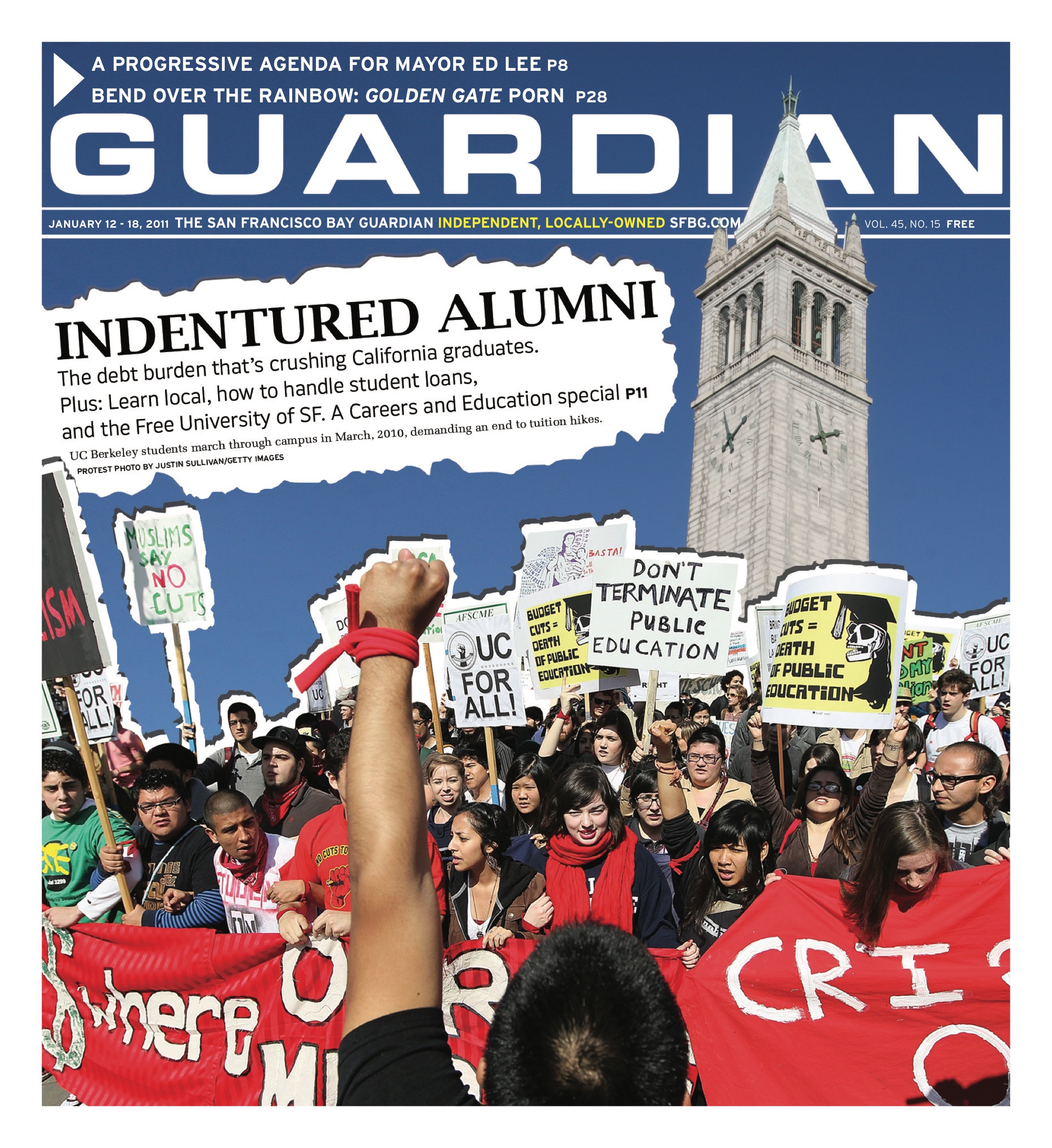
CAREERS AND ED When the University of California Board of Regents met Nov. 17, 2010 to approve an 8 percent tuition hike, roughly 300 UC students who were furious about the decision converged outside the University of California, San Francisco (UCSF) campus at Mission Bay to rally in opposition, some traveling from as far away as Los Angeles.

“We had been organizing with all the campuses to get students to come up because we really wanted to be there to let them know that it’s not what we want, and it’s something they can’t just get away with doing year after year,” said UC Student Association President Claudia Magana. The protests were raucous, and police cracked down by discharging pepper spray and making 13 arrests.

Despite the palpable fury outside and impassioned student opposition delivered to the Regents inside, the 8 percent fee increase was approved. It came on the heels of a 32 percent tuition increase imposed the year before, and the price was ratcheted up by 9 percent and 7 percent in the years prior to that.

The tuition hikes were steep, but hardly new. Indeed, the cost of attending UC schools has been rising steadily for quite a while. According to a study by economist Peter Donohue, student tuition and fees increased 277 percent from 1990-91 to 2008-09, and that was prior to the 40 percent increase that followed. That trend is repeated in rising costs at the California State University and California Community College systems (See “Access Denied,” April 6, 2010).

Student protesters have sought to make it clear that their outrage isn’t rooted in selfish unwillingness to shell out more money, but instead is linked to a broader concern about privatization and the increasingly limited accessibility of public education.

Magana expressed concern that the climbing cost of instruction at UC, though still a relative bargain compared with private institutions, would ultimately start to affect who could and couldn’t attain higher education through the public university system. The question isn’t limited to UC — tuition is increasing at public and private colleges across the board, and as income inequality sharpens, more students seek higher education.

“Students will always pay to be here,” she noted. “The issue is going to be, which students are here? That’s really the big problem — the huge class issue that’s going to come up. Although there are some forms of support for low-income students, it’s not easy.”


DEEPER IN DEBT

Rising costs at UC mirror the upward trend at private nonprofit and for-profit postsecondary institutions nationwide, and those higher prices have triggered a dramatic increase in student borrowing. While students from low- or medium-income families can access higher education at any institution they’re admitted to as long as they’re willing to take out significant sums in student loans, many find themselves at a serious disadvantage once they have to start repaying their debt.

A study conducted by the Public Interest Research Group (PIRG) noted that hefty debt burdens often dissuade graduates from pursuing careers in teaching, social work, the nonprofit sector, or other low-paying occupations that foster social justice. PIRG found that 23 percent of public four-year college grads and 38 percent of private four-year college grads were saddled with too much debt to manage paying back student loans on a starting teacher’s salary.

For students pursuing careers as social workers, the economic bind looked even worse: 37 percent of public school grads and 55 percent of private school grads with student loans wouldn’t be able to manage repayment with starting salaries in that field, the study concluded.

“Because students with lower incomes are more dependent on student loans than higher income students, students who already face significant challenges to attending college will more strongly feel the effect of loan debt on career choice,” the report points out.

“It’s a serious problem for so many young people to be starting out their working life so deep in debt,” said Edie Irons, spokesperson for The Institute on College Access and Success (TICAS), an Oakland-based research organization. “It really does limit people’s ability to take advantage of the opportunities education is supposed to provide. In concrete terms, it can make it really hard to buy a house, or start a business, or start a family, or go back to grad school, or to save for retirement or your own children’s education. And that’s all assuming you can keep up with the payments.”

Student loan debt has intensified over the past two decades. In 1993, just one third of all four-year college students graduated with debt, owing on average slightly more than $9,000, according to PIRG.

Today, the majority of college students take out loans to finance their education. Around 62 percent of public university students graduate with student loans, as do 72 percent of students attending private nonprofit institutions, and 96 percent of students attending for-profit institutions such as the University of Phoenix or the Academy of Art University, according to TICAS. Nationally, students graduate owing an average of $24,000, not counting debt associated with advanced degrees.

While young people must invest more than ever before to obtain higher education, the return on investment isn’t showing signs of improvement. The expected median income for UC graduates has stayed the same over the last decade, even as the cost of tuition has ballooned.

What’s more, says Bob Meister, president of the Council of UC Faculty Associations and professor of Political and Social Thought at UC Santa Cruz, is that an estimated 40 percent of public university students entering the workforce will either be unable to find a job, or will land in a lower-paying job that doesn’t require a college degree.

“For college graduates under 25, the unemployment rate is nearly as high as the national unemployment rate,” around 10 percent, Meister notes. “Over the past decade, what’s happened is that the median hasn’t risen. The top has risen very fast, and the bottom has fallen.”


IN A DIFFERENT CLASS

There’s no doubt that diminished state funding is affecting California’s public universities.

“A lot of departments are being eliminated, and a lot of professors who are really amazing are leaving to other universities,” Magana says. “And the waiting lists for classes are just ridiculous.” Academic goals are being compromised — for example, students had to abandon their push for an ethnic studies program at UCSC, she added, because the American studies department that would have partially supported it was slashed.

While diminished public funding has been used to explain the need to raise tuition, Meister has published numerous essays suggesting that the root cause of rising tuition costs at UC goes deeper than that, and he has gone so far as to publicly encourage students not to accept higher tuition without first demanding financial information.

Meister previously served on the UC budget committee and has observed the institution’s evolving financial policies for years. He doesn’t seem surprised that tuition is going up, regardless of what condition the economy is in or what amount of public funding is available because, as he puts it, “the universities will cost as much as they can.” UC had long sought to boost revenue by raising tuition, he noted, yet its leaders feared a rollback in state funding in response. But that changed under Gov. Arnold Schwarzenegger, who agreed to increase state support only on condition of that UC in turn require students to contribute more.

Around the same time that Schwarzenegger provided this new incentive to raise tuition, UC pooled its various revenue streams into a consolidated general revenue fund, Meister said, a departure from the old way of keeping separate accounts. This new fund, which included all non-state revenue and funding that wasn’t legally required to be used for certain purposes, could be pledged entirely as collateral for bonds for new construction projects, greatly increasing the institution’s borrowing power and boosting its revenue with the addition of new facilities.

To maintain its stellar bond rating, UC had to ensure an increase in revenues, according to Meister’s explanation, and to do that, UC ratcheted up the one source of revenue it had full control over: tuition. Meister laid bare this financial play in a 2009 open letter to students, titled “They Pledged Your Tuition.” Since it was published, a small corps of student activists has become deeply engaged in studying campus finance documents and airing criticism of financial policies.

Just before the Nov. 17 protests at UCSF Mission Bay, Meister published another open letter, this one addressed to UC President Mark Yudof. This one contemplated, “Why they think they can increase revenues regardless of how fast the economy grows … and regardless of whether the income of graduates is stagnant.”

His answer is somewhat surprising: “Their ability to raise tuition is a function of the growth of income inequality,” he told the Guardian. In the letter, Meister charges, “In the 21st century, when almost all income growth has been in the top 1 to 2 percent of California’s population, UC is still marketing income inequality to students as its most important product. It now expects all students to pay more for an ever-shrinking chance of reaping the ever-growing rewards that our economy makes available to the few. Your plan to increase revenue through tuition growth is feasible, of course, only because the federal government still allows students to borrow more for education despite the greater likelihood that they will not be able to repay — student loans may be the last form of subprime credit available in our economy.”

His theory highlights a paradox. “Being in the have-not category is increasingly worse,” he explains, “and so they are willing to take on more debt, which actually dampens their prospects for income growth.”

The question now is what will happen under Gov. Jerry Brown, who is likely to take a different stance toward rising tuition than Schwarzenegger but nonetheless is expected to unveil harsh cuts to education as a way to address a $26 billion budget deficit.

In a recent interview with the San Francisco Chronicle, UC Regent Richard Blum indicated that it probably would not be feasible to raise tuition again, so the message was that students should brace for more cuts to education.

When Brown unveiled his proposed budget on Jan. 10, he announced further cuts to higher education in California to balance the state budget. Brown’s revised 2010-11 budget decreases the state funding for UC, CSU, the community college system, and other higher education programs by $1.7 billion for the 2011-12 budget. The UC system would take a 13.3 percent hit in general fund support; the proposed cut to the CSU system is 12.5 percent; and the community college system would be cut by 6.9 percent.

Brown, who also wants to hold a special election to ask voters to maintain the current level of tax rates for income, sales, and vehicle license taxes for five years rather than let them expire later this year, expressed regret about making cuts to higher education. But he emphasized the need to make tough decisions in the face of a bleak financial outlook, saying, “We need to face the music.”

Editor’s Notes

2

tredmond@sfbg.com

Former Mayor Willie Brown says that choosing a person of color for a leadership position should be a progressive value. Board of Supervisors President David Chiu says the new mayor, Ed Lee, is a progressive. Several supervisors and other political observers say the six-vote progressive majority on the board is gone.

And nobody really talks about what that word means.

Progressive is a term with a long political vintage, but it’s changed (as has the political context) since the 1920s. (Progressives these days aren’t into Prohibition.) So I’m going to take a few minutes to try to sort this out.

I used to tell John Burton, the former state senator, that a progressive was a liberal who didn’t like real estate developers. But that was in the 1980s, when the Democratic Party in town was funded by Walter Shorenstein and other developers who were happy to be part of the party of Dianne Feinstein, happy to be liberals on some social issues (Shorenstein insisted that the Chamber of Commerce hire and promote more women), and happy to promote liberal candidates like John and Phil Burton for state and national office — as long as they didn’t mess with the gargantuan money machine that was high-rise office development in San Francisco.

But these days it’s not all about real estate; it’s that the level of economic inequality in the United States has risen to levels unseen since the late 1920s. So I sat down on a Saturday night when the kids went to bed(yeah, this is my social life) and made a list of what I think represent the core values of a modern American progressive. It’s a short list, and I’m sure there’s stuff I’ve left off, but it seems like a place to start.

This isn’t a litmus test list (we’ve endorsed plenty of people who don’t agree with everything on it). It’s not a purity test, it’s not a dogma, it’s not the rules of entry into any political party … it’s just a definition. My personal definition.

Because words don’t mean anything if they don’t mean anything, and progressive has become so much of a part of the San Francisco political dialogue that it’s starting to mean nothing.

For the record: when I use the word "progressive," I’m talking about people who believe:
1. That civil rights and civil liberties need to be protected for everyone, even the most unpopular people in the world. We’re for same-sex marriage, of course, and for sanctuary city and protections for immigrants who may not have documentation. We’re also in favor of basic rights for prisoners, we’re against the death penalty, and we think that even suspected terrorists should have the right to due process of law.
2. That essential public services — water, electricity, health care, broadband — should be controlled by the public, not by private corporations. That means public power and single-payer government run health insurance.
3. That the most central problem facing the city, the state, and the nation today is the dramatic upward shift of wealth and income and the resulting economic inequality. We believe that government at every level — including local government right here in San Francisco — should do everything possible to reduce that inequality. That means taxing high incomes, redistributing wealth, and using that money for public services (education, for example) that tend to help people achieve a stable middle-class lifestyle. We believe that San Francisco is a rich city, with a lot of rich people, and that if the state and federal government won’t try to tax them to pay for local services, the city should.
4. That private money has no place in elections or public policy. We support a total ban on private campaign contributions, for politicians and ballot measures, and support public financing for all elections. Corruption — even the appearance of corruption — taints the entire public sector and helps the fans of privatization, and progressives especially need to understand that.
5. That the right to private property needs to be tempered by the needs of society. That means you can’t just put up a highrise building anywhere you want in San Francisco, of course, but it also means that the rights of tenants to have stable places for themselves and their families to live is more important than the rights of landlords to maximize return on their property. That’s why we support strict environmental protections, even when they hurt private interests, and why be believe in rent control, including rent control on vacant property, and eviction protections and restrictions on condo conversions. We think community matters more than wealth, and that poor people have a place in San Francisco too — and if the wealthier classes have to have less so the city can have socioeconomic diversity, that’s a small price to pay. We believe that public space belongs to the public and shouldn’t be handed over to private interests. We believe that everyone, including homeless people, has the right to use public space.
6. That there are almost no circumstances where the government should do anything in secret.
7. That progressive elected officials should use their resources and political capital to help elect other progressives — and should recognize that sometimes the movement is more important that personal ambitions.

I don’t know if Ed Lee fits my definition of a progressive. He hasn’t taken a public position on any major issues in 20 years. We won’t know until we see his budget plans and learn whether he thinks the city should follow Gavin Newsom’s approach of avoiding tax increases and simply cutting services again. We won’t know until he decides what to tell the new police chief about enforcing the sit-lie law. We won’t know until we see whether he keeps Newsom’s staff in place or brings in some senior people with progressive values.
I agree that having an Asian mayor in San Francisco is a very big deal, a historic moment — and as Lee takes over, I will be waiting, and hoping, to be surprised.

Appetite: Mixology times two

0

BERETTA MIXOLOGY CLASSES — Class is equal parts learning and pleasure at Beretta during their monthly Monday educational cocktail classes led by Bar Manager Ryan Fitzgerald. Ryan is one of our city’s great bartenders and he shares his ability to showcase the essence of a drink with you. Set up with your own station of bar utensils and ingredients, you’ll experience an interactive two hours with a small group in Beretta’s basement. Shake and stir — learning when it’s appropriate to do each — as you sample your creations. Whether you study whiskey on January 24, tequila (Ryan’s particular passion) on February 21, or gin on March 21, you’ll come away with recipes both classic and modern, artisan but not so complicated that you can’t recreate them easily at home. And it’s all in the name of education.

$85 per person for class, cocktails, and nibbles of food (includes tax and gratuity)

$55 + tax for tools used during the class (optional)
*Class does NOT include tools, they must be purchased separately.

Beretta, 1199 Valencia Street
415-695-1199
Whiskey – January 24, 7-9pm
Tequila – February 21, 7-9pm
Gin – March 21, 7-9pm

Doug Williams makes liquid nitrogen cocktails at last year’s Science of Cocktails. Photo by Virginia Miller.

SCIENCE OF COCKTAILS — Science of Cocktails returns for its second year at the Exploratorium. The inaugural year impressed me despite the dozens of cocktail events I attend in any given year. Scientific displays turn drink-making into scientific art exhibit (for example, watch a shell-less egg being ‘cooked’ with alcohol). Sip your way through one interactive display after another. You may witness a liquid nitrogen cocktail being prepared or learn Japanese hard-shake techniques while sampling cocktails like last year’s layered SF Pousse Cafe from The Alembic or 83 Proof’s use of ingredients from jalapeno skin and toasted peppercorn to Darjeeling simple syrup. Price of admission includes unlimited hors d’oeuvres, demos, a number of cocktails, live entertainment and full reign over the Exploratorium. Bartenders (from 15 Romolo to Rye) and spirit sponsors (from Campo de Encanto Pisco to St. George Spirits/Hangar One) are top notch. Science exhibits were never quite this fun when you were a kid.
$120
January 26, 7:30-11pm
Exploratorium, 3601 Lyon Street
415-561-0360
visit.exploratorium.edu/events/science-of-cocktails

–Subscribe to Virgina’s twice monthly newsletter, The Perfect Spot: www.theperfectspotsf.com

What progressive means

85

Willie Brown says that choosing a person of color for a leadership position should be a “progressive” value. David Chiu says Ed Lee is a progressive. Several supervisors, and other political observers, say the six-vote progressive majority on the board is gone.

And nobody really talks about what that word means.

Progressive is a term with an excellent political vintage, but it’s changed (as has the political context) since the 1920s. (Progressives these days aren’t into prohibition.) So I’m going to take a few minutes to try to sort this out.

I used to tell John Burton that a progressive was a liberal who didn’t like real estate developers, but that was in the 1980s, when the Democratic Party in town was funded by Walter Shorenstein and other developers, who were happy to be part of the party of Dianne Feinstein, happy to be liberals on some social issues (Shorenstein insisted that the Chamber of Commerce hire and promote more women) and happy to promote liberal candidates like John and his brother Phil for national office – as long as they didn’t mess with the gargantuan money machine that was highrise office development in San Francisco.
Arguing that Shorenstein’s economic agenda was driving up housing prices, destroying low-income neighborhoods and displacing tenants was a waste of time; the liberals like Burton (who also represented real estate developers as a private attorney) weren’t interested.

But these days it’s not all about real estate; it’s about the fact that the level of economic inequality in the United States has risen to levels unseen since the late 1920s, and the impacts are all around us. And it’s about (Democratic) politicians in San Francisco blaming Sacramento, and (Democratic) politicians in Sacramento blaming Washington, and the Democratic Party in the United States abandoning economic equality as a guiding principle.

So I sat down on a Saturday night when the kids went to be (yeah, this is my social life) and made a list of what I think represent the core values of a modern American progressive. It’s a short list, and I’m sure there’s stuff I’ve left off, but it seems like a place to start.

For all the people who are going to blast me in the comments, let me say very clearly: This isn’t a litmus-test list (we’ve endorsed plenty of people who don’t agree with everything on it). It’s not a purity test, it’s not a dogma, it’s not the rules of entry into any political party … it’s just a definition. My personal definition.

Because words don’t mean anything if they don’t mean anything, and progressive has become so much of a part of the San Francisco political dialogue that it’s starting to mean nothing.
For the record: When I use the word “progressive,” I’m talking about people who believe:

1. That civil rights and civil liberties need to be protected for everyone, even the most unpopular people in the world. We’re for same-sex marriage, of course, and for Sanctuary City and protections for immigrants who may not have documentation. We’re also in favor of basic rights for prisoners, we’re against the death penalty, and we think that even suspected terrorists should have the right to due process of law.

2. That essential public services – water, electricity, health care, broadband – should be controlled by the public and not by private corporations. That means public power and single-payer government run health insurance.

3. That the most central problem facing the city, the state and the nation today is the dramatic upward shift of wealth and income and the resulting economic inequality. We believe that government at every level – including local government, right here in San Francisco – should do everything possible to reduce that inequality; that means taxing high incomes, redistributing wealth and using that money for public services (education, for example) that tend to help people achieve a stable middle-class lifestyle. We believe that San Francisco is a rich city, with a lot of rich people, and that if the state and federal government won’t try to tax them to pay for local services, the city should.

4. That private money has no place in elections or public policy. We support a total ban on private campaign contributions, for both politicians and ballot measures, and support public financing for all elections.

5. That the right to private property needs to be tempered by the needs of society. That means you can’t just put up a highrise building anywhere you want in San Francisco, of course, but it also means that the rights of tenants to have stable places for themselves and their families to live is more important than the rights of landlords to maximize return on their property. That’s why we support strict environmental protections, even when they hurt private interests, and why be believe in rent control, including rent control on vacant property, and eviction protections and restrictions on condo conversions. We think community matters more than wealth and that poor people have a place in San Francisco too — and if the wealthier classes have to have less so that the city can have socio-economic diversity, that’s a small price to pay. We believe that public space belongs to the public, and shouldn’t be handed over to private interests; we believe that everyone, including homeless people, has the right to use public space.

6. That there are almost no circumstances where the government should do anything in secret.

7. That progressive elected officials should use their resources and political capital to help elect other progressives – and should recognize that sometimes the movement is more important that their own personal ambitions.

I could add a lot more, but I think those six factors are at the heart of what I mean when I talk about progressives. We support a lot of other things; I put the right of workers to unionize under Number 3, since unions (along with public schools and subsidized higher education) are one of the major forces behind a stable middle class and a more equal society. We think racism and homophobia are never acceptable, and we support affirmative action, but that goes under Number 1.

This is not a socialist manifesto; I never mentioned worker control of the means of production. Progressives don’t oppose private enterprise; they just think that some things essential for the good of society don’t belong in the private sector, and that the private sector should be regulated for the good of all of us. We trust and support small businesses much more than big corporations – and we think their interests are not the same.

I don’t know if Ed Lee fits my definition of a progressive. We won’t know until we see his budget plans, and learn whether he thinks the city should follow Gavin Newsom’s approach of avoiding tax increases and simply cutting services again. We won’t know until he decides what the tell the new police chief about enforcing the sit-lie law. We won’t know until we see whether he keeps Newsom’s staff in place or brings in some senior people with progressive values. We know that the people who pushed him to take the job aren’t progressives by any definition, but you never know. I agree that having an Asian mayor in San Francisco is a very big deal, an historic moment — and when Lee takes office, I will be waiting, and hoping, to be surprised.

The Performant: Child’s play

0

The Mission gets a lot of ink these days for being a nexus of youthful, responsibility-free hipsterdom — but despite the skinny jeans and thick mustaches, the neighborhood still retains a surprisingly family-friendly vibe. For one, it’s still rife with community arts spaces, so it’s a good place for kids to get involved creatively: from Loco Bloco percussion classes, to brass band and capoeira courses at the Mission Cultural Center and Precita Eyes‘ lessons in mural installation.

Thanks in large part to the winter holidays, December is a great time to explore the youth arts scene as next wave performers strengthen their stage chops and strut their stuff and this last weekend played host to some of the best and brightest of these stage openings.

First up: the Community Music Center held their annual La Posarela at the Victoria Theatre. The production was a combination of Mexico’s traditional December plays, the posadas and pastorelas, which are both Catholic theatrical rites meant to re-enact the story of the birth of the baby Jesus. CMC’s starred members of its various classes and groups, including its children’s chorus, Latin vocal workshop, Coro del Pueblo, and Mission District young musicians programs.

In the flower of their youthitude: Revolutionary Nutcracker Sweetie plays Brava

Other youth openings included the Marsh Youth Theatre‘s relaunch of its now-perennial Siddhartha: The Bright Path and Krissy Keefer’s revamped Revolutionary Nutcracker Sweetie, which took the stage at the Brava Theater Center and was adapted for Dance Brigade’s various youth dance programs: beginning ballet was represented, as was hip-hop, belly dance, and taiko drumming.

A note on this last show: there’s something strangely inspiring about watching a group of determined girls wallop the heck out of a sturdy row of giant drums, fight off the annoying machinations of a pack of devious rats, overcome racial innuendo and classism, and dress up as jellyfish all in one production — and though pop culture references abounded throughout the production (party guests included Lady Gaga and the Jersey Shore kids), the delicate snowflake core of The Nutcracker did not melt under their onslaught. 

Like Waters for (hot) chocolate: the infamous film knave plays a holiday show at the Roxie. Photo by David Magnusson

But of course the Mission would not be the Mission if there weren’t holiday treats for big kids too, and John Waters’ appearance at the Roxie Theatre‘s 101st anniversary fundraiser was definitely one of those. After waxing rhapsodic about the possibility of receiving sticks and stones curated by artists such as Richard Serra, pulp fiction bookstore KAYO Books, and Alvin and the Chipmunks, he moved on to sharing his holiday wishlist of big ideas. This included opening a movie theater with gay and straight water fountains just to watch the fur fly, hosting an abortion film festival, going on a “Don’t Ask, Don’t Tell” USO Tour with Beth Ditto, Pee Wee Herman, and Iggy Pop, and having a nervous breakdown onstage.

As it was, no-one had a nervous breakdown at all — but here’s hoping at the very least Waters’ less comedic desire to see the Roxie thrive for another 101 years will be fulfilled.

School kids and Muni

6

So SFUSD just decided to cut half of its school bus routes (including, I believe, one that my son sometimes takes to Aptos Middle School). I should be outraged — but I’m not. Jerry Brown has made it clear that even if he raises taxes, it’s going to be an ugly year for schools and everyone else, and I’d rather see cuts in transportation than in teachers and classes.


But if this is the approach, then the city and the school district need to do a better job coordinating around Muni.


Elementary school kids shouldn’t be on Muni; I’d save the school bus routes for them. But older kids can use the city system, and many do — and more would, if it were just a little easier.


My son often takes Muni after school — to the library, to his Tae Kwon Do class — and soon I’ll let him ride the bus home. But to buy him a youth pass, I have to take him personally to a Muni pass outlet, once every month, and it’s a pain. I understand why they won’t sell me a youth pass for my kid; I could cheat (well, nobody would really believe I was under 18, sigh; I don’t even get carded in bars). But why don’t they sell youth passes in the schools? 


It would be pretty simple: Muni issues a number of youth passes to each middle school and high school, the schools sell them out of the office and hand kids Muni maps with routes near the school marked off. I can use Nextbus to tell my son when to head out to the bus stop; there’s no reason the schools couldn’t do that, too. Post the schedules; sell the passes. Maybe even change a few Muni routes to make them more convenient for students.


It seems silly for a city as geographically small as San Francisco to have two parallel transportation systems. With a little creativity Muni could work for the schools, too. 

Class of 2010: Jane Kim

7

steve@sfbg.com

Despite fears that a candidate backed by downtown could replace firebrand progressive leader Sup. Chris Daly in District 6, in the end it was the two progressive candidates — Jane Kim and Debra Walker — who finished far in front of the large pack of candidates, with Kim winning the race. And she thinks that says something about how the progressive movement has matured.

“To have the two leading candidates be progressives says a lot about the progressive political community,” Kim said. “The race was really between Debra and me in end.”

Kim, a 33-year-old attorney and the outgoing president of the San Francisco Board of Education, has been active in progressive politics in San Francisco for many years, from doing community organizing with the Chinatown Community Development Center to running the short-lived San Francisco People’s Organization, which Daly helped create.

Yet part of her campaign strategy, and the message that she’s sending in the wake of an election that divided the progressive community, focuses on issues and themes that are more common to political moderates: job creation, clean streets, public safety, and neighborhood services.

“I think it’s important for progressives to cross over, and I don’t think it should be viewed as selling out,” Kim told us. “Progressives need to do a good job at maintaining voters’ faith in the progressives’ ability to lead.”

In addition to courting progressive groups and voters, Kim’s campaign aggressively targeted residents of the residential condo towers in Rincon Hill and Eastern SoMa, voters who are generally more affluent and newer to San Francisco than the typical progressive constituencies.

“It’s a lot of new residents who don’t feel like they’re a part of any political faction and they’re really open,” Kim said. “People just want to see that things are better. They want the streets to be clean and safe.”

With a new mayor and new blood on the Board of Supervisors, Kim said this is an important political moment for San Francisco, “a huge opportunity” to redefine San Francisco politics in the wake of Mayor Gavin Newsom and progressive supervisors such as Aaron Peskin, Matt Gonzalez, Tom Ammiano, and Daly.

“The Class of 2000 was able to show how progressive we can be with policy. They really pushed the envelope,” Kim said, citing new worker and tenant protections and programs such as Healthy San Francisco. Now, she said, the challenge for progressives in the Classes of 2010 and 2008 is to show that they can provide effective leadership in realms like public safety and economic development. “If we’re able to lead on those two issues, it would really firm up our leadership of the city,” Kim said, noting that it would also affect the dynamics of next year’s mayor’s race.

While Kim didn’t go into detail about how she intends to deal with what she says is the biggest challenge facing the new board — a budget deficit of $700 million over two years, coming at a time when all the easy cuts have already been made in recent years — she said the city needs to be aggressive in boosting the local economy and ensuring San Franciscans get most city contracts.

“We need to figure out how we can partner with small business to create a diversity of jobs in San Francisco,” she said, noting that the average San Franciscan has more faith in the moderates’ ability to create jobs, something that progressives need to address. But how can she help break the grip that the conservative San Francisco Chamber of Commerce has on small businesses?

“Part of the problem is that small businesses aren’t organized,” Kim said, noting how that hurt Sup. David Chiu’s ability to win support this year for his business tax reform measure that would have helped most small businesses and made some large corporations pay more taxes. “They’re busy running their businesses and they don’t have the time to look at the details, so they just read the briefing of the Chamber of Commerce.”

Kim said she respects the leadership role Daly has played in progressive politics and that she’d “like to be part of the moral compass of the Board of Supervisors.” But she also said that Daly’s sometimes abrasive style unnecessarily hardened the opposition of moderates to important progressive issues.

“He made it harder to talk about affordable housing,” Kim said, noting that the city’s dearth of affordable housing should be an issue that’s important to middle class voters, noting that it includes housing for people who earn up to 120 percent of the median income for the region. But after Daly hammered on the issue, “It was like a bad word coming out, and people would turn off to the issue.”

But she thinks it’s a fixable problem if she and her allies do the hard work, an ability they demonstrated this year by defeating Walker, who had been running for the seat for years and lining up all the key endorsements. “Voters do respond to campaigns that work really hard, and that bodes well for progressives,” Kim said, noting that she intends to reach out to Walker’s supporters. “I don’t think I can be successful as a supervisor if I don’t work with all the camps in the progressive community.”

Rec & Park trashes HANC Recycling Center

At yesterday’s Recreation & Park Commission meeting on Dec. 2, hundreds of San Francisco residents turned out to urge commissioners not to replace the Haight Ashbury Neighborhood Council (HANC) Recycling Center with a community garden. Their pleas fell on deaf ears.

It didn’t matter that a sunnier spot for a community garden had already been identified in the same area, with funding approved by the commission more than a year ago. It didn’t matter that thousands of people use the recycling center every month, and that the nonprofit bolsters community gardens throughout the city with donations and funding. It didn’t matter that we’re in a recession and there were jobs on the line. It didn’t matter that HANC pays rent to a city department facing a $12.5 million deficit, but the community garden would cost $250,000.

All that mattered in the end was that Rec & Park, and Mayor Gavin Newsom, wanted the HANC recycling center out. They thought removing it might discourage homeless people from sleeping in the park and hanging around the neighborhood. After nearly four hours of listening to residents urge them not to do it, the commissioners yawned and pushed the eject button. They unanimously voted in favor of the community garden. A 90-day eviction notice is expected to go out to HANC today.

The fight over HANC’s eviction has been described as a political battle between progressives and moderates, a showdown between heroes who stand up for public safety versus intimidating thugs and the lefties who enable them, and even a sequel to the sit /lie controversy. I think there’s an 800-pound gorilla sitting in the middle of this fight that no one wants to talk about: Class.

Community gardens are wonderfully empowering. I used to volunteer at one at a public housing complex in North Carolina. It was especially important for people who lived in that low-income community, since they benefited from nutritious produce that also lowered their grocery bills. Under the city’s plan for this new, gated community garden, 30 of the 40 garden plots will go to area residents. Given the affluence of that neighborhood, the garden beds will likely go to people who can afford organic groceries at Whole Foods without breaking into a sweat. For well-to-do San Franciscans, growing produce is not a means of survival — it’s about feeling good, and being green. By itself, there’s nothing wrong with that.

The problem is that it will be installed at the expense of a long-standing community resource that employs 10 people and lightens the load for hundreds of others during a recession, when people are truly struggling to get by. The Rec & Park Commission has essentially decided that this parcel of public space should be taken from a nonprofit that benefits people of all classes, and given to a small number of residents who’ve voiced complaints about “quality-of-life issues.”

In its current function, the HANC Recycling Center is empowering to many different kinds of people. Most aren’t homeless. Tough-as-nails Asian grandmas show up with bags full of cans that they can exchange for some extra spending money. Urban gardeners purchase native plants in hopes of pleasing native insects and birds. People on fixed incomes get a small financial boost by turning in recyclables.

A small number of the HANC Recycling Center patrons do sleep outside. In order to earn small amounts of cash for things like food, many of them have to go digging around in garbage cans, which is gross and humiliating. Why would someone paw through the garbage for hours, battling bees and germs, and then haul smelly bottles uphill in a shopping cart just to make a few bucks? My guess is that it’s to ward off desperation. They make their own work, and they get to eat.

“Some of them may use drugs,” one of the speakers acknowledged last night. “But,” he paused for dramatic effect. “Some of us use drugs, too.”

When sit / lie was under debate, critics wondered where the homeless were supposed to go, if they couldn’t sit on the sidewalks. Often, the reply was that they could go to the parks. But this latest attack on the homeless shows that they aren’t welcome there, either.

This is an opinion piece.

One latte, art therapy on the side

2

What will your art look like when you have trouble remembering your last painting — or offspring? On the week of next, you’ll be able to sip your Cafe International espresso and ponder the answer. In the cafe’s new art installation, one-third of the pieces on the walls will be by Alzheimer patients (Tues/7). 

What you can look forward to: “The pointillist and – let’s call it aboriginal flavor of some of the work can be seen as a common trait,” says Patricia Ris, co-curator of the exhibit. “Some artists will bend their vertical lines, and there seems to be a tendency toward some aspects of surrealism and superimposition. But I’m being very unscientific here.” 

Ris (a creative activities coordinator at an SF adult day care center) and gerontologist-theater artist Caitlin Morgan of the Alzheimer’s Association decided to bring attention to their innovative work with seniors by integrating their art into the Care International’s regular wall fare of professional etchers and sketchers. 

The pieces are created as part of a therapeutic program that allows patients to take their mind off of memory loss for a moment. With the help of an instructor, Alzheimer’s sufferers create vivid canvas evocations that can bring up elemental reactions in the viewer. In one, a red-headed woman holds a hand over her shocked face — a key indication at discomfort over what is coming out of her mouth.  

Morgan also runs weekend camps for these older folk that not only give caretakers a chance to have a 24-hour period to focus on their own lives, but also give the Alzheimer’s patients a chance to try some new things. A recent NPR piece on her work highlighted Morgan’s focus on letting patients do what they feel needs to be done – telling a grandmother who insists she’s late for school that there’s no classes that day, or letting an elderly ex-carpenter work at a chair leg for the better part of an hour with invisible tools. It’s all a part of “reading between the lines,” fostering that interior mind that can seem to be in jeopardy for many people, but that is often just struggling to adjust to a new world. 

“Having worked with many Alzheimer’s patients who have lost their word-finding ability, I have seen firsthand, over and over, that art is a way for them to express what words no longer can,” says Morgan, who first came into contact with senior citizen patients while she was performing with a traveling theater troupe. She says that art can be a method of alleviating frustration for those that can’t deal with early symptoms of the disease – as well as a way of describe the weird, wacky world that they are coming into contact with through their memory loss. “The connection between Alzheimer’s and art is one of necessity,” concludes Ris. 

Morgan says that the work of Alzheimer’s patients probably shouldn’t be judged by the same yardsticks as other coffee shop work, that it’s primary use is that of therapy for the artist themselves. But I can imagine sitting next to Maurice’s eerie bird-woman, or Patricia’s bouquet of impressionist flowers and reflecting on an entirely different breed of cleansing: that life — even in the midst of degenerative disease — will go on and on, and in color no less.

(From top to bottom, paintings by Tamara, Maurice, and Patricia)

“Painting from the Heart: Alzheimer’s Art”

Opening reception Tues/7 6-9:30 p.m., free

Cafe International

508 Haight, SF

(415) 867-4617


What the Dickens

5

caitlin@sfbg.com

DAYS OF YORE For some, the holidays mean a frenzied stagger through the mall or a return to the cocoon of familial love. Others simply curl into a fetal position and try to block out consumerism’s bland canned tinkle of bells.

But for many in the Bay Area, the holidays mean donning some crinoline, a corset, or a snappy cravat and traipsing about a maze of freshly built village streets — engaging perfect strangers with a faux Victorian British accent. Such is life at the Great Dickens Christmas Fair, a nine-day event celebrating its 32nd year of “‘Appy Christmas, guv’nuh!”

In a foul, holiday-incurred blackness of a hangover, I was learning about the intricacies of epochal mass delusion in the Dickens family parlor — a party of cucumber sandwiches and polite conversation in a cozy corner of the Cow Palace, where the fair is set. Kevin Patterson, a beaming dandy of a man, greeted me with a blast of British cheer, although we quickly settled back into Californian when my somewhat reduced energy level and clumsy manhandling of a porcelain teacup became apparent.

Patterson’s parents started the fair, inspired by the sartorial glee of the Renaissance Pleasure Faire. “It was a natural shift from Queen Elizabeth and Shakespeare to Queen Victoria and Charles Dickens,” he tells me. Three generations of his family are now involved in its production, including his children and wife, Leslie. He says a fair of this kind exists nowhere else, not even in merry olde England.

I’m trying to figure out what makes a person want to be a part of such an involved pantomime. The three acres of Dickensian playground are host to more than 800 performers. There are the can-can girls flashing their bloomers at Mad Sal’s dockside alehouse, Father Christmas, homeless drunks, even the queen herself, who promenades past us to the loud delight of the waitstaff inside the family parlor.

The cast also includes a shriveled Scrooge (who is flown over from England specifically to play the role), dogs, and small children. Here and there dart 10-year-old boys delivering telegrams. Everyone is speaking in some approximation of Victorian dialect, and most seem reluctant to break through their shamming — we run into a belligerent William Sykes, apparently prior to being deported to Australia on charges of manslaughter, in one of the fair’s five (!) bars at one point and are nearly put off our spiced mead by his growlings.

It’s all about the season, Patterson explains. He tells me that the Victorian era, the birthplace of the Industrial Revolution, was when many of the traditions we celebrate today came about. “It was a simpler time.”

Perhaps, but not if you base your impressions of, say, the costume guidelines for the hundreds of cheery participants (easily seen on the fair’s website), or the dialect instructions, or the weekly e-mail missives that gently remind players that cell phones were not a feature of 1800s England and are not to be brandished, even if it is to take a photo of the live corset models or — gasp! — Dickens himself. “Authenticity is important. Most people in our cast care so much about doing it right,” says Patterson.

The rules of conduct are so expansive that classes are offered at a nearby high school in the weeks leading up to the fair for those hoping to brush up on their speech, improvisation skills (all the better to create the “environmental theater” effect Patterson IS looking for) as well as how to make your own clothing. Most people in those days had to, you know.

But the casual visitor to the Great Dickens Christmas Fair need not adhere to all these strictures, though I did feel très gauche in my jeans and hooded sweatshirt. We spent most of our time in the “unsavory” parts of town where custom dictates glottal stops for words with double t’s, and “anyfink” instead of “anything.” You find the filthiest drunks thereabouts, not to mention the boozy pub songs of Mad Sal’s, and a boudoir photography booth to show off your new spendy corsetry from Hayes Valley’s Dark Garden.

Not to mention an absinthe bar (pouring some local brews), hair-braiding salons, an explorer’s club, steampunk wonder shows, tarot readers, meat pies, crafts galore — and the happenstance magic of coming across a bunch of Dickensians spontaneously acting out some scene of yore-ness, not because they’re being watched by a gawking family but because they really, really like playing out life in Victorian England.

In one such scene, two women were strumming mandolins on the floor, their tiny ankle boots peeking out from voluminous skirts. Around them a perfectly period audience looked on from chairs set against the walls. Even in my slightly dehydrated, deflated state, I could enjoy their dedication to this homey weirdness.

“It’s our family holiday. We look forward to celebrating it every year,” twinkles Patterson, as I bid adieu to the posh environs of the family parlor. Charles Dickens himself sees me out onto the fake street outside, thanking me for attending his fair.

GREAT DICKENS CHRISTMAS FAIR

Sat/4–Sun/5, Dec.11–12, Dec.18–19;

11 a.m.–7 p.m., $12–$25

Cow Palace

2600 Geneva, SF

1-800-510-1558

www.dickensfair.com


DREAM on

2

sarah@sfbg.com

Spurred by congressional Democratic leaders’ promises to hold a vote on the DREAM (Development, Relief, and Education for Alien Minors) Act before the end of Congress’ lame-duck session this month, immigrant and civil rights advocates are pushing for the passage of bipartisan legislation that would give undocumented youth a shot at citizenship if they go to college or serve in the military for two years.

On Nov. 29 in San Francisco, several undocumented young people joined members of the Bay Area Coalition for Immigration Reform outside Mission High School — where as much as 20 percent of the student population may be undocumented, according to principal Eric Guthertz — to explain why it makes sense to give youth who grew up in the United States a shot at legal status.

“We are not asking you to give us a green card,” Anna, a student from Guatemala, said at the event. “All we want is a chance to succeed and give back to this country. We live here, we pay taxes, we’re smart, we go to college, but afterward we can’t work and give back.”

Mario, a 22-year-old gay student who was born in Peru to a Chinese father and Peruvian mother, graduated from UC Berkeley with a civil engineering degree. He explained that because of his lack of documentation, he can’t get a job to pay his bills or save up to pursue a master’s degree, and fears being deported to a homophobic country.

“It would be a waste of talent because I’ve learned California-specific engineering rules and the U.S. building code,” Mario said. “Sometimes I wake up from a nightmare about being detained. I came out here, but in Peru, I’d probably be back in the closet.

Joining Anna and Mario was Shing Ma “Steve” Li, a nursing student at City College, who was released Nov. 19 after two months in federal detention, shortly before he was to be deported to Peru. San Francisco Democrat Sen. Dianne Feinstein introduced legislation to halt his removal, saying it would be “unjust” to deport Li before a DREAM Act vote takes place.

Li, who speaks Cantonese, English, French, and Spanish, grew up reciting the Pledge of Allegiance and dreams of opening a clinic to serve low-income San Franciscans. But recently, federal immigration authorities flew him 800 miles to a jail in Arizona, all because his parents brought him here when he was 12 and he lacks documentation.

“We were handcuffed and shackled to our seats, and I wondered what would happen if the plane went down,” Li recalled.

Li believes the main barriers to the legislation’s passage is lack of accurate information. “People need to know the facts, see the people, and hear their stories,” Li said. “Then they’ll know it is a human rights issue.”

Guthertz said that as principal of Mission High, every year he sees undocumented youth who have great grades and lots of advanced placement classes “hit the wall” of their status. “Over and over, I’ve seen the heartbreaking effect of their situation,” Guthertz said. “The DREAM Act is yet another avenue to help these students.”

Eric Quezada, executive director of Dolores Street Community Services, noted that congressional leaders did not agree to the DREAM Act vote “out of the goodness of their heart — it’s because of the hard work of immigrant advocates.”

Quezada said the push to force a DREAM Act vote in Congress this year began when undocumented youth staged a sit-in in Sen. John McCain’s (R-Ariz.) office in May. “And the vote of Latinos saved the Senate from a Republican takeover on Nov. 2,” he said.

“But we understand this window is closing,” Quezada added, referring to the reality that Republicans will take control of the House in January. “So we’re not taking one vote for granted. And this is the first step. If we are able to pass the DREAM Act, it will be a downpayment for comprehensive immigration reform.”

Sup. John Avalos says the DREAM Act recognizes the contribution immigrants make to the community, and to the creation of economic opportunities for everybody. “Immigrants here support themselves and their families across the water, so it makes sense that we make proper investments and support,” Avalos said. “Education is one way to make the world a more stable place.”

Sup. David Campos, who came to the U.S. from Guatemala as an undocumented teenager, sees the DREAM Act as a piece of commonsense legislation.

“It’s so modest,” Campos said. “Even those who are against comprehensive immigration reform should be for something that recognizes that young people, who came here not by choice but because of their parents’ issues, should be given a chance to give back.”

Campos said his father was able to gain legal status for his whole family because of his employment, but that many undocumented youth aren’t so lucky.

“We open the doors to our public schools, we invest in their education, and then, when they are ready to give back to us, we say, ‘No, we don’t want you here,'” Campos said. “The best and brightest, the risk-takers, come here. As a country, we cannot go forward unless we realize that this influx of creativity and entrepreneurship made this country what it is.”

The high harvest

0

caitlin@sfbg.com

CULTURE “There was some sweet in there and some spice — it was like finger food, you could eat it like chips.” Larry Medders, 11-year resident of the Cecil Williams Glide Community House, is showing off the new rooftop garden, installed by the San Francisco Zen Center, on top of his nine-story supportive housing complex. He’s talking about his introduction to kale.

Medders cooks for himself in his studio apartment and used to stick to the same meals. He likes pasta and herbal teas, which he now brews with the mint and chamomile growing upstairs. An older man from the South endowed with a becoming drawl, he comes up once a day “to water and make sure everything’s in its place.” At the opening ceremony for the new green space, Medders tried the iron-rich greens for the first time. “Now I’m hooked,” he says.

If a once-bare Tenderloin rooftop seems like an incongruous spot to grow spinach, carrots, lemons, blueberries, parsley, onions, and tomatoes (a few of the nascent crops at the Community House), it shouldn’t. The buzzing streets below Medders’ feet offer sparse play areas for children, occasional safety risks, and few places to buy fresh veggies.

The city has tried to attract grocery stores to the area, so far unsuccessfully. “Grocery store operators and other retailers perceive that the area is unsafe and have expressed concerns about the safety of their employees and customers,” says Amy Cohen, director of neighborhood business development. TL residents largely must content themselves with corner stores for neighborhood shopping trips — a bummer for low-income seniors who live in the area.

For the residents of Community House’s 55 units — many dealing with life post-addiction and homelessness and all low income — the roof was already a place to gather. Building barbeques were common. But they knew the rooftop could be much more. “I just wanted to see more greenery, because it really is beautiful,” Medders says.

Enter the San Francisco Zen Center (www.sfzc.org). The center has operated in tandem with Muir Beach’s Green Gulch Farm since the early 1970s, providing a green dojo for meditation students and producing organic produce for restaurants such as Greens in Fort Mason. Says Zen Center vice president Susan O’Connell, “the color green alone is calming, the oxygen and the sense of being surrounded by life.” Gardening can aid in one’s quest for enlightenment, she says. “Zen takes a lot of different forms, it’s not just sitting down.”

Taking inspiration from a garden next door on top of Glide Church, the Zen Center pledged to fill Community House’s communal space with veggies. Now 15 planter boxes built by construction training nonprofit Youth Builds stand at different heights so children and residents in wheelchairs can work them. There are compost bins, shaded tables, chairs, a sink where cooking classes will be held once a local artist finishes painting a mural on the surrounding wall.

The roof’s design, plotted by ex-Green Gulch apprentice Jamie Morf, is laid out so residents can socialize (when Medders and I toured the roof, three children were eating a late lunch on one of the round tables) as well as sit and be thoughtful in nooks designed with peace in mind. “One of the most important precursors to being able to meditate is called taking refuge. But that’s really hard for people in the Tenderloin,” O’Connell says.

We are joined by Patty Rose and Arlinda Van Brunt, two other long-term residents who, with Medders, have stepped up to form the core gardening group. The three teach me about the challenges of running a plot that belongs to every one of the residents living in a nine-story building, including many who have never tended a kitchen garden before. The learning curve can include beginner’s missteps, like overpicking a hardy green onion plant that the trio laments.

“Look at this,” Van Brunt, an energetic woman whose father’s landscaping career left her with a severe aversion to seeing mistreated plants, is pointing at a vertical potato cage that doesn’t seem to be producing the same bushy green leafs as its neighbor. “They overwatered it! It’s our first year, we’re still finding a lot of things out.”

But these kinds of small setbacks show that the garden is being used — and often, they lead to new discoveries in and of themselves. The aforementioned rotting potato cage attracted the notice of the roof’s nightcrawlers, which must have scooted the 10 feet between their two massive bins to the cage, where they were discovered by Van Brunt.

The composting process in the worm bins is now one of her favorite parts of the garden. With the aid of Medders, she lifts the heavy metal lid of one of the bins and pulls aside the shredded newspaper piled on top of the composting material. Underneath, there is a teeming, squirming mass of pink worms. Van Brunt tenderly fingers a handful of them. “Look at that, are they really breeding in there? The nastier it is, the more they like it,” she says, exhibiting the satisfaction of a woman who has taken charge of her food system.

Hot sexy events November 17-23

0

You think that time you had a bad dream and awoke abruptly to the sounds of creaking in the bedroom next door was bad? What if that scene was being filmed, and instead of mom and marital romanticism at issue, Dad was boning Bambi Woods to shouts of “More ass! I need to see more ass!”? Such was the life (well, maybe the filming itself wasn’t going down in his family abode) of Bobby Gordon. Dad in this case was Howie Gordon, Playgirl’s 1979 Man of the Year and star of over 100 pornographic titles. Well hell, you’d make a movie about it too. See’s Bobby’s at Center for Sex and Culture Sat/20.


The ‘O’ of Eros: Evolving Your Orgasms

Goddess bless sexual enrichment coach Amy Cooper, for she has discovered the wisdom of the ages: how to make your climaxes more climactic. Erotic pleasure your game? Then surely you will dive right into Cooper’s one-time course on how to make your o’s easier, more meaningful, more intense, and (surely she must mean “or”!) longer lasting.

Wed/17 6-8 p.m., $20-25

Good Vibrations

1620 Polk, SF

(415) 345-0500

www.goodvibes.com


Laura Antoniou book release and BDSM party 

Leatherwoman extraordinaire and author of the successful series Marketplace, Laura Antoniou is in town to run a series of classes and events at Femina Potens for kinky women. Tonight features a recreated BDSM scene from one of her books – black tie and flogger please, ladies.

Fri/19 8 p.m., members only

Femina Potens 

2199 Market, SF

(415) 864-1558

www.feminapotens.org


Carnival Midway Sextravaganza

Is that ringmaster get-up eating a hole in your closet? Break out the bullwhips and boobies – Mission Control’s acting up again with one of their be-costumed swinger parties. This week you can screw kind strangers while the folks in charge raffle Annie Sprinkle boob prints, a ropes class with Midori, gift certificates for cosetry Dark Garden, and much more.

Fri/19 9 p.m.-2 a.m., $25-30 members only

Mission Control 

www.missioncontrolsf.org


Debbie Does My Dad

You’d think that a tale of a dad going porn star would fall into one of two categories: slapstick comedy or teary-eyed, Vaselined-lens rememberance. Shows what we know. Bobby Gordon’s movie about growing up “in the shadow of dad’s erection” (ha!) treads a middle ground to talk about the effect his dad’s romps had on his own experience of masculinity that is neither unsexy nor unhappy.

Sat/20 8 p.m., $15

Center for Sex and Culture

1519 Mission, SF


(415) 552-7399

www.sexandculture.org


Full Moon Fetish Party

So drop that jock down around your ankles – it’s time to give full moon. The crazies will be out in about for this once a month get-down at the locker room scene of your dreams. Open 24 hours a day, baby.

Sun/21, $5 for one time membership

Steamworks

2107 Fourth St., Berk.

(510) 845-8992

www.steamworksonline.com


Beginning Animal Roleplay

Do you long to have your hooves cleaned, coat stroked, a nice new rhinestone collar perhaps? (I hear catnip has it’s upside…) Anna is here to attune you to the ins and outs of animal role play. She herself is a seasoned pony and is ready and willing to school you on the art of finding your inner critter, the equipment you’ll need, care and training, etc. Get furry with it. 

Tue/23 8-10:30 p.m., $20

SF Citadel

1277 Mission, SF

(415) 626-2746

www.sfcitadel.org


The jazz don

0

arts@sfbg.com

MUSIC Adam Theis says his school teachers always told him that to succeed, he’d have to learn how to focus. Surely what they meant was that he’d have to find enough things to focus on. For like all great connectors, Theis finds his genius in the multitudinous.

At least, that would explain why Theis’ loose network of funky jazz bands and musicians, the Jazz Mafia, has expanded to 70 members over the past decade — and why he has difficulties naming all the instruments he’s proficient at playing. His primary toy is the trombone, followed in no particular order by the electric bass, keyboards, tuba, conch shells, didgeridoo, and laptop.

Theis thrives on the large scale, and his current project has more moving parts than any he’s attempted in the past. A recent grant gave him the means to take a break from his 30-gigs-a-month schedule to compose a 50-piece orchestral symphonic score, Brass, Bows, and Beats. It debuted at the Palace of Fine Arts in 2009 and has since been touring jazz festivals across the continent. The production gathers together some of the Mafia’s finest wind, string, and percussion players, seats them behind hip-hop vocalists and MCs, and does much to convince one of the epic grandeur of hip-hop — if anyone still needs convincing in this day and age.

Brass, Bows, and Beats does all this while mixing a lot of other genres into the pot. Theis says he isn’t bothered by critics’ allegations that the work doesn’t rightly fit into the hip-hop tradition. “We’re not trying to do something that’s pure,” he says. “That’s pretty much never been the trip with our groups.” A friend who caught the piece’s SF debut summed up the scene aptly enough: “It’s like you’re watching something that has maybe never been done before.”

In the early aughts, Theis and many of the original members of his networks played a regular Tuesday night gig at North Beach’s Black Cat Club. The theme of those nights — when the Mafia was conceived — was improvisation. “We would always invite musicians to jump up — we’d give them space to do something and we’d vibe off it,” Theis says.

A recent transplant to the city, Theis couldn’t stop inviting in more players. “I’d meet an amazing new musician every day,” he explains. From these impromptu sessions came many of the Mafia’s lasting artistic collaborations. Even now, most Shotgun Wedding Quintet (Theis’ touring group) shows begin with a jam — some versions of which have made it into the score of the symphony.

You’d think that the guy that holds the Mafia baton would have an overarching vision for the crew. They’ve reached symphony status, and another orchestral piece is in the works. What’s next, a jazz army? A hip-hop city-state?

For now, Theis seems happy to let the capable musicians surrounding him riff off his beat. When I ask him about plans for the decade to come, he envisions his network becoming looser (“more of a structure for other musicians”), and the Jazz Mafia website (www.jazzmafia.com) morphing into a blog where one can read news about the bands involved, perhaps getting more involved with youth music education. Theis already holds concert-classes for hundreds of schoolkids at a time.

Which, of course, could mean Theis is on the hunt for new lieutenants. What can the Cosa Nostra do for you, young trumpeter?

JAZZ MAFIA’S 10TH ANNIVERSARY SHOW

Featuring The Realistic Orchestra with Latyrx

Sat/13, 9 p.m., $15–$20

Mezzanine

444 Jessie, SF

(415) 625-8880

www.mezzaninesf.com

Our Weekly Picks: November 3-9, 2010

0

WEDNESDAY 3

EVENT

“The Neighborhood”

Audyssey, an L.A.-based audio laboratory, must have a thing for San Francisco. First it marketed its iPhone docking station as the South of Market, and now it’s calibrating the music scene by launching a monthly music showcase at 111 Minna: “Multiple genres. Local talent. The Neighborhood.” With live performances by Maus Haus, My First Earthquake, Shortkut, Trackademicks, Ghosts On Tape, DLRN, and Electric Sunset, and DJs King Most, Prince Aries, and A-Ron, the lineup is enough to make you forget the whole synergistic marketing thing (it’s free, yo). That many diverse acts and the promise of local food carts to keep you fed? (Food not free.) Half the fun should be seeing if it all come together under one roof. (Ryan Prendiville)
9 p.m., free
111 Minna Gallery
111 Minna, SF
(415) 974-1719
www.audyssey.com/theneighborhood

THURSDAY 4

COMEDY

Michael Ian Black

First gaining widespread fame for his work on Stella, The State, Viva Variety and other TV shows, comedian Michael Ian Black has honed his sarcastic commentary on pop culture to a fine, surgical-quality blade, quite literally stealing the show on every appearance he has made on VH1’s I Love The … series. For those who just can’t get enough of his wit and witticisms from the short, seconds-long snippets that make it on the air, here’s the chance to experience a full-on onslaught of hilarious, side-splitting observations from one of the best funnymen on the circuit today. (Sean McCourt)
Thurs.–Sun., 8 p.m. (also Fri.–Sat., 10:15 p.m.), $22.50–$23.50.
Cobb’s Comedy Club
915 Columbus, SF
(415) 928-4320
www.cobbscomedyclub.com

MUSIC

Marnie Stern

Kill Rock Stars artist Marnie Stern brings her whirlwind brand of finger-tap guitar shredding to Oakland. With influences ranging from math-rock godfathers Don Cabellero to punk and classic-rock staples, Stern and her band create quite the interesting racket. Equally impressive as Stern herself is her drummer, Zach Hill (of Hella), who matches her yelping vocal style and hyperactive arena rock solos with a frenetic creativity all his own. Stern’s new self-titled album brings the “noise for the sake of noise” level down just a tad and offers a more melodic and direct approach to her songwriting. (Landon Moblad)
8 p.m., $12
New Parish
579 18th St., Oakl.
www.thenewparish.com

FRIDAY 5

VISUAL ART

“I Live Here: SF”

It goes without saying that we live in a pretty diverse city, but since February 2009 photographer Julie Michelle has been capturing the people and stories that make SF great in her “I Live Here: SF” portrait series. The end result includes more than 170 images of SF residents, complete with their personal stories and accounts of their connection to this lovely, crazy, and exciting city of ours. Her subjects cut across races, classes, ages, and neighborhoods; you might just be surprised by the SF microcelebrities who pop up in them. I guarantee you’ll recognize someone photographed for the exhibit — or at least have seen one walking by you on the street. (Ben Hopfer)
6-9 p.m., free
SOMArts
934 Brannan, SF
(415) 552-1770
www.iliveheresf.com

DANCE

“Shared Space 4”

This is the fourth “Shared Space” season for Todd Eckert and Nol Simonse, two dancers who couldn’t be more different from each other. Yet as choreographers they find common ground. At least for this season, they are both diving into the past for their world premieres. The intricate meters of a medieval poetic form and the music of J.S. Bach inspired Eckert’s new Sinfonia. Continuing his interest in Greek mythology, Simonse is reaching even farther back. Demeter, the goddess of harvest and generosity, became the springboard for Greater Than. With Dancer for Hire, however, he hits a painful, up-to-date note: how to keep dancing in these parlous times. (Rita Felciano)
Fri/5-Sat/6, 8 p.m.; Sun/7, 7 p.m., $20
Dance Mission Theater
3316 24th St., SF
(415) 273-4633
www.sharedspacesf.org

MUSIC

Ray Manzarek and Roy Rogers

A recent project bringing together two luminaries of the 1960s and ’70s California rock ’n’ roll scene, the collaboration between legendary Doors keyboardist Ray Manzarek and blues guitarist par excellence Roy Rogers has produced an eclectic exploration of musical styles, including reimaginings of Doors classics, along with other blues and jazz tracks. Tonight’s show is being billed as “An Evening of Rock ’n’ Roll Tales and Music” since the duo promise to share stories about their long and fruitful careers between songs — fans won’t want to miss this rare opportunity to hear them straight from the still-rocking source. (McCourt)
8 and 10 p.m., $18–$25
Yoshi’s San Francisco
1330 Fillmore St., SF
(415) 655-5600
www.yoshis.com

DANCE

AXIS Dance Company and inkBoat

Known for its mix of disabled and able-bodied dancers, AXIS Dance Company has joined forces with Shinichi Iova-Koga and his company inkBoat to create ODD, a piece inspired by the work of Norwegian painter Odd Nerdrum. With cellist Joan Jeanrenaud performing a live original composition, ODD delves into themes found in Nerdrum’s paintings, including loneliness, fear, sexuality, and degradation. Iova-Koga’s choreography is mesmerizing to say the least and exactly how he will fuse two companies, a musician, and an artist’s work into an evening show is the source of much anticipation. (Emmaly Wiederholt)
Fri/5–Sat/6, 8 p.m., Sun/7, 3 p.m., $15–$18
ODC Theater
3153 17th St, SF
Also Nov. 12–14, $10–$22
Malonga Theater
1428 Alice, Oakl.
www.axisdance.org

SATURDAY 6

MUSIC

San Francisco Symphony Día de los Muertos family concert

One hundred years ago as the Mexican Revolution kicked into high gear, could Emiliano Zapatista or Pancho Villa have anticipated the havoc that has their country in a stranglehold today? We hear so much about the Mexican drug wars (and bankroll them on the weekend) that it’s easy to forget our southerly neighbor’s beauty and culture. This makes it a particularly salient year for the symphony’s annual celebration of Chicano heritage, underwritten by an homage to the centennial celebration of the Revolution. Papel picado, sugar skulls, and steaming cups of Mexican chocolate precede the musical program, which itself features kid-friendly works from accomplished Latino composers. (Caitlin Donohue)
2 p.m., $15–$68
Davies Symphony Hall
201 Van Ness, SF
(415) 864-6000
www.sfsymphony.org

PERFORMANCE

Burning Libraries: Stories from the New Ellis Island
Arts and Literacy in Children’s Education (ALICE) is a grassroots organization composed of artists from multiple genres committed to bringing arts education to economically disadvantaged schools. Born out of a project encouraging children to learn their oral histories is Burning Libraries: Stories from the New Ellis Island, a new piece by ALICE Presents, the professional performing arm of ALICE. Encapsulating 30 stories from people in minority and immigrant communities, this theatrical piece fuses dance, music, video, puppetry, and aerial arts to explore what it truly means to be American. (Wiederholt)
Through Nov. 14
Thurs/4 and Fri.–Sat., 8 p.m.;
Sun, 3 p.m., $15–$30
ZSpace at Theater Artaud
450 Florida, SF
Also Dec. 3–-5,
$15–$25
Laney College Theater
900 Fallon, Oakl.
www.alicepresents.com

MONDAY 8

DANCE

WestWave Dance Festival

If you are counting live performances, this is program three of this year’s WestWave Dance Festival. If you like your dance on screen as well as on stage, this is program four, since officially Nov. 7’s “Dance on Film Nite” is program three. Enough bean counting. It’s good to see that Monday night dance has caught on. Audiences apparently appreciate not having to squeeze all their dance fixes into the weekend. Of course, it helps to program stuff people want to see; tonight’s event is a good mix of well-, fairly-well, and little-known choreographers: Lisa Townsend, Brittany Brown Ceres, Erika Tsimbrovsky, Robert Dekkers, and Andrew Skeels. (Felciano)
8 p.m., $25
Cowell Theater
Fort Mason Center, Marina at Laguna, SF
(415) 345-7575
www.westwavedancefestival.org

TUESDAY 9

MUSIC

The Pains of Being Pure at Heart

With a name like the Pains of Being Pure at Heart, you’d be justified in taking these guys for some sappy, Bright Eyes wannabes. Luckily, this isn’t the case. Based out of New York City (who isn’t these days?), the band makes lovely little indie-pop tunes that couple boy-girl harmonies with Jesus and Mary Chain-style distortion. Check out the absolutely infectious track “Young Adult Friction” from the 2009 self-titled album for a taste. (Moblad)
With Weekend and Grave Babies
8 p.m., $15
Independent
628 Divisadero, SF
(415) 771-1421
www.theindependentsf.com

MUSIC

Kurt Vile and the Violators and Soft Pack

If sneering “I hope I die before I get old” epitomized a generation, what’s the significance of Matt Lamkin singing “I know I’m gonna die before I see my prime” on Letterman? Rock ’n’ roll is now collecting Social Security and emerging acts are hoping for a YouTube apotheosis. Musical appreciation amounts to identifying a band’s influences and then immediately writing them off. With the driving beat of Lamkin’s L.A.-based Soft Pack or the writing-from-the-bottom-of-a-well style of Philadelphia’s Kurt Vile and the Violators, this would be a disservice. The sounds familiar, but moves forward, and as Vile reminds, “I’ve got a freeway mind, let go of my head.” (Prendiville)
With Purling Hiss
8 p.m., $14
Rickshaw Stop
155 Fell, SF
(415) 861-2011
www.rickshawstop.com

GOLDIES 2010: Ramón Ramos Alayo

1

Whoever coined the phrase “jack of all trades, master of none” didn’t foresee an artist like Ramón Ramos Alayo, who is a stunning dancer, a socially committed choreographer, a passionate advocate of Afro-Caribbean culture, scholar of Yoruba spirituality, and an inspiring teacher of modern dance and salsa.

With his tall, powerfully built frame, Ramos Alayo is a mesmerizing presence whether he dances the West African Warrior God Ogun, the Tibetan Lord of Death, the son in La Madre — his tribute to family — or a prisoner trying to shed his shackles. Most recently he assumed Bob Hope’s mantle — unusual even for an open-minded artist like him — by spending a month entertaining American troupes stationed in Europe. “It was a good experience,” the Cuban-born dancer explains. “It was needed. These people have no entertainment. All they do is walk around with guns all day.”

Ramos Alayo regularly returns to Cuba. Next year he’ll go to choreograph and, even more important, to take classes. “The training in Cuba is very strict. There is no choice — you have to go to class,” he says. At 11, he began studying modern and folklórico. He still remembers that unless you met established standards, you couldn’t move to the next level. That kind of discipline paid off. Locally, he has danced with ensembles and choreographers as diverse as Robert Moses’ Kin, Zaccho Dance Theater, Sara Shelton Mann, and Krissy Keefer.

Ramos Alayo has two other passions: choreography and spreading the word about Caribbean culture.

For his Alayo Dance Company, he uses song, music, visuals, and narration to create theatrically potent works that include Afro-Cuban, modern, folkloric, and popular dance styles. Structurally these pieces can be rough, but they have an intoxicating quality — and often a no-holds-barred political perspective — that can prove irresistible. “Mixing things the way he does comes to him by nature and training,” Deborah Valoma, textile artist and costume designer for some of the choreography, explains. “The results are vibrantly alive pieces, approached from an unusually broad set of disciplines.”

After Rain looks at destruction and regeneration from an individual and social perspective. Blood and Sugar traces the passage of slavery through history and geography. A Piece of White Cloth metaphorically explores the movement of culture from Africa via Cuba to the Bay Area. These are big-themed endeavors, but Ramos Alayo also embraces athletic intimacy in works such as Wrong Way and last year’s Grace Notes. Still, Keefer, who first met Ramos Alayo when she took over Dance Mission Theater in 1999, appreciates him above all as a storyteller. “There are so few choreographers in modern dance who create narratives,” she explains.

The Cuba Caribe Festival, which Ramos Alayo founded in 2003, has become a mini ethnic dance festival, showcasing groups from the Cuban diaspora on the first weekend and Ramos Alayo’s ensemble on the second. The festival is always a rollicking, joyous affair. If sometimes there is a friendly rivalry between ensembles, it’s all in good spirit.

In the past, most of Cuba Caribe’s participating groups have been grounded in folklórico traditions. Lately, however, reflecting both the changes taking place within that community and Ramos Alayo’s personal interests, modern dance groups like Paco Gomes and Dancers and Liberation Dance Theater have made successful appearances. Master classes, workshops, and lectures augment the offerings.

Just how successfully Ramos Alayo will be in helping the Caribbean diaspora deepen its roots in the Bay Area remains to be seen. He has two daughters. “One of them is a dancer, the other a soccer player.”

www.alayodance.org; www.cubacaribe.org

>>MORE GOLDIES 2010

Calls for justice

0

rebeccab@sfbg.com

Since the fatal shooting of Oscar Grant III on New Year’s Day in 2009, a photograph of the 22-year-old African American man from Hayward has become iconic. The picture shows Grant’s smiling face, and the black ski cap and a hooded sweatshirt he was wearing the day it was taken.

It has been copied onto posters and displayed like wallpaper in downtown Oakland cafes and along city blocks, manipulated with different hues and accents to produce scores of flyers, banners, hip-hop album jackets, T-shirts, and even masks. An expansive mural in Oakland displays Grant’s image on a larger-than-life scale, framed with roses.

The ubiquitous pictures of Grant, the victim of a shooting by police, are a constant reminder that his life was taken suddenly when BART cop Johannes Mehserle shot him in the back on the Fruitvale train platform. At the time, Grant was unarmed and physically restrained, having been arrested following reports of a fight.

Cell phone camera footage of the shooting went viral, and the case drew national attention. The defense argued that it was all a tragic accident, saying Mehserle had mistakenly drawn his firearm when he meant to draw his Taser.

Mehserle was convicted of involuntary manslaughter and his sentencing is expected Nov. 5. With all the attention surrounding the case, this final determination has taken on the proportions of a moment of truth.

Mehserle could be sent to prison for as long as 14 years, or merely be placed on probation. For many Grant supporters, it’s a question of whether the justice system will incarcerate a police officer for killing a young person of color, after so many other youths have been slain in police shootings that never went to trial. For Mehserle’s supporters, the outcome will signify something else entirely.


RIVAL NARRATIVES

Mehserle, a white Napa native in his late 20s who resigned from BART after the shooting, was tried on a murder charge. But a jury in Los Angeles (where the trial was moved because of the publicity here) found him guilty of involuntary manslaughter on July 8. Protesters, decrying the verdict as too lenient, converged in downtown Oakland for a street rally directly afterward that later gave way to bursts of rioting and looting.

The grassroots community leaders who urged supporters into the streets aren’t the only people now mobilizing around the sentencing. In the months following the verdict, the law enforcement community rallied in support of Mehserle, whose conviction for on-duty police conduct stood out as a rarity.

The former cop’s supporters have set up websites, hosted vigils, and arranged media interviews for Mehserle and his allies. A website called Justice4Johannes.com decries his conviction, denouncing the justice system as biased against police. “Do not let our officers fall victim to a spineless system,” the website urges, “who would rather protect criminals than protect our law enforcement officers who daily put their lives on the line for you!”

As the date of the sentencing approaches, each side has demonstrated that they are as active as ever. When the Giants played in AT&T Park in October, Mehserle’s father, Todd, made an appearance in McCovey Cove on a stately sailboat with “Free Johannes Mehserle” banners ruffling on its tall masts. But a smaller wooden ketch with activist Jared Aldrich at the helm, hoisted banners that read “Justice for Oscar Grant” and, on another occasion, “Jail Killer Cops.”

On Oct. 23, the International Longshore and Warehouse Union (ILWU) Local 10 shut down Bay Area ports, using a stop-work day to hold a rally at the Port of Oakland calling for the maximum sentence for Mehserle.

“The litany of police killings of innocent young black and Latino men has evoked a public outcry in California,” Jack Heyman, a co-organizer of the rally, wrote in an article in CounterPunch. “Yet when it comes to killer cops, especially around election time, with both the Democratic and Republican parties espousing law and order, the mainstream media either expunges or whitewashes the issue.”

Heyman told the Guardian that he had visited Oakland high school classes to speak about the issue and found that in some classes, every single student raised a hand when asked if they knew the name Oscar Grant. “They happen to be sensitive to the issue of police brutality,” he noted. “A number of them had had problems with police.”


PRISON OR PROBATION?

On Oct. 26, opposing briefs on the sentencing were filed in Los Angeles County Superior Court. Defense Attorney Michael Rains submitted a 126-page memo urging the judge to drop the gun-enhancement charge and place Mehserle on probation, which would keep him out of prison. Meanwhile, prosecutors with the Alameda County District Attorney filed a 20-page memo indicating that Mehserle should be sent to prison, but stopped short of advocating for the maximum sentence.

Rains’ motion goes into great detail, quoting from letters sent to the court in Mehserle’s defense, in which the former transit officer is said to be “a gentle giant.” It even goes so far as to suggest that Mehserle’s infant son (born New Year’s Day, 2009) could suffer psychological difficulties later in life if he is separated from his father.

Grant, too, was a father — his daughter, Tatiana, is six — but the prosecution’s motion doesn’t mention how she may be psychologically affected later in life by her loss. Grant supporters sent some 2,000 letters to the judge, according to a posting on civil rights attorney John Burris’ website, but none were referenced in the briefing.

The DA argues that Mehserle intentionally shot Grant, implying that the Taser argument was a fabrication. In the moments following the shooting, the document notes, Mehserle told his fellow officer that he thought Grant was going for a gun. “If the sentence in this case is to serve any purpose whatsoever,” it notes, “it must serve as punishment.”


INSIDE THE POLICE LOBBY

The Peace Officers Research Association of California (PORAC) covered the cost of Mehserle’s defense. The 85,000-member, politically powerful police organization maintains a legal defense fund for officers facing legal troubles.

Technically, Mehserle wasn’t entitled to the financial assistance. According to PORAC’s website, an officer who voluntarily resigns may be ineligible for benefits, and Mehserle quit shortly after the shooting. Still, PORAC stepped up and put itself on the hook for millions in legal fees to ensure he had the best possible defense. PORAC was a driver behind the Peace Officers’ Bill of Rights, which established a unique set of protections for law enforcement officers under investigation for misconduct.

PORAC president Ron Cottingham acknowledged that its decision to fund Mehserle’s defense was discretionary, but declined to say more. It’s possible that PORAC was interested in preventing Mehserle’s trial from setting a precedent for other cases involving officers who use deadly force against unarmed suspects.

PORAC also played a role in the BART civilian oversight structure that was ultimately approved by the California Legislature. The transit agency’s lack of civilian oversight became a flashpoint in the wake of the shooting, prompting Assemblymember Tom Ammiano to draft legislation that would have created an Office of Citizen Complaints (OCC) for BART patterned after the system in place in San Francisco. PORAC fought it and the effort was stymied.

“PORAC … will actively oppose your bill as it is written,” Jesse Sekhon, president of the BART Police Officers’ Association, wrote in a letter to Ammiano’s office. “They also said that they will have every law enforcement agency in the state oppose the bill.” Ammiano’s bill would have prevented police officers from serving in oversight roles and would have granted more power to the OCC.

The bill that went forward instead, Assembly Bill 1586, was crafted by BART, supported by PORAC, and introduced by Assemblymember Sandre Swanson (D-Oakland). Under this system, the oversight process begins with a police auditor selected by the BART Board of Directors, and a citizen board — which may include police officers.

According to Lynette Sweet, a member of the BART Board who spoke about the bill during a community meeting in Oakland in August 2009, PORAC opposed Ammiano’s bill because it would have allowed the state to direct municipalities throughout California to create civilian-oversight offices. “PORAC doesn’t want to see that happen. So we’ve now become the lesser of two evils for them,” she said.

On Oct. 29, BART held a dedication ceremony for the new police auditor office and honored Swanson for bringing the legislation forward. The transit agency has initiated a search to fill the civilian-oversight positions. But the rifts in the community over this shooting are far from healed.

On one side, a politically powerful and financially robust police lobby is actively influencing civilian-oversight legislation and spending top dollar trying to keep Mehserle out of prison. On the other, a grassroots community movement furious about police brutality against black and Latino youth is gaining momentum.

Only Judge Robert Perry knows what his own personal interpretation of justice is, and he alone will determine if or for how long Mehserle will spend time behind bars. If he is spared from prison, the community will be outraged. If he is incarcerated, Mehserle supporters will be outraged. But regardless of the decision, Mehserle’s life will go on.

Steve Moss: the big duck

68

WORKING DOGGEDLY TO PIN DOWN THE EDITOR OF THE POTRERO VIEW WHO IS ALSO A CANDIDATE FOR SUPERVISOR FROM DISTRICT 10

We’ve been trying to pin Steve Moss down on some key questions.  Over the weekend, I sent him some questions by email.  He responded, but ducked or ignored the real points and never gave us any straight answers.

Here’s our exchange, my questions and his answers — unedited,  followed by some comments from me as we doggedly try to make sense of where Steve Moss really stands on key issues in the district.


Dear Steve,

In your October, pre-election issue of the Potrero View, your signed column
compares the Guardian with Fox News and states that we are both  “advocacy groups disguised as news purveyors” who “whip mostly anonymous commentators on their websites to call political candidates ‘weasle, lying, doucebags’ and worse.” You also state that “these same outlets barely take the time to edit–much less fact check–their stories.”

As you know, our reporter Sarah Phelan has done factual reporting on you and your campaign (http://www.sfbg.com/2010/09/14/five-things-you-should-know-about-steve-moss) and she and I have both checked with you to respond to our points before publication.  We will continue our policy by submitting these email questions to you in advance of publication. Our deadline is 5 p.m. on Monday

l. What specific facts do you find inaccurate in our previous reporting on you and your campaign? (You mixed up a comment on a blog with Phelan’s actual story and reporting. Was this intentional?)

2. How much money have you and your various profit and nonprofit enterprises accepted from PG&E during this past year?

How much money have you accepted in total from PG&E during your many years of operating  your profit and nonprofit enterprises? Why did you change the pro-public power View of Ruth Passen to a PG&E-friendly View under your ownership?  (For example, Passen always supported public power but you as the new owner  refused to support the last public power initiative and said it was “too contentious.”)

3. Campaign finance records show that Thomas Coates, a Republican who spent $l million trying to overturn rent control in California in 2008, has just dumped
$45,000 into the so-called Alliance for Jobs and Sustainable Growth in support of your candidacy.  Public records also show that you served a cure or quit notice
to a tenant in your rent-controlled building in District 8. Would you comment on this? And would you state whether you support or oppose rent control?

4.  On the front page of the October View, your lead story reported on the troubles of the Neighborhood House under the headline, “NABE Reeling Under City Budget Cuts.” Your story noted that the Nabe had lost “nearly $400,000 in funding from the Department of Human Services (DHS) and the Department of Children, Youth and Their Families” and that individual donations had dropped by 75 per cent. The result, your story noted, was that the NABE “has been forced to eliminate teen-focused programming, reduce elementary school offerings by 25 per cent, lay-off staff and impose pay cuts.”

Each year, the NABE sponsors the Potrero Hill festival as a benefit to raise much-needed funds. This year the benefit was more critical than ever to reduce its  crippling deficit. Just as the View was going to press earlier this month,  I got a call at the Guardian from a representative of the festival with a startling bit of information. I was told that you, as the owner and editor-publisher of the View, and a candidate for supervisor from our district, were  refusing to run a full page ad for the festival, a key piece of the NABE’s promotion on the hill,if the ad contained the logo of the Guardian as a festival sponsor. 

The representative was concerned that, if you wouldn’t run the NABE ad, that the Guardian as a media sponsor wouldn’t run a NABE ad in the Guardian.
(I told him not to worry, do what he had to do to get the ad in the View, and that the Guardian would run the ad and double up on its promotion for the festival. The Guardian logo did not appear on the Nabe ad in the View but did appear on all other NABE promotions.)

Why did you make this threat to the NABE and its festival benefit? Were you serious?

5. You said in your endorsement interview at the Guardian that, if you were elected supervisor, you would give up the View. Do you still plan to do that, if elected? If so, how would you do that?

 
 Steve Moss responds:

1.  The entire way you’ve covered the District 10 election has been slanted towards the candidate you prefer, and against the candidates you dislike.  From this perspective the Guardian is not serving the role of a newspaper, but rather is acting as an independent expenditure committee on behalf of its chosen candidates and causes.  I’d be happy to select a panel of five independent journalists — you pick two, I’ll pick two, and the four can pick one — to render an opinion about how you’ve run the Guardian during this election cycle, and how I’ve run the View.

2.  In 2010 I believe SF Power has received less than $25,000 in payments related to the small business demand-response program it operates, as sanctioned by the California Public Utility Commission.  I’ve already provided you and your reporter with multiple responses to your requests about SF Power’s successfull advocacy related to CPUC orders requiring PG&E to fund programs focusing on working families and small businesses, all of which, as I’ve repeatedly pointed out, are a matter of public record.

The View has published several articles about community-based energy systems, and effective ways to achieve local control over the power grid, during my tenure as publisher. They are available on our website.

3.  I read about Coats’ contribution in Bay Citizen.  As you know, this donation was made to an independent expenditure committee over which I have no control and almost no knowledge.  I have stated throughout the campaign, and directly to the Tenants Union, that I believe current rent control policy should remain unmolested.

4.  I made no threat to the NABE.  In fact, the festival was featured on the front page of the November issue, with a story inside, and a full page ad.

5.  Yes.  A new editor will be found to run the View if I’m elected to office.


Okay, You aren’t responsive.   Let me try again, point by point:

l. I am not running for office. You are.  Please tell me where we are factually wrong in any of our reporting on you and your campaign.

As you know, we have contacted you in advance of publication for comment. And you have written us twice with generalities but no specifics on inaccurate reporting.

2. You defend your PG&E payments on the basis that it’s actually money from the California Public Utilities Commission that PG&E is required by law to put up for energy efficiency projects. However, Loretta Lynch, former president of the CPUC, told me that PG&E decides who gets the money and that fund recipients that “cross PG&E” are in danger of getting their funds cut off.

In other words, if  you  want to continue to fund your organization with upwards of more than $l million over three years, you must avoid angering the utility.  This may explain why the Potrero View under your ownership has switched from its historic position supporting public power under former owner Ruth Passen to going easy on PG&E and ducking a position on the most recent public power initiative (Proposition H).

The background: Your  non profit collected  $1,290,000 from the CPUC for energy efficiency projects over the past three years, according to SF Power’s annual revenues and estimated budgets from 2008 to 2010 as provided on its website.

The breakdown: $500,000 in 2008, $440,000 in 2009, $350,000 in 2010.

You  also got $150,000 from the San Francisco Public Utilities Commission in 2008 and $125,000 in 2009.  Your  non profit also got $50,000 chunks each year from the Richard and Rhoda Goldman fund, where his wife Debbie Findling works.   The Lisa and Douglas Goldman Fund kicked in $5,000 in 2008 and 2009.  The  Potrero View contributed $5,000 in 2008, $4,500 in 2009, and $5,000 in 2010.  A footnote stated that SF Power “is also informally negotiating with the California Air Resources Board, San Francisco’s Office of the Mayor, Mirant Corporation, and Pacific Gas and Electric Company, among others, for project funding support.”  Did you get any additional money from Mirant, PG&E,  the Mayor, or anybody else? Are you still negotiating? If not, when did you stop?

Lynch explained that “all energy efficiency programs in California are funded by ratepayer dollars that are collected by the utilities as part of each ratepayer’s utility bill.  Thus, California ratepayers, big and small, pay for all energy efficiency programs and each and every program is funded by ratepayers, not utilities.”

She said that the CPUC “sets broad parameters for each utility concerning the amount of overall energy efficiency savings to be achieved and in what customer classes (residential, small business, large business,etc.). But the utilities choose the program providers. The CPUC simply reviews the overall package provided by the utilities to check to see whether the energy efficiency savings targets are met.”

Thus, PG&E each year decides  the amount of money going to SF Community Power. Lynch noted that  some non profit people told her, when she was a commissioner, that “if you crossed PG&E, they would stop the funding.”
 
Lynch mentioned a meeting with you  that showed  PG&E’s influence on you, your non profit and the View. .
She said that, shortly after she was termed out as a CPUC  commissioner in 2009, you  asked her to meet with  him at Farleys coffee shop and asked her to serve on the board of his nonprofit. “I thanked him and said that he should consider my relationship with PG&E before making that offer if he was funded through PG&E, as PG&E and I have a very contentious relationship,  and that they would not be happy if I were on the board. He thanked me for telling him and agreed that I should not serve on the board.”  Lynch lives on Potrero Hill.

3. I followed up my rent control question:  “If state law were amended to allow it, would you support extending rent control to vacant apartments?”  No answer.

4. I got a call from Keith Goldstein, president of the Potrero Hill Association of Merchants and Businesses and co-chair of the festival. He had gotten an email from you  that read: “Please have the festival’s pr agent remove the Guardian’s logo from any complimentary ad the View is providing the festival in this month’s paper.” Why did you make  such an unprofessional move?   Would you have backed out of sponsoring this event if the Guardian logo had remained? Is that how you would behave as a supervisor?

5. If elected, do you plan to sell the View?  Will you continue to operate your non profit and take chunks of money from PG&E? If elected, would your income from PG&E disquality you from voting on PG&E and energy issues? At what point would you sever your relations, if at all,  with your non profit and PG&E?

6. If  you lose, will you (as your wife suggested in an email to friends) move back to your house on Liberty St in Distict 8?

We anxiously  await your response. B3

War — what is it good for? Video games!

0

Medal Of Honor

Danger Close, Electronic Arts

(Xbox360, PS3, PC)

GAMER Though it arrives a few years behind its contemporaries in updating the mechanics of the original World War II series, Medal of Honor follows Call of Duty and Battlefield into the modern age of warfare. The most memorable aspect of this reboot’s PR muttering was that it was going to be authentic. Game developers working closely with members of the military is nothing new, but developer Danger Close wanted its take to be relevant to today’s war by setting the fight in Afghanistan and making the villains the Taliban. The game’s professed intent is to honor the soldiers who die every day in the conflict but, while the locations lend the game a sort of theoretical accuracy, Medal of Honor mostly just feels like War Games 101.

You won’t have any problems jumping into the action. From the first moments, Medal of Honor‘s game play, pacing, and button layout recall Modern Warfare‘s winning formula. The story is a tad more down to earth, but not without thrills and chills, and a good chunk of the game is devoted to sniper missions that do more than pay homage to the iconic Modern Warfare level “Ghillies in the Mist.” There are a few new twists (I will say, it’s been a while since a war game has made suppressive fire a mandatory game play element) but for the most part Medal of Honor emulates Modern Warfare‘s “shooting gallery” experience, which makes it fine, if not terribly inspired.

First-person shooters now ship with split personalities: single-player and multiplayer. The experiences are so divided (literally, with completely separate title screens) at this point that they might as well be two different games. Many developers have begun to send multiplayer development out-of-house, with the intention of focusing all their strength on the single-player experience. It’s probably a good idea — if one team is spread too thin, both experiences suffer.

Medal of Honor seems to have taken the stance “the enemy of my enemy is my friend,” enlisting Battlefield developers DICE in creating its multiplayer experience. As such, Medal of Honor‘s multiplayer emulates the tight feel and style of Battlefield 2 fairly well, but lacks the balance of the different classes. Limiting the choice to assault, spec-ops, or sniper doesn’t encourage teamwork in the same way that including a medic or engineer does.

I suppose Danger Close deserves some kudos for even attempting to engage with a real, contemporary war, but it’s also the sort of thing that needs to be done right. If you’re going to talk the big talk, you better walk the long walk, and Medal of Honor doesn’t really offer much that you can’t find in either of its competitors’ more refined products. Nonetheless, it remains an engaging, well-made war game that delights adequately enough and could indicate a better game to come.