City Hall

Newsom’s perplexing attack on San Francisco’s economy

4

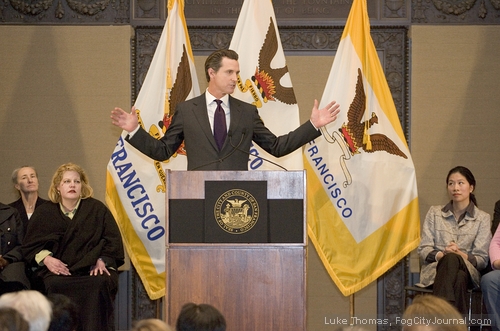
There’s a crazy disconnect in City Hall these days over how to help the local economy. Mayor Gavin Newsom has spent much of the last month focusing on “jobs” and “local economic stimulus,” proposing to give a few million dollars in tax breaks to local companies while refusing to discuss new tax measures to help close the city’s $522 million budget deficit.

As we explain in detail in tomorrow’s Guardian, economists just don’t think the tax cuts will help the economy much at all – particularly if the city is reducing its spending and payroll to do so — but even some progressive supervisors are playing along to appease the anxious business community. For example, Board of Supervisors President David Chiu supports an extension of the biotech tax, denying city coffers the benefit of efforts by the city and UCSF to become an important hub for the industry.

Then, in today’s Chronicle, Newsom floats the idea of unilaterally shortening the workweek for city employees in order to save $50 million in payroll costs, firing 10,000 workers and then rehiring most of them to do so. But let’s be clear about this: that means removing $50 million from San Francisco’s economy, or even more once you figure in the multiplier effect that would more than double that loss.

As much as Newsom and his Chamber of Commerce allies love to bash government, the city is one of San Francisco’s largest employers, a clean industry with good-paying jobs. And it just makes no sense why they prefer to inflict mass layoffs on that employer – not to mention the reduced city services that will hurt even private sector productivity — rather than increase taxes on large corporations that ship their profits out of the city and therefore offer minimal benefits to this city’s economy.   


Valentine’s Day events

0

PARTIES, EVENTS, AND BENEFITS

“Eat Your Heart Out” Supperclub, 657 Harrison; www.supperclub.com. Sun/14, 11am–3pm, $25–$150. All ages are welcome at this Valentine’s Day brunch benefiting the Black Rock Arts Foundation and featuring art, music, and performances.

“Hearts After Dark” Union Square; 206-4478, www.sfghf.net. Thurs/11, 7–10pm, $75–$125. San Francisco General Hospital Foundation hosts an evening of cocktails, hors d’oeuvres, and live entertainment with DJ Solomon and ’80s cover band Tainted Love.

“Hugs ‘n’ Hearts” Club 8, 1151 Folsom; www.heklina.com. Sun/14, 9pm, $10–$25. Heklina hosts this Big Top party with special guests Amanda LePore and Cazwell.

“Love on Wheels Dating Game” Rickshaw Stop, 155 Fell; www.sfbike.org/love. Fri/12, 6pm, $5–$10. The San Francisco Bike Coalition plays Cupid during another round of this dating game that pairs single cyclists with each other, with the same hilarious structure as the 1970s game show.

“My Sucky Valentine” Center for Sex and Culture, 1519 Mission; www.sexandculture.org. Sun/14, 7pm, $15–$25. Listen to good writers talk about bad sex and tainted love, including Stephen Elliott, Daphne Gottlieb, Carol Queen, and Simon Sheppard.

“Nightlife: Romance and Reproduction” California Academy of Sciences, 55 Music Concourse Dr; 379-5128, www.calacademy.org. Thurs/11, 6pm, $10–$12. Learn about the animal kingdom’s most amorous creatures and unique sexual behaviors while DJ Jeff Stallings plays Balearic, African, Bedouin, and Latin beats.

“Sex and Science Wine and Dine Tour” California Academy of Sciences, 55 Music Concourse Dr; 379-5128, www.calacademy.org. Sun/14, 6 and 7pm, $199. Take your cues from the planet’s lustiest creatures with a pre-dinner tour and champagne reception and a romantic four-course dinner with wine.

“Sweet Valentine’s Cruise” Pier 43½; 673-2900, www.redandwhite.com. Sun/14, 2pm, $36–$52. Join the Red and White Fleet for a romantic, fun, two-hour cruise of the San Francisco Bay, including a lavish appetizer buffet by Boudin and a complimentary beverage.

“Woo at the Zoo” San Francisco Zoo; Sloat Blvd at 47th St; 753-7236, www.sfzoo.org. Sat/13, 6pm, and Sun/14, 11am and 6pm, $70–$75. This multimedia event explores sexual and mating behaviors of animals, conducted by Jane Tollini of the former Sex Tours, all while you enjoy champagne and either a brunch bar or a decadent dinner of beef tenderloin on herbed couscous.

FILM, MUSIC, AND PERFORMANCE

“Assuming the Ecosexual Position” The Lab, 2948 16th St; 864-8855, www.thelab.org. Sat/13, 8pm, $7–$10. Acclaimed performance artist and sex educator Annie Sprinkle and her partner Elizabeth Stephens explore, generate, and celebrate love through art during this special event that includes an erotic cake contest. Bring your own!

“Cora’s Recipe for Love” EXIT Theatre, 156 Eddy; 673-3847, www.theexit.org. Fri-Sat, 8pm, through Feb 20. Sean Owens’ wacky alter ego returns to address love and longing through the eyes of Gas and Gulp regulars.

“Hearts on Fire!” Teatro Zinzanni, Pier 29; 438-2668, www.zinzanni.org. Sun/14, 12 and 5:30pm, $91–$145. Teatro Zinzanni presents two special performances of this joyful love affair featuring disco diva Thelma Houson and Christine Deaver. Show also runs through May 16.

“How We First Met” Herbst Theatre, 401 Van Ness; 392-4400, www.howwefirstmet.com. Sat/13 and Sun/14, 8pm, $25–$40. Real audience stories are spun into a comedy masterpiece in this one-of-a-kind hit show, now in its 10th year.

“Justin Bond: Close to You” Castro Theatre, 429 Castro; 863-0611, www.thecastrotheatre.com. Sun/14, 8:15pm, $35–$75. Accompanied by a lush 10-piece orchestra, the Tony nominee recreates sweet sounds from your favorite Carpenters hits. The evening also features the Thrillpeddlers as special guests.

“Love Everywhere” San Francisco City Hall Rotunda and Glide Memorial Church, www.erikachongshuch.org. Fri/12 (City Hall), 12pm; Sun/14 (Glide), 9 and 11am, free. The Erika Chong Shuch Performance Project debuts a new, large-scale work presented free as part of Dancers’ Group’s ONSITE series.

“MediaARTS 2010: Algo-rhythms of heart/break/beats” Ninth Street Independent Film Center, 145 Ninth St; www.mediaarts2010.com. Fri/12, 7pm, $10–$20. Ninth Street Independent Film Center presents an exhibition of the intersection of emerging technology, performance, and the moving image attempting to compute what it means to love and lose.

“Mortified: Doomed Valentine’s Show” Make-Out Room, 3225 22nd St.; www.makeoutroom.com. Thurs/11 and Fri/12, 8pm, $12–$15. Share the pain, awkwardness, and bad poetry associated with love as performers read from their teen angst artifacts.

“On the Periphery of Love: A Solo Performance Festival with Valentine’s Day Implications” StageWerx Theatre, 533 Sutter. Fri/12 and Sat/13, 8pm; Sun/14, 7pm, $15–$30. StageWerx presents five new visions of romance, featuring work by Martha Rynberg, Thao P. Nguyen, Zahra Noorbaksh, Bruce Pachtman, and Paolo Sambrano.

“Rock & Roll Theatresports: Be My Valentine” Bayfront Theater, Fort Mason Center; 474-6776, www.improv.org. Fri/12 and Sat/13, 8pm, $17. BATS presents two days of shows featuring scenes and songs dedicated to love and relationships, during which six rock-themed teams will compete for points and audience accolades.

“Strange Love” Actors Theatre, 855 Bush; 345-1287, www.natashamuse.com. Sun/14, 6:30pm, $10. The Valentine’s Day edition of “A Funny Night for Comedy” features Will Franken, Wegent and Page, and host Natasha Muse.

CLASSES AND WORKSHOPS

“Love Dub” Yoga Tree Castro, 97 Collingwood; 701-YOGA, www.yogatreesf.com. Sat/13, 8:30pm-12:30am, $45. Yoga Tree and Upmost High Records present a hatha flow yoga class and live reggae concert, with a portion of proceeds to benefit Save the Redwood Tree Foundation, Surfriders, and Power to the Peaceful.

Scraping bottom

0

The job of scrubbing down a city bus after it’s gone out of service is no picnic. At a Jan. 20 Budget and Finance Committee hearing called by Sup. Chris Daly to discuss health and safety impacts related to Municipal Transportation Agency layoffs, supervisors took a virtual tour of a Muni bus that was trashed on multiple levels: tagged inside and out, soiled with vomit, and strewn with garbage. Among the roughly 100 Muni workers who will lose their jobs to midyear budget cuts are 10 “car cleaners” — those unsung heroes who scrub away late into the night, tackling the residue left behind by the Sharpie-wielding, litterbug masses.

“We do send out all of our vehicles clean,” MTA spokesperson Judson True told the Budget and Finance Committee members at the hearing. “We do not send out any of our vehicles with any health issues … and we will not.” Despite his assurances, members of the Board of Supervisors and some Muni staffers voiced fears that with fewer and more overworked car cleaners, the overall experience of riding public transit could suffer.

It’s just one small example of on-the-ground impacts of painful budget cuts inflicted to solve a steep shortfall affecting the city’s transit agency. The fiscal woes aren’t unique to Muni. In coming months, San Francisco city departments across the board will have to contend with revenue shortfalls and find ways to continue providing services with diminished resources.

But with layoffs and other proposals such as raising fares, reducing service, and charging more for discount passes on the table, many are raising objections — including several members of the MTA Board of Directors, a body that is wholly appointed by Mayor Gavin Newsom. In a rare show of defiance at a Jan. 19 MTA Board meeting, several directors even resuscitated the idea of extending parking-meter hours and raising meter fees to generate new transit revenue, an idea Newsom previously rejected.

$49 MILLION IN THE RED

Muni has lost $180 million in state funding over the last three years due to “the nightmare in Sacramento,” as True put it, and no one seems to believe the fiscal crisis can be resolved without some degree of pain.

At the Jan. 19 MTA Board meeting, transit agency Chief Financial Officer Sonali Bose outlined the dismal financial picture, explaining that Muni has been hit hard by declining parking and taxi fees and impacts to the city’s general fund, leaving it about $49 million in the hole for the current budget cycle. After the layoffs, Muni will still face a $17 million problem. To solve it, suggestions include jacking up the historic F Line trolley fare from $3 to $5, charging $30 for discount monthly passes for seniors and passengers with disabilities, and reducing service.

Even against the gloomy fiscal backdrop, the prospect of eliminating jobs to make up for the losses drew serious concerns from MTA directors. “Once somebody’s gone, they’re gone,” Director Shirley Breyer Black noted. “I think moving forward with cuts in these classifications will send us into deeper fiscal crisis.”

All the affected workers — most of them frontline employees — are slated to lose their jobs by May 1, and around one-third of them were dismissed Jan. 22.

Muni Executive Director and CEO Nathaniel Ford emphasized that the decision to cut jobs was not made lightly. But at a Budget and Finance Committee meeting the following day, progressive members of the Board of Supervisors expressed alarm after hearing union members sound off about how the cuts disproportionately affect lower-paid classifications. The majority of layoffs target members of Service Employees International Union Local 1021, San Francisco’s largest labor union, which represents frontline workers across city departments.

“I understand that there are no good decisions,” Daly told the Guardian, adding that a certain group of workers seem to bearing the brunt of the cuts. “What progressive supervisors are calling for is for the budget to be handled more evenly,” he said.

A single Municipal Executives’ Association (MEA) employee — an MTA manager earning between $105,950 and $135,200 per year — was let go during this latest round of about 100 Muni layoffs, according to an agency memo. In the past year, MTA reduced its upper-level management team from 108 to 96 employees. In contrast, 33 members of SEIU Local 1021 — the majority frontline workers earning between $45,656 and $64,272 a year — will be affected by the cuts.

“Unfortunately, when MTA discovered that they had a budget problem, they didn’t bring all parties to the table,” SEIU Organizer Leah Berlanga testified at the Budget and Finance Committee hearing. “The way we got invited was via pink slips. That’s the only time they will talk to people who do direct services.”

When asked whether Muni had assessed mid- and upper-management level jobs to even the scales, True responded that a few mid-level managers were included in the latest round of cuts. One reason the layoffs seem disproportionate, he added, is that there are so many more frontline workers than others. “The budget picture has affected the entire agency,” he said. “No one is happy about these decisions.”

But SEIU Local 1021 characterized the layoffs as misguided, and attempted to identify waste and mismanagement within the agency in a packet of alternative cost-saving measures it submitted to MTA. At the top of the list was the suggestion that the agency eliminate 35 retired Muni employees, who are allowed to work up to 960 hours per year and earn wages in addition to their pensions. And according to the union, there are 21 temporary workers in the agency who’ve exceeded a two-year limit for short-term employment. SEIU recommended that those temps be dismissed too.

SEIU also criticized the decision to lay off 24 parking control officers (PCOs) — uniformed workers who have the unenviable job of issuing parking citations to bring in revenue for the city. “To me, if you do the simple math, it doesn’t make any sense. They make most of the money for the MTA,” said a PCO who testified at the hearing.

According to SEIU’s calculations, eliminating 24 employees who dole out parking tickets could result in a $7.2 million loss for the city in parking revenue. But True said MTA disagrees with this figure, and pointed to an internal memo showing how revenue from parking citations dropped in recent years even as more PCOs were hired. Nonetheless, at the urging of SEIU, the MTA Board agreed to postpone those 24 layoffs until February to buy time to study the impact. For other positions, negotiations between MTA and the union are ongoing. The details on still more layoffs, which will affect transit operators, is yet to come.

Sup. David Campos is asking for a management audit to see if Muni is spending its money efficiently. “I think we should look at best practices and how we’re operating before we finalize any cuts,” he said.

THE PARKING POLITICS

During a round of MTA budget talks last fall, the idea of extending city parking meter hours and raising meter fees was floated as a means of recouping losses — but Newsom balked at the idea, saying higher parking fees could harm small businesses. Now MTA Director Bruce Oka has revived — and endorsed — the concept.

“I can hold my nose and vote on anything, but I refuse to vote on something when I believe we have not looked under a rock for every source of funding,” Oka said at the meeting. “We have to extend the parking meter hours — we have to find dollars. If Room 200 [i.e. Newsom] doesn’t want that to happen, well then … he’s got to come up with a way to do what we need to do. If he’s not going to raise parking meters or extend parking meter time, he’s got to come up with some money.”

Tom Radulovich, executive director of nonprofit Livable City and one of the individuals who helped to create MTA in 1999, summed up Oka’s comments with a note of surprise: “He really called out the mayor,” he said. “I haven’t seen MTA Board members do that — they usually cover for him.”

Radulovich — who is also on the BART Board — says targeting motorists for more revenue instead of transit riders would be more equitable, sustainable, and in keeping with the city’s Transit First goals in the long run. Proposition A, passed November 2007, established “a strong mandate to reduce transportation-related greenhouse gas emissions,” he pointed out. But, he noted, with layoffs that could affect the qualify of service and possibly deter people from riding, “We don’t see how MTA is going to get to those voter-mandated transit goals.” *

MUNI MEETINGS

PUBLIC MEETINGS ON SFMTA BUDGET

Saturday, Feb. 6, 10 a.m. to noon

Tuesday, Feb. 9, 6 p.m. to 8 p.m.

Saturday, Feb. 20, 10 a.m. to noon

One South Van Ness Ave. at Market Street, 2nd Floor Atrium

SFMTA BOARD MEETINGS

Friday, Jan. 29, 10 a.m.; discussion of FY10 options, including Muni service reductions

Tuesday, Feb. 16, 11 a.m.; public hearing on proposed FY10 budget actions

Tuesday, Mar. 2, 2 p.m.; public hearing and possible board approval of FY10 budget actions

Location: City Hall, 1 Dr. Carlton B. Goodlett Place, Room 400

Saving ocean ecosystems

0

GREEN CITY In the spring and summer months, pacific leatherback sea turtles arrive just outside the Golden Gate to feast on jellyfish. The turtles, which can weigh up to 1,200 pounds and live as long as a century, are some of the oldest reptiles in existence.

In a single year, a leatherback may swim 6,200 miles as it encircles the Pacific Ocean, migrating from nesting grounds as far away as Indonesia to feed off the coasts of California, Oregon, and Washington. The leatherback was listed as a federally endangered species in 1970, and scientists now worry that the turtles could go extinct in as little as 10 years.

The ancient reptile may be rare, but its vanishing act is becoming common for marine creatures. Jackie Dragon, a campaign organizer with Pacific Environment, told us large fish populations, including bluefin tuna, Atlantic cod, marlin, and certain sharks, have declined by 90 percent since the advent of industrialized fishing in the 1950s. Meanwhile, ocean acidification due to rising carbon dioxide levels has imperiled key species, threatening to alter the food web with potentially drastic implications.

Recently, San Francisco’s ocean conservationists have displayed rare optimism, however, as historic new protections for ocean ecosystems and the leatherback seem within reach.

A coalition of local environmental organizations staged a Jan. 13 event at City Hall to rally for the creation of a new, comprehensive ocean-protection policy at the federal level. Dubbed Wear Blue for Oceans Day, the event drew a crowd of around 75 who donned blue in support of the federal policy, put forth by President Barack Obama last June.

Under the current regulatory system, there are 140 different laws relating to ocean management, and more than 20 disparate agencies, according to Dragon. “They have varying purposes and often conflicting mandates,” she explained. “Right now, it’s inconsistent with a healthy future for the ocean to have a piecemeal approach. And it’s absolutely necessary to appreciate that ecosystems in the ocean depend on a kind of management that takes into consideration the fact that these habitats … need to be looked at from a broader perspective.”

According to an interim report drafted by a 23-member task force convened by Obama to make suggestions for crafting a federal policy, the new approach would place ecosystem protection at the heart of regulatory decisions. Environmentalists hope it will improve the overall health of oceans.

The task force is scheduled to submit its final recommendations to Obama in early February, and the president is expected to announce the creation of the new policy shortly afterward. “The importance of ocean, coastal, and Great Lakes ecosystems cannot be overstated,” the report notes. “Simply put, we need them to survive.” Climate change and ocean acidification are named as top priorities.

A second regulatory victory seems imminent for the Sea Turtle Restoration Project, a San Francisco-based environmental organization that joined Oceana, the Center for Biological Diversity, and the Turtle Island Restoration Network in pressing for expanded critical habitat designation for the pacific leatherback turtles in 2007.

The groups sued the National Marine Fisheries Service, a division of the National Oceanic and Atmospheric Administration, for failing to take action for two years. Following a settlement, the agency finally submitted its proposal Jan. 5 for a new protection zone. The critical habitat area would span some 70,000 square miles of open waters along the West Coast.

Chris Pincetich, a campaign organizer with the Sea Turtle Restoration Project, called the designation “a long overdue action by federal agencies.” However, the proposal doesn’t limit commercial fishing, which Pincetich notes is one of the greatest threats to the leatherbacks, because they can become ensnared in gillnets. Nor does it cover habitat areas in Southern California, where turtles have been known to migrate, Pincetich said. NMFS will accept public comments on the proposal until March 8.

Although it’s a major step forward, changes won’t be implemented until January 2011 at the earliest.

For the leatherback, with about a decade to fight for survival, time is of the essence.

Do not beware of Showdogs

0

Text and photos by Caitlin Donohue

IMG_0801.JPG
These dogs don’t bite

We love the upscale hot dog joint. Artisan fixings, hefty sausages, microbrews- the dog has been having its day at neighborhood favorites like Underdog and Rosamunde, and now wieners are getting their due in the Tenderloin as well.

At Showdogs, even the vegetarians will leave happy. The Field Roast Vegetarian dog is a beaut; a hearty, almost beefy “sausage” topped with a mountain of crisp, colorful coleslaw and house-made mustard. “We don’t use any refined sugar here, so we sweeten the coleslaw with agave,” says manager Seth Carter. The result is a slaw that sits light on the tongue, but still pays homage to its Southern roots.

IMG_0802.JPG
Windows perfect for the people parade outside

Wedged into a stretch of town known more for colorful street life and discount beauty supply stores than its cuisine, Showdogs seems an unlikely place to find fancy sausages. But their menu-11 dogs made of ingredients from organic duck to wild boar each with a suggested pairing from their enviable selection of beers on tap- has made the spot a favorite mid-Market hangout. The dining room is bright, with massive windows perfect for watching the street milieu or just mooching off the free Wifi. Even our lovely Mayor has made the trek over from City Hall to announce his ongoing efforts to “clean up” this part of the ‘Loin, perhaps signaling the pivotal role the little dog shop could play in the neighborhood’s future.

How to get it cheaper… and pretty ancilliary art work after the jump.

Editorial: The mayor’s race starts now

2

Ross and Jeff and any other progressive candidates need to decide soon if they are serious about running for mayor and either announce that they are running or step out of the way so someone else can step forward

EDITORIAL Back in 2007, when no leading progressive stepped in to run against Gavin Newsom, Sup. Chris Daly called a convention in the hope that someone would come forward and take up the challenge. All the major potential candidates showed up and spoke, but none announced a campaign.

Let’s not go there again.

We’re two years into Newsom’s second term, and the city’s a mess. After absorbing a round of brutal cuts last year, the budget’s still half a billion dollars out of whack. The mayor’s only answer at this point is to cut more (then raffle off to landlords the right to get rich by evicting tenants and turning apartments into condos). The Newsom agenda hasn’t created jobs or addressed the housing crisis or resolved the unfairness of the tax code or taken even the first steps toward energy self-sufficiency. Over the past year, he’s been largely inaccessible and hostile to the press, a mayor who won’t even tell the public where he is and what he does all day.

A candidate who wants to change the direction at City Hall should have no problem getting political traction in 2011. But the progressives are still floundering. And while the race is two years away, the more centrist candidates are already out the door. Sup. Bevan Dufty has announced he’s in the race, and state Sen. Leland Yee might as well have announced since everyone knows he’s running. Same for City Attorney Dennis Herrera. And at a certain point — in the not-too-distant future — those candidates will be starting to line up endorsers and making promises to major financial backers and constituency groups, which aren’t going to wait around forever for the progressives to settle on someone willing to make the immense effort to mount a serious campaign for mayor.

So the potential candidates — starting with Sup. Ross Mirkarimi and Public Defender Jeff Adachi — need to decide, soon, whether they’re serious about this or not, and either announce that they’re running or step out of the way so someone else can step forward.

With public financing, a candidate in San Francisco doesn’t have to be as well-heeled as Newsom was his first time around. It won’t take $6 million in contributions to win. But a progressive who wants to be the next mayor needs to demonstrate he or she can do a few key things, including:

<\!s>Motivate and unite the base. Labor (or at least the progressive unions), the tenants, the left wing of the queer community (represented to a great extent by the Harvey Milk LGBT club), the environmentalists, and the progressive elected officials have to be fairly consistent in backing a candidate or downtown’s money will carry the day. So Mirkarimi and Adachi (and anyone else who’s interested) ought to be making the rounds, now. If that critical mass isn’t there, the campaign isn’t going to work.

<\!s>Develop and promote a signature issue. Newsom won in part because he came up with the catchy “care not cash” initiative. Voters frustrated with years of failed homeless policies (and an incumbent, Willie Brown, who said the problem could never be solved) were willing to try something new (however bogus it turned out to be). Nobody’s developed a populist way to approach city finance. Nobody’s got a workable housing or jobs plan. What’s the central issue, or set of issues, that’s going to define the next progressive mayoral campaign?

<\!s>Put together a central brain trust. This city’s full of smart progressives who have experience and ideas and can help put together a winning platform and campaign strategy. A good candidate will have them on board, early.

<\!s>Herrera, Yee, Dufty, and others who might run (including Assessor-Recorder Phil Ting) are already out there looking for progressive supporters and allies, but none has yet offered an agenda the city’s left can support. Dufty pissed off the tenants by refusing to back stronger eviction protections. Herrera pissed off immigrant advocates by refusing to be as aggressive in supporting the city’s sanctuary law as he was in defending same-sex marriage (and because he hasn’t officially announced yet, he’s still not taking stands on political issues). Yee tried to sell off the Cow Palace. Ting has taken some great initiatives (forcing the Catholic Church to pay its fair share of property transfer taxes), but hasn’t developed or spoken out on the broader issues of city revenue. More of those candidates have been leaders in the public power movement.

It would be inexcusable if the progressives, who control the Board of Supervisors, are forced to pick a mayoral candidate by default. It’s time to end the speculation and dancing and find a candidate who can carry the progressive standard in 2011.

The DEIR that ate Christmas!

0

Text by Sarah Phelan. Photo by Ben Hopfer.

Grinch.jpg

I don’t know if Mayor Newsom took a copy of the city’s 4,400 page draft environmental impact report (DEIR) for Lennar’s proposed massive Candlestick/Hunters Point Shipyard redevelopment on vacation at the swanky Mauna Kea Beach Hotel in Hawaii.

New-Room.jpg
This is what a room at the Newsoms’ get away (from the folks wanting more time to read the DEIR) hotel in Hawaii looks like.

But if he did, he’d need an extra suitcase just to carry the darn thing, not to mention an ante chamber to store it, when he goes swimming, or whatever, in between readings.

EIR_report.jpg
As our illustration shows, a volume of this massive six-volume report is the size of a phone book. And way denser.
That’s because it’s packed with all kinds of interesting information. Which is why folks have been asking Newsom to extend the public comment period on this document, which was released in mid-November, to mid-February.

This requested extension would give folks three months to read, digest and comment on one of the most important and legally binding documents to land on Newsom’s desk since he became mayor. And the last month of this requested extension wouldn’t be unencumbered by Thanksgiving, Christmas and New Years.

But to hear Newsom’s appointees on the Redevelopment and Planning Commissions, those folks asking for a mid-February extension are just whining, or don’t plan on reading the documents at all. And anyways, who cares if the public doesn’t get their comments in time. Because there’ll be plenty of opportunity to comment later on, right?

Wrong. The DEIR public comment period represents one of the few moments when comments have to be put into the public record—and replied to. That was not the case during all those hundreds of meetings that city staff and project boosters like to quote as alleged evidence that there has been plenty of public input into this process.

In fact, when folks were worried about the prospect of selling off a slice of Candlestick Park so that Lennar could build luxury condos on prime waterfront land, they were told, don’t worry, they’ll be plenty of opportunity to review this plan when the environmental impact report comes out. But now it’s all, hurry up and finish, already.

But now that a draft version has been released, and is available online—or in the offices of the Redevelopment Agency and the Planning Department, it’s critical that folks read all of it, and not just the executive summary. It’s also important that folks not versed in “DEIR speak” find professionals that are to give them independent feedback, and that they then submit written comments to Redevelopment and Planning, the city’s two lead agencies on this project, by the deadline that the city has set.

The city’s original deadline was Dec. 28–the minimum 45-day public review period that’s required under the California Environmental Quality Act (CEQA), when a project has to be reviewed by state agencies. That’s why a lot of folks showed up at the city’s two DEIR hearings on Dec. 15 and Dec. 17 to voice their concerns. And while I sympathize with the plight of Alice Griffith residents, who continue to live with cockroaches and backed-up sewers and leaking roofs and broken windows, and unemployed workers in this town, rushing DEIR review won’t get housing built or jobs created any sooner. What it will do is increase the chances that the city will get sued.

Which is why folks who seriously want to read and comment on the DEIR asked the city for the Feb. 12 extension. Instead, they got a patronizing rebuff from Newsom’s commissioners, who gave them a 15-day extension, which ends Jan. 12. Along with the opportunity to voice their concerns one more time before Redevelopment on Jan. 5.

That’s why some folks are planning to ask Newsom not to be a Grinch, by faxing copies of a poster that features a cool looking Grinch to City Hall. So, while it won’t be snowing in Hawaii, it could be snowing faxes in the Mayor’s Office. As the poster notes,

“Don’t be a Grinch! Mister Mayor. Don’t steal Christmas and New Years. Your staff released the draft environmental impact report a week and a half before Thanksgiving.”

“Your staff had two years to work on it, but your commissioners just gave the public two months to read 4,400 pages. It’s unfair to steal the public’s Christmas and New Years’ to meet an arbitrary deadline.”

“Extend public comment on the Candlestick Point Hunters Point Shipyard draft environmental impact report (DEIR) to Feb. 12, 2010.”

This follows on the heels of a letter that a broad coalition of environmental and community groups, along with concerned Bayview Hunters Point residents, sent to Newsom before the Dec. 15 and 17 hearings, asking for the Feb. 12 extension, a copy of which follows:

PG&E attack mailer puts City Hall on defensive

0

GREEN CITY On a Pacific Gas & Electric Co. conference call in late October, with top PG&E executives and analysts from Goldman Sachs, Deutsche Bank, and other prominent investment firms on the line, PG&E president Chris Johns explained how a company-sponsored ballot initiative could save millions of dollars for the utility.

“We have faced potential takeovers multiple times over the last several years and we have had to expend significant resources to oppose these efforts,” Johns explained, referring to attempts by public agencies to set up independent electricity programs that threaten to compete with PG&E. “The success of this initiative, if placed on the ballot, could significantly reduce the need for taxpayers and utilities to oppose these local government takeover attempts.”

His comments appeared in a transcript from an earnings call posted on a financial Web site called SeekingAlpha.com. When pressed by an analyst about how PG&E had come up with the idea, company CEO Peter Darbee chimed in. “What occurred to us was we were repeatedly faced with this, and we were spending significant amounts of money year after year,” Darbee said, according to the transcript. “So we asked ourselves: what would be something that could discourage this over the longer term?”

What surfaced was a proposal for a statewide ballot initiative that would amend the state constitution to require a two-thirds majority vote at the ballot before any local government could develop its own electricity program. With such a high hurdle in place, efforts to move forward with publicly-owned power programs would essentially come to a standstill. But with San Francisco’s own stab at it expected to get underway long before the proposed initiative is placed on the ballot, PG&E is back to its default tactic of pouring millions into an opposition campaign.

San Francisco’s community choice aggregation (CCA) initiative, called CleanPowerSF, took a leap forward last month when a request for proposals (RFPs) went out to potential electricity service providers. The program aims to provide 51 percent renewable electricity by 2017, a meaningful step toward reducing greenhouse gas emissions.

But on the heels of this milestone, a wave of mailers bearing PG&E’s name in fine print crashed into San Francisco homes and businesses, screaming “Business Beware” in 1.5-inch type and proclaiming CleanPowerSF to be a “costly energy scheme.” The mailer cites a city controller’s report projecting that customer bills could be 24 percent higher under CCA.

But the San Francisco Local Agency Formation Commission (LAFCo), which is working in partnership with the San Francisco Public Utilities Commission to craft the emerging power program, responded in a press statement that this claim is misleading, since a fee structure has not yet been nailed down. While the controller’s report also noted that it was too early to say just what the pricing structure would be, it’s been a primary goal of the city’s CCA all along to offer customer billing rates that meet or beat PG&E prices.

Meanwhile, the city appears ready to fight back — and questions have already been raised about whether it was legal to distribute the attack mailer. Sup. Ross Mirkarimi, who chairs LAFCo, announced at the Dec. 15 Board of Supervisors meeting that he was requesting that the city attorney examine whether PG&E had violated state law by distributing the mailer. According to the state law that laid the groundwork for CCAs to exist, investor-owned utilities are required to “cooperate fully” with the public power efforts of cities. “PG&E has blanketed this city … with mailers that distort and misrepresent what CCA is doing,” Mirkarimi said. “I believe this is a potential violation of California Public Utility Commission law.”

Several days before Mirkarimi’s announcement, the Guardian received confirmation from City Attorney Dennis Herrera that his office is looking into the matter.

The mailer included a link to the Web site CommonSenseSF.com, launched by an entity called the “Coalition for Reliable and Affordable Electricity.” A call to Townsend, Raimundo, Besler & Usher, a Sacramento public-relations firm that has worked with PG&E in the past, revealed that this coalition is one of the firm’s clients, and that the person handling that client is Bob Pence. The proponent listed on the statewide ballot initiative is Robert Lee Pence — evidently the same person. The Guardian left a message for Pence inquiring who, besides PG&E, the coalition members are (the mailer claims there are 50,000), but he did not return the call. Multiple calls to PG&E were not returned either.

Meanwhile, the Guardian has received a handful of anecdotal reports that when clipboard-wielding signature gatherers were out on the streets circulating a petition in support of the PG&E-backed ballot initiative, people were fed some fishy stories about what the proposed constitutional amendment would actually do.

A voter who lives in Bakersfield contacted the Guardian to say she’d signed the petition because she was told that the ballot initiative would limit PG&E expansion — but she later did some research and found that PG&E was the primary force behind it, so she called the Registrar of Voters to have her name struck from the list.

Mark Toney of the Utility Reform Network told the Guardian that he’d also been misinformed. But as someone familiar with the issue, he knew better. “I ran across signature gatherers in Emeryville. They told me that if I signed the petition, I’d be supporting a two-thirds majority vote to raise PG&E rates,” Toney said. “I said, ‘Well that’s interesting. The language here doesn’t say PG&E at all.

John Srebalus of Pasadena wrote in an e-mail that he was also misled by a signature gatherer. After he signed a petition to legalize marijuana, he said the woman with the clipboard flipped a few pages and asked him to sign again, as if in duplicate. But there was a rubber band securing the top half of this second page, hiding the text. When he peeled it back, he found that it was actually PG&E’s ballot initiative, which he had already refused to sign once before.

According to a source familiar with the campaign who asked not to be named, the petition was a particularly hard sell for signature gatherers, many of whom stake their entire livelihoods on earning less than $2 per signature. According to this individual, the erratic sales pitches caught on like wildfire because without a compelling hook, it was nearly impossible to convince random passersby to support something that came off as convoluted and wonky. This person said PG&E became alarmed when it caught wind of all the distorted representations and tried to put a stop to them.

Campaign spokesperson Greg Larsen told the Guardian he hadn’t heard anything about that, but he did emphasize the importance of the signed document, as opposed to the signature gatherers’ pitch. “The hope is that you read what you’re signing,” he said. “That’s really what the issue is — it’s what’s on this piece of paper.” Larsen added that the campaign had submitted 1.1 million signatures, “far in excess of the number of required certified signatures” to have the initiative placed on the ballot.

Can progressives counter a re-energized Newsom?

27

By Steven T. Jones

Since my Dec. 4 blog post about Mayor Gavin Newsom reengaging with San Francisco, there have been more signs that he’s back and trying to take control of the city’s agenda. While that may be preferable to an absentee mayor, it’s probably not good news for the progressives, who have nominal control over the Board of Supervisors but seem to be having a hard time putting together effective political plays.

Newsom dropped in on the San Francisco Chronicle’s editorial board yesterday and was rewarded with a splashy lead story about how he and Sup. Sean Elsbernd are proposing a charter amendment to reform the city’s pension system. Apparently, the mayor has dropped his petulant approach to the media and is now using the Chron to proactively build public support for a proposal that most City Hall players hadn’t even heard of yet.

Newsom’s recent choice of Tony Winnicker for a new press secretary – a figure far less caustic and divisive than his two predecessors – also probably signals the mayor’s intent to try to play offense for awhile and chip away at the progressive block. Newsom yesterday announced a new sustainable energy financing program for building owners in the city, which he’s pushing in partnership with Sup. Eric Mar – a progressive who was the swing vote earlier this year for approving a controversial solar project favored by the mayor.

None of this bodes well for the progressive movement in San Francisco.

Coastal Commission denies enviros’ request to yank desalination plant permit

3

By Rebecca Bowe

A coalition of environmental organizations argued yesterday that a permit issued to Poseidon Resources to build a massive desalination plant near San Diego should be revoked, because the company failed to provide complete information to California Coastal Commission staff.

At a CCC meeting held in the San Francisco Board of Supervisors Chambers in City Hall yesterday, commissioners listened as advocates from the Surfrider Foundation, San Diego Coastkeeper, and the Coastal Environmental Rights Foundation, who filed the request for permit revocation, argued that Poseidon purposely tried to mislead CCC staff by submitting incomplete and inaccurate information about technical aspects of its desalination facility.

The CCC granted Poseidon its permit in November of 2007. The 50 million gallon-per- day facility, which is under construction, has drawn sharp criticism statewide from labor and environment groups who argue that the expensive, highly energy intensive plant would contribute to higher greenhouse gas emissions and do nothing to encourage water-conservation efforts. Concerns have also been raised about the harm it could do to the marine ecosystem and the high price tag for tap water cycled first through a power-plant cooling system, and then through the desalination process.

Gov. Arnold Schwarzenegger supports the construction of the facility as a reliable water source for arid Southern California, and his representatives were in attendance at yesterday’s meeting. Last month, the Metropolitan Water District agreed to subsidize costs for the privately owned and operated plant, and Poseidon will go before the state’s Debt Limit Allocation Committee (which consists of Schwarzenegger, the state controller, and the state treasurer) to request tax-exempt bond status in mid-January.

San Francisco Sup. Ross Mirkarimi, who sits on the Coastal Commission, argued in favor of pulling the permit, saying it represented “a proper juncture for us to revisit the issue” and warned that the highly controversial project might be “rife with procedural and structural errors.”

Will Newsom follow Obama’s sunshine lead?

2

By Tim Redmond

The Obama administration has begun releasing a complete list of White House visitors. It’s pretty cool — who knew that my old friend David Binder, who did some polling work for the Obama campaign, is now hanging out at the White House?

But it raises a question: If the president of the United States is willing to tell us who is visiting what may be the most secure facility in America, why can’t the mayor of San Francisco tell us who’s coming to see him at City Hall?

No such list has ever been released. The mayor’s appointment calendar is sparse and incomplete.

I emailed the mayor’s press spokesperson, Joe Arellano, to ask if Newsom was willing to become as sunshine-friendly as the prez, but no word yet.

Fun and games, City Hall style

11

Text, photos and video by Sarah Phelan

snow15.jpg
City Hall looked cold and pretty Tuesday, what with the snow outside.

weddingtree15.jpg
And the wedding couples posing for photographers at the top of the stairs.
cityhallin15.jpg

Against the backdrop of a glittering Tree of Hope.
tree15.jpg

But inside the meeting, things were getting hot and ugly… in that glitteringly controlled way typical of city politics.
Daly15.jpg
The highlight came Sup. Chris Daly produced a handmade bar graph in an effort to help folks better understand the economic backdrop against which the budget debate plays out.
Dalyhand15.jpg
Promising to bring more charts to future meetings, Daly displayed a chart that showed how the San Francisco Police Department has enjoyed a significantly larger growth in General Fund support than any other department, including the Health Department. And you can watch some of that fun by clicking on the following video clip:

During Daly’s show and tell, Sup. Sean Elsbernd started mumbling about stunts, and according to the Chron, he subsequently challenged Daly to tackle pension costs, especially related to the Service Employees International Union, promising in return to tackle the police budget. Daly reportedly said he’d take a look at pension reform—so expect even more bar charts in the New Year.

Holiday snowjob

0

sarah@sfbg.com

Shortly before Thanksgiving, San Francisco city officials announced that the draft environmental impact report for Lennar Corp.’s massive Hunters Point Shipyard-Candlestick Point redevelopment proposal was finally available, and that the public has 45 days — until Dec. 28 — to read and comment on the 4,400-page document.

Envisioned to include more than 10,000 homes (most of them market-rate condos) spread over 708 acres in southeast San Francisco, the project — whose vague outlines city voters affirmed by approving Prop. G in June 2008 — is the centerpiece of the city’s housing strategy for the next 25 years.

At a Nov. 5 presentation, Michael Cohen, Mayor Gavin Newsom’s top economic advisor, told the city’s Planning Commission that the DEIR was a "milestone." But critics warn that this milestone could become a millstone around the city’s neck if it fails to extend the DEIR review period, as a coalition of environmental groups and a state agency are requesting. Cohen did not return repeated calls for this story.

These groups are concerned that the city of San Francisco, Lennar’s partner in this billion-dollar deal, is trying to rush through a controversial project before anyone can review its details. Forty-five days is the minimum required under California Environmental Quality Act guidelines for a project that also needs to be reviewed by state agencies and the groups want the deadline extended to mid-February.

The southeast sector has historically been home to low-income communities of color, and fears are running high that this project will continue the destructive, gentrifying legacy of the San Francisco Redevelopment Agency, which shares lead agency responsibilities for this project with the Planning Department.

After Redevelopment Agency projects in Western Addition and Yerba Buena displaced much of San Francisco’s African American population, there is concern that if this project isn’t carefully considered, it could finish the job in the remaining parts of town with significant black populations: Bayview and Hunters Point, which are both in the plan area.

"People would have to read 130-plus pages per day since the DEIR’s release to complete it by the first public hearing," said Kristine Enea, who sits on the board of the India Basin Neighborhood Association and is a candidate in the 2010 race to replace termed-out District 10 Sup. Sophie Maxwell.

Downloadable at the Planning Department’s Web site, the Shipyard-Candlestick DEIR envisions an influx of 24,465 new residents and the possible building of a new 49ers stadium on a site that is radiologically contaminated, seismically vulnerable, and will undoubtedly be adversely affected by climate change-induced sea level rise.

As such, it requires significant chunks of time to digest and comment on — something folks are urged to do at two public hearings in mid-December or in writing by Dec. 28.

"The timeline is incredibly short," Arc Ecology’s executive director Saul Bloom told us. So a coalition that includes Bloom, Enea, Arc Ecology, the Urban Strategies Council, the Sierra Club, the California Native Plant Society, and the Potrero Hill Democratic Club is urging Mayor Gavin Newsom to extend the DEIR public review period to 90 days.

"We believe that a public review period totaling 90 days ending on Feb. 12, 2010 is necessary and of appropriate length for the public and our organizations to review, discuss, and comment on this complicated tome," the coalition wrote in a Dec. 7 letter.

Also seeking a time extension is the San Francisco Bay Conservation and Development Commission (BCDC), a state agency charged with reviewing large projects that may impact the bay, although the agency did sign onto the coalition’s letter. BCDC studies project that much of the project area could be inundated with rising water levels caused by global warming.

Technically, the lead agencies have the authority to extend EIR comment periods, but because they are controlled by mayoral appointees, the coalition is appealing to Newsom. The coalition letter notes that the project will nearly double the population of Bayview-Hunters Point, and that the newly released DEIR was nearly two years in the making.

"The city’s project staff reasonably took the time to provide what in their opinion is an adequate review of the project," the coalition wrote. "The public similarly deserves 12 weeks to examine and comment on your work."

City officials have been patient with Lennar, recently granting the company a six-month delay in construction of housing at Phase 1 of the development, which sits at Parcel A of the shipyard. As a result, construction for Phase 2 is not expected to start until 2015 and continue until about 2035.

So coalition members say at 45-day delay isn’t asking much. The letter makes clear that the coalition isn’t opposed to the project or Newsom’s administration, but that its members expect "public engagement and transparency in government."

"It is our view that a 45-day public review period for a document as complex and lengthy as the DEIR is simply inadequate under any circumstances," the coalition wrote, adding that the document’s release over the Thanksgiving, Christmas, Kwanza, and Hanukkah holidays is "particularly troubling." By contrast, Santa Clara Countyoffered an extended comment period for its DEIR on its proposed new 49ers stadium.

"By releasing a six volume, 4,400 page document a week and a half before Thanksgiving, you have demanded that the public and community based organizations choose between civic duty, prearranged vacation time, and obligations to family and faith," the coalition wrote, noting that the city effectively shortened even this prep time to 25 days by holding public hearings one month after the DEIR’s release.

Unlike Prop. G or previous discussion about Phase 1 of the project, the coalition reminded Newsom that an EIR is an administrative decision document, and the DEIR is the part of the approval process where ideas become concrete plans to be approved in a lawful process. "Transparency in government is not just a matter of letting the public see information," the coalition observe in the letter. "The capacity to act on what one sees is critical to transparency and the length of the look has a direct effect on the quality of observation."

Or as Bloom warned the Guardian, the current 45-day review period will likely result in a polarized dialogue. "It will lead to the squeezing out of any of the middle-of-the road perspective from folks who are not opposed to development but think the proposed project could be better," Bloom warned. "And if that happens, no modifications will be possible."

The DEIR will be the subject of two public hearings: Dec. 15 at 4 p.m. in City Hall Room 416 by the Redevelopment Agency and Dec. 17 at 1:30 p.m. in City Hall Room 400 by the Planning Commission.

Pedaling forward

0

steve@sfbg.com

GREEN CITY San Francisco’s top elected and appointed officials made the city a little greener — literally — Dec. 3. And they say the recent removal of restrictions on bicycle-related improvements will make San Francisco a lot greener over the long term.

A festive mood was in the air when officials and activists gathered at the intersection of Oak and Scott streets to paint the city’s first green bike box (marking a safe spot for cyclists to wait in front of cars at intersections) and celebrate the first bike lanes to be created in more than three years.

In the week since Superior Court Judge Peter Busch partially lifted an injunction that had banned all projects mentioned in the city’s Bicycle Plan — the court ruled that they needed to be studied with a full-blown environmental impact report, which the city completed earlier this year, although it has been challenged by another lawsuit set for trial in June 2010 — city crews worked at a blistering pace on bike improvements.

They created three new bike lanes (of the 10 Busch is allowing to move forward before the trial, holding up another 50 for now) and installed barriers between the bike and car lanes on Market Street near 10th Street. "So now we have the first separated bike lane in San Francisco," San Francisco Bicycle Coalition director Leah Shahum told the Guardian, happy over a safety improvement that encourages children and seniors to ride.

The crews also have been installing about five new bike racks and 20 shared traffic lane markings (known as "sharrows") each day. Mayor Gavin Newsom praised the rapid implementation and told the crowd, "You’re going to see more than you’ve seen in years be done in the next few months. The goal is to get from 6 percent of commutes in San Francisco up to 10 percent of all commutes by bicycle — and I think that is imminently achievable in the next few years."

Also on hand were Sups. Ross Mirkarimi, Bevan Dufty, and Sophie Maxwell, Department of Public Works head Ed Reiskin, San Francisco Municipal Transportation Agency (SFMTA) board chair Tom Nolan, and SFMTA director Nat Ford, who declared the goal of making "San Francisco the preeminent city for bicycling in North America."

Mirkarimi, the only elected official to ride a bicycle to the event, told the crowd: "This is a delightful day…. We are all unified in the mission statement of making San Francisco bike-friendly."

Dufty, who chairs the Transportation Authority and pushed for the rapid implementation plan, said, "There’s a really great community here. First, my hat’s off to the Bicycle Coalition and all of their thousands of members who really keep the city honest and keep us moving forward."

Nolan also praised bike activists who pushing his agency to prioritize bike projects and prepare for the end of the injunction: "It was a very effective campaign. You did such a great job at making your case."

While anti-bike activist Rob Anderson, who sued the city along with attorney Mary Miles, regularly derides the "bike nuts" as a vocal minority pushing an unrealistic transportation option, the event showed almost universal support for bicycling at City Hall.

"I can say this is the best relationship we’ve had for years with the advocacy community, with the Bicycle Coalition," Newsom said. "We’ve begun to strike a nice balance where this is not about cars versus bikes. This is about cars and bikes and pedestrians cohabitating in a different mindset."

Bicycling in San Francisco has increased by 53 percent in the last three years, so Shahum said the plan’s projects and the growing legion of bicyclists will help the city in myriad ways in coming years.

"We know we can do this," she said. "We know the climate change goals this city has laid out, the public health goals, the livability goals that the city has laid out, will not be met without shifting more trips to bicycling, walking, and transit. And that’s why this day is so important."

Or as Maxwell said, "This is a great opportunity for San Francisco to finally take its place among world cities that recognize that cars are not the only mode of transportation."

Holiday blues

0

rebeccab@sfbg.com

Ethea Farahkhan lost her city job Nov. 29, when a round of city layoffs impacting front-line workers took effect.
Farahkhan, a woman of color who was an administrative assistant at San Francisco’s Department of Children, Youth and their Families, said she would have a job if it weren’t for Mayor Gavin Newsom’s decision not to spend money approved by the Board of Supervisors to save people from job losses during the holiday season.

The layoffs rippled through city government as DPH employees with seniority exercised “bumping rights” to replace employees like Farahkhan, who was hired three years ago.

“No one’s in a festive mood. We’re concentrating on making mortgages and buying food to put on our table,” Farahkhan told us when we caught up with her Thanksgiving eve. “I know San Francisco is not exempt from the economic crisis,” she added, “but I feel like our mayor is out of touch. He’s never been in this position.”

If DPH layoff had been covered by existing funds and incoming grant money, as directed by a veto-proof, 8-3 vote of the Board of Supervisors on Nov. 24, she said, “I would definitely have a job to go to.” Instead, Mayor Gavin Newsom announced after the board vote that he was refusing to spend the reallocated funding to halt the 478 DPH layoffs and reassignments.

Farahkhan’s union, Service Employees International Union (SEIU) Local 1021, spent months trying to save these jobs, finally winning over the final supervisor needed to overcome a veto, Sup. Sophie Maxwell, shortly before the vote. Then, for the second time in as many months, the head of the executive branch announced that he would simply ignore the legislative branch.

The impasse doesn’t bode well for a city that’s about to wrestle with a record midyear budget deficit again.
In October, Newsom declared that he would ignore the board’s passage of legislation — by the same 8-3 vote that could override a mayoral veto — to prevent deportation of undocumented youth in custody until they are convicted. It was the first of two actions that seemed to answer the question of whether the mayor is willing to work with the supervisors on the toughest problems facing the city.

That was the question raised last summer when the board discussed a budget analyst’s report that Newsom had either cut or refused to spend about $15.6 million of the $37.5 million that supervisors approved in budget add-backs for the 2008-09 fiscal year. With the mayor cutting 42 percent of program funding that the board fought to restore, trust was already eroding.

During budget deliberation, some progressive supervisors unsuccessfully tried to place hundreds of millions of dollars on reserve, which would give the board some leverage to force Newsom to honor his pledge to work with supervisors on midyear budget cuts, but the board ultimately decided not to do so.

The mayor’s latest rejection came after a long, embittered battle with the union. SEIU members resorted to drastic measures — staging protests in traffic intersections, distributing flyers outside Newsom’s PlumpJack restaurants, barging into his office unannounced singing civil-rights era ballads — to pressure the mayor. But neither those media stunts, nor compromise solutions developed by Sups. John Avalos, Bevan Dufty, and Board President David Chiu, could persuade Newsom to go along with revisiting the DPH cuts.

“Mayor Newsom cannot spend funds the city does not have,” Newsom’s press secretary, Joe Arellano, told the Guardian when asked for an explanation. “The board action didn’t provide any new money — it takes dollars already being used to pay other employees’ salaries.”

The money allocated by the board was already destined for salaries and benefits of other DPH employees, but Sups. Avalos, Chris Daly, and Ross Mirkarimi argued that new federal dollars en route to the city via state and federal channels would bring the department budget back into balance. An estimated $34 million in federal funding is expected to flow into city coffers for health services by mid-2010, but Arellano indicated that the mayor intends to use that money to help balance next year’s deficit.

As the city considers midyear slashes to cope with next year’s monstrous $522 million shortfall, the spirit of cooperation that Newsom publicly emphasized at the outset of last year’s budget cycle now seems dead. Chiu told the Guardian that the only way the board was able to achieve a palatable budget back in July was through controversial partnership with the Mayor’s Office. But when supervisors approached Newsom with alternative solutions for restoring the DPH layoffs, “the mayor was not interested in exploring these different options,” Chiu explained.

Now, Chiu said he’s worried by the implications of the mayor’s defiant approach to the board. “We have two branches of government — legislative and executive. Eleven of us are required to set laws for the city, and the mayor is supposed to carry it out. I hope and believe that the mayor would respect the roles of our respective branches,” Chiu said, carefully choosing his words when asked for his perspective on this trend. “I don’t know how we are going to get through next year if we can’t … not just agree to disagree, but figure out where we agree.”

Chiu’s persistent search for common ground stands in contrast to Daly’s more adversarial approach. In July, just before the board signed off on the 2009-10 budget, Daly floated a proposal to place $300 million on reserve — which would require additional board action to spend, thereby giving supervisors some leverage — but it failed to pass.

Daly also proposed a placing a charter amendment on the ballot that would have required the mayor to fund certain board-approved programs that supervisors deemed especially important. But that failed too when only Sups. Mirkarimi, David Campos and Eric Mar supported it. In a recent conversation with the Guardian, Daly indicated that this possibility could be revived. “It doesn’t matter how many supervisors it takes” to pass legislation, Daly said. “[The mayor] wants to govern unilaterally, and that’s not okay.”

As for the mayor’s latest announcement that he wouldn’t spend the money to restore DPH salaries, Daly said it’s not over yet. “There will be meetings. There will be discussions,” he said. “We’re going to move on this.”

At the same time, midyear cuts are speeding through the pipeline. By Dec. 4, city department heads will have to figure out how to slash their current budgets by 4 percent. By Feb. 20, Newsom is asking for plans to cut an additional 20 percent, plus an extra 10 percent in contingency funding in order to address next year’s gaping deficit.

Those “adjustments,” as they’re called in bureaucratic jargon, promise to be painful. As the next city budget squabble comes into focus on the horizon, the question of revenue measures is still out there and isn’t helped by the current acrimony at City Hall.

Progressive supervisors are also moving to tackle spending areas they deem wasteful, such as a surge in high-dollar management salaries or some of the mayor’s pet projects. Newsom is angling for opening the condo conversion floodgates by letting people buy their way out of the lottery system — a one-time moneymaker that progressives find repugnant because it depletes rental-housing stock.

As the city grows more financially anemic, accusations of mismanagement abound. After the board’s vote on DPH cuts, Newsom was quoted in the San Francisco Chronicle saying that progressive supervisors are in a “reality-free zone.”

But Farahkhan and other SEIU employees who are facing layoffs during the holidays believe Newsom is the one who is living on a different planet. “He’s at the top of the pay scale,” Farahkhan said, “and out of touch with everyday working people.”

——-

MUNI CUTS BACK SERVICE

Service reductions that will affect about half of all Muni routes start Dec. 5, the result of San Francisco Municipal Transportation Agency’s early summer deal to close a $129 million budget deficit for the current fiscal year. And that’s just the beginning of the bad news.
Less than halfway through this budget cycle, SFMTA is already looking at an additional $45 million deficit, partly because of the agency’s failure to follow through on plans to increase parking revenue, such as the stalled proposal to extend parking meter hours (see “We want free parking!” Oct. 28).
So additional layoffs and Muni service reductions or even another fare hike are possible, even though Muni fares have already doubled to $2 since Gavin Newsom became mayor. SFMTA officials say midyear budget reduction decisions will be made by the SFMTA Board of Directors over the next two months.
But for now, to find out how this week’s Muni service reductions will affect you, visit www.sfmta.com. (Steven T. Jones)

Out of reach

0

news@sfbg.com

On a sunny afternoon in Civic Center Plaza, a remarkable bounty covered a buffet table: coconut quinoa, organic mushroom tabouli, homemade vegan desserts, and an assortment of other yummy treats. The food and event were meant to raise awareness about public school lunches, although it was hard to imagine these dishes, brought by well-heeled food advocates, sitting under the fluorescent lights of a San Francisco public school cafeteria.

The spread was for the Slow Food USA Labor Day “eat-in,” a public potluck meant to publicize the proposed reauthorization of the Child Nutrition Act, national legislation that regulates the food in public schools. The crowd was in a festive, light-hearted mood. There was a full program of speeches by sustainability experts and a plant-your-own-vegetable-seeds table set up in one corner of the plaza.

A bedraggled couple who appeared homeless made their way through the jovial crowd and started scooping up the food in a way that suggested it had been a long time since their last roasted local lamb shish kebob. Their presence shouldn’t have been a surprise; most events involving free trips down a food table are geared toward a different demographic in this park, which borders the Tenderloin.

In a flash, an event volunteer was on the case, nervous in an endearingly liberal manner. “Sir,” she began. “This food is for the Child Nutrition Act.” And then she paused, searching for what to say next. I imagined her thinking: “Sir, this food is to raise awareness about the availability of sustainable food to the lower classes, not to be eaten by them,” or, “Sir, this good, healthy, local food is not for you.”

But there was no good way to say what she meant to convey. She knew it, and delivered her final line hurriedly before walking away. “If you could just, well, just don’t take like 25 things, okay?” Indifferent to the volunteer’s unspoken reprimand, the couple continued to eat, ignoring the whispers and stares of the social crusaders around them, who all seemed to take issue with their participation in this carefully planned political action.

It was a telling scene from a movement that has yet to really confront its class issues. Though organic grocery stores and farmers markets have sprung up on San Francisco’s street corners, it remains to be seen whether our current mania for sustainable, local food will positively affect the lower classes, be they farm workers or poor families.

Even iconic food writer Michael Pollan acknowledges the challenge the sustainability movement faces in widening its relevance for the poor, citing the high cost of local and organic food as just one of the issues that Slow Foodies and their allies must tackle before they can count the “good food” movement a success.

LOCAL ORGANIC LABOR

For the average heirloom tomato eater, the words “organic farm” often conjure up an idyllic agrarian picture: happy communes of earnest farmers growing veggies straight from the goodness of their hearts. In reality, a lot of the people who plant, tend, and harvest produce are poorly paid Latino immigrants. And it might come as a surprise that those who work on small or organic farms often face the same exploitative working conditions as those in conventional agriculture.

To learn how organic farm workers should be treated, consider Swanton Berry Farm, whose fields stretch out along the coastal highway just north of Santa Cruz. Swanton was the first organic farm in California to sign a contract with the United Farm Workers, a move that highlights the owners’ conviction that farm workers be viewed as skilled professionals. Employees are offered ownership shares in the farm and are provided health insurance, retirement plans, comfortable housing, and unlimited time off to attend to pressing family matters.

“Organic is a lot cleaner. Working with pesticides, you have to worry about wearing gloves and covering your skin. Here, you can pick that strawberry right off the plant and eat it,” Adelfo Antonio told the Guardian. He has worked these fields for 20 years, the last five as a supervisor. His high regard for his job and employers is apparent. As we talked, he kept at least one eye fixed on his coworkers, who stretched plastic sheets across the dirt of the field to protect their rows of seed from the coming autumn winds.

Antonio said he appreciates the culture of mutual respect on this farm. “People like how they are treated here. When conflicts come up, our management is open to working through them,” he said. A few minutes later, a break was called, illustrating his point. There had been some disruptive behavior in the company housing and a discussion ensued between the crew and one of the farm’s owners about house rules. The group formulated a plan to avoid trouble in the future.

But Swanton’s egalitarian fields are the exception among American organic farms. The average salary of the estimated 900,000 farm workers in California — the birthplace of the organic and farm labor movements in the U.S. — is around $8,500, more than $2,000 below the federal poverty line.

In 2006, the California Institute for Rural Studies put out a rare study of working conditions on the state’s 2,176 organic farms that suggested that in some respects, workers are better off on conventional farms. Although the average wage was higher on organic fields — $8.20 for entry-level work, compared with $7.91 on conventional farms — traditional agriculture outstripped organic on certain employee benefits. A mere 36 percent of organic businesses were found to provide health insurance to their employees, as opposed to 46 percent on conventional farms.

Unable to rely on chemicals for pest control, organic farms often face higher labor costs in the fields. “Wages and benefits should always be viewed in the wider context of sustainability, and that includes a farm’s ability to stay in business from one year to the next, i.e. its profitability,” said Jane Baker, a spokesperson for California Certified Organic Farmers, the state’s major organic certification agency.

The inequity faced by farm workers belies the fact that the organic movement began as an alternative to the industrialized food system. “Back then, we never would have imagined that you’d be buying an organic product that was built on the backs of workers. For us, social justice was every bit as important as the environmental part,” said Marty Mesh, an organic farmer since 1973 and executive director of Florida Certified Organic Growers & Consumers.

Mesh was involved in the debates over the U.S. Department of Agriculture’s first codification of the National Organic Program. He said that although many farmers advocated for regulations surrounding working conditions, the federal government found it hard to stomach labor stipulations. Many involved felt their inclusion would hurt the growth of the organic industry. So the social movement aspect of organic farming was left on the cutting room floor.

That has not been the case overseas. The International Federation of Organic Agriculture Movements, whose organic label is recognized worldwide, adopted explicit social justice language in its basic standards in 2003, stating in their “Principles of Organic Agriculture” document that “organic agriculture should provide everyone involved with a good quality of life and contribute to … reduction of poverty.”

CCOF now offers a dual track certification process wherein California farms can forgo specific IFOAM requirements. The lack of guidelines of worker treatment has led to some problems. “We’ve seen many of the same issues on organic farms that we do in conventional agriculture, on small and big farms alike,” Michael Marsh, directing attorney of California Rural Legal Assistance, told us. CRLA is an organization that regularly provides low cost legal assistance to agricultural workers, whom Marsh has seen bring charges against organic farmers for cases of sexual harassment, underpayment, and job safety concerns.

Sometimes the organic label is even used to justify vioutf8g workers rights. In 2003, the California Legislature considered a bill that would ban “stoop labor,” activities like hand-weeding which require working in bent positions that can cause musculoskeletal degeneration. Organic farmers’ associations lobbied against the bill, claiming that pesticide-free agriculture would suffer under such restrictions. Also, although chemical pest-killers are banned from organic farming, some popular natural pesticides like copper and sulfur have been known to cause irritation of the throat, eyes, and respiratory system.

“This is one of the hardest nuts to crack in the sustainable food world,” said Michael Dimock, executive director of Roots of Change, a San Francisco-based foundation that has developed campaign strategies for improving agricultural working conditions. Three years ago, Dimock left his post as chairman at Slow Food USA, at a time when farm labor conditions “were generally not at the top of the list. Slow Food as an organization is just beginning to figure out what it can do in a meaningful way on this issue.”

Roots of Change has found some success in identifying farm labor challenges and possible solutions through a series of worker-grower forums. It has pinpointed immigration reform as one key to progress. Anywhere from 50 to 90 percent of farm workers in California are undocumented, which puts even fair bosses at risk of being prosecuted for employing illegal immigrants.

Many farm owners turn to labor contractors — essentially agricultural temp agencies — to supply field hands. Use of these middle men largely shields the owner from legal responsibility for illegal hiring, but “the bad farm labor contractors cheat workers, take their pay, and risk their health and safety,” Dimock said.

Some Californian farm labor contractors have become notorious for their disregard of minimum wage and other labor standards, taking advantage of workers who are discouraged to seek help for fear of deportation. The role played by irresponsible contractors is one of many issues that can remain unseen by the buyers of food from farms that rely on the inadequate public information available on agricultural working conditions.

WHEN BUSINESS AND LABOR COLLABORATE

Food management company Bon Appetit in Palo Alto has built a good reputation as a sustainable company, buying its produce and other foodstuffs as locally and organically as possible. “I’ve learned a lot working here,” said Jon Hall, head chef of Bon Appetit’s University of San Francisco cafeteria. “In other kitchens, if you can get something for five cents a pound cheaper, that’s what you buy. If I did that here, people would notice. [My bosses at Bon Appetit] would say, ‘Why’d you buy that?’ ”

But when Bon Appetit executives decided to take on the issue of worker treatment on the farms that supplied their food, they found it difficult to find reliable information on the subject. “We always felt like there was something there that needed to be done and change that needed to take place,” said vice president Maisie Greenwalt. “But we didn’t know who to talk to.”

Her cue to act came from the Coalition of Immokalee Workers, a group from Immokalee County, Fla. The farm workers’ organization brought nationwide publicity to the slavery-like conditions in the area’s tomato fields. Greenwalt accompanied the group on an information-gathering trip to Immokalee and saw firsthand the places where recent immigrants were held to work against their will, living in squalor and being paid little as $20 a week.

Greenwalt saw the travesty as a wake-up call. Collaborating with the Immokalee activists, Bon Appetit developed a workers’ rights contract that all their tomato suppliers must now sign. “After Bon Appetit sent me the contract, I sort of at first didn’t see the point. But then I spoke with the [Coalition of Immokalee Workers] and it made sense. Worker abuse has been around for centuries,” said Tom Wilson of Alderman Farms, one of the company’s tomato growers.
Greenwalt says Bon Appetit cafeterias were prepared to eliminate tomatoes from their menus. “Every chef and manager I talked to said they would rather not serve tomatoes than serve the tomatoes that were coming from these conditions.” But every one of their suppliers signed, agreeing to conditions such as a mandatory worker-controlled safety committee and a “minimum fair wage.”

The success convinced Bon Appetit that this style of food buyer participation is crucial to making positive progress on farm worker treatment. The company is now conducting a nationwide survey of working conditions on organic farms. “Labor’s not a new issue,” said Carolina Fojo, one of the company’s researchers. “But for some reason, people are just now talking about it. We’ve found it can be a sensitive topic for a lot of farmers.”

Visually, Hall’s USF food court is similar to traditional college eateries. But plate-side, Bon Appetit’s commitment to sustainability is clear; specials vary seasonally and food is sourced locally whenever possible. The price for a semester’s meal plan is $3,810, more than twice that of San Francisco State University. Hall’s customers, college students who may eat three meals a day here, often approach him with questions about their food. Queries range from where to how the food was grown, but in no instances that Hall has been aware of, about the workers who grew it.

Labor issues are not the popular cause these days, at least in the sustainable food movement. Unlike the “eat local” and organic food movements, equitable treatment of farm workers has yet to spawn trendy slogans for tote bags or a book on the best-seller list.

One UC Santa Cruz study found that, when asked to rank their concern about food system related topics, Central Coast grocery shoppers assigned higher concern levels to animal treatment on farms than that of humans. But Hall is confident this will change as Bon Appetit and others continue to bring attention to the economically disadvantaged on the front lines of our local and organic food systems.

“This is the next frontier,” he said. “I can see it brewing.”

SERVING THE CHILDREN

In school cafeterias across the city, a different low-income group has its own challenges fitting into the sustainable food movement. San Francisco Unified School District manages one of the city’s most important food sources.

Every school day, Student Nutrition Services dishes out 31,000 cafeteria meals; of those, 84 percent go to students who qualify for free lunch or for the reduced price of $2 for elementary school students. It is not a stretch to say that for many of these kids, this is their one chance at healthy food for the day — certainly their only chance to learn about local and organic food. But the school district faces one of the major issues the sustainability movement has yet to resolve. Local and organic food costs a lot to produce, which makes it more expensive. If pricing was more socially equitable and accounted for living wages for farm workers, costs might rise even more. This is a problem. Federal funds supply about $2.49 for each free student lunch in San Francisco and less for the meals of students who do not qualify for reduced prices. After logistical costs like labor and transportation are accounted for, 90 cents per meal is left over for the food itself.

This is not enough to fund a menu like Hall’s. Given the numbers, it should come as no surprise that examining an average SFUSD school lunch — as San Francisco Chronicle food critic Michael Bauer did in his Oct. 29 “Between Meals” online column — turns up a lot of recently thawed, bland food matter. But this is not to say that cafeteria meals have not seen progress. Student Nutrition Services eliminated junk food in 2003, signaling a new attention to nutrition on a menu previously dominated by pizza and french fries.

Unlike working conditions for farm workers, school lunches have the benefit of visibility to middle class consumers and activists. Demonstrable efforts are being made to send some of that 90-cent budget toward local food. But with such a limited budget, institutions like SFUSD can only address a small slice of what is important about sustainable food. Yes, efforts are being put toward buying kids local, pesticide-free food that doesn’t further jeopardize their future by using excessive fossil fuel on transportation. But these limited efforts do nothing to affect the social aspect of sustainability — those who produce the food are again left invisible.

The school salad bar program, started in 2007, uses organic and local vegetables in its buffet line as much as possible. The majority of the bars are strategically located in schools where more than half the student body qualifies for free and reduced-price lunches, a response to a Community Healthy Kids survey that put the number of ninth-graders who had eaten a single vegetable in the last week at 29 percent. Student reaction to the bars has been encouraging. Many poor families credit them with increasing the amount of produce in their kids’ diets.

“This program is an anomaly,” said Paula Jones, director of San Francisco Food Systems. “Other schools around the country just don’t see things like this.”

But a generation’s worth of antitax sentiment has limited the variety of the salad bars and other attempts at getting fresh food onto kids’ lunch trays. Due to high labor costs, the school district buys pre-chopped vegetables, severely limiting sourcing options. In the meantime, another generation of low-income kids is growing up on processed, packaged foods. Jones said making sustainable food available to all children is an issue the community must help take on. “The bottom line is, it’s going to take a lot of people talking about this to realize this is not just the school district’s problem.”

Jones’ organization works on getting healthy food to the city’s underserved populations. Nutritionally, this is the salient mission of our age. Despite its current vogue, only 10 percent of Americans buy organic, and shoppers who consistently choose healthy foods usually find themselves spending 20 percent more. Several California studies have indicated that socioeconomically depressed neighborhoods have disturbingly high rates of food insecurity and obesity.

Despite the enormity of the challenge, Jones remains positive. “We lead in this issue. San Francisco is ready, and we have the will.” She counts among the city’s biggest successes in this area the fact that all farmers markets, typically more expensive than average supermarkets, now accept food stamps.

THE FRESHEST FOR THE POOREST

On a bright autumn Wednesday, market assistant manager John Fernandez stands outside his “office,” a white van with the Heart of the City logo. The Heart of the City Farmers Market takes place in a plaza just between City Hall and the Tenderloin twice a week, year-round. Fernandez said it has the highest food stamp sales — second only to that of the Hollywood market — in California and has played a role in allowing low income families and individuals in the area to fit local and organic food into their budget.

Fernandez has worked here for 13 years, and said that the use of food stamps has doubled since last summer. Most of his food stamp customers are families and individuals coming back week after week. They pass by the van to have Fernandez swipe their food stamp cards through a machine and hand them the yellow plastic coins used to buy everything from persimmons to what is far and away the market’s most popular item: the live chickens that squawk from cages at one end of the line of stalls.

Efreh Ghanen was one of the shoppers we talked to who felt that being able to use her food stamps at the farmers market had improved the health of her family. Ghanen, who shops with her mother and sister, likened Heart of the City to the Yemeni markets where they bought their food growing up. “The honey, fruit, and vegetables here are fresher,” she said. “They just taste better.”

“I definitely wouldn’t be able to shop here if it weren’t for the food stamp program,” echoed Shana Lancaster. She teaches at Paul Revere Elementary School in Bernal Heights, a position funded through AmeriCorps whose low pay automatically qualifies her for the food stamp program. She selects an armful of organic Gala apples while noting the value of shopping local for working people like herself. “I like supporting the farmers. Everyone here at the market has a story. These days, everyone is struggling.”

But both Lancaster and Ghanen tell us that when they can’t afford to shop at the farmers markets, they head straight for corporate retailers like Safeway and Walgreens, buying whatever they need to get by.

Programs like these are essential if the sustainability movement is to remain relevant and widen its reach. Just as the environment will degrade if industrial agriculture continues unabated, so too will local and organic food sources falter if the majority of our society cannot afford to buy their wares.

In the end, the obstacles are about class. Low-income groups, be they the people who grow the organic food or the schoolchildren who benefit from eating it, need to become more of a focus of the “good food” movement. What Slow Foodies and other activists must keep in mind is that over-accessorizing a cause (as with esoteric artisan products and exclusive dining experiences) makes it less a vehicle for change and more like reshuffling of the same old injustices. Social change, by definition, has to be for everyone. Because elitism tastes as bad as it always has.

For more information, check out “Fair Food: Field to Table,” a multimedia project recently released by the California Institute for Rural Studies. CIRS is one of the leading researchers of working standards on Californian farms and its data is found throughout this article. Watch the Fair Food documentary for free at www.fairfoodproject.org.

Drunk on holiday spirit

0

>culture@sfbg.com


I have to admit it. I love Christmas. I don’t mean the day, or even the presents, though those both have their charm. But I love the whole damn holiday season and everything that comes with it. Little white lights wrapped around trees downtown, fake icicles dangling from apartment windows, plastic nativity scenes in storefronts and Muzak versions of "The Little Drummer Boy" playing in elevators. I like spray snow and real snow and cheap batting that’s meant to look like snow. Ribbons and dangling ornaments, train sets and Santa scenes, really sappy Christmas movies featuring washed-up TV stars. This time of year, I even like the mall.


I’m not sure who to blame this obsession on: My Jewish dad, who considered Christmas a national holiday and therefore only celebrated the season (not the reason)? My Christian agnostic mom, who could never find the right denomination but always found the best Christmas Eve candlelight service, complete with bell choir and carols? Or perhaps it’s something innate in me that made me love the cold weather and warm drinks, the dark nights and bright lights, finding it all comforting and safe and magical. There’s certainly an element of fantasy that’s consistently charmed me: as a kid, my favorite game of Pretend was called Tinsel Fairies – one whose garland outfits and Christmas Tree scenery rendered it purely seasonal. And now, my favorite game of Pretend is called Boyfriend at Christmas – a whimsical daydream that involves mistletoe, a fireplace, and that elusive creature: a man who likes this crap as much as I do.


Whatever the reason, while most people are gearing up for their "Christmas decorations in November?!?" complaints, I’m getting out my calendar to schedule two months of awesome. In fact, I attempted to make a spreadsheet of every holiday fair, festival, and destination I wanted to hit this year, but it turns out there are too many to fit into one calendar year. (Seriously, planners, what’s up with Dec. 5? Does everything have to happen the first weekend of the month?) Instead, I’ve compiled a list of those places, shows, and events that I simply cannot miss.


Marlena’s

Best known as a drag bar, I’ve had my eye on this Hayes Valley watering hole for years, thanks to its Christmas tradition of drowning the place in Santa figurines (more than 800 of them) and twinkling lights. Add an enclosed smoking area, pool table, and amazing jukebox and it’s the perfect stop for a bit of holiday cheer any day of the week.

488 Hayes, SF. (415) 864-6672, www.marlenasbarsf.com


Union Square Ice Rink

Sure, there’s an outdoor ice skating rink at the Embarcadero too, but I prefer this one, situated beneath the giant tree amidst the glittering lights of San Francisco’s downtown. Despite the often annoying music, it’s one of the most beautiful spots to celebrate the holidays in the city. Now if only my pretend boyfriend would come with me and hold my hand&ldots;

Nov. 11-Jan. 18. Sun.-Thurs., 10 a.m.-10 p.m.; Fri.-Sat., 10 a.m.-11:30 p.m. $4.50-$9.50 for 90 minute sessions. ($4-$5 for skate rentals.) 555 Pine, SF. (415) 781-2688, www.unionsquareicerink.com


Let it Snow!

As much as I love this season, even I get sick of the predictable storylines of the Christmas Carol/Nutcracker/Miracle on 34th Street trinity (and their endless adaptations). This year, I’m looking forward to watching the Un-Scripted Theater Company weave an entirely unique story, based on audience participation, and present it in spontaneous Broadway song-and-dance fashion.

Nov. 19-Dec. 19, except Nov. 21 and 26. 8 p.m., $8-$20. Thurs.-Fri., 8 p.m.; Sat., 3 and 8 p.m. SF Playhouse, Stage 2, 533 Sutter, SF. (415) 869-5384, www.un-scripted.com


Black Rock Artumnal Gathering

Considering that Christmas Camp was one of the first theme camps at Burning Man, it seems only fitting to ring in the season with a playa-related event. This gorgeous gala benefiting the Black Rock Arts Foundation – an organization that supports Burning Man-style art outside of Burning Man — features performances by Fou Fou HA! and Lucent Dossier, beats by Freq Nasty, and visuals by Shrine and Andrew Jones.

Nov. 20, dinner at 6 p.m., late entry at 9 p.m. $35-$200. Bently Reserve, 400 Sansome, SF. (415) 626-1248, blackrockarts.org


Dickens Fair

The endless iterations of Dickens’ Christmas tale might get stale (OK, fine. I’ll never tire of Bill Murray in Scrooged), but the festivity of the story’s setting never will. I can’t wait to don my Victorian finest (acquired from La Rosa on Haight Street) and get my Christmas geek on with dance parties, Christmas shops, holiday food and drinks, and hundreds of costumed players roaming winding lanes.

Nov. 27 and Sat.-Sun. through Dec. 20. 11 a.m.-7 p.m. $10-$22. Cow Palace Exhibition Halls, 2600 Geneva Ave, SF. (800) 510-1558, www.dickensfair.com


San Francisco Motorized Cable Car Holiday Lights Tour

So maybe we don’t have horse drawn carriages, but we do have those charming cable cars. Why not channel a West Coast version of Christmas in Central Park by grabbing a blanket and some roasted chestnuts and boarding festively-decorated public transportation for a tour of the city’s lights, including Fisherman’s Wharf, Polk Street Shops, the tree and menorah at Union Square, and stops to appreciate the Golden Gate Bridge?

Nov. 27-Dec. 15, Wed.-Sun., 5 and 7 p.m. Dec. 16-Jan. 3, 5 and 7 p.m. daily. $14-$24. Departs from either Fisherman’s Wharf or Union Square, www.buysanfranciscotours.com/tours/holiday_lights_tour_ccc.html


Women’s Building Celebration of Craftswomen

Who doesn’t love a good holiday crafts fair? Especially one that supports such a good cause. This four-day event features unique hand-made crafts and art pieces by more than 200 female American artists, all supplemented with live music, gourmet food, and a benefit silent auction.

Nov. 28-29, Dec. 5-6, 10 a.m.-5 p.m., $6.50-$12. Herbst Pavilion, Fort Mason Center, SF. (650) 615-6838, www.celebrationsofcraftwomen.org


Vandals Christmas Formal

The punk rock veterans host this year’s version of their legendary holiday show, where they’ll play nearly their entire Oi! To the World album, including (if we’re lucky) that heart-warming family classic "Christmas Time for My Penis." Now the only question is where to get a studded corsage.

Dec. 5, 8 p.m. $16 G.A.; $40.95 with dinner. Slim’s, 333 11th St., SF. www.slims-sf.com


Cantare Con Vivo Choral Concert

My mom has a Master’s in music, so it’s probably no surprise that I can’t make it through a holiday season without seeking out some classic carols. This year, I’ll forego Handel’s Messiah for this stunning 100-voice ensemble, accompanied by brass and organ.

Dec. 6, 3 – 5 p.m. $10-$40. First Presbyterian Church, 27th and Broadway, Oakl. (510) 836-0789, www.cantareconvivo.org


The Making of Mister Magoo’s Christmas Carol

Author Darrell Van Citters discusses his book about the first-ever animated Christmas special, a ’60s classic that’s all but forgotten to new generations.
Dec. 8, 7:30 p.m.-9:00 p.m., free. Cartoon Art Museum, 655 Mission, SF. (415) CAR-TOON, www.cartoonart.org

Santacon
The only thing more delightful than the sight of hundreds of Santas drinking, dancing, and causing a rukus in public is being one of those Santas. Perhaps the best known and loved creation of the Cacophony Society, this annual bar crawl/flash mob/guerilla art piece has become one of my favorite holiday traditions (at least, the parts I can remember). Plus, as a walking and transportation tour led by volunteers, it’s a fantastic way to see parts of the city I’d rarely visit otherwise.
Dec. 12, times and locations TBA. www.santarchy.com

Dance-Along Nutcracker
This year sees Tchaikovsky’s characters translated through a Western lens with "Blazing Nutcrackers," a Wild West-themed participatory dance event with accompaniment by the San Francisco Lesbian/Gay Freedom Band. My plan? To channel Clara, by way of Mae West.
Dec. 12, 2:30 p.m. and 7:00 p.m. gala, Dec. 13, 11 a.m. and 3 p.m. $16-$50. Yerba Buena Center for the Arts Forum, 701 Mission, SF. (415) 978-2787, www.dancealongnutcracker.org

MOCHA Makers’ Studio: Adult Art Night
Call it a throwback to my days doing Sunday School crafts (at any one of several churches), but there’s something appealing about learning to make paper – and then make holiday cards or 3-D shapes and sculptures – while enjoying beer, wine, and each other at this kids’ night for grown-ups.
Dec. 17, 7:30 p.m.-10:30 p.m., $5. Museum of Children’s Art, 538 Ninth St., Oakl. (510) 465-8770, www.mocha.org

Carols in the Caves
For more than 20 years, David Auerbach – better known as The Improvisator – has been sharing the solstice spirit by playing his impressive bevy of instruments in natural caverns and wine cellars. Wondrous, reverent, and – especially during the audience participation part – fun, this is the event I’m perhaps looking forward to most. (But don’t tell the Vandals.)
Weekends Dec.19-Jan. 10. $40-$65. Various wineries. (707) 224-4222, www.carolsinthecaves.com

Have different taste than I do? (Apparently, that’s possible.) Check out our events, music, and stage listings throughout the holiday season. For information on tree lightings at places like city hall, check out www.sanfrancisco.com. And if you’re a fan of Christmas Tree Lanes, visit www.lightsofthevalley.com, a not-for-profit Website compiling information on more than 460 decorated homes in 105 cities, to be updated the day after Thanksgiving.

Editor’s Notes

0

Tredmond@sfbg.com

You can see the city’s next fiscal crisis, and all the bloodshed it will involve, sticking up its ugly head at the Board of Supervisors these days.

The immediate issue on the table is a supplemental appropriation of $7 million to save the jobs of some 500 frontline public health workers who are scheduled to receive pink slips this month. But the deeper issue is how the supervisors are going to deal with the fundamental unfairness of the mayor’s budget — particularly as the issue gets reopened this winter. Because the city’s finances are not improving, and it’s almost certain that there will have to be midyear changes. And — sadly — there’s no indication that Mayor Gavin Newsom is going to be any more willing to work with the board and look for progressive solutions than he was in the summer.

The budget deal the supervisors signed off on in June wasn’t such a good deal at all, in part because it rested on Newsom’s promise to work toward a revenue measure for the November ballot. In retrospect, San Francisco missed an opportunity here — lots of Bay Area cities went to the ballot with tax increases to head off service cuts, and voters approved nearly all of them.

But Newsom never tried very hard to convince his allies on the board to go along with that plan and let the whole thing slide, putting the city in the position where layoffs that will cut deeply into the public health infrastructure are moving forward.

And now seven supervisors — all of the progressives plus Bevan Dufty — are ready to take an emergency step to stop the layoffs. They’re willing to put $7 million in reserve money up front, now. And if they can convince Sophie Maxwell to change her position and join them, the board will put the ball right back in the mayor’s court.

The thing is, the city’s budget crisis never really goes away. It’s a structural imbalance; save for the occasional boom years, San Francisco simply doesn’t bring in enough revenue to cover the costs of services people in this city want and need. It’s much worse in a recession, of course, but it’s always bad. And it’s going to remain an annual problem until the folks at City Hall make some major structural changes.

If, for example, we really want to avoid raising any new taxes — Newsom’s line — then we have to downsize, and the only fair way to do that is to start at the top. There are highly paid managementlevel people all over this city who don’t do nearly as much work in a week as a typical nurse’s aide does every day. The rampant cronyism slowed down after Mayor Willie Brown left office, but it never went away. A lot of Brown appointees still have cush jobs, and Newsom has added to the list. None of those folks ever get laid off.

With the layoffs scheduled this month, more than 1,000 members of SEIU Local 1021 — the union that represents frontline workers — will have been laid off. How many members of the Management Employees Association? Exactly 25.

And if we’re not going to look at radical restructuring, starting with department organization and management, then we have to bring in more money. That’s taxes, Gavin. In fact, to make this city solvent for the future we should probably do both.

Nobody wants to talk about that, though. So the women who hold the public health system together get canned, the wealthy enjoy low taxes, and the crisis goes one, year after year.

I hope Sup. Maxwell realizes what this is about — because if she votes the right way, it might actually force the mayor to make some of those tough choices he loves to talk about.

Seizing space

0

steve@sfbg.com; molly@sfbg.com

San Francisco’s streets and public spaces are undergoing a drastic transformation — and it’s happening subtly, often below the radar of traditional planning processes. Much of it was triggered by the renegade actions of a few outlaw urbanists, designers, and artists.

But increasingly, their tactics and spirit are being adopted inside City Hall, and the result is starting to look like a real urban design revolution — one that harks back to a movement that was interrupted back in the 1970s.

One of the earliest signs of the new approach emerged in 2005 on the first Park(ing) Day, the brainchild of the hip, young founders of the urban design group Rebar. The idea was simple: turn selected street parking spots around San Francisco into little one-day parks. Just plug some coins in the meter to rent the space, then set up chairs or lay down some sod, and kick it.

It was a simple yet powerful statement about how San Franciscans choose to use public space — and the folks at Rebar expected to get in trouble.

“When we did the first Park(ing) Day in 2005, JB [a.k.a. John Bela] and I were just prepared to be arrested and hauled into court,” Rebar’s Matthew Passmore told us at a recent interview in the group’s new Mission District warehouse space. “But nothing like that happened.”

Instead, City Hall called. 079_realcover.jpg Rebar’s Blaine Merker, Teresa Aguilera, Matthew Passmore, and John Bela at their carfreee space at Showplace Triangle

“We got a call from the director of city greening, who said this is great, I want to meet with you guys and talk about how the city can support this kind of activity,” Passmore said. “Much to our surprise, the city was totally responsive as opposed to shutting us down and imprisoning us.”

Bela said the group discovered that Mayor Gavin Newsom’s administration was looking for just the sort of innovative, cool, environmental ideas that were Rebar’s focus. And that connection merged with other people’s efforts — like sidewalk-to-garden conversions being pioneered by Jane Martin, the urban gardening and bicycling movements, and the unique public art that was making its way back from Burning Man. That created a catalyst for a wide array of city initiatives, from the Sunday Streets road closures to temporary art installations that began popping up around the city to the Pavement to Parks program that creates short-term parks in underutilized roadways.

“It was a single interaction five years ago, and now we have things like Sunday Streets,” Bela told us on Sept. 18’s Park(ing) Day, in which various individuals and groups took over more than 50 parking spots around town. “It’s about reclaiming the streets for people.”

Park(ing) Day itself blew up, becoming a worldwide phenomenon that is now in 151 cities on six continents, and one that the Mayor’s Office is planning to turn into a more permanent plan, with the regular conversion of some parking spots on commercial corridors into outdoor seating areas.

“You had a few guys and a girl who had an idea and now it’s an international event,” Mike Farrah, a longtime Newsom lieutenant who now heads the Office of Neighborhood Services and has been the main contact in City Hall for Rebar and similar groups, told the Guardian.

Locally, the success of events like Park(ing) Day have changed San Francisco’s approach to urban spaces, particularly on land left dormant by the economic downturn. Rebar, the permaculture collective Upcycle, and former MyFarm manager Chris Burley plan to turn the old Hayes Valley freeway property near Octavia, between Oak and Fell streets, into a massive community garden and gathering space. Plans are being hatched for temporary uses on Rincon Hill properties approved for residential towers. “Green pod” seating areas are sprouting along Market Street and there are plans to extend the Sunday Streets road closures next year. And, perhaps most amazingly, most projects are being accomplished with very little funding.

How has San Francisco suddenly shifted into high gear when it comes to creating innovative new public spaces? The key is their common denominator: they’re all temporary. As such, they don’t require detailed studies, cumbersome approval processes, or the extensive outreach and input that can dampen the creative spark.

But San Francisco is starting to prove that dozens of short-term fixes can add up to a true transformation of the urban environment and the citizenry’s sense of possibility.


EVOLUTION OF THE PRANK

Rebar began as a group of friends and artists who came together to enter a design contest in 2004. Passmore was a practicing lawyer and Bela was a landscape architecture student at UC Berkeley. They chose the name Rebar for future collaborations, the first of which was Park(ing) Day.

Passmore, who had a background in conceptual art before going to law school, discovered a legal loophole that might allow for anything from a burlesque performance to a temporary swimming pool to be installed in metered parking spaces. Bela recruited Blaine Merker, a fellow landscape architecture student with whom he’d won a design competition, to join the effort.

Park(ing) Day was a hit, getting great press and igniting people’s imaginations. “We realized after we did it, like, oh, people are really getting this,” Merker said. And Rebar was off. In the following years they added a fourth principal, graphic designer Teresa Aguilera, and took on a number of acclaimed projects: planting the Victory Garden in Civic Center Plaza, building the Panhandle Bandshell from old car hoods and other recycled parts, creating COMMONspace events (from “Counterveillance” to the “Nappening”) in privately-owned public spaces, and designing the Bushwaffle (commissioned for the Experimenta-Design biennale in Amsterdam) to help soften paved urban spaces and create a sense of play.

Through it all, the group maintained its prankster spirit. When they were invited to present the Bandshell project at the prestigious Venice Biennale festival, Rebar members showed up costumed as Italian table-tennis players (a joke that mostly baffled other attendees, they said).

They told us every project needed to have a “quotient of ridiculum.” Or as Bela put it, “That’s how we know project has evolved to the right point — when we’re on the floor laughing.”

As Rebar found success, it was still mostly a side project for members who had other full-time jobs. “We were all playing hooky all the time,” said Merker, who, like Bela, joined a landscape architecture firm after he finished school. “It just got worse and worse.”

So now, they’re trying to turn their passion into a profession, recently moving into a cool warehouse office and workspace in the Mission. “We’re shifting our practice a little to have the same sort of spirit but trying to figure out how we can make that an occupation,” Merker said.

It’s also about moving from those short-lived installations to something a little more lasting, even while working within the realm of temporary projects. As Aguilera said, “A lot of the projects we started with were creating moments to maybe think about. But we’re shifting into more permanent ways to interact with the city.”

They may not be sure where they’re headed as an organization, but they have a clear conception of their canvas, as well as the traditions they draw from (including movements like the Situationists and artists such as Gordon Matta-Clark, who worked in urban niche spaces) and the fact that they are part of an emerging international movement to reclaim and redesign urban spaces.

“We’re not the originators of any of this stuff,” Bela said. “It’s like emerging phenomena happening in cities all over the world. We just happened to have plugged into it early on and we continue to push it.”


EXPANDING THE POSSIBLE

Rebar is strongly pushing a reclamation of spaces that have been rather thoughtlessly ceded to the automobile over the last few decades. “Street right-of-way is 25 percent of the city’s land area. A quarter of the city is streets,” Bela said. “And those streets were designed at the time when we wanted to privilege the automobile.

“So basically, there’s all this underutilized roadway,” he continued. “It’s asphalt and it’s pavement, and the city wants to reclaim some of those spaces for people. That’s a thread we’ve been exploring in our work for a long time, and now it’s elevated up to a citywide planning objective.”

The short-term nature of the projects comes in part from political necessity: temporary projects are usually exempt from costly, time-consuming environmental impact reports. Demonstration projects also don’t need the extensive public input that permanent changes do in San Francisco. But there’s more to the philosophy.

“It stands on this proposition that temporary or interim use does actually improve the character of the city,” Passmore said. “People used to think that if something is temporary or ephemeral, what good is it? It’s just here today, gone tomorrow. But I think now people are realizing that the city can be improved like this.”

And it goes even deeper than that. When people see parking spaces turned into parks, vacant lots blossoming with art and conversation nooks, or old freeway ramps turned into community gardens, their sense of what’s possible in San Francisco expands.

“What we’re remodeling is people’s mental hardware. It’s like stretching. You have to bend something a little more than it wants to go, and the next time you do that, it’s that much easier,” Merker said.

“There’s also a psychological aspect to that. When people see a crack in the Matrix open up, if you will, it can open up a whole lot more than just that one moment,” he said.

For those who have been working on urbanism issues in San Francisco for a long time, like Livable City director Tom Radulovich, this new energy and the tactic of conditioning people with temporary projects is a welcome development. “There is a huge resistance to change in San Francisco, no matter what the change is, and a lot of that stems from fear,” Radulovich said. But with temporary projects, he said, “you can establish what success looks like from the outset.”


BUILDING ALLIANCES

The Rebar folks have been fairly savvy in their approach, making key friends inside City Hall, people who have helped them bridge the gap between their idealism and what’s possible in San Francisco.

“We are a process-driven city, and temporary allows you to create change without fear,” Farrah told us. He said the partnership between the Mayor’s Office and community groups that want to do cool, temporary public art really began in the summer of 2005 with the Temple at Hayes Green by longtime Burning Man temple builder, David Best.

Farrah had connections to the Burning Man community, so he facilitated the placement of the temple along Octavia Boulevard, then one of the city’s newest and least developed public spaces. Next came the placement of another Burning Man sculpture, Flock by Michael Christian, in Civic Center Plaza that fall. Both projects got funding and support from the Black Rock Arts Foundation, a public art outgrowth of Burning Man.

“I saw, after some of the temporary art and special events, how it’s changed people’s ideas about what’s possible,” Farrah said. “There has been a change in the way people view the streets.”

That got Farrah thinking about what else could be done, so he approached BRAF’s then-director Leslie Pritchett and Rebar’s Bela, telling them, “I need you to look at San Francisco like a canvas. Tell me the things you want to do, and I’ll tell you if it’s possible or not. And that’s led to a lot of cool stuff.”

Livable city advocates like Radulovich — progressives who are generally not allied with Newsom and who have battled with him on issues from limiting parking to the Healthy Saturdays effort to create more carfree space in Golden Gate Park — give the Mayor’s Office credit for its greening initiatives.

He credits Greening Director Astrid Haryati and DPW chief Ed Reiskin with facilitating this return to urbanism. “He’s really responsive and he gets it,” Radulovich said of Reiskin. “This is really where a lot of energy is going in the mayor’s office. It seems to have captured their imaginations.”

Another catalyst was last year’s visit by New York City transportation commissioner and public space visionary Janette Sadik-Khan, who met with Reiskin and Newsom on a trip sponsored by Livable City and the San Francisco Bicycle Coalition. Radulovich said her message, which SF has embraced, is that, “There are low-cost, reversible ways you can reclaim urban space in the near term.”

The Mayor’s Office, SFBC, and Livable City partnered last year to create Sunday Streets, which involved closing streets to cars for part of the day. The events have proven hugely successful after overcoming initial opposition from merchants who now embrace it.

Then there’s the Pavement to Parks program — which involves converting streets into temporary parks for weeks or months at a time — that grew directly from the Sadik-Khan visit. Andres Power, who directs the program for the Planning Department, told us the visit was a catalyst for Pavement to Parks: “She came to the city a year ago and inspired my director, Ed Reiskin.”

“We’re rethinking what the streets are and what they can be,” Power said. “It’s rewarding to see this stuff happen and to be at the forefront of a national effort to imagine what our streets could be.”


DE-PAVE THE CONCRETE

Pavement to Parks launched last year, a multiagency effort with virtually no budget, but the mandate to use existing materials the city has on hand to turn underutilized streets into active parks. “It looks at areas where we can reclaim space that’s been given over to cars over the decades,” Power told the Guardian.

At the first site, where 17th Street meets Market and Castro, the city and volunteer groups used planters and chairs to convert a one-block stretch of street that was little-used by cars because of the Muni line at the site.

“We bent over backward to make the space look temporary,” Power said, noting the concern over community backlash that never really materialized, leading to two time extensions for the project. “But we’re now ready to revamp that whole space.”

Another Pavement to Parks site at Guerrero and San Jose streets was created by Jane Martin, whom Newsom appointed to the city’s Commission on the Environment in part because of the innovative work she has done in creating and facilitating sidewalk gardens since 2003.

As a professional architect, Martin was used to dealing with city permits. But her experience in obtaining a “minor sidewalk encroachment permit” to convert part of the wide sidewalk near a building she owned on Shotwell Street into a garden convinced her there was room for improvement.

“At that point, I was really jazzed with the result and response [to her garden] and I wanted to make it so we could see more of it,” she said. So she started a nonprofit group called PlantSF, which stands for Permeable Lands As Neighborhood Treasure. Martin worked with city agencies to create a simpler and cheaper process for citizens to obtain permits and help ripping up sidewalks and planting gardens.

“We want to de-pave as much excess concrete as possible and do it to maximize the capture of rainwater,” she said.

Martin said the models she’s creating allow people to do the projects themselves or in small groups, encouraging the city’s DIY tradition and empowering people to make their neighborhoods more livable. More than 500 people have responded, creating gardens on former sidewalks around the city.

“We’ll get farther faster with that model,” she said. “It’s really about engaging people in their neighborhoods and helping them personalize public spaces.”

San Francisco has always been a process-driven city. “We in San Francisco tend to plan and design things to death, so as a result, everything takes a very long time,” Power said.

But with temporary projects under Pavement to Parks, the city can finally be more nimble and flexible. Three projects have been completed so far, and the goal is to have up to a dozen done by summer.

“We’re working feverishly to get the rest of the projects going,” Power said.

One of those projects involves an impending announcement of what Power called “flexible use of the parking lane” in commercial corridors like Columbus Avenue in North Beach. “We’re taking Park(ing) Day to the next level.”

The idea is to place platforms over one or two parking spots for restaurants to use as curbside seating, miniparks, or bicycle parking. “The Mayor’s Office will be announcing in the next few weeks a list of locations,” Power said. “There have been locations that have come to us asking for this.”

“The idea is to do a few of these as a pilot to determine what works and what doesn’t. The goal is to use their trial implementation to develop a permanent process,” Power said. “We want to think of our street space as more than a place for cars to drive through or park.”

Rebar was responsible for the last of the completed Pavement to Parks projects. Known as Showplace Triangle, it’s located at the corner of 16th and Eighth streets in the Showplace Square neighborhood near Potrero Hill. For Rebar, it was like coming full circle.

“We started doing this stuff about five years ago, finding these niches and loopholes and exploring interim use as a strategy for activating urban space,” Bela said. “And to our surprise, what we perceived as a tactical action is now being embodied by strategic players like the Planning Department.”


REUSE, RECYCLE, REINVENT

The Rebar crew was like kids in a candy store picking through the DPW yard.

“These projects are all built with material the city owns already, so we had the opportunity to go down to the DPW yard and inventory all of these materials they had, and figure out ways to configure them to make a successful street plaza,” Bela said.

So they turned old ceramic sewer pipes into tall street barriers topped by planter boxes, and built lower gardens bordered by old granite curbs.

“We are trying to be as creative as possible with the use of materials the city already has on hand,” Power said. In addition to the DPW yard that Rebar tapped for Showplace Triangle, Power said the Public Utilities Commission, Port of SF, and the Recreation and Parks Department all have yards around the city that are filled with materials.

“They each have stockpiles of unused stuff that has accumulated over the years,” he said.

For her Pavement to Parks project on Guerrero, Martin used fallen trees that originally had been planted in Golden Gate Park — pines, cypress, eucalyptus — but were headed for the mulcher. Not only were they great for creating a sense of place, they offered a nod to the city’s natural history.

But perhaps the coolest material that had been sitting around for decades was the massive black granite blocks that Rebar incorporated into Showplace Triangle. “One of the most interesting materials that we used in Showplace Triangle was the big granite blocks from Market Street that were taken off because merchants didn’t like people encamping there. They were too successful as spaces, so they got torn out,” Merker said.

Bela said they couldn’t believe their eyes: “We saw these stacks of five-by-five by one-foot deep black granite. Just extraordinary. If we were to do a public project today, we could never afford that stuff. There’s no way. But the taxpayers bought that stuff back in the ’70s and now it’s just sitting there in the DPW yard. It’s a crime that it’s not being used, so it was great to get it back out on the street.”

Radulovich said the return of the black granite boxes to the streets represents the city coming full circle. He remembers talking to DPW manager Mohammad Nuru as he was removing the last of them from Market Street in the 1970s, citing concerns about people loitering on them.

“To see them put up again in JB’s project was symbolic of where the city went and where it’s coming back from,” Radulovich said. “It’s almost like the livability revolution got interrupted and we lost two decades and now it’s picking up again.”

Back in the 1970s, Radulovich said the city was actively creating new public spaces such as Duboce Triangle. It was also creating seating along Market Street and generally valuing the creation of gathering places. But in the antitax era that followed, public sector maintenance of the spaces lagged and they were discovered by the ever-growing ranks of the homeless that were turned loose from institutions.

“The fear factor took over,” Radulovich said. “We did a lot to destroy public spaces in the ’80s and ’90s.”

But by creating temporary public spaces, people are starting to realize what’s been lost and to value it again. “These baby steps are helping us relearn what makes a good public space,” Radulovich said.

For much of the younger generation, building public squares is a new thing. As Aguilera noted, “We don’t have a lot of public plazas anymore or places for people to gather. When Obama was elected, where did everyone go in the city? Into the streets. So we’re trying to give that back to the city.”


CARS TO GARDENS

Perhaps the most high-profile laboratory for these ideas is the Hayes Valley Farm, a temporary project planned for the 2.5 acres of freeway left behind after the Loma Prieta earthquake. The publicly-owned land between Oak and Fell streets is slated for housing projects that have been stalled by the slow economy.

“The site’s been vacant for 10 years. They came up with a beautiful master plan. And the moment they’re ready to move on the master plan, there’s an economic collapse, so nothing is happening,” Bela said.

In the meantime, the Mayor’s Office and Hayes Valley Neighborhood Association pushed for temporary use of the neglected site. They approached the urban farming collectives MyFarm and Upcycle. Later, Rebar was brought in to design and coordinate the project.

Now the group known as the Hayes Valley Farm Team has an ambitious plan for the area: part urban garden, part social gathering spot, and part educational space. There will be an orchard of fruit trees, a portable greenhouse, demonstrations on urban farming, and a regular farmers market.

“The different topography of ramps allows for different growing conditions. These ramps are prime exposure to the south,” Merker said. “They create these areas that can produce some really great growing conditions, so it’s kind of funny that this freeway is responsible for that. The ramps actually create different microclimates.”

Most remarkably, the whole project is temporary, designed to be moved in three years. “We’re interested in developing infrastructure and tools and machinery and implements that are sort of coded for the scale of the city: a lot of pedal-powered things, a lot of mobile infrastructure, and smaller things that are designed to be useful in a plot that is only 2.5 acres,” Bela said. “Then when we need to move on, we’ll be able to do that. It’s about being strategic with some of the investments so we can take some of the tools we develop here and move it to the next vacant lot down the street.”

The project has lofty goals, ranging from creating a social plaza in Hayes Valley to educating the public about productive landscaping. “We’re getting away from ideas of turning parks into food production — it can be both,” said David Cody of Upcycle. “We want to just crack the awareness that cities can be multi-use and agriculture doesn’t mean farm.”

This is perhaps the most ambitious temporary project the Mayor’s Office has taken on. “Rebar pushed the envelope on what is possible. I told them it would be a tough one,” Farrah said of the project. But he loves the concept: “You can argue that putting gardens in temporary spaces changes attitudes.”

Symbolically, this land seems the perfect place for such an experiment. “This really is a special spot. If you look at a map of the city, Hayes Valley is in the very center, and this is right in the heart of Hayes Valley,” Aguilera said. “And right now, in the heart of a neighborhood in the heart of the city, there’s this vacant, fallow reminder of what used to be there. We’re looking to turn it into a new beating heart that brings together lots of different parts of the community.”


ACTIVATING DORMANT SPACES

Activating dormant spaces in the city isn’t easy, particularly for properties with pending projects. In Hayes Valley, for example, the Rebar crew was required to develop a detailed takedown plan.

“A lot of development is hesitant to get involved with these interim uses because at the end, they’re worried that it’s going to be framed as the evil, money-hungry developer coming in to kick out artists or farmers,” Passmore said. “But the reality is, they are very generously opening up their space is the first place.”

With last year’s crash of the rental estate and credit markets, development in San Francisco stalled, leaving potentially productive land all over the city. “As the city has gone through an economic downturn, like now, the city has a lot of vacant lots with developer entitlements on them, but nothing is being built right now. Those are spaces the public has an interest in,” Merker said, citing Rincon Hill as a key example.

Michael Yarne, who facilitates development projects for the Mayor’s Office of Economic Development, has been working on how developers might be encouraged to adopt temporary uses of their vacant lots.

“How can we credit them to do a greening project on a vacant lot?” Yarne asks, a problem that is exacerbated by the complication that neither the developers nor local government have money to fund the interim improvements.

He looked at the possibility of using developer impact fees on short-term projects, but there are legal problems with that approach. The courts have placed strict limits on how impact fees are charged and used, requiring detailed studies proving that the fees offset a project’s real cost and damage.

“But there is other value we can give as a city without spending a dollar — and that is certainty,” said Yarne, a former developer. He said developers value certainty more than anything else.

Right now, developers have to return to the Planning Commission every year or so to renew project entitlements, something that costs time and money and potentially places the project at risk. But he said the city might be able to enter into developer agreements with a project proponent, waiving the renewal requirement for a certain number of years in exchange for facilitating short-term projects.

“Everyone wins. We get a short-term use, and the developer gets certainty that they won’t lose their rights,” Yarne said, noting that he’s now developing a pilot project on Rincon Hill. “If that works, that could be a template we could use over and over.”

Radulovich is happy to see the new energy Rebar and other groups are infusing into a quest to remake city streets and lots, and with the use of temporary projects to expand the realm of the possible in people’s minds: “Let’s get people reimagining what the streets could be.”

www.rebargroup.org

Controller, in radical move, defies supes

11

By Tim Redmond

In a move that’s unprecedented in modern San Francisco history, city controller Ben Rosenfield appears poised to try to block the Board of Supervisors from approving a $7 million supplemental budget appropriation to prevent 500 layoffs of frontline health department workers.

It’s the latest twist in a convoluted battle that pits SEIU Local 1021 and the progressives on the board against the mayor, who wants to lay off nurses aides and clerical workers.

In a budgetmessage posted today, Rosenfield says that the city is running $53 million in the red, and that “until this shortfall is addressed, the Controller’s Office will not be able to certify funds from the General Fund Reserve for other appropriations.”

Rosenfield, a Newsom appointee, is apparently relying on a very old City Charter section that looks like this:

S.F. Charter Sec. 9.113 (d) “General Fiscal Provisions”

No ordinance or resolution for the expenditure of money, except the
annual appropriation ordinance, shall be passed by the Board of
Supervisors unless the Controller first certifies to the Board that
there is a sufficient unencumbered balance in a fund that may legally be
used for such proposed expenditure, and that, in the judgment of the
Controller, revenues as anticipated in the appropriation ordinance for
such fiscal year and properly applicable to meet such proposed
expenditures will be available in the treasury in sufficient amount to
meet the same as it becomes due.

But in my 25 years of covering City Hall, I have never once seen this happen. There have been bad budget deficits before, and supplemental appropriations, and the controller has never told the supervisors that they can’t spend reserve money.

“About the only thing Rosenfield and I agree on is that this has never been done before,” Sup. Chris Daly told me this evening.

The controller’s report notes that several city departments are running over budget — but interestingly, Human Services and Public Health, the targets of the layoffs, are running a surplus of $8.1 million (exactly what the supervisors want to spend).

Among those departments facing shortfalls: The Sheriff’s Office, which is in the red because of “an increase in jail population” — possibly due to the new police chief’s crackdown on drug dealing in the Tenderloin.

I couldn’t reach Rosenfield tonight, but Daly notes that the same legislation was before the board last week, and Rosenfield didn’t object. “So he’s already certified it,” Daly said. “And I’m not sure how he can decertify it now.”

I’m not going to argue that the city has money to burn, but there are always mid-year budget changes in bad times. The supes and the mayor are going to have to make some budget adjustments. But there’s also unanticipated money coming in — for example, San Francisco stands to get about $33 million in federal stimulus money for the Department of Public Health in April, and that funding will be retroactive to the previous year. So this year’s shortfall will actually be $33 million less.

Tina Johnson, a legislative affairs staffer for the state Department of Health Care Services, confirmed the near-certain availability of that money in a Nov. 16th letter to state Sen. Leland Yee.

In any other year, I suspect the controller would follow the normal practice of informing the mayor and the supes that the budget was out of line (as it is, in one way or another, almost every year) and then allow them to come up with some mid-year corrections. But this battle between Local 1021 and the mayor has gotten ugly, and I’m sure there was pressure on Rosenfield.

Look for a showdown at the board meeting tomorrow (Nov. 17). Daly told me that whatever Rosenfield says, “we’re going to have a vote on this.”

Inside the mayor’s office with SEIU Local 1021

4

By Rebecca Bowe

Yesterday, around 4 p.m., 22 union members rushed into the mayor’s office (the plush reception area on the other side of those stately double doors) and demanded to meet with Mayor Gavin Newsom. Immediately blocked by security from continuing all the way to the mayor, they vowed to wait — and remained there for about two hours. The protesters were there as representatives or supporters of SEIU Local 1021, which has launched a months-long fight against Newsom in the wake of layoffs and deep salary cuts in the Department of Public Health inflicted by city budget cuts.

In the City Hall corridor just outside the mayor’s office, scores of other SEIU members gathered in support of those inside the reception area. Chants, cheers, and the refrain from Bob Marley’s “Get Up, Stand Up” could be heard from outside. The SEIU members inside, meanwhile, circled up and prepared to be arrested. Meanwhile, the clerks working in the reception area continued diligently working away at their desks. (Each of the mayoral staffers declined to comment. At one point, mayoral spokesman Nathan Ballard walked through the room, and the union members hollered at him to please ask the mayor to show some leadership. “Will do,” he said with a smile, and disappeared behind a door.)

The mayor never showed. Nor did any clash take place between the union members and the plainclothes security officers who were coolly guarding the doors leading out to the corridor and back to the mayor’s actual office. The union members stayed until approximately 6:15 p.m., chanting, singing, delivering impromptu speeches, and resolving that they would keep up the fight. Here’s what it was like in there.

They finally negotiated an exit with the security officers, and joined the others outside the doors.

Then, they flooded into the street outside City Hall with the other workers and proceeded to circle around the intersection of Polk and McAllister. Sup. Chris Daly joined them and thanked them for their work, vowing to do what he could to restore the cuts.

At Tuesday’s Board of Supervisors meeting, supervisors voted seven to four to dip into the General Fund reserve to restore the jobs of certified nursing assistants and unit clerks in the city’s Department of Public Health.

But after it was announced that the ordinance had passed on first reading, and the SEIU workers who’d packed the Board Chambers let out a celebratory whoop, some one pointed out that eight votes were needed for approval. The measure had actually failed — and the disappointment in the room was palpable.

Meet the mothers, Mister Mayor

1

Text and video by Sarah Phelan


Abigail Trillin reads a letter from an immigrant mother who wants to meet Newsom in person and hear him explain why he supports a policy that has led to her son being needlessly placed in a federal detention facility in Oregon

As the father of a newborn, Mayor Gavin Newsom is doubtless having sleepless nights and tiring days, as he learns to change diapers, burp and even bathe his young daughter, in between his duties as San Francisco’s CEO.

Presumably, he’s already gained the fiercely protective perspective of a parent–a point of view that could help him realize why it would be humane to meet with the parents of immigrant teens who have been whisked out of the city and away to federal detention facilities in other states, thanks to a policy that Newsom ordered last year.

One such mother wrote a letter requesting a meeting with the mayor to discuss why her son is sitting in a federal detention facility in Oregon, even though the SF District Attorney has dismissed all the charges in his case.

Abigail Trillin, staff attorney with Legal Services for Children, read that letter aloud at City Hall this week, shortly after the Board voted to override Newsom’s veto of amendments to the sanctuary policy (and you can listen to it, by clicking on the video above.)

The Board’s amendments seek to ensure that teens who haven’t done anything wrong aren’t turned over to the feds for possible deportation. The amendments would therefore also ensure that families aren’t needlessly put through hell, just because someone accuses their kids of doing something they never did.

But Newsom has said- indirectly through his spokespeople–that he plans to ignore the Board’s amendments, claiming that his hands are tied by federal law.

The Board believes otherwise and currently a nasty legal battle seems eminent.

In the meantime, families of immigrant children in San Francisco are left worrying if their kid is going to be the next child to be referred to the feds and disappeared to a detention facility in Oregon or Miami or Indiana or wherever for deportation to a country they never knew for a crime they never did.

So if Newsom, as a mayor and a parent, believes in his policy, then surely he is willing to defend and explain it to those directly impacted by his decisions.

Because this isn’t a game, or another piece of political theater. It’s a case of immigrant parents desperately fighting to protect their kids from needless harm, which could include death at the border or being recruited into a gang.

Now, folks tell me stuff like, well, these parents should make sure their kids don’t get into trouble in the first place.
But the truth is that some of these kids didn’t get into trouble in the first place. Or not into trouble that was so serious that it warranted being referred to the feds. And that’s why their mothers have a problem with Newsom’s current policy and want him to amend it, as he has been directed, or at the very least explain it, as mayor of San Francisco, to them in person.

f

Gavin’s long honeymoon is way over

2

Gavin Newsom’s long, long political honeymoon is crashing — and his recent secret escape to Hawaii hasn’t helped him a bit. Even the Chron is now getting a little snippy with the mayor, who showed up back at work today but wouldn’t talk to the press.

Heather Knight goes so far as to bring up the issue Sup. Ross Mirkarimi has been pushing for months:

Ballard wouldn’t say whether the SFPD’s mayoral security detail accompanied the Newsoms to Hawaii. The cost of guarding the mayor and his family has been a dispute at City Hall recently because the mayor’s office and police department won’t say how much taxpayer money is used on it.

But we’ve got to say, if the choice is going to gubernatorial fundraisers or lounging on the beach in Hawaii, we bet his security staff was pleased with the latter.

Think about that sort of press: The public gets the image of the mayor ducking comment, ducking his responsibilities, ducking the whole damn city — while his bodyguards lounge on the beach on the taxpayer dime.

It probably didn’t go down that way, but still: Lookin’ bad, Gav.

PG&E’s spooky stories headed to your mailbox

0

By Rebecca Bowe and Rachel Sadon

At a Halloween-themed press conference on the steps of City Hall this afternoon, Supervisors Bevan Dufty and Ross Mirkarimi warned that PG&E plans to disseminate misleading information about the city’s Community Choice Aggregation (CCA) program.

The attack comes on the heels of the Board of Supervisor’s approval of a request for proposals for Clean Power SF, San Francisco’s own fledgling CCA, which seeks to provide competitively priced and significantly greener energy than PG&E. The CCA would challenge PG&E’s monopoly in the San Francisco Bay Area, and the utility is expected to fight it tooth and nail.

Sup. Dufty got a heads up from a PG&E employee this morning that mailers criticizing the program would be sent out tomorrow. Recalling last year’s multimillion dollar campaign against Prop H, an initiative for public power, Dufty emphasized that the city does not nearly have the funds to match a misinformation campaign.

Tom Ammiano denounced PG&E and their tactics as “avaricious, criminal, morally corrupt” and “a throwback to robber barons.”

Though the content of the mailers is unknown, it has already created a stir around City Hall and throughout the community that is advocating for community choice. At the press conference, which was scheduled with very little advance notice, Dufty and Mirkarimi were joined by Sup. David Campos, San Francisco Public Utilities Commission director Ed Harrington, state senator Mark Leno, and Sierra Club representatives Michael Borenstein and John Rizzo.

Mirkarimi, chair of the Local Agency Formation Commission (LAFCo), insisted that “San Francisco is steadfast in its commitment to Community Choice Aggregation,” and stressed that “PG&E continues to mock our commitment to green energy and will do everything in their power to circumvent the process.”