City Hall

Some teeth for the sunshine law

1

EDITORIAL The San Francisco Sunshine Ordinance is a national model for open government, the first and strongest local sunshine law in the country. It was written to improve public access to government records and meetings, and to clear up some of the problems and loopholes in state law. On paper, it makes San Francisco a shining example of how concerned residents can come together and eliminate secrecy at City Hall.

But 17 years after its passage, it’s still not working. That’s because city officials routinely ignore the law — and the city attorney, the district attorney, and the Ethics Commission have utterly failed to enforce it.

Here’s how it works, in theory: A San Franciscan makes a request for records in the office of a public official. The official is supposed to make the documents available promptly — within 48 hours for immediate disclosure requests and within 10 working days for routine requests. If the records aren’t forthcoming, the resident can complain to the Sunshine Ordinance Task Force, which brings both sides in, holds a hearing, gets legal advice, and determines whether the complain is valid. If the task force finds that the official should have made the records available, the matter gets referred to the Ethics Commission, which can file charges of official misconduct.

Here’s how it happens in practice: Some officials, like Mayor Gavin Newsom, simply ignore sunshine requests, or delay responding well beyond the statutory limit, or refuse to release records on grounds that clearly violate the law. The task force holds a hearing, and nobody from the Mayor’s Office shows up. Then the task force finds in favor of the person seeking the records, sends the file to the Ethics Commission — and the whole thing dies.

Not once in the history of the ordinance has the Ethics Commission actually filed misconduct charges. Not once. Violating the Sunshine Ordinance is a crime, but D.A. Kamala Harris has never once prosecuted a miscreant. And public officials who disobey the law hide under the protection of advice from the city attorney — although that advice itself is secret.

The message to City Hall is clear: you can defy the sunshine law with impunity; nothing will ever happen.

The task force is offering a series of amendments to the law that would improve enforcement and give the measure some teeth. The supervisors ought to support those proposals — but the board ought to go even further.

The proposals would turn the task force into a commission, which is a fine idea. But more important, the new commission would have something extraordinary: a $50,000 litigation fund to pay for an outside lawyer — not the city attorney — to sue officials who flout the law. If those lawsuits succeed, the city would have to pay attorneys’ fees, which would replenish the fund. And the very threat of that could have a huge impact on the way City Hall responds to sunshine requests.

We support the plan — and since nobody else will enforce the law, we think the task force (or commission) needs the authority to do it. The body overseeing sunshine complaints should be able to force public officials to release records or open meetings; rulings from that body should have the force of law. That works well in Connecticut, where a state Freedom of Information Commission has the authority to order anyone, from the governor to a city council, to open up files. Government in that state hasn’t become unwieldy; officials secrets haven’t fallen into the hands of terrorists. But ordinary citizens who can’t afford a lawsuit have a forum to force reluctant public officials to do their business in public.

San Francisco should adopt that model, and the sooner the better.

SF State students march

0

Story and photos by Nima Maghame

San Francisco State University added pageantry to the Day of Action protest, one of the many schools from around the Bay Area from Kindergarten to Ph.D that united on the steps of San Francisco City Hall yesterday.

Students, faculty and staff painted their faces, wore colorful t-shirts and paraded 10-feet high puppets depicting a skull-faced grad, a crying queen and a fossilized dinosaur; each representing greedy politics and the killing of education.

SF State students started the day with blocking traffic on Holloway and 19th streets, an echo of the 1968 student strike when SF State students did the same thing to protest civil rights. Police were ordered to clear the protesters out of the streets, but students continued on the sidewalk before merging with several other organized demonstrations in Malcolm X plaza.

Hundreds of students filled the open-air plaza to dance to music, hear spoken word poetry and chant. By 3:30 p.m. the festivities moved to City Hall where university students marched along side elementary, middle and high school students. “We’re in solidarity with everyone in this protest. Not centralized but many coming together to send one message. We have elementary students protesting, for the first time ever all facets of education are joining up. It’s beautiful and it’s healthy,” Phil Lassky, an Ethnic Studies teacher.

Empowerment was the feeling in the air. Many who participated had stories about how budget cuts have kept them from graduating, sitting on the floor in classrooms and not receiving their financial aid checks. “They have forgotten about us. Here we are paying for the bank’s debt and we get our budgets cut? Time for this to stop,” said Andrea Thomas a senior at SF State. Some teachers were uncertain if they’ll have work in the fall, and some were certain they would have no classes to teach.

Not all on the Gator campus were eager to spray paint a sign. Some students said they thought the Day of Action was futile and contradictory. “Ditching class is a hypocritical message that goes against what we are all trying to do,” said Travis Northup, SF State sophomore. “Instead of posters with vague statements we should be trying to find solutions that are reasonable.”

But most of the campus community seemed down with the cause. Ramon Castellblanch, health professor and California Faculty Association president for the university, was one of the leading protest organizers for SF State. Planning had begun back in January and he was astounded by the number of students willing to volunteer. Speaking on those who have chosen not to join in, Castellblanch remarked, “They need to decide the best way to spend their time, usually it’s being in the classroom, other times it’s not. If something doesn’t happen, there may not be any classes left to be in.”

Protests demand more money for education

17

Images from yesterday’s protests by Charles Russo

Yesterday’s Day of Action to protest deep cuts in public education and other vital services was far larger – and occasionally more militant – than many had expected, sending a strong message to Sacramento that it’s time to pursue new revenue options instead of simply cutting the public sector to the bone.

More than 150 people were arrested (including Guardian intern Jobert Poblete, who is still among at least 80 awaiting booking this morning at the overwhelmed Santa Rita Jail in Dublin) for allegedly climbing onto the freeway at Interstate 880 in Oakland and blocking traffic around 5 p.m., the most confrontational event in an otherwise peaceful yet forceful day of protest.

The biggest Bay Area event was outside San Francisco City Hall, were more than a dozen smaller events and marches converged at 5 p.m. Civic Center Plaza was filled with thousands of people of all ages, backgrounds, and ethnicities, from sign-wielding kindergarteners to United Educators of San Francisco President Dennis Kelly, who served as MC of a program that explicitly excluded elected officials.

“We’re here today because never again should any of us feel helpless,” Kelly boomed, declaring, “The budgets of California will not be built on the backs of our future.”

It was indeed an inspiring, passionate presentation to the largest crowd that has filled the plaza since the start of the Iraq War in 2003. Some speakers even drew on that connection in scoffing at statements by elected officials that the budget cuts – which have results in hundreds of teacher layoffs and steep tuition hikes — are unavoidable.

“When the government wants to wage war, the money is there. When the government wants trillions of dollars to bail out the banks, the money is there,” Chabot College teacher Kip Waldo said.

Susan Solomon, a San Francisco kindergarten teacher, said the budget decisions being made today are incredibly myopic and unjust. “We are here today to address a crime, the crime of stealing education from our kids,” she said, going on to attack the belittling mantra that educators need to simply live within the budgets they’re given. “We are sick and tired of doing more with less. Let’s try something new. Let’s try doing more with more.”

Then she spelled out what she – and the majority of people who were out there, people who don’t usually take to the streets in protest – are advocating: “We want progressive taxation. The people and the corporation who have all the money should pay their fair share.”

Whether this nascent movement can help bring that about is yet to be determined, but its leaders sounded confident yesterday. As California Faculty Association President Lil Taiz said, “We have here the seeds of a movement that can lead this state to the kind of future we believe in.”

Day of Action field reports

3

We’re starting to get some field reports from today’s big Strike and Day of Action — which culminates in a 5 p.m. rally in Civic Center Plaza — from some Guardianistas who we have covering various marches. And it sounds like the turnout is big and lively.

Over at SF State, hundreds of protesting students blocked 19th Avenue before being cleared by police. Then, for those students who hadn’t walked out in protest of rising fees and declining class offerings, someone pulled a fire alarm and shut down classes that way.

Meanwhile, in the East Bay, intern Jobert Poblete is with a march that he estimates to be a couple thousand people that has taken Telegraph Avenue and is trying to go all the way from the UC Berkeley campus to downtown Oakland, where they’ll rally in the Frank Ogawa Plaza outside Oakland City Hall this afternoon. So far, they’ve met with little resistance or police activity.

Currently, there are already hundreds of protesters outside Oakland City Hall, which has been locked down, and the crowd is expected to swell to several thousand once the Telegraph protest and other East Bay events converge there. It’s the same story outside San Francisco City Hall, where a rally is now underway with several satellite protests making their way there now.

See Alerts for more on the various marches and check back to this post later for updates and photos.  

2:15 update: Brady Welch reports that around 100 Mission High students have walked off campus together and are now marching up Valencia Streets, banging drums and chanting slogans, with some SFPD squad cars providing an escort. We’ve also heard from various sources through SF and the East Bay that there’s been more than a dozen smaller protests, many of them involving grade school children carrying protest signs. SF Public Press has an interesting report by a former Guardian intern on that phenomenon.

Shot of crowd at East Bay march.

And a couple photos from Brady Welch:


This photo (taken from inside Oakland City Hall by my friend, Deputy City Attorney Alix Rosenthal, less than an hour ago) shows a smaller than expected turnout:

Meanwhile, San Francisco Mayor Gavin Newsom has issued a statement of support for the Day of Action that begins, ““I join the thousands of students, parents and teachers across California and here in San Francisco today calling for adequate, equitable education funding for our public schools and universities.”

Newsom also opposed the Iraq War but never took part in any of the peace marches (unlike progressive members of the Board of Supervisors, who marched and gave speeches at the events), but I’m headed to the Civic Center rally soon, so I’ll let you know if he makes an appearance. We’ll have more extensive coverage of today’s events and what they mean tomorrow.

UPDATE: Guardian intern Jobert Poblete was among 150-200 people arrested in the East Bay during the Day of Action protests this evening, a group that he says including several journalists. Details are sketchy in the brief messages that we’ve had from him, but most of the arrests reportedly occurred when the protesters briefly blocked Interstate 880. They’ve been taken to Alameda County Jail in Dublin where jail personnel tell us most of those arrested are likely to be cited and released sometime tonight. Meanwhile, a 5 p.m. rally at Civic Center Plaza in San Francisco was packed with an exhuberant crowd of several thousand, the largest demonstration there in years. We’ll have a full report of the day’s events tomorrow.

Taxi turbulence

13

By Skyler Swezy

news@sfbg.com

It’s 10:20 p.m. on a recent Saturday night. Cab driver Dorian Lavender picks up a middle-aged couple outside the Gold Club, a strip joint in SoMa.

The couple is sharply dressed for a night out. After requesting the Mitchell Brothers’ O’Farrell Theatre as their destination, the man brags to Lavender about having had sex with a stripper in one of the club’s private rooms. His female companion smiles and says nothing.

“This is before I met her,” the man explains. “We’re swingers.”

Minutes later, beneath the theater’s flashing marquee, the man hands the driver a $20 bill for the $10 fare. “Keep the change,” he says.

A few blocks away, a young couple flags the cab from the corner of Bush and Polk streets. They are talkative and entertained as Lavender tells them about the swingers. Ten minutes later, the meter reads $9.86. Apologizing, the young man hands him $11.

Lavender folds the bills into the cash-wad kept in his pocket.

“That’s how it goes with cab driving,” he says. “The nice couple tips 10 percent, the weird swingers tip 100 percent — and they were more interesting to talk to.”

At 25, Lavender considers cab driving a great gig and survives working only three shifts a week. He enjoys the cash, freedom, and unpredictable encounters. He’s even landed a few dates. A lot of career cabbies start driving for the same reasons. But after the excitement wears off, it turns out to be a tough job.

A typical cab driver in San Francisco makes less than $30,000 a year. Before drivers even start a shift, gate fees (covering the rental on the cab and the use of its permit, known here as a medallion), gas, and graft have already set them back close to $100. Bribes are commonplace in the industry, used to ensure weekend shifts, airport fares, and newer cars.

The industry offers no retirement plan or health coverage. In fact, the primary reason some people stay behind the wheel long after the thrill is gone is the promise that at some point, after maybe 15 years, an active driver becomes eligible for his or her own medallion. It costs almost nothing, and offers a tremendous benefit: drivers with medallions no longer pay high gate fees, get better shifts — and can lease out the permit when they’re not working. The lease revenue alone can nearly double a driver’s income.

Since 1978, medallions have been issued only to working drivers, and entirely on the basis of a waiting list that now numbers 3,200 names. New medallions become available when permit-holders retire, die, or are forced by disability to stop driving.

That system — and the entire cab industry — is about to change, profoundly. On Feb. 26, the San Francisco Municipal Transportation Agency agreed to allow some permits to be sold on the open market to help close its huge budget deficit. When the dust settles and the implications of that decision become clear, life for cab drivers and passengers will be very different.

Some say the industry will be better; some say it will be much worse — but the truth is, nobody really knows.


PRIVATIZING PERMITS

Mayor Gavin Newsom’s adminstration has talked about allowing the sale of permits for several years, but only in the past few months has Christine Hayashi, SFMTA’s deputy director of taxi services, come up with a detailed plan.

It’s aimed at addressing what some drivers call an unfair and flawed system. Permit-holders by law must drive a minimum number of shifts, and it they get hurt or just get too old to drive, they have to surrender their medallions, leaving them with no source of income.

It will also help SFMTA’s budget — the city could sell unclaimed permits for big money and would get a cut of every other sale.

But critics, including Judge Quentin Kopp, the former San Francisco supervisor who wrote the 1978 law that created the old system, say the medallion holders just want to cash in on something that has always been city property.

The pilot project approved by the SFMTA board allows the city to sell up to 60 medallions directly to drivers and allow about 300 drivers over the age of 70 to sell their medallions to any qualified driver who can come up with the cash. The program aims to set a fixed selling price, but has yet to do so, instead setting a $400,000 limit. It is estimated that medallions will sell for no less than $200,000.

That, of course, will be a huge windfall to the sellers, who paid nothing for their permits.

The pilot program was essentially a done deal even before the Feb. 26 vote. In an e-mail to the Guardian, agency spokesperson Judson True confirmed that $11 million in taxi revenue had been added into the MTA budget before the vote took place.


THE GREED FACTOR

Kopp sat behind the desk in his West Portal neighborhood office a week before the MTA vote, bitterly condemning the medallion sales program. “It’s based on greed. It’s based on City Hall greed,” he said. The stentorian 82-year-old occasionally thumped the desk with his fist for emphasis as he launched into the history of Proposition K. Then-Sup. Kopp authored that landmark legislation prohibiting private companies from owning driving permits, instead granting control to drivers.

“This will reverse a system that gave a genuine cab driver the opportunity to obtain a permit and replace it with a system that restores the ability of people with lots of money to buy a permit,” he said.

But Kopp’s bill had some unforeseen consequences. The list has become so long that medallions are being issued to people in their 60s and 70s — and some of those people are driving passengers around town despite failing reflexes, eyesight, and motor skills.

Carl Macmurdo, president of the Medallion Holders Association (MHA), believes that selling medallions will provide an exit plan for geriatric drivers while giving younger cabbies an entry opportunity. At 59, Macmurdo is still a full-time driver and has been in the industry 27 years.

It makes sense that MHA members are generally in favor of the pilot program — they could potentially make a mountain of money. Although only those over the age of 70 are now eligible to sell them, the age limit could be lowered in the future.


INDENTURED SERVANTS

The United Taxi Workers (UTW) headquarters consists of a few cramped offices on the fourth floor of an old office building in the Mission District. All the interior trim is painted taxi-yellow. In late January, UTW spokespersons Mark Gruberg and Rua Graffis sat at a large table, fearing the worst.

They predict the sale of medallions will provide large cab companies with the equivalent of indentured servants. They say drivers will need upwards of a $200,000 loan to purchase a medallion, requiring a hefty downpayment.

Few drivers will be able to pay for a permit with savings, so the system will only work if someone is willing to finance those purchases. And drivers who are recent immigrants or have bad credit may not be able to get traditional loans. So they could wind up borrowing from their employers, the cab companies, UTW activists say — and by owning the debt the companies will essentially own the medallion.

“Supposedly there’s going to be a provision that says a cab company can’t lend money to a driver toward purchasing a medallion. But it would be so easy to get around that by hooking up with an outside lender,” Gruberg said.

Another fear is that the pilot program will favor young drivers and punish veterans. “Suppose a 27 year-old is on the list and I’m 63. Which one of us is the bank more likely to lend money to?” Graffis asked.

Under the pilot program, drivers will have the option to purchase according to seniority on the list. But without a lender, that’s little help.


WHO’S GETTING SCREWED

At 1 p.m. the day of the SFMTA vote, Bill Mounsey and David Barlow were sitting on a bench outside the hearing room. Both are members of UTW and planned to speak in protest of the pilot program.

Mounsey is 63. He’s been on the list for 13 years and is No. 200. He is part of the group most vulnerable in the medallion reform process — drivers who have already waited more than a decade but still have years to go.

If at any point the board decides to eradicate the list before he receives a medallion, Mounsey’s years of waiting will be wasted. “I would never buy one. I’m 63 years-old, no one would ever give me a loan,” he said.

For now, the wait list survives. Under the pilot program, one medallion will be given away for every one sold until the list is exhausted. However, with only half as many medallions being given out, Mounsey fears the list will move half as fast.

Around 50 people attended the meeting, a small fraction of the city’s cab drivers. At 3:56 p.m. the board passed the pilot program and Prop. K moved a little closer toward death.

Hayashi spent more than 175 hours trying to create a pilot program that provides the city with revenue and benefits the taxi drivers. She has made an effort to engage the taxi community and worked with a group of drivers to draft the proposal. She even plans on getting a taxi license.

After the City Hall meeting, Hayashi explained the challenges facing the pilot program over coffee in a downtown cafe. Before March 30, when the proposal is set for a final SFMTA vote, Hayashi must lock down lenders, create lending programs feasible for drivers, and set a fixed selling price for the medallions.

The blaring problem with the pilot program is a lack of committed lenders ready to finance cab drivers’ loans. Bank of the West has expressed interest, as well as two New York credit unions experienced in medallion loans and two San Francisco credit unions.

But how will those loans be structured? Who will qualify? How much of a downpayment will drivers need? And how, in the end, will this change the experience and qualifications of the drivers — and the quality of cab service in the city?

Hayashi sounds confident. “Good service depends on happy drivers. Our goal is to restore professional pride for the drivers, allow them to feel that taxi driving is a career and a respected profession,” she said.

But a lot — a whole lot — can go wrong with this major change in a complex industry that provides essential service to residents and tourists alike. And once the city moves down the path to private medallions, it’s going to be hard to go back.

Newsom’s sanctuary policy destroys MUNI worker’s family

12

“They used our son as bait, just to get the mother to come in,” Washington said.

When San Francisco native and MUNI bus driver Charles Washington married Tracey, his Australian girlfriend in Reno last April, he never imagined that she and her sons would be deported after her 13-year-old bullied another kid at school for 46 cents.

But that’s what will happen Friday, March 5, almost a year after their wedding, unless a miracle happens. And this travesty is happening thanks to Mayor Gavin Newsom’s overreaching juvenile sanctuary policy, a broken federal immigration system, and a couple who tried to do the right thing, but were told they didn’t need to apply for a green card in a hurry, when they called an immigration number for information last year.

‘What more could we have done other than call the number?” Washington asked, noting that once they were told it wasn’t urgent, they began saving up, so they could afford the several thousand dollars a green card for his wife and two kids was going to cost.


But now, thanks to a bullying incident at school, and the city’s overly draconian policy towards immigrant youth, Washington’s wife and her 13-year-old son will be deported to Australia on Friday, and her 5-year-old boy will accompany them, while Washington  stays in San Francisco to look after his 12-year old daughter (pictured in a photograph taken at the March 1 press conference at Asian Law Caucus).

“There are no laws that prevent me from going to Australia, but I have joint custody of my daughter from a previous marriage and her mother is not going to authorize the child to move, so I’m hoping for a miracle,” Washington explained.

His wife Tracey, who has been forced to wear a federal electronic monitoring bracelet since February, looked on in silence, flanked by her sons and step-daughter.

Washington, who grew up on Mt. Davidson Terrace, and was formerly in the military, had been driving a MUNI bus for a year and a half, when he woke one morning after he got home from his late-night MUNI shift, to hear the phone ringing with a call from his stepson’s school to say there where problems between him and a sixth grader.

“The school told me it was their policy to call the parents any time the police are going to talk to a child,” Washington said. Twenty minutes later, he and his wife were at the school, talking to an SFPD officer, who said a report had been filed by another parent about the incident and the police now wanted to talk to their kid.

After the interview with the police, Washington thought the worst thing that could happen was that the officer would write a citation to say his son needed to appear at juvenile court. Instead, the police arrested his stepson, putting him in handcuffs and saying that they were going to take him to the Juvenile Justice center.

“I think my son was in shock, as I was, “ Washington said. “What he actually did, and what the actual charges are, they are universes apart. Back when I was in school, at worst, a bully was sent home for the day, creating problems for them at home, when they explain to their parents why they’ve been sent home.”

Instead, Washington’s stepson was charged with felony robbery, extortion and assault after the parents of a sixth-grader at his school called the police, but his case has yet to be adjudicated by a juvenile justice, –and a bench warrant will be issued if he fails to attend a March 8 hearing in San Francisco—3 days after he and his mother are deported.

According to Washington, (pictured here (left) with Angela Chan, (right) staff attorney for the Asian Law Caucus) no weapons, no injuries and no witnesses were involved in his stepson’s incident. “And it was strictly one kids’ words against the other,” Washington said.

So, why did the police decide to refer his stepson to the federal immigration authorities?

“I think the officer picked up on the fact that he had an accent,” Washington said. “And when asked where he was born, my stepson said, ‘Australia.’ He is 13 years old. He doesn’t know if he is undocumented or not. As far as he is concerned, he was born in Australia, moved to San Francisco, and this is his family, his new family.”

Washington said his stepson was held for a week at Juvenile Hall for a week, during which the atmosphere at home became tense and stressful.

“We did not understand why this was happening,” Washington said. “Kids on my bus get on and do way worse things than he actually did, and the police usually make their presence known, but there is no worry about going to Juvenile Hall.”

But the worst was yet to come.
After his stepson had been at Juvenile Hall for about a week, Washington got a call from his stepson’s probation officer, saying that he was going to have to contact federal Immigration and Customs Enforcement (ICE).

“He said he had to contact ICE, that he was just doing his job, that it’s what’s required under his job title,” Washington said.

Under a new policy that Mayor Gavin Newsom ordered in the summer of 2008, the city’s juvenile probation officers are required to contact the feds when a juvenile is booked on suspected felony charges. This means, the probation officers are required to contact ICE before immigrant kids have even had a hearing before a juvenile judge to determine if they are in fact, guilty, as charged.

‘They didn’t say, ‘he might be deported,’” Washington said.” I was just told that there might be a ‘ICE hold put on him,’ but at this point I was still not understanding the importance of ICE.”

Once ICE picked up his stepson and transferred him to ICE’s facility on Sansome Street, Washington got a call from his stepson, who said he was OK.

“At this point, we were aware of the immigration issue, so I told my wife to stay at home and I went down there with a lawyer, and I was able to meet with my son,” Washington recalled.

But when he got back home, he received a call from his lawyer who notified him that if his wife was willing to go in and put on an electronic monitoring ankle bracelet, the feds would release their son.

“So, I drove my wife to Sansome Street, and that’s when we were informed that she was being handed her deportation orders, along with our 13-year-old son,” he said

His wife has been wearing the electronic monitoring ankle bracelet ever since.

“She wore pants today because it makes her feel ashamed, and she cries nightly over the fact that she feels like she’s being treated like an animal,” Washington said. “She says, ‘I feel like they think I’m a murderer, but I’m not, I haven’t done anything wrong.’”

According to Washington, his wife arrived in the country along with her kids on a 90-day visa-waiver, and the couple got married about 45 days into that visa.

“We had known each other for seven years, and we looked into getting a green card, two days after we were married, and we were told, not once, but twice, that if you enter on a visa-waiver, there is no deadline to apply for your green card. We were misinformed.”

But while Washington notes that the office that he spoke to was a contractor for the federal government and had its information wrong, he still can’t get over the fact that the federal government would treat him and his wife this way, using their son as bait.

‘This is all shocking to me,” Washington said. “I never dreamed America would treat not only someone from America, but someone not from America, this way. All we want is for our application to be reviewed based upon the facts. We are being told it’s too late.”

Equally upsetting for Washington was the experience of seeing his stepson used as bait.

‘They used our son as bait, just to get the mother to come in,” he said. “ Our son wasn’t there for more than 4 or 5 hours ,and we had no clue that the deportation papers would be served until we walked in. They hadn’t even put the monitoring bracelet on her. She could easily have run, but we still don’t want to break the law, regardless of the outcome. Even though we did something wrong according to ICE, it wasn’t intentionally. If we had been given the correct information, we wouldn’t be here. Yes, we couldn’t afford the money at that time, but we’d have made sacrifices.”

Washington said he is reaching out to the media in a last ditch effort to save his family.

“I don’t know any other way but to network, maybe someone might know someone else who can save my family,” he said. ‘My stepson, he’s just a nerd, he’s not a violent person, he’s not aggressive at all, he’s just being a boy, and he really hasn’t had a father figure in his life, until he moved here.”

Angela Chan, staff attorney for the Asian Law Caucus, which has been helping the Washington family try to get their green cards, said that if the son had never been reported to ICE, then the family likely would have received green cards.

“But now they are refusing to consider it, because of the ICE referral,” Chan said.

Chan also explained that if the boy was able to appear before a juvenile justice, he’d likely get informal probation for a first-time minor offense.

“He only had a hearing, but the juvenile proceedings were halted, when he got handed off to ICE,” Chan said. “The District Attorney had filed charges, but they had not yet been adjudicated, and a judge had not yet reduced the charges.”

Jane Kim, President of the San Francisco United School District said the School Board unanimously supported the amendment to Newsom’s policy that Sup. David Campos introduced last year and which a supermajority of the Board of Supervisors supports.

“We have seen how changes in the Juvenile Probation Department as of August 2008 have been used as a blunt tool to separate family members, regardless of whether the juvenile is convicted of the charges, and regardless of the family’s circumstances. And we don’t believe that the Campos amendment violates the US Constitution.”

“Newsom’s policy has put a lot of burden on our staff,’ Kim said, explaining how schools are now worried about calling the police, lest students end up being deported because the police referred them to ICE, based merely on accusations, 

“For those worried about public safety, I think this type of situation encourages under reporting,” Kim said.

Washington for his worries that his wife and her kids will be homeless in Australia.

‘My wife sold her furniture and gave up her apartment in Melbourne to come here, and her mother and father have a one-bedroom apartment, so there is no space for her and two kids,” he said

He also worries that if they ever manage to come back, his stepson will have a warrant out for his arrests:
 ‘Today we were notified that if my stepson doesn’t show up for his March 8 pre-hearing (in the juvenile justice system where the DA’s office is pressing charges), we’ll have to worry about a warrant for his arrest, which will make it even more difficult for him to move back” Washington said.

If a person is deported, they are barred from reentering the country for 3-10 years.

The Washingtons’ federal deportation will occur the day after the Board of Supervisors holds a hearing into why the city’s Juvenile Probation Department has failed to implement the city’s new policy towards immigrant youth: under the new policy, which the Board passed in 2009, a teenager like Tracey Washington’s son would get his day in court before being referred to federal immigration.

Since July 2008, when Newsom first began requiring probation officers to report all suspected undocumented youth for deportation right after arrest – before the youth  receives an attorney or a hearing on the alleged charges, over 160 children have been reported to ICE without regard to their innocence or how minor the offense.

In November 2009, a community-based based campaign resulted in the passage of a new policy that restores due process to immigrant youth. The new policy gives youth an opportunity to have a hearing and requires a finding that the youth committed a felony before any referral to ICE. If implemented, the new policy would boost public safety for all residents because it would put an end to the Mayor’s policy, which has caused immigrant residents to be afraid to have contact with city employees.

 “Until Mayor Newsom restores due process to all youth in San Francisco, many more hard-working families like the Washingtons will be torn apart,” said Chan.
On Thursday, March 4, the Board’s’ Rules Committee will hold a 10.30 am hearing at City Hall regarding Juvenile Probation Department’s refusal to implement the Campos amendment which would restore due process to youth.

Pressure builds to save Muni

5

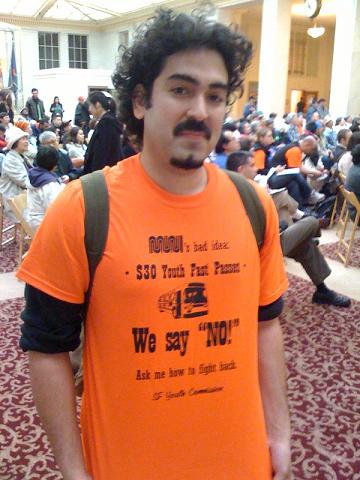
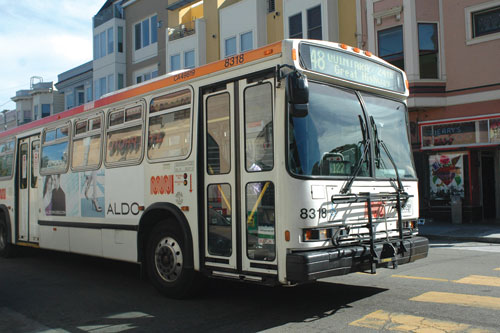
Widespread frustration with Muni service cuts and fare hikes – passionately expressed by the public on Friday at a San Francisco Municipal Transportation Agency meeting that continues tomorrow (Tuesday, March 2, starting at noon in City Hall Room 400) – has prompted a surprisingly diverse backlash.

From angry, street-level progressive activists to the downtown-friendly San Francisco Planning and Urban Research Association (SPUR), San Franciscans are criticizing the SFMTA’s budget plan (including the 10 percent service cuts approved on Friday, which could be revisited tomorrow) as short-sighted and unnecessarily divisive, prompting the biggest and most diffuse progressive organizing effort in years.

“I’ve never seen anything like this,” SFMTA spokesperson Judson True told me as he surveyed the huge, passionate crowd assembled for Friday’s meeting, adding, “It’s clear grassroots organizing is alive and well in San Francisco.”

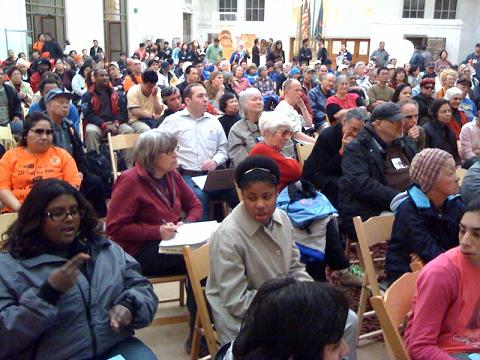
It’s true that grassroots organizing helped with Friday’s massive turnout, with hundreds of people lined up to give almost five hours worth of public testimony, much of it expressing frustration with poor city leadership (particularly by Mayor Gavin Newsom and his appointed SFMTA board and director) and declining public services.

But these weren’t the talking points of a centrally organized effort, which is what’s so remarkable about this movement. While many progressive groups joined forces under the Transit Not Traffic banner (coordinated by MTA Citizens Advisory Board member Sue Vaughn and others), and there’s a new San Francisco transit riders union (coordinated by transportation activist Dave Synder), the huge turnout on Friday came also from disability rights groups, ethnically identified groups from the Mission and Chinatown, the Senior Action Network, San Francisco Tomorrow, the social justice group POWER, the antiwar ANSWER Coalition, and several other groups, with very little coordination among them.

“We are really seeing a diverse group of people arguing for transit justice,” said Marc Caswell of the San Francisco Bicycle Coalition, which was part of the Transit Not Traffic coalition.

In fact, with Muni fares increasing and services declining since Newsom became mayor, a wide variety of groups seems to have figured out independently that there’s something seriously wrong with Newsom’s no-new-taxes approach to running the city, particularly given declining transit funding from the state and feds.

“These aren’t solutions. They’re just pitting one group against another,” said Frank Lara of the ANSWER Coalition, which opposes a proposal for extended parking meter hours, much to the chagrin of progressive groups who want motorists to help close the budget gap by giving up their free parking on Sundays.

One SPUR proposal also seeks to eliminate this pitting of groups against each other, listing as its biggest dollar proposal the elimination of work orders from the San Francisco Police Department, which would save $12.2 million per year, which the SFPD charges SFMTA for unspecified services that it has yet to document, despite agreeing to as part of last year’s budget deal.

When asked about the work order proposal, Newsom press secretary Tony Winnicker said doing so would make Muni less safe by discouraging officers from riding buses, saying such work orders were a “good accounting practice” rather than the budgetary shell game that progressive supervisors and SPUR director Gabriel Metcalf have called it.

“The gamesmanship with work orders has got to stop,” Metcalf told the Guardian, criticizing the SFMTA for cutting service across the board and raising fares for express bus service and cable cars. “They don’t have to do that and they shouldn’t do that. They just need some political courage right now.”

The next largest SPUR proposals are to charge $300 per year for disabled placards that allow drivers to park for free (which would raise $10 million per year) and to enforce existing city codes that require garages to charge by the hour rather than all day (which would raise $6.85 million), followed by Muni work rule changes that would need union approval.

Winnicker said Newsom was aware of the big turnout on Friday and the anger voiced by the crowd, telling us, “He understands people are concerned and he shares those concerns.” But rather than accepting that many people blame Newsom, Winnicker blamed Muni’s Transportation Workers Union for voting down about $5 million worth of wage concessions and work rule changes. Yet many speakers criticized Newsom’s finger-pointing on Friday, saying he and the SFMTA were too focused on targeting workers rather than the downtown corporations that Newsom has refused to adequately tax.

“There was already a fare increase last year, so for the low-income popular, this is major,” Wing Hoo Leung, vice president of the Community Tenants Association, told me in Mandarin, translated by Tan Chow, an organizer with Chinatown Community Development Center. “In a bad economy, the low-income people can’t get hit again and again. We need to cut from the top.”

Tax measures will be a big part of tomorrow’s SFMTA discussion of the $100 million budget deficit looming for the next two years – such as a parcel tax, downtown transit assessment district, parking tax increase, or local vehicle license fee — and several SFMTA board members agreed with the statement made Friday by Trustee Malcolm Heinicke that, “We need to look for other sources of revenue.”

Even Winnicker said Newsom acknowledges the need to discuss tax measures, even though he philosophically opposes them: “He understands that many things have to be on the table to close next year’s budget gap.”

But he’s far from advocating for any revenue-side solutions.

“The mayor doesn’t think the tax measures will have much public support,” Winnicker said. Yet progressive groups say that’s because Newsom has undermined people’s faith in local government and actively opposed tax increases rather than trying to make the case to the public that they’re needed to present public transit and other vital services.

“Newsom has to be out there fighting, one at the state level, and he needs to show some leadership here,” said Bob Allen of the group Urban Habitat. “I don’t want to hear Gavin Newsom say again that this is a transit-first city if he’s not going to do anything to support it.”

But Allen said that if Newsom and other city leaders made the case for new taxes to support transit and ran a strong campaign, “This city will support a ballot measure to protect Muni and expand it.”

Yet right now, he said one of the things frustrating low-income San Franciscans is there is a basic inequity between motorists and Muni riders: “If parking is going to be free on Sunday, transit should be free on Sunday. If parking is going to be free in the evenings, transit should be free in the evenings.”  

Newsom has long voiced opposition to extended meter hours, only recently softening that position slightly to possibly allow for a small pilot program for Sundays. But his appointed trustees might be willing to go even further, with Bruce Oka saying on Friday, “I know the mayor doesn’t like it, but it has to be tried.”

Marching on Sacramento

15

Angry parents, hundreds of them, met in Marina Middle School to demand an end to cuts in education.

Angry Muni riders, hundreds of them, jammed City Hall to oppose Muni fare hikes and service cuts.

Angry students from the University of California — thousands of them — will hold a huge event March 4th to push for better education funding and lower fees.

There’s something going on here — because in every case, grassroots activists in huge numbers (numbers that dwarf the so-called Tea Party events) want to force the state of California to change its budget priorities. And they are starting to talk seriously about taxes.

The Republicans are pretty intransigent up in Sacramento. But if these groups — the public school parents, the UC students, the transit users and the wide range of other middle-class folks who are sick to death of California’s budget mess and how it’s screwing them — could start working together, we could see a powerful coalition emerging.

And what that coalition needs to do, among other things, is push for Assemblyman Tom Ammiano’s legislation to change Prop. 13 and Sen. Mark Leno’s efforts to allow a local vehicle license fee, and a Constitutional amendment to get rid of the two-thirds majority for budget approval and tax hikes.

The Republicans have all signed this no-new-taxes pledge and it’s going to be hard to move them. Any attempt to change Prop. 13 will be met with huge opposition from big business. I used to think that it was hopeless even to talk about that … but maybe it’s not. Maybe if everyone who’s angry about government cuts understood that the only way to solve the problem in the end is to allow local government to raise money for the schools through property taxes, and allow state government to raise income taxes on the rich and impose taxes on big businesses, we’d be able to build a movement that could make some progress.

It’s worth thinking about.


Transit activists swarm City Hall

0

Hundreds of transit supporters, angrily opposed to the package of Muni fare hikes and service cuts proposed to close a $16.9 million mid-year budget deficit, are now packed into City Hall demanding equity and justice.

“I’ve never seen anything like this,” Judson True, spokesperson for the SF Municipal Transportation Agency, told me as he surveyed the huge overflow crowd packed into South Light Court, watching the upstairs budget meeting on closed circuit television. “We should all get on buses and go to Sacramento. It’s clear that grassroots organizing is alive and well in San Francisco.”

It may be true that budget cuts and lack of political will to raise taxes in Sacramento helped cause this problem, but this crowd was angry and they directed most of that ire at the MTA board and the man who appointed them, Mayor Gavin Newsom.

Even True wasn’t spared, as college student Glo Pereira laid into him as we spoke: “I’m a person who doesn’t appreciate this,” she glowered.
That was the dominant mood among the wide coalition of groups represented here today, including a strong presence by communities of color, those with disabilities, and social justice groups.

MTA spokesperson Judson True is confronted by activist Glo Pereira

“You folks should resign! You aren’t doing your job and you haven’t done your job,” activist Bob Planthold told the board. “This is an agency run by one man, Gavin Newsom, in the interests of one man, Gavin Newsom.”

That’s a common theme, one of complete exasperperation, with regular calls to tax the rich and lay off the poor, and for more engaged leadership from the Mayor’s Office.

As I write, there’s still lots of public testimony to go before the board deliberates and votes, so check back to this blog post, which I’ll update periodically.

Update: The MTA board seems to have heeded much the public input, voting 6-1 (with Trustee Cameron Beach in dissent) to remove the increases in Fast Pass fares for youth, senior, and the disabled and to approve the rest of the fare increases, which will increase prices for express buses and cable cars. That package was then approved on a 4-3 (with McCray, Lee, and Beach in dissent, although they didn’t make clear the reason for their votes).

Similarly, another 4-3 vote by the same trustees approved a package of service reductions that total about a 10 percent overall cut, although there was a consensus direction for the board to try to spare cuts on the busiest lines, including 14, 49, 30, 38, M, and the Owl, as well as ensuring nightime cuts are minimized. Overall, the results of the vote weren’t entirely clear and the meeting wasn’t formally adjourned, but instead will be recessed until Tuesday when the board will discuss the larger budget picture going into the next fiscal year.

At that time, the board will consider placing a parcel tax or other new revenues measures on the November ballot, something that seemed to have the support of most board members. In addition, Director Malcom Heinicke today outlined his support for a extended parking meter hours, which he would like to see done as a pilot program along five or six selected commercial corridors on Sundays and on a single commercial corridor on weeknights until 10 p.m. Several board members voiced support for the idea.

While today’s vote didn’t close the $16.9 million deficit that was the purpose of this meeting and the public testimony that went for nearly five hours, MTA executive director Nat Ford noted that “there is some softness” in the revenue picture, including the possibility of getting a $7 million from the Board of Supervisors and using a greater portion of the $17 million windfall that the MTA received after the feds decided to discontinue the Oakland airport connector service on operations rather than maintenance, as staff had proposed. In addition, the MTA board is currently discussing a privatization plan for taxi medallions, which could affect the revenue picture.

I’ll try to help sort this out with another post before day’s end, including more testimony from the occassionally raucous meeting, but it appears that this meeting essentially ended with a “To Be Continued,” and the board will pick up where it left off on Tuesday, when the big new revenue proposals (which Mayor Gavin Newsom has resisted supporting) could be at the very center of the debate.


Muni cuts spark popular backlash

2

Tomorrow’s big showdown over the latest round of Muni service cuts and fare hikes seems to be galvanizing transit supporters and giving birth to a rejuvenated progressive advocacy effort, including a new transit riders union led by noted alternative transportation advocate Dave Snyder. And that hearing is just a prelude to a taxi medallion privatization plan that will be heard in the afternoon and another big Muni budget blowout on Tuesday.

“We are asking everyone to show up and complain about the mayor and the MTA board’s failure to prepare for this and find alternatives to the drastic cuts they’re proposing,” Snyder told us, referring to the San Francisco Municipal Transportation Agency’s plans to close a $16.9 million mid-year budget deficit (which is what’s left after the $11 million from the taxi permit selloff, which the MTA has already figured into the budget) almost entirely on the backs of Muni riders, who have already seen their fares double since Gavin Newsom became mayor in 2004.

The hearing is Friday at 9 a.m. in City Hall Room 400. That afternoon, Snyder will meet with a broad-based advisory board that he’s assembled to lead (and to name) the new transit riders union that he’s been working on for months, and his tentative plan is to formally launch it on Monday.

For now, those interested in being part of this fledgling organization can sign up here. The new organization is being launched as the MTA board moves from tomorrow’s controversial meeting into another one on Tuesday, that one to start grappling with the huge budget deficit the agency will still face in the next fiscal year that begins in June, even if it’s successful in closing this year’s.  

Snyder is probably just the right person to lead this effort, having directed the San Francisco Bicycle Coalition in its formative years before founding Transportation for a Livable City (now known as Livable City) and then becoming the transportation policy director for the San Francisco Planning and Urban Research Association (SPUR), a post he left last year during a controversy surrounding Snyder’s appointment to the Golden Gate Bridge, Highway, and Transportation District Board of Directors. 

Snyder said Newsom and the MTA board have failed to plan for this foreseeable funding shortfall, saying they should have accelerated plans for extended parking meter hours (particularly ending the free parking on Sundays), a congestion pricing program, a local vehicle license fee, or measures like a gas tax, transit assessment fee, or a parcel tax – all of which the MTA board and mayor could have placed on the ballot for voter approval. Instead, they did nothing and are now pursuing a 10 percent reduction in Muni service, which could start a disastrous downward spiral.

“They need a stable, long-term funding source,” Snyder told us. “The charter actually says they’re supposed to aggressively seek new sources of funding.”

MTA spokesperson Judson True said that neither tax increases nor extended parking meter hours among the proposed solutions for Friday’s discussion, but they’re likely to be raised as part of a longer term strategy during the meeting on Tuesday: “It’s likely that the various tax measures will be part of that discussion.”

That could include reviving the extended parking meter hours proposal, which the MTA board heard last year during a rancorous public meeting, directing staff to do more community outreach on it. As True said, “We did a fair amount of outreach on it so we’ll see where the discussion goes on the two-year budget.”

Snyder is hardly alone in his local advocacy for budget solutions that spare Muni from deep cuts. In fact, the Transit Not Traffic coalition that successfully pushed the 2007 MTA reform measure Prop. A – which includes the Bike Coalition, Livable City, Walk SF, and other progressive groups – has revived itself in advance of tomorrow’s meeting and will be flying outside City Hall starting at 8:30 a.m.

There is broad support on the left for seeking more funding from drivers and the general public, but it’s not unanimous. The anti-war ANSWER Coalition frustrated many of its usual progressive allies last year by organizing against extended meter hours, claiming it was a hidden tax of low-income motorists. And Newsom has stubbornly resisted supporting new revenue measures, even in the face of unprecedented budget shortfalls, which makes the quest to win the support of two-thirds of voters difficult.

But the popular outrage that’s been expressed in recent weeks about how much Muni has been cut, year after year since Newsom became mayor, will likely put pressure on him and the MTA board (all of whom Newsom appointed) to pursue new revenue options.

True sounded weary as we spoke, noting how much anger has been expressed at the recent series of town hall meetings. “We know where people stand on these proposals,” True said. “The board is going to have some tough decisions to make, clearly.”

The battle for the forgotten district

24

sarah@sfbg.com

This November, when voters in District 10 — the largest, sunniest, and most diverse of the city’s 11 supervisorial districts — replace termed out Sup. Sophie Maxwell, they’ll be making a selection that could have pivotal implications for the entire city.

That’s because the next supervisor from southeast San Francisco inherits a district that is home to some of the city’s biggest environmental and public health challenges, as well as the most potential for development that will determine what kind of city San Francisco becomes.

District 10 is where you’ll find the most polluted and most underdeveloped lands in San Francisco, areas that could either be transformed into models of a sustainability or, in the words of Tony Kelly, the president of Potrero Boosters Neighborhood Association, “be turned into a toxic Foster City.”

District 10 is where the slaughterhouses, tanneries, and glue factories set up shop and used the bay as a dumping ground. It’s where the smokestacks of coal and oil fired power plants polluted the air. It’s where the Navy filled the Bay, built a shipyard at Hunters Point and loaded parts of the first atomic bomb onto the USS Indianapolis in 1945.

District 10 is where the bottom fell out of this industrial economy in 1974, when the Navy left, taking with it people’s jobs, pay, and hopes for a home of their own and a better future, particularly for what was then a predominantly African American population.

And District 10 is ground zero for plans that will triple the population and double the number of homes — homes that likely will only be “affordable” to Google executives and retirees from Marin, forever changing the face of San Francisco’s southeast sector. Critics fear that will accelerate what has been a steady exodus of black residents, replaced by megadeveloper Lennar’s vision for a new D10.

It’s against this dark history and difficult present that a wide open field of more than a dozen candidates are vying to replace Maxwell, who came to power in 2000 and has had a mixed voting record in her decade on the board. Sometimes, Maxwell was the eighth vote that let the progressive majority on the Board override Mayor Gavin Newsom’s veto and pass trailblazing legislation. Other times, she was the swing vote that allowed the moderate minority to carry Newsom’s water.

So, in addition to D10’s many internal challenges, this seat could determine the political balance of power on the Board of Supervisors, placing all the more importance on voters in this long-marginalized part of town.


DISTRICT OF DISCONTENT

Eric Smith, a biodiesel activist who has thrown his hat in the D10 ring, says that there is a lot of frustration in the air, and looking at the problems the district is facing, it’s hardly surprising that it has what nearly every candidate agrees is a fractured political culture.

“The Bayview, the Hunters Point Shipyard’s toxic Superfund site, the homicide rate, unemployment, poor public transportation, dwindling services and community resources have made D10 one of the city’s largest melting pots of discontent,” Smith said.

Smith’s words were spoken while the Elections Department was verifying signatures earlier this month on a second failed effort to qualify a petition to recall Maxwell.

Bayview resident and D10 candidate Marie Franklin didn’t support the attempt to recall Maxwell, but she understood it as “a frustration movement.”

“People are sinking in the sand, we’ve already lost so many of them, and they felt Sophie wasn’t doing anything for them,” said Franklin, who praised Maxwell for helping get Franklin’s apartment building complex renovated — a job that was completed 18 months ago, at a cost of $65 million, creating 500 local jobs.

“There are 654 units here, and they were uninhabitable,” Franklin said. “There was black mold, rain falling inside. We had people living worse than Haiti.”

Franklin, who said she is running because she “knows the history,” came here in 1978, when she and her son were living in a car after a fire left them homeless. She said the Bayview was a totally isolated area, barely part of mainstream San Francisco.

“There were no taxis, no services,” she recalled. “Nobody would come here, it was the stigmatized area where no one was accountable to provide services.”

The Bayview — which in some ways is the heart of D-!0 — wasn’t always a black community. But African Americans have been living here for 70 years, dealing with all the racism, denial of services, poverty, and pollution. And it bothers Franklin that 85 percent of the 10,500 homes that Lennar plans to develop won’t be affordable to the elderly, disabled, unemployed and low-income people who currently live in the Bayview.

“We need to preserve the diversity of the community and make sure their issues and information will flow to City Hall,” she said. “You must give the people a handle. If you don’t reach out, they’ll slip. That’s why folks out migrated.

Whoever succeeds Maxwell will be a central player in addressing some very big and dirty issues: the future of the Navy’s radiologically impacted shipyard at Hunters Point, Lennar’s massive redevelopment plan for the Shipyard and Candlestick Point, the polluting power plants, replacement of stinky digesters at the sewage plant, and the SF Hope public lousing rebuild.

There’s also the chance to address violence and crime. James Calloway, a candidate who has long worked in Bay Area schools, told us he believes that education and jobs are part of the keys to rejuvenating the district.

“Job opportunities are not as plentiful in the district,” Calloway said. “When I was a kid, you could walk down Third Street at 2 a.m. Now I wouldn’t walk down it at 9 p.m., and I know the area.”

Calloway is hopeful that the massive redevelopment plan, if done correctly, could start the district’s comeback. “Not a lot of black folks stay here when they have extensive education,” he said. “But it’s not only them. Many were displaced by redevelopment and had no way to go back.”


ELECTION UP FOR GRABS

The largest of the city’s 11 electoral districts, D10 is a huge triangular piece of land in the city’s southeast sector that was used as an industrial dumping zone for decades. Today, the district runs from the Giants stadium at AT&T Park to the 49ers stadium at Candlestick Point and encompasses Mission Bay, Potrero Hill, Dogpatch, India Basin, Portola, Little Hollywood, and Visitacion Valley. It’s also crossed by two freeways that isolate it from the rest of the city, and is home to a large number of crumbling housing projects that are in the process of being rebuilt.

Candidate Ed Donaldson grew up in the projects until he was 10 years old, when the Redevelopment Agency kicked his family out in the 1970s. “We landed on our feet, but others weren’t so lucky,” said Donaldson, who works as a housing counseling director at the San Francisco Housing Development Corporation.

“There is a sense that the Bayview and Visitacion Valley have not been included within the San Francisco family,” Donaldson said. “There is a sense of being forgotten.”

In 2007, Donaldson co-founded the Osiris Coalition to tackle the city’s dormant Certificate of Preference program, in which the Redevelopment Agency issued a document to displaced residents and businesses in the 1960s promising that they could return.

He also tried to rescue some 700 foreclosed properties and recycle them as affordable housing stock. And now he is trying to prevent the city from bulldozing seven SF Hope projects without guaranteeing residents that they have right to remain.

In 2007, Mayor Gavin Newsom and Maxwell convened an African American Outmigration Task Force that didn’t get a public hearing about its findings until August 2008. The timing angered some, who questioned why the report’s findings and implications for urban planning weren’t released before June 2008, when the residents of San Francisco voted for the Lennar-led Proposition G, a proposal to build 10,000 market rate homes at one of San Francisco’s last remaining black communities, which Newsom and Maxwell endorsed.

The taskforce didn’t publish its recommendations until the end of 2009, allegedly because of insider squabbling. Meanwhile, gentrification was going on actively, and many blamed Newsom, and by extension Maxwell, for failing to do anything with the group’s findings as D10 residents continued to suffer from high rates of asthma, cancer, unemployment and an ongoing black exodus.

It wasn’t always this way. In the 1940s, the district’s black population exploded when migrants from the south and World War II veterans came to work at the Hunters Point Naval Shipyard. Some moved to Alice Griffith Public Housing complex, or Double Rock, which was built as military housing in 1962. Others relocated to the Bayview when the Redevelopment Agency took over the Fillmore/Western Addition in the ’60s and ’70s as part of a controversial urban renewal effort.

But when the Navy abandoned the shipyard in 1974, unemployment hit the black community hard. Today, hundreds of the city’s lowest income residents live in Alice Griffith’s crumbling units and endure sewage backups, no heat, cloudy drinking water and leaking ceilings, as they wait for the projects to be rebuilt.

“Generations have been trapped in the silo of public housing and cannot get out, because of lack of opportunity and education, so when we legislate, we need to take that into consideration,” said candidate Malia Cohen, whose grandfather came from Texas to work at the shipyard where he met her grandmother, whose family came from New Orleans.

“My grandfather’s father was a longshoreman. He worked with the infamous Leroy King [a commissioner at the city’s Redevelopment Agency] and he has fantastically vivid stories of racism,” said Cohen, who works for the Federal Reserve Bank of San Francisco, previously served on the executive staff of Mayor Gavin Newsom, and has already raised over $18,000 in the D10 race and qualified for public matching funds.

“My family came here to work hard, they lived on Navy road in the projects, and then they bought a house here. My parents were born here, and we were all public schooled,” Cohen recalled as she took me on a tour of D10 that ended up in Visitacion Valley, an increasingly Chinese-American neighborhood that reflects a district-wide trend.

Census data show that by 2000, Asians were the largest racial group in the district (30 percent), followed by blacks (29 percent), whites (26 percent), and Latinos (19 percent). By 2003, according to the California Urban Issues project, the trend continued. Asians were the largest racial group (32 percent), followed by blacks (27 percent), whites (21 percent) and Latinos (17 percent) of the population.

This means that D10 candidates will have to garner support from more than one ethnic group to win. Over a dozen candidates have already filed papers in the race, but so far there is no clear front-runner.

Also frustrating the prognosticators is that fact that D10 has had the lowest voter turnout in the city, so the winner will also depend on who goes to the polls.

D10 candidate Geoffrea Morris, who is the grand daughter of longtime Bayview activist Charlie Walker, has been knocking on doors and participating in voter registration drives.

“We need new blood,” Morris said

Getting elected will be a complicated equation. Although Bayview’s population was 50 percent African American at the time of the 2000 census, it didn’t turn out the vote. In the 2006 election, only 14,000 of the district’s 37,000 registered voters went to the ballot, and 50 percent were from whiter, richer, and more Asian neighborhoods.

“It’s very important to the future of the city that the ethnicity diversity of the board be maintained and that the African American community have representation,” former Board President and current Democratic Party chair Aaron Peskin told the Guardian.

Maxwell recently told the Guardian that she’s not ready to endorse any D10 candidates yet. “I’m waiting for people to have a better understanding of what this community is, what the common thread running through it is, and how to use rank choice voting,” she told us.

The only candidate who currently holds elected office is BART director Lynette Sweet, who had her answers down pat when we reached her by phone, and even used wording that was eerily similar to Maxwell’s words.

“D10 is a pretty diverse district, but there is only one common thread: the need for economic development,” Sweet told me. “That’s true in Potrero Hill, Portola, Dog Patch and the Bayview. It’s the same mantra: a lot of small businesses need help, and the only way to help them is through economic development. In Potrero Hill it’s about land use. In the Bayview, it’s about the shipyard and better transportation and truancies.”


THE COMMON THREAD

District 10 is ground zero for the Lennar’s $2.2 billion plan to develop 10,500 market rate condos at the Shipyard and Candlestick Point. The plan will allegedly create thousands of jobs and new parks, deliver on an historic community benefits agreement that labor groups claim is so “lawyered up” that the developer can’t renege on its promises.

The package is framed as the one and only way to revitalize the southeast’s formerly vibrant economic engine. Indeed, any time anyone tries to slow down the process—to take time to thoroughly read the draft EIR and see if it adequately addresses the impacts of this massive urban reengineering project — a chorus of “no delays” starts up, either from residents of the housing projects desperate to see their homes rebuilt, or the labor contractors who hope to get jobs.

“It’s as if the city is playing checkers, while Lennar is playing three-dimensional chess,” Eric Smith observed.

Lennar has stated that it will contribute $711 million to finance this massive project. The remainder will be leveraged by Mello-Roos bonds, state taxes based on the use and size of a property and intended to raise money for needed services, and tax increment financing, which creates funding for projects by borrowing against future property tax revenues.

The conceptual plan won Maxwell’s backing but environmental groups are critical of the draft EIR.

During DEIR hearing, environmentalists questioned the wisdom and the cost of filling the Bay to build a bridge over Yosemite Slough, and building condos on Candlestick Point state recreation area, the only open major open space in the district.

But the city’s Planning Department also has 20,000-30,000 units of housing in its pipeline. This means that if all these plans get approved in the next decade, they’d account for 80 percent of residential development citywide. And D10’s population could triple, further skewing the district’s already shifting demographics.

In other words, D10 as we know it could become nothing more than a historic relic in a few years, and the next supervisor will play a key role in deciding whether that happens. SFHDC’s Ed Donaldson warns that any supervisor who does not understand the complexity of the city’s largest district can expect a similar recall backlash in future.

“There is no one homogenous voice in the community,” Donaldson said. “The grass-roots organizing that brought about the recall effort was a result of a changing political structure in the area, but is not yet on par with other districts in town. We still allow our politics to be controlled from downtown.”

Fellow candidate Eric Smith warns that the issues—and politics—are complex.

“People were emotional, angry, and desperate because they feel no one listens to them,” Smith said. “That’s part of the problem here; they would rather have a supervisor go down swinging for them, rather than watch one seemingly side with Lennar, PG&E and the mayor on issues contrary to their interests. That’s the terrible irony and one of the biggest problems in District 10. Folks are so mad, they’re willing to do whatever it takes to make them feel they have a voice in the outcome, even if it’s potentially worse.”

Smith cited the sequence of events that culminated last year in the Navy dissolving the community-based shipyard Restoration Advisory Board (RAB), which for years has reviewed technical documents and commented on the Navy’s clean-up proposals. But in December, the Navy made its official decision to disband the RAB, citing dysfunctional behavior and off-topic discussions that got in the way.

“Some of the same folks who were frustrated by the process, tried to send a signal to the Navy that they weren’t being heard and for all their well-intentioned efforts got the RAB dissolved,” Smith said. “I truly feel for them, it’s absolutely heartbreaking, but at times, they can be their own worst enemy.”

One of the looming issues about the shipyard is that the land has been polluted and needs to be cleaned. The shipyard contains radioactive debris from ships towed to the shipyard, after a 90-foot wave washed over them during an atomic test gone awry. The Navy burned 610,000 gallons of radioactively contaminated ship fuel at the shipyard, and workers showered on the shipyard, raising concerns that radioactive materials got into the drains and sewers. And questions have been raised about radiological tests on animals at the yard.


LEAKS AND FLOODS

It’s not just the shipyard that’s toxic. Even the buildings that were constructed to house workers 50 years ago are a serious mess.

Realtor Diane Wesley Smith, who grew up in public housing projects, took me on a walking tour of Alice Griffith last week to see conditions that tenants will likely have to endure until at least 2014, if the city sticks to its plan to relocate people into a new replacement unit in the same geographical area, if not the exact same site.

What we found was pretty messed up.

“The water sometimes comes out brown and feels like sand. It’s been like that for a year,” one resident said.

“The water is cloudy, the bath tub isn’t working and the sink keeps stopping up,” said another.

A woman named Silvia showed us how the water from the tap in her elderly mother’s kitchen flows out cloudy and then doesn’t settle properly, like foamy beer.

“The roof’s been leaking for years, the sewage backs up, but they just fixed the lights,” Silvia said. A neighbor named Linda was using her oven as a heater.

“The toilet backs up a lot, and my grandson’s been coughing a lot from asthma,” Linda said.

“Roaches is always a problem,” said a woman named Stormi, dressed in black sweats and a black T-shirt that read, “Can’t knock the hustle.”

“They’re trying,” said Stormi, a member of the Alice Griffith Residents Association, as a couple of Housing Authority trucks pulled up to do repairs.

“They promise that you will not have to leave your unit, but if they try to move us down to the waterfront, well, there’s a reason there’s no housing there, and it’s because the land will flood,” Stormi said.

“If we don’t end up at the table, we’ll end up on the menu,” Wesley Smith warned, as she stopped to chat with a group of young men, who were worried they would pushed out of the Alice Griffith rebuild through the criteria being established.

“Fred Blackwell, the executive director of the Redevelopment Agency, assures me that’s not the case, but Alice Griffith is a Housing Authority property, and empty promises have the potential to be great promises provided they are made in writing,” Wesley Smith said as we walked out of the projects and onto the road where a yellow and black sign announced “flooded” next to Candlestick Point park, where Lennar wants to build.

Malia Cohen expressed concern about Hope SF residents, as we drove through the Sunnydale housing project.

“We have to be diligent and mindful that people are not pushed out,” Cohen said, noting the sweeping views at Gleneagles golf course above Sunnydale, and the value of housing for a golf course community. “When public housing gets taken offline, we must work with Redevelopment and the Housing Authority to make sure no one is changing the rules halfway. We have to make sure the talks and walks line up. We need to be equal partners. We cannot be bulldozed by City Hall.”

Geoffrea Morris is a Calworks employee, at the Southeast Community College facility on Oakdale, which was built to mitigate the city’s expansion of the sewage plant in 1987. She cited concerns about the literacy levels of people who live in the 2200 public housing units that cluster D10. “A lot of people in Alice Griffith don’t even know the dates or when it’s going to be reconstructed,” Morris said. “Folks like to be told stuff like that, but the city gives you a stack of papers. Some will read them, but others rely on folks they think are trustworthy. They need stuff in layman’s terms written on one sheet of paper.”

Morris is a fan of the Internet who posted a community survey online, and made sure every housing project got some literature telling people to get informed. She worries about the digital divide in D10:

“A lot of folks don’t have computers and access to important information,” Morris said. “And let’s talk about the way ‘affordable’ is used to trick people.”

Michael Cohen, Newsom’s top economic adviser, recently stated in a memo that over the expected 15-20 year phased build out, Lennar’s Candlestick-Shipyard development would include, “up to 10,500 residential units, about 32 percent of which (3,345) will be offered at below market rates.”

“But 892 units of this ‘affordable category’ will be sold to folks earning $100,000,” Morris said. “So if you subtract 892 units from affordable unit category, you’re back to 25 percent affordable.”

Candidate Kristine Enea, an attorney and a former RAB member, chairs the India Basin Neighborhood Association, which administers a US EPA grant to hire experts to translate the Navy’s cleanup documents into plain English and comment on them She was frustrated by the Navy’s decision to dissolve the RAB.

“The lack of a forum does nothing to bolster the community’s trust in the cleanup or the redevelopment process,” Enea said.

Enea generally supports the Lennar project, but has concerns about whether it will adequately mitigate increased car traffic, or result in commercial development that benefits her neighborhood.

“India basin is a pocket of Hunters Point right along the shoreline,” Enea said. “Right now, we have no shops or restaurants, no ATM, no groceries, nothing beyond one liquor store and a few industrial businesses.

Potrero Boosters president Tony Kelly told us that District 10 residents can think for themselves. “D10 residents don’t need to rely on corporations to solve their problems,” he said.

“Folks in the eastern neighborhoods came up with a better revitalization plan than what the city proposed and community activists managed to close the power plant, after the city said it was impossible,” Kelly recalled.

And there’s no shortage of good ideas.

Kelly suggested that an urban agriculture center could immediately put low-skilled folks to work by erecting greenhouses on unused land. Smith said the industrial zone could be “incredible eco-park made from sustainable sources.

‘D 10 is the dumping ground for everything, including all the city’s waste,” he said. “We could be a shining example, not just for D 10, but the rest of the state.”

The D 10 candidate line up includes Calloway, Cohen, Donaldson, Smith, Enea: civil rights attorney Dewitt Lacy, Morris, Potrero View publisher Steve Moss; District 7 BART director Lynette Sweet, Wesley-Smith. Bill Barnes, who works for Sup. Michela Alioto-Pier, and Linda Richardson, who was appointed to the Human Rights Commission in 2007 by Mayor Newsom, have also expressed interest in the race.

In such a huge field, name identification will play a major role. Sweet is in office, but BART Board is not a high-profile job and won’t give her a huge advantage.

Cohen has a slight edge right now in that she’s raised $18,505, including $500 from former Newsom flak Peter Ragone, making her the first D. 10 candidate to qualify for campaign financing. The oldest of five girls, Cohen recalls how her mother got laid off from her city job as a school-based mental health worker and then rehired, as part of the city’s budget cuts.

“We felt that pinch and the frustrating games that are played out between the leadership and the rank and file,” she said.

Cohen who worked for Newsom in his first term as mayor, but has since left his administration , said she is uncomfortable at being framed as Newsom’s candidate.

“Because I’m not, but I am one of the few candidates who has seen how the mayor and the Board work—and don’t work—together,” she said.

Moss sees the city’s southeast as a “district in transition.” Over coffee at Farley’s in Potrero Hill, he told me that the southeastern neighborhoods could be “launching pads for environmentally sustainable growth.”

“The district’s been in a frozen period for 30 years, But despite the problems, people are deeply committed to and in love with their community.

“This district is the future of San Francisco and its social fabric—the diversity, income –and its problems are leftovers from the city’s industrial age.”


DISTRICT 10, BY THE NUMBERS

Total Acres: 5,650

Average household income: $85,000

Population: 73,000

Registered voters: 37,700

Average housing price: $335,000

Ethnicity (2003 figures): Asian 32%, African American, 27%, white 21%, Hispanic 17%

Development status of land: 18% residential, 38% is commercial, 38% undevelopable

All figures the latest available. Sources: SFGIS, Association of Bay Area Governments, U.S. Census, California Urban Issues Project. Ethnicity and income data is from 2003 and almost certainly has changed.


Stage listings

0

Stage listings are compiled by Molly Freedenberg. Performance times may change; call venues to confirm. Reviewers are Robert Avila, Rita Felciano, and Nicole Gluckstern. Submit items for the listings at listings@sfbg.com. For further information on how to submit items for the listings, see Picks. For the complete listings, go to www.sfbg.com.

THEATER

OPENING

Mirrors In Every Corner Intersection for the Arts, 446 Valencia; 626-2787, www.theintersection.org. Opens Thurs/25. Runs Thurs-Sun, 8pm. Through March 21. Intersection for the Arts, Campo Santo, and the Living Word Project present the world premiere of Chinaka Hodge’s provocative show exploring race and identity from new perspectives.

BAY AREA

Beebo Brinker Chronicles Brava Theater Center, 2781 24th St; 641-2822, www.brava.org. $20-$30. Opens Thurs/25. Runs Thurs-Sun and March 6, 8pm, through March 13. The regional premiere of Kate Moira Ryan and Linda S. Chapman’s play adapted from a series of pulp novels.

Concerning Strange Devices from the Distant West Roda Theatre, 2015 Addison, Berk; (510) 647-2949, berkeleyrep.org. $13.50-$27. Berkeley Rep presents a sexy and intriguing new show from Naomi Iizuka.


ONGOING

Animals Out of Paper SF Playhouse, 533 Sutter; 677-9596, www.sfplayhouse.org. $30-$40. Wed/24-Fri/26, 8pm; Sat/27, 3 and 8pm. SF Playhouse presents Rajiv Joseph’s quirky comedy.

Bay One Acts Festival Boxcar Theatre, 505 Natoma; 776-7427, www.threewisemonkeys.org. $12-$24. Dates and times vary. Through March 13. Three Wise Monkeys presents eleven short plays by Bay Area playwrights, including Cris Barth, Stuart Bousel, and Lauren Yee.

Beauty of the Father Phoenix Theatre, 414 Mason; (800) 838-3006, www.offbroadwaywest.org. $30. Thurs-Sat, 8pm. Through March 13. Off-Broadway West’s season opener offers the Bay Area a first look at the somewhat messy but ultimately rewarding 2006 drama by Cuban American Pulitzer Prize–winner Nilo Cruz ("Anna in the Tropics"). Set in contemporary Andalusia, in the south of Spain, it’s the story of an aging painter named Emiliano (Durand Garcia) whose best friend and near-constant companion is the ghost of Federico García Lorca (Michael Carlisi), poet and playwright long ago murdered by the fascists during the Spanish Civil War. Emiliano also lives with his mostly platonic sweetheart (Jeanette Sarmiento), whom he plans to marry after she divorces his other housemate, a young Moroccan immigrant named Karim (Chris Holland) who is tied to her for the green card but is also Emiliano’s sometime lover. When his long-estranged ex-wife back in the U.S. dies, he invites his grown daughter (Natasha Chacon) to come live with him, feeling the urge "to father her" again. She arrives for an indefinite stay instead, shedding the gloom of her mother’s death in the embrace of life under the Andalucian sun—and a smitten Karim in particular. There’s some piquancy to the unraveling of this romantic ménage, and real poetry in the language and perspective afforded through the magical realistic presence of Lorca, but despite Cruz’s muscular writing and ambitious thematic canvas, the drama flags at points and sometimes seems unsure of where it would take us or even the proper tone or color to employ. Nevertheless, artistic director Richard Harder helms a strong cast, which helps make the going worthwhile. (Avila)

Don’t Feel: The Death of Dahmer Mama Calizo’s Voice Factory, 1519 Mission; mcvf.org. $20. Thurs/25-Sat/27, 8pm.For most of us, Jeffrey Dahmer is a set-up and punch line in one, a byword for the macabre phenomenon of serial killing, as mundane as cereal eating (at least in pop culture terms). He’s the inhuman incarnate, hiding behind boyish white male normality. But what does it mean to us that he was also homosexual? That’s an animating question behind Evan Johnson’s "Don’t Feel: The Death of Dahmer," whose great power lies in its rigorous seriousness, the skill and depth it brings to its subject that makes it unexpectedly complicated, fascinating, terrible, tragic—an altogether human and social drama, centered on a terrifyingly isolated figure, but including many others from immediate family to those of us in the room listening to Dahmer’s shy, earnest, enraged postmortem testimony. The eerie, shadowy setting, perfectly augmented by Sean Malroy’s buzzingly jarring soundscape, has Dahmer still in his orange penitentiary garb, his forehead soaked with blood from the fatal blow received from a fellow inmate nicknamed Christ. The impressive result of writer-performer Johnson’s DIY residency at Mama Calizo’s Voice Factory, beautifully directed by Eric Wilcox, "Don’t Feel" humanizes its subject without recourse to crass sentiment or apology. And Johnson’s supple, multifaceted performance is passionately committed, deft and fearless. It’s a riveting communion with the dead, in several directions at once, and it will leave you troubled and moved. (Avila)

Eat, Pray, Laugh! Off-Market Theaters, 965 Mission; www.brownpapertickets.com. $20. Wed/24, 8pm. Off-Market Theaters presents stand up comic and solo artist Alicia Dattner in her award-winning solo show.

Eccentrics of San Francisco’s Barbary Coast: A Magical Escapade San Francisco Magic Parlor, Chancellor Hotel Union Square, 433 Powell; 1-800-838-3006. $30. Fri-Sat, 8pm. Ongoing. This show celebrates real-life characters from San Francisco’s colorful and notorious past.

Fabrik: The Legend of M. Rabinowitz Jewish Theatre, 470 Florida; 292-1233, www.tjt-sf.org. $20-$45. Thurs/25-Sat/27, 8pm; Sun/28, 2 and 7pm. The Jewish Theatre San Francisco presents a Wakka Wakka Productions presentation of this story of a Polish Jew who immigrated to Norway, told with hand-and-rod puppets, masks, and original music.

The Gilded Thick House, 1695 18th St. www.thegilded.com. $18-$30. Thurs, 7pm; Fri-Sat, 8pm; Sun, 2pm. Through March 7. The Curiouser Group presents a new musical by Reynaldi Lolong.

The Greatest Bubble Show on Earth Marsh, 1062 Valencia. (800) 838-3006, www.themarsh.org. $7-$50. Sun, 11am. Through April 3. The Amazing Bubble Man returns with his extraordinary family-friendly show.

Hearts on Fire Teatro ZinZanni, Pier 29; 438-2668, www.zinzanni.org. $117-$145. Wed-Sat, 6pm; Sun, 5pm. Through May 16. Teatro ZinZanni celebrates its 10th anniversary with this special presentation featuring Thelma Houston, El Vez, and Christine Deaver.

*Loveland The Marsh, 1074 Valencia; 826-5750, www.themarsh.org. $15-$50. Sat, 8:30pm; Sun, 7pm. Through April 11. Los Angeles–based writer-performer Ann Randolph returns to the Marsh with a new solo play partly developed during last year’s Marsh run of her memorable Squeeze Box. Randolph plays loner Frannie Potts, a rambunctious, cranky and libidinous individual of decidedly odd mien, who is flying back home to Ohio after the death of her beloved mother. The flight is occasion for Frannie’s own flights of memory, exotic behavior in the aisle, and unabashed advances toward the flight deck brought on by the seductively confident strains of the captain’s commentary. The singular personality and mother-daughter relationship that unfurls along the way is riotously demented and brilliantly humane. Not to be missed, Randolph is a rare caliber of solo performer whose gifts are brought generously front and center under Matt Roth’s reliable direction, while her writing is also something special—fully capable of combining the twisted and macabre, the hilariously absurd, and the genuinely heartbreaking in the exact same moment. Frannie Potts’s hysteria at 30,000 feet, as intimate as a middle seat in coach (and with all the interpersonal terror that implies), is a first-class ride. (Avila)

Mahalia Lorraine Hansberry Theatre, 450 Post; 474-8800, www.lhtsf.org. $18-$40. Thurs/25-Sat/27, 8pm; Sun/28, 4pm. Lorraine Hansberry Theatre presents the inaugural production of Tom Stolz’s gospel musical.

Oedipus el Rey Magic Theatre, Building D, Fort Mason Center; 441-8822, www.magictheatre.org. $20-$55. Days and times vary. Through March 14. Luis Alfaro transforms Sophocles’ ancient tale into an electrifying myth, directed by Loretta Greco.

Pearls Over Shanghai Hypnodrome, 575 Tenth St.; 1-800-838-3006, www.thrillpeddlers.com. $30-69. Sat, 8pm; Sun, 7pm. Through April 24. Thrillpeddlers presents this revival of the legendary Cockettes’ 1970 musical extravaganza.

*The Position Studio 250, 965 Mission; www.applyfortheposition.com. $20. Thurs/25-Sat/27, 8pm; Sun/28, 7pm. From the ready pen of local playwright William Bivins comes a witty dystopic thriller too good not to be (essentially) true: In the USA’s not-too-distant future, after "the Great Downturn," there’s 80% unemployment, the population lives by scavenging, despair is in the water and air, and there are no more dogs (those little four-legged ambassadors of hope). But there are still one or two job openings in the ultra-powerful, totemic, life-giving corporate universe of The Concern. A search narrows the candidates down to six (types played with palpable soul by Kate Jones, Asher Lyons, Gabi Patacsil, Eric Reid, Dan Williams, and Laura Zimmerman). They’re flown to an exclusive island, paradisial in its accommodations, totalitarian in its panoptic surveillance and haughty obscurantism. Greeted by icy hot Mrs. Radcliffe (Jessica Cortese) and her deliriously agreeable man-servant Baylian (a joyously loopy Even Winchester)—both nattily futuristic in coordinated turquoise outfits—the candidates learn there are no rules but two over the course of the evaluation, and no clue to what’s being evaluated. The contest begins and, in PianoFight’s high-spirited low-budget production, it makes no difference how familiar the themes or scenario. Adeptly suggesting classics new and hoary, from "Survivor" and "The Apprentice" to "The Most Dangerous Game," "The Position" never feels merely derivative, let alone dull or predictable. It’s inspired, rebellious lovemaking with our doom-clouded moment, engrossingly directed by PianoFight’s Christy Crowley. (Avila)

The Real Americans The Marsh, 1062 Valencia; 826-5750, www.themarsh.org. $15-$50. Thurs-Fri, 8pm; Sat, 5pm. Through April 18. The Marsh presents the world premiere of Dan Hoyle’s new solo show.

Suddenly Last Summer Actors Theatre, 855 Bush; 345-1287, www.actorstheatresf.org. $15-$35. Thurs-Sat, 8pm. Through March 27. Actors Theatre presents one of Tennessee Williams’ finest and most famous plays.

Tick, Tick&ldots;Boom! Eureka Theatre, 215 Jackson. (800) 838-3006, www.therhino.org. $15-$30. Wed/24-Sat/27, 8pm; Sun/28, 3pm. "Rent" creator Jonathan Larson’s small autobiographical musical theater piece receives a modestly scaled but enthusiastic, generally sound staging from Theatre Rhinoceros and director Christopher Herold. The play, set in 1990 and written as Larson was still struggling to make a name for himself, revolves around the protagonist’s (Scott Gessford) impending 30th birthday and the crisis of confidence it triggers, as girlfriend (Holly Nugent) drifts away and best friend (Brian Yates Sharber)—in a supreme wake-up call to the heretofore self-absorbed artist—gets diagnosed with AIDS. The music—despite some sour notes and body mic problems on opening night—comes across most forcefully, especially one or two devilishly clever songs, but the storyline is thin and hard to care too much about on its own (it’s real dramatic power coming from the knowledge we have of Larson’s poignant end a few years later, dying on the eve of "Rent"’s phenomenal take-off). (Avila)

What Just Happened? The Marsh, 1062 Valencia; (800) 838-3006, www.themarsh.org. $20-$50. Fri-Sat, 8pm. Through March 13. The Marsh presents Nina Wise’s improvisation-based sow about personal and political events which have transpired over the previous 24 hours.

What Mama Said About ‘Down There Our Little Theater, 287 Ellis; 820-3250, www.theatrebayarea.org. $15-$25. Thurs-Sun, 8pm. Through July 30. Writer/performer/activist Sia Amma presents this largely political, a bit clinical, inherently sexual, and utterly unforgettable performance piece.

Wicked Orpheum Theatre, 1182 Market; 512-7770, www.shnsf.com. $30-$99. Tues, 8pm; Wed, 2pm; Thurs-Fri, 8pm; Sat, 2 and 8pm; Sun, 2pm. Ongoing. Assuming you don’t mind the music, which is too TV-theme–sounding in general for me, or the rather gaudy décor, spectacle rules the stage as ever, supported by sharp performances from a winning cast. (Avila)


BAY AREA

An Anonymous Story by Anton Chekhov Berkeley City Club, 2315 Durant, Berk; (510) 558-1381, centralworks.org. $14-$25. Thurs-Sat, 8pm; Sun, 5pm. Central Works presents a new play adapted from the Checkhov novella.

Coming Home Thrust Stage, Berkeley Repertory Theatre, 2025 Addison; (510) 647-2917, www.berkeleyrep.org. Wed/24, 7pm; Thurs/25-Sat/27, 8pm; Sun/28, 2 and 7pm. $33-$71. The rags to riches fantasy of the small town girl who hits the big time after abandoning her hometown for the brighter lights of a big city is one of the most well-worn yet perennially beloved plotlines. Less popular are the tales of the girls who return to their hometowns years later still in rags, their big city dreams crumbled and spent. Such a tale is Athol Fugard’s Coming Home, a cautious sequel to Valley Song, which follows Veronica Jonkers (a versatile Roslyn Ruff) to her childhood home in the Karoo, her own small child in tow and little else. The tragedy of her ignominious return is further compounded by her secret knowledge that she is HIV-positive, and her young son’s future therefore precarious. The slow-moving yet tenacious script stretches over a period of four years, following both the progression of Veronica’s dread decline in health, and the flowering intellectual development of her son, Mannetjie (played by Kohle T. Bolton and Jaden Malik Wiggins), who keeps his "big words" in his deceased Oupa’s pumpkin seed tin. Almost superfluous appearances by the ghost of Oupa (Lou Ferguson) are made enjoyable by Ferguson’s quiet mastery of the role, and Thomas Silcott parlays great empathy and range in his performance as Veronica’s irrepressible childhood companion and circumstantial caretaker Alfred Witbooi. (Gluckstern)

*East 14th Laney College Theatre, 900 Fallon St, Oakl. www.east14thoak.eventbrite.com. $10-$50. Fri/26-Sat/27, 8:30pm. Also at the the Marsh Berkeley in March. Don Reed’s solo play, making its Oakland debut after an acclaimed New York run, is truly a welcome homecoming twice over. It returns the Bay Area native to the place of his vibrant, physically dynamic, consistently hilarious coming-of-age story, set in 1970s Oakland between two poles of East 14th Street’s African American neighborhood: one defined by his mother’s strict ass-whooping home, dominated by his uptight Jehovah’s Witness stepfather; the other by his biological father’s madcap but utterly non-judgmental party house. The latter—shared by two stepbrothers, one a player and the other flamboyantly gay, under a pimped-out, bighearted patriarch whose only rule is "be yourself"—becomes the teenage Reed’s refuge from a boyhood bereft of Christmas and filled with weekend door-to-door proselytizing. Still, much about the facts of life in the ghetto initially eludes the hormonal and naïve young Reed, including his own flamboyant, ever-flush father’s occupation: "I just thought he was really into hats." But dad—along with each of the characters Reed deftly incarnates in this very engaging, loving but never hokey tribute—has something to teach the talented kid whose excellence in speech and writing at school marked him out, correctly, as a future "somebody." (Avila)

The First Grade Aurora Theatre, 2081 Addison, Berk; (510) 843-4822, auroratheatre.org. $15-$55. Wed/24-Sat/27, 8pm; Sun/28, 2 and 7pm. Aurora Theatre Company presents the world premiere of Joel Drake Johnson’s new play.

*Learn to be Latina La Val’s Subterrnean, 1834 Euclid, Berk. impacttheatre.com. $10-$20. Thurs-Sat, 8pm. Impact Theatre continues its 14th season with the world premiere of Enrique Urueta’s play.


DANCE

"The Butterfly Lovers" Palace of Fine Arts Theatre; 392-4400, www.cityboxoffice.com. Wed, 7:30pm. $35-$70. Chinus Cultural Productions and China Arts and Entertainment Group present the U.S. premiere of China’s Romeo and Juliet, performed by the Beijing Dance Academy Youth Dance.

"Intercontinental Collaborations" CounterPULSE, 1310 Mission; (800) 838-3006, www.counterpusle.org. Thurs-Sun, 8pm. Check for ticket prices. This evening features the U.S. premiere of Claire Cunninghma’s award-winning solo and a preview excerpt of Jess Curtis/Gravity’s Dances for Non-Fictional Bodies.

"Olympus Rising" Dance Mission Theater, 3316 24th St. www.dancewright.com. Sun, 7pm. DanceWright Project appears in the Black Choreographers Festival to preview an excerpt from this sci-fi rock ballet.

"When Dreams are Interrupted" City Hall Rotunda. Wed, noon. Purple Moon Dance Project presents a special performance of this inspiring work about the forced removal of Japanese Americans in San Francisco.


BAY AREA

"Ecstatic Dance" Sweets Historic Ballroom, 1933 Broadway, Oakl; 505-1112, info.ecstaticdance@gmail.com. Sun, 9:30am; Wed, 7pm. Ongoing. Move however you feel inspired with this freeform journey of movement.

"here, look" Shawl-Anderson Dance Center, 2704 Alcatraz, Berk; (510) 654-5921, www.shawl-anderson.org. Fri-Sat, 8pm; Sun, 6pm. The Shawl-Anderson’s Dance Up Close/East Bay Series, ahdanco, presents an evening of new works by Abigail Hosein.

"Saints and Angels" Temescal Arts Center, 511 48th St, Oakl. www.danceelixir.org. Fri, 6:30 and 9pm. Dance Elixir presents an evening of beautiful, austere, athletic, and comic contemporary dance.


PERFORMANCE

"All Star Magic & More" SF Playhouse, Stage 2, 533 Sutter; 646-0776, www.comedyonthesquare.com. Sun, 7pm. Ongoing. Magician RJ Owens hosts the longest running magic show in San Francisco.

30th Anniversary Celebration of New Works African American Art and Culture complex, 762 Fulton; 292-1850, www.culturalodyssey.org/tickets. Thurs-Sat, 8pm; Sun, 3pm. Through March 14. $20. In celebration of Black History Month and National Women’s Month, Cultural Odyssey presents a festival featuring The Love Project, The Breach, and Dancing with the Clown of Love.

BATS Improv Theatre Bayfront Theater, Fort Mason Center, B350 Fort Mason; 474-6776, www.improv.org. Fri-Sat, 8pm. $17-$20. The Theatresports show format treats audiences to an entertaining and engaging night of theater and comedy presented as a competition.

Bijou Martuni’s, 4 Valencia; 241-0205, www.dragatmartunis.com. Sun, 7pm. $5. The eclectic live cabaret showcase features a night of love songs in honor of Valentine’s Day.

"Black History Month Blacktacular&ldots; Black!" StageWerx Theatre, 533 Sutter. Thurs-Fri, 8pm. $20-$50. W. Kamau Bell aims to finally figure out what the big deal is about BHM.

Don Carbone and Rick Shapiro Dark Room, 2263 Mission; 401-7987, darkroomsf.com. Sat. The Bay Area absurdist writer/performer shares an evening with the comic.

"La Cenerentola" Legion of Honor; 972-8930, www.pocketopera.org. Sat-Sun, 2pm. Also March 7 in Napa. $31-$37. Pocket Opera presents Rossini’s twist on Cinderella.

"The Cinderella Principle" Yerba Buena Center for the Arts, 701 Mission; 978-2787, www.ybca.org. Thurs-Sat, 8pm. $20-$35. Robert Moses’ Kin presents the world premiere of this show with Hush and Toward September.

"The Legendary Lions vs. the Fists of Fury" Southern Exposure, 3030 20th St; 963-2141, www.soex.org. Fri, 8pm. Free. Mike Lai presents a one-night performance that juxtaposes traditional and contemporary Chinese culture.

PianoFight Studio 250 at Off-Market, 965 Mission; www.painofight.com. Mon, 8pm. Through March 29. $20. The female-driven variety show Monday Night ForePlays returns with brand new sketches, dance numbers, and musical performances.

"Talk to Me" The Marsh, 1062 Valencia; (800) 838-3006, www.themarsh.org. Wed, 7:30pm. $10-$15. The Marsh presents a performance of Hernan Ximenez’ funny and riveting play.

"Unscripted: unscripted" Off-Market Theater, Studio 205, 965 Mission; 869-5384, www.un-scripted.com. Thurs-Sat, 8pm. Through March 13. The Un-Scripted Theater Company kicks off its eighth season with an improvised improv show.

"Six" Commonwealth Club, 595 Market. www.magictheatre.org. Mon, 6pm. Free. Magic Theatre presents the Martha Heasley Cox Virgin Play Series, this time featuring a piece by Zohar Tirosh-Polk.


BAY AREA

"Come Home" La Pena, 3105 Shattuck, Berk; (510) 849-2568, www.lapnea.org. Sat, 8pm. $15-$18. In celebration of Black History Month, La Pena Cultural Center presents Jovelyn Richards in her solo performance theater piece.

"Once Upon a Mattress" Julia Morgan Center for the Arts, 2640 College Ave, Berk; (510) 595-5514, www.ymtcberkeley.org. Feb 26, and 27, 7:30pm; Feb 21, 27, 2pm; Feb 28, 3pm. $10-$20. Young Musical Theater Company presents the Broadway classic.

Upright Citizens Brigade Pan Theater, 2135 Broadway, Oakl; www.pantheater.com. Fri, 8 and 9:10pm. Ongoing. $14-$18. Upright Citizens Brigade Touring Co. brings the NYC funny to Oakland with this improve comedy show with guest performing troupes.


COMEDY

Annie’s Social Club 917 Folsom, SF; www.sfstandup.com. Tues, 6:30pm, ongoing. Free. Comedy Speakeasy is a weekly stand-up comedy show with Jeff Cleary and Chad Lehrman.

"All Star Comedy and More with Tony Sparks" SF Playhouse, 533 Sutter; 646-0776, www.comedyonthesquare.com. Sun, 8:30pm. Ongoing. SF’s favorite comedy host brings a showcase of the Bay’s best stand-up comedy and variety.

"Big City Improv" Shelton Theater, 533 Sutter; (510) 595-5597, www.bigcityimprov.com. Fri, 10pm, ongoing. $15-$20. Big City Improv performs comedy in the style of "Whose Line Is It Anyway?"

Brainwash 1122 Folsom; 861-3663. Thurs, 7pm, ongoing. Free. Tony Sparks hosts San Francisco’s longest running comedy open mike.

Club Deluxe 1511 Haight; 552-6949, www.clubdeluxesf.com. Mon, 9pm, ongoing. Free. Various local favorites perform at this weekly show.

Clubhouse 414 Mason; www.clubhousecomedy.com. Prices vary. Scantily Clad Comedy Fri, 9pm. Stand-up Project’s Pro Workout Sat, 7pm. Naked Comedy Sat, 9pm. Frisco Improv Show and Jam Sun, 7pm. Ongoing.

Cobbs 915 Columbus; 928-4320.

"Comedy Master Series" Blue Macaw, 2565 Mission; www.comedymasterseries.com. Mon, 6pm. Ongoing. $20. The new improv comedy workshop includes training by Debi Durst, Michael Bossier, and John Elk.

"Danny Dechi and Friends" Rockit Room, 406 Clement; 387-6343. Tues, 8pm. Free. Danny Dechi hosts this weekly comedy showcase through October.

"Frisco Fred’s Comedy Hour" Chancellor Hotel in the Luques Restaurant, 433 Powell; 646-0776, www.comedyonthesquare.com. Sat, 7 and 8:30pm. Through March 27. $25. Frisco Fred presents this fun-filled hour of comedy, magic, crazy stunts and special guests.

"The Howard Stone Show – 100th Show Celebration" SF Playhouse, 533 Sutter; 646-0776, www.comedyonthesquare.com. Sun, 8:30pm. $20. The Playhouse presents an off-beat comedy talk show hosted by Howard Stone and featuring the Danny Detchi Orchestra.

"Improv Society" Shelton Theater, 533 Sutter; www.improvsociety.com. Sat, 10pm, ongoing, $15. Improv Society presents comic and musical theater.

Punch Line San Francisco 444 Battery; www.punchlinecomedyclub.com.

Purple Onion 140 Columbus; (800) 838-3006, www.purpleonionlive.com. Featuring Brent Weinbach and Will Franken Thurs.

Rrazz Room Hotel Nikko, 222 Mason; 781-0306, www.therrazzroom.com.

"Raw Stand-up Project SFCC, 414 Mason, Fifth Flr; www.sfcomedycollege.com. Sat, 7pm, ongoing. $12-15. SFCC presents its premier stand-up comedy troupe in a series of weekly showcases.

"SF State Comedy Night" Creative Arts Building, McKenna Theatre, San Francisco Stat University; 338-2467, creativearts.sfsu.edu. Sat, 7:30pm. $35-$70. Ronnie Schell brings comedy back to the campus for the 10th annual comedy night.


BAY AREA
"Comedy Off Broadway Oakland" Ms. Pearl’s Jam House, 1 Broadway, Oakl; (510) 452-1776, www.comedyoffbroadwayoakland.com. Thurs-Fri, 9pm. Ongoing. $8-$10. Comedians featured on Comedy Central, HBO, BET, and more perform every week.
"Sick Comedy" Berkeley Central Library, 2090 Kittredge, Berk; (510) 981-6100. Sun, 2pm. Free. See four professional comedians tell stories of the emotional and mental challenges brought on by illness.

SPOKEN WORD
"Black History Month Open Mic" Revolution Books, 2425 Channing Way, Berk; (510) 848-1196. Thurs, 7pm. Free. The theme is "What does liberation look like?" for tonight’s performance and discussion.
"Grateful Tuesday" Ireland’s 32, 3920 Geary; 386-6173, www.myspace.com/thegrasshoppersongs. Tues, 8pm. Ongoing. Grasshopper hosts this weekly open mic featuring folk, world, and country music.

No more silence on Prop. 16

0

EDITORIAL Pacific Gas and Electric Co. has found few allies in its effort to halt the spread of public power in California. The Sacramento Bee has come out strongly against PG&E’s initiative, Proposition 16 on the June ballot. Los Angeles Times columnists have denounced it. Six Democratic leaders in the California Senate have called for the company to withdraw the measure. Even the California Association of Realtors, hardly a radical environmental group, has come out strongly against the measure, in part because it’s so badly worded that it could halt residential and commercial development in large parts of the state.

But PG&E has already set aside $30 million to try to pass this thing — and since the cities and counties that would be hit hardest can’t use public money to defeat it, elected officials across the state need to be using every opportunity they have to speak out against it.

Prop. 16 is about the most anti-democratic measure you can imagine. It mandates that any local agency that wants to sell retail electricity to customers first get the approval of two-thirds of the local electorate. The two-thirds majority has been the cause of the debilitating budget gridlock in Sacramento, and it will almost certainly end efforts to expand public power or create community choice aggregation (CCA) co-ops in the state.

It actually states that no existing public power agency can add new customers or expand its delivery service without a two-thirds vote — which means, according to former California Energy Commissioner John Geesman, that no new residential or commercial development in the 48 California communities that have public power could be given electricity hook-ups.

It also, of course, eliminates the possibility of competition in the electricity business, making PG&E the only entity legally allowed to sell power in much of Northern California. That’s a radically anti-consumer position that most residents of the state would reject — if they understood it.

And there’s the problem. With PG&E spending $30 million (of our ratepayer money) promoting this, using misleading language and a campaign based on lies, and with very little money available for a counter-campaign, it’s going to be hard to get the message out.

That’s why every single elected official, candidate for office, and political group in the state that isn’t entirely bought off by PG&E needs to loudly oppose it, now.

And there’s still a lot of silence out there.

State Sen. Mark Leno and Assembly Member Tom Ammiano, to their credit, are not only opposing Prop. 16, they are helping lead the campaign against it. Sup. Ross Mirkarimi has helped build the coalition that’s running the No on 16 effort. The San Francisco Board of Supervisors has passed a resolution opposing the initiative. Sup. Bevan Dufty, who is running for mayor, is a public opponent. State Sen. Leland Yee’s office told us he opposes it (although he hasn’t made much of a big public issue of the measure). Same for City Attorney Dennis Herrera.

But where is Mayor Gavin Newsom? Where is District Attorney Kamala Harris, who is running for attorney general? Where’s Rep. Nancy Pelosi and Sens. Dianne Feinstein and Barbara Boxer? Where’s the City Hall press conference with the mayor and every other elected official in town denouncing Prop. 16 and urging San Franciscans to vote against it?

The silence is a disgrace, and amounts to a tacit endorsements of PG&E’s efforts.

And it’s happening at the same time that the supervisors are pushing against a tight deadline to get the city’s Community Choice Aggregation program up and running.

San Francisco is the only city in the United States with a federal mandate to sell public power, and the city is moving rapidly to set up a CCA system. This is a monumental threat to the city — and everyone either in office or seeking office needs to recognize that and speak out. Prop. 16 and CCA ought to be a factor in every local organization’s endorsements for Democratic County Central Committee and supervisor this year, and any candidate who can’t stand up to PG&E has no business seeking office in San Francisco.

Editorial: No more silence on PG&E’s statewide power grab

1

Every single elected official, candidate for office, and political group in the state that isn’t entirely bought off by PG&E needs to loudly oppose Prop. 16 – now

EDITORIAL Pacific Gas and Electric Co. has found few allies in its effort to halt the spread of public power in California. The Sacramento Bee has come out strongly against PG&E’s initiative, Proposition 16 on the June ballot. Los Angeles Times columnists have denounced it. Six Democratic leaders in the California Senate have called for the company to withdraw the measure. Even the California Association of Realtors, hardly a radical environmental group, has come out strongly against the measure, in part because it’s so badly worded that it could halt residential and commercial development in large parts of the state.

But PG&E has already set aside $30 million to try to pass this thing – and since the cities and counties that would be hit hardest can’t use public money to defeat it, elected officials across the state need to be using every opportunity they have to speak out against it.

Prop. 16 is about the most anti-democratic measure you can imagine. It mandates that any local agency that wants to sell retail electricity to customers first get the approval of two-thirds of the local electorate. The two-thirds majority has been the cause of the debilitating budget gridlock in Sacramento, and it will almost certainly end efforts to expand public power or create community choice aggregation (CCA) co-ops in the state.

It actually states that no existing public power agency can add new customers or expand its delivery service without a two-thirds vote — which means, according to former California Energy Commissioner John Geesman, that no new residential or commercial development in the 48 California communities that have public power could be given electricity hook-ups.

It also, of course, eliminates the possibility of competition in the electricity business, making PG&E the only entity legally allowed to sell power in much of Northern California. That’s a radically anti-consumer position that most residents of the state would reject – if they understood it.

And there’s the problem. With PG&E spending $30 million (of our ratepayer money) promoting this, using misleading language and a campaign based on lies, and with very little money available for a counter-campaign, it’s going to be hard to get the message out.

That’s why every single elected official, candidate for office, and political group in the state that isn’t entirely bought off by PG&E needs to loudly oppose it, now.

And there’s still a lot of silence out there.

State Sen. Mark Leno and Assembly Member Tom Ammiano, to their credit, are not only opposing Prop. 16, they are helping lead the campaign against it. Sup. Ross Mirkarimi has helped build the coalition that’s running the No on 16 effort. The San Francisco Board of Supervisors has passed a resolution opposing the initiative. Sup. Bevan Dufty, who is running for mayor, is a public opponent. State Sen. Leland Yee’s office told us he opposes it (although he hasn’t made much of a big public issue of the measure). Same for City Attorney Dennis Herrera.

But where is Mayor Gavin Newsom? Where is District Attorney Kamala Harris, who is running for attorney general? Where’s Rep. Nancy Pelosi and Sens. Dianne Feinstein and Barbara Boxer? Where’s the City Hall press conference with the mayor and every other elected official in town denouncing Prop. 16 and urging San Franciscans to vote against it?

The silence is a disgrace, and amounts to a tacit endorsements of PG&E’s efforts.

And it’s happening at the same time that the supervisors are pushing against a tight deadline to get the city’s Community Choice Aggregation program up and running.

San Francisco is the only city in the United States with a federal mandate to sell public power, and the city is moving rapidly to set up a CCA system. This is a monumental threat to the city – and everyone either in office or seeking office needs to recognize that and speak out. Prop. 16 and CCA ought to be a factor in every local organization’s endorsements for Democratic County Central Committee and supervisor this year, and any candidate who can’t stand up to PG&E has no business seeking office in San Francisco.

Why taxes need to be on SF’s budget table

18

San Francisco missed an opportunity last fall. While communities around the Bay Area were approving new revenue plans, addressing devastating budget cuts in part by raising their own taxes, San Francisco’s mayor and supervisors were sitting on their hands, bewailing the fact that passing tax measures is tough.

But this year’s budget is even worse than last year’s, and the cuts are going to be even more brutal (particularly when you realize that the cuts will come on top of several years of previous cuts). And still, nobody at City Hall seems to be putting forward any plans to mount a campaign for new revenues in the fall.

It’s not that hard a sell, really. Brian Leubitz has an excellent report on Calitics about a new poll showing how people in California feel about pressing issues. Budget cuts are a serious concern; so is employment and the economy. Taxes don’t even rate.

In other words, even across California, where the population is far more conservative than it is in San Francisco, people worry more about budget cuts than about taxes.

If the supervisors and the mayor made even a half-serious effort to get the message out — you can raise these taxes or you can accept these cuts — I think more than half the voters (all you would need this November) would go for the new revenue, easy.

At this point in the budget cycle, this ought to be not only on the table but front and center. We should have half a dozen different revenue plans in the works; legislation should be floating around, the Budget and Finance Committee should be holding hearing, the Controller’s Office should be studying the impacts and issuing reports, and the supervisors should be preparing to include the potential revenue from a November ballot measure in their 2010-2011 budget calculations.

Why isn’t this happening? It’s almost March, and the mayor will be delivering a budget in less than three months, and at that point the supervisors will have a short few weeks to deal with devastating cuts. And it will be too late at that point to start the debate over new revenue sources.

This is the year, folks. Let’s get on the stick.  

The people vs. corporate power

2

steve@sfbg.com

The June 8 election is shaping up to be one that pits the people against powerful business interests, a contest that will demonstrate either that money still rules or that growing public opposition to corporate con-jobs has finally taken root.

On the state level, the five ballot measures include two brazen money-making schemes and two experiments in election reform, along with primary races that are still in flux. In San Francisco, where the ballot measures still have a few more weeks to shake out, the election will feature two rarely contested judges races, recession relief for renters, City Hall fiscal reforms, and a fight for control of the local Democratic Party.

So far, only four local measures have qualified for the San Francisco ballot, all placed there by members of the Board of Supervisors. Progressives qualified the Renters Economic Relief package (which limits rent increases during recessions and sets conditions for landlords passing costs to tenants), an initiative establishing community policing standards, and one affirming city support for making Transbay Terminal the northern high-speed rail terminus. Supervisors were unanimous in supporting a charter amendment governing the Film Commission.

But the board is still hashing out changes to the more controversial ballot proposals, a debate that will continue at its Feb. 23 meeting. They include an overhaul of how the city funds its pension program and an effort to remove Muni salary minimums from the city charter, both by Sup. Sean Elsbernd; a $652 million seismic safety bond proposed by Mayor Gavin Newsom; and a Sup. John Avalos charter amendment that would prevent the mayor from unilaterally defunding certain budget expenditures. All measures must be approved by March 5.

Also still forming up in the coming weeks are primary races for legislative seats (although no incumbents appear to be facing strong challenges) and all eight state constitutional offices, including governor (where Attorney General Jerry Brown seems poised to easily win the Democratic nomination), lieutenant governor, and attorney general (which District Attorney Kamala Harris is running for).

Candidates have until March 12 to declare themselves for statewide and legislative offices, as well as for the San Francisco Democratic County Central Committee, which could play a key role in this fall’s Board of Supervisors elections. Two years ago, a slate of progressives led by Aaron Peskin and Chris Daly launched a surprise attack to wrest control of the board away from the moderates who have long controlled it. Newsom, U.S. Sen. Dianne Feinstein, and their downtown allies are expected to try hard to regain control over their party’s purse-strings and endorsements.


JUDGING THE JUDGES

Another struggle from two years ago is also being replayed. In 2008, then-Sup. Gerardo Sandoval successfully challenged Superior Court Judge Thomas Mellon, arguing the Republican-appointed jurist was too conservative (and the entire court is not diverse enough) for San Francisco. This time the target is Judge Richard Ulmer, a conservative appointed by Gov. Arnold Schwarzenegger. Ulmer is being challenged by two LGBT attorneys, Daniel Dean and Michael Nava, the latter endorsed by Sen. Mark Leno, Assembly Member Tom Ammiano, and Peskin, who chairs the Democratic Party and could be helpful in the race. “He’s a brilliant guy,” Leno said of Nava.

Leno also has endorsed deputy public defender Linda Colfax, a Latina lesbian, in a four-way race to replace retiring Judge Wallace Douglass. The other candidates are Harry Dorfman, Roderick McLeod, and Robert Retana. If no candidate wins a majority of votes, the top two finishers square off in a runoff election in November.

Leno said he’s thrilled to see a diverse crowd of attorneys seeking judgeships: “This governor has failed horribly in his appointments, not only with the LGBT community, but with communities of color as well.”


TWO COMPANIES TRY TO BUY CALIF.

The struggle between the broad public interest and the wealthy power brokers that have long-dominated California politics is most apparent in the state propositions, which have been certified and for which ballot arguments are now being collected by the California Secretary of State’s Office.

Two of those ballot measures, Propositions 16 and 17, are blatantly self-serving efforts by a pair of powerful corporations to increase their profitability, however deceptively and with overwhelming amounts of campaign cash they are presented.

Prop. 16, sponsored by Pacific Gas & Electric Co., would require local governments to get two-thirds of voters to approve creation of energy programs like Clean Power SF, San Francisco’s plan for developing renewable energy projects and selling that power directly to citizens.

As we’ve reported (“Battle royale,” Jan. 13, and “PG&E attack mailer puts City Hall on defensive,” Dec. 22, 2009), PG&E placed the measure on the ballot to avoid having to repeatedly crush public power initiatives around the state with multimillion dollar campaigns, even though political leaders like Leno and Sup. Ross Mirkarimi say the measure violates the state’s community choice aggregation law. That law allows local governments to create energy programs and prohibits PG&E from interfering with those efforts.

“The unregulated behavior of corporate arrogance is killing our democracy. Prop. 17, sponsored by Mercury Insurance, would let companies increase car insurance premiums for a variety of reasons that are now prohibited by the 1988 measure Prop. 103. Mercury has continuously attacked that landmark law, using lawsuits, huge political contributions, sponsored legislation, and, according to newly released documents from the California Department of Insurance (see “The malevolence of Mercury Insurance,” Feb. 10, Guardian Politics blog), blatantly illegal activity in setting premiums and excluding certain customers, such as artists, bartenders, and members of the military.

“The Mercury initiative is even more pernicious than what it was doing before,” Harvey Rosenfield, who wrote Prop. 103 and works for Consumer Watchdog, told the Guardian. “Under Mercury’s initiative, if you’ve never had prior insurance, you can be surcharged for the first time. Then they’ve thrown in some other tricks and traps.”

Mercury spokesperson Coby King told us the company has been unfairly maligned and denies that the measure is simply about boosting its profits: “Prop. 103 is the law of the land, but to the extent there are improvements that can be made that are pro-business and pro-consumer, Mercury has not been shy about acting in the public interest.”

Yet few public interest groups or public officials believe the claims being made by Mercury or PG&E, and they hope that the public won’t be fooled.

“These are measures designed to give a financial advantage to a specific industry or company,” U.S. Rep. John Garamendi, who battled Mercury as California’s first insurance commissioner, told us. He strongly opposes both measures, but did say, “Money talks. It always has, particularly in propositions.”

Yet Leno said he’s a bit more hopeful: “Californians have been savvy in the past, and I do believe they’ll be able to see through the tens of millions of dollars in misleading ads.”

“To me, it’s a classic case study of what’s going on with the initiative process in California and with politics in general,” said Derek Cressman, western regional director of California Common Cause. “There are two initiatives literally sponsored by corporations to push very narrow interests.”

Yet Cressman said recent events could help. There’s been a big public outcry in recent weeks over the U.S. Supreme Court’s decision to allow unlimited corporate spending to influence elections, the role that insurance companies played in sinking federal health care reform efforts, and the way businesses interests are hindering efforts to deal with global warming.

“It makes people aware of the overwhelming role corporations are playing in dictating government policy,” Cressman said.


TAKE OUT THE MONEY

A pair of election reform measures might help lessen the influence of money and political parties. Prop. 14 is an open primaries measure that Sen. Abel Maldonado (R-Santa Maria) got placed on the ballot as a condition for breaking last year’s budget stalemate. It would create a single primary ballot and send the top two finishers to the general election, regardless of party.

Prop. 15, the California Fair Elections Act, takes direct aim at the corrupting influence of money in elections, creating a pilot public finance program in the secretary of state races for 2014 and 2018. The measure, which has broad support from politicians and good government groups in the Bay Area, is modeled on successful programs in Maine and Arizona.

“No elected official should be in the fundraising game the way they are now,” campaign chair Trent Lange told us. “This is a way to change how we fund elections.”

The idea is to create a model that will eventually be used for other offices. The campaign fund would be generated by a $350 annual fee on lobbyists, lobbying firms, and lobbyist employers. Currently lobbyists pay just $12.50 per year to register, which Lange said, “just shows the power of lobbyists in Sacramento.” *


The “Newsom wins” merry-go-round: What fun

10

Gavin Newsom still hasn’t said for sure that he’s in the race for lt. governor, although just about everyone in town now thinks he’s going for it.

But the very prospect of the mayor leaving office before his term is up has the political classes speculating: Who gets that job? And how does it happen?

It’s actually pretty interesting.

Under the City Charter, the president of the Board of Supervisors becomes acting mayor in the event that the mayor leaves office before the end of his or her term. Then the supervisors, by a six-vote majority, can appoint someone else to the job.

Melissa Griffin lays out one piece of the scenario, which is that the board could appoint a new mayor in advance, without anyone serving as acting mayor.

But there’s much more to the story.

According to a fascinating city attorney’s opinion issued in 1978 (PDF), when George Moscone and Harvey Milk were killed and Dianne Feinstein was board president, no supervisor is allowed to vote on his or her own appointment. Which would mean that if, say, Board President David Chiu wanted the job, he’d need six votes not including his own.

Now the plot thickens. Suppose nobody can round up six votes — that is, a majority of the supervisors can’t agree on a new mayor? Well, Chiu, as board president, would be acting mayor — potentially for the entire duration of Newsom’s term, roughly a year. He’d also remain as board president. It’s the same as if the mayor goes out of the state and names an acting mayor in his place; that person is still a supervisor. So Chiu would have all the powers of both the mayor and the board president — and immense amout of clout for one person at City Hall.

But wait, there’s more: Chiu is board president only until the board elected in November of this year takes office, which would be about five days after Newsom would become lite guv. So unless the current board can choose a new mayor, with six votes (not including the vote of any supervisor being nominated), the new board would elect a new board president — who would instantly become acting mayor at the same time.

And since supervisors are allowed to vote for themselves for board president, any member would be allowed to vote for him- or herself for acting mayor.

Confused yet? Clearly, the folks who wrote the City Charter never actually envisioned this scenario (or didn’t think about it very much).

Of course, what that means that with the current board split the way it is, with exactly six solid progressive votes, someone who isn’t currently on the board (say, Aaron Peskin — or Tom Ammiano, or Mark Leno, or whoever) would have a better chance of getting a majority than a current member, who would need at least one of the moderate bloc votes.

And if Newsom runs, it will make the fall supervisorial elections even more important, because potentially those newly elected supes will be choosing not only a board president but a mayor.

Here’s another fun twist: If District Attorney Kamala Harris is elected attorney general, the mayor gets to appoint a new D.A. But suppose Newsom also wins and is sworn in a few minutes before Harris. Presumably acting mayor David Chiu (a former prosecutor who rumor has it might like to be D.A. himself someday) would choose the new D.A. — and suppose Chiu knows he doesn’t have six votes to be mayor. There’s no reason why he couldn’t appoint himself D.A., leaving a vacancy on the board and a vacancy for board president, which would be filled by anyone who could get six votes, who would then be acting mayor and could appoint a new supervisor to Chiu’s seat. Who could then be the deciding vote on who gets to be mayor.

Whoa. I can’t wait. Run, Gavin, Run.

Stage Listings

0

Stage listings are compiled by Molly Freedenberg. Performance times may change; call venues to confirm. Reviewers are Robert Avila, Rita Felciano, and Nicole Gluckstern. Submit items for the listings at listings@sfbg.com. For further information on how to submit items for the listings, see Picks. For the complete listings, go to www.sfbg.com.

THEATER

OPENING

Bay One Acts Festival Boxcar Theatre, 505 Natoma; 776-7427, www.threewisemonkeys.org. $12-$24. Dates and times vary. Opens Thurs/18. Runs through March 13. Three Wise Monkeys presents eleven short plays by Bay Area playwrights, including Cris Barth, Stuart Bousel, and Lauren Yee.

The Gilded Thick House, 1695 18th St. www.thegilded.com. $18-$30. Opens Thurs/18. Runs Thurs, 7pm; Fri-Sat, 8pm; Sun, 2pm. Through March 7. The Curiouser Group presents a new musical by Reynaldi Lolong.

Mahalia Lorraine Hansberry Theatre, 450 Post; 474-8800, www.lhtsf.org. $18-$40. Previews Thurs/18-Fri/19. Opens Sat/20. Runs Thurs-Sat, 8pm; Sun, 4pm. Through Feb 28. Lorraine Hansberry Theatre presents the inaugural production of Tom Stolz’s gospel musical.

Suddenly Last Summer Actors Theatre, 855 Bush; 345-1287, www.actorstheatresf.org. $15-$35. Opens Thurs/19. Runs Thurs-Sat, 8pm. Through March 27. Actors Theatre presents one of Tennessee Williams’ finest and most famous plays.

What Just Happened? The Marsh, 1062 Valencia; (800) 838-3006, www.themarsh.org. $20-$50. Opens Fri/19. Runs Fri-Sat, 8pm. Through March 13. The Marsh presents Nina Wise’s improvisation-based sow about personal and political events which have transpired over the previous 24 hours.


BAY AREA

An Anonymous Story by Anton Chekhov Berkeley City Club, 2315 Durant, Berk; (510) 558-1381, centralworks.org. $14-$25. Previews Fri/19. Opens Sat/20. Runs Thurs-Sat, 8pm; Sun, 5pm. Central Works presents a new play adapted from the Checkhov novella.

*East 14th Laney College Theatre, 900 Fallon St, Oakl. www.east14thoak.eventbrite.com. $10-$50. Opens Fri/19. Runs Fri-Sat, 8:30pm. Through Feb 27. Also at the the Marsh Berkeley in March. Don Reed’s solo play, making its Oakland debut after an acclaimed New York run, is truly a welcome homecoming twice over. It returns the Bay Area native to the place of his vibrant, physically dynamic, consistently hilarious coming-of-age story, set in 1970s Oakland between two poles of East 14th Street’s African American neighborhood: one defined by his mother’s strict ass-whooping home, dominated by his uptight Jehovah’s Witness stepfather; the other by his biological father’s madcap but utterly non-judgmental party house. The latter—shared by two stepbrothers, one a player and the other flamboyantly gay, under a pimped-out, bighearted patriarch whose only rule is “be yourself”—becomes the teenage Reed’s refuge from a boyhood bereft of Christmas and filled with weekend door-to-door proselytizing. Still, much about the facts of life in the ghetto initially eludes the hormonal and naïve young Reed, including his own flamboyant, ever-flush father’s occupation: “I just thought he was really into hats.” But dad—along with each of the characters Reed deftly incarnates in this very engaging, loving but never hokey tribute—has something to teach the talented kid whose excellence in speech and writing at school marked him out, correctly, as a future “somebody.” (Avila)

Learn to be Latina La Val’s Subterrnean, 1834 Euclid, Berk. impacttheatre.com. $10-$20. Previews Thurs/18-Fri/19. Opens Sat/20. Runs Thurs-Sat, 8pm. Impact Theatre continues its 14th season with the world premiere of Enrique Urueta’s play.


ONGOING

Animals Out of Paper SF Playhouse, 533 Sutter; 677-9596, www.sfplayhouse.org. $30-$40. Tues, 7pm; Wed-Fri, 8pm; Sat, 3 and 8pm. Through Feb 27. SF Playhouse presents Rajiv Joseph’s quirky comedy.

Beauty of the Father Phoenix Theatre, 414 Mason; (800) 838-3006, www.offbroadwaywest.org. $30. Thurs-Sat, 8pm. Through March 13. Off Broadway West Theatre Company presents Nilo Cruz’s Pulitzer Prize-winner.

Bright River Brava Theater Center, 2781 24th St; (800) 838-3006, thebrightriver.com. Thurs/18-Sat/20, 8pm. From the imagination of Tim Barsky comes a journey through a dystopian uderworld.

Eat, Pray, Laugh! Off-Market Theaters, 965 Mission; www.brownpapertickets.com. $20. Wed, 8pm. Through Feb 24. Off-Market Theaters presents stand up comic and solo artist Alicia Dattner in her award-winning solo show.

Eccentrics of San Francisco’s Barbary Coast: A Magical Escapade San Francisco Magic Parlor, Chancellor Hotel Union Square, 433 Powell; 1-800-838-3006. $30. Fri-Sat, 8pm. Ongoing. This show celebrates real-life characters from San Francisco’s colorful and notorious past.

Fabrik: The Legend of M. Rabinowitz Jewish Theatre, 470 Florida; 292-1233, www.tjt-sf.org. $20-$45. Thurs-Sat, 8pm; Sun, 2 and 7pm. Through Feb 28. The Jewish Theatre San Francisco presents a Wakka Wakka Productions presentation of this story of a Polish Jew who immigrated to Norway, told with hand-and-rod puppets, masks, and original music.

Fiddler on the Roof Golden Gate Theatre, 1 Taylor; 512-7770, www.shnsf.com. $30-$99. Wed/17-Sat/20, 8pm; Wed/20, Sat/21, 2pm. Harvey Fierstein, who played Tevye in the recent critically acclaimed Broadway production, reprises the role as part of the Best of Broadway series.

Fiorello! Eureka Theatre, 215 Jackson; 392-4400, www.cityboxoffice.com. $10-$30. Sat/20, 2pm. The San Francisco Arts Education Project celebrates the ninth year of its musical theater company with three weekend performances of Broadway’s Pulitzer Prize winning play.

The Greatest Bubble Show on Earth Marsh, 1062 Valencia. (800) 838-3006, www.themarsh.org. $7-$50. Sun, 11am. Through April 3. The Amazing Bubble Man returns with his extraordinary family-friendly show.

Hearts on Fire Teatro ZinZanni, Pier 29; 438-2668, www.zinzanni.org. $117-$145. Wed-Sat, 6pm; Sun, 5pm. Through May 16. Teatro ZinZanni celebrates its 10th anniversary with this special presentation featuring Thelma Houston, El Vez, and Christine Deaver.

*Loveland The Marsh, 1074 Valencia; 826-5750, www.themarsh.org. $15-$50. Sat, 8:30pm; Sun, 7pm. Through April 11. Los Angeles–based writer-performer Ann Randolph returns to the Marsh with a new solo play partly developed during last year’s Marsh run of her memorable Squeeze Box. Randolph plays loner Frannie Potts, a rambunctious, cranky and libidinous individual of decidedly odd mien, who is flying back home to Ohio after the death of her beloved mother. The flight is occasion for Frannie’s own flights of memory, exotic behavior in the aisle, and unabashed advances toward the flight deck brought on by the seductively confident strains of the captain’s commentary. The singular personality and mother-daughter relationship that unfurls along the way is riotously demented and brilliantly humane. Not to be missed, Randolph is a rare caliber of solo performer whose gifts are brought generously front and center under Matt Roth’s reliable direction, while her writing is also something special—fully capable of combining the twisted and macabre, the hilariously absurd, and the genuinely heartbreaking in the exact same moment. Frannie Potts’s hysteria at 30,000 feet, as intimate as a middle seat in coach (and with all the interpersonal terror that implies), is a first-class ride. (Avila)

Oedipus el Rey Magic Theatre, Building D, Fort Mason Center; 441-8822, www.magictheatre.org. $20-$55. Days and times vary. Through Feb 28. Luis Alfaro transforms Sophocles’ ancient tale into an electrifying myth, directed by Loretta Greco.

Pearls Over Shanghai Hypnodrome, 575 Tenth St.; 1-800-838-3006, www.thrillpeddlers.com. $30-69. Sat, 8pm; Sun, 7pm. Through April 24. Thrillpeddlers presents this revival of the legendary Cockettes’ 1970 musical extravaganza.

*The Position Studio 250, 965 Mission; www.applyfortheposition.com. $20. Thurs-Sat, 8pm; Sun, 7pm. Through Feb 28. From the ready pen of notable local playwright William Bivins comes a witty dystopic thriller too good not to be (essentially) true: In the USA’s not-too-distant future, after “the Great Downturn,” there’s 80% unemployment, the population lives by scavenging, despair is in the water and air, and there are no more dogs (those little four-legged ambassadors of hope). But there are still one or two job openings in the ultra-powerful, totemic, life-giving corporate universe of The Concern. A recent search has narrowed the candidates down to six (types played to perfection, while imbued with palpable soul, by Kate Jones, Asher Lyons, Gabi Patacsil, Eric Reid, Dan Williams, and Laura Zimmerman). They’re flown to an exclusive island, paradisial in its accommodations and distance from dismal American society at large, totalitarian in its panoptic surveillance and haughty obscurantism. Greeted by the icy hot Mrs. Radcliffe (Jessica Cortese) and her deliriously accommodating man-servant Baylian (a joyously loopy Even Winchester)—both nattily futuristic in coordinated turquoise business wear—the candidates find there are no rules but two over the course of the evaluation, and no explanation of what they might be evaluated on. The contest begins and, in PianoFight’s low-budgeted but high-spirited production, it makes no difference how familiar might be the themes or the scenario—very adeptly riffing on classics new and hoary, from “Survivor” and “The Apprentice” to “The Most Dangerous Game”—”The Position” never feels merely derivative, let alone dull or predictable. Instead, it’s inspired, rebellious lovemaking with our doom-clouded moment, realized by an engrossing cast unerringly directed by PianoFight’s Christy Crowley. Assume nothing, not even “the position,” unless it be that of butt-to-seat—this is a great ride. (Avila)

Ramona Quimby Zeum: San Francisco Children’s Museum, 221 Fourth St; (510) 296-4433, aciveartstheatre.org. $14-$18. Sat/20-Sun/21, 2 and 4:30pm. Active Arts Theatre for Young Audiences presents a theatrical production based on the novels of Beverly Cleary.

The Real Americans The Marsh, 1062 Valencia; 826-5750, www.themarsh.org. $15-$50. Thurs-Fri, 8pm; Sat, 5pm. Through April 18. The Marsh presents the world premiere of Dan Hoyle’s new solo show.

Red Light Winter Next Stage, 1620 Gough; (800) 838-3006, custommade.org. $18-$28. Thurs/18-Sat/20, 8pm. There’s a moment in the second act of Red Light Winter that eerily recalls the plotline of Fugard’s Coming Home, currently playing the Berkeley Rep, but unlike Fugard, playwright Adam Rapp can’t help but to ratchet up the despair without tempering it with a shred of hope, and the resultant script comes off more like misery porn than an authentic exploration of the human spirit. You can’t fault the fearless cast of Custom Made Theatre’s production of it for the script’s overall flaws though; they inhabit their characters wholly, firing off volleys of “dude-speak” “nerd-speak” and “unrequited love-lament” without a hitch, imbuing each scene with subtle quirk and nervous tension. Steve Budd, as Davis, channels the restless energies of a hedonistic jackass (whose brash exterior sadly does not hide a heart of gold), and the neurotic, OCD sorrows of the hopelessly heartbroken Matt are brought to acutely uncomfortable life by Daveed Diggs. But it is the shape-shifting, name-changing, unreliable Christina (powerfully rendered by Britanny K. McGregor) who remains the play’s greatest enigma and bears the brunt of Rapp’s punishing pen, like the weary subject of a Tom Waits ballad, minus the comfort of a redemptive moment, or even just a bottle of whiskey. (Gluckstern)

Rent Southside Theatre, Fort Mason Center; www.jericaproductions.com. $25-$35. Fri/19, 8pm; Sat/20-Sun/21, 2 and 8pm. The Royal Underground presents A Jerica Productions Company rendition of Jonathan Larson’s Tony Award and Pulitzer Prize-winning rock opera.

Tick, Tick … Boom! Eureka Theatre, 215 Jackson. (800) 838-3006, www.therhino.org. $15-$30. Wed-Sat, 8pm; Sun, 3pm. Through Feb 28.Theatre Rhinoceros presents Jonathan Larson’s rock musical.

What Mama Said About ‘Down There Our Little Theater, 287 Ellis; 820-3250, www.theatrebayarea.org. $15-$25. Thurs-Sun, 8pm. Through July 30. Writer/performer/activist Sia Amma presents this largely political, a bit clinical, inherently sexual, and utterly unforgettable performance piece.

Wicked Orpheum Theatre, 1182 Market; 512-7770, www.shnsf.com. $30-$99. Tues, 8pm; Wed, 2pm; Thurs-Fri, 8pm; Sat, 2 and 8pm; Sun, 2pm. Ongoing. Assuming you don’t mind the music, which is too TV-theme–sounding in general for me, or the rather gaudy décor, spectacle rules the stage as ever, supported by sharp performances from a winning cast. (Avila)


BAY AREA

Antigone Live Oak Theatre, 1301 Shattuck, Berk; (510) 649-5999, www.aeofberkeley.org. $12-$15. Fri/19-Sat/20, 8pm. Actors Ensemble of Berkeley presents Jean Anouilh’s adaptation of the ancient Greek tragedy.

Coming Home Thrust Stage, Berkeley Repertory Theatre, 2025 Addison; (510) 647-2917, www.berkeleyrep.org. Tues, 8pm; Wed, 7pm; Thurs-Sat, 8pm; Sun, 2 and 7pm. Through Feb 28. $33-$71. The rags to riches fantasy of the small town girl who hits the big time after abandoning her hometown for the brighter lights of a big city is one of the most well-worn yet perennially beloved plotlines. Less popular are the tales of the girls who return to their hometowns years later still in rags, their big city dreams crumbled and spent. Such a tale is Athol Fugard’s Coming Home, a cautious sequel to Valley Song, which follows Veronica Jonkers (a versatile Roslyn Ruff) to her childhood home in the Karoo, her own small child in tow and little else. The tragedy of her ignominious return is further compounded by her secret knowledge that she is HIV-positive, and her young son’s future therefore precarious. The slow-moving yet tenacious script stretches over a period of four years, following both the progression of Veronica’s dread decline in health, and the flowering intellectual development of her son, Mannetjie (played by Kohle T. Bolton and Jaden Malik Wiggins), who keeps his “big words” in his deceased Oupa’s pumpkin seed tin. Almost superfluous appearances by the ghost of Oupa (Lou Ferguson) are made enjoyable by Ferguson’s quiet mastery of the role, and Thomas Silcott parlays great empathy and range in his performance as Veronica’s irrepressible childhood companion and circumstantial caretaker Alfred Witbooi. (Gluckstern)

The First Grade Aurora Theatre, 2081 Addison, Berk; (510) 843-4822, auroratheatre.org. $15-$55. Tues, 7pm; Wed-Sat, 8pm; Sun, 2 and 7pm. Through Feb 28. Aurora Theatre Company presents the world premiere of Joel Drake Johnson’s new play.

DANCE

Akram Khan Company YBCA, 700 Howard; 978-2787, ybca.org. Thurs-Sat, 8pm. $22-$27. YBCA presents bahok, a profound meditation on national identity.

“The Butterfly Lovers” Palace of Fine Arts Theatre; 392-4400, www.cityboxoffice.com. Wed, 7:30pm. $35-$70. Chinus Cultural Productions and China Arts and Entertainment Group present the U.S. premiere of China’s Romeo and Juliet, performed by the Beijing

Dancemakers’ Forum San Francisco Conservatory of Dance, 301 Eighth St. Sun, 2pm. Free. Alyce Finwall Dance Theater hosts this workshop and showing of works-in-progress.

“It Never Gets Old” The Garage, 975 Howard; (510) 684-4294, dancetheatershannon.org. Thurs, 7pm. $25-$250. Dance/Theater Shannon presents an evening length performance exploring how different relationships provide context to intentions of touch.

“When Dreams are Interrupted” City Hall Rotunda. Wed, noon. Through Feb 24. Purple Moon Dance Project presents a special performance of this inspiring work about the forced removal of Japanese Americans in San Francisco.


BAY AREA

“Ecstatic Dance” Sweets Historic Ballroom, 1933 Broadway, Oakl; 505-1112, info.ecstaticdance@gmail.com. Sun, 9:30am; Wed, 7pm. Ongoing. Move however you feel inspired with this freeform journey of movement.

“here, look” Shawl-Anderson Dance Center, 2704 Alcatraz, Berk; (510) 654-5921, www.shawl-anderson.org. Fri-Sat, 8pm; Sun, 6pm. Through Feb 28. The Shawl-Anderson’s Dance Up Close/East Bay Series, ahdanco, presents an evening of new works by Abigail Hosein.

“Saints and Angels” Temescal Arts Center, 511 48th St, Oakl. www.danceelixir.org. Fri, 6:30 and 9pm. Through Feb 26. Dance Elixir presents an evening of beautiful, austere, athletic, and comic contemporary dance.


PERFORMANCE

“All Star Magic & More” SF Playhouse, Stage 2, 533 Sutter; 646-0776, www.comedyonthesquare.com. Sun, 7pm. Ongoing. Magician RJ Owens hosts the longest running magic show in San Francisco.

30th Anniversary Celebration of New Works African American Art and Culture complex, 762 Fulton; 292-1850, www.culturalodyssey.org/tickets. Thurs-Sat, 8pm; Sun, 3pm. Through March 14. $20. In celebration of Black History Month and National Women’s Month, Cultural Odyssey presents a festival featuring The Love Project, The Breach, and Dancing with the Clown of Love.

“Barbary Coast Comedy” Shine, 1337 Mission. www.barbarycoastcomedycom. Sun, 7:30pm. Ongoing. $5. The popular weekly production spotlights the best comedians in the Bay Area.

BATS Improv Theatre Bayfront Theater, Fort Mason Center, B350 Fort Mason; 474-6776, www.improv.org. Fri-Sat, 8pm. $17-$20. The Theatresports show format treats audiences to an entertaining and engaging night of theater and comedy presented as a competition.

Bijou Martuni’s, 4 Valencia; 241-0205, www.dragatmartunis.com. Sun, 7pm. $5. The eclectic live cabaret showcase features a night of love songs in honor of Valentine’s Day.

City Solo Off-Market Theaters, 965 Mission. www.brownpapertickets.com. Sun, 7pm. $20. Off-Market Theaters presents an all new show featuring a culturally diverse collection of the finest solo artists in the Bay Area.

“Cora’s Recipe for Love” EXIT Theatre, 156 Eddy; 673-3847, www.theexit.org. Fri-Sat, 8pm. $15-$25. Sean Owens’ wacky alter ego returns to address love and longing through the eyes of Gas and Gulp regulars.

“Fauxgirls!” Kimo’s Penthouse Lounge, 1351 Polk; 885-4535, www.fauxgirls.com. Sat, 10pm. The producers of En Drag present this female impersonation revue.

“Happy Forever: The Life and Death of an Italian Cat” Dark Room Theater, 2263 Mission; 401-7987. Tues, 7, 8, and 9pm. $10. Dark Room Theater presents a play by Spy Emerson and narrated by Hal Robins.

“Hot Summer Night” Eureka Theatre, 215 Jackson. www.therhino.org. Mon, 7pm. Donations accepted. Theatre Rhinoceros and Grooviness Productions presents a reading of Jerry Metzker’s impertinent and queerified adaptation of Shakespeare’s Midsummer Night’s Dream.

“Kids of Emily and Walt” Make-Out Room, 3225 22nd St; 647-2888, www.makeoutroom.com. Thurs, 7pm. Jack Foley, Sharon Doubiago, Whitman McGown, Margery Snyder, Marvin Hiemstra, and Ingrid Keir present a night of poetry and music honoring Walt Whitman and Emily Dickinson.

“Le Petit Mort: The Sex Show” Verdi Club, 2424 Mission; 861-9199, www.verdiclub.net. Mon, 7pm. $15-$25. Porchlight presents stories from Bawdy Storytelling Series maven Dixie de La Tour and more.

“The Lieutenant Governor from the State of Confusion” Rrazz Room, Hotel Nikko, 222 Mason; 781-0306, www.therrazzroom.com. Mon, 8pm. $25. Will Durst is back with his quiver chock full of fresh topical barbs.

“No Holds Barrio” Magic Theatre, Fort Mason Center; 441-8822, www.magictheatre.org. Fri, 10pm. $25. Luis Alfaro performs an evening of poetry, performance, and tequila slamming.

PianoFight Studio 250 at Off-Market, 965 Mission; www.painofight.com. Mon, 8pm. Through March 29. $20. The female-driven variety show Monday Night ForePlays returns with brand new sketches, dance numbers, and musical performances.

“Unscripted: unscripted” Off-Market Theater, Studio 205, 965 Mission; 869-5384, www.un-scripted.com. Thurs-Sat, 8pm. Through March 13. The Un-Scripted Theater Company kicks off its eighth season with an improvised improv show.


BAY AREA

“Death as a Salesman” Jellyfish Gallery, 1286 Folsom. Deathasasalesman.org. Humanist Hall,, Oakl. Sat, 7:30pm. Also March 12-13 in San Francisco. Teahouse Productions presents Douglass Truth’s one-woman show.

“Eve Ensler: I am an Emotional Creature” King Middle School, 1781 Rose, Berk; (510) 644-6280, www.mlkmiddleschool.org. Thurs, 7pm. $12-$15. KPFA Radio 94.1 presents the bestselling author of The Vagina Monologues .

“Once Upon a Mattress” Julia Morgan Center for the Arts, 2640 College Ave, Berk; (510) 595-5514, www.ymtcberkeley.org. Feb 20, 26, and 27, 7:30pm; Feb 21, 27, 2pm; Feb 28, 3pm. $10-$20. Young Musical Theater Company presents the Broadway classic.

Upright Citizens Brigade Pan Theater, 2135 Broadway, Oakl; www.pantheater.com. Fri, 8 and 9:10pm. Ongoing. $14-$18. Upright Citizens Brigade Touring Co. brings the NYC funny to Oakland with this improve comedy show with guest performing troupes.


COMEDY

“4 Ever Laughing with the Nutballs” SF Playhouse, 533 Sutter; 646-0776, www.comedyonthesquare.com. Sun, 8:30pm. $20. SF Playhouse presents refreshingly offbeat alternative comedy including impressions, stories, sound effects, and videos.

Annie’s Social Club 917 Folsom, SF; www.sfstandup.com. Tues, 6:30pm, ongoing. Free. Comedy Speakeasy is a weekly stand-up comedy show with Jeff Cleary and Chad Lehrman.

“All Star Comedy and More with Tony Sparks” SF Playhouse, 533 Sutter; 646-0776, www.comedyonthesquare.com. Sun, 8:30pm. Ongoing. SF’s favorite comedy host brings a showcase of the Bay’s best stand-up comedy and variety.

“Big City Improv” Shelton Theater, 533 Sutter; (510) 595-5597, www.bigcityimprov.com. Fri, 10pm, ongoing. $15-$20. Big City Improv performs comedy in the style of “Whose Line Is It Anyway?”

Brainwash 1122 Folsom; 861-3663. Thurs, 7pm, ongoing. Free. Tony Sparks hosts San Francisco’s longest running comedy open mike.

Club Deluxe 1511 Haight; 552-6949, www.clubdeluxesf.com. Mon, 9pm, ongoing. Free. Various local favorites perform at this weekly show.

Clubhouse 414 Mason; www.clubhousecomedy.com. Prices vary. Scantily Clad Comedy Fri, 9pm. Stand-up Project’s Pro Workout Sat, 7pm. Naked Comedy Sat, 9pm. Frisco Improv Show and Jam Sun, 7pm. Ongoing.

Cobbs 915 Columbus; 928-4320. Thurs, 8pm; Fri, 8 and 10:15pm. $20.

“Comedy For a Cause” San Francisco Comedy college, 414 Mason. Clubhousecomedy.com. Wed, 8pm. $15-$50. The best comedians in the Bay Area have come together to raise money for the Bonnie J Addario Lung Cancer Foundation.

“Comedy Master Series” Blue Macaw, 2565 Mission; www.comedymasterseries.com. Mon, 6pm. Ongoing. $20. The new improv comedy workshop includes training by Debi Durst, Michael Bossier, and John Elk.

“Danny Dechi and Friends” Rockit Room, 406 Clement; 387-6343. Tues, 8pm. Free. Danny Dechi hosts this weekly comedy showcase through October.

“Frisco Fred’s Comedy Hour” Chancellor Hotel in the Luques Restaurant, 433 Powell; 646-0776, www.comedyonthesquare.com. Sat, 7 and 8:30pm. Through March 27. $25. Frisco Fred presents this fun-filled hour of comedy, magic, crazy stunts and special guests.

“Galeria de la Laughter: Comedy Showcase” Galeria de la Raza, 2857 24th St; (209) 740-7522, www.galeriadelaraza.org. Wed, 8pm. $5. Evert Villasenor, Nato Green, Jabari Davis, Aundre the Wonderwoman, and Tony Sparks join up for socially conscious comedy.

“Improv Society” Shelton Theater, 533 Sutter; www.improvsociety.com. Sat, 10pm, ongoing, $15. Improv Society presents comic and musical theater.

Punch Line San Francisco 444 Battery; www.punchlinecomedyclub.com. Featuring Jim Jeffries Wed-Sat.

Purple Onion 140 Columbus; (800) 838-3006, www.purpleonionlive.com.

Rrazz Room Hotel Nikko, 222 Mason; 781-0306, www.therrazzroom.com.

“Raw Stand-up Project SFCC, 414 Mason, Fifth Flr; www.sfcomedycollege.com. Sat, 7pm, ongoing. $12-15. SFCC presents its premier stand-up comedy troupe in a series of weekly showcases.

BAY AREA “Comedy Off Broadway Oakland” Ms. Pearl’s Jam House, 1 Broadway, Oakl; (510) 452-1776, www.comedyoffbroadwayoakland.com. Thurs-Fri, 9pm. Ongoing. $8-$10. Comedians featured on Comedy Central, HBO, BET, and more perform every week.

MTA works on deep Muni service cuts

0

By Nima Maghame

San Francisco Municipal Transportation Agency, which operates Muni, has pushed back a City Hall meeting (originally set for today) to make a decision on budget-related plans for cutting transit services by 10 percent across the city and raising prices on monthly passes, setting it for Friday 26th at 9 a.m. instead.

The proposal seeks “a savings of 313,000 annual service hours, which would result in $4.8 million in savings for the fiscal year 2010. The annual savings would be $28.5 million.”

At the Feb. 8 meeting, where the MTA formally announced its new plans, representatives from disability and senior citizen communities voiced their frustrations with the monthly pass price increase. Both groups not only rely on public transportation to get around the city, but many are members of organizations that subsidize passes for those in need. Many of these organizations can’t budget the new price hikes, which could mean that people who depend on these hand-outs may not get them.

“The people of San Francisco need transit. We were there to stop the MTA — 99 percent of the people at the meeting were there to say don’t cut services, don’t cut rates, there are other ways,” Forrest Schmidt, an organizer for the ANSWER Coalition, told us.

The 10 percent cut in service would hit the residents of Treasure Island hard because many rely on buses to get on and off the island. Several came to the meeting to voice their Muni needs and point out that the 108 bus is the only alternative to driving a car. They criticized MTA calculations that determine the appropriate amount of service that can be cut without causing too many problems for commuters.

“Alternative means don’t exist when you live on Treasure Island. They have to acknowledge that we have unique factors,” Treasure Island resident and art student Drew Williams said at the meeting.

The MTA board heard the plea, MTA spokesperson Judson True told us: “The board has decided to reevaluate their plans for the 108 line.” It was one of several factors that has caused the MTA board of delay its budget decisions.

Critics are infuriated at the MTA for not taking a proactive approach at dealing with its fiscal challenges. “It’s a damn shame it came to this. The severity was not predictable but the deficit was predictable,” said longtime transportation activist Dave Snyder, who recently formed a new transit riders union to advocate on behalf of Muni riders. “The revenue panel met a couple of years ago and the MTA declined all their recommendations.”


Black History Month in SF kicks off with dancing, future visions

0

By the time I made it to the 2010 Black History Month kickoff ceremony at San Francisco City Hall, on Friday, Feb. 5, California Public Utilities Commissioner Tim Simon was talking about how the African American community can make sure it doesn’t get left on the sidelines in future.

Simon advised folks to know their resources, community and strategy to ensure that people of color are included in the burgeoning Green economy—a topic in keeping with the history-of-black-economic-empowerment theme.

“And I want to encourage all of us to celebrate the month of Black History and teach it to our children, because we could lose this generation,” Smith said, noting that just three blocks away from City Hall in the Western Addition/Filmore, “young men talk about and celebrate it when they reach 25 years old.”

California Public Utilities Commissioner Tim Simon advised folks how not to get left behind in the Green economy.

The community was encouraged to attend the Human Rights Commission’s Feb. 18 meeting in the Bayview and to get involved in the 2010 Census, which will provide temporary, part-time jobs with flexible hours.

Destined to Dance enlivens the corridors of power at San Francisco’s City Hall.

And then dancers with Destined to Dance wowed the audience by infusing the typically staid marble corridors of power with a “Swing low, sweet chariot” inspired blend of energy, grace and light-footed gaiety.

After the main program concluded, a who’s who of San Francisco’s black community lingered for a moment to chat.

Sup. Sophie Maxwell told me that she saw the failed attempt to recall her as “democracy at work.” She also repeated earlier statements that she is not yet ready to endorse any of the candidates vying to replace her when she is termed out in January 2011.

“It’s not just about Bayview Hunters Point,” Maxwell observed. “The common thread is the entire District 10 community.”


D. 10 candidates Eric Smith and Tony Kelly smile for the camera.

Kelly told me that to his mind the common thread is that residents of the district, which is home to the worst toxic hot spots in the city, can’t rely on corporations to solve their problems.

“District 10 can think for itself,” Kelly said. “They don’t have to look outside. But to my mind, up until now, the approach in city hall has been that there is no mess in D. 10 that can’t be fixed by a friendly corporation.”

Kelly observed that folks in the eastern neighborhoods came up with a better revitalization plan than what the city proposed, and that community activists managed to close the power plant, after the city said it was impossible.

“We have the worst schools, transportation and pollution,” Kelly said. “Candidates in the D. 10 race tend to fall into one of two groups: those that are responsive to Lennar and PG&E’s plans, and those who oppose them.”

D. 10 candidate Kristine Enea, who attended the Navy’s Feb. 2 “community involvement plan” meeting at the Bayview YMCA told me that at least the Navy showed some willingness to let the community speak at that meeting,

Chris Jackson San Francisco Community College Board Trustee chats with D. 10 candidates Tony Kelly and Kristine Enea.

“But they need to stop being so defensive,” Enea said, as she questioned why the Navy refuses to speak in public about why it dissolved the Shipyard Restoration Advisory Board.

D 10 candidate Lynette Sweet told me that she thought California PUC commissioner Tim Simon “hit it on the head with his comments,” at the Black History Month kickoff event.

D. 10 candidate Lynette Sweet poses for the camera.

“We’re not the sum of our parts, we’re not murderers and poverty pimps, there is some real leadership and quality people within our community,” Sweet observed.

The heart of art

0

arts@sfbg.com

DANCE In 1960, San Francisco City Hall’s glorious staircase became infamous when police turned fire hoses on protesters at a hearing of the House Un-American Activities Committee. Fifty years later, these same stairs will become the stage for a very different event: Erika Chong Shuch Performance Project’s Love Everywhere, a celebration of love and marriage equality.

Chong Shuch had never heard of the protest incident when Dancers’ Group commissioned her as part of its ONSITE initiative — free performances in public spaces that offer artists the opportunity to create something otherwise not possible (Joanna Haigood, Patrick Makuakane, and Anna Halprin are previous participants; Benjamin Levy is next). When Chong Shuch received the grant, she was asked to consider the Civic Center area as a possible site.

She first looked at the San Francisco Public Library, but upon walking into City Hall she was struck “by the beauty of the architecture of this public space that belongs to everybody living here.” She knew she wanted to make a work about “love and joy and the big things in my life as opposed to the difficulties.” Deciding on a Valentine’s Day piece, she was reminded that Feb. 12 is the sixth anniversary of when the city started issuing marriage licenses to same-sex couples. That sealed the deal.

“I remembered how incredibly joyous it was to be in that City Hall space at the time, and I was inspired to try to generate that kind of joy,” she recalls.

You certainly couldn’t miss the love and joy in the couple dances, spiraling chains, and whirling circles practiced at a recent rehearsal in the Margaret Jenkins Performance Lab. Fifty or so performers (“At this point, I am not sure myself of how many,” she says) answered Chong Shuch’s call for volunteers to join her octet of professional dancers. These folks — primarily young, but with a gray head or two — were having the time of their lives.

Two also had a surprise awaiting them. In addition to calling for volunteers, Chong Shuch sent out a request for marriage vows that people had written for each other. She received around 30, ranging from “African ceremonial” to “quirky and artsy” and “formal, God-ly.” These vows form the texts for Love. One became the basis for a call-and-response: “I promise to pay close attention; I promise to listen.” But one couple recognized lyrics from a Daveen DiGiacomo song composed for the piece — because they had selected them for their wedding. “It’s a lovely way for this couple to have their own vows reflected back to them,” Chong Shuch says.

Using amateur performers — “I don’t like to call them that, I prefer to simply call them people” Chong Shuch says — seems to be something of a trend among Bay Area choreographers. Joe Goode, Janice Garrett and Charles Moulton, and Chong Shuch in her 2008 After All have done it successfully. It’s a way to fill large spaces where the added numbers often serve as choruses, but it’s also a sign of what might be called an attempt to “democratize” dance.

For Chong Shuch, this means thinking differently about her own role as choreographer. Just as she increasingly seeks her professional dancers’ input, she also thinks that “regardless of their training or lack thereof, individual expressions are still of value and of worth” — and, therefore, have a place on stage.

LOVE EVERYWHERE

Fri/12, noon–1 p.m., free

San Francisco City Hall Rotunda

One Dr. Carlton B. Goodlett Place, SF

Sat/13, performances TBA (check Web site for updates)

Sun/14, 9 a.m. and 11 a.m., free

Glide Memorial Church

330 Ellis, SF

www.dancersgroup.com, www.erikachongshuch.org

Alerts

0

alerts@sfbg.com

THURSDAY, FEB. 11

Let BART know


Protest the upcoming BART Board meeting, which follows BART attorney Dale Allen’s announcement that BART intends to "vigorously fight [a lawsuit brought by friends of Oscar Grant] based on their contributing actions to the tragic accident." Ex-BART police officer Johannes Mehserle is being tried for murder in the case.

9 a.m., free

Kaiser Center

20th St. Mall, third floor

344 20th St., Oakl.

indybay.org/oscargrant

Responding to Mein Kampf


Attend this exhibit by French artist Linda Ellia, where pages of Hitler’s book Mein Kampf (My Struggle) have been transformed by artists, youths, and citizens into transformative artistic responses to the text creating a new book, Notre Combat (Our Struggle).

11 a.m., $10

Contemporary Jewish Museum

736 Mission, SF

(415) 655-7800

She wrote it


Attend the first lecture in the Radical Women’s 2010 Feminist Theory Series for a discussion with author and socialist feminism pioneer Clara Fraser on her book Revolution, She Wrote.

7 p.m., free

Radical Women

625 Larkin, Suite 202, SF

(415) 864-1278

V-Day East Bay


Celebrate the diversity and strength of local women at this performance of Eve Ensler’s play The Vagina Monologues starring local women. Proceeds benefit global women’s organizations.

8 p.m., $10

La Peña Cultural Center

3105 Shattuck, Berk.

(510) 849-2568?

Eat right


Dine and do good. Pick up a copy of Young Workers United 2010 Restaurant Guide to Guilt-Free Eating, which recognizes restaurants in San Francisco that provide good working environments and delicious food.

6:30 p.m., $5–$10 suggested donation

Women’s Building

Audre Lorde Room

3543 18th St., SF

(415) 621-4155

FRIDAY, FEB. 12

Black Rock


Attend this screening of the Kevin Epps film, The Black Rock: The Untold Story of the Black Experience on Alcatraz, which chronicles the role of African Americans in the history of Alcatraz.

8 p.m., $6

Artists’ Television Access

992 Valencia, SF

www.blackalcatraz.com

SATURDAY, FEB. 13

Save Stowe Lake Boathouse


Enjoy free festivities and snacks for the whole family at this historic boathouse building and help send a message to the SF Recreation and Park Department that you oppose the take-over of the top floor of the boathouse for an indoor, privately-owned restaurant. Rain cancels.

11 a.m., free

Stowe Lake Boathouse

Golden Gate Park

50 Stow Lake Drive, SF

www.savestowlake.org

TUESDAY, FEB. 16

MTA Not ATM


Protest Muni’s service cutbacks and fee hikes at this rally and press conference preceding a 2 p.m. MTA board meeting. Demand that the city implement progressive taxes instead of "taxing" the people who rely on Muni to get to work.

1 p.m., free

Steps of City Hall

1 Dr. Carlton B. Goodlett Place, SF

(415) 821-6545

Mail items for Alerts to the Guardian Building, 135 Mississippi St., SF, CA 94107; fax to (415) 255-8762; or e-mail alert@sfbg.com. Please include a contact telephone number. Items must be received at least one week prior to the publication date.

Why Newsom drives me nuts

2

This is the kind of thing that drive me nuts about the Newsom administration.


A few days ago, SF Appeal ran an item on a speech Newsom gave about condo conversions. The mayor wants to let more people turn rental units and tenancy-in-common units into condominiums; that, Newsom argues, will bring more revenue into the city treasury (those conversion permits are expensive).


But there’s a reason why the city limits to 200 the number of units that can be converted in any one year. Turning a rental unit into a condo reduces the number of rentals available, and turning a rent-controlled unit into a condo (or into a TIC and then a condo) cuts into the affordable housing stock.


And a majority of the supervisors, who recognize the impact the mayor’s plan would have on tenants (by making it easier to take rental units off the market), are dubious.


Okay, that’s a difference of opinion. You don’t have to make it personal. And yet, at his press conference, the mayor insisted that


“Half of the members of the board have been beneficiaries of condo conversions, and yet they deny it to other people.”


As the Appeal pointed out, that’s simply untrue.


A majority of Board members own their homes, according to a check of property records: mayoral allies Michela Alioto-Pier, Sean Elsbernd and Carmen Chu all enjoy the benefits of owning and equity, as do Sophie Maxwell and progressive Budget chairman John Avalos.


Eric Mar and David Chiu rent, according to a City Hall source. Chris Daly lives in a condo, but “my condo has always been a condo,” according to the supervisor (and according to the Assessor-Recorder’s Office, Daly at least bought his condo as a condo and not a tenancy-in-common or conversion).


By all accounts, progressive Ross Mirkarimi is on the condominium-conversion waitlist (an older news report says Ross owns a TIC and is on the conversion list; we’ll check in with him to confirm, he is at this moment still in committee). Mirkarimi and Bevan Dufty would be the two Board members conflicted-out of any votes on condo-conversions; Dufty went from a condo to a TIC after his daughter was born.


“And nobody was evicted,” the Bev told us today.


Okay, as I see it only one supervisor is even in a position to benefit from the condo conversion law. So I asked Tony Winnicker, the mayor’s press secretary, whether Newsom had been misquoted. Apparently not. So why did ne make an innacurate statement that insulted half the members of the board?


Winnicker:


His comments came in the context of the polarized politics of San Francisco which pit tenants vs homeowners to the benefit of no one. He was speaking that many Boardmembers enjoy the benefits of homeownership and that opposing the condo conversion proposal denies those benefits to others who are already living in TICs and displacing no one through condo conversion.


But there’s a big distinction between what Winnicker is talking about and what Newsom actually said. It’s entirely possible to be a homeowner in this city without evicting anyone and without taking a rental unit off the market. That’s what most of the homeowning board members have done.


As for TICs “displacing no one,” that’s wrong, too. The number one cause of no-fault evictions in this city is the use of the Ellis Act to clear the tenants out of a building to create a TIC. The only thing holding the TIC epidemic in check is the fact that the TIC ownership model is complex and a bit tricky. The minute you can convert those TICs into condos, you open the floodgates for a lot more of them — and that means a lot more evictions.


Newsom can make the case for condo conversions just fine without making factually inaccurate statements that insult the supervisors. Instead he pulls this shit. And then he complains about the supervisors not wanting to work with him


Drives me nuts.