City Hall

Larry Ellison, “city family” therapist

0

If billionaire yachtsman and Oracle CEO Larry Ellison rejects San Francisco’s bid for the America’s Cup, the whole ordeal might conclude with the kind of sappy ending that used to punctuate every episode of the sitcom Full House. The moral of the story would go something like this: It was never about the $1.2 billion in economic activity generated by the Cup, San Francisco, but something far more precious — coming together as a “city family.”

I didn’t count how many times the phrase “city family” was uttered at yesterday’s Dec. 14 Board of Supervisors meeting, but it was repeated in so many glowing remarks that I half-expected all 11 supervisors to join hands and start swaying and singing Kumbaya. Board President David Chiu made an analogy of all the crew members having to work together to win a sailing race, and then he took that yachting reference one step further, saying, “I want to thank everyone on the starboard and port side of the Board of Supervisors.”

Even Sup. Chris Daly, who opposed the first plan, threw his support behind the new deal, making for a rare unanimous vote of the Board of Supervisors.

Shortly after, during a ceremony called by Mayor Gavin Newsom to sign the America’s Cup bid, the mayor — who’s often at odds with Board progressives — praised Sup. Ross Mirkarimi and Board President David Chiu, saying, “This process was made better because of their leadership and stewardship.” Newsom also remarked on the unusual spirit of collaboration, saying, “I have rarely been part of something that brought more people of diverse backgrounds together.”

Even Chronicle columnist C.W. Nevius jumped on the big-happy-family bandwagon with a nod to Daly, who’s typically on the receiving end of his rants. In a column published Dec. 14, advising the city to stick to its guns and approve the better deal, Nevius included this astounding assertion: “I will have to say (gulp) I agree with Supervisor Chris Daly.”
 
Although Ellison hasn’t yet selected San Francisco for the Cup, he’s already accomplished a feat that probably no one else — neither shaman nor top-dollar family therapist — could manage. He infused San Francisco City Hall with a sense of harmony. He put forward a deal that was so outrageous, yet with an economic benefit so immense, that the supervisors, the port, the mayor, and the economic advisors were forced to put their differences aside, rise to the challenge, and craft a compromise that everyone (except maybe Ellison) could live with.
 
We knew he was good at winning boat races and lawsuits, but who ever imagined that Ellison’s hidden talent could ever bring such warm holiday cheer to City Hall?

Steven T. Jones contributed to reporting for this piece.

Local hire, Steve Kawa, and the Americas Cup

2

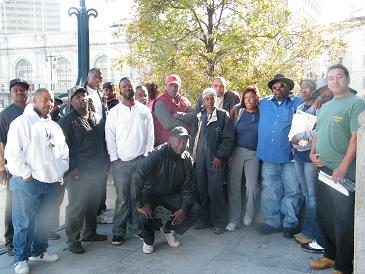
Unemployed workers and community advocates hoping to secure Mayor Gavin Newsom’s support for Sup. John Avalos’ groundbreaking local hire legislation rallied at City Hall December 14 to meet with Newsom’s chief of staff Steve Kawa. But Newsom and Kawa were said to be in intense negotiations over the Americas Cup bid. So, James Richards, founder of Aboriginal Blacks United, waited until Kawa could see him, along with Florence Kong of the Bayview-based Kwan Wo Ironworkers. Joshua Arce of the Brightline Defense Project, and a group of local residents.

“‘Living in the city is so expensive,” Kong observed. “It’s not fair that a lot of local work is being done by workers from outside the city.”

Kawa finally emerged and shepherded folks out of the Mayor’s Office and into a meeting room close to the supervisors’ office. He was uncomfortable with having media at the meeting. But Richards said the group was OK with a reporter. And then he asked Kawa if Newsom would sign Avalos’ local hire law later that day.

“This is a very complex piece of legislation, and if it does become law, that’s when the work begins,” Kawa said, noting that Newsom will have ten days to review it, after its Dec. 14 reading. “Some folks are still concerned about it, partly on the trades union side,” Kawa added.

But Richards pressed his point. “After the Board acts today, we want to talk to the mayor,” Richards said. “We don’t want to wait around another ten days. We want him to assure us.”

But Kawa refused to give assurances. “At the end of the day, 42,000 San Francisco don’t have a job,” Kawa said, claiming the best local jobs program was Jobs Now, under Newsom.  “But the federal government is refusing to extend that program, and now we can’t hire anybody at City Hall and we have to get this economy growing,” he said.

When Joshua Arce of Brightline expressed concern that folks had met privately with Newsom to exert pressure against Avalos’ legislation, Kawa replied that Newsom had concerns that some folks could lose their jobs around San Francisco airport, because, technically, it’s in San Mateo.

“And are we sure this legislation will be successful?” Kawa continued. “The worst thing a government can do is over promise and under deliver. Our question is, you tell me how it will not fail. Because, yes, we want to have local hire, but don’t mislead anybody by saying, we pass this legislation, she gets a job. Our issue is making sure that we are not misleading anyone. Those are the concerns that people have. Will it be successful, as written? Because we can’t mislead your members, James.”

“Tell the mayor, we are here,” Richards said.
And then Kawa was shaking his hand and heading back to the Mayor’s Office, presumably to talk about cups and America.

“It’s a good thing, we are here today,” Richards said to the workers who remained sitting in the meeting room long after Kawa was gone. Many of them were young, black and male–and in search of a job. “Give a round of applause for your own self,” Richards continued. “It’s a good thing to let them know you come down here to take care of your own business.Because don’t nobody…”

He paused and the ABU members in the room immediately picked up the “don’t nobody give a damn” refrain, their voices ringing as one.

“Some times when we push too hard, when we get what we want, he get on a roll and tell all the reasons why he not going to sign. ‘I want to do this, but…” Richard added.

And then Richards turned to the issue of local hire at UC Mission Bay.“They gotta know today that we are hot on their trail,” he said. “Let them go tell that. Let Steve go tell that. Then they know we are fighting that.”

An hour later, when the Board gave Avalos’ legislation a veto-proof majority, Richards, Kong and the rest of the group burst into applause.
“It’s been quite a road to get here,” Avalos said.

“This is the most substantive policy San Francisco has passed in a generation,” Julian Davis observed, as local hire supporters rejoiced by the Tree of Hope, outside the Board’s Chambers.

Inside the Chambers, the Board was voting unanimously to support the city’s Americas Cup bid.

“To win a sailing race, every member of the crew has to work together,” Board President David Chiu said.  And his words could equally have applied to Avalos and the community’s effort to navigate treacherous political seas, get local hire legislation passed and, hopefully, lift everyone’s boat, in the process.

Holy high whoreiday

0

caitlin@sfbg.com

SEX It started with a serial killer. Porn star-feminist Annie Sprinkle was reading about mass murderer Gary Ridgeway slaughter of, on his count, 71 prostitutes in the 1980s and ’90s. She came across this in Ridgway’s explanation of his choice of victims: “I picked prostitutes because they were easy to pick up without being noticed. I knew they … might never be reported missing. I thought I could kill as many of them as I wanted without getting caught.”

It was a wake-up call for Sprinkle. “We don’t have equal protection,” says the busty self-termed “ecosexual,” who was a sex worker for 20 years and now serves as a role model to many in the radical sex community. Sprinkle reacted by organizing the first International Day to End Violence Against Sex Workers on Dec. 17, 2003. It’s an event that is now recognized in cities around the world.

In San Francisco, Sprinkle’s “whore holy high holiday” will be marked by a City Hall vigil for all the sex workers affected by discrimination and violence this year and performance art, followed by a march to the Center for Sex and Culture (sexandculture.org). All the events are free and open to anyone who wants to stand up for those that get paid to lay down.

This year, event organizers have a dangerously prude city policy in their sights: the toxic San Francisco Police Department practice of checking suspected prostitutes’ pockets for condoms to serve as proof of intent to have sex for money. It’s a policy that Mayor Gavin Newsom and the state’s first Latina attorney general, Kamala Harris, support. Sprinkle finds it completely at odds with the mission of promoting safe sex among anyone who could be walking down the street with a rubber in their pocket, as well as dangerous to sex workers. “It’s nasty, and really stupid, and so counterproductive — is that the message that we want to be sending?”

Which is not to say that Friday will be devoid of sweet, sexy joy entirely. After all, where would be the fun in gathering up SF’s sex-positive community if no one got naked? Later that evening, the Center for Sex and Culture will host a special edition of the national literary series Naked Girls Reading showcasing — yep — naked girls reading literature written by those who spread their legs to make their living.

“It’s a great opportunity for feminism and art,” says event organizer Lady Monster, who heard about Miss Erotic World 2005 Michelle L’amour’s original Naked Girl Chicago series and thought it a perfect fit for our pervy-intellectual burg. She held the first event in April and “it took off like wild blazes,” packing venues across town.

An ex phone sex operator who dabbled in private peep shows in her home state of Ohio without being told that the work was illegal, Lady Monster notes that the poor economy and demise of Craigslist escort ads in response to outside pressure has introduced even greater risks to sex workers, pressure that can lead them to accept unsafe working conditions. She feels that the nationwide observance of Dec. 17 “is a way to give people an opportunity to celebrate sex workers’ rights.”

On stage, her reading event will celebrate their contribution to arts and literature. Sexologist Dr. Carol Queen will be leafing through a book at the night’s nudie show; as well as burlesque star Dottie Lux; sex worker activist Robyn Few; Lady Monster herself (who’ll be reading from Some Girls, the memoir of Jillian Lauren, the American who lived and worked in a Brunei harem); and Sprinkle, among others. Lady Monster says the requirements needed to be onstage fall into three categories: readers must be accomplished writers, have public speaking experience, and — perhaps the most obvious — they’ve got be down to make the scene in the all together.

“Three hundred and sixty-four days a year we talk about how much we like our work, and one day a year we take time to realize that there are real victims out there,” Sprinkle says. It may be the oldest profession, but even in Gomorrah by the Bay, sex work is still a far cry from society’s respected elder.

INTERNATIONAL DAY TO END VIOLENCE AGAINST SEX WORKERS

Fri., Dec. 17

4 p.m., free

City Hall

Civic Center, SF

www.swopusa.org

NAKED GIRLS READING

9 p.m., $15–$20

Center for Sex and Culture

1519 Mission, SF

(415) 552-7399

www.nakedgirlsreading.com/sanfrancisco

Hiring at home

1

sarah@sfbg.com

The lame duck Board of Supervisors made history Dec. 7 when it voted 8-3 to approve mandatory local hire legislation for city-funded construction projects. The measure ends a decade-long effort to reach 50 percent local hiring goals through good-faith efforts.

“That’s a sea change in our local hiring discussion,” said Sup. John Avalos, who launched the legislation in October as part of the LOCAL-SF (Local Opportunities for Communities and Labor) campaign, which seeks to strengthen local hiring, address high unemployment rates, and boost the local economy.

The veto-proof passage of Avalos’ measure comes in the wake of a city-commissioned study indicating that San Francisco has failed to meet good-faith local hiring goals for public works projects even as unemployment levels rise in the local construction industry and several local neighborhoods face concentrated poverty.

Although Cleveland also has a local-hire law, the Avalos measure will be the strongest in the nation. Avalos’ legislative aide Raquel Redondiez told the Guardian that Cleveland’s 2003 legislation requires 20 percent local hire.

“This legislation doesn’t just have a mandated 50 percent goal,” Avalos explained, noting that San Francisco will require that each trade achieve a mandated rate and that 50 percent of apprentices be residents.

“This will ensure that our tax dollars get recycled back into the local economy, and that San Franciscans who are ready to work are provided the opportunity to do so,” Avalos said.

Avalos’ groundbreaking legislation phases in mandatory requirements that a portion of San Francisco public works jobs go to city residents and includes additional targets for hiring disadvantaged workers.


WHO GETS $25 BILLION?

The legislation replaces the city’s First Source program, under which contractors were required only to make good faith efforts to hire 50 percent local residents on publicly-funded projects. But the measure begins slowly by mandating levels some contractors are already reaching. According to a study commissioned by the city’s Office of Employment and Workforce Development and released in October, 20 percent of work hours on publicly-funded construction projects are going to San Francisco residents.

Avalos’ legislation, which is supported by a broad coalition of labor and community groups including PODER, the Filipino Community Center, Southeast Jobs Coalition, Kwan Wo Ironworks Inc., Rubecon, and Chinese for Affirmative Action, comes at a critical moment for the recession-battered construction industry.

Under the city’s capital plan, more than $25 billion will be spent on public works and other construction projects in the next decade — and two-thirds of this money will be spent over the next five years.

The measure has environmental benefits too. Transportation still accounts for more greenhouse gas emissions generated in the Bay Area than any other source, and San Francisco residents are more likely to take transit, walk, or bike to work than residents of other Bay Area counties. “When local citizens are able to work locally, there are fewer cars on the road and less air pollution,” Avalos said.

Sup. Ross Mirkarimi said that Avalos’ legislation is “just a start.”

“People have talked a good game about local hiring,” observed Mirkarimi, whose district includes the high unemployment-affected Western Addition.

“We are going to have to go beyond construction and start thinking about delving into the private sector,” Mirkarimi continued, pointing to the need to build 100,000 housing units over the next 25 years if the city is to keep up with a projected population increase. “Who is going to build that housing?” he asked.

Sup. Eric Mar noted that “the Sierra Club endorsed the measure early on because of the environmental benefits of having people work close to where they live.”

Sup. David Campos, whose district includes the Mission, said the measure was one of the most significant pieces of legislation to emerge from the board in recent years. “In the past, a lot of obstacles got in the way, including some legal challenges,” said Campos, who credited Avalos for navigating a complicated legal structure. “At the end of the day, I think this is going to benefit everyone.”

Mike Theriault, secretary-treasurer for the San Francisco Building Trades Council, told the Guardian he remains opposed to the legislation because the union presers to allocate jobs based on seniority, not residency. But he said the amendments make the measure “less harmful and more survivable in the short-term.”


THE ECONOMIC GAP

Termed-out Sup. Sophie Maxwell, who represents the city’s economically distressed southeast sector, has often noted that the construction industry provides a path to the middle class for people without advanced degrees or facing barriers to employment. She thanked Avalos for pushing legislation that promises to provides opportunities for “growing the middle class instead of importing it.”

“This industry closes the economic gap,” she said.

Board President David Chiu and termed-out Sups. Chris Daly and Bevan Dufty also supported Avalos legislation. But Dufty, who is running in the 2011 mayoral race, cast the eighth vote, which gave the measure a veto-proof majority.

The board’s Dec. 7 vote came a few hours after Bayview-based Aboriginal Blacks United founder James Richards and a score of unemployed local residents rallied at City Hall in the hopes of securing Dufty’s vote.

ABU has recently been protesting at UCSF’s Mission Bay hospital buildings site on 16th and Third streets. Its members also triggered a shut down at the Sunset Reservoir last month after a court ruled that locals promised jobs installing solar panels at the plant be replaced by higher-skilled engineers,

“It’s been too long that we have been protesting and fighting this good faith effort,” Richards told the Guardian. “We need a mandatory policy.”

Dufty is also hoping the Avalos measure could spread to other cities and benefit workers nationwide. “At a certain point I looked at labor and said, ‘Yes, I’m going for this legislation. But not just for San Francisco — you want to take this concept to other cities,’ ” Dufty said, as he made good on his promise to Richards to vote to support Avalos’ law.

Dufty seemed hopeful that Mayor Gavin Newsom would get behind the legislation. “But I respect that there may be a little bit of coming together between now and the second reading.”

Newsom spokesman Tony Winniker told the Guardian that the mayor has 10 days to review Avalos’ legislation after its Dec. 14 second reading. “He supports stronger local hire requirements but does want to review the many amendments that were added before deciding,” Winnicker said.

But will Newsom, who is scheduled to be sworn in as California’s next lieutenant governor Jan. 3, issue a veto on or before Christmas Eve on legislation that has been amended to address the stated concerns of the building trades?

That would be ironic since the amended legislation appears to match recommendations that the Mayor’s Taskforce on African American Outmigration published in 2009. The California Department of Finance projected that San Francisco’s black population would continue to decline from 6.5 percent (according to 2005 census data) to 4.6 percent of the city’s total population by 2050 — in part because of a lack of good jobs.


WILL NEWSOM VETO?

Avalos originally proposed to start at 30 percent and reach 50 percent over three years. But after the building trades complained that these levels were unworkable, Avalos amended the legislation to require an initial mandatory participation level of 20 percent of all project work-hours within each trade performed by local residents, with no less than 10 percent of all project work-hours within each trade to be performed by disadvantaged workers.

He also amended his legislation to require that this mandatory level be increased annually over seven years in 5 percent increments up to 50 percent, with no less than 25 percent within each trade to be performed by disadvantaged workers in the legislation’s sixth year.

A Dec. 1 report from city economist Ted Egan estimated that the local hire legislation would create 350 jobs and cost the city $9 million annually. But Egan clarified for the Guardian that this cost equals only 1 percent of the city’s spending on public works in any given year.

Vincent Pan of Chinese Affirmative Action, which supports Avalos’ local hiring policy, suggested that the mayor “check the temperature.”

“It would be leadership on the part of the mayor not to veto legislation that’s about San Francisco,” Pan said.

And Mindy Kener, an organizing member of the Southeast Jobs Coalition breathed a deep sigh of relief when Dufty’s vote made the law veto-proof. “It’s gonna go across the country,” Kener said. “We just made history.”

The true cost of local hire

12

Chronicle columnists Phillip Matier and Andy Ross are claiming it will cost $2.2 million annually to carry out Sup. John Avalos’ newly approved legislation that mandates local hire rates on city-funded construction projects,

And Human Rights Commission director Theresa Sparks is claiming it will actually cost $3 million to run the program.

Neither Sparks nor Matier and Ross are talking about the savings the program will create in terms of the need for less law enforcement, if more local residents are hired. Nor do they mention the economic benefit of tax payer dollars being funneled into the local economy, if more San Francisco residents are hired on city-funded construction projects.

As a result, their conversation sounds like an attack on local hire legislation that Sparks says she supports.

“Matier & Ross are about a million dollars off,” Sparks told the Guardian in a voice mail message three days after I first called asking if it was true that HRC was pissed that the Office of Economic and Workforce Development was being charged with monitoring Avalos’ newly approved program.

‘We tried to get them to leave it with us,” Sparks said, noting that HRC already has contract compliance officers overseeing every city contract.

“This will cost $2-3 million more, and it’s unnecessary,” Sparks continued, noting that during her (ultimately unsuccessful) D6 campaign she talked about “inefficiency in government” and here was yet another example of that very same wasteful phenomenon.

‘Rather than approve a project, the agency that creates a program wants to hire its own people and create a whole new infrastructure, “ Sparks said. “We tried to participate in the local hire ordinance, but we were excluded from all the meetings.”

Sup. John Avalos’ legislative aide Raquel Redondiez disagrees that Sparks was omitted from the discussion. And Redondiez has the emails to prove it.

In an Oct. 21 email sent to Redevelopment director Fred Blackwell, Rhonda Simmons in the Office of Economic and Workforce Development, and Sparks at HRC, six weeks before Avalos’ legislation passed on its first reading, Redondiez wrote that Avalos would like to meet with Blackwell, Simmons and Sparks.

“Supervisor Avalos would like to meet with your offices to learn about how current contracts are now tracked for local hiring, lbe [local business enterprises], and union hours,” Redondiez wrote. “As we move forward with the local hiring legislation, we would like to have a deeper understanding of the current tracking practices and possibilities.Please let us know when we can meet in the next 10 days.”

Redondiez email thread shows she got a reply from Guillermo Rodriguez in the Mayor’s Office the same day. But there was no reply from Sparks. Blackwell and Simmons attended local hire hearings at City Hall in November and December. This reporter does not remember Sparks at those hearings, but community advocates say they saw her outside at least one hearing, in November.

So, does this add up to HRC being deliberately excluded from the discussion about how best to monitor local hire, or something entirely different?

Community and worker advocates, who support the legislation, say they tried to reach out to Sparks, but got mixed messages. They say Sparks said she was supportive of the legislation, but that they were left with the impression that HRC wasn’t interested in monitoring the program.

Michael Theriault, Secretary-Treasurer of the Building Trades, which opposes Avalos’ legislation because it believes the measure will pit workers who live here against workers who don’t, didn’t sound like he was advocating to put HRC in charge of monitoring compliance with the mandatory local hire ordinance.
“There is a sense that HRC is about small business advocacy,” Theriault said.

Sparks hasn’t returned my latest call, but I’ll be sure to post her comments here. So stay tuned as we follow the latest twist in the local hire debate. And don’tforget to tune in to tomorrow’s Board meeting (Dec. 14, 2 p.m. at City Hall), when the local hire legislation has its second reading.

Libidinous literature with Naked Girls Reading

1

I had asked Lady Monster, over a pair of red wine glasses and the pleasant buzz of nearby patrons at Revolution Cafe, to tell me what story she’d read at the Halloween installation of her Naked Girls Reading literary series. We were chatting in anticipation of her International Day to End Violence Against Sex Workers edition of NGR (Fri/17) which will take place at the Center for Sex and Culture after the day’s City Hall vigil and march.

The curvaceous redhead is quite the story teller, even clothed. “I did the elevator scene from The Shining,” she told me, launching into a brief summary of the Torrance family’s elevator travails. By the end of it I had the crap scared out of me – and she was fully clothed! Imagine what this lady can get done in the buff – surely, a live literary luminary not to be trifled with.

Lady Monster first heard of the Naked Girls Reading series circa its Chicago inception by burlesque showgirl Michelle L’Amour in 2009. The series sits down sex-positive female role models (SF’s chapter features sexologist Carol Queen, sex activists, and burlesque beauty Dottie Lux among others) for a theme night of literary lustiness. The event struck a chord (books and boobies yay!), and not just among Chicago pervs – the series has been featured on the Carson Daly show and has spread to nine other cities. “Like wild blazes,” says Monster.

“Almost immediately Michelle had people wanting to franchise the series,” she continues. Naked girls getting brainy? Lady Monster had an inkling that her own San Francisco community would gag for a NGR chapter of their own. She scheduled NGR’s SF breakout in May of this year and the show’s played to packed houses every two months since – and will score a regular monthly gig at Viracocha come the new year. “It’s so much fun, so silly. It’s all about being comfortable in your own skin,” Monster asserts.

That’s something that she’s had little trouble with – even growing up on an Ohio farm, Monster started hosting her (initially PG-13 rated) play parties in fifth grade. “I’d have all my friends over and make sure everyone was coupled off. Then we’d go into my room and close the door. At first we’d all just make out, but as we got older it got more serious. I was my own sexually liberated role model!” With a little help from some open-minded parents, of course. “They didn’t bother us, they let us have our time together.”

From grade school groping, Monster graduated to more advanced expressions of sexuality. She worked the graveyard shift at a phone sex line and loved the intimacy and honesty she could find in horny men just getting home from last call. “I wanted to hear their secrets all the time,” she confesses. But she wanted it to happen face to face, so she tripped her way into a job doing “legal escort work.” Private peep show stuff, for which Monster would strip or faux-masturbate for a paying customer. 

Only it wasn’t legal, a fact that her employer neglected to tell her. And even though she was getting face to face time, the sexual intimacy she’d felt with men on the other end of the phone line was gone. “There was no talking! Yeah, the money was a lot better but I had to get out of there.” All the way to San Francisco, in fact – where Monster has put her open sexuality to work in service to SF Sex Information and pens sex stories and erotic poetry. She’s also a long time performer in the burlesque scene – she’s been known to create her own astronomically-inspired LED-lit costumes and accesorize with glitter-dipped viking axes. Oh, and she toured with Ministry.

Like NGR, The International Day to End Violence Against Sex Workers was created by an empowered sexual superstar and has grown into a far-reaching event, marked by vigils in cities around the globe and marches of men and women carrying red umbrellas (the adopted symbol of the movement). It was started by the Bay’s own feminist porn star Annie Sprinkle, an ex-sex worker who Monster counts amongst her role models: “she’s not really a mother figure, more like a respected aunt,” Monster says.

“Sex workers need protection,” she continues, noting that Sprinkle started the annual day of memorial after reading a serial killer’s confession that he killed over 40 prostitutes because he knew they were less likely to be reported missing or inspire dedicated police investigations.

Lady Monster’s convinced that sex worker safety is an issue that carries particular import this year for a variety of reasons. First: shitty profits. “Business is definitely being affected by the economy,” she says. “And on top of that the market’s flooded,” with all the men and women out of work in other industries. Lack of work can make it harder to avoid risky working situations that put sex workers at risk of withheld wages, assault, or rape. The shut-down of Craigslist’s casual encounters listings has made it more difficult to find clients in the first place, and in the midst of all of this, SFPD has adopted an evidenciary policy that discourages condom usage: if cops find a rubber on a suspected prostitute, they’ll use it as evidence of intent to have sex for money. 

That’s why Monster’s event Friday (which follows a vigil and march from City Hall that starts at 4 p.m.) will give voice to those that often go unheard in our society. Monster, her regular NGR cast, and Sprinkle will all read from literature penned by sex workers, including Jillian Lauren’s memoir of her time in the prince of Brunei’s harem and Scarlet Harlot’s account of becoming a radical prostitute, Unrepentant Whore.

“This is such a great opportunity for feminism and art,” Monster says. Undeniably, giving naked women a stage on which to talk about reclamation of body and sex issues is a unique approach. NGR, sex worker edition: sure to be a hot night, but also a reflection of the power of corpus woman when framing its own literary discourse. 


Naked Girls Reading: International Day to End Violence Against Sex Workers 

Fri/17 9 p.m., $15-20

Center for Sex and Culture

1519 Mission, SF

(415) 255-1155

www.nakedgirlsreading.com


The mayoral roulette

23

At the San Francisco Tomorrow holiday party Dec. 8th, David Chiu, Dennis Herrera, John Rizzo, Jake McGoldrick and a host of others who I’ve seen at these events for at least the past few years were doing their usual schmoozing — when Ross Mirkarimi, a former SFT board member, showed up with …. Art Agnos. I haven’t seen the former mayor at an SFT event since … I don’t know. Since a long long time ago.


Agnos made a short speech and talked about all of the rising stars in the San Francisco progressive movement — Mirkarimi, Chiu, Rizzo, David Campos, Eric Mar, John Avalos … and it was all very nice and low key. But there was a message in his appearance, in his connection with Mirkarimi, and even in the overall tone of his remarks, which amounts to this:


If the supervisors have trouble finding a progressive who can get six votes — and if they want an old hand, someone who has been through a brutal recession as mayor of San Francisco and dealt with awful budgets and nasty politics, someone who will serve for a year and then walk away — Agnos is open to being asked.


Well, maybe a little more than open to being asked. I wouldn’t say he’s actively, publicly campaiging for the job, but he has met with most of the supervisors, and dropped them all a 13-page memo listing all of his accomplishments, and his supporters (maybe his emissaries) are making the rounds and making the case for Agnos. Which amounts to this:


None of the progressives now more-or-less openly in the mix (Campos, Chiu, Mirkarimi, even Aaron Peskin) can realistically take on all the sacred cows (esp. police and fire), make a bunch of other cuts, and push for all sorts of revenue increases — and at the same time try to run for re-election in November (when the tax hikes would be on the ballot). The only way to do “what needs to be done” is to put in a progressive caretaker who can then take the political heat for the tough decisions — and help set up a campaign for another progressive in November.


I’m not sure I entirely agree — the right person, with the right leadership and agenda, could set up a five-year plan for fiscal stability, launch year one immediately and tell the public that he/she needs a full term to finish the job. But it’s true that it will be tough — and it’s also true that none of the obvious alternatives have ever run citywide.


If Tom Ammiano were interested, we wouldn’t be having this discussion. Tom has run citywide numerous times (for School Board, pre-district elections supervisor and mayor), has been elected by half the city (to the Assembly), and has the credibility to deal with the budget crisis and still win in November. But he’s not, and we have to respect that.


Right now, the progressives can’t seem to unite on a candidate. None of the current board members has six votes today. And Campos, Chiu, Mirkarimi and everyone else in the game knows full well how hard it will be to win in November, particularly against State Sen. Leland Yee, who will be a formidable candidate, and possibly City Attorney Dennis Herrera (who has won citywide), State Sen. Mark Leno (who is popular all over town) and others.


So if a couple rounds pass and there’s no winner, the “progressive caretaker” concept will be in play. It’s possible Mirkarimi would give up his seat two years early and take that job; it’s likely Peskin would agree to serve one year and then step down. But it’s also possible that neither scenario works out — at which point Sheriff Mike Hennessey and Agnos will be in play.


(I hear through the grapevine that Willie Brown is nosing around, too — and let’s remember that he became Assembly speaker by cutting a deal with the Republicans.)


Hennessey’s got a strong progressive record, but has never had to deal with anything remotely as awful as what the next mayor will face. So Agnos backers will make the case that their guy has the experience and gravitas to pull it off.


Given all of that, let me say a couple of things about Agnos, since I was around and watching City Hall when he was mayor (and some of the people who will be voting on this weren’t.)


Art’s a mixture. He was a great progressive member of the state Assembly. When he ran for mayor, we backed him strongly; he seemed to be the great progressive hope. Then his long list of wonderful promises ran into the buzz saw of a deep recession — and made things much worse with his arrogant, imperious style. His first major act in office was to sign a set of contracts that gave away the store to PG&E. He never lifted a finger for public power. And it quickly became clear that he wasn’t a fan of open government or public process. We were all supposed to “Trust in Art” and shut up if we didn’t like it.


That’s why — despite what was at the time and is in retrospect a pretty darn progressive record, a lot of solid accomplishments and absolutly no hint of corruption or scandal — the progressives just weren’t all that excited about his re-election. So he lost to Frank Jordan, who was way worse.


The thing is, Agnos these days is a lot more mellow. He’s 72, knows he’s not going anywhere else in politics, and has essentially admitted to me that he made a lot of mistakes, and his arrogance and closed-door attitude were top on the list. A reformed Agnos — willing to serve with a degree of humility and an acceptance that progressive politics in this town demands inclusiveness, and that even though he’s a former mayor, he’s not by definition the most important person in any room he walks into — would present an interesting option.


Of course, we still don’t know exactly where he would be on the issues, since, like Chiu, he hasn’t even publicly called himself a candidate for the job. I still think anyone who is a serious contender ought to be willing to appear before the supervisors and answer questions.


We all know where to start: What’s your plan for raising a quarter billion dollars in new revenue in 2011?    

Elizabeth Edwards, breast cancer and the battle for a cure

2

When the news hit that Elizabeth Edwards had died at 61, I was sitting in the press box at San Francisco City Hall listening to the supervisors debate the merits of local hire legislation. In fact, I only became aware that Edwards had passed away, because Sup. Michela Alioto-Pier, who was sitting in front of me, was surfing the Internet on her laptop and I happened to see the headline.

The news immediately reminded me, all too powerfully, of the brave fight that my sister-in-law Leila, 47, lost last year after a six-year battle with the disease. She left behind a husband and two young sons, and I always feel a mix of pride at how hard she fought and desperation at how she still wasn’t able to win, whenever I remember her long slide towards death last fall.

“I have so much to live for,” Leila often told me, reflecting on how much she loved her husband and sons, how she wanted to finish her novel (which she managed to wrap up in the last months of her life) and how she still wanted to visit so many places and people in the world.

An avid advocate for peace, especially in the Middle East, where her father’s family came from, Leila was not one to give up on a cause, once she had it in her crosshairs. She attacked breast cancer with that same dogged determination. She read everything she could on the topic, changing her diet, modifying her lifestyle, going through chemo and the inevitable loss of her beautiful hair, and, at the end, taking a chance with experimental drugs.

I will never forget her telling me, one gut-wrenching afternoon last September, that the doctors had told her there was nothing more they could do. The disease had gone to her liver, and that she was beginning to feel panic and fear. It wasn’t easy to hear that admission, it must have been even harder for her to share it, and it left me hoping that one day, no other woman would ever have to go through this painful battle again.

I wanted Leila to live to see her sons grow up, to enjoy the company of her husband, to write, travel and work for her goal of world peace. But eventually, it became clear that she was not going to make it. When her death finally came, last October, I felt relief that she was no longer suffering, even as I shed tears for her, her family, and all the folks in the world who are going through similar battles.

So, when I got home last night, I immediately went online and wallowed in the huge wave of grief that Edwards’ death evoked as a symbol of the millions of women who live with and die from cancer worldwide.

Some noted that Edwards had not been conducting regular check ups when she found a lump in her breast (an uncomfortable reminder to all of us who haven’t got a check up recently). Others observed that her diagnosis likely fueled her passion for universal health care and helped the passage of Obamacare (a more welcome reminder that despite all the criticisms of Obama, he has pushed through monumental reforms that many will benefit from).

Some wrote about the ever-present fear for survivors that the cancer could come back, and how this awareness had  served to make them more fully appreciate every moment that they do have. Others pointed to the grim reality that even with access to great doctors, advanced treatment options and money, Edwards still could not prevail, because a cure has still not been found.

I’ll end this tribute to Edwards, my sister-in-law, and all the women who have struggled with this terrible disease with a message that landed in my inbox Dec. 7 from California’s First Lady Maria Shriver:

“I was deeply saddened to learn of the passing of my dear friend, Elizabeth Edwards,” Shriver wrote. “My heart goes out to her loving family. Elizabeth was a mighty warrior, and I’ve long admired her courage, her compassion and her personal quest for truth. She was a public servant, a dedicated mother, a tireless advocate and a loyal friend. She showed up to speak at The Women’s Conference every time I asked, and our audience was always moved by the open and honest way she would share the struggles she faced along her journey. I hope her children know their mother was an inspiration to women everywhere — a truly great woman.”

And I’ll add my hope that this nation will intensify its search for a cure for a disease that is the second leading cause of cancer deaths in women today (after lung cancer) and the most common cancer among women, excluding nonmelanoma skin cancers. According to the American Cancer Society, 1.3 million women will be diagnosed with breast cancer annually worldwide, 465,000 will die from the disease, and about 1 in 35 women die from breast cancer in the U.S. Scary? Yes. Curable? Hell, yeah (I hope and pray). Let’s just make sure it remains a national priority.

Class conflict in DC and SF

12

There’s an unmistakable whiff of class warfare in the air this holiday season, most obviously on the national level where President Barack Obama and congressional Republicans are helping the ultra-rich steal hundreds of billions of dollars from future generations and the country’s current needs. But we’re also seeing it right here in San Francisco, subtly playing out around who will be our next mayor.

During yesterday’s scheduled discussion at the Board of Supervisors on choosing a new mayor, members of the public – from African-American mothers of slain youth to representatives of immigrant communities to those representing labor and progressive groups – urged the board to choose a mayor who would finally represent all of San Francisco, not just the wealthy and the business community.

Then the progressive supervisors who represent the city’s working class districts talked about getting the process underway and voiced some of the things they’d like to see in a new mayor, such as compassion and a willingness to work with the board and community groups. It seemed like a good faith effort at having an open public discussion about the city’s needs.

But on the other side of the aisle, the supervisors who represent the city’s wealthiest neighborhoods voted to delay the discussion without offering a reason why. Sup. Chris Daly made good points about how incoming mayors usually have time to prepare for assuming this powerful office at a time of pressing city needs and tricky political dynamics, arguing for making this decision sooner than later.

And from the Establishment representatives: nothing. Not a word. Instead, we have Mayor Gavin Newsom threatening to delay his swearing in as lieutenant governor to thwart the current board from picking a successor, and being overtly urged to do so in a San Francisco Chronicle editorial and in disingenous, sanctimonious ruses from SF Chamber of Commerce officials.

Why? Well, here’s the closest thing the editorial offered to a reason: “It makes all the sense in the world to have the supervisors who will be working with the interim mayor make the selection. They are the ones who will have to find common ground and develop a working relationship with Newsom’s successor.”

But does it really make any sense to have an inexperienced group of new supervisors (as our current cover stories shows, none of the four new supervisors have held municipal office and two are new to politics) pick a mayor on their first day on the job, and then have that person immediately take on the complicated job of running the city with no staff in place? And to do that by flouting the the California Constitution and the City Charter?

That sounds like a recipe for disaster – and an opportunity for downtown power brokers to make mischief and ensure their interests aren’t threatened as part of whatever backroom deal gets cut to choose a new mayor, district attorney, and board president. Why else would they so vehemently oppose a deliberative public process that would lead to a decision by those who know the workings of City Hall better than anyone?

As we saw in the last election, wealthy San Franciscans are scared to death of progressive malcontents like Chris Daly, and they’re doing whatever they can to prevent him from being involved in this decision. They see, probably correctly, that the current political dynamics of the city could lead to perhaps the most progressive mayor since George Moscone, or maybe ever, and they’ll do whatever they can to prevent that from happening.

The rich of this city and this country have overplayed their hands, crippled the public sector, and, as Sen. Bernie Sanders so eloquently said recently on the floor of the US Senate, shown a selfish disregard for the needs and interests of the vast majority of citizens. The only question now is this: are we ready to finally stand up, fight back, and really give them something to fear? Or are we going to take our cues from Obama and treat anti-government conservatives as good faith actors when they have shown only contempt for our most cherished democratic processes and values?

I suppose next week, when this board reconvenes to try to choose a successor mayor, we’ll find out.

Class of 2010: Malia Cohen

4

sarah@sfbg.com

It took two weeks and 19 updates of San Francisco’s ranked-choice voting system before Malia Cohen, a former Mayor Gavin Newsom staffer and partner in a firm that helps businesses and nonprofits create public policy, was declared the winner of the hotly contested race to represent District 10, which includes Bayview, Hunters Point and Ingleside. The nail-biting time lag was a byproduct of complex calculations that involved 22 candidates, no clear front-runners, and a slew of absentee and provisional ballots.

But when the RCV dust settled, the results proved that the D10 vote continues to break down along class, race, and gender lines. These RCV patterns personally benefited Cohen’s success in picking up second- and third-place votes.

But they also helped D10’s African American community, now smaller than its growing Asian community but still larger that the black community in any other distinct in the city, send an African American supervisor back to City Hall. And it avoided a run-off between Lynette Sweet and Tony Kelly, who won most first-place votes.

Some chalk up Cohen’s victory to her polished appearance, the middle-of-the road positions she took on the campaign trail, and an impressive list of endorsements that include the San Francisco Democratic Party, the Labor Council, the Building and Construction Trades Council, state Sen. Leland Yee (D-SF), Assembly Speaker Pro Tempore Fiona Ma (D-SF), Board of Supervisors President David Chiu, SF Democratic Party Chair Aaron Peskin, and BART Board President James Fang.

But Cohen told us she thinks coalition building was the key. “Endorsements only account for a quarter of the reasons why you win,” she said. “It’s all about building an organization, a net that goes deep and wide.”

Some progressives were alarmed by a Dec. 1 fundraiser to help settle Cohen’s campaign debt whose guest list included Newsom, former Mayor Willie Brown, Sup. Sean Elsbernd, Ma, Building Owners and Managers Association director Ken Cleaveland, Kevin Westlye of the Golden Gate Restaurant Association, and Janan New of San Francisco Apartment Association.

Cohen dismissed concerns over this conservative showing of après-campaign support. “Fear not,” she said. “It is a fundraiser event. And now that I’m a newly elected supervisor, I look forward to meeting everyone. And I will do a great job representing everyone.

So what should we expect from Cohen, who ran as a fourth-generation “daughter of the district from a labor family” on a platform of health, safety, and employment — and will soon represent the diverse southeast sector, which has the highest unemployment, crime, recidivism, foreclosure and African American out-migration rates citywide and is ground zero for Lennar Corp.’s plan to build thousands of condos at Candlestick and the shipyard?

“I’m a bridge-builder,” said Cohen, who attributes her surprisingly tough but open-minded edge to being the oldest of five sisters.

So far, she’s not going out on a progressive limb. She told us she favors a caretaker mayor: “I’d like someone to maintain the business of the city, someone who has zero political ambition,” she said. “That way it creates an even playing field for the mayoral race.”

Cohen says she is determined to address quality of life concerns, including filling potholes, re-striping crosswalks and introducing traffic calming measures, and taking on critical criminal justice issues, including City Attorney Dennis Herrera’s gang injunction in the Sunnydale public housing project in Visitacion Valley. She opposes Herrera’s strategy but notes: “If not gang injunctions, then what? I can’t dispute that they get short-term results, but what about the long-term impacts? We need long-term solutions.”

Cohen supports Sup. John Avalos’ efforts to pass mandatory local hire legislation but is open to “creative solutions” to help get it over the finishing line. “People who live here should be working here,” Cohen said. “But is 50 percent the magic mandatory hire number? I don’t know.”

Cohen, who just survived a foreclosure attempt, has promised to be a “fierce advocate” for constituents facing similar challenges, including those who met predatory loan brokers at church.

But asked how she would cut spending or raise revenue to address the city’s massive budget deficit, she had no specific answer.

Yet Cohen disagrees with detractors who say she lacks experience. “I may look cute, but don’t be misled. I have a public policy background and fire in my belly. I’m a union candidate, I’m smart, I’m talented, and above all, I love the people in D10 and the rest of San Francisco. I want everyone to prosper and receive benefits. So give me a shot.”

Class of 2010: Mark Farrell

0

steve@sfbg.com

Mark Farrell is a 36-year-old venture capitalist and political newcomer who will represent the wealthy neighborhoods of District 2 (Pacific Heights, Sea Cliff, and the Marina) after narrowly beating Janet Reilly, whose extensive political endorsements ranged from the Guardian and local Democratic Party Chair Aaron Peskin to U.S. Sen. Dianne Feinsein and Mayor Gavin Newsom.

Challenging the city’s political power structure is why Farrell said he ran for office, playing up his outsider status and investment banking experience. He told visitors to his campaign website, “I am running for the Board of Supervisors to bring common sense back to City Hall” and railed against “career politicians who run for office again and again.”

In an interview with the Guardian, Farrell said he was motivated to make his first foray into politics by the dysfunction he has heard about at City Hall. “I’ve been frustrated with City Hall over the last few years, from the personal antics to the policies that have come out,” Farrell told us. “I humbly believe I have something different to bring to the table.”

Farrell calls himself a fiscal conservative who believes “our city government has gotten too large and we need to look at that,” a task he thinks he’s well-suited for given his background in finance. Yet when asked what government functions he would eliminate or cut deeply to help close a projected $700 million budget deficit over the next two years, Farrell said he can’t offer any specifics yet, saying only, “We need to make tough decisions.”

Would Farrell be open to new taxes or other revenue-side budget solutions? He told us that he won’t completely reject the idea of new taxes, but that he generally opposes them. “I don’t believe in raising taxes. We can’t raise enough revenue to get out of this problem,” Farrell said. “We need to learn to live within our means.”

Although he opposed Prop. B in this election, Farrell said public employee pension reform needs to be a part of the city’s budget solution, as well as scaling back how much the city gives to nonprofit groups, which provide many of the social services the city supports.

Farrell was born and raised in San Francisco — except for his college years, he’s spent his whole life in D2, where his parents still live — and has been friends with Sup. Sean Elsbernd since high school. Politically, Farrell also identifies with Elsbernd and fellow fiscally conservative Sups. Carmen Chu and Michela Alioto-Pier (who endorsed Farrell to replace her in D2), but he says that he doesn’t want to be politically pigeon-holed.

“I’m very much my own person and I look forward to working with everyone,” Farrell said. Indeed, part of Farrell’s frustration with City Hall politics has been the divisive relationship between the progressives and moderates, which he sees as a hindrance to finding “common sense solutions.”

“The progressive and moderate labels have been relatively destructive to San Francisco,” Farrell said. “We need to get beyond that to focus on issues.”

Yet people’s political values and worldview determine what issues they care about and the solutions they favor. For example, progressives decry the dearth of affordable being built for San Franciscans and cite city studies showing that deficit will get worse as developers build ever-more market rate housing (see “Dollars or sense?” Sept. 28), particularly in a city that is two-thirds renters.

Farrell said he supports rent control (saying he was unfairly attacked during the campaign as anti renter) and sees the dwindling rental stock and lack of new affordable units being constructed as problems, but he doesn’t have a solution to those problems. In fact, Farrell supports allowing more condo conversions, which would make the problem worse, telling us, “I believe home ownership is something we should promote.”

He was also vague about how he will approach land use issues and how tough he’ll be with developers in having them meet city design guidelines and provide affordable housing and other community benefits, saying only, “We need to have sustainable development in the city.”

Yet the issues that do animate Farrell are those typically focused on by conservative D2 voters. Farrell lists his top priorities as seeing to his district’s needs, promoting private sector job creation (“I think a lot of lip service has been paid to it, but not a lot of action by City Hall,” he said), public safety, and quality-of-life issues (he supported Prop. L, the sit-lie ordinance, calling it “very reasonable”). Generally Farrell sees San Francisco as a city in he midst of a serious fiscal crisis, “and I want to create a San Francisco that is secure for the future over the long haul.”

Dufty was Avalos’ eighth vote on local hire

3

History was made at City Hall on December 7, when the Board voted 8-3 to approve local hire legislation for city-funded construction projects.
“This is the strongest local hiring measure in the nation, “ said Sup. John Avalos, the legislation’s chief sponsor. “It doesn’t just have a mandated 50 percent goal. It has a ‘by trade’ mandate. It requires 50 percent of apprentices to be residents. More than anything we are moving away from a good faith policy. That’s a sea change in our local hiring discussion.”
Sup. Sophie Maxwell thanked Avalos “for taking up the mantle” and pushing construction industry legislation that will provide opportunities for ”growing the middle class instead of importing it.”
“This industry closes the economic gap,” Maxwell said,
Board President David Chiu, Sups. John Avalos, David Campos, Chris Daly, Bevan Dufty, Eric Mar, Sophie Maxwell and Ross Mirkarimi voted for the legislation. But Dufty was the eighth vote that gave the measure a veto-proof majority. His vote came after he met ABU (Aboriginal Blacks United) leader James Richards and other advocates of unemployed residents. They see the legislation as a way to invest local tax dollars in local communities, reduce crime and poverty, and lessen pollution by reducing workers’ commutes.


“It’s been too long that we have been protesting and fighting this good faith effort,” Richards said.” We need a mandatory policy.”
ABU member Troy, 47, who was born and raised in the Bayview, and has two sons, said he had been unemployed for six months.
“If we don’t work, nobody works, that’s ABU’s motto,” Troy said. ‘We can’t have nobody come from Marin, taking our jobs and pushing us back onto the streets, selling drugs. We gotta put the merry back into Christmas.”


“A lot of moving parts had to come together for this legislation to be successful,” Dufty told the Board, a couple of hours after he met ABU’s Richards. “This is very reminiscent of Healthy San Francisco, which was one of the most monumental changes in the city.”
Dufty said he believes that, much like Healthy San Francisco, local hire legislation is bigger than just San Francisco. “At a certain point, I looked at labor and said, yes, I’m going for this legislation, but not just for San Francisco,” Dufty said. “You want to take this concept to other cities.”


Dufty  was hopeful that Mayor Gavin Newsom will get behind the legislation, before its Dec.14 second reading.
“But I respect that there may be a little bit of coming together between now and the second reading,” he said.
Newsom spokesperson Tony Winniker told reporters that the mayor plans to review the amended legislation and consult with impacted contractors and unions before deciding whether to veto the legislation.
A December 1 report from city economist Ted Egan estimated that the local hire legislation will create 350 jobs and cost the city $9 million annually, or 1 percent of whatever it spends on public works. (San Francisco is set to spend an estimated $27 billion on capital projects over the next decade.)
Vincent Pan of Chinese Affirmative Action, which supports Avalos’ local hiring policy, suggested that the mayor “check the temperature.”
“It would be leadership on the part of the mayor not to veto legislation that’s about San Francisco,” Pan said.

Going to a club — or boarding an airplane?

12

news@sfbg.com

The War on Fun — a term coined by the Guardian in 2006 to describe the crackdowns on nightclubs, special events, and urban culture by police, NIMBY neighbors, and moderate politicians — continues to grind on in San Francisco.

The latest attack was launched by Mayor Gavin Newsom and the San Francisco Police Department, which has proposed a series of measures to monitor and regulate individuals who visit bars or entertainment venues, proposals that the embattled Entertainment Commission will consider at its Dec. 14 meeting.

Perhaps most controversial among the dozens of new conditions that the SFPD would require of nightclubs is an Orwellian proposal to require all clubs with an occupancy of 100 persons or more to electronically scan every patron’s identification card and retain that information for 15 days. Civil libertarians and many club owners call this a blatantly unconstitutional invasion of privacy.

Driving the latest calls for a crackdown is a stated concern over isolated incidents of violence outside a few nightclubs in recent years, something Newsom and police blame on the clubs and that they say warrants greater scrutiny by police and city regulators.

But the proposals also come in the wake of overzealous policing of nightclubs and parties — including improper personal property destruction and seizures, wrongful arrests and violence by police, harassment of disfavored club operators, and even dumping booze down the drain — mostly led by SFPD Officer Larry Bertrand and his former partner, Michelle Ott, an agent with the California Department of Alcoholic Beverage Control.

Those actions were documented in back-to-back cover stories by the Guardian (“The New War on Fun,” March 24) and SF Weekly (“Turning the Tables,” March 17), and they are the subject of multiple ongoing lawsuits by nightclub owners, patrons, and employees, including a racketeering lawsuit alleging that officials are criminally conspiring against lawful activities.

Yet rather than atoning for that enforcement overreach, Newsom and SFPD officials seem to be doubling down on their bets that San Franciscans will tolerate a more heavily policed nightlife scene in the hopes of eliminating the possibility of random violence.

A series of nighttime shootings this year has grabbed headlines and prompted calls to action by the Mayor’s Office and Board of Supervisors President David Chiu, whose District 3 includes North Beach. In February, there were shootings at Blue Macaw in the Mission and Club Suede at Fisherman’s Wharf, followed by a shooting at the Pink Saturday fair in June, one outside Jelly’s in SoMa in July, and the high-profile murder of a German tourist near Union Square in August.

Chiu responded with legislation to give the Entertainment Commission greater authority to close down problem nightclubs and, more recently, with legislation to require party promoters to register with the city so that officials can take actions against those who act irresponsibly.

In September, Newsom asked the SFPD for its recommendations and he received a laundry list of proposals now before the Entertainment Commission. That body held a closed session hearing Nov. 30 to discuss a confidential legal opinion by the City Attorney’s Office on whether the identification scan would pass constitutional muster, an opinion that has so far been denied to the Guardian and the public, although officials say it may be discussed in open session during the Dec. 14 hearing.

“Everything is being considered,” Jocelyn Kane, acting executive director of the Entertainment Commission, told the Guardian. Her office already has looked at the different types of scanners that clubs could use and has discussed the idea with several technology companies.

SFPD Inspector Dave Falzon, the department’s liaison to the nightclubs and ABC, told the Guardian that he believes the data gathered from nightclub patrons would allow police to more easily find witnesses and suspects to solve any crimes committed at or near the nightclubs.

“It’s not intended to be exploited,” Falzon said, stressing that the recommendations are a work in progress and part of an ongoing dialogue with the Entertainment Commission — an agency Newsom, SFPD officials, and some media voices have been highly critical of over the last two years.

Along with the proposal for the ID scanners, SFPD proposed many other measures such as increased security personnel (including requiring clubs to hire more so-called 10-B officers, or SFPD officials on overtime wages), metal detectors at club entrances, surveillance cameras at the entrances and exits, and extra lighting on the exterior of the night clubs.

Though this may sound to many like heading down the dystopian rabbit hole with Big Brother potentially watching your every move, Falzon thinks it’s the opposite. “It isn’t that police department is acting as a militant state,” Falzon said. “All we’re trying to do is to make these clubs safer so they can be more fun.”

Yet critics of the proposals don’t think they sound like much fun at all, and fear that employing such overzealous policing tools will hurt one of San Francisco’s most vital economic sectors while doing little to make anyone safer.

Jamie Zawinski is the owner of the DNA Lounge, which recently celebrated its 25th anniversary. He has been a leading voice in pushing back against the War of Fun, including running a blog that chronicles SFPD excesses. He said the proposed regulations go way too far.

“It’s gang violence happening on the street. The nightclubs are being scapegoated. You don’t solve the problem by increased security in the clubs,” Zawinski told us, adding that the lack of proper policing on the streets should be addressed before putting the financial strain on the entertainment industry.

“It’s ridiculously insulting. I will not do that to my customers. It’s not a way to solve any problems,” Zawinski said. “It sets the tone for the evening when you start demanding papers.”

It’s also a gross violation of people’s rights, says Nicole Ozer, the director of Technology and Civil Liberties Policy for the American Civil Liberties Union of Northern California. She said that recording people’s personal information when they enter a public venue raises troubling legal issues.

“There are some real implications of tracking and monitoring personal data. The details of what you visit reveal things about your sexuality and political views,” Ozer said, adding that the ACLU would also have issues with how that information is used and safeguarded.

In response to police crackdowns on nightlife, club owners and advocates earlier this year formed the California Music and Culture Association (CMAC) to advocate for nightlife and offer advice and legal assistance to members. CMAC officials say they are concerned about the latest proposals.

“The rise in violence has to be looked at from a societal point of view,” said Sean Manchester, president of CMAC and owner of the nightclub Mighty. He noted that most of the violence that has been associated with nightclubs took place in alleys and parking lots away from the bars and involved underage perpetrators. “In many instances [the increased security measures] wouldn’t have done anything to stop it,” he said.

While there are plenty of ideas to combat crime at nightclubs, nightlife advocates say the city is going to have to look beyond club venues to address what can be done to combat crime without infringing on any civil liberties or damaging the vibrant nightlife. Or officials can just listens to the cops, act on their fears, and make the experience of seeing live music in San Francisco more like boarding an airplane.

The Entertainment Commission meets Dec. 14 at 6:30 p.m., Room 400, City Hall.

EDITORIAL: No PG&E caretaker

0

We’ve made it clear in several editorials that the Board of Supervisors would be wasting a great opportunity and making a political mistake by choosing a mayor who vows to serve only as a “caretaker” and not run in the fall. A caretaker would lack the authority to make the significant changes that are needed at City Hall — and a vow not to run again would deprive the voters of the right to choose the next chief executive of the city. What would happen if the interim mayor did a great job? What if the so-called caretaker turns out to be the perfect person to continue on in the role?

But the real danger is that the board might choose a caretaker who not only continues the dangerous and divisive policies of Mayor Gavin Newsom, but sends the city in the wrong direction on the key decisions that will come up in the next 12 months.

The budget crisis is going to be the central concern of both the mayor and the supervisors, but there’s plenty more on the agenda. For example, the city will be moving next year to implement community choice aggregation — and since Pacific Gas and Electric Co. fought bitterly (and apparently illegally) to block Marin County from implementing a similar program, the next mayor needs to be prepared to fight PG&E vigorously. So anyone who lacks a record of taking on PG&E, or is weak on CCA, should be disqualified.

There will be a significant number of commission appointments coming up — and since the members of some panels serve at the mayor’s pleasure, and other commissioners often resign to give a new mayor the chance to put his or her own people in charge, the next mayor can remake city government on a larger level. We just saw, in the atrocious vote to evict the Haight Ashbury Neighborhood Council’s recycling center, how badly the Recreation and Park Commission functions. The Public Utilities Commission has dragged its feet on CCA. The Port and Airports Commission need new blood. And quite a few department heads should be replaced. Anyone serving in the Mayor’s Office next year needs to be willing to make those moves.

A bad caretaker could do real, lasting damage to the city; allowing PG&E to torpedo CCA would set progressive energy policy back a decade. Let’s remember, the progressives have six votes on the board; if they’re unable to agree on a longer-term replacement and want a caretaker, that person needs to have strong progressive, anti-PG&E credentials. Otherwise San Franciscans will be regretting the decision for a long time to come

Let’s play the “local hire” numbers game

0

There’s been a lot of discussion at City Hall about the pressing need for mandatory local hire legislation, as opposed to San Francisco’s current “good faith” efforts. And it seems that everyone agrees upon is that something needs to be done, as the Board prepares to vote December 7 on Sup. John Avalos’ local hire proposal, which seeks to ensure that 50 percent of workers hired on city-funded construction projects will be local residents.
The move comes at a time of high unemployment in the recession-hit construction industry, but would kick in as San Francisco stands poised to spend $27 billion on public works projects over the next decade.
‘The city needs to leverage its funding position to ensure that our residents benefit from these investments,” Avalos said at a Dec. 1 committee hearing on his legislation, which would require 25 percent of hours on city-funded construction projects, to be worked by local residents in the first year. This rate would rise 5 percent each year to 50 percent.
It would also require 50 percent of apprentice hours to be worked by local residents in the first year (with out-of-state workers exempt from these requirements).

These requirements currently apply to each individual construction trade (carpenters, painters, laborers, operators, brick masons, plasterers) and not to overall project hours.

The city would pay incentive bonuses to contractors that exceed the requirements.
Contractors who failed to meet the requirements would have the option of paying liquidated damages to the city, or sponsoring apprentices during the project.

But a December 1 report from Ted Egan, the city’s chief economist, estimates the legislation would raise the city’s contracting costs by $9.3 million per year, while creating 350 jobs.
 
Egan breaks down the city’s estimated $9.3 million in contracting and administrative costs into three distinct piles: $2 million in higher bid costs from hiring the unemployed, $4.5 million in higher bid costs from hiring the already unemployed, and $2.8 million in higher costs associated with penalties.

‘This cost represents approximately 1 percent of the city’s $934 million estimated annual spending on covered projects,” Egan noted, adding that the cost to the city will be lower in early years, because unemployment is high now and labor is widely available.

“This is a conservative estimate,” Egan added, “as it assumes no contractor exceeds the target and receives incentive bonuses from the city, and also excludes any contractor productivity losses caused by breaking up core crews.”

Egan acknowledges that most city expenses are associated with inflated contractor bids.
“These will occur because the local supply of skilled trades workers is insufficient to meet the local hiring requirements of the legislation,” he observed. “Contractors will be forced to pay above-the-market wages to workers that already have jobs, and pay the city penalties because resident labor is unavailable in many trades. These costs will be passed on to the city. This excess cost to the city could largely be mitigated by choosing local hiring targets that better reflect local supply.”

“The legislation will increase local employment and associated spending at local businesses, at the cost of higher City contracting costs,” Egan warned. “The legislation creates a net spending and jobs benefit, as written; with recommended mitigations, the positive economic impact can increase, and the cost to the city can decline.”

Egan calculated that estimated costs to the city could be reduced to $2.4 million, if Avalos’ proposed legislation is amended in the following ways:

1.    Replace across-the-board 50 percent mandatory requirements with trade-specific mandates to reflect “supply and demand in each trade.”
Egan argues that across-the-board requirement would lead to higher contracting costs “for several trades where required demand exceeds current supply.”
These impacted occupations include operators, brick masons and plasterers, and represent 50 percent of projected demand for city projects, over the next ten years, Egan said.
“Other occupations, such as carpenters, painters, laborers, and drivers are less impacted and can sustain the scheduled mandate, provided goals are set on an industry-wide and not a project-by-project basis,” Egan stated.

2.    Require a study every two years “to modify requirements and assess progress to a 50 percent mandatory requirement.”
Egan’s report suggests that the city conduct a review for two years, and then set mandatory participation levels for two years for brick masons, block masons, stone masons, cement masons, carpet, floor and tile installers and finishers, concrete finishers and terrazzo workers, construction equipment operators (except paving, surfacing and tamping equipment operators), drywall installers, ceiling tile installers and tapers, electricians, pipe layers, plumbers, pipe fitters and steam fitters, plasterers, stucco masons, roofers and sheet metal workers.
Egan’s proposal is that the city assess the length of time required for each of these trades to develop a pool of qualified resident workers to support a 50 percent local hire mandate, and then, if necessary, propose amendments to the mandatory levels for these trades.

3.    Allow contractors to transfer credit hours
Egan suggests that contractors and sub-contractors could accumulate credit for hiring local residents on non-City funded projects, transfer those accumulated credit hours to other contractors, and apply those credit hours to contracts for covered projects to meet the applicable minimum mandatory hiring requirements, or work off assessed liquidated damages. “Transferred credit hours may only be applied against mandatory hiring requirements for the trade in which they were accumulated,” Egan’s report states.

4.    Eliminate incentive payments
Egan recommends eliminating incentive payments, “since the ability to transfer accumulated credit hours provides a similar, and more efficient, incentive for contractors to exceed targets.”

Egan notes that his analysis assumes that annual public works spending is equal to the 10-year average in the city’s capital plan, which is $3.1 billion.
“60 percent of that will be spent on projects not covered by the legislation, because they are state- or federal-funded,” Egan stated.

He predicts that unemployment in the trades will average 10 percent in the next decade.
“Current unemployment in construction is 20 percent in San Francisco,” Egan said.

Egan argued that allowing contractors that exceed local hire requirements to transfer the additional hours, within a trade, to other contractors “would allow the same local hiring targets to be met on an industry-wide basis, not a project-by-project basis.”

He also recommended eliminating proposed incentive payments.
‘Giving contractors the ability to sell their excess hours creates a private incentive to exceed hiring targets. Contractors which do not meet the local hire requirements will compensate those that do,’ Egan wrote.

But at a Dec. 1 hearing by the Board’s Budget and Finance committee, not everyone agreed with Egan’s findings.

Missing from his “economic costs” equation, some speakers observed, were estimated savings from reduced law enforcement costs and poverty rates, if residents got jobs.
Egan acknowledged that his report does not factor in socio-economic benefits of the plan.
‘It’s a very fair point, but it’s hard to quantify,” Egan told the Guardian.

And while Avalos’ legislation proposes to phase in the local hiring mandate over the course of six years, Egan’s report simply focuses on costs when the city hits 50 percent.

Egan said he could have broken down his report into a phased-in, year by year, basis.
“But it gives the impression of greater certainty,” Egan said, noting that it’s not clear how much the city is going to spend on construction next year. “So, given what we’re planning to spend over the next 10 years, here’s an average estimate,” he explained.

I asked Egan about his report’s claim that there is a 20 percent unemployment rate in the construction industry in San Francisco, given that other city officials, including Mayor Gavin Newsom and Sup. John Avalos, have cited a 40 percent rate.

“The 2009 census figures came out in November and it said that 20 percent of San Francisco residents who are in construction say they are unemployed,” Egan said.

He acknowledged that the 40 percent unemployment rate that Newsom and Avalos cited likely refers to unemployment among folks who work in San Francisco’s construction industry, but live outside the city, where housing prices are cheaper.

Asked if his office was recommending that the local hire percentage start at 20 percent, as some building trades requested during the Budget Committee hearing on Avalos’ proposal Egan indicated this was not the case.
“We don’t see a problem in year one,” Egan explained. “There are a lot of unemployed people in year one that are available, so that target is not hard to meet.

The main problem, to Egan’s mind, was not the mandatory 50 percent local hiring goal, per se, but the requirement that it be achieved by every individual trade.
“That’s why we recommend doing a process every two years to take a look at how good a job individual trades are doing, and then set targets based on the rates of producing a supply of qualified workers,” he said.

“Some won’t take seven years to achieve a 50 percent rate, but others could take much longer,” Egan explained. ‘Otherwise, contractors, will have to raise bids so they can afford to pull qualified workers off other contracts. That would lead to shuffling people around, and the city paying for it, without new people being trained.”

So, that’s where the conversation seems to be headed going into Tuesday’s Board meeting, with the building trades still pushing for amendments, and Avalos, the chief sponsor of the legislation, reportedly trying to win support from Sup. Bevan Dufty, so that he can pass veto-proof legislation before the end of the month. Stay tuned.

The biggest fish

6

rebeccab@sfbg.com

Shortly after Larry Ellison, the billionaire CEO of Oracle Corp. and owner of the BMW Oracle Racing Team, won the 33rd America’s Cup off the coast of Valencia, Spain, in February 2010, a reception was held in his honor in the rotunda at San Francisco City Hall.

The event drew members of Ellison’s sailing crew, business and political heavyweights such as former Secretary of State George Schultz, and other VIPs. Attendees posed for photographs with the tall, glittering silver trophy at the base of the grand staircase.

As part of the celebration, Ellison helped Mayor Gavin Newsom into an official BMW Oracle Racing Team jacket, and Newsom granted Ellison a key to the city, a symbolic honor usually reserved for heads of state and the San Francisco Giants after they won the World Series. Shortly after, the mayor and the guest of honor, whom Forbes magazine ranked as the sixth-richest person in the world, sat down for a face-to-face.

That meeting marked the beginning of the city’s bid to host the 34th America’s Cup in San Francisco in 2013. Since securing the Cup, Ellison has made no secret of his desire to stage the 159-year-old sailing match against the iconic backdrop of the San Francisco Bay, a natural amphitheater that could be ringed with spectators gathered ashore while media images of the stunningly expensive yachts are broadcast internationally.

Newsom and other elected officials have feverishly championed the idea, touting it as an opportunity for a boost to the region’s anemic economy. The city’s Budget & Legislative Analyst projects roughly $1.2 billion in economic activity associated with the event — the real prize, as far as business interests are concerned. It would also create the equivalent of 8,840 jobs, mostly in the form of overtime for city workers and short-term gigs for the private sector.

While the idea has won preliminary support from most members of the Board of Supervisors, serious questions are beginning to arise as the finer details of the agreement emerge and the date for a final decision draws near.

Ellison and the race organizers would be granted control of 35 acres of prime waterfront property in exchange for selecting San Francisco as the venue for the Cup and investing $150 million into Port of San Francisco infrastructure. But the event would result in a negative net impact to city coffers.

Hosting the event and meeting Ellison’s demands for property would cost the city about $128 million, according the Budget & Legislative Analyst, just as city leaders grapple with closing a projected $712 million deficit in the budget cycle spanning 2011 and 2012.

Part of the impact is an estimated $86 million in lost revenue associated with rent-free leases the city would enter into with Ellison’s LLC, the America’s Cup Event Authority (ACEA). In exchange for selecting San Francisco as a venue and investing in port infrastructure, ACEA would win long-term control of Piers 30-32, Pier 50, and Seawall Lot 330 — waterfront real estate owned by the Port of San Francisco, with development rights included. Seawall Lot 330, a 2.5-acre triangular parcel bordered by the Embarcadero at the base of Bryant Street, would either be leased long-term or transferred outright to ACEA.

The most vociferous opponent of the America’s Cup plan is Sup. Chris Daly, who has voiced scathing criticism of the notion that the city would subsidize a billionaire’s yacht race at a time of fiscal instability. “The question is whether or not the package that San Francisco’s putting together is good or bad for the city,” Daly told the Guardian, “and whether or not it’s the best deal the city can get.”


THE CREW

According to a Forbes calculation from September 2010, Ellison’s net worth is $27 billion, making him several times wealthier than the City and County of San Francisco, which has a total annual budget of about $6 billion. Ellison reportedly spent $100 million and a decade pursuing the Cup.

As soon as Ellison expressed interest in bringing the Cup to San Francisco, Newsom began charting a course. Park Merced architect and Newsom campaign contributor Craig Hartman of the firm Skidmore, Owings & Merrill was tapped to reimagine the piers south of the Bay Bridge as the central hub for the event, and soon Hartman’s vision for a viewing area beneath a whimsical sail-like canopy was forwarded to the media.

The mayor also issued letters of invitation to form the America’s Cup Organizing Committee (ACOC), a group that would be tasked with soliciting corporate funding for the event. ACOC was convened as a nonprofit corporation, and it’s a powerhouse of wealthy, politically connected, and influential members.

Hollywood mogul Steve Bing, who’s donated millions to the Democratic Party and funded former President Bill Clinton’s 2009 trip to North Korea to rescue two imprisoned American journalists, is on the committee. So is Tom Perkins, a Silicon Valley venture capitalist, billionaire, and former mega-yacht owner who was once dubbed “the Captain of Capitalism” by 60 Minutes. George Schultz and his wife, Charlotte, are members. Thomas J. Coates, a powerful San Francisco real estate investor who dumped $1 million into a 2008 California ballot initiative to eliminate rent control, also has a seat. Coates resurfaced in the November 2010 election when he poured $200,000 into local anti-progressive ballot measures and the campaigns of economically conservative supervisorial candidates.

Billionaire Warren Hellman, San Francisco socialite Dede Wilsey, and former Newsom press secretary Peter Ragone are also on ACOC. There are representatives from Wells Fargo, AT&T, and United Airlines. One ACOC member directs a real estate firm that generated $2.5 billion in revenue in 2009. Another is Martin Koffel, CEO of URS Corp., an energy industry heavyweight that made $9.2 billion in revenue in 2009. There’s Richard Kramlich, a cofounder of a Menlo Park venture capital firm that controls $11 billion in “committed capital.” And then there’s Mike Latham, CEO of iShares, which traffics in pooled investment funds worth about $509 billion, according to a BusinessWeek article.

There’s also an honorary branch of ACOC composed of elected officials including House Minority Leader Nancy Pelosi, Gov. Arnold Schwarzenegger, Sen. Dianne Feinstein, and others. Their role is to help the Cup interface with various governmental agencies to control air space, secure areas of the bay exclusively for the event, set up international broadcasts, and bring foreign crew members and fancy sailboats into the United States without a hassle from immigration authorities.

ACOC is expected to raise $270 million in corporate sponsorships for the America’s Cup. That money will be funneled into the budget for ACEA. It’s unclear whether the $150 million ACEA is required to invest in city piers will be derived from ACOC’s fund drive.

The city also anticipates that ACOC would raise $32 million to help defray municipal costs. “However,” the Budget & Legislative Analyst report cautions, “there is no guarantee that any of the anticipated $32 million in private contributions will be raised.”

A seven-member board, chaired by sports management executive Richard Worth, will direct the ACEA, according to Newsom’s economic advisors, but the other six seats have yet to be filled. ACEA’s newly minted CEO is Craig Thompson, a native Californian who previously worked with a governing body for the Olympics and has helped coordinate major sporting events internationally. In an interview with sports blog Valencia Sailing, Thompson provided some insight on why major corporations might be inspired to donate to the cause. Basically, the Cup is the holy grail of networking events.

“It’s a very difficult economic situation we are going through, and it’s not the best time to be looking for sponsors for a major event,” Thompson acknowledged. “On the other hand, the America’s Cup is one of the very few activities … that offer access to really top-level individuals in terms of education or economic situation. The America’s Cup is a unique platform for a lot of companies that want access to those individuals that are very difficult to reach under normal circumstances. I can tell you for example that Oracle is very pleased with the marketing opportunity the America’s Cup has presented to them. They invite their best customers and are very successful in turning the America’s Cup into a platform for generating business. The same thing can be true for a lot of different companies that need access to wealthy individuals.”

But should San Francisco taxpayers really be subsidizing a networking event for the some of the business world’s richest and most powerful players?


TRANSFORMING THE WATERFRONT

Over the past four months, Newsom’s Office of Economic and Workforce Development (OEWD) has been negotiating with race organizers to hash out a Host City Agreement outlining the terms of bringing the America’s Cup to San Francisco.

The proposal will go before the Board of Supervisor’s Budget & Finance Committee on Dec. 8, and to the full board Dec. 14. A final decision on whether San Francisco will host the race is expected by Dec. 31. ACEA and ACOC will each sign onto the agreement with the City and County of San Francisco.

From the beginning, the event was envisioned as “the twin transformation,” according to OEWD — the America’s Cup would be transformed by attracting greater crowds and heightened commercial interest while San Francisco’s crumbling piers would be revitalized through ACEA’s $150 million investment in port infrastructure.

The plan paints downtown San Francisco as the “America’s Cup Village” during the sailing events, and a study produced by Beacon Economics estimates that the financial boost would come primarily from hordes of visitors flocking to the event — more than 500,000 are expected to attend. The city expects a minimum of 45 race days, including one pre regatta in 2011 and one in 2012 (or two in 2012 if the one in 2011 doesn’t happen), a challenger series in 2013, and a final match in 2013.

The transformation of the city’s waterfront would be dramatic. In addition to the rent-free leases for Piers 30-32, 50, and Seawall Lot 330, ACEA would be granted exclusive use of much of the central waterfront, water, and piers around Mission Bay, and water and land near Islais Creek during the course of the event. Under the Host City Agreement, race organizers would have use of water space spanning Piers 14 to 22 ½; Piers 28, 38, 40, 48, and 54, a portion of Seawall Lot 337, and Pier 80, where a temporary heliport would be sited.

Seawall Lot 330, a 2.5-acre parcel valued by the Port at $33 million, lies at the base of Bryant Street along the Embarcadero and has a nice unimpeded view of the bay. Piers 30-32 span 12.5 acres, and Pier 50 is 20 acres.

The Budget & Legislative Analyst’s study predicts that the ACEA could opt to build a 250-unit condo high-rise on Seawall Lot 330, deemed the most lucrative use. Under the Host City Agreement, the city would be obligated to remove Tidelands Trust provisions from Seawall Lot 330, which guarantee under state law that waterfront property is used for maritime functions or public benefit. Tweaking the law for a single deal would require approval from the State Lands Commission, but Newsom, in his new capacity as lieutenant governor, would cast one of the three votes on that body.

The combination of construction, demolition, lost rent revenue, police and transit, environmental analysis, and other event costs would hit the city with a bill totaling around $64 million, according to the Budget & Legislative Analyst study. Since city government would recoup around $22 million in revenue from hosting the Cup, the net impact would be around $42 million. That doesn’t include the potential $32 million assistance from ACOC.

At the same time, the city would stand to lose another $86.2 million by granting long-term development rights to 35 acres of Port property for 66 to 75 years without charging rent, bringing the total cost to $128 million. OEWD representatives played down that loss in potential revenue, saying past attempts to redevelop piers hadn’t been successful because none could handle the upfront investment to revitalize the crumbling piers.

The Host City Agreement has raised skepticism among Port staff and the Budget Analyst that tempered initial enthusiasm for the event. “The terms of the Host City Agreement will require significant city capital investment and will result in substantial lost revenue to the Port,” a Port study determined. Faith in that plan seems to be eroding and it may be scrapped for an alternative plan that’s cheaper for the city.

The Northern Waterfront alternative substitutes Piers 19-29 as the primary location for the event and eliminates the Mission Bay piers from the equation. Under this scenario, ACEA would invest an estimated $55 million, instead of $150 million. In exchange, it would receive long-term development rights to Piers 30-32 and Seawall 330 on “commercially reasonable terms,” according to a Port staff report.

Board of Supervisors President David Chiu requested that the Port explore that second option more fully, and the Port report notes that it would reduce the strain on Port revenue. The Northern Waterfront plan would cost the Port a total of $15.8 million, instead of $43 million, the report notes. Port staff recommended in its report that both the original agreement and the alternative be forwarded to the full board for consideration.


PHANTOM BIDS?

Under the competition’s official protocol, Ellison, as defender of the Cup, has unilateral power to decide where the next regatta will be held. Race organizers have said it’s a toss-up between San Francisco and an unnamed port in Italy — though it’s anyone’s guess how seriously a European site is being considered by a team headquartered at the Golden Gate Yacht Club, a stone’s throw from the Golden Gate Bridge.

According to a San Francisco Chronicle article published in early September, Newsom issued a memo stating that San Francisco was competing against Spain and Italy to become the chosen venue. Valencia was said to be offering a “generous financial bid,” and a group in Rome was rumored to have offered some $645 million to bring the Cup to Italian shores, the memo noted. It was a call for the city to present Ellison with the most attractive deal possible to compel him to pick San Francisco.

Speaking at an Oct. 4 Land Use Committee hearing, OEWD director Jennifer Matz told supervisors: “San Francisco was designated the only city under consideration back in July. Now we are competing against the prime minister of Italy and the king of Spain.”

However, the veracity of those claims came into question in mid-November. Daly, incensed that the Mayor’s Office never communicated with him about the Cup despite wanting to hold it in his sixth supervisorial district, launched his own personal investigation. He fired off an e-mail to Team Alinghi, a prior America’s Cup winner, and began communicating with other European contacts until he got in touch with someone in Valencia’s municipal government.

“I got a call back from a representative who basically said I should know something,” Daly recounted. Valencia, his source said, never submitted a bid to host the Cup. At a Nov. 13 press conference, Valencia’s mayor Rita Barbera confirmed this claim, according to a Spanish press report, expressing disappointment that the city had been eliminated from consideration as a host venue. “There was no formal bidding process,” she charged. She also denied reports that any money had been offered.

Meanwhile, the Budget Analyst was unable to find any concrete evidence that other host city bids had been submitted. “We have nothing to confirm that other offers have been made,” Fred Brousseau of the Budget Analyst’s office told the Guardian.

In response to Guardian queries about whether the Mayor’s Office had evidence that Italy had indeed submitted a bid, Project Manager Kyri McClellan of the OEWD forwarded a one-page resolution from the Italian prime minister assuring race organizers that there would be tax breaks, accelerated approvals, and other perks guaranteed if the Cup came to Italy. However, an Italian journalist who looked over the resolution told the Guardian that the document didn’t appear to be a formal bid, merely a response to a query from race organizers.

Daly has his doubts that either Valencia or the Italian port were ever seriously considered. “I think they were phantom bids,” he said, “created by either Larry Ellison or the Newsom administration … to place pressure on the Board of Supervisors.”

A representative from OEWD told the Guardian that officials have no reason to doubt that the European bids, and accompanying offers of money, were real. However, the city wasn’t privy to race organizer’s discussions about possible European venues. A final decision is expected before the end of the year.

Daly hasn’t held back in voicing opposition to the America’s Cup and blasted it at an Oct. 5 Board meeting. “This tacking around Sup. Daly will not get you in calmer waters,” Daly said. “I told myself I was not going to make a yachting reference. But I will bring a white squall onto this race and onto this Cup, and I will do everything in my power starting on Jan. 8 to make sure these boats never see that water.”


WIND IN WHOSE SAILS?

The America’s Cup would undoubtedly bring economic benefit to the area and create work at a time when jobs are scarce. Police officers would get overtime. Restaurant servers would be scrambling to keep up with demand. Construction workers seeking temporary employment would get gigs. Hotels would rake it in. Pier 39 would be booming. However, the Budget Analyst report cautioned: “It is unlikely that any labor benefits would remain in the years after the America’s Cup event is completed.”

Certain small businesses would catch a windfall. John Caine, owner the Hi Dive bar at Pier 28, didn’t hesitate when asked about his opinion on the city hosting the Cup. “Please come fix our piers. It’s a shout-out to Larry Ellison,” he said. Caine said he supports the America’s Cup bid 100 percent, and is excited about the boost it could give his business. The Hi Dive would not be required to relocate under the proposal, he added.

At the same time, other small business would be negatively affected, particularly those among the 87 Port tenants who would be forced to relocate to make way for the America’s Cup. The Budget Analyst’s report also notes that retail businesses in the area whose services had no appeal to race-goers might suffer from reduced access to their stores, since crowding and street closures would shut out their customers.

The sailing community has rallied in support of the Cup, and Newsom has received hundreds of e-mails from yachting enthusiasts from as far away as Hawaii and Florida promising to travel to San Francisco with all their sailing friends to watch the world-famous vessels compete.

Ariane Paul, commodore of a classic wooden boat club called the Master Mariners Benevolent Association, told the Guardian that she was excited about the opportunity for the America’s Cup to showcase sailing on the bay. “In the long term, it’s a win-win,” Paul said. “It would be great to have that boost.” As for the financial terms of the deal, she remained confident, saying, “I don’t think that the city is going to let Larry Ellison walk all over them.”

Sup. Ross Mirkarimi is often politically aligned with Daly, but not when it comes to the issue of the America’s Cup. As a kid growing up on the island of Jamestown, a tiny blue-collar community located off the coast of Rhode Island, Mirkarimi learned to sail and occasionally spent summers working as a deckhand. Every few years, the America’s Cup would come to nearby Newport, transforming the area into a bustling hub and bringing the locals into contact with famous sailors. It left an everlasting impression. When the BMW Oracle Racing Team secured the 33rd Cup off the coast of Valencia, Mirkarimi did a double-take when he saw a photograph of the winning team — his childhood friend from Rhode Island was on the crew.

Mirkarimi told the Guardian he supports bringing the Cup to San Francisco because of the economic boost the area will receive — if the Cup continues to return to San Francisco as it did for 53 years in Newport, he said, the city could look forward to a free gift in improved revenue associated with the event, and that could help quiet the tired annual debates over painful budget cuts.

At the same time, he acknowledged that the Budget Analyst report had prompted what he called healthy skepticism. “I think the onus is on the city and Cup organizers to make sure the benefits far, far outweigh the investment,” Mirkarimi said. “This effort is not just about making one of the wealthiest men in the United States that much more wealthy … That can’t be the case,” he said. “It has to be about what will the Cup do in order to be a win-win for the people of San Francisco.” Mirkarimi said he expected scrutiny of the details of the agreement at the Dec. 8 Budget and Finance Committee hearing: “Naturally, in this time of economic downturn … people want to know, what’s the outlay of cost, and what are we going to get in return?” 

Boring through

2

news@sfbg.com

Despite an official groundbreaking ceremony last February, the Central Subway — an underground Muni connection to Chinatown — still doesn’t have its full $1.5 billion in funding lined up yet, and now the project is facing renewed criticism that the high cost isn’t worth the benefits.

The project was a promise by former Mayor Willie Brown to Chinatown leaders who were upset that the Embarcadero Freeway was torn down after the 1989 Loma Prieta earthquake and never rebuilt, leaving that densely populated part of town difficult to access. But not everyone in Chinatown wants the project.

Wilma Pang, founder and co-chair of A Better Chinatown Tomorrow (ABCT) stands firmly against it, while the Rev. Norman Fong, deputy director of programs for the Chinatown Community Development Center, takes a solid stand for building the project, as does Board of Supervisors President David Chiu, who represents the district.

Fong explains that the majority of Chinatown has united to make sure the subway comes through, and that he himself has never seen the community in Chinatown more set on something. “This is an environmental justice movement,” Fong said. “For me, this was the first time Chinatown had ever fought [for such a major infrastructure project].”

City staff is also focused on moving the project forward. “This project has been supported by our state, local, and federal officials,” Brajah Norris, external affairs manager for the Central Subway Project, told the Guardian.

But the group SaveMuni — formed last year by progressives, transit engineers, transit advocates, and other activists “working to reverse Muni’s death spiral” — recently called for the Central Subway to be shelved and its resources put to more efficient projects. “Now that the analysis has been done, it’s time to rethink the situation,” SaveMuni says in a white paper on the Central Subway.

The group argues that using the subway will take longer than other transit options, threatens many businesses on Stockton Street, and doesn’t even connect effectively with the Muni system. Even worse, they point out that Muni would have to spend an additional $4 million a year in local operating expenditures beyond the existing bus service, an expenditure that seems unnecessary to the organization members.

Although creating a subway for the crowded community seemed like a good idea initially, people like Tom Radulovich soon began to realize that a 1.7 mile subway stretch buried 20 feet underground is not the same as the plan he hoped for when considering an economically efficient transportation system for the people in Chinatown.

“People deserve a whole range of alternatives,” said Radulovich, executive director of Livable City and an elected member of the BART Board of Directors. “You have to be mindful of when the [current] project is not the same project you voted for.”

For those at SaveMuni, the project long ago strayed from its original goal. Although they agree that Chinatown community members deserve their own form of reliable transportation, they believe this is not the right way to be spending federal, state, and local money.

“It’s an important corridor, so funding should go there,” Radulovich said. But he thinks the same money could be better used other ways, such as for a dedicated Bus Rapid Transit (BRT) lane.

Jerry Cauthen, a retired SFMTA transportation engineer who cofounded San Francisco Tomorrow and SaveMuni, explained that he initially liked the concept of a subway but then became “bitterly disappointed” as the project progressed.

The subway line has three stops mapped out: one at Moscone Center, one at Union Square/Market Street, and one in Chinatown. From the Chinatown station, the tunnel will continue under Washington Square and remain there for future extensions to the subway, which is projected to begin service in 2018.

“There’s no reason to wait 10 years for a subway,” Cauthen said. “Because it is not going to do what it says it will do.”

Cauthen explained that the route for the Central Subway misses the most important lines anyway, which would be “serving Chinatown poorly.” Cauthen was not alone in his concern that the three-stop subway system will prove to be more of a hassle than a convenience.

But in a committee meeting held Nov. 16 at City Hall, the San Francisco County Transportation Authority (which oversees capital expenditures, while the SFMTA runs Muni) addressed the issue that the city in fact does not have all the money it needs to complete this project. While federal officials have already handed over $72 million out of $948 million, getting the rest of that federal money requires the city and its affected agencies to come up with local matching funds of between $137 million to $225 million.

Malcolm Yeung, public policy manager for the Chinatown Community Development Center, explained that based on the recent hearing, the SFMTA needs to find a viable source for the remaining $137 million. It has until February to inform the Federal Transportation Administration how it will obtain the rest of this money. The SFCTA meeting was an attempt to request an allocation of about $22 million in Proposition K (sales tax) funds.

Now that the city is having trouble meeting its fiscal goal by February 2011, the new question is, if city officials don’t come up with the money, will San Francisco lose the project and its funding?

“I don’t think it means that we lose the whole project,” Yeung said, but there could be delays. And every time there is a delay, there is also an associated cost to be paid.

According to SFMTA, the project received $948.2 million in federal money, $375 million from the state, and $255.1 million in local contributions. Norris explained that since the federal money was given for this specific New Starts program, then it can only be used for this project. And if the project comes to a halt, the money will go somewhere else. “People don’t realize that $948 million is part of the New Starts program,” Norris said. “If we don’t get it, we actually lose it.”

Fong, Chiu, and other supporters of the project rallied in its support outside City Hall on Nov. 15. As Fong told us, “[People against the project] don’t appreciate the hard work, that it takes a decade to get the federal funds … It cannot be simply shifted or “redirected” as some have said.”

For Fong, ending this project would be “disregarding two decades of hard work.” Although the ideas to improve Muni seem fair to Fong, moving forward with the subway is the only option for him right now.


*This article has been corrected from an original version.

The mayoral selection last time

3

The last time the Board of Supervisors had to pick a mayor, things were very different. Former Sup. Dan White had just murdered Mayor George Moscone and Sup. Harvey Milk. The city was in shock. Board President Dianne Feinstein became acting mayor, and one week later, on Dec. 4, six of her colleagues — the narrowest possible margin — elected her to fill out Moscone’s term.

It’s worth looking back at what happened that week, not only because it’s a fascinating bit of political history, but because it gives some insights into how the current process should and shouldn’t go.
We’ve gone back and pulled not only the minutes of that meeting, but all of the relevant articles and editorials from the San Francisco Chronicle, the old San Francisco Examiner and the Bay Guardian, and while newspaper accounts are only the first, and often imperfect draft of history, the Chron had a good City Hall reporter, Jerry Burns, and you can get a lot from the day-by-day accounts.

For starters, everyone (even the Guardian) agreed that Feinstein did a good, almost uncanny job of keeping it together and managing the city in the week after the horrendous murders. But she was by no means the only, or consensus candidate for the job — Sup. Robert Gonzales announced his candidacy Dec. 1, and others were in the running until the end. The Guardian wrote at the time that Feinstein was fine as acting mayor – but shouldn’t be in office for the final 13 months of Moscone’s term.

Among the interesting elements of the drama:

— The process was riddled with Brown Act violations, and the selection of Feinstein was, in retrospect, almost certainly based on illegal meetings.  “Feinstein spent yesterday at her Pacific Heights home,where she talked with most of the supervisors,” a Dec. 4, 1978 Chronicle article by Burns noted. That would amount to an illegal meeting; under state law, then and now, meeting individually and serially in private with all or most of the members of a public board is a clear violation of the Brown Act.

At the time, however, nobody challenged Feinstein’s actions.

— Then, as now, there was a move to name a “caretaker” mayor who would fill out the remaining 13 months of Moscone’s term — and vow not to run again. But the conservative Examiner said that was a bad idea: In a Dec. 3 editorial, the paper, then owned by Hearst Corp., noted: “The City should not have to accept a “caretaker” mayor invested with only a thin veneer of authority.” The notion went nowhere.

— At least one name that was bandied around back then is in play again today: Then-Assembly Member Willie Brown.

— Feinstein got exactly six votes. Although in most casual historical accounts, she’s described as a clear, almost unanimous choice, that was far from true. In fact, Sup. Ron Gonzalez, who described himself as the board member most in synch with Moscone’s agenda, announced his candidacy Dec. 1, and as of Dec. 3, the day before the final vote, Russ Cone of the Examiner reported that “earnest and secretive negotiations among San Francisco’s nine supervisors to agree upon a mayor to replace the slain George Moscone today entered the final, feverish hours with no candidate ready to claim victory.”

At the Dec. 4th board meeting, Sup. Quentin Kopp moved to continue the decision for a week. Kopp – unlike most of his colleagues – had been avoiding the political furor in the days after the assassinations, saying it was unseemly to be making deals when city leaders ought to be in mourning. Feinstein and the six others who would ultimately elect her voted against the motion.

That would be a clear violation of law today; as a candidate, Feinstein would be unable to vote on anything that could promote her ascension to mayor. But no matter: The motion needed six votes, and only Kopp and Sup. Lee Dolson said Aye.

When the motion was made to name Feinstein as interim mayor, Kopp tried to ask her a few questions – particularly about her plans for various department heads. The city attorney quickly shut him down, saying Feinstein couldn’t legally answer or get involved in any debate.

Then six supervisors voted for Feinstein. Kopp and Dolson dissented. Feinstein by law had to abstain. And there were, of course, two empty seats; Dan White had just resigned and was in jail, and Harvey Milk was dead.

Why did Kopp vote no? There’s a back story, a key part of San Francisco political lore.

Feinstein had run for mayor twice before, in 1971 and 1975, both times finishing well out of the money. After her second defeat, she vowed she’d never do it again. In fact, the day before the assassinations, she had just returned from a trip to Nepal with her then-boyfriend (now husband) Richard Blum, and reporters asked her if she was going to run in 1979. “Not this time,” she said.

She and Kopp, longtime rivals, had cut a deal the year before. Feinstein wanted to be board president; Kopp wanted to be mayor. And Feinstein vowed that if Kopp would support her for board president, she’d stay out of the mayor’s race in 1979 and leave the field open for him.

And of course, immediately after the killings, she changed her mind. Kopp thought what was a bit slimly, and refused to vote for her for mayor. He challenged her in 1979, and narrowly lost, and her political career, so recently in the doldrums, was off and running again.

Sync up, time’s come for Zion I’s Atomic Clock

0

Bay Area hip-hop heads are grateful that Zion I walks these mean streets. Emcee Zumbi and DJ Amp Live have been expanding the boundaries of what dope beats and lifted lyrics can be ever since they fled the industry culture of Atlanta and hit the Oakland scene with 1997’s underground hit Enter the Woods. Their vibe’s stayed positive while resisting major label affliation and a lot of the turf warring that plagues hip-hop in a weird, stereotype-enhancing way around some of the Bay’s venues.

We spoke with Morehouse College grad Zumbi over the phone on the cusp of the duo’s weekend-long Slim’s celebration (Sat/20 and Sun/21) in honor of new album Atomic Clock, and the gig will be the duo’s last before hitting the road on tour. Clock is a bangin’, lifted affair studded with gems like “Always” and “Girlz” featuring Martin Luther’s sweet hook — but all the same, we still found ourselves talking politics. Sheesh.

San Francisco Bay Guardian: What’s your definition of a conscious emcee? I hear a lot of people call themselves “backpack rappers” and then come out with a song telling girls to shake faster, make that money. How can you tell who the conscious rappers are? 

Zumbi: For one, I don’t think consciousness is dictated by sexuality. For instance Common is a cat who’s a pretty consistently conscious person. But then he comes out talking about getting head — I think in most of his music there’s an awareness. For me, Jacka has conscious music because he reflects on spirituality and Allah. Even though he’s got the gangster stuff he’s analyzing society and spirituality, mixing it together. It’s about the dominant sense you get from the music. I feel you though, there are people that say they’re a conscious rapper and then their album just doesn’t feel that way. For me, consciousness doesn’t make you dope necessarily, even though most of the people I respect have it. 


SFBG: I’ve read in past interviews that your parents attended the March on Washington and that you were at the Million Man March yourself. Can you tell me what your political beliefs are? 

Z: I don’t really think of myself as a political person. I don’t totally believe in Democrats and Republicans and voting. I’m not sold on those things. I think there’s manipulation involved in all of that, and I don’t consider myself political, because I don’t think the political system is just. I just think people should be able to get what they need, that they should be able to have a full life. That’s why I’ve chosen music: it’s a little more direct. People have to jump through hoops with politics, I see it as kind of fraternity. 

Zion I’s latest, Atomic Clock, tells the time

SFBG: But you have musical talent you can use as a forum to express your beliefs – how do people make a difference who don’t have that platform?

Z: By being present and really standing for what you believe – just show up. I don’t call myself political, but take something like Oscar Grant, I was down there at the BART station, I was at City Hall the second time, I was taking pictures and trying to get footage. I think it’s more about that: standing up and making your voice known. Your clothes, your fashion sense, riding a bike instead of driving cars. There’s a disconnect between what people want and how people live their lives. You don’t want to be a slave to the system, so why do you put on clothes you don’t want to wear and go do something that someone tells you that you don’t want to do every day of your life? That’s what life is about, what you choose to do. Living in the United States, we can pretty much say what we want to say. It’s not a country that’s overly oppressive on the intellectual level. Physically it is, but you can pretty much say what you want. Just get out there and be it instead of complaining about everything, be the change you want to see in the world.


SFBG: Tell me your take on Obama’s presidency so far.

Z: It’s very interesting. You couldn’t write this stuff, this is a movie in action. When he got elected there was this passion, everyone was so over George Bush. It was like we were ushering in this whole level of politics in the US. And then, because things didn’t change… for me, I voted for Obama, but I don’t think the president makes all the decisions. He’s just the face man for the government. It’s not like this guy was going to change all evils in the world! But now reality is setting in. And because he is Black, it’s encouraged this other thing, the Tea Party? That’s just ridiculous, it’s engendered this backlash, there’s this ideal that there is no racism but in reality there’s more racism than before. Michael Vick — whose dog killed a man on his property — he served two years. Obama to me is a symbol of something – I’m not sure what it is yet, some kind of transformation hopefully, but people are pushing back against what change could be because they’re frustrated, there’s no jobs – they’re looking for a way out. It’s a strange story, it’s like a movie I’m watching. 


SFBG: I’ve heard that in Zion I, one of you studied to be a doctor and another, a psychologist. Which is which? How’d you chose that course of study?

Z: (laughs) I might again, you never know, I was just looking at grad schools online. The fact that it had to do with the mind in general. In college I was undeclared for the first two years and then I was getting to that point, so I was like psychology. I like the power of the mind, what the new age thing-movement is all about now, meditation, clearing your mind, intuition,


SFBG: Atomic Clock has been described as “moody and emotional.” Are you guys getting moody these days?

Z: Yeah a bit. The record, we did it really quickly in two and a half, three weeks. We proposed it to the label, hoping that they’d pass on it initially but they optioned it. It was a quick sprint all of a sudden, it went from this cool idea to something we had to rush to finish it. Because of that we had a moody attitude to it, the timing added this urgent feeling. Also, like the thing about Obama, it’s where things are, everything is in this transitional period, everyone’s stressed. 


SFBG: What do you think of the influx of dance beats in hip hop these days?

Z: I think its cool. I n the beginning, hip hop was always dance music. Sugar Hill Gang was the first quote-unquote rap record. For cats to be doing [dance beats], it’s a natural thing. That’s a part of hip hop. In the late ’90s, early ’00s hip hop kind of left the club, and then the South brought us back into the club. This music is about celebrating, having a good time. 


Zion I Atomic Clock CD release parties

Sat/20: featuring Locksmith, Hold Up, Bayliens, DJ Kevvy Kev

8:30 p.m., $20-23

Sun/21: featuring Eligh w/ Scarub, Bang Data, Hold Up, Oakland Faders

8 p.m., $20-23

Slim’s

333 11th St., SF

(415) 255-0333

www.slims-sf.com


Processing the mayoral transition

5

The question of who will be the next mayor of San Francisco wasn’t any clearer by the end of the Nov. 16 Board of Supervisors meeting, but many expressed a desire for an open and transparent process with accountability to the public. The board approved a motion by Board President David Chiu to have the Clerk of the Board propose an process for selecting a successor mayor, which will come under consideration at the next meeting. But with only a handful of board meetings left before the new board is sworn in on Jan. 8, there is a high level of anticipation.

Clerk of the Board Angela Calvillo confirmed that her office is drafting a proposed process for mayoral selection. Calvillo said the proposal would be submitted for consideration at next week’s meeting, and it will be available to the public on the city website by Friday, Nov. 19.

Essentially, the board could choose from a number of options at its next meeting on how to appoint a successor mayor once Mayor Gavin Newsom vacates office. Whatever the Board decides prior to Jan. 3, when Newsom is sworn in as Lt. Governor, will not have the force of law, since there won’t yet be a vacancy. So a second vote will have to be taken Jan. 4 to make the official appointment. Newsom has said he is “99 percent sure” that he will vacate the Office of the Mayor on Jan. 3.

According to Santa Clara County attorneys — who are filling in for City Attorney Dennis Herrera since he has a conflict-of-interest as a mayoral candidate — neither the Charter nor the Municipal Code dictates a specific process for the Board to use in selecting a successor mayor. So, the board could either follow the regular appointments procedure under the current Board Rules, or it could devise its own process.

The Clerk of Board is now hammering out that unique process, as directed by the board, and the board may vote to modify and adopt that process next week — but since a vote to adopt it would constitute an amendment to the board rules, it would require a super-majority of eight votes.

If there aren’t eight votes, then the board may still opt to set forth an appointment process under the current board rules. “I strongly believe that we do have the ability to effectuate an appointment without amending the board rules,” Sup. Chris Daly said. Daly told the Guardian that he has submitted a motion to take nominations and appoint a successor mayor, which will appear on the adoption without committee reference calendar at next Tuesday’s Board meeting. However, a similar motion put forth by Sup. John Avalos wasn’t able to gain the needed support.

If the board went through the normal appointments process, it would require sending nominees through the Rules Committee for consideration – but since it wouldn’t be practical to have just three members of the board recommend a mayoral appointment to the full board, all 11 supervisors could sit as a Committee of the Whole instead.

The timing is important because if supervisors cannot agree upon a process, or gain enough support for a single nominee, then the task will fall to the new Board of Supervisors, who will be sworn in Jan. 8. If the current board doesn’t reach a decision by Jan. 4, Board President David Chiu will automatically become acting mayor. Once the new board is sworn in, it can continue whatever appointment process has been set in motion or decide to initiate a new process for appointing a successor mayor. If the current board appoints a successor mayor, however, the new board cannot revoke or otherwise affect that appointment.

There are a slew of questions still at play. For example, under conflict-of-interest laws, when some one is nominated as successor mayor, he or she must leave the room and is barred from influencing the process in any way. The idea was bandied about at the Nov. 16 Board meeting to require nominees to respond to questions from the board as part of a public forum, but it’s unclear how a supervisor who has been nominated could respond to questions from his or her colleagues while being sequestered and prohibited from influencing the process.

Although word went out that interested members of the public should show up at City Hall around 4 p.m. Nov. 16 to weigh in on the discussion about appointing a successor mayor, the conversation didn’t get underway till much later.

Sup. John Avalos had submitted a motion to vote on an interim mayor and then vote a second time to ratify that appointment once Mayor Gavin Newsom had vacated office. However, his motion was amended to simply take public input and discuss the process of appointing a successor mayor.

Members of the public waited patiently, and when it was time, they lined up behind the speakers podium wearing neon sunburst stickers that read, “Let the Sun Shine In!” Local writer, artist, and activist Tommi Avicolli Mecca even sang the refrain of the song by that name, before imploring the Supes to “Get this done now, and give us a good, progressive interim mayor.”

Labor activist Gabriel Haaland urged the current board to agree upon an appointment instead of handing the responsibility over to the next board. “People who’ve never held an office hour in their life should not be making this decision,” Haaland said.

Christopher Cook highlighted the challenges that the new mayor would face. “We’re talking about a less-than-average amount of time to prepare for an absolute maelstrom,” with regard to the city budget, Cook noted.

“Let the sun shine in” seemed to be the catchphrase of the evening. Before the public weighed in, Sup. Chris Daly called for an open, transparent process for the appointment of the new mayor. “Conversations about mayoral transition have been happening behind closed doors, not in public session, for the better part of this past year,” Daly charged. “It’s time to hear from the public.”

But just how, exactly, the appointment process will work is anything but clear and sunny – at least for the time being.

Meanwhile, Judge Quentin Kopp, who was a member of the Board of Supervisors when a successor mayor was appointed on Dec. 4, 1978 — one week after the assassinations of Mayor George Moscone and Sup. Harvey Milk — said the process of choosing a new mayor was simpler back then.

In that case, then-Sup. Dianne Feinstein was the only nominee. She was appointed with six votes. Two, including Kopp, voted no, and there were two absences (Harvey Milk had been assassinated one week prior, and Dan White was in jail). Feinstein, who was made to leave the room during the vote, abstained. However, before the vote was called, Feinstein was able to vote against a motion for a continuance — a power she likely would not have had if current political-reform laws were in place.

“It’s simple,” Kopp said. “Why are they complicating it?”

He scoffed at the circuitous discussion happening now, and said some one else had called him with the same inquiry earlier that same day. “Once again, our overpaid supervisors are making work for themselves,” he said. “It’s called busywork.”

And that might be the most insightful statement yet – after all, while the process points are debated over and over again, there is more time for supervisors to determine just who might be able to collect the six votes needed to be elected mayor of San Francisco.

Reilly and Kelly concede D2 and D10 races

9

Two weeks after the Nov. 2 election, D2 candidate Janet Reilly and D10 candidate Tony Kelly issued concession statements, as ranked choice voting counts, which will certified by November 30, placed them second: Reilly trailing Mark Farrell in D2, and Kelly behind Malia Cohen in D10.

For Reilly, the disappointment was sharpened by the knowledge that she received more first-place votes than any other D2 candidate. She won 9,625 first place votes (41.15 percent of vote) compated to Farrell’s 9,442 votes (40.37 percent).

But with neither Reilly or Farrell winning an outright majority, second and third place votes were factored in under the city’s ranked choice voting system. And that calculation tipped the balance in favor of Farrell, who finished with 11,105 votes, (50.62 percent) compared to Reilly’s 10,835 votes (49.38 percent).

Reilly tried to put on a brave face in face of adversity.
“I have spent many years serving people outside public office — on the Golden Gate Bridge Board, at Clinic by the Bay, at Catholic Charities CYO, through our family’s high school scholarship program and at many other institutions,” she aid. “Now that the campaign is finished, I will be able to resume these activities.”

But she voiced her belief that attack campaign prevent potentially good candidates from running for political office. Acknowledging that “public service is an honor” and that it is “an integral part of our democratic tradition for candidates to pass a series of difficult tests before earning the right to hold office,” Reilly  added that she “understands why many bright, capable people choose not to run for office when I see how poisonous and cynical the process can be.”

 “In my own race, an independent expenditure committee armed with $230,000 leveled an 11th-hour smear campaign against me,” Reilly noted. “They violated a litany of election laws while peddling gross distortions and outright lies. This is simply wrong. Actions like this deter many good people from public service.”

That said, she ended on a positive note.

 “I am truly proud of the campaign we ran,” Reilly said. “We never wavered in the face of adversity and we continued bringing our positive message to the voters of D2 all the way through Election Day, You can count on me to be fighting by your side every step of the way for the good of the city.”

For his part, Kelly offered congratulations to Cohen and asserted his relative success in the complex D10 race in which race, class and geographical location had a profound impact on voting patterns—and the ultimate results of the supervisor election

”I came in second in the ranked-choice runoff, by a few hundred votes,” Kelly said, alluding to a race in which Lynette Sweet  won most first place votes (2,059, 12.06 percent), ahead of Kelly (2,035 votes, 11.92 percent) and Malia Cohen and Marlene Tran tied third (2001 votes, 11.72 percent of vote). But once second and third place votes were counted, the importance of strategic alliances, positive campaigns and widespread appeal became clear, as Cohen polevaulted into the lead (4,173 votes, 52.60 percent) ahead of Kelly 3, 761 votes (47.40 percent), while Tran remained in third place (3,256 votes, 30.44 percent) and Sweet dropped to a distant fourth (3077 votes, 23.87 percent).

Kelly acknowledged the importance of running grassroots campaigns under this system.
“We had more donors from D10 than anyone, more volunteers from D 10 than anyone, and just as many first-place votes in D 10 as any other campaign,” Kelly observed. “So we know the voters heard us. They, like us, want a supervisor who will listen to all our concerns, bring real progressive ideas to the Board, and ensure that the City’s resources work much harder for the people of District 10.”

He offered an olive branch to the incoming supervisor and her allies by encouraging his supporters to work with Cohen to win the best future for the district.

“Neighborhood leadership is not about one person, or one campaign,” Kelly observed. “The alliances that came together during this year must continue, and I urge everyone interested in my candidacy to work with Sup.  Cohen to show City Hall how to create local jobs, clean up our environment, support our families, and use common sense ideas to fix our budget. In years to come, we will all continue to fight for the people of D10 with courage, compassion, better ideas and hard work.”

And then he signed off with a peace note
”My love to you all, and many thanks, on behalf of my entire staff and the hundreds of volunteers who gave of themselves over the past nine months,” Kelly said.

Peace out to Reilly, Kelly and all the candidates in these long, exhausing and ultimately brutal races.


Alerts

0

alert@sfbg.com

WEDNESDAY, NOV. 17


“The Master Switch: The Rise and Fall of Information Empires”

Will corporations consolidate power over the Internet the way they have with television — or will it remain a source of free-flowing information? The Commonwealth Club presents a conversation on the possibilities with Tim Wu, author; policy advocate, and professor at Columbia University.

5:30 p.m., $8 members, $20 nonmembers

Commonwealth Club

595 Market, 2nd floor, SF

(415) 597-6700

THURSDAY, NOV. 18


Halt, thief!

To draw attention to the National Day of Action Against Wage Theft, the San Francisco Progressive Workers Alliance holds a rally and press conference highlighting how low-wage workers can have their wages withheld from them.. National surveys show that 68 percent of low-wage workers report minimum-wage violations, illegal pay deductions, denied overtime pay, and other forms of economic exploitation.

11 a.m., free

SF City Hall,

Polk Street steps

1 Dr. Carlton B. Goodlett, SF

crain100@gmail.com, shawsan@cpasf.org.


Fight the right

The International Socialist Organization presents Alan Maass, editor of the SocialistWorker.org and author of The Case for Socialism, giving a lecture entitled “The Right Turn in U.S. Politics: How It Happened … and What We Can Do To Stop It.”

1 p.m., free

CCSF Ocean Campus,

Statler Wing Room 14

Phelan and Juson, SF

iso@norcalsocialism.org

(415) 452-5481

SATURDAY, NOV. 20


A Progressive platform

The West Coast Regional Congress hosts plenary sessions and workshops on living-wage jobs, universal health care, affordable housing, Social Security, high-quality education, progressive taxation of corporations and the wealthy, and peace and self-determination.

9 a.m., free

Horace Mann Middle School

3351 23rd St. SF

(415) 863-1225


Be the change

Aimee Allison moderates a free talk on “Weaving through Change: Identifying Intersections Between Education, Health and Economics.” In the organizers’ words, “the event aspires to provide a safe space for discourse and structure to improve the quality of our thoughts, our actions, and most important, our results as change agents.”

9 a.m.–2 p.m., free

Laney College

900 Fallon, Oakl.

(510) 464-3424

SUNDAY, NOV. 21


The Legacy of Thanksgiving

This Free Land Project event brings together artists, activists, and communities to explore the complex history of Thanksgiving and acknowledge the legacy of US colonialism and genocide against Native Americans. Featuring Audiopharmacy, Jeremy Goodfeather, Mohawk , Yvonne Swan, Sinixt Arrow Lakes Nation Raw-G.

7 p.m., $10–$25 sliding scale

La Peña Cultural Center

3105 Shattuck, Berk.

(510) 849-2568 2

Mail items for Alerts to the Guardian Building, 135 Mississippi St., SF, CA 94107; fax to (415) 437-3658; or e-mail alert@sfbg.com. Please include a contact telephone number. Items must be received at least one week prior to the publication date.