City Hall

Ed Lee is San Francisco’s interim mayor

After a unanimous vote by San Francisco’s newly installed Board of Supervisors on Jan. 11, City Administrator Edwin M. Lee was sworn in as interim mayor of San Francisco. The swearing-in was regal affair staged in the rotunda of City Hall. A host of prominent political figures, including Oakland Mayor Jean Quan, congregated to witness the changing of the guard.

Former Mayor Willie Brown served as master of ceremonies, standing behind a podium on the grand staircase with members the newly elected board to his right and former Mayor Gavin Newsom and Mayor-elect Ed Lee to his left.

Newsom offered advice to Lee on how to govern the city, saying, “Figure out what it is you want to accomplish, and work backward from there.”

Rose Pak, the powerful head of the Chinatown Chamber of Commerce, was seated near the front row for a close-up view of the ceremony. Speaking to the historic nature of the first Asian American holding the office of mayor in San Francisco, Lee singled out Pak, whom he called his good friend, saying, “Today, Rose, our struggle is here, and it’s succeeding.”

Newly anointed as mayor, Lee expressed gratitude to Brown, Newsom, Pak, and the members of the Board of Supervisors who supported him.

He also noted that several weeks ago, he hadn’t even anticipated such a momentous change. “It’s been a whirlwind for me,” he said.

Lee promised to be “a mayor who tackles things head on, and moves the bar forward.” He also vowed to be inclusive – and if he is true to his word, it will mark a dramatic difference from Newsom’s administration, which tended to exclude anyone who disagreed with the mayor.

“I want to say to all of you: I will do my very best to represent all the communities,” Lee said. “I’m going to open up that Room 200 to everybody.”

Following the swearing-in was a reception featuring tables piled high with sushi, gourmet finger foods, and fancy cheese, plus a bar serving wine and beer. Several observers remarked to the Guardian that they had never seen such a feast offered up to the public at City Hall.

Alerts

0

alert@sfbg.com

WEDNESDAY, JAN. 12


Bradley Manning rally

Take the streets to protest the Berkeley City Council for backing down on plans to demand the freedom of Bradley Manning, the U.S. Army soldier imprisoned for exposing U.S. war crimes in Iraq by allegedly leaking documents to WikiLeaks. Legendary whistleblower Daniel Ellsberg speaks.

11:30 a.m.–1:30 p.m., free

Berkeley Old City Hall

2134 MLK Jr. Way, Berk.

THURSDAY, JAN. 13


Free the Hikers benefit

Lia Rose, a former classmate of one of the hikers still held hostage in Iran, chose to make her album release show a benefit to help free Josh Fattal and Shane Bauer. Joining her on stage will be Tim Marcus and Andrew Macguire, among others.

9:30 p.m., $12 (proceeds benefit Free the Hikers)

Roxie

3117 16th St., SF

www.roxie.com


Fiery Feminists of Color

Join Radical Women and the editors of Shout out! Women of Color Respond to Violence, as they discuss and analyze the violence against Native American, South Asian, and Afghan women. A winter buffet with a vegetarian option will be served.

6:15 p.m., $7.50 suggested donation

New Valencia Hall

625 Larkin, Suite. 202, SF

www.radicalwomen.org


Protesters fundraiser

Help JR Valrey and Holly Works, the last two of the Oakland 100 (those arrested during the protests following the murder of Oscar Grant last year) raise legal defense funds for their upcoming trials.

7 p.m., $10–$1,000 suggested donation

Black Dot Café

1195 Pine, Oakl.

SUNDAY, JAN. 16


Arrested protestors hearing

Show support for the dozens of protesters arrested at the recent rallies demanding justice for Oscar Grant as they attend their hearings.

9 a.m, free

Wiley M. Manuel Courthouse, Dept. 112

661 Washington, Oakl.


Capitalism doc

Richard Wolff explains in his documentary, Capitalism Hits the Fan: The Global Economic Meltdown and What to Do About It, how deep economic structures contributed to the global financial crisis and several depressions and recessions over the last 75 years.

7:30 p.m., $12 advance ($15 at the door)

Berkeley Hillside Club

2286 Cedar St, Berk.

www.hillsideclub.org

MONDAY, JAN. 17


Protest SFPD actions

Protest the San Francisco Police Department’s treatment of the disabled and people with mental health issues. Meet outside the SF Behavioral Health Center — where SFPD recently shot and killed a mentally disabled man in a wheelchair — and march to City Hall where a rally with speakers will be held by the Polk Street entrance.

12–3 p.m., free

Meet at 10th and Howard streets, SF

djasik87.9@gmail.com

TUESDAY, JAN. 18


Reigniting the Climate Justice Movement

Join environmentally focused nonprofits from around the Bay Area as they discuss climate change and what to expect in terms of U.S. legislation after the recent international climate negotiations in Cancun.

7 p.m., free

David Brower Center, Tamalpais Room

2150 Allston Way, Berk.

(510) 486-0286 

Mail items for Alerts to the Guardian Building, 135 Mississippi St., SF, CA 94107; fax to (415) 437-3658; or e-mail alert@sfbg.com. Please include a contact telephone number. Items must be received at least one week prior to the publication date.

The agenda for Mayor Lee

0

EDITORIAL San Francisco has its first Chinese American mayor, and that’s a major, historic milestone. Let’s remember: Chinese immigrants were among the most abused and marginalized communities in the early days of San Francisco. In 1870, the city passed a series of laws limiting the rights of Chinese people to work and live in large parts of the city. Chinese workers built much of the Transcontinental Railroad — at slave wages and in desperately unsafe conditions that led to a large number of deaths. The United States didn’t even repeal the Chinese Exclusion Act (an anti-immigration law) until 1943, and for years, Chinatown was one of the poorest and most neglected city neighborhoods.

So there’s good reason for Asians to celebrate that the last door in San Francisco political power is now open. And Mayor Ed Lee comes from a civil rights background; he got his start in politics working as a poverty lawyer and tenant organizer.

Unfortunately, his path to Room 200 was badly marred by some ugly backroom dealing involving Willie Brown, the most corrupt mayor in modern San Francisco history. Even Lee’s supporters agree the process was a mess and that it undermines Lee’s credibility. So it’s important for Mayor Lee to immediately establish that he’s independent of Brown and his cronies, that his administration will not just be a Gavin Newsom rerun, and that progressives can and should support him.

He has a tough job ahead. We urge him to make a clean break with the past and set the city in a new direction. Here are a few ways to get started.

Clear out the Newsom operatives and bring some new people with progressive credentials into the senior ranks. Newsom’s chief of staff, Steve Kawa, has been a shadow mayor for the past year while Newsom was on the campaign trail, and is the architect of much of what the outgoing administration has done to sow political division and cripple city government. Lee needs his own chief advisor.

Show up for question time and work with the district-elected supervisors. Newsom was openly dismissive of the board and refused to take the supervisors seriously as partners in city government. Lee should appear once a month to answer questions from the board in public, should meet regularly with all the supervisors and appoint a liaison that the board can work with and trust. He needs to make his administration as transparent and open as possible and ensure that everyone at City Hall follows the letter and spirit of the Sunshine Ordinance.

Make it clear that the next city budget includes substantial new revenue. Newsom offered nothing but Republican politics when it came to city finance; his only solutions to the massive structural deficit involved service cuts.

The deficit will be even worse than projected this year, since Gov. Jerry Brown wants to transfer much of the state’s responsibility for public safety and public health back to local government — and there won’t be enough state money attached to handle the new burden. Lee needs to publicly call on Brown and the Legislature to give cities more ability to raise taxes on the local levee. Then he should start planning for a June ballot package that will raise as much as $250 million in new revenue for the city.

A substantially higher vehicle license fee on expensive cars, a congestion management fee, a significant annual transit impact fee on downtown offices, a restructured business tax, and a progressive tax on income of more than $50,000 a year would more than eliminate the structural deficit.

There are plenty of other revenue ideas out there; not all can or would pass on a single ballot. But Lee needs to make it clear that revenue will be part of the solution — and that he will use all the political capital he can muster to convince the voters to go along.

<\!s> Get serious about community choice aggregation. Newsom loved to talk about his environmental agenda, but when it came to challenging the hegemony of Pacific Gas and Electric Co. and its dirty power portfolio, he ran for cover. His hand-picked Public Utilities Commission director, Ed Harrington, has been an obstacle to implementing the city’s CCA plan. Lee needs to get rid of Harrington or direct him to cooperate with the supervisors and get San Francisco on the path to clean public power.

<\!s> Establish a real affordable housing program. The city plans to build housing for as many as 60,000 new residents in the southeast neighborhoods — but only a fraction of them will be affordable. This city is already well on its way to becoming a high-end bedroom community for Silicon Valley; only a clear policy that limits new market-rate condos until there’s a plan for adequate affordable housing will turn things around.

<\!s> Support Sanctuary City and quit helping federal immigration authorities break up families. Newsom was just awful on this issue; Lee needs to work with Sup. David Campos to implement more humane laws.

<\!s> End the demonization of homeless people and public employees. Newsom came to power attacking the homeless (with Care Not Cash) and went out attacking the homeless (with the sit-lie law). Lee ought to tell the Police Department not to aggressively enforce the ordinance.

<\!s> Take on the sacred cows of the Police and Fire departments. The biggest salary and pension problems in the city are in the two public safety departments. The Fire Department budget has been bloated for years. If everyone else is taking cuts, so should the highest-paid cops and the overstaffed fire stations.

Some of Lee’s supporters insist he’s a solid progressive and that we shouldn’t hold the details of his selection — or the fact that he was chosen by people who are openly hostile to the progressive agenda — against him. We’re open to that — but the progressive community will judge him on his record. And he has to start right away.

Power and pragmatism

5

steve@sfbg.com

After an epic week at City Hall, the political dynamics in San Francisco have undergone a seismic shift, with pragmatism replacing progressivism, longtime adversarial relationships morphing into close collaborations, and Chinese Americans as mayor and board president.

It was a week of surprises, starting Jan. 4 when City Administrator Ed Lee came out of nowhere to become the consensus choice for interim mayor, and ending Jan. 9 when Mayor Gavin Newsom appointed Police Chief George Gascón to be the new district attorney, Newsom’s last official act as mayor before belatedly taking his oath of office as lieutenant governor on Jan. 10.

In between, the outgoing Board of Supervisors held a special final meeting Jan. 7, at which progressive supervisors fell into line behind Lee, some of them reluctantly, and accepted the new political reality. The next day, the new Board of Supervisors took office and overwhelmingly reelected David Chiu as board president, with only the three most progressive supervisors in dissent.

After Chiu played kingmaker as the swing vote for making Lee the new mayor, the board and Mayor’s Office are likely to enjoy far closer and more cooperative relations than they’ve had in many years. And the sometimes prickly, blame-game relations between the Police Department and D.A.’s Office should also get better now that the top cop has switched sides. But what it all means for the average San Franciscan, particularly the progressive voters who created what they thought was a majority on the Board of Supervisors, is still an open question.

One thing that is clear is the ideological battles that have defined City Hall politics — what Chiu called the “oppositional politics of personality” during his closing remarks on Jan. 8 — have been moved to the back burner while the new leaders try a fresh approach.

Newsom — with his rigid fiscal conservatism and open disdain for the Board of Supervisors, particularly its progressive wing — is gone. Also leaving City Hall is Sup. Chris Daly, a passionate and calculating progressive leader whose over-the-top antics caused a popular backlash against the movement.

In a way, Newsom and Daly were perfect foils for one another, caustic adversaries who often reduced one another to two-dimensional caricatures of themselves. But they were each strongly driven by rival ideologies and political priorities, despite Newsom’s rhetorical efforts to turn “ideology” into a dirty word applied only to his opponents.

“This year represents a changing of the guard, a transition,” Chiu said, pledging to continue pushing for progressive reforms, only with a more conciliatory approach, a theme also sounded by Sups. Eric Mar and Jane Kim, who each broke with their progressive colleagues to support Chiu over rival presidential nominee Sup. John Avalos.

“I will always support policies that will make our city more equitable and just,” Kim said after being sworn in to replace Daly, although she also made a claim about the new board with which her predecessor probably wouldn’t agree: “I think we have a lot more in common than we don’t.”

With a focus on diversity and compromise, “respect and camaraderie,” Mar said, “I think this new board represents the evolution of the progressive movement in San Francisco.”

If indeed City Hall is enjoying a “Kumbaya” moment, the path to this point was marred by backroom deal-making and old-school power politics, much of it engineered by a pair of figures from the previous era who are by no means progressives: former Mayor Willie Brown and Rose Pak, head of the Chinatown Chamber of Commerce.

Pak was seated front and center — literally and figuratively — during the board’s Jan. 7 vote for Lee and its Jan. 8 vote for Chiu, following media reports that it was she and Brown who persuaded Lee to take the job and city leaders (particularly Newsom, Chiu, and outgoing Sups. Bevan Dufty and Sophie Maxwell) to give it to him.

It all seemed sneaky and unsettling to board progressives, who questioned what kind of secret deal had been cut, even as they voiced their respect for Lee’s progressive roots and long history of service to the city. The sense that something unseemly was happening was exacerbated on Jan. 4 when Dufty abandoned a pledge of support for Sheriff Michael Hennessey — who five progressive supervisors supported for interim mayor — and left the meeting to confer with the Mayor’s Office before returning to announce his support for Lee.

Sups. David Campos, Ross Mirkarimi, and Avalos pleaded with their colleagues for time to at least talk with Lee, who was traveling in China since he reportedly changed his mind about wanting the interim mayor job. Maxwell was the only Lee supporter in the 6-5 vote for delaying the interim mayor item by a few days so the supervisors could speak with Lee by phone.

Pak and other Chinatown leaders put together a strong show of force by the Chinese American community at that Jan. 7 meeting, where the board voted 10-1 for Lee, with only Daly in dissent. Afterward, some of Lee’s strongest supporters — including the Rev. Norman Fong and Gordon Chin with the Chinatown Community Development Center — admitted that the process of picking Lee was flawed.

“Part of the problem was Ed’s because he couldn’t make up his mind. The process was bad,” Fong told the Guardian after the vote. Although Fong said he knows Lee to be a strong and trustworthy progressive, he admitted that the way it went down raised questions: “Some people were concerned about who he’ll listen to.”

Specifically, the concern is that Lee will be unduly influenced Brown and Pak, who each represent corporate clients whose interests are often at odds with those of the general public. And both operate behind the scenes and play a kind of political hardball that runs contrary to progressive values on openness, inclusion, and accountability.

“If there is a phone call from Willie Brown to Rose Pak, Ed Lee is going to go along with it,” predicted a knowledgeable source who has worked closely with all three, recalling the way they did business during Brown’s mayoral administration. “There was no real discussion of issues. The fix was always in.”

But Pak insisted that there was nothing wrong with the process of selecting Lee, and that all concerns about the nomination were driven by anti-Asian racism. “You have a plantation mentality,” Pak told the Guardian as she held court in front of a crowded press box before the Jan. 8 meeting. “The Bay Guardian has never given people of color a fair shot.”

While Newsom, Chiu, and Pak-allied political consultant David Ho all insisted “there was no deal” to win support for Lee, Pak seemed to revel in the high-profile role she played, with Bay Citizen reporter Gerry Shih labeling her “boastful” in his Jan. 6 article “Behind-The-Scenes Power Politics: The Making of Ed Lee,” which ran the next day in The New York Times.

“This was finally our moment to make the first Chinese mayor of a major city,” Pak reportedly told Shih. “How could you let that slip by?”

Chiu downplayed Pak’s influence, telling the Guardian that Lee was his top choice since November, and telling his colleagues before the Jan. 7 vote, “Ed is someone who does represent our shared progressive values.” But he also made it clear that helping the city’s progressive movement wasn’t what drove his decision.

“This is a decision beyond who were are as progressives and who we are as moderates. It’s about who we are as San Franciscans,” Chiu said. “This is a historic moment for the Chinese-American community,” calling it “a community that has struggled, a community that has seen discrimination.”

The next day, shortly after being elected to a second term as board president, Chiu acknowledged the “very real differences” in ideology among the supervisors, “but leadership is about working through those differences.” Ultimately, he said, “none of us were voted into office to take positions. We were voted into office to get things done.”

EDITORIAL: The Agenda for Mayor Lee

6

San Francisco has its first Chinese American mayor, and that’s a major, historic milestone. Let’s remember: Chinese immigrants were among the most abused and marginalized communities in the early days of San Francisco. In 1870, the city passed a series of laws limiting the rights of Chinese people to work and live in large parts of the city. Chinese workers built much of the Transcontinental Railroad at slave wages and in desperately unsafe conditions that led to a large number of deaths. The United States didn’t even repeal the Chinese Exclusion Act (an anti-immigration law) until 1943, and for years, Chinatown was one of the poorest and most neglected city neighborhoods.

So there’s good reason for Asians to celebrate that the last door in San Francisco political power is now open. And Mayor Ed Lee comes from a civil rights background; he got his start in politics working as a poverty lawyer and tenant organizer.

Unfortunately, his path to Room 200 was badly marred by some ugly backroom dealing involving Willie Brown, the most corrupt mayor in modern San Francisco history. Even Lee’s supporters agree the process was a mess and that it undermines Lee’s credibility. So it’s important for Mayor Lee to immediately establish that he’s independent of Brown and his cronies, that his administration will not just be a Gavin Newsom rerun, and that progressives can and should support him.

He has a tough job ahead. We urge him to make a clean break with the past and set the city in a new direction. Here are a few ways to get started.

Clear out the Newsom operatives and bring some new people with progressive credentials into the senior ranks. Newsom’s chief of staff, Steve Kawa, has been a shadow mayor for the past year while Newsom was on the campaign trail, and is the architect of much of what the outgoing administration has done to sow political division and cripple city government. Lee needs his own chief advisor.

Show up for question time and work with the district-elected supervisors. Newsom was openly dismissive of the board and refused to take the supervisors seriously as partners in city government. Lee should appear once a month to answer questions from the board in public, should meet regularly with all the supervisors and appoint a liaison that the board can work with and trust. He needs to make his administration as transparent and open as possible and ensure that everyone at City Hall follows the letter and spirit of the Sunshine Ordinance.

Make it clear that the next city budget includes substantial new revenue. Newsom offered nothing but Republican politics when it came to city finance; his only solutions to the massive structural deficit involved service cuts.

The deficit will be even worse than projected this year, since Gov. Jerry Brown wants to transfer much of the state’s responsibility for public safety and public health back to local government and there won’t be enough state money attached to handle the new burden. Lee needs to publicly call on Brown and the Legislature to give cities more ability to raise taxes on the local levee. Then he should start planning for a June ballot package that will raise as much as $250 million in new revenue for the city.

A substantially higher vehicle license fee on expensive cars, a congestion management fee, a significant annual transit impact fee on downtown offices, a restructured business tax, and a progressive tax on income of more than $50,000 a year would more than eliminate the structural deficit.

There are plenty of other revenue ideas out there; not all can or would pass on a single ballot. But Lee needs to make it clear that revenue will be part of the solution and that he will use all the political capital he can muster to convince the voters to go along.

Get serious about community choice aggregation. Newsom loved to talk about his environmental agenda, but when it came to challenging the hegemony of Pacific Gas and Electric Co. and its dirty power portfolio, he ran for cover. His hand-picked Public Utilities Commission director, Ed Harrington, has been an obstacle to implementing the city’s CCA plan. Lee needs to get rid of Harrington or direct him to cooperate with the supervisors and get San Francisco on the path to clean public power.

Establish a real affordable housing program. The city plans to build housing for as many as 60,000 new residents in the southeast neighborhoods but only a fraction of them will be affordable. This city is already well on its way to becoming a high-end bedroom community for Silicon Valley; only a clear policy that limits new market-rate condos until there’s a plan for adequate affordable housing will turn things around.

Support Sanctuary City and quit helping federal immigration authorities break up families. Newsom was just awful on this issue; Lee needs to work with Sup. David Campos to implement more humane laws.

End the demonization of homeless people and public employees. Newsom came to power attacking the homeless (with Care Not Cash) and went out attacking the homeless (with the sit-lie law). Lee ought to tell the Police Department not to aggressively enforce the ordinance.

Take on the sacred cows of the Police and Fire departments. The biggest salary and pension problems in the city are in the two public safety departments. The Fire Department budget has been bloated for years. If everyone else is taking cuts, so should the highest-paid cops and the overstaffed fire stations.

Some of Lee’s supporters insist he’s a solid progressive and that we shouldn’t hold the details of his selection or the fact that he was chosen by people who are openly hostile to the progressive agenda against him. We’re open to that but the progressive community will judge him on his record. And he has to start right away.

Chiu and pragmatism win over the new board

13

Despite the re-election of David Chiu as president of the Board of Supervisors today, there was a palpable shift in the political dynamics at City Hall. “Ideology” has been deemed a dirty word by a majority of the Board of Supervisors, while the politics of identity and “getting things done” is the new imperative.
That shift was most evident in the 8-3 vote for Chiu, with progressive Sups. John Avalos, David Campos, and Ross Mirkarimi supporting Avalos for the post through two rounds of voting. Chiu won it on the second round after fiscal conservative Sup. Sean Elsbernd withdrew his nomination, with he and his other three backers – Sups. Carmen Chu, Scott Wiener, and Mark Farrell – all supporting Chiu in the second round.
“This year represents a changing of the guard, a transition,” Chiu told us, noting the departure of both Mayor Gavin Newsom and supervisors that include Chris Daly. “We’re going to have to get past the oppositional politics of personality.”
In place of a progressive politics based on principled positions and aggressively challenging the influence that powerful downtown interests still exert on City Hall, Chiu is advocating for more pragmatic solutions to the considerable challenges facing the city, starting with a projected budget deficit of almost $400 million.
“None of us were voted into office to take positions, we were voted into office to get things done,” Chiu said.
His approach has occasionally earned him the scorn of progressives over the last two years, particularly in Chiu’s high-profile compromises with Newsom over cuts to Muni and city programs, business tax breaks, and other issues, as Avalos noted. But as Avalos told Chiu, “Clearly today, you have been validated in your hard work.”
Chiu was backed in both rounds of voting by progressive Asian-American Sups. Jane Kim and Eric Mar, both of whom also struck pragmatic notes in their comments. But they also noted that the board’s new civility and diversity are progressive values. “I think this new board represents the evolution of the progressive movement in San Francisco,” Mar said.
Newsom has been pointedly criticizing the notion of ideology for years – apparently unaware that his anti-tax, pro-business philosophy is an ideology – and it was echoed by several supervisors, including Farrell, who said he wants “to turn City Hall into a place based on issues and ideas and not ideology.”
Now, we’re all left to wait and see what kinds of issues and ideas take root. We’ll have much more on an extraordinary week at City Hall – with a new board and new incoming Mayor-select Ed Lee – in next week’s Guardian.

Highlights of Ed Lee’s nomination

25

An awful lot went down at City Hall today: four Board members were termed out, new Board members were moving into their offices, the old Board nominated Ed Lee as interim mayor, and Gavin Newsom revealed he’ll be gone as mayor by Monday afternoon. Here in no particular order are some of the highlights:


When termed-out D6 Sup. Chris Daly suggested that Rose Pak be nominated mayor, since she apparently managed to broker the Lee deal in three short days, Pak shot back, “I would do it, only if Chris Daly would be my Chief of Staff.”


Pak told me that she persuaded Lee to take the job, over the cell phone, while he was at the airport in Hong Kong.


Pak outlined her reasons for supporting Ed Lee as mayor. “Ed Lee has devoted 35 years to San Francisco. He’s earned his stripes. He’s the most qualified, the most unifying agent, and the most talented.”


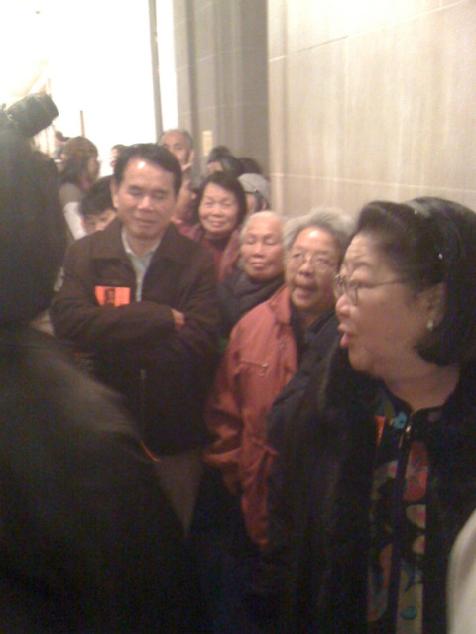
 The crowd of seniors from the Self Help for the Elderly non-profit who crammed City Hall today are a likely preview of things to come during the mayor’s race.


 Board President David Chiu’s insistence that there were no back room deals. “Shortly after Gavin Newsom was elected Lt. Governor, I said Ed Lee should be considered as a candidate,” Chiu told me. “There was never a deal.”


The strong sense that Chiu is running for mayor in November, though he hasn’t filed. Asked if he was running, Chiu said. “I’m here at the Board focused on the work.” Asked if he wasn’t running, Chiu said, “I’m here at the Board focused on the work.” (That’s not a very convincing denial, David!)


On being reminded that the Year of the Rabbit kicks off in February, Chiu added,  “Hopefully, this will be a very fortunate year for San Francisco.”


Oakland and San Francisco will both have Asian American mayors—160 years after Chinese immigrants first settled in San Francisco and 129 years after the Chinese Exclusion Act sought to prevent these immigrants from rising to the top.


The rejoicing that reportedly is going in the Asian community, right now.“Chinatown is excited,” a reporter for Sing Tao Daily told me. “Ed Lee is a low-key kinda guy. No one really knows him, but as former DPW director, he was always filling up pot holes.”


The stated hope that Lee will support Sup. Avalos local hire ordinance, which kicks in Feb. 23, implement Sup. David Campos’ due process for immigrant youth ordinance, and enforce the recommendations of the Mayor’s African American Out Migration Task Force.


The growing sense that Sup. John Avalos is a strong contender as new Board President.


Sharen Hewitt’s observation that burgeoning racial tensions between African Americans, Asian Americans and Latinos need to be addressed. Now.


Julian Davis’ observation that while the way Lee was appointed is not something San Francisco should be proud of, the fact that we now have an Asian American mayor with the almost unanimous support of the old Board is (Daly was the lone dissenter).


Newsom’s reminder that the old Board’s vote was symbolic.“Today was an extraordinary historic vote,” Newsom said. “But remember, it’s symbolic. The new Board will make the appointment.”


 Newsom’s description of Lee as a ‘recruitment” as he, too, insisted there were no backroom deals. “There were no deals, no backroom deals,” Newsom insisted. “He’s the right person at the right time.”


Newsom’s claim that this isn’t about Lee (or anyone else who’d been nominated.) “It’s not about you,” Newsom said, recreating a conversation he allegedly recently had to convince Lee, who’d just been guaranteed five more years employment as City Administrator, to become interim mayor for the rest of 2011. “You are that something more, that something better. You’re the one guy who can pull it altogether, including if disaster strikes, which is my biggest fear.”


Newsom’s relief that he only needs to prepare a 3-page budget brief. “Someone who understands so much of the process doesn’t need 20 pages,” he said.


Newsom’s claim that ideologues make terrible mayors.”If this city gets off track, plays some ideological game, it impacts the entire region,” he said. “I love that Lee is not even in the country. If he had been here, he’d probably have been convinced not to do it. Ideologues make terrible mayors, and mayors make terrible ideologues.”


Newsom’s explanation of how Lee will be able to get back his job, though the charter prohibits people who served in elected office from working for the city for at least a year.
”Hopefully, the Board will make it easy for him. Four members of the Board can put a charter amendment on the ballot. Or Lee can do it himself.”


Newsom’s revelation that he will be sworn in as Lt. Governor at 1:30 p.m, Jan. 10, and San Francisco will find out who the next District Attorney is by then.


Newsom’s claim that 2010 was an “incredible” year. “The Shipyard, Treasure Island, the America’s Cup, Doyle Drive, the Transbay Terminal. All these things are groundbreaking,” he said.


Historic mayoral vote followed a flawed process

6

Ed Lee would be San Francisco’s first Chinese-American mayor right now – if Mayor Gavin Newsom wasn’t delaying his swearing in as lieutenant governor. And Lee might also have had 10 votes on the Board of Supervisors on Tuesday, as he had today, if the process hadn’t involved backroom deals and moderate, lame-duck supervisors kowtowing to the outgoing mayor. In other words, this historic occasion just didn’t need to be sullied the way it was this week.
There was real jubilation at City Hall when I left there a few minutes ago, and for good reason, even though today’s vote will have to be repeated by the new board after Newsom officially resigns. “This is a historic moment for the Chinese-American community,” Board President David Chiu told a packed board chambers, calling it, “a community that has struggled, a community that has seen discrimination.”
Chiu braved the taunts of Sup. Chris Daly and some progressive activists for supporting Lee on Tuesday, steadfastly maintaining that Lee is progressive and the best candidate for this job, despite his five progressive colleagues voting for Sheriff Michael Hennessey. And Lee does have progressive roots and support, as the progressive supervisors have attested publicly.
Once the progressive supervisors were given the chance to talk to Lee – whose openness to accepting the nomination came out of nowhere, reportedly at the urging of Chinatown power broker Rose Pak and former Mayor Willie Brown – all but Daly voted to support Lee.
Yet all of them also publicly noted how the process was deeply flawed and contrary to progressive principles of openness and accountability. “I have questions about the process and how we got to this point,” Sup. John Avalos said before announcing his support for Lee based on a half-hour telephone conversation yesterday (Lee has been in China through his public consideration as interim mayor).  
Sup. David Campos said he nominated Hennessey as a compromise caretaker mayor based on the representation from Newsom that he was acceptable and after being told by Sup. Bevan Dufty that he would support Hennessey. Instead, Dufty refused to vote until calling for a recess and marching down to the Mayor’s Office on Tuesday, returning to be the swing vote for Lee.
“I’m very disappointed in the way this process has gone down,” Campos said, adding that Hennessey “did not deserve the kind of treatment he received.” Sups. Ross Mirkarimi and Eric Mar echoed the point, with Mirkarimi saying he still doesn’t understand why Dufty flipped or what happened when he went to visit the Mayor’s Office.
Through the whole hearing, Dufty – a candidate for mayor himself – didn’t say a word. At one point, he even started clearing out his desk in Board Chambers, throwing away recycled papers and filling a big envelope full of paper clips. He didn’t stick around the hallway for the celebration that he helped enable, instead going straight into his office, where I found him and asked for a reaction to his colleagues’ questioning of his motives and integrity.
“My actions speak for themselves,” was all Dufty would say.
Perhaps they do, but even Lee’s strongest supporters acknowledged that the process of picking him was flawed. “Part of the problem was Ed’s because he couldn’t make up his mind,” Rev. Norman Fong told the Guardian. “The process was bad.”
Without a public discussion or the ability of reporters or supervisors to talk to Lee, Fong acknowledged why some progressives worried that a deal had been cut to continue with Newsom’s policies and personnel. “Some people were concerned about who he’ll listen to,” Fong said, but he said, “I’ve fought with Ed Lee and I know his heart…He’ll do the right thing.”
Gordon Chin of Chinatown Community Development Center said he has worked closely with both Lee and Hennessey and both would have been good interim mayors, and he said this should not have been a partisan fight. “Who nominated Mike Hennessey as the nominee of all of progressive San Francisco?” Chin asked, noting that few progressive constituencies were consulted on the choice or offered their buy-in.
Yet he also acknowledged the unseemly way in which Lee came out of nowhere to get the nomination, with little public vetting, “If Ed was out there a week earlier, it would have been a lot better. It was a flawed process,” Chin said.
So flawed that Daly and many progressive activists are still smarting about what happened and wary of what kind of mayor Lee will be. “No more backroom deals,” queer activist and blogger Michael Petrelis repeatedly shouted at Rose Pak as she was being interviewed outside board chambers.
But Fong just shrugged and told me, “There’s backroom deals on the left too.”

Chinese community out in force for Lee

5

Well, Rose Pak promised a big demonstration and she’s got one: City Hall is mobbed with Ed Lee supporters pushing the supervisors to vote for the city’s first Asian mayor. Lee is still out of town, so he can’t answer questions, although he’s talked to several supervisors by phone. One said he seemed a little overwhelmed by all of this; he wasn’t even sure he wanted the job until Pak and Willie Brown talked him into it.


The revelations that the vote for Lee was a backroom deal orchestrated by Pak and Willie Brown (and from years of Brown watching, I can you this was a classic Brown move) will put Lee supporters like David Chiu and Eric Mar in a tough situation. Aaron Peskin, former supervisor, wasn’t mincing words when I talked to him jost before the meeting started:


“This is no so much about left and right, it’s about democracy and how power is transitioned,” he said. “This is disgusting, not because Ed Lee is or isn’t left or right or a progressive or a liberal. This is about the politics of power, and conservatives and moderates should be just as revolted as anyone.”


Meanwhile, my old friend Rev. Norman Fong, a leading Chinatown progressive, says he supports Ed Lee, as do a lot of progressives in the Asian communtity. I get that, and he’s a decent guy with a good history as a civil rights and housing lawyer, and he might even be a decent mayor. But this process stinks. There’s no other way to put it.

City Hall’s mad political swirl

1

It was common knowledge around City Hall that Chinatown power broker Rose Pak and former Mayor Willie Brown were lurking behind the sudden emergence of Ed Lee as the pick for interim mayor, but Bay Citizen reporter Gerry Shih does an excellent job showing how it actually went down in a story that appeared in today’s New York Times.

Pak is also expected to orchestrate a big show of Chinese-American power during this afternoon’s Board of Supervisors meeting, and progressive supervisors tell the Guardian that they have been personally lobbied by Pak to get behind Lee. Some supervisors hold out the hope that Michael Hennessey might still have a shot, or that Ed Harrington might be put back in play, but I wouldn’t bet on it. Lee seems like he’ll be the guy, at least with this board.

In addition, the rumor mill is buzzing that David Chiu will declare his candidacy for mayor in the coming weeks, although other sources indicate he hasn’t made a final decision yet. And given that the new board still has to confirm the current board’s selection, don’t be too surprised if someone makes a play to name Chiu as interim mayor, but that’s a longshot.

Following right on the heels of today’s interim mayor vote will be tomorrow’s swearing in of the new board and vote on president, which Chiu would like to hold onto. But after crossing his progressive colleagues on Tuesday to support Lee over Hennessey, most progressives are expected to push for Sup. John Avalos, while fiscal conservative Sup. Sean Elsbernd is also expected to make a bid for the presidency. None appear to have six votes yet.

Despite media reports about the board’s “progressive majority,” the current political dynamics don’t really give any faction a majority, with identity politics holding heavier sway than ideology right now. So the only prediction that political watchers can make right now is that it’s going to be interesting.

Chiu rejects DA job and defends his support for Lee

22

Amid speculation that he was angling to be appointed district attorney – and questions about whether that goal influenced his support for Ed Lee to be named interim mayor – Board of Supervisors President David Chiu has issued a press release announcing that he’s withdrawing from consideration for the DA’s job.

“Right now my strong belief is that I can best serve San Francisco from City Hall. The challenges ahead of us will require a new level of collaboration between our elected leaders—many of them new to office—and all San Franciscans who care about the future of our incredibly diverse and inclusive City,” Chiu said in the prepared statement, thanking Mayor Gavin Newsom and Attorney General Kamala Harris for their consideration and for recent meetings with Chiu on the appointment.

When I spoke with Chiu yesterday afternoon, he said that he was leaning against taking the job, partly out of concern that Newsom would replace him with a fiscal conservative like Joe Alioto Jr. “I would not want to leave my seat to someone whose perspective on issues is drastically different than mine,” Chiu told me.

He also strongly emphasized that there was no connection at all between his discussion with Newsom over the DA appointment and with Chiu’s pivotal support for Lee, and Chiu said Newsom did not raise the issue during their conversations. On Tuesday, Chiu broke with his progressive colleagues to be the sixth vote in favor of Lee.

Chiu said that he has long been supportive of Lee and Chiu disagrees with the assertion that Lee is a less progressive pick than Sheriff Michael Hennessey, who had the support of five progressive supervisors. “He’s someone who has tremendous progressive roots,” Chiu said of Lee, noting that Chinese-American progressives have long considered him one of their own. “We have been working with Ed Lee for years and we know where his heart is.”

Chiu argued that Lee is experienced in a broad range of city functions and issues while Hennessey’s knowledge of city government issues is limited mainly to law enforcement. While the strong and sudden support for Lee among fiscal conservatives has been worrisome to many progressives, Chiu noted that “unfortunately, the moderates are far more disciplined than we are on the progressive side.”

“We have many competing and diverse constituencies that led us to be unable to get to consensus around one candidate,” Chiu said.

The current Board of Supervisors will convene for a final time at 3 p.m. tomorrow to vote on Lee after progressive supervisors successfully pushed for a delay in the vote on Tuesday. In addition to Chiu and the five supervisors to his ideological right, Sup. Eric Mar has announced that he will also support Lee, and Sups. John Avalos and David Campos said they are open to backing Lee after they get the chance to speak with him.

Tapas with Sean: Some modest questions for a West Portal supervisor

9

Ever since the Brugmann family moved into the West Portal area in 1964 (with the help of local realtor John Barbagelata), I have been annoyed with the fact that many of our West of Twin Peaks supervisors prance around in their neighborhoods as “neighborhood supervisors,” then go to City Hall and vote to protect PG&E and vote the downtown/bigdeveloper/real estate line without blushing.

Barbagelata and  Quentin Kopp were notable exceptions. Barbagelata, when he was elected supervisor, even refused to go downtown to the election night parties and staged his own party in his West Portal real estate office and made the statement that there was a big difference between neighborhood and downtown issues.

Sean Elsbernd, my current supervisor, is good on some issues, shows some independence on occasion, and comes to the phone and answers emails and comes to the Guardian for interviews. In fact, I was emailing back and forth with him on Tuesday afternoon over my annual holiday card (and my note to “fear the beard in 2011″) shortly before the historic board meeting on the interim mayor. I asked him why he wasn’t more visible in West Portal and that I didn’t see him in the Manor coffee shop (he replied he was a Village Inn type of guy) and that I didn’t see him at Que Syrah, our local Best Of wine tasting gem. (He said he and his wife had gone to Que Syrah over the holidays but they were closed.) I explained that proprietors Stephanie and Keith McCardell had taken a week off.)

Anyway, a few hours later, Sean “mysteriously” nominated Ed Lee, the CAO traveling in Hong Kong, to take on the key city post of interim mayor. How in the world did this happen?

Was Sean once again demonstrating he was a neighborhood guy out in West Portal, but at City Hall the mayor’s go-to -guy in the smelly deal to preserve the mayor’s office and take control of the Board of Supervisors for PG@E and the mayor’s downtown allies?

So I sent him an email with my questions as his constituent. And I invited him to come as guests of my wife Jean and I for the Thursday night special at Que Syrah (230 West Portal Ave), with flights of small production wines and tapas by Val, styled in wondrous Barcelona fashion. I gave him a deadline (noon today) to answer my questions and I invited him to comment on my Bruce blog or send me a letter or email that I would be happy to publish on my blog. Stay alert for news on what my West Portal supervisor is really up to at City Hall.

To Sup. Sean Elsbernd:

You baffle me once again.

I am curious, as a constituent,  why you nominated Ed Lee for interim mayor when he was (a) out of town in Hong Kong, (b) not publicly “out there” or “in public discussion” as a candidate or even known by the supervisors to be a legitimate candidate, (c) has not publicly stated his views on any of the major tough issues coming before the mayor, (d) was not available for questioning by the board when the discussion and vote came down, (e) is not as qualified for t his tough post in these tough times as the other public candidates, and (f) was obviously part of a backroom deal orchestrated by Mayor Newsom and his downtown allies?

I wait patiently  for  your reply.  And I hope you drop by Que Syrah Thursday night,  for tapas and wine flights, so you can explain personally  to the West Portal throngs what you are really  up to at City Hall these days. Jean and I will be there to host you.

Respectfully, Bruce B. Brugmann, 2262 14th Ave, West Portal

Is Chiu really set to roll into D.A.’s office?

15

Last month, when I wrote about the game of musical chairs in the D.A.’s office that Kamala Harris’ victory in the Attorney General’s race triggered, Board President David Chiu said he wanted to stay put, “for now.”

But is it possible that Chiu was referring to December 2010, or the first week of January 2011, when he said “now”.

Today, his chief of staff Judson True acknowledged that Chiu’s name “is in the mix” when it comes to the conversation about appointing someone to replace Harris. But True also noted that Chiu’s “focus is still on the Board.”

And if I were Chiu, I’d be biting my nails over the prospect of trading my seat as an elected official for an appointment that only lasts until year’s end. Especially since this trade-off would be happening against the backdrop of the November election in which Harris’ chief of staff Paul Henderson and criminal justice reform advocate David Onek have already filed paperwork.

Either way, True says not to expect any announcement about the D.A. appointment until an interim mayor has been selected, so stay tuned.

And Chiu just told Guardian city editor Steve Jones that the D.A.’s office isn’t where his head right now.

“Chiu told me he doesn’t think he wants it and wouldn’t take it without assurances that someone who didn’t share his values would be appointed to D3,” Jones just told me, as he prepared to head for Daly’s roast at the Independent tonight.


Chris Daly’s Final Say

18

As part of my effort to compile a list of most roastable moments of Sup. Chris Daly‘s decade-long career at City Hall, I asked the termed-out D6 supervisor if he would sit down for an exit interview. And shortly before Christmas, when there was still hope the Board would select a progressive interim mayor, and Daly had not yet vowed to politically haunt Board President David Chiu with shouts of, “It’s on like Donkey Kong” , we arranged to meet me at the Buck Tavern on Market Street, which Daly, who now holds the liquor license, is threatening to rename “Daly’s Dive.”

As it happens, the lion’s share of our conversation ended up taking place by cell, since Daly got stuck in late afternoon commuter traffic, as he drove to San Francisco from Fairfield, where his wife and children have lived since April 2009, making him a fitting symbol of the East-Bay-and-beyond migration pattern of couples who live in San Francisco, until they have more than one kid.

Except not all couples with two small kids get to move into one of two foreclosed properties that the in-laws bought with $545,000 cash in spring 2009. At the time, Daly’s critics accused him making such a mess of governing the city that he had decided against raising his own family here. Daly predictably disagreed. “There are few people who think about the future of San Francisco and the health of the city more than me,” Daly told reporters, explaining that his wife wanted family support raising their children, so she had moved to the same cul-de-sac as her parents, as Daly continued to live in a condo in San Francisco with roommates and to see his family on weekends.

Anyways, on the dark and stormy night that I interviewed Daly in mid-December, he acknowledged that he was going to be in for one helluva roast at the Independent on Jan. 5. in the worst possible sense of the tradition.
“Will there be controversial subjects, things that on the face of it, are not very nice? Yes,” Daly said.

And then he claimed he had agreed to this ordeal, because, under the roast’s traditional format , he would get to go last—and thus would get to have the last word.
“Why would I want to end my City Hall career like this? Because I get to go last, and can really say what’s on my mind,” Daly said. “Unless the D.J. wants to say something as he’s spinning.”

Daly’s comment suggests that folks who attend his roast at the Independent will witness a historically vicious verbal drubbing on all sides, since no one has ever accused Daly of holding back from saying what was on his mind. Even if it has led to seemingly counterproductive “We are shocked, SHOCKED!” responses. Like the time Sup. Michela Alioto Pier introduced an ultimately doomed etiquette ordinance, after Daly swore at a constituent during a City Hall meeting, in 2004.

Daly said at the time that he comes from a background as a housing-rights organizer on the streets of Philadelphia and San Francisco, where confrontation was an effective political tool. But he also claimed that he had learned an important lesson.
“In the future it’s going to be better for me personally and politically to focus my energy positively on the people I care about instead of negatively on the people I think are doing them harm,” Daly reportedly said.

Fast forward six years, and Daly is unrepentant about his record of fighting for low-income people, while openly defying City Hall’s unwritten rules of etiquette.
“Etiquette always seemed a little silly, something for the ‘other’ San Francisco, for the prim and the proper and that’s not what I am concerned about,” Daly said. “I’m aware of the turn-the-other-check philosophy, and, if I were religious, I’d be out of the Old Testament. I’d be, if someone pokes you in the eye, I’d poke back.”

Daly says he stopped caring about etiquette towards the end of his first year in office. “When those in power use that power to put down those who are less advantaged, when I see that, I respond quickly and with as much force as I can to prevent them from doing that kind of thing again,” he said. “ If you want to attack homeless people for political advantage, I’m going to attack you right back. That’s not ‘proper,’ but I think it’s just.”

Daly says he also soon realized tthat the truth wasn’t the driver.
“I already knew that money, power and significant forces would be pushing back against me but then I discovered that the actual truth wasn’t what played out there in the world of spin. It’s like when the Examiner’s Josh Sabatini asked me how I want to be remembered, and I said, “Not as the caricature the Examiner created of me.”

Daly, who moved to San Francisco in 1993 to work on homeless and affordable housing issues, was at the heart of the movement around Ammiano’s 1999 write-in campaign for mayor, and part of the progressive sweep onto the Board, in 2000.

“For me, it’s never been about being a ‘good’ vote. I breathe leftist progressive politics,” Daly said. “Where I can make more of a mark is in terms of setting the stage for those votes and holding the line in districts that are not progressive. I’m very proud of my attempts to hold the line on issues, but the work doesn’t make any friends.”

Daly noted that after he made comments about Newsom’s alleged cocaine use during the 2007 Mayor’s race, downtown interests threw everything they had left at him.
‘They got a lot of hits in, but no total blows,” he opines. “Last time I checked, I saved the city $150 million on the Americas Cup deal that they were going to ram rod through.”

And so, as he prepares to begin life as a bar owner, don’t expect Daly to pass up opportunities to launch verbal attacks, if he believes they are warranted, political consequences be damned.

“People want to have the power without any of the negativity they associate with all the shit we have to deal with to build this power,” Daly added. “So, it’s all, Daly and [former Board President Aaron] Peskin took control of the Democratic Party at midnight. Well, how did you want us to take over? “

Daly claims if you take away “negatives” attributed to him, you take away his wins. “People call me a lot of things, but I’m not a loser, I win a lot” Daly added, noting that Democrats being nice to Republicans has led to losses in D.C., not gains. “So, yes, I’ve got a lot of negatives, and they’ve clearly been made into a target, but if I can take the hits, and help people I care about, I’m happy to do it. That’s what I’ve done for ten years.”

Daly says he’s become “pretty desensitized to criticism,” even as he admits to being a sensitive person, deep inside. “I don’t think I’d have quite the visceral response to poverty and oppression, if I wasn’t sensitive,” he said. “I care deeply about people’s struggles. That’s why I’m here, but I also have a pretty solid critique of capitalism and I know how to follow the money, so when I get criticized by some downtown mouthpiece, I know what time it is.”

Daly says he started the Daly Blog several years ago, to push back against what he felt was unfair treatment in the media. And he says he endorsed outgoing mayor Newsom for Lt. Governor, despite their long and antagonistic history, so progressives could have a shot at installing a mayor in Room 200.

“My money now is on the selection of the mayor going to the new Board, and Avalos getting it in the 13th round of voting,” Daly said.

Daly made that prediction three weeks before the progressives on the Board seem poised to hand the keys to R.200 to City Administrator Ed Lee—thereby eliciting Daly’s ballistic “Donkey Kong” outburst.

With the outgoing Board set to meet Friday to make a selection, here’s another Daly roastable moment, this time from Peskin, related to the fall-out that ensued after Daly made two appointments to the SFPUC, while serving as acting mayor for one day, while then Mayor Willie Brown was out of the country, on a trip to Tibet.

“When Mayor Willie Brown left office, Charlotte Schultz had an unveiling ceremony of Brown’s picture. Newsom, who by then was mayor, was presiding. And Charlotte had a beautiful easel with a golden drape over it. When she pulled back the curtain there was a picture of Daly, who was listed as “41st and a half” mayor presiding from 9 a.m. to 2 p.m. on October 22,” Peskin recalled, noting that under Daly’s picture there was another curtain that contained Brown’s actual portrait.”

And while Daly’s controversial statements and outbursts always make headlines, there is no denying that he helped make the progressive agenda, including establishing mandatory paid sick days, universal healthcare, and forcing developers to contribute in affordable housing or services for poor, an integral part of city policy.
 “The Chronicle used him as the poster child to try and dissuade anyone from supporting a progressive agenda,” former Sup. Jake McGoldrick observed. “He was used to smear any of our good ideas. And Chris never seemed to understand that some of us needed to be a little more sensitive, since we needed to get re-elected and didn’t represent districts that were as progressive as his. Personal attacks make the whole situation smell bad.”

Sup. John Avalos, who served as Daly’s legislative aide until he was elected as D11 supervisor, acknowledged that a lot of folks have accused Daly of doing irreparable harm to the progressive movement and being a gift to Newsom and the moderates at City Hall.
“People try and make hay out of it,” he said. “But his antics have probably hurt him more than anyone,” Avalos added, noting that he ran in 2008 as Daly’s former legislative aide.
‘And it didn’t hurt me, and I made no bones about where I came from.”

And then there’s the fact Daly defeated the Chamber ’s Rob Black in the 2006 election. “We don’t do enough to have better relationships between ourselves,” Avalos added , reflecting on the divided progressive movement. “It’s more than just one person.”
 
Peskin for his part acknowledges that Daly will be missed on the Board.
 “He sucked the oxygen out of the room and made it all super lefty and caustic, and it certainly did not allow a better conversation to evolve,” Peskin said. “But it’s still going to be a pretty profound loss.”

Progressive supervisors block mayoral appointments

15

UPDATED: Progressives on the Board of Supervisors have finally started to push back on Mayor Gavin Newsom for his petulant refusal to vacate Room 200 unless his conditions for choosing a successor mayor are met, with the Rules Committee today blocking nine [UPDATE: seven] of 10 of the mayor’s committee and commission appointments.

Led by Sups. David Campos and Eric Mar, the three-member committee has been voting to continue consideration of the appointees to a future date at the discretion of Chairman Campos, even those who they voice support for. But they are trying to force a more equitable approach to governing the city during this transition period. The meeting is ongoing at this writing and can be viewed live here.

The one exception so far has been San Francisco Public Utilities Commission appointee Vince Courtney, with Mar and Campos voicing the urgency of filling the appointment on a body that is now moving forward Clean Power SF and other important initiatives. But they have blocked the appointment of Andrew Wolfram, Richard Johns, and Karl Kasz to the Historic Preservation Commission, Harry Kim and Herb Cohn to the Relocation Appeals Board, Florence Kong to the City Hall Preservation Advisory Board, Leona Bridges to the Municipal Transportation Agency Board of Directors, and Michael Kim and Leslie Katz to the Port Commission.

Former Sup. Amos Brown lashed out at the move, telling the committee, “I’m appalled to witness what’s happening here.”

But progressives have been equally appalled at Newsom for delaying today’s scheduled swearing in as lieutenant governor, reportedly to Jan. 10 after the new board is sworn in, and for demanding that the supervisors guarantee him that they will only support one of his preferred moderate caretakers for the interim mayor position. Newsom’s office did not return a Guardian call for comment on today’s meeting.

UPDATE 1:25 PM: After hearing more than an hour’s worth of testimony in support of Bridges, the committee unanimously voted to recommend her nomination to the MTA, citing that agency’s urgent need for a nominee from the African-American community who has a strong financial management background. The full board will consider her nomination tomorrow.

UPDATE 2:20 PM: Shortly before adjourning, the committee also unanimously recommended Katz be appointed to the Port Commission, saying that agency urgently needs another good appointee, although Mar indicated he didn’t think Kim was right for the position and that nomination was continued.

Does Mayor Newsom represent SF workers or San Mateo politicians?

2

“Does Newsom represent local workers or San Mateo politicians?” That’s the question being asked  at City Hall today. And it’s threatening to deliver an unwelcome kick to Mayor Gavin Newsom on his way out of City Hall’s revolving doors, as dozens of unemployed construction workers deliver 1,000 Christmas cards that residents of Bayview Hunters Point, Chinatown, the Mission, the Tenderloin and South of Market have signed. The cards urge Mayor Gavin Newsom to “put the Merry into Christmas and the Happy back into New Year” and sign local hire law that the Board passed a week ago.

This special holiday season delivery has been in the works since Dec. 14, when Bayview-based job advocates Aboriginal Blackmen United (ABU) tried to meet with Newsom and get his signature on legislation that a super-majority on the Board support.

But after Newsom was a no-show and his chief of staff Steve Kawa refused to give ABU any assurances, community advocates Brightline Defense Project printed up a thousand of the cards urging Newsom to “put the Merry into Christmas”. And Brightline, ABU, Chinese for Affirmative Action, PODER, and the A. Philip Randolph Institute then asked unemployed workers, activists, and concerned citizens to sign this unusual set of greeting cards.

The move comes a day after the San Mateo County Board of Supervisors voted unanimously to urge Newsom to veto Avalos local hire policy. Local hire advocates suspect this counter-move was orchestrated to give Newsom political cover, should he choose to make the seemingly Scrooge-like move of vetoing, just before the holiday season, legislation that would help San Francisco residents secure work on billions of dollars worth of local tax-payer funded construction projects .

But the San Mateo supervisors claim that San Francisco’s plan, which would mandate that 50 percent of workers on city-funded projects are local residents, threatens to hurt an already sluggish regional economy.

“This is not the time to put isolation around a community,” San Mateo Sup. Carole Groom reportedly said at a hastily convened Dec. 21 special session.
 “If this is rejected, it would be time for all of us to sit down and talk about this,” fellow San Mateo County Sup. Adrienne Tissier reportedly said.

Newsom has until Christmas Eve to either sign or veto the law, though the Board can still override his veto, provided Avalos still has eight votes in the New Year. And if Newsom doesn’t sign or veto the law by week’s end, it will go into effect in 60 days.


San Mateo officials are arguing that the local hire legislation particularly impacts their county, because the law contains a “70-mile” clause that includes the San Francisco Airport, the Hetch Hetchy water system and the San Bruno jail.

Sup. John Avalos previously told the Guardian that project labor agreements protect workers at the airport and working on projects that the San Francisco Public Utilities Commission funds. But Tissier reportedly claimed that San Francisco’s local hire policy would kick in, once new contracts are negotiated.

Reached by phone, Avalos said it’s not clear if the San Mateo supervisors have actually read his legislation
‘If they had, they’d see a lot of ways that is supports San Mateo workers,” Avalos said.

San Francisco’s local hire legislation, which is the nation’s strongest, requires that 20 percent of workers within each construction trade be local residents starting in 2011. That number increases 5 percent annually for seven years, as local workers join trades where community representation is lacking, before reaching 50 percent. In other words, 80 percent of the workforce could be non-city residents in 2011, and even at 50 percent local hire, half of the jobs will still be available to workers who don’t live in San Francisco.
 
“That’s hardly an exclusion especially when you consider that San Francisco taxpayers are making the investments on these projects,” Avalos stated.
He believes that the San Mateo County Building Trades Council pressured the San Mateo Board to pass their Dec. 21 resolution urging a veto on his measure. Either way,  Victor Torreano, vice president of the San Mateo County Building Trades Council was quoted in media coverage of the Dec. 21 vote, saying, “the need for housing in San Francisco and the Peninsula make it impossible for many blue collar workers from sinking family roots in the area.”

Avalos acknowledges that San Francisco International Airport is in San Mateo County, and its workers understandably wants jobs there,
“San Mateo County has to put up with the sound of the airport, and its residents deserve to have jobs there, but this is much ado about nothing,” Avalos said. “But it’s the Building Trades that are uncomfortable with changing slightly their practices.”

Mike Theriault, Secretary-Treasurer of the San Francisco Building Trades Council, acknowledged that his group has never been pleased with Avalos’ legislation.

“But we are resigned to seeing how it plays out,” Theriault told the Guardian. “We think there are better things they could have done to guarantee access of San Francisco residents to careers in our trades.”

Theriault believes that Avalos may not understand the project labor agreement are of limited duration.
“So, they will require an extension of the existing labor agreement,” Theriault said,  noting the legislation states that future extensions would have to comply with the new law.

But Theriault acknowledged that with or without Newsom, Avalos’ legislation still has a chance to move forward.
“If he vetoes it, I understand that the Board will have another crack at it, Jan. 4,” THeriault said, referring to the current Board’s last meeting in January.
 
The Bay Area Council has also announced its opposition to Avalos’ legislation,
 “This troubling trend of intra-county battles being started by the San Francisco Board of Supervisors needs to stop,: Bay Area Council President and CEO Jim Wunderman said in a Dec. 21 statement. “The Bay Area is one regional economy, not nine island states. We need to focus on nurturing the fragile economic recovery in our region, not setting bad policies that pit county against county.  The Bay Area Council urges Mayor Newsom to veto this foolhardy piece of legislation.  Right now, we do not need any more incentives for businesses to leave any county, the Bay Area, or California.”

But advocates for the legislation note that the San Francisco Controller recently estimated that the law will pump $270 million into the local economy over the next 10 years. They hope Newsom will emerge from his warren-like office today and sign the law, delivering a historic Christmas present to the city’s growing ranks of unemployed workers.


But even if he doesn’t, Avalos isn’t sweating it.


“Newsom probably won’t sign it, and he’ll write a letter saying he’s opposed to it,” Avalos predicted. “And even if the new mayor is [SFPUC director] Ed Harrington, he’s been supportive of the measure. So Newsom has to answer his own conscience and ask himself, if he’s going to represent local residents or San Mateo politicians.”


According to Brightline’s Joshua Arce, ABU led about 30 to 40 workers from Bayview, Chinatown, and the Mission up to Room 200 today to drop off 1,000 signed  cards from residents in every neighborhood asking the Mayor to sign the community’s local hiring law by Christmas.
 
“Room 200 was locked, but we kept knocking,” Arce told the Guardian. “Eventually the doors opened and out came [Mayor Gavin Newsom’s chief of staff] Steve Kawa. We showed him all of the Christmas cards that we had for his boss and he thanked us. Ashley Rhodes of ABU explained that since we heard how much the Mayor liked the ABU holiday card last week, we printed up 1,000 more and got them signed by people from every community in San Francisco.”
 
“We asked where the Mayor was in terms of making his decision, he said that the Mayor was still studying all of the issues,” Arce continued. “He brought up the opposition from the San Mateo County Board of Supervisors, so we asked him to tell the Mayor to support us, the thousands of unemployed and job-hungry San Franciscans, over four San Mateo politicians.”
 
“Steve Kawa said that they will be working around the clock to make sure all concerns are addressed, and we showed Steve a card signed by Sup. Bevan Dufty just moments before we came upstairs,” Arce addded. “Sups. John Avalos and Eric Mar also signed Christmas cards to the Mayor.”

According to Arce, ABU left the two huge Santa bags full of cards with Kawa, who picked them up, commenting “These bags are awfully heavy.” 

“I asked him to make sure to tell his boss that the cards were printed on 100% recycled paper,” Arce concluded. “Let’s hope that Mayor Newsom puts the Merry into Christmas and the Happy back into New Year!”

How can you stay in the house?

0

arts@sfbg.com

YEAR IN DANCE Watching dance in the Bay Area is a privilege. With the constant influx of eager young talents, people who stick around and develop, and established artists who still manage to surprise year after year, the experience can be a ball. This celebration is boosted by the “travelers” from other cities and countries who come in for a day or two and keep local dance from becoming overly self-satisfied. There is a lot wrong with capitalism, but competition — in terms of ideas — can be a real quality booster.

Watching dance in the Bay Area can also be a chore. Performances bunch up on each other, making it difficult to schedule which shows to attend. No one seems to perform on Easter or Memorial Day, but everyone goes crazy on the adjacent weekends. What is this — do we all go to church on Easter or to the beach on Memorial Day? Kudos to the West Wave Dance Festival, which this year moved its schedule to Monday nights.

One consequence of the plethora of dance available all year round is my editor’s annual request for a retrospective of the past 12 months. It’s a useful exercise, I suppose, though I have yet to decide whether it’s a privilege or a chore. Here are a dozen highlights that rose to the surface.

1. I call them surprisers, because you think you know what to expect from them and then find out that you don’t. One example is long-term dancer Kara Davis. She’s unafraid to use large ensembles in increasingly complex choreography. Another is Katie Faulkner, who possesses wit in addition to a fine eye for form. Jazz choreographer Reginald Ray Savage took Stravinsky’s Agon and used it to choreograph for his tiny group. I still don’t know whether the result works, but it was great to see him daring to take on a ballet icon. Rajendra Serber and Stephany Auberville’s Dance for the Flies was an hour-long improvisation that thrilled, thanks to the dancers’ intensity and the contributions of equally good musicians Matt Davignon and Cheryl Leonard.

2. San Francisco Ballet. Helgi Tomasson is committed to stretching our notions about ballet. So he programmed John Neumeier’s visually stunning though choreographically problematic The Mermaid. Was the risk worth taking? Perhaps. SFB artists who still dance in my head: Sarah Van Patten as Juliet; Maria Kochetkova in Yuri Possokov’s Classical Symphony; Damian Smith in everything he touched; and Pascal Molat as Petrouchka.

3. Erika Chong Shuch Performance Project’s Love Everywhere in the City Hall rotunda on Valentine’s Day. Professional and community performers, plus a chamber ensemble, celebrated people’s commitment to each other in a work that was funny, humorous, and ever so gentle. It humanized the seat of power.

4. Lines Ballet. By now we may know choreographer Alonzo King’s choreographic language, yet he finds wondrous new ways to use it. For the gorgeous Wheel in the Middle of the Field, he interpreted European classical songs, putting the singers on stage with the dancers. With Zakir Hussein, he rethought both the music and the tale of Scheherazade.

5. In its reprise this year, Joe Goode Performance Group’s mesmerizing Traveling Light proved to be one of Goode’s most worthwhile journey in every way. Inspired by the Old Mint’s history and architecture, his company of seven and 15 additional dancers evoked 19th century ordinary folks, all of them recognizable.

6. Kuchipudi is one of the lesser-known classical Indian dance forms. It’s even more of a pity that Shantala Shivalingappa, a dancer of rare refinement and virtuosity, showed her Gamaka for one night only. Part of this evening’s appeal came from the ease and joy that she and her musicians brought to the performance.

7. In October, Zaccho Dance Theatre’s noble Sailing Away commemorated the exodus from San Francisco in 1858 of a whole segment of the African American community. When it was performed on Market Street, the contrast between the everyday crowd and the dignity and steely focus of the traveling performers (Anna Tabor-Smith and Antoine Hunter) created a high drama of its own.

8. If anybody still needed to be convinced, Socrates confirmed that the Mark Morris Dance Group is the finest modern dance company in the country. Based on Eric Satie’s astounding score, Morris luminously quiet meditation on death wove a spell that has yet to evaporate.

9. Ralph Lemon’s How Can You Stay in the House All Day and Not Go Anywhere? drew me in because of the many balls — formal questions about tonal nuances; juxtapositions of material; deeply-felt thematic concerns — that he had to keep afloat. He did so brilliantly. It was lovely to see — a major accomplishment by a gifted artist-thinker.

10. Carole Zertuche, artistic director of Theatre Flamenco of San Francisco, has reoriented flamenco to where it belongs: the soloist. For “Una Noche Flamenco,” the company’s 44th season, she invited dancers Manuel Gutierrez, Juan Siddi, and Cristina Hall, whose takes on flamenco could not be more different. They joined Zertuche and a group of equally strong, individualized singers and instrumentalists for an exceptionally well-balanced evening of powerfully performed dance.

11. This year also brought the inaugural — and much-needed — San Francisco Dance Film Festival. Greta Schoenberg assembled an impressive program of locally-made and imported works. The sheer number of perspectives that these dance/film artists brought to their work was inspiring. Good news: the festival returns March 25-27, 2011.

12. The collaboration between AXIS Dance Company and inkboat resulted in Odd — a work that was anything but odd. It was exquisite, fragile, and wispy. Taking his cue from Norwegian painter Odd Nordrum, choreographer Shinichi Iova-Koga worked with two groups of nontraditionally trained dancers. The result was a stunner. May it have a long and healthy life.

Mayoral dynamics

5

steve@sfbg.com

Despite the best efforts of Sup. Chris Daly and some of his progressive colleagues to create an orderly transfer of authority in the city’s most powerful office, the selection of a successor to Mayor Gavin Newsom will come down to a frantic, unpredictable, last-minute drama starting a few days into the new year.

The board has convened to hear public testimony and consider choosing a new mayor three times, each time delaying the decision with little discussion by any supervisor except Daly, who pleaded with his colleagues on Dec. 14 to “Say something, the people deserve it,” and asking, “Are we going to take our charge?”

The current board will get one more crack at making the decision Jan. 4, a day after the California Constitution calls for Newsom to assume his duties as lieutenant governor — although Newsom has threatened to delay his swearing-in so Daly and company don’t get to the make the decision.

“I can’t just walk away and see everything blow up. And there are a few politicians in this town that want to serve an ideological agenda,” Newsom told KCBS radio reporter Barbara Taylor on Dec. 16, two days after praising the board for its “leadership and stewardship” in revising and unanimously approving the city’s bid to host the America’s Cup.

Newsom and his fiscally conservative political base fear that the board’s progressive majority will nominate one of its own as mayor, whereas Newsom told Taylor, “The board should pick a caretaker and not a politician — that’s my criteria.”

Some board members strongly disagree. “It’s not his to decide. Besides, what’s not ideological? That doesn’t make sense. Everyone’s ideological,” Sup. John Avalos told the Guardian, a point echoed by other progressives on the board and even many political moderates in town, who privately complain that Newsom’s stand is hypocritical, petty, and not in the city’s best interests.

The Guardian has interviewed a majority of members of the Board of Supervisors about the mayoral succession question, and all expect the board to finally start discussing mayoral succession and making nominations on Jan. 4.

But whether the current board, or the newly elected board that is sworn in on Jan. 8, ultimately chooses the new mayor is anyone’s guess. And at Guardian press time, who that new mayor will be (and what conditions that person will agree to) was still a matter of wild speculation, elaborate conspiracy theories, and backroom deal making.


GETTING TO SIX

A majority of supervisors say there’s a simple reason why the board hasn’t seriously discussed mayoral succession since it unanimously approved the procedures for doing so Nov. 23 (see “The process begins,” Nov. 30). Everyone seems to know that nobody has the required six votes.

Avalos said he thinks the current board is better situated to choose the new mayor because of its experience, even though he voted for the delay on Dec. 14 (in an 8-3 vote, with Daly and Sups. Ross Mirkarimi and David Campos in dissent). “I supported the delay because we were not closer to having a real discussion about it than we were the week before,” Avalos told us, noting that those who were pushing for Campos “didn’t do enough to broaden the coalition to support David Campos.”

For his part, Campos agreed that “the progressive majority has not figured out what it wants to do yet,” a point echoed by Mirkarimi: “I don’t think there’s a plan.” Sup. Sophie Maxwell, who made both the successful motions to delay the vote, told us, “There’s a lot more thinking that people need to do.”

“We do not yet have consensus,” Chiu said of his reasons for supporting the delay, noting that state conflict-of-interest and open government laws also make it difficult for the board to have a frank discussion about who the new mayor should be.

For example, Chiu is barred from even declaring publicly that he wants the job and describing how he might lead, although he is widely known to be in the running.

The board can’t officially name a new mayor until the office is vacant. Sup. Bevan Dufty, who is already running for mayor, told us the board should wait for Newsom to act. “I felt the resignation should be in effect before the board makes a move,” Dufty said.

Sups. Sean Elsbernd, Carmen Chu, Michela Alioto-Pier, and Eric Mar did not return the Guardian’s calls for comment.


PIECES OF THE PUZZLE

Adding to the drama of the mayoral succession decision will be the new Board of Supervisors’ inaugural meeting on Jan. 8, when the first order of business will be the vote for a new board president, who will also immediately become acting mayor if the office has been vacated by then and the previous board hasn’t chosen a new mayor.

While Newsom and his downtown allies are clearly banking on the hope that the new board will select a politically moderate caretaker mayor, something that three of the four new supervisors say they want (see “Class of 2010,” Dec. 8), the reality is that the new board will have the same basic ideological breakdown as the current board and some personal relationships that could benefit progressives Chiu and Avalos.

Daly said downtown is probably correct that the current board is more likely than the new one to directly elect a progressive mayor who might run for the office in the fall, such as Campos or former board President Aaron Peskin. But he thinks the new board is likely to elect a progressive as president, probably Campos, Chiu, or Avalos, and that person could end up lingering as acting mayor indefinitely.

“They really haven’t thought through Jan. 8. Downtown doesn’t like to gamble, and I think it’s a gamble,” Daly said. “There’s a decent chance that we’ll get a more progressive mayor out of the leadership vote for board president.”

Avalos said it “would be a disaster” for the board president to linger as acting mayor for a long time, complicating the balance of power at City Hall. But he wouldn’t mind holding the board gavel. “I think I would do a good job as board president, but I’m not going to scratch and claw my way to be board president,” Avalos said. “I’d be just as happy to be chair of the Budget Committee again.”

Avalos said he thinks it’s important to have a mayor who is willing to work closely with board progressives and to support new revenues as part of the budget solution, which is why he would be willing to support Chiu, Campos, or Mirkarimi for mayor, saying “All of them could do a good job.”

Given the progressive majority on the board, it’s also possible that there will be a lingering standoff between supporters for Chiu, a swing vote in budget and other battles who has yet to win the full confidence of all the progressive supervisors, and former Mayor Art Agnos, who has offered to serve as a caretaker. Some see Agnos as more progressive than the other alternatives pushed by moderates, including Sheriff Michael Hennessey and San Francisco Public Utilities Commission head Ed Harrington.

Moderates like Dufty are hopeful that a couple of progressives might break off to support Hennessey (“From the first minute, he knows everything you’d need to know in an emergency situation,” Dufty said) or Harrington (“I could see him stepping in and closing the budget deficit and finding a good compromise on pension reform,” Dufty said) after a few rounds of voting.

Mirkarimi is openly backing Agnos. “He has evolved, as I’ve known him, in the days since being mayor,” Mirkarimi said. “I think we’ve spent too much time on finding the progressive guy to be mayor than on setting up what a progressive caretaker administration would look like.” And then there are the wild cards, like state Sen. Mark Leno and City Attorney Dennis Herrera. Herrera’s a declared candidate and Leno has made it clear that he’d take the job if it were offered to him.

Given the fact that supervisors can’t vote for themselves, it’s difficult for any of them to win. “I don’t think it’s likely that a member of the Board of Supervisors will get enough votes to be mayor,” Avalos told us, although he said that Chiu is the one possible exception.

But to get to six votes, Chiu would have to have most of the progressive supervisors supporting him and some moderates, such as D10 Supervisor-elect Malia Cohen (whom Chiu endorsed), D8’s Scott Wiener, and/or Chu (who might be persuaded to help elect the city’s first Chinese American mayor).

That would be a delicate dance, although it’s as likely as any of the other foreseeable scenarios.

Editor’s Notes

3

tredmond@sfbg.com

When the talk comes around to budget politics these days — and these days, nobody in politics can talk about much else — there’s a pretty consistent line out there, from the mainstream left to the far right, and it goes like this:

Public employees have been riding high on great pay and benefits, and they’re going to have to accept that those days are over. We can do it nicely, and negotiate and all, but the people who work for the city and the state are getting a haircut. Pension reform. Health care premium hikes. Two-tiered wage systems. Sorry, folks — there’s no other choice.

And I understand the feeling. There are plenty of unemployed people out there who aren’t happy that they’re still paying taxes to support generous pay and health benefits for workers who are consistently maligned as lazy. There are small business owners who can barely afford minimally adequate health insurance for themselves and their employees. There are underpaid private-sector workers who get jealous when they hear what you make over at City Hall.

I get it, and in terms of political reality, public-sector pensions, pay, and benefits are going to have to be part of any budget resolution in Sacramento or San Francisco.

But let me say something else.

In the past 30 years, while public-sector unions were getting organized, becoming a political force and negotiating decent pay and benefits, the United States economy was shifting radically, in a way that we hadn’t seen since the turn of the Century. From Reagan on through Bush I, Clinton and Bush II, powerful forces in Washington launched a class war in this country, one that has as many victims as most of the traditional wars we’ve fought in the past century. The winners have been a small number of people and businesses that have grown impossibly rich — by taking money away from everyone else.

And they aren’t getting any cuts. In fact, their pay, pensions, benefits, and wealth aren’t even on the table. Which is profoundly unfair.

Of the 400 richest people in America (according to Forbes), 80 live in California. Their combined new worth is $231.8 billion — about 10 times the size of the state’s budget deficit. If they gave up just a modest amount of the benefits they get from living in this state and this country (and yes, the rich got that way in part because of the benefits they get from living here), we wouldn’t have a budget crisis at all.

The people who declared this war were smart enough to figure out how to divide the opposition, to turn us against each other. That’s why they keep winning.

The next district attorney

34

sarah@sfbg.com

By the time District Attorney Kamala Harris declared victory in the razor-close California attorney general race, two candidates had already filed to replace her. And their candidacies further complicate the delicate process of appointing a new district attorney when Harris gets sworn in Jan. 3 as the first woman and racial minority to become attorney general of California.

David Onek, a senior fellow at the Berkeley Center for Criminal Justice and a former police commissioner, filed in July and has raised $130,000 and collected 1,000 signatures.

Paul Henderson, a veteran prosecutor whom Harris tapped in 2007 as her chief administrator, filed Nov. 22 when his boss’ victory in the attorney general’s race looked assured.

And now Alameda County Assistant D.A. Sharmin Bock, a human trafficking expert, is reportedly mulling a bid.

Mayor Gavin Newsom has said that if Harris resigns before him, he’ll heed her recommendation for her successor. But whoever Newsom, or his successor, appoints will have a major advantage as the incumbent if he or she runs in November 2011.

Unlike the interim mayor, who will have to make unpopular cuts to balance the budget, the person who fills out Harris’ term will have a strong presumption of holding onto the office.

So far Harris has been silent on the topic of a replacement to the post she held since 2003, when she defeated two-term incumbent District Attorney Terence Hallinan.

A possible reason for Harris’ silence is that until recently San Francisco Superior Court Presiding Judge Katherine Feinstein, the only daughter of U.S. Sen. Dianne Feinstein, was thought to be a front-runner for the post. This perception was based on the assumption that Sen. Feinstein wanted her daughter appointed, that Newsom would obey the senator’s wishes, and that no one in Democratic circles would dare to challenge Judge Feinstein in November given her mother’s political influence.

But it turns out that Feinstein, 53, whose peers unanimously elected her to succeed James J. McBride for a two-year term effective Jan. 1, 2011 as the Superior Court’s presiding judge, couldn’t legally accept an appointment anyway and would have to run in the November race.

And Superior Court spokeswoman Ann Donlan told the Guardian that Feinstein does not intend to give up her position as presiding judge. “Judge Feinstein has told court employees and her judicial colleagues that she has no intention of relinquishing her judicial duties in San Francisco,” Donlan stated.


THE HEIR APPARENT

That leaves Henderson as Harris’ presumptive heir; Onek, who is married to the daughter of Michael Dukakis, is a political force to be reckoned with; and former prosecutor Bill Fazio and police commissioner and former prosecutor Jim Hammer are possible appointments.

District Attorney’s Office spokesperson Erica Derryck would say nothing on the record about the appointment other than that it’s the mayor’s decision to make. But former D.A. Office spokesperson Debbie Mesloh noted that Harris has outlined the qualities she is seeking.

“Kamala has mentioned publicly that she is looking for someone with integrity who understands how the office works and will take over in such a way that allows people to continue their work,” Mesloh said. “That may sound like small potatoes, but it’s a big deal given how many folks work in the D.A.’s Office.”

Public Defender Jeff Adachi told us he finds it interesting that neither Harris nor Newsom has issued an endorsement in favor of anyone. “The silence is deafening,” Adachi said, “But what’s absolutely missing is a process to select a new district attorney. The D.A’s job involves major responsibilities in terms of running and managing a large law office, so I think there should be some kind of process.”

Adachi said the most important qualification is an understanding of how the D.A.’s Office operates and the respect of line staff. “That’s where trial experience comes in. You want someone with experience of homicide trials and serious cases. You’re overseeing a staff of trial attorneys, investigators, and their support staff — who are all litigators.”

Adachi warns that having a caretaker in that office for 11 months would create havoc. “The best choice would be someone who would allow for a smooth transition and have the qualifications and interest in running for office,” he said.

Sup. David Chiu, who became the first Chinese-American Board of Supervisors president in January 2008 and previously worked as a criminal prosecutor in the D.A.’s Office, has often been mentioned as a candidate. He told the Guardian that he enjoyed his time as a prosecutor but wants to stay put, for now.

“Kamala Harris did a good job in terms of her prosecutorial approach, and I understand she is anxious to make sure her legacy is not repealed,” Chiu said. “I’m happy to serve wherever to further the public interest, and the board is in a fragile and unstable place.”


IT WON’T BE SUP. ELSBERND

Former D.A. Terence Hallinan, who served two terms as a supervisor before being elected D.A., thinks it’s a big advantage to come from the board. “I knew how to use the budget process to get what I needed,” he said. “I held the key to that door.”

But a city insider who asked to remain anonymous said that if Chiu is thinking D.A., he’d be setting his sights too low. “The brass ring is right there for Chiu as mayor,” the source said.

According to the city charter, the D.A. must be a San Francisco resident who has been licensed to practice law in all California courts for at least five years. Sup. Sean Elsbernd, who qualified for the bar in 2000, has been mentioned in some circles. But Elsbernd told us that the rumors that Newsom would appoint him as D.A. and Newsom’s Chief of Staff Steve Kawa as D7 supervisor are baseless.

“They are just saying that because I’m an attorney,” said Elsbernd, who worked as a law clerk with Nielsen, Merksamer, Parinello, Mueller, & Naylor and with the D.A.’s Office prior to his August 2004 appointment to the board by Newsom and his November 2004 election.

So now the money remains on Newsom to appoint Henderson, who is a gay African American. “It’s important to take the diversity of the city into account,” our City Hall source said. “And Henderson can do the job. He’s extremely capable; the lawyer types like him; he reaches out to all groups and political factions; and his appointment would be a signal to the Democratic Party that whoever appoints him takes diversity seriously.”

Hallinan said he thinks Henderson will get the nod. “I think Kamala wants to keep a hand in that office,” Hallinan said. “And Paul is a nice guy, very competent, a good administrator — though not real experienced at trying cases.”

The D.A. doesn’t have time to try cases because there are administrative matters to deal with every day, Hallinan noted. “But trial experience is good because, although the job is administrative, you are selecting who should try what case,” he said. “So unless you have experience, it’s hard to judge what resources you have to be devoted.”

Fazio, who lost to Hallinan in the D.A.’s race in the 1990s, says he wants Henderson to get the appointment. “Henderson has been a loyal deputy. Onek has never been in a courtroom, and he doesn’t even work in San Francisco,” Fazio said.

Fazio doesn’t think Henderson’s bid will be hampered by ongoing crime lab and prosecutorial scandals in the D.A.’s Office since he wasn’t directly involved in the crime lab and police misconduct cases. “The biggest challenge for Paul will be turning all that around and running for office,” Fazio said. Insiders agreed that unless something highly unusual happens, an incumbent Henderson would get widespread political support in November.

But Onek sounds like he’s in the race for the duration, and he downplayed his lack of trial experience. “The bottom line is that I’m not going to be the chief trial attorney,” Onek said. “The role of the D.A. is to set policy, have a vision for the office, manage the office, work collaboratively with the community and law enforcement agencies, and finally, bring resources in from outside.”

“I’m spending my time building a criminal justice movement and not focusing on the politics of it all,” he added. “It’s speculation and the winds change every day.”

Onek observed that his entire career has been about criminal justice reform. “Kamala Harris did a great job of starting on that reform, and we need someone who can step in and continue the reform.”


Holy high whoreiday

0

caitlin@sfbg.com

SEX It started with a serial killer. Porn star-feminist Annie Sprinkle was reading about mass murderer Gary Ridgeway slaughter of, on his count, 71 prostitutes in the 1980s and ’90s. She came across this in Ridgway’s explanation of his choice of victims: “I picked prostitutes because they were easy to pick up without being noticed. I knew they … might never be reported missing. I thought I could kill as many of them as I wanted without getting caught.”

It was a wake-up call for Sprinkle. “We don’t have equal protection,” says the busty self-termed “ecosexual,” who was a sex worker for 20 years and now serves as a role model to many in the radical sex community. Sprinkle reacted by organizing the first International Day to End Violence Against Sex Workers on Dec. 17, 2003. It’s an event that is now recognized in cities around the world.

In San Francisco, Sprinkle’s “whore holy high holiday” will be marked by a City Hall vigil for all the sex workers affected by discrimination and violence this year and performance art, followed by a march to the Center for Sex and Culture (sexandculture.org). All the events are free and open to anyone who wants to stand up for those that get paid to lay down.

This year, event organizers have a dangerously prude city policy in their sights: the toxic San Francisco Police Department practice of checking suspected prostitutes’ pockets for condoms to serve as proof of intent to have sex for money. It’s a policy that Mayor Gavin Newsom and the state’s first Latina attorney general, Kamala Harris, support. Sprinkle finds it completely at odds with the mission of promoting safe sex among anyone who could be walking down the street with a rubber in their pocket, as well as dangerous to sex workers. “It’s nasty, and really stupid, and so counterproductive — is that the message that we want to be sending?”

Which is not to say that Friday will be devoid of sweet, sexy joy entirely. After all, where would be the fun in gathering up SF’s sex-positive community if no one got naked? Later that evening, the Center for Sex and Culture will host a special edition of the national literary series Naked Girls Reading showcasing — yep — naked girls reading literature written by those who spread their legs to make their living.

“It’s a great opportunity for feminism and art,” says event organizer Lady Monster, who heard about Miss Erotic World 2005 Michelle L’amour’s original Naked Girl Chicago series and thought it a perfect fit for our pervy-intellectual burg. She held the first event in April and “it took off like wild blazes,” packing venues across town.

An ex phone sex operator who dabbled in private peep shows in her home state of Ohio without being told that the work was illegal, Lady Monster notes that the poor economy and demise of Craigslist escort ads in response to outside pressure has introduced even greater risks to sex workers, pressure that can lead them to accept unsafe working conditions. She feels that the nationwide observance of Dec. 17 “is a way to give people an opportunity to celebrate sex workers’ rights.”

On stage, her reading event will celebrate their contribution to arts and literature. Sexologist Dr. Carol Queen will be leafing through a book at the night’s nudie show; as well as burlesque star Dottie Lux; sex worker activist Robyn Few; Lady Monster herself (who’ll be reading from Some Girls, the memoir of Jillian Lauren, the American who lived and worked in a Brunei harem); and Sprinkle, among others. Lady Monster says the requirements needed to be onstage fall into three categories: readers must be accomplished writers, have public speaking experience, and — perhaps the most obvious — they’ve got be down to make the scene in the all together.

“Three hundred and sixty-four days a year we talk about how much we like our work, and one day a year we take time to realize that there are real victims out there,” Sprinkle says. It may be the oldest profession, but even in Gomorrah by the Bay, sex work is still a far cry from society’s respected elder.

INTERNATIONAL DAY TO END VIOLENCE AGAINST SEX WORKERS

Fri., Dec. 17

4 p.m., free

City Hall

Civic Center, SF

www.swopusa.org

NAKED GIRLS READING

9 p.m., $15–$20

Center for Sex and Culture

1519 Mission, SF

(415) 552-7399

www.nakedgirlsreading.com/sanfrancisco


Chiu wins holiday bake-off “most artistic” category

1

The 4th annual Board of Supervisors holiday treat throw down at City Hall today featured elegant trophies, celebrity judges and fierce competition. The desserts were judged in three categories: Most Tasty, Most Festive and Most Artistic. And the judges seemed to be enjoying themselves as they sampled the goodies and decided on the awards, as the rest of us waited hungrily, dessert forks in hand

Sup. Eric Mar’s legislative aide Cassandra Costello won—and lost—the “Most Tasty” category, after the judges (who city insiders say were playing by hardcore Top Chef rules) deemed her apple tart “most tasty” but too late to qualify.

Sup. Bevan Dufty’s former legislative aide Boe Hayward won the “Most Festive” category for his Giants inspired cake. It didn’t hurt that his super cute 51/2 week-old baby Eloise was on hand to help accept the award.

But when it came to the most artistic category, Board President David Chiu’s “Mud Wrestling on the Board” narrowly beat out Sup. Carmen Chu’s legislative aide Katy Tang’s “Board of Chess-Off”. (Oops: as readers will notice if they read the comments on this post, Katy Tang’s entry was actually titled “Board of Chess-Eff,” a subtle play on the Board of SF. Sorry for the error, KT, and thanks for your fabulous bake art.)

Chiu’s mud wrestling confection featured 11 snow people. Each snow person had a numbered clue attached to help cake eaters identify which supervisor they were supposedly eating.  The clues were as follows: 1 Happy Meals. 2 Swans. 3 Gavel. 4 Her Dog Birdie. 5 Plastic Bags. 6 F-Bomb. 7 Throwing the Microphone. 8 Sidney. 9 Progressive Fists in the Air. 10 Stylishly Dressed. 11 Budget Chair. (Scroll down to find answers to Chiu’s quizz).

Chiu’s entry also came with a print out of what the Board President says is his favorite President Roosevelt quote: “The credit belongs to the man in the arena, whose face is marred by dust and sweat and blood.”  A clue, perhaps, as to how Chiu is feeling about his often-embattled position on the Board.

But while Tang’s Chess-Eff didn’t win the “most artistic award,” it was a classic illustration of what Chiu described as “the three-dimensional game of chess” being played around the choice of the next mayor. Featuring marshmallows for interim mayors and/or mayoral candidates, the Board of Chess-Eff came with a warning that the dessert wasn’t actually edible. No kidding. Don’t know about you, but the never-ending speculation about the mayor is giving me major indigestion.

Answers to Chiu’s Mud Wrestling quiz: 1 Eric Mar. 2 Michela Alioto-Pier. 3 David Chiu. 4 Carmen Chu. 5 Ross Mirkarimi. 6 Chris Daly. 7 Sean Elsbernd. 8 Bevan Dufty. 9 David Campos. 10 Sophie Maxwell. 11 John Avalos. (The answers correspond to the numeric district that each supervisor represents. And while this looks a tad too obvious, Chiu said that until he organized it this way, no one could figure out which supervisor he was talking about.)

Hot sexy events December 15-21

0

Sigh. I guess I’m supposed to be Christmas shopping right now. But all I can focus is on is another week of sweet and wild sex events – what’s a girl to do? In the spirit of at least trying to pretend I give a damn, however, here are five fantastic places to buy sexy somethings for the naughties on your list. And the weekly sex events, of course. 

1. Quality SM – run by womens since 1988, this locally based online catalog specializes in British BDSM titles. www.qualitysm.com

2. Dark Garden – the hottest corsets money can buy for the love in your life that needs cinching. 321 Linden, SF. (415) 431-7684, www.darkgarden.com

 3.Good Vibrationsduh, if you read this column at all, duh. Various Bay Area locations. www.goodvibes.com

4. Stormy Leather – leather goods for all! 1158 Howard, SF. (415) 626-1672, www.stormyleather.com

5. Big Al’s Adult Super Store – sample Yelp review: “Forget about stoopid goodvibes and their politically-correct-boring-medical-supply-store bullshit!” Great for bachelorette parties! 556 Broadway, SF. (415) 391-8510

Good Vibrations Customer Appreciation Night

Surely this night was formulated with the diligent holiday shopper in mind, but really Good Vibes – free wine and chocolate? One-on-one attention from sexperts? This is one shopping event (actually five – Fri/17, Sat/18, Weds/22 and Thurs/23 will see the same perks) that will nurture the sex life of the gifter and giftee in one fell swoop. Pick up a present for you and yours, how bout?

Thurs/16 6-8 p.m., free

Good Vibrations 

Various Bay Area locations

www.goodvibes.com


International Day to End Violence Against Sex Workers

Started in SF, this is the day to honor all those that lay down for our bullshit – and bucks – and to speak out against the violence and discrimination heaped on them in return. Friday’s memorial at City Hall features a performance piece entitled “Sex Worker Scream,” a reading of all of 2010’s victims, and a candlelit march to the Center for Sex and Culture for tea and cookies, for real.

Fri/17 

Performance and vigil start at 4:17 p.m., march after to Center for Sex and Culture, free

In front of City Hall, SF

www.swopusa.org


Naked Girls Reading 

Started by burlesque champion Michelle L’Amour in Chicago, this nudie reading series has spread to cities across the country – and none of the chapters have more sexy indie cred than SF’s franchise. Started by Burly Q beauty-erotica writer Lady Monster, this month’s event will see the women reading literature penned by sex workers. Annie Sprinkle makes a guest appearance, you can augment your literary arsenal, and see some boobies — what could be better, right?

Fri/17 8 p.m., $10-20

Center for Sex and Culture

1519 Mission, SF

(415) 552-7399

www.nakedgirlsreading/sanfrancisco


Pink

Pansexual play party Pink has made a practice of having sexy pre-event lessons to ease you into a night of swinging and cavorting at Mission Control’s pillow strewn harem rooms. This month, come early for a crash course on flirting: Jasper from The New Eccentrics will be taking it deep and hard into the areas of the brain and the corresponding ways to get them all hot and bothered (in a metaphysical sense).

Fri/17 9 p.m. charm school, 10 p.m. party

Mission Control

2519 Mission, SF

www.missioncontrolsf.org


Carnal Carnival

An encore performance by Ms. San Francisco Leather contestant Ms. Cat, singletail whip-throwing contests, vibrator races, and kinky raffles await you at this decidedly un-cotton candy carnival (although there will be a dessert table on hand). Plus, as befitting the holiday season, The Exiles (SF’s womens-only BDSM educational group) will be holding a children’s toy drive at their get-down.

Fri/17 7:30 p.m., $10 non-members

Women’s Building

3543 18th St., SF

(415) 431-1180

www.exiles.org


BBW BDSM Munch

Will all the big, beautiful, kinky women please stand up? That’s right, now find some car keys and roll to Milpitas, because there’s a far-flung party that’s being held in your honor. Yessir, here in the embrace of mesquite-grilled Southwestern fare you can find a diverse spread of those who’d be honored to engage in some rough play with you – men, women, doms, subs, everything in between. Appetites encouraged, as is street wear (you’ll be in a public room, no need to stress the squares). 

Sat/18 11 a.m.-1 p.m., free (purchase of food or drink encouraged)

On The Border

260 Ranch, Milpitas

(408) 935-6070

www.fetlife.com/groups/26844