Chamber of Commerce

Editor’s Notes

2

tredmond@sfbg.com

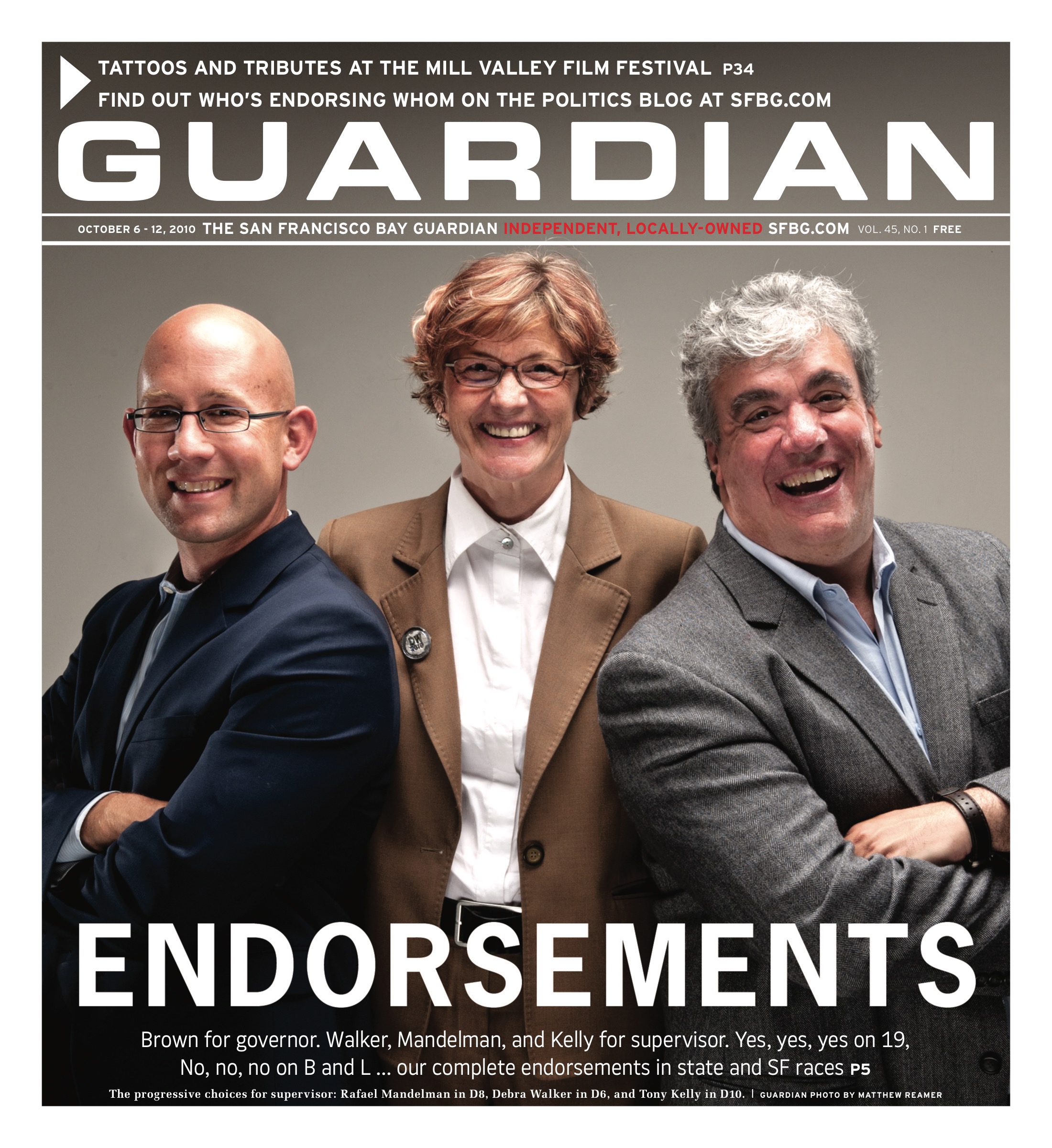
Former Mayor Willie Brown says that choosing a person of color for a leadership position should be a progressive value. Board of Supervisors President David Chiu says the new mayor, Ed Lee, is a progressive. Several supervisors and other political observers say the six-vote progressive majority on the board is gone.

And nobody really talks about what that word means.

Progressive is a term with a long political vintage, but it’s changed (as has the political context) since the 1920s. (Progressives these days aren’t into Prohibition.) So I’m going to take a few minutes to try to sort this out.

I used to tell John Burton, the former state senator, that a progressive was a liberal who didn’t like real estate developers. But that was in the 1980s, when the Democratic Party in town was funded by Walter Shorenstein and other developers who were happy to be part of the party of Dianne Feinstein, happy to be liberals on some social issues (Shorenstein insisted that the Chamber of Commerce hire and promote more women), and happy to promote liberal candidates like John and Phil Burton for state and national office — as long as they didn’t mess with the gargantuan money machine that was high-rise office development in San Francisco.

But these days it’s not all about real estate; it’s that the level of economic inequality in the United States has risen to levels unseen since the late 1920s. So I sat down on a Saturday night when the kids went to bed(yeah, this is my social life) and made a list of what I think represent the core values of a modern American progressive. It’s a short list, and I’m sure there’s stuff I’ve left off, but it seems like a place to start.

This isn’t a litmus test list (we’ve endorsed plenty of people who don’t agree with everything on it). It’s not a purity test, it’s not a dogma, it’s not the rules of entry into any political party … it’s just a definition. My personal definition.

Because words don’t mean anything if they don’t mean anything, and progressive has become so much of a part of the San Francisco political dialogue that it’s starting to mean nothing.

For the record: when I use the word "progressive," I’m talking about people who believe:
1. That civil rights and civil liberties need to be protected for everyone, even the most unpopular people in the world. We’re for same-sex marriage, of course, and for sanctuary city and protections for immigrants who may not have documentation. We’re also in favor of basic rights for prisoners, we’re against the death penalty, and we think that even suspected terrorists should have the right to due process of law.
2. That essential public services — water, electricity, health care, broadband — should be controlled by the public, not by private corporations. That means public power and single-payer government run health insurance.
3. That the most central problem facing the city, the state, and the nation today is the dramatic upward shift of wealth and income and the resulting economic inequality. We believe that government at every level — including local government right here in San Francisco — should do everything possible to reduce that inequality. That means taxing high incomes, redistributing wealth, and using that money for public services (education, for example) that tend to help people achieve a stable middle-class lifestyle. We believe that San Francisco is a rich city, with a lot of rich people, and that if the state and federal government won’t try to tax them to pay for local services, the city should.
4. That private money has no place in elections or public policy. We support a total ban on private campaign contributions, for politicians and ballot measures, and support public financing for all elections. Corruption — even the appearance of corruption — taints the entire public sector and helps the fans of privatization, and progressives especially need to understand that.
5. That the right to private property needs to be tempered by the needs of society. That means you can’t just put up a highrise building anywhere you want in San Francisco, of course, but it also means that the rights of tenants to have stable places for themselves and their families to live is more important than the rights of landlords to maximize return on their property. That’s why we support strict environmental protections, even when they hurt private interests, and why be believe in rent control, including rent control on vacant property, and eviction protections and restrictions on condo conversions. We think community matters more than wealth, and that poor people have a place in San Francisco too — and if the wealthier classes have to have less so the city can have socioeconomic diversity, that’s a small price to pay. We believe that public space belongs to the public and shouldn’t be handed over to private interests. We believe that everyone, including homeless people, has the right to use public space.
6. That there are almost no circumstances where the government should do anything in secret.
7. That progressive elected officials should use their resources and political capital to help elect other progressives — and should recognize that sometimes the movement is more important that personal ambitions.

I don’t know if Ed Lee fits my definition of a progressive. He hasn’t taken a public position on any major issues in 20 years. We won’t know until we see his budget plans and learn whether he thinks the city should follow Gavin Newsom’s approach of avoiding tax increases and simply cutting services again. We won’t know until he decides what to tell the new police chief about enforcing the sit-lie law. We won’t know until we see whether he keeps Newsom’s staff in place or brings in some senior people with progressive values.
I agree that having an Asian mayor in San Francisco is a very big deal, a historic moment — and as Lee takes over, I will be waiting, and hoping, to be surprised.

Power and pragmatism

5

steve@sfbg.com

After an epic week at City Hall, the political dynamics in San Francisco have undergone a seismic shift, with pragmatism replacing progressivism, longtime adversarial relationships morphing into close collaborations, and Chinese Americans as mayor and board president.

It was a week of surprises, starting Jan. 4 when City Administrator Ed Lee came out of nowhere to become the consensus choice for interim mayor, and ending Jan. 9 when Mayor Gavin Newsom appointed Police Chief George Gascón to be the new district attorney, Newsom’s last official act as mayor before belatedly taking his oath of office as lieutenant governor on Jan. 10.

In between, the outgoing Board of Supervisors held a special final meeting Jan. 7, at which progressive supervisors fell into line behind Lee, some of them reluctantly, and accepted the new political reality. The next day, the new Board of Supervisors took office and overwhelmingly reelected David Chiu as board president, with only the three most progressive supervisors in dissent.

After Chiu played kingmaker as the swing vote for making Lee the new mayor, the board and Mayor’s Office are likely to enjoy far closer and more cooperative relations than they’ve had in many years. And the sometimes prickly, blame-game relations between the Police Department and D.A.’s Office should also get better now that the top cop has switched sides. But what it all means for the average San Franciscan, particularly the progressive voters who created what they thought was a majority on the Board of Supervisors, is still an open question.

One thing that is clear is the ideological battles that have defined City Hall politics — what Chiu called the “oppositional politics of personality” during his closing remarks on Jan. 8 — have been moved to the back burner while the new leaders try a fresh approach.

Newsom — with his rigid fiscal conservatism and open disdain for the Board of Supervisors, particularly its progressive wing — is gone. Also leaving City Hall is Sup. Chris Daly, a passionate and calculating progressive leader whose over-the-top antics caused a popular backlash against the movement.

In a way, Newsom and Daly were perfect foils for one another, caustic adversaries who often reduced one another to two-dimensional caricatures of themselves. But they were each strongly driven by rival ideologies and political priorities, despite Newsom’s rhetorical efforts to turn “ideology” into a dirty word applied only to his opponents.

“This year represents a changing of the guard, a transition,” Chiu said, pledging to continue pushing for progressive reforms, only with a more conciliatory approach, a theme also sounded by Sups. Eric Mar and Jane Kim, who each broke with their progressive colleagues to support Chiu over rival presidential nominee Sup. John Avalos.

“I will always support policies that will make our city more equitable and just,” Kim said after being sworn in to replace Daly, although she also made a claim about the new board with which her predecessor probably wouldn’t agree: “I think we have a lot more in common than we don’t.”

With a focus on diversity and compromise, “respect and camaraderie,” Mar said, “I think this new board represents the evolution of the progressive movement in San Francisco.”

If indeed City Hall is enjoying a “Kumbaya” moment, the path to this point was marred by backroom deal-making and old-school power politics, much of it engineered by a pair of figures from the previous era who are by no means progressives: former Mayor Willie Brown and Rose Pak, head of the Chinatown Chamber of Commerce.

Pak was seated front and center — literally and figuratively — during the board’s Jan. 7 vote for Lee and its Jan. 8 vote for Chiu, following media reports that it was she and Brown who persuaded Lee to take the job and city leaders (particularly Newsom, Chiu, and outgoing Sups. Bevan Dufty and Sophie Maxwell) to give it to him.

It all seemed sneaky and unsettling to board progressives, who questioned what kind of secret deal had been cut, even as they voiced their respect for Lee’s progressive roots and long history of service to the city. The sense that something unseemly was happening was exacerbated on Jan. 4 when Dufty abandoned a pledge of support for Sheriff Michael Hennessey — who five progressive supervisors supported for interim mayor — and left the meeting to confer with the Mayor’s Office before returning to announce his support for Lee.

Sups. David Campos, Ross Mirkarimi, and Avalos pleaded with their colleagues for time to at least talk with Lee, who was traveling in China since he reportedly changed his mind about wanting the interim mayor job. Maxwell was the only Lee supporter in the 6-5 vote for delaying the interim mayor item by a few days so the supervisors could speak with Lee by phone.

Pak and other Chinatown leaders put together a strong show of force by the Chinese American community at that Jan. 7 meeting, where the board voted 10-1 for Lee, with only Daly in dissent. Afterward, some of Lee’s strongest supporters — including the Rev. Norman Fong and Gordon Chin with the Chinatown Community Development Center — admitted that the process of picking Lee was flawed.

“Part of the problem was Ed’s because he couldn’t make up his mind. The process was bad,” Fong told the Guardian after the vote. Although Fong said he knows Lee to be a strong and trustworthy progressive, he admitted that the way it went down raised questions: “Some people were concerned about who he’ll listen to.”

Specifically, the concern is that Lee will be unduly influenced Brown and Pak, who each represent corporate clients whose interests are often at odds with those of the general public. And both operate behind the scenes and play a kind of political hardball that runs contrary to progressive values on openness, inclusion, and accountability.

“If there is a phone call from Willie Brown to Rose Pak, Ed Lee is going to go along with it,” predicted a knowledgeable source who has worked closely with all three, recalling the way they did business during Brown’s mayoral administration. “There was no real discussion of issues. The fix was always in.”

But Pak insisted that there was nothing wrong with the process of selecting Lee, and that all concerns about the nomination were driven by anti-Asian racism. “You have a plantation mentality,” Pak told the Guardian as she held court in front of a crowded press box before the Jan. 8 meeting. “The Bay Guardian has never given people of color a fair shot.”

While Newsom, Chiu, and Pak-allied political consultant David Ho all insisted “there was no deal” to win support for Lee, Pak seemed to revel in the high-profile role she played, with Bay Citizen reporter Gerry Shih labeling her “boastful” in his Jan. 6 article “Behind-The-Scenes Power Politics: The Making of Ed Lee,” which ran the next day in The New York Times.

“This was finally our moment to make the first Chinese mayor of a major city,” Pak reportedly told Shih. “How could you let that slip by?”

Chiu downplayed Pak’s influence, telling the Guardian that Lee was his top choice since November, and telling his colleagues before the Jan. 7 vote, “Ed is someone who does represent our shared progressive values.” But he also made it clear that helping the city’s progressive movement wasn’t what drove his decision.

“This is a decision beyond who were are as progressives and who we are as moderates. It’s about who we are as San Franciscans,” Chiu said. “This is a historic moment for the Chinese-American community,” calling it “a community that has struggled, a community that has seen discrimination.”

The next day, shortly after being elected to a second term as board president, Chiu acknowledged the “very real differences” in ideology among the supervisors, “but leadership is about working through those differences.” Ultimately, he said, “none of us were voted into office to take positions. We were voted into office to get things done.”

What progressive means

85

Willie Brown says that choosing a person of color for a leadership position should be a “progressive” value. David Chiu says Ed Lee is a progressive. Several supervisors, and other political observers, say the six-vote progressive majority on the board is gone.

And nobody really talks about what that word means.

Progressive is a term with an excellent political vintage, but it’s changed (as has the political context) since the 1920s. (Progressives these days aren’t into prohibition.) So I’m going to take a few minutes to try to sort this out.

I used to tell John Burton that a progressive was a liberal who didn’t like real estate developers, but that was in the 1980s, when the Democratic Party in town was funded by Walter Shorenstein and other developers, who were happy to be part of the party of Dianne Feinstein, happy to be liberals on some social issues (Shorenstein insisted that the Chamber of Commerce hire and promote more women) and happy to promote liberal candidates like John and his brother Phil for national office – as long as they didn’t mess with the gargantuan money machine that was highrise office development in San Francisco.
Arguing that Shorenstein’s economic agenda was driving up housing prices, destroying low-income neighborhoods and displacing tenants was a waste of time; the liberals like Burton (who also represented real estate developers as a private attorney) weren’t interested.

But these days it’s not all about real estate; it’s about the fact that the level of economic inequality in the United States has risen to levels unseen since the late 1920s, and the impacts are all around us. And it’s about (Democratic) politicians in San Francisco blaming Sacramento, and (Democratic) politicians in Sacramento blaming Washington, and the Democratic Party in the United States abandoning economic equality as a guiding principle.

So I sat down on a Saturday night when the kids went to be (yeah, this is my social life) and made a list of what I think represent the core values of a modern American progressive. It’s a short list, and I’m sure there’s stuff I’ve left off, but it seems like a place to start.

For all the people who are going to blast me in the comments, let me say very clearly: This isn’t a litmus-test list (we’ve endorsed plenty of people who don’t agree with everything on it). It’s not a purity test, it’s not a dogma, it’s not the rules of entry into any political party … it’s just a definition. My personal definition.

Because words don’t mean anything if they don’t mean anything, and progressive has become so much of a part of the San Francisco political dialogue that it’s starting to mean nothing.
For the record: When I use the word “progressive,” I’m talking about people who believe:

1. That civil rights and civil liberties need to be protected for everyone, even the most unpopular people in the world. We’re for same-sex marriage, of course, and for Sanctuary City and protections for immigrants who may not have documentation. We’re also in favor of basic rights for prisoners, we’re against the death penalty, and we think that even suspected terrorists should have the right to due process of law.

2. That essential public services – water, electricity, health care, broadband – should be controlled by the public and not by private corporations. That means public power and single-payer government run health insurance.

3. That the most central problem facing the city, the state and the nation today is the dramatic upward shift of wealth and income and the resulting economic inequality. We believe that government at every level – including local government, right here in San Francisco – should do everything possible to reduce that inequality; that means taxing high incomes, redistributing wealth and using that money for public services (education, for example) that tend to help people achieve a stable middle-class lifestyle. We believe that San Francisco is a rich city, with a lot of rich people, and that if the state and federal government won’t try to tax them to pay for local services, the city should.

4. That private money has no place in elections or public policy. We support a total ban on private campaign contributions, for both politicians and ballot measures, and support public financing for all elections.

5. That the right to private property needs to be tempered by the needs of society. That means you can’t just put up a highrise building anywhere you want in San Francisco, of course, but it also means that the rights of tenants to have stable places for themselves and their families to live is more important than the rights of landlords to maximize return on their property. That’s why we support strict environmental protections, even when they hurt private interests, and why be believe in rent control, including rent control on vacant property, and eviction protections and restrictions on condo conversions. We think community matters more than wealth and that poor people have a place in San Francisco too — and if the wealthier classes have to have less so that the city can have socio-economic diversity, that’s a small price to pay. We believe that public space belongs to the public, and shouldn’t be handed over to private interests; we believe that everyone, including homeless people, has the right to use public space.

6. That there are almost no circumstances where the government should do anything in secret.

7. That progressive elected officials should use their resources and political capital to help elect other progressives – and should recognize that sometimes the movement is more important that their own personal ambitions.

I could add a lot more, but I think those six factors are at the heart of what I mean when I talk about progressives. We support a lot of other things; I put the right of workers to unionize under Number 3, since unions (along with public schools and subsidized higher education) are one of the major forces behind a stable middle class and a more equal society. We think racism and homophobia are never acceptable, and we support affirmative action, but that goes under Number 1.

This is not a socialist manifesto; I never mentioned worker control of the means of production. Progressives don’t oppose private enterprise; they just think that some things essential for the good of society don’t belong in the private sector, and that the private sector should be regulated for the good of all of us. We trust and support small businesses much more than big corporations – and we think their interests are not the same.

I don’t know if Ed Lee fits my definition of a progressive. We won’t know until we see his budget plans, and learn whether he thinks the city should follow Gavin Newsom’s approach of avoiding tax increases and simply cutting services again. We won’t know until he decides what the tell the new police chief about enforcing the sit-lie law. We won’t know until we see whether he keeps Newsom’s staff in place or brings in some senior people with progressive values. We know that the people who pushed him to take the job aren’t progressives by any definition, but you never know. I agree that having an Asian mayor in San Francisco is a very big deal, an historic moment — and when Lee takes office, I will be waiting, and hoping, to be surprised.

Class conflict in DC and SF

12

There’s an unmistakable whiff of class warfare in the air this holiday season, most obviously on the national level where President Barack Obama and congressional Republicans are helping the ultra-rich steal hundreds of billions of dollars from future generations and the country’s current needs. But we’re also seeing it right here in San Francisco, subtly playing out around who will be our next mayor.

During yesterday’s scheduled discussion at the Board of Supervisors on choosing a new mayor, members of the public – from African-American mothers of slain youth to representatives of immigrant communities to those representing labor and progressive groups – urged the board to choose a mayor who would finally represent all of San Francisco, not just the wealthy and the business community.

Then the progressive supervisors who represent the city’s working class districts talked about getting the process underway and voiced some of the things they’d like to see in a new mayor, such as compassion and a willingness to work with the board and community groups. It seemed like a good faith effort at having an open public discussion about the city’s needs.

But on the other side of the aisle, the supervisors who represent the city’s wealthiest neighborhoods voted to delay the discussion without offering a reason why. Sup. Chris Daly made good points about how incoming mayors usually have time to prepare for assuming this powerful office at a time of pressing city needs and tricky political dynamics, arguing for making this decision sooner than later.

And from the Establishment representatives: nothing. Not a word. Instead, we have Mayor Gavin Newsom threatening to delay his swearing in as lieutenant governor to thwart the current board from picking a successor, and being overtly urged to do so in a San Francisco Chronicle editorial and in disingenous, sanctimonious ruses from SF Chamber of Commerce officials.

Why? Well, here’s the closest thing the editorial offered to a reason: “It makes all the sense in the world to have the supervisors who will be working with the interim mayor make the selection. They are the ones who will have to find common ground and develop a working relationship with Newsom’s successor.”

But does it really make any sense to have an inexperienced group of new supervisors (as our current cover stories shows, none of the four new supervisors have held municipal office and two are new to politics) pick a mayor on their first day on the job, and then have that person immediately take on the complicated job of running the city with no staff in place? And to do that by flouting the the California Constitution and the City Charter?

That sounds like a recipe for disaster – and an opportunity for downtown power brokers to make mischief and ensure their interests aren’t threatened as part of whatever backroom deal gets cut to choose a new mayor, district attorney, and board president. Why else would they so vehemently oppose a deliberative public process that would lead to a decision by those who know the workings of City Hall better than anyone?

As we saw in the last election, wealthy San Franciscans are scared to death of progressive malcontents like Chris Daly, and they’re doing whatever they can to prevent him from being involved in this decision. They see, probably correctly, that the current political dynamics of the city could lead to perhaps the most progressive mayor since George Moscone, or maybe ever, and they’ll do whatever they can to prevent that from happening.

The rich of this city and this country have overplayed their hands, crippled the public sector, and, as Sen. Bernie Sanders so eloquently said recently on the floor of the US Senate, shown a selfish disregard for the needs and interests of the vast majority of citizens. The only question now is this: are we ready to finally stand up, fight back, and really give them something to fear? Or are we going to take our cues from Obama and treat anti-government conservatives as good faith actors when they have shown only contempt for our most cherished democratic processes and values?

I suppose next week, when this board reconvenes to try to choose a successor mayor, we’ll find out.

Class of 2010: Jane Kim

7

steve@sfbg.com

Despite fears that a candidate backed by downtown could replace firebrand progressive leader Sup. Chris Daly in District 6, in the end it was the two progressive candidates — Jane Kim and Debra Walker — who finished far in front of the large pack of candidates, with Kim winning the race. And she thinks that says something about how the progressive movement has matured.

“To have the two leading candidates be progressives says a lot about the progressive political community,” Kim said. “The race was really between Debra and me in end.”

Kim, a 33-year-old attorney and the outgoing president of the San Francisco Board of Education, has been active in progressive politics in San Francisco for many years, from doing community organizing with the Chinatown Community Development Center to running the short-lived San Francisco People’s Organization, which Daly helped create.

Yet part of her campaign strategy, and the message that she’s sending in the wake of an election that divided the progressive community, focuses on issues and themes that are more common to political moderates: job creation, clean streets, public safety, and neighborhood services.

“I think it’s important for progressives to cross over, and I don’t think it should be viewed as selling out,” Kim told us. “Progressives need to do a good job at maintaining voters’ faith in the progressives’ ability to lead.”

In addition to courting progressive groups and voters, Kim’s campaign aggressively targeted residents of the residential condo towers in Rincon Hill and Eastern SoMa, voters who are generally more affluent and newer to San Francisco than the typical progressive constituencies.

“It’s a lot of new residents who don’t feel like they’re a part of any political faction and they’re really open,” Kim said. “People just want to see that things are better. They want the streets to be clean and safe.”

With a new mayor and new blood on the Board of Supervisors, Kim said this is an important political moment for San Francisco, “a huge opportunity” to redefine San Francisco politics in the wake of Mayor Gavin Newsom and progressive supervisors such as Aaron Peskin, Matt Gonzalez, Tom Ammiano, and Daly.

“The Class of 2000 was able to show how progressive we can be with policy. They really pushed the envelope,” Kim said, citing new worker and tenant protections and programs such as Healthy San Francisco. Now, she said, the challenge for progressives in the Classes of 2010 and 2008 is to show that they can provide effective leadership in realms like public safety and economic development. “If we’re able to lead on those two issues, it would really firm up our leadership of the city,” Kim said, noting that it would also affect the dynamics of next year’s mayor’s race.

While Kim didn’t go into detail about how she intends to deal with what she says is the biggest challenge facing the new board — a budget deficit of $700 million over two years, coming at a time when all the easy cuts have already been made in recent years — she said the city needs to be aggressive in boosting the local economy and ensuring San Franciscans get most city contracts.

“We need to figure out how we can partner with small business to create a diversity of jobs in San Francisco,” she said, noting that the average San Franciscan has more faith in the moderates’ ability to create jobs, something that progressives need to address. But how can she help break the grip that the conservative San Francisco Chamber of Commerce has on small businesses?

“Part of the problem is that small businesses aren’t organized,” Kim said, noting how that hurt Sup. David Chiu’s ability to win support this year for his business tax reform measure that would have helped most small businesses and made some large corporations pay more taxes. “They’re busy running their businesses and they don’t have the time to look at the details, so they just read the briefing of the Chamber of Commerce.”

Kim said she respects the leadership role Daly has played in progressive politics and that she’d “like to be part of the moral compass of the Board of Supervisors.” But she also said that Daly’s sometimes abrasive style unnecessarily hardened the opposition of moderates to important progressive issues.

“He made it harder to talk about affordable housing,” Kim said, noting that the city’s dearth of affordable housing should be an issue that’s important to middle class voters, noting that it includes housing for people who earn up to 120 percent of the median income for the region. But after Daly hammered on the issue, “It was like a bad word coming out, and people would turn off to the issue.”

But she thinks it’s a fixable problem if she and her allies do the hard work, an ability they demonstrated this year by defeating Walker, who had been running for the seat for years and lining up all the key endorsements. “Voters do respond to campaigns that work really hard, and that bodes well for progressives,” Kim said, noting that she intends to reach out to Walker’s supporters. “I don’t think I can be successful as a supervisor if I don’t work with all the camps in the progressive community.”

Critical care

5

Sarah@sfbg.com

A complex and controversial project that would involve five San Francisco hospitals — including building a huge showcase facility for the wealthy atop Cathedral Hill — has prompted a debate about what average city residents need from the health care system.

California Pacific Medical Center, an affiliate of Sutter Health, proposes to downsize St. Luke’s Hospital, which primarily serves a low-income population in the Mission District, as part of a $2.5 billion proposal to renovate and retrofit three existing medical campuses, close another one, and build housing and a megahospital on Cathedral Hill that would draw patients from around the country.

CPMC’s grandiose plan was being considered strictly as a land use decision, despite its far-reaching impact on the city’s health care system. So Sup. David Campos created legislation calling for the city to create a citywide health services master plan and to use that as another tool for gauging future medical projects.

Debate over that legislation left some activists on both sides unhappy, with progressives disappointed that it won’t be able to stop a CPMC project they see as neglectful of the poor, and moderates wary of creating a new way to challenge development projects in the face of widespread unemployment in the construction industry.

But it struck a fine enough balance to win 8-3 approval by the board Nov. 16, enough to override a threatened mayoral veto. “I’m really happy and excited about the passage of this legislation,” Campos told the Guardian after the vote.

The legislation has a two-part mandate, with the first part kicking in as soon as it has final approval. It requires the Planning Department, with input from the Department of Public Health, to prepare a health care services master plan to identify current and projected needs for health care services and where they should be provided.

The second part, which begins in 2013, requires Planning to determine whether medical projects are consistent with the findings of this plan. That delay is credited to a last-minute amendment Campos granted during a Nov. 15 committee hearing after the hospital industry complained that the process could jeopardize its ability to meet state-mandated seismic retrofitting deadlines for projects already in the planning pipeline.

The passage of Campos’ legislation comes eight months after President Barack Obama signed the Patient Protection and Affordable Care Act. Hailed by its supporters as the most significant change to the U.S. health care delivery systems in 40 years, the reform package has also been greeted with criticism on both ends of the political spectrum. Progressives complain that it relies too heavily on private insurance companies and medical providers, while Tea Party supporters says that it’s government run amok and they have vowed to “kill the bill.” Senate Minority Leader Mitch McConnell (R-Ky) recently compared so-called Obamacare to “tyranny” in a speech to conservative legal scholars.

But here in San Francisco, the debate over Campos’ legislation — as heated and divisive as it was at times — yielded a surprising amount of consensus around the long-neglected idea that government should play a role in health care planning.


PULLING THE PLUG

The passage of Campos’ legislation marks the first time in 30 years that a government entity has mandated health care services planning in California. That approach West Bay Health Systems Agency, whose creation he opposed as governor of California.

Lucy Johns, a San Francisco-based health care planning consultant who wrote the only health care services master plan California has ever had, recalls what happened in the mid-1970s after President Gerald Ford signed legislation that established health system agencies nationwide.

“California established 14 health systems agencies, including the West Bay Health System Agency, which governed the nine Bay Area counties,” Johns told the Guardian. “The legislation mandated that they be established by every state, with the federal government providing the funding. So every state had to decide how many, how big, and how structured the health system agencies would be.”

Johns notes that state legislators were constrained when it came to the decisions these health service agencies made. “The governing bodies of the health systems agencies had to have a membership that was 51 percent consumer and 49 percent healthcare provider, which included doctors, nurses, and hospital administrators,” she said.

That history served as a backdrop for discussion of the Campos legislation, with the Planning Department staff report noting, “With the elimination of the West Bay Health Systems Agency in 1981, there is no longer a routine or comprehensive analysis of health service resources, needs, trends, and local impacts conducted for changes to or within medical uses.”

“It’s truly a historic moment for San Francisco,” Campos said after his legislation passed its Nov. 16 first reading (the second and final reading is set for Nov. 23, after Guardian press time). “We are the first city in the country to make sure land use decisions are aligned to our health care needs. That’s an unprecedented step that will shape the future of healthcare planning for years to come.”

Campos acknowledged that the passage of Obama’s heath reform package — which includes a mandate to purchase private health insurance beginning in 2014 — was also a catalyst for his legislation, along with the CPMC project.

“But it had more to do with seeing that the city didn’t have the tools it needed to evaluate projects in terms of whether they met the city’s healthcare needs and how they might impact people’s access to healthcare,” Campos said. “The main catalyst came from the community, which felt it was being asked to make decisions that will have long-lasting health care implications, but didn’t have any way to understand those needs. Those concerns were compounded by changes at the national level — and the recognition that these changes offer us an opportunity to engage in planning.”

Campos’ legislative victory came two months after members of the Cathedral Hill Neighbors Association joined nurses, medical workers, patients, and community groups in voicing concerns at a Sept. 23 public hearing about the draft environmental impact report for CPMC’s Cathedral Hill hospital and the other facilities that are part of its proposal.

These groups collectively expressed fear that downsizing St. Luke’s, closing the CPMC California campus, and transforming CPMC Pacific campus to an outpatient-only hospital will force low-income people to travel farther to access health care services while offering better service to the wealthy at Cathedral Hill. And neighbors worried that the proposed complex would increase traffic and require the demolition of rent-controlled apartments.

Formed in 1991 through the merger of Pacific-Presbyterian Medical Center and Children’s Hospital of San Francisco, CPMC has been affiliated with Sutter Health since 1996 and currently has four medical campuses in San Francisco: Pacific in Pacific Heights, California in Presidio Heights, Davies in the Duboce Triangle, and St. Luke’s in the Mission.

But CPMC’s longtime goal was to build a facility intended to be like the Mayo Clinic of the West Coast, a 15-story, 555-bed full-service hospital and specialty care facility at the corner of Van Ness Avenue and Geary Boulevard. Company officials have made approval for that project conditional on keeping St. Luke’s open in the face of the state’s deadline on seismic safety standards that the hospital doesn’t now meet.

“St. Luke’s Hospital was the big issue that got our attention,” Le Tim Ly, lead organizer for the Chinese Progressive Association, told the Guardian. His group has worked with residents in the city’s southeast sector around environmental justice, air quality, and pollution issues when they became aware of the threat to St. Luke’s. “All this, coupled with efforts to downsize Luke’s, left us alarmed by the disproportionate impact on an already impacted area.”

But alarm over CPMC’s plans has now revived the idea of healthcare planning.


MAKING A PLAN

As recently as the beginning of November, representatives for the Hospital Council of Northern and Central California — whose members include CPMC, Chinese Hospital, Jewish Home, Kaiser Permanente, Laguna Honda, St Luke’s, St. Mary’s, San Francisco General Hospital, and Veterans Affairs Medical Center — seemed opposed to any change in the way healthcare planning is done in San Francisco.

At a Nov. 1 hearing on the Campos legislation at the board’s Land Use and Economic Development Committee, Ron Smith, the Hospital Council’s senior vice president for advocacy, said his organization favored maintaining the city’s current procedures. “We would like to propose that the Health Commission does the planning, the Planning Commission does the land use, and that there is a required determination process which is in the current legislation,” Smith said. “We’re proposing that that continue.”

But two weeks later, after Campos amended his legislation so projects now in the planning pipeline are exempt from having to comply with the city’s health care services master plan, some members of the Hospital Council seemed to have a change of heart.

CPMC’s Chief Executive Officer Warren Browner surprised just about everybody when he publicly stated in mid-November that CPMC supports health care planning. “We strongly support the efforts of the city — we are in favor of health planning,” Browner said at a Nov. 15 hearing on the legislation.

“That statement was extraordinary,” said Lucy Johns, recalling CPMC’s history of resisting government control. “The conversation about this legislation has already changed the discourse, at least in public.”

Linda Schumacher, chief executive officer of Chinese Hospital, a community-owned, not-for-profit facility, explained at the same hearing that her organization had been concerned that Campos’ legislation would affect her hospital’s ability to move ahead with a $150 million project that has been in the pipeline since 2003.

“We thank you for that amendment that allows the effective date to be changed,” she said.

“It shows how much progress had been made, even before this legislation goes into effect,” Campos said of the hospital industry’s apparent shift in attitude. “It’s a monumental step, something that was not expected as recently as a few months ago.”

But Ly of the Chinese Progressive Association said he believes the Hospital Council still doesn’t want to see the city getting involved. “As recently as a month ago, their folks were speaking out against any kind of legislation. But I think they started seeing the writing on the wall.”

Ly fretted about the potential negative impact of Campos’ last-minute amendments. Sup. Campos’ plan represents a victory. But we could use that information as soon as possible. The 2013 deadline means the city will be handicapped: it will have information it can’t use yet.”

Ly ventures that the hospital industry’s approach will be to try to lessen the impact of the legislation. “As written, it still provides the Planning Commission and the board with the discretion to approve projects,” Ly said. “Ultimately, the struggle is about values. Just because there are plans and guidance doesn’t mean the healthcare needs of the community will become a top priority — it just provides us with tools to make an assessment.”

Campos counters that his bill will allow the city to create incentives for, and apply pressure on, the hospital industry. “If they truly want their projects to be expedited and approved before state-mandated seismic retrofitting deadlines kick in, they’ll propose plans that work for the community,” Campos explained.

But even as it publicly vows to be supportive, the Hospital Council continues to express concerns about the Campos legislation. “It’s the council’s job is to be supportive now that the board has approved Campos’ plan,” Smith said. “And Sup. Campos was very generous. He started talking to us in June. But we really didn’t get a handle on his proposal until much later. We think the idea of healthcare planning is very good. We still have concerns about the process, but now the board has voted on the legislation, our goal is to do our best to work with the law.”

Concerns that the legislation would be used to mire projects in repeated appeals and give too much weight to critics’ concerns was raised at the Nov. 16 hearing by Sup. Sean Elsbernd.

“Right now, if anyone has concerns, there’s a conditional use process and a CEQA [California Environmental Quality Act] process,” Elsbernd told the Guardian. “But this turns up a brand new appeal. It means the appeals are heard at the same time, but you’ve now created a third route.”

Campos responded to these concerns by amending the legislation to clarify that the board must act on consistency determination appeals at the same time it acts on other related appeals, so projects won’t be delayed.

Evidently this wasn’t enough to appease the San Francisco Chamber of Commerce. “We cannot be supportive of that piece of legislation,” Rob Black, the Chamber’s vice president of public policy, told the Guardian after the legislation was approved. “We believe appeals should be done at the Department of Public Health in conjunction with service providers, since San Francisco provides 20 percent of service, and private organizations provide the remaining 80 percent.”

Black says the Chamber was pleased Campos amended his legislation so as not to slow down projects that are currently in the planning pipeline. But he claimed Campos’ legislation could actually limit access to healthcare services. “The Chamber is concerned that Campos’ legislation will make it harder for doctors to pool together in pods, and if we don’t do that, it won’t make healthcare more available because services will be more expensive,” Black said. “But we absolutely think” the city should analyze gaps in providing health care to San Franciscans.

Campos’ aide Hillary Ronen confirmed that Black is correct in saying that anyone can appeal a hospital project’s consistency determination. “But the final analysis will revolve around asking if the proposed project meets the health care needs of San Francisco,” she said. “If it doesn’t, and the board doesn’t believe there’s a compelling public policy reason to approve the project, [the board] can override the approval.”


PATIENTS VS. PROFITS

Mary Michelucci, a registered nurse for 40 years and a member of the California Nurses Association, is hopeful that Campos’ legislation will rein in the hospital industry.

“I hope that any plan that would favor patient care over profit would be the way to go,” Michelucci said. “Running a hospital is expensive. But with the profits that Sutter and CPMC are making, they can afford this.”

Michelucci says the dispute over St. Luke’s came to a head three years ago, when nurses began to suspect that CPMC was planning to let the facility fail, suspicions that intensified when CPMC closed St. Luke’s neonatal intensive care unit 18 months ago.

“Now the babies who need neonatal special care are transported to CPMC’s California campus, which is in the Richmond,” Michelucci said. “But the moms may be discharged and most of them live in the Mission or Bayview-Hunters Point.”

Michelucchi still fears that CPMC will wage “a horrific campaign” against the California’s Nurses Association as it continues to push the plan for its megahospital. “CPMC wants to be in complete control of the registered nurses,” she said. “We, unfortunately, are their conscience, while they are a business model in the business of healthcare. The decisions they make about healthcare are not in the interests of patients or nurses, and we are the thorn in their side.”

All this is happening against the backdrop of the worst economic recession since the Great Depression, and for construction workers facing high unemployment rates in San Francisco, CPMC’s megaproject clearly represents light at the end of a very dark tunnel.

“CPMC is my future,” William Hestor, a 28-year-old father of two and member of SEIU-United Healthcare Workers, said at the Nov. 15 hearing. “We worked hard on a contract and we just want to make sure our hospital is built on time.”

CPMC media spokesperson Kevin McCormack told the Guardian that the real issue between CPMC and the CNA is union membership at CPMC’s Cathedral Hill facility. “CPMC is reducing beds at St. Luke’s because the beds aren’t in use, but the facility will be able to take care of 90 percent of patients’ needs and if you need specialist care, a shuttle will take you to Cathedral Hill,” McCormack said. “This centralized arrangement is the best way to attract the best staff and equipment.”

McCormack noted that there are union members and 1,200 nonunion nurses working at CPMC facilities in San Francisco. “We are bringing together nonunion and union nurses together at this facility, and we don’t feel we have the right to force our nonunion nurses to join,” he said, adding that since the Teamsters, the Carpenters, and SEIU-United Healthcare Workers (UHW) are already unionized at the Pacific and California campuses, they’ll be allowed to unionize at Cathedral Hill.

CNA member Eileen Prendiville, who has worked in San Francisco as a registered nurse for decades, recalls the negative changes she has already seen at CPMC’s facilities, including eliminating registered nurses and specialty services.

“If you pull services, as they have, of course you’ll have fewer patients. And the physicians start leaving, so it’s a vicious cycle,” she said. “St. Luke’s was a small community hospital but now it’s all about corporate medicine.”

Sup. Eric Mar sided with those seeking to exempt current projects from the city’s health care services master plan. But Sup. Sophie Maxwell noted that the Planning Commission will take a facility’s historical role into account in determining whether projects are consistent with the city’s health care services plan.

“We believe that addressed community concerns,” Maxwell said. “St. Luke’s would never have been targeted for closure had this legislation been on the books in the past.”

Campos insists his legislation is not simply about CPMC. “Ultimately this legislation stems from a number of pleas we have heard in the last couple of years from people throughout the city,” he said. “It takes the institutional master planning process to the next level. We have tried to consolidate the appeal process under existing law. Important as the legislation is, it’s key to make sure we have the right master plan because that’s where the heavy lifting will take place.”

Meanwhile, the final EIR is being completed for the CPMC project, which should go before the Board of Supervisors for approval early next year.

Why Prop. 19 went up in smoke

31

Hopes of legalizing marijuana may have gone up in smoke after Prop. 19’s defeat by a slim margin, but proponents are far from giving up. Groups such as Drug Policy Alliance, Just Say Now, and Bay Area proponents are already looking forward to 2012 to score more voters and support. But to win, they’re going to have to find solutions to the challenges they faced in this election.

While proponents are trying to rally people for 2012, others are scratching their heads and wondering what went wrong. Surprisingly, Prop. 19 failed to capture the vote in Humboldt, Mendocino and Trinity counties, one of the most pot friendly areas of California. According to Mother Jones, the initiative failed there because the growers in the so called Emerald Triangle fear the loss of their own pot heavy economy.

But our neighbors to the north aren’t the only reason why the initiative failed. Government opposition also turned away the vote along with the worry of the Fed, especially Attorney General Eric Holder fighting California on future marijuana issues. People are also speculating on a few other factors such as the small turnout of the younger generation of voters. Even though many are in favor, they did not turn out en masse to show their support and the vote went instead to the older generations.

And of course there was the vocal opposition of the proposition. In a recent post by Ryan Grim on the Huffington Post, the opposition ad campaign verged into paranoia. “A new Chamber of Commerce radio ad warns that in a dystopian, post-legalization world a Californian could be maimed in a car accident caused by a stoned driver and then treated in the hospital by nurses high off their gourds — all of it perfectly legal if the proposition passes, according to opponents,” wrote Grim.

Even with the loss, proponents are still hopeful for the future and see Prop. 19 as a stepping stone towards a future victory. According to Oaksterdam University Richard Lee, who funded the drive to create Prop. 19, the measure demonstrated a shift in opinions and a trend towards approving legalizing marijuana. “While we didn’t bring in enough votes tonight to pass Prop. 19, we know that we have achieved an enormous moral victory, and that there are millions of people across the country who are prepared to help finish the job they started here today when we come back to the polls stronger than ever in 2012,” Lee said in a statement following the defeat of the proposition.

Election 2010: Theresa Sparks supporters await results

District 6 candidate Theresa Sparks showed up fashionably late for her own election night gathering at Don Ramon’s Mexican restaurant in the South of Market neighborhood. Election results are still coming in, and she told the crowd, “We’ll just watch it together and see what happens.” Early results show Jane Kim as the favored candidate in the district so far, but as everyone here seems to be telling one another, “it’s going to be a long night.”

Rob Black of the San Francisco Chamber of Commerce was in attendance, as well as Francis Tsang, who works in Mayor Gavin Newsom’s press office. 

Katra Briel said she had known Sparks for years, and was one of the first to volunteer for her campaign. Being out on the streets and talking to voters about the election was “really enlightening,” she said, but “sometimes the things reminded me of the 7th grade — it seemed like more of a popularity contest than being about the issues.” Briel said she sees Sparks as “the kind of person we need in government.”

John Zowine, another campaign volunteer, said he was inspired to do phone banking for Sparks after a five-year stretch without being involved in any campaigns. “I was really impressed with her,” he said. Asked how he was feeling about the outcome of the race, Zowine said, “I would think that with all those endorsements, and Gavin’s support, she should do really well.”


Guardian: Endorsements for small business in San Francisco

1

Alas, this year some of the small business groups and leaders in San Francisco, such as the Small Business Advocates and Scott Hauge at Small Business California, once again came out with endorsements that were virtually identical with those of the downtown/Chamber of Commerce/PG&E/landlord/real estate gang. (See Guardian blogs.) Their candidates were, and the big downtown money went to, Steve Moss in District l0, Theresa Sparks in District 6, and Scott Wiener in District 8 and they all backed the Sit-Lie Ordinance and took identical positions on all the other local props.
There are many small business people who do not subscribe to the downtown line and vote more independently. I decided this year to do a special blog and email blast on the endorsements of the Guardian, which are done from the perspective of an independent, locally owned and operated alternative newspaper. I think it’s also good for people to know that there are a lot of independents and progressives out there in the small business community who support such things as public power, a city health plan for workers, more progressive taxation, and foot patrols by police for the neighborhoods and not just kicking kids off the sidewalks. b3

To the small business community in San Francisco:

Here are our 2010 endorsements of state and San Francisco candidates and propositions from the San Francisco Bay Guardian, a locally owned and operated, independent alternative weekly newspaper in San Francisco. The Guardian is a newspaper that is of, by, and for small business. We always question candidates carefully on their small businesses record and policies and consider small business to be a crucial criterion for candidates and propositions in our endorsement process. In a major story on the Guardian in its pre-election Sunday edition (Oct. 31), the Chronicle reported that Guardian endorsements “are widely considered the most influential in this left-leaning town.” We have done endorsements in every election since our founding in 1966.

For us, this is a serious, intensive process of many months: we interview all the major local candidates, put up podcasts of interviews on our website at sfbg.com, do extensive independent checking on the candidates and issues and their background and record and do independent reporting on the campaign and issues. You may agree with us; you may not. But you can have faith in our one and only campaign promise: Our Clean Slate represents what we think is best for San Francisco and San Francisco small business.
b3


Chevron spends big to fool voters

4

Bay Area-based oil giant Chevron is spending millions of dollars to influence this election and protect its financial interests, most notably by being the top contributor to the Prop. 26 campaign, which would make it almost impossible for Californians to impose fees that would help pay for environmental and public health programs.

Chevron, which reported a $5.4 billion record profit in the second quarter of this year, has given $3.75 million to the Yes on 26 campaign, according to campaign spending watchdog Maplight.org, beating the California Chamber of Commerce’s $3.5 million. Other big contributors include the American Beverage Association ($2 million) and Phillip Morris tobacco company ($1.75 million). The Yes on 26 campaign has raised about $16 million compared to the opposition raising less than $5 million from groups representing teachers, environmentalists and social justice advocates.

Prop. 26 would require a two-thirds super majority for the enactment of fees by the California Legislature or by the voters in cities, counties, or special districts, which has proven almost impossible to attain in the face of aggressive corporate-funded opposition campaigns. Such a high electoral bar would cripple the state’s ability to make big polluters and global warmers like Chevron – or the makers on alcohol or tobacco products – pay for their societal impacts.

But that payout isn’t even Chevron’s most audacious move of this election season. As the Bay Citizen reports, Chevron is almost spending $1 million on independent expenditures in support of their favored City Council candidates in Richmond, a city where Chevron has a big polluting oil refinery, in the hopes of buying a more friendly political environment.

Richmond officials have in recent years tried to get Chevron to mitigate its environmental impacts to the cash-strapped city and to pay a bit more in taxes, but Chevron responded with a lawsuit seeking a $26 million rebate on the property taxes that it paid to the city in past years, including 2007, when the company posted record profits of $18.7 billion.

Wall Street hold ’em

0

arts@sfbg.com

FILM Inside Job is director Charles Ferguson’s second investigative documentary after his 2007 analysis of the Iraq War, No End in Sight, but it feels more like the follow-up to Alex Gibney’s Enron: The Smartest Guys in the Room (2005). Keeping with the law of sequels, more shit blows up the second time around. As with No End in Sight, Ferguson adeptly packages a broad overview of complex events in two hours, respecting the audience’s intelligence while making sure to explain securities exchanges, derivatives, and leveraging laws in clear English (doubly important when so many Wall Street executives hide behind the intricacy of markets).

The revolving door between banks, government, and academia is the key to Inside Job‘s account of financial deregulation. At times borrowing heist-film conventions (it is called Inside Job, after all), Ferguson keeps the primary players in view throughout his history so that the eventual meltdown seems anything but an accident. Even apparent detours prove narrowly targeted. The subject of Wall Street’s venal appetites for drugs and prostitutes, for instance, is introduced first as farce and second as potential traction for broader criminal investigations. Presumably a junior partner might give up valuable information so as not to be made into another Eliot Spitzer, who, incidentally, comes off quite well in Inside Man.

While the fat cats only show up thanks to the CSPAN archive, several free market economists do sit for interviews with Ferguson. They probably regret doing so now — he reserves special scorn for the academic class of boosters. Frederic Mishkin is a typical case. Formerly a member of the Board of Governors at the Federal Reserve, he quickly becomes a muttering mess under Ferguson’s questioning. Mishkin quit the Treasury in August 2008, at the height of the crisis, to return to Columbia University to finish more pressing work: a textbook. In 2006, Mishkin coauthored a rosy report on Iceland’s doomed markets, pocketing a nice commission from the country’s Chamber of Commerce. Mysteriously, the title of the report changed from “Financial Stability in Iceland” to “Financial Instability in Iceland” on Mishkin’s CV — confronted with the discrepancy, he croaks something about a typo.

Ferguson’s relentless focus on the insiders isn’t foolproof. Tarring Ben Bernanke, Henry Paulson, and Timothy Geithner as “made” guys, for example, isn’t a substitute for evaluating their varied performances over the last two years. Inside Job makes it seem that the entire crisis was caused by the financial sector’s bad behavior, and this too is reductive. To take just one example, China figures into the film only as laborers losing their jobs due to market volatility — part of the story, certainly, but so is that government’s devaluation of its currency.

Furthermore, Ferguson does not come to terms with the politicized nature of the economic fallout. In Inside Job, there are only two kinds of people: those who get it and those who refuse to. The political reality is considerably more contentious. Americans on the right and left may well share disgust at the bailouts, but they’re drawing very different conclusions from the government’s cash infusions. Ferguson builds something of a false consensus between his talking heads, never asking them, for example, whether they think Fannie Mae or Countrywide was a bigger boogeyman (politically, the answer says a lot). In this regard, a general assessment in a recent article by Paul Krugman and Robin Wells holds for Inside Job: “Books on the Great Recession are still pouring off the presses … but they don’t offer much guidance on the most pressing problem at hand, which is how to deal with the continuing consequences of the last [bubble].” 

INSIDE JOB opens Fri/22 in Bay Area theaters.

Newsom could be headed for victory

11

Gavin Newsom seems poised to win his race for lieutenant governor, at least as indicated by his opponent Abel Maldonado’s increasingly desperate campaign tactics and Newsom’s string of newspaper endorsements, including the Spanish language La Opinion, which chose to pass over a moderate Latino that it has endorsed in the past. The only question now is voter turnout, and whether Newsom’s negatives would be enough to drag him down if the Democratic base stays home in this lackluster election.

In its endorsement in Sunday’s paper, La Opinion wrote, “We are deeply disappointed that in this election [Maldonado] has opted for an opportunistic strategy of using images of undocumented criminals to earn political points. This is unacceptable and his charges against Newsom on this issue are inaccurate.” The reference was to Maldonado’s wild charges in an Oct. 15 debate that Newsom created San Francisco’s sanctuary city policies and was responsible for the fatal shootings of Bologna family members, allegedly by an undocumented immigrant who had once been in city custody. The reality was that Newsom inherited the sanctuary city policy and unilaterally weakened it after the Bologna shooting, even refusing to implement legislation approved by the Board of Supervisors (which Newsom vetoed but the board overrode) to require due process before those arrested are turned over to the feds for possible deportation.

While the paper didn’t seem to understand that Newsom has snubbed his nose at San Francisco progressives and petulantly fed a particularly divisive style of politics here, they do rightfully give him credit for running a complicated city, unlike the conservative city of Santa Maria where Maldonado was mayor and always did the bidding of the Chamber of Commerce, something I observed while working at the Santa Maria Times at the time. “The Democratic candidate has implemented solid, progressive management while leading a diverse city during a deep budget crisis. Newsom has proven to be creative, resourceful, and sensitive while forging alliances that improve the quality of life for his city’s residents,” La Opinion wrote. 

Then yesterday, as the Los Angeles Times reports on its blog, when Newsom held a campaign event trumpeting his support by Latino leaders such as Los Angeles Mayor Antonio Villaraigosa and labor leader Dolores Huerta, Maldonado showed up and sat in the back with his advisers during the event. Now that’s just strange.

A California Democratic Party e-mail blast this afternoon used a series of rhetorical questions to describe the campaign’s episodes: “So was Maldonado’s bizarre behavior an egotistical attempt to intimidate other Latinos who came to the event to support Newsom? Does he feel entitled to the appointed position now that he actually has to compete for voters in a real election? Is he desperate for media attention? Or does he just enjoy being a spectator, watching his opponent secure key Latino endorsements while his own campaign falls apart?”

But the real question is whether Democrats can mobilize enough voters to overcome Newsom’s negatives, from his arrogance to his personal foibles. When I did a search for Gavin Newsom’s name on Yahoo, which automatically guesses what you’re asking for based on past queries, the first three that listed were “Gavin Newsom girlfriend,” “Gavin Newsom divorce,” and “Gavin Newsom affair,” an apparent reference to his admitted affair with Ruby Rippey Tourk, who worked for him and was married to his reelection campaign manager.

So, if you support Newsom for this office — or even if you’re just anxious for him to leave San Francisco a year before his mayoral term expires — don’t forget to get out there and vote.

The soul of the city

23

tredmond@sfbg.com

44th ANNIVERSARY SPECIAL We all arrived in San Francisco broke: Paulo and me in the ’73 Capri, crawling over Donner Pass with a blown valve and three cylinders firing; Tracy and Craig in the back of a VW van, behind in the payments and on the run from the repo men; Tom and Sharon hitching across the Southwest after Tom, who could bullshit with the best, talked himself out a jail cell in New Orleans. Moak showed up in a rusty Datsun with the wheels falling off. Jane and Danny came on the old hippie bus, the Green Tortoise, $69 across the country.

But we all had a friend who knew a friend where you could crash for a little while. And in the early 1980s you got food stamps the first day and it only took a couple of weeks to get a job waiting tables or canvassing or selling trinkets on the Wharf. And once you’d scraped together a couple hundred dollars — maybe two weeks’ work — you could get a place to live. My first room in a flat in the Western Addition was $120 a month.

We did art and politics and writing and music. After a while, some of us went to law school, some of us became journalists, some of us went into government and education. A few of us fled, and Paulo died in the plague (dammit). But in the end, a lot of us were — and are — San Franciscans, part of a city that welcomed us and gave us a chance.

It was a very different time to be young in San Francisco.

I’m not here to get all nostalgic, really I’m not. There were serious problems in 1982 — raging gentrification was creating clashes in the Mission and the Haight and south of Market that were more violent than anything going on today. And frankly, broke as we were, most of my friends were from middle class homes and were college educated and had a leg up. We weren’t going to starve; we didn’t have to make really ugly choices to eat.

Most of the stories in this special anniversary issue are about marginalized youth — young people trying to survive and make their way against all odds in an increasingly hostile city and a bitter, harsh economy.

But there’s an important difference about San Francisco today, something earlier generations of immigrants didn’t face. The cost of housing, always high, has so outstripped the entry-level and nonprofit wage scale that it’s almost impossible for young people to survive in this town — much less have the time to add to its artistic and creative culture.

I met the 21-year-old daughter of a college friend the other day. She’s as idealistic as we all were. She wants to move to San Francisco for the same reasons we did and you did — except maybe she won’t. Because she felt as if she had to come visit first, to use her dad’s network, see if she could line up a job and figure out if her likely earnings would cover the cost of living. When I mentioned that I’d just up and left the East Coast and headed west, planning to figure it out when I got here, she gave me a look that was part amazement and part sadness. You just can’t do that anymore.

The odds are pretty good that San Francisco won’t get her — her talent and energy will go somewhere else, somewhere that’s not so harsh on young people. I wondered, as I do every once in a while when I’m feeling halfway between an angry political writer and an old curmudgeon: would I come to San Francisco today?

Would Harvey Milk? Would Jello Biafra? Would Dave Eggers? Would you?

If you were born here, would you stay?

Are we squandering this city’s greatest resource — its ability to attract and retain creative people?

The two people who started the Bay Guardian 44 years ago were young arrivals from the Midwest. Bruce Brugmann looked around the city room at the Milwaukee Journal, where he worked as a reporter, and realized there wasn’t any job he wanted there in 10 years. With two young kids and a dream of starting a weekly newspaper in one of the world’s most exciting cities, Bruce and his wife, Jean Dibble, settled in a $130-a-month flat. The Guardian’s first office was a desk in the printers shop. When they paper could finally afford its own space, Bruce and Jean moved the staff into a $60-a-month four-room place on Ninth and Bryant streets.

From the start, the paper was a “preservationist” publication — both in terms of environmental issues like saving the bay and in the larger political sense. The San Francisco Bay Guardian was out to save San Francisco.

The city was under assault — by the developers who were making fast money tossing high-rises into downtown; the speculators making fast money flipping property, ducking taxes, and driving up rents; the unscrupulous landlords who were letting their buildings fall apart while they charged ever higher rent. For the Guardian, fighting this urbicide meant protecting San Francisco values, preserving the best of the city from what Bruce liked to call “the radicals at the Chamber of Commerce.”

For the Guardian, progress wasn’t measured in the number of new buildings constructed, but in the ability of the city to remain a place where artists and writers and community organizers and hell-raisers — and the young people who were always bringing new life to the city — could survive. We supported rent control, and growth limits, and affordable housing policies, and limits on condo conversions, and minimum-wage and sanctuary city laws — and a long list of other things that together amounted to a progressive agenda.

And in 2010, the assault on the young, the poor, the nonconformists, the immigrants, is still on, at full force. The mayor and his allies are pushing a ballot measure that would make it illegal just to sit on the sidewalk. He’s also turning the local juvenile authorities into immigration cops, breaking up families in the process. He’s cut funding for youth services, and wants to make it easier for speculators to evict tenants, take affordable rental housing (especially the flats that young people share to save money) off the market, and create high-priced condos. Virtually all of the new housing he’s pushing is for rich people. He’s shutting down parties and arresting DJs and, in effect, declaring a War on Fun.

What he’s doing — and what the downtown forces want — is the transformation of San Francisco from a welcoming city where the weird is the normal, where the young and the crazy and the brilliant and the broke can be part of (or even drivers of) the culture, to one where profit and property values are all that matter. And that’s a recipe for urban doom.

Richard Florida’s 2004 bestseller The Rise of the Creative Class shook up political thinking by pointing out that cities thrive with iconoclasts, not organization people. Everyone likes to talk about that now, even Mayor Gavin Newsom. But the missing piece, from a policy perspective, is that the creative class — particularly the young people who are going to be the next generation of the creative class — needs space to grow. And that means the most important thing a creative city can do is nurture the very people Newsom and his allies want to drive away.

If Prop. L, the “sit-lie” law, passes, if the rental flats in the Mission that have been home to several generations of young artists, writers, musicians and future civic leaders vanish in the name of condo conversions, if 85 percent of all the new housing in San Francisco is affordable only to millionaires, if the money that helps foster kids and runaways and at-risk youth dries up because this rich city won’t raise taxes, if nightlife becomes an annoyance to be stifled…then we’re in danger of losing San Francisco.

Our 44th Anniversary Issue also includes stories by Sarah Phelan on SF’s disadvantaged youth, Caitlin Donohue’s account of the Haight street kids, and Rebecca Bowe’s look at ageing out of the foster care system

Maxwell disappoints by endorsing Sweet

10

To be honest, I wasn’t surprised that termed-out Sup. Sophie Maxwell endorsed D10 candidate Lynette Sweet yesterday. Just disappointed. And it’s not just because Sweet refused to come into the Guardian this fall for an endorsement interview (a stance that suggests that Sweet would be depressingly inaccessible to reporters that haven’t drunk her Kool-Aid—a stance that, unfortunately, reminds me of Mayor Gavin Newsom’s attitude towards the media).

I’d been hearing rumors that Maxwell was going to endorse Sweet since February, when Sweet, who’d already racked up Mayor Gavin Newsom’s D10 blessing at that point, showed up alongside Maxwell at the city’s kickoff event for Black history month.

Then there was the fact that during an interview in February for the Guardian’s kickoff article about the D10 race, Sweet spouted phrases that sounded eerily similar to Maxwell’s words.
“D10 is a pretty diverse district, but there is only one common thread: the need for economic development,” Sweet told me.

But a few days earlier when I interviewed Maxwell about a third, and ultimately unsuccessful, attempt to recall her , Maxwell talked of common threads:

 “I’m waiting for people to have a better understanding of what this community is, what the common thread running through it is, and how to use rank choice voting,” Maxwell said, by way of explaining why she wasn’t willing to endorse anyone that early in the race.

Now, it’s understandable that Maxwell would be looking for a candidate to carry on her legacy. But it she was looking for a moderate black female candidate  then why not endorse Malia Cohen, who isn’t hampered by all of Sweet’s dirty laundry—and has raised the most money in the race, so far?

Could it be that Cohen wouldn’t be down for the kind of dirty deal making that was par for the course back in the days when Willie Brown was still mayor and Sweet was the swing vote that crowned Lennar as master developer at the shipyard/Candlestick Point?

Rumor has it that Maxwell is upset at all the corporate money that’s flooding into this race in support of Steve Moss—and that she asked the other candidates to hold a press conference in which they decry this practice. Rumor also has it that Sweet signaled her willingness to join Tony Kelly, Dewitt Lacy, Chris Jackson and Eric Smith–to name a few–in making such a statement. But it hasn’t happened, yet. And the corporate money keeps rolling in for Moss.

Meanwhile, with three weeks until the election, D10 forums are beginning to sound like a parody of a “Lost” episode featuring a 22-member cast that all claim to represent the city’s polluted and economically depressed southeast sector:

“One of us is a BART director, one of us worked at City Hall, one of us is a community advocate, one of us is a City College Board member, one of us is a civil rights attorney, one of us is an affordable housing development director, one of us is a bio-diesel advocate, one of us is a public safety advocate, one of us was raised in the Bayview, one of us served on the Navy’s Restoration Advisory Board,” and so on.

I’m not saying this is wrong. Hell, I love all this diversity of choices. but I am concerned that, come election night, the progressive vote will get split into a million pieces, while deep-pocketed conservative forces like the Chamber of Commerce and Golden Gate Restaurant line up behind one candidate in an attempt to crush candidates that would stand up to their powerful influence at City Hall and truly represent the D10 community

Yes, there is ranked choice voting, and it’s unlikely that one candidate will win a majority of the vote in the first round. But it’s critical at this venture that progressives develop a winning strategy. D10 candidate Ed Donaldson told me recently that if a candidate who doesn’t represent the community’s concerns gets elected, then the community would respond just as they did around Maxwell—and organize a recall.

But wouldn’t it be better if the community can come together behind three truly progressive candidates and help them win the November election?

One of the key challenges in this race will be to win votes in Visitacion Valley, as well as in the Bayview and/or Potrero Hill.

In his latest column in the Chron, former mayor and Sweet supporter Willie Brown alluded to the importance of this in a city with ranked-choice voting:”It’s not getting much attention, but someone has finally figured out how to get the Asian vote out,” Brown observed.”You do it by mail. You get ballots and ballot books into every household, then have the whole family sit down together. The kids help with the translation, everyone talks things over and everyone votes.”

Meanwhile, D10 candidate Tony Kelly told me that Marlene Tran, who is tri-lingual (English, Cantonese, Vietnamese) and has a good handle on community issues in Viz Valley, has confirmed that Kelly is her second-ranked choice (presuming that she votes for herself in first place. of course).

Not a bad strategy–and one that other progressives need to consider, given ranked choice voting–and the brutal reality that they are going to be massively outspent in the next three weeks.


Downtown massively outspends progressives

17

With only three weeks until the election, downtown interests are massively outspending progressive groups.(Conservative estimates suggest a 5:1 ratio, based on an analysis of campaign finance disclosures at the Ethics Commission.) And these downtown interests have plenty in reserve, as cash is funneled into a bunch of improbably-named political action committees that hope to influence the outcome of district elections and local measures on the fall ballot.

The Alliance for Jobs and Sustainable Growth, which is backed by the Chamber of Commerce, the SF Police Officers Association, and United Health Care Workers, recently got an infusion of cash from the conservative-minded Building Owners and Managers Association and Golden Gate Restaurant Association. And the alliance is already spending gobs of money in support of Theresa Sparks in D6, Scott Wiener in D8 and Steve Moss in D10.

The Coalition for Sensible Government, which recently received a $100,000 injection of cash from the SF Association of Realtors, is spending in support of Sparks in D6, Wiener and Rebecca Prozan in D8, and Lynette Sweet and Moss in D10. The coalition is also spending in support of Proposition G (transit operator wages) and Prop. L (Newsom’s sit-lie legislation)  and in opposition to Prop. M (community policing/ foot patrols) and Prop N (property transfer tax).

And a PAC consisting of the Coalition for Responsible Growth, Plan C, San Franciscans for a Better Muni, SF Forward (sponsored by the SF Chamber of Commerce and SPUR) received $85,000 from the Committee on Jobs, $60,000 from the SF Association of Realtors, and $35,000 from SF Forward.

This PAC, which has already spent $466,000 this year, recently plunked down $1,000 to produce a voter guide for Plan C–a group that focuses on condo conversions and is endorsing Sparks in D6, Wiener in D8, and Sweet (as its first ranked choice) and Moss (as its second ranked choice) in D10.

It isn’t surprising that downtown PACs have deep pockets and almost identical slates. But it is a bit of a shocker that their slates are apparently almost identical to the Small Business Advocates, a group that has somewhat differing values and only a couple hundred members.

Reached by phone, SBA director Scott Hauge said the group has a couple hundred members–and claimed that SBA’s Board supports Sparks in D6, Moss in D10, and supports Measures G, K, L and opposes Measures J, M & N.

Hauge acknowledged that these positions are identical to those of downtown interests.
“We have been working with large companies,” Hauge said, claiming that small and big business’ interests are “the same” in this particular election cycle.

To date, neither the Chamber’s Steve Falk nor UHW’s Leon Chow have replied to the Guardian’s calls about the genesis of their so-called Alliance for Jobs and Sustainable Growth (Chow posted a comment on our politics blog and that is really not the same as a live conversation.)

But Tim Paulson, executive director of the San Francisco Labor Council wasn’t afraid to go on record in opposition to the Alliance and its 2010 slate.

“We’re really disappointed that there are labor organizations that feel they have to team up with Golden Gate Restaurant Association, which is against healthcare, and with CPMC [California Pacific Medical Center], which is working to keep nurses from joining a union,” Paulson said. “This alliance does not reflect what the San Francisco labor movement is about.”

A door hanger that the Labor Council distributed in conjunction with the SF Democratic Party confirms that both organizations support Debra Walker in D6 and Rafael Mandelman in D8. But while the Dem Party supports DeWitt Lacy, Malia Cohen and Eric Smith (in that order) in D10, the Labor Council only supports Cohen and Chris Jackson (in that order) in D10.

But despite their differing D10 candidate slate, both these progressive groups support Measures J, M and N, and oppose Measures B, K and L.

“When we see the Hotel Council stoop to attack Mike Casey, one of the greatest labor leaders in SF history, for fighting hotels who want to take away healthcare and diminish the retirement benefits for workers who make $25K to $30K a year, that’s really disturbing,” Paulson said, referring to a recent op-ed in the SF Examiner that was written by Patricia Breslin, executive director of the Hotel Council.

“And any union that makes an alignment with groups that don’t share the values of the San Francisco Labor Council, that’s really disturbing to me and the Labor Council,” Paulson said.

Noting that downtown is spending buckets of money on the election, Paulson observed that the Labor Council’s values are about “sharing the wealth.”

“So we don’t want Measure B [Jeff Adachi’s pension reform] or K (Newsom’s hotel tax) or L (Newsom’s sit-lie legislation),” Paulson concluded. “And we have three solid weeks to do this.”

Big Oil’s false choice

0

rebeccab@sfbg.com

Tapping into voters’ economic insecurities at a time of record high unemployment rates, out-of-state oil interests say addressing global warming will cost California more jobs. But a broad coalition that includes environmentalists and top business groups argue that just the opposite is true, saying the economy will suffer if we suddenly kill the incentives now driving the clean energy industry, one business sector that actually grew during the recession.

Proposition 23 would indefinitely suspend Assembly Bill 32, California’s Global Warming Solutions Act. Texas oil companies are bankrolling the initiative, spending millions of dollars to convince voters that they must choose between saving jobs and saving the environment. Since jobs are more important right now, they argue, the environment will have to wait.

But the other side — which includes groups such as the Chamber of Commerce, whose top priority is always job creation — is promoting the compelling idea that the path to economic recovery lies in rising to the challenge of climate change. They argue that addressing global warming now isn’t just about avoiding more out-of-control wildfires, diminishing crop yields, prolonged intense droughts, coastal flooding, and other calamities that climate scientists say global warming will bring to California. It’s also about creating jobs now and trying to lower California’s 12.4 percent unemployment rate, the third highest nationwide.

The push to defeat Prop. 23 has brought together prominent business people, public-health advocates like the American Lung Association, big green organizations such as the Sierra Club, and environmental-justice advocates who are pushing for green jobs as a way to fend off poverty and tackle air quality problems in disadvantaged neighborhoods. If the coalition of unlikely allies is successful, Big Oil’s comfortable lock on the energy market could be thrown off balance by California’s emerging green economy.

“Ultimately, we think it’s going to be a David vs. Goliath battle, because they have very deep pockets,” said No on 23 campaign spokesperson Steve Maviglio. “The proponents are playing to the fears of those most affected by the economy.”

When voters decide on this one, it will signify a choice to proceed down one of two paths at an important crossroads. A global climate summit in Copenhagen late last year failed to produce an effective response to climate change. A push for a federal cap-and-trade system to combat global warming yielded similarly disappointing results. AB32 presents a third chance to set a new standard, and a precedent, for curbing greenhouse gas emissions. But if Prop. 23 passes, environmentalists will have struck out.

A report issued in July by the National Academy of Sciences lays bare the far-reaching implications of policy decisions around climate change. “Emissions reductions choices made today matter in determining impacts experienced not just over the next few decades,” the report notes, “but in coming centuries and millennia.”


CLOSE RACE

In 2006, Gov. Arnold Schwarzenegger signed AB32, mandating a statewide reduction of greenhouse gases to 1990 levels by the year 2020. The law is slated to go into full effect in January 2012, when a cap-and-trade system will make it more costly and burdensome for major polluters to continue burning high quantities of fossil fuels, among other strategies.

The law helps alternative energy companies and creates incentives for large and small businesses to green their operations. Prop. 23, deceptively titled the “California Jobs Initiative,” would suspend AB32 until the state’s unemployment rate drops to 5.5 percent for four consecutive quarters. A decade could pass before such a market condition is in place — in the past 40 years, it’s occurred just three times.

Speaking at the Commonwealth Club in Santa Clara in September, Schwarzenegger blasted Texas-based oil companies Tesoro Corporation and Valero Energy Corporation, which have contributed a combined $5.6 million to the Prop. 23 campaign, for trying to deceive California voters. “They are creating a shell argument that this is about saving jobs,” Schwarzenegger said. “Does anybody really believe that these companies, out of the goodness of their black oil hearts, are spending millions and millions of dollars to protect jobs? It’s not about jobs at all, ladies and gentlemen. It is about their ability to pollute and thus protect their profits.”

Prop. 23 has been unpopular even among many traditional right-wing and business interests. Oil giants Chevron and BP have remained neutral on it. Republican gubernatorial candidate Meg Whitman also renounced it, but straddled the fence by vowing to suspend AB32 for a year anyway.

According to a breakdown of campaign spending issued by opponents, oil interests contributed 97 percent of the funding for Prop. 23, while out-of-state interests were responsible for 89 percent. Kansas-based Koch Industries, run by billionaire siblings David and Charles Koch, dropped $1 million into the effort. The Koch brothers have been singled out as the financial backbone of the Tea Party.

Yet despite bipartisan opposition in Sacramento, polls suggest Prop. 23 could be a close race. A recent Los Angeles Times poll showed a dead heat among California voters, with 40 percent in favor, 38 percent opposed, and about one-fifth of likely voters undecided. The television commercials advocating Yes on 23 drive home a simple yet misleading message: “Save jobs. Stop the energy tax.” A spokesperson from the Yes on 23 campaign did not return the Guardian’s calls seeking comment.

Ironically, jobs are also the cornerstone of the No on 23 campaign’s arguments. “We have very heavy hitters who see this as a job killer,” Maviglio said. The campaign is highlighting the fact that the only economic area that has experienced growth amid the recession is green tech.

Democratic gubernatorial candidate Jerry Brown referenced green jobs as a bright hope for economic recovery in a televised debate against Whitman, and the prospect of green job creation as a way to alleviate poverty is clearly articulated in The Green Collar Economy, a widely influential book by Green for All founder Van Jones. Green for All has joined the Greenlining Institute and a host of 80 organizations statewide in a united front against Prop. 23, called Communities United Against Prop. 23, which is part of the larger opposition campaign dubbed Communities United Against the Dirty Energy Prop.

Low-income communities and communities of color will be disproportionately affected if Prop. 23 wins, said Orson Aguilar, executive director of the Greenlining Institute. “The communities we represent are feeling a double impact,” Aguilar noted. “They’re suffering from pollution,” since power plants and polluting industries tend to be sited in low-income communities, “and they’re suffering from unemployment and the economic crisis. There definitely is a double-whammy.”


LOCAL MOMENTUM

At a recent green business symposium hosted by Urban Solutions, a nonprofit that aids small businesses and seeks to create job opportunities in low-income communities, a Castro District merchant explained her decision to enter green-business certification process. “I’m dedicated to going green because, No. 1, it’s the right thing to do,” said Elaine Jennings, who runs Small Potatoes Catering & Events. “No. 2, it’s the right thing to do. And No. 3, it’s the right thing to do.”

But the moderator of the panel, a business reporter, wasn’t as interested in the moral rationale — instead, she followed up by asking whether going green was a wise financial move. Anthony Tsai, green business program manager at Urban Solutions, made the case that it is. Water bills have gone up 40 percent since 2000, Tsai said. Electricity costs have gone up 60 percent and waste disposal fees have increased 250 percent. By conserving energy and water and reducing waste, small businesses can save money during tough economic times.

Aguilar sees energy-efficiency building retrofits as an opportunity to create jobs for disadvantaged populations. In order to comply with the climate regulations under AB32, energy-efficiency retrofits would have to be completed to hit conservation targets. “We have thousands, if not millions, of buildings in California that need to be retrofitted,” he said. “A lot of people who are out of work are in the construction industry. Latinos and African Americans were hit hard when construction fell.” With energy retrofits and solar-panel installations on the agenda, AB32 could be good news for electricians, too, Aguilar said.

There are signs that AB32 is already giving green business a lift. A manufacturer of electric delivery trucks, for example, relocated from Mexico to California’s Central Valley late last year. A wind-energy company recently relocated to San Diego from Spain. The solar industry is growing faster in California, particularly in the Bay Area, than anywhere else nationwide. And in the past five years, roughly $9 billion in venture capital investment has gone into clean tech industries, with more going to California than any other state.

“Prop. 23 would essentially pull the rug out from under this explosive growth, which we’re experiencing during a recession,” Maviglio noted.

Jeanine Cotter, CEO of Luminalt, an independently owned San Francisco solar and installation company, is active in the campaign to defeat Prop. 23. “There is an entire ecosystem that feeds off of good policy,” Cotter said. If Prop. 23 passes, “we will lose the spark that we have and we will go backward.”

Despite the economic downturn, Luminalt experienced its best year in 2009 in the six-year history of the company, and if AB32 goes into effect in 2012 as planned, the demand for new solar installations will only grow. But with less than a month to go before the election, Cotter said she was alarmed by the lack of awareness about Prop. 23, even among environmentalists.

“We were at West Coast Green with No on 23 literature,” she said, referencing a widely attended green-business conference, “and I was shocked at how many people didn’t know what it is.”


RISKING IT

Small business owners and conscience-driven activists aren’t the only ones touting this theory of a new energy economy. The San Francisco Chamber of Commerce, a fiscally conservative business association that is often at odds with environmentalists and progressives, is actively campaigning against Prop. 23 — and it’s not out of any sense of moral duty.

If Prop. 23 succeeds, explained Chamber spokesperson Rob Black, it will scare off the venture capitalists. “For them, water’s like money,” he explained. “It will flow to the easiest place to invest.” Regulation like AB32 guarantees a return on investment for climate-friendly technology, he added. But if that regulatory structure is thrown into question, investors may flee overseas because investing would be too risky. “If we walk away from clean tech, the next Microsoft will be a Chinese company,” Black said.

Donnie Fowler, a political consultant who has worked for Al Gore and other top Democrats, is a senior adviser to the Clean Economy Network and a leader in the effort to defeat Prop. 23. Oil companies “went to Washington and spent hundreds of millions” lobbying against climate change regulations, Fowler pointed out. “Now they’ve opened up a second front. If California goes backward, all of those senators and Congressional representatives will say, ‘No way … I’m surely not taking a political risk. If they went backward, there’s no reason we should go forward.'”

Fowler said that for environmentalists, voting No on 23 could be seen as an affirmation of statewide efforts to address climate change in a meaningful way. “This is a real opportunity,” he said, “for Californians to stand up and say we’ve had enough. We are going to take a stand — right now.”

www.stopdirtyenergyprop.com

www.communitiesagainstprop23.com

Endorsements 2010: San Francisco ballot measures

26

PROP. AA

VEHICLE REGISTRATION FEE

YES

Proposition AA would add $10 to the existing annual fee for vehicles registered in San Francisco, which would bring in about $5 million a year in desperately needed funds for public transit and other environmentally friendly modes of transportation. Proceeds would help to fund new bike infrastructure, pedestrian crosswalks, and transit reliability projects. Some would also be spent on street repairs — with top priority given to streets with bikeways and public transit routes. Unless Muni and bike infrastructure improves, it’s hard to persuade drivers to leave their cars at home and choose greener ways of getting around. Prop. AA is in line with the city’s transit-first goals, and it will be a step toward reducing traffic congestion and helping public transit. Vote yes.


PROP. A

EARTHQUAKE RETROFIT BOND

YES

This $46.15 million general obligation bond to support seismic upgrades for wood-framed buildings is an important means of protecting San Franciscans in an earthquake and preserving affordable housing. A 2009 report by the Department of Building Inspection found that 151 buildings that received government affordable housing support — 8,247 units in all — could be destroyed in the next big earthquake.

Unfortunately, most of these buildings are break-even ventures for their owners, who have no incentive to put the money into needed seismic upgrades. This measure would fund those improvements with grants and deferred loans, which would accrue interest but would only need to be paid back if the owner makes a profit or tries to convert the building to another use, providing further guarantees that the housing will remain affordable even after an owner’s obligation to the state or federal governments ends. Vote yes on Prop. A.


PROP. B

CITY RETIREMENT AND HEALTH PLANS

NO, NO, NO

Back when the great national health care reform debate was raging, the Guardian advocated for a single-payer system, which would have cut out health insurance companies altogether. What we got instead was a bill that requires everyone to buy health insurance. Now endlessly rising health insurance costs pose a problem for the city — in years of financial stress, it must make ever-larger payments to cover public employees’ health benefits. The blame for this dysfunctional system should be pinned on health insurance companies, not public employees. After all, the industry spent millions lobbying federal lawmakers to preserve a system in which they are solidly guaranteed to make millions off the backs of taxpayers.

But Prop. B, introduced by Public Defender Jeff Adachi, asks public employees to bear the brunt of these ballooning costs. It would also require them to contribute up to 10 percent of their pay to fund retirement benefits. One of the most compelling arguments against Prop. B was articulated by Assemblymember Tom Ammiano in a recent Guardian editorial: “A single mother will be forced to pay up to $5,600 per year for her child’s health care — in addition to the $8,154 she already pays.” That cost would be the same whether the employee earns $40,000 or $100,000 annually — and that’s just unfair. Prop. B would deal the greatest blow to the people who have the least. But there’s a broader consequence, too — take this kind of money out of the pockets of working people and you’ve done just the opposite of stimulating the economy.

Adachi wrote and circulated his measure without negotiating with city employee unions or seeking a solution that would be less harsh and regressive. We’re all for reviewing the city’s pension and health care costs. But making the lowest-paid city workers take the same hit as the overpaid managers is no answer. Vote no on B.


PROP. C

MAYOR APPEARANCES AT BOARD

YES

If you feel like you’ve seen this measure before, that’s because you have — an advisory measure asking the mayor to show up once a month and answer questions at the Board of Supervisors passed overwhelmingly in 2006. But Mayor Gavin Newsom ignored it, and a tougher measure failed the next year after Newsom raised $250,000 to defeat it.

Now the problem is worse than ever. In a year in which back room negotiations and underhanded political tactics marred the city budget approval process and other legislative initiatives, progressive supervisors are again trying to get Newsom and future mayors to engage in a political dialogue, in public, to determine what’s best for the city. This is precisely how the people’s business should be done, in an open and transparent way that respects the role that these two branches of government are supposed to play in running the city. Besides, won’t it be fun to watch? Vote yes.


PROP. D

NONCITIZEN VOTING IN SCHOOL BOARD ELECTIONS

YES

Sponsored by Board President David Chiu and Sups. David Campos, Eric Mar, John Avalos, Ross Mirkarimi, Sophie Maxwell, Chris Daly, and Bevan Dufty, this charter amendment would extend the right to vote in local school board elections to San Francisco residents who are parents, guardians, and caregivers of children who attend school in San Francisco, regardless of whether these residents are U.S. citizens.

One-third of San Francisco residents are foreign-born. Parental involvement has been determined as a critical factor in children’s education — and this measure only applies to elections for the Board of Education. Vote yes.


PROP. E

ELECTION DAY VOTER REGISTRATION

YES

In an era of growing political apathy and cynicism, anything that draws more people into the electoral process is a good thing. So this common sense measure by Sup. Ross Mirkarimi to remove one more barrier to participation in elections is a positive step.

Current state law requires eligible voters to register at least 15 days before an election. Prop. E would allow any city resident to simply show up at a polling place on Election Day, register to vote, and participate in a municipal election. Eight other states currently offer same-day voter registration. Vote yes.


PROP. F

HEALTH SERVICE BOARD ELECTIONS

NO

Sup. Sean Elsbernd, who sponsored this measure, says it will save the city money be consolidating elections for the board that oversees the city employee health care fund. But it won’t save much — $30,000 a year, at most — and the unions that represent the people who are served by this board say risks turning board elections into more expensive and complex political contests. Vote no.


PROP. G

TRANSIT OPERATOR WAGES

NO

We understand the motivations behind this measure — Muni drivers are the only city employees who don’t have to engage in collective bargaining for wages and work rules. Instead, the City Charter guarantees them the second-highest salary level of all comparable transit systems in the nation. Although that’s not an unreasonable salary level given that Muni is perhaps the country’s most challenging transit system and San Francisco has one of the highest cost of living price tags in the country, no city workers should have their salaries set this way.

We also agree that many of Muni’s work rules need to be changed and that removal of the salary guarantees would give the city more leverage to make those changes. We even agree that Transport Workers Union Local 250 hasn’t done itself any favors and should have been a better partner in this year’s difficult city budget process.

But we oppose Prop. G, which inappropriately seeks to blame Muni’s problems on its drivers and would set a new standard for collective bargaining that could hurt workers and perhaps make Muni more dangerous to pedestrians and others.

Like all city employees, Muni drivers are banned from going on strike. In exchange, the city agrees to binding arbitration if contract talks reach an impasse. But this measure adds a factor that exists in no other city union contract: the arbitrator would have to consider whether a proposed contract could negatively affect service.

While that might seem benign or even appropriate, the reality is that everything from driver rest breaks to assisting those with disabilities to the expectations of how fast drivers can complete a route all potentially affect service, forcing the arbitrator into positions of agreeing with city officials who have been choosing the politically expedient path of trying to squeeze more out of Muni without trying to give it the resources it needs to operate safely, efficiently, and reliably.

Earlier this year, progressive supervisors tried to craft an omnibus Muni reform measure that removed driver pay guarantees from the charter while also trying to get it more money and make critical changes in how the system is governed, an effort the TWU supported but that the supervisors ultimately abandoned. That’s the kind of balanced approach the system needs and it ought to be revived. In the meantime, vote no on G.


PROP. H

LOCAL ELECTED OFFICIALS ON POLITICAL PARTY COMMITTEES

NO

This one’s a pure political vengeance act by Mayor Newsom, who is unhappy that the local Democratic Party is controlled by progressives who oppose his initiatives. The measure would bar elected officials in San Francisco from serving on the Democratic or Republican County Central Committee. It’s almost certainly unconstitutional — the parties get to decide their own membership rules — and has no rationale at all except the mayor’s personal sour grapes. Vote no.


PROP. I

SATURDAY VOTING

YES

Okay, we’re suspicious of Prop I. The sponsor is Alex Tourke, a political consultant whose client list isn’t exactly a roster of progressive San Francisco. And it’s a little funky — it calls for an experiment in opening the polls the Saturday before the next mayoral election, with the costs covered by private donations. And the idea of private interests paying for an election strikes us as bad policy.

But at its base, the idea is sound. Tuesday voting is a very old idea that makes no sense in the modern age. We’d much rather see Election Day held at a time when most people aren’t working. In fact, we’d rather see the polls open for a week, not just one day. And this is a one-time test to see if weekend voting might increase turnout. Vote yes.

PROP. J

HOTEL TAX CLARIFICATION AND TEMPORARY INCREASE

YES

There are two competing hotel taxes on the November ballot: Prop. J and Prop K. Prop. K contains a poison pill: if both measures pass, whichever gets the most votes take effect. Both J and K try to address legal insufficiencies in San Francisco’s existing hotel tax, but Prop. J also asks visitors to pay a slightly higher tax — about $3 a night (the cost of a latte) — for the next three years.

Currently the way hotel taxes are assessed allows some online customers to avoid part of the tax. When a customer books a hotel room through an online booking service like Expedia or Orbitz, the hotel tax is only assessed on the amount that a hotel receives, not the amount that the website charges the customer. In other words, if a website sells a room to an online customer for $150 a night, but only $120 of that goes to the hotel, the customer is charged hotel tax on the lower amount. If Prop. J passes, the customer will have to pay a hotel tax on the full amount paid to the online booking service. The measure would also eliminate a loophole that allows airlines to book rooms for flight crews without paying any tax. Those changes are expected to generate at least $12 million a year. The $3 increase in the hotel tax will generate another $26 million.

The Chamber of Commerce and Convention and Visitors Bureau say the measure could hurt tourism — but it’s hard to imagine how somebody will decide not to visit San Francisco because of a $3 a night fee. Vote yes.


PROP. K

HOTEL TAX CLARIFICATION

NO

Put on the ballot by Mayor Newson at the behest of large hotel corporations, Prop. K also seeks to close loopholes in the hotel tax. But Prop. K doesn’t include a tax increase, meaning that it will contribute millions less to the city’s General Fund at a time when San Francisco is having trouble balancing its budget, leading to ongoing cuts in city staff and services.

Prop. K’s a direct attempt to undermine Prop. J. Vote no.


PROP. L

SITTING OR LYING ON SIDEWALKS

NO, NO, NO

What kind of a city is San Francisco? If proponents of Prop. L, the Civil Sidewalks Ordinance, were to be believed, it’s a city where nothing is done when uncivil people harass pedestrians, drink on the sidewalk, or pee in public. Even though Prop. L purports to address this kind of behavior, all it really does is outlaw sitting or lying on public sidewalks.

We think San Francisco is the kind of city that is smart enough to reject this dumb idea. The Prop. L proponents like to say it’s about public safety, but there is nothing inherently unsafe about sitting or lying down on the sidewalk. Street poets sit at their typewriters to sell sonnets to tourists. The tamale lady sometimes sits while selling her tasty Mexican treats. Day laborers sit when they get tired of standing around waiting for work. Many people who live on the streets lie down to sleep beside their shopping carts. If Prop. L passes, there is nothing to guarantee that buskers, day laborers, homeless people, partygoers, people with bad knees, or anyone else would not be harassed by police for the simple act of sitting.

But even if there are people squatting on the sidewalk harassing passersby, how is this law going to change that? All they have to do is stand up — which would still be legal. If they persist, and the police arrest them, the city will be on the hook for millions of dollars in costs for prosecution, defense, and incarceration.

The notion that the ordinance would only be used against troublemakers is problematic too, since a law that is selectively enforced could open the door to legal headaches. Prop. L is misguided, draconian, unnecessary, and the wrong direction for San Francisco. Vote no.


PROP. M

COMMUNITY POLICING AND FOOT PATROLS

YES

Prop. M offers an enlightened alternative to Prop. L. Introduced by Sup. Ross Mirkarimi, it would require the chief of police to establish a comprehensive beat patrol program, with cops on the beat, to deal with the safety and civility issues Prop. L seeks to address. It would also direct the Police Commission to adopt a written community policing policy, involving police interactions with the community, focusing police resources on high crime areas, and encouraging citizen involvement in combating crime. Prop. M also has a poison pill: if the voters adopt both M and L and M gets more votes, then the law against sitting or lying down on the sidewalk would not take effect. So a yes vote for Prop. M is kind of like another no vote against Prop. L. Vote yes.


PROP. N

REAL PROPERTY TRANSFER TAX

YES

With the city facing a massive structural budget deficit, it’s hard to argue against a measure that would bring in an average of $36 million without hurting anyone except the buyers and sellers of very high-end property — that is, big corporations and exceptionally wealthy individuals. Prop. N would slightly increase the tax charged by the city on the sale of property worth more than $5 million. Vote yes.


>>BACK TO ENDORSEMENTS 2010

Endorsements 2010: San Francisco candidates

53

SUPERVISOR, DISTRICT 2


JANET REILLY


Frankly, we were a little surprised by the Janet Reilly who came in to give us her pitch as a District 2 supervisorial candidate. The last time we met with her, she was a strong progressive running for state Assembly as an advocate of single-payer health care. She was challenging Fiona Ma from the left, and easily won our endorsement.


Now she’s become a fiscal conservative — somewhat more in synch with her district, perhaps, but not an encouraging sign. Reilly seems to realize that there’s a $500 million budget deficit looming, but she won’t support any of the tax measures on the ballot. She’s against the hotel tax. She’s against the real estate transfer tax on high-end properties. She’s against the local car tax. She opposed Sup. David Chiu’s business tax plan that would have shifted the burden from small to larger businesses (even though it was clear from our interview that she didn’t understand it).


She talked about merging some of the nonprofits that get city money, about consolidating departments, and better management — solutions that might stem a tiny fraction of the red ink. But she wouldn’t even admit that the limited tax burden on the very rich was part of San Francisco’s budget problem.


Her main proposal for creating jobs is more tax credits for biotech, life sciences, and digital media and more public-private partnerships.


It’s too bad, because Reilly’s smart, and she’s far, far better than Mark Farrell, the candidate that the current incumbent, Michela Alioto-Pier, is backing. We wish she’d be realistic about the fiscal nightmare she would inherit as a supervisor.


On the positive side, she’s a strong supporter of public power and she has good connections to the progressive community. Unlike Alioto-Pier, she’d be accessible, open-minded, and willing to work with the progressive majority on the board. That would be a dramatic change, so we’ll give her the nod.


We were also impressed with Abraham Simmons, a federal prosecutor who has spent time researching city finance on the Civil Grand Jury. But he supports sit-lie, Prop. B and Prop. S, and opposes most new tax proposals and needs more political seasoning.


DISTRICT 4


NO ENDORSEMENT


We’ve always wanted to like Carmen Chu. She’s friendly, personable, intelligent, and well-spoken. But on the issues, she’s just awful. Indeed, we can’t think of a single significant vote on which she’s been anything but a call-up loyalist for Mayor Newsom. She even opposed the public power measure, Prop. H, that had the support of just about everyone in town except hardcore PG&E allies.


She’s running unopposed, and will be reelected. But we can’t endorse her.


DISTRICT 6


1. DEBRA WALKER


2. JANE KIM


3. GLENDON “ANNA CONDA” HYDE


CORRECTION: In our original version of this endorsement, we said that Jim Meko supports the sit-lie ordinance. That was an error, and it’s corrected below.


A year ago, this race was artist and activist Debra Walker’s to lose. Most of the progressive community was united behind her candidacy; she’d been working on district issues for a couple of decades, fighting the loft developers during the dot-com boom years and serving on the Building Inspection Commission. Then School Board member Jane Kim decided to enter the race, leaving the left divided, splitting resources that might have gone to other critical district races — and potentially helping to put the most pro-business downtown candidate, Theresa Sparks, in a better position to win.


Now we’ve got something of a mess — a fragmented and sometimes needlessly divisive progressive base in a district that’s key to holding progressive control of the board. And while neither of the two top progressive candidates is actively pursuing a credible ranked-choice voting strategy (Kim has, unbelievably, endorsed James Keys instead of Walker, and Walker has declined to endorse anyone else), we’re setting aside our concern over Kim’s ill-advised move and suggesting a strategy that is most likely to keep the seat Chris Daly has held for the past 10 years from falling to downtown control.


Walker is far and away our first choice. She understands land use and housing — the clear central issues in the district — and has well thought-out positions and proposals. She says that the current system of inclusionary housing — pressing market-rate developers to include a few units of below-market-rate housing with their high-end condos — simply doesn’t work. She supports an immediate affordable housing bond act and a long-term real estate transfer tax high enough to fund a steady supply of housing for the city’s workforce. She told us the city ought to be looking at planning issues from the perspective of what San Francisco needs, not what developers want to build. She’s in favor of progressive taxes and a push for local hiring. We’re happy to give her our first-place ranking.


Jane Kim has been a great SF School Board member and has always been part of the progressive community. But she only moved into District 6 a year and a half ago — about when she started talking about running for supervisor (and she told us in her endorsement interview that “D6 is a district you can run in without having lived there a long time.”) She still hasn’t been able to explain why she parachuted in to challenge an experienced progressive leader she has no substantive policy disagreements with.


That said, on the issues, Kim is consistently good. She is in favor of indexing affordable housing to market-rate housing and halting new condo development if the mix gets out of line. She’s for an affordable housing bond. She supports all the tax measures on this ballot. She’s a little softer on congestion pricing and extending parking-meter hours, but she’s open to the ideas. She supports police foot patrols not just as a law-enforcement strategy, but to encourage small businesses. She’d be a fine vote on the board. And while we’re sympathetic to the Walker supporters who would prefer that we not give Kim the credibility and exposure of an endorsement, the reality is that she’s one of two leading progressives and would be better on the board than the remaining candidates.


Hyde, a dynamic young drag queen performer, isn’t going to win. But he’s offered some great ideas and injected some fun and energy into the race. Hyde talks about creating safe injection sites for IV drug users to reduce the risk of overdoses and the spread of disease. He points out that a lot of young people age out of the foster-care system and wind up on the streets, and he’s for continuum housing that would let these young people transition to jobs or higher education. He talks about starting a co-op grocery in the Tenderloin. He proposes bus-only lanes throughout the district and wants to charge large vehicles a fee to come into the city. He’s a big advocate of nightlife and the arts. He lacks experience and needs more political seasoning, but we’re giving him the third-place nod to encourage his future involvement.


Progressives are concerned about Theresa Sparks, a transgender activist and former business executive who now runs the city’s Human Rights Commission. She did a (mostly) good job on the Police Commission. She’s experienced in city government and has good financial sense. But she’s just too conservative for what remains a very progressive district. Sparks isn’t a big fan of seeking new revenue for the city telling us that “I disagree that we’ve made all the cuts that we can” — even after four years of brutal, bloody, all-cuts budgets. She doesn’t support the hotel tax and said she couldn’t support Sup. David Chiu’s progressive business tax because it would lead to “replacing private sector jobs with public sector jobs” — even though the city’s own economic analysis shows that’s just not true. She supports Newsom’s sit-lie law.


Sparks is the candidate of the mayor and downtown, and would substantially shift the balance of power on the board. She’s also going to have huge amounts of money behind her. It’s important she be defeated.


Jim Meko, a longtime neighborhood and community activist, has good credentials and some solid ideas. He was a key player in the western SoMa planning project and helped come up with a truly progressive land-use program for the neighborhood. But he supports Prop. B and is awfully cranky about local bars and nightlife.


James Keys, who has the support of Sup. Chris Daly and was an intern in Daly’s office, has some intriguing (if not terribly practical) ideas, like combining the Sheriff’s Department and the Police Department and making Muni free). But in his interview, he demonstrated a lack of understanding of the issues facing the district and the city.


So we’re going with a ranked-choice strategy: Walker first, Kim second, Hyde third. And we hope Kim’s supporters ignore their candidate’s endorsement of Keys, put Walker as their second choice, and ensure that they don’t help elect Sparks.


DISTRICT 8


RAFAEL MANDELMAN


This is by far the clearest and most obvious choice on the local ballot. And it’s a critical one, a chance for progressives to reclaim the seat that once belonged to Harvey Milk and Harry Britt.


Mandelman, a former president of the Milk Club, is running as more than a queer candidate. He’s a supporter of tenants rights, immigrants’ rights, and economic and social justice. He also told us he believes “local government matters” — and that there are a lot of problems San Francisco can (and has to) solve on its own, without simply ducking and blaming Sacramento and Washington.


Mandelman argues that the public sector has been starved for years and needs more money. He agrees that there’s still a fair amount of bloat in the city budget — particularly management positions — but that even after cleaning out the waste, the city will still be far short of the money it needs to continue providing pubic services. He’s calling for a top-to-bottom review of how the city gets revenue, with the idea of creating a more progressive tax structure.


He’s an opponent of sit-lie and a supporter of the sanctuary city ordinance. He supports tenants rights and eviction protection. He’s had considerable experience (as a member of the Building Inspection Commission and Board of Appeals and as a lawyer who advises local government agencies) and would make an excellent supervisor.


Neither of the other two contenders make our endorsement cut. Rebecca Prozan is a deputy city attorney who told us she would be able to bring the warring factions on the board together. She has some interesting ideas — she’d like to see the city take over foreclosed properties and turn them into housing for teachers, cops, and firefighters — and she’s opposed to sit-lie. But she’s weak on tenant issues (she told us there’s nothing anyone can do to stop the conversion of rental housing into tenancies-in-common), doesn’t seem to grasp the need for substantial new revenues to prevent service cuts, and doesn’t support splitting the appointments to key commissions between the mayor and the supervisors.


Scott Wiener, a deputy city attorney, is a personable guy who always takes our phone calls and is honest and responsive. He’s done a lot of good work in the district. But he’s on the wrong side of many issues, and on some things would be to the right of the incumbent, Sup. Bevan Dufty.


He doesn’t support public power (which Dufty does). He says that a lot of the city’s budget problems can’t be solved until the state gets its own house in order (“we can’t tax our way out of this”) and favors a budget balanced largely by further cuts. In direct contrast to Mandelman, Wiener said San Franciscans “need to lower our expectations for government.” He wants broad-based reductions in almost all city agencies except Muni, “core” public health services, and public safety. He doesn’t support any further restrictions on condo conversions or TICs. And he has the support of the Small Property Owners Association — perhaps the most virulently anti-tenant and anti-rent control group in town.


This district once gave rise to queer political leaders who saw themselves and their struggles as part of a larger progressive movement. That’s drifted away of late — and with Mandelman, there’s a chance to bring it back.


DISTRICT 10


1. TONY KELLY


2. DEWITT LACY


3. CHRIS JACKSON


District 10 is the epicenter of new development in San Francisco, the place where city planners want to site as many as 40,000 new housing units, most of them high-end condos, at a cost of thousands of blue-collar jobs. The developers are salivating at the land-rush opportunities here — and the next supervisor not only needs to be an expert in land-use and development politics, but someone with the background and experience to thwart the bad ideas and direct and encourage the good ones.


There’s no shortage of candidates — 22 people are on the ballot, and at least half a dozen are serious contenders. Two — Steve Moss and Lynette Sweet — are very bad news. And one of the key priorities for progressives is defeating the big-money effort that downtown, the police, and the forces behind the Van Ness Avenue megahospital proposal are dumping into the district to elect Moss.


Our first choice is Tony Kelly, who operates Thick Description Theater and who for more than a decade has been directly involved in all the major neighborhood issues. He has a deep understanding of what the district is facing: 4,100 of the 5,300 acres in D10 have been rezoned or put under the Redevelopment Agency in the past 10 years. Planners envision as many as 100,000 new residents in the next 10 years. And the fees paid by developers will not even begin to cover the cost of the infrastructure and services needed to handle that growth.


And Kelly has solutions: The public sector will have to play a huge role in affordable housing and infrastructure, and that money should come from higher development fees — and from places like the University of California, which has a huge operation in the district and pays no property taxes. Kelly wants to set up a trigger so that if goals for affordable housing aren’t met by a set date, the market-rate development stops. He supports the revenue measures on the ballot but thinks we should go further. He opposes the pension-reform measure, Prop. B, but notes that 75 percent of the city’s pension problems come from police, fire, and management employees. He wants the supervisors to take over the Redevelopment Agency. He’s calling for a major expansion of open space and parkland in the district. And he thinks the city should direct some of the $3 billion in short-term accounts (now all with the Bank of America) to local credit unions or new municipal bank that could invest in affordable housing and small business. He’s a perfect fit for the job.


DeWitt Lacy is a civil-rights lawyer and a relative newcomer to neighborhood politics. He speaks passionately about the need for D10 to get its fair share of the city’s services and about a commitment to working-class people.


Lacy is calling for an immediate pilot program with police foot patrols in the high-crime areas of the district. He’s for increasing the requirements for developers to build affordable housing and wants to cut the payroll tax for local businesses that hire district residents.


Lacy’s vision for the future includes development that has mixed-use commuter hubs with shopping and grocery stores as well as housing. He supports the tax measures on the ballot and would be willing to extend parking meter hours — but not parking fines, which he calls an undue burden on low-income people.


He’s an outspoken foe of sit-lie and of gang injunctions, and with his background handling police abuse lawsuits, he would have a clear understanding of how to approach better law-enforcement without intimidating the community. He lacks Kelly’s history, experience, and knowledge in neighborhood issues, but he’s eminently qualified and would make a fine supervisor.


Chris Jackson, who worked at the San Francisco Labor Council and serves on the Community College Board, is our third choice. While it’s a bit unfortunate that Jackson is running for higher office only two years after getting elected to the college board, he’s got a track record and good positions on the issues. He talks of making sure that blue-collar jobs don’t get pushed out by housing, and suggested that the shipyard be used for ship repair. He wants to see the city mandate that landlords rent to people with Section 8 housing vouchers. He supports the tax measures on the ballot, but also argues that the city has 60 percent more managers than it had in 2000 and wants to bring that number down. He thinks the supervisors should take over Redevelopment, which should become “just a financing agency for affordable housing.” He wants to relocate the stinky sewage treatment plant near Third Street and Evans Avenue onto one of the piers and use the area for a transit hub. He’s still relatively unseasoned, but he has a bright political future.


Eric Smith, a biodiesel activist, is an impressive candidate too. But while his environmental credentials are good, he lacks the breadth of knowledge that our top three choices offer. But we’re glad he’s in the race and hope he stays active in community politics.


Malia Cohen has raised a lot of money and (to our astonishment) was endorsed No. 2 by the Democratic Party, but she’s by no means a progressive, particularly on tenant issues — she told us that limiting condo conversions is an infringement of property rights. And she’s way too vague on other issues.


Moss is the candidate of the big developers and the landlords, and the Chamber of Commerce is dumping tens of thousands of dollars into getting him elected. He’s got some good environmental and energy ideas — he argues that all major new developments should have their own energy distribution systems — but on the major issues, he’s either on the wrong side or (more often) can’t seem to take a stand. He said he is “still mulling over” his stand on sit-lie. He supports Sanctuary City in theory, but not the actual measure Sup. David Campos was pushing to make the policy work. He’s not sure if he likes gang injunctions or not. He only moved back to the district when he decided to run for supervisor. He’s way too conservative for the district and would be terrible on the board.


Lynette Sweet, a BART Board member, has tax problems (and problems explaining them) and wouldn’t even come to our office for an endorsement interview. The last thing D10 needs is a supervisor who’s not accountable and unwilling to talk to constituents and the press.


So we’re going with Kelly, Lacy, and Jackson as the best hope to keep D10 from becoming a district represented by a downtown landlord candidate.


SAN FRANCISCO BOARD OF EDUCATION


MARGARET BRODKIN


KIM-SHREE MAUFAS


HYDRA MENDOZA


Three seats are up on the School Board, and three people will get elected. And it’s a contested race, and in situations like that, we always try to endorse a full slate.


This fall, it was, to put it mildly, a challenge.


It’s disturbing that we don’t have three strong progressive candidates with experience and qualifications to oversee the San Francisco Unified School District. But it seems to be increasingly difficult to find people who want to — and can afford to — devote the time to what’s really a 40-hour-a-week position that pays $500 a month. The part-time school board is an anachronism, a creature of a very different economic and social era. With the future of the next generation of San Franciscans at stake, it’s time to make the School Board a full-time job and pay the members a decent salary so that more parents and progressive education advocates can get involved in one of the most important political jobs in the city.


That said, we’ve chosen the best of the available candidates. It’s a mixed group, made up of people who don’t support each other and aren’t part of anyone’s slate. But on balance, they offer the best choices for the job.


This is not a time when the board needs radical change. Under Superintendent Carlos Garcia, the local public schools are making huge strides. Test scores are up, enrollment is increasing, and San Francisco is, by any rational measure, the best big-city public school district in California. We give considerable credit for that to the progressives on the board who got rid of the irascible, secretive, and hostile former Superintendent Arlene Ackerman and replaced her with Garcia. He’s brought stability and improvement to the district, and is implementing a long-term plan to bring all the schools up to the highest levels and go after the stubborn achievement gap.


Yet any superintendent and any public agency needs effective oversight. One of the problems with the district under Ackerman was the blind support she got from school board members who hired her; it was almost as if her allies on the board were unable to see the damage she was doing and unable to hold her accountable.


Our choices reflect the need for stability — and independence. We are under no illusions — none of our candidates are perfect. But as a group, we believe they can work to preserve what the district is doing right and improve on policies that aren’t working.


Kim-Shree Maufas has been a staunch progressive on the board. She got into a little trouble last year when the San Francisco Chronicle reported that she’d been using a school district credit card for personal expenses. That’s not a great move, but she never actually took public money since she paid back the district. Maufas said she thought she could use the card as long as she reimbursed the district for her own expenses; the rules are now clear and she’s had no problems since. We don’t consider this a significant enough failure in judgment to prevent her from continuing to do what she’s been doing: serving as an advocate on the board for low-income kids and teachers.


Maufas is a big supporter of restorative justice and is working for ways to reduce suspensions and expulsions. She wants to make sure advanced placement and honors classes are open to anyone who can handle the coursework. She supports the new school assignment process (as do all the major candidates), although she acknowledges that there are some potential problems. She told us she thinks the district should go back to the voters for a parcel tax to supplement existing funding for the schools.


Margaret Brodkin is a lightening rod. In fact, much of the discussion around this election seems to focus on Brodkin. Since she entered the race, she’s eclipsed all the other issues, and there’s been a nasty whisper campaign designed to keep her off the board.


We’ve had our issues with Brodkin. When she worked for Mayor Newsom, she was part of a project that brought private nonprofits into city recreation centers to provide services — at a time when unionized public employees of the Recreation and Parks Department were losing their jobs. It struck us as a clear privatization effort by the Newsom administration, and it raised a flag that’s going to become increasingly important in the school district: there’s a coming clash between people who think private nonprofits can provide more services to the schools and union leaders who fear that low-paid nonprofit workers will wind up doing jobs now performed by unionized district staff. And Brodkin’s role in the Newsom administration — and her background in the nonprofit world — is certainly ground for some concern.


But Brodkin is also by far the most qualified person to run for San Francisco school board in years, maybe decades. She’s a political legend in the city, the person who is most responsible for making issues of children and youth a centerpiece of the progressive agenda. In her years as director of Coleman Advocates for Children and Youth, she tirelessly worked to make sure children weren’t overlooked in the budget process and was one of the authors of the initiative that created the Children’s Fund. She’s run a nonprofit, run a city department, and is now working on education issues.


She’s a feisty person who can be brusque and isn’t always conciliatory — but those characteristics aren’t always bad. Sup. Chris Daly used his anger and passion to push for social justice on the Board of Supervisors and, despite some drawbacks, he’s been an effective public official.


And Brodkin is full of good ideas. She talks about framing what a 21st century education looks like, about creating community schools, about aligning after-school and summer programs with the academic curriculum. She wants the next school bond act to include a central kitchen, so local kids can get locally produced meals (the current lunch fare is shipped in frozen from out of state).


Brodkin needs to remember that there’s a difference between being a bare-knuckles advocate and a member of a functioning school board. But given her skills, experience, and lifetime in progressive causes, we’re willing to give her a chance.


We also struggled over endorsing Hydra Mendoza. She works for Mayor Newsom as an education advisor — and that’s an out-front conflict of interest. She’s a fan of Obama’s Education Secretary, Arne Duncan, whose policies are regressive and dangerous.


On the other hand, she cares deeply about kids and public education. She’s not a big supporter of charter schools (“I’ve yet to see a charter school that offers anything we can’t do ourselves,” she told us) and while she was on the wrong side of a lot of issues (like JROTC) early in her tenure, over the past two years she’s been a good School Board member.


There are several other candidates worth mentioning. Bill Barnes, an aide to Michela Alioto-Pier, is a good guy, a decent progressive — but has no experience in or direct connection to the public schools. Natasha Hoehn is in the education nonprofit world and speaks with all the jargon of the educrat, but her proposals and her stands on issues are vague. Emily Murase is a strong parent advocate with some good ideas, but she struck us as a bit too conservative (particularly on JROTC and charter schools.) Jamie Wolfe teaches at a private school but lacks any real constituency or experience in local politics and the education community.


So given a weak field with limited alternatives, we’re going with Maufas, Brodkin and Mendoza.


SAN FRANCISCO COMMUNITY COLLEGE BOARD


JOHN RIZZO


The San Francisco Community College District has been a mess for years, and it’s only now starting to get back on track. That’s the result of the election of a few progressive reformers — Milton Marks, Chris Jackson, and John Rizzo, who now have enough clout on the seven-member board to drag along a fourth vote when they need it.


But the litany of disasters they’ve had to clean up is almost endless. A chancellor (who other incumbent board members supported until the end) is now under indictment. Public money that was supposed to go to the district wound up in a political campaign. An out-of-control semiprivate college foundation has been hiding its finances from the public. The college shifted bond money earmarked for an arts center into a gigantic, expensive gym with a pool that the college can’t even pay to operate, so it’s leased out to a private high school across the street.


And the tragedy is that all three incumbents — two of whom should have stepped down years ago — are running unopposed.


With all the attention on the School Board and district elections, not one progressive — in fact, not one candidate of any sort — has stepped forward to challenge Anita Grier and Lawrence Wong. So they’ll get another term, and the reformers will have to continue to struggle.


We’re endorsing only Rizzo, a Sierra Club staffer who has been in the lead in the reform bloc. He needs to end up as the top vote-getter, which would put him in position to be the board president. Rizzo has worked to get the district’s finances and foundation under control and he richly deserves reelection.


BART BOARD OF DIRECTORS, DISTRICT 8


BERT HILL


It’s about time somebody mounted a serious challenge to James Fang, the only elected Republican in San Francisco and a member of one of the most dysfunctional public agencies in California. The BART Board is a mess, spending a fortune on lines that are hardly ever used and unable to work effectively with other transit agencies or control a police force that has a history of brutality and senseless killing.


Fang supports the suburban extensions and Oakland Airport connector, which make no fiscal or transportation sense. He’s ignored problems with the BART Police for 20 years. It’s time for him to leave office.


Bert Hill is a strong challenger. A professional cost-management executive, he understands that BART is operating on an old paradigm of carrying people from the suburbs into the city. “Before we go on building any more extensions,” he told us, “we should take care of San Francisco.” He wants the agency to work closely with Muni and agrees there’s a need for a BART sunshine policy to make the notoriously secretive agency more open to public scrutiny. We strongly endorse him.


ASSESSOR-RECORDER


PHIL TING


San Francisco needs an aggressive assessor who looks for every last penny that big corporations are trying to duck paying — but this is also a job that presents an opportunity for challenging the current property tax laws. Phil Ting’s doing pretty well with the first part — and unlike past assessors, is actually stepping up to the plate on the second. He’s been pushing a statewide coalition to reform Prop. 13 — and while it’s an uphill battle, it’s good to see a tax assessor taking it on. Ting has little opposition and will be reelected easily.


PUBLIC DEFENDER


JEFF ADACHI


Adachi’s done a great job of running the office that represents indigent criminal defendants. He’s been outspoken on criminal justice issues. Until this year, he was often mentioned as a potential progressive candidate for mayor.


That’s over now. Because Adachi decided (for reasons we still can’t comprehend) to join the national attack on public employees and put Prop. B on the ballot, he’s lost any hope of getting support for higher office from the left. And since the moderate and conservative forces will never be comfortable with a public defender moving up in the political world, Adachi’s not going anywhere anytime soon.


Which is fine. He’s doing well at his day job. We wish he’d stuck to it and not taken on a divisive, expensive, and ill-conceived crusade to cut health care benefits for city employees.


SAN FRANCISCO SUPERIOR COURT


SEAT 15


MICHAEL NAVA


To hear some of the brahmins of the local bench and bar tell it, the stakes in this election are immense — the independence of the judiciary hangs in the balance. If a sitting judge who is considered eminently qualified for the job and has committed no ethical or legal breaches can be challenged by an outsider who is seeking more diversity on the bench, it will open the floodgates to partisan hacks taking on good judges — and force judicial candidates to raise money from lawyers and special interests, thus undermining the credibility of the judiciary.


We are well aware of the problems of judicial elections around the country. In some states, big corporations that want to influence judges raise and spend vast sums on trial and appellate court races — and typically get their way. In Iowa, three judges who were willing to stand on principle and Constitutional law and declare same-sex marriage legal are facing what amounts to a well-funded recall effort. California is not immune — in more conservative counties, liberal judges face getting knocked off the bench by law-and-order types.


It’s a serious issue. It’s worth a series of hearings in the state Legislature, and it might be worth Constitutional change. Maybe trial-court elections should be eliminated. Maybe all judicial elections should have public campaign financing. But right now, it’s an elected office — at least in theory.


In practice, the vast majority of the judicial slots in California are filled by appointment. Judges serve for four-year terms but tend to retire or step down in midterm, allowing the governor to fill the vacancy. Unless someone files specifically to challenge an incumbent, typically appointed judge, that race never even appears on the ballot.


The electoral process is messy and political, and raising money is unseemly for a judicial officer. But the appointment process is hardly pure, either — and governors in California have, over the past 30 years, appointed the vast majority of the judges from the ranks of big corporate law firms and district attorney’s offices.


There are, of course, exceptions, and Gov. Arnold Schwarzenegger has been better than his predecessor, Democrat Gray Davis. But overall, public interest lawyers, public defenders, and people with small community practices (and, of course, people who have no political strings to pull in Sacramento) have been frustrated. And it’s no surprise that some have sought to run against incumbents.


That’s what’s happening here. Michael Nava, a gay Latino who has been working as a research attorney for California Supreme Court Justice Carlos Moreno, was going to run for a rare open seat this year, but the field quickly got crowded. So Nava challenged Richard Ulmer, a corporate lawyer appointed by Schwarzenegger who has been on the bench a little more than a year.


We will stipulate, as the lawyers say: Ulmer has done nothing wrong. From all accounts, he’s a fine judge (and before taking the bench, he did some stellar pro bono work fighting for reforms in the juvenile detention system). So there are two questions here: Should Nava have even filed to run against Ulmer? And since he did, who is the better candidate?


It’s important to understand this isn’t a case of special interests and that big money wanting to oust a judge because of his politics or rulings. Nava isn’t backed by any wealthy interest. There’s no clear parallel to the situations in other areas and other states where the judiciary is being compromised by electoral politics. Nava had every right to run — and has mounted an honest campaign that discusses the need for diversity on the bench.


Ulmer’s supporters note — correctly — that the San Francisco courts have more ethnic and gender diversity than any county in the state. And we’re not going to try to come to a conclusion here about how much diversity is enough.


But we will say that life experience matters, and judges bring to the bench what they’ve lived. Nava, who is the grandson of Mexican immigrants and the first person in his family to go to college, may have a different perspective on how low-income people of color are treated in the courts than a former Republican who spent his professional career in big law firms.


We were impressed by Nava’s background and knowledge — and by his interest in opening up the courts. He supports cameras in the courtrooms and allowing reporters to record court proceedings. He told us the meetings judges hold on court administration should be open to the public.


We’re willing to discuss whether judicial elections make sense. Meanwhile, judges who don’t like the idea of challenges should encourage their colleagues not to retire in midterm. If all the judges left at the end of a four-year term, there would be plenty of open seats and fewer challenges. But for now, there’s nothing in this particular election that makes us fear for the independence of the courts. Vote for Nava.


>>BACK TO ENDORSEMENTS 2010

Endorsements 2010: State ballot measures

25

PROP. 19

LEGALIZE MARIJUANA

YES, YES, YES

The most surprising thing about Prop. 19 is how it has divided those who say they support the legalization of marijuana. Critics within the cannabis community say decriminalization should occur at the federal level or with uniform statewide standards rather that letting cities and counties set their own regulations, as the measure does. Sure, fully legalizing marijuana on a large scale and regulating its use like tobacco and alcohol would be better — but that’s just not going to happen anytime soon. As we learned with the legalization of marijuana for medical uses through Prop. 215 in 1996, there are still regional differences in the acceptance of marijuana, so cities and counties should be allowed to treat its use differently based on local values. Maybe San Francisco wants full-blown Amsterdam-style hash bars while Fresno would prefer far more limited distribution options — and that’s fine.

Other opponents from within marijuana movement are simply worried about losing market share or triggering federal scrutiny of a system that seems to be working well for many. But those are selfish reasons to oppose the long-overdue next step in legalizing adult use of cannabis, a step we need to take even if there is some uncertainty about what comes next. By continuing with prohibition Californians and their demand for pot are empowering the Mexican drug cartels and their violence and political corruption; perpetuating a drug war mentality that is ruining lives, wasting resources, and corrupting police agencies that share in the take from drug-related property seizures; and depriving state and local governments of tax revenue from the California’s number one cash crop.

Bottom line: if there are small problems with this measure, they can be corrected with state legislation that Assemblymember Tom Ammiano has already pledged to carry and that Prop. 19 explicitly allows. But this is the moment and the measure we need to seize to continue making progress in our approach to marijuana in California. Vote yes on Prop. 19.


PROP. 20

CONGRESSIONAL DISTRICT REAPPORTIONMENT

NO

Prop. 20 seeks to transfer the power to draw congressional districts from elected officials to the 14-member California Citizens Redistricting Commission, the state agency created in 2008 to draw boundary lines for California state legislative districts and Board of Equalization districts.

Supporters argue that Prop. 20, (which is backed by Charles Munger Jr., the heir to an investment fortune) would create more competitive elections and holds politicians accountable. And indeed, there’s been some funky gerrymandering going on the the state for decades.

But the commission is hardly a fair body — it has the same number of Republicans as Democrats in a state where there are far more Democrats than Republicans. And most states still draw lines the old-fashioned way, so Prop. 20 could give the GOP an advantage in a Democratic state. States like Texas and Florida, notorious for pro-Republican gerrymandering, aren’t planning to change how they do their districts.

That’s why former state Assemblymember John Laird (D-Santa Cruz), who lost his recent bid for the State Senate thanks to gerrymandering and an August special election, calls Prop. 20 “the unilateral disarmament of California.”

It could also create a political mess in San Francisco, Laird said. “An independent commission could end up dividing the city north/south, not east/west. Or it could throw Sen. Mark Leno and Leland Yee into the same district.” Vote no.


PROP. 21

VEHICLE LICENSE FEE FOR PARKS

YES

Part of the reason California is in the fiscal crisis it is now facing — underfunding schools, slashing services, and considering selling off state parks — is because Gov. Arnold Schwarzenegger ran for office on a pandering pledge to deeply cut the vehicle license fee, costing the state tens of billions of dollars since then. It was the opposite of what this state should have been doing if it was serious about addressing global warming and other environmental imperatives, not to mention encouraging car drivers to come closer to paying for their full societal impacts, which study after study shows they don’t now do. This measure doesn’t fully correct that mistake, but it’s a start.

Prop. 21 would charge an $18 annual fee on vehicle license registrations and reserve at least half of the $500 million it would generate for state park maintenance and wildlife conservation programs. As an added incentive, the measure would also give cars free entrance to the state parks, a $50 million perk. Of the remaining $450 million, $200 million could be used to back-fill state general fund revenue now going to these functions, which means most of this money would go to parks and wildlife.

We’d rather see funds derived from private car use go to mass transit and other alternatives to the automobile, but we’re not going to quibble with the details on this one. California desperately needs the money, and it’s time for drivers to start giving back some of the money they shouldn’t have been given in the first place.


PROP. 22

LOCAL REDEVELOPMENT FUNDS

NO

This one sounds good, on the surface: Prop. 22 would prevent the state from taking money from city redevelopment agencies to balance the budget in Sacramento. But it’s not so simple: Sometimes it actually makes sense to use redevelopment money to fund, say, education — and only the state can do that. Besides, this particular bill only protects cities, not counties — so San Francisco will take even more of a hit in tough times. Vote no.


PROP. 23

SUSPENDING AIR POLLUTION CONTROL LAWS

NO, NO, NO

Think of Prop. 23 as a band of right-wing extremists orchestrating a sneak attack on the one hope this country has for removing its head from the tarball-sticky sand and actually doing something, for real this time, about global warming. Assembly Bill 32, California’s Global Warming Solutions Act, imposes enforceable limits on greenhouse gas emissions by 2012 — and now, Big Oil is drilling deep into its pockets in an effort to blow up those limits.

Funded by Texas oil companies Tesoro Corporation and Valero Energy Corporation in conjunction with the Koch brothers, billionaires who have been called the financial backbone of the Tea Party, Prop. 23 would reverse a hard-fought victory by suspending AB32 until unemployment drops to 5.5 percent for four consecutive quarters — not likely to happen anytime soon. In truly sleazy fashion, proponents have dubbed Prop. 23 the “California jobs initiative.”

The environmental arguments for rejecting Prop. 23 are obvious, but this time there’s a twist — even the business community doesn’t like it. Take it from Rob Black of the San Francisco Chamber of Commerce, which is actively opposing Prop. 23. “There is a fear that clean energy policy is a communist plot,” Black explained. “We actually think it’s a good capitalist strategy.” To most business leaders, AB32 is like the goose that laid the golden egg — it encourages investment in green technology, which is probably California’s best future economic hope. Vote no on 23.


PROP. 24

BUSINESS TAXES

YES

Prop. 24 repeals some special-interest tax breaks that the Legislature had to accept as part of the latest budget deal. In essence, it restores about $1.7 billion worth of taxes on corporations, particularly larger ones that hide income among various affiliates. Vote yes.


PROP. 25

SIMPLE MAJORITY BUDGET PASSAGE

YES, YES, YES

Prop. 25 would be a step toward ending the budget madness that defines California politics every year. It would allow the state Legislature to pass a budget and budget-related legislation can be passed with a simple majority vote.

It’s not a full solution — a two-thirds vote would still be required to pass taxes. But at least it would allow the majority party to approve a blueprint for state spending and help end the gridlock caused by a small number of Republicans. Vote yes.


PROP. 26

TWO-THIRDS VOTE FOR FEES

NO, NO, NO.

Prop. 26 would require a two-thirds supermajority vote in the Legislature and at the ballot box in local communities to pass fees, levies, charges and tax revenue allocations that under existing rules can be enacted by a simple majority vote

It’s supported by the Chamber of Commerce, Chevron, Occidental Petroleum, the Wine Institute, and Aera Energy.

Opponents argue that Prop. 26 should be called the “Polluter Protection Act” because it would make it harder to impose fees on corporations that cause environmental or public health problems. For example, it would be harder to impose so-called “pollution fees” on corporations that discharge toxics into the air or water. It would also make it nearly impossible for San Francisco to impose revenue measures like the Alcohol Fee sponsored by Sup. John Avalos. It’s another in a long line of attempts at the state level to block local government from raising money. Vote no.


PROP. 27

ELIMINATING REDISTRICTING COMMISSION

YES

We opposed the 2008 ballot measure creating the redistricting commission, arguing that, while allowing the state Legislature to draw its own seats is a problem, the solution would make things worse. The panel isn’t at all representative of the state (it has an equal number of Republicans and Democrats) and could be insensitive to the political demographics of California cities (it makes sense, for example, to have Senate and Assembly lines in San Francisco divide the city into east and west sides because that’s how the politics of the city tend to break).

This measure abolishes that panel and would allow the Legislature to draw new lines for both state and federal offices after the 2010 census. We don’t love having the Legislature handle that task — but we like the existing, unaccountable, unrepresentative agency even less. Vote yes.


>>BACK TO ENDORSEMENTS 2010

Endorsements 2010: State races

24

GOVERNOR

EDMUND G. BROWN

We have issues with Jerry Brown. The one-time environmental leader who left an admirable progressive legacy his first time in the governor’s office (including the Agricultural Labor Relations Board, the California Conservation Corps, and the liberal Rose Bird Supreme Court) and who is willing to stand up and oppose the Diablo Canyon nuclear power plant has become a centrist, tough-on-crime, no-new-taxes candidate. And his only solution to the state budget problems is to bring all the players together early and start talking.

But at least since he’s started to debate Republican Meg Whitman face to face, he’s showing some signs of life — and flashes of the old Jerry. He’s strongly denouncing Whitman’s proposal to wipe out capital gains taxes, reminding voters of the huge hole that would blow in the state budget — and the $5 billion windfall it would give to the rich. He’s talking about suing Wall Street financial firms that cheated Californians. He’s promoting green jobs and standing firm in support of the state’s greenhouse-gas emissions limits.

For all his drawbacks (his insistence, for example, that the Legislature shouldn’t raise any taxes without a statewide vote of the people), Brown is at least part of the reality-based community. He understands that further tax cuts for the rich won’t solve California’s problems. He knows that climate change is real. He’s not great on immigration issues, but at least he’s cognizant that 2 million undocumented immigrants live in California — and the state can’t just arrest and deport them all.

Whitman is more than a conservative Republican. She’s scary. The centerpiece of her economic platform calls for laying off 40,000 state employees — thereby greatly increasing the state’s unemployment rate. Her tax plan would increase the state’s deficit by another $5 billion just so that a tiny number of the richest taxpayers (including her) can keep more of their money. She’s part of the nativist movement that wants to close the borders.

She’s also one of the growing number of candidates who think personal wealth and private-sector business success translate to an ability to run a complex state government. That’s a dangerous trend — Whitman has no political experience or background (until recently she didn’t even vote) and will be overcome by the lobbyists in Sacramento.

This is a critically important election for California. Vote for Jerry Brown.


LIEUTENANT GOVERNOR


GAVIN NEWSOM

Why is the mayor of San Francisco running for a job he once dismissed as worthless? Simple: he couldn’t get elected governor, and he wants a place to perch for a while until he figures out what higher office he can seek. It’s almost embarrassing in its cold political calculus, but that’s something we’ve come to expect from Newsom.

We endorsed Newsom’s opponent, Janice Hahn, in the Democratic primary. It was hard to make a case for advancing the political career of someone who has taken what amounts to a Republican approach to running the city’s finances — he’s addressed every budget problem entirely with cuts, pushed a “no-new-taxes” line, and given the wealthy everything they wanted. His immigration policies have broken up families and promoted deporting kids. He’s done Pacific Gas and Electric Co. a nice favor by doing nothing to help the community choice aggregation program move forward.

Nevertheless, we’re endorsing Newsom over his Republican opponent, Abel Maldonado, because there really isn’t any choice. Maldonado is a big supporter of the death penalty (which Newsom opposes). He’s pledged never to raise taxes (and Newsom is at least open to discussion on the issue). He used budget blackmail to force the awful open-primaries law onto the ballot. He’s a supporter of big water projects like the peripheral canal. In the Legislature, he earned a 100 percent rating from the California Chamber of Commerce.

Newsom’s a supporter of more funding for higher education (and the lieutenant governor sits on the University of California Board of Regents). He’d be at least a moderate environmentalist on the state Lands Commission. And he, like Brown, is devoting a lot of attention to improving the state’s economy with green jobs.

We could do much worse than Newsom in the lieutenant governor’s office. We could have Maldonado. Vote for Newsom.


SECRETARY OF STATE


DEBRA BOWEN

California has had some problems with the office that runs elections and keeps corporate filings. Kevin Shelley had to resign from the job in 2005 in the face of allegations that a state grant of $125,000 was illegally diverted into his campaign account. But Bowen, by all accounts, has run a clean office. Her Republican opponent, Damon Dunn, a former professional football player and real estate agent, doesn’t even have much support within his own party and is calling for mandatory ID checks at the ballot. This one’s easy; vote for Bowen.


CONTROLLER


JOHN CHIANG

Chiang’s been a perfectly decent controller, and at times has shown some political courage: When Gov. Arnold Schwarzenegger tried to cut the pay of state employees to minimum-wage level, Chiang refused to go along — and forced the governor to back down. His opponent, state Sen. Tony Strickland (R-Los Angeles), wants to use to office to promote cuts in government spending. Vote for Chiang.


TREASURER


BILL LOCKYER

Lockyer’s almost certain to win reelection as treasurer against a weak Republican, Mimi Walters. He’s done an adequate job and pushed a few progressive things like using state bonds to promote alternative energy. Mostly, though, he seems to be waiting for his chance to run for governor — and if Jerry Brown loses, or wins and decides not to seek a second term, look for Lockyer to step up.


ATTORNEY GENERAL


KAMALA HARRIS

This is going to be close, and it’s another clear choice. We’ve had our differences with Harris — she’s trying too hard to be a tough-on-crime type, pushing some really dumb bills in Sacramento (like a measure that would bar sex offenders from ever using social networking sites on the Internet). And while she shouldn’t take all the blame for the problems in the San Francisco crime lab, she should have known about the situation earlier and made more of a fuss. She’s also been slow to respond to serious problem of prosecutors and the cops hiding information about police misconduct from defense lawyers that could be relevant to a case.

But her opponent, Los Angeles D.A. Steve Cooley, is bad news. He’s a big proponent of the death penalty, and the ACLU last year described L.A. as the leading “killer county in the country.” Cooley has proudly sent 50 people to death row since he became district attorney in 2001, and he vows to make it easier and more efficient for the state to kill people.

He’s also a friend of big business who has vowed, even as attorney general, to make the state more friendly to employers — presumably by slowing prosecutions of corporate wrongdoing.

Harris, to her credit, has refused to seek the death penalty in San Francisco, and would bring the perspective of a woman of color to the AG’s office. For all her flaws, she would be far better in the AG’s office than Cooley. Vote for Harris.


INSURANCE COMMISSIONER


DAVE JONES

Jones, currently a state Assemblymember from Sacramento, won a contested primary against his Los Angeles colleague Hector de la Torre and is now fighting Republican Mike Villines of Fresno, also a member of the Assembly. Jones is widely known as a consumer advocate and was a foe of Prop. 17, the insurance industry scam on the June ballot. A former Legal Aid lawyer, he has extensive experience in health-care reform, supports single-payer health coverage, and would make an excellent insurance commissioner.

Villines pretty much follows right-wing orthodoxy down the line. He wants to replace employer-based insurance with health savings accounts. He argues that the solution to the cost of health insurance is to limit malpractice lawsuits. He wants to limit workers compensation claims. And he supports “alternatives to litigation,” which means eliminating the rights of consumers to sue insurance companies.

Not much question here. Vote for Jones.


BOARD OF EQUALIZATION, DISTRICT 1


BETTY YEE

The Board of Equalization isn’t well known, but it plays a sizable role in setting and enforcing California tax policy. Yee’s a strong progressive who has done well in the office, supporting progressive financial measures. She’s spoken out — as a top tax official — in favor of legalizing and taxing marijuana. We’re happy to endorse her for another term.


SUPERINTENDENT OF PUBLIC INSTRUCTION


TOM TORLAKSON

We fully expected a November runoff between Torlakson and state Sen. Gloria Romero. Both Democrats had strong fundraising and political bases — and very different philosophies. Romero’s a big charter school and privatization fan; Torlakson has the support of the teachers unions. But to the surprise of nearly everyone, a wild-card candidate, retired Los Angeles educator Larry Aceves, came in first, with Torlakson second and Romero third. Now Aceves and Torlakson are in the runoff for this nonpartisan post.

Aceves is an interesting candidate, a former principal and school superintendent who has the endorsement of the San Francisco Chronicle and the San Francisco Green Party. But he’s too quick to take the easy line that the teachers’ unions are the biggest problem in public education, and he wants the unilateral right to suspend labor contracts.

Torlakson wants more charter-school accountability and more funding for primary education. He’s the far better candidate.


STATE SENATE


DISTRICT 8

Leland Yee

Yee’s got no opposition to speak of, and will easily be re-elected. So why is he spending money on a series of slick television ads that have been airing all over San Francisco, talking about education and sending people to his website? It’s pretty obvious: The Yee for state Senate campaign is the opening act of the Yee for San Francisco mayor campaign, which should kick into high gear sometime next spring. In other words, if Yee has his way, he’ll serve only a year of his next four-year term.

Yee infuriates his colleagues at times, particularly when he refuses to vote for a budget that nobody likes but everyone knows is necessary to keep the state afloat. He’s done some ridiculous things, like pushing to sell the Cow Palace as surplus state property and turn the land over to private real estate developers. But he’s always good on open-government issues, is pushing for greater accountability for companies that take tax breaks and then send jobs out of state, has pushed for accountability at the University of California, and made great progress in opening the records at semiprivate university foundations when he busted Stanislaus State University for its secret speaking-fees deal with Sarah Palin.

With a few strong reservations, we’ll endorse Yee for another term.


STATE ASSEMBLY, DISTRICT 12


FIONA MA

A clear hold-your-nose endorsement. Ma has done some truly bad things in Sacramento, like pushing a bill that would force the San Francisco Unified School District to allow military recruiters in the high schools and fronting for landlords on a bill to limit rent control in trailer parks. But she’s good on public power and highly critical of PG&E, and she has no opposition to speak of.


STATE ASSEMBLY, DISTRICT 13


TOM AMMIANO

Ammiano’s a part of San Francisco history, and without his leadership as a supervisor, we might not have a progressive majority on the Board of Supervisors. Ammiano was one of the architects of the return to district elections, and his 1999 mayoral campaign (against Willie Brown) marked a turning point in the organization, sophistication, and ultimate success of the city’s left. He was the author of the rainy day fund (which has kept the public schools from massive layoffs over the past couple of years) and the Healthy San Francisco plan.

In Sacramento, he’s been a leader in the effort to legalize (and tax) marijuana and to demand accountability for the BART Police. He’s taken on the unpleasant but critical task of chairing the Public Safety Committee and killing the worst of the right-wing crime bills before they get to the floor. He has four more years in Sacramento, and we expect to see a lot more solid progressive legislation coming out of his office. We enthusiastically endorse him for reelection.


STATE ASSEMBLY, DISTRICT 14


NANCY SKINNER

Skinner’s a good progressive, a good ally for Ammiano on the Public Safety Committee, and a friend of small business and fair taxation. Her efforts to make out-of-state companies that sell products in California pay state sales tax would not only bring millions into the state coffers but protect local merchants from the likes of Amazon. We don’t get why she’s joined with Berkeley Mayor Tom Bates to try to get rid of Kriss Worthington, the most progressive member of the Berkeley City Council, but we’ll endorse her for re-election.


STATE ASSEMBLY, DISTRICT 16


SANDRE SWANSON

Swanson’s a good vote most of the time in Sacramento, but he’s not yet the leader he could be — particularly on police accountability. The BART Police murdered Oscar Grant in Swanson’s district, yet it fell to a San Franciscan, Tom Ammiano, to introduce strong state legislation to force BART to have civilian oversight of the transit cops. Still, he’s done some positive things (like protecting state workers who blow the whistle on fraud) and deserves another term.


>>BACK TO ENDORSEMENTS 2010

Downtown money hits district races

42

Downtown cash is pouring into the district supervisorial races.

Ethics Department filings show that an alliance backed by the Chamber of Commerce, the SF Police Officers Association and United Health Care Workers West is dropping major money on Steve Moss in D10, Scott Wiener in D8 and Theresa Sparks in D6. 

Called the “Alliance for Jobs and Sustainable Growth,” the coalition supports the building of a mega-hospital on Cathedral Hill.

The independent expenditure alliance puts UHW, part of the Service Employees International Union, in the odd position of using membership money to attack progressive politics in San Francisco – potentially undermining years of work by another SEIU affiliate, Local 1021.

Campaign disclosure forms show that the Chamber-Police-UHW alliance has spent $20,000 on bilingual (English/Chinese) door hangers for Moss that feature photos of Chamber of Commerce President Steve Falk and United Healthcare Workers political director Leon Chow.

These same interests also spent $20,000 on robo-calls for Moss, with a heavy focus on Visitacion Valley in an effort to secure the Asian vote in the crowded D10, where there is a strong likelihood that the race will be decided by second and third place votes

Word on the street in the Bayview is that former Mayor Willie Brown is pissed off that the Chamber is backing Moss, instead of African American candidate Lynette Sweet, and that termed out D10 Sup. Sophie Maxwell is angry that big corporations are trying to buy an election in the poorest and most ethnically diverse district in town.

But unlike the rumor mill, the money trail doesn’t lie. And from that perspective this is looking like a replay of the June 2008 election, when big businesses bought support for Lennar’s Candlestick Point/shipyard development by claiming it would create thousands of jobs building condos that most workers can’t afford—jobs that have yet to materialize.

This time the battle cry is for jobs building a massive hospital, even though few workers will likely get service from this hospital, which is designed to serve as a regional center for high-end health care.

So far, the same alliance of police and corporate money has plunked down $17,000 for bilingual (English and Chinese) door hangers in support of Theresa Sparks in D6 and another $17,000 for bilingual robo-calls in support of Sparks.

And so far, Scott Wiener has gotten the relatively short end of the corporate money stick: the Alliance has only spent $15,000 on a door hanger in support of Wiener.

This means that the alliance spent $90,000 in a two-week period in September. The numbers lend credence to DCCC Chair Aaron Peskin’s belief that the alliance has a war chest of $800,000, which it intends to use to put pro-downtown candidates into power.

Asked about the support of this alliance, Sparks, Wiener and Moss gave markedly different replies that reveal as much about each candidate as the money behind them.

D6 candidate Theresa Sparks suggested that the Alliance was spending more on her and Moss’ D10 campaign, because it felt Wiener was further ahead in the D8 race than she is in D6 or Moss is in D10.

And Sparks was openly supportive of the Cathedral Hill hospital project. “I’ve been very supportive of that project,” Sparks told us.

Sparks also observed that it was logical that the Chamber would support her.

“D6 has one of the largest numbers of small businesses and one of my biggest platforms has been economic growth, and I think the Chamber has been very supportive of job creation,” Sparks said.

By comparison, Scott Wiener told the Guardian that he has not taken a position on CPMC’s proposed mega hospital on Cathedral Hill.

“Those kind of issues could come before the Board, in terms of CEQA issues, and so I could be conflicted out,” Wiener said.

When the Guardian noted that the Alliance has so far not spent any money on phone banking for Wiener in D8, Wiener said, “I have volunteers doing phone banking.”

As for Moss, he told the Guardian that said he doesn’t have a position on the mega-hospital.

“I haven’t seen the plan,” Moss said. “But I understand that there seems to be an agreement that would maintain St. Luke’s with about 300 beds, but that there is a deep suspicion among the nurses that it’s not economically viable. And there seems to be a much greater need for a hospital in the southeast.”

Moss, however, is with downtown on other key issues: He supports the sit-lie legislation on the November ballot. He also reiterated that he likes the rabidly anti-tenant Small Property Owners Association, whose endorsement he called a “mistake” during a previous interview with the Guardian.

“Landlords feel that they are responsible for maintaining costly older buildings and that they are not provided with ways to upgrade their units in ways that share costs with tenants,” Moss, who sold a condo on Potrero Hill in 2007 for the same price that he paid for the entire building in 2001, and owns a 4-floor rent-controlled apartment building in D8, near Dolores Park, that he bought for $1.6 million in 2007, and where he lived from December 2007 to February 2010.

Moss refused to provide a copy of the lease on his current rental at Vermont and 18th St—something that the Guardian requested in light of an email from his wife that indicated that the family intended to move back to Dolores Park of Moss loses the race.
‘That’s private information,” Moss said, claiming that he does not plan to move back into his apartment building in D8, if he loses in November.

Moss claimed that UHW endorsed him because his position on politicians and unions.
“I agreed that politicians should get not involved in union politics,” Moss said. “The United Healthcare Workers seem to be a worthy group,” he added. “All they said was that they wanted to make sure that they had access.”

All this campaign money drama is playing out against the backdrop of a punishing battle between United Healthcare Workers West and the rest of SEIU. And as these recent filings show, UHW is spending a huge amount of its membership dues to undermine the city’s progressive infrastructure by trying to elect candidates who are not progressive, even though its progressive sister union has endorsed Rafael Mandelman in D8.

SEIU 1021 member Ed Kinchley, who works in the Emergency Room at SF General Hospital, is furious that UHW is pouring all its money into downtown candidates like Moss, Sparks and Wiener and trying to undermine everything that its progressive sister union is trying to do.

“UHW basically isn’t participating in the Labor Council, it’s just doing its own thing,” Kinchley said.

Kinchley noted that UHW is currently in trusteeship, and is being controlled by its International, and not its local membership, thus explaining why it’s doing this dance with forces like the Chamber and the Building Owners and Managers Association, which have long been the enemy of labor.

“Sutter wants a monopoly on private healthcare, and people like Rafael Mandelman in and Debra Walker have been strong supporters of public healthcare,” Kinchley said, Kinchley also noted that he wants supervisors who are willing to state their support for public health care, rather than dodging the issue and hedging their bets, right now.

“I want someone who can straight-up say, here’s what’s important for families in San Francisco, especially something as important as healthcare,” Kinchley said. “but it sounds like UHW is teaming up with the Chamber and supporting people who are not progressive.”

“And it’s not OK for somebody in D10 to say they haven’t seen CPMC’s plans, when people from D10 use St. Luke’s all the time for healthcare, because it sounds like Sutter wants to change St. Luke’s into an out-patient clinic for paying customers,” he continued.

SEIU 1021 activist Gabriel Haaland accused the Chamber, the Building Owners and Managers Association, UHW and the Police Officers Association of putting together a massive political action committee, “to try and steal the election through corporate spending.”

All this leaves the Guardian wondering how Leon Chow, the political director of UHW, who has done good work in the past on health care issues, is feeling about seeing his photograph spreads all over town alongside that of Chamber of Commerce President Steve Falk on door hangers in support of Sparks, Wiener and Moss.
 
As of press time, Chow had not returned our calls, but if he does, we’ll update this post.

District 2 race divides Alioto clan

6

The Janet Reilly for District 2 Supervisor campaign today announced its endorsement by Angela Alioto, the former supervisor, mayoral candidate, and aunt of the current incumbent, Michela Alioto-Pier, who endorsed Reilly rival Mark Farrell in the race. Hmm, I wonder how this will go over at the next family gathering.

“As a former supervisor and a District 2 resident, I am backing Janet Reilly 100 percent,” Alioto said, according to the Reilly campaign press release. “At such a crucial moment in this city we need leaders like Janet who combine strong business credentials with a proven track record of public service.”

Contrast that with her niece’s recent praise of Farrell as “someone with common sense values who will stand up to the special interests and lead with honor and integrity.”

What’s the back story on this? Well, neither Alioto returned my calls yet, but it’s well-known that Michela is bitter about how the courts and City Attorney’s Office wouldn’t let her run for a third term and with the fact that Reilly didn’t defer to her desires to do so, instead securing an early endorsement from Mayor Gavin Newsom, who appointed Michela to succeed him in the D2 seat.

But this thicket of family conflicts is even more tangled than that. Michela’s husband, Tom Pier, used to work for Janet’s husband, Clint Reilly. And when Clint sued the San Francisco Chronicle, twice, over the company’s improper and anticompetitive collusion first with the Examiner and then with MediaNews, his attorney was Joe Alioto Jr., son of former Mayor Joe Alioto, sister of Angela, and father of Michela. Perhaps politics is thicker than blood.

Yet for the Guardian, it’s really simpler than all that: We thought Angela was a far better supervisor than Michela, who has been little more than a Newsom proxy and call-up vote for the Chamber of Commerce, so this is one more vote in Janet Reilly’s favor as we consider who to endorse for the seat.

Holding corporations accountable for job creation claims

0

Amid the ongoing state budget impasse and an election season dominated by scapegoating public employee unions for public sector fiscal problems, Sen. Leland Yee (D-SF) today introduced legislation to hold corporations that receive tax breaks accountable for the jobs they claim to create, a bill that was quietly killed earlier this year after being approved by both houses of the Legislature.

Opposition to the bill by corporate interests should puncture the oft-repeated myth that tax breaks spur job creation rather than simply increased corporate profits, a myth that leads everyone from SF Mayor Gavin Newsom to Gov. Arnold Schwarzenegger to push business tax breaks that have hobbled the ability of governments to effectively function.

After intense lobbying against the measure by banks and the California Chamber of Commerce, SB 1391 fell one vote short on the concurrence approval it needed on the last night the Legislature’s regular session after some Southern California legislators who had originally voted for it decided to let it die. So Yee has reintroduced the bill as SBx6 20 for consideration during the upcoming special session that the governor called to deal with tax reform, which begins when legislators return to vote on the state budget as soon as this week.

The measure would require corporations that claim job creation tax credits to annually file information with the Franchise Tax Board listing how many full-time positions they offer. If the number of jobs at the company drops over a three-year period – a common occurrence in this era of outsourcing and downsizing – the corporations would be required to pay back taxpayers for their tax breaks.

“It is wrong for California to provide upwards of $14 billion in corporate tax credits without transparency and accountability,” Yee said in a public statement, also adding, “A working mother on CalWORKS or disabled senior receiving in-home supportive services has to jump through numerous bureaucratic hoops to receive minimal life-sustaining benefits, but if you are a Wall Street bank or big corporation looking for scarce tax credits, no one asks any questions.”

Numerous studies and books such as the Great American Jobs Scam have shown how the pervasive argument that cutting business taxes promotes job growth just isn’t true, even though it is taken as an article of faith by corporation and business-friendly politicians. But one need only consider the current jobless economic recovery – in which corporate profits have rebounded while unemployment remains stubbornly high – to doubt the Chamber of Commerce messaging.

Yee’s Chief of Staff Adam Keigwin tells the Guardian the measure simply makes sense, particularly in the context of a discussion about tax reform: “Here we have found a majority vote solution to a revenue issue and a fairness issue,” he told us. “If we’re going to give these tax breaks, fine, but make sure there’s accountability.”

Trash war hits Chamber of Commerce lunch

3

The San Francisco Chamber of Commerce is hosting a lunch with Recology today in an apparent effort to push a garbage transportation/disposal contract that the Board of Supervisors hasn’t yet approved.

The Guardian wrote about this ongoing landfill disposal contract dispute between Recology and Waste Management earlier this year, and to date, the Board has not voted on the matter.

But judging from the tone of the following press release, the Chamber, whose incoming chair elect is Recology Vice President John Legnitto, has already made its decision:

“Please join us for a lunch with Recology to learn about the San Francisco’s garbage by Green Rail to Ostrom Road project,” the Chamber states, noting that until the city’s goal of zero waste is reached, “some material will still need to be sent to landfill.”
“A panel of city officials from San Francisco and Oakland chose Recology Ostrom Road Landfill to receive garbage from San Francisco after the city’s current landfill agreement ends in 2015,” the Chamber continues, without bothering to note that this plan involves hauling the city’s waste all the way to Yuba County, which is three times further away than San Francisco’s current waste disposal contract with Waste Management at the Altamont Landfill, near Livermore.

“Officials say the plan to ship San Francisco’s garbage by Green Rail to Ostrom Road is the most cost-effective and environmental option for transporting waste,” the Chamber continues.  “Rail haul is at least three times more efficient than trucking, takes trucks off the road, and cuts fuel consumption and air emissions.” And it encourages folks to learn more about the plan to ship the city’s garbage to Ostrom Road, by visiting Recology’s Ostrom Road site:

Not to be outdone, Waste Management, Inc.has put together a video clip that features on-the-street interviews in downtown San Francisco with local residents–including an amazing “Statue Man” in Justin Herman Plaza– about its competing plan to convert San Francisco’s garbage into liquid natural gas that would then fuels its garbage trucks.

Meanwhile, the Sierra Club has asked the Board of Supervisors to schedule a public hearing. In a September 17 email, sent to Board President David Chiu and the rest of the Board, Rebecca Evans, chair of the Sierra Club’s San Francisco Group, requested that the Board hold a public information hearing on the current status of the City’s contract for landfill operations, starting in 2015.  

“Some months ago, the Department of the Environment ‘selected’ Recology’s proposal to transport San Francisco’s waste to Yuba County,” Evans notes. “A contract was to be released in June 2010.  We understand the confidential nature of contract negotiations but it is September and no further information has been made public.”

“To be clear, the San Francisco Bay Chapter has no policy position on the plan to move landfill operations from the current Waste Management Alameda County Altamont site to Recology’s Ostrom Road destination,” Evans clarifies. “However our chapter and the Club’s Mother Lode Chapter have strong interests in the proposal and how it might be carried out. We ask you to hold a hearing in the near future so that the public can have a fuller understanding of this important issue.”