Cars

Brilliant essay on the state of California

6

Vast treatises have been written about the California mess and how we got where we are today. But a professor at UC Berkeley’s school of public policy sums the whole thing up in one brilliant, short letter to his students. You can read the whole thing here (thanks, Calitics), but the gist is that today’s generation of California kids is the collective victim of a massive swindle:


Swindle–what happened? Well, before you were born, Californians now dead or in nursing homes made a remarkable deal with the future.  (Not from California? Keep reading, lots of this applies to you, with variations.) They agreed to invest money they could have spent on bigger houses, vacations, clothes, and cars into the world’s greatest educational system, and into building and operating water systems, roads, parks, and other public facilities, an infrastructure that was the envy of the world. They didn’t get everything right: too much highway and not enough public transportation. But they did a pretty good job.


Young people who enjoyed these ‘loans’ grew up smarter, healthier, and richer than they otherwise would have, and understood that they were supposed to “pay it forward” to future generations, for example by keeping the educational system staffed with lots of dedicated, well-trained teachers, in good buildings and in small classes, with college counselors and up-to-date books.  California schools had physical education, art for everyone, music and theater, buildings that looked as though people cared about them, modern languages and ancient languages, advanced science courses with labs where the equipment worked, and more. They were the envy of the world, and they paid off better than Microsoft stock. Same with our parks, coastal zone protection, and social services.


This deal held until about thirty years ago, when for a variety of reasons, California voters realized that while they had done very well from the existing contract, they could do even better by walking away from their obligations and spending what they had inherited on themselves.  “My kids are finished with school; why should I pay taxes for someone else’s?  Posterity never did anything for me!”  An army of fake ‘leaders’ sprang up to pull the moral and fiscal wool over their eyes, and again and again, your parents and their parents lashed out at government (as though there were something else that could replace it) with tax limits, term limits, safe districts, throw-away-the-key imprisonment no matter the cost, smoke-and-mirrors budgeting, and a rule never to use the words taxes and services in the same paragraph.


That about sums it up, and I hate to say it, but my generation — the baby boomers who were supposed to change the world in such a wonderful way — is guilty of just the opposite. If the WWII folks were the Greatest Generation, then the boomers are the Selfish Generation.

Bay Bridge tolls a boost for congestion pricing?

5


San Francisco officials are watching closely to see if higher tolls on the Bay Bridge might help the city make the case for charging fees to drive into downtown in high-traffice periods — and so far, the evidence is promising.


Since tolls increased July 1, an additional 4,000 commuters turning to BART — and that means fewer cars on the bridge.
The Bay Area Toll Authority elevated fees during the hours of 5 am to 10 am and 3 pm until 7 pm for crossing all bridges except the Golden Gate, which is managed by a different agency.


Drivers crossing the Bay Bridge during weekday commute hours are now expected to pay $6. During other hours, the weekday toll remains at $4. The toll is $5 on both Saturday and Sunday.


The toll has also been bumped up to $5 on the Antioch, Carquinez, Dumbarton, San Mateo, Benicia-Martinez and Richmond bridges. Although previously exempt from charges, occupants in the carpool lane now pay $2.50.
These increased costs may have prompted discontented commuters to add to the approximately 335,000 individuals that use BART each day, spokesman Jim Allison said.


“We have seen 2,000 to 4,000 more people riding BART on an average weekday this month compared with last,” he said.
Allison was careful to note that because of the brief time element and other seasonal changes, it is hard to determine higher tolls as the only reason for a boost in ridership.


“It is just too soon to draw any conclusions,” he said. “While it may be a factor, the increase cannot necessarily be attributed to the changes on the Bay Bridge.”


However, executives from the San Francisco County Transportation Authority planning to bring a citywide congestion pricing plan before the Board of Supervisors this fall were encouraged by the trend toward public transit.
“We do think that it is too early to draw any conclusions,” SFCTA deputy director for planning Tilly Chang said. “But the general indication is that people are shifting their behavior in some way, which is the goal of congestion pricing.”
The toll hikes mark the Bay Area’s first quasi-attempt at congestion pricing, with officials hoping to encourage the use of public transportation while simultaneously decreasing travel time for those who choose to stay in the driver’s seat.
According to a preliminary study on the compounded tolls, there were more than 12,000 fewer carpoolers and 2,300 more drivers paying the full fare on their commutes.


Spokesman John Goodwin said that the increase in solo drivers could be due to the new system’s ability to weed out cheaters, with FasTrak identification and a guaranteed minimum toll putting a damper on disobedience.
“It may very well be that we didn’t have as many real carpoolers as we thought we did,” Goodwin said. “There is, of course, no way of quantifying exactly how many drivers who didn’t meet the occupancy requirement are now recalibrating

Start your engines for the Chiselers!

0

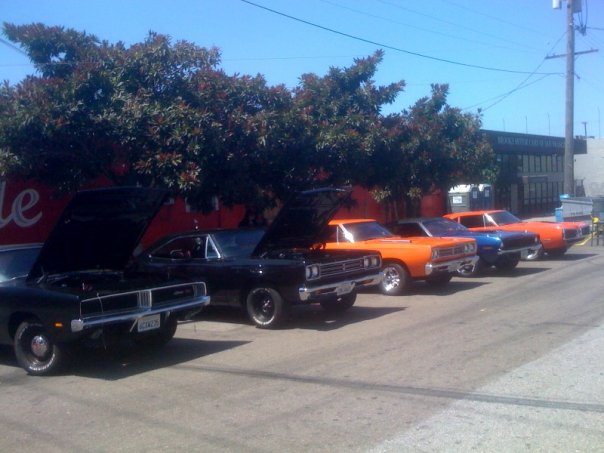
Sure, sure — you love your Prius. Or your fixie-skateboard-rollerblades-scooter-Clipper pass. But there’s something awfully rock n’ roll about a muscle car, especially one that’s been lovingly restored to roarin’-around-town condition.

Sat/7, local auto fanatics Chiselers Car Club host their first annual Chiselers Car Club Blowout — “blowout” in this context referring to a raucous party, of course, not a tire gone haywire. Revelers are encouraged to “bring your pre ’75 pimped-ass ride” (bikes are also welcome); the carless can gawk all they want. Arrive during the daytime hours (starts at 4 p.m., free) to check out the cars, scarf some barbecue, and listen to classic tunes by the Ramshackle Romeos, a two-man group incorporating an array of strange instruments, including the ever-haunting musical saw.

http://www.youtube.com/watch?v=p8bDhRMHrC8&feature=player_embedded

Stick around for the night show (starts at 8 p.m., $10), featuring the pop-punk Clorox Girls (one of those all-dude bands with “Girls” in their name), punk-punk Complaints, and the sassy, garage-y Midnite Snaxxx, whose MySpace “sounds like” is “making out with a burrito.” What’s not to love?

Chiselers Car Show Blowout

Sat/7, 4 p.m., free-$10

Thee Parkside

1600 17th St, SF

www.theeparkside.com

A new community congress

0

EDITORIAL The first time a group of activists from across San Francisco met in a Community Congress, it was 1975 and the city was in trouble. Runaway downtown development was creating massive displacement and threatening the quality of life. Rents were rising and tenants were facing eviction. An energy crisis had left residents and businesses with soaring power bills. The manifesto of the Congress laid out the problem:

"Every poor and working class community in San Francisco has learned the hard way that its interests are at the bottom of the list as far as City Hall is concerned. At the top of the list are the banks, real estate interests, and large corporations, who view San Francisco not as a place for people to live and work and raise families, but as a corporate headquarters city and playground for corporate executives. By using their vast financial resources, they have been able to persuade local government officials that office buildings, hotels, and luxury apartments are more important than blue-collar industry, low-cost housing and decent public services and facilities."

The Community Congress hammered out a platform — a 40-page document that pretty much defined what progressive San Francisco believed in and wanted for the city. It included district elections of supervisors, rent control, public power, a requirement that developers build affordable housing, and a sunshine ordinance — in fact, much of what the left has accomplished in this town in the past 35 years was first outlined in that document.

Beyond the details, what the platform said was profound: it suggested that the people of San Francisco could reimagine their city, that local government could become a force for social and economic change on the local level, even when politics in Washington and Sacramento were lagging behind. It called for a new relationship between San Franciscans and their city government and looked not just at what was wrong, but what was possible.

That’s something that too often gets lost in political debate today. With urban finances in total collapse, the progressives are on defense much of the time, trying to save the basic safety net and preserve essential programs and services. It seems as if there’s little opportunity to talk about a comprehensive alternative vision for San Francisco.

But bad times are great times to try new ideas — and when the second Community Congress convenes Aug. 14 and 15 at the University of San Francisco, that’s exactly what they’ll be trying to do. It’s not going to be easy — the left in San Francisco has always been fractious, and there’s no consensus on a lot of central issues. But if the Community Congress attracts a broad enough constituency and develops a coherent platform that can guide future political organizing efforts, it will have made a huge contribution to the city.

The event also offers the potential for the creation of a permanent progressive organization that can serve as a forum for discussion, debate, and action on a wide range of issues. That’s something the San Francisco left has never had. Sup. Chris Daly tried to create that sort of organization but it never really worked out. The city’s full of activist groups — the Tenants Union, the Harvey Milk LGBT Club, the Sierra Club, and many others — that work on important issues and generally agree on things, but there’s no umbrella group that can knit all those causes together. It may be an impossible dream, but it’s worth discussing.

The organizers of the Community Congress discuss some of their agenda in the accompanying piece on this page. It should be based on a vision of what a city like San Francisco can be. Think about it:

This can be a city where economic development is about encouraging small businesses and start-ups, where public money goes to finance neighborhood enterprises instead of subsidizing massive projects.

This can be a city where planning is driven by what the people who live here want for their community, not by what big developers can make a profit doing.

This can be a city where housing is a right, not a privilege, where new residential construction is designed to be affordable for the people who work here.

This can be a city where renewable energy powers nearly all the needs of residents and businesses and where the public controls the electricity grid.

This can be a city where the wealthy pay the same level of taxes that rich people paid in this country before the Reagan era, where the individuals and corporations that have gotten filthy rich off Republican tax cuts give back a little bit to a city that is proud of its liberal Democratic values.

This can be a city where it’s safe to walk and bike on the streets and where clean, reliable buses and trains have priority over cars.

This can be a city where all kids get a good education in public schools.

Despite all the economic woes, this is one of the richest cities in one of the richest countries in the history of human civilization. There are no economic or physical or scientific or structural constraints to reimagining the city. The only obstacles are political.

In the next two years, control of City Hall will change dramatically. Five seats on the Board of Supervisors are up in November, and the mayor’s office is open the year after that. The progressives have made great progress in the past few years — but downtown is gearing up to try to reverse those advances. The community congress needs to address not just the battle ahead, but describe the outcome and explain why San Francisco’s future is worth fighting for.

A new community congress

2

Bad times are great times to try new ideas – the second Community Congress convenes Aug. 14 and 15 at the University of San Francisco

EDITORIAL The first time a group of activists from across San Francisco met in a Community Congress, it was 1975 and the city was in trouble. Runaway downtown development was creating massive displacement and threatening the quality of life. Rents were rising and tenants were facing eviction. An energy crisis had left residents and businesses with soaring power bills. The manifesto of the Congress laid out the problem:

“Every poor and working class community in San Francisco has learned the hard way that its interests are at the bottom of the list as far as City Hall is concerned. At the top of the list are the banks, real estate interests, and large corporations, who view San Francisco not as a place for people to live and work and raise families, but as a corporate headquarters city and playground for corporate executives. By using their vast financial resources, they have been able to persuade local government officials that office buildings, hotels, and luxury apartments are more important than blue-collar industry, low-cost housing and decent public services and facilities.”

The Community Congress hammered out a platform — a 40-page document that pretty much defined what progressive San Francisco believed in and wanted for the city. It included district elections of supervisors, rent control, public power, a requirement that developers build affordable housing, and a sunshine ordinance — in fact, much of what the left has accomplished in this town in the past 35 years was first outlined in that document.

Beyond the details, what the platform said was profound: it suggested that the people of San Francisco could reimagine their city, that local government could become a force for social and economic change on the local level, even when politics in Washington and Sacramento were lagging behind. It called for a new relationship between San Franciscans and their city government and looked not just at what was wrong, but what was possible.

That’s something that too often gets lost in political debate today. With urban finances in total collapse, the progressives are on defense much of the time, trying to save the basic safety net and preserve essential programs and services. It seems as if there’s little opportunity to talk about a comprehensive alternative vision for San Francisco.

But bad times are great times to try new ideas — and when the second Community Congress convenes Aug. 14 and 15 at the University of San Francisco, that’s exactly what they’ll be trying to do. It’s not going to be easy — the left in San Francisco has always been fractious, and there’s no consensus on a lot of central issues. But if the Community Congress attracts a broad enough constituency and develops a coherent platform that can guide future political organizing efforts, it will have made a huge contribution to the city.

The event also offers the potential for the creation of a permanent progressive organization that can serve as a forum for discussion, debate, and action on a wide range of issues. That’s something the San Francisco left has never had. Sup. Chris Daly tried to create that sort of organization but it never really worked out. The city’s full of activist groups — the Tenants Union, the Harvey Milk LGBT Club, the Sierra Club, and many others — that work on important issues and generally agree on things, but there’s no umbrella group that can knit all those causes together. It may be an impossible dream, but it’s worth discussing.

The organizers of the Community Congress discuss some of their agenda in the accompanying piece on this page. It should be based on a vision of what a city like San Francisco can be. Think about it:

This can be a city where economic development is about encouraging small businesses and start-ups, where public money goes to finance neighborhood enterprises instead of subsidizing massive projects.

This can be a city where planning is driven by what the people who live here want for their community, not by what big developers can make a profit doing.

This can be a city where housing is a right, not a privilege, where new residential construction is designed to be affordable for the people who work here.

This can be a city where renewable energy powers nearly all the needs of residents and businesses and where the public controls the electricity grid.

This can be a city where the wealthy pay the same level of taxes that rich people paid in this country before the Reagan era, where the individuals and corporations that have gotten filthy rich off Republican tax cuts give back a little bit to a city that is proud of its liberal Democratic values.

This can be a city where it’s safe to walk and bike on the streets and where clean, reliable buses and trains have priority over cars.

This can be a city where all kids get a good education in public schools.

Despite all the economic woes, this is one of the richest cities in one of the richest countries in the history of human civilization. There are no economic or physical or scientific or structural constraints to reimagining the city. The only obstacles are political.

In the next two years, control of City Hall will change dramatically. Five seats on the Board of Supervisors are up in November, and the mayor’s office is open the year after that. The progressives have made great progress in the past few years — but downtown is gearing up to try to reverse those advances. The community congress needs to address not just the battle ahead, but describe the outcome and explain why San Francisco’s future is worth fighting for.

“Mission’s first farmers market” checks off its grocery list

0

I watch as Theresa Alvarez painstakingly turns four year old Rolando Steinway-Raybon into a tiger with the palette of face-paints sitting in front of the Mission Beacon neighborhood organizer. Next to them, speakers bumped a hip hop song. Down the block of Bartlett Street where they sat, community members were buying and selling bags of salad greens and edible flowers, white peaches, homemade soaps, and pupusas that came with salad and salsa for the princely sum of $2. A lot going on at the first Mission Community Market, which Alvarez takes as a good sign.

“We’re not only giving out produce, but services people might need,” she told me between happily decorated children. Alvarez’s face-painting operation had set up shop behind a table full of literature about Mission Beacon, the local organization she works for whose mission is to empower youth by exposing them to new places and skills – a bike club and a gardening class are two of the programs that the group offers out of Everett Middle School.  

The presence of neighborhood nonprofits – Dolores Community Youth Alliance and volunteers from the Mission YMCA had joined Alvarez in organizing the kids play space and were also distributing information about their programs in the hopes of attracting new volunteers – was one sign that this is a market that’s trying hard to address the needs of local residents. 

Rolando Steinway-Raybon and sister Naijella show off their new facial flair, courtesy of the kid’s space at the first Mission Community Market

The concept was first dreamed up in November of 2009 at public planning meetings for the Mission Streetscape Plan, which is re-envisioning street usage in the neighborhood. One of the market’s head organizers, Jeremy Shaw, told me its implementation followed a three point plan; “one, the farmers market, which promotes healthy eating. Number two, supporting emerging businesses, people that don’t have the capital for a storefront. Number three, community programs. We’re saying, we’re going to provide this public space and you can do what you want with it. We can use this street for more than just cars.”

True that said the crowd yesterday evening; we can use it for veggies! And for playing four square! And the strumming tunes of a mini-orchestral group! As I strolled through in the early evening hours, the block was slowly filling up with shoppers and those who had paused on their way home to see what all the commotion was about. At 5:30 p.m., volunteers at both entrances told me that they’d already counted around 330 attendees, and expected the numbers to rise as more people got off work. The market raised money for this week’s opening at a fundraiser on Bartlett Street in June, and aims to close the block between 21st and 22nd Street every week at the same time, Thursdays from 4-8 p.m.

Entrepreneurs from the Women’s Initiative hawked wares alongside the produce farmers, including Rubber Ducky Soap Co. owner Kelly Smith. Smith, who stood cheerfully behind her table stacked with naturally made bath products in a green skirt and retro cateye glasses, joined the Women’s Initiative in 2000 to gather the “networking, support groups, and knowledge” she needed to make her enterprise profitable. She recently used her business acumen to help create a new farmers market herself, in a largely abandoned strip mall parking lot in her town of Marinwood. So how were Sharp, the Streetscape Plan, and the Mission District doing on their first market day? “I have to congratulate them,” Smith told me, smiling. “They’re already so tapped into the community, that’s the basic. Its a nice honor to be a part of opening day.”

That connection gives Alvarez hope that the Mission Community Market will meet the needs of its neighborhood beyond just its shopping lists. “It’s hard when people do this without community organizations and families. In the last several years, the neighborhood’s been transforming. I think us being a partner [in the market] will help preserve what’s special about this area.”

Update: 1500 attendees came to the market’s first week!

Mission Community Market

every Thursday, 4-8 p.m., free

22nd St. and Bartlett, SF

www.missioncommunitymarket.org


Cigar Bar and Grill

1

paulr@sfbg.com

DINE As a child growing up in a smoke-filled room called America, I developed the skill of distinguishing among various sorts of fume — and there was a lot of distinguishing to be done, since all the adults around me were puffing away at some glowing protuberance or other. They were like human smokestacks. Cigarette smoke, to the child’s nose, was piercingly nasty, while pipe smoke sweetly asphyxiated, especially in the back seats of cars. Cigar smoke, however, had a no-nonsense robustness that made it bearable, at least if one rolled down the window from time to time and stuck one’s head out for gasps of fresh air.

Recently I have had occasion to rethink this hierarchy, and now I find cigar smoke fully as awful as the other kinds. It hovers, clings, and smothers, and this is bad enough if you’re just trying to breathe, let alone trying to eat, as you might be at the six-year-old Cigar Bar and Grill near Jackson Square. Tobacco smoke powerfully interferes with our sensations of taste and flavor. On the other hand, there is something to be said for the spectacle of strapping 25-year-old lads (many with their Yahoo ID cards dangling from their belts) manfully chomping on their rolled cylinders amid swirling wreaths of smoke. Did they remind me of baby robber barons, or of little boys clopping around in their fathers’ shoes, wing-tips five sizes too big? I thought of Bill Clinton, of course (who managed to do more for the notoriety of the cigar — without even lighting up! — than a thousand Dutch Masters commercials ever could), and then, inevitably, of Freud.

The saving grace of Cigar Bar is that the smoking goes on in a large open courtyard. Most of the smoke presumably rises and is carried off by the wind to join the rest of the city’s smog in the Central Valley, with only traces remaining to lend an unhealthy blue-gray haze to the window glass, like a cataract forming on an eye. Around the courtyard, in a kind of U-shaped arcade, are dimly lit, cozy dining areas with a definite Spanish flavor — low arches, adobe walls. (No smoking in these enclosed spaces.) Tobacco smoke might not pair well with any food, but Iberian design does put one in mind of Spanish-style food, and this Cigar Bar has, after a fashion.

It might be more accurate to describe the menu as offering foods of the Spanish-speaking world, given that the list of munchables includes tortilla chips ($7) with a first-rate, chunky guacamole and a pico de gallo with well-honed edges. I call that Mexican. Chorizo, on the other hand, is both Spanish and Mexican, but, as with its fellow shape-shifter, the tortilla, your expectation as to what’s coming will depend on which side of the Atlantic you’re on. Cigar’s bruschetta ($10) featured Spanish chorizo (a cured sausage with a dense, jerky-like meatiness), cut into fine dice and scattered amid basil leaves, chunks of Roma tomato, dabs of goat cheese, and some baby greens, with EVOO and fleur de sel as binders.

Other preparations seemed to lack any Spanish or Mexican influence at all — but that didn’t mean they weren’t splendid. The crispy polenta batons ($8.50), in particular, were sensational; they looked like small bricks dotted with bits of kalamata olive and cherry pepper and were topped with crumblings of bleu cheese and a few peperoncini. If you sometimes find polenta bland, here is your remedy.

The paradox of fish tacos is that they are at their most appealing and least healthy when the fish is batter-fried. If you grill your fish, as Cigar does ($9.50) — it’s tilapia, by the way, a reliable foot soldier in these kinds of operations — you do well to compensate in other areas for the lack of seducing crunch. Cigar’s answer was a generous shower of mango and jicama dice, along with dollops of chilpotle sour cream, whose smooth smokiness mingled with the fruit’s sweetness — while reminding us that we were in a smoky cigar bar.

You would expect tables-full of cigar-chomping — or, in a few cases, cigarillo-chomping — dudes to be interested in baby back ribs, at least when they’re not playing poker (do they ever play strip poker?), and the kitchen obliged. A half-slab ($11) was lightly slathered with a sauce the menu card unsurprisingly described as “smoky”; we found it just spicy enough to give a nice tingle on the tongue. The accompanying coleslaw was on the sweet side but still fresh and tangy. Would Freud have enjoyed this coleslaw, or would his attention have been riveted elsewhere?

CIGAR BAR AND GRILL

Dinner: Mon.–-Fri., 4 p.m.–2 a.m.; Sat., 6 p.m.–2 a.m.

850 Montgomery, SF

(415) 398-0850

www.cigarbarandgrill.com

Full bar

AE/DS/MC/V

Noise less of an issue than smoke

Wheelchair accessible

Playing safe at the Fire Cabaret

1

This from Michael Sturtz, creative director of the berth of the Bay’s fire community, the Crucible. This weekend (Fri/16 and Sat/17), HEAT: the Fire Cabaret, rises up like a sultry phoenix, an onstage imagining of a flame speakeasy during fire Prohibition at whose “height, lighters and matches were confiscated.” Involved in the production:


1 flaming entryway

4 large fire sculptures

30 fire safety staff each night

60 security staff (“for crowd management, and to make sure no photographers cross any lines”)

30-40 onstage fire sources

100 isolated fire sources in all

150 fire extinguishers (“maybe upwards of a few hundred, it’s hard to tell”)


“It’s kind of like our own fire department,” Sturtz told me this morning, still a little groggy from the Cabaret’s first and only dress rehearsal last night. But it’s not all about flames and iron. 

Last night at the run-through, which was the first time performers and live music had taken the stage together, I saw evidence enough that the production is hot to handle. The stage (made entirely of re-purposed steel crafted into an apocalyptic distillery by what Sturtz affectionately termed “the Crucible community”) was birthing speakeasy scenes that swerved between sexy and… well I guess I should get over calling what the circus folks do dangerous, it’s just a little nerve-wracking for us momma-type squares. Tracy Piper, straight out of an R. Crumb cartoon in denim Daisy Dukes and scuffed black playa boots, mixed acrobatic archings and seductive glass blowing, while performers Scarlett and Axelrod, Fleeky Flanco, and Jennings and Xiaohong hornily stalked around her in the first act, guiding ray guns of fire blasts, balancing on wooden blocks, seducing each other wildly. Corsets, fishnets, flame retardant costumes go! 

Off stage — there’s more? Damn, there’s more! The Crucible staff has cooked up all manner of sparks to light your fire between on stage acts. The usuals; torch wielding burlesque, dance welders, vintage cars, booze. Of the performer’s crossover between the technical and artistic, Sturtz was comfortably matter of fact, very apropos of the mind that founded the organization itself back in 1999; “It’s easier to teach a singer how to weld than a welder how to sing.”

Dig. See you there – in 1920s flapper wear, please. Just be careful with that fringe.


HEAT: A Fire Cabaret

Fri/16 and Sat/17 7 p.m., $43-48

The Crucible 

1260 7th St., Oak.

(510) 444-0919

www.thecrucible.org

Group think

0

arts@sfbg.com

HAIRY EYEBALL “Calder to Warhol,” San Francisco Museum of Modern Art’s giant introductory survey of the Fisher collection, isn’t the only big summer show happening right now. With its wanted poster-style flyer design and a menacing title that could have come from a hardboiled paperback, “They Knew What They Wanted” is an exquisite corpse of a group show, pieced together and then strewn across town by four artists at four different galleries: Shannon Ebner at Altman Siegel, Robert Bechtle at John Berggruen, Katy Grannan at Fraenkel Gallery, and Jordan Kantor at Ratio 3.

Allusions to criminality aside, the artists/curators of “They Knew What They Wanted” would more likely be found on the forensics team than the wrong side of the law. All are steely observers whose art could broadly be said to share a focus on the dynamics of surveillance at work within postwar portrait and landscape photography, particularly photography that looked at what was booming outside of America’s urban centers. Although Grannan is the sole photographer in the group, Ebner’s temporary installations of handmade signage placed in public settings — which she then photographs in black and white — and Bechtle and Kantor’s photo-based oil paintings also fall under the sign of the photography.

It’s not surprising then that multiple pieces by each of the curators can be found across all four galleries, as well as certain names (Lee Friedlander, Miriam Böhm, Trevor Paglen, and Ed Ruscha in particular) whose work shares an aesthetic affinity with that of the curators. This form of cross-gallery display gives “They Knew What They Wanted” a cohesion that is often rare in group shows, while still not being so insular as to make it hard to differentiate each artist-curator’s own aesthetic sense.

Bechtle’s selections offer the least surprises, summoning the same post-1960s Western suburban milieu evoked by his photorealistic paintings of driveway-bound vintage cars. After a few rounds of viewing, though, Robert Adams’ vintage snaps of Colorado ‘burbs, Friedlander’s skewed takes on small town architecture, Isca Greenfield-Sanders’ aquatint etchings of backyard swimmers, and Tom McKinley’s oils of cool modernist interiors start to add up to the visual equivalent of tract housing.

Ebner and Kantor’s picks are more interior-minded than the mainly street-level and exterior scenes crowding John Berggruen. They also veer the furthest from each artist’s own work. For example, Sol LeWitt’s blink-and-you’ll-miss-it painted electrical wall plate at Altman Siegel is just a few Home Depot aisles away from Rachel Whiteread’s stainless steel castings of light switches over at Ratio 3. Back at Altman Siegel, Fletcher Benton’s 1983 bronze tennis racket, “Adjustable Racket for Short Heavy Hitters,” leans dejectedly in a corner, in wait for a yard sale that will never come. Grannan’s grab bag at Fraenkel is the most photo-heavy, and her selection ventures furthest — with mixed success — from the thematic territory staked out by Bechtle, Ebner, and Kantor.

In a way, Ebner, Bechtle, Grannan, and Kantor have beat SFMOMA to the punch. The museum is set to restage the landmark 1975 photography exhibit “New Topographics: Photographs of a Man-Altered Landscape” — which presented dispassionate documentation of parking lots, construction sites, and other forms of ex-urban development — at the end of the month. But for a sustained exploration of the meteor-like impact of “New Topographics” on the photography and painting that followed in its wake, one couldn’t ask for a better art historical crash-course than “They Knew What They Wanted.” *


THEY KNEW WHAT THEY WANTED

Through July 31, free

John Berggruen Gallery

228 Grant, SF

(415) 781-4629

www.berggruen.com

Through Aug. 7, free

Altman Siegel Gallery

49 Geary, SF

(415) 576-9300

www.altmansiegel.com

Through Aug. 13, free

Ratio 3

1447 Stevenson, SF

(415) 821-3371

www.ratio3.org

Through Aug. 21, free

Fraenkel Gallery

49 Geary, SF

(415) 981-2661

www.fraenkelgallery.com

Bad faith

3

steve@sfbg.com

Mayor Gavin Newsom and his business allies are actively trying to sabotage the various revenue measures that have been put forth by the labor movement and progressive members of the Board of Supervisors, employing deceptive rhetoric, sneaky tactics, and a refusal to bargain in good faith.

In fact, Newsom — the Democratic nominee for lieutenant governor — is so averse to supporting anything that could be called a “tax” that he rejected a hard-won compromise measure created by powerful developers, affordable housing advocates, a pro-business think tank, the building trades, and his own directors of housing and economic development.

Just as that story was breaking in the New York Times (produced by Bay Citizen) on July 9, members of the Board of Supervisors Budget and Finance Committee discovered that Newsom’s proposed ballot measure to close loopholes in the city’s hotel tax that favored airline employees and online travel companies — a widely supported change, but one worth just $6 million per year — contains language that would nullify any increases in the hotel tax. Earlier in the week, labor unions turned in signatures on an initiative to increase the hotel tax by 2 percent, which would bring in more than $30 million per year.

“This poison pill is an intentionally deceptive, underhanded move,” Gabriel Haaland, an organizer with Service Employees International Union Local 1021, which sponsored the hotel tax, told us. “It’s so frustrating. It’s not even a good faith fight. He’s trying to create confusion and fool the voters. If our measure passes fair and square, it should be implemented.”

Meanwhile, Newsom and business groups have been attacking a reform measure by Board President David Chiu that would make the currently flat payroll tax more progressive, exempt more small businesses from paying it, and create a commercial rent tax to spread the tax burden more widely than the 10 percent of businesses who now pay tax to the city.

Critics complained that the measure would hurt local businesses — but that’s just not true. The city’s Office of Economic Analysis concluded that Chiu’s original proposal would have no effect on private sector jobs and would generate $34 million annually for the city, preserving some government jobs and spending.

Then Chiu amended the measure to spare even more small businesses. Now the OEA says that the measure would actually create private sector jobs — and still bring $28 million in to the city. Yet Newsom and the business community are still withholding their support.

This trio of Machiavellian moves comes just a week after Newsom pulled out of budget negotiations with board progressives concerning about $40 million in board add-backs to programs that Newsom proposed to cut after they wouldn’t agree to his precondition that they withdraw unrelated measures proposed for the November ballot, such as splitting appointments to the Rent, Recreation and Park, and Municipal Transportation Agency boards and requiring police officers to do foot patrols.

The series of events has led many progressives to say that conservative ideological blinders — a knee-jerk opposition to anything that saves government jobs and services or that Republicans might criticize — is the only logical explanation for the intransigent stance adopted downtown and by Newsom.

“It’s ideological. It’s not economic, and it’s not even political,” said Calvin Welch, the affordable housing activist who helped negotiate the transfer tax compromise with developer Oz Erickson, San Francisco Planning Urban Research Association director Gabriel Metcalf, Mayor’s Office of Housing Director Doug Shoemaker, and others.

That measure would have created a transfer tax on sales of properties over $875,000 and generated approximately $50 million annually for affordable housing (funds that were drastically reduced in Newsom’s proposed 2010-11 budget) while cutting in half the current requirements and fees on market-rate developers to create below-market-rate units. The plan would have stimulated both types of housing and created desperately needed construction work — an approach those involved called an elegant solution to several problems.

“To me, this was a win-win, solving two problems that are each a big deal,” Metcalf told us. “I don’t know what his reasons were for not supporting it. I was surprised.”

But Welch said, “It collapsed straight up because the mayor didn’t want to support a tax.” Although Newsom told the Times it was because there wasn’t broad enough consensus yet, “the mayor’s reason is whole-cloth bullshit,” Welch said, noting the role of the Mayor’s Office in brokering the deal. “The mayor walks away from it because everyone wasn’t in the room? Well, it’s your room, motherfucker. Show some leadership.”

Newsom Press Secretary Tony Winnicker refused to discuss these issues by phone, responding to our written inquires by noting that Newsom opposes taxes and thinks the best way to address budget deficits are privatizing city services and pension reform (although he opposes Public Defender Jeff Adachi’s initiative, the only pension reform measure on the fall ballot).

“The mayor is opposed to the Board of Supervisors’ proposals to increase taxes because they’re not needed to balance the budget and they will strangle our still young economic recovery,” Winnicker wrote, refusing to answer follow-up questions or support a statement about Chiu’s measure that the OEA concludes is not accurate.

Like many political observers of all stripes, those from downtown and progressive circles, Welch criticized Newsom for his lack of engagement with city business and its long-term fiscal outlook, contrasting him with former Mayor Willie Brown, who met regularly with former Board of Supervisors President Tom Ammiano even as the two ran a bitter campaign for mayor against one another in 1999. “They dealt with the city’s business like two adults who cared about the city,” he said.

Welch acknowledged that there was still work to be done building political support for the transfer tax measure. He and other progressives would have had to win over city employee unions who wouldn’t like the budget set-aside aspect, and Erickson and Metcalf would need to placate some of their downtown allies who oppose taxes on ideological grounds. But given how downtown groups are behaving right now, that might not have been an easy sell.

“There are members of the small business community that are averse to any taxes,” said Regina Dick-Endrizzi, director of the city’s Office of Small Business and staffer to the Small Business Commission, which was withholding a recommendation on the Chiu measure but planned to meet again to consider it July 12 (look for an update on the sfbg.com Politics blog). She said the small business community is having tough times and “they are just not sensitive to keeping city workers employed.”

Larger commercial interests are being even more forceful in opposing the revenue measures. While a parade of workers, social service providers, and progressive activists testifying at the July 9 Budget Committee hearing implored supervisors to place all the proposed revenue measures on the ballot, representatives from the Building Owners and Managers Association (BOMA) and San Francisco Chamber of Commerce were the only two speakers urging supervisors to drop the measures and focus instead on creating private sector jobs.

“You’re trying to create a little revenue here and it’s not going to work,” said Ken Cleaveland, director of BOMA SF, arguing that big banks and financial services companies — entities exempt from the payroll tax that Chiu is hoping to target with the commercial rent tax — will buy their buildings to avoid paying the tax. “They aren’t going to create more jobs and they really aren’t going to create more revenue.”

Yet Chiu noted that it was the business community and fiscal conservatives who pushed to create the Office of Economic Analysis, whose work they have regularly used to attack progressive legislation. Now that the office has concluded that a piece of progressive legislation is good for the local economy, Chiu told Cleaveland and the Chamber spokesperson Rob Black at the hearing, “I ask you to respect the work this office has done.”

Black said the Chamber board will consider Chiu’s amended legislation, but said businesses are in no mood to help the city. “How many times have you gone to your neighborhood merchant and had them say, ‘Gee, my rent’s too cheap’?<0x2009>” he said during his testimony.

Yet Chiu said landlords of small tenants (those paying less than $65,000 in rent per year) are exempt from the rent tax and only 26 percent of SF businesses would pay any city business tax under his plan. “I hope the mayor will support this proposal and the business community will give it a good look,” Chiu said as the hearing ended.

At the beginning of the hearing, Chiu framed the dire situation facing San Francisco, citing Controller’s Office figures showing this year’s $500 million budget deficit (out of a $6 billion total budget) will be followed by a $700 million deficit next year and a $800 million gap the following budget cycle as a result of a deep structural budget imbalance.

“We have budget deficits as far as the eye can see,” Chiu said at the hearing. “We have to consider measures that will provide more stable sources of revenue.”

He also noted that city employee unions have agreed to give back about $250 million in salary and had their ranks reduced by about 2,000 workers in the last two years. So he and the other progressive supervisors say it’s time for the rest of San Francisco to help address the problem.

“We, as a city, should not be trying to balance this budget simply through cutting,” Sup. David Campos said.

Sup. John Avalos, the committee chair, amended his transfer tax measure in the wake of Newsom’s rejection of the deal by making it a simple 2 percent tax on properties that sell for more than $5 million, and 2.5 percent tax on properties over $10 million. He estimates it will bring in about $25 million per year from the city’s wealthiest corporations and landlords.

“That’s who we’re socking it to,” Avalos told us, saying he was disappointed the compromise fell through. “The amendment is going to be more progressive than what was originally planned.”

Even Sup. Sean Elsbernd, a strong fiscal conservative who announced early in the hearing, “You want to do that [balance future budgets] by adding taxes, but I want to do it through ongoing service cuts,” later told the Guardian that he was intrigued by the amendments Avalos and Chiu made to their measures and has not yet taken a position on them.

Sup. Ross Mirkarimi is also sponsoring a measure to increase the city’s tax on parking lot operators from 25 percent to 35 percent, the first change to that tax in 30 years, and will include valet parking for the first time. The measure would bring in up to $24 million per year, and OEA analysis shows it would decrease the number of cars trips by 1.3 percent, another benefit.

SFMTA supports the measure, with board member Cameron Beach testifying that the money will be used to subsidize Muni and “it links the use of private automobiles and is consistent with the city’s transit-first policy.” Mirkarimi, who chairs the Transportation Authority, also has proposed a $10 local vehicle license fee surcharge that would bring in another $5 million per year for Muni.

All the revenue measures require six votes by the full Board of Supervisors, which is scheduled to consider them July 20, after which they would need a simple majority approval by voters in November to take effect.

The mayor has the authority to directly place measures on the ballot, so the committee hearing on his hotel tax loophole measure and a $39 million general obligation bond that he’s proposing to create a revolving loan fund for private sector seismic improvements were mere formalities, so supervisors criticized aspects of each but were unable to make changes.

Avalos even grudgingly acknowledged the hotel tax poison pill was an effective way to kill that revenue source, saying at the hearing, “This is very smart. I don’t agree with it, but it’s very smart.”

Haaland was less charitable, criticizing a provision designed to confuse voters. “This kind of move means both measures won’t pass because now we have to oppose [Newsom’s measure],” he said, criticizing the mayor for running away from the hard decisions facing the city. “He won’t be around next year, when we have an even bigger structural budget deficit, to clean up this mess. Absent new revenue sources, this city starts to fall apart.”

Sunday Streets creates public benefits from private labors

2

By Kristen Peters

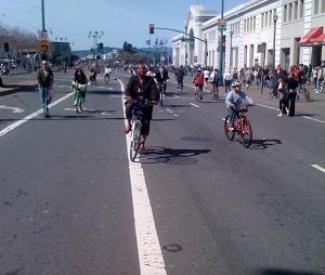
San Francisco locals will take to the streets this weekend as main roads in the Mission neighborhood are closed to automobiles for the sixth installment of Sunday Streets. On July 11, a three-mile route from 17th and Valencia to Dolores Park to Potrero Avenue will be car-free from 10 am until 3pm.

Taken from Bogota’s weekly ciclovía, in which nearly 100 miles of city streets are reserved for pedestrians and other recreationalists, Sunday Streets began in San Francisco almost two years ago. Since then, the tradition has made its way to other California cities including Los Angeles and Oakland.

“In San Francisco we have our own unique style,” event coordinator Susan King, who works for the nonprofit group Livable City, said. “We have different routes and we hit different neighborhoods year after year. In each neighborhood, the featured events have their own flair.”

This Sunday, revelers can look forward to performances by Grupo Azteca as well as capoeira and salsa dancing lessons, not to mention the countless restaurants in the area opening their doors early to the public. While the event has some support from the city and its San Francisco Municipal Transportation Agency, mostly in the form of permit fee waivers, it is run by Livable City and funded from corporate donations.

“Our corporate sponsors provide everything from durable goods, in-kind donations and cold, hard cash,” King said.

City officials have even curtailed helping with hanging “no parking” signs, leaving that task to volunteers from the SF Bicycle Coalition. That job was usually designated to the San Francisco Department of Parking and Traffic, but they have now stopped providing that service to an event that Mayor Gavin Newsom trumpets as something he’s bringing to the people. But King still calls Sunday Streets a good example of a public-private partnership.

“Everybody brings something to the table,” King said. “It’s a real cooperative entity with everyone pulling together to produce something really special.”

According to King, the benefits are widespread. Not only is it refreshing for the public to ditch their cars for a few hours, but it also reinvigorates the local economy. “It’s a real boom for the city,” King said. “Lots of people on the street means lots of eating. It’s good for business and good for the community.”

Acting executive director for the SF Bicycle Coalition Renee Rivera said that the Mission in particular has benefited from the crowds at Sunday Streets. “Everyone is enjoying the outdoor activities the event has to offer but, at the same time, are going to get ice cream, stopping for tacos or getting to enjoy all the merchants on 24th and Valencia,” Rivera said.

There are three more Sunday Street events following the Mission neighborhood closure. The Great Highway and areas of Golden Gate Park will be closed on August 22 followed by the Western Addition on September 19. The series will conclude on October 24 with the closure of the Civic Center and Tenderloin areas.

Cross Rock Beach

0

Rating: D

Pebble-covered Cross Rock Beach is so tiny that it sometimes remains underwater until late summer. The beach path is so steep and dangerous that “you shouldn’t even think about using it,” says Red Rock regular Hugh Fullerton, who estimates the trail’s angle at 45 degrees. At least one person has fallen from the cliffs.

Legal status: Unknown, believed to be part of Mount Tamalpais State Park.

How to find it: Follow directions for Muir Beach. Between the Step Ravine Campground sign (about four miles north of Muir) and the big Red Rock parking lot (a mile south of Stinson Beach), look for cars pulled over next to Highway 1. Park there and then walk down the path to the beach.

The beach: The beach is pebbly, with a thin ribbon of sand only in late summer and fall.

The crowd: It may or may not be deserted. When nearby Red Rock is crowded, Cross Rock sometimes gets a few visitors.

Problems: Rocky shoreline; extremely dangerous trail; no access in winter, spring, or early summer; unknown legal status.

Transit troubles

0

rebeccab@sfbg.com

Peggy da Silva is an avid cyclist, public transit advocate, and member of the San Francisco Transit Riders Union — a new organization made up of several hundred San Franciscans who want to see improvements to Muni.

Yet even she admits that when it comes to getting to work, it takes just 15 minutes by car or an hour if she opts to go by bus. “I am committed to transit and cycling” for environmental reasons, she said, but “it gets really frustrating” to wait for the bus or light rail cars to arrive.

Da Silva could be considered lucky in that she can opt to drive if she feels it’s necessary, while many lower-income San Franciscans cannot afford a car and have no choice but to rely on Muni to get to work, buy groceries, or make doctor appointments. It’s even worse late at night when the buses run less frequently and the streets are dark and empty.

Speaking at a June 29 transit rally, the Rev. Norman Fong of the Chinatown Community Development Center joked that Chinatown is one of the city’s greenest neighborhoods — but “not by choice.” Most Chinatown residents just can’t afford to own a car, underscoring the point that Muni service cuts affect lower-income communities more significantly than those with more transportation options.

The perception that Muni is broken isn’t unique to transit advocates. Around City Hall, a number of proposals have been put forth to fix the ailing system, which has been mired in delays and overcrowding as fares have gone up and service was slashed. But determining what the root problems are, how they should be addressed, and what the best path forward may be has proved arduous.

Rather than a simple calculation or a study in efficiency, the debate surrounding Muni is spinning into an emotionally charged affair. For those aiming to protect low-income riders from service cuts or fare increases, it’s a discussion about social justice, calling into question why the city is asking more of bus riders than motorists in a city with a “transit-first” mandate in its charter.

The strong opposition to the cuts by supervisors and the public has led to a rollback. On June 30, the San Francisco Municipal Transportation Agency (SFMTA) announced that on Sept. 4, it would be able to restore half of the 10 percent systemwide service reduction that went into effect in May.

“Due to stronger than expected revenue streams, operational efficiencies, and new grant opportunities, staff is recommending the restoration of service on some routes and lines this fall,” according to an SFMTA press release. Buses that run all night would come more often, and the partial service restoration would help ease over-crowding.

While this was welcome news for anyone who takes transit, the expected improvement still leaves untouched many key issues plaguing the city’s public transit system. Two separate initiatives most likely destined for the November ballot seek to deal with systemic problems — but both have met with resistance.

On July 1, Sup. Sean Elsbernd announced that he had submitted some 75,000 signatures for a proposed charter amendment for the November ballot to change the way transit operator salaries are determined. Since they only needed 46,000 signatures, “presumably, we’ll qualify,” Elsbernd told us.

“It presses the reset button on all the [memorandums of understanding] and then puts the riders at the table,” he explained. “It also eliminates the side letters that allow the six leaders of the union to get full-time salaries and benefits without needing to drive.”

Elsbernd’s proposal would require operator wages and benefits to be set through collective bargaining, instead of the current guarantee that their wages be at least as high as the average wage rate for transit operators in the two highest paying comparable transit systems.

Yet his proposal is opposed by the city’s transit operators union, TWU Local 250-A, whose members feel they’ve been unfairly blamed for the MTA’s fiscal problems. Speaking at the June 29 rally, Ron Heintzman, the new international president of the Amalgamated Transit Union, summed up the attitude of drivers who feel they are being asked to give up hard-fought gains in the face of an economic downturn.

“I’ve been told that here in San Francisco, the mayor for some reason clearly has his head up his ass,” Heintzman said. “It’s time to tell him to stop trying to balance the damn budget on the backs of the workers.”

Speakers at the rally voiced support for federal legislation that would bolster municipal transit budgets nationwide with a $2 billion emergency infusion. A second federal bill would allow local governments greater flexibility with federal transit funding that currently can only be spent on capital projects, not day-to-day operations.

“We’re asking them not to make us buy a bus when we can’t hire a bus operator to drive it,” explained Harry Lombardo, international president of the Transit Workers Union. “There’s no point in spending hundreds of thousands on a bus and letting it sit in mothballs. And believe me, it’s happening all over the country.”

Sup. David Campos, a cosponsor of a competing ballot measure that aims for more comprehensive Muni reform, joined the rally and criticized the notion that drivers should be blamed a dysfunctional, underfunded transit system.

“Those of you who live in San Francisco know that right now there is a climate at City Hall that is pointing the finger at drivers, blaming drivers and blaming the workers for the problems that this system has,” Campos said at the rally. “Muni is broken. But Muni is not broken because of labor. And we have to say no to that push to somehow create a division between riders and drivers…. We can’t ignore the fact that we have a system that is getting money that is not being used well.”

Campos has joined with Sups. Ross Mirkarimi, Eric Mar, and Board President David Chiu to propose a reform package that would remove the pay guarantee for Muni driver, but also create split appointments to the MTA Board of Directors, allocate a share of property tax revenue to the city’s Transportation Fund, and establish an Office of the MTA Inspector General to help reduce waste and ramp up efficiency. The proposal would be subject to voter approval in November.

The proposal to give the supervisors some appointments to an MTA board that is now solely accountable to the Mayor’s Office became an issue at the eleventh hour of budget negotiations between the supervisors and Newsom on June 30. The mayor strongly opposed that and two similar charter amendments that would establish split appointments for the Recreation and Park Commission and the San Francisco Rent Board, as well as a ballot measure that would require the police department to engage in foot beat patrols.

Many saw his stance as a quid pro quo that inappropriately tied mayoral support for the budget — which included funding restorations to community programs that progressive board members wanted to preserve — to these unrelated ballot proposals.

Dave Snyder, who directs the SF Transit Riders Union, viewed the move as an affront on Muni riders. “This particular mayor has managed to screw up Muni service through his complete control over the agency,” Snyder said. “And whatever it takes, Muni riders want to see that fixed.”

While he said he thought a split appointment for the MTA Board was important, “the most important thing is more money. That’s the key issue,” he added, noting the reform package would create more funding for Muni.

Members of the Budget and Finance Committee resisted the mayor’s demand and forwarded a budget to the full board that included their high-priority restorations. The proposed ballot measures will be considered by the board this month.

“If you ask me, I would say we should have commission reform across the board,” Mirkarimi told the Guardian. “The idea of having [equally balanced appointments] is a smart way for us to share the responsibility and the consequences.”

MTA’s fiscal problems aren’t unique to San Francisco. On July 1, Caltrain announced a menu of undesirable options to deal with big financial troubles facing the commuter railroad. Elimination of weekend service and certain weekday train stops, or a 25-cent increase to base fares or zone fares, will be the subject of public hearings this summer.

Noting that all the different sources that fund Caltrain have been slashed, spokesperson Christine Dunn told us, “It’s frustrating to not be able to provide the service you want to provide.”

Naked fun in the sun!

9

Entertainer Wavy Gravy and Pentagon Papers leaker Daniel Ellsberg like Red Rock Beach; Marin Superior Court Commissioner Roy Chernus favors Bass Lake, and Marin County Sup. Steve Kinsey says he’s been naked at Red Rock, Bolinas, Hagmier Pond, and Mount Vision Pond.

“I’ve probably hit every nude beach in Marin,” says Kinsey, who has described his visits as “exhilarating and normal.” “My last dip was at Bass Lake last fall. It has beautiful, fresh water, and the swimming environment is wonderful. I look forward to the next opportunity.”

But on their next trips to the nude section of beautiful Muir Beach, visitors may notice something new: a warning sign is being erected by the county this summer to urge users to be “respectful” of each other and to notify authorities if there’s trouble.

The sign is the result of a compromise worked out by nudists, law enforcers, county officials, and local homeowners, some of whom wanted nudity stopped. Under the agreement, cops are making a few more visits than before. But through July 1, 2010, only four complaints about nudity and one citation for improper sexual conduct have occurred since January 1, 2009, and none since August 13, 2009, according to marin county sheriff’s office crime analyst Susan Medina. “We keep responding to complaints, but I can’t recall any recent citations,” says Lt. Cheryl Fisher, commander of the Marin County Sheriff’s Office’s West Marin Station. Fisher says the subjects are usually suited up by the time deputies arrive. “A deputy showed up on a very hot Sunday,” says regular visitor Michael Velkoff of Scotts Valley. “As soon as he left, everybody was naked again.”

“Of course, guys in spiked penis rings not parading themselves around also have helped,” says Sup. Kinsey, who, for now, has spiked his previous threat to fight back by starting an effort to make Muir and other beaches clothing-optional under a 1975 law giving Marin County the power to exempt areas from its anti-nudity provisions. “Sometimes the best thing we can do in government is to stay out of the way.”

Homeowners remain wary. One, who wants to remain anonymous, tells the Guardian: “We are optimistic” about being able to “coexist” with the naturists, “but we also remain very clear about what is legal and what will and won’t be tolerated.” And a former advocate of the ban told me that instead of not going to Muir Beach “a person wanting to use the beach nude might do it in a manner that doesn’t draw a lot of attention.”

As if the Marin mashup wasn’t enough, nervous naturists also got ready to do battle with state authorities, who they feared would eventually ban nudity at Devil’s Slide in San Mateo County and at Bonny Doon Beach near Santa Cruz, both of which are state beaches.

The jitters came in the wake of an October 2009 California high court ruling allowing a crackdown on nude sunbathing on state beaches, even in areas traditionally used for such activity. “All it takes now is an individual ranger with the desire to issue a citation,” warns R. Allen Baylis, a Huntington Beach attorney representing the Naturist Action Committee, the country’s biggest nudist lobbying group. “It could have a chilling effect [on nudity] on any state beach.”

“Our thin line of security has been overturned,” says Rich Pasco, head of the Bay Area Naturists, based in San Jose. “So let’s hope that in today’s economy, the thin level of state park staff has better things to do with their time than dealing with naturists.”

At press time, the NAC, along with BAN and 14 other nudist groups, were preparing, for the first time, to officially petition California to “designate clothing-optional areas” on one or more state beaches. Other efforts have, says Baylis, been “less formal.” “Do they really expect us to pack up and leave?” Baylis asks. “We’re going to fight back. This is our freedom they’re messing with!”

What’s the good news? Just like at Muir Beach, it doesn’t look like naturists have anything to worry about for now in Northern California. “In the short term, things at Bonny Doon are destined to continue the way they are,” says Kirk Lingenfelter, sector superintendent for Bonny Doon. He wants a better trail, stairs, and parking, but says the cash-starved state doesn’t have the budget to make even a preliminary plan or increase ranger visits. He said his staff have not issued any citations or warnings at the nude cove, which he calls one of the spots that “really give you the feeling of rugged, untouched majesty. It’s a very important feeling. Going to places like Bonny Doon helps you get recharged.”

And the Devil’s Slide police source, who wants to remain anonymous, told us: “Rangers aren’t going to be pursuing enforcement against nudity per se. Nothing’s changed.” Rangers will continue responding to complaints, he explained, but it usually means they arrive too late to do anything about them because cell phones don’t work on the beach. “We hear about it after the fact,” says another Devil’s Slide enforcer, Supervising State Park Ranger Michael Grant.

Want to contribute to the glad tidings? There’s still time for plenty of fun in the sun. You can donate your body to the record books, at least temporarily, by showing up Saturday, July 10 at the Sequoians Clothes Free Club (www.sequoians.com) in Castro Valley, when its annual attempt at setting a world skinny-dipping record, with 138 other nude locations, will be held. And if you’ve ever been dying to do a little light cleaning in the nude (no window-washing needed), here’s your chance: Your butt can be bare if you stop by Bonny Doon Sept. 18 to help fans pick up cigarette butts and other litter on the beach.

Speaking of good things, would you like to help improve our report? Please send brainstorms, your new beach “finds,” improved directions (especially road milepost numbers), and trip reports to garhan@aol.com or by snail mail to Gary Hanauer, c/o San Francisco Guardian, 135 Mississippi St., San Francisco CA 94107. Please include your phone number so we can verify that you’re not just another mirage in the nude beach sand.

>>BELOW ARE CAPSULE GUIDES TO POPULAR NUDE BEACHES. CLICK HERE FOR OUR COMPLETE GUIDE, INCLUDING MANY MORE

NORTH BAKER BEACH, SAN FRANCISCO

Things are really cooking at San Francisco’s long, narrow North Baker, which is in good shape this year, with plenty of sand and an influx of young people and more women than five years ago, even though the beach is still heavily male. “If you want to see naked chicks and guys, it’s the place to go,” says aficionado Paul Jung. Although beach regulars like himself welcome all the new nude volleyball players, “some of them seem to make up rules as they go along,” he laughs. Fun activities: Look for dolphins that occasionally surface in the water off shore. And in low tide only, walk around the big rocks at the north end of the beach to check out Baker’s “secret” tide pools.

Directions: Take the 29 Sunset bus or go north on 25th Avenue to Lincoln Boulevard. Turn right and take the second left onto Bowley Street. Follow Bowley to Gibson Road, turn right, and follow Gibson to the east parking lot. Head right on the beach to the nude area, which starts at the brown and yellow “Hazardous surf, undertow, swim at your own risk” sign. Some motorcycles in the lot have been vandalized, possibly by car owners angered by bikers parking in car spaces; to avoid trouble, motorcyclists should park in the motorcycle area near the cyclone fence.


LAND’S END BEACH, SAN FRANCISCO

Land’s End is just the beginning: it’s not just the ground that seems to “disappear” into the sunset at this little slice of paradise off Geary Boulevard. So do your clothes, if you want to be magically transported to another dimension, away from the cares of everyday constraints. Shorts, swimsuit, even work clothes during a quick lunch break — they all can be removed at this delightful cove, which features a mix of sand and rocks plus some of San Francisco’s best views. Better still, only a handful of people are usually present. Bring a windbreak for protection in case the weather changes.

Directions: Follow Geary Boulevard to the end, then park in the dirt lot up the road from the Cliff House. Take the trail at the far end of the lot. About 100 yards past a bench and some trash cans, the path narrows and bends, then rises and falls, eventually becoming the width of a road. Don’t take the road to the right, which leads to a golf course. Just past another bench, as the trail turns right, go left toward a group of dead trees where you will see a stairway and a “Dogs must be leashed” sign. Descend and head left to another stairway, which leads to a 100-foot walk to the cove. Or, instead, take the service road below the El Camino del Mar parking lot 1/4 mile until you reach a bench, then follow the trail there.

GOLDEN GATE BRIDGE BEACH, SAN FRANCISCO

Don’t come to Golden Gate Bridge Beach, also called Nasty Boy Beach, if you want privacy: dozens to hundreds of visitors show up on the hottest days at the site that some have likened to a “gay meat market.” Along with the guys, a smattering of women, straight couples, children and fishermen are spread out on the three adjoining rocky coves that make up the beach, whose stunning views of the Bridge will make you feel like you’re the star of your own postcard. “It’s really nice to walk in the water,” says a woman. “In low tide, you can sometimes go out 150 feet.”

Directions: Directions: from the toll booth area of Highway 101/1, take Lincoln Boulevard west about a half mile to Langdon Court. Turn right (west) on Langdon and look for space in the parking lots, across Lincoln from Fort Winfield Scott. Park and then take the new, improved beach trail, starting just west of the end of Langdon, down its more than 200 steps to Golden Gate Bridge Beach, also known as Marshall’s Beach.


FORT FUNSTON BEACH, SAN FRANCISCO

If you try to be naked here on weekends, you’ll be barking up the wrong tree. The main creatures who go nude at Fort Funston, south of Ocean Beach, are dogs, but that hasn’t stopped a small band of stark naked sunbathers from hiding away in some sand dunes when rangers aren’t in the area. Authorities usually issue several citations a year here. But if you don’t make a fuss and visit on a weekday, you probably won’t be busted. If anyone complains, put on your beach gear right away. Two more fun activities at “Fort Fun”: watching hang-gliders take off from the cliffs and checking out a seemingly endless passing parade of people and their pets.

Directions: From San Francisco, head west to Ocean Beach, then go south on the Great Highway. After Sloat Boulevard, the road goes uphill. From there, curve right onto Skyline Boulevard, go past one stoplight, and look for signs for Funston on the right. Turn into the public lot and find a space near the west side. At the southwest end, take the sandy steps to the beach, turn right, and walk to the dunes. Find a spot as far as possible from the parking lot. Do not go nude here on the weekends. And if you don’t like dogs, go elsewhere.


LAS TRAMPAS REGIONAL WILDERNESS, CASTRO VALLEY

Nudity’s banned in the East Bay Regional Park District, but if you tell that to the nude hikers who will be once again walking across park land July 23 and Aug. 22 — at night — they may moon you en masse. On America’s only naked “Full Moon Hikes,” participants leave the grounds of the Sequoians Naturist Club in Castro Valley fully clothed at dusk and walk through meadows and up hills until the moon rises, before heading back down the slopes with their clothes folded neatly into their backpacks. Says Dave Smith, of San Leandro: “It’s truly wonderful. Except for deer, we’re usually the only ones on the path.” Agrees James, of Fremont: “It’s one of the best experiences I’ve ever had. You’re walking in this silvery light. The moonlight is flooding everything. You feel like you’re in the middle of a beautiful dream.”

Directions: Contact the Sequoians Naturist Club (www.sequoians.com) or the Bay Area Naturists (www.bayareanaturists.org) for details on how to join a walk. Participants usually meet at and return to the Sequoians Club. To get there, take Highway 580 east to the Crow Canyon Road exit. Or follow 580 west to the first Castro Valley off-ramp. Take Crow Canyon Road toward San Ramon 0.75 mile to Cull Canyon Road. Then follow Cull Canyon Road around 6.5 miles to the end of the paved road. Take the dirt road on the right until the “Y” in the road and keep left. Shortly after, you’ll see the Sequoians sign. Proceed ahead for about another 0.75 mile to the Sequoians front gate.


DEVIL’S SLIDE, MONTARA

Will they be having a devil of a time in paradise? For the first time, rangers say they’ll begin enforcing state anti-nudity regulations if offended beachgoers complain about the nudists who visit Gray Whale Cove, which is commonly called Devil’s Slide. The good news: It’s a nonissue because cell phones (used to summon rangers) don’t work on the beach, so by the time cops arrive, the offenders have long since suited up or left. And the beach’s top enforcer told us he won’t be telling rangers to bust nudists they see. Most visitors love the long sandy shore, where nudies, about 20 percent of visitors, hang out on the north end.

Directions: Driving from San Francisco, take Highway 1 south through Pacifica. Three miles south of the Denny’s restaurant in Linda Mar, turn left (inland or east) on an unmarked road, which takes you to the beach’s parking lot and to a 146-step staircase leads to the sand. “The steps are in good shape,” Ron says. Coming from the south on Highway 1, look for a road on the right (east), 1.2 miles north of the Chart House restaurant in Montara.


SAN GREGORIO NUDE BEACH, SAN GREGORIO

America’s oldest nude beach, near Half Moon Bay, offers two miles of soft sand and tide pools to explore, as well as a lagoon, lava tube, and, if you look closely enough on the cliffs, the remains of an old railroad line. Pets are allowed on weekdays. Up to 200 visitors may be present, but they’re usually so spread out, you may not even notice them. Gay men tend to hang out on the north side and in “sex condos” made of driftwood by visitors — a major annoyance to those who are easily offended. On the south end of the beach, there are sometimes dozens of straight couples and families, naked and clothed. For weather information, call (415) 765-7697.

Directions: Head south on Highway 1 past Half Moon Bay. Between mileposts 18 and 19, look on the right side of the road for telephone call box number SM 001 0195, at the intersection of Highway 1 and Stage Road and near an iron gate with trees on either side. From there, expect a drive of 1.1 miles to the entrance. At the Junction 84 highway sign, the beach’s driveway is just 0.1 mile away. Turn into a gravel driveway, passing through the iron gate mentioned above, which says 119429 on the gatepost. Drive past a grassy field to the parking lot, where you’ll be asked to pay an entrance fee. Take the long path from the lot to the sand; everything north of the trail’s end is clothing-optional.


BONNY DOON NUDE BEACH, BONNY DOON

Bonny Doon isn’t doomed. To the contrary, because the state has no plans to develop it or send rangers out to make anti-nudity patrols, it looks like it will remain Santa Cruz County’s prettiest nude beach, which should please the nudists who were on the edge of their towels wondering what would happen. Says Kirk Lingenfelter, sector superintendent for Bonny Doon and nearby state beaches: “Going to places like Bonny Doon helps you get recharged.” Naturists usually use the cove on the north end of the beach, which attracts more women and couples than most clothing-optional enclaves.

Directions: Head south on Highway 1 to the Bonny Doon parking lot at milepost 27.6 on the west side of the road, 2.4 miles north of Red, White, and Blue Beach, and some 11 miles north of Santa Cruz. From Santa Cruz, head north on Highway 1 until you see Bonny Doon Road, which veers sharply to the right just south of Davenport. The beach is right off the intersection. Park in the paved lot to the west of Highway 1; don’t park on Bonny Doon Road or the shoulder of Highway 1. If the lot is full, drive north on Highway 1, park at the next beach lot and walk back to the first lot. To get to the beach, climb the berm next to the railroad tracks adjacent to the Bonny Doon lot, cross the tracks, descend, and take the trail to the sand. Walk north past most of the beach to the cove on the north end.


2222, SANTA CRUZ

Size matters at 2222, which is the smallest nude beach in the U.S. — and probably smaller than your backyard. Not many people can fit into it and not many have heard about it, so not many are there, which is just fine with its mostly young crowd of local college students. Located across from 2222 West Cliff Drive, it’s a great place to sunbathe, read, relax, or even watch Neal the Juggler practice tossing balls, pins, and beanbags on the sand. But don’t attempt the very steep climb up and down the cliff unless you’re in good shape.

Directions: The beach is a few blocks west of Natural Bridges State Beach and about 2.5 miles north of the Santa Cruz Boardwalk. From either north or south of Santa Cruz, take Highway 1 to Swift Street. Drive 0.8 miles to the sea, then turn right on West Cliff Drive. 2222 is five blocks away. Past Auburn Avenue, look for 2222 West Cliff on the inland side of the street. Park in the nine-car lot next to the cliff. If it’s full, continue straight and park along Chico Avenue. Bay Area Naturists leader Rich Pasco suggests visitors use care and then follow the path on the side of the beach closest to downtown Santa Cruz and the Municipal Wharf.


PRIVATES BEACH, SANTA CRUZ

Privates Beach, at 4524 Opal Cliff Drive, north of the Capitola Pier, is so private that it has a locked gate, security guards, and, unless you’re too cheap to pay and want to try another option, a $100 per year fee (cash only). The two coves are exceptionally clean and you’re likely to see families, kids, and dogs on the shore.

Directions: 1) Some visitors walk north from Capitola Pier in low tide (not a good idea since at least four people have needed to be rescued after being trapped by rising water). 2) Others reach it in low tide via the stairs at the end of 41st Avenue, which lead to a surf spot called the Hook at the south end of a rocky shoreline known as Pleasure Point. 3) Surfers paddle on boards for a few minutes to Privates from Capitola or the Hook. 4) Most visitors buy a key to the beach gate at Freeline Design Surfboards (821 41st Ave., Santa Cruz, 831-476-2950) 1.5 blocks west of the beach. Others go with someone with a key or wait outside the gate until someone with a key goes in. “Most people will gladly hold the gate open for someone behind them whose hands are full,” says Bay Area Naturists leader Rich Pasco. The nude area is to the left of the bottom of the stairs.


MUIR NUDE BEACH, MUIR BEACH

The mellowness of marvelous Muir Beach was marred last year when some homeowners verbally clashed with nudists over use of the sand. After a few meetings, it was decided that while bare buns on the beach wouldn’t be banned, a warning sign stressing “respect” for everyone and listing a phone number for complaints will be erected, most likely in July, near the border of the nude and clothed sections of the shore. The nude spot is pretty and curved and usually has excellent swimming conditions and access. Instead of a trail, you just walk along the water from the public beach and go around and over some easy-to-cross rocks.

Directions: From San Francisco, take Highway 1 north to Muir Beach, to milepost 5.7. Turn left on Pacific Way and park in the Muir lot (to avoid tickets, don’t park on Pacific). Or park on the long street off Highway 1 across from Pacific and about 100 yards north. From the Muir lot, follow a path and boardwalk to the sand, and then walk north to a pile of rocks between the cliffs and the sea. You’ll need good hiking or walking shoes to cross; in very low tide, try to cross closer to the water. The nude area starts north of it.


RED ROCK BEACH, STINSON BEACH

Bay Area fan favorite Red Rock is still rocking with an improved trail, more sand than last summer, Ultimate Frisbee games that last as long as three hours, a shower where you can cool down on a hot day, and up to 75 people a day. “More rock climbers than ever are coming to the beach,” says the Rock’s “ambassador,” Fred Jaggi. “You can get more privacy there.” Three nude women who were perched on a terrace overlooking the cove in June were recently anointed as the Cheerleaders by members of the fun, highly social crowd below.

Directions: The easiest way to find the beach is to go north on Highway 1 from Mill Valley, following the signs to Stinson Beach. At the long line of mailboxes next to the Muir Beach cutoff point, start checking your odometer. Look for a dirt lot full of cars to the left (west) of the highway exactly 5.6 miles north of Muir and a smaller one on the right (east) side of the road. The lots are at milepost 11.3, one mile south of Stinson Beach. Limited parking is also available 150 yards to the south on the west side of Highway 1. Take the path to the beach that starts near the Dumpster next to the main parking lot. The trail’s doable but moderately long, steep, and slippery, so don’t wear flip-flops.


BASS LAKE, BOLINAS

If you’re sleepless in San Anselmo, a cure might be to bare your bottom at Bass in Bolinas. “If you want to visit an enchanted lake, Bass is it,” says Ryan, of the East Bay. “Tree branches reach over the water, forming a magical canopy, and huge bunches of calla lilies bloom on the shore.” Even walking to Bass, 45-60 minutes from the lot over 2.8 relatively easy miles, can be an adventure like none other. You may see people with backpacks but no pants on the trail. Rangers once stopped and cited a clad man who had an unleashed dog but let the nudists continue. Says Dave Smith, of San Leandro, who unusually walks naked: “I came around a corner and there was a mountain lion sitting like Egypt’s Great Sphinx of Giza 50 yards down the path.” Bring a heavy towel or tarp for sitting on a somewhat prickly meadow near the water.

Directions: From Stinson Beach, go north on Highway 1. Just north of Bolinas Lagoon, turn left on the often-unmarked exit to Bolinas. Follow the road as it curves along the lagoon and eventually ends at Olema-Bolinas Road; continue along Olema-Bolinas Road to the stop sign at Mesa Road. Turn right on Mesa and drive four miles until it becomes a dirt road and ends at a parking lot. On hot days the lot fills quickly. A sign at the trailhead next to the lot will guide you down scenic Palomarin Trail to the lake.


RCA BEACH, BOLINAS

Couples love RCA Beach near Bolinas, and so do singles who long for a ruggedly isolated shoreline that doesn’t take long to reach. This summer, there’s even more to enjoy: the beach is reported to be about four to six feet wider than last year. But it has more gravel this season. “A downside is that it’s very exposed to the wind,” says regular visitor Michael Velkoff. “There’s so much driftwood on the sand that many people build windbreaks or even whole forts. The last time I went, somebody built a 30-foot-tall dragon.” The breathtakingly beautiful beach seems even bigger than its one mile length because, Velkoff says, “you might only see eight people spread out on the sand. Everybody’s like 100 feet apart. It’s great.”

Directions: From Stinson Beach, take Highway 1 (Shoreline Highway) north toward Calle Del Mar for 4.5 miles. Turn left onto Olema Bolinas Road and follow it 1.8 miles to Mesa Road in Bolinas. Turn right and stay on Mesa until you see cars parked past some old transmission towers. Park and walk a 0.25 to the end of the pavement. Go left through the gap in the fence. The trail leads to a gravel road. Follow it until you see a path on your right, leading through a gate. Take it along the cliff top until it veers down to the beach. Or continue along Mesa until you come to a grove of eucalyptus trees. Enter through the gate here, then hike a 0.5 mile through a cow pasture on a path that will also bring you through thick brush. The second route is slippery and eroding, but less steep.


LIMANTOUR BEACH, OLEMA

You can tour long, lovely Limantour in Point Reyes National Seashore while wearing only your smile and some suntan lotion. Few visitors realize the narrow spit of sand is clothing-optional. But unless there are complaints or if you beach your bare body too close to a parking lot or the main entrance, you shouldn’t be hassled. The site is so big — about 2.5 miles long — you can wander for hours, checking out ducks and other waterfowl, shorebirds such as endangered snowy plovers, gray whales in the spring, and playful harbor seals (offshore and on the north side). Dogs are allowed on six-foot leashes on the south end. Directions: Follow Highway 101 north to the Sir Francis Drake Boulevard exit, then follow Sir Francis through San Anselmo and Lagunitas to Olema. At the intersection with Highway 1, turn right onto the highway. Just north of Olema, go left on Bear Valley Road. A mile after the turnoff for the Bear Valley Visitor Center, turn left (at the Limantour Beach sign) on Limantour Road and follow it 11 miles to the parking lot at the end. Walk north a 0.5 mile until you see some dunes about 50 yards east of the shore. Nudists usually prefer the valleys between the dunes for sunbathing. “One Sunday we had 200 yards to ourselves,” says a nudist. But lately, the dunes have been more crowded.

The good old days in Rock Rapids, Iowa, the Fourth of July, 1940-1953

0

(Note: In July of 1972, when the Guardian was short a Fourth of July story, I sat down and cranked out this one for the front page on my trusty Royal Typewriter. I now reprint it each year on the Bruce blog, with some San Francisco updates and postscripts.)

Back where I come from, a small town beneath a tall standpipe in northwestern Iowa, the Fourth of July was the best day of a long, hot summer.

The Fourth came after YMCA camp and Scout camp and church camp, but before the older boys had to worry about getting into shape for football. It was welcome relief from the scalding, 100-degree heat in a town without a swimming pool and whose swimming holes at Scout Island were usually dried up by early July. But best of all, it had the kind of excitement that began building weeks in advance.

The calm of the summer dawn and the cooing of the mourning doves on the telephone wires would be broken early on July Fourth: The Creglow boys would be up by 7 a.m. and out on the lawn shooting off their arsenal of firecrackers. They were older and had somehow sent their agents by car across the state line and into South Dakota where, not far above the highway curves of Larchwood, you could legally buy fireworks at roadside stands.

Ted Fisch, Jim Ramsey, Wiener Winters, the Cook boys, Hermie Casjens, Jerry Prahl, and the rest of the neighborhood would race out of  their houses to catch the action. Some  had cajoled firecrackers from their parents or bartered from the older boys in the neighborhood: some torpedoes (the kind you smashed against the sidewalk); lots of 2 and 3-inchers, occasionally the granddaddy of them all, the cherry bomb (the really explosive firecracker, stubby, cherry red, with a wick sticking up menacingly from its middle; the kind of firecracker you’d gladly trade away your best set of Submariner comics for).

Ah, the cherry bomb. It was a microcosm of excitement and mischief and good fun. Bob Creglow, the most resourceful of the Creglow boys, would take a cherry bomb, set it beneath a tin can on a porch, light the fuse, then head for the lilac bushes behind the barn.

“The trick,” he would say, imparting wisdom of the highest order, “is to place the can on a wood porch with a wood roof. Then it will hit the top of the porch, bang, then the bottom of the porch, bang. That’s how you get the biggest clatter.”

So I trudged off to the Linkenheil house, the nearest front porch suitable for cherry bombing, to try my hand at small-town demolition. Bang went the firecracker. Bang went the can on the roof. Bang went the can on the floor. Bang went the screen door as Karl Linkenheil roared out in a sweat, and I lit out for the lilacs behind the barn with my dog, Oscar.

It was glorious stuff – not to be outdone for years, I found out later, until the Halloween eve in high school when Dave Dietz, Ted Fisch, Ken Roach, Bob Babl, and rest of the Hermie Casjens gang and I made the big time and twice pushed a boxcar loaded with lumber across Main Street and blocked it for hours. But that’s another story in my Halloween blog of last year.

Shooting off fireworks was, of course, illegal in Rock Rapids, but Chief of Police Del Woodburn and later Elmer “Shinny” Sheneberger used to lay low on the Fourth. I don’t recall ever seeing them about in our neighborhood and I don’t think they ever arrested anybody, although each year the Rock Rapids Reporter would carry vague warnings about everybody cooperating to have “a safe and sane Fourth of July.”

Perhaps it was just too dangerous for them to start making firecracker arrests on the Fourth – on the same principle, I guess, that it was dangerous to do too much about the swashbuckling on Halloween or start running down dogs without leashes (Mayor Earl Fisher used to run on the platform that, as long as he was in office, no dog in town would have to be leashed. The neighborhood consensus was that Fisher’s dog, a big, boisterous boxer, was one of the few that ought to be leashed).

We handled the cherry bombs and other fireworks in our possession with extreme care and cultivation; I can’t remember a single mishap. Yet, even then, the handwriting was on the wall. There was talk of cutting off the fireworks supply in South Dakota because it was dangerous for young boys. Pretty soon, they did cut off the cherry bomb traffic and about all that was left, when I came back from college and the Roger boys had replaced the Creglow boys next door, was little stuff appropriately called ladyfingers.

Fireworks are dangerous, our parents would say, and each year they would dust off the old chestnut about the drugstore in Spencer that had a big stock of fireworks and they caught fire one night and much of the downtown went up in a spectacular shower of roman candles and sparkling fountains.

The story was hard to pin down, and seemed to get more gruesome every year – but, we were told, this was why Iowa banned fireworks years before, why they were so dangerous and why little boys shouldn’t be setting them off. The story, of course, never made quite the intended impression; we just wished we’d been on the scene My grandfather was the town druggist (Brugmann’s Drugstore, “where drugs and gold are fairly sold, since 1902″) and he said he knew the Spencer druggist personally. Fireworks put him out of business and into the poorhouse, he’d say, and walk away shaking his head.

In any event, firecrackers weren’t much of an issue past noon – the Fourth celebration at the fairgrounds was getting underway and there was too much else to do. Appropriately, the celebration was sponsored by the Rex Strait post of the American Legion (Strait, so the story went, was the first boy from Rock Rapids to die on foreign soil during World War I); the legionnaires were a bunch of good guys from the cleaners and the feed store and the bank who sponsored the American Legion baseball team each summer.

There was always a big carnival, with a ferris wheel somewhere in the center for the kids, a bingo stand for the elders, a booth where the ladies from the Methodist Church sold homemade baked goods, sometimes a hootchy dancer or two, and a couple of dank watering holes beneath the grandstand where the VFW and the Legion sold Grainbelt and Hamms at 30¢ a bottle to anybody who looked of age.

Later on, when the farmboys came in from George and Alvord, there was lots of pushing and shoving, and a fist fight or two.

In front of the grandstand, out in the dust and the sun, would come a succession of shows that made the summer rounds of the little towns. One year it would be Joey Chitwood and his daredevil drivers. (The announcer always fascinated me: “Here he comes, folks, rounding the far turn…he is doing a great job out there tonight…let’s give him a big, big hand as he pulls up in front on the grandstand…”)

Another year it would be harness racing and Mr. Hardy, our local trainer from Doon, would be in his moment of glory. Another year it was tag team wrestling and a couple of barrel-chested goons from Omaha, playing the mean heavies and rabbit-punching their opponents from the back, would provoke roars of disgust from the grandstand. ( The biggest barrel-chest would lean back on the ropes, looking menacingly at the crowd and yell, “ Aw, you dumb farmers. What the hell do you know anyway?” And the grandstand would roar back in glee.)

One year, Cedric Adams, the Herb Caen of Minneapolis and the Star-Tribune, would tour the provinces as the emcee of a variety show. “It’s great to be in Rock Rapids,” he would say expansively, “because it’s always been known as the ‘Gateway to Magnolia.” (Magnolia, he didn’t need to say, was a little town just over the state line in Minnesota which was known throughout the territory for its liquor-by-the-drink roadhouses. It was also Cedric Adams’ hometown: his “Sackamenna.”) Adams kissed each girl (soundly) who came on the platform to perform and, at the end, hushed the crowd for his radio broadcast to the big city “direct from the stage of the Lyon County Fairgrounds in Rock Rapids, Iowa.”

For a couple of years, when Rock Rapids had a “town team,” and a couple of imported left-handed pitchers named Peewee Wenger and Karl Kletschke, we would have some rousing baseball games with the best semi-pro team around, Larchwood and its gang of Snyder brothers: Barney the eldest at shortstop, Jimmy the youngest at third base, John in center field, Paul in left field, another Snyder behind the plate and a couple on the bench. They were as tough as they came in Iowa baseball.

I can remember it as if it were yesterday at Candlestick, the 1948 game with the Snyders of Larchwood. Peewee Wenger, a gawky, 17-year-old kid right off a high school team, was pitching for Rock Rapids and holding down the Snyder artillery in splendid fashion. Inning after inning he went on, nursing a small lead, mastering one tough Larchwood batter after another, with a blistering fastball and a curve that sliced wickedly into the bat handles of the right-handed Larchwood line-up.

Then the cagey Barney Snyder laid a slow bunt down the third base line. Wenger stumbled, lurched, almost fell getting to the ball, then toppled off balance again, stood helplessly holding the ball. He couldn’t make the throw to first. Barney was safe, cocky and firing insults like machine gun bullets at Peewee from first base.

Peewee, visibly shaken, went back to the mound. He pitched, the next Larchwood batter bunted, this time down the first base line. Peewee lurched for the ball, but couldn’t come up with it. A couple more bunts, a shot through the pitcher’s mound, more bunts and Peewee was out. He could pitch, but, alas, he was too clumsy to field. In came Bill Jammer, now in his late 30’s, but in his day the man who beat the University of Iowa while pitching at a small college called Simpson.

Now he was pitching on guts and beer, a combination good enough for many teams and on good days even to take on the Snyders. Jammer did well for a couple of innings, then he let two men on base, then came a close call at the plate. Jammer got mad. Both teams were off the bench and onto the field and, as Fred Roach wrote in the Rock Rapids Reporter, “fisticuffs erupted at home plate.” When the dust cleared, Jammer has a broken jaw, and for the next two weeks had to drink his soup through a straw at the Joy Lunch. John Snyder, it was said later, came all the way in from center field to throw the punch, but nobody knew for sure and he stayed in the game. I can’t remember the score or who won the game, but I remember it as the best Fourth ever.

At dusk, the people moved out on their porches or put up folding chairs on the lawn. Those who didn’t have a good view drove out to the New Addition or parked out near Mark Curtis’ place or along the river roads that snaked out to the five-mile bridge and Virgil Hasche’s place.

A hush came over the town. Fireflies started flickering in the river bottom and, along about 8:30, the first puff of smoke rose above the fairgrounds and an aerial bomb whistled into the heavens. BOOM! And the town shook as if hit by a clap of thunder.

Then the three-tiered sky bombs – pink, yellow, white, puff, puff, puff. The Niagara Falls and a gush of white sparks.

Then, in sudden fury, a dazzling display of sizzling comets and aerial bombs and star clusters that arched high, hung for a full breath and descended in a cascade of sparks that floated harmlessly over the meadows and cornfields. At the end, the flag – red, white and blue – would burst forth on the ground as the All-American finale in the darkest of the dark summer nights. On cue, the cheers rolled out from the grandstand and the cars honked from the high ground and the people trundled up their lawn chairs and everybody headed for home.

Well, I live in San Francisco now, and I drive to Daly City with my son, Danny, to buy some anemic stuff in gaudy yellow and blue wrapping and I try unsuccessfully each year to get through the fog or the traffic to see the fireworks at Candlestick. But I feel better knowing that, back where I come from, everybody in town will be on their porches and on the backroads on the evening of the Fourth to watch the fireworks and that, somewhere in town, a little boy will put a big firecracker under a tin can on a wood porch, then light out for the lilacs behind the barn.

P.S. Our family moved in l965 from Daly City to a house in the West Portal area of San Francisco. There are, I assure you, few visible fireworks in that neighborhood. However, down where we work at the Guardian building at the bottom of Potrero Hill, the professional and amateur action is spectacular.

From the roof of the Guardian building at 135 Mississippi, and from any Potrero Hill height, you can see the fireworks in several directions: the waterfront fireworks in the city, fireworks on the Marin side of the Golden Gate bridge, fireworks at several points in the East Bay, fireworks along the Peninsula coast line.

And for the amateur action, parents with kids, kids of all ages, spectators in cars and on foot, congregate after dusk along Terry Francois Boulevard in San Francisco along the shoreline between the Giants ballpark and Kellys Mission Rock restaurant.

The action is informal but fiery and furious: cherry bombs, clusters, spinning wheels, high flying arcs, whizzers of all shapes and sizes. The cops are quite civilized and patrol the perimeter but don’t bother anybody. I go every year. I think it’s the best show in town. B3.

Complicating the simple

6

steve@sfbg.com

GREEN CITY San Francisco can legally give more street space to bicycles, even if it delays cars or Muni in some spots, a policy that enjoys universal support among elected officials here. So why have all the city’s proposed bike projects been held up by an unprecedented four-year court injunction, despite the judge’s clear affirmation of the city’s right to approve its current Bicycle Plan as written?

The answer involves a mind-numbing journey into the complex strictures of the California Environmental Quality Act and its related case law, which was the subject of a three-hour hearing before Superior Court Judge Peter Busch on June 22 that delved deeply into transportation engineering minutiae but did little to indicate when the city might be able to finally stripe the 45 bike lanes that have been studied, approved, funded, and are ready to go.

Anti-bike activist Rob Anderson and attorney Mary Miles have been on a long and lonely — but so far, quite successful — legal crusade to kill any proposed bike projects that remove parking spaces or cause traffic delays. They have argued that the city shouldn’t be allowed to hurt the majority of road users to help the minority who ride bikes, urging the city and court to remove those projects from the Bike Plan.

But Busch repeatedly said the court can’t do that. “That’s the policy question that’s not for the court to decide,” he told Miles in court, later adding: “I don’t get to decide that the Board of Supervisors’ policy is misguided.”

Yet city officials have offered detailed arguments that the policy of facilitating safe bicycling isn’t misguided, but instead is consistent with the transit-first policy in the city charter and with the goals of reducing greenhouse gas emissions, improving public health, and even alleviating overall traffic congestion by giving more people good alternatives to driving a car.

Busch hasn’t indicated that he has any issues with that rationale. Instead, the question is whether policymakers had enough information — in the proper manner spelled out by two generations’ worth of legal battles over land use decisions in California — to make their unanimous decisions to approve the Bike Plan in 2005 and again in 2009, after completing a court-ordered, four-volume, two-year, $2 million environmental impact report.

Miles argues that the EIR is legally inadequate in every way possible, employing such gross hyperbole in condemning it as a hollow document that does nothing to explain or justify any of its conclusions that Busch told her at one point, “That’s such an over-argument, it leaves me wondering about the rest of your argument.”

But he’s certainly considering the rest of her argument that more analysis was required, going into great detail on the questions of whether the city studied and spelled out enough alternatives and mitigation measures, how much of the voluminous traffic survey data should be in the plan, whether there was enough support for the thresholds of significant impacts, and what the remedy should be if he finds some minor errors in the methodology.

Yet even Busch said there wasn’t a clear regulatory road map for the city to follow on this project. “There probably has never been an EIR for a project like this,” he acknowledged. It was the city’s decision in 2004 to do a Bike Plan that mentioned specific projects without studying them that led to the injunction and this extraordinarily complex EIR, which did detailed analysis on more than 60 projects.

“Once you get that complexity, the toeholds are everywhere to fight it,” activist Mark Salomon, who has long criticized city officials and bicycle activists for their approach to the Bike Plan, told us.

But Kate Stacey, who heads the land use team in the City Attorney’s Office, says the city will be in a good position to quickly create lots of bike lanes once this plan passes legal muster.

“The city can now go through the specific bike projects without having another step of analysis,” she told us. “I think it’s a complete and elegant approach even if it was more time-consuming at the outset.” Busch asked both sides to submit proposed orders by July 6 and responses to those orders by July 13, with a ruling and possible lifting of the injunction expected later this summer.

Raising revenues on the backs of the East Bay/working class

32

If you are one of the many thousands of people who commute the Bay Bridge each day, then you already know that the  toll is going to increase on Thursday, July 1 to $6 during commute hours, and that the car pool is going to stop being free and start costing $2:50 (and you’ll need a Fastrak pass to use it). Tolls will also rise to $5 on Antioch, Benicia-Martinez, Carquinez, Dumbarton, Richmond-San Rafael and San Mateo-Hayward bridges. What you may not know is that San Francisco is also planning to start charging fees this summer to  “out-of-towners” to access certain facilities.

http://www.youtube.com/watch?v=pCivf4OMuqY

As an East Bay resident and a member of San Francisco’s workforce, I understand the logic behind all these toll and fee increases: raise tolls to get cars off roads, people onto public transit, and spare the air in the process. And raise entrance fees for tourists, so as to generate revenue for cash-strapped city departments.

And yet, it feels like working-class folks who can’t afford to raise their families in San Francisco keep getting stuck with the bill for the excesses of the city’s real estate market, while the folks who made money gaming the real estate market in the ’90s and the Noughties keep leading the “no new taxes, lots of new fees” mantra.

That extra $2 a day to get to work is going to cost working folks about $500 more a year, at a time when wages are either stagnant or being cut. So, don’t be surprised if we stop spending any money on buying food in the city, to make ends meet. But should we also plan to stop visiting fee-charging city facilities?

I ask because a recent article in the Chronicle pointed out that “Out-of-town visitors will have to start paying an admission fee to San Francisco’s tranquil and well-tended Botanical Garden in Golden Gate Park, now that the Board of Supervisors signed off on the proposal after months of heated public debate.”

San Francisco residents will continue to get free entry, the article reported, but other adults will have to pay $7 to get into the Botanical Garden, starting in late July or early August. (Discounts will be offered to seniors and youth.)

“The total price for a family will be capped at $15,” the Chron reported, ” and the money-making initiative is expected to generate $250,000 a year for the city’s strapped Recreation and Park Department, officials say.”

It’s not clear from that report whether the city’s commuters who now account for more than 50 percent of the city’s workforce) are classified as “out-of-towners?” And if it turns out that we are not, I’ll post an update here in short order. But I suspect we are, since we don’t actually live here, (even if we do spend half our lives working in a building within city limits).

Update: Lisa Van Cleef, public spokesperson for the Botanical Gardens (a former SFBG worker, when the Guardian was still on York Street) confirmed that Mayor Gavin Newsom is expected to sign the Botanical Gardens fee hike legislation by the end of this week.

“All San Francisco residents have free admission,” Van Cleef emailed. “Non-residents including those who work in SF, will pay the $7.00.”

In her email, Van Cleef made a great case for visiting the Botanical Gardens.

“It is very different than a park,” she wrote. “With 26 distinct gardens and collections, our visitors can experience incredible rarities from  Asia, Australia, New Zealand, Central and South America, and South Africa, plus our award-winning California Native Plant Garden 
complete with a century-old redwood forest. Hundreds of our plants are rare and/or endangered in the wild.Right now, the Passionflowers, Chilean, Australian and Perennial gardens are looking exceptionally great with lots in bloom.”

So, I guess I’ll be tempted to visit, fee or no, even as I wish for a more equitable way to generate new city revenues, in future.

Now, it’s easy to demonize folks who drive to work from the East Bay, as being irresponsible climate change inducing air polluters. But I can’t help noticing that many folks on the road alongside me each morning are driving beat-up pick-ups full of work tools and cars full of infant seats and toys. These are working class family-oriented folks who definitely pay their “entrance fee” into the city each day. (And then there’s the fact that we are paying to cross a bridge that no longer feels entirely safe to drive across, but that’s a whole other story.)

But when out-of-town commuters use public transit, it can take several hours each way–between bad connections and cut services–unless we live and work close to BART. And those hours spent waiting for the T-Third or changing buses adds up to precious time we don’t spend with our families, and costs a lot in child care.

That’s why I’m getting sick of the  “cyclists v drivers” debate in San Francisco. Because it’s a divisive, misleading debate. There are saints and sinners on both sides of that debate’s equation, but when it comes to actually getting folks off the road and onto public transit, the real issue continues to be the cost of housing and the lack of a truly comprehensive public transit system in San Francisco. And I’m not seeing the kind of planning in the pipeline that would allow working-class families to move back into town and/or make traveling to and from the East Bay less of a nightmare.

Instead, there are plans to build thousands and thousands of condos where a couple could possibly raise one child–until the crying and the constant bits of Lego underfoot in the condo’s swag carpetting get them fleeing to the Oakland hills, and beyond.

So, go ahead and bite me and the rest of the working class commuters with more fees, both at the toll booths and at the entrance gate to  the Botanical Gardens. We don’t have much choice but to pay them, if we want to keep our jobs in the city, and enjoy ourselves in our downtime before making the return commute. But milking us is not going to solve the underlying problem in a city that sold out to the highest bidder a long time ago. Yes, this is a bit of a “whine” piece, and it’s coming from someone who enjoys navigating her “London Taxi” as I like to call my anonomobile, through the roughest of city streets. But seriously folks, when is someone going to have the balls to raise taxes on the rich in this richest of cities and stop sticking it to the poor?

Oakland joins the car-free “ciclovia” movement

2

Joining American cities including Portland, San Francisco, and New York in borrowing the temporarily car-free ciclovia concept pioneered in Bogota, Colombia, Oakland officials will clear the automobiles from the heart of the city this Sunday for its first Oaklavia event.

The city’s invitation to “come play in the streets of Oakland” from 10 a.m. to 2 p.m. mirrors SF’s Sunday Streets call that brought thousands of people into the streets of the Mission District last Sunday, an event that will be repeated July 11 before moving to Great Highway Aug. 22 and the Western Addition Sept. 19.

“The heart and soul of a city is its pedestrians spaces,” former Bogota Mayor Enrique Penalosa, who started the trend, told the Guardian during a visit to San Francisco last year, emphasizing the value of borrowing space from cars to to create temporary parks, particularly in resource-strapped cities such as Oakland. “In a poor city, the inequality is felt most during leisure time,” he said. “My main concerns are equity and happiness and the way cities can contribute to those things.”

SCENE: Shannon and the Clams open up

0


A long version of the interview in the current issue of SCENE:

If I’m going to stay up late and go as deep as I can into the night, so far that I’m just about lost and in trouble, I want the sounds of Shannon and the Clams with me. The Oakland group’s album I Wanna Go Home (1-2-3-4-Go! Records) is packed with songs that have been there and will shine a light to lead you back into the day, while letting you have a sip or two and an adventure or three along the way. This is rock ‘n’ roll music, electric-charged by bassist Shannon Shaw’s wild wonder of a voice, guitarist Cody Blanchard’s flair for classic crooning and crying, and drummer Ian Amberson’s fierce reliability. See Shannon and the Clams live. You will believe.

SFBG Shannon, when did you start to sing for fun? What singers did you love as a kid? What kind of stuff forms what you’ve called a “rage cage,” and does singing help you break out of it?
SHANNON SHAW I have been making up songs since I could talk at the ripe age of two. The first song I remember in full came about because I was cast off to spend time in my room for being bad. There, I formed a rage cage (rage cage: an explosion of anger you can’t escape from) and sang a song that lasted the duration of my time out. The lyrics were something like: ‘I’m really a princess, and my mom doesn’t know because she’s evil, and I’m a princess, and my gramma is my real mom who is a queen and she loves me and lives in a castle…my castle, I’m a princess, where’s my castle?” Very sophisticated, eh? I think I was 4ish at the time.
My favorite singers growing up were definitely Roy Orbison, Kermit the Frog, the Mouse Girl from An American Tale, Mrs. Brisby from The Secret of N.I.M.H., Eric Burdon, George Strait, Les Claypool, Ronnie Spector, Shelley Fabares, the Supremes, and Connie Francis. I know it’s a strange combo, but it’s true.

http://www.youtube.com/watch?v=ndApsVCeM54

SFBG Did you all meet at California College of the Arts? What was that experience (meeting and being there) like?
CODY BLANCHARD Yeah, I met Ian and Shannon [during] my second year there. And me and Ian lived in a big house together with 5 people, but we were always really busy with school stuff, so we didn’t even hang out much. We used to have crazy gigantic parties there — that’s where Shannon and the Clams started playing as a band. I wasn’t in the band yet, but I would listen to them practice. 
IAN AMBERSON Cody and I used to live together, but we all joined forces by way of CCA. The music my peers introduced me to had a big impact on my knowledge and taste. CCA is so small that sometimes you form relationships and exchange ideas with people at a higher rate, just by your proximity to others in a context that attempts to promote creativity.

SFBG Cody, you sing an amazing song called “Warlock in the Woods.” Can you tell me a bit about the warlock?
CB The warlock was a child whose mother didn’t want him and ditched him in the forest and tied him up with tree roots. The roots started to grow around him and tell him their secrets and poison his mind. He sort of went into a cocoon of roots, then was released decades later, very mixed-up and manipulated by the dark spirits of the forest. He took a cave as his new home and was convinced that he must capture the hearts of young children and travelers in the woods and put them inside this amulet, which the trees had given him, in order to find his way home and to be free of the forest. In the end, he realizes that all the hundreds of hearts he has taken have done nothing for him and he was still living in a cave, lost in the woods, and that he was tricked by the evil forest into doing their bidding.
I like to write songs about fantastical stuff these days, weird little stories set to song. That’s my favorite kind of song; one that tells a tiny story that you are easily able to follow just by listening.

SFBG What is your favorite item of clothing right now?
CB A rope belt.
SS A ripped-up white Adam Ant V-neck T-shirt that Seth of Hunx and His Punx gave me. While I was on tour with them in France I saw him wearing it one day and said, “I love Adam Ant, I need your shirt.” He took it off of his back and handed it to me. What a good friend! He stood there, nearly naked as a jaybird, to give me the shirt of my dreams. I wear it every Friday night if you ever wanna see it.

SFBG Whose sense of style do you admire?
CB The members of the Lollipop Guild — you know, from The Wizard of Oz. We represent the Lollipop Guild!
SS A really pleasant pie-baking mother of the ’50s, mixed with an ’80s skateboardin’ bad boy.

SFBG What do you like and not like about Oakland?
CB I love that’s it’s not too big or too busy, not overwhelming. All of the neighborhoods are really small and you can find a totally hip fancy neighborhood and then walk a few blocks and be in some scary warehouse district full of abandoned hot dog stands. I like that it’s kind of like San Francisco’s more relaxed little brother. Less freaks here, more quiet — less happening, but still tons of cool stuff. I like a place that doesn’t have too much going on.
I love that there is crazy scary Ghost Town and West Oakland, but then there’s also the Oakland hills with amazing parks like Tilden and Joaquin Miller. I generally wish there were more trees and foliage. I thrive on fauna, and I grew up in a very woodsy suburb. I love the Berkeley Bowl — I guess that’s in Berkeley.
One thing I’m on the fence about is gentrification. On one hand, I don’t like burned-out neighborhoods, but on the other, I hate really expensive stuff and excess and money as an oppressive force. And I know all that stuff is catering to people like me. It makes me feel mixed-up and bad. It sort of destroys the charm of a more naturally evolved neighborhood.
IA Oakland is just a great hub. It sort of feels like being in the middle of a giant cultural sample platter. Having places like Berkeley and San Francisco nearby is nice, while not having to live in those more demanding environments.

SFBG Where do you like to go out at night? 

CB I love movie theaters so much. Usually they’re too expensive, though. My favorite thing is when a theater plays an old movie. I’ve seen Blade Runner, El Topo, The Thing, Jurassic Park, Maximum Overdrive and a bunch of other stuff in the theater. I also love to go to the video store and rent movies. It’s way more fun than Netflix or something, because it’s impulsive and you’re not sure what to get and all these other movies or snacks can catch your eye. Or I love to be around a BBQ or a campfire. My parents have a fire pit. And if there can be fireworks too, then it’s my #1 dream. Or bicycling through the empty night. Or being in a car or a train going across the country, staring out the window.

SS If I had my choice, I would hang out in a wooded area by some railroad tracks with a boombox and a bike.I used to hand out at this old Sunsweet prune factory by train tracks in an old deserted part of downtown Napa. I loved it so much. It was super overgrown with weeds, and surrounded by foliage and abandoned factories. There was a little campfire area nearby and a perfect place to sip on a Friday night sneaky flask. I think I like the feeling of being kind of like a hobo, waiting to hop a train, or camping all hidden in the middle of town. I like having freedom and privacy outside. Part of why Oakland is so rad.

SFBG Shannon, your brothers were at one of your recent shows. What’s it like to have them in the audience?
SS Lucky for me they come to most of my shows. I like them a lot. They are giant and hilarious and love to shake it. They both walk around and seem to have these magic invisible love vests on at all times. It’s really nice to see them dancing around and making people happy.

SFBG Cody, why do think there have been so many great songs about crying?
CB Umm, well crying is something you do instinctively as a baby, and you do it all the time. I guess you laugh and shit and barf a lot too. But maybe when people think of crying it brings them back to that primal state — baby times. It’s a very powerful, uncontrollable emotion. People are drawn to powerful things like that, like when a song has so much power over you it brings you back to a time when you had no control, crying. It is attractive because it is so powerful and so rare. And we try not to cry, so when there’s a song that lets us feel as if we are crying, maybe we love it because we miss that feeling. Or maybe people just want to pretend they are babies. A song about crying might make you feel like a helpless baby, which can be fun. I like to do that. Like Muppet Babies.

SFBG How about death songs, doomed teenage romance or otherwise – do you have any favorites?
SS “Johnny Angel” by Shelley Fabares, “Earth Angel” by the Penguins, “Leader of the Pack” by the Shangri-Las, “Little Town Flirt” by Del Shannon, “I Think We’re Alone Now” by Tommy James and the Shondelles, “Last Kiss” by Ricky Nelson, “Patches” by Dickey Lee. So tragic. Listen to those lyrics — oh my!
CB I love “The Gypsy Cried” by Lou Christie as a doomed romance song. Mostly because the music is soooo great. But also because you don’t really get an answer in that song; the man goes to the gypsy to see what the future holds for his love, and the premonition is so sad and devastating that the gypsy can’t even speak, all she can do is cry.
“Snowman” by Diane Ray is awesome, it’s about building a snowman to replace your former lover. “Don’t Drag No More” by Susan Lynne includes death, and the hook and title are grammatically incorrect — that’s awesome.

SFBG Who are your favorite record producers, past and present?
CB I really love Joe Meek. Ian turned me on to him. Such a weirdo, and his stuff is so experimental for the time [when he was recording]. And he was crazy, which is double interesting, also gay and he couldn’t play any instruments or read notation. So I hear.
Also, Giorgio Moroder is incredible, both his crazy awesome stuff with Donna Summer and his solo stuff. I think he produced the theme for The Neverending Story.
Ennio Morricone is so awesome, such an experimental freak. Big influence. I so dearly love the music from Leon Schlesinger and Harman & Ising cartoons, MGM and Warner Bros. studios. Not sure who was in charge of the music.
Also, those Italian synth weirdos who did soundtracks for all those ’70s Lucio Fulci movies, like Fabio Frizzi and Claudio Simonetti.

SFBG Shannon, what were some of your wildest and favorite experiences on the road in Europe with Hunx and the Punkettes, and what were some of your favorite ones?
SS Probably full-group ghost hunting in underwear in Liege, Belgium, in this abandoned college where we had to sleep. Lots of screaming and giggling and inappropriate flashlight shining.
Also, maybe full-band nude sauna with King Khan and his wife and kids. Those Europeans are quite comfortable with nudity. ‘Twas hard for me, because I’m a former Mormon and a bit of a chunker if you haven’t noticed. In the end, no one gave a shit and it was fun! Glad I did it.
In Paris, we played along a canal that was basically a gypsy camp. Seth wore a banana hammock made of candy that broke at a very inconvenient time. Instead of helping him with his suddenly public family jewels, some demon of entertainment overtook me and made me tear the remaining candies off his bod and throw them to the audience. I think he thought it was funny.

SFBG If you could set up a dream bill packed with bands you’ve never played a show with, who would be on it? What place would be the venue?
SS Gene Pitney, Roy Oribson, Gem, Danzig, Lou Christie and the Tammys, and the Muppet Band.
CB Oh boy, Ennio Morricone, the Lollipop Guild, the Ramones, Devo, King Tuff, Best Coast, Mark Sultan, the Ooga Boogas, Pissed Jeans, the Seven Dwarves (from the Disney cartoon), Roger Miller, King Louie (from The Jungle Book), Motorhead, Jonathan Richman, the Monks and the Frogs.

SFBG Rollercoasters or haunted houses?

SS Haunted houses. Not the fake kind at fairs and stuff. Real ones.
IA Haunted houses. Our favorite is in the Enchanted Forest theme park in Salem, Oregon. It has lots of creepy automatons and surprisingly scary uses of compressed air to scar the crap out of ya.
CB Gosh, tough call. Haunted houses. They have more character and their creation and construction is a more nuanced art form I think. They’re longer and more entertaining and weird and freaky. Although I do love rollercoaster art more than almost anything. The glitter and lightbulbs and bold stripes and stuff. So wonderful, so American.

SFBG Hot dogs or hamburgers?
SS Hamdoggers, I think.
IA The process leading up to both is disgusting, but I really prefer a well-cooked brat over a patty of beef. Hot dogs are so much more mysterious, and have a pleasant snap to them.
CB Hamburger, no contest. Hamburgers are bigger and more filling and it’s easier to fit more cool toppings on them, like cheese and mayonnaise and avocado and pickles and onions and stuff. Although Pink’s Hot Dogs in LA makes me think twice about that statement. Also, vegetarian hot dogs taste like a garbage can, and vegetarian burgers come in all types of weird flavors and textures.

SFBG 45 record parties or drive-in double features?
SS Drive-in! I’ve never been to one. Somebody wanna give me a ride?
CB Drive-in for sure. I go to record parties all the time, but I never get to go to the drive-in because they are so rare these days. I love movies so much, and the drive-in is the ultimate movie experience. You’re outside in the magical summer night and you can do whatever you want in your car. It’s very nostalgic for me. I saw Honey, I Shrunk the Kids at a drive-in when it came out. I don’t think I’ve been to one since.

SFBG Have any of you ever had a curfew, and if so, did you break it? Do you like staying up late at night, and if so, why?
SS Our curfew system at both houses was crappy and confusing. My mom only had one if she was mad or awake, so most of the time me and my brothers would stay under the radar because she went to bed so early.
My little brother Paddy and I would sleep way deep out in our field with our dogs at night when it was hot in the summer. We would wait until we were sure Mom was passed out and then go sneak around in the country with sticks to hit stuff, or dig holes, or whatever hilbilly kids do. And at my dad’s house the curfew was always conveniently right before Are You Afraid of the Dark? came on Nickelodeon or X-Files started. He hates “scary stuff” so much. He didn’t want me and my bros exposed to it because he saw the original Mummy in the ’50s when he was little and is still scarred from it.
CB Yes, I had a curfew, and yes, I broke it constantly. I got grounded once because me and my neighbor friends camped in my backyard with a bunch of TVs and video games and Doritos and 2-liter Cokes and we got bored and snuck out of the yard and ran around the neighborhood, hid from cars, and climbed on the roof of the junior high. When we came back to go to sleep, my parents were waiting and came out with flashlights. A flashlight in your face is so disturbing. We got grounded from each other for a month.
I like the late night and early morning equally. The only thing I don’t like about the late night is that you will probably miss the early morning. Both times are really quiet and there are certain things that are off-limits, like calling people and going to the store. It limits your activity in a fun way. You have to find something weird to do. Someone once told me that there’s a theory that, since more people are asleep at night, there’s less “psychic energy” flying around at night, and so your mind feels different, quieter, more focused. I’m not sure, but I like to believe it.

SFBG It’s perfect that you’ve performed at the Stud. Etta James used to sing there, and  Shannon’s vocal on “Troublemaker” reminds me of her. Do either of you ever feel the presence of ghosts or artists or people you love when writing or performing a song? Who would you most like to join you on stage?
IA I think it would be really awesome to jam with Dick Dale or maybe the piano stylings of Zombies-era Rod Argent.
CB I don’t think think about songwriting enough to feel that. Or maybe I think about it too much. I like to think about Marc Bolan when I sing some new thing to myself. He seemed so enchanted and magical and possessed by some uncontrollable musical spirit. I like to think part of his ghost is inside me, like maybe just the ghost of his hair or something. Or I like to think at least that his ghost likes what I’m singing, and he can hear me through all the noise of the astral plane, because we are alike somehow. I would most like to share a stage with Marc Bolan. We would dress like psychedelic elves and do duets.
SS Roy Orbison is totally my #1, Gene Pitney is my #2, Frankie Valli is my #3, the Beach Boys are my #4, Danzig is my #5.
What would I give to do a show with Roy O.? I don’t think I coild ever have enough gold, doubloons, or talent to sign with him or his ghost. He was so special and unique and genuine. You can feel his troubles and pain like they’re yours when you listen. Earthshattering heartache and longing is his forte.

SFBG What are the Clams up to these days? Are you recording a new album? Can you tell me about some of your new songs?
IA We should be recording our new stuff soon, but soon might mean in several months. We are playing with the Pharmacy and Guantanamo Baywatch at Pissed Off Pete’s on 25th. That will be a show worth going to.
CB We’re getting a bunch of material ready for a new album. We have a 7″ of some really old awesome stuff coming out on Southpaw Records, it’s called “Paddy’s Birthday” and it’s so good.
We’re trying to lay off playing so much, we overwork and distract ourselves doing so many shows, although it seems like Oakland loves it when we play two parties a week. We love them!
We’re spending some money on recording equipment. The new stuff has some Buddy Holly-type poppy sparse hop jump fun songs and some dark scary Disney soundtrack haunted forest type stuff, like “Teddy Bear’s Picnic.” Also a lot of ballads like we’ve always done, but they’re vocally weirder, lots of weird doo-wop yelps, Muppet singing and Morricone primal yowling. We’re trying to finally perfect some powerful Everly Brothers/girl group-style harmonies. And we’re experimenting with some super-evil-sounding ’80s punk thrash stuff. I can’t wait to record ’em!


Bike Plan hearing yields lots of detail but no decision

2

The fate of San Francisco’s Bicycle Plan and the four-year-old court injunction against implementing its projects remains unclear following a nearly three-hour hearing today that delved deeply into the minutiae of traffic studies, mitigation requirements, and the dictates of the California Environmental Quality Act.

But Superior Court Judge Peter Busch did make a few things clear, most notably that it’s a legitimate decision for city leaders to give more street space to bikes, even if it slows down cars or Muni. “That’s the policy question that’s not for the court to decide,” he said, cutting off plaintiff attorney Mary Miles’ repeated arguments that the city shouldn’t be favoring bicyclists because they are a minority of road users. He later repeated the point: “I don’t get to decide that the Board of Supervisors’ policy is misguided.”

The issue at hand – which was argued to a level of detail that only a lawyer or traffic engineer could really appreciate – was whether policymakers had the benefit of a full analysis of all the various impacts and options before they unanimously decided to certify the four-volume EIR and green light 45 of the 60 near-term bike projects it studied.

“The analysis had to occur before the city approved the project,” Miles, who sued the city along with anti-bike activist Rob Anderson back in 2005, told the court today, charging that “there’s no mitigation or analysis in the EIR” that their suit forced the city to prepare and adopt last year.

Deputy City Attorney Audrey Williams Pearson strongly disagreed, asserting that “one of the great things about this EIR is the breadth of alternatives studied” and noting, “For complicated projects, caselaw is clear that it’s almost impossible to eliminate all impacts.”

And this is certainly a complicated case, as all sides acknowledged. Part of the reason for that was the city’s 2004 decision to mention dozens of specific projects in the plan – a legal strategy some bike activists have criticized – without doing a full EIR, which has proven to be a complicated endeavor that took two years and blazed a new regulatory trail because of all the intersections and factors it needed to study.

“There probably has never been an EIR for a project like this. This is a strange project to prepare an EIR for,” Busch acknowledged, noting the difficulty in deciphering what is then legally required by CEQA. In the end, he gave no indication how he was leaning, asking both sides to submit proposed orders by July 6 and responses to those orders by July 13, meaning that it will likely be at least another month (and up to 90 days) before we have a ruling.

But Busch certainly didn’t seem to buy Miles argument that this was a fatally flawed study that did little to study alternatives or mitigation measures, which she charged was a gross violation of CEQA and abuse of the city’s discretion.

Miles seemed to be throwing out a wide range of accusations hoping that something would stick, belittling every city claim to have diligently looking at alternatives and employing hyperbole and sweeping denunciations with such regularity that Busch finally challenged her on it.

“That’s such an over-argument it leaves me wondering about the rest of your argument,” Busch said after Miles asserted that the voluminous EIR contained no references to any of its underlying studies and source data.

Busch also noted the contradiction between her complaints that the EIR didn’t include all the traffic count data that went into its formulas for determining changes to the level of service at intersections and her complaint that the EIR was too big and unwieldy. “So you’re saying the info should have been added to what you say is already an overlarge EIR?” Busch asked.

Later, he took Miles to task for advocating that the threshold the EIR used for determining whether delays to Muni service rose to the level of a significant impact should have been the subject of separate public hearings, just as she argued that virtually every detail in the plan should have been explicitly laid out in full detail and subject to challenge.

“You’re describing an endless process that would be impossible to comply with,” Busch told Miles.

In fact, Pearson said CEQA specifically says such fine details shouldn’t be in EIRs. For example, while the EIR discusses impacts to the level of service at every intersection affected by the plan – a complicated formula involving 30 different data points, which were in a Transportation Impact Study that the EIR referenced – she said it didn’t need to all be in the EIR. “If this detail was in the EIR, it would turn the four-volume EIR into an eight-volume EIR,” she said.

Miles challenged the city on not going into that same level of detail in justifying why potential mitigation measures for each impact weren’t included in the EIR, something Pearson argued isn’t legally required (although she did trip up in citing a case that did require such analysis, saying that court ruling was wrong and earning a rebuke from Busch, who said it’s not in his power to overrule a higher court’s ruling).

Pearson also noted that for all the complaints about not studying enough alternatives, neither Miles nor Anderson have suggested any. “I think it’s telling that the petitioners haven’t come up with a single alternative that we should have looked at,” Pearson said before acknowledging the point by Miles and Busch that’s not incumbent upon petitioners in cases like this.

But Pearson seemed more persuasive when she noted that in a built out city, there’s only so much the city can do to find creative ways to offset the traffic impacts of giving more space to bikes. “This is not your typical project. We are not working on a blank slate. We are working within the constraints of the city’s existing roadways,” Pearson said.

In the end, Busch asked both sides what the remedies might be if he finds some flaws in the EIR, expressing a desire to wrap this case up without extending the current wide-ranging injunction against all bike projects. But Anderson said the hearing gave him hope that the judge might not let the plan proceed without more work: “It’s taken longer than I thought, which tells me he has some serious concerns.”