California

Nurses Union Alleges Intimidation by Sutter

0

By Emma Lierley

As several thousand striking nurses continue to picket ten Bay Area Sutter Health hospitals this week, the California Nurses Association announced Thursday that they have filed charges against Sutter Health for mistreatment of their members.

Alleging continued harassment and threats made against striking nurses, along with failure to bargain “in good faith,” the union lodged their complaints with the National Labor Relations Board. CNA official Shum Preston told the Guardian Thursday that the charges are being brought forward on behalf of a few specific nurses who have received direct threats, as well as many nurses who faced hostile situations in their hospitals.

Amie Davidow, a striking labor and delivery nurse with California Pacific Medical Center in San Francisco, told the Guardian Thursday that “nurse managers are calling people at home, threatening them with losing their job, loss of health benefits, and threats of suspension.”

Davidow said that she herself has received no direct harassment but that, “there are a lot of nurses very scared about [these threats].”

When we asked CPMC representative Kevin McCormick about the charges, he strongly disputed their validity, and claimed that they were made to drum up sensational media headlines. “This is the third time our nurses have been on strike, and we have never done anything to them in the past. Why would we do something now?”

McCormick added that the dispute was with the union, and not the nurses themselves. “We want the nurses to come back to work after the strike. We want to have the best relationship we can with our nurses,” he said.

Superlist: Step up!

0

› superlists@sfbg.com

It’s a fact: when your sneakers are fresh, random people from the street will ask you where you got ’em. So for all the bus drivers and friends of friends who have asked, here is a list of Bay Area shops where you too can score an exclusive pair of kicks.

Female sneakerheads are usually at a disadvantage when trying to find limited-edition athletic footwear in their size, but Bows & Arrows (2513 Telegraph, Berk.; 510-649-6683, www.bowsandarrowsberkeley.com) owner Jerry Harris acknowledges the demand for smaller shoes and orders small men’s sizes whenever he can. Definitely a stop to make for all genders who are looking for Quickstrikes on the other side of the Bay Bridge.

Virtually invisible from the denser streets of North Beach, the remodeled shop formerly known as Recon/NORT, now called the Darkside Initiative (1827 Powell, SF; 415-837-1909), is too easy to miss but a pleasure to find. The downstairs sneaker heaven is closed off now, but you can still find Quickstrikes and other limited-edition styles on the main floor, such as the bright, primary-colored Nike Tier Zero "Be True" Dunks.

Along with Nike SBs and the occasional Quickstrikes, DLX (1831 Market, SF; 415-626-5588, www.dlxsf.com) also carries Vans Syndicates, which are exclusive to skate shops. Drino Man may have ranted that Vans aren’t real sneakers in his song "Fuck Vans," but the Syndicates collabo with Japanese brand W)Tap would be a nice addition to any sneakerphile’s collection.

The security glass cases at First Step (948 Market, SF; 415-693-9720, www.firststepsf.com) display unworn, retro, upper-tier Nikes and Jordans that can be purchased in their original boxes. With an average price of $500 a pair, these shoes end up in the hands of true collectors or those endowed with deep pockets. Also check out their Sneaker Art display — Air Force 1s and other favorites that have met with local artists’ paintbrushes.

While most skate shops shied away from adopting Nike’s first foray into manufacturing skateboarding shoes, 510 (2500 Telegraph, Berk.; 510-849-8600, www.510skateboarding.com) was one of only three shops in the Bay Area to carry Nike SBs when the line debuted in 2001. Its early interest in Nike SBs is the reason that the store has a premium account with Nike. Good news, ladies: 510 orders men’s sizes as small as 4, so now you can be as fresh as the fellas.

In 2006, two companies each designed a pair of shoes specifically for FTC (1632 Haight, SF; 415-626-0663, www.ftcskate.com) in honor of its 20th anniversary. And because the store has been around for 21 years, a lot of brands send it color combos that aren’t otherwise available in the United States. FTC’s obviously got clout in the footwear game, and female clients can’t complain: they’ve carried some styles in a men’s size 3.5.

It’s like stepping into a 1980s stockroom — Harput’s (1527 Fillmore, SF; 415-922-9644, www.harputs.com) has been collecting Adidas shoes for the last 20 years. That vintage pair on display that just caught your eye? They’ve been marinating in storage for decades and are no longer available anywhere else but here. To get the most out of your visit, ask Bootsy Harput about the true origin of sneaker culture.

You can’t be a self-proclaimed sneaker fiend if you’ve never been to Huf (808 Sutter, SF; 415-614-9414, www.hufsf.com). The Sutter location has top accounts with all the popular brands — Nike, Air Jordan, Adidas, and Vans — and it’s the only authorized dealer in northern California for Japanese brand Vizvim and quirky Ice Cream lace-ups. The store’s resemblance to an art gallery shows off its shoe selection nicely, and the signature lime-green bag with the Etch A Sketch city skyline is as official as your new kicks.

Only 80 pairs of the Yo! MTV Raps Pumas were made worldwide, and Shoe Biz II (1553 Haight, SF; 415-861-3933, www.shoebizsf.com) was one of the few stores deemed worthy of carrying a few pairs when they debuted this past fall. Online manager Levi Beutler invites sneakerheads to check out this Upper Haight location for limited-edition steps in various brands ranging from Asics to Pumas, and of course Nikes.

Fune Ya

0

HUNGER SET SAIL I must confess: I wasn’t planning to go to Fune Ya. I wanted to go to Namu, but couldn’t get a table (thanks, Paul Reidinger). Then I wanted to go to Burma Superstar, but after driving around the Inner Richmond for 45 minutes trying to find parking I wasn’t in the mood to wait twice that amount of time for food. So after buying a bunch of Peek-a-Poohs and Pocky from Genki’s Crepes, I walked a few doors down and saw a big banner in Fune Ya’s window: "Sushi Boat! $1.95 Rolls Special Promotion."

I love sushi boats for their interactive quality. We’re taught as kids to wait patiently; as adults, we’re taught that serious dining is a process of patience, of conversation in between plates. The whole point of a restaurant is to be served. But sometimes, as I walk starving through the restaurant to my table, I just want to grab food off the server window. I not only want what I order, but to pick off what everyone else ordered. Hence the sushi boat: you see, you want, you grab that shit. Ah, instant gratification.

Sushi boat sushi is never that good. It’s only decent when the restaurant is busy and the sushi is constantly replenished. On this visit, it was a Friday night, so everything was fresh. The shrimp tempura roll was delicately crunchy — not oily and soggy — and the shrimp was juicy and sweet inside. The spicy tuna with creamy sauce on top was delectable, as were the California rolls and other sushi standards. It was when we got into the nigiri that the quality severely dropped. The octopus was way too chewy; the salmon was fresh, but sorely lacking the high-grade buttery flavor.

A nice touch at Fune Ya normally missing from sushi boat establishments, though, was having the makings of a full meal via nonsushi items: appetizers (such as edamame) and dessert. The dessert was deep-fried tempura banana drizzled with sweet strawberry sauce. It was incredible. I am ashamed to say that my friend and I grabbed four plates, all of which were newly fried — warm, mushy banana in a crunchy, still-sizzling cocoon.

If you find yourself in the Inner Richmond (hopefully, you’ve taken the bus or ridden your bike), stop by Fune Ya. The cheapie promotion will last a few more months.

FUNE YA Mon.–Thurs., 11:30a.m.–3 p.m., 5:30–10 p.m.; Fri., 11:30 a.m.–3 p.m., 5:30–11 p.m.; Sat., 11:30 a.m.–11 p.m.; Sun., 11:30 a.m.–10 p.m., 354 Clement, SF. (415) 386-2788, www.funeya.us

Murder, revisited

0

Editor’s note: The Chauncey Bailey Project just won a major national award, the Renner Award from Investigative Reporters and Editors. The award honors “outstanding reporting covering organized crime or other criminal acts” According to the IRE press release, tho award went to A.C. Thompson, Thomas Peele, Josh Richman, Angela Hill, Mary Fricker, G.W. Schulz, Cecily Burt, Bob Butler, Paul T. Rosynsky and Harry Harris for “The Chauncey Bailey Project.” Thompson works with New American Media, Peele, Richan, Burt, Rosynsky, Hill and Harris are from the Bay Area News Group. Fricker is a retired reporter from the Santa Rosa Press Democrat. Bob Butler is a freelance radio reporter. Schulz works for the Bay Guardian. The coordinator of the project is Robert Rosenthal, director of the Center for Investigative Reporting. “These stories would have been difficult to pursue under any circumstances,” the organization noted, “but it took extreme dedication to get at the truth following the assassination of Oakland Post Editor Chauncey Bailey. In the tradition of the Arizona Project, this coalition of Bay area journalists delved into questionable real estate deals and contracts involving the owners of Your Muslim Bakery in Oakland. The reporters raised questions about the thoroughness of a police investigation into the group before Bailey’s murder. They probed the interrogation and confession of Bailey’s alleged killer. And they carried on the work that Bailey intended to pursue before his death. (IRE is providing data analysis and computer services for the project). “ —————————————————————- SANTA BARBARA – Police here, responding to inquiries by the Chauncey Bailey Project, have re-opened an investigation into the unsolved 1968 shooting deaths of a couple affiliated with a mosque that was the forerunner to Your Black Muslim Bakery. Detectives could arrive in Oakland as early as this week to question Abdul Raab Mohammad, 71, formerly known as Billy X Stephens. He is the brother of late Your Black Muslim Bakery patriarch Yusuf Ali Bey, who was born Joseph H. Stephens. In the mid-1960s, the brothers converted to Islam in this seaside city 90 miles north of Los Angeles and founded a now-defunct mosque, planting the seeds of what eventually became the Bey organization, its Oakland bakery and a culture of African-American defiance and self-reliance. But just as those aspects of the bakery began in Southern California, so too did allegations of intimidation and crimes ranging from fraud to murder. On Aug. 17, 1968, two members of the Santa Barbara mosque, Birdie Mae Scott, 33, and her husband, Wendell Scott, 30, were slain with a 30.30 rifle as they slept in an apartment they shared with her two children, ages 13 and 10. Though he was never named as a suspect, records show the police investigation at the time focused largely on Billy X Stephens, who was the organization’s top leader as minister. Joseph Stephens served as its secretary. No arrests were made in the case. Police reports were copied to microfilm, archived and remained untouched for decades. Nearly 200 pages of documents about the Scott killings released by Santa Barbara police to the Chauncey Bailey Project show that detectives in 1968 focused on internal mosque disputes as the motive in the Scott killings. Wendell Scott, according to police documents, had written a letter to Nation of Islam leaders in Chicago complaining that he had been forced to burn two cars belonging to the Stephens brothers’ mother so insurance money could be collected. Billy Stevens learned of the letter and suspended the Scotts from the mosque, the documents said. The couple was killed weeks later. Documents also show similarities to the Aug. 2 killing of Oakland Post editor Chauncey Bailey, who was investigating the bakery’s finances and internal disputes. A handyman at the bakery has been arrested and charged with murder in connection with the shooting. The handyman, Devaughndre Broussard, 20, told authorities he shot Bailey because he wanted to be a “good soldier” for bakery leaders; he has since recanted that confession. In both the Scott and Bailey cases, police have theorized the slayings were carried out to silence critics of the Stephens/Bey family and their organizations. Another look Santa Barbara police said they will investigate the Scott killing again. “There has been some recent information from some cases up in Oakland that have some similarities,” said Santa Barbara Police Lt. Amando Martel. Detectives will “see maybe if there are any connections with the case in Oakland and the one here in 1968.” Billy X Stephens, in a telephone interview from his home in Oakland, denied last week having anything to do with the double slaying in Santa Barbara. “I didn’t do it. I don’t know who did it, nor did I know beforehand that it was going to happen,” he said. “I don’t have anything to hide.” He said the shooting had nothing to do with the mosque and that “outsiders” committed the crime. In their 1968 reports, Santa Barbara police wrote they suspected Wendell Scott was targeted because of his complaints about Billy and Joseph Stephens. Police noted that Birdie Scott’s brother, Toby Jackson, told them Wendell Scott was “trying to drop out” of the organization. “In those days … the only way you left the Black Muslims was feet first because you were privy to information that may have involved possible criminal activity,” said retired Santa Barbara officer Keene Grand, who worked on the case. In investigating the Scotts’ killing, police found a pattern of intimidation and fear within the mosque’s members. The mosque was a closed group that resolved its own problems and had little contact with outsiders, especially police, records show. “There were a lot of discussions and rumors (in 1968) of the potential of a connection (between the killings and) the mosque and some of (its) leaders,” Martel said. “People were reluctant to talk.” Detectives also ran into a tangle of family intrigue – Birdie Scott was the sister of Billy X Stephens’ former wife, Mary. Documents show that detectives believed Mary Stephens, who still lives in Santa Barbara, may have known more about the killings than she said at the time. In a brief telephone interview last week, Mary Stephens said she would welcome justice for her late sister but declined to discuss the slaying. “It’s been 40 years and I’ve put it out my mind and I don’t want to put my mind back on it,” she said. Five weeks after the killings, Billy and Mary Stephens married for a second time. Police reports note that several people told detectives the couple remarried because Billy X Stephens believed Mary could not be forced to testify against him if she was his wife. The couple divorced again in 1976. The early investigation Much of the investigation in 1968 focused on Billy X Stephens and a phone call he made to police the night of the shooting – a call that other mosque members told police was in direct violation of Stephens’ stringent policy against bringing outsiders into mosque affairs, according to police reports. Stephens, however, said no such policy existed. “There was no rule about not calling the police,” he said last week. “You wouldn’t do it if it was a family disturbance. Any time I hear a gunshot I call the police.” Documents show that Stephens phoned police at 2:30 a.m. Aug. 17, 1968, but didn’t report hearing gunshots from the Scotts’ apartment, which was directly above his in a shoebox-shaped complex Stephens managed just yards from U.S. Highway 101. Stephens “said he just finished a business phone call and had gone to bed and was just in ‘twilight’ sleep when he heard what sounded like a door slam,” a detective wrote. Stephens told police he called the Scotts’ phone several times to inquire about their welfare and became worried when no one answered, records show. Police found the Scotts’ apartment door kicked in and the couple dead in their bed. Each was shot twice. The children in the next room were unharmed. Police began an aggressive canvas of the neighborhood at dawn. At least six people interviewed said they’d heard four gun shots roughly 20 minutes earlier than Stephens’ call to police, the reports said. One man, who lived about 75 yards away, told detectives the shots came during the climactic scene of a movie he was watching on television. The detectives contacted the Los Angeles television station that broadcast the movie and found the scene the man described aired about 2:10 a.m. Other people who lived nearby told police they also heard the shots, followed by a more dull, cracking sound, and police speculated that the gunman may have entered the apartment with a key and kicked in the door when leaving to make it look as if entry was forced, according to documents. Police noted that Stephens managed the apartment complex. Stephens said he never heard any shots and suggested the killer used a rifle with a silencer attached. “I didn’t hear any shots,” he told the Chauncey Bailey Project. “I heard them rumbling down the stairs.” There is no reference in the police reports to Stephens telling police he heard anyone on the stairs. When detectives confronted Stevens with the time discrepancy and other questions, he became angry and refused their request to take a lie detector test, according to reports. Last week, Stephens said he didn’t take the lie detector test because a woman phoned him anonymously and told him police would use the results to arrest him. “They were trying to build a case against me,” he said. Another person named in police reports in 1968 was a former U.S Army soldier named Ermond Givens. He is a retired school janitor, now 70, who changed his name to Ali Omar and lives in Alameda. He served as the mosque’s lieutenant and was responsible for what he described in a recent interview as “training the Muslim soldier.” In an interview at his Alameda home, Omar first said there were never any problems at the Santa Barbara mosque during his tenure there. When reminded of the double killing, he remembered that police had never solved the case but said he knew little about it. Police reports show that a woman named Ida Hamilton, who was also a member of the mosque, told detectives that Omar was among those closest to Billy X Stephens. Omar said last week he had no information about the shooting. Birdie Scott’s daughter, Audrey Hazelwood, who was 13 the night of the killing and in the next bedroom, cannot recall hearing the fatal shots. She said her family deserves to know who killed her mother and stepfather. “Of course we do,” said Hazelwood, now 53 and living in Santa Barbara, “My (late grandmother) always said that she would live to see the day” when the case would be investigated again. “But I guess it’ll be in my lifetime.” Investigation hits a dead end Police continued to investigate through the end of 1968, documents show, but hit a dead-end when 30.30 shell casings found in the Scott’s bedroom didn’t have any fingerprints on them. In the days before DNA testing, police were left with little physical evidence. Martel, the Santa Barbara police lieutenant, said any breaks in the case will have to come from someone with knowledge of it who talks to detectives. Detectives, he said, will question people in both Santa Barbara and Oakland, where the Stephens brothers moved in 1970 with orders from a Nation of Islam leader to open another mosque. A year later, the brothers split – Billy X became Abdul Raab Mohammad and stayed with the Nation of Islam. He served as a minister in the organization for 44 years and is now living in Oakland. Joseph Stephens took the name Yusuf Bey and broke away from the Nation of Islam. He started his own organization, which became Your Black Muslim Bakery and served as a center of empowerment and employment for African Americans in Oakland. It was one of the few places where ex-convicts could find work. Cracks in the bakery’s respectability began to appear in 1994 when four of its associates were charged with assaulting and torturing a man over a real estate deal. Bey died in 2003 while awaiting trial on statutory rape charges, and the bakery soon descended into chaos. Yusuf Bey’s hand-picked successor, Waajid Aliawwaad, 51, soon disappeared and was found five months later in a shallow grave. Another of Bey’s protégés left town after several men opened fire on him as he left his house for work. Police suspected other members of the organization were involved in both crimes, which remain unsolved, largely because police have found no one willing to provide them with information, a decades long pattern of silence that apparently began in Santa Barbara. Bob Butler is a freelance journalist. Thomas Peele is an investigative reporter for the Bay Area News Group. Contact Butler at bobbutler7@comcast.net and Peele at tpeele@bayareanewsgroup.com. The Chauncey Bailey Project is a consortium of news organizations dedicated to continuing the reporting that Bailey, editor of the Oakland Post, was pursuing when he was killed Aug. 2. For information, contact Dori J. Maynard of the Robert C. Maynard Institute for Journalism Education at 510-684-3071. E-mail tips to gwschulz@sfbg.com.

Buster’s axed: City’s top earners next?

0

imagesdoubleax.jpg
Anyway you cut it, the city budget deficit is going to be painful

Sup. Chris Daly failed to save Buster’s Place from the budgetary chopping board today—a quest Sup. Tom Ammiano deemed “a Sophie’s Choice,” since it involved disappropriating funds that had been earmarked for making the Board’s Chambers wheelchair accessible.

“But I applaud Daly for trying to do an Immaculate Conception, a Hail Mary to make it work,” said Ammiano, as he joined Sups. Sean Elsbernd, Sophie Maxwell, Jake McGoldrick, Carmen Chu and Bevan Dufty to defeat Daly’s plan.

But by meeting’s end, the homeless weren’t the only ones feeling the city’s budget pain. Hundreds of highly paid city employees were surely chewing their nails, following Board President Aaron Peskin’s announcement that in light of the city’s $338 million deficit, he is drafting an ordinance to eliminate all base salaries over $150,000.

596 city employees make over $150,000 a year, according to the Controller’s Office.

But while the MTA’s Nathaniel Ford tops the list ($297,999), with the Retirement System’s David Kushner ($289,478) and Administrative Services’ Amy Hart ($264,524) in second and third place, followed by the Airport’s John Martin ($256,565), Controller Ed Harrington ($256,553) and DPH’s Dr Mitch Katz ($256,553), don’t expect them to be laid off any time soon.
imagesmultipleax.jpg
You can try dealing with the deficit with lots of little cuts from the bottom up.

As Peskin told the Guardian, the Board is not allowed to tinker with some positions, because of charter mandates.

“Some people are constitutionally protected, such as department heads,” Peskin said, “and Proposition D arguably protects police personnel who make over $150,000. And others are doctors at San Francisco General Hospital.”

But beyond those restrictions, a lot of folks could be standing in Peskin’s potential firing line.

“All of them, regardless of pay, perform an important function in the government,” Peskin observed, “but rather than do what the Mayor is doing and make 8 percent across-the-board cuts, we’re making sure that the most vulnerable people don’t get hurt.”
“And we don’t need public information officers in every department,” Peskin added, noting that their elimination would save the City about $50 million a year.
imagesexax.jpg
Or try attacking the problem from the top down.

Peskin admitted that the police, fire and nurses MOUs, which Mayor Gavin Newsom negotiated last summer in the run up to his 2007 mayoral reelection, explain a large part of the City’s 2007-2008 budgetary woes.

“We are all to blame for that. The Board signed off on them, I’m not going to pretend we didn’t,” Peskin said, observing that this month’s axing of Buster’s Place and the Workers Compensation Clinic are “just the tip of the iceberg.”

“Come the Mayor’s budget, we’ll be crying over much larger things,” Peskin explained. “That’s why we need to take some radical steps now to lessen the impact.”

Monique Zmuda of the Controllers Office told the Guardian that the City will need to determine if the functions performed by folks who make over $150,000 are “mandated”. From the remaining sublist, Peskin will have to decide, “if he is truly intending to delete those jobs,” said Zmuda, noting that many of the remaining positions are lawyers, and that “it’s not Peskin’s intention to stop city departments from being able to do business.”

Pointing to the 8 percent cut that the mayor asked of departmental baseline budgets last November, and the additional 8 percent personnel cut that Newsom just announced, Zmuda said, “Peskin’s request means the Boad has additional options to consider, that it’s not just reacting to the Mayor’s proposal. If we have a $338 million gap, it’s better if the options add up to more than that, so that the Board can pick and choose and decide what is the highest priority to save and to cut.”

Or as Sup. Jake McGoldrick told the Guardian” I think Peskin is trying to invigorate a dynamic dialogue and debate.”

imageschinesetoyaxe.jpg
And then, of course, there’s the Chinese toy axe.

In other Board-related news, the Olympic Torch debate continues to burn.
As protesters chanted ‘Mayor Newsom reject China’s bloody torch” outside City Hall, Sup.Tom Ammiano introduced a resolution urging the Mayor, the Mayor’s Office of Criminal Justice and the San Francisco Police Department to comply with the City’s Sunshine ordinance and immediately release the route of the April 9 torch run, along with other documents that the American Civil Liberties Union of Northern California requested on March 13.

And Board President Aaron Peskin sent Supervisor Chris Daly’s resolution, which proposes to accept the Olympic Torch with “alarm” in light of China’s Tibetan crackdown, to the Rules Committee this Thursday.

Smashing Pumpkins file suit against ex-label Virgin

0

smashing_pumpkins.jpg

“We fought hard for the right to be in control of how our music is used, to avoid situations like this kind of crass commercialism and exploitation. Labels like EMI are no longer running the show, and we won’t be bullied by those in the ‘old’ music business who consider every artist to be easily expendable. Those days are over.” – Billy Corgan

This just in from the Smashing Pumpkins’ publicists: “The Smashing Pumpkins have filed a lawsuit this week against Virgin Records, their former record label, for the unauthorized exploitation of the band’s musical works and image as well as for devaluing the market value of its music and deceiving its fans.

“Filed in the Superior Court of the State of California in Los Angeles, the suit states that Virgin Records—without the band’s knowledge or permission—endorsed and sponsored a worldwide promotional marketing campaign by Amazon.com and Pepsi for both companies to promote and sell Amazon and Pepsi products for financial profit.

The Guardian Iraq War casualty report (03/24/08)

0

For a breakdown of the positions that relevant politicians are taking on the war in Iraq, visit the slate.com link below. 36 U.S. soldiers were killed this month, which means at least one U.S. soldier was killed for every day that passed. Click here to view.

Casualties in Iraq

U.S. military:

4 U.S. Soldiers were killed in a bomb blast on Sunday bringing the American soldier death toll to 4,000, according to CNN.

The New York Times created a web page called Faces of the Dead, where you can view specific information about all of the U.S. Soldiers who have died in Iraq.

4,276: Killed since the U.S. invasion of Iraq 3/20/03

Source: http://www.icasualties.org/

145 : Died of self-inflicted wounds, according to http://www.icasualties.org/

For the Department of Defense reports go to: http://www.defenselink.mil/

For a more detailed list of U.S. Military killed in the War in Iraq go to: www.cnn.com

To view a breakdown of U.S. military casualties by state of residence, click here.

Iraqi civilians:

82,394 – 89,914: Killed since 1/03

Source: http://www.iraqbodycount.net

For a list of recent events that have resulted in Iraqi casualties, visit :
http://www.iraqbodycount.org/database/recent/

For first hand accounts of the grave situation in Iraq, visit some of these blogs:
www.ejectiraqikkk.blogspot.com
www.healingiraq.blogspot.com
www.afamilyinbaghdad.blogspot.com

Iraq Military:

30,000?: Killed since 2003

Source: http://www.infoshout.com

Journalists:

127 journalists have been killed since the start of the war in March, according to CPJ.


Refugees:

2.2 million: Iraqis displaced internally

2 million: Iraqis displaced to neighboring states

Incessant violence across much of Iraq’s central and southern regions has forced tens of thousands of people to leave their homes every month, presenting the international community with a humanitarian crisis even larger than the upheaval aid agencies had planned for during the 2003 war, according to United Nations High Commissioner for Refugees’ estimates.

U.S. Military Wounded:

132,199: Wounded from 3/19/03 to 3/01/08

Source: http://www.icasualties.org/


The Guardian cost of Iraq war report (03/24/08): So far, $505 billion for the U.S., $63 billion for California and $1 billion for San Francisco.

Compiled by Paula Connelly

Here is a running total of the cost of the Iraq War to the U.S. taxpayer, provided by the National Priorities Project located in Northampton, Massachusetts. The number is based on Congressional appropriations. Niko Matsakis of Boston, MA and Elias Vlanton of Takoma Park, MD originally created the count in 2003 on costofwar.com. After maintaining it on their own for the first year, they gave it to the National Priorities Project to contribute to their ongoing educational efforts.

To bring the cost of the war home, please note that California has already lost $63 billion and San Francisco has lost $1 billion to the Bush war and his mistakes. In San Francisco alone, the funds used for the war in Iraq could have been used to provide 3,144,442 homes with renewable electricity, 726,370 people with health care, or 31,528 public safety. For a further breakdown of the cost of the war to your community, see the NPP website aptly titled “turning data into action.”

For more information on what the war is costing the United States visit the American Service Friends Committee website here.

FPPC Chair: Migden “Deceitful … We Will Fight Her”

0

By JB Powell

On Thursday, the full board of the Fair Political Practices Commission (FPPC) voted to approve a record settlement agreement with State Sen. Carole Migden. As part of the deal, Migden had to pony up $100,000 of her own money as a down payment on the $350,000 in total penalties – the largest amount the FPPC has ever fined a public official in its 34 year history. The incumbent senator has one year to come up with the rest of the cash. Migden and two of her campaign aides admitted to 89 different campaign finance violations – including spending over $16 grand of campaign funds for “personal use.”

In a separate matter – covered this week in the Guardian (“Migden sues the FPPC”) – Migden is hauling the FPPC into federal court to save about a million dollars they say she can’t have. In a statement released after the vote yesterday, commission chair Ross Johnson didn’t mince words in voicing his displeasure with the San Francisco Democrat: “Senator Migden’s track record has shown her complete disdain for [campaign finance laws] … We will now focus our attention on [her] lawsuit and Senator Migden’s numerous other serious and deceitful violations of California law. We will fight her all the way.”

The Guardian Iraq War casualty report (03/19/08)

0

For a breakdown of the positions that relevant politicians are taking on the war in Iraq, visit the slate.com link below. 36 U.S. soldiers were killed this month, which means at least one U.S. soldier was killed for every day that passed. Click here to view.

Casualties in Iraq

A female suicide bomber killed five Iraqi civilians today in Northeast Baghdad, according to the L.A. Times.

Yesterday, 2 U.S. soldiers and 52 Iraqi civilians, including 6 youths, were killed in bombings across Baghdad on the same day that Vice President Cheney visited the country to discuss security, according to the BBC.

Iraqi civilians:

82,249 – 89,760: Killed since 1/03

Source: http://www.iraqbodycount.net

For a list of recent events that have resulted in Iraqi casualties, visit :
http://www.iraqbodycount.org/database/recent/

For first hand accounts of the grave situation in Iraq, visit some of these blogs:
www.ejectiraqikkk.blogspot.com
www.healingiraq.blogspot.com
www.afamilyinbaghdad.blogspot.com

U.S. military:

4,268: Killed since the U.S. invasion of Iraq 3/20/03

Source: http://www.icasualties.org/

145 : Died of self-inflicted wounds, according to http://www.icasualties.org/

For the Department of Defense reports go to: http://www.defenselink.mil/

For a more detailed list of U.S. Military killed in the War in Iraq go to: www.cnn.com

To view a breakdown of U.S. military casualties by state of residence, click here.

Iraq Military:

30,000?: Killed since 2003

Source: http://www.infoshout.com

Journalists:

127 journalists have been killed since the start of the war in March, according to CPJ.org.


Refugees:

2.2 million: Iraqis displaced internally

2 million: Iraqis displaced to neighboring states

Incessant violence across much of Iraq’s central and southern regions has forced tens of thousands of people to leave their homes every month, presenting the international community with a humanitarian crisis even larger than the upheaval aid agencies had planned for during the 2003 war, according to United Nations High Commissioner for Refugees’ estimates.

U.S. Military Wounded:

132,199: Wounded from 3/19/03 to 3/01/08

Source: http://www.icasualties.org/

The Guardian cost of Iraq war report (03/19/08): So far, $503 billion for the U.S., $63 billion for California and $1 billion for San Francisco.

Compiled by Paula Connelly

Here is a running total of the cost of the Iraq War to the U.S. taxpayer, provided by the National Priorities Project located in Northampton, Massachusetts. The number is based on Congressional appropriations. Niko Matsakis of Boston, MA and Elias Vlanton of Takoma Park, MD originally created the count in 2003 on costofwar.com. After maintaining it on their own for the first year, they gave it to the National Priorities Project to contribute to their ongoing educational efforts.

To bring the cost of the war home, please note that California has already lost $63 billion and San Francisco has lost $1 billion to the Bush war and his mistakes. In San Francisco alone, the funds used for the war in Iraq could have been used to provide 3,144,442 homes with renewable electricity, 726,370 people with health care, or 31,528 public safety. For a further breakdown of the cost of the war to your community, see the NPP website aptly titled “turning data into action.”

For more information on what the war is costing the United States visit the American Service Friends Committee website here.

Alone again, or

0

› a&eletters@sfbg.com

In memoriam: Ike Turner, Buddy Miles, Teo Macero, and Arthur Lee

"Music won’t have no race, only space…." — an eternal lyric sung by that titanic philosopher Marvin Gaye, echoing many other dusky voices, from that of pioneer Afronaut Estevanico the Black, whose exploits across the sixteenth century, proto–American West supersede words, to the United Kingdom’s newest alt-country composer Lightspeed Champion. This sensibility is at the core of the Afro-Baroque aesthetic currently being revived as Arthurian legend — King Arthur Lee, that is. From punk-haired black girls in East New York City digging his hybrid soul on the subway through their iPods, to the foremost articulators of the genre’s lush, neoclassical Afropean clash — his Los Angelean heir Stew and the Houston-born boy-king Devonte Hynes, aka Lightspeed Champion — the Arthurly is wrecked no mo’. And it’s way past prime time for the original Love man to be honored on the black-hand side.

PASSING PHASES AND STAGES


The lure of fair Europa held sway over Arthur Lee’s next-gen singer-songwriter from Crenshaw-Adams in South Central Los Angeles: Stew. No more "California Dreamin’" or uneasy rock for this brer who eschewed his colored cloister for liberation abroad. Only Stew’s Negro Problem followed him to Western Europe and then to Gotham, where he’s brought it to the Great White Way in the format of Passing Strange (2007). What makes this choreo-poem Afro-Baroque is that at this play’s core it’s a conjure of sacrifice — lush and hybridized sonic bleeding for those Negro chillun who are nominally free but not weightless enough to swing a ride on ancient Kemet’s Ark of a Million Years.

Akin to Lightspeed Champion, Stew is the product of a God-fearing background and is prone to vanguard aesthetic allusions in parallel to his younger counterpart’s preoccupations with a blend of meditation, country, gospel, punk, Rocky Horror, French minimalist composer Alain Goraguer, and my friend Galt MacDermot’s Afro-fusionist musical score for Hair. The elder art-punk Stew can go head-to-head with the Afro-punk whippersnapper over Arthurly’s thorny crown, and nothing goes over so well during Passing Strange as the first act sequence when two costars, Daniel Breaker’s Youth and Eisa Davis’s Mother, enact their tense separation in homage to European avant-garde cinema.

Yass y’all, Passing Strange, which was incubated at the Berkeley Repertory Theater and Sundance Institute, is a bona fide masterpiece, yet not without flaw. On the structural tip, even with the move from downtown to midtown requiring a tightening up of the boho flow, the second "abroad" act still lacks a satisfying resolution and includes less of Stew’s meta-Pentecostal exhortations and fourth wall–smashing. And some aspects of the play are problematic, mostly on the score of gender politricks. On Broadway, Davis’s embodiment of her Mother role seems whittled down somehow — but I ain’t gon’ get into the thick of what goes on between black men and they mamas. Then there’s the grumbling from my historian sibling and others about the play’s valorizing of the second act’s European muses above the sacred black feminine. The title is derived from Shakespeare’s Othello, and after almost two decades of experience observing America’s black rock scene, it has struck me repeatedly the degree to which many black male rockers feel they can only truly rock by acquiring a baby mama who resembles Joni Mitchell circa 1970 or, nowadays, Feist. This, even when these black Atlantic boys believe Monika Danneman murdered their beloved Saint Jimi!

Still, Stew’s genius doesn’t make me want to put the hoodoo on him or Passing Strange. Rather, when he exhorts freedom from the podium with Arthur’s Little Red Book, Stew makes me wanna holler in Little Richard’s whoo-hoo! and reach back to my Baptist pastor granddaddy’s church in Georgia for my pious MLK Jr. hand fan with the wavy popsicle stick handle.

To wit: I have seen Passing Strange several times since being taken to see it for my birthday last spring at the Public Theatre (Mayday! Mayday!). While I applaud its leap to Broadway as a lifelong supporter of black difference and arts, my obsession with it is purely personal. Aside from Stevie Wonder at a distance, whose mother died a month before mine in 2006, no one feels my pain nor comes as close to articuutf8g the loss as Stew’s play. A mid-Atlantic chile from the opposite coast, I, like Stew, come from a restrictive Christian background — A.M.E. partisans on the maternal side and preaching as virtual family biniss on the paternal — that would condemn and cast me out for my atheism. Like me at an Allmans concert, Passing Strange is a spook in the Broadway buttermilk, probing the deep history of rock ‘n’ roll incubation and conservatism in the black church.

Although Stew’s a decade older than I, I also spent my youth in the ’70s plotting how to dance my way out of the constrictions of the black bourgeoisie horrorshow. And I loved punk and other subcultural provocations for the anarchic possibilities they presented in terms of society and style. Above all, I, too, long mistook songs for love — until now, when I’m in the grips of a hurt that music ultimately cannot heal. But while I appreciate my education abroad, I differ from Stew on the Europa-as-Utopia tip. Nothing breeds contempt like familiarity.

MR. MIDDLE PASSAGE


Stew’s alter-ego, Youth, comments that, "America can’t deal with freaky Negroes!" So there’s always been black in the Union Jack, leastways when it comes to rock ‘n’ roll — from Brian Jones’s ace boon Jimi Hendrix through to today’s new eccentric Lightspeed Champion. The UK has been perennially more hospitable to creative Africans who would be free, despite Ruth Owen of Mama Shamone’s faintly damning radio doc of last year, which took the pulse of the black rock orbit on both sides of the Atlantic.

Lightspeed Champion reminds me less of this ‘n’ that name-checked Britpopper than Modesto’s recently retired armchair critic of freeway flight and exurban strip-mall anomie: Granddaddy’s Jason Lytle. Perhaps this cracked Americana element stole into the proceedings since Hynes recorded his solo debut in Omaha amongst the cabal of Bright Eyes’ Saddle Creek-dippers, but it seems such wry "from inside the scene looking out" songs as "Everyone I Know Is Listening to Crunk" suggest the subjectivity of a disaffected young man looking for a room of his own far from the urban, madding crowd of druggies, chavs, and black authenticity dealers that surround its narrator. Like Lytle’s renovation of country and western — with an emphasis on restoring the western part of the early twentieth century modern genre from the perspective of what happens when America’s run out of room for expansion — Lightspeed Champion’s brand of high lonesome is borne out of England’s dreaming during the insular nation’s nightmarish era of being "overrun" by immigrants, urban blight, and various forms of terrorism.

It is rather fascinating that Texas-born Hynes should have escaped parochial black American life due to his itinerant parents’ lifestyle only to seek out Omaha-as-omphalos for requisite head space to craft his new opus, Falling Off the Lavender Bridge (Domino). Why? Precisely because it’s his attaining maturity in England that permitted Hynes to become the swooning, anxious, vulnerable almost to the point of fey version of black manhood that pervades his finely wrought songs. His brand of Afro iconoclasm — which got him signed as a Test Icicle at 19 and now gets him fêted for sepia twang in his early 20s — would have encountered far more roadblocks on American shores where young black males are required to be consistently hard and never punks (catch the final season of The Wire). Plus ça change, eh, Josephine et Jimmy? Of course, Hynes’s will-to-flight was telegraphed from childhood when he penned a comic about a superhero from Planet Voltarz whose power derived from wielding mathematical equations. The superhero’s moniker? Lightspeed Champion, whose power in maturity will likely rest on "touring until I die."

When he performed at that East Village hip cloister Mercury Lounge before a small fawning audience sporting about — a record — six Negroes, the fur-helmeted Champion in David Ruffin’s black glasses, a self-willed superhero and Urkel-in-Little Richard’s hairpiece, seemed to be signaling that the secret power propelling him out of the dystopic urban milieu he described was not merely blowing up in America but striving to refine a hyperliterate and well-enunciated language to get his Romantic apologias across. And don’t let the widescreen alt-country symphony "Galaxy of the Lost" fool you — our Devonte’s still black enough for ya, with his disc being inspired by a lot of hip-hop and by closing his debut with an ode to his Mama: "No Surprise (For Wendela)." If Falling Off the Lavender Bridge does the biniss projected, this postmodern Professor Longhair is on his way. Watch his space.

Despite the decades of separation, Stew and his fellow black Atlantic jumper Lightspeed Champion are both still seeking newer sonic horizons, even as that campaigning purveyor of "Them Changes," B-rack Obama, is traveling electric miles to paint the White House black.

Piqueo’s

0

› paulr@sfbg.com

When Carlos Altamirano opened his first restaurant, Mochica, on a drab block of Harrison Street in SoMa more than four years ago, I thought: well, Peruvian, that’s interesting, but how good could it be if he had to put it there? Then I went and found out how good it could be: way good, extraordinary, probably the best Peruvian food in the city. Few pleasures are as exquisite as that of finding one’s expectations exceeded.

And yet, in unlooked-for success, danger can lurk, too. If your first restaurant turns out to be marvelous, people will expect your other restaurants to be marvelous, maybe even more marvelous. The word, from two summers ago, that Altamirano would be taking over the original Moki’s space in Bernal Heights to open a Mochica sibling wasn’t surprising, but it did lead me to suppose that the new place would be at least as good as the older one and, at the same time, wonder if and how it could be. Would it be disappointing if Piqueo’s, the new restaurant, were only as good as Mochica, not better?

One way out of this gilded conundrum might be to serve a slightly different sort of food at each locale. Altamirano describes the menu at Piqueo’s as "contemporary" Peruvian cuisine — "traditional" Peruvian, "with a California twist." (Mochica, incidentally, serves "fusion Peruvian cuisine," according to the Web site.) The description is fair enough in that vague, diplomats-having-frank-discussions way, but it does not begin to capture the wonder of the sauces, which, in their variety, sophistication, and vividness, are so good we actually requested glasses to drink them from, once we’d run out of sopping and soaking material. If you associate sauces with a certain sort of snooty French cooking, you will find revelation at Piqueo’s.

The menu card itself is an unwieldy artifact. It’s oversized — it could pass as a modestly shrunken reproduction of the Declaration of Independence — and like that worthy document it’s filled with text, in small, difficult-to-read lettering. One evening we had to whip out our Peepers (those wallet-size magnifying glasses, so no, it’s not what you think) to be able to read the menu. Rarely do you see so many choices except at Chinese restaurants, and when a kitchen must turn out such a broad range of dishes, you wonder if it isn’t trying to spread too little butter over too much bread.

But you don’t get bread at Piqueo’s: You get little dishes of crispy, spicy chickpeas, tossed with scallion mince and some mild white vinegar. They’re no good for sauce reclamation, but they are addictive. You empty the dish and another soon appears, and by the time you’ve emptied that, you are presented with a platter of seviche, maybe the mixto version ($17), an embarrassment of peeled shrimp, sea scallops, mussels, yam chunks, kernels of Peruvian corn, and a few slivers of fresh ginger bathing in a glow-in-the-dark sauce of lime juice and two kinds of chili pepper, rocoto and aji limo. The sauce was almost like a distillate of V-8 juice, and when the seafood was gone, we poured the remnant into a cordial glass and made a small toast to the next course.

After such puckering heat, a bit of aromatic sweetness is indicated. How about a salad of quinoa ($9) — the grain of the Inca — perfumed with mint? I was expecting something like couscous, but the salad was a real salad: a bowlful of mixed greens, with the cooked quinoa scattered like cheese crumblings over the lettuces and a lively but well-mannered supporting cast of halved black olives, red bell pepper julienne, and more Peruvian corn kernels tossed into the mix. Vinaigrette: lush and balsamicky, a hint of caramel sweetness.

As familiar as Peruvian corn (a.k.a. cancha) may have become in recent years, at least to those who haunt Peruvian restaurants, its appearances have remained confined (in my experience) to off-the-cob bit parts. But Piqueo’s offers cancha steamed on skewered cobs ($9) in a fabulous, turmeric-yellow aji sauce. The corn itself was a little bland (though it doesn’t stick in your teeth the way the ordinary kind can), but the sauce was so good that we pleaded for, and were brought, a plate of toasted baguette rounds to clean it up with.

Bread recurred (in a kind of late-inning rally) as part of a fried-smelt sandwich ($9) enlivened by sprigs of fresh cilantro. Smelt is a fresh-water fish not often seen in restaurants around here — I associate it with the Great Lakes and early-spring fishing expeditions by night along Chicago’s lakefront — but there is a variety native to the Sacramento-San Joaquin Delta, so it’s not necessarily an exotic delicacy.

Also not exotic delicacies, but delicious all the same, are calamari tubes ($19), closed off at one end like pastry piping bags, filled with chorizo, and grilled. The tubes (which look like elongated dreidels) are plated with broad, flat white beans, a jumble of watercress, and yet another wondrous sauce, this one called chupe.

If there is a slight letdown, it has to do with the dessert menu. Many of the usual suspects can be found here, from alfajores (the little cookies) to suspiro to passion-fruit mousse. After some squabbling ("Gentlemen, draw your Peepers"), we settled on the chocolate cake ($10) with ice cream. The ice cream, made with lucuña, a tropical fruit native to Peru, was a pretty orange-pink color but disappointingly granular, which suggested it had melted and been refrozen. The cake, on the other hand, a disk held within a rim of crushed nuts, was outstanding: a mousse cake, smooth and dense as night. No sauce needed.

PIQUEO’S

Daily, 5:30–10:30 p.m.

830 Cortland, SF

(415) 282-8812

www.piqueos.com

Beer and wine

AE/DC/MC/V

Moderately noisy

Wheelchair accessible

Shitloads of Money

0

› le_chicken_farmer@yahoo.com

CHEAP EATS Stirring constantly … I’m a troublemaker. For complicated reasons, my old pals, um, Ronnie "Zack" Pottery and his wife, Mrs. "Zack" Pottery, were running from the law. Understand that these are two of the sweetest, law-abidingest people you will ever meet. They live very cleanly, simply, and musically in subrural, um, Idaho, pay taxes, stay sober, write, work, and record at home, go to the doctor, and consume more tea than anyone I know. Their idea of a wild time is to stay up late (as in, like, 11 p.m.) and render jazz standards on melodica and banjo. Sometimes they throw in a little slide whistle, or toy piano … the sick, twisted deviants! Their closest friends, I swear, are nuns.

Everybody sing: The hills are alive with the sound of music. No. It’s Idaho, but it ain’t like that. And I’m not sure I quite know what I mean, but I have a gut feeling it might be funny, in an over-my-own-head kind of way, so let’s stay with it. Just in case.

Everybody sing again: The hills are alive with the sound of music.

Sorry. The reason I’m stalling is because I want so very badly to explain why my two most clean-living friends ever, anywhere, were fugitives from (in)justice for a week. It’s so exciting and ridiculous. Surely it will make great copy. And yet, I have to be careful, don’t I?

Suffice it to say, as vaguely as possible, that people with shitloads of money can do basically whatever they want to people without squat, or very little, at any rate — like maybe some musical instruments and herbal tea. Everybody knows this, right?

But it’s even more twisted than that. Woohoo!

To make a long story short, as Ronnie "Zack" himself is fond of saying, someone with shitloads of money takes someone else with shitloads of money to court over, say, shitloads of money, or custody of kids, or it could be anything, really. The point is that clever, ruthless lawyers with shitloads of money start playing shitloads-of-money hardball with each other over shitloads of money, and the next thing you know, nun-hugging, starving-artistical innocents with a fear of flying are about to be subpoenaed to appear in a courtroom many states away to testify against a third person with shitloads of money who is not even materially involved in the case of Shitloads of Money vs. Shitloads of Money.

So let’s say that this third person with shitloads of money would prefer not to see Shitloads of Money winning shitloads of money off of Shitloads of Money, if only because in the process his own good name, Shitloads of Money, stands to be destroyed and he may, for example, lose the respect of loved ones who may or may not already have lost respect for him years ago. In any case, it’s too much to risk for someone with shitloads of money, so he generously suggests to said nun huggers that they must certainly be under stress and could use a vacation.

Oh, it’s so convoluted and other-worldly. It’s enough to boggle a little chicken farmer’s tiny brain. Which is partly my fault, because as soon as I saw Mr. and Mrs. "Zack" Pottery in their his-and-hers false mustaches at a discreet little hotel in My Hometown, California, I asked them please not to tell me too much about what was going on, so that I might write about it more accurately.

As a result, you probably know more about this case right now than I do. All I know is that Shitloads of Money vs. Shitloads of Money + Shitloads of Money – False Mustache–Sporting Nun Huggers = Fun for Chicken Farmers.

Breakfast was on them. Lunch was on them. Dinner was on them. Gas was on them. And as it gradually dawned on me that "on them" likely didn’t really mean on them so much as on them, I started suggesting fancier and fancier places. Places that chicken farmers and musicians don’t generally get to eat at.

And in this way, in my own imagination at least — which counts! — I had the small satisfaction of sticking it to Shitloads of Money.

———————————————————————————-

My new favorite restaurant is the Willow Wood Market up here in Graton. It’s the kind of place where I would never be able to afford to go, myself. It ain’t cheap eats: in other words, you’ll spend $15-$25 on a dinner entrée. But on special occasions, like your birthday or surprise out-of-town visitors wearing false mustaches and picking up checks…. It serves pretty basic, unpretentious, comfortable, and great food like risotto with scallops, rock shrimp with polenta, and grilled flat iron steak.

WILLOW WOOD MARKET & CAFE

9020 Graton Road, Graton

(707) 823-0233

Mon.–Sat., 8 a.m.–9:30 p.m.; Sun., 9 a.m.–3 p.m.

Beer and wine

MC/V

Unchain my art

0

› a&eletters@sfbg.com

REVIEW The United States has the highest incarceration rate of any nation in the world, with more than 1.8 million people currently behind bars. But perhaps more disturbing is the fact that the largest state on the so-called left coast is the most prison-happy: California spends the most money in the nation on corrections while ranking 43rd in funding education.

This according to "Golden Rules: A Guide to the California Prison System," a booklet designed by Kelly Beile and Emily Wright, which presents startling statistics on the industry and economics behind this state’s prison system as part of "The Prison Project," Intersection for the Arts’s continuing multidisciplinary exploration into California’s criminal justice system. The book was produced in conjunction with an exhibition of work by an array of artists directly affected by the correctional facilities in our state.

With so little money being put into education for California’s unoffending citizens, it’s not surprising that next to nothing is spent on rehabilitation programs for prisoners. Thankfully, through private funding and grants, programs such as San Quentin’s Arts in Corrections and the William James Foundation’s Prison Arts Project exist to offer a creative outlet to inmates.

Arts in Corrections student Ronnie Goodman uses acrylic on canvas board to record daily life as a prisoner at San Quentin. In Under the Bullet Holes Shat (2007), Goodman captures the undifferentiated backs of inmates exiting the prison yard as beams of light stream through bullet holes in the tented tarp roof. One figure — perhaps the artist — hangs back from the crowd, a solitary man without a face.

The solitary man is a recurring subject in the show. In the work of Robert Stansbury, who died on San Quentin’s death row in 1991, the male subject appears alone with nature, walking on a beach or cooking his meat over a campfire. Stansbury was entirely self-taught, since programs such as Arts-in-Corrections are only available to "mainline" prisoners, not those on death row.

Another self-taught artist, on San Quentin’s Death Row since 1983, William Noguera recreates images from his dreams and memories in painstaking detail with ink on paper. Photo-realistic renderings of a couple embracing, a billowing curtain, a cross, a shadow, and a cityscape are overlapped and collaged together, creating networks of narratives. Each piece takes Noguera approximately 100 hours to complete, and the artist mixes his own blood into the ink with the belief that he might free a bit of himself from his four-by-10-foot cell with every composition.

Artist Mabel Negrete is not incarcerated, but her brother is, and their collaborative installation You and Me describes the relationship between inmates and their loved ones on the outside. Negrete compares a day in her own life, as she lives in freedom, and a day in the life of her brother, as he lives inside prison walls. On the wall of the gallery, Negrete transcribes a letter from her brother — in distraught hatch marks — and, next to it, her own letter in carefree cursive. On the floor, Negrete renders with masking tape the actual space of her brother’s shared cell, with two beds, a desk, and a toilet/sink, next to the equivalent space of her apartment bathroom.

"The Prison Project" also includes works by at-risk boys and girls through preventive youth education programs such as the Imagine Bus Project and City Studio. Noticeably underrepresented in the exhibition is work by adult women prisoners, especially since "Golden Rules" tell us that the incarceration of women in California has gone up exponentially in the last two decades (mostly for nonviolent offenses) due to mandatory sentencing laws.

Amid the troubling information provided by "Golden Rules" and the haunting art on view, a lighter moment seems necessary — and it arrives in the form of Larry Machado’s motorcycle sculpture Bone Shaker (1981-82). Assembled from the bones of dead rodents found on the prison yard, Bone Shaker is a straightforward, unsentimental symbol of freedom.

THE PRISON PROJECT

Through March 29

Tues., by appt.; Wed.–Sat., noon–5 p.m.

Intersection for the Arts

446 Valencia, SF

(415) 626-2787

Ribbons and signs

0

› sarah@sfbg.com

The hardest thing I’ve ever done was take my son to the airport the day he deployed to Iraq.

We set off at dawn, the hour that most dates with the Army begin, exhausted after a sleepless night in which my son packed his gear, put on his military fatigues and assumed what my daughter calls his "soldier’s face," an expressionless, unnaturally calm look.

The sun rose, Led Zeppelin began to sing, Dancing days are here again / As the summer evenings grow / I got my flower / I got my power / I got my woman who knows on my car radio — and I began to wonder how I could be helping my son in joining Bush’s surge.

Isn’t this kind of dysfunctional? I thought, wondering if my son’s militaristic tendencies were the universe’s way of jokingly paying me back for a lifetime of peacenik activities.

I know he says he wants to go, but he is young and innocent and doesn’t know what he is getting into, I thought, glancing at my son, who had always shown an interest in war since he was a small child, and was already looking like some kind of psycho-killer, thanks to a pair of black-rimmed, ballistic glasses he insisted on wearing on the plane.

And now he was reminiscing about the time he almost melted a machine gun barrel.

"I let off 300 rounds out of a machine gun without a break," he explained, his newly shaved head as fuzzy as a chick. "By the time I was done, the barrel was glowing orange and red at the tip. They were blanks, but they still create that much heat."

For a moment I wanted to turn and drive in the opposite direction. But I knew that there was nothing I could do to stop my son from going on his mission, the modern day version of the medieval knight’s quest.

It wasn’t until after we’d hugged and he’d disappeared into airport security that I broke down and cried.

When I got home, I took out the yellow ribbon magnet I got at the Camp Roberts PX store. I bought it last summer, when I attended the California National Guard farewell ceremony. And now I wrote on it, in black marker, "Til they all come home."

Then I stuck the magnet on my car, between the "Prune the Shrub" and the "Yes to Coexistence, No to Violence" bumper stickers. I’d finally come out as a military mom.

A few weeks later, I was filling up my car, when the guy behind me at the gas station commented on my bumper sticker collection.

"Don’t you think that sometimes there has to be violence for there to be coexistence?" said this guy, who looked younger than me, but older than my son.

"Last weekend 14 US soldiers were killed by roadside bombs," I said, my voice suddenly on the edge of tears. "What good does that do anybody?"

"Nobody," the guy agreed, evidently attuned to my distress. "What’s your son’s name? I’ll pray for him."

PRECIOUS TREASURE


These days, I pray for my son all the time, and all the people who are in Iraq, too. I pray in elevators and bathrooms and coffee stores. I pray when I’m driving across the Bay Bridge toward San Francisco and the towers on the bridge’s western span loom like archangels.

"Protect him, protect them all," I say to the towers, the angels, and anyone else who might be listening.

Until my son enlisted, I had no idea of the daily nightmare that military families endure. The pain they feel when they read the paper or see the news and hear that some soldiers have been killed, and wonder if folks in uniform will show up at the door with bad news.

And until I went to the National Guard’s farewell ceremony last summer, I had no idea what the 800 guardsmen, who were deploying with my son, were like. Then I saw them marching in formation toward me across a dusty parade field under the anxious gaze of their families. A shiver went up my spine.

They were so young, these soldiers — boys, most of them, just like my son. And they were so representative of the racial demographics of California, so many colors and ethnicities gathered there that day. And most of them didn’t seem to be rolling in money.

But they were precious treasure in the eyes of their wives and children, siblings and parents, who all would really rather not see them leave. And they continue to be a mighty rare resource in these days of no military draft, a body of soldiers who should be only be deployed when all other avenues have been exhausted.

Most of us are disconnected from these soldiers, their families and this war. We see images of burning tanks, charred buildings, and stunned Iraqis on the television. But there is no smell of burning flesh. No fear that the person walking toward us is a bomb, about to go off.

And without the draft, most Americans aren’t worrying that Iraq will devour their children. It’s a dangerous disconnect that could allow this war to drag on for decades — its burden to fall on the backs of the same soldiers and their families, over and over again.

Watching these young men prepare to deploy, I felt sick, remembering that when Bush first tried to make his case for the invasion, I naively believed this war could be averted. All it would take, so I thought, was people listing the many reasons why a preemptive invasion was illegal and how it would have long-term counterproductive repercussions for Iraq.

I also remembered how I began to grow desperate in December 2002, when Bush continued to talk about assassination, regime change, and first-strike nuclear attacks, despite the fact that inspectors found no evidence that Saddam had weapons of mass destruction and despite the fact that millions were marching against an invasion.

I helped organize and participate in a naked peace sign on a beach in Santa Cruz County, along with my friend and fellow peacenik Jane Sullivan.

I know that getting naked to stop the invasion sounds terribly lame in retrospect. As Jay Leno joked at the time, "Good idea. Wrong president." But it wasn’t likely to trigger any nuclear build-ups, either.

At the time, my son was 16 and wasn’t talking about joining the military. That happened in his first year at college. It was January 2006, and I was hopeful that since the war was becoming increasingly unpopular, the Democrats would be able to take control of Congress and force Bush to bring the troops home, before my son could be deployed.

My son’s recruiters apparently had no such illusions

"Run away, boy! They’ll send you to Iraq!" they said, when my son showed up to enlist.

"I couldn’t expect you to understand," he said, the day he broke the news of his enlistment, adding that he believed his ensuing experience would be "like a crucible."

Crucible is certainly an accurate metaphor describing my odyssey as a newborn military mom. As I wrote in my diary in Spring 2007, when my son got his deployment orders and came home on leave for a week, "Since last week, I have learned the difference between the cavalry, the field artillery and the infantry. I have helped my son draw up a living will and power of attorney documents. We have had conversations about death, maiming, and vegetative conditions."

We also had plenty of sweet and funny times, the way people do when they don’t know how much time they have left together. Like the day we took a road trip to Mount Tam. We laughed ourselves silly when the person in the passenger seat of the car ahead of us turned out to be a giant poodle. After we climbed to the top of the mountain and looked out at stunning views of the Bay and ocean, my son said, "If everyone could go into space and see the planet Earth from a distance, they’d probably become very spiritual."

Then he skipped down the path with a hop and jump, like a leprechaun on vacation.

The next morning we delivered him to the National Guard Armory in Walnut Creek (at dawn, of course,) so he could hurry up and wait until he and his fellow soldiers were bussed away to Paso Robles for three months of predeployment training.

The streets were deserted, except for a TV crew filming families like ours saying goodbye. This was the biggest deployment of the local Guard in a long time, and it was making prime time news. I didn’t feel much like talking, and afterwards, my daughter and I caught BART to San Francisco. The first stop was Lafayette. When we looked out the window, we saw a hillside covered with white crosses, one for each US soldier who has died in Iraq, so far.

It was May 9, 2007. The sign said 3,367.

"Unspeakable pain, grief, and discombobulation," was all I wrote in my diary that night.

THE PAIN GOES ON


By June 5, 2007, I noted that the number of US casualties had risen to 3,495.

Today, it’s creeping toward 4,000 soldiers, and no one even knows for sure how many thousands of Iraqis have been killed, maimed, or displaced by this war.

During the months my son has been gone, I have reached out to the other military moms and wives I know in the Bay Area. To them, I offer my profound thanks. They alone understand what it’s like to go weeks without hearing anything, then learn nothing of what is going on when you do get to speak with your soldier by phone.

When I told Kim Mack, whose 23-year-old son Bobby just returned from a yearlong tour in Iraq, that my son hopes to be home by the end of April, she said, "People don’t understand what it does to the family. I know what you are going through."

Mack is executive director for Sacramento for Obama and supports his candidacy in large part because she believes he’s the only Democratic front runner who is serious about withdrawing combat troops from Iraq as soon as possible.

Cindy Sheehan, whose son Casey died in Iraq on April 4, 2004, observes that none of the presidential front-runners are talking about a complete troop withdrawal.

"I cannot bring my son back to life, but your story is what keeps me motivated to get the troops out of Iraq and start the reconciliation process with the people of Iraq," Sheehan said.

So, here I sit, tortured by unspeakable worries as the fifth anniversary of the invasion approaches. Does the trail mix in my son’s care packages soothe his nerves or fuel random acts of violence? Will he and his buddies get the care they need when they come home? Will we be out of Iraq by 2009? When will the Iraqis get their country back?

I don’t know, but I’ll keep pushing until I have answers, and all the troops are home, and the black marker pen is completely worn off from my yellow ribbon magnet.

Migden sues the FPPC

0

› jesse@sfbg.com

Barack Obama and Hillary Clinton aren’t the only Democrats beating each other up this campaign season. The race for California’s third senate district has turned into a nasty three-way donnybrook, with incumbent Carole Migden fighting for her political life against San Francisco Assemblymember Mark Leno and former North Bay Assemblymember Joe Nation.

Now, to save her campaign from possible financial ruin, Migden has taken on yet another adversary: state campaign finance regulators.

On March 3, in a stunning move, Migden filed a lawsuit in federal court against the Fair Political Practices Commission, challenging its decision to strip her of nearly $1 million in campaign funds. A hearing is scheduled for April 1.

If Migden loses, it could leave her with very little money to spend in the heat of an expensive primary battle — a situation that might seriously hurt her chances for reelection.

"This lawsuit is very unusual," government scholar and former FPPC general counsel Bob Stern told the Guardian. "I can’t remember the last time a legislator sued the FPPC. Usually it’s the other way around."

Last October, after several months of investigation, the FPPC barred Migden from accessing $997,340.28 in her reelection accounts. She had transferred the cash to her current campaign from an account dating back to her days in the State Assembly. California’s "surplus funds" law, which Migden’s suit seeks to overturn, says public officials running for a new office must move old campaign funds into new accounts before they leave their original office. Migden did not move the money until October 2006, four years after she left the assembly.

After it was filed in the federal court for the Eastern District of California, the senator’s lawsuit provoked an angry response from the commission’s chair, Ross Johnson. In a statement, he said Migden was attempting to "bully" and "distract" the FPPC. Johnson, who pledged to "enforce the law," also asserted that Migden had already spent "nearly $400,000" from her assembly campaign. That could mean big trouble for the senator: by law, she might be liable for up to three times that amount in penalties, as well as additional fines. In recent weeks, FPPC commissioners have met several times in closed session to discuss an unnamed matter that many observers guessed was her case.

Last week, the commissioners met in secret again — and after they adjourned, they disclosed that they were in fact consulting with their attorneys about Migden. Given their actions both before and after the senator filed her suit, the buzz around Sacramento was that it was only a matter of time before the regulators started formal proceedings against her.

By beating them to the punch and challenging the law in the federal system, Migden may be trying to head off disaster. Polls show her currently running third behind Nation and Leno. In such a tight race, a large fine would cripple her campaign. And even if the FPPC didn’t choose to fine her, she still desperately needs the cash that they forbade her from spending — not just for the election, but also for a slough of legal expenses she’s racked up defending herself against regulators. As the text of her lawsuit states, her lost assembly funds, "could well make the difference in the June primary election."

Migden’s lawyer, James Harrison, called her campaign’s failure to properly transfer the money from her assembly accounts "a technical glitch" caused by a volunteer staffer. Why the senator would trust a volunteer to make sure such a huge sum of money was moved legally from one account to another has people in and around the capital scratching their heads.

"It’s mind-boggling to me," Stern said. "This is an awful lot of money to entrust to a volunteer. How long has she been in the Legislature?"

Migden told us by phone that at the end of 2006, after she was fined nearly $100,000 for other violations by the FPPC, she initiated a "top-to-bottom audit" of her finances. During the audit, she said, "We discovered that we had problems that exceeded the [abilities] of volunteer staff, so we brought in experts." Migden herself is now listed as the treasurer of her reelection campaign committee as well as her legal defense fund. But these staffing changes, she said, came after the assembly money had been transferred.

Whether or not the faulty funds transfer was caused by an innocent mistake, Migden is taking huge political as well as legal risks by challenging state law in federal court. Her lawsuit cites a controversial 1976 Supreme Court case, Buckley v. Valeo, which holds that the First Amendment’s right to free speech protects political campaign expenditures. That decision has been used by many — mostly conservative — opponents of campaign finance reform. In other words, Migden, a liberal lawmaker in one of the most liberal districts in the state, finds herself arguing from a conservative viewpoint against a key campaign finance law. Moreover, Migden publicly supported a 2000 ballot initiative, Proposition 34, which reaffirmed the surplus funds statute — the very law she now says is unconstitutional.

Reached by phone, her opponent Leno pounced on Migden’s apparent flip-flop on the law she is now challenging. "She never suggested that the [surplus funds] law was unconstitutional prior to breaking it. I wasn’t aware that as citizens or lawmakers, we got to pick and choose which laws we follow."

Migden would not address the matter of Proposition 34 with us. "The funds ought to be available to communicate with voters," she argued. "It’s a constitutional protection … whatever we did was lawful, we believe, and therefore we’re asking for a court decision."

For Stern, Migden’s gambit shows that she has nothing left to lose anymore. "It’s obvious that she needs this money desperately because [the lawsuit is] not good press…. She’s probably not going to win [in court], but there’s so much at stake, I can understand why she’s doing it."

Resistance is futile — or is it?

0

It was a time without precedent in American history. The commander-in-chief voiced his intention to take the country to war — a voluntary, preemptive war with no clear catalyst, no faraway invasion or Pearl Harbor or sinking of the Maine and millions of people shouted their opposition. With plenty of time to avert war, the protesters warned the invasion would be a costly disaster.

They were right. And it didn’t matter.

The war in Iraq was a test of our democratic ideals. It was a test that this country failed, a failure that has been felt by the people of the United States, Iraq, and elsewhere for the last five years. For many, the refusal of the US government to heed the demands of its citizens left them disillusioned and disempowered.

But others say it sparked a political change that woke up an apathetic citizenry, pulled the Democratic Party back to the left, and may have averted war with Iran.

It’s certainly arguable that the presidential campaign of Barack Obama owes its energy and success in part to the antiwar movement — and if Obama wins, he will be the first president in a long time who took office thanks to the support of a strong grassroots progressive movement.

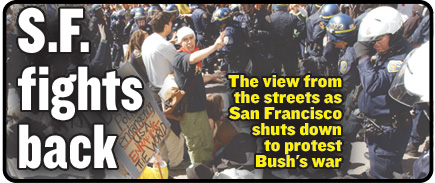
Nowhere was the clash of people power and government will more acute than on the streets of San Francisco, where a series of massive marches, some drawing nearly 100,000 people, filled the streets prior to the invasion of Iraq on March 19, 2003. The onset of war led protesters to effectively shut down the city, resulting in about 2,300 arrests and millions of dollars in costs to the city.

President George W. Bush dismissed the protests, of course, but he wasn’t the only one. Political leaders such as Rep. Nancy Pelosi, then-Mayor Willie Brown and soon-to-be Mayor Gavin Newsom (who didn’t attend any of the marches, unlike progressives on the Board of Supervisors) condemned the peace movement for hurting an innocent city. But with the “battle for San Francisco” making international news, the protesters were more concerned with the global audience.

A month earlier, on the weekend of Feb. 15 and 16, there were coordinated protests against the impending war in about 800 cities around the world, drawing around 10 million people. The peace march in Rome included about 3 million people, earning a listing in the Guinness Book of World Records as the largest anti-war rally in history. People have never made such a loud and clear statement against an incipient war.

Beyond the numbers, the antiwar movement was also right. On every major issue and prediction, the messages from the street proved correct while those from the White House were wrong. The US wasn’t welcomed as liberators. There were no weapons of mass destruction. Iraq after the invasion isn’t a stable democracy or shining beacon to anyone but the new generation of jihadis Bush created.

We can blame a hard-headed president, ineffectual opposition party, failure of the national media, or the national climate of fear following Sept. 11. But rather than refighting that lost battle, now is the time to gain perspective on the events of five years ago and determine what it means for democracy and the post-Bush national agenda.


TO THE STREETS

There were two main umbrella groups organizing protests before the war: Direct Action to Stop the War (DASW) and International ANSWER (Act Now to Stop War and End Racism). ANSWER has remained active and DASW has recently been reconstituted for the fifth anniversary of the war, using direct action in San Francisco as well as other urban centers and outposts like Chevron’s refinery in Richmond, which has reportedly been processing Iraqi oil.

“With the fifth anniversary coming up, we’re going back to direct action on the streets,” said Henry Norr of DASW. “But I don’t have any illusions that it’s going to be like it was five years ago.”

The maddening march to an ill-advised war created a political dynamic in which a broad cross-section of Americans was willing to hit the streets.

“We had a wonderfully diverse group of people, from soccer moms to anarchists,” said Mary Bull, who cofounded DASW, a collective of various affinity groups and concerned individuals formed in October of 2002 as Bush started beating the drums of war.

It was a group fiercely determined to prevent the war — and really believed that was possible. In fact, Bull recalls how she and other members of the group burst out crying at one meeting when a key activist said the war was going to happen.

Richard Becker, who cofounded ANSWER and serves as its West Coast coordinator, said that in the summer of 2002, “we came to the conclusion that [the war] was going to happen.” The group called its first big protest for Sept. 15, 2002, and another one two weeks later. But the movement really exploded on Oct. 26 when almost 100,000 people took to Market Street, much of it a spontaneous popular uprising.

“We were overwhelmed,” Becker said. “We were in a perpetual state of mobilization to keep up with what was going on. But then it didn’t stop the war.”

Did he think they could?

“I think a lot of people thought maybe it was possible to stop it. And we thought maybe it was possible to stop it,” Becker said.

The high point, according to Becker and Norr, was Feb. 17, 2003, when the New York Times ran a front page analysis piece entitled “A new power in the streets” that claimed “the huge anti-war demonstrations around the world this weekend are reminders that there may still be two superpowers on the planet: the United States and world public opinion.” But then Colin Powell went to the United Nations to argue for the invasion, and the Democrats in Congress did nothing, and it became clear war was coming.

Norr stayed out there protesting, being arrested several times and even shot in the leg by Oakland police with a rubber bullet during a protest at the Oakland docks. And he thinks some good came from the experience.

“The lesson for people is the political and economic elites are committed to preserving and extending empire. And they basically say as much in their own writing,” Norr said. “Wars are not anomalies.”

Despite being a frustrating and depressing exercise, most saw benefits to the failed movement. “People got an incredible education about how the system really worked,” Becker said. “Building a movement is mostly about a series of setbacks.”

Medea Benjamin, cofounder of both Global Exchange and CodePink and fixture of the anti-establishment peace movement for years, was upbeat about the protests. “We did our job as citizens. We did what we were supposed to do: organize, get people to take action, get people onto the streets,” she said. “We did everything we could think of.

“What you take from it is we don’t have a very well-developed democracy because the people spoke and the government didn’t listen.”

25war2_Lars1.jpg The ever-evolving “Democracy Wall” on Valencia Street, March 2003, helped stir up debate (Photo by Lars Howlett)


FACING ARREST

The collective action of five years ago starts with a series of personal stories — tens of thousands of them — so let me briefly begin with mine.

My arrival in San Francisco was closely tied to the march to war. I was living in Sacramento and working as the news editor of the Sacramento News & Review when Bush began his saber rattling against Saddam Hussein, but by the end of 2002 I had a falling out with my boss and found myself jobless.

Like most Northern Californians who opposed the war, I came to San Francisco on Jan. 18 to make my voice heard and experienced a bit of serendipity on my way to Justin Herman Plaza: while reading the Guardian on Muni, I saw their advertisement for a city editor, a job that was ideal for me at a paper I’ve always loved. Needless to say, it was a great day, empowering and full of possibilities.

Less than two months later I was on the job, and on the second week of that job I was back on the turbulent streets of San Francisco, part of a Guardian team covering the eruption of this city on the first full day of war. When I stepped off the cable car just after 7 a.m., people were streaming up Market Street and I joined them.

When a large group stopped at the intersection of Market and Beale, I stopped too, taking notes and bearing witness to this historic, exciting event. I had a press pass issued by the California Highway Patrol that allowed me to cross police lines, so when police in riot gear surrounded us and threatened arrest, I held my ground with 100 or so protesters.

After interviewing about a dozen people about why they were there and that they hoped to accomplish (see “On the bus: Journalists, lawyers, four-year-olds — the cops were ready to bust anyone Thursday morning“), I was arrested with the others and taken to a makeshift jail and processing center at Pier 27 (no charges were filed in my case, and charges against all of the 2,300 people arrested here in those first few days of the war were later dropped).

I recently tracked down a few of the people who appeared in my article, including Daphne and Ross Miller, who were at the center of the most interesting drama to play out during our standoff with the police. She’s a family practice physician, he’s an architect, and they live in Diamond Heights with their two children, Emet, who is almost 9, and Arlen, 12, who was away on vacation when the war began.

“We were genuinely shocked that the war started,” Ross told me. “We were at some of the earlier protests and really thought there was no way [Bush] could do it.”

They woke up March 20, 2003, to news that the war had begun and immediately walked to the BART station with Emet and rode to the Embarcadero station, not really planning for the day ahead but just knowing that they had to make themselves heard.

“We were pissed as hell. I don’t think I’ve ever been so angry in my life,” Daphne said.

They quickly came up with a plan. “We basically decided that if anyone was going to be arrested, it was going to be Ross and I’d stay with Emet. But it didn’t end up that way and I ended up in the arrest circle.”

Daphne had their house keys and threw them over the police line to Ross at one point. A photographer in the circle had gotten shots of a man named Roman Fliegel being roughed up by police as they pulled him off his bicycle, which was towing a trailer with a sound system, and decided to throw his backpack with camera gear out as well. When Ross — who had four-year-old Emet on his shoulders — caught it and refused police orders to give it to them, police grabbed Emet and roughly arrested Ross, leaving a gash on his forehead.

“Rage surged through the crowd, and it seemed as if things might get ugly, but the police kept a tight lid on the situation, using their clubs to shove back protesters who had moved forward,” I wrote at the time.

Emet was delivered into the circle with Daphne as the arrests continued, many quite rough. “At that point, as a mom, I had to exercise the most restraint ever,” said Daphne, who was angry about the situation but fearful about what she was exposing her son to. “Please, don’t let any violence happen here,” she pleaded with the crowd. Eventually, commanders on the scene let the mother and child go.

“The officer who let me go said that if he saw me again out there, he would call Child Protective Services on me,” Daphne said. But two days later, still brimming with outrage at her country’s actions, she ditched a downtown medical conference to rejoin the street protests, this time solo.

The couple say they’ve lost friendships over the war and have become more engaged with politics, coming to believe that Bush and the neocons are malevolent figures who knew how badly the war would go and did it anyway to establish a large, permanent military base in Iraq.

“Since that day, we’ve been far more active,” Ross said. “We realized you can’t just trust the system. You have to push.”

But that determination was mixed with feelings of disempowerment and depression. They attended some of the protests that following year, but the couple — like most people — just stopped going at some point because they seemed so futile.

“There was a horrible sense of resignation and a genuine depression that followed,” Ross told me.

The nadir was when Bush was reelected and they considered leaving the country. But then, Ross said, “we decided we’re not just going to run away and we’re not going to accept this.” Looking back, even with the scare over Emet, they express no regrets.

“It was the right thing to do because it was the wrong war to have. I’d do it again and again and again if I had to,” Ross said

They’re guardedly hopeful that Barack Obama could begin to turn things around if he’s elected. “I think the right president can at least start to dismantle this,” Daphne said. “I think thousands of people marching in the streets is something he would listen to.”

25war3_Charles1.jpg A die-in on the streets of San Francisco in March 2007 marked the fourth anniversary of the invasion (Photo by Charles Russo)


WITNESS TO HISTORY

Covering the peace movement in those early days was a heady experience, like reporting on a revolutionary uprising or working in a foreign country where the people are organized and active enough to be able to shut down society and brave enough to risk bodily injury for their beliefs.

I was at the founding meeting of CodePink — which became the most effective group at personally confronting the warmongers and keeping the war in the public eye — one evening at Muddy Waters in the Mission District shortly after the war started.

Looking back, Benjamin rattled off a long list of the alliances the group built — with labor, churches, businesses, and a wide array of social movements — and creative actions intended to build and demonstrate popular support for ending the war.

“We’ve done so many things and what did we get? We got a surge,” she said. “It shows the crisis in our democracy, the crisis of the two-party system, the crisis of a dysfunctional opposition party.”

Yet she said the peace movement has been remarkably successful in convincing the public that the war was a mistake and that it’s time for the troops to come home, even if the Democrats have been slow to respond to that shift.

“The progress we’ve made is turning around public opinion and that’s going to play a big role in the upcoming elections,” she said. For Norr, the role of the news media is a particular sore spot. He was a technology reporter for the San Francisco Chronicle who called in sick on the first full day of war and was arrested on Market Street with his wife and daughter, resulting in suspension by editor Phil Bronstein for his actions.

I wrote several stories on the issue, which culminated in Norr being fired and Bronstein unilaterally banning Chron employees from peace protests. I even borrowed CodePink’s guerilla tactics when Bronstein repeatedly refused to return my calls or address why he had singled out antiwar protesters for uniquely punitive treatment. I confronted him during a speech he gave at the Commonwealth Club (see “Lies and half-truths,” 5/7/03). That was the tenor of the times: we were all tired of being lied to and we decided to push back.

Norr was particularly frustrated with his own paper’s reporting of the war and started sending articles by the foreign press to his paper’s news desk, trying to wake his colleagues up to the pro-war propaganda being passed off as journalism in this country.

He was also disappointed with the country and with the Chronicle — both the management and his fellow reporters, who did little to support him — but the experience caused him to return to his roots as a progressive activist.

“The war and losing the job and everything brought an abrupt end to my consumerist phase and dumped me back into the world of being an activist,” said Norr, who serves on the KPFA 94.1 FM local station board and has made three recent trips to the Palestinian territories while working with the International Solidarity Movement.

Benjamin said Americans shouldn’t expect the next president to end the war — not without lots of pressure from a renewed and vocal peace movement. “This is the time to set the stage for the post-Bush agenda,” Benjamin said. “Don’t put your hopes in Barack Obama in getting us out of Iraq. Put your hopes in the people.”

25war4_Lane1.jpg A rally and nonviolent direct action at the Richmond refinery targeted Chevron on March 15 (Photo by Lane Hartwell)


THE AFTERMATH

The San Francisco Police Department, which spent more than $2 million on overtime costs responding to peace protests between March 15 and April 16, 2003, generally behaved with restraint and professionalism, but there were several exceptions.

The most costly and disturbing incident came when Officer Anthony Nelson began aggressively swinging his long riot baton at protesters, badly shattering the arm of peaceful protester Linda K. Vaccarezza, who suffered a permanent disability in her career as a court reporter.

Nelson’s incident report falsely stated that Vaccarezza had threatened him with a sign attached to a solid pole, but video of the incident later clearly showed there was no pole and that she was retreating when he teed off on her (see “The home front,” 05/19/04).

Vaccarezza received an $835,000 settlement from the city in November of 2004. On Oct. 5, 2005, two and a half years after the incident, SFPD fired Nelson for lying about what happened that day, and the City Attorney’s Office has been successfully fighting Nelson’s appeals in court ever since, putting in more than $100,000 in attorney time and costs into the Nelson and Vaccarezza cases.

The other significant ongoing litigation from the antiwar protests involved Mary Bull, who was arrested during an early protest for pouring fake blood in front of the entrance to Chevron’s San Francisco office before being allegedly strip searched and left naked in her San Francisco Jail cell for 36 hours.

Ironically, Bull was among those who brought a successful class action lawsuit against Sacramento County after she and others protesting a logging plan were strip searched, setting a precedent and led most counties to reform their strip-search policies. She used her share of the $15 million judgment to buy an organic permaculture farm in Sebastopol.

Her San Francisco case, in which Bull won a multimillion-dollar judgment, is still under appeal and now in mediation. Bull said the protests five years ago did make a difference, something she tells those who fret about its apparent failure. “I tell them to look at what issues the candidates are talking about now and I thank them for protesting then.”

“Even though we had millions throughout the world, we were sort of blocked, but now we’re regaining that momentum,” Melodie Barclay, a massage therapist who was also arrested with me on the first day of the war, told me recently. “We can’t judge it by the fact that we didn’t get the momentum we wanted.”

Norr started his antiwar activism working with Students for a Democratic Society in Boston, protesting the Vietnam War, which he said shares many similarities with the current situation, for good or for ill. He said that people tend to forget that while the protests then were huge and helped end the war, the movement did wane after Nixon ended the draft and substituted massive aerial bombardment for boots on the ground.

“The protests dropped off considerably,” he said. “A lot of the things that drove people to take risks in the late ’60s had faded by the early ’70s.”

He thinks the current administration learned a lesson from those days: it’s easier to maintain a war effort if the average citizen isn’t affected.

But there are other factors as well keeping a lid on the antiwar outrage.

“The culture has changed too. Young people are oversaddled with debt. People in schools seem to be docile. The culture as a whole seems to be more individualist and consumerist,” Norr said.

Yet some young people have woken up and many of them are funneling their energies into a peace group that was formed in the summer of 2005: World Can’t Wait, as in: the world can’t wait for the end of Bush’s second term before we change our direction and leadership.

“We don’t just want them gone, we need to repudiate their program,” said Giovanni Jackson, a 26-year-old WCW student organizer. “If we’re going to change anything, we need the youth.”

Jackson was at WCW’s founding convention in New York City, which came just as New Orleans was being flooded and then essentially abandoned by the federal government.

“When [Kerry] lost, people felt demoralized and World Can’t Wait kind of stepped into that situation,” Jackson said. “There was a lot of demoralization in the antiwar movement at that time.”

The group organized protests and student walkouts on Nov. 2, 2005.

“Everyone has their moments of doubt,” he said, “but I’m motivated by the crimes we see everyday.”


THE LESSONS

One of the biggest barriers to galvanizing people and turning the fifth anniversary of the war into something that might make a difference is the presidential election, which is diverting the energy of many potential protesters — and at the same time, offering some hope that a new president may lead to peace.

After all, every single one of the Democratic presidential candidates has promised to withdraw troops from Iraq, with varying timelines and numbers of US personnel left behind. And with enough encouragement, they might be willing to help change the status quo.

Many of the activists who volunteered their time and money to help move the Obama campaign into its front-runner position came out of the antiwar movement, and Obama’s strong stand against the war has been a key factor in his popularity.

Becker and some other activists don’t have much faith that a change in presidents will change the course in Iraq, although he agrees that much of the energy now surrounding Barack Obama derives directly from the antiwar movement.

“There’s been a huge upsurge of hope for Obama and that he might bring about the kind of change we need,” Bull said, adding that she doesn’t share that hope, believing the only path to peace is to pressure Obama and other leaders to commit to more progressive positions.

Norr said, “On one level, people have illusions about the power of peaceful protests. People believe in democracy, as well they should. We feel like the rulers should be paying attention to public opinion.

“It’s a remarkable story how broadly and quickly the American people have turned against the war. Public opinion was certainly ahead of the Democrats.”

And people will only grow more disenchanted with Iraq and its multitude of costs. “The people here are paying for this war, and everyday we have new stories about health clinics being shut down,” Becker said.

Becker was amazed last March as massive demonstrations for immigrant rights seemed to explode out of nowhere. “We think there will be more things like that,” he said.

Because after five years of organizing communities to resist the military-industrial complex’s plans, Becker thinks there’s been some visible progress.

“There isn’t a town or hamlet in the US that doesn’t have activism going on, but you wouldn’t know it from the corporate media,” Becker said. “It’s a mistake for people to feel discouraged.”


The Guardian Iraq War casualty report (03/17/08)

0

At least 39 Iraqi civilians were killed today in a suicide bombing at a mosque in Karbala, according to the Associated Press.

For a breakdown of the positions that relevant politicians are taking on the war in Iraq, visit the slate.com link below. 36 U.S. soldiers were killed this month, which means at least one U.S. soldier was killed for every day that passed. Click here to view.

Casualties in Iraq

Iraqi civilians:

82,199 – 89,710: Killed since 1/03

Source: http://www.iraqbodycount.net

For a list of recent events that have resulted in Iraqi casualties, visit :
http://www.iraqbodycount.org/database/recent/

For first hand accounts of the grave situation in Iraq, visit some of these blogs:
ejectiraqikkk.blogspot.com
healingiraq.blogspot.com
afamilyinbaghdad.blogspot.com

U.S. military:

4,266: Killed since the U.S. invasion of Iraq 3/20/03

Source: http://www.icasualties.org/

145: Died of self-inflicted wounds, according to http://www.icasualties.org/

For the Department of Defense reports go to: http://www.defenselink.mil/

For a more detailed list of U.S. Military killed in the War in Iraq go to: www.cnn.com

To view a breakdown of U.S. military casualties by state of residence, click here.

Iraq Military:

30,000?: Killed since 2003

Source: http://www.infoshout.com

Journalists:

127: journalists have been killed since the start of the war in March, according to www.cpj.org.

Refugees:

2.2 million: Iraqis displaced internally

2 million: Iraqis displaced to neighboring states

Incessant violence across much of Iraq’s central and southern regions has forced tens of thousands of people to leave their homes every month, presenting the international community with a humanitarian crisis even larger than the upheaval aid agencies had planned for during the 2003 war, according to United Nations High Commissioner for Refugees’ estimates.

U.S. Military Wounded:

132,199: Wounded from 3/19/03 to 3/01/08

Source: http://www.icasualties.org/


The Guardian cost of Iraq war report (03/17/07): So far, $503 billion for the U.S., $63 billion for California and $1 billion for San Francisco.

Compiled by Paula Connelly

Here is a running total of the cost of the Iraq War to the U.S. taxpayer, provided by the National Priorities Project located in Northampton, Massachusetts. The number is based on Congressional appropriations. Niko Matsakis of Boston, MA and Elias Vlanton of Takoma Park, MD originally created the count in 2003 on costofwar.com. After maintaining it on their own for the first year, they gave it to the National Priorities Project to contribute to their ongoing educational efforts.

To bring the cost of the war home, please note that California has already lost $63 billion and San Francisco has lost $1 billion to the Bush war and his mistakes. In San Francisco alone, the funds used for the war in Iraq could have been used to provide 3,144,442 homes with renewable electricity, 726,370 people with health care, or 31,528 public safety. For a further breakdown of the cost of the war to your community, see the NPP website aptly titled “turning data into action.”

For more information on what the war is costing the United States visit the American Service Friends Committee website here.

SPORTS: A new Giant’s phenom

0

rookie2.jpg

By A.J. Hayes

PHOENIX — Norman Rockwell would hardly recognize today’s big league newbie.

The stereotypical hayseed wearing an ill-fitted suit and aw-shucks grin that Rockwell depicted in his “The Rookie” (1957), is much a thing of the past. If he really ever existed.

Today’s spring phenoms, more often than not have wallets larded with million dollar signing bonuses. They tool around in snazzy sports cars and idle away the hours plugged into their I-Pod thingies.

The kids today!

denker2.jpg

On first glance you might think Giants rookie infielder Travis Denker is just another pampered pup – especially when you hear that he inked his first shoe deal at an age when most kids are still trying to coordinate their Granimals.

But don’t jump to conclusions.

Yes, its true Denker did land his first professional sponsorship as a mere four year old – more on that later – but he’s also a bubble gum-snapping, run-out-every-ground-ball 22-year-old whirlwind that makes even the most jaded fans feel gooey inside.

“You can tell just by the way he stands at his position that Denker looks like a ball player. He could be Al Dark or Eddie Stanky,” gushed my 72-year-old friend Joel who’s seen every Giants club dating back to the mid-1940s. “He exudes a certain grittiness. He looks like he’s been in the majors for 15 seasons, not 15 minutes.”

The truth is the 5-foot-9, 193 pound Denker has never played a game in the big leagues yet, and in fact hasn’t played above Single-A ball. There’s no guarantee he will blossom into a big leaguer.

But the way Denker performed late last season for the San Jose Giants – helping the minor league club to the California League Championship – and the way he’s looked in major league camp this month, the scrappy Denker has optimistic San Francisco fans recalling the likes of Robby Thompson, Chris Speier and Dirty Al Gallagher.

“The pitchers are smarter and the game is much faster at the major league level,” said Denker. “But I feel I belong.”

Travis Denker

The Giants are in a rebuilding mode and are loading up on young talent. Other untested players who have looked good in camp include outfielders Clay Timpner and John Bowker and infielders Emmanuel Burriss and Brian Bocock.

Of all of them, the hard-nosed Denker appears closest to the majors.

Making the second baseman’s rise so much more enjoyable is the fact that the Giants have the arch-enemy Los Angles Dodgers to thank for him.

After going more than 20 years between trades, the century old rivals swapped players last August. The Giants sent veteran pinch-hitter Mark Sweeney to Los Angels in exchange for Denker.

Though he was battling some nagging muscle strains at the time, Denker batted a blistering .400 (10-for-25) over the Little Giants final regular season seven games. In seven post-season contests he batted .480, with 3 home runs and 7 RBI.

Denker could have easily mailed it in once joining the Giants organization or sat out for medical reasons, but he quickly assimilated to his new team and practically insisted on playing down the stretch.

“I wanted to be part of a championship club,” he said last week. “I knew I may never get another shot at something like that. I really wanted in.”

After leading all Dodgers minor leaguers in batting (.310), home runs (21) and RBI (68) in 2005, Denker struggled in 2006. But he was batting .294, with 10 homers and 57 RBI for Los Angeles’ Inland Empire club last summer when he was acquired by the Giants.

Despite growing up an hour from Dodger Stadium in Brea, Denker was not heart-broken by the deal to San Francisco.

“As a kid I was more an Angels fan, than a Dodgers fan,” he said. “And I’ve always loved the Giants colors.”

San Francisco orange and black does favor Denker. But it was another bruising color scheme – black and blue – that is most associated with the sport that led to Denker being sponsored by the Vans shoe company as a tyke.

“I was your typical California kid scooting all over on my skateboard, and next thing I knew I was in Florida on a skateboarding tour sponsored by Vans and Bactine – the bug bite stuff.”

Denker stuck with street surfing until scouts started showing up at his high school baseball games. Denker inked a deal with the Dodgers after batting a hearty .425 (34-for-80), with 11 home runs and 22 RBI as a senior at Brea High.

“I might jump on a board to go down to the corner store, but the competitive stuff is over,” Denker said. “It’s all about baseball now.”

PG&E’s Green War Chest?

0

Greetings, Californians for a Clean Energy Future! Welcome to the fold of innocuous sounding, pseudo-environmental political front groups. This one is brought to us by our buddies over at Pacific Gas and Electric Co.

The group, which doesn’t seem to have a Web site or any other physical manifestation outside of filings with the California Secretary of State, already has $340,000 ready and waiting for the upcoming election cycle. According to a Secretary of State spokesperson, the group was born on Dec. 21, 2007. The only contact is the law firm Nielsen Merksamer, which has a history of teaming up with PG&E to break the law for political gain.

So far, they haven’t spent a cent — all of which were dumped into the committee by PG&E in three lump sums. Wonder what they’re going to spend all that money on? Since it’s calling itself a “coalition of environmentalists, taxpayers, and Pacific Gas and Electric Company,” it could go for or against nearly anything — including boosting Prop 98 on this June’s ballot. If passed, the measure would kill rent control and make it illegal for governments to use eminent domain to seize utility infrastructure and use it to provide the services themselves, an idea San Francisco has considered in the past and Stockton is currently pursuing.

Fresh sips

0

› culture@sfbg.com

Spring is positively bursting with wacky holidays. Arbor Day? April Fool’s Day? Patriot’s Day? How the heck are you supposed to celebrate those with a cocktail or two? Figuring out what drink to pair with which spring holiday can become an overwhelming ordeal. Sure, the first few are easy: St. Patrick’s Day and green beer, Passover and four glasses of kosher wine. But what about the others? After a careful and tipsy review, I’ve paired some of my favorite local cocktails with these unusual days of celebration.

Rusty Robot Of all the major Christian holidays, Palm Sunday seems the least alcoholically celebrated, even though feasting is the order of the day. Why not figure in a Rusty Robot from Homestead? A combination of Wild Turkey, Tuaca, lemon, and bitters, it’s perfect for vigorous consumption. The lemon flavor is as wild as the Turkey, but the drink achieves a simplicity missing from most cocktails — the tastes don’t just augment one another; they smack together, almost like two palms. Get it? Homestead, 2301 Folsom, SF; (415) 282-4663.

Green Man Tea Just as we’re getting over our green St. Paddy’s Day hangover, we’re immediately hit with St. Joseph’s Day on March 19 — or more familiarly, the day the swallows return to Mission San Juan Capistrano. Bird lovers across California, rejoice! But with what? I encourage you to stick to something green-related, like Green Man Tea at Nihon Whisky Lounge; your system may not yet be ready for other colors. Made with lime and pineapple juices, green tea liquor, and single malt Scotch, this drink brings together two distinctly different flavors — the Scotch’s smokiness and the other ingredients’ fruity tang — to take delicious flight. Nihon Whisky Lounge, 1779 Folsom, SF; (415) 552-4400, www.nihon-sf.com.

Vieux Carre How do you raise a glass to a good April’s Fools Day prank? Since only rush-hour radio hosts and nine-year-olds actually carry out pranks, you probably don’t. So relax, there’s no need to fuss over this "holiday." Instead, take the time to savor a fine local drink. The Vieux Carre is a version of a classic New Orleans cocktail with its amalgam of rye, cognac, and sweet vermouth. It tastes more like Manhattan in 3-D, however, than it does an Old-Fashioned, Sazerac, or Sidecar — a high-powered, cheek-parching blast. Alembic, 1725 Haight, SF; (415) 666-0822, www.alembicbar.com

Take Your Pick Few outside Massachusetts, Maine, or Wisconsin celebrate Patriot’s Day, which falls on the first Monday in April. But it’s a great excuse to patriotically hoist one. Head to Dimples on Post and order whatever. The mirrored-out decor and neon light overload is so dazzling that your cocktail choice won’t matter — it’ll be like an early Fourth of July, but indoors. Go, USA! Dimples, 1700 Post, SF; (415) 775-6688.

Blue Tokyo Come Earth Day, the Blue Tokyo at Festa Wine and Cocktails should be the perfect drink to remind you that our island cities will soon be submerged, once the sea levels rise high enough. An unfussy mix of vodka, pineapple, and Curaçao amid Festa’s menu of ostentatious pear cosmos and pomegranate martinis, the drink is a useful aid to celebration — it’s almost a frat house cocktail in its simplicity. It wouldn’t jive at most bars, but at this kitschy lounge overlooking Webster — complete with fake skyline behind the karaoke stage — it works perfectly. Festa Wine and Cocktails, 1581 Webster, suite 207, (415) 567-5866.

Bohemian Forget the corporate beer and margarita mix branding that’s attached itself to Cinco de Mayo. Do something different, dammit, and head to Blondie’s Bar and No Grill in the Mission for a Bohemian. Along the same taste lines as, but more full-bodied than, a Cosmo, this well-balanced drink contains a generous dose of 151, so you can feel sunny and in sync with Cinco. Blondie’s Bar and No Grill, 540 Valencia, SF; (415) 864-2419, www.blondiesbar.com.

Sangre Amado Few complicated cocktails are as rooted in earthy flavor as the Sangre Amado, and no place in town makes it better than Catalyst Cocktails. After a fulfilling, tree-hugging Arbor Day, cozy up with this drink made with either vodka or gin, rosehips-hibiscus syrup, grapefruit juice, and fresh strawberries. For all its contents, the concoction is far from overwhelming, and it easily plants the seeds for another round. Catalyst Cocktails, 312 Harriet, SF; (415) 621-1722, www.catalystcocktails.com

Dark and Stormy Despite its name, this semiclassic cocktail — which gets its best treatment at Koko Cocktails — is the perfect way to kick off Memorial Day weekend and ease into the summer season. The taste brings to mind yachting through the Caribbean, which is why I hope the name is ironic. A smooth mix that falls halfway between a mojito and a whiskey ginger, this bevvie consists of ginger beer, lime, and a mild rum that makes it soar. KoKo Cocktails, 1060 Geary, SF; (415) 885-4788

White made right

0

Although "white" carries generally favorable connotations in our race-haunted society, the spell breaks at the gates of the wine kingdom. When Californians mention wines they like, the wines are almost always red ones — and more often than not, cabernets sauvignons. White wines? What are those?

To an extent, this bias can be explained by the great and unexpected success of (red) California wines at the famous Paris blind tasting of 1976, in which French judges ended up preferring the New World wines. But the vestigial glow of this triumph doesn’t explain why so many young people I know, many of them recently converted from beer to wine, already equate "wine" with red wine. Are red wines inherently superior?

Part of the issue could have to do with the fact that white wines are by nature more naked and skeletal than their red cousins. Their flaws tend to show, and they don’t have rich color or fruit-bomb radiance to distract us from noticing them. Another and more pertinent factor is the lackluster quality of so much California white wine. Many of the best whites still come from difficult little swatches of Europe (rainy Galicia, stony Sardinia, chilly Burgundy, the chalky Loire Valley), while our homegrown grapes, having lived the high life in rich soil and warm sunshine, too often produce wines that are flabby and flubbery (in the case of chardonnay) or aggressively grassy (in the case of sauvignon blanc).

Of course, I overgeneralize — but with intent. There are good white wines of California provenance to be found, and it’s fun to try to find them. You might have met despair while locked in the bathroom at a party, spitting up yet another overcooked chardonnay, but you will be all the more grateful when you take your first silvery sip of Navarro’s dry riesling, or Dry Creek’s utterly Loire-like chenin blanc — or if you are bound and determined to find a good California chardonnay, the unoaked chardonnay from Clos LaChance. The winery is slightly off the beaten path, in the foothills south of San Jose, and the wine is nearly Burgundian in its well-managed acidity (like a sharp knife with a sumptuous handle), crisp apple-y character, and wondrous lack of buttery bloat. If you’ve gagged on your last slug ever of party chardonnay, a gentle tipple of this stuff should settle you down nicely.

Paul Reidinger

› paulr@sfbg.com

Pacific Catch

0

› paulr@sfbg.com

When a service station is torn down to make way for an art gallery, we cheer. When the art gallery folds and is succeeded by a restaurant, we shuffle our feet uneasily. At least they won’t be tearing the building down to bring back the service station — but art galleries are harder to find than restaurants.

Pacific Catch is a pretty good seafood restaurant in a neighborhood already chockablock with restaurants. The prices are moderate, the service is friendly and efficient, the food is good, and the look is handsome in a not-overbearing way. But those who remember that the space was home for several years to the Canvas Gallery — a blend of art forum, café, restaurant, and meetinghouse, with a general university-town flavor — won’t recognize much when they step inside. The interior floor plan has been heavily reworked: the central coffee and pastry bar, once surrounded by naves hung with paintings and photographs, has been replaced by tables, chairs, and booths. There is also now (at the far side of the restaurant as you enter) a shiny and bustling exhibition kitchen, along with a bold color scheme of red and blue, and light fixtures that look like clusters of bottomless Bombay Sapphire gin bottles. All that remains of the original layout is a smaller dining room along the building’s north face, looking across the busy street at Golden Gate Park.

Still, there is a nice irony in the transformation of a filling station — or indeed any other urban eyesore — into a haven of civilization, whether it’s a locus for art or food, and to have a seafood restaurant on a site that once reeked of gasoline fumes must be accounted an improvement by any standard. I only wish Pacific Catch weren’t a nascent chain; there’s a tiny sibling outlet on Chestnut in the Marina, another (of unknown scale) in Corte Madera, and a general sense, as a friend of mine put it, that still more Pacific Catches can’t be far off.

The food is accordingly mainstream, with tweaks and tunings that reflect sensibilities on either side of the Pacific, trending sometimes in an Asian direction and at others in a Latin American one. Among the great Mexican seafood dishes must be the fish taco, and Pacific Catch offers several versions ($4.25), all creditable on their beds of shredded cabbage: Baja, with chunks of batter-fried halibut or cod; grilled mahimahi, slathered in the restaurant’s ubiquitous avocado-tomatillo salsa; and barbecue shrimp, enlivened by little flares of fresh ginger (a nod across the Pacific there). Side dishes enhance the south-of-the-border aura; black beans ($2.95 for a sizable crock) are well seasoned and sprinkled with crumblings of queso fresco, while grilled corn ($2.95) — still on disks of cob — is suitable for dipping into accompanying pats of chipotle butter.

If Pacific Catch can seem like a cantina in Cabo San Lucas, it can also present itself as a sushi bar on Maui. A variety of sashimi is offered (as is its New World cousin, seviche), along with a selection of sushi rolls and — for that Hawaiian touch — poke ($8.50), cubes of lightly seared ahi drizzled with soy sauce and served atop a Fritos-like mélange of rice chips. The poke is temperamentally well suited to share table space with wakame (seaweed) salad ($3.95), a staple of sushi bars and notable here for its considerable size. The salad is plenty for two and could even satisfy four if other treats were on the way.

The grilled salmon ($19.95) — a deftly grilled filet — had been organically farmed in British Columbia, which relieved some of my unease at having it, since farmed salmon is usually a big no-no. The so-called California presentation itself was pleasant if unremarkable and consisted of a huge scoop of brown rice, several stalks of steamed asparagus (with basil aioli for dipping), and under the fish, a confit of tomatoes and lemon.

Even if Pacific Catch is mostly a seafood restaurant, you don’t have to have seafood. You could have grilled skirt steak ($18.95), glazed with miso, cut into tender slices, and plated with a huge scoop of white rice, a salad of picked cucumber threads, and a pile of deceptively pale kimchi that packed a real and thrilling wallop of garlic and chili pepper. My only complaint about these large plates is that they did look like subcompacts coming off an assembly line: this one got an extra cup holder from the parts bin, that one a CD deck in the dashboard — but otherwise they heavily resembled one another in a bolted-together way.

Dessert tends to soothe complainants of most stripes, luckily, and Pacific Catch has at least one quite good dessert: a sundae ($6.50) built on a macadamia-nut brownie. The brownie isn’t a doodle or add-on here, an extra calorie payment stuffed into a sundae glass with gobs of ice cream, as is so often the case with brownie sundaes; instead, it’s like Huck’s raft, sprawling and commodious, and the blob of macadamia-nut ice cream on top is almost a condiment. Other condiments include twin oozings of hot-fudge and caramel sauces.

There’s one element of the mix that hasn’t changed much in the metamorphosis, and that’s the crowd. It remains young and collegiate- or postcollegiate-looking, although the noise level has risen noticeably. In the old art-café days, people tended to keep even their more intense conversations at murmur level; now, without the elevating presence of art beyond some paintings of fish on the walls, there is a tendency to hoot and bray, if you catch my drift.

PACIFIC CATCH

Sun.–Thurs., 11 a.m.–10 p.m.;
Fri.–Sat., 11 a.m.–11 p.m.

1200 Ninth Ave., SF

(415) 504-6905

www.pacificcatch.com

Full bar

MC/V

Noisy

Wheelchair accessible

What the verdict meant

0

>>Read more at www.sfbg.com/lawsuit

› tredmond@sfbg.com

The press coverage was impressive: The San Francisco Chronicle put the story on page one. KTVU-TV made it the third item on its 10 O’Clock News. Editor and Publisher, the newspaper trade journal, picked it up, as did Forbes magazine. The San Francisco Daily used a front-page bold banner headline: "Jury punishes chain."

And indeed, as anyone who follows the local news media is aware by now, a San Francisco jury March 5th ruled that the SF Weekly and its corporate parent, Village Voice Media, illegally sold ads below cost in an effort to harm the Guardian. The jurors awarded $6.3 million in damages, and since the law allows as least part of that award to be trebled, the Weekly and VVM could be liable for as much as $15.6 million.

VVM already announced it will appeal, which means it’s unlikely the Guardian will see any cash award for several years as the case works its way through the legal system. But in the meantime, we will be asking Judge Marla Miller to issue an injunction barring any further below-cost sales.

Under state law, interest on the judgment will accrue at 10 percent a year. That means the Weekly and VVM will be paying $4,000 a day in interest for as long as they seek to dispute and appeal the jury decision.

The verdict alone sends a powerful message that goes beyond the newspaper industry. California’s Unfair Practices Act, a Progressive-era measure, forbids a big chain with deep pockets from coming into town and using predatory pricing to run a locally-owned, independent operation out of business. A San Francisco jury has confirmed that the law can be a powerful weapon against the consolidation of news media — and the chain-store assault on local merchants.

Not surprisingly, VVM’s principals have said they are going to try to invalidate the law in the courts. In a written statement posted to the SF Weekly Web site, the chain says it doesn’t think the law ought to apply to competitive markets.

Of course, the entire point of our lawsuit was that the Weekly and VVM wanted to end competition — that the chain was trying to harm its only direct competitor in the San Francisco marketplace. And that’s precisely what the law was written to prevent.

As James R. McCall, a law professor at Hastings, wrote in a 1997 article for the Pacific Law Journal, "the commercial practice of knowingly selling below cost with the intent to injure competitors or injury competition has long been considered unlawful by American courts and state legislatures."

The trial produced reams of evidence and extensive testimony on the business practices of both papers, and provided some remarkable insights into how the nation’s largest alternative newspaper chain operates. Some highlights:

VVM, which has built highly profitable papers in many national markets, fared very differently here. The chain bought two papers that were profitable concerns — the SF Weekly in 1995 and the East Bay Express in 2001 — and turned them both into huge money losers. Over the past 12 years, the company lost some $25 million in the Bay Area, and has pumped $13 million from corporate headquarters into propping up the Weekly.

Financial data presented in court showed that in markets where the chain faces no direct competition from a strong alternative paper, VVM is practically printing money. Profits in Denver and Phoenix were sky-high, sending some $40 million back to corporate headquarters over about 10 years. But in places where a strong competitor challenged the VVM paper — San Francisco and Cleveland being the two most notable examples — the chain was losing money or its profits were much thinner.

The folks in Phoenix were obsessed with going after the Guardian. The record is littered with e-mails between VVM headquarters and the SF office discussing ways to get ads out of the locally owned paper. The Weekly publishers had to send a regular "Guardian report" back to Phoenix to show how the two papers stacked up. Weekly publishers admitted that they might have offered special bonuses to sales reps who took ads away from the Guardian.

In fact, three witnesses testified that on the day he bought the Weekly in 1995, Mike Lacey, one of the chain’s two principals, threw a copy of the Guardian on the floor and vowed to put us out of business.

The jurors found that sort of behavior strong evidence of predatory intent. One panel member, Kerstin Sjoquist, a local business owner and graduate student, said in an interview that "it felt overly predatory on the part of the Weekly" and that "the predatory intent trickled down from the top."

You could see that same intent by the way the Weekly covered the trial. None of the local reporters at the paper were in the courtroom; instead, the chain brought in one of its top editorial executives, Andy Van De Voorde, from Denver to write about the case every day. And the blog posts he authored were about as personally vicious as anything I’ve seen in a long, long time.

Van De Voorde portrayed this entirely as an attempt by Guardian publisher Bruce Brugmann to shake down the Weekly and VVM for money. (And he never reported on the fact that the evidence clearly showed Bruce and his wife, Jean Dibble, had never taken big profits out of the paper and had instead reinvested money to improve the Guardian.) From the start, Van De Voorde called the suit silly and stupid and tried to make the case that the Guardian had no evidence at all to prove predatory pricing.

As the case wore on, he started to change his tune: by the last few days, he was tacitly acknowledging that there was a chance the Weekly would lose, and he started attacking the law itself. In the end, he told me he "wasn’t surprised" by the verdict — although for weeks his blog posts had taken the position that the Guardian couldn’t possibly win.

The Weekly‘s lawyers essentially argued that their own client was unable to handle pressure from the Internet and unable to adapt to a changing marketplace. Expert after expert on the VVM payroll testified that both the Guardian and the Weekly had seen revenues drop because of outside market forces in San Francisco that apparently were completely beyond the coping ability of a national chain that was making money hand over fist in the rest of the country. In his closing arguments, H. Sinclair Kerr, the Weekly‘s lead attorney, insisted that the market for alternative newsweekly advertising had shrunk and that both papers were, in essence, failing.

That contrasted dramatically with testimony from the only expert witness for either side who had actually run a weekly newspaper. Bill Johnson, publisher of the Palo Alto Weekly, testified that the Internet was not destroying alternative papers and that it was entirely possible to make money in the Bay Area, even during a tough economy. He pointed out that, unlike daily newspapers that rely increasingly on wire-service stories, alt-weeklies offer unique content that can’t be found anywhere else. And the people who are looking for those stories make up a lucrative market for advertisers.

His conclusion, after attending much of the trial and viewing much of the economic evidence: the reason the Guardian was losing revenue was that the Weekly had systematically depressed the price of display ads in the alternative weekly marketplace. And the chain paper was able to do that because of its deep pockets.

Numerous witnesses agreed that the Weekly could have raised its rates and made a profit. But that would have made it possible for the Guardian to compete for those clients — and VVM wanted the market to itself.

In the end, the jury got the message: the Guardian has been hurting badly all these years not because of any external factor but because a rich competitor was selling below cost.
That, Johnson testified, was exactly how predatory chains operate. "It happens," he said, "all the time."

The Guardian was (well) represented by Ralph Alldredge, Rich Hill and E. Craig Moody

Freedom of Information: Virtual meeting

0

› news@sfbg.com

Forget smoke-filled rooms and paper shredders — today’s government officials can elude public scrutiny from the comfort of their own e-mail accounts, conducting virtual meetings to do the public’s business.

To curb such activity, provisions in both the Brown Act (the state law governing open meetings) and the San Francisco Sunshine Ordinance have been interpreted as prohibiting the use of electronic communication between members of policy bodies. But not everyone has been heeding the rules, particularly in this hyperconnected age.

The TechConnect Task Force, a now disbanded advisory body charged by Mayor Gavin Newsom with creating a plan to bridge the city’s digital divide with free wireless Internet service, frequently used an e-mail listserv to conduct its business.

"Since these things were publicly posted right away, I should think there would be a transparency that advocates would like," said Emy Tseng, a member of the task force. "It was useful in the way e-mails and listservs are useful to anyone."

However, many contend the task force was engaging in activities prohibited under the city’s Sunshine Ordinance, even if the intent was to provide greater public access to the group’s work. Tseng, who claims to have never been informed by the City Attorney’s Office that the group might have been in violation of Sunshine laws, expressed the frustrations of many throughout the city who must comply with open-meeting policies.

"If you don’t use e-mail in this day and age, what can you do?" she asked. The answer, according to state and local laws, is to conduct public business in a public meeting, with the agenda posted in advance and where anyone can attend.

State and city public-disclosure laws apply to all "policy bodies," which can include nearly every government-sanctioned board, commission, or task force. Some members of these bodies have been suspected of vioutf8g open-meeting and public-disclosure laws through the use of online communication.

Seriatim meetings are presumably the most common illegal activity occurring under both open-information laws, although they are the hardest to detect. A seriatim meeting occurs when one member of a policy body privately contacts another, who then contacts another, in a chain of communication that eventually constitutes a quorum of the group.

An e-mail that is forwarded along to enough individuals, or a round of mass e-mails, would constitute a seriatim meeting, according to attorneys who spoke with the Guardian. While e-mail forwarding is a common practice for any office worker, some are just an unassuming click away from breaking the law.

"I would absolutely make it clear that anybody subject to the Brown Act or Sunshine [should] not communicate through e-mail," said Thomas Burke, a San Francisco-based attorney who specializes in media and Internet law and has represented the Guardian. "This could go on for years because people are not in the loop."

The Brown Act, passed in 1953 by the California Legislature, expressly bans a legislative body from using "technological devices" in order to communicate about topics relevant to the work of that body.

"The Brown Act itself forbids the majority of ‘technological devices’ — which is essentially anything you could imagine," said Terry Francke, director of Californians Aware, who also drafted amendments to the act in the early ’90s. Under the Brown Act, a committee member can be slapped with a misdemeanor for the intent to withhold information from the public or conduct prohibited meetings.

Many of the same issues are also addressed in the San Francisco Sunshine Ordinance, filling in more restrictions and open information requirements. Ironically, the TechConnect Task Force was charged with creating universal access to online discussions like theirs, although few legal experts think even that would nullify the requirement for open, public meetings in a physical – rather than virtual – setting.

According to a report released by the San Francisco TechConnect Task Force, 32 percent of Americans do not have access to the Internet. In San Francisco, certain populations are even worse off compared to national averages — for instance, women and the elderly.

"You have to consider if people are going to have equal access to meetings," Burke told the Guardian. "There is still a digital divide. As a public entity they have to be sensitive to this."

Recently, members of the city’s Peak Oil Task Force inquired with the City Attorney’s office about using Yahoo! Groups or a blog to increase efficiency on the all volunteer committee. Attorneys advised the group to stay away from Internet communication, as it can easily lead to prohibited seriatim meetings. Jeanne Rosenmeier, who is the chairperson of the task force, now spends more committee time trying to determine alternative ways to engage the public.

"It is certainly something that should be rewritten, to deal with modern technology so it corresponds with today’s reality," Rosenmeier told the Guardian. "If we have a public e-mail listserv that anyone can sign on to, that seems transparent; or if we have a blog, that’s pretty transparent."

In other cities that do not have sunshine ordinances, teleconferencing may be used legally under the Brown Act to conduct meetings. In Los Angeles, for instance, some boards and commissions teleconference when members would need to drive a few hours just to meet. There is some speculation that the language of the Brown Act could be augmented under this provision to allow for online communication, but there are no major groups pursuing the amendment.

In 2001, former California Attorney General Bill Lockyer wrote an opinion declaring the use of e-mail between policy-body members as an infraction of the Brown Act, even if the e-mails were made publicly available. "Members of the public who do not have Internet access would be unable to monitor the deliberations as they occur," the opinion states. "All debate concerning an agenda item could well be over before members of the public could [participate]."

According to the Sunshine Ordinance Task Force, there have been no complaints filed concerning prohibited online meetings, however there have been public information disclosures of private e-mail messages over the years. Recently, a group of deputy city attorneys were required to turn over an e-mail correspondence when a member of the public filed a complaint.

While Peter Scheer, director of the California First Amendment Coalition, understands the frustration of government officials who must abide by the cumbersome laws, he thinks the tradeoff is well worth it.

"The whole rest of society uses the power of e-mail and the only business that can’t use it is government, because they’re subject to the Brown Act," Scheer told the Guardian. "But we made the tradeoff already in efficiency versus accountability, to force all meetings and information to be open to the press and public."

>1...184185186...219Page 185 of 219