California

The Governor and the condemned man

0

Dick Meister, a San Francisco-based columnist, covered the Caryl Chessman case as a reporter for The Associated Press, correspondent for The Nation
magazine, and commentator for Pacifica Radio, which won a Peabody Award for its coverage. Contact him through his website, www.dickmeister.com.

It’s February 19, 1960. Caryl Chessman, tall, broad-shouldered, hawk nosed, sits on the edge of a hard, narrow bed. Clenching his fists and biting his lips, he stares at the bare walls of Cell 2455, Death Row, then out through a small, barred window and across the dark waters of San Francisco Bay – from San Quentin Prison to the lights of the city.

One-hundred miles north, Edmund G. (Pat) Brown, the pudgy, owlish 32nd governor of California, also sits alone, perched on the edge of an overstuffed arm chair. Puffing incessantly on a cigar, he studies the ornate design in the pale green wallpaper that covers the walls of the Victorian parlor of the governor’s mansion in Sacramento, as he agonizes over whether to spare Caryl Chessman from execution the next morning.  Outside, I and a half-dozen other reporters, chilling in the harsh night air, anxiously await his decision.

It’s been fifty years. Yet the events of that cold February evening and those immediately preceding and following them, remain vivid in my memory, and surely in the memories of many others, as among the most dramatic in modern California history.  Californians weren’t alone in their concern over whether Chessman should be executed, for the Chessman case had become a major issue internationally, with millions urging Gov. Brown to spare Chessman.

Pat Brown was one of California’s finest governors. He was, as he once said of John Kennedy, a chief executive who carried out a strong belief  “in people and the political process for solving human problems.” Brown’s contributions were many, and among the most important were those stemming from that agonizing night. The evening was as significant for Chessman, whose courage and determination inspired people throughout the world to actively oppose capital punishment. His actions, as those of Brown, had a profound and lasting impact.

Brown was convinced that Chessman had been unjustly condemned. “They got him on technicalities,” the governor noted – not on charges of killing anyone, but under a law, since repealed, that made kidnapping for the purpose of robbery, with bodily harm a capital offense. Two cases were involved. In both, Chessman was charged with sexually attacking women, taking money from them and “kidnapping” them by, in one case, forcibly moving the woman from one room in a house to another and, in the other case, driving the alleged victim a few miles in a car.

Chessman insisted, at any rate, that he was not guilty, and for almost a dozen years up until that night 50 years ago, he had fended off execution. Six other times he had been scheduled for death but each time he had won reprieves from the courts, largely on the basis of his own carefully researched arguments against errors in the trial proceedings that had led to his death sentence. Finally, as he faced his seventh appointment in San Quentin’s gas chamber, Chessman appealed to the governor for executive clemency that would free him at last from the threat of execution.

Pat Brown was an avowed foe of the death penalty. But he insisted that as long as capital punishment was on California’s statute books, he had no choice but to “uphold and faithfully execute” the law, even including its unjust technicalities.

That’s what Brown had done earlier in his political career as district attorney for San Francisco and later as state attorney general, calling for the death penalty in legally appropriate cases. True, Brown had granted clemency to 22 of the 62 people who were scheduled for execution during his two terms as governor, but none of them attracted the public attention that Chessman drew.

None of the other condemned men had so loudly, so arrogantly and so eloquently proclaimed their innocence and disdain for the law that threatened them with death. Only Caryl Chessman had managed to stave off a death sentence for so long, damning and exposing in court and in the books he wrote from his prison cell, the serious failings of a legal system that relied on the gas chamber. Only Caryl Chessman rallied millions of people to support him and to oppose the law and those pledged to “uphold and faithfully execute” it.

Chessman, Brown complained at the time, sought “only vindication.” That the governor would not grant. Nor would he grant clemency to Chessman – because, said Brown,”the evidence of his guilt is overwhelming.” Many who were familiar with the case, including prominent lawyers and law enforcement, disagreed strongly with that assessment. But like the complaint that Chessman’s death sentence was based on “technicalities,” that was almost beside the point.

Much more important were the political considerations involved. Politically, Brown’s course was by far the wisest he could have taken. Virtually every newspaper in the state, virtually every politician and a clear majority of the general public were clamoring for the death of a man who so boldly had defied their system of justice, a man who had in effect dared them to “kill me if you can.”

“The mob may applaud treating me arbitrarily and arrogantly, history won’t,” Chessman wrote the governor. “But, then, history can’t vote.”

Chessman obviously had little reason for hope, as he sat on the edge of his hard prison bed on that February night a half-century ago, awaiting the morning and death.

But Gov. Brown was having second thoughts as he sat staring at the parlor wall in Sacramento. Brown flipped through a tall stack letters and telegrams from all over the world urging clemency for Chessman, some from close political allies such as Eleanor Roosevelt.
There also were petitions, including one from Brazil with more than two million signatures. Among the hundreds of telegrams was one from an assistant secretary of state warning there might be anti-American rioting throughout South America if Chessman went to the gas chamber. There was a telephone call from Brown’s 22-year-old son Jerry – who would one day be governor, too – arguing that Chessman be spared.

Most of all, there was Brown’s very troubled conscience. He began ‘”doubting the righteousness” of his position, he later told some reporters privately, now that he was “the one man on God’s green earth between another man and death.” Brown knew very well, however, that sparing Chessman would subject him to severe criticism that could do great harm to his extremely promising political career.

Finally, after two hours of hard, painful thought, Brown reached a decision.

The governor could not commute Chessman’s death sentence to life imprisonment or to any other lesser penalty. Under California law that would have required approval by the State Supreme Court, since Chessman had been convicted of more than one felony. And the court had previously voted 4-3 against commutation.  But the governor was able to grant Chessman a 60-day reprieve, in the meantime calling the State Legislature into special session to consider Brown’s proposal for abolition of the death penalty in California.

The furor was immediate and fierce. Letters poured into Brown’s office at the rate of 1,000 a day, attacking the governor and Chessman in foul, violent language. Newspaper editorialists were as outraged over Brown’s reprieve of a man they called a “depraved fiend . . . filthy monster . . . psychopath,” an example of “the scum among us which should be pushing up the daisies.”

Abortive movements for Brown’s impeachment or recall were begun, and legislators from both parties complained bitterly because the governor had in effect tossed the Chessman case to the Legislature, where 100 of the 120 seats were to be contested in the fall elections later that year.

Brown’s political influence dwindled rapidly, and he backed off on his promise to “do everything in my power” for the abolition proposal. He merely submitted it for the Legislature’s consideration.

 The abolition bill didn’t make it out of committee, even after Chessman urged that, if necessary, it be amended “in such a way as to exclude me.”  He told legislators, “I am willing to die if that will bring about this desperately needed social reform.”

Caryl Chessman was executed 50 years ago this month, on May 2, 1960.

Dick Meister covered the Caryl Chessman case as an Associated Press reporter.

Shake-shake-shake

1

superego@sfbg.com

SUPER EGO And so, my queer peeps, we finally get an official “day” that won’t automatically invoke thoughts of rainbow jock straps, hot pink pasties, inscrutable promotional booths, and Miller Lite sponsorships. I’m talking about the new Harvey Milk Day, May 22, which doesn’t yet involve an Altoids float full of Gold’s Gym refugees or a Virgin sweepstakes. But I’m sure we’ll try our damnedest!

J/k, j/k, don’t get your Pride panties all in a twist, just sayin’. It’s beyond lovely that Mr. Milk is finally being recognized by California, thanks to our perennially tanned, leather-pantsed, and boyish state Sen. Mark Leno. And it’ll be plum-dandy to (hopefully) refocus on the great political legacy of the queer movement.

That’s not to say we’re not gonna have ourselves a little party. All day Saturday, the Castro District will be abuzz with what looks like 20-hundred gonzo events, everything from a “Hotcakes for Harvey” brunch at the Harvey Milk Civil Rights Academy, to the crazy tricycle-race-meets-bar-crawl Tour de Castro with the Sisters of Perpetual Indulgence, to a, duh, “Milk & Cookies Street Fair.” Happily bewilder yourself by visiting www.milkday.org for the full rundown. Then, on Sun/23, the ginormous Kink Armory gets taken over for a hootin’ and hollerin’ Castro County Fair (www.castrocountyfair.org) and a fruity evening Milk Shake party hits 715 Harrison (www.milkshake2010.com). No, we don’t get a day off work, but if you’re queer, you best be workin’ all the time anyway.


TERRORBIRD

Oh yes, Terrorbird is a real thing, with terrorclaws. OK, it’s not that scary, but Terrorbird is one of the biggest local indie and electronic music promoters going, and it’s celebrating its fourth birthday with a beakin’ extravaganza. DJs Sugar & Gold and Disco Shawn work it out between primo acts Man/Miracle, Baths, the Splinters, and Sister Crayon.

Thu/20, 8 p.m., $5. Milk, 1840 Haight, SF. www.milksf.com


JD SAMSON

If you don’t have a kinda-crush on JD Samson, formerly of Le Tigre and now of MEN, you are not human. Samson will bring expertly fun electro-fied rock skills to “create space for rad people to dance and smile and hold each other.” Unicrons and The Workout host, Honey Soundsystem, Distorted Disco DJs, Fonzie, and more open up.

Fri/21, 9 p.m., $10. Triple Crown, 1772 Market, SF. www.triplecrownsf.com


FAREWELL J.PHLIP

Oh man, one of my favorite DJs in San Francisco is leaving, and I can’t even be mad at her because she’s (of course) going to Berlin. You can catch her waving a mind-melting techno adieu at the superior Phonic party at the EndUp on Thursday, or you can watch her wig out with world-famous Dirtybird labelmates Claude Vonstroke, Justin Martin, Christian Martin, and Worthy at Mezzanine. Better yet, do both for a double dose. See ya on the Phlipside, J.

Fri/21, 9 p.m.-4 a.m., $15. Mezzanine, 444 Jessie, SF. www.mezzaninesf.com


NGUZUNGUZU

Completely mad tropical bass rave sounds from this young Los Angeles duo who are blowing up the spotlight with that warped airhorn sound. Catch them rumbling the intimate 222 Hyde space with support from Ghosts on Tape, Disco Shawn, and Rollie Fingers.

Sat/22, 10 p.m., $5. 222 Hyde, SF. www.222hyde.com


SANGUINE SUNDAY

Soulful sassiness all Sunday afternoon at this North Beach throwdown. Mama Feelgood hostesses, soul food is served, tacos cost a dollar, local artists astound, and DJs Centipede, Romanowski, Aebldee, and Honey Knuckles knock on smooth beats of every genres — vinyl 45s only, folks!

Sun/23, 2 p.m.–7 p.m., free. Mojito, 1337 Grant, SF. www.myspace.com/mojitosf


CAPSULE DESIGN FESTIVAL

Look, to go out you don’t just need to have style, you need to be style. Which may explain why I’ve worn the same flannel shirt and Tigers ball cap to the club for the past five years. Meet me at this Hayes Valley afternoon extravaganza featuring more local underground designers than you can shake a wire hanger at (and curated by Javier Natureboy, so you know it’ll be edgy). Let’s put on a new attitude.

Sun/23, 11 a.m.–6 p.m., free. Hayes Green , SF. www.uniondesignsf.com

A hologlyphic story

2

arts@sfbg.com

FILM/VISUAL ART The first time I witnessed Walter Funk’s Hologlyphics, I’d spiraled up the whimsical stairs of Jaina Bee’s Granny’s Empire of Art, parted curtains and slipped inside the otherwise dark, slanted-roof attic. A circle floated in the center of the room that slowly morphed into a rhombus, then a rectangle. It was three-dimensional, but not real. Along with its movement, sound spread from keyboards and motion-sensor instruments and bounced off the walls.

Remember when R2-D2 projected Princess Leia’s message “Help me, Obi-Wan Kenobi. You’re my only hope”? What was once just an idea imagined by George Lucas is now Walter Funk’s Hologlyphics — although the images are abstract and more like Leia’s famous coiled buns. Unlike the 3-D technology Avatar is hyping, Hologlyphics requires no glasses and presents a 90-degree view of the object, allowing a viewer to walk around the image and see it from multiple perspectives.

Funk developed a system for live auto-stereoscopic movies along with music and created a family of real-time spatial image synthesis and processing algorithms that he has coined Hologlyphics. The system takes information from keyboards, controllers, motion sensors, and acoustic instruments and projects a 3-D image that interacts with the sound it is simultaneously producing. “So as something gets bigger and smaller, something might get louder or softer or lower or higher in pitch,” Funk explains as we talk over a café americano (him) and black coffee (me) at the Marsh Café. “The sound and the visual are considered one thing. For every visual, there’s an associated sound, just like in the real world.”

Funk has been pursuing holography ever since he went to the now defunct Museum of Holography in New York in the 1980s. In 1987, he ordered his first holography kit and played with graphics on the now-ancient Apple IIe. But he kept running into walls and was frustrated by monetary and technological constraints. He considered abandoning his work. Then, in the early 1990s while doing research in old technical journals, he discovered Homer Tilton’s display system and got in touch with Tilton.

“He [Tilton] was really open to the idea of doing art with his parallactiscope system, even though it wasn’t what he did,” Funk explains. “He actually put together some early hardware for me. Here I was, this freaky artist in California. And he didn’t necessarily share my same visual aesthetic, but just liked the idea that people wanted to do other stuff with his display.” By 1994, with the aide of Tilton, Funk had put together his first prototype.

Currently the display projects green, morphing, 3-D shapes. But Funk has big dreams for the future — although there are still the same two limitations: money and technology. In an ideal future, the system would be “larger, full color, and photo-realistic.” If the system was larger, multiple people could view it at a time — just like Avatar. But for now, Hologlyphics works best as a one-person-at-a-time experience. “Everything I’m doing is pretty much abstract, which is good, since I’m doing a lot of abstract music,” Funk says. “At the same time, I’d like people to incorporate real-world imagery with it.”

Funk has an optimistic view of the latest 3-D craze. “There are some negative aspects because some studios are just going make things 3-D to make money. But there’s a whole new world of storytelling going on. Done right, it can be amazing and even evolve into a different art form beyond film.”

With Funk’s system, viewers witness multiple perspectives while moving, just like the hologlyph, thus integrating it fluidly into the real world. “This is a cheesy example, but everyone knows it,” he says, with more energy than a mere cafe americano can provide. “Imagine Clint Eastwood when he says, ‘Go ahead, make my day.’ What if you were watching that movie for the first time, and right at that scene you’re looking at the back of his head because you can — that takes away a lot of effect and power from the filmmaker. It’s not a bad thing or a good thing. It’s just a different art form.”

Hologlyphics illustrates the potential for enhanced viewing experiences and new ways to tell stories. “The thought of it is very common, but the existence of it is not,” he says. “I think once this stuff does exist, there’s no putting it back. It’s like Pandora’s box — people are gonna love it.”

WALTER FUNK’S HOLOGLYPHICS

Maker Faire

Sat/22, 10 a.m.–8 p.m.; Sun/23, 10 a.m.–6 p.m.; free–$25

San Mateo County Event Center

346 Saratoga Drive, San Mateo (650) 574-3247

www.hologlyphics.com


Sheriff: ICE referrals will leap from 2,000 to 40,000

4

There was a strong showing of supervisors, activists and community members at today’s rally to urge San Francisco to opt out of the Secure Communities Initiative, an automated fingerprint screening system that U.S. Immigration and Customs Enforcement (ICE) plans to switch on, in San Francisco on June 1—just two weeks ago.

The program links local law enforcement agencies to the Department of Homeland Security’s biometric system through interoperability agreements with each state. Scott Lorigan in the California Department of Justice’s Bureau of Criminal Identification and Information reportedly signed such an agreement with John P. Torres, acting assistant Secretary of ICE, over a year ago, on April 10, 2009. And according to ICE, As April 2010, biometric identification has been activated in 169 jurisdictions in 20 states:

In California, the system has already been activated in Alameda, Contra Costa, Fresno, Imperial, Los Angeles, Monterey, Orange, Sacramento, San Bernadino, San Diego, San Joaquin, San Luis Obispo, Santa Barbara, Solano, Sonoma, Stanislaus, and Ventura.But as speakers pointed out at today’s rally, the supervisors and the communities they represent would not have even known that this system was about to go live in San Francisco, had it not been for San Francisco Sheriff Mike Hennessey, who spoke out after ICE informed local law enforcement agencies about the program three weeks ago.

Eric Quezada of Mission-based Dolores Street Community Services kicked off the rally with a rousing speech in which he warned that this “draconian Policy” was happening in the “shadow of Arizona.

Sup. Eric Mar warned that ICE’s proposed program will not make communities more safe.
”It was developed in the dead of night,” Mar said. “The police-ICE entanglement will hurt our communities and tear families apart.”

The Bush administration introduced the Secure Communities Initiative in March 2008. But as Mar observed, it is now being expanded under President Obama.“Many people accused of minor crimes will see families torn apart,” Mar said, citing statistics to show that  “90 percent of those IDed have been arrested for minor, less severe crimes.

“The shadow of Arizona is starting to cover other cities,” Mar continued. “We can’t let Arizona come to SF.”

Sheriff Hennessey told the crowd that he had written to California Attorney General Jerry Brown asking for his assistance in opting San Francisco out of the ICE program.“The Sheriff already has the authority to report foreign born folks charged with serious  felonies,” Hennessey explained.

In a May 18 letter to AG Jerry Brown, Hennessey wrote that he believed that Brown’s agency “has the technological capability to isolate by agency the information linked to ICE.”

““I ask that you isolate transactions from the San Francisco Sheriff’s Department because Secure Communities conflicts with local laws,” the Sheriff continued. “My department already has a system in place that reports individuals to ICE and I do not wish it to be replaced by Secure Communities.”

Hennessey also expressed concern about the unintended consequences of ICE technology interfacing with that of the Department of Justice’s fingerprint database, which also holds fingerprints collected for non-criminal justice purposes such as employment applications. And he warned that the number of ICE referrals could explode under the new system.
Under this system, we’ll be fingerprinting 35,000-40,000 persons annually, “ Hennessey said. “I think that’s excessive.”

Currently the Sheriff’s Dept. reports foreign-born individuals arrested on a felony crime or found during the booking process to have a felony of a previous ICE contact in their criminal histories.

‘Since 2007, the department has delivered more than 3,100 individuals to ICE, and has reported at least twice that number,” Hennessey wrote. “I would like to keep system that way.”

At the rally, Hennessey warned that the new system will widen excessively to include folks who were charged with misdemeanors, infractions and traffic violations, but failed to show up in court.

“ICE has a record of secrecy. They won’t tell me what happened to folks they picked up, they won’t say if they are still in custody, been released or deported,” Hennessey said.

Sup. John Avalos said the Secure Communities Initiative is yet another example of why the nation needs comprehensive immigration reform.
“I don’t know if we have the ability to opt out, there are a lot of obstacles in our oath, right now.”

But he warned that the nation is passing laws that “stand at odds” with the U.S. Constitution and the Bill of Rights “And we have rogue departments in the Obama administration, “ Avalos added. “ I consider ICE a rogue department. “
 
Rev. Phillip Lawson, a retired Methodist minister said he wanted to stand in solidarity with “resident aliens”.
“As black people, we know what it’s like to be aliens in our own land. And this enlarges the net of ICE. We will soon not be able to tell any difference between the police and ICE. And no one will trust the police.”

“I give thanks to the courage of folks here for instituting this attempt to say, no we will not cooperate…And we can also resist the law.”

Sup. David Campos, who provided much leadership in the last two years around the city’s sanctuary legislation, thanked Hennessey for blowing the whistle.

“None of us would have known this was happening,” Campos said. “This is the time for all San Francisco’s elected officials to stand up in support of the principles that led us to establish a sanctuary city. It’s not just the Board, but also the mayor who needs to step up and say that what just happened is not acceptable. This program eviscerates sanctuary city.”

Campos warned that the community has already lost trust in the local police, over the last two years, thanks to the city’s policy of referring juveniles to ICE when they are booked.

“If we cooperate [with SCI] that lack of trust will intensify,” he warned. “I applaud the sheriff, but we also need the police department to come forward.”

Campos laid the blame at Obama’s door.
“This is a Democratic president, who was elected with the support of the Latino and the immigrant community, but is engaging in practices worse than any other president.”

Tim Paulson, executive director of the Labor Council spoke on behalf of 150 unions in town. “Our work is dependent on the immigrant community,” He said. “Secure Communities is absolutely divisive and unconstructive. It pits worker against worker, families against families.”

Heidi Li of Asian Pacific Islander Legal Outreach warned that victims of domestic violence, trafficking and elder abuse would be at risk from ICE’s program.

“It will result in a situation where folks who need trust and assurance the most, will not feel safe and will no longer report to the police when they are the victims of abuse,” Li said.

At rally’s end, Hennessey told the Guardian, “The basis of Sanctuary city is to protect immigrants who are not doing anything wrong or serious. When ICE grabs someone who failed to pay a traffic ticket, and that person is supporting a family, I don’t think those crimes should rise to the level of deportation.”

Warning folks that folks did not know that SCI had been activated in Alameda and Contra Costa counties, Hennessey said all he can do is “raise the issue” of opting out. 

Sup. Mar told the Guardian that the request to opt out is a “unique and creative tactic.”

“We have the strong legal backing from organizations around the country, but SFPD Chief George Gascon doesn’t seem convinced,” Mar observed

Christine Gasparac, Attorney General Jerry Brown’s press secretary told the Guardian that they received Hennessey’s May 18 letter requesting to opt out and are reviewing it.

“To clarify, the California Department of Justice manages the statewide database of fingerprints that are essential to solving crimes, but we have no direct role in enforcing federal immigration laws,” Gasparac said. “We were informed by ICE yesterday that they will work with counties to opt out of their program. Because that is a process directly between the county and ICE, we are advising local authorities who want to opt out to contact ICE directly.

Virginia Kice, ICE’s Western Regional Communications Director said, “under Secure Communities jurisdictions can choose not to receive the immigration-related information on individuals who are fingerprinted, but that information will still be provided to ICE.

As April 2010, biometric identification has been activated in 169 jurisdictions in 20 states. Since it’s unclear, which communities know about the program, the Guardian is posting the list here:

In Arizona:  Cochise, Maricopa, Pima, Pinal, Santa Cruz, Yavapai and Yuma

In California Alameda, Contra Costa, Fresno, Imperial, Los Angeles, Monterey, Orange, Sacramento, San Bernadino, San Diego, San Joaquin, San Luis Obispo, Santa Barbara, Solano, Sonoma, Stanislaus, and Ventura

In Delaware: Kent, New Castle and Sussex

In Florida: Brevard, Browar, Charlotte, Clay, Collier, Duval, Escambia, Highlands, Hillsborough, Lake, Leon, Manatee, Marion,Miami Dade, Monroe, Orange, Osceola, Palm Beach, Pinellas, Polk
Sarasota, St. Johns, St. Lucie, Volusia

In Georgia: Clayton, DeKalb and Gwinnett

In Hawaii: Oahu

In Illinois: DuPage, Kane, Lake, Madison, McHenry, St. Clair, Will and Winnebago

In Lousiana: Jefferson Parrish

In Maryland: Frederick, Prince George’s, Queen Anne’s and St. Mary’s.

In Massachusetts: Suffolk

In Michigan: Wayne

In North Carolina: Brunswic, Buncombe, Cabarrus, Catawba, Columbus , Cumberland, Dare , Duplin, Durham, Gaston, Halifax, Harnett, Henderson, Jackson, Lee, Mecklenburg, New Hanover,
Orange, Transylvania, Union and Wake.

In New Mexico: Bernalillo, Dona Ana, Grant, Hidalgo, LunaOhio, Cuyahoga and Franklin

In Oklahoma: Oklahoma, TulsaOregon and Clackamas

In Pennsylvania: Bucks, Montgomery and Philadelphia

In Utah: Box Elder, Davis, Salt Lake, Utah and Weber

In Virginia: Alexandria City, Arlington, Fairfax, Fauquier, Henrico, Loudoun, Norfolk City, Prince William, Rappahannock. Richmond City and Virginia Beach City

In Texas: Bexar, Brazoria, Brewster, Brooks, Collin, Culberson, Dallas Dallas County Jail, Dallas Farmers Branch PD, Dallas Irving PD, Dallas and Collin Richardson PD, Dallas and Kaufman Mesquite PD, Dallas, Collin, Denton Carrollton PD, Denton, Dimmit, El Paso, Fort Bend, Galveston
Grayson, Harris, Hidalgo, Hudspeth, Hunt, Jeff Davis, Jefferson, Jim Wells, Johnson, Kaufman, Kenedy, Kinney, Kleberg, Maverick, McLennan, Montgomery, Nueces, Pecos, Presidio, Real, Starr, Tarrant, TDCJ, Terrell, Travis, Uvalde, Val Verde, Webb, Willacy, Williamson, Zapata and Zavala.

The Daily Blurgh: Flipper goes commando and Gidget almost loses it (again)

0

Curiosities, quirks, oddites, and items from around the Bay and beyond

In the near future, Navy Marine Mammals will prevent the next diabolical underwater plot hatched by marine-loving terrorists. In fact, they’re doing it off the coast of California right now. Lest you be worried that these aquatic freedom defenders are “canaries in a coalmine” (but in water!), rest assured that, “None of the animals have been harmed in the anti-terrorist work. They never have to carry potentially catastrophic mines.”

*****
The sexual history of “Gidget.”

*****

UC Berkeley plans on asking incoming freshman and transfer students to submit DNA samples swabbed from their inner cheeks, “in an effort to introduce them to the emerging field of personalized medicine.” Yeah right. We know that UCB is going to take a page from Philip K. Dick and use the genetic data to blackmail the students when they attempt to do things like go on hunger strikes or protest budget cuts.

*****

Boing Boing has a neat-o preview of this year’s Maker Faire.

*****

Garderobe, a word now extinct, went through a similar but slightly more compacted transformation. A combination of “guard” and “robe”, it first signified a storeroom, then any private room, then (briefly) a bedchamber and finally a privy. However, the last thing privies often were was private. The Romans were particularly attached to the combining of evacuation and conversation. Their public latrines generally had 20 seats or more in intimate proximity, and people used them as unselfconsciously as modern people ride a bus.

*****

Creepiest headline of the day: Slain woman found in suitcase off Embarcadero 

*****

Most delicious word of the day: “maize’wiches

*****

Piece of Internet wisdom of the day, courtesy of Slog commenter gloomy gus:

“The internet is 45% sadness, 45% anger, and 10% things to soothe the sadness and anger, meaning: cats and advice.”


Quick Lit: May 19-May 25

0

Literary readings, book tours, and talks this week

Michael Chabon, Chuck Palahniuk, a celebration of Bukowski, Carol Queen revisits exhibitionism, Rebecca Solnit and Mona Caron create a California bestiary, and more

Wednesday, May 19

A California Bestiary
Authors Rebecca Solnit and Mona Caron partnered to create their own book of magical California beasts inspired by medieval bestiaries that were more fanciful than factual.
7 p.m., free
Green Arcade
1680 Market, SF
(415) 431-6800

Celebrate Bukowski
Celebrate the release of Absence of the Hero: Uncollected Stories and Essays by Charles Bukowski with editor David Calonne in conversation with Garrett Caples and readings from Stephen Elliot and Daphne Gottlieb.
7 p.m., free
City Lights Bookstore
261 Columbus, SF
(415) 362-8193

The Empire Strikes Out
Author Robert Elias reads from his new book The Empire Strikes Out: How baseball sold U.S. foreign policy and promoted the American way abroad, which takes an eye-opening look at baseball’s relationship to the American empire, from the revolutionary era to the present.
7:30 p.m., free
Pegasus Books Downtown
2349 Shattuck, Berk
(510) 649-1320

Michael Chabon
Join bestselling and Pulitzer Prize-winning author Michael Chabon as he discusses his new memoir, Manhood for Amateurs.
7:30 p.m., free
The Booksmith
1644 Haight, SF
(415) 863-8688

“Massive Stars and Their Temper Tantrums”
Join UC Berkeley professor Dr. Nathan Smith as he discusses the properties of the most massive stars, and the life and death of large, unstable stars, such as Eta Carinae.
7:30 p.m., free
Randall Museum
199 Museum Way, SF
(415) 554-9600
www.randallmuseum.org

Carol Queen
Attend a book party for Queen’s 1996 book, Exhibitionism for the Shy, featuring new chapters on internet exhibitionism and added interviews. Dress up, show off, and talk hot at this discussion on finding your own erotic identity and comfort zone to become the erotically outgoing soul you’d like to be.
6:30 p.m., free
Good Vibrations Berkeley
2504 San Pablo, Berk.
http://events.goodvibes.com

Thursday, May 20

An evening with Chuck Palahniuk
Hear the famed author of Fight Club discuss his new book Tell All, a Sunset Boulevard homage to Old Hollywood, filled with name-dropping and nostalgia.
7:30 p.m., $36
Swedish American Hall
2174 Market, SF
(415) 863-8688

California Condors
Learn more about the reestablished population of California Condors after their near extinction 30 years ago at this talk with National Park Service wildlife biologist Daniel George titled, “The Natural History and Future of California Condors.”
7:30 p.m., free
First Unitarian Universalist Church
1187 Franklin, SF
www.goldengateaudubon.org

The Food Industry
Hear Pulitzer Prize winner and New York Times reporter Michael Moss discuss lapses in food safety, nutrition related issues, the White House’s war on obesity and more in conversation with KQED reporter Sarah Varney.
Noon, $20
Commonwealth Club
2nd floor
595 Market, SF
(415) 597-6700

Hearts for Madeline
Hear author Page Hodel talk about her new book about when she met Madelene Rodriguez, who soon after died of cancer, and how she still leaves crafted hearts on her doorstep to say ‘I love you.’
7:30 p.m., free
Books Inc.
2275 Market, SF
(415) 864-6777

InsideStorytime: Crime
Enjoy readings from crime writers Lisa Lutz, author of The Spellmans Strike Again, Mark Coggins, author of The Big Wake-up, Seth Harwood, author of Jack Wakes Up, Mitzi Ngim, and Julie Graham with MC Ransom Stephens.
6:30 p.m., $3-$5 sliding scale
Café Royale
800 Post, SF
(415) 505-0869
www.insidestorytime.com

Low Bite
Attend this launch of Sin Soracco’s new prison novel about survival, dignity, friendship, and insubordination inside a women’s prison.
7 p.m., free
Modern Times Bookstore
888 Valencia, SF
www.mtbs.com

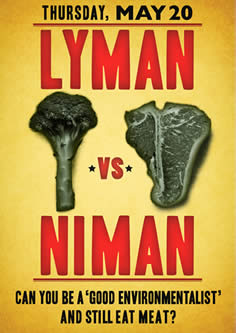
“Lyman vs. Niman: Can you be a good environmentalist and still eat meat?”
Raising livestock is resource-intensive and, we are beginning to learn, a significant contributor to greenhouse gas emissions. Nicolette Hahn Niman, a Marin rancher and author of Righteous Porkchop, will argue that there is an ecologically sustainable way to eat meat against Howard Lyman, the author of Mad Cowboy: Plain truth from a cattle rancher who won’t eat meat.
7 p.m., $10-$20
David Brower Center
Richard & Rhoda Goldman Theater
2150 Allston, Berk.
(510) 859-9100

Friday, May 21

To Teach: The Journey, In Comics
Graphic artist Ryan Alexander-Tanner brings William Ayers’ memoir To Teach: The journey of a teacher to life in this new graphic novel.
7 p.m., free
Green Arcade
1680 Market, SF
(415) 431-6800

Saturday, May 22

“Shanghai”
Attend an Asian Art Museum docent talk featuring a lecture and slideshow presentation about the museum’s exhibition “Shanghai.” The talk will be in English and Cantonese.
2:30 p.m., free
Chinatown Branch Library
Community Room
1135 Powell, SF
(415) 355-2888

Very Good-Looking Seeks Same
Author Robert Philipson will read from his new book, Very Good-Looking Seeks Same: Gay profiles in search of love, a new volume of transgressive, internet inspired poems, at this event featuring refreshments and live jazz music.
5 p.m., free
San Francisco LGBT Center
4th floor
1800 Market, SF
(415) 865-5555

Sunday, May 23

Broken Promises, Broken Dreams
Hear author Alice Rothchild explore the complexities of Jewish Israeli attitudes and the hardships of Palestinians living in the West Bank and Gaza through personal narratives based on work with medical delegations in the region.
3 p.m., free
Modern Times Bookstore
888 Valencia, SF
www.mtbs.com

Monday, May 24

Sunnyside
Bay Area author Glen David Gold discusses his new American epic, Sunnyside, starring Charlie Chaplin, about dreams, ambition, and the birth of modern America.
7:30 p.m., free
The Booksmith
1644 Haight, SF
(415) 863-8688


War: As Soldiers Really Live It

Hear Sebastian Junger discuss his new book about the reality of combat, the fear, honor and trust among men in an extreme situation whose survival depends on their absolute commitment to one another. His on-the-ground account follows a single platoon through a 15 month tour of duty in the most dangerous outpost in Afghanistan’s Korengal Valley.
7:30 p.m., $12
First Congregational Church of Berkeley
2345 Channing, Berk.
(510) 848-6767

Tuesday, May 25


A Poem for Mother Earth

Attend this poetry sharing and community healing ceremony featuring poetry, spoken word, and music from migrant Raza, indigenous youth, adults, and elders in poverty focused on the impacts of climate change  on indigenous peoples and poor people of color.
Noon, free
Galleria de la Raza
2857 24th St., SF
www.poormagazine.org

Benefits: May 19-May 25

0

Ways to have fun while giving back this week

Friday, May 21


Threatened, Endangered, Extinct

Celebrate 2010 Endangered Species Day at this lively discussion with experts currently creating strategies to protect biodiversity and convert consumers worldwide featuring cocktails, hors d’oeuvres, a silent auction including travel, restaurants, jewelry, limited edition signed wildlife prints, and more.
6 p.m., free
The University Club
800 Powell, SF
RSVP to sullivan@wildaid.org

Three-Minute Picture Show
Shake your booty to the music of Ron Silva and the Monarchs and enter to win raffle prizes from 3 Fish Studios, Books Inc., Gregory Cowley Photography, Interior Design Fair, Madrone Art Bar, and more at this benefit soiree featuring a screening of past Three-Minute Picture Show audience favorites.
7:30 p.m., $7
Make-Out Room
3225 22nd St., SF
www.threeminutepictureshow.com

Saturday, May 22

Bachelor Firefighter Auction
Bid on a smokin’ hot bachelor and enjoy raffle prizes, music, and other suprises at this fundraiser for the Alisa Ann Ruch Burn Foundation, a nonprofit dedicated to enhancing the lives of burn survivors and promoting burn prevention education.
8 p.m., $35
Sir Francis Drake Hotel
450 Powell, SF
http://buyfiremen.eventbrite.com

Harvey Milk Diversity Brunch
Celebrate the birthday and life of Harvey Milk, the first openly gay elected official. Enjoy well-known speakers from the LGBT community, food from Hott Box Catering, and more at this fundraiser for La Cocina, a small business support resource.
10:30 a.m., $65
The Arc of San Francisco
1500 Howard, SF
www.milkday.org

Public Glass Auction
Attend this benefit auction featuring the work of more than 60 renowned glass artists, wine, and hors d’ oeuvres. Proceeds will go towards Public Glass’ education program that reaches 300 students a year.
4:30 p.m., $50
First Unitarian Universalist Church and Center
1187 Franklin, SF
www.publicglass.org

Reliquarium
Attend this auction of reliquary-like objects representing the artistic DNA of writers and artists, housed in an attractive container. Participating artists include Justin Timberlake, Lemony Snicket, Jonathan Lethem, Anne Waldman, and more. Proceeds to benefit Small Press Traffic, an organization that brings together independent readers, writers, and presses.
5:30 p.m., $20 includes refreshments
California College of the Arts
Graduate Writing Studio
195 De Haro, SF
www.sptraffic.org

Sunday, May 23

Backyard BBQ for Chile
Join the Art House Gallery at this backyard potluck BBQ to benefit the Chile Earthquake Relief Effort featuring live music by Rafael Manriquez, Esteban Bello, Clara Bellino, and more. Look for the balloons.
Noon, $5-$50
Edith between Cedar and Lincoln, Berk.
(510) 472-3170

Castro County Fair
Join AIDS Emergency Fund on Harvey Milk weekend for a one of a kind county fair and fundraiser, featuring a dog-owner look alike contest, carnival games, country western dancing, a pie baking contest, an orchid show, field day events, and more.
10 a.m., $25
The Armory
14th at Mission, SF
www.castrocountyfair.org


Chance for Change

Enjoy a night of food, music, an auction, and a tribute to the struggles of homeless women and children at this fundraiser for Berkeley Women’s Daytime Drop-In Center, a daytime program for homeless women and their children.
3 p.m., $50
St. Alban’s Episcopal Church
1501 Washington, Albany
(510) 548-2884
www.womensdropin.org

Hidden Gems Garden Tour
Take a look at ten inspiring private gardens and public spaces with gardeners on hand to answer questions at this fundraiser for the new Potrero Hill Library.
10 a.m.; $25, $40 for two
Christopher’s Books
1400 18th St., SF
(415) 255-8802
All States Best Foods
1607 20th St., SF
(415) 642-3230

Drills, baby, drills

2

rebeccab@sfbg.com

The disastrous Deepwater Horizon oil spill in the Gulf of Mexico should be viewed as a wakeup call for the San Francisco Bay Area, Pacific Environment’s Jackie Dragon noted at a May 11 forum on oil spill preparedness and prevention.

The forum was planned even before the April 20 explosion of BP’s rig, triggering the onset of an out-of-control oil spill that has continued to wreak havoc in the Gulf for nearly a month. Up to 100,000 barrels of oil a day could be gushing from undersea pipeline, according to the highest estimates, which would dwarf the damage caused by the 1989 Exxon Valdez spill in Alaska.

Investigative reports in the New York Times in the wake of the spill revealed that the Minerals Management Service (MMS) had issued deep water drilling permits in the Gulf without obtaining permits from a federal agency that assesses threats to endangered species — in violation of federal law — and that MMS routinely overruled staff biologists’ safety concerns. The reports suggest the failure of not only a mechanical device, but an entire regulatory system, in which oil company interests appeared to take precedent over public safety and environmental concerns.

Here in California, environmentalists breathed a sigh of relief when Gov. Arnold Schwarzenegger withdrew his support for Tranquillon Ridge, a controversial offshore oil drilling project planned off the coast of Santa Barbara. Yet the governor’s change of heart doesn’t safeguard California’s coastal territories from a spill. Millions of gallons of oil are transported in and out of the ports every year, and refinery infrastructure dots the coastline.

“It’s all about the initial timeframe,” noted Fred Felleman, an environmental consultant who spoke at the forum. Shaken by BP’s colossal blunder and wary of the string of failures that led up to last year’s Dubai Star oil spill, environmental groups are now pushing for legislation they hope will slash response time by requiring ships to deploy protective boom before pumping fuel, so potential spills could be sopped up immediately.

The precaution would do little to remedy a major spill, however, and it’s just a small piece of a wider response puzzle that entails coordination among volunteers, community groups, and multilevel government agencies to accomplish everything from containing the slick, to cleaning beaches, to caring for impacted wildlife.

Although established protocols and a chain of command are in place for responding to oil spills, several speakers at the forum noted that vigilance tends to wane between these catastrophes. The environmental devastation in the Gulf could prove to be a catalyst for investing more energy and resources into safeguarding against the worst.


LESSONS LEARNED?

Fortunately, the Bay Area has been spared from the sort of devastating blow that is blackening Gulf of Mexico waters, crippling fisheries, and sending tar balls ashore. However, the bay has weathered two comparatively minor oil spills in the last three years, which could be viewed as learning experiences for a bigger incident.

The Cosco Busan spill occurred in late 2007, when a cargo ship hit the Bay Bridge under foggy conditions and released 58,020 gallons of bunker fuel into the bay. According to a detailed account of the incident response, the vessel collided with the Bay Bridge at 8:30 a.m., and the fuel leaked out in a matter of minutes. Two hours later, the estimated amount spilled was reported at 10 barrels (420 gallons), and hours passed before the actual quantity was revealed. The state official who determined how much had leaked arrived at Yerba Buena Island at 9:45 a.m. to perform an assessment but had to wait more than two hours to be transported to the ship.

Speaking at the forum, Zeke Grader, of the Pacific Coast Federation of Fishermen’s Associations, said fishing boat captains with vessels at Fisherman’s Wharf were ready to be deployed instantly to help contain the spill — but the Coast Guard initially turned them away. “This was a relatively minor spill in a bay, and we were totally unprepared to deal with it,” Grader charged. “That is really egregious.” Commercial fishing vessels were finally deployed to help with efforts, most venturing out on day five — long after the damage had been done.

San Francisco Baykeeper, a pollution watchdog group, was inundated with thousands of phone calls from volunteers, but the lack of an overarching volunteer coordination plan between governmental agencies and community organizations made it difficult to plug people in, executive director Deb Self noted. The Office of Spill Prevention and Response (OSPR) is the state agency under the Department of Fish and Game that works in conjunction with the U.S. Coast Guard and the financially responsible polluter to react when a spill occurs. Carol Singleton, an OSPR spokesperson, acknowledged that better communication during the Cosco Busan would have made the response more effective.

The spill affected the Bay Area’s biologically rich ecosystem. Just 421 of the roughly 1,000 oiled birds recovered by volunteers were successfully rehabilitated and released back into the wild, according to the Golden Gate Audubon Society, while nearly 7,000 are estimated to have died. Even a small drop of oil on the feathers of a bird can destroy the animal’s natural insulation, resulting in hypothermia.

Singleton said a well-established oil-spill response strategy is in place. “Every vessel and every facility has a contingency plan,” she noted. “We’re constantly practicing.” Since the Cosco Busan, a volunteer coordination plan has been crafted, she said. Ecologically sensitive areas are mapped out and prioritized, and a network of wildlife care facilities stand ready to take in oiled animals.

Following the Cosco Busan spill, members of the Legislature put forth a suite of proposals that came to be known as the “spill bills,” resulting in a few stronger protections such as spill-response equipment stationed and ready for deployment in high-risk areas, enhanced funding to care for oiled wildlife, and grants to local governments for oil-spill response tools. However, some ideas for stronger protection got killed by Schwarzenegger’s veto pen.

Former Sen. Carole Migden proposed a mandatory spill response time of two hours, but that was vetoed. Sen. Loni Hancock proposed beefing up the state’s Oil Spill Prevention Administrative Fund, which is derived from fees on barrels of oil transported into California ports, by upping the charge from 5 cents to 8 cents per barrel. That was also struck down, as was Sen. Mark Leno’s proposal to establish grants to develop better containment and cleanup technology.

As the disaster in the Gulf continues to unfold, Dragon of Pacific Environment said grassroots environmental organizations might renew pressure for stricter regulations on some of these fronts.


TIMING IS EVERYTHING

Another piece of legislation, inspired by the Dubai Star oil spill, is expected to go before the Senate Environmental Quality Committee in early June. The Dubai Star mishap occurred last October when at least 400 gallons of bunker fuel was released into open water near Alameda.

Far smaller than the Cosco Busan incident, the Dubai Star spill still resulted in the deaths at least 100 shorebirds. It happened at Anchorage 9, two miles south of the Bay Bridge, during a fuel transfer — a routine fill-up that occurs roughly 800 times per year.

The official investigation report hasn’t been released, but U.S. Coast Guard Captain Paul Gugg noted that a faulty valve was to blame. Some 2,000 gallons of oil overflowed, but went unnoticed until someone aboard a tugboat pointed it out, according to Gugg’s account. Most of the oily mess was contained on board, but between 400 and 800 gallons spilled over the port side, instantly creating a toxic plume.

“This particular vessel is equipped with high-level alarms, and high high-level alarms, which did not activate,” Gugg noted.

Under state regulations, vessels are required to respond to spills by deploying 600 feet of boom within 30 minutes, and 600 more feet more within one hour. In the case of the Dubai Star, that didn’t happen, a report released by the San Francisco Estuary Partnership noted. Instead, the slick was allowed to spread.

Assembly Member Jared Huffman (D-San Rafael) introduced AB 234 to establish a requirement for vessels to deploy boom before beginning a fuel transfer, so that a spill could be contained without losing time. The state of Washington has a similar law, noted legislative aid Paige Brokaw, “and their current conditions are pretty similar to our current conditions.” Booming is only effective at slower currents, which makes things difficult since a fuel transfer can take more than eight hours, and currents may shift in that time.

Huffman’s office received a letter of opposition to the bill from OSPR. “Booming is a good method to contain a spill, but it’s not a foolproof method,” said Singleton, the OSPR spokesperson. “To use that one method, it just may or may not work in certain circumstances.” Nonetheless, proponents of the bill say that even partial oil containment in higher currents is better than having no precautionary measures at all.

While the lessons of the past can be instructive, forum participants noted that continuous coordination, communication, and vigilance is the surest path to being able to respond if another oil spill occurs in the Bay Area. Grader, meanwhile, said he knew the best solution of all. “The ultimate prevention,” he said, “is basically getting off our oil addiction.”

San Francisco gaze

0

arts@sfbg.com

MUSIC On certain mornings in San Francisco, I step outside and feel as if I’m enveloped by clouds. Dew drops slide off of wiry branches, sparkling as they hit the cement sidewalk. Is it pretty or is it dark? It’s pretty and dark. Before I lived here, it wasn’t clear to me that this was even possible. As the day unravels, it reveals both sunny and stormy moments.

Much like a San Francisco day, the no-fi psych-rock of Young Prisms casts sunbeams and rain showers. Sitting with the group on the rooftop of Ruminator Audio, a studio space in the Mission, I ask about the moods it aims to create and receive. I hear the words "dream-state," "California," "tripped-out," "engaging," "engrossing," and, finally, guitarist-vocalist Matthew Allen’s breakdown: "It’s made so you can hear it two different ways. So each time you listen to it, whether at a show or on your headphones, you’ll discover totally different things."

Four-fifths of the group spent their childhoods in all-boy or all-girl schools on the Peninsula, where a strange amalgam of suburbia and house parties drove them to wage war against ennui by making music. Randomly — once — they performed as individual musicians at an improv show at Mills College before they found each other as a band. Bassist-vocalist Giovanni Betteo played a miked typewriter; Allen and guitarist-vocalist Jason Hendardy played guitar.

Eventually, in a desperate attempt to escape the suburban boredom that bubbled outward as they got older, the barely 20-year-olds moved into a house in San Francisco. Here they met Jordan Silbert, a Detroit native, who completed the prism as drummer. As Silbert jokes, "It’s been the worst two years of my life."

In the YP’s Mission house, the friends became a band. The energy of "a crammed, shitty apartment," as Betteo deems it, led to productivity and tomfoolery. "But at least we were able to practice there," Betteo notes. To which vocalist Stefanie Hodapp adds, "And play music how we wanted to."

"We had just started writing songs again for the first time in years, and also had just met Jordan. So things were really weird," Betteo elaborates. "We were trying to understand each other’s personal styles for a while and what we’re into. We would try different techniques, like jamming together or individually bringing in parts of songs."

"One day it all freely came out," he says. And the band’s self-titled EP for Mexican Summer was born. Its combination of shredded chords, dreary drumbeats, and nostalgic crooning is luminous and murky.

SXSW and an accompanying tour forced YP to abandon their San Francisco rental, and on returning, they’ve found themselves scattered across the city — in the closet spaces of their friends in the group Weekend and on borrowed couches. "We are certain there will be a new YP home," the band declares. "Sometime soon, we hope." The house had negative and positive aspects, they explain. Someone on their block was shot in the dick. There was blood on their porch for weeks.

Young Prisms’ upcoming show with Weekend celebrates a new split-single on Transparent. It is the first in a succession of releases from the prolific band: a split 7-inch with Mathemagic on Atelier Ciseaux, a live 12-inch on Under Water Peoples, and a full-length that might be released at the end of the summer.

According to Batteo, the track on the Weekend split, titled "I Don’t Get Much," is a precursor to the sound of the upcoming full-length. The album is being mixed by Monte Vallier beneath the roof where we sit. "It’s the last song we wrote in the apartment," Betteo says. "From there, the songs have become more cohesive. There is more focus and more of a mission."

"I Don’t Get Much" slowly flows in with shoegaze reverb, rises up, and then drags the listener down. The water levels eventually re-rise and plateau. There are echoes, heartbeats, and an apocalyptic romance, as male and female vocals repetitively discuss the end.

When I ask the band to explain the existentialist undercurrent that ripples throughout the song, Allen rhetorically asks: "If you don’t do anything, what does it really matter?" And vocalist-partner Hodapp notes, "It’s about how dying does not matter once you get in the ground."

Can a dark day be textured with the pretty? Or is the sunny sky filled with clouds? Young Prisms have the answers. *

YOUNG PRISMS

With Weekend, Grave Babies, and Swanifant

Sun/30, 9:30 p.m., 8 p.m., $8

Hemlock Tavern

1131 Polk St., S.F.

(415) 923-0923

www.youngprisms.com

Film listings

0

Film listings are edited by Cheryl Eddy. Reviewers are Kimberly Chun, Michelle Devereaux, Max Goldberg, Dennis Harvey, Johnny Ray Huston, Erik Morse, Louis Peitzman, Lynn Rapoport, Ben Richardson, and Matt Sussman. The film intern is Peter Galvin. For rep house showtimes, see Rep Clock. For first-run showtimes, see Movie Guide.

OPENING

The City of Your Final Destination In James Ivory’s latest literary adaptation, Omar (Omar Metwally), an Iranian American graduate student of Latin American literature, precipitously descends on a rural estate in Paraguay, hoping to petition the relatives of deceased writer Jules Gund for authorization to write his biography. Numbering among the somewhat complicated ménage are Gund’s widow, Caroline (Laura Linney), his mistress, Arden (Charlotte Gainsbourg), their child, Portia (Ambar Mallman), the author’s brother, Adam (Anthony Hopkins), and Adam’s lover, Pete (Hiroyuki Sanada), a household that the film depicts as caught in a sedative isolation obstructing any progress or flourishing or change. But where Gund’s violent suicide has failed to produce a cataclysmic shift, the somewhat hapless Omar manages to interrupt their idle routines and mobilize them, stirring up sentiment and ambition. The notion of redirected fate is telegraphed by the title, but what the film does best is show the calm before the storm (really more of a heavy downpour) — and showcase the fineness of Hopkins’s and Linney’s dramatic abilities. In the final act, we see the characters being moved about rather than moved, and the sound of screeching brakes applied as the film reaches its conclusion undoes much of the subtlety invested in their performances. (1:58) Embarcadero, Shattuck. (Rapoport)

*Dirty Hands The 1990s-ish iconoclastic, workaholic breed of Asian hipster is obsessively worked by David Choe in Dirty Hands. Exhaustively documenting the Los Angeles-born artist for eight years as he matures before our eyes, director Harry Kim charts the growth spurts: from mischievous tot to shoplifter and graf artist to porn illustrator to street-art superstar to spiritual penitent after a stint in a Tokyo jail. The filmmaker doesn’t seem to know quite when to stop, but then neither does his subject: an obviously intelligent, playful talent who specializes in compulsively analyzing himself and pushing himself to the limits of the law, his work, and his own (r)evolution as a human being. So driven in his pursuit of edge-skating experiences that he comes off as less hipster than haunted, Choe and his Bukowskian tendencies, Vice aesthetics, and "deep" thoughts rivet long after the bodily fluids and sensory overload murals congeal. (1:33) Roxie. (Chun)

Kites This Bollywood action-romance is "presented by" Brett Ratner (apparently, he helped re-edit this English version). (1:30)

MacGruber Will Forte’s bemulleted, MacGyver-biting Saturday Night Live character gets his own movie. (1:39)

Paper Man Though certainly offbeat enough to fall into the quirky indie category, Paper Man reminds us that weird is not always good. There’s very little original about the main conceit: plagued by writer’s block, Richard Dunn (Jeff Daniels) rents a house in Montauk where he befriends outcast Abby (Emma Stone), a teenage girl with a tragic past. The film’s unique addition is Richard’s imaginary friend Captain Excellent, played by Ryan Reynolds in full-on superhero attire. But Captain Excellent is so absurdly campy that he’s almost too much to take — which wouldn’t be such a problem if Paper Man weren’t asking us to take it seriously. The wacky superhero scenes are mostly out-of-place, and all the heavy drama moments fall flat. But even without the muddled tone, Paper Man is riddled with clichés. We’ve seen enough of the zany manchild learning valuable life lessons, and the troubled teen forming an unlikely bond. At this point, there’s nothing super about it. (1:50) Lumiere. (Peitzman)

Shrek Forever After 3D Mike Myers has sure gotten a lot of longevity out of his Scottish accent. (1:33) Four Star, Presidio.

ONGOING

Alice in Wonderland Tim Burton’s take on the classic children’s tale met my mediocre expectations exactly, given its months of pre-release hype (in the film world, fashion magazines, and even Sephora, for the love of brightly-colored eyeshadows). Most folks over a certain age will already know the story, and much of the dialogue, before the lights go down and the 3-D glasses go on; it’s up to Burton and his all-star cast (including numerous big-name actors providing voices for animated characters) to make the tale seem newly enthralling. The visuals are nearly as striking as the CG, with Helena Bonham Carter’s big-headed Red Queen a particularly marvelous human-computer creation. But Wonderland suffers from the style-over-substance dilemma that’s plagued Burton before; all that spooky-pretty whimsy can’t disguise the film’s fairly tepid script. Teenage Alice (Mia Wasikowska) displaying girl-power tendencies is a nice, if not surprising, touch, but Johnny Depp’s grating take on the Mad Hatter will please only those who were able to stomach his interpretation of Willy Wonka. (1:48) SF Center. (Eddy)

*Babies Thomas Balmes’ camera records the first year in the lives of four infants in vastly different circumstances. They’re respectively born to hip young couple in Tokyo’s high-tech clutter; familiar moderately alterna-types (the father is director Frazer Bradshaw of last year’s excellent indie drama Everything Strange and New) in S.F.’s Mission District; a yurt-dwelling family isolated in the vast Mongolian tundra; and a Namibian village so maternally focused that adult menfolk seem to have been banished. Yes, on one level this is the cutest li’l documentary you ever saw. But if you were planning to avoid thinking that is all (or most) of what Babies would be like, you will miss out bigtime. Void of explanatory titles, voice-over narration, or subtitle translations, this is a purely observatory piece that reveals just how fascinating the business of being a baby is. There’s very little predictable pooping, wailing, or coddling. Instead, Balmes’ wonderful eye captures absorbing moments of sussing things out, decision-making, and skill learning. While the First World tykes firstborns both — are hauled off to (way) pre-school classes, the much less day planned Third Worlders have more complex, unmediated dealings with community. Those range from fending off devilish older siblings to Mongol Bayarjargal’s startlingly casual consorting with large furry livestock. (Imagine the horror of parents you know were their baby found surrounded by massive cows — a situation that here causes no concern whatsoever for adults, children, or bovines.) So accustomed to the camera that it doesn’t influence their behavior, the subjects here are viewed with an intimacy that continually surprises. Babies is getting a wider-than-usual release for a documentary, one cannily timed to coincide with Mother’s Day. But don’t be fooled: this movie is actually very cool. (1:19) Albany, Empire, 1000 Van Ness, Piedmont, Smith Rafael, Sundance Kabuki. (Harvey)

The Back-Up Plan (1:40) SF Center.

*Casino Jack and the United States of Money Casino Jack is big-budget documentary filmmaking, glossy and prone to expensive music cues, but I suppose you get a license to be flashy when you’ve proven to be as good at it as Alex Gibney. The director of Enron: The Smartest Guys in the Room (2005) and Academy Award winner Taxi to the Dark Side (2007), Gibney sets his sights on Washington lobbyist Jack Abramoff with an abundantly in-depth exploration of government greed and fraud. Investigating Abramoff’s indiscretions, from his introduction as chairman of the College Republicans, to his illegal selling of House votes for sweatshops in the Mariana Islands and over-billing of numerous Indian casinos, Gibney solidly serves Abramoff his just desserts. The director is equally interested in questioning the kind of government America has fostered that turns a blind eye to this sort of behavior. (2:02) Opera Plaza, Shattuck. (Galvin)

*City Island The Rizzo family of City Island, N.Y. — a tiny atoll associated historically with fishing and jurisdictionally with the Bronx — have reached a state where their primary interactions consist of sniping, yelling, and storming out of rooms. These storm clouds operate as cover for the secrets they’re all busy keeping from one another. Correctional officer Vince (Andy Garcia) pretends he’s got frequent poker nights so he can skulk off to his true shameful indulgence: a Manhattan acting class. Perpetually fuming spouse Joyce (Julianna Margulies) assumes he’s having an affair. Daughter Vivian (Dominik García-Lorido) has dropped out of school to work at a strip joint, while the world class-sarcasms of teenager Vinnie (Ezra Miller) deflect attention from his own hidden life as an aspiring chubby chaser. All this (plus everyone’s sneaky cigarette habit) is nothing, however, compared to Vince’s really big secret: he conceived and abandoned a "love child" before marrying, and said guilty issue has just turned up as a 24-year-old car thief on his cell block. Writer-director Raymond De Felitta made a couple other features in the last 15 years, none widely seen; if this latest is typical, we need more of him, more often. Perfectly cast, City Island is farcical without being cartoonish, howl-inducing without lowering your brain-cell count. It’s arguably a better, less self-conscious slice of dysfunctional family absurdism than Little Miss Sunshine (2006) — complete with an Alan Arkin more inspired in his one big scene here than in all of that film’s Oscar-winning performance. (1:40) Lumiere, Shattuck. (Harvey)

Clash of the Titans The minds behind Clash of the Titans decided their movie should be 3D at the last possible moment before release. Consequently, the 3D is pretty janky. I don’t know what the rest of the film’s excuse is. Clash of the Titans retreads the 1981 cult classic with reasonable faithfulness, though Ray Harryhausen’s stop-motion effects have been (of course) replaced with CG renderings of all the expected monsters, magic, gods, etc. Liam Neeson and Ralph Fiennes — as other reviews have pointed out: Schindler’s List (1993) reunion! — glow and glower as Zeus and Hades, while Sam Worthington (2009’s Avatar) once again fills the role of bland hero, this time as a snooze-worthy Perseus. You might have fun in the moment with Clash of the Titans, but it’s hardly memorable, and certainly nowhere near epic. (1:58) SF Center. (Eddy)

Date Night By today’s comedy standards, Date Night is positively old-fashioned: a case of mistaken identity causes a struggling married couple (Steve Carell and Tina Fey) to be tangled in a ransom plot for a stolen flash drive that belongs to a local mob boss. Unfussy plots are par for the course for films belonging to the all-but-lost "madcap all-nighter" genre, and in this case the simplicity of the set-up becomes Date Night‘s greatest asset, allowing Carell and Fey free reign to joke and ad lib lines. Like it or loathe it, the pair’s trademark senses of humor are the movie, and they arrange some pretty gleefully entertaining bits on the fly. Toss in a bunch of cameos from the likes of Ray Liotta and Mark Wahlberg and you’ve got yourself a bona fide movie-film, but it’s difficult not to see what Date Night might have been with just a smidge more effort. (1:27) 1000 Van Ness, SF Center. (Galvin)

*Exit Through the Gift Shop Exit Through the Gift Shop is not a film about the elusive graffiti-cum-conceptual artist and merry prankster known as Banksy, even though he takes up a good chunk of this sly and by-no-means impartial documentary and is listed as its director. Rather, as he informs us — voice electronically altered, face hidden in shadow — in the film’s opening minutes, the film’s real subject is one Thierry Guetta, a French expat living in LA whose hangdog eyes, squat stature, and propensity for mutton chops and polyester could pass him off as Ron Jeremy’s long lost twin. Unlike Jeremy, Guetta is not blessed with any prodigious natural talent to propel him to stardom, save for a compulsion to videotape every waking minute of his life (roughly 80 percent of the footage in Exit is Guetta’s) and a knack for being in the right place at the right time. When Guetta is introduced by his tagger cousin to a pre-Obamatized Shepard Fairey in 2007, he realizes his true calling: to make a documentary about the street art scene that was then only starting to get mainstream attention. Enter Banksy, who, at first, is Guetta’s ultimate quarry. Eventually, the two become chummy, with Guetta acting as lookout and documenter for the artist just as the art market starts clambering for its piece of, "the Scarlet Pimpernel of street art," as one headline dubs him. When, at about three quarters of the way in, Guetta, following Banksy’s casual suggestion, drops his camcorder and tries his hand at making street art, Exit becomes a very different beast. Guetta’s flashy debut as Mr. Brainwash is as obscenely successful as his "art" is terribly unimaginative — much to the chagrin of his former documentary subjects. But Guetta is no Eve Harrington and Banksy, who has the last laugh here, gives him plenty of rope with which to truss himself. Is Mr. Brainwash really the ridiculous and inevitable terminus of street art’s runaway mainstream success (which, it must be said, Banksy has handsomely profited from)? That question begs another: with friends like Banksy, who needs enemies? (1:27) Embarcadero, Shattuck, Smith Rafael, Sundance Kabuki. (Sussman)

Furry Vengeance (1:32) SF Center.

*The Ghost Writer Roman Polanski’s never-ending legal woes have inspired endless debates on the interwebs and elsewhere; they also can’t help but add subtext to the 76-year-old’s new film, which is chock full o’ anti-American vibes anyway. It’s also a pretty nifty political thriller about a disgraced former British Prime Minister (Pierce Brosnan) who’s hanging out in his Martha’s Vineyard mansion with his whip-smart, bitter wife (Olivia Williams) and Joan Holloway-as-ice-queen assistant (Kim Cattrall), plus an eager young biographer (Ewan McGregor) recently hired to ghost-write his memoirs. But as the writer quickly discovers, the politician’s past contains the kinds of secrets that cause strange cars with tinted windows to appear in one’s rearview mirror when driving along deserted country roads. Polanski’s long been an expert when it comes to escalating tension onscreen; he’s also so good at adding offbeat moments that only seem tossed-off (as when the PM’s groundskeeper attempts to rake leaves amid relentless sea breezes) and making the utmost of his top-notch actors (Tom Wilkinson and Eli Wallach have small, memorable roles). Though I found The Ghost Writer‘s ZOMG! third-act revelation to be a bit corny, I still didn’t think it detracted from the finely crafted film that led up to it. (1:49) Opera Plaza, Presidio. (Eddy)

*The Girl With the Dragon Tattoo By the time the first of Stieg Larsson’s so-called "Millennium" books had been published anywhere, the series already had an unhappy ending: he died (in 2004). The following year, The Girl With the Dragon Tattoo became a Swedish, then eventually international sensation, its sequels following suit. The books are addicting, to say the least; despite their essential crime-mystery-thriller nature, they don’t require putting your ear for writing of some literary value on sleep mode. Now the first of three adaptive features shot back-to-back has reached U.S. screens. (Sorry to say, yes, a Hollywood remake is already in the works — but let’s hope that’s years away.) Even at two-and-a-half hours, this Girl With the Dragon Tattoo by necessity must do some major truncating to pack in the essentials of a very long, very plotty novel. Still, all but the nitpickingest fans will be fairly satisfied, while virgins will have the benefit of not knowing what’s going to happen and getting scared accordingly. Soon facing jail after losing a libel suit brought against him by a shady corporate tycoon, leftie journalist Mikael Blomkvist (Michael Nyqvist) gets a curious private offer to probe the disappearance 40 years earlier of a teenage girl. This entangles him with an eccentric wealthy family and their many closet skeletons (including Nazi sympathies) — as well as dragon-tattooed Lisbeth Salander (Noomi Rapace), androgynous loner, 24-year-old court ward, investigative researcher, and skillful hacker. Director Niels Arden Oplev and his scenarists do a workmanlike job — one more organizational than interpretive, a faithful transcription without much style or personality all its own. Nonetheless, Larsson’s narrative engine kicks in early and hauls you right along to the depot. (2:32) Bridge, Piedmont, Shattuck. (Harvey)

The Greatest Lofty title aside, there’s nothing particularly extraordinary about The Greatest. In many ways, it’s your standard grief porn, in that it focuses on a group of characters mourning a dead teenager for an hour and a half. On the other hand, the cast is tremendous — Susan Sarandon and Pierce Brosnan are solid as the parents of the broken Brewer family, but the young actors give the most memorable performances. Fresh off her Oscar nomination for An Education (2009), Carey Mulligan continues to mingle precociousness and naiveté. The Greatest also showcases the very talented Johnny Simmons, whose past films — Hotel for Dogs (2009) and Jennifer’s Body (2009) — haven’t exactly earned him exposure. For its genre, then, The Greatest is actually quite good. It has plenty of charm mixed with moments of genuine emotion, often marked by much welcome restraint. But even with a slight twist on the convention (Mulligan’s Rose is pregnant with the dead kid’s baby), it’s still just a well-made tearjerker. (1:36) Smith Rafael. (Peitzman)

Harry Brown Shades of Dirty Harry (1971) for the tea cozy and tweed set: elegantly rendered and very nicely played, Harry Brown might be the dark, late-in-the-day elder brother to 1971’s Get Carter, in the hands of eponymous lead Michael Caine. He’s a pensioner mourning the passing of his beloved wife, his mysterious life as a Marine stationed in Northern Ireland firmly behind him. Then his chess-playing pal Leonard (David Bradley) is terrorized and killed by the unsavory gang of heroin dealing hoodlums who lurk near their projects in a tunnel walkway like gun-toting, foul-mouthed, sociopathic trolls. Harry Brown is, er, forced to forsake a vow of peace and go commando on the culprits’ asses, triggering some moments of ultraviolence that are unsettling in their whole-hearted embrace of vigilante justice. Like predecessors similarly fixated on vengeance in their respective urban hells, a la Hardcore (1979) and Taxi Driver (1976) (Harry Brown echoes key moments in the latter, in particular — see, for instance, its keenly tense, eerily humorous gun shopping scene), Harry Brown is essentially an arch-conservative film, if good looking and even likable with Caine meting out the punishment. The overall denouement just might make some seniors feel very, very good about the coiled potential for hurt embedded in their aging frames. (1:42) Embarcadero, Shattuck, Sundance Kabuki. (Chun)

How to Train Your Dragon (1:38) 1000 Van Ness.

The Human Centipede (First Sequence) Director Tom Six had a vision, a glorious dream of surgically connecting three human beings via their gastro-intestinal systems, or as Kevin Smith would say — "ass to mouth." When two girlfriends on a road trip across Europe get a flat tire, they stumble upon the home of a mad doctor (Dieter Laser) with a similar dream, who drugs them and ties them up in his basement laboratory. The Human Centipede is an entry into the torture porn arena, but it feels especially icky because you just know that the girls have zero chance of escaping the "100 percent medically accurate!" surgery. Once hooked up, there’s nowhere for the film to go and two out of three actors can’t talk because they are sewn to someone else’s anus. Still, as one-note as The Human Centipede is, I think we’d do well to encourage more films to be as batshit insane as this one. (1:30) Bridge. (Galvin)

*Iron Man 2 Tony Stark (Robert Downey Jr.) returns, just as rich and self-involved as before, though his ego his inflated to unimaginable heights due to his superheroic fame. Pretty much, he’s put the whole "with great power comes great responsibility" thing on the back burner, exasperating everyone from Girl Friday Pepper Potts (Gwyneth Paltrow); to BFF military man Rhodey (Don Cheadle, replacing the first installment’s Terrence Howard); to certain mysterious Marvels played by Samuel L. Jackson and Scarlett Johansson; to a doofus-y rival defense contractor (Sam Rockwell); to a sanctimonius Senator (Garry Shandling). Frankly, the fact that a vengeful Russian scientist (Mickey Rourke) is plotting Tony’s imminent death is a secondary threat here — for much of the film, Tony’s biggest enemy is himself. Fortunately, this is conveyed with enjoyable action (props to director Jon Favreau, who also has a small role), a witty script (actor Justin Theroux — who knew? He also co-wrote 2008’s Tropic Thunder, by the way), and gusto-going performances by everyone, from Downey on down. Stay for the whole credits or miss out on the geek-gasm. (2:05) California, Castro, Empire, Four Star, Marina, 1000 Van Ness, Presidio, Sundance Kabuki. (Eddy)

Just Wright (1:51) 1000 Van Ness.

*Kick-Ass Based on a comic book series by Mark Millar, whose work was also the model for 2008’s Wanted, Kick Ass is a similarly over-the-top action flick that plays up its absurdity to even greater comedic effect. High school nerd Dave (Aaron Johnson) decides to become the world’s first real superhero. Donning a green wetsuit he bought on the internet and mustering some unlikely courage, he takes to the streets to avenge wrongdoing. Unsurprisingly, Dave is immediately beaten almost to death because he’s just a kid who has no idea what he’s doing, but Kick-Ass‘ greatest achievement is knowing exactly how to subvert audience expectations. Scenes that marry the film’s innocent story with enormously exaggerated violence enhance the otherwise Superbad-lite high-school comedy unfolding around them, and a parallel plot-line involving Nicolas Cage instructing his 12-year-old daughter to commit grievous murders will probably end up being the most gratifying aspect of the film. Though too much set-up and spinning gears mars the middle act, it’s hard to fault the film for competently setting up one of the most crowd-pleasing endings in recent memory. (1:58) 1000 Van Ness, SF Center. (Galvin)

Letters to Juliet If you can stomach the inevitable Barbara Cartland/Harlequin-romance-style clichés — and believe that Amanda Seyfried as a New Yorker fact-checker — then Letters to Juliet might be the ideal Tuscan-sunlit valentine for you. Seyfried’s Sophie is on a pre-honeymoon trip to Verona with her preoccupied chef-restaurateur intended, Victor (Gael Garcia Bernal), who’s more interested in sampling cheese and purchasing vino than taking in the romantic attractions of Verona with his fiancée. Luckily she finds the perfect diversion for a wannabe scribe: a small clutch of diehard romantics enlisted by the city of Verona to answer the letters to Juliet posted by lovelorn ladies. They’re Juliet’s secretaries — never mind that Juliet never managed to maintain a successful or long-term relationship herself. When Sophie finds a lost, unanswered letter from the ’50s, she sets off sequence of unlikely events, as the letter’s English writer, Claire (Vanessa Redgrave), returns to Verona with her grandson Charlie (Christopher Egan), in search of her missed-connection, Lorenzo. Alas, Lorenzo’s long gone, and the fact-checker decides to help the warm-hearted, hopeful Claire find her lost lover. Unfortunately Sophie’s chemistry with both her matches isn’t as powerful as Redgrave’s with real-life husband Franco Nero — after all he was Lancelot to her Guenevere in 1967’s Camelot and the father of her son. Still, Redgrave’s power as an actress — and her relationship with Nero — adds a resonance that takes this otherwise by-the-numbers romance to another level. (1:46) Marina, 1000 Van Ness, Piedmont, SF Center, Sundance Kabuki. (Chun)

The Little Traitor Lynn Roth’s film is set in 1947 Palestine, shortly before Israel became a state. Young Proffi Liebowitz (Ido Port) wasn’t yet born when his parents fled the Holocaust in Poland, but he’s politically tuned-in enough to form a mini-resistance group with his neighborhood pals, who plot against the occupying British forces (sample act of rebellion: "British Go Home" graffiti). Caught one night scampering home after the citywide curfew, Proffi meets Sergeant Dunlop (Alfred Molina), whose kindness makes the boy realize his black-and-white view of the enemy might have some room for color after all. Of course, Proffi’s friendship with the Brit, who teaches him to play snooker and pronounce complicated English words like "flatulence," is not received well by his community (see: film’s title). Despite its political undertones, this is a pretty standard coming-of-age tale (including the de rigueur "peeping on the sexy neighbor" subplot). Too bad the director decided to film so much of it in English — kid actor Port is far less cloying when he’s speaking his native Hebrew. (1:29) Opera Plaza. (Eddy)

*Mid-August Lunch Gianni Di Gregorio’s loose, engaging comedy is about an aging bachelor still living with his ancient mum in their Rome flat. When his landlord offers to forgive some debts in return for briefly taking in his own elderly ma, Gianni (played by the director himself) soon finds himself in cat-herding charge of no less than five old ladies who delight in one another’s company while running him ragged. Gomorrah (2008) screenwriter Di Gregorio used nonprofessionals to play those parts in this semi improvised miniature, which is as light and flavorful as a first course of prosciutto and mozzarella. It’s a solid addition to the canon of palate-pleasing culinary flicks such as Big Night (1996) and Babette’s Feast (1987), as opposed to the repulsive ones like Super Size Me (2004) or Monty Python’s The Meaning of Life (1983). (1:15) Opera Plaza, Shattuck. (Harvey)

La Mission A veteran S.F. vato turned responsible — if still muy macho — widower, father, and Muni driver, fortysomething Che (Benjamin Bratt) isn’t the type for mushy displays of sentiment. But it’s clear his pride and joy is son Jess (Jeremy Ray Valdez), a straight-A high school grad bound for UCLA. That filial bond, however, sustains some serious damage when Che discovers Jes has a secret life — with a boyfriend, in the Castro, just a few blocks away from their Mission walkup but might as well be light-years away as far as old-school dad is concerned. This Bratt family project (Benjamin’s brother Peter writes-directs, his wife Talisa Soto Bratt has a supporting role) has a bit of a predictable TV-movie feel, but its warm heart is very much in the right place. (1:57) Opera Plaza, Shattuck, SF Center. (Harvey)

Mother and Child Adoption advocates who railed against Orphan (2009) should turn their sights on Mother and Child, a ridiculous melodrama with a thoroughly vile message. I’d wager writer-director Rodrigo García didn’t set out to make an anti-adoption film: this is a movie about the relationship between mothers and daughters. But the undertones are impossible to miss. Annette Bening plays Karen, a miserable woman consumed by regret for putting her daughter up for adoption 37 years ago. That biological daughter is Elizabeth (Naomi Watts), who — despite having been adopted at birth — speaks dismissively of her "adoptive" parents as though they were never really hers. She’s cold and manipulative, sleeping with her boss and married neighbor because she can. Mother and Child offers no real explanation for why these women are so unpleasant, so we’re forced to conclude it’s the four decades-old adoption. Despite a stellar cast, which also includes Kerry Washington, Samuel L. Jackson, and S. Epatha Merkerson, the film’s misguided politics are too distracting to ignore. (2:06) Shattuck, Sundance Kabuki. (Peitzman)

A Nightmare on Elm Street I’ll say this about the remake of A Nightmare on Elm Street: it could have been worse. Yes, it’s pointless and unimaginative and producer Michael Bay should still be ashamed, but I didn’t hate every minute of it. Don’t get me wrong, the movie is not good. It’s not terrible, if only because it has a few decent scares — all of which are, of course, shamelessly lifted from the original. Mostly, however, A Nightmare on Elm Street is a waste of time, updating Freddy Krueger with an icky twist (which I won’t spoil here) and culling together more jump scares than should ever be shoved into one film. The cast is passable, with relative newbie Rooney Mara taking on Nancy — she’s fine but forgettable. Jackie Earle Haley does a solid job with Freddy, but he was doomed from the start, just by virtue of not being Robert Englund. This Freddy is more brutal, to be sure, but he’s also far less fun. One pun in the entire movie? He might as well be Jason Voorhees. (1:42) 1000 Van Ness. (Peitzman)

*October Country In taking on the subject of family in the documentary October Country, co-directors Michael Palmieri and Donal Mosher face some imposing specters, and I’m not just talking about the varied stories of the Mosher family. If there’s any micro-genre within documentary that has become embattled over the past decade, it’s the family portrait, thanks to controversial or contentious works such as Andrew Jarecki’s Capturing the Friedmans and Jonathan Caouette’s Tarnation (both from 2003), son-of-Grey Gardens freakouts which incited claims of exploitation and sensationalism on their paths to a larger public profile. Palmieri’s and Mosher’s movie is a quieter work, yet it isn’t folksy in a complacent Sundance manner, either. The list of the maladies plaguing the Mosher clan — physical abuse, drug abuse, war trauma, custody battles, and abortion, to name a handful — would provoke an ambulance-chasing impulse in some filmmakers, blood ties be damned. But Palmieri (who edited and did cinematography) and Mosher (a former San Francisco resident whose photo essays on his family were shown at Artists’ Television Access) realize these are common American problems, and their treatment of them is at once deeper and more ephemeral. They use the passage of a year from one Halloween to the next to reveal the changes wrought — or evident — on a person’s face, and when they can, a person’s life. (1:20) Roxie. (Huston)

*OSS 117: Lost in Rio The Cold War heated up a public appetite for spy adventures well before James Bond became a pop phenomenon. In fact, Ian Fleming hadn’t yet created 007 in 1949, when Jean Bruce commenced writing novels about Hubert Bonisseur de La Bath, a.k.a. Agent OSS 117. This French superspy was ready-made to join the ranks of umpteen 007 wannabes, appearing in somewhere between six and 11 films (it’s unclear whether all involved de La Bath, or were just Bruce-based) through 1970, played by at least four actors. The series remained well-known enough to get a new life in 2006 when director Michel Hazanavicius and top French comedy star Jean Dujardin sought to spoof 1960s espionage flicks a la Austin Powers: International Man of Mystery (1997). That was a big hit, so now we’ve got a sequel. OSS 117: Lost in Rio isn’t as fresh or funny as the preceding Cairo, Nest of Spies. But it’s still a whole lot fresher and funnier than Austin Powers Nos. two (1999) and three (2002). Dujardin’s de La Bath is the very model of jet-set masculinity, twisting the night away at a ski chalet with umpteen soon-to-be-machine gunned "Oriental" lovelies in the opening sequence. Of course such pleasure pursuits take place strictly between car chases, shootouts, and karate fights. Agreeably silly, Lost in Rio doesn’t go for Hollywood-style slapstick and grossout yuks. Instead, its biggest laughs are usually droll throwaways, as when 117 explains a shocking sudden costume change with the unlikely declaration "I sew," or during an LSD-dosed hippie orgy proves quite willing to go with the flow — even when that involves another guy’s groovy finger breaching security up the pride of French intelligence’s derriere. (1:37) Lumiere, Shattuck, Smith Rafael. (Harvey)

*Please Give Manhattan couple Kate (Catherine Keener) and Alex (Oliver Platt) are the proprietors of an up-market vintage furniture store — they troll the apartments of the recently deceased, redistributing the contents at an astonishing markup — and they’ve purchased the entire apartment of their elderly next-door neighbor (Ann Guilbert). As they wait for her to expire so they can knock down a wall, they try not to loom in anticipation in front of her granddaughters, the softly melancholic Rebecca (Rebecca Hall) and the brittle pragmatist Mary (Amanda Peet). Filmmaker Nicole Holofcener has entered this territory before, examining the interpersonal pressures that a sizable income gap can exert in 2006’s Friends with Money. Here she turns to the pangs and blunderings of the liberal existence burdened with the discomforts of being comfortable and the desire to do some good in the world. The film capably explores the unexamined impulses of liberal guilt, though the conclusion it reaches is unsatisfying. Like Holofcener’s other work, Please Give is constructed from the episodic material of mundane, intimate encounters between characters whose complexity forces us to take them seriously, whether or not we like them. Here, though, it offers these private connections as the best one can hope for, a sort of domestic grace accrued by doing right, authentically, instinctively, by the people in your immediate orbit, leaving the larger world to muddle along on its axis as best it can. (1:30) Clay, SF Center, Shattuck. (Rapoport)

Princess Kaiulani Well-meaning and controversial (the independent’s first title, Barbarian Princess, and the tragic events it depicts has distressed some native Hawaiians) in its own inoffensive way, Princess Kaiulani is unfortunately overshadowed by star Q’orianka Kilcher’s first film, 2005’s The New World, in which she portrayed Pocahontas. The Hawaii-raised Kilcher appears to be getting typecast as a tragic, romanticized native royal. Still, if you can get past director Marc Forby’s weak attempts to match New World director Terrence Malick’s searingly poetic montages and the clunky History Channel-by-the-numbers screenplay, you might give a little credit to the makers for bringing to the screen the tale of Hawaii’s last intelligent, beautiful, and accomplished princess — a young woman determined to fight an overthrow of the Hawaiian monarchy and battle its annexation against the white land owners and descendents of missionaries who tried to block the voting rights of native Hawaiians. Kilcher possesses some of the noble charisma claimed by the real Kaiulani, but the obligatory romance superimposed on the narrative and the neglect of some of genuinely promising threads, such as Kaiulani’s friendship with Robert Louis Stevenson, make Princess Kaiulani feel as faux as those who pretended to Hawaii’s rule. (2:10) Embarcadero. (Chun)

Robin Hood Like it or not, we live in the age of the origin story. Ridley Scott’s Robin Hood introduces us to the outlaw while he’s still in France, wending his way back to Albion in the service of King Richard III. The Lionheart soon takes an arrow in the neck in order to demonstrate the film’s historical bona fides, and yeoman archer Robin Longstride (Russell Crowe) — surrounded by a nascent band of merry men — accidentally embroils himself in a conspiracy to wrest control of England. The complications of this intrigue hie Robin to Nottingham, where he is thrown together with Maid Marion (Cate Blanchett), a plucky rural aristocrat who likes getting her hands dirty almost as much as she likes a bit of smoldering Crowe seduction. A lot of hollow medieval verisimilitude ensues, along with a good bit of slow-mo swordplay, but the cumulative effect is tepid and rote. (2:20) Empire, 1000 Van Ness, Presidio, Sundance Kabuki. (Richardson)

The Secret in Their Eyes (2:07) Albany, Embarcadero.

Touching Home Hometown boys (Logan and Noah Miller) make good in this based-on-a-true-story tale of identical twins who must divide their time at home between training for major league baseball and looking after their alcoholic father. The brothers, who also wrote and directed the film, aim for David Gordon Green by way of Marin, but fall short of mastering that director’s knack for natural dialogue. Ed Harris is, unsurprisingly, compelling as the alcoholic father, but the actors in the film who are not named Ed Harris tend to contribute to the script’s distracting histrionics. Touching Home has some amazing NorCal cinematography, and I could see how family audiences might enjoy its "feel bad, then feel good" style of melodrama. But while it’s awkward to say that someone’s real-life experiences come off as trite, there are moments here that feel as clichéd as a Lifetime movie. (1:48) Smith Rafael. (Galvin)

Vincere Given the talent involved, Vincere should be a better film that it is. Director Marco Bellocchio has a lengthy track record of successes, and star Giovanna Mezzogiorno is one of the biggest names in contemporary Italian cinema. The based-on-a-true-story plot is certainly worthy of being filmed: Mezzogiorno plays Ida Dalser, secret wife of Mussolini and mother of the dictator’s first-born son. When Ida begins to make trouble for Il Duce by publicly proclaiming their marriage, she is locked away in a mental hospital. But while Vincere‘s subject is compelling, the film as a whole falls flat. Moments of greatness are few and far between, and the rest of the movie gets by on mediocrity. It’s likely the fault lies with the script, which is too scattered and unfocused to maintain an audience’s focus. Why after almost two hours of watching Ida’s struggle are we suddenly left with her son’s descent into madness? How depressing that a film about a woman forgotten by history is, itself, mostly forgettable. (2:02) Smith Rafael. (Peitzman)

Music listings

0

Music listings are compiled by Paula Connelly and Cheryl Eddy. Since club life is unpredictable, it’s a good idea to call ahead to confirm bookings and hours. Prices are listed when provided to us. Submit items at listings@sfbg.com.

WEDNESDAY 19

ROCK/BLUES/HIP-HOP

Dead Souls, Winston Tong, Graves Bros. Deluxe, Carletta Sue Kay Elbo Room. 9pm, $8. Ian Curtis memorial show.

Francis and the Lights, Teen Inc. Great American Music Hall. 8pm, $16.

Frightened Rabbit Fillmore. 8pm, $22.50.

Gosta Berling, Matinees, Foreign Cinema El Rio. 8pm, $5.

Groundation, Orgone, DJ Jeremiah Independent. 9pm, $27.

Hounds and Harlots, Bomber, Poison Control, Mick Leonardi Thee Parkside. 8pm, $10.

Kacey Johansing, Honeycomb, Dovekins, Range of Light Wilderness Rickshaw Stop. 8pm, $10.

Jerry Joseph and the Jackmormons, Jeremy Messersmith Hotel Utah. 9pm, $12.

Khi Darag!, Charming Hostess, Mitch Marcus Quintet Bottom of the Hill. 9pm, $12.

Pebble Theory, Fleeting Trance, JJ Schultz, Wolf Larsen Café du Nord. 8pm, $10.

Planet Loop Madrone Art Bar. 9:30pm, free.

Chris Pureka, Ramaya Soskin, Fences Slim’s. 8pm, $16.

Todd Wolfe Biscuits and Blues. 8 and 10pm, $15.

FOLK/WORLD/COUNTRY

Michael Abraham Jazz Session, Gaucho Amnesia. 8pm, free.

Jim Page Plough and Stars. 9pm.

DANCE CLUBS

Booty Call Q-Bar, 456 Castro, SF; www.bootycallwednesdays.com. 9pm. Juanita Moore hosts this dance party, featuring DJ Robot Hustle.

Hands Down! Bar on Church. 9pm, free. With DJs Claksaarb, Mykill, and guests spinning indie, electro, house, and bangers.

Machine Sloane, 1525 Mission, SF; (415) 621-7007. 10pm, free. Warm beats for happy feet with DJs Sergio, Conor, and André Lucero.

Mary-Go-Round Lookout, 3600 16th St, SF; (415) 431-0306. 10pm, $5. A weekly drag show with hosts Cookie Dough, Pollo Del Mar, and Suppositori Spelling.

RedWine Social Dalva. 9pm-2am, free. DJ TophOne and guests spin outernational funk and get drunk.

Respect Wednesdays End Up. 10pm, $5. Rotating DJs Daddy Rolo, Young Fyah, Irie Dole, I-Vier, Sake One, Serg, and more spinning reggae, dancehall, roots, lovers rock, and mash ups.

Synchronize Il Pirata, 2007 16th St, SF; (415) 626-2626. 10pm, free. Psychedelic dance music with DJs Helios, Gatto Matto, Psy Lotus, Intergalactoid, and guests.

Yoruba Dance Sessions Bacano! Som., 2925 16th St, SF; (415) 558-8521. 9pm, free. With resident DJ Carlos Mena and guests spinning afro-deep-global-soulful-broken-techhouse.

THURSDAY 20

ROCK/BLUES/HIP-HOP

Danny Cohen, Jonah Kit, Powell St. John and the Aliens Hemlock Tavern. 9pm, $7.

Roky Erickson, Okkervil River Fillmore. 8pm, $29.50.

Funk Revival Orchestra, Stymie and the Pimp Jones Luv Orchestra, Loveseat Trio Red Devil Lounge. 9pm, $8.

*Sean Hayes, Laura Goldhamer and the Silvernail, DJ Harry D Independent. 8pm, $17.

In the Belly of the Falcon, Tiny Television, Sons of Eden Rickshaw Stop. 8pm, $10.

Izabella, Nat Keefe, Aaron Redner, and Erik Yates Café du Nord. 9pm, $12.

Kehoe Nation, HoneyDust, Polar Bears Bottom of the Hill. 9pm, $10.

John Németh Biscuits and Blues. 8 and 10pm, $18.

Tender Box, Deadbeat Darling, Margins Hotel Utah. 9pm, $7.

30db Great American Music Hall. 9pm, $20.

DANCE CLUBS

Afrolicious Elbo Room. 9:30pm, $10. DJs Pleasuremaker and Señor Oz with guest Black Dynamite Sound spin Afro-tropical, samba, and funk.

Caribbean Connection Little Baobab, 3388 19th St, SF; (415) 643-3558. 10pm, $3. DJ Stevie B and guests spin reggae, soca, zouk, reggaetón, and more.

Club Jammies Edinburgh Castle. 10pm, free. DJs EBERrad and White Mice spinning reggae, punk, dub, and post punk.

Drop the Pressure Underground SF. 6-10pm, free. Electro, house, and datafunk highlight this weekly happy hour.

Electric Feel Lookout, 3600 16th St, SF; (415) 431-0306. 9pm, $2. With DJs subOctave and Blondie K spinning indie music videos.

Good Foot Yoruba Dance Sessions Bacano! Som., 2925 16th St, SF; (415) 558-8521. 9pm, free. A James Brown tribute with resident DJs Haylow, A-Ron, and Prince Aries spinning R&B, Hip hop, funk, and soul.

Koko Puffs Koko Cocktails, 1060 Geary, SF; (415) 885-4788. 10pm, free. Dubby roots reggae and Jamaican funk from rotating DJs.

Mestiza Bollywood Café, 3376 19th St, SF; (415) 970-0362. 10pm, free. Showcasing progressive Latin and global beats with DJ Juan Data.

Nightvision Harlot, 46 Minna, SF; (415) 777-1077. 9:30pm, $10. DJs Danny Daze, Franky Boissy, and more spinning house, electro, hip hop, funk, and more.

Peaches Skylark, 10pm, free. With an all female DJ line up featuring Deeandroid, Lady Fingaz, That Girl, and Umami spinning hip hop.

Popscene 330 Rich. 10pm, $10. Rotating DJs spinning indie, Britpop, electro, new wave, and post-punk.

Rock Candy Stud. 9pm-2am, $5. Luscious Lucy Lipps hosts this electro-punk-pop party with music by ReXick.

Solid Thursdays Club Six. 9pm, free. With DJs Daddy Rolo and Tesfa spinning roots, reggae, dancehall, soca, and mashups.

FRIDAY 21

ROCK/BLUES/HIP-HOP

Bonerama Red Devil Lounge. 9pm, $15.

Broken Bells, Morning Benders Regency Ballroom. 9pm, $37.

Clem Snide, Whiskey and the Devil Chaplain, Heligoats Bottom of the Hill. 10pm, $12.

Dredg, Facing New York, Trophy Fire Great American Music Hall. 9pm, $20.

Dynamic Coda. 10pm, $10.

Nokie Edwards, Venturesmania, Deke Dickerson and the Ecco-Fonics, Pollo Del Mar Rickshaw Stop. 8pm, $20.

*Fresh and Onlys, Jacuzzi Boys, Sonny and the Sunsets, Art Museums Thee Parkside. 9pm, $8.

Katie Garibaldi Abbey Tavern, 4100 Geary, SF; www.abbeytavern-sf.com. 9:30pm, free.

Heticide, Sweet Nothing, Le Fleur El Rio. 9pm, $3-5.

Shooter Jennings and Hierophant, Lukas Nelson and Promise of the Real Independent. 9pm, $20.

Jetskiis, Repeater, Northern Key Hemlock Tavern. 9:30pm, $6.

Kaki King Fillmore. 9pm, $20.

Mata Leon, Silent Comedy, Mississippi Man, Steelwells Elbo Room. 9pm, $8-10.

Paper Suns, Scraping for Change, Attack Plan, Five Minutes to Freedom Café du Nord. 9pm, $10.

Jackie Payne and Steve Edmonson Band Biscuits and Blues. 8 and 10pm, $20.

Pillows, Noodles, Pop Chocolat, Monokuro Slim’s. 8pm, $28.

Soul Delights Rite Spot, 2099 Folsom, SF; www.myspace.com/ritespot. 9pm, free.

Temporary Rock Formation, Tsigoti Hotel Utah. 9pm, $7.

JAZZ/NEW MUSIC

Audium 9 1616 Bush, SF; (415) 771-1616. 8:30pm, $15.

Black Market Jazz Orchestra Top of the Mark. 9pm, $10.

Emily Anne’s Delights Revolution Café, 3248 22nd St, SF; (415) 642-0474. 8:45pm, free.

Eric Kurtzrock Trio Ana Mandara, Ghirardelli Square, 891 Beach, SF; (415) 771-6800. 8pm, free.

Eddie Palmieri and La Perfecta II Yoshi’s San Francisco. 8 and 10pm, $25-30.

FOLK/WORLD/COUNTRY

Bluegrass Revolution Plough and Stars. 9pm.

Johnny G and Hi Ukelele Socha Café, 3235 Mission, SF; (415) 643-6848. 8:30pm, free.

Rob Reich and Craig Ventresco Amnesia. 7pm, free.

DANCE CLUBS

Activate! Lookout, 3600 16th St, SF; (415) 431-0306. 9pm, $3. Face your demigods and demons at this Red Bull-fueled party.

Blow Up Rickshaw Stop. 10pm, $10. With rotating DJs.

Deep Fried Butter, 354 11th St, SF; (415) 863-5964. DJs jaybee, David Justin, and Dean Manning spinning indie, dance rock, electronica, funk, hip hop, and more.

Dirty Rotten Dance Party Madrone Art Bar. 9pm, $5. With DJs Morale, Kap10 Harris, and Shane King spinning electro, bootybass, crunk, swampy breaks, hyphy, rap, and party classics.

Exhale, Fridays Project One Gallery, 251 Rhode Island, SF; (415) 465-2129. 5pm, $5. Happy hour with art, fine food, and music with Vin Sol, King Most, DJ Centipede, and Shane King.

Farewell to Berlin Mezzanine. 9pm, free. With Claude, Justin Martin, Worthy and Christian Martin.

Fat Stack Fridays Koko Cocktails, 1060 Geary, SF; (415) 885-4788. 10pm, free. With rotating DJs Romanowski, B-Love, Tomas, Toph One, and Vinnie Esparza.

Gay Asian Paradise Club Eight, 1151 Folsom, SF; www.eightsf.com. 9pm, $8. Featuring two dance floors playing dance and hip hop, smoking patio, and 2 for 1 drinks before 10pm.

Good Life Fridays Apartment 24, 440 Broadway, SF; (415) 989-3434. 10pm, $10. With DJ Brian spinning hip hop, mashups, and top 40.

Hot Chocolate Milk. 9pm, $5. With DJs Big Fat Frog, Chardmo, DuseRock, and more spinning old and new school funk.

House of Voodoo Medici Lounge, 299 9th St., SF; (415) 501-9162. 9pm. With DJs voodoo and Purgatory spinning goth, industrial, deathrock, glam, darkwave, and eighties.

Hubba Hubba Revue DNA Lounge. 9pm, $10-15. With the Ogres and burlesque performances.

Lago Roots Blue Macaw, 2565 Mission, SF; (415) 920-0577. 9pm, $12. With DJs Kush Arora, Matt Haze and Manitous, and B-Haul spinning afrobeat.

Look Out Weekend Bambuddha Lounge. 4pm, free. Drink specials, food menu and resident DJs White Girl Lust, Swayzee, Philie Ocean, and more.

Loose Stud. 10pm-3am, $5. DJs Domino and Six spin electro and indie, with vintage porn visual projections to get you in the mood.

M4M Fridays Underground SF. 10pm-2am. Joshua J and Frankie Sharp host this man-tastic party.

*Oldies Night Knockout. 9pm, $2-4. Doo-wop, one-hit wonders, and soul with DJs Primo, Daniel, and Lost Cat.

Radioactivity 222 Hyde, SF; (415) 440-0222. 6pm. Followed by Warm Leatherette at Space Gallery, 1141 Polk, SF; (415) 377-3325. 9pm. A back to back traveling Cold Wave night with DJs spinning danceable post-punk and psychedelic.

Rockabilly Fridays Jay N Bee Club, 2736 20th St, SF; (415) 824-4190. 9pm, free. With DJs Rockin’ Raul, Oakie Oran, Sergio Iglesias, and Tanoa “Samoa Boy” spinning 50s and 60s Doo Wop, Rockabilly, Bop, Jive, and more.

SATURDAY 22

ROCK/BLUES/HIP-HOP

Seth Augustus Revolution Café, 3248 22nd St, SF; (415) 642-0474. 8:45pm, free.

Stacy Dee and Lil Jen, Jeson Welt, Mike McGuire, Roland Finn Hemlock Tavern. 5pm, $5.

Evelyn Evelyn, Sxip Shirley, Amanda Palmer, Jason Webley Great American Music Hall. 9pm, $26.

*Finches, Key Losers, Breezy Days Band Hemlock Tavern. 9:30pm, $8.

“Forever Young: Bob Dylan Birthday Tribute” Ireland’s 32. 9pm, $10. With Crooked Roads, Warehouse Eyes, Z-Trane Electric Band, and more.

Leatherface, Ninja Gun, Young Livers Bottom of the Hill. 9pm, $12.

Motherlode, Devil’s Own, Belltower, Brad Brooks Thee Parkside. 9pm, free.

Rod Piazza and the Mighty Flyers Biscuits and Blues. 8 and 10pm, $22.

Splinters, Superstitions, Larry and the Angriest Generation, Machete Pissed-Off Pete’s, 4528 Mission, SF; (415) 584-5122. 9pm.

State Radio, Kelley James Independent. 9pm, $20.

Sugar Spun, Sky Flakes, Lost Puppy Thee Parkside. 3pm, free.

This Charming Band, Love Vigilantes, Fascination Street Slim’s. 9pm, $15.

“Traffic: A Benefit for the Somaly Mam Foundation” Elbo Room. 10pm, $15-20. With Cold Shot.

We Be the Echo, Ventid, Form and Fate, Art in Heaven El Rio. 9pm, $7.

Y&T, Don Dokken Fillmore. 9pm, $36.50

JAZZ/NEW MUSIC

Audium 9 1616 Bush, SF; (415) 771-1616. 8:30pm, $15.

Eric Kurtzrock Trio Ana Mandara, Ghirardelli Square, 891 Beach, SF; (415) 771-6800. 8pm, free.

Eddie Palmieri and La Perfecta II Yoshi’s San Francisco. 8 and 10pm, $30.

Marlina Teich Quintet and Two Generations of Perkoff Savanna Jazz. 7:30pm.

Soulive, Will Blades OGD Palace of Fine Arts Theatre, 3301 Lyon, SF; www.sfjazz.org. 8pm, $25-45.

FOLK/WORLD/COUNTRY

Yacouba Diarra Red Poppy Art House. 8pm, $10-$15.

Frank Jordan and the Wrenboys Plough and Stars. 9pm.

Hallflowers Rite Spot, 2099 Folsom, SF; www.myspace.com/ritespot. 9pm, free.

Honky-Tonk Showdown Café Du Nord. 8pm, $13. With Whisky Richards, Misisipi Rider, Bootcuts, and Toshio Hirano.

Honoring St. Francis Mission Dolores Basilica, 3321 Dolores, SF; (415) 621-8203. 8pm, free.

Kafana Balkan, Brass Menazeri Rickshaw Stop. 9pm, $10.

Nay Virtuoso, Bassam Saba, and guests Yerba Buena Gardens, Mission between 3rd and 4th St., SF; www.arabculturalcenter.org. 1pm, free.

Royal Deuces, Old Death Whisper Amnesia. 9pm, $7-$10.

Socha All-Stars Socha Café, 3235 Mission, SF; (415) 643-6848. 8:30pm, free.

DANCE CLUBS

Bar on Church 9pm. Rotating DJs Foxxee, Joseph Lee, Zhaldee, Mark Andrus, and Niuxx.

Barracuda 111 Minna. 9pm, $5-10. Eclectic 80s music with Djs Damon, Phillie Ocean, and Javier, plus free 80s hair and make-up by professional stylists.

Bootie DNA Lounge. 9pm, $6-12. Prom-themed festivities and mash-ups with Adrian and Mysterious D.

Colombia y Panama Coda. 10pm, $5. With DJs Beto, Vinne Esparza, and Guillermo.

Dead After Dark Knockout. 6-9pm, free. With DJ Touchy Feely.

Debaser Knockout. 9pm, $5. The 90s dance party goes hip-hop this week with DJs Jamie Jams, EmDee, and Stab Master Arson.

DJ Kaskade Mezzanine. 9pm, $40.

EpiscoDisco Grace Cathedral, 1100 California, SF; (415) 869-7817. 7pm, free. A monthly event featuring art, installations, live music, drinks, and DJs.

Go Bang! Deco SF, 510 Larkin, SF; (415) 346-2025. 9pm, $5. Recreating the diversity and freedom of the 70’s/ 80’s disco nightlife with DJs Tres Lingerie, Steve Fabus, Nicky B., and more.

HYP Club Eight, 1151 Folsom, SF; www.eightsf.com. 10pm, free. Gay and lesbian hip hop party, featuring DJs spinning the newest in the top 40s hip hop and hyphy.

Junk Food Love Madrone Art Bar. 9pm, $5. With DJ A-Ron, Sneak-E Pete, and more spinning hip hop, soul, reggae, and electrofunk.

Reggae Gold Club Six. 9pm, $15. With DJs Daddy Rolo, Polo Mo’qz, Tesfa, Serg, and Fuze spinning dancehall and reggae.

Slide into Summer Mighty. 9pm, $20. With DJs Solar and Galen, Sammy D, Chris Smith and Rooz, and more.

Social Club Lookout, 3600 16th St, SF; (415) 431-0306. 9pm. Shake your money maker with DJs Lee Decker and Luke Fry.

Spirit Fingers Sessions 330 Ritch. 9pm, free. With DJ Morse Code and live guest performances.

SUNDAY 23

ROCK/BLUES/HIP-HOP

“Battle of the Bands” DNA Lounge. 5:30pm, $12. With Alrt, Sirly, Sherlock Tones, and more.

Caribou, Toro y Moi Independent. 8pm, $17.

Bone Cootes, Joe and Vicki Price Rite Spot, 2099 Folsom, SF; www.myspace.com/ritespot. 6pm, free.

Evelyn Evelyn, Sxip Shirley, Amanda Palmer, Jason Webley Great American Music Hall. 9pm, $26.

Horse Feathers, Dawn Landes, Garrett Pierce Bottom of the Hill. 9pm, $12.

Indian Valley Line, Drew Grow and the Pastors’ Wives, James Finch Jr. Hotel Utah. 9pm, $7.

Lecherous Gaze, Switchblade Riot, Butcher Cover, Bang Maiden Thee Parkside. 8pm, free.

Lucabrazzi Pissed-Off Pete’s, 4528 Mission, SF; (415) 584-5122. 9pm.

Raccoons, Slaves, Tunnels, Kevin Shields Hemlock Tavern. 9pm, $6.

Emily Jane White, Slow Motion Cowboys, Devotionals Café du Nord. 8pm, $12.

JAZZ/NEW MUSIC

Helladelics Red Poppy Art House. 7pm, $12-$15. Greek roots music.

Jamie Davis Quintet San Francisco Conservatory of Music Concert Hall, 50 Oak, SF; www.sfjazz.org. 7pm, $25.

Eddie Palmieri and La Perfecta II Yoshi’s San Francisco. 5 and 7pm, $5-30.

FOLK/WORLD/COUNTRY

Louie Romero y su Mazacote Coda. 8pm, $10.

John Sherry, Kyle Thayer and friends Plough and Stars. 9pm.

Starlene Thee Parkside. 4pm, free.

Vission Latina El Rio. 4pm, $8.

Zithers of East Asia Mercy High School, 3250 19th Ave., SF; (415) 668-8111. 3pm, $15-$20. Part of the 28th annual San Francisco Gu-Zheng Music Society Concert.

DANCE CLUBS

DiscoFunk Mashups Cat Club. 10pm, free. House and 70’s music.

Dub Mission Elbo Room. 9pm, $6. Dub, roots, and classic dancehall with Vinnie Esparza and Ludichris.

Gloss Sundays Trigger, 2344 Market, SF; (415) 551-CLUB. 7pm. With DJ Hawthorne spinning house, funk, soul, retro, and disco.

Honey Soundsystem Paradise Lounge. 8pm-2am. “Dance floor for dancers – sound system for lovers.” Got that?

Jock! Lookout, 3600 16th St, SF; (415) 431-0306. 3pm, $2. This high-energy party raises money for LGBT sports teams.

Kick It Bar on Church. 9pm. Hip-hop with DJ Zax.

Lowbrow Sunday Delirium. 1pm, free. DJ Roost Uno and guests spinning club hip hop, indie, and top 40s.

One Love Sundays Gravity Room, 3251 Scott, SF; (415) 776-1928. 9pm, $8. With DJs Senseless and Young Fyah spinning reggae, dancehall, and soca.

Religion Bar on Church. 3pm. With DJ Nikita.

Stag AsiaSF. 6pm, $5. Gay bachelor parties are the target demo of this weekly erotic tea dance.

MONDAY 24

ROCK/BLUES/HIP-HOP

Baths, Future Islands, Lower Dens El Rio. 7pm, $5.

Demon Hunter, Stick To Your Guns, War of Ages, Great Commission Slim’s. 7:30pm, $16.

“Felonious Presents Live City Revue” Coda. 9pm, $7.

Kina Grannis Café du Nord. 8pm, $14.

*Talib Kweli and Hi-Tek Fillmore. 8pm, $29.50.

Shalants, Bitter Honeys, Harry Merry, Dark Sun Sky Pilot Knockout. 9pm, $7.

Worm Ouroboros, Pussygutt, A Story of Rats, Prizehog Elbo Room. 9pm, $7.

X (Australia), A-Frames, Hank IV Hemlock Tavern. 7pm, $12.

FOLK/WORLD/COUNTRY

Earl Brothers Amnesia. 8:30pm, free.

DANCE CLUBS

Bacano! Som., 2925 16th St, SF; (415) 558-8521. 9pm, free. With resident DJs El Kool Kyle and Santero spinning Latin music.

Black Gold Koko Cocktails, 1060 Geary, SF; (415) 885-4788. 10pm-2am, free. Senator Soul spins Detroit soul, Motown, New Orleans R&B, and more — all on 45!

Death Guild DNA Lounge. 9:30pm, $3-5. Gothic, industrial, and synthpop with Decay, Joe Radio, and Melting Girl.

Krazy Mondays Beauty Bar. 10pm, free. With DJs Ant-1, $ir-Tipp, Ruby Red I, Lo, and Gelo spinning hip hop.

M.O.M. Madrone Art Bar. 6pm, free. With DJ Gordo Cabeza and guests playing all Motown every Monday.

Manic Mondays Bar on Church. 9pm. Drink 80-cent cosmos with Djs Mark Andrus and Dangerous Dan.

Monster Show Underground SF. 10pm, $5. Cookie Dough and DJ MC2 make Mondays worth dancing about, with a killer drag show at 11pm.

Network Mondays Azul Lounge, One Tillman Pl, SF; www.inhousetalent.com. 9pm, $5. Hip-hop, R&B, and spoken word open mic, plus featured performers.

Skylarking Skylark. 10pm, free. With resident DJs I & I Vibration, Beatnok, and Mr. Lucky and weekly guest DJs.

TUESDAY 25

ROCK/BLUES/HIP-HOP

Califa, Astral Force El Rio. 8pm, free.

Congress Elbo Room. 9:30pm, $8.

Crow, Talk Is Poison, Yakodai Knockout. 9pm, $10.

Massive Attack, Martina Topley-Bird, Anti Pop Consortium Regency Ballroom. 8pm, $47.50-52.50.

Maus Haus, Boomsnake, Hosannas Hemlock Tavern. 8pm, $8.

Olehole, Build Us Airplanes, Kairu Bottom of the Hill. 9pm, $8.

Landon Pigg, Madi Diaz Café du Nord. 8:30pm, $14.

Plants and Animals, Lost in the Trees Independent. 8pm, $14.

Spectrum, Wooden Shjips, DJ Britt Govea Great American Music Hall. 8pm, $20.

DANCE CLUBS

Alcoholocaust Presents Argus Lounge. 9pm, free. With DJ Ravi Rocka and DJ Big Nate.

Eclectic Company Skylark, 9pm, free. DJs Tones and Jaybee spin old school hip hop, bass, dub, glitch, and electro.

La Escuelita Pisco Lounge, 1817 Market, SF; (415) 874-9951. 7pm, free. DJ Juan Data spinning gay-friendly, Latino sing-alongs but no salsa or reggaeton.

Rock Out Karaoke! Amnesia. 7:30pm. With Glenny Kravitz.

Share the Love Trigger, 2344 Market, SF; (415) 551-CLUB. 5pm, free. With DJ Pam Hubbuck spinning house.

Womanizer Bar on Church. 9pm. With DJ Nuxx.

Editor’s Notes

3

Tredmond@sfbg.com

The governor of California released his last official state budget proposal May 14, just a few weeks before Mayor Gavin Newsom releases what might be his last official city budget proposal. The guv’s is truly ugly, so bad it’s almost hard to imagine what would happen if it passes. The mayor’s may not be a whole lot different.

Here’s why Gov. Schwarzenegger’s budget is so hypocritical. In his message, Schwarzenegger said that "employment remains the biggest source of concern" as the state emerges from the Great Recession. Then he moved to guarantee more unemployment.

I remember when a Democratic Assembly Member from San Francisco first proposed the idea that would later become the philosophical basis for the CALWORKS program. Art Agnos, who went on to serve as mayor of this city, suggested that it wasn’t such a bad idea to make welfare recipients work — as long as the state offered education, training, and, most important, affordable child care. A lot of us complained about it, warning that it would never get fully funded; it costs a lot up front to provide the services that allow long-term unemployed to transition into the workforce. Ultimately, however, most states have now created some sort of welfare-to-work program.

Now Schwarzenegger wants that completely eliminated. Along with all state-subsidized child care. So how are low-income people with kids supposed to get a job?

They’re not. They’re supposed to become a permanent underclass in a rich state. That’s exactly what the governor is talking about — destroying opportunities for hundreds of thousands of people, keeping them from joining in the productivity boom we’re going to need to get the economy going again, forcing them to live a third-world existence, at a massive cost to the state’s future. All to avoid modest taxes on the rich. If that’s not class warfare, I don’t know what is.

So how are we going to respond in San Francisco? Will Newsom’s budget — the one he will have to answer for as he runs for lieutenant governor — be cuts only? Or does he have the courage to tell the truth — that the only way the state and the city are ever going to emerge from this recession is if the folks on top of the economic pyramid chip in a little more? Well, I asked his press person, Tony Winnicker, and here’s what he said: "The mayor’s budget will not rely on taxes to achieve balance."

Nice.

UC, CSU chiefs need to quit the Chamber of Commerce board

1

The California Chamber of Commerce is one of the most consistently right-wing organizations in the state, particularly on economic issues. The Chamber’s against pretty much all taxes and supports pretty much all cuts in government spending.

So why are the heads of the three largest public educational institutions in California, the University of California, California State University, and the California Community Colleges, members of the Chamber board?

It’s a tradition at the Chamber to put the UC president and the CSU and CCC chancellors on the board, which has about 100 members. But the three educators came under fire recently when the Chamber put out a blatantly partisan ad attacking Jerry Brown

And in fact, UC President Mark Yudof told the Chamber’s fundraising chair last year that he couldn’t donate to the CalChamberPAC because that group was trying to make sure that Democrats don’t win enough seats in the Legislature to hold a two-thirds majority. “As president of a public institution that is both in practice and in policy nonpartisan, I must decline your request for a contribution,” Yudof wrote in an Oct. 9, 2009 letter, a copy of which I obtained under the state’s Public Records Act.

But Yudof also stated: “As a member of the Board of Directors, I appreciate the Chamber’s engagement in the political process and its advocacy for a strong and vibrant California economy.”

The truth is, the Chamber’s “engagement in the political process” is almost always adversarial to the interests of the state’s public education system. The fundraising letter Yudof was responding to specifically sought money to block Democrats from holding enough seats to raise taxes — and the refusal of the governor and his GOP colleagues to seek any new revenue sources has been the major reason the state’s budget is so horribly messed up. And that’s the main reason the University of California and CSU have faced such alarming budget cuts.

Why are the people in charge of promoting public higher education willingly putting their names, and their credibility, behind what’s really a Neanderthal institution? Because that’s what’s going on here — Yudof, CSU Chancellor Charles Reed and CCC Chancellor Jack Scott aren’t on the Chamber board to offer advice. They’re on the board to give the Chamber more credibility. They help make the organization seem more friendly, more concerned with the public interest.

They help make an organization devoted to reducing the role of the public sector in this state seem supportive of public education. They help propagate a political lie.

I asked Yudof, Reed and Scott why they’re still on the board, and got pretty weak responses. Here’s Yudof’s spokesperson, Peter King:

[President Yudof] considers the California business community to be one of several key constituency groups that are important to the University, which is why traditionally higher education leaders in California have held seats on the Chamber board. In general, President Yudof has found the Chamber to be highly supportive of higher education in California. He cannot recall in his tenure as President a single Chamber proposal to reduce funding for higher education.

Um, actually that’s not true at all. The Chamber just released its 2010 “job killer” list — a roster of bills that the organization will oppose on the grounds that they’re bad for business. Among them: Assemblymember Tom Ammiano’s bill to fix a loophole in Prop. 13 (and provide more money for public education), and a bill by Sen. Leland Yee that would allow the state to recapture tax-credit money if the company that got the credits (for increasing employment in the state, for example) winds up leaving California or shipping jobs elsewhere. That money would be available for higher education.

 Passage of those bills would allow the state to stop cutting UC and CSU. The Chamber wants to kill them.

King did say, however, that after the Brown ad aired, he “has informed the Chamber that he will continue to serve on the board only if his status is changed to that of an ex officio member.” But that doesn’t mean anything; it’s his name on the letterhead that matters.

Reed’s press person, Erik Fallis, was even more vague. He would only refer me to a statement Reed and Yudof issued after the Brown ad controversy, which said, in part:

We value our inclusion on the Chamber board, which provides an opportunity to interact with business leaders on issues that are of vital importance to the future of California. This is a dialogue that has been of great benefit to higher education, the business community and the state as a whole.

Actually, the inclusion of top state education officials  is detrimental to the public interest, detrimental to public education and really bad form. Particularly now, when the Chamber is going out of its way to make sure that the state budget crisis is solved with nothing but cuts.

Scott has been openly complaining about budget cuts (PDF) but his office hasn’t responded to my questions.

Yee, a frequent critic of UC management, responded, though, and he didn’t mince words:

It would be one thing if President Yudof and Chancellor Reed used their positions on the California Chamber of Commerce board to support more revenue for our beleaguered public universities.  Unfortunately, the CalChamber is categorical in its opposition to new revenues and has become nothing short of a mouthpiece for the Republican Party.  The Chamber benefits from the prestige that Yudof and Reed bring to the table, and uses it to advance a right-wing agenda that includes questioning the validity of global warming (AB 32, 2006) and the need to protect workers from discrimination (AB 793, Jones, 2009), blocking universal health care (SB 810, Leno, 2010), and holding corporations accountable to their promises to create jobs (SB 1391, Yee, 2010).  It is outrageous that Yudof and Reed would serve as accomplices to killing bills that would increase revenue for higher education.

The top education executives need to resign from the Chamber board, now.

Supes to SF: Let’s opt out of ICE’s automatic fingerprint referral program

8

Just two weeks before a controversial collaboration between local police and ICE is set to get switched on in San Francisco, Sups. Eric Mar, John Avalos, David Campos, Chris Daly and Sophie Maxwell are introducing a  resolution that calls on the city to opt out of a program that could undermine public safety and threaten innocent community members with deportation.

Sheriff Michael Hennessey, who blew the whistle on this program, and Labor Council Executive Director Tim Paulson will join the supervisors May 18,  9 a.m. on the steps of City Hall. The resolution will be formally introduced at the Board’s afternoon meeting.

Sup. Mar’s legislative aide Lin-Shao Chin told the Guardian that it looks like an opt-out option is possible.
“It’s very vague, the way it’s written,” Chin said, referring to the contract that the Department of Homeland Security has drafted and that cities are required to sign onto, via a statement of intent.”So, while it doesn’t say you can opt out, it’s very vague, and from what we’ve heard, so far it’s all just been verbal communication between the law enforcement agencies.”

The fed’s proposed Secure Communities Initiative (SCI) has been criticized by civil rights experts.They say the program causes immigrants to be reported for deportation without due process and that it destroys trust between the police and immigrant communities.

The program seeks to check the immigration status of anyone whose fingerprints are taken by law enforcement personnel by cross-checking fingerprints through a federal database. They warn that  immigrants who are simply charged with very  minor charges – such as selling ice cream bars without a permit– or those who are overcharged on arrest–could end up torn from their families without due process and reported for deportation.
 
Advocates see similarities between the program and Arizona’s SB1070, since SCI gives discretion to individual police officers, who may mistakenly arrest or overcharge innocent immigrant residents, thereby triggering their deportation. 

“ICE’s own statistics, cited in news reports, indicate that some 88 percent of the 33,000 immigrants deported to date under the program had committed non-violent offenses or no offense at all,” community advocates note.

“Five percent of people tagged are actually documented, and only 10 percent are actually felons,” Chin claimed, warning that there is also, “the  potential for a whole bunch of databases, including those containing information on legal citizens, to be hooked together in ways that pose civil liberty concerns.”

Earlier this month, Washington, DC’s City Council unanimously introduced legislation that would prohibit local police from sharing arrest and booking information with ICE. But the Board’s resolution will be the first in the nation to urge an opt-out.

“The feds didn’t present opting-out as an option, they made it sound compulsory, but immigrant groups who met with ICE were verbally told the could opt out,” Chin claimed.
“Immigrant advocates in Contra Costa and Alameda counties didn’t even know their cities had opted into the program, until folks were referred to ICE. The good news is that we are touching this before we have been hooked into the program.”

Chin said it seems the SFPD CHief George Gascon’s office is “under the impression that the program is mandatory, but that’s not the impression we get from ICE.”
Chin also noted that the SCI is an “unfunded mandate,” since there could be costs to cities and municipalities who have to hold folks in jail longer than usual, while they wait for the feds to come and pick them up.

“From what we have heard, these [SCI] contracts are negotiated at the state level,” Chin added, suggesting that the ball on this issue in California lies within Attorney General and gubernatorial candidate Jerry Brown’s court.
 

SFBG Radio: Johnny and Tim on the worst state budget ever

0

In today’s SFBG.COM Radio, Johnny and Tim talk about the worst state budget proposal ever, why higher taxes won’t drive rich people and businesses out of California and how the next budget battle will play out in Sacramento. You can listen after the jump.

SFBGRadio5/17/2010 by SFBG

Arnold’s attack on the poor

5

As usual, Robert Cruickshank at Calitics has it exactly right: The governor’s budget isn’t just bloody and brutal, it’s a direct attack on poor people — and an effort to divide the interests of the poor and the middle class. If the new round of budget cuts had continued to hit public schools, higher education, state parks and other things that benefit the middle class and the people who are slightly better off, there might be a huge public backlash. Instead, almost everything that he’s hacking away is a program that helps the most needy:


Arnold is implicitly telling the middle-class “either you screw these poor families or we’re cutting something you want” and counting on the middle-class to react the same way they did in the ’80s and ’90s – by saying “go ahead, we won’t stop you.” 


In a sick way, it’s brilliant; it worked so well for Ronald Reagan, and Schwarzenegger figures it might work for him, too.


So this budget battle will not just be a test of whether the Democrats have the spine to stand up to the guv and the political skill to outflank the Republicans; it will be a test of whether they — and the better-off among the voters — are willing to go beyond narrow self-interest and stand up for the people at the bottom.


If not, what the governor is proposing will be the creation of a permanent underclass in California.

Never mind the budget, Gavin’s worried about himself

2

So this afternoon, the governor released a truly horrifying mid-year budget revise, a bloody proposal that would eliminate CALWORKS, the state’s major welfare program, and cut billions out of other essential services. Calitics puts it nicely:


At today’s press conference unveiling the May Revise of the 2010-11 budget, Arnold Schwarzenegger said “the budget should be a reflection of California’s values.” If that’s the case, then California’s values are protecting the wealthy and the large corporations from having to contribute anything to this society while making old people and children suffer. Arnold’s California is a place where if you aren’t wealthy, you don’t deserve to have health, food, or any other form of economic security.


And about an hour later, the mayor of San Francisco sends a text to Assemblymember Tom Ammiano, who represents the city. Was he asking for Ammiano’s help in fighting the budget cuts? Was he suggesting they work together on strategy to save the city’s most needy from the governor’s axe? No. Here’s what the text from Newsom, who is running for Lt. Governor, said:


I hear you voted for Hahn at the convention.


That’s right — a month after the state Democratic Convention, Newsom is complaining that Ammiano voted for his opponent in the endorsement derby. That’s what he cares about? More than the worse budget in state history?


Ammiano’s response:


And what???


Good question.


Shine up your trikes: Tour de Castro’s wheelin’ through

0

Sat/22 — hereforthwith known to the State of California and someday to the US and World as Harvey Milk Day — is going to be a big gay deal. One of the primo partyish events, however, will be the tricycle-team race Tour de Castro, put on by those gloriously roamin’-handed Sisters of Perpetual Indulgence. Grab two-to-five friends to make your trike-team, and register by Sat/15 for a totally fun-filled way to celebrate Ms. Milk AND raise money for AIDS. Straight people totally accepted! (We’re open like that). Bonus: It’s also a bar crawl. Details after the jump.

FROM UNDER THE DESK OF SISTER VIVA L’AMOUR

The Tour de Castro is a race, bar crawl, costume, raffle, and fundraiser extravaganza benefiting AIDS/LifeCycle 9 bike riders who are still need of donations to reach the minimum $3,000 required to participate in the annual ride. As in previous years, the Sisters of Perpetual Indulgence want to make sure everyone rides!

Teams of 2 to 5 riders will race to several Upper Market/Castro neighborhood “pit stops”. Participants are asked to find sponsors who pledge a donation to the riders for each stop they successfully complete. A grand prize is awarded to the team raising the most donations. The first three contestants to win the “race” also will win prizes. Other prize categories include best gluts [sic], best costume, most outrageous and best decorated tricycle.

REGISTER ONLINE AT http://www.thesisters.org/tdc

Mission possibility

1

Meklit Hadero’s voice exudes music. A casual conversation over morning coffee can feel like an impromptu personal performance by the San Francisco jazz musician, because even her speaking voice has rhythm.

Assured with the spoken word, Hadero pauses at all the right times, naturally crafting an underlying melodic or poetic content to her dialogue. The intonation floats up and down like a line from one of her songs, as the buzz of the bean grinder, the clanking ceramic cups, and pings of a cash register replace traditional percussion. Opening and closing her eyes between thoughts, she carefully constructs each sentence.

“There is an art to not saying things too quickly,” she blushes when I call her out on this distinct way of speaking. “You have to be open to letting the words come. If there’s too much conversation in your head, the poetry runs away.”

Hadero is all about feeling out the right tempo. And whether it’s in regard to speech or daily duties, she’s established a beat. But as her musical career has grown in the past couple years due to residencies at both the Red Poppy Art House and the de Young Museum, her to-do list has simultaneously matured into a demanding beast, distracting her creative process and throwing off her internal metronome. When she does get a day off, it’s all about coffee and taking time to breathe.


“I’ll sleep in, enjoy the view from my apartment, and trick myself into not using my computer — I hide it in my car. Well, just kidding … but maybe I should do that.”

It’s on these days that Hadero is able to create music. Soul-filled vocals dance with jazzy, playful bass for a sound that references Nina Simone and suggests a more vibrant Norah Jones. This week she releases her debut album, On A Day Like This … (Porto Franco), a collection of plush, bright songs woven from the world of influences Hadero’s been collecting throughout her 30 years of life.

Hadero was born in Ethiopia, spent her childhood in Brooklyn, and has since lived in a dozen other places, including Germany; Washington, D.C.; Iowa City; Seattle; Miami; and New Haven, Conn., where she earned a degree from Yale. While she’s most comfortable in “nomad mode,” if there’s anywhere that’s home for her in this country, it’s here, Hadero says.

“The artistic community here is not something to take for granted. I’m coming on six years here in San Francisco — that’s the longest I’ve spent anywhere,” she pauses to reflect on this realization. “I will always be a person with multiple homes — because for me, home isn’t a physical place.”

For Hadero, home is made up of the people who inhabit a space and the rich exchanges that happen among them. It’s the diversity. The mountains. The water. The coffee shops and the music. On A Day Like This … is her ode to California.

“All the songs were written in San Francisco — they’re a culmination of my first period here. My Mission community of artists are all on this album, all the people I’ve been working and playing with for years. These are my moments in the Mission.”

MEKLIT HADERO CD RELEASE PARTY

With DJ Jeremiah Kpoh, and art by Great Tortilla Conspiracy

Thurs/13, 8 p.m., $15–$18

Bimbo’s 365 Club

365 Columbus, SF

1 (877) 4FL-YTIX

www.meklithadero.com


Consumer Watchdog launches air strike against Prop. 17

0

For decades, respected consumer advocate Harvey Rosenfield has been battling Mercury Insurance and other corporations that have sought to undermine Proposition 103, the landmark car insurance regulatory measure that he wrote and California voters approved in 1988. But he’s never felt the need to advertise on television, until now.

Today in San Francisco, Rosenfield and the organization he founded, Consumer Watchdog, unveiled a 15-second commercial urging voters to reject Proposition 17, an effort by Mercury Insurance to overturn part of Prop. 103 to allow big surcharges on new drivers or those who have let their coverage lapse for even one day.

Mercury has spent more than $10 million and counting to blanket the media with its messaging, while Rosenfield has scraped together just $250,000 for a one-week Bay Area ad buy.

“We’ve never done this before, but given that Mercury Insurance is carpet bombing the airwaves with 30-second lies all over the state, we thought we’d do the equivalent of David’s slingshot,” Rosenfield told the Guardian.

Most newspapers, consumer groups, and other public interest entities have come out strongly against both Prop. 17 and Prop. 16, an effort by Pacific Gas & Electric to consolidate its monopoly and stop local governments from doing clean energy projects. But these two corporations are expected to spend about $35 million to fool Californians into voting against their interests and to increase corporate profits.

For more, read “Buying Power,” our recent investigation into these companies and their deceptive tactics.

Ending the crackdown is as easy as ABC

0

Sup. Bevan Dufty brought a surprise guest to the “Death of Fun” panel at SPUR that we each served on last night: Steve Hardy, director of the California Department of Alcoholic Beverage Control, an agency that has played a key role in the crackdown on San Francisco nightlife.

Hardy sounded a conciliatory tone, telling me that ABC agent Michelle Ott is no longer working with SFPD officer Larry Bertrand – the undercover duo has wreaked havoc on clubs and parties – and telling the large crowd that he’s trying to heed the criticisms and change his agency’s ways. Well, sort of.

“We’re working very hard to create an image that does not draw so much hostility,” Hardy said, later complaining about the state budget shortfall’s squeeze on his agency and saying, “It’s wearing thin and there’s no relief.”

Hardy said he was raised and still lives in San Francisco and served as an SFPD beat cop before a 25-year career staffing the California Legislature, mostly with the Senate Committee on Government Organization. Three years ago, he was appointed by Gov. Arnold Schwarzenegger to run the ABC, an agency that has cited many SF clubs for noise complaints and not serving enough food with their booze, and private parties for serving alcohol without permits.

“We do have a tremendous relationship with the SFPD,” he told the crowd, as if that weren’t already clear.

SFPD Inspector Dave Falzon of the Vice Crimes Division, another panelist, repeatedly emphasized the department’s desire to improve communications with the community, which has organized against the crackdown by forming the California Music and Culture Association. And Falzon announced a new SFPD initiative to centralize and streamline its permitting functions for clubs and special events.

But when I was answered a question about what we’d like to see in terms of improved communication by saying I wanted the SFPD to finally grant the Guardian’s longstanding request to interview Bertrand (whose brutal and illegal actions have been publicly condoned by his captain) and to directly address the community’s concerns about the SFPD’s hostility to nightlife, I didn’t get much of a responsive answer from Falzon.

Two separate legal teams who are suing the department for its overreaching tactics are also seeking to depose Bertrand and his superiors, and to review Bertrand’s personnel file, but the city has so far been stonewalling them. The consensus on the panel was that city leaders haven’t adequately valued nightlife or special events or sent the message to various city departments that protecting the urban culture from bureaucratic excess is important.

For example, in the current budget crisis, most departments that deal with clubs and special events have adopted full cost recovery policies, and then jacked up those costs with demands that promoters pay for excessive police protection and other services. Just a few weeks ago, the Municipal Transportation Agency approved a budget that made full cost recovery official policy, thus jacking up prices for all events that require street closures or Muni diversions.

Who’s to blame? Well, Dufty and Sup. Ross Mirkarimi (who also served on the panel) each laid the blame squarely on Mayor Gavin Newsom, who they say has abdicated his responsibility to lead city departments through the sometimes complicated balancing act between protecting the urban culture and being sensitive to neighborhood concerns, leaving the city essentially rudderless on an issue vital to maintaining San Francisco’s status as a world-class city.

Quick Lit: May 12-May 18

0

Literary readings, book tours, and talks this week

Norris Chruch Mailer, Daniel Clowes, real live magic, authors on immigration, the urban farming movement, and more.

Wednesday, May 12

Cakewalk
Hear author Kate Moses disuss her new memoir about being a self-taught baker whose appetite for sugar helped her to survive a tumultuous sixties-era childhood and the friendships she forged with famous authors while working in the editorial department of the North Point Press in Berkeley.
7:30 p.m., free
The Booksmith
1644 Haight, SF
(415) 863-8688
www.booksmith.com

Chronic
Hear D.A. Powell read from his new book of poetry.
6 p.m., free
University Press Books
2430 Bancroft, Berk.
www.universitypressbooks.com

“Urban Farming Movement”
Join leaders of the urban farming movement as they discuss their aspirations to shift our culture away from chain grocery stores in favor of local urban businesses. Featuring Jason Mark, manager of Alemany Farm and editor-in-chief of Earth Island Journal, Novella Carpenter, author of Farm City, and Christopher Burley, founder of Hayes Valley Farm.
6:30 p.m., $20
Commonwealth Club
595 Market, 2nd floor, SF
www.commonwealthclub.org

Thursday, May 13

Daniel Clowes

Enjoy a visual presentation and conversation with Oscar-nominated screenwriter and award-winning cartoonist, Daniel Clowes, about his new graphic novel, Wilson.
7:30 p.m., free
The Booksmith
1644 Haight, SF
(415) 863-8688
www.booksmith.com

Jamy Ian Swiss
Enjoy some live magic and conversation with slight-of-hand artist Jamy Ian Swiss, author of Shattering Illusions and The Art of Magic. In conversation with Adam Savage.
8 p.m., $20
Herbst Theater
401 Van Ness, SF
www.cityboxoffice.com

Saturday, May 15

Unbound: A true tale of war, love, and survival
Hear author Dean King discuss his new book about 30 women who participated in China’s Long March in 1934.
2:30 p.m., free
San Francisco Public Library
Chinatown Branch
1135 Powell, SF
www.shanghaicelebration.com


West Coast Live

Attend this live radio broadcast with host Sedge Thomson and guests Norris Church Mailer, author of A Ticket to the Circus, Eric Puchner, author of Model Home, Abraham Verghese, author of Cutting Stone, and more.
10 a.m., $18
Freight and Salvage
2020 Addison, Berk.
www.wcl.org

Monday, May 17

Authors on Immigration
Hear Peter Schrag, author of Not Fit for Society, discuss the modern immigration controversy within the context of three centuries of debate and Tyche Hendricks, author of The Wind Doesn’t Need a Passport, talk about her experience in the U.S.-Mexico borderlands and the ordinary Americans and Mexicans who live there.
7:30 p.m., free
The Booksmith
1644 Haight, SF
(415) 863-8688
www.booksmith.com

Counselor: Life at the Edge of History
Hear author Theodore Sorensen recount his experience as former Special Counsel and Advisor to President John F. Kennedy, including his significant input into JFK’s most important speeches.
6 p.m., $20
Commonwealth Club
595 Market, 2nd floor, SF
www.commonwealthclub.org

The Frugal Foodie Cookbook
Learn some tips on “Frugal Beauty” from author Lara Starr like how to make “sugar-free spa candy” and “wake up and smell the coffee scrub” as she discusses her new book, The Frugal Foodie Cokbook: Waste not recipes for the wise cook.
7:30 p.m., free
Pegasus Books Downtown
2349 Shattuck, Berk.
www.pegasusbookstore.com

Norris Church Mailer
Hear Norris Church Mailer discuss her new memoir, A Ticket to the Circus, that depicts the evolution of her marriage to Norman Mailer, as well as her early years in Little Rock Arkansas, where she was a young beauty queen who dated Bill Clinton.
8 p.m., $18-$20
Jewish Community Center of San Francisco
Kanbar Hall, 3200 California, SF
(415) 292-1233
www.jccsf.org/arts

Tuesday, May 18

Point Dume
Hear author Katie Arnoldi talk about her new novel set in Malibu where she takes on the death of surf culture, human trafficking, drug cartels, and the environmental devastation caused by illegal pot farms on public lands.
7:30 p.m., free
The Booksmith
1644 Haight, SF
(415) 863-8688
www.booksmith.com

Wordcatcher
Hear Phil Cousineau discuss his new book, Wordcatcher: An odyssey into the world of weird and wonderful words.
6 p.m., $12
Mechanics’ Institute
Room 406
57 Post, SF
www.milibrary.org

Court to Chevron: consider climate change

0

By Adam Lesser

news@sfbg.com

GREEN CITY When a California appellate court rejected Chevron Corporation’s attempt to expand its Richmond refinery without clarifying whether it intends to process heavier, more polluting crude oil two weeks ago, planetary concerns loomed even larger than local impacts.

Environmental and local groups celebrated a ruling against a project that would have fouled Bay Area air, but legal experts have pointed out that the long-term impact of the ruling may have less to do with crude oil refining and more to do with global warming.

Justice Ignacio John Ruvolo took nine pages of the 35-page decision specifically to address the fact that the environmental impact report (EIR) failed to outline how Chevron was going to mitigate the approximately 898,000 metric tons of carbon dioxide emissions the refinery expansion would create. The Richmond refinery is already the largest emitter of CO2 in California, clocking in at just under 4.8 million metric tons annually.

The appellate court’s ruling is the first to state that it is illegal under the California Environmental Quality Act (CEQA) to defer to a later date the mitigation of greenhouse gases. Ruvolo, representing the 3-0 ruling, wrote “incremental increases in greenhouse gases would result in significant adverse impacts to global warming, the EIR was now legally required to describe, evaluate, and ultimately adopt feasible mitigation measures that would ‘mitigate or avoid’ those impacts.”

Ruvolo goes on to point out that if the greenhouse gas mitigation is worked out later, the public wouldn’t have a chance to comment on how best to offset those emissions. Or worse: maybe adequate mitigation isn’t even possible. An amicus brief filed by the Center for Biological Diversity pointed out that mitigating 898,000 tons of greenhouse gases is equivalent to taking 160,000 cars off the road. That’s a tall order, and the appellate court wants a better EIR that lays out adequate measures to offset the added emissions.

“There was absolutely no specificity on whether the mitigation could be accomplished,” said Matt Vespa, who wrote the amicus brief. “There needs to be a clear road map of what will happen.”

Possible mitigation measures include internal efficiencies at the refinery, ranging from improved heat exchangers to carbon sequestration. But Vespa and Earthjustice attorney Will Rostov, who argued the case, are hopeful that a plan could include measures that would aid the Richmond community, such as retrofitting low income homes or installing clean sources of energy like solar panels.

The issue of mitigating greenhouse gases comes as Democrats in the U.S. Senate prepare to introduce a cap-and-trade bill. Rostov expressed concern that mitigation could occur far away from Richmond, where residents could suffer environmental harm and receive no benefits from Chevron.

Chevron has not yet said what its plans are, only that it is reviewing its options. They include cooperating with a new EIR, halting the expansion, or appealing the ruling to the California Supreme Court. On the possibility of appealing, Vespa commented, “I certainly don’t think the decision was a stretch in terms of the law.”

For now, the community waits. Richmond has a 19 percent unemployment rate and there have been mixed reactions to the project ever since a Contra Costa Superior Court halted the expansion last summer. The project had support from trade unions in need of jobs, although many residents are fearful of more pollution from a corporation it views as a bad and untrustworthy neighbor.

The political fight between the city and Chevron got worse this year as a battle over how much utility tax Chevron should pay became irresolvable. The situation is heading for a showdown in November, with both sides authoring competing ballot measures and the potential for the city to lose $10 million in revenue. A proposed 15-year agreement recently has been outlined.

The conflict over taxes is another milestone in a difficult relationship between Chevron and the citizens of Richmond. The near-term victory for those living in Richmond is a legal framework for holding Chevron responsible for pollutants it puts in the air Richmond citizens breathe.

“CEQA has been around for 40 years and it’s been protecting air and water,” Rostov told the Guardian. “This case shows that CEQA is going to protect the public health from greenhouse gases.”