Budget

Reilly and Kelly concede D2 and D10 races

9

Two weeks after the Nov. 2 election, D2 candidate Janet Reilly and D10 candidate Tony Kelly issued concession statements, as ranked choice voting counts, which will certified by November 30, placed them second: Reilly trailing Mark Farrell in D2, and Kelly behind Malia Cohen in D10.

For Reilly, the disappointment was sharpened by the knowledge that she received more first-place votes than any other D2 candidate. She won 9,625 first place votes (41.15 percent of vote) compated to Farrell’s 9,442 votes (40.37 percent).

But with neither Reilly or Farrell winning an outright majority, second and third place votes were factored in under the city’s ranked choice voting system. And that calculation tipped the balance in favor of Farrell, who finished with 11,105 votes, (50.62 percent) compared to Reilly’s 10,835 votes (49.38 percent).

Reilly tried to put on a brave face in face of adversity.
“I have spent many years serving people outside public office — on the Golden Gate Bridge Board, at Clinic by the Bay, at Catholic Charities CYO, through our family’s high school scholarship program and at many other institutions,” she aid. “Now that the campaign is finished, I will be able to resume these activities.”

But she voiced her belief that attack campaign prevent potentially good candidates from running for political office. Acknowledging that “public service is an honor” and that it is “an integral part of our democratic tradition for candidates to pass a series of difficult tests before earning the right to hold office,” Reilly  added that she “understands why many bright, capable people choose not to run for office when I see how poisonous and cynical the process can be.”

 “In my own race, an independent expenditure committee armed with $230,000 leveled an 11th-hour smear campaign against me,” Reilly noted. “They violated a litany of election laws while peddling gross distortions and outright lies. This is simply wrong. Actions like this deter many good people from public service.”

That said, she ended on a positive note.

 “I am truly proud of the campaign we ran,” Reilly said. “We never wavered in the face of adversity and we continued bringing our positive message to the voters of D2 all the way through Election Day, You can count on me to be fighting by your side every step of the way for the good of the city.”

For his part, Kelly offered congratulations to Cohen and asserted his relative success in the complex D10 race in which race, class and geographical location had a profound impact on voting patterns—and the ultimate results of the supervisor election

”I came in second in the ranked-choice runoff, by a few hundred votes,” Kelly said, alluding to a race in which Lynette Sweet  won most first place votes (2,059, 12.06 percent), ahead of Kelly (2,035 votes, 11.92 percent) and Malia Cohen and Marlene Tran tied third (2001 votes, 11.72 percent of vote). But once second and third place votes were counted, the importance of strategic alliances, positive campaigns and widespread appeal became clear, as Cohen polevaulted into the lead (4,173 votes, 52.60 percent) ahead of Kelly 3, 761 votes (47.40 percent), while Tran remained in third place (3,256 votes, 30.44 percent) and Sweet dropped to a distant fourth (3077 votes, 23.87 percent).

Kelly acknowledged the importance of running grassroots campaigns under this system.
“We had more donors from D10 than anyone, more volunteers from D 10 than anyone, and just as many first-place votes in D 10 as any other campaign,” Kelly observed. “So we know the voters heard us. They, like us, want a supervisor who will listen to all our concerns, bring real progressive ideas to the Board, and ensure that the City’s resources work much harder for the people of District 10.”

He offered an olive branch to the incoming supervisor and her allies by encouraging his supporters to work with Cohen to win the best future for the district.

“Neighborhood leadership is not about one person, or one campaign,” Kelly observed. “The alliances that came together during this year must continue, and I urge everyone interested in my candidacy to work with Sup.  Cohen to show City Hall how to create local jobs, clean up our environment, support our families, and use common sense ideas to fix our budget. In years to come, we will all continue to fight for the people of D10 with courage, compassion, better ideas and hard work.”

And then he signed off with a peace note
”My love to you all, and many thanks, on behalf of my entire staff and the hundreds of volunteers who gave of themselves over the past nine months,” Kelly said.

Peace out to Reilly, Kelly and all the candidates in these long, exhausing and ultimately brutal races.


Ode to a N-Owl

0

Honest to Tyra, one of my absolute favorite things in the world is the N-Judah Night Owl bus at 3 a.m. Where else can you encounter such a juicy cross-section of the city’s nightlife players — at least the ones too broke or too cheap (or too hot, like me) to snag a cab home?

The guilt-eyed bridesmaid lured away from her bachelorette for a quickie in the bushes; electro kids still fidgety from that tragic final snort; full-throated bro-skis trying tipsily to locate the end of their sentences; post-concert hipsters screaming over their own blown eardrums, ankles swollen and bright blue from asphyxiating jeggings (still!); drooling newbie Googlers who tried so very hard to be “cool,” succumbing to drowsy numbness as their $300 steampunk sunglasses slip, one lens cracked, from their acne-scarred foreheads; botched pot deals, stunned French teens, cruisy bears, fresh tweakers, gothic Lolitas, country line-dancers, really aspiring rappers, several actual hotties … Amazing. Especially when someone busts out a boombox. All aboard our homegrown diesel-driven party train, woot woot!


NERD NITE

“It’s like the Discovery Channel … with beer!” I’m not sure if there’s going to be intentional dancing at this hot monthly snarf-a-thon, but feisty cerebella should be jumpin’ for these presentations: “Mars’s Lumpy Bumpy Neato Magneto(sphero),” “Penguins, the True Chickens of the Sea,” and “The Perilous Infirmity of Burning: The History of Neisseria Gonorrhea.” OK!

Wed/17, doors 7:30 p.m., show at 8 p.m., $8. Rickshaw Stop, 155 Fell, SF. sf.nerdnite.com


PACO OSUNA

They say that minimal is dead — but it actually just got hijacked by hot Spaniards. They added some much-needed swing and even humor (not to mention a little color) to the pale-faced genre, keeping the intellectual rigor but expanding its rhythmic template. Beardy Barcelonan Paco Osuna still likes it dark and heady in a Plus8 Records vein, but he knows how to thump the floor as well.

Thu/18, 9:30 p.m., $10. Vessel, 85 Campton Pl., SF. www.vesselsf.com


RADIOACTIVITY

The monthly happy hour celebrating “the sound of low budget synthesizers, Eastern European Cold War dance parties, and the more experimental, dubby, and danceable side of post-punk” turns one year colder with special guests Dominique Leone, one of SF’s best hoarders of vinyl plutonium, and Wobbly, plus residents Robots.In.Heat and Tristes Tropique.

Fri/19, 6 p.m.–9 p.m., free. 222 Hyde, SF. www.222hyde.com


SIMIAN MOBILE DISCO

Yes, the Brit duo is still here, and yes, they are still your friends. I never use the word “eargasm,” because ew, but if your rocks pop for anthemic electro bombast and fuzzy blasts of bass tempered ever so slightly by devilishly insistent samples, then yes, you will have a bananas one of those.

Fri/19, 9 p.m., $18 advance. Mezzanine, 444 Jessie, SF. www.mezzaninesf.com


DUBSTEP BEAT BATTLE

Little recognized fact: the Bay has a shit-ton of excellent beats-production talent. (The recent Red Bull Big Tune and BART Series Big Battle were explosions of creativity.) Promoters Phillip Drummond and Ro Knew are unleashing the future wobble with this multiplayer rumble. Plus, it’s a canned food drive for Glide — bring a tin, leave with tinnitus?

Sat/20, 9 p.m., $10/$7 with can of food. Club Six, 66 Sixth St., SF. www.clubsix1.com


ILL-ESHA

Breakbeat specialist turned harmonic dubstep heroine (with occasional acid crunk overtones), the Daly City Records artist brings a decade of experience and some spicy live vocals to the tables. This special release party for her new EP includes Brit glitch-hoppers Glitchy and Scratchy, B. Bravo, Slayers Club DJs, and everybody’s favorite cuddly purple noise-monster, Mochipet.

Sat/20, 10 p.m.–3 a.m., $10. Public Works, 161 Erie, SF. www.publicsf.com


SEAN PRICE

The adventurous-eared monthly Frequency party brings in this super-talented, kicked-back, bearish Brooklyn rapper — as one-half of the classic Heltah Skeltah, Price rocked and rucked the ’00s, on his own he’s rolling over tasty Lee Mason “Shady Blues” samples. With Danny Brown, Moe Green, Quelle, and DJ Joe Quixx of Oakland Faders.

Sat/20, 10 p.m.–3 a.m., $10 advance. Mighty. 119 Utah, SF. www.mighty119.com 

Delta death

5

By Patrick Porgans and Lloyd Carter

news@sfbg.com

While Californians were held captive waiting for Gov. Arnold Schwarzenegger and the Legislature to agree on spending cuts and adopt a budget, state officials were throwing hundreds of millions of dollars down the drain and compounding California’s water crisis.

Water officials have wasted more than $10 billion and 35 years in extended delays in their failed attempt to carry out their legal mandates to protect the waters of the state and restore the San Francisco Bay-Delta Estuary. The result: water quality in the estuary is rapidly declining; fisheries are in crisis; and the proposed solution, an $11 billion bond act set for the ballot in 2012, will only make things worse.

The primary source of the water-quality crisis is a toxic mix of salt and chemicals discharged from lands irrigated by subsidized water delivered by the federal Central Valley Project to contractors farming on the arid west side of the San Joaquin Valley.

The salt comes from several sources. Irrigation water — particularly from the delta, where the water is somewhat brackish — contains salt. There also is salt and traces of much more toxic selenium in the soil. Industrial fertilizers add more dangerous chemicals to the mix. And since crops grown in the Central Valley don’t absorb much salt and the constant flushing with irrigation water leaches the selenium out of the soil, a nasty stew starts to build up.

This U.S. Geological Survey map shows a plan by federal and state regulators to divert toxic water more directly into the Sacramento Delta. All these diversion plans ignore the fact that poorly drained land isn’t suitable for farming.

If the irrigation water isn’t drained off, the salt buildup in the groundwater renders the land unusable to farming. In essence, farmers have been dumping the runoff water — laden with salt and selenium, along with mercury and boron — into the San Joaquin River, which carries it back into the delta and the bay.

All this is being done as the government declares its intent to save the San Francisco Bay-Delta Estuary.

How much salt are we talking about? According to a 2006 U.S. Geological Survey report, it amounts to about 17 railroad cars a day, each capable of carrying 100 tons of salt, as well as selenium and mercury. That’s 3.4 million pounds of salt a day being dumped in the lower San Joaquin River.

Of course, the river is a freshwater habitat, so all that salt damages plant and fish life.

Some experts say that part of the toxic stew is ultimately flushed out to sea, and the rest perhaps enters the aquatic food chain or at least degrades cleaner delta water.

As far back as the 1998, the state Water Board staff reported that salt loads in the valley were doubling every five years. Toxic salt-loading is not only taking its toll on the river and Bay-Delta Estuary, it’s draining the state treasury since myriad publicly funded programs for drainage, water quality improvement, fisheries restoration, and others continue to be financed with borrowed money from the deficit-ridden General Fund.

The water quality problem was identified as a potential crisis in the 1950s and has contributed to the pollution of a significant length of the 330-mile San Joaquin River. According to the U.S. Environmental Protection Agency, 215.4 miles of the river are on the list of waterways so polluted they’re unfit to swim in. And some species of fish from the river aren’t safe to eat.

On a 1999 EPA map, the valley is the single largest “more serious water quality problem — high vulnerability” area in the nation.

Water officials, drainers, and the major environmental groups forged a deal in 1995 to permit the toxic drainage to continue until October 2010, at which time the discharges were to end. But that hasn’t happened; the water boards have approved a new target date for compliance (2019) and sanctioned continued dumping of toxic drainage. The train wreck in the making will be allowed to continue dumping and pumping toxic salts every day into the waters of the state for the rest of this decade.

The tons of toxics salts being discharged into the waters of the state are only the tip of the iceberg. An unfathomable amount of toxic salts are also being stored in the soil underground, contaminating groundwater basins throughout the valley.

State and federal officials have put a lot of faith in a federal Bureau of Reclamation project known as the Grasslands Bypass, which is designed to send contaminated agricultural water through a part of the old San Luis Drain (that once led to the contamination of the Kesterson Wildlife Refuge) into a San Joaquin tributary known as Mud Slough.

The Grasslands Bypass Project, begun in 1995, is operated by the Department of the Interior’s Bureau of Reclamation. It reroutes subsurface agricultural drainage water around wetlands on its way eastward to the San Joaquin River.

Originally the agricultural runoff traveled through Salt Slough (a San Joaquin River tributary), which passed through wetlands on the way to the river. The Grasslands Bypass Project uses the San Luis Drain to reroute that runoff around approximately 100,000 acres of land between Firebaugh and Los Banos and into Mud Slough (another tributary of the San Joaquin River).

Carolee Krieger, president of the California Water Impact Network (C-WIN), says the Grasslands Bypass Project misses the point. The best solution, she said, is to stop farming altogether on the poorly-draining western valley along the San Joaquin River.

The project protects the wetlands but hurts the river itself. Dennis Lemly, research professor of biology at Wake Forest University in Winston/Salem, N.C., confirmed in December 2009 that the continuation of the Grasslands Bypass Project will cause a 50 percent mortality among juvenile Chinook salmon and Central Valley Steelhead in the San Joaquin River. Furthermore, the state water board lists both the Carquinez Strait and Suisun Bay, both downstream from the San Joaquin River, as “impaired” for their excessive selenium content.

At best, the bypass project can only slightly mitigate the damage. The only real way to resolve the discharge of the tons of toxic salts is to stop irrigating land that has known drainage problems.

In the early 1980s, the discharge of the toxic salts into the now-closed Kesterson National Wildlife Refuge, located in the San Joaquin Valley, was the site of one of the worst government-induced wildlife crises in American history. Several studies have since been conducted and numerous Band-Aid-type fixes have been implemented, costing taxpayers hundreds of millions of dollars. So far officials have failed to identify a viable cost-effective solution to the toxic agricultural drainage crisis and estimate a pilot program will cost at least $2 billion.

Meanwhile, the Legislative Analyst reported in 2008 that the state and federal government have spent $5 billion on projects to improve the Delta.

This is one of the ways your tax dollars fund the destruction of the San Francisco Bay-Delta ecosystem.

Patrick Porgans is a Sacramento-based water-policy consultant. Lloyd Carter, a former UPI and Fresno Bee reporter, has covered water issues in California for more than 30 years. For more information, go to www.lloydgcarter.com and www.planetarysolutions.org. Additional research was done by Noah Arroyo.

Questions for the next mayor

4

EDITORIAL The progressives on the Board of Supervisors are a long way from united on a possible mayoral candidate, and if they can’t come together, the person who finishes Gavin Newsom’s term will be a compromise candidate, either a short-term caretaker (not the greatest option) or someone who’s more in the moderate camp but a candidate the left can work with — for 2011 and possibly four years after that.

We’re glad to see the proposal by Sup. John Avalos to begin the mayoral selection process early. Picking a mayor in a mad scramble on the day Newsom steps down is a recipe for chaos — and potentially a bad outcome. And as the process begins, the last thing the city needs is a mayor chosen through a backroom deal.

But it’s entirely appropriate for progressive board members to set some standards and to ask the people who are angling for the job to make clear exactly what their positions would be on key policy issues.

In other words, anyone who wants to be the interim mayor — and possibly mayor for the next five years or longer — should have to answer, directly and without hedging, question like these:

How much new revenue does San Francisco need to solve its budget problems, and where, specifically, should it come from? This is the central issue facing the city, now and for the indefinite future. San Francisco’s budget has a structural deficit of at least $250 million, and it simply can’t be closed by cuts alone. What taxes will you pledge to support — and put political capital and fundraising clout behind when they go on the ballot?

What specific programs ought to be cut? Everyone likes to talk about the city living within its means, but that ends up leading to a series of death-by-1,000-cuts decisions that year after year devastate services to the poor. Don’t tell us you need to look at budget figures and work it out later; the big-ticket items are no secret. What’s on the chopping block — and what isn’t?

Will you work to promote public power? How will you expedite community choice aggregation, and will you support a ballot measure to replace Pacific Gas and Electric Co. with a full-scale municipal electric utility?

What are your law enforcement priorities? If money’s tight, should the San Francisco police be hassling nightclubs, or should more resources go into the homicide division? How important are foot patrols, and which neighborhoods should get them? Will the SFPD and juvenile authorities continue to turn young people over to federal immigration authorities?

Who should pay to fix Muni? Should the burden of paying for the transit system fall primarily on the riders (through fare increases and reduced services) or should big downtown businesses and retailers (the major beneficiaries of the system) pay more? Should car owners pay higher fees (including parking fees and congestion management fees) to subsidize transit? Which specific fees would you be willing to push for?

Who should the city build housing for? Right now, much of the new housing stock is aimed at the very rich — and San Francisco is turning into a bedroom community for Silicon Valley. Would you set housing policy to conform with the city’s General Plan assertion that more than half of all new housing should be below market rate? How would you make that balance happen? Should the city spend a significant amount of money for affordable housing, and who should pay for it?

Do you agree that public sector jobs are as important as private sector jobs in San Francisco? Would you support the tax plan proposed by Sup. David Chiu?

Do you support giving the supervisors appointments to all major commissions?

Do you think the city should be doing more to stop TICs and condo conversions and to preserve existing rental housing?

That’s just the beginning of a long list of questions — but the progressives on the board should make sure they have answers before agreeing to support anyone, as a caretaker or interim mayor.

A word from the sheriff on the mayoral mix

0

One of the names that’s getting thrown around a lot in the discussions of the interim mayor is Sheriff Mike Hennessey, who’s been in his job longer than I’ve been in mine, and that’s a good while. The idea is that Hennessey — generally a good progressive, and lately very outspoken on Sanctuary City — would serve for the rest of Newsom’s term, but not run for re-election; he wold be the classic “caretaker” mayor.


I’m dubious about the caretaker idea. A short-termer would have to deal with massive budget problems — but without any real power to make long-term decisions. But as far as I can tell, nobody in the local press has bothered to call Hennessey and ask what he thinks, so I gave him a jingle today. As always, he called me right back and was friendly and spoke off the cuff with his usual sense of humor.


The bottom line: He’s fine with the job he has now. He’s never really wanted to be mayor. But if the supes wanted him, he wouldn’t say no.


“It’s realy not something I’m lusting after,” Hnnessey said. “But if the supervisors decide they need a steady hand, someone who has been before the voters, I’d be willing to do it.”


He would also be utterly uninterested in running for re-election. In fact, he’s not even sure he’s going to run for sheriff again; he’s still relatively young (early 60s) but has 32 years in the job and is probably looking forward to a nice semi-retirement. Serving out Newsom’s term would make that decision easy.


On the other hand, he was quick to point out that a caretaker mayor couldn’t do a lot. “The first five months you’d be working on the budget, then the election cycle would start up and you’d just have to try to stay out of the way,” he told me. “You can’t municipalize PG&E in one year.”


Which I think is about right. There are some key pieces of legislation that Newsom has vetoed that a short-termer like Hennessey might be willing to sign, but all the real major decisions would be put off for a year. And the progressives would be giving up the chance to put someone in the mayor’s office would could run for re-election on a progressive platform.


Mike’s not to fond of my bright idea of asking all the potential mayoral candidates to show up and answer questions at a public board hearing, either. “I think that’s a really bad idea,” he said with a laugh. “Because I wouldn’t want to do it.”


Gavin Newsom, Republican

1

I mean, isn’t this exactly what the Republicans have been saying in Sacramento, paralyzing the state by refusing to accept any new taxes? Is that the attitude Newsom wants to bring to his new job? What’s he going to do when Jerry Brown announces a package of tax hikes for the June ballot and wants his loyal Lt. to go around the state and campaign for them? Or is there a different standard for the state budget?


I don’t get it, Gav. 

Questions for the next mayor

19

 The progressives on the Board of Supervisors are a long way from united on a possible mayoral candidate, and if they can’t come together, the person who finishes Gavin Newsom’s term will be a compromise candidate, either a short-term caretaker (not the greatest option) or someone who’s more in the moderate camp but a candidate the left can work with for 2011 and possibly four years after that.

We’re glad to see the proposal by Sup. John Avalos to begin the mayoral selection process early. Picking a mayor in a mad scramble on the day Newsom steps down is a recipe for chaos and potentially a bad outcome. And as the process begins, the last thing the city needs is a mayor chosen through a backroom deal.

But it’s entirely appropriate for progressive board members to set some standards and to ask the people who are angling for the job to make clear exactly what their positions would be on key policy issues.

In other words, anyone who wants to be the interim mayor and possibly mayor for the next five years or longer should have to answer, directly and without hedging, question like these:

How much new revenue does San Francisco need to solve its budget problems, and where, specifically, should it come from? This is the central issue facing the city, now and for the indefinite future. San Francisco’s budget has a structural deficit of at least $250 million, and it simply can’t be closed by cuts alone. What taxes will you pledge to support and put political capital and fundraising clout behind when they go on the ballot?

What specific programs ought to be cut? Everyone likes to talk about the city living within its means, but that ends up leading to a series of death-by-1,000-cuts decisions that year after year devastate services to the poor. Don’t tell us you need to look at budget figures and work it out later; the big-ticket items are no secret. What’s on the chopping block and what isn’t?

Will you work to promote public power? How will you expedite community choice aggregation, and will you support a ballot measure to replace Pacific Gas and Electric Co. with a full-scale municipal electric utility?

What are your law enforcement priorities? If money’s tight, should the San Francisco police be hassling nightclubs, or should more resources go into the homicide division? How important are foot patrols, and which neighborhoods should get them? Will the SFPD and juvenile authorities continue to turn young people over to federal immigration authorities?

Who should pay to fix Muni? Should the burden of paying for the transit system fall primarily on the riders (through fare increases and reduced services) or should big downtown businesses and retailers (the major beneficiaries of the system) pay more? Should car owners pay higher fees (including parking fees and congestion management fees) to subsidize transit? Which specific fees would you be willing to push for?

Who should the city build housing for? Right now, much of the new housing stock is aimed at the very rich and San Francisco is turning into a bedroom community for Silicon Valley. Would you set housing policy to conform with the city’s General Plan assertion that more than half of all new housing should be below market rate? How would you make that balance happen? Should the city spend a significant amount of money for affordable housing, and who should pay for it?

Do you agree that public sector jobs are as important as private sector jobs in San Francisco? Would you support the tax plan proposed by Sup. David Chiu?

Do you support giving the supervisors appointments to all major commissions?

Do you think the city should be doing more to stop TICs and condo conversions and to preserve existing rental housing?

That’s just the beginning of a long list of questions but the progressives and other supervisors  on the board should make sure they have answers before agreeing to support anyone, as a caretaker or interim mayor.


PG&E’s priorities and the San Bruno pipeline

0

A few weeks ago, the Guardian reported that Pacific Gas & Electric Company was granted $5 million to upgrade a portion of its San Bruno gas pipeline, but never got around to doing it. A rupture along that section of pipe caused the deadly Sept. 9 explosion that took the lives of eight people, destroyed 37 homes, and left an entire San Bruno neighborhood traumatized.

What did PG&E spend the money on instead? Presumably, the $5 million went toward other repairs that were deemed to be higher priorities. But in the meantime, the company also managed to bankroll an eight-figure CEO salary, a state ballot initiative, and a controversial SmartMeter program, just to name a few. Just for comparison, here are a few examples of how $5 million breaks down for PG&E.

·    It’s less than half the boss’ pay. According to Forbes.com, PG&E CEO Peter Darbee earned $10,559,428 in 2009 in total compensation. $5 million represents 47 percent of the top exec’s pay.

·    It’s 10.8 percent of what PG&E spent on Proposition 16. The utility spent $46 million on Prop. 16, a failed June ballot initiative that would have effectively snuffed out PG&E’s competition from community choice aggregation programs. Had it poured just $41 million down the toilet instead, there might have been some left over for things like aging infrastructure.

·    It’s .22 percent of PG&E’s SmartMeter program budget. Recent news reports about the former SmartMeter director, better known as a sock puppet, note that he presided over a $2.2 billion program before submitting his resignation. $5 million represents a mere fraction of one percent of the budget for the controversial SmartMeter program.

KPFA’s Morning Show purged

43

KPFA has always been part radical-left radio station and part radical-left soap opera. It’s a collection of talented shit disturbers supervised at times by wildly incompetent managers who report to a highly political elected board that is so packed with agendas it’s hard to imagine how anything ever gets done.


Every time KPFA and its parent Pacifica Foundation have money problems — and like most progressive organizations, money problems are a fact of life — there are layoff talks and discussions of cutbacks that lead to protests, counterprotests, and full-blown rehtorical wars.


And yet, every morning, I tune my radio to the Morning Show, and somehow, what comes over the airwaves is solid progressive journalism. Hosts Brian Edwards-Tiekert and Aimee Allison, with  the support of news director Aileen Alfandary, always put on a good show (full dislosure: I’ve been a guest on it a few times).


So I was startled Nov. 10th to hear a show piped in from Los Angeles — and to learn that the entire Morning Show crew, including both Edwards-Tiekert and Allison, had been summarily fired.


The way Pacifica Executive Director Arlene Englehardt has described it, the move was made entirely for budgetary reasons. No question: KPFA’s budget is in the red, and that station had to borrow money to make payroll recently. And since the KPFA staff is unionized, layoffs are supposed to be made by seniority, which Englehardt also said tied her hands.
But actually, Edwards-Tiekert has more seniority than other people who weren’t alid off — and I have to say, this looks a lot more like a programming decision than a simple layoff.


It’s also a kind of crazy move: KPFA lives on listener support, and the Morning Show is the most lucrative program on the station when it comes to pledge drives. KPFA listeners want local content; in fact, since the Morning Show staff was laid off, listenership has plummetted. Figures I’ve obtained on web listenership (which is easy to track, and at KPFA ultimately tends to be similar to the overall listenership tends) show that the peak audience dropped more than 60 percent after the station started piping in outside content.


I can’t get Englehardt on the phone (possibly because of the Veterans Day holiday) but she made her case on KQED’s Forum Nov. 10th. You have to listen to this show; it’s only half an hour. Elglehardt is on with Larry Bensky, a former KPFA staffer, Polk Award winner, and one of the most respected progressive media voices in the country. And frankly, Bensky tears her arguments apart (in his brilliant, logical way) pointing out the insanity and inconsistency of what she’s done here.
 
I guess they’re going to try to do a new Morning Show, but I don’t know who is going to host it; according to Edwards-Tiekert, the unionized staff have agreed not to take each other’s jobs. And it’s hard to find people with the kind of experience and skill it takes to do something as complicated as hosting the Morning Show on KPFA.


I’ve tried in the past year to stay out of the drama at KPFA — I’m a KPFA member, a longtime supporter and a fan of what the station does, and I don’t think contant media scrutiny and leftist harping about every single cut and personnel decision in tough financial times does any good for the progressive cause. But this one seems to be a big mistake, and I don’t see how Englehardt is going to fix it.


You can listen to the last Morning Show talking about all of this and read the staff’s comments, and the details of how this went down, at the KPFA staff blog here.


Side of the road

0

arts@sfbg.com

FILM Kelly Reichardt wrote and directed a pair of arresting short features in the 1990s — River of Grass (1993) and Ode (1999) — but it was the two poignant recalibrations of the road movie she made during the George W. Bush years that put her on the map. With so much American independent cinema gone upwardly mobile, Old Joy (2006) and Wendy and Lucy (2008) were films that dug back in to that minor place that gives the 1970s cinema of Monte Hellman (1971’s Two-Lane Blacktop), Bob Rafelson (1970’s Five Easy Pieces), Barbara Loden (1970’s Wanda), and Eagle Pennell (1978’s The Whole Shootin’ Match) its plaintive appeal. Reichardt’s characters (the recent ones all developed with the help of Portland, Ore., author Jon Raymond) are side-winding, shipwrecked, or otherwise in limbo. The films do not engineer uplift, but instead reserve empathy for melancholy souls who, for one reason or another, feel themselves cut off.

Some of the elements of Reichardt’s “naturalism” include her subtle direction of actors (an emphasis on gesture and rhythm); her deceptively unhurried pacing which, as in the best short stories, reveals the continuity of life in its interruptions; her sensitivity to the emotional registry of politics; and the strong regional accents of all her films. If you’ve seen the two earlier movies, you know that Reichardt has a strong feeling for the southeast’s glades, but she’s since come to be associated with Oregon’s overcast skies (her new film, Meek’s Cutoff, was shot upon the state’s hardscrabble plains). Reichardt could probably make a good picture in any out-of-the-way place — a lot of America, actually.

Reichardt’s films unfold as ballads: a cast of two, with occasional walk-ons, observed from a near distance. The incremental addition of events anticipates heartbreak or worse, with context and emphasis left between the lines. Always, we find ourselves in an America where it’s hard to escape and easy to get lost. However the meaning of “escape” and “getting lost” might vary, the characters emerge similarly bruised: walking the strip, stuck in traffic, riding a freight train, or back at home without consolation. Many of Reichardt’s memorable scenes — and there are already many — might have been torn from Robert Frank’s The Americans.

Like all good ballads, the stories strike us as being emblematic. In interviews, Reichardt has made it clear that she intends her films to remind us of the times, whether evoking the left’s ineffectual ties in Old Joy or the lack of a public sphere in Wendy and Lucy. As with her ’70s forerunners, the films invite a pastoral daydream (renewal in the wilderness or out on the road) only to have it dissipate in responsibility or a dead end. Something Cozy (Lisa Bowman) says in River of Grass hangs over all Reichardt’s movies: “It’s funny how a person can leave everything she knew behind and still wind up in such a familiar place.”

Even before learning that Meek’s Cutoff (which premiered at the 2010 Venice Film Festival; no local release date has been announced) was to be set in 1845, it seemed reasonable to assume that we wouldn’t soon see a computer or text message in one of Reichardt’s films. Her characters all have difficulty communicating — this can be vexing, especially in Wendy and Lucy — but the films finally turn on the repressed energies and vulnerabilities that only surface in the midst of a genuine encounter. In Reichardt’s early work, intimate productions provided the right scale for these fragile relationships. That began to change in Wendy and Lucy by virtue of Michelle Williams, and now Meek’s Cutoff represents another enlargement of cast and budget. Reichardt will be in conversation with film scholar B. Ruby Rich following the Pacific Film Archive’s screenings of Old Joy and Wendy and Lucy, and it will be interesting to hear whether the extra attention has made it any more difficult for her to keep to the byways. 

KELLY REICHARDT WITH B. RUBY RICH

Nov. 11–13, $5.50–$9.50

Pacific Film Archive

2575 Bancroft, Berk.

(510) 642-5249 www.bampfa.berkeley.edu

The next mayor

108

tredmond@sfbg.com

By the time a beaming Mayor Gavin Newsom took the stage at Tres Agaves, the chic SoMa restaurant, on election night, enough results were in to leave no doubt: the top two places on the California ballot would go to the Democrats. Jerry Brown would defeat Meg Whitman in the most expensive gubernatorial race in American history — and Newsom, who once challenged Brown in the primary and dismissed the office of lieutenant governor, would be Brown’s No. 2.

It might not be a powerful job, but Newsom wasn’t taking it lightly anymore. “We can’t afford to continue to play in the margins,” he proclaimed proudly, advancing a vague but ambitious agenda. “There is absolutely nothing wrong with California that can’t be fixed with what’s right with California.”

But around the city, as results trickled in for the local races, the talk wasn’t about Newsom’s role in the Brown administration, or the change the Democrats might bring to Sacramento. It was about the profound change that could take place in his hometown as he vacates the office of mayor a year early — and opens the door for the progressives who control the Board of Supervisors to appoint a chief executive who agrees with, and is willing to work with, the majority of the district-elected board.

At a time when the Republican takeover of Congress threatens to create gridlock in Washington, there’s a real chance that San Francisco’s government — often paralyzed by friction between Newsom and the board — could take on an entirely new direction. It’s possible that the progressives, long denied the top spot at City Hall, could put a mayor in office who shares their agenda.

This could be a turning point in San Francisco, a chance to put the interests of the neighborhoods, the working class, small businesses, the environmental movement, and economic justice ahead of the demands of downtown and the rich. All the pieces are in place — except one.

To make a progressive vision happen, the fractious (and in some cases, overly ambitious) elected leaders of the progressive movement will have to recognize, just for a little while, that it’s not about any individual. It’s not about David Chiu, or Ross Mirkarimi, or Chris Daly, or John Avalos, or Eric Mar, or David Campos, or Jane Kim, or Aaron Peskin. It’s not about any one person’s career or personal power.

It’s about a progressive movement and the issues and causes that movement represents. And if the folks with the egos and personal gripes and career designs can’t set them aside and do what’s best for the movement as a whole, then the opportunity of a generation will be wasted.

Folks: this is a hard thing for politicians to recognize. But right now it’s not about you. It’s about all of us.

It’s an odd time in San Francisco, fraught with political hazards. And it’s so confusing that no one — not the elected officials, not the pundits, not the lobbyists, not the insiders — has any clear idea who will occupy Room 200 in January.

Here’s the basic scenario, as described by past opinions of the city attorney’s office:

Under the state Constitution, Newsom will take office as lieutenant governor Jan. 3, 2011. The City Charter provides that a vacancy in the Mayor’s Office is filled by the president of the Board of Supervisors until the board can choose someone to fill the job until the end of the term — in this case, for 11 more months.

So if all goes according to the rules (and Newsom doesn’t try to play some legal game and delay his swearing-in), David Chiu will become acting mayor on Jan.3. He’ll also retain his job as board president.

On Jan. 4, the current members of the Board of Supervisors will hold a regularly scheduled Tuesday meeting — and the election of a new mayor will be on the agenda. If six of the current supervisors can agree on a name (and sitting supervisors can’t vote for themselves) then that person will immediately take office and finish Newsom’s term.

If nobody gets six votes — that is, if the board is gridlocked — Chiu remains in both offices until the next regular meeting of the board — a week later, when the newly elected supervisors are sworn in.

The new board will then elect a board president — who will also instantly become acting mayor — and then go about trying to find someone who can get six votes to take the top job. If that doesn’t work — that is, if the new board is also gridlocked — then the new board president remains acting mayor until January 2012.

There are at least three basic approaches being bandied about. Some people, including Newsom and some of the more conservative members of the board, want to see a “caretaker” mayor, someone with no personal ambition for the job, fill out Newsom’s term, allowing the voters to choose the next mayor in November, 2011. That has problems. As Campos told us, “The city has serious budget and policy issues and it’s unlikely a caretaker could handle them effectively.” In other words, a short-termer will have no real power and will just punt hard decisions for another year.

Then there’s the concept of putting in a sacrificial progressive — someone who will push through the tax increases and service cuts necessary to close a $400 million budget gap, approve a series of bills that stalled under Newsom, take the hits from the San Francisco Chronicle, and step out of the way to let someone else run in November.

The downside of that approach? It’s almost impossible for a true progressive to raise the money needed to beat a downtown candidate in a citywide mayor’s race. And it seems foolish to give up the opportunity to someone in the mayor’s office who can run for reelection as an incumbent.

Which is, of course, the third — and most intriguing — scenario.

The press, the pundits, and the mayor have for the past few months been pushing former Sup. Peskin as the foil, trying to spin the situation to suggest that the current chair of the local Democratic Party is angling for a job he wouldn’t win in a normal election. But right now, Peskin is no more a front-runner than anyone else. And although he’s made no secret in the past of wanting the job, he’s been talking of late more about the need for a progressive than about his own ambitions.

“If the board chose [state Assemblymember] Tom Ammiano, I would be thrilled to play a role, however small, in that administration,” Peskin told us.

In fact, Peskin said, the supervisors need to stop thinking about personalities and start looking at the larger picture. “If we as a movement can’t pull this off, then shame on us.”

Or as Sup. Campos put it: “We have to come together here and do what’s right for the progressive movement.”

Two years ago, the San Francisco left was — to the extent that it’s possible — a united electoral movement. In June, an undisputed left slate won a majority on the Democratic County Central Committee. In November 2008, Districts 1, 3, 5, and 11 saw consensus left candidates running against downtown-backed opponents — and won. In D9, three progressives ran a remarkably civil campaign with little or no intramural attacks.

The results were impressive. As labor activist Gabriel Haaland put it, “we ran the table.”

But that unity fell apart quickly, as a faction led by Daly sought to ensure that Sup. Ross Mirkarimi couldn’t get elected board president. Instead that job went to Chiu — the least experienced of the supervisors elected in that class, and a politician who is, by his own account, the most centrist member of the liberal majority.

This fall, the campaign to replace Daly in D6 turned nasty as both Debra Walker and Jane Kim openly attacked each other. Walker sent out anti-Kim mailers, and Kim’s supporters charged that Walker was part of a political machine — a damaging (if silly) allegation that created a completely unnecessary rift on the left.

And let’s face it: those fights were all about personality and ego, not issues or progressive strategy. Mirkarimi and Daly have never had any substantive policy disagreements, and neither did Walker and Kim.

In the wake of that, progressives need to come together if they want to take advantage of the opportunity to change the direction of the city. It’s not going to be easy.

“We’re good at losing,” Daly said. “I’m afraid we’re doing everything we can to blow it.”

The cold political calculus is that none of the current board members can count on six votes, and neither can Peskin or any of the other commonly mentioned candidates. The only person who would almost certainly get six votes today is Ammiano — and so far, he’s not interested.

“I know you never say never in politics, but I’m happy here in Sacramento. Eighty-six percent of the voters sent me back for another term, and I think that says something,” he told us.

It’s hardly surprising that someone like Ammiano, who has a secure job he likes and soaring approval ratings, would demur on taking on what by any account will be a short-term nightmare. The city is still effectively broke, and next year’s budget shortfall is projected at roughly $400 million. There’s no easy way to raise revenue, and after four years of brutal cuts, there’s not much left to pare. The next mayor will be delivering bad news to the voters, making unpleasant and unpopular decisions, infuriating powerful interest groups of one sort or another — and then, should he or she want the job any longer, asking for a vote of confidence in November.

Yet he power of incumbency in San Francisco is significant. The past two mayors, Newsom and Willie Brown, were reelected easily, despite some serious problems. And an incumbent has the ability to raise money that most progressives won’t have on their own.

Chiu thus far is being cautious. He told us his main concern right now is ensuring that the process for choosing the next mayor is open, honest, and legally sound. He won’t even say if he’s officially interested in the job (although board observers say he’s already making the rounds and counting potential votes).

And no matter what happens, he will be acting mayor for at least a day, which gives him an advantage over anyone else in the contest.

But some of the board progressives are unhappy about how Chiu negotiated the last two budget deals with Newsom and don’t see him as a strong leader on the left.

Ross Mirkarimi is the longest-serving progressive (other than Daly, who isn’t remotely a candidate), and he’s made no secret of his political ambitions. Then there’s Campos, an effective and even-tempered supervisor who has friendly relationships with the board’s left flank and with centrists like Bevan Dufty. But even if Dufty (who I suspect would love to be part of electing the first openly gay mayor of San Francisco) does support Campos, he’d still need every other progressive supervisor. Campos also would need Chiu’s vote to go over the top. Which means Chiu — who needs progressive support for whatever his political future holds — would have to set aside his own designs on the job to put a progressive in office.

In other words, some people who want to be mayor are going to have to give that up and support the strongest progressive. “If there’s someone other than me who can get six votes, then I’m going to support that person,” Campos noted.

Then there are the outsiders. City Attorney Dennis Herrera has already announced he plans to run in the fall. If the board’s looking for a respected candidate who can appeal to moderates as well as progressives, his name will come up. So will state Sen. Mark Leno, who has the political gravitas and experience and would be formidable in a re-election campaign in November. Leno doesn’t always side with the left on local races; he supported Supervisor-elect Scott Wiener, and losing D6 candidate Theresa Sparks. But he has always sought to remain on good terms with progressives.

All that assumes that the current board will make the choice — and even that is a matter of strategic and political dispute. If the lame duck supervisors choose a mayor — particularly a strong progressive — you can count on the San Francisco Chronicle, Newsom, and the downtown establishment to call it a “power grab” and cast doubt on the legitimacy of the winner.

“But choosing a mayor is the legal responsibility of this board and they ought to do their jobs,” Peskin said.

The exact makeup of the next board was still unclear at press time. Jane Kim is the likely winner in D6 and has always been a progressive on the School Board. She’s also close to Chiu, who strongly supported her. If Malia Cohen or Lynette Sweet wins D10, it’s unlikely either of them will vote for a progressive mayor.

Newsom also might try to screw things up with a last-minute power play. He could, for example, simply refuse to take the oath of office as lieutenant governor until after the new board is seated.

Chiu’s allies say it makes sense for the progressives to choose a mayor who’s not identified so closely with the left wing of the board, who can appeal to the more moderate voters. That’s a powerful argument, and Herrera and Leno can also make the case. The progressive agenda — and the city — would be far better off with a more moderate mayor who is willing to work with the board than it has been with the arrogant, recalcitrant, and distant Newsom. And if the progressives got 75 percent of what they wanted from the mayor (as opposed to about 10 percent under Newsom), that would be cause to celebrate.

But to accept that as a political approach requires a gigantic assumption. It requires San Franciscans to give up on the idea that this is still, at heart, a progressive city, that the majority of the people who live here still believe in economic and social justice. It means giving up the dream that San Francisco can be a very different place, a city that’s not afraid to defy national trends and conventional wisdom, a place where socioeconomic diversity is a primary goal and the residents are more important than the big companies that try to make money off them. It means accepting that even here, in San Francisco, politics have to be driven by an ever-more conservative “center.”

It may be that a progressive can’t line up six votes, that a more moderate candidate winds up in the Mayor’s Office. But a lot of us aren’t ready yet to give up hope.

Additional reporting by Noah Arroyo.

How not to choose a mayor

5

EDITORIAL There are plenty of good arguments among progressives about who would be the best person to replace Gavin Newsom as mayor and how the Board of Supervisors should make that decision. It’s a complicated situation: The next mayor will face a horrible budget deficit, all sorts of tough decisions — and then face the voters in 10 months. And if the board appoints a progressive, that person will face a hostile daily newspaper and several well-funded opponents in the fall.

But we know there are some very bad scenarios, some things the board and the potential mayor contenders shouldn’t do — because in the end, the process needs to be free of any sort of backroom taint.

Here are some basic ground rules for the next two months.

Newsom shouldn’t try to mess around with the selection of his successor. The mayor decided to run for state office with the full knowledge that he would leave behind a vacancy that the supervisors would fill. He has no business playing political and legal games to skew the results. For example, some say Newsom is considering delaying his swearing in, now set for Jan 3, 2011, for a week to prevent the current supervisors from voting on an interim mayor. That would be a bad faith, manipulative move. He made his choice; now he needs to get out of the way and let the City Charter process work.

The current board should have a fair shot at electing Newsom’s replacement. The day after Newsom takes office as lieutenant governor, the current board will meet for one last time — and by law, they should and will have a chance to find a candidate who can get six votes to serve out Newsom’s term. Any parliamentary moves that serve only to delay the vote and push the decision to the new board would be inappropriate.

The idea of a “caretaker” mayor is fraught with problems — and Willie Brown shouldn’t even be on the list. Newsom is pushing the idea of a true interim mayor, someone who won’t run for the job in November and will simply keep the lights on for 11 months. That means ignoring the city’s serious structural problems. A caretaker would have no authority and little ability change things. And the notion that’s being floated around of former mayor Willie Brown stepping in is disgraceful. Brown was a terrible mayor, and a rerun of that nightmare — even of only 11 months — is the last thing San Francisco needs.

Kamala Harris shouldn’t be a player in this game. If Harris, the current district attorney, is elected state attorney general, her job will be open too — and it’s easy to see how Newsom could use that as a plum to get his way. If Harris resigns before Newsom is sworn in, Newsom would get to appoint her replacement — and if that appointee is currently on the Board of Supervisors, Newsom would get to fill a seat on the board too. Harris needs to stay out of that unseemly sort of deal.

All the rules and procedures need to be made public, now. The legalities of this transition are tricky. Could the current board appoint an interim mayor now, knowing that a vacancy will occur, or must they wait until Newsom has actually resigns? Could Newsom delay his swearing in? The supervisors need to get legal advice on every possible scenario — and make it public. The last thing anyone needs in this confusion period is secrecy.

Plenty of people will be unhappy with whatever plays out. But if the process is bad, the result will be a mayor with no legitimacy.

Film Listings

0

Film listings are edited by Cheryl Eddy. Reviewers are Kimberly Chun, Michelle Devereaux, Peter Galvin, Max Goldberg, Dennis Harvey, Johnny Ray Huston, Louis Peitzman, Lynn Rapoport, Ben Richardson, and Matt Sussman. The film intern is Ryan Prendiville. For rep house showtimes, see Rep Clock. For first-run showtimes, see Movie Guide at www.sfbg.com. For complete film listings, see www.sfbg.com.

OPENING

The Blue Tower Smita Bhide’s debut film, The Blue Tower, part of the 3rd I South Asian International Film Fest, begins with Mohan (Abhin Galeya) in the sort of loveless marriage that has become a standard cliché. It’s unnecessary to give any reason why the relationship is failing; as a viewer I accept it just as easily as I realize that with the introduction of Judy (Alice O’Connell), a young white nurse working for Mohan’s overbearing Auntie, Mohan will have an affair. However, this predictable fare, like a straight version of My Beautiful Laundrette (1985), takes a dark turn about halfway through, as every character and plot point emerges as more nefarious and twisted than originally imagined, and Mohan finds himself in a situation full of Lynchian perversion and Kafkaesque disorientation. The boldness and speed at which developments occur shifts the deadpan, suburban drama into a black-humored, grotesque ride — the sort you half want to stop, and you half want to see where it’s going. (1:25) Castro. (Prendiville)

*Brutal Beauty: Tales of the Rose City Rollers Focusing on Portland-based league Rose City Rollers, Chip Mabry’s Brutal Beauty offers some insights into the recent roller derby revival. The documentary follows the league travel team’s attempt to make it to Nationals over the course of the 2009 season. Ultimately though, the narrative really isn’t all that exciting (spoiler alert: they don’t make it very far). The real heart of the movie lies in the backgrounds and interviews of the tatted-up, foul-mouthed, dyed-haired derby girls from teams like the Break Neck Betties and Guns ‘N’ Rollers. Their personalities and stories of how derby helped shatter their ideas of self-expression and traditional gender norms helps keep the majority of the film’s 80-minute running time interesting, even when the action is not. (1:20) Red Vic. (Landon Moblad)

Butte, America: The Saga of a Hard Rock Mining Town This documentary follows the life and death of a great American mining town, following Butte, Montana’s rise as a mining town through to its inevitable environmental collapse. Once home to one of the world’s largest (and most dangerous) copper mines, Butte saw an influx of immigrants drawn to “the richest hill on earth.” Its story is definitely rich in terms of subject matter, particularly with the town’s role in the labor struggle; it could easily be the background for great early 20th century stories (as is the case with Atlantic City in HBO’s current Boardwalk Empire). But Butte, America is decidedly not cinematic, despite the voice-over narration by Gabriel Byrne, and is better suited to PBS than the big screen. (1:06) Victoria. (Prendiville)

Carlos Carlos, Olivier Assayas’s biopic of Ilich Ramírez Sánchez, a.k.a. Carlos the Jackal, begins with a warning, that while the film is the subject of historical and journalistic research, “relations with other characters have been fictionalized.” In other words: there be contradictions ahead. But I suppose that’s the least you can expect when you’re watching a 330 minute theatrical miniseries that gives the rock ‘n’ roll biopic treatment to a terrorist who, under an alias, professes “the pleasure of doing one’s duty in silence.” Much of this is intentional, questioning the convictions of extremists. One particularly well-shot scene involves Carlos (Édgar Ramírez) sexually dominating a cell member, only moments after she admits to being a German feminist. After about four hours, though, the intellectual irony begins to feel more like a filmmaker attempting to cover his bases. Carlos is an idealist, but also a sellout. An egalitarian revolutionary, but also a sexist bigot. (And so vain.) Still, the film, full of actors speaking a bevy of languages and propelled by a international punk rock soundtrack, manages to be engaging. Keep in mind, though, that the miniseries was originally aired in three parts, and viewing Carlos in one sitting should be left to the cinemasochists. (5:30) Sundance Kabuki. (Prendiville)

Due Date Robert Downey Jr. and Zach Galifianakis star in this Todd Phillips-directed road trip movie. (1:35) Four Star, Presidio, Shattuck, Sundance Kabuki.

*Fair Game Doug Liman’s film effectively dramatizes yet another disgraceful chapter from the last Presidential administration: how CIA agent Valerie Plame (Naomi Watts), who’d headed the Joint Task Force on Iraq investigating whether Saddam Hussein had WMDs, was identified by name in the Washington Post as a covert agent — thus ending her intelligence career and placing many of her subordinates and sources around the world in danger. This info was leaked to the press, it turned out, by highest-level White House officials as “punishment” for the New York Times editorial former ambassador Joe Wilson (Sean Penn) — Plame’s husband — wrote condemning their insistence on those WMDs to justify the Iraq invasion by then already well in progress. (The CIA task force had also found zero evidence of mass-destruction weapons, but Bush and co. chose to come up with their own bogus “facts” to sway US public opinion.) Purportedly, Karl Rove clucked to CNN’s Chris Matthews that Wilson’s awkwardly-timed dose of sobering truth rendered his spouse “fair game” for exposure. Unfortunately opening here several days after it might theoretically have done some election-day good — not that many Republican voters would likely be queuing up — Fair Game may be a familiar story to many. But its gist and details remain quite enough to make the blood boil. While the political aspects are expertly handled in thriller terms, the personal ones are a tad less successful. That’s partly because we never quite glimpse what brought these two very busy, business-first people together; but largely, alas, because so many of Wilson’s diatribes come off all too much as things that might be said by Sean Penn, Rabble-Rouser and Humanitarian. This is perhaps a case of casting so perfect it becomes a distracting fault. (1:46) Embarcadero, Sundance Kabuki. (Harvey)

For Colored Girls Sprinkling many tears and Janet Jackson’s blue steel throughout his high-camp, muy melodramatic adaptation of Ntzoke Shange’s For Colored Girls Who Have Considered Suicide When the Rainbow Is Enuf, Tyler Perry deserves at least an E for effort in attempting to bring Shange’s choreopoem masterpiece to the screen. The result is a free-floating, somewhat tortured contemporary collection of vignettes centered on a clutch of African American women residing in an Harlem apartment building — a structure that remotely evokes an early Wong Kar-Wai omnibus like Days of Being Wild (1991), sans the narrative ambiguity and sublime cinematography — with its “colored girls,” each representing a hue in Shange’s rainbow, occasionally pouring out the poet’s original verse. Crystal (Kimberly Elise) appears to have it the hardest, burdened with an abusive baby daddy (Michael Ealy), a veteran dealing with Post Traumatic Stress Disorder. Dance teacher Yasmine (Anika Noni Rose) is the beacon of positivity who finds her trust horribly betrayed. Tangie (Thandie Newton) is the saucy slut, baby sister Nyla (Tessa Thompson) is the good girl with a secret, and their mother Alice (Whoopi Goldberg) is the building’s extremely annoying holy roller. Overseeing all is the apartments’ de facto matriarch Gilda (Phylicia Rashad), safe sex activist Juanita (Loretta Devine), and social worker Kelly (Kerry Washington). Oh, yes, and there’s Miss Jackson, who plays the leather-tough, magazine-editing devil wearing Prada, and spends most of her time looking wrecked about possibly ruining her makeup with an actual facial expression. Yes, they will survive, hey, hey, and though Perry may not have been the best moviemaker to adapt Shange’s groundbreaking work, a few of his players, particularly Newton and Elise, rise above the rainbow with wrenching, scene-stealing performances. (2:00) (Chun)

Honest Man: The Life of R. Budd Dwyer Everyone of a certain age or with morbid curiosities has heard of R. Budd Dwyer, thanks to the very public way he died — by committing suicide at a televised-live press conference. The 1987 footage, of a portly middle-aged man with anguish in his eyes and a finger on the trigger, has been recycled in a number of contexts; thanks to the internet, it’s now freely viewable for shock value more than anything else (the incident created a controversy as to how much should be shown during news replays — when Dwyer takes out the gun? When he sticks it in his mouth?) Along the way, who Dwyer was, and why he shot himself, have kind of been lost by the general public. However, as director James Dirschberger discovers, the Pennsylvania politician’s widow, children, colleagues, and even the man whose testimony lead to a conviction in Dwyer’s corruption trial have never forgotten him. Honest Man suggests that Dwyer was actually innocent, but decided in despair to end his life before he’d been removed from office, thus allowing his family to collect full benefits. The full story will probably never be known, but Honest Man‘s attempts to show the man behind the gruesome film clip are sincere, if couched in the understanding that he’ll always be first associated with his infamous, well-documented death. (1:16) Red Vic. (Eddy)

*Megamind Be careful what you wish for, especially if you’re a blue meanie with a Conehead noggin and a knack for mispronunciation and mayhem. Holding up hilariously against such animated efforts as The Incredibles (2004) and Monsters, Inc. (2001), Megamind uses that nugget of wisdom as its narrative springboard and takes off where most superhero-vs.-supervillain yarns end: the feud between baddie Megamind (voiced by Will Farrell) and goody-two-shoes Metro Man (Brad Pitt) goes waaay back, to the ankle-biter years. They’ve battled so often over intrepid girl reporter Roxanne Ritchi (Tina Fay) that she’s beyond bored by every nefarious torture device and disco crocodile the Blue Man throws at her. When Mega finally, unexpectedly vanquishes his foe, he finds himself with a bad case of the blues. With the help of his loyal Minion (David Cross), he decides to change the game and create his own worthy opponent, who just happens to be Roxanne’s schlubby cameraman (Jonah Hill). Chortles ensue, thanks to the sarcastic sass emanating from the Will and Tina show, although the 3-D effects seem beside the point. The resemblance to this year’s Despicable Me is more than a little passing, from the bad guy on the moral turnaround to the adorable underlings, but Megamind‘s smart satire of comic hero conventions, its voice actor’s right-on riffs, and the rock and pop licks on the soundtrack make it the nice and nasty winner. (1:36) Presidio, Sundance Kabuki. (Chun)

*Monsters After a NASA space pod bearing samples of extraterrestrial life crashes in northern Mexico, a large swath of the now massively walled-off U.S. border area becomes an “Infected Zone,” with frequent unpleasant contact between humans and giant octopus-like creatures. Photographer Andrew (Scoot McNairy) is reluctantly charged with delivering his publisher’s daughter Sam (Whitney Able) to safety. Unfortunately, things do not go as planned. The duo find themselves making a dangerous journey northward straight through the Zone, right at the start of an annual “migration season” that always makes the critters especially ornery. Just as 2009’s District 9 commented obliquely on Apartheid, Gareth Edwards’ feature similarly riffs on our own illegal-alien debate. But there’s no need to look for deep meanings here. Taken as a slow build (sometimes a little too slow) toward the inevitable perils, Monsters is a successfully low-key, lower-budget spin on aspects of The War of the Worlds, Cloverfield (2008), The Mist (2007), etc. Those looking for lots of graphic horror-fantasy content may be frustrated, but on its own terms the film is creepy and credible enough. (1:33) California, Lumiere. (Harvey)

*36 Quai des Orfèvres It’s taken six years for this major French policier to get a proper U.S. release, which is a little strange considering its genre appeal and lack of conflict with an English-language remake (Martin Campbell, director of 2006’s Casino Royal, might make one within the next couple years). Leaving for another post, Paris’ Chief of Police (Andre Dussolier) wants to wrap things up tidily before he goes, and that means nailing the violent gang that’s been robbing armored trucks and killing their guards. Though he’d prefer his post be inherited by the honorable Leo Vrinks (Daniel Auteil) rather than the latter’s ex-friend, shamelessly ambitious and underhanded Denis Klein (Gerard Depardieu), internal politics necessitate he give it to whichever man and his team end this crime spree. When a con (Roschdy Zem) gives Vrinks a tip — albeit under seriously compromising, blackmail-ready circumstances — it seems the murderous gang will be caught under his supervision. Drunk and raging with envy, Klein pulls a stunt that has catastrophic consequences. Yet a chance windfall allows him to turn things to his advantage, and greatly against Vrinks. To a point the story is very loosely inspired by events that actually occurred in the mid-1980s, when director-writer Olivier Marchal was a Parisian cop. His script (penned in collaboration with three others) is intricate and dramatic, with some startling twists of fate; the casting, which includes a number of other leading French actors, is impeccable. 36 has been called a Gallic Heat — though it lacks the visually and thematically epic, larger-than-life qualities Michael Mann provided that film. Which leaves it a very good story competently executed, but not the great movie it could have been. (1:51) Roxie. (Harvey)

Tibet in Song It’s often a bad sign when directors are subjects in their own documentaries. With Tibet in Song, Ngawang Choephel has good cause to disprove this theory. In 1995, he returned to Tibet for the first time since fleeing with his mother as a child. An ethnomusicologist and Fulbright scholar, he wanted to record traditional Tibetan music. Instead he was arrested, lost half his footage, and charged with spying, eventually serving six years in jail. Tibet in Song is the completion of his original project, and although the director does give due attention to the circumstances of his own story, it’s always within the larger context of the music, as a culture is being held captive by Chinese pop and propaganda. As Choephel argues that the traditional Tibetan music has been manipulated to change the country’s identity generation by generation, we don’t just hear the music, but understand what it means. (1:26) Lumiere, Shattuck. (Prendiville)

ONGOING

Cairo Time (1:29) Opera Plaza.

Conviction (1:47) Empire, Piedmont, SF Center.

*Easy A (1:30) Shattuck.

Enter the Void (2:17) Lumiere.

*The Girl Who Kicked the Hornet’s Nest If you enjoyed the first two films in the Millennium trilogy — 2009’sThe Girl With the Dragon Tattoo and The Girl Who Played With Fire — there’s a good chance you’ll also like The Girl Who Kicked the Hornet’s Nest. Based on the final book in Stieg Larsson’s series, the film begins shortly after the violent events at the conclusion of the second movie. There are brief flashes of what happened — the cinematic equivalent of TV’s “previously on&ldots;” — but it’s likely an indecipherable jumble to Girl first-timers. Hornet’s Nest presents the trial of Lisbeth Salander (Noomi Rapace), the much-abused, much-misunderstood, entirely kick-ass protagonist of the series. With the help of journalist Mikael Blomkvist (Michael Nyqvist) and his sister Annika (Annika Hallin) as her lawyer, Lisbeth finally gets her day in court. The conspiracy that drives the story is somewhat convoluted, and while it all comes together in the end, Hornet’s Nest isn’t an easy film to digest. Still, it’s a well-made and satisfying conclusion to the trilogy — as long as you caught the beginning and middle, too. (2:28) Bridge, Embarcadero, Piedmont, Shattuck, Smith Rafael. (Peitzman)

Hereafter (2:09) Empire, Marina, 1000 Van Ness, SF Center, Shattuck, Sundance Kabuki.

Inside Job (2:00) Embarcadero, Shattuck, Sundance Kabuki.

It’s Kind of a Funny Story (1:51) 1000 Van Ness, Shattuck.

*Jackass 3D (1:30) 1000 Van Ness.

*The Kids Are All Right (1:47) Red Vic.

*Leaving Few beauties — French, English, French-English, or otherwise — have managed the transformation Kristin Scott Thomas has, in using her considerable beauty to convey unfathomable hunger. In this romantic thriller with a touch of Madame Bovary and more than a dab of noir, Scott Thomas is Suzanne, the efficient if somewhat taken-for-granted wife of a doctor (Yvan Attal, director of 2001’s My Wife Is an Actress and Charlotte Gainsbourg’s partner), whose marriage resembles a business arrangement more than a love match. The couple enlist Catalan ex-con Ivan (Sergi Lopez) to build an office for her budding physical therapy practice, and after a minor car accident, Ivan falls into Suzanne’s care, and as she grows to care more deeply about him, an affair begins. Director Catherine Corsini’s tough-eyed look at what follows — concerning the economics of marriage and the price of one woman’s individuation and passionate choices — calls to mind women’s melodramas of the ’40s and ’50s, though Corsini renders her oft-told tale of awakening with considerably less heavy-handedness and minimal condescension. That approach and Scott Thomas’ performance — the movie almost turns on the motionless, slowly evolving look in Suzanne’s eyes when she realizes what she must do — makes Leaving a departure from your average coming-of-liberation romance. (1:30) Albany, Clay. (Chun)

Let Me In (1:55) Four Star.

Life as We Know It (1:52) 1000 Van Ness.

*Mademoiselle Chambon (1:41) Opera Plaza.

My Dog Tulip (1:22) Smith Rafael.

Never Let Me Go (1:43) Four Star, Lumiere.

*Nowhere Boy (1:37) Opera Plaza, Shattuck.

Paranormal Activity 2 (1:45) California, 1000 Van Ness.

Red (1:51) 1000 Van Ness, SF Center, Sundance Kabuki.

Saw 3D (1:31) 1000 Van Ness.

*Secretariat (1:56) 1000 Van Ness, SF Center.

*The Social Network (2:00) Empire, Marina, 1000 Van Ness, Sundance Kabuki.

Stone (1:45) Opera Plaza.

The Town (2:10) 1000 Van Ness, Presidio, SF Center, Shattuck.

*Waiting for “Superman” (1:51) Piedmont, SF Center, Shattuck.

Wall Street: Money Never Sleeps (2:13) Presidio.

You Will Meet a Tall Dark Stranger (1:38) Albany, Opera Plaza, Presidio.

Election 2010: Prop. 19 loses

4

Okay, I admit it: I thought Californians would come to their senses and vote in large numbers in favor of legalizing pot. And that’s how the polls looked — until Attorney General Eric Holder announced that he would continue to enforce federal law and bust Californians for marijuana offenses. At that point, the voters seemed to collectively sigh and say: Hell with it, if the feds are going to get us anyway, why bother? And that’s when the polls began to shift

The rest of the state props are a mixed bag — the proposal to get rid of the two-thirds vote on passing a budget went through, but so did the mandate that local fees get a two-thirds vote.

Sorting out the Kim and Walker claims

2

As the District 6 supervisorial race winds down, we at the Guardian have been inundated by calls and messages by Debra Walker supporters saying how nasty Jane Kim supporters are being, and by Kim supporters complaining that Walker’s people are being mean. And while we’d be the last ones to say that we told you so, everyone should remember that politics is nasty business, particularly when two progressive candidates are targeting the same voters.

It’s not worth trying to sort out the street-level accusations, but it’s worth pointing out some dubious claims in the mailers both sides have sent in recent days, punches and counter-punches that began last week with a mailer by Walker’s camp claiming Kim moved into the district to run for office. Kim’s people dispute that she moved into D6 simply to run, and they note that progressive politicians such as Chris Daly and and Matt Gonzalez were also recent transplants when they decided to run for supervisor.

Yet it’s probably going too far to label this “last-minute lies being spread,” as the latest Kim mailer contends. Another Walker mailer says that Kim is under investigation by the Ethics Commission for illegally coordinating with an independent expenditure mailer funded partially by Willie Brown, which Kim’s camp calls another lie.

It was a story first reported by the Guardian, then picked up by the Bay Citizen, which quoted Ethics head John St. Croix as saying the situation appeared to violate campaign finance law and “warrant an investigation.” Ethics can’t confirm when it is doing investigations, so it might be going to far to say Kim is under investigation, although the incident does appear to involve improper behavior that is probably fair game for criticism.

The mailer also included a Walker campaign accusation that Kim “took off on an all-expenses-paid trip to Vegas – and charged it to the School District” while it was laying off teachers and wrestling with a $40 million deficit. That also has a kernel of truth to it, even that it sounds worse than it was and is probably being blown out of proportion.

The Kim campaign says the trip to speak at a national education conference was paid for jointly between the conference organizers and the school district, which covered about $600 worth of hotel and meal expenses. Again, the accusation has some nasty implications, but it’s probably not an unreasonable accusation during the heat of an election season.

The hit on Walker that the Kim campaign sent out in response also seems to fudge the truth just a bit, but in this case it was in exaggerating Kim’s experience not in criticizing Walker (except for the line that Walker was “Appointed by City Hall insiders” to her spot on the Building Inspection Commission, rather than “Elected by the people,” as Kim was to the school board).

But three of the five claims that Kim makes seem to apply more to Superintendent Carlos Garcia and his administrative staff than to the part-time school board members: “Experience Administering A Budget of $400+ Million,” “Experience Overseeing Over 1,000 Employees,” and “Experience Bargaining With Labor Unions.”

Yet by tonight, all these claims and counter-claims, and all the street-level mudslinging that has been going on, will hopefully fade into memories of a heated political campaign. Hopefully. But if this inter-progressive-movement fight ends up handing this seat over to downtown-backed candidate Theresa Sparks, then the nastiness could be just beginning, because both campaigns will have some explaining to do.

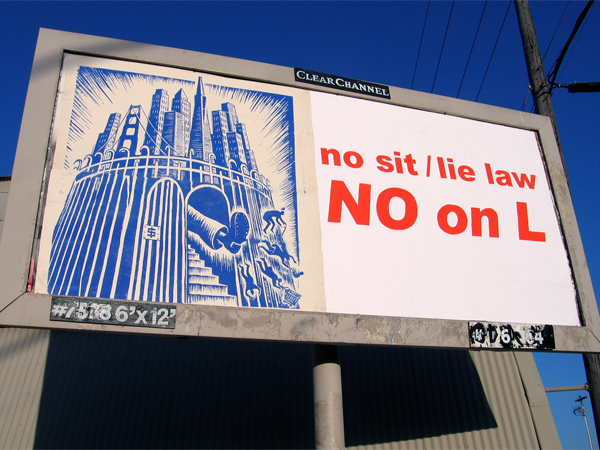
The Sit Lie Posse can “liberate” a billboard in 10 minutes

A press release went out yesterday announcing that a group called the Sit Lie Posse had “liberated” six billboards and 60 bus shelters with original artwork in opposition to Proposition L, San Francisco’s proposed sit / lie ordinance. The posters bear three different images, including one featuring a “Gascon-topus,” illustrated with the face of San Francisco Police Chief George Gascon and the body of a gigantic octopus. Gascon is a strong advocate for the ordinance, which would ban sitting and lying down on San Francisco sidewalks.

While members of the posse did not provide a phone number or reveal their true identities, the Guardian did manage to get in touch via email with a spokesperson of the posse, who goes by the name Jim Rawley.

Rawley says he chose his name in honor of the character from John Steinbeck’s The Grapes of Wrath, who manages the utopian Weedpatch camp and treats the impoverished Joad family with dignity and respect. Rawley also reveals the technique the Sit Lie Posse uses to liberate bus-shelter ads, and tells us how long it takes for the crew to put up displays of their artwork throughout the city. A few of our questions and answers appear below.

San Francisco Bay Guardian: Does the Sit Lie Posse have a budget? If so, how much?
Jim Rawley: The Sit Lie Posse is a volunteer group unaffiliated with any electoral campaign. We made our guerrilla ads by hand and paid for our materials out of pocket. It cost us $150 to liberate six billboards and 60 bus shelter ads.

 
SFBG: How long does it take to liberate a billboard? How about a bus shelter ad? Does the posse use wheat-paste?
JR: Our billboards took about 10 minutes and the bus shelters took 2-3 minutes. We accessed the bus shelters using a master key and attached our work with Velcro, the industry standard for bus shelters because of quick, easy insertion. We attached our billboards with wheat-paste. Despite the efforts of Clear Channel and a heavy rainstorm, our bus shelters and billboards are still up.


SFBG: The Sit / Lie Posse has created quite a stir. C.W. Nevius writes in this morning’s column: “Opponents are attempting to make a comparison with the civil rights movement in the South in the ’50s and ’60s. Apparently their view is that an unkempt panhandler camping on the sidewalk equates to the Freedom Riders opposing racial discrimination. Weird.” What would you say to Nevius in response?

 JR: We expected that the Chronicle would try to ridicule, belittle and smear our work, especially since C.W. Nevius and his advocacy columns instigated Prop L. In the 1950s and 60s civil rights workers were maligned by the mainstream press, harassed by the police and subject to physical violence. It takes time for social movements to gain legitimacy in the eyes of the state and the corporate media. In their own words, Chronicle columnist C.W. Nevius and Police Chief George Gascon have said that Prop L enforcement would exclude tourists and center on the homeless. Regardless of your opinion on homelessness, it’s clearly discrimination when the law is based upon a person’s appearance and applies only to certain groups – the poor and people of color. Even more so when the stated intent of the enforcement is to drive certain people out of a neighborhood. This is San Francisco’s kindler, gentler version of Jim Crow segregation.


SFBG: What was the inspiration behind the Gascon-topus?

JR: We came up with the Gascon-topus as a reference to sci-fi movie posters. Prop L will give unchecked power to the police to conduct unconstitutional searches and arrests. In the face of such a monstrous attack on civil liberties, we wanted to respond with wit, humor and satire.


SFBG: Why do you think it’s important to fight against expanded policing in public space?

JR: It’s important to fight additional policing in pubic space to preserve our civil liberties and to save the character of San Francisco. Most San Franciscans don’t want to sacrifice the city’s diversity and rebellious creativity in order to recreate San Francisco as one massive, sanitized shopping mall with all action controlled by the police. Most San Franciscans don’t want undocumented immigrants and day laborers to be deported after a bogus bust for sitting. Most people don’t want to see the poor disqualified from government housing because they committed the crime of sitting. Most people don’t want to be subjected to unconstitutional drug searches after being detained for sitting, nor do people want to see parolees sent back to prison for the crime of sitting. Public space and civil liberties are vital to a healthy democracy. Public space is the only area beyond private property and the marketplace where San Franciscans can come together to exercise civil rights and collectively shape the future of the city. We need to defend that space and extend it against threats from wealthy business interests and their allies in government.

Different walls

0

arts@sfbg.com

Palestinian perspectives are in. You know it when a major filmmaker like Julian Schnabel makes a big-budget film like Miral, based on the book by Palestinian journalist Rula Jebreal (which recently screened at the Mill Valley Film Festival in advance of a general release next year).

In many ways, though, it’s the rest of the country that’s catching up to places like the Bay Area, where Palestinian voices have long been a part of the cultural landscape. The Arab Film Festival, for instance, which just closed its 14th season, once again featured several films from and about Palestine. And this year the San Francisco International Film Festival gave us a look at Port of Memory, the latest work from Kamal Aljafari, one of the most interesting and sophisticated filmmakers to come from Palestine since Elia Suleiman.

In theater, San Francisco’s Golden Thread Productions just gave a staged reading of biographical work from youth in embattled Gaza called The Gaza Monologues. For years, Golden Thread has produced works incorporating the Palestinian perspective amid a mass culture overwhelmingly slanted toward the more powerful side in a basically colonial project. And currently Campo Santo and Intersection for the Arts bring the diasporic repercussions of Palestinian dispossession center stage in Habibi, a new play from a new Palestinian American theatrical voice, Sharif Abu-Hambeh.

Habibi makes its debut as the second offering in a trio of world premieres at Intersection by first-time playwrights (the first having been Chinaka Hodge’sMirrors in Every Corner). Directed by Omar Matwally, Abu-Hambeh’s play weaves together two distinct storylines that attempt to capture the inter-generational confusion and displacement experienced by assimilating Palestinian immigrants in the Bay Area. That confusion can regrettably transfer to the play itself, whose intentional deployment of ambiguity ends up, at least to some extent, being merely fuzzy rather than thought-provoking. But the ideas here are at times intriguingly subtle and the effort a promising one. Moreover, Matwally and Campo Santo give the play a strong production with various charms along the way.

At the center of this double helix of a narrative is young Palestinian American Tariq (a coolly vital and engaging Aleph Ayin). Tariq shares a small Mission District apartment and even — talk about family overload — a single bed with his loving but paternalistic father, Mohammed (a stern, sympathetic Paul Santiago). The deliberate and routine-loving Mohammed — who unlike his Americanized son speaks in accented English — is a museum guard with a strong work ethic that he’s trying, unsuccessfully, to instill in his slacker offspring. Tariq, for his part, has just happily shed his menial job at a local café and is in no hurry to find a new one. His absent mother (Nora El Samahy) apparently left them some time before, though she reappears at one point in his imagination.

This father and son dynamic, familial and almost too familiar, comes intercut with a public talk by a high-class museum curator (a sharp and funny El Samahy, dressed by costume designer Courtney Flores in esteem-grabbing Manhattan chic and sporting a very respectable English accent), who leads us through a slide lecture on the great art heists of the last century. Her talk, avid but meandering, is interrupted by simultaneously exasperating and guilt-producing phone calls from her terminally ill father, and a consequent tendency to wander into ruminations farther afield — summoned for us in pictures of dispossession that float by on the screen behind her (in video projections designed by Aubrey Millen).

Maybe these wayward ruminations aren’t so far afield after all, we come to suspect, as her theme of cultural theft warms up to its own complexities and encourages us to consider the nature of cultural transmission, loss, and hybridization in the life-and-death circumstances of exiled populations. This idea deepens as Tariq’s raucous and rebellious spirit extends to breaking into the curator’s monologue, and even smashing the fourth wall to confront us, her audience. Tariq also has a unique tendency to narrate his own actions, a self-conscious conceit that can be productive at times, especially of humor, and works as an indirect aside to the audience.

By the end, the two narratives come even closer together through a rash act of Tariq’s father that trades disastrously on the concept of family heirlooms, or the physical symbols of patrimony and place. The climax arrives too hastily, and its potential impact is muted. At the same time, the play’s departure from the more universal, shopworn gestures of “melting pot” tales verges on something rare and coruscating.

HABIBI

Thurs.–Sun., 8 p.m.; through Nov. 7; $15–$25

Intersection for the Arts

446 Valencia, SF

(415) 626-2787 

www.theintersection.org


Editor’s notes

0

Tredmond@sfbg.com

At a certain point, you have to stop trying to project what’s going to happen and just wait for the election results. Because what matters now isn’t the $140 million Meg Whitman has spent or Carly Fiorina’s record at Hewlett-Packard or which aide to Jerry Brown called Whitman a whore. It’s who shows up to vote.

If I were Meg Whitman’s campaign manager, I’d stop spending money. Go into hiding. Pretend there’s nothing going on here, no big deal next Tuesday morning — and then pray for rain. Because the way Whitman wins — possibly the only way she wins — is if huge numbers of Californians don’t bother to vote.

If the turnout is reasonable — that is, if enough Democrats realize the danger posed by of the GOP candidate and go to the polls — then Jerry Brown is in. And if that happens, chances are good that the rest of the Democratic ticket — including Gavin Newsom and Kamala Harris — squeaks in, too. And then we can all start to have fun figuring out the future of San Francisco politics.

That, of course, depends on the same factor: Who’s going to show up to vote? Will all the tenants in District 8 — many of them unexcited about Jerry Brown — take the time to vote for Rafael Mandelman for supervisor? Will the progressive voters who have lived in District 6 for a while get to the polls in greater numbers than the conservative newcomers in the pricey condos? Will the next Board of Supervisors — which could be choosing the next mayor — be as progressive as the current board (which also might wind up choosing the next mayor?)

And who’s even on the mayoral short list?

At the Haight Ashbury Neighborhood Council forum Oct. 14, former Supervisor (and potential mayoral contender) Aaron Peskin noted that the person in Room 200 year “is going to have to take out the garbage.” The city’s going to face another awful budget deficit and a progressive interim mayor will have to make a lot of enemies. Who wants to face the voters in November 2011 after making more cuts and raising taxes?

Well, somebody needs to — because the “caretaker” mayor some people are pushing for won’t have the clout to make tough decisions. And frankly, a progressive with the power of incumbency might actually be able to win a full term, even up against a huge downtown war chest.

Fun stuff. Go out and vote.


Steve Moss: the big duck

68

WORKING DOGGEDLY TO PIN DOWN THE EDITOR OF THE POTRERO VIEW WHO IS ALSO A CANDIDATE FOR SUPERVISOR FROM DISTRICT 10

We’ve been trying to pin Steve Moss down on some key questions.  Over the weekend, I sent him some questions by email.  He responded, but ducked or ignored the real points and never gave us any straight answers.

Here’s our exchange, my questions and his answers — unedited,  followed by some comments from me as we doggedly try to make sense of where Steve Moss really stands on key issues in the district.


Dear Steve,

In your October, pre-election issue of the Potrero View, your signed column
compares the Guardian with Fox News and states that we are both  “advocacy groups disguised as news purveyors” who “whip mostly anonymous commentators on their websites to call political candidates ‘weasle, lying, doucebags’ and worse.” You also state that “these same outlets barely take the time to edit–much less fact check–their stories.”

As you know, our reporter Sarah Phelan has done factual reporting on you and your campaign (http://www.sfbg.com/2010/09/14/five-things-you-should-know-about-steve-moss) and she and I have both checked with you to respond to our points before publication.  We will continue our policy by submitting these email questions to you in advance of publication. Our deadline is 5 p.m. on Monday

l. What specific facts do you find inaccurate in our previous reporting on you and your campaign? (You mixed up a comment on a blog with Phelan’s actual story and reporting. Was this intentional?)

2. How much money have you and your various profit and nonprofit enterprises accepted from PG&E during this past year?

How much money have you accepted in total from PG&E during your many years of operating  your profit and nonprofit enterprises? Why did you change the pro-public power View of Ruth Passen to a PG&E-friendly View under your ownership?  (For example, Passen always supported public power but you as the new owner  refused to support the last public power initiative and said it was “too contentious.”)

3. Campaign finance records show that Thomas Coates, a Republican who spent $l million trying to overturn rent control in California in 2008, has just dumped
$45,000 into the so-called Alliance for Jobs and Sustainable Growth in support of your candidacy.  Public records also show that you served a cure or quit notice
to a tenant in your rent-controlled building in District 8. Would you comment on this? And would you state whether you support or oppose rent control?

4.  On the front page of the October View, your lead story reported on the troubles of the Neighborhood House under the headline, “NABE Reeling Under City Budget Cuts.” Your story noted that the Nabe had lost “nearly $400,000 in funding from the Department of Human Services (DHS) and the Department of Children, Youth and Their Families” and that individual donations had dropped by 75 per cent. The result, your story noted, was that the NABE “has been forced to eliminate teen-focused programming, reduce elementary school offerings by 25 per cent, lay-off staff and impose pay cuts.”

Each year, the NABE sponsors the Potrero Hill festival as a benefit to raise much-needed funds. This year the benefit was more critical than ever to reduce its  crippling deficit. Just as the View was going to press earlier this month,  I got a call at the Guardian from a representative of the festival with a startling bit of information. I was told that you, as the owner and editor-publisher of the View, and a candidate for supervisor from our district, were  refusing to run a full page ad for the festival, a key piece of the NABE’s promotion on the hill,if the ad contained the logo of the Guardian as a festival sponsor. 

The representative was concerned that, if you wouldn’t run the NABE ad, that the Guardian as a media sponsor wouldn’t run a NABE ad in the Guardian.
(I told him not to worry, do what he had to do to get the ad in the View, and that the Guardian would run the ad and double up on its promotion for the festival. The Guardian logo did not appear on the Nabe ad in the View but did appear on all other NABE promotions.)

Why did you make this threat to the NABE and its festival benefit? Were you serious?

5. You said in your endorsement interview at the Guardian that, if you were elected supervisor, you would give up the View. Do you still plan to do that, if elected? If so, how would you do that?

 
 Steve Moss responds:

1.  The entire way you’ve covered the District 10 election has been slanted towards the candidate you prefer, and against the candidates you dislike.  From this perspective the Guardian is not serving the role of a newspaper, but rather is acting as an independent expenditure committee on behalf of its chosen candidates and causes.  I’d be happy to select a panel of five independent journalists — you pick two, I’ll pick two, and the four can pick one — to render an opinion about how you’ve run the Guardian during this election cycle, and how I’ve run the View.

2.  In 2010 I believe SF Power has received less than $25,000 in payments related to the small business demand-response program it operates, as sanctioned by the California Public Utility Commission.  I’ve already provided you and your reporter with multiple responses to your requests about SF Power’s successfull advocacy related to CPUC orders requiring PG&E to fund programs focusing on working families and small businesses, all of which, as I’ve repeatedly pointed out, are a matter of public record.

The View has published several articles about community-based energy systems, and effective ways to achieve local control over the power grid, during my tenure as publisher. They are available on our website.

3.  I read about Coats’ contribution in Bay Citizen.  As you know, this donation was made to an independent expenditure committee over which I have no control and almost no knowledge.  I have stated throughout the campaign, and directly to the Tenants Union, that I believe current rent control policy should remain unmolested.

4.  I made no threat to the NABE.  In fact, the festival was featured on the front page of the November issue, with a story inside, and a full page ad.

5.  Yes.  A new editor will be found to run the View if I’m elected to office.


Okay, You aren’t responsive.   Let me try again, point by point:

l. I am not running for office. You are.  Please tell me where we are factually wrong in any of our reporting on you and your campaign.

As you know, we have contacted you in advance of publication for comment. And you have written us twice with generalities but no specifics on inaccurate reporting.

2. You defend your PG&E payments on the basis that it’s actually money from the California Public Utilities Commission that PG&E is required by law to put up for energy efficiency projects. However, Loretta Lynch, former president of the CPUC, told me that PG&E decides who gets the money and that fund recipients that “cross PG&E” are in danger of getting their funds cut off.

In other words, if  you  want to continue to fund your organization with upwards of more than $l million over three years, you must avoid angering the utility.  This may explain why the Potrero View under your ownership has switched from its historic position supporting public power under former owner Ruth Passen to going easy on PG&E and ducking a position on the most recent public power initiative (Proposition H).

The background: Your  non profit collected  $1,290,000 from the CPUC for energy efficiency projects over the past three years, according to SF Power’s annual revenues and estimated budgets from 2008 to 2010 as provided on its website.

The breakdown: $500,000 in 2008, $440,000 in 2009, $350,000 in 2010.

You  also got $150,000 from the San Francisco Public Utilities Commission in 2008 and $125,000 in 2009.  Your  non profit also got $50,000 chunks each year from the Richard and Rhoda Goldman fund, where his wife Debbie Findling works.   The Lisa and Douglas Goldman Fund kicked in $5,000 in 2008 and 2009.  The  Potrero View contributed $5,000 in 2008, $4,500 in 2009, and $5,000 in 2010.  A footnote stated that SF Power “is also informally negotiating with the California Air Resources Board, San Francisco’s Office of the Mayor, Mirant Corporation, and Pacific Gas and Electric Company, among others, for project funding support.”  Did you get any additional money from Mirant, PG&E,  the Mayor, or anybody else? Are you still negotiating? If not, when did you stop?

Lynch explained that “all energy efficiency programs in California are funded by ratepayer dollars that are collected by the utilities as part of each ratepayer’s utility bill.  Thus, California ratepayers, big and small, pay for all energy efficiency programs and each and every program is funded by ratepayers, not utilities.”

She said that the CPUC “sets broad parameters for each utility concerning the amount of overall energy efficiency savings to be achieved and in what customer classes (residential, small business, large business,etc.). But the utilities choose the program providers. The CPUC simply reviews the overall package provided by the utilities to check to see whether the energy efficiency savings targets are met.”

Thus, PG&E each year decides  the amount of money going to SF Community Power. Lynch noted that  some non profit people told her, when she was a commissioner, that “if you crossed PG&E, they would stop the funding.”
 
Lynch mentioned a meeting with you  that showed  PG&E’s influence on you, your non profit and the View. .
She said that, shortly after she was termed out as a CPUC  commissioner in 2009, you  asked her to meet with  him at Farleys coffee shop and asked her to serve on the board of his nonprofit. “I thanked him and said that he should consider my relationship with PG&E before making that offer if he was funded through PG&E, as PG&E and I have a very contentious relationship,  and that they would not be happy if I were on the board. He thanked me for telling him and agreed that I should not serve on the board.”  Lynch lives on Potrero Hill.

3. I followed up my rent control question:  “If state law were amended to allow it, would you support extending rent control to vacant apartments?”  No answer.

4. I got a call from Keith Goldstein, president of the Potrero Hill Association of Merchants and Businesses and co-chair of the festival. He had gotten an email from you  that read: “Please have the festival’s pr agent remove the Guardian’s logo from any complimentary ad the View is providing the festival in this month’s paper.” Why did you make  such an unprofessional move?   Would you have backed out of sponsoring this event if the Guardian logo had remained? Is that how you would behave as a supervisor?

5. If elected, do you plan to sell the View?  Will you continue to operate your non profit and take chunks of money from PG&E? If elected, would your income from PG&E disquality you from voting on PG&E and energy issues? At what point would you sever your relations, if at all,  with your non profit and PG&E?

6. If  you lose, will you (as your wife suggested in an email to friends) move back to your house on Liberty St in Distict 8?

We anxiously  await your response. B3

Our Weekly Picks: October 20-26

0

THURSDAY 21

THEATER

“The Laramie Residency”

Just when you thought it was safe to come out of the closet, a chilling spike in suicide rates among gay teenagers who have been bullied or harassed has reemerged as national news. Which makes this rare double-header of The Laramie Project and its sequel, The Laramie Project: Ten Years Later, Epilogue uncannily apropos. Written in response to the notorious murder of Matthew Shepard, a young gay man in small-town Wyoming, both plays were created from hundreds of interviews with the inhabitants of Laramie. The results offer a detailed examination of how violence affects not only the perpetrators victims, but an entire community. “The Laramie Residency” also includes a special Thursday dialogue between director and coauthor Moisés Kaufman and Tony Taccone of the Berkeley Rep. (Nicole Gluckstern)

Thurs/21, 7 p.m.; Fri/22–Sat/23, 8 p.m., $10–$55

Jewish Community Center of San Francisco

3200 California, SF

(415) 292-1233

www.jccsf.org

FILM/PERFORMANCE

All About Evil: The Peaches Christ Experience in 4-D”

Horror fans are well familiar with the tag line for Wes Craven’s 1972 Last House on the Left: “To avoid fainting, keep repeating ‘It’s only a movie … It’s only a movie…'” Well, it wouldn’t be Halloween in San Francisco without Peaches Christ, whose alter ego, the less-flashy but no less fabulous filmmaker Joshua Grannell, brings his All About Evil to life at the very Mission District theater where it was shot. The film and its accompanying pre-show performance have been out roaming the U.S. and the U.K. for the past several months; expect the hometown gig to be extra-specially spooky, with musical and multimedia numbers by Peaches and Evil cast members. And since the Victoria plays an important supporting role in the film, expect interactive surprises galore. Only a movie? Don’t be so sure! (Cheryl Eddy)

Through Sun/24

8 p.m., $20

Victoria Theater

2961 16th St, SF

www.peacheschrist.com

MUSIC

Joshua Bell with the San Francisco Symphony

An average street performer isn’t always average. In 2007, the acclaimed violinist Joshua Bell participated in an experiment in which he played for 45 minutes as an anonymous busker in the D.C. Metro. The few who bothered to pause in their morning bustle and pull out their headphones realized they were in the presence of greatness. Renowned worldwide, virtuoso Bell joins the San Francisco Symphony in Bruch’s Violin Concerto No. 1. Conducted by James Conlon, the evening also includes Wagner’s Prelude to Act I of Die Meistersinger von Nürnberg, as well as Dvorák’s In Nature’s Realm and the overtures to Carnival and Othello. (Emmaly Wiederholt)

Thurs.–Sat., 8 p.m.; Sun, 2 p.m., $15–$150

Davies Symphony Hall

201 Van Ness, SF

www.sfsymphony.org

MUSIC

Steve Lawler

You can either love or hate seminal Ibiza club Space, and there’s been plenty of room to do both in its 20-year history. But just when you throw up your hands in a bad way at all the astringent trance, tipsy Brits, and noodling minimal, boom!, a DJ comes along who can drag you back to the dance floor. Rightly respected Brit Steve Lawler, known as the “King of Space,” scored that tiara by leapfrogging styles and keeping his sets limber. There’s some fluttering bass, chunky old-school breakdowns, and searing tech in his bag as well as, gasp, snippets of wistful melody. Lawler especially rocks the hard-driving, samba-esque Spanish-Berlin sound that’s become Ibiza’s best recent export. (Marke B.)

9:30 p.m., $10–>$20

Vessel

85 Campton Place, SF

(415) 433-8585

www.vesselsf.com

DANCE

Kunst-Stoff and LEVYdance

Dancers are famous for their kinesthetic memory. Without activating the brain, their muscles recall whole dances — or at least fragments. Show them a step or two and the rest follows. But dancers also seem to be able to dig even deeper, into something akin to an ancestral memory. It may take personal affinity but also a lot of hard research to unearth the kind of treasure trove that then can be used creatively. Two temperamentally different choreographers, Yannis Adoniou, of Greek descent, and Ben Levy, from a Jewish-Persian family, have done the excavations. Adoniou’s Rebetiko, commissioned by CounterPULSE’s Performing Diaspora Program, and Levy’s Our Body Remembers should make for an intriguing evening of might be called “kinetic history.” (Rita Felciano)

Through Oct. 30

Thurs.–Sat. and Sun/24, 8 p.m., $18

ODC Theater

3153 17th St., SF

(415) 863-9834

www.odctheater.org

FRIDAY 22

MUSIC

Stone Foxes

Let’s talk foxes, shall we? The native gray one is uncommon in San Francisco. The exotic red species, however, is a regular interloper of the Presidio. The Stone Foxes, four young dudes who play mean blues, are more like the former: genuine, rare, and always a treat to see in the wild. Sometimes you don’t want indie or nu-gaze or psych-doom-metal — you simply need real rock ‘n’ roll. Their sophomore album Bears and Bulls was released this past July, and though not as raw as their killer debut, it exudes a new and natural confidence. This is their official vinyl release show, so bring extra cash. (Kat Renz)

With Soft White Sixties and Real Nasty

10 p.m., $12

Bottom of the Hill

1233 17th St., SF

(415) 621-4455

www.bottomofthehill.com DANCE

Paco Gomes and Dancers

In his choreography, Brazilian-born Paco Gomes speaks with a powerfully articulated and mature voice. His dances beautifully integrate modern and Afro-Brazilian influences; as a company director he gathers around him — and trains — multi-ethnic dancers who seem to thrive under his tutelage. Now, with guest choreographers Jorge Silva and J. Pazmino, Gomes is presenting Amor O, an evening of works old and new that circles around love: of self, of friends, and also as remembered and lived within families. In addition, the program includes an excerpt of a new work in progress planned for an upcoming international tour. It examines love within another “family,” the Orixas, from the Yoruba religion. Perhaps it’s a consolation that in the world of the gods, not everything went smoothly either. (Felciano)

Through Sat/23

8 p.m., $15

Garage

975 Howard, SF

(415) 518-1517

www.975howard.com

MUSIC

Karl Blau

Eclectic K Records artist Karl Blau throws a wrench into the indie/folk scene with a chameleon-like ability to work within multiple genres. Ignoring the usual expectations of singer-songwriter stereotypes, Blau is known to inject everything from hip-hop and electronic influences to world and reggae music into his solo albums. He’s also worked with some notable names in Phil Elvrum (The Microphones, Mount Eerie) and Laura Veirs. Blau can currently be found playing bass for droney doom-metal band, Earth. It’ll be interesting to see how he melds all these elements together in a live setting. (Landon Moblad)

With Dina Maccabee and Birds and Batteries

7 p.m., free ($5 donation suggested)

Viracocha

998 Valencia, SF

(415) 374-7048

www.viracochasf.com

MUSIC

Lyrics Born

If it was any other rapper describing his newest album as “more synth-oriented” and “dealing with a lot of issues that are more mature than the last few albums, from abandonment to betrayal to incredible joy,” I’d say watch out for a lawsuit from one Mr. West. But since half of Latryx (with Lateef the Truthspeaker) and cofounder of Quannum Records, Lyrics Born is known for bringing his own brand of substance to the scene while pushing the genre forward. His new material, which features emerging artists Trackademicks, Francis and the Lights, and Sam Sparro, will be on display at this release party. (Ryan Prendiville)

With Chali 2na and the House of Vibe and Rakaa

9 p.m., $25

Independent

628 Divisadero, SF

(415) 771-1421

www.theindependentsf.com

SATURDAY 23

MUSIC

Triptykon

After almost 30 years in the arena, Tom G. Warrior has earned his status as heavy metal royalty. The Swiss singer and guitarist formed Hellhammer in 1982 and went on to found Celtic Frost two years later. Both bands contributed immeasurably to the development of extreme metal, and their influence reverberates throughout the genre today. Having parted ways with Celtic Frost in 2008, Warrior formed Triptykon, planning to pick up where Monotheist (Celtic Frost’s 2006 LP) left off. The new band’s music combines slabs of doomy guitar, razor-wire black metal, and Warrior’s paint-peeling vocals, breaking down genre boundaries in pursuit of heaviness. Come out and play. (Ben Richardson)

With 1349 and Yakuza

9 p.m., $23

Slim’s

333 11th St, SF

(415) 255-0333

www.slims-sf.com

EVENT

“SF DocFest Roller Disco Costume Party”

Have you ever stared longingly at the roller skaters in Golden Gate Park? Always wanted to join in but too embarrassed by your lack of boogie? Still hung up over the accident you had at a fifth grade skate party? Well, get over it. The Roller Disco Costume Party offers a simple solution: anonymity. As part of DocFest, admission is free with a ticket stub or just $5 if you strap on your best costume (which could potentially double as padding in case of collision.) (Prendiville)

8 p.m., free–$10

CELLSpace

2050 Bryant, SF

www.sfindie.com

MUSIC

Taj Mahal, Toumani Diabaté, Vieux Farka Touré

Tonight the Paramount plays host to a blues exploration featuring American bluesman Taj Mahal, Malian kora player Toumani Diabaté, and Malian guitarist Vieux Farka Touré. To trace the roots of the blues immediately leads to Africa, and in particular to Mali, and each of these three frontmen represents a different facet of that exploration. Mahal has spent decades reinterpreting the blues through far-flung musical traditions from the Caribbean and Hawaii to Europe and Latin America; Diabaté brings to the fore the centuries old West African tradition of the kora; and Touré, the torch-bearing son of the late Ali Farka Touré, represents a more recent cross-pollination of traditional Malian sounds with American blues and rock. While each of the three musicians is a monster in his own right, together they represent a veritable blues trifecta. (Mirissa Neff)

8 p.m., $25–$75

Paramount Theatre

2025 Broadway, Oakl.

(510) 465-6400

EVENT

“B.Y.O.Q.: Bring Your Own Queer”

Gurla-Q, you better bring it: a cavalcade of queer artists, musicians, and performers is avalanching Golden Gate Park for a full day of heady debauchery. Vinyl soul from the Hard French party DJs, homo-futurist sounds from Honey Soundsystem, Las Bomberas de la Bahia’s Afro-Puerto Rican percussion and dance, local indie faves Excuses for Skipping, fashion shows, a candygram booth, art displays, and so much more to turn you hot pink with multitasking. Plus, special guest John Cameron Mitchell giving you Hedwig fierceness. The annual B.Y.O.Q. has been a sweet, sweet success, conjuring up the activist days of yore while introducing some amazing new talent. Don’t wrap your internal pansy up in a plain brown bag, let her shine and shine. (Marke B.)

Noon–6 p.m., free

Golden Gate Park Music Concourse, SF

www.byoq.org

SUNDAY 24

MUSIC

Reigning Sound

Reigning Sound burst out of the gates in 2002 with the garage-punk classic, Time Bomb High School. Since then, the Tennessee-based group — performing as part of the ninth Budget Rock festival — has continued to refine its brand of country, soul, and classic R&B touches by way of organ-filled, distorted guitar-driven rock ‘n’ roll, most recently on 2009s Love & Curses. The band also recently backed up original Shangri-la member Mary Weiss on her 2007 comeback album, further evidence of the range its capable of. As far as modern garage rock goes, Reigning Sound is as classy and fun a group that you’re likely to find. (Moblad)

With Flakes, Ty Segall, and Touch-Me-Nots

9 p.m., $15

Bottom of the Hill

1233 17th St, SF

(415) 621-4455

www.bottomofthehill.com 

The Guardian listings deadline is two weeks prior to our Wednesday publication date. To submit an item for consideration, please include the title of the event, a brief description of the event, date and time, venue name, street address (listing cross streets only isn’t sufficient), city, telephone number readers can call for more information, telephone number for media, and admission costs. Send information to Listings, the Guardian Building, 135 Mississippi St., SF, CA 94107; fax to (415) 487-2506; or e-mail (paste press release into e-mail body — no text attachments, please) to listings@sfbg.com. We cannot guarantee the return of photos, but enclosing an SASE helps. Digital photos may be submitted in jpeg format; the image must be at least 240 dpi and four inches by six inches in size. We regret we cannot accept listings over the phone.

Newsom could be headed for victory

11

Gavin Newsom seems poised to win his race for lieutenant governor, at least as indicated by his opponent Abel Maldonado’s increasingly desperate campaign tactics and Newsom’s string of newspaper endorsements, including the Spanish language La Opinion, which chose to pass over a moderate Latino that it has endorsed in the past. The only question now is voter turnout, and whether Newsom’s negatives would be enough to drag him down if the Democratic base stays home in this lackluster election.

In its endorsement in Sunday’s paper, La Opinion wrote, “We are deeply disappointed that in this election [Maldonado] has opted for an opportunistic strategy of using images of undocumented criminals to earn political points. This is unacceptable and his charges against Newsom on this issue are inaccurate.” The reference was to Maldonado’s wild charges in an Oct. 15 debate that Newsom created San Francisco’s sanctuary city policies and was responsible for the fatal shootings of Bologna family members, allegedly by an undocumented immigrant who had once been in city custody. The reality was that Newsom inherited the sanctuary city policy and unilaterally weakened it after the Bologna shooting, even refusing to implement legislation approved by the Board of Supervisors (which Newsom vetoed but the board overrode) to require due process before those arrested are turned over to the feds for possible deportation.

While the paper didn’t seem to understand that Newsom has snubbed his nose at San Francisco progressives and petulantly fed a particularly divisive style of politics here, they do rightfully give him credit for running a complicated city, unlike the conservative city of Santa Maria where Maldonado was mayor and always did the bidding of the Chamber of Commerce, something I observed while working at the Santa Maria Times at the time. “The Democratic candidate has implemented solid, progressive management while leading a diverse city during a deep budget crisis. Newsom has proven to be creative, resourceful, and sensitive while forging alliances that improve the quality of life for his city’s residents,” La Opinion wrote. 

Then yesterday, as the Los Angeles Times reports on its blog, when Newsom held a campaign event trumpeting his support by Latino leaders such as Los Angeles Mayor Antonio Villaraigosa and labor leader Dolores Huerta, Maldonado showed up and sat in the back with his advisers during the event. Now that’s just strange.

A California Democratic Party e-mail blast this afternoon used a series of rhetorical questions to describe the campaign’s episodes: “So was Maldonado’s bizarre behavior an egotistical attempt to intimidate other Latinos who came to the event to support Newsom? Does he feel entitled to the appointed position now that he actually has to compete for voters in a real election? Is he desperate for media attention? Or does he just enjoy being a spectator, watching his opponent secure key Latino endorsements while his own campaign falls apart?”

But the real question is whether Democrats can mobilize enough voters to overcome Newsom’s negatives, from his arrogance to his personal foibles. When I did a search for Gavin Newsom’s name on Yahoo, which automatically guesses what you’re asking for based on past queries, the first three that listed were “Gavin Newsom girlfriend,” “Gavin Newsom divorce,” and “Gavin Newsom affair,” an apparent reference to his admitted affair with Ruby Rippey Tourk, who worked for him and was married to his reelection campaign manager.

So, if you support Newsom for this office — or even if you’re just anxious for him to leave San Francisco a year before his mayoral term expires — don’t forget to get out there and vote.

On the edge

0

rebeccab@sfbg.com

It’s a strange and daunting time for anyone just starting out, but youth who age out of foster care are up against particularly harsh challenges.

In July, the national unemployment rate for 16- to 24-year-olds reached a staggering 51 percent, according to the Bureau of Labor Statistics. A recent article in The New York Times Magazine described how, in the face of a bleak job market, 20-somethings today are far more likely than those in past generations to go back to school, travel, volunteer, or complete unpaid internships — extending a phase of impermanence and financial dependency for years beyond what used to be considered the norm. Studies show that nearly half of youth between ages 18 and 25 move back home with their parents at least once.

But young people aging out of the foster care system typically have to face this world of churning uncertainty without the benefit of a safety net. Many post-foster care youth don’t have the luxury of “failing to launch,” embarking on an early career path without pay, or landing back home if nothing else pans out. Foster youth lose their support base at 18, when the state ceases to be their legal guardian. For these young people, who are often the least equipped to achieve financial self-sufficiency, becoming emancipated as a legal adult is no cause for celebration; rather, it’s a source of anxiety.

Most foster youth lack the skills, connections, and resources they would need to transition to independence at age 18 — a prospect that would be difficult even for youth with greater access to resources and no major family history problems. Studies measuring the outcomes for this population paint a grim picture: many wind up homeless, incarcerated, or at risk of losing children of their own by the time they reach their early 20s.

There’s a growing awareness that many of the approximately 5,000 youth who age out of foster care in California every year are slipping through the cracks. Local and state programs have been initiated to improve their chances of achieving independence, but efforts on both fronts have run up against obstacles.

In Sacramento, Assembly Bill 12 — which extends key services for foster youth to age 21 — was signed into law several weeks ago, but the intentions behind it were undermined when Gov. Arnold Schwarzenegger issued a line-item veto of $80 million in funding for child welfare programs. In San Francisco, a housing facility designed for youth at risk of homelessness seems to hold promise as an effective model, yet it has encountered resistance from local neighborhood organizations.

The plight of these young people is both a measure of our compassion and potentially a harbinger of larger societal problems to come.

HIGH STAKES

Kirsten Johnson-Bell is an emancipated youth who turned 18 in January. She has six siblings still in foster care in the East Bay, and she says she has been in more than 20 foster care placements since 2007.

Johnson-Bell told the Guardian that she has housing assistance that will last for 18 months — but she’s already beginning to wonder what will happen after that. “Where am I supposed to go?” Johnson-Bell wondered. If the experience of her peers who’ve exited the system is any indication, her concern is well founded.

Nationwide, nearly 40 percent of post-foster-care youth have been homeless at some point by the time they turn 24, according to survey results released by the University of Chicago and Partners for Our Children at the University of Washington. Just 6 percent had completed college degrees by that age, and only 48 percent were working — mostly in low-wage jobs. More than half of the young men had been convicted of crimes, and roughly three-quarters of the young women had received government benefits to meet basic needs. Teen pregnancy is statistically higher among young women exiting foster care.

Most youth in foster care aren’t housed continuously with a single caregiver, but bounce from place to place, making it tough to form long-lasting relationships. “It’s a fairly rare experience that youth stay in one home, and that means moving schools and moving friends,” notes Rachel Antrobus, executive director of Transitional Age Youth San Francisco (TAY SF), a city-funded nonprofit. Many foster kids take medication for behavioral problems, and it’s common for them to experience emotional upheaval.

“It’s practically inevitable that they’re going to have long-term emotional impacts,” Antrobus said, noting many bear the long-term scars of abuse, neglect, or forced separation from their families for some other reason. “It’s a much longer road, and they have to do it with deeper wounds. Even the kids that are the most together … will likely experience some really dark places in their 20s.”

In San Francisco, there are 1,400 young people in the foster care system, and all but about 500 are in placements outside the city. Lynette Davis, who turned 18 this year, moved from San Francisco to Oakland when she first entered foster care in the eighth grade. Davis acknowledges that she was one of the lucky ones. Rather than move in with a stranger, she went to live with her godmother and remained there until her 18th birthday.

Davis is now living with her boyfriend and his family in Oakland — and the household was in the process of moving when the Guardian spoke with her. Her godmother offered to continue housing her after she turned 18, Davis noted. “But she’s got her own kids. I felt like I should be able to go off and do my own thing.” The requirement in either housing situation is that she must work, go to school, or both, Davis said. She’s attending classes at Oakland’s Merritt College. In the meantime, she’s mired in the frustrating exercise of applying for job after job.

“It’s been pretty ridiculous,” Davis said of her fruitless job hunt. “Sometimes it makes me want to stop and give up. But as long as you’ve got people around you who care about you, it’s okay.”

Many foster kids who didn’t have the support network that Davis did are up against alarmingly high stakes as they age out. “Some people are mothers and they have to pay rent and are looking for more than two jobs,” she said. Asked what she thought were the greatest challenges facing foster youth in San Francisco, she mentioned poverty, gangs, and a lack of job opportunities.

“To be successful, you have to be financially stable,” she said. “With some youth, that’s hard. They don’t have jobs, or they can’t get jobs. They want to find an easy way out.” That’s when they become more susceptible to gangs or drugs, she said. Davis says she was a “rebellious youth” at a younger age, but now she’s focused on her goal of obtaining a degree in psychology so that one day she can go into counseling. When she became a member of California Youth Connections, which aids youth with transitional support, she met other foster youth and realized she could really have an impact.

HELP OR HARM?

The difference between ages 18 and 21 can be critical, so foster youth advocates throughout the state cheered Sept. 30 when AB12, California’s Fostering Connections to Success Act, was signed into law. It allows California to make use of federal matching funds to provide transitional support for qualifying foster youth until age 21. It also authorizes the state to take advantage of a federal subsidy for an existing guardianship program for relatives of foster youth who want to become caregivers. Many foster youth advocates have thrown support behind the kin caregiver model — it can be less traumatic for youth to move in with a grandparent than being suddenly dropped into a strange place.

A major sponsor of A 12 was the John Burton Foundation for Children Without Homes, and policy director Amy Lemley hailed its passage as “the biggest child-welfare improvement in 20 years.” Studies show that youth who receive support beyond 18 are 200 percent more likely to be working toward completion of a high school diploma, 65 percent less likely to have been arrested, and 54 percent less likely to have been incarcerated than those who exit with no support. The benefits could also generate savings by reducing the number of people in prison, on welfare, or in need of publicly funded health and human services. The law will be implemented in 2012.

The law also will provide new housing options. The federal government will chip in to cover more placements in the Transitional Housing Program Plus — nearly axed during the last budget cycle — which offers supervised transitional housing for emancipated youth. Youth may also receive a rent subsidy that could apply in a dorm, a shared-living situation, or another arrangement that fits the youth’s needs. This flexibility is a positive change, Lemley noted. “We’re not telling young people ‘it’s our way or the highway,'<0x2009>” she said.

“If a state like California can do this in the context of its current fiscal deficit, it sends a strong signal to other states,” Lemley said. However, an unexpected line-item veto put a damper on the landmark achievement. Schwarzenegger dealt a blow to the child-welfare system by cutting $80 million in funding for programs the California Legislature had restored, which actually amounts to more like $133 million due to the loss of federal matching funds.

“It’s really just a schizophrenic policy on the governor’s part,” Lemley said. “We were hoping he would have a legacy of the foster care governor, but now it doesn’t seem as if he will have that legacy at all.”

While the deep budget cut isn’t aimed at AB12 directly, Lemley said, it erodes funding for child-welfare workers and forces counties to make painful funding cuts. The overarching effect is that abuse and neglect may go undetected more often, and youth in the system will have fewer available resources once they’re placed.

ANOTHER CHANCE

Of all the challenges facing foster youth who age out of the system, housing is among the most critical, particularly in San Francisco. A partnership between the city, Larkin Street Youth Services, and nonprofit developer Community Housing Partnership (CHP) aims to address this by providing a space for transitional-age youth who wouldn’t otherwise be able to afford housing in the city. Located at the King Edward II Inn near Cow Hollow and the Marina district, the facility would house 24 young people, ages 18 to 24, who are at risk of homelessness.

“By definition, that includes youth aging out of foster care,” explains David Schnur of CHP. The nonprofits are working in tandem with the city’s Human Services Agency and Mayor’s Office of Housing.

Youth housed at Edward II would have access to physical and mental health care, substance abuse and HIV-related services, education and job training, coaching in basic life skills such as budgeting and personal hygiene, and case management, Schnur said. They would be required to contribute a portion of their income, whatever the amount, toward rent.

However, an organized force of opposition has already surfaced from the surrounding community, which comprises one of San Francisco’s wealthiest neighborhoods. “I think people are just nervous about what it means to have a building of this type in the neighborhood,” Schnur noted. To assuage neighborhood concerns, the nonprofits have set up a project advisory committee in hopes of talking it out and bringing everyone on board.

Patricia Vaughey, with the Marina-Cow Hollow Neighbors, is actively opposed to the project but insists that it isn’t out of NIMBY (Not In My Backyard) concerns. “We are not NIMBYs,” she told the Guardian. “We want to find a location that’s suitable. We want to make sure those kids are safe.” She said that criminal activity in the neighborhood made the inn a poor choice. Yet advocates insist that for the youth, the program could mean the difference between a lifetime of hardship and a chance to get their lives on track at a crucial age. “The safety net for these young people is so thin,” Lemley noted. “You might have one person, you might have another. But then the winds of change blow and suddenly the bloom falls off the rose.”

Our 44th Anniversary Issue also includes stories by Sarah Phelan on SF’s disadvantaged youth, Caitlin Donohue’s account of the Haight street kids, and Tim Redmond’s editorial on the issues facing our rising generation

Music listings

0

Music listings are compiled by Paula Connelly and Cheryl Eddy. Since club life is unpredictable, it’s a good idea to call ahead to confirm bookings and hours. Prices are listed when provided to us. Submit items for the listings at listings@sfbg.com.

WEDNESDAY 20

ROCK/BLUES/HIP-HOP

Aerosols, Montra, Skystone Hemlock Tavern. 9pm, $6.

Pryor Baird and the Deacons Biscuits and Blues. 8 and 10pm, $15.

Blood and Sunshine, Callow, Shauna Regan Red Devil Lounge. 8pm, $6.

Deer Tick, J. Roddy Walston and the Business Regency Ballroom. 8pm, $17.

Ennen Enne, Winebirds, Zoo Elbo Room. 9pm, $7.

Four Year Strong, Wonder Years, American Fangs Slim’s. 8pm, $17.

Hedley, Gold Motel, Chairman Wow Café Du Nord. 8pm, $12.

Hesta Prynn, Kenan Bell, 40Love Rickshaw Stop. 8pm, $12.

Scout Niblett, Esben and the Witch, Excuses for Skipping Bottom of the Hill. 9pm, $12.

Suicidal Tendences, (hed)p.e. Fillmore. 8pm, $26.50.

UK Subs, Total Chaos, Sore Thumbs, Final Summation Thee Parkside. 8pm, $10-12.

Vaselines, Dum Dum Girls Great American Music Hall. 8pm, $23.

Hawksley Workman, Joe Firstman, Aimee Francis, Trey Lockerbie Hotel Utah. 7:30pm, $10.

DANCE CLUBS

Booty Call Q-Bar, 456 Castro, SF; www.bootycallwednesdays.com. 9pm. Juanita Moore hosts this dance party, featuring DJ Robot Hustle.

Breezin Koko Cocktails, 1060 Geary, SF; (415) 885-4788. 9:30pm, free. With DJs Amy A and Brynnie Mac spinning yacht rock od smooth 70s.

Hands Down! Bar on Church. 9pm, free. With DJs Claksaarb, Mykill, and guests spinning indie, electro, house, and bangers.

Jam Fresh Wednesdays Vessel, 85 Campton, SF; (415) 433-8585. 9:30pm, free. With DJs Slick D, Chris Clouse, Rich Era, Don Lynch, and more spinning top40, mashups, hip hop, and remixes.

Mary-Go-Round Lookout, 3600 16th St, SF; (415) 431-0306. 10pm, $5. A weekly drag show with hosts Cookie Dough, Pollo Del Mar, and Suppositori Spelling.

RedWine Social Dalva. 9pm-2am, free. DJ TophOne and guests spin outernational funk and get drunk.

Respect Wednesdays End Up. 10pm, $5. Rotating DJs Daddy Rolo, Young Fyah, Irie Dole, I-Vier, Sake One, Serg, and more spinning reggae, dancehall, roots, lovers rock, and mash ups.

Synchronize Il Pirata, 2007 16th St, SF; (415) 626-2626. 10pm, free. Psychedelic dance music with DJs Helios, Gatto Matto, Psy Lotus, Intergalactoid, and guests.

THURSDAY 21

ROCK/BLUES/HIP-HOP

Ancestors, Pins of Light, Fucking Wrath Hemlock Tavern. 9pm, $7.

Atreyu, Bless the Fall, Chiodos, Architects, Endless Hallway Regency Ballroom. 6:30pm, $23.

Bell X1 Swedish American Hall (upstairs from Café Du Nord). 8pm, $18.

Company Car, Pebble Theory, Farewell Typewriter El Rio. 9pm, $6.

Stan Erhart with Garth Webber Biscuits and Blues. 8 and 10pm, $15.

Harry and the Hitmen, Hypnotist Collectors, Jugtown Pirates Rickshaw Stop. 8pm, $10.

Dave Mason Yoshi’s San Francisco. 8pm, $36.

Joey McIntyre, Emanuel Kiriakou Great American Music Hall. 8pm, $34.

Mischka, White Buffalo, Chris Velan Independent. 8pm, $15.

Old Man Markley, Whisky Richards, West Nile Ramblers Bottom of the Hill. 9pm, $10.

Recoil: A Strange Hour, Alan Wilder and Paul Kendall, Architect, Conjure One Mezzanine. 8pm, $25.

*Saviours, Kowloon Walled City Thee Parkside. 9pm, free.

Scrams, Airfix Kits, Dirty Cupcakes, Bad Backs Knockout. 9:30pm.

DANCE CLUBS

Afrolicious Elbo Room. 9:30pm, $10. DJs Pleasuremaker and Señor Oz and guest Choco Mann spin Afrobeat, tropicália, electro, samba, and funk.

Caribbean Connection Little Baobab, 3388 19th St, SF; (415) 643-3558. 10pm, $3. DJ Stevie B and guests spin reggae, soca, zouk, reggaetón, and more.

Club Jammies Edinburgh Castle. 10pm, free. DJs EBERrad and White Mice spinning reggae, punk, dub, and post punk.

John Digweed Ruby Skye. 9pm, $30.

Drop the Pressure Underground SF. 6-10pm, free. Electro, house, and datafunk highlight this weekly happy hour.

Electric Feel Lookout, 3600 16th St, SF; (415) 431-0306. 9pm, $2. With DJs subOctave and Blondie K spinning indie music videos.

Good Foot Som., 2925 16th St, SF; (415) 558-8521. 10pm, free. With DJs spinning R&B, Hip hop, classics, and soul.

Jivin’ Dirty Disco Butter, 354 11th St., SF; (415) 863-5964. 8pm, free. With DJs spinning disco, funk, and classics.

Koko Puffs Koko Cocktails, 1060 Geary, SF; (415) 885-4788. 10pm, free. Dubby roots reggae and Jamaican funk from rotating DJs.

Mestiza Bollywood Café, 3376 19th St, SF; (415) 970-0362. 10pm, free. Showcasing progressive Latin and global beats with DJ Juan Data.

Nightvision Harlot, 46 Minna, SF; (415) 777-1077. 9:30pm, $10. DJs Danny Daze, Franky Boissy, and more spinning house, electro, hip hop, funk, and more.

Peaches Skylark, 10pm, free. With an all female DJ line up featuring Deeandroid, Lady Fingaz, That Girl, and Umami spinning hip hop.

Popscene 330 Rich. 10pm, $10. Rotating DJs spinning indie, Britpop, electro, new wave, and post-punk.

FRIDAY 22

ROCK/BLUES/HIP-HOP

Born Ruffians, Meligrove Band Slim’s. 9pm, $16.

Fleeting Trance, Wish Inflicted, Jeremy Serwer Hotel Utah. 9pm, $8.

Jon B. Yoshi’s San Francisco. 10:30pm, $25.

Lyrics Born, Chali 2na, Rakaa Independent. 9pm, $25.

Never Shout Never, Maine, I Can Make a Mess Like Nobody’s Business, Carter Hulsey Warfield. 6:30pm, $20.

Jack O and the Tearjerkers, Roy Loney, East Bay Grease, Wrong Words, Scrams Thee Parkside. 8:30pm, $10. Part of Budget Rock 9.

Mississippi Man, Silent Comedy, Michael Beach Hemlock Tavern. 9:30pm, $8.

Pierced Arrows, Bare Wires, Burnt Ones Rickshaw Stop. 8:30pm, $12.

Lavay Smith and Her Red Hot Skillet Lickers Biscuits and Blues. 8 and 10pm, $20.

Starfucker, Octopus Project, Strength Great American Music Hall. 9pm, $14.

Stone Foxes, Soft White Sixties, Real Nasty Bottom of the Hill. 10pm, $12.

JAZZ/NEW MUSIC

*Yusef Lateef Grace Cathedral, 1100 California, SF; www.sfjazz.org. 8pm, $30-50.

Gretchen Parlato Swedish American Hall (upstairs from Café Du Nord). 8pm, $30.

Marlena Teich Savanna Jazz. 7:30pm, $8.

FOLK/WORLD/COUNTRY

Boca do Rio Coda. 10pm, $10.

Marina Lavalle Brava Theater, 2781 24th St., SF; www.brownpapertickets.com. 8pm, $22.

DANCE CLUBS

Afrobeat Lab Elbo Room. 10pm, $10. Featuring a live performance by ALBINO! with DJs Señor Oz and guests.

Alcoholocaust Presents Riptide Tavern. 9pm, free. DJ What’s His Fuck spins old-school punk rock and other gems.

Club Dragon Club Eight, 1151 Folsom, SF; www.eightsf.com. 9pm, $8. A gay Asian paradise. Featuring two dance floors playing dance and hip hop, smoking patio, and 2 for 1 drinks before 10pm.

Duniya Dancehall Blue Macaw, 2565 Mission, SF; (415) 920-0577. 10pm, $10. With live performances by Duniya Drum and Dance Co. and DJs dub Snakr and Juan Data spinning bhangra, bollywood, dancehall, African, and more.

Exhale, Fridays Project One Gallery, 251 Rhode Island, SF; (415) 465-2129. 5pm, $5. Happy hour with art, fine food, and music with Vin Sol, King Most, DJ Centipede, and Shane King.

Fat Stack Fridays Koko Cocktails, 1060 Geary, SF; (415) 885-4788. 10pm, free. With rotating DJs B-Cause, Vinnie Esparza, Mr. Robinson, Toph One, and Slopoke.

Fubar Fridays Butter, 354 11th St., SF; (415) 863-5964. 6pm, $5. With DJs spinning retro mashup remixes.

Good Life Fridays Apartment 24, 440 Broadway, SF; (415) 989-3434. 10pm, $10. With DJ Brian spinning hip hop, mashups, and top 40.

Hot Chocolate Milk. 9pm, $5. With DJs Big Fat Frog, Chardmo, DuseRock, and more spinning old and new school funk.

House of Voodoo Medici Lounge, 299 9th St., SF; (415) 501-9162. 9pm, $5. With DJ Purgatory and Stiletto spinning goth, industrial, deathrock, glam, darkwave, and eighties.

Psychedelic Radio Club Six. 9pm, $7. With DJs Kial, Tom No Thing, Megalodon, and Zapruderpedro spinning dubstep, reggae, and electro.

Queens are Wild Mezzanine. 8pm, $25-$500. A benefit casino night costume party with host Juanita More and DJs Gemini Disco.

Rockabilly Fridays Jay N Bee Club, 2736 20th St, SF; (415) 824-4190. 9pm, free. With DJs Rockin’ Raul, Oakie Oran, Sergio Iglesias, and Tanoa "Samoa Boy" spinning 50s and 60s Doo Wop, Rockabilly, Bop, Jive, and more.

Scientist with Roots Radics Rock-it Room. 9pm, $17.

Some Thing The Stud. 10pm, $7. VivvyAnne Forevermore, Glamamore, and DJ Down-E give you fierce drag shows and afterhours dancing.

Soul in the Machine DNA Lounge. 8pm, $20. Techno and industrial with Dyloot, Taj, and more.

$3 Dance Party Knockout. 10pm, $3. Eclectic tunes with DJs Paul Paul, dX the Funky Gran Paw, and Deadbeat.

SATURDAY 23

ROCK/BLUES/HIP-HOP

Laurie Anderson Yoshi’s San Francisco. 8pm, $55.

Bilal Ameoba, 1855 Haight, SF; www.amoeba.com. 2pm, free. 2pm, free.

Chuck Alvarez Band Biscuits and Blues. 8:30pm, $15.

Crosstops, Sassy Bender’s, 800 S. Van Ness, SF; www.bendersbar.com. 10pm, $5.

Electric Six, Constellations, Ghost Robot Independent. 9pm, $16.

Frail, Savage Resurrection El Rio. 9pm, donations to Rocket Dog Rescue accepted.

Giovenco Project Coda. 10pm, $10.

JP, Chrissie and the Fairground Boys, Amy Correia Bimbo’s 365 Club. 9pm, $33.

Oblivians, Icky Boyfriends, Wounded Lion, Wild Thing Bottom of the Hill. 9pm, $20.

Rubinoos Great American Music Hall. 9pm, $18. Part of Budget Rock 9.

*Skipper, Shannon and the Clams, C’Mon Everybody, Tropical Sleep, Larry and the Angriest Generation, Midnite Snaxx Thee Parkside. 2pm, $7. Part of Budget Rock 9.

Trashcan Sinatras Swedish American Hall (upstairs from Café Du Nord). 8pm, $20.

Triptykon, 1349, Yakuza Slim’s. 9pm, $23.

Women, French Miami, Manchild Hemlock Tavern. 9:30pm, $10.

JAZZ/NEW MUSIC

Bill Frisell and the 858 Quartet Noe Valley Ministry, 1021 Sanchez, SF; www.noevalleymusicseries.com. 7:30 and 9:30pm, $25.

JFJO, Con Brio, Evarusnik Café Du Nord. 9:30pm, $15.

Will Sellenraad Coda. 7pm, $7.

Suzanna Smith Savanna Jazz. 7:30pm, $8.

FOLK/WORLD/COUNTRY

Ashwin Batish and friends of Sitar Power Red Poppy Art House. 7pm, $25. With dance artist Rasa Vitalia.

Greensky Bluegrass Boom Boom Room. 8pm, $15.

Ten Sorrowful Songs and a Crane San Francisco Community Music Center, 544 Capp, SF; (415) 647-6015. 8pm, free.

Craig Ventresco and Meredith Axelrod Atlas Café. 4pm, free.

DANCE CLUBS

Bar on Church 9pm. Rotating DJs Foxxee, Joseph Lee, Zhaldee, Mark Andrus, and Nuxx.

Barracuda 111 Minna. 9pm, $10. Eclectic 80s music with DJs Damon and Phillie Ocean plus 80s cult video projections, a laser light show, prom balloons, and 80s inspired fashion.

Bootie DNA Lounge. 9pm, $6-12. Mash-ups with guest VJ Faroff and more.

Derrick Carter Ruby Skye. 9pm, $15.

Cockblock Rickshaw Stop. 10pm. Queer dance party with DJ Nuxx and friends.

David J. Cat Club. 9:30pm, $10-12. Music from the dark side.

Debaser Knockout. 9pm, $5. Hip-hop hits of the 90s with DJs Jamie Jams, EmDee, and Stab Master Arson.

4OneFunktion Elbo Room. 10pm, $5-10.

Go Bang! Deco Lounge, 510 Larkin, SF; (415) 346 – 2025. 9pm, $5. Recreating the diversity and freedom of the 70’s/ 80’s disco nightlife with DJs Steve Fabus, Tres Lingerie, Sergio, and more.

HYP Club Eight, 1151 Folsom, SF; www.eightsf.com. 10pm, free. Gay and lesbian hip hop party, featuring DJs spinning the newest in the top 40s hip hop and hyphy.

Icee Hot 222 Hyde, SF; www.iceehotmartyn.eventbrite.com. 10pm. With Dutch drum and bass veteran and producer Martyn.

Reggae Gold Club Six. 9pm, $15. With DJs Daddy Rolo, Polo Mo’qz, Tesfa, Serg, and Fuze spinning dancehall and reggae.

Rock City Butter, 354 11th St., SF; (415) 863-5964. 6pm, $5 after 10pm. With DJs spinning party rock.

Spirit Fingers Sessions 330 Ritch. 9pm, free. With DJ Morse Code and live guest performances.

SUNDAY 24

ROCK/BLUES/HIP-HOP

Laurie Anderson Yoshi’s San Francisco. 8pm, $55.

Azure Ray, Whispertown, Tim Fite Independent. 8pm, $15.

"Battle of the Bands" DNA Lounge. 5:30pm, $12. With House of Clouds, Twisted Blues, and more.

Happy Body Slow Brain, Please Do Not Fight, Bird by Bird, Girlfriend Season Rickshaw Stop. 7pm, $10.

Making Dinner Café Du Nord. 8pm, $10.

Muskrats, Tee’n’Dee Explosion, Outdoorsmen, Spencey Dude and the Doodles, Angora Debs, Skkkumby Thee Parkside. 1pm, $7. Part of Budget Rock 9.

Lucky Peterson Biscuits and Blues. 8 and 10pm, $20.

Reigning Sound, Flakes, Ty Segall, Touch-Me-Nots Bottom of the Hill. 9pm, $15. Part of Budget Rock 9.

Safes, Cellar Doors, Dead Westerns Hemlock Tavern. 8pm, $7.

JAZZ/NEW MUSIC

Anthony Brown and friends Koret Auditorium, de Young Museum, Golden Gate Park, 50 Hagiwara Tea Garden Dr, SF; www.theintersection.org. 2pm, free.

Bill Frisell Ameoba, 1855 Haight, SF; www.amoeba.com. 2pm, free.

Bill Frisell and the 858 Quartet Noe Valley Ministry, 1021 Sanchez, SF; www.noevalleymusicseries.com. 7:30pm, $25.

FOLK/WORLD/COUNTRY

Kenny Barron Trio with David Sanchez Herbst Theatre, 401 Van Ness, SF; www.sfjazz.org. 7pm, $25-65.

Big Tings Gravity, 3251 Scott, SF; (415) 776-1928. 5pm, free.

Jon Jang SF Conservatory of Music, 50 Oak, SF; www.sfjazz.org. 3pm, $30-50.

Barrington Levy Slim’s. 9pm, $30.

Orquesta America El Rio. 4pm, $8.

Josh Workman, Bryan Bowman, Ravi Abcarian Bliss Bar, 4026 24th St, SF; (415) 826-6200. 4:30pm, $10.

DANCE CLUBS

DiscoFunk Mashups Cat Club. 10pm, free. House and 70’s music.

Dub Mission Elbo Room. 9pm, $6. Dub, dubstep, roots, and dancehall with DJ Sep, Ludachris, and DJ Tomas.

Gloss Sundays Trigger, 2344 Market, SF; (415) 551-CLUB. 7pm. With DJ Hawthorne spinning house, funk, soul, retro, and disco.

Honey Soundsystem Paradise Lounge. 8pm-2am. "Dance floor for dancers – sound system for lovers." Got that?

Jock! Lookout, 3600 16th St, SF; (415) 431-0306. 3pm, $2. This high-energy party raises money for LGBT sports teams.

Kick It Bar on Church. 9pm. Hip-hop with DJ Zax.

Lowbrow Sunday Delirium. 1pm, free. DJ Roost Uno and guests spinning club hip hop, indie, and top 40s.

Pachanga Coda. 5pm, $10. Salsa with DJs Fab Fred, DJ Antonio, and Montuno Swing.

Religion Bar on Church. 3pm. With DJ Nikita.

Stag AsiaSF. 6pm, $5. Gay bachelor parties are the target demo of this weekly erotic tea dance.

Swing Out Sundays Rock-It Room. 7pm, free (dance lessons $15). DJ BeBop Burnie spins 20s through 50s swing, jive, and more.

MONDAY 25

ROCK/BLUES/HIP-HOP

Lights, Jeremy Fisher Slim’s. 8pm, $15.

Lucky Peterson Biscuits and Blues. 8 and 10pm, $20.

Russian Circles, Keelhaul, Call Me Lightning Bottom of the Hill. 9pm, $13.

Seabear, Grandchildren Independent. 8pm, $15.

Amanda Shires, Jesse Brewster, Heather Combs Elbo Room. 9pm, $7.

DANCE CLUBS

Black Gold Koko Cocktails, 1060 Geary, SF; (415) 885-4788. 10pm-2am, free. Senator Soul spins Detroit soul, Motown, New Orleans R&B, and more — all on 45!

Death Guild DNA Lounge. 9:30pm, $3-5. Gothic, industrial, and synthpop with DJs Decay, Joe Radio, and Melting Girl.

Krazy Mondays Beauty Bar. 10pm, free. With DJs Ant-1, $ir-Tipp, Ruby Red I, Lo, and Gelo spinning hip hop.

M.O.M. Madrone Art Bar. 6pm, free. With DJ Gordo Cabeza and guests playing all Motown every Monday.

Manic Mondays Bar on Church. 9pm. Drink 80-cent cosmos with Djs Mark Andrus and Dangerous Dan.

Musik for Your Teeth Revolution Café, 3248 22nd St., SF; (415) 642-0474. 5pm, free. Soul cookin’ happy hour tunes with DJ Antonino Musco.

Network Mondays Azul Lounge, One Tillman Pl, SF; www.inhousetalent.com. 9pm, $5. Hip-hop, R&B, and spoken word open mic, plus featured performers.

Skylarking Skylark. 10pm, free. With resident DJs I & I Vibration, Beatnok, and Mr. Lucky and weekly guest DJs.

TUESDAY 26

ROCK/BLUES/HIP-HOP

Best Coast, Sonny and the Sunsets Great American Music Hall. 8pm, $15.

Billy Nayer Show, Lee Vilensky Trio Café Du Nord. 8:30pm, $12.

Breathe Owl Breathe, Little Wings, Kacey Johansing Bottom of the Hill. 9pm, $10.

Ego Likeness, Chant, Slave Unit Elbo Room. 9pm, $10.

Mariah Larkin El Rio. 7pm, free.

DANCE CLUBS

Alcoholocaust Presents Argus Lounge. 9pm, free. "Stump the Wizard" with DJs What’s His Fuck and DJ Wizard.

Eclectic Company Skylark, 9pm, free. DJs Tones and Jaybee spin old school hip hop, bass, dub, glitch, and electro.

Rock Out Karaoke! Amnesia. 7:30pm. With Glenny Kravitz.

Share the Love Trigger, 2344 Market, SF; (415) 551-CLUB. 5pm, free. With DJ Pam Hubbuck spinning house.

Womanizer Bar on Church. 9pm. With DJ Nuxx.

Beat patrols: A case study

14

If you want a case study that illustrates why San Francisco needs Proposition M, taken a look at Bernal Heights.

In 2008, two people were killed at the Alemany public housing project, topping off a disturbing increase in street crime. Neighborhood activists responded by working successfully with the captain of the Ingleside Station to a beat cop on Cortland Ave. Crime dropped.

But several weeks ago, Captain Louis Cassanego cut that foot patrol, citing the need to reallocate scarce SFPD manpower to more violent areas.

We couldn’t reach Cassanego, but at an Oct. 6th Police Commission meeting, Chief George Gascon said the beat patrol fell victim to budget problems. He explained that a beat cop on Cortland wasn’t needed anymore because the policy “was set there at a time when there was an increase in robberies… in this community that is no longer there today.”

But comminity activists say that’s precisely the point: “When we got the beat cops, crime went down,” Joseph Smooke, executive director of the Bernal Heights Neighborhood Center, told us. In fact, Smooke said, the foot patrol reduced overall crime in the surrounding neighborhoods as well.

And now, with the foot patrols gone, residents fear that crime will rise again.

Supervisor David Campos, a coauthor of Prop M, told us: “It doesn’t make sense: the community wants more policing, not less. They rightly feel that we’re moving backwards, that something they worked very hard for is being taken away.”

Prop M would hamper future foot patrol cuts by requiring the Chief of Police to prescribe a comprehensive “Foot Beat Patrol Program” for all SFPD stations.

Says community organizer Buck Bagot, who volunteers with the Bernal Height Neighborhood Center, “It’s hard not to think [Prop M] makes sense.”

Prop M could also address what Bagot and Smooke agree is the larger problem: community-police synergy. Besides mandating foot patrols, Prop M would require the Police Commission to “adopt a comprehensive written policy on community policing,” including “a plan for… open communication… among [SFPD] personnel and community members,” with a focus on “neighborhood-specific policing priorities and strategies.”

In recent years Bernal Heights community groups have fallen somewhat out of step with local police. Communication with Ingleside Station has at times been strained. The station’s former captain, David Lazar, started a program in August of 2009 that alloowed merchants and residents to call cell phones that beat cops carried on duty. Cassanego ended that program, too.

Cassanego cut the Cortland Ave beat, he compensated by extending two bike patrol beats into that area. Though Bagot is skeptical that this will be effective, losing personal access to the police irks him most. “At least if we could talk with [the cops], we could work with them…. But if they’re not going to patrol there anymore, and we can’t call them on the cell phones, then we’re kind of floating free.”