Budget

Will Occupy message reach Sacramento?

26

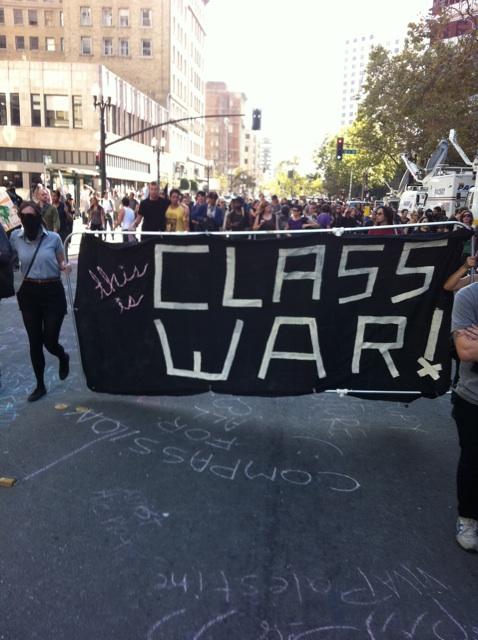
One of the early tests of the political impact of the Occupy movement will come in the next two months, as California prepares to make drastic further cuts in education and social services for the poor and the Democratic governor begins — cautiously and hesitantly — to talk about new revenues.

The numbers from the Legislative Analysts Office are fairly bleak — the state budget relied on $4 billion in revenue that hasn’t been collected. That’s because Gov. Brown and the Democrats in the Legislature assumed that the economy would pick up more than it has. We don’t know what the final shortfall will be — but because the budget deal included automatic trigger cuts, it’s clear that K-12 education, CSU and UC are going to get hit again, as will, for example, medical assistance for the disabled.

So just as students and faculty all over the state are protesting existing cuts and tuition hikes, more are on the way. I expect this will go over extremely well on the campuses.

The cops may be poised to shut down OccupySF, but this is a movement that isn’t about to go away. And if the governor and the Democrats in the Legislature (who are going to be running from new districts next fall) start to feel the heat and realize that the Occupy movement is already influencing the political debate and will, directly or indirectly, be playing a major role in state and national politics, they’re going to have to respond.

How? Well, the Legislature can always decide to scrap the cuts and raise taxes now. Unlikely, since that would require a two-thrids vote and the Republicans still care more about their no-taxes pledge than they do about the tens of thousands of people (including in their own districts) who are taking to the streets to protest economic inequality.

More likely the talk will be about November, 2012, and what sort of revenue measures Jerry Brown wants to put on the ballot. And that’s where the politics of Occupy can have a significant impact.

There are so many ways to go with tax measures; the easiest, in some ways, is to talk about the state sales tax, which bothers the GOP hardliners (like any tax) but bothers the big-business world a lot less. Most of any sales tax hike would be paid by consumers and the poor would pay more than the rich; typically, big business groups are willing to accept a sales tax hike before they’ll go for anything more progressive.

Obviously, the best option is to do exactly what Occupy is talking about, and raise the income tax on the top brackets (and cut corporate loopholes, and pass an oil severance tax). And that’s what will drive the California Chamber of Commerce types absolutely mad.

But I think a there’s a way to make this a winner at the polls, and a winner for the legislators who push it — and maybe even a winner for a Dem or a moderate Republican in some of the potential swing districts. Just call it a One Percent Tax — that is, a tax on the One Percent. Could be a combination of income taxes and corporate taxes, as long as it’s a package carefully written to target largely the wealthiest in the state.

Hard for anyone these days to oppose something that is totally defined and promoted that way. Gives the Occupy movement something to vote for. Could save jobs, keep classrooms open, keep sick people alive … I see no downside at all.


Editor’s notes

0

tredmond@sfbg.com

Occupy Oakland has been very good at exposing one local problem — police brutality. The first raids, and the tear gas and rubber bullets that flew afterward — showed the world how poorly trained the Oakland cops are and how unprepared they were for a largely peaceful demonstration.

But overall, the Occupy movement has been about national issues — or rather, The National Issue, which is income inequality. Nothing else going on in the United States compares. On an economic level, I could argue that nothing else matters — until we resolve the wealth and income gap, the recession will never end, the deficit will never improve, the unemployment rate won’t stabilize, the nation will grow weaker and weaker and more and more unstable … basically, we’re doomed.

But while there have been marches on local banks and corporations, not a lot of Occupy attention has gone to local inequality — to what the folks at San Francisco City Hall, and Oakland City Hall are doing to make the one percent in our own backyards pay its fair share for the services that most impact many of our lives. Mayor Jean Quan got booed for calling in the riot cops, but Mayor Ed Lee isn’t getting booed for corporate tax breaks.

The OccupySF people came out in force to a Board of Supervisors hearing to demand that their camp be left alone. But they aren’t out in force to demand, say, a local fee on bank foreclosures.

That’s not a criticism of a movement that continues to inspire me every day; it’s just a statement about tactics and strategy. And it’s one we all ought to be thinking about.

In a brilliant opinion piece this week, Raj Jayadev, director of Silicon Valley Debug, notes:

“In San Jose, the city that used to promote itself as the capitol of Silicon Valley, city budget cuts have either eliminated or dramatically slashed hours for youth sanctuaries like libraries and community centers. … For us, the one percent are just up the street -– the 101 to be precise. Those tech giants exist in the same Silicon Valley that cannot even keep its library doors open. Why have they not given? Why have we not demanded?”

Good question.

Ed Lee’s challenges

2

EDITORIAL Mayor Ed Lee has always talked about bringing the city together, about avoiding division and harsh conflict. And how that he’s won a four-year term, he’s going to have to address a wide range of city problems that in the past haven’t responded well to consensus and compromise.

He’s going to have to do it in the wake of an election in which the centrist candidates all finished low in the pack — and the strongest progressive actually won more votes than anyone else on Election Day. And his victory comes at a time when there’s more concern over economic inequality than this country has seen since the 1930s — represented most visibly by the large and growing OccupySF encampment.

The mayor received huge financial support — in the hundreds of thousands of dollars — from some of the same people and businesses that the Occupy movement is targeting. Some of his campaign contributors have an conservative economic agenda that’s way to the right of the center of San Francisco politics. And some of his closest allies (and strongest supporters) are, to put it kindly, ethically challenged.

So it’s not going to be easy for the mild-mannered mayor to lead the city — and if he wants to be successful, he needs to work with and not ignore the left.

There are a few critical steps that would show the people who opposed him that he’s not a captive of big-business interests and that he can be trusted:

1. Appoint a real progressive to Sheriff-elect Ross Mirkarimi’s District Five supervisorial seat. If Lee is really a mayor who’s above petty politics, the chief criterion for the appointment shouldn’t be loyalty to Lee.

District Five supported Avalos over Lee by a solid margin (in the Haight, Avalos got twice as many votes as Lee). The district has been represented by two people, Matt Gonzalez and Mirkarimi, both of whom were elected as Green Party members. It’s almost certainly the most left-leaning district in the city, and deserves a supervisor who represents that political perspective. Most of the qualified people who fit that description supported a candidate other than Ed Lee for mayor.

2. Don’t send the cops to roust OccupySF. The movement has support all over the city and is making an historic statement. It’s probably the most important political demonstration in San Francisco since the 1960s. A mayor who has any shred of a progressive soul should recognize that the most important issue facing this city and this nation is the wealth and income gap and help OccupySF make its voice even louder.

3. Present a plan for more than a “cuts only” budget. Yes, the sales tax measure lost, putting a hole in the city budget, and yes, it will be a year before a credible new revenue measure can go on the ballot. But now is the time to start bringing people together to look at what comprehensive tax reforms might be more appealing than a regressive sales tax.

4. Don’t give away the city to the One Percent. A developer wants to build 160 condos for the very, very rich on the waterfront at 8 Washington. Mayoral ally Rose Pak supports the project. It’s about as blatant an example as possible of something that only benefits multimillionaires, and it will be one of the first major land-use decisions Lee will have to grapple with. Making his opposition clear would demonstrate his independence.

5. Run an open administration. Both previous mayors, Gavin Newsom and Willie Brown, were openly hostile to the press, hostile to open government and supremely arrogant. Lee has a different personal style — and he ought to show that he respect the Sunshine Ordinance by directing his departments to abide by the rulings of the Sunshine Task Force.

That’s what good government would look like.

Alerts

0

alert@sfbg.com

WEDNESDAY 16

Confront the UC Regents

Editor’s Note: The UC canceled this meeting as we were going to press, citing public safety concerns, and protest organizers were figuring out how to respond. Check our Politics blog or www.makebankspaycalifornia.com for the latest.

The UC Board of Regents will be meeting at the UCSF Mission Bay Campus at 10 am, and students have been organizing for months to make their voices heard. The message: stop tuition hikes, budget cuts, and privatization of public schools; tax the 1 percent.

ReFund California and the Northern California Convergence will join up with OccupySF and Occupy encampments being set up on various college campuses this week to “Shut down the UC Regents meeting and take control of our education and our future.” ReFund California is also threatening to march on the Financial District to shut down banks if the Regents don’t support their five-point pledge of action (see “The growing 99 percent,” 11/9).

OccupySF will be marching from their encampment at Justin Herman Plaza (Market and Embarcadero) to the Mission Bay Campus starting at 7 am. UC Berkeley students can board a ReFund California bus at 7 am at Bancroft and Telegraph in Berkeley.

10 a.m., free

UCSF Mission Bay Campus

1675 Owens, SF

(650) 238-4821

www.occupyed.org

makebankspaycalifornia.com

occupyoureducation@gmail.com

rose.goldman@gmail.com


THURSDAY 17

Changing Congress

San Francisco Progressive Democrats of America hosts a discussion with Norman Solomon, a prolific progressive political writer who is running for Congress to replace retiring Rep. Lynn Woolsey (D-Marin), a member and former chair of the Congressional Progressive Caucus. The event opens the floor for questions and concerns regarding future legislation.

7-9 p.m., free

Harry R. Bridges Memorial Building, ILWU, 4th Floor

1188 Franklin, SF

sig4re@comcast.net

www.pdamerica.org


SATURDAY 19

Addiction & Society

Our capitalist society may be to blame for our addictive tendencies and obsessive consumerism. Dr. Gabor Mate, an author and physician who focuses on mental illness, explains how our market economy drives us crazy and leads us down a path toward dependency. Speak Out Now’s colloquium event will help listeners connect the dots between two of our country’s most prevalent concerns.

5-7 p.m., $2 suggested donation

South Berkeley Senior Center 2939 Ellis, Berk.

contactspeakout@gmail.com

www.speakout-now.org


MONDAY 21

“Gay Politics in Africa”

Beyond our own shores, homophobia persists to infiltrate government and subjugate people with leaders who use religion and law as instruments to thwart the freedom of sexual expression. Dr. Sylvia Tamale, renowned African feminist, analyzes the Ugandan Anti-Homosexuality Bill and opines on the roots of homosexual suppression in Africa and Western societies.

6- 7:30 p.m., free

Berman Hall in the Fromm Building, USF Golden Gate and Parker, SF

510-663-2255

priorityafrica@priorityafrica.org

www.priorityafrica.org

Her way

4

arts@sfbg.com

DANCE Early in the 20th century, Ezra Pound declared “the artist is the antenna of the race.” True or false? Do artists have the ability to predict the future, or are they stuck in the present?

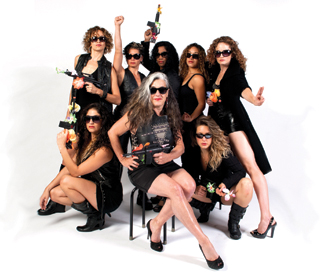
Krissy Keefer, artistic director of Dance Brigade and Dance Mission Theater, tends to side with Pound. While she wouldn’t go as far as writer-performer Guillermo Gómez-Peña, who considers the artist a shaman, she does think that “there is something about the artistic process that opens your brain to see into the future, to see things happening before they actually happen.”

This weekend Keefer and her troupe are celebrating the 35th anniversary of Dance Brigade and its antecedents the Wallflower Order. The performances, all with free admission, include a retrospective of works spanning the last three decades, plus the 2009 Great Liberation Upon Hearing, based on the Tibetan Book of the Dead; Keefer created the work after losing two close friends within the same year.

Women taking charge of their own fate may not be news today, but in 1975, Wallflower’s five female warriors were pioneers. The turmoil of the post-Vietnam era and the rise of feminism had created a climate in which audiences hungered for dance that spoke to their lives. Many of them were women. The company was made up of contentious women, strong dancers, committed activists. They were not about to be stopped, much like their “grandmothers” Isadora Duncan and Martha Graham or, in terms of politics, the characters in 1964 Chinese ballet The Red Detachment of Women.

Most remarkably, Keefer’s commitment to make art addressing issues that matter has not waned — she’s as ready as ever to mount the barricades and make her voice heard through art. In retrospect, it is surprising how much of her past work was highly prescient.

She recently called my attention to my reservations about her having drenched one section of the 2002 Cave Women in images of extreme destruction and war. (At the time, the bloodiness seemed over the top). Almost immediately, all hell broke loose in Afghanistan and the Middle East. Revolutionary Nutcracker Sweetie, a huge success from 1987-1997, features one-percenters the McGreed family, an abused undocumented servant in Clara, and a homeless Sugar Plum Fairy. Issues that were under the radar at the time have become headlines.

Appearing in Nutcracker — with an excellent, Tchaikovsky-based score by jazz composer Mary Watson — were then-little-known artists like Axis Dance Company and aerial dance pioneer Terry Sendgraff; Keith Hennessy played the McGreed’s renegade son.

For all her predilection for “making art that includes themes of social responsibility and dealing with real situations with real people,” Keefer is also very much a creature of the theater. The work has to stand on its artistic feet, perhaps not surprising for a woman who trained as dancer at age six — long before she knew what she wanted to dance about.

The 2005 Dry/Ice, a look at the effects of global warming, for instance, was a commission from the San Francisco International Arts Festival. Now who else, except someone who besotted by the stage, would lug a cast-iron bathtub, weighing over 300 pounds, into Theater Artaud for two performances? “I just wanted to do something about the environment,” she recalls. (Al Gore’s An Inconvenient Truth came out the next year.)

In the 2004 Spell, a collaboration with Hennessy, Keefer became a raging goddess-witch figure doing an exorcism for peace and economic justice. It was a power performance that, given the lives many people have today, probably would play well in the suburbs.

Keefer also takes her social activism outside the theater. In 2000, when she felt that the criteria for acceptance to the San Francisco Ballet School were unjustifiable — based on the experiences of her daughter, eight years old at the time — she complained loud and clear. It started discussions about the female dancer’s body at the time when academics had barely touched the subject. In 2006, she was so furious about the country’s priorities that she ran for Congress. Of course, she knew that she wouldn’t win — but she wanted to take a stand. Even her parents encouraged her to do so. “I can’t believe that I ran against Nancy Pelosi when she was poised to become Speaker of the House,” she laughs today.

Meditation has helped Keefer step away from anger, what she called her “habitual response” to injustice. The resolve was shaken, however, this past summer, when — coming back from a successful East Coast and Caribbean tour with Liberation — all the costumes (transported via Greyhound, the only shipping the company could afford) were stolen. “What can you do?” she shrugs. This Mother Courage of dance will just put her shoulder to the wheel a little harder. 


“FROM WALLFLOWER ORDER TO DANCE BRIGADE: A 35-YEAR RETROSPECTIVE CELEBRATION”

Fri/18-Sat/19, 8 p.m.; Sun/20, 2 p.m., free

Novellus Theater

Yerba Buena Center for the Arts

700 Howard, SF www.dancebrigade.org


“MORE THAN THE SUM OF ITS PARTS:” LOCAL ARTS LUMINARIES TOAST DANCE BRIGADE


DANCE From Brady Street to Dance Mission and beyond, Krissy [Keefer] has been one of the true champions of our dance community, in no small part due to her own artistry. The spirit of her work is visually and musically rich, fundamentally diverse, and deeply committed to social relevance — attributes she’s manifested on so many levels in a long and vital career. Rob Bailis, Former Artistic Director, ODC Theater

In the dance ecology of the Bay Area, Dance Brigade, and especially Krissy Keefer, play such vital role. I can’t think of anyone else as fierce about what she believes in, what she cares about, and how she creates work to reflect those beliefs. In many ways she is our conscience when we might waver in the face of budget cuts and the endless struggle to get money to do work. Because she is so strong about this herself, I really count on her to keep us honest around our vision and our integrity of purpose. Kenneth J. Foster, Executive Director, Yerba Buena Center for the Arts

Krissy Keefer’s life energy is totally invested in professional, community-based, inclusive, and affordable feminist art. She has consistently supported women artists for over 30 years. It is no easy task to maintain an artistic vision and a financially secure organization, and to be able to deal with the high volume of traffic that is required to run a studio anywhere, much less in the most expensive city in the U.S. That piece of real estate at 24th and Mission has always been a port in the storm for the dance community. Mary Alice Fry, Artistic Director, Footloose Dance Company and Shotwell Studios

What makes Dance Brigade’s work special and important is how they take on the big issues facing the world and then find a way to make us laugh. Krissy Keefer is the Jon Stewart of the dance world! Krissy’s perspective, passion and tenacity are testament to the company’s longevity; that a Dance Brigade show dealing with war, greed, or even addressing violence towards women, can be entertaining is powerful. Krissy, in her wonderfully brash and focused manner, has the ability to remind us that we are citizen-dancers, that we need to participate, and that big messages, abstract dance and the hope for social change can happily co-exist on stage. Wayne Hazzard, Executive Director, Dancers’ Group

Dance Brigade’s legacy in the Bay Area is huge. By not allowing their company to become mainstream, they paved the way for alternate companies to see that there is a place at the table for work that is not shiny, slick and influenced by institutional homogenization. Dance Brigade has demonstrated by example that contemporary dance can be messy, political, and uncomfortable. By blurring the lines between politics and art, a whole new generation of politicized artists have been given permission to emerge and that has infused Bay Area dance with a lot of new ideas and energy. Joe Landini, Director, The Garage

Krissy and the Dance Brigade have been at the forefront of bringing political concerns into the theater. They have paved the way, both artistically and practically, for dozens of politically engaged artists who may or may not identify with their work. To me, Dance Mission is a physical embodiment of the importance of the Dance Brigade’s values of democracy. It’s not easy to separate the artistic and the community legacy of Dance Brigade’s work; it’s the combination that makes them so powerful. Jessica Robinson Love, Executive and Artistic Director, CounterPULSE

When Dance Brigade emerged in San Francisco in the mid-’80s as an outgrowth of the nearly-mythical Wallflower Order, they brought together a number of tendencies that were already percolating in the dance community: using dancers of widely varying body types, introducing world music (sometimes performed by the dancers), spoken word, and text narrative, circus and vaudeville tricks and, always, no-holds-barred political content. Dance Brigade inspired other companies to be braver through their example of what might be called gonzo feminist dance. Krissy and her dancers and collaborators took these disparate influences and turned them into powerhouse performances where the whole was more than the sum of its parts. Kary Schulman, Director, Grants for the Arts. (Compiled by Rita Felciano)

Guardian editorial: Mayor Ed Lee’s challenges

21

 Mayor Ed Lee has always talked about bringing the city together, about avoiding division and harsh conflict. And now  that he’s won a four-year term, he’s must address a wide range of city problems that in the past haven’t responded well to consensus and compromise.
He’s going to have to do it in the wake of an election in which the centrist candidates all finished low in the pack — and the strongest progressive actually won more votes than anyone else on Election Day. And his victory comes at a time when there’s more concern over economic inequality than this country has seen since the 1930s — represented most visibly by the large and growing OccupySF encampment.
The mayor received huge financial support — in the hundreds of thousands of dollars — from some of the same people and businesses that the Occupy movement is targeting. Some of his campaign contributors have an conservative economic agenda that’s way to the right of the center of San Francisco politics. And some of his closest allies (and strongest supporters) are, to put it kindly, ethically challenged. So it’s not going to be easy for the mild-mannered mayor to lead the city — and if he wants to be successful, he needs to work with and not ignore the left.
There are a few critical steps that would show the people who opposed him that he’s not a captive of big-business interests and that he can be trusted:

1. Appoint a real progressive to Sheriff-elect Ross Mirkarimi’s District Five supervisorial seat. If Lee is really mayor who’s above petty politics, the chief criterion for the appointment shouldn’t be loyalty to Lee or Willie Brown or Rose Pak et al.  District Five supported Avalos over Lee by a solid margin (in the Haight, Avalos got twice as many votes as Lee). The district has been represented by two people, Matt Gonzalez and Mirkarimi, both of whom were elected as Green Party members. It’s almost certainly the most left-leaning district in the city, and deserves a supervisor who represents that political perspective. Most of the qualified people who fit that description supported a candidate other than Ed Lee for mayor.

2. Don’t send the cops to roust OccupySF. The movement has support all over the city and is making an historic statement. It’s probably the most important political demonstration in San Francisco since the 1960s. A mayor who has any shred of a progressive soul should recognize that the most important issue facing this city and this nation is the wealth and income gap and help OccupySF make its voice even louder.

3. Present a plan for more than a “cuts only” budget. Yes, the sales tax measure lost, putting a hole in the city budget, and yes, it will be a year before a credible new revenue measure can go on the ballot. But now is the time to start bringing people together to look at what comprehensive tax reforms might be more appealing than a regressive sales tax.4. Don’t give away the city to the One Percent. A developer wants to build 160 condos for the very, very rich on the waterfront at 8 Washington. Mayoral ally Rose Pak supports the project. It’s about as blatant an example as possible of something that only benefits multimillionaires, and it will be one of the first major land-use decisions Lee will have to grapple with. Making his opposition clear would demonstrate his independence.

5. Support public power and community chocie aggregation. And appoint SPUC commissioners with visible, credible public power credentials. PG&E has maintained its illegal private power monopoly in San Francisco for decades  by muscling  mayors to appoint only PG&E-friendly commissioners who keep City Hall safe for PG&E.

6.  Run an open administration. Both previous mayors, Gavin Newsom and Willie Brown, were openly hostile to the press, hostile to open government and and supremely arrogant. Lee has a different personal style and he ought to show that he respects the Sunshine Ordinance by directing his departments to abide by the rulings of the Sunshine Task Force. That’s what good government would look like.

Adachi, smiles, frets about Prop C

7

By Shawn Gaynor

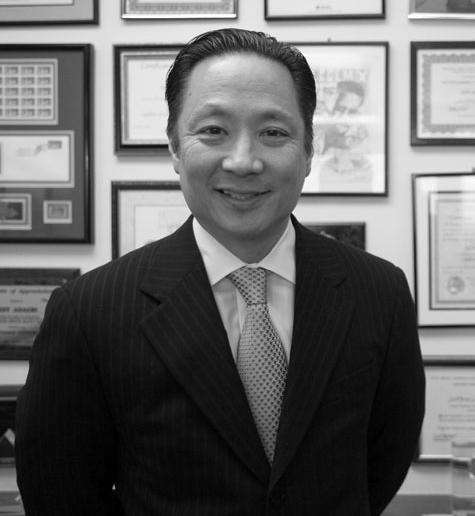
A montage of campaign pictures projected on the wall of the packed Harbor Court Hotel ballroom (totally fancy, good desert) show a man who wears a smile with a natural, genuine ease. Mayoral candidate Jeff Adachi arrives with that smile and looks up, reflecting on the photos for a moment before his supporters notice he has entered. Suddenly, a cheer goes up.


“We’re still in it, we have to be patient,” Adachi announces to about 200 supporters.

Adachi is concerned, though at the apparent passage of Prop C pension reform, saying this means $400 million more in SF budget woes.

“It’s just pushing the issue down the road,” says Adachi who worries that the voters’ choice will put additional pressure on the city’s social safety network.

Adachi encouraged his supporters to go out and “do the right thing and make change happen.”

“If you look at everything we’ve done together, it was honest and from the heart and real — and that’s what I’m proud of.”

What the early numbers show

0

For starters, they show that turnout is going to be low. Some people predict that the absentees will represent almnost half the votes cast; if that’s the case, then total turnout will be around 30 percent. I think that’s low — but it’s a safe bet that fewer than half the registered voters have gone to the polls.

If the low turnout trend continues, then Ed Lee’s lead is insurmountable.

The numbers suggest that Michela Alioto-Pier — who is in seventh place, only a few votes ahead of the widely discredited Tony Hall — is going nowhere. The same goes for Jeff Adachi, who is in sixth place.

Interesting also that David Chiu is ahead of Leland Yee (only by a handful of votes, but still ahead) in what looks like a westside and Chinatown absentee turnout. 

Scott Wiener isn’t faring well tonight; both of his measures (Prop. E, which would allow the supervisors to amend some ballot initiatives) and Prop. F (which would change the registration requirements for political consultants) are losing badly.

I’m a little nervous about the sales tax, Prop. G., which needs a two-thirds vote and is now trailing 57-42. That’s a lot of ground to make up — and if it loses, it blows a big hole in the mayor’s budget.

The growing 99 percent

0

steve@sfbg.com

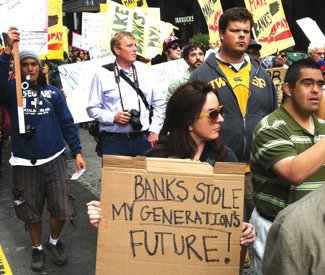
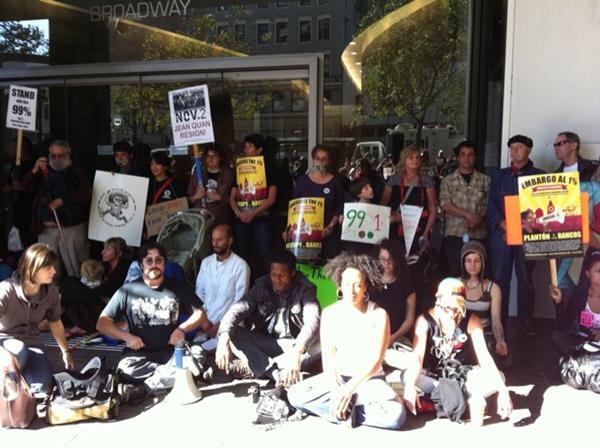
In recent weeks, the Bay Area has been roiled by anger and frustration with how the rich have grown richer while the rest of us endure underemployment, foreclosures, and deep cuts to public education and services, peaking with the Nov. 2 Oakland General Strike that drew more than 10,000 people into the streets to demand economic justice.

The Occupy Wall Street movement — and its many local manifestations, including OccupySF and Occupy Oakland — has been the main vehicle for those populist passions for the last two months, with the support of the labor movement. But now, student and faculty groups from California’s three public university systems are about to get involved in the fight in a big way.

Student and labor groups allied with the ReFund California coalition are planning a week of action for Nov. 9-16, culminating that final day in demonstrations outside the California State University Board of Trustees meeting in Fullerton and University of California Board of Trustees meeting at the UCSF campus in San Francisco’s Mission Bay.

Those protests aim to connect the problem of deep cuts and tuition hikes in the public university systems with the larger issue of wealthy individuals and corporations that haven’t been paying their fair share. The coalition wants the boards to pledge support for a five-point action plan that includes taxes on the wealthy, removing commercial property from Prop. 13 caps on property taxes, restoration of cuts to higher education, a sales tax on Wall Street financial transactions, and pressuring banks to reduce mortgage debt on underwater homes.

Charlie Eaton, a ReFund California organizer from United Auto Workers Local 2865, which represents teaching assistants at UC, notes that many UC and CSU board members also sit on the boards of major banks and corporations that have contributed to the current financial crisis and which have been in the crosshairs of the Occupy Wall Street movement.

“It’s really a club of California’s corporate elites,” Eaton said. “It’s about saying to these folks: if you aren’t willing to actively support paying your fair share, or at least get out of the way, we can’t let it be business as usual at the Wall Street institutions that you help run.”


NO BUSINESS AS USUAL

He said there’s a direct connection between the actions of these corporate boards and lack of resources in California for public education and services, so it’s only right that these powerful board members — from Regent Richard Blum, the investment banker husband of Sen. Dianne Feinstein, to Trustee Bill Hauck, former head of the California Business Roundtable — support the needs of the 99 percent.

“We’ll be there to call on them to sign the pledge,” Eaton said of the Nov. 16 meetings. “And if they aren’t prepared to make that pledge, we’re headed to the Financial District to make sure there is no business as usual for these corporations.”

That day of action will echo the last ReFund California protest in San Francisco, the Sept. 29 “Make Banks Pay” march through the Financial District that was one of the first high-profile demonstrations involving OccupySF. The march was several hundred strong, targeting major financial institutions including a Chase Bank branch on Market Street that was occupied by protesters, resulting in six arrests.

When we asked Eaton whether the Occupy movement would lend its energy and numbers to these ReFund California protests, he said, “We’re embedded in the Occupy movement, so it’s not quite right to say it’s something the Occupy movement might help with…I think the Occupy Wall Street movement shows we can make them pay.”

Meanwhile, the next day (Nov. 17), Occupy Wall Street plans to march the 11-mile length of Manhattan in a day of action that will be supported by solidarity marches by Occupy encampments across the country. That is also the day that a two-campus strike is being threatened by the California Faculty Association.

“I think that day is going to be a busy day all around the nation,” Kim Geron, a political science professor at CSU East Bay and vice president of the CFA, told us.

On Nov. 7, the CFA Board of Directors authorized one-day strikes for Nov. 17 at the CSU East Bay and CSU Dominguez Hills campuses to protest CSU Chancellor Charles B. Reed’s decision to withhold negotiated faculty pay raises. It would be the first faculty strike in the system since 1983, although a strike was authorized in 2007 but called off after a negotiated settlement.

After the vote, according to a statement put out to members, CFA President Lillian Taiz told her board, “We hope this carefully targeted strike, which symbolizes both our anger and our commitment to fairness, will lead to changes in his priorities and his positions. If it does not, the CFA leadership—and the CSU faculty we represent—are prepared to escalate the fight.”


DUCKING THE TAX ISSUE

CSU spokesperson Mike Uhlenkamp said the campuses will remain open despite the strikes. “We expect it to be business as usual,” he said. As for the pledge that ReFund California is seeking, “We don’t get into advocating between taxing and not taxing,” he said, saying that’s a state decision and “we’re not going to push them to make that determination.”

Guardian calls to the UC President’s Office were not returned by press time. A spokesperson for Gov. Jerry Brown, who is the subject of a student letter-writing campaign urging him to tax the rich and stop cutting public services, continued to blame Republicans.

“We too are deeply concerned about cuts to the state’s universities and colleges, which is why the Governor pushed for a solution to our budget deficit that included extending revenues. Unfortunately, Republicans in the Legislature refused to even allow the people of California to vote on the measure, which could have helped prevent future cuts,” Brown spokesperson Evan Westrup responded via email.

When we asked whether Brown was simply giving up, how he planned to deal with the problem, and why Brown has not followed up his campaign pledge to tax the rich with any proposals to do so, he wrote simply, “There are a number of ways to pursue additional revenue moving forward and these options are being considered.”

Geron said there is a clear connection between problems in the CSU system and the hoarding of resources by the richest one percent of Americans, the main critique of Occupy Wall Street, a movement driven largely by current and recent college students.

“We are part of it. One of our slogans is we are the 99 percent and we teach the 99 percent,” Geron told us.

While the CFU is focused on decisions by the Chancellor’s Office — indeed, the strike is legally allowed only because the chancellor broke the contract by withholding negotiated pay increases — Geron said those decisions were made in a climate of deep funding cuts prompted by the state budget crisis.

“Obviously, the economic crisis is a lot of the reason why all this happened. It’s part of a larger crisis that is going on about how to fund the public good, including higher education,” Geron said. “Students are paying a lot more and getting a lot less. That’s the heart of what’s going on.”

The UC Student Association is taking part in the ReFund California week of action, but has not yet voted to participate in direct action against corporations on Nov. 16, Executive Director Matt Haney told us. But he said that many UC students will still take part in that action, just as they’ve been taking part in the Occupy movement.

“It’s the same frustrations. We have to get out there and start pushing this ourselves,” he told us. “We need to show the state that things can’t just keep moving along as they have. We have to put a stop to business as usual. The economic collapse is what destroyed the UC system.”

Haney sees the student, labor, and Occupy movements starting to come together in a very natural way. “It has really put the wind in the sails of student activists to see the energy of the Occupy movement,” Haney said. “There is a coming together of students and labor, and it’s overlapping with the Occupy movement in a powerful way.” *

Find details about the ReFund California Week of Action at www.makebankspaycalifornia.com.

Our Weekly Picks: November 9-15

0

WEDNESDAY 9

Keep Shelly in Athens

Grecian downbeat band Keep Shelly in Athens is an enigmatic act. Not in the annoying, contrived, hype-craving way — rather, this duo keeps its public persona as laid back as its chilled out, ambient music, allowing the material to speak for itself. Keep Shelly in Athens’ new EP, Our Own Dream (Forest Family), is refreshingly accessible. There are enough enchanting vocal melodies to snare pop enthusiasts, enough heavy beats to satisfy the most voracious electro-heads, and plenty of mellow, spaced out vibes for the chillwavers. (Frances Capell)

With Kisses and Blackbird Blackbird (DJ Set)

8 p.m., $14

Independent

628 Divisadero, SF

(415) 771-1421

www.theindependentsf.com


Lykke Li

A few years back, it seemed Swedish singer Lykke Li was most known for a certain frailty, a breathless, whispered seduction on songs like “Little Bit.” With her last album, 2011’s boldly dark Wounded Rhymes, every weakness has been inverted into a strength. The pining 1950s bubblegum on “Sadness Is A Blessing” is not the song of teen heartbreak it appears to be, revealing an emotional maturity and confidence beyond what you would expect from any of her peers. From other 25-year-olds, the chorus of “Get Some” — “I’m your prostitute/you’re gonna get some” — would be little more than a sleazy come on. From Lykke Li, it’s a threat. (Ryan Prendiville)

With First Aid Kit

8 p.m., $35

Fox Theater

1807 Telegraph, Oak.

www.thefoxtheater.com


THURSDAY 10

Holy Ghost!

With the release of the first single in 2007, Holy Ghost! set a high bar for itself. An electropop track with a debt to Italo, “Hold On” announced the duo of Alex Frankel and Nick Millhiser (two session musicians with ties to DFA in NYC) as a group to watch. Also, taking the title seriously, a group to wait for, as a full album wouldn’t be released until this year (they may have been busy opening for LCD Soundsystem and Cut Copy.) On the self-titled LP, though, “Hold On” is easily overshadowed by songs including the New Order referencing “It’s Not Over,” “Some Children” featuring soulful white man Michael McDonald, and the saddest dance song, “Jam for Jerry,” (a tribute to deceased !!! drummer Jerry Fuchs, who also had worked with Holy Ghost!).(Prendiville)

With Jessica 6 and Eli Escobar

8 p.m., $16

Slim’s

333 11th St., SF

(415) 255-0333

www.slims-sf.com


Blek le Rat

Xavier Prou, a.k.a Blek le Rat, has been stenciling political art on city walls since 1981 — decades earlier than Banksy. “Every time I think I’ve painted something original,” Banksy has said, “I find out Blek Le Rat has done it as well, only 20 years earlier.” Blek le Rat’s stirring and elegant stencil work has become a model for others. He’s pushed the limits of what graffiti can do, and helped elevate it to the respected art it is today — as one court judge in Paris said of his work, “I cannot condemn it. It’s too beautiful.” Arts Publishing Ltd. has released an immense 30-year retrospective book of Blek le Rat’s work. And at SFMOMA, the artist appears for a signing party in the Schwab Room. (James H. Miller)

6:30 p.m., free

SFMOMA

151 Third St., SF

(415) 357-4000

www.sfmoma.com


FRIDAY 11

Big Troubles

It was difficult to discern just how much talent was buried within Big Troubles’ ultra-fuzzy lo-fi debut, Worry. There were a few promising glimpses of My Bloody Valentine, but altogether the band came across as a little one-dimensional. Then the baby-faced boys from Ridgewood, NJ, got serious for the more mature, infinitely more polished follow-up, Romantic Comedy (Slumberland). Its songs convey angst, heartache, and ennui with a delightfully diverse array of influences: shoegaze, jangle-pop, even slacker rock. Big Troubles makes modern pop music for the teenager in all of us. Let your inner teen out, if only for a night. (Capell)

With Real Estate

9 p.m., $17

Slim’s

333 11th St., SF

(415) 255-0333

www.slims-sf.com


“Bring on the Lumière”

Don’t fence in Catherine Galasso. She is intrigued by smashing distinctions between the virtual and the real, the present and the historic and, of course, conventional artistic disciplines like dance, music, drama, and film. Her instinct for the theater is clear; her craft impressive. Still, expending all that talent on a work about Emperor Norton seemed distinctly odd. Given that her father was a composer of music for films — she uses some of his scores — her present project, “Bring on the Lumière,” an evocation of cinema inventors Auguste and Louis Lumière, makes a lot more sense. She couldn’t have done better than collaborating with pioneering lighting designer Elaine Buckholtz. Or with dancers Cristine Bonansea and Marina Fukushima as the brothers. (Rita Felciano)

Through Sun/13, 8 p.m. $17-$20.

ODC Theater

3153 17th St., SF

(415) 863-9834

www.odctheater.org


“Lost Together in No Man’s Land”

Midnites for Maniacs’ latest triple bill at the Castro highlights exotic road adventures with two familiar features, the animated Ferngully: The Last Rainforest (1992) and 1984’s Romancing the Stone. Both were hits, but the midnight show was a notorious flop. Like Heaven’s Gate before it, Ishtar‘s 1987 release was preceded by embarrassingly public reports of a production wildly over-budget, over-schedule, and over-run by the clashing of several monumental egos. Thus it was considered a failure before it was ever seen, and became a cultural joke rejected by both critics and public. But Elaine May’s salute to the 1940s Hope/Crosby Road to… comedies, with Warren Beatty and Dustin Hoffman as talentless NYC lounge singers incongruously caught up in Middle Eastern political upheavals, is overdue for re-evaluation — it has moments of sublime silliness. Still unavailable on DVD, Ishtar gets a rare 35mm showing tonight. (Dennis Harvey)

7:30 p.m. (Ishtar at 11:45 p.m.), $12

Castro Theatre

429 Castro, SF

(415) 621-6120

www.midnightsformaniacs.com


SATURDAY 12

“International BowWow Doggy Film Festival”

I just finished reading Susan Orlean’s Rin Tin Tin: The Life and the Legend, so I’ve got canine cinema on the brain. That famous German Shepherd (or shepherds, as the book discusses) doesn’t factor into the Roxie’s first-ever dog-centric film festival, but plenty of other pooches do, from the sad-faced, snappily-dressed Weimaraners onscreen (in a program of William Wegman shorts), to the dog show judged by celebs like Go-Go’s guitarist Jane Wiedlin and former child actor Jon Provist (a.k.a. the always-imperiled Timmy from Lassie). A good portion of the audience will be on four legs, too: hounds under 35 pounds get in free, and while bigger Fidos do need their own tickets, it’s all for a good cause — Muttville senior dog rescue. Alert the pup-arazzi! (Cheryl Eddy)

12:30 p.m., $10–$40

Roxie Theater

3117 16th St., SF

(415) 863-1087

www.roxie.com


They Might Be Giants

The Fillmore’s page for this show includes a video of They Might Be Giants from 1991, performing a couple of traditional gateways into the band, “Istanbul” and “Birdhouse In Your Soul.” But it doesn’t really answer important questions like “Are these guys still any good?” or “Are they still making children’s music?” For that, you could check out the recent albums Join Us and Album Raises New and Troubling Questions, but a shortcut would be John Flansburgh and John Linnell’s performance for the Onion AV Club’s cover song competition, “Undercover.” With a bombastic version of Chumbawumba’s “Tubthumping” the veteran band destroys a host of hip chillwave acts and bearded indie rockers, proving that yeah, the two Johns still got it.(Prendiville)

Also Sun/13,

8 p.m., $27.50

Fillmore

1850 Geary, SF

(415) 346-6000

www.thefillmore.com


Austra

Austra’s sound has been described as “harkening back to the sleazier side of new wave” — is there anything more appealing than that notion? Sleaze-wave; it rolls off the tongue. Led by Latvian-Canadian vocal powerhouse Katie Stelmanis (a former solo artist known for her youthful opera training and her Fucked Up album guest appearance), the Toronto based trio creates classically driven electronic dance music with spiffy beats and supernatural female vocals — it’d fit well in an impassioned 1980s montage scene, perhaps one where our main girl has a revelation of sudden power. This is especially true of “Lose It,” the heart-pumping single with scattered operatic highs off this spring’s debut, Feel It Break. It’s a modern, electro-“Total Eclipse of the Heart” meets “Sweet Dreams,” only you know, sexier. (Emily Savage)

With Grimes, Sister Crayon

9 p.m., $16

Great American Music Hall

859 O’Farrell, SF

(415) 885-0750

www.gamh.com


SUNDAY 13

The Two Man Gentlemen Band

Calling all hep cats and swing kids. The Two Man Gentlemen Band is jumping and jiving its way across the country with a brand new vinyl seven-inch, and an exuberant retro sound. Sounding like a cheeky cross between a Django Reinhardt revival and a late-night drinking session with Broke-Ass Stuart, the gents of the Two Man Gentlemen Band honed their craft on the unsympathetic streets and subways of the Big Apple, and like other buskers-turned-legit, their sound is much bigger and far tighter than you might expect from a bare bones string duo whose favorite themes are inebriation, indiscretion, and ladies. A toe-tapping, seriously swinging good time for all. (Nicole Gluckstern)

With Colin Gilmore, the Barbary Ghosts

9 p.m., $10

Amnesia

853 Valencia, SF

(415) 970-0012

www.amnesiathebar.com


TUESDAY 15

Future Islands

The only thing more intense and cathartic than a Future Islands record is a Future Islands show. Each release from this Baltimore, Md., synth-pop trio is more haunting than the last, but its dramatic performances have been legendary from the get-go. Thunder-throated singer Samuel T. Herring has been known to call forth the beast within by slapping his own face and beating on his chest as he takes to the stage. Future Islands’ dreamy synth and bass tunes are as danceable as they are tragic; you won’t know whether to sweat or cry. You’ll probably do both. (Capell)

With Ed Shrader’s Music Beat and Secret Shopper

9 p.m., $14

Bottom of the Hill

1233 17th St., SF

(415) 621-4455

www.bottomofthehill.com


The Guardian listings deadline is two weeks prior to our Wednesday publication date. To submit an item for consideration, please include the title of the event, a brief description of the event, date and time, venue name, street address (listing cross streets only isn’t sufficient), city, telephone number readers can call for more information, telephone number for media, and admission costs. Send information to Listings, the Guardian Building, 135 Mississippi St., SF, CA 94107; fax to (415) 487-2506; or e-mail (paste press release into e-mail body — no text attachments, please) to listings@sfbg.com. Digital photos may be submitted in jpeg format; the image must be at least 240 dpi and four inches by six inches in size. We regret we cannot accept listings over the phone.

On the Cheap Listings

0

Submit items for the listings at listings@sfbg.com. For further information on how to submit items for the listings, see Picks.

WEDNESDAY 9

Food For Thought Dine-Out Various locations, SF. www.missiongraduates.org. 9 a.m. – 11 p.m., prices vary (check website for participating restaurants). Mission Graduates, a nonprofit working to boost the numbers of college-bound Mission youngsters, receives a sizeable chunk of participating diners’ bills tonight at eateries across town. Depending on your budget, today’s the day to either go all-out at Foreign Cinema or reignite your love affair with the humble Papalote burrito.

“Trading Ideas: Emerging Discourses on Asian Contemporary Art” Galley One, Yerba Buena Center for the Arts, 701 Mission, SF. www.ybca.org. 6:30 – 8:30 p.m., $7, free for members. YBCA and the Asian Art Museum team up to explore Asia’s role within the contemporary art picture.

“Unwrapped and Regifted: Stories about the Holidays” 111 Minna gallery, SF. (415) 974-1719, www.111minnagallery.com, free. The story-sharers at LitUp Writers know that it’s not even Thanksgiving, and on shopping center time that means the hour is nigh for Christmas and Chanukah tales. If you think you can take the heat, don your worst holiday sweater to compete for a cash prize.

THURSDAY 10

One and Only: the Untold Story of On the Road book reading Booksmith, 1644 Haight, SF. www.booksmith.com. 7:30 p.m., free. LuAnne Henderson rambled with Jack Kerouac and Neal Cassady for the entire length of that well-known Road. Her daughter, Anne Marie Santos, joins Kerouac expert Gerald Nicosia to discuss the journey’s underside.

Love Cake Reading Modern Times, 2919 24th St., SF. www.mtbs.com. 7 p.m., free. Leah Lakshmi Piepzna-Samarasinha may not be the easiest name to type into Google, but it merits a cramped finger or two. The activist and spoken-word poet reads from recent work addressing how queer people of color combat violence with compassion and sexuality.

Footloose Forays Talk Randall Museum, 199 Museum Way, SF. www.randallmuseum.org. 7:30 – 9 p.m., free. Michael Ellis’s bio photo shows the man in a backwards pink baseball cap, matching shirt, and dangling binoculars. This may aptly sum him up. Join the freewheeling botanist, Burner, world traveler, and radio host for a recounting of his best adventures.

FRIDAY 11

Legends of Hip-Hop book signing Booksmith, 1644 Haight, SF. www.booksmith.com. 6:30 p.m., free. With a lovingly-penned forward by Chuck D of Public Enemy, Justin Bua’s compilation of art honoring hip-hop’s greats breathes new life into the traditional coffee table book.

Celebration of Craftswomen Festival Pavilion, Fort Mason, SF. Also Sat/12 and Sun/13. www.celebrationofcraftswomen.org. 10 a.m. – 5 p.m., $9. The 33rd annual fair and celebration brings SF’s craftiest females and their wares out on display, accompanied by live music and dance. Proceeds benefit the Mission’s eye-poppingly beautiful Women’s Building.

SATURDAY 12

Green Festival Concourse Exhibition Center, 635 8th St., SF. Also Sun/13. www.greenfestivals.org. 10 a.m. – 7 p.m., free (see conditions below). Maybe the 12 pounds of organic garbanzo beans you just bought do have an immediate use, after all. Bring a Rainbow Grocery receipt (for a purchase of more than ten dollars), four cans of food, your bike, your Sierra Club card or a union card and get free admission to the green equivalent of a state fair. Food court, beer garden, yoga classes, business seminars, speakers, and exhibits await.

Paul Madonna book signing Museum Store, SFMOMA, 151 Third St., SF. www.sfmoma.org. 2 p.m., free. If this well-known SF cartoonist has luminously sketched your cupola, gable, or neighborhood pothole you know you have bragging rights. Everything Is Its Own Reward, Madonna’s latest compilation of SF streetscapes, roams from mundane telephone wires to noble turrets, all in pen and ink.

Writers with Drinks The Make Out Room, 3225 22nd St., SF. www.makeoutroom.com. 7:30 – 9:30 p.m., $5 sliding scale. Authors swig and shoot the breeze with their audience at this recurrent event, which benefits the Center for Sex and Culture this month. Befitting of the cause of the evening, tonight’s lineup includes writers responsible for an erotic novella, a transsexual showbiz memoir, and a treatise on dating as a feminist.

SUNDAY 13

“Man as Object” Peep Show Drawing Circle SOMArts Cultural Center, 934 Brannan, SF. www.somarts.org. Noon – 3 p.m., $8 suggested donation. All our welcome to take up their artistic tools and depict a live male model as part of SOMArts’ ongoing exhibit turning traditional gender roles upside down — although we tend to question the innovation of having a man treated like a piece of meat in this town.

MONDAY 14

Mere Future Reading and Signing Pegasus Books, 2349 Shattuck, Berk. www.pegasusbookstore.com. 7:30 p.m., free. To an audience familiar with paying astronomical rents, Sarah Schulman’s dystopian satire of a future New York will strike a chord. Schulman slyly invents a world where apartments go for forty bucks a month and the only possible jobs are in marketing.

TUESDAY 15

Ether Reading and Signing City Lights, 261 Columbus, SF. www.citylights.com. 7 p.m., free. Ben Ehrenreich once reimagined The Odyssey to critical acclaim, and his latest undertaking – the chronicle of an unnamed protagonist wandering through a city’s violent apocalypse – is no less involved of a literary feat.

The Guardian–and the historic elections of 1966 and 2011

2

(Written on election day before the polls closed. Scroll down for our editorial positions of 1966 and 2011)

In the second edition of the Guardian, dated Nov. 7, 1966, we published our first set of editorial endorsements that were to become a trademark of our form of alternative journalism.  (Our 1966 editorial in pdf form.)

We strongly endorsed then Gov. Pat Brown, going for his third term as a progressive governor, over Ronald Reagan, making his first run at elective office as the voice of the new Republican conservatism, in what we called “our historic election.” In reading the editorial over on the eve of our current “historic election,” it was remarkably prescient.

“For the repudiation of Brown and the election of Reagan,” we noted gloomily,  “would mean that a generation of progressive legislation—in medicare, in education, in welfare, in conservation, in water resources, in bringing to account the dreadful problems of growth, population, and sprawl—would be in grave jeopardy.

“It isn’t difficult to imagine, for example, what will happen to the conservation movement at the hands of a man who talks loudly about selling off ‘unused park land.’ It is this sort of statement that shows Reagan’s naivete, his total lack of qualification for any responsible government job and his complete misunderstanding of what is happening in our state.”

We pointed out that Brown had continued the progressive policies of Govs.Warren and Knight but that this forward movement would end abruptly with Reagan as governor. Well, alas, we were right. Reaganomics was born and the Guardian and everybody else have ever since been fighting the doctrine of tax cuts, deregulation, privatization, and the economics of greed is good and greed is legal.

The result can be seen in today’s election in San Francisco and other California cities and counties.

The mayoral regimes of Brown, Newsom and Ed Lee have carried on the key elements of Reaganomics: endless budget cuts and a bushelbasket of  higher fees, no new revenue initiatives, no moves to tax the Warren Hellmans and the Gordon Gettys on the same basis as the middle class, no moves to tax the big realtors and banks and big downtown companies on the same basis as small businesses, maintaining and facilitating the galloping inequalities of income, keeping the corrupting PG&E/Raker scandal intact at City Hall and thus allowing PG&E to operate as an illegal private utility in San Francisco. On and on.

 The sad thing is that if Lee wins and the tide of sleaze keeps rising in his office, and the progressives lose even more power, things are likely  to get much worse and fast. If Avalos or Herrera win, things are likely to get better but slowly if at all. If Mirkarimi wins, he will make an excellent sheriff in the Mike Hennessey tradition and will immediately be a candidate in waiting to run for mayor as a progressive sheriff and keep PG&E and the Chamber of Commerce gang on edge. (Our position as  outlined by Executive Editor Tim Redmond in “The bad old days” in   our 45th anniversary issue of Oct. 19, 2011.) 

 In any event, the Guardian will be here to “print the news and raise hell for good causes,” to update our masthead motto of 45 years. B3


Why Occupy? Here’s why

2

The Chron buried the story below an item about Chevron cutting its grants to PBS, but if you want to see the case for the Occupy movement, it’s laid out perfectly in a powerful new report by the California Budget Project. Read it here (PDF) The data is solid; the policy impacts are clear.

For starters, California’s 33,900 millionaire taxpayers (people reporting more than $1 million in income in 2010) — that’s two-tenths of the top one percent — earned $104 billion — 11 times the amount needed to lift every single California out of poverty. That’s right — a ten-percent surtax on incomes of more than $1 million could end poverty in California.

California, the report states, has the 7th worst income gap in the nation, between Alabama and Texas.

The San Francisco/Marin/Oakland metropolitan area has the 7th worst income disparity of any major urban area in America.

And it’s not the Invisible Hand of Adam Smith that caused the problem: “Public policy,” the report states, “narrow income gaps less today than they did a generation ago.”

San Francisco’s electing a new mayor today. When you go to the polls, think about economic justice. And when you hear complaints about Occupy SF, think about the fact that before the Occupy movement, the wealth and income gap was barely on the political agenda.


Adachi video attacks public financing

180

This is odd: An eight-minute video narrated by Matt Gonzalez in support of Jeff Adachi devotes a considerable amount of time to attacking public campaign financing — something Gonzalez always supported as a supervisor.

The video claims that the $4 million that “politicians” are taking to pay for their mayoral campaigns could have helped the city avoid cancelling summer school and cutting school bus routes.

Actually, the city doesn’t pay for summer school or for school buses; the school district does. But I suppose the city could have scrapped public financing and given the money to SFUSD. Unlikely, but possible. (The city actually does share some money with SFUDS, under a measure that Gonzalez opposed.)

The thing about public financing, of course, is that it allows candidates like John Avalos, who won’t get big business support, to run a competitive campaign. If it prevents special interests from buying elections, it saves the city far more than it costs. Public financing has always been a central part of the progressive agenda, nationally and locally.

The rest of the message is about what you’d expect — pension reform, Recology’s franchise fee, giveaways to the police and fire unions. All stuff that Adachi has made part of his campaign. It’s nicely (if inexpensively) produced, and, as always, Gonzalez is a great presenter.

But what’s up with the attack on public finance?

(UPDATE: Gonzalez emailed me to say that Adachi doesn’t oppose public financing but thinks this is a bad year to accept it. He also said when he chaired the Budget Commitee the city sent a lot of money to the schools. But he did oppose the measure that guarantees some city funding to SFUSD.)

Progressive group stands out as the lone Lee endorser

86

Mayor Ed Lee’s support by the wealthy power brokers and his checkered history with the Willie Brown administration has caused most progressive groups to shun him in this election, with one notable exception. San Francisco Rising Action Fund, a grassroots organization for working class people of color, gave Lee its second place endorsement, right after progressive favorite John Avalos. It’s the only slate that the two political opposites appear on together.

The San Francisco Democratic Party, Sierra Club, San Francisco Labor Council, the Bay Guardian, and other progressive groups have all issued endorsement slates that generally include Avalos, Dennis Herrera, and sometimes Leland Yee. But Lee has been almost entirely shut out on the left – except for a third place endorsement by the San Francisco Bicycle Coalition, which is generally left but mostly single issue – making SFRAF the rare exception.

Alex Tom, one of the directors of SFRAF, clarified that its endorsement “ is not about Ed, but about the larger progressive movement.” Going against the endorsement grain, he said SFRAF consolidates the Asian, Latino, and Black communities— a strategy to compensate the divided nature in the political left.

“We need to step back in general and have a conversation with how people of color engage with politics and the progressive movement,” Tom told us.

Like many liberal groups, SFRAF is at the front lines of OccupySF and supports progressive bills like the Health Care Security Ordinance, which was the subject of Lee’s first veto this week, angering progressive groups who sought to close a loophole that lets businesses raid the health savings accounts of their employees.

But Tom points out that “there is an assumption in SF that to get progressive things passed you need to go to District 5, 6, and 9— you don’t go to the Southeast,” or other lower income neighborhoods. SFRAF is trying to reframe the broad spectrum of progressives, to “civically engage [voters of color and lower incomes] and [include them] in the electorate.”

Voters of color don’t engage in the same spaces that other progressive do. “We are not insiders, we are not even inside the progressive circle,” Tom says.

SFRAF’s Board of Directors includes Joel Aguilar, who recently left SF Day Labor Program; Chelsea Boilard with Coleman Advocates for Children and Youth; Antonio Diaz of People Organized to Demand Environmental and Economic Rights; Ariana Gil of Mujers Unidas y Activas; Adam Gold of Causa Justa: Alex Tom with the Chinese Progressive Association; and Steve Williams of People Organized to Win Employment Rights (POWER).

The Directors promote Ed Lee’s platforms on local hire, summer school, fight against wage-theft, and facilitating equitable budget process. Lee’s a viable candidate for a new type of progressive, says SFRAF, who doesn’t “agree with the insider game” in regards to Rose Pak and Willie Brown, Lee’s closest associates.

SFRAF doesn’t believe the company Lee keeps makes him untrustworthy. While many progressives see a politician’s connections as good indicators of their future actions and allegiances, SFRAF doesn’t seem to place much emphasis on this. Indeed, Lee seems to be an obstacle to much of the group’s agenda.

Take the SFRAF’s 10-point platform, which is diametrically opposed to many of Lee’s recent actions. In the matters of health care, SFRAF’s promotes, “policies that require employers to provide quality, affordable healthcare coverage to their employees and their families,” something that Lee’s recent veto seemed to weaken, letting businesses take about $50 million per year that city law required them to set aside for employee health care.

The next day, Lee faced the same groups he voted against— at a labor union rally— and explained his veto was an act of diligence to protect jobs. But the sponsor of the vetoed legislation, Sup. David Campos, said the veto was an setback for workers’ rights and consumer protection. “It’s a defining issue for us at City Hall,” Campos told us.

But Tom disagrees with progressive assessments that “pay to play” is a major force in City Hall politics, although to did say it is important to “acknowledge your power structure.” To SFRAF, the progressive sector cannot duplicate a city run by a few insiders— a fear SFBG expects to be a reality with Ed Lee as mayor. Instead, he says a progressive City Hall must bring a “multi-sectored” people into the decision-making process.

And he think Lee will be an ally in doing so.

Steven T. Jones contributed to this report.

The richest 1 percent get richer

7

If there was any doubt in the message being sounded from the streets these days — that the richest 1 percent has been taking a disproportionate and growing share of the nation’s wealth — a long-awaited new study issued yesterday by the Congressional Budget Office makes it crystal clear.

Not only has their share of the nation’s income doubled in the last 30 years, but the report found that concentration was accelerated by a tax structure that has become steadily less progressive, allowing the very rich to keep more of the wealth that the rest of the country so desperately needs.

And the reason the tax code has become far less redistributive is because wealthy special interests have been rewriting it in their favor, and being allowed to do so by politicians in both major parties whose elections and post-service employment the wealthy sponsor.

These same politicians and the mainstream media have been trying to cast the Occupy movement as dirty, disorganized, and incoherent, but it central message — which is now being chanted in cities across the country — couldn’t be more clear and compelling.

“We are the 99 percent!” they’re shouting, a simple truth that highlights the biggest problem that our country is facing: an unfair and unsustainable consolidation of wealth, the central problem that spawns the myriad other problems we face, from underfunded schools and public infrastructure to corruption in our financial and political systems to the economic hardships that most of us face.

Politicians like Mayor Ed Lee, the clear choice of the 1 percent in this mayor’s race, can talk all he wants about “jobs” and the imperative of enforcing minor municipal codes against OccupySF, which is expecting its third raid by the police as soon as tonight. But those are meaningless abstractions compared to the simple truth that is being so clearly articulated by young people in streets.

We’re not the problem, they are. We are many, they are few. We know the truth and we aren’t giving up. Power to the people!

Alerts

0

alert@sfbg.com

Editor’s Note: Protests and other events connected to the Occupy Wall Street movement, include OccupySF and Occupy Oakland, have been developing quickly. To take part, follow our Politics blog or check with the websites associated with this important economic justice movement: occupysf.com, occupyoakland.org, or occupytogether.org. And you can send tips about what’s happening to news@sfbg.com.

WEDNESDAY 26

San Francisco’s budget crisis

Youth from the Bay Area Urban Debate League opine on solving the budget crisis in San Francisco. These electrifying young orators seek to engage the community in conversation and share their research about the current economic atmosphere.

6 p.m., free

SFUSD Board Room

555 Franklin St, 1st Floor

www.baudl.org


THURSDAY 27

Progressive prospects in fall election

Bay Guardian Executive Editor Tim Redmond holds a talk on how the upcoming election will effect the progressive community. Join in discussion, sponsored by Progressive Democrats of America, and ask questions regarding mayoral candidates and city politics.

7-9pm, free

Unitarian Universalist Center, Martin Luther King Room

1187 Franklin, SF

TGTGTGTGTG@aol.com

www.pdamerica.org


FRIDAY 28

White Picket Fences Reception

This multi-media visual and performance art exhibit highlights queer perspectives on the family unit and reflections of contemporary marriage and relationships. Artists like Midori, Monica Canilao, Harrison Bartlett, Mev Luna, Amelia Reiff Hill and Madison Young conjure dialogue in and out of the LGBT community on the dynamics of progressive life. This family oriented event is open to all ages and will be catered with food, wine and performances of featured artists.

7:30-10 p.m.

Michelle O’Connor Gallery

2111 Mission, SF

www.feminapotens.org


SUNDAY 30

Organize and fight back

The Party for Socialism and Revolution is holding its NorCal Regional Conference, with discussions on how big corporations avoid taxes, endless U.S. Wars, the cost of higher education, the prospects for capitalism and socialism, and other topics.

10 a.m.-5 p.m., $7-10

2969 Mission, SF

(415) 821-6171

sf@pwlweb.org


Making Democracy Work

Celebrate 17 years of social justice service with keynote speakers Rep. Andre Carson (D-IN) and Imam Siraj Wahhaj, religious director of At-Taqwa Mosque in NY, at a dinner banquet. This fundraiser supports the Council on American-Islamic Relations, the largest Islamic grassroots civil rights and advocacy group in the country.

5-10 p.m.

Santa Clara Marriott

2700 Mission College, Santa Clara

(408) 986-9874

www.ca.cair.com/sfba/event/17thannualbanquet


Mail items for Alerts to the Guardian Building, 135 Mississippi St., SF, CA 94107; fax to (415) 437-3658; or e-mail alert@sfbg.com. Please include a contact telephone number. Items must be received at least one week prior to the publication date.

The selling of Ed Lee

0

steve@sfbg.com

Ed Lee has gone through a remarkable makeover in the last year, transformed from the mild-mannered city bureaucrat who reluctantly became interim mayor to a political powerhouse backed by wealthy special interests waging one of the best-funded and least transparent mayoral campaigns in modern San Francisco history.

The affable anti-politician who opened Room 200 up to a variety of groups and individuals that his predecessor had shut out — a trait that won Lee some progressive accolades, particularly during the budget season — has become an elusive mayoral candidate who skipped most of the debates, ducked his Guardian endorsement interview, and speaks mostly through prepared public statements peppered with contradictions that he won’t address.

The old Ed Lee is still in there somewhere, with his folksy charm and unshakable belief that there’s compromise and consensus possible on even the most divisive issues. But the Ed Lee that is running for mayor is largely a creation of the political operatives who pushed him to break his word and run, from brazen power brokers Willie Brown and Rose Pak to political consultants David Ho and Enrique Pearce to the wealthy backers who seek to maintain their control over the city.

So we thought it might be educational to retrace the steps that brought us to this moment, as they were covered at the time by the Guardian and other local media outlets.

Caretaker mayor

The story begins quite suddenly on Jan. 4, when the Board of Supervisors convened to consider a replacement for Gavin Newsom, who had been elected lieutenant governor but delayed his swearing-in to prevent the board from choosing a progressive interim mayor who might then have an advantage in the fall elections. Newsom and other political centrists insisted on a “caretaker mayor” who pledged to vacate the office after serving the final year of the current term.

It was the final regular meeting of the old board, four days before the four newly elected supervisors would take office. What had been a bare majority of progressive supervisors openly talked about naming former mayor Art Agnos, or Sheriff Michael Hennessey, or maybe Democratic Party Chair Aaron Peskin as a caretaker mayor.

When then-Sup. Bevan Dufty said he would support Hennessey, someone Newsom had already said was acceptable, the progressive supervisors decided to coalesce around Hennessey. That was mostly because the moderates on the board had suddenly united behind a rival candidate who had consistently said didn’t want the job: City Administrator Ed Lee.

Board President David Chiu was the first in the progressive bloc to breaks ranks and back Lee, saying that had long been his first choice. Dufty became the swing vote, and he abstained from voting as the marathon meeting passed the 10 p.m. mark, at which point he asked for a recess and walked down to Room 200 to consult with Newsom.

At the time, Dufty said no deals had been cut and that he was just looking for assurances that Lee wouldn’t run for a full term (Dufty was already running for mayor) and that he would defend the sanctuary city law. But during his endorsement interview with the Guardian last month, he confessed to another reason: Newsom told him that Hennessey had pledged to get rid of Chief-of-Staff Steve Kawa, a pro-downtown political fixer from the Brown era who was despised by progressive groups but liked by Dufty.

Chiu and others stressed Lee’s roots as a progressive tenants rights attorney, the importance of having a non-political technocrat close the ideological gap at City Hall and get things done, particularly on the budget. So everyone just hoped for the best.

“Run, Ed, Run”

The drumbeat began within just a couple months, with downtown-oriented politicos and Lee supporters urging him to run for mayor in the wake of a successful if controversial legislative push by Lee, Chiu, and Sup. Jane Kim to give million of dollars in tax breaks to Twitter and other businesses in the mid-Market and Tenderloin areas.

In mid-May, Pak and her allies created Progress for All, registering it as a “general civic education and public affairs” committee even though its sole purpose was to use large donations from corporations with city contracts or who had worked with Pak before to fund a high-profile “Run, Ed, Run” campaign, which plastered the city with posters featuring a likeness of Lee.

Initially, that campaign and its promotional materials were created by Pak (who refuses to speak to the Guardian) and political consultant Enrique Pearce (who did not return calls for this article) of Left Coast Communications, which had just run Kim’s successful D6 victory over progressive opponent Debra Walker, along with Pak protégé David Ho.

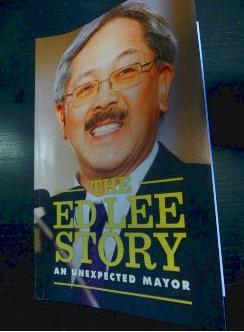
During that campaign, the Guardian and Bay Citizen discovered Pearce running an independent expenditure campaign called New Day for SF, funded mostly by Willie Brown, out of his office, despite bans of IEs coordinating with official campaigns. That tactic would repeat itself over the coming months, drawing criticism but never any sanctions from the toothless Ethics Commission. Pearce was hired by two more pro-Lee IEs: Committee for Effective City Management and SF Neighbor Alliance, for which he wrote the book The Ed Lee Story, a supposedly “unauthorized biography” filled with photos and personal details about Lee.

Publicly, the campaign was fronted by noted Brown allies such as his former planning commissioner Shelly Bradford-Bell, Pak allies including Chinatown Community Development Center director Gordon Chin, and a more surprising political figure, Christina Olague, a progressive board appointee to the Planning Commission. She had already surprised and disappointed some of her progressive allies on Feb. 28 when she endorsed Chiu for mayor during his campaign kickoff, and even more when she got behind Lee.

Olague recently told us the moves did indeed elicit scorn from some longtime allies, but she defends the latter decision as being based on Lee’s experience and willingness to dialogue with progressives who had been shut out by Newsom, noting that she had been asked to join the campaign by Chin. Olague also said the decision was partially strategic: “If we get progressives to support him early on, maybe we’ll have a seat at the table.”

Right up until the end, Lee told reporters that he planned to honor his word and not run. During a Guardian interview in July when we pressed him on the point, Lee said he would only run if every member of the Board of Supervisors asked him to, although about half the board publicly said that he shouldn’t, including Sup. Sean Elsbernd, who nominated him for interim mayor.

And then, just before the filing deadline in early August, Lee announced that he had changed his mind and was running for mayor, the powers of incumbency instant catapulting him into the frontrunner position where he remains today, according to the most recent poll by the Bay Citizen and University of San Francisco.

Lee the politician

With his late entry into the race and decision to forgo public financing and its attendant spending limits, one might think that Lee would have to campaign aggressively to keep his job. But most of the heavy lifting has so far been done by his taxpayer-financed Office of Communications (which issues press releases at least daily) and by corporate-funded surrogates in a series of coordinated “independent” groups (see Rebecca Bowe’s story, “The billionaires’ mayor”).

That has left Lee to simply act as mayor, where he’s made a series of decisions that favor the business community and complement the “jobs” mantra cited relentlessly by centrist politicians playing on people’s economic insecurities.

Yet Lee has been elusive on the campaign trail and to reporters who seek more detailed explanations about his stands on issue or contradictions in his positions, and his spokespersons sometimes offer only misleading doublespeak.

For example, Lee’s office announced plans to veto legislation by Sup. David Campos that would prevent businesses from meeting their city obligation to provide a minimum level of employee health benefits through health savings accounts that these businesses would then pocket at the end of the year, taking $50 million last year even though some of that money had been put in by restaurant customer’s paying 5 percent surcharges on their bills.

Although Campos, the five other supervisors who voted for the measure, four other mayoral candidates, and its many supporters in the labor and consumer rights movements maintained the money belonged to workers who desperately needed it to afford expensive health care, the San Francisco Chamber of Commerce said it was about “jobs” that would be protected only if businesses could keep that money.

Lee parroted the position but tried to push the political damage until after the election, issuing a statement entitled “Mayor Lee Convenes Group to Improve Health Care Access & Protect Jobs,” saying that he would seek to “develop a consensus strategy” on the divisive issue — one in which Campos said “we have a fundamental disagreement” — that would take weeks to play out.

After a frustrating back-and-forth with Lee Press Secretary Christine Falvey by email, it’s still unclear how to resolve the contradiction between whether businesses could seize these funds or whether they belonged to employees, with her latest statement being, “The Mayor absolutely wants these funds spent on providing access to quality primary and preventative health care because this is the business’s obligation under HCSO. Making sure that these funds go to pay for health care is the most important objective.”

Similarly, when police raided the OccupySF encampment on Oct. 5, Lee’s office issued a statement that was a classic case of politicians trying to have it both ways, expressing support for the movement and its goal to “occupy” public space, but also supporting the need to police to clear the encampment of those same occupiers.

But now, in the wake of a repeat raid on Oct. 16 that has inflamed passions on the issue, the question is whether Lee can run out the clock and retain the office he gained on the promise of being someone more than a typical politician.

The bad old days

0

tredmond@sfbg.com

Willie L. Brown, according to the Chronicle’s John Cote, is “a tremendously popular figure in the city, viewed by many as an avuncular man-about-town, elder statesman and a uniquely San Franciscan character.” The Ed Lee Story, a hagiographic campaign book, refers to Brown’s “characteristic showmanship and hypnotic charm.” Even Randy Shaw, the housing activist who clashed with Brown over gentrification once upon a time, now says in BeyondChron that Brown’s first term “was the most progressive of any mayor in modern San Francisco history.”

I feel as if I’m living in some sort of strange parallel universe, something out of Orwell or North Korea or the Soviet Union of the 1950s. It’s as if history never happened, as if the years between 1996 and 2004 have just vanished, have been deleted from San Francisco’s collective memory. It’s crazy.

I wonder:

What about the thousands and thousands of people who lost their homes and were tossed out of the city like refugees from a war? What about the rampant corruption at City Hall? What about the legions of unqualified political cronies who got good jobs and commission posts? What about the iron-fisted machine rule that kept local politics closed to all but the loyal insiders? Doesn’t any of that count?

Here are some things that absolutely, undeniable, demonstrably happened while Willie Brown was mayor:

Rents on the East Side of town, particularly in the Mission, tripled and sometimes quadrupled between 1996, when Brown took office, and 2004, when he left. Evictions more than tripled, too, and at one point more than 100 people a month were losing their homes. Most of those people were low-income, long-term tenants. They were forced out because richer people were moving into town during the dot-com boom and could pay more for those apartments. We called it the “Economic Cleansing of San Francisco.”

Every day, it seemed, we’d be out at another rally as the Tenants Union and the Mission Antidisplacement Coalition tried to save another family from the forces of gentrification. Every week, it seemed, another group house full of artists would be served an eviction notice. Everywhere you looked, nonprofits and small businesses were losing space to high-tech companies with plenty of money.

I watched the wrecking crew tear down a studio complex on Bryant Street, forcing more than 100 painters and photographers to leave, to make way for a high-tech office project that was approved even though it violated the local zoning laws — and then was never built. For two years, I walked to get my lunch past the empty hole in the ground that had once been a thriving community.

That was typical. Every developer who waved money in front of the mayor got a building permit, no matter how crazy, illogical or illegal the project was. The Planning Department and the Bureau of Building Inspection were little more than fronts for the lobbyists and Brown cronies who determined development policy in the city.

In October, 1999, the author Paulina Borsook wrote a famous piece in Salon called “How the Internet Ruined San Francisco.” I agreed with the sentiment; the influx of the dot-commers was wrecking all that was cool and weird about the city. But she got one point wrong: The Internet didn’t ruin anything. The Internet was, and is, a technology, a tool, something that, like most technological advances, can be used for good or evil.

Mayor Brown didn’t create the dot-com boom. Although he took credit for an awful lot of things, even Willie didn’t claim to have invented the Internet.

But what he did — and what ruined many San Francisco neighborhoods, and ruined the lives of many San Franciscans — was to let the economic cleansing of the city happen, without raising a finger to slow it down or prevent the evictions or protect the most vulnerable people in the city. Over and over, he encouraged it — by appointing commissioners and supervisors and department heads who allowed evictions and development and displacement in the name of growth and prosperity.

In fact, when reporters from the zine Maximum Rock ‘n’ Roll asked Brown about the problems facing poor people, he told them that the city had become so expensive that poor people would be better off living somewhere else.

Because he didn’t care about poor people, or tenants, or artists, or anyone who lacked money and flash and dazzle and clout. He was the worst kind of imperial mayor.

Here’s how we put in it in our 33rd anniversary issue in 1998:

“Let’s say the next major earthquake that hits San Francisco is of roughly the same magnitude of the Loma Prieta quake of 1989, or maybe just a bit stronger. Let’s say it wipes out right 1,000 houses and leave some 5,000 people homeless … and lets say a few unscrupulous profiteers take advantage of the shortages of critical supplies and charge desperate residents triple the normal rate for food, blankets and drinking water….

“The profiteers, speculators and charlatans would be exposed in the press and roundly, loudly denounced by every political and community leader in the city. The ones who didn’t wind up in jail would be forced to leave town in disgrace.”

Or else they wouldn’t. Because when an economic earthquake ravaged San Francisco during his term, Brown — the most powerful mayor in modern history, a guy who could have had an immense impact on what was happening — went to meet the speculators and profiteers with outstretched arms, welcomed them to the city and partied with them at night.

And when he ran for re-election, they thanked him by funding an astonishing $5 million campaign.

Then there was the corruption. Not only did Brown raise pay-to-play to a new art form, he filled the city payroll and key commissions with campaign workers, former political allies, and cronies, subverting the civil service system and undermining both the function of city agencies and public respect for local government. At least seven Brown appointees were indicted or investigated for criminal misconduct. While sentencing a Housing Authority official to five years in prison, U.S. District Judge Charles Legge decried what he called Third World-style corruption at San Francisco City Hall.

When Mayor Ed Lee, who is now seeking a full four-year term, was asked to give Brown a grade for his eight years in Room 200, Lee said: A-Plus.

Which makes us a little nervous. To say the least.

I’ve been going back through the Guardian archives over the past couple of weeks, picking out some great covers to reproduce (see page 18) and looking at four and a half decades of alternative news coverage of San Francisco. And if there’s one theme that emerges from the stacks and stacks and stacks of papers, it’s that local government matters.

In the 1960s, when the underground press was talking about sex, drugs and dropping out, the Guardian was talking about the ways big corporations were stealing the taxpayers’ money at City Hall. (Okay, the Guardian wrote about sex and drugs too. But sex and drugs and political scandals.)

The difference between the independent alternative press and the underground papers of the era was more than just thematic. The underground publishers were having a great time and celebrating culture, but none of those publications was built to last. From the day they published their first issue in October, 1966, Guardian founders Bruce Brugmann and Jean Dibble intended their paper to become a permanent part of San Francisco.

The Guardian quickly demonstrated that it had a different approach than a lot of the “New Left” — particularly when it came to electoral politics. At a time when some were saying that it made no difference whether Ronald Reagan or Pat Brown won the 1966 governor’s race, the Guardian made the key point about Reagan.

“California cannot afford the luxury of this kind of conservatism,” a Nov. 7, 1966 editorial stated. “Because of the millions of people coming to California, because San Francisco and Los Angeles soon will have the greatest concentration of urban power in history, because farm land and open space is vanishing at a suicidal rate, because technology is putting vast populations out of work, because of the social neglect of our cities and the uglification of our countryside, because we now have the knowledge to bridge the gap between the rich and the poor.”

And while the paper devoted considerable space to reporting on and opposing the war in Vietnam, it was also developing a reputation for local investigative reporting. One June 7, 1971 story showed how the city had all of its short-term deposits in local banks that paid no interest at all. The story parked an investigation by the city’s budget analyst, the resignation of the city treasurer — and a new investment policy that brought the city at least $1 million more revenue a year. (Adjusted for inflation, that’s about $5 million a year, times 40 years is a lot of money that the Guardian brought into the city coffers).

And from the start, the Guardian was a nonpartisan, independent foe of corruption, secrecy and undue influence at City Hall. So while the paper eagerly endorsed Phil Burton (and later his brother, John) for Congress and lauded their antiwar and environmental policies, the Guardian also blasted the Burtons for exercising undue influence back home. The paper strongly endorsed George Moscone for mayor — then denounced him when he fired Harvey Milk from a commission post after Milk had the gall to challenge the Moscone/Burton candidate for state Assembly.

The 1999 Sunshine Ordinance, which dramatically opened up City Hall records, was sponsored and promoted by the Guardian. Willie Brown and his cronies hated it.

It’s probably a misnomer to say that the Burtons, who were a dominant force in local politics in the 1970s and 1980s, ran an old-fashioned machine. They didn’t have the iron control over local politics and the patronage jobs system that the word “machine” implies.

But when Brown became mayor of San Francisco, he had all of that. Brown controlled eight solid votes on the Board of Supervisors (and through various political machinations, had managed to appoint most of them). “He ruled the building,” Assemblymember Tom Ammiano, who was a supervisor during those years, recalled. “If you defied him, you were radioactive.”

And one of the people who rose through the ranks as a loyal Brown appointee was Ed Lee. Who to this day thinks things in that administration were just dandy.


The Lee campaign complains about “guilt by association,” and that’s a legitimate point. Ed Lee isn’t Willie Brown. He’s a lot more open, a lot (a lot) more humble, and as numerous progressives have pointed out to us, his door is open. He doesn’t have the history of sleaze that pretty much defined Brown’s political career.

There will be no “Ed Lee Machine.” In fact, with district elections of supervisors pretty much guaranteeing more diffuse political power in the city, there will never be another mayor able to rule the way Brown did.

And these days, Brown’s clout could easily be overstated. Until he engineered the selection of Ed Lee as mayor, his power seemed to be waning. And even Mayor Lee hasn’t done everything that Brown wanted.

Of course, the Chronicle, which he helped immensely when Hearst Corp. bought the paper and had trouble with federal regulators, has helped Brown by giving him a column that created a new, sanitized persona.

But the important thing about the Brown administration was not so much who was in charge but who benefited. The landlords, the developers, the big corporations got pretty much what they wanted from City Hall. The rest of us got screwed.

And now those same interests — in some cases, the exact same people — who supported, promoted and worked with Willie Brown are backing Lee for mayor. If they thought he was going to be an independent progressive, that money and support wouldn’t be coming in. There are people who miss the machine days — and if they think Ed Lee is their guy, it’s reason to worry.

Corruption matters. When people lose faith in local government because they see the kind of sleaze that was daily business under Brown, then they stop wanting to pay taxes for public services. After all, the mayor is wasting our money already. Lee may be a decent guy — but some of the people he hangs out with, some of the people who are supporting him, have a long and very unpleasant history in this town. And all the time he was sitting there at City Hall, while Brown was running a corrupt operation that did lasting damage, Lee never raised a public finger in protest. I hate to see all the history forgotten when people decide who to support for mayor in November, 2011.