Books

Mirrors and masks

0

arts@sfbg.com

LIT/VISUAL ART At a time when everyone is bemoaning the death of the book from either Kindle or just plain old lack of interest, I stand up for our old friend and former conveyance. There’s something about it — the smell of fresh ink, the feel of the yellowed-pages of a well-worn paperback, that gentle “crack” of the spine of a new volume — that can never be replaced by some black-matte gadget. As a writer and lover of all things book, I’ve been impressed by a few this year that may reignite your love for what’s laying between the covers, just waiting for your return.

Julian Bell’s Mirror of the World: A New History of Art (Thames and Hudson, 496 pages, $34.95) is an unassuming tome. Clocking in at just under 500 pages, this softcover textbook-looking marvel has become a mainstay on my research shelf and bathroom magazine rack. Gathering full-color plates of some of the most lush (Delacroix’s Death of Sarandapulus), confrontational (Donatello’s David), and demanding (Jane Alexander’s Vissershok) images in Western art over the last 500 years, Bell has managed to do what so often seems like the impossible in the art world: he’s included damn near everybody. To Bell, Nok terracotta, Chinese Master Guo Xi, and Dogon carvings have as much influence on contemporary art as Warhol, Pollack, and Manet. “I want to believe,” he says in the introduction, “that works of art can reveal realities that had otherwise lain unseen, that they can act as frames for truth.” Mirror to the World does just that, framing a more-true, inclusive history of art while providing a nifty little timeline in the back to play catch-up.

Speaking of timelines, I’m grateful that Simone Werle’s 50 Fashion Designers You Should Know (Prestel, 160 pages, $19.95) has one! As a latecomer to the world of fashion, I know what I like, but sometimes have no idea why, or where it came from. The designers profiled in this book are given full- color spreads featuring their most signature pieces. Armani, Prada, and Dolce and Gabbana are explored at length, while conceptualists such as Yohji Yamamoto and Rei Kubokawa are not overlooked. From early-20th century designers like Coco Chanel and Andre Courreges to contemporaries such as Vivienne Westwood and Tom Ford, this guidebook is handy and dandy.

One of the most beautiful books I’ve gotten my hands on this year is also one of the most challenging and provocative. Martin Eder’s Der Blasse Tanz/The Pale Dance (Prestel, 320 pages, $64.95) is a formidably luscious soft-focus bomb waiting to go off in the reader’s psyche. The German painter walks the thin line between fantasy and reality, nightmare and saccharine dream, child-like infatuation and barely-legal obsession. With a technical prowess to rival Renoir and Botticelli, Eder uses watercolors to draw us into this uncomfortable in-between, turning us into admirers and voyeurs at the same time. From the plush feel of the slightly weathered cover-stock, to Isabel Azoulay’s introduction and its insights regarding feminism and erotic art, everything works together, making Der Blasse Tanz an artifact that tells our oh-so modern story in a way that only a well-made book can.

But if there is any book out there right now that truly justifies why art and photo books still exist, it’s got to be Phyllis Galembo’s Maske (Chris Boot, 208 pages, $46). I love this book! In it, ordinary people turn into mythic figures and magicians, tricksters, and gods through fantastic costumes in African and Caribbean rituals and celebrations. Striped bodysuits that cover the entire body, including the face, conjure both Sesame Street and Freddy Kruger. Outfits are made entirely of bunched greenery. A lacquered wooden mask topped with a headdress and a full-body model doubles and then triples a small boy’s mass. The images themselves are striking, statements on both fashion and fetish. Knowing that there are 180 of them, and explanations for each one, makes the imagination take off on plywood wings.

Wall Street hold ’em

0

arts@sfbg.com

FILM Inside Job is director Charles Ferguson’s second investigative documentary after his 2007 analysis of the Iraq War, No End in Sight, but it feels more like the follow-up to Alex Gibney’s Enron: The Smartest Guys in the Room (2005). Keeping with the law of sequels, more shit blows up the second time around. As with No End in Sight, Ferguson adeptly packages a broad overview of complex events in two hours, respecting the audience’s intelligence while making sure to explain securities exchanges, derivatives, and leveraging laws in clear English (doubly important when so many Wall Street executives hide behind the intricacy of markets).

The revolving door between banks, government, and academia is the key to Inside Job‘s account of financial deregulation. At times borrowing heist-film conventions (it is called Inside Job, after all), Ferguson keeps the primary players in view throughout his history so that the eventual meltdown seems anything but an accident. Even apparent detours prove narrowly targeted. The subject of Wall Street’s venal appetites for drugs and prostitutes, for instance, is introduced first as farce and second as potential traction for broader criminal investigations. Presumably a junior partner might give up valuable information so as not to be made into another Eliot Spitzer, who, incidentally, comes off quite well in Inside Man.

While the fat cats only show up thanks to the CSPAN archive, several free market economists do sit for interviews with Ferguson. They probably regret doing so now — he reserves special scorn for the academic class of boosters. Frederic Mishkin is a typical case. Formerly a member of the Board of Governors at the Federal Reserve, he quickly becomes a muttering mess under Ferguson’s questioning. Mishkin quit the Treasury in August 2008, at the height of the crisis, to return to Columbia University to finish more pressing work: a textbook. In 2006, Mishkin coauthored a rosy report on Iceland’s doomed markets, pocketing a nice commission from the country’s Chamber of Commerce. Mysteriously, the title of the report changed from “Financial Stability in Iceland” to “Financial Instability in Iceland” on Mishkin’s CV — confronted with the discrepancy, he croaks something about a typo.

Ferguson’s relentless focus on the insiders isn’t foolproof. Tarring Ben Bernanke, Henry Paulson, and Timothy Geithner as “made” guys, for example, isn’t a substitute for evaluating their varied performances over the last two years. Inside Job makes it seem that the entire crisis was caused by the financial sector’s bad behavior, and this too is reductive. To take just one example, China figures into the film only as laborers losing their jobs due to market volatility — part of the story, certainly, but so is that government’s devaluation of its currency.

Furthermore, Ferguson does not come to terms with the politicized nature of the economic fallout. In Inside Job, there are only two kinds of people: those who get it and those who refuse to. The political reality is considerably more contentious. Americans on the right and left may well share disgust at the bailouts, but they’re drawing very different conclusions from the government’s cash infusions. Ferguson builds something of a false consensus between his talking heads, never asking them, for example, whether they think Fannie Mae or Countrywide was a bigger boogeyman (politically, the answer says a lot). In this regard, a general assessment in a recent article by Paul Krugman and Robin Wells holds for Inside Job: “Books on the Great Recession are still pouring off the presses … but they don’t offer much guidance on the most pressing problem at hand, which is how to deal with the continuing consequences of the last [bubble].” 

INSIDE JOB opens Fri/22 in Bay Area theaters.

How they’re sitting

182

caitlin@sfbg.com

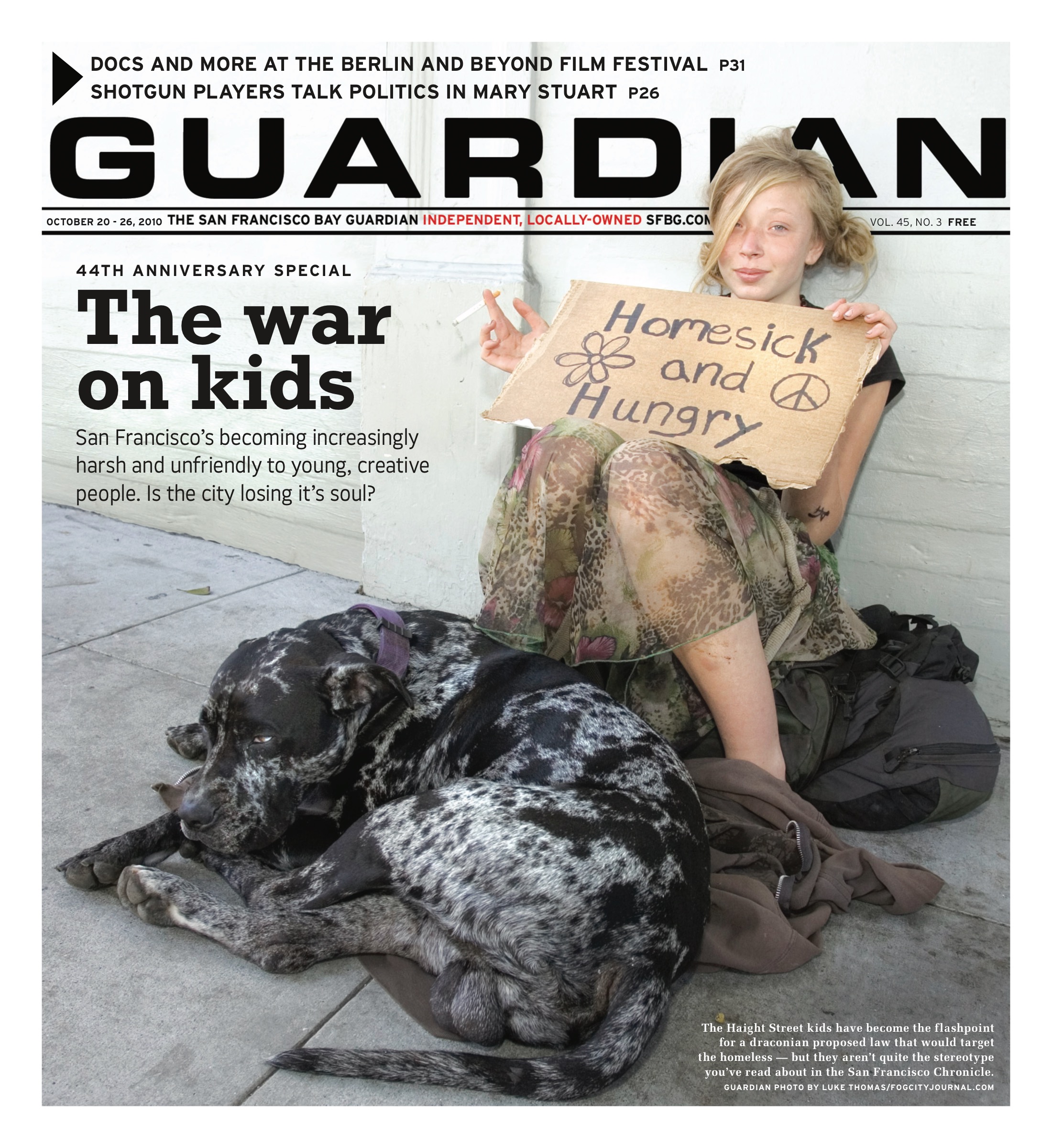
I’ve been hanging out with the Haight Street kids. Over the course of a week or so, I smoked weed, drank malt liquor, witnessed nasty run-ins with police officers — all events that anyone who has walked down the sidewalks of that legendary street would expect. But I also met people who’d give away their last dollar to a friend, people who know a thing or two about community, and people who don’t see sidewalks only as thoroughfares to commerce.

Ironically, though the homeless kids on Haight are the explicit inspiration for Proposition L, the sit-lie measure on the Nov. 2 ballot, their voices have been significantly absent from the vitriolic debate on its merits and faults. Ironic because of all people, it’s these young men and women — and the citizens of San Francisco who interact humanely with them — who could teach us the most about what public space in San Francisco could be.

I didn’t just stand with a notebook, fire questions, and walk away. I took a seat and spent time with the kids, to see for myself whether its true that they’re harassing people, letting their dogs run amok, and generally ruining everyone’s lives as much as sit-lie supporters say they are. That it turned out to be uplifting was an added bonus. I got to see what many don’t on their way to shop for souvenir bongs, retro dresses, and designer skateboards — the reason young people from around the country come to the neighborhood.

It doesn’t have anything to do with fancy Victorians and boutiques, which may explain the disconnect between the street kids and their detractors. They come for the legacy of individuals brave enough to slough off social mores that Haight-Ashbury residents are so ostensibly proud of — not to mention the companionship of others who are comfortable with their rejection of and by society. They come to share stories and pipes and encouragement, and it was cool to watch a streetscape in San Francisco that wasn’t geared solely to commerce.

And while the young people I talked to told me how much they liked to travel, to live free of convention and without ties to the workday world, after a while most acknowledged that they had left behind families who couldn’t or didn’t care for them, home situations that were uncomfortable enough to make life on the streets seem like a better alternative.

Although violent incidents, uncivil behavior, and threatening dogs are well-documented by other news sources, I didn’t see any of that when I was hanging out on Haight. That doesn’t mean that these things don’t exist — but it might suggest that some of the strident supporters of Prop. L are seeing what they want to see.

SPANGING

Steven, who asked us not to use his full name, is 20 and homeless. He grew up in Stockton, became a welder after high school, then decided he “didn’t want the hassle” of staying put for a wage job. His fingernails play host to an ungodly amount of dirt, but his tight blonde curls, pretty golden eyes (“they look like a lion’s!” says one friend in amazement) and mellow, generous demeanor make him a popular hub among his homeless peers.

It doesn’t hurt that he sells weed, small amounts at a time to passing tourists and acquaintances. He silently passes a pipe around to his companions with the slightest provocation. Steven approached me on the street before he knew I was a journalist, a fact that seemed to make little difference to him.

He says he came to the Haight “for the people,” for the area’s reputation of open souls and unconventional artists that originated in the glory days of Janis Joplin and the Grateful Dead. Like most of the kids I talked to, he eschewed the often dangerous shelter scene to sleep in Golden Gate Park or nearby Buena Vista Park despite the police surveillance that could result in spendy fines for park camping.

Although Steven’s worldly possessions fit into the large camping backpack he carries with him 24 hours a day, and even though he’s been living on Haight less than nine months — broken by a jaunt to Eugene, Ore., where he found it “too rainy” to join the town’s expansive street kid community — he doesn’t plan on being homeless forever. It’s just that nothing about this economic climate inspires him to sell his freedom for a paycheck. He plans to go to a four-year college eventually. He sees an education as the only way to get a “real” job. “But until then, why not do this?” he asks. I’m not sure if he’s waiting for my answer.

“This” is sit on Haight Street and “spange,” the term used for “flying a sign” and asking shoppers and neighbors walking by for money, often in a creative way. Of the many crimes street kids are guilty of in the eyes of supporters, spanging is the only one Prop. L would effect.

If Francisco voters approve it, anyone who sits or reclines on the sidewalk (with exceptions for the handicapped and those with permits — but not for the tired, workers on breaks, or people waiting for buses) will be subject to a fine of $50 to $100 for the first offense and $300 to $500, or a maximum of 10 days in jail, for someone found guilty twice within 24 hours of unduly supporting his or her body on the sidewalk between 7 a.m. and 11 p.m. Similar laws can be found up and down the West Coast — although Portland’s was pulled from the books last year after being found unconstitutional because it targeted the homeless.

I ask street kid after street kid why they’ve chosen this lifestyle. Many wouldn’t have it any other way. “Why do people want us off the street?” says Oz, a 21 year old from upstate New York who deals alongside Steven. “Probably because they can’t do this themselves.”

Though I’m skeptical at first, after a while I see why the unconventional group of “travelers” on Haight choose to spend their time spanging. Conversations get struck up with the most unusual people — the old hippie who bought a new Mad Hatter cap for the weekend, the suburban woman who might or might not like to buy some weed (she can’t decide). When a few businesses ask us to move so they can sweep the sidewalk or clear a doorway, the street kids I’m watching relocate with little protest. Many who walk past Steven seemed to find humor in his sign, which that day reads “Are you one paycheck away from having this be your job too?” He says he likes to switch his message daily. “Keep it fresh.”

By hanging out with the spangers, I get to see a Haight Street with human interaction at its core. People walk by, often dropping off surprisingly generous gifts: a ex-Grateful Dead roadie with a massive beard who lives in Fairfax and stopped by the neighborhood for a quick lunch with his daughter parks in front of Steven’s group and approaches them. “You kids hungry? You look like you could use a pizza.”

He emerges a half-hour later with a large cheese pie and drives away after chatting for a few minutes about the old days, to the glee of the group (many of the street kids are Dead Heads). The kids eat their fill, then start handing out the remaining pizza to people walking by, a comic role reversal. “I like to support the community — they get back all the money they get sucked out of them,” Steven tells me.

“NARCOTIC FUELED, ANTISOCIAL THUGS”

The campaign to put a sit-lie ordinance into effect in San Francisco kicked into gear with a Saturday morning stroll. As San Francisco Chronicle columnist C.W. Nevius — who regularly publicizes complaints against the Haight street kid culture — reported Feb. 27, Mayor Gavin Newsom recently relocated to the neighborhood and saw evidence of drug use on the main stretch of Haight where he was walking with his infant daughter. “As God as my witness, there’s a guy on the sidewalk smoking crack,” Newsom reportedly said.

The mayor threw his support behind a sentiment already being voiced by the Haight Ashbury Improvement Association, a resident-merchant alliance in the area. HAIA sees the street kids as disruptive outsiders. “These are not the flower children of the 1960s. It’s narcotic fueled, antisocial thugs who act like a quasi-gang,” Ted Loewenberg, president of the association, was quoted as saying in Business Week.

Adds the Prop L website: ” … the Haight-Ashbury district — once synonymous with peace and love — this corridor is now a hot spot for street bullies, pit bulls, and drug abuse.” It’s a deft cultural lobotomy that dissociates drugs from the Summer of Love, and a devious one that implies that street kids weren’t major players in that social revolution.

As for the bullies, I didn’t see any violence from the street kids in the days and nights I spent out on Haight Street.

I couldn’t get cops to talk to me about it, either. There were two police officers on foot traversing Haight’s main strip and I introduced myself when they stood chatting with a coffee shop owner in the afternoon sunshine and asked them about the sort of neighborhood complaints they regularly received about the street kids.

“No comment,” Cop No. 1 told me. Okay, Cop No. 2, your thoughts? “I don’t speak English.”

To my requests that they share their view of crime on Haight, I could get one response: “It’s complicated.” Later, when I returned to write down their badge numbers, they were standing silently, staring at a lone young man sitting against a wall next to his skateboard. The kid was looking at the ground. Eventually they handcuffed him and put him in a police car while he pleaded meekly about it “only being a little bit of weed — and I was only skateboarding on the sidewalk.”

The most aggression I witnessed from any party took place while I was tapping my feet to a group of traveling bluegrass musicians performing around 10 p.m. on a Thursday. Their cover of Del Shannon’s “Runaway” had inspired an older homeless man to strike up a curiously graceful stomp dance on the sidewalk. He was so drunk and fully immersed in the music that the bottle of Jim Beam in his flailing hand didn’t even register when the police officer approached him and asked, “What do you think you’re doing?”

The musicians began to pack up. “I could have told you this would happen 20 minutes ago,” one tells me, nodding toward the old man. “Don’t say a word or I’ll fucking take you in,” said the cop, who poured out the half-full bottle and wrote a ticket for the older man, who had made a few feeble protests that ended abruptly with the cop’s obscenity.

The officer said he’d received a complaint about the music, a line I heard from each cop I came into contact with on Haight — including one officer who cautioned a family with a toddler to pack up the bracelets they were selling to pay the towing charges on their van. “People don’t like to see people with kids out here, you better move it along,” the cop said.

“I’ve seen aggression because people start shit,” Steven tells me when I ask him about his experience with street violence. A man has just walked by chanting “dirty, dirty” in Steven’s and his friends’ faces. “They don’t like to see people sit on the ground.”

“There are people who come down here just to make themselves look better,” chimes in Oz. “Like ‘ha ha ha, I have air conditioning.’ All kinds of people start shit”

I asked if they knew they were the focus of a massive political debate in San Francisco. “No, what debate?” asked Steven.

“You mean sit-lie?” Oz asks. “It probably has to do with tourism. I don’t see why else they would do that.”

Even the most well-known recent case of Haight Street violence — which was reported June 11 by New York Times reporter Scott James as having “inspired a grass roots movement” that propelled Prop. L, seems to be a question of mutual aggression on the two sides of the street kids issue.

The story goes that a man named Thomas was hosing down the sidewalk in front of his house — a practice that is growing more common in the Haight to make property inhospitable to the homeless. He found himself “surrounded and engaged in a heated confrontation,” as James reports. Thomas reportedly shouted “Do you want a piece of me?” and a scuffle erupted between him and Chad Potter, a 26-year old homeless man, culminating with Potter being arrested and set free the next day. Thomas says Potter and friends continued to harass him after the incident.

James Orr, 24, is busking with his flute when I meet him sitting by a store that sells flowing hippie skirts and bumper stickers that command future tailgaters to “Coexist.” He’s looking to trade his wind instrument for a banjo, which he plays in addition to guitar. A rolling stone, Orr is in town for the Hardly Strictly Bluegrass festival that weekend — he travels the country going to festivals, and even scored a job recently at upstate New York’s Mountain Jam for the event’s blog site, taking photos with a borrowed camera of performances by (ex-member of The Band) Levon Helm and Michael Franti.

Orr’s quite erudite and eager to “say something articulate” about the situation of the street kids and travelers on Haight. He tells me that yeah, he’s seen aggression go down here on occasion. But he resents those situations leading to laws against sitting on the street.

“It’s another example of the few that do mess up casting a bad light on everyone else. Most of us just want to make some money, put a smile on someone’s face.” As a busker, he finds it baffling that people who are against the presence of the homeless would want him to stop plying his trade by making sitting illegal. “You should point out also that it’s how we make money!” he exclaims.

THE PIT BULLS

Snarling ruffians on frayed rope leashes stalking the city streets! As evidenced by the Civil Sidewalks campaign, dogs — specifically pit bulls — are another source of controversy on the pavement. Last December, SFist identified a C.W. Nevius tirade against the breed as example of its ongoing feature “Pit Bull Hate Watch.” The paper has pointed out that the demonized dogs can make great members of society and are often the subject of a media smear campaign.

But for many homeless youth, their dogs aren’t the means of imposing chaos on the gentry. They keep them for the same reasons we do: friendship, protection, love — and during the days I spent on Haight, it was a pleasure to pat the doggies while interviewing their owners. Most were as gentle and laid back as the kids they sprawled next to, a reasonably expected result from the 24 hours a day of socialization with humans that the homeless lifestyle affords.

Smiley is an inveterate street kid unlikely to go indoors anytime soon. “I don’t know how to do anything else,” she tells me. Now in her early 20s with a shock of magenta, purple, and dirty blonde hair and fanciful purple ear plugs that pierce her lobes before spiraling nearly to her shoulders, she’s been traveling since she was 12 — “a Bohemian by blood,” as she puts it. Not only did her parents move their household regularly throughout her childhood, but their heritage is Romani, from the traveling tribes of Eastern Europe.

For Smiley, travel outside the bounds of business trips and weekend vacations is her life’s norm, and Haight Street’s legacy resounds in her nomadic soul. “Most of the people that travelers idolize were here,” she tells me.

Smiley has a year-old behemoth black mutt with droopy eyes. He obliges her as she leans into him holding her spanging sign, which tells the world the pup needs Benadryl for an upcoming van ride to Southern California. “He’s carsick,” she tells me sheepishly. She admits that the dog can limit her mobility on public transportation, but his benefits outweigh his cost. He keeps her warm at night — and, more important for a young woman who is often on her own, he protects her. For a moment breaking out of tough girl mode, she tell me, “oh yeah, I don’t have to worry about anything when he’s around.”

We talk about the perceived threat of dogs on Haight Street. “They want us to leash them, which I guess I understand — but look at that!” A well-dressed woman in her 40s has her Chihuahua off its leash and it has run into the busy street, with her in hot pursuit. “That dog’s out of control,” Smiley smiles.

PISS

Sitting against a mural on a wall where Haight meets Clayton, I watch Piss, an outgoing, gangly guy in his early 20s with a curly blonde mohawk in a growing-out stage. I ask him where he got his unusual moniker. “I like to get drunk and piss on things,” he says.

Well. Originally from Billings, Mont., Piss has been traveling since his mid-teens. “Let’s just say me and my family don’t get along,” he tells me.

His answers to my questions about why he’s on the streets follow a path I see with many of the younger homeless youth: they insist that the lure of the open road was too hard to ignore, but eventually reveal that their parents kicked them out or were unable to care for them at a young age. Many, like Juju, another small-time weed dealer I met, bounced from family member to family member until frictions with them and their significant others left no recourse but the street.

Piss says he’s been to every state in the country, plus Canada and Mexico. With so many years on the road, he is, as they say, letting his freak flag fly. Piss has a blue, vaguely tribal tattoo that curls around his right eye. He’s wearing white tube socks on the dirty pavement. At first glance, he could be crazy — and maybe he is. Whatever his motivation for travel, it’s not to blend in with the locals.

Piss is also actively spanging passersby in a manner that oscillates between off-putting and charming. “You got some money for some crack and ice cream?” he inquires of a passing trio of young women. They shake their head, but before they’re gone completely he continues “I’m just kidding! I don’t like ice cream! Hey miss, you have a nice ass … day!”

Over the course of the hour that I watch him a stand up routine emerges. Beneath the grime, he’s a charismatic kid with an enviable sense of comedic timing.

As he ranges up and down a 20-foot stretch of sidewalk, belly laughs are elicited from a few targets, dollars surfacing here and there. One man carrying an accordion and wearing an expensive-looking pair of leather Chaco sandals donates a handful of strawberries to Piss and to those of us acting as his entourage.

But Piss’ play is a little rough — like a big puppy — and he’s alienating the people who don’t crack up over crack. A couple of people walk away quickly from his petitions shaking their heads over one of the zingers, their suspicions confirmed about those rowdy Haight Street kids.

He’s not doing anything more than what young travelers do all over the world. Thousands of families bid see you later to young adults en route to Prague, Peru, and Perth each year, where they lug their dirty backpacks through the world’s most wondrous towns.

Of course, these kids aren’t sleeping in the public parks of Cuzco — but in countries with plenty of cheap travelers’ hostels, you don’t have to. And though international flights cost more than the van rides and freight train hops that brought in most of the Haight Street kids, backpackers abroad do the same things: take fewer showers and flaunt social norms — not because they want to cause a problem for the natives of the lands they pass through, but because they are young, and discovering themselves for the first time, and can’t see much past that. Piss isn’t being violent, but he has lost the language to deal with “normies” and he’s seen as unpredictable to the not-traveling, not-disenfranchised around him. Which to those who see public space as a place that should be predictable, mean he’s a threat.

The clash between the settled and transient in the Haight is not new. Indeed, it’s what made the neighborhood famous. As far back as the mid-1960s, officials have been simultaneously fighting and publicizing the Haight’s worldwide reputation as a traveler’s meeting place, a place with a culture of loosened societal moorings and enlightenment through free love, drugs, and art.

Businesses claim that the omnipresent homeless drive away paying customers from Haight Street. It a curious claim in an area where the vagrant hippie culture made the place the tourist attraction it is today, and one that is belied by the entry of Whole Foods, which plans to open a branch this year at a lot at Haight and Stanyan vacant since 2006. When contrasted with the Tenderloin — another neighborhood with a visible street community — and its chronic problems attracting a grocery store, the Haight street kids’ effect on local commerce doesn’t seem to be all that grave.

They certainly aren’t making the place any less desirable of a neighborhood to live in for the wealthy. Real estate website Trulia.com puts the median listing price for homes in the Haight-Ashbury neighborhood at $962,264.

The Haight Street kids I spoke could all too easily see what sit-lie would mean for San Francisco. When you control public space, you control who is in public space — and they have no illusions about whether or not they’re included in the perfect world of those who push the measure. If it’s enacted, the subculture that made Haight famous — part of which still survives today in a different form — would be gone, leaving it sterile and safe for the head shops and clothing boutiques, an even less authentic version of the ’60s love fest their patrons come to the street for. One wonders if a scrubbed-clean Haight is even what the residents and business owners who have thrown their lot behind sit-lie truly want, or if they’ve been duped into sit-lie’s efficacy by the same forces that on a national level have convinced us that curtailing civil liberties will lead to freedom for the real Americans. It comes down to this: What do we want Haight Street to be? Do we want to capitalize and benefit from the accepting, messy, wildly creative legacy the 20th century endowed our streets, or do we want a clean, friendly, outdoor mall? The powers of homogenization and gentrification can demonize the little heathens on Haight Street all they want, but they’ve miscalculated if they think that they don’t belong in San Francisco — after all, Haight created them, not the other way around.

Our 44th Anniversary Issue also includes stories by Sarah Phelan on SF’s disadvantaged youth, Rebecca Bowe’s look at ageing out of the foster care system, and Tim Redmond’s editorial on the issues facing our rising generation

On the cheap listings

0

Events listings are compiled by Caitlin Donohue. Submit items for the listings at listings@sfbg.com.

WEDNESDAY 20

hell strung and crooked Release Party The Beat Museum, 540 Broadway, SF; www.thebeatmuseum.com. 6pm, free. The Beat Museum helps to present a night of intensely creative bards from the world over in anticipation of the release of their new poetry tome.

Smack Dab Open Mic Magnet, 4122 18th St., SF; wwwmagnetsf.org. 8pm, free. All ages and genders are welcome to this open mic, which sets a medley of musicians and poets onstage to the tune of five minutes a piece. No open mic traumas here, people.

THURSDAY 21

Art Attack One Year Anniversary supperclub, 657 Harrison, SF; www.visualsby3.com. 9:30 pm, $8. The flopsy, floozy art performance group celebrates its first 365 days on this earth with a burlesque-off featuring Alotta Boutté, Scotty the Blue Bunny, and more local A-listers from the world of tassels and tease.

"Graphic Details: Confessional Comics by Jewish Women" Cartoon Art Museum, 655 Mission, SF; (415) CAR-TOON, www.cartoonart.org. 7pm, $5. Beyond the kvetch and kibitz, female Jewish cartoonists have proven themselves adept at a stark, honest rendering of life in the 21st century. Hear them discuss their art at this panel discussion.

Jo Scott-Coe Books Inc., 2275 Market, SF; (415) 864-6777, www.booksinc.net. 7:30 pm, free. An ex-public school teacher exposes the subtle and overt forms of violence in the education system in her latest book, which she’ll discuss at this bookstore klatch.

BAY AREA

Homeless Connect Health Fair Multi Service Center, 2362 Bancroft, Berk; (510) 809-8516, www.sites.google.com/site/bfhphealth. Noon, free. Vision screenings, STD tests, flu shots, therapist and addiction referrals, haircuts, and more at this gathering of service providers for the homeless.

FRIDAY 22

UN-65 Muir Woods Walking Tour Cathedral UN Grove, Muir Woods, Sausalito; (415) 267-1866; www.una-sf.org. 11am, free. Advance registration requested. Mark 65 years of the United Nations’ brand of global collaboration with this trek through the redwoods, a cup of tea, and some Qi Gong — a path braved by UN founders in 1945.

Fog City Necropolis 354 5th St., SF; (415) 606-2503. 7pm, 10pm. Take a tour through SF’s interactive haunted house, whose theme this year is a truly scary trope: eviction! Evade the undead grasp of Jack Kerouac, Frida Kahlo, the crazy cat man of the Presidio, and more so that you can live to pay rent again.

BAY AREA

"Analysis of the Tea Party Movement" UC Berkeley Alumni House, Bancroft and Telegraph, Berk; www.ccsrwm.berkeley.edu/conferences. 8:30am-5:30am, free. Political scientists and sociologists take a look at America’s most grating political movement: are the Tea Partiers part of a grass roots campaign, a media-driven construction, or something in between?

SATURDAY 23

Actors Theatre Season Kick-Off Actors Theatre, 855 Bush, SF; (415) 345-1287; www.actorstheatresf.org. 7 pm, $10. A cabaret to celebrate the new stage season, featuring the psychedelic tropes of comedian Wil Franken, and the world premiere of William Blake Sings the Blues, penned by the theater’s own company member.

Bernal Yoga Literacy Series Bernal Yoga, 461 Cortland, SF; (4125) 643-9007, www.bernalyoga.com. 8pm, $5 suggested donation. Tsering Wangmo Dhopma and Stephen O’Connor, writers both, will fill the chakras of this neighborhood ayurvedic space with readings from their recent publications.

Bring Your Own Queer Festival Music Concourse, Golden Gate Park, SF; www.byoq.org. Noon-6pm, free. Pack a gay in your rucksack for this community collaboration of art, performance, and music, featuring DJ collectives Honey Soundsystem and Hard French, the Bay Area Derby Girls, and a rescue dog fashion show.

Drag Racing Day Velma’s, 2246 Jerrold, SF; (415) 824-4606. Noon, by donation. A Bayview family needs help raising funds for their drag racing team. They make their own motors and transmissions! Grab a bite at this neighborhood restaurant while you watch racing footage and dad Mike Henery’s presentation to interested young people.

Potrero Hill History Night International Studies Academy, 655 De Haro, SF; (415) 863-0784. 5:30 pm barbeque, $6; 7 pm historical program, free. A movie on Potrero Hill public housing, urban gardening in the neighborhood, and hood tales from 50-year residents like "Goat Hill Phil."

Seismic Safety Fair San Francisco General Hospital, 1001 Potrero, SF; www.sfdph.org/dph/rebuildsfgh. 9am, free. Feeling a little shaky? SF General’s setting aside a day to explain the base-isolated design of its new earthquake retrofitting. It’s meant to be the most seismically-resistant plan available today, so go on and get grounded.

BAY AREA

Cal Science and Engineering Festival Haas Pavilion, Bancroft, Berk; (510) 642-0352, www.scienceatcal.berkeley.edu/festival. 10am, free. Kids been clamoring to touch a real human brain? Bring ’em to this hands-on extravaganza of natural science — for free.

Fantastic Fountain Thistle Recovery Work Party Highway 92-W and I-280-N, San Mateo. 9am, free with RSVP. Remove invasive pampas grass and Australian tea tree so that our small bristly friend the fountain thistle can continue to live long and prosper in the Bay Area.

SUNDAY 24

Sunday Streets: Civic Center and Tenderloin Civic Center Plaza, SF; www.sundaystreetssf.com. 10 am- 3pm, free. The last Sunday Streets car-free community event takes the action to the heart of downtown, with clear biking and walking from a roller disco outside the Asian Art Museum to the Tenderloin National Forest.

Tricycle Music Fest West Various libraries and times, SF; www.sfpl.org/tricycle. Free. Three wheel from library to library or plunk the kiddies in front of a show of their choosing for this day of kids’ music, that effervescent establisher of early literary skills.

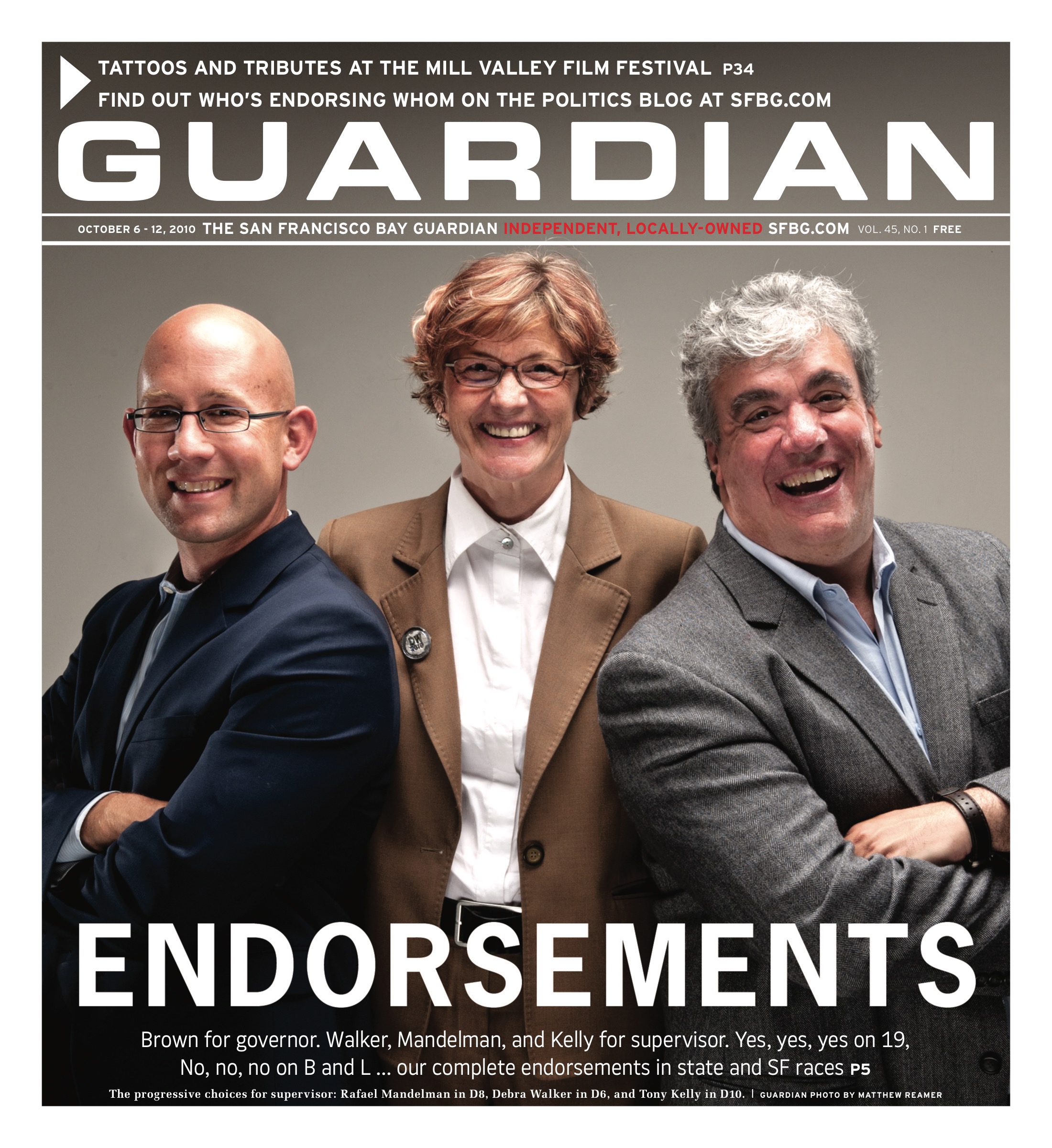
Maxwell disappoints by endorsing Sweet

10

To be honest, I wasn’t surprised that termed-out Sup. Sophie Maxwell endorsed D10 candidate Lynette Sweet yesterday. Just disappointed. And it’s not just because Sweet refused to come into the Guardian this fall for an endorsement interview (a stance that suggests that Sweet would be depressingly inaccessible to reporters that haven’t drunk her Kool-Aid—a stance that, unfortunately, reminds me of Mayor Gavin Newsom’s attitude towards the media).

I’d been hearing rumors that Maxwell was going to endorse Sweet since February, when Sweet, who’d already racked up Mayor Gavin Newsom’s D10 blessing at that point, showed up alongside Maxwell at the city’s kickoff event for Black history month.

Then there was the fact that during an interview in February for the Guardian’s kickoff article about the D10 race, Sweet spouted phrases that sounded eerily similar to Maxwell’s words.
“D10 is a pretty diverse district, but there is only one common thread: the need for economic development,” Sweet told me.

But a few days earlier when I interviewed Maxwell about a third, and ultimately unsuccessful, attempt to recall her , Maxwell talked of common threads:

 “I’m waiting for people to have a better understanding of what this community is, what the common thread running through it is, and how to use rank choice voting,” Maxwell said, by way of explaining why she wasn’t willing to endorse anyone that early in the race.

Now, it’s understandable that Maxwell would be looking for a candidate to carry on her legacy. But it she was looking for a moderate black female candidate  then why not endorse Malia Cohen, who isn’t hampered by all of Sweet’s dirty laundry—and has raised the most money in the race, so far?

Could it be that Cohen wouldn’t be down for the kind of dirty deal making that was par for the course back in the days when Willie Brown was still mayor and Sweet was the swing vote that crowned Lennar as master developer at the shipyard/Candlestick Point?

Rumor has it that Maxwell is upset at all the corporate money that’s flooding into this race in support of Steve Moss—and that she asked the other candidates to hold a press conference in which they decry this practice. Rumor also has it that Sweet signaled her willingness to join Tony Kelly, Dewitt Lacy, Chris Jackson and Eric Smith–to name a few–in making such a statement. But it hasn’t happened, yet. And the corporate money keeps rolling in for Moss.

Meanwhile, with three weeks until the election, D10 forums are beginning to sound like a parody of a “Lost” episode featuring a 22-member cast that all claim to represent the city’s polluted and economically depressed southeast sector:

“One of us is a BART director, one of us worked at City Hall, one of us is a community advocate, one of us is a City College Board member, one of us is a civil rights attorney, one of us is an affordable housing development director, one of us is a bio-diesel advocate, one of us is a public safety advocate, one of us was raised in the Bayview, one of us served on the Navy’s Restoration Advisory Board,” and so on.

I’m not saying this is wrong. Hell, I love all this diversity of choices. but I am concerned that, come election night, the progressive vote will get split into a million pieces, while deep-pocketed conservative forces like the Chamber of Commerce and Golden Gate Restaurant line up behind one candidate in an attempt to crush candidates that would stand up to their powerful influence at City Hall and truly represent the D10 community

Yes, there is ranked choice voting, and it’s unlikely that one candidate will win a majority of the vote in the first round. But it’s critical at this venture that progressives develop a winning strategy. D10 candidate Ed Donaldson told me recently that if a candidate who doesn’t represent the community’s concerns gets elected, then the community would respond just as they did around Maxwell—and organize a recall.

But wouldn’t it be better if the community can come together behind three truly progressive candidates and help them win the November election?

One of the key challenges in this race will be to win votes in Visitacion Valley, as well as in the Bayview and/or Potrero Hill.

In his latest column in the Chron, former mayor and Sweet supporter Willie Brown alluded to the importance of this in a city with ranked-choice voting:”It’s not getting much attention, but someone has finally figured out how to get the Asian vote out,” Brown observed.”You do it by mail. You get ballots and ballot books into every household, then have the whole family sit down together. The kids help with the translation, everyone talks things over and everyone votes.”

Meanwhile, D10 candidate Tony Kelly told me that Marlene Tran, who is tri-lingual (English, Cantonese, Vietnamese) and has a good handle on community issues in Viz Valley, has confirmed that Kelly is her second-ranked choice (presuming that she votes for herself in first place. of course).

Not a bad strategy–and one that other progressives need to consider, given ranked choice voting–and the brutal reality that they are going to be massively outspent in the next three weeks.


It’s not easy being an arrogant know-it-all

0

arts@sfbg.com

WRITERS ISSUE Having to constantly suffer the company of the ignorant, it’s difficult to suppress my condescension. After all, I know about obscure music and books that few others know of and this makes me superior.

For that matter, I must also tolerate the naive with regard to politics and current events. It is a constant struggle to maintain a civil façade, to avoid an outburst. After all, the polite response to the uninformed is not to point out their glaring faults but to gently correct their errors in a subtle, guiding way. Maintaining patience is not easy.

I was talking the other day to an acquaintance (it’s hard for people to actually be friends with one as superior as me) and I was shocked to find he’d never heard of Sainkho Namtchylak. Come on, what rock do you have to be living under to not know of the Tuvan throat-singing virtuoso — a singer who makes Diamanda Galas sound like Whitney Houston — who collaborates with free-jazzers like saxophonist Evan Parker? I tried not to be too disdainful as I informed him of her numerous releases on the British record label, Leo. It’s just so difficult not to get sarcastic when faced with that sort of colossal ignorance and cultural complacency.

Do these people just take whatever is offered them on MTV, instead of digging deeper? I have to laugh at the people who think they’re hip just because they listen to something they consider obscure, like Borbetomagus. Come on, they’ve been around forever. Even some grunge-listening moron who hasn’t picked up a magazine since Forced Exposure turned into a mail-order company knows that.

How did I become as I am: namely, one of the most hip people on the planet, endowed with a broad cultural knowledge? Obscurantists are made, not born. To tell the wounding truth, my strength came from weakness. In high school, I was a geek, woefully ignorant of popular culture and rock music in particular. My reading was predominantly in the genre of science fiction. I listened to the folk and classical music my parents preferred and, for exoticism’s sake, enjoyed the synthesizer stylings of Wendy Carlos and Tomita. Children have no taste. We’re shaped (or should I say twisted?) by our environment.

Once I discovered punk rock, I shot up like a late bloomer whose delayed pubescence doesn’t preclude his growth to a height greater than six feet. I devoured the Trouser Press Record Guide, listened to lots of music from the collections of friends. I started reading obscure magazines that reviewed music none of my friends listened to and I was an early adopter of the Internet: I had email in college in 1984 and my Usenet newsgroup posts archived on Google Groups date back that far, before the 1987 Great Renaming, which reorganized online discussion forums. I was an invited member of a secret e-mail music list called “Music-flamers” in 1986.

Let’s face it, it’s too easy to put someone down for being a fan of Korn or Britney Spears (what’s the difference, really?). I prefer to insult people for being so obvious as to be fans of virtually mainstream 1970s British psyche-folk group Caravan instead of Everyone Involved or fill-in-the-blank with your favorite ultra-obscure, private pressing, un-reissued psyche-folk LP of the early ’70s.

Why should music be something that we have in common, something that might bring us together, when it can be a soapbox to stand on to put us above other people? Why settle for the pleasure of turning on someone to good music when you can use it to put them down? If you can tell me, I’ll let you listen to my copy of Jim French and Galas’ If Looks Could Kill or Orchid Spangiafora’s Flee Past’s Ape Elf

Excerpted from The International Homosexual Conspiracy (Manic D Press, 224 pages, $14.95).


Moving portraits

0

cheryl@sfbg.com

WRITERS ISSUE The Metreon is handy if you require 10 different Inception showtimes. But watching a movie there is not same as seeing one — even the same one — at a circa-1922 palace like the Castro Theatre, a space lovingly dedicated to the specific pleasure of Going To The Movies. Edited by Julie Lindow (a former Castro employee), the brand-new Left in the Dark: Portraits of San Francisco Movie Theatres (Charta Art Books, $39.95) compiles essays from Bay Area film advocates, paying homage to San Francisco’s dwindling population of theaters. The book is illustrated by photographer R.A. McBride’s colorful, often haunting images of spaces robust (the Roxie) and ravaged (the New Mission).

Cinephiles will recognize most of the contributors, including San Francisco International Asian American Film Festival director Chi-hui Yang (topic: Chinatown cinemas); Landmark Theatre cofounder and current Balboa Theatre proprietor Gary Meyer (a personal timeline of his life as an exhibitor); and Guardian writer D. Scot Miller (a look at theaters in the onetime “Harlem of the West,” the Fillmore), among others. There’s also an interview with author Rebecca Solnit, who points out that the shared-experience aspect of movie-going is lost in a multiplex environment. Buying a ticket in a theater inside a mall, she writes, “you don’t have that funny sudden spiritual bond that this person next to you in line, who looks so different, also wants to see cowboys.”

Even before they met, Lindow and McBride had a mutual interest in local theaters. “I had been thinking about doing a book to help the movie theaters. At a party that Melinda Stone [another of Left in the Dark‘s essayists] had, I met Rebecca [McBride] and she had started her series of [theater] photographs. So we thought, that might make a great book if we combine these two things together. And then she handled the photos, and I handled the text.” The collaborative spirit continued to the selection of contributors. Lindow says making a connection with one author would lead to her to another; she describes the writing process as a true community effort.

By contrast, McBride found that accessing every venue she wanted to document wasn’t easy (she was flatly denied access to Cow Hollow’s Metro shortly before it closed). She also made some surprising discoveries (a toilet in the projection booth at the Clay, for example).

“There were over 100 theaters at one point in the San Francisco Bay Area — and I’ve only photographed 19 of them,” McBride says, with a certain amount of wistfulness. “One my favorites was the Coronet, which is now gone.”

LEFT IN THE DARK: PORTRAITS OF SAN FRANCISCO MOVIE THEATRES

Wed/13, 5:30 p.m. reception;

7 p.m., slideshow with R.A. McBride

SF Camerawork

657 Mission, second floor, SF

www.sfcamerawork.org

More events at www.leftinthedark.info


Tick tock

0

arts@sfbg.com

HAIRY EYEBALL In a characteristically poetic passage within 1980’s Camera Lucida, Roland Barthes describes early cameras, given their cabinet-like appearance and precise mechanical innards, as “clocks for seeing.” I couldn’t shake the phrase while taking in Will Rogan’s “Stay Home,” an ambiguous smile of a solo show composed of photographs and three-dimensional photographic collages at Altman Siegel.

Taking the measure of time is very much on Rogan’s mind, as it was on Barthes’ some 40 years ago. A photograph is but an imperfect means of forestalling time’s onward march: it offers the present a momentary record of an instant long gone. So too has photography, at least in the nondigital form that Barthes was writing about, become an index of a past medium, and in our current age of Photoshop, an object for nostalgic longing (see the Hipstamatic iPhone app).

Rogan skirts this sand trap even though his practice deliberately engages with 1970s printed matter and evokes a range of photographers from that decade and later, most notably Lee Friedlander and Daido Moriyama’s social landscapes, and to a lesser extent, Sherrie Levine’s appropriations. The three small sculptural collages of cropped images affixed to painted wood pieces with beeswax even look as if they are from another time. Indeed, it’s easy to get distracted by Rogan’s mode of address (“hey guys, here are some cool books I found at a yard sale, and look what I came upon while walking to the corner store”), by his work’s muted cleverness and calculated arrangement of happenstance, that it can be easy to overlook the substance of what he’s saying.

Viewing the Past As it Happens takes its title from a passage in a picture book on astronomy that is itself the subject of the photograph. The book lies open; a picture of a galaxy on the right page. A description on the adjacent page details that what we are looking at, that what astronomers gaze at through their telescopes night after night, is in fact millions of years old. Of course, this also functions as a gloss (as does the photograph’s title) on the act of taking a picture: in that moment when we look into the viewfinder, our fingers poised to capture what we see before us, we are in a sense seeing what will become the past.

Two other photographs of educational books, The Elusive Nature of Time and Man Versus Clock: The Unequal Struggle, drive the point home that the photographer’s relationship to time is a Sisyphean one, even as the lifted bathos of their titles sends up the self-seriousness inherent to such postulating. Rogan seems to say, “Don’t freak out, too much,” while simultaneously holding up evidence to the contrary. The detritus that catches Rogan’s eye in other pictures — reflective glass shards, a gutter-lodged beer can, a taped-together window, an abandoned sneaker — are corollaries to the amazing sign on the paper shredding business captured in Shredder that reads, “DOCUMENT DESTRUCTION — While You Watch,” in light of which “document” starts to read more as a verb than a noun.

With Busts, a series of six magazine pages (covers perhaps?) that have been altered so that only the ghostly white silhouettes of unknown seated subjects remain, Rogan moves from documenting destruction to participating in it. It’s hard to tell whether or not the outlines are formed from erasing a prior image or painting over unrelated text, some of which is visible underneath the white. Regardless, the message is still clear: time is on no one’s side.


THAT JOKE ISN’T FUNNY ANYMORE

Time will certainly not be on the side of Hugh Brown, who demonstrates in his solo show “Allegedly” at Robert Koch that no amount of skilled workmanship or flawless execution can make up for a paucity of ideas. Indeed, he has but one, and truly, it is more a gimmick than a concept: to remake iconic works of art in his own image.

And how does the artist picture himself? As a chainsaw-wielding bad boy, cutting through the canon and art world pretensions with the power phallus of choice for exploitation filmmakers and ice sculptors. Brown’s smash and grab tour through art history includes Diane Arbus (here, the child clenched in rage holds a toy saw instead of a grenade), John Baldessari, Henri Matisse, Barbara Kruger (“I saw therefore I am”), and Roy Lichtenstein, among many others.

Granted, Brown’s art is well made and it exhibits a careful attention to the material details of the work it parodies. A “Bruce Nauman” is actually done in neon (surprise, it’s a chainsaw). Each work is also credited to the original artist, a parenthetical “allegedly” following their name, as if the dubiousness of what we we’re looking at weren’t apparent already.

Appropriation is by no means a new game, and many of the artists hijacked by Brown made poaching and quotation central to their own practices. But the art in “Allegedly” lacks any real critical force. It says nothing about the works being pillaged and everything about Brown’s estimation of himself. The show is apiece with those postcards that put sunglasses on the Mona Lisa or banana hammocks on Michelangelo’s David.

How Brown has managed to convince gallerists otherwise is a mystery that “Allegedly” leaves unsolved. *

WILL ROGAN: STAY HOME

Through No. 6

Altman Siegel Gallery S/F

49 Geary, Fourth floor, SF

(415) 576-9300

www.altmansiegel.com

HUGH BROWN: ALLEGEDLY

Through Oct. 30

Robert Koch Gallery

49 Geary, SF

(415) 421-0122

www.kochgallery.com


Lost city

2

arts@sfbg.com

WRITERS ISSUE With its vast divide between the rich and poor, its lusty appetite for sex, and its backroom real estate deals, it would seem that even the boutique and completely gentrified San Francisco of today offers to writers of crime fiction a rich vein of noir opportunity. Yet the lone novelist today determinedly probing the dark side of San Francisco’s endless battle to clean up the streets is Peter Plate. His latest novel, Elegy Written on a Crowded Street (Seven Stories Press, 176 pages, $13.95), is Plate’s ninth in a hardboiled writing career that spans the era of out of control gentrification in San Francisco. With little fanfare or support, against the real life backdrop of police sweeps of the homeless and the start of the dot com boom, Plate has produced a shelf of books that represent a lonely, yet noble and deeply radical literary effort to write noir crime fiction in which not the cops but the criminals are the protagonists.

Plate’s novels are full of delicious hooks. They reliably begin with some of the best premises in noir fiction today. Fogtown (Seven Stories Press, 2004) opens as a crowd of Market Street homeless and down and outers witness the crash of an armored Brinks truck at dawn that temporarily fills the desolate street with crisp, new hundred dollar bills. In Police and Thieves (Seven Stories Press, 1999), Doojie, a small-time Capp Street weed dealer, accidently witnesses the murder of a homeless man by a police officer and spends the rest of the book on the run from the murderous cop who seeks to silence him.

Like Doojie, Plate’s characters are always in the wrong place at the wrong time, unwilling spectators as the city changes around them. The free money in Fogtown offers the Market Street dwellers a tantalizing glimpse of the kind of new carefree life being lived all around them by the rich who have newly arrived to the city. Yet, like the upscale new eateries and clubs popping up everywhere, the money is off limits to them, and those who take the money instantly become, like Doojie, hunted by police. Plate’s strength is in conveying the hopelessness and despair of lone characters pitted in Doestoyevskian battle with societal forces far greater than they are. As they are slowly ground down by this struggle, we feel their terror, incomprehension and paranoia. As the drug dealer and SRO hotel manager, Jeeter, says in Fogtown, “Rights? You don’t have any rights. You have choices. That’s all you have. And you made the wrong one.”

In this context, noir fiction for Plate is protest fiction. A longtime street activist, Plate writes with the gut instincts of a protester, taking his novels right to the barricades where different visions of San Francisco violently clash. One Foot Off The Gutter (Incommunicado, 1995), is a mordant postcard from a Mission District just about to enter its gentrification era in which a homeless cop, a Latino gang member, and a yuppie doctor all covet the same Victorian houses at 21st Street and Folsom. Soon The Rest Will Fall (Seven Stories, 2006) is set in the Trinity Plaza Apartments on Market Street at the height of housing activists’ struggle to save the low income housing from demolition. Plate has so reliably found the pulse of change in the city that at times his work has blurred tragically with reality. Police and Thieves ends with a fire at the Crown Hotel on Valencia Street. Just months after the book’s publication, the real life Crown Hotel burned to the ground.

Since Plate finished his Mission Quartet at the close of the dot-com era, he has turned his attention to San Francisco’s Main Street, Market Street. Recently, in its inaugural issue, the incipient local newspaper San Francisco Public Press reported that one lone real estate speculator owns 62% of the vacant real estate between 5th and 6th on Market Street and that he is willfully leaving those properties vacant until he can make the money he thinks he deserves off of the property. Those uselessly abandoned and boarded up buildings at the very heart of the city are the recurring backdrop for much of Elegy Written On a Crowded Street, perhaps Plate’s darkest and most emotional work to date.

Elegy is not so much a traditional crime fiction thriller, but a lyrical roman noir in which police and thieves battle not each other but the stifling conditions of the city. Plate’s latest evokes Don Carpenter’s 1966 classic Hard Rain Falling (reissued this year by New York Review of Books), an unrelenting work that also took place largely on Market Street. Carpenter’s novel brings to life the old dive 24-hour pool halls and dirty hotel rooms of a 1950s San Francisco where the promise of the Gold Rush American West has faded. The novels’ restless young pool hustlers and small time thieves can only shuttle aimlessly back and forth in the new remote control city, like the 8 Ball, waiting to fall. Elegy’s characters are their descendents, still on Market Street and still waiting.

Down this mean street walks May Jones a tough, hard-drinking bail bondswoman, who is nearing forty with no prospects. Like everyone around her, Jones dreams of escape from the city. Even Jones’ clients are leaving for Portland. “It’s got trees. Good people. Cheap housing,” an erstwhile, young crusty-punk bank robber earnestly tells Jones as she prepares to skip bail. But Jones is condemned to remain, while all around her are the undead ghosts of those already disappeared and the soon to be departed. The cleaned up San Francisco is haunted. The living are exhausted. Jones says to herself, “I have pipelines to the lands of the dead.’

Jones echoes the food stamp caseworker, Charlene Hassler from Plate’s welfare reform novel, Snitch Factory (Incommunicado, 1996). Like Hassler, Jones is being worn down between the insatiable needs of her clients and the treacherous intrigues that surround her job. Jones’ client is Mary Anderson, a pregnant twenty-year-old African-American who has killed her boyfriend, the SFPD’s star snitch on Fillmore Street. By keeping her client out of jail, Jones finds herself on the cops’ shitlist and in fear for her life. As in other Plate novels, a police hunt for Jones ensues. As in other recent Plate novels, after the initial hook, the plot soon becomes murky and this hunt becomes elliptical and hard to follow, perhaps even a bit ridiculous. A plot sideline in which Jones has a brief fling with a dyke she meets at the End Up goes nowhere. The ghosts of Lenin and punk rock legend, Will Shatter make surprise cameos that stretch the reader’s credulity. Yet, Plate’s spot on descriptions of Market Street today and the universe of dread his characters inhabit there remains compelling throughout and one never doubts that the unraveling narrative is what life feels like for his characters. Plate writes with a tightly wound urgency throughout and Elegy makes a persuasive case that what is happening at 5th and Market today is happening to the city as a whole.

Fantastical plot aside, it is the weight of the dead that is the true subject of Elegy. The book opens with a dreamy scene, shrouded in fog, in which Jones watches the dead body of one of her former clients as it bobs up and down in the surf, unable to either reach the shore or go under for good. Some policemen have waded into the water to grapple with the dead man and bring him in, but the body proves too difficult to apprehend and the cops are pulled down with the it into the crashing waves. Throughout Elegy, Plate’s characters similarly bob along, paralyzed and unable to take decisive action, only pulling each other down, and as the novel ends, May Jones is more or less back where she started. Sadly, like many of Plate’s recent books, the novel fails to fully satisfy because there is no resolution to the plot. Plate’s characters do not seem changed by their ordeal; they only become more numb. Yet perhaps that is the point. Plate seems to be saying that as long as the city fails to grapple with its own dead, nothing can change, and the city is condemned to go around and around in a sort-of netherworld, reliving its past traumas in new conflicts. “It’s a moment in hell that should be taking place beneath the ground,” Plate writes of a brutal police assault on a drunken derelict in Elegy, and it sums up the whole book. The dead won’t stay buried.

While an elegy is a funeral song, a lamentation for the dead, it also suggests a last word. With Elegy has Plate said all he has to say about San Francisco? One hopes not. Perhaps no writer working today has left such a record of what it feels like to live in the American city in the era of gentrification. Yet, in life as in Plate’s fiction, knowing the truth can take its toll, as Doojie finds out when he is hunted by the police for the truth he alone knows. By the end of Elegy, May Jones has spent so much time wallowing in the murky depths where her clients dwell, that her identification with them is complete and her fate has become inseparable from theirs.

The exhausted tone of Elegy suggests that like Jones, Plate, the lifelong activist and engaged writer, has perhaps stared into the abyss too long. Nonetheless, his nine novels are a significant achievement, the life’s work of a doggedly engaged writer. In each book, I have found scenes that remain unforgettable in my own mind and that have permanently altered my own perceptions of San Francisco and its streets. While Plate’s novels are each flawed in their own way, I love them with the Algren-like compassion he clearly has for his memorable characters, like the homeless cop who lives in his squad car in Gutter, and the ex-con who robs a pot club while dressed like Santa Claus in Soon the Rest Will Fall. Taken as a whole, Plate’s novels offer a compelling and defiant portrait of the psychic toll the disappearance of loved people, places, and opportunity from the city has taken on those left behind.


On the cheap listings

0

On the Cheap listings are compiled by Paula Connelly. Submit items for the listings at listings@sfbg.com.

WEDNESDAY 13

“How to Cook Like a Scientist” Bazaar Café, 5927 California, SF; (415) 831-5620. 7pm, free. Meet Jeff Potter, author of Cooking for Geeks, who combines cooking with Mythbusters to create a food-as-science, cooking experience for those who like to know how things work.

THURSDAY 14

Sparring with Beatnik Ghosts Beat Museum, 540 Broadway, SF; (415) 399-9626. 7pm, free. This ongoing multimedia poetry series returns to the Beat Museum with host Daniel Yaryan and featuring readings by David Meltzer, San Francisco Poet & Beat Icon, Ellyn Maybe & Her Band, Steve Arntson, Jerry Ferraz, Martin Hickle, Richard Loranger, Whitman McGowan, Ginger Murray, Julie Rogers, Margery Snyder, and Chris Vannoy.

FRIDAY 15

Mark I. Chester Benefit Mark I. Chester Studio, 1229 Folsom, SF; (415) 621-6294. 7pm; free, donations encouraged. Celebrate Mark I. Chester’s 60th birthday while helping to raise funds for a new book. View Chester’s current exhibit, “Doing Time on Folsom St: a 30 year retrospective of fine art gay radical sex photography” and enjoy readings and performances by Carol Queen, Tom Orr, Seth Eisen and Jesse Hewitt and more. Sponsored by the Center for Sex and Culture.

“Writing Our Word, Speaking Our Minds, Telling Out Stories” San Francisco Main Library, Latino/Hispanic Community Meeting Room, 100 Larkin, SF; (415) 557-4400. 6pm, free. Featuring readings by and about lesbians with disabilities with Elana Dykewomon, Barbara Ruth, Teya Schaffer, Dominika Bednarska, and the Mothertongue Feminist Theater Collective.

SATURDAY 16

“The Classics” 1:AM Gallery, 1000 Howard, SF; (415) 861-5089. 5:30pm, free. Attend the closing reception for this exhibit, curated by Nate1, that brings together original vintage work from the artists that put San Francisco on the graffiti map and defined Bay Area graffiti style. Guest speaker Spie will give an informative tour of the exhibit on Bay Area graffiti.

Halloween Bazaar Modern Eden Gallery, 403 Francisco, SF; (415) 420-2898. 7pm, free. End your day of touring open studios in North Beach, as part of SF Open Studios’ weekend two, at this spooky-themed trunk show featuring wares by local artists JuJu by Sarah, Marya Zoya Taxidermy Courture, Blackbird Bazaar, Squid Rose designs, and more plus pumpkin carving and painting, music, drinks, and treats. Costumes encouraged.

Potrero Hill Festival 20th street between Missouri and Wisconsin, SF; www.potrerofestival.com. 11am-4pm, free. Soak up the best of Potrero Hill at this street fair with a view featuring local merchants and residents selling their wares, arts, and crafts, two stages with live music, food from Potrero Hill restaurateurs, information booths, and kids activities including a bouncy house, petting zoo, pony rides, and performances.

Taste of Fillmore Fillmore between Post and Jackson, SF; www.tasteoffillmore.com. 1pm-6pm; free admission, $20 for wrist band. Buy a wrist band and enjoy food and wine tastings at boutiques and restaurants, or just walk around and check out some live jazz, walk through home décor scenes installed on the sidewalks, watch cooking demonstrations, fashion shows, and more.

Trolley Dances Meet at the Harvey Milk Center for Recreational Arts at Duboce Park, Scott at Duboce, SF; www.epiphanydance.org. 11am-2:45pm, tours leave every 45 min.; free with MUNI fare. Get out of the theater and into the streets with traveling performances by Epiphany Productions SDT, Joe Goode Performance Group, Sara Shelton Mann, and more as they take you from Duboce Park to the SF Botanical Garden in Golden Gate Park for several unique performance locations.

“The Wild Kitchen” Omnivore Books on Food, 3885a Cesar Chavez, SF; (415) 282-4712. 3pm, free. Hear authors Connie Green and Sara P. Scott discuss their book, The Wild Kitchen: Seasonal Foraged Foods and Recipes, and the increasing popularity of wild delicacies. Green sells her gathered goods across the country to Napa Valley’s finest chefs, so before you buy that expensive meal, consider the free buffet that is California.

Writers with Drinks Make Out Room, 3225 22nd St., SF; (415) 647-2888. 7:30pm, $5-$10 sliding scale. This installment of the monthly spoken word variety show features Marcia Clark, Ken Scholes, Jamie Freveletti, Stephen O’Connor, Kirya Traber and Daniel Allen Cox. Proceeds to benefit the Center for Sex and Culture.

Yerba Buena Fair Yerba Buena Gardens, Mission between 3rd and 4th St., SF; (415) 644-0728. 11am-3pm, free. Celebrate the Yerba Buena neighborhood at the fair featuring live music, dancing, acrobats, neighborhood food vendors, street food vendors, art and history walks, prizes and giveaways, kids activities, and more.

SUNDAY 17

Capsule Hayes Valley Park, Octavia at Hayes, SF; www.capsulesf.com. 11am-6pm, free. Enjoy this fashion design open air market and community party where you can browse locally made clothing, upcycled jewelry and accessories, steampunk-inspired wear, graphic tees, kids clothes, and designer housewares while listening to live music by members of the Jazz Mafia, Brent Bishop and the Part Poopers, and more.

Fiesta on the Hill Cortland between Bocana and Folsom, SF; (415) 206-2140. 10am-6pm, free. Join your friends and neighbors for the 22nd annual Fiesta to benefit the Bernal Heights Neighborhood center, an organization that works to maintain the ethnic, cultural, and economic diversity of Bernal Heights. This alcohol free family event to feature a petting zoo, pony rides, a pumpkin patch, non-profit booths, live music, food vendors and more.


Appetite: 3 recent food books pique our palates

0

These three books (one factual journey, one memoir, one cookbook) have two things in common: they’re all new this year and centered around food.

TWAIN’S FEAST by Andrew Beahrs — Andrew Beahrs, an East Bay local, displays his affection for the great Mark Twain in this thoroughly researched book. Twain’s Feast explores the history of foods Twain waxed eloquent about that are either gone entirely or slowly making their way back into the American landscape.  Experiencing food and coffee in his European travels “as tasteless as paper”, Twain found American cooking of his time “generous”, “genuine”, “real”. Of course, the prairie hens he grew up with, fresh possum and raccoon, New Orleans’ sheep-head and croakers, and the “heaven on the half shell” of San Francisco’s own oysters and mussels, are largely extinct or rare nowadays.

The book is, yes, a poignant ode to the pre-mass-produced, homogenized, dangerously grown American “food” we now know. It’s also a hopeful challenge to the reader, worded gently in the epilogue: “… choices about what we eat help to determine which American landscapes survive and thrive.”

There are many worthy stories here, both for the Twain aficionado and food historian. What I came away with, besides a reminder to support the craftswomen and men making food and growing animals with care (which we’re heavily blessed with in the Bay Area), was Twain’s insataible passion for robust flavor, a hunger to drink life to the dregs. I relate to the way he eats… and heartily writes about it.

As Beahrs says, “… Twain’s love for a dish was inseparable from his love of life.” Amen.

HUNGRY TOWN by Tom Fitzmorris — Make no bones about it, I have a mad love affair with New Orleans, a city you hear me go on about often enough. Naturally, I ate up (no pun intended) Tom Fitzmorris‘ new Hungry Town, a leading Nola restaurant reviewer both in print and on the radio for decades.

He knows the city’s food scene intimately: its history, key players, essential recipes (included in the book), and the post-Katrina struggle that has brought the culinary magic of the ultimate Southern city back to even greater heights (and more restaurants) than before the storm. His post-Katrina assessments are honest insights into just how torn apart families and businesses were, including his own. But he unabashedly claims: “Food Saves New Orleans”.

I value his commitment to Creole and Cajun as the “default” styles of cooking in New Orleans, essential to the city’s future. He states: “The genius of New Orleans cooking is not that we cook better than anyone else. It’s that nobody in the world cooks our local specialties – except when they consciously imitate us (usually badly, I’ve found). The day that our food fails to be flagrantly distinctive… is the day we become Anywhere, USA. That’s also the day I’m leaving town.”

THE SUNSET COOKBOOK — Cooks take note: 10/19 is the release date of the massive, 1000+ recipe tome that is the latest edition of the Sunset Cookbook. It’s a fine one. Not only are the clean, bright photos dangerous to peruse on an empty stomach, but the book manages to be both approachable and widely comprehensive, with sections on every aspect of a meal you can think of from bread to cocktails to preserves and pickles.

Sunset magazine‘s food editor, Margo True, is also the book’s editor and she maintains a cohesive standard of ‘farmers-market-fresh’ ingredients with regional Western foods. Yes, Sunset magazine is based in the Bay Area, so California ethos displays prominently with international influences married to a rich range of produce. But the styles of cooking cover the world, showcasing food of the West as what it truly is: global.

Many recipes tempt me here, including this snack and shake:

Avocado Fries
SERVES 6 | TIME 30 minutes

Canola oil for frying
1⁄4 cup flour
1⁄4 tsp. kosher salt, plus more to taste
2 eggs, beaten to blend
11⁄4 cups panko (Japanese-style bread crumbs)
2 firm-ripe medium Hass avocados, pitted, peeled, sliced into 1⁄2-in. wedges

1. Preheat oven to 200°. In a medium saucepan, heat 11⁄2 in. oil until it registers 375° on a deep-fry thermometer.

2. Meanwhile, mix flour with salt in a shallow plate. Put eggs and panko in separate shallow plates. Dip avocado wedges in flour, shaking off excess. Dip in egg, then panko to coat. Set on two plates in a single layer.

3. Fry a quarter of the avocado wedges at a time until deep golden, 30 to 60 seconds. Transfer wedges to a plate lined with paper towels. Keep warm in oven while cooking remainder. Sprinkle with salt to taste.

California Date Shake
One of the great foods of the Sunshine State, the date shake is exactly what you want to be slurping while visiting baking-hot date country near Palm Springs. Our favorite shake is the one at Shields Date Gardens, in Indio. Shields uses its own date “crystals”—dehydrated Deglet Noor and Blonde dates (the latter is one of its signature varieties). You can order these online or substitute fresh, as we’ve done here. This shake is sensational with a shot of rum stirred in.

Makes 1 shake (11⁄3 cups) | TIME 10 minutes

4 pitted Medjool dates (about 3 oz.), coarsely chopped
1⁄4 cup very cold milk
11⁄4 cups high-quality vanilla ice cream

In a blender, blend dates and milk until smooth and super-frothy. Add ice cream and pulse a few times, until just blended.

Subscribe to Virgina’s twice monthly newsletter, The Perfect Spot

A trio of great Hispanic leaders

0

Dick Meister, former labor editor of the SF Chronicle and KQED-TV Newsroom, has covered labor and politics for a half-century. Contact him through his website, www.dickmeister.com, which includes more than 250 of his columns.

It’s Hispanic Heritage Month, an excellent time to remember three of the most important Hispanic labor leaders in U.S. history. All three were engaged in the much needed and very tough job of organizing and improving the generally poor conditions of the nation’s largely Latino farm labor force.

Cesar Chavez, of course, is one of the farm worker leaders we should particularly honor. Another is Dolores Huerta, who joined Chavez in founding the United Farm Workers union – and who, in fact, is still organizing and otherwise helping Latino workers, particularly women.

The third leader who’s especially deserving of honor is the lesser known but no less important t pioneer farm labor organizer, Ernesto Galarza. Despite his important work, Galarza has been largely forgotten – though certainly not by me.  He’s been dead now for a quarter-century, but I recall him well from my days as a reporter covering farm labor:

His shining, black hair and fierce, penetrating gaze. His angry, intense words and slashing speeches against those who resisted demands for reform. His scholarly writing and novels and poetry – and his teaching.

Galarza was one of the loudest and most unusual of the voices that have been raised for the farm worker. He had a Ph. D., wrote a half-dozen books and numerous pamphlets and articles , and taught at all levels, from elementary school to university.

Yet Galarza was also an active union organizer – a key leader in laying the groundwork for the farm labor movement led by Cesar Chavez.

Galarza came to California’s fields in 1948, as an officer of the American Federation of Labor’s now long gone National Farm Labor Union. He had grown up in California, and had worked on farms as a teenager.

But Galarza had left that behind to head off to college on a scholarship and, eventually, to Columbia University for a doctorate in Latin American affairs.

After that, Galarza worked for the Pan American Union in Washington – until, characteristically, he became enraged over what he felt was the organization’s overlooking the exploitation of Latin American workers by US business interests. He resigned to take the job with the National Farm Labor Union.

Galarza led several strikes, but he was completely thwarted by the federal Bracero program that allowed growers to import penniless, undemanding Mexican workers to replace US workers who dared to strike or otherwise seek better treatment. So Galarza shifted his efforts into trying to abolish the Bracero program.

For more than a dozen years he fought a frustrating and often lonely battle. He spoke out endlessly before legislative committees and elsewhere, He issued hundreds of reports documenting the abuses of U.S. and Mexican workers under the Bracero program,. But the program remained untouched, and by 1960, Galarza’s union was gone. Near exhaustion, he turned mainly to writing and teaching.

But finally, in 1964, the public pressure that Galarza had a key role in generating led Congress to kill the Bracero program. It’s no coincidence that year, 1964, was the same year in which Cesar Chavez began his organizing drive. For Galarza was correct: The existence of the Bracero program had made farm labor organizing impossible.

By the time of Galarza’s death at 78 in 1984, the Chavez-led United Farm Workers had become an effective, nationally supported union.

The farm labor system still relies heavily on desperately poor immigrant workers, But thanks to the farm workers union that Ernesto Galarza helped bring about, many workers have had the chance to seek – and many have won – the right to the decent lives that Ernesto Galarza spent so much of his life seeking for them.

I was fortunate enough to also get to know Cesar Chavez.  I first met him when I was covering labor for the San Francisco Chronicle. It was on a hot summer night 45 years ago in the little farm town of Delano in southern California.

“Si se puede . . . It can be done . . . Si se puede.” He said it repeatedly as we talked deep into the early morning hours.

Si se puede . . . But I would not be persuaded. Too many others, over too many years, had tried and had failed to win for farm workers the union rights they had to have if they were to escape their severe economic and social deprivation. The Industrial Workers of the World who stormed across western fields early in the 20th century, had first tried organizing farm workers – and failed. Failing, too, were Communist organizers, socialists, and AFL and CIO organizers.

I was certain Chavez’ effort would be no different from theirs. Boy, was I wrong.  I had not accounted for the tactical brilliance, creativity, courage and just plain stubbornness of Cesar Chavez.

He understood that farm workers had to organize themselves, not depend on outsiders to do it. Chavez led the workers in creating a union of their own, which then sought out – and won – widespread support  from influential outsiders through boycotts and other tactics of non-violence patterned after those of Mohandas Gandhi and Martin Luther King Jr.

Chavez proved beyond doubt that the poor and oppressed can prevail against even the most powerful of opponents – if they can effectively organize themselves and adopt non-violence as their principal tactics. As Chavez explained, “We have our bodies and spirits and the justice of our cause as our weapons.”

The results of the Chavez-led organizing drives were impressive – the first farm union contracts in U.S. history, and the California law, also a first, that requires growers to bargain collectively with workers who vote for unionization.

Chavez worked closely with Dolores Huerta in creating and leading the United Farm Workers union. Huerta was, for instance, one of the principal leaders of the worldwide grape boycott that forced growers to agree to those first farm labor contracts  – which Huerta negotiated despite her lack of experience in contract bargaining.

Huerta’s work with the UFW was just a part of her lifelong and extraordinarily successful and courageous fight for economic and social justice that she waged while also raising 11 children.

Huerta’s traveled the country, speaking out and joining demonstrations for a wide variety of causes and successfully lobbying legislators for important gains for Hispanic immigrants and others.

Huerta started out as an elementary school teacher in northern California in 1955, but soon tired of seeing the children of farm workers regularly come to school hungry. That, and her anger over the injustices suffered by the local farm workers, led Huerta to quit teaching and join the Community Services Organization – the CSO – an organization founded by community organizer Saul Alinsky, with Chavez eventually serving as its General Director.

The CSO helped local Chicanos wage voter registration drives and take other actions to win a strong political and economic voice. But when the CSO’s other directors refused to agree to a union organizing drive among local farm workers, Chavez and Huerta quit to organize on their own. Like so many others, the CSO directors said it couldn’t be done. Thankfully, they were wrong and Cesar Chavez and Dolores Huerta were right.

But being right is just the first step, essential as it is. Hundreds of thousands, if not millions of poorly treated farm workers badly need to be organized, badly need the decent treatment that unionization can bring them, as it did to many others that the extraordinary efforts of Cesar Chavez, Dolores Huerta, and Ernesto Galarza helped bring to many others.

Dick Meister, former labor editor of the SF Chronicle and KQED-TV Newsroom, has covered labor and politics for a half-century. Contact him through his website, www.dickmeister.com, which includes more than 250 of his columns.

Hot sexy events Oct 6-12

0

It’s about that time, cats and kittens. Time to start fantasizing — Halloween is just around the corner. And though everyone and their mother is going to be Stephen Colbert’s Muslim vampire this year, many will seize the autumnal juncture as an opportunity to whore it up and out – in a good way! 

After all, who doesn’t love the sexy nurses, kitties, police officers, and Snookies that stalk the city bars each year on the 31st? Look, the point is that on this day of days society indulges those that follow their dreams. May as well make it a wet dream, no? Sexy Muslim vampire it is! Oh, and here are some sexy events that’ll wet your whistle this week, with an emphasis on finding that alluring inner equilibrium.

Bawdy Storytelling

Two events this week to get you hooked into what’s happening in Dixie De La Tour’s recurring sexcapade storytelling series: one, a best-of edition featuring writers and comedians from around town (Wed/6) and two, a back alley Lit Crawl edition of Bawdy that’ll have Clarion Alley echoing with the retelling of disastrous dates and tales of unconventional canoodling.  

Bawdy Storytelling: Graphic Confessions

Wed/6 8 p.m., $10

The Blue Macaw

2565 Mission, SF

www.bawdystorytelling.com


Bawdy in the Alley

Sat/9 8:30-9:30 p.m., free

Clarion Alley between 17th and 18th St., SF

www.bawdystorytelling.com


Declaring Our Erotic

Jen Cross knows that erotic writing isn’t just a pleasure to read – for some, the act of writing down passions can be a cathartic, even therapeutic event. That’s why she’s offering this eight-week class for survivors of LGBT sexual trauma. The syllabus promises a safe space to reconnect with your body’s desires and memories. And of course, a chance to write some hot, dirty smut. 

First class Thu/7 6:30-9 p.m., $225-250

email jennifer@writingourselveswhole.com for details


Urge

Put the Citadel’s 5,400 square feet of devious dungeon to use to use for the whipping, slapping, burning, and loving of young loins – hot young male whippersnappers will be the only ones invited to this get together of BDSM blowout. 

Fri/8 9 p.m.- 1:30 a.m., $25

SF Citadel

1277 Mission, SF

(415) 626-1746

www.sfcitadel.org


Steven Saylor

Love, sex, and intrigue in the palace! But this ain’t no corset-buster. No, Steven Saylor’s new book Empire is a males-only play space – the plotline follows Emperor Nero’s eunuch lover Sporus, who becomes the hottest piece of tranny ass on the Forum. Let Saylor woo you into a new love of history at this talk about his latest historical tome of carnal knowledge.

Mon/11 7:30 p.m., free

A Different Light Bookstore

489 Castro, SF

(415) 431 0891 

www.adl-books.blogspot.com


Grizzly’s Bullwhips by the Bay

Don’t worry baby, they got loaner whips. Put your lusted one’s mind at ease by polishing up your whipping skills at this bimonthly peer skill share class by the sea. It’s about safety, kids! After all, when the singletails start flying, you can’t always guarantee that Grizzly, the organizer of the get-togethers, will be there with spare protective goggles to guard those bedroom eyes.

Sun/10 11:30 a.m.- 1 p.m., free

Southeast of the Golden Gate Park Polo Fields, SF

www.laughingbear.org


Body Love for Better Sex

How would you spread your legs if you weren’t worried about chunky inner thighs? Body anxiety can be the nemesis of good sex –  but Virgie Tovar, fat positive sex educator, is here to help you titter about Miss Body Anxiety until she drops out of school due to social anxiety. Which is to say, help you feel as pretty as you are. Aww. No more naked nervousness, bam.

Mon/11 6-8 p.m., $20-25

Good Vibrations

1620 Polk, SF

(415) 345-0500

www.goodvibes.com


Get a clue, Randy Shaw

29

I read BeyondChron every day, and Randy Shaw, who operates the site, and Paul Hogarth, his managing editor, often have interesting commentary. But I’m constantly annoyed by people who run what by any stretch is a journalistic operation, but don’t follow the basic rules of (even alternative, activist) journalism: When you’re going to say something nasty about somebody, you call that person for comment.


Randy never called me, or Steve Jones, or Bruce Brugmann, before he launched an attack on the Guardian as part of a political machine. If he had — or if he’d done any reporting work and called around town — he might have learned something.


Randy’s argument is that the “machine” — including the Bay Guardian — is trying to block Jane Kim’s election as D6 supervisor. Let’s examine that for a minute.


There are plenty of people in San Francisco who would love to have a political machine. But it’s just not happening. The very fact that Jane Kim has the support of so many progressives — including the Board president, David Chiu, and Supervisors Eric Mar and John Avalos (all part of what Shaw calls the “machine”) suggests that nobody has to clout — not even me — to tell a candidate whether she can run for office, to control (or cut off) campaign contributions, or to wire an election.


In the days when Willie Brown ran San Francisco, the machine really did keep people from running for office. It really did close off avenues to political advancement. And if the machine was against you, it was really hard to raise money. If Brown were still the boss, and he didn’t want Kim to run, she would have been frozen out of much of the support and money she has today. Instead, Brown was at her campaign kickoff — and nobody’s manged to intimidate her many supporters and campaign contributors.


And guess what? The Guardian — the axis of the machine evil trying to freeze out Kim — endorsed her as our second choice.


I stand by what I said months ago — there’s nobody in San Francisco today — and no cadre or group — with the clout to operate as a political machine.


Nobody can line up six automatic votes on the Board of Supervisors. Even the progressives on the Democratic County Central Committee can’t always seem to get it together (note that Aaron Peskin, the chair and supposed machine honco, supported Tony Kelly for supervisor, and the DCCC didn’t put Kelly on its slate).


Right now, power in this city is fairly diffuse. That’s both a good and a bad thing. Good because machines are exclusionary, bad because it means the progressives can’t always function on a level that gets the right candidates elected and the right legislation through. Good because the left in this city is aggressively, almost happily disorganized and politically diverse, full of characters, voices, interest groups, candidates and elected officials who don’t always agree with each other and take orders from nobody. Bad because when we’re disorganized, we tend to lose.


Jane Kim didn’t get the DCCC endorsement. Nobody talked to me about that; I’m not on the panel and none of the members called to ask my advice. I would have said what the Guardian said in our endorsement package: There are exactly two progressive candidates who are qualified to be the next D6 supervisor, and their names are Debra Walker and Jane Kim. I still don’t understand why Kim entered the race against an established candidate with whom she has no substantial policy disagreements; I think that, before Kim moved to the district and entered the race, Walker was the clear consensus candidate of progressives, and as a matter of strategy, since Kim and Walker are both on the same side on the key issues, it might have made more sense for the left to unite behind one candidate.


But that’s not the issue anymore; Kim had every right to run, and now any cogent, honest ranked-choice voting strategy includes both her and Walker.


That statement alone makes clear that the Guardian’s not exactly in synch with the DCCC or any of Shaw’s other “machine” operations. The DCCC decided that the top candidate in D10 should be DeWitt Lacy, and left Tony Kelly off the slate entirely. We endorsed Tony Kelly as our first choice. The labor activists on the DCCC (and in the “machine”) are dead set against Margaret Brodkin winning a seat on the Board of Education; we endorsed her.


I would have explained our positions to Randy Shaw if he’d called or emailed me; I’m really easy to reach. And slapping people around without talking to them is bad journalism and bad progressive politics. Randy and I have disagreements, but I don’t consider him the enemy; we’re both part of a larger progressive community, and while I love (and thrive on) disputes in that community, we ought to be civil about it.


(I always contact Randy before I write about him. I did that yesterday, and asked him a series of questions, including why he never called me for comment. His non-response: “I write 3-4 articles a week and have published three books. You are free to quote from anything I have written without asking me about it.”)


Herb Caen used to say (somewhat in jest) that if you “check an item, you lose it.” In other words, once you start talking to everyone involved in an issue, you sometimes find out that the story isn’t at all the way you heard it.


That’s what should have happened with Shaw’s completely inaccurate claim about Steve Jones.


BeyondChron says that Jones was trying to get Kim to challenge Carmen Chu in D4 because they’re both Asian-American, ” in effect saying that as an Asian-American Jane should run among ‘her people,’ implying that demographics prevailed over issues and political stands.”


I talked to Steve about it; he did, indeed, talk to Jane Kim when Kim was shopping around for a district to run in. What he told her — and would have told Randy Shaw — was that it would be great for Kim, a school board member with citywide name recognition, to knock off Carmen Chu and expand the progressive majority rather than going after a strong progressive candidate in a solidly progressive seat. Race had nothing to do with it.


In fact, just about everything we’ve written about Kim comes down to the same argument: Sometimes, you have to think about the larger progressive movement, not just about yourself.


I sometimes wish the all the people who say the Bay Guardian is part of a powerful Peskin Machine were right: I’d love to pass a city income tax, hit the wealthy up for about half a billion dollars a year, eliminate the budget deficit without cutting services, municipalize PG&E (and have municipal cable TV and broadband), ban cars on a lot of streets, create 25,000 units of affordable housing … I’ve got a great agenda. And the Guardian’s so powerful that none of it ever happens.


Randy Shaw and I were both around for the tail end of the Burton Machine, and I think he gives the brothers Phil and John Burton too much credit. They were great on national issues, progressive champions in Congress. But they weren’t progressive leaders on local issues.


The Burton Machine was nowhere on the fights against overdevelopment and downtown power. Phil Burton rarely used his clout to support progressive causes and candidates at home. The machine got Harvey Milk fired from a commission appointment when he announced he was going to run for state Assembly against Art Agnos. The machine came together to make sure that Nancy Pelosi, an unknown who had never held office, got elected to Congress instead of Harry Britt, the most progressive elected official in the city at the time. The machine never helped out on public power, the numerous anti-highrise initiatives, rent control, or much of anything else that challenged the real estate interests like Walter Shorenstein, who gave vast sums of money to the Democratic Party.


Yes, George Moscone, a Burton ally, supported district elections, but once he got elected he stopped challenging downtown power.


And, of course, when Willie Brown emerged as heir to the machine throne, he was a disaster for progressives. He also at one point controlled an unshakable majority on the Board of Supervisors; he could call up votes whenever he needed.


The progressives in San Francisco today share an ideology on local issues — tough local issues that involve powerful economic forces at home.


And honestly, Randy: It’s not all about Jane Kim.


Past presence

0

arts@sfbg.com

LIT/MUSIC/VISUAL ART A present from the past — the paradox within that phrase is as close as one might get to pithily describing hauntology. The term was coined in 1993 by the French philosopher Jacques Derrida to describe utopian specters within capitalist society. But more recently, the music writer Simon Reynolds has specifically applied hauntology — literally, ghost logic — to music, using the term to describe the playfully eerie studio-as-séance-site releases on the British label Ghost Box, and similar recordings.

Since his early days as a journalist for Melody Maker, Reynolds has cannily related French theory to musical phenoms in practical and illustrative ways, whether applying the feminism of Hélène Cixous to Throwing Muses, ideas about jouissance to the sonic innovations of My Bloody Valentine, or Deleuze and Guattari to the jones for acceleration in rave culture. With the release of Reynolds’ most recent book, Totally Wired: Postpunk Interviews and Overviews (Soft Skull Press, 464 pages, $16.95), I thought the time was right to turn the tables and interview him about hauntology and the related library music genre — especially since the current Berkeley Art Museum exhibition “Hauntology” cites him while putting forth a hauntological theory of visual art.

SFBG What do you think about the current interest in library music as culture grows ever more digitized? To me it seems there’s an intrinsic push-pull between searches for rare objects in far reaches, and then their incorporation into digital or online spheres.

Simon Reynolds Certainly there are some music bloggers who specialize in library [music] and go about it in an extremely systematic manner — they aim to upload or share or post every single Bruton or Peer International Library or Chappell release. They work their way through the entire catalog, number by number. These are super-obscure records, and there doesn’t seem to be any kind of discography for a lot of the labels — I guess they weren’t precious about their own output. That must be both attractive and maddening (attractively maddening?) for a certain kind of obsessive-compulsive collector.

People are building a body of knowledge about library music, in the same way that reggae collectors did with the similarly chaotic and massive output of record labels in the ’70s. But it still has the aspect of an unmapped zone, a zone of discovery, which you can’t say about many other areas of music.

SFBG What aspects of library music appeal to you, and what aspects don’t?

SR I like the electronic stuff done by people moonlighting from the BBC Radiophonic Workshop, or by oddball figures like Ron Geesin. Or Eric Peters and Frederick G, who did stuff — electronic weirdness, or effects-laden goofy production-type tracks — for Studio G among other library labels. The Studio G stuff on the Trunk compilation G-Spots is just so luxuriant sounding.

In library music, the weird combination of anything-goes experimentation and un-precious functionalism creates good results, especially when you factor in brevity. Most library tunes are really short. So you get the same alien buzz as from experimental music, but without being detained for 20 minutes to an hour.

I also like the whole mythos and vibe around library music, the idea of all these studios in Wardour Street and thereabouts in central London churning stuff out, with top session players or underemployed composers earning a bit of dough on the side. And of course the packaging, with its uniform artwork for different series and wonderfully distilled evocative track descriptions (“pathetic, grotesque”; “relaxed swing-along”).

The downside is that some library music is just anodyne. A large proportion is sub-music, just splinters of mood or feeling that aren’t developed because they’re meant to underscore or mood-tint brief moments in a movie or TV show. I’m also less interested in the breaks end of library music, the “groovy scene in swinging discotheque” redolent tunes favored by some beat headz.

SFBG How would you characterize or define the relationship between library music and hauntology?

SR What people would consider the classic era of library music — the ’60s and ’70s, when there were groups of musicians in the studio, as opposed to the ’80s and thereafter, when it increasingly became one composer using a digital synthesizer to play all the parts — has heavy associations with the popular culture of that period. Especially TV programs and radio, and particularly children’s TV. Library music was used when there wasn’t a budget to get a soundtrack made, so you got this off-the-peg stuff.

If you’re a child of the ’60s or ’70s, this music has a potent memory-stirring effect, but in a nonspecific way. You hear certain kinds of lite-jazz chords, or melancholic orchestrations, or certain analog synth sounds, and it sets off reverberations inside you, but you can’t place them. (A later generation will probably have the same relationship with digital-era music — we’re maybe getting that with the vogue for video game sounds in a lot of dance music now.)

When hauntologist artists use this material, they can trigger all these emotions. They can also mess with the “science of mood” in library music by making emotions clash and mingle in strange combinations.

The formality and institutional vibe of library releases has a similar appeal to the “benevolent state” stuff that the hauntologist artists are into (like polytechnics, new towns, the BBC when it believed in elevating and educating the common man, etc.). Even though the library labels were commercial ventures, the aura of them is oddly similar to government or educational institutions: kind of stuffy and prim. The artwork relates to the way Penguin and Pelican books looked. It has that “lost Britain” quality.

SFBG Have you heard responses from theorists about your application of Derrida’s concept of hauntology to music?

SR No. I really just stole the word off Jacques because I liked the feel of it. It’s Mark Fisher of k-punk who’s done the more serious mapping of hauntology as a theory onto the music. I think there are definitely some parallels and connections, but Derrida’s thing seems very much bound up with Marxism and philosophy.

SFBG What is particularly hauntological about the Ghost Box label’s recordings, and what are some notable hauntological recordings over time?

SR The “haunty” aspect to the Ghost Box stuff relates to the reverberations I just described. They use samples from the era’s library or incidental music and TV or Radiophonic Workshop scores. Or (in the case of more composed-and-played recordings by Belbury Poly or The Advisory Circle) they write new melodies and motifs that are evocative of that era or in the style of that music.

I think there’s an intrinsic musical appeal and value to this stuff that works on people who don’t have the nostalgic connection. For instance, I know some quite young Americans who really like Ghost Box’s stuff. But if you are of the demographic, it has this extra layer of meaning and effect. It can be bound to a generation, and also to nationality. (Interestingly, it appeals to Australians, who get a lot of the TV from the U.K., and thus have a similar pop cultural matrix of memory).

The Ghost Box artists have a “haunty” aspect in the sense that they’re interested — in a simultaneously playful and serious way — in all kinds of pop culture to do with the supernatural and horror, from the Algernon Blackwood/Arthur Machen tales of cosmic horror, to the Hammer House of Horror movies, to Doctor Who, to ghost stories. Again, there’s a nostalgic aspect in the sense that these things, first encountered as a child, have a profound effect. British children’s TV had some really creepy and macabre stuff on it. In retrospect, you wonder, “What were they thinking broadcasting this stuff to under-10-year-olds?”

Ghost Box has fun with the cultural associations of all this stuff. There is a really pleasing clash of the campy and the genuinely disquieting in the way they handle it. It’s not some goth/industrial scary thing, which I think is where people get confused — they put on the Ghost Box records and discover they’re quite pleasant and enjoyable.

I like the main three Ghost Box groups very much — The Focus Group, Belbury Poly, and The Advisory Circle. And Roj made a cool album, The Transactional Dharma of Roj. The label’s most fully realized, brilliant record is Advisory Circle’s Other Channels. But in terms of individual peaks, I’d say certain tracks on Focus Group’s Hey Let Loose Your Love and Belbury Poly’s The Willows are among the most remarkable music of the past decade. For me they find this place between idyllic and eerie that just presses all my buttons, especially when you add the overall framework — the design and the concepts have this dry, poker-faced humor to them.

A similar vibe is going on in the records by Moon Wiring Club and Mordant Music, who are the other two central hauntologists for me. The Caretaker, a.k.a. Leyland James Kirby, has also done some really great stuff, but it’s more amorphous and drone-y.

SFBG Inside and outside of a deployment of library music, does hauntology appeal to you more than “retrofuturism” as an idea and a practice?

SR They are similar, or they overlap. The Ghost Box guys and Mordant Music are into the whole nostalgia for the future trip. Part of the appeal of something like the BBC Radiophonic Workshop is the futurism of it, the alien impact it had on impressionable ears, now inevitably filtered through a scrim of bygone charm and quaintness.

SFBG What future forms might hauntology take?

SR It may well be that every generation will come up with some kind of working-through of its recent past, the stuff that affected it most intensely as children. If you look at Ariel Pink and all the people he’s influenced who’ve come through recently, it’s bound up with a different memory-set: ’80s pop, MTV, and radio.

HAUNTOLOGY

Through Dec. 5

(Oct 29, 6-9pm “Hauntology at L@te Event with Interdisciplinary Intro Panel and musical performances Indignant Senility, Barn Owl, and Jim Haynes)

Berkeley Art Museum

2626 Bancroft Way, Berk.

(510) 642-0808

www.bampfa.berkeley.edu


Endorsements 2010: San Francisco ballot measures

26

PROP. AA

VEHICLE REGISTRATION FEE

YES

Proposition AA would add $10 to the existing annual fee for vehicles registered in San Francisco, which would bring in about $5 million a year in desperately needed funds for public transit and other environmentally friendly modes of transportation. Proceeds would help to fund new bike infrastructure, pedestrian crosswalks, and transit reliability projects. Some would also be spent on street repairs — with top priority given to streets with bikeways and public transit routes. Unless Muni and bike infrastructure improves, it’s hard to persuade drivers to leave their cars at home and choose greener ways of getting around. Prop. AA is in line with the city’s transit-first goals, and it will be a step toward reducing traffic congestion and helping public transit. Vote yes.


PROP. A

EARTHQUAKE RETROFIT BOND

YES

This $46.15 million general obligation bond to support seismic upgrades for wood-framed buildings is an important means of protecting San Franciscans in an earthquake and preserving affordable housing. A 2009 report by the Department of Building Inspection found that 151 buildings that received government affordable housing support — 8,247 units in all — could be destroyed in the next big earthquake.

Unfortunately, most of these buildings are break-even ventures for their owners, who have no incentive to put the money into needed seismic upgrades. This measure would fund those improvements with grants and deferred loans, which would accrue interest but would only need to be paid back if the owner makes a profit or tries to convert the building to another use, providing further guarantees that the housing will remain affordable even after an owner’s obligation to the state or federal governments ends. Vote yes on Prop. A.


PROP. B

CITY RETIREMENT AND HEALTH PLANS

NO, NO, NO

Back when the great national health care reform debate was raging, the Guardian advocated for a single-payer system, which would have cut out health insurance companies altogether. What we got instead was a bill that requires everyone to buy health insurance. Now endlessly rising health insurance costs pose a problem for the city — in years of financial stress, it must make ever-larger payments to cover public employees’ health benefits. The blame for this dysfunctional system should be pinned on health insurance companies, not public employees. After all, the industry spent millions lobbying federal lawmakers to preserve a system in which they are solidly guaranteed to make millions off the backs of taxpayers.

But Prop. B, introduced by Public Defender Jeff Adachi, asks public employees to bear the brunt of these ballooning costs. It would also require them to contribute up to 10 percent of their pay to fund retirement benefits. One of the most compelling arguments against Prop. B was articulated by Assemblymember Tom Ammiano in a recent Guardian editorial: “A single mother will be forced to pay up to $5,600 per year for her child’s health care — in addition to the $8,154 she already pays.” That cost would be the same whether the employee earns $40,000 or $100,000 annually — and that’s just unfair. Prop. B would deal the greatest blow to the people who have the least. But there’s a broader consequence, too — take this kind of money out of the pockets of working people and you’ve done just the opposite of stimulating the economy.

Adachi wrote and circulated his measure without negotiating with city employee unions or seeking a solution that would be less harsh and regressive. We’re all for reviewing the city’s pension and health care costs. But making the lowest-paid city workers take the same hit as the overpaid managers is no answer. Vote no on B.


PROP. C

MAYOR APPEARANCES AT BOARD

YES

If you feel like you’ve seen this measure before, that’s because you have — an advisory measure asking the mayor to show up once a month and answer questions at the Board of Supervisors passed overwhelmingly in 2006. But Mayor Gavin Newsom ignored it, and a tougher measure failed the next year after Newsom raised $250,000 to defeat it.

Now the problem is worse than ever. In a year in which back room negotiations and underhanded political tactics marred the city budget approval process and other legislative initiatives, progressive supervisors are again trying to get Newsom and future mayors to engage in a political dialogue, in public, to determine what’s best for the city. This is precisely how the people’s business should be done, in an open and transparent way that respects the role that these two branches of government are supposed to play in running the city. Besides, won’t it be fun to watch? Vote yes.


PROP. D

NONCITIZEN VOTING IN SCHOOL BOARD ELECTIONS

YES

Sponsored by Board President David Chiu and Sups. David Campos, Eric Mar, John Avalos, Ross Mirkarimi, Sophie Maxwell, Chris Daly, and Bevan Dufty, this charter amendment would extend the right to vote in local school board elections to San Francisco residents who are parents, guardians, and caregivers of children who attend school in San Francisco, regardless of whether these residents are U.S. citizens.

One-third of San Francisco residents are foreign-born. Parental involvement has been determined as a critical factor in children’s education — and this measure only applies to elections for the Board of Education. Vote yes.


PROP. E

ELECTION DAY VOTER REGISTRATION

YES

In an era of growing political apathy and cynicism, anything that draws more people into the electoral process is a good thing. So this common sense measure by Sup. Ross Mirkarimi to remove one more barrier to participation in elections is a positive step.

Current state law requires eligible voters to register at least 15 days before an election. Prop. E would allow any city resident to simply show up at a polling place on Election Day, register to vote, and participate in a municipal election. Eight other states currently offer same-day voter registration. Vote yes.


PROP. F

HEALTH SERVICE BOARD ELECTIONS

NO

Sup. Sean Elsbernd, who sponsored this measure, says it will save the city money be consolidating elections for the board that oversees the city employee health care fund. But it won’t save much — $30,000 a year, at most — and the unions that represent the people who are served by this board say risks turning board elections into more expensive and complex political contests. Vote no.


PROP. G

TRANSIT OPERATOR WAGES

NO

We understand the motivations behind this measure — Muni drivers are the only city employees who don’t have to engage in collective bargaining for wages and work rules. Instead, the City Charter guarantees them the second-highest salary level of all comparable transit systems in the nation. Although that’s not an unreasonable salary level given that Muni is perhaps the country’s most challenging transit system and San Francisco has one of the highest cost of living price tags in the country, no city workers should have their salaries set this way.

We also agree that many of Muni’s work rules need to be changed and that removal of the salary guarantees would give the city more leverage to make those changes. We even agree that Transport Workers Union Local 250 hasn’t done itself any favors and should have been a better partner in this year’s difficult city budget process.

But we oppose Prop. G, which inappropriately seeks to blame Muni’s problems on its drivers and would set a new standard for collective bargaining that could hurt workers and perhaps make Muni more dangerous to pedestrians and others.

Like all city employees, Muni drivers are banned from going on strike. In exchange, the city agrees to binding arbitration if contract talks reach an impasse. But this measure adds a factor that exists in no other city union contract: the arbitrator would have to consider whether a proposed contract could negatively affect service.

While that might seem benign or even appropriate, the reality is that everything from driver rest breaks to assisting those with disabilities to the expectations of how fast drivers can complete a route all potentially affect service, forcing the arbitrator into positions of agreeing with city officials who have been choosing the politically expedient path of trying to squeeze more out of Muni without trying to give it the resources it needs to operate safely, efficiently, and reliably.

Earlier this year, progressive supervisors tried to craft an omnibus Muni reform measure that removed driver pay guarantees from the charter while also trying to get it more money and make critical changes in how the system is governed, an effort the TWU supported but that the supervisors ultimately abandoned. That’s the kind of balanced approach the system needs and it ought to be revived. In the meantime, vote no on G.


PROP. H

LOCAL ELECTED OFFICIALS ON POLITICAL PARTY COMMITTEES

NO

This one’s a pure political vengeance act by Mayor Newsom, who is unhappy that the local Democratic Party is controlled by progressives who oppose his initiatives. The measure would bar elected officials in San Francisco from serving on the Democratic or Republican County Central Committee. It’s almost certainly unconstitutional — the parties get to decide their own membership rules — and has no rationale at all except the mayor’s personal sour grapes. Vote no.


PROP. I

SATURDAY VOTING

YES

Okay, we’re suspicious of Prop I. The sponsor is Alex Tourke, a political consultant whose client list isn’t exactly a roster of progressive San Francisco. And it’s a little funky — it calls for an experiment in opening the polls the Saturday before the next mayoral election, with the costs covered by private donations. And the idea of private interests paying for an election strikes us as bad policy.

But at its base, the idea is sound. Tuesday voting is a very old idea that makes no sense in the modern age. We’d much rather see Election Day held at a time when most people aren’t working. In fact, we’d rather see the polls open for a week, not just one day. And this is a one-time test to see if weekend voting might increase turnout. Vote yes.

PROP. J

HOTEL TAX CLARIFICATION AND TEMPORARY INCREASE

YES

There are two competing hotel taxes on the November ballot: Prop. J and Prop K. Prop. K contains a poison pill: if both measures pass, whichever gets the most votes take effect. Both J and K try to address legal insufficiencies in San Francisco’s existing hotel tax, but Prop. J also asks visitors to pay a slightly higher tax — about $3 a night (the cost of a latte) — for the next three years.

Currently the way hotel taxes are assessed allows some online customers to avoid part of the tax. When a customer books a hotel room through an online booking service like Expedia or Orbitz, the hotel tax is only assessed on the amount that a hotel receives, not the amount that the website charges the customer. In other words, if a website sells a room to an online customer for $150 a night, but only $120 of that goes to the hotel, the customer is charged hotel tax on the lower amount. If Prop. J passes, the customer will have to pay a hotel tax on the full amount paid to the online booking service. The measure would also eliminate a loophole that allows airlines to book rooms for flight crews without paying any tax. Those changes are expected to generate at least $12 million a year. The $3 increase in the hotel tax will generate another $26 million.

The Chamber of Commerce and Convention and Visitors Bureau say the measure could hurt tourism — but it’s hard to imagine how somebody will decide not to visit San Francisco because of a $3 a night fee. Vote yes.


PROP. K

HOTEL TAX CLARIFICATION

NO

Put on the ballot by Mayor Newson at the behest of large hotel corporations, Prop. K also seeks to close loopholes in the hotel tax. But Prop. K doesn’t include a tax increase, meaning that it will contribute millions less to the city’s General Fund at a time when San Francisco is having trouble balancing its budget, leading to ongoing cuts in city staff and services.

Prop. K’s a direct attempt to undermine Prop. J. Vote no.


PROP. L

SITTING OR LYING ON SIDEWALKS

NO, NO, NO

What kind of a city is San Francisco? If proponents of Prop. L, the Civil Sidewalks Ordinance, were to be believed, it’s a city where nothing is done when uncivil people harass pedestrians, drink on the sidewalk, or pee in public. Even though Prop. L purports to address this kind of behavior, all it really does is outlaw sitting or lying on public sidewalks.

We think San Francisco is the kind of city that is smart enough to reject this dumb idea. The Prop. L proponents like to say it’s about public safety, but there is nothing inherently unsafe about sitting or lying down on the sidewalk. Street poets sit at their typewriters to sell sonnets to tourists. The tamale lady sometimes sits while selling her tasty Mexican treats. Day laborers sit when they get tired of standing around waiting for work. Many people who live on the streets lie down to sleep beside their shopping carts. If Prop. L passes, there is nothing to guarantee that buskers, day laborers, homeless people, partygoers, people with bad knees, or anyone else would not be harassed by police for the simple act of sitting.

But even if there are people squatting on the sidewalk harassing passersby, how is this law going to change that? All they have to do is stand up — which would still be legal. If they persist, and the police arrest them, the city will be on the hook for millions of dollars in costs for prosecution, defense, and incarceration.

The notion that the ordinance would only be used against troublemakers is problematic too, since a law that is selectively enforced could open the door to legal headaches. Prop. L is misguided, draconian, unnecessary, and the wrong direction for San Francisco. Vote no.


PROP. M

COMMUNITY POLICING AND FOOT PATROLS

YES

Prop. M offers an enlightened alternative to Prop. L. Introduced by Sup. Ross Mirkarimi, it would require the chief of police to establish a comprehensive beat patrol program, with cops on the beat, to deal with the safety and civility issues Prop. L seeks to address. It would also direct the Police Commission to adopt a written community policing policy, involving police interactions with the community, focusing police resources on high crime areas, and encouraging citizen involvement in combating crime. Prop. M also has a poison pill: if the voters adopt both M and L and M gets more votes, then the law against sitting or lying down on the sidewalk would not take effect. So a yes vote for Prop. M is kind of like another no vote against Prop. L. Vote yes.


PROP. N

REAL PROPERTY TRANSFER TAX

YES

With the city facing a massive structural budget deficit, it’s hard to argue against a measure that would bring in an average of $36 million without hurting anyone except the buyers and sellers of very high-end property — that is, big corporations and exceptionally wealthy individuals. Prop. N would slightly increase the tax charged by the city on the sale of property worth more than $5 million. Vote yes.


>>BACK TO ENDORSEMENTS 2010

Quick Lit: Oct. 6-Oct. 12

0

Literary readings, book tours, and talks this week

Litquake 2010 goes out with a bang featuring novelists, scientists, poets, comedians, sexy storytellers, and more, culminating in this year’s not-to-be-missed Lit Crawl.


Wednesday, Oct. 6

“The Art of Narrative Nonfiction”
Much is said about how to write fiction, but what about non-fiction? This panel moderated by best-selling author David Ewing Duncan will discuss the techniques for turning a biography into a National Book Award Winner. Featuring Tamim Ansary, Frances Dinkelspiel, Richard Rhodes, and T.J. Stiles.
6 p.m., free
San Francisco Main Library
100 Larkin, SF
www.litquake.org

Bawdy Storytelling
Hear real people sharing their bona fide sexual exploits in ten minutes or less. Storytellers are an eclectic mix of authors, poets, comedians, actors, and regular people, including Tim Barsky, Stephen Elliot, Johnny Funcheap, Jow Klocek, Joe Kukura, and Morgan.
7 p.m., $10
Blue Macaw
2565 Mission, SF
www.litquake.org

“The Complex Societies of Ants and Honeybees”
Join Litquake and the California Academy of Sciences for a discussion led by two leading experts, Mark W. Moffett and Dr. Thomas D. Seeley, on our planet’s smallest and most complex social organizations. Co-sponsored by KQED, and moderated by KQED’s QUEST TV series producer Amy Miller.
7 p.m., $15
Morrison Planetarium
California Academy of Sciences
55 Music Concourse
Golden Gate Park, SF
www.litquake.org


“Dance, Intergenerational Trauma, and the Diaspora”
Learn about the Katherine Dunham Technique at this lecture featuring Eyla Moore, teacher at ODC, Dance Commons, Hip Line, and Dance Fitness Studio, and Aliyah Dunn Salahuddin, dancer and tutor in City College of San Francisco’s African American Scholastic Program.
3 p.m., free
City College of San Francisco
Ocean Campus
Rosenberg Library, Room 305
50 Phelan, SF
(415) 239-3854

Flight of Poets
Internationally renowned sommelier Christopher Sawyer pairs six talented local poets with six great wines carefully selected to illuminate their work. Featuring Camille T. Dungy, Robin Ekiss, Paul Hoover, Ada Limón, Zachary Mason, Christopher Sawyer, and Matthew Siegel.
7 p.m., $15 includes wine flight 
Hotel Rex
562 Sutter, SF
www.litquake.org

The Funny Side of Sex
Join Daily Show correspondent Kristen Schaal as she celebrates her first book, The Sexy Book of Sexy Sex, along with Scott Jacobson, co-author of the new book Sex: Our Bodies Our Junk, illustrator Michael Kupperman, and actor and writer Ted Travelstead. This evening of live and uncensored sex-humor unfolds at San Francisco’s legendary Cobb’s Comedy Club. Co-sponsored by Chronicle Books.
8 p.m., $15
Cobbs Comedy Club
915 Columbus, SF
www.litquake.org

Lit on the Lake
Celebrate East Bay writers at this litquake event featuring acclaimed novelists including Melanie Abrams, Elaine Beale Lucy Jane Bledsoe, Jacqueline Luckett, Lisa Braver Moss, and Kristin McCloy.
6 p.m., $5-$10 donation
Gondola Room
Lake Chalet
1520 Lakeside, Oakl.
www.litquake.org

100th Literary Death Match
Celebrate the kickoff of a worldwide Literary Death Match tour where judges, W. Kamau Bell, Mark Fiore, and Jane Smiley, will pass centurial judgment on a must-see lineup featuring readers Jason Bayani, David Corbett, Kari Kiernan, and Joel Selvin. Hosted by Todd Zuniga, Elissa Bassist, Alia Volz, and M.G. Martin.
7 p.m., $15
Elbo Room
647 Valencia, SF
www.litquake.org

Radar Reading Series: Litquake Edition
This monthly literary series brings in first-time novelists, playwrights, shoplifting poets, and riot girl historians for readings, followed by a Q&A session hosted by Michelle Tea. Featuring Chinaka Hodge, Tao Lin, Sara Marcus, and Beth Pickens.
6 p.m., free
Latino Reading Room
San Francisco Main Library
100 Larkin, SF
www.litquake.org

Thursday, Oct. 7

Booksmith Bookswap
Bring a book you passionately love but can part with and learn about dozens of new, fantastic books. Ticket price includes two drinks, appetizers, and a 20% discount card to purchase books after the event.
6:30 p.m., $25
Booksmith
1644 Haight, SF
www.litquake.org

Feminine Wiles
Hear witty women read from their most recent books, featuring Elif Batuman, Marisa Crawford, Katie Crouch, Thaisa Frank, Joyce Maynard, Kaya Oakes, and Shawna Yang Ryan.
7 p.m., free
Noe Valley Recreational Center
295 Day, SF
www.litquake.org

The International Homosexual Conspiracy
Author Larry-bob Roberts offers humorous insights into the absurdities of modern life and queer culture, from contemporary topics like mistaken first impressions, to sustainable yet unaffordable pants, and critiques of bourgeois mindsets.
7 p.m., free
Modern Times Bookstore
888 Valencia, SF
www.mtbs.com

Litquake Bites
Local food and books, two of San Francisco’s favorite pastimes, converge at this delicious and informative lunchtime event featuring presentations and tastings by four innovative food purveyors and authors including Sarah Billingsley, Gordon Edgar, Steve Sando, and Amy Treadwell.
Noon, free
Book Passage
1 Ferry Building, SF
www.litquake.org


Stories on the Stage
Hear short fiction stories about love lost, love never found, and love perpetually out of touch with authors Daniel Handler, Daniel Alarcón, and Yiyun Li. Directed by Sean San José, co-founder of Campo Santo, the award-winning resident theater company of San Francisco’s Intersection for the Arts.
7:30 p.m., $25
Roda Theater
Berkeley Repertory Theatre
2025 Addison, Berk.
www.litquake.org

Friday, Oct. 8

All-Memoir Women’s Night
From finding love in foreign lands to struggling with poverty, from being in the sandwich generation to making the perfect brownie, women are fearless when it comes to exploring life and its myriad joys and challenges. Hear authors Zoe Fitzgerald Carter, Katherine Ellison, Laura Fraser, Frances Lefkowitz, Meredith Maran, Kate Moses, Janice Cooke Newman turn inward to provide us with stories that delight, dismay, and entertain. Emceed by Litquake co-director Jane Ganahl.
6:30 p.m., $5-$10 donation
Paris Ballroom
501 Geary, SF
www.litquake.org


“How to Write and Sell Erotica”

Join a panel of editors, anthologists, and published authors as they offer practical tips and personal insights about how to write and sell all forms of erotica. Find out what magazines, websites, anthologies, and book publishers you can sell your work to, as well as  tips on how to write more marketable erotica.
7:30 p.m., $5-$15 donation
Center for Sex and Culture
1519 Mission, SF
www.sexandculture.org

“It’s All Over But the Crying”
Enjoy a night of author talks on the world of sports, from the infinite variations of major-league baseball to the international phenomenon of the World Cup, with Alan Black, Howard Bryant, Dan Epstein, Dan Fost, David Henry Sterry, Jason Turbow, and Michael Zagaris. Special multimedia presentation by Bay Area sports photographer Michael “Z Man” Zagaris. Emceed by Litquake co-director Jack Boulware.
7 p.m., $10
Hemlock Tavern
1131 Polk, SF
www.litquake.org

Jonathan Lethem
Novelist, essayist, and short story writer Jonathan Lethem will discuss his latest novel, Chronic City. Co-presented by Litquake and San Francisco’s Jewish Community Center.
11 a.m., $20
Jewish Community Center of San Francisco
3200 California, SF
www.litquake.org


Litquake at the Bikestore

In the late 19th century, an accountant named Frank Lenz quit his job to cycle around the world. Two years later he mysteriously disappeared during the final leg of the journey. Hear author David V. Herlihy discuss this mystery and his new book The Lost Cyclist. In conjunction with Green Apple Books.
7 p.m., free
Public Bikes
123 South Park, SF
www.litquake.org

Saturday, Oct. 9

Lit Crawl
Get your fill of literary entertainment at galleries and bars across the Mission, where each phase offers crawlers a choice of attending readings happening simultaneously at over a dozen venues. With best-selling authors, poets, professors, bawdy story-tellers, amateurs, and professionals, it’ll be tough to choose three.
Phase I 6pm-7pm, Phase II 7:15pm-8:15pm, Phase III 8:30pm-9:30pm; free
Various venues along the Valencia Street Corridor
Mission District, SF
www.litquake.org

Sunday, Oct. 10

Social Justice with Claudette Colvin
Attend this social justice event featuring a conversation between Enid Lee and Civil Rights legend Claudette Colvin, who refused to give up her seat to a white person on a Montgomery bus in 1955 and was the star witness in the federal case Browder v. Gayle, which desegregated the Montgomery buses. Also featuring a performance piece by Awele Makeba and a performance by poet, activist, and spoken word artist Bryonn Bain.
1:30 p.m., free
San Francisco Main Library
100 Larkin, SF
www.litquake.org

Tuesday, Oct. 12

Bill Bryson
Hear the author of At Home in conversation with Roy Eisenhardt.
8 p.m., $20
Herbst Theater
401 Van Ness, SF
www.cityboxoffice.com

Left in the Dark
Authors R.A. McBride and Julie Lindow celebrate twentieth century movie theatres and movie going in this book titled, Left in the Dark: Portraits of San Francisco Movie Theatres, a collection of personal essays and fine art photographs that casts the theatres as characters within the city’s cultural landscape.
7 p.m., free
City Lights Bookstore
261 Columbus, SF
www.litquake.org

Joseph O’ Neill
The award-winning novelist of Netherland will be discussing his new family memoir, Blood-Dark Track.
7 p.m., $20
Jewish Community Center of San Francisco
3200 California, SF
(415) 292-1200

On the Cheap listings

0

On the Cheap listings are compiled by Paula Connelly. Submit items for the listings at listings@sfbg.com.

WEDNESDAY 6

Bawdy Storytelling Blue Macaw, 2565 Mission, SF; www.litquake.org. 7pm, $10. Hear real people sharing their bona fide sexual exploits in ten minutes or less. Storytellers are an eclectic mix of authors, poets, comedians, actors, and regular people, including Tim Barsky, Stephen Elliot, Johnny Funcheap, Jow Klocek, Joe Kukura, and Morgan.

THURSDAY 7

"Fierce" Visual Aid Gallery, Suite 905, 57 Post, SF; (415) 777-8242. 5:30pm, free. This exhibition comments on the horror of the AIDS pandemic by showing work by two artists whose lives were cut short by AIDS. Featuring John B. Davis’ (1964-1992) photographs based on images of his own body titled, "Fearless Gaze," and two Sylvain Klaus’ (1959-1996) mixed media paintings from the series titled, "Mourning Wall." Hosted by Visual Aid, a non-profit that helps support artists living with life-threatening diseases.

National Cemetery Walk San Francisco National Cemetery, 1 Lincoln, SF; (415) 561-4323. 10am, free. Learn about the interesting lives of the people buried in the San Francisco National Cemetery, including a Union spy, an Indian scout, Buffalo Soldiers, and 28,000 U.S. Servicemen and Servicewomen, 35 of whom received the Congressional Medal of Honor. Call to make a reservation.

FRIDAY 8

Day of the Dead Exhibition SOMArts, 934 Brannan, SF; (415) 552-1770. 6pm, free. The father and son curatorial team of Rene Yañez and Rio Yañez, with assistance from architect Nick Gomez, challenge artists to use their creative visions to look at personal loss, as well as local and global issues. This year, over 70 artists will create installations about contemporary issues. Through November 2, the Day of the Dead.

SATURDAY 9

"Art Publishing Now" Southern Exposure, 3030 20th St., SF; (415) 863-2141. Sat. 11am-10pm, Sun. 11am-6pm; free. This two-day event is dedicated to the investigation and showcasing of art publishing practices in the Bay Area including a summit on Saturday featuring a panel discussion with leading creators of print, online, and experimental publications, and an art publishing fair on Sunday that will showcase upcoming projects.

Four Short Docs San Francisco Main Library, 100 Larkin, SF; (415) 557-4400. 11am, free. Attend this screening of four short documentaries from the National Geographic All Roads Film Festival, including Owners of the Water: Conflict and Collaboration over Rivers, Daughters of the Revolution, Earth Day in Attawapiskat, and Weaving the Wisdom.

Lit Crawl Various venues along the Valencia Street Corridor in the Mission District, SF; www.litquake.org. Phase I 6pm-7pm, Phase II 7:15pm-8:15pm, Phase III 8:30pm-9:30pm; free. Get your fill of literary entertainment at galleries and bars across the Mission, where each phase offers crawlers a choice of attending readings happening simultaneously at over a dozen venues. With best-selling authors, poets, professors, bawdy story-tellers, amateurs, and professionals, it’ll be tough to choose three.

"Loneliest Species on Earth" Presidio Native Plant Nursery, 1244 Appleton, SF; www.wildequity.org. 10am; free, RSVP required. Hear the story of the last wild Presidio Manzanita plant, learn how the last one was discovered, and learn about the efforts biologists are taking to germinate the Manzanita’s seeds in order to continue the lineage. Part of the Golden Gate National Park Endangered Species Big Year series.

Nude Peace Day East side of Baker Beach, Presidio, SF; www.fkkfreebodyculture.com. Noon, free. Following the 2010 Nude Beach Olympics, join other Free Body Culture enthusiasts for a day of body paint, no tan lines, and community in the name of freedom and peace. Adults of all genders and orientations welcome.

BAY AREA

Oaktoberfest Fruitvale at MacArthur, Oakl.; (510) 839-3100. 11am-6pm, free. Walk around the sunny East Bay and try beer from over 20 local craft breweries, including Pyramid, Lagunitas, 21st Amendment, Triple Rock, Pacific Coast, Drake’s Brewing Company, and more. Featuring live music bringing the traditional sounds of Munich to Oakland, street food, including traditional German dishes, an eco fair, and more.

SUNDAY 10

Social Justice with Claudette Colvin San Francisco Main Library, 100 Larkin, SF; (415) 557-4400. 1:30pm, free. Attend this social justice event featuring a conversation between Enid Lee and Civil Rights legend Claudette Colvin, who refused to give up her seat to a white person on a Montgomery bus in 1955 and was the star witness in the federal case Browder v. Gayle, which desegregated the Montgomery buses. Also featuring a performance piece by Awele Makeba and a performance by poet, activist, and spoken word artist Bryonn Bain.

BAY AREA

Say No to Torture Revolution Books, 2425 Channing, Berk.; (510) 848-1196. 7 p.m., $5-$10 sliding scale. In honor of anti-torture week hear authors discuss their work and findings on the topic of torture. Featuring investigative journalist Justine Sharrock, author of Tortured: When Good Soldiers Do Bad Things, and journalist and historian Andy Worthington, author of The Guantánamo Files.

TUESDAY 12

Left in the Dark City Lights Bookstore, 261 Columbus, SF; (415) 362-8193. 7pm, free. Authors R.A. McBride and Julie Lindow celebrate twentieth century movie theatres and movie going in this book titled, Left in the Dark: Portraits of San Francisco Movie Theatres, a collection of personal essays and fine art photographs that casts the theatres as characters within the city’s cultural landscape.

Appetite: The green fairy transforms

0

Absinthe is on the move from its initial novelty phase once finally legalized in the US in 2007 into an era where appreciators of fine drink are gaining greater education and refinement on the subject. No, it is not a hallucinogen (more on that in a minute), and no, it’s not the artificially sweetened and colored liqueurs flooding the market (but labeled as absinthe). When made as it has been historically, it’s a natural, herbal spirit with a rich culture surrounding it. 

We owe increasing knowledge to artisan producers of absinthe near and far. Some are local guys, like Lance Winters of St. George Spirits, the first producer in the US when the ban was lifted, or more recently, Davorin Kuchan of Old World Spirits, producing green (verte) and bleue (white) absinthes. Then there’s absinthe historians and experts like Peter Schaf and John Troia of Tempus Fugit Spirits who import some of the best absinthes from France and Switzerland, such as Duplais’ brilliant verte and blanche (white) versions. Schaf also created Vieux Pontarlier, a classic-style absinthe made in Pontarlier, France, from local wormwood, long considered the finest grown in the world (where most wormwood was sourced over 100 years ago). Schaf, Winters and Ted Breaux of Lucid, formed a recent panel during SF Cocktail Week, a two hour session (and tasting) on the green fairy (read about it here).

Another source for absinthe education is books, the latest being A Taste for Absinthe, by R. Winston Guthrie with James F. Thompson. Though predominantly a cocktail recipe source, this elegant new book, with photography by Liza Gershman, offers an encompassing summary of the history and culture surrounding absinthe, from its poster art, to the spoons, glasses, fountains and accouterments used to serve it. It’s an artful drink requiring leisure and attention, not a hallucinogen, a myth still falsely promoted around the world (thujone is the fragrant chemical found in wormwood and other plants, such as sage, believed to be a neurotoxoin in extremely high doses – governments have strict regulations on the levels of thujone allowed in the making of absinthe so it is not remotely dangerous yet qualifies as actual absinthe). Kudos for film anecdotes throughout the book on movies where absinthe is imbibed, classic films I grew up watching that are rare to run across now like Lust for Life and Madame X. 

On the recipe side, the book is broken down into five sections: classics, fruit and citrus, whiskey and gin, liqueurs and bitters, and modern classics. The recipes are compiled from some of our country’s best bartenders, including many SF locals. While straightforward classics like Death in the Afternoon (absinthe and champagne) and a bright Brunelle (lemon, absinthe, citrus) are all here, there are also modern takes such as Neyah White’s Green Goddess: absinthe, Square One cucumber vodka, simple syrup, lime fresh basil and thyme. There’s even dessert-like recipes… try an Absinthe & Old Lace: gin, absinthe, creme de menthe, cream, egg white and chocolate mole bitters. 

A Taste for Absinthe is clearly well-researched, with many of the sources above tapped to bring together a comprehensive book worthy of a place on the shelves of absinthe aficionados as well as novices. This Monday at Book Passage (6pm) is a book release event with the author, photographer, and an all-star line-up of bartenders at neighboring Slanted Door serving four cocktails from the book: 

The event is free… well, purchased drinks and the book are on your own dime, but that’s a small price to pay for a little education.
 

Monday, 10/4 – 6pm

 Book Passage

1 Ferry Building # 42


www.atasteforabsinthe.com


Rep Clock

0

Schedules are for Wed/29–Tues/5 except where noted. Director and year are given when available. Double and triple features are marked with a •. All times are p.m. unless otherwise specified.

ARTISTS’ TELEVISION ACCESS 992 Valencia, SF; www.atasite.org. $6. Out of Our Minds (Stone and Auf der Mar, 2009), Sat, 4:30. “Other Cinema:” Mellodrama: The Mellotron Movie (Dilworth, 2010), Sat, 8:30.

CASTRO 429 Castro, SF; (415) 621-6120, www.castrotheatre.com. $7.50-10. Metropolis: The Complete Restoration (Lang, 1927), Wed, 2, 5, 8. “Grace Kelly: Grace and Style:” •To Catch a Thief (Hitchcock, 1955), Thurs, 2:40, 7, and High Society (Walters, 1956), Thurs, 4:40, 9; •Rear Window (Hitchcock, 1954), Fri, 2:45, 7, and Dial M For Murder (Hitchcock, 1954), Fri, 4:50, 9:15.

CHRISTOPHER B. SMITH RAFAEL FILM CENTER 1118 Fourth St, San Rafael; (415) 454-1222, www.cafilm.org. $6.50-10.25. Howl (Epstein and Friedman, 2010), call for dates and times. Capturing Reality: The Art of Documentary (Ferrari, 2009), Thurs, 7. Fresh (Joanes, 2010), Oct 1-6, call for times. Film Portraits By Christopher Felver: Ferlinghetti (Felver, 2009), Sun, 6:30.

EMBARCADERO One Embarcadero Center, promenade level, SF; www.sffs.org. $12.50. Earth Made of Glass (Scranton, 2010), Thurs, 7. Screening followed by a panel discussion about documentary film as a form of investigative journalism.

HERBST THEATRE 401 Van Ness, SF; (415) 392-4400, www.lunafest.org. $10-75. “Lunafest,” short films by, for, and about women, Thurs, 7:30. Benefits the Breast Cancer Fund.

MECHANICS’ INSTITUTE 57 Post, SF; (415) 393-0100 (reservations required). $10. “CinemaLit: Apocalypse Noir:” The Innocents (Clayton, 1961), Fri, 6.

ODDBALL FILMS 275 Capp, SF; (415) 558-8117, info@oddballfilm.com. $10 (RSVP required as seating is limited). “The Lit Show: Rare Cinema + Live Literary Song,” with Suzy Williams and Brad Kay, Sun, 8.

PACIFIC FILM ARCHIVE 2575 Bancroft, Berk; (510) 642-5249, www.bampfa.berkeley.edu. $5.50-9.50. “Radical Light: Alternative Film and Video in the San Francisco Bay Area:” “1946-53,” short films, Wed, 7:30. “Shakespeare on Screen:” Angelic Conversations (Jarman, 1985), Thurs, 7. “Days of Glory: Revisiting Italian Neorealism:” La Terra Trema (Visconti, 1948), Fri, 7; Teresa Venerdi (De Sica, 1941), Sat, 6:30; Paisan (Rossellini, 1946), Sun, 4.”Drawn From Life: Comic Books and Graphic Novels Adapted:” American Splendor (Berman and Pulcini, 2003), Sat, 8:30. “Elegant Perversions: The Cinema of João César Monteiro:” The Last Dive (1992), Sun, 6:30.

PRESIDIO Moraga at Arguello, SF; www.sffs.org. Free. “Film in the Fog:” The Incredible Shrinking Man (Arnold, 1957) with “The Skeleton Dance” (Disney, 1929), Sat, 5.

RED VIC 1727 Haight, SF; (415) 668-3994. $6-10. I Am Love (Guadagnino, 2009), Wed, 2, 7, 9:30. Sweethearts of the Prison Rodeo (Beesley, 2010), Thurs, 7:15, 9:30. Fresh (Joanes, 2010), Oct 1-7, 7:15, 9:15 (also Sat-Sun, 2, 4; Wed, 2).

ROXIE 3117 and 3125 16th St, SF; (415) 863-1087, www.roxie.com. $5-9.75. The Agony and the Ecstasy of Phil Spector (Jayanti, 2008), Wed-Thurs, 7. Exit Through the Gift Shop (Banksy, 2010), Wed-Thurs, 9. “McSweeney’s Presents:” “Wholphin Issue 12 Release Party,” Wed, 7; “I’m Here,” short films by Spike Jonze and more, Thurs, 7:30. Who Is Harry Nilsson (And Why Is Everybody Talkin’ About Him?) (Scheinfeld, 2010), Oct 1-7, call for times.

SAN FRANCISCO MUSEUM OF MODERN ART 151 Third St, SF; www.sfmoma.org. $5. “Paul Clipson presents the Elements,” films by Clipson with music by Jefre Cantu-Ledesma and Portraits, Thurs, 7.

SAN FRANCISCO PUBLIC LIBRARY Koret Auditorium, 100 Larkin, SF; www.sfpl.org. Free. “Amandla! South Africa During and After Apartheid:” District 9 (Blomkamp, 2009), Thurs, noon.

VIZ CINEMA New People, 1746 Post, SF; www.vizcinema.com. $10-15. Sayonara Itsuka — Goodbye, Someday (Lee, 2010), Oct 1-7, check website for times.

YERBA BUENA CENTER FOR THE ARTS 701 Mission, SF; (415) 978-2787, www.ybca.org. $6-8. “Others/Ourselves: The Cinema of Robert Gardner:” Forest of Bliss (1986), Thurs, 7:30. “Sesame Street: A Celebration:” “Sesame Street at 40: Milestones on the Street,” best-of compilation, Fri, 7:30; Sat, 2. “San Francisco Jewish Film Festival Presents: Tough Guys: Images of Jewish Gangsters in Film:” Eight Men Out (Sayles, 1988), Sun, 2.

False witness: Yael Hersonski on “A Film Unfinished”

0

Documentaries that “tell” the Holocaust tend to employ archival footage generically as a kind of historical flavoring. It’s rare that we are asked to contemplate either the provenance of the images or the individual lives depicted. Yael Hersonski’s A Film Unfinished simultaneously confronts both of these gaps with a taut historiography of several reels of Nazi propaganda footage. Even in the German film’s inchoate form, we easily apprehend the propagandistic moves to further manipulate an already constructed reality (the Warsaw Ghetto) for objective “proof” of the necessity of Hitler’s Final Solution. And yet here before us, flowing at the speed of life, are the faces and places that would be destroyed within months of the filming.

Hersonski attempts to extricate the documentary value of this footage using frame-speed manipulations and edits which call attention to telling movements. She also films elderly survivors watching the footage alone in a darkened theater. In their capacity for recognition and incredulousness, they unravel the German point-of-view. By weaving these live responses with diary entries of those consigned to the ghetto along with the deposition of a German cameraman, Hersonski draws a fragmentary, highly specific account of the Holocaust’s crisis of representation. We discussed the film in a recent email exchange.

San Francisco Bay Guardian: The question of how to use archival footage responsibly is one that haunts the great Holocaust-themed films — Night and Fog (1955), Shoah (1985), and the films of Péter Forgács all find very different solutions. Can you describe the way your own attitudes regarding the appropriation of this archive developed during the time you worked on A Film Unfinished?

Yael Hersonski: During the last decade I became more and more preoccupied with the thought of the near future, when no Holocaust survivors will be left to remember — the time when the archives will be the only source of witness. I’ve tried to examine the possibilities of exploring the image like an archaeologist analyses a palimpsest, and to excavate, by cinematic means, new layers of reality from beneath the known imagery. I admit that [at one] time I felt that Night and Fog and Shoah were all that a filmmaker could express facing such an inconceivable, unprecedented event. For [Shoah director Claude] Lanzmann, the Holocaust lies firmly outside the archive as the ultimately Other, a black hole which threatens to swallow every visual witness, and thus resists the film archive and its raptures.
Forgács faces the impossibility of bearing witness exactly by confronting the contemporary viewer (who knows how it all ended) with private documentation which was abruptly stopped when the photographer himself was no longer capable of documenting, nor his dear ones of being documented. Forgács’ films introduce me again and again to the immense capacity of footage to reveal, in the form of a private history, the traces of an inconceivable past.

My aim in showing the Warsaw Ghetto footage (for the first time in its entire length) and confronting the images with many points of view about the filmmaking itself was not to tell “the true story” of the Warsaw Ghetto, nor to expose the evil of Nazi propaganda (which was obvious even to the German filmmaker who discovered the reels in 1954), but to make the viewers question the way they see these images and through them perceive the past.

SFBG: Did you set out to interrogate the decontextualization of these images in more conventional visual histories of the Holocaust and Warsaw Ghetto? The logic of many Holocaust documentaries, wittingly or not, is that the content of these images can be separated from the context in which they were made — that what we see speaks for itself. Your film challenges this assumption in many ways.

YH: I’ve always felt that the images from the Holocaust were mainly used the same way: as illustrations for many different stories, as visual background between interviews. We see the same images over and over again, [both] because the quantity of footage is finite (only 10 percent from what the Nazis documented on film survived the war), [but also] because of sheer laziness of filmmakers who find it more comfortable to use what’s [familiar]. The superficial use of an image enables it to show almost nothing — or merely repeats the humiliation of the victims that were captured on film as an anonymous helpless crowd. I emphasize a moment [by slowing it down] in which a woman is protesting against the humiliation caused by filming merely by means of her gaze and her body language. When I know this woman was probably murdered a short time after her image was taken, and when I hear at the same time the cameraman who was filming her speaking about how he could not even imagine what was going on, I feel closer to the reality of that image than I did before.

SFBG: How did you come to the idea of having the survivors respond to the archival footage in place of a more traditional question-and-answer interview? As viewers separated from these events, we’re able to treat these archival images as content — whereas I imagine for the person who was there, it’s inescapable that the footage literally represents how they were seen by the Germans. Were you concerned that you might be putting your subjects through a kind of secondary trauma by having them view the footage in such a way that they didn’t have their hands on the controls?

YH: I was looking not only for survivors from the Warsaw Ghetto, but for those who could actually recall the event of the filming in May 1942. I was quite amazed to locate more than the five survivors I interviewed for the film, because obviously the filming was a negligible event compared with the unimaginable horrors that went on there. When speaking with the survivors, I explained to them in detail how the filming would be done — that they would watch the whole film, alone, on the big screen, that it contained atrocious scenes (I described these), and that obviously it would be a difficult experience. Some of the survivors indeed refused to watch it, and some hesitated. Only those who felt it was their personal obligation to [speak to] the silent images, those who told me that the worst horrors exist not in any footage but in their own memories, [those who thought] it important to add their own point of view to the Nazi perspective — only these people were invited to be filmed. Still, I stopped the screening every time a reel was over and asked if they wished to continue. All of them asked to watch to the very end and felt a great relief after doing so.

The decision to film [the survivors] inside a cinema hall and to show the footage in 35mm stemmed from three [priorities]. First of all, I wanted to intensify the experience of the screening as much as I could, for I knew I would not — not in any case — film these survivors again. After they had given me their approval, I knew I had only one chance. I was also aware that the time of interview would be short, since all of them are physically too fragile to sit for more than two hours in such an intense emotional state. If there was a chance someone could recognize a person in the film or add any other important historical information about the footage, the only way to help them remember was to isolate them from their domestic surroundings and show them the film on the big screen.

The second reason relates to the character of the survivors as witnesses. Roughly [speaking], we can say that there are those survivors who won’t talk about the past, who remain silent merely to be able to live…and there are those who ceaselessly tell their stories, who give lectures and interviews, write books, and so on. They find witnessing [to be] their very vocation and destiny. The survivors who were filmed belong to the group who speaks. They have told their stories many times, and because they can’t tell it all any one time, their memory [often narrows] to [a] single narrative. Other details have remained in a less accessible memory. By changing the traditional scenery of the interview and creating a new interactive space [in which] the survivors were not just storytellers but also viewers and witnesses who comment, I hoped to help them to release some of the memories which [remained unspoken] by them.

The third reason was aesthetic: it was important for me to maintain [every aspect] of the film in relation to the archival documents and documentation itself. My initial idea, even before watching the footage for the first time, was to think of these archives as if they were a brain, with memories and even a subconscious. The labyrinth of the archive, with its knowns and unknowns, the desire to restore and remember, which is simultaneously the impulse to destroy and forget, can be used as a metaphor for our own memories and forgetfulness.

SFBG: Given your film’s deliberate consideration of the way the Nazi footage represents a constructed, stage-managed view of the Jews in the ghetto, I think many viewers might be curious why you choose to visually recreate the interview with Willy Wist. Why is this transcript recreated visually, while the various diary entries are only read?

YH: First of all, the diaries were written, [whereas] the preliminary interrogation with the cameraman was recorded on audio reels (the audio reels were recycled for the next interrogation, and therefore only the paper protocols survived). I insisted on emphasizing the various manners of documentation. Until we found the interrogation’s protocol, the only fact we knew about the cameraman was his name. When I first read the protocols, I was amazed to [discover] what a rare witness I was faced with. These images that we were educated to see in bits and pieces, as if they were some kind of an “objective” anonymous documentation of past events — suddenly there was a specific gaze of a cameraman, with his own impressions, speculations, inner monologues and so on, and he describes himself shooting scenes we can actually see in the footage. [It] enabled me to see the footage not merely as a sequence of images but as a real trace of reality, and as the atrociously painful (for the viewer) medium between the perpetrators and their victims. I knew I’d have to create the cameraman’s witness with different tools to distinguish it from other kinds of testimony, to emphasize the presence of a single gaze behind a single camera.

There is another crucial reason for delivering the texts from the protocols visually. After watching the footage for the first time, I felt there was no way to show it all without having any visual breaks between the different reels. At a certain point, our psychological mechanism of self-defense [prevents us from] absorbing more images, and we find ourselves looking yet not seeing. My goal here was quite the opposite: I was trying to figure out a way to enable the viewer to keep his gaze constantly fresh and involved. My solution was to produce visual breaks which would allow the viewer to dive into these dark waters again and again. Delivering the cameraman’s protocols in a visual way was something that helped me do this. But I was very strict in not changing even a single word from the protocols, not dramatizing it in any way, not working with the actors to establish an imaginary character of a cameraman, not interpreting his words, and most of all, not judging him in any way.

http://www.youtube.com/watch?v=Khut0kKn-c8

A Film Unfinished opens Fri/1 in Bay Area theaters.

Rep Clock

0

Schedules are for Wed/22–Tues/28 except where noted. Director and year are given when available. Double and triple features are marked with a •. All times are p.m. unless otherwise specified.

ARTISTS’ TELEVISION ACCESS 992 Valencia, SF; www.atasite.org. $6-10. "What is Life Without the Living?", experimental queer works by Luther Price and David Scheid, Thurs, 8. "Electronic Cinema," sound artists perform scores for films by experimental filmmakers, Fri, 8. "Other Cinema: The Land of the Rising Fastball," films about Japanese baseball, Sat, 8:30.

CASTRO 429 Castro, SF; (415) 621-6120, www.castrotheatre.com. $7.50-10. "Janus Films Presents: Charlie Chaplin:" •Limelight (1952) with "Shoulder Arms" (1918), Wed, 1:30, 4:45, 8. "Good Vibrations Fifth Annual Indie Erotic Film Festival," film competition hosted by Peaches Christ and Dr. Carol Queen, Thurs, 8 (pre-party, 7). For additional info, visit www.gv-ixff.org. "Gavyn Awards," also known as "the Oscars of gay adult entertainment," Fri, 7. For tickets, visit www.gayvnawards.com. Metropolis: The Complete Restoration (Lang, 1927), Sat, 1:30; Sun-Tues and Sept 29, 8 (also Sept 29, 2, 5). "The Twilight Saga Marathon": •Twilight (Hardwicke, 2008), Sat, 5; New Moon (Weitz, 2009), Sat, 7:20; and Eclipse (Slade, 2010), Sat, 9:45. "The Mighty Uke Roadshow:" Mighty Uke (Coleman, 2010), Sun, 3. Also featuring a live ukelele concert (this event, $12).

CHRISTOPHER B. SMITH RAFAEL FILM CENTER 1118 Fourth St, San Rafael; (415) 454-1222, www.cafilm.org. $6.50-10.25. The Agony and the Ecstasy of Phil Spector (Jayanti, 2009), call for dates and times. Cairo Time (Nadda, 2009), call for dates and times. The Girl Who Played With Fire (Alfredson, 2009), call for dates and times. The Sicilian Girl (Amenta, 2008), call for dates and times. Howl (Epstein and Friedman, 2010), Sept 24-30, call for times. "The Films of My Life:" Stranger Than Paradise (Jarmusch, 1984), Thurs, 7. Presented by musician Jerry Harrison.

EMBARCADERO One Embarcadero Center, promenade level, SF; www.sffs.org. $8-20. "NY/SF International Children’s Film Festival," films for kids ages 3-18 and their families, Fri-Sun.

"FILM NIGHT IN THE PARK" This week: Creek Park, 451 Sir Francis Drake, San Anselmo; (415) 272- 2756, www.filmnight.org. Donations accepted. Wall-E (Stanton, 2008), Fri, 8. Dolores Park, Dolores at 19th St, SF; same contact and price info. The Big Lebowski (Coen, 1998), Sat, 8.

HUMANIST HALL 390 27th St, Oakl; www.humanisthall.org. $5. Six Degrees Could Change the World, Wed, 7:30.

JACK LONDON SQUARE East lawn, Oakl; www.jacklondonsquare.com. Free. "Waterfront Flicks:" Land of the Lost (Silberling, 2009), Thurs, 7:30.

MECHANICS’ INSTITUTE 57 Post, SF; (415) 393-0100 (reservations required). $10. "CinemaLit: Loves Labours: Leo McCarey Revisited:" Going My Way (McCarey, 1944), Fri, 6.

"OAKLAND UNDERGROUND FILM FESTIVAL" Various venues, Oakl; www.oakuff.org. $10. Independent and DIY films, video, and video art made in Oakland. Thurs-Fri, 5; Sat, 10am.

PACIFIC FILM ARCHIVE 2575 Bancroft, Berk; (510) 642-5249, www.bampfa.berkeley.edu. $5.50-9.50. "Alternative Visions:" L’Age d’or (Buñuel, 1930) with "Un Chant d’amour" (Genet, 1950), Wed, 7:30. "Behind the Scenes: The Art and Craft of Cinema:" Akeelah and the Bee (Atchison, 2006), Thurs, 7:30; Hud (Ritt, 1963). With special guests in person discussing the making of each film. "Elegant Perversions: The Cinema of João César Monteiro:" Trails (1978), Fri, 7; God’s Comedy (1995), Sat, 8. "Drawn From Life: Comic Books and Graphic Novels Adapted:" Tank Girl (Talalay, 1995), Fri, 9:15; Who Framed Roger Rabbit (Zemeckis, 1988), Sun, 6:45. "Swoon: Great Leading Men in Gorgeous 35mm Prints:" Jubal (Daves, 1956), Sat, 6.

RED VIC 1727 Haight, SF; (415) 668-3994. $6-10. "Isle of Wight 40th Anniversary Film Festival: Shot and Directed By Murray Lerner:" Leonard Cohen (1970), Wed, 2, 7:15; Listening to You: The Who at the Isle of Wight (1970), Wed, 9:15; Jethro Tull: Nothing Is Easy: Live at the Isle of Wight (1970), Thurs, 7:15; The Moody Blues (1970), Thurs, 9:15; Miles Electric: A Different Kind of Blue (1970), Fri, 7; Message to Love: The Isle of Wight Festival (1970), Fri, 9:35 and Sat, 2, 7; Jimi Hendrix (1970), Sat, 4:30, 9:35. The Room (Wiseau, 2003), Sat, midnight. 8 1/2 (Fellini, 1963), Sun, 2, 5, 8; Mon, 7:30. I Am Love (Guadagnino, 2009), Sept 28-29, 7, 9:30 (also Sept 29, 2).

ROGUE ALES PUBLIC HOUSE 673 Union, SF; www.rogue.com. Free. "Barbary Coast Film Festival," original films under 15 minutes, Sun, 7:30.

ROXIE 3117 and 3125 16th St, SF; (415) 863-1087, www.roxie.com. $5-9.75. The Agony and the Ecstasy of Phil Spector (Jayanti, 2008), Wed-Thurs, Wed, 7; Thurs, 7:45. Exit Through the Gift Shop (Banksy, 2010), Wed-Thurs, 9 (also Thurs, 7). •The Long Goodbye (Altman, 1972), Wed, 7; Thieves Like Us (Altman, 1974), Wed, 9. "SF Irish Film Festival," Thurs-Sat. For program info, visit www.sfirishfilm.com. "PFFR September Sexclusive," Sun, 7. •Surviving Desire (Hartley, 1991), Mon-Tues, 7, 9:40, and Book of Life (Hartley, 1998), Mon-Tues, 8:15.

"SAN FRANCISCO LATINO FILM FESTIVAL" University of San Francisco, 130 Fulton, SF; (415) 826-7057, www.sflatinofilmfestival.org. $8-10. Lula, Son of Brazil, Sat, 7. Ichthus Gallery, 1769 15th St, SF. Same contact info and price. "Shorts Program," Sun, 6.

SAN FRANCISCO MUSEUM OF MODERN ART 151 Third St, SF; www.sfmoma.org. $10. "Return to Canyon," presented by San Francisco Cinematheque in association with the Pacific Film Archive, Thurs, 7.

SAN FRANCISCO PUBLIC LIBRARY Koret Auditorium, 100 Larkin, SF; www.sfpl.org. Free. "Amandla! South Africa During and After Apartheid:" Invictus (Eastwood, 2009), Thurs, noon.
VIZ CINEMA New People, 1746 Post, SF; www.vizcinema.com. $10-15. Detroit Metal City (Lee, 2008), Wed-Tues, 7:15 (also Wed-Fri and Mon-Tues, 5).
YERBA BUENA CENTER FOR THE ARTS 701 Mission, SF; (415) 978-2787, www.ybca.org. $6-8. "Others/Ourselves: The Cinema of Robert Gardner:" Dead Birds (1964), Thurs, 7:30; Rivers of Sand (1974), Sun, 2. "Totally Ridiculous: The Lost Films of Charles Ludlam:" The Sorrows of Dolores (Ludlam, late 70s-1987) with "Museum of Wax," Fri-Sat, 7:30; The Imposters (Rappaport, 1980), Sun, 4:30.

On the Cheap listings

0

On the Cheap listings are compiled by Paula Connelly. Submit items for the listings at listings@sfbg.com.

WEDNESDAY 22

Big Book Sale Festival Pavilion, Fort Mason Center, Laguna at Beach, SF; (415) 626-7500. Wed.-Sat. 10am-8pm, Sun. 10am-4pm; free. Head out to the annual big book sale and browse through a half a million books, DVDs, CDs, books on tape, vinyl, and more, all for $5 or less. Proceeds to benefit the San Francisco Public Library and literacy programs.

Party with Carnivores Conservatory of Flowers, 100 John F. Kennedy Dr., SF; (415) 831-2090. 5:30pm, $5. Take a tropical vacation for a night at the Conservatory of Flowers special exhibition, "Chomp 2: Return of the Carnivorous Plants" featuring artists Sarah Filley and Yvette Molina, who are working on a project to float a giant terrarium on Lake Merritt. This event is 21 and over, cocktails will be available for purchase.

THURSDAY 23

City of Stairways Red Poppy Art House, 2698 Folsom, SF; (415) 826-2402. 7pm, $5-$10. Join the young authors of WritersCorps for a reading of this new travel guide and literary anthology, packed with poetry, photography, artwork, maps, and tips on seeing some of the most memorable sites and neighborhoods in San Francisco. Also featuring live music by Hopie Spitshard, Tbird, and the Invisible Cities.

"Copyright Criminals" Mighty, 119 Utah, SF; www.theslayersclub.com/cc. 8:30pm, $10. Attend this screening of Copyright Criminals, a film about the history of music sampling, followed by a panel discussion with hip hop historian Jeff Chang, entertainment lawyer Tony Berman, Tim Jones, and more. Featuring live performances by controversial music collage master Steinski and DJ Amp Live, live painting by Nick Fregosi, b-boy performances, and more.

Fancy French Cologne Casanova Lounge, 527 Valencia, SF; www.fancyfrenchcologne.com. 7pm, free. Attend the launch party for this new web boutique inspired by classic San Francisco style and curated by two local ladies to carry fashion-forward clothing, bag, and accessory labels and handmade items from independent designers. Featuring complimentary treats and music by DJ Eli Glad.

FRIDAY 24

Farm Film Night Hayes Valley Farm, 450 Laguna, SF; www.hayesvalleyfarm.com. 6pm; free, $5 suggested donation for honeybee outreach efforts and programming. See the newly released eco-documentary Vanishing of the Bees, co-directed by Maryam Henein and George Langworthy and presented in partnership with Holos Institute. Featuring live music by local duo The Secrets. The film will start at sundown.

Leather Art The Eagle Tavern, 398 12th St., SF; (415) 626-0880. 9pm, free. Celebrate leather week at this art show and auction of homoerotic leather and exotic art by celebrities, known, and unknown artists, curated by Leather Daddy IV Tom Rodgers. Proceeds to benefit Visual Aid, a support program for artists living with HIV/AIDS and other life-threatening illnesses.

24 Days kickoff Mint Plaza, Jesse at Mary, SF; www.centralmarketarts.org. Fri. Noon-7pm, Sat. and Sun. 1pm-5pm; free. Enjoy three days of music and performances at Mint Plaza to kickoff a three week visual art and performance schedule happening at various locations in the Central Market district. The kickoff to include a free concerts and performances throughout the weekend by twenty dance and performance companies, including Project Bandaloop, Labayen Dance, Virginia Iglesias, LEVY Dance, KUNST-STOFF Dance Company, and many more.

SATURDAY 25

Dragon Boat Festival Treasure Island, SF; www.sfdragonboat.com. Racing Sat.-Sun. 8am-5pm, Festival Sat.-Sun. 10am-5pm; free. Watch the 15th annual dragon boat races following the Chinese tradition, where each boat uses 20 paddlers, a drummer, and a steers person to compete to win. There will also be a festival featuring live dance and music performances, international food vendors, arts and crafts, and more.

Festa Coloniale Italiana San Francisco Athletic Club, 1630 Stockton, SF; (415) 781-0165. 11am-6pm, free. Celebrate San Francisco’s rich Italian and Italian-American heritage at this festa featuring live Italian music, a pizza toss demonstration, dancers, delicious food, drinks, and wares. Promenade through the temporary piazza in the main ballroom and you’re sure to sing "vita bella."

Green Presidio Enter at the 15th Ave. gate, 15th Ave. at Lake, SF; (415) 561-5418. 11am-4pm, free. Attend the grand opening of the Presidio’s new Public Health Service District, a re-imagining of landmark buildings and homes to create a welcoming park, new apartments, cultural and educational programs, and new trails. The opening to feature local food, art, live music, and sustainable vendors.

North Beach Art Walk Start at Live Worms Gallery, 1345 Grant, SF; www.northbeachartwalk.org. Sat.-Sun. 11am-5pm, free. Pick up a map at Live Worms Gallery while you check out the group show by all participating art walk artists and then visit various venues along Columbus, Grant, and other neighboring streets for poetry, music, and art.

Polk Street Blues Festival Polk from Pacific to Union, SF; 1-800-310-6563. Sat.-Sun. 10am-6pm, free. Attend this first annual blues festival featuring two days of live blues on two stages, vendor booths, arts and crafts, gourmet food, a family area, café seating, and more.

Tour de Fat Lindley Meadow, Golden Gate Park, SF; www.sfbike.org. 11am-5pm, free. The day begins with a Bike Parade through Golden Gate Park at 11am and continues with fire-jumping bicycle acts, cycling games, live music, New Belgium beer, bike maintenance, and, of course, free bike valet parking. All proceeds to benefit the San Francisco Bicycle Coalition and the Bay Area Ridge Trail Council.

SUNDAY 26

BAY AREA

Tropical Time Machine Forbidden Island Tiki Lounge, 1304 Lincoln, Alameda; (510) 749-0332. 2pm, free. Browse through vintage tiki, Hawaiiana, rockabilly, vinyl, collectibles along with original art, collectible mugs, vintage furniture, and more. DJ Tanoa will be spinning exotica and the Reefriders will be playing live surf music in the evening. Food will be available from the La Piñata Taco Truck and drink specials and surprises will be on hand all day.