Beer

Fondue Cowboy

0

paulr@sfbg.com

The word “cowboy” has carried its share of evocative adjectives over the years — midnight, urban, lonesome (yet do we really believe that an urban cowboy would be lonesome at midnight?) — but fondue is unexpected. In part this must be because fondue itself is slightly unexpected in these parts. Our best-known fondue restaurant, Matterhorn, is something of a Swiss period piece, and whatever else Fondue Cowboy might be, it certainly isn’t that. The place, which opened early last summer in a SoMa spot that had been an Extreme Pizza outlet, is surprisingly light on the Wild West kitsch you might expect to find inside. Indeed, there is virtually none, other than the black-and-white cowboy movies playing silently on the flat-screen behind the bar. The crowd is interestingly mixed, if not quite emulsified: groups of shrieking (and apparently heterosexual) 30-ish people, along with dottings of young gay men, heavy of bicep, who look as if they might have just stepped off the set of Cruising, William Friedkin’s dark cinematic ode to life in Manhattan’s meatpacking district circa 1980.

What binds these disparate elements is fondue, whether melted cheese or chocolate. Fondue should probably be more popular than it is; for shareability and participation, it’s hard to beat. And because the dunkables are brought to you almost in mis en place form, you get a good, close look at what you’re about to eat. In these respects, Fondue Cowboy shares some ancestry with Matterhorn — but in the execution, the new place goes its own way. A lot of its distinctiveness has to do with the cheese blends in the savory fondues (all $20 for two). They’re given atmospheric names — Desperado, Quick Draw, Rawhide — and are seasoned accordingly, with real Southwestern verve. For traditionalists, there is the Traditional, of Gruyère and Emmenthaler cheeses, white wine, roasted garlic, and nutmeg. More typical of the Fondue Cowboy experience is the Outlaw, which begins with cheddar cheese and adds beer, roasted tomatoes, garlic, cilantro, and jalapeños.

The presentation turned out to be not entirely unlike that of a queso fundido, with the seasoned cheese bubbling in its little cast-iron chafing pot above a blue Sterno flame. But whereas queso fundido is generally accompanied just by tortillas, the Outlaw turned up with an impressive ensemble of bite-sized items ready for dipping: baguette squares, roasted fingerling potato, broccoli florets, black grapes, black olives, cornichons, and green apple. A modest surcharge of $8 brought a sizable plate of sausage coins, spicy Louisiana edition. The coins were delicious, whether dipped in the melted cheese or eaten straight, and they compared favorably with chorizo, the Mexican sausage that has made many a queso fundido memorable.

The brief menu does offer a few other items, mostly salads, such as white bean ($8), a jumble of mixed baby greens, pickled red onions, red and orange pepper julienne, shredded black olives, and plenty of the advertised white beans. The dressing: an extroverted red-wine vinaigrette that glistened like morning dew on the greens. I would have liked a little more sugar for balance in the dressing, since sourness and saltiness were already strongly represented by the onions and olives. A vinaigrette is a bar stool, and a bar stool needs three legs, the third — and sometimes neglected — leg being sugar in some form.

Speaking of sugar: the marvelous Happy Trails ($18 for two), the dark-chocolate dessert fondue, was notable at least as much for its cayenne kick as for its sweetness. Of sweetness, it had just enough, and of kick, it had .. just enough. I have eaten chili-infused chocolate before, but never did I find it sublime, as I did here. Maybe this had to do with the chocolate being molten. Or maybe it had to do with the supporting cast, a rich array of fruit (kiwi, strawberries, banana), along with baked goods (pieces of madeleine and squares of chocolate-cherry cake) from nearby Pinkie’s, and — for the final festive touch — slivers of marshmallow. Roasting marshmallows over embers in a Weber kettle was one of the great treats of childhood — maybe something that actual cowboys might have done — but dipping them in pepper-charged melted dark chocolate, in a handsome urban restaurant far from midnight, turned out to be a fine alternative.

FONDUE COWBOY

Dinner: Tues.–Sun., 5–10 p.m.

1052 Folsom, SF

(415) 431-5100

www.fonduecowboy.com

Beer and wine

AE/MC/V

Noisy

Wheelchair accessible


Endangered Eagle may still have hope

4

news@sfbg.com

An important community institution never truly dies. It remains in the hearts and minds of everyone it has touched — a fact that that patrons who have lived and loved (sometimes literally) in the Eagle Tavern understand. But that doesn’t mean they’re ready to loosen their talons and let go.

With the help of San Francisco’s supervisors, some seriously committed community energy — and maybe even a Dallas cowboy who likes his leather — they may not have to.

For the past week, patrons of one of San Francisco’s oldest and boldest gay leather bars have been rallying to save their stomping ground from uncertain fate. It started when they found that rumors swirling since early in the year were true: the Eagle was slated to close at the end of April and faced a May 1 eviction.

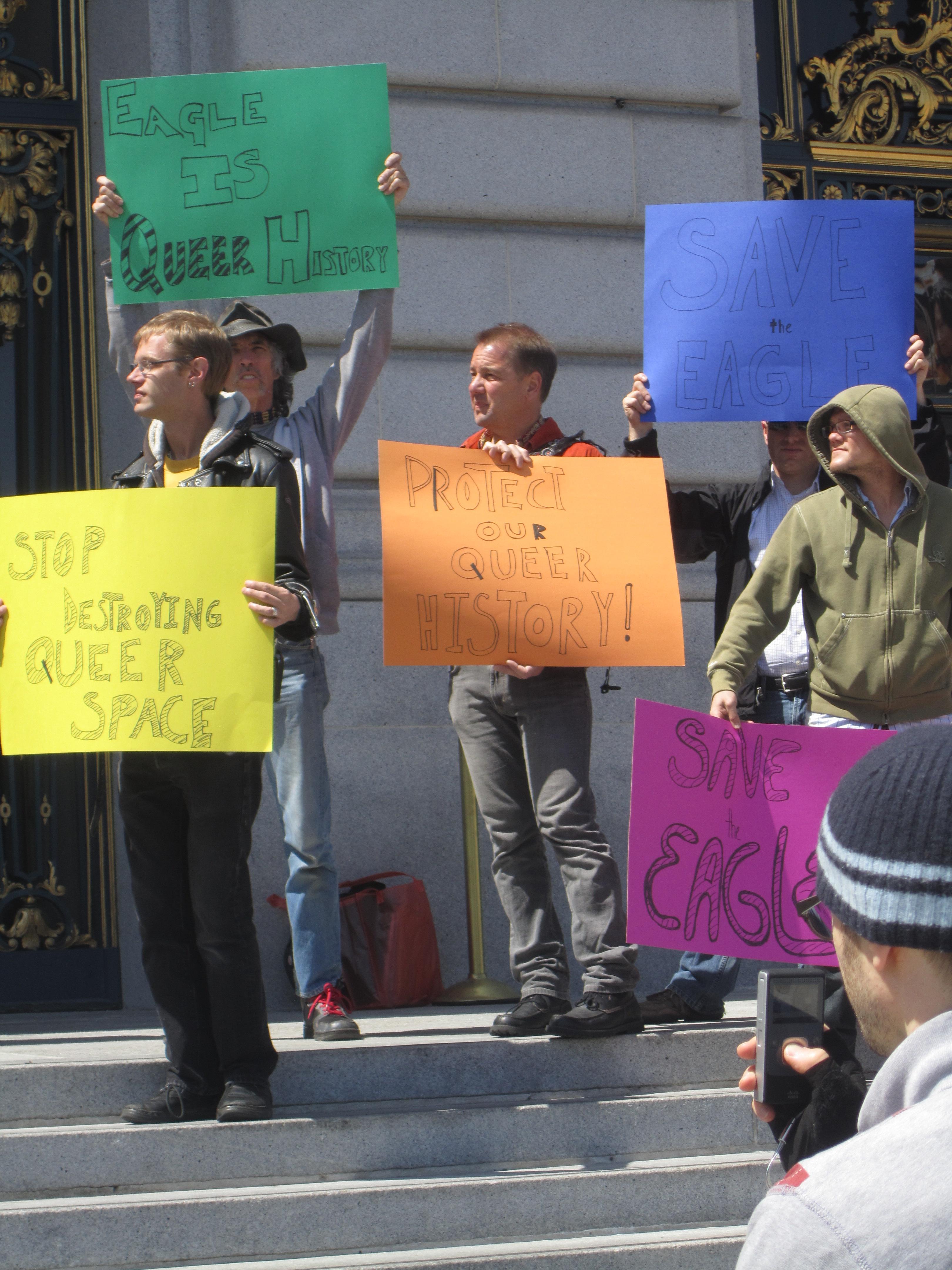
Since then, defenders of the 12th Street space have scraped together emergency meetings and impromptu marches, a surprise leather night at the Skylark Bar (owned by a believed-to-be buyer), and a demonstration on the steps of City Hall. Letters were sent to the Board of Supervisors, petitions signed, and pink tent campouts planned as vigils.

Through it all, the message carrying most clearly was that the Eagle Tavern is far more than a swingin’ hot spot. “It’s our history and it’s our culture,” said organizer Kyle DeVries at a rally on the steps of City Hall last Tuesday. “And we’re proud of what we’ve given to this city.”

That “what” includes more than $1 million raised through the years at popular Sunday beer busts supporting everything from breast cancer research to AIDS awareness. But it also includes providing a safe haven and sense of belonging for San Francisco’s queer community for more than three decades.

And now, patrons have learned they will eek out another month. Thanks to the huge outpouring of support from Eagle denizens, and political pressure from three San Francisco supervisors, the end-of-April plan to fly the coop has been delayed at least until the end of May, Eagle manager Ron Hennis said.

But since the issue first exploded April 11, efforts to save the sacred space haven’t slowed down. At press time, supporters were planning an April 19 “Tuesday roost” at the Eagle in hopes of pumping energy and cash back into the tavern on a night known to be quiet.

Sup. Scott Wiener, along with Sups. David Campos and Jane Kim, sent a letter to the San Francisco Police Department that reviews liquor license sales in connection with the California Department of Alcohol Beverage Control. The letter reviewed the Eagle’s importance in SF’s queer community and stated that its authors are “adamantly opposed to any sale that would result in the Eagle’s destruction.”

The supervisors urged the SFPD to “closely scrutinize, consistent with applicable legal standards, any requested liquor license transfer relating to the Eagle to ensure that any such transfer will not harm the LGBT community by putting an end to the Eagle.”

So far, these efforts have been promising for Eagle patrons. In a phone interview, Wiener told us that Skylark owner Steve Englebrecht has pulled out of negotiations to buy the place. But the situation remains complex.

Eagle manager Ron Hennis explained that current owners John Gardiner and Joe Banks decided to sell the Eagle a year ago to focus on their other SoMa leather bar, Hole in the Wall Saloon, which has been plagued with high-cost property battles of its own.

Gardiner and Banks didn’t respond to our e-mails. But Hennis said they intended to sell the business — which includes the Eagle name, equipment, and liquor license — to people they felt would maintain the existing spirit of the bar: Hennis, Eagle entertainment coordinator Doug Hilsinger, and Lila Thirkield, owner of the Lexington Club.

Hennis and Hilsinger told us a contract was signed and the deal had progressed through an initial set of inspections and into escrow when the property’s owner, John Nikitopoulos, refused to negotiate a new lease with the prospective owners.

Despite successful conversations up to that point, Gardiner and Banks “turned off and didn’t say why,” Hennis said.

Further complicating the matter, Gardiner and Banks’ lease ran out and Nikitopoulos hasn’t renewed it. He’s been renting the property month-to-month and is reportedly raising the monthly price tag, which has remained the same for the past 10 years.

Hennis said the owners were still paying rent when they were threatened with eviction — which would mean a death sentence for the Eagle unless they could sell the business to a party Nikitopoulos would be willing to negotiate a lease with.

In the midst of the stalemate, Nikitopoulos offered to buy the business (and most important, the liquor license) from Gardiner and Banks, who refused saying they’d already agreed to sell to Hennis and his partners. Nikitopoulos then approached Hennis, suggesting Hennis purchase the business as planned and then sell him the liquor license. When Hennis also turned down the landlord’s offer — without the liquor license, Hennis wouldn’t actually own the bar — he disappeared from the conversations.

At the April 12 demonstration, mayoral candidate Bevan Dufty called for the stakeholders involved to recognize that in a city that “values history — indeed, is defined by history,” the lease on the Eagle is “more than just a business transaction.

“The owner of this building needs to come to the table and talk about this,” he urged.

But Nikitopoulos, a resident of Santa Rosa who inherited the property from his father, hasn’t responded to Hennis, reporters, or even to calls from Sup. Wiener. He was, however, reportedly in communication with Englebrecht when the Skylark owner swept in to purchase the space and liquor license — but not the name or the leather culture.

Though Englebrecht withdrew, supporters worry Nikitopoulos could potentially negotiate a lease with a different tenant — leaving the bar a casualty of SoMa’s continued gentrification.

Longtime Eagle patron Mike Talley, who has lived in SoMa for more than two decades, fears the Eagle would fit perfectly into a familiar story of luxury lofts, astronomical rent increases, and — inevitably — mass evictions. He explained that what the Chronicle’s late columnist Herb Caen called the Miracle Mile — a strip of SoMa gay and leather bars that once numbered in the dozens — now consists of just a few properties “hanging in there.”

Mark Kliem, a.k.a Sister Zsa Zsa Glamour of the Sisters of Perpetual Indulgence, echoed Talley’s concern, saying, “The rest of the entire world is family-friendly. Why can’t we have this one little half-mile area to call queer space?”

It’s worth noting that the Eagle is by no means exclusively gay. It is famous for its Thursday-night rock shows where, according to an Eagle DJ, “a melting pot of hipsters, stoners, and rockers mixed with the leather crowd.”

“Everyone was cool,” he said. “Everyone was welcome.”

Still, the bar has become an icon of San Francisco’s queer community.

Kim, who represents the district, presented the Eagle with a letter of commendation recognizing its 30 outstanding years as a “venue, cultural institution, safe haven, and home for the LGBT community” at the April 12 meeting.

“You can’t threaten something as important as this institution,” Campos added.

Wiener, Kim, and California Sen. Mark Leno also praised the Eagle at Sunday’s regularly scheduled beer bust. Leno lauded the efforts of local drag queen/community organizer Anna Conda, and referred to the week’s events as “Stonewall West.”

If anything, the week of demonstrations has drawn San Francisco’s queer community closer. And there is hope that the crowd can stay together in the spot they claimed for themselves. One white-horse possibility is Mark Frazier, owner of a Dallas bar also named the Eagle — and also home to a leather crowd.

Seth Munter of Herth Realty in San Francisco said Frazier has been eyeing the SF Eagle for more than a year, and that he is “interested and able to participate in continuing the Eagle as it has been, either with partners or on his own.”

Reached by phone in Dallas, Frazier told us he’s dreamt of the business since before his own Eagle took flight in 1995. “I think the San Francisco Eagle has a lot of history and a core base of support,” he said. “Any time you go into a business with so much support, it’s going to be successful.”

Frazier stressed that like the SF original, his Eagle has raised substantial sums for charity. Though he acknowledged that the bottom line of all businesses is to make money, “the successful ones continue to give back to the community — and not only monetarily.”

So far, Frazier said he has “exchanged e-mails with the powers that be” and that he is confident the Eagle’s troubles stem from a “communication gap” he could help fix.

Hennis expressed hope about the possibility of working with Frazier in addition to pursuing other options like historical preservation.

Demonstrators have penned more than 100 hand-written letters to the Historic Preservation Commission urging it to assign the Eagle landmark status. Commissioner Alan Martinez said such a process could cost thousands of dollars and would not “grant the right to dictate businesses or tenants.”

Still, he announced publicly that giving the building historic status is not “about turning the city into a museum — it’s about our history.”

Though landmark status protects the physical property, it would also provide legitimacy, an instantaneous way to tell the building’s story and bind the community together. And no matter what happens with the sale of the Eagle, that’s one possibility that flies.


Appetite: Island bites, part two

0

After a dreamy week in Hawaii, I have a slew of food and drink recommendations to share. Part one of these covered farmers market and street food in Honolulu and snacks from the North Shore of Oahu. This time, we sleep and drink in Honolulu. In part three, we’ll talk Honolulu restaurants.

Though I arrived islandside with a head full of romantic, slightly improbable Blue Hawaii dreams — me wearing a vintage bathing suit, lei, and a mai tai being serenaded by Elvis — my vacation reality was no letdown. No doubt the touristy scourge of chain shops, restaurants, and photo-snapping throngs do indeed exist in Waikiki, but contrary to what some told me, Hawaii’s largest city can be clean and relaxed. Though you truly find “island time” on Kauai and quieter locales, Honolulu is by no means hectic (if you ignore the traffic). It is that island city where you can while away hours at the beach, explore hole-in-the-wall eats, or listen to live music as the sun sets.

Hotel Renew, Waikiki Beach: 

With Asian-modern, Zen-like decor, clean lines and big city chic, these rooms are a welcome respite from the all-day party of Waikiki surfers and sunbathers. No pool or beachfront property here, though upper rooms on the south side have views of the beach. After long walks and lots of sun, I was grateful to enter the heavy front doors of Renew and be welcomed by the tinkle of the lobby’s water fountain. I’d grab a glass of water laced with fresh oranges and head up to my room with ultra-comfy bed and an ocean view.

The winning points of Hotel Renew, which is located on the eastern end of Waikiki, is affordability and peace. Plus, you can always take their complimentary boogie boards and towels a block away to the beach. But the best part? As overpriced as Waikiki can be, here you can get a room on a busy weekend for $180 to $225 a night. 


COCKTAILS

The cocktail renaissance is finally hitting Hawaii. Here’s a handful of places and bartenders forging the way.

Lobby Bar at The Waikiki Edition:

Although it is to be found by pushing aside a bookshelf in a hotel lobby, the Lobby Bar is no speakeasy — it’s a white, urban bar with muted lighting and long couches with a semi-exclusive, yet unpretentious air in The Edition, a hot hotel perfect for ultra-cool poolside lounging.

Bar manager Sam Treadway hails direct from Boston’s best-known cocktail bar, Drink and he’s clearly loving the warm island breezes, playing off of the canon of island classics, like the deconstructed mai tai ($11). Treadway has toned down the drink’s characteristic sweetness, amping up the rum (Pyrat XO) and orgeat (almond syrup) and topping it off with mai tai foam and a shiso leaf. He served me a lovely rum manhattan made with Montecristo 12 year rum, and he’s also handy with mezcal. The Agony and the Ecstasy ($11 – nice literary reference) is a winning mix of Del Maguey’s Mezcal Vida, St. Germain, and fresh grapefruit juice, topped with a house ginger beer. Spicy, smoky, gently sweet.

The cherry on top? Treadway combines Mezcal Vida, Campari, and soda to create, yes, a mezcal negroni. I long for the day when I can get one here, in my own negroni-obsessed city.

Town:

Another of the city’s great bartenders is Town‘s Dave Power. Located in Kaimuki, just a few minutes drive from Waikiki, Town feels like I’m back home in San Francisco. Local, organic foods served with with rustic, Italian technique, all-American heart, gourmet animal parts, and classic cocktails (all $10).

Power executes cocktails simply but with a beautifully, even literary, bent. His tequila negroni is a revelation. He explains that his inspiration is M.F.K. Fisher‘s love of equal parts gin, vermouth, and bitters in her cocktail. His version adds an equal part of Don Julio Reposado and a Campari infused with local Hawaiian Kiawe wood chips for a gentle smoky taste.

He also makes a Very Very Good Martini (this being how it’s listed on the menu) and my beloved Death’s Door — something you don’t see much in these parts — and a white manhattan with moonshine (white whiskey) and Dolin Blanc vermouth.

I’d recommend eating as well as drinking here. It’s a special place that evokes other big cities, but uses Hawaiian ingredients and laid-back charm.

Mai Tai Bar:

I am in love with the Royal Hawaiian Hotel. A pink, playful beacon that jumps out of the town’s blanket of highrises, it is the one hotel that evokes the history of old Waikiki. Built in 1927 and dubbed the Pink Palace of the Pacific, this is the classic Hawaii I dreamed of.

I’ll stay there one day. But in the meantime, one can always head through its grove of trees laden with hanging lights, past torches, through the lobby, and out to the back lawn where the Mai Tai Bar looks out over the beach. Live music at sunset and my own private cabana on the beach made this scene one of the most magical I spent in Honolulu.

This is not the place for refined cocktails but the bar has a history of providing tropical oceanside drinks. Manager Mike Swerdloff is a wine lover himself, but keeps up on the national cocktail scene and is passionate about great service, food and drink.

As for cocktails, there are various versions of the mai tai here — all too sweet for me, but they’re destined to be crowd-pleasers, and are greatly enhanced by the paradisical surroundings. Were I to really go for sweetness here, I’d prefer the Chi ($13), made from coconut and Maui’s organic Ocean Vodka and perked up with fresh pineapple and basil; or Pina Rocks ($10): Bacardi 8 year, coconut cream, pineapple, and a lemon-thyme float.

We had a lot of fun with our Smoking Gun mai tai, a winner in last year’s Mai Tai Festival on Kona. A glass of Whaler’s dark rum, Bacardi White, and a housemade velvet falernum was torched with smoke, then topped with a brown sugar-torched pineapple wedge. The presentation was quite dramatic — smoke even spilled out from the glass — but I could still taste the propane when I sipped the drink. That aside, the Smoking Gun yielded a delightfully sweet, smoky island imbibement that evoked roasting marshmallows over a campfire.

Lewers Lounge:

Inside the gorgeous Halekulani Hotel hides a classic New York hotel bar, rich with history and flush with jazz. And the music really is the reason to come. Nightly live jazz sets the classy, upscale tone of Lewers — don’t you dare wear shorts or flip-flops because this elegance is maintained with a strict dress code. You’ll also need a reservation on many nights.

Despite the legendary stamp of Dale DeGroff on the menu (he created it), drinks are of the sweet, fruity variety, like the refreshing ginger lychee caipirissima ($12). More ambitious efforts like the Amante Picante ($12) — tequila with cucumber, cilantro, green tabasco — have the right idea but lack balance. All in the execution?

What is impressive is the bar’s dessert menu. The ever-popular Halekulani coconut cake ($9) is ordered for weddings all over the islands, even from as far as LA. Adult gourmet versions of popsicles and ice cream sandwiches on ice are also available. One can always order from the spirits and wine lists and enjoy a sip of brandy and a slice of cake while taking in Tennyson Stephens and Rocky Holmes’ delightful jazz duo.

La Mariana:

No, I am not recommending La Mariana Sailing Club for the drinks — this write-up is a nod to the historical appeal and charm of a rundown but well-loved space. One of the last remaining kitschy tiki bars from the 1950′s, it can be an adventure just getting here.

Located way out on a harbor, you won’t be sure you’ve found it even when you’ve arrived at the right spot. Park on the street near the “sailing club” sign, then walk around to the right side of the building and enter through the back along the water. Tiki decor and thatched roofs abound in a multi-room layout with open air patio.

The day after the Japanese tsunami hit Hawaii’s shores, I sat here with a pina colada watching boat owners pull their damaged sailboats out of the water. Crusty, sun-scorched sailors sipped mai tais and beers around me, comparing damage done to their boats.

If you go, be sure to read the story of owner Annette Nahinu on the menu. She’s the sort of local character that will make you fall in love with Honolulu and its colorful international history.

Note: I tried to make it to a new Honolulu hotspot that local bartenders recommended, Apartment 3, but couldn’t make it there on a day when Kyle was bartending (Friday nights at the moment). I hear he’s a whiskey lover like myself, and I was sure he’d be another envelope-pushing bartender on this list.

–Subscribe to Virgina’s twice monthly newsletter, The Perfect Spot


Flannelalia

0

marke@sfbg.com

PLAID OBSESSION We live in a post-Etsy world, people, and the latest homemade, zero-kilometer focus is on small-batch clothing production. As usual, the Bay Area is taking a lead here, weaving its green intentions and entrepreneurial zeal into its free-spirited fashion sense and a strong garment manufacturing legacy — and producing stylish duds with enough professional veneer to take to the runway or just out for a beer.

The three sharp dudes from Pladra (www.pladra.com) — Scott Ellison, Ian Ernzer, and Jeff Ladra — add another Bay tradition to the mix: classically avid sportiness. “As passionate outdoorsmen, we have never found a flannel that we could wear both in the field and to the bar after getting blood on it,” they say, and so they set about combining their love of surfing, fly-fishing, camping, hunting, skateboarding, and nature photography with flawless design skills and vintage beauty. (It doesn’t hurt that a good plaid flannel is the one item that still unites many of our current style tribes.)

I admit I’m a flannel freak, and Pladra’s three current lines, including an awesome one for women, had me wiping drool off my keyboard. But I wanted a glimpse into the new local-production trend, too, and the Pladra boys happily provided, answering my questions over e-mail.

SFBG Pladra is all about plaid flannel — how’d you come to focus on that? Will you be expanding? 

PLADRA I think it’s safe to say we’ve all had a few go-to flannels throughout our lives. You know, the one you camp in, then come home and go straight to a bar or concert in, then wear to work the next day — each stain is a story and a memory. In terms of our growth, we’d love to let everything grow at its own pace, although we definitely have some ideas. For now, we’re keeping production small and tight. We wanted to start with plaid flannel shirts because they’re timeless and represent an iconic outdoor style we feel really connects to life in the Bay Area. It’s funny that people peg flannels as a trend, but even the gold miners wore flannel. Jeff grew up here, and his grandparents spent their whole lives building and racing motorcycles. He still has photos of them wearing flannels.

SFBG Right now you’re foregoing retail outlets and selling direct from your website. I’m assuming that’s to keep costs down, yes? Has this been a problem in regard to getting your product in front of people?

PLADRA That’s true, we’re selling direct through our website to maintain the lowest price possible. Our goal is not to turn a profit, but to make the best garment possible at the most reasonable price — and our price range is $89–$109. Truth be told, this is what it costs to have a quality, American-made, custom shirt. We’ve found that people who initially scoff at our prices backpedal when they find out what goes into making something in the USA. Americans are so accustomed to paying for cheap garments that are imported mostly from Asia. We’re not condemning that, the truth is that a lot of production out of Asia has great quality. But at a certain point, we need to step back and consider the ramifications that one of the USA’s largest imports is apparel. Many U.S. cities used be the home to some of the best and biggest fabric mills in the world. Now what? All the mills are overseas. Very few companies can afford to use fabric milled in the USA. Even denim companies have to use reclaimed fabric.

The direct selling approach certainly makes it difficult to reach a wide range of people off the bat. But we do want to offer reasonable pricing to our customers. We want to focus on the brand integrity and we don’t want to dilute our product and blast it everywhere right away. We are taking a slow and careful approach in our growth.

SFBG What were the specific challenges of designing and producing everything in San Francisco? 

PLADRA It was really important to us to keep things local and support local businesses. But limiting our geographic range also meant limiting our accessibility to materials that would maintain our desired quality while not forcing our prices to skyrocket. That meant we had to challenge ourselves to search harder for vendors that could deliver great materials and finishing — and we ended up partnering with some incredible ones who went above and beyond to support our vision.

SFBG Pladra isn’t just all about hunting and designing. What are some of your favorite shops and bars in SF? 

PLADRA Shopping-wise, we really like Union Made in the Castro. Our friends at Park Life in the Inner Richmond and the General Store in the Outer Sunset offer amazing home-produced goods. And the Aqua and Mollusk surf shops have always been amazing at supporting their communities. As for going out, we could happily spend the rest of our lives drinking our way through the menus at Toronado and Alembic. And we just scored one of our favorite clubs, 111 Minna, to host our official launch party. See you there? *

PLADRA LAUNCH PARTY Tues/26, 5 p.m.–9 p.m., free. 111 Minna, SF. www.111minnagallery.com


Heady

0

culture@sfbg.com

CAREERS AND ED “Just to let you know, this class is different than other yoga classes,” warns the receptionist at the San Francisco Integral Yoga Institute. It’s Monday night and I’ve just shown up at the institute to try my first restorative yoga class. “You roll around on pillows …” he continues.

I get it — restorative yoga is not your typical barrage of sun salutations and yogic pretzel bends — so I nod reassuringly and head up the flights of stairs to the top floor of the institute’s Victorian-style mansion-cum-yoga-palace, emerging in the dark, candle-lit room where the class will be held. There are high wood ceilings and plenty of space on the carpeted floor, where a pile of pillows wait for each student.

Our instructor will be Divya Nanda, a guest teacher who has been affiliated with the institute for more than 40 years. Wearing silky orange garments from head to toe, she radiates a calming, peaceful presence.

Here we go. Let’s just get it out there. I’m not a yoga person. If I happen to take a break from Internet-beer time long enough to exercise, I prefer to do it alone with my iPod rather than in a room full of strangers.

But I’m a stressed-out soul, generally speaking, and restorative yoga’s smooth, centering movements sound appealing. This form of yoga is geared toward relaxation and uses slow-moving techniques to give students a sense of peacefulness, spiritual fulfillment, and mind-body connection — all things yours truly is 100 percent lacking. Most yoga studios in the city offer some form of restorative class, which can be perfect for those suffering from injuries or just in need of a little slow-paced nurturing.

“Restorative yoga is based in the philosophy of the whole yoga practice, which is to be peaceful,” Nanda says. “Peace is within you, so we go within.”

Within we go, starting with “oms,” “hari oms,” and simple warm-ups — downward dog pose interspersed with concentrated breathing exercises and stretches. All the while, Nanda circulates throughout the room, adjusting our positions and making sure that we’re completely relaxed and comfortable.

During one warm-up that involved sitting with our knees tucked under us, Nanda looked over at me and said, “Hannah, you might want to do this one in the cross-legged position, I don’t want you to hurt your ankles.” I was shocked. How did she know my ankles were aching — x-ray yogi vision?

After the deep breathing, we move on to poses that entailed lying in super-comfortable, unconventional asanas. They make me feel like a sleepy baby. Designed to place minimal pressure on joints, they include splaying out our legs and arms, every part of our bodies supported by soft pillows.

Along the way, Nanda shares soothing thoughts: “The future is a mystery. The past is history. What we have is now, the golden present.” “Beyond the thinking mind there is a great peacefulness,” and so on. We end the class with guided meditation and this Sanskrit chant: “From the unreal to the real, from the darkness to the light, from our fears to the knowledge of our immortal natures.”

Leaving Nanda’s world was bittersweet: I’m sad to go, realizing I’ve never given myself a sanctioned stretch of time to nurture my reflective side. But emerging from the institute, walking back out into the gentle buzz of Dolores Street, I feel so centered that I can almost hear my body whispering to me. Was that an “om shanti,” relaxed core of mine? I can’t be sure — but I know it won’t be my last time in restorative yoga. Below, a brief list of ways to learn to nurture yourself in the Bay.

Restorative yoga

Mondays 7:30 p.m. –9 p.m., $9 for first class, $12 for subsequent classes, Integral Yoga Institute, 770 Dolores, SF. www.integralyogasf.org


INTERPRETING DREAMS WITH HORARY ASTROLOGY

You may not have heard of the San Francisco Astrological Society, but as far as Bay Area star sign enthusiasts are concerned, it’s a big deal. This year it will be hosting astrology-focused lectures on topics like “The Cycle of Saturn,” “2012 and Beyond.” If you’re interested in what your dreams can tell you about the future, you’ll have to check out this upcoming talk. It promises to teach about the basic techniques needed to unlock your dreams for clues on what’s to come using ancient Greek dream interpretation methods and horary astrology, a sect of astrology based on creating a horoscope for the exact moment in which a question is asked.

May 26, 7:30 p.m., $7 for members, $12 for nonmembers. Building C, Fort Mason Center, SF., www.sfastrologicalsociety.com


SENSUAL TOUCH AND DEEPER CONNECTION (IN AND OUT OF THE BEDROOM)

If you’re not big on touching people, then this class is probably not for you — although it might have the power to change your mind on the subject. This one-time workshop with somatic therapist and intimacy coach Shara Ogin teaches you how to take physical contact to the next level. From intimacy to sex to sensual massage, Ogin plans to show students how to make each experience more intimate and cosmically close.

April 19, 6–8 p.m., $40/pair advance, $45 at door. Good Vibrations, 1620 Polk, SF. www.goodvibes.com


EVOLVING WESTERN HERBAL TRADITIONS

Medical herbalist, new age crusader, and self-proclaimed member of the herbal renaissance, David Hoffman teaches this class focusing on the history of herbalism in the United States and the world. The workshop ranges from discussions about herbs in science and medicine to ways herbs are used in the our country and the changing role of botanical medicine in a modern global context. Rolling papers not included.

Aug. 23, 10 a.m.–5 p.m., $100. Charlotte Maxwell Complimentary Clinic, 2601 Mission, SF. www.ohlonecenter.org


Loco for Locavore

1

paulr@sfbg.com

DINE In a better world than this one — a world of locavores — there would be no need for a restaurant like Locavore. President Kennedy would have gone to the Berlin Wall and declared, “Ich bein ein locavore!” — and been greeted with applause from the other side. In related news, the dictatorship of the proletariat would have peaceably dissolved itself.

In the world we have, Locavore is a rather lovely place. It’s been some time since I found so much poured concrete so full of charm. The floors and walls are concrete, curving into a low ceiling so that you feel a little as if you’re inside one of the sections of BART’s transbay tube before they sank it for installation. Considering all the hard surfaces and the exuberance of the crowd, the place is surprisingly not too noisy. There is a definite roar, low and sustained, but it doesn’t interfere with conversation or require cross-table shouting and the use of signal flags. How the sound damping was achieved must be a trade secret, because none of the usual suspects (including that quilted baffling material) are visible.

The restaurant, which opened near Halloween, procures all its ingredients (including beer, wine, and cider) from within a radius of 100 miles — and since, as we know, there’s a lot of agricultural action within 100 miles of this city, year-round, the question presented is whether you would know you were in a restaurant committed to this philosophical and moral principle if you didn’t know beforehand. My guess is no. It would be different if Locavore was, say, in Burlington, Vt., where the land and climate would pose serious challenges to locavoricity for a chef composing a late-winter menu (or any winter menu). But in our land of plenty, with its rich tilth and kindly climate, such stresses are muted. The result is that Locavore’s cooking doesn’t seem very different from that of a host of other places.

But this isn’t a bad thing. Chef/owner Jason Moniz’s food is excellent, reasonably priced, and the vegetarian angle seems to have been considered with some imagination. We were most impressed with the spicy yuba soy roll ($17), a trio of chubbies made from yuba (tofu skin), stuffed with chopped, spiced yuba, gift-wrapped with ribbons of wilted red-mustard greens and finished with an emulsion of soy and puréed baby leeks that assumed the form of a foam the pale green color of spring. The plate also included a small bundle of whole baby leeks, which added their subtle, sublime oniony-ness to the proceedings and were only slightly hard to handle.

But flesh-lovers need not despair. There is plenty of animal protein on the menu, from mussels ($9) in an herbed broth made faintly bittersweet by grapefruit, to ham hock ravioli ($10), smoky and adrift in a buttery broth of so intensely meaty as to be kind of pork liqueur. A little lighter, but still substantial, was a pair of chicken croquettes ($10) served with baby chicories, spiced hazelnuts, and ghostly splinters of apple slaw — almost like a salad, with a set of crisp golden disks thrown in.

It’s hard for me to resist halibut, which is one of the most user-friendly fish, is taken from well-managed fisheries, and has a nice weight. Locavore’s version ($19) did right by this indispensable seafood, pan-frying a filet to a crispy gold without drying it out and serving it with lovely little crisp-gold gnocchi (a clever echo — were these browned alongside the fish?) and a jumble of chard and green garlic that captured the passage from winter to spring. No one would ever say the halibut was undersalted, incidentally, but because most seafood has a faint sweetness, balance was maintained.

To the charge that I have perhaps too often described this or that dessert as resembling a cloud, or clouds, I would have to plead guilty. But now I must do it again, because Locavore’s honey semifreddo ($7), a puff of creamy gold, was the most cloud-like apparition I have ever seen descend to a dessert plate. And its sweetness was elusive and complex, no doubt in large part because of the presence of kiwi slices and chunks of oro blanco, the mild white grapefruit that nonetheless packs a real grapefruit charge of sourness and bitter bite. In symphony, these ingredients made a beautiful, balanced mouth music unlike any other I’ve ever enjoyed. This dessert did not ask to be liked, and for that reason alone, — how many desserts show that kind of resolve? — this intermittently lapsed locavore had to like it.

LOCAVORE

Dinner: Mon.–Thurs., 5–-9:30 p.m.;

Fri.-Sat., 5–10:30 p.m.

Lunch: Tues.–Sat., 11:30 a.m.–4 p.m.

3215 Mission, SF

(415) 821-1918

www.locavoreca.com

Wine and beer

DS/MC/V

Lively, not quite noisy

Wheelchair accessible


Fist Fam hits the Bay

3

In the music video for rap collective Fist Fam‘s song “Posted,” emcee Philo stands on a Columbus Avenue median, the Transamerica Pyramid pointing into the sky behind the North Carolinan, traffic whizzing by on either side of him. “I’m posted in the middle of the street/And we don’t even look right/But I got that million dollar mouthpiece/So we gon’ be allright,” he sings, at home in his new city. 

It’s an apt portrayal of the group of back-home friends from Asheville who seem set on taking the music they grew up with to the ears of the Bay. Fist Fam’s latest album release, also called Posted, is straight up, laid back, “psychedelic country rap tunes,” so dubbed by Philo and producer Al Lover, who are sitting with me outside Farley’s on a gorgeous Potrero Hill morning.

The boys grew up in the embrace of early ’90s hip-hop: Goodie Mob, UGK. Their tunes still have that Southern feel, but the layering of soul samples and front porch hooks (see: the sunshine feel of “Drinkin’,” a track the group just shot a video for on Philo’s family’s Appalachian farm) betray a citified knowledge of sound. 

The group’s trickle west was led by Philo, who established connections with the SF music community that made everyone else feel at home upon their arrival. But. “I didn’t have a safety net!” Philo says. “I had a backpack and $400. Back in the Gold Rush of ’05…” he trails off in an old man voice, his San Francisco debut having already achieved mythic status. He’s urged to share more of the legend. “My first move? I went to a bar in the Sunset, got a quesadilla at Gordo’s and tried to fandangle a place to sleep.”

Did the crew run into any funny business? Hey, a lot of people have funny perceptions about Southerners out here. “But we have funny perceptions about West Coasters – and they’re all true, by the way,” Lover teases. 

But with a ready-made, tightly-knit clan like theirs, there’s really no need for Fist Fam to sweat whatever still exists of regional stereotypes. This is how they record an album: they’ll set up shop in someone’s house (Philo has been building studio space since he was a teenager and says with the techonology available today, he can do it pretty much anywhere — and besides “we’re not going for a super clean sound”). Alcohol is usually involved. Budweiser is the group’s beer of choice – the two have stories about earning the king of beers for catching fireflies when they were little, a story that sounds adorably Southern to this West Coaster. 

Back to recording: there’s usually a fair amount of bickering. “A lot of us have known each other since high school,” Philo says. “We really are the Fist Fam — and I think that’s why we work. A lot of people are afraid to hurt each other’s feelings — ” Lover picks up the thread: “but we like it.”

“You gotta be chaotic to produce something,” Lover continues, conceding that for Posted, the group took a slightly more structured approach – he produced all of the beats and told people which songs they’d be on. Lover got some attention earlier this year for an electronic remix he did of the recently departed blues surrealist Captain Beefheart, but his favorite palettes to work from are old R&B songs. He’s also been doing work with contemporary beats, mixing Fist Fam over the music of Ty Segall and Thee Oh Sees. “Why use the old stuff when you have all these things going on now?” Added bonus: by using the tracks, Lover can cross-promote and strengthen connections with the psychedelic garage scene where the group sometimes find itself in the city.

Talking about the range of sound that Posted is built on takes me back to the image of Philo swinging his arms around, un-fuckwithable despite the North Beach traffic dashing around him. Sure, they’ve still got their twang, but you can’t quite see these boys doing what they do if they were still in Asheville. South comes to San Fran, welcome y’all. 

Fist Fam-Boac album release concert

feat. Trunk Drank

Fri/8 9 p.m., $10

Rasselas Jazz Club 

(415) 346-8696

www.thefistfam.com

Dick Meister: More Than a Game

1

Baseball season again. That smell again. It overwhelms me — the incredibly fresh smell of newly cut grass and stale earthy odor of freshly watered basepaths, the very essence of baseball.

I’m up on the edge of some infield, somewhere, crouching. I’m up on my toes, leaning forward anxiously and peering intently at a batter, my stubby-fingered fielder’s glove skimming the dirt. Bits of damp grass cling to the paper-thin kangaroo leather of my black spiked shoes and those of my teammates. Our uniforms hang on us in folds, like baggy woolen sacks.

Is it 1942? 1945? 1950?

Is it a ballpark in San Francisco? We look like human billboards with that splashy lettering all over the front of our uniform shirts. What’s that it says? Leslie Salt, Bucher Asbestos, Ghiselli Meats, Farallon Cleaners? Molkenbuhr Jewelers? Johnnies Billiards?

It could be any one of the two dozen or so neighborhood parks in SF that I so clearly recall, parks that swarmed year-round with players – young kids, teenagers, twenty-year-olds, middle aged men. Baseball was the ladder the younger players hoped to climb to fame and fortune, the chief form of recreation for all.

Sunday was the big day. Three games on each of the parks’ diamonds, at ten in the morning, at noon and two o’clock, between the city’s hundreds of merchant-sponsored teams, well sprinkled with professionals during the winter.

But the field I recall could be in Boonville, California. Or in Coquille, Oregon. 
Or Medicine Hat, Alberta. Or in any of the other towns where I also once played – in tumble-down parks, you’d probably call them, though we hardly noticed.

Mingled with the moist smell of the grass and the dirt and the sourness of sweat-soaked flannel uniforms is the sweet and sour of freshly cut lumber. It wafts from the mills where summertime semi-professional ballplayers from the city earned their keep when not racing across lumpy, sun-blistered fields while entire towns watched, cheered and jeered.

I mean places like Boonville, a town of 700 people 120 miles north of San Francisco, where I played a half-century ago, a 17-year-old shortstop not yet out of high school in San Francisco certain he was making the first stop on the road to major league stardom.

The Boonville fans – farmers, sheepherders, lumbermen and their families – barreled into town at noontime on Saturdays and Sundays, straight down the highway that doubled as Main Street, climbed out of dented and dusty pickups and long fish-tailed sedans and hurried into the Boonville Lodge. They jostled good-naturedly as they yelled out their orders: Beer and chicken-fried steak, beer and hamburger steak, beer and fried chicken or, for those feeling flush, beer and the house special, T-bone steak.

Soon the laughing, noisy crowd, grasping bottles of beer and washtubs filled with ice and more beer, crossed the highway and jounced down a dirt road on the other side to a field a few hundred yards away. The heat rose in waves; you could see it through the thick clouds of dust kicked up by the infielders, warming up as the crowd clambered up into the bleachers, rattling the seats formed from sagging wooden planks, old, dry and smelling of resin.

The crowd of two, three-hundred people yelled out advice and encouragement full blast through the afternoon, and fans came down under the bleachers between innings to offer icy, dripping bottles of beer that we downed in quick, gasping gulps.

It didn’t end with the games. We walked, players and fans, the sweat-soaked lot of us, across the highway afterward, replaying the games as we made our way to the lodge, there to continue our talk, inside and in boisterous groups that spilled out onto the sidewalk. More beer, and the raucous, endlessly blasting jukebox sound of country boys singing country songs.

That was Boonville on just about any weekend in the summer of 1950. That could have been just about any small town anywhere.

But sometimes when I remember baseball, I’m not playing at all. I’m in Seals Stadium in San Francisco, and younger. It’s a Saturday afternoon in the summer of 1941.

We hear the haunting echo of bat against ball that fills the virtually empty stadium during pre-game practice, the shuffle of feet as the crowd begins filing in. We hear the thump of balls in gloves as the players warm up, performing one of the most effortlessly graceful of human activities, a simple game of catch between skilled ballplayers. We hear the sing-song chatter of the players.

Suddenly, the umpire-in-chief bellows, “Play ball!” The crowd cheers, and the San Francisco Seals stream out of the home team dugout just behind the square white pillow of third base, figures in loosely-fitting uniforms of white daubed with black and orange. They move with arrogant grace onto the emerald green of the outfield and rich deep brown of the infield. We leap up to join in a fresh round of cheers.

Half-stumbling with excitement, we bound down flights of concrete steps 
between rows of dark green wooden seats set apart by ornate arms of cast-iron. We reach over the low railing in left field and into the San Francisco Seals’ bullpen to pluck at the pinstriped sleeve of a hero’s garment.

It’s Pard Ballou, the great relief pitcher. He’s the best, we’re sure, in the whole Pacific Coast League – a friendly, fat-faced man who’s always there, and always, the grownups tell us, just a little “under the influence.” Well, his breath does smell kind of bad sometimes – but, boy, can Old Pard pitch.

“Hi ya, kids,” says Pard, squinting up through the bright sunlight as he turns sideways on the bullpen bench. “How ya today?” He winks, and grins in a funny, lopsided way. “Think we can beat the bums?”

Seals Stadium was a very special place, but so was the little ballpark in Boonville and the neighborhood parks of San Francisco. So are the parks and stadiums of today, whatever their size and wherever they are. Jim Lefebvre, who played long and well for the Los Angeles Dodgers, likens them to temples.

Temples? Well, it may be only a game, but think about it.

A baseball park is a place of myth, isn’t it, of tradition, and veneration and ritual and order, of wisdom being passed from generation to generation, from elder to younger.

A temple also is a place in which to pay reverence to beauty, and what’s more beautiful than the graceful motion and timing of baseball, its unique rhythm, the exquisite ebb and flow of action and anticipation, action and thought. That’s right, exquisite, and you know it, unless you’ve been watching exclusively on TV, with its commercials, instant replays and non-stop announcers.

A ballpark is a place, too, where you demonstrate faith. Everyone who enters a ballpark believes it’s always possible to “beat the bums,” that it isn’t over until the very last out of the very last inning, that the innings, the game can go on for as long as the players perform well.

The commandments in the rule book promise that. There are no clocks measuring off quarters and halves, no point during a game when there is not 
enough time left to win, no rule saying how long it should take to make three outs and complete an inning, or how long it should take to win or lose a game.

Yes, life outside the temple may not always offer quite so much hope. But if it did, who’d need religion? Who’d need baseball?

Dick Meister is a longtime San Francisco journalist. Contact him through his website www.dickmeister.com

WonderCon diaries: Chris Cosentino is… Wolverine’s new buddy!

0

I had seen chef Chris Cosentino (of Bay Area offal ground zero Incanto, also a The Next Iron Chef contestant and host of the Food Network’s Chef Vs. City) in person for the first time a few weeks ago – he’d just made an incredible multi-course meal for a bunch of beer journalists at Anchor Brewery and was racing around, saying hi to people and describing his thought process on the various beer-food pairings. My tablemates, friends of Cosentino, told me he had a comic coming out at WonderCon, or something. So I gave him a shout – hey, dope local angle on the convention, since I knew I was going anyway.

Maybe I should have known when I saw the massive poster of Cosentino in the Ferry Building at the stand of his other business, Boccolone Tasty Salted Pig Parts (signed by the man himself, “pork is the new vegetable,”), a few days later that this was going to be no mere small press comic release.  

Perhaps a nice interview about his project for some pre-event coverage? — I inquired of the king of offal. “You have to speak with Marvel first before anything can be written sorry it’s their protocol,” he replied. Marvel! At which point I embarked on the epic voyage that is reporting on Marvel Comics, much of which involves intriguing email exchanges with C.B. Cebulski, senior V.P. of “creator and content development.” Marvel, like most of the major comic labels, luxuriates in a cycle of suspense and sneak peeks. So are Cebulski’s emails: vague, then bombshell! Damn, they’re good at what they do. 

Which is to say, the convention approached and I still had no idea what the hell Chris Cosentino had to do with WonderCon, or Marvel at all for that matter. I dug out of C.B. that he was indeed, going to be the special guest at Marvel’s “Welcome to the X-Men” panel, so that at least I would be present for when the bomb was detonated. Still, Chris — are you going to be an X-Man? “No I’m not an X-Man,” is all his email in return said. So what the hell — ? Suspense!

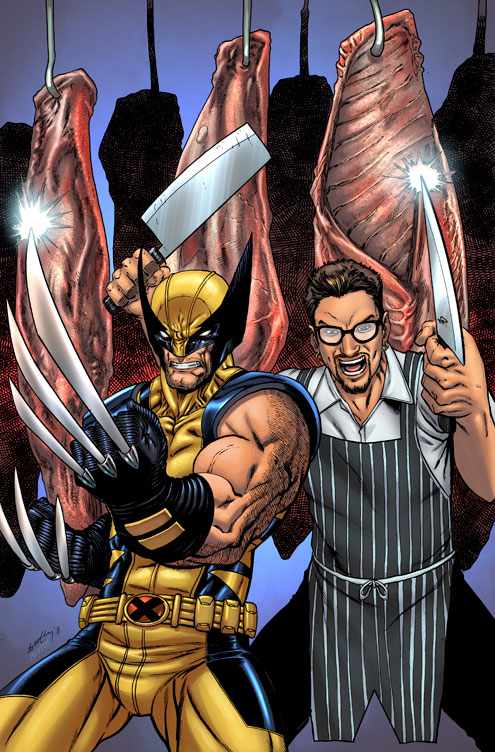
On Friday Cebulski sent me the artwork of the upcoming Cosentino Marvel appearance, which was probably a big deal that I should have tweeted about immediately: Wolverine and the chef in a meat locker poised for battle, Wolverine with his metal alloy adamantium claws, Cosentino brandishing a pair of shiny butcher knives. Best friends! 

I was hooked. Thusly, I ferreted out said Marvel presentation on Saturday, the first WonderCon event I attended and the only time I would attend a major label event this weekend, I think. I saw Cebulski and Cosentino enter, was briefly and glancingly greeted by the two, watched Cebulski assume a spot at the panel table, Cosentino grab a seat towards the back of the conference room with a friend, and then the panel began discussing upcoming X-Men releases to a rapt audience, who cheered when individual series (there are many within the X-Men universe, of course): suspense, sneak peek!

“I can’t say a lot about what’s involved — but there are lots of giant robots involved,” said a much-loved Marvel artist on the panel. And on: “something drastic will be happening in the X-Men universe — I don’t think I can say much more about it.” Suspense, sneak peek! 

And then, the artwork I’d been sent earlier flashed on screen, with Cosentino’s figure replaced with a black shape with a question mark in the middle. And then, Cosentino! I think it’ll be bigger news on Chowhound, judging from the lukewarm  WonderCon entusiasm levels expressed upon his introduction. He arose from his seat towards the back of the room and assumed a spot at the panel table.  

“It’ll be very food centric, very San Francisco-located,” Cosentino announces of his impending dance with the X-Men universe. “We’re gonna have fun with this one.”

“I grew up being infatuated with Wolverine. As a little kid, I used to sit there and stare at my hands,” he says, the best line of the panel: the audience chuckles, remembering their own metal alloy adamantium dreams. Cebulski, panel moderating, asks what Wolverine’s favorite restaurant is. 

“He has so many food loves,” Cosentino replies, unwilling to pigeonhole his childhood hero. “Japan, Germany.” Which is to say: read the comic book! You can, it comes out in June exclusively in digital form. I for one, will be stoked to see where Cosentino takes Wolverine on whatever shredding and stabbing mayhem ensues – North Beach for cioppino? Nobu’s late night meaty buffet? 

Anyway, the audience members that surfaced for the post-panel Q&A was less intrigued with these culinary concerns. The closest ask came from a young man from the South Bay. When, he wondered, will the X-Men be spending some time on the peninsula? He sees them in San Francisco, Oakland, and Marin all the time, so he’d like to know. “I want to see X-Men on my street!”

“You want to see X-Men destroy your house and your street,” a panelist says, by way of very inconclusive response, albeit one that incites much enthusiasm from the questioner and the rest of the audience. Seeing one’s house destroyed by ones heroes being the ultimate honorific here in this crowd of Marvel enthusiasts, save becoming a character oneself. 

Anyways, now our chefs are cartoon characters. What’s next, the anime version of the Tamale Lady? Alice Waters vs. Godzilla? 

More WonderCon tidings are on their way, later this week. Ziggy Marley will be involved. How’s that for a tease, Marvel?

Roller derby: the San Francisco treat

4

Drizzly March was a slow time for San Fran sports fans — the last Super Bowl Sunday pig-in-a-blanket put to bed a month before, the NBA trade deadline past and playoffs a distant dream; and today’s April 1 major league baseball opening games an agonizing countdown away. Short of swimming through the dreary rains to San Jose’s Shark Tank, what’s a rowdy, rooting beer-guzzler to do?

Heading to Golden Gate Park to cheer on some equally rowdy rollers might not be the first thought that comes to mind, but it’s exactly what thousands of die-hard derby-goers did on March 19, when the storied San Francisco Bay Bombers elbowed past the Brooklyn Red Devils in the American Roller Skating Derby league’s world championship game.

Some may not consider a wet night in a packed Kezar Pavilion to be a legit answer to the pro-sports dry spell. But the Bay Area-based ARSD league is serious about its professional status, taking pride in everything from the team uniforms to the traditional banked track – a far cry, if you please, from the fishnets and flat floors of newer leagues

Bombers’ general manager Jim Fitzpatrick, who skated for the team from 1977 to 1987, has now delivered his third straight league title since rejoining as GM in 2007 (the ARSD doesn’t hold its championship game every year). For his efforts, he’s received three straight general manager of the year awards. But for him, the real thrill is keeping banked track derby – and its SF history – alive. 

“As a little kid growing up in San Francisco roller derby was huge,” Fitzpatrick said. “Everyone watched the Bombers on TV, everyone knew them. I dreamed about playing for them in Kezar. Now, I want to honor the tradition of the old derby.”

The venerable “old derby” is rooted in19th century roller marathons that lasted for days, sometimes caused deaths, and, on the whole, managed to acquire a reputation as less-than-legitimate. The sport was popularized as a Depression-era divertissement by Chicagoan Leo Seltzer, who in 1935 built a banked track and took it on the road, dubbing it the Transcontinental Roller Derby. At each stop, skaters would circle the wooden ring as many as 57,000 times, simulating a days-long journey from New York to California, with lit-up placeholders marking teams’ make-believe progress across a billboard-sized map of the U.S.. 

Derby historians credit crowds’ hunger for blood (not that 57,000 laps would be tedious otherwise, Nascar notwithstanding) with the spectacle’s increasing focus on physical contact and frightening pile-ups. The endurance element gave way to a derby more similar to that of today, where a “jammer” on each team gains points by bumping, jumping and jostling past opposing teams’ “blockers.” 

In 1949, Seltzer created the National Roller Derby League to showcase the scintillating sport, which was poised to become a television sensation. Echoing his earlier pilgrim’s progress, he packed up the whole shebang and moved it first to Los Angeles and then to the Bay, where the 1954 formation of the San Francisco Bay Bombers created a lasting sports legacy with some of the game’s most enduring stars. (Bomber Joanie Weston was even reputed to be the era’s highest-paid female athlete.) 

The iconic Bombers were the epitome of the banked track derby that aficionados like Fitzpatrick remember watching on their family room TV sets as youths. Dozens of games a year were taped in Kezar Pavilion, adjacent to then-home of both the Oakland Raiders and the San Francisco 49ers. From there, KTVU broadcast Bombers’ games to hundreds of cities nationwide, making roller derby the Rice-a-Roni of sports, synonymous with San Francisco. 

Seltzer eventually transferred ownership to his son, Jerry, who would later recall the glory of San Francisco’s skating days, when Kezar regularly sold out. And just for an added taste of legitimacy: the Bombers shared locker rooms with their NFL stadium-mates. 

“There were no dressing rooms in Kezar Stadium,” the younger Seltzer wrote in a blog he kept, “so when the 49ers played a home game they used the tacky dressing rooms in the Pavilion. Sometimes there was virtually no overlap between the time the players left and our teams arrived, to really scummy and wet dressing rooms.” 

Fitzpatrick affirmed that the dressing rooms still exist today, though Kezar Stadium has been knocked down and rebuilt. Under the parking lot, connected to a tunnel that once funneled the teams out to a roaring crowd, the rooms are a kind of shrine to days-gone-by – days when the 49ers and the Raiders would lace up roller skates and join the Bombers on the banked track, sometimes indulging in a bit of competitive action off the football field.

“Of course,” Fitzpatrick said, “That was before the NFL took off and salaries skyrocketed.  Once that happened, the guys couldn’t afford to be fooling around.”

Though their fun ended, there was still plenty of thrill left on the banked track. The ‘60s marked the height of television popularity for the Bombers who, across the nation, were considered the team to beat.

Seltzer’s league folded in 1973, a disaster attributed to everything from the rising cost of fuel to the diversification of televised sports and events. Since then, leagues have appeared, disappeared, fractured and gone defunct, the sport’s popularity waxing and waning, the focus shifting between skill and sensation. 

“Other games and jams have come along,” Fitzpatrick explained, applying the term “silly stuff,” to a whole array of roller sports, from L.A.-based Roller Games to CBS’ over the top show Roller Jam. Fitzpatrick even alluded to “midgets on skates” – and while that might be happening somewhere out there, it doesn’t take tiny rollers to get folks to think of derby as sports entertainment: the WWE on wheels, with sexpot women in the starring roles. 

Mixed-gender for-profit leagues like the Bombers’ league ARSD leave off the false eyelashes, but fans still debate whether the scores – and punches – are fake.

According Fitzpatrick, the Bombers’ aggression is all real.

“It’s a competitive sport,” he said, “based on contact and maneuverability. It’s like when someone cuts you off on the road – like road rage, tempers flare.”

Fitzpatrick’s sincerity never falters, and it’s clear he’s proud of his skaters when he describes how player coach Richard Brown scored the last point of the 43-40 game despite sweltering heat, or when he hails rookie Crista Chua as the female standout who learned under fire and performed under pressure, despite the championship being only her second real game.

And for their part, the players are just as serious. Chua said she trains hard for the team, staying in shape with running, weights, extra skating practices, and yoga sessions to stay flexible. 

Despite the sensationalism, Fitzpatrick’s goal is to keep roller derby on track – and so far, his efforts have resulting in a sterling record. Will it ever be as good as lacing up the ol’ skates for a game of his own? According to Fitzpatrick, it’s even better.

“To see something completely disappear, and then to be able to carry on – I’m that much more grateful,” he said.

As for the future: “I want to keep on the path, looking ahead to great skating and great ability. There’s always going to be showmanship in every sport, but I want to honor the athleticism.”


Hot diggity, old school dog training

6

Under the towering eucalyptus trees of Temescal Creek Park, a sturdy wood-planked fence frames a curve in the pavement. Every day, joggers and dog-walkers shuffle alongside, crossing the border of North Oakland and Emeryville. But the ones who turn their heads at just the right moment catch a scene flickering through the slits between boards – as if from an old-fashioned zoetrope – that transports them to another world entirely.

Here, there the dogs and people form a different scene: smoke roils from the chimney of a squat plastered building with ornate round windows. A rooster crows. A bark echoes. A man proportioned like Popeye’s archnemesis Bluto stumbles around kicking a barrel. Suddenly, a streak of muscle and fur launches toward the figure and sinks its teeth into his calf, shaking him from head to toe.

This is St. Roch’s, named for the Christian patron of pestilential illness, the falsely imprisoned, and dog trainers. The real Rocco was born in Montpellier, contracted plague in Rome, retreated to a sylvan cave where a dog licked his wounds and brought him bread, and finally died in a French prison in 1327. But the man who lives here, Francis Metcalf, is alive and well and has a 65-pound Belgian Malinois attached to the leg of his padded Bluto suit.

Metcalf, along with his wife, Norma, created Friends of the Family – a dog club modeled after traditional French and Belgian dog training guilds. They fashioned St. Roch’s as their headquarters, built from one part antique canine memorabilia, one part Westminster-Dog-Show-style paraphernalia, and three parts European pub.

“In the United States, dog trainers follow a doctor’s office model,” Metcalf says. St. Roch’s – which includes gardens, dog runs, an agility course, a chicken coop, sculptures, and a small fountain – is his remedy the problem-focused and service-based approach.

“I wanted to created a community center, a resource hub,” Metcalf says of the property. “In France, there are no professional dog trainers. It’s just part of the culture.”

Indeed, France is where Metcalf learned many of his tricks. He is steeped in the art of French and Belgian ring sport, or mondioring, which grew from training techniques of the 19th century – a time when dogs were still widely used for work and protection. Mondioring tests a dog’s obedience and agility. At the highest level, it involves protection and attack drills, where handlers teach dogs to guard, bite, and release on verbal command.

Though Metcalf is a pioneering competitor and has won several international titles, he believes in the value of mondioring as a foundation for a broader relationship with dogs  – one that seamlessly blends work, sport, and simply good company. 

After working with French ring-sport greats like Dan Maison (a ‘68er who told him “Americans know nothing. They think dog training is like Vietman), Metcalf dreamt of emulating European clubs he says grew “organically.” Where playgrounds for children and women cooking dinner accompany the “young bucks running around with the dogs,” Metcalf explains, competition and expertise yield to a sense of camaraderie.

“With dog sports in America, it’s intense and hard and you have to be completely dedicated.  I wanted to change that – to take care of myself and other people, and the dogs, too.” And for that, Metcalf says he needed to build himself “a temple, a castle.”

Castle Roch

Some of St. Roch’s guests are less than polite about the building’s fine furnishings.  Logan, a 155-pound giant Alaskan malamute, can’t stop slobbering on the bearskin rug. But that’s all right with Metcalf, because he and Logan’s owners, Angie and Maggie Kim, are schooling him for the AKC’s Canine Good Citizen test, and – luckily – drooling is allowed.

In a private training session, Metcalf runs Logan through a battery of exercises, from rolling over to wearing a muzzle to staying put while his owners disappear.  Most of the exercises involve repetitive drills followed by treats doled out from the hotdog holster Metcalf keeps buckled around his waist.

Metcalf is serious, but that doesn’t mean his methods have to be. He alternates balancing a muzzle on Logan’s snout with offering him a big red Dubé juggling ball –with which Metcalf has some skills of his own. Logan is learning to balance the ball at the same time as the muzzle, which associates muzzling (an activity that can cause dogs the feeling of extreme helplessness) with a fun game – and provides his owners an opportunity to show him off.

Whether it’s training dogs for the Alameda police department’s K-9 unit or teaching a blind Akita to play the piano, Metcalf believes training and tricks are all part-and-parcel of a dog’s public relations strategy. For some dogs, PR management is a necessity (“It’s because he’s so big, and we’re so small,” says petite Maggie Kim), but it can enrich any animal relationship.

“People would never believe what their dogs are capable of,” Metcalf says. “But it’s worth finding out.”

Love bites

Clients like Bill Smoot agree.  He and his shepherd-mix, Athena, have been training in mondioring with Metcalf for nearly a year, though Smoot doesn’t intend to ever compete. 

“She’s just really smart,” he says of Athena, “so we thought we should educate her. It was either this or ballet lessons.”  

Metcalf, dressed in the $1,500 silk and linen costume d’attaque that bulks him up to super hero-sized proportions, plays the part of the decoy – the “bad guy” whom dogs are trained to attack. On Smoot’s command, Athena lunges at Metcalf, growling as Metcalf goads her on.   

Though the display is a fearsome one, Metcalf points out that, to Athena, it’s all in good fun.

“Decoying is all about losing to the dog, making the dog feel confident. When you’re playing the decoy, you’re like a walking tennis ball. Protection work taps into the core of who a dog is as a creature. I’m interested in honoring that,” Metcalf says. 

He adds that “ring sport is called ring sport for the same reason you refer to a circus ring: it’s a place to show your skills.”

To that end, Metcalf plays his part well. With muttonchops, rosy cheeks, and a handlebar mustache, he’s the very image of a clown. Barrels, chairs, extra people and even pet chickens become all the props he needs to put dogs through their paces. He says his impromptu style is guided by a sense of the animals need in each moment and – more importantly – a love for what he does.

Metcalf is in the process of opening St. Roch’s to more easily foster that love and understanding in others. By creating additional classes and group sessions in everything from mondioring to circus arts, he hopes to make his pad a place where anyone, from amateurs to professionals, can have a (preferably Belgian) beer and see the dogs.

“The root of the word ‘amateur,’” he notes, “isn’t based on money or status. It’s based on love.”

For Metcalf, training is not just about good behavior. Whether it’s a dog, a chicken, or a fish (and Francis has trained them all), the goal is to reawaken people’s ability to dream, and to imagine what animals may be capable of.

For more information, please visit the Metcalfs’ dog-training website


5 Things: March 29, 2011

3

>>EYES OUT FOR LIL’ ONES What does a San Francisco look like where everyone is safe to ride their bikes? Well, a lot like next Thursday, April 7, we hope. That’s the day that 3,000 (at least) schoolkiddos will be hopping their two-wheelers to over 40 different schools. The San Francisco Safe Routes to School program is still looking for volunteer bike chaperones and mechanics to help families for the day, who wants to put on their teacher’s hat?


Betabrand’s Greed Pants: but one of many ways to support your local manufacturers

>>MADE YOU LOOK What do a Dogpatch bike bag factory, a fancy men’s shirt maker, SF’s biggest beer brand, and a socially-conscious print shop have in common? They’re all members of SFMade, a business association comprised of companies that manufacture their goodies inside city limits. Need to know more? The NYT gave them a sterling writeup in the op-ed section this past Sunday. 

>>SKOOL SOMEBODY East Bay Free Skool‘s starting a newsletter for adherents to its circus skill-sharing-Spanish learning-urban studying sessions for the shallow-pocketed, yet deserving-of-education masses. And the skool longs for your voice to be represented within its Xeroxed reams! Holler at eastbayfs@gmail.com if you’ve got a tale to tell from a class you’ve gone to/taught at, submissions due by Friday, April 1. 

>>LISTEN UP SLACKERS SF’s own Jenny Blake, a Career Development Program Manager at Google – something like an internal cheerleader and guidance counselor for the Google masses – launches her book today, Life After College: The Complete Guide to Getting What You Want. Check out her blog to glower at the hundreds of pics in which Blake looks consistently clean and well-fed (something many of us post-collegiate-types still strive for), or simply check out her promo video – it’s filmed in front of the Bay Bridge, and there are some nice birds in the background. 

>>GETTING STOKED FOR TOMORROW’S PET ISSUE After our slow loris scare yesterday we’re all on edge of the abuse of animals in adorable videos, but this one seems okay:

Dogboarding from DANIELS on Vimeo.

Satisfying crunch

1

arts@sfbg.com

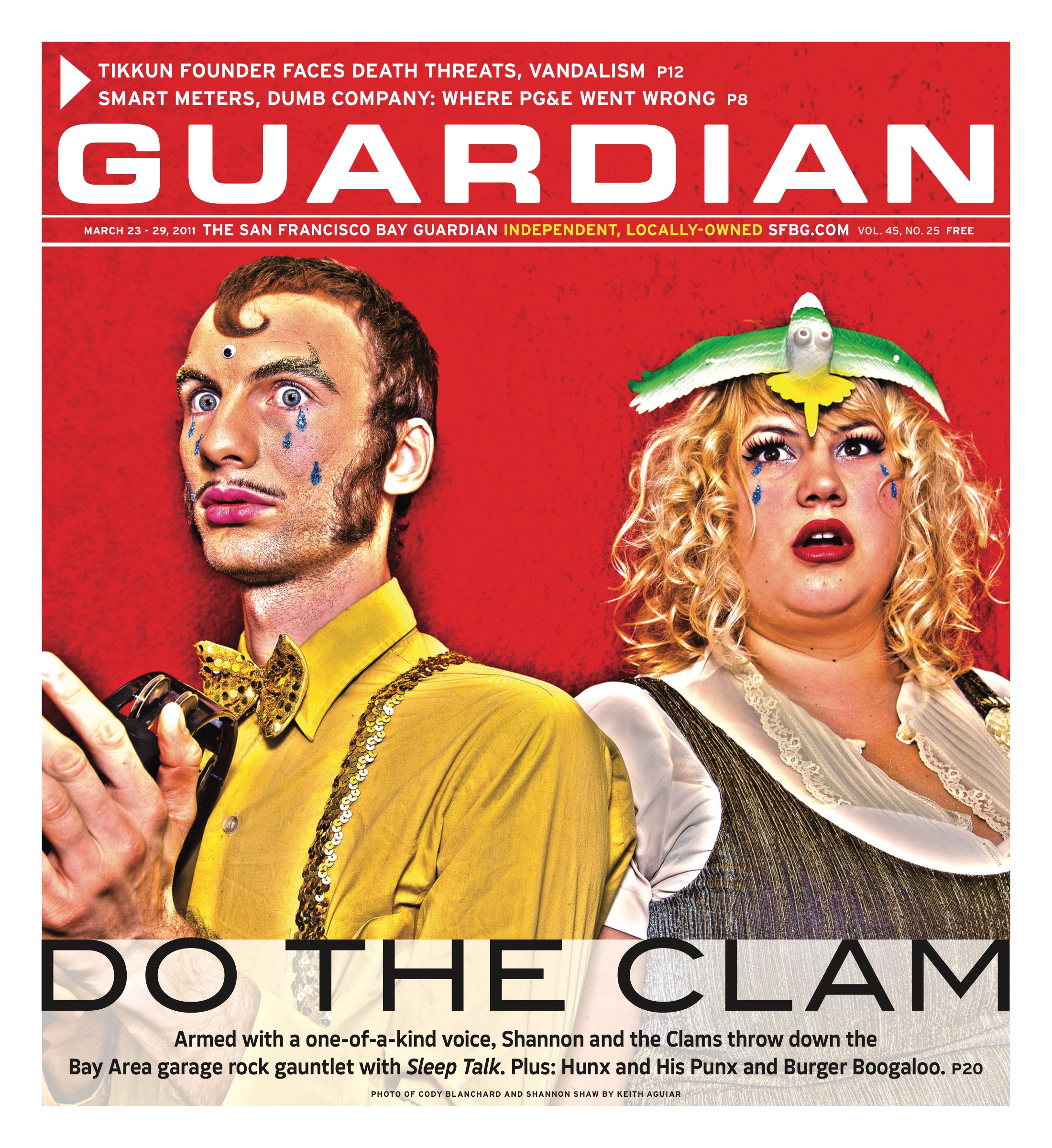
MUSIC For three nights, Burger Boogaloo is going to sate the appetites of Bay Area garage fiends with a hunger for rock. It makes perfect sense that the weekend event is building to a Sunday night finale involving Midnite Snaxx. Sharing the stage with Nobunny, as well as Shannon Shaw’s side project, Egg Tooth, the Snaxx bring a skilled chef’s resume to the bill: Tina Lucchesi, a hairstylist at Down at Lulu’s by day, has blasted amps in bands such as the Bobbyteens and Trashwomen, while Dulcinea Gonzalez, who does time at the Guardian while the sun is out, was a member of the Loudmouths. (Bassist Renee Leal of the LaTeenos completes the trio.) I recently caught up with guitarist-vocalist Gonzalez and drummer Lucchesi.

SFBG You two are garage rock veterans. How do you feel about the Bay Area garage scene right now?

Tina Lucchesi It’s different now, for sure. It’s younger.

Dulcinea Gonzalez I’m happy to be playing music. We haven’t lost our lust for rock ‘n’ roll.

SFBG One of your songs is “October Nights.” What’s special about that time of year?

DG October is when Budget Rock is happening. We tend to party hard, and the weather tends to be better. [The song’s] a celebration of rock ‘n’ roll and living in the Bay Area.

TL It’s Rocktober!

DG Tina wants us to have a record cover where we’re werewolves, like Ozzy Osbourne [on the cover of Bark at the Moon].

SFBG Are there any looks you have in mind for upcoming shows or photos?

DG Don’t give Tina any ideas, she loves to dress up. We had taco suits for Halloween. We hope to do a video soon where we can express our funnier side.

TL This is a T-shirt, tennis shoes, leather jacket kind of band, which is good. It’s cas.

SFBG Why do you think there’s such a connection between garage rock and food, especially in the Bay Area, with bands like yours and Personal and the Pizzas, and labels like Burger Records?

DG I guess it has to do with wanting satisfaction right away. We like our music a little dirty, sleazy, fun, and poppy, and those kinds of foods are the same way — a guilty pleasure.

SFBG What are some of Midnite Snaxx’s favorite snacks?

TL Probably nachos — the vegetarian nachos from [Taqueria] Cancun, with cheese. The midnight buffet that drunkenly happens at my house dips into anything in the fridge.

DG Pizza from Lanesplitter’s. We’ve had some terrible, terrible Taco Bell runs after practice and going to the Avenue.

TL Sometimes we get healthy and go eat sushi at Koryo because they’re open until 3 a.m.

DG That’s when we just got paid.

TL They have half-off specials now. [laughs]

SFBG What’s on the Midnight Snaxx menu, recording and release-wise?

DG We put out our first single on Raw Deluxe. Our next single is on Total Punk Records, an offshoot of Floridas Dying. It comes out in May. Then we have big plans to record our LP for Red Lounge Records in Germany, which will be out in the summer.

SFBG How did you wind up on a German label?

DG This guy [Martin Christoph of Red Lounge] follows a lot of the bands that Tina’s been in and he knew one of my past bands, and he liked the rawness of our recordings. We’re stoked. Hopefully this means we get to go to Europe.

TL Time for schnitzel and beer [laughs].

DG Jason Testasecca from Nobunny is recording the album at Tina’s house.

SFBG Is there anything that people should expect from Midnite Snaxx at your Burger Fest show?

DG Tina, what are you gonna do?

TL They should expect a full-blast snack attack all over their faces.

BURGER BOOGALOO

Fri/25–Sun/27, $10

Thee Parkside

1600 17th St., SF

(415) 252-1330

burgerrecords.webs.com

www.theeparkside.com 


Party Radar: Happy birthday, sexy Lexy

0

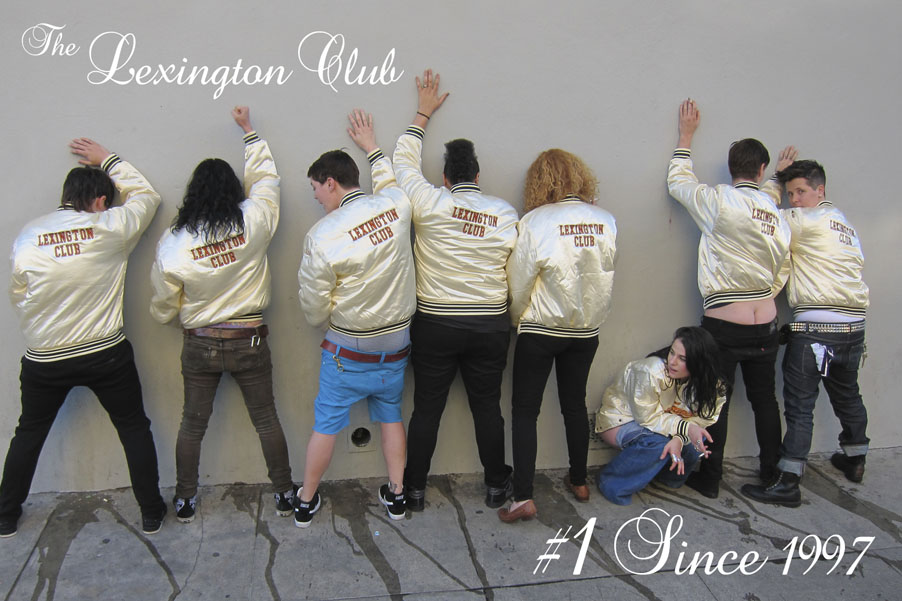
Gosh and begorrah, I know you’re hungovah — from all that St. Paddy’s Day grog or whatever. Don’t worry, you’ll feel better by Saturday, just in time to celebrate the Lexington Club‘s 14th anniversary, huzzah! Unfamiliar with this rowdy party dyke landmark? Hot chicks, get hip real quick at this blowout, featuring DJs Jenna Riot and Miss Pop, sexy-sexy dancers, no cover, and of course stiff drinks.

After the jump, a Super Ego clubs column from 2007 devoted to the Lex’s 10th anniversary (which was the perfect antidote to the L Word phenomenon of the time), giving you a wee bit o’ lesbian history.

LEXINGTON CLUB 14TH ANNIVERSARY Sat/19, 9 p.m., free. Lexington Club, 3464 19th St., SF. www.lexingtonclub.com

(originally published 4/10/07):

HOT LEX

10 years of hot dykes and cold beer at the Lexington Club

SUPER EGO Lesbians: is there nothing they can’t do? They can run a contemporary art gallery in thigh-baring Versace, tossing back their Paul Labrecqued locks as they leap from their roofless 330Ci. They can go from homeless crack addict to nude Hugo Boss model without gaining a single ounce. They can be a smokin’-hot Latina named Papi, a sassy, brassy canoodler who just happens — surprise! — to be a whiz at hoops. Astonishing lesbians!

Oh, wait. That’s The L Word — about as far from the real world of gloriously rambunctious, wild San Francisco dykes as you can get without scarfing down a gift sack of MAC Pervette lip frost, doing Pilates to Ashlee Simpson (“I am me!”), and microwaving Cheeto, your stump-tailed calico cat. Yes, yes, I know the writhing isle of televised lesbos that L makes LA out to be is one big, fat, easy, anorexic target. Don’t get your Mary Green panties in a bunch, Caitlyn. Just lie back, relax, and think of Joan Jett and Carmen Electra. It’s OK. But just as Chuck D. once bemoaned the fact that most of his heroes don’t appear on no stamps, so my homo heroes don’t appear on no Showtime.

Case in point: Lila Thirkield, the superhumanly vivacious owner of SF sapphic outpost the Lexington Club. When I first moved here in the early ’90s, I almost turned straight or something. The San Francisco my naive dreams envisioned was full of hot, scruffy, tattooed boys into hip-hop and punk, all of them on goofy, gleaming bicycles, occasionally in drag. What I got were mostly overgymed proto–circuit queens in pink spandex thongs and cracked-out twinks you could practically see through. Great if I needed to floss, but … And while all the cute ex–ACT UPers were somewhere adrift — busy shearing sleeves off flannels, maybe — it was the rough-and-tumble sistas who really dotted the t’s on my fanboy résumé. Dykes ruled it.

That was back when wallet chains were radical and FTMs were the new It girls. I’m dating myself, but who wouldn’t, hello? Alas, despite all those Sister Sledge–soundtracked strides up the rainbow of equal signs, women could still get kicked out of bars for making out. Wha? It was a gay man, man, man’s world, and the few lesbian watering holes hewed strictly to the old-school standards: alternadykes, calm down.

Thirkield, a spiky-souled kid at the time, stepped up and opened the Lexington in 1997 to give dykes of a different stripe a dive of their own. Like all bars clever enough to fill a cultural gap, the Lex galvanized its community and reinforced the new, boisterous lesbo aesthetic that combined street activism, machismo appropriation, punk rock attitude, and a winking yen for girly pop culture. And hot sex, of course.

“It seemed so important to have a space where we could be creative, where artists, street kids, and young people could hook up and express themselves,” Thirkield says. “It was my first time running a bar, but it was like the whole community was running it with me.”

Over the past decade the Lex has persevered in the same spirit. “The economics of the city have really changed,” Thirkield says. “Our crowd has a really hard time living here now — that’s why we never charge a cover and we always support other things going on. But really, we’re doing better than ever.”

The young drinking dyke crowd has also expanded, finding homes over the years in such spaces as the Phone Booth and Pop’s, as well as legendary joints such as Sadie’s Flying Elephant and the Wild Side West. New bar Stray is catering to a mostly female clientele, and, although lesbian spaces Cherry and the old Transfer have succumbed, a slew of roving dyke dance parties have taken root.

“The dyke scene has changed in the past 10 years too,” Thirkield says. “It’s more diverse. Certain aspects of it are more visible in the media — some people expect different things. We get a lot more complaints from people coming in for the first time, saying things like ‘It’s such a dive!’ Well, yes, that’s exactly what it is. I mean, it’s great that lipstick types exist. I hope they find a place that makes them happy. But if you want to flick your lighter and sing along to old Journey songs with a roomful of babes from around the world — like during Pride last year — this is the place.”

And what about that pesky L Word? “We get a big crowd to watch it on Sunday nights — mostly because they can’t afford cable. Then they stay for an hour afterward, drinking and bitching about it. So it’s great for business!”

5 Things: March 17, 2011

0

>>THREE VEILS TO THE WIND You’re probably already green around your St. Patrick’s Day gills — maybe it’s the perfect time to rustle up a bridal gown, and a wee bit more liver to damage, for this Saturday’s Brides of March dash around the city. The raucous, open-to-all annual event is the Santarchy of hetero privilege, so let’s get sloppy-ironic and “WOOOOO” like a bachelorette.

And if you’re feeling extra classy, may we suggest a stop by North Beach’s fabulous Glamour Closet which traffics in scrumptious, perfectly Daddy’s Little Girly recycled designer wedding gowns?     

Wooooo!

>>AND SUDDENLY, TSA SHIRTS ARE ALL THE RAGE AT THE LOOKOUT If only Castro street club flyers looked like this.

>>FAKE THAT FLOW ON SIXTH STREET You got no dough, but still wanna impress your crew? At TL cafe-third space Rancho Parnassus on Sixth and Minna you can rent out the dining room (complete with nautical trappings and the occasional fly art show on the walls) for FREE any day after 7 p.m. as long as you bring at least 15 friends in tow. It’s a win-win situation for the affordably-priced cafe — they need the business, and you — you and your buds get your pick of its Mendocino wine list, North Coast beer and full menu.

Rancho’s riches can be yours for free. Photo by Hannah Tepper

>>EVER WONDERED WHAT EL FAROLITO LOOKED LIKE IN 1951? The main library’s galleries in the basement (Jewett) and on the sixth floor (Skylight) are hosting “San Francisco EATS,” a smorgasbord of SF restaurant paraphernalia and photos from all time, but only on display through Sunday, March 20. Included in the bounty: hilarious food porn (flauta plate for $2.50? Ohhhh, 1951), racist menus from not long-enough-ago, peeks into culinary luxury from various eras, and brief historical rundowns of the city’s four most famous food districts. 

>>THOSE SOUTHERN BOYS… Carolina-bred band Fist Fam has relocated to the Bay, and in honor of the move they set their “SF Bay” spit to the chase scene from a seventies SF flick — which would make it worth watching even if the Fam’s laid-back Southern twang didn’t already have us stoked for the group’s April 8 show at Rasselas.

http://www.youtube.com/watch?v=SL00ezneBc4


Songs of flesh and faith

1

arts@sfbg.com

MUSIC Some cowboy angels have been crying into their beer for salvation; meantime, some of us singing cowgirls who are also in struggle push onward to save ourselves. Texan-in-exile Josh T. Pearson’s new Last of the Country Gentlemen (Mute) is very much the answer record for that divide, its harrowing, beautiful 60 minutes transmuting into a sonic angel and devil’s advocate for both sides.

On hearing the disc’s seven songs — or, as when seeing Pearson live a few weeks past at Brooklyn’s Bell House, where he opened with the one-two punch of “Sweetheart I Ain’t Your Christ” and “Thou Art Loosed” — you might be inclined to label the work mere post-breakup bittersweets, or worse, sexist. Yet you would be woefully wrong, akin to those scene-making hipsters at the Bell House who refused to pocket their cell phones and thus did not respect the artist or the hush required to truly hear the songs. You would not be awake to the fact that Brother Pearson’s preaching the (female) listener toward empowerment. He fled Sam the Sham, crossing the pond for refuge, solace, and space, but did not find old world streets paved with gold, and ultimately he was stalked by heartache, firewater, and despair. No one else can love you into wholeness. Reckon I don’t know if Jesus saves; down here, it appears nobody can save your soul but you — savior self.

In my recent long seasons of darkness, this is the hardest life lesson I was forced to learn. And so the acute sadness of Josh T. Pearson the artist — once weighted with the spoils and pressures of one anointed as sonic savior, courtesy of his prior trio Lift to Experience and its lone apocalyptic recording The Texas-Jerusalem Crossroads (2001) — and his seven devastating accounts of love gone wrong, about the chains of dissipation and loss of mind and self, resonate with me in ways that cannot be reduced to printed matter nor speech. After a decade of inner turbulence and music’s collective loss of grace, here, at last, is a recording made by a grown-ass man.

With their length and delicate, unvarnished instrumentation — chiefly, Pearson’s voice and guitar, recorded over two days in Berlin with strings added a few months later — the songs of Last of the Country Gentlemen will doubtless cause some to resist, too cowardly to engage with pain. They need to recognize that Pearson is strong enough to balance (gallows) wit with generous depth and unflinching honesty. See “Honeymoon is Great, I Wish You Were Her,” or even the tortured meshes of “Sorry With A Song,” with its “Last time you left I got my drunk ass whupped in a fight/ My whole life’s been one clichéd country unfinished line after line after line after line.” On stage at the Bell House, he joked about expecting to see more beards in the Brooklyn crowd, and noted that the 10-year length of his own mirrored his “absence.” Awake, awake…know his embodiment of the divine.

The portrait Pearson is gentlemanly enough to present: a young Ugly American seeking detachment abroad, unraveling, and painstakingly slaying dragons to evolve and become a better human. Yes, there are ghost notes between his being the son of a Southern preacher man and myself being the granddaughter, niece, cousin of same; a shared lore of traditions and the Word communicates beneath the surface of this record (and I nigh passed out when he seamlessly recuperated the Melodians-minted “Rivers of Babylon” into his oeuvre live last week).

It matters not that Pearson focused on busking and drifting across western Europe and the isles, surfacing only once in the past decade with a (fitting) cover of Hank Williams’ “I’m So Lonesome I Could Cry” and continuing to sit on a trove of unreleased material. In fleeing the horrors of Bush America, he reconnected with the traditions of his own soil and kinfolk (as slyly/sadly limned on the single, “Country Dumb”) and went through them changes to fiercely mature as songcatcher and man. When he opens his record keening, crying that he is “off to save the world,” he may be earnest and he might be clowning himself. It could just be the bravado of wishful drinkin’, but it sho’nuff ain’t purty aesthetic insincerity. I am bone-weary of Pan’s musical sons capering in the glades, and the ever-cloning manchildren of indie-ana. Give me Brother Pearson’s testimony and its rare, precious ability to trigger the full spectrum of human feeling.

The inevitable forthcoming hooptedoodle that results from Pearson’s appearance at Austin’s annual South by Southwest festival next week will determine how much of his vault comes to light and whether or not the amorphous-but-fervent digital cult that enshrined Lift to Experience and has awaited any new music with bated breath expands to a mass. However, I neither require consensus nor further laurels determining its future reception to claim that Last of the Country Gentlemen is a masterpiece. Especially when it seems possible that Brother Pearson could well disappear into Texas, never to record again. Or feel beckoned anew by the boomtown Berlin of our master satirist Californian bard Stew, and Pearson’s fellow quester, the noted East Village African performance artist Krylon Superstar (a “breathaholic,” as we all should be). He could pull a Josephine-with-her-leopards rather than remain here to help rebuild America(na) from the ashes.

I, the Indian watching from the deep dark woods as the settlers clash and struggle to resurrect themselves and their ideals from the heaven/hell of Bush’s infinitely twisted New Jerusalem, am very grateful that Josh T. Pearson has boldly called himself out an American dreamer. He reminds me that I could be one, too, if I am brave enough to bleed. This is worth so much more than letter grades and lazy crit comparisons to this act or that, so expect none. Due to powers of inner vision and commitment, Pearson conjures the two other maverick artists who framed the past decade for me: my most-beloved white chocolate master, Lewis Taylor, from the United Kingdom, and still-undersung, Carolina-to-canyon folk visionary Jonathan Wilson. But he is virtually without peer. It takes a great deal now to summon me from the abyss. Truth alone.

Myself, still too blue to fly — yet there is great remedy and mystery to be gained from Josh the Revelator’s Wild West revolution of the mind. I know you have heard the sounds of red, white, and blue footsteps scrawling in fear. You know intimately the disintegration of this earth. If only you have the ears to hear both the low lonesome and glory of “Sweetheart I Ain’t Your Christ,” wherein Pearson wrenches out, through rippling guitar, “You don’t need a lover or a friend/ You need a savior/ And I am not him.” Don’t flinch when he sings from a land you’re stranger to. Do not escape into the sunset — the brother needs you to openly and humbly step up as his amen corner, and welcome holy breath. 

Josh T. Pearson will be making his solo debut at South by Southwest at three official performances — the first, Wed., March 16 at the Central Presbyterian Church in downtown Austin, should be the hot ticket

Our Weekly Picks: March 16-22

0

WEDNESDAY 16

EVENT

“Nerd Nite SF No. 10: Visualization of Science, Undersea Internet, and the Art of Videogames”

Get your geek on! Nerd Nite, a relaxed celebration of the cerebral, features science-centric presentations that will increase your already genius-level IQ, you MENSA member, you. Take your first sip of alcohol and listen to lectures like The Coolest A/V Club in the Universe: Science Visualization at the California Academy of Sciences” by Jon Britton, senior systems engineer and production engineering manager of electronics engineering and science visualization (that’s a mouthful) at the academy; “20,000 Leagues Under the TCP: The Undersea Internet” by Chris Woodfield, senior network engineer for Yahoo!; and “Sorry, but Videogames Are Art” by acclaimed technology journalist Alex Handy. (Jen Verzosa)

8 p.m., $8

Rickshaw Stop

155 Fell, SF

(415) 861-2011

www.sf.nerdnite.com


MUSIC

“(Pre) St. Paddy’s Day Punk Bash XI”

Tradition dictates that the St. Paddy’s Day Punk Bash is held on, well, March 17. But this year, there was a Steve Ignorant-playing-Crass-songs show (don’t call it a reunion!) scheduled for March 17, so veteran local promoter Scott Alcoholocaust — noting the potential conflict of mohawked interests — scooted his Paddy party to the day prior. Alas, Crass ran into visa troubles and had to reschedule its gig for later this spring. So get your punk fix tonight; tomorrow, you can stay home and recover (suggested activity: watching all the Leprechaun movies) while the amateurs crowd the pubs. The bill includes SF’s own tongue-in-cheek rockers Crosstops and “all-zombie” Dead Boys tribute act UNdead Boys. Magically delicious! (Cheryl Eddy)

With Ruleta Rusa, Face the Rail, and Street Justice

8 p.m., $8

Elbo Room

647 Valencia, SF

(415) 552-7788

www.elbo.com


THURSDAY 17

EVENT

“How Wine Became Modern Featuring Pop-Up Magazine”

If you prefer wine to green beer on St. Patrick’s Day, head to SFMOMA for a wine-infused installment of their Now Playing series, featuring Pop-Up Magazine in a new, between-issues format, “Sidebar.” Unlike normal magazines with a shelf life, each issue of Pop-Up takes the form of a live performance presented to an audience in real time. This issue discusses wine culture, science, history, politics, and humor in conjunction with the museum’s current exhibition, “How Wine Became Modern.” The evening includes a screening of Brian De Palma’s Dionysus in 69 (1970) and a rooftop bacchanal-themed event by Meatpaper magazine. Bonus: admission is half-price after 6 p.m. Thursday nights. (Julie Potter)

6 p.m., $9

San Francisco Museum of Modern Art

151 Third St., SF

(415) 357-4000

www.sfmoma.org


FRIDAY 18

DANCE

Dance Anywhere

A few years ago dancer-choreographer Beth Fein asked herself: “What if the world paused to dance?” It certainly couldn’t hurt. In the Bronx, hip-hop helped reduce violence. More recently, all of Cairo danced on Tahrir Square. Fein elicited enough of a response that people around the globe will gather for one big communal dance. You can “dance anywhere” on your own or join kindred spirits. In San Francisco, find Alyce Finwall (Geary and Grant streets), the Foundry (Civic Center BART), Kara Davis and Agora Project (Lincoln Park), or Project Trust (Togonon Gallery). In Oakland see Carolyn Lei-Lanilau (Bosko Picture and Framing store), Destiny Arts Center (at home), and Eric Kupers’ Dandelion Dance Theater (Frank Ogawa Plaza). For additional Bay Area participants consult the website. (Rita Felciano)

Noon, free

Various Bay Area locations

(415) 706-7644

www.danceanywhere.org


DANCE

Nederlands Dans Theater

The elite dance creatures of Nederlands Dans Theater visit Berkeley to perform Whereabouts Unknown, the work of former artistic director Jiri Kylián, and Silent Screen, a collaboration by resident choreographers Paul Lightfoot and Sol León set to the music of Philip Glass. Known for its gorgeously trained artists, the company pairs the work of NDT’s longtime leader alongside choreography by the company’s next generation of dance makers, giving audiences an idea of this fine group’s trajectory. In addition, artistic director Jim Vincent (previously stateside directing Hubbard Street Dance Chicago) offers a free public lobby talk with Cal Performances’ Kathryn Roszak Sat/19 at 5 p.m. (Potter)

Fri/18–Sat/19, 8 p.m., $34–$72

Zellerbach Hall

Bancroft at Telegraph, Berk.

(510) 642-9988

www.calperfs.berkeley.edu


MUSIC

Devo

With nearly 15 years between releases leading up to 2010’s Something for Everybody, it’s probably an understatement to say that Devo has slowed down considerably since its heyday throughout the 1970s and ’00s. Regardless, the band is still synonymous with the idiosyncratic new wave and synth-punk it helped create those many years ago. Ringleader Mark Mothersbaugh has rekindled the group’s flare for sci-fi kitsch, surreal humor, and of course, the costumes, in recent appearances and the group seems rejuvenated with touring drummer Josh Freese (Vandals, A Perfect Circle) on board. With talks of a possible Devo Broadway musical in the works, it seems the group possibly has a few more tricks up its oddball sleeve. (Landon Moblad)

With the Octopus Project

9 p.m., $37.50–$99.50

Warfield

982 Market, SF

(415) 345-0900

www.thewarfieldtheatre.com


DANCE

RAWdance

RAWdance, also known as Ryan T. Smith and Wendy Rein, may be best known for their Concept Series, in which popcorn and new dance packs them in. (It is also a place where a local critic was once hit by a flying ice cream bar.) The work shown is usually “in progress.” An ODC Theater Residency has now enabled the two artists to finish one of their tentative excursions. The full-evening Hiding in the Space Between — live dance and LED projections — takes on the complications, discoveries, and shifting priorities that an exploding range of technology imposes on us. Human beings have always been social creatures, but what kind of animals are we turning into? (Felciano)

Fri/18–Sun/20, 8 p.m., $15–$18

ODC Theater

3153 17th St., SF

(415) 863-9834

www.odctheater.org


SATURDAY 19

MUSIC

Greg Ginn and the Royal We

Full disclosure: I have only the vaguest impression of what the erstwhile Black Flag guitarist’s latest project actually sounds like (short answer: weird and stony), and my preliminary Internet sleuthing suggests that nobody else seems to know too much, either. What’s certain, however, is that any band with Greg Ginn at the helm will make for an interesting experience — consider the countless stories in circulation about people who walked into a Taylor Texas Corrugators show hoping to hear “Police Story,” only to be held hostage by a nightmarish jam band for over an hour. Here’s hoping Ginn’s latest project lives up to the jarring strangeness of its immediate predecessors. (Tony Papanikolas)

With Big Scenic Nowhere and Glitter Wizard

9 p.m., $8

Thee Parkside

1600 17th St., SF

(415) 252-1330

www.theeparkside.com


PERFORMANCE

“Jay and Silent Bob Get Old”

Since their first appearance in Kevin Smith’s 1994 film Clerks, the characters of Jay and Silent Bob have gone on to achieve cult status — ever though Smith’s alter ego doesn’t speak much and his overly-verbose partner, portrayed by Jason Mewes, is a foul-mouthed, obnoxious punk. Smith and Mewes have revived the hilarious duo once again; brandishing the tagline “Every saga has a middle age,” they’ve started taping a live podcast, “Jay and Silent Bob Get Old,” riffing on just about everything funny thing you could imagine. When the show comes to the city tonight, just imagine you’re standing in front of that old Quick Stop in Jersey and let the raunchy tirades roll. (Sean McCourt)

9 p.m., $59.50

Warfield

982 Market, SF

(415) 345-0900

www.thewarfieldtheatre.com


SUNDAY 20

MUSIC

Carlton Melton

Welcome to Spaceship Earth. Please enjoy its dynamic equilibrium, finite resources, and infallible interdependency. Heavy shit? Maybe. But engineer and visionary Buckminster Fuller had reality dialed, helping popularize these concepts and designing the eco-before-“eco” geodesic dome. Time travel 40 years to today, where the five members of Carlton Melton have pioneered “dome rock” from the acoustic womb of their spherical abode on the Mendocino coast. No rehearsals, studios, or second takes; all dome-inspired improvisation, experimentation, and Floydian trippiness. Bucky would be proud. And beyond reverberations from dome sweet dome, how could you flake on a stony Sunday afternoon BBQ with Acid King? (Kat Renz)

With Acid King and Qumram Orphics

2 p.m., $8

Bottom of the Hill

1233 17th St., SF

(415) 621-4455

www.bottomofthehill.com


MONDAY 21

MUSIC

Destroyer

Dan Bejar is never quite what he seems. He’s a pivotal member of indie talent union the New Pornographers, but the nine albums he’s released as Destroyer stands to eclipse that collective effort. The name may invoke metal, but that’s the one popular genre that Bejar seems to borrow from the least. Kaputt in particular, the latest and best Destroyer album since 2001’s Streethawk: A Seduction, finds Bejar in territory that’s undeniably smooth. Smooth jazz smooth, but adding musical nuance and lyrical mystery in a way that hasn’t been so successful since the ’80s (or arguably, ever). If the eight-piece orchestra on this tour aims to destroy anything, it’s expectations. (Prendiville)

With the War on Drugs, Devon Williams, and DJ Britt Govea

8 p.m., $16

Great American Music Hall

859 O’Farrell, SF

(415) 885-0750

www.gamh.com

The Guardian listings deadline is two weeks prior to our Wednesday publication date. To submit an item for consideration, please include the title of the event, a brief description of the event, date and time, venue name, street address (listing cross streets only isn’t sufficient), city, telephone number readers can call for more information, telephone number for media, and admission costs. Send information to Listings, the Guardian Building, 135 Mississippi St., SF, CA 94107; fax to (415) 487-2506; or e-mail (paste press release into e-mail body — no text attachments, please) to listings@sfbg.com. Digital photos may be submitted in jpeg format; the image must be at least 240 dpi and four inches by six inches in size. We regret we cannot accept listings over the phone.

Do the leprechaun swing

0

Does the standard set of St. Patrick’s Day festivities leaving you feeling a little bit like boiled cabbage? We rounded up a shamrock patch full of St. Paddy’s events this year, but you might also try celebrating the Celts with a bit more steam — punk, that is. Get hep with San Fran swingers (dance, you filthies!) Swing Goth at the third annual Steam Punktrick’s Day. The event will feature Nathanial Johnstone, intrepid violinist from steampunk band Abney Park, donning his fiddler’s cap with his side project, the Nathanial Johnstone Band.

So if you like mixing your corned beef with corsets and bagpipes with balboa, then break out your fishnets and mini-kilts and head on over to 50 Mason Social House, the TL’s newest wine and beer bar that provides solace from the bright lights and overpriced pints of Union Square’s tourist traps, as well as nightly line ups of live music.

No swing experience necessary for Steam Punktrick’s — those already familiar with Swing Goth will know that no music is too punk to partner dance to, and for newbies, a dance lesson will be offered from 8:30 to 9:30 p.m.


Third annual Steam Punktrick’s Day Featuring the Nathanial Johnstone Band

With Heavy Sugar and Standfire Collective

9:30 p.m., lesson at 8:30 p.m., $12

50 Mason Social House

50 Mason, SF

(415) 433-5050

www.brownpapertickets.com


Appetite: 2 intriguing new food memoirs

0

Just released in early March, here are two new reads I’d recommend not only for foodies but for fans of the absorbing, well-crafted memoir.

>>Life, On the Line by Grant Achatz & Nick Kokonas: When Alinea’s chef genius Grant Achatz writes a memoir, it’s destined to get buzz among foodies. When this visionary chef was diagnosed with stage four tongue cancer, threatened to lose his tongue and taste buds (something devastating to anyone, much less a celebrated chef), it was news well beyond the food world.

Achatz’s first memoir, written with his business partner, Nick Kokonas, is much more than a cancer survival story. It is also more than a chef memoir. Appropriately titled, Life, On the Line, it may not be the most literary of food memoirs, but it is gripping. I couldn’t stop reading of Achatz’s humble Michigan roots, his rise as a chef under Charlie Trotter and Thomas Keller, and particularly the incessant drive that led him to opening his own, widely acclaimed restaurant just as he entered his thirtieth decade.

Life, On the Line is raw, honest, with a straightforwardness that is refreshing. A bittersweet tone underlies this impressive success story. I love Alinea as much as most who’ve had the privilege of eating there, and this book certainly acquaints me in a real, unsentimental way with the minds behind it.

I’m already plotting how I can get to Chicago after his unparalleled concepts of Aviary and Next open…

>>Blood, Bones & Butter by Gabrielle Hamilton: Who knew chef of NY’s beloved Prune, in the East Village, was first and foremost a writer? Early word on the street was that her book was, as Anthony Bourdain himself said, “the best memoir by a chef ever.”

I find the hype a bit high, but do think cooks and food lovers will find much to savor in Blood, Bones and Butter. Though I found it not as compelling as Achatz’s Life, On the Line, Hamilton shines in her mastery of the English language, making it a more pleasurable read.  From idyllic, dreamy parties her parents threw at her rural Pennsylvania childhood home, to the devastation of their divorce that led Hamilton to support herself in restaurant jobs from teen years on, her choice of words creates vivid pictures of each era of her life.

Amidst dish-washing and butchery, she describes her move back to school at “the Harvard of the Midwest” (University of Michigan), where she gets an MFA in fiction writing. It’s an intriguing journey from writing to unexpectedly running her own restaurant. You can’t help but feel writing is her first calling.

As she describes the lamb roasts of her youth, you clearly envision it, and acutely wish you were there: “… the lambs on their spits were hoisted off the pit onto the shoulders of men, like in a funeral procession, and set down on the makeshift plywood-on-sawhorse tables to be carved. Then the sun started to set and we lit the paper bag luminaria, which burned soft glowing amber, punctuating the meadow and the night, and the lamb was crisp-skinned and sticky from slow roasting, and the root beer was frigid and it caught, like an emotion, in the back of my throat.”

** Catch Gabrielle this week in SF at Camino in Oakland (3/11), Omnivore Books (3/12).

–Subscribe to Virgina’s twice monthly newsletter, The Perfect Spot


What has happened to America?

13

I’m serious. I listened to the news this morning on the radio, and I started to wonder if I hadn’t gone through some kind of a time warp, back to the 1950s. The House Homeland Security Committee is actually holding hearings on whether members of a certain religion have become too radical — and what the U.S. government can do about it.


Richard Nixon used to say that the Jews were part of the Commie Radical Conspiracy, and J. Edgar Hoover thought that black religious leaders, including the Rev. Marting Luther King, Jr, were linked to the Communist Party, but it’s been a while since the U.S. government officially investigated an entire religion on the grounds that it might contain radical elements.


Of course, as Rep. Loretta Sanchez (D-Calif.) notes:


Yet, since September 11, 2001, there have been at least 78 terrorist attacks around the world which did not involve Muslim perpetrators. During the same period, there were 45 incidents connected to Islamic radicals.


Same thing in the United States. Timothy McVeigh? Not a Muslim.


Here’s Rep. Dan Lundgren (R-Calif.) telling us all about this particular scare:


I think moderate voices in this country are intimidated by the radicals. If we hide this and pretend that it doesn’t exist, we’re ignoring reality.


It’s funny — I could make that same argument about the Republican Party. The moderates (if any are left) are intimidated by the Tea Party and anti-tax radicals. Now we have a HUAC-style investigation of the Muslims.


And then in Wisconsin, one of the birthplaces of the modern labor movement in America, the state Legislature is stripping public employees of almost all collective bargaining rights. Forget wages and benefits, which the unions have already agreed to open up for discussion. This is about the most central tenet of organized labor — the right to collective bargaining. It’s as if all the victories we’ve won in the past half century (or more) are going away. With a Democrat in the White House.


It’s funny: I was drinking beer with my neighbor the other night and talking about tax policy (you wonder why I have so many friends) and he told me he’d  given up any thoughts of socialist revolution or radical change: “I’d just take the 1950s,” he said.


Because in the 1950s, the rich people paid taxes.


So now we’ve got the worst of both worlds: We have 50s-era witch hunts and union busting — and we don’t even have 50s-era taxes. What the fuck?