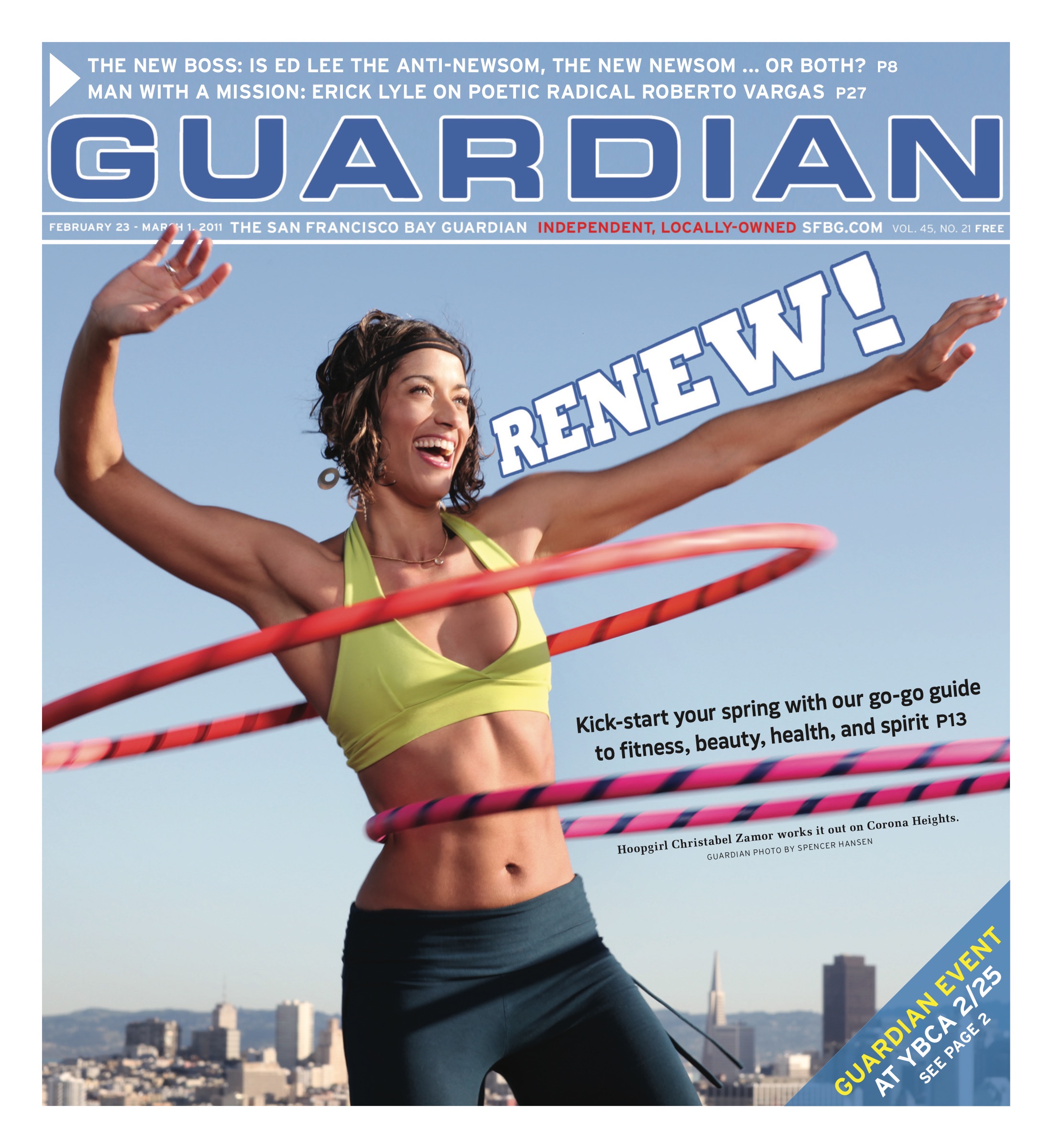
Beauty

Music Listings

0

Music listings are compiled by Cheryl Eddy. Since club life is unpredictable, it’s a good idea to call ahead to confirm bookings and hours. Prices are listed when provided to us. Submit items for the listings at listings@sfbg.com. For further information on how to submit items for the listings, see Picks.

WEDNESDAY 23

ROCK/BLUES/HIP-HOP

Antonionian, Doseone, Jel Rickshaw Stop. 8pm, $10.

Burmese, Vaz, Rabbits Knockout. 9pm, $6.

Esben and the Witch, Julianna Barwick, Hungry Kids of Hungary Bottom of the Hill. 9pm, $10.

Otis Heat, Diamond Light, Caldecott Hotel Utah. 9pm, $8.

Theophilus London, Alexander Spit, The 87 Stick Up Kids, C Plus and Duckworth 330 Ritch. 9pm, $17.

Tecumseh, Derek Moneypenny, Opera Mort, Caldera Lakes Hemlock Tavern. 9pm, $7.

Wakey! Wakey!, All Smiles Café Du Nord. 8:30pm, $12.

JAZZ/NEW MUSIC

Alfredo Rodriguez Trio Yoshi’s San Francisco. 8 and 10pm, $10-18.

Cat’s Corner with Christine and Nathan Savanna Jazz. 9pm, $10.

Cosmo Alleycats Le Colonial, 20 Cosmo, SF; www.lecolonialsf.com. 7pm.

Dink Dink Dink, Gaucho, Michael Abraham Amnesia. 7pm, free.

Ben Marcato and the Mondo Combo Top of the Mark. 7:30pm, $10.

FOLK/WORLD/COUNTRY

Green, Through the Roots, Thrive Great American Music Hall. 9pm, $13.

Matt Turk Revolution Café, 3248 22nd St, SF; (415) 642-0474. 8:30pm, free.

DANCE CLUBS

Booty Call Q-Bar, 456 Castro, SF; www.bootycallwednesdays.com. 9pm. Juanita Moore hosts this dance party, featuring DJ Robot Hustle.

Buena Onda Little Baobab, 3388 19th St., SF; (415) 643-3558. 10pm, $3. Soul, funk, swing, and rare grooves with residents Dr. Musco, DJB.

Cannonball Beauty Bar. 10pm, free. Rock, indie, and nu-disco with DJ White Mike.

Club Shutter Elbo Room. 9pm, $5. Goth with DJs Nako, Omar, and Justin.

Jam Fresh Wednesdays Vessel, 85 Campton, SF; (415) 433-8585. 9:30pm, free. With DJs Slick D, Chris Clouse, Rich Era, Don Lynch, and more spinning top40, mashups, hip hop, and remixes.

Mary-Go-Round Lookout, 3600 16th St, SF; (415) 431-0306. 10pm, $5. A weekly drag show with hosts Cookie Dough, Pollo Del Mar, and Suppositori Spelling.

No Room For Squares Som., 2925 16th St, SF; (415) 558-8521. 6-10pm, free. DJ Afrodite Shake spins jazz for happy hour.

Respect Wednesdays End Up. 10pm, $5. Rotating DJs Daddy Rolo, Young Fyah, Irie Dole, I-Vier, Sake One, Serg, and more spinning reggae, dancehall, roots, lovers rock, and mash ups.

Synchronize Il Pirata, 2007 16th St, SF; (415) 626-2626. 10pm, free. Psychedelic dance music with DJs Helios, Gatto Matto, Psy Lotus, Intergalactoid, and guests.

THURSDAY 24

ROCK/BLUES/HIP-HOP

Acid Mothers Temple & The Melting Paraiso U.F.O., Shilpa Ray & Her Happy Hookers Bottom of the Hill. 9:30pm, $12.

Blind Willies Blue Macaw, 2565 Mission, SF; (415) 920-0577. 8pm.

Curious Mystery, Greg Ashley, Zoobombs Knockout. 9:30pm, $6.

Quinn Deveaux Amnesia. 9pm, $5.

Dispirit, Atriarch, Alaric El Rio. 8pm, $8.

Shane Dwight Biscuits and Blues. 8 and 10pm, $15.

Liam Finn, Luyas Independent. 8pm, $15.

Flexx Bronco, Spittin’ Cobras, Hewhocannotbenamed, Crawler Thee Parkside. 9pm, $8.

Kids of 88, Art vs. Science Rickshaw Stop. 9pm, $10-20.

Music for Animals, Foreign Resort, Matinees Hemlock Tavern. 9pm, $7.

Naughty By Nature Yoshi’s San Francisco. 8pm, $38.

Sky Parade, Grand Atlantic, Parties, Modern Day Sunshine Hotel Utah. 8pm, $8.

Soul Man Revolution Café, 3248 22nd St, SF; (415) 642-0474. 8:30pm, free.

Toro Y Moi, Braids, Cloud Nothings Great American Music Hall. 7:30pm, $15.

JAZZ/NEW MUSIC

Derek Smith Latin Jazz Band and director Dee Spencer SFSU Jazz Bands Savanna Jazz. 7:30pm, $10.

Jane Monheit SF Conservatory of Music, 50 Oak, SF; www.sfjazz.org. 7:30pm, $30-50.

Organsm featuring Jim Gunderson and “Tender” Tim Shea Bollyhood Café. 6:30-9pm, free.

Paul Drescher Ensemble 25th Anniversary Z Space, 450 Florida, SF; www.brownpapertickets.org. 7pm, $20.

Stompy Jones Top of the Mark. 7:30pm, $10.

FOLK/WORLD/COUNTRY

Kris Delmhorst Café Du Nord. 8pm, $18.

JimBo Trout and the Fishpeople Atlas Café. 8-10pm, free.

“Twang! Honky Tonk” Fiddler’s Green, 1330 Columbus, SF; www.twanghonkytonk.com. 5pm.

DANCE CLUBS

Afrolicious Elbo Room. 9:30pm, $5. DJs Pleasuremaker and Señor Oz spin Afrobeat, tropicália, electro, samba, and funk.

Caribbean Connection Little Baobab, 3388 19th St, SF; (415) 643-3558. 10pm, $3. DJ Stevie B and guests spin reggae, soca, zouk, reggaetón, and more.

Drop the Pressure Underground SF. 6-10pm, free. Electro, house, and datafunk highlight this weekly happy hour.

80s Night Cat Club. 9pm, $6 (free before 9:30pm). Two dance floors bumpin’ with the best of 80s mainstream and underground with Dangerous Dan, Skip, Low Life, and guests.

Gigantic Beauty Bar. 9pm, free. With DJs Eli Glad, Greg J, and White Mike spinning indie, rock, disco, and soul.

Guilty Pleasures Gestalt, 3159 16th St, SF; (415) 560-0137. 9:30pm, free. DJ TophZilla, Rob Metal, DJ Stef, and Disco-D spin punk, metal, electro-funk, and 80s.

Jivin’ Dirty Disco Butter, 354 11th St., SF; (415) 863-5964. 8pm, free. With DJs spinning disco, funk, and classics.

Mestiza Bollywood Café, 3376 19th St, SF; (415) 970-0362. 10pm, free. Showcasing progressive Latin and global beats with DJ Juan Data.

1984 Mighty. 9pm, $2. The long-running New Wave and 80s party has a new venue, featuring video DJs Mark Andrus, Don Lynch, and celebrity guests.

Peaches Skylark, 10pm, free. With an all female DJ line up featuring Deeandroid, Lady Fingaz, That Girl, and Umami spinning hip hop.

Thursday Special Tralala Revolution Café, 3248 22nd St, SF; (415) 642-0474. 5pm, free. Downtempo, hip-hop, and freestyle beats by Dr. Musco and Unbroken Circle MCs.

FRIDAY 25

ROCK/BLUES/HIP-HOP

Beats Antique Fillmore. 9pm, $20.

Bruises, Hold Me Luke Allen, Eighteen Individual Eyes El Rio. 9pm, $5.

Elle Nino, Club Crasherz, Double Duchess Hotel Utah. 9pm, $8.

Good Charlotte, This Century Regency Ballroom. 8pm, $28.

Hot Panda, Twinks, Watch It Sparkle Hemlock Tavern. 9:30pm, $7.

Candye Kane Biscuits and Blues. 8 and 10pm, $20.

King Tuff, Personal and the Pizzas, Rantouls, Wrong Words, King Lollipop Thee Parkside. 9pm, $10.

Ed Kowalczyk Yoshi’s San Francisco. 8pm, $30.

James Lanman and the Good Hurt, Mark Sexton Band, Dylan Cannon Café Du Nord. 9pm, $10.

Men, Lady Tragik, Katastrophe Rickshaw Stop. 8:30pm, $12.

Saw Doctors, AM Taxi Slim’s. 8pm, $24.

Smoking Popes, New Trust, Hot Toddies Great American Music Hall. 9pm, $15.

Taj Mahal, Lady Bianca Independent. 9pm, $40.

Wye Oak, Callers, Sands Bottom of the Hill. 10pm, $12.

JAZZ/NEW MUSIC

Black Market Jazz Orchestra Top of the Mark. 9pm, $10.

Lacemaking: Katy Stephan with the Nice Guy Trio Red Poppy Art House. 8pm, $12-20.

Paul Drescher Ensemble 25th Anniversary Z Space, 450 Florida, SF; www.brownpapertickets.org. 8pm, $20.

Marlina Teich Savanna Jazz. 7:30pm, $8.

Adam Theis and the Jazz Mafia String Quartet Swedish American Hall (upstairs from Café Du Nord). 8pm, $25.

Tin Cup Serenade Revolution Café, 3248 22nd St, SF; (415) 642-0474. 9pm, free.

FOLK/WORLD/COUNTRY

Albino!, Mark Edwards, DJ Spincycle Elbo Roon. 10pm, $10.

Baxtalo Drom Amnesia. 9pm, $7-10.

DANCE CLUBS

Afro Bao Little Baobab, 3388 19th St, SF; (415) 643-3558. 10pm, $5. Afro and world music with rotating DJs including Stepwise, Steve, Claude, Santero, and Elembe.

Cityfox Showcase Public Works, 161 Erie, SF; www.cityfox.eventbrite.com. 9pm. With Digitaline, Lee Jones, James What?, and more spinning deep house and techno.

Debaser 111 Minna. 9pm, $5. The 90s party celebrates its third anniversary with a Fugazi cover band and DJs Jamie Jams, Emdee, and Stab Master Arson.

Duniya Dancehall Blue Macaw, 2565 Mission, SF; (415) 920-0577. 10pm, $10. With live performances by Duniya Drum and Dance Co. and DJs dub Snakr and Juan Data spinning bhangra, bollywood, dancehall, African, and more.

Exhale, Fridays Project One Gallery, 251 Rhode Island, SF; (415) 465-2129. 5pm, $5. Happy hour with art, fine food, and music with Vin Sol, King Most, DJ Centipede, and Shane King.

Fubar Fridays Butter, 354 11th St., SF; (415) 863-5964. 6pm, $5. With DJs spinning retro mashup remixes.

Good Life Fridays Apartment 24, 440 Broadway, SF; (415) 989-3434. 10pm, $10. With DJ Brian spinning hip hop, mashups, and top 40.

Hot Chocolate Milk. 9pm, $5. With DJs Big Fat Frog, Chardmo, DuseRock, and more spinning old and new school funk.

Hubba Hubba Revue: The 90s Show DNA Lounge. 9pm, $10-15. Burlesque plus DJs spinning 90s jams.

Psychedelic Radio Club Six. 9pm, $7. With DJs Kial, Tom No Thing, Megalodon, and Zapruderpedro spinning dubstep, reggae, and electro.

Rockabilly Fridays Jay N Bee Club, 2736 20th St, SF; (415) 824-4190. 9pm, free. With DJs Rockin’ Raul, Oakie Oran, Sergio Iglesias, and Tanoa “Samoa Boy” spinning 50s and 60s Doo Wop, Rockabilly, Bop, Jive, and more.

Some Thing Stud. 10pm, $7. VivvyAnne Forevermore, Glamamore, and DJ Down-E give you fierce drag shows and afterhours dancing.

Soul Rebel Koko Cocktails, 1060 Geary, SF; www.kokococktails.com. 10pm, free.

Spindig Happy Hour Knockout. 6-9pm, free. With Ryan Poulsen, Joe Bank$, and Stef playing rap, punk, and everything in between.

Teenage Dance Craze: The Number One Twisting Party in the Universe Knockout. 10pm, $4. Surf, garage, soul, and more with Russell Quan and dX the Funky Granpaw.

Vintage Orson, 508 Fourth St, SF; (415) 777-1508. 5:30-11pm, free. DJ TophOne and guest spin jazzy beats for cocktalians.

SATURDAY 26

ROCK/BLUES/HIP-HOP

Appleseed Cast, Muscle Worship Great American Music Hall. 9pm, $15.

Beautiful Losers Café Royale, 800 Post, SF; (415) 641-6033. 8pm, free.

Blue Roan Filly, Pie Crust Promises, Steel Hotcakes El Rio. 9pm, $7.

Davila 666, Mean Jeans, Biters, Booze Thee Parkside. 9pm, $10.

Ha Ha Tonka, Hoots and Hellmouth, Devil’s Own Hotel Utah. 9pm, $10.

“Jason Becker’s Not Dead Yet Festival” Slim’s. 9pm, $25. With Joe Satriani, Richie Kotzen, Steve Lukather, Kehoe Nation, Flametal, Vinnie Moore, and Michael Lee Firkins.

Lost Coves, Bambi Killers, Chapter 24 Hemlock Tavern. 5pm, $6.

Narooma, Aimless Never Miss, We Be the Echo, Form and Fate Submission, 2183 Mission, SF; www.sf-submission.com. 7:30pm, $6.

O’Death, Arann Harris and the Farm Band, Helado Negro Independent. 9pm, $12.

Parson Red Heads, Jean Marie, Laguna Hemlock Tavern. 9:30pm, $8.

Say Hi!, Yellow Ostrich, Blair Bottom of the Hill. 10pm, $14.

Sheila E. Yoshi’s San Francisco. 8 and 10pm, $35.

Earl Thomas Biscuits and Blues. 8 and 10pm, $22.

Totally Enormous Extinct Dinosaurs, Beni Rickshaw Stop. 9pm, $12.50.

Traditional Fools, Audacity, Culture Kids, Underground Railroad to Candyland, Skumby and the Disney Dads, Shrouds Thee Parkside. 2pm, $10.

Voodoo Fix, Sara Payah, Con Brio Amnesia. 8pm, $7-10.

JAZZ/NEW MUSIC

Gina Harris and Torbie Phillips Savanna Jazz. 7:30pm, $8.

Paul Drescher Ensemble 25th Anniversary Z Space, 450 Florida, SF; www.brownpapertickets.org. 2 and 8pm, $20.

Alex Pinto Revolution Café, 3248 22nd St, SF; (415) 642-0474. 9pm, free.

Jake Shimabukuro Herbst Theatre, 401 Van Ness, SF; www.sfjazz.org. 7 and 9pm, $30-75.

Lavay Smith and Her Red Hot Skillet Lickers Red Poppy Art House. 7:30 and 9pm, $12-20.

FOLK/WORLD/COUNTRY

Mijo de la Palma Mission Cultural Center Theater, 2868 Mission, SF; www.missionculturalcenter.org. 7:30pm, $12-15.

Mucho Axé 50 Mason Social House, 50 Mason, SF; www.50masonsocialhouse.com. 9:30pm.

Nada Brahma Music Ensemble Om Shan Tea, 233 14th St., SF; 1-888-747-8327. 7pm, $10-20.

Corey Allen Porter, Seth Augustus, Handlebars and Kindle Make-Out Room. 7:30pm, $7.

Craig Ventresco and Meredith Axelrod Atlas Café. 4pm, free.

DANCE CLUBS

Afro Bao Little Baobab, 3388 19th St, SF; (415) 643-3558. 10pm, $5. Afro and world music with rotating DJs including Stepwise, Steve, Claude, Santero, and Elembe.

Bootie SF: Titus Jones DNA Lounge. 9pm, $8-15. Mash-ups.

4OneFunktion Elbo Room. 10pm, $8-10. Hip-hop and funk with DJ Numark, F.A.M.E., and DJs Platurn, J. Boogie, and B. Cause.

Go Bang! Deco Lounge, 510 Larkin, SF; www.gobangsf.com. 9pm, $5. Atomic dancefloor disco action with special guest Tim Zawada, plus residents Steve Fabus, Stanley Frank, Tres Lingerie, and Sergio.

HYP Club Eight, 1151 Folsom, SF; www.eightsf.com. 10pm, free. Gay and lesbian hip-hop party, featuring DJs spinning the newest in the top 40s hip hop and hyphy.

Lonely Teardrops Knockout. 10pm. Rockabilly with Daniel and dX theFunky Gran Paw.

Open Forum Madrone Art Bar. 9pm, $5. Pam the Funkstress and DJ BackSide spin 80s, 90s, hip-hop, funk, and more.

Reggae Gold Club Six. 9pm, $15. With DJs Daddy Rolo, Polo Mo’qz, Tesfa, Serg, and Fuze spinning dancehall and reggae.

Rock City Butter, 354 11th St., SF; (415) 863-5964. 6pm, $5 after 10pm. With DJs spinning party rock.

Temptation Cat Club. 9:30pm, $7. Video dance explosion with DJs Dangerous Dan, Skip, Ryan B spinning 80s and new wave, and guests Blondie K and subOctave spinning indie.

SUNDAY 27

ROCK/BLUES/HIP-HOP

“AP Tour” Regency Ballroom. 5:30pm, $18. With Black Veil Brides, Destroy Rebuild Until God Shows, I See Stars, VersaEmerge, and Conditions.

David Dondero, Franz Nicolay, Boats Hemlock Tavern. 9pm, $8.

Lloyd Gregory Biscuits and Blues. 8 and 10pm, $15.

Jeff Jones Band Boom Boom Room. 9:30pm, free.

Miniature Tigers, Pepper Rabbit, Cannons and Clouds Rickshaw Stop. 8pm, $10.

Mo’Some Tonebender, Lolita No. 18, Zukunashi, Hystoic Vein, Josy Independent. 8pm, $15.

Jay Nash, Joey Ryan and Kenneth Pattengale Café Du Nord. 8pm, $10.

Nobunny, Apache, Wild Thing, Midnite Snaxxx, Egg Tooth Thee Parkside. 8pm, $10.

Ready Set, Allstar Weekend, Downtown Fiction, We Are the In Slim’s. 6:30pm, $16.

Rotting Christ, Melechesh, Hate, Abigail Williams, Lecherous Nocture DNA Lounge. 7:30pm, $25.

She Rides, Bully, Dcoi Submission, 2183 Mission, SF; www.sf-submission.com. 7:30pm, $5.

Sharon Van Etten, Little Scream, Colossal Yes Bottom of the Hill. 9pm, $12.

Erica Von Vokyrie vs. Honey Mahogany Martuni’s, 4 Valencia, SF; www.dragatmartunis.com. 7pm, $5.

JAZZ/NEW MUSIC

Frank Jackson, Larry Vuckovich, Al Obidinski Bliss Bar, 4026 24th St., SF; www.blissbarsf.com. 4:30pm, $10.

Little Brown Brother Band Savanna Jazz. 7:30pm, $5.

Paul Drescher Ensemble 25th Anniversary Z Space, 450 Florida, SF; www.brownpapertickets.org. 2 and 7pm, $20.

Swing-out Sundays Milk Bar. 9pm, $3-15. With beginner swing lessons.

Irma Thomas Palace of Fine Arts, 3301 Lyon, SF; www.sfjazz.org. 7pm, $25-60.

Tom Lander Duo Medjool, 2522 Mission, SF; www.medjoolsf.com. 6-9pm, free.

FOLK/WORLD/COUNTRY

Beyond the Pale, Orkestar Sali Amnesia. 9pm, $10.

Family Folk Explosion Revolution Café, 3248 22nd St, SF; (415) 642-0474. 8pm, free.

Ray Martinez and Salsa Jazz Project El Rio. 4-8pm, $8.

Old Man Markley, Filthy Thieving Bastards, Cooper McBean Thee Parkside. 3pm, $10.

Abigail Washburn Yoshi’s San Francisco. 7pm, $18.

DANCE CLUBS

Batcave Cat Club. 10pm, $5. Death rock, goth, and post-punk with Steeplerot Necromos and c_death.

Dub Mission Elbo Room. 9pm, $6. Dub, roots, and classic dancehall with DJ Sep, Vinnie Esparza, and guest DJG.

45 Club: 100 Years of Funky Soul Records Knockout. 10pm, free. With English Steve and dX the Funky Gran Paw.

Gloss Sundays Trigger, 2344 Market, SF; (415) 551-CLUB. 7pm. With DJ Hawthorne spinning house, funk, soul, retro, and disco.

Honey Soundsystem Paradise Lounge. 8pm-2am. “Dance floor for dancers – sound system for lovers.” Got that?

La Pachanga Blue Macaw, 2565 Mission, SF; www.thebluemacawsf.com. 6pm, $10. Salsa dance party with live Afro-Cuban salsa bands.

MONDAY 28

ROCK/BLUES/HIP-HOP

B and Not B, She’s, I Hate You Just Kidding Knockout. 9pm, $7.

Crosby and Nash Warfield. 8pm, $43.50-60.50.

Endroit, Mahgeetah, Add Moss Elbo Room. 9pm, $5.

Le Mutant, Tank Attack, Arms N Legs, Black Stool El Rio. 7pm, $5.

Royskopp, Jon Hopkins Regency Ballroom. 8pm, $32.

She Wants Revenge, Californian Independent. 8pm, $25.

“Under Raps” Showdown, 10 Sixth St., SF; www.bposmusic.us. 9pm. Hip-hop open mic hosted by Mantis One and Big Shawn.

JAZZ/NEW MUSIC

“Earplay: Sound Tangents” Herbst Theater, 401 Van Ness, SF; (415) 392-4400. 7:30pm, $10-20. Works by John Cage, Elliott Carter, and more.

Lisa Mezzacappa’s Bait and Switch Yoshi’s San Francisco. 8pm, $15.

Lavay Smith Orbit Room, 1900 Market, SF; (415) 252-9525. 7-10pm, free.

DANCE CLUBS

Death Guild DNA Lounge. 9:30pm, $3-5. Gothic, industrial, and synthpop with Joe Radio, Decay, and Melting Girl.

Krazy Mondays Beauty Bar. 10pm, free. With DJs Ant-1, $ir-Tipp, Ruby Red I, Lo, and Gelo spinning hip hop.

M.O.M. Madrone Art Bar. 6pm, free. With DJ Gordo Cabeza and guests playing all Motown every Monday.

Network Mondays Azul Lounge, One Tillman Pl, SF; www.inhousetalent.com. 9pm, $5. Hip-hop, R&B, and spoken word open mic, plus featured performers.

Sausage Party Rosamunde Sausage Grill, 2832 Mission, SF; (415) 970-9015. 6:30-9:30pm, free. DJ Dandy Dixon spins vintage rock, R&B, global beats, funk, and disco at this happy hour sausage-shack gig.

Skylarking Skylark. 10pm, free. With resident DJs I & I Vibration, Beatnok, and Mr. Lucky and weekly guest DJs.

TUESDAY 29

ROCK/BLUES/HIP-HOP

Endemics, Uzi Rash, American Splits, Broken Water Knockout. 9pm, $5.

Greenflash El Rio. 7pm, free.

Guitar vs. Gravity, Control-R, Cleve-Land, DJ Culture Shizzam Elbo Room. 9pm, free.

Katchafire, Tomorrows Bad Seeds Independent. 8:30pm, $20.

Mallard, Sugar Sugar Sugar, Will Ivy Hemlock Tavern. 9pm, $6.

Parlotones, Imagine Dragons, Ivan and Alyosha Bottom of the Hill. 9pm, $10.

Rebecca Roudman Café Royale, 800 Post, SF; (415) 641-6033. 8pm, free.

Uh Huh Her, Diamonds Under Fire Great American Music Hall. 8pm, $21.

Mary Wilson Yoshi’s San Francisco. 8pm, $35.

DANCE CLUBS

Boomtown Little Baobab, 3388 19th St, SF; (415) 643-3558. 9pm, free. DJ Mundi spins roots, ragga, dancehall, and more.

Eclectic Company Skylark, 9pm, free. DJs Tones and Jaybee spin old school hip hop, bass, dub, glitch, and electro.

Share the Love Trigger, 2344 Market, SF; (415) 551-CLUB. 5pm, free. With DJ Pam Hubbuck spinning house.<\! * *

 

Film Listings

0

SAN FRANCISCO INTERNATIONAL ASIAN AMERICAN FILM FESTIVAL

The 29th SFIAAFF runs through Sun/20 at the Camera 12, 201 S. Second St., San Jose; Pacific Film Archive, 2776 Bancroft, Berk.; Sundance Kabuki, 1881 Post; and Viz Cinema, New People, 1746 Post, SF. For tickets (most shows $12) and additional program information, visit www.caamedia.org. All times pm.

WED/16

Kabuki “Futurestates” (shorts program) 4. One Voice 4:45. Made in India 6:45. Anna May Wong: In Her Own Words with “Slaying the Dragon Reloaded” 7:15. Dance Town 9:15. Affliction 9:30.

PFA M/F Remix 7. Sampaguita, National Flower 9.

Viz “Living Life Large” (shorts program) 4. Dog Sweat 6:45. Peace 9:15.

THURS/17

Kabuki Living in Seduced Circumstances 4:20. “Tainted Love” (shorts program) 5:15. “Silent Rituals and Hovering Proxies” (shorts program) 6:45. Surrogate Valentine 7. Bi, Don’t Be Afraid! 7:30.

PFA Dance Town 7. Nang Nak 9:20.

Viz “Life Interrupted” (shorts program) 5. “Futurestates” (shorts program) 7:30.

FRI/18

PFA Passion 7. The Taqwacores 8:45.

SAT/19

Camera Amin 12:15. Piano in a Factory 1. Saigon Electric 3:15. “Life, Interrupted” (shorts program) 3:30. Almost Perfect 6. Made in India 6. Emir 8:30. When Love Comes 9.

PFA Bend It Like Beckham 4. The Imperialists Are Still Alive! 6:10. Histeria 8.

SUN/20

Camera “3rd I South Asian International Shorts” noon. The Fourth Portrait 1. One Voice 2:15. Surrogate Valentine 3:30. Abraxas 4:45. Bi, Don’t Be Afraid! 6. It’s a Wonderful Afterlife 7:30. Break Up Club 8.


OPENING

Certified Copy See “Looking Glass Love.” (1:46) Clay, Shattuck, Smith Rafael.

*Heartbeats See “Xavier University.” (1:35) Lumiere.

*The Human Resources Manager What happens when a nameless, faceless “human resource” begin to resolve into a palpably real being with hopes, fears, loved ones, a hometown, a past? The harried Human Resources Manager of a big Jerusalem bakery finds out when one of his employer’s foreign workers is killed in a suicide bombing. After her body remains unclaimed in a city morgue, his employer is tagged with callous indifference, and it’s up to the beleaguered HR Manager (Mark Ivanir) — already suffering from something of an existential crisis — to undertake damage control. That task turns out to be absurdly above and beyond the ordinary when he retraces his late charge’s footsteps and tracks down her family in Romania, dogged by a meddling reporter (Guri Alfi). Back in the bleak old country, “neither east nor west,” as he’s constantly reminded, the HR Manager encounters a suitably salty, strange array of characters — the earthy Consul (Rozina Cambos) and the deceased’s divorced husband (Reymond Amsalem) and her feral son (Noah Silver) — though who can actually claim the lady’s remains? The troublesome chore turns into a journey about reconnecting with the people the HR Manager stopped seeing as full-fledged, complicated beings. Working from A.B. Yehoshua’s 2006 novel, A Woman in Jerusalem, director Eran Riklis deigns to give his characters names, apart from the dead, and instead focuses on crafting a carefully balanced, altogether enjoyable and accessible black comedy, rendering it all with a delicate touch that Anton Chekhov might have approved of. (1:43) Opera Plaza, Shattuck. (Chun)

*Jane Eyre Do we really need another adaptation of Jane Eyre? As long as they’re all as good as Cary Fukunaga’s stirring take on the gothic romance, keep ’em coming. Mia Wasikowska stars in the titular role, with the dreamy Michael Fassbender stepping into the high pants of Edward Rochester. The cast is rounded out by familiar faces like Judi Dench, Jamie Bell, and Sally Hawkins — all of whom breathe new life into the material. It helps that Fukunaga’s sensibilities are perfectly suited to the story: he stays true to the novel while maintaining an aesthetic certain to appeal to a modern audience. Even if you know Jane Eyre’s story — Mr. Rochester’s dark secret, the fate of their romance, etc. — there are still surprises to be had. Everyone tells the classics differently, and this adaptation is a thoroughly unique experience. And here’s hoping it pushes the engaging Wasikowska further in her ascent to stardom. (2:00) Embarcadero. (Peitzman)

*Limitless An open letter to the makers of Limitless: please fire your marketing team because they are making your movie look terrible. The story of a deadbeat writer (Bradley Cooper) who acquires an unregulated drug that allows him to take advantage of 100 percent of his previously under-utilized brain, Limitless is silly, improbable and features a number of distracting comic-book-esque stylistic tics. But consumed with the comic book in mind, Limitless is also unpredictable, thrilling, and darkly funny. The aforementioned style, which includes many instances of the infinite regression effect that you get when you point two mirrors at each other, and a heavy blur to distort depth-of-field, only solidifies the film’s cartoonish intentions. Cooper learns foreign languages in hours, impresses women with his keen attention to detail, and sets his sights on Wall Street, a move that gets him noticed by businessman Carl Van Loon (Robert DeNiro in a glorified cameo) as well as some rather nasty drug dealers and hired guns looking to cash in on the drug. Limitless is regrettably titled and masquerades in TV spots as a Wall Street series spin-off, but in truth it sports the speedy pacing and tongue-in-cheek humor required of a good popcorn flick. (1:37) (Galvin)

The Lincoln Lawyer Matthew McConaughey stars as an unconventional lawyer who takes on a controversial client (Ryan Phillippe). (1:59)

The Music Never Stopped Based on a Dr. Oliver Sacks case history, this neurological wild-ride focuses on the generation gap in extremis: after a ’60s teenage son rebels against his parents, staying incommunicado in the interim, he resurfaces over two decades later as a disoriented, possibly homeless patient they’re called to identify at a hospital. He’s had a benign brain tumor removed — yet it had grown so large before surgery that it damaged gray-matter areas including those handling recent memory. As a result, Gabriel (Lou Taylor Pucci) relates to Mr. (J.K. Simmons) and Mrs. Sawyer (a terrific but underutilized Cara Seymour) as if they were still his upstate NY domestic keepers. A radiant Julia Ormond plays the music therapist who convinces them Gabe might respond to music, which had helped serially glue and sever the father-son bond decades earlier. This is an inherently fascinating psychological study. But director Jim Kohlberg and his scenarists render it placidly inspirational, with too little character nuance, scant period atmosphere (somewhat due to budgetary limitations), and weak homage to the Grateful Dead (ditto) rendering an unusual narrative oddly formulaic. (1:45) Shattuck. (Harvey)

Paul Across the aisle from the alien-shoot-em-up Battle: Los Angeles is its amiable, nerdy opposite: Paul, with its sweet geeks Graeme (Simon Pegg) and Clive (Nick Frost), off on a post-Comic-Con pilgrimage to all the US sites of alien visitation. Naturally the buddies get a close encounter of their very own, with a very down-to-earth every-dude of a schwa named Paul (voiced by Seth Rogen), given to scratching his balls, spreading galactic wisdom, utilizing Christ-like healing powers, and cracking wise when the situation calls for it (as when fear of anal probes escalates). Despite a Pegg-and-Frost-penned script riddled with allusions to Hollywood’s biggest extraterrestrial flicks and much 12-year-old-level humor concerning testicles and farts, the humor onslaught usually attached to the two lead actors — considered Lewis and Martin for pop-smart Anglophiles — seems to have lost some of its steam, and teeth, with the absence of former director and co-writer Edgar Wright (who took last year’s Scott Pilgrim vs. the World to the next level instead). Call it a “soft R” for language and an alien sans pants. (1:44) California. (Chun)

*Phil Ochs: There But For Fortune When Phil Ochs was at his peak, he was one of the finest polemical folksingers to come out of the ’60s, and when he tumbled from those heights, the fall was terrible: he lost more than friends and fame — he appeared to completely lose himself, to substance abuse and mental illness. Director Kenneth Bowser does the singer-songwriter justice with this documentary, threading to-the-ramparts tunes like “Hazard, Kentucky,” questioning numbers a la “Love Me, I’m a Liberal,” and achingly beautiful songs such as “Jim Dean of Indiana” throughout political events of the day, scenes from a protest movement that were inextricably entangled with Ochs’ oeuvre. Along with the many clips of Ochs in performance are interviews with the artist’s many friends, cohorts, and fans including Van Dyke Parks (who is becoming a Thurston Moore-like go-to for a generation’s damaged voices), brother (and music archivist) Michael Ochs, Joan Baez, Tom Hayden, Peter Yarrow, Billy Bragg, daughter Meegan Ochs, and Ed Sanders. Expect an education in Ochs’ art, but also, perhaps more importantly (to the singer-songwriter), a glimpse into a time and place that both fed, fueled and bestowed meaning on his songs. Bowser succeeds in paints the portrait of a performer that was both idealistic and careerist, driven to fight injustice yet also propelled to explore new creative avenues (like recording with local musicians in Africa). Did Ochs fall — by way of drink, drugs, and mental illness — or was he pushed, as the artist claimed when he accused CIA thugs of destroying his vocal chords? The filmmaker steps back respectfully, allowing us to draw our own conclusion about this life lived fully. (1:38) Smith Rafael. (Chun)

You Won’t Miss Me Look at this fucking hipster: dour, aimless Shelly (Stella Schnabel, daughter of Julian) has her own New York City apartment (plus access to a country home, the ability to travel to Atlantic City on a whim, etc.) despite having no apparent source of income. Shelly drifts, going on auditions to further her as-yet unsuccessful acting career; leaving monotone voice mails for her mother; visiting her therapist; hooking up with assorted unwashed dudes; and hanging out with her insipid friends, one of whom helps our hapless 21st century protagonist set up her very first email account. That Shelly is depressed is a given; why anyone would choose to watch this drag of a film is a mystery. Director Ry Russo-Young aims to break up the angst by deploying an array of formats — from Super 8 to Flip — but no amount of artsy quirks (or cameos recognizable only to mumblecore enthusiasts) can make up for You Won’t Miss Me‘s uninvolving plot and unsympathetic characters. For a less painful (though by no means pain-free) experience, seek out last year’s similar Tiny Furniture instead. (1:21) Roxie. (Eddy)

ONGOING

The Adjustment Bureau As far as sci-fi romantic thrillers go, The Adjustment Bureau is pretty standard. But since that’s not an altogether common genre mash-up, I guess the film deserves some points for creativity. Based on a short story by Philip K. Dick, The Adjustment Bureau takes place in a world where all of our fates are predetermined. Political hotshot David Norris (Matt Damon) is destined for greatness — but not if he lets a romantic dalliance with dancer Elise (Emily Blunt) take precedence. And in order to make sure he stays on track, the titular Adjustment Bureau (including Anthony Mackie and Mad Men‘s John Slattery) are there to push him in the right direction. While the film’s concept is intriguing, the execution is sloppy. The Adjustment Bureau suffers from flaws in internal logic, allowing the story to skip over crucial plot points with heavy exposition and a deus ex machina you’ve got to see to believe. Couldn’t the screenwriter have planned ahead? (1:39) 1000 Van Ness, Piedmont, SF Center, Shattuck, Sundance Kabuki. (Peitzman)

*Battle: Los Angeles Michael Bay is likely writhing with envy over Battle: Los Angeles; his Transformers flicks take a more, erm, nuanced view of alien-on-human violence. But they’re not all such bad guys after all; these days, as District 9 (2009) demonstrated, alien invasions are more hazardous to the brothers and sisters from another planet than those trigger-happy humanoids ready to defend terra firma. So Battle arrives like an anomaly — a war-is-good action movie aimed at faceless space invaders who resemble the Alien (1979) mother more than the wide-eyed lost souls of District 9. Still reeling from his last tour of duty, Staff Sergeant Nantz (Aaron Eckhart) is ready to retire, until he’s pulled back in by a world invasion, staged by thirsty aliens. In approximating D-Day off the beach of Santa Monica, director Jonathan Liebesman manages to combine the visceral force of Saving Private Ryan (1998) with the what-the-fuck hand-held verite rush of Cloverfield (2008) while crafting tiny portraits of all his Marines, including Michelle Rodriguez, Ne-Yo, and True Blood‘s Jim Parrack. A few moments of requisite flag-waving are your only distractions from the almost nonstop white-knuckle tension fueling Battle: Los Angeles. (1:57) California, 1000 Van Ness. (Chun)

Beastly The problem with a title like Beastly is that it’s difficult to avoid the obvious line: the movie lives up to its name. But indeed, this modernized take on the Beauty and the Beast tale is wretched on all fronts — a laughable script, endless plot holes, and the kind of wooden acting that makes you long for the glory days of Twilight (2008). New “It Boy” Alex Pettyfer stars as Kyle, a vapid popular kid who is cursed to look like a slightly less attractive version of himself by a vengeful witch (Mary-Kate Olsen). Only the love of kind-hearted Lindy (Vanessa Hudgens) can cure him of his fate. There is so much wrong with Beastly, it’s hard to zone in on its individual faults: this is a film in which the opening scene has Kyle telling his ugly classmates to “embrace the suck”—and then getting elected to student government anyway. Embrace Beastly‘s suck if you can’t live without Pettyfer’s washboard abs, but you’re far better off rewatching the Disney or Cocteau versions. (1:35) 1000 Van Ness. (Peitzman)

Biutiful Uxbal (Javier Bardem) has problems. To name but a few: he is raising two young children alone in a poor, crime-beset Barcelona hood. He is making occasional attempts to rope back in their bipolar, substance-abusive mother (Maricel Álvarez), a mission without much hope. He is trying to stay afloat by various not-quite legal means while hopefully doing the right thing by the illegals — African street drug dealers and Chinese sweatshop workers — he acts as middleman to, standing between them and much less sympathetically-inclined bossmen. He’s got a ne’er-do-well brother (Eduard Fernandez) to cope with. Needless to say, with all this going on (and more), he isn’t getting much rest. But when he wearily checks in with a doc, the proverbial last straw is stacked on his camelback: surprise, you have terminal cancer. With umpteen odds already stacked against him in everyday life, Uxbal must now put all affairs in order before he is no longer part of the equation. This is Alejandro González Iñárritu’s first feature since an acrimonious creative split with scenarist Guillermo Arriaga. Their films together (2006’s Babel, 2003’s 21 Grams, 2000’s Amores Perros) have been criticized for arbitrarily slamming together separate baleful storylines in an attempt at universal profundity. But they worked better than Biutiful, which takes the opposite tact of trying to fit several stand-alone stories’ worth of hardship into one continuous narrative — worse, onto the bowed shoulders of one character. Bardem is excellent as usual, but for all their assured craftsmanship and intense moments, these two and a half hours collapse from the weight of so much contrived suffering. Rather than making a universal statement about humanity in crisis, Iñárritu has made a high-end soap opera teetering on the verge of empathy porn. (2:18) Shattuck. (Harvey)

*Black Swan “Lose yourself,” ballet company head Thomas (Vincent Cassel) whispers to his leading lady, Nina (Natalie Portman), moments before she takes the stage. But Nina is already consumed with trying to find herself, and rarely has a journey of self-discovery been so unsettling. Set in New York City’s catty, competitive ballet world, Black Swan samples from earlier dance films (notably 1948’s The Red Shoes, but also 1977’s Suspiria, with a smidgen of 1995’s Showgirls), though director Darren Aronofsky is nothing if not his own visionary. Black Swan resembles his 2008 The Wrestler somewhat thematically, with its focus on the anguish of an athlete under ten tons of pressure, but it’s a stylistic 180. Gone is the gritty, stripped-down aesthetic used to depict a sad-sack strongman. Like Dario Argento’s 1977 horror fantasy, the gory, elegantly choreographed Black Swan is set in a hyper-constructed world, with stabbingly obvious color palettes (literally, white = good; black = evil) and dozens of mirrors emphasizing (over and over again) the film’s doppelgänger obsession. As Nina, Portman gives her most dynamic performance to date. In addition to the thespian fireworks required while playing a goin’-batshit character, she also nails the role’s considerable athletic demands. (1:50) Shattuck, Sundance Kabuki. (Eddy)

*Cedar Rapids What if The 40 Year Old Virgin (2005) got so Parks and Rec‘d at The Office party that he ended up with a killer Hangover (2009)? Just maybe the morning-after baby would be Cedar Rapids. Director Miguel Arteta (2009’s Youth in Revolt) wrings sweet-natured chuckles from his banal, intensely beige wall-to-wall convention center biosphere, spurring such ponderings as, should John C. Reilly snatch comedy’s real-guy MVP tiara away from Seth Rogen? Consider Tim Lippe (Ed Helms of The Hangover), the polar opposite of George Clooney’s ultracompetent, complacent ax-wielder in Up in the Air (2009). He’s the naive manchild-cum-corporate wannabe who never quite graduated from Timmyville into adulthood. But it’s up to Lippe to hold onto his firm’s coveted two-star rating at an annual convention in Cedar Rapids. Life conspires against him, however, and despite his heartfelt belief in insurance as a heroic profession, Lippe immediately gets sucked into the oh-so-distracting drama, stirred up by the dangerously subversive “Deanzie” Ziegler (John C. Reilly), whom our naif is warned against as a no-good poacher. Temptations lie around every PowerPoint and potato skin; as Deanzie warns Lippe’s Candide, “I’ve got tiger scratches all over my back. If you want to survive in this business, you gotta daaance with the tiger.” How do you do that? Cue lewd, boozy undulations — a potbelly lightly bouncing in the air-conditioned breeze. “You’ve got to show him a little teat.” Fortunately Arteta shows us plenty of that, equipped with a script by Wisconsin native Phil Johnston, written for Helms — and the latter does not disappoint. (1:26) California, Empire, Piedmont, Sundance Kabuki. (Chun)

Even the Rain It feels wrong to criticize an “issues movie” — particularly when the issues addressed are long overdue for discussion. Even the Rain takes on the privatization of water in Bolivia, but it does so in such an obvious, artless way that the ultimate message is muddled. The film follows a crew shooting an on-location movie about Christopher Columbus. The film-within-a-film is a less-than-flattering portrait of the explorer: if you’ve guessed that the exploitation of the native people will play a role in both narratives, you’d be right. The problem here is that Even the Rain rests on our collective outrage, doing little to explain the situation or even develop the characters. Case in point: Sebastian (Gael García Bernal), who shifts allegiances at will throughout the film. There’s an interesting link to be made between the time of Columbus and current injustice, but it’s not properly drawn here, and in the end, the few poignant moments get lost in the shuffle. (1:44) Lumiere, Shattuck. (Peitzman)

The Fighter Once enough of a contenda to have fought Sugar Ray Leonard — and won, though there are lingering questions about that verdict’s justice — Dicky (Christian Bale) is now a washed-up, crack-addicted mess whose hopes for a comeback seem just another expression of empty braggadocio. Ergo it has fallen to the younger brother he’s supposedly “training,” Micky (Mark Wahlberg), to endure the “managerial” expertise of their smothering-bullying ma (Melissa Leo) and float their large girl gang family of trigger-tempered sisters. That’s made even worse by the fact that they’ve gotten him nothing but chump fights in which he’s matched someone above his weight and skill class in order to boost the other boxer’s ranking. When Micky meets Charlene (Amy Adams), an ambitious type despite her current job as a bartender, this hardboiled new girlfriend insists the only way he can really get ahead is by ditching bad influences — meaning mom and Dicky, who take this shutout as a declaration of war. The fact-based script and David O. Russell’s direction do a good job lending grit and humor to what’s essentially a 1930s Warner Brothers melodrama — the kind that might have had Pat O’Brien as the “good” brother and James Cagney as the ne’er-do-well one who redeems himself by fadeout. Even if things do get increasingly formulaic (less 1980’s Raging Bull and more 1976’s Rocky), the memorable performances by Bale (going skeletal once again), Wahlberg (a limited actor ideally cast) and Leo (excellent as usual in an atypically brassy role) make this more than worthwhile. As for Adams, she’s just fine — but by now it’s hard to forget the too many cutesy parts she’s been typecast in since 2005’s Junebug. (1:54) 1000 Van Ness, SF Center. (Harvey)

Gnomeo and Juliet If you willingly see a movie titled Gnomeo and Juliet, you probably have a keen sense of what you’re in for. And as long as that’s the case, it’s hard not to get sucked into the film’s 3D gnome-infested world. Believe it or not, this is actually a serviceable adaptation of Shakespeare’s classic — minus the whole double-suicide downer ending. But at least the movie is conscious of its source material, throwing in several references to other Shakespeare plays and even having the Bard himself (or, OK, a bronze statue) comment on the proceedings. It helps that the cast is populated by actors who could hold their own in a more traditional Shakespearean context: James McAvoy, Emily Blunt, Maggie Smith, and Michael Caine. But Gnomeo and Juliet isn’t perfect — not because of its outlandish concept, but due to a serious overabundance of Elton John. The film’s songwriter and producer couldn’t resist inserting himself into every other scene. Aside from the final “Crocodile Rock” dance number, it’s actually pretty distracting. (1:24) 1000 Van Ness. (Peitzman)

Hall Pass There are some constants when it comes to a Farrelly Brothers movie: lewd humor, full-frontal male nudity, and at least one shot of explosive diarrhea. Hall Pass does not disappoint on the gross-out front, but it’s a letdown in almost every other way. Rick (Owen Wilson) and Fred (Jason Sudeikis) are married men obsessed with the idea of reliving their glory days. Lucky for them, wives Maggie (Jenna Fischer) and Grace (Christina Applegate) decide to give them a week-long “hall pass” from marriage. Of course, once Rick and Fred are able to go out and snag any women they want, they realize most women aren’t interested in being snagged by dopey fortysomethings. On paper, Hall Pass has the potential to be a sharp, anti-bro comedy. Instead, it wallows in recycled toilet humor that’s no longer edgy enough to make us squirm. At least there are still moments of misogyny to provide that familiar feeling of discomfort. (1:38) 1000 Van Ness. (Peitzman)

Happythankyoumoreplease Director, writer, and star Josh Radnor gets the prize for most unwieldy, hard-to-remember title in a while — and a tiny gold star for revealing the most heart within one so-called hipster. In this indie feel-gooder, writer Sam (Radnor) is lost at sea, completely adrift at the close of his twenties and unable to sell his novel. The aimlessness is beginning to seem less than cute to the random ladies that pass in the night and chums like Annie (Malin Akerman), who happens to have Alopecia and whose merry outlook is battling with her lack of self-confidence, and Mary Catherine (Zoe Kazan), who is puzzling whether to follow her boyfriend Charlie (Pablo Schreiber) to LA or to retain her life as a an artist in NYC. It takes a lost little boy, Rasheen (Michael Algieri), to bring out the selfless nurturer in Sam’s self-conscious man-child, giving him the courage to approach the local hottie-slash-waitress-slash-cabaret-singer Mississippi (Kate Mara). Radnor — who resembles a likable, every-guy Ben Affleck, though he’s hindered with an expressiveness that ranges from bemused to bemused — himself points to the similarities between Woody Allen’s hymns to Manhattan intelligentsia-bohemia and his own aria to NYC singles on the brink of hooking up with adulthood. Waxing cute rather than critical, Happythankyoumoreplease lacks Allen’s early bite, but its guileless sweetness just might do the trick and satisfy some. (1:40) Lumiere. (Chun)

I Am File in the dusty back drawer of An Inconvenient Truth (2006) wannabes. The cringe-inducing, pretentious title is a giveaway — though the good intentions are in full effect — in this documentary by and about director Tom Shadyac’s search for answers to life’s big questions. After a catastrophic bike accident, the filmmaker finds his lavish lifestyle as a successful Hollywood director of such opuses as Bruce Almighty (2003) somewhat wanting. Thinkers and spiritual leaders such as Desmond Tutu, Howard Zinn, UC Berkeley psychology professor Dacher Keltner, and scientist David Suzuki provide some thought-provoking answers, although Shadyac’s thinking behind seeking out this specific collection of academics, writers, and activists remains somewhat unclear. I Am‘s shambling structure and perpetual return to its true subject — Shadyac, who resembles a wide-eyed Weird Al Yankovic — doesn’t help matters, leaving a viewer with mixed feelings, less about whether one man can work out his quest for meaning on film, than whether Shadyac complements his subjects and their ideas by framing them in such a random, if well-meaning, manner. And sorry, this film doesn’t make up for Ace Ventura: Pet Detective (1994). (1:16) Opera Plaza, Shattuck. (Chun)

I Am Number Four Do you like Twilight? Do you think aliens are just as sexy — if not sexier! — than vampires? I Am Number Four isn’t a rip-off of Stephenie Meyer’s supernatural saga, but the YA novel turned film is similar enough to draw in that coveted tween audience. John (Alex Pettyfer) is a teenage alien with extraordinary powers who falls in love with a human girl Sarah (Dianna Agron). But they’re from two different worlds! To be fair, star-crossed romance isn’t the issue here: the real problem is I Am Number Four‘s “first in a series” status. Rather than working to establish itself as a film in its own right, the movie sets the stage for what’s to come next, a bold presumption for something this mediocre. It lazily drops some exposition, then launches into big, loud battles without pausing to catch its breath. I Am Number Four only really works if it gets a sequel, and we all know how well that turned out for The Golden Compass (2007). (1:44) 1000 Van Ness. (Peitzman)

I Saw the Devil This latest by South Korean wunderkind Kim Ji-woon (2008’s The Good, The Bad, The Weird; 2003’s A Tale of Two Sisters) aims to push serial-killer thriller conventions to new extremes in intensity, violent set-piece bravado, and sheer length. Intelligence agent Joo-yeong (Lee Byung-hun) is inconsolably horrified when his fiancée — a police chief’s daughter — is abducted, tortured and murdered by giddily remorseless Kyung-chul (Choi Min-sik). The latter is a rural schoolbus driver who stalks his prey on and off the job, hauling them to a rigged-up shack where he enjoys their protracted final writhings. Once our hero tracks down this grotesque villain, he demonstrates a perverse, obsessive side by letting the “devil” loose again — each time after serious physical punishment — so that he can live in terror of his avenger. The trouble with that concept is that our upright, fanatical hero thus allows remorseless Kyung-chul to abuse new victims every time he’s let loose, which simply doesn’t make psychological sense. I Saw the Devil has some dazzling action set-pieces and outre content. But the dependency on slasher genre-style harm toward pretty young women sounds a sour, conventional note. And while it reserves a delicious irony or two for the end, this glorified horror flick simply goes on way too long. (2:21) Opera Plaza. (Harvey)

*The Illusionist Now you see Jacques Tati and now you don’t. With The Illusionist, aficionados yearning for another gem from Tati will get a sweet, satisfying taste of the maestro’s sensibility, inextricably blended with the distinctively hand-drawn animation of Sylvain Chomet (2004’s The Triplets of Belleville). Tati wrote the script between 1956 and 1959 — a loving sendoff from a father to a daughter heading toward selfhood — and after reading it in 2003 Chomet decided to adapt it, bringing the essentially silent film to life with 2D animation that’s as old school as Tati’s ambivalent longing for bygone days. The title character should be familiar to fans of Monsieur Hulot: the illusionist is a bemused artifact of another age, soon to be phased out with the rise of rock ‘n’ rollers. He drags his ornery rabbit and worn bag of tricks from one ragged hall to another, each more far-flung than the last, until he meets a little cleaning girl on a remote Scottish island. Enthralled by his tricks and grateful for his kindness, she follows him to Edinburgh and keeps house while the magician works the local theater and takes on odd jobs in an attempt to keep her in pretty clothes, until she discovers life beyond their small circle of fading vaudevillians. Chomet hews closely to bittersweet tone of Tati’s films — and though some controversy has dogged the production (Tati’s illegitimate, estranged daughter Helga Marie-Jeanne Schiel claimed to be the true inspiration for The Illusionist, rather than daughter and cinematic collaborator Sophie Tatischeff) and Chomet neglects to fully detail a few plot turns, the dialogue-free script does add an intriguing ambiguity to the illusionist and his charge’s relationship — are they playing at being father and daughter or husband and wife? — and an otherwise straightforward, albeit poignant tale. (1:20) Opera Plaza, Smith Rafael. (Chun)

Inside Job Inside Job is director Charles Ferguson’s second investigative documentary after his 2007 analysis of the Iraq War, No End in Sight, but it feels more like the follow-up to Alex Gibney’s Enron: The Smartest Guys in the Room (2005). Keeping with the law of sequels, more shit blows up the second time around. As with No End in Sight, Ferguson adeptly packages a broad overview of complex events in two hours, respecting the audience’s intelligence while making sure to explain securities exchanges, derivatives, and leveraging laws in clear English (doubly important when so many Wall Street executives hide behind the intricacy of markets). The revolving door between banks, government, and academia is the key to Inside Job‘s account of financial deregulation. At times borrowing heist-film conventions (it is called Inside Job, after all), Ferguson keeps the primary players in view throughout his history so that the eventual meltdown seems anything but an accident. The filmmaker’s relentless focus on the insiders isn’t foolproof; tarring Ben Bernanke, Henry Paulson, and Timothy Geithner as “made” guys, for example, isn’t a substitute for evaluating their varied performances over the last two years. Inside Job makes it seem that the entire crisis was caused by the financial sector’s bad behavior, and this too is reductive. Furthermore, Ferguson does not come to terms with the politicized nature of the economic fallout. In Inside Job, there are only two kinds of people: those who get it and those who refuse to. The political reality is considerably more contentious. (2:00) Bridge. (Goldberg)

The King’s Speech Films like The King’s Speech have filled a certain notion of “prestige” cinema since the 1910s: historical themes, fully-clothed romance, high dramatics, star turns, a little political intrigue, sumptuous dress, and a vicarious taste of how the fabulously rich, famous, and powerful once lived. At its best, this so-called Masterpiece Theatre moviemaking can transcend formula — at its less-than-best, however, these movies sell complacency, in both style and content. In The King’s Speech, Colin Firth plays King George VI, forced onto the throne his favored older brother Edward abandoned. This was especially traumatic because George’s severe stammer made public address tortuous. Enter matey Australian émigré Lionel Logue (Geoffrey Rush, mercifully controlled), a speech therapist whose unconventional methods include insisting his royal client treat him as an equal. This ultimately frees not only the king’s tongue, but his heart — you see, he’s never had anyone before to confide in that daddy (Michael Gambon as George V) didn’t love him enough. Aww. David Seidler’s conventionally inspirational script and BBC miniseries veteran Tom Hooper’s direction deliver the expected goods — dignity on wry, wee orgasms of aesthetic tastefulness, much stiff-upper-lippage — at a stately promenade pace. Firth, so good in the uneven A Single Man last year, is perfect in this rock-steadier vehicle. Yet he never surprises us; role, actor, and movie are on a leash tight enough to limit airflow. (1:58) Albany, Embarcadero, Empire, 1000 Van Ness, Piedmont, Sundance Kabuki. (Harvey)

*Last Lions It’s hard being a single mom. Particularly when you are a lioness in the Botswana wetlands, your territory invaded and mate killed by an invading pride forced out of their own by encroaching humanity. Add buffalo herds (tasty yes, but with sharp horns they’re not afraid to use) and crocodiles (no upside there), and our heroine is hard-pressed to keep herself alive, let alone her three small cubs. Derek Joubert’s spectacular nature documentary, narrated by Jeremy Irons (in plummiest Lion King vocal form) manages a mind-boggling intimacy observing all these predators. Shot over several years, while seeming to depict just a few weeks or months’ events, it no doubt fudges facts a bit to achieve a stronger narrative, but you’ll be too gripped to care. Warning: those kitties sure are cute, but this sometimes harsh depiction of life (and death) in the wild is not suitable for younger children. (1:28) Embarcadero, Shattuck. (Harvey)

Mars Needs Moms (1:28) 1000 Van Ness, SF Center.

Nora’s Will There’s certainly something to be said for the uniqueness of Nora’s Will: I can’t think of any other Mexican-Jewish movies that cover suicide, Passover, and cooking with equal attention. But while it sounds like the film is overloaded, Nora’s Will is actually too subtle for its own good. It meanders along, telling the story of the depressed Nora, her conflicted ex-husband, and the family she left behind. When the movie focuses on the clash between Judaism and Mexican culture, the results are dynamic, but more often that not, it simply crawls along. It’s not that Nora’s Will is boring: it’s just easily forgettable, which is surprising given its subject matter. Meanwhile, it walks that fine line between comedy and drama, never bringing the laughs or the emotional catharsis it wants to offer. The only real reaction it inspires is hunger, particularly if the idea of a Mexican-Jewish feast sounds appealing. Turns out “gefilte fish” is the same in every language. (1:32) Opera Plaza, Shattuck. (Peitzman)

*Of Gods and Men It’s the mid-1990s, and we’re in Tibhirine, a small Algerian village based around a Trappist monastery. There, eight French-born monks pray and work alongside their Muslim neighbors, tending to the sick and tilling the land. An emboldened Islamist rebel movement threatens this delicate peace, and the monks must decide whether to risk the danger of becoming pawns in the Algerian Civil War. On paper, Of Gods and Men sounds like the sort of high-minded exploitation picture the Academy swoons over: based on a true story, with high marks for timeliness and authenticity. What a pleasant surprise then that Xavier Beauvois’s Cannes Grand Prix winner turns out to be such a tightly focused moral drama. Significantly, the film is more concerned with the power vacuum left by colonialism than a “clash of civilizations.” When Brother Christian (Lambert Wilson) turns away an Islamist commander by appealing to their overlapping scriptures, it’s at the cost of the Algerian army’s suspicion. Etienne Comar’s perceptive script does not rush to assign meaning to the monks’ decision to stay in Tibhirine, but rather works to imagine the foundation and struggle for their eventual consensus. Beauvois occasionally lapses into telegraphing the monks’ grave dilemma — there are far too many shots of Christian looking up to the heavens — but at other points he’s brilliant in staging the living complexity of Tibrihine’s collective structure of responsibility. The actors do a fine job too: it’s primarily thanks to them that by the end of the film each of the monks seems a sharply defined conscience. (2:00) Albany, Embarcadero. (Goldberg)

Rango (1:47) Empire, 1000 Van Ness, Sundance Kabuki.

Red Riding Hood In order to appreciate a movie like Red Riding Hood, you have to be familiar with the teen supernatural romance genre. Catherine Hardwicke’s sexy reinterpretation of the fairy tale is not high art: the script is often laughable, the acting flat, and the werewolf CGI embarrassing. But there’s something undeniably enjoyable about Red Riding Hood, especially in the wake of the duller, more sexually repressed Twilight series. Amanda Seyfried stars as Valerie, a young woman living in a village of werewolf cannon fodder. She’s torn between love and duty — or, more accurately, Peter (Shiloh Fernandez) and Henry (Max Irons). Meanwhile, a vicious werewolf hunter (Gary Oldman) has arrived to overact his way into killing the beast. It’s a silly story with plenty of hamfisted references to the original fairy tale, but if you can embrace the camp factor and the striking visuals, Red Riding Hood is actually quite fun. Though, to be fair, it might help if you suffer through Beastly first. (1:38) 1000 Van Ness, Shattuck, SF Center. (Peitzman)

Take Me Home Tonight Just because lame teen comedies existed in the ’80s doesn’t mean that they need to be updated for the ’10s. Nary an Eddie Money song disgraces the soundtrack of this unselfconscious puerile, pining sex farce — the type one assumes moviemakers have grown out of with the advent of smarty-pants a la Apatow and Farrell. Take Me Home Tonight would rather find its feeble kicks in major hair, big bags of coke, polo shirts with upturned collars, and “greed is good” affluenza. Matt (Topher Grace) is an MIT grad who’s refused to embrace the engineer within and is instead biding his time as a clerk at the local Suncoast video store when he stumbles on his old high school crush Tori (Teresa Palmer), a budding banker. In an effort to impress, he tells her he works for Goldman Sachs and trails after her to the rip-roaring last-hooray-before adulthood bash. Pal Barry (Dan Fogler) gets to play the Belushi-like buffoon when he swipes a Mercedes from the dealership he just got fired from, and ends up with a face full of powder in the arms of a kinky ex-supermodel (Angie Everhart). Despite cameos by comedians like Demetri Martin and a trailer and poster that make it all seem a bit cooler than it really is, Take Me Home Tonight doesn’t really touch the coattails of Jonathan Demme or even Cameron Crowe — in the hands of director Michael Dowse, it feels nowhere near as heartfelt, rock ‘n’ roll, or at the very least, cinematically competent. (1:37) 1000 Van Ness. (Chun)

*True Grit Jeff Bridges fans, resist the urge to see your Dude in computer-trippy 3D and make True Grit your holiday movie of choice. Directors Ethan and Joel Coen revisit (with characteristic oddball touches) the 1968 Charles Portis novel that already spawned a now-classic 1969 film, which earned John Wayne an Oscar for his turn as gruff U.S. Marshall Rooster Cogburn. (The all-star cast also included Dennis Hopper, Glen Campbell, Robert Duvall, and Strother Martin.) Into Wayne’s ten-gallon shoes steps an exceptionally crusty Bridges, whose banter with rival bounty hunter La Boeuf (a spot-on Matt Damon) and relationship with young Mattie Ross (poised newcomer Hailee Steinfeld) — who hires him to find the man who killed her father — likely won’t win the recently Oscar’d actor another statuette, but that doesn’t mean True Grit isn’t thoroughly entertaining. Josh Brolin and a barely-recognizable Barry Pepper round out a cast that’s fully committed to honoring two timeless American genres: Western and Coen. (1:50) SF Center. (Eddy)

“2011 Academy Award-Nominated Short Films, Live-Action and Animated” (Live-action, 1:50; animated, 1:25) Red Vic.

Unknown Everything is blue skies as Dr. Martin Harris (Liam Neeson) flies to Germany for a biotech conference, accompanied by lovely wife Elizabeth (January Jones in full Betty Draper mode). Landing in Berlin things quickly become grey, as he’s separated from his wife and ends up in a coma. Waking in a hospital room, Harris experiences memory loss, but like Harrison Ford he’s getting frantic with an urgent need to find his wife. Luckily she’s at the hotel. Unluckily, so is another man, who she and everyone else claims is the real Dr. Harris. What follows is a by-the-numbers thriller, with car chases and fist fights, that manages to entertain as long as the existential question is unanswered. Once it’s revealed to be a knock-off of a successful franchise, the details of Unknown‘s dated Cold War plot don’t quite make sense. On the heels of 2008’s Taken, Neeson again proves capable in action-star mode. Bruno Ganz amuses briefly as an ex-Stasi detective, but the vacant parsing by bad actress Jones, appropriate for her role on Mad Men, only frustrates here. (1:49) 1000 Van Ness, SF Center. (Ryan Prendiville)

*William S. Burroughs: A Man Within William S. Burroughs, as director John Waters puts it in this long-overdue documentary, became famous before any of his peers, “for all the things you were supposed to hide: he was gay; he was a junkie; he shot his wife.” Of course, that isn’t the entire story. Examining the cultural forces and tragic biographical events that shaped The Naked Lunch author, director Yony Lesler attempts with varying degrees of success to separate the intensely private man from the countercultural raconteur in the gray flannel suit Burroughs would become later in his life. Combining interviews with a who’s who of famous associates, friends, and admirers, rare and never-before seen archival footage, and clips from Burroughs’ own experimental films and later home movies, Lesler makes a convincing case for Burroughs as a perennial outsider, even to himself. His Harvard education and wealthy pedigree set him apart from his crunchier Beat compatriots and he openly disdained the label of “gay revolutionary” even as his writing boldly envisioned same-sex desire as something truly queer. And although his dour mien and conservative dress would later become personal trademarks, he in fact privately mourned the death of his wife, Joan Vollmer, who he shot in Mexico playing a drunken round of William Tell (he was never tried), and his estranged son, Bill Burroughs Jr., who died attempting to approximate his father’s former junkie lifestyle. The film’s talking heads variously credit Burroughs with everything from punk rock to performance art, but the sad, all-too-human story behind the hagiography is what’s most compelling here. (1:38) Roxie. (Sussman)

REP PICK

*In the Dust of the Stars This goofy 1976 science-fiction opus would certainly have some cult cache in the West if it hadn’t been an East Germany-Romania coproduction whose exposure was pretty well limited to nations behind the Iron Curtain. A spaceship from planet Cynro captained by Akala (Jana Brejchova) arrives on Tem 4, having answered a call asking for help. It is disconcerting when the Temians try to make them crash during landing, then incongruously welcome them with open arms and cocktails — well, actually, flavored inhalers — while claiming no distress signal was sent. When our protagonists remain skeptical, they are further plied with a lavish party involving much interpretive dancing, snakes slithering among the smorgasbord (which no one seems to mind, or notice), screaming women bouncing on circus nets, and a game in which men and women alike catch little balls with their cleavage. The guests are brainwashed by these vaguely orgiastic goings-on, but one who’d stayed behind on the ship suspects something amiss, soon discovering Tem 4’s big secret: its ruling class are invaders who have enslaved the actual natives, who toil in the mines or serve as frequently slapped waiters. Its supreme leader, apparently named “Boss,” likes to get his hair painted different colors and wear a bathrobe at all times. Things bog down at times as we wait for the proletariat to achieve nonviolent revolutionary overthrow of their capitalist oppressors, but how can you dislike any movie in which people wear futuristic pastel disco track suits and red leather jumpsuits? Let alone one that alternately recalls everything from 1930s Flash Gordon and 1950s mega-kitsch like Queen of Outer Space (1958) to Barbarella (1968) and Space: 1999. This is part of Goethe Institut’s “From the Wild West to Outer Space: East German Genre Films” series, which concludes March 31 with the 1968 youth pop musical Hot Summer. (1:35) Thurs/17, 7 p.m., $7, Goethe-Institut, 530 Bush, SF; www.goethe.de. (Harvey)


Film listings are edited by Cheryl Eddy. Reviewers are Kimberly Chun, Michelle Devereaux, Peter Galvin, Max Goldberg, Dennis Harvey, Johnny Ray Huston, Louis Peitzman, Lynn Rapoport, Ben Richardson, and Matt Sussman. For rep house showtimes, see Rep Clock. For first-run showtimes, see Movie Guide.

Rep Clock

0

Schedules are for Wed/16–Tues/22 except where noted. Director and year are given when available. Double and triple features are marked with a •. All times are p.m. unless otherwise specified.

ARTISTS’ TELEVISION ACCESS 992 Valencia, SF; www.atasite.org. $6. “OpenScreening,” Thurs, 8. for participation info, contact ataopenscreening@atasite.org. To Dream of Falling Upwards (Alli, 2011), Fri, 8. “Other Cinema,” films about the military-industrial complex by Andrew Wilson, Javier Arbona, and more, Sat, 8:30.

BERKELEY FELLOWSHIP OF UNITARIAN UNIVERSALISTS 1924 Cedar, Berk; www.bfuu.org. $5-10. COINTELPRO 101, Tues, 7. With a discussion led by Claude Marks of the Freedom Archives.

CASTRO 429 Castro, SF; (415) 621-6120, www.castrotheatre.com. $7.50-10. All About Eve (Mankiewicz, 1950), Wed, 2:30, 5:10, 8. •The Seventh Seal (Bergman, 1957), Thurs, 3:15, 7, and Beauty and the Beast (Cocteau, 1946), Thurs, 5:05, 8:55. Battleship Potemkin (Eisenstein, 1925), Fri-Sun, 7:30, 9:30 (also Sat-Sun, 2, 4, 5:45).

CHRISTOPHER B. SMITH RAFAEL FILM CENTER 1118 Fourth St, San Rafael; (415) 454-1222, www.cafilm.org. $6.50-15. Garbo the Spy (Roch, 2010), call for dates and times. Certified Copy (Kiarostami, 2010), March 18-24, call for times. Phil Ochs: There But For Fortune (Bowser, 2010) March 18-24, call for times.

DAVID BROWER CENTER 2150 Allston, Berk; www.browercenter.org. $10. “EarthDance Short Attention Span Environmental Film Festival,” short films about nature, culture, and the environment, Thurs, 7 and 9.

HUMANIST HALL 390 27th St, Oakl; www.humanisthall.org. $5. A Crude Awakening: The Oil Crush (Gelpe and McCormack, 2006), Wed, 7:30.

MECHANICS’ INSTITUTE 57 Post, SF; (415) 393-0100, rsvp@milibrary.org. $10. “CinemaLit Film Series: Heros and Misfits: The Films of Stephen Frears:” The Snapper (1993), Fri, 6.

PACIFIC FILM ARCHIVE 2575 Bancroft, Berk; (510) 642-5249, www.bampfa.berkeley.edu. $5.50-9.50. “Film 50: History of Cinema:” Ugetsu (Mizoguchi, 1953), Wed, 3:10. “San Francisco International Asian American Film Festival,” Wed-Sat. See Film Listings for complete schedule and ticket information. “Under the Skin: The Films of Claire Denis:” No Fear, No Die (1990), Sun, 3. “Radical Light: Alternative Film and Video in the San Francisco Bay Area:” “Experimental Animation,” Sun, 5.

RED VIC 1727 Haight, SF; (415) 668-3994; www.redvicmoviehouse.com. $6-10. Dazed and Confused (Linklater, 1993), Wed, 2, 7:15, 9:25. “2011 Academy Award-Nominated Short Films, Live-Action and Animated,” Thurs-Sat, 9:30 (also Sat, 4:15). The Illusionist (Chomet, 2010), Sun-Mon, 7:15, 9:15 (also Sun, 2). “The Ski Channel Presents:” The Story, Sun, 5. Rushmore (Anderson, 1998), March 22-23, 7:15, 9:15 (also March 23, 2).

ROXIE 3117 and 3125 16th St, SF; (415) 863-1087, www.roxie.com. $10. William S. Burroughs: A Man Within (Leyser, 2010), Wed-Thurs, 7, 9:10. You Won’t Miss Me (Russo-Young, 2009), March 18-24, 7, 8:50 (also Sat-Sun, 3:15, 5:10).

VORTEX ROOM 1082 Howard, SF; www.myspace.com/thevortexroom. $5 donation. “Thursday Film Cult:” •The Ambushers (1967), Thurs, 9, and Salt and Pepper (1968), Thurs, 11.

WOMEN’S BUILDING Audre Lord Room, 3543 18th St, SF; sheviros@gmail.com (RSVP requested). Free. My Mom the General (Rosenfield), Thurs, 8:30. YERBA BUENA CENTER FOR THE ARTS 701 Mission, SF; (415) 978-2787, www.ybca.org. $6-8. “Volume 14: Middle East,” nine videos focusing on the Middle East compiled by ASPECT: The Chronicle of New Media Art, Jan 13-March 27 (gallery hours Thurs-Sat, noon-8; Sun, noon-6). “Human Rights Watch Film Festival:” Enemies of the People (Lemkin and Sambath, 2009), Thurs, 7:30. “Iran Beyond Censorship:” Offside (Panahi, 2008) with “The Accordion” (Panahi, 2010), Sun, 2.

Music Listings

0

WEDNESDAY 16

ROCK/BLUES/HIP-HOP

Boulder Acoustic Society, Victoria Vox, Naomi Greenwald Hotel Utah. 8pm, $10.

Caroliner Rainbow Shade is Natural Composure, Gumball Rimpoche, Tony Dryer, Coagulator, PantyKhrist Café Du Nord. 8:30pm, $10.

Trevor Childs and the Beholders, Headslide, Bobbleheads El Rio. 8pm, $5.

Clean White Lines Hemlock Tavern. 9pm, $10.

Crosstops, Undead Boys, Ruleta Rusa, Face the Rail, Street Justice Elbo Room. 8pm, $8.

Vows, Gipsy Moonlight Band, Stirling Says, DJ Mr. Soft Bottom of the Hill. 9pm, $8.

JAZZ/NEW MUSIC

Dink Dink Dink, Gaucho, Michael Abraham Amnesia. 7pm, free.

Ben Marcato and the Mondo Combo Top of the Mark. 7:30pm, $10.

Pamela Rose’s Wild Women of Song Yoshi’s San Francisco. 8pm, $18.

Michael Parsons Revolution Café, 3248 22nd St, SF; (415) 642-0474. 8:30pm, free.

Paul Drescher Ensemble 25th Anniversary Z Space, 450 Florida, SF; www.brownpapertickets.org. 7pm, $20.

Marc Ribot Yerba Buena Center for the Arts, 701 Mission, SF; www.sfjazz.org. 7:30pm, $20-35. Accompanying a screening of The Kid (1921).

DANCE CLUBS

Booty Call Q-Bar, 456 Castro, SF; www.bootycallwednesdays.com. 9pm. Juanita Moore hosts this dance party, featuring DJ Robot Hustle.

Bueno Onda Little Baobab, 3388 19th St., SF; (415) 643-3558. 10pm, $2. Soul, funk, swing, and rare grooves with residents Dr. Musco, DJB, and guest Gaselection.

Cannonball Beauty Bar. 10pm, free. Rock, indie, and nu-disco with DJ White Mike.

Jam Fresh Wednesdays Vessel, 85 Campton, SF; (415) 433-8585. 9:30pm, free. With DJs Slick D, Chris Clouse, Rich Era, Don Lynch, and more spinning top40, mashups, hip hop, and remixes.

Mary-Go-Round Lookout, 3600 16th St, SF; (415) 431-0306. 10pm, $5. A weekly drag show with hosts Cookie Dough, Pollo Del Mar, and Suppositori Spelling.

No Room For Squares Som., 2925 16th St, SF; (415) 558-8521. 6-10pm, free. DJ Afrodite Shake spins jazz for happy hour.

Respect Wednesdays End Up. 10pm, $5. Rotating DJs Daddy Rolo, Young Fyah, Irie Dole, I-Vier, Sake One, Serg, and more spinning reggae, dancehall, roots, lovers rock, and mash ups.

Synchronize Il Pirata, 2007 16th St, SF; (415) 626-2626. 10pm, free. Psychedelic dance music with DJs Helios, Gatto Matto, Psy Lotus, Intergalactoid, and guests.


THURSDAY 17

ROCK/BLUES/HIP-HOP

Dwele Yoshi’s San Francisco. 8 and 10pm, $28.

Ex, Death Sentence: Panda!, Street Eaters Bottom of the Hill. 9pm, $15.

La Gente, Ziva, Anita Lofton Project, Cassandra Farrar and the Left Brains Café Du Nord. 9pm, $10.

Horns of Happiness, Bad Paradise Hotel Utah. 9pm, $7.

Laurie Morvan Band Biscuits and Blues. 8 and 10pm, $15.

Elliot Randall and the Deadmen, Walty, Brad Brooks Red Devil Lounge. 8pm, $8.

Sporting Life, Somehow at Sea, White Cloud Knockout. 10pm, $6.

Tenderloins, DJs Omar and Party Ben Rickshaw Stop. 10pm, $10.

Tunnel, Buffalo Tooth, Poor Sons, That Ghost Thee Parkside. 9pm, $5.

Wounded Stag, Scission Stud. 9pm.

JAZZ/NEW MUSIC

Royal Hartigan, Hafez Modirzadeh Red Poppy Art House. 7pm, $10-15.

Marcus Roberts Trio Yerba Buena Center for the Arts, 701 Mission, SF; www.ybca.org. 7:30pm, $30-50.

“Rrazz Room Third Anniversary Gala Celebration” Rrazz Room. 8pm. With Sarah Dash, Joyce DeWitt, Sally Kellerman, and more; benefit for St. Jude Children’s Research Hospital.

Stompy Jones Top of the Mark. 7:30pm, $10.

FOLK/WORLD/COUNTRY

Culann’s Hounds, Brothers Comatose, Fucking Buckaroos Great American Music Hall. 8pm, $20.

Saddie Cats Atlas Café. 8-10pm, free.

DANCE CLUBS

Afrolicious Elbo Room. 9:30pm, $5. DJs Pleasuremaker and Señor Oz spin Afrobeat, tropicália, electro, samba, and funk.

Caribbean Connection Little Baobab, 3388 19th St, SF; (415) 643-3558. 10pm, $3. DJ Stevie B and guests spin reggae, soca, zouk, reggaetón, and more.

Club Jammies Edinburgh Castle. 10pm, free. DJs EBERrad and White Mice spinning reggae, punk, dub, and post punk.

Delhi 2 Dublin, DJ Dragonfly, Pleasuremaker, Dgiin Mezzanine. 9pm.

Drop the Pressure Underground SF. 6-10pm, free. Electro, house, and datafunk highlight this weekly happy hour.

80s Night Cat Club. 9pm, $6 (free before 9:30pm). Two dance floors bumpin’ with the best of 80s mainstream and underground with Dangerous Dan, Skip, Low Life, and guests. This week: “Madonna Music Video Spectacular.”

Guilty Pleasures Gestalt, 3159 16th St, SF; (415) 560-0137. 9:30pm, free. DJ TophZilla, Rob Metal, DJ Stef, and Disco-D spin punk, metal, electro-funk, and 80s.

Hot Mess: St. Paddy’s Day Bash Ambassador Lounge, 673 Geary, SF; www.ambassador415.com. 10pm, free. Indie, booty, and electro with DJs White Mike, Greg J, and Audio 1.

Jivin’ Dirty Disco Butter, 354 11th St., SF; (415) 863-5964. 8pm, free. With DJs spinning disco, funk, and classics.

Mestiza Bollywood Café, 3376 19th St, SF; (415) 970-0362. 10pm, free. Showcasing progressive Latin and global beats with DJ Juan Data.

Nightvision Harlot, 46 Minna, SF; (415) 777-1077. 9:30pm, $10. DJs Danny Daze, Franky Boissy, and more spinning house, electro, hip hop, funk, and more.

1984 Mighty. 9pm, $2. The long-running New Wave and 80s party has a new venue, featuring video DJs Mark Andrus, Don Lynch, and celebrity guests.

Peaches Skylark, 10pm, free. With an all female DJ line up featuring Deeandroid, Lady Fingaz, That Girl, and Umami spinning hip hop.

St. Patrick’s Day Electro Party Supperclub, 657 Harrison, SF; www.blast-sf.com. 10pm, $10. With Digital Freq, B333Son, Liam Shy, Dizzy, and more.

Thursday Special Tralala Revolution Café, 3248 22nd St, SF; (415) 642-0474. 5pm, free. Downtempo, hip-hop, and freestyle beats by Dr. Musco and Unbroken Circle MCs.


FRIDAY 18

ROCK/BLUES/HIP-HOP

Devo, Octopus Project Warfield. 9pm, $37.50-99.50.

Dwele Yoshi’s San Francisco. 8 and 10pm, $30.

East of Western, Dogcatcher, Velvet Diplomacy Café Du Nord. 9pm, $15.

Finches, Coconut, Mist and Mast Hemlock Tavern. 9:30pm, $8.

Funk Revival Orchestra, Yung Mars Project, 40 Watt Hype Elbo Room. 10pm, $13.

Katdelic, DJ K-Os Boom Boom Room. 9:30pm, $15.

New Mastersounds Independent. 9pm, $22.

Cece Peniston Rrazz Room. 9:15pm, $35.

Punch Brothers, Chris Thile, Sweetback Sisters Great American Music Hall. 9pm, $26.

Soul of John Black Biscuits and Blues. 8 and 10pm, $15.

State Radio, Ton Tons Fillmore. 9pm, $21.

Marnie Stern, Tera Melos, Amaranth Bottom of the Hill. 10pm, $12.

Vegas is North, Dylan Fox and the Wave, Sunshine Estates, Taking’s Not Stealing Slim’s. 8pm, $13.

JAZZ/NEW MUSIC

Black Market Jazz Orchestra Top of the Mark. 9pm, $10.

Emily Anne’s Delights Revolution Café, 3248 22nd St, SF; (415) 642-0474. 9pm, free.

“Go Home: Ben Goldberg, Ellery Eskelin, Charlie Hunter, Scott Amendola” Yerba Buena Center for the Arts, 701 Mission, SF; www.sfjazz.org. 8pm, $20-35.

Amanda McBroom Rrazz Room. 7:30pm, $35.

Paul Drescher Ensemble 25th Anniversary Z Space, 450 Florida, SF; www.brownpapertickets.org. 8pm, $20.

JL Stiles Red Poppy Art House. 8pm, $8-12.

FOLK/WORLD/COUNTRY

“Bluegrass Bonanza!” Plough and Stars. 9pm, $6-10. With Bluegrass Revolution and Trespassers.

Brass Menazeri, Michael Musika, Toshio Hirano, DJ Zeljko Rickshaw Stop. 8pm, $12.

Colm O’Riain St. Cyprian’s Church, 2097 Turk, SF; www.noevalleymusicseries.com. 8pm.

DANCE CLUBS

Afro Bao Little Baobab, 3388 19th St, SF; (415) 643-3558. 10pm, $5. Afro and world music with rotating DJs including Stepwise, Steve, Claude, Santero, and Elembe.

Dirty Rotten Dance Party Madrone Art Bar. 9pm, $5. With DJs Morale, Kap10 Harris, and Shane King spinning electro, bootybass, crunk, swampy breaks, hyphy, rap, and party classics.

Exhale, Fridays Project One Gallery, 251 Rhode Island, SF; (415) 465-2129. 5pm, $5. Happy hour with art, fine food, and music with Vin Sol, King Most, DJ Centipede, and Shane King.

Fubar Fridays Butter, 354 11th St., SF; (415) 863-5964. 6pm, $5. With DJs spinning retro mashup remixes.

Good Life Fridays Apartment 24, 440 Broadway, SF; (415) 989-3434. 10pm, $10. With DJ Brian spinning hip hop, mashups, and top 40.

Hot Chocolate Milk. 9pm, $5. With DJs Big Fat Frog, Chardmo, DuseRock, and more spinning old and new school funk.

Oldies Night Knockout. 9pm, $2-4. Doo-wop, one-hit wonders, soul, and more with DJs Primo, Daniel, and Lost Cat.

Radioactivity 222 Hyde, SF; (415) 440-0222. 6pm. Synth sounds of the cold war era.

Rockabilly Fridays Jay N Bee Club, 2736 20th St, SF; (415) 824-4190. 9pm, free. With DJs Rockin’ Raul, Oakie Oran, Sergio Iglesias, and Tanoa “Samoa Boy” spinning 50s and 60s Doo Wop, Rockabilly, Bop, Jive, and more.

Salted vs. Green Gorilla Lounge Public Works, 161 Erie, SF; (415) 932-0955. 9pm, $10-15. With Miguel Migs.

SF-RES Milk. 9pm, $5. Live beats and electronics with Secret Sidewalk, Broken Figures, and Bento and Jermski, plus DJs MuddBird, DnZ, and Modest Mark.

Some Thing Stud. 10pm, $7. VivvyAnne Forevermore, Glamamore, and DJ Down-E give you fierce drag shows and afterhours dancing.

Trannyshack: David Bowie Tribute DNA Lounge. 9:30pm, $15. With special guest Angie Bowie.

Vintage Orson, 508 Fourth St, SF; (415) 777-1508. 5:30-11pm, free. DJ TophOne and guest spin jazzy beats for cocktalians.

DJ What’s His Fuck Riptide Tavern. 9pm, free. Old-school punk rock and other gems.


SATURDAY 19

ROCK/BLUES/HIP-HOP

Cartographer, Pegataur, Tigon Hemlock Tavern. 9:30pm, $6.

Dwele Yoshi’s San Francisco. 8 and 10pm, $30.

Eric McFaddin Trio, Jeff Cotton’s Gin Joint, Terese Taylor, Carroll Glenn Café Du Nord. 9pm, $12.

Foreverland Showroom, 1000 Van Ness, SF; www.theshowroomsf.com. 10pm, $15.

Greg Ginn and the Royal We, Big Scenic Nowhere, Glitter Wizard Thee Parkside. 9pm, $8.

Gino Matteo Biscuits and Blues. 8 and 10pm, $20.

MegaFlame, Gomorran Social Aid and Pleasure Club Bottom of the Hill. 10pm, $12. With a burlesque performance by Delilah.

Murderess, Countdown to Armageddon, Fix My Head Elbo Room. 5pm.

New Mastersounds Independent. 9pm, $22.

Paris King Band, Jaymie Arrendondo Thee Parkside. 3pm, free.

Cece Peniston Rrazz Room. 9:15pm, $35.

Slowness, Gosta Berling, Tied to Branches Odes Retox Lounge. 8pm, $5.

Zion-I and the Grouch Fillmore. 9pm, $25.

JAZZ/NEW MUSIC

Patricia Barber Yerba Buena Center for the Arts, 701 Mission, SF; www.sfjazz.org. 8pm, $30-50.

Dave Mihaly Hoonsut Society Revolution Café, 3248 22nd St, SF; (415) 642-0474. 9pm, free.

Amanda McBroom Rrazz Room. 7:30pm, $35.

Paul Drescher Ensemble 25th Anniversary Z Space, 450 Florida, SF; www.brownpapertickets.org. 2 and 8pm, $20.

FOLK/WORLD/COUNTRY

Trio Garufa Red Poppy Art House. 8pm, $15.

Craig Ventresco and Meredith Axelrod Atlas Café. 4pm, free.

DANCE CLUBS

Afro Bao Little Baobab, 3388 19th St, SF; (415) 643-3558. 10pm, $5. Afro and world music with rotating DJs including Stepwise, Steve, Claude, Santero, and Elembe.

Bootie SF: Brides of March DNA Lounge. 9pm, $8-15. Mash-ups.

Booty Bassment Knockout. 10pm, $5. Hip-hop with DJs Ryan Poulsen and Dimitri Dickinson.

Cock Fight Underground SF. 9pm, $7. Gay locker room antics galore with electro-spinning DJ Earworm, MyKill, and Dcnstrct.

Full House Gravity, 3505 Scott, SF; (415) 776-1928. 9pm, $10. With DJs Roost Uno and Pony P spinning dirty hip hop.

Go Bang! Deco Lounge, 510 Larkin, SF; (415) 346 – 2025. 9pm, $5. Recreating the diversity and freedom of the 70’s/ 80’s disco nightlife with DJs Steve Fabus, Tres Lingerie, Sergio, and more.

Hacienda Deco Lounge, 510 Larkin, SF; www.decosf.com. 10pm. With Bobby Browser and resident DJs Jase of Bass, Tristes Tropiques, and Nihar.

Hot Flash Dance: Experience the Magic Ruby Skye. 5-9pm, $15. For older women who like to dance, with DJ Rockaway.

HYP Club Eight, 1151 Folsom, SF; www.eightsf.com. 10pm, free. Gay and lesbian hip-hop party, featuring DJs spinning the newest in the top 40s hip hop and hyphy.

Non Stop Bhangra Rickshaw Stop. 9pm, $10-20. Bhangra, hip-hop, reggae, and electronica.

Prince vs. Michael Madrone Art Bar. 8pm, $5. With DJs Dave Paul and Jeff Harris battling it out on the turntables with album cuts, remixes, rare tracks, and classics.

Rock City Butter, 354 11th St., SF; (415) 863-5964. 6pm, $5 after 10pm. With DJs spinning party rock.

Saturday Night Soul Party Elbo Room. 10pm, $5-10. DJs Lucky, Phengren Oswald, and Paul Paul spin sixties soul.

Spirit Fingers Sessions 330 Ritch. 9pm, free. With DJ Morse Code and live guest performances.

True Skool Sessions Bruno’s. 10pm, $10. With DJ Jah Yzer, Ren the Vinyl Archaeologist, and DJ Franky Fresh spinning hip-hop classics, funk, and more.


SUNDAY 20

ROCK/BLUES/HIP-HOP

Acid King, Carlton Melton, Qumran Orphics Bottom of the Hill. 2pm, $8.

“Battle of the Bands” DNA Lounge. 5:30pm, $12.

Grand Lake, Devotionals Amnesia. 9pm.

Ian Fays, Hobbits NYC, Amber Field Rickshaw Stop. 6pm, $15. Ipads for Autism benefit.

Lucas Nelson and Promise of the Real, Reflectacles Café Du Nord. 8pm, $10.

Mist Giant, Withered Hand, Future Twin Hemlock Tavern. 9pm, $6.

She’s, Rotten Kids, Flaming Horizons Slim’s. 4pm, $10.

Zion-I and the Grouch Amnesia, 1855 Haight, SF; www.amoeba.com. 2pm, free.

JAZZ/NEW MUSIC

Yasmin Levy Herbst Theatre, 401 Van Ness, SF; www.sfjazz.org. 7pm, $25-65.

Amanda McBroom Rrazz Room. 7:30pm, $35.

Montana Skies Red Poppy Art House. 7pm, $10-15.

Paul Drescher Ensemble 25th Anniversary Z Space, 450 Florida, SF; www.brownpapertickets.org. 2pm, $20.

Regina Carter’s Reverse Thread Yoshi’s San Francisco. 5pm, $5-22.

Tom Lander Duo Medjool, 2522 Mission, SF; www.medjoolsf.com. 6-9pm, free.

FOLK/WORLD/COUNTRY

Danilo y Universal El Rio. 4pm, $8.

Family Folk Explosion Revolution Café, 3248 22nd St, SF; (415) 642-0474. 8pm, free.

Grooming the Crow, Going Away Party Thee Parkside. 4pm, free.

Louise Pitre Rrazz Room. 5pm, $30.

DANCE CLUBS

Call In Sick Skylark. 9pm, free. DJs Animal and I Will spin danceable hip-hop.

DiscoFunk Mashups Cat Club. 10pm, free. House and 70’s music.

Dub Mission Elbo Room. 9pm, $6. Dub, roots, and classic dancehall with DJ Sep, Ludachris, and guest Mexican Dubwiser.

Fresh Ruby Skye. 6pm-midnight, $20-25. With DJ Kimberly S.

Gloss Sundays Trigger, 2344 Market, SF; (415) 551-CLUB. 7pm. With DJ Hawthorne spinning house, funk, soul, retro, and disco.

Honey Soundsystem Paradise Lounge. 8pm-2am. “Dance floor for dancers – sound system for lovers.” Got that?

La Pachanga Blue Macaw, 2565 Mission, SF; www.thebluemacawsf.com. 6pm, $10. Salsa dance party with live Afro-Cuban salsa bands.

Swing-out Sundays Rock-It Room. 7pm, free (dance lessons $15). DJ B-Bop spins 20s through 50s swing, jive, and more with varying live band weekly.


MONDAY 21

ROCK/BLUES/HIP-HOP

Destroyer, War on Drugs, Devon Williams, DJ Britt Govea Great American Music Hall. 8pm, $16.

Fujiya and Miyagi, Fol Chen Independent. 8pm, $15.

Jimmy Thackery Biscuits and Blues. 8 and 10pm, $18.

JAZZ/NEW MUSIC

Regina Carter’s Reverse Thread Yoshi’s San Francisco. 8pm, $22.

Tom Shaw Trio, Shelley, Victoria Theodore, Sheelagh Murphy, Suzanna Smith, Benn Bacot Café Du Nord. 9pm, $30. Benefit for Lyon Martin Health Services.

DANCE CLUBS

Death Guild DNA Lounge. 9:30pm, $3-5. Gothic, industrial, and synthpop with Joe Radio, Decay, and Melting Girl.

Krazy Mondays Beauty Bar. 10pm, free. With DJs Ant-1, $ir-Tipp, Ruby Red I, Lo, and Gelo spinning hip hop.

M.O.M. Madrone Art Bar. 6pm, free. With DJ Gordo Cabeza and guests playing all Motown every Monday.

Network Mondays Azul Lounge, One Tillman Pl, SF; www.inhousetalent.com. 9pm, $5. Hip-hop, R&B, and spoken word open mic, plus featured performers.

Sausage Party Rosamunde Sausage Grill, 2832 Mission, SF; (415) 970-9015. 6:30-9:30pm, free. DJ Dandy Dixon spins vintage rock, R&B, global beats, funk, and disco at this happy hour sausage-shack gig.

Skylarking Skylark. 10pm, free. With resident DJs I & I Vibration, Beatnok, and Mr. Lucky and weekly guest DJs.


TUESDAY 22

ROCK/BLUES/HIP-HOP

Beta State, Dylan Fox and the Wave, Nouveau-Expo Bottom of the Hill. 9pm, $8.

Bong-Ra, End.User, Bonk, VJ Slackness Elbo Room. 9pm, $12.

Majors, Scott Alan Simmons El Rio. 7pm, free.

Coco Montoya Yoshi’s San Francisco. 8pm, $18.

Niners, Ex-Girlfriends Club, Lotus Moons, Harlowe and the Great North Woods Kimo’s. 8:30pm.

Slow Trucks, Cutter, Maxirad Hemlock Tavern. 9pm, $6.

Jimmy Thackery Biscuits and Blues. 8 and 10pm, $18.

Unko Atama, Cutter, Ragenet, DJ Lightnin’ Jeff G. Knockout. 9:30pm, $5.

DANCE CLUBS

Boomtown Little Baobab, 3388 19th St, SF; www.bissapbaobab.com. 9pm, free. DJ Mundi spins roots, ragga, dancehall, and more.

Eclectic Company Skylark, 9pm, free. DJs Tones and Jaybee spin old school hip hop, bass, dub, glitch, and electro.

Share the Love Trigger, 2344 Market, SF; (415) 551-CLUB. 5pm, free. With DJ Pam Hubbuck spinning house


Music listings are compiled by Cheryl Eddy. Since club life is unpredictable, it’s a good idea to call ahead to confirm bookings and hours. Prices are listed when provided to us. Submit items for the listings at listings@sfbg.com. For further information on how to submit items for the listings, see Picks.

The Performant: Lady in Red

0

Cirque Noveau and Carletta Sue Kay blaze and seduce 

Even though nothing I saw over the weekend had anything remotely to do with Mardi Gras (Sunday’s Motown Parade in the Fillmore, was on the radar, but I melt in the rain), subtle little visuals kept it very much on my mind. In fact, as I type this, it nags me that I’m missing out on another Rosenmontag, Rose Monday, which is being celebrated all across Germany, a blowout which rivals the best Carnival celebrations from around the world, packed with parades, costumed revelry, and oceans of bier. I’m trying to compensate with a Rammstein CD and a 21st Amendment IPA, but really, it isn’t the same. Let “next year in Cologne” be the rallying cry! There are so many ways to dream.

Despite there not being any roses in my Montag, rose red colored my weekend. First found swirling in the startling tsunami of stage blood spilled by Impact Theatre in their Russian-mafia-meets-Romeo-and-Juliet adaptation, it also glowed wickedly, stretched across the muscled torsos of the performers of Cirque Noveau, in a production that closed last weekend entitled Devil Fish

Somewhat hampered by a plot line as thin as a contortionist’s body-stocking, the Circus improved immensely whenever they dropped the narrative and amped up the acrobatics. The sultry “Devil’s Advocate” Haley Vilora, in glittering red tiger stripes, contorted her body across the stage and through the air, a mesmerizing, gelatinous ooze. Peruvian performer (and show director) Angelo Rodriguez strutted across the stage as the Devil, and also took to the air with his signature cube. And Calvin Kai Ku entertained as a lovelorn clownfish with the hots for aerialist Morgaine Rosenthal, who floated on a set of straps with partner Ryan Webb, her red dress fluttering in the spotlight, a victory banner. 

Something tells me that recondite crooner Carletta Sue Kay knows a little about victory. I first encountered the beau-dazzling alter ego of Randy Walker in a whorehouse off the Carquinez Straits, singing longingly as if to an empty room of heartbreak, male beauty, and candy canes. Part torch singer, part small-town librarian with a knack for Karaoke show-stoppers, Carletta Sue’s enviable pipes turn often hilarious lyrics into rough gems of wisdom such as “is there a lot of dog shit in Paris?/I don’t know why I never noticed it before/Until you said goodbye to me in Paris/it’s just not the same to me anymore.” 

At Sunday’s show at the Makeout room (with the Suicide Dragons and the Sandwitches), the stage was lit red as always, which took the frump out of an embroidered sweater and peasant skirt combo and infused CSK with outlaw glamour, especially when she wailed into the mic like a soul train diva. The crowning moment of the show was definitely the stirring rendition of “If I Was Your Woman,” a song that Carletta promised would fuck her up. I don’t know how she sounds today, rasping through Rosenmontag like some film noir private eye, but on Sunday, her voice was a banner, bathed in red. 


The end?

0

DANCE Looking at the magnificent and elegant Merce Cunningham dancers perform Pond Way (1998), Antic Meet (1958) and Sounddance (1975) in the by no means sold-out Zellerbach Hall on March 3 made me sad. Each of these works showed such skill, beauty, and intelligence. Yet they left me pessimistic about the future of a precious repertoire.

So this was it. This was end of the Merce Cunningham Dance Company, which has appeared at UC Berkeley since 1962. Some people there this past weekend have been watching them since year one. I am not one of them. It took me a quite while to realize the difference between “connection” and “coexistence” of movement, music, and design. But I finally understood that connections happened between these elements — not as a result of planning, but simply by together at a particular moment. And once I apprehended Cunningham’s multifocused — rather than front- and center-oriented — stage picture, a wondrous world opened up.

Now it’s finished. Shortly before his death, the choreographer decided the company would go on a two-year “Legacy Tour” around the world and then disband. Following the Balanchine model, Cunningham set up a foundation that can license the pieces to companies that want to perform them. That’s the rub.

Who can do them? The company’s early quintets or septets are one thing, but his big, companywide choreographies, which still don’t make for easy viewing, are another. We don’t have a tradition of repertory modern dance companies; they are driven by their founder-choreographers. So who can do justice to Cunningham?

Ballet companies would seem the logical choice, since Cunningham’s technique — though exceedingly specific — relies heavily on ballet-trained dancers. But would these ensembles invest the amount of rehearsal that a Cunningham piece would require, especially at a time when choreographers are given as little as two weeks to create a new piece on a company? And what about their conservative base of support?

The serenely lyrical Pond Way has been described as one of Cunningham’s nature pieces. To be sure, Brian Eno’s sound score includes some howling monkeys and barking dogs, and if you want, you can see loping gazelles and hoping frogs in the choreography. But the work, with the ensemble dressed by Suzanne Gallo in tunic-like tops and wide pants, suggests a crowded Elysian fields — assuming one knows what that looks like — where the inhabitants are engaged in some kind of praise dancing.

Maybe Roy Lichtenstein’s barely perceivable ship on the backdrop had brought them there. Brandon Collwes, his hair bleached the whitest of blonds, magisterially streaked through the unisons, only to join them. An upstage quintet for women seemed inspired by Greek vase paintings. And then there was Marcie Munnerly, who for the longest period stood frozen in a running position, oblivious to the guys who tried to get her attention. She finally whipped herself into a solo that pulled her into the wings.

The recently-reconstructed Antic Meet, with Robert Rauschenberg’s design, is a rarity. A mashup of vaudeville and silent movie pratfalls, it’s a full-blown comedy. It takes on the oh-so-serious attempts of (old school) modern dancers to squeeze meaning out of every gesture. The dancers strained, pushed, pulled, then hopelessly collapsed into a muddle. Four of them, dressed in fluttering parachutes, flopped and hopped and surrounded their “heroine.” They looked as much like Edward Gorey characters as Martha Graham acolytes. Curiously, John Cage’s score sounded very much of its time, but the wittily-danced choreography looked as fresh as ever.

In this context, the sweet Sounddance felt like a farewell. Robert Swinston, the ensemble’s rehearsal director and a company member since 1980, stepped into the Cunningham role. As heavy baroque curtains seemed to spit out the dancers one by one, he tried to keep an eye on the multiple actions — four men manipulating Andrea Weber; evanescent couples and line dancing; Rashaun Mitchell enclosing everyone in a magic circle. In the end, the dancers and Swinston/Cunningham disappeared back into the curtains. It seemed very final.

Film Listings

0

SAN FRANCISCO INTERNATIONAL ASIAN AMERICAN FILM FESTIVAL

The 29th SFIAAFF runs March 10-20 at the Asian Art Museum, 200 Larkin, SF; Castro, 429 Castro, SF; Clay, 2261 Fillmore, SF; Pacific Film Archive, 2776 Bancroft, Berk.; Sundance Kabuki, 1881 Post; and Viz Cinema, New People, 1746 Post, SF. For tickets (most shows $12) and additional program information, visit www.caamedia.org. All times pm.

THURS/10

Castro West Is West 7.

FRI/11

Clay The Learning 6. When Love Comes 9. Histeria 11:30.

Kabuki Dooman River 4:30. One Kine Day 6:30. The House of Suh 9:15. “Life, Interrupted” 9:30.

PFA Abrazas 7. Break Up Club 9:20.

Viz Summer Pasture 6:30. “Chicken Proof” (shorts program) 9:30.

SAT/12

Clay It’s a Wonderful Afterlife 12:15. The Fourth Portrait 3. The Taqwacores 5:30. I Wish I Knew 8.

Kabuki Gold and Copper 12:15. Anna May Wong: In Her Own Words with “Slaying the Dragon Reloaded” 12:45. Stepping Forward 2. Saigon Electric 3:15. Open Season 5:30. Dog Sweat 6. Resident Aliens with “Fumiko Hayashida: The Woman Behind the Symbol” 7:30. “Living Life Large” (shorts program) 8:30. Nang Nak 9:30.

PFA Summer Pasture 4. Piano in a Factory 6:30. Living in Seduced Circumstances 9.

Viz M/F Remix 4. “Tainted Love” (shorts program) 8:45.

SUN/13

Castro The Man From Nowhere noon. Emir 3. Clash 6:30. Raavanan 9:30.

Clay Almost Perfect 1. Bend It Like Beckham 4. One Voice 6:45. Break Up Club 9.

Kabuki Peace noon. “3rd I South Asian International Shorts” (shorts program) 1:15. The House of Suh 2. Passion 4. “Play/House” (shorts program) 4:30. Made in India 6. Piano in a Factory 8:30. Sampaguita, National Flower 9:15.

PFA Anna May Wong: In Her Own Words with “Slaying the Dragon Reloaded” 2:30. Charlie Chan at the Olympics 6. Bi, Don’t Be Afraid! 8.

Viz “Silent Rituals and Hovering Proxies” (shorts program) 2:15. Tales of the Waria 5. Gold and Copper 7. Living in Seduced Circumstances 9:30.

MON/14

Kabuki “Chicken Proof” (shorts program) 4. Summer Pasture 4:30. Sampaguita, National Flower 6:30. Abraxas 6:45. Saigon Electric 8:30. Dooman River 9:30.

Viz One Kine Day 4. “Suite Suite Chinatown” (shorts program) 7. Affliction 9.

TUES/15

Kabuki “3rd I South Asian International Shorts” (shorts program) 4:15. Tales of the Waria 4:45. Almost Perfect 6:45. Open Season 7. M/F Remix 9. “Play/House” (shorts program) 9:30.

PFA I Wish I Knew 7.

Viz Resident Aliens with “Fumiko Hayashida: The Woman Behind the Symbol” 4:15. The Imperialists Are Still Alive! 6:30. Amin 9.

OPENING

Battle: Los Angeles Aliens invade L.A. and Will Smith isn’t involved? SoCal is doomed. (1:57) California.

Carbon Nation This polished, surprisingly optimistic doc from director Peter Byck (1996’s Garbage) takes on the world’s current over-reliance on carbon-based energy — with a focus on the greediest “Carbon Nation” around, the U.S. — and lays out several logical and seemingly do-able scenarios and solutions that just might help slow the rapidly changing climate. Though Carbon Nation reality-checks itself on more than one occasion (noting the reluctance of politicians and corporations to help mainstream the green movement), this doc is unerringly hopeful, and it entertains with an array of real-life characters: a good ol’ boy Texas wind farmer, a quirky Alaskan geothermal expert, a former rock n’ roller who turned to recycling refrigerators after a near-death experience, and charismatic Bay Area activist Van Jones. Carbon Nation‘s droll narration and snappy graphics at times suggest the film is aimed at lowest-common-denominator types who don’t even recycle their soda cans — but really, isn’t that the type of person who most deserves a clean-energy wake-up call? (1:22) Opera Plaza. (Eddy)

Happythankyoumoreplease Director, writer, and star Josh Radnor gets the prize for most unwieldy, hard-to-remember title in a while — and a tiny gold star for revealing the most heart within one so-called hipster. In this indie feel-gooder, writer Sam (Radnor) is lost at sea, completely adrift at the close of his twenties and unable to sell his novel. The aimlessness is beginning to seem less than cute to the random ladies that pass in the night and chums like Annie (Malin Akerman), who happens to have Alopecia and whose merry outlook is battling with her lack of self-confidence, and Mary Catherine (Zoe Kazan), who is puzzling whether to follow her boyfriend Charlie (Pablo Schreiber) to LA or to retain her life as a an artist in NYC. It takes a lost little boy, Rasheen (Michael Algieri), to bring out the selfless nurturer in Sam’s self-conscious man-child, giving him the courage to approach the local hottie-slash-waitress-slash-cabaret-singer Mississippi (Kate Mara). Radnor — who resembles a likable, every-guy Ben Affleck, though he’s hindered with an expressiveness that ranges from bemused to bemused — himself points to the similarities between Woody Allen’s hymns to Manhattan intelligentsia-bohemia and his own aria to NYC singles on the brink of hooking up with adulthood. Waxing cute rather than critical, Happythankyoumoreplease lacks Allen’s early bite, but its guileless sweetness just might do the trick and satisfy some. (1:40) Embarcadero. (Chun)

I Saw the Devil This latest by South Korean wunderkind Kim Ji-woon (2008’s The Good, The Bad, The Weird; 2003’s A Tale of Two Sisters) aims to push serial-killer thriller conventions to new extremes in intensity, violent set-piece bravado, and sheer length. Intelligence agent Joo-yeong (Lee Byung-hun) is inconsolably horrified when his fiancée — a police chief’s daughter — is abducted, tortured and murdered by giddily remorseless Kyung-chul (Choi Min-sik). The latter is a rural schoolbus driver who stalks his prey on and off the job, hauling them to a rigged-up shack where he enjoys their protracted final writhings. Once our hero tracks down this grotesque villain, he demonstrates a perverse, obsessive side by letting the “devil” loose again — each time after serious physical punishment — so that he can live in terror of his avenger. The trouble with that concept is that our upright, fanatical hero thus allows remorseless Kyung-chul to abuse new victims every time he’s let loose, which simply doesn’t make psychological sense. I Saw the Devil has some dazzling action set-pieces and outre content. But the dependency on slasher genre-style harm toward pretty young women sounds a sour, conventional note. And while it reserves a delicious irony or two for the end, this glorified horror flick simply goes on way too long. (2:21) Lumiere, Shattuck. (Harvey)

Mars Needs Moms A young boy must fight to save his kidnapped-by-aliens mother in this 3D animated Disney comedy. (1:28)

Red Riding Hood Amanda Seyfried stars in Catherine Hardwicke’s edgy (i.e., the Big Bad Wolf is now a werewolf) fairy-tale update. (1:38) Shattuck.

*William S. Burroughs: A Man Within William S. Burroughs, as director John Waters puts it in this long-overdue documentary, became famous before any of his peers, “for all the things you were supposed to hide: he was gay; he was a junkie; he shot his wife.” Of course, that isn’t the entire story. Examining the cultural forces and tragic biographical events that shaped The Naked Lunch author, director Yony Lesler attempts with varying degrees of success to separate the intensely private man from the countercultural raconteur in the gray flannel suit Burroughs would become later in his life. Combining interviews with a who’s who of famous associates, friends, and admirers, rare and never-before seen archival footage, and clips from Burroughs’ own experimental films and later home movies, Lesler makes a convincing case for Burroughs as a perennial outsider, even to himself. His Harvard education and wealthy pedigree set him apart from his crunchier Beat compatriots and he openly disdained the label of “gay revolutionary” even as his writing boldly envisioned same-sex desire as something truly queer. And although his dour mien and conservative dress would later become personal trademarks, he in fact privately mourned the death of his wife, Joan Vollmer, who he shot in Mexico playing a drunken round of William Tell (he was never tried), and his estranged son, Bill Burroughs Jr., who died attempting to approximate his father’s former junkie lifestyle. The film’s talking heads variously credit Burroughs with everything from punk rock to performance art, but the sad, all-too-human story behind the hagiography is what’s most compelling here. (1:38) Roxie. (Sussman)

ONGOING

The Adjustment Bureau As far as sci-fi romantic thrillers go, The Adjustment Bureau is pretty standard. But since that’s not an altogether common genre mash-up, I guess the film deserves some points for creativity. Based on a short story by Philip K. Dick, The Adjustment Bureau takes place in a world where all of our fates are predetermined. Political hotshot David Norris (Matt Damon) is destined for greatness — but not if he lets a romantic dalliance with dancer Elise (Emily Blunt) take precedence. And in order to make sure he stays on track, the titular Adjustment Bureau (including Anthony Mackie and Mad Men‘s John Slattery) are there to push him in the right direction. While the film’s concept is intriguing, the execution is sloppy. The Adjustment Bureau suffers from flaws in internal logic, allowing the story to skip over crucial plot points with heavy exposition and a deus ex machina you’ve got to see to believe. Couldn’t the screenwriter have planned ahead? (1:39) 1000 Van Ness, Piedmont, SF Center, Shattuck, Sundance Kabuki. (Peitzman)

*Another Year Mike Leigh’s latest represents a particularly affecting entry among his many improv-based, lives-of-everyday-Brits films. More loosely structured than 2008’s Happy-Go-Lucky, which featured a clear lead character with a well-defined storyline, the aptly-titled Another Year follows a year in the life of a group of friends and acquaintances, anchored by married couple Tom (Jim Broadbent) and Gerri (Ruth Sheen). Tom and Gerri are happily settled into middle-class middle age, with a grown son (Oliver Maltman) who adores them. So far, doesn’t really sound like there’ll be much Leigh-style heightened emotion spewing off the screen, traumatizing all in attendance, right? Well, you haven’t met the rest of the ensemble: there’s a sad-sack small-town widower, a sad-sack overweight drunk, a near-suicidal wife and mother (embodied in one perfect, bitter scene by Imelda Staunton), and Gerri’s work colleague Mary, played with a breathtaking lack of vanity by Lesley Manville. At first Mary seems to be a particularly shrill take on the clichéd unlucky-in-love fiftysomething woman — think an unglamorous Sex in the City gal, except with a few more years and far less disposable income. But Manville adds layers of depth to the pitiful, fragile, blundering Mary; she seems real, which makes her hard to watch at times. That said, anyone would be hard-pressed to look away from Manville’s wrenching performance. (2:09) Shattuck. (Eddy)

Barney’s Version The charm of this shambling take on Mordecai Richler’s 1997 novel lies almost completely in the hang-dog peepers of star Paul Giamatti. Where would Barney’s Version be without him and his warts-and-all portrayal of lovable, fallible striver Barney Panofsky — son of a cop (Dustin Hoffman), cheesy TV man, romantic prone to falling in love on his wedding day, curmudgeon given to tying on a few at a bar appropriately named Grumpy’s, and friend and benefactor to the hard-partying and pseudo-talented Boogie (Scott Speedman). So much depends on the many nuances of feeling flickering across Giamatti’s pale, moon-like visage. Otherwise Barney’s Version sprawls, carries on, and stumbles over the many cute characters we don’t give a damn about — from Minnie Driver’s borderline-offensive JAP of a Panofsky second wife to Bruce Greenwood’s romantic rival for Barney’s third wife Miriam (Rosamund Pike). A mini-who’s who of Canadian directors surface in cameos — including Denys Arcand, David Cronenberg, and Atom Egoyan — as a testament to the respect Richler commands. Too bad director Richard J. Lewis didn’t get a few tips on dramatic rigor from Cronenberg or intelligent editing from Egoyan — as hard as it tries, Barney’s Version never rises from a mawkish middle ground. (2:12) Opera Plaza. (Chun)

Beastly The problem with a title like Beastly is that it’s difficult to avoid the obvious line: the movie lives up to its name. But indeed, this modernized take on the Beauty and the Beast tale is wretched on all fronts — a laughable script, endless plot holes, and the kind of wooden acting that makes you long for the glory days of Twilight (2008). New “It Boy” Alex Pettyfer stars as Kyle, a vapid popular kid who is cursed to look like a slightly less attractive version of himself by a vengeful witch (Mary-Kate Olsen). Only the love of kind-hearted Lindy (Vanessa Hudgens) can cure him of his fate. There is so much wrong with Beastly, it’s hard to zone in on its individual faults: this is a film in which the opening scene has Kyle telling his ugly classmates to “embrace the suck”—and then getting elected to student government anyway. Embrace Beastly‘s suck if you can’t live without Pettyfer’s washboard abs, but you’re far better off rewatching the Disney or Cocteau versions. (1:35) 1000 Van Ness. (Peitzman)

Biutiful Uxbal (Javier Bardem) has problems. To name but a few: he is raising two young children alone in a poor, crime-beset Barcelona hood. He is making occasional attempts to rope back in their bipolar, substance-abusive mother (Maricel Álvarez), a mission without much hope. He is trying to stay afloat by various not-quite legal means while hopefully doing the right thing by the illegals — African street drug dealers and Chinese sweatshop workers — he acts as middleman to, standing between them and much less sympathetically-inclined bossmen. He’s got a ne’er-do-well brother (Eduard Fernandez) to cope with. Needless to say, with all this going on (and more), he isn’t getting much rest. But when he wearily checks in with a doc, the proverbial last straw is stacked on his camelback: surprise, you have terminal cancer. With umpteen odds already stacked against him in everyday life, Uxbal must now put all affairs in order before he is no longer part of the equation. This is Alejandro González Iñárritu’s first feature since an acrimonious creative split with scenarist Guillermo Arriaga. Their films together (2006’s Babel, 2003’s 21 Grams, 2000’s Amores Perros) have been criticized for arbitrarily slamming together separate baleful storylines in an attempt at universal profundity. But they worked better than Biutiful, which takes the opposite tact of trying to fit several stand-alone stories’ worth of hardship into one continuous narrative — worse, onto the bowed shoulders of one character. Bardem is excellent as usual, but for all their assured craftsmanship and intense moments, these two and a half hours collapse from the weight of so much contrived suffering. Rather than making a universal statement about humanity in crisis, Iñárritu has made a high-end soap opera teetering on the verge of empathy porn. (2:18) SF Center, Sundance Kabuki. (Harvey)

*Black Swan “Lose yourself,” ballet company head Thomas (Vincent Cassel) whispers to his leading lady, Nina (Natalie Portman), moments before she takes the stage. But Nina is already consumed with trying to find herself, and rarely has a journey of self-discovery been so unsettling. Set in New York City’s catty, competitive ballet world, Black Swan samples from earlier dance films (notably 1948’s The Red Shoes, but also 1977’s Suspiria, with a smidgen of 1995’s Showgirls), though director Darren Aronofsky is nothing if not his own visionary. Black Swan resembles his 2008 The Wrestler somewhat thematically, with its focus on the anguish of an athlete under ten tons of pressure, but it’s a stylistic 180. Gone is the gritty, stripped-down aesthetic used to depict a sad-sack strongman. Like Dario Argento’s 1977 horror fantasy, the gory, elegantly choreographed Black Swan is set in a hyper-constructed world, with stabbingly obvious color palettes (literally, white = good; black = evil) and dozens of mirrors emphasizing (over and over again) the film’s doppelgänger obsession. As Nina, Portman gives her most dynamic performance to date. In addition to the thespian fireworks required while playing a goin’-batshit character, she also nails the role’s considerable athletic demands. (1:50) Shattuck, Sundance Kabuki. (Eddy)

Carmen in 3D (2:55) SF Center.

*Cedar Rapids What if The 40 Year Old Virgin (2005) got so Parks and Rec‘d at The Office party that he ended up with a killer Hangover (2009)? Just maybe the morning-after baby would be Cedar Rapids. Director Miguel Arteta (2009’s Youth in Revolt) wrings sweet-natured chuckles from his banal, intensely beige wall-to-wall convention center biosphere, spurring such ponderings as, should John C. Reilly snatch comedy’s real-guy MVP tiara away from Seth Rogen? Consider Tim Lippe (Ed Helms of The Hangover), the polar opposite of George Clooney’s ultracompetent, complacent ax-wielder in Up in the Air (2009). He’s the naive manchild-cum-corporate wannabe who never quite graduated from Timmyville into adulthood. But it’s up to Lippe to hold onto his firm’s coveted two-star rating at an annual convention in Cedar Rapids. Life conspires against him, however, and despite his heartfelt belief in insurance as a heroic profession, Lippe immediately gets sucked into the oh-so-distracting drama, stirred up by the dangerously subversive “Deanzie” Ziegler (John C. Reilly), whom our naif is warned against as a no-good poacher. Temptations lie around every PowerPoint and potato skin; as Deanzie warns Lippe’s Candide, “I’ve got tiger scratches all over my back. If you want to survive in this business, you gotta daaance with the tiger.” How do you do that? Cue lewd, boozy undulations — a potbelly lightly bouncing in the air-conditioned breeze. “You’ve got to show him a little teat.” Fortunately Arteta shows us plenty of that, equipped with a script by Wisconsin native Phil Johnston, written for Helms — and the latter does not disappoint. (1:26) California, Empire, Piedmont, Sundance Kabuki. (Chun)

Drive Angry 3D It says something about the sad state of Nicolas Cage’s cinematic choices when the killer-B, grindhouse-ready Drive Angry 3D is the finest proud-piece-o-trash he’s carried since The Bad Lieutenant: Port of Call New Orleans (2009), which doesn’t say much — the guy works a lot. Here, in his quest to become the paycheck-happy late-Brando of comic book, sci-fi, and fantasy flicks, Cage gets to work that anguished hound-dog mien, while meting out the punishment against grotty Satanists, in this cross between Constantine (2005), bible comics, and Shoot ‘Em Up (2007). Out for blood and sprung from the deepest, darkest hole a bad boy can find himself in, vengeful grandpa Milton (Cage) — a sop for Paradise Lost readers — is determined to rescue his infant granddaughter. She’s in the hands of Jonah King (Billy Burke), a devil-worshipping cult leader with a detestable soul patch who killed Milton’s daughter and carries her femur around as a souvenir. Along for the ride is the hot-pants-clad hottie Piper (Amber Heard), who’s as handy with her fists as she is randy with the busboys (she drives home from work, singing along to Peaches’ “Fuck the Pain Away” — ‘nuf said), and trailing Milton is the mysterious Accountant (William Fichtner). Gore, boobs, fast cars, undead gunfighters, and cheese galore — it’s a fanboy’s fantasy land, as handed down via the tenets of our fathers Tarantino and Rodriguez — and though the 3D seems somewhat extraneous, it does come in, ahem, handy during the opening salvo. (1:44) 1000 Van Ness. (Chun)

Even the Rain It feels wrong to criticize an “issues movie” — particularly when the issues addressed are long overdue for discussion. Even the Rain takes on the privatization of water in Bolivia, but it does so in such an obvious, artless way that the ultimate message is muddled. The film follows a crew shooting an on-location movie about Christopher Columbus. The film-within-a-film is a less-than-flattering portrait of the explorer: if you’ve guessed that the exploitation of the native people will play a role in both narratives, you’d be right. The problem here is that Even the Rain rests on our collective outrage, doing little to explain the situation or even develop the characters. Case in point: Sebastian (Gael García Bernal), who shifts allegiances at will throughout the film. There’s an interesting link to be made between the time of Columbus and current injustice, but it’s not properly drawn here, and in the end, the few poignant moments get lost in the shuffle. (1:44) Lumiere, Shattuck, Smith Rafael. (Peitzman)

The Fighter Once enough of a contenda to have fought Sugar Ray Leonard — and won, though there are lingering questions about that verdict’s justice — Dicky (Christian Bale) is now a washed-up, crack-addicted mess whose hopes for a comeback seem just another expression of empty braggadocio. Ergo it has fallen to the younger brother he’s supposedly “training,” Micky (Mark Wahlberg), to endure the “managerial” expertise of their smothering-bullying ma (Melissa Leo) and float their large girl gang family of trigger-tempered sisters. That’s made even worse by the fact that they’ve gotten him nothing but chump fights in which he’s matched someone above his weight and skill class in order to boost the other boxer’s ranking. When Micky meets Charlene (Amy Adams), an ambitious type despite her current job as a bartender, this hardboiled new girlfriend insists the only way he can really get ahead is by ditching bad influences — meaning mom and Dicky, who take this shutout as a declaration of war. The fact-based script and David O. Russell’s direction do a good job lending grit and humor to what’s essentially a 1930s Warner Brothers melodrama — the kind that might have had Pat O’Brien as the “good” brother and James Cagney as the ne’er-do-well one who redeems himself by fadeout. Even if things do get increasingly formulaic (less 1980’s Raging Bull and more 1976’s Rocky), the memorable performances by Bale (going skeletal once again), Wahlberg (a limited actor ideally cast) and Leo (excellent as usual in an atypically brassy role) make this more than worthwhile. As for Adams, she’s just fine — but by now it’s hard to forget the too many cutesy parts she’s been typecast in since 2005’s Junebug. (1:54) 1000 Van Ness, SF Center, Sundance Kabuki. (Harvey)

Gnomeo and Juliet If you willingly see a movie titled Gnomeo and Juliet, you probably have a keen sense of what you’re in for. And as long as that’s the case, it’s hard not to get sucked into the film’s 3D gnome-infested world. Believe it or not, this is actually a serviceable adaptation of Shakespeare’s classic — minus the whole double-suicide downer ending. But at least the movie is conscious of its source material, throwing in several references to other Shakespeare plays and even having the Bard himself (or, OK, a bronze statue) comment on the proceedings. It helps that the cast is populated by actors who could hold their own in a more traditional Shakespearean context: James McAvoy, Emily Blunt, Maggie Smith, and Michael Caine. But Gnomeo and Juliet isn’t perfect — not because of its outlandish concept, but due to a serious overabundance of Elton John. The film’s songwriter and producer couldn’t resist inserting himself into every other scene. Aside from the final “Crocodile Rock” dance number, it’s actually pretty distracting. (1:24) 1000 Van Ness, SF Center. (Peitzman)

Hall Pass There are some constants when it comes to a Farrelly Brothers movie: lewd humor, full-frontal male nudity, and at least one shot of explosive diarrhea. Hall Pass does not disappoint on the gross-out front, but it’s a letdown in almost every other way. Rick (Owen Wilson) and Fred (Jason Sudeikis) are married men obsessed with the idea of reliving their glory days. Lucky for them, wives Maggie (Jenna Fischer) and Grace (Christina Applegate) decide to give them a week-long “hall pass” from marriage. Of course, once Rick and Fred are able to go out and snag any women they want, they realize most women aren’t interested in being snagged by dopey fortysomethings. On paper, Hall Pass has the potential to be a sharp, anti-bro comedy. Instead, it wallows in recycled toilet humor that’s no longer edgy enough to make us squirm. At least there are still moments of misogyny to provide that familiar feeling of discomfort. (1:38) 1000 Van Ness. (Peitzman)

I Am File in the dusty back drawer of An Inconvenient Truth (2006) wannabes. The cringe-inducing, pretentious title is a giveaway — though the good intentions are in full effect — in this documentary by and about director Tom Shadyac’s search for answers to life’s big questions. After a catastrophic bike accident, the filmmaker finds his lavish lifestyle as a successful Hollywood director of such opuses as Bruce Almighty (2003) somewhat wanting. Thinkers and spiritual leaders such as Desmond Tutu, Howard Zinn, UC Berkeley psychology professor Dacher Keltner, and scientist David Suzuki provide some thought-provoking answers, although Shadyac’s thinking behind seeking out this specific collection of academics, writers, and activists remains somewhat unclear. I Am‘s shambling structure and perpetual return to its true subject — Shadyac, who resembles a wide-eyed Weird Al Yankovic — doesn’t help matters, leaving a viewer with mixed feelings, less about whether one man can work out his quest for meaning on film, than whether Shadyac complements his subjects and their ideas by framing them in such a random, if well-meaning, manner. And sorry, this film doesn’t make up for Ace Ventura: Pet Detective (1994). (1:16) Lumiere, Shattuck, Smith Rafael. (Chun)

I Am Number Four Do you like Twilight? Do you think aliens are just as sexy — if not sexier! — than vampires? I Am Number Four isn’t a rip-off of Stephenie Meyer’s supernatural saga, but the YA novel turned film is similar enough to draw in that coveted tween audience. John (Alex Pettyfer) is a teenage alien with extraordinary powers who falls in love with a human girl Sarah (Dianna Agron). But they’re from two different worlds! To be fair, star-crossed romance isn’t the issue here: the real problem is I Am Number Four‘s “first in a series” status. Rather than working to establish itself as a film in its own right, the movie sets the stage for what’s to come next, a bold presumption for something this mediocre. It lazily drops some exposition, then launches into big, loud battles without pausing to catch its breath. I Am Number Four only really works if it gets a sequel, and we all know how well that turned out for The Golden Compass (2007). (1:44) 1000 Van Ness. (Peitzman)

*The Illusionist Now you see Jacques Tati and now you don’t. With The Illusionist, aficionados yearning for another gem from Tati will get a sweet, satisfying taste of the maestro’s sensibility, inextricably blended with the distinctively hand-drawn animation of Sylvain Chomet (2004’s The Triplets of Belleville). Tati wrote the script between 1956 and 1959 — a loving sendoff from a father to a daughter heading toward selfhood — and after reading it in 2003 Chomet decided to adapt it, bringing the essentially silent film to life with 2D animation that’s as old school as Tati’s ambivalent longing for bygone days. The title character should be familiar to fans of Monsieur Hulot: the illusionist is a bemused artifact of another age, soon to be phased out with the rise of rock ‘n’ rollers. He drags his ornery rabbit and worn bag of tricks from one ragged hall to another, each more far-flung than the last, until he meets a little cleaning girl on a remote Scottish island. Enthralled by his tricks and grateful for his kindness, she follows him to Edinburgh and keeps house while the magician works the local theater and takes on odd jobs in an attempt to keep her in pretty clothes, until she discovers life beyond their small circle of fading vaudevillians. Chomet hews closely to bittersweet tone of Tati’s films — and though some controversy has dogged the production (Tati’s illegitimate, estranged daughter Helga Marie-Jeanne Schiel claimed to be the true inspiration for The Illusionist, rather than daughter and cinematic collaborator Sophie Tatischeff) and Chomet neglects to fully detail a few plot turns, the dialogue-free script does add an intriguing ambiguity to the illusionist and his charge’s relationship — are they playing at being father and daughter or husband and wife? — and an otherwise straightforward, albeit poignant tale. (1:20) Embarcadero, Smith Rafael. (Chun)

Inside Job Inside Job is director Charles Ferguson’s second investigative documentary after his 2007 analysis of the Iraq War, No End in Sight, but it feels more like the follow-up to Alex Gibney’s Enron: The Smartest Guys in the Room (2005). Keeping with the law of sequels, more shit blows up the second time around. As with No End in Sight, Ferguson adeptly packages a broad overview of complex events in two hours, respecting the audience’s intelligence while making sure to explain securities exchanges, derivatives, and leveraging laws in clear English (doubly important when so many Wall Street executives hide behind the intricacy of markets). The revolving door between banks, government, and academia is the key to Inside Job‘s account of financial deregulation. At times borrowing heist-film conventions (it is called Inside Job, after all), Ferguson keeps the primary players in view throughout his history so that the eventual meltdown seems anything but an accident. The filmmaker’s relentless focus on the insiders isn’t foolproof; tarring Ben Bernanke, Henry Paulson, and Timothy Geithner as “made” guys, for example, isn’t a substitute for evaluating their varied performances over the last two years. Inside Job makes it seem that the entire crisis was caused by the financial sector’s bad behavior, and this too is reductive. Furthermore, Ferguson does not come to terms with the politicized nature of the economic fallout. In Inside Job, there are only two kinds of people: those who get it and those who refuse to. The political reality is considerably more contentious. (2:00) Bridge. (Goldberg)

The King’s Speech Films like The King’s Speech have filled a certain notion of “prestige” cinema since the 1910s: historical themes, fully-clothed romance, high dramatics, star turns, a little political intrigue, sumptuous dress, and a vicarious taste of how the fabulously rich, famous, and powerful once lived. At its best, this so-called Masterpiece Theatre moviemaking can transcend formula — at its less-than-best, however, these movies sell complacency, in both style and content. In The King’s Speech, Colin Firth plays King George VI, forced onto the throne his favored older brother Edward abandoned. This was especially traumatic because George’s severe stammer made public address tortuous. Enter matey Australian émigré Lionel Logue (Geoffrey Rush, mercifully controlled), a speech therapist whose unconventional methods include insisting his royal client treat him as an equal. This ultimately frees not only the king’s tongue, but his heart — you see, he’s never had anyone before to confide in that daddy (Michael Gambon as George V) didn’t love him enough. Aww. David Seidler’s conventionally inspirational script and BBC miniseries veteran Tom Hooper’s direction deliver the expected goods — dignity on wry, wee orgasms of aesthetic tastefulness, much stiff-upper-lippage — at a stately promenade pace. Firth, so good in the uneven A Single Man last year, is perfect in this rock-steadier vehicle. Yet he never surprises us; role, actor, and movie are on a leash tight enough to limit airflow. (1:58) Albany, Embarcadero, Empire, 1000 Van Ness, Piedmont, Sundance Kabuki. (Harvey)

*Last Lions It’s hard being a single mom. Particularly when you are a lioness in the Botswana wetlands, your territory invaded and mate killed by an invading pride forced out of their own by encroaching humanity. Add buffalo herds (tasty yes, but with sharp horns they’re not afraid to use) and crocodiles (no upside there), and our heroine is hard-pressed to keep herself alive, let alone her three small cubs. Derek Joubert’s spectacular nature documentary, narrated by Jeremy Irons (in plummiest Lion King vocal form) manages a mind-boggling intimacy observing all these predators. Shot over several years, while seeming to depict just a few weeks or months’ events, it no doubt fudges facts a bit to achieve a stronger narrative, but you’ll be too gripped to care. Warning: those kitties sure are cute, but this sometimes harsh depiction of life (and death) in the wild is not suitable for younger children. (1:28) Embarcadero, Shattuck. (Harvey)

*Machotaildrop Every once in a while you see the Best Film Ever Made. Meaning, the movie that is indisputably the best film ever made at least for the length of time you’re watching it. Illustrative examples include Dr. Seuss musical The 5,000 Fingers of Dr. T (1953), Superstar (Todd Haynes’ 1987 Barbie biopic about Karen Carpenter), Nina Paley’s 2008 animation Sita Sings the Blues, several Buster Keaton vehicles, and Paul Robeson sightings — anything that delights unceasingly. Now there is Machotaildrop, which the Roxie had the excellent sense to book for an extended run after its local debut at SF IndieFest, a year and a half after its premiere at Toronto mystifyingly failed to set the entire world on fire. Corey Adams and Alex Craig’s debut takes place in a gently alternative universe where pro skateboarders play pro skateboarders who aspire to belonging in the media kingdom and island fiefdom of ex-tightrope-walking corporate titan the Baron (James Faulkner). Such is the lucky fate of gormless small-town lad Walter (Anthony Amedori), though naturally there proves to be something sinister going on here to kinda drive the kinda-plot along. When that disruption of skating paradise takes central focus after about an hour, what was hitherto something of pure joy — a genial, laid-back surrealist joke without identifiable cinematic precedent — becomes just a wee more conventional. But Machotaildrop still offers fun on a level so high it’s seldom legal. (1:31) Roxie. (Harvey)

Nora’s Will There’s certainly something to be said for the uniqueness of Nora’s Will: I can’t think of any other Mexican-Jewish movies that cover suicide, Passover, and cooking with equal attention. But while it sounds like the film is overloaded, Nora’s Will is actually too subtle for its own good. It meanders along, telling the story of the depressed Nora, her conflicted ex-husband, and the family she left behind. When the movie focuses on the clash between Judaism and Mexican culture, the results are dynamic, but more often that not, it simply crawls along. It’s not that Nora’s Will is boring: it’s just easily forgettable, which is surprising given its subject matter. Meanwhile, it walks that fine line between comedy and drama, never bringing the laughs or the emotional catharsis it wants to offer. The only real reaction it inspires is hunger, particularly if the idea of a Mexican-Jewish feast sounds appealing. Turns out “gefilte fish” is the same in every language. (1:32) Opera Plaza, Shattuck, Smith Rafael. (Peitzman)

*Of Gods and Men It’s the mid-1990s, and we’re in Tibhirine, a small Algerian village based around a Trappist monastery. There, eight French-born monks pray and work alongside their Muslim neighbors, tending to the sick and tilling the land. An emboldened Islamist rebel movement threatens this delicate peace, and the monks must decide whether to risk the danger of becoming pawns in the Algerian Civil War. On paper, Of Gods and Men sounds like the sort of high-minded exploitation picture the Academy swoons over: based on a true story, with high marks for timeliness and authenticity. What a pleasant surprise then that Xavier Beauvois’s Cannes Grand Prix winner turns out to be such a tightly focused moral drama. Significantly, the film is more concerned with the power vacuum left by colonialism than a “clash of civilizations.” When Brother Christian (Lambert Wilson) turns away an Islamist commander by appealing to their overlapping scriptures, it’s at the cost of the Algerian army’s suspicion. Etienne Comar’s perceptive script does not rush to assign meaning to the monks’ decision to stay in Tibhirine, but rather works to imagine the foundation and struggle for their eventual consensus. Beauvois occasionally lapses into telegraphing the monks’ grave dilemma — there are far too many shots of Christian looking up to the heavens — but at other points he’s brilliant in staging the living complexity of Tibrihine’s collective structure of responsibility. The actors do a fine job too: it’s primarily thanks to them that by the end of the film each of the monks seems a sharply defined conscience. (2:00) Albany, Embarcadero. (Goldberg)

127 Hours After the large-scale, Oscar-draped triumph of 2008’s Slumdog Millionaire, 127 Hours might seem starkly minimalist — if director Danny Boyle weren’t allergic to such terms. Based on Aron Ralston’s memoir Between a Rock and a Hard Place, it’s a tale defined by tight quarters, minimal “action,” and maximum peril: man gets pinned by rock in the middle of nowhere, must somehow free himself or die. More precisely, in 2003 experienced trekker Ralston biked and hiked into Utah’s Blue John Canyon, falling into a crevasse when a boulder gave way under his feet. He landed unharmed … save a right arm pinioned by a rock too securely wedged, solid, and heavy to budge. He’d told no one where he’d gone for the weekend; dehydration death was far more likely than being found. For those few who haven’t heard how he escaped this predicament, suffice it to say the solution was uniquely unpleasant enough to make the national news (and launch a motivational-speaking career). Opinions vary about the book. It’s well written, an undeniably amazing story, but some folks just don’t like him. Still, subject and interpreter match up better than one might expect, mostly because there are lengthy periods when the film simply has to let James Franco, as Ralston, command our full attention. This actor, who has reached the verge of major stardom as a chameleon rather than a personality, has no trouble making Ralston’s plight sympathetic, alarming, poignant, and funny by turns. His protagonist is good-natured, self-deprecating, not tangibly deep but incredibly resourceful. Probably just like the real-life Ralston, only a tad more appealing, less legend-in-his-own-mind — a typical movie cheat to be grateful for here. (1:30) Opera Plaza. (Harvey)

Rango (1:47) Empire, 1000 Van Ness, Sundance Kabuki.

Take Me Home Tonight Just because lame teen comedies existed in the ’80s doesn’t mean that they need to be updated for the ’10s. Nary an Eddie Money song disgraces the soundtrack of this unselfconscious puerile, pining sex farce — the type one assumes moviemakers have grown out of with the advent of smarty-pants a la Apatow and Farrell. Take Me Home Tonight would rather find its feeble kicks in major hair, big bags of coke, polo shirts with upturned collars, and “greed is good” affluenza. Matt (Topher Grace) is an MIT grad who’s refused to embrace the engineer within and is instead biding his time as a clerk at the local Suncoast video store when he stumbles on his old high school crush Tori (Teresa Palmer), a budding banker. In an effort to impress, he tells her he works for Goldman Sachs and trails after her to the rip-roaring last-hooray-before adulthood bash. Pal Barry (Dan Fogler) gets to play the Belushi-like buffoon when he swipes a Mercedes from the dealership he just got fired from, and ends up with a face full of powder in the arms of a kinky ex-supermodel (Angie Everhart). Despite cameos by comedians like Demetri Martin and a trailer and poster that make it all seem a bit cooler than it really is, Take Me Home Tonight doesn’t really touch the coattails of Jonathan Demme or even Cameron Crowe — in the hands of director Michael Dowse, it feels nowhere near as heartfelt, rock ‘n’ roll, or at the very least, cinematically competent. (1:37) 1000 Van Ness, Shattuck. (Chun)

*True Grit Jeff Bridges fans, resist the urge to see your Dude in computer-trippy 3D and make True Grit your holiday movie of choice. Directors Ethan and Joel Coen revisit (with characteristic oddball touches) the 1968 Charles Portis novel that already spawned a now-classic 1969 film, which earned John Wayne an Oscar for his turn as gruff U.S. Marshall Rooster Cogburn. (The all-star cast also included Dennis Hopper, Glen Campbell, Robert Duvall, and Strother Martin.) Into Wayne’s ten-gallon shoes steps an exceptionally crusty Bridges, whose banter with rival bounty hunter La Boeuf (a spot-on Matt Damon) and relationship with young Mattie Ross (poised newcomer Hailee Steinfeld) — who hires him to find the man who killed her father — likely won’t win the recently Oscar’d actor another statuette, but that doesn’t mean True Grit isn’t thoroughly entertaining. Josh Brolin and a barely-recognizable Barry Pepper round out a cast that’s fully committed to honoring two timeless American genres: Western and Coen. (1:50) 1000 Van Ness, SF Center, Sundance Kabuki. (Eddy)

“2011 Academy Award-Nominated Short Films, Live-Action and Animated” (Live-action, 1:50; animated, 1:25) Opera Plaza.

*Uncle Boonmee Who Can Recall His Past Lives There are very few contemporary filmmakers who grasp narrative as an expressive instrument in itself, and even among them Apichatpong Weerasethakul (2000’s Mysterious Object at Noon, 2004’s Tropical Malady) seems special. For those yet convinced, it’s important to note that while Apichatpong is sometimes pegged as a critic’s darling, he’s also highly esteemed by other filmmakers. I think this is because he entrusts the immersive qualities of sound and image and the intuitive processes of narrative. Like animals, his films change form as they move. Their regenerative story structures and sensuous beauty betray a motivating curiosity about the nature of perception as filtered through memory, desire, landscape, spirituality and social ties. All of Apichatpong’s films have a science-fiction flavor — the imaginative leap made to invent parallel worlds which resemble our reality but don’t quite behave — but Uncle Boonmee is the first to dress the part. That the film won the Palme d’Or at the 2010 Cannes Film Festival was instantly claimed as a triumph for film culture (which it was), but Uncle Boonmee has something to say to those interested in Buddhism, installation art, Jung, astrophysics, experimental music, animism … I could go on. If that list makes it sound a very San Francisco-appropriate movie, that’s not wrong either. (1:53) Sundance Kabuki. (Goldberg)

Unknown Everything is blue skies as Dr. Martin Harris (Liam Neeson) flies to Germany for a biotech conference, accompanied by lovely wife Elizabeth (January Jones in full Betty Draper mode). Landing in Berlin things quickly become grey, as he’s separated from his wife and ends up in a coma. Waking in a hospital room, Harris experiences memory loss, but like Harrison Ford he’s getting frantic with an urgent need to find his wife. Luckily she’s at the hotel. Unluckily, so is another man, who she and everyone else claims is the real Dr. Harris. What follows is a by-the-numbers thriller, with car chases and fist fights, that manages to entertain as long as the existential question is unanswered. Once it’s revealed to be a knock-off of a successful franchise, the details of Unknown‘s dated Cold War plot don’t quite make sense. On the heels of 2008’s Taken, Neeson again proves capable in action-star mode. Bruno Ganz amuses briefly as an ex-Stasi detective, but the vacant parsing by bad actress Jones, appropriate for her role on Mad Men, only frustrates here. (1:49) 1000 Van Ness, SF Center. (Ryan Prendiville)

*We Were Here Reagan isn’t mentioned in David Weissman’s important and moving new documentary about San Francisco’s early response to the AIDS epidemic, We Were Here — although his communications director Pat Buchanan and Moral Majority leader Jerry Falwell get split-second references. We Were Here isn’t a political polemic about the lack of governmental support that greeted the onset of the disease. Nor is it a kind of cinematic And the Band Played On that exhaustively lays out all the historical and medical minutiae of HIV’s dawn. (See PBS Frontline’s engrossing 2006 The Age of AIDS for that.) And you’ll find virtually nothing about the infected world outside the United States. A satisfying 90-minute documentary couldn’t possibly cover all the aspects of AIDS, of course, even the local ones. Instead, Weissman’s film, codirected with Bill Weber, concentrates mostly on AIDS in the 1980s and tells a more personal and, in its way, more controversial story. What happened in San Francisco when gay people started mysteriously wasting away? And how did the epidemic change the people who lived through it? The tales are well told and expertly woven together, as in Weissman’s earlier doc The Cockettes. But where We Were Here really hits home is in its foregrounding of many unspoken or buried truths about AIDS. The film will affect viewers on a deep level, perhaps allowing many to weep openly about what happened for the first time. But it’s a testimony as well to the absolute craziness of life, and the strange places it can take you — if you survive it. (1:30) Castro. (Marke B.)

*The Woman Chaser First widely noted as Elaine’s emotionally deaf boyfriend on Seinfield, in recent years Patrick Warburton has starred in successful network sitcoms Rules of Engagement and Less than Perfect. They followed The Tick, a shortlived Fox superhero parody series everyone loved but the viewing public. He’s voiced various characters on Family Guy (a man’s gotta work), as well as endearing villain Kronk in The Emperor’s New Groove (2000). That latter reunited him with Eartha Kitt, also a co-star in his screen debut: 1987’s campsterpiece Mandingo (1975) rip-off Dragonard, which he played a race traitor Scottish hunk on an 18th century Caribbean slaving isle also populated by such punishing extroverts as boozy Oliver Reed, chesty Claudia Uddy, and creaky Pink Panther boss Herbert Lom. These days, Warburton is promoting a past project he’d rather remember: 1999’s The Woman Chaser, billed as his leading-role debut. It was definitely the first feature for Robinson Devor (2005’s Police Beat, 2007’s Zoo), one of the most stubbornly idiosyncratic and independent American directors to emerge in recent years. Derived from nihilist pulp master’s Charles Willeford 1960 novel, this perfect B&W retro-noir miniature sets Warburton’s antihero to swaggering across vintage L.A. cityscapes. Sloughing off an incestuously available mother and other bullet-bra’d she cats, his eye on one bizarre personal ambition, he’s a vintage man’s man bobbing obliviously in a sea of delicious, droll irony. (1:30) Roxie. (Harvey)


Film listings are edited by Cheryl Eddy. Reviewers are Kimberly Chun, Michelle Devereaux, Peter Galvin, Max Goldberg, Dennis Harvey, Johnny Ray Huston, Louis Peitzman, Lynn Rapoport, Ben Richardson, and Matt Sussman. For rep house showtimes, see Rep Clock. For first-run showtimes, see Movie Guide.

Music Listings

0

WEDNESDAY 9

ROCK/BLUES/HIP-HOP

Castanets, Holy Sons, Dolorean Hemlock Tavern. 9pm, $8.

Dears, Eulogies, Tender Box Slim’s. 8pm, $16.

Damien Jurado, Viva Voce, Campfire OK Bottom of the Hill. 9pm, $12.

Guverment, Curse of Panties, One Over Eight Red Devil Lounge. 8pm, $6.

Red Hot Blues Sisters Biscuits and Blues. 8 and 10pm, $15.

Sabertooth Zombie, Owen Hart, Xibalba, Grace Alley Thee Parkside. 8pm, $8.

Starfucker, Unknown Mortal Orchestra Rickshaw Stop. 8pm, $15.

Sway Machinery, Khaira Arby Great American Music Hall. 8pm, $16.

Emily Jane White, Hélène Renaut, Ed Masuga Café Du Nord. 9:30pm, $10.

JAZZ/NEW MUSIC

Cosmo Alleycats Le Colonial, 20 Cosmo, SF; www.lecolonialsf.com. 7pm.

Jesus Diaz and the Afro-Cuban Jazz All-Star Ensemble Yoshi’s San Francisco. 8pm, $15.

Dink Dink Dink, Gaucho, Michael Abraham Amnesia. 7pm, free.

Ettie Street Project Madrone Art Bar. 9pm, free.

Ben Marcato and the Mondo Combo Top of the Mark. 7:30pm, $10.

Medeski, Martin and Wood, Edmund Welles: The Bass Clarinet Quartet Independent. 8pm, $30.

“Musical Flora and Fauna” Meridian Gallery, 535 Powell, SF; www.meridiangallery.org. 7:30pm, $10. Performed by David Barnett.

Pocket Jazz Revolution Café, 3248 22nd St, SF; (415) 642-0474. 8:30pm, free.

Paula West and George Mesterhazy Quartet Rrazz Room. 8pm, $35.

FOLK/WORLD/COUNTRY

Chico Trujillo, Bang Data, DJ Juan Data Elbo Room. 9pm, $10-12.

DANCE CLUBS

Booty Call Q-Bar, 456 Castro, SF; www.bootycallwednesdays.com. 9pm. Juanita Moore hosts this dance party, featuring DJ Robot Hustle.

Cannonball Beauty Bar. 10pm, free. Rock, indie, and nu-disco with DJ White Mike.

Jam Fresh Wednesdays Vessel, 85 Campton, SF; (415) 433-8585. 9:30pm, free. With DJs Slick D, Chris Clouse, Rich Era, Don Lynch, and more spinning top40, mashups, hip hop, and remixes.

Mary-Go-Round Lookout, 3600 16th St, SF; (415) 431-0306. 10pm, $5. A weekly drag show with hosts Cookie Dough, Pollo Del Mar, and Suppositori Spelling.

No Room For Squares Som., 2925 16th St, SF; (415) 558-8521. 6-10pm, free. DJ Afrodite Shake spins jazz for happy hour.

Respect Wednesdays End Up. 10pm, $5. Rotating DJs Daddy Rolo, Young Fyah, Irie Dole, I-Vier, Sake One, Serg, and more spinning reggae, dancehall, roots, lovers rock, and mash ups.

Synchronize Il Pirata, 2007 16th St, SF; (415) 626-2626. 10pm, free. Psychedelic dance music with DJs Helios, Gatto Matto, Psy Lotus, Intergalactoid, and guests.


THURSDAY 10

ROCK/BLUES/HIP-HOP

Joey Cape, Steve Soto and the Twisted Hearts, Richmond Kid Thee Parkside. 9pm, $10.

Cave Singers, Lia Ices, Triumph of Lethargy Great American Music Hall. 8pm, $15.

Cheap Time, Idle Times, Dead Meat Hemlock Tavern. 9pm, $10.

Data Rock, Dirty Ghosts, Baertur Bottom of the Hill. 9pm, $14.

Jason King Band Biscuits and Blues. 8 and 10pm, $15.

Kill Moi, Silent Comedy, Sporting Life Red Devil Lounge. 8pm, $6.

Miami Horror, Reporter, Boys IV Men, Eli Glad Mezzanine. 9pm, $18.

Wave Array, Ash Reiter, Buckeye Knoll Café Du Nord. 9pm, $10.

JAZZ/NEW MUSIC

Cosmo Alleycats Blondie’s, 540 Valencia, SF; www.blondiesbar.com. 9pm.

Organsm with Jim Gunderson and “Tender” Tim Shea Bollyhood Café. 6:30pm, free.

SF Jazz Hotplate Series Amnesia. 9pm.

Stompy Jones Top of the Mark. 7:30pm, $10.

McCoy Tyner Yoshi’s San Francisco. 8 and 10pm, $25-35.

Paula West and George Mesterhazy Quartet Rrazz Room. 8pm, $40.

Patrick Wolff Revolution Café, 3248 22nd St, SF; (415) 642-0474. 8:30pm, free.

FOLK/WORLD/COUNTRY

Tyler Fortier Café Royale, 800 Post, SF; (415) 641-6033. 8pm, free.

High Country Atlas Café. 8-10pm, free.

DANCE CLUBS

Afrolicious Elbo Room. 9:30pm, $5. DJs Pleasuremaker and Señor Oz spin Afrobeat, tropicália, electro, samba, and funk.

Caribbean Connection Little Baobab, 3388 19th St, SF; (415) 643-3558. 10pm, $3. DJ Stevie B and guests spin reggae, soca, zouk, reggaetón, and more.

Drop the Pressure Underground SF. 6-10pm, free. Electro, house, and datafunk highlight this weekly happy hour.

80s Night Cat Club. 9pm, $6 (free before 9:30pm). Two dance floors bumpin’ with the best of 80s mainstream and underground with Dangerous Dan, Skip, Low Life, and guests. This week, March birthday babies get in free with a guest.

Guilty Pleasures Gestalt, 3159 16th St, SF; (415) 560-0137. 9:30pm, free. DJ TophZilla, Rob Metal, DJ Stef, and Disco-D spin punk, metal, electro-funk, and 80s.

Jivin’ Dirty Disco Butter, 354 11th St., SF; (415) 863-5964. 8pm, free. With DJs spinning disco, funk, and classics.

Kissing Booth Make-Out Room. 9pm, free. DJs Jory, Commodore 69, and more spinning indie dance, disco, 80’s, and electro.

Mestiza Bollywood Café, 3376 19th St, SF; (415) 970-0362. 10pm, free. Showcasing progressive Latin and global beats with DJ Juan Data.

Motion Sickness Vertigo, 1160 Polk, SF; (415) 674-1278. 10pm, free. Genre-bending dance party with DJs Sneaky P, Public Frenemy, and D_Ro Cyclist.

1984 Mighty. 9pm, $2. The long-running New Wave and 80s party has a new venue, featuring video DJs Mark Andrus, Don Lynch, and celebrity guests.

Peaches Skylark, 10pm, free. With an all female DJ line up featuring Deeandroid, Lady Fingaz, That Girl, and Umami spinning hip hop.

Popscene Rickshaw Stop. 10pm, $10. With Blackbird Blackbird, Designer Deejays, and Richie Panic, plus resident DJ Aaron Axelsen.

Thursday Special Tralala Revolution Café, 3248 22nd St, SF; (415) 642-0474. 5pm, free. Downtempo, hip-hop, and freestyle beats by Dr. Musco and Unbroken Circle MCs.


FRIDAY 11

ROCK/BLUES/HIP-HOP

Bone Thugs-N-Harmony Yoshi’s San Francisco. 8 and 10pm, $35.

“Boxwars” Cellspace, 2050 Bryant, SF; www.boxwars.tumblr.com. 8pm, $7. “Violent recycling” plus live music with Bum City Saints, 132, and Not Even a Mouse.

Foolproof 4 Revolution Café, 3248 22nd St, SF; (415) 642-0474. 9pm, free.

Rick McKay and GQ Café Royale, 800 Post, SF; (415) 641-6033. 8pm, free.

North Mississippi Allstars Independent. 9pm, $22.

Pogo, Lynx Slim’s. 9pm, $16.

Joshua Radin, Cary Brothers, Laura Jensen Great American Music Hall. 9pm, $22.

Revolver, Hey Rosetta, 7 Orange ABC Rickshaw Stop. 8:30pm, $10.

Lavay Smith and the Red Hot Skillet Lickers Biscuits and Blues. 8 and 10pm, $20.

Soft Kill, Dangerous Boys Club, DJ Night School Hemlock Tavern. 9:30pm, $8.

Super Diamond, Sun Kings Bimbo’s 365 Club. 9pm, $22.

Tapes ‘n Tapes Amoeba, 1855 Haight, SF; www.amoeba.com. 3pm, free.

Tapes ‘n Tapes, Dale Earnhardt Jr. Jr., Glaciers Bottom of the Hill. 10pm, $16.

Truth and Salvage Co., Pirate Radio, Shants Café Du Nord. 9pm, $12. 

Weedeater, Zoroaster, Kvelertak, Begotten Thee Parkside. 9pm, $12-14.

JAZZ/NEW MUSIC

Black Market Jazz Orchestra Top of the Mark. 9pm, $10.

SF Jazz Collective Herbst Theatre, 401 Van Ness, SF; www.sfjazz.org. 8pm, $25-65. Performing the music of Stevie Wonder.

Paula West and George Mesterhazy Quartet Rrazz Room. 8pm, $45.

FOLK/WORLD/COUNTRY

Valerie Orth, Larry Block, Dana Carmel Dolores Park Café, 501 Dolores, SF; (415) 621-2936. 8pm, $10.

Chuchito Valdez Peña Pachamama, 1630 Powell, SF; (415) 646-0018. 10pm.

DANCE CLUBS

Afro Bao Little Baobab, 3388 19th St, SF; (415) 643-3558. 10pm, $5. Afro and world music with rotating DJs including Stepwise, Steve, Claude, Santero, and Elembe.

Blow Up: Designer Drugs DNA Lounge. 10pm, $20. With Designer Drugs and Jeffrey Paradise.

Club Gossip Cat Club. 9pm, $5-8 (free before 9:30pm). Joy Division tribute night.

Exhale, Fridays Project One Gallery, 251 Rhode Island, SF; (415) 465-2129. 5pm, $5. Happy hour with art, fine food, and music with Vin Sol, King Most, DJ Centipede, and Shane King.

Fubar Fridays Butter, 354 11th St., SF; (415) 863-5964. 6pm, $5. With DJs spinning retro mashup remixes.

Good Life Fridays Apartment 24, 440 Broadway, SF; (415) 989-3434. 10pm, $10. With DJ Brian spinning hip hop, mashups, and top 40.

Heartical Roots Bollywood Café. 9pm, $5. Recession friendly reggae.

Hot Chocolate Milk. 9pm, $5. With DJs Big Fat Frog, Chardmo, DuseRock, and more spinning old and new school funk.

Original Plumbing Elbo Room. 10pm, $6. With dance DJs 100 Spokes and Rapid Fire.

Rockabilly Fridays Jay N Bee Club, 2736 20th St, SF; (415) 824-4190. 9pm, free. With DJs Rockin’ Raul, Oakie Oran, Sergio Iglesias, and Tanoa “Samoa Boy” spinning 50s and 60s Doo Wop, Rockabilly, Bop, Jive, and more.

Some Thing Stud. 10pm, $7. VivvyAnne Forevermore, Glamamore, and DJ Down-E give you fierce drag shows and afterhours dancing.

Vintage Orson, 508 Fourth St, SF; (415) 777-1508. 5:30-11pm, free. DJ TophOne and guest spin jazzy beats for cocktalians.


SATURDAY 12

ROCK/BLUES/HIP-HOP

AC/Dshe, Total B.S., Only Sons Slim’s. 9pm, $15.

Clay Aiken Warfield. 8pm, $34.50-49.50.

Aunt Kizzy’z Boyz Biscuits and Blues. 8 and 10pm, $20.

Bar Feeders, Lopez, Fast Asleep Bender’s Bar and Grill, 900 S. Van Ness, SF; www.bendersbar.com. 10pm, $5.

Bone Thugs-N-Harmony Yoshi’s San Francisco. 8 and 10pm, $35.

Captain 9’s and the Knickerbocker Trio, Kepi Ghoulie Electric, Meat Sluts Thee Parkside. 9pm, $6.

Excision, Downlink, Antiserum Independent. 9pm, $25.

North Mississippi Allstars Independent. 9pm, $22.

Joshua Radin, Cary Brothers, Laura Jensen Great American Music Hall. 9pm, $22. Red Fang, Danava, Lecherous Gaze Bottom of the Hill. 10pm, $12.

Sharp Objects, Complaints, High and Tight, Neighborhood Brats Li Po Lounge. 9pm, $5. Slough Feg, Christian Mistress, Witch Mountain Hemlock Tavern. 9:30pm, $8.

Umphrey’s McGee, Big Gigantic Fillmore. 9pm, $25.

Zoo Station: The Complete U2 Experience, Minks, Bang-on Café Du Nord. 9pm, $15.

JAZZ/NEW MUSIC

Gayle Lynn and the Hired Hands Café Royale, 800 Post, SF; (415) 641-6033. 8pm, free.

SF Jazz High School All-Stars Combo Swedish American Hall (upstairs from Café Du Nord). 6:30pm, $5-15.

Paula West and George Mesterhazy Quartet Rrazz Room. 7 and 9:30pm, $45.

FOLK/WORLD/COUNTRY

Juanes Bill Graham Civic Auditorium, 99 Grove, SF; www.ticketmaster.com. 8pm, $39.50-79.50.

Rupa and the April Fishes Revolution Café, 3248 22nd St, SF; (415) 642-0474. 9pm, free.

Chuchito Valdez Peña Pachamama, 1630 Powell, SF; (415) 646-0018. 10pm.

Craig Ventresco and Meredith Axelrod Atlas Café. 4pm, free.

DANCE CLUBS

Afro Bao Little Baobab, 3388 19th St, SF; (415) 643-3558. 10pm, $5. Afro and world music with rotating DJs including Stepwise, Steve, Claude, Santero, and Elembe.

Bootie: Brazilian Carnaval Party DNA Lounge. 9pm, $8-15. Mash-ups with Adrian and Mysterious D plus Faroff and more.

Cockblock Rickshaw Stop. 10pm, $7. With DJ Nuxx and friends.

Frolic Stud. 9pm, $3-7. DJs Dragn’Fly, NeonBunny, and Ikkuma spin at this celebration of anthropomorphic costume and dance. Animal outfits encouraged.

Same Sex Salsa and Swing Magnet, 4122 18th St, SF; (415) 305-8242. 7pm, free.

Spirit Fingers Sessions 330 Ritch. 9pm, free. With DJ Morse Code and live guest performances.

Spotlight Siberia, 314 11th St, SF; (415) 552-2100. 10pm. With DJs Slowpoke, Double Impact, and Moe1.

Tormenta Tropical Elbo Room. 10pm. Electro cumbia with Schachthofbronx and DJs Shawn Reynaldo and Oro 11.


SUNDAY 13

ROCK/BLUES/HIP-HOP

Blind Willies, Broun Fellinis, Ferocious Few, Kallisto Stud. 8pm, $10.

Jimmie Dale Gilmore, Wronglers: Heritage Music Exposed, Barbary Ghosts Slim’s. 5pm, $10.

Hightower, Walken, Asada Messiah Bottom of the Hill. 4pm, $8.

Meshell Ndegeocello Independent. 8pm, $25. Prince covers.

Royal Baths, Twerps, Lilac Hemlock Tavern. 9pm, $6.

Tahiti 80, It’s For Free Grace, Sunbeam Rd. Rickshaw Stop. 8pm, $12.

Umphrey’s McGee, Big Gigantic Fillmore. 8pm, $25.

JAZZ/NEW MUSIC

John Butcher, Bill Hsu, Gino Robair Artists’ Television Access, 992 Valencia, SF; www.atasite.org. 7:30pm, $6.

Mark Inouye and the Unit Yoshi’s San Francisco. 7pm, $15.

Marcus Shelby Trio Herbst Theatre, 401 Van Ness, SF; www.sfjazz.org. 11am, $5-15.

Tom Lander Duo Medjool, 2522 Mission, SF; www.medjoolsf.com. 6-9pm, free.

John Pizzarelli and Jessica Molaskey Venitian Room, Fairmont San Francisco, 950 Mason, SF; www.bayareacabaret.org. 5pm, $45.

Preservation Hall Jazz Band, Bourbon Kings Brass Band Herbst Theatre, 401 Van Ness, SF; www.sfjazz.org. 7pm, $25-60.

Pete Yellin, Larry Vuckovich, Buca Necak, Adam Goodhue Bliss Bar, 4026 24th St., SF; www.blissbarsf.com. 4:30pm, $10.

Paula West and George Mesterhazy Quartet Rrazz Room. 7pm, $40.

FOLK/WORLD/COUNTRY

Falls City Five, Misisipi Mike Wolf Thee Parkside. 2pm, free.

Family Folk Explosion Revolution Café, 3248 22nd St, SF; (415) 642-0474. 8pm, free.

DANCE CLUBS

Death Guild 18th Anniversary: Assemblage 23 DNA Lounge. 8pm, $22. Industrial.

DiscoFunk Mashups Cat Club. 10pm, free. House and 70’s music.

Dub Mission Elbo Room. 9pm, $6. Dub, roots, and classic dancehall with DJ Sep, J Boogie, and guest DJ Arson.

Gloss Sundays Trigger, 2344 Market, SF; (415) 551-CLUB. 7pm. With DJ Hawthorne spinning house, funk, soul, retro, and disco.

Honey Soundsystem Paradise Lounge. 8pm-2am. “Dance floor for dancers — sound system for lovers.” Got that?

La Pachanga Blue Macaw, 2565 Mission, SF; www.thebluemacawsf.com. 6pm, $10. Salsa dance party with live Afro-Cuban salsa bands.

Swing-out Sundays Rock-It Room. 7pm, free (dance lessons $15). DJ B-Bop spins 20s through 50s swing, jive, and more with varying live band weekly.


MONDAY 14

ROCK/BLUES/HIP-HOP

Liar Script, Threads, Neon Anyway Elbo Room. 9pm, $5.

Smiths Indeed, Reptile House Café Du Nord. 8pm, $10.

DANCE CLUBS

Death Guild 18th Anniversary DNA Lounge. 9:30pm, $5-10. Gothic, industrial, and synthpop with Joe Radio, Decay, and Melting Girl.

Krazy Mondays Beauty Bar. 10pm, free. With DJs Ant-1, $ir-Tipp, Ruby Red I, Lo, and Gelo spinning hip hop.

M.O.M. Madrone Art Bar. 6pm, free. With DJ Gordo Cabeza and guests playing all Motown every Monday.

Network Mondays Azul Lounge, One Tillman Pl, SF; www.inhousetalent.com. 9pm, $5. Hip-hop, R&B, and spoken word open mic, plus featured performers.

Sausage Party Rosamunde Sausage Grill, 2832 Mission, SF; (415) 970-9015. 6:30-9:30pm, free. DJ Dandy Dixon spins vintage rock, R&B, global beats, funk, and disco at this happy hour sausage-shack gig.

Skylarking Skylark. 10pm, free. With resident DJs I & I Vibration, Beatnok, and Mr. Lucky and weekly guest DJs.


TUESDAY 15

ROCK/BLUES/HIP-HOP

Beehavers, Passenger and Pilot, Sour Mash Hug Band Bottom of the Hill. 9pm, $8.

Harper Blynn, Schuyler Fisk, King Baldwin Café Du Nord. 8pm, $10.

East Bay Grease, Only Sons, D. Runk Knockout. 9:30pm, $5.

House of Pain, Big B, Dirtball, Sozay Fillmore. 8pm, $25.

Yea-Ming, Andrew Licoln Levy Hemlock Tavern. 9pm, $5.

FOLK/WORLD/COUNTRY

Forro Brazuca, DJ Carioca, DJ P-Shot Elbo Room. 9pm, $7.

Panique Revolution Café, 3248 22nd St, SF; (415) 642-0474. 8:30pm, free.

DANCE CLUBS

Death Guild 18th Anniversary: Imperative Reaction DNA Lounge. 8pm, $22. Industrial.

Eclectic Company Skylark, 9pm, free. DJs Tones and Jaybee spin old school hip hop, bass, dub, glitch, and electro.

Extra Classic DJ Night Little Baobab, 3388 19th St, SF; www.bissapbaobab.com. 10pm. Dub, roots, rockers, and reggae from the 60s, 70s, and 80s.

Share the Love Trigger, 2344 Market, SF; (415) 551-CLUB. 5pm, free. With DJ Pam Hubbuck spinning house.


Music listings are compiled by Cheryl Eddy. Since club life is unpredictable, it’s a good idea to call ahead to confirm bookings and hours. Prices are listed when provided to us. Submit items for the listings at listings@sfbg.com. For further information on how to submit items for the listings, see Picks.

In Wisconsin, it’s all about jobs–249,865 of them

1


By Jess Brownell

(Jess Brownell is a freelance writer in Milwaukee who keeps a sharp eye on job-creating events in Madison, Wisconsin.)

  According to our new Governor, Scott Walker, his budget – which includes big tax breaks for the private sector and strips public employees and teachers of their collective bargaining rights – will engender a business climate that will soon produce 250,000 new jobs in Wisconsin.  Right now the outcome remains uncertain.  The battle is on, and after the battle the war will continue.   Yet who can argue with the need for jobs?  And what state couldn’t use 250,000 new ones?  So in the interest of fairness, let us put aside our differences for a moment and peer into this rosy future . . .

(The Governor of Wisconsin and an aide are showing a prospective factory site to a manufacturer who is considering moving his production facility to Wisconsin.)

WisGov:  I’m sure you’ll like it here.  We are all very proud of our natural beauty.  Why, not far from here Frank Lloyd Wright built his dazzling Taliesin.  With no help from the state, I might add.  And with my new budget and laws governing bargaining and employment we’re attracting attention all over the world.  You could lose out on this prime location if you don’t move quickly.

Mfr:  Very nice, the beauty and the Frank-What’s-His-Name and all that, but what about the nitty-gritty?  What about taxes?

WisGov:  No taxes.

Mfr:  No taxes?

WisGov:  None at all.  We’ve eliminated all taxes on business.  I would point out that even Alabama and Mississippi still collect some taxes, or try to.   We’ve given that up. So there you go.  Moving to Wisconsin just makes economic sense.

Mfr:  It’s very tempting, I must admit.  Could you tell me a little about the public school system?

WisGov:  Don’t have one.

Mfr:  No public schools?

WisGov:  Nope.  We used to have them, but after I gave the teachers the ass-kicking they had coming our damn test scores kept going down.  So we closed the public schools and now we give every kid a voucher for a private school instead.

Mfr:  And the test scores are better? 

WisGov:  That’s the beauty part.  There’s no requirement for testing private school students.  We are totally off the hook on education.  Saves a ton of money.

Aide:  We’re pretty sure that a lot of those kids can read and write.

WisGov:  And do simple sums.

Mfr:  Well, our jobs aren’t terribly demanding in that way.  But it could cause some problems in assembling a competent work force.

WsGov:  We’ve got that covered, too.  Our new laws say that you don’t have to pay any employee until you are completely satisfied with his or her performance.  It’s part of what we call the Wisconsin Idea.

Mfr:  Wow.  How long does that provision last?

WisGov:  There’s no time limit.  (Laughs.)  Wink, wink, nudge, nudge.

Mfr:  Got ya.  I have to hand it to you folks in state government here.  You really do have your people on the run.  Talk about desperation!

WisGov:  I said I was going to create a business-friendly climate, and with the help of the good Lord and a Republican majority, that’s what I’ve done.

Mfr:  You’ve convinced me.  I’m moving the business to Wisconsin.  Uh, you wouldn’t throw in a sign, would you?

WisGov:  You bet we would.  Neon, if you want.  I can see it now, right out on the highway.  The H. Allen Smith Putty Knife Factory.

Mfr:  Big letters?

WisGov:  As big as you want.  By the way, how many jobs are we talking about?

Mfr:  Oh, 25, maybe 30.

Aide:  That’s really great.  (To WisGov, looking at his clipboard.)  Only 249, 865 to go.  Or 249,870, as the case may be.  (To Mfr.)  That’s counting the 105 new state workers we hired to run the Business Development Department, of course.

Mfr:  (Glancing up at the sky.)  What was that?

WisGov:  That?  Just a snowflake.

Mfr.  You have snow?

Wisgov:  It’s Wisconsin.  You have to expect a little snow in the winter.

Mfr:  There wasn’t anything in your brochure about snow.  Or winter.

WisGov:  We didn’t really think it was necessary.

Mfr:  I’m not moving anyplace that’s got winter.

WisGov:  You don’t have to live here, for God’s sake.

Mfr:  Yeah, but what if I have to come here in the wintertime for a meeting or something.  I could get snowed in.  I could slip and fall on the ice and hurt myself.

WisGov:  We’ve got snowplows.  We’ve got salt.

Mfr:  That’s just it.  I don’t want anything to do with any place that needs snowplows and salt.

WisGov:  Look, we’re burning coal and oil as fast as we can.  We buy it at a discount from the Koch brothers.  At least they assured me over the phone it was a discount.  But climate change doesn’t happen overnight, you know.

Mfr:  But you do expect a winter this year?

WisGov:  Yes.

Mfr:  And next year?

Wisgov:  Probably.

Mfr:  Sorry, but that’s a deal-breaker for me.  I’m outa here.  (Shivers, puts up his collar and hurriedly departs.)

Aide:  Well, I guess we’re back to 249, 895.

WisGov:  Goddamn wimp.

Aide:  Don’t take it so hard, Governor.  We’ve got that delegation coming in from Fiji tomorrow.  They’re sure to love it here.

Okay, the above is admittedly fanciful.  Given its current poisonous political climate, not even a putty knife manufacturer would consider moving to Wisconsin.   Also, I know the reference to H. Allen Smith is pretty obscure.  Anyone who recalls H. Allen Smith reveals a lot about both his age and his taste in literature, but I always thought that his Life in a Putty Knife Factory was one of the great American book titles.  I never thought that as a concept it would be preferable to life in Wisconsin, though.


As close to the lens as possible: A (too brief) Q&A with David Weissman

0

One of the strongest aspects of the film We Were Here is the intimacy and depth of its interviews (read our review here), so it’s with embarrassment and regret that I’m presenting this relatively casual Q&A with director David Weissman with the caveat that it’s been marred by a snafu. While transcribing, I discovered that the ‘Rec’ button on my ancient tape recorder had been triggered when it was in my carrying bag, and a sizable portion of the talk – including passages about archives, filmmaking, community, San Francisco, the cultural influence of The Cockettes, and a younger generation’s view of AIDS – had been replaced by the muffled sound of footsteps and traffic. The conversation is lost, but the story isn’t: We We Here is screening at the Castro Theatre through Thurs/3. Here’s some of what Weissman and I discussed.

SFBG What was the response to We Were Here like at Sundance?
David Weissman Sundance was great. We’d had a sneak preview at the Castro, and an even earlier one in Portland at the festival [the Portland Gay and Lesbian Film Festival] that I curate with Russ Gage up there, but Sundance was the first really mixed audience. The Salt Lake City screening was particularly fantastic.

SFBG How so?
DW You can feel the energy in the room, and people cry a lot at this movie. But I think that people cry in a way that by the end of the movie they feel good. That was one of the most important things to me – I didn’t want to make a movie that would just be devastating. It was important to me that it be inspiring. In almost every review and every response, people talk about it being uplifting.

Trailer for We Were Here:

SFBG In some ways We Were Here continues a tradition in San Francisco of oral history in documentary. I wanted to ask about your methodology in terms of doing interviews, because spoken interview accounts are a fundamental, powerful part of the film. You really devote time to the people whose stories you tell, or to flip it, those who tell their stories.
DW The only person I knew I was going to interview at the beginning was Ed [Wolf] and that’s because we’d known each other through doing HIV work, and I knew he had a passion about this story being told, and there was enough existing personal trust between us that I knew he would be an easy person to experiment with.
Right before I interviewed him, I woke up in the middle of the night with a start and thought, “Oh my god, I’ve done no research and have no notes. What am I thinking?” On The Cockettes [2002] we’d done tremendous research before each interview. Then I quickly calmed down and realized, “This is my story. This is my history. I lived through this entire thing.”
The interviews were totally unplanned and they went where they went. Rather than being conventional subject-object interviews, they were deep, mutually therapeutic conversations between people who shared a painful history.

SFBG How did you find and choose the film’s subjects?
DW It was completely intuitive. Other than Ed, the only way any of these people wound up in the film is that I bumped into them somewhere. In the course of conversation, I’d think, “Oh, you’d be good,” and [from] their unambiguous [affirmative] response, I’d decide to go with it. To some degree, their willingness to be interviewed is reflective of their generosity during the years of the epidemic. They clearly got a lot out of being interviewed personally. Having that kind of focus on such an intense part of one’s life for the first time is a powerful experience. But each of them really did it for the community and for the world.

SFBG Some of the answers are obvious, but how was making this film different from making The Cockettes, as an experience?
DW In many ways, the two films are very similar. The experience was different emotionally simply because there was so much pain involved in revisiting [We Were Here‘s] history. But both ultimately wound up being films in which a very large historical moment is evoked by a very small number of people, without a lot of extenuating materials to contextualize the times. The idea was to have the times emerge from the storytellers. There’s a great similarity in that choice.
The intention of the two films is also similar. In describing my intention with The Cockettes over the years, I’d say it had a twofold purpose, in validating the complexity and beauty of a period of time for the people who lived through it, and illuminating it in a rich and complex way for people who didn’t know anything about it. I’d use the exact same language for We Were Here.
The emotional aspect was much different. This film was much less celebratory and more wrenching. But there was something gratifying about being strong enough to engage with the material. The working experience with [co-director] Bill [Weber], the shared quality, was profoundly beautiful and extraordinary.

SFBG In making this film, I’d think any tasks or parts of the process you did on your own would be difficult.
DW When I see other documentaries and look at the credits, there’s name after name, but basically, it’s me and Bill. Each of us wears multiple hats. There’s also the production crew, Marsha [Kahm] and Loretta [Mollitor], who were incredible, and we had some archival help, too. But the big tasks of the movie belonged to me and Bill.

SFBG How did the film structure and approach of the film develop? Was it an intuitive process, as you suggested earlier?
DW The Cockettes had a clear narrative arc that Bill and I [as co-directors] agreed on from the beginning, and it didn’t have the burden of an entire community of people who had a stake in the story being told. The burden of how people would respond to We Were Here was a huge one that I worried about every day.
I don’t think Bill initially trusted that we could do [We Were Here] with this few people. From my vantage point, it was the fewer the better. And the less music the better. I came into it at the beginning saying, “No music at all.” Bill said, “You’re insane, we’re going to need some,” and I decided, “When we get there, let’s deal with it, but I want to start from zero.”

We evolved together, and Bill’s an enormously sensitive editor, both visually and with music. We were a good team. Bill said he kept having to unlearn his normal way of doing things, because some of what we were doing was so contrary – people are on screen for a long time, and they breathe, and they pause, and they make mistakes, and there is no augmentation of sentiment through music.

Sundance Film Festival: David Weissman:

SFBG Did you both do the film’s interviews?
DW I did all the interviews. With The Cockettes, we were co-directors. With We Were Here, I’m the producer and director, and Bill is the editor, and he got a co-director credit because his editorial role was so important.

SFBG Were there points while looking at archival material or doing interviews where you encountered anything that changed your ideas about what you were making?
DW Yes. One of the more conventional beliefs when making a film about recent events is that filmmakers generally prefer to use moving images instead of archival and still images. At a certain point, we shifted away from that, particularly when covering the pre-epidemic period in San Francisco. We focused on faces, and almost all of  the faces are looking directly into the lens. That sense of personal intimacy is central to how the whole film works.

SFBG There’s a counterbalance that works well in direct relation to that decision – you move from those still images to the footage of people in clinics.
DW Some of that footage came from Tina Di Feliciantonio’s Living With AIDS [1987], and from Marc Huestis’s Chuck Solomon film [Chuck Solomon: Coming of Age, 1987]. I don’t know if we got any clinic footage from Ellen Seidler’s Fighting For Our Lives [1987], but we got a lot of footage from it. All of those films were made between 1985 and 1986. And there’s the footage from Silverlake Life [1993]. I still can’t bring myself to watch Silverlake Life all the way through. Bill did, and he chose the footage.
When I’m interviewing – and this is also true with The Cockettes – I sit with my ear literally on the camera. I want people looking as close to the lens as possible.


The unseen enemy

0

Trevor Paglen’s photography has always been about making the unseen visible. His luminous chromogenic prints unsettlingly reveal that the machinery of war and surveillance controlled by the military-industrial complex is more often than not hiding from plain sight; one need only have the right high-powered lens to gaze back.

One of the ironies of Paglen’s work, owing largely to the great distances from which he must photograph his purposefully obscured subjects, is how minuscule and non-particular they appear within the photographs themselves (this is also why Paglen’s work, in particular, suffers in reproduction). Test sites are twinkling oases amid vast surrounds of rock and sand, orbiting satellites are often no more than streaks of light, and unmanned planes are but black flecks against large expanses of sky. The human element is absent or left implied.

“Unhuman,” the title of Paglen’s second solo show at Altman Siegel, is thus quite appropriate, calling to mind the unmanned and auto-piloted craft that he repeatedly shoots while also drawing attention to the reality that much of this technology will continue to exist and perhaps, one might speculate, even continue to operate long after we have vanished. The recent work in “Unhuman” zeros in on both concerns.

Take the black and white photograph, Dead Military Satellite (DMSP 5D-F11) Near the Disk of the Moon, in which the titular forgotten object, lighted only by a half-veiled moon, is barely visible amid the surrounding darkness of space. The shot could easily be mistaken for a matte painting from Alien, and its seeming impossible vantage point makes Paglen’s dogged tracking of the dead satellite somehow all the more poignant.

Other photographs are less subtle. In the diptych Artifacts, a black and white photograph of the famous Anasazi cliff dwellings in Arizona’s Canyon de Chelly National Park hangs next to one that captures the glowing traces of spacecraft perpetually orbiting thousands of kilometers above the equator. Although the score-marked cliff face in the first photo forms a nice formal counterpoint to the hatch-markings of time-lapsed stars in the second, the pairing (perhaps a nod to Kubrick’s bone-satellite?) offers too heavy-handed and easy a comparison.

But Paglen doesn’t need to spell things out so directly. The show’s most stunning pieces are a series of lush skyscapes in which reaper and predator drones hover mote-like amid large, gaseous swathes of color seemingly lifted straight from a Rothko or Turner. The abstract beauty of these images is held in tension by the near-unseen menace that their titles call attention to. It’s a tension exacerbated by the limits of Paglen’s own machine-enhanced vision, such as when he photographs a similar type of dronecraft in a blurry, enlarged “close-up” two miles from the Indian Springs, Nev., site where it sits parked.


TENDERLOIN SATORI

For her debut at Silverman, local Deva Graf looks to both midcentury Minimalist sculpture as well as her ongoing studies at the Mount Baldy Zen Center in California’s ski country. The pairing isn’t so unlikely, and the two installations Graf has created on either side of the small space evoke both the simple shapes and natural materials of de Maria and Smithson sculptures as well as those of objects used in Zen practice.

To the right is Mother’s Vigil, an arrangement of three small stone sculptures of Buddhist deities surrounded by lighted candles (around 40 are used for the piece each day) set into earthenware bowls filled with sand. In Bindu, on the opposite side, a lighted pyramid-shaped candle on stone pedestal sits below an eye-level framed piece of paper with a black India ink square at its center. An arc, also done in India ink, is traced on the wall above both painting and candle.

The features and iconography of each installation overtly solicit the viewer’s contemplation and concentration. Alas, that’s a tall order when floor-to-ceiling windows are the only thing between you and heavily-trafficked Sutter Street.

TREVOR PAGLEN: UNHUMAN

Through April 2

Altman Siegel Gallery

49 Geary, Fourth Floor, SF

(415) 576-9300

www.altmansiegel.com

DEVA GRAF: GOOD MORNING

Through March 12

Silverman Gallery

804 Sutter, SF

(415) 255-9508

www.silverman-gallery.com


Something wild

0

arts@sfbg.com

FILM There are few contemporary filmmakers who grasp narrative as an expressive instrument in itself, and even among them Apichatpong Weerasethakul seems special. Like other influential artists from the provinces — he grew up in the rural northeast of Thailand — Apichatpong has developed a sui generis style by rethinking the shape of the container. When the transitional cinema of 2000-10 is recalled, his shorts, gallery installations, and five primary features (let us now praise them: 2000’s Mysterious Object at Noon, 2002’s Blissfully Yours, 2004’s Tropical Malady, 2007’s Syndromes and a Century, and now 2010’s Uncle Boonmee Who Can Recall His Past Lives) will appear uniquely evolved.

For those yet unconvinced, it’s important to note that while Apichatpong is sometimes pegged as a critic’s darling, he’s also highly esteemed by other filmmakers. I think this is because he entrusts the immersive qualities of sound and image and the intuitive processes of narrative. Like animals, his films change form as they move. Their regenerative story structures and sensuous beauty betray a motivating curiosity about the nature of perception as filtered through memory, desire, landscape, spirituality, and social ties. All of Apichatpong’s films have a science-fiction flavor — the imaginative leap made to invent parallel worlds that resemble our reality but don’t quite behave — but Uncle Boonmee is the first to dress the part.

It goes like this: Jen and her son Tong visit her brother-in-law Boonmee at his rural farm. Every evening, his attendant Rai, a migrant worker from Laos, drains Boonmee’s failing kidney. Spirits gather for the dying uncle; in a wonderfully framed and acted long scene around the dinner table, he is met by the ghost of his wife Huay and his son Boonsong, who since disappearing into the jungle with his camera has taken the form of an ape creature with electro-red eyes. Back in daylight, Boonmee tours Jen around the farm. They taste honey together, and he tells her that he thinks his illness is karmic retribution for killing too many Communists in the forest.

Before Boonmee finally commits himself to the cradle of a cave, there are excursions to the past; to unnamed alternate realities (a fantastic interlude in which, you may have heard, a princess finds love with a catfish); and to dreams of the future. Back in the city, Jen and her daughter tally donations for Boonmee’s funeral. Tong comes to the door, only now he’s a monk. He wants a shower and something to eat — earthly things.

This is the gist, but not the grain. For that, you need the enveloping sound field of the jungle; the sly style of cutting that configures the jumps between worlds as if they were reaction shots; the day-for-night jungle saturating every inch of the frame; the many unenclosed shelters from porch to cave. These formal features are porous, as should be the film’s appeal. That the film won the Palme d’Or at the 2010 Cannes Film Festival was instantly claimed as a triumph for film culture (which it was), but Uncle Boonmee has something to say to those interested in Buddhism, installation art, Jung, astrophysics, experimental music, animism … I could go on. If that list makes it sound a very San Francisco-appropriate movie, that’s not wrong either.

Within the film itself, the central themes of transmigration and reincarnation are widened every step of the way. The supernatural visitations clearly echo the presence of illegal “aliens,” for instance, just as the monkey-spirits and omnipresent insects evoke the lingering memory of those massacred Communists troubling Boonmee’s final hours. And yet Boonmee feels nothing like a dutiful allegory, in part because its unordered clusters of association ensure many prisms through which to apprehend its compounded light.

Another is cinema. Apichatpong has explained that he conceived of Uncle Boonmee‘s stylistic shifts as a panorama of film history. Distinct passages recoup Thai costume drama, idyllic French verité, TV family drama, and Apichatpong’s own long take style. The transformations call attention to yet another medium, and work to crystallize two resonant aspects of cinema’s temps perdus: its disembodied nature and vicarious consummation of the past. Film has itself entered a Boonmee-like twilight, so when Apichatpong refers to Uncle Boonmee‘s spirit of lamentation in interviews, he’s talking as much about the vessel as the story.

But one need not decipher symbols to enjoy Apichatpong’s films — it’s a matter, rather, of sharing in his sensibility. Like all his work, Uncle Boonmee has a strong basis in Apichatpong’s own idiosyncratic personal history. But the film has the same relationship to autobiography as Mysterious Object at Noon did to ethnography. That film used the surrealist game of exquisite corpse as a model to interact with documentary subjects. Apichatpong traveled from city to country on narrative threads invented, elaborated on, and acted out by those appearing on camera. The premise is that the kernels of individual experience and insight can be followed to something like collective knowledge — that we might locate the self, in other words, between selves. None of the secondary readings are remarkable in themselves; it’s the connectedness that counts.

UNCLE BOONMEE WHO CAN RECALL HIS PAST LIVES opens Fri/4 at the Sundance Kabuki.

Film Listings

0

OPENING

The Adjustment Bureau In this drama adapted from a Philip K. Dick story, a congressman (Matt Damon) and a dancer (Emily Blunt) fall in love, much to the annoyance of the mysterious suits (portrayed by Mad Men‘s John Slattery, among others) tasked with controlling the politician’s destiny. (1:39) Marina, Piedmont, Shattuck.

Beastly Beauty (Vanessa Hudgens) meets beast (Alex Pettyfer) in this teen-oriented drama. Neil Patrick Harris is also involved, hopefully playing a singing tea kettle. (1:35)

Carmen in 3D Bizet’s popular opera hits the big screen, thanks to RealD and London’s Royal Opera House. (2:55)

I Am File in the dusty back drawer of An Inconvenient Truth (2006) wannabes. The cringe-inducing, pretentious title is a giveaway — though the good intentions are in full effect — in this documentary by and about director Tom Shadyac’s search for answers to life’s big questions. After a catastrophic bike accident, the filmmaker finds his lavish lifestyle as a successful Hollywood director of such opuses as Bruce Almighty (2003) somewhat wanting. Thinkers and spiritual leaders such as Desmond Tutu, Howard Zinn, UC Berkeley psychology professor Dacher Keltner, and scientist David Suzuki provide some thought-provoking answers, although Shadyac’s thinking behind seeking out this specific collection of academics, writers, and activists remains somewhat unclear. I Am‘s shambling structure and perpetual return to its true subject — Shadyac, who resembles a wide-eyed Weird Al Yankovic — doesn’t help matters, leaving a viewer with mixed feelings, less about whether one man can work out his quest for meaning on film, than whether Shadyac complements his subjects and their ideas by framing them in such a random, if well-meaning, manner. And sorry, this film doesn’t make up for Ace Ventura: Pet Detective (1994). (1:16) Lumiere, Shattuck, Smith Rafael. (Chun)

*Last Lions It’s hard being a single mom. Particularly when you are a lioness in the Botswana wetlands, your territory invaded and mate killed by an invading pride forced out of their own by encroaching humanity. Add buffalo herds (tasty yes, but with sharp horns they’re not afraid to use) and crocodiles (no upside there), and our heroine is hard-pressed to keep herself alive, let alone her three small cubs. Derek Joubert’s spectacular nature documentary, narrated by Jeremy Irons (in plummiest Lion King vocal form) manages a mind-boggling intimacy observing all these predators. Shot over several years, while seeming to depict just a few weeks or months’ events, it no doubt fudges facts a bit to achieve a stronger narrative, but you’ll be too gripped to care. Warning: those kitties sure are cute, but this sometimes harsh depiction of life (and death) in the wild is not suitable for younger children. (1:28) Embarcadero. (Harvey)

*Machotaildrop Every once in a while you see the Best Film Ever Made. Meaning, the movie that is indisputably the best film ever made at least for the length of time you’re watching it. Illustrative examples include Dr. Seuss musical The 5,000 Fingers of Dr. T (1953), Superstar (Todd Haynes’ 1987 Barbie biopic about Karen Carpenter), Nina Paley’s 2008 animation Sita Sings the Blues, several Buster Keaton vehicles, and Paul Robeson sightings — anything that delights unceasingly. Now there is Machotaildrop, which the Roxie had the excellent sense to book for an extended run after its local debut at SF IndieFest, a year and a half after its premiere at Toronto mystifyingly failed to set the entire world on fire. Corey Adams and Alex Craig’s debut takes place in a gently alternative universe where pro skateboarders play pro skateboarders who aspire to belonging in the media kingdom and island fiefdom of ex-tightrope-walking corporate titan the Baron (James Faulkner). Such is the lucky fate of gormless small-town lad Walter (Anthony Amedori), though naturally there proves to be something sinister going on here to kinda drive the kinda-plot along. When that disruption of skating paradise takes central focus after about an hour, what was hitherto something of pure joy — a genial, laid-back surrealist joke without identifiable cinematic precedent — becomes just a wee more conventional. But Machotaildrop still offers fun on a level so high it’s seldom legal. (1:31) Roxie. (Harvey)

Nora’s Will There’s certainly something to be said for the uniqueness of Nora’s Will: I can’t think of any other Mexican-Jewish movies that cover suicide, Passover, and cooking with equal attention. But while it sounds like the film is overloaded, Nora’s Will is actually too subtle for its own good. It meanders along, telling the story of the depressed Nora, her conflicted ex-husband, and the family she left behind. When the movie focuses on the clash between Judaism and Mexican culture, the results are dynamic, but more often that not, it simply crawls along. It’s not that Nora’s Will is boring: it’s just easily forgettable, which is surprising given its subject matter. Meanwhile, it walks that fine line between comedy and drama, never bringing the laughs or the emotional catharsis it wants to offer. The only real reaction it inspires is hunger, particularly if the idea of a Mexican-Jewish feast sounds appealing. Turns out “gefilte fish” is the same in every language. (1:32) Albany, Bridge, Smith Rafael. (Peitzman)

*Of Gods and Men It’s the mid-1990s, and we’re in Tibhirine, a small Algerian village based around a Trappist monastery. There, eight French-born monks pray and work alongside their Muslim neighbors, tending to the sick and tilling the land. An emboldened Islamist rebel movement threatens this delicate peace, and the monks must decide whether to risk the danger of becoming pawns in the Algerian Civil War. On paper, Of Gods and Men sounds like the sort of high-minded exploitation picture the Academy swoons over: based on a true story, with high marks for timeliness and authenticity. What a pleasant surprise then that Xavier Beauvois’s Cannes Grand Prix winner turns out to be such a tightly focused moral drama. Significantly, the film is more concerned with the power vacuum left by colonialism than a “clash of civilizations.” When Brother Christian (Lambert Wilson) turns away an Islamist commander by appealing to their overlapping scriptures, it’s at the cost of the Algerian army’s suspicion. Etienne Comar’s perceptive script does not rush to assign meaning to the monks’ decision to stay in Tibhirine, but rather works to imagine the foundation and struggle for their eventual consensus. Beauvois occasionally lapses into telegraphing the monks’ grave dilemma — there are far too many shots of Christian looking up to the heavens — but at other points he’s brilliant in staging the living complexity of Tibrihine’s collective structure of responsibility. The actors do a fine job too: it’s primarily thanks to them that by the end of the film each of the monks seems a sharply defined conscience. (2:00) Embarcadero. (Goldberg)

Rango Pirates of the Caribbean series director-star duo Gore Verbinski and Johnny Depp re-team for this animated comedy about a chameleon’s Wild West adventures. (1:47) Presidio.

Take Me Home Tonight Just because lame teen comedies existed in the ’80s doesn’t mean that they need to be updated for the ’10s. Nary an Eddie Money song disgraces the soundtrack of this unselfconscious puerile, pining sex farce — the type one assumes moviemakers have grown out of with the advent of smarty-pants a la Apatow and Farrell. Take Me Home Tonight would rather find its feeble kicks in major hair, big bags of coke, polo shirts with upturned collars, and “greed is good” affluenza. Matt (Topher Grace) is an MIT grad who’s refused to embrace the engineer within and is instead biding his time as a clerk at the local Suncoast video store when he stumbles on his old high school crush Tori (Teresa Palmer), a budding banker. In an effort to impress, he tells her he works for Goldman Sachs and trails after her to the rip-roaring last-hooray-before adulthood bash. Pal Barry (Dan Fogler) gets to play the Belushi-like buffoon when he swipes a Mercedes from the dealership he just got fired from, and ends up with a face full of powder in the arms of a kinky ex-supermodel (Angie Everhart). Despite cameos by comedians like Demetri Martin and a trailer and poster that make it all seem a bit cooler than it really is, Take Me Home Tonight doesn’t really touch the coattails of Jonathan Demme or even Cameron Crowe — in the hands of director Michael Dowse, it feels nowhere near as heartfelt, rock ‘n’ roll, or at the very least, cinematically competent. (1:37) California. (Chun)

*Uncle Boonmee Who Can Recall His Past Lives See “Something Wild.” (1:53) Sundance Kabuki.

When We Leave See “Choose or Lose.” (1:59) Opera Plaza, Shattuck.

ONGOING

*Another Year Mike Leigh’s latest represents a particularly affecting entry among his many improv-based, lives-of-everyday-Brits films. More loosely structured than 2008’s Happy-Go-Lucky, which featured a clear lead character with a well-defined storyline, the aptly-titled Another Year follows a year in the life of a group of friends and acquaintances, anchored by married couple Tom (Jim Broadbent) and Gerri (Ruth Sheen). Tom and Gerri are happily settled into middle-class middle age, with a grown son (Oliver Maltman) who adores them. So far, doesn’t really sound like there’ll be much Leigh-style heightened emotion spewing off the screen, traumatizing all in attendance, right? Well, you haven’t met the rest of the ensemble: there’s a sad-sack small-town widower, a sad-sack overweight drunk, a near-suicidal wife and mother (embodied in one perfect, bitter scene by Imelda Staunton), and Gerri’s work colleague Mary, played with a breathtaking lack of vanity by Lesley Manville. At first Mary seems to be a particularly shrill take on the clichéd unlucky-in-love fiftysomething woman — think an unglamorous Sex in the City gal, except with a few more years and far less disposable income. But Manville adds layers of depth to the pitiful, fragile, blundering Mary; she seems real, which makes her hard to watch at times. That said, anyone would be hard-pressed to look away from Manville’s wrenching performance. (2:09) Shattuck. (Eddy)

Barney’s Version The charm of this shambling take on Mordecai Richler’s 1997 novel lies almost completely in the hang-dog peepers of star Paul Giamatti. Where would Barney’s Version be without him and his warts-and-all portrayal of lovable, fallible striver Barney Panofsky — son of a cop (Dustin Hoffman), cheesy TV man, romantic prone to falling in love on his wedding day, curmudgeon given to tying on a few at a bar appropriately named Grumpy’s, and friend and benefactor to the hard-partying and pseudo-talented Boogie (Scott Speedman). So much depends on the many nuances of feeling flickering across Giamatti’s pale, moon-like visage. Otherwise Barney’s Version sprawls, carries on, and stumbles over the many cute characters we don’t give a damn about — from Minnie Driver’s borderline-offensive JAP of a Panofsky second wife to Bruce Greenwood’s romantic rival for Barney’s third wife Miriam (Rosamund Pike). A mini-who’s who of Canadian directors surface in cameos — including Denys Arcand, David Cronenberg, and Atom Egoyan — as a testament to the respect Richler commands. Too bad director Richard J. Lewis didn’t get a few tips on dramatic rigor from Cronenberg or intelligent editing from Egoyan — as hard as it tries, Barney’s Version never rises from a mawkish middle ground. (2:12) Opera Plaza. (Chun)

Big Mommas: Like Father, Like Son (1:47) 1000 Van Ness.

Biutiful Uxbal (Javier Bardem) has problems. To name but a few: he is raising two young children alone in a poor, crime-beset Barcelona hood. He is making occasional attempts to rope back in their bipolar, substance-abusive mother (Maricel Álvarez), a mission without much hope. He is trying to stay afloat by various not-quite legal means while hopefully doing the right thing by the illegals — African street drug dealers and Chinese sweatshop workers — he acts as middleman to, standing between them and much less sympathetically-inclined bossmen. He’s got a ne’er-do-well brother (Eduard Fernandez) to cope with. Needless to say, with all this going on (and more), he isn’t getting much rest. But when he wearily checks in with a doc, the proverbial last straw is stacked on his camelback: surprise, you have terminal cancer. With umpteen odds already stacked against him in everyday life, Uxbal must now put all affairs in order before he is no longer part of the equation. This is Alejandro González Iñárritu’s first feature since an acrimonious creative split with scenarist Guillermo Arriaga. Their films together (2006’s Babel, 2003’s 21 Grams, 2000’s Amores Perros) have been criticized for arbitrarily slamming together separate baleful storylines in an attempt at universal profundity. But they worked better than Biutiful, which takes the opposite tact of trying to fit several stand-alone stories’ worth of hardship into one continuous narrative — worse, onto the bowed shoulders of one character. Bardem is excellent as usual, but for all their assured craftsmanship and intense moments, these two and a half hours collapse from the weight of so much contrived suffering. Rather than making a universal statement about humanity in crisis, Iñárritu has made a high-end soap opera teetering on the verge of empathy porn. (2:18) California, SF Center, Sundance Kabuki. (Harvey)

*Black Swan “Lose yourself,” ballet company head Thomas (Vincent Cassel) whispers to his leading lady, Nina (Natalie Portman), moments before she takes the stage. But Nina is already consumed with trying to find herself, and rarely has a journey of self-discovery been so unsettling. Set in New York City’s catty, competitive ballet world, Black Swan samples from earlier dance films (notably 1948’s The Red Shoes, but also 1977’s Suspiria, with a smidgen of 1995’s Showgirls), though director Darren Aronofsky is nothing if not his own visionary. Black Swan resembles his 2008 The Wrestler somewhat thematically, with its focus on the anguish of an athlete under ten tons of pressure, but it’s a stylistic 180. Gone is the gritty, stripped-down aesthetic used to depict a sad-sack strongman. Like Dario Argento’s 1977 horror fantasy, the gory, elegantly choreographed Black Swan is set in a hyper-constructed world, with stabbingly obvious color palettes (literally, white = good; black = evil) and dozens of mirrors emphasizing (over and over again) the film’s doppelgänger obsession. As Nina, Portman gives her most dynamic performance to date. In addition to the thespian fireworks required while playing a goin’-batshit character, she also nails the role’s considerable athletic demands. (1:50) Shattuck, Sundance Kabuki. (Eddy)

*Blue Valentine Sometimes a performance stands out and grabs attention for embodying a particular personality type or emotional state that’s instantly familiar yet infrequently explored in much depth at the movies. What’s most striking about Derek Cianfrance’s Blue Valentine is the primary focus it lends Michelle Williams’ role as the more disgruntled half of a marriage that’s on its last legs whether the other half knows that or not. Ryan Gosling has the showier part — his Dean is mercurial, childish, more prone to both anger and delight, a babbler who tries to control situations by motor-mouthing or goofing through them. But Williams’ Cindy has reached the point where all his sound and fury can no longer pass as anything but static that must be tuned out as much as possible so that things get done. Things like parenting, going to work, getting the bills paid, and so forth. It’s taken a few years for Cindy to realize that she’s losing ground in her lifelong battle for self-improvement with every exasperating minute she continues to tolerate him. Williams’ bile-swallowing silences and the involuntary recoil that greets Dean’s attempts to touch Cindy are the film’s central emotional color: that state in which the loyalty, obligation, fear, pity, or whatever has kept you tied to a failing relationship is being whittled away by growing revulsion. Gosling’s excellent stab at an underwritten part is at a disadvantage compared to Williams, who just about burns a hole through the screen. (1:53) Four Star, SF Center, Shattuck, Sundance Kabuki. (Harvey)

*Cedar Rapids What if The 40 Year Old Virgin (2005) got so Parks and Rec‘d at The Office party that he ended up with a killer Hangover (2009)? Just maybe the morning-after baby would be Cedar Rapids. Director Miguel Arteta (2009’s Youth in Revolt) wrings sweet-natured chuckles from his banal, intensely beige wall-to-wall convention center biosphere, spurring such ponderings as, should John C. Reilly snatch comedy’s real-guy MVP tiara away from Seth Rogen? Consider Tim Lippe (Ed Helms of The Hangover), the polar opposite of George Clooney’s ultracompetent, complacent ax-wielder in Up in the Air (2009). He’s the naive manchild-cum-corporate wannabe who never quite graduated from Timmyville into adulthood. But it’s up to Lippe to hold onto his firm’s coveted two-star rating at an annual convention in Cedar Rapids. Life conspires against him, however, and despite his heartfelt belief in insurance as a heroic profession, Lippe immediately gets sucked into the oh-so-distracting drama, stirred up by the dangerously subversive “Deanzie” Ziegler (John C. Reilly), whom our naif is warned against as a no-good poacher. Temptations lie around every PowerPoint and potato skin; as Deanzie warns Lippe’s Candide, “I’ve got tiger scratches all over my back. If you want to survive in this business, you gotta daaance with the tiger.” How do you do that? Cue lewd, boozy undulations — a potbelly lightly bouncing in the air-conditioned breeze. “You’ve got to show him a little teat.” Fortunately Arteta shows us plenty of that, equipped with a script by Wisconsin native Phil Johnston, written for Helms — and the latter does not disappoint. (1:26) California, Empire, Piedmont, Sundance Kabuki. (Chun)

Drive Angry 3D It says something about the sad state of Nicolas Cage’s cinematic choices when the killer-B, grindhouse-ready Drive Angry 3D is the finest proud-piece-o-trash he’s carried since The Bad Lieutenant: Port of Call New Orleans (2009), which doesn’t say much — the guy works a lot. Here, in his quest to become the paycheck-happy late-Brando of comic book, sci-fi, and fantasy flicks, Cage gets to work that anguished hound-dog mien, while meting out the punishment against grotty Satanists, in this cross between Constantine (2005), bible comics, and Shoot ‘Em Up (2007). Out for blood and sprung from the deepest, darkest hole a bad boy can find himself in, vengeful grandpa Milton (Cage) — a sop for Paradise Lost readers — is determined to rescue his infant granddaughter. She’s in the hands of Jonah King (Billy Burke), a devil-worshipping cult leader with a detestable soul patch who killed Milton’s daughter and carries her femur around as a souvenir. Along for the ride is the hot-pants-clad hottie Piper (Amber Heard), who’s as handy with her fists as she is randy with the busboys (she drives home from work, singing along to Peaches’ “Fuck the Pain Away” — ‘nuf said), and trailing Milton is the mysterious Accountant (William Fichtner). Gore, boobs, fast cars, undead gunfighters, and cheese galore — it’s a fanboy’s fantasy land, as handed down via the tenets of our fathers Tarantino and Rodriguez — and though the 3D seems somewhat extraneous, it does come in, ahem, handy during the opening salvo. (1:44) 1000 Van Ness. (Chun)

The Eagle The mysterious fate of Rome’s Ninth Legion is all the rage lately — well, so sayeth the wee handful of people who caught Neil Marshall’s Centurion last year. For all who missed that flawed if worthy release, The Eagle arrives with a bigger budget and a bigger-name cast to puzzle out exactly what happened when thousands of Roman soldiers marched into what’s now Scotland, circa 120 AD, and never returned. The Eagle‘s Kevin Macdonald (2006’s The Last King of Scotland) bases his film on Rosemary Sutcliff’s popular children’s book, The Eagle of the Ninth, but the theory advanced here resembles Centurion‘s: the army was wiped out by hostile (and occasionally body-painted) natives. Much of The Eagle takes place decades after the disappearance, with the son of a Roman commander (Channing Tatum) scuttling past Hadrian’s Wall to seek truth, clear his family name, and reclaim a highly symbolic bronze eagle. Providing muscle and street smarts (or whatever the equivalent — backwoods smarts?) is slave Jamie Bell. The Eagle is handsomely shot, with some semi-thrilling PG-13 battle scenes, and any spin on Unsolved Mysteries: The Ninth Legion can’t really suck outright. But while Tatum has clearly clocked in the gym time to embody a Roman soldier, he doesn’t possess nearly enough depth (or any interesting qualities whatsoever) to play a character who supposedly has a lot of big emotions to work through. Bell does what he can with his sidekick role, short of performing CPR on his pulse-free costar, but it ain’t enough. Was Vin Diesel unavailable, or what? (1:54) 1000 Van Ness. (Eddy)

Even the Rain It feels wrong to criticize an “issues movie” — particularly when the issues addressed are long overdue for discussion. Even the Rain takes on the privatization of water in Bolivia, but it does so in such an obvious, artless way that the ultimate message is muddled. The film follows a crew shooting an on-location movie about Christopher Columbus. The film-within-a-film is a less-than-flattering portrait of the explorer: if you’ve guessed that the exploitation of the native people will play a role in both narratives, you’d be right. The problem here is that Even the Rain rests on our collective outrage, doing little to explain the situation or even develop the characters. Case in point: Sebastian (Gael García Bernal), who shifts allegiances at will throughout the film. There’s an interesting link to be made between the time of Columbus and current injustice, but it’s not properly drawn here, and in the end, the few poignant moments get lost in the shuffle. (1:44) Lumiere, Shattuck, Smith Rafael. (Peitzman)

The Fighter Once enough of a contenda to have fought Sugar Ray Leonard — and won, though there are lingering questions about that verdict’s justice — Dicky (Christian Bale) is now a washed-up, crack-addicted mess whose hopes for a comeback seem just another expression of empty braggadocio. Ergo it has fallen to the younger brother he’s supposedly “training,” Micky (Mark Wahlberg), to endure the “managerial” expertise of their smothering-bullying ma (Melissa Leo) and float their large girl gang family of trigger-tempered sisters. That’s made even worse by the fact that they’ve gotten him nothing but chump fights in which he’s matched someone above his weight and skill class in order to boost the other boxer’s ranking. When Micky meets Charlene (Amy Adams), an ambitious type despite her current job as a bartender, this hardboiled new girlfriend insists the only way he can really get ahead is by ditching bad influences — meaning mom and Dicky, who take this shutout as a declaration of war. The fact-based script and David O. Russell’s direction do a good job lending grit and humor to what’s essentially a 1930s Warner Brothers melodrama — the kind that might have had Pat O’Brien as the “good” brother and James Cagney as the ne’er-do-well one who redeems himself by fadeout. Even if things do get increasingly formulaic (less 1980’s Raging Bull and more 1976’s Rocky), the memorable performances by Bale (going skeletal once again), Wahlberg (a limited actor ideally cast) and Leo (excellent as usual in an atypically brassy role) make this more than worthwhile. As for Adams, she’s just fine — but by now it’s hard to forget the too many cutesy parts she’s been typecast in since 2005’s Junebug. (1:54) Four Star, 1000 Van Ness, SF Center, Sundance Kabuki. (Harvey)

Gnomeo and Juliet If you willingly see a movie titled Gnomeo and Juliet, you probably have a keen sense of what you’re in for. And as long as that’s the case, it’s hard not to get sucked into the film’s 3D gnome-infested world. Believe it or not, this is actually a serviceable adaptation of Shakespeare’s classic — minus the whole double-suicide downer ending. But at least the movie is conscious of its source material, throwing in several references to other Shakespeare plays and even having the Bard himself (or, OK, a bronze statue) comment on the proceedings. It helps that the cast is populated by actors who could hold their own in a more traditional Shakespearean context: James McAvoy, Emily Blunt, Maggie Smith, and Michael Caine. But Gnomeo and Juliet isn’t perfect — not because of its outlandish concept, but due to a serious overabundance of Elton John. The film’s songwriter and producer couldn’t resist inserting himself into every other scene. Aside from the final “Crocodile Rock” dance number, it’s actually pretty distracting. (1:24) 1000 Van Ness, Presidio, SF Center. (Peitzman)

*The Green Hornet I still don’t understand why this movie had to be in 3D, or what Cameron Diaz’s character has to do with anything, but I liked The Green Hornet in spite of myself. Only in Hollywood could artsy director Michel Gondry hook up with self-satisfied comedian Seth Rogen, who stars in and co-wrote this surprisingly amusing (if knowingly lightweight) superhero entry. After the death of his father (a megarich newspaper owner — how retro!), Rogen’s party boy Britt Reid decides, either out of boredom or misdirected rebellion, to become an anti-crime vigilante only pretending to be a criminal. (And that’s about as complicated as this movie gets.) Helping him, which is to say creating all of the cool cars and gadgets and single-handedly winning all of the fist fights, is Kato (Taiwanese actor Jay Chou, taking over the role Bruce Lee made famous). As himself, Reid is so obnoxious he pisses off newspaper editor Axford (Edward James Olmos); as the Hornet, he’s so obnoxious he pisses off actual crime boss Chudnofsky, played by movie highlight Christoph Waltz — more or less doing a Eurotrash twist on his Oscar-winning Inglourious Basterds (2009) Nazi. (1:29) SF Center. (Eddy)

Hall Pass There are some constants when it comes to a Farrelly Brothers movie: lewd humor, full-frontal male nudity, and at least one shot of explosive diarrhea. Hall Pass does not disappoint on the gross-out front, but it’s a letdown in almost every other way. Rick (Owen Wilson) and Fred (Jason Sudeikis) are married men obsessed with the idea of reliving their glory days. Lucky for them, wives Maggie (Jenna Fischer) and Grace (Christina Applegate) decide to give them a week-long “hall pass” from marriage. Of course, once Rick and Fred are able to go out and snag any women they want, they realize most women aren’t interested in being snagged by dopey fortysomethings. On paper, Hall Pass has the potential to be a sharp, anti-bro comedy. Instead, it wallows in recycled toilet humor that’s no longer edgy enough to make us squirm. At least there are still moments of misogyny to provide that familiar feeling of discomfort. (1:38) 1000 Van Ness, Presidio. (Peitzman)

How I Ended This Summer (2:04) Sundance Kabuki.

I Am Number Four Do you like Twilight? Do you think aliens are just as sexy — if not sexier! — than vampires? I Am Number Four isn’t a rip-off of Stephenie Meyer’s supernatural saga, but the YA novel turned film is similar enough to draw in that coveted tween audience. John (Alex Pettyfer) is a teenage alien with extraordinary powers who falls in love with a human girl Sarah (Dianna Agron). But they’re from two different worlds! To be fair, star-crossed romance isn’t the issue here: the real problem is I Am Number Four‘s “first in a series” status. Rather than working to establish itself as a film in its own right, the movie sets the stage for what’s to come next, a bold presumption for something this mediocre. It lazily drops some exposition, then launches into big, loud battles without pausing to catch its breath. I Am Number Four only really works if it gets a sequel, and we all know how well that turned out for The Golden Compass (2007). (1:44) 1000 Van Ness, Shattuck. (Peitzman)

*The Illusionist Now you see Jacques Tati and now you don’t. With The Illusionist, aficionados yearning for another gem from Tati will get a sweet, satisfying taste of the maestro’s sensibility, inextricably blended with the distinctively hand-drawn animation of Sylvain Chomet (2004’s The Triplets of Belleville). Tati wrote the script between 1956 and 1959 — a loving sendoff from a father to a daughter heading toward selfhood — and after reading it in 2003 Chomet decided to adapt it, bringing the essentially silent film to life with 2D animation that’s as old school as Tati’s ambivalent longing for bygone days. The title character should be familiar to fans of Monsieur Hulot: the illusionist is a bemused artifact of another age, soon to be phased out with the rise of rock ‘n’ rollers. He drags his ornery rabbit and worn bag of tricks from one ragged hall to another, each more far-flung than the last, until he meets a little cleaning girl on a remote Scottish island. Enthralled by his tricks and grateful for his kindness, she follows him to Edinburgh and keeps house while the magician works the local theater and takes on odd jobs in an attempt to keep her in pretty clothes, until she discovers life beyond their small circle of fading vaudevillians. Chomet hews closely to bittersweet tone of Tati’s films — and though some controversy has dogged the production (Tati’s illegitimate, estranged daughter Helga Marie-Jeanne Schiel claimed to be the true inspiration for The Illusionist, rather than daughter and cinematic collaborator Sophie Tatischeff) and Chomet neglects to fully detail a few plot turns, the dialogue-free script does add an intriguing ambiguity to the illusionist and his charge’s relationship — are they playing at being father and daughter or husband and wife? — and an otherwise straightforward, albeit poignant tale. (1:20) Clay, Shattuck, Smith Rafael. (Chun)

Inside Job Inside Job is director Charles Ferguson’s second investigative documentary after his 2007 analysis of the Iraq War, No End in Sight, but it feels more like the follow-up to Alex Gibney’s Enron: The Smartest Guys in the Room (2005). Keeping with the law of sequels, more shit blows up the second time around. As with No End in Sight, Ferguson adeptly packages a broad overview of complex events in two hours, respecting the audience’s intelligence while making sure to explain securities exchanges, derivatives, and leveraging laws in clear English (doubly important when so many Wall Street executives hide behind the intricacy of markets). The revolving door between banks, government, and academia is the key to Inside Job‘s account of financial deregulation. At times borrowing heist-film conventions (it is called Inside Job, after all), Ferguson keeps the primary players in view throughout his history so that the eventual meltdown seems anything but an accident. The filmmaker’s relentless focus on the insiders isn’t foolproof; tarring Ben Bernanke, Henry Paulson, and Timothy Geithner as “made” guys, for example, isn’t a substitute for evaluating their varied performances over the last two years. Inside Job makes it seem that the entire crisis was caused by the financial sector’s bad behavior, and this too is reductive. Furthermore, Ferguson does not come to terms with the politicized nature of the economic fallout. In Inside Job, there are only two kinds of people: those who get it and those who refuse to. The political reality is considerably more contentious. (2:00) Lumiere. (Goldberg)

Just Go With It Only within the hermetically sealed landscape of the Hollywood romantic comedy can a man’s sociopathic impulse (to lie about being unhappily married to every gullible young woman he sleeps with over the course of two action-filled decades) be smoothed over into a laughable character defect that the right woman will see through or look past and then cure him of. But here we are in Hollywood, or rather, in Beverly Hills, where, as depicted by Just Go With It, the moral continuum seems to range from plastic surgeons who perform good boob jobs to plastic surgeons who perform bad ones. Adam Sandler is one of the good-fake-boob kinds but also the liar liar, and Jennifer Aniston is the long-suffering office assistant and single mom who joins forces with him in the cause of smoothing out a wrinkle in his ersatz romantic life. This involves the construction of an improvisatory tissue of lies so vast that it envelops an entire fake blended family (including not one but two creepily precocious children) and necessitates a trip to Hawaii and nearly two hours of penile-implant, mammary-gland, and alimentary-canal humor to be untangled sufficiently for a happy ending. Sandler and Aniston have a decent comic rapport going, at least until the sappy, sick-making moment of truth, and this reviewer may have snickered at one or two moments, or even periodically throughout the film, but is deeply ashamed of it now. (1:56) 1000 Van Ness. (Rapoport)

Justin Bieber: Never Say Never 3D (1:45) 1000 Van Ness.

The King’s Speech Films like The King’s Speech have filled a certain notion of “prestige” cinema since the 1910s: historical themes, fully-clothed romance, high dramatics, star turns, a little political intrigue, sumptuous dress, and a vicarious taste of how the fabulously rich, famous, and powerful once lived. At its best, this so-called Masterpiece Theatre moviemaking can transcend formula — at its less-than-best, however, these movies sell complacency, in both style and content. In The King’s Speech, Colin Firth plays King George VI, forced onto the throne his favored older brother Edward abandoned. This was especially traumatic because George’s severe stammer made public address tortuous. Enter matey Australian émigré Lionel Logue (Geoffrey Rush, mercifully controlled), a speech therapist whose unconventional methods include insisting his royal client treat him as an equal. This ultimately frees not only the king’s tongue, but his heart — you see, he’s never had anyone before to confide in that daddy (Michael Gambon as George V) didn’t love him enough. Aww. David Seidler’s conventionally inspirational script and BBC miniseries veteran Tom Hooper’s direction deliver the expected goods — dignity on wry, wee orgasms of aesthetic tastefulness, much stiff-upper-lippage — at a stately promenade pace. Firth, so good in the uneven A Single Man last year, is perfect in this rock-steadier vehicle. Yet he never surprises us; role, actor, and movie are on a leash tight enough to limit airflow. (1:58) Albany, Embarcadero, Marina, 1000 Van Ness, Piedmont, Sundance Kabuki. (Harvey)

No Strings Attached The worst thing about No Strings Attached is its advertising campaign. An eyeroll-worthy tagline — “Can sex friends stay best friends?” distracts from the fact that this is a sharp and satisfying romantic comedy. Perhaps it’s not the most likely follow-up to Black Swan (2010), but Natalie Portman is predictably charming, and Ashton Kutcher proves he’s leading man material after all. They’re aided by an exceptional supporting cast, including indie darlings Greta Gerwig and Olivia Thirlby, and underrated comic actors Lake Bell and Mindy Kaling. No Strings Attached is a welcome return to form from director Ivan Reitman, who gave us classics like Ghostbusters (1984) before tainting his image with Six Days Seven Nights (1998) and My Super Ex-Girlfriend (2006). There are likely going to be many who will dismiss Reitman’s latest out of hand — and with those misleading trailers and posters, it’s hard to blame them. But I advise you to give No Strings Attached a chance: at the very least, it’ll counter the image of Portman tearing at a stubborn hangnail. (1:50) 1000 Van Ness. (Peitzman)

127 Hours After the large-scale, Oscar-draped triumph of 2008’s Slumdog Millionaire, 127 Hours might seem starkly minimalist — if director Danny Boyle weren’t allergic to such terms. Based on Aron Ralston’s memoir Between a Rock and a Hard Place, it’s a tale defined by tight quarters, minimal “action,” and maximum peril: man gets pinned by rock in the middle of nowhere, must somehow free himself or die. More precisely, in 2003 experienced trekker Ralston biked and hiked into Utah’s Blue John Canyon, falling into a crevasse when a boulder gave way under his feet. He landed unharmed … save a right arm pinioned by a rock too securely wedged, solid, and heavy to budge. He’d told no one where he’d gone for the weekend; dehydration death was far more likely than being found. For those few who haven’t heard how he escaped this predicament, suffice it to say the solution was uniquely unpleasant enough to make the national news (and launch a motivational-speaking career). Opinions vary about the book. It’s well written, an undeniably amazing story, but some folks just don’t like him. Still, subject and interpreter match up better than one might expect, mostly because there are lengthy periods when the film simply has to let James Franco, as Ralston, command our full attention. This actor, who has reached the verge of major stardom as a chameleon rather than a personality, has no trouble making Ralston’s plight sympathetic, alarming, poignant, and funny by turns. His protagonist is good-natured, self-deprecating, not tangibly deep but incredibly resourceful. Probably just like the real-life Ralston, only a tad more appealing, less legend-in-his-own-mind — a typical movie cheat to be grateful for here. (1:30) Opera Plaza. (Harvey)

*True Grit Jeff Bridges fans, resist the urge to see your Dude in computer-trippy 3D and make True Grit your holiday movie of choice. Directors Ethan and Joel Coen revisit (with characteristic oddball touches) the 1968 Charles Portis novel that already spawned a now-classic 1969 film, which earned John Wayne an Oscar for his turn as gruff U.S. Marshall Rooster Cogburn. (The all-star cast also included Dennis Hopper, Glen Campbell, Robert Duvall, and Strother Martin.) Into Wayne’s ten-gallon shoes steps an exceptionally crusty Bridges, whose banter with rival bounty hunter La Boeuf (a spot-on Matt Damon) and relationship with young Mattie Ross (poised newcomer Hailee Steinfeld) — who hires him to find the man who killed her father — likely won’t win the recently Oscar’d actor another statuette, but that doesn’t mean True Grit isn’t thoroughly entertaining. Josh Brolin and a barely-recognizable Barry Pepper round out a cast that’s fully committed to honoring two timeless American genres: Western and Coen. (1:50) Empire, SF Center, Shattuck, Sundance Kabuki. (Eddy)

“2011 Academy Award-Nominated Short Films, Live-Action and Animated” (Live-action, 1:50; animated, 1:25) Opera Plaza, Shattuck.

Unknown Everything is blue skies as Dr. Martin Harris (Liam Neeson) flies to Germany for a biotech conference, accompanied by lovely wife Elizabeth (January Jones in full Betty Draper mode). Landing in Berlin things quickly become grey, as he’s separated from his wife and ends up in a coma. Waking in a hospital room, Harris experiences memory loss, but like Harrison Ford he’s getting frantic with an urgent need to find his wife. Luckily she’s at the hotel. Unluckily, so is another man, who she and everyone else claims is the real Dr. Harris. What follows is a by-the-numbers thriller, with car chases and fist fights, that manages to entertain as long as the existential question is unanswered. Once it’s revealed to be a knock-off of a successful franchise, the details of Unknown‘s dated Cold War plot don’t quite make sense. On the heels of 2008’s Taken, Neeson again proves capable in action-star mode. Bruno Ganz amuses briefly as an ex-Stasi detective, but the vacant parsing by bad actress Jones, appropriate for her role on Mad Men, only frustrates here. (1:49) 1000 Van Ness, Presidio, SF Center. (Ryan Prendiville)

*We Were Here Reagan isn’t mentioned in David Weissman’s important and moving new documentary about San Francisco’s early response to the AIDS epidemic, We Were Here — although his communications director Pat Buchanan and Moral Majority leader Jerry Falwell get split-second references. We Were Here isn’t a political polemic about the lack of governmental support that greeted the onset of the disease. Nor is it a kind of cinematic And the Band Played On that exhaustively lays out all the historical and medical minutiae of HIV’s dawn. (See PBS Frontline’s engrossing 2006 The Age of AIDS for that.) And you’ll find virtually nothing about the infected world outside the United States. A satisfying 90-minute documentary couldn’t possibly cover all the aspects of AIDS, of course, even the local ones. Instead, Weissman’s film, codirected with Bill Weber, concentrates mostly on AIDS in the 1980s and tells a more personal and, in its way, more controversial story. What happened in San Francisco when gay people started mysteriously wasting away? And how did the epidemic change the people who lived through it? The tales are well told and expertly woven together, as in Weissman’s earlier doc The Cockettes. But where We Were Here really hits home is in its foregrounding of many unspoken or buried truths about AIDS. The film will affect viewers on a deep level, perhaps allowing many to weep openly about what happened for the first time. But it’s a testimony as well to the absolute craziness of life, and the strange places it can take you — if you survive it. (1:30) Castro. (Marke B.)

*The Woman Chaser First widely noted as Elaine’s emotionally deaf boyfriend on Seinfield, in recent years Patrick Warburton has starred in successful network sitcoms Rules of Engagement and Less than Perfect. They followed The Tick, a shortlived Fox superhero parody series everyone loved but the viewing public. He’s voiced various characters on Family Guy (a man’s gotta work), as well as endearing villain Kronk in The Emperor’s New Groove (2000). That latter reunited him with Eartha Kitt, also a co-star in his screen debut: 1987’s campsterpiece Mandingo (1975) rip-off Dragonard, which he played a race traitor Scottish hunk on an 18th century Caribbean slaving isle also populated by such punishing extroverts as boozy Oliver Reed, chesty Claudia Uddy, and creaky Pink Panther boss Herbert Lom. These days, Warburton is promoting a past project he’d rather remember: 1999’s The Woman Chaser, billed as his leading-role debut. It was definitely the first feature for Robinson Devor (2005’s Police Beat, 2007’s Zoo), one of the most stubbornly idiosyncratic and independent American directors to emerge in recent years. Derived from nihilist pulp master’s Charles Willeford 1960 novel, this perfect B&W retro-noir miniature sets Warburton’s antihero to swaggering across vintage L.A. cityscapes. Sloughing off an incestuously available mother and other bullet-bra’d she cats, his eye on one bizarre personal ambition, he’s a vintage man’s man bobbing obliviously in a sea of delicious, droll irony. (1:30) Roxie. (Harvey)


Film listings are edited by Cheryl Eddy. Reviewers are Kimberly Chun, Michelle Devereaux, Peter Galvin, Max Goldberg, Dennis Harvey, Johnny Ray Huston, Louis Peitzman, Lynn Rapoport, Ben Richardson, and Matt Sussman. For rep house showtimes, see Rep Clock. For first-run showtimes, see Movie Guide.


Stage Listings

0

THEATER

OPENING

Beauty and the Beast Young Performers Theatre, Fort Mason Theatre, Bldg C; 346-5550, www.ypt.org. $7-10. opens Sat/5, 1pm. Runs Sat, 1pm; Sun 1 and 3:30pm. Young Performers Theatre presents the classic fairy tale.

Geezer Marsh, 1062 Valencia; (800) 838-3006, www.themarsh.org. $20-50. Previews Thurs, 8pm; Sat, 5pm; Sun, 3pm (through March 27). Opens March 31, 8pm. Runs Thurs, 8pm; Sat, 5pm; Sun, 3pm. Through May 1. The Marsh presents a new solo show about aging and mortality by Geoff Hoyle.

James Bond: Lady Killer Dark Room Theater, 2263 Mission; 732-9592, www.brownpapertickets.com. $20. Opens Fri/4, 8pm. Runs Fri-Sat, 8pm. Through March 26. Dark Room Theater presents an all-new James Bond adventure.

Regrets Only New Conservatory Theatre Center, 25 Van Ness; 861-8972, www.nctcsf.org. $24-40. Previews Wed/2-Fri/4, 8pm. Opens Sat/5, 8pm. Runs Wed-Sat, 8pm; Sun, 2pm. Through April 3. New Conservatory Threatre presents a play by Paul Rudnick, directed by Andrew Nance.

Tenth Annual Bay One-Acts Festival Boxcar Theatre, 505 Natoma; 891-7235, www.bayoneacts.org. $20-32. Opens Wed/6, 8pm. Runs Wed-Fri, 8pm; Sat, 3 and 8pm; Sun, 3pm. Through March 26. Three Wise Monkeys Theatre Company presents the tenth incarnation of the curated festival.

BAY AREA

Free Range Thinking Marsh Berkeley, TheaterStage, 2120 Allston, Berk; 1-800-838-3006, www.themarsh.org. $15-50. Previews Fri, 8pm; Sat, 5pm (through March 12). Opens March 18, 8pm. Runs Fri, 8pm; Sat, 5pm. Through April 9. The Marsh Berkeley presents a new comedic solo show by Robert Dubac.

ONGOING

Devil/Fish Brava Theater, 2781 24th St; www.criquenoveau.com. $26. Thurs/3-Sat/5, 7pm; Sun/6, 6pm. Cirque Noveau presents a contemporary circus that riffs off of the Faust legend.

*Farragut North NOHSpace, 2840 Mariposa; www.opentabproductions.com. $25. Thurs/3-Sat/5, 8pm. Former Howard Dean speechwriter Beau Willimon’s formulaic but solidly crafted 2008 play about backroom politics and the seamy side of what’s euphemistically called the American democratic process seems like it’d make a good George Clooney movie. George Clooney thought so too. He’s making it now under the title The Ides of March. You can see it sooner and without all those goddamn movie stars in this low-budget, high-octane staging by OpenTab Productions (Fishing). Stephen (Ben Euphrat) is a 25-year-old wiz of a press secretary for a “maverick” governor heading into a major primary battle on the road to the White House. But an unexpected phone call leads “idealistic” power-lover Stephen into temptation, even as it reveals the real dynamics of the electoral system he thought he’d mastered. A battle for career survival ensues with his former boss (Alex Plant), in which loyalty is a password and decency the first sandbag to drop. Opening night had one or two timing issues and some actors lost in shadow, but director Dave Sikula builds the action well and gets strong performances from an uneven but generally winning cast. Particularly nice work comes from a convincingly unraveling Euphant, a coolly compassionate Carla Pauli (as precocious intern–turned–unwitting pawn), and the formidable Nathan Tucker as Stephen’s slickly conniving counterpart and Mephistopheles of the moment.

40 Pounds in 12 Weeks: A Love Story The Marsh, 1062 Valencia; 1-800-838-3006, www.themarsh.org. $15-35. Fri, 8pm; Sat, 8:30pm. Through March 26. A one-woman show about eating and weight loss, by Pidge Meade.

*Loveland Marsh, 1062 Valencia; 1-800-838-3006, www.themarsh.org. $20-50. Fri, 8pm; Sat, 8:30pm. Through March 26. Ann Randolph’s one-woman show extends its run.

Out of Sight Marsh, 1062 Valencia; 1-800-838-3006, www.themarsh.org. $15-50. Thurs and Sat, 8pm; Sun, 3pm. Through March 27. Sara Felder’s one-woman show extends its run.

Party of 2 – The New Mating Musical Shelton Theater, 533 Sutter; 1-800-838-3006, www.partyof2themusical.com. $27-29. Sun, 3pm. Open-ended. A musical about relationships by Shopping! The Musical author Morris Bobrow.

*Pearls Over Shanghai Thrillpeddlers’ Hypnodrome, 575 Tenth St; 1-800-838-3006, www.brownpapertickets.com. $30-69. Sat, 8pm. Through April 9. Thrillpeddlers’ acclaimed production of the Cockettes musical continues its successful run.

Sex and Death: A Night with Harold Pinter Phoenix Theatre, ste 601, 414 Mason; 1-800-838-3006, www.offbraodwaywest.org. $35. Thurs-Sat, 8pm. Through March 26. Off Broadway West Theatre Company presents two Pinter one-acts: The Dumb Waiter and The Lover.

What We’re Up Against Magic Theatre, Fort Mason Center, bldg D; 441-8822, www.magictheatre.org. Wed/2-Fri/4, 8pm; Sat/5, 2:30 and 8pm; Sun/6, 2:30pm. Following the popularity of Theresa Rebeck’s Mauritius in 2009, Magic Theatre brings the New York playwright back for the world premiere of a decidedly flimsy comedy about sexual discrimination at a busy architecture firm. Eliza (Sarah Nealis) is the bright and brash new employee who finds herself shut out by an old boys network. Sodden boss Stu (Warren David Keith) resents her heartily for her competence and ambition, while ass-kissing power-jockey Weber (James Wagner) uses the leverage for all its worth. Gender solidarity with sole (but soulless) sister Janice (Pamela Gaye Walker) doesn’t get Eliza very far either. One guy at the firm, Ben (Rod Gnapp), alone knows better (among what amounts to an unbelievably inept staff). Eliza, meanwhile, crafts a form of revenge from her well-guarded solution to the otherwise stymieing “duct problem” in the plans for a new mall, a major account hitting the skids. Ben’s obsession with ducts is something of a key joke here, which ends up being characteristic of a play that stretches its not-very-new conceits thinly over two acts. The glass ceiling, ducts and all, is a bit too transparent in this bloodless production (helmed by artistic director Loretta Greco), leaving precious little to wonder or worry about. (Avila)

William Blake Sings the Blues Actors Theatre of SF, 855 Bush; 345-1287, www.brownpapertickets.com. $26-38. Wed-Sat, 8pm. Through Sat/5. Actors Theatre of San Francisco presents the world premiere of a play by Keith Philips.

BAY AREA

Collapse Aurora Theatre, 2081 Addison, Berk; (510) 843-4822, www.auroratheatre.org. $34-55. Wed/2-Sat/5, 8pm; Sun/6, 2 and 7pm. Aurora Theatre presents a comedy by Allison Moore.

Death of a Salesman Pear Avenue Theatre, Mtn View; (650) 254-1148, www.thepear.org. $15-30. Thurs-Sat, 8pm; Sun, 2pm. Through March 20. Pear Avenue Theatre presents the Arthur Miller classic.

A Man’s Home…an Ode to Kafka’s Castle Berkeley City Club, 2315 Durant; (510) 558-1381, www.centralworks.org. $14-25. Thurs-Sat, 8pm; Sun 5pm (also Sat/5 and March 12, 5pm). Through March 13. Central Works

Romeo and Juliet La Val’s Subterranean, 1834 Euclid, Berk; www.impacttheatre.com. $10-20. Thurs-Sat, 8pm. Through March 26. Impact Theatre presents a Russian mafia interpreation of the tragic romantic classic.

Ruined Berkeley Repertory Theatre, Roda Theatre, 2015 Addison, Berk; (510) 647-2949, www.berkeleyrep.org. $29-73. Call for dates and times. Through April 10. Berkeley Rep presents Lynn Nottage’s Pulitzer-winning play about the lives of women in Africa.

World’s Funniest Bubble Show The Marsh Berkeley, 2120 Allston Way, Berk; 1-800-838-3006, www.themarsh.org. $8-11. Sun, 11am. Through April 3. The Amazing Bubble Man extends the bubble-making celebration.

PERFORMANCE/DANCE

Comedy Brains The Cabaret at the Marsh Berkeley, 2120 Allston Way, Berk; 1-800-838-3006, www.themarsh.org. Sat/5, 8:30pm. $15-35. Scott Capurro and Piano Fight’s ForePlays are this week’s lineup.

Devotion ODC Theater, 3153 17th St; 863-9834, www.odctheater.org. Fri/4-Sun/6, 8pm. $15-18. Sarah Michelson and Richard Maxwell present a new dance work.

Halau o Keikiali’i City Hall; 920-9181, www.dancersgroup.org. Fri/4, noon. Free. The first installment in a monthly lunchtime dance series.

Hope Mohr Dance Z Space at Theater Artaud, 450 Florida; 1-800-838-3006, www.hopemohr.org. Thurs/3-Sat/5, 8pm; Sun/6, 2pm. The company presents its fourth home season with the world premiere of The Unsayable.

Miss Toolbox Pageant Club 93, 93 Ninth St; www.club93sf.com. Thurs/3, 11pm. Free. Witness performers of all genders and sexualities utilizing their style, talent, beauty, and star wattage.

Qcomedy Showcase Martuni’s, 4 Valencia; www.Qcomedy.com. Mon/7, 8pm. $5-16. Performers include Kat Evasco, Dana Cory, Cookie Dough, Maggie Dolan, and Nick Leonard.

Stephen Petronio Company Novellus Theater, Yerba Buena Center for the Arts, 701 Mission; 392-6449, www.sfperformances.org. Thurs/4-Fri/5, 8pm. $30-50. SF Performances presents Stephen Petronio Dance Company’s 25th anniversary work, I Drink the Air Before Me.

BAY AREA

Bale Folklorico Da Bahia Zellerbach Hall, UC Berkeley campus, Berk; (510) 642-9988, www.calperformances.org. Sun/6, 7pm; Mon/7, 11am. $5-52. The Brazilian troupe of dancers, musicians, and singers performs Sacred Heritage.

Body of Knowledge Western Sky Studio, Eighth St. and Dwight, Berk; www.bodyresearch.org. Thurs/4-Fri/5, 8pm. $12-20. Karl Frost/Body rearch presents a new work and a happening.

Marga’s Funny Mondays Cabaret at Marsh Berkeley, 2120 Allston; 1-800-838-3006, www.themarsh.org. Mon/28, 8pm. $10. Marga Gomez hosts a Monday night comedy series.

Merce Cunningham Dance Company Zellerbach hall, UC Berkeley campus, Berk; (510) 642-9988, www.calperformances.org. Thurs/3-Sat/5, 8pm. The legendary company makes its final Bay Area appearance.

Stage listings are compiled by Guardian staff. Performance times may change; call venues to confirm. Reviewers are Robert Avila, Rita Felciano, and Nicole Gluckstern. Submit items for the listings at listings@sfbg.com. For further information on how to submit items for the listings, see Picks. For complete listings, see www.sfbg.com.


Music Listings

0

WEDNESDAY 2

ROCK/BLUES/HIP-HOP

As A People, Blue Rabbit, My Second Surprise Hemlock Tavern. 9pm, $6.

Boys IV Men, Honey, Bleak Ethnique Elbo Room. 9pm, $5.

Ghost Town Refugees, Wild Son, Manchowder, 31 Bottom of the Hill. 9pm, $8.

JJ Grey, Sunny War Independent. 8pm, $25.

Missing Persons Yoshi’s San Francisco. 8pm, $18.

Nodzzz, Personal and the Pizzas, Tim Cohen’s Magick Trick Knockout. 9pm, $8.

Rubbersidedown, Sistas in the Pit, Swig, Red Light Circuit Rickshaw Stop. 8pm, $10.

Versus the Nothing, Outshined Kimo’s. 9pm.

Holcombe Waller Café Du Nord. 8pm, $16.

JAZZ/NEW MUSIC

Cosmo Alleycats Le Colonial, 20 Cosmo, SF; www.lecolonialsf.com. 7pm.

Dink Dink Dink, Gaucho, Michael Abraham Amnesia. 7pm, free.

Ben Marcato and the Mondo Combo Top of the Mark. 7:30pm, $10.

Michael Parsons Trio Revolution Café, 3248 22nd St, SF; (415) 642-0474. 8:30pm, free.

Paula West and George Mesterhazy Quartet Rrazz Room. 8pm, $35.

FOLK/WORLD/COUNTRY

Dgiin Milk. 9pm, $6.

DANCE CLUBS

Booty Call Q-Bar, 456 Castro, SF; www.bootycallwednesdays.com. 9pm. Juanita Moore hosts this dance party, featuring DJ Robot Hustle.

Cannonball Beauty Bar. 10pm, free. Rock, indie, and nu-disco with DJ White Mike.

Hands Down! Bar on Church. 9pm, free. With DJs Claksaarb, Mykill, and guests spinning indie, electro, house, and bangers.

Jam Fresh Wednesdays Vessel, 85 Campton, SF; (415) 433-8585. 9:30pm, free. With DJs Slick D, Chris Clouse, Rich Era, Don Lynch, and more spinning top40, mashups, hip hop, and remixes.

Mary-Go-Round Lookout, 3600 16th St, SF; (415) 431-0306. 10pm, $5. A weekly drag show with hosts Cookie Dough, Pollo Del Mar, and Suppositori Spelling.

No Room For Squares Som., 2925 16th St, SF; (415) 558-8521. 6-10pm, free. DJ Afrodite Shake spins jazz for happy hour.

Qoöl Mammoth End Up. 5-10pm, $5 (free before 7pm). Happy hour with Spesh, JDubya, Gravity, Derek Hena, and Never Knows.

Respect Wednesdays End Up. 10pm, $5. Rotating DJs Daddy Rolo, Young Fyah, Irie Dole, I-Vier, Sake One, Serg, and more spinning reggae, dancehall, roots, lovers rock, and mash ups.

Synchronize Il Pirata, 2007 16th St, SF; (415) 626-2626. 10pm, free. Psychedelic dance music with DJs Helios, Gatto Matto, Psy Lotus, Intergalactoid, and guests.


THURSDAY 3

ROCK/BLUES/HIP-HOP

Ale Mania Hemlock Tavern. 9pm, $6.

Eskmo, Blackbird Blackbird, oOoOO, DJG Independent. 9pm, $15.

Future Twin, Dadfag, Waste Rig Knockout. 9:30pm, $5.

A Hawk and A Handsaw, Sioux City Kid Café Du Nord. 9pm, $14.

Alan Iglesias Biscuits and Blues. 8 and 10pm, $16. Stevie Ray Vaughan tribute.

Leilujh, Aloud, Yellow Dress El Rio. 8pm, $6.

Christine Shields, William Winant Percussion Group, Sunfoot, Ruby Howl Amnesia. 9pm, $5.

Spooky Flowers, Jhameel, Dear Indugu, Steinway Junkies Bottom of the Hill. 9pm, $8.

Robin Trower Fillmore. 8pm, $37.50.

Wet Illustrated, Downtown Struts, Brothers Gross, Burnt Ones Thee Parkside. 9pm, $6.

Wild Nothing, Abe Vigoda, DJ Nako Rickshaw Stop. 9pm, $12.

JAZZ/NEW MUSIC

Stompy Jones Top of the Mark. 7:30pm, $10.

Paula West and George Mesterhazy Quartet Rrazz Room. 8pm, $40.

FOLK/WORLD/COUNTRY

Kelly McFarling Revolution Café, 3248 22nd St, SF; (415) 642-0474. 8:30pm, free.

Shut-Ins Atlas Café. 8-10pm, free.

Soja, Mambo Sauce, Chris Boomer Slim’s. 9pm, $21.

DANCE CLUBS

Afrolicious Elbo Room. 9:30pm, $5. DJs Pleasuremaker and Señor Oz plus guest Honey Knuckles spin Afrobeat, tropicália, electro, samba, and funk.

Caribbean Connection Little Baobab, 3388 19th St, SF; (415) 643-3558. 10pm, $3. DJ Stevie B and guests spin reggae, soca, zouk, reggaetón, and more.

Club Jammies Edinburgh Castle. 10pm, free. DJs EBERrad and White Mice spinning reggae, punk, dub, and post punk.

Drop the Pressure Underground SF. 6-10pm, free. Electro, house, and datafunk highlight this weekly happy hour.

Electric Feel Lookout, 2600 16th St, SF; www.fringesf.com. 9pm, $2. Indie music video dance party with subOctave and Blondie K, plus guest DJ Starr.

Guilty Pleasures Gestalt, 3159 16th St, SF; (415) 560-0137. 9:30pm, free. DJ TophZilla, Rob Metal, DJ Stef, and Disco-D spin punk, metal, electro-funk, and 80s.

Funktastique Tunnel Top, 601 Bush, SF; (415) 986-8900. 10pm, free. Rare grooves, funk, and electro-swing with Dr. Musco.

Holy Thursday Underground SF. 10pm, $5. Bay Area electronic hip hop producers showcase their cutting edge styles monthly.

Jivin’ Dirty Disco Butter, 354 11th St., SF; (415) 863-5964. 8pm, free. With DJs spinning disco, funk, and classics.

Lacquer Beauty Bar. 10pm-2am, free. DJs Mario Muse and Miss Margo bring the electro.

Lords of Acid, Angelspit, Radical G DNA Lounge. 8pm, $23.

Mestiza Bollywood Café, 3376 19th St, SF; (415) 970-0362. 10pm, free. Showcasing progressive Latin and global beats with DJ Juan Data.

1984 Mighty. 9pm, $2. The long-running New Wave and 80s party has a new venue, featuring video DJs Mark Andrus, Don Lynch, and celebrity guests.

Peaches Skylark, 10pm, free. With an all female DJ line up featuring Deeandroid, Lady Fingaz, That Girl, and Umami spinning hip hop.

Thursday Special Tralala Revolution Café, 3248 22nd St, SF; (415) 642-0474. 5pm, free. Downtempo, hip-hop, and freestyle beats by Dr. Musco and Unbroken Circle MCs.


FRIDAY 4

ROCK/BLUES/HIP-HOP

Baths, Braids, Gobble Gobble Rickshaw Stop. 8:30pm, $12.

Crystal Castles, Suuns Warfield. 9pm, $28.

Dead Prez, Sellassie Yoshi’s San Francisco. 10:30pm, $25.

Drive-By Truckers, Heartless Bastards Fillmore. 9pm, $25.

“Funk Cancer” DNA Lounge. 8pm. Benefit for Leukemia and Lymphoma Society with Harry and the Hitmen, Sun Hop Fat, and more.

I the Mighty, A Night in Hollywood, Bruises Bottom of the Hill. 9:30pm, $12.

Kaki King, Zoe Keating Yoshi’s San Francisco. 8 and 10pm.

Lonely Wild, Tito Amnesia. 7pm, $5-10.

McCabe and Mrs. Miller, Tippy Canoe, Bye Bye Blackbirds Hemlock Tavern. 9:30pm, $8.

Nat Keefe Concert Carnival Independent. 9pm, $20-35.

Norma Jean, Stick To Your Guns, Impending Doom, Of Legends Slim’s. 7:30pm, $16.

Kevin Russell Biscuits and Blues. 8 and 10pm, $20.

Strangelove, Erasure-Esque, Sanity Assassins Café Du Nord. 9:30pm, $10.

Zero: A Chance in a Million Great American Music Hall. 9pm, $35. With Steve Kimock, Greg Anton, Judge Murphy, Chip Roland, Liam Hanrahan, and special guests.

JAZZ/NEW MUSIC

Black Market Jazz Orchestra Top of the Mark. 9pm, $10.

Boca Do Rio Red Poppy Art House. 8pm, $10-12.

Hugh Maskela Palace of Fine Arts Theatre, 3301 Lyon, SF; www.sfjazz.org. 8pm, $25-60.

Paula West and George Mesterhazy Quartet Rrazz Room. 8pm, $45.

FOLK/WORLD/COUNTRY

Shareef Ali and the Radical Folksonomy, Great Girls Blouse, Maria Quiles Brainwash, 1122 Folsom, SF; www.brainwash.com. 8pm, free.

Sioux City Kid and Revolutionary Ramblers Revolution Café, 3248 22nd St, SF; (415) 642-0474. 9pm, free.

Chuchito Valdez Peña Pachamama, 1630 Powell, SF; (415) 646-0018. 10pm.

DANCE CLUBS

Afro Bao Little Baobab, 3388 19th St, SF; (415) 643-3558. 10pm, $5. Afro and world music with rotating DJs including Stepwise, Steve, Claude, Santero, and Elembe.

Le Castle Vania, Fukkk Offf, Realboy, Fabian Campos, Robot Mafia, Mikeyydrops Mezzanine. 9pm, $20.

Deeper 222 Hyde, 222 Hyde, SF; (415) 345-8222. 9pm, $10. With rotating DJs spinning dubstep and techno.

Dirty Rotten Dance Party Madrone Art Bar. 9pm, $5. With DJs Morale, Kap10 Harris, and Shane King spinning electro, bootybass, crunk, swampy breaks, hyphy, rap, and party classics.

Exhale, Fridays Project One Gallery, 251 Rhode Island, SF; (415) 465-2129. 5pm, $5. Happy hour with art, fine food, and music with Vin Sol, King Most, DJ Centipede, and Shane King.

Fubar Fridays Butter, 354 11th St., SF; (415) 863-5964. 6pm, $5. With DJs spinning retro mashup remixes.

Good Life Fridays Apartment 24, 440 Broadway, SF; (415) 989-3434. 10pm, $10. With DJ Brian spinning hip hop, mashups, and top 40.

Hot Chocolate Milk. 9pm, $5. With DJs Big Fat Frog, Chardmo, DuseRock, and more spinning old and new school funk.

Oldies Night Knockout. 9pm, $2-4. Doo-wop, one-hit wonders, soul, and more with DJs Primo, Daniel, and Lost Cat.

120 Minutes Elbo Room. 10pm, $5-10. With DJs oOoOO, Whitch, Nako, and guests Tearist and Rezound.

Rockabilly Fridays Jay N Bee Club, 2736 20th St, SF; (415) 824-4190. 9pm, free. With DJs Rockin’ Raul, Oakie Oran, Sergio Iglesias, and Tanoa “Samoa Boy” spinning 50s and 60s Doo Wop, Rockabilly, Bop, Jive, and more.

Some Thing Stud. 10pm, $7. VivvyAnne Forevermore, Glamamore, and DJ Down-E give you fierce drag shows and afterhours dancing.

Strangelove Cat Club. 9:30pm, $6 (free before 10pm). Goth and industrial with DJs Tomas Diablo, Lowlife, Fact50, and DeathBoy.

Vintage Orson, 508 Fourth St, SF; (415) 777-1508. 5:30-11pm, free. DJ TophOne and guest spin jazzy beats for cocktalians.


SATURDAY 5

ROCK/BLUES/HIP-HOP

Broken Records, US Royalty, Pancho-san Rickshaw Stop. 8:30pm, $12.

Carlton Melton, White Manna, Outlaw, Moccretro Hemlock Tavern. 9:30pm, $8.

Drive-By Truckers Amoeba, 1855 Haight, SF; www.amoeba.com. 2pm, free.

Drive-By Truckers, Heartless Bastards Fillmore. 9pm, $25.

Escape the Fate, Alesana, Motionless in White, Get Scared, Drive A Regency Ballroom. 7:30pm, $20.

John Lee Hooker Jr. Biscuits and Blues. 8 and 10pm, $22.

Hot Lunch, Friggin Harderships Thee Parkside. 3pm, free.

Morcheeba, Mulers Warfield. 9pm, $30.

Stan Ridgway, We Is Shore Dedicated, Red River Amnesia. 9pm, $15.

Megan Slankard, Family Crest, Pwolf and Avi Bottom of the Hill. 8:45pm, $12.

Chris Sprauge and His 18 Wheelers, Mitch Polzak and 10-4, Kit Lopez and Glen Earl Brown Jr. Verdi Club, 2424 Mariposa, SF; www.oldtimey.net. 9pm, $10-12.

Too $hort Yoshi’s San Francisco. 8 and 10pm, $28.

Zero: A Chance in a Million Great American Music Hall. 9pm, $35. With Steve Kimock, Greg Anton, Judge Murphy, Chip Roland, Liam Hanrahan, and special guests.

JAZZ/NEW MUSIC

Carton 4 Tet Revolution Café, 3248 22nd St, SF; (415) 642-0474. 9pm, free.

Anna Estrada and Bill Kwan Savanna Jazz. 7:30pm, $10.

Kenny Werner Quintet Herbst Theatre, 401 Van Ness, SF; www.sfjazz.org. 8pm, $25-65.

Lisa Engelken Band Red Poppy Art House. 8pm, $12-20.

Paula West and George Mesterhazy Quartet Rrazz Room. 8pm, $45.

FOLK/WORLD/COUNTRY

Greensky Bluegrass, Huckle Slim’s. 9pm, $16.

Guntown, Daryl Shawn Brainwash, 1122 Folsom, SF; www.brainwash.com. 8pm, free.

Zigaboo Modeliste: King of the Funky Drums, Kofy Brown Café Du Nord. 9pm, $20.

Queen Makedah Pier 23 Café, Pier 23, SF; www.pier23cafe.com. 9pm, $10.

Chuchito Valdez Peña Pachamama, 1630 Powell, SF; (415) 646-0018. 10pm.

Craig Ventresco and Meredith Axelrod Atlas Café. 4pm, free.

DANCE CLUBS

Afro Bao Little Baobab, 3388 19th St, SF; (415) 643-3558. 10pm, $5. Afro and world music with rotating DJs including Stepwise, Steve, Claude, Santero, and Elembe.

Bar on Church 9pm. Rotating DJs Foxxee, Joseph Lee, Zhaldee, Mark Andrus, and Nuxx.

Debaser Knockout. 9pm, $5. DJ Jamie Jams and Emdee of Club Neon bust out 90s alternative jams.

Dirty Talk Dance Party Deco Lounge, 510 Larkin, SF; (415) 346-2025. 10pm, $5. Disco, house, funk, and more with guest Sergio (Go Bang!)

Everlasting Bass 330 Ritch. 10pm, $5-10. Bay Area Sistah Sound presents this party, with DJs

Zita and Pam the Funkstress spinning hip-hop, soul, funk, reggae, dancehall, and club classics.

For the Love Vessel, 85 Campton Pl., SF; www.vesselsf.com. 9pm. With Rony Seikaly, Pheeko Dubfunk, and Lexel.

Gemini Disco Underground SF. 10pm, $5. Disco with DJ Derrick Love and Nicky B. spinning deep disco.

Harvard Bass, Nadastrom Mighty. 9pm, $10. With Nisus and Sleazemore.

HYP Club Eight, 1151 Folsom, SF; www.eightsf.com. 10pm, free. Gay and lesbian hip-hop party, featuring DJs spinning the newest in the top 40s hip hop and hyphy.

Kontrol Endup. 10pm, $20. With resident DJs Alland Byallo, Craig Kuna, Sammy D, and Nikola Baytala spinning minimal techno and avant house.

Leisure Paradise Lounge. 10pm, $7. DJs Omar, Aaron, and Jet Set James spinning classic britpop, mod, 60s soul, and 90s indie.

New Wave City: Soundtrack Night DNA Lounge. 9pm, $7-12. Skip and Shindog spin hits from 80s movies.

Rock City Butter, 354 11th St., SF; (415) 863-5964. 6pm, $5 after 10pm. With DJs spinning party rock.

Saturday Night Soul Party Elbo Room. 10pm, $10. Sixties soul with DJs Lucky, Phengren Oswald, and Paul Paul.

Souf Club Six. 9pm, $7. With DJs Jeanine Da Feen, Motive, and Bozak spinning southern crunk, bounce, hip hop, and reggaeton.

Soundscape Vortex Room, 1082 Howard, SF; www.myspace.com/thevortexroom. With DJs C3PLOS, Brighton Russ, and Nick Waterhouse spinning Soul jazz, boogaloo, hammond grooves, and more.

Spirit Fingers Sessions 330 Ritch. 9pm, free. With DJ Morse Code and live guest performances.


SUNDAY 6

ROCK/BLUES/HIP-HOP

Belphegor, Blackguard, Neuraxis, Pathology Thee Parkside. 8pm, $16.

Crawler, Manifest, Sheens Café Du Nord. 8pm, $10.

Damon Fowler Biscuits and Blues. 8 and 10pm, $15.

Hosannas, Winnie Byrd Hemlock Tavern. 9pm, $6.

Laco$te, Religious Girls, Simo Soo Rickshaw Stop. 8pm, $10.

“Scarlett Fever” DNA Lounge. 1-9pm, $15. Rett Syndrome benefit with Big Sandy and His Fly-Rite Boys, Chop Tops, La Cholita, Stigma 13, and more.

JAZZ/NEW MUSIC

Gerard Clayton Trio Florence Gould Theatre, Legion of Honor, 100 Legion of Honor Dr., SF; www.sfjazz.org. 2pm, $25-40.

Kally Price Old Blues and Jazz Band, Emperor Norton’s Jazz Band Amnesia. 9pm, $5.

Celia Malheiros, Rich Kuhns, Buca Necak Bliss Bar, 4026 24th St., SF; www.blissbarsf.com. 4:30pm, $10.

Noertker’s Moxie Musicians’ Union Hall, 116 Ninth St, SF; www.noertker.com. 7:30pm, $10.

Tom Lander Duo Medjool, 2522 Mission, SF; www.medjoolsf.com. 6-9pm, free.

Paula West and George Mesterhazy Quartet Rrazz Room. 7pm, $40.

FOLK/WORLD/COUNTRY

Family Folk Explosion Revolution Café, 3248 22nd St, SF; (415) 642-0474. 8pm, free.

Ragged Jubilee Thee Parkside. 2pm, free.

Rock Soup Ramblers Café Royale, 800 Post, SF; (415) 641-6033. 8pm, free.

DANCE CLUBS

Afterglow Nickies, 466 Haight, SF; (415) 255-0300. An evening of mellow electronics with resident DJs Matt Wilder, Mike Perry, Greg Bird, and guests.

Call In Sick Skylark. 9pm, free. DJs Animal and I Will spin danceable hip-hop.

DiscoFunk Mashups Cat Club. 10pm, free. House and 70’s music.

Dub Mission Elbo Room. 9pm, $6. Dub, roots, and classic dancehall with DJ Sep, Maneesh the Twister, and guest Irie Dole.

Gloss Sundays Trigger, 2344 Market, SF; (415) 551-CLUB. 7pm. With DJ Hawthorne spinning house, funk, soul, retro, and disco.

Honey Soundsystem Paradise Lounge. 8pm-2am. “Dance floor for dancers – sound system for lovers.” Got that?

Kick It Bar on Church. 9pm. Hip-hop with DJ Zax.

La Pachanga Blue Macaw, 2565 Mission, SF; www.thebluemacawsf.com. 6pm, $10. Salsa dance party with live Afro-Cuban salsa bands.

Religion Bar on Church. 3pm. With DJ Nikita.

Swing Out Sundays Rock-It Room. 7pm, free (dance lessons $15). DJ BeBop Burnie spins 20s through 50s swing, jive, and more.


MONDAY 7

ROCK/BLUES/HIP-HOP

Civil Twilight, Daylights Independent. 8pm, $12.

DeVotchKa, White Buffalo Great American Music Hall. 8pm, $26.

Diamond Rings, P.S. I Love You, AB and the Sea Rickshaw Stop. 8pm, $12.

David Gray, Lisa O’Neill Davies Symphony Hall, 301 Van Ness, SF; www.ticketmaster.com. 8pm, $45-65.

Jon Cohen Experimental, Bang Girl Group Revue, Teenage Sweater Elbo Room. 9pm, $10.

Kataklysm, All Shall Perish, Decrepit Birth, Conducting from the Grave Slim’s. 8pm, $20.

Macklemore, Ryan Lewis, Blueprint Café Du Nord. 9:30pm, $15.

“Switchboard Music Festival” Hemlock Tavern. 6pm, $8. With Real Vocal String Quartet, Gojogo, and the Genie.

“Teena Marie Birthday Tribute” Yoshi’s San Francisco. 8pm, $25. With Biscuit.

DANCE CLUBS

Death Guild DNA Lounge. 9:30pm, $3-5. Gothic, industrial, and synthpop with Joe Radio, Decay, and Melting Girl.

Krazy Mondays Beauty Bar. 10pm, free. With DJs Ant-1, $ir-Tipp, Ruby Red I, Lo, and Gelo spinning hip hop.

M.O.M. Madrone Art Bar. 6pm, free. With DJ Gordo Cabeza and guests playing all Motown every Monday.

Manic Mondays Bar on Church. 9pm. Drink 80-cent cosmos with Djs Mark Andrus and Dangerous Dan. Network Mondays Azul Lounge, One Tillman Pl, SF; www.inhousetalent.com. 9pm, $5. Hip-hop, R&B, and spoken word open mic, plus featured performers. Sausage Party Rosamunde Sausage Grill, 2832 Mission, SF; (415) 970-9015. 6:30-9:30pm, free. DJ Dandy Dixon spins vintage rock, R&B, global beats, funk, and disco at this happy hour sausage-shack gig. Skylarking Skylark. 10pm, free. With resident DJs I & I Vibration, Beatnok, and Mr. Lucky and weekly guest DJs.


TUESDAY 8

ROCK/BLUES/HIP-HOP 

Asobi Seksu, Brahms, Dandelion War Bottom of the Hill. 9pm, $14. DeVotchKa, Priscilla Ann Great American Music Hall. 8pm, $26. Kisses Rickshaw Stop. 8pm, $10. Makepeace Brothers, Raining Jane Café Du Nord. 9pm, $12. “Savoy Brown 45th Anniversary” Biscuits and Blues. 8 and 10pm, $24. Shrapnelles, Topless Mongos, Spencey Dood and the Doodles, Primitive Hearts Hemlock Tavern. 9pm, $6. Starfucker, Unknown Mortal Orchestra Independent. 8pm, $15. Yann Tiersen, Breathe Owl Breath Regency Ballroom. 8pm, $25. John Wiese, Dimmer, Orhima, Plumes Amnesia. 9:30pm, $6.

JAZZ/NEW MUSIC 

Haggau Cohen Milo Revolution Café, 3248 22nd St, SF; (415) 642-0474. 8:30pm, free. Ricardo Scales Top of the Mark. 6:30pm, $5.

FOLK/WORLD/COUNTRY 

Dave Hanley, Albatross West, Travis Vick, Nick Shattell Club Waziema, 543 Divisadero, SF; www.citysessions.com. 8pm, free.

DANCE CLUBS 

Fat Tuesday Carnaval Party: Foga Na Roupa Elbo Room. 9pm, $10. With DJs Carioca and P-Shot. Eclectic Company Skylark, 9pm, free. DJs Tones and Jaybee spin old school hip hop, bass, dub, glitch, and electro. Extra Classic DJ Night Little Baobab, 3388 19th St, SF; www.bissapbaobab.com. 10pm. Dub, roots, rockers, and reggae from the 60s, 70s, and 80s. Share the Love Trigger, 2344 Market, SF; (415) 551-CLUB. 5pm, free. With DJ Pam Hubbuck spinning house.

Alerts

0

WEDNESDAY 2

Day of Action for public education

Protest Gov. Jerry Brown’s proposed budget cuts to public higher education with a picnic, musical performance, teach-in, and rally. Check the website for a complete schedule of events and to sign up if you would like to perform or teach a class.

12 p.m.–12 a.m., free

UC Berkeley Memorial Glade

ca.defendpubliceducation.org

Facebook: Day for action for public education


FRIDAY 4

Danny Glover on health and wealth

Actor and humanitarian Danny Glover comes to the Bayview to talk about community health and prosperity, discussing ways to bring about positive changes in the community. Glover will also discuss his collaboration with the Bayview Rotary Club to provide scholarships to benefit Bayview-Hunter’s Point college-bound youth.

5 p.m., $40–$50

San Francisco City College

Alex L. Pitcher Jr. Community Room

1800 Oakdale, SF

www.sfbayviewrotary.org


SATURDAY 5

International Women’s Day

Join the Reggae Gyals at a benefit for the Family Violence Law Center of Alameda County, featuring live performances by Queen Makedah , Sistah Beauty, Djs and dance crews, a spoken word competition, and much more.

10 p.m.–2 a.m., $10

Pier 23 Cafe

The Embarcadero, SF

www.reggaegyals.com


SUNDAY 6

Discussion with Tony Serra and Paulette Frankl

Join KPFA and author/illustrator Paulette Frankl for a discussion of her book Lust for Justice: The Radical Life and Law of Tony Serra. Frankl spent 12 years following Serra from courtroom to courtroom as he defended the likes of Black Panther Huey Newton, the Hell’s Angels, the Symbionese Liberation Army, and more to bring you this definitive account of an antiestablishment hero and legal legend.

7:30 p.m., $12–$15

Berkeley Hillside Club

2286 Cedar, Berk.

(800) 838-3006

www.kpfa.org/events

www.brownpapertickets.org


MONDAY 7

Russia’s foremost LGBT activist

To bring to light the violence and government oppression faced by the Russian LGBT community and to promote Moscow’s Pride Parade, Nikolai Alekseev will talk about the efforts of major Russian religious and political parties to quell the Pride Parade, the European Court ruling that the Russian government committed crimes to its LGBT community, and more.

5:30–7:30 p.m., free

San Francisco LGBT Center

1800 Market, SF

www.gayliberation.net


TUESDAY 8

Mothers march to end poverty

Mothers in cities will gathering all over the world today to demand the end of poverty, war, oversees occupations, the criminalization of communities of color, and other global issues. San Francisco’s march — inclusive to all — begins at the 16th Street BART Station and stops at major corporate banks along the way. See the website for updates on the route.

4:30 p.m., free

16th and Mission BART Station, SF

www.globalwomenstrike.net


Mail items for Alerts to the Guardian Building, 135 Mississippi St., SF, CA 94107; fax to (415) 437-3658; or e-mail alert@sfbg.com. Please include a contact telephone number. Items must be received at least one week prior to the publication date.

Bug artist under glass

1

Kevin Clarke is riffling through drawers, tossing around their various contents and muttering to himself, “I can’t believe I can’t find the lingerie.”

On every surface of his Richmond home, which doubles as his studio, the instruments of his trade are scattered: pins, needles, razorblades and film. But this isn’t some sort of dungeon, and Clarke’s job isn’t to indulge clients’ fetishistic fantasies. His trade is insect art, and the lingerie is for his beetles.

Clarke is a trained conservation biologist who now spends his days boiling butterflies and spreading insect wings, creating whimsical dioramas and gorgeous butterfly wing necklaces he bills as “museum quality insect art.” This year marks the first that his company, Bug Under Glass, has been his sole source of income, but Clarke’s fascination with all things creepy-crawly started long ago.

“I grew up in Massachusetts, where I was fortunate enough to have a huge tract of land behind my house,” he says. “I explored, played with dirt, and got to know insects really well.”

A generation later, Clarke – who is expecting a wee one of his own with wife, Jen – worries that children today won’t have access to anything like the natural world he experienced as a youngster. Urban and suburban areas in the United States are undergoing a process of fragmentation, he explains, that leaves mere pockets of green space too small to support native species. 

“Most people driving by don’t even realize it,” he says. Which is the reason he’s given up flirtations with dentistry and psychology – and a bona fide job in financial analysis – in order to educate through beautiful and humorous entomological displays.  

Though he draws the connection between finance and ecology – studying patterns in order to make predictions – Clarke simply wasn’t meant to wear a suit and sit behind a desk. In 2002, when a friend informed him that the California Academy of Sciences needed help preparing and cataloguing insects for a terrestrial arthropod inventory of Madagascar, Clarke began pinning bug parts for free.  Six months later, anticipating an opportunity to work in South Africa for famed ant scientist Brian Fisher, Clarke quit his finance job cold in order to train.

Clarke says he was a “geeky, eager kid who was always pestering (Fisher) for a job” – a description Fisher agrees with wholeheartedly, adding that “people studying insects tend to feel free to be more themselves.”

Indeed, it was after working for Fisher that Clarke returned to his hometown of Medfield, Mass., moving in with his parents at age 30 in order to pursue graduate studies in conservation biology. There, he saw his former backyard playground taken over by housing developments, his town “consumed by urbanization.” Suddenly, habitat preservation became a real, tangible issue.

 So how did the formally trained conservation biologist end up gluing farm-raised beetles to bicycles for a living? The seed was planted at the California Academy of Sciences, where Clarke worked in a room amidst 14 million specimens. 

“I was blown away by the diversity of insects, yet I was disappointed that these beautiful insects were in an area of the museum that people don’t ever see.”

Clarke’s art is his response to the growing alienation of people from their natural world. He is a purveyor of formally matted butterflies, artful displays of insects foiled by paper ephemera, and – to the delight of the young and young-at-heart – beetles humorously inserted into an array of human landscapes.

“It’s a great way to have a product that is educational, conservation-minded, and reminds people of a world they can’t necessarily always see,” Clarke says.

Clarke notes that the anthropomorphized insects – beetles playing the saxophone or sitting on the toilet reading a newspaper – are a particularly good way to draw in audiences with an insect aversion. “The same people who look at spiders in my traditional displays – the ones whose reactions are ‘ick, argh, eww’ – will get up real close,” he says. “It brings the natural world a little closer in a weird, distorted way.”

Clarke started building his displays as gifts for friends, but says “I’d always had this dream of making bugs my business.” Today that business supports his family, but also supports butterfly farmers – and conservation efforts – across the world. 

According to Kristin Natoli, a California Academy of Sciences biologist who supervises the importation of farmed butterfly chrysalises for the museum’s live exhibits, butterfly farming provides an important form of economic activity that doesn’t rely on destroying ecosystems, as agriculture or logging might. Instead, it ensures that rainforest areas from Costa Rica to Thialand, Indonesia to Africa are preserved, because butterfly farmers must collect wild larvae to breed, and plant native habitat on their property to raise their captive population. 

Clarke adds that butterfly farming is supported by the UN Wildlife Fund and The Nature Conservancy. “It’s a way to help impoverished people around rainforest areas that isn’t destructive,” he says.

Clarke has personally visited many of the farms from which he purchases his insects, and unlike butterfly observatories, Clarke’s shadowbox displays make use of animals that have lived out their full lifecycles and died naturally. They also provide a product that people can take home, sit on their shelf, and experience forever. 

For Clarke, who once worked as a stager for Pottery Barn making “life-size dioramas,” gluing arthropods onto park benches seemed like a natural next step. Fascinated by miniatures since childhood, he grew up with a huge train set in his basement and a family of hermit crabs who were treated to a constant stream of newly-renovated Lego architecture.

“It took me over a year to figure out how exactly to get them to stay on there,” he says, describing the day he finally conquered the difficulty of manipulating the bugs, which must be soaked, softened and pinned in place in a multi-step process. “I had just broken up with I girlfriend. I was drinking. It was euphoric.”

And the type of glue he uses?

“It’s a trade secret.  I can’t tell you,” he grins. “But I’ll give you a hint: I use three kinds.” 

Clarke hopes that his epiphany will ultimately help children relate to insects with less apprehension and more curiosity.  

“Fear of insects is a learned behavior,” he says. “When I see kids at my craft shows, they always want to come right up to the displays. Their parents are afraid.”

Clarke notes that insects account for 80 percent of all animals. Of nearly one million known insect species, less than one percent have been evaluated.  With some sources estimating that several thousand species go extinct each year, Clarke understands the importance of turning around our “nuisance” mentality toward insects.

“We’re stung by a bee or see ants in our kitchens, so our conception of insects is negative. We forget about the great things: ants spread 30 percent of all plant seeds and aerate more soil than earthworms … we learn things from insects, and they provide one in three free ecosystem services – things like pollination, that amount to billions, trillions of dollars annually.”

But “in general, scientists are horrible communicators,” Clarke says. He argues that showcasing insects in terms of their beauty, wonder, and – yes – humor can help bring the whole issue a little closer to home. 

“Because,” he says, paraphrasing author E.O. Wilson’s view on environmental destruction, “when it happens in your own backyard, you’ll care.”

You can shop Kevin’s creepy-crawlies online at www.bugunderglass.com

Appetite: Gin for a winter’s night

1

A favorite experiment: gather a few industry and non-industry friends, taste a specific spirit side-by-side, sample it in the same cocktail recipe, and compare notes. Gin seemed appropriate for a rainy winter’s night.

While gin is fabulous all year ’round, there’s something about its bracing herbal and citrus qualities that evoke winter, particularly in Northern California where crisp air and sunny days mingle to create the mild backdrop that spawns our wealth of citrus at its peak.

Our cocktail of choice was plain and simple: the Martini. Gin and dry vermouth with a little twist of lemon… on the extra dry side to truly taste the properties of the gin.

Out of the 12 gins we sampled, these six stood out for various reasons:

All-around Favorite

DEATH’S DOOR GIN (94 proof – $32) — In our gathering, all loved Death’s Door, and the majority included it as one of their top two or three. It has been a top choice of mine since its release. This Wisconsin gem is made with local ingredients (wheat and organic malted barely) around Washington Island, WI. One of the best gins to come along in recent years, it’s reminiscent of a London dry gin but with its own unique, Midwest character.

Tasting Notes: Juniper berries dominate, coriander and citrus add nuance, while gentle fennel notes surprise.

In a Martini: A bold, flavorful Martini, Death’s Door fennel adds a subtle but seductive absinthe-like tinge to the cocktail.


Rare Edition

BEEFEATER’S WINTER EDITION (80 Proof – $30 and up) — The very limited Beefeater London Dry Winter Edition Gin isn’t going to be available for long, in limited supply, originally launched in New York and San Francisco in December. Legendary master distiller Desmond Payne has taken the signature profile of Beefeater, and as he has done with Beefeater 24 and their Summer gin, added new depth. Here’s hoping for more seasonal, limited editions ahead.

Tasting Notes: With a heavier citrus thrust than the standard Beefeater, I taste Seville orange and peel with a gentle sweetness. Pine and cinnamon add dimension.

In a Martini: It makes a citrusy, bright Martini with nuanced smoothness.


Brand New

NO. 3 GIN (92 Proof – $45) – Created by Berry Brothers & Rudd, London’s oldest wine and spirit merchant, No. 3 Gin is a brand new release named after BBR’s address at 3 St. James St. in London since 1698. Actually distilled in Schiedam, Holland, in copper pot stills, No. 3 is a classic-style, London dry gin.

Tasting Notes: Juniper stands strong here but does not overwhelm. There’s undertones of citrus with the Spanish orange and grapefruit peels used, while Angelica root, coriander and Moroccan cardamom round out this dry gin with a spicy finish.

In a Martini: Makes a classic, smooth Martini, redolent with juniper.


Smooth and Balanced

VOYAGER GIN (84 proof – $35) – Voyager Dry Gin is a harder-to-procure beauty that exemplifies balance and roundness in a juniper-driven gin. Voyager is American (made in Woodinville, WA) in the London dry style, distilled in a copper alembic pot still.

Tasting Notes: Not one element overwhelms: orris root, citrus, angelica, coriander and cassia are all here, but so are licorice and cardamom. They meld with smooth elegance.

In a Martini: Though initially a martini made with Voyager tastes as smooth as the gin alone, when compared side-by-side to other martinis, it somehow got lost. It was quite mellow compared to martinis made with gins like Death’s Door or Junipero.


Local Perfection

JUNIPERO GIN (98.6 proof – $33) – Junipero Gin has long been one of my favorites. Certainly I am proud of its local heritage as an Anchor Distilling product. But it also has one of the bolder, stand-out gin profiles. In the classic London dry style, more than a dozen botanicals and distillation in a copper pot still imbue it with a radiant complexity.

Tasting Notes: Bold and punchy, juniper comes across strong, though the overall effect is still clean and bright. Spice comes through as does citrus, though Anchor Distilling remains secretive about botanicals used.

In a Martini: A bracing yet balanced martini, this makes my top martini alongside Death’s Door.


Classic and Affordable

BROKER’S GIN (80 proof – $20) – Broker’s Gin has only been around since 1998, created by brothers Martin and Andy Dawson, but it plays like a classic London dry gin (actually distilled near Birmingham, England) around for hundreds of years. The best part is the quality vs. price, if you can get past the silly bowler hat cap (although I love the elegant, clean label design with a bowler-hatted gentleman).

Tasting Notes: Delightfully dry, botanicals reign here with herbs from Bulgaria to Macedonia. Orris root and coriander co-mingle with nutmeg, Cassia bark and cinnamon.

In a Martini: Makes a straightforward, classic Martini, but is also balanced, full and spicy.

–Subscribe to Virgina’s twice monthly newsletter, The Perfect Spot

Spirit and soul

0

Having uprooted from his native Atlanta to chase his musical dreams in L.A., Cody ChestnuTT and his band, the Crosswalk, landed a deal with Hollywood Records and got as far as recording and mixing a debut album, Venus Loves a Melody, before things went south. In 2002, ChestnuTT took his bass, drum machine, keyboard, guitar, organ, microphone, and headphones into his bedroom and single-handedly crafted his debut album, The Headphone Masterpiece (Ready Set Go). The 99-minute double CD contained 39 songs that ranged from Southern-fried rock to hip-hop, and was laced with enough dastardly and divine deeds to provoke any listener. All of it was written, produced, and performed by ChesnuTT on his four-track cassette recorder.

The success of the album is evident in how it permeated the American fabric. ChestnuTT’s fame soared when Grammy Award-winning band the Roots decided to cover his song “The Seed” for its 2002 album Phrenology, with ChestnuTT on guitar and vocals. The video for “The Seed (2.0)” was nominated for an MTV Video Music Award and an MTV 2 Award. The Headphone Masterpiece was nominated for the Shortlist Music Prize in 2003. ChesnuTT’s music figured in Miranda July’s Me and You and Everyone We Know (2005), and his performance in the Dave Chappelle movie Block Party (2005) was a throwback to the days of Wattstax. Thom Yorke of Radiohead considers ChesnuTT a musical genius, and the opening riff to Headphone Masterpiece‘s “Look Good In Leather” has become a ubiquitous commercial ditty.

Though ChesnuTT continued to tour and release singles, it wasn’t until his 2010 reemergence project, the six-track EP Black Skin No Value (Vibration Vineyard), that he truly returned, brandishing a lyrical approach that had evolved beyond the more “profane” content of Masterpiece. In his words, “the EP was a social commentary rooted in spiritual and soul traditions.” Due later this year, his next album, Landing On a Hundred, promises to be as passionate and powerful as the rest of his work. On the eve of a show at Yoshi’s, I caught up with him.

SFBG Why did you title your EP Black Skin No Value?

Cody ChesnuTT I wanted to form something that was ironic. To blend all I think could be a literal application to what I feel is going on. We’re facing a low perception of self-worth in the community — from media, the justice system, and so many different things — and at the same time the content of the body of work itself is in stark contrast. We have to recognize that there’s value in acknowledging or addressing the issue. Off the top, it was an ironic approach to deal with what I feel is a crisis in the community.

SFBG Although there’s community focus in the album, most of the songs seem intimate.

CC Yeah, it’s straightforward. I wanted to take a sound-bite songwriting approach. Straight to the point, to cut through all the noise we’re hearing in the media right now. Something that awakens the spirit in some way, or opens chakras that make sure you’re really paying attention to what we’re facing right now.

SFBG Somewhere between rock, funk, folk, soul, hip-hop, and experimental sounds, The Headphone Masterpiece and its success left you in an interesting position in the world of music. I know you didn’t cultivate this crossroad or gray area, so how do you work within it?

CC I don’t think about it. I just create. I do know that the last experience put me in a position where I had some advantages as an artist that gave me room to do what I wanted to do. That’s the beauty of my career — it set me up to go either way. Gave me the freedom to create whatever I wanted to create. What’s your take on it?

SFBG In The Headphone Masterpiece you’re able to show so many sides in an industry that demands two-dimensionality. You go from “Serve This Royalty” to “Smoke and Love,” then you write “Bitch, I’m Broke” and throw in a lullaby to your son. You’re showing yourself as a fully-formed human being. I feel that kind of complexity confuses the machine.

CC I think that is to my advantage. I was hoping, and still hope, that it will inspire other people to look at the humanity of it all. To not be so focused on sure-thing in-the-box marketing. I think exposing the range of human emotion makes the landscape much more interesting. Not to get too deep off into the philosophical aspects of creativity, but I’m reading a piece on Nietzsche’s self-criticism and The Birth of Tragedy, and [Nietzsche is] saying that after the first three Greek tragedies, there were no more to create — the rest are just copies. That’s why we need to expose the range and bring in new content, because, in my opinion, certain subject matter has been exhausted. There’s more to explore within the spirit. It’s what drives me to do what I do.

SFBG What can we expect from your show?

CC I’m playing all new material with a 10-piece band. I’m really interested into tapping into that root soul music. The kind of music that heals, the kind that touches. It’s what I want to feel and hear right now. And there seems to be a consensus that people really want something a little more substantive, closer to that feeling that they had when they were growing up. Right now is an interesting time to bring back that healing vibration, that element. I’m not the only one doing it. I just want to contribute to what I think is a renaissance, a resurgence, a restoration, so to speak, of soul. So much of the soul has been sapped out of our music.

CODY CHESNUTT

Sat./26, 8 and 10 p.m.; $25

Yoshi’s San Francisco

1330 Fillmore, S.F.

(415) 655-5600

www.yoshis.com

Back to the streets

2

Coronel knew an old man in Granada who said

(who often said):

“I wish I were a foreigner, so that I

Could go home

— Zero Hour, Ernesto Cardenal

I first came into contact with the work of poet Roberto Vargas a couple of years ago, when I saw his face, projected several stories tall, on a wall just off Valencia Street.

I was riding my bike to the Day of the Dead procession when I came across filmmaker Veronica Majano screening historical footage of the old Mission District on the wall of Dog Eared Books. The footage of Vargas was from a movie called Back to the Streets, and it showed a Latino hippie fest in Precita Park circa-1970. Long-haired Chicanos smoked weed and danced and played bongos on the grass while Vargas read from a stage. On today’s Valencia Street, Vargas was a ghost returned from a long-lost Mission, now standing twenty feet tall on the bookstore’s wall, reading a powerful poem that angrily denounced the SFPD for the mysterious death of a Mission Latino youth in police custody.

The film of Vargas was a beautiful snapshot of Latino youth culture in the neighborhood before gang violence and gentrification, like a Mission High School yearbook scene from an exhilarating era of Latino self-determination. In 1970, the Free Los Siete movement was feeding the community at a free breakfast program out of St. Peter’s Church on Alabama Street and had started free clinics and legal aid programs in the Mission. In the years to follow, the neighborhood would see the founding of the Mission Cultural Center and Galeria de la Raza and the inception of many of the neighborhood’s now world-famous mural projects.

Looking at the groovy scene in the park, it was hard to imagine that just a few short years later, Vargas and other kids from the Mission would be fighting alongside the Sandinistas in the jungles and mountains of Nicaragua. Yet the utopian promise of the era’s poetry, art, and youth culture in many ways culminated in the guerrilla war in which Vargas and other poets from San Francisco would fight and ultimately — in 1979 — help defeat the forces of Nicaraguan dictator Anastasio Somoza.

On Feb. 24, the day of his 70th birthday, Roberto Vargas makes a rare return to San Francisco to perform in a poetry event at the Mission Cultural Center in honor of that Nicaraguan solidarity movement of the 1970s. A video will be shown of footage from that struggle — classic scenes of Vargas and others taking over the Nicaraguan consulate in San Francisco; of the famed nightly candlelight vigils at 24th and Mission BART Plaza in support of the Sandinistas — and Vargas will be reunited on stage to read with old poet friends like Lawrence Ferlinghetti, Diane di Prima, Alejandro Murguía, and Vargas’ old compañero from San Francisco State University’s Third World Liberation Front, actor Danny Glover. The event is not open to the public. Invitations have been given out and the small MCC theater’s 150 seats have already been filled. Yet the event provides an opportunity to publicly honor Roberto Vargas’ contributions to the Mission, and to reflect on the hopes and dreams of Mission past.


POETRY AND REVOLUTIONARY VISION

Poetry was a part of Vargas’ world from the beginning. Vargas was born in Nicaragua, but came to the United States when he was a small child. In his 1980 collection of poems Nicaragua Te Canto Besos, Balas, y Sueños, he writes of “living in an offbeat alley called Natoma Street (where I always imagined a lost Mayan city existed beneath the factories).” By the late 1950s, Vargas may have been the first Mission District Latino Beat poet. “I graduated from Mission High School in 1958 and used to hang out in North Beach, going around to see all the poets,” he says. “I met Allen Ginsberg when I was just a 19-year-old kid running around in North Beach. Diane di Prima, Bob Kaufman, Ted Berrigan — all the major poets knew me when I was in my teens.”

After a stint in the U.S. Marine Corps and an attempt at a boxing career that ended with a detached retina (an injury that also helped him avoid the Vietnam-era draft), Vargas went to SF State, where he was heavily active in the student strike of 1968-69. Students walked out of campus and battled riot police while standing on picket lines for five months to demand an ethnic studies program at the university.

In the spirit of the times, Vargas and other poets — including a young Mission Chicano named Alejandro Murguía — joined the Pocho-Che Collective to publish poetry by local Latino poets. The poets went to cut sugar cane in the Venceremos Brigade in Cuba. They put out small poetry chapbooks in the Mission, full of poems that linked Che Guevara’s call for Third World revolution with the experience of the Chicano barrios of the United States in a new vision tropical. In the era after the SF State strike, the city started funding community arts projects in the ghettos. Like all classic zines, the first copies of Pocho-Che were scammed, in this case late at night at Vargas’ new job in the Mission’s Neighborhood Arts Program. In the years to come, the group would eventually publish hardbound books by Vargas, Nina Serrano, and others.

Today, Murguía is a professor in the ethnic studies program at SF State that the strikers fought to originate. He is the author of the American Book Award-winning short story collection This War Called Love (2002) and the memoir The Medicine of Memory (2002). He remembers, “The poetry scene was incipient, very young, and the readings weren’t always very formal. Sometimes they were at community events or protest rallies. But we had contact with Latin America. We knew people who had been in Chile, like Dr. Fernando Alegría.”

Alegría was a poet who had been the cultural attaché to the U.S. under Allende in Washington. Vargas recalls, “Alegría had myself and some other young poets come to Chile and spend a month or two studying with [Pablo] Neruda. But, of course, our plans were canceled by the coup in Chile.”

Murguia remembers the September 1973 coup in Chile that overthrew the popularly elected Socialist democracy of Salvador Allende caused the young poets to organize rare formal readings at Glide Memorial Church in protest. “We had several big ones there,” he says. “There was a broad range of poets — Michael McClure, Fernando Alegría, Jack Hirschman, Bob Kaufman, Janice Mirikitami all read. There was a line going down the block to get in.”

In addition to their mentor, Alegría, Vargas, and Murguía also knew one of their heroes, the Nicaraguan Marxist poet and priest, Ernesto Cardenal. Cardenal lived under the Somoza dictatorship in a sort-of internal exile in a religious artist commune called Solentiname. Vargas wanted to bring Cardenal to read in the United States, but Somoza would not allow the poet, who was critical of the Nicaraguan dictator, to travel outside the country. Vargas went to his old pal Ginsberg for help.

“Because Allen knew me when I was a kid, he helped me with my organizing for Nicaragua,” says Vargas. “Allen was part of PEN, and in 1973 or ’74 he went to the State Department with other writers to put pressure on [Anastasio] Somoza. Eventually Somoza relented and we brought Cardenal to New York for a reading.”

The poetry of Cardenal was a north star to the young Mission poets. Cardenal’s epic 1957-60 masterwork Zero Hour is perhaps the literary foundation of revolution in Nicaragua. Influenced formally by Ezra Pound, Zero Hour weaves a sprawling history of Somozan oppression and U.S. intervention in Nicaragua together with lyrical imagery of Nicaragua’s natural beauty and wildlife. The poem creates a poignant sense that Nicaraguans, unable to enjoy and own these natural riches, had under Somoza become exiles within their own country.

Of particular interest to the young Mission poets, though, was Cardenal’s Homage to the American Indians (1969), a book-length meditation on the glory of Mayan and North American native civilizations. “For us, the work of Cardenal was very important,” says Murguía. “Homage to the American Indians is a continental vision of Native Americans — everything from the San Blas Indians of Panama to the Indians of Omaha to the Indians of Mexico City and Peru.”

In Homage, Cardenal evokes a lost Indian Utopia “so democratic that archaeologists know nothing about their rulers,” where “their pyramids were built with no forced labor, the peak of their civilization did not lead to an empire, and the word wall does not exist in their language.” He writes:

But how to write anew the hieroglyph,

How to paint the jaguar anew,

How to overthrow the tyrants?

How to build our tropical acropolis anew

Cardenal’s poems of this lost glorious past were to Vargas more pointedly a vision of a Latin American utopia that can also be regained in the future. In Cardenal’s work, says Vargas, “There is a longing for the simplicity of that civilization — the creativity, the innocence, the tribalism. Can we get it back after all the dictatorships, after all that capitalism has done? Cardenal showed us what we were, what we had, what we lost.”

Under Cardenal’s influence, the Mission poets turned seeing lost Mayan cities beneath the city’s factories into a literary movement. By 1975, members of Pocho-Che had started a magazine called El Tin Tan with Murguia as editor and Vargas as contributor. El Tin Tan presented a sweeping utopian vision of a borderless invisible Latino republic united culturally and politically under the sign of the palm tree. The poets situated the capital of this world right here in the Mission District.

“To tropicalize the Mission — to see it as a tropical pueblo — was a political act of defiance and self-determination,” says Murguía. “We were saying that we put this particular neighborhood — our pueblo, in a way — not in a context of North American history but in the context of Latin American history. The history of the eastern U.S. doesn’t affect California until 1848 when the first illegal immigrants came to California — not from the South, but from the East.

El Tin Tan,” Murguía continues, “was probably the first magazine that was intercontinental in scope, a combination of politics and literature and art and different trends from the Mission to Mexico City to Argentina and everywhere in between.” He proudly recalls that it ran the first North American essays on Salvadoran poetry, and translated and printed a short story by Nelson Marra, a writer imprisoned by the Uruguayan dictatorship.

Yet for all its international perspective, El Tin Tan remained firmly rooted in the Mission. Columns by Nuyorican poet Victor Hernández Cruz and news of the assassination of Salvadoran guerrilla poet Roque Dalton ran side by side with the first comics by future Galeria de la Raza founder Rene Yáñez, all folded between wildly colorful cover art by neighborhood favorites like the famed Chicano artist Rupert Garcia and the muralist Mike Rios.

“The magazines were colorful — tropical — on the outside, but very political on the inside,” says Murguía. “That was a metaphor for our own work.”

By this time, Vargas had become an Associate Director at the SF Arts Commission. From within City Hall, he started to pump city arts money into the Mission, helping to fund projects like Mike Rios’ mural of the people holding BART on their backs at 24th and Mission BART Plaza and the Balmy Alley Mural Project — art that can still be seen in public today.

Once, Vargas commissioned a Chuy Campesano mural for the Bank of America building at 22nd and Mission. “I read a poem called “Boa” and had the crowd dancing and chanting, Es la Boa, Es la Boa,” says Vargas. “We were trying to say, ‘You made your millions off our farmers, but now you are on our turf in the Mission here in occupied Mexico. So we’ll put hieroglyphics on the walls of your bank like we used to do!’ Someone from the bank tried to take the mic from me and cops came and escorted us out.”

Vargas’s story of the mural’s dedication ceremony captures the bravado of the era. “It was a beautiful time, all of us young and thinking we were going to change the world. We wanted to change the world through culture.”

The poets organized the community to demand a neighborhood’s arts center, too. In 1977, the dream was realized when the City, with pressure from Vargas from within City Hall in the Arts Commission, purchased an old, five-floor furniture store at 24th and Mission to be made into the Mission Cultural Center. Murguia became the center’s first director.

The Mission utopia was becoming a reality for Vargas. In Nicaragua Te Canto, he wrote:

We used to drive

Our lowered down Plymouths and Chevys

On top of the breast of a mountain to

Make love and drink wine… Never

Knowing what was going to happen after

Mission High School

The Mission is now an expression of real culture, a many-faceted being … both plus and minus with the soul of a human rainbow…My people watching slides of Sandino and Nica history … White children wearing guarachas and afros trippin’ down the streets to party. Young Salvadoran poets discussing the assassination of Roque Dalton … The Mission is now an implosion/explosion of human color, of walls being painted by muralistas. There is a collective feeling of compassion for each other Nicas Blacks Chicanos Chilenos Oppressed Indios. The sense of collective survival, histories full of Somozas, Wounded Knees written on the walls.

In Zero Hour, Cardenal wrote of Nicaragua’s trees and birds and lakes, and their call to revolution, as seen from its mountains:

What’s that light way off there? Is it a star?

Its Sandino’s light shining in the black mountain


Vargas, the excited Mission kid, echoed in his work:


Tonight I am sitting on a mountain called Bernal Hill

Tonight I see the flames of America Latina spreading from here …


STRUGGLE AND VICTORY — AND STRUGGLE

Perhaps inevitably, the Latin American Utopia Vargas and company created in poetry would seem so tantalizingly close to actualization that they would be forced to pick up the gun and fight for its existence.

When the enormous earthquake of 1972 left Nicaragua’s capital, Managua, in ruins, Nicaraguan refugees flocked to SF’s Mission District. Soon, San Francisco was home to more Nicaraguans than any place on Earth outside of Nicaragua. The family of Anastasio Somoza had controlled Nicaragua with brutal repression for generations. Somoza’s embezzling of relief funds for earthquake victims led to increased revolutionary activity against his rule. Taking their name from Augusto Sandino, a Nicaraguan revolutionary who led resistance against U.S. occupation of Nicaragua in the 1930s, La Frente Sandinista de Liberacion Nacional (FSLN) — or the Sandinistas, as they were popularly known — began guerrilla activities in late 1974 by taking government officials and Somoza relatives hostage in a raid on the house of the minister of agriculture. They received a $2 million ransom and had their communiqué printed in the national newspaper. Thus was born the Sandinista revolution.

In the Mission, Vargas, Murguía, and others were in touch with La Frente, and began organizing Sandinista solidarity rallies to coordinate with La Frente’s actions in Nicaragua. Out of offices in the Mission Cultural Center, along with El Tin Tan, the poets published a newspaper called La Gaceta about the situation in Nicaragua. The paper had a circulation of 5000 copies and was available for free all over the district. The sight of pro-Sandinista rallies at 24th and BART Plaza became so common that the plaza was popularly nicknamed Plaza Sandino.

Vargas organized takeovers of the Nicaraguan consulate in San Francisco and traveled the US, speaking about Nicaragua. Yet, soon, this kind of support didn’t seem like enough. In Cardenal’s poetry, victory was inevitable. Cardenal had written that Indian time was circular, that “history became prophecy,” and that therefore the “empire will always fall.” He had also written, “The hero is reborn when he dies. And the green grass is reborn from the ashes.” In poetry, Vargas and Murguia found inspiration to go to war.

In 1976 and 1977, Mission District residents, in solidarity with the FSLN, began quietly leaving San Francisco to join up with La Frente and pick up the gun in the Sandinista Revolution. Among them were Roberto Vargas and Alejandro Murguía.

“It was very romantic,” says Murguía. “If you grew up in the time after Che’s death, when you had Che’s figure calling for “1,2,3, many Vietnams” and a lot of different armed struggles going on all over Latin America, then it would seem logical, I think, if you were kind of young and crazy, that you would want to participate in some of these situations besides just doing solidarity work or organizing rallies. Also, the coup in Chile crushed our generation’s hope for electoral change in Latin America.”

Today, Murguía tries to situate the poets’ embrace of armed struggle within the spirit of those long ago times, but one senses that Vargas would not hesitate to join a guerrilla war tomorrow morning. When I ask him how the young poets made the leap from verse to bullets, he is incredulous at the question.

“We had to fight! There was no other way!” Vargas says. “We had the historical perspective and as a people we were worthless if we let that situation stand. We had our own books out. But are we really revolutionary poets if we just sit back and collect our laurels?”

Murguía compares the Sandinista war with the Spanish Civil War, when there were many international brigades in which writers had been involved. He suggests the poets went to war because they were poets. “If you knew the situation intimately in Nicaragua and you were reading Cardenal’s poems,” he says, “it was easy to see the connection between poets and political necessity.”

Vargas began organizing small, tight-knit cadres for battle in Nicaragua, recruiting his Sandinista guerrillas right off of the streets of the Mission. “I was secretive and I found them one by one,” he explains. “We were very clandestine and very compartmentalized. We never had more than a dozen people in our committee at once.”

Men who were menial laborers in San Francisco would one day be among the most respected heroes of the Nicaraguan Revolution. “When I recruited Chombo [Walter Ferretti], he was a cook at the Hyatt Regency,” says Vargas. “Later, Chombo would become a head of national security in Nicaragua. Another recruit was a former pilot, so I went to talk to him where he pumped gas at 21st and South Van Ness. That was Commandante Raúl Venerio. After the triumph of 1979, he would become the Chief of the Nicaraguan Air Force.”

When in San Francisco, Venerio later served as the editor of La Gaceta. In Nicaragua, the former gas station attendant became a real hero. “They got an airplane and attacked the National Palace,” says Vargas, laughing. “They hit it and split, and got away — real Mission boys!”

Before heading off to join La Frente, Vargas’ recruits would undergo a regimen of training and political education, an informal boot camp largely hidden in plain sight in the Bay Area.

“It was primitive,” remembers Murguía. “We didn’t really have someone with a military background to train us. We got just guns at pawn shops on Mission Street and practiced shooting at the firing range in Sharp Park down in Pacifica. We worked out with a friend who was a black belt in karate.”

Murguía says the most difficult part of training was the daily pre-dawn run of five laps around Bernal Hill. “We would run up the hill counter-clockwise — because that way is more difficult,” he says, “and we would wear these combat boots we bought at Leed’s Shoes on Mission.”

Besides being a part of physical conditioning, the run was a litmus test of the recruits’ commitment. “Doing activity like that is almost impossible if you’re not really psychologically into it,” says Murguía. “Try running five times around Bernal Hill! You start wondering after your third lap, ‘Goddamn! Why am I doing this?‘ Especially when no one is forcing you to do it!”

When I ask if the daily jog of 10 or 12 Latino men in combat boots on the hill at sunrise did not attract any, uh, attention, Murguía shrugs. “There were less people on the hill in those days,” he says. He recalls that the Mission cadres trained in complete anonymity: “We got money to rent planes and we took turns learning to fly the planes around the Bay Area. Nobody suspected anything because nobody knew anything about Nicaragua then.”

When I try to imagine a phalanx of Sandinistas at dawn on today’s Bernal Hill, surrounded by a crowd of early morning dog walkers, I can’t help but laugh. But the cadre’s training was deadly serious, and Murguía says its value was far more than psychological. “What I discovered when I went to the Southern Front was that our San Francisco cadres were some of the most advanced in the war,” he explains. “We understood the political situation and the tactic of insurrection and we had a minimum of physical conditioning. But some of these other cats, man! They literally just walked in off the street!”

For a time, Murguía remained the director of the Mission Cultural Center, while making regular trips to fight in Nicaragua. In 1977, Vargas resigned from the Arts Commission and went to battle for six or seven months. He and Murguía would spend the next couple of years rotating back and forth from the war front in Nicaragua to their solidarity work in the Mission. Murguía describes his entry into Nicaragua, his stay in various guerrilla safe houses in Costa Rica, and his experiences in the war in his 1991 American Book Award-winning fictionalized memoir, Southern Front.

Though Murguía says the actual military war on the ground was largely a stalemate between the Sandinistas and the Somozas’ National Guard, the Sandinistas were at last able to triumph through international pressure, strategic military victories, and a general strike. Somoza fled in July of 1979, and the Sandinistas entered Managua victorious on July 19 of the same year. Cardenal’s poem “Lights” describes the city as seen from a plane that brought the elder poet into a Managua free from the Somoza family’s rule for the first time in 43 years. In Managua, street graffiti declared, El triunfo de la revolución el triunfo de la poesía.

Vargas and Murguía, however, did not enter Managua with the victorious army. The Southern Front did not go to Managua, and Vargas had recently been sent back to the U.S., to coordinate a simultaneous take over of the Nicaraguan consulates in major U.S. cities from coast to coast to coincide with the victory in Managua.

Vargas’ work for Nicaragua did not end with victory. The Mission High kid now found himself serving in the new revolutionary government as cultural attaché to the United States. “I was jailed in the takeover of the DC consulate,” Vargas says, laughing, “but then I came back several months later to serve there!”

The voluble poet grows uncharacteristically silent when I ask him what it felt like to actually win the war.

“To win?,” he asks, pronouncing the word as if he was hearing it for the very first time. “Well … it’s like taking off a huge load, man. Like taking mountains off your back.” He is silent for a bit and then adds, “But what do you win? You win the right to continue the struggle.”

“To win was to reach the objective of getting rid of the Somoza family once and for all,” Vargas says. “But it was not really a win/lose situation.” Indeed, the Sandinistas inherited a country in ruins and in debt, with an estimated 50,000 war dead, and 600,000 homeless. Nicaragua’s left-wing powers would become an obsession for the Reagan Administration, who for the next ten years offered heavy financial assistance and training to the Contras, a coalition of pro-Somoza and anti-Sandinista guerrillas who fought to overthrow the revolutionary government. The U.S. strangled Nicaragua’s economy with a trade embargo like it employed against Cuba. In reality, for the Sandinistas, the war literally never ended.

“Somoza bombed everything in Nicaragua before he left the country. Reagan was spending — what? — $100 million a year annually against us at that time?” says Vargas. “They spent so much for a decade to destroy our little country.”

Nonetheless, poetry remained in the forefront of the Nicaraguan revolution. Cardenal was named Ministry of Culture, and he instituted poetry workshops across Nicaragua as part of a highly successful literacy campaign that raised literacy from just 12 percent to over 50 percent in the first 6 months of the revolutionary government. Soon, poetry was being written and taught in the tiniest villages and in the fields.

“We tried,” Vargas says bluntly. “We were doing very important land reform, incredible stuff for the economy. But it was dangerous to be a good example. We had the potential, but we had to hold off this enormous power [of the U.S.] for decades. Ultimately, we had to step back so they would not destroy Nicaragua.”

In 1990, Nicaraguan voters, weary of war and economic misery, chose to elect FSLN President Daniel Ortega’s U.S.-backed opponent, Violetta Chamorro, in the presidential election. “We lost the elections,” says Vargas. “But we had to allow them to demonstrate that we were not like Cuba or other revolutions. We lost beautiful young men and women to get that liberty.”

I ask Vargas to consider the successes and failures of the Nicaraguan revolution. He pauses and then seemingly changes the subject, excitedly telling me of the time he brought Ginsberg to meet the Sandinista soldiers. “Ginsberg was fascinated by the Sandinistas,” says Vargas. “And he wanted to see what he had been supporting on my behalf all these years. So I took him to the fighting along the Honduras border in 1984, during the Contra war.”

When Ginsberg went to the war zone, he brought not a rifle but a concertina. “I took him to meet these young soldiers in a trench. They see Allen with the concertina and they were like, ‘Who the hell is this guy?’ I told them he was a very famous poet. At once, they all started taking bits of paper out of their pockets that they had written poems on and started reading them to Allen. So there we are, with these soldiers in the trench with their rifles reading poetry, and Allen just wailing away on this concertina!”

I think of the strange road from Cardenal’s vision of lost Mayan cities to Vargas’ dreams of a Bernal Hill utopia to Ginsberg listening to soldiers’ poetry in a Nicaraguan trench, and I see that Vargas has answered my question with his own, the question asked by revolutionary poetry.


LOST CITIES, AND NEW ONES

The lost moment with Ginsberg in the trenches is like a missing chapter out of Roberto Bolaño’s Savage Detectives. Indeed Vargas’ story in many ways embodies that of Bolaño’s exile poet generation, of which he wrote, “They dreamed of a Latin American paradise and died in a Latin American hell.” Except for one crucial difference: Vargas is very much alive and still fighting.

Today, Vargas still puts in a tireless 50-hour work week as a labor organizer for the American Federation of Teachers in San Antonio, TX. During our conversation, he excitedly tells me of an action he is organizing for next month, a march of teachers on the Texas capital to protest budget cuts to education. “I camp out in the teacher’s lounge and talk to them when they are on break,” he says. “I signed up 50 new members last week!”

As he nears 70, the poet shows no signs of slowing down. “I can’t afford to!” he says. “My youngest son is only 17. When I get finished putting him through college, then maybe I can take a break.”

But work seems like more than necessity to Vargas; political struggle is the central theme of his life’s work. “Work, work, work, Erick,” he tells me. “That is what we have to do. I could go back and forth about what went wrong in Nicaragua, but there is more work to do and I have to stay positive. It is all part of the process.”

When Vargas comes back to the Mission Cultural Center this week, he will literally return, full circle, to a building he helped build. “We had no money to hire laborers, so we’d be there with our kids every weekend, building the place,” he remembers.

One of those kids was Vargas’ son, Mission poet Ariel Vargas, who will read in public with his father for the first time this week. “Cardenal baptized him when Ernesto came to bless the new Mission Cultural Center in 1977,” Vargas says. “He had offered to baptize any children who also might be there. In the end, there was a line of families around the block on 24th Street who had brought their children for Ernesto Cardenal to baptize. Ariel had already been there every weekend on his hands and knees sanding those huge gymnasium-like floors with us. The Mission Cultural Center is still there and that is our monument.” As he discusses the Mission, Vargas forgets the problems of the Nicaraguan revolution and begins talking nonstop again at last. He comes back to the stories that started our conversation. “You know, I lived at 110 Mullen on Bernal Hill,” he says, his excitement gathering. “Mike Rios was my neighbor. Rene Yáñez lived on the block. So it was all happening right there! Carlos Santana lived down the block at around 180 Mullen or something. We used to hear him and his band jamming all the time. The Arts Commission had a stage truck and I’d take it out to Precita Park and put the stage down for Carlos to play on.” I think of Cardenal’s vision of the repeating cycle of time, the promise that the empire will always fall and the hero will always be reborn. Much in the Mission has changed. But Vargas, the old poet, still looks out from Bernal Hill today and sees lost cities beneath the surface.


Spa steals

0

Hey pretty! We had so much Renew Issue we couldn’t fit it all in the paper today. So below, please find assembled some of the best ways to spa yourself in SF on the cheap. Because it’s easier to enjoy a nice steam without watching one’s rent money go up in smoke.


Nob Hill Spa 

Located in the classy Huntington Hotel, the price of this spa’s treatments are not for the thrifty-at-heart. Luckily, Nob Hill makes its facilities available to the average bear for the relatively humble cost of $35 a day, so that even without paying hundreds of dollars to be wrapped in seaweed like a man-sized maki roll, one can enjoy the use of an indoor pool, steam room, sauna, Jacuzzi, deck, work-out facility, tea service, and lounge mysteriously titled the “Zen Room.” Available Mon-Thurs, and on the weekends with a reservation.

1075 California, SF. (415) 345-2860, www.nobhillspa.com

The Hot Tubs

The Hot Tubs’ water, according its website, is filtered once every six minutes, so you have little reason to worry – overmuch – about what your room’s previous tenants were getting up to. Simple: private rooms with showers, redwood saunas and squeaky-clean hot tubs, $19.95 for one hour, with a free half-hour included if you wanna soak before 5 p.m. Difficult: finding a cozier spot for DIY massage.

2200 Van Ness, SF. (415) 441-8827, www.thehottubs.com


Apotheca 

Apotheca’s motto is “spas are swell, but we are not a spa.” It doesn’t offer fluffy robes, or expect patrons to settle for fluffy service. there’s no luxe lounge or  bubbling hot tub, but there is a staff of certified message therapists and licensed estheticians who claim they’ll tailor a treatment just for you. Furthermore, there’s a commitment to sustainability in Apotheca’s products and services — they’ll even encourage you to take the bus, oh my! Facials start at $85 for 60 minutes, massages start at $80 for 40 minutes.

582 Marshall, SF. (415) 573-9077, www.apotheca.com


Imperial Day Spa 

With an atmosphere that’s more YMCA than Club Med, this Korean wellness center offers a traditionally vigorous head-to-toe scrub-down followed by a milk-yogurt-cucumber moisturizing treatment and a shampoo that will set you back only $60 for 30 minutes and $90 for 80 minutes. Take advantage of the spot’s assortment of Jacuzzis, showers, saunas, and steam rooms before your treatment and you’ll go forth into the world silky-smooth and shining. Pick up a facial mask infused with ginger, lemon, tomato, or potato (!) at the front counter when you check in – nothing says spa day like wearing vegetable-scented tissue paper on your face.

1875 Geary, SF. (415) 771-1114, www.imperialdayspa.com


International Orange 

Named for the paint color on the Golden Gate Bridge, International Orange offers a full range of spa services, plus a light-drenched yoga studio, lounge, and redwood deck. This is the place to go for soft slippers, flavored water, and silky robes — and while prices tend to reflect the fact that dried fruit and gourmet chocolate are available in the waiting area, International Orange offers a variety of specials and membership packages that help soothe the sub-cutaneous layer and the wallet alike. Check the website for the ever-changing specials and save up to 30 percent.

2044 Fillmore, SF. (415) 563-5000, www.internationalorange.com


La Biang Thai Masssage

Traditional Thai massage includes stretching, yogic poses, reflexology, energy line work and pressure – lots and lots of pressure. But its proponents swear by the beating and for those who leave ‘Merican massage parlors longing for something a bit deeper, this may be your ticket. None of that tickle-and-feather stuff: this is intense, serious body work at a price that can’t be beat: $30 for 30 minutes, $55 for 60 minutes, and $105 for 120 minutes. 

1301 Polk, SF. (415) 931-7692, www.labiangthai.com


Spa Vitale

A private penthouse infinity pool in a bamboo garden terrace laps sunset bathers with luxury. Sound spendy? Well at $60 for 25 minutes, this rooftop ritual is steep in more ways than one, but the view combined with scented water, herbal beverages, and cucumber cooling pack for the eyes, make this a nice excuse to fake it ’til you make it. 

3000 Bridgeway, Sausalito. (415) 331-1611, www.hotelvitale.com


L.A. Confidential

0

arts@sfbg.com

FILM Patrick Warburton occupies his own special niche. He is a big (6 feet, 3 inches), hirsute, square-jawed kinda white guy — the kind who saved screaming ingénues from gorillas or Martians in 1950s B flicks — who’s flourished parodying macho blowhards. Who doesn’t love Warburton? People who don’t know who he is, obviously.

They probably know him regardless, if not by name. First widely noted as Elaine’s emotionally deaf boyfriend on Seinfield, in recent years he’s starred in successful network sitcoms Rules of Engagement and Less than Perfect. They followed The Tick, a short-lived Fox superhero parody series everyone loved but the viewing public. He’s voiced various characters on Family Guy (a man’s gotta work), as well as loftier ‘toons including The Venture Bros., Kim Possible, and Scooby-Doo! Mystery Incorporated, playing Buzz Lightyear in Toy Story spinoffs, as well as endearing villain Kronk in The Emperor’s New Groove (2000).

The Emperor’s New Groove reunited him with Eartha Kitt, also a costar in his screen debut: 1987’s WTF Mandingo (1975) rip-off Dragonard, in which he played a race traitor Scottish hunk on an 18th century Caribbean slaving isle populated by such punishing extroverts as boozy Oliver Reed, chesty Claudia Uddy, and creaky Pink Panther boss Herbert Lom. This campsterpiece features steamy sex intercut with chicken sacrifice, a character called “Manroot,” appalling homosexual caricatures, much library music, and other incitements to drinking-game joy. (Start trolling eBay for used VHS copies now.)

These days, Warburton is promoting a past project he’d rather remember: 1999’s The Woman Chaser, billed as both his leading-role debut (hello! Dragonard!!) It was definitely the first feature for Robinson Devor (2005’s Police Beat, 2007’s Zoo), one of the most stubbornly idiosyncratic and independent American directors to emerge in recent years.

Derived from nihilist pulp master’s Charles Willeford 1960 novel, this perfect B&W retro-noir miniature sets Warburton’s antihero to swaggering across vintage L.A. cityscapes. Sloughing off an incestuously available mother and other bullet-bra’d she cats, his eye on one bizarre personal ambition, he’s a vintage man’s man bobbing obliviously in a sea of delicious, droll irony. Warburton appears with Devor at the Roxie for The Woman Chaser‘s theatrical-revival opening night. I caught up with the actor via phone last week.

SFBG Did The Woman Chaser have a significant impact on your career?

Patrick Warburton It should have. We debuted at the New York Film Festival, an amazing experience, then went to Sundance. The film got a nice little art house release in 15 or 20 cities. But after that, there were ownership issues, [and] it never went to DVD. So the audience has been extremely limited.

SFBG Yet a whole lot of people here seem to know and love it.

PW Of course I’ve always known San Francisco and its residents to possess far more beauty and art and culture than this desolate hell-hole we call Los Angeles.

SFBG Were you at all familiar with Charles Willeford before?

PW No, my first peek was Rob Devor’s screenplay adaptation, which was originally entitled King Size, then went back to the original [novel’s] title.

SFBG: A strange title, because the hero isn’t chasing women. In fact, he’s completely self-absorbed and alarmingly misogynist.

PW No, this isn’t about a guy chasing women. I guess that’s the way you sold a pulp novel back then, putting a man with a topless woman in a convertible on the cover of a paperback with a title like The Woman Chaser — even though Willeford’s interests were much more psychological. I was [36] years old, playing this role had my sexual interest at an all-time low. I didn’t get it. Meanwhile the actor, Patrick Warburton, was probably knocking one off in his dressing room once a day back then.

SFBG: Once?

PW Well, I was eating whatever the fuck I wanted, cuz this guy is a chain-smoking, whiskey-drinking car salesman. I got heavier than I’d ever been in my life, about 250 pounds. My wife was not pleased. [This character] was certainly an odd fellow, a misogynist.

SFBG How did you get involved?

PW My agent said “Here’s a script,” I met Rob, and we clicked. What’s interesting is it was right after the ninth season of Seinfeld. Anything else coming my way was because of that. But [Devor] had never seen an episode — I still don’t know if he has.

SFBG The movie does an incredible job recreating 1960 L.A. on a budget.

PW It was a grind. We’d procured a handful of permits, but mostly just ran into locations with our guerilla crew and stole shots. Rob really did have a vision. When you’re working long hours, you’re not getting paid a dime, you’re working with a director who has such a specific idea what he wants — he’s going to be a little bit of a pain in the ass. But it’s an experience I’ve come to appreciate over time. Because I’ve been on the other side, where you can’t believe what a piece of garbage you’re a part of. That movie was what it was wholly because of Rob. He’s truly an artist. You don’t get such opportunities very often in this business. We’ve talked about [working together] again, and the right thing hasn’t come up. But I would love that more than anything.

SFBG: On another subject, I must quote 12 words of dialogue: “Sometimes being a slave is a man more dignity than being free!” So ungrammatical, for starters. Please reveal every last thing about Dragonard.

PW Oh, God. It was the first thing I ever did, and I knew after that experience … well. You have to be able to accept it. The most you can ask for [in this industry] are experiences where you learn and in the end get a great product. Like doing The Dish (2000) in Australia was great. I spent quality time with Sam Neill and Geoffrey Wright, then this delightful film came out of it. But with something like Dragonard, if you’re going to grow as an actor, you’ve got to just shit it out. You’ve got to say, not only is this the most awful movie ever made, but I am the worst thing in it.

THE WOMAN CHASER

Feb. 25–March 3, 7 and 9:15 p.m. (also Sat/26, 2 and 4:30 p.m.), $$5–$9.75

Roxie

3117 16th St., SF

(415) 863-1087

www.roxie.com


Renew yourself

2

culture@sfbg.com

So 2011 is a couple months in, and already your new year’s resolution list reads like so many dreams deferred? Chuck it in the flames — not all rebirths neatly coincide with the Gregorian calendar. This spring, rejuvenate your inner and outer workings with some of these excellent opportunities to renew everything from your chi, to your core strength, to the sweetness of your swagger.


HEAR THE CRY OF THE MIDNIGHT DOWN-DOG

Tripped the light cataclysmic a time too many? The toxic Fernet fumes ooze from your pores, and you’ve left not only your debit, but your credit, library, and frequent bagel-buyer card in various watering holes about time? Time to purge. Take a night off from tippling and toddle to Laughing Lotus, where Friday night’s midnight yoga class (each week from 10 p.m.-midnight) soothes abused chakras — and livers, need be. Each week even features a different live musician: Fri/25’s class will be home to the didgeridoo and sound-healing savasana of Amber Field.

Laughing Lotus, 3271 16th St., SF. (415) 355-1600, www.laughinglotus.com


PARTICIPATE IN A GROUP POKING

What’s community acupuncture, you ask? Small groups of patients are treated in recliners in a quiet, calm room. During the hour-long sessions, those waiting for their pokes receive staggered personalized care (needles are inserted into one’s limbs, face, and head: no disrobing necessary) from a licensed acupuncturist. Learned how to share in kindergarten? Perfect, because the cooperative method means that a single session will only run you $25–$45, including the initial visit’s paperwork fee. Circle Community Acupuncture, 1351 Harrison, SF. (415) 864-1070, www.circleca.com


ALKALINIZE!

Fasting, ugh. It has its place, but not eating anything is a bitter pill in the land of street tacos and gourmet coffee grounds. If you’re asking our opinion, a day of cleanse is best accessorized with Lydia’s raw green soup, a tangy elixir of kale, cucumber, dulse seaweed, avocado, ginger, and other green delicious majicks. Lydia’s sells neatly packaged soup servings, resplendent kale chips, and other yummy raw treats are favorites at the city’s crunchiest festivals, and you can pick them up at health food stores too.

Available at various SF grocery stores, www.lydiaslovinfoods.com


SWEAT IT OUT

Hidden behind hippie-wear emporium P-Kok is a small green garden and a sauna where tired city souls retreat for the store’s patchouli-heavy full moon ceremonies, complete with vibrational sauna singing. Starting in March, the hidden space will go holistic and become Tall Tree Tambo Wholeness Center. Monthly memberships (to encourage the use of the space as a healthy community hub) will be available for $100–$125 including coed and single-sex sauna access, healing events facilitated by other members, and the center’s four on-site healing arts practitioners, small-group classes in spiritual alignment, yoga, and the ever-popular full moon rites.

776 Haight, SF. (415) 430-8285, www.talltreetambo.org


TAKE INSPIRATION FROM A FEMALE FIGHTER

Forget Rocky. For true Bay Area boxing spirit, you couldn’t do better than checking out the super bantamweight championship boxing match of Ana “the Hurricane” Julaton vs. Franchesca “the Chosen One” Alcanter on Fri/25. Julaton, a Daly City and Bayview raised Filipina American, is looking to regain her standing in the pro world after a disappointing loss last year. Regardless of who walks with the belt, the ring’s high-powered punching — and rock hard musculature — is worth checking out if you’re in need of some gym motivation.

Fri/25 6 p.m., $35–$360. Craneway Pavilion, 1414 Harbour, Richmond. www.brownpapertickets.com


SWEAT TO BOLLYWOOD BREAKS

Of course, you could saddle up your most comfortable heels and get your werqout in the club. Should you try this tactic, you could hardly do better than the rum-tum-tum stylings of Non-Stop Bhangra, a night that’s been teaching San Franciscans how to circle wrists and move hips in pure Punjabi mode since 2004. Nights begin with a hour-long class on Bollywood-style dance, continues with ample time to practice to beats by resident DJs and guest scratchers, and now attract a diverse following of races, ages, and ahem, physical aptitudes. Calorie burn and culture learn at the same time, perfect.

Next show: March 19 9 p.m., $10–$20. Rickshaw Stop, 155 Fell, SF. (415) 861-2011, www.nonstopbhangra.com


READ ABOUT OTHER, HEALTHIER PEOPLE

Maria Arellano was gunning for a healthier lifestyle, so she decided to blog about it. “Accountability,” the chipper office manager e-mailed us when we asked her about Oh Healthy Day‘s providence. “Posting your workouts and healthy eating habits with others is a great way to stay motivated.” Her short, addicting posts and sunny photos of her ongoing journey to fitness are also great ways to hold us accountable — how are you going to down that family-sized bag of corn chips after reading Arellano’s upbeat prose about her delicious protein and veggie dinners or inspiring Crossfit workout? Answer: you’re not.

www.ohhealthyday.com


REACH FOR THE SKY

While the spectacularly cool House of Air has added a valuable component to San Francisco’s kid’s-activity-starved landscape (little ones can’t help but explode with glee at the very sight of the humongous “Bounce House”), there’s trampin’ for adults as well. Specifically, the Air Conditioning workout is a 50-minute fly-through that promises to “leave your cheeks just as sore as your quads from smiling so much.” At $16 for a 50-minute session, it’s not a huge leap to “yes.”

926 Mason, SF. (415) 345-9675, www.houseofairsf.com


BUFF YOUR BRAINPOWER

Feel the burn all you want in your thighs, but no fitness program would be complete without a stretching your mind. At vibrantBrains, you’ll exercise that flabby cerebellum in what amounts to a workout for your brain. Improve your memory, tackle abstractions, and fast-track your alertness, literacy, and comprehension skills with programs like “Neurobics,” “Mind Evolve,” “NeoCORTA,” and “Posit Science Cortex with InSight.” Each program concentrates on a different area of mental agility using a combination of cutting edge techniques and personal attention. Even reading about the various vibrantBrains offerings makes us feel smarter.

3235 Sacramento, SF. (415) 775-1138, www.vibrantbrains.com


IMMERSE YOURSELF IN EGGHEAD

Holy smarty-pants, Batman, there’s a ton of intellectually stimulating stuff going down at the Mechanics’ Institute. Any given day you might enjoy a screwball comedy from the 1940s, a talk by a famous fantasist-cartographer, a book club discussion centering on the Harlem Renaissance, a class in beginner Excel, or intensive chess instruction at any level. It’s also a library! The 1854 Mechanics’ Institute building is a mind-blow in itself — but with a wide-ranging and welcoming program of creatively exhilarating (and very inexpensive) events, you may not even notice your intriguing surroundings.

57 Post. # 415, SF. (415) 393-0110, www.milibrary.org


STROKE SOME FUR

Next time you’re about to calculate your checkbook in your head or cry because your (ex-)drummer stole your boyfriend, head over to the Little Farm petting zoo in Berkeley’s Tilden Regional Park. This fully-loaded snuggle gang of cows, goats, rabbits, chickens, and pigs will have you back to your cute self — because petting zoos are restorative for small, whiny children, but they also work for midsized, whiny adults.

Little Farm petting zoo, Tilden Regional Park, Central Park Drive, Berk. (510) 525-2233, www.ebparks.org


MEDITATE STUPA-SIDE

If you want to change your outlook, pay a visit to the Peace Pagoda in Japan Center, an underrated San Francisco landmark. Designed by artist and architect Yoshiro Taniguchi, the pagoda and its subtly Op Art-tinged interpretation of a Buddhist stupa made their debut in the year of the Summer of Love. Walk around and even step inside Taniguchi’s 100-foot-high, five-tiered, many-passaged structure to meditate from an infinite variety of angles. Or better yet, play a quick game of hide and seek with someone you love. 24-7.

1704 Post, SF. (415) 775-1817, www.sfjapantown.org


LET YOUR SPIRIT WANDER

Sometimes the best way to refresh yourself is to get a little lost. When things begin to spiral out of control, let the ancient spiritual meditative paths of the three Bay Area labyrinths lead you to a calmer place. Take a natural journey to the mysterious Eagle Point Labyrinth (Lands End, Sutro Heights Park, SF.). Experience transcendence — and a spectacular quiet zone — with the Labyrinth at Grace Cathedral (1100 California, SF. www.gracecathedral.org). Or amble with playful tots along the colorful circle of the Scott Street Labyrinth near Duboce Park (Scott between Duboce and Waller, SF).


MULTITASK YOUR RETRO BEAUTY FIX

If you want to feel new, sometimes there’s only one thing to do: get a fresh hairdo at Down at Lulu’s. The bass is thumpin’, the clothes are cheap and sexy, and the pop culture treasures and creative energy are abundant at this self-described “hair salon-vintage clothing-record store-junk shop” co-owned by Tina Lucchesi and Seth Bogart, where you can get hot highlights, cuckoo color jobs, and perms with panache.

6603 Telegraph, Oakl. (510) 601-0964, www.downatlulus.com.


PUT CUTE AT YOUR FINGERTIPS

You’ll break your lease in the land of not-so-fresh after an introduction to wonders of kawaii nail art. Let Trang Bui, the manager of Crystal Nail, facilitate your escape from the days of dull French manicures with her signature collage talons of glitter, jewels, and — so popular you should book and specify you want them well in advance — Hello Kitty 3-D art. Don’t be shocked at the price tag — a full acrylic set with designs and tip will run around $65. Worth it for such blingy digits, no? Next challenge: learning to type with horizontal fingers.

2347 Clement, SF. (415) 752-4425


STICK A FEATHER IN YOUR COIF

Still rocking the all-natural look? Shame that — freshen up your do with some feather hair extensions, slim bursts of hue that’ll set you apart from the other land-locked long hairs, but don’t involve the same commitment as a jar of Manic Panic (though they can last for months). You can get a natural or neon-colored bundle of up to four feathers for $30 or single plumes for $10 each at the Mission’s Pretty Parlor. Move fast — once these hit Dolores Park, the trend’s gonna blow up.

Pretty Parlor. 3150 18th St., SF. (415) 556-2883, www.prettyparlorsf.com

Naughty girls (need love too)

0

SCANDAL! Flaubert’s Madame Bovary is one of those pillars of French culture whose dismissal might well get you deported. (Deservedly.) It has inspired innumerable adaptations and co-optations, including a Hindi musical, a VeggieTales episode, and a postmodernist novel posing as a nonfiction memoir-literary homage (Julian Barnes’ Flaubert’s Parrot). Its film incarnations have been reset everywhere from Portugal to Argentina to Rye, N.Y., attracting directors as celebrated as Jean Renoir and Vincente Minnelli and actresses as disparate as emotional heavy-lifter Pola Negri and chilly, twiggy Isabelle Huppert.

A few notches below that lofty company is 1969’s The Sins of Madame Bovary, a German-Italian coproduction with the era’s requisite mixture of dubbed multinationals — none very well remembered now — which is being issued this month by South San Francisco’s CAV Distributing. Despite its lurid title, this is a fairly faithful, if uninspired, version of the novel directed by journeyman Hans Schott-Schöbinger, whose less-than-illustrious prior credits included something called The Pastor with the Jazz Trumpet (1962).

It was a last career stop for him, but just the beginning for star Edwige Fenech, an Algerian-born beauty contest winner of Maltese and French extraction who would be the face that launched a thousand European exploitation movies — well, a lot of them anyway — over the next decade-plus. (Never entirely retired, she recently had a cameo in 2007’s Hostel: Part II.) Through all her giallos and sex comedies, Fenech, a brunette with a jones for heavy mascara, gamely deployed her beauty in various stages of undress, revealing a curvy figure with considerably less discretion than Flaubert allowed the tragic ninny he both pitied and ridiculed.

It’s probably on the shelf of every junior-high library now, but the original Madame Bovary was hugely scandalous — not just in her fictive world of bourgeois discontent, but in the salons, government offices, and courts of actual mid-19th century France. Couched in the most exquisite prose, her hapless infidelities — spurred by the fatal error of having married a nice, very dull country doctor — brought charges of immorality against author and original publisher (when it was serialized in a magazine) that came close to throwing the future pal to George Sand, Turgenev, and Emperor Napoleon III in prison.

Who knows how many titillated readers tried to emulate Emma B.’s suggested shag in a closed horse-drawn carriage only to discover their design in that era would in all likelihood make that exercise conducive to unpleasant contortions and muscle cramps? Perhaps that was another of Flaubert’s little jokes — as a many-mistress’d lifelong bachelor who’d explored the length of the Kinsey Scale (yet never truly moved out of his mother’s house) and had the venereal souvenirs to show for it. Yet one suspects he would have found the subsequent graphic sexualities of later banned books Lady Chatterley’s Lover, Ulysses, Tropic of Cancer, etc. to be merely vulgar.