Beauty

Music Listings

0

Music listings are compiled by Cheryl Eddy. Since club life is unpredictable, it’s a good idea to call ahead to confirm bookings and hours. Prices are listed when provided to us. Submit items for the listings at listings@sfbg.com. For further information on how to submit items for the listings, see Picks.

WEDNESDAY 27

ROCK/BLUES/HIP-HOP

Chen Santa Maria, This Invitation, Pink Canoes Hemlock Tavern. 9pm, $6.

Dominant Legs, Superhumanoids, Dirty Ghosts Rickshaw Stop. 8pm, $12.

Head and the Heart, Devil Whale, Laura Jansen Bottom of the Hill. 9pm, $14.

Brandon Lee Revolution Café, 3248 22nd St, SF; (415) 642-0474. 8:30pm, free.

Brian McPherson, Jason White, James Leste Hotel Utah. 8pm, $7.

Paul Simon Fillmore. 8pm, $52.50.

Mindy Smith, Sunny War Independent. 8pm, $18.

“Steve Ignorant presents Crass songs 1977-82, Last Supper” Slim’s. 9pm, $21. With Goldblade.

Undertaker and His Pals, Orgres, Angel and Robot Knockout. 10pm, $6.

Whiskerman, Dum Spiro Spero, American Nomad El Rio. 8pm, $5-10.

JAZZ/NEW MUSIC

Cosmo Alleycats Le Colonial, 20 Cosmo, SF; www.lecolonialsf.com. 7pm.

Dink Dink Dink, Gaucho, Michael Abraham Amnesia. 7pm, free.

Ben Marcato and the Mondo Combo Top of the Mark. 7:30pm, $10.

Tom Shaw Trio Martuni’s, 4 Valencia, SF; www.dragatmartunis.com. 7pm, $5.

FOLK/WORLD/COUNTRY

Beauty Operators 50 Mason Social House, 50 Mason, SF; www.50masonsocialhouse.com. 9pm, free.

DANCE CLUBS

Booty Call Q-Bar, 456 Castro, SF; www.bootycallwednesdays.com. 9pm. Juanita Moore hosts this dance party, featuring DJ Robot Hustle.

Cannonball Beauty Bar. 10pm, free. Rock, indie, and nu-disco with DJ White Mike.

Club Shutter Elbo Room. 10pm, $5. Goth with DJs Nako, Omar, and Justin.

Full-Step! Tunnel Top. 10pm, free. Hip-hop, reggae, soul, and funk with DJs Kung Fu Chris and Bizzi Wonda.

Jam Fresh Wednesdays Vessel, 85 Campton, SF; (415) 433-8585. 9:30pm, free. With DJs Slick D, Chris Clouse, Rich Era, Don Lynch, and more spinning top40, mashups, hip hop, and remixes.

Mary-Go-Round Lookout, 3600 16th St, SF; (415) 431-0306. 10pm, $5. A weekly drag show with hosts Cookie Dough, Pollo Del Mar, and Suppositori Spelling.

No Room For Squares Som., 2925 16th St, SF; (415) 558-8521. 6-10pm, free. DJ Afrodite Shake spins jazz for happy hour.

Respect Wednesdays End Up. 10pm, $5. Rotating DJs Daddy Rolo, Young Fyah, Irie Dole, I-Vier, Sake One, Serg, and more spinning reggae, dancehall, roots, lovers rock, and mash ups.

Synchronize Il Pirata, 2007 16th St, SF; (415) 626-2626. 10pm, free. Psychedelic dance music with DJs Helios, Gatto Matto, Psy Lotus, Intergalactoid, and guests.

THURSDAY 28

ROCK/BLUES/HIP-HOP

Accept, Sabaton Regency Ballroom. 8pm, $32-65.

City Tribe, Maheetah, Subtle Trace, Reggie Ginn Kimo’s. 8pm, $6.

Devil Makes Three, Brown Bird Slim’s. 9pm, $18.

Felice Brothers, You Are Plural Great American Music Hall. 9pm, $21.

Fox and Women, Sioux City Kid and the Revolutionary Ramblers Amnesia. 9pm, $7.

Donald Glover + Childish Gambino Fillmore. 9pm, $20.

Lunarchy, Animal Prufrock, DJ Durt El Rio. 8pm, $5-10.

Oxbow, Hellenes, Liar Script Eagle Tavern. 9pm.

Phosphorescent, Little Wings, Family Band, DJ Britt Govea Independent. 8pm, $15.

Red Light Mind 50 Mason Social House, 50 Mason, SF; www.50masonsocialhouse.com. 9pm, free.

Sekta Core, La Plebe, DJ Chaos Bottom of the Hill. 9pm, $15.

Sean Smith, Singleman Affair Hemlock Tavern. 9pm, $5.

Thee Oh Sees, Charlie Tweddle, George Cloud, Miles Rizotti Café Du Nord. 9pm, $12.

JAZZ/NEW MUSIC

Organsm featuring Jim Gunderson and “Tender” Tim Shea Bollyhood Café. 6:30-9pm, free.

Swing With Stan Rite Spot, 2099 Folsom, SF; www.ritespotcafe.net. 9pm, free.

Stompy Jones Top of the Mark. 7:30pm, $10.

FOLK/WORLD/COUNTRY

Pato Banton and the Now Generation Band Rock-it Room. 9:30pm, $20.

Bluegrass and old-time jam Atlas Café. 8-10pm, free.

Creatures Revolution Café, 3248 22nd St, SF; (415) 642-0474. 8:30pm, free.

Mischka Hard Rock Café, Pier 39, SF; www.hardrock.com. 9:30pm.

“Twang! Honky Tonk” Fiddler’s Green, 1330 Columbus, SF; www.twanghonkytonk.com. 5pm.

DANCE CLUBS

Afrolicious Four-Year Anniversary Elbo Room. 9:30pm, $10. DJs Pleasuremaker and Señor Oz spin Afrobeat, tropicália, electro, samba, and funk with guests DJ Smash, Nappy G, and more.

Caribbean Connection Little Baobab, 3388 19th St, SF; (415) 643-3558. 10pm, $3. DJ Stevie B and guests spin reggae, soca, zouk, reggaetón, and more.

Culture Corner Koko Cocktails, 1060 Geary, SF; www.kokococktails.com. 10pm, free. Roots reggae, dub, rocksteady, and classic dancehall with DJ Tomas, Yusuke, Vinnie Esparza, and Basshaka and ILWF.

Drop the Pressure Underground SF. 6-10pm, free. Electro, house, and datafunk highlight this weekly happy hour.

80s Night Cat Club. 9pm, $6 (free before 9:30pm). Two dance floors bumpin’ with the best of 80s mainstream and underground with Dangerous Dan, Skip, Low Life, and guests. This week is “Monsters of Rock Nite.”

Gigantic Beauty Bar. 9pm, free. With DJs Eli Glad, Greg J, and White Mike spinning indie, rock, disco, and soul.

Guilty Pleasures Gestalt, 3159 16th St, SF; (415) 560-0137. 9:30pm, free. DJ TophZilla, Rob Metal, DJ Stef, and Disco-D spin punk, metal, electro-funk, and 80s.

Jivin’ Dirty Disco Butter, 354 11th St., SF; (415) 863-5964. 8pm, free. With DJs spinning disco, funk, and classics.

Lacquer Beauty Bar. 10pm-2am, free. DJs Mario Muse and Miss Margo bring the electro.

Mestiza Bollywood Café, 3376 19th St, SF; (415) 970-0362. 10pm, free. Showcasing progressive Latin and global beats with DJ Juan Data.

1984 Mighty. 9pm, $2. The long-running New Wave and 80s party has a new venue, featuring video DJs Mark Andrus, Don Lynch, and celebrity guests.

Peaches Skylark, 10pm, free. With an all female DJ line up featuring Deeandroid, Lady Fingaz, That Girl, and Umami spinning hip hop.

Thursday Special Tralala Revolution Café, 3248 22nd St, SF; (415) 642-0474. 5pm, free. Downtempo, hip-hop, and freestyle beats by Dr. Musco and Unbroken Circle MCs.

FRIDAY 29

ROCK/BLUES/HIP-HOP

A B and the Sea, Soft White Sixties, She’s Rickshaw Stop. 8:30pm, $10.

Beehavers, FpodBpod Amnesia. 9pm, $7.

Blame Sally, Ellis Great American Music Hall. 8:30pm, $36.

Boxer Rebellion, We Are Augustines, Polaris at Noon Slim’s. 9pm, $16.

Jenny Hoyston, Lovers, Kaia Wilson El Rio. 9pm, $6.

Kowloon Walled City, Fight Amp, Tigon Thee Parkside. 9pm, $7.

“M.O.M.’s Two-Year Anniversary: A Motown Revue” Café Du Nord. 9pm, $15. With Martin Luther, Sarah Jane, Bleached Palms, M.O.M. DJs, and more.

Pikachu-Makoto, Mugu Guymen, Tone Volt Hemlock Tavern. 9:30pm, $10.

Mike Watt, Electric Chair Repair Co., Liquid Indian Bottom of the Hill. 10pm, $12.

JAZZ/NEW MUSIC

Black Market Jazz Orchestra Top of the Mark. 9pm, $10.

“Cartoon Jazz Swing Dance” Wellness Center Performance Space, City College of San Francisco, Ocean Campus, 50 Phelan, SF; (415) 239-3580. 7pm, free.

Patrick Cress, Tbird Tallflame Luv Kaleidoscope, 3109 24th St, SF; www.kaleidoscopefreespeechzone.com. 9pm, $7.

Doug Martin Avatar Ensemble Red Poppy Art House. 8pm, $12-15.

John Scofield Grace Cathedral, 1100 California, SF; www.sfjazz.org. 8pm, $30-50.

Soraya Trio Rite Spot, 2099 Folsom, SF; www.ritespotcafe.net. 9pm, free.

Swing Goth 50 Mason Social House, 50 Mason, SF; www.50masonsocialhouse.com. 9pm, free.

FOLK/WORLD/COUNTRY

Radio Istanbul Revolution Café, 3248 22nd St, SF; (415) 642-0474. 9pm, free.

DANCE CLUBS

Afro Bao Little Baobab, 3388 19th St, SF; (415) 643-3558. 10pm, $5. Afro and world music with rotating DJs including Stepwise, Steve, Claude, Santero, and Elembe.

Afrolicious Four-Year Anniversary Elbo Room. 9:30pm, $10. DJs Pleasuremaker and Señor Oz spin Afrobeat, tropicália, electro, samba, and funk with guests DJ Smash, Nappy G, Jeremy Sole, and more.

DJ Chaos, DJ Dion Riptide Tavern. 9pm, free. Punk rock on vinyl.

DJ Duserock Medjool, 2522 Mission, SF; www.medjoolsf.com. 10:30pm, free.

Exhale, Fridays Project One Gallery, 251 Rhode Island, SF; (415) 465-2129. 5pm, $5. Happy hour with art, fine food, and music with Vin Sol, King Most, DJ Centipede, and Shane King.

Fubar Fridays Butter, 354 11th St., SF; (415) 863-5964. 6pm, $5. With DJs spinning retro mashup remixes.

Good Life Fridays Apartment 24, 440 Broadway, SF; (415) 989-3434. 10pm, $10. With DJ Brian spinning hip hop, mashups, and top 40.

Hot Chocolate Milk. 9pm, $5. With DJs Big Fat Frog, Chardmo, DuseRock, and more spinning old and new school funk.

It’s Not Easy Being Green Mighty. 8:30pm, $15. Dubstep, hio-hop, house, and more with DJ Swamp, Shotgun Radio, Forest Green, and Syd Gris.

Rockabilly Fridays Jay N Bee Club, 2736 20th St, SF; (415) 824-4190. 9pm, free. With DJs Rockin’ Raul, Oakie Oran, Sergio Iglesias, and Tanoa “Samoa Boy” spinning 50s and 60s Doo Wop, Rockabilly, Bop, Jive, and more.

Some Thing Stud. 10pm, $7. VivvyAnne Forevermore, Glamamore, and DJ Down-E give you fierce drag shows and afterhours dancing.

Trannyshack: Ladies of the 80s DNA Lounge. 9:30pm, $20. With Heklina, Rusty Hips, Syphillis Diller, and more.

Vintage Orson, 508 Fourth St, SF; (415) 777-1508. 5:30-11pm, free. DJ TophOne and guest spin jazzy beats for cocktalians.

SATURDAY 30

ROCK/BLUES/HIP-HOP

Blame Sally Great American Music Hall. 8:30pm, $36.

Cavalera Conspiracy Fillmore. 9pm, $25.

Discontinued Models, Lighter Thieves Thee Parkside. 3pm, free.

Jean Marie, Magic Leaves, Kapowski Amnesia. 9pm, $7.

Jessica Lea Mayfield, Nathaniel Rateliff, Echo Twin Bottom of the Hill. 9:30pm, $12.

Meat Sluts, Thee Headliners, Bugs Hemlock Tavern. 9:30pm, $7.

Midnight Bombers, Dirty Power, Texas Thieves, Sassy Thee Parkside. 9:30pm, $7.

Andre Nickatina, Ali AKA Smoove-E, Roach Gigz, Mumbls Slim’s. 9pm, $29.

Solwave, Resurrection Men, Goodness Gracious Me El Rio. 9pm, $5.

Weapons of the Future, MedievalKnieval, Johnny Manal and the Depressives Café Du Nord. 9:30pm, $12.

Viddy V and the Aquababes 50 Mason Social House, 50 Mason, SF; www.50masonsocialhouse.com. 9pm, free.

JAZZ/NEW MUSIC

Philip Glass Yerba Buena Center for the Arts, 701 Mission, SF; www.sfperformances.org. 3pm, $30-50.

Nick McFarling Revolution Café, 3248 22nd St, SF; (415) 642-0474. 8:30pm, free.

Mills Brothers Rrazz Room. 3pm, $40.

FOLK/WORLD/COUNTRY

Fito Reinoso Quartet Red Poppy Art House. 8pm, $10-15.

Robbie Fitzsimmons, Annie Lynch, Katherine Day Hotel Utah. 8pm, $8.

Toshio Hirano Rite Spot, 2099 Folsom, SF; www.ritespotcafe.net. 9pm, free.

“Lavay Smith’s Patsy Cline Tribute” Yerba Buena Center for the Arts, 701 Mission, SF; www.sfjazz.org. 8pm, $20-35.

Chico Mann, Toy Selectah, DJ Shawn Reynaldo Rickshaw Stop. 9pm, $12.

Craig Ventresco and Meredith Axelrod Atlas Café. 4pm, free.

DANCE CLUBS

Afro Bao Little Baobab, 3388 19th St, SF; (415) 643-3558. 10pm, $5. Afro and world music with rotating DJs including Stepwise, Steve, Claude, Santero, and Elembe.

Blondes, Wav Dwgs, Ghosts on Tape Public Works, 161 Erie, SF; www.publicsf.com. 9:30pm, $5-10.

DJ Chris Nguyen Medjool, 2522 Mission, SF; www.medjoolsf.com. 10:30pm, free.

Family Vibes Elbo Room. 10pm, $10. DJs from Non Stop Bhangra, J Boogie’s Dubtronic Science, and DJ Wisdom.

Full House Gravity, 3505 Scott, SF; (415) 776-1928. 9pm, $10. With DJs Roost Uno and Pony P spinning dirty hip hop.

HYP Club Eight, 1151 Folsom, SF; www.eightsf.com. 10pm, free. Gay and lesbian hip-hop party, featuring DJs spinning the newest in the top 40s hip hop and hyphy.

LoveTech Il Pirata, 2007 16th St, SF; www.lovetechsf.com. 9pm, $8. With Evolution Control Committee, Janaka Selekta, Edison, and more.

Pearson Sound, Maddslinky Public Works, 161 Erie, SF; www.publicsf.com. 10pm, $12.

Rock City Butter, 354 11th St., SF; (415) 863-5964. 6pm, $5 after 10pm. With DJs spinning party rock.

Spirit Fingers Sessions 330 Ritch. 9pm, free. With DJ Morse Code and live guest performances.

SUNDAY 1

ROCK/BLUES/HIP-HOP

Builders and the Butchers, Damion Suomi and the Minor Prophets, T.V. Mike and the Scarecrowes Bottom of the Hill. 9pm, $10.

Lloyd Gregory Biscuits and Blues. 8 and 10pm, $15.

Hollywood Undead, 10 Years, Drive A, New Medicine Fillmore. 7pm, $25.

Jugtown Pirates, Sioux City Kid, Mark Matos Café Du Nord. 8:30pm, $10.

Necrite, Aseethe, Sutekh Hexen Hemlock Tavern. 9pm, $6.

JAZZ/NEW MUSIC

Kally Price Old Blues and Jazz Band, Emperor Norton’s Jazz Band Amnesia. 9pm, $5.

Mills Brothers Rrazz Room. 3 and 7pm, $40.

Gabriela Montero Florence Gould Theatre, Legion of Honor, 100 Legion of Honor Dr., SF; www.sfjazz.org. 2pm, $25-40.

Tom Lander Duo Medjool, 2522 Mission, SF; www.medjoolsf.com. 6-9pm, free.

FOLK/WORLD/COUNTRY

Coburns, Judea Eden Band Thee Parkside. 4pm, free.

DANCE CLUBS

Batcave Cat Club. 10pm, $5. Death rock, goth, and post-punk with Steeplerot Necromos and c_death.

Dub Mission Elbo Room. 9pm, $6. Dub, roots, and classic dancehall with DJ Sep, Vinnie Esparza, and guest Maneesh the Twister.

Gloss Sundays Trigger, 2344 Market, SF; (415) 551-CLUB. 7pm. With DJ Hawthorne spinning house, funk, soul, retro, and disco.

Honey Soundsystem Paradise Lounge. 8pm-2am. “Dance floor for dancers – sound system for lovers.” Got that?

La Pachanga Blue Macaw, 2565 Mission, SF; www.thebluemacawsf.com. 6pm, $10. Salsa dance party with live Afro-Cuban salsa bands.

MONDAY 2

ROCK/BLUES/HIP-HOP

Here We Go Magic, AroarA Rickshaw Stop. 8pm, $12-14.

DANCE CLUBS

Death Guild DNA Lounge. 9:30pm, $3-5. Gothic, industrial, and synthpop with Joe Radio, Decay, and Melting Girl.

Krazy Mondays Beauty Bar. 10pm, free. With DJs Ant-1, $ir-Tipp, Ruby Red I, Lo, and Gelo spinning hip hop.

M.O.M. Madrone Art Bar. 6pm, free. With DJ Gordo Cabeza and guests playing all Motown every Monday.

Network Mondays Azul Lounge, One Tillman Pl, SF; www.inhousetalent.com. 9pm, $5. Hip-hop, R&B, and spoken word open mic, plus featured performers.

Sausage Party Rosamunde Sausage Grill, 2832 Mission, SF; (415) 970-9015. 6:30-9:30pm, free. DJ Dandy Dixon spins vintage rock, R&B, global beats, funk, and disco at this happy hour sausage-shack gig.

Skylarking Skylark. 10pm, free. With resident DJs I & I Vibration, Beatnok, and Mr. Lucky and weekly guest DJs.

TUESDAY 3

ROCK/BLUES/HIP-HOP

Battles Bottom of the Hill. 9pm, $15.

Chris Brokaw, Mark McGuire, Allen Karpinski, Matthew Mullane, Joshua Blatchely Hemlock Tavern. 8pm, $7.

Cannons and Clouds, Silian Rail, Lambs Café Du Nord. 9pm, $10.

Chris Cornell, William Elliott Whitmore Fillmore. 8pm, $39.50.

Johnny Clegg Band Great American Music Hall. 8pm, $25.

Pipettes, Agent Ribbons, Bitter Honeys Rickshaw Stop. 8pm, $12.

Joe Purdy, Milk Carton Kids Independent. 8pm, $15.

Psychedelic Furs Slim’s. 8pm, $31.

Xavier Rudd, Honey Honey Regency Ballroom. 8pm, $25.

FOLK/WORLD/COUNTRY

Mucho Axe, Palavra Elbo Room. 9pm, $7.

DANCE CLUBS

Eclectic Company Skylark, 9pm, free. DJs Tones and Jaybee spin old school hip hop, bass, dub, glitch, and electro.

Share the Love Trigger, 2344 Market, SF; (415) 551-CLUB. 5pm, free. With DJ Pam Hubbuck spinning house.
 

Film Listings

0

Film listings are edited by Cheryl Eddy. Reviewers are Kimberly Chun, Michelle Devereaux, Peter Galvin, Max Goldberg, Dennis Harvey, Johnny Ray Huston, Louis Peitzman, Lynn Rapoport, Ben Richardson, and Matt Sussman. For rep house showtimes, see Rep Clock. For first-run showtimes, see Movie Guide.

SAN FRANCISCO INTERNATIONAL FILM FESTIVAL

The 54th annual San Francisco International Film Festival runs through May 5. Venues are the Sundance Kabuki, 1881 Post, SF; Castro, 429 Castro, SF; New People, 1746 Post, SF; San Francisco Museum of Modern Art, 151 Third, SF; and Pacific Film Archive, 2575 Bancroft, SF. For tickets (most shows $13) and complete schedule visit www.sffs.org.

OPENING

*…But Film is My Mistress and Images from the Playground Swedish critic Stig Bjorkman will visit the Rafael with two recent documentaries he’s made about

his country’s–and one of the last century’s–greatest filmmakers, Ingmar Bergman. The feature-length Mistress adds commentary from admiring colleagues Olivier Assayas, John Sayles, Arnaud Desplechin, Bertolucci, Scorcese, Lars von Trier and Woody Allen to a scrutiny of Bergman’s working methods, as glimpsed in eight features from 1966’s Persona to 2003’s Saraband. It’s fascinating to watch Liv Ullmann and Ingrid Bergman endlessly questioning their scenes on 1978’s Autumn Sonata, charming to watch the director walk arm-in-arm down a street with his invaluable cinematographer Sven Nykvist. Bjorkman’s half-hour Images from the Playground is comprised of home movies and behind-the-scenes footage mostly shot by Bergman himself from the early 1950s onward, accompanied by audio reflections from him and major collaborators. In contrast to the filmmaker’s rep for doom and gloom, these clips show everybody having a pretty good time on the job, goofing for the camera, while his unbridled enthusiasm for his actresses suggests something was swinging in Sweden well before the Sixties. Dennis (1:35) Smith Rafael. (Harvey)

Dylan Dog: Dead of Night Brandon Routh stars as the titular supernatural investigator in this adaptation of the Italian comic-book series. (1:47)

Fast Five Vin Diesel and Paul Walker: still furious after all these years. (1:41)

Hoodwinked Too! Hood vs. Evil Hayden Panettiere, Glenn Close, and Joan Cusack lend their voices to this 3D animated sequel. (run time not available) Legend of the Fist: The Return of Chen Zhen Donnie Yen stars in Andrew Lau’s period martial arts actioner. (1:46) Four Star.

*My Perestroika Robin Hessman’s very engaging documentary takes one very relatable look at how changes since glasnost have affected some average Russians. The subjects here are five thirtysomethings who, growing up in Moscow in the 70s and 80s, were the last generation to experience full-on Communist Party indoctrination. But just as they reached adulthood, the whole system dissolved, confusing long-held beliefs and variably impacting their futures. Andrei has ridden the capitalist choo-choo to considerable enrichment as the proprietor of luxury Western menswear shops. But single mother Olga, unlucky in love, just scrapes by, while married schoolteachers Lyuba and Boris are lucky to have inherited an apartment (cramped as it is) they could otherwise ill afford. Meanwhile Ruslan, once member of a famous punk band (which he abandoned on principal because it was getting “too commercial”), both disdains and resents the new order just as he did the old one. Home movies and old footage of pageantry celebrating Soviet socialist glory make a whole ‘nother era come to life in this intimate, unexpectedly charming portrait of its long-term aftermath. (1:27) Balboa. (Harvey)

*The Princess of Montpensier Marie (Mélanie Thierry), the titular figure in French director Bertrand Tavernier’s latest, is a young 16th century noblewoman married off to a Prince (Grégoire Leprince-Ringuet) of great wealth and property. But they’ve barely met when he’s called off to war — leaving her alone on his enormous estate, vulnerable to myriad suitors who seem to be forever throwing themselves at her nubile, neglected body. Lambert Wilson (2010’s Of Gods and Men) is touching as the older soldier appointed her protector; he comes to love her, yet is the one man upstanding enough to resist compromising her. If you’ve been jonesing for the kind of lush arthouse period epic that feels like a big fat classic novel, this engrossing saga from a 70-year-old Gallic cinema veteran in top form will scratch that itch for nearly two and a half satisfyingly tragic-romantic hours. (2:19) Smith Rafael. (Harvey)

Prom Every teen movie has a prom scene; this ensemble movie’s just cutting to the chase is all. (1:44)

The Robber A bank robber uses his marathoning skills to escape crime scenes in this Austrian thriller based on a true story. (1:37)

Stake Land See “Land of the Undead.” (1:38) Roxie.

Too Perfect Five 14-year-old boys come of age in this Bay Area-made film. (1:15) Orinda.

ONGOING

The Adjustment Bureau As far as sci-fi romantic thrillers go, The Adjustment Bureau is pretty standard. But since that’s not an altogether common genre mash-up, I guess the film deserves some points for creativity. Based on a short story by Philip K. Dick, The Adjustment Bureau takes place in a world where all of our fates are predetermined. Political hotshot David Norris (Matt Damon) is destined for greatness — but not if he lets a romantic dalliance with dancer Elise (Emily Blunt) take precedence. And in order to make sure he stays on track, the titular Adjustment Bureau (including Anthony Mackie and Mad Men‘s John Slattery) are there to push him in the right direction. While the film’s concept is intriguing, the execution is sloppy. The Adjustment Bureau suffers from flaws in internal logic, allowing the story to skip over crucial plot points with heavy exposition and a deus ex machina you’ve got to see to believe. Couldn’t the screenwriter have planned ahead? (1:39) (Peitzman)

African Cats (1:40)

Arthur (1:45)

Atlas Shrugged (1:57)

*Bill Cunningham New York To say that Bill Cunningham, the 82-year old New York Times photographer, has made documenting how New Yorkers dress his life’s work would be an understatement. To be sure, Cunningham’s two decades-old Sunday Times columns — “On the Street,” which tracks street-fashion, and “Evening Hours,” which covers the charity gala circuit — are about the clothes. And, my, what clothes they are. But Cunningham is a sartorial anthropologist, and his pictures always tell the bigger story behind the changing hemlines, which socialite wore what designer, or the latest trend in footwear. Whether tracking the near-infinite variations of a particular hue, a sudden bumper-crop of cropped blazers, or the fanciful leaps of well-heeled pedestrians dodging February slush puddles, Cunningham’s talent lies in his ability to recognize fleeting moments of beauty, creativity, humor, and joy. That last quality courses through Bill Cunningham New York, Richard Press’ captivating and moving portrait of a man whose reticence and personal asceticism are proportional to his total devotion to documenting what Harold Koda, chief curator at the Costume Institute at the Metropolitan Museum of Art, describes in the film as “ordinary people going about their lives, dressed in fascinating ways.” (1:24) (Sussman)

Ceremony It’s easy to dismiss Ceremony as derivative. The plot isn’t exactly original. But recycled material aside, it’s an entertaining indie diversion and a promising feature-length debut from writer-director Max Winkler. The underrated Michael Angarano stars as Sam Davis, a pretentious shit who owes a lot to Holden Caulfield by way of Rushmore‘s Max Fischer. Sam tricks his best friend Marshall (Reece Thompson) into accompanying him on a weekend getaway, with the real objective of winning back his lost love Zoe (Uma Thurman). But Zoe is all set to marry blowhard Whit Coutell (Lee Pace) and is not too keen on blowing off her wedding. None of the characters are all that likable — a quirky indie comedy must — and there are few surprises. But Winkler’s script is cute, and his cast is charming enough to carry the material along. The scenes between Angarano and Thompson are the film’s best. Here’s hoping they stand out enough to earn these young actors the recognition they deserve. (1:40) (Peitzman)

Certified Copy Abbas Kiarostami’s beguiling new feature signals “relationship movie” with every cobblestone step, but it’s manifestly a film of ideas — one in which disillusionment is as much a formal concern as a dramatic one. Typical of Kiarostami’s dialogic narratives, Certified Copy is both the name of the film and an entity within the film: a book written against the ideal of originality in art by James Miller (William Shimell), an English pedant fond of dissembling. After a lecture in Tuscany, he meets an apparent admirer (Juliette Binoche) in her antique shop. We watch them talk for several minutes in an unbroken two-shot. They gauge each other’s values using her sister as a test case — a woman who, according to the Binoche character, is the living embodiment of James’ book. Do their relative opinions of this off-screen cipher constitute characterization? Or are they themselves ciphers of the film’s recursive structure? Kiarostami makes us wonder. They begin to act as if they were married midway through the film, though the switch is not so out of the blue: Kiarostami’s narrative has already turned a few figure-eights. Several critics have already deemed Certified Copy derivative of many other elliptical romances; the strongest case for an “original” comes of Roberto Rossellini’s Voyage to Italy (1954). The real difference is that while Rossellini’s masterpiece realizes first-person feelings in a third-person approach, Kiarostami stays in the shadow of doubt to the end. (1:46) Smith Rafael. (Goldberg)

*Circo The old notion of “running away with the circus” seldom seemed appealing — conjuring images of following an elephant around with a shovel — and it grows even less so after watching Aaron Schock’s warm, touching documentary. The kids here might one day run away from the circus. They’re born into Grand Circo Mexico, one of four circuses run by the Ponce family, which has been in this business for generations; if they’re old enough to walk, they’re old enough to perform, and help with the endless setup and breakdown chores. (Presumably child labor laws are an innovation still waiting to happen here.) Touring Mexico’s small towns in trucks with a variety of exotic animals, it’s a life of labor, with on-the-job training in place of school — arguably not much of a life for child, as current company leader Tino’s wife Ivonne (who really did run away with the circus, or rather him, at age 15) increasingly insists. Other family members have split for a normal life, and Tino is caught between loyalty to his parents’ ever-struggling business and not wanting to lose the family he’s raised himself. This beautifully shot document, scored by Calexico and edited by Mark Becker (of 2005’s marvelous Romantico), is a disarming look at a lifestyle that feels almost 19th century, and is barely hobbling into the 21st one. (1:15) (Harvey)

The Conspirator It may not be your standard legal drama, but The Conspirator is a lot more enjoyable when you think of it as an extended episode of Law & Order. The film chronicles the trial of Mary Surratt (Robin Wright), the lone woman charged in the conspiracy to assassinate Abraham Lincoln. It’s a fascinating story, especially for those who don’t know much of the history past John Wilkes Booth. But while the subject matter is compelling, the execution is hit-or-miss. Wright is sympathetic as Surratt, but the usually great James McAvoy is somewhat forgettable in the pivotal role of Frederick Aiken, Surratt’s conflicted lawyer. It’s hard to say what it is that’s missing from The Conspirator: the cast — which also includes Evan Rachel Wood and Tom Wilkinson — is great, and this is a story that’s long overdue to be told. Still, something is lacking. Could it be the presence of everyone’s favorite detective, the late Lennie Briscoe? (2:02) (Peitzman)

*Hanna The title character of Hanna falls perfectly into the lately very popular Hit-Girl mold. Add a dash of The Boys from Brazil-style genetic engineering — Hanna has the unfair advantage, you see, when it comes to squashing other kids on the soccer field or maiming thugs with her bare hands — and you have an ethereal killing/survival machine, played with impassive confidence by Atonement (2007) shit-starter Saoirse Ronan. She’s been fine-tuned by her father, Erik (Eric Bana), a spy who went out into the cold and off the grid, disappearing into the wilds of Scandinavia where he home-schooled his charge with an encyclopedia and brutal self-defense and hunting tests. Atonement director Joe Wright plays with a snowy palette associated with innocence, purity, and death — this could be any time or place, though far from the touch of modern childhood stresses: that other Hannah (Montana), consumerism, suburban blight, and academic competition. The 16-year-old Hanna, however, isn’t immune from that desire to succeed. Her game mission: go from a feral, lonely existence into the modern world, run for her life, and avenge the death of her mother by killing Erik’s CIA handler, Marissa (Cate Blanchett). The nagging doubt: was she born free, or Bourne to be a killer? Much like the illustrated Brothers Grimm storybook that she studies, Hanna is caught in an evil death trap of fairytale allegories. One wonders if the super-soldier apple didn’t fall far from the tree, since evil stepmonster Marissa oversaw the program that produced Hanna — the older woman and the young girl have the same cold-blooded talent for destruction and the same steely determination. Yet there’s hope for the young ‘un. After learning that even her beloved father hid some basic truths from her, this natural-born killer seems less likely to go along with the predetermined ending, happy or no, further along in her storybook life. (1:51) (Chun)

Henry’s Crime Keanu Reeves is one of those actors who’s spectacularly franchise-wealthy — due to those Matrix movies wherein his usual baffled solemnity was ideal — yet whom the public otherwise feels scant evident loyalty toward, and producers don’t know what to do with. Now that he’s aging out of his looks, can he transform into a character actor? Maybe. Reeves played charming suitors in Something’s Gotta Give (2003) and The Private Lives of Pippa Lee (2009), both very much supporting roles. He seems increasingly interested in indie films, which he surely doesn’t need to pay the rent, and he’s certainly the best reason to see Henry’s Crime, a pleasant, middling, retro crime caper costarring frequently better actors at dimmer wattage than usual. The film is an old hat out of the Damon Runyon trunk, in which lovable crooks mix it up with hoity theatrical types and nobody gets hurt except (barely) the really bad guys. James Caan — who starred in similar enterprises during their post-The Sting heyday plays the veteran convict-conman who schools Reeves’ hapless Buffalo, N.Y., toll-taker Henry after our hero is slammer-thrown for an armed robbery he didn’t know he was embroiled in until it was over. Upon release, Henry discovers the targeted bank and nearby theater had a Prohibition-era secret tunnel between them. Having already done the time, he figures he might as well do the crime by finishing the aborted bank job for real. He enlists local stage diva Julie (Vera Farmiga) as well as Caan’s parole-coaxed Max. Resulting wacky hijinks render Max a theater “volunteer” and Henry as Julie’s Cherry Orchard costar, all so they can access the walled-up passageway to the bank vault. Much of this is ridiculous, of course, and not intentionally so. The climax is classic movies-getting-how-theater-works-wrong. But its contrivance functions to some extent because the lead actor convinces us it should. (1:48) (Harvey)

Hop (1:30)

*In a Better World Winner of this year’s Best Foreign Language Film Oscar, this latest from Danish director Susanne Bier (2004’s Brothers, 2006’s After the Wedding) and her usual co-scenarist Anders Thomas Jensen (2005’s Adam’s Apples, 2003’s The Green Butchers) is a typically engrossing, complex drama that deals with the kind of rage for “personal justice” that can lead to school and workplace shootings, among other things (like terrorism). Shy, nervous ten-year-old Elias (Markus Rygaard) needs a confidence boost, but things are worrying both at home and elsewhere. His parents are estranged, and his doting father (Mikael Persbrandt) is mostly away as a field hospital in Kenya tending victims of local militias. At school, he’s an easy mark for bullies, a fact which gets the attention of charismatic, self-assured new kid Christian (William Jøhnk Nielsen), who appoints himself Elias’ new (and only) friend — then when his slightly awed pal is picked on again, intervenes with such alarming intensity that the police are called. Christian appears a little too prone to violence and harsh judgment in teaching “lessons” to those he considers in the wrong; his own domestic situation is another source of anger, as he simplistically blames his earnest, distracted executive father (Ulrich Thomsen) for his mother’s recent cancer death. Is Christian a budding little psychopath, or just a kid haplessly channeling his profound loss? Regardless, when an adult bully (Kim Bodnia as a loutish mechanic) humiliates Elias’ father in front of the two boys, Christian pulls his reluctant friend into a pursuit of vengeance that surely isn’t going to end well. With their nuanced yet head-on treatment of hot button social and ethical issues, Bier and Jensen’s work can sometimes border on overly-schematic melodrama, meting out its own secular-humanist justice a bit too handily, like 21st-century cinematic Dickenses. But like Dickens, they also have a true mastery of the creating striking characters and intricately propulsive plotlines that illustrate the points at hand in riveting, hugely satisfying fashion. This isn’t their best. But it’s still pretty excellent, and one of those universally accessible movies you can safely recommend even to people who think they don’t like foreign or art house films. (1:53) (Harvey)

*Jane Eyre Do we really need another adaptation of Jane Eyre? As long as they’re all as good as Cary Fukunaga’s stirring take on the gothic romance, keep ’em coming. Mia Wasikowska stars in the titular role, with the dreamy Michael Fassbender stepping into the high pants of Edward Rochester. The cast is rounded out by familiar faces like Judi Dench, Jamie Bell, and Sally Hawkins — all of whom breathe new life into the material. It helps that Fukunaga’s sensibilities are perfectly suited to the story: he stays true to the novel while maintaining an aesthetic certain to appeal to a modern audience. Even if you know Jane Eyre’s story — Mr. Rochester’s dark secret, the fate of their romance, etc. — there are still surprises to be had. Everyone tells the classics differently, and this adaptation is a thoroughly unique experience. And here’s hoping it pushes the engaging Wasikowska further in her ascent to stardom. (2:00) (Peitzman)

Kill the Irishman If you enjoy 1970s-set Mafia movies featuring characters with luxurious facial hair zooming around in Cadillacs, flossing leather blazers, and outwitting cops and each other — you could do a lot worse than Kill the Irishman, which busts no genre boundaries but delivers enjoyable retro-gangsta cool nonetheless. Adapted from the acclaimed true crime book by a former Cleveland police lieutenant, the film details the rise and fall of Danny Greene, a colorful and notorious Irish-American mobster who both served and ran afoul of the big bosses in his Ohio hometown. During one particularly conflict-ridden period, the city weathered nearly 40 bombings — buildings, mailboxes, and mostly cars, to the point where the number of automobiles going sky-high is almost comical (you’d think these guys would’ve considered taking the bus). The director of the 2004 Punisher, Jonathan Hensleigh, teams up with the star of 2008’s Punisher: War Zone, Ray Stevenson, who turns in a magnetic performance as Greene; it’s easy to see how his combination of book- and street smarts (with a healthy dash of ruthlessness) buoyed him nearly to the top of the underworld. The rest of the cast is equally impressive, with Vincent D’Onofrio, Val Kilmer, Christopher Walken, and Linda Cardellini turning in supporting roles, plus a host of dudes who look freshly defrosted from post-Sopranos storage. (1:46) (Eddy)

The King’s Speech Films like The King’s Speech have filled a certain notion of “prestige” cinema since the 1910s: historical themes, fully-clothed romance, high dramatics, star turns, a little political intrigue, sumptuous dress, and a vicarious taste of how the fabulously rich, famous, and powerful once lived. At its best, this so-called Masterpiece Theatre moviemaking can transcend formula — at its less-than-best, however, these movies sell complacency, in both style and content. In The King’s Speech, Colin Firth plays King George VI, forced onto the throne his favored older brother Edward abandoned. This was especially traumatic because George’s severe stammer made public address tortuous. Enter matey Australian émigré Lionel Logue (Geoffrey Rush, mercifully controlled), a speech therapist whose unconventional methods include insisting his royal client treat him as an equal. This ultimately frees not only the king’s tongue, but his heart — you see, he’s never had anyone before to confide in that daddy (Michael Gambon as George V) didn’t love him enough. Aww. David Seidler’s conventionally inspirational script and BBC miniseries veteran Tom Hooper’s direction deliver the expected goods — dignity on wry, wee orgasms of aesthetic tastefulness, much stiff-upper-lippage — at a stately promenade pace. Firth, so good in the uneven A Single Man last year, is perfect in this rock-steadier vehicle. Yet he never surprises us; role, actor, and movie are on a leash tight enough to limit airflow. (1:58) Castro. (Harvey)

*Limitless An open letter to the makers of Limitless: please fire your marketing team because they are making your movie look terrible. The story of a deadbeat writer (Bradley Cooper) who acquires an unregulated drug that allows him to take advantage of 100 percent of his previously under-utilized brain, Limitless is silly, improbable and features a number of distracting comic-book-esque stylistic tics. But consumed with the comic book in mind, Limitless is also unpredictable, thrilling, and darkly funny. The aforementioned style, which includes many instances of the infinite regression effect that you get when you point two mirrors at each other, and a heavy blur to distort depth-of-field, only solidifies the film’s cartoonish intentions. Cooper learns foreign languages in hours, impresses women with his keen attention to detail, and sets his sights on Wall Street, a move that gets him noticed by businessman Carl Van Loon (Robert DeNiro in a glorified cameo) as well as some rather nasty drug dealers and hired guns looking to cash in on the drug. Limitless is regrettably titled and masquerades in TV spots as a Wall Street series spin-off, but in truth it sports the speedy pacing and tongue-in-cheek humor required of a good popcorn flick. (1:37) (Galvin)

*The Lincoln Lawyer Outfitted with gym’d-tanned-and-laundered manly blonde bombshells like Matthew McConaughey, Josh Lucas, and Ryan Phillippe, this adaptation of Michael Connelly’s LA crime novel almost cries out for an appearance by the Limitless Bradley Cooper — only then will our cabal of flaxen-haired bros-from-other-‘hos be complete. That said, Lincoln Lawyer‘s blast of morally challenged golden boys nearly detracts from the pleasingly gritty mise-en-scène and the snappy, almost-screwball dialogue that makes this movie a genre pleasure akin to a solid Elmore Leonard read. McConaughey’s criminal defense attorney Mickey Haller is accustomed to working all the angles — hence the title, a reference to a client who’s working off his debt by chauffeuring Haller around in his de-facto office: a Lincoln Town Car. Haller’s playa gets truly played when he becomes entangled with Louis Roulet (Phillippe), a pretty-boy old-money realtor accused of brutally attacking a call girl. Loved ones such as Haller’s ex Maggie (Marisa Tomei) and his investigator Frank (William H. Macy) are in jeopardy — and in danger of turning in some delightfully textured cameos — in this enjoyable walk on the sleazy side of the law, the contemporary courtroom counterpart to quick-witted potboilers like Sweet Smell of Success (1957). (1:59) (Chun)

Miral (1:42)

*Of Gods and Men It’s the mid-1990s, and we’re in Tibhirine, a small Algerian village based around a Trappist monastery. There, eight French-born monks pray and work alongside their Muslim neighbors, tending to the sick and tilling the land. An emboldened Islamist rebel movement threatens this delicate peace, and the monks must decide whether to risk the danger of becoming pawns in the Algerian Civil War. On paper, Of Gods and Men sounds like the sort of high-minded exploitation picture the Academy swoons over: based on a true story, with high marks for timeliness and authenticity. What a pleasant surprise then that Xavier Beauvois’s Cannes Grand Prix winner turns out to be such a tightly focused moral drama. Significantly, the film is more concerned with the power vacuum left by colonialism than a “clash of civilizations.” When Brother Christian (Lambert Wilson) turns away an Islamist commander by appealing to their overlapping scriptures, it’s at the cost of the Algerian army’s suspicion. Etienne Comar’s perceptive script does not rush to assign meaning to the monks’ decision to stay in Tibhirine, but rather works to imagine the foundation and struggle for their eventual consensus. Beauvois occasionally lapses into telegraphing the monks’ grave dilemma — there are far too many shots of Christian looking up to the heavens — but at other points he’s brilliant in staging the living complexity of Tibrihine’s collective structure of responsibility. The actors do a fine job too: it’s primarily thanks to them that by the end of the film each of the monks seems a sharply defined conscience. (2:00) (Goldberg)

*Poetry Sixtysomething Mija (legendary South Korean actor Yun Jung-hee) impulsively crashes a poetry class, a welcome shake-up in a life shaped by unfulfilling routines. In order to write compelling verse, her instructor says, it is important to open up and really see the world. But Mija’s world holds little beauty beyond her cheerful outfits and beloved flowers; most pressingly, her teenage grandson, a mouth-breathing lump who lives with her, is completely remorseless about his participation in a hideous crime. In addition, she’s just been disgnosed with the early stages of Alzheimer’s, and the elderly stroke victim she housekeeps for has started making inappropriate advances. Somehow writer-director Lee Chang-dong (2007’s Secret Sunshine) manages not to deliver a totally depressing film with all this loaded material; it’s worth noting Poetry won the Best Screenplay Award at the 2010 Cannes Film Festival. Yun is unforgettable as a woman trying to find herself after a lifetime of obeying the wishes of everyone around her. Though Poetry is completely different in tone than 2009’s Mother, it shares certain elements — including the impression that South Korean filmmakers have recognized the considerable rewards of showcasing aging (yet still formidable) female performers. (2:19) Smith Rafael. (Eddy)

Pom Wonderful Presents: The Greatest Movie Ever Sold Don’t even think about shortening the title: Morgan Spurlock’s new documentary POM Wonderful Presents: The Greatest Story Ever Sold is ingenious, bitingly funny, and made possible by corporate sponsorship. POM paid good money to earn a spot about the title, so damned if I’m going to leave them out. Instead of keeping product placement subliminal — or at least trying — Spurlock shows exactly what goes into the popular marketing practice. His film isn’t so much critical as it is honest: he doesn’t fight product placement, but rather embraces it to his own advantage. It’s win-win. Spurlock gets to make his movie without losing any cash, and the audience gets a hilarious insider look into a mostly hidden facet of advertising. As he says, it’s about transparency, and no one can claim Spurlock is trying to go behind our backs. And what of the advertising that pops up throughout the film? I can only speak to my own experience, but yes, I’m drinking POM as I write this. (1:26) (Peitzman)

Potiche When we first meet Catherine Deneuve’s Suzanne — the titular trophy wife (or potiche) of Francois Ozon’s new airspun comedy — she is on her morning jog, barely breaking a sweat as she huffs and puffs in her maroon Adidas tracksuit, her hair still in curlers. It’s 1977 and Suzanne’s life as a bourgeois homemaker in a small provincial French town has played out as smoothly as one of her many poly-blend skirt suits: a devoted mother to two grown children and loving wife who turns a blind eye to the philandering of husband Robert (Fabrice Luchini), Suzanne is on the fast track to comfortable irrelevance. All that changes when the workers at Robert’s umbrella factory strike and take him hostage. Suzanne, with the help of union leader and old flame Babin (Gerard Depardieu, as big as a house), negotiates a peace, and soon turns around the company’s fortunes with her new-found confidence and business savvy. But when Robert wrests back control with the help of a duped Babin, Suzanne does an Elle Woods and takes them both on in a surprise run for political office. True to the film’s light théâtre de boulevard source material, Ozon keeps things brisk and cheeky (Suzanne sings with as much ease as she spouts off Women’s Lib boilerplate) to the point where his cast’s hammy performances start blending into the cheery production design. Satire needs an edge that Potiche, for all its charm, never provides. (1:43) Smith Rafael. (Sussman)

Red, White and Blue (1:42) Roxie.

Rio (1:32)

Scre4m Back in 1996, Wes Craven’s Scream revitalized the slasher genre with a script (by Kevin Williamson) that poked fun at horror clichés while still delivering genuine scares. The sequels offered diminishing returns on this once-clever formula; Scream 4 arrives 11 years past Scream 3, presumably hoping to work that old self-referential yet gory magic on a new crop of filmgoers. But Craven and Williamson’s hall-of-mirrors creation (more self-satisfied than self-referential, scrambling to anticipate a cynical audience member’s every second-guess) is barely more than than a continuation of something that was already tired in 2000, albeit with iPhone and web cam gags pasted in for currency’s sake. Eternal Ghostface target Sidney Prescott (Neve Campbell) returns to her hometown to promote what’s apparently a woo-woo self-help book (Mad Men‘s Alison Brie, as Sidney’s bitchy-perky publicist, steals every scene she’s in); still haunting Woodsboro are Dewey (David Arquette), now the sheriff, and Gale (Courteney Cox), a crime author with writer’s block. When the Munch-faced one starts offing high school kids, local movie nerds (Rory Culkin, Hayden Panettiere) and nubile types (Emma Roberts, Hayden Panettiere) react by screening all seven Stab films, inspired by the “real-life” Woodsboro murders, and spouting off about the rules, or lack thereof in the 21st century, of horror sequels. If that sounds mega-meta exhausting, it is. And, truth be told, not very scary. (1:51) (Eddy)

Soul Surfer (1:46)

*Source Code A post-9/11 Groundhog Day (1993) with explosions, Inception (2010) with a heart, or Avatar (2009) taken down a notch or dozen in Chicago —whatever you choose to call it, Source Code manages to stand up on its own wobbly Philip K. Dick-inspired legs, damn the science, and take off on the wings of wish fulfillment. ‘Cause who hasn’t yearned for a do-over — and then a do-over of that do-over, etc. We could all be as lucky — or as cursed — as soldier Colter Stevens (Jake Gyllenhaal), who gets to tumble down that time-space rabbit hole again and again, his consciousness hitching a ride in another man’s body, while in search of the bomber of a Chicago commuter train. On the upside, he gets to meet the girl of his dreams (Michelle Monaghan) — and see her getting blown to smithereens again and again, all in the service of his country, his commander-cum-link to the outside world (Vera Farmiga), and the scientist masterminding this secret military project (Jeffrey Wright). On the downside, well, he gets to do it over and over again, like a good little test bunny in pinball purgatory. Fortunately, director Duncan Jones (2009’s Moon) makes compelling work out of the potentially ludicrous material, while his cast lends the tale a glossed yet likable humanity, the kind that was all too absent in Inception. (1:33) (Chun)

Trust Outta-hand sexting and predatory online pedophilia gets Schwimmerized with Trust, which creeps into the theaters with all the sudden stealth of a—surprise!—predatory online pedophile. Nevertheless, like any relevant drama torn from the headlines, Trust starts off with promise, as director David Schwimmer attempts to replicate the budding chat-room romance of Annie (Liana Liberato) and her supposed male tween counterpart with playful onscreen text. The constant, increasingly intimate chatting takes a sexy turn while the crush confesses that he’s actually in college, then older still, and finally instigates a meet-up. Few can accuse Annie’s ad-man father Will (Clive Owen) and quirky mom Lynn (Catherine Keener) of being uncaring—but the consequences of Annie’s relationship quickly upend the family in ways that have the frustrated, guilt-ridden Owen rampaging with the barely capped rage that he does so well (a skill that threatens to typecast him). Liberato, who flips from fresh-faced hope to utter desperation, and Keener, who can make drinking a glass of water compelling, do much better, though Trust never truly grabs even the most wired social networker. Must be all that annoying texting. (1:55) (Chun)

Tyler Perry’s Madea’s Big Happy Family (2:00)

Water for Elephants A young man named Jacob Jankowski (Robert Pattinson) turns his back on catastrophe and runs off to join the circus. It sounds like a fantasy, but this was never Jacob’s dream, and the circus world of Water for Elephants isn’t all death-defying feats and pretty women on horses. Or rather, the pretty woman also rides an elephant named Rosie and the casualties tend to occur outside the big top, after the rubes have gone home. Stumbling onto a train and into this world by chance, Jacob manages to charm the sadistic sociopath who runs the show, August (Christophe Waltz), and is charmed in turn by August’s wife, Marlena (Reese Witherspoon), a star performer and the object of August’s abusive, obsessive affections. Director Francis Lawrence’s film, an adaptation of Sarah Gruen’s 2006 novel, depicts a harsh Depression-era landscape in which troupes founder in small towns across America, waiting to be scavenged for parts — performers and animals — by other circuses passing through. Waltz’s August is a frightening man who defines a layoff as throwing workers off a moving train, and the anxiety of anticipating his moods and moves supplies most of the movie’s dramatic tension; Jacob and Marlena’s pallid love story feeds off it rather than adding its own. The film also suffers from a frame tale that feels awkward and forced, though Hal Holbrook makes heroic efforts as the elderly Jacob, surfacing on the grounds of – what else? – a modern-day circus to recount his tale of tragedy and romance. (2:00) (Rapoport)

White Irish Drinkers What is 20-year TV veteran John Gray (of series The Ghost Whisperer) doing writing-directing yet another indie Mean Streets (1973) knockoff? That’s fresh-outta-film-school business. Why is anyone doing one of those so long after the expiration date for that second (or by now third) generation shit? This trip down some very familiar roads — 1997’s Good Will Hunting and 1977’s Saturday Night Fever being others — stars SF native Nick Thurston as a 1975 Brooklyn youth with a violent alcoholic father (Stephen Lang), long-suffering mother (Karen Allen), and an older brother drifting into criminality (Geoffrey Wigdor). As outside influences this talented closet artist has the requisite upscaling girl (Leslie Murphy) urging him to dream big, and a wistfully downtrodden employer (Peter Riegert) providing the plot gimmick as a failing movie-palace owner who hopes to turn around his fortunes with a one-night-stand by the Rolling Stones. Everything about White Irish Drinkers feels recycled from other movies. Though the performers work hard and the progress is entertaining enough, there’s way too much déjà vu here for one film to bear and still stand on its own punch-drunk legs. (1:49) (Harvey)

*Win Win Is Tom McCarthy the most versatile guy in Hollywood? He’s a successful character actor (in big-budget movies like 2009’s 2012; smaller-scale pictures like 2005’s Good Night, and Good Luck; and the final season of The Wire). He’s an Oscar-nominated screenwriter (2009’s Up). And he’s the writer-director of two highly acclaimed indie dramas, The Station Agent (2003) and The Visitor (2007). Clearly, McCarthy must not sleep much. His latest, Win Win, is a comedy set in his hometown of New Providence, N.J. Paul Giamatti stars as Mike Flaherty, a lawyer who’s feeling the economic pinch. Betraying his own basic good-guy-ness, he takes advantage of a senile client, Leo (Burt Young), when he spots the opportunity to pull in some badly-needed extra cash. Matters complicate with the appearance of Leo’s grandson, Kyle (newcomer Alex Shaffer), a runaway from Ohio. Though Mike’s wife, Jackie (Amy Ryan), is suspicious of the taciturn teen, she allows Kyle to crash with the Flaherty family. As luck would have it, Kyle is a superstar wrestler — and Mike happens to coach the local high school team. Things are going well until Kyle’s greedy mother (Melanie Lynskey) turns up and starts sniffing around her father’s finances. Lessons are learned, sure, and there are no big plot twists beyond typical indie-comedy turf. But the script delivers more genuine laughs than you’d expect from a movie that’s essentially about the recession. (1:46) (Eddy)

Your Highness One of the dangers of reviewing a film like Your Highness is that stoner comedies have a very specific intended audience. A particular altered state is recommended to maximize one’s enjoyment. I tend not to show up for professional gigs with Mary Jane as my plus-one, so I had to view the latest from Pineapple Express (2008) director David Gordon Green through un-bloodshot eyes. While Express was more explicitly ganja-themed, Your Highness is instead a comedy that approximates the experience of getting as high as possible, then going directly to Medieval Times. Never gut-bustingly funny, Your Highness still reaps chuckles from its hard-R dialogue and plenty of CG-assisted sight gags involving genetalia. James Franco and Danny McBride star as princes, one heroic and one ne’er-do-well, who quest to save a maiden kidnapped by an evil wizard (Justin Theroux). Natalie Portman turns up as a thong-wearing warrior, just ’cause it’s that kind of movie. Forget the box office; only time and the tastes of late-night movie watchers will dictate whether Your Highness is a success or a bust. Case in point: nobody thought much of Half Baked (1998) when it was released, but in certain circles, it’s become a bona fide classic. Say it with me now: “Fuck you, fuck you, fuck you, you’re cool, and fuck you. I’m out!” (1:42) (Eddy)


What to watch

0

THURS/21

Beginners (Mike Mills, U.S., 2010) There is nothing conventional about Beginners, a film that starts off with the funeral arrangements for one of its central characters. That man is Hal (Christopher Plummer), who came out to his son Oliver (Ewan McGregor) at the ripe age of 75. Through flashbacks, we see the relationship play out — Oliver’s inability to commit tempered by his father’s tremendous late-stage passion for life. Hal himself is a rare character: an elderly gay man, secure in his sexuality and, by his own admission, horny. He even has a much younger boyfriend, played by the handsome Goran Visnjic. While the father-son bond is the heart of Beginners, we also see the charming development of a relationship between Oliver and French actor Anna (Melanie Laurent). It all comes together beautifully in a film that is bittersweet but ultimately satisfying. Beginners deserves praise not only for telling a story too often left untold, but for doing so with grace and a refreshing sense of whimsy. Thurs/21, 7 p.m., Castro. (Louis Peitzman)


FRI/22

The Good Life (Eva Mulvad, Denmark, 2010) Portraits of the formerly wealthy are often guilty of peddling secondhand nostalgia for some ancien regime while simultaneously stoking schadenfreude toward the now-deposed (just ask Vanity Fair). Eva Mulvad’s melancholy character study of 50-something Annemette Beckmann and her aged mother, Mette, avoids both traps even as her subjects — formerly wealthy Danish expats living on the dole in a cramped apartment in a coastal Portuguese town — offer few inroads for sympathy. Narcissistic and petulant, Annemette blames the loss of her family’s wealth on the 1974 nationalization of Portugal’s then-Communist government, and claims that her cosseted upbringing has made it hard to find a job (“Work doesn’t become me,” she gratingly protests at one point). Mette, who is more likeable, is a resigned realist whose sole comfort, aside from the pet dog, seems to be her knowledge that she is not long for this world. Comparisons to Grey Gardens (1975) are inevitable here, but the Beckmanns simply aren’t as interesting or possessed by as idiosyncratic a joie de vivre as the Beales, making The Good Life a tough slog. Fri/22, 3:45 p.m.; April 28, 6:45 p.m.; and May 1, 9:30 p.m., Kabuki. (Matt Sussman)

Hahaha (Hong Sang-soo, South Korea, 2010) Do you remember a time you behaved badly (not horribly, but bad enough that you felt ashamed) but you didn’t really think about it until long after the fact, say, when getting drinks with an old friend? If you can’t, than the latest from South Korean director Hong Sang-soo will probably jog your memory. As with many of Hong’s films, Hahaha’s premise is similar to the above scenario: two 30-something buds get together and reminisce about their recent trips to the same seaside town. Shown in episodic flashbacks, we start to realize that the incidents and players in their separate accounts overlap into one story filled with terrible poetry, domineering mothers, stalker-ish behavior, and poorly made choices. Hong’s films are primers in how not to treat your fellow human beings (straight dudes are usually the culprits), so take notes. Fri/22, 9:15 p.m.; Mon/25, 9 p.m.; and Tues/26, 3:30 p.m., Kabuki. (Sussman)

I’m Glad My Mother is Alive (Claude Miller and Nathan Miller, France, 2009) Codirected with his son Nathan, this latest by veteran French director Claude Miller is an about-face from his acclaimed 2007 period epic A Secret. Viscerally up-to-the-moment in content and handheld-camera style, it’s a small story that builds toward an enormous punch. Thomas (played by Maxime Renard as a child, then Vincent Rottiers) is a lifelong malcontent whose troubles are rooted in his abandonment at age five by an irresponsible mother (Sophie Cattani). Neither the attentions of well-meaning adoptive parents or the influence of his better-adjusted younger brother can quell Thomas’ mix of furious resentment and curiosity toward his mere, whom he finally develops a relationship with as a young adult. As usual, Miller doesn’t “explain” his characters or let them explain themselves, yet everything feels emotionally true — right up to a narrative destination both that feels both shocking and inevitable. Fri/22, 6:45 p.m., and Mon/25, 9:30 p.m., Kabuki. (Dennis Harvey)

Meek’s Cutoff (Kelly Reichardt, U.S., 2010) After three broke down road movies (1994’s River of Grass, 2006’s Old Joy, 2008’s Wendy and Lucy), Kelly Reichardt’s new frontier story tilts decisively toward socially-minded existentialism. It’s 1845 on the choked plains of Oregon, miles from the fertile valley where a wagon train of three families is headed. They’ve hired the rogue guide Meek to show them the way, but he’s got them lost and low on water. When the group captures a Cayeuse Indian, Solomon proposes they keep him on as a compass; Meek thinks it better to hang him and be done with it. The periodic shots of the men deliberating are filmed from a distance — the earshot range of the three women (Michelle Williams, Zoe Kazan, and Shirley Henderson) who set up camp each night. It’s through subtle moves like these that Meek’s Cutoff gives a vivid taste of being subject to fate and, worse still, the likes of Meek. Reichardt winnows away the close-ups, small talk, and music that provided the simple gifts of her earlier work, and the overall effect is suitably austere. Fri/22, 9 p.m., and Mon/25, 4:30 p.m., Kabuki. (Max Goldberg)

Stake Land (Jim Mickle, U.S., 2010) Not gonna lie — the reason I wanted to review this one was because of the film still in the SFIFF catalog. Rotten-faced vampire with a stake through its neck? Yes, please! But while Jim Mickle’s apocalyptic road movie does offer plenty of gore, it’s more introspective than one might expect, following an orphaned teenage boy, Martin (Connor Paolo, Serena’s little bro on Gossip Girl), and his gruff mentor, Mister (Snake Plissken-ish Nick Damici), on their travels through a ravaged America. As books, films, and comics have taught us, whenever a big chunk of the human race is wiped out (thanks to zombies, vampires, an unknown cataclysm, etc.), the remaining population will either be good (heroic, like Mister and Martin, or helpless, like the stragglers they rescue, including a nun played by Kelly McGillis), or evil — cannibals, rapists, religious nuts, militant survivalists, etc. Stake Land doesn’t throw many curveballs into its end-times narrative, but it’s beautifully shot and doesn’t hold back on the brutality. Larry Fessenden (director of 2006’s The Last Winter) produced and has a brief cameo as a helpful bartender. Fri/22, 11:30 p.m., and Mon/25, 9:45 p.m., Kabuki. (Cheryl Eddy)


SAT/23

The Autobiography of Nicolae Ceausescu (Andrei Ujica, Romania, 2010) Andrei Ujica’s three-hour documentary uses decades of propagandic footage to let the late Romanian dictator — who was overthrown by popular revolt and executed in 1989 — hang himself with his own grandiose image-making. While the populace suffered (off-screen, you might want to bone up on the facts before seeing this ironical, commentary-free portrait), the “great leader” and his wife Elena were constantly seen holding state dances, playing volleyball, hunting bear, and vacationing hither and yon. (We even see them on the Universal Studios tour.) There’s no surprise in seeing them greeted with enormous pageantry in China; but it’s a little shocking to see this tyrant welcome Nixon (in the first-ever U.S. presidential visit to a Communist nation), lauded by Jimmy Cartner, and hobnobbing with Queen Elizabeth. This grotesque parade of self-glorifying public moments has a happy ending, however. Sat/23, 12:45 p.m., Kabuki; Sun/24, 5:15 p.m., New People; May 1, 1:30 p.m., PFA. (Harvey)

Life, Above All (Oliver Schmitz, South Africa/Germany, 2010) It’s tough enough to simply grow up, let alone care for a parent with AIDS and deal with the suspicions and fears of the no-nothing adults all around you. Rising above easy preaching and hand-wringing didacticism, Life, Above All takes as its blueprint the 2004 best-seller by Allan Stratton, Chandra’s Secrets, and makes compelling work of the story of 12-year-old Chandra (Khomotso Manyaka) and her unfortunate family, unable to get effective help amid the thicket of ignorance regarding AIDS in Africa. After her newborn sister dies, Chandra finds her loyalty torn between her bright-eyed best friend Esther (Keaobaka Makanyane), who’s rumored to hooking among the truck drivers in their dusty, sun-scorched rural South African hometown, and her mother (Lerato Mvelase), who listens far too closely to her bourgie friend Mrs. Tafa (an OTT Harriet Manamela), for her own good. Cape Town native director Oliver Schmitz sticks close to the action playing across his actors’ faces, and he’s rewarded, particularly by the graceful Manyaka, in this life-affirmer about little girls forced to shoulder heart-breaking responsibility far too soon. Sat/23, 4 p.m., and April 28, 6 p.m., Kabuki. (Kimberly Chun)

The Mill and the Cross (Lech Majewski, Poland/Sweden, 2010) One of the clichés often told about art is that it is supposed to speak to us. Polish director Lech Majewski’s gorgeous experiment in bringing Flemish Renaissance painter Peter Bruegel’s sprawling 1564 canvas The Procession to Calvary to life attempts to do just that. Majeswki both re-stages Bruegel’s painting — which draws parallels between its depiction of Christ en route to his crucifixion and the persecution of Flemish citizens by the Spanish inquisition’s militia — in stunning tableaux vivant that combine bluescreen technology and stage backdrops, and gives back stories to a dozen or so of its 500 figures. Periodically, Bruegel himself (Rutger Hauer) addresses the camera mid-sketch to dolefully explain the allegorical nature of his work, but these pedantic asides speak less forcefully than Majeswki’s beautifully lighted vignettes of the small joys and many hardships that comprised everyday life in the 16th century. Beguiling yet wholly absorbing, this portrait of a portrait is like nothing else at the festival. Sat/23, 12:30 p.m., SFMOMA, and April 27, 9 p.m., Kabuki. (Sussman)

Mind the Gap Experimental film fans: come for the big names, but don’t miss out on the newcomers. Locals Jay Rosenblatt (melancholy found-footage bio The D Train), Kerry Laitala (psychedelic 3-D brain-dazzler Chromatastic), and Skye Thorstenson (mannequin-horror music video freak out Tourist Trap, featuring the acting and singing stylings of the Guardian’s Johnny Ray Huston) offer strong entries in an overall excellent program. International bigwigs Peter Tscherkassky (the 25-minute Coming Attractions, a layered study of airplanes, Hollywood, and Hollywood airplanes — not for the crash-phobic) and Jonathan Caouette (“Lynchian” has been used to describe the Chloë Sevigny-starring All Flowers In Time, though it contains a scary-faces contest that’d spook even Frank Booth) are also notable. New names for me were Zachary Drucker, whose Lost Lake introduces a transsexual, pervert-huntin’ vigilante for the ages, and my top pick: Kelly Sears’ Once it started it could not end otherwise, a deliciously sinister hidden-history lesson imagined via 1970s high-school yearbooks. Sat/23, 4:45 p.m., and May 1, 9:45 p.m., Kabuki. (Eddy)

The Troll Hunter (André Ovredal, Norway, 2010) Yes, The Troll Hunter riffs off The Blair Witch Project (1999) with both whimsy and, um, rabidity. Yes, you may gawk at its humongoid, anatomically correct, three-headed trolls, never to be mistaken for grotesquely cute rubber dolls, Orcs, or garden gnomes again. Yes, you may not believe, but you will find this lampoon of reality TV-style journalism, and an affectionate jab at Norway’s favorite mythical creature, very entertaining. Told that a series of strange attacks could be chalked up to marauding bears, three college students (Glenn Erland Tosterud, Tomas Alf Larsen, and Johanna Morck) strap on their gumshoes and choose instead to pursue a mysterious poacher Hans (Otto Jespersen) who repeatedly rebuffs their interview attempts. Little did the young folk realize that their late-night excursions following the hunter into the woods would lead at least one of them to rue his or her christening day. Ornamenting his yarn with beauty shots of majestic mountains, fjords, and waterfalls, Norwegian director-writer André Ovredal takes the viewer beyond horror-fantasy — handheld camera at the ready — and into a semi-goofy wilderness of dark comedy, populated by rock-eating, fart-blowing trolls and overshadowed by a Scandinavian government cover-up sorta-worthy of The Girl with the Dragon Tattoo (2009). Sat/23, 11:30 p.m., Kabuki; Mon/25, 6:15 p.m., New People. (Chun)

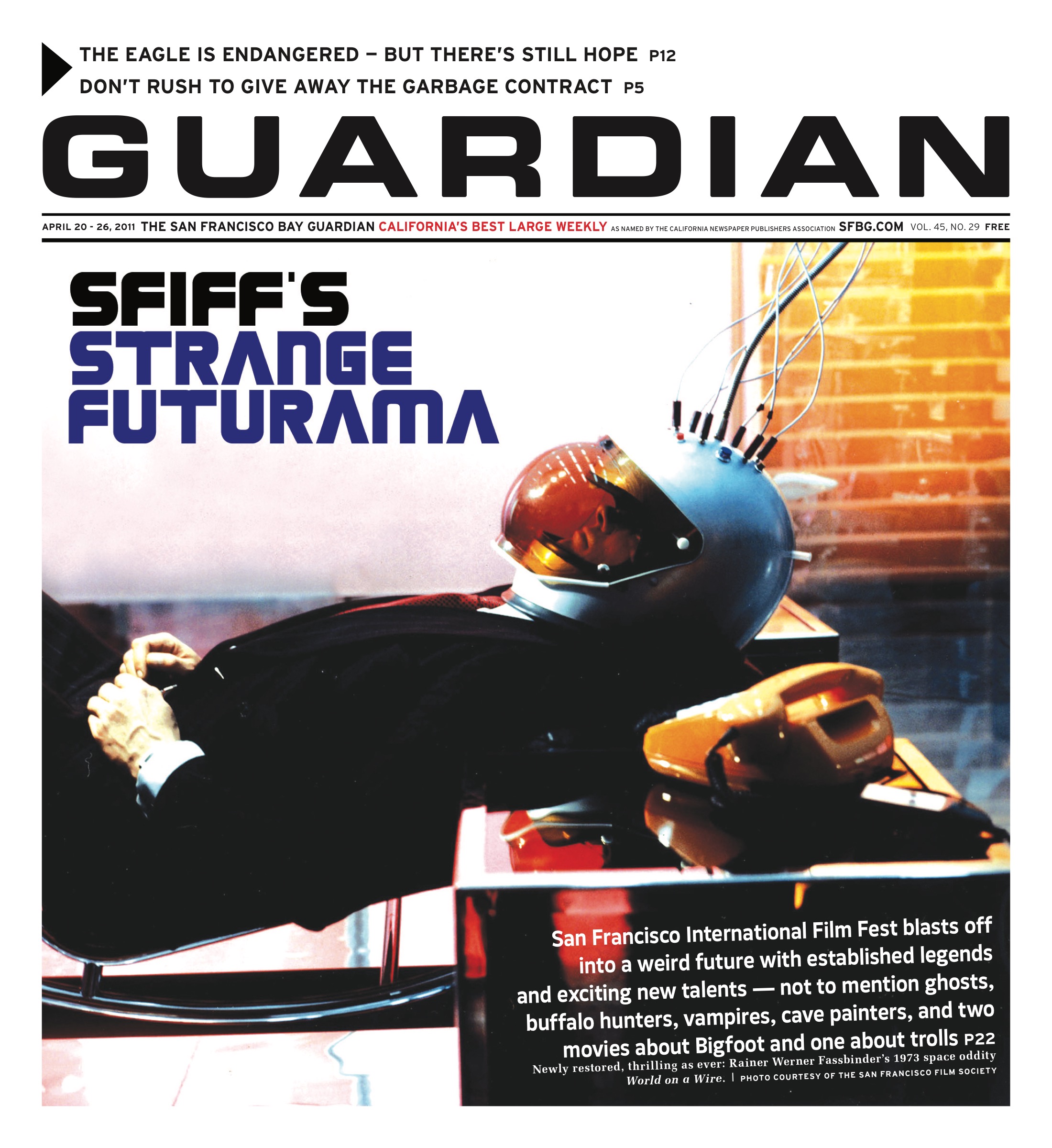
World on a Wire (Rainer Werner Fassbinder, Germany, 1973) The words “Rainer Werner Fassbinder” and “science fiction film” are enough to get certain film buffs salivating, but the Euro-trashy interior décor is almost reason enough to see this restored print of the New German Cinema master’s cyber thriller. Originally a two-part TV miniseries, World on a Wire is set in an alternate present (then 1973) in which everything seems to be made of concrete, mirror, Lucite, or orange plastic. When the inventor of a supercomputer responsible for generating an artificial world mysteriously disappears, his handsome predecessor must fight against his corporate bosses to find out what really happened, and in the process, stumbles upon a far more shattering secret about the nature of reality itself. Riffing off the understated cool of Godard’s Alphaville (1965) while beating 1999’s The Matrix to the punch by some 25 years, World on a Wire is a stylistically singular entry in Fassbinder’s prolific filmography. Sat/23, 8:45 p.m., Kabuki, and April 30, 2 p.m., PFA. (Sussman) SUN/24

A Cat in Paris (Alain Gagnol and Jean-Loup Felicioli, France/Belgium/Netherlands/Switzerland, 2010) Save your pocket poodles, please: Paris, as cities go, is most decidedly feline. From 1917’s silent serial Les Vampires to its uber-cool 1990s update Irma Vep, cat burglars and the Parisian skyline have gone together like café and au lait. Add actual cats and jazz to the mix for good measure (even Disney saw fit to set its jazzy 1970 Aristocats in the City of Light). At just over an hour long, the animated A Cat in Paris is an enjoyable little amuse-bouche that employs all the standards of the cats-in-Paris meme: Billie Holiday warbling on the soundtrack, a dashingly heroic antihero who scales the rooftops as if he studied parkour under Spider-Man, and the titular untamable black cat who serves as his partner in crime. Complete with a climatic Hitchcockian set piece on the rooftops of Notre Dame Cathedral, A Cat in Paris has a refreshingly angular and graphic, almost cubist, feel. Directors Alain Gagnol and Jean-Loup Felicioli’s work certainly doesn’t rank among that of countryman Sylvain Chomet (2010’s The Illusionist), but this family film is worth checking out if kitties up to no good in Purr-ree simply make you want to le squee. Sun/24, 12:30 p.m., Kabuki, and May 1, 12:30 p.m., New People. (Michelle Devereaux)


MON/25

Cave of Forgotten Dreams (Werner Herzog, U.S., 2010) The latest documentary from Werner Herzog once again goes where no filmmaker — or many human beings, for that matter — has gone before: the Chauvet-Pont-d’Arc Cave, a heavily-guarded cavern in Southern France containing the oldest prehistoric artwork on record. Access is highly restricted, but Herzog’s 3D study is surely the next best thing to an in-person visit. The eerie beauty of the works leads to a typically Herzog-ian quest to learn more about the primitive culture that produced the paintings; as usual, Herzog’s experts have their own quirks (like a circus performer-turned-scientist), and the director’s own wry narration is peppered with random pop culture references and existential ponderings. It’s all interwoven with footage of crude yet beautiful renderings of horses and rhinos, calcified cave-bear skulls, and other time-capsule peeks at life tens of thousands of years ago. The end result is awe-inspiring. Mon/25, 7 p.m., and Tues/26, 9:30 p.m., Kabuki. (Eddy)


TUES/26

Nostalgia for the Light (Patricio Guzmán, France/Chile/Germany, 2010) Chile’s Atacama Desert, the setting for Patricio Guzmán’s lyrically haunting and meditative documentary, is supposedly the driest place on earth. As a result, it’s also the most ideal place to study the stars. Here, in this most Mars-like of earthly landscapes, astronomers look to the heavens in an attempt to decode the origins of the universe. Guzmán superimposes images from the world’s most powerful telescopes — effluent, gaseous nebulas, clusters of constellations rendered in 3-D brilliance — over the night sky of Atacama for an even more otherworldly effect, but it’s the film’s terrestrial preoccupations that resonate most. For decades, a small, ever dwindling group of women have scoured the cracked clay of Atacama searching for loved ones who disappeared early in Augusto Pinochet’s regime. They take their tiny, toy-like spades and sift through the dirt, finding a partial jawbone here, an entire mummified corpse there. Guzmán’s attempt through voice-over to make these “architects of memory,” both astronomers and excavators alike, a metaphor for Chile’s reluctance to deal with its past atrocities is only marginally successful. Here, it’s the images that do all the talking — if “memory has a gravitational force,” their emotional weight is as inescapable as a black hole. Tues/26, 6:30 p.m., Kabuki, and April 28, 6:15 p.m., PFA. (Devereaux)

The Sleeping Beauty (Catherine Breillat, France, 2010) Fairytales are endemically Freudian; perhaps it has something to with their use of subconscious fantasy to mourn — and breathlessly anticipate — the looming loss of childhood. French provocateuse Catherine Breillat’s feminist re-imagining of The Sleeping Beauty carries her hyper-sexualized signature, but now she also has free reign to throw in bizarre and beastly metaphors for feminine and masculine desire in the form of boil-covered, dungeon-dwelling ogres, albino teenage princes, and icy-beautiful snow queens. The story follows Anastasia, a poor little aristocrat, who longs to be a boy (she calls herself “Sir Vladimir”). When her hand is pricked with a yew spindle (more of a phallic impalement, really), Anastasia falls into a 100-year adventurous slumber, eventually awakening as a sexually ripe 16-year-old. It all plays like an anchorless, Brothers Grimm version of Sally Potter’s 1992 Orlando. And while it’s definitely not for the kiddies, it’s hard to believe that many adults would find its overt symbolism and plodding narrative any more than a sporadically entertaining exercise in preciousness. Your own dreams will undoubtedly be more interesting — perhaps you can catch a few zzz’s in a theater screening this movie. Tues/26, 6:15 p.m., and April 27, 6:30 p.m., Kabuki. (Devereaux)

THE 54TH ANNUAL SAN FRANCISCO INTERNATIONAL FILM FESTIVAL runs April 21–May 5. Venues are the Sundance Kabuki, 1881 Post, SF; Castro, 429 Castro, SF; New People, 1746 Post, SF; San Francisco Museum of Modern Art, 151 Third, SF; and Pacific Film Archive, 2575 Bancroft, SF. For tickets (most shows $13) and complete schedule visit www.sffs.org>.

Music Listings

0

Music listings are compiled by Cheryl Eddy. Since club life is unpredictable, it’s a good idea to call ahead to confirm bookings and hours. Prices are listed when provided to us. Submit items for the listings at listings@sfbg.com. For further information on how to submit items for the listings, see Picks.

WEDNESDAY 20

ROCK/BLUES/HIP-HOP

Bridge, Big Light, Real Nasty Slim’s. 8pm, $13.

Cypress Hill Warfield. 8pm, $45.

Dengue Fever, Maus Haus, DJ Felina Fillmore. 8pm, $22.50.

Fucking Buckaroos, Clepto, Mano Cherga Band El Rio. 9pm, $5.

Grand Lodge 50 Mason Social House, 50 Mason, SF; www.50masonsocialhouse.com. 9pm, free.

Gregory Alan Isakov, Fairchildren Café Du Nord. 8:30pm, $14.

Janet Jackson Bill Graham Civic Auditorium, 99 Grove, SF; www.tickemaster.com. 8pm, $49.50-149.50.

Limousines, K.Flay, Young Digerati, Shitty DJ Independent. 8pm, $15.

Angie Mattson, Beth Waters Hotel Utah. 8pm, $8.

Movits!, Planet Booty, Coppe with Deghouls Bottom of the Hill. 9pm, $12.

Radiators Great American Music Hall. 9pm, $30.

Thralls, Night Surgeon, Bad Bibles Hemlock Tavern. 9pm, $6.

FOLK/WORLD/COUNTRY

Artofficial, Hot Pocket, Seneca, DJ A-Train Elbo Room. 9pm, $8.

“Jah Summit Live” Blue Macaw, 2565 Mission, SF; www.jahsummit.eventbrite.com. 9pm, $7.

JAZZ/NEW MUSIC

Lynda Carter Rrazz Room. 8pm, $45-55.

Cosmo Alleycats Le Colonial, 20 Cosmo, SF; www.lecolonialsf.com. 7pm.

Dink Dink Dink, Gaucho, Michael Abraham Amnesia. 7pm, free.

Larry Jazz Band Showroom, 1000 Van Ness, SF; www.theshowroomsf.com. 7pm, $10.

Ben Marcato and the Mondo Combo Top of the Mark. 7:30pm, $10.

Michael Parsons Revolution Café, 3248 22nd St, SF; (415) 642-0474. 8:30pm, free.

DANCE CLUBS

Booty Call Q-Bar, 456 Castro, SF; www.bootycallwednesdays.com. 9pm. Juanita Moore hosts this dance party, featuring DJ Robot Hustle.

Cannonball Beauty Bar. 10pm, free. Rock, indie, and nu-disco with DJ White Mike.

Jam Fresh Wednesdays Vessel, 85 Campton, SF; (415) 433-8585. 9:30pm, free. With DJs Slick D, Chris Clouse, Rich Era, Don Lynch, and more spinning top40, mashups, hip hop, and remixes.

Mary-Go-Round Lookout, 3600 16th St, SF; (415) 431-0306. 10pm, $5. A weekly drag show with hosts Cookie Dough, Pollo Del Mar, and Suppositori Spelling.

No Room For Squares Som., 2925 16th St, SF; (415) 558-8521. 6-10pm, free. DJ Afrodite Shake spins jazz for happy hour.

Respect Wednesdays End Up. 10pm, $5. Rotating DJs Daddy Rolo, Young Fyah, Irie Dole, I-Vier, Sake One, Serg, and more spinning reggae, dancehall, roots, lovers rock, and mash ups.

Synchronize Il Pirata, 2007 16th St, SF; (415) 626-2626. 10pm, free. Psychedelic dance music with DJs Helios, Gatto Matto, Psy Lotus, Intergalactoid, and guests.

Third Wednesdays Underground SF. 10pm-2am, $3. With Ms. Jackson, DJ Loryn, and Becky Knox spinning electro, tech, house, and breaks.

THURSDAY 21

ROCK/BLUES/HIP-HOP

Nicholas Burke, Infantree, Hugo, Damato Hotel Utah. 8pm, $8.

Crackerjack Highway 50 Mason Social House, 50 Mason, SF; www.50masonsocialhouse.com. 9pm, free.

Harderships, Mammatus Knockout. 9:30pm.

Marchfourth Marching Band Independent. 8pm, $18.

Mimosa, Paper Diamond Dillmore. 8pm, $22.50.

Off!, Culture Kids, Ecoli Eagle Tavern. 9pm.

Valerie Orth, Stringer Belle, Audiafauna Café Du Nord. 9pm, $10.

Ty Segall, Royal Baths, TRMRS, Nick Waterhouse and the Tarots Bottom of the Hill. 8:30pm, $8.

Sparrows Gate, SentiMentals, Toshio Hirano Amnesia. 9pm, $7.

Subhumans, M.D.C., Vacuum Thee Parkside. 8:30pm, $12.

System and Station, Gold Medalists, Sprains Hemlock Tavern. 9pm, $7.

Young the Giant, Man in Space, Strange Birds Slim’s. 9pm, $14.

Zeds Dead Regency Ballroom. 8pm, $20.

JAZZ/NEW MUSIC

Lynda Carter Rrazz Room. 8pm, $45-55.

Collective Revolution Café, 3248 22nd St, SF; (415) 642-0474. 8:30pm, free.

Dime Store Dandy Rite Spot, 2099 Folsom, SF; www.ritespotcafe.net. 9pm, free.

Organsm featuring Jim Gunderson and “Tender” Tim Shea Bollyhood Café. 6:30-9pm, free.

Stompy Jones Top of the Mark. 7:30pm, $10.

FOLK/WORLD/COUNTRY

Country Casanovas Atlas Café. 8-10pm, free.

Jessica Fichot Red Poppy Art House. 7pm, $12-15.

“Twang! Honky Tonk” Fiddler’s Green, 1330 Columbus, SF; www.twanghonkytonk.com. 5pm.

DANCE CLUBS

Afrolicious Elbo Room. 9:30pm, $5. DJs Pleasuremaker and Señor Oz spin Afrobeat, tropicália, electro, samba, and funk.

Base Vessel. 10pm, $10. With Three and Greg Eversoul.

Caribbean Connection Little Baobab, 3388 19th St, SF; (415) 643-3558. 10pm, $3. DJ Stevie B and guests spin reggae, soca, zouk, reggaetón, and more.

Club Jammies Edinburgh Castle. 10pm, free. DJs EBERrad and White Mice spinning reggae, punk, dub, and post punk.

Culture Corner Koko Cocktails, 1060 Geary, SF; www.kokococktails.com. 10pm, free. Roots reggae, dub, rocksteady, and classic dancehall with DJ Tomas, Yusuke, Vinnie Esparza, and Basshaka and ILWF.

Drop the Pressure Underground SF. 6-10pm, free. Electro, house, and datafunk highlight this weekly happy hour.

80s Night Cat Club. 9pm, $6 (free before 9:30pm). Two dance floors bumpin’ with the best of 80s mainstream and underground with Dangerous Dan, Skip, Low Life, and guests. This week, celebrate Robert Smith’s birthday with a Cure-themed night.

Guilty Pleasures Gestalt, 3159 16th St, SF; (415) 560-0137. 9:30pm, free. DJ TophZilla, Rob Metal, DJ Stef, and Disco-D spin punk, metal, electro-funk, and 80s.

Jivin’ Dirty Disco Butter, 354 11th St., SF; (415) 863-5964. 8pm, free. With DJs spinning disco, funk, and classics.

Mestiza Bollywood Café, 3376 19th St, SF; (415) 970-0362. 10pm, free. Showcasing progressive Latin and global beats with DJ Juan Data.

Monsoon Season El Rio. 9pm, free. World beats with DJ ExEss.

Nightvision Harlot, 46 Minna, SF; (415) 777-1077. 9:30pm, $10. DJs Danny Daze, Franky Boissy, and more spinning house, electro, hip hop, funk, and more.

1984 Mighty. 9pm, $2. The long-running New Wave and 80s party has a new venue, featuring video DJs Mark Andrus, Don Lynch, and celebrity guests.

Peaches Skylark, 10pm, free. With an all female DJ line up featuring Deeandroid, Lady Fingaz, That Girl, and Umami spinning hip hop.

Thursday Special Tralala Revolution Café, 3248 22nd St, SF; (415) 642-0474. 5pm, free. Downtempo, hip-hop, and freestyle beats by Dr. Musco and Unbroken Circle MCs.

FRIDAY 22

ROCK/BLUES/HIP-HOP

Amon Amarth Regency Ballroom. 9pm, $25.

Lynda Carter Rrazz Room. 8pm, $45-55.

Diego’s Umbrella, Vagabond Opera, Mark Growden Independent. 9pm, $15.

Disastroid, Here, Fondue El Rio. 9pm, $8.

Endoxi, Bob Hill Band Union Room (above Biscuits and Blues). 8:30pm, $10.

Glen Fajardo and Eddie Cohn 50 Mason Social House, 50 Mason, SF; www.50masonsocialhouse.com. 9pm, free.

Lost in the Trees, Sean Rowe Hemlock Tavern. 9:30pm, $10.

Mustache Harbor Café Du Nord. 9:30pm, $15.

Randy Newman Davies Symphony Hall, 201 Van Ness, SF; www.sfjazz.org. 8pm, $25-45.

Radio Moscow, Hot Lunch Thee Parkside. 9pm, $10.

“Sugar Rush: A Fundraiser Concert for the American Diabetes Association” Rasselas Jazz. 9pm, $10-20. With Jay Trainer Band, Ziva, Peggle Theory, For the Broken, and more.

Kurt Vile and the Violators, RTX, Carletta Sue Kay Bottom of the Hill. 10pm, $14.

“Yard Concert Fundraiser 2011” Dolores Park Café, 501 Dolores, SF; www.doloresparkcafe.com. 7pm, $20. With Audrey Howard, Laura Zucker, True Margit, Shelley Doty, Groovy Judy, and Sistas in the Pit.

JAZZ/NEW MUSIC

Black Market Jazz Orchestra Top of the Mark. 9pm, $10.

Les Carnegie and the Jazz Vanguards Condor, 300 Columbus, SF; www.condorsf.com. 3pm.

Ensemble Mik Nawooj Red Poppy Art House. 8pm, $10-15.

Wobbly, Ensemble Economonique, Thomas Carnacki Lab, 2948 16th St, SF; www.thelab.org. 8pm.

FOLK/WORLD/COUNTRY

Baxtalo Drom Amnesia. 9pm, $7-10.

Harvey Diller Revolution Café, 3248 22nd St, SF; (415) 642-0474. 9pm, free.

Lagos Roots AfroBeat Ensemble, DJ Jeremiah Elbo Room. 10pm, $13.

Yonder Mountain String Band Fillmore. 9pm, $25.

DANCE CLUBS

Afro Bao Little Baobab, 3388 19th St, SF; (415) 643-3558. 10pm, $5. Afro and world music with rotating DJs including Stepwise, Steve, Claude, Santero, and Elembe.

DJ Mei Lwun Medjool, 2522 Mission, SF; www.medjoolsf.com. 10:30pm, free.

Duniya Dancehall Blue Macaw, 2565 Mission, SF; (415) 920-0577. 10pm, $10. With live performances by Duniya Drum and Dance Co. and DJs dub Snakr and Juan Data spinning bhangra, bollywood, dancehall, African, and more.

Exhale, Fridays Project One Gallery, 251 Rhode Island, SF; (415) 465-2129. 5pm, $5. Happy hour with art, fine food, and music with Vin Sol, King Most, DJ Centipede, and Shane King.

Fubar Fridays Butter, 354 11th St., SF; (415) 863-5964. 6pm, $5. With DJs spinning retro mashup remixes.

Good Life Fridays Apartment 24, 440 Broadway, SF; (415) 989-3434. 10pm, $10. With DJ Brian spinning hip hop, mashups, and top 40.

Hot Chocolate Milk. 9pm, $5. With DJs Big Fat Frog, Chardmo, DuseRock, and more spinning old and new school funk.

Hubba Hubba Revue: The San Francisco Show DNA Lounge. 9pm, $10-15. Barbary Coast-themed burlesque.

PANTyRAID, LowRIZERz 103 Harriet, 1015 Folsom, SF; www.1015.com. 10pm, $25.

Psychedelic Radio Club Six. 9pm, $7. With DJs Kial, Tom No Thing, Megalodon, and Zapruderpedro spinning dubstep, reggae, and electro.

Rockabilly Fridays Jay N Bee Club, 2736 20th St, SF; (415) 824-4190. 9pm, free. With DJs Rockin’ Raul, Oakie Oran, Sergio Iglesias, and Tanoa “Samoa Boy” spinning 50s and 60s Doo Wop, Rockabilly, Bop, Jive, and more.

Some Thing Stud. 10pm, $7. VivvyAnne Forevermore, Glamamore, and DJ Down-E give you fierce drag shows and afterhours dancing.

Soul Rebel Koko Cocktails, 1060 Geary, SF; www.kokococktails.com. 10pm, free. Reggae, punk, 2tone, oi, and more with Dougie, Tim, and Tomas.

Vintage Orson, 508 Fourth St, SF; (415) 777-1508. 5:30-11pm, free. DJ TophOne and guest spin jazzy beats for cocktalians.

SATURDAY 23

ROCK/BLUES/HIP-HOP

Jello Biafra and the Guantanamo School of Medicine, Restarts, Dreadful Children, Bum City Saints Thee Parkside. 2:30pm, $10-12.

Eddie Cohn, Joyce Todd McBride and friends, Mindi Hadan, Con Brio Amnesia. 8pm, $7-10.

Foreverland, Sex With No Hands Bimbo’s 365 Club. 9pm, $22.

Daryl Hance Brick and Mortar Music Hall, 1710 Mission, SF; www.brickandmortarmusic.com.

“Lyrics Born presents Continuum” Yoshi’s San Francisco. 10:30pm, $26. With full live band and special guests.

Silly Pink Bunnies! Thee Parkside. 7pm, free.

Spectrum, Spyrals Hemlock Tavern. 9:30pm, $15.

Two Gallants Bottom of the Hill. 10pm, $15.

“UK Reunion Tour” Regency Ballroom. 8pm, $65-99. Featuring Eddie Jobson and John Wetton.

Yoni Wolf, Moore Brothers, Becky Wolf and Amy Miller Swedish American Hall (upstairs from Café Du Nord). 8pm, $15.

JAZZ/NEW MUSIC

Erin Brazill 50 Mason Social House, 50 Mason, SF; www.50masonsocialhouse.com. 9pm, free.

Garage a Trois, Amendola vs. Blades Independent. 9pm, $20.

Buddy Guy, John Németh Davies Symphony Hall, 201 Van Ness, SF; www.sfjazz.org. 8pm, $20-65.

Nucleus Revolution Café, 3248 22nd St, SF; (415) 642-0474. 9pm, free.

FOLK/WORLD/COUNTRY

Back49 Riptide Tavern. 9:45pm, free.

Lady A and the Heel Draggers, Misisipi Mike and the Midnight Gamblers, West Nile Ramblers, Bootcuts, DJ Blaze Orange Café Du Nord. 8:30pm, $13.

Quijeremá Red Poppy Art House. 8pm, $12-15.

“Sounds and Rhythms of Afghanistan” Herbst Theatre, 401 Van Ness, SF; (415) 621-6600. 8pm, $25-75.

Craig Ventresco and Meredith Axelrod Atlas Café. 4pm, free.

Yonder Mountain String Band Fillmore. 9pm, $25.

DANCE CLUBS

Afro Bao Little Baobab, 3388 19th St, SF; (415) 643-3558. 10pm, $5. Afro and world music with rotating DJs including Stepwise, Steve, Claude, Santero, and Elembe.

Barracuda 111 Minna. 9pm, $10. Eclectic 80s music with DJs Damon and Phillie Ocean plus 80s cult video projections, a laser light show, prom balloons, and 80s inspired fashion.

Bootie SF: DJ Tripp’s Birthday DNA Lounge. 9pm, $8-15. Mash-ups with DJ Tripp, David X, Mykill, and more.

Debaser Knockout. 9pm, $5. DJ Jamie Jams, EmDee, and Stab Master Arson spin 90s hip-hop jams.

DJ Clee Medjool, 2522 Mission, SF; www.medjoolsf.com. 10:30pm, free.

Fog and Laser Rickshaw Stop. 9pm, $7. DJs EmDee and RamblinWorker host this anything-goes, genre-free dance party.

4OneFunktion Elbo Room. 10pm, $5-10. Starship 27 Vol. 2 release party with guest performers Diabase, J-1, the 4OneFunktion All-Stars, and more.

Go Bang! Deco Lounge, 501 Larkin, SF; www.decosf.com. 9pm, $5. Atomic dancefloor disco action with Nicky B, Derrick Love, and more.

Mango El Rio. 3-8:30pm, $8-10. Sweet, sexy fun for women with DJs Edaj, Marcella, Olga, and La Coqui.

Reggae Gold Club Six. 9pm, $15. With DJs Daddy Rolo, Polo Mo’qz, Tesfa, Serg, and Fuze spinning dancehall and reggae.

Rock City Butter, 354 11th St., SF; (415) 863-5964. 6pm, $5 after 10pm. With DJs spinning party rock.

Spirit Fingers Sessions 330 Ritch. 9pm, free. With DJ Morse Code and live guest performances.

SUNDAY 24

ROCK/BLUES/HIP-HOP

“Aftermath: A Citizen to Citizen Tsunami Rescue and Relief Benefit” Thee Parkside. 8pm, $7-10. With Ass Baboons of Venus, Thunders, Tiger Honey Pot, and DJs Nako, Korri, and Lil Joe.

Alter Bridge, Black Stone Cherry, Like A Storm Regency Ballroom. 8pm, $28.

Eastern Conference Champs, Red Cortez, Apopka Darkroom Hemlock Tavern. 9pm, $8.

“It Gets Indie: A Benefit for It Gets Better and the Trevor Project” Great American Music Hall. 7:30pm, $25. With Rabbit! and Handshakes.

“JAMband Family Festival” Park Chalet, 1000 Great Hwy, SF; www.jamjamjam.com. 11am, free. With Charity Kahn.

Tower of Dudes, Graves Brothers Deluxe, Tunnel Make-Out Room. 8pm, $7.

Two Gallants Bottom of the Hill. 9pm, $15.

JAZZ/NEW MUSIC

Tom Lander Duo Medjool, 2522 Mission, SF; www.medjoolsf.com. 6-9pm, free.

FOLK/WORLD/COUNTRY

Family Folk Explosion Revolution Café, 3248 22nd St, SF; (415) 642-0474. 8:30pm, free.

Louis Romero and Mazacote El Rio. 5-8pm, $8.

Tater Famine Thee Parkside. 4pm, free.

DANCE CLUBS

Batcave Cat Club. 10pm, $5. Death rock, goth, and post-punk with Steeplerot Necromos and c_death.

Branded James Rickshaw Stop. 8pm, $5. Benefit for Back to Business career workshops.

Dub Mission Elbo Room. 9pm, $6. Dub, roots, and classic dancehall with DJ Sep, Ludachris, and guest Janaka Selekta.

Gloss Sundays Trigger, 2344 Market, SF; (415) 551-CLUB. 7pm. With DJ Hawthorne spinning house, funk, soul, retro, and disco.

Honey Soundsystem Paradise Lounge. 8pm-2am. “Dance floor for dancers – sound system for lovers.” Got that?

La Pachanga Blue Macaw, 2565 Mission, SF; www.thebluemacawsf.com. 6pm, $10. Salsa dance party with live Afro-Cuban salsa bands.

MONDAY 25

ROCK/BLUES/HIP-HOP

Travis Barker and Mix Master Mike Independent. 9pm, $30-50.

Mad Rad, Mash Hall, Toast Elbo Room. 9pm, $10.

Paul Simon Davies Symphony Hall, 201 Van Ness, SF; www.ticketmaster.com. 8pm, $65-125.

DANCE CLUBS

Death Guild DNA Lounge. 9:30pm, $3-5. Gothic, industrial, and synthpop with Joe Radio, Decay, and Melting Girl.

Krazy Mondays Beauty Bar. 10pm, free. With DJs Ant-1, $ir-Tipp, Ruby Red I, Lo, and Gelo spinning hip hop.

M.O.M. Madrone Art Bar. 6pm, free. With DJ Gordo Cabeza and guests playing all Motown every Monday.

Network Mondays Azul Lounge, One Tillman Pl, SF; www.inhousetalent.com. 9pm, $5. Hip-hop, R&B, and spoken word open mic, plus featured performers.

Sausage Party Rosamunde Sausage Grill, 2832 Mission, SF; (415) 970-9015. 6:30-9:30pm, free. DJ Dandy Dixon spins vintage rock, R&B, global beats, funk, and disco at this happy hour sausage-shack gig.

Skylarking Skylark. 10pm, free. With resident DJs I & I Vibration, Beatnok, and Mr. Lucky and weekly guest DJs.

TUESDAY 26

ROCK/BLUES/HIP-HOP

Civil War Rust, Cut Downs, Sheens Bottom of the Hill. 9pm, $8.

Jamaica, Chain Gang of 1974 Independent. 8pm, $15.

Outlaws and Preachers, Ghost Town Refugees John Colins, 138 Minna, SF; www.johncolins.com. 9pm, $5.

Ash Reiter, Radiation City, Phantom Kicks Hemlock Tavern. 9pm, $6.

Sugarspun, Silver Threads El Rio. 7pm, free.

tUnE-yArDs, Buke and Gass, Man/Miracle

Whiskey Avengers, Franco Nero, DJ Ras Fank Elbo Room. 9pm, $5.

FOLK/WORLD/COUNTRY

Quiet Echos Revolution Café, 3248 22nd St, SF; (415) 642-0474. 8:30pm, free.

DANCE CLUBS

Eclectic Company Skylark, 9pm, free. DJs Tones and Jaybee spin old school hip hop, bass, dub, glitch, and electro.

Share the Love Trigger, 2344 Market, SF; (415) 551-CLUB. 5pm, free. With DJ Pam Hubbuck spinning house.

 

Film Listings

0

Film listings are edited by Cheryl Eddy. Reviewers are Kimberly Chun, Michelle Devereaux, Peter Galvin, Max Goldberg, Dennis Harvey, Johnny Ray Huston, Louis Peitzman, Lynn Rapoport, Ben Richardson, and Matt Sussman. For rep house showtimes, see Rep Clock. For first-run showtimes, see Movie Guide.

SAN FRANCISCO INTERNATIONAL FILM FESTIVAL

The 54th annual San Francisco International Film Festival runs April 21–May 5. Venues are the Sundance Kabuki, 1881 Post, SF; Castro, 429 Castro, SF; New People, 1746 Post, SF; San Francisco Museum of Modern Art, 151 Third, SF; and Pacific Film Archive, 2575 Bancroft, SF. For tickets (most shows $13) and complete schedule visit www.sffs.org.

THURS/21

Castro Beginners 7.

FRI/22

Kabuki The Place In Between 2. “Irresistable Impulses” (shorts program) 3:15. The Good Life 3:45. Miss Representation 6. Hahaha 6:15. I’m Glad My Mother is Alive 6:45. Attenberg 7. Walking Too Fast 8:45. Meek’s Cutoff 9. Microphone 9:15. The City Below 9:30. Stake Land 11:30.

New People Hot Coffee 6:30. Nainsukh 9:15.

PFA Silent Souls 7. Jean Gentil 8:40.

SAT/23

Kabuki “Youth Media Mash-Up” noon. Mysteries of Lisbon 12:15. The Autobiography of Nicolae Ceausescu 12:45. The Colors of the Mountain 1. Year Without a Summer 3. Life, Above All 4. “Mind the Gap” (shorts program) 4:45. Better This World 6. The Future 6:15. Le Quattro Volte 6:45. The Light Thief 7:15. World on a Wire 8:45. Living On Love Alone 9:30. “Get With the Program” (shorts program) 9:45. The Troll Hunter 11:30.

New People Pink Saris 1. The Last Buffalo Hunt 3:20. The Pipe 6. Hospitalité 9.

SFMOMA The Mill and the Cross 12:30. !Women Art Revolution 3.

PFA Foreign Parts 2:15. The Green Wave 4. Autumn 6:15. The High Life 8:40.

SUN/24

Kabuki “Irresistable Impulses” (shorts program) noon. A Cat in Paris 12:30. Jean Gentil 1. Nainsukh 2:30. The Green Wave 2:45. Walking Too Fast 3. “Cupid With Fangs” (shorts program) 3:15. Silent Souls 4:45. Crime After Crime 6. At Ellen’s Age 6:15. The Colors of the Mountain 6:30. “The Deep End” (shorts program) 7. Asleep in the Sun 8:45. “State of Cinema: Christine Vachon” 9. The Stool Pigeon 9:15. “From A to Zellner” (shorts program) 9:45.

New People A Useful Life noon. Microphone 2. The Autobiography of Nicolae Ceausescu 5:15. The Future 9:15.

PFA Something Ventured 2. Children of the Princess of Cleves 4:15. Chantrapas 6:15. The Arbor 8:45.

MON/25

Kabuki Children of the Princess of Cleves 2. The City Below 4. Meek’s Cutoff 4:30. Hot Coffee 6:30. Autumn 6:45. Cave of Forgotten Dreams 7. She Monkeys 7:15. Salon: The Social Justice Documentary 8:30. Hahaha 9. The Light Thief 9:15. I’m Glad My Mother is Alive 9:30. Stake Land 9:45.

New People The Troll Hunter 6:15. Year Without a Summer 9:15.

PFA A Useful Life 7. !Women Art Revolution 8:40.

TUES/26

Kabuki Hot Coffee 2. Hahaha 3:30. Ulysses 4. Chantrapas 6. Jean Gentil 6. The Sleeping Beauty 6:15. Nostalgia for the Light 6:30. She Monkeys 8:45. New Skin For the Old Ceremony 9. The Whistleblower 9:15. Cave of Forgotten Dreams 9:30.

New People The Last Buffalo Hunt 6:30. “Cupid With Fangs” (shorts program) 9.

PFA Better This World 6:30. Position Among the Stars 8:50.

OPENING

African Cats This Earth Day release, narrated by Samuel L. Jackson, follows cheetah and lions on the African savanna. (1:40) Shattuck.

Ceremony It’s easy to dismiss Ceremony as derivative. The plot isn’t exactly original. But recycled material aside, it’s an entertaining indie diversion and a promising feature-length debut from writer-director Max Winkler. The underrated Michael Angarano stars as Sam Davis, a pretentious shit who owes a lot to Holden Caulfield by way of Rushmore‘s Max Fischer. Sam tricks his best friend Marshall (Reece Thompson) into accompanying him on a weekend getaway, with the real objective of winning back his lost love Zoe (Uma Thurman). But Zoe is all set to marry blowhard Whit Coutell (Lee Pace) and is not too keen on blowing off her wedding. None of the characters are all that likable — a quirky indie comedy must — and there are few surprises. But Winkler’s script is cute, and his cast is charming enough to carry the material along. The scenes between Angarano and Thompson are the film’s best. Here’s hoping they stand out enough to earn these young actors the recognition they deserve. (1:40) Lumiere. (Peitzman)

Pom Wonderful Presents: The Greatest Movie Ever Sold Don’t even think about shortening the title: Morgan Spurlock’s new documentary POM Wonderful Presents: The Greatest Story Ever Sold is ingenious, bitingly funny, and made possible by corporate sponsorship. POM paid good money to earn a spot about the title, so damned if I’m going to leave them out. Instead of keeping product placement subliminal — or at least trying — Spurlock shows exactly what goes into the popular marketing practice. His film isn’t so much critical as it is honest: he doesn’t fight product placement, but rather embraces it to his own advantage. It’s win-win. Spurlock gets to make his movie without losing any cash, and the audience gets a hilarious insider look into a mostly hidden facet of advertising. As he says, it’s about transparency, and no one can claim Spurlock is trying to go behind our backs. And what of the advertising that pops up throughout the film? I can only speak to my own experience, but yes, I’m drinking POM as I write this. (1:26) SF Center. (Peitzman)

Red, White and Blue Noah Taylor stars in this mystery punctuated by shocking twists. (1:42) Roxie.

Trust A teenager is victimized by an internet predator in this drama. Clive Owen and Catherine Keener play her horrified parents. (1:55) Opera Plaza.

Tyler Perry’s Madea’s Big Happy Family She’s baaack. (2:00) Shattuck.

Water for Elephants A young man (Robert Pattinson) joins a circus (populated by the likes of Reese Witherspoon and Christoph Waltz) in this drama based on the best-selling novel. (2:00) Balboa, Marina.

White Irish Drinkers What is 20-year TV veteran John Gray (of series The Ghost Whisperer) doing writing-directing yet another indie Mean Streets (1973) knockoff? That’s fresh-outta-film-school business. Why is anyone doing one of those so long after the expiration date for that second (or by now third) generation shit? This trip down some very familiar roads — 1997’s Good Will Hunting and 1977’s Saturday Night Fever being others — stars SF native Nick Thurston as a 1975 Brooklyn youth with a violent alcoholic father (Stephen Lang), long-suffering mother (Karen Allen), and an older brother drifting into criminality (Geoffrey Wigdor). As outside influences this talented closet artist has the requisite upscaling girl (Leslie Murphy) urging him to dream big, and a wistfully downtrodden employer (Peter Riegert) providing the plot gimmick as a failing movie-palace owner who hopes to turn around his fortunes with a one-night-stand by the Rolling Stones. Everything about White Irish Drinkers feels recycled from other movies. Though the performers work hard and the progress is entertaining enough, there’s way too much déjà vu here for one film to bear and still stand on its own punch-drunk legs. (1:49) Lumiere, Shattuck. (Harvey)

ONGOING

The Adjustment Bureau As far as sci-fi romantic thrillers go, The Adjustment Bureau is pretty standard. But since that’s not an altogether common genre mash-up, I guess the film deserves some points for creativity. Based on a short story by Philip K. Dick, The Adjustment Bureau takes place in a world where all of our fates are predetermined. Political hotshot David Norris (Matt Damon) is destined for greatness — but not if he lets a romantic dalliance with dancer Elise (Emily Blunt) take precedence. And in order to make sure he stays on track, the titular Adjustment Bureau (including Anthony Mackie and Mad Men‘s John Slattery) are there to push him in the right direction. While the film’s concept is intriguing, the execution is sloppy. The Adjustment Bureau suffers from flaws in internal logic, allowing the story to skip over crucial plot points with heavy exposition and a deus ex machina you’ve got to see to believe. Couldn’t the screenwriter have planned ahead? (1:39) Balboa, Shattuck. (Peitzman)

Arthur (1:45) Empire, 1000 Van Ness, SF Center.

Atlas Shrugged (1:57) Shattuck, SF Center.

*Bill Cunningham New York To say that Bill Cunningham, the 82-year old New York Times photographer, has made documenting how New Yorkers dress his life’s work would be an understatement. To be sure, Cunningham’s two decades-old Sunday Times columns — “On the Street,” which tracks street-fashion, and “Evening Hours,” which covers the charity gala circuit — are about the clothes. And, my, what clothes they are. But Cunningham is a sartorial anthropologist, and his pictures always tell the bigger story behind the changing hemlines, which socialite wore what designer, or the latest trend in footwear. Whether tracking the near-infinite variations of a particular hue, a sudden bumper-crop of cropped blazers, or the fanciful leaps of well-heeled pedestrians dodging February slush puddles, Cunningham’s talent lies in his ability to recognize fleeting moments of beauty, creativity, humor, and joy. That last quality courses through Bill Cunningham New York, Richard Press’ captivating and moving portrait of a man whose reticence and personal asceticism are proportional to his total devotion to documenting what Harold Koda, chief curator at the Costume Institute at the Metropolitan Museum of Art, describes in the film as “ordinary people going about their lives, dressed in fascinating ways.” (1:24) Embarcadero, Shattuck. (Sussman)

Certified Copy Abbas Kiarostami’s beguiling new feature signals “relationship movie” with every cobblestone step, but it’s manifestly a film of ideas — one in which disillusionment is as much a formal concern as a dramatic one. Typical of Kiarostami’s dialogic narratives, Certified Copy is both the name of the film and an entity within the film: a book written against the ideal of originality in art by James Miller (William Shimell), an English pedant fond of dissembling. After a lecture in Tuscany, he meets an apparent admirer (Juliette Binoche) in her antique shop. We watch them talk for several minutes in an unbroken two-shot. They gauge each other’s values using her sister as a test case — a woman who, according to the Binoche character, is the living embodiment of James’ book. Do their relative opinions of this off-screen cipher constitute characterization? Or are they themselves ciphers of the film’s recursive structure? Kiarostami makes us wonder. They begin to act as if they were married midway through the film, though the switch is not so out of the blue: Kiarostami’s narrative has already turned a few figure-eights. Several critics have already deemed Certified Copy derivative of many other elliptical romances; the strongest case for an “original” comes of Roberto Rossellini’s Voyage to Italy (1954). The real difference is that while Rossellini’s masterpiece realizes first-person feelings in a third-person approach, Kiarostami stays in the shadow of doubt to the end. (1:46) Opera Plaza, Smith Rafael. (Goldberg)

*Circo The old notion of “running away with the circus” seldom seemed appealing — conjuring images of following an elephant around with a shovel — and it grows even less so after watching Aaron Schock’s warm, touching documentary. The kids here might one day run away from the circus. They’re born into Grand Circo Mexico, one of four circuses run by the Ponce family, which has been in this business for generations; if they’re old enough to walk, they’re old enough to perform, and help with the endless setup and breakdown chores. (Presumably child labor laws are an innovation still waiting to happen here.) Touring Mexico’s small towns in trucks with a variety of exotic animals, it’s a life of labor, with on-the-job training in place of school — arguably not much of a life for child, as current company leader Tino’s wife Ivonne (who really did run away with the circus, or rather him, at age 15) increasingly insists. Other family members have split for a normal life, and Tino is caught between loyalty to his parents’ ever-struggling business and not wanting to lose the family he’s raised himself. This beautifully shot document, scored by Calexico and edited by Mark Becker (of 2005’s marvelous Romantico), is a disarming look at a lifestyle that feels almost 19th century, and is barely hobbling into the 21st one. (1:15) Lumiere, Shattuck. (Harvey)

The Conspirator It may not be your standard legal drama, but The Conspirator is a lot more enjoyable when you think of it as an extended episode of Law & Order. The film chronicles the trial of Mary Surratt (Robin Wright), the lone woman charged in the conspiracy to assassinate Abraham Lincoln. It’s a fascinating story, especially for those who don’t know much of the history past John Wilkes Booth. But while the subject matter is compelling, the execution is hit-or-miss. Wright is sympathetic as Surratt, but the usually great James McAvoy is somewhat forgettable in the pivotal role of Frederick Aiken, Surratt’s conflicted lawyer. It’s hard to say what it is that’s missing from The Conspirator: the cast — which also includes Evan Rachel Wood and Tom Wilkinson — is great, and this is a story that’s long overdue to be told. Still, something is lacking. Could it be the presence of everyone’s favorite detective, the late Lennie Briscoe? (2:02) Embarcadero, Empire, 1000 Van Ness, Piedmont, Presidio. (Peitzman)

*Hanna The title character of Hanna falls perfectly into the lately very popular Hit-Girl mold. Add a dash of The Boys from Brazil-style genetic engineering — Hanna has the unfair advantage, you see, when it comes to squashing other kids on the soccer field or maiming thugs with her bare hands — and you have an ethereal killing/survival machine, played with impassive confidence by Atonement (2007) shit-starter Saoirse Ronan. She’s been fine-tuned by her father, Erik (Eric Bana), a spy who went out into the cold and off the grid, disappearing into the wilds of Scandinavia where he home-schooled his charge with an encyclopedia and brutal self-defense and hunting tests. Atonement director Joe Wright plays with a snowy palette associated with innocence, purity, and death — this could be any time or place, though far from the touch of modern childhood stresses: that other Hannah (Montana), consumerism, suburban blight, and academic competition. The 16-year-old Hanna, however, isn’t immune from that desire to succeed. Her game mission: go from a feral, lonely existence into the modern world, run for her life, and avenge the death of her mother by killing Erik’s CIA handler, Marissa (Cate Blanchett). The nagging doubt: was she born free, or Bourne to be a killer? Much like the illustrated Brothers Grimm storybook that she studies, Hanna is caught in an evil death trap of fairytale allegories. One wonders if the super-soldier apple didn’t fall far from the tree, since evil stepmonster Marissa oversaw the program that produced Hanna — the older woman and the young girl have the same cold-blooded talent for destruction and the same steely determination. Yet there’s hope for the young ‘un. After learning that even her beloved father hid some basic truths from her, this natural-born killer seems less likely to go along with the predetermined ending, happy or no, further along in her storybook life. (1:51) Empire, Four Star, 1000 Van Ness, SF Center. (Chun)

Henry’s Crime Keanu Reeves is one of those actors who’s spectacularly franchise-wealthy — due to those Matrix movies wherein his usual baffled solemnity was ideal — yet whom the public otherwise feels scant evident loyalty toward, and producers don’t know what to do with. Now that he’s aging out of his looks, can he transform into a character actor? Maybe. Reeves played charming suitors in Something’s Gotta Give (2003) and The Private Lives of Pippa Lee (2009), both very much supporting roles. He seems increasingly interested in indie films, which he surely doesn’t need to pay the rent, and he’s certainly the best reason to see Henry’s Crime, a pleasant, middling, retro crime caper costarring frequently better actors at dimmer wattage than usual. The film is an old hat out of the Damon Runyon trunk, in which lovable crooks mix it up with hoity theatrical types and nobody gets hurt except (barely) the really bad guys. James Caan — who starred in similar enterprises during their post-The Sting heyday plays the veteran convict-conman who schools Reeves’ hapless Buffalo, N.Y., toll-taker Henry after our hero is slammer-thrown for an armed robbery he didn’t know he was embroiled in until it was over. Upon release, Henry discovers the targeted bank and nearby theater had a Prohibition-era secret tunnel between them. Having already done the time, he figures he might as well do the crime by finishing the aborted bank job for real. He enlists local stage diva Julie (Vera Farmiga) as well as Caan’s parole-coaxed Max. Resulting wacky hijinks render Max a theater “volunteer” and Henry as Julie’s Cherry Orchard costar, all so they can access the walled-up passageway to the bank vault. Much of this is ridiculous, of course, and not intentionally so. The climax is classic movies-getting-how-theater-works-wrong. But its contrivance functions to some extent because the lead actor convinces us it should. (1:48) Embarcadero. (Harvey)

Hop (1:30) 1000 Van Ness, Shattuck.

*In a Better World Winner of this year’s Best Foreign Language Film Oscar, this latest from Danish director Susanne Bier (2004’s Brothers, 2006’s After the Wedding) and her usual co-scenarist Anders Thomas Jensen (2005’s Adam’s Apples, 2003’s The Green Butchers) is a typically engrossing, complex drama that deals with the kind of rage for “personal justice” that can lead to school and workplace shootings, among other things (like terrorism). Shy, nervous ten-year-old Elias (Markus Rygaard) needs a confidence boost, but things are worrying both at home and elsewhere. His parents are estranged, and his doting father (Mikael Persbrandt) is mostly away as a field hospital in Kenya tending victims of local militias. At school, he’s an easy mark for bullies, a fact which gets the attention of charismatic, self-assured new kid Christian (William Jøhnk Nielsen), who appoints himself Elias’ new (and only) friend — then when his slightly awed pal is picked on again, intervenes with such alarming intensity that the police are called. Christian appears a little too prone to violence and harsh judgment in teaching “lessons” to those he considers in the wrong; his own domestic situation is another source of anger, as he simplistically blames his earnest, distracted executive father (Ulrich Thomsen) for his mother’s recent cancer death. Is Christian a budding little psychopath, or just a kid haplessly channeling his profound loss? Regardless, when an adult bully (Kim Bodnia as a loutish mechanic) humiliates Elias’ father in front of the two boys, Christian pulls his reluctant friend into a pursuit of vengeance that surely isn’t going to end well. With their nuanced yet head-on treatment of hot button social and ethical issues, Bier and Jensen’s work can sometimes border on overly-schematic melodrama, meting out its own secular-humanist justice a bit too handily, like 21st-century cinematic Dickenses. But like Dickens, they also have a true mastery of the creating striking characters and intricately propulsive plotlines that illustrate the points at hand in riveting, hugely satisfying fashion. This isn’t their best. But it’s still pretty excellent, and one of those universally accessible movies you can safely recommend even to people who think they don’t like foreign or art house films. (1:53) Embarcadero, Shattuck. (Harvey)

Insidious (1:42) 1000 Van Ness.

*Jane Eyre Do we really need another adaptation of Jane Eyre? As long as they’re all as good as Cary Fukunaga’s stirring take on the gothic romance, keep ’em coming. Mia Wasikowska stars in the titular role, with the dreamy Michael Fassbender stepping into the high pants of Edward Rochester. The cast is rounded out by familiar faces like Judi Dench, Jamie Bell, and Sally Hawkins — all of whom breathe new life into the material. It helps that Fukunaga’s sensibilities are perfectly suited to the story: he stays true to the novel while maintaining an aesthetic certain to appeal to a modern audience. Even if you know Jane Eyre’s story — Mr. Rochester’s dark secret, the fate of their romance, etc. — there are still surprises to be had. Everyone tells the classics differently, and this adaptation is a thoroughly unique experience. And here’s hoping it pushes the engaging Wasikowska further in her ascent to stardom. (2:00) Albany, Embarcadero, Piedmont, Presidio. (Peitzman)

Kill the Irishman If you enjoy 1970s-set Mafia movies featuring characters with luxurious facial hair zooming around in Cadillacs, flossing leather blazers, and outwitting cops and each other — you could do a lot worse than Kill the Irishman, which busts no genre boundaries but delivers enjoyable retro-gangsta cool nonetheless. Adapted from the acclaimed true crime book by a former Cleveland police lieutenant, the film details the rise and fall of Danny Greene, a colorful and notorious Irish-American mobster who both served and ran afoul of the big bosses in his Ohio hometown. During one particularly conflict-ridden period, the city weathered nearly 40 bombings — buildings, mailboxes, and mostly cars, to the point where the number of automobiles going sky-high is almost comical (you’d think these guys would’ve considered taking the bus). The director of the 2004 Punisher, Jonathan Hensleigh, teams up with the star of 2008’s Punisher: War Zone, Ray Stevenson, who turns in a magnetic performance as Greene; it’s easy to see how his combination of book- and street smarts (with a healthy dash of ruthlessness) buoyed him nearly to the top of the underworld. The rest of the cast is equally impressive, with Vincent D’Onofrio, Val Kilmer, Christopher Walken, and Linda Cardellini turning in supporting roles, plus a host of dudes who look freshly defrosted from post-Sopranos storage. (1:46) Opera Plaza. (Eddy)

The King’s Speech Films like The King’s Speech have filled a certain notion of “prestige” cinema since the 1910s: historical themes, fully-clothed romance, high dramatics, star turns, a little political intrigue, sumptuous dress, and a vicarious taste of how the fabulously rich, famous, and powerful once lived. At its best, this so-called Masterpiece Theatre moviemaking can transcend formula — at its less-than-best, however, these movies sell complacency, in both style and content. In The King’s Speech, Colin Firth plays King George VI, forced onto the throne his favored older brother Edward abandoned. This was especially traumatic because George’s severe stammer made public address tortuous. Enter matey Australian émigré Lionel Logue (Geoffrey Rush, mercifully controlled), a speech therapist whose unconventional methods include insisting his royal client treat him as an equal. This ultimately frees not only the king’s tongue, but his heart — you see, he’s never had anyone before to confide in that daddy (Michael Gambon as George V) didn’t love him enough. Aww. David Seidler’s conventionally inspirational script and BBC miniseries veteran Tom Hooper’s direction deliver the expected goods — dignity on wry, wee orgasms of aesthetic tastefulness, much stiff-upper-lippage — at a stately promenade pace. Firth, so good in the uneven A Single Man last year, is perfect in this rock-steadier vehicle. Yet he never surprises us; role, actor, and movie are on a leash tight enough to limit airflow. (1:58) Shattuck. (Harvey)

*Limitless An open letter to the makers of Limitless: please fire your marketing team because they are making your movie look terrible. The story of a deadbeat writer (Bradley Cooper) who acquires an unregulated drug that allows him to take advantage of 100 percent of his previously under-utilized brain, Limitless is silly, improbable and features a number of distracting comic-book-esque stylistic tics. But consumed with the comic book in mind, Limitless is also unpredictable, thrilling, and darkly funny. The aforementioned style, which includes many instances of the infinite regression effect that you get when you point two mirrors at each other, and a heavy blur to distort depth-of-field, only solidifies the film’s cartoonish intentions. Cooper learns foreign languages in hours, impresses women with his keen attention to detail, and sets his sights on Wall Street, a move that gets him noticed by businessman Carl Van Loon (Robert DeNiro in a glorified cameo) as well as some rather nasty drug dealers and hired guns looking to cash in on the drug. Limitless is regrettably titled and masquerades in TV spots as a Wall Street series spin-off, but in truth it sports the speedy pacing and tongue-in-cheek humor required of a good popcorn flick. (1:37) California, Four Star, 1000 Van Ness, SF Center. (Galvin)

*The Lincoln Lawyer Outfitted with gym’d-tanned-and-laundered manly blonde bombshells like Matthew McConaughey, Josh Lucas, and Ryan Phillippe, this adaptation of Michael Connelly’s LA crime novel almost cries out for an appearance by the Limitless Bradley Cooper — only then will our cabal of flaxen-haired bros-from-other-‘hos be complete. That said, Lincoln Lawyer‘s blast of morally challenged golden boys nearly detracts from the pleasingly gritty mise-en-scène and the snappy, almost-screwball dialogue that makes this movie a genre pleasure akin to a solid Elmore Leonard read. McConaughey’s criminal defense attorney Mickey Haller is accustomed to working all the angles — hence the title, a reference to a client who’s working off his debt by chauffeuring Haller around in his de-facto office: a Lincoln Town Car. Haller’s playa gets truly played when he becomes entangled with Louis Roulet (Phillippe), a pretty-boy old-money realtor accused of brutally attacking a call girl. Loved ones such as Haller’s ex Maggie (Marisa Tomei) and his investigator Frank (William H. Macy) are in jeopardy — and in danger of turning in some delightfully textured cameos — in this enjoyable walk on the sleazy side of the law, the contemporary courtroom counterpart to quick-witted potboilers like Sweet Smell of Success (1957). (1:59) Four Star, 1000 Van Ness. (Chun)

Miral (1:42) California.

*Of Gods and Men It’s the mid-1990s, and we’re in Tibhirine, a small Algerian village based around a Trappist monastery. There, eight French-born monks pray and work alongside their Muslim neighbors, tending to the sick and tilling the land. An emboldened Islamist rebel movement threatens this delicate peace, and the monks must decide whether to risk the danger of becoming pawns in the Algerian Civil War. On paper, Of Gods and Men sounds like the sort of high-minded exploitation picture the Academy swoons over: based on a true story, with high marks for timeliness and authenticity. What a pleasant surprise then that Xavier Beauvois’s Cannes Grand Prix winner turns out to be such a tightly focused moral drama. Significantly, the film is more concerned with the power vacuum left by colonialism than a “clash of civilizations.” When Brother Christian (Lambert Wilson) turns away an Islamist commander by appealing to their overlapping scriptures, it’s at the cost of the Algerian army’s suspicion. Etienne Comar’s perceptive script does not rush to assign meaning to the monks’ decision to stay in Tibhirine, but rather works to imagine the foundation and struggle for their eventual consensus. Beauvois occasionally lapses into telegraphing the monks’ grave dilemma — there are far too many shots of Christian looking up to the heavens — but at other points he’s brilliant in staging the living complexity of Tibrihine’s collective structure of responsibility. The actors do a fine job too: it’s primarily thanks to them that by the end of the film each of the monks seems a sharply defined conscience. (2:00) Albany, Opera Plaza. (Goldberg)

*Poetry Sixtysomething Mija (legendary South Korean actor Yun Jung-hee) impulsively crashes a poetry class, a welcome shake-up in a life shaped by unfulfilling routines. In order to write compelling verse, her instructor says, it is important to open up and really see the world. But Mija’s world holds little beauty beyond her cheerful outfits and beloved flowers; most pressingly, her teenage grandson, a mouth-breathing lump who lives with her, is completely remorseless about his participation in a hideous crime. In addition, she’s just been disgnosed with the early stages of Alzheimer’s, and the elderly stroke victim she housekeeps for has started making inappropriate advances. Somehow writer-director Lee Chang-dong (2007’s Secret Sunshine) manages not to deliver a totally depressing film with all this loaded material; it’s worth noting Poetry won the Best Screenplay Award at the 2010 Cannes Film Festival. Yun is unforgettable as a woman trying to find herself after a lifetime of obeying the wishes of everyone around her. Though Poetry is completely different in tone than 2009’s Mother, it shares certain elements — including the impression that South Korean filmmakers have recognized the considerable rewards of showcasing aging (yet still formidable) female performers. (2:19) Shattuck, Smith Rafael. (Eddy)

Potiche When we first meet Catherine Deneuve’s Suzanne — the titular trophy wife (or potiche) of Francois Ozon’s new airspun comedy — she is on her morning jog, barely breaking a sweat as she huffs and puffs in her maroon Adidas tracksuit, her hair still in curlers. It’s 1977 and Suzanne’s life as a bourgeois homemaker in a small provincial French town has played out as smoothly as one of her many poly-blend skirt suits: a devoted mother to two grown children and loving wife who turns a blind eye to the philandering of husband Robert (Fabrice Luchini), Suzanne is on the fast track to comfortable irrelevance. All that changes when the workers at Robert’s umbrella factory strike and take him hostage. Suzanne, with the help of union leader and old flame Babin (Gerard Depardieu, as big as a house), negotiates a peace, and soon turns around the company’s fortunes with her new-found confidence and business savvy. But when Robert wrests back control with the help of a duped Babin, Suzanne does an Elle Woods and takes them both on in a surprise run for political office. True to the film’s light théâtre de boulevard source material, Ozon keeps things brisk and cheeky (Suzanne sings with as much ease as she spouts off Women’s Lib boilerplate) to the point where his cast’s hammy performances start blending into the cheery production design. Satire needs an edge that Potiche, for all its charm, never provides. (1:43) Clay, Shattuck, Smith Rafael. (Sussman)

Rio (1:32) 1000 Van Ness, Presidio, SF Center.

Scre4m Back in 1996, Wes Craven’s Scream revitalized the slasher genre with a script (by Kevin Williamson) that poked fun at horror clichés while still delivering genuine scares. The sequels offered diminishing returns on this once-clever formula; Scream 4 arrives 11 years past Scream 3, presumably hoping to work that old self-referential yet gory magic on a new crop of filmgoers. But Craven and Williamson’s hall-of-mirrors creation (more self-satisfied than self-referential, scrambling to anticipate a cynical audience member’s every second-guess) is barely more than than a continuation of something that was already tired in 2000, albeit with iPhone and web cam gags pasted in for currency’s sake. Eternal Ghostface target Sidney Prescott (Neve Campbell) returns to her hometown to promote what’s apparently a woo-woo self-help book (Mad Men‘s Alison Brie, as Sidney’s bitchy-perky publicist, steals every scene she’s in); still haunting Woodsboro are Dewey (David Arquette), now the sheriff, and Gale (Courteney Cox), a crime author with writer’s block. When the Munch-faced one starts offing high school kids, local movie nerds (Rory Culkin, Hayden Panettiere) and nubile types (Emma Roberts, Hayden Panettiere) react by screening all seven Stab films, inspired by the “real-life” Woodsboro murders, and spouting off about the rules, or lack thereof in the 21st century, of horror sequels. If that sounds mega-meta exhausting, it is. And, truth be told, not very scary. (1:51) 1000 Van Ness. (Eddy)

Some Days Are Better Than Others First-time director Matt McCormick doesn’t break any new stylistic or thematic ground with his ensemble drama, but Some Days Are Better Than Others does boast an interesting bit of stunt casting. Indie rock fans will recognize the Shins’ James Mercer as mopey Eli, who drifts between temp jobs trying to earn enough money to go back to school because he hates working so much; fellow musician Carrie Brownstein appears as Katrina, a recently-dumped, reality TV-obsessed dog-shelter worker; her character is the kind of emo thrift-shopper that Portlandia would had no trouble poking fun at. Other points on this sad-sack square are a lonely woman ((Renee Roman Nose) who finds an erstwhile cremation urn, and an elderly man (David Wodehouse) obsessed with the kaleidoscope-like patterns he captures while filming soap bubbles. Moments of wry humor (Katrina checks messages at “mumblemail.net”) and some Ghost World-ish jabs at mainstream go-getters (including a moving-company douchebag who hires Eli to help clean out a recently-deceased woman’s house) keep Some Days from being a total downer, but be warned: this is one melancholy movie. Shins fans will enjoy the scene where Eli, alone in his room, rehearses for a yearned-for karaoke date with a Bonnie Tyler classic. (1:33) Roxie. (Eddy)

Soul Surfer (1:46) 1000 Van Ness, SF Center.

*Source Code A post-9/11 Groundhog Day (1993) with explosions, Inception (2010) with a heart, or Avatar (2009) taken down a notch or dozen in Chicago —whatever you choose to call it, Source Code manages to stand up on its own wobbly Philip K. Dick-inspired legs, damn the science, and take off on the wings of wish fulfillment. ‘Cause who hasn’t yearned for a do-over — and then a do-over of that do-over, etc. We could all be as lucky — or as cursed — as soldier Colter Stevens (Jake Gyllenhaal), who gets to tumble down that time-space rabbit hole again and again, his consciousness hitching a ride in another man’s body, while in search of the bomber of a Chicago commuter train. On the upside, he gets to meet the girl of his dreams (Michelle Monaghan) — and see her getting blown to smithereens again and again, all in the service of his country, his commander-cum-link to the outside world (Vera Farmiga), and the scientist masterminding this secret military project (Jeffrey Wright). On the downside, well, he gets to do it over and over again, like a good little test bunny in pinball purgatory. Fortunately, director Duncan Jones (2009’s Moon) makes compelling work out of the potentially ludicrous material, while his cast lends the tale a glossed yet likable humanity, the kind that was all too absent in Inception. (1:33) Balboa, Marina, 1000 Van Ness. (Chun)

*Win Win Is Tom McCarthy the most versatile guy in Hollywood? He’s a successful character actor (in big-budget movies like 2009’s 2012; smaller-scale pictures like 2005’s Good Night, and Good Luck; and the final season of The Wire). He’s an Oscar-nominated screenwriter (2009’s Up). And he’s the writer-director of two highly acclaimed indie dramas, The Station Agent (2003) and The Visitor (2007). Clearly, McCarthy must not sleep much. His latest, Win Win, is a comedy set in his hometown of New Providence, N.J. Paul Giamatti stars as Mike Flaherty, a lawyer who’s feeling the economic pinch. Betraying his own basic good-guy-ness, he takes advantage of a senile client, Leo (Burt Young), when he spots the opportunity to pull in some badly-needed extra cash. Matters complicate with the appearance of Leo’s grandson, Kyle (newcomer Alex Shaffer), a runaway from Ohio. Though Mike’s wife, Jackie (Amy Ryan), is suspicious of the taciturn teen, she allows Kyle to crash with the Flaherty family. As luck would have it, Kyle is a superstar wrestler — and Mike happens to coach the local high school team. Things are going well until Kyle’s greedy mother (Melanie Lynskey) turns up and starts sniffing around her father’s finances. Lessons are learned, sure, and there are no big plot twists beyond typical indie-comedy turf. But the script delivers more genuine laughs than you’d expect from a movie that’s essentially about the recession. (1:46) Bridge, California, Piedmont. (Eddy)

Your Highness One of the dangers of reviewing a film like Your Highness is that stoner comedies have a very specific intended audience. A particular altered state is recommended to maximize one’s enjoyment. I tend not to show up for professional gigs with Mary Jane as my plus-one, so I had to view the latest from Pineapple Express (2008) director David Gordon Green through un-bloodshot eyes. While Express was more explicitly ganja-themed, Your Highness is instead a comedy that approximates the experience of getting as high as possible, then going directly to Medieval Times. Never gut-bustingly funny, Your Highness still reaps chuckles from its hard-R dialogue and plenty of CG-assisted sight gags involving genetalia. James Franco and Danny McBride star as princes, one heroic and one ne’er-do-well, who quest to save a maiden kidnapped by an evil wizard (Justin Theroux). Natalie Portman turns up as a thong-wearing warrior, just ’cause it’s that kind of movie. Forget the box office; only time and the tastes of late-night movie watchers will dictate whether Your Highness is a success or a bust. Case in point: nobody thought much of Half Baked (1998) when it was released, but in certain circles, it’s become a bona fide classic. Say it with me now: “Fuck you, fuck you, fuck you, you’re cool, and fuck you. I’m out!” (1:42) 1000 Van Ness, SF Center. (Eddy) 


Hey Nikki! Sixx heads to SF to sign his new book, “This Is Gonna Hurt”

0

Known not only for his fiery stage presence and key songwriting contributions as bassist for Mötley Crüe, Nikki Sixx gained a notorious reputation for his off-stage antics as well, particularly his legendary appetite for drugs and debauchery. Sober now for several years, Sixx detailed many of these early escapades and horrors in his 2007 book The Heroin Diaries.

He returns — just in time before a major summer tour featuring Mötley Crüe, Poison, and the New York Dolls, which hits San Francisco June 15 — with the follow up, This Is Gonna Hurt: Music, Photography and Life Through The Distorted Lens of Nikki Sixx (William Morrow), a look at his post-addiction life that finds him a successful author, radio host, and of course, still rocking the stage as a member of the Crüe and Sixx: A.M.

The new book, which Sixx signs tonight (Thurs/14) at Book Passage in the Ferry Building, is a strikingly designed collection of attention grabbing and thought-provoking photos and essays, a body of work that covers a wide variety of subjects. When he came up with his first draft of the project, Sixx says that it wound up being 500 pages long — his passions for the book and subjects inspiring a flurry of writing that he eventually streamlined into the 200 page tome that was released earlier this week.

“I had this body of work from the last ten years as a photographer, and once I started talking about photography, it was really like peeling an onion; I started looking at a lot of social issues, a lot of issues of my own, where I came from, where I’m at and where I’m going,” says Sixx.

“It took a lot of trimming down and finding that thread — when I write I kind of just do this stream of consciousness writing, I’m really influenced by Beat Generation writers. I can really get lost in words, and sometimes that’s hard for a reader to follow, so it really took an editor to help me figure out the best way to deliver the message.”

That main message, which Sixx touches on throughout the book, is that he hopes to show people a different way of looking at life, that where mainstream society sees freaks and deformities, he sees through to the inner beauty.

Some of the images he captured while travelling the world on tour with Mötley Crüe; there are pictures of the band included, but the collection mainly focuses on his adventures offstage: exploring brothels in Germany, drug-infested alleys in Vancouver, gothic churches in St. Petersburg, Russia. Several images featured in the book were shot in his private photography studio, with models running the gamut from women who could be called obese to men with a variety of birth defects to a double amputee.

“For me, it’s all about seeing something and going for it, I wanted to push myself to the next level as a photographer,” says Sixx, who says that after working with the models, he often felt that they were the type of person that he — and others — should aspire to be.

In one passage of the book, he relates a story of visiting San Francisco a few years ago; while walking down by the waterfront and piers, he was approached by a large, African American homeless man, who said, “Hey Tattoo Man…you have any money?”

Sixx replied, “I’ll do you a favor if you do me one…don’t judge me by the color of my skin, ok?”

The man apologized, Sixx smiled and told him “It’s ok, happens all the time.”

The man’s response: “Yeah, me too.”

“That fit with what the overall message of This Is Gonna Hurt is all about, it really is in a nutshell what we do to each other as people, and this man who has been judged is whole life is judging another man. And I’m guilty of it too, it’s something I have to work on,” says Sixx.

With several book signings in the near future, the release of the book’s companion CD from Sixx: A.M., the summer Mötley Crüe tour, his radio show and new clothing line, Sixx certainly has his plate full; he admits to being a workaholic in the book, but it clearly brings him satisfaction and inspiration.

“I’m just so excited to get out there and see what kind of reaction that it raises in people,” says Sixx, who hopes that the book will inspire his fans to do something creative and fulfilling in their own lives. “Music will always be there, along with other creative outlets, whether its clothing design, or photography, or writing. For me, creativity is something anybody can do at any age — not have, do. Some people say, ‘Well I’m not a creative person’ — that’s not true. If you want to be creative you can be, you can pick up a guitar or a pen or whatever, and it’s sort of like being a magician — you just make stuff appear, it can come out of thin air. It’s amazing.”

Thurs/14
6 p.m., purchase of book ($29.99) is required for admission.
Book Passage
1 Ferry Building, SF
(415) 835-1020
www.bookpassage.com

Supes vote on Botanical Garden fees

The Board of Supervisors voted on April 12 to keep in place nonresident fees at the San Francisco Botanical Garden for at least another two years, rejecting a proposal by Sup. John Avalos to do away with the fees and make up for the shortfall with a portion of revenues brought in by a real-estate transfer tax that was approved by voters last year.

Advocating for his position, Avalos stood to tell a story about his last visit to the Botanical Garden. “A couple months ago, I was able to go there with my kids,” he began. “I went in, I was asked for my ID, I showed my ID. I noticed the next person who came in after me looked very agitated when she got to the gate. She said the F-word very loud, and she started to walk away. I approached her, and I said, ‘hey what’s going on?’ And she said, ‘I come here everyday, and I’m being asked for my ID, and I have to go back to my house to get it because I don’t have it with me today.'”

She wasn’t the only person who seemed disgruntled by the gatekeeper that day. “On my way out, I noticed a few tourists coming up,” Avalos continued. “It looked like they were from Germany. They walked up to the gate and then they walked back away from the gate. They clearly did not go in because they did not want to pay the fee.” A couple in their 60s tried to enter, but they did not go in because they didn’t have their IDs proving that they lived in San Francisco, he added.

Bottom line: “The gate and the fee has really diminished what people’s enjoyment of the park has been like for decades,” he said. “Can’t there just be one fee that we don’t raise? Can this be that one fee? I don’t think that’s asking too much.” He also noted that budget analyst’s report showed that the fees did not bring in the revenue that had been anticipated, a point echoed by Sups. Ross Mirkarimi and David Campos.

Yet Avalos’ pitch wasn’t enough to persuade his colleagues. On the question of whether money from the real-estate transfer tax revenues should be used to make up for the nonresident fees so that the Botanical Garden could be free for everyone, supervisors said no on a 7-4 vote, with Sups. Eric Mar, Mirkarimi, Campos, and Avalos voting yes.

The board also voted on whether the nonresident admission fees should be extended beyond June 30, 2011 (a date set when the fee was initially imposed), as proposed by Mayor Ed Lee. Board President David Chiu offered an amendment that the fees would only remain in place for two years, after which point the debate could be rehashed. The amendment was adopted, and the mayor’s proposal passed on a 6-5 vote, with Sups. Jane Kim, Mar, Mirkarimi, Avalos, and Campos voting no.

So, that’s how it went down at the board. If you’re a nonresident, the Botanical Garden still isn’t free.

Since Kim and Avalos both shared their accounts of visiting the Botanical Garden, I thought I’d share my own photos and impressions from a visit on a recent afternoon, when I had several hours to myself to explore Golden Gate Park’s haven of greenery. Admission was free, since I’d planned ahead to bring my ID.

The day was sunny and warm, and I spent a long time photographing the light streaming through a cluster of bamboo and sitting by a pond watching some water bugs skip around on the surface. It was a welcome escape from city life with an element of educational value, since all the plants are labeled with plaques identifying their Latin names, common names, and places of origin.

I noticed two people sitting wordlessly together in the sun. The woman, who seemed to be a caregiver, was seated on a bench, and beside her was an elderly man in a wheelchair with a blanket over his lap. The man seemed to be very frail. Yet he wore a serene expression, and was clearly enjoying the calm and quiet afternoon.

I don’t know if they paid to get in or not. As Board President David Chiu noted at the meeting before voting in favor of keeping the fee in place, “We don’t live in a perfect world.” You can argue about the privatization of parks, or about the need to find all possible sources of revenue in order to fend off cuts to city-funded services. Nevertheless, it’s sad to think of the folks who would be barred from the simple pleasure of sitting in the sun surrounded by natural beauty, because they can’t afford to pay.

Flannelalia

0

marke@sfbg.com

PLAID OBSESSION We live in a post-Etsy world, people, and the latest homemade, zero-kilometer focus is on small-batch clothing production. As usual, the Bay Area is taking a lead here, weaving its green intentions and entrepreneurial zeal into its free-spirited fashion sense and a strong garment manufacturing legacy — and producing stylish duds with enough professional veneer to take to the runway or just out for a beer.

The three sharp dudes from Pladra (www.pladra.com) — Scott Ellison, Ian Ernzer, and Jeff Ladra — add another Bay tradition to the mix: classically avid sportiness. “As passionate outdoorsmen, we have never found a flannel that we could wear both in the field and to the bar after getting blood on it,” they say, and so they set about combining their love of surfing, fly-fishing, camping, hunting, skateboarding, and nature photography with flawless design skills and vintage beauty. (It doesn’t hurt that a good plaid flannel is the one item that still unites many of our current style tribes.)

I admit I’m a flannel freak, and Pladra’s three current lines, including an awesome one for women, had me wiping drool off my keyboard. But I wanted a glimpse into the new local-production trend, too, and the Pladra boys happily provided, answering my questions over e-mail.

SFBG Pladra is all about plaid flannel — how’d you come to focus on that? Will you be expanding? 

PLADRA I think it’s safe to say we’ve all had a few go-to flannels throughout our lives. You know, the one you camp in, then come home and go straight to a bar or concert in, then wear to work the next day — each stain is a story and a memory. In terms of our growth, we’d love to let everything grow at its own pace, although we definitely have some ideas. For now, we’re keeping production small and tight. We wanted to start with plaid flannel shirts because they’re timeless and represent an iconic outdoor style we feel really connects to life in the Bay Area. It’s funny that people peg flannels as a trend, but even the gold miners wore flannel. Jeff grew up here, and his grandparents spent their whole lives building and racing motorcycles. He still has photos of them wearing flannels.

SFBG Right now you’re foregoing retail outlets and selling direct from your website. I’m assuming that’s to keep costs down, yes? Has this been a problem in regard to getting your product in front of people?

PLADRA That’s true, we’re selling direct through our website to maintain the lowest price possible. Our goal is not to turn a profit, but to make the best garment possible at the most reasonable price — and our price range is $89–$109. Truth be told, this is what it costs to have a quality, American-made, custom shirt. We’ve found that people who initially scoff at our prices backpedal when they find out what goes into making something in the USA. Americans are so accustomed to paying for cheap garments that are imported mostly from Asia. We’re not condemning that, the truth is that a lot of production out of Asia has great quality. But at a certain point, we need to step back and consider the ramifications that one of the USA’s largest imports is apparel. Many U.S. cities used be the home to some of the best and biggest fabric mills in the world. Now what? All the mills are overseas. Very few companies can afford to use fabric milled in the USA. Even denim companies have to use reclaimed fabric.

The direct selling approach certainly makes it difficult to reach a wide range of people off the bat. But we do want to offer reasonable pricing to our customers. We want to focus on the brand integrity and we don’t want to dilute our product and blast it everywhere right away. We are taking a slow and careful approach in our growth.

SFBG What were the specific challenges of designing and producing everything in San Francisco? 

PLADRA It was really important to us to keep things local and support local businesses. But limiting our geographic range also meant limiting our accessibility to materials that would maintain our desired quality while not forcing our prices to skyrocket. That meant we had to challenge ourselves to search harder for vendors that could deliver great materials and finishing — and we ended up partnering with some incredible ones who went above and beyond to support our vision.

SFBG Pladra isn’t just all about hunting and designing. What are some of your favorite shops and bars in SF? 

PLADRA Shopping-wise, we really like Union Made in the Castro. Our friends at Park Life in the Inner Richmond and the General Store in the Outer Sunset offer amazing home-produced goods. And the Aqua and Mollusk surf shops have always been amazing at supporting their communities. As for going out, we could happily spend the rest of our lives drinking our way through the menus at Toronado and Alembic. And we just scored one of our favorite clubs, 111 Minna, to host our official launch party. See you there? *

PLADRA LAUNCH PARTY Tues/26, 5 p.m.–9 p.m., free. 111 Minna, SF. www.111minnagallery.com


Hear me howling!

1

MUSIC Last November, with little fanfare, homegrown roots music empire Arhoolie Records turned 50, an almost unbelievable milestone for a niche music label dedicated to the lasting preservation of regional music in an increasingly disposable MP3 world.

It wasn’t until this February that Arhoolie even scheduled a celebration, the proceeds of which went to fund the Arhoolie Foundation, the 16-year-old nonprofit dedicated to making a digital archive of founder Chris Strachwitz’s vast miscellany of Mexican and Mexican American recordings — the Frontera Collection — widely considered to be the largest of its kind on both sides of the border. Conceived as a research resource and historical documentation of the recordings, the digitized files are stored and accessible at the Chicano Studies Research Center library at UCLA (www.chicano.ucla.edu). The physical collection of approximately 46,000 units, housed in a climate-controlled basement in El Cerrito, stands as a fragile yet monumental testament to the mostly under-recognized talents of literally thousands of music-makers.

Strachwitz himself, a seemingly boundless wellspring of enthusiasm at 79, slowed only by a recalcitrant hip (recently replaced), attributes the label’s longevity in part to his own stubborn “fanaticism” for music, a trait shared by his small yet dedicated staff. From Strachwitz’s well-documented obsession with tracking down Lightnin’ Hopkins to record him in 1959, to his increasingly far-flung forays into the backwoods and swamps of the musically-diverse South, his emphasis has been on excavating the genuine, the raw, and the regionally significant. The diversity of music that Arhoolie publishes and records ranges in style from dirty blues to folk ballads, Cajun zydeco to conjunto. The tie that binds them isn’t genre, but emotional content.

“They are all very down to earth, totally alive and vibrant, from people who have mostly had a rough life,” Strachwitz explains. Perhaps best known for their bang-for-your-buck compilations assembled by region or genre: 15 Early Tejano Classics, Angola Prisoner’s Blues, Masters of the Folk Violin, Arhoolie has also released a number of seminal single-artist albums. Bogalusa Boogie by recent Grammy Hall of Fame inductee Clifton Chenier, Flaco Jiménez’s 1986 Grammy-winning ranchera album Ay Te Dejo en San Antonio, and the Pine Leaf Boys’ 2007 Grammy-nominated Cajun dance album Blues de Musicien exemplify Arhoolie’s commitment to unadorned authenticity.

Though it’s been a few years since Arhoolie recorded any new material, there’s a stockpile of one-of-a-kind field recordings patiently awaiting release. A recent addition to the Arhoolie canon is 2010’s Hear Me Howling, a four-CD collection housed in the handsome confines of a hardcover scrapbook. This 72-track compilation of raw material, gleaned from a series of Bay Area recording sessions from 1954-71, captures the essence of the music as well as the musicians in the moment: a humorous reference about Strachwitz’s “new recording machine,” improvised by skiffle group The Skid Band; a soft-spoken call for requests by bluesman Mance Lipscomb; a brief but earnest sermon delivered by the Rev. Louis Overstreet before he launches into an anthem on his electric guitar.

On several of Hear Me Howling‘s tracks, you can hear Strachwitz’s distinctive laugh carrying above the responsive noises of the audience. The intimacy of these mostly home recordings brings the circumstances they were recorded in to life in a way that no studio polish can mimic. Each is an aural document of a precise place and time.

Aural documents are what head Frontera Collection archivist (and trombonist for radical ska-punk ensemble La Plebe) Antonio Cuellar specializes in. His Sisyphean task is to scan and digitize a copy of every album — he’s been working for nine years, focusing primarily on the 78s and 45s that make up the bulk of the collection. After listening to a recording, Cuellar compiles a list of keywords to append to the digital file. Recurring themes and keywords such as “patriotism” (four hits), “praise of beauty” (3,590 hits), “executions” (32), and “trabajo de emigrante” (277) are entered into the digital database, along with a high-quality scan of the physical vinyl, and notes on the artists (Hermanas Segovia, Narciso Martínez, Orquesta La Campaña) and style of music (conjunto, ranchera, bolero, vals bajito, and Latino rock and soul).

“Often the only information left about a recording is on the label,” explains Cuellar, who extracts what he can from each. But besides collecting discards from jukebox joints, radio stations, and major label back-stock, Strachwitz acquired several now-defunct labels lock, stock, and-barrel, including Falcón and Ideal. This has allowed him to expand on the information he archives, noting, for example, what a particular recording artist was paid ($10 and a six-pack) or who was in the backing band. It’s painstaking, “sometimes tedious” work, but Cuellar, who may be the only person besides Strachwitz to have listened to so much of the collection, has a clear sense of its historical importance.

“Probably 99.9 percent of these artists are unknown,” Cuellar points out. “If I do a search for them online, it directs me back to Arhoolie, to the information that we have here … [Whereas] I can go and search for information about the most obscure blues guy, and he’s going to have something written about him.”

“It was Guillermo Hernandez [the late former director of UCLA’s Chicano Studies Research Center] who made me aware that this music was really the literature of the campesinos,” Strachwitz muses. “When he discovered I had all these damn old records, he became totally intrigued. Because nobody at that time seemed to know they had such a long history.” “It definitely influences me,” notes Cuellar, who was born in Mexico. “It’s helped open my eyes to my own history.”

Breaking point

0

arts@sfbg.com

FILM When erstwhile Hitchcock (1948’s Rope, 1951’s Strangers on a Train) protagonist Farley Granger died last month, obituaries kindly forgot that hitherto he’d been judged as a limited-range pretty boy luckily cast in a few iconic films.

Beauty alone certainly can get you pretty far in Hollywood, now as then. But Granger’s big-lashed, puppy-eyed, dark-haired hunk had charms not strictly visual, notably a mile-wide vulnerability streak poignant in classic noir films like 1949’s They Live By Night and 1950’s Edge of Doom. He wasn’t that impressive an actor, or even an imposing personality like many golden age stars. But he communicated an attractive, soulful decency.

Similarly positioned is Keanu Reeves, who has managed a longer mainstream Hollywood ride while seldom escaping the perception that he hugely lucked out. He’s one of those actors spectacularly franchise-wealthy — due to those Matrix movies wherein his usual baffled solemnity was ideal — yet whom the public otherwise feels scant evident loyalty toward, and producers don’t know what to do with. Now that he’s aging out of his looks, can he transform into a character actor à la the similarly problematic Kevin Costner?

Maybe. Reeves played charming suitors in Something’s Gotta Give (2003) and The Private Lives of Pippa Lee (2009), both very much supporting roles. He seems increasingly interested in indie films, which he surely doesn’t need to pay the rent. They generally suit him more than the myriad large-scale fantasy, action, or romantic vehicles that followed The Matrix (1999) and Speed (1994).

He’s certainly the best reason to see Henry’s Crime, a pleasant, middling, retro crime caper costarring frequently better actors at dimmer wattage than usual. Although uneven, Reeves still offers a turn equal to (if quite different from) his personal bests: as the second half of a stoner-goofball team in the Bill and Ted movies, and as Siddhartha in the good parts of Bertolucci’s silly Little Buddha (1993), which fully tapped a nirvanic tranquility behind his screen passivity.

Henry’s Crime is an old hat out of the Damon Runyon trunk, in which lovable crooks mix it up with hoity theatrical types and nobody gets hurt except (barely) the really bad guys. James Caan — who starred in similar enterprises during their post-The Sting heyday, particularly 1976’s excessively dissed Harry and Walter Go To New York — plays the veteran convict-conman who schools Reeves’ hapless Buffalo, N.Y., toll-taker Henry after our hero is slammer-thrown for an armed robbery he didn’t know he was embroiled in until it was over.

Upon release, Henry discovers the targeted bank and nearby theater had a Prohibition-era secret tunnel between them. Having already done the time, he figures he might as well do the crime by finishing the aborted bank job for real. He enlists local stage diva Julie (Vera Farmiga) as well as Caan’s parole-coaxed Max. Resulting wacky hijinks render Max a theater “volunteer” and Henry as Julie’s Cherry Orchard costar, all so they can access the walled-up passageway to the bank vault.

Much of this is ridiculous, of course, and not intentionally so. We can’t believe Henry/Reeves is a stage “natural,” for Chekhov or anything else (despite Mr. Ted having played Hamlet in 1995 Winnipeg). Caan and a solid support cast hit predictable notes; romantic interest Farmiga is atypically shallow in her admittedly stereotypical role. Yet her superior thespian chops seem to stir something in Reeves, who remains wooden at times but also flags a relaxed sweetness in their scenes and elsewhere. The climax is classic movies-getting-how-theater-works-wrong. But its contrivance functions to some extent because the lead actor convinces us it should.

Reeves is getting a tad jowly now, physique likewise surrendering to gravity. This could be great for him: he’s made his money already, maybe he can now surrender to being something more-less-other than a box-office behemoth. Costner managed it with The Upside of Anger (2005) and The Company Men (2010), while still playing the occasional lead (albeit in flops). The critical success he’s had as middle-aged losers after a run of critically disclaimed variably-superheroes could be Ted-slash-Neo’s own, if he’s willing to surrender glamour that much. He’d hardly be the first huge movie star to finally get some respect thataway. But he might be the (still) cutest.


HENRY’S CRIME opens Fri/15 in Bay Area theaters.

Music Listings

0

Music listings are compiled by Cheryl Eddy. Since club life is unpredictable, it’s a good idea to call ahead to confirm bookings and hours. Prices are listed when provided to us. Submit items for the listings at listings@sfbg.com. For further information on how to submit items for the listings, see Picks.

WEDNESDAY 13

ROCK/BLUES/HIP-HOP

Broken Social Scene, Gord Downie Warfield. 8pm, $27.

Francis and the Lights, Oh Land, Sunday Ghost Café Du Nord. 9:30pm, $15.

Girls in Trouble, Jascha vs. Jascha Viracocha, 998 Valencia, SF; www.viracochasf.com. 8pm, $5-10.

Hammerlock, Scheisse Minnelli, Seven Crowns, Lecherous Gaze Thee Parkside. 8pm, $6.

Black Joe Lewis and the Honeybears, Those Darlins Independent. 8pm, $18.

Lightning Bolt, Tits, High Castle Rickshaw Stop. 8pm, $12.

Majesty, Sweet Chariot, Tarantula Tango Knockout. 9pm, $6.

Curtis Peoples, Keaton Simons, Whitney Nichols Hotel Utah. 8pm, $10.

Porch, Bone Dweller Hemlock Tavern. 9pm, $6.

Rural Alberta Advantage, Lord Huron, Birdmonster Bottom of the Hill. 9pm, $14.

Chelsea TK and the Tzigane Society, Parlour Suite, Starfish in the Clouds, Uni and Her Ukelele, DJ Neil Martinson Elbo Room. 9pm, $7.

Yacht, Bobby Birdman Bimbo’s 365 Club. 8pm, $20.

JAZZ/NEW MUSIC

Cosmo Alleycats Le Colonial, 20 Cosmo, SF; www.lecolonialsf.com. 7pm.

Dink Dink Dink, Gaucho, Michael Abraham Amnesia. 7pm, free.

Jazz All-Stars Revolution Café, 3248 22nd St, SF; (415) 642-0474. 8:30pm, free.

Ben Marcato and the Mondo Combo Top of the Mark. 7:30pm, $10.

New Rite Spot All-Stars Rite Spot, 2099 Folsom, SF; www.ritespotcafe.net. 9pm, free.

Rudy Simone 50 Mason Social House, 50 Mason, SF; www.50masonsocialhouse.com. 9pm, free.

DANCE CLUBS

Booty Call Q-Bar, 456 Castro, SF; www.bootycallwednesdays.com. 9pm. Juanita Moore hosts this dance party, featuring DJ Robot Hustle.

Buena Onda Little Baobab, 3388 19th St., SF; (415) 643-3558. 10pm, $3. Soul, funk, swing, and rare grooves with residents Dr. Musco and DJB.

Cannonball Beauty Bar. 10pm, free. Rock, indie, and nu-disco with DJ White Mike.

Jam Fresh Wednesdays Vessel, 85 Campton, SF; (415) 433-8585. 9:30pm, free. With DJs Slick D, Chris Clouse, Rich Era, Don Lynch, and more spinning top40, mashups, hip hop, and remixes.

Mary-Go-Round Lookout, 3600 16th St, SF; (415) 431-0306. 10pm, $5. A weekly drag show with hosts Cookie Dough, Pollo Del Mar, and Suppositori Spelling.

Mod vs. Rocker Make-Out Room. 10pm, free. DJs all night spinning 60s pop; come at 7:30 p.m. (cover $7) for a live concert with Bond Girl and 10 ft. 5.

No Room For Squares Som., 2925 16th St, SF; (415) 558-8521. 6-10pm, free. DJ Afrodite Shake spins jazz for happy hour.

Obey the Kitty Vessel. 10pm, $10. With a Ladytron DJ set.

Respect Wednesdays End Up. 10pm, $5. Rotating DJs Daddy Rolo, Young Fyah, Irie Dole, I-Vier, Sake One, Serg, and more spinning reggae, dancehall, roots, lovers rock, and mash ups.

Strutter El Rio. 9pm, $3. DeeJay Andre spins electro, booty bass, hip-hop, and more for lesbians and friends.

Synchronize Il Pirata, 2007 16th St, SF; (415) 626-2626. 10pm, free. Psychedelic dance music with DJs Helios, Gatto Matto, Psy Lotus, Intergalactoid, and guests.

“When I Was a Youth: Big Up Magazine Issue Release” Mezzanine. 9pm, $10. With Breakage, Goth Trad, and a screening of the documentary Bassweight.

THURSDAY 14

ROCK/BLUES/HIP-HOP

Cults, Magic Kids, White Arrows Independent. 8pm, $13.

Cute Lepers, Re-Volts, Complaints, Lydia and the Projects Thee Parkside. 9pm, $10.

Delorean, Water Borders Slim’s. 9pm, $21.

“Eddie Dane Memorial” DNA Lounge. 9pm, $5 suggested donation. With Hi-Rhythm Hustlers and burlesque performances.

Ellie Goulding, Knocks Rickshaw Stop. 9pm, $13.

Joy Formidable, Lonely Forest Bottom of the Hill. 8:30pm, $12.

Lake, AgesandAges, Michael Beach Hemlock Tavern. 9pm, $8.

Little Mercury, Exit Wonderland, Curly El Rio. 8pm, $5.

Vonda Shephard Yoshi’s San Francisco. 8pm, $25.

Tomihara, My Second Surprise, Haberdasher Red Devil Lounge. 8pm, $6.

Two Door Cinema Club, Globes, Work Drugs Fillmore. 8pm, $20.

Matt Wertz, Ben Rector Swedish American Hall (upstairs from Café Du Nord). 8pm, $15.

JAZZ/NEW MUSIC

Zach Hash Revolution Café, 3248 22nd St, SF; (415) 642-0474. 8:30pm, free.

Organsm featuring Jim Gunderson and “Tender” Tim Shea Bollyhood Café. 6:30-9pm, free.

Ken Sealy Rite Spot, 2099 Folsom, SF; www.ritespotcafe.net. 9pm, free.

SF Jazz Hotplate Series Amnesia. 9pm.

Scott Sier Café Royale, 800 Post, SF; (415) 641-6033. 8pm, free.

Stompy Jones Top of the Mark. 7:30pm, $10.

FOLK/WORLD/COUNTRY

Meredith Axelrod 50 Mason Social House, 50 Mason, SF; www.50masonsocialhouse.com. 9pm, free.

Bay Island Ramblers Atlas Café. 8-10pm, free.

Amy Obienski Mama Art Café, 4754 Mission, SF; www.mamasf.com. 8pm, free.

Yeye Suárez Red Poppy Art House. 7pm, $12-15.

“Twang! Honky Tonk” Fiddler’s Green, 1330 Columbus, SF; www.twanghonkytonk.com. 5pm.

DANCE CLUBS

Afrolicious Elbo Room. 9:30pm, $5. DJs Pleasuremaker and Señor Oz spin Afrobeat, tropicália, electro, samba, and funk.

CakeMIX SF Wish, 1539 Folsom, SF; www.wishsf.com. 10pm, free. DJ Carey Kopp spinning funk, soul, and hip hop.

Caribbean Connection Little Baobab, 3388 19th St, SF; (415) 643-3558. 10pm, $3. DJ Stevie B and guests spin reggae, soca, zouk, reggaetón, and more.

Culture Corner Koko Cocktails, 1060 Geary, SF; www.kokococktails.com. 10pm, free. Roots reggae, dub, rocksteady, and classic dancehall with DJ Tomas, Yusuke, Vinnie Esparza, and Basshaka and ILWF.

Drop the Pressure Underground SF. 6-10pm, free. Electro, house, and datafunk highlight this weekly happy hour.

Electric Feel Lookout, 2600 16th St, SF; www.fringesf.com. 9pm, $2. Indie music video dance party with subOctave and Blondie K.

80s Night Cat Club. 9pm, $6 (free before 9:30pm). Two dance floors bumpin’ with the best of 80s mainstream and underground with Dangerous Dan, Skip, Low Life, and guests. This week’s theme is Duran Duran; come dressed as a member of the band and get in free before 11pm.

Guilty Pleasures Gestalt, 3159 16th St, SF; (415) 560-0137. 9:30pm, free. DJ TophZilla, Rob Metal, DJ Stef, and Disco-D spin punk, metal, electro-funk, and 80s.

Jivin’ Dirty Disco Butter, 354 11th St., SF; (415) 863-5964. 8pm, free. With DJs spinning disco, funk, and classics.

Kissing Booth Make-Out Room. 9pm, free. DJs Jory, Commodore 69, and more spinning indie dance, disco, 80’s, and electro.

Mestiza Bollywood Café, 3376 19th St, SF; (415) 970-0362. 10pm, free. Showcasing progressive Latin and global beats with DJ Juan Data.

Motion Sickness Vertigo, 1160 Polk, SF; (415) 674-1278. 10pm, free. Genre-bending dance party with DJs Sneaky P, Public Frenemy, and D_Ro Cyclist.

1984 Mighty. 9pm, $2. The long-running New Wave and 80s party has a new venue, featuring video DJs Mark Andrus, Don Lynch, and celebrity guests.

Peaches Skylark, 10pm, free. With an all female DJ line up featuring Deeandroid, Lady Fingaz, That Girl, and Umami spinning hip hop.

Thursday Special Tralala Revolution Café, 3248 22nd St, SF; (415) 642-0474. 5pm, free. Downtempo, hip-hop, and freestyle beats by Dr. Musco and Unbroken Circle MCs.

FRIDAY 15

ROCK/BLUES/HIP-HOP

Blank Tapes, Little Wings, Kacey Johansing, Rad Cloud Great American Music Hall. 8:30pm, $13.

Burmese, CCR Headcleaner, Crib Death Hemlock Tavern. 9:30pm, $7.

“Cheerleader Graduation Party” Rickshaw Stop. 8pm, $10. With Cock-Ts, Devil-Ettes, Boner Jams, and Six Million Dollar Band.

Entrance Band, Rachel Fannan, Nick Waterhouse, Allah Las, DJ Selections by KC Bull Slim’s. 9pm, $13.

Gr’ups, Swann Danger, Street Eaters, Hounds and Harlots Thee Parkside. 9pm, $8.

Katdelic, DJ K-Os Boom Boom Room. 9:30pm, $15.

Naked Fiction Amnesia. 7pm.

Night Call, Purple Rhinestone Eagle, Bad Dream El Rio. 9pm, $5.

Nodzzz, Art Museums, Gun Outfit Bottom of the Hill. 10pm, $10.

Residents Bimbo’s 365 Club. 9pm, $30.

Raphael Saadiq, Quadron Regency Ballroom. 9pm, $39.50-49.50.

Scissor Sisters, Oh Land Warfield. 9pm, $37.

Upsets 50 Mason Social House, 50 Mason, SF; www.50masonsocialhouse.com. 9pm, free.

JAZZ/NEW MUSIC

Emily Anne Revolution Café, 3248 22nd St, SF; (415) 642-0474. 9pm, free.

“B3 Bash” Herbst Theatre, 401 Van Ness, SF; www.sfjazz.org. 8pm, $25-60. With Dr. Lonnie Smith and Barbara Dennerlein Trio.

Black Market Jazz Orchestra Top of the Mark. 9pm, $10.

Chelle! and friends Red Poppy Art House. 8pm, $12-15.

Melees, Ken Sealy Rite Spot, 2099 Folsom, SF; www.ritespotcafe.net. 9pm, free.

Maceo Parker Yoshi’s San Francisco. 8 and 10pm, $20-30.

FOLK/WORLD/COUNTRY

Deke Dickerson, B-Stars, Golddigger Elbo Room. 9pm, $13.

Amjad Ali Khan Palace of Fine Arts, 3301 Lyon, SF; www.ciis.edu/publicprograms. 8pm, $25-100.

Amy Obienski Velo Rouge Café, 798 Arguello, SF; www.velorougecafe.com. 7pm, free.

Pine Box Boys, Hubba Hubba Revue, Possum and Lester Café Du Nord. 9:30pm, $14.

Shakulintang Rancho Parnassus, 505 Minna, SF; www.ranchoparnassus.com. 8pm, $10-15.

DANCE CLUBS

Afro Bao Little Baobab, 3388 19th St, SF; (415) 643-3558. 10pm, $5. Afro and world music with rotating DJs including Stepwise, Steve, Claude, Santero, and Elembe.

Chase and Status, 2cents, Lukeino, Kuze DNA Lounge. 10pm, $20.

DJ Momentum Medjool, 2522 Mission, SF; www.medjoolsf.com. 10:30pm, $10.

DJ What’s His Fuck Riptide. 9pm, free. Old-school punk and other gems.

Dirty Rotten Dance Party Madrone Art Bar. 9pm, $5. With DJs Morale, Kap10 Harris, and Shane King spinning electro, bootybass, crunk, swampy breaks, hyphy, rap, and party classics.

Exhale, Fridays Project One Gallery, 251 Rhode Island, SF; (415) 465-2129. 5pm, $5. Happy hour with art, fine food, and music with Vin Sol, King Most, DJ Centipede, and Shane King.

Fubar Fridays Butter, 354 11th St., SF; (415) 863-5964. 6pm, $5. With DJs spinning retro mashup remixes.

Good Life Fridays Apartment 24, 440 Broadway, SF; (415) 989-3434. 10pm, $10. With DJ Brian spinning hip hop, mashups, and top 40.

Mary Anne Hobbs 1015 Folsom. 10pm, $15. With Joy Orbison, Kode9, Lorn, Gonja Sufi, and more.

Hot Chocolate Milk. 9pm, $5. With DJs Big Fat Frog, Chardmo, DuseRock, and more spinning old and new school funk.

Radioactivity 222 Hyde, SF; (415) 440-0222. 6pm. Synth sounds of the cold war era.

Rockabilly Fridays Jay N Bee Club, 2736 20th St, SF; (415) 824-4190. 9pm, free. With DJs Rockin’ Raul, Oakie Oran, Sergio Iglesias, and Tanoa “Samoa Boy” spinning 50s and 60s Doo Wop, Rockabilly, Bop, Jive, and more.

Some Thing Stud. 10pm, $7. VivvyAnne Forevermore, Glamamore, and DJ Down-E give you fierce drag shows and afterhours dancing.

Vintage Orson, 508 Fourth St, SF; (415) 777-1508. 5:30-11pm, free. DJ TophOne and guest spin jazzy beats for cocktalians.

SATURDAY 16

ROCK/BLUES/HIP-HOP

All Time Low, Yellowcard, Hey Monday, Summer Set Warfield. 7pm, $27.

Arrival, Luvplanet, Relay Company Showroom, 1000 Van Ness, SF; (415) 346-5597. 8:30pm, $12-15.

Crazy Alligators Revolution Café, 3248 22nd St, SF; (415) 642-0474. 9pm, free.

Forrest Day, Bayonics, Ghost and the City Great American Music Hall. 9pm, $14.

Druglords of the Avenues, Fracas, Street Justice Bender’s, 806 S. Van Ness, SF; www.bendersbar.com. 9:30pm, $5.

Duran Duran Fillmore. 9pm, $57.50.

Full on Flyhead, Lavish Green, Ben Benkert Band, Scholar and the Melting Pot Slim’s. 9pm, $14.

Heavy Liquid, Tempermentals Thee Parkside. 3pm, free.

Maserati, Kenseth Thibideau, Glaciers Hemlock Tavern. 9:30pm, $10.

OONA, Super Adventure Club, Dogcatcher Bottom of the Hill. 10pm, $10.

Orgone, Quinn Deveaux and the Blue Beat Review Independent. 9pm, $16.

Residents Bimbo’s 365 Club. 9pm, $30.

Stymie and the Pimp Jones Love Orchestra Café Du Nord. 9pm, $15-25.

JAZZ/NEW MUSIC

Billy White Quintet West Red Poppy Art House. 8pm, $12-20.

JP and the Rhythm Chasers, Petunia and the Vipers Verdi Club, 2424 Mariposa, SF; www.oldtimey.net. 8pm, $15.

Maceo Parker Yoshi’s San Francisco. 8 and 10pm, $30.

Proverb Trio with Dafnis Prieto, Kokyai, and Jason Lindner Swedish American Hall (upstairs from Café Du Nord). 8pm, $30.

FOLK/WORLD/COUNTRY

Culann’s Hounds, Lucia Comnes St. Cyprian’s Church, 2097 Turk, SF; www.noevalleymusicseries.com. 8pm, $20.

Octomutt, Lily Taylor Rite Spot, 2099 Folsom, SF; www.ritespotcafe.net. 9pm.

Craig Ventresco and Meredith Axelrod Atlas Café. 4pm, free.

DANCE CLUBS

Afro Bao Little Baobab, 3388 19th St, SF; (415) 643-3558. 10pm, $5. Afro and world music with rotating DJs including Stepwise, Steve, Claude, Santero, and Elembe.

Cock Fight Underground SF. 9pm, $7. Gay locker room antics galore with electro-spinning DJ Earworm, MyKill, and Dcnstrct.

Bootie SF: Bootiechella DNA Lounge. 9pm, $8-15. Coachella artists get mashed up by Adrian and Mysterious D, and more.

DJ Nik Medjool, 2522 Mission, SF; www.medjoolsf.com. 10:30pm, $10.

Fringe Madrone Art Bar. 9pm, $5. Indie music video dance party with DJ Blondie K and subOctave bringing the best of Coachella to SF.

Full House Gravity, 3505 Scott, SF; (415) 776-1928. 9pm, $10. With DJs Roost Uno and Pony P spinning dirty hip hop.

HYP Club Eight, 1151 Folsom, SF; www.eightsf.com. 10pm, free. Gay and lesbian hip-hop party, featuring DJs spinning the newest in the top 40s hip hop and hyphy.

Prince vs. Michael Madrone Art Bar. 8pm, $5. With DJs Dave Paul and Jeff Harris battling it out on the turntables with album cuts, remixes, rare tracks, and classics.

Saturday Night Soul Party Elbo Room. 10pm, $10. Sixties soul with DJs Lucky, Phengren Oswald, and Paul Paul.

Spirit Fingers Sessions 330 Ritch. 9pm, free. With DJ Morse Code and live guest performances.

SUNDAY 17

ROCK/BLUES/HIP-HOP

“Bands for the Rising Sun: Benefit for Japan Tsumani Quake Relief” Maggie McGarry’s, 1353 Grant, SF; bandsfortherisingsun@gmail.com. 2-9pm, donations accepted. With Dyno Cats, Deepest Purple, Project Gojira, and more.

“Battle of the Bands” DNA Lounge. 5:30pm, $12. With Glorious Birds, Style Like Revelators, and more.

Black Wizard Hemlock Tavern. 9pm, $6.

Foxtails Brigade, Rachel Fannan Swedish American Hall (upstairs from Café Du Nord). 8pm, $15.

Hauschka, Magik*Magik Orchestra Great American Music Hall. 8pm, $18.

Goh Nakamura, Come Gather Round Us, Yea-Ming Café Du Nord. 8pm, $10.

Vostok-Zapad Rickshaw Stop. 7pm, $25.

Wire Slim’s. 9pm, $21.

JAZZ/NEW MUSIC

“Bruno’s/Wayne Niethold Tribute” Public Works, 161 Erie, SF; www.publicsf.com. 4-10pm, $15-50. With DJ Chase Gowdy, Todd Sickafoose Group, Graham Connah’s Sour Note Seven, Scott Amendola Quartet, and more.

Jennifer Bryce and Josh Workman Bliss Bar, 4026 24th St., SF; www.blissbarsf.com. 4:30pm, $10.

Jazz jam 50 Mason Social House, 50 Mason, SF; www.50masonsocialhouse.com. 9pm, free.

Ellis Marsalis Herbst Theatre, 401 Van Ness, SF; www.sfjazz.org. 7pm, $25-65.

Tom Lander Duo Medjool, 2522 Mission, SF; www.medjoolsf.com. 6-9pm, free.

FOLK/WORLD/COUNTRY

Andy y Callao El Rio. 4-8pm, $8.

Family Folk Explosion Revolution Café, 3248 22nd St, SF; (415) 642-0474. 8:30pm, free.

Silver Threads, Kitchen Fire Thee Parkside. 4pm, free.

Venezuelan Music Project Yoshi’s San Francisco. 7pm, $16.

DANCE CLUBS

Batcave Cat Club. 10pm, $5. Death rock, goth, and post-punk with Steeplerot Necromos and c_death.

Call In Sick Skylark. 9pm, free. DJs Animal and I Will spin danceable hip-hop.

Chocolate Sundays Beauty Bar. 9pm. With DJs 4AM and Automatic Transmission, plus a drunken spelling bee.

Dub Mission Elbo Room. 9pm, $6. Dub, roots, and classic dancehall with DJ Sep, Vinnie Esparza, and guest DJ Ripley.

Gloss Sundays Trigger, 2344 Market, SF; (415) 551-CLUB. 7pm. With DJ Hawthorne spinning house, funk, soul, retro, and disco.

Honey Soundsystem Paradise Lounge. 8pm-2am. “Dance floor for dancers – sound system for lovers.” Got that?

La Pachanga Blue Macaw, 2565 Mission, SF; www.thebluemacawsf.com. 6pm, $10. Salsa dance party with live Afro-Cuban salsa bands.

MONDAY 18

ROCK/BLUES/HIP-HOP

!!! Independent. 9pm, $20.

New Pornographers, Menomena Regency Ballroom. 8pm, $32.

One Way Station, Califia, Songs for Snakes Elbo Room. 9pm.

Spiral Bombs, Narooma, Hazel’s Wart El Rio. 7pm, $5.

Tame Impala, Yuck Fillmore. 8pm, $20.

DANCE CLUBS

Death Guild DNA Lounge. 9:30pm, $3-5. Gothic, industrial, and synthpop with Joe Radio, Decay, and Melting Girl.

Krazy Mondays Beauty Bar. 10pm, free. With DJs Ant-1, $ir-Tipp, Ruby Red I, Lo, and Gelo spinning hip hop.

M.O.M. Madrone Art Bar. 6pm, free. With DJ Gordo Cabeza and guests playing all Motown every Monday.

Network Mondays Azul Lounge, One Tillman Pl, SF; www.inhousetalent.com. 9pm, $5. Hip-hop, R&B, and spoken word open mic, plus featured performers.

Sausage Party Rosamunde Sausage Grill, 2832 Mission, SF; (415) 970-9015. 6:30-9:30pm, free. DJ Dandy Dixon spins vintage rock, R&B, global beats, funk, and disco at this happy hour sausage-shack gig.

Skylarking Skylark. 10pm, free. With resident DJs I & I Vibration, Beatnok, and Mr. Lucky and weekly guest DJs.

TUESDAY 19

ROCK/BLUES/HIP-HOP

Marcia Ball Yoshi’s San Francisco. 8pm, $20.

“Beyond the Music Label Series” Boom Boom Room. 6-9pm, free. With Blind Willies.

Grooming the Crow, Scott Gagner El Rio. 7pm, free.

Janet Jackson Bill Graham Civic Auditorium, 99 Grove, SF; www.ticketmaster.com. 8pm, $49.50-149.50.

Pains of Being Pure at Heart Amoeba, 1855 Haight, SF; www.amoeba.com. 6pm, free.

Pains of Being Pure at Heart, Twin Shadow, Catwalk Great American Music Hall. 8pm, $17.

Rubber O Cement, Dental Work, Shortwave Surfers, Terror Apart Hemlock Tavern. 9pm, $6.

FOLK/WORLD/COUNTRY

Bomba Estéreo, Bayonics Independent. 8pm, $18.

Lumanation, Dubtown Dread John Colins, 138 Minna, SF; www.johncolins.com. 9pm, $5.

Sue Quigley Café Royale, 800 Post, SF; (415) 641-6033. 8pm, free.

DANCE CLUBS

Boomtown Little Baobab, 3388 19th St, SF; www.bissapbaobab.com. 9pm, free. DJ Mundi spins roots, ragga, dancehall, and more.

Brazilian Wax Elbo Room. 9pm, $7. Forro and samba with Razteria, DJ Carioca, and DJ P-Shot.

Eclectic Company Skylark, 9pm, free. DJs Tones and Jaybee spin old school hip hop, bass, dub, glitch, and electro.

Share the Love Trigger, 2344 Market, SF; (415) 551-CLUB. 5pm, free. With DJ Pam Hubbuck spinning house.

 

Film Listings

0

Film listings are edited by Cheryl Eddy. Reviewers are Kimberly Chun, Michelle Devereaux, Peter Galvin, Max Goldberg, Dennis Harvey, Johnny Ray Huston, Louis Peitzman, Lynn Rapoport, Ben Richardson, and Matt Sussman. For rep house showtimes, see Rep Clock. For first-run showtimes, see Movie Guide.

OPENING

An Affirmative Act A lesbian couple fights for their right to stay married in this narrative courtroom drama. (1:33) Four Star.

*Circo The old notion of “running away with the circus” seldom seemed appealing — conjuring images of following an elephant around with a shovel — and it grows even less so after watching Aaron Schock’s warm, touching documentary. The kids here might one day run away from the circus. They’re born into Grand Circo Mexico, one of four circuses run by the Ponce family, which has been in this business for generations; if they’re old enough to walk, they’re old enough to perform, and help with the endless setup and breakdown chores. (Presumably child labor laws are an innovation still waiting to happen here.) Touring Mexico’s small towns in trucks with a variety of exotic animals, it’s a life of labor, with on-the-job training in place of school — arguably not much of a life for child, as current company leader Tino’s wife Ivonne (who really did run away with the circus, or rather him, at age 15) increasingly insists. Other family members have split for a normal life, and Tino is caught between loyalty to his parents’ ever-struggling business and not wanting to lose the family he’s raised himself. This beautifully shot document, scored by Calexico and edited by Mark Becker (of 2005’s marvelous Romantico), is a disarming look at a lifestyle that feels almost 19th century, and is barely hobbling into the 21st one. (1:15) Lumiere, Shattuck. (Harvey)

The Conspirator It may not be your standard legal drama, but The Conspirator is a lot more enjoyable when you think of it as an extended episode of Law & Order. The film chronicles the trial of Mary Surratt (Robin Wright), the lone woman charged in the conspiracy to assassinate Abraham Lincoln. It’s a fascinating story, especially for those who don’t know much of the history past John Wilkes Booth. But while the subject matter is compelling, the execution is hit-or-miss. Wright is sympathetic as Surratt, but the usually great James McAvoy is somewhat forgettable in the pivotal role of Frederick Aiken, Surratt’s conflicted lawyer. It’s hard to say what it is that’s missing from The Conspirator: the cast — which also includes Evan Rachel Wood and Tom Wilkinson — is great, and this is a story that’s long overdue to be told. Still, something is lacking. Could it be the presence of everyone’s favorite detective, the late Lennie Briscoe? (2:02) Embarcadero, Piedmont. (Peitzman)

Henry’s Crime See “Breaking Point.” (1:48) California, Embarcadero.

Meet Monica Velour Kim Cattrall stars as an aging porn star in this comedy. (1:37)

Rio Jesse Eisenberg and Anne Hathaway lend their voices to this animated bird adventure. (1:32) Presidio.

Scre4m It’s kinda fun to just look at the cast list and wonder which demi-star will suffer the most hideous death at the hands of ol’ Ghostface: Emma Roberts? Adam Brody? Shanae Grimes? (run time not available)

Some Days Are Better Than Others First-time director Matt McCormick doesn’t break any new stylistic or thematic ground with his ensemble drama, but Some Days Are Better Than Others does boast an interesting bit of stunt casting. Indie rock fans will recognize the Shins’ James Mercer as mopey Eli, who drifts between temp jobs trying to earn enough money to go back to school because he hates working so much; fellow musician Carrie Brownstein appears as Katrina, a recently-dumped, reality TV-obsessed dog-shelter worker; her character is the kind of emo thrift-shopper that Portlandia would had no trouble poking fun at. Other points on this sad-sack square are a lonely woman ((Renee Roman Nose) who finds an erstwhile cremation urn, and an elderly man (David Wodehouse) obsessed with the kaleidoscope-like patterns he captures while filming soap bubbles. Moments of wry humor (Katrina checks messages at “mumblemail.net”) and some Ghost World-ish jabs at mainstream go-getters (including a moving-company douchebag who hires Eli to help clean out a recently-deceased woman’s house) keep Some Days from being a total downer, but be warned: this is one melancholy movie. Shins fans will enjoy the scene where Eli, alone in his room, rehearses for a yearned-for karaoke date with a Bonnie Tyler classic. (1:33) Roxie. (Eddy)

ONGOING

The Adjustment Bureau As far as sci-fi romantic thrillers go, The Adjustment Bureau is pretty standard. But since that’s not an altogether common genre mash-up, I guess the film deserves some points for creativity. Based on a short story by Philip K. Dick, The Adjustment Bureau takes place in a world where all of our fates are predetermined. Political hotshot David Norris (Matt Damon) is destined for greatness — but not if he lets a romantic dalliance with dancer Elise (Emily Blunt) take precedence. And in order to make sure he stays on track, the titular Adjustment Bureau (including Anthony Mackie and Mad Men‘s John Slattery) are there to push him in the right direction. While the film’s concept is intriguing, the execution is sloppy. The Adjustment Bureau suffers from flaws in internal logic, allowing the story to skip over crucial plot points with heavy exposition and a deus ex machina you’ve got to see to believe. Couldn’t the screenwriter have planned ahead? (1:39) 1000 Van Ness, Shattuck, Sundance Kabuki. (Peitzman)

Arthur (1:45) Empire, Four Star, Marina, 1000 Van Ness, SF Center, Sundance Kabuki.

*Battle: Los Angeles Michael Bay is likely writhing with envy over Battle: Los Angeles; his Transformers flicks take a more, erm, nuanced view of alien-on-human violence. But they’re not all such bad guys after all; these days, as District 9 (2009) demonstrated, alien invasions are more hazardous to the brothers and sisters from another planet than those trigger-happy humanoids ready to defend terra firma. So Battle arrives like an anomaly — a war-is-good action movie aimed at faceless space invaders who resemble the Alien (1979) mother more than the wide-eyed lost souls of District 9. Still reeling from his last tour of duty, Staff Sergeant Nantz (Aaron Eckhart) is ready to retire, until he’s pulled back in by a world invasion, staged by thirsty aliens. In approximating D-Day off the beach of Santa Monica, director Jonathan Liebesman manages to combine the visceral force of Saving Private Ryan (1998) with the what-the-fuck hand-held verite rush of Cloverfield (2008) while crafting tiny portraits of all his Marines, including Michelle Rodriguez, Ne-Yo, and True Blood‘s Jim Parrack. A few moments of requisite flag-waving are your only distractions from the almost nonstop white-knuckle tension fueling Battle: Los Angeles. (1:57) 1000 Van Ness. (Chun)

*Bill Cunningham New York To say that Bill Cunningham, the 82-year old New York Times photographer, has made documenting how New Yorkers dress his life’s work would be an understatement. To be sure, Cunningham’s two decades-old Sunday Times columns — “On the Street,” which tracks street-fashion, and “Evening Hours,” which covers the charity gala circuit — are about the clothes. And, my, what clothes they are. But Cunningham is a sartorial anthropologist, and his pictures always tell the bigger story behind the changing hemlines, which socialite wore what designer, or the latest trend in footwear. Whether tracking the near-infinite variations of a particular hue, a sudden bumper-crop of cropped blazers, or the fanciful leaps of well-heeled pedestrians dodging February slush puddles, Cunningham’s talent lies in his ability to recognize fleeting moments of beauty, creativity, humor, and joy. That last quality courses through Bill Cunningham New York, Richard Press’ captivating and moving portrait of a man whose reticence and personal asceticism are proportional to his total devotion to documenting what Harold Koda, chief curator at the Costume Institute at the Metropolitan Museum of Art, describes in the film as “ordinary people going about their lives, dressed in fascinating ways.” (1:24) Embarcadero, Shattuck. (Sussman)

*Cedar Rapids What if The 40 Year Old Virgin (2005) got so Parks and Rec‘d at The Office party that he ended up with a killer Hangover (2009)? Just maybe the morning-after baby would be Cedar Rapids. Director Miguel Arteta (2009’s Youth in Revolt) wrings sweet-natured chuckles from his banal, intensely beige wall-to-wall convention center biosphere, spurring such ponderings as, should John C. Reilly snatch comedy’s real-guy MVP tiara away from Seth Rogen? Consider Tim Lippe (Ed Helms of The Hangover), the polar opposite of George Clooney’s ultracompetent, complacent ax-wielder in Up in the Air (2009). He’s the naive manchild-cum-corporate wannabe who never quite graduated from Timmyville into adulthood. But it’s up to Lippe to hold onto his firm’s coveted two-star rating at an annual convention in Cedar Rapids. Life conspires against him, however, and despite his heartfelt belief in insurance as a heroic profession, Lippe immediately gets sucked into the oh-so-distracting drama, stirred up by the dangerously subversive “Deanzie” Ziegler (John C. Reilly), whom our naif is warned against as a no-good poacher. Temptations lie around every PowerPoint and potato skin; as Deanzie warns Lippe’s Candide, “I’ve got tiger scratches all over my back. If you want to survive in this business, you gotta daaance with the tiger.” How do you do that? Cue lewd, boozy undulations — a potbelly lightly bouncing in the air-conditioned breeze. “You’ve got to show him a little teat.” Fortunately Arteta shows us plenty of that, equipped with a script by Wisconsin native Phil Johnston, written for Helms — and the latter does not disappoint. (1:26) Shattuck. (Chun)

Certified Copy Abbas Kiarostami’s beguiling new feature signals “relationship movie” with every cobblestone step, but it’s manifestly a film of ideas — one in which disillusionment is as much a formal concern as a dramatic one. Typical of Kiarostami’s dialogic narratives, Certified Copy is both the name of the film and an entity within the film: a book written against the ideal of originality in art by James Miller (William Shimell), an English pedant fond of dissembling. After a lecture in Tuscany, he meets an apparent admirer (Juliette Binoche) in her antique shop. We watch them talk for several minutes in an unbroken two-shot. They gauge each other’s values using her sister as a test case — a woman who, according to the Binoche character, is the living embodiment of James’ book. Do their relative opinions of this off-screen cipher constitute characterization? Or are they themselves ciphers of the film’s recursive structure? Kiarostami makes us wonder. They begin to act as if they were married midway through the film, though the switch is not so out of the blue: Kiarostami’s narrative has already turned a few figure-eights. Several critics have already deemed Certified Copy derivative of many other elliptical romances; the strongest case for an “original” comes of Roberto Rossellini’s Voyage to Italy (1954). The real difference is that while Rossellini’s masterpiece realizes first-person feelings in a third-person approach, Kiarostami stays in the shadow of doubt to the end. (1:46) Opera Plaza, Shattuck, Smith Rafael. (Goldberg)

*Hanna The title character of Hanna falls perfectly into the lately very popular Hit-Girl mold. Add a dash of The Boys from Brazil-style genetic engineering — Hanna has the unfair advantage, you see, when it comes to squashing other kids on the soccer field or maiming thugs with her bare hands — and you have an ethereal killing/survival machine, played with impassive confidence by Atonement (2007) shit-starter Saoirse Ronan. She’s been fine-tuned by her father, Erik (Eric Bana), a spy who went out into the cold and off the grid, disappearing into the wilds of Scandinavia where he home-schooled his charge with an encyclopedia and brutal self-defense and hunting tests. Atonement director Joe Wright plays with a snowy palette associated with innocence, purity, and death — this could be any time or place, though far from the touch of modern childhood stresses: that other Hannah (Montana), consumerism, suburban blight, and academic competition. The 16-year-old Hanna, however, isn’t immune from that desire to succeed. Her game mission: go from a feral, lonely existence into the modern world, run for her life, and avenge the death of her mother by killing Erik’s CIA handler, Marissa (Cate Blanchett). The nagging doubt: was she born free, or Bourne to be a killer? Much like the illustrated Brothers Grimm storybook that she studies, Hanna is caught in an evil death trap of fairytale allegories. One wonders if the super-soldier apple didn’t fall far from the tree, since evil stepmonster Marissa oversaw the program that produced Hanna — the older woman and the young girl have the same cold-blooded talent for destruction and the same steely determination. Yet there’s hope for the young ‘un. After learning that even her beloved father hid some basic truths from her, this natural-born killer seems less likely to go along with the predetermined ending, happy or no, further along in her storybook life. (1:51) Empire, 1000 Van Ness, Presidio, SF Center, Sundance Kabuki. (Chun)

Hop (1:30) 1000 Van Ness, Presidio, Shattuck.

I Am File in the dusty back drawer of An Inconvenient Truth (2006) wannabes. The cringe-inducing, pretentious title is a giveaway — though the good intentions are in full effect — in this documentary by and about director Tom Shadyac’s search for answers to life’s big questions. After a catastrophic bike accident, the filmmaker finds his lavish lifestyle as a successful Hollywood director of such opuses as Bruce Almighty (2003) somewhat wanting. Thinkers and spiritual leaders such as Desmond Tutu, Howard Zinn, UC Berkeley psychology professor Dacher Keltner, and scientist David Suzuki provide some thought-provoking answers, although Shadyac’s thinking behind seeking out this specific collection of academics, writers, and activists remains somewhat unclear. I Am‘s shambling structure and perpetual return to its true subject — Shadyac, who resembles a wide-eyed Weird Al Yankovic — doesn’t help matters, leaving a viewer with mixed feelings, less about whether one man can work out his quest for meaning on film, than whether Shadyac complements his subjects and their ideas by framing them in such a random, if well-meaning, manner. And sorry, this film doesn’t make up for Ace Ventura: Pet Detective (1994). (1:16) Shattuck. (Chun)

*In a Better World Winner of this year’s Best Foreign Language Film Oscar, this latest from Danish director Susanne Bier (2004’s Brothers, 2006’s After the Wedding) and her usual co-scenarist Anders Thomas Jensen (2005’s Adam’s Apples, 2003’s The Green Butchers) is a typically engrossing, complex drama that deals with the kind of rage for “personal justice” that can lead to school and workplace shootings, among other things (like terrorism). Shy, nervous ten-year-old Elias (Markus Rygaard) needs a confidence boost, but things are worrying both at home and elsewhere. His parents are estranged, and his doting father (Mikael Persbrandt) is mostly away as a field hospital in Kenya tending victims of local militias. At school, he’s an easy mark for bullies, a fact which gets the attention of charismatic, self-assured new kid Christian (William Jøhnk Nielsen), who appoints himself Elias’ new (and only) friend — then when his slightly awed pal is picked on again, intervenes with such alarming intensity that the police are called. Christian appears a little too prone to violence and harsh judgment in teaching “lessons” to those he considers in the wrong; his own domestic situation is another source of anger, as he simplistically blames his earnest, distracted executive father (Ulrich Thomsen) for his mother’s recent cancer death. Is Christian a budding little psychopath, or just a kid haplessly channeling his profound loss? Regardless, when an adult bully (Kim Bodnia as a loutish mechanic) humiliates Elias’ father in front of the two boys, Christian pulls his reluctant friend into a pursuit of vengeance that surely isn’t going to end well. With their nuanced yet head-on treatment of hot button social and ethical issues, Bier and Jensen’s work can sometimes border on overly-schematic melodrama, meting out its own secular-humanist justice a bit too handily, like 21st-century cinematic Dickenses. But like Dickens, they also have a true mastery of the creating striking characters and intricately propulsive plotlines that illustrate the points at hand in riveting, hugely satisfying fashion. This isn’t their best. But it’s still pretty excellent, and one of those universally accessible movies you can safely recommend even to people who think they don’t like foreign or art house films. (1:53) Embarcadero, Shattuck. (Harvey)

Insidious (1:42) 1000 Van Ness.

*Jane Eyre Do we really need another adaptation of Jane Eyre? As long as they’re all as good as Cary Fukunaga’s stirring take on the gothic romance, keep ’em coming. Mia Wasikowska stars in the titular role, with the dreamy Michael Fassbender stepping into the high pants of Edward Rochester. The cast is rounded out by familiar faces like Judi Dench, Jamie Bell, and Sally Hawkins — all of whom breathe new life into the material. It helps that Fukunaga’s sensibilities are perfectly suited to the story: he stays true to the novel while maintaining an aesthetic certain to appeal to a modern audience. Even if you know Jane Eyre’s story — Mr. Rochester’s dark secret, the fate of their romance, etc. — there are still surprises to be had. Everyone tells the classics differently, and this adaptation is a thoroughly unique experience. And here’s hoping it pushes the engaging Wasikowska further in her ascent to stardom. (2:00) Albany, Embarcadero, Piedmont, Sundance Kabuki. (Peitzman)

Kill the Irishman If you enjoy 1970s-set Mafia movies featuring characters with luxurious facial hair zooming around in Cadillacs, flossing leather blazers, and outwitting cops and each other — you could do a lot worse than Kill the Irishman, which busts no genre boundaries but delivers enjoyable retro-gangsta cool nonetheless. Adapted from the acclaimed true crime book by a former Cleveland police lieutenant, the film details the rise and fall of Danny Greene, a colorful and notorious Irish-American mobster who both served and ran afoul of the big bosses in his Ohio hometown. During one particularly conflict-ridden period, the city weathered nearly 40 bombings — buildings, mailboxes, and mostly cars, to the point where the number of automobiles going sky-high is almost comical (you’d think these guys would’ve considered taking the bus). The director of the 2004 Punisher, Jonathan Hensleigh, teams up with the star of 2008’s Punisher: War Zone, Ray Stevenson, who turns in a magnetic performance as Greene; it’s easy to see how his combination of book- and street smarts (with a healthy dash of ruthlessness) buoyed him nearly to the top of the underworld. The rest of the cast is equally impressive, with Vincent D’Onofrio, Val Kilmer, Christopher Walken, and Linda Cardellini turning in supporting roles, plus a host of dudes who look freshly defrosted from post-Sopranos storage. (1:46) Lumiere. (Eddy)

The King’s Speech Films like The King’s Speech have filled a certain notion of “prestige” cinema since the 1910s: historical themes, fully-clothed romance, high dramatics, star turns, a little political intrigue, sumptuous dress, and a vicarious taste of how the fabulously rich, famous, and powerful once lived. At its best, this so-called Masterpiece Theatre moviemaking can transcend formula — at its less-than-best, however, these movies sell complacency, in both style and content. In The King’s Speech, Colin Firth plays King George VI, forced onto the throne his favored older brother Edward abandoned. This was especially traumatic because George’s severe stammer made public address tortuous. Enter matey Australian émigré Lionel Logue (Geoffrey Rush, mercifully controlled), a speech therapist whose unconventional methods include insisting his royal client treat him as an equal. This ultimately frees not only the king’s tongue, but his heart — you see, he’s never had anyone before to confide in that daddy (Michael Gambon as George V) didn’t love him enough. Aww. David Seidler’s conventionally inspirational script and BBC miniseries veteran Tom Hooper’s direction deliver the expected goods — dignity on wry, wee orgasms of aesthetic tastefulness, much stiff-upper-lippage — at a stately promenade pace. Firth, so good in the uneven A Single Man last year, is perfect in this rock-steadier vehicle. Yet he never surprises us; role, actor, and movie are on a leash tight enough to limit airflow. (1:58) Empire, Red Vic, Shattuck. (Harvey)

*Limitless An open letter to the makers of Limitless: please fire your marketing team because they are making your movie look terrible. The story of a deadbeat writer (Bradley Cooper) who acquires an unregulated drug that allows him to take advantage of 100 percent of his previously under-utilized brain, Limitless is silly, improbable and features a number of distracting comic-book-esque stylistic tics. But consumed with the comic book in mind, Limitless is also unpredictable, thrilling, and darkly funny. The aforementioned style, which includes many instances of the infinite regression effect that you get when you point two mirrors at each other, and a heavy blur to distort depth-of-field, only solidifies the film’s cartoonish intentions. Cooper learns foreign languages in hours, impresses women with his keen attention to detail, and sets his sights on Wall Street, a move that gets him noticed by businessman Carl Van Loon (Robert DeNiro in a glorified cameo) as well as some rather nasty drug dealers and hired guns looking to cash in on the drug. Limitless is regrettably titled and masquerades in TV spots as a Wall Street series spin-off, but in truth it sports the speedy pacing and tongue-in-cheek humor required of a good popcorn flick. (1:37) California, 1000 Van Ness, SF Center, Sundance Kabuki. (Galvin)

*The Lincoln Lawyer Outfitted with gym’d-tanned-and-laundered manly blonde bombshells like Matthew McConaughey, Josh Lucas, and Ryan Phillippe, this adaptation of Michael Connelly’s LA crime novel almost cries out for an appearance by the Limitless Bradley Cooper — only then will our cabal of flaxen-haired bros-from-other-‘hos be complete. That said, Lincoln Lawyer‘s blast of morally challenged golden boys nearly detracts from the pleasingly gritty mise-en-scène and the snappy, almost-screwball dialogue that makes this movie a genre pleasure akin to a solid Elmore Leonard read. McConaughey’s criminal defense attorney Mickey Haller is accustomed to working all the angles — hence the title, a reference to a client who’s working off his debt by chauffeuring Haller around in his de-facto office: a Lincoln Town Car. Haller’s playa gets truly played when he becomes entangled with Louis Roulet (Phillippe), a pretty-boy old-money realtor accused of brutally attacking a call girl. Loved ones such as Haller’s ex Maggie (Marisa Tomei) and his investigator Frank (William H. Macy) are in jeopardy — and in danger of turning in some delightfully textured cameos — in this enjoyable walk on the sleazy side of the law, the contemporary courtroom counterpart to quick-witted potboilers like Sweet Smell of Success (1957). (1:59) Four Star, 1000 Van Ness, SF Center, Sundance Kabuki. (Chun)

Max Manus One of Norway’s most expensive films to date, Max Manus follows the rise to infamy of the title character, a charismatic World War II resistance fighter whose specialty was blowing up German ships docked in occupied Oslo harbor. Again, I emphasize: this is a World War II movie about Norway made by Norwegians — though the Brits play a role, there’s nary a mention of the United States. That fact is the single most refreshing part of a movie that’s nonetheless clearly been inspired by stateside war epics, with traumatic flashbacks, male bonding, sadistic Nazis, rousing if familiar-sounding dialogue (“Being a commando takes more than courage!”), etc. Star Aksel Hennie anchors a film that’s painted in pretty broad strokes with a nuanced performance befitting the real-life Manus’ legacy as an everyman who became a hero. (1:58) Balboa. (Eddy)

Miral (1:42) Opera Plaza.

*Of Gods and Men It’s the mid-1990s, and we’re in Tibhirine, a small Algerian village based around a Trappist monastery. There, eight French-born monks pray and work alongside their Muslim neighbors, tending to the sick and tilling the land. An emboldened Islamist rebel movement threatens this delicate peace, and the monks must decide whether to risk the danger of becoming pawns in the Algerian Civil War. On paper, Of Gods and Men sounds like the sort of high-minded exploitation picture the Academy swoons over: based on a true story, with high marks for timeliness and authenticity. What a pleasant surprise then that Xavier Beauvois’s Cannes Grand Prix winner turns out to be such a tightly focused moral drama. Significantly, the film is more concerned with the power vacuum left by colonialism than a “clash of civilizations.” When Brother Christian (Lambert Wilson) turns away an Islamist commander by appealing to their overlapping scriptures, it’s at the cost of the Algerian army’s suspicion. Etienne Comar’s perceptive script does not rush to assign meaning to the monks’ decision to stay in Tibhirine, but rather works to imagine the foundation and struggle for their eventual consensus. Beauvois occasionally lapses into telegraphing the monks’ grave dilemma — there are far too many shots of Christian looking up to the heavens — but at other points he’s brilliant in staging the living complexity of Tibrihine’s collective structure of responsibility. The actors do a fine job too: it’s primarily thanks to them that by the end of the film each of the monks seems a sharply defined conscience. (2:00) Albany, Opera Plaza. (Goldberg)

Paul Across the aisle from the alien-shoot-em-up Battle: Los Angeles is its amiable, nerdy opposite: Paul, with its sweet geeks Graeme (Simon Pegg) and Clive (Nick Frost), off on a post-Comic-Con pilgrimage to all the US sites of alien visitation. Naturally the buddies get a close encounter of their very own, with a very down-to-earth every-dude of a schwa named Paul (voiced by Seth Rogen), given to scratching his balls, spreading galactic wisdom, utilizing Christ-like healing powers, and cracking wise when the situation calls for it (as when fear of anal probes escalates). Despite a Pegg-and-Frost-penned script riddled with allusions to Hollywood’s biggest extraterrestrial flicks and much 12-year-old-level humor concerning testicles and farts, the humor onslaught usually attached to the two lead actors — considered Lewis and Martin for pop-smart Anglophiles — seems to have lost some of its steam, and teeth, with the absence of former director and co-writer Edgar Wright (who took last year’s Scott Pilgrim vs. the World to the next level instead). Call it a “soft R” for language and an alien sans pants. (1:44) 1000 Van Ness. (Chun)

*Poetry Sixtysomething Mija (legendary South Korean actor Yun Jung-hee) impulsively crashes a poetry class, a welcome shake-up in a life shaped by unfulfilling routines. In order to write compelling verse, her instructor says, it is important to open up and really see the world. But Mija’s world holds little beauty beyond her cheerful outfits and beloved flowers; most pressingly, her teenage grandson, a mouth-breathing lump who lives with her, is completely remorseless about his participation in a hideous crime. In addition, she’s just been disgnosed with the early stages of Alzheimer’s, and the elderly stroke victim she housekeeps for has started making inappropriate advances. Somehow writer-director Lee Chang-dong (2007’s Secret Sunshine) manages not to deliver a totally depressing film with all this loaded material; it’s worth noting Poetry won the Best Screenplay Award at the 2010 Cannes Film Festival. Yun is unforgettable as a woman trying to find herself after a lifetime of obeying the wishes of everyone around her. Though Poetry is completely different in tone than 2009’s Mother, it shares certain elements — including the impression that South Korean filmmakers have recognized the considerable rewards of showcasing aging (yet still formidable) female performers. (2:19) Balboa, Opera Plaza, Shattuck, Smith Rafael. (Eddy)

Potiche When we first meet Catherine Deneuve’s Suzanne — the titular trophy wife (or potiche) of Francois Ozon’s new airspun comedy — she is on her morning jog, barely breaking a sweat as she huffs and puffs in her maroon Adidas tracksuit, her hair still in curlers. It’s 1977 and Suzanne’s life as a bourgeois homemaker in a small provincial French town has played out as smoothly as one of her many poly-blend skirt suits: a devoted mother to two grown children and loving wife who turns a blind eye to the philandering of husband Robert (Fabrice Luchini), Suzanne is on the fast track to comfortable irrelevance. All that changes when the workers at Robert’s umbrella factory strike and take him hostage. Suzanne, with the help of union leader and old flame Babin (Gerard Depardieu, as big as a house), negotiates a peace, and soon turns around the company’s fortunes with her new-found confidence and business savvy. But when Robert wrests back control with the help of a duped Babin, Suzanne does an Elle Woods and takes them both on in a surprise run for political office. True to the film’s light théâtre de boulevard source material, Ozon keeps things brisk and cheeky (Suzanne sings with as much ease as she spouts off Women’s Lib boilerplate) to the point where his cast’s hammy performances start blending into the cheery production design. Satire needs an edge that Potiche, for all its charm, never provides. (1:43) Clay, Shattuck, Smith Rafael. (Sussman)

*Rubber This starts out just on the right side of self-conscious prank, introducing a droll fourth-wall-breaking framework to a serenely surreal central conceit: An old car tire abandoned in the desert miraculously animates itself to commit widespread mayhem. Credit writer-director-editor-cinematographer-composer Quentin Dupieux for an original concept and terrific execution, as our initially wobby antihero wends its way toward civilization, discovering en route it can explode (or just crush) other entities with its “mind.” Which this rumbling black ring of discontent very much enjoys doing, to the misfortune of various hapless humans and a few small animals. Rubber is an extended Dadaist joke that has adventurous fun with filmic and genre language. Beautifully executed as it is, the concept tires (ahem) after a while, reality-illusion games and comedic flair flagging by degrees. Still, it’s so polished and resourceful a treatment of an utterly peculiar idea that no self-respecting cult film fan will want to say they didn’t see this during its initial theatrical run. (1:25) Lumiere. (Harvey)

Soul Surfer (1:46) 1000 Van Ness, SF Center.

*Source Code A post-9/11 Groundhog Day (1993) with explosions, Inception (2010) with a heart, or Avatar (2009) taken down a notch or dozen in Chicago —whatever you choose to call it, Source Code manages to stand up on its own wobbly Philip K. Dick-inspired legs, damn the science, and take off on the wings of wish fulfillment. ‘Cause who hasn’t yearned for a do-over — and then a do-over of that do-over, etc. We could all be as lucky — or as cursed — as soldier Colter Stevens (Jake Gyllenhaal), who gets to tumble down that time-space rabbit hole again and again, his consciousness hitching a ride in another man’s body, while in search of the bomber of a Chicago commuter train. On the upside, he gets to meet the girl of his dreams (Michelle Monaghan) — and see her getting blown to smithereens again and again, all in the service of his country, his commander-cum-link to the outside world (Vera Farmiga), and the scientist masterminding this secret military project (Jeffrey Wright). On the downside, well, he gets to do it over and over again, like a good little test bunny in pinball purgatory. Fortunately, director Duncan Jones (2009’s Moon) makes compelling work out of the potentially ludicrous material, while his cast lends the tale a glossed yet likable humanity, the kind that was all too absent in Inception. (1:33) Marina, 1000 Van Ness, Sundance Kabuki. (Chun)

Sucker Punch If steampunk and Call of Duty had a baby, would it be called Baby Doll? That seems to be the question posed by director-cowriter Zack Snyder with his latest edge-skating, CGI-laden opus. Neither as saccharine and built-for-kids as last year’s Legend of the Guardians, nor as doomed and gore-besotted as 2006’s 300, Sucker Punch instead reads as a grimy Grimm’s fairy tale built for girls succored on otaku, Wii, and suburban pole dancing lessons. Already caught in a thicket of storybook tropes, complete with a wicked stepfather and vulnerable younger sister, Baby Doll (Emily Browning) is tossed into an asylum for wayward girls, signed up for a lobotomy that’s certain to put her in la-la land for good. Fortunately she has a great imagination — and a flair for disassociating herself from the horrors around her —and the scene suddenly shifts to a bordello-strip club populated by such bad-girls-with-hearts-of-gold as Sweet Pea (Abbie Cornish) and sister Rocket (Jena Malone). There Baby Doll discovers yet another layer in the gameplay: like a prospective hoofer in Dancing with the Stars, she must dance her way to the next level or next prize — while deep in her imagination, she sees herself battling giant samurai, robot-zombie Nazis, dragons, and such, assisted by the David Carradine-like, cliché-spouting wise man (Scott Glenn) and accompanied by an inspiring score that includes Björk’s “Army of Me” and covers of the Pixies and Stooges. Things take a turn for the girl gang-y when she recruits Sweet Pea, Rocket, and other random stripper-‘hos (Vanessa Hudgens and Real World starlet Jamie Chung) in her scheme to escape. Why bother, one wonders, since Baby Doll seems to be a genuine escape artist of the mind? The ever-fatalistic Snyder obviously has affection for his charges: when the shadows inevitably close in, he delicately refrains from the arterial spray as the little girls bite the dust in what might be the closest thing to a feature-length anime classic that Baz Luhrmann would give his velvet frock coat to make. (2:00) 1000 Van Ness. (Chun)

Super Naive, vaguely Christian, and highly suggestible everyman Frank (Rainn Wilson) snaps when his wife (Liv Tyler) is seduced away by sleazy drug dealer Jacques (Kevin Bacon). With a little tutoring from the cute girl at the comic store, Libby (Ellen Page), he throws together a pathetically makeshift superhero costume and equally makeshift persona as the Crimson Bolt. Time to dress up and beat down local dealers, child molesters, and people who cut in line with cracks like, “Shut up, crime!” Frank’s taking stumbling, fumbling baby steps toward rescuing his lady love, but it becomes more than simply his mission when Libby discovers his secret and tries to horn in on his act as his kid sidekick Boltie. Alas, what begins as a charming, intriguing indie about dingy reality meeting up with violent vigilantism goes full-tilt Commando (1985), with all the attendant gore and shocks. In the process director James Gunn (2006’s Slither) completely squanders his chance to peer more deeply into the dark heart of the superhero phenom, topping off this vaguely Old Testament reading of good and evil with an absolutely incoherent ending. (1:36) Lumiere. (Chun)

*Win Win Is Tom McCarthy the most versatile guy in Hollywood? He’s a successful character actor (in big-budget movies like 2009’s 2012; smaller-scale pictures like 2005’s Good Night, and Good Luck; and the final season of The Wire). He’s an Oscar-nominated screenwriter (2009’s Up). And he’s the writer-director of two highly acclaimed indie dramas, The Station Agent (2003) and The Visitor (2007). Clearly, McCarthy must not sleep much. His latest, Win Win, is a comedy set in his hometown of New Providence, N.J. Paul Giamatti stars as Mike Flaherty, a lawyer who’s feeling the economic pinch. Betraying his own basic good-guy-ness, he takes advantage of a senile client, Leo (Burt Young), when he spots the opportunity to pull in some badly-needed extra cash. Matters complicate with the appearance of Leo’s grandson, Kyle (newcomer Alex Shaffer), a runaway from Ohio. Though Mike’s wife, Jackie (Amy Ryan), is suspicious of the taciturn teen, she allows Kyle to crash with the Flaherty family. As luck would have it, Kyle is a superstar wrestler — and Mike happens to coach the local high school team. Things are going well until Kyle’s greedy mother (Melanie Lynskey) turns up and starts sniffing around her father’s finances. Lessons are learned, sure, and there are no big plot twists beyond typical indie-comedy turf. But the script delivers more genuine laughs than you’d expect from a movie that’s essentially about the recession. (1:46) Bridge, California, Piedmont, SF Center. (Eddy)

Winter in Wartime (1:43) Smith Rafael.

Your Highness One of the dangers of reviewing a film like Your Highness is that stoner comedies have a very specific intended audience. A particular altered state is recommended to maximize one’s enjoyment. I tend not to show up for professional gigs with Mary Jane as my plus-one, so I had to view the latest from Pineapple Express (2008) director David Gordon Green through un-bloodshot eyes. While Express was more explicitly ganja-themed, Your Highness is instead a comedy that approximates the experience of getting as high as possible, then going directly to Medieval Times. Never gut-bustingly funny, Your Highness still reaps chuckles from its hard-R dialogue and plenty of CG-assisted sight gags involving genetalia. James Franco and Danny McBride star as princes, one heroic and one ne’er-do-well, who quest to save a maiden kidnapped by an evil wizard (Justin Theroux). Natalie Portman turns up as a thong-wearing warrior, just ’cause it’s that kind of movie. Forget the box office; only time and the tastes of late-night movie watchers will dictate whether Your Highness is a success or a bust. Case in point: nobody thought much of Half Baked (1998) when it was released, but in certain circles, it’s become a bona fide classic. Say it with me now: “Fuck you, fuck you, fuck you, you’re cool, and fuck you. I’m out!” (1:42) 1000 Van Ness, Presidio, SF Center, Sundance Kabuki. (Eddy) 


The joy of life

0

arts@sfbg.com

FILM To say that Bill Cunningham, the 82-year old New York Times photographer, has made documenting how New Yorkers dress his life’s work would be an understatement. To be sure, Cunningham’s two decades-old Sunday Times columns — “On the Street,” which tracks street-fashion, and “Evening Hours,” which covers the charity gala circuit — are about the clothes. And, my, what clothes they are.

But Cunningham is a sartorial anthropologist, and his pictures always tell the bigger story behind the changing hemlines, which socialite wore what designer, or the latest trend in footwear. Whether tracking the near-infinite variations of a particular hue, a sudden bumper-crop of cropped blazers, or the fanciful leaps of well-heeled pedestrians dodging February slush puddles, Cunningham’s talent lies in his ability to recognize fleeting moments of beauty, creativity, humor, and joy.

That last quality courses through Bill Cunningham New York, Richard Press’ captivating and moving portrait of a man whose reticence and personal asceticism are proportional to his total devotion to documenting what Harold Koda, chief curator at the Costume Institute at the Metropolitan Museum of Art, describes in the film as “ordinary people going about their lives, dressed in fascinating ways.”

Press goes about filming Cunningham the way the photographer claims to capture his own subjects: “discreetly, quietly, invisibly.” Press, along with producer Philip Gefter and cinematographer Tony Cenicola (also a Times staff photographer), followed Cunningham for two years with no crew (after Press spent eight attempting to get Cunningham’s consent), tailing the photographer from uptown soirees to the runways of Paris fashion week.

Interspersed with Cunningham’s own sharp insights and footage of the photographer biking around Manhattan and throwing himself into oncoming traffic to get the perfect shot, are interviews with old friends and frequent subjects: Upper West Side grandes dames, fashion powerhouses, former editors, neighbors, and strutting peacocks. The loving accounts they share of encounters with Cunningham sing his artistic praises and unwavering kindness but stop short of revealing much about the man himself, save for his monasticism.

Cunningham famously lived for decades in a tiny studio apartment above Carnegie Hall filled almost exclusively with negative-stuffed file cabinets and an Army cot. His uniform is the cheap blue jacket worn by French street sweepers, augmented by a duct-tapped poncho in inclement weather. He rarely stops to schmooze, let alone sleep or eat. When a real estate agent shows Cunningham, who over the course of filming was evicted from his Carnegie Hall cell, the kitchen of the new apartment he will be relocated to, he genially scoffs, “What would I do with that?”

Cunningham’s disdain for the material and emotional comforts most of us take for granted might seem at odds with the worlds he documents (perhaps the film’s most shocking moment comes when Cunningham casually reveals he has never been in a romantic relationship). Fashion has become a hydra-headed beast of which street style, and the myriad bloggers who document it, have been completely swallowed by.

What Bill Cunningham New York makes clear, however, is that for this man, sustained by indefatigable reserves of passion and the ability to see what others can’t, the pursuit of beauty is not merely his chosen vocation; it has always been and always will be a calling.

BILL CUNNINGHAM NEW YORK opens Fri/8 in Bay Area theaters.

Music Listings

0

Music listings are compiled by Cheryl Eddy. Since club life is unpredictable, it’s a good idea to call ahead to confirm bookings and hours. Prices are listed when provided to us. Submit items for the listings at listings@sfbg.com. For further information on how to submit items for the listings, see Picks.

WEDNESDAY 6

ROCK/BLUES/HIP-HOP

Ani DiFranco Fillmore. 8pm, $33.50.

Fences, Rin Tin Tiger, Passenger and Pilot Rickshaw Stop. 8pm, $10.

Emma Jean Foster and Glide Gospel 50 Mason Social House, 50 Mason, SF; www.50masonsocialhouse.com. 9pm, free.

Aaron Glass and friends, Mowgli’s, Sufis Elbo Room. 9pm, $8.

A Rocket to the Moon, Valencia, Anarbor, Runner Runner Bottom of the Hill. 7pm, $15.

Spider Heart Submission, 2183 Mission, SF; www.sf-submission.com. 10pm, $5.

JAZZ/NEW MUSIC

Cosmo Alleycats Le Colonial, 20 Cosmo, SF; www.lecolonialsf.com. 7pm.

Dink Dink Dink, Gaucho, Michael Abraham Amnesia. 7pm, free.

Ben Marcato and the Mondo Combo Top of the Mark. 7:30pm, $10.

Michael Parsons Revolution Café, 3248 22nd St, SF; (415) 642-0474. 8:30pm, free.

Denise Perrier Rrazz Room. 8pm, $30.

DANCE CLUBS

Booty Call Q-Bar, 456 Castro, SF; www.bootycallwednesdays.com. 9pm. Juanita Moore hosts this dance party, featuring DJ Robot Hustle.

Buena Onda Little Baobab, 3388 19th St., SF; (415) 643-3558. 10pm, $3. Soul, funk, swing, and rare grooves with residents Dr. Musco and DJB.

Cannonball Beauty Bar. 10pm, free. Rock, indie, and nu-disco with DJ White Mike.

Jam Fresh Wednesdays Vessel, 85 Campton, SF; (415) 433-8585. 9:30pm, free. With DJs Slick D, Chris Clouse, Rich Era, Don Lynch, and more spinning top40, mashups, hip hop, and remixes.

Mary-Go-Round Lookout, 3600 16th St, SF; (415) 431-0306. 10pm, $5. A weekly drag show with hosts Cookie Dough, Pollo Del Mar, and Suppositori Spelling.

No Room For Squares Som., 2925 16th St, SF; (415) 558-8521. 6-10pm, free. DJ Afrodite Shake spins jazz for happy hour.

Respect Wednesdays End Up. 10pm, $5. Rotating DJs Daddy Rolo, Young Fyah, Irie Dole, I-Vier, Sake One, Serg, and more spinning reggae, dancehall, roots, lovers rock, and mash ups.

Synchronize Il Pirata, 2007 16th St, SF; (415) 626-2626. 10pm, free. Psychedelic dance music with DJs Helios, Gatto Matto, Psy Lotus, Intergalactoid, and guests.

THURSDAY 7

ROCK/BLUES/HIP-HOP

Dark Star Orchestra Great American Music Hall. 9pm, $35.

Dodos, Reading Rainbow Fillmore. 8pm, $18.50.

Futur Skullz, Blown to Bits, Trouble Kidz, Born Uglies Eagle Tavern. 9:30pm, $7.

Heavy Metal Kings, Danny Diablo Slim’s. 8:30pm, $18.

Hydrophonic, Burn River Burn, Electric Shepherd Bottom of the Hill. 9pm, $8.

Loto Ball, Moira Scar, Tunnel Hemlock Tavern. 9pm, $7.

Peelander-Z, Anamanaguchi, Glowing Stars DNA Lounge. 8pm, $16.

Ron Sexsmith, Caitlin Rose Café Du Nord. 9pm, $16.

“Shock and Roll Therapy” Stud. 8pm, free. With Havarti Party, Poor Sons, Narooma, and Cool Ghouls.

Society 50 Mason Social House, 50 Mason, SF; www.50masonsocialhouse.com. 9pm, free.

Sounds, K.Flay, DJ Aaron Axelsen, Miles the DJ Rickshaw Stop. 9pm, $14.

Tycho, Inu, Soma FM DJs Independent. 8pm, $20. SOMA FM 11th anniversary party.

JAZZ/NEW MUSIC

“Activating the Medium XIV: Radio: Chapter One” San Francisco Museum of Modern Art, 151 Third St, SF; www.sfmoma.org. 7pm, $10. With Richard Garet and Jim Haynes and Allison Holt.

Raul Midion Yoshi’s San Francisco. 8pm, $28.

Organsm featuring Jim Gunderson and “Tender” Tim Shea Bollyhood Café. 6:30-9pm, free.

Stompy Jones Top of the Mark. 7:30pm, $10.

FOLK/WORLD/COUNTRY

Bill Monroe Tribute Band Atlas Café. 8-10pm, free.

Chris Milam Revolution Café, 3248 22nd St, SF; (415) 642-0474. 8:30pm, free.

Rafael and Ingrid Red Poppy Art House. 7pm, $12.

“Twang! Honky Tonk” Fiddler’s Green, 1330 Columbus, SF; www.twanghonkytonk.com. 5pm.

DANCE CLUBS

Afrolicious Elbo Room. 9:30pm, $5. DJs Pleasuremaker and Señor Oz spin Afrobeat, tropicália, electro, samba, and funk.

Caribbean Connection Little Baobab, 3388 19th St, SF; (415) 643-3558. 10pm, $3. DJ Stevie B and guests spin reggae, soca, zouk, reggaetón, and more.

Club Jammies Edinburgh Castle. 10pm, free. DJs EBERrad and White Mice spinning reggae, punk, dub, and post punk.

Culture Corner Koko Cocktails, 1060 Geary, SF; www.kokococktails.com. 10pm, free. Roots reggae, dub, rocksteady, and classic dancehall with DJ Tomas’ Bunny Wailer and Big Youth Birthday Celebration.

Diapers, Binkies, and Friends Knockout. 9:30pm, free. Dad-to-be Jamie Jams spins baby-themed jams with DJs Stab Master Arson and DJ Eli Glad.

Drop the Pressure Underground SF. 6-10pm, free. Electro, house, and datafunk highlight this weekly happy hour.

Electric Feel Lookout, 2600 16th St, SF; www.fringesf.com. 9pm, $2. Indie music video dance party with subOctave and Blondie K, plus guest DJ Candy.

80s Night Cat Club. 9pm, $6 (free before 9:30pm). Two dance floors bumpin’ with the best of 80s mainstream and underground with Dangerous Dan, Skip, Low Life, and guests.

Wolfgang Gartner Ruby Skye. 9pm, $25.

Guilty Pleasures Gestalt, 3159 16th St, SF; (415) 560-0137. 9:30pm, free. DJ TophZilla, Rob Metal, DJ Stef, and Disco-D spin punk, metal, electro-funk, and 80s.

Holy Thursday Underground SF. 10pm, $5. Bay Area electronic hip hop producers showcase their cutting edge styles monthly.

Jivin’ Dirty Disco Butter, 354 11th St., SF; (415) 863-5964. 8pm, free. With DJs spinning disco, funk, and classics.

Lacquer Beauty Bar. 10pm-2am, free. DJs Mario Muse and Miss Margo bring the electro.

Mestiza Bollywood Café, 3376 19th St, SF; (415) 970-0362. 10pm, free. Showcasing progressive Latin and global beats with DJ Juan Data.

1984 Mighty. 9pm, $2. The long-running New Wave and 80s party has a new venue, featuring video DJs Mark Andrus, Don Lynch, and celebrity guests.

Peaches Skylark, 10pm, free. With an all female DJ line up featuring Deeandroid, Lady Fingaz, That Girl, and Umami spinning hip hop.

Thursday Special Tralala Revolution Café, 3248 22nd St, SF; (415) 642-0474. 5pm, free. Downtempo, hip-hop, and freestyle beats by Dr. Musco and Unbroken Circle MCs.

FRIDAY 8

ROCK/BLUES/HIP-HOP

Bryan Adams Warfield. 9pm, $25-85.

Akron/Family, Delicate Steve, Honeymoon, DJ Britt Govea Independent. 9pm, $15.

Buxter Hoot’n, Devotionals, Nick Jaina Café Du Nord. 9:30pm, $10.

Danielson, Battlehooch, Half-handed Cloud Bottom of the Hill. 10pm, $13.

Dark Star Orchestra Great American Music Hall. 9pm, $35.

Fiver Brown and the Good Sinners 50 Mason Social House, 50 Mason, SF; www.50masonsocialhouse.com. 9pm, free.

Larry Graham and Graham Central Station Yoshi’s San Francisco. 8 and 10pm, $30-38.

Hillside Fire, Narwhal Brigade, Ayurveda, Sandy Greenfield Band Kimo’s. 9pm.

Hot Lunch, Blank Stares, Pre-Legendary and the Dreamers Hemlock Tavern. 9:30pm, $7.

Mantles, Wrong Words, Lenz, Wet Illustrated Knockout. 9pm, $7.

Or the Whale, Chamberlin, Steve Taylor Rickshaw Stop. 8:30pm, $12.

Protest the Hero, Maylene and the Sons of Disaster, TesseracT Slim’s. 8:30pm, $17.

Volbeat, Damned Things Fillmore. 7pm, $22.50.

JAZZ/NEW MUSIC

Black Market Jazz Orchestra Top of the Mark. 9pm, $10.

Empty Space Revolution Café, 3248 22nd St, SF; (415) 642-0474. 9pm, free.

Madeleine Peyroux Palace of Fine Arts, 3301 Lyon, SF; www.sfjazz.org. 8pm, $30-75.

Redshift, Rootstock Community Music Center, 544 Capp, SF; www.sfcmc.org. 8pm, $10.

FOLK/WORLD/COUNTRY

“Cowpokes, Gunslingers, and Outlaw Country” Red Devil Lounge. 9pm, $12. With Good Luck Thrift Store Outfit, Whisky Richards, Tiny Television, and Preservation.

Tito y Su Son De Cuba Quinteto Red Poppy Art House. 8pm, $12-15.

DANCE CLUBS

Afro Bao Little Baobab, 3388 19th St, SF; (415) 643-3558. 10pm, $5. Afro and world music with rotating DJs including Stepwise, Steve, Claude, Santero, and Elembe.

Bass Time Continuum Session 4 Club Six. 9pm, $5. With Lotus Drops, Energy Alchemist, Bitch Plz, Benito, and Mr. Rise.

Blow Up DNA Lounge. 10pm, $10-15. “Miss Blow Up USA Pageant” with Jeffrey Paradise.

Cartagena! CD release party   Elbo Room. 10pm, $5. Cumbia with DJs Beto, Vinnie Esparza, and B. Cause.

Deeper 222 Hyde, 222 Hyde, SF; (415) 345-8222. 9pm, $10. With rotating DJs spinning dubstep and techno.

Dirty Rotten Dance Party Madrone Art Bar. 9pm, $5. With DJs Morale, Kap10 Harris, and Shane King spinning electro, bootybass, crunk, swampy breaks, hyphy, rap, and party classics.

Exhale, Fridays Project One Gallery, 251 Rhode Island, SF; (415) 465-2129. 5pm, $5. Happy hour with art, fine food, and music with Vin Sol, King Most, DJ Centipede, and Shane King.

Fo’ Sho! Fridays Madrone Art Bar. 10pm, $5. DJs Kung Fu Chris and Makossa spin rare grooves, soul, funk, and hip-hop classics.

Fubar Fridays Butter, 354 11th St., SF; (415) 863-5964. 6pm, $5. With DJs spinning retro mashup remixes.

Good Life Fridays Apartment 24, 440 Broadway, SF; (415) 989-3434. 10pm, $10. With DJ Brian spinning hip hop, mashups, and top 40.

Hot Chocolate Milk. 9pm, $5. With DJs Big Fat Frog, Chardmo, DuseRock, and more spinning old and new school funk.

Rockabilly Fridays Jay N Bee Club, 2736 20th St, SF; (415) 824-4190. 9pm, free. With DJs Rockin’ Raul, Oakie Oran, Sergio Iglesias, and Tanoa “Samoa Boy” spinning 50s and 60s Doo Wop, Rockabilly, Bop, Jive, and more.

Some Thing Stud. 10pm, $7. VivvyAnne Forevermore, Glamamore, and DJ Down-E give you fierce drag shows and afterhours dancing.

Vintage Orson, 508 Fourth St, SF; (415) 777-1508. 5:30-11pm, free. DJ TophOne and guest spin jazzy beats for cocktalians.

SATURDAY 9

ROCK/BLUES/HIP-HOP

Jeff Beck, Imelda May Fillmore. 8pm, $75.

Danger Babes 50 Mason Social House, 50 Mason, SF; www.50masonsocialhouse.com. 9pm, free.

Dark Star Orchestra Great American Music Hall. 9pm, $35.

Deskonocidos, Criaturas, Needles, Ruleta Rusa Knockout. 10pm, $7.

Funk Bros Revolution Café, 3248 22nd St, SF; (415) 642-0474. 9pm, free.

Larry Graham and Graham Central Station Yoshi’s San Francisco. 8 and 10pm, $38.

Jesse Morris and the Man Cougars Riptide Bar. 9pm, free.

Papercuts, Banjo or Freakout Café Du Nord. 9:30pm, $14.

Pollux, Bonnie Dune, Lite Brite Bottom of the Hill. 10pm, $12.

Rise Against, Bad Religion, Four Year Strong Bill Graham Civic Auditorium, 99 Grove, SF; www.ticketmaster.com. 7:30pm, $32.50.

Shearing Pinx, Continues, Victory and Associates Hemlock Tavern. 9:30pm, $7.

Submarines, Nik Freitas Slim’s. 9pm, $16.

FOLK/WORLD/COUNTRY

Hypnotist Collectors, Shareef Ali and the Radical Folksonomy, Fancy Dan Band, Slow Motion Cowboys Hotel Utah. 8pm, $8.

Mamacoatl Red Poppy Art House. 8pm, $15.

Craig Ventresco and Meredith Axelrod Atlas Café. 4pm, free.

DANCE CLUBS

Afro Bao Little Baobab, 3388 19th St, SF; (415) 643-3558. 10pm, $5. Afro and world music with rotating DJs including Stepwise, Steve, Claude, Santero, and Elembe.

Bootie SF: Halloween in April DNA Lounge. 9pm, $6-12. Who says Halloween only comes once a year? Mash it up with DJs Adrian and Mysterious D, guest Faroff, and more.

Club Gossip Cat Club. 9pm, $5-8. Pay tribute to Janet Jackson and other 80s ladies at this party guest-hosted by the Bay Area Flash Mob.

New Wave City New Order Tribute Mezzanine. 9pm, $7-12. Celebrate “Blue Monday” on a Saturday with DJ Shindog, guest Andy T, and more.

Rock City Butter, 354 11th St., SF; (415) 863-5964. 6pm, $5 after 10pm. With DJs spinning party rock.

Same Sex Salsa and Swing Magnet, 4122 18th St, SF; (415) 305-8242. 7pm, free.

Spirit Fingers Sessions 330 Ritch. 9pm, free. With DJ Morse Code and live guest performances.

Spotlight Siberia, 314 11th St, SF; (415) 552-2100. 10pm. With DJs Slowpoke, Double Impact, and Moe1.

Tormenta Tropical Elbo Room. 10pm. Electro cumbia with Chancha Via Circuito, El G, and DJs Shawn Reynaldo and Oro 11.

SUNDAY 10

ROCK/BLUES/HIP-HOP

Band of Heathens Slim’s. 7:30pm, $15.

Let the Night Roar, Pigs Hemlock Tavern. 9pm, $6.

G. Love and Special Sauce, Belle Brigade Fillmore. 8pm, $25.

Mark Growden and His Tucson String Band, Conspiracy of Venus Amnesia. 9pm, $10.

John Mellencamp Warfield. 7pm, $49.50-130.

Sleepytime Gorilla Museum, Now You, Listo Independent. 8pm, $18.

Whiskerman, 7 Orange ABC, Magic Leaves Bottom of the Hill. 9pm, $8.

David Wilcox Yoshi’s San Francisco. 7pm, $25.

JAZZ/NEW MUSIC

Assad Brothers Palace of Fine Arts, 3301 Lyon, SF; www.sfjazz.org. 7pm, $25-60.

John Santos Bliss Bar, 4026 24th St., SF; www.blissbarsf.com. 4:30pm, $10.

Tom Lander Duo Medjool, 2522 Mission, SF; www.medjoolsf.com. 6-9pm, free.

FOLK/WORLD/COUNTRY

Family Folk Explosion Revolution Café, 3248 22nd St, SF; (415) 642-0474. 8:30pm, free.

Jenny Lynn and Her Gone Daddies Thee Parkside. 4pm, free.

“San Francisco Festival of the Mandolins” Croatian American Cultural Center, 60 Onondaga, SF; www.croatianamericanweb.org. 10am-5pm, $15.

DANCE CLUBS

Batcave Cat Club. 10pm, $5. Death rock, goth, and post-punk with Steeplerot Necromos and c_death. Dub Mission Elbo Room. 9pm, $6. Dub, roots, and classic dancehall with DJ Sep, Vinnie Esparza, and guest Adam Twelve.

Gloss Sundays Trigger, 2344 Market, SF; (415) 551-CLUB. 7pm. With DJ Hawthorne spinning house, funk, soul, retro, and disco.

Honey Soundsystem Paradise Lounge. 8pm-2am. “Dance floor for dancers – sound system for lovers.” Got that?

La Pachanga Blue Macaw, 2565 Mission, SF; www.thebluemacawsf.com. 6pm, $10. Salsa dance party with live Afro-Cuban salsa bands.

MONDAY 11

ROCK/BLUES/HIP-HOP

Elephant and Castle, Pixel Memory, Butterfly Bones Elbo Room. 9pm, $5.

Moon Duo, Royal Baths, Lilac Bottom of the Hill. 9pm, $10.

Scala and Kolacny Brothers Independent. 8pm, $25.

JAZZ/NEW MUSIC

Broun Fellinis Yoshi’s San Francisco. 8pm, $25.

Lavay Smith Orbit Room, 1900 Market, SF; (415) 252-9525. 7-10pm, free.

DANCE CLUBS

Death Guild DNA Lounge. 9:30pm, $3-5. Gothic, industrial, and synthpop with Joe Radio, Decay, and Melting Girl.

Krazy Mondays Beauty Bar. 10pm, free. With DJs Ant-1, $ir-Tipp, Ruby Red I, Lo, and Gelo spinning hip hop.

M.O.M. Madrone Art Bar. 6pm, free. With DJ Gordo Cabeza and guests playing all Motown every Monday.

Network Mondays Azul Lounge, One Tillman Pl, SF; www.inhousetalent.com. 9pm, $5. Hip-hop, R&B, and spoken word open mic, plus featured performers.

Sausage Party Rosamunde Sausage Grill, 2832 Mission, SF; (415) 970-9015. 6:30-9:30pm, free. DJ Dandy Dixon spins vintage rock, R&B, global beats, funk, and disco at this happy hour sausage-shack gig.

Skylarking Skylark. 10pm, free. With resident DJs I & I Vibration, Beatnok, and Mr. Lucky and weekly guest DJs.

TUESDAY 12

ROCK/BLUES/HIP-HOP

Olof Arnalds Café Du Nord. 9:30pm, $15.

Amee Chapman, Jenny Kerr, Sugarplums Club Waziema, 543 Divisadero, SF; (415) 356-6641. 8pm, free.

Ms. Lauryn Hill Warfield. 8pm, $59.50-90.

Omar Rodriguez Lopez Group, Zachs Marquise Great American Music Hall. 8pm, $21.

Haroula Rose, TD Lind Hotel Utah. 8pm, $8.

Rural Alberta Advantage, Lord Huron, Vandella Bottom of the Hill. 9pm, $14.

Scala and Kolacny Brothers Independent. 8pm, $25.

Sydney Ducks, Something Fierce Hemlock Tavern. 9pm, $6.

DANCE CLUBS

Boomtown Little Baobab, 3388 19th St, SF; www.bissapbaobab.com. 9pm, free. DJ Mundi spins roots, ragga, dancehall, and more.

Eclectic Company Skylark, 9pm, free. DJs Tones and Jaybee spin old school hip hop, bass, dub, glitch, and electro.

Share the Love Trigger, 2344 Market, SF; (415) 551-CLUB. 5pm, free. With DJ Pam Hubbuck spinning house.

 

Film Listings

0

Film listings are edited by Cheryl Eddy. Reviewers are Kimberly Chun, Michelle Devereaux, Peter Galvin, Max Goldberg, Dennis Harvey, Johnny Ray Huston, Louis Peitzman, Lynn Rapoport, Ben Richardson, and Matt Sussman. For rep house showtimes, see Rep Clock. For first-run showtimes, see Movie Guide.

OPENING

Arthur For those keeping score at home, this is 456th remake of 2011. And it’s only April! (1:45) Four Star, Marina.

*Bill Cunningham New York See “The Joy of Life.” (1:24) Embarcadero, Shattuck.

Born to Be Wild Morgan Freeman narrates this IMAX nature doc. (:40)

*Hanna See “Hanna and Her Sisters.” (1:51) Presidio.

*In a Better World Winner of this year’s Best Foreign Language Film Oscar, this latest from Danish director Susanne Bier (2004’s Brothers, 2006’s After the Wedding) and her usual co-scenarist Anders Thomas Jensen (2005’s Adam’s Apples, 2003’s The Green Butchers) is a typically engrossing, complex drama that deals with the kind of rage for “personal justice” that can lead to school and workplace shootings, among other things (like terrorism). Shy, nervous ten-year-old Elias (Markus Rygaard) needs a confidence boost, but things are worrying both at home and elsewhere. His parents are estranged, and his doting father (Mikael Persbrandt) is mostly away as a field hospital in Kenya tending victims of local militias. At school, he’s an easy mark for bullies, a fact which gets the attention of charismatic, self-assured new kid Christian (William Jøhnk Nielsen), who appoints himself Elias’ new (and only) friend — then when his slightly awed pal is picked on again, intervenes with such alarming intensity that the police are called. Christian appears a little too prone to violence and harsh judgment in teaching “lessons” to those he considers in the wrong; his own domestic situation is another source of anger, as he simplistically blames his earnest, distracted executive father (Ulrich Thomsen) for his mother’s recent cancer death. Is Christian a budding little psychopath, or just a kid haplessly channeling his profound loss? Regardless, when an adult bully (Kim Bodnia as a loutish mechanic) humiliates Elias’ father in front of the two boys, Christian pulls his reluctant friend into a pursuit of vengeance that surely isn’t going to end well. With their nuanced yet head-on treatment of hot button social and ethical issues, Bier and Jensen’s work can sometimes border on overly-schematic melodrama, meting out its own secular-humanist justice a bit too handily, like 21st-century cinematic Dickenses. But like Dickens, they also have a true mastery of the creating striking characters and intricately propulsive plotlines that illustrate the points at hand in riveting, hugely satisfying fashion. This isn’t their best. But it’s still pretty excellent, and one of those universally accessible movies you can safely recommend even to people who think they don’t like foreign or art house films. (1:53) Embarcadero. (Harvey)

Max Manus One of Norway’s most expensive films to date, Max Manus follows the rise to infamy of the title character, a charismatic World War II resistance fighter whose specialty was blowing up German ships docked in occupied Oslo harbor. Again, I emphasize: this is a World War II movie about Norway made by Norwegians — though the Brits play a role, there’s nary a mention of the United States. That fact is the single most refreshing part of a movie that’s nonetheless clearly been inspired by stateside war epics, with traumatic flashbacks, male bonding, sadistic Nazis, rousing if familiar-sounding dialogue (“Being a commando takes more than courage!”), etc. Star Aksel Hennie anchors a film that’s painted in pretty broad strokes with a nuanced performance befitting the real-life Manus’ legacy as an everyman who became a hero. (1:58) Balboa. (Eddy)

*Poetry Sixtysomething Mija (legendary South Korean actor Yun Jung-hee) impulsively crashes a poetry class, a welcome shake-up in a life shaped by unfulfilling routines. In order to write compelling verse, her instructor says, it is important to open up and really see the world. But Mija’s world holds little beauty beyond her cheerful outfits and beloved flowers; most pressingly, her teenage grandson, a mouth-breathing lump who lives with her, is completely remorseless about his participation in a hideous crime. In addition, she’s just been diagnosed with the early stages of Alzheimer’s, and the elderly stroke victim she housekeeps for has started making inappropriate advances. Somehow writer-director Lee Chang-dong (2007’s Secret Sunshine) manages not to deliver a totally depressing film with all this loaded material; it’s worth noting Poetry won the Best Screenplay Award at the 2010 Cannes Film Festival. Yun is unforgettable as a woman trying to find herself after a lifetime of obeying the wishes of everyone around her. Though Poetry is completely different in tone than 2009’s Mother, it shares certain elements — including the impression that South Korean filmmakers have recognized the considerable rewards of showcasing aging (yet still formidable) female performers. (2:19) Opera Plaza, Shattuck, Smith Rafael. (Eddy)

Soul Surfer Biopic about teen surfer and shark-attack survivor Bethany Hamilton. (1:46)

Your Highness Failed Oscar host James Franco goes back to his day job in his anachronistic medieval comedy from David Gordon Green (2008’s Pineapple Express). (1:42) Presidio.

ONGOING

The Adjustment Bureau As far as sci-fi romantic thrillers go, The Adjustment Bureau is pretty standard. But since that’s not an altogether common genre mash-up, I guess the film deserves some points for creativity. Based on a short story by Philip K. Dick, The Adjustment Bureau takes place in a world where all of our fates are predetermined. Political hotshot David Norris (Matt Damon) is destined for greatness — but not if he lets a romantic dalliance with dancer Elise (Emily Blunt) take precedence. And in order to make sure he stays on track, the titular Adjustment Bureau (including Anthony Mackie and Mad Men‘s John Slattery) are there to push him in the right direction. While the film’s concept is intriguing, the execution is sloppy. The Adjustment Bureau suffers from flaws in internal logic, allowing the story to skip over crucial plot points with heavy exposition and a deus ex machina you’ve got to see to believe. Couldn’t the screenwriter have planned ahead? (1:39) Four Star, 1000 Van Ness, Piedmont, SF Center, Shattuck, Sundance Kabuki. (Peitzman)

*Battle: Los Angeles Michael Bay is likely writhing with envy over Battle: Los Angeles; his Transformers flicks take a more, erm, nuanced view of alien-on-human violence. But they’re not all such bad guys after all; these days, as District 9 (2009) demonstrated, alien invasions are more hazardous to the brothers and sisters from another planet than those trigger-happy humanoids ready to defend terra firma. So Battle arrives like an anomaly — a war-is-good action movie aimed at faceless space invaders who resemble the Alien (1979) mother more than the wide-eyed lost souls of District 9. Still reeling from his last tour of duty, Staff Sergeant Nantz (Aaron Eckhart) is ready to retire, until he’s pulled back in by a world invasion, staged by thirsty aliens. In approximating D-Day off the beach of Santa Monica, director Jonathan Liebesman manages to combine the visceral force of Saving Private Ryan (1998) with the what-the-fuck hand-held verite rush of Cloverfield (2008) while crafting tiny portraits of all his Marines, including Michelle Rodriguez, Ne-Yo, and True Blood‘s Jim Parrack. A few moments of requisite flag-waving are your only distractions from the almost nonstop white-knuckle tension fueling Battle: Los Angeles. (1:57) 1000 Van Ness, Shattuck. (Chun)

*Carancho What Psycho (1960) did for showers this equally masterful, if far more bloody, neo-noir is bound to do for crossing the street at night. Argentine director Pablo Trapero has spun his country’s grim traffic statistics (the film’s opening text informs us that more than 8,000 people die every year in road accidents at a daily average of 22) into a Jim Thompson-worthy drama of human ugliness and squandered chances. Sosa (Ricardo Darín of 2009’s The Secret in Their Eyes) is the titular “carancho,” or buzzard, a disbarred lawyer-turned-ambulance chaser who swoops down on those injured in road accidents on behalf of a shady foundation that fixes personal injury lawsuits. It’s only a matter of time before he crosses paths with and falls for Lujan (a wonderful Martina Gusman, also of Trapero’s 2008 Lion’s Den), a young ambulance medic battling her own demons and a grueling work schedule. A May-December affair begins to percolate until Sosa botches a job and incurs the wrath of the foundation, kicking off a chain reaction that only leads to further tragedy for him and his newfound love. Trapero keeps a steady hand at the wheel throughout, deftly guiding his film through intimate scenes that lay bare Lujan’s quiet desperation and Sosa’s moral ambivalence as well as genuinely shocking moments of violence. The Academy passed over Carancho as one of this year’s nominees for Best Foreign Language Film, but Hollywood would do well to learn from talent like Trapero’s. (1:47) Lumiere. (Sussman)

*Cedar Rapids What if The 40 Year Old Virgin (2005) got so Parks and Rec‘d at The Office party that he ended up with a killer Hangover (2009)? Just maybe the morning-after baby would be Cedar Rapids. Director Miguel Arteta (2009’s Youth in Revolt) wrings sweet-natured chuckles from his banal, intensely beige wall-to-wall convention center biosphere, spurring such ponderings as, should John C. Reilly snatch comedy’s real-guy MVP tiara away from Seth Rogen? Consider Tim Lippe (Ed Helms of The Hangover), the polar opposite of George Clooney’s ultracompetent, complacent ax-wielder in Up in the Air (2009). He’s the naive manchild-cum-corporate wannabe who never quite graduated from Timmyville into adulthood. But it’s up to Lippe to hold onto his firm’s coveted two-star rating at an annual convention in Cedar Rapids. Life conspires against him, however, and despite his heartfelt belief in insurance as a heroic profession, Lippe immediately gets sucked into the oh-so-distracting drama, stirred up by the dangerously subversive “Deanzie” Ziegler (John C. Reilly), whom our naif is warned against as a no-good poacher. Temptations lie around every PowerPoint and potato skin; as Deanzie warns Lippe’s Candide, “I’ve got tiger scratches all over my back. If you want to survive in this business, you gotta daaance with the tiger.” How do you do that? Cue lewd, boozy undulations — a potbelly lightly bouncing in the air-conditioned breeze. “You’ve got to show him a little teat.” Fortunately Arteta shows us plenty of that, equipped with a script by Wisconsin native Phil Johnston, written for Helms — and the latter does not disappoint. (1:26) California, Four Star. (Chun)

Certified Copy Abbas Kiarostami’s beguiling new feature signals “relationship movie” with every cobblestone step, but it’s manifestly a film of ideas — one in which disillusionment is as much a formal concern as a dramatic one. Typical of Kiarostami’s dialogic narratives, Certified Copy is both the name of the film and an entity within the film: a book written against the ideal of originality in art by James Miller (William Shimell), an English pedant fond of dissembling. After a lecture in Tuscany, he meets an apparent admirer (Juliette Binoche) in her antique shop. We watch them talk for several minutes in an unbroken two-shot. They gauge each other’s values using her sister as a test case — a woman who, according to the Binoche character, is the living embodiment of James’ book. Do their relative opinions of this off-screen cipher constitute characterization? Or are they themselves ciphers of the film’s recursive structure? Kiarostami makes us wonder. They begin to act as if they were married midway through the film, though the switch is not so out of the blue: Kiarostami’s narrative has already turned a few figure-eights. Several critics have already deemed Certified Copy derivative of many other elliptical romances; the strongest case for an “original” comes of Roberto Rossellini’s Voyage to Italy (1954). The real difference is that while Rossellini’s masterpiece realizes first-person feelings in a third-person approach, Kiarostami stays in the shadow of doubt to the end. (1:46) Embarcadero, Shattuck, Smith Rafael. (Goldberg)

Diary of a Wimpy Kid: Rodrick Rules (1:36) 1000 Van Ness.

Even the Rain It feels wrong to criticize an “issues movie” — particularly when the issues addressed are long overdue for discussion. Even the Rain takes on the privatization of water in Bolivia, but it does so in such an obvious, artless way that the ultimate message is muddled. The film follows a crew shooting an on-location movie about Christopher Columbus. The film-within-a-film is a less-than-flattering portrait of the explorer: if you’ve guessed that the exploitation of the native people will play a role in both narratives, you’d be right. The problem here is that Even the Rain rests on our collective outrage, doing little to explain the situation or even develop the characters. Case in point: Sebastian (Gael García Bernal), who shifts allegiances at will throughout the film. There’s an interesting link to be made between the time of Columbus and current injustice, but it’s not properly drawn here, and in the end, the few poignant moments get lost in the shuffle. (1:44) Opera Plaza. (Peitzman)

Hop (1:30) 1000 Van Ness, Presidio, Shattuck.

I Am File in the dusty back drawer of An Inconvenient Truth (2006) wannabes. The cringe-inducing, pretentious title is a giveaway — though the good intentions are in full effect — in this documentary by and about director Tom Shadyac’s search for answers to life’s big questions. After a catastrophic bike accident, the filmmaker finds his lavish lifestyle as a successful Hollywood director of such opuses as Bruce Almighty (2003) somewhat wanting. Thinkers and spiritual leaders such as Desmond Tutu, Howard Zinn, UC Berkeley psychology professor Dacher Keltner, and scientist David Suzuki provide some thought-provoking answers, although Shadyac’s thinking behind seeking out this specific collection of academics, writers, and activists remains somewhat unclear. I Am‘s shambling structure and perpetual return to its true subject — Shadyac, who resembles a wide-eyed Weird Al Yankovic — doesn’t help matters, leaving a viewer with mixed feelings, less about whether one man can work out his quest for meaning on film, than whether Shadyac complements his subjects and their ideas by framing them in such a random, if well-meaning, manner. And sorry, this film doesn’t make up for Ace Ventura: Pet Detective (1994). (1:16) Shattuck. (Chun)

*The Illusionist Now you see Jacques Tati and now you don’t. With The Illusionist, aficionados yearning for another gem from Tati will get a sweet, satisfying taste of the maestro’s sensibility, inextricably blended with the distinctively hand-drawn animation of Sylvain Chomet (2004’s The Triplets of Belleville). Tati wrote the script between 1956 and 1959 — a loving sendoff from a father to a daughter heading toward selfhood — and after reading it in 2003 Chomet decided to adapt it, bringing the essentially silent film to life with 2D animation that’s as old school as Tati’s ambivalent longing for bygone days. The title character should be familiar to fans of Monsieur Hulot: the illusionist is a bemused artifact of another age, soon to be phased out with the rise of rock ‘n’ rollers. He drags his ornery rabbit and worn bag of tricks from one ragged hall to another, each more far-flung than the last, until he meets a little cleaning girl on a remote Scottish island. Enthralled by his tricks and grateful for his kindness, she follows him to Edinburgh and keeps house while the magician works the local theater and takes on odd jobs in an attempt to keep her in pretty clothes, until she discovers life beyond their small circle of fading vaudevillians. Chomet hews closely to bittersweet tone of Tati’s films — and though some controversy has dogged the production (Tati’s illegitimate, estranged daughter Helga Marie-Jeanne Schiel claimed to be the true inspiration for The Illusionist, rather than daughter and cinematic collaborator Sophie Tatischeff) and Chomet neglects to fully detail a few plot turns, the dialogue-free script does add an intriguing ambiguity to the illusionist and his charge’s relationship — are they playing at being father and daughter or husband and wife? — and an otherwise straightforward, albeit poignant tale. (1:20) Opera Plaza. (Chun)

Inside Job Inside Job is director Charles Ferguson’s second investigative documentary after his 2007 analysis of the Iraq War, No End in Sight, but it feels more like the follow-up to Alex Gibney’s Enron: The Smartest Guys in the Room (2005). Keeping with the law of sequels, more shit blows up the second time around. As with No End in Sight, Ferguson adeptly packages a broad overview of complex events in two hours, respecting the audience’s intelligence while making sure to explain securities exchanges, derivatives, and leveraging laws in clear English (doubly important when so many Wall Street executives hide behind the intricacy of markets). The revolving door between banks, government, and academia is the key to Inside Job‘s account of financial deregulation. At times borrowing heist-film conventions (it is called Inside Job, after all), Ferguson keeps the primary players in view throughout his history so that the eventual meltdown seems anything but an accident. The filmmaker’s relentless focus on the insiders isn’t foolproof; tarring Ben Bernanke, Henry Paulson, and Timothy Geithner as “made” guys, for example, isn’t a substitute for evaluating their varied performances over the last two years. Inside Job makes it seem that the entire crisis was caused by the financial sector’s bad behavior, and this too is reductive. Furthermore, Ferguson does not come to terms with the politicized nature of the economic fallout. In Inside Job, there are only two kinds of people: those who get it and those who refuse to. The political reality is considerably more contentious. (2:00) Opera Plaza. (Goldberg)

Insidious (1:42) 1000 Van Ness.

*Jane Eyre Do we really need another adaptation of Jane Eyre? As long as they’re all as good as Cary Fukunaga’s stirring take on the gothic romance, keep ’em coming. Mia Wasikowska stars in the titular role, with the dreamy Michael Fassbender stepping into the high pants of Edward Rochester. The cast is rounded out by familiar faces like Judi Dench, Jamie Bell, and Sally Hawkins — all of whom breathe new life into the material. It helps that Fukunaga’s sensibilities are perfectly suited to the story: he stays true to the novel while maintaining an aesthetic certain to appeal to a modern audience. Even if you know Jane Eyre’s story — Mr. Rochester’s dark secret, the fate of their romance, etc. — there are still surprises to be had. Everyone tells the classics differently, and this adaptation is a thoroughly unique experience. And here’s hoping it pushes the engaging Wasikowska further in her ascent to stardom. (2:00) Albany, Embarcadero, Piedmont, Sundance Kabuki. (Peitzman)

Kill the Irishman If you enjoy 1970s-set Mafia movies featuring characters with luxurious facial hair zooming around in Cadillacs, flossing leather blazers, and outwitting cops and each other — you could do a lot worse than Kill the Irishman, which busts no genre boundaries but delivers enjoyable retro-gangsta cool nonetheless. Adapted from the acclaimed true crime book by a former Cleveland police lieutenant, the film details the rise and fall of Danny Greene, a colorful and notorious Irish-American mobster who both served and ran afoul of the big bosses in his Ohio hometown. During one particularly conflict-ridden period, the city weathered nearly 40 bombings — buildings, mailboxes, and mostly cars, to the point where the number of automobiles going sky-high is almost comical (you’d think these guys would’ve considered taking the bus). The director of the 2004 Punisher, Jonathan Hensleigh, teams up with the star of 2008’s Punisher: War Zone, Ray Stevenson, who turns in a magnetic performance as Greene; it’s easy to see how his combination of book- and street smarts (with a healthy dash of ruthlessness) buoyed him nearly to the top of the underworld. The rest of the cast is equally impressive, with Vincent D’Onofrio, Val Kilmer, Christopher Walken, and Linda Cardellini turning in supporting roles, plus a host of dudes who look freshly defrosted from post-Sopranos storage. (1:46) SF Center. (Eddy)

The King’s Speech Films like The King’s Speech have filled a certain notion of “prestige” cinema since the 1910s: historical themes, fully-clothed romance, high dramatics, star turns, a little political intrigue, sumptuous dress, and a vicarious taste of how the fabulously rich, famous, and powerful once lived. At its best, this so-called Masterpiece Theatre moviemaking can transcend formula — at its less-than-best, however, these movies sell complacency, in both style and content. In The King’s Speech, Colin Firth plays King George VI, forced onto the throne his favored older brother Edward abandoned. This was especially traumatic because George’s severe stammer made public address tortuous. Enter matey Australian émigré Lionel Logue (Geoffrey Rush, mercifully controlled), a speech therapist whose unconventional methods include insisting his royal client treat him as an equal. This ultimately frees not only the king’s tongue, but his heart — you see, he’s never had anyone before to confide in that daddy (Michael Gambon as George V) didn’t love him enough. Aww. David Seidler’s conventionally inspirational script and BBC miniseries veteran Tom Hooper’s direction deliver the expected goods — dignity on wry, wee orgasms of aesthetic tastefulness, much stiff-upper-lippage — at a stately promenade pace. Firth, so good in the uneven A Single Man last year, is perfect in this rock-steadier vehicle. Yet he never surprises us; role, actor, and movie are on a leash tight enough to limit airflow. (1:58) Empire, 1000 Van Ness, Piedmont, Shattuck, Smith Rafael, Sundance Kabuki. (Harvey)

*Last Lions It’s hard being a single mom. Particularly when you are a lioness in the Botswana wetlands, your territory invaded and mate killed by an invading pride forced out of their own by encroaching humanity. Add buffalo herds (tasty yes, but with sharp horns they’re not afraid to use) and crocodiles (no upside there), and our heroine is hard-pressed to keep herself alive, let alone her three small cubs. Derek Joubert’s spectacular nature documentary, narrated by Jeremy Irons (in plummiest Lion King vocal form) manages a mind-boggling intimacy observing all these predators. Shot over several years, while seeming to depict just a few weeks or months’ events, it no doubt fudges facts a bit to achieve a stronger narrative, but you’ll be too gripped to care. Warning: those kitties sure are cute, but this sometimes harsh depiction of life (and death) in the wild is not suitable for younger children. (1:28) Opera Plaza. (Harvey)

*Limitless An open letter to the makers of Limitless: please fire your marketing team because they are making your movie look terrible. The story of a deadbeat writer (Bradley Cooper) who acquires an unregulated drug that allows him to take advantage of 100 percent of his previously under-utilized brain, Limitless is silly, improbable and features a number of distracting comic-book-esque stylistic tics. But consumed with the comic book in mind, Limitless is also unpredictable, thrilling, and darkly funny. The aforementioned style, which includes many instances of the infinite regression effect that you get when you point two mirrors at each other, and a heavy blur to distort depth-of-field, only solidifies the film’s cartoonish intentions. Cooper learns foreign languages in hours, impresses women with his keen attention to detail, and sets his sights on Wall Street, a move that gets him noticed by businessman Carl Van Loon (Robert DeNiro in a glorified cameo) as well as some rather nasty drug dealers and hired guns looking to cash in on the drug. Limitless is regrettably titled and masquerades in TV spots as a Wall Street series spin-off, but in truth it sports the speedy pacing and tongue-in-cheek humor required of a good popcorn flick. (1:37) 1000 Van Ness, SF Center, Sundance Kabuki. (Galvin)

*The Lincoln Lawyer Outfitted with gym’d-tanned-and-laundered manly blonde bombshells like Matthew McConaughey, Josh Lucas, and Ryan Phillippe, this adaptation of Michael Connelly’s LA crime novel almost cries out for an appearance by the Limitless Bradley Cooper — only then will our cabal of flaxen-haired bros-from-other-‘hos be complete. That said, Lincoln Lawyer‘s blast of morally challenged golden boys nearly detracts from the pleasingly gritty mise-en-scène and the snappy, almost-screwball dialogue that makes this movie a genre pleasure akin to a solid Elmore Leonard read. McConaughey’s criminal defense attorney Mickey Haller is accustomed to working all the angles — hence the title, a reference to a client who’s working off his debt by chauffeuring Haller around in his de-facto office: a Lincoln Town Car. Haller’s playa gets truly played when he becomes entangled with Louis Roulet (Phillippe), a pretty-boy old-money realtor accused of brutally attacking a call girl. Loved ones such as Haller’s ex Maggie (Marisa Tomei) and his investigator Frank (William H. Macy) are in jeopardy — and in danger of turning in some delightfully textured cameos — in this enjoyable walk on the sleazy side of the law, the contemporary courtroom counterpart to quick-witted potboilers like Sweet Smell of Success (1957). (1:59) 1000 Van Ness, Presidio, SF Center, Sundance Kabuki. (Chun)

Miral (1:42) Embarcadero.

*Of Gods and Men It’s the mid-1990s, and we’re in Tibhirine, a small Algerian village based around a Trappist monastery. There, eight French-born monks pray and work alongside their Muslim neighbors, tending to the sick and tilling the land. An emboldened Islamist rebel movement threatens this delicate peace, and the monks must decide whether to risk the danger of becoming pawns in the Algerian Civil War. On paper, Of Gods and Men sounds like the sort of high-minded exploitation picture the Academy swoons over: based on a true story, with high marks for timeliness and authenticity. What a pleasant surprise then that Xavier Beauvois’s Cannes Grand Prix winner turns out to be such a tightly focused moral drama. Significantly, the film is more concerned with the power vacuum left by colonialism than a “clash of civilizations.” When Brother Christian (Lambert Wilson) turns away an Islamist commander by appealing to their overlapping scriptures, it’s at the cost of the Algerian army’s suspicion. Etienne Comar’s perceptive script does not rush to assign meaning to the monks’ decision to stay in Tibhirine, but rather works to imagine the foundation and struggle for their eventual consensus. Beauvois occasionally lapses into telegraphing the monks’ grave dilemma — there are far too many shots of Christian looking up to the heavens — but at other points he’s brilliant in staging the living complexity of Tibrihine’s collective structure of responsibility. The actors do a fine job too: it’s primarily thanks to them that by the end of the film each of the monks seems a sharply defined conscience. (2:00) Albany, Lumiere. (Goldberg)

*Orgasm, Inc. Liz Canner’s doc begins as she’s hired to do some editing work for a drug company in need of a loop of erotic videos to excite the women who’re testing its latest invention: a cream targeting so-called “Female Sexual Dysfunction.” As it turns out, basically everyone with a lab is frantically trying to develop a female Viagra; potential profits could rake in billions. Canner’s intrigued enough to leave the porn-editing bay and further investigate the race to scientifically calculate exactly what women need to achieve orgasm. Of course, it’s not as simple as what men need — though that doesn’t stop pharmaceutical giants from pushing potentially harmful drugs, inventors from convincing women to get invasive operations to test something called the “Orgasmatron” (note: Woody Allen not included), surgeons from pimping scary “genital reconstruction surgery,” or TV doctors from defining what a “normal” woman’s sex life should be. San Francisco’s own Dr. Carol Queen is among the inspiring experts interviewed to help cut through all the big-money bullshit. (1:19) Roxie. (Eddy)

Paul Across the aisle from the alien-shoot-em-up Battle: Los Angeles is its amiable, nerdy opposite: Paul, with its sweet geeks Graeme (Simon Pegg) and Clive (Nick Frost), off on a post-Comic-Con pilgrimage to all the US sites of alien visitation. Naturally the buddies get a close encounter of their very own, with a very down-to-earth every-dude of a schwa named Paul (voiced by Seth Rogen), given to scratching his balls, spreading galactic wisdom, utilizing Christ-like healing powers, and cracking wise when the situation calls for it (as when fear of anal probes escalates). Despite a Pegg-and-Frost-penned script riddled with allusions to Hollywood’s biggest extraterrestrial flicks and much 12-year-old-level humor concerning testicles and farts, the humor onslaught usually attached to the two lead actors — considered Lewis and Martin for pop-smart Anglophiles — seems to have lost some of its steam, and teeth, with the absence of former director and co-writer Edgar Wright (who took last year’s Scott Pilgrim vs. the World to the next level instead). Call it a “soft R” for language and an alien sans pants. (1:44) 1000 Van Ness. (Chun)

Potiche When we first meet Catherine Deneuve’s Suzanne — the titular trophy wife (or potiche) of Francois Ozon’s new airspun comedy — she is on her morning jog, barely breaking a sweat as she huffs and puffs in her maroon Adidas tracksuit, her hair still in curlers. It’s 1977 and Suzanne’s life as a bourgeois homemaker in a small provincial French town has played out as smoothly as one of her many poly-blend skirt suits: a devoted mother to two grown children and loving wife who turns a blind eye to the philandering of husband Robert (Fabrice Luchini), Suzanne is on the fast track to comfortable irrelevance. All that changes when the workers at Robert’s umbrella factory strike and take him hostage. Suzanne, with the help of union leader and old flame Babin (Gerard Depardieu, as big as a house), negotiates a peace, and soon turns around the company’s fortunes with her new-found confidence and business savvy. But when Robert wrests back control with the help of a duped Babin, Suzanne does an Elle Woods and takes them both on in a surprise run for political office. True to the film’s light théâtre de boulevard source material, Ozon keeps things brisk and cheeky (Suzanne sings with as much ease as she spouts off Women’s Lib boilerplate) to the point where his cast’s hammy performances start blending into the cheery production design. Satire needs an edge that Potiche, for all its charm, never provides. (1:43) Clay, Shattuck, Smith Rafael. (Sussman)

Rango (1:47) Empire, 1000 Van Ness, Sundance Kabuki.

Red Riding Hood In order to appreciate a movie like Red Riding Hood, you have to be familiar with the teen supernatural romance genre. Catherine Hardwicke’s sexy reinterpretation of the fairy tale is not high art: the script is often laughable, the acting flat, and the werewolf CGI embarrassing. But there’s something undeniably enjoyable about Red Riding Hood, especially in the wake of the duller, more sexually repressed Twilight series. Amanda Seyfried stars as Valerie, a young woman living in a village of werewolf cannon fodder. She’s torn between love and duty — or, more accurately, Peter (Shiloh Fernandez) and Henry (Max Irons). Meanwhile, a vicious werewolf hunter (Gary Oldman) has arrived to overact his way into killing the beast. It’s a silly story with plenty of hamfisted references to the original fairy tale, but if you can embrace the camp factor and the striking visuals, Red Riding Hood is actually quite fun. Though, to be fair, it might help if you suffer through Beastly first. (1:38) SF Center. (Peitzman)

*Rubber This starts out just on the right side of self-conscious prank, introducing a droll fourth-wall-breaking framework to a serenely surreal central conceit: An old car tire abandoned in the desert miraculously animates itself to commit widespread mayhem. Credit writer-director-editor-cinematographer-composer Quentin Dupieux for an original concept and terrific execution, as our initially wobby antihero wends its way toward civilization, discovering en route it can explode (or just crush) other entities with its “mind.” Which this rumbling black ring of discontent very much enjoys doing, to the misfortune of various hapless humans and a few small animals. Rubber is an extended Dadaist joke that has adventurous fun with filmic and genre language. Beautifully executed as it is, the concept tires (ahem) after a while, reality-illusion games and comedic flair flagging by degrees. Still, it’s so polished and resourceful a treatment of an utterly peculiar idea that no self-respecting cult film fan will want to say they didn’t see this during its initial theatrical run. (1:25) Lumiere. (Harvey)

*Source Code A post-9/11 Groundhog Day (1993) with explosions, Inception (2010) with a heart, or Avatar (2009) taken down a notch or dozen in Chicago —whatever you choose to call it, Source Code manages to stand up on its own wobbly Philip K. Dick-inspired legs, damn the science, and take off on the wings of wish fulfillment. ‘Cause who hasn’t yearned for a do-over — and then a do-over of that do-over, etc. We could all be as lucky — or as cursed — as soldier Colter Stevens (Jake Gyllenhaal), who gets to tumble down that time-space rabbit hole again and again, his consciousness hitching a ride in another man’s body, while in search of the bomber of a Chicago commuter train. On the upside, he gets to meet the girl of his dreams (Michelle Monaghan) — and see her getting blown to smithereens again and again, all in the service of his country, his commander-cum-link to the outside world (Vera Farmiga), and the scientist masterminding this secret military project (Jeffrey Wright). On the downside, well, he gets to do it over and over again, like a good little test bunny in pinball purgatory. Fortunately, director Duncan Jones (2009’s Moon) makes compelling work out of the potentially ludicrous material, while his cast lends the tale a glossed yet likable humanity, the kind that was all too absent in Inception. (1:33) Marina, 1000 Van Ness, Sundance Kabuki. (Chun)

Sucker Punch If steampunk and Call of Duty had a baby, would it be called Baby Doll? That seems to be the question posed by director-cowriter Zack Snyder with his latest edge-skating, CGI-laden opus. Neither as saccharine and built-for-kids as last year’s Legend of the Guardians, nor as doomed and gore-besotted as 2006’s 300, Sucker Punch instead reads as a grimy Grimm’s fairy tale built for girls succored on otaku, Wii, and suburban pole dancing lessons. Already caught in a thicket of storybook tropes, complete with a wicked stepfather and vulnerable younger sister, Baby Doll (Emily Browning) is tossed into an asylum for wayward girls, signed up for a lobotomy that’s certain to put her in la-la land for good. Fortunately she has a great imagination — and a flair for disassociating herself from the horrors around her —and the scene suddenly shifts to a bordello-strip club populated by such bad-girls-with-hearts-of-gold as Sweet Pea (Abbie Cornish) and sister Rocket (Jena Malone). There Baby Doll discovers yet another layer in the gameplay: like a prospective hoofer in Dancing with the Stars, she must dance her way to the next level or next prize — while deep in her imagination, she sees herself battling giant samurai, robot-zombie Nazis, dragons, and such, assisted by the David Carradine-like, cliché-spouting wise man (Scott Glenn) and accompanied by an inspiring score that includes Björk’s “Army of Me” and covers of the Pixies and Stooges. Things take a turn for the girl gang-y when she recruits Sweet Pea, Rocket, and other random stripper-‘hos (Vanessa Hudgens and Real World starlet Jamie Chung) in her scheme to escape. Why bother, one wonders, since Baby Doll seems to be a genuine escape artist of the mind? The ever-fatalistic Snyder obviously has affection for his charges: when the shadows inevitably close in, he delicately refrains from the arterial spray as the little girls bite the dust in what might be the closest thing to a feature-length anime classic that Baz Luhrmann would give his velvet frock coat to make. (2:00) Empire, 1000 Van Ness. (Chun)

Super Naive, vaguely Christian, and highly suggestible everyman Frank (Rainn Wilson) snaps when his wife (Liv Tyler) is seduced away by sleazy drug dealer Jacques (Kevin Bacon). With a little tutoring from the cute girl at the comic store, Libby (Ellen Page), he throws together a pathetically makeshift superhero costume and equally makeshift persona as the Crimson Bolt. Time to dress up and beat down local dealers, child molesters, and people who cut in line with cracks like, “Shut up, crime!” Frank’s taking stumbling, fumbling baby steps toward rescuing his lady love, but it becomes more than simply his mission when Libby discovers his secret and tries to horn in on his act as his kid sidekick Boltie. Alas, what begins as a charming, intriguing indie about dingy reality meeting up with violent vigilantism goes full-tilt Commando (1985), with all the attendant gore and shocks. In the process director James Gunn (2006’s Slither) completely squanders his chance to peer more deeply into the dark heart of the superhero phenom, topping off this vaguely Old Testament reading of good and evil with an absolutely incoherent ending. (1:36) Embarcadero, California. (Chun)

*Win Win Is Tom McCarthy the most versatile guy in Hollywood? He’s a successful character actor (in big-budget movies like 2009’s 2012; smaller-scale pictures like 2005’s Good Night, and Good Luck; and the final season of The Wire). He’s an Oscar-nominated screenwriter (2009’s Up). And he’s the writer-director of two highly acclaimed indie dramas, The Station Agent (2003) and The Visitor (2007). Clearly, McCarthy must not sleep much. His latest, Win Win, is a comedy set in his hometown of New Providence, N.J. Paul Giamatti stars as Mike Flaherty, a lawyer who’s feeling the economic pinch. Betraying his own basic good-guy-ness, he takes advantage of a senile client, Leo (Burt Young), when he spots the opportunity to pull in some badly-needed extra cash. Matters complicate with the appearance of Leo’s grandson, Kyle (newcomer Alex Shaffer), a runaway from Ohio. Though Mike’s wife, Jackie (Amy Ryan), is suspicious of the taciturn teen, she allows Kyle to crash with the Flaherty family. As luck would have it, Kyle is a superstar wrestler — and Mike happens to coach the local high school team. Things are going well until Kyle’s greedy mother (Melanie Lynskey) turns up and starts sniffing around her father’s finances. Lessons are learned, sure, and there are no big plot twists beyond typical indie-comedy turf. But the script delivers more genuine laughs than you’d expect from a movie that’s essentially about the recession. (1:46) Bridge, California, Piedmont, SF Center. (Eddy)

Winter in Wartime (1:43) Embarcadero, Shattuck, Smith Rafael.


Dick Meister: More Than a Game

1

Baseball season again. That smell again. It overwhelms me — the incredibly fresh smell of newly cut grass and stale earthy odor of freshly watered basepaths, the very essence of baseball.

I’m up on the edge of some infield, somewhere, crouching. I’m up on my toes, leaning forward anxiously and peering intently at a batter, my stubby-fingered fielder’s glove skimming the dirt. Bits of damp grass cling to the paper-thin kangaroo leather of my black spiked shoes and those of my teammates. Our uniforms hang on us in folds, like baggy woolen sacks.

Is it 1942? 1945? 1950?

Is it a ballpark in San Francisco? We look like human billboards with that splashy lettering all over the front of our uniform shirts. What’s that it says? Leslie Salt, Bucher Asbestos, Ghiselli Meats, Farallon Cleaners? Molkenbuhr Jewelers? Johnnies Billiards?

It could be any one of the two dozen or so neighborhood parks in SF that I so clearly recall, parks that swarmed year-round with players – young kids, teenagers, twenty-year-olds, middle aged men. Baseball was the ladder the younger players hoped to climb to fame and fortune, the chief form of recreation for all.

Sunday was the big day. Three games on each of the parks’ diamonds, at ten in the morning, at noon and two o’clock, between the city’s hundreds of merchant-sponsored teams, well sprinkled with professionals during the winter.

But the field I recall could be in Boonville, California. Or in Coquille, Oregon. 
Or Medicine Hat, Alberta. Or in any of the other towns where I also once played – in tumble-down parks, you’d probably call them, though we hardly noticed.

Mingled with the moist smell of the grass and the dirt and the sourness of sweat-soaked flannel uniforms is the sweet and sour of freshly cut lumber. It wafts from the mills where summertime semi-professional ballplayers from the city earned their keep when not racing across lumpy, sun-blistered fields while entire towns watched, cheered and jeered.

I mean places like Boonville, a town of 700 people 120 miles north of San Francisco, where I played a half-century ago, a 17-year-old shortstop not yet out of high school in San Francisco certain he was making the first stop on the road to major league stardom.

The Boonville fans – farmers, sheepherders, lumbermen and their families – barreled into town at noontime on Saturdays and Sundays, straight down the highway that doubled as Main Street, climbed out of dented and dusty pickups and long fish-tailed sedans and hurried into the Boonville Lodge. They jostled good-naturedly as they yelled out their orders: Beer and chicken-fried steak, beer and hamburger steak, beer and fried chicken or, for those feeling flush, beer and the house special, T-bone steak.

Soon the laughing, noisy crowd, grasping bottles of beer and washtubs filled with ice and more beer, crossed the highway and jounced down a dirt road on the other side to a field a few hundred yards away. The heat rose in waves; you could see it through the thick clouds of dust kicked up by the infielders, warming up as the crowd clambered up into the bleachers, rattling the seats formed from sagging wooden planks, old, dry and smelling of resin.

The crowd of two, three-hundred people yelled out advice and encouragement full blast through the afternoon, and fans came down under the bleachers between innings to offer icy, dripping bottles of beer that we downed in quick, gasping gulps.

It didn’t end with the games. We walked, players and fans, the sweat-soaked lot of us, across the highway afterward, replaying the games as we made our way to the lodge, there to continue our talk, inside and in boisterous groups that spilled out onto the sidewalk. More beer, and the raucous, endlessly blasting jukebox sound of country boys singing country songs.

That was Boonville on just about any weekend in the summer of 1950. That could have been just about any small town anywhere.

But sometimes when I remember baseball, I’m not playing at all. I’m in Seals Stadium in San Francisco, and younger. It’s a Saturday afternoon in the summer of 1941.

We hear the haunting echo of bat against ball that fills the virtually empty stadium during pre-game practice, the shuffle of feet as the crowd begins filing in. We hear the thump of balls in gloves as the players warm up, performing one of the most effortlessly graceful of human activities, a simple game of catch between skilled ballplayers. We hear the sing-song chatter of the players.

Suddenly, the umpire-in-chief bellows, “Play ball!” The crowd cheers, and the San Francisco Seals stream out of the home team dugout just behind the square white pillow of third base, figures in loosely-fitting uniforms of white daubed with black and orange. They move with arrogant grace onto the emerald green of the outfield and rich deep brown of the infield. We leap up to join in a fresh round of cheers.

Half-stumbling with excitement, we bound down flights of concrete steps 
between rows of dark green wooden seats set apart by ornate arms of cast-iron. We reach over the low railing in left field and into the San Francisco Seals’ bullpen to pluck at the pinstriped sleeve of a hero’s garment.

It’s Pard Ballou, the great relief pitcher. He’s the best, we’re sure, in the whole Pacific Coast League – a friendly, fat-faced man who’s always there, and always, the grownups tell us, just a little “under the influence.” Well, his breath does smell kind of bad sometimes – but, boy, can Old Pard pitch.

“Hi ya, kids,” says Pard, squinting up through the bright sunlight as he turns sideways on the bullpen bench. “How ya today?” He winks, and grins in a funny, lopsided way. “Think we can beat the bums?”

Seals Stadium was a very special place, but so was the little ballpark in Boonville and the neighborhood parks of San Francisco. So are the parks and stadiums of today, whatever their size and wherever they are. Jim Lefebvre, who played long and well for the Los Angeles Dodgers, likens them to temples.

Temples? Well, it may be only a game, but think about it.

A baseball park is a place of myth, isn’t it, of tradition, and veneration and ritual and order, of wisdom being passed from generation to generation, from elder to younger.

A temple also is a place in which to pay reverence to beauty, and what’s more beautiful than the graceful motion and timing of baseball, its unique rhythm, the exquisite ebb and flow of action and anticipation, action and thought. That’s right, exquisite, and you know it, unless you’ve been watching exclusively on TV, with its commercials, instant replays and non-stop announcers.

A ballpark is a place, too, where you demonstrate faith. Everyone who enters a ballpark believes it’s always possible to “beat the bums,” that it isn’t over until the very last out of the very last inning, that the innings, the game can go on for as long as the players perform well.

The commandments in the rule book promise that. There are no clocks measuring off quarters and halves, no point during a game when there is not 
enough time left to win, no rule saying how long it should take to make three outs and complete an inning, or how long it should take to win or lose a game.

Yes, life outside the temple may not always offer quite so much hope. But if it did, who’d need religion? Who’d need baseball?

Dick Meister is a longtime San Francisco journalist. Contact him through his website www.dickmeister.com

Take back the knit

0

caitlin@sfbg.com

STREETWISE The dinosaur outside my library makes my day. Someone knit a little green bike rack cozy with floppy yellow spikes, right next to the rack that now has a custom-sized, rainbow-colored, beaded sweater. Indeed, the whole neighborhood has been knit-tagged — the stretch of Divisadero between Post and California streets has nary a rack that hasn’t been dressed against the spring chills.

The woman who answered the phone at Atelier Yarns, the knitting store down the block on Divisadero, didn’t know who had done the pieces, which is not to say they’d gone unnoticed. “They’re really good,” she said. “I wish I knew who had done them.”

Digging further, I fell into the deep abyss of Internet craft blogs and found that the Western Addition isn’t the only place where knit is joining the textures of the concrete jungle. Across the world, “yarn bombing” groups have sprung up. Last year, a group altered the Oakland-Berkeley border’s controversial “Here There” statues, knitting a colorful cozy over the T in “There” that renders the words equal, symbolically erasing the hierarchical positioning of the two bergs. There have been knitted seat covers on Philly’s Blue line subway and a knitted tank cover in shades of Pepto-Bismol pink in Copenhagen — not to mention jauntily decorated stop signs, trees, and railings the world over.

Magda Sayeg, a.k.a. PolyCotn, is generally regarded as the mother of this peaceful barrage. So I called her to find out why she — and now the rest of the world — yarn bombs.

It all started seven years ago with a knit cover for the doorknob of her Houston art studio. “It was about me making my door-handle pretty,” she remembers. Then she knitted a cover for a stop sign, which attracted lots of attention. “People would get out of the car, take pictures, scratch their head.”

She did more pieces. She formed a yarn bomb collective called “Knitta Please.” Since then, Sayeg has knitted everything from a riotously rainbow cover on a Mexico City bus to a powder pink coat for a single stone on the Wall of China.

Sayeg’s work makes knitting, once a private activity, part of the public domain. “You’re taking something so traditional and homey and placing it in an environment — graffiti art, it’s so male-dominated.”

Which is not to say that she doesn’t locate yarn bombing inside the tradition of street art. “I identify with the street artists more than the knitters,” Sayeg says, remembering the first time she saw the moaning cartoon faces of a gallery show by seminal SF street artist Barry McGee. “That really rocked my perception of what street art was. You could say [the yarn bombing] story started there.”

Like “traditional” street artists, Sayeg uses her creations to make her mark on her physical surroundings. She loves tagging the redundant bits of the urban landscape, like street posts whose signs have been removed and rendered useless. “It’s a visual pollution that we just accept. There’s no reason why we shouldn’t cover up something that’s not needed.” She pointed to the 3-D video game sprites of Space Invader and moss graffiti artists like Edina Tokodi as others who “are putting the can down” in the street art world.

But Sayeg also likes how yarn bombing questions the assumptions of what knitting is, which brings us to the question of the genre’s feminist interpretation. Though there are certainly male yarn bombers, you can’t deny that this kind of functional art, and craft in general, has historically been thought of as “women’s work” — and has had its worth denigrated and minimized as such. With yarn bombing, “there’s something there that might make people uncomfortable. An edge to something that never seems edgy. Like we’re supposed to be making sweaters and socks,” Sayeg says.

That stereotype has been turned on its head by craft activism, a form of protest that has its modern day roots in the 1980s and ’90s peace demonstrations at Greenham Common Royal Air Force base in England, where the U.S. military installed cruise missiles in 1981. Women gathered around the cyclone fencing at the base, stuffing its grid with knitted objects and hoisting handmade signs that read “Women’s Struggle Won The Vote, Now Let’s Use It For Disarmament.”

More recently, as Kirsty Robertson recounts in an essay in Extra/Ordinary (Duke University Press, 306 p., $24.95), the Revolutionary Knitting Circle held a “knit-in” at the 2002 G-8 summit in Alberta, Canada. Betsy Greer — who has a day job as an anti-sweatshop activist and also wrote an essay in Extra/Ordinary — coined the term “craftivism” to describe efforts similar to her own antiwar cross-stitch art. In Greer’s words, craftivism is “about using what you can to express your feelings outward in a visual manner without yelling or placard-waving. It was about channeling that anger in a productive and even loving way.”

Which is not to say that all urban crafters — as I’ve come to think of the men and women reclaiming textile and other forms of craft in a modern setting — are explicitly political. I was reminded of Sayeg’s desire to subvert the masculine face of street art when I visited the SoMa studio of Amy Ahlstrom, a San Francisco textile artist who is taking images from the walls of cities and translating them into painstakingly crafted quilts.

Ahlstrom, who has made her own clothes since her Molly Ringwald childhood, started quilting as an art student in 1991. She had a successful career in comic art and returned to stitching in 2005. “To me, this is a very natural thing,” she says, surrounded by her eye-popping creations hanging on stark white walls. “This was the most unique way I could speak to the world.”

Living in the Mission, Ahlstrom found the neighborhood’s murals, street signs, and tags an integral part of her city life. She began photographing them and was struck by an urge to alter their context. “I saw this tag and thought, ‘Wouldn’t that be funny in gingham?’ “

Like a textile DJ, she cut and sewed patterns made from the digital images she had captured into textured Dupioni silk. Now she’s working on a series of pieces dedicated to the visual cues of specific neighborhoods. Her SoMa quilt contains depictions of furniture leaping from public art installation “Defenestration”‘s decrepit Sixth Street building, Jeremy Novy’s ubiquitous stenciled koi, and the neon signs of Holy Cow and Brainwash. She’s not the only artist to harness the power of the quilt — Ben Venom is another SF quilter who creates heavy metal motifs from old band shirts (his “Listen to Heavy Metal While You Sleep!” skull-cross design is a Guardian staff favorite).

Ahlstrom brings the street to textile and the yarn bombers bring their textiles to the street, but they all work to the same end. Though Ahlstrom’s pieces will sell for hundreds of dollars and hang like the gallery pieces that they are, she creates them with the intention of breaking down the art world stipulation that craft cannot be art.

She cites the Gee’s Bend quilts as one inspiration for her work. Gee’s Bend is a small Alabama River community whose women inhabitants came together to have their quilts exhibited by the Houston Museum of Fine Arts in 2002, to great critical acclaim. In contrast to previous exhibitions, the quilts were not divorced from their functional use — museum literature placed the stories of Gee’s Bend quilters front and center in an attempt to highlight how the beauty of their geometric patterns was accentuated, not diminished, by their status as household objects.

So what did the gentle crafter of my beloved dinosaur have in mind when she or he looped that clover green around the bike rack? You’d have to ask the knitter — but at the very least, they’ve made their presence known.

Music Listings

0

Music listings are compiled by Cheryl Eddy. Since club life is unpredictable, it’s a good idea to call ahead to confirm bookings and hours. Prices are listed when provided to us. Submit items for the listings at listings@sfbg.com. For further information on how to submit items for the listings, see Picks.

WEDNESDAY 30

ROCK/BLUES/HIP-HOP

B Foundation, Katastro, Jahlectrik Bottom of the Hill. 9pm, $10.

Careerers, Le Mutant, Marmalade Mountain Hemlock Tavern. 9pm, $6.

DOM, Heavy Hawaii, Melted Toys, EpicSauce.com DJs Rickshaw Stop. 8pm, $10.

Ari Hest, Rosi Golan Café Du Nord. 8pm, $15.

Katchafire, Tomorrows Bad Seeds Independent. 9pm, $20.

Weapons of the Future, Tokyo Raid, Knives Knockout. 10pm, $6.

Mary Wilson Yoshi’s San Francisco. 8pm, $35.

Mitch Woods Biscuits and Blues. 8pm, $15.

Zodiac Death Valley, Preteen, Mata Leon Elbo Room. 9pm, $7.

JAZZ/NEW MUSIC

Cat’s Corner Savanna Jazz. 9pm, $10.

Cosmo Alleycats Le Colonial, 20 Cosmo, SF; www.lecolonialsf.com. 7pm.

Dink Dink Dink, Gaucho, Michael Abraham Amnesia. 7pm, free.

Guerrilla Cabaret with Tom Shaw Trio Martuni’s, Four Valencia, SF; www.dragatmartunis.com. 7pm.

Ben Marcato and the Mondo Combo Top of the Mark. 7:30pm, $10.

Michael Parsons Trio Revolution Café, 3248 22nd St, SF; (415) 642-0474. 8:30pm, free.

FOLK/WORLD/COUNTRY

Stevie Coyle Bazaar Café, 5927 California, SF; (415) 831-5620. 7pm.

Rose’s Pawn Shop, All My Pretty Ones Red Devil Lounge. 8pm, $6.

Matthew Santos, Chi McClean, Chris Gelbuda Hotel Utah. 8pm, $10.

David Wagner Café Royale, 800 Post, SF; www.caferoyale-sf.com. 8pm, free.

DANCE CLUBS

Booty Call Q-Bar, 456 Castro, SF; www.bootycallwednesdays.com. 9pm. Juanita Moore hosts this dance party, featuring DJ Robot Hustle.

Buena Onda Little Baobab, 3388 19th St., SF; (415) 643-3558. 10pm, $3. Soul, funk, swing, and rare grooves with residents Dr. Musco and DJB.

Cannonball Beauty Bar. 10pm, free. Rock, indie, and nu-disco with DJ White Mike.

Jam Fresh Wednesdays Vessel, 85 Campton, SF; www.vesselsf.com. 9:30pm, free. With DJs Slick D, Chris Clouse, Rich Era, Don Lynch, and more spinning top40, mashups, hip hop, and remixes.

Mary-Go-Round Lookout, 3600 16th St, SF; (415) 431-0306. 10pm, $5. A weekly drag show with hosts Cookie Dough, Pollo Del Mar, and Suppositori Spelling.

No Room For Squares Som., 2925 16th St, SF; (415) 558-8521. 6-10pm, free. DJ Afrodite Shake spins jazz for happy hour.

Respect Wednesdays End Up. 10pm, $5. Rotating DJs Daddy Rolo, Young Fyah, Irie Dole, I-Vier, Sake One, Serg, and more spinning reggae, dancehall, roots, lovers rock, and mash ups.

Salem, Water Borders, Whitch, Disco Shawn 103 Harriet, 1015 Folsom, SF; www.1015.com. 8pm, $10.

Synchronize Il Pirata, 2007 16th St, SF; (415) 626-2626. 10pm, free. Psychedelic dance music with DJs Helios, Gatto Matto, Psy Lotus, Intergalactoid, and guests.

THURSDAY 31

ROCK/BLUES/HIP-HOP

Alabama Mike Biscuits and Blues. 8 and 10pm, $15.

B-Stars Amnesia. 9pm, $5.

Dreamdate, Touch-Me-Nots, Elvis Christ Knockout. 9:30pm, $6.

Dreamdate, Touch-Me-Nots, Elvis Christ Knockout. 9:30pm, $6.

Frail Amoeba, 1855 Haight, SF; www.amoeba.com. 6pm, free.

Doug E. Fresh Yoshi’s San Francisco. 8 and 10pm, $20-26.

Brendan James and Matt White, Lauren Pritchard Red Devil Lounge. 8pm, $12.

Kem, Timothy Bloom Warfield. 8pm, $49.50-69.50.

Koalacaust, Steel Tigers of Death, King City Thee Parkside. 9pm, $7.

Travie McCoy, Donnis, Black Cards, XV, Bad Rabbits Slim’s. 7:30pm, $18.

Route 66 Players Revolution Café, 3248 22nd St, SF; (415) 642-0474. 8:30pm, free.

Southeast Engine, Pancho-san, Tommy Carns Bottom of the Hill. 9pm, $10.

JAZZ/NEW MUSIC

Dominique Leone, Meotar, Headshear Blue Macaw, 2565 Mission, SF; www.thebluemacawsf.com. 9pm.

Organsm featuring Jim Gunderson and “Tender” Tim Shea Bollyhood Café. 6:30-9pm, free.

Pascal Bokar Band and Alan Benzie’s Berklee College of Music Band Savanna Jazz. 7:30pm, $10.

Stompy Jones Top of the Mark. 7:30pm, $10.

“Tingel Tangel Club: Three Year Anniversary Party” Café Du Nord. 9pm, $16-20. Cabaret with Ann Magnuson and Kristian Hoffman, Uni and Her Ukelele, Scotty the Blue Bunny, and more.

FOLK/WORLD/COUNTRY

Bluegrass and old-time jam Atlas Café. 8-10pm, free.

Prince Royce Regency Ballroom. 8pm, $38.

“Twang! Honky Tonk” Fiddler’s Green, 1330 Columbus, SF; www.twanghonkytonk.com. 5pm.

DANCE CLUBS

Afrolicious Elbo Room. 9:30pm, $5. DJs Pleasuremaker and Señor Oz spin Afrobeat, tropicália, electro, samba, and funk.

Bag Raiders, DJs Aaron Axelsen, Omar, and KidHack Rickshaw Stop. 9:30pm.

Base Vessel, 85 Campton, SF; www.vesselsf.com. 10pm, $10. With Roger Sanchez.

Caribbean Connection Little Baobab, 3388 19th St, SF; (415) 643-3558. 10pm, $3. DJ Stevie B and guests spin reggae, soca, zouk, reggaetón, and more.

Drop the Pressure Underground SF. 6-10pm, free. Electro, house, and datafunk highlight this weekly happy hour.

80s Night Cat Club. 9pm, $6 (free before 9:30pm). Two dance floors bumpin’ with the best of 80s mainstream and underground with Dangerous Dan, Skip, Low Life, and guests.

Jivin’ Dirty Disco Butter, 354 11th St., SF; (415) 863-5964. 8pm, free. With DJs spinning disco, funk, and classics.

Mestiza Bollywood Café, 3376 19th St, SF; (415) 970-0362. 10pm, free. Showcasing progressive Latin and global beats with DJ Juan Data.

1984 Mighty. 9pm, $2. The long-running New Wave and 80s party has a new venue, featuring video DJs Mark Andrus, Don Lynch, and celebrity guests.

Peaches Skylark, 10pm, free. With an all female DJ line up featuring Deeandroid, Lady Fingaz, That Girl, and Umami spinning hip hop.

Thursday Special Tralala Revolution Café, 3248 22nd St, SF; (415) 642-0474. 5pm, free. Downtempo, hip-hop, and freestyle beats by Dr. Musco and Unbroken Circle MCs.

Wax Candy Showdown, 10 Sixth St, SF; www.showdownsf.com. 9pm, free. Disco, funk, house, and techno with Sergio, the Worker, André Lucero, and Travis Dalton.

FRIDAY 1

ROCK/BLUES/HIP-HOP

Ashford and Simpson Rrazz Room. 8pm, $55.

Seth Augustus Revolution Café, 3248 22nd St, SF; (415) 642-0474. 9pm, free.

Ben, Ian, and Tom of Gomez Swedish American Hall (upstairs from Café Du Nord). 8pm, $25.

Books on Tape, Downer Party, Nero Nava Bottom of the Hill. 10pm, $10.

De La Soul Yoshi’s San Francisco. 8 and 10pm, $45.

Galactic, Cyril Neville, Corey Henry and Rebirth Brass Band Fillmore. 9pm, $29.50.

Last Nova, Untied, Fever Charm, Distorted Harmony, Amply Hostile Slim’s. 7:30pm, $15.

Lenka, Greg Laswell Rickshaw Stop. 8:30pm, $14.

Stung, Petty Theft Café Du Nord. 9:30pm, $15.

“Thee Parkside Anniversary Party” Thee Parkside. 9pm, free. With Glen Meadmore and His Hot Horny Born Again Revue.

Walken, Lozen, Dog Shredder, Pins of Light Hemlock Tavern. 9:30pm, $8.

JAZZ/NEW MUSIC

Black Market Jazz Orchestra Top of the Mark. 9pm, $10.

FOLK/WORLD/COUNTRY

BeauSoliel aves Michael Doucet Great American Music Hall. 8pm, $25.

Head for the Hills Boom Boom Room. 9:30pm, $10.

Rupa and the April Fishes, Rumen Sali Shopov and the Soul of the Mahala, Sani Rifati and Mahala Blaster, DJ Zeljko Independent. 9pm, $20.

Tony Ybarra and Sonido Moreno Red Poppy Art House. 8pm, $10-15.

DANCE CLUBS

Afro Bao Little Baobab, 3388 19th St, SF; (415) 643-3558. 10pm, $5. Afro and world music with rotating DJs including Stepwise, Steve, Claude, Santero, and Elembe.

Aural Fixation with Kool Keith Club Six. 9pm, $15. Plus DJ Godfather, Dials, Prince Zammy, and Ryury.

DJ Scott Cams Medjool, 2522 Mission, SF; www.medjoolsf.com. 10:30pm, $10.

ESL Music Showcase Public Works, 161 Erie, SF; www.publicsf.com. 10pm, $15. With Rob Garza, Ancient Astronauts, and Afrolicious DJs.

Exhale, Fridays Project One Gallery, 251 Rhode Island, SF; (415) 465-2129. 5pm, $5. Happy hour with art, fine food, and music with Vin Sol, King Most, DJ Centipede, and Shane King.

Fubar Fridays Butter, 354 11th St., SF; (415) 863-5964. 6pm, $5. With DJs spinning retro mashup remixes.

Good Life Fridays Apartment 24, 440 Broadway, SF; (415) 989-3434. 10pm, $10. With DJ Brian spinning hip hop, mashups, and top 40.

Hot Chocolate Milk. 9pm, $5. With DJs Big Fat Frog, Chardmo, DuseRock, and more spinning old and new school funk.

Mix-Up! 540 Club, 540 Clement, SF; www.540-club.com. 10pm, free. DJ Ben Abstrakt plays indie, new wave, dance, and more.

Oldies Night Knockout. 9pm, $2-4. Doo-wop, one-hit wonders, and soul with DJs Primo, Daniel, and Lost Cat.

120 Minutes Elbo Room. 10pm, $5-10. Witch house with DJs oOoOO, Whitch, Nako, and White Ring.

Rockabilly Fridays Jay N Bee Club, 2736 20th St, SF; (415) 824-4190. 9pm, free. With DJs Rockin’ Raul, Oakie Oran, Sergio Iglesias, and Tanoa “Samoa Boy” spinning 50s and 60s Doo Wop, Rockabilly, Bop, Jive, and more.

Some Thing Stud. 10pm, $7. VivvyAnne Forevermore, Glamamore, and DJ Down-E give you fierce drag shows and afterhours dancing.

Strangelove Cat Club. 9:30pm, $6. Goth, industrial, and plenty of surprises with DJs Tomas Diablo, Melting Girl, Mitch, and more.

Vintage Orson, 508 Fourth St, SF; (415) 777-1508. 5:30-11pm, free. DJ TophOne and guest spin jazzy beats for cocktalians.

SATURDAY 2

ROCK/BLUES/HIP-HOP

American Steel, Yi, Cat Party, Hanalei Thee Parkside. 9:30pm, $12.

Ashford and Simpson Rrazz Room. 7 and 9:30pm, $55.

Baseball Project, Minus 5, Steve Wynn Slim’s. 9pm, $17.

Big Bang Revolution Café, 3248 22nd St, SF; (415) 642-0474. 9pm, free.

De La Soul Yoshi’s San Francisco. 8 and 10pm, $45.

Doormats, Daisy Chain Thee Parkside. 3pm, free.

Galactic, Cyril Neville, Corey Henry and Rebirth Brass Band Fillmore. 9pm, $29.50.

Hunx and His Punx, Shannon and the Clams, Grass Widow Bottom of the Hill. 10pm, $10.

Ivan Neville’s Dumpstaphunk, Zigaboo Modeliste and the New Aahkesstra Independent. 9pm, $22.

Nibblers Shine SF, 1337 Mission, SF; www.shinesf.com. 9pm.

Sex With No Hands Ireland’s 32. 10pm, free.

Trophy Fire, I Was Totally Destroying It, Glass Trains Hemlock Tavern. 9:30pm, $7.

JAZZ/NEW MUSIC

Marcus Shelby Trio Herbst Theatre, 401 Van Ness, SF; www.sfjazz.org. 11am, $5-15.

John Santos Herbst Theatre, 401 Van Ness, SF; www.sfjazz.org. 8pm, $19-60.

FOLK/WORLD/COUNTRY

“Americana Jukebox” Plough and Stars. 9:30pm, $6-10. With Hang Jones and Susan James.

Hot Buttered Rum String Band with guests Great American Music Hall. 8pm, $21.

Lee MacDougall Elbo Room. 6-9pm, $10.

Belle Monroe and her Brewglass Boys, California Honeydrops, Windy Hill Bluegrass Band Café Du Nord. 9pm, $12.

Craig Ventresco and Meredith Axelrod Atlas Café. 4pm, free.

DANCE CLUBS

Afro Bao Little Baobab, 3388 19th St, SF; (415) 643-3558. 10pm, $5. Afro and world music with rotating DJs including Stepwise, Steve, Claude, Santero, and Elembe.

Bardot A Go Go’s Serge Gainsbourg Birthday Dance Party Rickshaw Stop. 9pm, $10. French pop.

Bootie SF DNA Lounge. 9pm, $6-12. Mash-ups.

Bridge 2 MIghty. 10pm, $10. Eclectic dance music with Deekline, Udachi, and Qdup Foundation.

Debaser Knockout. 9pm, $5. Fly your flannel at this 90s alternative party with DJ Jamie Jams and EmDee.

DJ Duserock Medjool, 2522 Mission, SF; www.medjoolsf.com. 10:30pm, $10.

HeroesNHunks Truck, 1900 Folsom, SF; (415) 252-0306. 6pm. Superhero-themed party with an XXX twist.

HYP Club Eight, 1151 Folsom, SF; www.eightsf.com. 10pm, free. Gay and lesbian hip-hop party, featuring DJs spinning the newest in the top 40s hip hop and hyphy.

Mount Kimble, Shigeto, Matthew David Mezzanine. 9pm, $15.

Rock City Butter, 354 11th St., SF; (415) 863-5964. 6pm, $5 after 10pm. With DJs spinning party rock.

Saturday Night Soul Party Elbo Room. 10pm, $10. Soul with DJs Lucky, Phengren Oswald, and Paul Paul.

Spirit Fingers Sessions 330 Ritch. 9pm, free. With DJ Morse Code and live guest performances.

SUNDAY 3

ROCK/BLUES/HIP-HOP

Ashford and Simpson Rrazz Room. 7pm, $55.

A Day to Remember, Bring Me the Horizon, We Came as Romans, Pierce the Veil Warfield. 7pm, $27.

Ferraby Lionheart, Henry Wolfe, Charlie Wadhams Café Du Nord. 8pm, $12.

Gears, Controllers, Poop Hemlock Tavern. 8:30pm, $10.

Helmet, Saint Vitus, Crowbar, Kylesa, Red Fang, Howl, Atlas Moth Mezzanine. 8pm, $25.

Middle Brother, Blake Mills Independent. 8pm, $20.

Dorian Wood Viracocha, 998 Valencia, SF; (415) 374-7048. 8pm.

Young Prisms Knockout. 9pm, $6.

JAZZ/NEW MUSIC

Daria Bliss Bar, 4026 24th St., SF; www.blissbarsf.com. 4:30pm, $10.

Swing-out Sundays Milk Bar. 9pm, $7-15. With beginner swing lessons.

“Switchboard Music Festival” Brava Theater, 2781 24th St, SF; www.switchboardmusic.com. 2-10pm, $15-40. Marathon concert with Birds and Batteries, Causing a Tiger, Loren Chasse, Genie, Gojogo, and more.

Tom Lander Duo Medjool, 2522 Mission, SF; www.medjoolsf.com. 6-9pm, free.

FOLK/WORLD/COUNTRY

Family Folk Explosion Revolution Café, 3248 22nd St, SF; (415) 642-0474. 8:30pm, free.

Gentry Bronson, Rachel Efron, Kate Isenberg Yoshi’s San Francisco Lounge. 8pm, $7.

Dang Show Yoshi’s San Francisco. 7pm, $35.

Slow Poisoner, Naked and Shameless Thee Parkside. 4pm, free.

DANCE CLUBS

Batcave Cat Club. 10pm, $5. Death rock, goth, and post-punk with Steeplerot Necromos and c_death.

Dub Mission Elbo Room. 9pm, $7. Dub, roots, and classic dancehall with DJ Sep, Vinnie Esparza, and guest Kush Arora.

Gloss Sundays Trigger, 2344 Market, SF; (415) 551-CLUB. 7pm. With DJ Hawthorne spinning house, funk, soul, retro, and disco.

Honey Soundsystem Paradise Lounge. 8pm-2am. “Dance floor for dancers – sound system for lovers.” Got that?

La Pachanga Blue Macaw, 2565 Mission, SF; www.thebluemacawsf.com. 6pm, $10. Salsa dance party with live Afro-Cuban salsa bands.

MONDAY 4

ROCK/BLUES/HIP-HOP

Saturn, KaeRo, Zutra El Rio. 7pm, $7.

Seasick Steve Slim’s. 7:30pm, $15.

Witchburn, Betty White Hemlock Tavern. 6pm, $5.

JAZZ/NEW MUSIC

Phil Manley, Sean Smith, Ava Mendoza Elbo Room. 9pm, $10.

Lavay Smith Orbit Room, 1900 Market, SF; (415) 252-9525. 7-10pm, free.

DANCE CLUBS

Death Guild DNA Lounge. 9:30pm, $3-5. Gothic, industrial, and synthpop with Joe Radio, Decay, and Melting Girl.

Krazy Mondays Beauty Bar. 10pm, free. With DJs Ant-1, $ir-Tipp, Ruby Red I, Lo, and Gelo spinning hip hop.

M.O.M. Madrone Art Bar. 6pm, free. With DJ Gordo Cabeza and guests playing all Motown every Monday.

Network Mondays Azul Lounge, One Tillman Pl, SF; www.inhousetalent.com. 9pm, $5. Hip-hop, R&B, and spoken word open mic, plus featured performers.

Sausage Party Rosamunde Sausage Grill, 2832 Mission, SF; (415) 970-9015. 6:30-9:30pm, free. DJ Dandy Dixon spins vintage rock, R&B, global beats, funk, and disco at this happy hour sausage-shack gig.

Skylarking Skylark. 10pm, free. With resident DJs I & I Vibration, Beatnok, and Mr. Lucky and weekly guest DJs.

TUESDAY 5

ROCK/BLUES/HIP-HOP

Sarah Allner, Brian Weeber El Rio. 7pm, free.

Ryan Bisio, Gwyneth and Monko, Ben Jordan Hotel Utah. 8pm, $10.

Erin Brazill and the Brazillionaires, Annie Bacon and Her Oshen, Love Axe Bottom of the Hill. 8:30pm, $8.

British Sea Power, A Classic Education, Sporting Life Independent. 8pm, $16.

Crackerjack Highway, Fulton and 44th Rickshaw Stop. 7pm, $12. Benefit for Boys Hope Girls Hope of San Francisco.

Das Butcher, Rodney J. Cooper, Chronox Hemlock Tavern. 9pm, $5.

Donion, Outlaws and Preachers 50 Mason Social House, 50 Mason, SF; www.50masonsocialhouse.com. 9pm, free.

Giant Panda Guerilla Dub Squad, Kevin Kinsella Café Du Nord. 9pm, $12.

Talib Kweli Fillmore. 8pm, $28.50.

Sydney Ducks, Face the Rail, Go Time, DJ Mackiveli, DJ Taypoleon Knockout. 8:30pm, $5.

Yeallow, Secret Secretaries, General Bye Bye, Interchangeable Hearts Kimo’s. 9pm.

Pete Yorn, Ben Kweller, Wellspring Regency Ballroom. 8pm, $30.

DANCE CLUBS

Benefit for Capoeira Brasil Elbo Room. 9pm, $5. Brazilian dance hits, samba, and more with DJs Dion and Kwala.

Boomtown Little Baobab, 3388 19th St, SF; www.bissapbaobab.com. 9pm, free. DJ Mundi spins roots, ragga, dancehall, and more.

Eclectic Company Skylark, 9pm, free. DJs Tones and Jaybee spin old school hip hop, bass, dub, glitch, and electro.

Share the Love Trigger, 2344 Market, SF; (415) 551-CLUB. 5pm, free. With DJ Pam Hubbuck spinning house


Film Listings

0

Film listings are edited by Cheryl Eddy. Reviewers are Kimberly Chun, Michelle Devereaux, Peter Galvin, Max Goldberg, Dennis Harvey, Johnny Ray Huston, Louis Peitzman, Lynn Rapoport, Ben Richardson, and Matt Sussman. For rep house showtimes, see Rep Clock. For first-run showtimes, see Movie Guide.

OPENING

*The Elephant in the Living Room Or, the mountain lion in the kitchen. The gaboon viper in the garage. Americans are crazy enough without needing to keep dangerously exotic pets, but keep them they do, as director Michael Webber discovers in this surprisingly emotional documentary. The film focuses on a pair of Ohio men: the fearless, big-hearted Tim Harrison, a cop and firefighter who’s also the point person when a cast-off or escaped pet’s in a jam; and Terry Brumfield, weakened by depression and the effects of a lingering truck accident, who keeps a pair of fully-grown lions in a dilapidated cage in his junk-strewn yard. As Tim tends to his real-life superhero duties (including going incognito to an exotic pet show and purchasing the deadliest snake on offer, then taking it to a venom lab where it’s put to work saving lives), Terry worries over the continued care of his prized pets, who he sees as family members. The two men inevitably meet, and their relationship is the heart of Webber’s film, which touches on the more sensational aspects of wild-animal ownership via news reports (remember that chimpanzee who ate that woman’s face off?) while never making Terry out to be a villain. On a more selfish note, here’s hoping any puff adder habitats in my neighborhood remain securely latched. (1:43) Four Star. (Eddy)

Hop Comedy about a live-action guy tangling with an animated Easter bunny, from the same director who made Alvin and the Chipmunks (2007) and Garfield: A Tail of Two Kitties (2006). (1:30) Presidio, Shattuck.

Insidious Saw (2004) and Paranormal Activity (2007) creators join forces for this PG-13 horror movie about a family whose young son is menaced by evil spirits. (1:42)

Miral Slumdog Millionaire (2008) beauty Freida Pinto stars in Julian Schnabel’s drama about an orphan girl growing up amid Israel-Palestine unrest. (1:42) Embarcadero.

*Orgasm, Inc. Liz Canner’s doc begins as she’s hired to do some editing work for a drug company in need of a loop of erotic videos to excite the women who’re testing its latest invention: a cream targeting so-called “Female Sexual Dysfunction.” As it turns out, basically everyone with a lab is frantically trying to develop a female Viagra; potential profits could rake in billions. Canner’s intrigued enough to leave the porn-editing bay and further investigate the race to scientifically calculate exactly what women need to achieve orgasm. Of course, it’s not as simple as what men need — though that doesn’t stop pharmaceutical giants from pushing potentially harmful drugs, inventors from convincing women to get invasive operations to test something called the “Orgasmatron” (note: Woody Allen not included), surgeons from pimping scary “genital reconstruction surgery,” or TV doctors from defining what a “normal” woman’s sex life should be. San Francisco’s own Dr. Carol Queen is among the inspiring experts interviewed to help cut through all the big-money bullshit; she’ll be part of a panel discussion after the film’s Monday, April 4, 6:45 p.m. show. Director Canner will appear Saturday, April 2, from 8:30-9:30 p.m. at Good Vibrations (www.goodvibes.com) on Valencia Street. (1:19) Roxie. (Eddy)

Potiche When we first meet Catherine Deneuve’s Suzanne — the titular trophy wife (or potiche) of Francois Ozon’s new airspun comedy — she is on her morning jog, barely breaking a sweat as she huffs and puffs in her maroon Adidas tracksuit, her hair still in curlers. It’s 1977 and Suzanne’s life as a bourgeois homemaker in a small provincial French town has played out as smoothly as one of her many poly-blend skirt suits: a devoted mother to two grown children and loving wife who turns a blind eye to the philandering of husband Robert (Fabrice Luchini), Suzanne is on the fast track to comfortable irrelevance. All that changes when the workers at Robert’s umbrella factory strike and take him hostage. Suzanne, with the help of union leader and old flame Babin (Gerard Depardieu, as big as a house), negotiates a peace, and soon turns around the company’s fortunes with her new-found confidence and business savvy. But when Robert wrests back control with the help of a duped Babin, Suzanne does an Elle Woods and takes them both on in a surprise run for political office. True to the film’s light théâtre de boulevard source material, Ozon keeps things brisk and cheeky (Suzanne sings with as much ease as she spouts off Women’s Lib boilerplate) to the point where his cast’s hammy performances start blending into the cheery production design. Satire needs an edge that Potiche, for all its charm, never provides. (1:43) Clay, Shattuck, Smith Rafael. (Sussman)

*Rubber This starts out just on the right side of self-conscious prank, introducing a droll fourth-wall-breaking framework to a serenely surreal central conceit: An old car tire abandoned in the desert miraculously animates itself to commit widespread mayhem. Credit writer-director-editor-cinematographer-composer Quentin Dupieux for an original concept and terrific execution, as our initially wobby antihero wends its way toward civilization, discovering en route it can explode (or just crush) other entities with its “mind.” Which this rumbling black ring of discontent very much enjoys doing, to the misfortune of various hapless humans and a few small animals. Rubber is an extended Dadaist joke that has adventurous fun with filmic and genre language. Beautifully executed as it is, the concept tires (ahem) after a while, reality-illusion games and comedic flair flagging by degrees. Still, it’s so polished and resourceful a treatment of an utterly peculiar idea that no self-respecting cult film fan will want to say they didn’t see this during its initial theatrical run. (1:25) Lumiere. (Harvey)

*Source Code A post-9/11 Groundhog Day (1993) with explosions, Inception (2010) with a heart, or Avatar (2009) taken down a notch or dozen in Chicago —whatever you choose to call it, Source Code manages to stand up on its own wobbly Philip K. Dick-inspired legs, damn the science, and take off on the wings of wish fulfillment. ‘Cause who hasn’t yearned for a do-over — and then a do-over of that do-over, etc. We could all be as lucky — or as cursed — as soldier Colter Stevens (Jake Gyllenhaal), who gets to tumble down that time-space rabbit hole again and again, his consciousness hitching a ride in another man’s body, while in search of the bomber of a Chicago commuter train. On the upside, he gets to meet the girl of his dreams (Michelle Monaghan) — and see her getting blown to smithereens again and again, all in the service of his country, his commander-cum-link to the outside world (Vera Farmiga), and the scientist masterminding this secret military project (Jeffrey Wright). On the downside, well, he gets to do it over and over again, like a good little test bunny in pinball purgatory. Fortunately, director Duncan Jones (2009’s Moon) makes compelling work out of the potentially ludicrous material, while his cast lends the tale a glossed yet likable humanity, the kind that was all too absent in Inception. (1:33) Marina. (Chun)

Super Naive, vaguely Christian, and highly suggestible everyman Frank (Rainn Wilson) snaps when his wife (Liv Tyler) is seduced away by sleazy drug dealer Jacques (Kevin Bacon). With a little tutoring from the cute girl at the comic store, Libby (Ellen Page), he throws together a pathetically makeshift superhero costume and equally makeshift persona as the Crimson Bolt. Time to dress up and beat down local dealers, child molesters, and people who cut in line with cracks like, “Shut up, crime!” Frank’s taking stumbling, fumbling baby steps toward rescuing his lady love, but it becomes more than simply his mission when Libby discovers his secret and tries to horn in on his act as his kid sidekick Boltie. Alas, what begins as a charming, intriguing indie about dingy reality meeting up with violent vigilantism goes full-tilt Commando (1985), with all the attendant gore and shocks. In the process director James Gunn (2006’s Slither) completely squanders his chance to peer more deeply into the dark heart of the superhero phenom, topping off this vaguely Old Testament reading of good and evil with an absolutely incoherent ending. (1:36) Embarcadero, California. (Chun)

ONGOING

The Adjustment Bureau As far as sci-fi romantic thrillers go, The Adjustment Bureau is pretty standard. But since that’s not an altogether common genre mash-up, I guess the film deserves some points for creativity. Based on a short story by Philip K. Dick, The Adjustment Bureau takes place in a world where all of our fates are predetermined. Political hotshot David Norris (Matt Damon) is destined for greatness — but not if he lets a romantic dalliance with dancer Elise (Emily Blunt) take precedence. And in order to make sure he stays on track, the titular Adjustment Bureau (including Anthony Mackie and Mad Men‘s John Slattery) are there to push him in the right direction. While the film’s concept is intriguing, the execution is sloppy. The Adjustment Bureau suffers from flaws in internal logic, allowing the story to skip over crucial plot points with heavy exposition and a deus ex machina you’ve got to see to believe. Couldn’t the screenwriter have planned ahead? (1:39) Four Star, 1000 Van Ness, Piedmont, Presidio, SF Center, Shattuck, Sundance Kabuki. (Peitzman)

*Battle: Los Angeles Michael Bay is likely writhing with envy over Battle: Los Angeles; his Transformers flicks take a more, erm, nuanced view of alien-on-human violence. But they’re not all such bad guys after all; these days, as District 9 (2009) demonstrated, alien invasions are more hazardous to the brothers and sisters from another planet than those trigger-happy humanoids ready to defend terra firma. So Battle arrives like an anomaly — a war-is-good action movie aimed at faceless space invaders who resemble the Alien (1979) mother more than the wide-eyed lost souls of District 9. Still reeling from his last tour of duty, Staff Sergeant Nantz (Aaron Eckhart) is ready to retire, until he’s pulled back in by a world invasion, staged by thirsty aliens. In approximating D-Day off the beach of Santa Monica, director Jonathan Liebesman manages to combine the visceral force of Saving Private Ryan (1998) with the what-the-fuck hand-held verite rush of Cloverfield (2008) while crafting tiny portraits of all his Marines, including Michelle Rodriguez, Ne-Yo, and True Blood‘s Jim Parrack. A few moments of requisite flag-waving are your only distractions from the almost nonstop white-knuckle tension fueling Battle: Los Angeles. (1:57) 1000 Van Ness, Shattuck. (Chun)

*Black Swan “Lose yourself,” ballet company head Thomas (Vincent Cassel) whispers to his leading lady, Nina (Natalie Portman), moments before she takes the stage. But Nina is already consumed with trying to find herself, and rarely has a journey of self-discovery been so unsettling. Set in New York City’s catty, competitive ballet world, Black Swan samples from earlier dance films (notably 1948’s The Red Shoes, but also 1977’s Suspiria, with a smidgen of 1995’s Showgirls), though director Darren Aronofsky is nothing if not his own visionary. Black Swan resembles his 2008 The Wrestler somewhat thematically, with its focus on the anguish of an athlete under ten tons of pressure, but it’s a stylistic 180. Gone is the gritty, stripped-down aesthetic used to depict a sad-sack strongman. Like Dario Argento’s 1977 horror fantasy, the gory, elegantly choreographed Black Swan is set in a hyper-constructed world, with stabbingly obvious color palettes (literally, white = good; black = evil) and dozens of mirrors emphasizing (over and over again) the film’s doppelgänger obsession. As Nina, Portman gives her most dynamic performance to date. In addition to the thespian fireworks required while playing a goin’-batshit character, she also nails the role’s considerable athletic demands. (1:50) Red Vic. (Eddy)

*Carancho What Psycho (1960) did for showers this equally masterful, if far more bloody, neo-noir is bound to do for crossing the street at night. Argentine director Pablo Trapero has spun his country’s grim traffic statistics (the film’s opening text informs us that more than 8,000 people die every year in road accidents at a daily average of 22) into a Jim Thompson-worthy drama of human ugliness and squandered chances. Sosa (Ricardo Darín of 2009’s The Secret in Their Eyes) is the titular “carancho,” or buzzard, a disbarred lawyer-turned-ambulance chaser who swoops down on those injured in road accidents on behalf of a shady foundation that fixes personal injury lawsuits. It’s only a matter of time before he crosses paths with and falls for Lujan (a wonderful Martina Gusman, also of Trapero’s 2008 Lion’s Den), a young ambulance medic battling her own demons and a grueling work schedule. A May-December affair begins to percolate until Sosa botches a job and incurs the wrath of the foundation, kicking off a chain reaction that only leads to further tragedy for him and his newfound love. Trapero keeps a steady hand at the wheel throughout, deftly guiding his film through intimate scenes that lay bare Lujan’s quiet desperation and Sosa’s moral ambivalence as well as genuinely shocking moments of violence. The Academy passed over Carancho as one of this year’s nominees for Best Foreign Language Film, but Hollywood would do well to learn from talent like Trapero’s. (1:47) Lumiere, Shattuck. (Sussman)

*Cedar Rapids What if The 40 Year Old Virgin (2005) got so Parks and Rec‘d at The Office party that he ended up with a killer Hangover (2009)? Just maybe the morning-after baby would be Cedar Rapids. Director Miguel Arteta (2009’s Youth in Revolt) wrings sweet-natured chuckles from his banal, intensely beige wall-to-wall convention center biosphere, spurring such ponderings as, should John C. Reilly snatch comedy’s real-guy MVP tiara away from Seth Rogen? Consider Tim Lippe (Ed Helms of The Hangover), the polar opposite of George Clooney’s ultracompetent, complacent ax-wielder in Up in the Air (2009). He’s the naive manchild-cum-corporate wannabe who never quite graduated from Timmyville into adulthood. But it’s up to Lippe to hold onto his firm’s coveted two-star rating at an annual convention in Cedar Rapids. Life conspires against him, however, and despite his heartfelt belief in insurance as a heroic profession, Lippe immediately gets sucked into the oh-so-distracting drama, stirred up by the dangerously subversive “Deanzie” Ziegler (John C. Reilly), whom our naif is warned against as a no-good poacher. Temptations lie around every PowerPoint and potato skin; as Deanzie warns Lippe’s Candide, “I’ve got tiger scratches all over my back. If you want to survive in this business, you gotta daaance with the tiger.” How do you do that? Cue lewd, boozy undulations — a potbelly lightly bouncing in the air-conditioned breeze. “You’ve got to show him a little teat.” Fortunately Arteta shows us plenty of that, equipped with a script by Wisconsin native Phil Johnston, written for Helms — and the latter does not disappoint. (1:26) California, Four Star, Sundance Kabuki. (Chun)

Certified Copy Abbas Kiarostami’s beguiling new feature signals “relationship movie” with every cobblestone step, but it’s manifestly a film of ideas — one in which disillusionment is as much a formal concern as a dramatic one. Typical of Kiarostami’s dialogic narratives, Certified Copy is both the name of the film and an entity within the film: a book written against the ideal of originality in art by James Miller (William Shimell), an English pedant fond of dissembling. After a lecture in Tuscany, he meets an apparent admirer (Juliette Binoche) in her antique shop. We watch them talk for several minutes in an unbroken two-shot. They gauge each other’s values using her sister as a test case — a woman who, according to the Binoche character, is the living embodiment of James’ book. Do their relative opinions of this off-screen cipher constitute characterization? Or are they themselves ciphers of the film’s recursive structure? Kiarostami makes us wonder. They begin to act as if they were married midway through the film, though the switch is not so out of the blue: Kiarostami’s narrative has already turned a few figure-eights. Several critics have already deemed Certified Copy derivative of many other elliptical romances; the strongest case for an “original” comes of Roberto Rossellini’s Voyage to Italy (1954). The real difference is that while Rossellini’s masterpiece realizes first-person feelings in a third-person approach, Kiarostami stays in the shadow of doubt to the end. (1:46) Embarcadero, Shattuck, Smith Rafael. (Goldberg)

Desert Flower Based on the best-selling “model memoir,” Desert Flower spins the remarkable tale of Waris Dirie, who fled across the Somalian desert as a young teen to escape an arranged marriage. The marriage was not the most cruel tradition to be imposed on the girl, however — as a toddler, she’d been circumcised, and the crude operation (designed to keep her “pure” until marriage) caused her pain for years after. Waris (played as an adult by Ethiopian supermodel Liya Kebede) eventually makes her way to London, where she’s discovered by a top photographer (Timothy Spall) while mopping floors at a fast-food restaurant. Part culture-clash drama, part girl-power success story (Waris befriends a spunky Topshop clerk, played by Sally Hawkins), Desert Flower is directed (by Sherry Hormann) with the heavy-handedness of a TV movie. But the film does a powerful job drawing attention to a subject not often discussed — despite the efforts of activists like the real-life Dirie, female circumcision still affects some 6,000 girls a day — and for that it cannot be faulted. (2:00) Sundance Kabuki. (Eddy)

Diary of a Wimpy Kid: Rodrick Rules (1:36) 1000 Van Ness.

Even the Rain It feels wrong to criticize an “issues movie” — particularly when the issues addressed are long overdue for discussion. Even the Rain takes on the privatization of water in Bolivia, but it does so in such an obvious, artless way that the ultimate message is muddled. The film follows a crew shooting an on-location movie about Christopher Columbus. The film-within-a-film is a less-than-flattering portrait of the explorer: if you’ve guessed that the exploitation of the native people will play a role in both narratives, you’d be right. The problem here is that Even the Rain rests on our collective outrage, doing little to explain the situation or even develop the characters. Case in point: Sebastian (Gael García Bernal), who shifts allegiances at will throughout the film. There’s an interesting link to be made between the time of Columbus and current injustice, but it’s not properly drawn here, and in the end, the few poignant moments get lost in the shuffle. (1:44) Balboa, Opera Plaza. (Peitzman)

I Am File in the dusty back drawer of An Inconvenient Truth (2006) wannabes. The cringe-inducing, pretentious title is a giveaway — though the good intentions are in full effect — in this documentary by and about director Tom Shadyac’s search for answers to life’s big questions. After a catastrophic bike accident, the filmmaker finds his lavish lifestyle as a successful Hollywood director of such opuses as Bruce Almighty (2003) somewhat wanting. Thinkers and spiritual leaders such as Desmond Tutu, Howard Zinn, UC Berkeley psychology professor Dacher Keltner, and scientist David Suzuki provide some thought-provoking answers, although Shadyac’s thinking behind seeking out this specific collection of academics, writers, and activists remains somewhat unclear. I Am‘s shambling structure and perpetual return to its true subject — Shadyac, who resembles a wide-eyed Weird Al Yankovic — doesn’t help matters, leaving a viewer with mixed feelings, less about whether one man can work out his quest for meaning on film, than whether Shadyac complements his subjects and their ideas by framing them in such a random, if well-meaning, manner. And sorry, this film doesn’t make up for Ace Ventura: Pet Detective (1994). (1:16) Shattuck. (Chun)

*The Illusionist Now you see Jacques Tati and now you don’t. With The Illusionist, aficionados yearning for another gem from Tati will get a sweet, satisfying taste of the maestro’s sensibility, inextricably blended with the distinctively hand-drawn animation of Sylvain Chomet (2004’s The Triplets of Belleville). Tati wrote the script between 1956 and 1959 — a loving sendoff from a father to a daughter heading toward selfhood — and after reading it in 2003 Chomet decided to adapt it, bringing the essentially silent film to life with 2D animation that’s as old school as Tati’s ambivalent longing for bygone days. The title character should be familiar to fans of Monsieur Hulot: the illusionist is a bemused artifact of another age, soon to be phased out with the rise of rock ‘n’ rollers. He drags his ornery rabbit and worn bag of tricks from one ragged hall to another, each more far-flung than the last, until he meets a little cleaning girl on a remote Scottish island. Enthralled by his tricks and grateful for his kindness, she follows him to Edinburgh and keeps house while the magician works the local theater and takes on odd jobs in an attempt to keep her in pretty clothes, until she discovers life beyond their small circle of fading vaudevillians. Chomet hews closely to bittersweet tone of Tati’s films — and though some controversy has dogged the production (Tati’s illegitimate, estranged daughter Helga Marie-Jeanne Schiel claimed to be the true inspiration for The Illusionist, rather than daughter and cinematic collaborator Sophie Tatischeff) and Chomet neglects to fully detail a few plot turns, the dialogue-free script does add an intriguing ambiguity to the illusionist and his charge’s relationship — are they playing at being father and daughter or husband and wife? — and an otherwise straightforward, albeit poignant tale. (1:20) Four Star, Opera Plaza. (Chun)

Inside Job Inside Job is director Charles Ferguson’s second investigative documentary after his 2007 analysis of the Iraq War, No End in Sight, but it feels more like the follow-up to Alex Gibney’s Enron: The Smartest Guys in the Room (2005). Keeping with the law of sequels, more shit blows up the second time around. As with No End in Sight, Ferguson adeptly packages a broad overview of complex events in two hours, respecting the audience’s intelligence while making sure to explain securities exchanges, derivatives, and leveraging laws in clear English (doubly important when so many Wall Street executives hide behind the intricacy of markets). The revolving door between banks, government, and academia is the key to Inside Job‘s account of financial deregulation. At times borrowing heist-film conventions (it is called Inside Job, after all), Ferguson keeps the primary players in view throughout his history so that the eventual meltdown seems anything but an accident. The filmmaker’s relentless focus on the insiders isn’t foolproof; tarring Ben Bernanke, Henry Paulson, and Timothy Geithner as “made” guys, for example, isn’t a substitute for evaluating their varied performances over the last two years. Inside Job makes it seem that the entire crisis was caused by the financial sector’s bad behavior, and this too is reductive. Furthermore, Ferguson does not come to terms with the politicized nature of the economic fallout. In Inside Job, there are only two kinds of people: those who get it and those who refuse to. The political reality is considerably more contentious. (2:00) Opera Plaza. (Goldberg)

*Jane Eyre Do we really need another adaptation of Jane Eyre? As long as they’re all as good as Cary Fukunaga’s stirring take on the gothic romance, keep ’em coming. Mia Wasikowska stars in the titular role, with the dreamy Michael Fassbender stepping into the high pants of Edward Rochester. The cast is rounded out by familiar faces like Judi Dench, Jamie Bell, and Sally Hawkins — all of whom breathe new life into the material. It helps that Fukunaga’s sensibilities are perfectly suited to the story: he stays true to the novel while maintaining an aesthetic certain to appeal to a modern audience. Even if you know Jane Eyre’s story — Mr. Rochester’s dark secret, the fate of their romance, etc. — there are still surprises to be had. Everyone tells the classics differently, and this adaptation is a thoroughly unique experience. And here’s hoping it pushes the engaging Wasikowska further in her ascent to stardom. (2:00) Albany, Embarcadero, Piedmont, Sundance Kabuki. (Peitzman)

Kill the Irishman If you enjoy 1970s-set Mafia movies featuring characters with luxurious facial hair zooming around in Cadillacs, flossing leather blazers, and outwitting cops and each other — you could do a lot worse than Kill the Irishman, which busts no genre boundaries but delivers enjoyable retro-gangsta cool nonetheless. Adapted from the acclaimed true crime book by a former Cleveland police lieutenant, the film details the rise and fall of Danny Greene, a colorful and notorious Irish-American mobster who both served and ran afoul of the big bosses in his Ohio hometown. During one particularly conflict-ridden period, the city weathered nearly 40 bombings — buildings, mailboxes, and mostly cars, to the point where the number of automobiles going sky-high is almost comical (you’d think these guys would’ve considered taking the bus). The director of the 2004 Punisher, Jonathan Hensleigh, teams up with the star of 2008’s Punisher: War Zone, Ray Stevenson, who turns in a magnetic performance as Greene; it’s easy to see how his combination of book- and street smarts (with a healthy dash of ruthlessness) buoyed him nearly to the top of the underworld. The rest of the cast is equally impressive, with Vincent D’Onofrio, Val Kilmer, Christopher Walken, and Linda Cardellini turning in supporting roles, plus a host of dudes who look freshly defrosted from post-Sopranos storage. (1:46) SF Center. (Eddy)

The King’s Speech Films like The King’s Speech have filled a certain notion of “prestige” cinema since the 1910s: historical themes, fully-clothed romance, high dramatics, star turns, a little political intrigue, sumptuous dress, and a vicarious taste of how the fabulously rich, famous, and powerful once lived. At its best, this so-called Masterpiece Theatre moviemaking can transcend formula — at its less-than-best, however, these movies sell complacency, in both style and content. In The King’s Speech, Colin Firth plays King George VI, forced onto the throne his favored older brother Edward abandoned. This was especially traumatic because George’s severe stammer made public address tortuous. Enter matey Australian émigré Lionel Logue (Geoffrey Rush, mercifully controlled), a speech therapist whose unconventional methods include insisting his royal client treat him as an equal. This ultimately frees not only the king’s tongue, but his heart — you see, he’s never had anyone before to confide in that daddy (Michael Gambon as George V) didn’t love him enough. Aww. David Seidler’s conventionally inspirational script and BBC miniseries veteran Tom Hooper’s direction deliver the expected goods — dignity on wry, wee orgasms of aesthetic tastefulness, much stiff-upper-lippage — at a stately promenade pace. Firth, so good in the uneven A Single Man last year, is perfect in this rock-steadier vehicle. Yet he never surprises us; role, actor, and movie are on a leash tight enough to limit airflow. (1:58) Empire, 1000 Van Ness, Piedmont, Shattuck, Sundance Kabuki. (Harvey)

*Last Lions It’s hard being a single mom. Particularly when you are a lioness in the Botswana wetlands, your territory invaded and mate killed by an invading pride forced out of their own by encroaching humanity. Add buffalo herds (tasty yes, but with sharp horns they’re not afraid to use) and crocodiles (no upside there), and our heroine is hard-pressed to keep herself alive, let alone her three small cubs. Derek Joubert’s spectacular nature documentary, narrated by Jeremy Irons (in plummiest Lion King vocal form) manages a mind-boggling intimacy observing all these predators. Shot over several years, while seeming to depict just a few weeks or months’ events, it no doubt fudges facts a bit to achieve a stronger narrative, but you’ll be too gripped to care. Warning: those kitties sure are cute, but this sometimes harsh depiction of life (and death) in the wild is not suitable for younger children. (1:28) Opera Plaza. (Harvey)

*Limitless An open letter to the makers of Limitless: please fire your marketing team because they are making your movie look terrible. The story of a deadbeat writer (Bradley Cooper) who acquires an unregulated drug that allows him to take advantage of 100 percent of his previously under-utilized brain, Limitless is silly, improbable and features a number of distracting comic-book-esque stylistic tics. But consumed with the comic book in mind, Limitless is also unpredictable, thrilling, and darkly funny. The aforementioned style, which includes many instances of the infinite regression effect that you get when you point two mirrors at each other, and a heavy blur to distort depth-of-field, only solidifies the film’s cartoonish intentions. Cooper learns foreign languages in hours, impresses women with his keen attention to detail, and sets his sights on Wall Street, a move that gets him noticed by businessman Carl Van Loon (Robert DeNiro in a glorified cameo) as well as some rather nasty drug dealers and hired guns looking to cash in on the drug. Limitless is regrettably titled and masquerades in TV spots as a Wall Street series spin-off, but in truth it sports the speedy pacing and tongue-in-cheek humor required of a good popcorn flick. (1:37) 1000 Van Ness, Presidio, SF Center. (Galvin)

*The Lincoln Lawyer Outfitted with gym’d-tanned-and-laundered manly blonde bombshells like Matthew McConaughey, Josh Lucas, and Ryan Phillippe, this adaptation of Michael Connelly’s LA crime novel almost cries out for an appearance by the Limitless Bradley Cooper — only then will our cabal of flaxen-haired bros-from-other-‘hos be complete. That said, Lincoln Lawyer‘s blast of morally challenged golden boys nearly detracts from the pleasingly gritty mise-en-scène and the snappy, almost-screwball dialogue that makes this movie a genre pleasure akin to a solid Elmore Leonard read. McConaughey’s criminal defense attorney Mickey Haller is accustomed to working all the angles — hence the title, a reference to a client who’s working off his debt by chauffeuring Haller around in his de-facto office: a Lincoln Town Car. Haller’s playa gets truly played when he becomes entangled with Louis Roulet (Phillippe), a pretty-boy old-money realtor accused of brutally attacking a call girl. Loved ones such as Haller’s ex Maggie (Marisa Tomei) and his investigator Frank (William H. Macy) are in jeopardy — and in danger of turning in some delightfully textured cameos — in this enjoyable walk on the sleazy side of the law, the contemporary courtroom counterpart to quick-witted potboilers like Sweet Smell of Success (1957). (1:59) Balboa, Marina, 1000 Van Ness, SF Center, Sundance Kabuki. (Chun)

Mars Needs Moms (1:28) 1000 Van Ness.

The Music Never Stopped Based on a Dr. Oliver Sacks case history, this neurological wild-ride focuses on the generation gap in extremis: after a ’60s teenage son rebels against his parents, staying incommunicado in the interim, he resurfaces over two decades later as a disoriented, possibly homeless patient they’re called to identify at a hospital. He’s had a benign brain tumor removed — yet it had grown so large before surgery that it damaged gray-matter areas including those handling recent memory. As a result, Gabriel (Lou Taylor Pucci) relates to Mr. (J.K. Simmons) and Mrs. Sawyer (a terrific but underutilized Cara Seymour) as if they were still his upstate NY domestic keepers. A radiant Julia Ormond plays the music therapist who convinces them Gabe might respond to music, which had helped serially glue and sever the father-son bond decades earlier. This is an inherently fascinating psychological study. But director Jim Kohlberg and his scenarists render it placidly inspirational, with too little character nuance, scant period atmosphere (somewhat due to budgetary limitations), and weak homage to the Grateful Dead (ditto) rendering an unusual narrative oddly formulaic. (1:45) Shattuck, Sundance Kabuki. (Harvey)

*Of Gods and Men It’s the mid-1990s, and we’re in Tibhirine, a small Algerian village based around a Trappist monastery. There, eight French-born monks pray and work alongside their Muslim neighbors, tending to the sick and tilling the land. An emboldened Islamist rebel movement threatens this delicate peace, and the monks must decide whether to risk the danger of becoming pawns in the Algerian Civil War. On paper, Of Gods and Men sounds like the sort of high-minded exploitation picture the Academy swoons over: based on a true story, with high marks for timeliness and authenticity. What a pleasant surprise then that Xavier Beauvois’s Cannes Grand Prix winner turns out to be such a tightly focused moral drama. Significantly, the film is more concerned with the power vacuum left by colonialism than a “clash of civilizations.” When Brother Christian (Lambert Wilson) turns away an Islamist commander by appealing to their overlapping scriptures, it’s at the cost of the Algerian army’s suspicion. Etienne Comar’s perceptive script does not rush to assign meaning to the monks’ decision to stay in Tibhirine, but rather works to imagine the foundation and struggle for their eventual consensus. Beauvois occasionally lapses into telegraphing the monks’ grave dilemma — there are far too many shots of Christian looking up to the heavens — but at other points he’s brilliant in staging the living complexity of Tibrihine’s collective structure of responsibility. The actors do a fine job too: it’s primarily thanks to them that by the end of the film each of the monks seems a sharply defined conscience. (2:00) Albany, Lumiere. (Goldberg)

Paul Across the aisle from the alien-shoot-em-up Battle: Los Angeles is its amiable, nerdy opposite: Paul, with its sweet geeks Graeme (Simon Pegg) and Clive (Nick Frost), off on a post-Comic-Con pilgrimage to all the US sites of alien visitation. Naturally the buddies get a close encounter of their very own, with a very down-to-earth every-dude of a schwa named Paul (voiced by Seth Rogen), given to scratching his balls, spreading galactic wisdom, utilizing Christ-like healing powers, and cracking wise when the situation calls for it (as when fear of anal probes escalates). Despite a Pegg-and-Frost-penned script riddled with allusions to Hollywood’s biggest extraterrestrial flicks and much 12-year-old-level humor concerning testicles and farts, the humor onslaught usually attached to the two lead actors — considered Lewis and Martin for pop-smart Anglophiles — seems to have lost some of its steam, and teeth, with the absence of former director and co-writer Edgar Wright (who took last year’s Scott Pilgrim vs. the World to the next level instead). Call it a “soft R” for language and an alien sans pants. (1:44) 1000 Van Ness. (Chun)

*Phil Ochs: There But For Fortune When Phil Ochs was at his peak, he was one of the finest polemical folksingers to come out of the ’60s, and when he tumbled from those heights, the fall was terrible: he lost more than friends and fame — he appeared to completely lose himself, to substance abuse and mental illness. Director Kenneth Bowser does the singer-songwriter justice with this documentary, threading to-the-ramparts tunes like “Hazard, Kentucky,” questioning numbers a la “Love Me, I’m a Liberal,” and achingly beautiful songs such as “Jim Dean of Indiana” throughout political events of the day, scenes from a protest movement that were inextricably entangled with Ochs’ oeuvre. Along with the many clips of Ochs in performance are interviews with the artist’s many friends, cohorts, and fans including Van Dyke Parks (who is becoming a Thurston Moore-like go-to for a generation’s damaged voices), brother (and music archivist) Michael Ochs, Joan Baez, Tom Hayden, Peter Yarrow, Billy Bragg, daughter Meegan Ochs, and Ed Sanders. Expect an education in Ochs’ art, but also, perhaps more importantly (to the singer-songwriter), a glimpse into a time and place that both fed, fueled and bestowed meaning on his songs. Bowser succeeds in paints the portrait of a performer that was both idealistic and careerist, driven to fight injustice yet also propelled to explore new creative avenues (like recording with local musicians in Africa). Did Ochs fall — by way of drink, drugs, and mental illness — or was he pushed, as the artist claimed when he accused CIA thugs of destroying his vocal chords? The filmmaker steps back respectfully, allowing us to draw our own conclusion about this life lived fully. (1:38) Balboa, Smith Rafael. (Chun)

*Queen of the Sun: What Are the Bees Telling Us? There are plenty of docs out there detailing the slow decline of the human race — self-inflicted decline, that is, thanks to our disregard for long-term environmental damage caused by our greedy, polluting ways. But unlike the recent Carbon Nation (2010), for example, which took a broad look at renewable energy, Queen of the Sun studies a far more specific issue. A tiny one, in fact: the size of a honeybee. Of course, as the movie points out, this honeybee-sized disaster is actually a global disaster in the making. The latest from Taggart Siegel, director of 2005’s The Real Dirt on Farmer John, investigates the global bee crisis, talking to numerous beekeepers and scientists to discover why bees are disappearing, how their mass-vanishing act affects the food chain, and what (if anything) can be done before it’s too late. Creative animation and quite a few characters (including a shirtless French guy who tickles his hive with his graying mustache) keep Queen of the Bees from feeling too much like a lecture; in fact, it’s quite an eye-opener. You’ll think twice before ever swatting another bee. (1:23) Roxie. (Eddy)

Rango (1:47) Empire, Presidio, 1000 Van Ness, Sundance Kabuki.

Red Riding Hood In order to appreciate a movie like Red Riding Hood, you have to be familiar with the teen supernatural romance genre. Catherine Hardwicke’s sexy reinterpretation of the fairy tale is not high art: the script is often laughable, the acting flat, and the werewolf CGI embarrassing. But there’s something undeniably enjoyable about Red Riding Hood, especially in the wake of the duller, more sexually repressed Twilight series. Amanda Seyfried stars as Valerie, a young woman living in a village of werewolf cannon fodder. She’s torn between love and duty — or, more accurately, Peter (Shiloh Fernandez) and Henry (Max Irons). Meanwhile, a vicious werewolf hunter (Gary Oldman) has arrived to overact his way into killing the beast. It’s a silly story with plenty of hamfisted references to the original fairy tale, but if you can embrace the camp factor and the striking visuals, Red Riding Hood is actually quite fun. Though, to be fair, it might help if you suffer through Beastly first. (1:38) 1000 Van Ness, SF Center. (Peitzman)

Sucker Punch If steampunk and Call of Duty had a baby, would it be called Baby Doll? That seems to be the question posed by director-cowriter Zack Snyder with his latest edge-skating, CGI-laden opus. Neither as saccharine and built-for-kids as last year’s Legend of the Guardians, nor as doomed and gore-besotted as 2006’s 300, Sucker Punch instead reads as a grimy Grimm’s fairy tale built for girls succored on otaku, Wii, and suburban pole dancing lessons. Already caught in a thicket of storybook tropes, complete with a wicked stepfather and vulnerable younger sister, Baby Doll (Emily Browning) is tossed into an asylum for wayward girls, signed up for a lobotomy that’s certain to put her in la-la land for good. Fortunately she has a great imagination — and a flair for disassociating herself from the horrors around her —and the scene suddenly shifts to a bordello-strip club populated by such bad-girls-with-hearts-of-gold as Sweet Pea (Abbie Cornish) and sister Rocket (Jena Malone). There Baby Doll discovers yet another layer in the gameplay: like a prospective hoofer in Dancing with the Stars, she must dance her way to the next level or next prize — while deep in her imagination, she sees herself battling giant samurai, robot-zombie Nazis, dragons, and such, assisted by the David Carradine-like, cliché-spouting wise man (Scott Glenn) and accompanied by an inspiring score that includes Björk’s “Army of Me” and covers of the Pixies and Stooges. Things take a turn for the girl gang-y when she recruits Sweet Pea, Rocket, and other random stripper-‘hos (Vanessa Hudgens and Real World starlet Jamie Chung) in her scheme to escape. Why bother, one wonders, since Baby Doll seems to be a genuine escape artist of the mind? The ever-fatalistic Snyder obviously has affection for his charges: when the shadows inevitably close in, he delicately refrains from the arterial spray as the little girls bite the dust in what might be the closest thing to a feature-length anime classic that Baz Luhrmann would give his velvet frock coat to make. (2:00) Empire, 1000 Van Ness, Presidio. (Chun)

*Win Win Is Tom McCarthy the most versatile guy in Hollywood? He’s a successful character actor (in big-budget movies like 2009’s 2012; smaller-scale pictures like 2005’s Good Night, and Good Luck; and the final season of The Wire). He’s an Oscar-nominated screenwriter (2009’s Up). And he’s the writer-director of two highly acclaimed indie dramas, The Station Agent (2003) and The Visitor (2007). Clearly, McCarthy must not sleep much. His latest, Win Win, is a comedy set in his hometown of New Providence, N.J. Paul Giamatti stars as Mike Flaherty, a lawyer who’s feeling the economic pinch. Betraying his own basic good-guy-ness, he takes advantage of a senile client, Leo (Burt Young), when he spots the opportunity to pull in some badly-needed extra cash. Matters complicate with the appearance of Leo’s grandson, Kyle (newcomer Alex Shaffer), a runaway from Ohio. Though Mike’s wife, Jackie (Amy Ryan), is suspicious of the taciturn teen, she allows Kyle to crash with the Flaherty family. As luck would have it, Kyle is a superstar wrestler — and Mike happens to coach the local high school team. Things are going well until Kyle’s greedy mother (Melanie Lynskey) turns up and starts sniffing around her father’s finances. Lessons are learned, sure, and there are no big plot twists beyond typical indie-comedy turf. But the script delivers more genuine laughs than you’d expect from a movie that’s essentially about the recession. (1:46) Bridge, California, SF Center. (Eddy)

Winter in Wartime (1:43) Embarcadero, Shattuck, Smith Rafael.

REP PICKS

Fat, Sick & Nearly Dead Joe Cross appears in person for a special screening of his weight-loss documentary; visit www.balboamovies.com for details and advance tickets. (1:40) Balboa.

*Some Girls Do, The President’s Analyst This last double bill in the Vortex Room’s March of vintage espionage offers something silly and something sublime. The former is journeyman U.K. director Ralph Thomas’ 1969 feature, a slick 007 knockoff with Richard Johnson — a homelier Sean Connery lookalike — being pursued far and wide by foes of “the world’s first supersonic airliner.” Plus a lot of sexy girls, natch, including Ohio-born starlet Synde Rome — whose stunning filmography would include roles opposite Marty Feldman, David Bowie, and The Pumaman (1960), not to mention a Polanski movie — as miniskirted twit “Flicky,” and Israeli bombshell Daliah Lavi. The semi-spoof no doubt taxed the finances of Rank Organization, that British studio remembered for its muscleman-striking-gong logo, which had missed out on the Bond bonanza. It’s enjoyably dated disposable entertainment. By contrast, 1967’s The President’s Analyst by writer-director Theodore J. Flicker, whose non-promotion to the status of Woody Allen or Mel Brooks deprived us of unimaginable comic gold, is possibly the greatest of all 1960s movie satires. A marvelous James Coburn plays the title figure, whose privileged access to the Oval Office results in tracking by assassins worried he “knows too much,” to the free world’s peril. Parodying everything from spy flicks to emergent hippie culture, it’s an undervalued classic you’ll remain unacquainted with at your peril. Vortex Room. (Harvey)


Sister Liz : A loving look back at “Liz: Unhinged”

0

This review originally appeared (as “Liztrionics: Taylor blows hinges off YBCA!”) in the Dec. 5-11, 2001 issue of the Bay Guardian:

“Elizabeth Taylor is my sister. You might as well know it.”

So begins A Superficial Estimation, poet John Wieners‘s homage to the women in his life, including his aunt, Dorothy Lamour, and his mother, Bette Davis. Overtly conflating movie stars with family is A Superficial Estimation‘s gay masterstroke, one typical of the tiny tome’s undersung author. Liz gets the first chapter; Wieners lovingly notes that she “peruses her surroundings with dignity and harmony,” which leads one to believe that he’s describing his sister before the era — 1968 to 1973 — covered in film curator Joel Shepard‘s current Yerba Buena Center for the Arts series “Liz: Unhinged.” Beginning with a Boom! and ending with Ash Wednesday‘s on-screen plastic surgery, these were Liz’s Divine years: the period when she treated audiences to one throttlehold after another, angrily rubbing their faces into her larger-than-larger-than-life image.

This is star power as deadly weaponry. Daring to dive into Liz in the book Deeper Into Movies, Pauline Kael — reviewing X, Y, and Zee — deems Taylor “Beverley Hills Chaucerian,” a “great bawd” with upholstered hair who uses vulgarity as “a form of assault.” Actually, that movie is the sweetest concoction in “Liz: Unhinged”‘s liquored quartet. (Lore has it that Boom!‘s cast began each day with Bloody Marys.) X, Y, and Zee is a sort of Who’s Afraid of Virginia Woolf?-lite, with Michael Caine pinch-hitting for Richard Burton. “I just love eating between meals,” Liz proclaims, but the real bite is in her voice, a tone that translates to “Fuck you! All of you!” Caine and smug other woman Susanna York share precious mmoments (replete with silhouettes in sunset) on the glorious coast of Scotland, but who cares when they’re up against Liz, wearing a gold headband as she roars at her hairdresser, “Yes, I am a bitch! Open and straight!”

Yes, indeed — thank god. Bitchy Liz has been credited as the first major female star to use the word “fuck” in a movie (Boom!), a rather literal factoid; her line readings regularly translate sunny nicety into no-shit-Sherlock sarcasm. When she breaks free from the florid language of Tennessee Williams, Edna O’Brien, and other, less-esteemed screenwriters, unhinged Liz shoots off an arsenal of yuck-yucks, yoo-hoos, grunts, groans, seagull shrieks of panicky delight, and crying jags that mutate into laughing fits. She triumphs over blue eye shadow. She dons kaftans, cloaks, shawls, ponchos, and diaphanous nightgowns; at one point (in Boom!) her ensemble matches the lamps in her room. And then there’s the headwear, one fur hat after another, capped by a piece (also in Boom!) that transforms her cranium into a dangerous stalactite formation. Gorge your eyes before she gouges them out.

Elizabeth Taylor (with Noël Coward) in Boom!:

Other period details recur throughout “Liz: Unhinged.” Cannelloni is devoured, mineral water flows freely, Liz’s beauty is haunted by Parma violets in not one but two of these burnt offerings: Boom! and Ash Wednesday. Liz herself is a wilted flower in the latter, but then, full-body plastic surgery (captured in loving detail) is exhausting. Especially when it’s meant to win back the arthritic caresses of Henry Fonda. Now, Liz, we know you can do better than that — even if you aren’t sick and tired of wearing loose wraps.

Joseph Losey’s Secret Ceremony locks Liz and a wigged-out Mia Farrow in a mansion to play a fatal game of pseudo-profound, authentically pretentious hide-and-seek. The same director’s Boom!, made the same year (1968) is a sort of debauched Contempt; the film finds Liz dictating her memoirs over an elaborate intercom system and entertaining the Witch of Capri (played by Noël Coward, since Katherine Hepburn — cementing her snooty, uptight image — rejected the part). “Pain…injection!” Liz’s hypochondriac gulps at the outset, shortly before Losey’s portent-laden camera lands on her biggest diamond ring. (Another bit of lore: during this era, Taylor was paid for her jet-setting film roles in rare jewels rather than money.) “Bring me my menthol inhaler and tweezers!” she demands a little later, after coughing up a lung and comparing an X-ray machine to a “baby buggy from Mars.” Death comes in the bedroom, in the form of a bloated, red-eyed Richard Burton.

Dinner with the Clams

1

arts@sfbg.com

MUSIC “This is where the heartbeat is. Does that sound cocky?” Shannon Shaw, bold-voiced singer and bassist from Oakland’s Shannon and the Clams, is cautious how she answers my question. She’s in a booth, finishing up her fries at Grubstake, just off of Polk Street. The eatery is my suggestion for a pre-performance chat about the band’s new album, Sleep Talk (1-2-3-4 Go! Records), slated for release April 5.

Amid the bustling dinner-time sounds of the restaurant, Cody Blanchard, the guitarist, eats something vegetarian, while Ian Amberson, the group’s drummer, opts for the more traditional caldo verde soup. In a few hours Shannon and the Clams is playing a show at the nearby Hemlock Tavern, along with openers Guantanamo Baywatch — a Portland, Ore., band they admire — and Uzi Rash.

The heartbeat Shaw refers to is the Bay Area and its seemingly tight-knit music scene. I’d asked if the group’s members if they thought their success could have been achieved anywhere, or if it’s something particular to their Oakland stomping grounds.

“The Bay Area is defined by its history of fun punk — stuff like the Mummies, the Trashwomen, and the Bobbyteens,” Cody says, in acknowledgment of our locale’s rich garage rock history. But as much as they’re influenced by the “weird and wild people” they consider like-minded allies, and the strange beauty of Oakland’s abandoned neighborhoods, Shannon and the Clams’ inspiration also comes from a place in the past, no less strange, sort of dark, yet innocent. Their music is the sound of teenage despair.


NOT QUITE QUEERCORE

I first encountered Shannon and the Clams live at Oakland’s Stork Club in early 2009. I’d seen their ridiculous name around before, but didn’t know what to expect. They’d been categorized as everything from queercore to surf punk to the downright nauseating term retro-billy. “I think the people feel a kinship with us,” Cody says, discussing the group’s fan base. “People become really comfortable letting their freak flag fly.”

Still, Cody doesn’t think some of the labels assigned to the band were the best fit. “I’d rather musical genres have more to do with sounds instead of politics, gender, and sexuality,” he explains, while acknowledging that it isn’t how things often work.

On that night two years ago, Shannon and the Clams turned out a solid performance that incorporated oldies elements such as late-1950s, early-1960s vocal styles and instrumental sounds. The group even covered Del Shannon’s “Runaway,” which was the moment of confirmation for me. I knew I was hooked and wanted more.

The group’s version of “Runaway” is a keeper, but Shannon and the Clams isn’t just recycling rock ‘n’ roll hits from a repressive American era when feelings were bottled up, not talked about. The group’s songs and sound possess an individual spirit and personality that ranges from playful to feral, calm (a clam anagram) to cuckoo. Both shine through on Sleep Talk, the follow-up to 2009’s I Wanna Go Home, also on 1-2-3-4 Go! Records. The new collection of songs was written and recorded in three weeks.

The Bay Area’s most recent wave of psych and garage bands draws from the acid-soaked late-1960s, with results that often come out drone-y, druggy, and dreamlike. But the Clams obviously take note of the less-altered dawn of that same decade, before psilocybin and its closely associated synthetic cousin became the remedy reaction of youth and counterculture. Melodramatic songs of angst and lost love were common.

Shannon, a self-described square-but-morbid kid, admits to loving Roy Orbison’s “Crying.” “Any teenager death ballad, I was all over,” she says. A tragic mood is conjured on Sleep Talk‘s “Half Rat,” where the incessantly repetitive lyric longs for a soul mate’s return. It’s almost like when a loved one dies and you dream about them being alive, only to be disappointed when you wake up to the heartbreaking reality that nothing will ever bring them back. It’s no wonder that without a release other than singing, so many of the voices from the past were compelled to do some amazing things.


THAT VOICE

Raspy and powerful, Shannon’s voice has become a signature trademark. She shreds words, wails, and lets loose with an extended growl on “Done With You.” Her vocal delivery is raw, real, and out of control — one of a kind. Her vocals are one reason that it’s misleading to tag Shannon and the Clams as simply retro — it’s hard to imagine a June Cleaver-type belting out songs in this fashion, though maybe someone like Wanda Jackson would be up for the task.

“I think it’s out-of-body,” Shannon, says when asked about singing. “I just sometimes feel kind of possessed on stage, or like I’m excreting odd toxins or something.” She notes that other dynamic vocalists like Tina Turner, James Brown, and Irma Thomas bring a similarly unique intensity to live performance.

Wanda Jackson is a queen of rock ‘n’ roll, but it was another Jackson who inspired Shannon to get up on stage sing in public for the first time, at a karaoke bar during her “lowest of lows.” She performed a ballad famously delivered by a little boy who, sadly, was adult ahead of his time. “I didn’t sing publicly at all till I started playing [music] around three years ago, and I just knew I really needed to sing “Ben” [by Michael Jackson], and I needed to sing it right away,” she explains. “I didn’t care about being self-conscious.” After being accepted by her “grizzled karaoke comrades,” she found the strength and confidence to perform her own songs.

Cody, the Clams’ co-songwriter, is also no slouch behind the mic. On Sleep Talk‘s “Old Man Winter,” he sounds brilliant doing his rockabilly best, exaggerating the whooping, keening sounds Buddy Holly could make with his voice. He’s pretty keen on the originality of vocalists Hasil Adkins, Joey Ramone, and Marc Bolan, preferring sound over lyrical content.

“Amazing singing is something that feels to the singer like a compulsion or a nervous tick, as if that singer can’t do anything to keep themselves from crying out,” he says. “They must do it or they’ll go nuts, and they just invent these bizarre sounds.”


WE JUST WANNA BE WEIRD

On the subject of songwriting, Cody uses vivid imagery to describe a T-Rex- that “kidnaps” him and takes him away to a “glittery, horny, spaced-out fantasy world.” I guess Clam nation can’t all be doom and gloom. Indeed, a typical Shannon and the Clams show finds the band in colorful costume, making inventive use of capes, fast-food outfits, and other assorted disguises. This past Halloween they even dressed as Devo for a night of cover songs.

Shannon and the Clams’ affinity for cartoons, jingles, and campy commercialism is apparent. On Sleep Talk‘s cover art, photographed by Keith Aguiar, Shannon and Cody are buried in what looks like a landfill of stuffed animal nostalgia and familiar characters. The imagery is indicative of their bubblegum side and love of Jim Henson’s Muppets. Cody points out that the people behind those Muppet tunes were pretty solid songwriters. On “The Cult Song,” listeners might even detect a vocal tribute to the Cookie Monster, if not Keith Moon circa “Boris the Spider.”

The name Joe Meek pops up more than once in conversation. “I love how Meek’s records sound, so inventive and strange,” Cody says, regarding the innovative Space Race-era producer behind “Telstar,” an instrumental No. 1 hit by the Tornados. “And he seemed totally nuts.”

Shannon and the Clams haven’t yet rocketed to the moon, but a trip to South by Southwest and a tour with Hunx and His Punx are part of their immediate travel plans. I ask what comes after that. “I feel like something [currently] brewing in Oakland is much weirder caveman-type music,” Shannon says, in anticipation of the scene’s next wave of creativity. “Can we just be weirdo, other rock ‘n’ roll?”

Cody is convinced that the dedication of the Bay Area music scene is unique and undying. “I can’t think of any other cities that are so enthusiastic about [music],” he says. “It just keeps coming. Waves of all kinds come and go.” If you think Shannon and the Clams are riding the wave for teenage kicks and landing in tragic territory, you’re partly right — and it’s working. Right now, with Sleep Talk, you’ve got a second dose.

Fruits of labor

0

arts@sfbg.com

FILM One of the first things cinema learned to say was “you are there.” The Lumières sent their lightweight cameras around the world and were soon able to transport their Parisian audience to remote settings — a fine flexing of industrial capitalism. If Werner Herzog used to have the market on art-cinema primitivism cornered, the recent films making up the “First Person Rural” series at the Pacific Film Archive take a different tack, disavowing outlandish narratives of madness and expedition for reality-hungry visions of work and rough beauty. As a group, they privilege phenomenal experience to exposition; affective texture to intelligibility; nonverbal utterance to patent explication. They often seem more in line with epic poetry than documentary realism.

Argentine director Lisandro Alonso’s stoic debut La Libertad (2001) led the way to many of the decade’s shorn agricultural narratives. To begin, we watch a young man work a tree into lumber and eat and nap in a lean-to a few shades rougher than Thoreau’s Walden. In the film’s second half, the man turns his labor into capital, transporting, selling, and spending before returning to camp to eat a freshly caught armadillo as lightning flashes in the distance. The slow time of the man’s routines defines the temporality of the film, and Alonso’s bold compositions in turn monumentalize the man’s tasks. What to make of this aesthetic surplus of the man’s labor remains an open question.

The issue of poetic license is even more pressing in Agrarian Utopia (2009), a work of social (hyper) realism focused on a family of Thai subsistence farmers. In contrast to their crushing penury is the rich HD cinematography: every grain of rice and droplet of water makes its stunning mark. Hitching scripted social drama to a loose documentary style joining scenes, director Urophong Raksasad proposes three possible utopic frameworks for the farming family: urban demonstrations calling for political reform, a hippie neighbor’s sustainable farming practices, and the ecstatic vision of the camera itself. The limitations of the first two should give us pause over the third; this is the rare film about poverty that doesn’t imagine its lyricism as a redemptive force.

There’s no question of any kind of utopia in Eugenio Polgovsky’s Tropic of Cancer (2004), a video report from the Mexican desert that’s bruising and cunning in equal measure. Polgovsky shows us the hard lives of peasants who scour the arid landscape for (unfriendly) critters they can sell alongside a godforsaken highway. Their middle-class customers seem primarily concerned with animals’ living conditions — one of many bitter ironies registered in Polgovsky’s sharply assertive montage.

Strong as it is, Tropic of Cancer doesn’t cry out for repeat viewings — not the case with Sweetgrass (2010) and Alamar (2009), both among the finest films of recent years. With Sweetgrass especially, it’s only after you’ve surrendered to its sensory richness as a recording (the multichannel sound mix combines with the physical camerawork for a nearly Whitmanesque extension of perception) that you can begin to digest its cross-purposed contemplation of the final sheep drive across a mountainous western-mythic landscape.

Writing about Jean-François Millet’s peasant subjects, the critic John Berger observed that the French painter’s personal nostalgia extended to history: “Most of what he knew about peasants was that they were reduced to a brutal existence, especially the men. He sensed, it seems to me, two things which, at the time, few others foresaw: that the poverty of the city and its suburbs; and that the market created by industrialization, to which the peasantry was being sacrificed, might one day entail the loss of all sense of history.” The “First Person Rural” films mark this loss with immersion, and in so doing leave us with the lingering sense that it is we and not the films’ subjects who are “out of time.”

“FIRST PERSON RURAL: THE NEW NONFICTION”

March 26–April 27, $5.50–$9.50

Pacific Film Archive

2575 Bancroft, Berk.

(510) 642-5249

www.bampfa.berkeley.edu