Bars

Los Yaquis

0

paulr@sfbg.com

DINE Los Yaquis is easy to find: It’s just steps from los Audis, those gleaming iron horses sitting in their well-lighted lots at the corner of 14th and South Van Ness streets, waiting for people with sacksful of cash to come along and buy them. Window-shopping for cars that cost $40,000 used — and up, plus tax — does make one hungry and slightly value sensitive. In this sense, Los Yaquis couldn’t be better-situated. The restaurant serves quite a few Salvadoran dishes (it was a Salvadoran spot before changing hands two years ago), but its name refers (paradoxically, I thought) to an ancient Indian tribe of the Sonora desert in northern Mexico. The owners, the brothers Sammy and Chava Aguirre, are from Jalisco, in southwest Mexico, and the restaurant’s name turns out to be a family reference to their father.

As a reminder that this part of the city has not always been absolutely fabulous, the windows are lined with iron bars, which give a certain jailhouse cast if you happen to glance toward the street. I haven’t seen fortifications of this sort since I was last at Pauline’s Pizza, a few blocks west on 14th. But that was years ago, along a Valencia Street that has ceased to exist several times over. These days Valencia seems increasingly done over with plate glass. I wonder if this trend will migrate east.

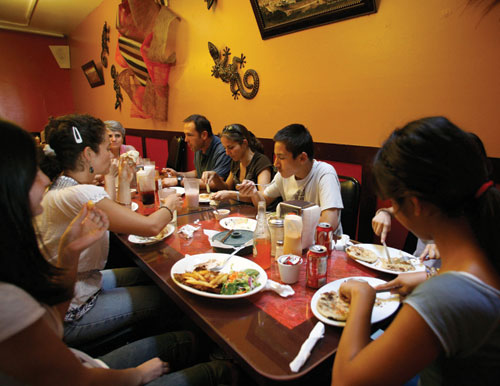
Inside, the ruddy good cheer of a beer hall obtains. And speaking of that: the restaurant offers Corona beer brewed in and imported from Mexico, which is different from the brewed-under-license stuff you typically find around here. The bottle is of brown glass, opaque and etched, and is available in a near-liter size ($12) that looks like a piece of ordnance ready to be loaded into the magazine of a warship. Beer is not usually presented in shareable form, but in this case, sharing should be given careful consideration — if you actually reached bottom, you would want to hand off the Audi keys to someone else.

In homey little spots, one looks for the unusual amid a raft of familiar faces. I had never before come across loroco, for instance, an edible flower that figures in Salvadoran cooking. When I think of edible flowers, I think first of nasturtiums, which are really more edible colors than flavors, or of perfumy lavender. Loroco resembles neither of these; even worked into an expansive pupusa ($2) with cheese, it revealed a peppery, slightly acidic bite. It also wasn’t much to look at — a muddy green, like okra. The spinach-filled pupusa ($2) also had a theme of green, but it was a more luxurious, creamy, liquid sort. And for no green at all, how about good old beans and cheese ($2)? The pupusas are made from white masa and are about as big around as a hamburger bun. Two or three would make a real meal.

The kitchen is also proud of its fried tacos ($7), which come bundled in groups of five, like a litter of puppies. They’re filled with shredded beef, topped with shredded green cabbage, sour cream, and your choice of delicacies, among them head cheese, pig skin, pig’s ears, cactus, and carrot. Quail’s eggs were an elegant thumbnail size, and a kind of ivory white stippled with blue; they looked like bits that had dropped from an example of gorgonzola statuary. To me they tasted like hard-boiled eggs, with the advantage that, because they were bite-sized, they were gone quickly. It was like doing egg shots. A couple of the other finishers, white cheese and avocado, were testament to the limits of adventurousness, but there is a reason these foods are perennially popular.

One of the most striking dishes on the menu is the fish soup ($12.95). Fish definitely means fish in this instance; we turned up a dorsal fin and a tail, each still sheathed in glossy black skin, along with several steaks — i.e. pieces of the creature cut crosswise. There was, thankfully, no head. The flesh had the look and texture of halibut, but the skin was wrong. According to our voluble server, it was catfish, which in my experience tends to turn up as filets, like its farmed river-fish relation, tilapia.

The broth was intense (and housemade), and floating in it, amid the dramatic piscine debris, were bits of tomato and carrot and, for extra color, shreds of spinach. The soup was presented with fresh-made tortillas, still warm in their little plastic flying saucer. Of course they were sublime, but also useless with respect to soup. We dunked, with unimpressive results. A bowl of rice — Spanish rice, plain rice — would have had a better sop factor. As for the tortillas: they would have been better with butter. What isn’t?

LOS YAQUIS

Mon.–Thurs., 9 a.m.–8 p.m.; Fri., 8 a.m.–9 p.m.;

Sat.–Sun., 7 a.m.–9 p.m.

324 South Van Ness, SF

(415) 252-8204

www.los-yaquis.com

Beer and wine

MC/V

Somewhat noisy

Wheelchair accessible


The toast of London

0

virginia@sfbg.com

>>View an extended version of this article at Virginia’s site, the Perfect Spot.

TRAVEL TALES Twenty-five bars, from Notting Hill to Hoxton. I did some serious exploring when I splashed down in London’s famed cocktail scene this June, from cutting-edge experimentation to dive-y comfort, legendary classics to just-opened destinations. I sipped with cocktail luminaries like Nick Strangeway, imbibed incognito at world famous haunts, and raised my glass at good old-fashioned pubs. Here are some of my experiences, served neat.

A SHOT OF INNOVATION

It’s true: there’s some cutting edge stuff going down in London Town. Among them, 69 Colebrooke Row is considered a standard of experimentation, if not mad science, with drinks pioneer Tony Conigliaro at the helm. A visit to its test lab, Drink Factory — “a collective of like-minded bartenders and artists” — was a revelation. There, unexpected flavors are subjected to rigorous R&D via a dazzling collection of lab equipment ranging from sous vide thermal immersion circulator to tube-tangled “vacuum machine.” (Press comparisons of Conigliaro to Willy Wonka have grown cliched but remain effective.).

Drink Factory rhubarb gimlet, post-centrifuge

By no means are Conigliaro and crew’s concoctions fussy. When you taste a rhubarb gimlet, for example, you get the pure tart of fresh rhubarb stalks, their essence extracted via centrifuge. This gimlet — among the best cocktails I encountered in London — may have had a complex origin but it contained a mere three ingredients: rhubarb, Beefeater gin, and a twist of grapefruit.

The Colebrooke crew recently took on the fabulous new Zetter Townhouse bar. They’ve created a cocktail menu of understated, intricate sips like the Flintlock: Beefeater gin, gunpowder tea tincture, sugar, Fernet Branca, and dandelion and burdock bitters. Zetter’s British drawing room, whimsically peppered with taxidermy (a full-sized kangaroo!), a gramophone, and mismatched furniture, complemented by a stately yet quirky basement gaming room, is among London’s nicest spots to linger over drinks.

Another standout was the spanking new Worship Street Whistling Shop. I chatted with bar manager Ryan Chetiyawardana, formerly of Bramble Bar in Edinburgh and 69 Colebrooke Row. Candlelight glowed warmly against dark wood fixtures and a classic organ with more than a hint of Victorian influence in the basement bar’s decor. Chetiyawardana showed us their Rotovap (for distilling at low temperatures) in a tiny, glass-walled “lab.” Here the Whistling Shop elves create bitters, tonics, and ingredients like “walnut ketchup” (port wine, green walnut, chocolate, saffron, and spice).

Wonders are many, from a house gin fizz using vanilla salt, orange bitters, extra virgin olive oil, and soda, to a conversation-starter called the (Substitute) Bosom Caresser, layered with baby formula milk (you heard right), Hennessy Fine de Cognac, dry Madeira, house grenadine, salt, and pepper bitters. A pricey Champagne gin fizz (80 pounds a bottle) takes No. 3 gin, lemon, and sugar, fermenting the ingredients with yeast via méthode champenoise, a classic process of secondary fermentation in the bottle. Elegant, integrated beauty.

Some of Whistling Shop’s profoundest joys came from a row of mini-casks behind the bar where an intriguing mix of ingredients are infused into a range of spirits. Though the barrel-aged cocktail craze has swept the world, I’ve yet to see this range at any one bar. WS2 “Whisky” ages Balvenie with beech, maple, and peat syrup in new oak. WS2 “Genever” captivates with Tanqueray gin, Caol Ila Scotch, green malt, and spices, aged in sherry oak. Wherever you turn at this bar, you’ll find the unusual, while the staff and vibe are comfortable, classy. Just the kind of place I’d love to have in my own city.

TRADITIONAL, WITH TWISTS

Smokin’: Hawksmoor’s julep and Tobacco Old Fashioned

Hawksmoor is the territory of visionary mixer Nick Strangeway, where friendly bartenders continue his tradition of well-crafted drinks. I was delighted to order from a menu loaded with classic juleps, cobblers, punches. St. Regis mint julep is a 1930s new Orleans recipe: rye whiskey and Cuban rum form the base, while homemade grenadine rounds it out. it comes, wonderfully, in a traditional julep cup (atypically caked in thick ice, however) with a vivid garnish of berries and mints, tasting like a proper southern julep. compared to other smoke-infused cocktails, I would have liked to taste more tobacco in the Hawksmoor’s tobacco old fashioned. But with rye and house tobacco bitters, the drink was still beautifully executed.

AND THEN … NOT SO MUCH

It’s incredible how many acclaimed London menus are still littered with flavored vodkas and fruity, chichi, or just plain played-out drinks. I witnessed entire groups of friends each with a mojito in hand in bars that carried extensive, fascinating menus.

The 1930s tunes and classy, basement vibe of Nightjar worked in terms of a speakeasy-themed bar. But clientele appeared to be not a day over 18, making the place feel like “kindergarten just let out,” as my companion the Renaissance Man said. Fine — but the flamboyantly garnished yet crappy-tasting drinks really sank the place. Despite a beautiful menu, “signature” cocktails tasted of juice (Pedro Pamaro) or smoky tea (Name of the Samurai) but not at all of alcohol. The only win was a surprisingly good canape platter. For a mere 6 pounds, one can get six tasty, generously-sized canapés until 2 or 3 a.m. This is significant when you realize how impossible it is to get even a bite to eat in London’s hippest neighborhoods after 11 p.m. (just try!)

POMP OVER TASTE

My expectations were high for my visit to the lauded Artesian Bar at the Langham Hotel. The gorgeous, airy room is illuminated with Asian-meets-French decor, romantic and intimate. An extensive menu hosts a brilliant flavor-profile map to help choose a cocktail to suit your mood. All seemed to confirm how special this place was. And then …

Yes, I was prepared for pricey cocktails (15 pounds) but not for the menu to read better than it tasted. The standout was Cask Mai Tai, a cask-aged Mai Tai, deeply spiced and autumnal, with tart lime and fresh mint. However, Silk Route, an intriguing milk punch of Batavia Arrack, Pimento Dram, and Elements 8 Platinum Rum was bland with a funky aftertaste. I yearned for its sun-dried roasted coconut and lime elements to shine through. Alexino sounded luscious: Ron Zacapa 23 Rum shaken with whipping cream, red bean paste, and aromatic spices. I tasted little red bean or spice, while the bean paste sat sludge-like at the bottom of the glass. Granted, red bean is not an easy ingredient to mix into a drink. But at roughly $25 a cocktail, each should be exemplary.

SOMETIMES CLASSIC IS BEST

I’ve saved one of the best for last: Duke’s. This elegant, small hotel bar is a temple to the martini. I could see why it was frequented by James Bond author Ian Fleming and other martini lovers over the years. I cannot recall a more perfect martini. Head barman Alessandro Palazzi is among the most delightful, consummate bartenders I’ve had the pleasure to be served by. As he wheeled out a trolley laden with olives, lemons, ice, and gorgeous barware, he immediately impressed with his expert gin knowledge.

Asking where we were from, he launched into a rapturous account of his love for San Francisco gins 209 and Junipero, saying he’s long been extolling the glories of Junipero. Well-versed and intimately acquainted with the best gins the world over, he dropped distiller names like “Arne” and “Fritz.”

I asked for London’s Sipsmith gin. Alessandro proceeded to bring out a sample of another locally-produced, small distiller Sacred so we could compare side-by-side. He mixed our martinis to icy perfection, gin’s bite tempered with the refreshing cool of dry vermouth and a hint of lemon. This tiny, quiet haven remains among my favorite memories of London, an impeccable martini immaculately served lingering in my mind.

Guns and necessity

4

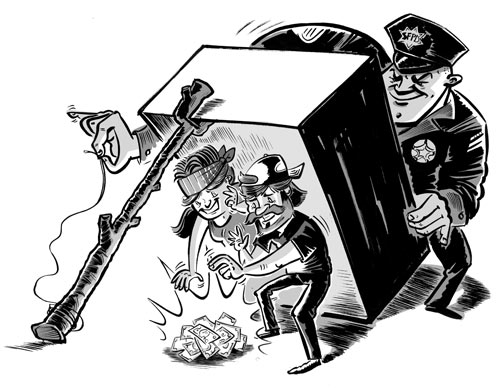
The Public Defender’s Office is getting a lot of press for its trial victory in the case of Johnny Stone. And as a big fan of the Public Defender’s Office (although not always of Jeff Adachi’s outside political ventures), I have to say: Congratulations. Arial Boyce-Smith came up with an effective strategy to keep Stone out of jail on a gun charge. I’m generally happy when the defense wins; I think our criminal justice system is so screwed up, and our prison system is a costly, brutal, inhuman and ineffective way to handle offenders. A few high-profile cases aside, the times when prosecutors put innocent people (or people who don’t deserve prison time) behind bars far exceeds the number of times when a truly guilty bad actor gets away.


So good for the PD. From the facts in this case, I see no reason why Mr. Stone should have been convicted.


But I also have to say: I’m glad this was just a trial court case and doesn’t set any precedent. Because the idea that a person can carry a concealed firearm around any time he or she can claim to be afraid of crime is a pretty dangerous idea.


I know all the gun nuts will be on my case here, but I’ve never been big on handguns, and never believed guns are a terribly good means of self-defense. And while Stone was in fact in a situation that could have made him fearful for his life, I wonder: Was he really going to point the gun and shoot somebody? Would another gun battle in front of the Sunnydale Housing Project be good for anyone?


And how scared do you have to be? I know plenty of people who worry about crime in the Mission — and I wouldn’t want any of them walking around with concealed handguns.


I appreciate the excellent trial work here. But let’s not try that too often.

(Summer) Trash Lit: Adrenaline

0

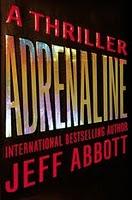
Adrenaline, by Jeff Abbott


Grand Central Publishing, 400 pages, $24.99


There’s a CIA agent who has a wife who also works for the CIA, and she’s seven months preggers with their kid, and life in the London Station is just dandy. Already a very bad sign: CIA agents with spouses and kids are prime fodder for thriller writers. It never works out. James Bond figured that out early, and since then, everyone else in the genre has fallen in love at his or her peril.


So naturally the wife gets kidnapped (or maybe she’s really a double agent) and the London CIA Station is blown up by a bomb that she might have planted (or maybe she didn’t) and our hero, agent Sam Capra, gets the full-on spook interrogation treatment, including all manner of fine drugs and devices, to see if he’s a traitor, too.


Of course, he’s entirely clueless. But by the time the manages to (maybe) convince CIA management that he doesn’t know where (or who) his wife is, he realizes it’s been nine months and the baby must have been born. So he sets off to find the kid, and the wife along the way, and the guy who either snatched her or hired her.


It’s a fun ride. Capra has to pretend he’s a smuggler who’s ready to steal counterfeit goods from Chinese gangs and reuse their trucks to get some nasty stuff into Great Britain. Much discussion of the modern underworld:


The postmodern criminal networks come together for a particular function — smuggling in ethnic laborers, muling heorin hidden inside televisions from China that were diverted first to ports in Pakistan, or setting up a train bombing to short-sell a transportation stock price. The cells are small and nimble, and they snap together and break into new shapes, like a child’s plane of tank or wall made from little plastic blocks. … When you cannot break a wall, you can shatter a single brick. I just needed to find the right brick.


In the weak tradition of this year’s top thrillers, there’s absolutely no sex. But Adrenaline does offer more than the usual amount of shooting, beating, and assorted personal violence:


[I] Found two Glock 9 mms, spare clips, silencers.


“What else do you need?”


“I have to fight a large number of people,” I said. “They will be heavily armed and I’ll be alone. So I guess I have to kill them all.”


You get the picture.


In the end, nothing is as it appears, the whole situation is a masterfully tangled mess that works its way through a string of bars in Europe and winds up with an ending that makes it very clear this is just the start of a Capra series. Don’t get too drunk when you read it or you’l lose track; the twists and turns require a little more concentration than the typical beach novel. But that’s not a bad thing, and this one goes on my summer list.


Maniocs!

0

le.chicken.farmer@gmail.com

CHEAP EATS I’ve got to get my head out of my ass. I don’t know if bars are where this happens, but the music is better. At the Dovre Club, they were playing the Cars, then the Clash, and Kayday was trying to think what comes next — the Dead Kennedys, or Devo — when a cockroach peeked out from under a coaster, then scampered between our drinks.

An interesting thing is that I was having a gin and tonic for probably the first time since I was in high school, listening to the Cars, the Clash, and then-what. This cockroach had probably only been alive for six days, week-and-a-half tops. It was pretty scrawny.

Kayday, who is a way, way more classy woman than I can ever dream of being, sort of lifted her glass (without spilling!) and scooted the little no-no over toward the bartender, who unceremoniously dealt with it.

And that was a life.

Mine is different. The Dovre Club has always been good to me, ever since it was in the downstairs corner of the Women’s Building. It was there, 15 years ago, in front of a pint of something-or-other, that I made an important, life-altering decision: to go to El Rio.

Where I met Crawdad de la Cooter, my most significant ex-other ever, whose children are the strongest argument for getting out of bed in the morning that I have ever heard. Especially the past couple mornings, when the argument was made in person and accompanied by pulls and tugs and demands for oatmeal.

With kids it’s automatic: your head can’t be up your ass because it has to be up theirs. And this is why my No. 1 goal in life is to become a grandmother. Somehow. Against all odds — every single one of them, given my own personal lack of children. But if I can only have a grandchild! Then I can die, when I do, with my head out of my ass.

And with a big pot of sauce on the stove.

I was talking with my hairdresser last night about mortality, and our problems with it — which are for the most part, at this point, conceptual. When I left the house, the kids were sleeping. Their father was home from work, eating ice cream, being the dad of their dreams, and just generally practicing the sousaphone. Their mom was in Bellingham, Wash., memorializing a friend of ours who was too young to die but did.

So I got my hair done. And when I came back, he didn’t even look up from his ice cream. “Nice haircut,” he said.

“Crawdad is a lucky woman,” I said, and went to bed.

But before any of this, before even the cockroach that came after the Cars and the Clash and between our drinks, my long-lost bestie Kayday and me were seeing to some Nicaraguan food at Nicaragua Restaurant on Mission Street.

There was ceviche, which I loved, and a tamale, which I didn’t, and the great Nicaraguan dish called chancho con yuca, which means, in no uncertain terms, pig with yuca.

As you know if you’ve ever been to Limon Rotisserie and ordered right (i.e. fried), yuca can be so good. Or … not.

Not that it was bad at Nicaragua. It just was, you know, a starch. Like a boiled potato, it needed work. If you scoop a bunch of the tangy ceviche juices onto it, hot sauce, salsa, and mash it up with your fork: OK. Yum. Otherwise, you know, ho fuckin’ hum.

Kayday started waxing poetic on the nature of starches, such troopers! How resilient and accommodating they are. Up for anything. Then the next thing I knew, she was speaking from the point of view of our plate-loads of underseasoned yuca. She’s from Indiana and therefore does great impersonations of starches.

Anyway, it was better than the music. For some strange reason, by way of atmosphere, they were playing Juice Newton and Laura Branigan. Which is why the Cars and Clash songs after were such a treat, like a chiropractic adjustment.

Or something.

NICARAGUA RESTAURANT

Sun.–Thurs. 11 a.m.–8:30 p.m.;

Fri.–Sat. 11 a.m.–9:30 p.m.

3015 Mission, SF

(415) 826-3672

Beer and wine

Cash only

Feelmore510 is bringing sexy back to Oakland

0

The Bay’s east side can seem a little prudish, especially when compared to its slutty sister city. Until February, Oakland’s only retail resources for sex were a couple of trashy adult “superstores.” Those places can be fun and functional, but it’s safe to bet the cashier probably isn’t too concerned about answering a list of questions and making you feel comfortable with your purchase. Nenna Joiner, the owner of Oakland’s new sex-positive shop, Feelmore510, is quite the opposite and simply can’t wait to start friendly conversations about sex with everyone in her community.

Joiner, a sex educator and adult film director, has been dreaming about opening an Oakland shop for years, but her ideas go far beyond retail. From terminology to etiquette, Joiner says her community needs to start at the beginning, birds and bees style. “I love talking to people. People teach me new things everyday. I’m open and not judgmental. I’ll talk about anything,” she says after ushering a couple ladies out the door who had spent their lunch break browsing. 

From basic questions to the personal, Joiner is educating from the inside out. “A guy came by the other day asking if it was gay for him to want to play with his girlfriend’s butt,” she says. “San Francisco takes its sexual openness for granted — the community there is so exposed, probably overexposed,” she laughs, a playful swipe at the close-knit kink communities and accessible sex-positive resources she loves.

Joiner says Oakland residents may attend erotic events like Folsom or shop for dildos west of the bridge, but when they return home, the conversation goes flaccid. She puts partial blame on years of serious bedroom talk: preventative health and safe sex practices have been a priority due to the high number of HIV cases in the area. No one is contesting the importance of these topics, but in terms of fast, slutty fun they can be total Debbie Downers. Joiner wants to put the spunk back into conversations about sexuality. 

Before the shop opened, the surrounding neighborhood seemed nervous about the addition of a sex shop on the block, but Joiner has been extra careful to make sure people understand that her intentions are purely rooted in the revitalization of Oakland. She keeps up on local politics, attends city meetings, directs tourists to other neighborhood businesses, and even watches high school band concerts. She waves at people from across the street and welcomes anyone inside to chat and enjoy the space. Joiner feels supported by the city around her, which she thinks is happy to recognize her role as a successful business owner. She regularly gets friendly calls from the Alameda Small Business Association, casual check-ins to make sure she’s doing well.

“They know I’m a young woman of color, working my ass off. Maybe they don’t watch porn or have interest in the products I sell, but they support me because they know how hard I’m working.”

Nestled between downtown office buildings on Telegraph Avenue, Feelmore510 lures in its share of curious customers during the day with a modest store front that looks more art gallery than porn hub. Inside the store, Joiner loves to play her late grandmother’s vinyl collection, including Sinatra and Perry Como, which perfectly compliment the space’s glowing chandeliers and velvet curtains. The shop stays open until midnight, way past the bedtime of most of her neighbors’, but with the Fox Theater nearby and a collection of bars and clubs in walking distance, Joiner likes providing the night owls some after-party options.

“I stay open late because I want to help more people have great sex.” Getting people off the streets and under the sheets with body-safe, pleasurable accessories– now that’s community activism!


Feelmore510

1703 Telegraph Avenue, Oakland

(510) 891-0199

www.Feelmore510.com


Girls just want to have fun

9

culture@sfbg.com

SEX It was their first official slumber party and a late-night run to the grocery store for pink hair dye was in order. Decked out in a combination of pink, pajamas, and leather, the San Francisco girls of Leather shrieked and giggled as they wandered the aisles searching for anything rosy-colored. The girls could easily have been mistaken for a freshman herd of coeds soaked in Malibu and cheap vodka, but as the group’s president, Leland, remembers, they were “just high on girls.”

Until they discovered the store’s collection of pink and white unicorns — on sale.

“We all oohed and ahhed and ended up purchasing six of them, surprising the other girls by returning to the party with an entire unicorn herd,” Leland says. From sleeping bags and hair braiding to dirty storytelling and play piercing, the night teetered between innocent and naughty, sweet and sexy. “So many unicorns, so many needles, and so much blood!” she said.

The SF girls of Leather (the girls prefer a lowercase “g” and uppercase “L” out of respect for the traditions of the leather community) are giddy and flirty: the epitome of seventh-grade girliness, complete with kinky sleepovers, hearts, and cuteness. As this year-old group sees it, maturity is overrated when it comes to BDSM — and a hint of silliness in a dark dungeon can only heighten the sex appeal. Who else is going to giggle or blush after a spank?

The group’s approach to leather is hardly in line with the masculine traditions that have come to be associated with the history of the kink community. But in the year since the girls formed their group, they’ve been working to secure their place in the continuum of leather lovers. And judging from the group’s growing membership — and accolades from the leather community at large — SFgoL is providing a much-needed refuge for marginalized fans of lighthearted play, splashing accents of pink across the traditional wash of black.


GIRL GOALS

Historically, a girl in the leather community has been defined as the female-identified version of a boy — a submissive expected to service a dominant individual in various kinds of BDSM play. But in SFgoL parlance, girl means something way more fun. Top, bottom, submissive, dominant, giver, receiver, experienced, or curious: all roles are welcome in the group, as long as you “girl” identify.

Which means what, exactly?

“Leather doesn’t have to be serious,” says Leland, who is of the mind that people of all ages, bodies, and sexual preferences can find bliss by tapping into their own personalized “girl-space.”

“You’re a leathergirl if you feel like it,” says SFgoL Vice President Kate McKinley. Even boys and bois are allowed in the group — as long as they have a “girl heart.” Coincidentally, McKinley wears one of these around her neck — a silver heart necklace.

“I play girly and therefore this group is where I belong,” she says.

An important tenet of the leather life, service (traditionally, the practice of obediently pleasing a dominant character) is still an integral part of the girl group’s goals — but its definition of the term goes beyond tending to masters and daddies.

In the year since the group’s inception, SFgoL has volunteered at multiple fundraisers and organized charity drives for nonprofits benefiting women in the leather community and beyond. Members are free to service individuals but are required to serve the community by means of philanthropy: grown-up Girl Scouts earning merit badges for kink.

Their efforts haven’t gone unnoticed — the San Francisco Bay Area Leather Alliance recognized SFgoL as its best new organization of 2010. “Contributing to the community makes it easier for us to enjoy what we’re doing,” says SFgoL member Anita, who asked that we not use her last name for professional reasons.

Anita moved to San Francisco from Norway on a work visa, but soon found herself lusting for a close encounter with leather. She discovered some BDSM groups for women interested in playing with women, but because she identified as straight when she arrived in the city, the SFgoL’s more inclusive membership requirements felt like a better fit.

She was also attracted to the group because it didn’t require members be in a dominant-submissive relationship. She was free to play with whomever, whenever, and however she pleased. “I’m a girl and I was interested in exploring the leather community in a group where I could just be myself and share my feelings,” she says.

Last month the SFgoL celebrated its one-year anniversary with 18 full members and more than 100 girls on its Listserv. The numbers are a strong indicator of its success, especially since the current version of the SFgoL isn’t the city’s first attempt at a girly collective. In 2004, a leathergirl group was formed, but failed to secure footing in the established leather community. The second time around seems to be the shiny charm — or maybe these girls are just extra-charming?

“We do have a smokin’ hot group of girls,” giggles Leland, looking around the table and raising her eyebrows at Anita and McKinley.

It’s lunch hour on a Tuesday and the three girls flirt like crazy, constantly laughing and finishing each other’s sentences between small bites of spicy Thai food. The three are a prime example of the group’s demeanor and exactly why Leland has enforced a “no cruising” rule during official meetings.

“The meetings are meant to be safe space and for taking care of business. But yes, we can play outside the meetings,” she says, batting her lashes as the other girls smirk, hiding a thousand secrets anyone with a pulse would die to hear.


RESIZING THE LEATHER FIT

Since its inception, the leather community has been predominately male. Icons like Marlon Brando, and the work of Tom of Finland and the Satyrs Motorcycle Club, defined modern masculinity in the 1950s, igniting a kinky obsession in the gay community. A badass jacket, muir cap, and related wardrobe of black hide became a symbol of sexual power and masculine independence, eradicating the stereotype that all gay men were effeminate.

Leather rules and traditions grew from military protocol and were diligently enforced by masters and their slaves, daddies and their boys. Women were intrigued, but struggled to find a place among the men; many leather bars turned away women at the door.

Over time, elements of BDSM became associated with leather and the community began to flex. During the ’80s, leatherwomen competitions popped up, and in the ’90s, groups like San Francisco’s Outcasts — now the Exiles —provided the community with strong female-identified role models. In 2006, the Exiles helped open Betty Paige’s Secret, which in subsquent years of the festival became Venus’ Playground. It was the first leatherwomen play space at the Folsom Street Fair.

It’s been six years since the Venus milestone, yet during this April’s International Ms. Leather competition in San Francisco, it was apparent that questions about the role of women in the leather community remain.

In a moment of call and response, “Where are the leatherwomen?” was shouted into the microphone. The answer was loud and proud: “Here we are! We’re here!” followed by a rumble of audience applause. Women may be standing their ground with paddles in hand, but the exchange was telling of their struggle for continued acknowledgment.

Deborah Isadorah, a veteran of kink and current leather momma, has been entranced by the leather community for more than 40 years, and is proud to have watched the roles of women expand. But in Isadorah’s eyes, the progression has been slow going.

“We live in a patriarchal society and that reflects on every part of our society, including leather,” she says, sipping a latte in Oakland and soaking in the spring sun.

“The men outnumber us physically in this community, [but that] doesn’t mean women’s voices are missing,” she continues. Isadorah is pleased with the progress of her generation of leatherwomen and is happy to sit back and nurture the younger crop. “I think we’ve done our job: to educate women about their bodies and the opportunities they have to explore sexuality beyond what society thinks is appropriate.”

Today, nearly half the current directors of the Leather Alliance, the community’s well-respected governing board, are female.

“We’re sitting at the table now,” says Daddy Vick Germany, a female-bodied leather daddy who has been a part of the Bay Area’s leather community for more than 15 years and serves as a director for the Alliance. Overall, Daddy Vick is content with the community’s moves toward inclusivity. “The men are leaving more space for us,” she says.

But traces of segregation can still be found. “Sometimes men just don’t see you — you’re not even in their line of vision,” she says, referring to a recent experience at the Up Your Alley street fair where a man blindly butted in front of her while she stood in a concession line. She recognizes that these incidents can be subconscious, but any female who roams the SoMa leather fairs is bound to encounter this feeling of invisibility. It makes her “mad as hell.”

Elected SF Dyke Daddy in 2002, Vick made substantial efforts to bridge gaps between the sexes. She’s currently running for SF Leather Daddy, a traditional competition built on fundraising for the AIDS crisis. In 2009 a transman won the competition, but if she wins, Daddy Vick would be the first female-bodied daddy to hold the title. Her candidacy alone is sure to shake things up with leathermen who believe in upholding traditional roles — but her motives are pure.

“I’m not doing this to make a statement as a female daddy. I’m running because I think I’m a good daddy for the community,” she says, meaning she cares about being a supportive, reliable father figure for those around her. The “working title” would help her foster change more effectively than her individual efforts.

Besides Folsom’s Venus’ Playground, there are no official social spaces intended for leatherwomen. This makes sharing communal bars and events incredibly important. Change is a slow process, but Daddy Vick says ample motivation is brewing in all corners, and — paired with the diffusion of kink — the space for growth can only flourish. Leather is opening into an umbrella term with the capacity to encompass multiple elements of fetish, and to further accept people of all genders, bodies, and preferences in any role.

In this respect, Daddy Vick thinks the SFgoL could play an important role. “It just takes people like Leland, coming in with a different energy. People who stand up in the crowd, see a need, and start organizing.”


FOLLOW THE PINK BRICK ROAD

While leatherwomen made slow but steady strides in the past decade, those straddling the space between butch and femme — the girl space — began breaking ground for themselves, too. In 2003 an international Leather Girl Network was born, led by the Bay Area’s Cheryl D. The group intended to mirror the already well-established leather boy community. Girls everywhere were giddy with possibilities.

“I had always identified with the title of ‘girl.’ I was a girl who liked to serve the community, but I was also a switch,” says Mistress Pilar, a longtime leather veteran and member of the original, and now revived, SF girls of Leather. Being a switch — someone who doesn’t commit to top or bottom exclusively — meant her definition of girl didn’t fit with that of the Leather Girl Network, which stated: girl equals submission. She wasn’t alone in her dilemma.

In 2004, San Francisco girls decided to put together their own troop, headed by girl Lori, the 2003 San Francisco Leather Dyke girl (a contest that no longer exists), and girl Hayden, the 2004 title-holder. They intentionally left the definition of girl open to allow for individual interpretation. The leather community shuddered at the loose restraints, confused by the men, boys, and transpeople that joined the girl ranks.

“People in the leather community were not comfortable with this idea at the time. No one even liked talking about it,” says Pilar, referring to the notion that a girl didn’t need to be a biological woman to be in their group. “The attitude that people should ‘get off the fence’ really hurt.”

The initial group grew to about 30 members and its short three years as a successful alliance was packed with fundraising, volunteer work, and super-girly fun. But eventually the negative attitudes, biased expectations, and confusion over the definition of “girls” wore down on moral.

“People would walk up to me and demand, ‘girl, clean my boots’ and I would say, ‘I don’t serve you, I serve the community,'” Pilar says shaking her head.

Even Daddy Vick remembers how the group of strong, independent individuals struggled to prove themselves to the wider leather community. The girls, she says, “took a lot of flak” for contesting tradition. “There was still a belief in place that girls and boys couldn’t be leaders. Some thought girls and boys should be seen and not heard.”

The girls managed to have good times regardless, but Pilar says by early 2007 the group was down to five members who reluctantly agreed the end had come. It wasn’t until the 2010 International Ms. Leather competition — when Pilar decided to donate the leftover SF girls memorabilia and a curious Leland started asking questions — that SFgoL sparked back into life, with a little PR and a lot of ambition.

“Leland is a wonderful leader. She creates a really positive image of a girl,” says Pilar, nostalgically looking over an old stack of meeting notes, scribbled calendars, and photos from the original group. The dissolution of her crew hit hard, and it’s bittersweet for Pilar to hear about the new group’s instant success. But more than anything, she’s proud. “I feel like a proud mom. Those are my girls.”

Coincidentally, just as the girls sprung out of the woodwork and formed an official group, the San Francisco boys of Leather, a longstanding and once very active organization, hung up their chaps and caps due to a decline in membership. The boys generously donated all their remaining funds to the girls.

Steve Gaynes, the 1994 SF Leather Daddy and Alliance director representing the 15 Association, a longstanding sexual fraternity for men interested in BDSM, has been a leatherman since 1978 and has watched all kinds of groups come and go. He says the ebb and flow is just a reflection of the community’s current needs.

“The energy ran of out the boys and ran into the girls. If there’s no driving force behind a group, it will die,” he says, noting the community’s excitement for the new girl group. “They’re enthusiastic, inclusive, and have clear ideas for their future. And they’re doing [it all] with a lot of respect for tradition.”

And the SFgoL’s continued dedication to volunteer work and partnerships with other groups have shown the community at large that it values the path paved by the forefathers — and foremothers — of leather.

Paying tribute to old protocol is simple. Isadorah boils it down to three simple rules: integrity, honesty, and service to the community. Judged by this metric, she says, anyone who thinks the SFgoL is out of line is just being stubborn. “Whenever something happens in the community that brings change, there will always be someone who is offended,” Gaynes says. “You won’t know you’ve created change until you’ve offended those people. Change is good and should be embraced.”


LOOKING OUT FOR THE GIRLS

Leland and McKinley agree that there seems to be a buzz of excitement surrounding the SfgoL lately. The group’s logo is everywhere, and partnerships are being fostered across the community. Leland has even been asked to serve as a director for the SF Leather Alliance.

But her primary concern is making sure the SFgoL remains a safe, welcoming landing pad for girls who are new to the leather community. And these days, the media is providing all sorts of inspiration for curiosity. Rihanna’s song “S&M” speaks directly to sexual play, but even a quick Google search for “girls in leather” retrieves images of celebrities in fetish gear, from Lindsay Lohan and Miley Cyrus in leather leggings to Emma Watson in a full latex suit with collar. In general, our society is opening up to alternative sex and women want in on the action.

But girls who jump in with little research and few friends may not leave with the most positive experiences. The inherent power dynamic associated with BDSM relationships and play can blur the lines between consent and abuse, and Leland says it’s important for newbies to have mentors within reach. “Sometimes the person you’re playing with may not have your best intentions at heart,” she says. “But as an alliance of girls, we can look out for each other.”

On the hook

4

rebeccab@sfbg.com

Unique Roberts squared back her shoulders and recalled what it was like when she first moved to San Francisco from East Oakland more than a decade ago. A tall, 33-year-old African American transgender woman with piercing eyes and a charming smile despite gaps of missing teeth, Roberts said she performed as a showgirl at clubs like Harvey’s and the Pendulum in the Castro. In those exciting days, “I fell in love with this boy, and he was an addict,” she explained. “I thought that if I did it, it would keep our relationship together.”

She recalled how awful her boyfriend felt when he found out she was using, telling her, “You don’t know what you’re doing to yourself.” He departed for Texas several years later, but addiction stuck with her as a way of life.

She says she’s tried to kick the habit, but it’s wrapped up in a battle against depression stemming from the loss of loved ones. Roberts was wearing one of the bright orange sweatshirts issued to inmates at San Francisco County Jail. She landed there after being arrested in April for allegedly selling a tiny rock of crack, weighing just 9/100s of a gram, to an undercover narcotics officer. According to the police report, the cop offered her $20 for it — but based on National Drug Intelligence Center street-value estimates, that amount is only worth about $2.50.

Roberts may go by the first name Unique, but her lawyer Tal Klement, who works for the San Francisco Public Defender’s Office, is fond of saying her case is hardly unique at all. She was one of several people arrested in the Tenderloin that day after interacting with the same plainclothes officer.

It was part of a coordinated sweep known as a buy-bust, a common practice under which an officer may pose as a homeless person, a clueless outsider, or a dope-sick fiend to lure people into selling crack, pills, meth, heroin, or marijuana. Once a transaction is made, a team of officers awaiting the signal immediately closes in and arrests the seller.

As of June 20, there were at least 109 open buy-bust cases in San Francisco. Based on defendants’ rap sheets, 92 percent had prior drug-use histories, according to a tally conducted by the Public Defender’s Office.

The officers posing as buyers — who often earn overtime — use street lingo, know which drugs can be obtained at which intersections, and sometimes offer higher prices than the accepted street value. Attorney Anne Irwin, also a public defender, is critical of the practice, saying it’s an expensive tactic that’s makes for easy arrests — because the money is irresistible to addicts who think they’re getting an opportunity to convert a personal stash into more drugs.

In a lean budget year, “they’re cutting social services left and right, and these are the very services that could help the addicts get off the street,” Irwin noted. She’s skeptical that the strategy stems the flow of substantial quantities of drugs.

Police Chief Greg Suhr, who said he participated in buy-busts for years as a narcotics officer, credits the tactic for helping to eradicate a rampant open-air drug market on Third Street in the Bayview, and says it can help prevent drug-related violence.

Klement, however, condemns it as a “war on crumbs,” saying it ensnares far more addicts than serious dealers and often ends up unnecessarily pinning felony convictions onto low-level offenders.


NUMBERS GAME

Buy-busts usually involve around eight officers, according to an average calculated by the Public Defender’s Office based on open cases, but have involved as many as 14 and as few as three. There’s the decoy buyer, who sometimes dresses in grimy sweatpants, goes without shaving, or dirties his face to look like a street addict in desperate need of a fix. There’s a “close cover” officer who follows the decoy, plus an arrest team that is also sometimes in plainclothes. Beforehand, officers will photocopy cash — usually $20 bills — to document the serial numbers so that the same marked city funds can be used as evidence once recovered from arrestees. Busts can happen within minutes of one another, and a single shift may net five or six arrests.

Irwin says the people snared aren’t typical drug dealers — certainly not big-time players. But they’re charged as dealers — and in many cases wind up branded as felons, with severe legal penalties such as multiyear prison sentences.

While the police department is able to show on paper that it’s brought hundreds of drug dealers into custody — and the district attorney can point to a boost in the conviction rate thanks to the program’s efficiency — Irwin says the amounts being peddled are tiny.

“In traditional narcotics operations, they cultivated snitches, used surveillance, and obtained search warrants” to go after major dealers, Irwin said. With buy-busts, “It’s like shooting fish in a barrel. Everyone agrees that we need cops on the streets to help keep us safe … But do we want to be paying hundreds of thousands of dollars for this?”

Sharon Woo, chief assistant of operations for the San Francisco District Attorney, told the Guardian that “we charge based on the conduct of the individual.” Woo went on to say that the DA tried to “exercise appropriate discretion” on a case-by-case basis when individuals are selling to support an addiction or due to being in dire financial straits.

Sometimes individuals are ushered into alternative programs such as drug court or a Back on Track program for first-time offenders, Woo said. And while the DA typically includes charges that make defendants ineligible for probation under state law if they have prior convictions for selling crack-cocaine — a discretionary practice that has drawn criticism from public defenders — Woo observed that “it doesn’t mean that’s how cases resolve.”

Police forces in nearly every major metropolitan area practice buy-busts, said Frank Zimring, a law professor at UC Berkeley’s Boalt Hall School of Law specializing in criminal justice issues. Yet he described the practice as costly and noted that paying overtime for it “makes what would ordinarily be a very expensive operation into a more expensive operation.”

Cost estimates for the entire program are tough to pin down. It costs $130 per day to house each prisoner in the county jail, amounting to more than $14,000 per day if all of the defendants with pending cases are in custody. If an average of eight officers per bust were paid $60 an hour each to spend six hours conducting a buy-bust, the current caseload represents more than $300,000 in officer pay — a conservative estimate — and that’s before lawyers in the offices of the public defender and district attorney are paid to prosecute and defend the suspects in court.

But no matter how you add it up, it’s a lot of money.

Suhr told the Guardian that apprehending street-level offenders occasionally leads officers to bigger fish. “Sometimes you get a low-level person, or a buyer if you will … if that same person would say, ‘But I know this guy and he has guns and he’s a big dealer and whatever.’ That is a good way to get to those bigger people.”

“We’ve never seen that happen in practice,” Klement countered.

One of Irwin’s clients, a homeless man, was charged with selling narcotics after he scraped out the contents of his pipe to sell 1/1,000th of a gram of crack to an undercover officer for $20. In a rare twist, the case was ultimately settled on a misdemeanor possession of narcotics.

Inspector Robert Doss, who served as the decoy in that case, has earned substantial amounts of overtime while going undercover to buy drugs, according to a court transcript. In 2009 Doss earned $35,488 in combined overtime and “other pay,” which includes time spent testifying in court, according to a San Francisco Chronicle database of municipal salaries.


ON THE STREET, OFF THE STREET

The Tenderloin is frequently targeted for buy-busts, with 65 percent of open cases as of June 13 having taken place in that neighborhood. The Haight ranked second, with nearly 12 percent of cases, and the Mission followed with 10 percent. Shortly after District Attorney George Gascón was sworn into his prior post as police chief in 2009, he announced a concerted effort to clean up the Tenderloin, and Klement maintains he’s seen a surge in cases stemming from buy-busts there ever since.

Drug dealing in the Tenderloin often makes the news as a source of frustration to merchants and residents. “You try and explain to the people of San Francisco that it’s okay for people to have open-air drug markets right in front of their stores,” Suhr said.

Yet Klement maintains that what is essentially a quality-of-life crime should not be treated as a felony. “There’s a lot of pressure from people who are invested in businesses [in the Tenderloin] who would love to see that neighborhood become the next Hayes Valley,” he said. “But what they don’t realize is that people are paying with prison for that agenda.”

Once someone has been labeled a drug dealer in the eyes of the law, he said, it becomes more difficult for them to access drug treatment — not to mention get a job, qualify for a student loan, or find housing.

Roberts’ case nearly went to trial. If convicted, she could have been sent to prison for a minimum of three and a maximum of 17 years due to extra penalties from prior convictions. On the eve of the trial, however, the case was settled on a possession charge for a year in jail, a rare outcome. Klement was hoping to have her placed in a treatment program.

Asked if she knew of others swept up in undercover operations, Roberts gave a wry chuckle and gestured to the jail corridor behind her, indicating that nearly everyone there had been taken down in similar fashion. Klement noted that the targets of the buy-busts are almost exclusively people of color, saying, “You walk into the holding cell and you think you’re in Alabama or Mississippi, not San Francisco.”

In an editorial on the subject that he wrote a couple years ago, Klement noted that by contrast, predominantly white middle class people with a fondness for illegal drugs are rarely targeted because they aren’t the ones selling drugs on the street. “The hard truth is that the police ignore most of the middle class drug use and dealing occurring out of private homes in every neighborhood or other public venues in the city — bars, nightclubs, concert halls. More drugs are being transported to Burning Man as we speak than will probably be seized during Gascón’s entire crackdown.”

For Klement, it’s just another symptom of a broken system. “A lot of these people are repeat players because we don’t have the right interventions at the right time,” he said. “We don’t understand addiction.”


Yearbook of heartbreak and outrage

0

news@sfbg.com

The giant commemorative AIDS ribbon that was up on Twin Peaks during the first half of June has been taken down, but the 30th anniversary of the epidemic, and how it changed San Francisco, is still reverberating throughout the city.

“It was like paradise,” Mark Ottman said as he guided me through the high-ceiling lobby, quiet as a library, of Union Bank on 400 California St. “For a few years. Then things got really scary.”

Ottman, the vice president of personal trust and estate services at the bank, recalled arriving in the city in 1981 as a 22-year-old Montana transplant. That year, the gay newspaper the Bay Area Reporter published the word AIDS for the very first time.

Although the paper has been at the forefront of reporting gay news for its 40 years — from White Night Riots of the 1970s through the Lavender Sweep of the 1990s, the Bowers vs. Hardwick decision through the “don’t ask, don’t tell” repeal — the way it straightforwardly handled the heartbreak of AIDS and the outrage that followed has become its lasting legacy.

“This was not stuff that was shown on the nightly news,” Ottman continued. “The B.A.R. was three or four months ahead in covering AIDS. In that sense, it was really the leader.”

This month, those with a thirst for history will need to look no further than newsprint. Union Bank’s LGBT Alliance has commissioned a retrospective exhibit highlighting the Bay Area Reporter’s coverage of the gay and lesbian community.

When the B.A.R. started in 1971, founders and friends Paul Bentley and Bob Ross had the intention of making it more than just a gossipy guide to bars and bathhouses. The newspaper focused on serious local news — even recruiting Harvey Milk as a political columnist.

“The founders weren’t journalists,” said Rick Gerharter, the longtime freelance photographer who curated the photo- and front page-filled exhibit at Union Bank. “But as the paper grew, it certainly became more professional.”

In 1981, when AIDS first appeared, the B.A.R. had no choice but to undergo a journalistic coming of age as it struggled to be first and be fair covering the mysterious disease that had begun to mow down gay men.


UNEASY EARLY AIDS COVERAGE

Yet the newspaper was not immune to the confusion and uneasiness that enveloped the community during the early days of the “gay cancer.”

“Me and my boyfriend both laughed — it must be another Anita Bryant plot against homosexuals,” said Robert Julian, recalling his first response to talk of the “gay-related immunodeficiency” or GRID.

“Gay people are united by sexual orientation, not genetics,” said Julian. Initially, the former B.A.R. entertainment editor and author of But the Show Went On: San Francisco 1987-1988 had his suspicions, thinking that a “physical ailment confined solely to gay people was a practical impossibility.”

It didn’t take long before the B.A.R. began reporting on the latest research, medical resources, and information about financial services available to the hundreds of gay men in San Francisco who had contracted the HIV virus.

Once researchers discovered that AIDS was being transmitted sexually, public opinion divided. Then-Mayor Diane Feinstein and Director of Public Health Mervyn Silverman wanted to close the bathhouses, but some members of the gay community considered this a violation of personal rights.

“There was this repression around gay people and sex, this hysteria around bathhouses,” said Gerharter. And the B.A.R. was hesitant to feed into that frenzy at first. “When it was clear what was really happening, how this thing was being spread around, then it clicked — and the paper really jumped to the forefront of covering what had tuned into an epidemic.”


STEAMY BATHHOUSE DEBATE

The paper not only began to cover the AIDS crisis extensively, but did it with an editorial slant that fostered debate in the community. Paul Lorch, then-managing editor, became a prominent voice arguing to keep the bathhouses open. Bathhouses don’t give you AIDS; unprotected sex gives you AIDS, Lorch expressed in strongly-penned editorials. Sometimes he even answered back to Letters to the Editor.

“Lorch and the publishers didn’t believe closing the bathhouses would solve it,” said Wayne Friday, who took over the paper’s political column after Harvey Milk was assassinated and continued it for 27 years. “But no one had an alternative. Diane [Feinstein] would call me at 5 a.m. asking me what we should do about this thing.”

The community was split. Some, including Friday, believed that the bathhouses were a public health hazard while others accused Feinstein of scapegoating. “Those people were being selfish and foolish,” Friday said. “Closing the bathhouses saved lives.”

In 1984 the San Francisco Health Department asked for a court order forbidding renting out private rooms in bathhouses. Without the luxury of privacy, most closed within months. “San Francisco became a blueprint of how to handle AIDS on the city level for the rest of the country,” Friday said.


OBITUARIES KEPT SAD TALLY

During this time, the B.A.R. was also keeping a more morbid type of tally: the obituaries. Each week the paper published two pages — 30 to 50 obituaries — until 1998.

“When you picked it up, it was the first thing you turned to,” Gerharter said. “It was just a name and a face. Maybe you recognized the person. Maybe someone you tricked with.”

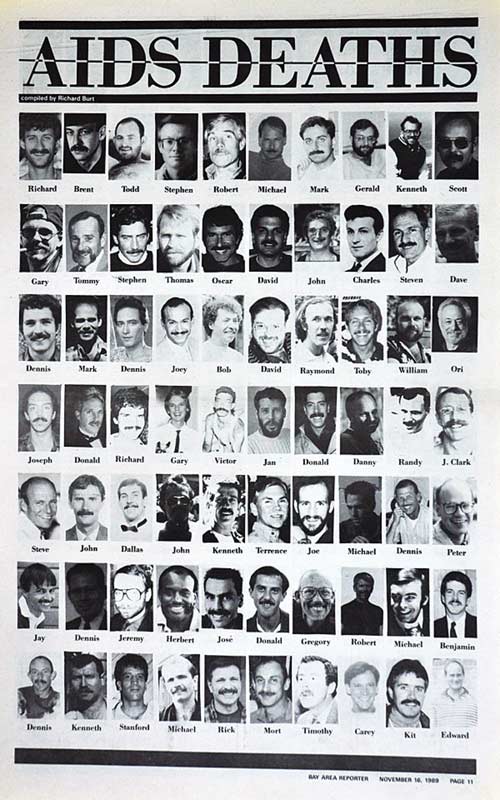
In 1989, art director Richard Burt became so overwhelmed by the number of obituaries that had been turned in to the B.A.R. within the first 10 months that he wanted to convey the sinking feeling in the pages of the paper. The Nov. 16 issue included a four-page collage of everyone who had passed away due to AIDS that year. Just a name and a face.

“It was heartbreaking,” Julian said, “to see my friends and lovers pictured there.”

Through the efforts of Tom Burtch and the San Francisco GLBT Historical Society, a massive searchable online database of B.A.R. obituaries since 1979 was launched in 2009 (www.leifkerdesigns.com/olo/index.jsp).

During his tenure at the paper, Julian chose not to cover AIDS, feeling that the point of entertainment news was to distract away “from the soul-crushing presence of the grim reaper stalking our neighborhoods.”

Though AIDS was a heavily political newsbeat, Friday removed himself from covering it for different reasons. “I knew every elected official. I sat in on all the City Hall meetings about the bathhouses,” Friday said. “But I just couldn’t do it every week. It was too damned personal.”

“Thinking about turning the page to those obituaries even now is making me shiver,” Ottman said. “It’s like a high school reunion, except you don’t know which half made it.”


COVERING THE RISE OF ACTIVISM

The B.A.R. was also instrumental in covering the various political and protest actions that accompanied the disease, including the bloody police sweep of ACT-UP protesters the Castro and the Stop AIDS Now or Else blockade of the Golden Gate Bridge, both in 1989.

Gerharter remembers the blockade. “They arranged it for the morning commute. And thank God it was foggy or else the surveillance cameras would have stopped us.”

Gerharter would often be trusted with information about an upcoming demonstration and be the only photographer allowed to tag along. “You can document history better when you become a part of it. You get closer to the people — they’re not posing,” he said. “It was our job to be advocates and watchdogs.”

After consistently seeing the tragedy of AIDS on the front page for almost a decade, the B.A.R. became more active itself, inciting its readers to action. “We’d read the B.A.R. to find out about the rallies were happening so we could skip work and take a road trip to Sacramento,” Ottman said. “The Chronicle would never cover that.”

When the fight against AIDS became a war, the B.A.R.’s writers often felt like they had become war correspondents, complete with all the outsize personality conflict and drama of the classic stereotype.

“[Bob] Ross was a nightmare boss, a pain in the ass, and complete rageaholic,” Julian said of B.A.R.’s often conservative cofounder, who died in 2003. “But he was committed to keeping the paper and us running.”

THE BAY AREA REPORTER 40TH ANNIVERSARY EXHIBIT

Through June 30, 9 a.m.–5 p.m.

Union Bank Main Branch

400 California, SF


Mehserle’s free, but some protesters could still face jail time

 Johannes Mehserle, the former BART police officer who shot and killed Oscar Grant while he was lying face down on the Fruitvale station train platform on New Year’s Day 2009, was released from a Los Angeles jail June 13 after serving a total of 365 days for his involuntary manslaughter conviction. He was sentenced to two years behind bars, but Judge Robert Perry granted him an early release due to credit for time served and good behavior.

The same date of his release, the National Lawyers Guild filed a class-action lawsuit on behalf of 150 protesters who were mass-arrested during the Nov. 5, 2010 demonstration in Oakland in the wake of Mehersle’s sentencing. Meanwhile, a handful of individuals who engaged in the Jan. 14, 2009 and July 8, 2010 protests launched by Grant supporters — which morphed into riots after community rallies came to an end — are still battling court cases.

Two of the protesters arrested last July initially faced serious felony arson charges for igniting a trash can, which could have led to incarceration for a longer duration than Mehserle served for fatally shooting Grant.

“There were several felony arrests last July, and people were facing charges that could lead to more than a year, no question about that,” noted attorney Dan Siegel of the Oakland-based firm Siegel & Yee. Siegel is currently representing Todd Lister and Adrian Wilson, the two defendants who were accused of arson. The codefendants now face attempted arson charges, carrying a minimum penalty of eight months, with a midterm of one year. “Theoretically, that’s what they’re still facing,” Siegel said, but added that he was confident the as-yet unresolved case would result in a more lenient outcome.

Meanwhile, some of the burglary charges stemming from the looting that occurred in Oakland last July could potentially lead to multi-year sentences, Siegel added, leading to more time in jail than Mehserle served.

Some of the hundreds arrested over the course of the three protests who had prior criminal convictions had their probation or parole immediately revoked as a consequence, said Rachel Jackson, a member of the Coalition for Justice for Oscar Grant and one of the organizers of the Nov. 5 community rally in downtown Oakland’s Frank Ogawa Plaza.

Of the hundreds of arrests made in Oakland during waves of protests launched by Grant supporters, just a small number were on serious charges such as burglary or arson. The mass arrest of 150 individuals last November was initially made on charges of unlawful assembly, yet nearly all of the arrestees were cited and released after spending up to 24 hours in jail, and all had their charges dropped.

In that instance, Oakland police corralled 150 demonstrators who had been participating in a lawful march through the streets into a residential block in East Oakland. Once they were surrounded, Oakland police — who were aided in the streets by 32 other law-enforcement agencies that night, according to National Lawyers Guild attorney Rachel Lederman — placed them all under arrest. No dispersal order was issued prior to making the arrests, and it would have been impossible to comply if one had been issued.

In a class-action lawsuit, the National Lawyers Guild argues that the Nov. 5 protester roundup and mass arrest was a violation of the Oakland Police Department’s crowd control policy, and that it constituted a violation of protesters’ rights to freedom of speech and freedom of assembly. “Even legal observers and a few people who happened to live in the neighborhood were swept up,” Lederman said.

“The policy is clear, and the constitution is clear,” she went on. “You must have probable cause to believe an individual is committing a crime. But in this case, the whole crowd was herded onto a residential street, blocked in, and held on the street for hours. There was never a dispersal order, and all exits were sealed off.”

The Oakland Police Department did not respond to a request for comment.

Arrestees were held handcuffed in vans, in some cases for hours, without access to a bathroom, Lederman noted. All of the women were subjected to pregnancy tests upon being booked into jail, “which made no sense and was abusive in this particular case,” Lederman maintains, because the short time they spent there didn’t justify the excuse that the test would have been necessary to determine whether anyone needed prenatal care. Several men, meanwhile, were subjected to DNA swabs, which is “only supposed to happen if you’re arrested for a violent felony,” according to Lederman. 

Jackson, who was also arrested that night, said she believed police conduct was “incredibly intimidating, and it has a chilling effect on free speech.”

New album review! EMA!

0

EMA

Past Life Martyred Saints

(Souterrain Transmissions)

 In a recent post on her blog – “lookit that came outta nowhere”, still humbly hosted on WordPress – Erika M. Anderson shares a letter she received from a soldier. “I want to live but i don’t mind dying at the same time / I feel like you and me are the same in that way / Two misfits like two submarines in the sky.” The lines possess some of the quiet force of Anderson’s music, though her lyrics are more firmly rooted in the body: mishaps with men, throw up, a butterfly knife. Anderson wears her initials on a big gold chain for the album art of Past Life Martyred Saints, and as an artist she goes by EMA.

That “misfit extending a hand” vibe is one that Anderson nurtures throughout her solo-debut and Internet presence. Online, she describes growing up “in the dive bars and rotten graveyards of South Dakota” and then fleeing to the West Coast. One song in, and she’s ready to proclaim: “Fuck California, you made me boring.” It’s the most memorable line on the album and one that introduces Anderson’s steady, chanting voice and droning electric guitar.

Listening to Past Life Martyred Saints is like taking that cross-country road trip with Anderson. Though most of the album’s songs run less than four minutes long, they roll with slow shifts in tone as a lamenting Anderson bumps into another stray voice, instrument, or clamoring industrial sound. Odd turns of phrase crop up like eerie landmarks among long stretches of repetition (“Mama’s in the bedroom, don’t you stop” eight times, followed by seven rounds of “you feel just like a breeze to me…”).

Anderson said she “wanted to make a piece that changes fidelity in the middle of the song, from lo-fi to hi-fi,” specifically on opener “Grey Ship.” These cycling crescendos and transitions yield the album’s best moments as she gracefully molds expanses of white space. It’s as if someone threw the xx off a cliff, and Erika M. Anderson got up, dusted herself off and picked up a guitar. (David Getman)

Make a splash

0

virginia@sfbg.com

BAR CRAWLER Overrun with partiers from the burbs on weekends, North Beach remains far more than its hordes of visitors would suggest. Italian history, comforting foods, historical churches, and Beat mystique keep tourists roaming the streets. But savvy locals know North Beach’s under-the-radar gems. In some ways, it’s our most European neighborhood, where you’re most likely to find elderly Continental gentlemen gesticulating over coffee and cigarettes at sidewalk tables outside Cafe Greco or Caffe Trieste. Beneath the tourist trappings and meat markets, beats a vibrant and cultured heart.

This is equally true of its nightlife. Look beyond seedy strip joints and bars packed with suburbanites to find a long list of spots rich with history and colorful characters. If you haven’t hung out in NB in awhile, it’s time to fall in love with this late-night neighborhood’s impressive diversity again via a nice north-to-south bar crawl.


BIMBO’S

There’s no cooler live music venue in San Francisco than Bimbo’s. A Rat Pack-style supperclub where Rita Hayworth danced as a chorus girl in the early 1930s and gin was served in coffee cups, the spacious club is rife with character. Wood-paneled walls, red curtains, and stools create a space Dean Martin’s Matt Helm character would have felt at home in. Start your night with a show of acts as divergent as Flaming Lips and Adele.

1025 Columbus, (415) 474-0365, www.bimbos365club.com


TONY NIK’S

Divey and lived-in, Tony Nik’s still shines under its original neon sign. A Prohibition-era bar opened in 1933 by namesake Tony Nicco, it’s a funky, worn respite from the bustle of North Beach. It’s like stepping back in time … with rock ‘n’ roll attitude. It’s just the place to pop in for conversation and a stiff martini.

1534 Stockton, (415) 693-0990, www.tonyniks.com


CHURCH KEY

This underrated beer haven keeps a rotating selection of craft beers from around the world on tap. Victoriana wallpaper melds with a mellow vibe, offering a welcome respite from weekend craziness. Sip an Allagash Witbier in the upstairs alcove with wild game sausages while a DJ plays classic soul records that won’t drown you out.

1402 Grant, (415) 963-1713


(Click here for larger Google map.)

THE SALOON

It’s time for more music at one of the country’s oldest bars. The Saloon hit the Barbary Coast in 1861 as Wagner’s Beer Hall. Beat-up and worn down (in look and regulars), this bar feels like New Orleans, where music sings out into the night from seasoned musicians who play as hard as they live. Offering live music seven nights and three afternoons a week, the Saloon’s key focus is blues, although rock ‘n’ roll and soul influences abound. Dancing erupts in tight confines — like one ongoing party where music legends relive glory days.

1232 Grant, (415) 989-7666


15 ROMOLO

No North Beach night would be complete without killer cocktails, and they don’t get better than at 15 Romolo. A turn-of-the-century bar vibe is balanced by killer jukebox. Karaoke Gong Show nights are legendary and, although frequently packed, it’s often a place to get an artisanal drink in a relaxed setting. Spawning some of our city’s best bartenders, the talent behind the bar remains impressive. You’ll be hard-pressed not to count their inventive (yet far from fussy) creations among the best in the city.

15 Romolo Place, (415) 398-1359, www.15romolo.com


BAMBOO HUT

It’s a grungy sort of tiki vibe at Bamboo Hut. Live surfer bands, kitschy tiki paraphernalia, and tropical drinks (warning: this ain’t no Smuggler’s Cove) make it a fun, distinctive stop on your crawl for a fruity island escape. And, yes, there are volcano bowls.

479 Broadway, (415) 989-8555, www.maximumproductions.com


MONROE

If you must do a club, this newest North Beach addition is unlike the rest. With decidedly Hollywood flair, mirrors and artwork of models draped in pearls (alas, no Marilyn) line brick walls over leather and velvet couches in this unexpected den of hip classiness.

473 Broadway, (415) 772-9002, www.monroesf.com


SPECS

Journeying south down Columbus Avenue, you’ll hit a few of the city’s great classics. Specs’ Twelve Adler Museum Cafe is the dive to trump all dives. Singing around the piano with a Guinness or a shot of whiskey is a favorite pastime, as is soaking in the glowing, musty atmosphere and listening to stories from crusty locals your mother would be nervous around. A maritime SF mainstay since 1968, Specs is more than a bar, it’s an institution.

12 William Saroyan Place, (415) 421-4112


TOSCA CAFÉ

In the realm of classic bars, Tosca stands alone. Surviving Prohibition with “house cappuccinos” (hot chocolate with brandy), still its No. 1 seller, Tosca has been a North Beach hotspot for decades, its famed back room a haven for rock and movie stars alike. With a lovingly faded yet romantic interior, red booths and chairs hark back to its early days. The famed jukebox spins out a line of tunes crucial to Italians, from legendary opera singer Enrico Caruso to Dino and Frank.

242 Columbus, (415) 986-9651, toscacafesf.com


VESUVIO

Vesuvio is not so much about drink. Libations are an afterthought in a legendary 1950s space like no other. This is the kind of bar where intellectual discussion and reading books are the norm, where inspiration seeps out of the walls. Eclectic, hodgepodge decor is quirky and artsy, just like the clientele. The spirit of the Beat poets who frequented its corners lives on … with beer.

255 Columbus, (415) 362-3370, www.vesuvio.com


COMSTOCK SALOON

End your long night with a mellow, classy stop recalling Barbary Coast days. Comstock Saloon captures that spirit in a restored turn-of-the-century space replete with antique mahogany bar, Victorian furniture, 1916 rotating ceiling fans, and wood-burning stove. Cocktails are impeccable, classic and expertly-made … and top-notch jazz musicians play from the upstairs balcony.

155 Columbus, (415) 617-0071, www.comstocksaloon.com

Sacramento deadline: Some key bills

0

A bunch of key bills come up in the state Legislature this week — and some of them are going to be very close. Assemblymember Tom Ammiano is pushing hard to get AB 1017, which would eliminate mandatory felony charges for pot cultivation, throught the Assembly floor (in fact, when I called his press secretary, Quintin Mecke, today (June 1) at about 11 a.m., Ammiano was on the floor making his 1017 pitch.) Ammiano also has a key tenant bill, AB 265, which would allow tenants who are a few days late with the rent to avoid eviction.


Dean Preston, executive director of Tenants Together, has a great rundown on the major tenant bills here. Sen. Mark Leno’s bill, SB 184, which is critical to protecting the rights of cities to demand affordable housing as part of a development deal, is going to be very close. So is Assemblymember Mike Feuer’s AB 934 — a nobrainer that simply clarifies tenant protections that have been threatened by recent court cases. (Preston told me that San Francisco Assemblymember Fiona Ma is not among the bill’s supporters at this point; you can call her office at  557-2312 and let her know you want her to vote for it.)


Sen. Leland Yee has gotten two bills through, one that would allow pharmacies to sell sterile syringes without a prescription and one that mandates more sunshine in the courts. His bill forcing the University of California to open up its foundation records will almost certainly clear the Senate now that UC had dropped its opposition. Tougher going, I expect, for SB 9, which would end life without parole sentences for juveniles.


Leno’s bill legalizing infusion drinks at bars cleared the Senate. He’s also pushing a Community Choice Aggregation bill, SB 790, and  the long-awaited, much-fought-over cell phone, SB 932, which would require modest disclosure of cell-phone radiation.


The difference between this session and the last one is that a lot of these bills might actually get the governor’s signature.

Morph

0

paulr@sfbg.com

DINE It’s a competitive era in restaurant light fixtures, and this must be in part because light fixtures are one of the few levers designers can push to create a flourish. As with men’s clothing (blue suit, gray suit, white shirt, blue shirt, brown shoes, black shoes?), restaurant design is largely a function of restraints and requirements, with few chances to have a bit of fun. Light fixtures, like neckties, offer a chance to add some pizzazz and style while also being useful.

Of all the amusing and witty light fixtures I’ve seen in the past few years, none compare with those at Morph, a pan-Asian spot that opened about a year ago in the outer Richmond. Dangling from long cords under a high ceiling is a line of what look a lot like iPhones, each with a glowing screen that displays a skeletal image of … a light bulb.

The restaurant’s other design cues are similarly up-to-date and clever (Chef/owner, Thiti Tanrapan, is also an architect). High on the rear wall hang several flat panels displaying electronic art, along with an innovative calendar that gives the exact date and time, down to the second, in shifting red words. Other walls are lined with patterns of wafer-like tiles that resemble bits of a Roman ruin reimagined as computer animation. There is an elegant chill to this look, as to a well-made martini; it’s fun without quite being friendly.

Luckily, the food provides considerable cheer. The menu seems to have accepted suggestions from wide swaths of east and south Asia, but its heart lies somewhere along the Bay of Bengal. To emphasize this point, a pair of lovely coconut-milk curries, yellow and green, pop up here and there, in full-fledge main dishes (with salmon, chicken, and tofu) and as dipping sauces for paratha ($6). The yellow is the sweeter and milder-tempered of the two, while the green packs more of a salty heat kick.

Hand rolls are something you often see in sushi bars, but here ($7 for three) the colorful cones (of soy sheets, pink, yellow, and green) enclose cubes of pork, along with beets, carrots, lettuce, mint, egg, and tamarind sauce. They’re like reinvented spring rolls.

Although I’ve long maintained that lobster is overrated and crab gives better value (and might even be preferable), I think soft-shell crab is as overrated in its way as lobster. And it isn’t local, being mainly a product of the Atlantic and gulf coasts. Still, it can be good, especially when, as here ($10), it was given a tempura batter and deep-fried so that, like a french fry, it was golden-crisp on the outside and meltingly tender within. The accompanying salad turned out to be far livelier than it appeared at first glance; beneath a bale of spring mix, we found a colorful trove of cashews, avocado chunks, and a dice of mango and red beets with a spicy vinaigrette. I wished that a little more of that vinaigrette had penetrated to this complex substratum.

A salad called 2-NA ($10) — a vanity license plate name — brought together slats of yellowfin and albacore tuna and arranged them into a disk, like a napoleon except with lateral rather than vertical layers. Eating it was a little like peeling a flattened onion. The dish’s most distinctive supplementary flavor came from rice powder, though there was also fresh mint and a lemon dressing.

Among the larger dishes, one we found especially arresting was the crispy fried rainbow trout ($16), a whole fish split open, lightly crusted, and filled like a piñata with scallops, prawns, and calamari. I hadn’t eaten anything like this since working my way through a plate of acqua pazza at the Beverly Hills Spago at least a decade ago. Morph’s version was far tastier at a fraction of the price. A whole fish often presents a small-bone problem, but here we turned up just a few splinters. To one side of the fish sat a puck of coconut-fried rice, while underneath it lay a heap of baby spinach leaves dressed with a lime vinaigrette.

The dessert menu is less distinctive, though a construction like hazelnut mousse ($6) sandwiched between rounds of chocolate sponge cake didn’t need to be a novelty to be satisfying. And, in a subtle way, struck me as a near relation, of tiramisù, the alcoholic Italian warhorse. There was no detectable alcohol in either the mousse or the sponge cake, and the dessert was the better for it.

Morph sits in the middle of a busy, cluttered block of Geary Street just west of Park Presidio, which means you might have to do some light searching for it. But once inside, you can safely set your watch.

MORPH

Dinner: Mon.–Sat., 5:30–10 p.m.

Lunch: Fri.–Sun., 11:30 a.m.–4 p.m.

5344 Geary, SF

(415) 742-5093

www.morphlife.com

Beer and wine

Can get noisy

DS/MC/V

Wheelchair accessible


Art fair city

1

arts@sfbg.com

HAIRY EYEBALL The booths have been dismantled, countless plastic cups and empty liquor bottles are heading to recycling centers, and the exhibitors have returned to the quiet of their respective white cubes. San Francisco’s big, busy art fair weekend has come and gone. By many accounts it was a success for a city that two years ago hadn’t had an art fair in almost two decades, even if, in retrospect, it doesn’t feel like the lay of the land has been significantly altered.

The buzz generated by the raucous preview parties for SF’s two newest fairs, artMRKT and ArtPadSF, carried on throughout the weekend, no doubt helped by the good weather and ever-present availability of booze. When I arrived at the Phoenix early Saturday afternoon, the young, stylish crowd (which included a few families) milled around the hotel’s patio, awaiting a much-hyped synchronized swimming performance organized by Bean Gilsdorf, a California College of the Arts student. Other visitors popped in and out of the midcentury modern hotel’s rooms, each occupied by a gallery, like excited college students on their first day at the dorms. “It’s been positive so far,” said Patricia Sweetow, one of the first gallerists to sign on with ArtPadSF.”The fairs give the community a focus, a place, a reason to celebrate.”

Wendi Norris, co-owner of Frey Norris gallery, echoed Sweetow’s comments when we chatted at her booth beneath the fluorescent glare of the Concourse’s lights. “Participating in this makes me feel like part of a community, instead of an island,” Norris said, adding, “of course, there’s the business side of things, but that’s not the only reason we’re here.” It was past 5 p.m., and the steady stream of foot traffic throughout the art-covered cubicles slowed as people drifted toward the corner bars. I hoped that they would stop en route at the tables for local arts organizations and nonprofits, which, truer to Norris’ words than she perhaps intended, had been placed at the outer edges of artMRKT’s grid-like layout like outliers in an archipelago.

Still, none of the partnering orgs involved could be said to have suffered from underexposure. Attendance at the fairs was high. ArtMRKT boasted 13,000 visitors over its three days (impressive, considering that incumbent SF Fine Art Fair’s total was 16,600). Meanwhile, ArtPadSF brought in 9,000 visitors (with 2,000 tickets sold), a high number given the Phoenix’s smaller size and the fair’s edgier aesthetic. Certainly, artMRKT and ArtPad’s turnouts were helped by the shuttle service that ran between them on the weekend (something that further underscored Fort Mason’s relative geographic remoteness).

The fairs were also strong fundraisers. UCSF’s Art Program netted $10,000 at artMKRT’s preview benefit, and ArtPad’s party raised $15,000 for its beneficiary nonprofit, the Black Rock Arts Foundation. Additionally, the SF Fine Art Fair raised $2,000 in donations for the SF Art Commission’s ArtCares conservation program, and each of the local arts organizations that participated in artMRKT’s MRKTworks online and mobile auction now has $1,500 more to their name.

Given those numbers, the question isn’t whether San Francisco can support art fairs — clearly it can, although I don’t think a city our size needs three to its name — but rather, What kind of fairs can best support art in San Francisco? ArtMRKT and ArtPadSF’s differing approaches and ambiances complimented each other immensely, and it was heartening to see such a concerted outreach effort to noncommercial spaces as well, even if, as at artMRKT, their presence didn’t really register onsite or in terms of programming.

One criticism I heard from a portion of gallerists, collectors, and attendees was that none of the fairs offered a strong enough curatorial sensibility, and that there weren’t enough prominent names among the non-SF participating galleries (several prominent SF galleries were also notably absent). Art fairs are, to some degree, always going to have to deal with the problem of offering something for everyone and nothing for some. But implicit in this critique is that none of the fairs presented themselves — and by extension San Francisco — as a unique market to be taken seriously by collectors.

To repeat a sentiment expressed in local critic and former Guardian contributor Glen Helfand’s take on the fairs for SFMOMA’s Open Space blog, the presence of art fairs isn’t going to turn San Francisco into a market boom town overnight. And that’s fine. In Helfand’s words, “[the Bay Area’s] market is determined by scale and temperament — we’ve got intimacy and experimentation on our side, but a curiously uncomfortable relationship to conspicuous consumption.” Smaller fairs such as ArtPadSF, at which the art was by and large more affordably priced and modest in scale, are one way perhaps to ease that discomfort, while still allowing local galleries, arts orgs and artists tobuild out their contact networks.

Certainly by late Sunday afternoon, as packing materials emerged, the optimistic skepticism expressed by many in the art community in the weeks leading up to the fairs seemed to have given way to pleasant surprise.

While talking to Kimberly Johannson of Oakland’s Johannson Projects, I witnessed a very happy 20-something purchase her first piece of art: a palm-sized, chirping kinetic sculpture of a bird-like creature by Misako Inaoka. Transactions like this could be taken as a hopeful sign that the future of art collecting in the Bay Area doesn’t rest solely with the established few or with moving units (although sales figures of SF Fine Art Fair, which boasted $6.3 million spent on modern and contemporary artwork, offer a different form of reassurance).

It will be interesting to see if and how these fairs, in particular ArtMRKT and ArtPadSF, grow and expand. “We need to keep in mind that these fairs are in their infancy,” cautions SF Art Commission Gallery director Meg Shiffler, who also attended and participated in the fairs, in an e-mail. “But people showed up. This goes a long way in validating the substantial support for the visual arts that exist in San Francisco.”

For a city that too often portrays itself as the woeful underdog routinely losing its visionaries to New York City and Los Angeles, that validation is critical.

The sun rising

0

arts@sfbg.com

 The sun is high and your freezie is melting at a rapid, uncontrollable pace. Somehow a trail of sticky red syrup traces a path from hand to elbow, where it casually drips onto your exposed thigh. You’re seven and you don’t flinch because in five minutes you’ll be treading lake water. It’s summer and it’s damn hot. Life is simple and sweeter than high fructose corn syrup.

Fast-forward to adult status and days stacked with adult plans. Growing up totally blows (well, at least in terms of responsibilities, because puberty was a bitch and having your own place, a paycheck, a lover, and as many pets as you want is nice). Nostalgia for blissful, super-fun days of yore means we grown-ups will jump at anything and everything with hints of kiddie innocence.

Think giant trampoline gyms, mac ‘n’ cheese bars, and dodgeball leagues, plus all kinds of spiked youth-inspired activities: drunken spelling bees, boozy slip ‘n’ slides, and bars with board games. This stuff is all about guzzling a cocktail and laughing until you nearly pee, just like you did in the third grade, minus the vodka. It’s about having fun, being weird, and enjoying the simple things.

We have now entered the perfect time of year for getting caught up in a totally relaxed, school’s-out mentality. Use those sick days. Grill hotdogs and stain your upper lip with fruit punch. Don’t be intimidated by your age or your nasty bills. May means summer, and although we’re in San Francisco and must be very patient for the corresponding weather, this is the ideal season for simple, juicy living.

This mindset may take a little coaxing and the best non-pharmaceutical solution lies in the perfect soundtrack. Ironically, a trio of friends from the dreary north has crafted the perfect beach-inspired treat: Seattle’s Seapony is sure to get you in the summer mood with its 12-song debut, Go With Me (Hardly Art).

Seapony’s modest surf pop induces the most delightful high, thanks to a combination of super lo-fi recording and innocent melodies. Fuzzy guitars and light drums wrap around Jen Weidl’s breathy vocals, all blowing like a warm summer breeze through tall palms. The entire album runs in under 35 minutes, but could easily sit on repeat for hours, keeping fresh and light with its unpretentious appeal.

Songs on Go With Me are vaguely distinct and play better as one long dose. Songwriter Danny Rowland has intentionally kept things as simple as possible, setting up each track with the same basic framework: minimal major chords, a quiet drum machine, and super chill bass.

Weidl’s lyrics are in the same, slow-moving boat. There are no swells or outbursts; the minimal phrases do not beg for a psychologist’s interpretation. Her lackluster tone speaks of love and sadness in generics and the poppy track “Dreaming” repeats the same six lines over and over.

The band also doesn’t like to talk during performances, preferring to play song after song with limited interruptions, foraging yet another attempt at simplicity. According to a quote on Seapony’s website, this makes the group’s live show “cooler,” which could very well be true. Band witty banter is never very impressive.

In a world where everyone is trying to speed past the competition with innovative ideas, Seapony is riding the lazy river — the only water park attraction that never has a line. Is Seapony jaded? Or just looking to get a better tan? Adults are expected to tote around all sorts of bells and whistles, their eyes fixated on being first place, but Seapony doesn’t want to race. Instead, the group is producing music that wins by default. It sounds nice; it compliments sunshine; and it’s made for days free of responsibility.

This summer, put on that swimsuit, run around the yard, and laugh obnoxiously loud like you did as an awkward adolescent. Or keep it San Francisco-style by trading out the yard for Dolores Park and adding a brown paper sack. Just don’t forget the Seapony. 

SAN FRANCISCO POP FEST: SEAPONY

With the Beets, Catwalk, Eternal Summer

Sun/29, 8 p.m., $12

Hemlock Tavern

1131 Polk, SF

www.sfpopfest.com


Finally, a prosecutor leaps into D.A.’s race

73

From the moment I walked into Sharman Bock’s District Attorney campaign launch and saw the roomful of “signs proclaiming, “A prosecutor for District Attorney”, I realized that Bock isn’t the type of candidate to hold her punches. And that makes perfect sense, because unlike the other candidates in the D.A.’s race, Bock, 48,  is a seasoned prosecutor.


Bock, as I soon found out, is also a longtime San Francisco resident, who moved here from Iran when she was four and has lived in the city for more than four decades. She went to high school here, returned after graduating cum laude from Georgetown University Law Center, and earned a clerkship with the Hon. D. Lowell Jensen of the Northern District of California, before starting her prosecutorial career in Alameda County, where she has served as an Assistant D.A. since 1989.  And she continues to live in San Francisco, where she is currently raising two kids with her husband in the Richmond District.


Joined by Congressmember Jackie Speier, Lulu Flores, President of the National Women’s Political Caucus, and Shronda Wallace, whose mother was brutally murdered in 1989, Bock made no bones about why she has decided to spring into the race.


“I’m running for San Francisco District Attorney because this is a job that requires a seasoned prosecutor who knows what it takes to put the most violent and dangerous criminals behind bars and keep them there,” Bock said. “I am a professional prosecutor. I want to give voters a real choice. No other candidate in this race has prosecuted even a single criminal case. This is no job for rookies. The stakes are too high and rookies make mistakes.”


When Bock noted that her conviction rate is over 90 percent, and that she has never lost a serious or violent jury trial, I wondered how successful the other main contenders–former SFPD Chief George Gascón, who Mayor Gavin Newsom appointed as D.A. in January, and former San Francisco Police Commissioner David Onek, are going to be when it comes to downplaying the fact that neither, as Bock wasn’t afraid to remind reporters, “has ever prosecuted a criminal case.”


“This is not a managerial, police or career job,” Bock continued, confronting head-on the arguments Gascón and Onek have already tossed out in response to questions about how they can be D.A. given their complete lack of prosecutorial experience.


“It’s certainly not a job for a rookie, and with 22 years of experience, I’m ready,” Bock commented.


“To lead an office of trial lawyers, you’d have to walk a mile in their shoes,” Bock added, noting that currently she is doing just that. “I’m responsible for supervising extremely experienced trial lawyers each day,” she said, referring to her job as Assistant D.A. in Alameda County.


Praising the record of former D.A. Kamala Harris, who was elected Attorney General in November, Bock observed that San Francisco “sets the national standard. Kamala did a good job, and I’d like to keep the momentum going. We can’t lose it.”


Next, Bock outlined some of the highlights of her prosecutorial career.


A national expert on efforts to combat human trafficking, Bock leads the Human Exploitation and Trafficking (HEAT) Unit, which prosecutes complex trafficking cases. In fact, Bock actually prosecuted the first human trafficking case in California.


Based on her expertise with DNA and other forensic evidence, Bock was tapped to lead the Cold Case Unit, which focuses on solving old murder and sexual assault cases.


Bock also oversees other specialized felony units, including Public Integrity, Child Sexual Assault, Sexually Violent Predator and Restitution, which recovered more than $15 million for victims of violent crime last year.


In 2009, Bock received the Fay Stender Award from the California Women’s Lawyers Association for her “ability to affect change and her commitment to representing the underprivileged. And in 2010, the California Legislature recognized Bock as “Woman of the Year” for her groundbreaking work to stop human trafficking.


“American children are being sold for sex in our own backyard,” Bock warned, as she talked about what she has learned from her decades as a prosecutor. She said solving cold cases “provides closure that is priceless for families of victims” and is part of keeping the community safe. She talked about the fact that she is an independent prosecutor, who won’t be conflicted by police misconduct and crime lab scandals, unlike our current D.A. And she wrapped up by voicing her desire to serve—and remain in—San Francisco. “I am committed to giving back and serving the city I love,” Bock said.


Meanwhile, across the city, D.A. Gascón had just a neighborhood prosecution program in the Bayview and Mission districts. According to a Gascón press release, the program, “brings immediacy to the resolution of crimes that diminish the livability of local communities by employing a restorative justice model” and “brings the D.A.’s Office into the community, positioning the office to be more directly and immediately responsive to the needs of community members.”


Gascón promised that the program will engage “residents in the process of determining an appropriate sanction focused on repairing the harm done to the community and setting the offender on the path to long-term productivity. This approach will bring a swifter and more certain resolution to offenses that have repeatedly gone unchecked for too long.”


The idea is that designated Assistant D.A’s will be assigned to  local police station to pre-screen eligible individuals and determine if the offenses they have been cited for by police are suitable to be heard in neighborhood courts. “Under the supervision of the District Attorney’s Office local residents are trained in restorative justice to adjudicate matters, instead of having cases charged and heard in criminal courts,” Gascón stated. “The adjudicators represent a wide swath of the community and include merchants, home owners retirees and students.”


Gascón says a range of non-violent offenses, including drinking in public, vandalism and petty theft, fit the criteria for matters that can be reviewed in the neighborhood court.“Eligible individuals cannot be under the supervision of the criminal justice system,” he stated. “Individuals who volunteer to have their matters heard in the neighborhood courts agree to abide by the prescribed outcomes that focus on restoring both the community and the offender. Individuals who are successful in meeting the terms avoid the blight of a mark on their criminal record. By taking this restorative justice approach, the program seeks to break the cycle of crime. It increases the accountability of the offenders to the community and the community’s stake in the offenders’ rehabilitation.”


Gascón claimed the program saves money by significantly shortening the length of time it takes to resolve offenses. “Typically the offenses being heard in a neighborhood court in one to two weeks from the time a citation is written would take nine months to a year to be heard in a criminal court,” he stated. “The average cost of having these cases charged and heard in a traditional criminal court would be $1500 per misdemeanor compared to $300 in a neighborhood court.”


Gascón concluded by noting that this new neighborhood prosecution program will operate under the direction of the newly-formed Collaborative Courts Division of the D.A.’s Office and is scheduled to spread citywide. “The Bayview and Mission district launches are part of D.A. Gascón’s initiative to increase accountability and integration of the former Community Court programs,” Gascón’s press release stated. “The neighborhood prosecution program model will eventually be adopted and employed city-wide, district by district as a replacement for the former model.”


Bock for her part seemed less than impressed by the fairness of Gascón’s program. “People dealing with quality of life crimes deserve a District Attorney,  a defense attorney and a judge,” she said. “You can’t shortchange justice “


And she wasn’t shy about sharing her thoughts on the conflict of interest Gascón faces when dealing with the ongoing police misconduct and crime lab scandals.“George Gascón is between a rock and a hard place,” Bock said. “He was in charge of the police district during that time period,” she observed. “And it’s important that the police don’t get thrown under the bus in the process.”


And unlike Gascón, Bock is personally opposed to the death penalty.“I will oppose any effort to further that law, and I would support ballot measures to change it,” Bock said. “It hasn’t had a deterrent effect, it doesn’t make the community safer, but it is the law of the state.”


As D.A., Bock would implement the same procedures that former D.A. Kamala Harris had in place—a committee where each case is reviewed in fact and law, and not reflective of a personal opinion. “I would look at each case,” Bock said.


“I want to make this city as safe to live in as I have fought in Oakland to achieve,” Bock continued, noting that when she graduated, she faced a choice of a corporate job or public service. “I chose public service,” she said.


Unlike Gascón, Bock does not think the city’s recently enacted sit-lie legislation has resolved anything. “Sit-lie is a perfect example of why political hot-button measures don’t work,” Bock said. “People should be able to use the sidewalks. But at the same time, there are people with serious mental health issues. Sit-lie hasn’t solved any problem. And the good news about me is that I am not a politician.”


Congressmember Jackie Speier enthusiastically endorsed Bock. “This is a very important race for San Francisco, and it’s not a political race,” Speier said. “It’s a race about safety and prosecution and making sure we have a District Attorney who is going to be here for thecommunity.”


Speier noted that Bock has worked for some of the finest law firms, has dedicated more than 20 years of her life to prosecuting heinous criminals, has deep roots in San Francisco, and is on the board of numerous non-profits.


“She has been successful in over 1,000 cases—tough cases, including murder, torture and sex trafficking,” Speier continued. “She is someone who has the capacity to handle this job like no one I’ve ever seen. Her passion for her work knows no bounds.”


“And she is truly committed to San Francisco,” Speier added. “It’s no secret that the present occupant of the D.A.’s office is interested in being a highly placed person in the F.B.I. I think Gaston will be good in some respects should he seek that.”


“Politics is a funny thing, the process works the way it does, but the people of San Francisco have an opportunity to compare and contrast—and this is a stark contrast,” Speier concluded, pointing to Bock’s “impeccable credentials and proven track record in the prosecution of criminals,” and describing her as “the best and brightest” as she lauded Bock’s leadership skills and talent as a prosecutor.


Lula Flores, who flew in from Washington, D.C. to announce the National Women’s Political Caucus early endorsement of Bock, described Bock as a “progressive forward-thinking candidate.”


“We need more women in leadership safety positions,” Flores said, noting that Bock “represents diversity and is the most qualified and most experienced candidate.”


“She will do the best job,” Flores continued. “San Francisco is home to a myriad of leaders, it is the place that has grown so many of our national leaders.”


And Shronda Wallace recalled how her mother’s 1989 murder had been “all but forgotten, but then Sharman Bock took charge.”
Wallace described how, using DNA from the crime, Bock “re-created the scene, identified the killer, proved he intended to kill my mother, convicted him, and put him in prison without parole for the rest of his life. Through her determined and relentless prosecution of this cold case, not only did Sharman Bock make me feel safer, but she brought me desperately needed closure, and that is something I will never forget.”


Our Weekly Picks: May 18-24, 2011

0

WEDNESDAY 18

EVENT

Larry Flynt

To some, Larry Flynt is crass smut peddler. For many others, he is a champion for the First Amendment who has engaged in a variety of legal battles defending the freedom of speech since the 1970s, perhaps most infamously against the late Rev. Jerry Falwell. The legendary Hustler publisher comes to the city to discuss his new book, One Nation Under Sex, in which the now 68-year-old media mogul examines the world of politicians and sex scandals — and their impacts on American history. In addition to a book signing, Flynt’s coauthor, Columbia University professor David Eisenbach, will join him in conversation with the San Francisco Chronicle’s Phil Bronstein. (Sean McCourt)

6:30 p.m., $7–$45

Commonwealth Club

595 Market, SF

(415) 597-6700

www.commonwealthclub.org


THEATER

Tales of the City

Armistead Maupin’s San Francisco spirit gets a musical makeover courtesy of American Conservatory Theater in the new production Tales of the City, directed by Jason Moore, with libretto by Tony Award-winning writer Jeff Whitty, music and lyrics by John Garden and Jake Shears of the Scissor Sisters, and choreography by Larry Keigwin. Based on Maupin’s two novels set in 1970s San Francisco, Tales of the City and More Tales of the City, the author’s memorable characters navigate the foggy skies, disco clubs, and legendary 28 Barbary Lane. As A.C.T.’s biggest undertaking ever, the grand musical boasts a large cast and celebrates the glorious oddities of San Francisco. Previews start this week! (Julie Potter)

Through July 10

Check website for dates and times, $35–$98

American Conservatory Theater

405 Geary, SF

(415) 749-2228

www.act-sf.org


MUSIC

Light Asylum

Last year, James Murphy explained that by disbanding LCD Soundsystem, he would free more time to make coffee and produce for bands like Arcade Fire, the Flaming Lips and, er … Light Asylum? With a single EP recalling the goth side of New Wave, Light Asylum has made a strong impression. Bruno Coviello’s synths tend to come in first, playing tight loops that speed up the heart rate, priming it for the emotional impact of Shannon Funchess’ deep, brooding voice. (Drawing Grace Jones comparisons, if you imagine her covering Depeche Mode or Ian Curtis.) It’s ultimately captivating, accompanied by a fog machine and a dark dance floor. (Ryan Prendiville)

With Water Borders, Boyz IV Men, WhITCH, Nako, and Richie Panic

9 p.m., $10

Public Works

161 Erie, SF

(415) 932-0955

www.publicsf.com


THURSDAY 19

PERFORMANCE

Kunst-Stoff arts/fest

Join local dance artists Mary Carbonara, Jesse Hewit, Christy Funsch, Stephen Pelton, Julia Stiefel, Marina Fukushima, and Daiane Lopes da Silva for a robust installment of Kunst Stoff arts/fest, a multi-weekend festival of cross-disciplinary performances selected by Kunst-Stoff artistic director Yannis Adoniou. Recently relocated to Civic Center, the new Kunst-Stoff space offers an intimate venue for performance and continues to champion experimental voices in the field. Come back next week for additional programs by Kunst-Stoff, Rob Bailis, Laura Arrington, Abby Crain, and Margit Galante. Performances range from works in process and improvisations to full completed works, demonstrating a broad range of contemporary expressions. (Potter)

Thurs/19–Sat/21 and May 26–28, 8:30 p.m., $15

Kunst-Stoff Arts

1 Grove, SF

(415) 777-0172

www.kunst-stoff.org


EVENT

“Great Expectations: The Opulence of Alone”

Loneliness is a lot of things, but most folks wouldn’t say that it’s opulent. That’s why Bay Area artists Hannah “Daddy” Cairns, Kari “iamMom” Koller, Angela “MYSDIX” Dix, and Najva Sol are not like most folks. These boundary-bending queers and friends present an interactive gallery spectacle aimed at embracing Alone. Presented in conjunction with SF and New York City collective the Lowbrow Society for Arts (and part of the 100 Days of Spring series at local community space the Schoolhouse) this event promises encounters with life-size Victorian doll-people and wandering portrayals of Mrs. Havisham (that spinster chick from Great Expectations). Plus: video projections of bloody cow-heart romance, an uncanny photo booth, provocative poetics, a try-on costume chest, and overall enchantingly dark vibes that will make you want to go home and listen to Kate Bush alone in your bathrobe. (Hannah Tepper)

Thurs/19–Fri/20, 7 p.m., $3 suggested donation

Schoolhouse

1592 Market, SF

(240) 505-8665

www.lowbrowsociety.org


DANCE

“8x8x8”

Dancers are peripatetic, and not just on stage. Like the wandering minstrels of old, they travel to take their art to the people rather than sitting at home lamenting the absence of audiences. One of the more adventurous along those lines is Rande Paufve’s six-year-old “8x8x8,” which brings dancers, eight at time, to unusual performance venues (clubs, bars) with stages about eight-feet square. This year Paufve and her troupers are offering downtown dance — witty, urban, smart, small-scale — to patrons of Oakland’s Uptown, who will see choreography by Paufve as well as other locals Janet Das, Melecio Estrella and Andrew Ward, Abigail Hosein, Dandelion Dancetheater, Navarette x Kajiyama, Lisa Townsend, and (from Oregon) Gregg Bielemeier. And in the end they’ll be invited to join the dance — drink in hand. (Rita Felciano)

8:30 p.m., $8

Uptown

1928 Telegraph, Oakl.

www.paufvedance.org


EVENT

“San Francisco Cinematheque at 50”

Five decades and thousands of screenings later, San Francisco Cinematheque is having a party. The long itinerant experimental film series dates its anniversary back to the summer afternoon in 1961 when Bruce Baillie rigged a projection space in the East Bay redwoods. Canyon Cinema eventually came down from the hills and split into a distribution co-op and the Cinematheque. Neither is profitable; both are essential. Help pitch in at this festive benefit featuring films by Larry Jordan, Paul Clipson, and Kerry Laitala; live performances by garage rockers Primary Structures and longtime Beastie Boys collaborator Money Mark; and a silent art auction featuring artwork by several first-rate experimental filmmakers. (Max Goldberg)

8 p.m., $25–$45

111 Minna Gallery

111 Minna, SF

(415) 552-1990

www.sfcinematheque.org


DANCE

Oakland Ballet

The renewal of ballet in Oakland seems well on its way. In December the new Artistic Director Graham Lustig’s Nutcracker was a charmer of wit and sentiment. Now he is presenting his first season with choreography by two smart, talented dance-makers. Sonja Delwaide choreographed Mozart’s enchanting glass harmonica music; Amy Seiwert adapted and enlarged her splendid 2009 “Response to Change.” In addition to a new duet, Lustig presents the entirety of his reconstituted Oakland Ballet Company through his “VISTA” with music from the Lounge Lizards. The Laney Foyer is given over to four local artists’ visual responses to watching the dancers at work. Sounds good, all of it. (Felciano)

Thurs/19–Sat/21, 8 p.m. (also Sat/21, 3 p.m.), $15–$38

Laney College

900 Fallon, Oakl.

1-866-711-6037

www.oaklandballet.org


FRIDAY 20

EVENT

Endangered Species Day

Aside from cockroaches, humans are one of the least imperiled species, by sheer numbers at least, on the planet. Which — combined with our big brains, opposable thumbs, and raging self-consciousness — means we have the power and the intelligence to help those less fortunate, right? The Golden Gate National Recreation Area, stretching from Point Reyes to Pacifica, has more plants and animals in federally-listed dire straits than Yosemite, Yellowstone, Sequoia, and King’s Canyon National Parks combined. Join volunteer habitat restoration projects in the Presidio, Muir Beach, and San Mateo’s Milagra Ridge to honor the Senate-designated Endangered Species Day. Save the world? Save yourself? Is there a difference? You are the environment, sweet pea! (Kat Renz)

 Fri/20, 1–4 p.m.; Sat/21, 9 a.m.–1 p.m., free

Various locations

(415) 561-3077

www.parksconservancy.org


SATURDAY  21

EVENT

“World War II: Fighting the War With Ink and Paint”

When the United States was drawn into World War II in December, 1941, the Walt Disney studio began contributing to the war effort in a variety of ways — making training videos for soldiers, designing insignias and logos for different branches of the military, and of course, making cartoons, albeit this time to bolster public morale. Beloved characters such as Mickey, Donald, and Pluto all did their part to comfort and encourage Americans during that difficult time. Disney historian Paul F. Anderson will be on hand for “Fighting the War With Ink and Paint,” a multimedia presentation about that fascinating and important era in the Disney legacy. (McCourt)

3 p.m., $9–$12

Walt Disney Family Museum Theater

104 Montgomery, Presidio, SF

(415) 345-6800

www.waltdisney.org


SUNDAY 22

MUSIC

“Twang Sunday”

Want the most twang for your buck? Pedal or lap steel guitar, an electric or acoustic, or p’haps a banjo or piano? Git ’em all — the strings’ll be vibrating aplenty at Thee Parkside’s weekly dose of variations on the country music theme. The Careless Hearts are up from San Jose, weaving stories through harmonized drawls while blending rock ‘n’ roll, indie, folk, and of course, country, with dusty grace. Locals the GoldDiggers offer alt-country expertise, and Rick McCulley, with a throat of rocks reminiscent of a male Lucinda Williams, is power pop with an Americana edge. The music is free — and for just $5, you can get your tummy in sync with the tunes by chowing down on some pulled-pork barbecue. Yeehaw! (Renz)

4 p.m., free

Thee Parkside

1600 17th St., SF

(415) 252-1330

www.theeparkside.com


MONDAY 23

MUSIC

Bomba Estereo

A specific type of ignorant American, I can’t understand Spanish. But if I did, I probably still wouldn’t know what Liliana Saumet is saying on the mic. Hailing from Bogotá, Colombia, Bomba Estereo combines electro and cumbia to create a sublimely tropical psychedelia. But when singer Saumet really starts to rip, and the staccato drum beats seem to stand still behind her pace, a serious hip-hop element unavoidably shines through. One of the band’s last stops on their North American tour is at the extremely intimate New Parish. (Please: if the lyrics are the Colombian equivalent of the Black Eyed Peas’, don’t tell me.) (Prendiville)

8:30 p.m., $18

New Parish

579 18th St., Oakl.

www.thenewparish.com 


The Guardian listings deadline is two weeks prior to our Wednesday publication date. To submit an item for consideration, please include the title of the event, a brief description of the event, date and time, venue name, street address (listing cross streets only isn’t sufficient), city, telephone number readers can call for more information, telephone number for media, and admission costs. Send information to Listings, the Guardian Building, 135 Mississippi St., SF, CA 94107; fax to (415) 487-2506; or e-mail (paste press release into e-mail body — no text attachments, please) to listings@sfbg.com. Digital photos may be submitted in jpeg format; the image must be at least 240 dpi and four inches by six inches in size. We regret we cannot accept listings over the phone.


Bedbugs and pickpockets: a non-travelers tale

3

I am a hotel aficionado. I wrote my undergraduate thesis in a New Haven hotel lobby, watching the light fade from pink to orange to a deep purple-blue each night, sometimes not leaving until the floor-to-ceiling panes of glass began to brighten with the morning.


Some of my favorite places in San Francisco are hotels: I love their bars and cafes, awash at all hours with a tide of voices bubbling forth in languages I don’t understand. I love the scale and grandeur of the marble foyers and reams of upholstery. I love making up stories about the passers-by: this one with jetlagged eyes and too much eyeliner; that one walking an unwieldy assortment of shopping bags like too many dogs; the last, an anachronism with a cigar and seersucker.


Like the airport bar, hotels hold all the romance of a moment suspended: an alternate reality, set apart from the day-to-day. Of course, most people associate traveling with a whole set of very real hassles – from which, I found out yesterday, my little non-vacation vacations are not immune. I experienced some authenticity along with all that atmosphere: in the lush upholstery, bedbugs, and among the tides of travelers, at least one very skilled pickpocket.


Picture me: a steaming pot of Earl Grey, settling into a sofa, the sun slanting through the gauzy drapes. No sooner have I unfolded my laptop and set Pandora to supply the elevator music (embarrassing but true) than I feel a tickle on my neck. Absentmindedly, I brush it away, and there – sitting right there on my hand – is an impudent, shameless, full-grown bedbug.


I’d like to point out that I am not a paranoid person. But the bedbug’s reputation precedes him, and the tales of horror are too overwhelming to take lightly. Bedbugs, parasites that snack on human blood, can survive temperatures that dip below freezing and soar above 100 degrees. They can go months without feeding – some say more than a year. More than enough to warrant my jumping, yelping reaction.


I smushed the bug, heart racing, and looked for the nearest escape. But simply running away would not do. Instead, I needed to assess my situation.


I put Mr. Bug in a Ziploc bag (despite a thorough smashing, he waved jauntily as I sealed him shut) and began to examine the couch. Bedbugs particularly like seams, corners, rolls in the fabric, and cording. If an infestation is severe, piles of cast-off skins and small white eggs can be found in little caches. The bugs also leave dark brown droppings dotted over areas where they have recently fed.


My search didn’t reveal much, but adults – flat, rusty-brown, and about the size of a pencil-eraser – generally hide during the day. Nymphs range from .5-4mm – easily small enough to hitch a ride on clothing, shoes, luggage, or hair without arousing suspicion. Once they reach their new home, they will burrow into the cracks around baseboards, to say nothing of the raging party they will have in mattresses.


The thing about bed bugs is that they can come from anywhere. Even if a hotel is scrupulous about maintenance, any person who walks in and sits on a couch can bring them and transfer them to the next person. Females lay eggs continuously (300 in a lifetime) so a lone straggler is enough to start an infestation.


So, I did what any sane and sensible person in my position would: I politely informed the hotel staff that I had found the dreaded critter, and then I got the heck out. I had the urge to tear off my clothes and burn them, but I settled for locking myself in the bathroom of the hotel next door and performing a careful inspection. I would need to wash my clothes in hot water and dry on “high” when I got home – a good policy for all travelers, especially if they’ve received suspicious bites on their trip. Suitcases should also be thoroughly inspected and vacuumed.


I said good-bye to Mr. Bug and threw him out in his sealed Ziploc – never throw out infested items (such as vacuum bags used to clean buggy furniture) without sealing them first – and sighed, secure in the knowledge that I’d sufficient precautions.


I settled down with a new pot of Earl Grey in my new hotel, ready to regain my earlier calm. It was a bustling lobby of tiny tables overflowing with a tipsy happy-hour crowd. Hotel happy hours are another reason I love this city’s hospitality industry: the bartenders are less hassled than at the typical neighborhood watering hole, and the people-watching is far better.
After a happy few hours (during which I switched from plain tea to G&T), I had finished a pile of work and was ready to pack up. I bid adieu to the bartender and looked for my pocketbook to leave a tip.


It was gone.


For the second time that day, I found myself groveling on the floor, lifting up couch cushions, and sweeping through curtains. I wished I’d had enough to drink to call the whole thing a hallucination, but by the time I found myself riffling the leaves of the potted plants, I had to admit that my wallet was not going to reappear.


I dumped out my purse (which is really just a canvas shoulder bag) I realized my phone was gone, too. Both had been in the bag, which had spent the last couple hours hanging on the back of my chair. This, obviously, was a huge mistake.
In all that cheery hustle and bustle, I’d been totally hustled. I have to hand it to my assailant – who, I’ll deduce from the $800 Nordstrom splurge, was a woman. She managed to get both items out of my possession without my noticing a thing. Of course, I did her a huge favor by favoring an open-style bag without a zipper or other closure. I love that my laptop and other sundries fit in the loose sack, and Ms. X loved that it enabled her to take a quick trip to Saks.


In just a few hours, Ms. X loaded a total of $6,000 of charges onto my Merrill Lynch Visa. To their credit, the folks at Chase Bank didn’t let the same thing happen to my debit card – when I called the hotline, a representative read me a list of fraudulent charges they had denied. Five minutes and a few identifying security questions later, I was slated to receive a new card in the mail.


It may seem obvious, but if your wallet is stolen, the absolute first order of business is to cancel your cards – even if means spending, as I did, the hours of 12 a.m. to 3 a.m. on the phone with a series of outsourced Visa workers. Word to the wise: it’s far easier to call your bank directly than deal with your credit card company. Like most US banks, Merrill Lynch has a 24-hour customer support line, and if I’d dialed it rather than the number I found on the Visa website, I’d have bypassed a long painful process. Furthermore, only my bank was able to tell me what charges had been made, and what I will need to do to reverse them.


And then there’s the police report: it’s a pain, especially because fraudulent charges mean you must appear at the station in-person, rather than filing online or by phone. But it’s also crucial in case you have troubles down the road with your bank, credit card company, or someone who wants to pretend they’re you. Reports are kept on file, and copies may be requested at a later date.


Verizon received an A+ for swiftly cutting service to my cell phone, switching me back to my old dumb-as-a-brick phone, and automatically crediting charges for my no longer needed data plan. By then, it was 4:00 a.m. The next day, I would need to tackle the new driver’s license, the new student ID, and the new keys. But first, I needed a good night’s sleep – in my own non-vaction home, in my bed bug-free bed.

The myth of the poor landlord

112

Early in my career at the Guardian, Bruce Brugmann, the editor, warned me about certain kinds of stories. “You know,” he said, “you can always find a welfare cheat.” It’s true: if you look hard enough, you can always find someone, somewhere, who’s getting an extra welfare check or scamming the system for a few bucks — and if that’s what you write about, you start to give the impression that everyone’s cheating on welfare, and that maybe we ought to crack down on the thieving bastards.


But the problem with welfare isn’t the handful of cheats — it’s the fact that most deserving people can’t get enough money to live on. And there are far more, bigger cheaters in the executive suites.


I thought about that when I read Elizabeth Lesly Stevens’ story in the Bay Citizen about poor Wayne Koniuk.


Listen:


By trade, Koniuk fashions artificial limbs for amputees. By habit, he fits prostheses at no charge for people who cannot pay. This has left him a less-than-wealthy man.


But he does have one substantial asset: a Divisadero Street building that his father, Walter, an orthotist, bought in 1970 and gave to his only son in 2001 so Wayne could run his business on the ground floor and Wayne’s adult children would always have a place to live.


For eternity,” Koniuk recalls his father saying, “my grandkids will always have a place they can go. No matter whatever happens, that building should stay in the family.”


A small problem has come up: Koniuk wants to evict his longtime tenant so his 24-year-old son can have the apartment. And since the tenant is over 60 — and has done nothing wrong, paid his rent on time and been well behaved for roughly 30 years — it’s not easy to get rid of him.


Koniuk, who himself lives in suburban Belmont, gave a half-interest in the building to his older son in 2007 so he could evict a tenant and move in himself. But under San Francisco’s extraordinarily pro-tenant housing laws, landlords can do this only once per building. 


I like that: extraordinarily pro-tenant housing laws.


The sob story of the poor landlord even registered with Sup. Ross Mirkarimi, who has never once voted against single piece of pro-tenant legislation:


Vacancy rates are going up because owners have decided to take their units off the market,” said Ross Mirkarimi, a progressive member of the Board of Supervisors. He attributes that response to “peaking frustrations in dealing with the range of laws that protect tenants in San Francisco that make it difficult for small property owners to thrive.”


Well: Where do I start?


Maybe with the obvious: San Francisco is, overall, an extraordinarily tough place to be a tenant right now — and an extraordinarily excellent place to be a landlord. Between soaring rents and Prop. 13, virtually anyone who owns rental housing in this city is doing well. The pitiful tales of the poor broke landlord who can’t afford the upkeep are, frankly, mostly tales. I have heard hundreds of them over the years. In every single case, it turns out the landlord was a lot better off than he or she claimed.


There’s a good reason for that: San Francisco residential property is immensely valuable. The city’s only 49 square miles, most of it is built up, and almost nobody’s building new rental housing. Yeah, there are dips, but over the past 50 years, property values have gone in only one direction — and thanks to Prop. 13, if you bought the building more than a week ago, your taxes are less than what they ought to be.


There are, indeed, tenants who pay less than market rent, mostly people who have lived in their apartments for a long time and have been protected by rent control — and have somehow avoided the fate that awaits Koniak’s tenant, Robert Murphy, which is eviction.


Murphy pays “only” $525 a month, which seems like nothing compared to the $2,000 or more that Koniuk could probably get for the unit today. But keep in mind: That rent was set 30 years ago, when it was more than adequate to cover his share of the landlord’s mortgage, property taxes and maintenance. When Koniak’s dad bought the place, the building was worth a fraction of its current value. I’m pretty sure the mortgage payments didn’t go up (not as many variable-rate deals back then) — and the property taxes are essentially frozen under Prop. 13. Why should Murphy’s rent go up?


That’s the whole idea of rent control — not to deny landlords a reasonable rate of return on their investments, but to ensure that tenants aren’t punished if property values soar out of control.


And let’s remember: Koniuk didn’t pay a penny for the place — he inherited it from his dad. And he owns it free and clear; he confirmed to me when we talked that the original mortgage was paid off long ago. He complained about the cost of maintenance, but read the story carefully — he gave one of the units to his son, which was lovely but was also his choice. He could have been getting rent from that unit if he wanted more maintenance money. By moving your kids into a building, you become in essence a single-family homeowner. When I have to do maintenance on my house, it comes out of my pocket. That’s just how it is.


And Stevens’ line about Koniuk being a “less than wealthy man” seems a bit of a stretch. He owns a home in Belmont. He owns (free and clear) a building in the city worth well over $1 million. His mother owns another rental building just down the street, as well as a home in the Sunset. “Over the years,” he told me, “my dad bought up properties in the city, and fixed them up and sold them or gave them to his kids.”


And why does he need to evict Murphy? Because, he told me, his son, who is now 24, has moved out of the family home, and Koniuk is paying $1,200 a month to cover his son’s rent. If he could just get more money out of Murphy, he said, he wouldn’t evict him — “I could just use that money to pay my son’s rent someplace else.”


Well: Good for Mr. Koniuk, paying his 24-year-old son’s rent. Again, though, it’s a choice — my parents didn’t pay my rent when I was 24. Most parents don’t. I’m glad this not-wealthy landlord feels he can afford it — but that doesn’t mean a 30-year tenant, a retired union worker who is living on a fixed income, should lose his home.


There’s a fundamental misunderstanding in all of this about the relations between a tenant and landlord and how rental housing is, and should be, treated in San Francisco. I’ll give you my bias, first: I believe that in a city with a world-class housing crisis, and that’s San Francisco, housing should be regulated like a public utility. Landlords should be allowed a reasonable rate of return on their investment, but should not be allowed speculative profit — and should have no financial incentive to evict long-term tenants.


That’s impossible thanks to state law, which bars rent controls on vacant apartments and allows landlords to evict tenants whenever they want and sell the units as tenancies in common, or backdoor condos.


So the best we can do is use the regulatory powers that we have — and they ought to start with the notion (well established in law, and not just in San Francisco) that a tenant who pays rent on time and creates no nuisance has as much right to his unit as the landlord does. It ought to be okay for people to rent apartments and live in them for 30 or 40 years — and know, just as homeowners do, what the monthly nut will be when they retire.


I feel bad for Wayne Koniuk, who seems like a nice guy and a good human being. I feel much worse for his tenant, who is decidedly NOT rich and will have a huge burden paying market rent in this city right now. In fact, if he’s evicted, I don’t know where he’s ever going to find a place to live. He certainly won’t find a comparable place.


Now onto the claim that landlords are holding units vacant because they don’t like tenant-protection laws. First, if that’s true, in this city, and this market, right now, it ought to be a crime — it’s like a store withholding food and water from local residents after an earthquake because it might be more valuable later. The city has the right in a housing emergency to make laws strongly discouraging landlords from keeping housing vacant. The Rent Board ought to study this, and the supervisors ought to act. At the very least, the city ought to have a special tax on vacant residential units.


But I’m not entirely sure how much of that is really going on. Ted Gullicksen at the San Francisco Tenants Union told me it’s pretty rare: “That’s always been a big myth that the property owners put out.” he said. (I remember in the early days of rent control, when landlords insisted that nobody would ever build new rental housing in a city with rent control laws. So San Francisco exempted all new housing from rent control. Didn’t make a damn bit of difference; nobody builds rental housing anyway, because condos are more profitable.)


Stevens, who was very nice and polite when I called her and is a professional reporter who has done some excellent work, told me she didn’t want to talk to me for the record but would be glad to respond to comments on the Bay Citizen website. She pointed to a map of census data showing vacant buildings in San Francisco.


Gullicksen says his read of the data shows that most of the vacant units tend to be unsold condos; the highest concentration is in the Soma/South Beach area where the new condos have been built (and it’s no secret that a lot of them are vacant).


Check it out for yourself. The map function isn’t easy to use, but unless I’m reading the data wrong, the census tract with the most vacant housing is in the Mission Bay area, and the tracts that cover the Mission, the Haight and other tenant-heavy areas have a much smaller percentage of vacancies.


Now, there probably are landlords who keep units vacant; as I say, that ought to be a crime, but it isn’t. But it’s a bid odd for Ross Mirkarimi to talk about this situation the way Stevens quoted him, particularly his line about laws that “make it difficult for small property owners to thrive.”


Mirkarimi told me that he got involved in the case because Koniuk is “a constituent.” (So, by the way, is Murphy.) He reminded me that he’s been one of the best pro-tenant votes on the board (absolutely true). And he told me, for the record, very clearly, that he does NOT favor any relaxation of tenant laws or changes in the restrictions on owner-move-in evictions. “I would never want to change the protections for tenants against evictions,” he said.


I reminded him of the bottom line: Small property owners in San Francisco ARE thriving. The vast majority are doing far better financially than their tenants. This myth of the poor starving property owner with the rich greedy tenants is, frankly, so much horsepucky it’s hard to hear it without screaming.


In the comments section of the story, Stevens goes further on her interview with Mirkarimi:


Mr. Koniuk showed Mr. Mirkarimi the letter demanding $70,000. Mr. Koniuk had offered $45,000. (TBC also has a copy of the letter, and I spoke with the attorney who wrote it). When speaking with me, Mr. Mirkarimi said that “my jaw dropped” when he read the letter. “That letter is negotiated extortion, legitimized,” he said, by the tenant/landlord laws as they have evolved in SF. The Koniuk episode “revealed how greed or special interest can shift [power] to the other [tenant] side.”


Mirkarimi and I went back and forth on this for a while, and in the end, he told me that the statements in the Bay Citizen story “do not reflect my views or my record.” I think that’s true; I think he just got caught up in this one story of this one guy with a situation that isn’t at all the way it looks at first.


I mean, “extortion?” Seriously? What’s wrong with Murphy asking for $70,000 to move out? I don’t think that’s anywhere near enough. As another commenter noted:


You portray the tenant as “greedy” for asking for $70k but is it fair to do so without also stating the fair market value of the property? $70k on a building worth 2 million doesn’t sound so “greedy” specifically when the displaced tenant has to try to find a equivalent unit at market rate; just a guess but that cost per month I’d estimate at close to $3,000/month… do the math $70/3= 2 years at the higher rent. Doesn’t appear so “greedy”, to me.


Here’s what’s fair: Koniuk wants Murphy out so he can move in his son (who presumably won’t be paying rent at all). Fine: he should offer his tenant enough money to rent a comparable apartment in the city for the rest of his life. That’s what Murphy has now — the right to live in his apartment, at a controlled rent, until he dies. And he has a legal, moral and public-policy right to stay there.


The way I see it, Koniuk wants to buy from Murphy the right to occupy that apartment. He wants to buy the unit for his son. He ought to pay fair market value — enough to allow Murphy to buy or rent a similar place at a similar monthly payment.


The commenters who says that’s not fair because Koniuk “owns” the building


Don’t forget Murphy does not OWN the building, he pays for the privilege to live there; he has no right to it otherwise.


are missing a fundamental point. Ownership of residential property in San Francisco is not a single, simple right. It’s a bundle of rights and restrictions. I, for example, own a house in Bernal Heights. I do not own the right to demolish it and replace it with a gas station. (In fact, I don’t have the right to demolish it at all unless I can make a very good case for doing so.) I don’t have the right to drill for oil under the house. I don’t have the right to open a dog kennel in the house. I don’t have the right to add a second unit in the basement and rent it out.


If you buy, or inherit, a building with a longtime tenant in it, your rights as an owner are restricted. You don’t have the right to evict that person or raise the rent except under very limited circumstances. Murphy’s right to live in that house is every bit as solid as the rights of my neighbors not to see my house torn down and replaced with a Burger King.


That’s been a basic principle of real property law for a long time now. Some libertarians don’t like it, but most of society has come to accept it.


It doesn’t matter what Koniuk’s dad wanted; he left his son a building with a tenant in it, and thus he left a property with use restrictions. His dad could have gone to his grave dreaming that his son would turn the place into an amusement park, but that wasn’t going to happen either.


If all of this makes it tough on the poor landlords, I’m sorry: they knew, or should have know, the rules when they got into the landlord business. And virtually all of them can get out easily by selling the building — at a profit — to somebody else who realizes that residential property in San Francisco is, and has always been, an excellent financial investment.


PS: Randy Shaw at Beyond Chron really went after Mirkarimi for his comments, which I understand — Shaw’s been a tenant lawyer all his life and he has every right to criticize an elected official who makes what appear to be anti-tenant comments. What disturbed me is that Shaw never called Mirkarimi for comment; that’s just basic journalistic practice (and always a good idea). I asked him why he didn’t call; my email said:


I have no complaint with what you wrote; as a longtime tenant advocate you have every right (and responsibility) to be critical of a politician who makes statements that appear to run counter to the tenant agenda. I just think it’s fair to call people before you go after them; sometimes, as you well know, quotes that appear in news accounts are incomplete or inaccurate. That’s why I always try to check before I write.


His response:


I see the issue very differently and disagree with your premise.


Which is really, really weak. Pick up the phone, Randy. It’s really not that hard.

Now just end the death penalty

2

Jerry Brown is going to save the state $356 million by scrapping plans to build a new Death Row. Go, Jerry. Now if he really wants to save money he can scrap the death penalty.


It’s actually one thing a governor can do on his own; he can just issue a blanket stay of execution to all condemned inmates. He can, without ever having to get a single Republican vote in the Legislature, call off executions in California. I know he’s not personally a fan of the death penalty. Wouldn’t it be wild if Jerry became the first governor in the country to get rid of it not because of morals or questions about innocence (both of which are excellent reasons to stop the state from killing people) but because it was a waste of money?


Most people on death row die of old age. Life without parole IS a death sentence; you’re going to die behind bars. Call it off on fiscal grounds, guv — and Let the Republicans defend this wasteful state spending.

This place

0

arts@sfbg.com

LIT Begun in part as a series of maps accompanying public lectures, Rebecca Solnit’s Infinite City: A San Francisco Atlas (University of California Press, 167 pages, $24.95) is a remarkable act of gathering, one that presents myriad versions and visions of San Francisco and its surrounding areas that can inform a reader’s experience.

Infinite City was recently selected by the Northern California Independent Booksellers as one of its 2011 winners. Duality is a fundamental aspect of the book’s breadth and depth and sense of sharply critical appreciation — structurally, Solnit pairs distinct maps with corresponding chapter-length essays. In keeping with that characteristic, and also with the book’s group spirit (though admittedly on a much smaller and less intensive scale), I asked different Guardian contributors to share appraisals of one, or in most cases two, of the 22 sections. The result provides just a hint of what can be found within Infinite City. (Johnny Ray Huston)

MAP 3. “Cinema City: Muybridge Inventing Movies, Hitchcock Making Vertigo

The map for this chapter tracks the San Francisco life of Eadweard (sic) Muybridge, alongside landmarks from Alfred Hitchcock’s Bay Area masterpiece Vertigo. In “The Eyes of the Gods,” Solnit, who won the National Book Critics Circle award for her 2003 Muybridge bio River of Shadows, writes of the 19th century artist’s breakthrough high-speed photography, “It was as though the ice of frozen photographic time had broken free into a river of images.”

Many such rivers flowed all over this fair city when Vertigo premiered at the Stage Door Theatre at 420 Mason St. on May 9, 1958. Alas, only 10 of the more than 60 single-screen venues extant that year, all demarcated on Shizue Seigel’s fine map, are still functioning. Solnit rightly describes the shift to watching films on various digital delivery mechanisms as leaving contemporary culture with a “curious imagistic poverty.” As she concisely describes watching Milk and Once Upon a Time in the West on the Castro Theatre’s giant screen, we’re reminded that there is no comparison between enjoying cinema in such a grand setting and staring at a laptop. The great 20th century memoirist and observer Quentin Crisp wrote, “We ought to visit a cinema as we would go to a church. Those of us who wait for films to be made available for television are as deeply suspicious as lost souls who claim to be religious but who boast that they never go to church.”

That applies to you too, Netflix subscribers! The Roxie, Castro, Red Vic, Clay, and a small number of other houses of worship are still in business, so what are you waiting for? (Ben Terrall)

MAP 4. “Right Wing of the Dove: The Bay Area as Conservative/Military Brain Trust”

In “The Sinews of War are Boundless Money and the Brains of War Are in the Bay Area,” Solnit argues that antiwar, green, and left Bay Area hotspots are well known and don’t need to be charted again — unlike military contractors and assorted other forces of reaction in the region.

Solnit notes that many military bases that used to operate in the Bay Area are closed, “but the research, development, and profiteering continue as a dense tangle of civilian and military work, technological innovation, economic muscle, and political maneuvering for both economic and ideological purposes.”

Among the hard-right compounds providing counterevidence for that demonstration chestnut “the people united will never be defeated”: Lawrence Livermore National Labs (birthplace of Star Wars — the Reagan era money pit, not the George Lucas movie); Lockheed Martin, world’s largest “defense” contractor; the Hoover Institution, Stanford’s reactionary think tank; and Northrop Grumman, missile component designer. It’s useful to have so many of them in one place, if queasy-making.

On the lower left of the map sits Sandow Birk’s beautifully warped code of arms, which features the Cicero quote (Nervi belli pecunia infinita) that Solnit cites in her chapter title, under a half eagle/half dove, a rifle-toting soldier, and a scythe-clutching skeleton. It should be on the door of every U.S. military recruiting center. (Terrall)

MAP 6. “Monarchs and Queens: Butterfly Habits and Queer Public Spaces”

“How thoroughly the lexical landscape of gay history is invested with [a] paradigm of emergence,” notes poet Aaron Shurin in “Full Spectrum,” the chapter accompanying Infinite City‘s sixth map. Like one of the dazzlingly-named butterfly species rendered by Mona Caron on the map, Shurin flits gracefully between memoir and historiography as he tracks San Francisco’s ongoing evolution as a locus for queer emergence.

From North Beach to Polk Gulch, from Folsom to Castro, LGBT folk — be they American painted ladies, Satyr angel wings, or Mission blues — have continually migrated to and within the city to shed their cocoons and show their true colors. Local faux-queen Fauxnique traced this metamorphosis at the 2003 Miss Trannyshack Pageant when she climatically emerged as a regal butterfly to Elton John’s “Someone Saved My Life Tonight” (apropos to Shurin’s royalty motif, she won the crown). So too did the late Age of Aquarius painter Chuck Arnett, who often nestled butterfly imagery into his portraits of SoMa’s leather demimonde, and whose murals once adorned some of the many now-extinct bars also denoted by Ben Pease’s cartography. Only more than half a dozen of these “wildlife sanctuaries,” in Shurin’s parlance, have survived, with the Eagle Tavern’s announced closure marking another loss of habitat. Queers, though, are if anything adaptive, and my hope is that the future fluttering tribes of San Francisco will keep alighting on new ground to unfurl their wings. (Matt Sussman)

MAP 7. “Poison/Palate: The Bay Area in Your Body”

“Food is part of the Bay Area you hear about nowadays, exquisite upscale food at famous restaurants and gourmet markets. But it’s so boring we couldn’t stay focused on it in this map.” These refreshing, if rarely uttered words come two-thirds of the way through the chapter that accompanies the “Poison/Palate” map, Rebecca Solnit’s “What Doesn’t Kill You Makes You Gourmet.”

The phony Tuscany of Napa and the once-orchard-filled, now-EPA-Superfund-site-speckled Silicon Valley are wisely singled out for derision, a convenient duality in both geography and culture and the perfect framework on which to hang a critique of the local culinary community’s smug, myopic self-indulgence, by raising the not-so-elite-specters in Bay Area food history (the It’s It, the Popsicle, the Hangtown Fry, the Rice-a-Roni), and reintroducing the politics of food into the conversation, in the form of the chemical tonnage used to produce wine grapes, food giveaways at community gardens, Diet for a Small Planet, and Black Panther breakfast programs for school-kids. The sprawling topic is almost given too short a shrift, threatening to leap its mutant-mermaid-bedecked map.

Better is the 18th chapter, “How to Get From Ethiopia to Ocean Beach.” Solnit begins by loosely charting the ingredients that go into your cuppa joe: the water from Hetch Hetchy, the milk from West Marin, the coffee that courses through the port of Oakland, and, impishly, the leavings that flow toward the Southeast Water Pollution Control Plant. All that’s missing from the equation is the sugar that I need to make the darkest, brandy-and-cherry-tinged brew palatable. SF’s cafe culture is also deservedly lionized — though some might want to hurl china due to the exclusions on the accompanying map: why, for instance, call out Blue Danube Coffee House and not the grungier, more Chinese-populated Java Source? (Kimberly Chun)

MAP 8. “Shipyards and Sounds: The Black Bay Area since World War II”

Though author Joshua Jelly-Schapiro opens this chapter, subtitled “High Tide, Low Ebb,” with an eloquent invocation of Otis Redding’s “(Sittin’ on) The Dock of the Bay” — penned in Sausalito, by the way — it was the slight mention of Lowell Fulson’s “San Francisco Blues” that most resonated with me. “Ohh, San Francisco,” the lyric goes, “Please make room for me.” The facts presented in “Shipyards and Sounds” record The City’s answer as a genteel and progressive “No nigger.”

Beginning at the start of WWII, when Southern blacks migrated to the Bay Area to build ships in Hunters Point, Jelly-Schapiro points out that the main areas of wartime shipbuilding (Richmond, Hunters Point, Marin City) are “places that today remain centers of black population and of black poverty.” Indicating, to me, that little has changed since the 1940s in some significant ways. Don’t get mad at me, I didn’t say it. Jelly-Schapiro did.

Jelly-Schapiro also shows how terms like “redevelopment” displaced black Fillmore District residents to housing projects they’d been banned from during the war and land-grab euphemisms like “urban renewal” decimated black neighborhoods such as West Oakland. Electoral laws mandating that the SF Board of Supervisors be elected by citywide contests and not by district allowed a city that desegregated its schools and transit system in the 1860s to remain progressive and very, very white.

Jelly-Schapiro’s conclusion contains a critique of Bay Area celebrations when “Negro president” Barack Obama was elected in 2008. What he won’t say is covered in Shizue Seigel’s map. A sidebar shows the dwindling soul of a city, while the headers cover the founding of the Black Panthers and Sylvester’s solo debut at Bimbo’s. (D. Scot Miller)

MAP 9. “Fillmore: Promenading the Boulevard of Gone”

After the damned disheartening facts presented in the previous chapter, it’s both merciful and hopeful that “Little Pieces of Many Wars” — though just as rage-inducing — establishes some kind of equilibrium.

Gent Sturgeon’s incredible Rorschach-inspired artwork opens a thoroughly-researched piece on Fillmore Street and its many incarnations. Mary Ellen Pleasant’s abolitionist work and her eucalyptus trees — which still stand on the corners of Bush and Octavia streets — are a starting point for a leisurely stroll with Solnit, who runs the voodoo down, “The war between the states left its traces here,” she says, “as did the Second World War, and the war on poverty, the war on drugs, the stale and ancient war of racism, and the various forms of freelance violence.”

She remembers San Francisco as an abolitionist headquarters, and Fillmore Street as the first place Allen Ginsberg read “Howl.” Recalling the Fillmore’s rich heritage of jazz, poetry, and art, Solnit takes it even further, adding, “The wealthy sometimes claim to bring civilization to rough neighborhoods, but the Upper Fillmore neighborhood that was so culturally rich when it was the property of poor people in the 1950s is smoothed over in significance now.”

The tragedy of Japanese internment, and the cross-cultural exchange that was demolished by it and redevelopment loom like white sheets over the city to this day. But Solnit closes with an optimistic sense of resurgence, even though Nickie’s has gone Irish.

Ben Pease’s cartography shows the cross-currents of culture of yesterday’s Fillmore Street, but not much else. That’s not a complaint, really. (Miller)

 MAP 13. “The Mission: North of Home, South of Safe”

Two 2009 shootings on 24th Street pop out, in blood red, on the map accompanying Adriana Camarena’s “The Geography of the Unseen,” in much the same way that the spate of shooting deaths the previous year marked my brief time spent living in the Mission. In ’08, I lived in a Victorian flat at Treat and 23rd, distinguished by the fact that it was a favorite hang for the teenaged homies — its steps were slightly tucked back off the street, ideal when it came to hiding out, smoking dope, and snacking out — until my landlords installed a fence, ostensibly to keep the steps free of spit.

We were on the same block as an appliance-loaded junkyard; the last stop of an ancient Mission industrial railroad; and the Parque Niños Unidos, with its swampy, grassy corner, so often cordoned off to keep the tots from wading in the mud, its circling ice cream carts and its de facto refreshment stand, El Gallo Giro taco truck; and the community garden, where the feral kittens tumbled and hid and fresh produce was given away free every Sunday afternoon.

The Parque likely was the last thing 18-year-old poet Jorge Hurtado saw when he was shot and killed on our corner at 1 a.m. that year. I remember waking up that night to what sounded like a cannon boom, only the first of a slew that sweltering, ominous summer — Mark Guardado, president of the SF chapter of the Hells Angels, was killed a little over a week later, down Treat, in front of Dirty Thieves. The tension was thick and gooey in the air — who was next? The beauty of Shizue Seigel’s Mission map lies in how intimate it is, how it’s threaded around the shaggy-dog snatches of yarns Camarena catches among the day laborers waiting at Cesar Chavez and Bayshore, from the long litany of splintered families, time spent in the refuge of gangs at 24th and Shotwell, and then, in Frank Pena’s case, lives cut sadly short farther up 24th at Potrero. The included stories, rarely straying beyond the tellers’ voices and the facts they choose to reveal, stay with you — even if her sources’ internal lives remain, as the chapter’s subtitle goes, “the Geography of the Unseen.” (Chun)


NORTHERN CALIFORNIA INDEPENDENT BOOKSELLERS 2011 BOOK OF THE YEAR AWARDS


FICTION


Gold Boy, Emerald Girl, stories, Yiyun Li (Random House, 240 pages, $25)

Nonfiction

Packing for Mars: The Curious Science of Life in the Void, Mary Roach (W.W. Norton and Company, 336 pages, $15.95)

Honorable Mention: Autobiography of Mark Twain, Vol. 1, (University of California, 760 pages, $34.95)


POETRY

Come On All You Ghosts, Matthew Zapruder (Copper Canyon, 96 pages, $16)

Food Writing

My Calabria: Rustic Family Cooking from Italy’s Undiscovered South, Rosetta Costantino, Janet Fletcher, and Shelley Lindgren (W.W. Norton and Company, 416 pages, $35)

Children’s Picture Book

The Quiet Book, Deborah Underwood and Renata Liwska (Houghton Mifflin Books for Children, 32 pages, $12.95)

Honorable mention: Zero, Kathryn Otoshi (KO Kids, 32 pages, $17.95)


TEEN LIT

The Sky is Everywhere, Jandy Nelson (Dial, 288 pages, $17.99)

Honorable mention: The Mockingbirds, Daisy Whitney (Little, Brown Books for Young Readers, 352 pages, $16.99)


REGIONAL TITLE

Infinite City: A San Francisco Atlas, Rebecca Solnit (University of California, 167 pages, $24.95)

Honorable mention: A State of Change: Forgotten Landscapes of California, Laura Cunningham (Heyday, 352 pages, $50)


What to watch, part two

0

WEDS/27

The Ballad of Genesis and Lady Jaye (Marie Losier, U.S., 2011) Once dubbed “the wickedest man in the world”, shock artist and cofounder of seminal industrial music pioneers Throbbing Gristle Genesis Breyer P-Orridge has softened somewhat with time. Her plunge into pandrogyny, an ongoing artistic and personal process embarked upon with the late Jacqueline “Lady Jaye” Breyer P-Orridge, is an attempt to create a perfectly balanced body, incorporating the characteristics of both. As artists, the two were committed to documenting their process, but as marriage partners, much of their footage is sweetly innocuous home video footage: Genesis cooking in the kitchen decked out in a little black dress, Lady Jaye setting out napkins at a backyard bar-b-que or helping to dig through Genesis’ archives of COUM Transmissions and Throbbing Gristle “ephemera,” the two wrapped in bandages after getting matching nose jobs. “I just want to be remembered as one of the great love affairs of all time,” Jaye tells Genesis. This whimsical documentary by Marie Losier will go a long way toward making that wish a reality. Wed/27, 9:15 p.m., and May 5, 6:30 p.m., Kabuki. (Nicole Gluckstern)


THURS/28

Love in a Puff (Pang Ho-cheung, Hong Kong, 2010) In 2007 the global crackdown on smoking made its way to Hong Kong, where the smoking ordinance effectively banned the practice in all indoor areas. This has lead to the explosion of “hot pot packs,” where smokers from varying walks of life come together in solidarity to grab their drags in the streets. That’s the milieu of Love in a Puff, an utterly charming, endearingly funny rom-com from Hong Kong filmmaker Pang Ho-cheung. When Cherie, a pretty Sephora sales clerk and asthmatic with a magenta-hued bob, meets Jimmy, a blandly handsome 20-something advertising exec, over Capri Slims and Lucky Strikes, what follows is a thoroughly modern and tentative courtship waged through dozens of text messages, a dash of karaoke, and a chaste encounter in a Hong Kong “love hotel.” Throw in some haunted car trunks, rogue foreign pubes in bracelets, all night-smoke runs to beat brutal tax increases, and a dry-ice-in-the toilet fetish (“It’s like taking a dump in heaven!” exclaims Jimmy) and you get a thoroughly quirky but never overly cute take on modern romance, one that never blows smoke when it comes to navigating the messy realities of love. Thurs/28, 8:45 p.m., and Sat/30, 1:15 p.m., Kabuki. (Michelle Devereaux)


SAT/30

The Black Power Mixtape 1967-1975 (Göran Hugo Olsson, Sweden/U.S.) Cinematic crate-diggers have plenty to celebrate, checking the results of The Black Power Mixtape 1967-1975. Swedish documentarian Göran Hugo Olsson had heard whispers for years that Swedish television archives possessed more archival footage of the Black Panthers than anyone in the states — while poring through film for a doc on Philly soul, he discovered the rumors were dead-on. With this lyrical film, coproduced by the Bay Area’s Danny Glover, Olsson has assembled an elegant snapshot of black activists and urban life in America, relying on the vivid, startlingly crisp images of figures such as Stokely Carmichael and Huey P. Newton at their peak, while staying true to the wide-open, refreshingly nonjudgmental lens of the Swedish camera crews. Questlove of the Roots and Om’Mas Keith provide the haunting score for the film, beautifully historicized with shots of Oakland in the 1960s and Harlem in the ’70s. It’s made indelible thanks to footage of proto-Panther school kids singing songs about grabbing their guns, and an unforgettable interview with a fiery Angela Davis talking about the uses of violence, from behind bars and from the place of personally knowing the girls who died in the infamous Birmingham, Ala., church bombing of 1963. Sat/30, 9 p.m., Kabuki, and Tues/3, 6 p.m., New People. (Kimberly Chun)


SUN/1

Circumstance (Maryam Keshavarz, France/U.S./Iran/Lebanon) Thirteen (2003) goes to Tehran? The world of sex, drugs, and underground nightclubs in Iran provides the backdrop for writer-director Maryam Keshavarz’s lusty, dreamy take on the passionate teenagers behind the hijabs. Risking jail and worse are the sassy, privileged Atafeh (Nikohl Boosheri) and the beautiful, orphaned Shireen (Sarah Kazemy), who, much like young women anywhere, just want to be free — to swim, sing, dance, test boundaries, lose, and then find themselves. The difference here is that they’re under constant, unnerving surveillance, in a country where more than 70 percent of the population is younger than 30. Nevertheless, within their mansion walls and without, beneath graffitied walls and undulating at intoxicating house parties, the two girls begin to fall in love with each other, as Atafeh’s handsome, albeit creepy older brother Mehran (Palo Alto-bred Reza Sixo Safai) gazes on. The onetime musical talent’s back from rehab, has returned to the mosque with all the zeal of the prodigal, and has hooked up with the Morality Police that enforces the nation’s cultural laws. Filmed underground in Beirut, with layers that permit both pleasure and protest (wait for the hilarious moment when 2008’s Milk is dubbed in Farsi), Circumstance viscerally transmits the realities and fantasies of Iranian young women on the verge. Sun/1, 6 p.m., and Tues/3, 6:15 p.m., Kabuki. (Chun)

The Salesman (Sébastien Pilote, Canada) Indefatigably optimistic on the outside, small-town Quebec car salesman Marcel (Gilbert Sicotte) refuses to slow down, let alone retire — perhaps from fear that grief over his wife’s death would fill any hours left empty, though he’s far too composed to let that show. He has his daughter (Nathalie Cavezzali) and grandson (Jeremy Tessier) to dote on, and his customers to endlessly fuss over and reassure. But there are few customers these days because the local factory workers are on strike, their plant in danger of being shuttered. Sébastien Pilote’s quiet drama carefully accumulates everyday details toward a full understanding of Marcel and his milieu, the stability of both eventually threatened by factors that not even his formidable powers of denial can overcome. It’s the kind of movie so small and unassuming you’re caught completely unaware when it delivers a gut-punch. Sun/1, 6:15 p.m., Kabuki; Tues/3, 8:50 p.m., PFA; and May 5, 2 p.m., Kabuki. (Dennis Harvey)

13 Assassins Before you accuse Japan’s bad boy director Takashi Miike of going all prestige-y by making a Kurasawa-esque samurai pic, consider that his 13 Assassins is actually a remake of what was originally dismissed by many as a Seven Samurai knockoff, the late Eiichi Kudo’s 1963 film of the same name. Koji Yakusho stars as Shinzaemon Shimada, an aging ronin convinced to come out of the proverbial retirement to assassinate a psychotically brutal lord (Goro Inagaki) with a penchant for raping, killing, and wreaking general havoc. Shinzaemon assembles a ragtag team of warriors with varying levels of experience, and the requisite carnage ensues. Featuring solid performances and an impressively choreographed climax, this well-told tale nevertheless feels disappointing stale. The idea of the iconoclastic Miike reinventing the samurai genre is an intriguing one. But while the film at times gnashes the provocative pulp that most Miike devotees have come to crave, it admittedly elicits a measure of old-fashioned respectability that the genre, by default, seems to command like a master ordering his knightly charge. It certainly beheads all its targets, but with something of a shrug of its shoulders. Sun/1, 8:30 p.m., Castro. (Devereaux)


MON/2

Incendies (Denis Villeneuve, Canada/France, 2010) When tightly wound émigré Nawal (Luba Azabal) dies, she leaves behind adult twins Jeanne (Mélissa Désormeaux-Poulin) and Simon (Maxim Gaudette) — and leaves them documents that only compound their feelings of grief and anger, suggesting that what little they thought they knew about their background might have been a lie. While resentful Simon at first stays home in Montreal, Jeanne travels to fictive “Fuad” (a stand-in for source-material playwright Wajdi Mouawad’s native Lebanon), playing detective to piece together decades later the truth of why their mother fled her homeland at the height of its long, brutal civil war. Alternating between present-day and flashback sequences, this latest by Canadian director Denis Villeneuve (2000’s Maelstrom) achieves an urgent sweep punctuated by moments of shocking violence. Resembling The Kite Runner in some respects as a portrait of the civilian victimization excused by war, it also resembles that work in arguably piling on more traumatic incidences and revelations than one story can bear — though so much here has great impact that a sense of over-contrivance toward the very end only slightly mars the whole. Mon/2, 6:30 p.m., and May 5, 8 p.m., Kabuki. (Harvey)


TUES/3

Tabloid (Errol Morris, U.S., 2010) Taking a break from loftier subjects, Errol Morris’ latest documentary simply finds a whopper of a story and lets the principal participant tell her side of it — one we gradually realize may be very far from the real truth. In 1978 former Miss Wyoming Joyce McKinney flew to England, where the Mormon boy she’d grown infatuated with had been posted for missionary work by his church. What ensued became a U.K. tabloid sensation, as the glamorous, not at all publicity-shy Yankee attracted accusations of kidnapping, imprisonment, attempted rape, and more. Her victim of love, one Kirk Anderson, is not heard from here — presumably he’s been trying to live down an embarrassing life chapter ever since. But we do hear from others who shed considerable light on the now middle-aged McKinney’s continued protestations that it was all just one big misunderstanding. Most important, we hear from the lady herself — and she is colorful, unflappable, unapologetic, and quite possibly stone-cold nuts. Tues/3, 9:30 p.m., Kabuki, and May 5, 2:45 p.m., New People. (Harvey)

THE 54TH ANNUAL SAN FRANCISCO INTERNATIONAL FILM FESTIVAL runs through May 5. Venues are the Sundance Kabuki, 1881 Post, SF; Castro, 429 Castro, SF; New People, 1746 Post, SF; San Francisco Museum of Modern Art, 151 Third, SF; and Pacific Film Archive, 2575 Bancroft, SF. For tickets (most shows $13) and complete schedule visit www.sffs.org>.