Banks

Holding corporations accountable for job creation claims

0

Amid the ongoing state budget impasse and an election season dominated by scapegoating public employee unions for public sector fiscal problems, Sen. Leland Yee (D-SF) today introduced legislation to hold corporations that receive tax breaks accountable for the jobs they claim to create, a bill that was quietly killed earlier this year after being approved by both houses of the Legislature.

Opposition to the bill by corporate interests should puncture the oft-repeated myth that tax breaks spur job creation rather than simply increased corporate profits, a myth that leads everyone from SF Mayor Gavin Newsom to Gov. Arnold Schwarzenegger to push business tax breaks that have hobbled the ability of governments to effectively function.

After intense lobbying against the measure by banks and the California Chamber of Commerce, SB 1391 fell one vote short on the concurrence approval it needed on the last night the Legislature’s regular session after some Southern California legislators who had originally voted for it decided to let it die. So Yee has reintroduced the bill as SBx6 20 for consideration during the upcoming special session that the governor called to deal with tax reform, which begins when legislators return to vote on the state budget as soon as this week.

The measure would require corporations that claim job creation tax credits to annually file information with the Franchise Tax Board listing how many full-time positions they offer. If the number of jobs at the company drops over a three-year period – a common occurrence in this era of outsourcing and downsizing – the corporations would be required to pay back taxpayers for their tax breaks.

“It is wrong for California to provide upwards of $14 billion in corporate tax credits without transparency and accountability,” Yee said in a public statement, also adding, “A working mother on CalWORKS or disabled senior receiving in-home supportive services has to jump through numerous bureaucratic hoops to receive minimal life-sustaining benefits, but if you are a Wall Street bank or big corporation looking for scarce tax credits, no one asks any questions.”

Numerous studies and books such as the Great American Jobs Scam have shown how the pervasive argument that cutting business taxes promotes job growth just isn’t true, even though it is taken as an article of faith by corporation and business-friendly politicians. But one need only consider the current jobless economic recovery – in which corporate profits have rebounded while unemployment remains stubbornly high – to doubt the Chamber of Commerce messaging.

Yee’s Chief of Staff Adam Keigwin tells the Guardian the measure simply makes sense, particularly in the context of a discussion about tax reform: “Here we have found a majority vote solution to a revenue issue and a fairness issue,” he told us. “If we’re going to give these tax breaks, fine, but make sure there’s accountability.”

Hands off social security!

2

Dick Meister, former labor editor of the SF Chronicle and KQED-TV Newsroom, has covered labor and politics for a half-century. Contact him through his website, www.dickmeister.com, which includes more than 250 of his recent columns.

Republican leaders in Congress would have us believe that most Americans support cutting Social Security and Medicare payments as a way to cut the federal budget deficit. But don’t you believe it.

As the AFL-CIO and other labor sources have discovered, that’s at best a figment of the Republican imagination. Or, as is most likely, it’s a bald-faced political lie.

The proof came in a poll marking the 75th anniversary of Social Security this year. It was conducted by a prominent research organization, Greenberg Quilan Rosner, and commissioned by the nation’s leading public employee unions, the Service Employees International and American Federation of State, County and Municipal Employees, joined by MoveOn.org and the Campaign for America’s Future.

The poll was in response to Republican House leader John Boehner’s call for reducing the federal budget deficit by raising the Social Security retirement age to 70, while continuing President Bush’s massive tax breaks for multi-billion-dollar corporations and wealthy individuals.

Boehner, that is, wants to lower the Republicans’ rich friends’ taxes at the expense of Americans who must rely on Social Security payments, averaging less than $14,000 a year, to meet their basic living expenses.

It would make much more sense, of course, to reduce the deficit by increasing taxes on the wealthy at least to the level they were before Bush’s tax cuts, rather than do it by raising the retirement age and making other financial cutbacks that hurt low and middle income Americans.

So, what did the poll show?

Most Democrats and independents responding wanted to end the Bush tax cuts that, if not repealed, will increase the deficit by an estimated $3.1 trillion over the next decade and reduce government revenue by more than $650 billion. That obviously would greatly curtail Social Security and other government programs for poor and middle class Americans.

It shouldn’t surprise anyone that most of the Republicans polled did not want to repeal the tax cuts and thus help government provide more services to those who need them, often badly need them.

Nevertheless, nearly 70 percent of the probable voters polled, whatever their political party, opposed cutting Social Security and Medicare to reduce the deficit.
What’s more, two-thirds of the Republicans also opposed raising the retirement age, despite their general dislike of the Social Security system. Raising the retirement age from 67 to 70 obviously would greatly curtail Social Security and other government programs designed to help poor and middle class Americans. But that apparently didn’t disturb many of the Republicans polled. Most of them did not want to repeal the tax cuts under any circumstance.

The AFL-CIO concluded – and quite accurately, I think – that “those conservative politicians who want to use concern about deficits as an opening to go after Social Security or Medicare risk a backlash” from voters.

The poll made clear that relatively few people are buying the Republican claims that Social Security and Medicare outlays are a major cause of the continuing federal budget deficit. Too many people have too much sense to believe that.

But what did sensible voters see as the main causes of the deficit?

Nearly half of those polled blamed the costs of the wars in Iraq and Afghanistan.
About a third blamed the bailouts of big banks and the auto industry.

Nearly a third blamed lobbyists and special interests for getting unnecessary spending put into the budget.

Almost as many placed the major blame on President Obama’s economic recovery or stimulus plan.

About one-fourth blamed the Bush tax cuts.  A relative few blamed the economic recession that reduced tax revenue and required costly government support for the unemployed. A relatively few others blamed the deficit on the cost of Medicare prescription drug benefits.

What it boils down to is this, as the AFL-CIO’s James Parks said in a bit of public advice to GOP Congressman Boehner:  “The public doesn’t like your plan to cut their Social Security so your rich friends can get another tax break.”

Anyone doubting the popularity and importance of Social Security need only consider a recent AARP survey that showed  “exceedingly high” support for the program.

” Clearly,” said AARP researcher Colette Thayer, ” most Americans rely on Social Security and expect it to be a source of income in their retirement. In fact, it is the most commonly cited source of retirement income.”

    Whatever their ages, whether over 30 or under, the poll – just as others like taken on the program’s anniversary dates five, 15 and 25 years ago – shows that Social Security is one of the government’s most important programs in that it provides essential retirement income to millions of Americans who would otherwise have little or no income.

The Campaign for America’s Future and MoveOn.org, will be jointly campaigning for candidates in the coming midterm elections who’ll pledge to block cuts in Social Security and Medicare and otherwise back the organizations’ liberal agendas. The unions that helped them sponsor the poll will also be waging major campaigns, as will other AFL-CIO affiliates.

They’re backing the kind of political candidates we should all back – and as strongly as we can. Our social security depends on it.

Dick Meister, former labor editor of the SF Chronicle and KQED-TV Newsroom, has covered labor and politics for a half-century. Contact him through his website, www.dickmeister.com, which includes more than 250 of his recent columns.

High time

34

steve@sfbg.com

DRUGS With polls showing that California voters are probably poised to approve Proposition 19 in November and finally fully legalize marijuana, this should be a historic moment for jubilant celebration among those who have long argued for an end to the government’s costly war on the state’s biggest cash crop. But instead, many longtime cannabis advocates — particularly those in the medical marijuana business — are voicing only cautious optimism mixed with fear of an uncertain future.

Part of the problem is that things have been going really well for the medical marijuana movement in the Bay Area, particularly since President Barack Obama took office and had the Justice Department stop raiding growing operations in states that legalized cannabis for medical uses, as California did through Proposition 215 in 1996.

In San Francisco, for example, more than two dozen clubs form a well-run, regulated, taxed, and legitimate sector of the business community that has been thriving even through the recession (see “Marijuana goes mainstream,” Jan. 27). The latest addition to that community, San Francisco Patient and Resource Center (SPARC), opened for business on Mission Street on Aug. 13, an architecturally beautiful center that sets a new standard for quality control and customer service.

“This is the culmination of a 10-year dream. We’re going to have a real community center for patients with a great variety of services,” longtime cannabis advocate Michael Aldrich, who cofounded SPARC along with Erich Pearson, told us at the club, which includes certified laboratory testing of all its cannabis and free services through Quan Yin Healing Arts Center and other providers.

Yet cash-strapped government agencies have been hastily seeking more taxes and permitting fees from the booming industry, particularly since the ballot qualification of Prop. 19, an initiative that was written and initially financed by Oaksterdam University founder Richard Lee that would let counties legalize and regulate even recreational uses of marijuana.

Oakland, Berkeley, Richmond, and other California cities have placed measures on the November ballot to tax marijuana sales, and the Oakland City Council last month approved a controversial plan to permit large-scale cannabis-growing operations on industrial land (see “Growing pains,” July 20).

In an increasingly competitive industry, many small growers fear they’ll be put out of business and patient rights will suffer once Prop. 19 passes and counties are free to set varying regulatory and tax systems, concerns that have been aired publicly by advocates ranging from Prop. 15 author Dennis Peron to Kevin Reed, founder of the Green Cross medical marijuana delivery service.

“It’s tearing the medical marijuana movement apart,” Reed told the Guardian. “It’s a little scary that we’re going to go down an uncertain road that may well scare the hell out of mainstream America.” Indeed, U.S. Attorney General Eric Holder — who ended the raids on medical marijuana growers — has said the feds may reengage with California if voters legalize recreational weed.

Yet Lee said people shouldn’t get distracted from the measure’s core goal: “The most important thing is to stop the insanity of prohibition.” He expects the same jurisdictions that set up workable systems to deal with medical marijuana to also take the lead in setting rules for other uses of marijuana.

“It will be just like medical marijuana was after [Prop.] 215, when a few cities were doing it, like San Francisco, Oakland, and Berkeley,” Lee told us. “And for cities just coming to grips with medical marijuana, it will be clean-up language that clarifies how they can regulate and tax it.”

Indeed, the tax revenue — estimated to be around $2 billion for the state annually, according to the California Legislative Analyst’s Office — has been the main selling point for the Yes on 19 campaign (whose website is www.taxcannabis.org) and Assembly Member Tom Ammiano, who authored bills to legalize marijuana and has current legislation to set up a state regulatory framework if Prop. 19 passes.

“It makes it more seductive,” Ammiano said of revenue potential from legalized marijuana. “I’ve been working with Betty Yee [who chairs the California Board of Equalization, the state’s main taxing authority] on a template and structure for taxing it.”

Reed and others say they fear taxes at the state and local levels will drive up the price of marijuana, as governments have done with tobacco and alcohol, and hinder access by low-income patients. But Ammiano scoffed at that concern: “Even with the tax structure on booze, there was no diminishing of access to booze.”

Pearson said he believes Prop. 19 will actually help the medical marijuana industry. “Anything that takes the next step toward legalizing recreational use only helps medical cannabis,” he said. Pearson moved to California to grow medical marijuana more than 10 years ago, at a time when the federal government was aggressively trying to crush the nascent industry.

“When you’re packing up and running from the DEA all the time, you’re not thinking about the quality of the medicine. You’re trying to stay out of jail,” Pearson said. “Now, we can be transparent, which is huge.”

Like most dispensaries, SPARC is run as a nonprofit cooperative where most of the growing is done by member-patients. Speaking from his office, with its clear glass walls in SPARC’s back room, Pearson said the Obama election ushered in a new openness in the industry.

“Everything is on the books now, whereas before nothing was on the books because it would be evidence if we got busted … We are allowed to have banks accounts; we’re allowed to use accountants; I can write checks; we can talk to government officials,” Pearson said. “It helps with the public and governments, where they see the transparency, to normalize things.”

He also said Prop. 19 will only further that normalizing of the industry, which ultimately helps patients and growers of medical marijuana. SPARC, for example, gives free marijuana to 40 low-income patients and offers cheap specials for others (opening day, it was an eighth of Big Buddha Cheese for $28) because others are willing to pay $55 for a stinky eighth of OG Kush.

“Our objective here is to bring the cost of cannabis down. We can subsidize the medicine for people who can’t afford it with sales to people who can,” Pearson said, noting that dynamic will get extended further if the legal marketplace is expanded by Prop. 19.

While Pearson strongly supports the measure, he does have some minor concerns about it. “The biggest concern is if local governments muddy the line between medical and nonmedical,” Pearson said, noting that he plans to remain exclusively in medical marijuana and develop better strains, including those with greater CBD content, which doesn’t get users high but helps with neuromuscular diseases and other disorders.

Reed also said he’s concerned that patients who now grow their own and sell their excess to the clubs to support themselves will be hurt if big commercial interests enter the industry. Yet for all his concerns, Reed said he plans to reluctantly vote for Prop. 19 (which he doesn’t believe will pass).

“They’ll get my vote because not having enough yes votes will send the wrong message to law enforcement and politicians [that Californians don’t support legalizing marijuana],” Reed said, noting that would rather see marijuana uniformly legalized nationwide, or at least statewide.

Attorney David Owen, who works with SPARC, said the momentum is now there for the federal government to revisit its approach to marijuana. But in the meantime, he said Prop. 19 has come along at a good time, given the need for more revenue and more legal clarity following the federal stand-down.

And even if the measure isn’t perfect, he said those who have devoted their lives to legalizing marijuana will still vote for it: “A lot of these folks, intellectually and emotionally, will have a hard time voting against Prop. 19.”

The politics of unity and division

7

steve@sfbg.com

These are strange days for the San Francisco Democratic Party, which is seeking to overcome bitter divisions on the local level and come together around candidates for statewide office that include Mayor Gavin Newsom, whose fiscal conservatism and petulant political style are the main sources of that local division.

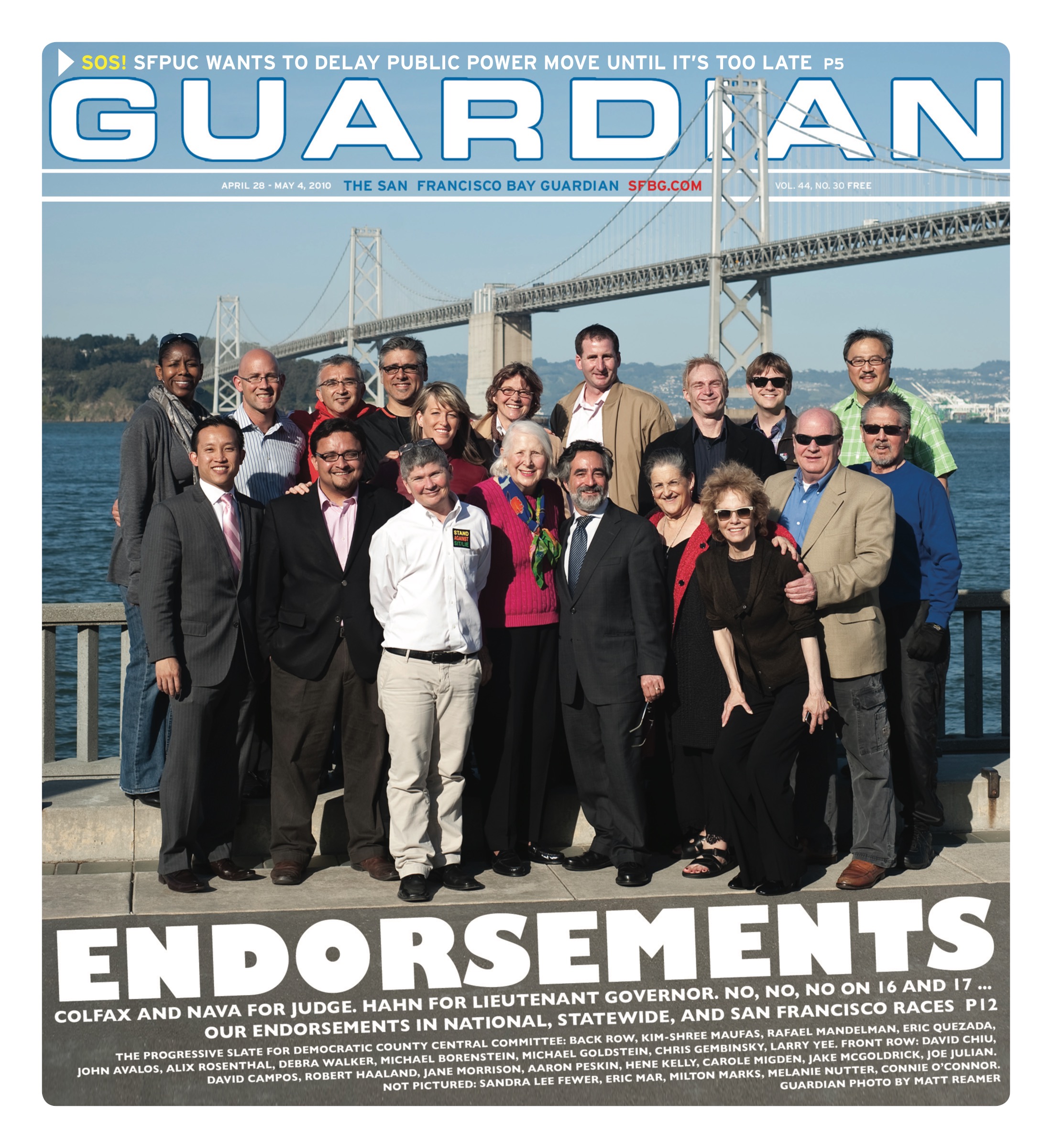
The tension has played out recently around the Board of Supervisors deliberations on the new city budget and November ballot measures and in dramas surrounding the newly elected Democratic County Central Committee, where the battles during its July 28 inaugural meeting previewed a more significant fight over local endorsements coming up Aug. 11.

Almost every elected official in San Francisco is a Democrat. Newsom, the Democratic nominee for lieutenant governor, has been the main obstacle to new taxes that progressives and labor leaders say are desperately needed to preserve public services, deal with massive projected deficits in the next two years, and quit balancing budgets on the backs of workers.

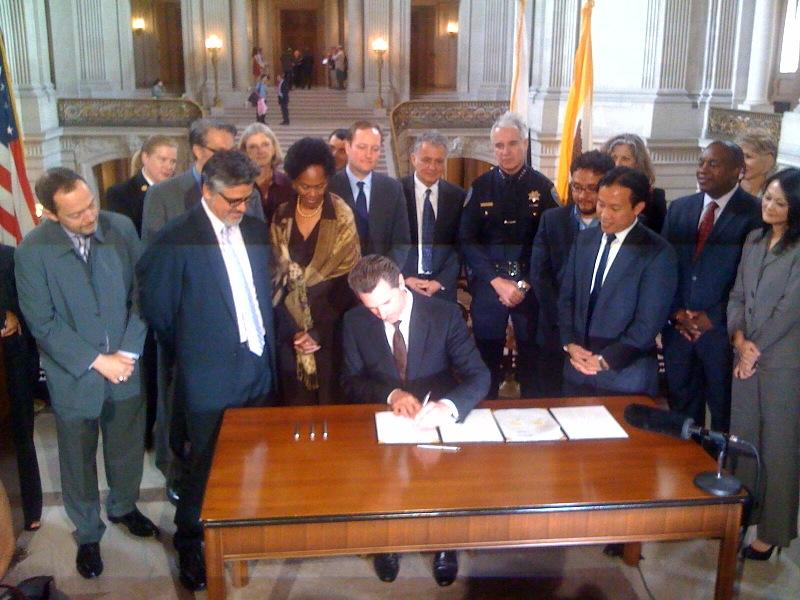
“We balanced the budget without raising taxes. I don’t believe in raising taxes. We don’t need to raise taxes,” Newsom said proudly at his July 29 budget signing ceremony, during which he also effusively praised the labor unions whose support he needs this fall: “Labor has been under attack in this state and country. They’ve become a convenient excuse for our lack of leadership in Sacramento and around the country.”

That hypocritical brand of politics has been frustrating to his fellow Democrats, particularly progressive supervisors and DCCC members. At the July 27 board meeting, Sup. Ross Mirkarimi and Board President David Chiu reluctantly dropped their pair of revenue measures that would have raised $50 million, bowing to opposition by Newsom and the business community.

The San Francisco Chamber of Commerce has become such a vehicle for antitax and antigovernment vitriol that the DCCC on July 29 approved a resolution calling for the organization — which hosted a speech by Republican National Chair Michael Steele in June — to renounce the platform of the Republican National Committee.

“The Chamber is not a knee-jerk right-wing organization,” Chamber President Steve Falk felt compelled to clarify in a July 28 letter to DCCC Chair Aaron Peskin, closing with, “Anything you can do to avoid painting the Chamber as a pawn of the GOP would be greatly appreciated — because it just isn’t true.”

Yet Rafael Mandelman, who sponsored the resolution and is a progressive supervisorial candidate in District 8, told us the Chamber’s fiscal policies are indistinguishable from those pushed by Republicans. “They’re the leading force pushing the Republican agenda in San Francisco,” Mandelman said, calling the stance short-sighted. “It’s not in the long-term interests of the business community for our public sector to fall apart.”

Chiu’s business tax reform measure is a good example of how conservative ideology seems to be trumping progressive policy, even among Democrats. Only 10 percent of businesses in the city pay any local business tax, and the measure would increase taxes on large corporations, lower them on small businesses, create private sector jobs, bring $25 million per year into the city, and expand the tax burden to 25 percent of businesses, including the large banks, insurance companies, and financial institutions that are now exempt. But even the Small Business Commission refused to support the plan, prompting Chiu to drop the proposal and tell his colleagues, “There is still not consensus about whether this should move forward.”

Sup. Chris Daly, the lone vote against the budget compromise with Newsom and the removal of revenue measures from the November ballot, noted at the July 27 board meeting how the business community has sabotaged city finances, citing its 2002 lawsuit challenging the gross receipt taxes, which the board settled on a controversial 8-3 vote. “This is a large part of our structural budget deficit,” Daly said.

But antitax sentiment has only gotten worse with the current recession and political dysfunction, causing Democrats like Newsom to parrot Republicans’ no-new-taxes mantra, much to the chagrin of progressives.

“A lot of this is being driven by statewide politics. [Newsom] needs to not have taxes go up but he also needs the support of the labor unions, so we get weird stuff happening in San Francisco,” Mandelman said.

The situation has also fed Newsom’s animus toward progressives, who have enjoyed more local electoral success than the mayor. Newsom responded in June to the progressive slate winning a majority on the DCCC by placing a measure on the November ballot that would ban local elected officeholders from serving on that body, which includes four progressive supervisors and three supervisorial candidates.

Nonetheless, Newsom then unexpectedly sought a seat on the DCCC, arguing that his lieutenant governor nomination entitled him to an ex officio seat (those held by state and federal elected Democrats) even though the DCCC’s legal counsel disagreed. While noting the hypocrisy of the request, Party Chair Aaron Peskin took the high road and proposed to change the bylaws to seat Newsom.

Some progressives privately groused about giving a seat to someone who, as DCCC member Carole Migden said at the meeting, was “picking a fight” with progressives by pushing a measure she called “disrespectful and unconstitutional.” But in practice, the episode seems to have hurt Newsom’s relations with progressives without really strengthening his political hand.

Newsom ally Scott Wiener — a DCCC member and District 8 supervisorial candidate (who told us he opposes the mayor’s DCCC ballot measure) — proposed to amend Peskin’s motion to change the bylaws in order to seat Newsom with language that would allow Newsom to continue serving even if he loses his race in November.

That amendment was defeated on a 17-13 vote that illustrated a clear dividing line between the progressive majority and the minority faction of moderates and ex officio members. Even with Newsom and District Attorney Kamala Harris (who was seated as the Democratic nominee for attorney general) being seated — and counting the one absent vote, Sen. Leland Yee, who is expected to sometimes vote with progressives and sometimes with moderates — progressives still hold the majority going into the process of endorsing local candidates and allocating party resources for the fall campaign.

“Presuming that 17 people of that 33-member body all agree on something, then the presence of Mayor Newsom doesn’t change anything,” Peskin said. He also noted that even if Newsom’s measure passed and the progressive supervisors were removed, “the irony is that the chair of the party [Peskin] would appoint their successors.”

Also ironic is the political reality that it is Newsom who most needs his party’s support right now, while it is progressives who are adopting the most conciliatory tone.

“We should all be working to turn out the vote and help Democrats win,” Peskin told us. “I implore our mayor and lieutenant gubernatorial candidate to work with us and get that done.”

Yet after Newsom gave a budget-signing speech that included the line, “At the end of the day, it comes down to leadership, stewardship, collaboration, partnership,” he told the Guardian that he has no intention of removing or explaining his DCCC ballot measure, saying only, “If the voters support it, then it would be the right thing to do.”

Chiu responded to the news by telling us, “I hope the mayor can move beyond the politics of personality and build a party vehicle that is about unity.”

A new community congress

0

EDITORIAL The first time a group of activists from across San Francisco met in a Community Congress, it was 1975 and the city was in trouble. Runaway downtown development was creating massive displacement and threatening the quality of life. Rents were rising and tenants were facing eviction. An energy crisis had left residents and businesses with soaring power bills. The manifesto of the Congress laid out the problem:

"Every poor and working class community in San Francisco has learned the hard way that its interests are at the bottom of the list as far as City Hall is concerned. At the top of the list are the banks, real estate interests, and large corporations, who view San Francisco not as a place for people to live and work and raise families, but as a corporate headquarters city and playground for corporate executives. By using their vast financial resources, they have been able to persuade local government officials that office buildings, hotels, and luxury apartments are more important than blue-collar industry, low-cost housing and decent public services and facilities."

The Community Congress hammered out a platform — a 40-page document that pretty much defined what progressive San Francisco believed in and wanted for the city. It included district elections of supervisors, rent control, public power, a requirement that developers build affordable housing, and a sunshine ordinance — in fact, much of what the left has accomplished in this town in the past 35 years was first outlined in that document.

Beyond the details, what the platform said was profound: it suggested that the people of San Francisco could reimagine their city, that local government could become a force for social and economic change on the local level, even when politics in Washington and Sacramento were lagging behind. It called for a new relationship between San Franciscans and their city government and looked not just at what was wrong, but what was possible.

That’s something that too often gets lost in political debate today. With urban finances in total collapse, the progressives are on defense much of the time, trying to save the basic safety net and preserve essential programs and services. It seems as if there’s little opportunity to talk about a comprehensive alternative vision for San Francisco.

But bad times are great times to try new ideas — and when the second Community Congress convenes Aug. 14 and 15 at the University of San Francisco, that’s exactly what they’ll be trying to do. It’s not going to be easy — the left in San Francisco has always been fractious, and there’s no consensus on a lot of central issues. But if the Community Congress attracts a broad enough constituency and develops a coherent platform that can guide future political organizing efforts, it will have made a huge contribution to the city.

The event also offers the potential for the creation of a permanent progressive organization that can serve as a forum for discussion, debate, and action on a wide range of issues. That’s something the San Francisco left has never had. Sup. Chris Daly tried to create that sort of organization but it never really worked out. The city’s full of activist groups — the Tenants Union, the Harvey Milk LGBT Club, the Sierra Club, and many others — that work on important issues and generally agree on things, but there’s no umbrella group that can knit all those causes together. It may be an impossible dream, but it’s worth discussing.

The organizers of the Community Congress discuss some of their agenda in the accompanying piece on this page. It should be based on a vision of what a city like San Francisco can be. Think about it:

This can be a city where economic development is about encouraging small businesses and start-ups, where public money goes to finance neighborhood enterprises instead of subsidizing massive projects.

This can be a city where planning is driven by what the people who live here want for their community, not by what big developers can make a profit doing.

This can be a city where housing is a right, not a privilege, where new residential construction is designed to be affordable for the people who work here.

This can be a city where renewable energy powers nearly all the needs of residents and businesses and where the public controls the electricity grid.

This can be a city where the wealthy pay the same level of taxes that rich people paid in this country before the Reagan era, where the individuals and corporations that have gotten filthy rich off Republican tax cuts give back a little bit to a city that is proud of its liberal Democratic values.

This can be a city where it’s safe to walk and bike on the streets and where clean, reliable buses and trains have priority over cars.

This can be a city where all kids get a good education in public schools.

Despite all the economic woes, this is one of the richest cities in one of the richest countries in the history of human civilization. There are no economic or physical or scientific or structural constraints to reimagining the city. The only obstacles are political.

In the next two years, control of City Hall will change dramatically. Five seats on the Board of Supervisors are up in November, and the mayor’s office is open the year after that. The progressives have made great progress in the past few years — but downtown is gearing up to try to reverse those advances. The community congress needs to address not just the battle ahead, but describe the outcome and explain why San Francisco’s future is worth fighting for.

A new community congress

2

Bad times are great times to try new ideas – the second Community Congress convenes Aug. 14 and 15 at the University of San Francisco

EDITORIAL The first time a group of activists from across San Francisco met in a Community Congress, it was 1975 and the city was in trouble. Runaway downtown development was creating massive displacement and threatening the quality of life. Rents were rising and tenants were facing eviction. An energy crisis had left residents and businesses with soaring power bills. The manifesto of the Congress laid out the problem:

“Every poor and working class community in San Francisco has learned the hard way that its interests are at the bottom of the list as far as City Hall is concerned. At the top of the list are the banks, real estate interests, and large corporations, who view San Francisco not as a place for people to live and work and raise families, but as a corporate headquarters city and playground for corporate executives. By using their vast financial resources, they have been able to persuade local government officials that office buildings, hotels, and luxury apartments are more important than blue-collar industry, low-cost housing and decent public services and facilities.”

The Community Congress hammered out a platform — a 40-page document that pretty much defined what progressive San Francisco believed in and wanted for the city. It included district elections of supervisors, rent control, public power, a requirement that developers build affordable housing, and a sunshine ordinance — in fact, much of what the left has accomplished in this town in the past 35 years was first outlined in that document.

Beyond the details, what the platform said was profound: it suggested that the people of San Francisco could reimagine their city, that local government could become a force for social and economic change on the local level, even when politics in Washington and Sacramento were lagging behind. It called for a new relationship between San Franciscans and their city government and looked not just at what was wrong, but what was possible.

That’s something that too often gets lost in political debate today. With urban finances in total collapse, the progressives are on defense much of the time, trying to save the basic safety net and preserve essential programs and services. It seems as if there’s little opportunity to talk about a comprehensive alternative vision for San Francisco.

But bad times are great times to try new ideas — and when the second Community Congress convenes Aug. 14 and 15 at the University of San Francisco, that’s exactly what they’ll be trying to do. It’s not going to be easy — the left in San Francisco has always been fractious, and there’s no consensus on a lot of central issues. But if the Community Congress attracts a broad enough constituency and develops a coherent platform that can guide future political organizing efforts, it will have made a huge contribution to the city.

The event also offers the potential for the creation of a permanent progressive organization that can serve as a forum for discussion, debate, and action on a wide range of issues. That’s something the San Francisco left has never had. Sup. Chris Daly tried to create that sort of organization but it never really worked out. The city’s full of activist groups — the Tenants Union, the Harvey Milk LGBT Club, the Sierra Club, and many others — that work on important issues and generally agree on things, but there’s no umbrella group that can knit all those causes together. It may be an impossible dream, but it’s worth discussing.

The organizers of the Community Congress discuss some of their agenda in the accompanying piece on this page. It should be based on a vision of what a city like San Francisco can be. Think about it:

This can be a city where economic development is about encouraging small businesses and start-ups, where public money goes to finance neighborhood enterprises instead of subsidizing massive projects.

This can be a city where planning is driven by what the people who live here want for their community, not by what big developers can make a profit doing.

This can be a city where housing is a right, not a privilege, where new residential construction is designed to be affordable for the people who work here.

This can be a city where renewable energy powers nearly all the needs of residents and businesses and where the public controls the electricity grid.

This can be a city where the wealthy pay the same level of taxes that rich people paid in this country before the Reagan era, where the individuals and corporations that have gotten filthy rich off Republican tax cuts give back a little bit to a city that is proud of its liberal Democratic values.

This can be a city where it’s safe to walk and bike on the streets and where clean, reliable buses and trains have priority over cars.

This can be a city where all kids get a good education in public schools.

Despite all the economic woes, this is one of the richest cities in one of the richest countries in the history of human civilization. There are no economic or physical or scientific or structural constraints to reimagining the city. The only obstacles are political.

In the next two years, control of City Hall will change dramatically. Five seats on the Board of Supervisors are up in November, and the mayor’s office is open the year after that. The progressives have made great progress in the past few years — but downtown is gearing up to try to reverse those advances. The community congress needs to address not just the battle ahead, but describe the outcome and explain why San Francisco’s future is worth fighting for.

Newsom’s budget and DCCC hypocrisy

9

Hypocrisy hung thickly in the air at City Hall today as Mayor Gavin Newsom refused to responsively address glaring contradictions on a pair of high-profile policy stances, pursuing naked self interest while cloaking himself in deceptive but high-minded rhetoric. Newsom used the city budget-signing ceremony to effusively praise the labor unions that he publicly shamed into giving back $250 million over two years to balance the budget without tax increases, a budget that cut services and increased various fees and fines.

“Labor has been under attack in this state and country. They’ve become a convenient excuse for our lack of leadership in Sacramento and around the country,” Newsom said without blushing, defending unions against pension reform measures such as Public Defender Jeff Adachi’s SF Smart Reform, which he opposes while continuing to support the need for pension reform.

But Newsom seemed unaware that the layoffs, forced furloughs, and voluntary pay cuts accepted by the unions that he publicly demonized just a couple months ago and now praises – whose support he needs for his current run for lieutenant governor – is connected to his steadfast opposition to new taxes, which he reiterated today: “We balanced the budget without raising taxes. I don’t believe in raising taxes, we don’t need to raise taxes.”

Despite the fact that just 10 percent of San Francisco businesses pay any business taxes to the city, Newsom opposed and this week helped kill a measure by Board President David Chiu to reform the business tax system in a way that would increase taxes on large corporations, lower them on small businesses, create private sector jobs, bring $25 million per year into the city, and expand the tax burden to 25 percent of businesses, including the large banks, insurance companies, and financial institutions that are now exempt. Instead, labor took a deep hit and the city still faces projected $500 million budget deficits each of the next two fiscal years.

But Newsom’s hypocrisy isn’t confined fiscal issues. After the ceremony, he told reporters that he was sticking by his November ballot measure to ban local elected officials from serving on the Democratic County Central Committee, even after last night insisting that body give him a seat, which they had to change the bylaws to accommodate.

At last night’s DCCC meeting, members of an elected committee that includes four progressive supervisors and three current supervisorial candidates called for Newsom or his proxy John Shanley to explain why he is pushing a policy to ban locally elected officials from serving on the DCCC, a body in which elected state and federal officials automatically get seats.

“This mayor is on record as saying local officials should not serve on the committee,” Sup. David Campos said at the meeting, calling for Newsom to clarify this policy contradiction and offer his reasoning for the policy: “We don’t want to do anything that is inconsistent with what the mayor has said so far.”

Chair Aaron Peskin translated Campos’s comments as indicating “some level of irony or hypocrisy,” but Campos objected, insisting “it’s not a personal attack” but a genuine desire to know why Newsom sought to ban local elected officials after progressives won a majority of the DCCC seats in June.

Both Shanley last night and Newsom today gave the same legalistic answers, noting that he’s not serving in his capacity as the mayor, but as an ex officio member who automatically gets a seat for being the Democratic nominee for a statewide office (although the DCCC legal counsel said Newsom wasn’t entitled to a seat because the bylaws only award a seat when the current holder of the office being sought is a Democrat).

But DCCC member Carole Migden objected to Shanley’s answer, saying of Newsom’s effort to unseat duly elected members, “That’s picking a fight, if we want to be clear…That effects my vote, I have to say. It’s disrespectful and unconstitutional.”

DCCC member David Chiu noted that Newsom’s ballot measure would explicitly ban supervisors and the mayor from serving on the DCCC and said that the mayor still had a few days before the deadline for him to withdraw the measure, which he single-handedly placed on the ballot using his authority as mayor.

But today, when asked by the Guardian, Newsom said he had no intention of either withdrawing the measure or explaining it to the DCCC. When we asked about the contradiction in his positions, Newsom said only, “If the voters support it then it would be the right thing to do.”

He was similarly dismissive when other reporters continued to ask about the controversy, gesturing toward me with a dismissive wave of his hand as he said, “Certain people with certain newspapers major in the minor.”

After being told that Newsom is sticking by his DCCC ballot measure, Chiu told us, “I hope the mayor can move beyond the politics of personality and build a party vehicle that is about unity.”


Editor’s Notes

0

Tredmond@sfbg.com

I just got back from a short trip to Canada, the land of government health care and tight bank regulations, where business is booming. From my hotel room in downtown Toronto, I could see construction cranes everywhere. The Globe and Mail had a fascinating report on a construction company manager in Winnipeg who was learning the language of the Cree tribe and creating a new apprenticeship program for First Nations people — in large part because he was facing a serious labor shortage.

Yeah, that’s right: in Canada, they can’t find enough construction workers to fill all the jobs. And there’s a good reason (which has nothing to do with zoning or taxes or fees on developers): The banks in our neighboring country to the north have always been more tightly regulated, so they didn’t have the same meltdown we saw here in the USA.

Then I came back and read that Meg Whitman, candidate for governor of California, wants to eliminate the capital gains tax in the state. I like the Huffington Post headline: "Meg Whitman tax plan: she stops paying hers."

There are two types of people in the world, the rich and the rest of us, and the rich quite often don’t work for a living. Whitman, for example, doesn’t have a day job. She pays the bills with the money she makes by investing the billion dollars or so that she racked up working at eBay.

Actually, she probably doesn’t invest much of it herself these days; she hires someone else to do that. Which means she doesn’t do anything at all to earn the money that comes in each week.

That income is called capital gains — and the HuffPo estimates that she’s bringing in enough that she’d probably owe the state about $4 million a year in taxes at current rates. If she gets elected, and manages to repeal the capital gain tax, she won’t pay any taxes on that money at all.

Which means the state will be even more broke — or that the rest of us suckers, who actually go to work every morning, will have to pay more to make up for it.

I suppose next she’ll want to deregulate the banks.

Small biz should support Chiu tax plan

0

EDITORIAL It’s rare to see a fairly conservative city agency, created in part to make it harder for progressives to push measures that might affect business, come down in favor of a new business tax. But the San Francisco Office of Economic Analysis has concluded that the proposal by Board of Supervisors President David Chiu to change the local payroll tax and impose a new tax on commercial rents would actually help local businesses, particularly small businesses. The proposal presents a crucial opportunity for progressives to make the case that the Chamber of Commerce and big downtown corporations are not advancing the interests of small businesses — and local merchant groups need to pay attention.

Chiu has taken on a problem that has lingered in San Francisco for decades. The city’s business tax is terribly regressive: Only 10 percent of the companies in town even pay the payroll tax, in part because banks, insurance companies, and financial services firms are exempt under state law. That means the burden falls the heaviest on small and medium-sized companies — the ones that provide most of the net job growth in the city.

The new proposal would make the flat payroll tax more progressive and would exempt more small businesses. It would also raise $28 million more a year for the cash-strapped municipal coffers by taxing commercial rents of more than $60,000 a year.

The commercial rent levy would force the big outfits that now pay no city taxes whatsoever to take on at least some of the burden of financing San Francisco government. Smaller companies with modest leases, and small commercial landlords, wouldn’t pay the new tax at all.

Chiu originally had proposed an even broader tax, which would have raised more than $35 million. But after the Small Business Commission expressed concerns, he changed the measure, reducing the burden on small business even further. And at this point, Ted Egan, the city’s chief economist at the Office of Economic Analysis, reports that the tax would lead to greater job creation in the private sector (because of the reduction in the payroll tax) as well as greater job creation in the public sector (because of the additional revenue to the city).

It’s the kind of idea that ought to have broad-based support — progressives looking to fund crucial services see it as a way to bring in money, and small businesses ought to see it as a way to cut taxes and create jobs in the sector of the city that most needs economic stimulus.

Unfortunately, the response from small business leaders hasn’t been encouraging. The commission hasn’t taken a stand on the measure; on July 12th, the panel deadlocked 2-2, with one member absent and two slots still vacant (the mayor hasn’t filled them). That lets the big downtown players — the Chamber, the Building Owners and Managers Association, the Committee on JOBS, etc. — in a position to claim that the Chiu proposal is anti-business.

We’ve seen this pattern far to often. Small business groups allow big corporations, which have no interest in the real issues that impact local merchants, stick the little folks out front on political issues. We’ve seen it over the years with public power, commercial rent control, downtown development, and taxes — and it needs to stop.

The Small Business Commission, the Council of District Merchants, all the local community merchant groups, and anyone else who really cares about the interests of small business in San Francisco should support the Chiu measure. It’s a tax plan that’s good for small business. And if the advocates don’t realize that, they’re hurting themselves, the customers, and the city.

The tax poll is seriously messed up

19

Chuck Nevius, who doesn’t seem to like any taxes, weighed in this morning on a poll paid for by the city’s Transportation Authority that, the way Nevius puts it, “[cast] doubt on whether it would be wise to put some tax issues on the ballot in November.” His analysis of the numbers:


[W]hen it comes to the hotel, parking, business and real estate transfer tax, the voters had four responses: no, no, no and hell no.


His ideological soulmate over at the Ex, Ken Garcia, had a similar report. “San Francisco,” he wrote, “is not in a tax-supporting mood.”


But that’s not how I read the poll at all.


You can see the actual document here. The first thing I’ll note is that 67 percent of the people who responded were over 40. That’s not a surprise; telephone polls skew older these days. (How many young people have land lines, which are the numbers primarily called by pollsters?) The second is that some of the questions are pretty close to incomprehensible. Imagine someone reading this to you over the phone and asking for a quick answer:


To provide loans to pay for seismic retrofits of certain multi-story wood structures at significant
risk of substantial damage and collapse during a major earthquake and funded by a qualified
governmental housing finance agency for permanent or long-term affordability, or single room
occupancy buildings owned by private parties, and pay related costs, shall the City and County
of San Francisco issue up to thirty nine million one hundred forty thousand dollars of general
obligation bonded indebtedness, subject to citizen oversight and regular audits?


But the most important thing is that the tax questions were more than misleading; they’re phrased in a way that almost begs for a No. Here’s the real-estate transfer tax question:


Shall the City and County of San Francisco increase the real property transfer tax on certain
properties by between $3.75 and $10.00 per $500.00 of value, depending on the overall
property value and exempting rent-restricted affordable housing units from the increased tax rate?


That sounds like the average person trying to buy or sell a house is going to get hit with more taxes. Actually, nobody’s proposing a tax on low-end sales. If you asked the real question — should people or businesses that sell property worth more than $5 million pay a slightly higher transfer tax — you’d get a very different answer.


Here’s another one:


Shall the City and County of San Francisco establish a progressive payroll expense tax rate
structure and impose a gross receipts tax on the rental of commercial real property?


My immediate response: What the hell does that mean? It sounds like higher taxes on payrolls and a new tax on rents. Sounds like it’s bad for small business. Actually, that’s an utterly inaccurate representation of the tax the Sup. David Chiu is proposing. How avbout an honest question: Should the city cut taxes on small businesses and make banks and insurance companies pay their fair share? I suspect that would poll a little higher.


You want a real snapshot of how a conservative, older groups of voters, the ones represented in this poll, feel about taxes? Check out question 13, which asks people if they agree or disagree with this statement:


It is crucial to have high quality streets, roads and public transit, even if it means raising taxes.


A full 71 percent said they agree.

I’m not arguing that it’s going to be easy to pass any tax proposals on the fall ballot. But if you put the question the right way, and explain that these revenue measures impact primarily the wealthier residents and businesses and that they money is needed for essential public services, I think most voters are going to say Yes.


Small biz should support Chiu tax plan

2

A new proposal to make the flat payroll tax more progressive and exempt more small businesses

EDITORIAL It’s rare to see a fairly conservative city agency, created in part to make it harder for progressives to push measures that might affect business, come down in favor of a new business tax. But the San Francisco Office of Economic Analysis has concluded that the proposal by Board of Supervisors President David Chiu to change the local payroll tax and impose a new tax on commercial rents would actually help local businesses, particularly small businesses. The proposal presents a crucial opportunity for progressives to make the case that the Chamber of Commerce and big downtown corporations are not advancing the interests of small businesses — and local merchant groups need to pay attention.

Chiu has taken on a problem that has lingered in San Francisco for decades. The city’s business tax is terribly regressive: Only 10 percent of the companies in town even pay the payroll tax, in part because banks, insurance companies, and financial services firms are exempt under state law. That means the burden falls the heaviest on small and medium-sized companies — the ones that provide most of the net job growth in the city.

The new proposal would make the flat payroll tax more progressive and would exempt more small businesses. It would also raise $28 million more a year for the cash-strapped municipal coffers by taxing commercial rents of more than $60,000 a year.

The commercial rent levy would force the big outfits that now pay no city taxes whatsoever to take on at least some of the burden of financing San Francisco government. Smaller companies with modest leases, and small commercial landlords, wouldn’t pay the new tax at all.

Chiu originally had proposed an even broader tax, which would have raised more than $35 million. But after the Small Business Commission expressed concerns, he changed the measure, reducing the burden on small business even further. And at this point, Ted Egan, the city’s chief economist at the Office of Economic Analysis, reports that the tax would lead to greater job creation in the private sector (because of the reduction in the payroll tax) as well as greater job creation in the public sector (because of the additional revenue to the city).

It’s the kind of idea that ought to have broad-based support — progressives looking to fund crucial services see it as a way to bring in money, and small businesses ought to see it as a way to cut taxes and create jobs in the sector of the city that most needs economic stimulus.

Unfortunately, the response from small business leaders hasn’t been encouraging. The commission hasn’t taken a stand on the measure; on July 12th, the panel deadlocked 2-2, with one member absent and two slots still vacant (the mayor hasn’t filled them). That lets the big downtown players — the Chamber, the Building Owners and Managers Association, the Committee on JOBS, etc. — in a position to claim that the Chiu proposal is anti-business.

We’ve seen this pattern far too often. Small business groups allow big corporations, which have no interest in the real issues that impact local merchants, stick the little folks out front on political issues. We’ve seen it over the years with public power, commercial rent control, downtown development, and taxes — and it needs to stop.

The Small Business Commission, the Council of District Merchants, all the local community merchant groups, and anyone else who really cares about the interests of small business in San Francisco should support the Chiu measure. It’s a tax plan that’s good for small business. And if the advocates don’t realize that, they’re hurting themselves, the customers, and the city.

Newsom’s one bright spot (and even it’s a bit dingy)

8

Covering Mayor Gavin Newsom’s devious exploits for this story last week, watching as the ever-ambitious Newsom sacrificed the city’s fiscal future on the altar of political expediency and his increasingly rigid anti-tax ideology, it seemed as if there was nothing remotely redeeming about this callow, self-serving man. But then he does this, appointing Cheryl Brinkman – a strong and respected advocate for promoting alternatives to the automobile – to the Municipal Transportation Agency Board of Directors.

I’m not saying this one act redeems Newsom, not even close. In fact, some have speculated that he’s trying to coopt a qualified progressive or burnish his green credentials, an echo of the responses to when he appointed San Francisco Bicycle Coalition director Leah Shahum to the MTA board a couple years ago, a tenure Newsom ended prematurely after they clashed over creating more car-free spaces. Or maybe he’s trying to head off support for a ballot measure being considered by the Board of Supervisors to split appointments to the MTA. Who knows with this guy?

Yet it’s also true that being open to democratizing the streets of San Francisco has been a bright spot in Newsom’s otherwise dismal record as mayor. And I think that’s because the cost of admission to this movement is so low. He’s embraced temporary car-free spaces, supported more bicycling, and moved forward other green initiatives – all of which have little to no cost involved and no real political downside. So it’s been easy for Newsom to strike green poses when he chooses, just as it was easy for him to make the supposedly “courageous” decision to legalize same-sex marriage, which involved no heavy lifting and greatly improved Newsom’s political prospects.

But we’re reaching a moment of truth for San Francisco, a point at which the easy answers are evaporating and the bill is coming due – just as Newsom prepares to leave San Francisco for Sacramento. After doubling Muni fares since he became mayor and reaching a level where they really can’t go up anymore without diminishing returns and serious political consequences, Newsom and his appointees have run out of easy options for maintaining Muni in an era of declining state and federal support.

Now, the choices aren’t as easy: charge motorists more for parking, permits, or driving in the most congested times or places; cut Muni service or raise rates more; find ever more ways to nickle-and-dime everyone with various fee increases; or find more general tax revenue, which Newsom has been steadfastly unwilling to do, even though the big banks and financial services companies that caused the Great Recession are exempt from city business taxes.

Brinkman, who tells us that the Mayor’s Office placed no conditions on the appointment, now has a tough job, as do all of this city’s elected and appointed officials. But this is the moment when they must have the courage to make the tough choices about what’s best for San Francisco, choices that Newsom has been unwilling to make.

Bad faith

3

steve@sfbg.com

Mayor Gavin Newsom and his business allies are actively trying to sabotage the various revenue measures that have been put forth by the labor movement and progressive members of the Board of Supervisors, employing deceptive rhetoric, sneaky tactics, and a refusal to bargain in good faith.

In fact, Newsom — the Democratic nominee for lieutenant governor — is so averse to supporting anything that could be called a “tax” that he rejected a hard-won compromise measure created by powerful developers, affordable housing advocates, a pro-business think tank, the building trades, and his own directors of housing and economic development.

Just as that story was breaking in the New York Times (produced by Bay Citizen) on July 9, members of the Board of Supervisors Budget and Finance Committee discovered that Newsom’s proposed ballot measure to close loopholes in the city’s hotel tax that favored airline employees and online travel companies — a widely supported change, but one worth just $6 million per year — contains language that would nullify any increases in the hotel tax. Earlier in the week, labor unions turned in signatures on an initiative to increase the hotel tax by 2 percent, which would bring in more than $30 million per year.

“This poison pill is an intentionally deceptive, underhanded move,” Gabriel Haaland, an organizer with Service Employees International Union Local 1021, which sponsored the hotel tax, told us. “It’s so frustrating. It’s not even a good faith fight. He’s trying to create confusion and fool the voters. If our measure passes fair and square, it should be implemented.”

Meanwhile, Newsom and business groups have been attacking a reform measure by Board President David Chiu that would make the currently flat payroll tax more progressive, exempt more small businesses from paying it, and create a commercial rent tax to spread the tax burden more widely than the 10 percent of businesses who now pay tax to the city.

Critics complained that the measure would hurt local businesses — but that’s just not true. The city’s Office of Economic Analysis concluded that Chiu’s original proposal would have no effect on private sector jobs and would generate $34 million annually for the city, preserving some government jobs and spending.

Then Chiu amended the measure to spare even more small businesses. Now the OEA says that the measure would actually create private sector jobs — and still bring $28 million in to the city. Yet Newsom and the business community are still withholding their support.

This trio of Machiavellian moves comes just a week after Newsom pulled out of budget negotiations with board progressives concerning about $40 million in board add-backs to programs that Newsom proposed to cut after they wouldn’t agree to his precondition that they withdraw unrelated measures proposed for the November ballot, such as splitting appointments to the Rent, Recreation and Park, and Municipal Transportation Agency boards and requiring police officers to do foot patrols.

The series of events has led many progressives to say that conservative ideological blinders — a knee-jerk opposition to anything that saves government jobs and services or that Republicans might criticize — is the only logical explanation for the intransigent stance adopted downtown and by Newsom.

“It’s ideological. It’s not economic, and it’s not even political,” said Calvin Welch, the affordable housing activist who helped negotiate the transfer tax compromise with developer Oz Erickson, San Francisco Planning Urban Research Association director Gabriel Metcalf, Mayor’s Office of Housing Director Doug Shoemaker, and others.

That measure would have created a transfer tax on sales of properties over $875,000 and generated approximately $50 million annually for affordable housing (funds that were drastically reduced in Newsom’s proposed 2010-11 budget) while cutting in half the current requirements and fees on market-rate developers to create below-market-rate units. The plan would have stimulated both types of housing and created desperately needed construction work — an approach those involved called an elegant solution to several problems.

“To me, this was a win-win, solving two problems that are each a big deal,” Metcalf told us. “I don’t know what his reasons were for not supporting it. I was surprised.”

But Welch said, “It collapsed straight up because the mayor didn’t want to support a tax.” Although Newsom told the Times it was because there wasn’t broad enough consensus yet, “the mayor’s reason is whole-cloth bullshit,” Welch said, noting the role of the Mayor’s Office in brokering the deal. “The mayor walks away from it because everyone wasn’t in the room? Well, it’s your room, motherfucker. Show some leadership.”

Newsom Press Secretary Tony Winnicker refused to discuss these issues by phone, responding to our written inquires by noting that Newsom opposes taxes and thinks the best way to address budget deficits are privatizing city services and pension reform (although he opposes Public Defender Jeff Adachi’s initiative, the only pension reform measure on the fall ballot).

“The mayor is opposed to the Board of Supervisors’ proposals to increase taxes because they’re not needed to balance the budget and they will strangle our still young economic recovery,” Winnicker wrote, refusing to answer follow-up questions or support a statement about Chiu’s measure that the OEA concludes is not accurate.

Like many political observers of all stripes, those from downtown and progressive circles, Welch criticized Newsom for his lack of engagement with city business and its long-term fiscal outlook, contrasting him with former Mayor Willie Brown, who met regularly with former Board of Supervisors President Tom Ammiano even as the two ran a bitter campaign for mayor against one another in 1999. “They dealt with the city’s business like two adults who cared about the city,” he said.

Welch acknowledged that there was still work to be done building political support for the transfer tax measure. He and other progressives would have had to win over city employee unions who wouldn’t like the budget set-aside aspect, and Erickson and Metcalf would need to placate some of their downtown allies who oppose taxes on ideological grounds. But given how downtown groups are behaving right now, that might not have been an easy sell.

“There are members of the small business community that are averse to any taxes,” said Regina Dick-Endrizzi, director of the city’s Office of Small Business and staffer to the Small Business Commission, which was withholding a recommendation on the Chiu measure but planned to meet again to consider it July 12 (look for an update on the sfbg.com Politics blog). She said the small business community is having tough times and “they are just not sensitive to keeping city workers employed.”

Larger commercial interests are being even more forceful in opposing the revenue measures. While a parade of workers, social service providers, and progressive activists testifying at the July 9 Budget Committee hearing implored supervisors to place all the proposed revenue measures on the ballot, representatives from the Building Owners and Managers Association (BOMA) and San Francisco Chamber of Commerce were the only two speakers urging supervisors to drop the measures and focus instead on creating private sector jobs.

“You’re trying to create a little revenue here and it’s not going to work,” said Ken Cleaveland, director of BOMA SF, arguing that big banks and financial services companies — entities exempt from the payroll tax that Chiu is hoping to target with the commercial rent tax — will buy their buildings to avoid paying the tax. “They aren’t going to create more jobs and they really aren’t going to create more revenue.”

Yet Chiu noted that it was the business community and fiscal conservatives who pushed to create the Office of Economic Analysis, whose work they have regularly used to attack progressive legislation. Now that the office has concluded that a piece of progressive legislation is good for the local economy, Chiu told Cleaveland and the Chamber spokesperson Rob Black at the hearing, “I ask you to respect the work this office has done.”

Black said the Chamber board will consider Chiu’s amended legislation, but said businesses are in no mood to help the city. “How many times have you gone to your neighborhood merchant and had them say, ‘Gee, my rent’s too cheap’?<0x2009>” he said during his testimony.

Yet Chiu said landlords of small tenants (those paying less than $65,000 in rent per year) are exempt from the rent tax and only 26 percent of SF businesses would pay any city business tax under his plan. “I hope the mayor will support this proposal and the business community will give it a good look,” Chiu said as the hearing ended.

At the beginning of the hearing, Chiu framed the dire situation facing San Francisco, citing Controller’s Office figures showing this year’s $500 million budget deficit (out of a $6 billion total budget) will be followed by a $700 million deficit next year and a $800 million gap the following budget cycle as a result of a deep structural budget imbalance.

“We have budget deficits as far as the eye can see,” Chiu said at the hearing. “We have to consider measures that will provide more stable sources of revenue.”

He also noted that city employee unions have agreed to give back about $250 million in salary and had their ranks reduced by about 2,000 workers in the last two years. So he and the other progressive supervisors say it’s time for the rest of San Francisco to help address the problem.

“We, as a city, should not be trying to balance this budget simply through cutting,” Sup. David Campos said.

Sup. John Avalos, the committee chair, amended his transfer tax measure in the wake of Newsom’s rejection of the deal by making it a simple 2 percent tax on properties that sell for more than $5 million, and 2.5 percent tax on properties over $10 million. He estimates it will bring in about $25 million per year from the city’s wealthiest corporations and landlords.

“That’s who we’re socking it to,” Avalos told us, saying he was disappointed the compromise fell through. “The amendment is going to be more progressive than what was originally planned.”

Even Sup. Sean Elsbernd, a strong fiscal conservative who announced early in the hearing, “You want to do that [balance future budgets] by adding taxes, but I want to do it through ongoing service cuts,” later told the Guardian that he was intrigued by the amendments Avalos and Chiu made to their measures and has not yet taken a position on them.

Sup. Ross Mirkarimi is also sponsoring a measure to increase the city’s tax on parking lot operators from 25 percent to 35 percent, the first change to that tax in 30 years, and will include valet parking for the first time. The measure would bring in up to $24 million per year, and OEA analysis shows it would decrease the number of cars trips by 1.3 percent, another benefit.

SFMTA supports the measure, with board member Cameron Beach testifying that the money will be used to subsidize Muni and “it links the use of private automobiles and is consistent with the city’s transit-first policy.” Mirkarimi, who chairs the Transportation Authority, also has proposed a $10 local vehicle license fee surcharge that would bring in another $5 million per year for Muni.

All the revenue measures require six votes by the full Board of Supervisors, which is scheduled to consider them July 20, after which they would need a simple majority approval by voters in November to take effect.

The mayor has the authority to directly place measures on the ballot, so the committee hearing on his hotel tax loophole measure and a $39 million general obligation bond that he’s proposing to create a revolving loan fund for private sector seismic improvements were mere formalities, so supervisors criticized aspects of each but were unable to make changes.

Avalos even grudgingly acknowledged the hotel tax poison pill was an effective way to kill that revenue source, saying at the hearing, “This is very smart. I don’t agree with it, but it’s very smart.”

Haaland was less charitable, criticizing a provision designed to confuse voters. “This kind of move means both measures won’t pass because now we have to oppose [Newsom’s measure],” he said, criticizing the mayor for running away from the hard decisions facing the city. “He won’t be around next year, when we have an even bigger structural budget deficit, to clean up this mess. Absent new revenue sources, this city starts to fall apart.”

Beyond the rage

46

rebeccab@sfbg.com

Downtown Oakland became supercharged with emotion in the hours following the July 8 announcement of the verdict in the trial of former BART police officer Johannes Mehserle. And in the days that followed, the city remained electrified as residents struggled to make sense of the verdict, the rioting that occurred in its wake, and the historic significance of these developments.

But as the emotions dissipate, the issues behind the verdict and its aftermath remain — along with a series of questions that could determine whether this intensely scrutinized shooting of an unarmed man will lead to any changes in police practices or the justice system, as well as how the community will react if the judge imposes a light sentence.

After being moved out of the Bay Area because the publicity surrounding the case, a Los Angeles jury found Mehserle, a white officer, guilty of involuntary manslaughter for fatally shooting Oscar Grant, a 22-year-old unarmed black man who was detained on a BART train platform in Oakland on Jan. 1, 2009 following reports of a fight.

The verdict stood out as an almost unprecedented conviction of an officer in a case involving deadly use of force, and a departure from an all-too-familiar narrative in which tragedies resulting from police shootings bring no consequences for those responsible for pulling the trigger. However, in the wake of the verdict, Grant’s family members made it clear that they did not believe that justice had been served.

“This involuntary manslaughter verdict is not what we wanted, nor do we accept it,” Oscar Grant’s uncle, Cephus “Bobby” Johnson, said at a July 10 press conference at True Vine Ministries, a West Oakland church. “It’s been a long, hard road, but there are chapters in this war. The battle’s just getting started.”

To Grant’s relatives and a coalition of supporters who came together in response to the shooting, the trial is intrinsically linked to a long history of police brutality that occurs with impunity in cases involving youth of color. Meetings organized by clergy and community members have been held weekly in West Oakland over the past 19 months with the ultimate goal of bringing about greater oversight of the BART police and effective police reform on a broader scale.

On July 9, the U.S. Department of Justice announced that its Civil Rights Division, the U.S. Attorney’s Office, and the FBI have opened an investigation into the shooting and would determine whether prosecution at the federal level is warranted. Defense Attorney Michael Rains also made a motion to move Mehserle’s sentencing to a date later than Aug. 6, the date it was originally expected.

As the events of July 8 solidify into the Bay Area’s collective memory, attention is now shifting toward the next steps, and to lingering questions. Mehserle’s sentencing is key: will his sentence be light, reflecting the jury’s conclusion that he simply made a mistake — or will it include substantial prison time, reflecting the fact that he shot and killed an unarmed man without justification? Will he receive a lighter sentence than someone else without a criminal record found guilty of involuntary manslaughter simply because of his identity as a former officer with law enforcement organizations still in his corner? If Mehserle receives a long sentence, will it signify a shift in a justice system that many perceive as biased — or a stand-alone result of intense public scrutiny?

And as a result of all this, will the BART police finally get the type of training and serious civilian oversight they so badly need?


RAW REACTION

On the day the verdict was announced, thousands turned out for a peaceful rally near Oakland’s 12th Street BART Station and City Hall to hear speakers sound off about how their lives had been affected by police brutality.

As night fell, looting and rioting began to break out as the media covered scenes of rage set against small trash fires, causing anger and frustration for many Oakland residents who were dismayed and frightened by the chaos and disorder. More than 80 arrests were made, and dozens of stores including Sears, Whole Foods, Subway, Foot Locker, and numerous banks were damaged or looted. Police efforts to respond to the situation gave downtown city blocks the feeling of a war zone for several hours.

Reactions to the verdict, and the chaotic aftermath that followed, varied in the following days.

“The truth is that in American history, this is both a high point and a low point,” Olis Simmons, executive director of Youth UpRising — an Oakland nonprofit that works with youth of color — told the Guardian the following day. Speaking to the fact that an officer had been convicted in a case involving a wrongful death, she said: “I think it really is a signal that America is changing. This is the farthest we’ve ever gone.”

She said she hoped that people who were infuriated enough to react violently on the evening of July 8 would channel that energy toward constructive goals of pushing for a more satisfactory outcome. Before rallies and later rioting began that night, Youth UpRising sent people into the crowd to hand out glossy flyers proclaiming “violence isn’t justice.”

Davey D Cook, an independent radio journalist who extensively covered activity surrounding Grant’s death on a news site called Davey D’s Hip Hop Corner, said he thought the mainstream media was ready to have “a field day” with the riots, pointing out that they ran special coverage in the days leading up to verdict, building up anticipation of violent outbreaks. He also said that the scope of the rioting should be kept in perspective.

On his July 9 KPFA radio show, Hard Knock Radio, Cook added a salient point: “Broken windows can be replaced, and in two weeks, they will be. Stolen merchandise can be replaced, and it will be. But who’s going to replace this justice system that got looted? What insurance policy takes care of that?”

Just before the July 10 press conference, a town hall meeting was held inside True Vine Ministries. It was crammed full of supporters from Oakland, San Francisco, and beyond who listened as Minister Keith Muhammad — a representative of the Nation of Islam who has worked closely with the Grant family and traveled to Los Angeles to watch the trial — spoke at length. Muhammad was dressed immaculately in a suit and tie, and spoke with an air of fiery conviction.

“In the outcome of this case, there is surely more to be resolved that has yet to be addressed,” Muhammad said. He emphasized that “we’re not satisfied,” but added: “You should know that dissatisfaction is the foundation of all change.”

He raised a number of questions about the proceedings, asking why there was an absence of African Americans on the jury, and why the judge called an early recess when Grant’s teenage friend, Jamil Dewar, sobbed uncontrollably on the witness stand — but not when Mehserle sobbed on the stand. He noted that Grant’s friends were kept in handcuffs for six hours after witnessing Grant’s death.

In the days following July 8, much was also said about mainstream media coverage of the events, in particular the notion that “outside agitators” would come in and start trouble. “I do not like this divisive campaign to divide our community and protestors by calling people outsiders,” Oakland defense attorney Walter Riley wrote in a statement posted on Indybay.org. “This is a great metropolitan area … we expect people from all over the map to participate in Oakland. Calling people outsiders in this instance is a political attack on the movement. The subtext is that the outsiders are white and not connected to Oakland. From the days of the civil rights movement to now, the outsider labeling failed to address the underlying problems for which people came together. We must engage in respectful political struggle. I understand the frustration. I do not support destruction and looting as political protest.”


LOOKING FORWARD

Mehserle’s conviction suggests the jurors believed his defense that he meant to draw and fire his Taser instead of his gun. In legal terms, settling on involuntary manslaughter, rather than second-degree murder or voluntary manslaughter, means the jury was not convinced beyond a reasonable doubt that Mehserle had malice toward Grant. But the jury found that he was criminally negligent when he failed to notice that he had his gun instead of his Taser in the moments before he pulled the trigger.

“In California, and really in any state, it is extremely difficult for jurors to convict a police officer. There’s an extreme reluctance to do that,” Whitney Leigh, an attorney who formerly worked in the San Francisco Public Defender’s Office, told us.

“There are undoubtedly instances where things like this have happened at some time in the past in California, that weren’t videotaped,” Leigh continued. “But for the videotape, if you walked 10 witnesses in who said that what happened, happened, no one would believe them if the officer took the stand and said that’s not what happened. The only reason there’s a case at all is that there’s a videotape.”

Leigh said he thought that unless the public develops a better awareness that police misconduct regularly occurs, “individuals are going to continue to be victimized by a system that effectively encourages officers to believe that they can act with significant impunity.”

Asked whether he thought it was likely that the federal government would decide to step in after concluding its investigation, he said it was a tough call. “The Justice Department is highly selective in the cases it chooses to prosecute for these crimes,” he cautioned. “That said, the kinds of cases they choose are ones that tend to have a lot of public attention and concern, so this fits within that category. Since it’s such a public case, it can have more of a widespread impact.”

If Mehserle was prosecuted at the federal level, the case would invoke Criminal Code 18 U.S.C. Sec. 242, used when a government agent or an individual acting under the color of authority denies someone their civil rights through force, threats, or intimidation, based on their race, gender, or another protected category.

Then again, the federal government’s decision over whether or not to step in may be linked to the degree of severity of Mehserle’s sentence.

California Penal Code Section 193 specifies the mitigated, midterm, and aggravated sentences for involuntary manslaughter: two, three, or four years in state prison, respectively. Because Mehserle’s case involves his personal use of a firearm, a sentence enhancement of three, four, or 10 years can be added to his prison time under California Penal Code Section 12022.5.

The judge will weigh circumstances to determine Mehserle’s sentence, possibly including his record as a police officer, his criminal record, age, remorse, and other factors, explained Jim Hammer, a former prosecutor and current San Francisco Police Commission member. The judge could toss out the sentence enhancement for personal use of a gun — and there’s a possibility he would deem extreme circumstances, such as his police record, to warrant probation rather than prison time. But Hammer said he thought both of those outcomes are unlikely.

“The judge will want to appear more than fair, not giving special treatment,” Hammer said. “Judges have to stand [for] election too, and in the light of the fact that somebody’s dead, I think the chance of probation is incredibly slim.”

Even if Mehserle receives a light sentence and then faces prosecution at the federal level, there is a chance that information about his past record as an officer — which was not admitted as evidence, thanks to laws that afford protections for police officers in these kinds of cases — would continue to be shielded. The protection applies even though Mehserle resigned.

“The average person just wants courts to be fair,” Leigh said. “And there’s an inherent unfairness in a system that allows a government or a police department that has all the resources and records to … use against you while shielding what might be much more serious and relevant acts by police officers. That’s one change that would be great if that did happen.”

A key legal issue in the case and any possible federal case is reasonable doubt, Hammer said. “Reasonable doubt is everything, and no one talks about it. They just say, ‘Oh, he didn’t have intent.’ That’s not the issue. Can anybody really, honestly say that they don’t have some doubts about his intent?”

At the same time, Hammer tempered his legal analysis with some understanding of Grant’s mother’s pain in light of what happened to her son and as the verdict was reached.

“If the dictionary had three pictures of murder for a picture image, one would be shooting somebody in the back who is unarmed,” he told the Guardian. “What she’s saying is not outrageous. If it were my relative I would probably call it murder too. She’s not crazy.”

As things continue to unfold with Mehserle’s sentencing and the federal civil rights investigation, civil litigation is in the works too. Wrongful death civil lawsuits will likely be filed against BART by Oakland civil rights attorney John Burris on behalf of Grant’s mother, as well as another suit by five friends who were with Grant the night he was killed. BART settled a suit filed on behalf of Tatiana Grant, the slain man’s five-year-old daughter, in January. That total settlement should amount to more than $5.1 million, according to a media release on Burris’ website.

During an interview after the July 10 press conference, Johnson was asked how Grant’s young daughter was doing. He responded: “Tatiana is still struggling with the issue of when her daddy’s coming home. So it’s going to take time for her, when she does understand that he is not coming back home.”

Outside Grant’s family, many observers hope to see systemic change come out of this tragedy. Assembly Member Tom Ammiano introduced legislation to create civilian oversight of BART police after the shooting, but was unhappy to see how it was watered down during the legislative process. Now he wants to see stronger reforms.

“I think Oscar Grant’s death was inevitable based on the lack of caring about how those police were trained,” he told us. “If you’re going to have the kind of independent civilian oversight that’s going to prevent a repeat of what happened to Oscar Grant, you can’t have this namby-pamby law. The mantra has been, well, this is better than nothing. Unless they’re made to do it … it’s not going to happen the way we want.”

Taming finance in an age of austerity

1

By Joseph E. Stiglitz

NEW YORK – It was not long ago that we could say, “We are all Keynesians now.” The financial sector and its free-market ideology had brought the world to the brink of ruin. Markets clearly were not self-correcting. Deregulation had proven to be a dismal failure.

The “innovations” unleashed by modern finance did not lead to higher long-term efficiency, faster growth, or more prosperity for all. Instead, they were designed to circumvent accounting standards and to evade and avoid taxes that are required to finance the public investments in infrastructure and technology – like the Internet – that underlie real growth, not the phantom growth promoted by the financial sector.

The financial sector pontificated not only about how to create a dynamic economy, but also about what to do in the event of a recession (which, according to their ideology, could be caused only by a failure of government, not of markets). Whenever an economy enters recession, revenues fall, and expenditures – say, for unemployment benefits – increase. So deficits grow.

Financial-sector deficit hawks said that governments should focus on eliminating deficits, preferably by cutting back on expenditures. The reduced deficits would restore confidence, which would restore investment – and thus growth. But, as plausible as this line of reasoning may sound, the historical evidence repeatedly refutes it.

When US President Herbert Hoover tried that recipe, it helped transform the 1929 stock-market crash into the Great Depression. When the International Monetary Fund tried the same formula in East Asia in 1997, downturns became recessions, and recessions became depressions.

The reasoning behind such episodes is based on a flawed analogy. A household that owes more money than it can easily repay needs to cut back on spending. But when a government does that, output and incomes decline, unemployment increases, and the ability to repay may actually decrease. What is true for a family is not true for a country.

More sophisticated advocates warn that government spending will drive up interest rates, thus “crowding out” private investment. When the economy is at full employment, this is a legitimate concern. But not now: given extraordinarily low long-term interest rates, no serious economist raises the “crowding out” issue nowadays.

In Europe, especially Germany, and in some quarters in the US, as government deficits and debt grow, so, too, do calls for increased austerity. If heeded, as appears to be the case in many countries, the results will be disastrous, especially given the fragility of the recovery. Growth will slow, with Europe and/or America possibly even slipping back into recession.

Stimulus spending, the deficit hawks’ favorite bogeyman, did not cause most of the increased deficits and debt, which are the result of “automatic stabilizers” – the tax cuts and spending increases that automatically accompany economic fluctuations. So, as austerity undermines growth, debt reduction will be marginal at best.

Keynesian economics worked: if not for stimulus measures and automatic stabilizers, the recession would have been far deeper and longer, and unemployment much higher. This does not mean that we should ignore the level of debt. But what matters is long-term debt.

There is a simple Keynesian recipe: First, shift spending away from unproductive uses – such as wars in Afghanistan and Iraq, or unconditional bank bailouts that do not revive lending – toward high-return investments. Second, encourage spending and promote equity and efficiency by raising taxes on corporations that don’t reinvest, for example, and lowering them on those that do, or by raising taxes on speculative capital gains (say, in real estate) and on carbon- and pollution-intensive energy, while cutting taxes for lower-income payers.

There are other measures that might help. For example, governments should help banks that lend to small- and medium-size enterprises, which are the main source of job creation – or establish new financial institutions that would do so – rather than supporting big banks that make their money from derivatives and abusive credit card practices.

Financial markets have worked hard to create a system that enforces their views: with free and open capital markets, a small country can be flooded with funds one moment, only to be charged high interest rates – or cut off completely – soon thereafter. In such circumstances, small countries seemingly have no choice: financial markets’ diktat on austerity, lest they be punished by withdrawal of financing.

But financial markets are a harsh and fickle taskmaster. The day after Spain announced its austerity package, its bonds were downgraded. The problem was not a lack of confidence that the Spanish government would fulfill its promises, but too much confidence that it would, and that this would reduce growth and increase unemployment from its already intolerable level of 20%. In short, having gotten the world into its current economic mess, financial markets are now saying to countries like Greece and Spain: damned if you don’t cut back on spending, but damned if you do as well.

Finance is a means to an end, not an end in itself. It is supposed to serve the interests of the rest of society, not the other way around. Taming financial markets will not be easy, but it can and must be done, through a combination of taxation and regulation – and, if necessary, government stepping in to fill some of the breaches (as it already does in the case of lending to small- and medium-size enterprises.)

Unsurprisingly, financial markets do not want to be tamed. They like the way things have been working, and why shouldn’t they? In countries with corrupt and imperfect democracies, they have the wherewithal to resist change. Fortunately, citizens in Europe and America have lost patience. The process of tempering and taming has begun. But there is far more yet to do.

Joseph E. Stiglitz is University Professor at Columbia University and a Nobel laureate in Economics. His latest book, Freefall: Free Markets and the Sinking of the Global Economy, is now available in French, German, Japanese, and Spanish.

Copyright: Project Syndicate, 2010.
www.project-syndicate.org
For a podcast of this commentary in English, please use this link:
http://media.blubrry.com/ps/media.libsyn.com/media/ps/stiglitz127.mp3

Sorting out the Adachi initiative

37

Lots of press on the Adachi pension-reform measure, a proposal that would amount to cutting the pay of city workers during a recession. It turns out even Gavin Newsom doesn’t like the plan:


The mayor also attacked Adachi’s pension plan, arguing that the public defender never discussed it with the employee unions, city officials or others affected by the measure and that it could have “unintended consequences” for the city.


And while I think it’s a bit of a stretch to say that the Adachi measure “could reshape national politics,” Randy Shaw makes a good point:


Adachi’s measure would join with Sean Elsbernd MUNI charter amendment to create a one-two punch against public employees on San Francisco’s November ballot. The national media will have a field day with the prospect of “liberal” San Francisco, and Nancy Pelosi’s home turf, voting to cut public employee compensation.

While this is not the message Adachi wants to send, it will likely be the one that is heard. It emerges at a time when the entire Republican Party and corporate Democrats are in a full-fledged media campaign to redirect public anger over the fiscal crisis toward excessively compensated public employees, and away from banks, oil companies, hedge fund managers, and an under taxed and poorly regulated private sector.


Shaw also says that the campaign will “bitterly divide progressives,” and I’m not sure it has to turn out that way. There’s always the danger that liberal voters who work in the private sector, and are struggling to keep their jobs and health insurance, will be seduced by the notion that public-sector employees are too well paid already. And the donwtown folks, who will soon be fully on board with the Adachi measure, will seek to divide the nonprofit sector and labor by arguing that nonprofit workers don’t get the same benefits as city employees — and city funding for nonprofits is threatened by the budget deficit. Both those things are true, but it’s also true that there’s a growing movement to challenge that approach. This battle will be a test for the city’s progressive movement, but I think the overwhleming majority of progressive leaders, activists and nonprofits will stick together and oppose Adachi.


The more important political impact will be felt in the tightly contested district-election contests, where city-employee pensions could join the sit-lie measure as wedge issues that the moderates will use against progressives. When Adachi came down to see us, I asked him if he was worried about that; he didn’t really seem to think it was important.


But there’s a reason we talk about a “progressive movement” (and don’t start on the “machine” stuff again, we had that debate over here). We all ought to be concerned about how one campaign affects the larger goal of building a better and more sustainable city. And while I hate to say it, I have to agree with Gavin Newsom: This thing could have “unintended consequences.”


The Daily Blurgh: Ethnic Frensing, a bear suns in Oakland

0

Fake trend alert! “Ethnic Frensing.” Quick! Get it into circulation before Tyra Banks tries to copyright it.

*****

WTF Headline of the day: “Ghoulish cargo of 60 severed heads found at airport.

*****

Couldn’t the Chronicle‘s editors have worked a “crypt keeper” pun into this profile of UC Santa Cruz’s resident Grateful Dead scholar?

*****

Fantasy casting the inevitable BP oil spill movie. (But no Kevin Costner???).

*****

Welcome Oakland’s newest ursine resident, Pagi.

*****

Is demonstrating part of “The Berkeley Experience?”

*****

Anthony Bourdain on Alice Waters: “I respect her, but … well, that’s comedy gold, let’s put it that way …” Amen.

*****

Mission Street Food to try its hand at “Americanized Oriental Food.” Bring on the free range Egg foo young!

*****

Stay cool this weekend:

Receiver appointed to investigate assets of SF Weekly and parent chain

0

 The California Superior Court has appointed a receiver to investigate the finances of SF Weekly’s parent company and develop a plan to pay the Bay Guardian the $22 million that the chain owes as a result of our predatory pricing lawsuit. 


 On May 25, Commissioner Everett A. Hewlett, Jr., entered an order appointing professional receiver David Summers to investigate the assets of New Times Media LLC and its subsidiary, SF Weekly LP.


New Times Media LLC is the holding company for the nationwide Village Voice chain of alternative weekly newspapers.


Summers has been ordered to develop a plan for the disposition of the company’s assets so the Bay Guardian can get paid.


“This is a very significant step forward in our collection efforts,” said Bruce B. Brugmann, Bay Guardian editor and publisher.


After a six-week trial in 2008, a San Francisco jury found that the Weekly and New Times had intentionally sold ads below cost in an effort to damage the independently owned local competitor.


The jury awarded the Bay Guardian $6.39 million, and Judge Marla Miller trebled part of the damages and added on attorney’s fees. With interest accruing at 10 percent a year, the judgment is now more than $22 million.


New Times and SF Weekly Have appealed the judgment. The California Court of Appeal has set oral argument for 9 a.m. June 11.


Earlier this year, a lending syndicate lad by Bank of Montreal declared the Village Voice chain to be in default of their $77 million loan arrangements. Bank of Montreal claims to be daily sweeping the moneys earned by the Village Voice chain into a special account so as to protect the lenders’ interests.


The banks in the syndicate that are holding the VVM debt (as of March, 2009) are Bank of Montreal, U.S. Bank, Wells Fargo, WestLB AG, Rabobank, BNP Paribas, and Brown Brothers Harrimann.


The Bay Guardian has already seized two of SF Weekly’s vehicles and the rent that the paper’s subtenants pay. The California Superior Court has previously ordered half the SF Weekly’s advertising revenues diverted into an independent bank account, and placed a lien on New Times’ interests in its subsidiaries to protect the Bay Guardian’s interests.


Andy Van De Voorde, spokesperson for VVM, didn’t respond to an email requesting comment. 

Streets of San Francisco: City talk

0

On Friday, May 7 at 12 p.m., I stood at the intersection of Van Ness and Market with a pen, notepad, and die in hand. The pen and notepad were used to capture discernable language overheard, while the die served to dictate the initial direction of my walking as well as the decision made at each new intersection. The following is a transcription of one-hour of that journey—eventually the die led me to the ocean—or an attempt to quilt together found language from San Francisco’s streets.

Van Ness: “Bastard! Mother fucking wrinkle-ass… jump on the girl…”
Fell: “…are you serious!?… “ “…I don’t know what happened yesterday…” “…no, the reason it’s an awkward…” 
Franklin: “Oops, sorry.” 
Hayes:
Van Ness: “…not at all, not at all…”
Polk: “… get a phone number from this person…” “…that lady got on my nerves…” “Yeah, yeah, uh-huh, yeah…” “Hello sir, how are you? I’m handing out information; it concerns worker’s rights.” “I just wanna be like…” “…uh-huh…” “Hey, Sweetheart: let’s get breakfast…” “…know what I’m sayin’?”
Turk: “…that’s like all the banks…” “…so anyway, they said all you can do is get me the…”
Larkin: …
Eddy: “…what if when I’m really saying, it, it’s really time…” “…donde estas…” “…really spazzy in the car…” “Mami!” “Huh!? Huh?” “…what you talking about?” “Tattoo with color… in five minutes… we be walking down right now…”
Leavenworth: “I double dip! Take two, two, two, and two…” “Wussup, wussup, yo?” “I didn’t forget about… I forgot…”
O’Farrell: “…and it’s Divisadero… hit Taylor and… “I think she said it… Isadora Duncan…” “From my understanding the Isadora building is… uh…” “And sometimes this one…” “Hey, Eddy…” “Hi, I’m here…”
Taylor:  …that’s not like… give me a hug!… c’mon!…
Eddy: “…lemme talk…” “I’m gonna help you out: get to the point…” “Bitch-ass nigga…” “Make sure I don’t get up—you better knock me out…” “Did you just fall down? Want me to call someone? Want me to call 911?” “…I think that’s a good idea…” “She fell twice…” “Put all three of our names on the guest list…”  “…it’s hopeless…” “…uh, just left…”
Market: “…15 years…” “That’s part of it in, yep…” “…last time, oh yeah…” “Oh my god…” “…then I gotta put the locks in…” “Excuse me,  you know where Macy’s is?” “Uh-huh, back that way and…” “…it’s okay… no, I’m excited!“”…she, she…” “Five o’clock? Alright, bye…” “…but I think it’s all…” “So where we going?” “…so you pay like what?” “…yeah, that’s true…” “…very pragmatic person, and then he got this bad rap…
Kearny: “…but I like it…” “I don’t…”
Geary: “I’m sure she has…”
Market: “…oh, you know, we need a crew here and…” “…my congratulations…”
New Montgomery: “…it’s not me…” “Oh, I know…” “…and she just, oh I don’t know…” “Will that fit in there? Yeah, all right…”
Mission: “…which, I don’t know, maybe people just fuck you know?” “…two a month, two a month…” “so this is where this place is…”
3rd: “…it’s at 3rd and Howard… this is 3rd…” “Goddamned people…” “I appreciate your work, when you gonna…” “…he’s from Utah; he’s Mormon—looks just like a city boy… he’s popular: all the girls want him… hard body; hair all tweaked up… I know! That’s what I’m sayin’…”

Moyers: Plutocracy and democracy can’t co-exist

0

The great public-interest journalist Bill Moyers, 75, ended his long-running Journal program on Friday with a warning: Plutocracy and democracy don’t mix. And these days, it appears that the former has all but destroyed the latter, turning American democracy into a cruel and deceptive farce. The fact that many readers will need to scramble to their dictionaries or computers to look up “plutocracy” is a good sign of how unaware the average citizen is of what ails this country and keeps them down. So let me save y’all the trouble, it means rule by the rich, and it’s what we now have in this country.

I got a lot of criticism last week when I raised the issue of how Meg Whitman, Goldman Sachs, and the other scions of our plutocracy have fatally undermined our democratic values, which used to involve taxing the rich adequately enough to fund our infrastructure, alleviate poverty, and protect the planet. So rather than repeating that point, I thought I’d just let Moyers carry the argument, as he did so effectively on his final Journal broadcast, calling for a kind of public-interest journalism, biased in favor of the people and the planet, that I firmly believe in. He’ll be missed, and we would all be wise to heed his words and his warning.

Moyers said: 

You’ve no doubt figured out my bias by now. I’ve hardly kept it a secret. In this regard, I take my cue from the late Edward R. Murrow, the Moses of broadcast news.

Ed Murrow told his generation of journalists bias is okay as long as you don’t try to hide it. So here, one more time, is mine: plutocracy and democracy don’t mix. Plutocracy, the rule of the rich, political power controlled by the wealthy.

Plutocracy is not an American word but it’s become an American phenomenon. Back in the fall of 2005, the Wall Street giant Citigroup even coined a variation on it, plutonomy, an economic system where the privileged few make sure the rich get richer with government on their side. By the next spring, Citigroup decided the time had come to publicly “bang the drum on plutonomy.”

And bang they did, with an “equity strategy” for their investors, entitled, “Revisiting Plutonomy: The Rich Getting Richer.” Here are some excerpts:

“Asset booms, a rising profit share and favorable treatment by market-friendly governments have allowed the rich to prosper…[and] take an increasing share of income and wealth over the last 20 years…”

“…the top 10%, particularly the top 1% of the US– the plutonomists in our parlance– have benefited disproportionately from the recent productivity surge in the US…[and] from globalization and the productivity boom, at the relative expense of labor.”

“…[and they] are likely to get even wealthier in the coming years. [Because] the dynamics of plutonomy are still intact.”

And so they were, before the great collapse of 2008. And so they are, today, after the fall. While millions of people have lost their jobs, their homes, and their savings, the plutonomists are doing just fine. In some cases, even better, thanks to our bailout of the big banks which meant record profits and record bonuses for Wall Street.

Now why is this? Because over the past 30 years the plutocrats, or plutonomists — choose your poison — have used their vastly increased wealth to capture the flag and assure the government does their bidding. Remember that Citigroup reference to “market-friendly governments” on their side? It hasn’t mattered which party has been in power — government has done Wall Street’s bidding.

Don’t blame the lobbyists, by the way; they are simply the mules of politics, delivering the drug of choice to a political class addicted to cash — what polite circles call “campaign contributions” and Tony Soprano would call “protection.”

This marriage of money and politics has produced an America of gross inequality at the top and low social mobility at the bottom, with little but anxiety and dread in between, as middle class Americans feel the ground falling out from under their feet. According to a study from the Pew Research Center last month, nine out of ten Americans give our national economy a negative rating. Eight out of ten report difficulty finding jobs in their communities, and seven out of ten say they experienced job-related or financial problems over the past year.

So it is that like those populists of that earlier era, millions of Americans have awakened to a sobering reality: they live in a plutocracy, where they are disposable. Then, the remedy was a popular insurgency that ignited the spark of democracy.

Now we have come to another parting of the ways, and once again the fate and character of our country are up for grabs.

So along with Jim Hightower and Iowa’s concerned citizens, and many of you, I am biased: democracy only works when we claim it as our own.

Our 2010 Small Business Awards

culture@sfbg.com

The mallification of America continues apace, with faceless conglomerates training new generations of shoppers to look for the cheapest deals at bland big box outlets, regardless of what “cheap” might actually mean in terms of pollution, transportation, labor, and the local economy. (For starters, out of every $100 dollars spent at a big box, only $43 remains in the local economy, compared to $68 if you buy local.) But in San Francisco at least, the little guys keep on swinging, maintaining unique shops and service companies with a vibrant local feel and contributing to the patchwork of optimism, individuality, and community effort that make the city great. Each year, we honor several of them for sticking to their guns and pursuing their visions.


WOMEN IN BUSINESS AWARD

DEENA DAVENPORT, GLAMA-RAMA SALON

“The higher the hair, the closer to God,” a wise Southern drag queen once said. Here in San Francisco, one of our own heavenly salons, Glama-Rama, is about to get a whole lot more divine, expanding from its homey kitsch digs in SoMa to a new 2500 square foot space on Valencia Corridor, creating 16 new jobs. The driving force behind that expansion is owner Deena Davenport, who combined her hairdressing talent, natural business acumen, and deep connection to the local arts scene into a formula for sheer success when she opened Glama-Rama 11 years ago.

“My dream was not to have a business, but a community space,” Davenport told me. “I wanted a place for all my gifted friends to express themselves. Not just our excellent stylists, but artists, designers, musicians, event producers — we all came together to make this happen. I think that’s the key to our success. We work with all kinds of styles and we don’t price ourselves out of the nonprofit sector. That allows a great mix of clientele, and an element of comfort for everyone.”

Davenport, a creative blur, plans to kickstart a Valencia Corridor merchants association once she gets settled in, and dreams of a future in politics. (She currently hosts a show on Pirate Cat Radio and appears onstage in local productions.) “I’m fortunate to have always had great friends and great landlords — and to be in a business the Internet can’t compete with,” she says.

“By the way, the new space will be two shades of cream with gold accents,” Davenport adds, ever the stylish professional. “We’re taking off our Doc Martens and putting on some heels.” (Marke B.)

GLAMA-RAMA

304 Valencia, SF

415-861-4526

www.glamarama.com


GOLDEN SURVIVOR AWARD

CAFÉ DU NORD

It’s no secret that nightlife in San Francisco has taken a big hit lately. A combination of economic woes and persistent crackdowns by the Department of Alcoholic Beverage Control and local police, a.k.a. the War on Fun, has taken its toll — even on 100-year-old live-venue mainstays like Café Du Nord.

“It’s been tough for us and for everyone out there,” says Guy Carson, who took over the space with Kerry LaBelle in 2003. “They don’t call it ‘hard times’ for nothing. But we love what we do, and we know how to run a quality business. I’ve been promoting live shows since I was nine years old, so you know it’s what I love. You have to be willing to weather the storms.”

The intimate basement space retains its speakeasy vibe and velvet-curtained, cabaret-like setting, while playing host to mighty big names and burgeoning local upstarts. As a “venue with a menu” that serves food and puts on all ages and 18+ shows, Café Du Nord has been specifically targeted by the city and ABC for what Carson calls “differing interpretations of the law.” He looks forward to the upcoming launch of the new California Music and Culture Association, which will bring together several local venues and nightlife activists to fight the tide of local nightlife repression. “When we all work together, we can return the city’s nightlife to its former glory,” Carson says. (Marke B.)

CAFÉ DU NORD

3174 Market, SF

(415) 861-5016

www.cafedunord.com


GOOD NEIGHBOR AWARD

OPPORTUNITY FUND

Eric Weaver put his first nonprofit loan package together in 1995. His small startup, called Opportunity Fund, helped brothers who wanted to expand their pet shop borrow $17,000 for aquariums and fish. The deal worked out well; the pet store prospered, the money got repaid, and Opportunity Fund was on its way to becoming one of the most successful microlending outfits in California.

Weaver, a Stanford MBA and the fund’s CEO, now oversees a staff of 35 that makes loans to small businesses, most of them minority owned, that might have trouble getting financing from a traditional bank. And the nonprofit continues to grow by helping entrepreneurs in the Bay Area get the financing they need to create jobs and build community businesses. “We just made our 1,000th loan,” he told me. “We’re on target to make 200 loans this year, more than ever.”

Unlike most banks, Opportunity Fund sees its clients almost as partners. The staff takes time to help borrowers work up a successful business plan and learn how to manage their finances. “We do one-on-one business counseling with almost all of our clients,” Weaver said.

The group also helps finance affordable housing developments and offers individual development accounts (IDAs)— special savings accounts that come with financial training and grants — for everything from education to home purchases to putting aside the cash it now takes to become a U.S. citizen.

A recent study showed that Opportunity Fund has created or retained 1,200 in the Bay Area. “With a median loan size of $7,000, and a focus on making loans to people who have historically been underserved by banks, Opportunity Fund has been a particularly valuable resource for women, minority, and low-income entrepreneurs,” Weaver noted. He added that 73 percent of Opportunity Fund borrowers are members of an ethnic minority, and 90 percent of borrowers have incomes at or below 80 percent of area median income.

Imagine a traditional bank making a statement like that. (Tim Redmond)

OPPORTUNITY FUND

785 Market Street, Suite 1700, SF

408-297-0204

opportuityfund.org


CHAIN ALTERNATIVE AWARD

NORTHERN CALIFORNIA INDEPENDENT BOOKSELLERS ASSOCIATION

Independent booksellers are a wonder. Up against giant chains like Wal-Mart, facing technological changes like Kindle and online behemoths like Amazon.com (which doesn’t even have to pay state sales taxes), it’s hard to believe they can even survive. Yet they do — in fact, the Northern California Independent Booksellers Association keeps growing.

“The mainstream press wants to write about bookstores closing,” Calvin Crosby, NCIBA’s vice president, told me. “But actually, stores are opening. We have two new members this year.”

The booksellers group keeps the small, community-based stores in the public eye, with promotions, events like the annual NCIBA awards (see page 28) and political lobbying (NCIBA is a big supporter of a bill by Assembly Member Nancy Skinner, D-Berkeley, that would force Amazon to pay sales tax).

One of the group’s biggest tasks is education — reminding the public that local bookstores serve a critical function. “I was at a book-signing recently with a major author, and a bunch of people showed up with books they bought on Amazon and they wanted to trade them for signed copies,” Crosby, who is community relations director at Books Inc., recalled. “I had to explain to all of them that Amazon doesn’t pay taxes and hurts the locals.”

And with 300 bookseller members, NCIBA is helping preserve the notion that buying a book from someone who actually cares about books is an idea whose time will never pass. (Redmond)

NCIBA

1007 General Kennedy, SF.

415-561-7686

www.nciba.com


SMALL BUSINESS ADVOCATE AWARD

KEITH GOLDSTEIN

“Money spent in a small business — far, far more of it stays here in the neighborhood than with a chain store,” says Keith Goldstein, president of the Potrero Hill Association of Merchants and Businesses. A Potrero Hill resident since 1974, and owner of Everest Waterproofing and Restoration, Inc., Goldstein has spent the last six years with the merchant’s association promoting a sense of community in the inclined blocks of Potrero.

He’s overseen the growth of the Potrero Hill Festival from what he calls “a small affair” to a yearly event that’s “great for residents and businesses,” and also serves on the Eastern Neighborhood Advisory Committee, where he works on issues, like new transit plans, that affect local businesses.

Somehow he has found the time to start SEEDS (www.nepalseeds.org), a group that provides infrastructure and health support to underserved Tibetan villages, and is involved in Food Runners (www.foodrunners.org), an organization that links homeless shelters to food sources.

The superlative community member incorporates the ‘buy local’ mentality into every aspect of his life, even placing the administration of the health care plan for his 50 employees into the hands of a fellow Potrero Hill Merchant’s Association member. “It’s all richly rewarding,” Goldstein says of his hands-on role in his neighborhood’s economic viability. “I like to walk around the hill and be able to chat with my neighbors about quality of life issues.” (Caitlin Donohue)

KEITH GOLDSTEIN

Potrero Hill Association of Merchants and Businesses

1459 18th St., SF.

(415) 341-8949

www.potrerohill.biz


EMPLOYEE-OWNED BUSINESS AWARD

RED VIC MOVIE HOUSE

“Once it got going, it was like a perpetual-motion machine. And I have to say, I think it was the collective nature of the thing that’s kept the Red Vic going this long,” says Jack Rix, long time worker and cofounder of the Red Vic Movie House, which celebrates its 30th anniversary this year.

The Red Vic’s employees put a lot into the neighborhood theater’s showings of unique and classic flicks. Each worker-owner does a little of everything, from sweeping the lobby floor to washing dishes. “We’re all utility players here, this is very much a labor of love,” Rix says. Launched in 1980 by community organizers, the theater’s focus has not only been on providing great movies but doing it sustainably, installing solar paneling on the roof and eschewing paper products. “Back then I don’t think the phrase ‘green’ existed,” Rix recalls. “We were trying to be ‘green’ and we didn’t even know it!”

The Red Vic’s workers aren’t the only ones with a certain affection for the theater’s bench seating, environmentally friendly ceramic coffee mugs, and wooden popcorn bowls. Rix says some Upper Haight residents will wait for blockbusters to make their way out of “corporate” movie cinemas to the Red Vic’s second-run screen. “We’re very much a community theater,” he says proudly. (Donohue)

RED VIC MOVIE HOUSE

1727 Haight, SF

(415) 668-3994

www.redvicmoviehouse.com


CHAIN ALTERNATIVE AWARD

OTHER AVENUES

Nestled in a part of the city best known for its tiny pastel homes and bracing sea breezes, Ocean Beach’s Other Avenues is everything you could desire in a neighborhood grocery store: Warm atmosphere, vast swaths of bulk food bins, and a well-edited health food selection, including vitamins, medicines, and cheery shelves of produce. Plus health insurance for all its knowledgeable employees.

Trader who? No need for big box stores near Other Avenues, which has earned a loyal clientele in the 36 years since it first opened its doors. “Since we’re a co-op, I like to think of us as a giant organism,” says Other Avenues worker Ryan Bieber. “Occasionally we lose parts and regrow them. A lot of customers have been coming here for 10, 20 years.” Their loyalty might be in response to Other Avenues’ commitment to keeping its beachside clientele healthy and well. “The aim is to make sure that people have access to things like this,” says Bieber.

Asked what he thinks would happen if one of the chain grocery behemoths encroaches on the shop’s territory, Bieber is unconcerned. “I think people will come here regardless. [We] have been doing this forever and we take pretty good care of ourselves. I think our customers really respond to that. We wouldn’t want a world where there was only Whole Foods — that’d be too boring!” (Donohue)

OTHER AVENUES

3930 Judah, SF

(415) 661-7475

www.otheravenues.coop


ARTHUR JACKSON DIVERSITY IN SMALL BUSINESS AWARD

RAYMOND OW-YANG

Raymond Ow-Yang tends to downplay the impact he’s had on the North Beach-Chinatown artistic landscape. The owner of New Sun Hong Kong restaurant, Ow-Yang put up the funds to have the iconic Jazz Mural painted on the Columbus and Broadway walls of his Chinese restaurant. The artist Bill Weber approached him in 1988 — securing an approximately $70,000 aesthetic gift to the community that Ow-Yang has never sought public recognition for.

“Back then you’re young, you have no brain. I thought, this is nice — it’s something you do because you feel like it,” Ow-Yang recalls dismissively.

“Nice”is an understatement. The mural, which depicts famous San Francisco figures and scenes, has become one of the neighborhood’s visual joys, stopping tourists in their photo-snapping tracks. The gift reflects Ow-Yang’s commitment to the streets he grew up on

He immigrated to Chinatown from Canton in 1962, at age 13. A lifelong entrepreneur, Ow-Yang owned a photo studio, a floral shop, and a restaurant in Oakland’s Chinatown (the original Sun Hong Kong) before opening at 606 Broadway in 1989. The restaurant is open until 3 a.m. every day — a timetable residents can appreciate for more reasons than just Ow-Yang’s post-bar won ton soup. “Before, people were afraid to walk through this area,” says the businessman. “Now there’s a lot more foot traffic — the city even put up traffic lights. With the bright lights [from New Sun Hong Kong], it’s a lot safer in this area.” (Donohue)

RAYMOND OW-YANG

New Sun Hong Kong

606 Broadway, SF

(415) 956-3338


ENDORSEMENTS: National and state races

15

Editor’s note: the file below contains a correction, updated May 5 2010. 


National races


U.S. SENATE, DEMOCRAT


BARBARA BOXER


The Republican Party is targeting this race as one of its top national priorities, and if the GOP can dislodge a three-term senator from California, it will be a major blow for the party (and agenda) of President Obama. The pundits are happily talking about how much danger Barbara Boxer faces, how the country’s mood is swinging against big-government liberals.


But it’s always a mistake to count out Boxer. In 1982, as a Marin County supervisor with little name recognition in San Francisco, she trounced then-SF Sup. Louise Renne for an open Congressional seat. Ten years later, she beat the odds and won a hotly contested primary and tough general election to move into the Senate. She’s a fierce campaigner, and with no primary opposition, will have a united party behind her.


Boxer is one of the most progressive members of the not-terribly progressive U.S. Senate. She’s been one of the strongest, most consistent supporters of reproductive rights in Washington and a friend of labor (with 100 percent ratings from the AFL-CIO and National Education Association). We’ve had our disagreements: Boxer supported No Child Left Behind, wrote the law allowing airline pilots to carry guns in the cockpit, and was weak on same-sex marriage when San Francisco sought to legalize it (although she’s come around). But she was an early and stalwart foe of the war in Iraq, split with her own party to oppose a crackdown on illegal immigration, and is leading the way on accountability for Wall Street. She richly deserves reelection, and we’re happy to endorse her.


CONGRESS, 6TH DISTRICT, DEMOCRAT


LYNN WOOLSEY


It’s odd that the representative from Marin and Sonoma counties is more progressive by far than her colleague to the south, San Francisco’s Nancy Pelosi. But over the years, Lynn Woolsey has been one of the strongest opponents of the war, a voice against bailouts for the big Wall Street banks, and a foe of cuts in the social safety net. We’re proud to endorse her for another term.


CONGRESS, 7TH DISTRICT, DEMOCRAT


GEORGE MILLER


George Miller has been representing this East Bay district since 1974, and is now the chair of the Education and Labor Committee and a powerhouse in Congress. He’s too prone to compromise (with George W. Bush on education policy) but is taking the right line on California water (while Sen. Dianne Feinstein is on the wrong side). We’ll endorse him for another term.


CONGRESS, 8TH DISTRICT, DEMOCRAT


NANCY PELOSI


We’ve never been terribly pleased with San Francisco’s most prominent Congressional representative. Nancy Pelosi was the author of the bill that created the first privatized national park at the Presidio, setting a horrible standard that parks ought to be about making money. She was weak on opposing the war, ducked same-sex marriage, and has used her clout locally for all the wrong candidates and issues. But we have to give her credit for resurrecting and pushing through the health care bill (bad as it was — and it’s pretty bad — it’s better than doing nothing). And, at a time when the Republicans are trying to derail the Obama presidency, she’s become a pretty effective partner for the president.


Her fate as speaker (and her future in this seat) probably depends on how the Democrats fare in the midterm Congressional elections this fall. But if she and the party survive in decent shape, she needs to take the opportunity to undo the damage she did at the Presidio.


CONGRESS, 9TH DISTRICT, DEMOCRAT


BARBARA LEE


Barbara Lee, who represents Berkeley and Oakland, is co-chair of the Progressive Caucus in the House, one of the most consistent liberal votes in Congress, and a hero to the antiwar movement. In 2001, she was the only member of either house to oppose the Bush administration’s Use of Force resolution following the 9/11 attacks, and she’s never let up on her opposition to foolish military entanglements. We’re glad she’s doing what Nancy Pelosi won’t — represent the progressive politics of her district in Washington.


CONGRESS, 13TH DISTRICT, DEMOCRAT


PETE STARK


Most politicians mellow and get more moderate as they age; Stark is the opposite. He announced a couple of years ago that he’s an atheist (the only one in Congress), opposed the Iraq war early, called one of his colleagues a whore for the insurance industry, and insulted President Bush and refused to apologize, saying: “I may have dishonored the commander-in-chief, but I think he’s done pretty well to dishonor himself without any help from me.” He served as chair of the House Ways and Means Committee for exactly one day — March 3 — before the Democratic membership overruled Speaker Pelosi and chucked him out on the grounds that he was too inflammatory. The 78-year-old may not be in office much longer, but he’s good on all the major issues. He’s also fearless. If he wants another term, he deserves one.


State races


GOVERNOR, DEMOCRAT


EDMUND G. BROWN


Jerry Brown? Which Jerry Brown? The small-is-beautiful environmentalist from the 1970s who opposed Pacific Gas and Electric Co.’s Diablo Canyon nuke and created the California Conservation Corps, the Office of Appropriate Technology, and the Farm Labor Relations Board (all while running a huge budget surplus in Sacramento)? The angry populist who lashed out at corporate power on a KPFA radio talk show and ran against Bill Clinton for president? The pro-development mayor of Oakland who sided with the cops on crime issues and opened a military academy? Or the tough-on-crime attorney general who refuses to even talk about tax increases to solve the state’s gargantuan budget problems?


We don’t know. That’s the problem with Brown — you never know what he’ll do or say next. For now, he’s been a terribly disappointing candidate, running to the right, rambling on about preserving Proposition 13, making awful statements about immigration and sanctuary laws, and even sounding soft on environmental issues. He’s started to hit his stride lately, though, attacking likely GOP contender Meg Whitman over her ties to Wall Street and we’re seeing a few flashes of the populist Brown. But he’s got to step it up if he wants to win — and he’s got to get serious about taxes and show some budget leadership, if he wants to make a difference as governor.


LIEUTENANT GOVERNOR, DEMOCRAT


JANICE HAHN


Not an easy choice, by any means.


Mayor Gavin Newsom jumped into this race only after it became clear that he wouldn’t get elected governor. He sees it as a temporary perch, someplace to park his political ambitions until a better office opens up. He’s got the money, the statewide name recognition, and the endorsement of some of the state’s major power players, including both U.S. Senators and House Speaker Nancy Pelosi. He’s also been a terrible mayor of San Francisco — and some progressives (like Sup. Chris Daly) argue, persuasively, that the best way to get a better person in Room 200 is to ship Newsom off to an office in Sacramento where he can’t do much harm and let the supervisors pick the next mayor.


But it’s hard to endorse Newsom for any higher office. He’s ducked on public power, allowing PG&E to come very close to blocking the city’s community choice aggregation program (See editorial, page 5). His policies have promoted deporting kids and breaking up families. He’s taken an approach to the city budget — no new revenue, just cuts — that’s similar to what the Republican governor has done. He didn’t even bother to come down and talk to us about this race. There’s really no good argument for supporting the advancement of his political career.


Then there’s Janice Hahn. She’s a Los Angeles City Council member, the daughter of a former county supervisor, and the sister of a former mayor. She got in this race way before Newsom, and her nightmare campaign consultant, Garry South, acts as if she has some divine right to be the only Democrat running.


Hahn in not overly impressive as a candidate. When we met her, she seemed confused about some issues and scrambled to duck others. She told us she’s not sure she’s in favor of legalizing pot, but she isn’t sure why she’s not sure since she has no arguments against it. She won’t take a position on a new peripheral canal, although she can’t defend building one and says that protecting San Francisco Bay has to be a priority. She won’t rule out offshore oil drilling, although she said she has yet to see a proposal she can support. Her main economic development proposal was to bring more film industry work to California, even if that means cutting taxes for the studios or locating the shoots on Indian land where there are fewer regulations.


On the other hand, she told us she wants to get rid of the two-thirds threshold in the state Legislature for passing a budget or raising taxes. She supports reinstating the car tax at pre-Gov. Arnold Schwarzenegger levels. She supports a split-roll measure to reform Prop. 13. She wants to see an oil-severance tax to fund education. She’s one of the few statewide candidates who openly advocates higher taxes on the wealthy as part of the solution to the budget crisis.


We are under no illusions that Hahn will be able to use the weak office of lieutenant governor to move on any of these issues, and we’re not at all sure she’s ready to take over the top spot. But on the issues, she’s clearly better than Newsom, so she gets our endorsements.


SECRETARY OF STATE, DEMOCRAT


DEBRA BOWEN


Debra Bowen is the only Democrat running, a sign that pretty much everyone in the party thinks she’s doing a fine job as Secretary of State. She’s run a clean office and we see no reason to replace her.


CONTROLLER, DEMOCRAT


JOHN CHIANG


Like Bowen, John Chiang has no opposition in the primary, and he’s been a perfectly adequate controller. In fact, when Gov. Schwarzenegger tried two years ago to cut the pay of thousands of state employees to the minimum wage level, Chiang defied him and refused to change the paychecks — a move that forced the governor to back down. We just wish he’d play a more visible role in talking about the need for more tax revenue to balance the state’s books.


TREASURER, DEMOCRAT


BILL LOCKYER


Bill Lockyer keeps bouncing around Sacramento, waiting, perhaps, for his chance to be governor. He was attorney general. Now he’s treasurer seeking a second term, which he will almost certainly win. He’s done some good things, including trying to use state bonds to promote alternative energy, and has spoken out forcefully about the governor’s efforts to defer deficit problems through dubious borrowing. He hasn’t, however, come out in favor of higher taxes for the rich or a change in Prop. 13.


ATTORNEY GENERAL, DEMOCRAT


KAMALA HARRIS


There are really only two serious candidates in this race, Kamala Harris, the San Francisco district attorney, and Rocky Delgadillo, the former Los Angeles city attorney. Harris has a comfortable lead, with Delgadillo in second and the others far behind.


Delgadillo is on his second try for this office. He ran against Jerry Brown four years ago and got nowhere. And in the meantime, he’s come under fire for, among other things, using city employees to run personal errands for him (picking up his dry-cleaning, babysitting his kids) and driving his car without insurance. On a more significant level, he made his reputation with gang injunctions that smacked of ethnic profiling and infuriated Latino and civil liberties groups. It’s amazing he’s still a factor in this race; he can’t possibly win the general election with all his baggage.


Harris has a lot going for her. She was among the first California elected officials to endorse Barack Obama for president, and remains close to the administration. She’s a smart, articulate prosecutor and could be one of the few women atop the Democratic ticket this year. We were never comfortable with her ties to Willie Brown, but he’s no longer a factor in state or local politics. These days, she’s more closely allied with the likes of State Sen. Mark Leno.


That said, we have some serious problems with Harris. She’s been up in Sacramento pushing Republican-style tough-on-crime bills (like a measure that would bar registered sex offenders from ever using social networking sites on the Internet) and forcing sane Democrats like Assembly Member and Public Safety Committee Chair Tom Ammiano to try to tone down or kill them (and then take the political heat). If she didn’t know about the problems in the SFPD crime lab, she should have, and should have made a bigger fuss, earlier.


But Harris has kept her principled position against the death penalty, even when it meant taking immense flak from the cops for refusing to seek capital punishment for the killer of a San Francisco police officer. She’s clearly the best choice for the Democrats.


INSURANCE COMMISSIONER, DEMOCRAT


DAVE JONES


Two credible progressives are vying to run for this powerful and important position regulating the massive — and massively corrupt — California insurance industry. Dave Jones and Hector De La Torre are both in the state Assembly, with Jones representing Sacramento and De La Torre hailing from Los Angeles. Both have a record opposing insurance industry initiatives; both are outspoken foes of Prop. 17; and either would do a fine job as insurance commissioner. But Jones has more experience on consumer issues and health care reform, and we prefer his background as a Legal Aid lawyer to De La Torre’s history as a Southern California Edison executive. So we’ll give Jones the nod.


BOARD OF EQUALIZATION, DISTRICT 1, DEMOCRAT


BETTY T. YEE


Betty Yee has taken over a job that’s been a stronghold of progressive tax policy since the days of the late Bill Bennett. She’s done well in the position, supporting progressive financial measures and even coming down, as a top tax official, in favor of legalizing (and taxing) marijuana. We’re happy to endorse her for another term.


SUPERINTENDENT OF PUBLIC INSTRUCTION


TOM TORLAKSON


Two prominent Democratic legislators are running for this nonpartisan post, state Sen. Gloria Romero of Los Angeles and Assembly Member Tom Torlakson of Martinez. It’s a pretty clear choice: Romero is a big supporter of charter schools who thinks parents should be able to move their kids out of one school district and into another (allowing wealthier white parents, for example, to abandon Los Angeles or San Francisco for the suburban districts). She’s been supported in the past by Don and Doris Fisher, who put a chunk of their GAP Inc. fortune into school privatization efforts. Torlakson wants more accountability for charters, opposes the Romero district-option bill, and has the support of every major teachers union in the state. Vote for Torlakson.


STATE SENATE, DISTRICT 8, DEMOCRAT


LELAND YEE


Sen. Leland Yee can be infuriating. Two years ago, he was hell-bent on selling the Cow Palace as surplus state property and allowing private developers to take it over. In the recent budget crisis, he pissed off his Democratic colleagues by refusing to vote for cuts that everyone else knew were inevitable (while never making a strong stand in favor of, say, repealing Prop. 13 or raising other taxes). But he’s always been good on open-government issues and has made headlines lately for busting California State University, Stanislaus over a secret contract to bring Sarah Palin in for a fundraiser — and has raised the larger point that public universities shouldn’t hide their finances behind private foundations.


Yee will have no serious opposition for reelection, and his campaign for a second term in Sacramento is really the start of the Leland Yee for Mayor effort. With reservations over the Cow Palace deal and a few other issues, we’ll endorse him for reelection.


 Correction update: Yee’s office informs us that the senator suports an oil-severance tax and a tax on high-income earners and “believes that Prop. 13 should be reformed,” although he hasn’t taken a position on Assemblymember Tom Ammiano’s reform bill. 


STATE ASSEMBLY, DISTRICT 12, DEMOCRAT


FIONA MA


Fiona Ma’s a mixed bag (at best). She doesn’t like Pacific Gas and Electric Co. and supports public power, but comes up with strange bills that make no sense, like a 2009 measure to limit rent control in trailer parks. Why does Ma, who has no trailer parks in her district, care? Maybe because the landlords who control the mobile home facilities gave her some campaign cash. She faces no opposition, and we’re not thrilled with her record, but we’ll reluctantly back her for another term.


STATE ASSEMBLY, DISTRICT 13, DEMOCRAT


TOM AMMIANO


When the history of progressive politics in modern San Francisco is written, Tom Ammiano will be a central figure. His long-shot 1999 mayoral campaign against Willie Brown brought the left to life in town, and his leadership helped bring back district elections and put a progressive Board of Supervisors in place in 2000. As a supervisor, he authored the city’s landmark health care bill (which Newsom constantly tries to take credit for) and the rainy day fund (which saved the public schools from debilitating cuts). He uses his local influence to promote the right causes, issues, and candidates.


And he’s turned out to be an excellent member of the state Assembly. He forced BART to take seriously civilian oversight of the transit police force. He put the battle to reform Prop. 13 with a split-role measure back on the state agenda. And his efforts to legalize and tax marijuana are close to making California the first state to toss the insane pot laws. As chair of the Public Safety Committee, he routinely defies the police lobbies and the right-wing Republicans and defuses truly awful legislation. We’re glad Ammiano’s still fighting in the good fight, and we’re pleased to endorse him for another term.


STATE ASSEMBLY, DISTRICT 14, DEMOCRAT


NANCY SKINNER


Nancy Skinner has taken on one of the toughest, and for small businesses, most important, battles in Sacramento. She wants to make out-of-state companies that sell products to Californians collect and remit sales tax. If you buy a book at your local bookstore, you have to pay sales tax; if you buy it from Amazon, it’s tax-free. That not only hurts the state, which loses hundreds of millions of dollars in tax revenue, it’s a competitive disadvantage to local shops. Skinner’s a good progressive vote and an ally for Ammiano on the Public Safety Committee. We’re happy to endorse her for another term.


STATE ASSEMBLY, DISTRICT 16, DEMOCRAT


SANDRE SWANSON


Sandre Swanson represents the district where BART police killed Oscar Grant, but he wasn’t the one out front pushing for more civilian accountability; that was left to SF’s Ammiano. And while Swanson was generally supportive of Ammiano’s bill, he was hardly a leader in the campaign to pass it. This is too bad, because Swanson’s almost always a progressive vote and has been good on issues like whistleblower protection (a Swanson bill that passed this year protects local government workers who want to report problems confidentially). We’ll endorse him for another term, but he needs to get tougher on the BART police.

Housing relief – for tenants

1

OPINION Since the burst of the housing bubble, we’ve seen a lot of attention paid to the plight of homeowners hit hard by the recession and facing foreclosure. Indeed, President Obama recently enacted a protection for homeowners that requires banks to let unemployed homeowners delay their mortgage payments. But until now there has been little talk and even less action on how we can help tenants who are also in danger of losing their homes.

Tenants need economic relief too. Renters have been particularly hard hit by the housing bubble and the ensuing recession. During the bubble, real estate speculation caused San Francisco rents to increase by an average of 50 percent. When the bubble burst, tenants saw their jobs disappear and incomes drop — but rents remained at record high levels. Evictions for nonpayment of rent shot up as renter after renter found it impossible to keep up with San Francisco’s housing costs.

The June 8 election will give voters a chance to change that. Proposition F will give tenants the right to postpone rent increases when they’ve lost their jobs or seen their wages or hours cut.

Many tenants struggle to pay San Francisco’s sky-high rents in the best of times and, when hit with a layoff or reduction in pay, it becomes even more difficult. Any further rent increases would be devastating and put their housing at risk. Prop. F will provide needed relief to those tenants trying to pay high rents with vastly reduced incomes. Unemployed tenants or those who have seen their wages cut by 20 percent or more will be able to get any rent increase delayed simply by filing a petition with the San Francisco Rent Board and documenting that they are unemployed or have had wages cut.

With the difficulties renters face in one of the country’s most expensive housing markets, Prop. F is a mild and measured response to a very real crisis. Prop. F essentially does what any decent landlord would do anyway: give a break to tenants who’ve just lost their jobs and hold off on rent increases until back on their feet.

San Francisco voters should also give a break to tenants on the verge of losing their homes. Vote Yes on Prop. F.

Ted Gullicksen runs the San Francisco Tenants Union.