Art

Supervisors reinstate Mirkarimi, rejecting Lee’s interpretation of official misconduct

181

The Board of Supervisors has voted to reinstate Sheriff Ross Mirkarimi and reject the official misconduct charges that Mayor Ed Lee brought against Mirkarimi for grabbing and bruising his wife’s arm during a New Year’s Eve argument, for now ending an ugly saga that has polarized San Franciscans.

The vote was 7-4, two votes shy of the nine needed to sustain the charges and remove Mirkarimi, who now resumes the position voters elected him to in November with back pay going back to March when Lee suspended him. Sups. Christina Olague, David Campos, John Avalos, and Jane Kim voted in Mirkarimi’s favor, condemning the domestic violence incident but saying that it didn’t meet what is and should be a high and clear standard for overruling the will of voters, a concern also voiced by Sup. Mark Farrell. 

“I do take this job seriously, that we are public policy makers,” said Kim, a lawyer who emphasized their duty to set clear standards for officials during these unprecedented proceedings rather than being swayed by emotional responses to conduct by Mirkarimi that she called “incredibly egregious.”

But for most of the supervisors, that was enough. Sup. Eric Mar, who is in the middle of difficult reelection campaign against the more conservative and well-financed David Lee, said he thought is was important to have “zero tolerance” for domestic violence and his vote was “in the service of justice and a belief it will combat domestic violence.”

Earlier in the hearing, Kim had led the questioning of Deputy City Attorney Sherri Kaiser, whose broad interpretation of official misconduct standards and inability to set clear guidelines troubled Kim, just as it had earlier to Ethics Commission Chair Benedict Hur, the sole vote on that body against removal after it conducted six months worth of hearings.

“I agree with Chairman Hur, I think we need to take the most narrow view of official misconduct,” Kim said, echoing a point that had also been made by Campos, who quoted Hur’s comment from the Aug. 16 hearing where the commission voted 4-1 to recommend removal: “I have a lot of concern about where you draw the line if you don’t relate this to official duties.”

Farrell also shared that concern, which he raised in questioning Kaiser and during the final board deliberations almost seven grueling hours later. 

“I worry a great deal about the potential for abuse in this charter section,” Farrell said, warning this and future mayors to use great caution and restraint before bringing official misconduct charges. Yet he still found that the “totality of the circumstances” warranted removal because Mirkarimi had compromised his ability to be the top law enforcement officer.

Each supervisor expressed what a difficult and joyless decision this was, and even those who supported Mirkarimi strongly condemned his actions and the efforts by some of his supporters to minimize the seriousness of his actions and the need for him to change.

“I have tremendous mixed feelings about Ross Mirkarimi,” Avalos said, noting his many proud progressive accomplishments but adding, “I’ve always seen Ross as someone who has deep flaws….[This saga] offers a chance for personal transformation and I think that’s something Ross really needs to do.”

Mirkarimi seems humbled by the hearing, and the stinging criticism of his former colleagues and his one-time allies in the domestic violence community, and he pledged to work on “regaining their trust” as he tries to embody the city’s long-held value on redemption.

“I appreciate all the comments of by the Board of Supervisors and I hear the message. The next step is mending fences and moving forward,” Mirkarimi said. Later, he told reporters, “We’re absorbing all the comments that were made by the Board of Supervisors. They are my former colleagues and I take it very seriously.”

That need to heal the deep and emotional divide between San Franciscans who see this case in starkly different ways – which was on vivid display during the hours of public testimony – was sounded by several supervisors. “We will need to come together as a city on this,” Board President David Chiu said.

Most of those who spoke during the nearly four hours in public comments favored Mirkarimi and condemned the efforts to remove him as politically motivated, overly judgmental, and setting a dangerous precedent rather than resorting to usual method for removing politicians after a scandal: recall elections.

“If anything happens to the man, it should come back to me to make that decision. Don’t do their dirty work for them,” one commenter said.

The most politically significant person to speak during public comment was former Mayor Art Agnos, who said he was a friend and supporter of Mirkarimi, but he was more concerned with the scary implications of this decision. “I respectfully urge that this Board protect all elected officials from the dangerous discretion used in this case and reinstate Sheriff Ross Mirkarimi.”

Most of those who spoke against Mirkarimi were domestic violence advocates, who were adamant that Mirkarimi be removed, casting it as a litmus test for whether the city takes their issue seriously. “This is a disciplinary proceeding, it is not election stealing,” said Beverly Upton, head of the Domestic Violence Consortium, who has lead the campaign to oust Mirkarimi since the incident was made public.

But the two sides seemed to be speaking past one another, each expressing righteous indignation that people didn’t see the issue like they did, indicating how polarizing these long-lingering proceedings have become and how difficult to heal that rift may be.

“It made my stomach turn to hear some of the comments that were made,” Sup. Carmen Chu said, condemning the actions of Mirkarimi supporters in vocally or visibly supporting one another. “That was wrong, this is not a joyous event.”

Yet Farrell said he was also concerned that Mirkarimi’s opponents would go after supervisors who made a principled stand against removing him. “I hope no one takes pot shots at the people who voted against this,” he said.

That principled stand – condemning Mirkarimi’s behavior but having a high standard for removing an elected official – was a trail blazed by Hur, who opened the hearing by presenting the Ethics Commission’s findings and a decision that he was the sole vote against. He noted the “challenge of my presentation” but made careful efforts to accurately represent the views of the commission majority.

Yet he ended up using almost half of his time at the podium — his allotted 10 minutes plus a few extra minutes to respond to questions from supervisors — to stress the danger of broadly interpreting the city’s official misconduct language and not requiring direct connection to an official’s duties.

“Public policy suggests we should interpret this more narrowly than proposed by the majority,” Hur said, later adding that his colleagues on the commission “did not provide a clear basis for how official misconduct is delineated.”

When Sup. Malia Cohen asked what he meant by the “public policy” interest at stake here, he replied, “The need to have policies that are clear…It does benefit the public when the laws are clear.” (Cohen later voted to remove Mirkarimi, stating with little explanation, “I believe the reading of the charter is narrow and appropriately applied in this case.”)

The issue of what qualifies as official misconduct — and whether there is a predictable way for officials to know where that line is drawn, or whether it’s entirely up to the discretion of mayors — was also highlighted by Kaiser’s long presentation, but probably not in the way she intended.

Kaiser appealed to people’s sense of outrage about the initial arm-grab and subsequent guilty plea — claiming Mirkarimi “attacked his wife” and “this conduct was serious!” — and seemed to think that was an adequate test of whether bad behavior by an elected official warrants his unilateral removal from office.

Kaiser took issue with Hur’s contention that a lack of clear, limiting standards gives too much power to future mayors to remove their political enemies for minor incidents.

“The mayor certainly does not agree with Hur’s argument for a bright line rule,” Kaiser said. She mocked the notion that mayors would abuse this expanded power. “The check on that is the Ethics Commission, and the check on that is this body.” Kaiser’s position was that the statute should be read as broadly as possible and that the process should be trusted to protect against political manipulations.

But Chiu also took issue with that standard, saying “having clarity in the law seems to make sense” and asking Kaiser how officials can know what standards they’re expected to meet.

“I don’t agree and I didn’t mean to convey the standard is murky,” Kaiser replied, but as she tried to elaborate, her standard began to seem ever murkier.

“It depends on the circumstance,” Kaiser said. “But that doesn’t make it too vague to apply. It makes it more nimble.”

A nimble standard might suit mayors just fine, but the idea seemed to bother the supervisors, even Farrell, who told Kaiser that her position “seems to me very contradictory.”

At the end of the hearing, Campos returned to Kaiser’s “nimble” comment as a reason for rejecting that argument and Lee’s charges: “I don’t think the analysis made me comfort. She said the interpretation was nimble, but I don’t know the difference between nimble and vague, and I think they are one in the same.”

“Most cases will be clear, but there are decisions on the periphery,” Kaiser told Farrell during the earlier questioning, not making it clear which category she’d put the Mirkarimi case into.

Kim was the next to try to pin Kaiser down on whether there’s a discernible standard for the city to apply to this and future cases, saying she’d like to see a “bright line rule or a test.” Kaiser said that it depends on the office, but that a law enforcement officer shouldn’t commit a crime.

“Then any misdemeanor the sheriff pleads to is official misconduct, is that right?” Kim asked.

No, she said, the conduct must be while someone is in office — seemingly contradicting her earlier point – and found to be so by the board and commission. But then she said, “It is true that any misdemeanor relates to the duties of a sheriff.”

Kim persisted: “This is where I get stuck. When does it fall below the standard of decency?”

“The charter doesn’t answer that question. It’s a case-by-case determination,” Kaiser said.

“What’s to guide us in the future?” Kim asked.

But again, there was no clear answer, it’s simply for mayors to decide. “It is a discretionary decision,” Kaiser said.

Kim, a lawyer, questioned whether the stance by Kaiser and Lee could lead the courts to strike down the city’s untested statute. “Does that open us up to the vagueness issue, which would make the clause unconstitutional?” Kim asked.

But Kaiser said San Francisco voters wanted to give the mayor wide power to interpret misconduct when they approved the broad new official misconduct language in 1995, part of a complete overhaul of the City Charter.

“Voters made a considered choice to put suspend and remove procedures in the charter,” she said, trying to counter the argument that recall elections should be used to remove elected officials. “These suspension and removal procedure is more nimble. It’s less expensive than a recall.”

Yet with a final price tag expected to be in the millions of dollars and proceedings lasting seven months, it’s debatable whether this process was really cheaper and more nimble.

Mirkarimi attorney David Waggoner began his presentation by saying, “There’s no question that on Dec. 31, 2011, Ross Mirkarimi made a terrible mistake.”

But it was a mistake that Mirkarimi admitted to, accepted the criminal punishment that followed his guilty plea, endured a forced six-month separation from his family, had his job and salary taken from him, was the target of a media and political campaigns that have deeply damaged his reputation, “his entire life’s work was destroyed almost in an instant.” All for pleading to a low-level misdemeanor.

“At the end of the day, the punishment does not fit the crime,” Waggoner said.

He noted that just three elected officials have been removed for official misconduct in the city’s history, each time for serious felonies. But now, it’s being applied to a misdemeanor with arguments that broaden a mayor’s ability to remove political adversaries.

“You must decide whether to uphold or overturn the will of the voters,” Waggoner told the supervisors.

He even took a swipe at the domestic violence advocates who have led the campaign to remove Mirkarimi: “Ironically, the very advocates who should be defending Eliana Lopez have been attacking her.”

Taking over from Waggoner, Mirkarimi’s other attorney, Shepard Kopp, said Mirkarimi had no official duties before taking the oath of office, and the charter makes clear there needs to be connection. “It says misconduct has to occur while an official is in office.”

Kopp also brought the focus back to the precedent in this historic case. “The other problem with the mayor’s position is it doesn’t give you any guidance or future mayors any guidance,” Kopp said, later adding, “To follow the mayor’s position is not workable policy and it doesn’t have any support under the law.”

Supervisors questioned Kopp and Waggoner, but it didn’t seem to reveal any new insights, simply reinforcing their points that official misconduct should be a rarely used tool applied only to serious crimes.

In her final five-minute final rebuttal, rather than letting her co-counsel Peter Keith speak or trying to mitigate some of the damage from her earlier testimony, Kaiser seemed to double-down on her tactic of using emotional arguments rather than addressing legal standards for removal.

She alleged Mirkarimi’s team offered “a theory that domestic violence doesn’t matter if you’re sheriff,” prompting an audible negative reaction from the crowd that Chiu gaveled down. That reaction was even louder and more outraged when Kaiser implied Mirkarimi “threatens the life of a family member.”

Those sorts of characterizations fed much of the crowd’s stated belief that this case was a “political witchhunt” designed to destroy a progressive leader, and the opposition expressed to some domestic violence advocates testimony could be used against the larger progressive community.

But Agnos, who sat in the audience throughout the long hearing, told us the frustration was understandable. “The crowd, after nine months of agony, expressed a lot of emotions, and that is inherent in mass crowds,” he said. “They didn’t mean ill will to the domestic violence community. There was no malevolent intent there.”

Supervisors who voted to reinstate Mirkarimi said they want to make clear their commitment to combating domestic violence. “I worry that this case has set us back because of the tensions around how we responded,” Avalos said.

“I think it’s important that no matter how we feel about this that we come together as a city,” Campos said. “People on both sides have legitimate viewpoints on this issue.”
Our Weekly Picks: October 10-16

0

WEDNESDAY 10

Happy Hour at 251 Post

Stumbling on 251 Post Street feels a lot like clicking on a square in Minesweeper that opens up an awesome chunk of mine-free space. The entrance is nudged between a designer sunglass shop and high-end French clothing store, but it leads to six floors full of innovate artwork. Granted, the art might be in the same price range as the surrounding stores, but hey, admission is a lot cheaper than a museum. The happy hour will feature artist talks at four of the six galleries, including the Bay Area painter Brett Amory, whose simple but beautiful paintings are evocative of my lonelier dream visions. His work, focused on figures and buildings he encounters in Oakland and San Francisco, reduces everything down to the essence, creating empty spaces where buildings and figures seem to recede and appear before your eyes. (Molly Champlin)

5pm, free

251 Post Street Art Galleries, SF

(415) 291-8000

www.artgalleryweek.com


Dinosaur Jr.

We don’t need to tell you that Dinosaur Jr was one of the most influential alternative rock bands of the 1990s or that these dudes can really shred. We’ll just let their 28-year career attest to that. What we will tell you is that their new album is not to be overlooked or underestimated. These Dinosaurs have aged well. I Bet on Sky, their 10th full-length, is a loudmouthed snarl of a record. It features all the best quirks of Dinosaur Jr’s extensive catalogue: frightening amounts of fuzz, weirdly engaging hooks, and deep dark lyrics in J Mascis’ disengaged nasal yowls. Don’t forget to bring earplugs. (Haley Zaremba)

8pm, $32.50

Fillmore

1805 Geary, SF

(415) 346-3000

www.thefillmore.com


FRIDAY 12

Lenora Lee Dance

The history of Chinese Americans in the Bay Area is not exactly a closed book. Over the years many artists — including dancers — have opened a few of its pages, but I can’t think of any choreographer who has taken an approach as simultaneously intimate and large scale as Lenora Lee. In her work, the personal and the political intertwine inextricably. As part of her fifth anniversary celebration she, and some very fine visual, musical and text collaborators, are presenting a triptych that is still in the making. “Passages: For Lee Ping To” is the most personal — based on Lee’s grandmother’s story; “Reflections” looks at conflicting ideas of maleness; and “The Escape”, a work on immigrant women. (Rita Felciano)

Fri/12-Sat/13, 8pm, $15–$25

Sun/14, 3:30pm

Dance Mission Theater

3316, 24th St., SF

www.dancemission.com


The Raveonettes

The collaboration of Sune Rose Wagner and Sharin Foo feels like 1950s and ’60s rock’n’roll overlaid with electric noise and coupled with darker, more introspective lyrics. Their sound recalls grunge and captures a shoegazy moodiness that’s both mysterious and lyrical. The Danish duo has been making music together as the Raveonettes since 2001, has developed a cult following along the way, and has been credited with spawning somewhat of an American indie rock renaissance. Wagner relates Observator, the group’s recently released sixth album, to “a heavenly dream that you slowly realize is actually taking place in hell.” (Mia Sullivan)

With Melody’s Echo Chamber

9pm, $25

Bimbo’s

1025 Columbus, SF?

(415) 474-0365

www.bimbos365club.com


Morbid Angel

Time was that Morbid Angel could do no wrong. Tampa was bursting with bands in the later Reagan years, but few combined brutality with complexity as well as guitarist Trey Azagthoth, drummer Pete Sandoval, and bassist-vocalist David Vincent. With the release of 2011’s Illud Divinum Insanus, however, that time officially ended. Industrial and electronic textures alienated fans, leaving them uncertain about the band’s new direction. Thankfully, having missed the Illud… sessions while recovering from back surgery, Sandoval is now back in the fold, which bodes well for a return to death metal roots on the band’s current tour. (Ben Richardson)

With Dark Funeral, Grave

9pm, $31

Slim’s

333 11th St., SF

(415)-255-0333

www.slimspresents.com


SATURDAY 13

Life is Living Festival

Even in the season of street fair, Marc Bamuthi Joseph’s Life is Living Festival stands out. The overarching theme for the fests — they take place in ‘hoods across the country, from Houston’s Emancipation Park to Chicago’s South Side to the Bronx — is bringing green to the black community, uniting the sustainability movement with a hip-hop sensibility. The fest overflows with hip-happenings: Oakland’s first youth poet laureate Stephanie Yun will take the stage, there’ll be a street art contest, a show by a local team of dunk artists, vegan Filipino food, free breakfast (a park tradition started by the Black Panthers), youth science exhibition, dancing, hip-hop cipher — oh, and Talib Kweli will DJ. The fest prides itself on being an uber-positive, multi-generational show of strength. You won’t go home frowning. (Caitlin Donohue)

10am-6pm, free Defremery Park 1651 Adeline, Oakl. www.lifeisliving.org


Alternative Press Expo

Besides, of course, the sweetly self-conscious parade of Optimus Prime, Misty from Pokemon, and Clockwork Android costumes, my favorite part of the dearly-departed Wonder Con was the sociology nerd comics panels. “Women in Comics,” “Social Justice in Comics,” the list goes on. Graphic novels present the perfect, neurosis-friendly media in which to delve into alternative culture, which is why the Alternative Press Expo will make you forget all those Hollywood blockbuster star panels. Go this year to delve into the best scribblers of alt culture, like the Hernandez brothers of Love and Rockets Latino punk fame, a queer cartoonist panel moderated by Glamazonia’s Justin Hall, and the chance to connect with a gajillion like-minded indie comic freaks. (Donohue)

11am-7pm; also Sun/14, 11am-6pm; $10 one day, $15 two day pass Concourse Exhibition Center 635 Eighth St., SF www.comic-con.org/ape


Yerba Buena Night

Art allies in the Yerba Buena district are rallying together for another installment of Yerba Buena Night. The neighborhood will be full of people getting their musing-spectator on during the gallery walk, rocking out at the three main performance stages, and chatting with class at the champagne reception hosted by Visual Aid. Be sure to stop by 111 Minna to see surreal graffiti and pen artist Lennie Mace, who operates in both America and Japan, as well as some of Mike Shine’s paintings and props from Outside Lands (minus the live carny folk, unfortunately). Or visit Wendi Norris Gallery for beautifully bright but often gruesome narrative paintings by artist Howie Tsui: think pop-surrealist Mark Ryden with a Chinese influence. (Champlin)

3pm, free

Yerba Buena District

701 Mission

(415) 541-0312

www.yerbabuena.org


MONDAY 15

David Byrne and St. Vincent

Old and young, man and woman, beauty and beast (albeit a hip beast with now slick, silver hair), David Byrne and St. Vincent make quite the unlikely pair. Despite, or maybe in light of these differences, their respective talents fit together like puzzle pieces in their joyously poppy and horn-laden collaboration, Love This Giant. The album, released in September, rings in like a call to action and touches on issues of wealth, prescribed and individual culture, love, and forgiveness. Aside from the fact that everyone loves a rock show backed with an eight-piece brass band, this is set to be a memorable night.(Champlin)

8pm, $63.50–$129

Orpheum Theater

1192 Market, SF

(888) 746-1799

www.shnsf.com


The Sheepdogs

If you’re itching for some classic rock nostalgia but aren’t in the mood for the full-on experience (i.e. Dark Star Orchestra), check out The Sheepdogs. This Canadian quartet looks like they were pulled straight out of the ’70s and has been sonically influenced by rock icons like The Grateful Dead, Credence Clearwater Revival, and Steely Dan. These guys released a self-titled, debut album with Atlantic Records last month. (They released their first three albums independently.) The Sheepdogs thrive on three-part harmonies, produce extremely catchy tracks, and have been rumored to put on fun, blissful shows. (Sullivan)

With Black Box Revelation

7:30pm, $15

Rickshaw Stop

155 Fell, SF

(415) 861-2011

www.rickshawstop.com


TUESDAY 16

Nik Bärtsch’s Ronin

Not quite nu-jazz, math-rock, or classical minimalism, Nik Bärtsch’s Ronin attacks Reichian time signatures with the borderline robotic technical skill of a group of Juilliard grads, the undeniable groove of an airtight funk band, and the Steely Dan-worthy production values inherent to ECM, the venerable European jazz label to which they’re signed. Bärtsch’s piano playing is remarkably dynamic, flowing between resonant, open tones and muffled, percussive hammering, while generously layered drums, agile bass-plucking, and exotic woodwinds (contrabass clarinet, anyone?) create a dark, steely backdrop. Considering the Swiss ensemble’s masterful ability to anchor soulful acoustic instrumentation with a relentlessly electronic pulse, Nik Bärtsch’s Ronin is as compelling, and unmissable, as any live ensemble currently working. (Taylor Kaplan)

8pm, $20

Yoshi’s Oakland

510 Embarcadero West, Oakl.

(510) 238-9200

www.yoshis.com/oakland


Vampyr with live score by Steven Severin

Get your Halloween on a little early this year with Steven Severin, founding member and bassist of Siouxie and the Banshees, who comes to haunt the city tonight with two special live performances of his new score to the classic 1932 horror film Vampyr. The third installment in Severin’s ongoing film accompaniment series “Music For Silents,” the darkly moody synthesizer score perfectly matches the surreal scenes on the silver screen, working in conjunction with the somewhat unorthodox style of filmmaker Carl Theodor Dreyer, who continued to use elements of the silent era, including dialogue title cards, even though the film was made at the advent of the talkies. (Sean McCourt)

7 and 9:30pm, $15

Roxie Theater

3117 16th St., SF

www.roxie.com


The Guardian listings deadline is two weeks prior to our Wednesday publication date. To submit an item for consideration, please include the title of the event, a brief description of the event, date and time, venue name, street address (listing cross streets only isn’t sufficient), city, telephone number readers can call for more information, telephone number for media, and admission costs. Send information to Listings, the Guardian, 225 Bush, 17th Flr., SF, CA 94105; or e-mail (paste press release into e-mail body — no attachments, please) to listings@sfbg.com. Digital photos may be submitted in jpeg format; the image must be at least 240 dpi and four inches by six inches in size. We regret we cannot accept listings over the phone.

On the cheap

0

Listings compiled by George McIntire. Submit items for the listings at listings@sfbg.com. For further information on how to submit items for the listings, see Picks.

WEDNESDAY 10

“Seeing is Not Believing”: The Art of Barren Storey Room 140, CCSF Ocean Campus, 50 Phelan, SF. (415) 239-3580. 6:30-8:30pm, free. Renowned artist Barren Storey, most famous for his cover design for the 1980 reissue of Lord of the Flies, lectures today at an event hosted by CCSF’s graphic communications department and its concert and lecture series.

THURSDAY 11

“Day of the Dead and Beyond” Mini Bar, 837 Divisadero, SF. (415) 525-3565. 7pm-1am, free. Nopa’s Mini Bar will be hosting a Day of the Dead-themed showcase featuring work from local artists like Gaytha Watley, James McPhee, Janette Lopez, and Neil Motteram.

“My Heart is an Idiot”: Found Magazine’s anniversary celebration Space Lounge at Saturn Café, 2175 Allston, Berk. (510) 845-8505, www.spacelounge.saturncafe.com. 7pm, $5. Davy and Peter Rothbart invite you to celebrate the 10th anniversary of Found Magazine this Thursday. The function will also double as a book release party for Davy’s new book of personal essays My Heart is an Idiot that has garnered significant praise from the likes of Dave Eggers and Elizabeth Gilbert (Eat, Pray, Love).

FRIDAY 12

Adrian Tomine: New York Drawings Pegasus Bookstore, 2349 Shattuck, Berk. (510) 649-1320, www.pegasusbookstore.com. 7:30pm, free. Noted for his cartoons in The New Yorker, cartoonist and illustrator Adrian Tomine will be on hand at Pegasus Bookstore for a presentation of the new collection of his works from that esteemed publication and elsewhere — an ode to an adopted home from an original West Coaster.

“Original Navigations/Navegações Originais” Village Market, 4555 California, SF. (415) 221-0445, www.tinyurl.com/originalnavigations. 6-8pm, free. Billed as San Francisco’s first ever Luso American by those eager to see more Portuguese diaspora events in the Bay, this event will be hosted by Brazilian American and Portuguese American writers, delving into experiences pertaining to their distinct heritage.

SATURDAY 13

Day of the Dead Exhibition SOMArts Cultural Center, 934 Brannan, SF. (415) 863-1414, www.somarts.org. Through Nov.10. Opening reception: 11am-5pm, free. In a rather intimate setting, over 80 local artists continue the tradition of honoring those who have passed. The event, which features altars commemorating dear friends, natural disasters, and deaths that affected society, is curated by father-son artists Rene and Rio Yañez, with the help of architect Nick Gomez.

Life is Living Defremery Park, 1651 Adeline, Oakl. www.lifeisliving.org. 10am-6pm, free. It’s going to be quite the shindig in West Oakland this Saturday. The urban-centric block party will feature everything from a Talib Kweli DJ set to the Hood Games skate competition to a petting zoo. The fest — which looks to unite black communities across the country with the sustainability movement — will also will be balancing out the fun with an assortment of educational activities such an open mic read in and a food first teach-in.

Fall Gallery Walk Various SF locations. www.yerbabuena.org. 4-7pm, free. In a group effort orchestrated through the Yerba Buena Gardens, 15 art galleries in the surrounding SoMa neighborhood will be opening their doors to all comers. 111 Minna, Gallery 4n5, and the Society of California Pioneers are all featured. Plus, get stamps each time you visit a gallery — the more you collect, the better chance you have of winning a prize at the end of the night.

50th Anniversary of a Wrinkle in Time Koret Auditorium, SF Main Library, 100 Larkin, SF. www.sfpl.org. 2pm, free. In conjunction with Litquake, the San Francisco Public Library will be celebrating the 50th anniversary of Madeleine L’Engle much-adored classic A Wrinkle in Time by having writers such as Rebecca Stead, Hope Larson, and Lewis Buzbee discuss how the book served as a muse for them and their writing careers.

SUNDAY 14

Sunday Streets Berkeley Shattuck between Haste and Rose, Berk. www.sundaystreetsberkeley.com. 11am-4pm, free. Everybody’s favorite Sunday car-free block party will be making its way across the Bay, planting itself in North Berkeley this upcoming Sunday. The 17-block festival will be awash with all the fanfare that you’ve been accustomed to such as yoga classes, dodgeball, and a bike rodeo for kiddos.


Best bets for indie comic inspiration at APE

0

We cried wet, hot, nerdy tears when Wonder Con moved south to Anaheim this year — but then wiped them away with the hem of our Bat Girl and Wonder Woman-printed flouncy skirt when we remembered that the Alternative Press Expo (APE) was, as ever, on its way to the Concourse Exhibition Center.

The alt-comic gathering descends with a swish of self-published zinery Sat/13 and Sun/14, and with it, passels of adorable, print-oriented babes who read. (We hear our favorite drag illustrator, the UK’s Rosa Middleton, is even around on the town, check her, and her glitterized versions of reality out.) With no furthur ado, here is a list of highlights to look out for among the speakers and on the expo floor. 

Queer cartoonist panel

One of our favorite parts of APE — besides the chance to hobnob with the best and brightest DIY, indie comic book fans — is the surplus of panels the explore the expansion of the comic universe. This year, with the closet shattering of the Green Lantern fresh in our minds, we’re excited to see what this starry panel of queer comic artists have to share. Have a seat and listen to moderator Justin Hall (of Glamazonia fame), Tara Madison Avery, Tony Breed, Dylan Edwards, Steve MacIsaac, and Leia Weathington reflect on four decades of out and proud panels.

Sat/13, 2:45pm

Watercoloring comics demo

Feel free to learn more than just watercolor techniques from San Francisco artiste Jamaica Dyer. In 2008, Weird Fishes, her graphic novel about bunny boys and a young woman who sees ducks who talk became a Internet hit, garnering a deal with a publishing house that helped give it a life outside of computer screens (that means they printed it.) Today, she’ll be showing off her brush skills, surely an inspiration to draw things just the way you like them.

Sat/13, 3pm

Comic Creator Connection

This is where the magic happens. Do you have a fab idea for a magic carpet tale through the ruined car factories of Detroit? Perhaps a super-sleuth sloth who looks for danger in the depths of the rainforest? Maybe you just want to draw the crap out of one of the above? APE provides this space specifically so that indie comic makers can find each other, in the hopes of spawning future collabs and extending the genre into the future. RSVP to assure yourself of a spot.

Sat/13, 4-6pm; Sun/14, 3-5pm

http://www.youtube.com/watch?v=CLZDIUt6-d4

The Hernandez brothers

Few siblings have created a world as vast, complex, and racy as Jaime, Gilbert, and Mario Hernandez of Love and Rockets fame. The three’s graphic novel saga of Latino punks, queers, and troubled souls will discuss what it’s like to play God with your two brothers, and, probably, what it takes to work together for over 30 years without brandishing a sharp Bic at the others’ throats.

Sat/13, 5:45

“Bay Area Comics: Past, Present, and Future”

But enough about you, let’s talk about us. At this gathering of Bay comic greats (Thien Pham, illustrator of Sumo, Gene Luen Yang’s fab Level Up, and other amazing odes to the Asian American experience; Andrew Farago, curator of the Cartoon Art Museum; and Jason Shiga, who penned Empire State, an epic ode to cross-country geekery), our terrific comic legacy will be discussed — and harebrained ideas put forth about where exactly we are headed in the new millenium.

Sun/14, 4:45pm

Alternative Press Expo

Sat/13, 11am-7pm; Sun/14, 11am-6pm, $10 one day pass/$15 two day pass

Concourse Exhibition Center

635 Eighth St., SF

www.comic-con.org/ape

Rally for Ross at noon today on the City Hall steps

45

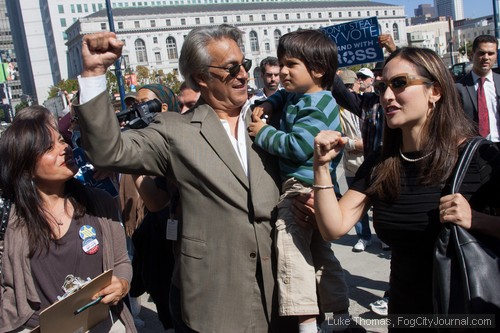
Join Sheriff Michael Hennessey; Mayor Art Agnos; Dolores Huerta, Co-Founder of the UFW & Medal of Freedom Recipient; Supervisors Sophie Maxwell, Harry Britt, Doris Ward, Willie Kennedy and Carol Ruth Silver; Public Defender Geoff Brown, and others in calling for the reinstatement of Sheriff Mirkarimi this Tuesday before the Board of Supervisors Vote.

RALLY @ NOON, TUESDAY, OCTOBER 9 2012 – CITY HALL STEPS

The San Francisco Chapter of the National Lawyers Guild, SF Labor Council, Service Employees International Union (SEIU) 1021, Harvey Milk LGBT Democratic Club, Latino Democratic Club, Bernal Heights Democratic Club, District 5 Democratic Club, Padres Unidos, Bay Area Iranian Democrats, SF Green Party, San Francisco Guardian, Bay Area Reporter, Sunset Beacon, and Central City Democrats all Support Reinstatement!!

Come to the rally and show your support too!!!

Dolores Huerta, Co-Founder of the UFW, Medal of Freedom Recipient, Eliana Lopez and Friend

 If you can not make the Rally – Please call you supervisor today – Let them know you Stand with Ross and will not stand for anything but reinstatement!

Click to Donate to the Ross Mirkarimi Legal Defense Fund

or by sending a check to:
Ross Mirkarimi Legal Defense Fund
721 Webster Street
San Francisco, CA 94117


The Mirkarimi vote: Will there be some profiles of courage?

52

(See the postscript for the Chronicle’s shameful crucifixion coverage of Mirkarimi and a timely, newsworthy oped it refused to run by Mirkarimi’s former girl friend. And how Chronicle columnist Debra Saunders ran the Nieves piece on her blog. Damn good for you, Debra Saunders.)

On Jan. 6, 2011, the Bay Citizen/New York Times broke a major investigative story headlined “Behind-the-Scenes Power Politics: The Making of Ed Lee.” The story by Gerry Shih detailed how then Mayor Gavin Newsom, ex-Mayor Willie Brown, and his longtime political ally Rose Pak orchestrated an “extraordinary political power play” to make Ed Lee the interim mayor to replace Newsom, the lieutenant governor-elect.

The story also outlined the start of a chain of events that leads to the vote by the San Francisco Board of Supervisors on Tuesday on whether Sheriff Ross Mirkarimi keeps his job.

Shih reported that “word had trickled out” that the supervisors had narrowed the list of interim candidates to three—then Sheriff Michael Hennessey, former Mayor Art Agnos, and Aaron Peskin, then chairman of the city’s Democratic party.  But the contenders “were deemed too liberal by Pak, Brown, and Newsom, who are more moderate.”

Over the next 48 hours, Pak, Brown, and the Newsom administration put together the play, “forging a consensus on the Board of Supervisors, outflanking the board’s progressive wing and persuading Lee to agree to become San Francisco’s first Asian-American mayor, even though he had told officials for months that he had no interest in the job,” Shih wrote.

The play was sold on the argument that Lee would be an “interim mayor” and that he would not run for mayor in the November election. The Guardian and others said at the time that the play most likely envisioned Lee saying, or lying, that he would not run for mayor and then, at the last minute, he would run and overpower the challengers as an incumbent with big downtown money behind him.  This is what happened. That is how Ed Lee, a longtime civil servant, became the mayor and that is how the Willie Brown/Rose Pak gang won the day for the PG&E/Chamber of Commerce/big developer bloc and thwarted the progressives.

Let us note that the other three interim candidates would most likely never have done what Lee did and suspend Mirkarimi for pleading guilty to misdemeanor false imprisonment in an arm-bruising incident with his wife Eliana. In fact, Hennessey supported Mirkarimi during the election and still does and says he is fit to do the job of sheriff. 

This was a political coup d’etat worthy of Abe Ruef, the City Hall fixer at the start of the century. “This was something incredibly orchestrated, and we got played,” Sup. John Avalos told Shih. Sup. Chris Daly was mad as hell and he voted for Rose Pak because, he told the Guardian, she was running everything in City Hall anyway. Significantly, the San Francisco Chronicle missed the story and ever after followed the line of its columnist/PG&E lobbyist Willie Brown and Pak by supporting Lee for mayor without much question or properly reporting the obvious power structure angles and plays.

This is the context for understanding a critical part of the ferocity of the opposition to Mirkarimi. As the city’s top elected progressive, he was a politician and force to be reckoned with. His inaugural address as sheriff  demonstrated his creative vision for the department and that he would ably continue the progressive tradition of Richard Hongisto and Hennessey. That annoyed the conservative law enforcement folks. He could be sheriff for a good long time, keep pushing progressive issues from a safe haven, and be in position to run for mayor when the time came. So he was a dangerous character.  

To take one major example, the  PG&E political establishment and others regard him as Public Enemy No. 1. Among other things, he managed as an unpaid volunteer two initiative campaigns during the Willie Brown era. They were aimed at kicking PG&E out of City Hall, enforcing the public power provisions of the federal Raker Act, and bringing  the city’s cheap Hetch Hetchy public power to its residents and businesses for the first time. (See Guardian stories since 1969 on the PG&E/Raker act scandal.)

He then took the public power issue into City Hall when he became a supervisor and aggressively led the charge for the community choice aggregation (cca) project.  His work was validated in the recent 8-3 supervisorial vote authorizing the city to start up a public power/clean energy program. This is the first real challenge ever to PG&E’s private power monopoly.

Significantly, Willie is now an unregistered $200,000 plus a year lobbyist for PG&E. He writes a column for the San Francisco Chronicle promoting, among other things, his undisclosed clients and allies and whacking Mirkarimi and the progressives and their issues on a regular basis.  And he is always out there, a phone call here, an elbow at a cocktail party there, to push his agenda.   The word is that he’s claiming he has the votes to fire Mirkarimi.

The point is that the same forces that put Lee into office as mayor are in large part the same forces behind what I call the political assassination of Mirkarimi.  And so, when the Mirkarimi incident emerged, there was an inexorable  march to assassination. Maximum resources and pressure from the police on Mirkarimi. And then maximum pressure from the District Attorney. And then maximum pressure from the judicial process (not even allowing  a change of venue for the case after the crucifixion media coverage.)  And then Lee calls Mirkarimi “a wife beater” and suspends him with cruel and unusual punishment: no pay for him, his family, his home, nor legal expenses for him or Eliana for the duration.

And then Lee pushes for maximum pressure from the City Attorney and the Ethics Commission to try Mirkarimi and force the crucial vote before the election to put maximum pressure on the supervisors. Obviously, the vote would be scheduled after the election if this were a fair and just process.

Lee, the man who was sold as consensus builder and unifier, has become a polarizer and punisher on behalf of the boys and girls  in the backroom.  

And so the supervisors are not just voting to fire the sheriff.  Mirkarimi, his wife Eliana, and son Theo, 3, have already paid a terrible price and, to their immense credit, have come back together as a family.

The supervisors got played last time and voted for a coup d’etat to make Lee the mayor, rout the progressives, and keep City Hall safe for Willie Brown and Rose Pak and friends.   This time the stakes are clear: the supervisors are now voting on the political assassination of the city’s top elected progressive and it’s once again aimed at helping keep City Hall safe for PG&E, the Chamber, and big developers.

The question is, will there be some profiles of courage this time around? b3

P.S.1  Julian Davis for District 5 supervisor: “Supes mum on sheriff,” read the Sunday Chronicle head. Nobody would say how he/she would vote. And poor Sup. Sean Elsbernd claimed that he would be “holed all Sunday in his office reading a table full of thick binders of official documents related to the case plus a few that he’s prepared for himself containing some case law.”  (Anybody wonder how he’s going to vote? Let’s have a show of hands.)  

The last time I saw Julian Davis he was holding a “Stand with Ross” sign at a Mirkarimi rally on the City Hall steps. With Davis, there would be no second guessing and hand wringing on how he would vote. That’s the problem now with so many neighborhood supervisors who go down to City Hall and vote with Willie and downtown. Davis would be a smart, dependable progressive vote in the city’s most progressive district (5), and a worthy successor to Matt Gonzalez and Ross Mirkarimi. If Davis were on the board now, I’m sure he would stand with Ross and speak for Ross, no ifs, ands, or buts. And his vote might be decisive.  

P.S. 2 The Chronicle’s  shameful crucifixion of Mirkarimi continues  The Chronicle has refused to run a timely and  newsworthy op ed piece from Evelyn Nieves, Mirkarimi’s former girl friend. She  wrote an op ed piece for the Chronicle four days before the Tuesday vote.  Nieves is an accomplished journalist who for several years was the San Francisco bureau chief for the New York Times.  She told me that she was notified Monday morning that the Chronicle didn’t have room for the op ed in Tuesday’s paper. I sent an email to John Diaz, Chronicle editorial page editor, and asked him why the Chronicle couldn’t run her op ed when the paper could run Willie Brown, the unregistered $200,000 plus PG&E lobbyist who takes regular whacks at Mirkarimi, as a regular featured column in its Sunday paper.  No answer at blogtime.

This morning, I opened up the Chronicle to find that the paper, instead of running the Nieves piece today or earlier,  ran an op ed titled “Vote to remove Mirkarmi,” from Kathy Black, executive director of the Casa de las Madres, the non profit group that advocates against domestic violence. It has been hammering Mirkarimi for months. On the page opposite, the Chron ran yet another lead editorial, urging the supervisors to “Take a Stand” and vote for removal because “San Francisco now needs its leaders to lead.” It was as if Willie was not only directing the Chronicle’s news operation but writing its editorials–and getting paid both by PG&E and the Chronicle.  And so the Chronicle started out with shameful crucifixion coverage of  Mirkarimi and then continued the shameful crucifixion coverage up until today. Read Nieves on Ross.

Well, the honor of the Chronicle was maintained by columnist Debra Saunders, virtually the Chroncle’s lone journalistic supporter of Mirkarmi during his ordeal. Many Chronicle staffers are privately supportive of Ross, embarrassed by Willie’s “journalism,” and critical of the way the Chronicle has covered Mirkarimi. Saunders posted the Nieves column her paper refused to print on her Chronicle blog. Damn good for you, Debra Saunders.  


Louis Dunn: Would you vote for a Mormon bishop?

4

Louis Dunn, longtime Guardian cartoonist, asks a key question: Would you vote for a Mormon bishop? Click on the art work for a full size image.


On the Om Front: The divine essence of play

1

Yoga can be so serious. Ever look around class while people are doing backbends or pressing their quads to their bones in a standing pose? Wrinkled brows. Flared nostrils. Gripping toes. You’d think we’re all training to go into battle. Not that I have an issue with intensity– in the right amounts and on the right occasions. But if we don’t balance passion, dedication, and hard work with lightness and ease, we may be doing warrior pose but we’re not doing yoga.

So, play. Play means different things to different people. When I was a child, play meant begging my older brother to let me cavort with him and his friends while they played fighting-soldier-shoot-out in the backyard. My brother let me play sometimes, but only if I would take on the secret code name of Mop Top.

That wasn’t the most delightful kind of play.


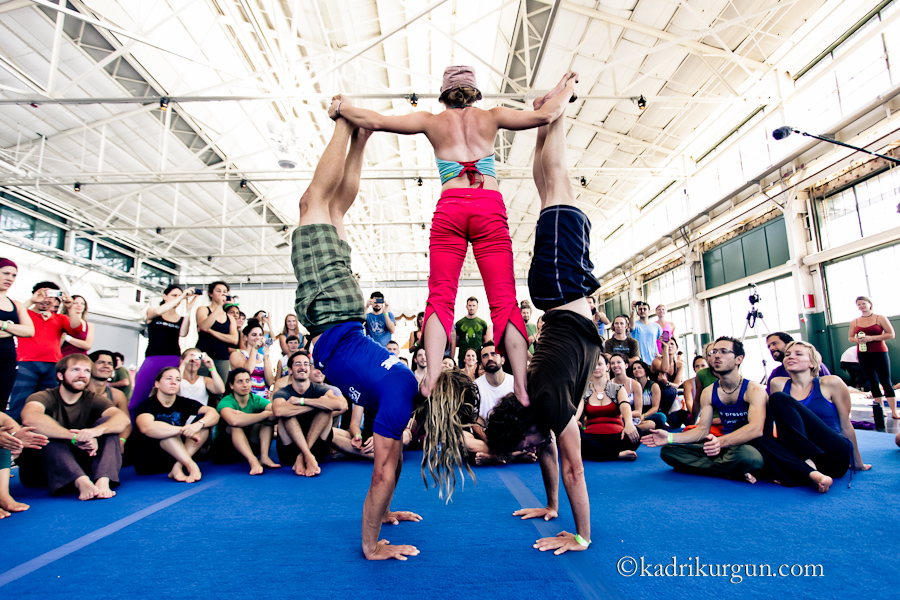
But as an adult, I love to play. Play keeps me connected to the lighter part of who I am. It reminds me not to take myself too seriously (and I often need that reminder). I like to play by doing handstands, Acro Yoga, laughing till the point of internal combustion with an old pal. You know who you are.

There is a word in Sanskrit for play: It’s lila. It relates to yoga and the spiritual path, though its interpretations vary. Lila can be thought of as the play of the universe, in the sense that the whole creation and dance of life is a wild game that was invented by the gods. This is often thought of as Divine Play. (If you’ve ever seen Shakespeare’s A Midsummer Night’s Dream, that’s a delicious commentary on Divine Play.) Lila can also be thought of as the crazy, marvelous, confusing dance between two lovers (or between the male and female energies that reside in all of us).

To live a life of ease, play is necessary. Not the kind of play that lands you in the ER at 5am with someone else’s clothes on after imbibing copious amounts of illicit substances in the backseat of your ex’s car. (That’s called escapism.)  But lighthearted, clean fun that helps you loosen the reins on rigid thinking, and lighten the load when your practice gets too heavy.

Acro Yoga’s Divine Play Festival (coming up next week — details below) is a sweet example of play’s importance in your yoga practice. Organizer Jenny Sauer-Klein told me that, “Play keeps you connected to innocence and wonder. It keeps you fresh. In Acro Yoga, we’re playing to create connection and see the highest and best in each other, to see the divine in each other through the vehicle of play.”

If the whole universe is just an unpredictable giant puppet laser light show dance party, we may as well get on the dance floor. Go forth and play.

——

Around the Bend: Ways to Play

Painting Yantras and Mandalas
Play with spiritual painting. Learn how to create sacred yantras and mandalas with Master Sacred Artist Pieter Weltevrede.
10/5-10/7, $150, Yoga Tree Telegraph, Berk. www.yogatreesf.com

Divine Play Festival
In its third year, the annual Acro Yoga Festival is the pinnacle of ridiculous fun for both acro newbies and old school trees and elves. Flying required—no wings necessary. The Acro Yoga mantra, which I love: “Work honestly. Meditate every day. Meet people without fear. And play.” –Baba Hari Das
10/12-14, $325 for entire event (various prices for other passes), Fort Mason Center, SF. www.acroyoga.org/acroyogafestival

Yoga Rave
Not like a rave rave. Like a yoga rave. Insane dance party minus substances. No booze equals no age restrictions. So bring your baby, bring your grandma, or just bring yourself. Presented by the Art of Living and in conjunction with Divine Play.
10/12, $20-$30, Herbst Pavilion at Fort Mason Center, SF. www.yogarave.org/us

Strong Yogini
Trouble rockin’ those chatturangas or inversions? Not sure how to access your physical (or emotional) core? In this playful, strength-building workshop for women (taught by your truly!), we’ll learn ways to build muscle and confidence through yoga. Come play for the day! 
10/27, $35 by Oct. 20, $40 after, Yoga Garden, SF. www.yogagardensf.com

Slackline Classes with the Yoga Slackers

You haven’t played till you’ve gotten on a rope. Learn to walk it, learn to do yoga on it, learn to fall off it with the fabulous local Yoga Slackers, helmed by Ariel Mihic and Liz Williams.
Various dates in Nov and Dec, free, Sports Basement, SF. freeslacklineclasses.eventbrite.com

Karen Macklin is a yoga teacher and multi-genre writer in San Francisco. She’s been up-dogging her way down the yogic path for over a decade, and is a lifelong lover of the word. To learn more about her teaching schedule and writing life, visit her site at www.karenmacklin.com.

Feminist vigilante gangs to march on Oakland Friday

58

Oakland’s last feminist vigilante gangs march was a demonstration promoting offensive feminism in response to rape, assault, and murder of “women, queers, gender rebels and allies.” It was also a birthday party.

“The first march basically came about because it was my 30th birthday,” said Lauren, one of the organizers of that march and a second feminist vigilante gangs march, which will take place in Oakland on Friday.

“I had been talking a big game about feminist vigilante gangs and calling attention to the need for people to form affinities for a long time. When I was asked what I wanted for my 30th birthday I said, I want a feminist vigilante gangs march, as a joke. But people were into it.”

Last time, a group, equipped with and radical queer and feminist literature, banners, and glitter, marched from the “fake neighborhood” of uptown Oakland to downtown Oakland, Lauren said, ending with a dance party in “Oscar Grant Plaza,” Occupy Oakland’s longtime home base outside City Hall.

Along the way, organizers “stopped at some places to talk about things have had happened there,” said Lauren. “For instance, the place where Brandy Martell was killed.”

Brandy Martell was transgender woman who was shot April 29. Her murder remains unsolved. Martell’s is a “a high-profile case of transgender bashing. She died, and so we know about. But these types of things happen everyday on the streets in Oakland,” said Lauren.

The next feminist vigilante gangs march begins Friday at 7pm from 19th and Telegraph. It will also stop at the spot where Martell was killed, as well as other spots where queer bashing, rape and assault have taken place.

Lauren says the march is a few things. It’s a call-out “encouraging women, queers, gender outlaws in the Bay Area to start thinking offensively about the abuse that we’re on the receiving end of.”

It’s also “a way for us to practice discipline in the streets. Because we live in a culture that’s so abusive towards women, queers, gender variant people, its really hard for us to form affinities.”

The group plans for a tightly organized march. A security team and a league of bike scouts to protect the march have already begun training, and before the march begins a generalized security training is planned. Anyone who arrived alone will be given the chance to hook up with a marching buddy. Street medics and “emotional medics” from the Occupy Oakland safer spaces working group– “people who have some training to interact with people who are experiencing PTSD or who are experiencing emotions that are making it difficult for them to participate”– will be on hand.

“We have a bloc that is set up for people with limited mobility, that’s wheelchair users, cane users, people using walkers,” Lauren said.

Community self-defense

Organizers of the march hope that its spirit and practice of community building and self-defense can extend to the everyday lives of participants.

One way is by connecting demonstrators “with the resources to begin things like self-defense training, especially in a feminist and collective environment,” Lauren said. Groups like the Offensive Feminist Project, the Suigetsukan Dojo, and Girl Army.

“Something that we should be creating in marginalized communities is community self-defense. That’s something that the Black Panthers worked on. It’s not a new concept, in Oakland we have a lot of history with that,” said Lauren.

Community self-defense, of course, is supposed to be unnecessary; crime prevention and retribution is supposed to be relegated to the police and the criminal justice system. But Lauren said that these institutions are not working.

“I don’t believe that the criminal justice system is just, or serving anyone. And I think that’s a perspective shared by the people who are organizing the march, and probably by most of the people who will attend it,” she said. “I say this as someone who’s watched the police interrogate a rape victim and– interrogate is the correct word. There’s no justice in the criminal justice system for victims of rape and assault. So we want to talk about extra-legal methods of dealing with these issues.”

Extra-legal means of dealing with violence, she says, is “what feminist vigilante gangs is all about.”

After the march, organizers plan to continue this conversation at “a series of plenaries and salons in the East Bay” where participants will discuss questions like “What does feminist vigilantism look like?” Lauren said.

“As these conversations continue we will be spending a lot of time focusing on issues like race, and things like the history in the United States of falsely accusing men of color of assaulting white women so that they can be imprisoned or abused or killed,” Lauren said.

The group also has an open call for entries for a feminist vigilante gangs zine, for those who want to continue the discussion on paper. “People have been writing about bashing back. The Bash Back book Queer Ultraviolence just came out this year,” she noted.

Still, many people have not been exposed to the ideas and practices behind the feminist vigilante gangs march. On Friday, a lot of people will be– the march will coincide with Art Murmur, and downtown Oakland’s streets will already be crowded. A contingent from GLITUR, aka the Grand Legion of Incendiary and Tenacious Unicorn Revolutionaries, is coming down from Seattle. This march might get big.

But never fear, Lauren assured: “We should have enough glitter bandanas for everyone who comes.”

Film Listings

0

Film listings are edited by Cheryl Eddy. Reviewers are Kimberly Chun, Dennis Harvey, and Lynn Rapoport. For rep house showtimes, see Rep Clock.

MILL VALLEY FILM FESTIVAL

The 35th Mill Valley Film Festival runs Oct. 4-14 at the Christopher B. Smith Rafael Film Center, 1118 Fourth St, San Rafael; Cinéarts@Sequoia, 25 Throckmorton, Mill Valley; and 142 Throckmorton Theatre, Mill Valley. For additional venues, full schedule, and tickets (most shows $13.50), visit www.mvff.com. For commentary, see Film.

OPENING

Bitter Seeds Just what we all needed: more incontrovertible evidence of the bald-faced evil of Monsanto. This documentary on destitute Indian cotton farmers follows an 18-year-old girl named Manjusha, a budding journalist who investigates the vast numbers of farmer suicides since the introduction (and market stranglehold) of "BT" cotton — which uses the corporation’s proprietary GMO technology — in the region of Vidarbha. Before BT took over in 2004, these cotton farmers relied on cheap heritage seed fertilized only by cow dung, but the largely illiterate population fell prey to Monsanto’s marketing blitz and false claims, purchasing biotech seed that resulted in pesticide reliance, failing crops, and spiraling debt. It’s a truly heartbreaking and infuriating story, but much of the action feels stagy and false. Should Indian formality be blamed? Considering the same fate befell Micha X. Peled’s 2005 documentary China Blue, probably not. Still, eff Monsanto. (1:28) Roxie. (Michelle Devereaux)

Butter Jennifer Garner, Olivia Wilde, and Hugh Jackman star in this Iowa-set satirical comedy about competitive butter carving. (1:32)

Frankenweenie Wee Victor Frankenstein brings his dog back from the dead in Tim Burton’s black-and-white, 3D animated tale. (1:27) Presidio.

The Mystical Laws As The Master gathers Oscar buzz for its Scientology-inspired tale, another movie based on the teachings of a similarly-named religion, Japanese fringe sect Happy Science, opens this weekend. But that analogy is incorrect, for The Mystical Laws way more resembles 2000’s Battlefield Earth, demonstrating and preaching its source material’s tenants rather than questioning them. Visit Happy Science’s website and you’ll find a New Age mix of Christianity and Buddhism, with woo-woo about truth and love. Its founder, Ryuho Okawa, claims to the reincarnation of "El Cantare," sort of an über-god who controls all spiritual activity on Earth. Anyway, now there’s an anime flick based on one of Okawa’s hundreds of books; it’s about an evil overlord with planet-ruling aspirations who gets smacked down by the powerful combo of aliens, a guy who realizes he’s humanity’s "light of hope" (basically a Jesus-Buddha combo, with psychic powers to boot), and an eight-headed flying dragon. There is Nazi iconography; there are Star Wars-inspired plot points. At one point, the hero preaches directly to the camera. It’s all very heavy-handed. A far more amusing use of your time would be to go to Happy Science’s website and click the tab marked "Astonishing Facts" to learn the spiritual fates of historical figures: "Currently Beethoven lives in the lower area of the Bodhisattva Realm of the 7th dimension in the Spirit world, and aims to transcend the sadness evident in parts of his music and become an expert in the music of joy," while proponent o’ evolution Darwin "is now serving a penance in Abysmal Hell." Hey, wait a minute! Isn’t science supposed to be "happy?" (2:00) New People, 1746 Post, SF; www.newpeopleworld.com. (Eddy)

The Oranges In director Julian Farino’s tale of two families, the Wallings and the Ostroffs are neighbors and close friends living in the affluent New Jersey township of West Orange. We meet David Walling (Hugh Laurie), his wife Paige (Catherine Keener), his best friend Terry Ostroff (Oliver Platt), and Terry’s wife, Carol (Allison Janney), during a period of domestic malaise for both couples — four unhappy people who enjoy spending time together — that is destined to be exponentially magnified over the Thanksgiving and Christmas festivities. We learn much of this in voice-over courtesy of stalled-out 24-year-old design school grad Vanessa (Alia Shawkat), a second-generation Walling whose narrative subjectivity the film makes plain. No one will fault Vanessa for editorializing, however, when her Ostroff counterpart, onetime BFF and present-day nemesis Nina (Leighton Meester), returns home after a five-year absence and, amid maternal pressure to date Vanessa’s visiting brother, Toby (Adam Brody), instead embarks on an affair with their father. The ick factor is large, particularly because it takes a while to keep straight all the spouses, offspring, and houses they belong in. But Farino works to convince us that the romantic spark between David and Nina should be judged on its merits rather than with a gut-level revulsion, a reaction we can leave to the film’s principals. To the extent that this is possible, it’s possible to enjoy The Oranges‘ intelligent writing and fine cast, whose sympathetic characters (perhaps excluding Nina, whose heedlessness regarding the feelings of others verges on sociopathic) we wish the best of luck in surviving the holidays. (1:30) Albany, Clay. (Rapoport)

The Paperboy Lee Daniels scored big with Precious (2009), but this follow-up is so off-kilter in tone and story it will likely polarize critics and confuse audiences, despite its A-list cast. I happened to enjoy the hell out of this tacky, sweat-drenched, gator-gutting, and generally overwrought adaptation of Peter Dexter’s novel (Dexter and Daniels co-wrote the screenplay); it’s kind of a Wild Things-The Help-A Time to Kill mash-up, with the ubiquitous Matthew McConaughey starring as Ward Jansen, a Florida newspaper reporter investigating what he thinks is the wrongful murder conviction of Hillary Van Wetter (a repulsively greasy John Cusack). But the movie’s not really about that. Set in 1969 and narrated by Macy Gray, who plays the veteran housekeeper for the Jansens — a clan that also includes college dropout Jack (Zac Efron) — The Paperboy is neither mystery nor thriller. It’s more of a swamp cocktail, with some odd directorial choices (random split-screen here, random zoom there) that maybe seem like exploitation movie homages. As a Southern floozy turned on by "prison cock" (but not, to his chagrin, by the oft-shirtless Jack), Nicole Kidman turns in her trashiest performance since 1995’s To Die For. (1:46) Embarcadero. (Eddy)

V/H/S See "Gruesome Discovery." (1:55) Bridge, Shattuck.

Taken 2 It’s kidnapping season again, and Liam Neeson is pissed. (1:31) Marina.

ONGOING

Arbitrage As Arbitrage opens, its slick protagonist, Robert Miller (Richard Gere), is trying to close the sale of his life, on his 60th birthday: the purchase of his company by a banking goliath. The trick is completing the deal before his fraud, involving hundreds of millions of dollars, is uncovered, though the whip-smart daughter who works for him (Brit Marling) might soon be onto him. Meanwhile, Miller’s gaming his personal affairs as well, juggling time between a model wife (Susan Sarandon) and a Gallic gallerist mistress (Laetitia Casta), when sudden-death circumstances threaten to destroy everything, and the power broker’s livelihood — and very existence — ends up in the hands of a young man (Nate Parker) with ambitions of his own. It’s a realm that filmmaker Nicholas Jarecki is all too familiar with. Though like brothers Andrew (2003’s Capturing the Friedmans) and Eugene (2005’s Why We Fight), Jarecki’s first love is documentaries (his first film, 2006’s The Outsider, covered auteur James Toback), his family is steeped in the business world. Both his parents were commodities traders, and Jarecki once owned his own web development firm and internet access provider, among other ventures. When he started writing Arbitrage‘s script in 2008, he drew some inspiration from Bernard Madoff — but ultimately, the film is about a good man who became corrupted along the way, to the point of believing in his own invincibility. (1:40) Metreon, Presidio, Smith Rafael, Shattuck. (Chun)

Backwards Athletic disappointment is not a new feeling for Abi (Sarah Megan Thomas, who also wrote the script), who has just learned she’s been named the alternate for the Olympic crew team — a bench warming role she was also relegated to in the last Olympics. But after she quits the team in a huff and moves home, it’s not long before she realizes that her life off the water is pretty depressing, too. Enter former boyfriend Geoff (James Van Der Beek), now the athletic director at the high school where Abi honed her rowing talents, who gives her a job coaching the talented but undisciplined girls who make up the current team. Will this new venture help Abi finally grow up and regain her self-confidence? Will she re-ignite her spark with Geoff? Will there be a last-act conflict involving yet another chance at the Olympics? Will there be multiple training montages? As directed by Ben Hickernell, Backwards hits all of the expected themes about following one’s heart and Doing the Right Thing. Thomas, a former rower herself, has an ordinary-girl appeal, but even Backwards’ attention to authenticity can’t elevate what’s essentially a very predictable sports drama. (1:29) Sundance Kabuki. (Eddy)

Beasts of the Southern Wild Six months after winning the Grand Jury Prize at Sundance (and a Cannes Camera d’Or), Beasts of the Southern Wild proves capable of enduring a second or third viewing with its originality and strangeness fully intact. Magical realism is a primarily literary device that isn’t attempted very often in U.S. cinema, and succeeds very rarely. But this intersection between Faulkner and fairy tale, a fable about — improbably — Hurricane Katrina, is mysterious and unruly and enchanting. Benh Zeitlin’s film is wildly cinematic from the outset, as voiceover narration from six-year-old Hushpuppy (Quvenzhané Wallis) offers simple commentary on her rather fantastical life. She abides in the Bathtub, an imaginary chunk of bayou country south of New Orleans whose residents live closer to nature, amid the detritus of civilization. Seemingly everything is some alchemical combination of scrap heap, flesh, and soil. But not all is well: when "the storm" floods the land, the holdouts are forced at federal gunpoint to evacuate. With its elements of magic, mythological exodus, and evolutionary biology, Beasts goes way out on a conceptual limb; you could argue it achieves many (if not more) of the same goals Terrence Malick’s 2011 The Tree of Life did at a fraction of that film’s cost and length. (1:31) Four Star, Shattuck, Smith Rafael. (Harvey)

Beauty is Embarrassing You may not recognize the name Wayne White offhand, but you will know his work: he designed and operated many of the puppets on Pee-Wee’s Playhouse, including Randy (the blockheaded bully) and Dirty Dog (the canine jazzbo). Neil Berkeley’s Beauty Is Embarrassing — named for a mural White painted on the side of a Miami building for Art Basel 2009 — charts the life of an artist whose motto is both "I want to try everything I can!" and "Fuck you!" The Southern-born oddball, who came of age in the early-1980s East Village scene, is currently styling himself as a visual artist (his métier: painting non-sequitur phrases into landscapes bought from thrift stores), but Beauty offers a complex portrait of creativity balanced between the need to be subversive and the desire to entertain. (1:27) Roxie. (Eddy)

The Bourne Legacy Settle down, Matt Damon fans — the original Bourne appears in The Bourne Legacy only in dialogue ("Jason Bourne is in New York!") and photograph form. Stepping in as lead badass is Jeremy Renner, whose twin powers of strength and intelligence come courtesy of an experimental-drug program overseen by sinister government types (including Edward Norton in an utterly generic role) and administered by lab workers doing it "for the science!," according to Dr. Rachel Weisz. Legacy‘s timeline roughly matches up with the last Damon film, The Bourne Ultimatum, which came out five years ago and is referenced here like we’re supposed to be on a first-name basis with its long-forgotten plot twists. Anyway, thanks to ol’ Jason and a few other factors involving Albert Finney and YouTube, the drug program is shut down, and all guinea-pig agents and high-security-clearance doctors are offed. Except guess which two, who manage to flee across the globe to get more WMDs for Renner’s DNA. Essentially one long chase scene, The Bourne Legacy spends way too much of its time either in Norton’s "crisis suite," watching characters bark orders and stare at computer screens, or trying to explain the genetic tinkering that’s made Renner a super-duper-superspy. Remember when Damon killed that guy with a rolled-up magazine in 2004’s The Bourne Supremacy? Absolutely nothing so rad in this imagination-free enterprise. (2:15) 1000 Van Ness, SF Center. (Eddy)

The Campaign (1:25) 1000 Van Ness.

Celeste and Jesse Forever Married your best friend, realized you love but can’t be in love with each other, and don’t want to let all those great in-jokes wither away? Such is the premise of Celeste and Jesse Forever, the latest in what a recent wave of meaty, girl-centric comedies penned by actresses — here Rashida Jones working with real-life ex Will McCormack; there, Zoe Kazan (Ruby Sparks), Zoe Lister Jones (Lola Versus), and Lena Dunham (Girls) — who have gone the DIY route and whipped up their own juicy roles. There’s no mistaking theirs for your average big-screen rom-com: they dare to wallow harder, skew smarter, and in the case of Celeste, tackle the thorny, tough-to-resolve relationship dilemma that stubbornly refuses to conform to your copy-and-paste story arc. Nor do their female protagonists come off as uniformly likable: in this case, Celeste (Jones) is a bit of an aspiring LA powerbitch. Her Achilles heel is artist Jesse (Andy Samberg), the slacker high school sweetheart she wed and separated from because he doesn’t share her goals (e.g., he doesn’t have a car or a job). Yet the two continue to spend all their waking hours together and share an undeniable rapport, extending from Jesse’s encampment in her backyard apartment to their jokey simulated coitus featuring phallic-shaped lip balm. Throwing a wrench in the works: the fact that they’re still kind of in love with each other, which all their pals, like Jesse’s pot-dealer bud Skillz (McCormack), can clearly see. It’s an shaggy, everyday breakup yarn, writ glamorous by its appealing leads, that we too rarely witness, and barring the at-times nausea-inducing shaky-cam under the direction of Lee Toland Krieger, it’s rendered compelling and at times very funny — there’s no neat and tidy way to say good-bye, and Jones and McCormack do their best to capture but not encapsulate the severance and inevitable healing process. It also helps that the chemistry practically vibrates between the boyish if somewhat one-note Samberg and the soulful Jones, who fully, intelligently rises to the occasion, bringing on the heartbreak. (1:31) Shattuck. (Chun)

The Dark Knight Rises Early reviews that called out The Dark Knight Rises‘ flaws were greeted with the kind of vicious rage that only anonymous internet commentators can dish out. And maybe this is yet another critic-proof movie, albeit not one based on a best-selling YA book series. Of course, it is based on a comic book, though Christopher Nolan’s sophisticated filmmaking and Christian Bale’s tortured lead performance tend to make that easy to forget. In this third and "final" installment in Nolan’s trilogy, Bruce Wayne has gone into seclusion, skulking around his mansion and bemoaning his broken body and shattered reputation. He’s lured back into the Batcave after a series of unfortunate events, during which The Dark Knight Rises takes some jabs at contemporary class warfare (with problematic mixed results), introduces a villain with pecs of steel and an at-times distractingly muffled voice (Tom Hardy), and unveils a potentially dangerous device that produces sustainable energy (paging Tony Stark). Make no mistake: this is an exciting, appropriately moody conclusion to a superior superhero series, with some nice turns by supporting players Gary Oldman and Joseph Gordon-Levitt. But in trying to cram in so many characters and plot threads and themes (so many prisons in this thing, literal and figural), The Dark Knight Rises is ultimately done in by its sprawl. Without a focal point — like Heath Ledger’s menacing, iconic Joker in 2008’s The Dark Knight — the stakes aren’t as high, and the end result feels more like a superior summer blockbuster than one for the ages. (2:44) Metreon. (Eddy)

Detropia Those of us from Detroit, once-glamorous capital of American manufacturing and symbol of the triumph of capitalism, often feel like we were born with the history of the city in our bones. Another common feeling is that of dread upon hearing that yet another arty documentary (or brow-furrowing article, or glossy photo book) is coming down the pipe. The narrative arc of such things is usually this: remember Motown? Cars were amazing. Then there were scary riots, probably out of thin air. Then the jobs left. Isn’t Detroit sad now? Look how spooky this abandoned train station from the 1930s is! America is over. Wait! Some hipsters are starting a farm downtown! There may be hope after all. But who knows? Detropia, directed by Heidi Ewing, who grew up near Detroit, and Rachel Grady, doesn’t exactly deconstruct that crusty storyline (non-spoiler alert: the hipster-farmers become performance artists). But this important and beautiful film shows how much more of the Detroit tale takes on meaning and shape when told through the voices of people who actually live there, with a cinematic eye that doesn’t shy away from reality, even as it bends it to narrative ends. (1:30) Elmwood, Roxie, Smith Rafael. (Marke B.)

Diana Vreeland: The Eye Has to Travel The life of legendary fashion editor Diana Vreeland is colorfully recounted in Diana Vreeland: The Eye Has to Travel, a doc directed by her granddaughter-in-law, Lisa Immordino Vreeland. The family connection meant seemingly unlimited access to material featuring the unconventionally glamorous (and highly quotable) Vreeland herself, plus the striking images that remain from her work at Harper’s Bazaar, Vogue, and the Costume Institute of the Metropolitan Museum of Art. "Narrated" from interview transcripts by an actor approximating the late Vreeland’s husky, posh tones, the film allows for some criticism (her employees often trembled at the sight of her; her sons felt neglected; her grasp of historical accuracy while working at the museum was sometimes lacking) among the praise, which is lavish and delivered by A-listers like Anjelica Huston, who remembers "She had a taste for the extraordinary and the extreme," and Manolo Blahnik, who squeals, "She had the vision!" (1:26) Embarcadero, Shattuck. (Eddy)

Dredd 3D Cartoonishly, gleefully gruesome violence abounds in Dredd 3D, a pretty enjoyable comic-book adaptation thanks to star Karl Urban’s deadpan zingers. This is not a remake of the 1995 Sly Stallone flop Judge Dredd, by the way, though it might as well be a remake of 2011 Indonesian import The Raid: Redemption. The stories are identical. Like, lawsuit material-identical: supercop infiltrates (and then becomes trapped in, and must battle his way out of) a high-rise apartment tower run by a ruthless crime boss. Key difference is that Dredd has futuristic weapons, and The Raid had badass martial arts. Also Dredd‘s villain is played by Lena "Cersei Lannister" Headey, so there’s that. (1:38) Metreon, 1000 Van Ness. (Eddy)

End of Watch Buddy cop movies tend to go one of two ways: the action-comedy route (see: the Rush Hour series) or the action-drama route. End of Watch is firmly in the latter camp, despite some witty shit-talking between partners Taylor (a chrome-domed Jake Gyllenhaal) and Zavala (Michael Peña from 2004’s Crash) as they patrol the mean streets of Los Angeles. Writer-director David Ayer, who wrote 2001’s Training Day, aims for authenticity by piecing together much of (but, incongruously, not all of) the story through dashboard cameras, surveillance footage, and Officer Taylor’s own ever-present camera, which he claims to be carrying for a school project, though we never once see him attending classes or mentioning school otherwise. Gyllenhaal and Peña have an appealing rapport, but End of Watch‘s adrenaline-seeking plot stretches credulity at times, with the duo stumbling across the same group of gangsters multiple times in a city of three million people. Natalie Martinez and Anna Kendrick do what they can in underwritten cop-wife roles, but End of Watch is ultimately too familiar (but not lawsuit-material familiar) to leave any lasting impression. Case in point: in the year 2012, do we really need yet another love scene set to Mazzy Star’s "Fade Into You"? (1:49) Marina, 1000 Van Ness, SF Center. (Eddy)

Finding Nemo 3D (1:40) 1000 Van Ness, SF Center.

For a Good Time, Call&ldots; Suffering the modern-day dilemmas of elapsed rent control and boyfriend douchebaggery, sworn enemies Katie (Ari Graynor) and Lauren (Lauren Miller) find themselves shacking up in Katie’s highly covetable Manhattan apartment, brought together on a stale cloud of resentment by mutual bestie Jesse (Justin Long, gamely delivering a believable version of your standard-issue young hipster NYC gay boy). The domestic glacier begins to melt somewhere around the time that Lauren discovers Katie is working a phone-sex hotline from her bedroom; equipped with a good head for business, she offers to help her go freelance for a cut of the proceeds. Major profitability ensues, as does a friendship evoking the pair bonding at the center of your garden-variety romantic comedy, as Katie trains Lauren to be a phone-sex operator and the two share everything from pinkie swears and matching pink touch-tone phones to intimate secrets and the occasional hotline threesome. Directed by Jamie Travis and adapted from a screenplay by Miller and Katie Anne Naylon, the film is a welcome response to the bromance genre, and with any luck it may also introduce linguistic felicities like "phone-banging" and "let’s get this fuckshow started" into the larger culture. The raunchy telephonic interludes include cameos by Kevin Smith and Seth Rogen (Miller’s husband) as customers calling from such unfurtive locations as a public bathroom stall and the front seat of a taxicab. But the two roomies supply plenty of dirty as Katie, an abashed wearer of velour and denim pantsuits, helps the more restrained Lauren discover the joys of setting free her inner potty mouth. (1:25) SF Center. (Rapoport)

Hotel Transylvania (1:32) Metreon, 1000 Van Ness, Shattuck.

House At the End of the Street Tight T-shirts, a creepy cul-de-sac, couples in cars on lonely lanes, and the cute but weird loner kid — all the stuff of classic drive-in horror fare, revisited in this ambitious tribute of sorts. Don’t mistake House at the End of the Street for genre-reviving efforts by super fans like Eli Roth and Rob Zombie; Mark Tonderai’s mash up of Psycho (1960) and Last House on the Left (1972) lacks the rock ‘n’ roll brio and jet-black humor of, say, Cabin Fever (2002) or The Devil’s Rejects (2005). Instead House reads like an earnest effort to add a thin veneer of psychological realism and even girl power sincerity to a blood-spattered back catalog. Teenage musician Elissa (Jennifer Lawrence) and her overwhelmed mom Sarah (Elisabeth Shue) have found themselves quite a deal of a new rental home — a bit too good, since their next door neighbors were both brutally killed by their brain-damaged offspring who was obviously afflicted with the same greasy hair issues as the ghoulish gal in The Ring. Ryan (Bay Area native Max Thieriot), the boy who continues to live in the house where his parents were murdered, is ostracized, attractive, and much like his home, a fixer — making him mighty attractive to Elissa. A hearty, artistic soul who likes to venture where others fear to tread, she’s drawn to him despite the fact that she feels like she’s being watched from the woods that separate their homes. Switching back and forth between various perspectives — like that of a sputtering, spasmodically edited psychopath-cam and the steady, thoughtful gaze of a rebellious yet empathetic girl — House manages to effectively throw a few curveballs your way, while toying with genre conventions and upsetting your expectations. Shoring up its efforts is a talented cast, headed up by Lawrence’s feisty heroine and Shue’s sad-eyed struggling mom. (1:43) Metreon, 1000 Van Ness. (Chun)

Lawless Lawless has got to be the most pretentiously humorless movie ever made about moonshiners — a criminal subset whose adventures onscreen have almost always been rambunctious and breezy, even when violent. Not here, bub. Adapting Matt Bondurant’s fact-inspired novel The Wettest County in the World about his family’s very colorful times a couple generations back, director John Hillcoat and scenarist (as well as, natch, composer) Nick Cave have made one of those films in which the characters are presented to you as if already immortalized on Mount Rushmore — monumental, legendary, a bit stony. They’ve got a crackling story about war between hillbilly booze suppliers and corrupt lawmen during Prohibition, and while the results aren’t dull (they’re too bloody for that, anyway), they’d be a whole lot better if the entire enterprise didn’t take itself so gosh darned seriously. The Bondurant brothers of Franklin County, Va. are considered "legends" when we meet them in 1931, having defied all and sundry as well as survived a few bullets: mack-truck-built Forrest (Tom Hardy); eldest Howard (Jason Clarke), who tipples and smiles a lot; and "runt of the litter" Jack (Shia LeBeouf), who has a chip on his shoulder. The local law looks the other way so long as their palms are greased, but the Feds send sneering Special Deputy Charlie Rakes (Guy Pearce), it’s an eye for an eye for an eye, etc. The revenge-laden action in Lawless is engaging, but the filmmakers are trying so hard to make it all resonant and folkloric and meta-cinematic, any fun you have is in spite of their efforts. (1:55) 1000 Van Ness, SF Center. (Harvey)

Liberal Arts Against his better judgment, 35-year-old Jesse (How I Met Your Mother‘s Josh Radnor, who also wrote and directed) falls for 19-year-old Zibby (Elizabeth Olsen), a student at the leafy Ohio university he graduated from years before (never named, but filmed at Kenyon College, Radnor’s own alma matter). The two meet when Jesse, now a jaded Brooklynite, visits to celebrate the retirement of Professor Hoberg (Richard Jenkins). Letter-writing, classical-music appreciation, a supremely awkward follow-up visit, and much white-boy angst follows. Liberal Arts is at its best when delineating a specific type of collegiate experience — as safe, privileged bubble where, as Jesse explains, you can announce "I’m a poet!" without anyone punching you in the face. It can also be an oppressive space, as illustrated by a cranky prof who feels trapped by academia (a razor-sharp Lucinda Janney), and a morose classmate of Zibby’s who identifies a little too closely with David Foster Wallace. And it’s stuff like the Wallace references (again, never named — just identified via heavily dropped hints, for all the cool viewers to pick up on) that’re ultimately Liberal Arts‘ undoing. Radnor explores some interesting themes, but the film is full of indie-comedy tropes — the friendly stoner (Zac Efron) who randomly appears to dispense life lessons; an anti-Twilight rant that’s a bit too pleased with itself; the unusually attractive character who appears in the first act and is obviously destined for inclusion in the inevitable happy ending. (1:37) Shattuck. (Eddy)

Looper It’s 2044 and, thanks to a lengthy bout of exposition by our protagonist, Joe (Joseph Gordon-Levitt), here’s what we know: Time travel, an invention 30 years away, will be used by criminals to transport their soon-to-be homicide victims backward, where a class of gunmen called loopers, Joe among them, are employed to "do the necessaries." More deftly revealed in Brick writer-director Rian Johnson’s new film is the joylessness of the world in which Joe amorally makes his way, where gangsters from the future control the present (under the supervision of Jeff Daniels), their hit men live large but badly (Joe is addicted to some eyeball-administered narcotic), and the remainder of the urban populace suffers below-subsistence-level poverty. The latest downside for guys like Joe is that a new crime boss has begun sending back a steady stream of aging loopers for termination, or "closing the loop"; soon enough, Joe is staring down a gun barrel at himself plus 30 years. Being played by Bruce Willis, old Joe is not one to peaceably abide by a death warrant, and young Joe must set off in search of himself so that—with the help of a woman named Sara (Emily Blunt) and her creepy-cute son Cid (Pierce Gagnon)—he can blow his own (future) head off. Having seen the evocatively horrific fate of another escaped looper, we can’t totally blame him. Parsing the daft mechanics of time travel as envisioned here is rough going, but the film’s brisk pacing and talented cast distract, and as one Joe tersely explains to another, if they start talking about it, "we’re gonna be here all day making diagrams with straws" —in other words, some loops just weren’t meant to be closed. (1:58) Four Star, 1000 Van Ness, Piedmont, Presidio, SF Center, Sundance Kabuki. (Rapoport)

The Master Paul Thomas Anderson’s much-hyped likely Best Picture contender lives up: it’s easily the best film of 2012 so far. Philip Seymour Hoffman stars as Lancaster Dodd, the L. Ron Hubbard-ish head of a Scientology-esque movement. "The Cause" attracts Freddie Quell (Joaquin Phoenix, in a welcome return from the faux-deep end), less for its pseudo-religious psychobabble and bizarre personal-growth exercises, and more because it supplies the aimless, alcoholic veteran — a drifter in every sense of the word — with a sense of community he yearns for, yet resists submitting to. As with There Will Be Blood (2007), Anderson focuses on the tension between the two main characters: an older, established figure and his upstart challenger. But there’s less cut-and-dried antagonism here; while their relationship is complex, and it does lead to dark, troubled places, there are also moments of levity and weird hilarity — which might have something to do with Freddie’s paint-thinner moonshine. (2:17) Albany, Embarcadero, 1000 Van Ness, Presidio, Sundance Kabuki. (Eddy)

Moonrise Kingdom Does Wes Anderson’s new film mark a live-action return to form after 2007’s disappointingly wan Darjeeling Limited? More or less. Does it tick all the Andersonian style and content boxes? Indubitably. In the most obvious deviation Anderson has taken with Moonrise, he gives us his first period piece, a romance set in 1965 on a fictional island off the New England coast. After a chance encounter at a church play, pre-teen Khaki Scout Sam (newcomer Jared Gilman) instantly falls for the raven-suited, sable-haired Suzy Bishop (Kara Hayward, ditto). The two become pen pals, and quickly bond over the shared misery of being misunderstood by both authority figures and fellow kids. The bespectacled Sam is an orphan, ostracized by his foster parents and scout troop (much to the dismay of its straight-arrow leader Edward Norton). Suzy despises her clueless attorney parents, played with gusto by Bill Murray and Frances McDormand in some of the film’s funniest and best scenes. When the two kids run off together, the whole thing begins to resemble a kind of tween version of Godard’s 1965 lovers-on the-lam fantasia Pierrot le Fou. But like most of Anderson’s stuff, it has a gauzy sentimentality more akin to Truffaut than Godard. Imagine if the sequence in 2001’s The Royal Tenenbaums where Margot and Richie run away to the Museum of Natural History had been given the feature treatment: it’s a simple yet inspired idea, and it becomes a charming little tale of the perils of growing up and selling out the fantasy. But it doesn’t feel remotely risky. It’s simply too damn tame. (1:37) Shattuck. (Michelle Devereaux)

ParaNorman (1:32) Metreon.

The Perks of Being a Wallflower Move over, Diary of a Wimpy Kid series — there’s a new shrinking-violet social outcast in town. These days, life might not suck quite so hard for 90-pound weaklings in every age category, what with so many films and TV shows exposing, and sometimes even celebrating, the many miseries of childhood and adolescence for all to see. In this case, Perks author Stephen Chbosky takes on the directorial duties — both a good and bad thing, much like the teen years. Smart, shy Charlie is starting high school with a host of issues: he’s painfully awkward and very alone in the brutal throng, his only friend just committed suicide, and his only simpatico family member was killed in a car accident. Charlie’s English teacher Mr. Andersen (Paul Rudd) appears to be his only connection, until the freshman strikes up a conversation with feline, charismatic, shop-class jester Patrick (Ezra Miller) and his magnetic, music- and fun-loving stepsister Sam (Emma Watson). Who needs the popular kids? The witty duo head up their gang of coolly uncool outcasts their own, the Wallflowers (not to be confused with the deeply uncool Jakob Dylan combo), and with them, Charlie appears to have found his tribe. Only a few small secrets put a damper on matters: Patrick happens to be gay and involved with football player Brad (Johnny Simmons), who’s saddled with a violently conservative father, and Charlie is in love with the already-hooked-up Sam and is frightened that his fragile equilibrium will be destroyed when his new besties graduate and slip out of his life. Displaying empathy and a devotion to emotional truth, Chbosky takes good care of his characters, preserving the complexity and ungainly quirks of their not-so-cartoonish suburbia, though his limitations as a director come to the fore in the murkiness and choppily handled climax that reveals how damaged Charlie truly is. (1:43) Albany, California, Embarcadero, Sundance Kabuki. (Chun)

Pitch Perfect As an all-female college a cappella group known as the Barden Bellas launches into Ace of Base’s "The Sign" during the prologue of Pitch Perfect, you can hear the Glee-meets-Bring It On elevator pitch. Which is fine, since Bring It On-meets-anything is clearly worth a shot. In this attempt, Anna Kendrick stars as withdrawn and disaffected college freshman Beca, who dreams of producing music in L.A. but is begrudgingly getting a free ride at Barden University via her comp lit professor father. Clearly his goal is not making sure she receives a liberal arts education, as Barden’s academic jungle extends to the edges of the campus’s competitive a cappella scene, and the closest thing to an intellectual challenge occurs during a "riff-off" between a cappella gangs at the bottom of a mysteriously drained swimming pool. When Beca reluctantly joins the Bellas, she finds herself caring enough about the group’s fate to push for an Ace of Base moratorium and radical steps like performing mashups. Much as 2000’s Bring It On coined terms like "cheerocracy" and "having cheer-sex," Pitch Perfect gives us the infinitely applicable prefix "a ca-" and descriptives like "getting Treble-boned," a reference to forbidden sexual relations with the Bellas’ cocky rivals, the Treblemakers. The gags get funnier, dirtier, and weirder, arguably reaching their climax in projectile-vomit snow angels, with Elizabeth Banks and John Michael Higgins as grin-panning competition commentators offering a string of loopily inappropriate observations. (1:52) Metreon. (Rapoport)

The Possession (1:31) Metreon.

Resident Evil: Retribution (1:35) Metreon, 1000 Van Ness.

Samsara Samsara is the latest sumptuous, wordless offering from director Ron Fricke, who helped develop this style of dialogue- and context-free travelogue with Koyaanisqatsi (1982) and Baraka (1992). Spanning five years and shooting on 70mm film to capture glimmers of life in 25 countries on five continents, Samsara, which spins off the Sanskrit word for the "ever-turning wheel of life," is nothing if not good-looking, aspiring to be a kind of visual symphony boosted by music by the Dead Can Dance’s Lisa Gerrard and composers Michael Stearns and Marcello De Francisci. Images of natural beauty, baptisms, and an African woman and her babe give way to the madness of modern civilization — from jam-packed subways to the horrors of mechanized factory farming to a bizarre montage of go-go dancers, sex dolls, trash, toxic discarded technology, guns, and at least one gun-shaped coffin. After such dread, the opening and closing scenes of Buddhist spirituality seem almost like afterthoughts. The unmistakable overriding message is: humanity, you dazzle in all your glorious and inglorious dimensions — even at your most inhumane. Sullying this hand wringing, selective meditation is Fricke’s reliance on easy stereotypes: the predictable connections the filmmaker makes between Africa and an innocent, earthy naturalism, and Asia and a vaguely threatening, mechanistic efficiency, come off as facile and naive, while his sonic overlay of robot sounds over, for instance, an Asian woman blinking her eyes comes off as simply offensive. At such points, Fricke’s global leap-frogging begins to eclipse the beauty of his images and foregrounds his own biases. (1:39) Opera Plaza, Shattuck. (Chun)

Searching for Sugar Man The tale of the lost, and increasingly found, artist known as Rodriguez seems to have it all: the mystery and drama of myth, beginning with the singer-songwriter’s stunning 1970 debut, Cold Fact, a neglected folk rock-psychedelic masterwork. (The record never sold in the states, but somehow became a beloved, canonical LP in South Africa.) The story goes on to parse the cold, hard facts of vanished hopes and unpaid royalties, all too familiar in pop tragedies. In Searching for Sugar Man, Swedish documentarian Malik Bendjelloul lays out the ballad of Rodriguez as a rock’n’roll detective story, with two South African music lovers in hot pursuit of the elusive musician — long-rumored to have died onstage by either self-immolation or gunshot, and whose music spoke to a generation of white activists struggling to overturn apartheid. By the time Rodriguez himself enters the narrative, the film has taken on a fairy-tale trajectory; the end result speaks volumes about the power and longevity of great songwriting. (1:25) Opera Plaza. (Chun)

Sleepwalk with Me Every year lots of movies get made by actors and comedians who want to showcase themselves, usually writing and often directing in addition to starring. Most of these are pretty bad, and after a couple of festival appearances disappear, unremembered by anyone save the credit card companies that vastly benefited from its creation. Mike Birbiglia’s first feature is an exception — maybe not an entirely surprising one (since it’s based on his highly praised Off-Broadway solo show and best-seller), but still odds-bucking. Particularly as it’s an autobiographical feeling story about an aspiring stand-up comic (Mike as Matt) who unfortunately doesn’t seem to have much natural talent in that direction, but nonetheless obsessively perseveres. This pursuit of seemingly fore destined failure might be causing his sleep disorder, or it might be a means of avoiding taking the martial next step with long-term girlfriend (Lauren Ambrose, making something special out of a conventional reactive role) everyone else agrees is the best thing in his life. Yep, it’s another commitment-phobic man-boy/funny guy who regularly talks to the camera, trying to find himself while quirky friends and family stand around like trampoline spotters watching a determined clod. If all of these sounds derivative and indulgent, well, it ought to. But Sleepwalk turns a host of familiar, hardly foolproof ideas into astute, deftly performed, consistently amusing comedy with just enough seriousness for ballast. Additional points for "I zinged him" being the unlikely most gut-busting line here. (1:30) Opera Plaza, Piedmont, Shattuck. (Harvey)

Solomon Kane Conceived by Conan the Barbarian creator Robert E. Howard, this 16th-century hero is cut from the same sword-and-sorcery cloth, being a brawny brute of slippery but generally sorta-kinda upright morals. Solomon (James Purefoy) is slaughtering his way to a North African treasure trove when demons swallow up his likewise greedy, conscience-free cohorts and damn his soul for a lifetime of bad deeds. Suddenly committed to the greater good, he returns homeward to cold gray England, where Jason Flemyng’s evil sorcerer soon imperils both our protagonist and the Puritan family (complete with love interest) he’s befriended. This movie has been around a while — since 2009, to be exact, yet barely beating director Michael J. Bassett’s new Silent Hill: Revelation 3D to U.S. theaters — and is a good illustration of what can happen when you make a fairly expensive ($45 million) fantasy-action adventure without major stars nor any marketable novelty. Which is to say: not much. There is absolutely nothing wrong with the good-looking, watchable but generic-feeling Solomon Kane, save that nothing about it feels remotely original or inspired. It’s the perfectly okay, like-a-thousand-others mall flick you’ll forget you saw by Thanksgiving, despite being peopled with such normally interesting actors as Max Von Sydow, Alice Krige, and the late Pete Postlethwaite. (1:54) Metreon. (Harvey)

Somewhere Between Five years ago, when filmmaker Linda Goldstein Knowlton adopted a baby girl from China, she was inspired to make Somewhere Between, a doc about the experiences of other Chinese adoptees. The film profiles four teenage girls, including Berkeley resident Fang "Jenni" Lee, whose American lives couldn’t be more different (one girl has two moms and attends a fancy prep school; another, raised by devout Christians, dreams of playing her violin at the Grand Ole Opry) but who share similar feelings about their respective adoptions. The film follows the girls on trips to London (as part of an organized meeting of fellow adoptees), Spain (to chat with people interested in adopting Chinese babies, and where the question "What does it feel like to be abandoned?" is handled with astonishing composure), and China (including one teen’s determined quest to track down her birth family). Highly emotional at times, Somewhere Between benefits from its remarkably mature and articulate subjects, all of whom have much to say about identity and personal history. (1:28) Shattuck. (Eddy)

"Stars In Shorts" Outside of the festival circuit, it’s an uncommon feat for shorts to make it to the big screen, so it can’t hurt to make name recognition a prerequisite for selection. In writer-director Rupert Friend’s Steve, Keira Knightley plays an embattled Londoner under siege by her lonely, pathologically odd neighbor (Colin Firth). Written by Neil LaBute, Jacob Chase’s After School Special sets up a semi-flirtation between two strangers (Sarah Paulson and Wes Bentley) at a playground, only to deliver the kind of gut-level punch you might expect from the writer-director of 1998’s Your Friends and Neighbors. LaBute’s own Sexting is an entertaining exercise in stream-of-consciousness monologuing by Julia Stiles. As with most shorts programs, "Stars" is a mixed bag. Robert Festinger’s The Procession, in which Lily Tomlin and Modern Family‘s Jesse Tyler Ferguson play reluctant participants in a funeral procession, sounds promising, but the conversation palls during the 10-plus minutes we’re stuck in the car with them. Benjamin Grayson’s sci-fi thriller Prodigal, starring Kenneth Branagh, reaches its predictable crisis points several minutes after the viewer has arrived. More successful are Jay Kamen’s musical comedy Not Your Time, starring Seinfeld‘s Jason Alexander as an old Hollywood hand whose writing career has stalled out, and Chris Foggin’s Friend Request Pending, which treats viewers to the sight of Dame Judi Dench gamely wading into the social network in search of a date. (1:53) Opera Plaza. (Rapoport)

Trouble with the Curve Baseball scout Gus (Clint Eastwood) relies on his senses to sign players to the Atlanta Braves, and his roster of greats is highly regarded by everyone — save a sniveling climber named Sanderson (Matthew Lillard), who insists his score-keeping software can replace any scout. Gus’ skill in his field are preternatural, but with his senses dwindling, his longtime-friend Pete (a brilliant John Goodman) begs Gus’ daughter Mickey (Amy Adams) to go with him — to see how bad the situation is and maybe drive him around. Ultimately, the film’s about the rift between career woman Mickey, and distant dad Gus, with some small intrusions from Justin Timberlake as Mickey’s romantic interest. Trouble with the Curve is a phrase used to describe batters who can’t hit a breaking ball and it’s a nuance — if an incontrovertible one — unobservable to the untrained eye. While Mickey and Gus stumble messily toward a better relationship (with a reasonable amount of compromise), Curve begins to look a bit like The Blind Side (2009), trading the church and charity for therapy and baggage. But what it offers is sweet and worthwhile, if you’re tolerant of the sanitized psychology and personality-free aesthetics. But it’s a movie about love and compromise — and if you love baseball you won’t have trouble forgiving some triteness, especially when Timberlake, the erstwhile Boo-Boo, gets to make a Yogi Berra joke. (1:51) Metreon, 1000 Van Ness, Sundance Kabuki. (Sara Vizcarrondo)

Vulgaria (1:32) Metreon.

Won’t Back Down If talk of introducing charter schools into the public education mix tends to give you collective-bargaining-related hives, Daniel Barnz’s Won’t Back Down is unlikely to appeal, unless perhaps as the object of a boycott or a picket line. Two embattled mothers, Jamie Fitzpatrick (Maggie Gyllenhaal) and Nona Alberts (Viola Davis), both with children at a failing Pittsburgh elementary school and the latter a teacher there, join forces to change the institutional culture by leading a parent-teacher takeover, with the goal of creating a charter school. As the bureaucratic process for doing so is described by a school district employee, it should take them three to five years to discover that they’ve been hurling themselves at a brick wall; Jamie, an efficient combination of fireball and pit bull, is determined to pulverize the wall in about two months. Watching her and Nona try to secure more than a third-rate, treading-water education for their kids, it’s hard not to root for the possibility of a transformation, and even an upper-level teachers’ union staffer played by Holly Hunter finds herself climbing the fence. The details of what lies on the other side (and inside Jamie and Nona’s 400-page proposal) stay fairly fuzzy, though. And while Barnz lets his warring factions—desperate mothers and educators, a union boss (Ned Eisenberg) watching the deterioration of the labor movement, a pro-union teacher (Oscar Isaac) ambivalently engaged in the chartering project—impassionedly debate their way through the film, a little more wonkiness might have clarified the arguments of those done waiting for Superman. (2:00) Metreon, 1000 Van Ness, Sundance Kabuki. (Rapoport)

The Words We meet novelist Rory Jansen (Bradley Cooper) as he’s making his way from a posh building to a cab in the rain; it’s important the shot obscures his generally shiny exterior, because we’re meant to believe this guy’s a sincere and struggling novelist. Jeremy Irons, aged with flappy eye makeup, watches him vengefully. Seems Rory fell upon the unpublished novel Irons’ character wrote in sadness and loss — and feeling himself incapable of penning such prose, transcribed the whole thing. When his lady friend (Zoe Saldana) encourages him to sell it, he becomes the next great American writer. He’s living the dream on another man’s sweat. But that’s not the tragedy, exactly, because The Words isn’t so concerned with the work of being a writer — it’s concerned with the look and insecurity of it. Bradley and Irons aren’t "real," they’re characters in a story read by Clay Hammond (Dennis Quaid) while the opportunistic, suggestive Daniella (Olivia Wilde) comes onto him. She can tell you everything about Clay, yet she hasn’t read the book that’s made him the toast of the town — The Words, which is all about a young plagiarist and the elderly writer he steals from. "I don’t know how things happen!", the slimy, cowering writers each exclaim. So, how do you sell a book? Publish a book? Make a living from a book? How much wine does it take to bed Olivia Wilde? Sure, they don’t know how things happen; they only know what it looks like to finish reading Hemingway at a café or watch the sun rise over a typewriter. Rarely has a movie done such a trite job of depicting the process of what it’s like to be a writer — though if you found nothing suspect about, say, Owen Wilson casually re-editing his 400-page book in one afternoon in last year’s Midnight in Paris, perhaps you won’t be so offended by The Words, either. (1:36) SF Center. (Vizcarrondo)

Tetris of awesome

3

MUSIC “We’ve done the ISAM show in venues as big as the Sydney Opera House and as small as a local rock venue, but we’re basically holding our breaths every time. Someone could plug in their iPhone charger and blow the whole thing. In Coachella, the act on the field opposite had the idea of turning on floodlights for half their set, which washed us out for a good part with the ambient light.”

Brazilian electronic music legend Amon Tobin is on the phone, recounting some of the mundane worries that come with operating one of the most brilliant stage concepts in years, ISAM Live. The show is a marvel of cutting-edge technology that bathes a towering tetrominal assemblage of stacked cubes in digital projections, while — like the pilot of a Tetris spaceship, clad in his trademark baseball cap, hoodie, and jeans, ensconced in one of the glowing cubes — Tobin performs tracks from ISAM, his seventh studio album, and several other sonic treats. The tour is now in its second, completely revamped conceptual leg, ISAM Live 2.0, coming to Berkeley’s Greek Theatre on Fri/5. Tobin promises that ISAM 2.0 is “totally different … not connected to the album as much at all” from the first version, which played at the Warfield last year. Perhaps he’ll be wearing a spacesuit this time, too:

The visual illusions conjured up by Tobin and collaborators and mapped on the sculpture, made real with the help of a crack team of production designers headed up by Alex Lazarus of local art-tech collective Blasthaus, recall everything from early 20th century Constructivist art and colorform animation to tomorrow’s Xbox 360 game. Some of the effects are absolutely lovely, as when the structure “shatters” to crystalline pieces or a flood of winged creatures take flight across the stage. Some are vertigo-inducing, as when the whole thing acts as a flight simulator, or a slightly different version of the structure is projected onto the structure itself, and then begins revolving: meta! It’s all a sort of hyperreal 3-D, as shapeshifting as Tobin’s ever-elegant and booming compositions. (The music on ISAM itself is typical technopoetic Tobin — what makes the album standout is really how much the rest of the music world has caught up to his signature style, which contains elements of moody ambient, classic drum and bass, squonky electro, and crunchy dubstep without ever falling wholly into any of those genres.)

“What drove me to this idea was trying to find my way around the universal problem of presenting electronic music,” Tobin told me. “How do I make an engaging experience out of an album when I’m really just pushing buttons and twisting dials — it’s what we all do as electronic musicians. I don’t make dance music — I don’t think I even can — so the challenge becomes the concert presentation. And then the unusual situation becomes how to integrate myself into the proceedings. I didn’t just want to go out there and hang about.”

The waving hands and bobbing heads at the Warfield last year may prove that “I don’t make dance music” remark incorrect, but the show certainly succeeds at bridging the rapt audience vs. some arty dude’s knob-twisting divide. Tobin’s projects have lately been as much about technological expression as producing music — although one could argue, especially in his case, that these are one and the same at this point in history. Previous album Foley Room was a mosaic of found sounds recorded on the street (“from neighbours singing in the bath to ants eating grass”), that was accompanied by a gorgeous interactive website called “Field Recording” that featured morphological subaquatic creatures and a night-goggle feel.

This time around, Tobin’s technological adventurousness is helping to pique new interests. The crowd at the Warfield was not composed of the typical intelligent dance music, underground glitch, and scruffy turntablism fans I know from previous Amon Tobin shows. Rather, the “oohs,” “aahs,” and “this is fucking amazings” were coming from what looked to be a distinctly tech crowd. With Industrial Light and Magic, Pixar, and countless other digital animation studios located in the Bay Area, is ISAM Live introducing a new wave on enthusiasts to somewhat challenging electronic music through geek-candy visual technology?

“Well, electronic music is inherently tech-y to begin with,” Tobin says, “but even when I was just starting out, I was never interested in scenes. I’m too wrapped up in what I’m trying to do. I’m just hoping people will be into it, no matter who they are or how they got there.”

Tobin’s known for being laidback almost to the point of reclusivity, and his recent relocation to the Bay Area — “I live a little north of San Francisco, in the middle of the woods: I can walk around or go for a drive and do what I like” — has helped contribute to to both his secluded genius image and access to tech opportunity. Once he had the inspiration for ISAM Live, it wasn’t like he put an ad out on Craisglist to find designers, he told me. But a serendipitous encounter with Lazarus and the ease of putting together an adventurous, California-based design team got things going pretty easily. It’s also helped him firm up connections with local musicians he admires like SF’s Kronos Quartet, who were featured on Foley Room and will open for his concert at the Greek, and incredible live-sample collagist Eskmo, who opened for him early in the ISAM tour.

But the mind of Amon Tobin is ever-restless, and ISAM has been around for more than as year — despite the 2.0 relaunch, our conversation perks up when we begin to talk about his new release as Two Fingers called Stunt Rhythms, a beats and bass album that also belies his claim not to make dance music.

Stunt Rhythms is a tribute to the amazing electro and breakdance music that actually saved me, growing up in a shitty town called Hastings in England. Things like Cybotron’s ‘Clear’ or Man Parrish, JVC Force’s ‘Strong Island.’ My relationship to that sound is so deep. It’s music that keeps me pushing for something further off, pushing me through drum and bass, and making my own persona.

“It’s working my way toward that thing just over the horizon that keeps me going.”

AMON TOBIN: ISAM LIVE 2.0

with Kronos Quartet and Holy Other

Fri/5, 8pm, $39.50

Greek Theatre

2001 Gayley Way, Berk.

www.ticketmaster.com

Amanda (Fucking) Palmer unites the freaks at the Fillmore

0

Theatrics! Camp! Bravado! Glitter! Body hair! Going to an Amanda Palmer concert is like taking a trip to the island of misfit toys. Standing in the crowd, I was surrounded by top hats, tutus, tuxedos, pink mohawks, steampunk creations, and many more accessories that I can’t begin to identify. 

The audience at the Fillmore last Wednesday was incredibly diverse in age, gender, and style, seemingly united only by their love for the many artistic eccentricities of Amanda Fucking Palmer, as her fans call her.

An electric performer, Palmer ruled the stage, looking like the black swan in dark, heavy makeup and a corset as she spit her venomously witty lyrics and jerked around like a marionette, swinging a megaphone, banging on her keyboard, and running instrumental drills with her band, the Grand Theft Orchestra. The setlist, dominated by her new album Theatre is Evil, crackled with energy and emotion.

The night’s dynamic itinerary offered many emotional highs and lows. In a particularly heartbreaking segment, Palmer brought up a box that had been left on the merch table for people to fill with all the bad and sad things that had happened in their bedrooms. Usually Palmer reads the box, but her husband, writer Neil Gaiman, offered to read tonight. 

The tragic and highly personal details people shared cast an incredible hush over the sold-out room. Usually, Palmer records this reading and mashes it into a new song, but she forgot on this night (she later issued an online apology and a promise to make it up to the fans with a recorded version.) 

Despite this omission, the segment was incredibly powerful. These dark secrets saw the light in a crowd of people who were really listening. Palmer does something truly incredible here, using performance art to de-stigmatize past trauma and to turn sharing into a beautiful, communal experience.

This solemn moment was balanced with the transcendent song “Bottom Feeder” in which Palmer, looking like a mermaid, jumped into the crowd wearing a jacket that trailed yards of rippling chiffon over the audience. Under the fabric, holding it up with our hands, the audience members were grinning widely at each other in a moment that perfectly captured the whimsical beauty of the song and the entire night.


Music Listings

0

Since club life is unpredictable, it’s a good idea to call ahead or check the venue’s website to confirm bookings and hours. Prices are listed when provided to us. Visit www.sfbg.com/venue-guide for venue information. Submit items for the listings at listings@sfbg.com. For further information on how to submit items for the listings, see Picks.

WEDNESDAY 3

ROCK/BLUES/HIP-HOP

Assemblage 23, Espermachine, Demodulate DNA Lounge. 9pm, $18.

Battlehooch, Paranoids, Chaka Knockout. 9pm, $5.

“Communion in San Francisco” Brick and Mortar Music Hall. 8pm, $8-$10. With Tarnation, Prairiedog, Quinn DeVeaux.

Guido vs Jason Marion Johnny Foley’s Dueling Pianos. 9:30pm, free.

Jezabels, Yukon Blinde Independent. 8pm, $16.

Keith Crossan Blues Showcase: Big Jo Manfra Biscuits and Blues. 8 and 10pm, $15.

Laura Marling Swedish American Hall. 8pm, $25.

Nightwish, Kamelot Warfield. 8pm, $40-$65.

Helen Reddy Yoshi’s SF. 8pm, $45.

Terry Savastano Johnny Foley’s. 9pm, free.

“SF Acoustic Collective” Bottom of the Hill. 9pm, $7. With Laura Weinbach, Ben Flanagan, Adam Dishart, and more.

Spring Standards Hotel Utah. 8pm, $8.

Strung Out, Swellers, Such Gold, Sheds Slim’s. 7:30pm, $18-$20.

Tokyo Raid, Spiral Electric, Elektrik Sunset Hemlock Tavern. 8:30pm, $6.

Wax Tailor, Shana Halligan, DJ Tom Thump Rickshaw Stop. 8pm, $15.

Z-Man, Dregs One, Toast, Rey Resurrection Elbo Room. 9pm, $10.

JAZZ/NEW MUSIC

Cat’s Corner with Nathan Dias Savanna Jazz. 9pm, $10.

Dink Dink Dink, Gaucho, Eric Garland’s Jazz Session Amnesia. 7pm, free.

Ricardo Scales Top of the Mark, 999 California, SF; www.topofthemark.com. 6:30pm, $5.

FOLK/WORLD/COUNTRY

Cha-Ching Boom Boom Room. 8pm, $5.

DANCE CLUBS

Booty Call Q-Bar, 456 Castro, SF; www.bootycallwednesdays.com. 9pm.

Coo-Yah! Som., 2925 16th St, SF; (415) 558-8521. 10pm, free. DJs Daneekah and Green B spin reggae and dancehall.

Obey the Kitty: Justin Milla Vessel, 85 Campton Place, SF; www.vesselsf.com. 10pm, $5.

THURSDAY 4

ROCK/BLUES/HIP-HOP.

Alma Desnuda, Achii Boom Boom Room. 8pm, $15.

Big Tree, DRMS, Guy Fox Brick and Mortar Music Hall. 7:30pm, $5-$8.

Bisi and the Moonwalker, Black Dream, Greater Sirens 50 Mason Social House. 8pm, $13.

Dead Western, Exquisite Corpse, Blue Oaks Hemlock Tavern. 8:30pm, $6.

Helio Sequence, Slowdance Independent. 8pm, $18.

John Lawton Trio Johnny Foley’s. 9pm, free.

Stephen Marley Fillmore. 8pm, $29.50.

Mount Eerie, Bouquet, Tortured Genius Bottom of the Hill. 9pm, $12.

Niki and the Dove, Wolf Gang, popscene DJs Rickshaw Stop. 9:30pm, $13-$15.

Sheri Puorto Biscuits and Blues. 8 and 10pm, $15.

Helen Reddy Yoshi’s SF. 8pm, $45.

Sleeping Giants Brick and Mortar Music Hall. 10pm, $5-$8.

Street Justice, Lord Nasty and the Seekers of Perversion, Fuck You Cop, You Fucking Cop Knockout. 10pm, $7.

Rags Tuttle vs Guido Johnny Foley’s Dueling Pianos. 9:30pm, free.

JAZZ/NEW MUSIC

Home of Easy Credit Luggage Store Gallery, 1007 Market, SF; www.luggagestoregallery.org. 8pm, $5.

“Jazz Beyond Genre” Red Poppy Art House. 7pm, $12-$15. With Andrea Wolper, Hafez Modirzadeh, and more.

Stompy Jones Top of the Mark, 999 California, SF; www.topofthemark.com. 7:30pm, $10.

Ned Boyton Trio Bottle Cap, 1707 Powell, SF; www.bottlecapsf.com. 7-10pm.

FOLK/WORLD/COUNTRY

Delhi 2 Dublin, Non Stop Bhangra Slim’s. 9pm, $17

Septeto Nacional JCCSF, 3200 California, SF; www.jccsf.org. 7:30pm, $27-$45.

Twang! Honky Tonk Fiddler’s Green, 1330 Columbus, SF; www.twanghonkytonk.com. 5pm. Live country music.

DANCE CLUBS

Afrolicious Elbo Room. 9:30pm, $5-$7. With DJ-host Pleasuremaker.

All 80s Thursday Cat Club. 9pm, $6 (free before 9:30pm). The best of ’80s mainstream and underground.

Base: Tim Green Vessel, 85 Campton Place, SF; www.vesselsf.com. 10pm, $5-$10.

Supersonic Lookout, 3600 16th St., SF; www.lookoutsf.com. 9pm. Global beats paired with food from around the world.

Tropicana Madrone Art Bar. 9pm, free. Salsa, cumbia, reggaeton, and more.

FRIDAY 5

ROCK/BLUES/HIP-HOP

Adios Amigo, Solwave, Dogcatcher Elbo Room. 9:30pm, $8.

Adoration 50 Mason Social House. 8pm, $5.

Bernadette, Shawn Virago, Castles in Spain, Lydia Popovich, DJ Salex Thee Parkside. 9pm, $10.

Brother Tyrone Biscuits and Blues. 8 and 10pm, $20.

ConFunkShun Yoshi’s SF. 8 and 10pm, $30.

Dead Kennedys, Fang, Guantanamo Dogpile, 13 Scars Regency Ballroom. 9pm, $27.

Dead Winter Carpenters, Hackensaw Boys Brick and Mortar Music Hall. 9pm, $15-$20.

Dry the River, Ferocious Few, Houndmouth Independent. 9pm, $15.

Roger Knox, Jon Langford and Sally Timms, Walter Salas-Humara Swedish American Hall. 7:30pm, $16.

Nick Lowe, Jesse Winchester Great American Music Hall. 9pm, $30.

Mono, Chris Brokaw, Jon Porras Rickshaw Stop. 9pm, $12-14.

Reckless Kelly, Chuck Mead and His Grassy Knoll Boys, Trishas, Tiny Television Slim’s. 9pm, $17

Rebel Ship Boom Boom Room. 8pm, $15.

Laetitia Sadier, Orca Team, Pageants, DJ Dominique Leone Bottom of the Hill. 9:30pm, $14.

Sadies, John Langford and His Sadies, Misisipi Rider Cafe Du Nord. 7:30pm, $16.

Shpongle, Phutureprimitive Warfield. 10pm, $35-$40.

Sole Johnny Foley’s. 9pm, free.

Tell River, Gunsafe, Clay Hawkins Plough and the Stars. 9pm, $6.

Nathan Temby, Greg Zema, Jason Marion Johnny Foley’s Dueling Pianos. 9pm, free.

Toys That Kill, Pins of Light, Elephant Rifle Hemlock Tavern. 9:30pm, $10.

JAZZ/NEW MUSIC

Audium 1616 Bush, SF; www.audium.org. 8:30pm, $20. Theater of sound-sculptured space.

Black Jazz Orchestra Top of the Mark, 999 California, SF; www.topofthemark.com. 9pm, $10.

FOLK/WORLD/COUNTRY

Janam, Lila Sklar Red Poppy Art House. 8pm, $12-$15.

DANCE CLUBS

Braza! Som., 2925 16th St, SF; (415) 558-8521. 10pm, $5-$10. DJs Sabo, Kento, Elan spin Brazilian, and samba.

Joe Lookout, 3600 16th St.,SF; www.lookoutsf.com. 9pm.

Kenny Loi, Steele vs Whitlock Vessel, 85 Campton Place, SF; www.vesselsf.com. 10pm, $20-$30.

Old School JAMZ El Rio. 9pm. Old school funk, hip-hop, and R&B.

Paris to Dakar Little Baobab, 3388 19th St, SF; (415) 643-3558. 10pm, $5. Afro and world music.

Strangelove: Undead Wedding Cat Club. 9:30pm, $3-$10. With DJs Tomas Diablo, Joe Radio, Daniel Skellington, and Donimo.

Womp SF DNA Lounge. 9pm, $10. With Dyloot, Liam Shy, and more.

SATURDAY 6

ROCK/BLUES/HIP-HOP

Apogee Sound Club, Generacion Suicida, Permanent Ruin, Die Time, Cold Circuits Knockout. 4pm, $6.

Rome Balestrieri, Nathan Temby, Randy Johnny Foley’s Dueling Pianos. 9pm, free.

Michael Beach, Native Cats, Buttons Hemlock Tavern. 9:30pm, $7.

Big Gigantic, GriZ Regency Ballroom. 9pm, $20.

Burning Monk, Die! Thee Parkside. 3pm, free.

ConFunkShun Yoshi’s SF. 8 and 10pm, $30.

Dead Winter Carpenters, Hackensaw Boys Brick and Mortar Music Hall. 9pm, $12-$15.

Glen Hansard Fillmore. 9pm, $30.

Paula Harris and the Beasts of Blues, Big Ass Brass Biscuits and Blues. 8 and 10:30pm, $20.

Inciters, Impalers, Wicked Mercies Cafe Du Nord. 9:30pm, $10.

John Wayne Bro Band Riptide. 9:30pm, free.

Jenny Lewis Great American Music Hall. 9pm, $21.

Maccabees, Mwahaha Independent. 9pm, $20.

Mantles, Swiftumz, Cocktails El Rio. 10pm, $8.

Soul Rebels, Rebel Ship Boom Boom Room. 8pm, $20.

Tall Shadows Johnny Foley’s. 9pm, free.

Wave Array, She Beards, Warbler Bottom of the Hill. 9:30pm, $10.

JAZZ/NEW MUSIC

Audium 1616 Bush, SF; www.audium.org. 8:30pm, $20. Theater of sound-sculptured space.

FOLK/WORLD/COUNTRY

BronwChicken BrownChicken, Renegade Stringband, Mountain Men, Dull Richards Plough and Stars. 9pm, $10-$15.

Kafana Balkan, Brass Menazeri, Jill Parker and Foglove Sweethearts, DJ Zeljko Rickshaw Stop. 9pm, $13.

DANCE CLUBS

“Beats for Boobs” Mezzanine. 7pm, $25-$40. With shOOey, Carol C, Emily Fox, and more.

Bootie SF DNA Lounge. 9pm, $10-$15.

Martin Buttrich Public Works. 9:30pm, $20.

Cockfight Underground SF, 424 Haight, SF; (415) 864-7386. 9pm, $7. Dance night for gay boys.

Foundation Som., 2925 16th St, SF; (415) 558-8521. 10pm, $5-$10. Hip-hop, dancehall,funk, and salsa.

Haceteria Deco Lounge, 510 Larkin, SF; www.decosf.com. 9pm, free before 11pm, $3 after.

Paris to Dakar Little Baobab, 3388 19th St, SF; (415) 643-3558. 10pm, $5. Afro and world music.

Pheeko Dubfunk, Vahid, Frenchy Le Freak, G StavVessel, 85 Campton Place, SF; www.vesselsf.com. 10pm, $20-$30.

Saturday Night Soul Party Elbo Room. 10pm, $5-$10. DJs Lucky, Paul Paul, and Phengren Oswald spinning 60s soul 45s.

SUNDAY 7

ROCK/BLUES/HIP-HOP

Admiral Fallow, Young Buffalo Cafe Du Nord. 8:30pm, $12-$14.

Gregors, Piranha Party, Crazy Eyes Sub-Mission. 8pm.

Ewert and the Two Dragons, Lighthouse and the Whaler, Family Crest Bottom of the Hill. 8pm, $10.

Jason King Band Biscuits and Blues. 7 and 9pm, $15.

Michael Kiwanaka, Nathaniel Rateliff, Foy Vance Independent. 8pm, $20.

Wayne Krantz Yoshi’s SF. 7pm, $20.

Aaron Leese and the Panhandlers, Jenny and the Jerks Boom Boom Room. 8pm, $5.

Li XI, Rubedo, Mosshead, Oiler Hemlock Tavern. 8:30pm, $7.

Terry Savastano Johnny Foley’s. 9pm, free.

She Wants Revenge, Pyyramids Great American Music Hall. 8pm, $25.

Soulit 50 Mason Social House. 8pm.

Stepdad, Rich Aucoin, Terror Pigeon Dance Revolt Rickshaw Stop. 8pm, $10.

JAZZ/NEW MUSIC

Jazzkwest Trio Bliss Bar, 4026 24th St, SF; www.blissbarsf.com. 4:30pm, $10.

FOLK/WORLD/COUNTRY

Twang Sunday Thee Parkside. 4pm, free. With Jinx Jones and the King Tones.

DANCE CLUBS

Dub Mission Elbo Room. 9pm, $13. With Brother Culture, DJ Sep, and Dubsmashers.

Jock Lookout, 3600 16th St, SF; www.lookoutsf.com. 3pm, $2.

Love and Light Public Works. 9pm, $15.

Remember the Party: We Are Family City Nights, 715 Harrison, SF; www.remembertheparty.com. 6pm-3am, $30. Disco with DJ Jerry Bonham.

MONDAY 8

ROCK/BLUES/HIP-HOP

Star Anna and Kasey Anderson Brick and Mortar Music Hall. 9pm, free.

Blank Tapes, Lawlands, Cafe Cabana Cafe Du Nord. 8pm, $10.

Damir Johnny Foley’s. 9pm, free.

Gangstagrass, BPos Elbo Room. 9pm, $7.

Patti Smith Fillmore. 8pm, $39.50.

Richie Spice Independent. 9pm, $25.

JAZZ/NEW MUSIC

Bossa Nova Tunnel Top, 601 Bush, SF; (415) 722-6620. 8-11:30pm, free. Live acoustic Bossa Nova.

DANCE CLUBS

Death Guild DNA Lounge. 9:30pm, $3-$5. Gothic, industrial, and synthpop with Joe Radio, Decay, and Melting Girl.

Crazy Mondays Beauty Bar, 2299 Mission, SF; www.thebeautybar.com. 10pm, free. Hip-hop and other stuff.

M.O.M. Madrone Art Bar. 6pm, free. DJs Timoteo Gigante, Gordo Cabeza, and Chris Phlek playing all Motown every Monday.

Soul Cafe John Colins Lounge, 138 Minna, SF; www.johncolins.com. 9pm.

Vibes’N’Stuff El Amigo Bar, 3355 Mission, SF; (415) 852-0092. 10pm, free. Conscious jazz and hip-hop from the ’60s-’90s.

TUESDAY 9

ROCK/BLUES/HIP-HOP

Bad Books, Drowning Men, Harrison Hudson Bottom of the Hill. 8pm, $19.

“Benefit Show for Subversion Vol. 1” Knockout. 9:30pm, $6. With Secret People, No Mistake, Stares, Total Fucker.

Ben Howard Fillmore. 8pm, $25.

IO Echo, Gliss, Cruel Summer Rickshaw Stop. 8pm, $10-$12.

Saint Vitus, Weedeater, Sourvein Independent. 8pm, $22.

Stan Erhart Band Johnny Foley’s. 9pm, free.

Steve Vai, Beverly McClellan Regency Ballroom. 7:30pm, $40-$49.50.

Wreckless Eric and Amy Rigby, John Murry Hemlock Tavern. 8:30pm, $10.

JAZZ/NEW MUSIC

Bombshell Betty and Her Burlesqueteers, Fromagique Elbo Room. 9pm, $10.

On the Cheap Listings

0

Submit items for the listings at listings@sfbg.com. For further information on how to submit items for the listings, see Picks.

WEDNESDAY 3

Humpday Happy Hour! Good Vibrations Lakeshore Store, 3219 Lakeshore, Oakl. (510) 788-2389, www.goodvibes.com. 6:30-7:30pm, free. We’ve all faced the post-work dilemma: gym or happy hour? Stress no more because the good folks at Good Vibrations would like to invite you to come and work out those PC muscles by doing Kegel exercises. Remember, strong PC muscles are very beneficial regardless of age, gender and, sexuality.

Venus and Mars reading J. Paul Leonard Library, Room 121, 1600 Holloway, SF. (415) 338-2408, www.library.sfsu.edu. 4pm, free. SFSU professor of cinema Jan Millsapps reads from her new novel Venus and Mars, a story about the discoveries of a 20th century astronomer.

THURSDAY 4

“The Art of Conservation” The Bone Room, 1573 Solano, Berk. (510) 526-5252, www.boneroom.com. 7-9pm, free. Artist Jane Kim’s passion for the environment is her raison d’etre. Her environmental consciousness will be on display at this upcoming event hosted by Berkeley’s Bone Room. Featured will be life size murals of the endangered Sierra Nevada bighorn sheep, meant by Kim as a reminder of our own fragile ecosystem.

Hendrix on Hendrix Pegasus Books, 2349 Shattuck, Berk. (510) 649-1320, www.pegasusbookstore.com. 7:30pm, free. Jimi Hendrix historian and author Steven Roby will be a giving an audiovisual presentation on the storied and tragic career of one of rock’s most talented guitarists. This unique presentation will feature interviews with reporters in which Hendrix discusses his fraught childhood and his legacy. A cannot-miss for Hendrix enthusiasts.

“Circular Motion: Subverting Circumscription” Meridian Gallery, 535 Powell, SF. (415) 398-7229, www.merdiangallery.org. Through Nov.24. Opening reception: 5:30-8:30pm, free. Seven video installations from contemporary Cuban female artists will be display at the Meridian Gallery. The pieces of art each with its own distinct circular aspects form together to symbolize the much-troubled relationship between Cuba and United States.

FRIDAY 5

Pancakes and Booze Pop-Up Art Show Gallery 4n5, 863 Mission, SF. (415) 522-2440, www.galiara.com. Also Sat/6. 8pm-1am, free. If the name of this art show doesn’t convince you to show up then nothing will. But then again, don’t be that person and show up just for the food and beer — in addition to art from over 75 local and emerging artists, there will be a zombie fashion show, live music, and body painting.

SATURDAY 6

Frank Moore; Risk For Deep Love Temescal Art Center, 511 48th St., Oakl. (510) 526-7858, www.temescalartcenter.org. 8pm, free. Lauded and controversial shaman performance artist Frank Moore’s event at the Temescal Art Center will be sure to baffle your mind. Moore will attempt to reimagine human emotion through the use of musicians, actors, dancers, and members of the audience. It’s experimental performance art at its most experimental.

Garden Party White Walls, 835 Larkin, SF. (415) 931-1500, www.whitewallssf.com. Through Nov.5. Opening reception: 7-11pm, free. Artist Casey Gray will debut new works in his third exhibition with White Walls. This time around, the focus will be on paintings of 17th century Flemish life.

Cheeses of France Pop-Up Café Minna Gallery, 111 Minna, SF. (415) 974-1719, www.111minnagallery.com. 10am-5pm, free. Calling all cheeseheads! Famed chef Jason Fox of Commonwealth will be putting on a cheese dish clinic courtesy of the SOMA Pop-up Café. Five different French cheese producers will also be on hand to let you sample their delectable goods. Oh and there’ll be cheese art too.

SUNDAY 7

Japan Center Anime Fair: Sailor Moon’s 20th Anniversary Japantown Peace Plaza, Post and Buchanan, SF. www.japancentersf.com. 12:30-4:30pm, free. Bust out that Sailor Mercury ‘fit and head on over to Japantown to celebrate the 20th anniversary of the Sailor Moon anime classic series. There will be a performance that consists of a battle between Super Sentai and Kamen Rider and singing and dancing by Mari Watanabe, Yukie Dong, Ti@Mi, and Angel Hearts.

UCSF Taste for the Cure: A Taste of Science Jewish Community Center, 3200 California, SF. (415) 353-7672, www.jccsf.org. 11am-4pm, free. It’s nutrition meets education in UCSF’s popular event on how diet can have a significant effect on breast health. Breast cancer doctors from the university will be conducting presentations numerous breast cancer-related topics. Unique to this year’s event will be a demonstration of DNA extraction — after the strands have been extricated you’ll be able to view them via microscope on the spot.

MONDAY 8

Safeway World Championship Pumpkin Weigh-Off IDES Grounds, 735 Main, Half Moon Bay. www.miramarevents.com/weighoff. 7-11am, free. Cartoonishly fat pumpkins will be battling it out for the heavyweight title (no pun intended) at this year’s Safeway World Championship Pumpkin Weigh-Off. Defending champion Leonardo Urena of Napa will have to bring his A game if he’s going to break the state record that he set at last year’s competition. For the first time in the history of outlandish contest there will be a mega-prize of $25,000 offered to the pumpkin grower that can grow the world’s first one-ton pumpkin.

‘Fire’ insight: talking with David Wojnarowicz biographer Cynthia Carr

9

The following interview took place with Cynthia Carr, author of Fire in the Belly: The Life and Times of David Wojnarowicz (Bloomsbury USA, 624 pp., $35), on an early fall afternoon at the old Odessa Restaurant on Avenue A in the Lower East Side, New York City — one of the few places left where you can still pretend you’re in the LES of Wojnarowicz’s day. Carr will be at the San Francisco Art Institute Wed/3 to discuss her book. Read Erick Lyle’s review of the book here.

San Francisco Bay Guardian Your book is the first real biography of David Wojnarowicz. Up until now, the best book on him I thought was that Semiotext(e) book, David Wojnarowicz: A Definitive History of Five or Six Years on the Lower East Side. Your book has a lot of that same feel, the layers and layers of neighborhood detail. But, of course, your book has the advantage of having all of David’s thoughts and perspective on the same events because you have his journals and his correspondence. How were you able to access all of that material?

Cynthia Carr All of his papers are at Fales Library at NYU — all of his journals and the letters he kept. And I did get letters from quite a few other people, like his boyfriend in Paris, Jean-Pierre. At the beginning of the relationship, David wrote to JP at least every other day and later at least once a week.

When I went to Paris I took a scanner with me and back home I printed them out. The stack was like four inches thick! It was filled with information about what he was doing or working on every day. While the journals from those times are mostly about him going to the piers for sex, which he didn’t tell his boyfriend too much about! [Laughs.] The letters, though, are all about where he was living or where he was working, or … really, most of the time, he was looking for work… I was very fortunate to get that.

SFBG How long have you been working on this?

CC Five years. I started in ’07.

SFBG One of the things I think is really great about the book is how you break down the reporter objectivity and place yourself into the narrative. And I think it works because it’s really a story in a way that only you could tell, because it has the rich detail that could only come from an observer who was really here in this place the whole time. What led you to take this on? What was your inspiration to tell the story of David or of the neighborhood through him?

CC Well, David’s last boyfriend, Tom Rauffenbart, actually mentioned to me that he would really like there to be a book about David and that he thought I should be the person to write it. I had written another book and when that came out in 2006, I wasn’t at the [Village] Voice anymore. I was freelancing, which is rough, as you know. And Tom had mentioned this to me, and I thought maybe I should give it a try, writing a book about David.

I wasn’t sure of all the details of David’s life, but I thought it seemed like a compelling life story. Over the years, too, people had questioned “the mythology,” — I mean, people didn’t believe his childhood stories, so I thought maybe there was a mystery there I could figure out. It was a period of time when I had lived in the same neighborhood as David and this would give me a chance to write about the East Village arts scene, the AIDS crisis, and the culture wars of the 80s all in one book, because he was a central player in all of those things.

SFBG In the end of the book, David approaches you and starts to tell you things about his life before he dies. Do you feel like in some way he knew you were a reporter and he was choosing you to do this book?

CC That might be a little too mystical to get credence, but he did open up to me and reach out. He started calling me to come over a lot. He also chose Amy Scholder who will be on stage with me in San Francisco. She was an editor at City Lights and he got to know her and chose her to edit his journals.

SFBG Those last couple years of his life — even though we know how it ends, that part of the book is so full of suspense Because it was amazing to see someone be so driven to do everything they wanted to die before they died and to actually almost do it all! It was really amazing to see how much art he was able to make across so many different media in such a short time.

CC David had tremendous inner strength and very solid will power that got him through all of this stuff. For the last year or really eight or nine months of his life he actually wasn’t really able to work, but he always talked about it. He always wanted to. I describe him as workaholic who had trouble holding a job. He worked constantly.

There was a trip he went on with Tom and their friend, Anita, near the end of his life that I describe in the book. One day, they find David just lying contentedly in a hammock and Tom says, “Look! He’s not working!” Because David was always working. Like, if he was walking with you on the beach, he’d also the whole time be picking up twigs or shells or driftwood that he thought he could use in a piece. It was like that.

SFBG So obviously you were already pretty far along with this when the latest controversy with David’s art happened at the “Hide/Seek” show at the Smithsonian. What were you thinking when that happened?

CC In a way, I liked that it happened because it drew attention to David and a lot of people didn’t know who he was, so I thought it would be helpful for the book. But in another way, it was shocking that he would get back into the news in this absurd way, which was for about 11 seconds of a film that he didn’t even finish that was completely misinterpreted by everybody. I mean, even the art world people who defended David by saying that the film was about AIDS didn’t have it right.

SFBG It was such a weird déjà vu … I first encountered Wojnarowicz as a teen during the era of that culture war controversy. There was his work, the Piss Christ, Karen Finley, Mapplethorpe, of course. That’s when I first heard about a lot of cool art! But I couldn’t believe it was happening all over again. Like, “Are we still HERE?” Not really, I guess, but they are. It’s really incredible.

CC It shows that David still has the power to be a lightning rod.

SFBG Why do you think that is?

CC David was very blunt in both his imagery and his feelings about things. He didn’t pull any punches. He used powerful symbols that are hard to explain as sound bites, so it’s easy for the Right to pick them up and take them out of context.

SFBG Personally, I’ve always felt like David’s writing is more timeless than his art. Some of the art is so linked to the time and place of the AIDS/culture war era that it sometimes seems dated to me, whereas the writing is this beautiful, timeless narrative of the outlaw in America, the outsider. But it was interesting that those artworks from that time and place are still so triggering, so perhaps they are timeless after all.

CC There are certain themes of his that really live on. His work is in major museums, of course.

SFBG You’re doing this panel tomorrow at the Brooklyn Book Festival. What is it? “The Creative City”?

CC Yeah, I think it’s about the 70s and 80s in NYC…

SFBG Here’s the notice: “The Creative City: The 70’s, 80’s, AND BEYOND”! [Laughs] Beyond? That must be like a blank, white space on the map…

CC Right! [Laughs]

SFBG In the past couple years there has been so much nostalgia for the NYC of the 70s and 80s in books and films. It’s coming from all sides. What do you think accounts for all of the interest in this lost time and place?

CC Well, the city has changed so much and the culture has changed so much. I think people look back to the freedom of that era when there was so much more uncolonized space, even in Manhattan, and it was cheaper to live here so people could just come here and try things. There was room to experiment. You didn’t have to make a lot of money immediately. You could just, say, go to a vacant lot between Avenue B and C and put on a performance with a cast of 30 or 40 people and no one would bother you. I saw many things like that then but there’s no way that could happen today. It’s starting to feel like everything has a stricture on it.

Not everybody looks back with longing for those days, of course. And when I look back with longing, I try to remember how dangerous it was then, because it really was very dangerous here. There was more crime, more rats, more garbage…

SFBG The price of freedom!

CC [Laughs] Right! But it starts to look like this golden age of Bohemia because there’s nothing like it now. Everyone’s so spread out. Williamsburg is completely gentrified. There are artists living all over the city from Red Hook, Brooklyn, all the way up to the Bronx. Also, people are starting out in MFA programs and artists are going to graduate school, so it’s a different way of coming up in the art world. David was so uneducated. I was thinking tomorrow on the panel I would read something about the piers. Not just the sex piers but the two art piers where David sometimes painted and took photos. There you had people making this art in this abandoned space with a total freedom and also working with the knowledge that it was not going to last, that it would be destroyed. David loved that part of it.

SFBG That’s one of the most poignant things about the book. David really identified with this idea that the Empire was falling, that the civilization was in ruins. Like the painting he titled, Some Day All of This Will Be Picturesque Ruins. But then it turned out that it was really just his own civilization or community that would soon crumble and disappear. And now a generation later, the inhabitants of this new Lower East Side are walking around on top of this lost civilization that has disappeared without a trace and is buried just under their feet. Could anyone at that time have imagined that the neighborhood would turn into what we have here today?

CC Oh, I think not. It was clear from as early as 1990 that the neighborhood was undergoing changes. The galleries had to leave because the rents were going up. I lived between Avenue A and B and I heard about someone buying an apartment for $250,000 on my block! I couldn’t believe it. But now you have luxury hotels up in the LES and every old parking lot has a high-priced condo on it. But when you’re younger, I guess, you don’t really think about what things will turn into.

SFBG Do you still live in the neighborhood?

CC Yes, I do. I can’t afford to move! I have a rent-stabilized apartment and have been there since the 70s. When I moved in there was only one bodega between Houston and 14th street on Avenue A – that and the Pyramid Club. Before that I lived between Avenues C and D, and people wouldn’t come over to visit me.

SFBG Where do you think your book fits into this flow of books full of nostalgia for that era, then? To me it’s almost a corrective to the nostalgia, since it’s not romantic at all. It shows the struggle and loss that happened from there to here.

CC I don’t know that those other books really went into what happened in the AIDS crisis. The AIDS epidemic is a shadow that was behind the East Village arts scene the entire time right from the beginning and no one knew it. I found news stories about people coming down with Kaposi’s Syndrome as early as the late 1970s. It was starting to spread then and no one knew it. And the people that died from AIDS were the biggest risk takers, the people who were most creative… the people who had the biggest impact on the arts scene. Losing all those people changed the world for the worse.

SFBG So, the building where David lived his last few years and where he died was his late best friend, Peter Hujar’s loft. Am I right that Hujar’s loft is now that multi- screen movie theater on Second Avenue at 12th?

CC Yeah.

SFBG Have you been to see movies there?

CC Oh yeah! It’s really weird! I haven’t seen a movie there in a few years, but I do think about, about David dying right upstairs. I’ve been told that the loft is now an office space. The first time I went to the theater part of the building was for Charles Ludlum’s memorial service. It was still being converted then from an old Yiddish theater into the cinema multiplex. It’s been a couple years, and I can’t remember what I saw there last, but, sure, I’ve gone to see films there.

SFBG Where was David’s room in the building? It’s such a strange layout for a theater.

CC Well, he was up on the Third floor. There are windows shaped like Old West tombstones that face 12th street and that was where his kitchen table was, where he sat and worked. Recently, I was thinking that out of all of us who were there taking care of David in those last months, none of us took a picture of the place. I wish now I could remember what all the piles of stuff were, because David was just such a pack rat. There were piles not just of art projects and supplies, but piles of paper, The NY Post — he liked using the tabloids in his collage pieces…

SFBG That Nan Goldin photo in the book is so great. What is he sitting with here? Like are those giant sperm?

CC Yeah, they are sperm — homemade props from his In the Shadow Of Forward Motion performance. And there is his baby elephant skeleton. And some movie posters he must have brought back from Mexico…

SFBG Well, let’s talk about David and San Francisco. For such a noted queer artist and activist, he seems to have surprisingly limited connection with San Francisco. But he did make it to the city a couple of notable times, right?

CC One of his early goals in life was to go to City Lights Books and he actually took a bus all the way across the USA just to go there.

SFBG Well, he’s not the only one. That’s so great!

CC And when he took this early hitchhiking and rail-riding trip in 1976, he went to SF and stayed there at the YMCA in the Tenderloin for awhile. He liked San Francisco.

SFBG Did he also appear at the SF Arts Institute?

CC I believe he performed In the Shadow Of Forward Motion there. But he also did a reading for Close To The Knives in SF at the bookstore, A Different Light. That was the only reading he did for that book tour. His first idea was to drive across the country and do readings here and there, but he just wasn’t feeling well enough. So he decided he would only do one reading and it would be in San Francisco. That same day, he joined in a march about AIDS awareness in SF.

SFBG What do you think is next for you?

CC It might be time for me to move my work out of the East Village. My first book was a collection of my Village Voice articles and now there’s this book, so maybe I’ve told all of my story here. I got so exhausted with this. I really worked every single day except Christmas Day, working around the clock, and I got really depleted. So I’m recovering from all of that work.

SFBG Well, that work really paid off! This book is very special. Is there anything you want to add to this?

CC Well, one thing I’ve noticed is that reviewers tend not to talk about the love stories in the book. The importance of Peter Hujar and Jean Pierre to David. And Tom Rauffenbart. And maybe it’s natural that people focus on the art and the AIDS crisis. But the love stories are to me really important.

SFBG I got that from the book. His life was so improvised. He never reached a place of safety or security where he had the luxury of saying, “OK, here’s what I’m going to do next.” It was like he was reacting all of the time to whatever came up. He had difficulty trusting in the future or in relationships with other people. I think all of that is common with people who have abuse histories and I think you got that across.

CC Yes, he always reacted to stuff. Like he found an obscene drawing on the street where someone had scrawled “Fuck you, faggot fucker!”. So he used it in a painting and based a whole work around the drawing and called it Fuck You Faggot Fucker! He was always responding. The things that troubled him became the subject of his work. That is what inspired him.

David Wojnarowicz: Cynthia Carr and Amy Scholder in Conversation
Wed/3, 7:30pm, free
Lecture Hall
San Francisco Art Institute
800 Chestnut, SF
www.sfai.edu/event/CynthiaCarr

Downtown development

1

LIT/VISUAL ARTS The term “Mission School” was coined in these pages by Glen Helfand in 2002 to describe a loose-knit group of artists based around the Mission District who were then just beginning to break through into international art world success. These artists — including Barry McGee, Margaret Kilgallen, Chris Johanson, Alicia McCarthy, Rigo 23 and others — made use of found materials and shared an informal aesthetic that was influenced as much by the low rent streets of the city around them as a relaxed, collective Bay Area vibe.

A decade later, it seems safe to say that the Mission School was probably the last major art movement of its kind in this country, and itself the end of an era. For over three decades, significant art and music breakthroughs in this country were linked to specific urban neighborhoods (hip-hop to the South Bronx; Warhol’s Factory to downtown Manhattan, riot grrrl to Olympia, Wash.; grunge to Seattle; Fort Thunder in Providence, RI, etc.) Today, with the rise of the importance of MFA programs as a means to enter the art world, and the lack of locality fostered by the internet, the era of geographic specificity as arts incubator has perhaps passed us for good.

Two new books take us back to those freer, more experimental days at the inception of the SoHo and East Village arts scenes of New York in the 1970s and 80s. 112 Greene Street: The Early Years (1970-1974) (Radius Books, 192 pp., $50) is a brief, but invigorating oral history from the early years of what we now know as SoHo. This just-released catalog to last year’s exhibition at Zwirner Gallery in Chelsea brings to life the sense of discovery and improvisation of the nascent neighborhood scene that centered around the legendary pioneering alternative arts space and its north star, the late Gordon Matta-Clark.

In October 1970, when Jeffrey Lew and Matta-Clark opened 112 Greene Street in the storefront of a “rundown former rag picking factory,” the area south of Houston Street was a wasteland of abandoned former textile factories known as Hell’s Hundred Acres. The space, with its lack of heat, and its raw walls, uneven floors, and poor artificial lighting resembled the city then falling apart all around it. The ruins of the city not only influenced the work; sometimes they literally became work.

Alan Saret remembers walking near Canal Street with Matta-Clark one night when a cornice simply fell off a building right in front of them. Saret found some other cornices on the ground nearby and paid the crew of a passing city garbage truck to haul them back to 112 Greene where they became part of a sculpture piece he called Cornices.

Far from the uptown galleries where Manhattan art world power then was consolidated, 112 Greene’s isolation and state of decay fostered a certain kind of “anything goes” artistic freedom and collaborative spirit. For the first opening at 112 Greene, Matta-Clark jackhammered a hole in the basement floor and filled the area with dirt, where he planted a cherry tree that he kept alive all winter with grow lamps. For a later exhibition, George Trakas wanted to do a two-story sculpture, so he simply cut a hole in the floor so his piece could rise up out of the basement into the main floor. The only rule seemed to be that work had to be created on site and could not be made for sale.

Perhaps predictably, with this last rule, the space could barely keep its doors open. Yet, there is a timeless lesson here for those running arts spaces today: the downfall of 112 Greene came ironically only after it finally achieved financial stability. When Lew landed a big NEA grant in 1973, pure art experimentation and spontaneity gradually gave way to formal scheduling and programming guidelines from the funders in DC, who demanded more and more say in the operation of the space. “The excitement that anything could happen waned as paperwork and schedules were enforced,” remembers Lew. The core group of artists slowly drifted away from 112 Greene, just as the original SoHo, too, was beginning to change all around them into the high-end shopping district it is today.

The SoHo model has become a cynical real estate gentrification strategy, as developers create prefab arts — and shopping — neighborhoods in empty warehouse districts across the country from Miami to Portland, Ore. to Brooklyn. But if, say, Bushwick’s art scene feels less like a real place than the shores of a desert island where hundreds of young artists have been randomly washed up by the storms of the global economy, 112 Greene Street reminds us that the first art neighborhoods were formed organically around genuine community. In 1971, Matta-Clark and artist Carol Goodden started an artist-run collective restaurant in SoHo called Food. By all accounts, Food was not some relational aesthetic stunt; it was a well loved and sincere attempt to provide cheap meals, a gathering place, and jobs to artists in the scene.

112 Greene Street ends before Matta-Clark’s untimely death from pancreatic cancer at age 35 in 1978, and before the artist would famously take the work he developed in the ruins of 112 Greene out into the ruins of the city with a practice he dubbed “Anarchitecture.” He took the city as his canvas, transforming raw space by sawing dramatic cuts in the floors and facades of abandoned buildings in the South Bronx and industrial parts of New Jersey. But the charm and dreamy freedom of the era 112 Greene Street depicts comes through in Matta-Clark’s film, Day’s End. In it, Matta-Clark works calmly with a blowtorch, cutting holes in the steel ceiling of an abandoned city pier on the Hudson River (with no apparent fear of getting caught) as the space slowly fills with radiant light.

A decade later, another artist who would die too young, David Wojnarowicz, would also find a wide-open playground in the rotting piers along the river. Wojnarowicz would spend hours at the piers, writing about what he saw there, having sex with strangers, and drawing murals or writing poetry on the crumbling walls. Wojnarowicz delighted in the ruins and saw the piers as a sign that America’s empire was fading away before his eyes. That today we know it was actually only Wojnarowicz’s world that was about to disappear is just one of the many poignant aspects of Cynthia Carr’s beautiful new book, Fire in the Belly: The Life and Times of David Wojnarowicz (Bloomsbury USA, 624 pp., $35), the first comprehensive biography to date of the artist, writer, and activist who died of AIDS at the age of 39 in 1992.

On the run from an abusive father, Wojnarowicz started sleeping with older men for money while living on the streets in his teens. Drawn to other criminals and outlaws, his first published writings were based on interviews he did with street hustlers, travelers, and homeless people he met in skid row waterfront diners and on hitchhiking trips. In the works of Jean Genet, he found a literary moral universe that helped him make sense of his own worldview. One of his earliest surviving works, a collage entitled St. Genet, depicts the French writer wearing a halo in the foreground while in the background, Jesus is tying off to shoot up. While Wojnarowicz would continue to use such blunt religious imagery in his work, the collage resonates in other ways. Carr reports that it was Kathy Acker who first called Wojnarowicz “a saint” when she appeared with him at his final public reading in 1991. The identification of Wojnarowicz’s life and work with the tragic loss of so many daring, outlaw artists to AIDS is so complete that Wojnarowicz has become a patron saint to young queer and activist artists today, his life story surrounded by an aura of myth.

Carr, a former arts reporter for the Village Voice, carefully picks apart myth from fact: Wojnarowicz didn’t actually start selling his body for money at age nine as he often claimed and he also wasn’t a founding member of ACT UP as many people suppose (though he did participate in some ACT UP protests). Yet, the complex and more human Wojnarowicz that Carr leaves us with is no less inspiring a figure — a self-taught artist whose lifelong struggle to make meaningful art out of his own experience, sexuality, and ultimate diagnosis with an incurable disease would almost by chance place him front and center in the story of the AIDS crisis and the great culture wars of the late 1980s and early ’90s.

Carr, a resident of the East Village now for four decades, became friends with Wojnarowicz late in his life, and she refreshingly breaks journalistic “objectivity” to insert her own eyewitness perspective into the narrative at many key junctures. One senses Fire in the Belly is so good precisely because it is a story only Carr could personally tell. Built on years of observation, Fire in the Belly has the ambitious scope and rich detail of a novel, and, more than a biography, is the story of a fabled East Village scene now irrevocably lost.

Wojnarowicz arrived in a gritty East Village where whole blocks had been abandoned to heroin dealers and bricked up tenements. A nihilistic neighborhood arts scene embraced the decay of the streets as an aesthetic, and galleries like Civilian Warfare Studios presented a giddy cocktail of downtown punk and queer culture mixed with the freshly born graffiti and hip-hop scenes of the South Bronx. Carr relates now-famous events like Gracie Mansion’s “Loo Division” show (mounted in the bathroom of her E. Ninth Street walkup), Keith Haring painting on the snow on the street in front of his show at Fun Gallery, and the exploits of the Wrecking Crew — a team including Wojnarowicz and other artists who would binge on acid and stay awake for days, filling galleries with creepy and crazed collaborative installations.

The artists’ isolation would not protect them from the art world for long. Soon, limos were disgorging passengers at openings on the heroin and rat-filled terra incognita east of First Avenue. East Village stalwarts like Jean-Michel Basquiat and Haring became rich and internationally famous, and even Wojnarowicz became a fairly established up-and-coming art star. The rags-to-riches story of the East Village scene might be the same kind of innocent tale of lost Bohemia as that of 112 Greene, were it not for the AIDS crisis shadowing it the whole time. Carr skillfully juxtaposes the narrative of openings and parties with chronological news reports of the then-unknown new disease. Carr describes a party on Fire Island in July 1981: writer Cookie Mueller read a story from the New York Times out loud to the room about a strange, new “gay cancer”. Photographer Nan Goldin, who was present, remembers today, “We all just kind of laughed.”

Carr’s tale picks up suspense after Wojnarowicz himself is diagnosed with AIDS. Over a breathtaking two-year period, Wojanrowicz embarks on an urgent mission to complete every single art project he’d ever hoped to accomplish in the time left to him in life. In the process he almost reluctantly becomes the fiery AIDS activist we remember today. While working on his career retrospective, he also battles the harassment of his landlord who is determined to evict Wojnarowicz and convert his loft in the gentrifying East Village into a cinema multiplex. He struggles to complete his memoir, even as his work becomes the focus of battles over government funding of art. Soon, Republicans denounce the dying man’s work as obscene and anti-Christian on the floors of Congress, and Wojnarowicz becomes a target of conservative Mississippi preacher Reverand Donald Wildmon’s public attacks. Wojnarowicz absorbed these attacks and the era’s stunning homophobia and turned them into what became the most powerful work of his career, the myth of his own life.

Carr’s book stands along with recent work like Sarah Schulman’s Gentrification of The Mind as a corrective to the uncritical nostalgia for the lost New York City of the 1970s and 80s that seems to have flowed like a river from Patti Smith’s 2009 memoir, Just Kids. These works unromantically detail what has been lost and then lovingly describe exactly how painfully it was all lost. Yet, perhaps all is not lost. While arts neighborhoods like the ones described in 112 Greene Street and Fire in the Belly seem like a thing of the past, the towering myths left behind by figures like Matta-Clark and Wojanrowicz still bring young artists against all odds to the rehabbed neighborhoods of San Francisco and New York today. Everytime Sara Thustra serves a meal at an opening at Adobe Books on 16th Street or Homonomixxx shuts down a Wells Fargo bank, we walk, if just for a short time, the streets of our old familiar city.

David Wojnarowicz: Cynthia Carr and Amy Scholder in Conversation
Wed/3, 7:30pm, free
Lecture Hall
San Francisco Art Institute
800 Chestnut, SF
www.sfai.edu/event/CynthiaCarr

Stealing the American dream back from Chuck Norris

4

Why’d we let him do it, United States of America? All of a sudden (maybe this happened awhile ago), the face of “America” was no longer the face of the people who’d been there for millenia, but rather a gun-toting, karate-chopping, Christian blogging white guy (there may have been steps in between the two.)

Reminder brought to you by Gerardo de Sepulveda, the painter behind the comically-rendered “Chuck Norris and the Theft of the American Spirit” and one of the Bay Area Native Americans featured in Galeria de la Raza and the Indigenous Arts Coalition‘s group exhibition “Native Diaspora Now.”


Richard Castaneda’s “Sacred Pipe”

The show is an at-times wry look at Native American life in America today. In another corner of the gallery hangs a multimedia piece by Richard Castaneda. It’s deals in American spirit, too — the kind you smoke. Baby blue and yellow headdress-adorned cigarrette boxes, arranged in the shape of a cross, adorned with feathers hanging from Pepsi bottlecaps. It’s instantly recognizable as coming from a Native tradition, but will cause cognitive woe to anyone whose concept of Native art borrows from the “ethnic print” section of Urban Outfitters.

The same can be said of the rest of the show, which ranges from leather vests hanging in space to video clips that expose deep, wailing wells of hurt, to the bright, witty work of Spencer Keeton Cunningham (who uses those working class-iconic ramen noodles to represent a figure’s heart in one memorable work, aptly titled “Chief Ramen Heart”.) It’s totally — oh dang, am I going to say this? — American in a way that any dude who campaigned for Mike Huckabee could only dream of encapsulating. 

Formed in 2008 as a San Francisco Art Institute student group, the Indigenous Arts Coalition is focused on promoting First Peoples art in the Bay Area. The work deserves to be lauded, and the show marks the ascedence of the group, insofar as its website debuted at the interactive computer that is set up by Galeria de la Raza’s front door if by no other metric. Let’s hope “Native Diaspora Now” is a sign of more insightful projects to come.  

You can drop by to see the show any time Galeria de la Raza is open, but for a more interactive look, we recommend attending Sat/6 when artists from the Indigenous Artists Coalition will speak on a panel moderated by publisher-poet Mica Valdez. Stick around afterwards for readings from Turtle Island to Abya Yala, music from The Genie and Daniel Rodriguez on the acoustic guitar, and snacks from Rocky’s Frybread

“Native Diaspora Now” 

Through Oct. 13


Indigenous Artists Coalition artist talk

Sat/6, 6-10pm, free

Galeria de la Raza

2857 24th St., SF

www.galeriadelaraza.org

This year, Banned Books Week matters more than ever

25

Have you ever listened to KPFA’s “Flashpoints”? A friend described it to me, as we listened to an episode featuring San Francisco’s newest poet laureate – our first Latino laureate – Alejandro Murgía, as a “very pointed” radio show. The host, poet Dennis Bernstein, asked a very pointed question about Obama and Romney’s reactions to the anti-Muslim video that’s causing uproar in the Middle East. 

But Murgía changed the subject. What about the racism of the Tucson Unified School District, he asked? Why doesn’t its removal of the Mexican American studies program, and with it books like The Tempest and Pedagogy of the Oppressed, and other books that “emphasize students’ ethnicity rather than their individuality” get talked about more? The more he talked, the more I became convinced that yes, this was a very big deal. 

Luckily, the country has an opportunity to talk about the issue of free speech repression via next week’s 30th annual national celebration of Banned Books Week, Sun/30-Oct. 6.

Ethnic studies isn’t the only literature with targets on its back. The national Banned Books Week site has a handy list of the top 10 titles banned in 2011. People get riled up about Hunger Games? Whoa, we’re still incensed by To Kill A Mockingbird and Brave New World?

Free speech suppression is real! Here’s where you can go to break the ban next week. You’ll also want to keep your eyes on the City Lights blog, where you’ll see talks by famous authors on their fave banned books – we’re waiting eagerly for them to post the John Waters’ reading of Lady Chatterly. On a national level, check the Banned Books Week website for information on joining the country-wide “virtual read-out” that the group is organizing.

“Cracking the News with Project Censored”

Every year, the Guardian publishes Project Censored’s list of the top most suppressed stories in the news. (Because sometimes banning starts before publishing does.) On Monday, get a sneak peek with Mickey Huff from PC, who will break down the big events of the year that you didn’t get to hear about. 

Mon/1, 7:30pm, free

The Booksmith

1644 Haight, SF

www.booksmith.com

“Let’s Talk 50 Shades of Grey”

Perhaps, given the issues we’ve already discussed, the fact that the soccer mom version of a BDSM novel getting restricted in libraries across the country doesn’t seem quite so dire. But sexuality, of course, is still very much a part of us. The library’s conscripted Emily Morse, star of Bravo’s Miss Advised reality show and local self-styled sexpert, to lead a discussion of this bestselling, racy tale of a CEO and his virginal submissive. 

Tue/2, 6pm, free

San Francisco Main Library

100 Larkin, SF

www.sfpl.org

“Out of Print” art reception

The students at City College respond to free speech issues with their art at this Banned Books Week group show.

Tue/2-Wed/5, opening reception Tue/2, 5-8pm, free

Cesar Chavez Student Center gallery, City College of San Francisco 

1650 Holloway, SF

www.ccsf.edu

“Read Banned Books Naked”: Naked Girls Reading 

Ophelia Coeur de Noir, Carol Queen, and members of the Twilight Vixen Revue strip down and start turning pages for you from their favorite piece of restricted literature at the SF edition of this national network of nudie-bookworm readings. 

Tue/2, 8pm, $20-25/$35 for two

Stagewerx Theater

446 Valencia, SF

www.nakedgirlsreading.com

On the Om Front: A path with heart

0

I’ve been practicing yoga for 12 years. Over the years, my practice has changed depending on the basic conditions of my life: my age, my health, my schedule, my location, my physical and spiritual interests and needs, my romantic relationships, my relationship with chocolate chip cookies. Each time I’ve come to a point of transition in how I practice, or where I practice, or with whom I practice (and, more recently: how I teach, where I teach, and for whom I teach), I start to question why I’m doing what I am doing and what is the ultimate goal. 

The questioning is uncomfortable—who wants to question a thing they love? 

It feels dirty, disloyal. It creates murk in a stream that once felt swimmingly clear. But I’ve learned that it’s an inevitable part of any path. Whether we like it or not, questions arise—if they didn’t, we wouldn’t have some version of this symbol in every language: “?” Luckily (or unluckily), I come from Jewish heritage, so questioning is in my blood. In Judaism, it’s godly to question. 

So, I’m questioning.

And I’m reading this book right now called A Path With Heart. It’s by Jack Kornfield, one of the founders of Spirit Rock, a Buddhist meditation retreat center up in Marin that runs regular residential silent meditation retreats. (It’s a top local joint that I highly recommend, especially if you’re one of those people who thinks you “could never” sit in silence for a week, which is nearly everyone unless you’ve actually done it and know that you could, in fact, have.) 

Anyway: In the first few pages of his book, Jack gets down to the crux of the matter. He says that no matter what road you’re driving your spiritual chariot down, you’ve got to keep coming back to the question of whether or not your path has heart. To paraphrase, you could be touching your first metatarsal to your crown chakra or chanting Om Namah Shivaya until the cows come home (and if you’re doing that in India, it won’t be very long—the cows are always coming home), but if you’re not practicing from a place of love, there’s no point to it. Or, maybe there’s some point to it … but it’s not the point.

This isn’t just about yoga or meditation. The same is true for anything you do. Take art, for instance. If your art has no heart, it may look or sound pretty, but its cosmic shelf life is going to be shorter than a wink. Good art creates soul grooves. It has a ripple effect. It’s a rechargeable battery that powers up each time it connects with a new source. It needs to be infused with real juice, the kind that comes from that metaphorical, physiological blood pumper that sits just to the right of center—in your chest.

There’s a lot of heart in our city.

I went to see a play last weekend called Dogsbody at Intersection for the Arts by Erik Ehn, a gifted spiritual warrior who has crafted 17 poetic theatrical works on genocide as part of a project called Soulographie to wake us up to the realities of war. (The project is en route to NYC, so if you’re out there November 11-18, get in on it.) I also hit Martin Scott’s Saturday morning yoga class at Union Yoga, for which all proceeds generously go to Headstand.org, an organization that brings yoga to at-risk youth. Both Erik and Martin are heart-ists. 

Here’s a line from Kornfield’s book, which I’ve been reading to my own classes this past week. He’s quoting Carlos Castaneda who’s referring to a teaching by Don Juan: 

“Look at every path closely and deliberately. Try it as many times as you think necessary. Then ask yourself and yourself alone one question …. Does this path have a heart? If it does, the path is good. If it doesn’t, it is of no use.”

Not a bad one to pull out when faced with a moment of evaluation. Here’s to landing in a place where that question has the right answer.

********

Around the Bend 

(some upcoming events with heart)


Sweat and Study: Chants and Invocations for Yoga 

If you love chanting to Ganesh and the other colorful yoga deities, this workshop is the place to be this Sunday. You’ll learn several of the basic yoga mantras and—if you’re already a regular chanter—you’ll learn how to lead them. Sean Feit is a gem. It’s worth the trip to Berkeley.

9/30, 2-5, $20, Yoga Tree Telegraph


Sivananda Poetry Night

The Sivananda center in San Franciso has a new monthly poetry satsang. This week, hear Virginia Barrett (Vidya devi) read poems from her forthcoming  book, I Just Wear My Wings, and bring a short poem (your own or one from a spiritual teacher/writer). Tea and snacks available.

9/28, 7:30 – 9:15 p.m, suggested donation $5-$10, Sivananda Center in SF


Union Yoga’s Donation-Based Vinyasa for Headstand.org

This fun, challenging flow class taught by Martin Scott on Saturday mornings is entirely donation-based, and all of the profits support the non-profit organization Headstand.org, which brings yoga classes to at-risk youth in underserved schools. It fills up (as it should) so register online beforehand.  

Every Saturday, 9am, suggested donation $15, Union Yoga


KFOG Harmony by The Bay

KFOG shows some love to yogis in its Harmony by the Bay concert by offering a special yoga stage. (If you go, please report back on what this actually looked like—I’ve no idea!) Musical acts for the outdoor concert include The Shins, Tegan and Sara, and the holy rapper Matisyahu.

9/29, $40-$75, Shoreline Amphitheatre. More info: www.harmonybythebay.org/2012


Karen Macklin is a yoga teacher and multi-genre writer in San Francisco. She’s been up-dogging her way down the yogic path for over a decade, and is a lifelong lover of the word. To learn more about her teaching schedule and writing life, visit her site at www.karenmacklin.com.