Affordable Housing

Driving up the cost of housing

0

By Jobert Poblette

news@sfbg.com

GREEN CITY If you think living in the Bay Area is expensive, think about what it would be like if you didn’t have access to public transportation. A new report by Chicago-based think tank Center for Neighborhood Technology (CNT) considers just that problem, offering a new way of understanding just what constitutes affordable housing.

The CNT report — dubbed the Housing and Transportation (H+T) Affordability Index (www.htaindex.cnt.org) — maps housing affordability for 337 metropolitan areas and provides before-and-after snapshots that show how affordability changes when transportation costs are taken into account.

Affordable housing is usually defined as consuming 30 percent or less of a household’s income, but CNT proposes a redefinition. Under CNT’s new definition, housing is only considered affordable if the sum of housing and transportation costs constitutes 45 percent or less of household income. That redefinition would have dramatic effects on the Bay Area’s affordability picture.

Many communities in the region that would have been considered affordable under the old definition — including large swaths of Hayward, Marin County, Sacramento, and Stockton — would be unaffordable under the new standard. And San Francisco, well served by public transit, would be deemed a lot more affordable.

The difference that smart planning and public transportation make can be huge, especially for households already feeling the pinch of a weak economy. According to CNT, transportation costs in “location efficient” neighborhoods — its term for “compact, mixed-use communities with a balance of housing, jobs, and stores, and easy access to transit” — can be as low as 12 percent of a household’s budget versus up to 32 percent for less efficient neighborhoods where residents must drive to jobs and services.

For example, CNT calculated an annual transportation cost difference of $2,780 between Oakland’s Rockridge neighborhood, which it calls “compact,” and the city of Antioch, which it considers “dispersed.”

CNT says “location efficiency” in development can translate to big savings. According to its report, if 50 percent of new growth in the Bay Area occurs in compact rather than dispersed neighborhoods, the region could collectively save more than $1.1 billion in transportation costs.

Besides reducing a community’s environmental impact and improving residents’ quality of life, the report argues that things like walkability, proximity to jobs and services, and efficient public transportation help make an area more livable and affordable. The report also raises questions about the wisdom of cutting public transportation, especially in a period when many households are being forced out of their homes.

CNT hopes that its analysis will lead to more awareness for policy makers and more transparency for consumers. “What we’re looking for is a new definition of affordability, transportation cost disclosures for consumers, and incentives to build more compact communities around transit,” CNT spokesperson Nicole Gotthelf told us.

Gotthelf said the Bay Area has been at the forefront of this issue, specifically mentioning the work of the Bay Area Metropolitan Transportation Commission (MTC), the agency that plans, coordinates, and finances transportation in the nine counties that make up the region. “They’ve been actively trying to understand the housing and transportation trade-offs for Bay Area households.”

In turn, MTC offered support for the principles behind the CNT study. “We agree that it is good policy to promote the development of affordable housing at or near transit hubs,” MTC spokesperson John Goodwin told the Guardian.

In its “Transportation 2035 Plan for the San Francisco Bay Area,” which outlines how the agency will spend $218 billion in transportation funds over the next 25 years, MTC even sets out a goal of “decreas[ing] by 10 percent the combined share of low-income and lower-middle-income residents’ household income consumed by transportation and housing.”

Goodwin told us the agency is committed to smart growth principles: “The Bay Area is not unique, but I think the Bay Area is part of a vanguard … We are among the leading metro areas in making this a policy priority, and I feel confident in saying that this priority will continue to be affirmed.”

Goodwin pointed to the agency’s Transportation for Livable Communities (TLC) program, which is designed to promote development that “revitalizes central cities and older suburbs, supports and enhances public transit, promotes walking and bicycling, and preserves open spaces and agricultural lands.” Now in its 12th year, the TLC program has helped fund scores of transportation-related and affordable housing projects.

The MTC also administers the Housing Incentive Program, which “rewards communities … when they successfully promote high-density housing and mixed-use developments at transit stops to support transit use.” The program provides up to $3 million in grants to local governments that partner with developers to build housing near transit hubs.

Conversely, the agency also won’t approve funding for new transit stops that aren’t in dense areas. The thresholds require a minimum number of housing units within a half-mile radius of new transit stops, from 750 units for new ferry terminals to 3,850 units for new BART stations.

But the MTC’s efforts represent only one part of the equation. Goodwin said that coordination is key. “What we have here in the Bay Area is that decisions about transportation funding — for the most part — are conducted at the regional level, while land-use decisions are made at the local level. So it requires coordination between regional agencies like MTC and local cities and counties.”

In spite of the MTC’s efforts, huge problems plague the region. Housing costs in the Bay Area are among the highest in the nation. A recent report conducted by the Urban Land Institute — based on research conducted by CNT — found that, on average, Bay Area households spent $41,420 a year on housing and transportation, a whopping 59 percent of median income.

With budget crises affecting many of the region’s public transit providers, service cuts and fare hikes make the picture bleaker. Recently, AC Transit and Muni services were cut by almost 10 percent, causing longer waits and crowded buses — and a huge budget deficit could mean deep cuts in Caltrain service this summer. If these cuts force more Bay Area households to turn to cars, the region’s affordability can be adversely affected, even as households deal with the pressures of a weak economy.

On the national stage, several developments offer signs that smart growth principles — including the link between housing affordability and transportation — may be gaining wider traction. These developments are presenting smart growth and public transportation advocates with opportunities to push for reform.

Last year, three federal agencies — the Department of Housing and Urban Development, the Department of Transportation, and the Environmental Protection Agency — announced a partnership that would have the agencies working together on housing and transportation initiatives. The partnership laid out six “livability principles,” including commitments to provide more transportation choices, “promote equitable, affordable housing,” support existing communities, and “value communities and neighborhoods.” The new partnership’s rhetoric includes references to location and energy efficiency, transit-oriented and mixed-use development, and walkable neighborhoods.

On Capitol Hill, Congress is working on a new omnibus transportation bill to replace a bill that expired in 2009. The bill would provide billions in federal funding for highways and other forms of surface transportation. Consideration of the new bill in both the House and Senate has stalled, but some proposals emphasize the creation of transportation choices and livable communities. Transportation for America (www.t4america.org), a coalition of housing, transportation, environmental, and other groups, is mobilizing to promote public transportation and sustainable development in the new transportation bill, seeking to make CNT’s way of looking at the world into official U.S. policy.

What do you get for your tax dollars?

0

By Steven Hill

OPINION Most Americans seem to regard April 15 — the day income tax returns are due — as a recurring tragedy akin to a biblical plague. Europe frequently plays the punching bag role during these moments because there is a perception that the poor Europeans are overtaxed serfs.

But a closer look reveals that this is a myth that prevents Americans from understanding the vast shortcomings of our own system.

The fact is, in return for their taxes, Europeans receive a generous support system for families and individuals that Americans must pay for exorbitantly, out-of-pocket, if we are to receive it at all. That includes high-quality health care for every single citizen, the average cost of which is about half what Americans pay, even as various studies show that Europeans achieve healthier results.

But that’s not all. In return for their taxes, Europeans also receive affordable childcare, a decent retirement pension, free or inexpensive university education, job retraining, paid sick leave, paid parental leave, ample vacations, affordable housing, senior care, efficient mass transportation, and more. To receive the same level of benefits as Europeans, most Americans fork out a ton of money in out-of-pocket payments, in addition to our taxes.

For example, while 47 million Americans have no health insurance, many who do pay escalating premiums and deductibles. Anthem Blue Cross of California announced that its premiums will increase by up to 40 percent. But all Europeans receive health care in return for a modest amount deducted from their paychecks.

Friends have told me they are saving nearly $100,000 for their children’s college education, and most young Americans graduate with tens of thousands of dollars in debt. But European children attend for free or nearly so (depending on the country).

Childcare in the U.S. costs over $12,000 annually for a family with two children; in Europe, it costs about one-sixth that amount, and the quality is far superior. Millions of Americans are stuffing as much as possible into their IRAs and 401(k)s because Social Security provides only about half the retirement income needed. But the more generous European retirement system provides about 75 percent to 85 percent (depending on the country) of retirement income. Either way, you pay.

Americans’ private spending on old-age care is nearly three times higher per capita than in Europe because Americans must self-finance a significant share of their own senior care. Americans also tend to pay more in local and state taxes, as well as in property taxes. Americans also pay hidden taxes, such as $300 billion annually in federal tax breaks to businesses that provide health benefits to their employees.

That’s something to keep in mind as you pay your income taxes.

Steven Hill is the author of the recently published Europe’s Promise: Why the European Way is the Best Hope in an Insecure Age (www.EuropesPromise.org) and director of the Political Reform Program for the New America Foundation.

On Tax Day, are Americans getting our money’s worth?

0

Editor’s Note: While the teabaggers try to claim Tax Day as a national day of protest against government and taxes, San Francisco author and activist Steven Hill (the father of the city’s ranked choice voting system) offers a different perspective, noting that it isn’t taxes and government that we should be so angry about today, but how little we get for them, thanks largely to right-wing opposition to expanding public services

By Steven Hill
Most Americans seem to regard April 15 — the day income tax returns are due to the Internal Revenue Service — as a recurring tragedy akin to a Biblical plague.  Particularly this year, with US government deficits soaring, everyone from the teabaggers to Fox News and Senate Republicans are sounding the alarm about a return to “big government.” Recently former New York mayor Rudy Giuliani even stated that President Obama was moving us towards — gasp — European socialism.
Europe frequently plays the punching bag role during these moments because there is a perception that the poor Europeans are overtaxed serfs.  But a closer look reveals that this is a myth that prevents Americans from understanding the vast shortcomings of our own system.

A few years ago, an American acquaintance of mine who lives in Sweden told me that, quite by chance, he and his Swedish wife were in New York City and ended up sharing a limousine to the theater district with a southern U.S. Senator and his wife. This senator, a conservative, anti-tax Democrat, asked my acquaintance about Sweden and swaggeringly commented about “all
those taxes the Swedes pay.” To which this American replied, “The problem with Americans and their taxes is that we get nothing for them.” He then went on to tell the senator about the comprehensive level of services and benefits that Swedes receive.

“If Americans knew what Swedes receive for their taxes, we would probably riot,” he told the senator. The rest of the ride to the theater district was unsurprisingly quiet.

The fact is, in return for their taxes, Europeans are receiving a generous support system for families and individuals for which Americans must pay exorbitantly, out-of-pocket, if we are to receive it at all. That includes quality health care for every single person, the average cost of which is about half of what Americans pay, even as various studies show that Europeans achieve healthier results.  

But that’s not all.  In return for their taxes, Europeans also are receiving affordable childcare, a decent retirement pension, free or inexpensive university education, job retraining, paid sick leave, paid parental leave, ample vacations, affordable housing, senior care, efficient mass transportation and more. In order to receive the same level of benefits as Europeans, most Americans fork out a ton of money in out-of-pocket payments, in addition to our taxes.

For example, while 47 million Americans don’t have any health insurance at all, many who do are paying escalating premiums and deductibles.  Indeed, Anthem Blue Cross announced that its premiums will increase by up to 40%. But all Europeans receive health care in return for a modest amount deducted from their paychecks.

Friends have told me they are saving nearly a hundred thousand dollars for their children’s college education, and most young Americans graduate with tens of thousands of dollars in debt.  But European children attend for free or nearly so (depending on the country).

Childcare in the U.S. costs over $12,000 annually for a family with two children, but in Europe it cost about one-sixth that amount, and the quality is far superior. Millions of Americans are stuffing as much as possible into their IRAs and 401(k)s because Social Security provides only about half the retirement income needed. But the more generous European retirement system provides about 75-85 percent (depending on the country) of retirement income. Either way, you pay.

Americans’ private spending on old-age care is nearly three times higher per capita than in Europe because Americans must self-finance a significant share of their own senior care. Americans also tend to pay more in local and state taxes, as well as in property taxes.  Americans also pay hidden taxes, such as $300 billion annually in federal tax breaks to businesses that provide health benefits to their employees.

When you sum up the total balance sheet, it turns out that Americans pay out just as much as Europeans — but we receive a lot less for our money.  

Unfortunately these sorts of complexities are not calculated into simplistic analyses like Forbes’ annual Tax Misery Index, a “study” which shows European nations as the most miserable and the low-tax United States as happy as a clam — right next to Indonesia, Malaysia and the Philippines.

In this economically competitive age, increasingly these kinds of services are necessary to ensure healthy, happy and productive families and workers. Europeans have these supports, but most Americans do not unless you pay a ton out-of-pocket. Or unless you are a member of Congress, which of course provide European-level support for its members and their families.

That’s something to keep in mind on April 15.  Happy Tax Day.

[Steven Hill is the author of the recently published “Europe’s Promise: Why the European Way is the Best Hope in an Insecure Age” (www.EuropesPromise.org) and director of the Political Reform Program for the New America Foundation].

Editorial: No free ride for developers

0

Under Newsom’s approach, the current residents and businesses of San Francisco will have to put up millions of dollars to cover the costs created by market-rate housing developers

The dumbest plan the Newsom administration has cooked up in a long time continues to make its way through City Hall. The mayor wants to defer fees for housing developers as a way to “stimulate” the economy — despite the fact that the city’s own economist concluded the plan would lead to the creation of a relatively tiny number of jobs and perhaps 40 or 50 new market-rate condos over the next two years.

And the cost would be staggering. Over the next 15 to 20 years, depending on how much the housing market picks up, $43 million worth of fees developers typically pay before they break ground could be deferred, an analysis by Fernando Marti, a member of the Eastern Neighborhoods Citizens Advisory Committee, shows. The city would get the money eventually — but buildings would go up before the cash to provide water and sewer service, public transportation, schools, parks, and other amenities is in the city’s accounts.

At the same time, information released by the city last week shows that the gap between the cost of the infrastructure needed for the Eastern Neighborhoods plan and the fees developers will pay is at least $100 million, and perhaps as much as $234 million.

The message is clear. Under Newsom’s approach, the current residents and businesses of San Francisco will have to put up millions of dollars to cover the costs created by market-rate housing developers. In fact, Newsom’s administration is already suggesting special levies on property in the impacted areas to make up the difference.

In underserved areas like the Eastern Neighborhoods, where transit and open space are already inadequate to meet current needs, the situation is particularly harsh. “They want to have the Eastern Neighborhoods pay higher taxes than anyone else to mitigate the impacts of new stuff that was supposed to pay for itself,” planning activist Tony Kelly, who is running for District 10 supervisor, told us. “This is a non-starter.”

The problem is nothing new — although a lot of pro-development activists have been denying it for years: new high-end housing development doesn’t pay its own way. If more than 40,000 new residents are going to live in the southeast part of town, San Francisco will have to build schools, police stations, firehouses, bus and rail lines, parks, and in some cases new roads. Then the city will have to hire (and train) cops, bus drivers, firefighters, gardeners, and teachers. None of that is cheap — in fact, the Eastern Neighborhoods Infrastructure Finance Working Group estimates that the actual cost of providing basic infrastructure would be about $22 for every square foot of new development.

The developers howl at that sort of number and insist they can’t afford it, so the city is prepared to charge closer to $10 a square foot. To make up the difference in the Eastern Neighborhoods, the working group suggested some form of tax-increment financing — that is, the city would borrow against the expected new property tax revenues from the new development and use that to build infrastructure. The mayor took that off the table, wanting any new revenue to go right to the General Fund.

And, of course, under the mayor’s current plan, the modest fees developers actually have to pay will be deferred for several years, making the problem even worse. So the only way to pay for the costs of new housing development is some sort of special property-tax district in the affected neighborhoods.

Add to this the fact that the mayor’s proposal would mean the immediate loss of at least 400 affordable housing units, and the whole thing becomes untenable.

The supervisors have amended the fee-deferral plan to make it a bit less awful, but the whole approach is still completely backward. City fees aren’t holding up housing construction; the weak market and tight credit are to blame for that. And when those conditions change, developers will be poised — as always — to make a vast amount of money selling overpriced condos for millionaires in San Francisco. And if they can’t pay their own way, the city shouldn’t allow them to break ground.


No free ride for developers

2

EDITORIAL The dumbest plan the Newsom administration has cooked up in a long time continues to make its way through City Hall. The mayor wants to defer fees for housing developers as a way to "stimulate" the economy — despite the fact that the city’s own economist concluded the plan would lead to the creation of a relatively tiny number of jobs and perhaps 40 or 50 new market-rate condos over the next two years.

And the cost would be staggering. Over the next 15 to 20 years, depending on how much the housing market picks up, $43 million worth of fees developers typically pay before they break ground could be deferred, an analysis by Fernando Marti, a member of the Eastern Neighborhoods Citizens Advisory Committee, shows. The city would get the money eventually — but buildings would go up before the cash to provide water and sewer service, public transportation, schools, parks, and other amenities is in the city’s accounts.

At the same time, information released by the city last week shows that the gap between the cost of the infrastructure needed for the Eastern Neighborhoods plan and the fees developers will pay is at least $100 million, and perhaps as much as $234 million.

The message is clear. Under Newsom’s approach, the current residents and businesses of San Francisco will have to put up millions of dollars to cover the costs created by market-rate housing developers. In fact, Newsom’s administration is already suggesting special levies on property in the impacted areas to make up the difference.

In underserved areas like the Eastern Neighborhoods, where transit and open space are already inadequate to meet current needs, the situation is particularly harsh. "They want to have the Eastern Neighborhoods pay higher taxes than anyone else to mitigate the impacts of new stuff that was supposed to pay for itself," planning activist Tony Kelly, who is running for District 10 supervisor, told us. "This is a non-starter."

The problem is nothing new — although a lot of pro-development activists have been denying it for years: new high-end housing development doesn’t pay its own way. If more than 40,000 new residents are going to live in the southeast part of town, San Francisco will have to build schools, police stations, firehouses, bus and rail lines, parks, and in some cases new roads. Then the city will have to hire (and train) cops, bus drivers, firefighters, gardeners, and teachers. None of that is cheap — in fact, the Eastern Neighborhoods Infrastructure Finance Working Group estimates that the actual cost of providing basic infrastructure would be about $22 for every square foot of new development.

The developers howl at that sort of number and insist they can’t afford it, so the city is prepared to charge closer to $10 a square foot. To make up the difference in the Eastern Neighborhoods, the working group suggested some form of tax-increment financing — that is, the city would borrow against the expected new property tax revenues from the new development and use that to build infrastructure. The mayor took that off the table, wanting any new revenue to go right to the General Fund.

And, of course, under the mayor’s current plan, the modest fees developers actually have to pay will be deferred for several years, making the problem even worse. So the only way to pay for the costs of new housing development is some sort of special property-tax district in the affected neighborhoods.

Add to this the fact that the mayor’s proposal would mean the immediate loss of at least 400 affordable housing units, and the whole thing becomes untenable.

The supervisors have amended the fee-deferral plan to make it a bit less awful, but the whole approach is still completely backward. City fees aren’t holding up housing construction; the weak market and tight credit are to blame for that. And when those conditions change, developers will be poised — as always — to make a vast amount of money selling overpriced condos for millionaires in San Francisco. And if they can’t pay their own way, the city shouldn’t allow them to break ground.

Revenue for all

2

OPINION Cut, cut, cut, cut, cut: this is the sound of your government — parks, schools, playgrounds, hospitals, clinics, public transportation, programs for youth and seniors, arts, social services, the whole fabric that makes San Francisco what it is — fading away as state and local politicians refuse to raise revenue to revitalize our economy.

Mayor Gavin Newsom and big business groups have promoted a defeatist politics of low expectations, cutting spending, laying off city workers by the thousands, and offering tax breaks to businesses and developers rather than tapping San Francisco’s deep pockets of wealth to generate economic opportunities citywide.

It’s time for a new path: a fiscal politics of optimism, opportunity, and addition rather than subtraction. It’s time for an unapologetic progressive taxation movement for this November’s ballot and beyond, to make the city’s great wealth — individual and corporate, often badly undertaxed — work for all San Franciscans.

As California crumbles, local revenue movements could fuel a statewide campaign of towns, cities, and counties to overturn Proposition 13. San Francisco can take the lead with progressive taxation to create jobs, promote small neighborhood businesses, expand affordable housing and public transit, save public health, and more.

A citywide campaign for progressive taxes is building, including leaders from community-based nonprofits, grassroots organizing and neighborhood groups, labor unions, and some corners of City Hall. There are many promising ideas; with the right political will and organizing, the city could, for instance, tax large-scale real estate and levy profits from large firms. Progressive taxes could, at minimum, bring in close to $100 million and help save critical city services.

To win this campaign, a strong coalition must educate and mobilize the public about the vital importance — and citywide benefit — of raising revenue through targeted taxes on large firms and wealthy individuals. The city’s political leaders will need prodding, pressure, and support to get this done.

Progressive taxation will benefit all of San Francisco, not just some — working-class people of color and immigrants who endure the cuts’ harshest effects, everyone from youths to seniors, and vitally needed city employees like social workers, nurses, librarians, park workers, and firefighters.

The politics of austerity poses false choices between public safety and public health — as if health isn’t a safety issue. San Franciscans of all stripes must reject the pitting of services and "constituencies" against each other, reject the wedge politics that pit labor against nonprofits (both of which work to uplift working-class and poor residents), and unify around progressive revenue.

Nobody likes taxes, least of all the middle class, working class, and poor (the vast majority of us) who shoulder the bulk of the burden. But wealthy individuals and corporations can and must pay their fair share. According to a 2007 World Wealth Report produced by Merrill Lynch, 123,621 households in the Bay Area — many of them in San Francisco — "had $1 million or more in financial assets in 2007, up 10.8 percent from the year before," the San Francisco Chronicle reported.

At a Feb. 14, 2007 Town Hall on Poverty in Bayview-Hunters Point, Newsom asserted, "we haven’t addressed the wealth divide; we haven’t addressed the health divide; we haven’t addressed the economic divide … why in a city like San Francisco has income inequality grown like it has?"

Yet Newsom and others continue to avoid progressive taxation — despite polls suggesting such measures can win. Tell Mayor Newsom, and your district supervisor, to make San Francisco’s wealth work for everyone. Now. *

Christopher Cook, an award-winning journalist and former Bay Guardian city editor, is communications director for the Revenue for All campaign of Budget Justice, a coalition of members from dozens of community organizations, labor unions and their allies working to raise revenue and protect the most vulnerable San Franciscans from budget cuts.

Still defying gravity

0


By Brady Welch

news@sfbg.com

For more than a decade, a curious scene has greeted viewers looking upon the old Hugo Hotel at Sixth and Howard streets. A bright green couch lurches precipitously from the building’s corner window. Packs of reading lamps are scaling the building’s outer walls. A floor or two up, another couch, some coffee tables, and one of those old and impossibly heavy television cabinets appear to contemplate jumping from the fourth-story rooftop. No prank of the homeless, this precarious assemblage — wow, that’s a dangling claw-foot bathtub three stories up — is the Defenestration Project, the work of Bay-Area artist Brian Goggin.

“I never thought it would last,” Goggin recently admitted to us. In fact, the project wasn’t supposed to last for more than six months. “The clock and armoire were built for the project. But the bathtub is an original from the Hugo, and all the others were salvaged from the street or found in thrift stores.” It is a testament to the project’s sheer fortitude against the elements — and its quirky appeal — that Defenestration will celebrate its 13th anniversary March 5 at 1:AM Gallery, located directly across the street from the installation.

The event will be a retrospective-cum-fundraiser for a proposed $75,000 restoration Goggin has titled “Project Restore Defenestration” that includes illuminating the lamps and installing an LED strobe in the hulking television set. “We’re making sure that all the pieces are looking good and in some cases even better than they originally looked,” he said.

A few pieces of furniture already have been removed, many needing to be entirely rebuilt. Others will be restored while remaining affixed to the building, requiring boom lifts and scaffolding. Overall, these will require resealing, repainting, fiberglassing in some instances, and in the case of the couch, getting covered in a new gloss of latex (as a preservative). Goggin estimates the restoration will take from one to three months, and he may even add some entirely new pieces to the installation.

“We want to see it vibrant again,” he said. For the gallery show, he plans to have individual pieces of furniture on view with the intent that patrons will sponsor them. “We’re hoping to get the funding and support, so by the time the rain stops, we’re funded and ready to go. If we don’t, maybe it’s time for it to come down.”

And come down it eventually will, though not for lack of funding and support. In October 2009, a court ruled that the San Francisco Redevelopment Agency could condemn and acquire the building under eminent domain for $4.6 million. Though the agency’s plan is to build much-needed affordable housing in the area, the sale represented the retreat of any protective cover the building’s original owners, the I.M. and S.I. Patel Living Trust, inadvertently provided for the artwork.

The Guardian spoke to Jeremy Sugerman, Goggin’s legal adviser, who was able to confirm that the artist always had a loose agreement with the Patels whereby they reserved the right to notify the artist to take down the work for any reason or lose title to it. So when the Redevelopment Agency purchased the building, the notice from the Patels came due.

Sugerman and Goggin then went directly to the Redevelopment Agency and pleaded with them to let the building and art stay until a new development was solidly in the works. A raggedy Hugo Hotel with couches and reading lamps welded to its side, they argued, is easier on the eye than an empty hole in the ground. Sugerman told us that the agency was immediately receptive. A month after the purchase, SFRA commissioners approved a permit stipulating that the work could stay hanging for a minimum of 18 months.

Then again, any demolition of the building will require a litany of proposal reviews, permits, and budgeting that could take longer than the 18-month lifeline. In other words, Defenestration will continue to occupy the same conspicuously abandoned and, depending on whom you ask, dilapidated building at the corner of Sixth and Howard.

Originally funded by a combination of maxed-out credit cards, a $3,500 grant from the National Endowment for the Arts, “sweat equity” from more than 100 volunteers, and a staggering $14,000 raised on the project’s opening night, Goggin — understandably — doesn’t envision the same type of institutional support existing in today’s economy for his present renovation. Still, he’s positive. “I feel like this can be done,” he said, adding that $75,000 “is not an outrageous amount to be raised. It’s much less than Burning Man projects that only stay up for a few days.”

Which got us to wondering how in the heck Goggin came up with the idea of Defenestration — a word that means throwing someone or something out a window — in the first place. “I was an apprentice to a sculptor in Europe for a number of years, helping him set up shows, and he invited me to go create an installation in Paris,” Goggin told us. “There was this one area where they were demolishing 18th-century buildings, and I could see remnants of the walls and portions of the staircases and tiled elements of the bathrooms and old shelving. Through the course of imagining what could fill that vacant space that so many had lived in, life and form created a drama.”

For years, it was a drama that played out solely within the artist’s head. But Goggin eventually received the NEA grant, and like a kid who just received his allowance, went shopping around. “I just started knocking on doors, asking people who had buildings if they’d be interested as a base for this installation,” he told us. “Most owners were interested in the idea but then, when they found out what would be involved in installing the piece, became less interested. After I was told off a 16th time, I was riding my bicycle by the Hugo Hotel and I noted the sign.” The sign Goggin is referring to is still there. Posted for potential buyers of the building, it reads: “LOT & BUILDING for SALE. Limit ‘130’ ZONED: RC. 3 HEIGHT,” and lists a fax number.

“It looked vacant, so it seemed like a good option,” he said. “I sent them a proposal.”

Sumati Patel, the daughter of the buildings owner, loved the idea, and over the course of a few weeks, convinced her father that having Goggin work on the building would ultimately be advantageous to the real estate. Squatters had become a problem since renovations on the building had stalled in the 1990s. “Lots of squatters,” Patel told us. “Tons. They’re pooping and peeing. They would have rallies. It gets tiring. It gets expensive.” Under the artist’s agreement with the owners, Goggin sort of took responsibility for the building. “If a squatter got it in, Brian would go over there and take care of it,” Patel said. And how does she feel the project turned out? “I remember once picking up my AAA magazine and seeing an article about Defenestration and showing my dad, like, ‘See?'”

The agreement between Goggin and SFRA to keep the work hanging certainly testifies to the success of the project. It has become part of the neighborhood, and although its days are numbered, perhaps they will be brighter than ever before.

The battle for the forgotten district

24

sarah@sfbg.com

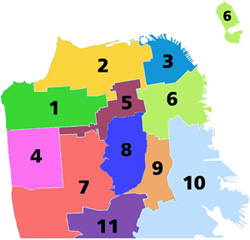
This November, when voters in District 10 — the largest, sunniest, and most diverse of the city’s 11 supervisorial districts — replace termed out Sup. Sophie Maxwell, they’ll be making a selection that could have pivotal implications for the entire city.

That’s because the next supervisor from southeast San Francisco inherits a district that is home to some of the city’s biggest environmental and public health challenges, as well as the most potential for development that will determine what kind of city San Francisco becomes.

District 10 is where you’ll find the most polluted and most underdeveloped lands in San Francisco, areas that could either be transformed into models of a sustainability or, in the words of Tony Kelly, the president of Potrero Boosters Neighborhood Association, “be turned into a toxic Foster City.”

District 10 is where the slaughterhouses, tanneries, and glue factories set up shop and used the bay as a dumping ground. It’s where the smokestacks of coal and oil fired power plants polluted the air. It’s where the Navy filled the Bay, built a shipyard at Hunters Point and loaded parts of the first atomic bomb onto the USS Indianapolis in 1945.

District 10 is where the bottom fell out of this industrial economy in 1974, when the Navy left, taking with it people’s jobs, pay, and hopes for a home of their own and a better future, particularly for what was then a predominantly African American population.

And District 10 is ground zero for plans that will triple the population and double the number of homes — homes that likely will only be “affordable” to Google executives and retirees from Marin, forever changing the face of San Francisco’s southeast sector. Critics fear that will accelerate what has been a steady exodus of black residents, replaced by megadeveloper Lennar’s vision for a new D10.

It’s against this dark history and difficult present that a wide open field of more than a dozen candidates are vying to replace Maxwell, who came to power in 2000 and has had a mixed voting record in her decade on the board. Sometimes, Maxwell was the eighth vote that let the progressive majority on the Board override Mayor Gavin Newsom’s veto and pass trailblazing legislation. Other times, she was the swing vote that allowed the moderate minority to carry Newsom’s water.

So, in addition to D10’s many internal challenges, this seat could determine the political balance of power on the Board of Supervisors, placing all the more importance on voters in this long-marginalized part of town.


DISTRICT OF DISCONTENT

Eric Smith, a biodiesel activist who has thrown his hat in the D10 ring, says that there is a lot of frustration in the air, and looking at the problems the district is facing, it’s hardly surprising that it has what nearly every candidate agrees is a fractured political culture.

“The Bayview, the Hunters Point Shipyard’s toxic Superfund site, the homicide rate, unemployment, poor public transportation, dwindling services and community resources have made D10 one of the city’s largest melting pots of discontent,” Smith said.

Smith’s words were spoken while the Elections Department was verifying signatures earlier this month on a second failed effort to qualify a petition to recall Maxwell.

Bayview resident and D10 candidate Marie Franklin didn’t support the attempt to recall Maxwell, but she understood it as “a frustration movement.”

“People are sinking in the sand, we’ve already lost so many of them, and they felt Sophie wasn’t doing anything for them,” said Franklin, who praised Maxwell for helping get Franklin’s apartment building complex renovated — a job that was completed 18 months ago, at a cost of $65 million, creating 500 local jobs.

“There are 654 units here, and they were uninhabitable,” Franklin said. “There was black mold, rain falling inside. We had people living worse than Haiti.”

Franklin, who said she is running because she “knows the history,” came here in 1978, when she and her son were living in a car after a fire left them homeless. She said the Bayview was a totally isolated area, barely part of mainstream San Francisco.

“There were no taxis, no services,” she recalled. “Nobody would come here, it was the stigmatized area where no one was accountable to provide services.”

The Bayview — which in some ways is the heart of D-!0 — wasn’t always a black community. But African Americans have been living here for 70 years, dealing with all the racism, denial of services, poverty, and pollution. And it bothers Franklin that 85 percent of the 10,500 homes that Lennar plans to develop won’t be affordable to the elderly, disabled, unemployed and low-income people who currently live in the Bayview.

“We need to preserve the diversity of the community and make sure their issues and information will flow to City Hall,” she said. “You must give the people a handle. If you don’t reach out, they’ll slip. That’s why folks out migrated.

Whoever succeeds Maxwell will be a central player in addressing some very big and dirty issues: the future of the Navy’s radiologically impacted shipyard at Hunters Point, Lennar’s massive redevelopment plan for the Shipyard and Candlestick Point, the polluting power plants, replacement of stinky digesters at the sewage plant, and the SF Hope public lousing rebuild.

There’s also the chance to address violence and crime. James Calloway, a candidate who has long worked in Bay Area schools, told us he believes that education and jobs are part of the keys to rejuvenating the district.

“Job opportunities are not as plentiful in the district,” Calloway said. “When I was a kid, you could walk down Third Street at 2 a.m. Now I wouldn’t walk down it at 9 p.m., and I know the area.”

Calloway is hopeful that the massive redevelopment plan, if done correctly, could start the district’s comeback. “Not a lot of black folks stay here when they have extensive education,” he said. “But it’s not only them. Many were displaced by redevelopment and had no way to go back.”


ELECTION UP FOR GRABS

The largest of the city’s 11 electoral districts, D10 is a huge triangular piece of land in the city’s southeast sector that was used as an industrial dumping zone for decades. Today, the district runs from the Giants stadium at AT&T Park to the 49ers stadium at Candlestick Point and encompasses Mission Bay, Potrero Hill, Dogpatch, India Basin, Portola, Little Hollywood, and Visitacion Valley. It’s also crossed by two freeways that isolate it from the rest of the city, and is home to a large number of crumbling housing projects that are in the process of being rebuilt.

Candidate Ed Donaldson grew up in the projects until he was 10 years old, when the Redevelopment Agency kicked his family out in the 1970s. “We landed on our feet, but others weren’t so lucky,” said Donaldson, who works as a housing counseling director at the San Francisco Housing Development Corporation.

“There is a sense that the Bayview and Visitacion Valley have not been included within the San Francisco family,” Donaldson said. “There is a sense of being forgotten.”

In 2007, Donaldson co-founded the Osiris Coalition to tackle the city’s dormant Certificate of Preference program, in which the Redevelopment Agency issued a document to displaced residents and businesses in the 1960s promising that they could return.

He also tried to rescue some 700 foreclosed properties and recycle them as affordable housing stock. And now he is trying to prevent the city from bulldozing seven SF Hope projects without guaranteeing residents that they have right to remain.

In 2007, Mayor Gavin Newsom and Maxwell convened an African American Outmigration Task Force that didn’t get a public hearing about its findings until August 2008. The timing angered some, who questioned why the report’s findings and implications for urban planning weren’t released before June 2008, when the residents of San Francisco voted for the Lennar-led Proposition G, a proposal to build 10,000 market rate homes at one of San Francisco’s last remaining black communities, which Newsom and Maxwell endorsed.

The taskforce didn’t publish its recommendations until the end of 2009, allegedly because of insider squabbling. Meanwhile, gentrification was going on actively, and many blamed Newsom, and by extension Maxwell, for failing to do anything with the group’s findings as D10 residents continued to suffer from high rates of asthma, cancer, unemployment and an ongoing black exodus.

It wasn’t always this way. In the 1940s, the district’s black population exploded when migrants from the south and World War II veterans came to work at the Hunters Point Naval Shipyard. Some moved to Alice Griffith Public Housing complex, or Double Rock, which was built as military housing in 1962. Others relocated to the Bayview when the Redevelopment Agency took over the Fillmore/Western Addition in the ’60s and ’70s as part of a controversial urban renewal effort.

But when the Navy abandoned the shipyard in 1974, unemployment hit the black community hard. Today, hundreds of the city’s lowest income residents live in Alice Griffith’s crumbling units and endure sewage backups, no heat, cloudy drinking water and leaking ceilings, as they wait for the projects to be rebuilt.

“Generations have been trapped in the silo of public housing and cannot get out, because of lack of opportunity and education, so when we legislate, we need to take that into consideration,” said candidate Malia Cohen, whose grandfather came from Texas to work at the shipyard where he met her grandmother, whose family came from New Orleans.

“My grandfather’s father was a longshoreman. He worked with the infamous Leroy King [a commissioner at the city’s Redevelopment Agency] and he has fantastically vivid stories of racism,” said Cohen, who works for the Federal Reserve Bank of San Francisco, previously served on the executive staff of Mayor Gavin Newsom, and has already raised over $18,000 in the D10 race and qualified for public matching funds.

“My family came here to work hard, they lived on Navy road in the projects, and then they bought a house here. My parents were born here, and we were all public schooled,” Cohen recalled as she took me on a tour of D10 that ended up in Visitacion Valley, an increasingly Chinese-American neighborhood that reflects a district-wide trend.

Census data show that by 2000, Asians were the largest racial group in the district (30 percent), followed by blacks (29 percent), whites (26 percent), and Latinos (19 percent). By 2003, according to the California Urban Issues project, the trend continued. Asians were the largest racial group (32 percent), followed by blacks (27 percent), whites (21 percent) and Latinos (17 percent) of the population.

This means that D10 candidates will have to garner support from more than one ethnic group to win. Over a dozen candidates have already filed papers in the race, but so far there is no clear front-runner.

Also frustrating the prognosticators is that fact that D10 has had the lowest voter turnout in the city, so the winner will also depend on who goes to the polls.

D10 candidate Geoffrea Morris, who is the grand daughter of longtime Bayview activist Charlie Walker, has been knocking on doors and participating in voter registration drives.

“We need new blood,” Morris said

Getting elected will be a complicated equation. Although Bayview’s population was 50 percent African American at the time of the 2000 census, it didn’t turn out the vote. In the 2006 election, only 14,000 of the district’s 37,000 registered voters went to the ballot, and 50 percent were from whiter, richer, and more Asian neighborhoods.

“It’s very important to the future of the city that the ethnicity diversity of the board be maintained and that the African American community have representation,” former Board President and current Democratic Party chair Aaron Peskin told the Guardian.

Maxwell recently told the Guardian that she’s not ready to endorse any D10 candidates yet. “I’m waiting for people to have a better understanding of what this community is, what the common thread running through it is, and how to use rank choice voting,” she told us.

The only candidate who currently holds elected office is BART director Lynette Sweet, who had her answers down pat when we reached her by phone, and even used wording that was eerily similar to Maxwell’s words.

“D10 is a pretty diverse district, but there is only one common thread: the need for economic development,” Sweet told me. “That’s true in Potrero Hill, Portola, Dog Patch and the Bayview. It’s the same mantra: a lot of small businesses need help, and the only way to help them is through economic development. In Potrero Hill it’s about land use. In the Bayview, it’s about the shipyard and better transportation and truancies.”


THE COMMON THREAD

District 10 is ground zero for the Lennar’s $2.2 billion plan to develop 10,500 market rate condos at the Shipyard and Candlestick Point. The plan will allegedly create thousands of jobs and new parks, deliver on an historic community benefits agreement that labor groups claim is so “lawyered up” that the developer can’t renege on its promises.

The package is framed as the one and only way to revitalize the southeast’s formerly vibrant economic engine. Indeed, any time anyone tries to slow down the process—to take time to thoroughly read the draft EIR and see if it adequately addresses the impacts of this massive urban reengineering project — a chorus of “no delays” starts up, either from residents of the housing projects desperate to see their homes rebuilt, or the labor contractors who hope to get jobs.

“It’s as if the city is playing checkers, while Lennar is playing three-dimensional chess,” Eric Smith observed.

Lennar has stated that it will contribute $711 million to finance this massive project. The remainder will be leveraged by Mello-Roos bonds, state taxes based on the use and size of a property and intended to raise money for needed services, and tax increment financing, which creates funding for projects by borrowing against future property tax revenues.

The conceptual plan won Maxwell’s backing but environmental groups are critical of the draft EIR.

During DEIR hearing, environmentalists questioned the wisdom and the cost of filling the Bay to build a bridge over Yosemite Slough, and building condos on Candlestick Point state recreation area, the only open major open space in the district.

But the city’s Planning Department also has 20,000-30,000 units of housing in its pipeline. This means that if all these plans get approved in the next decade, they’d account for 80 percent of residential development citywide. And D10’s population could triple, further skewing the district’s already shifting demographics.

In other words, D10 as we know it could become nothing more than a historic relic in a few years, and the next supervisor will play a key role in deciding whether that happens. SFHDC’s Ed Donaldson warns that any supervisor who does not understand the complexity of the city’s largest district can expect a similar recall backlash in future.

“There is no one homogenous voice in the community,” Donaldson said. “The grass-roots organizing that brought about the recall effort was a result of a changing political structure in the area, but is not yet on par with other districts in town. We still allow our politics to be controlled from downtown.”

Fellow candidate Eric Smith warns that the issues—and politics—are complex.

“People were emotional, angry, and desperate because they feel no one listens to them,” Smith said. “That’s part of the problem here; they would rather have a supervisor go down swinging for them, rather than watch one seemingly side with Lennar, PG&E and the mayor on issues contrary to their interests. That’s the terrible irony and one of the biggest problems in District 10. Folks are so mad, they’re willing to do whatever it takes to make them feel they have a voice in the outcome, even if it’s potentially worse.”

Smith cited the sequence of events that culminated last year in the Navy dissolving the community-based shipyard Restoration Advisory Board (RAB), which for years has reviewed technical documents and commented on the Navy’s clean-up proposals. But in December, the Navy made its official decision to disband the RAB, citing dysfunctional behavior and off-topic discussions that got in the way.

“Some of the same folks who were frustrated by the process, tried to send a signal to the Navy that they weren’t being heard and for all their well-intentioned efforts got the RAB dissolved,” Smith said. “I truly feel for them, it’s absolutely heartbreaking, but at times, they can be their own worst enemy.”

One of the looming issues about the shipyard is that the land has been polluted and needs to be cleaned. The shipyard contains radioactive debris from ships towed to the shipyard, after a 90-foot wave washed over them during an atomic test gone awry. The Navy burned 610,000 gallons of radioactively contaminated ship fuel at the shipyard, and workers showered on the shipyard, raising concerns that radioactive materials got into the drains and sewers. And questions have been raised about radiological tests on animals at the yard.


LEAKS AND FLOODS

It’s not just the shipyard that’s toxic. Even the buildings that were constructed to house workers 50 years ago are a serious mess.

Realtor Diane Wesley Smith, who grew up in public housing projects, took me on a walking tour of Alice Griffith last week to see conditions that tenants will likely have to endure until at least 2014, if the city sticks to its plan to relocate people into a new replacement unit in the same geographical area, if not the exact same site.

What we found was pretty messed up.

“The water sometimes comes out brown and feels like sand. It’s been like that for a year,” one resident said.

“The water is cloudy, the bath tub isn’t working and the sink keeps stopping up,” said another.

A woman named Silvia showed us how the water from the tap in her elderly mother’s kitchen flows out cloudy and then doesn’t settle properly, like foamy beer.

“The roof’s been leaking for years, the sewage backs up, but they just fixed the lights,” Silvia said. A neighbor named Linda was using her oven as a heater.

“The toilet backs up a lot, and my grandson’s been coughing a lot from asthma,” Linda said.

“Roaches is always a problem,” said a woman named Stormi, dressed in black sweats and a black T-shirt that read, “Can’t knock the hustle.”

“They’re trying,” said Stormi, a member of the Alice Griffith Residents Association, as a couple of Housing Authority trucks pulled up to do repairs.

“They promise that you will not have to leave your unit, but if they try to move us down to the waterfront, well, there’s a reason there’s no housing there, and it’s because the land will flood,” Stormi said.

“If we don’t end up at the table, we’ll end up on the menu,” Wesley Smith warned, as she stopped to chat with a group of young men, who were worried they would pushed out of the Alice Griffith rebuild through the criteria being established.

“Fred Blackwell, the executive director of the Redevelopment Agency, assures me that’s not the case, but Alice Griffith is a Housing Authority property, and empty promises have the potential to be great promises provided they are made in writing,” Wesley Smith said as we walked out of the projects and onto the road where a yellow and black sign announced “flooded” next to Candlestick Point park, where Lennar wants to build.

Malia Cohen expressed concern about Hope SF residents, as we drove through the Sunnydale housing project.

“We have to be diligent and mindful that people are not pushed out,” Cohen said, noting the sweeping views at Gleneagles golf course above Sunnydale, and the value of housing for a golf course community. “When public housing gets taken offline, we must work with Redevelopment and the Housing Authority to make sure no one is changing the rules halfway. We have to make sure the talks and walks line up. We need to be equal partners. We cannot be bulldozed by City Hall.”

Geoffrea Morris is a Calworks employee, at the Southeast Community College facility on Oakdale, which was built to mitigate the city’s expansion of the sewage plant in 1987. She cited concerns about the literacy levels of people who live in the 2200 public housing units that cluster D10. “A lot of people in Alice Griffith don’t even know the dates or when it’s going to be reconstructed,” Morris said. “Folks like to be told stuff like that, but the city gives you a stack of papers. Some will read them, but others rely on folks they think are trustworthy. They need stuff in layman’s terms written on one sheet of paper.”

Morris is a fan of the Internet who posted a community survey online, and made sure every housing project got some literature telling people to get informed. She worries about the digital divide in D10:

“A lot of folks don’t have computers and access to important information,” Morris said. “And let’s talk about the way ‘affordable’ is used to trick people.”

Michael Cohen, Newsom’s top economic adviser, recently stated in a memo that over the expected 15-20 year phased build out, Lennar’s Candlestick-Shipyard development would include, “up to 10,500 residential units, about 32 percent of which (3,345) will be offered at below market rates.”

“But 892 units of this ‘affordable category’ will be sold to folks earning $100,000,” Morris said. “So if you subtract 892 units from affordable unit category, you’re back to 25 percent affordable.”

Candidate Kristine Enea, an attorney and a former RAB member, chairs the India Basin Neighborhood Association, which administers a US EPA grant to hire experts to translate the Navy’s cleanup documents into plain English and comment on them She was frustrated by the Navy’s decision to dissolve the RAB.

“The lack of a forum does nothing to bolster the community’s trust in the cleanup or the redevelopment process,” Enea said.

Enea generally supports the Lennar project, but has concerns about whether it will adequately mitigate increased car traffic, or result in commercial development that benefits her neighborhood.

“India basin is a pocket of Hunters Point right along the shoreline,” Enea said. “Right now, we have no shops or restaurants, no ATM, no groceries, nothing beyond one liquor store and a few industrial businesses.

Potrero Boosters president Tony Kelly told us that District 10 residents can think for themselves. “D10 residents don’t need to rely on corporations to solve their problems,” he said.

“Folks in the eastern neighborhoods came up with a better revitalization plan than what the city proposed and community activists managed to close the power plant, after the city said it was impossible,” Kelly recalled.

And there’s no shortage of good ideas.

Kelly suggested that an urban agriculture center could immediately put low-skilled folks to work by erecting greenhouses on unused land. Smith said the industrial zone could be “incredible eco-park made from sustainable sources.

‘D 10 is the dumping ground for everything, including all the city’s waste,” he said. “We could be a shining example, not just for D 10, but the rest of the state.”

The D 10 candidate line up includes Calloway, Cohen, Donaldson, Smith, Enea: civil rights attorney Dewitt Lacy, Morris, Potrero View publisher Steve Moss; District 7 BART director Lynette Sweet, Wesley-Smith. Bill Barnes, who works for Sup. Michela Alioto-Pier, and Linda Richardson, who was appointed to the Human Rights Commission in 2007 by Mayor Newsom, have also expressed interest in the race.

In such a huge field, name identification will play a major role. Sweet is in office, but BART Board is not a high-profile job and won’t give her a huge advantage.

Cohen has a slight edge right now in that she’s raised $18,505, including $500 from former Newsom flak Peter Ragone, making her the first D. 10 candidate to qualify for campaign financing. The oldest of five girls, Cohen recalls how her mother got laid off from her city job as a school-based mental health worker and then rehired, as part of the city’s budget cuts.

“We felt that pinch and the frustrating games that are played out between the leadership and the rank and file,” she said.

Cohen who worked for Newsom in his first term as mayor, but has since left his administration , said she is uncomfortable at being framed as Newsom’s candidate.

“Because I’m not, but I am one of the few candidates who has seen how the mayor and the Board work—and don’t work—together,” she said.

Moss sees the city’s southeast as a “district in transition.” Over coffee at Farley’s in Potrero Hill, he told me that the southeastern neighborhoods could be “launching pads for environmentally sustainable growth.”

“The district’s been in a frozen period for 30 years, But despite the problems, people are deeply committed to and in love with their community.

“This district is the future of San Francisco and its social fabric—the diversity, income –and its problems are leftovers from the city’s industrial age.”


DISTRICT 10, BY THE NUMBERS

Total Acres: 5,650

Average household income: $85,000

Population: 73,000

Registered voters: 37,700

Average housing price: $335,000

Ethnicity (2003 figures): Asian 32%, African American, 27%, white 21%, Hispanic 17%

Development status of land: 18% residential, 38% is commercial, 38% undevelopable

All figures the latest available. Sources: SFGIS, Association of Bay Area Governments, U.S. Census, California Urban Issues Project. Ethnicity and income data is from 2003 and almost certainly has changed.


Editorial: How to create jobs in San Francisco

3

If Newsom decides to solve the city’s $520 million deficit with cuts alone, he will be taking more than $1 billion out of the local gross domestic product

EDITORIAL If Mayor Gavin Newsom is serious about stimulating the San Francisco economy, he ought to start with a basic number that the city’s own economist, Ted Egan, passed along to us this week. The number is 2.11 — and Egan says that’s the multiplier effect of cuts in local public spending.
In other words, every dollar Newsom cuts from the city budget has a ripple effect of taking $2.11 out of the San Francisco economy. Which means that if the mayor decides to solve the city’s $520 million deficit with cuts alone, he’ll be taking more than $1 billion out of the local gross domestic product.
And that, in a nutshell, is the problem with the mayor’s economic stimulus package: it’s entirely aimed at the private sector, with no regard for how it will hit public spending.
A dose of reality here — public-sector jobs are also jobs. People who work in the public sector pay rent and mortgages and buy clothes and food for their kids and go shopping in local stores and go to local clubs and restaurants and pay taxes — and have the same economic impacts on the economy as private-sector workers. If you lay off nurses and recreation directors, those people stop spending money in town, and you continue the vicious cycle that has made this recession so deep and painful.
And if your entire economic stimulus program is aimed at cutting private sector taxes, it’s going to lead to public sector job losses. And those losses will undermine much of the impact of any gains you might get from private sector job growth.
Egan predicts that Newsom’s program of eliminating the payroll tax for new hires would create 4,330 new jobs in the city. We find that something of a stretch — it’s hard to imagine how any struggling small business would find eliminating a small tax enough reason to hire a new worker, and small businesses provide the vast majority of the private-sector jobs in San Francisco. But even if it’s accurate, it’s a fairly tiny gain. The city’s lost more than 35,000 jobs since 2007, and when the economy rebounds in the next two years, Egan predicts about 20,000 new jobs in the city even without the stimulus.
Egan also acknowledged to us last year that “the consensus among economists is that most of the time government spending stimulates the economy more” [than tax cuts].”
That’s particularly true in a city where the largest employers are all in the public sector (see opinion piece this page).
If the mayor and the supervisors actually want to create jobs in San Francisco, there are plenty of things they can do — starting with finding ways to close as much of the budget gap as possible without layoffs. Here are some possible approaches.
• Put a major revenue measure on the November ballot that saves city jobs without costing private sector jobs. There are several ways to do this, but all of them start with the well-demonstrated concept that transferring wealth from the rich to the poor and middle-class — that is, giving money to people most likely to spend it — is good for job creation. One option: shift the payroll tax to a gross receipts tax and charge bigger companies a higher rate. Another: a commuter tax on income earned above $50,000 a year would charge wealthier people who use city services and don’t pay for them.
• Issue infrastructure bonds. The notion that cities can’t borrow money the way the federal government does to fund economic stimulus programs is just wrong. San Francisco can sell bonds for a wide range of projects, from affordable housing to alternative energy projects to public works programs that are badly needed and could put San Franciscans directly to work. But it can’t be small-time projects; to make a difference, direct stimulus needs to be big, perhaps $1 billion. San Francisco’s property owners, who ultimately are on the hook for the bonds, are by and large (thanks to Prop. 13) entirely able to handle more payments.
• Lend more money to small businesses. The biggest obstacle to small business hiring isn’t taxes but a lack of credit. The $73 million Newsom is going to spend on tax cuts would create far more jobs as part of a city-sponsored microloan fund. Newsom’s efforts on that front are still very small scale.
There’s so much more the city can do — but cutting taxes and losing city jobs is the wrong way to turn around the economy.

How to create jobs in SF

10

EDITORIAL If Mayor Gavin Newsom is serious about stimulating the San Francisco economy, he ought to start with a basic number that the city’s own economist, Ted Egan, passed along to us this week. The number is 2.11 — and Egan says that’s the multiplier effect of cuts in local public spending.

In other words, every dollar Newsom cuts from the city budget has a ripple effect of taking $2.11 out of the San Francisco economy. Which means that if the mayor decides to solve the city’s $520 million deficit with cuts alone, he’ll be taking more than $1 billion out of the local gross domestic product.

And that, in a nutshell, is the problem with the mayor’s economic stimulus package: it’s entirely aimed at the private sector, with no regard for how it will hit public spending.

A dose of reality here — public-sector jobs are also jobs. People who work in the public sector pay rent and mortgages and buy clothes and food for their kids and go shopping in local stores and go to local clubs and restaurants and pay taxes — and have the same economic impacts on the economy as private-sector workers. If you lay off nurses and recreation directors, those people stop spending money in town, and you continue the vicious cycle that has made this recession so deep and painful.

And if your entire economic stimulus program is aimed at cutting private sector taxes, it’s going to lead to public sector job losses. And those losses will undermine much of the impact of any gains you might get from private sector job growth.

Egan predicts that Newsom’s program of eliminating the payroll tax for new hires would create 4,330 new jobs in the city. We find that something of a stretch — it’s hard to imagine how any struggling small business would find eliminating a small tax enough reason to hire a new worker, and small businesses provide the vast majority of the private-sector jobs in San Francisco. But even if it’s accurate, it’s a fairly tiny gain. The city’s lost more than 35,000 jobs since 2007, and when the economy rebounds in the next two years, Egan predicts about 20,000 new jobs in the city even without the stimulus.

Egan also acknowledged to us last year that “the consensus among economists is that most of the time government spending stimulates the economy more” [than tax cuts].”

That’s particularly true in a city where the largest employers are all in the public sector (see opinion piece this page).

If the mayor and the supervisors actually want to create jobs in San Francisco, there are plenty of things they can do — starting with finding ways to close as much of the budget gap as possible without layoffs. Here are some possible approaches.

Put a major revenue measure on the November ballot that saves city jobs without costing private sector jobs. There are several ways to do this, but all of them start with the well-demonstrated concept that transferring wealth from the rich to the poor and middle-class — that is, giving money to people most likely to spend it — is good for job creation. One option: shift the payroll tax to a gross receipts tax and charge bigger companies a higher rate. Another: a commuter tax on income earned above $50,000 a year would charge wealthier people who use city services and don’t pay for them.

Issue infrastructure bonds. The notion that cities can’t borrow money the way the federal government does to fund economic stimulus programs is just wrong. San Francisco can sell bonds for a wide range of projects, from affordable housing to alternative energy projects to public works programs that are badly needed and could put San Franciscans directly to work. But it can’t be small-time projects; to make a difference, direct stimulus needs to be big, perhaps $1 billion. San Francisco’s property owners, who ultimately are on the hook for the bonds, are by and large (thanks to Prop. 13) entirely able to handle more payments.

Lend more money to small businesses. The biggest obstacle to small business hiring isn’t taxes but a lack of credit. The $73 million Newsom is going to spend on tax cuts would create far more jobs as part of a city-sponsored microloan fund. Newsom’s efforts on that front are still very small scale.

There’s so much more the city can do — but cutting taxes and losing city jobs is the wrong way to turn around the economy.


Newsom’s war on the public sector

2


By Calvin Welch

OPINION With the Feb. 10 release of the Controller’s Office economic analysis of Mayor Gavin Newsom’s proposed tax cuts to businesses, combined with its December 2009 analysis of the Newsom administration’s proposed fee cuts to market-rate condo developers, we now have a clear and objective measurement of this administration’s response to the biggest economic collapse in San Francisco since the Great Depression: the mayor hopes to create 4,400 jobs (of the 39,000 jobs lost in San Francisco since the start of the downturn) and 40 to 50 new market-rate condos over the next two years at the cost of $72 million in lost tax revenues.

The plan includes no affordable housing — zero, zip, nada — below-market rate housing for moderate-income San Franciscans. Instead, the developer fees that fund parks, transit, and other critical neighborhood infrastructure projects promised for the Market Street, Octavia Street, and eastern neighborhoods plan areas will be postponed indefinitely.

Those impacts don’t include the loss of public sector jobs and services. The report rather coyly notes that “the potential impacts of the city revenue decline on public services, and indirectly on the economy, is not considered because the city could adjust to that impact in many ways.” The analysis warns: “However, if the stimulus does not directly incentivize job creation, it may not overcome the loss of public sector employment that the subsidy’s revenue would pay for.”

That last point that needs some attention.

Newsom’s “stimulus” is targeted solely at the private sector, with no requirement that the companies slated to get tax breaks and fee reductions actually perform — either through job growth or housing development. It cuts public sector employment and public sector-led infrastructure development — affordable housing, transit lines, parks and playgrounds — when it’s clear that both public employment and infrastructure development would be a direct stimulus to the local economy.

Quick, name the biggest employer in San Francisco. How about the second biggest — or fourth, sixth, or seventh? Well, they’re all in the public sector: the City and County of San Francisco, the University of California, San Francisco, the State of California, the San Francisco Unified School District, and the U.S. Postal Service top the list. As of 2008, some 85,000 jobs in San Francisco — 15 percent of all jobs in the city — were in the public sector. More than half were in education, and the bulk of the rest were in health and human services.

The Newsom administration’s war, and it is a war, on the public sector is economic suicide. We should look at stimulus as saving as many public sector jobs — especially in education and health and human services — as we can and finance as much local infrastructure development as we can afford. That’s real economic stimulus. What Newsom is proposing is the same old, inside-the-box, tried and failed trickle-down that got us in this ditch in the first place.

Calvin Welch has spent the last four decades working for sane economic development policies in San Francisco.

Sunshine and shadows

2

tredmond@sfbg.com

It was, the San Francisco Chronicle proclaimed, the end of the world for development in the city, or at least something close to that. A ballot measure, sponsored by Sup. David Chiu, restricting new buildings from casting shadows on city parks “could imperil major development projects,” a Jan. 28 article by John Cote said. “Everything from a new wing at the San Francisco Museum of Modern Art to the expansion of the Moscone Center and creation of a new downtown core around a rebuilt Transbay Terminal could be affected.”

A lot of that is wildly exaggerated. The Chiu ordinance, which has since been pulled from the ballot pending a city study of the issue, would hardly have halted all development — or even all high-rises — in San Francisco. It wouldn’t have gutted the Transbay Terminal plan (although it might have forced planners to reduce the height of a tower that would soar 400 feet above the tallest building in San Francisco). In fact, the real story is how Chiu has managed — for now — to stop a backroom attempt by developers to undermine a 25-year-old environmental law. We found some fascinating evidence of how Mayor Gavin Newsom has been working with the San Francisco Chamber of Commerce to undermine Chui’s efforts — using broad threats to try to get his way.

Chiu’s legislation sought to clear up a couple of loopholes in a landmark 1984 law, which passed on the ballot as Proposition K. The measure, authored by then-Sup. Bill Maher, essentially barred any new construction that would cast a significant shadow on a city park.

In 1989, the final implementation guidelines were approved, and they’ve stopped literally hundreds of proposed projects from casting dark shadows on public open space.

But in the past year, city planners have been meeting with lawyers for big developers and looking for a way to change the rules. Citing new technology that better measures the curve of the earth and complex algorithms that calculate sunlight, the Planning Department has since proposed revising the Prop. K guidelines — in a way that would allow taller buildings and more shadows without getting the approval of voters or supervisors.

Chiu told us he’s been trying for months to find out exactly what the proposed guidelines would do — how many new buildings, at what heights, would be able to shadow which parks. “I was unable to get any answers,” he said.

The measure he drafted would have barred any new guidelines that allowed more shadows — and would have required the Board of Supervisors to sign off any changes. It would still allow the city to make case-by-case exemptions for projects that cast minor shadows but are otherwise deserving of approval — affordable housing developments, for example.

But downtown went nuts — and Newsom joined the fray.

The crux of the opposition came from the Chamber — and is outlined in an e-mail from Chamber Vice President Rob Black to members of the Chamber board.

“The mayor was very direct and clear about the need to defeat the measure,” the e-mail, which we obtained, states. “The mayor was also very clear that he was in no mood for deal-making on the issue and that he would look very unfavorably on any developer or anyone else who tries to cut a deal with David Chiu on the issue. He literally said, you will be on your own for the next two years if you go there.”

Black confirmed that the e-mail was in fact his — but said the version we’d obtained “has been edited. Some words were changed and other omitted.” He refused to say what the changes were, saying that the e-mail was meant to be a confidential communication to his board. However, he confirmed that the basic message and descriptions of a meeting with Newsom were accurate.

Tony Winnicker, Newsom’s press secretary, confirmed that Newsom had been directly involved in trying to scuttle the ordinance — and didn’t deny the mayor had made those threats.

“The mayor made clear the importance of asking the supervisor to withdraw the measure,” Winnicker wrote in an e-mail to us. “The mayor was clear that backroom deal-making should not be tolerated on the issue.”

Chiu was somewhat aghast at the mayor’s statements. “The context for all this is that the developers and their lawyers were trying to change the rules,” he said.

Aaron Peskin, the former supervisor and longtime North Beach neighborhood activist, told us that the “hysteria around this is factually untrue. This isn’t about stopping development — it’s about making sure development doesn’t have an adverse impact on the city’s common space.”

So now Chiu has agreed to hold off — but only if the key stakeholders (not just developers) have some input into how planning devises new shadow rules. And he’s ready to go back to the ballot in November if the developers try to play games again.

That makes sense, Gabriel Metcalf, executive director of the San Francisco Planning and Urban Research Association, told us. “There should be a heavy burden of proof on the people who want new rules,” he said. “And there should be a heavy burden of proof for anyone who wants a ballot measure.”

In other words, Prop. K — as it is, as it’s stood all these years — is working pretty well. And if the developers hadn’t tried to sneak in some big changes, none of this would have happened in the first place.

The “jobs” shell game

0

Written with Nima Maghame

news@sfbg.com

While many San Francisco city officials have been trying to figure out how to close a projected budget deficit of more than $520 million, Mayor Gavin Newsom has spent the last month trying to make that spending gap even larger by aggressively pushing a variety of business tax cuts that economists say will do little to improve the local economy and could actually make it worse.

Newsom first proposed his so-called “local economic stimulus package” a year ago during his ill-fated run for governor, just as President Barack Obama was pushing his own economic stimulus plan. But unlike the federal government’s $787 billion plan, about a third of which involved tax cuts demanded by conservatives, Newsom proposed to cut local business taxes while also deeply slashing local government spending and laying off hundreds of city workers.

Most economists say that’s a terrible idea. In fact, a report issued at the time by Moody’s Investor Services made it clear that every dollar of direct government spending adds about $1.60 into the economy (or $1.73 if it’s on food stamps, the most stimulative spending government can make), whereas business tax cuts add only about $1 to the economy for every dollar spent.

We clashed with the Mayor’s Office at the time on our Politics blog (see “Mayor Newsom doesn’t understand economics,” 2/13/09), with Newsom’s spokesperson telling us the mayor was relying on the input of City Economist Ted Egan. But when we interviewed Egan about the issue, he agreed that it’s a bad idea to slash government spending to pay for tax cuts.

“We were in no way saying you should cut taxes to stimulate the economy, particularly if it means reducing government spending,” Egan told us then. And when we asked directly whether it’s better for San Francisco’s economy for the city to directly spend a dollar on payroll or to give that dollar away in a private sector tax break, he told us, “The consensus among economists is that most of the time government spending stimulates the economy more.”

The Board of Supervisors basically ignored Newsom’s proposal. But he revived it last month, expanding the proposals with even more private sector subsidies and making them the centerpiece of his Jan. 13 State of the City speech, publicly pushing it since then with a series of public events at businesses located in the city.

And this time — with the local economy still slow, projected city budget deficits bigger than ever, and little serious talk about how the city can bring in more money — it appears the proposals will be the subject of a series of hearings before Board of Supervisors’ committees in the coming weeks.

Newsom’s tax cut proposals include a proposal to waive the 1.5 percent payroll tax (the city’s main business tax) for all new hires; extend and expand the payroll tax exemption for biotech companies (see “Biotech’s bonanza,” p. 12); give small businesses tax credits for their spending on health plans; and allow developers to pass one-third of their affordable housing in-lieu fees onto future homeowners.

Newsom and his Press Secretary Tony Winnicker have spoken euphorically about the proposals, saying they’re desperately needed to spur the local economy. “We believe that enacting these tax incentives, particularly the payroll tax credit for new hires, is one of the single biggest things we can do for economic growth,” Winnicker said.

Despite repeated questions about the economists’ concerns over financing tax cuts with government spending cuts, we couldn’t get them to address the tradeoff directly. “The mayor will support critical public services,” was all Winnicker would say about the deep cuts that Newsom is expected to announce in his June 1 budget.

Sup. John Avalos, who chairs the Board of Supervisors Budget and Finance Committee, expressed more skepticism about the mayor’s proposals. “Do tax breaks have the intended effect of stimulating the economy? As we underfund government services, are we getting a net gain or are we getting something taken away? For the very small businesses in my district, it’s going to be trickle-down economics. It’s very unrelated and unmeasurable in benefit,” he told us.

David Noyola, board aide to President David Chiu, said his boss is supporting the biotech tax credit but reserving judgment on the rest. “It’s going to be a cost-benefit analysis,” Noyola said. “When we’re talking about jobs, we’re talking about public and private sector jobs, always.”

While Egan’s economic analysis predicts tax cuts will encourage some economic growth, even he is circumspect about the good it will do, particularly without finding a way to avoid deep cuts in city spending. “The truth of the matter is that our stimulus efforts are small because the city has relatively small power to affect the local economy,” Egan told us.

That’s the consensus economic opinion. Huge federal spending can help a national economy a little bit, but local economies are just different animals that local governments are largely powerless to really alter, particularly through tax cuts.

“I agree with Egan: city government has little power over the local economy,” Mike Potepan, an urban development economist at San Francisco State University, told the Guardian.

Both economists agree that tying tax cuts to job creation or development stimulus is better than general tax cuts, but that neither is good if it means laying off more city workers.

“Research shows that by cutting taxes you have more business activity where studies show it is likely to effect employment,” Potepan said. “On the other side, you have to think about revenue. Cities are going to have to balance their budgets, which could mean a cut in services.”

Author Greg LeRoy expresses a more critical perspective in his book The Great American Jobs Scam: Corporate Tax Dodging and the Myth of Job Creation (1995, Berrett-Koehler), amassing evidence from economic studies and CEO surveys that corporate tax breaks, even those tied to new job creation, have almost no effect on private companies’ decisions about where to locate and whether to hire.

“How can companies get away with this? Because the system is rigged. Corporations have it down to a science. They have learned how to chant ‘jobs, jobs, jobs’ to win huge corporate tax breaks — and still do whatever they wanted all along,” LeRoy writes. “That’s the Great American Jobs Scam: an intentionally constructed system that enables corporations to exact huge taxpayer subsidies by promising quality jobs — and lets them fail to deliver. The other benefit often promised — higher tax revenues — often proves false as well.”

While proposing to forgo collecting millions of dollars in payroll taxes (the Controller’s Office is still working on a projected total for the tax cut package), the Mayor’s Office also wants to spur development of new housing with a proposal that would delay collection of needed affordable housing money by more than a decade.

After hearing mostly from a large crowd of desperate developers and construction workers during a Jan. 21 hearing on the proposal, the Planning Commission approved the package on a 4-3 vote, with the mayor’s appointees in agreement and the board’s appointees in dissent. It will be considered by the Board of Supervisors Land Use Committee sometime after Feb. 12.

The most controversial part of the fee reform package involves reducing the fee developers pay to support affordable housing by 33 percent, then charging a 1 percent transfer tax to subsequent buyers of those homes. Egan estimates developers would save almost $20,000 per housing unit, and that it would take an average of 16 years for the city to recover that money. But for high-rise luxury condos, the city would eventually recover about $27,000 per unit.

“It’s a classic make-an-investment-now-to-get-more-later strategy,” Michael Yarne, who crafted the policy for the Mayor’s Office of Economic and Workforce Development at Newsom’s direction, told the Guardian.

“If it makes it feasible for projects to be started, then it is worth passing,” Tim Colen, a representative of San Francisco Housing Action, said at the Planning Commission hearing, expressing hope that it will help create desperately needed construction jobs and new market rate housing.

But affordable housing advocates and some progressives criticize the policy as completely backward, saying that affordable housing development is desperately needed now, during these tough economic times, rather than a policy that encourages more market rate housing and bails out bad investments made at the height of the real estate bubble.

“What the city needs to do is directly build affordable housing, for which there is a demand,” affordable housing activist Calvin Welch told us. “The problem is that the banks don’t want to lend these guys money because they know nobody can afford to buy houses at the prices that these guys are demanding.”

Debra Walker, who is running for supervisor from District 6 and voted against the proposal when it came before the Building Inspection Commission (the sole vote on a commission dominated by mayoral appointees), agrees.

“The whole argument is that it stimulates development, but it doesn’t,” Walker said, arguing that the incremental gains (about 25 housing units per year, Egan estimates) will be offset by delayed affordable housing construction. “There would be more economic stimulus by using the fee to build more affordable housing.”

Instead, it simply shifts resources to favored entities: from home owners to developers, in the case of the affordable housing fees, or in the case of the tax credits, from the public to the private sector. But Newsom’s office just doesn’t see it that way.

“The Guardian believes in protecting public sector employees over private sector employees,” was how Winnicker formulated our understanding of what the economists are saying. “Most people don’t work for the city, and if we can support private sector jobs, that adds to sales tax revenues and benefits the economy. Despite a short-term impact of the tax credit, that’s a benefit.”

Adam Lesser contributed to this report


Editor’s Notes

0

tredmond@sfbg.com

Progressives don’t have to be afraid of economic development, don’t have to be afraid of promoting business and creating private-sector employment. And we don’t have to be terrified of a mayor who wants to label anyone who opposes Reagan-era economic policies as anti-jobs.

The thing is, San Francisco needs to promote the biggest engine of new employment — small business — and needs to encourage entrepreneurship and innovation. But there’s enough good economic science out there, enough evidence of what works and what doesn’t, that we don’t have to be stupid.

The most obvious example of that is tax cuts. We talk about the mayor’s tax plans this week — and what’s most remarkable is the consensus among economists, even the city’s own economist, that what Newsom is proposing won’t work.

If cutting specific taxes for certain businesses — say, waiving the 1.5 percent payroll tax for biotech — would actually lead local companies to hire hundreds of new people, it might be worth the budget pain. But that’s not going to happen. If allowing developers to pay their affordable housing fees years down the road would put thousands of construction workers back on the job, you could make the case for it — but nobody with any sense really thinks that’s likely.

What do we know would create employment opportunities? Well, a giant affordable housing bond, hundreds of millions in city money going to build new apartments, would generate construction jobs. But what most small businesses really need, what would really encourage hiring, is credit. If San Francisco took the money it’s going to expend (and tax cuts are an expense; let’s be honest) and put all of it into a revolving microloan fund for community businesses, we’d get a lot more jobs. In fact, almost any way that San Francisco spends that money on direct services would create more jobs than these tax cuts.

That’s not politics or ideology or anything else. It’s just reality.

Why Newsom drives me nuts

2

This is the kind of thing that drive me nuts about the Newsom administration.


A few days ago, SF Appeal ran an item on a speech Newsom gave about condo conversions. The mayor wants to let more people turn rental units and tenancy-in-common units into condominiums; that, Newsom argues, will bring more revenue into the city treasury (those conversion permits are expensive).


But there’s a reason why the city limits to 200 the number of units that can be converted in any one year. Turning a rental unit into a condo reduces the number of rentals available, and turning a rent-controlled unit into a condo (or into a TIC and then a condo) cuts into the affordable housing stock.


And a majority of the supervisors, who recognize the impact the mayor’s plan would have on tenants (by making it easier to take rental units off the market), are dubious.


Okay, that’s a difference of opinion. You don’t have to make it personal. And yet, at his press conference, the mayor insisted that


“Half of the members of the board have been beneficiaries of condo conversions, and yet they deny it to other people.”


As the Appeal pointed out, that’s simply untrue.


A majority of Board members own their homes, according to a check of property records: mayoral allies Michela Alioto-Pier, Sean Elsbernd and Carmen Chu all enjoy the benefits of owning and equity, as do Sophie Maxwell and progressive Budget chairman John Avalos.


Eric Mar and David Chiu rent, according to a City Hall source. Chris Daly lives in a condo, but “my condo has always been a condo,” according to the supervisor (and according to the Assessor-Recorder’s Office, Daly at least bought his condo as a condo and not a tenancy-in-common or conversion).


By all accounts, progressive Ross Mirkarimi is on the condominium-conversion waitlist (an older news report says Ross owns a TIC and is on the conversion list; we’ll check in with him to confirm, he is at this moment still in committee). Mirkarimi and Bevan Dufty would be the two Board members conflicted-out of any votes on condo-conversions; Dufty went from a condo to a TIC after his daughter was born.


“And nobody was evicted,” the Bev told us today.


Okay, as I see it only one supervisor is even in a position to benefit from the condo conversion law. So I asked Tony Winnicker, the mayor’s press secretary, whether Newsom had been misquoted. Apparently not. So why did ne make an innacurate statement that insulted half the members of the board?


Winnicker:


His comments came in the context of the polarized politics of San Francisco which pit tenants vs homeowners to the benefit of no one. He was speaking that many Boardmembers enjoy the benefits of homeownership and that opposing the condo conversion proposal denies those benefits to others who are already living in TICs and displacing no one through condo conversion.


But there’s a big distinction between what Winnicker is talking about and what Newsom actually said. It’s entirely possible to be a homeowner in this city without evicting anyone and without taking a rental unit off the market. That’s what most of the homeowning board members have done.


As for TICs “displacing no one,” that’s wrong, too. The number one cause of no-fault evictions in this city is the use of the Ellis Act to clear the tenants out of a building to create a TIC. The only thing holding the TIC epidemic in check is the fact that the TIC ownership model is complex and a bit tricky. The minute you can convert those TICs into condos, you open the floodgates for a lot more of them — and that means a lot more evictions.


Newsom can make the case for condo conversions just fine without making factually inaccurate statements that insult the supervisors. Instead he pulls this shit. And then he complains about the supervisors not wanting to work with him


Drives me nuts.


The attack on district elections begins

2

I knew it was coming. After ten years of district-elected supervisors promoting progressive policies (minimum wage and sick day laws, universal health care, tenant protections, public power, development limits, affordable housing etc.) downtown has finally figured out how to launch a counter-attack. It was announced this morning in the pages of the Chronicle

I knew it was coming. After ten years of district-elected supervisors promoting progressive policies (minimum wage and sick day laws, universal health care, tenant protections, public power, development limits, affordable housing etc.) downtown has finally figured out how to launch a counter-attack. It was announced this morning in the pages of the Chronicle

The idea is to replace some of the district supes with at-large representatives – say, four of the 11. That Chamber of Commerce is doing a poll on the issue. Expect a November ballot initiative.

C.W. Nevius chimed in, too, arguing in favor of the “hybrid” (sounds so much like an eco-friendly car) system.

The line is going to be this: District supervisors don’t pay attention to citywide issues.

“People like the idea of being able to talk to a district supervisor about neighborhood problems, but also feel that they want someone they can go to with broader, citywide concerns,” said Steve Falk, president and CEO of the San Francisco Chamber of Commerce.

Or as Nevius puts it:

The truth is that San Francisco has more supervisors than any county in California. Is it too much to ask that a few of them have the entire city’s best interest in mind?

Let’s consider for a moment what this is really about.

For starters, get rid of the nonsense about a “citywide perspective.” Even Nevius didn’t try to push that too hard when I emailed him with the facts, to wit: Over the past ten years, district-elected supervisors have devoted themselves to a long string of exceptional citywide reform measures and have been guilty of very little district pandering.

Consider a few examples:

Healthy San Francisco
The Rainy-Day Fund
Reforming the makeup of the Planning Commission, Police Commission and Board of Appeals
Restricting the use of plastic bags
Minimum wage and sick day laws
A citywide infrastructure plan and bond program
Community choice aggregation and green energy
Campaign finance reform
Sanctuary city protecting for immigrants

The list goes on and on.

You may agree or disagree with what this board has done, but nobody can honestly say that the district supervisors have ignored citywide issues or that they don’t have a citywide persoective. No: This has nothing to do with citywide issues vs. district issues. It’s entirely about policy – about the fact that district supervisors are more progressive. About the fact that downtown can’t possibly get a majority under a district system – because with those small districts that Nevius complains about, big money can’t carry the day.

In a district system, grassroots organizing – the stuff that labor and nonprofits and progressive groups are good at – is more important than raising money. So district supes are accountable to a different constituency.

I watched an at-large board for almost 20 years, and it was, by and large, a collection of sold-out hacks who did exactly what the mayor and the downtown donors said. It was really pathetic.

The polls have consistently shown that people like have district supes, so now there’s this “hybrid” effort.

Here’s what it means:

Right now, there are three districts that will generally elect a more conservative representative – D 2 (Michela Alioto-Pier) D- 4 (Carmen Chu) and D-7 (Sean Elsbernd). Districts 8, 10, 11 and 1 are swing districts, and the rest are going to go generally progressive.

So the odds are under this system that the left-leaning constituencies will have at least six votes, and in good times, as many as eight.

Now take four of those votes away, pretty much forever. Set it up so that four supervisors, elected citywide, will be guaranteed downtown call-up votes. Then add in one or two more from the more conservative districts, and you’ve got a majority.

That, my friends, is exactly what this is about, and any effort to frame it as anything else is just spin.

I asked Nevius what the hell he was doing buying the bogus argument that we need citywide perspective – since the district board has already demonstrated that, consistently. Here’s his response:

First, I’d envision the city-wide supes as made to order swing votes. When a district supervisor had a good idea, let’s say Healthy San Francisco, it might not be an issue of critical interest for a district supervisor. But it would be right in the wheelhouse for a city-wide official, who is looking for broad stroke issues to back. And, although you didn’t advance the idea, I’d reject the notion that whomever it was that was elected city-wide would be incredibly conservative and obstructionist. The most moderate politician we’ve elected in this city is Gavin Newsom. Although the Guardian doesn’t agree with him much of the time, he’s still advanced some very progressive ideas. Everyone jumps on the Chris Daly example as why district elections are a problem, but I think we can look beyond that. I think he’s been an aberration. District supes like David Campos and David Chiu have proved they can compromise and govern so I think that’s a good thing. I would never advocate that we get rid of representation in the neighborhoods. But c’mon, 11 little districts in a very small city? As Jim Stearns said, some of the districts are no more than a mile square. Combining some of them would still let residents have someone they could call to get the potholes fixed, but also spread out the areas.

Okay, I didn’t say citywide supes would be conservative. Sean Elsbernd is (relatively) conservative. He’s also independent of any big-money interest and does what he thinks is right. He doesn’t need half a million dollars to get elected in his district.

What I say is that citywide supes would be in hock to big money. I’ve seen it, lived with it. Suffered from it.

And guess what: Healthy San Francisco didn’t need any citywide supes; it passed just fine with the district board.

So what this is about is money and political control, and it’s about the political direction the city is going and who’s going to set that direction. Let’s get that straight and be honest about, and then we can have this discussion.

Development stimulus would delay affordable housing construction

0

By Steven T. Jones
onerincon.jpg
Would the partially completed One Rincon and other stalled luxury condo tower projects move forward if the city reduced their front-end fees, and is the cost worth benefit?

In order to encourage the development of more market-rate housing projects in San Francisco, Mayor Gavin Newsom and his administration are trying to let developers pass a third of their affordable housing fees onto the buyers of their homes, who would eventually pay them though a 1 percent transfer tax – a change that the Controller’s Office says would delay collection of those fees an average of 16 years.

That’s the most controversial component in the package of pro-development proposals that’s headed to the Planning Commission on Thursday. Consolidating the collection of various developer fees within the Department of Building Inspection makes sense to many observers, and there’s some left-of-center support for another proposal to let developers delay fee collection until after the building is nearly complete, as long as they pay the city an additional surcharge.

But affordable housing advocates are howling about letting the developers of projects that don’t pencil out and can’t get bank loans avoid their obligations to help the city meet its urgent affordable housing needs, in the process exacerbating the growing imbalance between homes for millionaires and those for the working class. They say it’s the latest example of Newsom’s perverse belief in discredited trickle-down economic theories.

“This is the world as viewed by (Newsom economic advisor) Michael Cohen, that the way out of a real estate speculation bubble is to blow as hard as you can to re-inflate that bubble,” affordable housing activist Calvin Welch told us, noting that many of targeted property were bought at the height of that bubble and are aimed at buyers that are now in short supply because of the recession. “They have to fail and reset, then there will be development.”

Outside SF Federal Building, freedom of assembly is carefully controlled

0

By Rebecca Bowe

fed-uncle-sam.jpg
GSA’s denial of a permit for an event outside the SF Federal Building inspired some art.

Paul Boden, executive director of the Western Regional Advocacy Project (WRAP), a homeless advocacy group based in San Francisco, says he’s got busloads of people from cities up and down the West Coast headed into San Francisco Jan. 20 for a rally designed as a plea to the Obama Administration to make affordable housing a priority. But the estimated 1,500 participants in the event, dubbed “Homelessness Ends With a Home,” were left without a home base after word came down from the San Francisco Federal Building that the permit to hold it there had been revoked.

The event has since been changed to a permitted march that will go by the building, but Boden says the message he’s getting from the feds is essentially that freedom of assembly outside the new federal building will only be granted on narrowly defined terms, and with restrictions on the number of people who can attend. The San Francisco Federal Building, a green-design tower on Mission and 7th streets that opened in 2007, houses the offices of senators Barbara Boxer and Diane Feinstein, and Speaker of the House Nancy Pelosi.

Jean Gibson, Regional Public Affairs Officer at General Services Administration (GSA), a government agency that manages the new federal building, says the permit denial was “no effort to silence the group,” but purely a decision to ensure functional operation and public access to the building.

WRAP had initially applied to hold the event in the plaza outside the building, and Boden says he specified in his permit application back in October that roughly 1,500 people were expected to attend, and that they planned to use a sound system. GSA approved the application and sent the nonprofit an event permit on Nov. 30, according to Boden. But a couple days later, after he called to ask where the port-o-potties should be placed, he says GSA responded with a disheartening email.

“After further review, General Services Administration (GSA) has made the decision to deny the use of the San Francisco Federal Building plaza area on January 20, 2010,” the email stated. “Thanks in advance for your understanding regarding this matter.”

Editorial: Sitting on the sidewalk is no crime

0

Passing the new law might make the supervisors look tough on crime–but it’s not going to make Haight Street any safer

EDITORIAL The recent San Francisco Police Department crackdown on street kids in the Haight Ashbury conclusively proves two things:

1. Chief George Gascón is a media hound who will shift policy and priorities in an instant in response to a couple of newspaper stories, and

2. There’s no need for any new law against sitting on the sidewalk.

Even before the ink was dry on a column by the Chronicle’s C.W. Nevius, who lives in the East Bay suburbs, decrying the “aggressive punks” in the Haight, the Park Station had stepped up foot patrols in the neighborhood. Cops walking beats began making arrests, targeting young people who allegedly had threatened shoppers and residents.

And the crackdown has had an impact. “It proves exactly what I’ve been saying,” Sup. Ross Mirkarimi, who represents the district, told us. “When you put cops out on the streets, walking beats on foot, you get results.”

One of the reasons you get results is simple deterrence: Beat cops may not be able to stop every gangland shooting in the Western Addition or the Mission or Bayview. But when you’ve got enough uniformed officers walking up and down Haight Street, life becomes a lot more unpleasant for small-time thugs. And while not every case will get prosecuted, not every case has to — this isn’t murder we’re talking about. It’s bad behavior by a group of people that will continue only as long as it’s tolerated.

Haight Street has attracted more than its share of social problems over the years, and neighborhood organizing has helped address many of them. Community leaders, merchants, and residents worked with the cops in the 1970s to drive heroin dealers out. A decade or so later, neo-Nazi skinheads met the same fate. In no case has the problem been solved by long jail sentences or tougher laws.

Yet with Nevius pushing the issue, there’s a call for a ban on sitting and lying on the sidewalk — a move to criminalize behavior that, for the most part, over many years, has not been a serious law-enforcement problem. We’ve seen this siren song before — in the early 1980s, when Dianne Feinstein was mayor, San Francisco police began conducting massive sweeps, arresting homeless people who congregated on the sidewalk and charging them with violating a law that banned blocking a thoroughfare. The ACLU took the city to court, the Guardian wrote several stories about it, homeless advocates complained loudly — and while the courts ultimately upheld the law, the sweeps came to an end.

And the misdirected law-enforcement did nothing to address the problem of homelessness. It didn’t make the streets safer — or put one more person in an affordable housing unit.

A law banning sitting on the sidewalk would have similar problems. “It gives the police a way to arrest people based entirely on the way they look,” said Alan Schlosser, legal director for the ACLU of Northern California. Homeless people, people who have no intention of doing anything violent or dangerous — anyone who happens to be sitting in the wrong place could be swept up and charged with a crime.

Passing a new law might make the supervisors look tough on crime — but it’s not going to make Haight Street any safer. There’s no reason to outlaw the nonviolent, non-threatening act of sitting on a public sidewalk — particularly when simply enforcing existing laws against harassment, assault, threats, and other violent behavior is a lot more effective. The supervisors should resist any move to pass a “sit/lie” law that will be hard to enforce, ripe for abuse, and probably won’t survive the inevitable (expensive) court challenge.

Don’t rush the Candlestick EIR

0

EDITORIAL The Candlestick Point redevelopment project is by far the biggest land-use decision facing San Francisco today, and one of the most significant in the city’s modern history. The project, sponsored by Lennar Corp., would bring 10,500 housing units and 24,000 additional residents to the area. Those residents would need new schools, playgrounds, open space, and transportation systems. Industrial and commercial development would create some 3,500 permanent jobs, and those people would need ways to get to work. Plans calls for new roadways, including a bridge over the fragile Yosemite Slough. The 708-acre site includes areas with significant toxic waste issues.

It’s no surprise that the draft environmental impact report on the project weighs in at 4,400 pages. It took two years to review the land use, transportation, air quality, water quality, population, employment, noise, hazardous materials, and other potential issues.

And now the Planning Department and Redevelopment Agency wants all public comment to be completed in a 45-day period that includes the winter holidays. That’s crazy – and it’s a sign that the city just wants to rush this project through without adequate oversight, review, or discussion.

The EIR in a project this size is a major political battleground. It’s one of the few times that the Planning Commission and Board of Supervisors will get to weigh in on the entire project and look at its local and citywide impacts. It’s quite possibly the only time prior to construction when the economic, social, and environmental issues around the project will get widespread public discussion.

And anyone who reads these reports on a regular basis can tell you that they’re thick, dense, tough to follow, and filled with minute details and arcana that add up to very big policy decisions. Among the most pressing issues:

• The housing mix. The city’s own General Plan notes that almost two-thirds of all new housing built in San Francisco needs to be available at below-market rates. Lennar won’t even meet half that target. So the project would create an even greater unmet demand for affordable housing — something the EIR, at least on first read, glosses over. The report refers to “a broad range of housing options of varying sizes, types, and levels of affordability [that would] be developed at Candlestick Point” and states that “such housing would be in close proximity to the jobs provided by the project, [so] it is likely that future employees at Candlestick Point would seek housing at the project site prior to searching for housing in the surrounding Bayview-Hunters Point neighborhood. However, if future employees did seek housing elsewhere in the neighborhood, the effects would not be adverse.”

Actually, if comparatively well-paid employees at the project’s research and development facilities decided to move into the existing Hunters Point/Bayview neighborhood, it would almost certainly drive up housing prices, displacing existing residents.

• Transportation options. The project projects significant improvements in Muni service — but doesn’t say how the city will pay for them. There’s a sizable focus on cars — the EIR estimates the project will need more than 21,000 parking spaces. That’s a lot more cars on the streets of the city, a lot more traffic in the southeast — and a direct clash with the city’s transit-first policies.

• What jobs, and for whom? The 3,500 permanent jobs that would be created are badly needed in that neighborhood, which has the highest unemployment rate in the city. But a comprehensive labor pool study, and a discussion of how existing residents will be trained for projected jobs, appears to be missing from the EIR.

• Hazardous materials. The EIR broadly proclaims that “construction activities associated with the project would not result in a human health risk involving the disturbance of naturally occurring asbestos, demolition of buildings that could contain hazardous substances in building materials, or possible disturbance of contaminated soils or groundwater within one-quarter mile of an existing school.” That is — at the very least — a matter of some dispute.

There’s lots more – 4,400 pages more – and if the approval process is going to be anything other than an utter farce, the Planning and Redevelopment directors need to extend the public comment period for at least another 45 days. *

Wanna side of Candlestick EIR with turkey dinner?

5

Text by Sarah Phelan
For those brave folks who plan to read the newly released six-volume EIR for Lennar’s proposed redevelopment of the 770-acre Hunters Point Shipyard/Candlestick Point site, the holiday season promises to be a busy time.

First, you need to actually find the report, which is buried over at the San Francisco Planning Commission’s site. To help you find your way there, click here.

Nex, you need to figure out when you’ll have time to read it before two public hearing which are scheduled for Dec. 15 & 17—just ten and eight shopping days before Christmas.

And then, if you plan to make a difference, you’ll also need to figure out when you’ll have time to write and submit public comments, which will be accepted until Dec. 28 (three days after Christmas, three days before New Year)

Now, maybe this timing will work marvelously, what with the economy in the shitter, and no one having money to spend on the holidays, and more and more people unemployed and therefore in possession of the time needed to read, digest and comment on all six of these crucial tomes.

Or could it be that most people won’t be doing any of this, and especially not during and in between the biggest celebrations –in terms of family gatherings and feasts?

To motivate y’all to sit up and start tracking this plan, which promises to majorly impact the city’s southeast, may I point you to a Nov. 5 presentation on the proposed plan that was made before the San Francisco Planning Commission last week, in anticipation of the EIR’s release.
(You can watch it or read the captions, depending on your mood). in anticipation of the EIR’s release, by clicking on the Nov. 5 links listed at the Planning Commission’s site.)

What struck me when I watched it was the overall vagueness, on the part of city officials, when it came to explaining the plans, and the desperation of community members, on the one hand, to get jobs, and, on the other, to get the shipyard thoroughly cleaned up (and not just cleaned up to Lennar’s “intended use”) and to get Lennar to keep its promises, be they to monitor the dust, or build 32 percent affordable housing, or create thousands of permanent jobs. Enjoy.

Crunch time

0

sarah@sfbg.com

The proposal by city officials and Lennar Corp. to build more than 10,000 new housing units at Hunters Point Shipyard/Candlestick Point is entering a critical phase, particularly for Bayview-Hunters Point residents who want greater oversight and scrutiny of the project.

Candidates are lining up to replace termed-out District 10 Sup. Sophie Maxwell next year; the project’s draft environmental impact report will be released, considered for approval and potentially challenged; and Lennar officials will seek to get the final development agreement with the city signed before Mayor Gavin Newsom leaves office in 2011, or earlier.

The 770-acre redevelopment plan, which the Mayor’s Office is touting as a shining example of a public-private partnership, has come under repeated attack from community advocates after Lennar’s failures to monitor and control toxic asbestos dust at the shipyard. The crash of the housing market and plunge in the company’s stock price also triggered concerns about the project.

And in light of the U.S. Navy’s recent decision to dissolve the Hunters Point Shipyard Restoration Advisory Board (RAB), the community is concerned that decisions about radiologically-affected dumps and the shipyard’s early transfer from the Navy to the city could occur without important public oversight.

Another aspect of the project — a proposal to build condos on 42 acres of Candlestick Point State Recreation Area — was criticized by the Sierra Club, Arc Ecology, and Friends of Candlestick Park. Lennar argued it was necessary for the project to pencil out and this sale of state land was to be authorized by Senate Bill 792, sponsored by Sen. Mark Leno.

In August, Leno secured the neutrality of the environmental groups and the support of the California Assembly (but not Assembly Member Tom Ammiano, the lone dissenting vote) for an amended version of his bill, arguing that selling 23 acres for $50 million would spare the rest of Candlestick Point SRA from being closed by budget cuts. The legislation now awaits Gov. Arnold Schwarzenegger’s signature.

Now, with the project’s EIR due to be released Sept. 28, people have the chance to register concerns about plans for such a massive development project, which includes condos on the Bayview’s only major park and a controversial bridge over Yosemite Slough.

On Sept. 15, community members packed the Board of Supervisors’ meeting to demand an investigation into their concerns, which also include the apparent inability of Newsom’s African American Out Migration task force to issue its overdue final report about the ongoing exodus of the city’s black population, which this project could exacerbate.

Sup. John Avalos told us he is now gathering information on the issue and hopes to schedule Land Use Committee hearings on the shipyard cleanup and Lennar’s economic health. "The documentation gives real strength and power to the community’s contentions," Avalos said.

He also noted that Maxwell is scheduling a hearing into the dissolution of the RAB, while Sup. Ross Mirkarimi is resurrecting legislation that seeks to put the San Francisco Redevelopment Authority under the control of the Board of Supervisors.

Arc Ecology director Saul Bloom said his group will study the project’s EIR to see if it accurately assesses the effects of Lennar’s development.

"We are concerned about the impact of truck traffic, the bridge over Yosemite Slough, and whether the transportation plan is going to effectively put the Bayview between three freeways," Bloom said. "But we’re going to be even-handed. If the EIR does a good job, we plan to say so."

Jaron Browne of the Bayview advocacy group POWER (People Organized to Win Employment Rights) told the Guardian that her group wants the shipyard cleaned up and the community respected.

"This is not just a Bayview issue," Browne said. "The whole city will be affected by the decisions that take place in terms of the future of affordable housing and environmental protection."

I’ll miss the defenestration building

9

By Tim Redmond

914defen.jpg

I’m not about to start a campaign here; I know the place is falling apart and a hazard to everyone and ought to be turned into affordable housing, so there’s no rational reason to protest the Redevelopment Agency’s plan to bulldoze the old Hugo Hotel.

But I have to say: I’m going to miss the place.

It just sat there for so long, a weird piece of street art, an abandoned building with furniture flowing out of the windows and hanging on the walls defying gravity and progress. Every time I’d pass by, I’d say: God, I love this fucking city.

It was just art for art’s sake, no money in it, no sign describing the vision of the artist, no discussion of what it means or meant … just old stuff miraculously bolted to the old crumbling walls of an an old crumbling building. I always wondered what would fall down first and what the green couch would look like after it hit the sidewalk.

It was never meant to be permanent. And now it will be gone. That’s appropriate, in a sad kind of way.

But every time something truly strange goes away, San Francisco loses a bit of itself. I hope we don’t forget this one; maybe Redevelopment can find the cash to hire a photographer to document the place, and put great big color pictures of it up in the lobby of the new, clean, sterile project that takes its place, just to remind us that things were different here, once.

Lawns to highrises

0

rebeccab@sfbg.com

When Aaron Goodman walks the grounds at Parkmerced, a sprawling apartment complex spanning about 116 acres in southwestern San Francisco, he picks up on details that might escape the notice of a casual observer. A gregarious tour guide, he chatters on enthusiastically about the unique design elements of an entryway or townhouse facade, the curve of a knee-high brick wall defining the slope of a courtyard, the simple elegance of a tiered planter or classic window frame, or the spacious feel of a breezeway that opens onto shared grassy space encircled by backyard terraces. "No two courtyards are alike," Goodman says. "Each one is like a little vignette."

An architect who lives in a rental unit in one of Parkmerced’s towers, Goodman is on a mission to document the complex’s 1940s-era courtyard landscapes — but he’s racing against the clock. Landscape and carpentry crews are constantly rearranging things before he can get to them, he says — and those piecemeal cosmetic changes are nothing in comparison with what’s coming.

A total overhaul has been proposed for Parkmerced. The low-rise town houses would be razed, the landscape drastically altered, and an additional 5,665 housing units constructed, nearly tripling the number of residents that can be accommodated.

Goodman regards the plan as a "total tear-down," an affront to the work of the influential landscape architect who designed the grounds, and a terrible waste.

But Skidmore, Owens and Merrill, the internationally renowned architecture firm hired by the owner, a real-estate investment group called Parkmerced Investors LLC, describes the future Parkmerced as a cutting-edge eco-neighborhood that would provide the city with desperately needed rental housing. "This will be the largest sustainable revitalization project on the West Coast — perhaps in the entire nation," says Craig Hartman, the principal architect. "Our goal is to create an international model of environmentally sustainable urban living, and all our decisions are being made in that context."

A development of this scale would fundamentally change the feel of an entire San Francisco neighborhood. It’s also, potentially, a case study in one of the most complex urban planning problems of our time.

"This is the kind of problem that America is going to be faced with over and over in the coming decades," Gabriel Metcalf, executive director of the San Francisco Planning and Urban Research Association, told us. "It’s this question of how do we retrofit suburbia?"

Parkmerced is one of many similar areas developed after World War II, "when people hated cities," Metcalf said, "when the idea was that everybody would drive everywhere, and it was a sort of new town in town. It’s a period piece. It’s from a time when people were trying to escape density and traditional Victorian patterns like in the Tenderloin or SoMa or North Beach — [instead], you would have big lawns, and it would look very suburban."

But that model, most environmentalists and planner agree, isn’t sustainable. And activists say that the western part of the city, which has always resisted density, will have to accept more residents in the coming years.

But a development of this size and magnitude, driven by a profit-seeking real-estate operation, creates all sorts of other problems, including potential traffic disasters on the nightmare called 19th Avenue. And while much of the new housing will be rental and some will be affordable, it raises the question: is this the sort of new housing the city needs?

TOO MUCH WATER


The plans for Parkmerced are bold, and the construction timeline spans 15 to 20 years. The 11 towers on the site, which account for about half the 3,000-unit housing stock, would remain standing, while the low-scale apartment dwellings would be demolished to make way for a mix of taller buildings, including 11 new towers at about the same height. Once the project is complete, Parkmerced would have a total of nearly 8,900 housing units, with a mix of rental and for-sale properties.

"Our plan for Parkmerced will directly address the city’s housing shortage for households at all income levels," Hartman told the Guardian, adding that existing rental units would be preserved, and the project would comply with the city’s affordable-housing requirements. The city typically requires about 15 percent affordability, which would mean about 850 new below-market units — and 4,800 at market rate.

And while the complex was originally designed for middle-class families, the owners have been targeting San Francisco State University students — who typically have their parents co-sign the leases and who don’t present a rent-control issue, since they don’t stay long.

Sustainability and energy-efficiency are underpinnings of the project, according to Hartman. The poorly insulated garden apartments are moisture-ridden and inefficient, he said, and the entire neighborhood layout reflects the car-centric mentality of a bygone era. The landscape also poses a problem. "Maintaining the expansive lawns … requires the application of tons of fertilizer and wastes millions of gallons of drinking water annually. In fact, actual metering shows the consumption of 55 million gallons of potable water per year — just for irrigation."

Parkmerced residents would use 60 percent less energy and water per capita than they do now, according to Hartman, through efficiency improvements and investments in renewable energy sources. Plans also call for an organic farm and a network of bike paths. A storm-water management system would naturally filter runoff and use it to recharge Lake Merced, which has been seeping lower in recent years.

The developers hope to re-route the Muni M line through the complex to make transit more accessible. New retail would eliminate the need to drive somewhere for something as simple as a quart of milk.

"To me what’s most exciting about this is, if they get it right, it’s actually taking an area that right now generates a ton of car trips, and making it walkable," Metcalf said.

But Goodman and others have suggested that Parkmerced should be designated as a landmark, which would hamper development plans, precisely because its character is reminiscent of that postwar era. A draft report issued by Page & Turnbull, a historic-architecture firm, found that Parkmerced would be eligible for designation as a historic district on the California and national registers of historic places.

It was built in the 1940s by Metropolitan Life Insurance Co. as part of a government-supported effort to supply housing for the middle-class and families of servicemembers. The "courtyard vignettes" bear the mark of Thomas Dolliver Church, regarded as the founding father of the modern movement in landscape design.

"It was Church’s biggest public project," notes Inge Horton, an architect and former regional planner with the San Francisco Planning Department who completed an historic assessment of Parkmerced for Docomomo, the International Committee for Documentation and Conservation of Buildings, Sites and Neighborhoods of the Modern Movement. Horton has mixed feelings about the proposed development. "It is one of these things where the developer or owner proposes to tear down all the low-rise buildings and put up a high-rise and make it a little bit green," Horton said. "Sorry to be so cynical."

Goodman wonders just what’s so sustainable about demolishing buildings that the owners have just sunk millions of dollars into for fix-ups and cosmetic repairs. "When you look at the overall site, it’s a functioning community — and it’s essential housing," he says, wondering why it can’t be reused and expanded," he says.

Hartman says he views the site "as an architect," and finds it to be incongruous with San Francisco’s character. "To be frank, the architecture is unworthy of this extraordinary site," he says. Instead, he sees potential for what it could be: a pioneering example of a green neighborhood that uses urban density to meet the challenge of climate change.

MOVING OUT


At a public meeting held in June to discuss the future plans, residents shared their anxiety about being forced to move. Some tenants, particularly seniors, have lived there for decades in rent-controlled units. Parkmerced Investors has promised that those residents would be able to maintain their current rents in brand new, comparatively sized apartments. But Goodman points out that many would lose their meticulously cared-for garden plots and be forced to adapt to life in a high-rise instead.

About half the tenants are college students who attend San Francisco State, which lies adjacent to Parkmerced. District 7 Sup. Sean Elsbernd, who represents the neighborhood, told the Guardian that he often receives complaints from his constituents about "keggers" that go on until the wee morning hours.

"Parkmerced is such a fascinating societal study," Elsbernd noted. "You’ve got a lot of folks who’ve been there since it was built, but really the vast majority now are students at San Francisco State who are so transient and really aren’t terribly invested in the neighborhood."

Elsbernd said he also shares a different concern, which came across at the meeting loud and clear: traffic. Although development plans emphasize cycling, Muni access, and a shuttle that would carry passengers to the Daly City BART, the redesign would come with a grand total of more than 11,000 on-street and off-street parking spaces. And it’s situated along the 19th Avenue corridor, which is already notorious for traffic snarls (and for pedestrian deaths). Some fear the combination of two new developments would fuel perpetual, dangerous gridlock.

"At minimum, we’re talking 5,000 additional vehicular trips a day," said Calvin Welch, a longtime affordable housing activist. "You couldn’t build housing further from where people work if you tried." Welch regards the smart-growth school of thought, enthusiastically endorsed by SPUR, with skepticism. The pitfall, he says, is "allowing high-density development in transit-oriented neighborhoods … and then finding out that people drive."

On the other hand, Welch said, market-rate rental housing is much more affordable than market-rate condominiums, so Parkmerced will provide a service compared to the condos that are pricing so many middle-class families out of San Francisco. And the eastern half of the city has had its share of new residential development, so building new rental units in the western half might be an appropriate counterbalance.
Goodman said he has his own vision for Parkmerced, which would employ adaptive reuse of the existing structures and ensure truly affordable housing for people of modest means. "If I had money and tons of land and all the power in the world, I’d do it a completely different way," he says. "But I don’t. I’m a tenant living on site."