Affordable Housing

Maxwell disappoints by endorsing Sweet

10

To be honest, I wasn’t surprised that termed-out Sup. Sophie Maxwell endorsed D10 candidate Lynette Sweet yesterday. Just disappointed. And it’s not just because Sweet refused to come into the Guardian this fall for an endorsement interview (a stance that suggests that Sweet would be depressingly inaccessible to reporters that haven’t drunk her Kool-Aid—a stance that, unfortunately, reminds me of Mayor Gavin Newsom’s attitude towards the media).

I’d been hearing rumors that Maxwell was going to endorse Sweet since February, when Sweet, who’d already racked up Mayor Gavin Newsom’s D10 blessing at that point, showed up alongside Maxwell at the city’s kickoff event for Black history month.

Then there was the fact that during an interview in February for the Guardian’s kickoff article about the D10 race, Sweet spouted phrases that sounded eerily similar to Maxwell’s words.
“D10 is a pretty diverse district, but there is only one common thread: the need for economic development,” Sweet told me.

But a few days earlier when I interviewed Maxwell about a third, and ultimately unsuccessful, attempt to recall her , Maxwell talked of common threads:

 “I’m waiting for people to have a better understanding of what this community is, what the common thread running through it is, and how to use rank choice voting,” Maxwell said, by way of explaining why she wasn’t willing to endorse anyone that early in the race.

Now, it’s understandable that Maxwell would be looking for a candidate to carry on her legacy. But it she was looking for a moderate black female candidate  then why not endorse Malia Cohen, who isn’t hampered by all of Sweet’s dirty laundry—and has raised the most money in the race, so far?

Could it be that Cohen wouldn’t be down for the kind of dirty deal making that was par for the course back in the days when Willie Brown was still mayor and Sweet was the swing vote that crowned Lennar as master developer at the shipyard/Candlestick Point?

Rumor has it that Maxwell is upset at all the corporate money that’s flooding into this race in support of Steve Moss—and that she asked the other candidates to hold a press conference in which they decry this practice. Rumor also has it that Sweet signaled her willingness to join Tony Kelly, Dewitt Lacy, Chris Jackson and Eric Smith–to name a few–in making such a statement. But it hasn’t happened, yet. And the corporate money keeps rolling in for Moss.

Meanwhile, with three weeks until the election, D10 forums are beginning to sound like a parody of a “Lost” episode featuring a 22-member cast that all claim to represent the city’s polluted and economically depressed southeast sector:

“One of us is a BART director, one of us worked at City Hall, one of us is a community advocate, one of us is a City College Board member, one of us is a civil rights attorney, one of us is an affordable housing development director, one of us is a bio-diesel advocate, one of us is a public safety advocate, one of us was raised in the Bayview, one of us served on the Navy’s Restoration Advisory Board,” and so on.

I’m not saying this is wrong. Hell, I love all this diversity of choices. but I am concerned that, come election night, the progressive vote will get split into a million pieces, while deep-pocketed conservative forces like the Chamber of Commerce and Golden Gate Restaurant line up behind one candidate in an attempt to crush candidates that would stand up to their powerful influence at City Hall and truly represent the D10 community

Yes, there is ranked choice voting, and it’s unlikely that one candidate will win a majority of the vote in the first round. But it’s critical at this venture that progressives develop a winning strategy. D10 candidate Ed Donaldson told me recently that if a candidate who doesn’t represent the community’s concerns gets elected, then the community would respond just as they did around Maxwell—and organize a recall.

But wouldn’t it be better if the community can come together behind three truly progressive candidates and help them win the November election?

One of the key challenges in this race will be to win votes in Visitacion Valley, as well as in the Bayview and/or Potrero Hill.

In his latest column in the Chron, former mayor and Sweet supporter Willie Brown alluded to the importance of this in a city with ranked-choice voting:”It’s not getting much attention, but someone has finally figured out how to get the Asian vote out,” Brown observed.”You do it by mail. You get ballots and ballot books into every household, then have the whole family sit down together. The kids help with the translation, everyone talks things over and everyone votes.”

Meanwhile, D10 candidate Tony Kelly told me that Marlene Tran, who is tri-lingual (English, Cantonese, Vietnamese) and has a good handle on community issues in Viz Valley, has confirmed that Kelly is her second-ranked choice (presuming that she votes for herself in first place. of course).

Not a bad strategy–and one that other progressives need to consider, given ranked choice voting–and the brutal reality that they are going to be massively outspent in the next three weeks.


East Bay endorsements 2010

31

BART BOARD DISTRICT 4

ROBERT RABURN

Incumbent Carole Ward Allen has been a disappointment, part of the moribund BART establishment that wastes money on pointless extensions, ignores urban cores, and can’t control its own police force. Robert Raburn, a bicycle activist with a PhD in transportation and urban geography, would be a great replacement. If he’s elected, and Bert Hill wins in San Francisco, BART will have two more progressive transit activists to join Tom Radulovich. Vote for Raburn.


BERKELEY CITY AUDITOR

ANN-MARIE HOGAN

Hogan’s running unopposed and we see no reason not to support her for another term.


BERKELEY CITY COUNCIL

DISTRICT 1

LINDA MAIO

Maio in the past has had a decent progressive track record, but lately she’s been something of a call-up vote for Mayor Tom Bates. We’re not thrilled with her more recent positions years (against raising condo conversion fees and for new high-rises downtown), but she has no strong credible opponents. Green Party Jasper Kingeter has never run for elective office before and needs more seasoning.

DISTRICT 4

JESSE ARREGUIN

Arreguin and Kriss Worthington hold down the progressive wing on the City Council. He’s pushed the Berkeley police to stop impounding the cars of undocumented immigrants and is a foe of the development-at-all costs mentality of the mayor.

DISTRICT 7

KRISS WORTHINGTON

It’s disappointing that Mayor Tom Bates and his allies are trying to get rid of Worthington, who by our estimation is the best, hardest-working, and most progressive member of the City Council. He’s been willing to stand up to the mayor when he’s wrong — and has managed to force developers to build more affordable housing. He’s against the mayor’s downtown plan, but sees a way forward to a compromise that includes all the positive elements without big high-rises. Vote for Worthington.

DISTRICT 8

STEWART JONES

Gordon Wozniak, the incumbent, is the most conservative member of the City Council and has been a bad vote on almost everything. He’s going to be tough to beat in this district, but we’re giving the nod to Jones, a teacher, Green Party member, and neighborhood activist. He lacks experience, but almost anyone would be better than Wozniak.


BERKELEY RENT BOARD

ASA DODWORTH

LISA STEPHENS

JESSE TOWNLEY

PAM WEBSTER

DAVE BLAKE

KATHERINE HARR

There’s a six-person tenant slate running, with endorsements from Worthington, Arreguin, and other progressive leaders. The members couldn’t find an easy mnemonic, so they’ve used the last letters of their last names, which, in the right order, add up to SHERRY. We’ve listed them in the order they’ll appear on the ballot.


OAKLAND CITY AUDITOR

COURTNEY RUBY

Ruby’s moved the office forward a bit, and we don’t see any argument to replace her.


OAKLAND MAYOR

1. REBECCA KAPLAN

2. JEAN QUAN

The danger in this race is Don Perata, the former state Senate president, longtime power broker, and friend of developers who has, at the very least, a checkered ethical record that led at one point to a five-year federal corruption investigation (the investigation ended with no charges filed). Perata wants to use the mayor’s office to continue his role as a regional kingpin, and he has the support of Pacific Gas and Electric Co. and the big developers. No thanks.

Two strong progressive challengers are taking him on. Our first choice is Rebecca Kaplan, an at-large City Council member who is full of great, innovative ideas for Oakland. She wants to enforce an Oakland-first hiring law, work on transit-oriented development, and encourage small businesses that can attract some of the $2 billion a year Oakland loses in retail sales from local residents who shop out of town.

Kaplan told us she thinks that if Proposition 19 passes and local government has the right to regulate legal marijuana, Oakland is perfectly situated to take advantage of the new law. By combining pot sales and possibly on-site consumption with new restaurants, bike lanes, and street-level amenities, the city could revitalize neighborhoods and bring in significant new tax revenue.

She’s a big bicycle advocate, would consider a progressive city income tax, and is a strong supporter of public power. She also has a practical sense of how to solve problems.

Jean Quan has been active in Oakland politics for decades. She served 12 years on the school board, eight on the City Council, and has the experience, skills, and vision to run the city. She’s also almost tied in the polls with Perata, despite being outspent dramatically (and being the subject of some nasty, inaccurate Perata hit pieces). She told us she wants to be a cheerleader for the public schools, to work with local businesses, expand the high school internship program, and add city wrap-around services to public schools. She’s had a long, impressive record on environmental issues (she worked with San Francisco on a plastic bag ban and wrote Oakland’s Styrofoam ban). She recognizes that much of the city’s budget problem comes from the police department and police pensions. But she’s a little less aggressive than Kaplan about raising new revenue, and while she fully supports Prop. 19 and the Oakland plan for allowing commercial marijuana operations, she is, in her own words, “relatively conservative” on how far Oakland should go to allow sales and use in the city.

Kaplan’s got more of the cutting-edge progressive vision. Quan’s got more experience and a longer track record. They’re the two choices to beat Perata and save Oakland’s future, and we’re happy that ranked-choice voting allows us to endorse them both.


OAKLAND CITY COUNCIL

DISTRICT 2

JENNIFER PAE

Patricia Kernighan is among the most conservative votes on the council. She’s also representing a wealthy, conservative hills district and will be hard to beat. We’re endorsing Jennifer Pae, community outreach director for the East Bay Voter Education Consortium. She has the backing of progressives like Supervisor Keith Carson and Berkeley City Council Member Kriss Worthington (as well as the Alameda County Green Party). She’s a long shot, but better than the incumbent.

DISTRICT 4

DANIEL SWAFFORD

The front-runners in this race are probably Libby Schaaf, a former aide to Ignacio de la Fuente; Melanie Shelby, a small business owner; and Daniel Swafford, a business consultant. Schaaf is too close to her old boss. We liked Shelby, but she’s awfully vague on solutions to Oakland’s problems — and she voted for Prop. 8. She now says her position on same-sex marriage is “evolving,” and she supports equal rights for all couples. But that’s an awfully big issue to have taken an awfully wrong stand on just two years ago.

This leaves Swafford, a neighborhood activist who grew up in Oakland and was City Council Member Jean Quan’s appointee to the Neighborhood Crime Prevention Council and is a strong advocate of community policing. He gets the nod.

DISTRICT 6

JOSE DORADO

Conventional wisdom says Desley Brooks is almost certain to get reelected to this seat. Her only competition comes from Nancy Sidebotham, whose platform is all cops all the time, and Jose Dorado, a bookkeeper with little political experience. Brooks is a fierce advocate for her district and has been tough on banks and good on pushing local hiring, but has too many ethical problems to merit our endorsement. She has never denied that she kept her boyfriend’s daughter on as a $5,000-a-month aide while the young woman was a full-time student at Syracuse University in New York. When San Francisco Chronicle columnist Chip Johnson challenged some of her ethical lapses, she sued him for libel (the case was dismissed).

Dorado is a neighborhood activist who is running a grassroots campaign and, while he needs more experience, he’s raising good issues (like public financing of elections). And unlike Sidebotham, he’s supporting the revenue measures on the ballot.


East Bay Ballot Measures

BERKELEY MEASURE H

SCHOOL FACILITIES TAX

YES

The East Bay cities have done a much better job than San Francisco at using parcel taxes — a poor substitute for property taxes but still a relatively progressive form of revenue — to support schools and other public services. Measure H would continue an existing tax on residential and commercial buildings — 6.3 cents per square foot on residences and 9.4 cents on businesses — to pay for maintenance on public school buildings. Vote yes.


BERKELEY MEASURE I

SCHOOL BONDS

YES

Measure I is a $210 million bond act to expand and upgrade the public schools. Vote yes.


BERKELEY MEASURE T

CANNABIS PERMITS

YES

Measure T is on the ballot as part of Berkeley’s effort to implement Prop. 19, the statewide pot-legalization measure. Berkeley and Oakland are both ahead of San Francisco in planning for legal marijuana. Prop. T would allow six medical cannabis clinics with cultivation permits, but restrict future industrial pot uses to industrial districts. Vote yes.


OAKLAND MEASURE L

SCHOOL TAX

YES

Another parcel tax for schools, this one $195 a year for 10 years, essentially to offset state cuts. There’s an exemption for low-income taxpayers. Vote yes.


OAKLAND MEASURE V

CANNABIS TAXES

YES

If Oakland goes ahead with its plans to allow large-scale cultivation and passes this tax hike on pot sales (to $50 per $1,000 of gross revenue for medical pot and $100 per $1,000 for recreational pot) the city could take in as much as $30 million a year — almost enough to offset the budget deficit. Vote yes.


OAKLAND MEASURE W

PHONE LINE TAX

YES

Another creative — if imperfect — way to raise some revenue, Measure W puts a modest $1.99 a month tax on phone lines to raise money for the general fund. Vote yes.


OAKLAND MEASURE X

POLICE PARCEL TAX

NO

We typically support any reasonable tax on property to pay for public services, but we can’t back this one. Measure X would impose a fairly high ($360 a year) parcel tax on single-family homes — entirely to pay for cops. The police union has been intractable, refusing to give back any of its generous pension benefits to help solve the budget deficit. We can’t see raising taxes for that department alone when so much of Oakland is hurting for money.


OAKLAND MEASURE BB

POLICE FUNDING

YES

Measure BB would allow Oakland to continue collecting violence-prevention money under a previous ballot measure even if the police department falls below a mandated staffing level. It would give the City Council more flexibility in addressing public safety. Vote yes.


>>VIEW OUR COMPLETE ENDORSEMENTS FOR THE 2010 ELECTION

Get a clue, Randy Shaw

29

I read BeyondChron every day, and Randy Shaw, who operates the site, and Paul Hogarth, his managing editor, often have interesting commentary. But I’m constantly annoyed by people who run what by any stretch is a journalistic operation, but don’t follow the basic rules of (even alternative, activist) journalism: When you’re going to say something nasty about somebody, you call that person for comment.


Randy never called me, or Steve Jones, or Bruce Brugmann, before he launched an attack on the Guardian as part of a political machine. If he had — or if he’d done any reporting work and called around town — he might have learned something.


Randy’s argument is that the “machine” — including the Bay Guardian — is trying to block Jane Kim’s election as D6 supervisor. Let’s examine that for a minute.


There are plenty of people in San Francisco who would love to have a political machine. But it’s just not happening. The very fact that Jane Kim has the support of so many progressives — including the Board president, David Chiu, and Supervisors Eric Mar and John Avalos (all part of what Shaw calls the “machine”) suggests that nobody has to clout — not even me — to tell a candidate whether she can run for office, to control (or cut off) campaign contributions, or to wire an election.


In the days when Willie Brown ran San Francisco, the machine really did keep people from running for office. It really did close off avenues to political advancement. And if the machine was against you, it was really hard to raise money. If Brown were still the boss, and he didn’t want Kim to run, she would have been frozen out of much of the support and money she has today. Instead, Brown was at her campaign kickoff — and nobody’s manged to intimidate her many supporters and campaign contributors.


And guess what? The Guardian — the axis of the machine evil trying to freeze out Kim — endorsed her as our second choice.


I stand by what I said months ago — there’s nobody in San Francisco today — and no cadre or group — with the clout to operate as a political machine.


Nobody can line up six automatic votes on the Board of Supervisors. Even the progressives on the Democratic County Central Committee can’t always seem to get it together (note that Aaron Peskin, the chair and supposed machine honco, supported Tony Kelly for supervisor, and the DCCC didn’t put Kelly on its slate).


Right now, power in this city is fairly diffuse. That’s both a good and a bad thing. Good because machines are exclusionary, bad because it means the progressives can’t always function on a level that gets the right candidates elected and the right legislation through. Good because the left in this city is aggressively, almost happily disorganized and politically diverse, full of characters, voices, interest groups, candidates and elected officials who don’t always agree with each other and take orders from nobody. Bad because when we’re disorganized, we tend to lose.


Jane Kim didn’t get the DCCC endorsement. Nobody talked to me about that; I’m not on the panel and none of the members called to ask my advice. I would have said what the Guardian said in our endorsement package: There are exactly two progressive candidates who are qualified to be the next D6 supervisor, and their names are Debra Walker and Jane Kim. I still don’t understand why Kim entered the race against an established candidate with whom she has no substantial policy disagreements; I think that, before Kim moved to the district and entered the race, Walker was the clear consensus candidate of progressives, and as a matter of strategy, since Kim and Walker are both on the same side on the key issues, it might have made more sense for the left to unite behind one candidate.


But that’s not the issue anymore; Kim had every right to run, and now any cogent, honest ranked-choice voting strategy includes both her and Walker.


That statement alone makes clear that the Guardian’s not exactly in synch with the DCCC or any of Shaw’s other “machine” operations. The DCCC decided that the top candidate in D10 should be DeWitt Lacy, and left Tony Kelly off the slate entirely. We endorsed Tony Kelly as our first choice. The labor activists on the DCCC (and in the “machine”) are dead set against Margaret Brodkin winning a seat on the Board of Education; we endorsed her.


I would have explained our positions to Randy Shaw if he’d called or emailed me; I’m really easy to reach. And slapping people around without talking to them is bad journalism and bad progressive politics. Randy and I have disagreements, but I don’t consider him the enemy; we’re both part of a larger progressive community, and while I love (and thrive on) disputes in that community, we ought to be civil about it.


(I always contact Randy before I write about him. I did that yesterday, and asked him a series of questions, including why he never called me for comment. His non-response: “I write 3-4 articles a week and have published three books. You are free to quote from anything I have written without asking me about it.”)


Herb Caen used to say (somewhat in jest) that if you “check an item, you lose it.” In other words, once you start talking to everyone involved in an issue, you sometimes find out that the story isn’t at all the way you heard it.


That’s what should have happened with Shaw’s completely inaccurate claim about Steve Jones.


BeyondChron says that Jones was trying to get Kim to challenge Carmen Chu in D4 because they’re both Asian-American, ” in effect saying that as an Asian-American Jane should run among ‘her people,’ implying that demographics prevailed over issues and political stands.”


I talked to Steve about it; he did, indeed, talk to Jane Kim when Kim was shopping around for a district to run in. What he told her — and would have told Randy Shaw — was that it would be great for Kim, a school board member with citywide name recognition, to knock off Carmen Chu and expand the progressive majority rather than going after a strong progressive candidate in a solidly progressive seat. Race had nothing to do with it.


In fact, just about everything we’ve written about Kim comes down to the same argument: Sometimes, you have to think about the larger progressive movement, not just about yourself.


I sometimes wish the all the people who say the Bay Guardian is part of a powerful Peskin Machine were right: I’d love to pass a city income tax, hit the wealthy up for about half a billion dollars a year, eliminate the budget deficit without cutting services, municipalize PG&E (and have municipal cable TV and broadband), ban cars on a lot of streets, create 25,000 units of affordable housing … I’ve got a great agenda. And the Guardian’s so powerful that none of it ever happens.


Randy Shaw and I were both around for the tail end of the Burton Machine, and I think he gives the brothers Phil and John Burton too much credit. They were great on national issues, progressive champions in Congress. But they weren’t progressive leaders on local issues.


The Burton Machine was nowhere on the fights against overdevelopment and downtown power. Phil Burton rarely used his clout to support progressive causes and candidates at home. The machine got Harvey Milk fired from a commission appointment when he announced he was going to run for state Assembly against Art Agnos. The machine came together to make sure that Nancy Pelosi, an unknown who had never held office, got elected to Congress instead of Harry Britt, the most progressive elected official in the city at the time. The machine never helped out on public power, the numerous anti-highrise initiatives, rent control, or much of anything else that challenged the real estate interests like Walter Shorenstein, who gave vast sums of money to the Democratic Party.


Yes, George Moscone, a Burton ally, supported district elections, but once he got elected he stopped challenging downtown power.


And, of course, when Willie Brown emerged as heir to the machine throne, he was a disaster for progressives. He also at one point controlled an unshakable majority on the Board of Supervisors; he could call up votes whenever he needed.


The progressives in San Francisco today share an ideology on local issues — tough local issues that involve powerful economic forces at home.


And honestly, Randy: It’s not all about Jane Kim.


Endorsements 2010: San Francisco ballot measures

26

PROP. AA

VEHICLE REGISTRATION FEE

YES

Proposition AA would add $10 to the existing annual fee for vehicles registered in San Francisco, which would bring in about $5 million a year in desperately needed funds for public transit and other environmentally friendly modes of transportation. Proceeds would help to fund new bike infrastructure, pedestrian crosswalks, and transit reliability projects. Some would also be spent on street repairs — with top priority given to streets with bikeways and public transit routes. Unless Muni and bike infrastructure improves, it’s hard to persuade drivers to leave their cars at home and choose greener ways of getting around. Prop. AA is in line with the city’s transit-first goals, and it will be a step toward reducing traffic congestion and helping public transit. Vote yes.


PROP. A

EARTHQUAKE RETROFIT BOND

YES

This $46.15 million general obligation bond to support seismic upgrades for wood-framed buildings is an important means of protecting San Franciscans in an earthquake and preserving affordable housing. A 2009 report by the Department of Building Inspection found that 151 buildings that received government affordable housing support — 8,247 units in all — could be destroyed in the next big earthquake.

Unfortunately, most of these buildings are break-even ventures for their owners, who have no incentive to put the money into needed seismic upgrades. This measure would fund those improvements with grants and deferred loans, which would accrue interest but would only need to be paid back if the owner makes a profit or tries to convert the building to another use, providing further guarantees that the housing will remain affordable even after an owner’s obligation to the state or federal governments ends. Vote yes on Prop. A.


PROP. B

CITY RETIREMENT AND HEALTH PLANS

NO, NO, NO

Back when the great national health care reform debate was raging, the Guardian advocated for a single-payer system, which would have cut out health insurance companies altogether. What we got instead was a bill that requires everyone to buy health insurance. Now endlessly rising health insurance costs pose a problem for the city — in years of financial stress, it must make ever-larger payments to cover public employees’ health benefits. The blame for this dysfunctional system should be pinned on health insurance companies, not public employees. After all, the industry spent millions lobbying federal lawmakers to preserve a system in which they are solidly guaranteed to make millions off the backs of taxpayers.

But Prop. B, introduced by Public Defender Jeff Adachi, asks public employees to bear the brunt of these ballooning costs. It would also require them to contribute up to 10 percent of their pay to fund retirement benefits. One of the most compelling arguments against Prop. B was articulated by Assemblymember Tom Ammiano in a recent Guardian editorial: “A single mother will be forced to pay up to $5,600 per year for her child’s health care — in addition to the $8,154 she already pays.” That cost would be the same whether the employee earns $40,000 or $100,000 annually — and that’s just unfair. Prop. B would deal the greatest blow to the people who have the least. But there’s a broader consequence, too — take this kind of money out of the pockets of working people and you’ve done just the opposite of stimulating the economy.

Adachi wrote and circulated his measure without negotiating with city employee unions or seeking a solution that would be less harsh and regressive. We’re all for reviewing the city’s pension and health care costs. But making the lowest-paid city workers take the same hit as the overpaid managers is no answer. Vote no on B.


PROP. C

MAYOR APPEARANCES AT BOARD

YES

If you feel like you’ve seen this measure before, that’s because you have — an advisory measure asking the mayor to show up once a month and answer questions at the Board of Supervisors passed overwhelmingly in 2006. But Mayor Gavin Newsom ignored it, and a tougher measure failed the next year after Newsom raised $250,000 to defeat it.

Now the problem is worse than ever. In a year in which back room negotiations and underhanded political tactics marred the city budget approval process and other legislative initiatives, progressive supervisors are again trying to get Newsom and future mayors to engage in a political dialogue, in public, to determine what’s best for the city. This is precisely how the people’s business should be done, in an open and transparent way that respects the role that these two branches of government are supposed to play in running the city. Besides, won’t it be fun to watch? Vote yes.


PROP. D

NONCITIZEN VOTING IN SCHOOL BOARD ELECTIONS

YES

Sponsored by Board President David Chiu and Sups. David Campos, Eric Mar, John Avalos, Ross Mirkarimi, Sophie Maxwell, Chris Daly, and Bevan Dufty, this charter amendment would extend the right to vote in local school board elections to San Francisco residents who are parents, guardians, and caregivers of children who attend school in San Francisco, regardless of whether these residents are U.S. citizens.

One-third of San Francisco residents are foreign-born. Parental involvement has been determined as a critical factor in children’s education — and this measure only applies to elections for the Board of Education. Vote yes.


PROP. E

ELECTION DAY VOTER REGISTRATION

YES

In an era of growing political apathy and cynicism, anything that draws more people into the electoral process is a good thing. So this common sense measure by Sup. Ross Mirkarimi to remove one more barrier to participation in elections is a positive step.

Current state law requires eligible voters to register at least 15 days before an election. Prop. E would allow any city resident to simply show up at a polling place on Election Day, register to vote, and participate in a municipal election. Eight other states currently offer same-day voter registration. Vote yes.


PROP. F

HEALTH SERVICE BOARD ELECTIONS

NO

Sup. Sean Elsbernd, who sponsored this measure, says it will save the city money be consolidating elections for the board that oversees the city employee health care fund. But it won’t save much — $30,000 a year, at most — and the unions that represent the people who are served by this board say risks turning board elections into more expensive and complex political contests. Vote no.


PROP. G

TRANSIT OPERATOR WAGES

NO

We understand the motivations behind this measure — Muni drivers are the only city employees who don’t have to engage in collective bargaining for wages and work rules. Instead, the City Charter guarantees them the second-highest salary level of all comparable transit systems in the nation. Although that’s not an unreasonable salary level given that Muni is perhaps the country’s most challenging transit system and San Francisco has one of the highest cost of living price tags in the country, no city workers should have their salaries set this way.

We also agree that many of Muni’s work rules need to be changed and that removal of the salary guarantees would give the city more leverage to make those changes. We even agree that Transport Workers Union Local 250 hasn’t done itself any favors and should have been a better partner in this year’s difficult city budget process.

But we oppose Prop. G, which inappropriately seeks to blame Muni’s problems on its drivers and would set a new standard for collective bargaining that could hurt workers and perhaps make Muni more dangerous to pedestrians and others.

Like all city employees, Muni drivers are banned from going on strike. In exchange, the city agrees to binding arbitration if contract talks reach an impasse. But this measure adds a factor that exists in no other city union contract: the arbitrator would have to consider whether a proposed contract could negatively affect service.

While that might seem benign or even appropriate, the reality is that everything from driver rest breaks to assisting those with disabilities to the expectations of how fast drivers can complete a route all potentially affect service, forcing the arbitrator into positions of agreeing with city officials who have been choosing the politically expedient path of trying to squeeze more out of Muni without trying to give it the resources it needs to operate safely, efficiently, and reliably.

Earlier this year, progressive supervisors tried to craft an omnibus Muni reform measure that removed driver pay guarantees from the charter while also trying to get it more money and make critical changes in how the system is governed, an effort the TWU supported but that the supervisors ultimately abandoned. That’s the kind of balanced approach the system needs and it ought to be revived. In the meantime, vote no on G.


PROP. H

LOCAL ELECTED OFFICIALS ON POLITICAL PARTY COMMITTEES

NO

This one’s a pure political vengeance act by Mayor Newsom, who is unhappy that the local Democratic Party is controlled by progressives who oppose his initiatives. The measure would bar elected officials in San Francisco from serving on the Democratic or Republican County Central Committee. It’s almost certainly unconstitutional — the parties get to decide their own membership rules — and has no rationale at all except the mayor’s personal sour grapes. Vote no.


PROP. I

SATURDAY VOTING

YES

Okay, we’re suspicious of Prop I. The sponsor is Alex Tourke, a political consultant whose client list isn’t exactly a roster of progressive San Francisco. And it’s a little funky — it calls for an experiment in opening the polls the Saturday before the next mayoral election, with the costs covered by private donations. And the idea of private interests paying for an election strikes us as bad policy.

But at its base, the idea is sound. Tuesday voting is a very old idea that makes no sense in the modern age. We’d much rather see Election Day held at a time when most people aren’t working. In fact, we’d rather see the polls open for a week, not just one day. And this is a one-time test to see if weekend voting might increase turnout. Vote yes.

PROP. J

HOTEL TAX CLARIFICATION AND TEMPORARY INCREASE

YES

There are two competing hotel taxes on the November ballot: Prop. J and Prop K. Prop. K contains a poison pill: if both measures pass, whichever gets the most votes take effect. Both J and K try to address legal insufficiencies in San Francisco’s existing hotel tax, but Prop. J also asks visitors to pay a slightly higher tax — about $3 a night (the cost of a latte) — for the next three years.

Currently the way hotel taxes are assessed allows some online customers to avoid part of the tax. When a customer books a hotel room through an online booking service like Expedia or Orbitz, the hotel tax is only assessed on the amount that a hotel receives, not the amount that the website charges the customer. In other words, if a website sells a room to an online customer for $150 a night, but only $120 of that goes to the hotel, the customer is charged hotel tax on the lower amount. If Prop. J passes, the customer will have to pay a hotel tax on the full amount paid to the online booking service. The measure would also eliminate a loophole that allows airlines to book rooms for flight crews without paying any tax. Those changes are expected to generate at least $12 million a year. The $3 increase in the hotel tax will generate another $26 million.

The Chamber of Commerce and Convention and Visitors Bureau say the measure could hurt tourism — but it’s hard to imagine how somebody will decide not to visit San Francisco because of a $3 a night fee. Vote yes.


PROP. K

HOTEL TAX CLARIFICATION

NO

Put on the ballot by Mayor Newson at the behest of large hotel corporations, Prop. K also seeks to close loopholes in the hotel tax. But Prop. K doesn’t include a tax increase, meaning that it will contribute millions less to the city’s General Fund at a time when San Francisco is having trouble balancing its budget, leading to ongoing cuts in city staff and services.

Prop. K’s a direct attempt to undermine Prop. J. Vote no.


PROP. L

SITTING OR LYING ON SIDEWALKS

NO, NO, NO

What kind of a city is San Francisco? If proponents of Prop. L, the Civil Sidewalks Ordinance, were to be believed, it’s a city where nothing is done when uncivil people harass pedestrians, drink on the sidewalk, or pee in public. Even though Prop. L purports to address this kind of behavior, all it really does is outlaw sitting or lying on public sidewalks.

We think San Francisco is the kind of city that is smart enough to reject this dumb idea. The Prop. L proponents like to say it’s about public safety, but there is nothing inherently unsafe about sitting or lying down on the sidewalk. Street poets sit at their typewriters to sell sonnets to tourists. The tamale lady sometimes sits while selling her tasty Mexican treats. Day laborers sit when they get tired of standing around waiting for work. Many people who live on the streets lie down to sleep beside their shopping carts. If Prop. L passes, there is nothing to guarantee that buskers, day laborers, homeless people, partygoers, people with bad knees, or anyone else would not be harassed by police for the simple act of sitting.

But even if there are people squatting on the sidewalk harassing passersby, how is this law going to change that? All they have to do is stand up — which would still be legal. If they persist, and the police arrest them, the city will be on the hook for millions of dollars in costs for prosecution, defense, and incarceration.

The notion that the ordinance would only be used against troublemakers is problematic too, since a law that is selectively enforced could open the door to legal headaches. Prop. L is misguided, draconian, unnecessary, and the wrong direction for San Francisco. Vote no.


PROP. M

COMMUNITY POLICING AND FOOT PATROLS

YES

Prop. M offers an enlightened alternative to Prop. L. Introduced by Sup. Ross Mirkarimi, it would require the chief of police to establish a comprehensive beat patrol program, with cops on the beat, to deal with the safety and civility issues Prop. L seeks to address. It would also direct the Police Commission to adopt a written community policing policy, involving police interactions with the community, focusing police resources on high crime areas, and encouraging citizen involvement in combating crime. Prop. M also has a poison pill: if the voters adopt both M and L and M gets more votes, then the law against sitting or lying down on the sidewalk would not take effect. So a yes vote for Prop. M is kind of like another no vote against Prop. L. Vote yes.


PROP. N

REAL PROPERTY TRANSFER TAX

YES

With the city facing a massive structural budget deficit, it’s hard to argue against a measure that would bring in an average of $36 million without hurting anyone except the buyers and sellers of very high-end property — that is, big corporations and exceptionally wealthy individuals. Prop. N would slightly increase the tax charged by the city on the sale of property worth more than $5 million. Vote yes.


>>BACK TO ENDORSEMENTS 2010

Endorsements 2010: San Francisco candidates

53

SUPERVISOR, DISTRICT 2


JANET REILLY


Frankly, we were a little surprised by the Janet Reilly who came in to give us her pitch as a District 2 supervisorial candidate. The last time we met with her, she was a strong progressive running for state Assembly as an advocate of single-payer health care. She was challenging Fiona Ma from the left, and easily won our endorsement.


Now she’s become a fiscal conservative — somewhat more in synch with her district, perhaps, but not an encouraging sign. Reilly seems to realize that there’s a $500 million budget deficit looming, but she won’t support any of the tax measures on the ballot. She’s against the hotel tax. She’s against the real estate transfer tax on high-end properties. She’s against the local car tax. She opposed Sup. David Chiu’s business tax plan that would have shifted the burden from small to larger businesses (even though it was clear from our interview that she didn’t understand it).


She talked about merging some of the nonprofits that get city money, about consolidating departments, and better management — solutions that might stem a tiny fraction of the red ink. But she wouldn’t even admit that the limited tax burden on the very rich was part of San Francisco’s budget problem.


Her main proposal for creating jobs is more tax credits for biotech, life sciences, and digital media and more public-private partnerships.


It’s too bad, because Reilly’s smart, and she’s far, far better than Mark Farrell, the candidate that the current incumbent, Michela Alioto-Pier, is backing. We wish she’d be realistic about the fiscal nightmare she would inherit as a supervisor.


On the positive side, she’s a strong supporter of public power and she has good connections to the progressive community. Unlike Alioto-Pier, she’d be accessible, open-minded, and willing to work with the progressive majority on the board. That would be a dramatic change, so we’ll give her the nod.


We were also impressed with Abraham Simmons, a federal prosecutor who has spent time researching city finance on the Civil Grand Jury. But he supports sit-lie, Prop. B and Prop. S, and opposes most new tax proposals and needs more political seasoning.


DISTRICT 4


NO ENDORSEMENT


We’ve always wanted to like Carmen Chu. She’s friendly, personable, intelligent, and well-spoken. But on the issues, she’s just awful. Indeed, we can’t think of a single significant vote on which she’s been anything but a call-up loyalist for Mayor Newsom. She even opposed the public power measure, Prop. H, that had the support of just about everyone in town except hardcore PG&E allies.


She’s running unopposed, and will be reelected. But we can’t endorse her.


DISTRICT 6


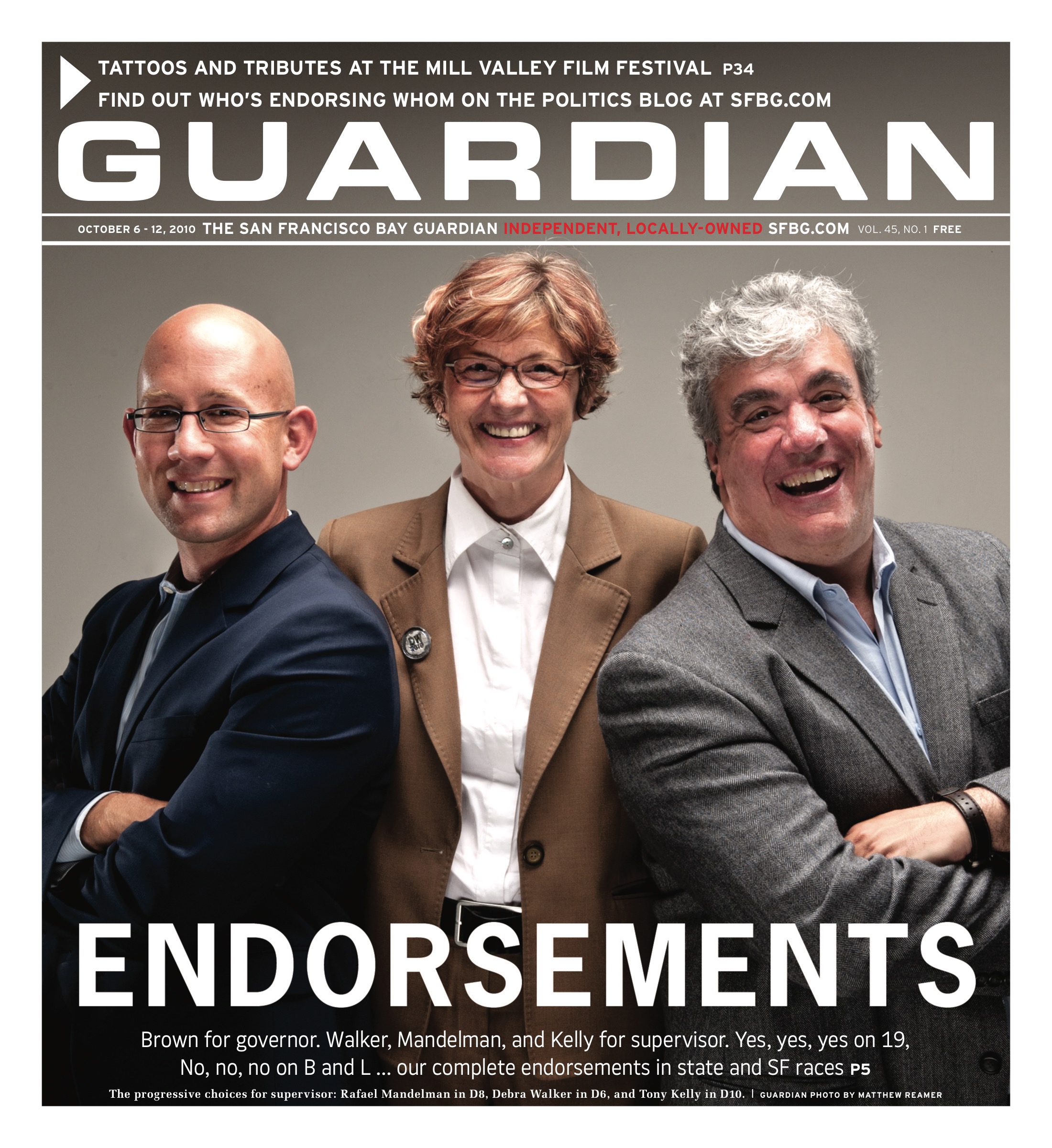
1. DEBRA WALKER


2. JANE KIM


3. GLENDON “ANNA CONDA” HYDE


CORRECTION: In our original version of this endorsement, we said that Jim Meko supports the sit-lie ordinance. That was an error, and it’s corrected below.


A year ago, this race was artist and activist Debra Walker’s to lose. Most of the progressive community was united behind her candidacy; she’d been working on district issues for a couple of decades, fighting the loft developers during the dot-com boom years and serving on the Building Inspection Commission. Then School Board member Jane Kim decided to enter the race, leaving the left divided, splitting resources that might have gone to other critical district races — and potentially helping to put the most pro-business downtown candidate, Theresa Sparks, in a better position to win.


Now we’ve got something of a mess — a fragmented and sometimes needlessly divisive progressive base in a district that’s key to holding progressive control of the board. And while neither of the two top progressive candidates is actively pursuing a credible ranked-choice voting strategy (Kim has, unbelievably, endorsed James Keys instead of Walker, and Walker has declined to endorse anyone else), we’re setting aside our concern over Kim’s ill-advised move and suggesting a strategy that is most likely to keep the seat Chris Daly has held for the past 10 years from falling to downtown control.


Walker is far and away our first choice. She understands land use and housing — the clear central issues in the district — and has well thought-out positions and proposals. She says that the current system of inclusionary housing — pressing market-rate developers to include a few units of below-market-rate housing with their high-end condos — simply doesn’t work. She supports an immediate affordable housing bond act and a long-term real estate transfer tax high enough to fund a steady supply of housing for the city’s workforce. She told us the city ought to be looking at planning issues from the perspective of what San Francisco needs, not what developers want to build. She’s in favor of progressive taxes and a push for local hiring. We’re happy to give her our first-place ranking.


Jane Kim has been a great SF School Board member and has always been part of the progressive community. But she only moved into District 6 a year and a half ago — about when she started talking about running for supervisor (and she told us in her endorsement interview that “D6 is a district you can run in without having lived there a long time.”) She still hasn’t been able to explain why she parachuted in to challenge an experienced progressive leader she has no substantive policy disagreements with.


That said, on the issues, Kim is consistently good. She is in favor of indexing affordable housing to market-rate housing and halting new condo development if the mix gets out of line. She’s for an affordable housing bond. She supports all the tax measures on this ballot. She’s a little softer on congestion pricing and extending parking-meter hours, but she’s open to the ideas. She supports police foot patrols not just as a law-enforcement strategy, but to encourage small businesses. She’d be a fine vote on the board. And while we’re sympathetic to the Walker supporters who would prefer that we not give Kim the credibility and exposure of an endorsement, the reality is that she’s one of two leading progressives and would be better on the board than the remaining candidates.


Hyde, a dynamic young drag queen performer, isn’t going to win. But he’s offered some great ideas and injected some fun and energy into the race. Hyde talks about creating safe injection sites for IV drug users to reduce the risk of overdoses and the spread of disease. He points out that a lot of young people age out of the foster-care system and wind up on the streets, and he’s for continuum housing that would let these young people transition to jobs or higher education. He talks about starting a co-op grocery in the Tenderloin. He proposes bus-only lanes throughout the district and wants to charge large vehicles a fee to come into the city. He’s a big advocate of nightlife and the arts. He lacks experience and needs more political seasoning, but we’re giving him the third-place nod to encourage his future involvement.


Progressives are concerned about Theresa Sparks, a transgender activist and former business executive who now runs the city’s Human Rights Commission. She did a (mostly) good job on the Police Commission. She’s experienced in city government and has good financial sense. But she’s just too conservative for what remains a very progressive district. Sparks isn’t a big fan of seeking new revenue for the city telling us that “I disagree that we’ve made all the cuts that we can” — even after four years of brutal, bloody, all-cuts budgets. She doesn’t support the hotel tax and said she couldn’t support Sup. David Chiu’s progressive business tax because it would lead to “replacing private sector jobs with public sector jobs” — even though the city’s own economic analysis shows that’s just not true. She supports Newsom’s sit-lie law.


Sparks is the candidate of the mayor and downtown, and would substantially shift the balance of power on the board. She’s also going to have huge amounts of money behind her. It’s important she be defeated.


Jim Meko, a longtime neighborhood and community activist, has good credentials and some solid ideas. He was a key player in the western SoMa planning project and helped come up with a truly progressive land-use program for the neighborhood. But he supports Prop. B and is awfully cranky about local bars and nightlife.


James Keys, who has the support of Sup. Chris Daly and was an intern in Daly’s office, has some intriguing (if not terribly practical) ideas, like combining the Sheriff’s Department and the Police Department and making Muni free). But in his interview, he demonstrated a lack of understanding of the issues facing the district and the city.


So we’re going with a ranked-choice strategy: Walker first, Kim second, Hyde third. And we hope Kim’s supporters ignore their candidate’s endorsement of Keys, put Walker as their second choice, and ensure that they don’t help elect Sparks.


DISTRICT 8


RAFAEL MANDELMAN


This is by far the clearest and most obvious choice on the local ballot. And it’s a critical one, a chance for progressives to reclaim the seat that once belonged to Harvey Milk and Harry Britt.


Mandelman, a former president of the Milk Club, is running as more than a queer candidate. He’s a supporter of tenants rights, immigrants’ rights, and economic and social justice. He also told us he believes “local government matters” — and that there are a lot of problems San Francisco can (and has to) solve on its own, without simply ducking and blaming Sacramento and Washington.


Mandelman argues that the public sector has been starved for years and needs more money. He agrees that there’s still a fair amount of bloat in the city budget — particularly management positions — but that even after cleaning out the waste, the city will still be far short of the money it needs to continue providing pubic services. He’s calling for a top-to-bottom review of how the city gets revenue, with the idea of creating a more progressive tax structure.


He’s an opponent of sit-lie and a supporter of the sanctuary city ordinance. He supports tenants rights and eviction protection. He’s had considerable experience (as a member of the Building Inspection Commission and Board of Appeals and as a lawyer who advises local government agencies) and would make an excellent supervisor.


Neither of the other two contenders make our endorsement cut. Rebecca Prozan is a deputy city attorney who told us she would be able to bring the warring factions on the board together. She has some interesting ideas — she’d like to see the city take over foreclosed properties and turn them into housing for teachers, cops, and firefighters — and she’s opposed to sit-lie. But she’s weak on tenant issues (she told us there’s nothing anyone can do to stop the conversion of rental housing into tenancies-in-common), doesn’t seem to grasp the need for substantial new revenues to prevent service cuts, and doesn’t support splitting the appointments to key commissions between the mayor and the supervisors.


Scott Wiener, a deputy city attorney, is a personable guy who always takes our phone calls and is honest and responsive. He’s done a lot of good work in the district. But he’s on the wrong side of many issues, and on some things would be to the right of the incumbent, Sup. Bevan Dufty.


He doesn’t support public power (which Dufty does). He says that a lot of the city’s budget problems can’t be solved until the state gets its own house in order (“we can’t tax our way out of this”) and favors a budget balanced largely by further cuts. In direct contrast to Mandelman, Wiener said San Franciscans “need to lower our expectations for government.” He wants broad-based reductions in almost all city agencies except Muni, “core” public health services, and public safety. He doesn’t support any further restrictions on condo conversions or TICs. And he has the support of the Small Property Owners Association — perhaps the most virulently anti-tenant and anti-rent control group in town.


This district once gave rise to queer political leaders who saw themselves and their struggles as part of a larger progressive movement. That’s drifted away of late — and with Mandelman, there’s a chance to bring it back.


DISTRICT 10


1. TONY KELLY


2. DEWITT LACY


3. CHRIS JACKSON


District 10 is the epicenter of new development in San Francisco, the place where city planners want to site as many as 40,000 new housing units, most of them high-end condos, at a cost of thousands of blue-collar jobs. The developers are salivating at the land-rush opportunities here — and the next supervisor not only needs to be an expert in land-use and development politics, but someone with the background and experience to thwart the bad ideas and direct and encourage the good ones.


There’s no shortage of candidates — 22 people are on the ballot, and at least half a dozen are serious contenders. Two — Steve Moss and Lynette Sweet — are very bad news. And one of the key priorities for progressives is defeating the big-money effort that downtown, the police, and the forces behind the Van Ness Avenue megahospital proposal are dumping into the district to elect Moss.


Our first choice is Tony Kelly, who operates Thick Description Theater and who for more than a decade has been directly involved in all the major neighborhood issues. He has a deep understanding of what the district is facing: 4,100 of the 5,300 acres in D10 have been rezoned or put under the Redevelopment Agency in the past 10 years. Planners envision as many as 100,000 new residents in the next 10 years. And the fees paid by developers will not even begin to cover the cost of the infrastructure and services needed to handle that growth.


And Kelly has solutions: The public sector will have to play a huge role in affordable housing and infrastructure, and that money should come from higher development fees — and from places like the University of California, which has a huge operation in the district and pays no property taxes. Kelly wants to set up a trigger so that if goals for affordable housing aren’t met by a set date, the market-rate development stops. He supports the revenue measures on the ballot but thinks we should go further. He opposes the pension-reform measure, Prop. B, but notes that 75 percent of the city’s pension problems come from police, fire, and management employees. He wants the supervisors to take over the Redevelopment Agency. He’s calling for a major expansion of open space and parkland in the district. And he thinks the city should direct some of the $3 billion in short-term accounts (now all with the Bank of America) to local credit unions or new municipal bank that could invest in affordable housing and small business. He’s a perfect fit for the job.


DeWitt Lacy is a civil-rights lawyer and a relative newcomer to neighborhood politics. He speaks passionately about the need for D10 to get its fair share of the city’s services and about a commitment to working-class people.


Lacy is calling for an immediate pilot program with police foot patrols in the high-crime areas of the district. He’s for increasing the requirements for developers to build affordable housing and wants to cut the payroll tax for local businesses that hire district residents.


Lacy’s vision for the future includes development that has mixed-use commuter hubs with shopping and grocery stores as well as housing. He supports the tax measures on the ballot and would be willing to extend parking meter hours — but not parking fines, which he calls an undue burden on low-income people.


He’s an outspoken foe of sit-lie and of gang injunctions, and with his background handling police abuse lawsuits, he would have a clear understanding of how to approach better law-enforcement without intimidating the community. He lacks Kelly’s history, experience, and knowledge in neighborhood issues, but he’s eminently qualified and would make a fine supervisor.


Chris Jackson, who worked at the San Francisco Labor Council and serves on the Community College Board, is our third choice. While it’s a bit unfortunate that Jackson is running for higher office only two years after getting elected to the college board, he’s got a track record and good positions on the issues. He talks of making sure that blue-collar jobs don’t get pushed out by housing, and suggested that the shipyard be used for ship repair. He wants to see the city mandate that landlords rent to people with Section 8 housing vouchers. He supports the tax measures on the ballot, but also argues that the city has 60 percent more managers than it had in 2000 and wants to bring that number down. He thinks the supervisors should take over Redevelopment, which should become “just a financing agency for affordable housing.” He wants to relocate the stinky sewage treatment plant near Third Street and Evans Avenue onto one of the piers and use the area for a transit hub. He’s still relatively unseasoned, but he has a bright political future.


Eric Smith, a biodiesel activist, is an impressive candidate too. But while his environmental credentials are good, he lacks the breadth of knowledge that our top three choices offer. But we’re glad he’s in the race and hope he stays active in community politics.


Malia Cohen has raised a lot of money and (to our astonishment) was endorsed No. 2 by the Democratic Party, but she’s by no means a progressive, particularly on tenant issues — she told us that limiting condo conversions is an infringement of property rights. And she’s way too vague on other issues.


Moss is the candidate of the big developers and the landlords, and the Chamber of Commerce is dumping tens of thousands of dollars into getting him elected. He’s got some good environmental and energy ideas — he argues that all major new developments should have their own energy distribution systems — but on the major issues, he’s either on the wrong side or (more often) can’t seem to take a stand. He said he is “still mulling over” his stand on sit-lie. He supports Sanctuary City in theory, but not the actual measure Sup. David Campos was pushing to make the policy work. He’s not sure if he likes gang injunctions or not. He only moved back to the district when he decided to run for supervisor. He’s way too conservative for the district and would be terrible on the board.


Lynette Sweet, a BART Board member, has tax problems (and problems explaining them) and wouldn’t even come to our office for an endorsement interview. The last thing D10 needs is a supervisor who’s not accountable and unwilling to talk to constituents and the press.


So we’re going with Kelly, Lacy, and Jackson as the best hope to keep D10 from becoming a district represented by a downtown landlord candidate.


SAN FRANCISCO BOARD OF EDUCATION


MARGARET BRODKIN


KIM-SHREE MAUFAS


HYDRA MENDOZA


Three seats are up on the School Board, and three people will get elected. And it’s a contested race, and in situations like that, we always try to endorse a full slate.


This fall, it was, to put it mildly, a challenge.


It’s disturbing that we don’t have three strong progressive candidates with experience and qualifications to oversee the San Francisco Unified School District. But it seems to be increasingly difficult to find people who want to — and can afford to — devote the time to what’s really a 40-hour-a-week position that pays $500 a month. The part-time school board is an anachronism, a creature of a very different economic and social era. With the future of the next generation of San Franciscans at stake, it’s time to make the School Board a full-time job and pay the members a decent salary so that more parents and progressive education advocates can get involved in one of the most important political jobs in the city.


That said, we’ve chosen the best of the available candidates. It’s a mixed group, made up of people who don’t support each other and aren’t part of anyone’s slate. But on balance, they offer the best choices for the job.


This is not a time when the board needs radical change. Under Superintendent Carlos Garcia, the local public schools are making huge strides. Test scores are up, enrollment is increasing, and San Francisco is, by any rational measure, the best big-city public school district in California. We give considerable credit for that to the progressives on the board who got rid of the irascible, secretive, and hostile former Superintendent Arlene Ackerman and replaced her with Garcia. He’s brought stability and improvement to the district, and is implementing a long-term plan to bring all the schools up to the highest levels and go after the stubborn achievement gap.


Yet any superintendent and any public agency needs effective oversight. One of the problems with the district under Ackerman was the blind support she got from school board members who hired her; it was almost as if her allies on the board were unable to see the damage she was doing and unable to hold her accountable.


Our choices reflect the need for stability — and independence. We are under no illusions — none of our candidates are perfect. But as a group, we believe they can work to preserve what the district is doing right and improve on policies that aren’t working.


Kim-Shree Maufas has been a staunch progressive on the board. She got into a little trouble last year when the San Francisco Chronicle reported that she’d been using a school district credit card for personal expenses. That’s not a great move, but she never actually took public money since she paid back the district. Maufas said she thought she could use the card as long as she reimbursed the district for her own expenses; the rules are now clear and she’s had no problems since. We don’t consider this a significant enough failure in judgment to prevent her from continuing to do what she’s been doing: serving as an advocate on the board for low-income kids and teachers.


Maufas is a big supporter of restorative justice and is working for ways to reduce suspensions and expulsions. She wants to make sure advanced placement and honors classes are open to anyone who can handle the coursework. She supports the new school assignment process (as do all the major candidates), although she acknowledges that there are some potential problems. She told us she thinks the district should go back to the voters for a parcel tax to supplement existing funding for the schools.


Margaret Brodkin is a lightening rod. In fact, much of the discussion around this election seems to focus on Brodkin. Since she entered the race, she’s eclipsed all the other issues, and there’s been a nasty whisper campaign designed to keep her off the board.


We’ve had our issues with Brodkin. When she worked for Mayor Newsom, she was part of a project that brought private nonprofits into city recreation centers to provide services — at a time when unionized public employees of the Recreation and Parks Department were losing their jobs. It struck us as a clear privatization effort by the Newsom administration, and it raised a flag that’s going to become increasingly important in the school district: there’s a coming clash between people who think private nonprofits can provide more services to the schools and union leaders who fear that low-paid nonprofit workers will wind up doing jobs now performed by unionized district staff. And Brodkin’s role in the Newsom administration — and her background in the nonprofit world — is certainly ground for some concern.


But Brodkin is also by far the most qualified person to run for San Francisco school board in years, maybe decades. She’s a political legend in the city, the person who is most responsible for making issues of children and youth a centerpiece of the progressive agenda. In her years as director of Coleman Advocates for Children and Youth, she tirelessly worked to make sure children weren’t overlooked in the budget process and was one of the authors of the initiative that created the Children’s Fund. She’s run a nonprofit, run a city department, and is now working on education issues.


She’s a feisty person who can be brusque and isn’t always conciliatory — but those characteristics aren’t always bad. Sup. Chris Daly used his anger and passion to push for social justice on the Board of Supervisors and, despite some drawbacks, he’s been an effective public official.


And Brodkin is full of good ideas. She talks about framing what a 21st century education looks like, about creating community schools, about aligning after-school and summer programs with the academic curriculum. She wants the next school bond act to include a central kitchen, so local kids can get locally produced meals (the current lunch fare is shipped in frozen from out of state).


Brodkin needs to remember that there’s a difference between being a bare-knuckles advocate and a member of a functioning school board. But given her skills, experience, and lifetime in progressive causes, we’re willing to give her a chance.


We also struggled over endorsing Hydra Mendoza. She works for Mayor Newsom as an education advisor — and that’s an out-front conflict of interest. She’s a fan of Obama’s Education Secretary, Arne Duncan, whose policies are regressive and dangerous.


On the other hand, she cares deeply about kids and public education. She’s not a big supporter of charter schools (“I’ve yet to see a charter school that offers anything we can’t do ourselves,” she told us) and while she was on the wrong side of a lot of issues (like JROTC) early in her tenure, over the past two years she’s been a good School Board member.


There are several other candidates worth mentioning. Bill Barnes, an aide to Michela Alioto-Pier, is a good guy, a decent progressive — but has no experience in or direct connection to the public schools. Natasha Hoehn is in the education nonprofit world and speaks with all the jargon of the educrat, but her proposals and her stands on issues are vague. Emily Murase is a strong parent advocate with some good ideas, but she struck us as a bit too conservative (particularly on JROTC and charter schools.) Jamie Wolfe teaches at a private school but lacks any real constituency or experience in local politics and the education community.


So given a weak field with limited alternatives, we’re going with Maufas, Brodkin and Mendoza.


SAN FRANCISCO COMMUNITY COLLEGE BOARD


JOHN RIZZO


The San Francisco Community College District has been a mess for years, and it’s only now starting to get back on track. That’s the result of the election of a few progressive reformers — Milton Marks, Chris Jackson, and John Rizzo, who now have enough clout on the seven-member board to drag along a fourth vote when they need it.


But the litany of disasters they’ve had to clean up is almost endless. A chancellor (who other incumbent board members supported until the end) is now under indictment. Public money that was supposed to go to the district wound up in a political campaign. An out-of-control semiprivate college foundation has been hiding its finances from the public. The college shifted bond money earmarked for an arts center into a gigantic, expensive gym with a pool that the college can’t even pay to operate, so it’s leased out to a private high school across the street.


And the tragedy is that all three incumbents — two of whom should have stepped down years ago — are running unopposed.


With all the attention on the School Board and district elections, not one progressive — in fact, not one candidate of any sort — has stepped forward to challenge Anita Grier and Lawrence Wong. So they’ll get another term, and the reformers will have to continue to struggle.


We’re endorsing only Rizzo, a Sierra Club staffer who has been in the lead in the reform bloc. He needs to end up as the top vote-getter, which would put him in position to be the board president. Rizzo has worked to get the district’s finances and foundation under control and he richly deserves reelection.


BART BOARD OF DIRECTORS, DISTRICT 8


BERT HILL


It’s about time somebody mounted a serious challenge to James Fang, the only elected Republican in San Francisco and a member of one of the most dysfunctional public agencies in California. The BART Board is a mess, spending a fortune on lines that are hardly ever used and unable to work effectively with other transit agencies or control a police force that has a history of brutality and senseless killing.


Fang supports the suburban extensions and Oakland Airport connector, which make no fiscal or transportation sense. He’s ignored problems with the BART Police for 20 years. It’s time for him to leave office.


Bert Hill is a strong challenger. A professional cost-management executive, he understands that BART is operating on an old paradigm of carrying people from the suburbs into the city. “Before we go on building any more extensions,” he told us, “we should take care of San Francisco.” He wants the agency to work closely with Muni and agrees there’s a need for a BART sunshine policy to make the notoriously secretive agency more open to public scrutiny. We strongly endorse him.


ASSESSOR-RECORDER


PHIL TING


San Francisco needs an aggressive assessor who looks for every last penny that big corporations are trying to duck paying — but this is also a job that presents an opportunity for challenging the current property tax laws. Phil Ting’s doing pretty well with the first part — and unlike past assessors, is actually stepping up to the plate on the second. He’s been pushing a statewide coalition to reform Prop. 13 — and while it’s an uphill battle, it’s good to see a tax assessor taking it on. Ting has little opposition and will be reelected easily.


PUBLIC DEFENDER


JEFF ADACHI


Adachi’s done a great job of running the office that represents indigent criminal defendants. He’s been outspoken on criminal justice issues. Until this year, he was often mentioned as a potential progressive candidate for mayor.


That’s over now. Because Adachi decided (for reasons we still can’t comprehend) to join the national attack on public employees and put Prop. B on the ballot, he’s lost any hope of getting support for higher office from the left. And since the moderate and conservative forces will never be comfortable with a public defender moving up in the political world, Adachi’s not going anywhere anytime soon.


Which is fine. He’s doing well at his day job. We wish he’d stuck to it and not taken on a divisive, expensive, and ill-conceived crusade to cut health care benefits for city employees.


SAN FRANCISCO SUPERIOR COURT


SEAT 15


MICHAEL NAVA


To hear some of the brahmins of the local bench and bar tell it, the stakes in this election are immense — the independence of the judiciary hangs in the balance. If a sitting judge who is considered eminently qualified for the job and has committed no ethical or legal breaches can be challenged by an outsider who is seeking more diversity on the bench, it will open the floodgates to partisan hacks taking on good judges — and force judicial candidates to raise money from lawyers and special interests, thus undermining the credibility of the judiciary.


We are well aware of the problems of judicial elections around the country. In some states, big corporations that want to influence judges raise and spend vast sums on trial and appellate court races — and typically get their way. In Iowa, three judges who were willing to stand on principle and Constitutional law and declare same-sex marriage legal are facing what amounts to a well-funded recall effort. California is not immune — in more conservative counties, liberal judges face getting knocked off the bench by law-and-order types.


It’s a serious issue. It’s worth a series of hearings in the state Legislature, and it might be worth Constitutional change. Maybe trial-court elections should be eliminated. Maybe all judicial elections should have public campaign financing. But right now, it’s an elected office — at least in theory.


In practice, the vast majority of the judicial slots in California are filled by appointment. Judges serve for four-year terms but tend to retire or step down in midterm, allowing the governor to fill the vacancy. Unless someone files specifically to challenge an incumbent, typically appointed judge, that race never even appears on the ballot.


The electoral process is messy and political, and raising money is unseemly for a judicial officer. But the appointment process is hardly pure, either — and governors in California have, over the past 30 years, appointed the vast majority of the judges from the ranks of big corporate law firms and district attorney’s offices.


There are, of course, exceptions, and Gov. Arnold Schwarzenegger has been better than his predecessor, Democrat Gray Davis. But overall, public interest lawyers, public defenders, and people with small community practices (and, of course, people who have no political strings to pull in Sacramento) have been frustrated. And it’s no surprise that some have sought to run against incumbents.


That’s what’s happening here. Michael Nava, a gay Latino who has been working as a research attorney for California Supreme Court Justice Carlos Moreno, was going to run for a rare open seat this year, but the field quickly got crowded. So Nava challenged Richard Ulmer, a corporate lawyer appointed by Schwarzenegger who has been on the bench a little more than a year.


We will stipulate, as the lawyers say: Ulmer has done nothing wrong. From all accounts, he’s a fine judge (and before taking the bench, he did some stellar pro bono work fighting for reforms in the juvenile detention system). So there are two questions here: Should Nava have even filed to run against Ulmer? And since he did, who is the better candidate?


It’s important to understand this isn’t a case of special interests and that big money wanting to oust a judge because of his politics or rulings. Nava isn’t backed by any wealthy interest. There’s no clear parallel to the situations in other areas and other states where the judiciary is being compromised by electoral politics. Nava had every right to run — and has mounted an honest campaign that discusses the need for diversity on the bench.


Ulmer’s supporters note — correctly — that the San Francisco courts have more ethnic and gender diversity than any county in the state. And we’re not going to try to come to a conclusion here about how much diversity is enough.


But we will say that life experience matters, and judges bring to the bench what they’ve lived. Nava, who is the grandson of Mexican immigrants and the first person in his family to go to college, may have a different perspective on how low-income people of color are treated in the courts than a former Republican who spent his professional career in big law firms.


We were impressed by Nava’s background and knowledge — and by his interest in opening up the courts. He supports cameras in the courtrooms and allowing reporters to record court proceedings. He told us the meetings judges hold on court administration should be open to the public.


We’re willing to discuss whether judicial elections make sense. Meanwhile, judges who don’t like the idea of challenges should encourage their colleagues not to retire in midterm. If all the judges left at the end of a four-year term, there would be plenty of open seats and fewer challenges. But for now, there’s nothing in this particular election that makes us fear for the independence of the courts. Vote for Nava.


>>BACK TO ENDORSEMENTS 2010

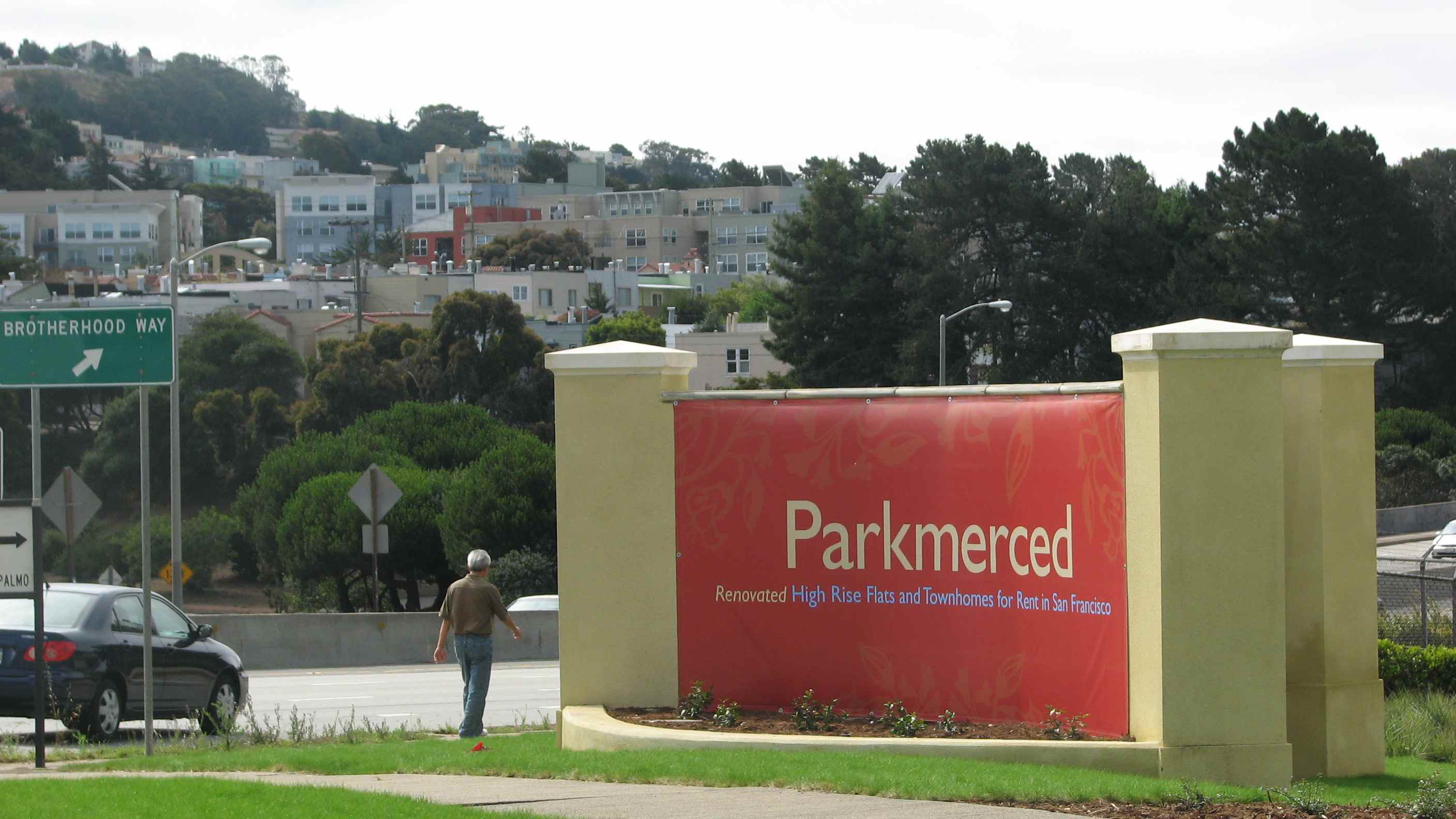
Who’s trying to fast-track Parkmerced?

At a Sept. 30 Planning Commission meeting, several commissioners and community members raised concerns that project approval for Parkmerced, a development that will add thousands of new housing units to an existing residential complex, had been scheduled before anyone was really prepared to discuss it. It’s since been pushed back, but the attempt to rush it through drew fire nonetheless.

Land use attorney Sue Hestor said she’d discovered the day before the Planning Commission meeting that a final project EIR would be made available Oct. 7, with an approval hearing scheduled just two weeks later, on Oct. 21. That came as a surprise even to Hestor, who closely monitors development projects. “You cannot just drop a complex legal document on people two weeks before the hearing and say that is sufficient,” Hestor said. “Two weeks for a staff report for this project is insulting.” Prior to this notice, the hearing on Parkmerced was widely expected later in the year.

Christina Olague, vice-president of the Planning Commission, said during the meeting that the accelerated timeline was highly unusual. “I was hearing that we were going to be attempting to initiate this project on the 7th of October with an approval calendared for the following week,” she said. “And I was concerned that it felt, at that point, that it was a little bit out of the hands of the planning commission. When it comes to projects of this size, I just felt like that was too much of a rush to get it through, especially given that we are in the middle of CPMC with comments due the 19th of October.”

Olague said the process made her uncomfortable. “I felt a lot of our say was being removed from our realm and there were outside forces … other departments in the city that were kind of influencing it in a way that didn’t feel comfortable to me,” she said. “Also, historically … we have never done it that way. Usually we calendar an item for one week and then there’s a 20-day noticing period that allows members of the public to digest the information and review the information.” She added, “I just didn’t want the public to get the impression that we were favoring one project over other projects.”

Calvin Welch, an affordable housing activist, noted that Parkmerced developers have a laudable goal of preserving onsite rent-controlled units at the housing complex — but he had yet to see a draft of a development agreement outlining the details of that plan. The planning commissioners hadn’t seen that document, either. Welch suggested more time was needed to review the terms of the agreement.

If the Planning Commission had approved Parkmerced on this accelerated schedule, it might have gone to the Board of Supervisors for approval before the end of the year, so the votes would’ve easier to count than if the project went before a new class of Supes in 2011.

The Guardian reported earlier this month that Mayor Gavin Newsom received a $1,000 campaign contribution for his bid for lieutenant governor from Craig Hartman, a design partner for Parkmerced, plus $2,000 from two executives associated with the project. AECOM, which is completing technical studies for the project, gave him campaign donations totaling $13,000.

Speaking to a crowd of real-estate professionals and representives from the business community a couple weeks ago, Newsom urged them to get involved in district elections in order to avoid “a dramatic shift” that would occur if the wrong people get elected to local office in November.

Did the mayor’s office lean on the planning department to rush the approval of Parkmerced in order to ensure a more predictable outcome? We emailed Newsom’s press secretary, Tony Winnicker, with questions, and we’ll be sure to post a response if we receive one.


The test of the Tenderloin

16

caitlin@sfbg.com

This is a story about love and money. Or a story about love, money, and location. — Rebecca Solnit, Hollow City (Verso 2000)

It’s a sunny day in the most maligned neighborhood in San Francisco. I’m walking down a busy sidewalk with an excited Randy Shaw, long-time housing advocate. He’s giving me a tour of his Tenderloin.

“There’s history everywhere you look here,” he notes as we rush about the dingy blocks of one of the city’s most densely populated, economically bereft communities. In a half-untucked navy button-down and square-frame glasses, Shaw reels off evidence of this legacy faster than I can write it down and still maintain our walking pace.

To our left, Hyde Street Studios, where the Grateful Dead recorded its 1970 album American Beauty. Across the street, a ramshackle building that once housed Guido Caccienti’s Black Hawk nightclub, where the sounds of jam-fests by the likes of Billie Holiday and John Coltrane would echo out onto the streets during its heyday in the 1950s. Throughout its history, the Tenderloin has been renowned for its nightlife: music, theater, sex work — and the social space that occurs between them.

Shaw came to the Tenderloin 30 years ago as a young law student and founded and built the Tenderloin Housing Clinic, a nonprofit agency that is now one of the largest property owners in the neighborhood and employs more than 250 full-time workers. Shaw has spent the last few decades fighting to improve conditions in the single-room occupancy hotels, or SROs, once notorious for malfunctioning heating systems and mail rooms that would dump the letters for their hundreds of low-income residents into a pile on the floor rather than fit them into personal lock boxes (which now line the walls of THC’s lobbies).

But that activism isn’t the reason for this tour. No, today Shaw is showing me why tourism can work in the Tenderloin. The heavy iron gate of an SRO is quickly buzzed open as the doorman recognizes him. Inside, working-class seniors mill about aided by walkers — this particular property is an old folks’ home — but over our heads, affixed to a majestically high ceiling, looms a triple-tiered glass and metal chandelier, evidence of the area’s architecturally important past.

“When I show people this,” Shaw smiles at my amazement at this bling in a nonprofit apartment building, “they’re amazed at the quality of the housing.” Further down the road, we peep in at a vividly Moorish geometric vaulted ceiling and a lobby that once housed a boxing gym where Miles Davis and Muhammad Ali liked to spar. Both are now home to the inner city’s poorest residents.

Of course, it’s not just tours that we’re talking when it comes to Shaw’s plans for the future. Shaw has acquired a 6,400-square-foot storefront in the Cadillac Hotel on the corner of Eddy and Leavenworth streets, where he plans to open the Uptown Tenderloin Museum in 2012. He says it will showcase the hood’s historical legacy as well as house a nighttime music venue in the basement. The increased foot traffic, he says, will do good things for public safety (a problem that has been identified as a high priority by the resident-run Tenderloin Neighborhood Association) and bring business to the neighborhood’s impressive collection of small ethnic restaurants.

An increased focus on the Tenderloin’s heritage and public image, Shaw says, will translate to more jobs and a better quality of life for the people who live here. “My goal is to have this be the first area in an American city where low income people have a high quality of life,” he says.

If Shaw is correct, it will indeed be a first. Many cities have attempted to transform low income areas with arts districts — and the end result has typically been the displacement of the poorer residents. Coalition on Homelessness director Jennifer Friedenbach described the process: “Gentrification follows a very specific path. First come police sweeps, then the arts, then the displacement. That’s the path that we’re seeing. Hopefully we’ll be able to avoid the displacement part,” she says.

It’d be great if the Tenderloin took the road less traveled — but will it?

Shaw’s best-case scenario seems unlikely, according to Chester Hartman, a renowned urban planning scholar and author of the numerous studies of San Francisco history and the activist handbook Displacement: How to Fight It (National Housing Law Project 1982). Hartman doubts the Tenderloin will remain a housing option for the city’s poor, given its central location and market trends. “The question is, what proportion will move and what will stay?” he said in a phone interview.

Earlier this summer, the National Endowment of the Arts awarded the SF Arts Commission $250,000 toward an arts-based “revitalization of the mid-Market neighborhood.” The area, which is adjacent to the Tenderloin, is considered by many to be the more outwardly visible face of the TL. In truth, the two neighborhoods share many of the same issues and public characteristics, including high density living and prominent issues with drugs.

Amy Cohen, Mayor Gavin Newsom’s director of neighborhood business development, said the Newsom administration is using the money “to implement arts programming that would have an immediate impact on the street. These activities would then build momentum for the longer-term projects.” At this point, plans for that “immediate impact” have started with the installation of lights on Market Street between Sixth and Eighth streets. Two other projects are also in effect: a city-sponsored weekly arts market on United Nations Plaza and an al fresco public concert series.

It’s hard to distinguish these moves from a general trend toward rebranding the image of the Tenderloin. These streets have already seen Newsom announce a historic preservation initiative that put $15,000 worth of commemorative plaques on buildings; it was also announced they would be added to the National Register of Historic Places, a move that allows property owners deep tax cuts for building renovations.

Cohen said her office has spent time trying to attract a supermarket (something the neighborhood, although flush with corner stores, currently lacks), but efforts seem to be faltering. “Grocery store operators and other retailers perceive that the area is unsafe and have expressed concerns about the safety of their employees and customers,” Cohen said. “The arts strategy makes sense because it builds on the assets that are there. Cultivating the performing and visual arts uses that are already succeeding will ultimately enhance the neighborhood’s ability to attract restaurants, retail, and needed services like grocery stores.”

These days, many of the small businesses in the area have window signs hyping “Uptown Tenderloin: Walk, Dine, Enjoy” over graphics of jazzy, people-free high-rises. Looking skyward, one observes the recent deployment of tidy street banners funded by the North of Market/Tenderloin Community Benefit District that pay homage to the number of untouched historic buildings in the neighborhood. The banners read “409 historic buildings in 33 blocks. Yeah, we’re proud.”

Figuring out who benefits from these new bells and whistles can seem baffling at times. Even the museum plan, which Shaw says will draw inspiration in part from New York’s Tenement Museum, has drawn criticism. A July San Francisco Magazine blog post was subtitled “An indecent proposal that puzzled even the San Francisco Visitors Bureau” and likened Shaw’s attempts to the “reality tourism movement” that takes travelers through gang zones in L.A. and poverty-stricken townships in South Africa.

This seems to be a misconstruction of what he’s attempting. “You know what no one ever calls out? The Mission mural tours, the Chinatown tours,” Shaw says.

And Shaw scoffs when I bring up that PR bane of the urban renewer: gentrification. He takes me through a brief rundown of the strict zoning laws in the Tenderloin, adding that many people don’t believe that poor people have the right to live in a high-quality neighborhood: “I haven’t been down here for 30 years to create a neighborhood no one wants to live in.”

Indeed, thanks to the efforts of Shaw and others, it would be hard for even the most determined developers to get rid of the SRO housing in the Tenderloin.

In the 1980s, community activists struggled to change the zoning designation of the neighborhood, which lacked even a name on many city maps. The area was zoned for high-rise buildings and was being encroached on by the more expensive building projects of tourist-filled Union Square, Civic Center, and the wealthier Nob Hill neighborhood. Their success came in the form of 1990s Residential Hotel Anti-Conversion Ordinance, which placed strict limits on landlords flipping their SROs into more expensive housing.

Hartman remains unconvinced of the efficacy of the protective measures activists have won in years past; indeed, even SRO rental prices have soared. According to the Central City SRO Collaborative, in the decade after the Anti-Conversion Ordinance, rental prices increased by 150 percent, not only pricing residents out of the Tenderloin but out of the city. “Where do they move?” Hartman asked. “It’s probably the last bastion of low-income housing in the city. That changes the class composition of the city.”

“The neighborhood has been changing slowly but steadily,” says District Six Sup. Chris Daly when reached by e-mail for comment on the Tenderloin’s future. He writes that rents in the neighborhood have been consistently rising and that several condo development proposals have crossed his desk. Daly has been involved in negotiating “community benefits” and quotas for low income housing in past mid-Market housing projects, but has been disappointed by subsequent affordable housing levels in projects like Trinity Plaza on the corner of Sixth and Market streets. In terms of the Tenderloin, he said, “it is untrue to say that the neighborhood is immune from gentrifying forces. It is shielded, but not immune.”

But some see the influx of art-based attention to the area as a possible boon to residents. Debra Walker, a San Franciscan artist who is running for the District 6 supervisor post, said she believes arts can be used “organically to resolve some of the chronic problems in the Tenderloin, street safety being the primary one in my mind.”

Though most of her fellow candidates expressed similar views when contacted for this story, western SoMa neighborhood activist Jim Meko said he thinks artists in the area are being used to line the pockets of the real estate industry. “The idea of creating an arts district is an amenity that the real estate dealers want to see because it makes the neighborhood less scary for their upper class audience” he says.

The area clearly has a rich legacy of nightlife, arts, and theater. The Warfield is here, as is American Conservatory Theater, the Orpheum, and the Golden Gate. So is the unofficial center of SF’s “off-off Broadway district,” which includes Cutting Ball Theater and Exit Theater. The Exit has been located in the TL since its first performance in 1983, held in the lobby of the Cadillac Hotel, and sponsors the neighborhood’s yearly Fringe Festival. There are art galleries and soup kitchens, youth and age, and more shouted greetings on the streets than you’ll hear anywhere else in the city.

No one is more aware of this diversity of character than Machiko Saito, program director of Roaddawgz, a TL creative drop-in center and resource referral service for homeless youth. I met Saito in the Roaddawgz studio, which occupies a basement below Hospitality House, a homeless community center that also houses a drop-in self-help center, an employment program, men’s shelter and art studio for adults in transition.

Despite its being empty in the morning before the open hours that bring waves of youth to its stacks of paints and silk-screens, Roaddawgz is in a glorious state of bohemian dishevelment that implies a well-loved space. It could be a messy group studio if not for the load-bearing post in the center of the room covered with flyers for homelessness resource centers and a “missing” poster signed “your Mom loves you.”

We talk about how important it is that the kids Saito works with have a place like this, a spot where they can create “when all you want to do is your art and if you can’t you’ll die.” A career artist herself, she cuts a dramatic figure in black, safety pins, and deep red lipstick painted into a striking cupid’s bow. Her long fingernails tap the cluttered desk in front of her as she tells me stories from the high-risk lives that Roaddawgz youth come to escape: eviction, cop harassment, theft, rape.

The conversation moves to some of the recent developments in the area. Saito and I recently attended an arts advisory meeting convened by the Tenderloin Economic Development Corporation’s executive director, Elvin Padilla, who has received praise from many of the TL types I spoke with regarding his efforts to connect different factions of the community. Attendees ranged from a polished representative from ACT, which is considering building another theater, for students, in a space on Market and Mason streets, to heralded neighborhood newbies Grey Area Foundation, to Saito and longtime community art hub Luggage Store’s cofounder Darryl Smith. Talk centered on sweeping projects that could develop a more cohesive “identity” for the neighborhood.

I ask Saito how it felt for her to be involved with a group whose vision of the neighborhood might be focused on slightly different happenings than what she lives through Roaddawgz. She says she’s been to gatherings in the past where negative things about the Tenderloin were highlighted. Of Padilla’s arts advisory meeting, she says, “I think that one of the reasons I wanted to go was that it’s important [for attendees] to remember that there’s a community out there. Things can get really complicated. It’s hard to come up with decisions that affect everyone positively. If we’re going to say, ‘The homeless are bad; the drug addicts are bad; the business owners that don’t beautify their storefronts…” She trails off for a moment. “I don’t want to lose the heart of the Tenderloin.”

In yet another Tenderloin basement — this one housing the North of Market-Tenderloin CBD, an organization that is known for its work employing ex-addicts and adults in transition — Rick Darnell has created the Tenderloin Art Lending Library. The library accepts donated works from painters and makes them available for use by Tenderloin residents, many of whom have recently moved into their SRO housing and are in need of a homey touch.

Darnell is rightfully ecstatic at the inclusive nature of his library, but has been hurt over its reception at an arts advisory meeting he attended to publicize its creation. “Someone whispered under their breath ‘I would never lend anything to anyone in the Tenderloin,’ ” he tells me. The exclusion that Saito and Darnell sometimes feel highlights the reality that the definition of the Tenderloin might well vary, even among those who are set on making it “a better place.” The arts community appears to suffer from fractures that appear along the lines of where people live, their organizational affiliation, their housing status, and how they think art should play a role in community building.

Sammy Soun is one Tenderloin resident who would welcome an increased focus on art in the Tenderloin. Soun was born in a Thailand refugee camp to Cambodian parents fleeing the civil wars in their country. He grew up in the Tenderloin, where his family lived packed into small studios and apartments.

But he was part of a community, with plenty of support, and lives in the neighborhood to this day, as do one of his four siblings and his daughter. Soun paints, does graffiti, draws — he’s considering transferring from City College to the San Francisco Art Institute. He has worked at the Tenderloin Boys and Girls Club for nine years, giving back to the kids he says “are the future. They’re going to be the ones that promote this place or keep it going — if they want to.” His sister, cousins, and uncles still live in the neighborhood. You might say he has a vested interest in the area’s future.

He finds the incoming resources for the Tenderloin arts scene to be a mixed bag. Soun has never been to the Luggage Store, although it’s one of the longtime community art hubs in the area. He can’t relate to the kinds of art done at the neighborhood’s recent digital arts center, Grey Area Foundation for the Arts, though he says the space has contacted him and friends to visit. His disconnect from the arts scene implies that future arts projects need to work harder on their community outreach — or even better, planning — with artists who call the Tenderloin home.

But Soun loves the new Mona Caron mural the CBD sponsored on the corner of Jones Street and Golden Gate Avenue. Well-known for her panoramic bike path mural behind the Church Street Safeway, Caron painted “Windows into the Tenderloin” after dozens of interviews and tours of the neighborhood with community members. Its “before and after” panels are a dummies’ guide for anyone seeking input on ways to strengthen the Tenderloin community — though the “after” does show structural changes like roads converted into greenways and roof gardens sending tendrils down the sides of buildings, the focal point is the visibility of families. Where children were ushered through empty parking lots single-file in the “before” section, the second panel shows families strolling, children running, a space that belongs to them.

Our interview is probably the first time somebody has asked Soun where he thinks arts funding in the Tenderloin should go. “For projects by the kids in the community,he said.

Truth be told, more art of any kind can only make the Tenderloin a better place — but if you’re trying to improve quality life, focus needs to be on plans that positively affect residents of all ages — art can be a vital part of that, but it should be one part of a plan that ensures rent control, safe conditions, and access to services. After all, if you’re going to rebrand the Tenderloin, you might want to look at the painting on the wall.

Dollars or sense?

28

rebeccab@sfbg.com

It’s no secret that San Francisco is a particularly costly place to live. It consistently ranks in the top 10 most expensive cities nationwide, and it isn’t uncommon to see people renting out their walk-in closets as makeshift bedrooms to make ends meet.

There’s ample evidence that the city’s market-rate housing is out of reach for many families, middle-class workers, and low-income populations, particularly during the recession. Yet the shortage of affordable housing is a problem that is going largely unaddressed at City Hall.

The city’s General Plan estimates that a full 61 percent of new housing would have to be affordable to satisfy the housing needs of city residents, but even the most demanding development standards fall far short, producing only about half that amount. And while most new affordable housing is built for low-income people, a sizable portion is intended for first-time homebuyers with salaries at the highest threshold of affordability. In recent years, about one-third of new “affordable housing” was built to sell to people with “moderate” incomes.

So as big plans are mapped out for new residential developments composed of mostly market-rate units, what’s the strategy for addressing the underlying affordability gap? And will it ever be enough to keep from further turning San Francisco into a city of rich people while its workers are forced to live elsewhere?

This map, which appears in San Francisco’s Five-Year Consolidated Plan, charts concentrations of low- and moderate-income households in the city using HUD 2000 income data. Under federal guidelines, people with low and moderate income could be eligible for affordable housing.

A San Francisco Unified School District proposal to create new housing for San Francisco teachers underscores just how mismatched housing prices are to income. The National Low Income Housing Coalition (NLIHC) estimates that San Francisco renters paying market rate in 2010 would have to earn $56,240 to afford rent a one-bedroom apartment, $70,400 for a two-bedroom unit, and $94,000 for a three-bedroom unit, assuming they spend no more than about one-third of their income on housing.

A starting teacher’s salary in San Francisco is $50,000, so early-career educators may feel the squeeze. A survey of teachers conducted for the proposal found that 81 percent of respondents were renters, most living with unrelated roommates. More than half had plans to relocate in five years to a city where they could afford to be homeowners.

Housing was a hot-button issue at the Sept. 16 Planning Commission hearing on the environmental impact review for a hospital and housing complex that California Pacific Medical Center wants to build near Van Ness Avenue.

“The CPMC EIR fails miserably to analyze the income of the CPMC work force, and where it’s supposed to be housed,” affordable housing advocate Calvin Welch told the Guardian. “It’s a profoundly important question. If they are [providing] jobs that produce incomes that are insufficient to pay for average market-rate housing in San Francisco, who’s responsibility is it going to be to build housing for that workforce?”


WHO CAN AFFORD IT?

San Francisco has a reputation as a diverse, politically engaged hub that supports emerging artists, independent thinkers, and advocates for youth, workers’ rights, healthy ecosystems, protections for the most vulnerable segments of society, and hundreds of other causes. Without economic diversity — which is only possible when housing is available to people with a range of incomes — it might be a different place.

NLIHC estimates that 65 percent of San Francisco households are renters, and a significant number are what the Mayor’s Office of Housing (MOH) calls “cost-burdened,” shelling out more than a third of their incomes on rent. To get by, tenants have been known to cram roommates in like sardines, or cling tenaciously to a rent-controlled unit.

In a thick report outlining affordable housing goals for 2010–14, MOH and two other city agencies clearly articulate the housing challenges facing low-income renters. For one thing, the report says rents are going up despite the economic recession and declining home prices. And most people’s salaries don’t stretch far enough to cover those high prices. Even though there are 16 billionaires and some fabulously wealthy CEOs residing in San Francisco, the majority of people work in more mundane occupations like waiting tables, retail, office work, nonprofit jobs, teaching, health care, or public service.

The MOH report notes that despite the city’s relatively high median income, there’s a widening gap between top earners and people on the lower end of the spectrum, so few households actually wind up in that middle zone. “In fact, over a quarter of San Francisco’s population earns under 50 percent of [area median income],” the report states. For individuals in 2010, this translates to one in four people earning $34,800 or less. Compounding that problem are recent unemployment figures indicating that nearly one in 10 is jobless.

About one half of San Francisco’s population is considered low- or moderate-income, the housing report notes, using the standards used to formulate affordable housing prices. MOH uses a tiered income matrix, calculated using federal guidelines, to determine who could qualify for housing below the market rate. If you make $20,900 or less, you’re counted as “extremely low income.” You’re “very low income” if you make between $21,000 and $34,800, “low income” if you earn between $35,496 and $55,700, and if you make between $56,376 and $83,500, you count as “moderate income.” Even these figures are skewed higher because they include data from wealthy Marin County. As a point of comparison, U.S. Census data estimates that the median income for American workers was $29,530 over the last several years.

Most of the new affordable housing constructed in San Francisco is aimed toward people in the lowest ranges, but in recent years one-third was built for those with moderate incomes, which could gentrify some parts of the city. “Supervisorial Districts 3, 6 and 10 had rates of more than 40 percent extremely low and low-income,” the MOH report notes. “These three districts make up the entire eastern part of the city.”

A Guardian analysis of Bureau of Labor Statistics occupational and wage estimates for 2009 suggests that about 71 percent of people who work in San Francisco (many commute from less expensive places) earned less than that highest “moderate” salary limit of $83,500. It suggests that the vast majority of the workforce could not afford market-rate housing unless they sought it in pairs or groups.

“A big issue is the inability of San Francisco’s employment market to produce jobs that pay people enough to afford housing,” Welch says. “There’s a mismatch between market-rate income and market-rate housing costs. We’re housing somebody else’s workforce.”

Another stab at assessing the affordable housing need gazes into the future. The Housing Element of the San Francisco General Plan includes an estimate for the city’s future housing needs for the better part of the decade. The city should build 31,200 new housing units to meet its need, the General Plan says, and “at least 39 percent of these new units must be affordable to very low and low-income households. Another 22 percent should be affordable to households with moderate incomes.”

What this adds up to is a full 61 percent of new residential development in San Francisco ought to be dedicated to some form of affordable housing. The calculation reveals a lot about the condition San Francisco is in, but it might as well be chalked up as a hollow academic exercise. Indeed, the report deems this goal “unrealistic.” The reality of the market and chronic government deficits ensures that there will not even be an attempt to meet it.


IF YOU BUILD IT

The trouble with affordable housing is that developers won’t build it unless there is a financial incentive. “The only way it works is not in the marketplace,” Welch said. “There’s no such thing as affordable land, affordable sheetrock, affordable architects, or affordable engineers. The profound condition … is that the market cannot produce affordable housing.” As long as developers can make higher profits building market-rate, they will.

That’s why government steps in to subsidize or mandate new affordable housing construction or preserve existing stock. Under the Inclusionary Housing Ordinance, if developers decide not to build the required 15 percent of affordable units, they must pay an in-lieu fee that gets funneled into an affordable housing fund.

In a good year, MOH Executive Director Douglas Shoemaker told the Guardian, the city receives $10 to $15 million from these fees, which is used in partnership with developers to build affordable projects. That system hasn’t worked so well lately. Last year funds for affordable housing were depleted instead of bolstered. Developers who paid their fees in anticipation of building new projects requested refunds after their projects were stalled, Shoemaker told the Guardian, so MOH gave back up to $12 million to developers instead of using that money to build new affordable housing.

This year, Mayor Gavin Newsom introduced what he called an “economic stimulus” program that allowed developers to defer payment of in-lieu fees. This guarantees that it will be a long, long time before new affordable housing can be built using those funds. So as it stands, the inclusionary housing law isn’t so effective at producing new affordable housing.

Projects done in conjunction with the San Francisco Redevelopment Agency, meanwhile, do include higher portions of affordable housing. With all of the planned Redevelopment projects combined — Treasure Island, the Hunter’s Point shipyard, and others — the city can expect to see perhaps 7,000 new affordable housing units in coming years, a portion of which will be condos meant for people in the “moderate” income range. It may well be better than other cities have offered, but it doesn’t begin to address the true need for more than 19,000 units outlined in the General Plan.

Shoemaker noted that San Francisco is a cut above the rest when it comes to affordable-housing requirements. “I just don’t think you could find a city that has more aggressive goals,” he said, noting that in major redevelopment areas, “We’re getting like 30 percent of homes to be affordable on some level.” Yet Shoemaker acknowledged, “the need is intense,” and “there’s more people we would like to serve.”

Olson Lee, deputy executive director of the San Francisco Redevelopment Agency, also described San Francisco as taking a very aggressive stance on affordable housing. Redevelopment devotes 50 percent of its tax-increment financing to affordable housing, where the state requires just 20 percent, Lee said. And some Redevelopment project areas include twice as much affordable housing as is required by state law, he added. “The city has done a tremendous amount of affordable housing,” he said. However, “the fact of the matter is, there’s a greater demand for affordable housing than the number of units.”

From 2005 to 2009, there were 3,607 new affordable housing units constructed, mostly for people at the lowest end of the pay scale, MOH reports. But in that same time frame, 3,465 rental units were converted to condominiums. One could argue that the city essentially broke even with its affordable housing stock in a decade where housing prices almost doubled. As San Francisco housing prices skyrocketed, the city’s 170,000 rent-controlled units served as the saving grace for the majority who couldn’t afford market-rate, and condo conversions continue to threaten the erosion of that very significant housing stock.

Debra Walker, a candidate for District 6 and a tenant representative on the Building Inspection Commission, told the Guardian that she believes a new financing system is needed for affordable housing. “The argument for development is that we get affordable housing money out of it,” she said, but “the inclusionary doesn’t get us enough housing. We cannot include affordable in those high-rises, because they’re so expensive to build.”

She has talked up the idea of a real estate transfer tax that would create a dedicated fund that could then be used in partnerships with affordable-housing developers. Shoemaker, for his part, noted that having a dedicated revenue stream for affordable housing would be very helpful. A committee comprised of the San Francisco Planning and Urban Research Association, Welch, developer Oz Erickson, and Shoemaker was formed earlier this year and actually arrived at a deal, but Newsom ultimately rejected it. Other creative solutions, Walker says, might include reusing shuttered commercial properties or building cheaper by design using different building materials. “It’s about looking at what it is we need,” she said, “and realizing people are in a pinch.”

The greatest complicating factor of the current system, in which the city relies on market-rate development to get new affordable housing, is that even though there a some 40,000 new residential units in the pipeline, developers can’t secure financing to start building them. For now, in the down economy, they only exist on paper.

“They’ll never get built,” Welch predicts, and as long as Newsom continues to extend entitlements for those planned projects in hopes that the market will get a jump, “it’s freezing September 2008 conditions, evidently forever,” limiting opportunities to build something more reasonable.

“They’re zombies,” Welch added. “Who the fuck is going to pay $2 million for a new condo when they can buy a $4 million building for $1 million in foreclosure?” But if the need for affordable housing began to be addressed, he said, something might start to happen. “If you converted half the pipeline units to rental,” he theorized, “they might get built.”

Endorsement interviews: Chris Jackson

0

In 2008, San Francisco voters elected Chris Jackson to the Community College Board, where he serves as Budget Chair. And from 2007 until spring 2010, Jackson worked as a policy analyst for the San Francisco Labor Council.
Those experiences helped convince Jackson, whose grandfather came from Mississippi to work at Hunters Point Shipyard, of the pressing need for the next D10 supervisor to promote progressive policies that help working class families remain in San Francisco.

“People in D. 10 aren’t asking for market rate housing, they are looking for job opportunities,” Jackson said, clarifying that he wants to see the creation of good-paying, entry-level jobs with health and retirement benefits and the shoring up of local hiring policies, so workers can support their families and stay in the local community.

Jackson plans to create a stable funding source for truly affordable housing. He wants to help Section 8 recipients to rent in San Francisco. He thinks the city needs a different vision of redevelopment—one in which the Redevelopment Commission is brought within the control of the Board. He thinks gang injunctions serve to accelerate gentrification in low-income communities of color. And he thinks the city needs to reduce the number of high-level management positions before it fires and rehires thousands of public health workers at lower wages.

“I believe that the role of the supervisor is to empower local residents and community groups to be voices for real transformative chang,” Jackson said.
You can listen to the full interview here:


Cjackson by endorsements2010

Redevelopment throws Arc Ecology under the bus

3

No one was really surprised when the Redevelopment Commission voted 4-0 not to renew Arc Ecology’s contract to provide environmental information services regarding remediation plans at Hunters Point Shipyard and award it to Circle Point.

Sad and disgusted, yes. But surprised, no. That’s because everyone expected that Commissioners Leroy King, Darshan Singh, Rick Swig and Francee Covington, who are all appointees of Mayor Gavin Newsom, would throw Arc under the bus as payback for Arc’s decision to comment on the EIR for Lennar’s Candlestick Point/shipyard redevelopment plan and oppose the giving away of state parklands so Lennar could build luxury condos.

“The message was that we shouldn’t have commented ” Arc’s executive director Saul Bloom told the Guardian after the Commission vote went down. “But this you’re-either-on-our-side-or-out-of-a- contract attitude is completely bogus. It’s tactics that Republicans use against Democrats.”

And with the exception of Al Norman (who had the bad manners to burst out laughing when Arc got voted out) and Circle Point staffers, who obviously wanted the contract, those who attended the Commission’s September 21 meeting agreed that the outcome symbolized everything that’s wrong with Redevelopment’s current model of governance, in which political appointees, not elected officials, make decisions that majorly impact the city’s land use.

Thor Kaslofsky, Redevelopment’s shipyard project manager, kicked off the Commission’s contract discussions by explaining why Redevelopment Agency staff were recommending that the Commission award the contract to Arc Ecology.
As Kaslofsky explained, Circle Point received 0.2 points more than Arc from the Agency’s scoring panel, “making it difficult for the panel to determine who is the most qualified.”

Kaslofsky noted that there had been “concerns about Arc Ecology’s multiple roles in the community.”
This was a reference to the fact that, besides, providing independent assessments on the Navy’s clean-up plans, Arc produced “Alternatives For Study,” a report that studied alternatives to a plan that Lennar and the city refused to change–a public-private stubbornness that most recently resulted in a lawsuit from the Sierra Club and the Golden Gate Audubon Society.

“But the panel voted for Arc as the most qualified firm,” Kaslofsky concluded, noting that there were “concerns about Circle Point’s ability to ramp up”—a reference to the fact that though Circle Point has offices in Sacramento and downtown San Francisco, it doesn’t have a presence in the Bayview and little-to-no experience of the military base clean-up process.

Bloom then talked about how Arc has been active in the Bayview for decades.

“We’ve been in the Bayview for 25 years,” Bloom told the Commission. “We’ve read every environmental document that’s been produced. And our office is on Third Street,”
Bloom noted that after Arc scored the highest for Redevelopment’s environmental services contract in 2009, the Agency withdrew its request for proposals (RFP) leaving the community without Arc’s services—and without the services of the Navy’s community-based Restoration Advisory Board—at a time when the Navy was pushing clean-up plans that favor capping the shipyard’s heavily polluted Parcel E-2, rather than digging and hauling out the contamination.

As Bloom noted, the Agency’s contract RFP switcheroo, “caused significant costs to the community because we were unable to provide services at the same time the Navy’s RAB was closed down.”

After Bloom spoke, a stream of Bayview advocates testified in support of Arc.

“Arc is more knowledgeable about clean-up issues than most government regulators,” said Scott Madison, a member of the shipyard’s citizen advisory committee.
“The community asked for—and you granted—an independent contractor, a watch dog, not a lap dog,” Madison continued. “Circle Point may be technically qualified, but they are strangers to the Bayview. The Commission should have the courage to hire a watchdog, even at the risk of a nip at the heels.”

Michael Lynes, conservation director with the Golden Gate Audubon Society, which recently joined the Sierra Club in suing to block the city’s EIR on Lennar’s Candlestick/ shipyard plans, told the Commission that he found “the value provided by Arc to be absolutely essential.”

D10 candidate Eric Smith, a member of the Navy’s now defunct RAB, praised Arc for, “being fantastic in sharing the information.”
“There is no other organization that has their history, has done the work they’ve done, and has the relationship with the community,” Smith said, “With the loss of the RAB, Arc was the only place to go.”

Jackie Phillips of ACCE (Alliance of Californians for Community Empowerment) noted that how a lot of organizations come to the Bayview, but unlike Arc, few stay the course.
“I’ve gone to their workshops,” Phillips said. “They sat us down, they’ve taken us on tours, they’ve taken us to the toxic sites, they have shown us what these changes will mean.”

Phillips also expounded on the difficulty of winning the trust of the Bayview community.
“In the Bayview, we don’t know who to trust, because there have been a lot of broken promises,” Phillips said. “Arc did not try to hide things from us. They have a relationship with the community.”

Next up was Claude Eberhart, who said ordinarily he’d be happy to see Circle Point get the contract, because he likes their staff.
“But by rights, I can’t recommend that,” Eberhart said. “The issue is trust.”
Noting that he has worked with Arc since 1987 when he and Bloom fought plans to homeport the USS Missouri at the shipyard, Eberhart said that in terms of getting “clear, concise and correct information,” Arc is “one environmental organization we can rely on.”

Eberhart also noted that last year, when there was pressure to take a large chunk out of the Candlestick Point State Recreation Area so that the city/Lennar could build luxury condos on state parklands, “Arc stepped forward and provided the information we needed to achieve a community consensus and have the Sierra Club come up with the final deal that allowed for an exchange [of state parklands].”

John Eller, an organizer with ACCE, which co-signed the community benefits agreement that the Labor Council negotiated with Lennar to secure living wages and higher levels of affordable housing, noted that Commission President Rick Swig had spoken earlier in the meeting about how Cohen, Newsom’s former economic advisor, was a consensus builder.

“And that’s exactly what Arc has done over the years,” Eller said.

Kate Kelley, director of the Sierra Club’s San Francisco Bay Chapter, praised Arc’s integrity.
“The information it provided was balanced, responsive and certainly technically competent,” she said.

“This is not a baseball game,” Kelley continued, referring to Circle Point’s understandable claim that it rightfully won the contract based on the Agency’s scoring process. “This is about relationships and trust—and I trust Arc Ecology to do the right thing.”

Al Norman, who heads the Bayview Merchants Association, was the sole dissenter among Bayview residents who spoke at the meeting.
Norman claimed that Arc’s critique of the city’s EIR was somehow “a conflict of interest.”

But instead of providing evidence to support his claims, Norman launched into a personal attack.
“[Bloom] went against this agency and the community, concerning his alternative plan, when we already had a plan in place,” Norman said. “I think Circle Point deserves a chance.”

The son of the late Jesse Mason, who worked for Arc until he died this summer, spoke in support of Arc and Bloom.
“My father believed in Arc, he trusted Arc,” Mason said.

And Christine Johnson, secretary of the shipyard’s Citizen Advisory Committee, spoke of the pressing need in the Bayview for independent review of technical environmental documents.
“We feel it’s imperative to get immediate advice and expert opinion and to properly assimilate information,” Johnson said, referring to the Navy’s shipyard clean-up plans.
‘We’ve been without that advice for nearly a year.”

Terry Ander, whose organization is a member of the Southeast Jobs Coalition, which includes Brightline, Inner City Youth, Visitacion Valley Community Development Coalition and Young Community Developers, spoke highly of Arc.
“Arc Ecology deserves this contract,” Anders said, noting that the Bayview community has been part of “enough neglect and B.S. to last for ten life times.”

And D10 candidate Kristine Enea, a former member of the Navy’s RaB, urged the Commission to “support Arc and focus on the community’s need for information.”

Bayview community advocate Espanola Jackson stressed the need for accurate information from a trusted source, as opposed to politically comfortable lip service.
“We need the correct information and not the lies and the politics that have been played upon my community,” Jackson said.

After 17 folks spoke in favor of Arc, many of them registering surprise that there was talk of taking the contract away from a small Bayview-based non-profit, Bloom sought to correct any misinformation that had been spread about his organization.
Noting that Arc’s Alternative for Studies “was an attempt to do some problem solving,” Bloom observed how, “Instead, we got painted as an opponent to a bridge. We are a strong supporter of the development and we have put 300 people to work in the Bayview.”

But all this support and clarification was not enough to save Arc from being thrown under the bus.

Commissioners Leroy King, Francee Covington and Darshan Singh joined Commission President Rick Swig in calling for Arc’s ouster. And along the way, they variously accused Bloom of disloyalty, dishonesty and expectations of winning the contract. (The latter accusation was a tad ironic given that there are currently no term limits for Redevelopment commissioners, as evidenced by King who has sat on the commission for decades and has just been renominated by Mayor Gavin Newsom to serve yet another term.)

“I’m opposed to giving the contract to Arc,” Commissioner King said. “Each time, [Bloom] spoke opposed to Redevelopment,” King continued, without proffering any details to support his claims, but giving a disturbing insight into how he thinks organizations that contract with Redevelopment for $282,000 a year (the amount Circle Point will be paid for four years for the environmental services contract) should position themselves on all Agency-related issues.

“[Lennar’s] Kofi Bonner called me and said. ‘Will you chance your vote? We need him’” King said, acknowledging that he didn’t want to award the contract to Arc, when it first applied, four years ago.  “But every time [Bloom] was opposed to basic things to fill that shipyard. He talks against Lennar.”

Commissioner Covington confused the audience by pulling out a copy of the city’s response to comments on its EIR for Lennar’s redevelopment plans, even though the Redevelopment contract in question concerns assessing the environmental issues related to the Navy’s shipyard clean-up plans.

Covington then pointed to, but did not identify, letters that she claimed were from individuals who alleged their names were falsely included in a letter supporting Arc’s EIR comments.

Covington then told the audience that the Agency’s 50 percent small business enterprise standard in contract awards “ is a goal but does not apply to non-profits”.

And Commission President Swig, a hotel and tourism industry consultant, sought to frame Arc, which is respected as an independent non-profit, as an ungrateful consultant.
“As a consultant myself, I don’t agree with all my customers, but I don’t bite the hand that feeds me,” Swig said.

And then the Commission voted 4-0 to reject Arc—and award the contract to Circle Point.

Outside the meeting, a black mood reigned.
“It was political payback,” Scott Madison said. “I think the Commission made a bad choice.”

Mike McGowan. Arc’s senior scientist, noted that public support was 17-3 in favor of Arc.
“But I guess only four votes counted,” he observed. “It seemed that Redevelopment’s staff was in favor of Arc, as was the community except for a few voices, but the Commission kept harping on incidental issues. The truth is that there are no holes in our qualifications.”

McGowan noted that the environmental services contract relates primarily to Navy clean-up.
“Arc never got in the way of the development,” McGowan said. “What it did was participate more fully in the EIR process, and, as I understand, Lennar incorporated some of Arc’s suggestions into their design. But by Arc not having its contract for the last 18 months, a lot of misinformation floated to the top.”

McGowan noted that the spirit of the Agency’s policy on small business enterprises is to foster the development of small firms that are disadvantaged and local.
“And Arc definitely is smaller, less advantaged and based in the Bayview, but it seemed like a lot of personal animosity came up,” he said.

Bloom acknowledged that the loss of this contract is a serious economic blow for Arc.
“They screwed a local small non-profit in the face of a multi-million dollar organization that swathed itself in a couple of small Bayview businesses,” Bloom continued, referring to Circle Point’s inclusion of three local SBEs as sub-contractors in its contract proposal.

Others, speaking off the record for fear of political reprisal, told the Guardian that the Commission’s treatment of Arc—and its refusal to listen to community members and community-based organizations that represent many thousands of local residents—calls into question the need for Redevelopment to exist in its present configuration, if the Commission believes its priority is to fire contractors that disagree with its plans in other arenas.

“The Board can eliminate the Redevelopment Agency and/or change its governance,” a Bayview resident said. “The Bayview is the last frontier of the eastern side of San Francisco. It’s a historically neglected neighborhood that many folks in City Hall now see as the next potential gold mine.”

The District 8 dilemma

13

tredmond@sfbg.com

Gabriel Haaland, a longtime queer labor activist, was talking to a friend from District 8 the other day, chatting about the race for a supervisor to fill the shoes of Harvey Milk, Harry Britt, Mark Leno, and Bevan Dufty. “She told me that she didn’t know who to vote for,” Haaland said, “because she didn’t know who the progressive was in the race.”

For supporters of Rafael Mandelman, that’s a serious challenge. “The polls are very consistent,” Haaland said. “Most of the voters in D-8 would prefer a progressive over a moderate, and when they know who the progressive is, they support that candidate.”

But oddly enough, although District 8 — the Castro, Noe Valley, and parts of the Mission — is one of the most politically active parts of the city, where voter turnout is consistently high, the supervisorial race is getting only limited media attention. The neighborhood and queer papers are doing a good job of covering the race, but for the rest of the media, it’s as if nothing’s happening. And that’s left voters confused about what ought to be a very clear choice.

The San Francisco Chronicle featured the District 6 race on the front page Sept. 19, with a long story about how demographic changes in the South of Market area would affect the successor to Sup. Chris Daly. District 10, with the mad political scrum of 22 candidates, no clear front runner and endorsements all over the map, has received considerable media attention.

Yet D–8 — which offers by far the most striking distinctions between candidates and the sharpest divisions over issues — has been flying under the radar.

Three major candidates are in the race, two gay men and a lesbian. All of them, for what it’s worth, are lawyers. Rafael Mandelman, who works for a firm that advises cities and counties, has the support of the vast majority of progressive leaders and organizations. Rebecca Prozan, a deputy district attorney, and Scott Wiener, a deputy city attorney, are very much on the moderate-centrist (some would say, by San Francisco standards, conservative) side of the political spectrum.

“As Barbara Boxer has said in her ads, the choice is clear,” Aaron Peskin, chair of the local Democratic Party and a Mandelman backer, told us. “Not to exaggerate, but this is like Boxer v. Carly Fiornia, and Rafael is our Boxer.”

Yet by almost all accounts, Wiener is ahead in the race.


ON THE ISSUES

The San Francisco Board of Supervisors has been roughly divided in the past decade between the progressive camp and moderate camp. And while those labels are hard to define (the Chronicle won’t even use the term “progressive,” preferring “ultraliberal”), most observers have a basic grip on the differences.

The moderates, who tend to support Mayor Gavin Newsom, are social liberals but fiscal conservatives. They talk about the city surviving budget red ink without major tax increases. They talk about controlling government spending and increasing public safety. The progressives generally see local government as underfunded after four years of brutal cuts and support the idea of raising new revenue to fill the gap. They support tenants over landlords, seek stronger protections for affordable housing, support Sanctuary City, and oppose sit-lie.

Certainly with Wiener and Mandelman, it’s abundantly clear where the candidates fall. The two agree on some things (they both oppose Prop. B, the pension-reform measure that would reduce health care payments for the children of city employees) and they both support nightlife. But overall, they take very different political stands.

Wiener told us, for example, that the city’s structural budget problems won’t be solved without cuts. “We’re not going to able to tax our way out of this,” he said in an endorsement interview. “We have to lower our expectations for government.”

Other than Muni, public safety, and core public health services, cuts “will have to be across the board,” he said. “What are the things we really can’t do without?”

Wiener supports the sit-lie proposal, saying that he doesn’t think the local police have the tools they need to get poorly behaving people off the streets. He doesn’t support Sup. Ross Mirkarimi’s measure mandating foot patrols because, he told us, he doesn’t think the supervisors should micromanage the Police Department.

Sup. Bevan Dufty, who currently holds the D–8 seat, has voted with the progressives occasionally — but almost never on tenant issues. And Wiener, who has the support of the rabidly anti-tenant Small Property Owners of San Francisco, is likely to follow that approach. Although he told us he supports rent control (which just about everyone in local politics agrees on at this point), he’s not a fan of additional protections against evictions and condo conversions. “I’m not prepared to go beyond what we have now” on eviction protections, he said. He supported Newsom’s plan to allow people to buy their way out of the waiting list and lottery for condo conversions.

And when it comes to public power, he’s to the right of the incumbent: Dufty has said repeatedly that he supports the city taking over Pacific Gas and Electric Co.’s infrastructure and putting the city in control of a full-scale public power system. Wiener says he supports community choice aggregation (CCA), but not full-scale public power.

Mandelman is a big supporter of local government and says, without hesitation, that the city needs more revenue. “The public sector is dramatically underfunded,” he told us in a recent interview. “There’s great wealth in the city and it needs to be tapped to preserve public services.” Mandelman said he’s not “tax happy,” but told us that the structure of how the city raises revenue is a mess. He supports a top-to-bottom review of the city’s revenue base with the goal of making taxation more progressive — and bringing in enough money to fund crucial services.

Mandelman is a foe of sit-lie, which he sees as punitive and ineffective. He opposes gang injunctions and supports Sanctuary City. And he’s a strong advocate for tenants, supporting stronger eviction protections and limits on condo conversions that take away affordable rental stock.

“You have to look at the candidates and ask what their priorities are,” he said. “Are the displacement of long-time residents critically important or something that’s not on the top of the list? Do you believe we need to rebuild the safety net? Or is queer politics all about property values?”

Prozan told us that she’s the one who can “bring the two sides together” and said that, like Dufty, she is “right up the middle.” She supports the hotel tax and the vehicle license fee and opposes sit-lie, but also thinks gang injunctions are a useful tool for law enforcement. She doesn’t see any reason to split appointments between the mayor and the supervisors for the board that oversees Muni or the Redevelopment Agency. She doesn’t think the city can or should do anything more about the conversion of rental property to tenancies in common, but supports the idea of taking over foreclosed properties to create housing for teachers, cops, and firefighters. So it’s safe to say the Prozan would probably be similar to the incumbent — with the progressives on a few things, against them on others.


UNDER THE RADAR?

Wiener and Mandelman agree on two basic points: there are stark differences between the candidates — and the city’s major media outlets aren’t paying enough attention. That’s probably because the relatively tame politics doesn’t compare to the sort of wild excitement you see in Districts 6 and 10.

“There’s less chaos than some of the other districts,” Wiener said. “The three major candidates are all hard-working, respected people who have all lived in the district a while.”

He also agreed that he and Mandelman have “very different visions” for the district and the city, and that there are sharp contrasts and divisions between the two candidates.

Prozan also argued that the political differences on issues aren’t going to be the only — or even the deciding — factor for many voters. “I think they’re looking for who’s got the courage and independence to do what’s right,” she told us.

But Mandelman told us there’s a crucial story here that needs to be told: “It’s a definitional fight about what the queer community is about in 2010. As goes D–8, so goes San Francisco.”

Endorsement interviews: Jane Kim

20

Jane Kim’s top issues are economic development and jobs. She told us she wants to encourage small business in the district, starting with an “empty storefronts” campaign. She’s pushing local-first hiring for construction and development.


Kim said she wants the city to index affordable housing to market-rate housing and try to keep the ratio from getting too far unbalanced. She’s calling for a new affordable housing bond.


She recognizes that the city needs substantial new sources of revenue, and supports a transit fee on downtown businesses, a transfer tax hike for properties selling for more than $825,000, and would explore a city income tax. She said she’s open to congestion pricing for downtown drivers.


Kim supports the City Place project, saying that a lot of the residents of the Tenderloin want discount retail in the area.


She’s a fairly new arrival to the district, having moved in about a year and a half ago, but she told us: “D6 is a district you can run in without having lived there a long time.”


Listen to the full interview here:


janekim by endorsements2010

Endorsement interview: Tony Kelly

7

Tony Kelly’s been involved in land-use and development battles in the district for more than a decade — and it shows. He talks about zoning, redevelopment, and urban finance with the ease of an expert. He complains that funding affordable housing just by asking developers to include a little bit in their market-rate units is “a sucker’s game.” He talks about the need for public-sector investment to handle the major influx of population projected for the district over the next 20 years. He’s also thought a lot about city finance, and suggests, among other things, that San Francisco demand that the University of California pay some sort of fee in lieu of the $60 million the giant institution doesn’t pay in local property taxes.


Kelly also talks about environmental justice in the district, and is willing to go as far as suggesting that the city look at ending I-280 at either Cesar Chavez or Alemany as part of a program to expand rail service along the corridor. You can listen to our interview here:


kelly by endorsements2010

Endorsement Interviews: Rebecca Prozan

Rebecca Prozan, a candidate for Disctrict 8, has the endorsement of incumbent Sup. Bevan Dufty, and she and Dufty seem to have a lot in common. “I’m able to bring both sides together,” she told us, noting that D-8 constituents “like people who are independent thinkers, who are right up the middle.”

An assistant District Attorney, LGBT and District 8 liaison under former Mayor Willie Brown, and a Recreation & Parks Commissioner, Prozan is familiar with San Francisco government from a number of angles — but she’s also perceptive of the level of mistrust that exists. “There isn’t a San Franciscan in District 8 that actually thinks government is spending every dollar as it should,” she said.

Prozan said she is supportive of a hotel tax to boost revenues, a vehicle license fee to help improve MUNI, and a parcel tax to raise money for schools. She likes the idea of conducting audits as a way to tighten up spending, but rejected the idea of requiring nonprofit organizations to disclose how they spend city funds that are allocated to them. She doesn’t see any reason for split appointments on the SFMTA Board or the Redevelopment Agency, and she believes that while it’s “not a witch hunt,” part of the solution for MUNI should be targeting salaries. She’s against the proposed sit / lie ordinance, she’s a big fan of the Community Justice Center, and she thinks gang injunctions are a useful tool for law enforcement.

Prozan also told us she thinks the city should focus on building more rental housing, and she has been shopping around the idea of figuring out how to convert 1,100 foreclosed San Francisco properties into affordable housing for “teachers, cops, and firefighters.” Listen to the full interview below.

rprozan by endorsements2010

Endorsement interviews: Glendon “Anna Conda” Hyde

2

Editors note: The Guardian is interviewing candidates for the fall elections, and to give everyone the broadest possible understanding of the issues and our endorsement process, we’re posting the sound files of all the interviews on the politics blog. Our endorsements will be coming out Oct. 6th.

District 6 candidate Glendon “Anna Conda” Hyde is full of intriguing ideas for how San Francisco can bring greater dignity into people’s lives.

These include a five-year moratorium on condominiums, the establishment of safe injection sites, building a grocery store in the Tenderloin, continuum housing for youth that age out of foster care, the charging of weight-based fees on vehicles that enter the city, and the creation of a theater and cultural district on the mid-Market Street corridor.

“We have been inspiring a whole lot of people that didn’t have a voice,” Hyde, who performs as the drag queen Anna Conda, told us in a conversation that touched on hot-button topics like decriminalizing homelessness, expanding rent control, creating safe and affordable housing, and providing better and basic services for folks in low-income areas,

“I was more into the idea of rent control but people are far more willing to talk about harm reduction and safe injection sites,” Hyde said of life on the campaign trail.

“San Francisco is a magical place that draws people to it, but it’s become the place that forces people out.”

Folks often talk about the divisive rise of NIMBYism in the South of Market, but Hyde thinks there is a way to create a more unified front in the district. “People don’t understand the ramifications of not taking care of the homelessness,” Hyde said. “Your tax is putting people in jail or on the streets, where it will cost twice as much. Three nights in jail equals the cost of an entire month of housing.”

To learn more about how Hyde intends to offer permanent solutions to these challengers, instead of simply sweeping folks from a doorstep to a jail cell, listen to the interview here:


glendon by janwend

Community Congress convened

1

news@sfbg.com

About 60 San Francisco citizens voted just before 1 p.m. on Aug. 15 to adopt a progressive platform of approximately 100 policy recommendations they hope will define the agenda of candidates and elected officials in coming years and offer a contrasting vision for the city to that of downtown corporate interests.

Sunday’s culmination of the 2010 Community Congress represented almost a year’s work by some 400 San Franciscans and dozens of community-based organizations, according to the Congress’ draft recommendations. The congress convened all day Aug. 14, at the University of San Francisco’s Fromm Hall, where participants engaged in breakout groups aimed at addressing four distinct local policy categories: health and human services; Muni and public transportation; affordable housing and tenant rights; and community-based economic development.

Recommendations in the four areas were drafted prior to the congress and published by the Guardian (see “Reinvention of San Francisco,” Aug. 4 and “Ideas that work: a plan for a new San Francisco,” Aug. 11), but planning group coordinator Calvin Welch said between a one-quarter and one-third were rewritten and amended during the breakout sessions on Saturday and by the congress as a whole on Sunday. Representatives from the breakout groups are working to finalize all the last-minute amendments and hope to post a final document by on the congress’ website (www.sfcommunitycongress.wordpress.com) by Aug. 20.

“This is a group of left-progressive people trying to articulate a left-progressive view for the city that is distinct from the cynicism of the [San Francisco] Chronicle and [Mayor] Gavin Newsom’s message,” Welch told the Guardian after the vote.

Gail Gilman facilitated the final adoption session on Aug. 15, passing a microphone to those who wished to speak or propose amendments while pushing the group to stick to the schedule. “I think we produced a solid progressive platform that will gain traction in the upcoming supervisors race,” Gilman told the Guardian outside the congress. “We’re hoping to have actionable items implemented over the next five years.”

Some of the congress’ ambitious agenda had to be put on hold, either because consensus couldn’t be reached or groups simply ran out of time. The Muni group’s recommendation to delay the Central Subway Project and use those funds to address “Muni’s backlog of operating, maintenance, and capital improvement needs” was tabled, as was decentralizing control of expenditures in health and human services out of the mayor’s hands. However, several agencies that the congress hopes to create, including a “canopy” entity to manage San Francisco’s public health system, would have direct budgetary control over city departments.

Health and human services group coleader and Bayview-Hunters Point Foundation Executive Director Jacob Moody told the crowd about a question posed early in the congress that informed his group’s recommendations: How do we create a city where people can live, work, and prosper together?

Welch admitted that some of policy recommendations would be difficult to realize and would draw the ire of powerful political groups in San Francisco, but he insisted that creating a municipal bank, an economic redevelopment agency, and a health and human services planning agency, and implementing several of the Muni group’s recommendations, were actionable in the short term.

“Some others would need to wait until the election of a new mayor,” Welch said. “I hope we can get some mayoral candidates to endorse some of these proposals.”

Sunnydale/southeast neighborhood community organizer Sharen Hewitt said that although there were often disagreements at the congress, the most important aspect of the event to her was that everyone learned from the perspectives of others.

“Tension is not always bad,” Hewitt told the Guardian at the event. “Everybody came here with biases and interests. Everybody needs to leave here with more. I’m damn near 60 years old and I grew half an inch today.”

Sunday’s congress and policy platform were modeled after San Francisco’s first Community Congress, which took place in 1975. But Welch told us this congress was entirely new. “To the extent that there is a historical aspect, 35 years ago we tried to figure out a way to bring people together. And 35 years later, young people want to do the same thing.”

“Diamond” Dave Whittaker, a modern Emperor Norton-esque San Francisco personality, closed the congress with a poem. “The basis of real social change is happening here,” he said. “And we need to continue casting a wider net, finding the thread, and letting it flourish.”

SFBG Radio: Meg’s poll slide and Jerry’s green plan

6

In today’s episode, Johnny and Tim talk about Meg Whitman’s poll slide, Jerry Brown’s green-jobs plan — and why affordable housing is key to the city’s future as a center for cutting-edge arts. You can listen after the jump.

sfbgradio8/15/2010 by jangellw

Ideas that work: a plan for a new San Francisco

6

OPINION San Francisco is a city of tremendous riches and problems — a locus of wealth, inequality, innovation, creativity, and sometimes stifling resistance by political and economic power brokers. It’s time to break through. We have the ability, and opportunity, to create a whole new set of economic, social, and political relationships between people and government. On everything from municipal banking, to Muni reform, to public-controlled sustainable energy production and community-driven budgeting, we have a flood of ideas from thinkers and activists across the city.

The Aug. 14-15 Community Congress at the University of San Francisco will focus on turning those ideas into a political platform the city can implement. Last week, we described the vision; this week, we offer some proposals that will be discussed at the event; following the event, others will be posted at sfbg.com.

The event runs Aug. 14 from 9 a.m.–5 p.m. and Aug. 15 from 9 a.m.–1 p.m. at USF’s McLaren Conference Center. For information, go to www.sfsummitcongress.wordpress.com. (Karl Beitel and Christopher Cook)

1. A MUNICIPAL BANK


San Francisco is rich — it has $16.1 billion in assets, with a net worth of $6.5 billion, according to the city treasurer. With a little maneuvering and political will, roughly a half-billion of that money could be devoted to creating a municipal bank: a fiscally solvent, federally insured economic engine that would invest in community development projects serving underfunded activities and endeavors, providing significant economic and social benefits to the residents of San Francisco.

With its own public bank, San Francisco could begin to fund and promote more community-centered forms of economic development. Worker co-ops, for instance, could get loans for projects that are socially beneficial and economically viable. The bank could also help generate new homegrown industries that produce both revenue and social value to the city. This would help democratize the city economy, giving financial muscle to community-based projects and neighborhood-serving businesses.

Over a period of three to five years, a modest portion of the city’s liquid investments can be transferred to create to the new bank. The bank could use this pool of capital to extend low-interest, long-term loans for projects located in San Francisco. The bank would offer a full spectrum of retail banking services, such as money market accounts, to attract additional deposits to supplement funds from the city.

A municipal bank has potential to grow into a major economic force in the city for financing community-centered development. With the right up-front commitment from the city, the total asset portfolio of loans and other investments would grow far beyond this initial public investment — representing a significant infusion of loan capital into currently underserved segments of the credit market in San Francisco.

The municipal bank would be a member-owned, federally chartered, and federally insured credit union. It would engage in rigorous vetting of loan applicants. But because the bank would not run as a profit-maximizing enterprise, loan officers would explicitly consider projects in light of their economic viability and potential contribution to the economic, social, and cultural well being of San Francisco.

Priority could, for instance, be given to loans for affordable housing development and community economic development. In particular, the bank could prioritize businesses and enterprises that represent alternative models of ownership such as worker co-ops and worker collectives, and smaller, community-serving, locally-based, social enterprise-type businesses.

To ensure that the bank’s lending activities reflect the need for more democratic modes of credit and finance, governance and oversight could include representation from social groups and constituents normally excluded from corporate governance. The bank’s member-owners would elect the board of directors.

Municipal bank funds would be completely separate from the city’s general fund, with strict firewalls imposed to assure that lending activities do not become intermingled in any way with the annual appropriations process.

By creating its own bank, San Francisco would be a national model for community-based development and economic democracy. It would be a national first, and has the potential to transform how cities think about local economic development. (Beitel)

2. HOUSING SAN FRANCISCO


Since the beginning of the dot-com boom, San Francisco has seen displacement of low-income families from rent-controlled housing in alarming numbers. Much of this displacement has been happening through conversion of small residential apartment buildings (between four and 12 units) into tenancy in common units. Small-site displacement tends to target seniors, disabled people, and working class families — and many of the units that were converted were, under rent control, de facto affordable housing.

In addition, over the past 15 years the city has lost 4,370 units due to Ellis Act evictions. At the same time, the city’s housing production model favors larger projects because of the economies of scale possible for new construction of big projects, with 70 or more units. While these projects are important in adding to the city’s affordable housing stock, sites to accommodate giant developments are in short supply.

So how do we address San Francisco’s chronic affordable housing crisis. First, stabilize low-income communities and preserve diverse neighborhoods by encouraging the city to invest in developing a small sites acquisition and rehabilitation program that could help nonprofits take over and operate affordable rental housing for low-income tenants. That property could also be converted to limited equity housing cooperatives and community land trust properties.

Next, the city should ban all TICs from becoming condos. The city can give landlords and speculators a choice: If you want your property to be eligible for condo conversion, with all the economic benefits that come with that designation, then you need to follow the process and abide by tenant protections in the condo law. If you want to ignore the condo law, then you’re stuck with a TIC.

To further protect renters, prior to sale of a renter-occupied unit, the city could require the owner to offer tenants the right to buy the unit, at a price based on the last best offer from a bona fide purchaser.

The Rent Board also needs reform. The panel, which oversees rent increases, consists of five members: two landlords, two tenants, and one homeowner. All are appointed by the mayor. We suggest three tenants, two landlords, and two homeowners — with the appointments split between the mayor and the supervisors.

There also must be a permanent, local source of funding for affordable housing development. A progressive increase in the real estate transfer tax could generate $45 million annually.

We further support Sup. Ross Mirkarimi’s proposed legislation that would protect resident’s rights during relocation and ensure their right to return to buildings that have been redeveloped. (Amy Beinart and the Council of Community Housing Organizations)

3. THE CRISIS IN CARE


More than any other American city, San Francisco relies on a network of faith- and community-based nonprofits to deliver critical health and human services to its poorest and sickest residents. More than 15,000 people are employed in this sector, which had a total budget of almost $800 million in 2000.

Health and human service nonprofits play a significant role in providing a substantial portion of the city’s services for seniors, people with AIDS, the homeless, children and youth, people with special physical and mental needs, and those who suffer from substance abuse.

Yet this critical sector finds itself bearing the brunt of cuts and reduction in services caused by the fiscal crisis facing San Francisco.

So what can we do? Here are seven suggestions.

First, conduct a coordinated citywide health and human services needs assessment driven by neighborhoods and communities.

Second, working with service users, service providers, and city employees, create a 10-year plan for health and human services that can guide yearly budget considerations.

Third, as the city implements the 2009 ballot measure that calls for a two-year budget cycle informed by five-year financial plans, require department heads and commissions to include the perspective of professional service providers and service users, including a standards analysis plan and a narrative about the impact on services.

Fourth, open a dialogue with the foundation community on addressing the changing needs of the nonprofit human services community, including community needs, accountability, and funding cycles.

Fifth, depoliticize the request-for-proposals (RFP) process by moving it out of city departments and into the Controller’s Office.

Sixth, require city departments that contract with nonprofit health and human service providers to complete their implementation of the recommendations to streamline the city’s contracting and monitoring processes approved by the 2003 City Nonprofit Contracting Task Force, and ensure that current procedures and processes are consistent with those recommendations.

And seventh, preserve services for the most vulnerable San Franciscans by focusing on revenue solutions to the city’s ongoing structural budget deficit, including November 2010 campaigns to increase the hotel tax and the real property transfer tax. (Debbi Lerman, Human Services Network)

4. BUILDING WORKER COOPERATIVES


Although these are hard times, there’s an opportunity for San Francisco to realize a new model of economic sustainability — by supporting worker cooperatives.

The worker cooperative model is a business form well-suited to the diverse needs of urban areas and is already viable in a broad variety of sectors including manufacturing, service, and retail. A key aspect of worker cooperative development is that its goal is not just the creation of jobs; it’s also about making business ownership accessible.

An inspiring new model of economic development is currently taking place with the Evergreen Cooperatives in Cleveland. In an ambitious effort, anchor institutions such as the local universities, hospitals, and the City of Cleveland have established procurement agreements with developing worker cooperatives rooted in the struggling urban communities of Cleveland (where unemployment rates are as high as 25 percent). The goal is to redirect the estimated $3 billion that these anchor institutions spend on goods and services toward worker cooperatives in the communities where these institutions are located. The first two business models underway are a commercial laundry service and a solar installation company.

There’s also a lot of inspiring work already being done by the worker cooperative community in the Bay Area. The Arizmendi Association continues to develop new worker-owned bakeries despite the economic recession. This fall, Arizmendi will launch its second SF location in the Mission District, creating new jobs and opportunities for local residents to have ownership over their work. Rainbow Grocery and Other Avenues are two extremely successful, long-lasting worker-owned grocery stores in San Francisco.

The city ought to officially recognize the worker cooperative model as both viable and preferable, and include it in the city’s various efforts of economic development. And city officials should take a leadership role in reimagining what a vibrant economy could look like and begin to promote worker cooperatives as central to that vision. (Poonam Whabi, Rick Simon, Steve Rice, Inno Nagara, and Nadia Khastagir)

D. 10 candidates split on Lennar’s plan

3

One of the key questions at the Potrero Hill Democratic Club’s forum for D. 10 candidates revolved around Lennar’s Candlestick Point-Hunter’s Point Shipyard redevelopment plan.

The current Board of Supervisors recently approved Lennar’s plan by a 10-1 vote (D.6 Sup. Chris Daly dissented). Following that vote, Mayor Gavin Newsom rushed to sign twelve pieces of legislation that approve and enable what could shape up to be the largest redevelopment project in San Francisco´s history.

“Today is a historic day for San Francisco and a testament to so many who have worked for more than a decade to secure this critical engine for our City´s economic future,” Newsom said in a press statement, after he signed off on the Lennar deal. “I want to thank Sup. Sophie Maxwell for spearheading this effort throughout her entire tenure on the Board of Supervisors and our State and Federal representatives including Speaker Pelosi and Senator Feinstein as we take a giant leap forward towards our shared vision of jobs, housing, and hope for the Bayview-Hunters Point community.”

But with Maxwell termed out in January, the successful candidate in the D. 10 race stands to inherit a plan that has been approved, but apparently isn’t funded yet. And by my accounting, the majority of the candidates who spoke at the D. 10 forum expressed reservations with Lennar’s proposal, with only a few firmly against it, and only a few firmly in favor of it. But read their comments, decide for yourself–and keep tracking this fascinating race!

 
Asked how she would have voted on Lennar’s plan, Lynette Sweet, who voted to make Lennar the shipyard’s master developer when she was a member of the Redevelopment Commission in 1999, said she would have approved it.
“I voted for it then, and I would have voted for it now,” Sweet said. “And I want to be the person who shepherds it through in the next eight years.” But Sweet also sought to reduce the many ongoing questions about the plan–including housing affordability levels, local job creation, air quality impacts, and the  Navy’s related shipyard clean-up–to one simplistic issue: the bridge over Yosemite Slough.

“There’s been a lot of controversy over a bridge,” Sweet said. “But we don’t give up on people for a bridge. We just can’t.”

Eric Smith said he was supportive of the plan and the community benefits agreement, but he voiced criticism of the project’s environmental Impact report (EIR).
“The project’s EIR wasn’t perfect,” Smith noted. “And I wasn’t a huge fan of the bridge, but I’ve walked around Alice Griffith [a dilapidated public housing project in the Bayview] and when you see folks with moldy pipes, broken ceilings, and rats, it moves you. So, I’m supportive of it, and I’m supportive of the community benefits agreement [that the SF Labor Council negotiated with Lennar] and the jobs it can bring.”

Nyese Joshua said she would have voted against the plan, starting years ago.
“I would have voted to stop that project in 2006, when the dust issue was going on,” Joshua said. “And it’s a misnomer to claim the Board voted 10-1 for Lennar,” Joshua contined, as she pointed out that five progressive supervisors on the Board voted against the bridge and for air quality analysis, greater affordability and greater workforce protections. But ultimately, this progressive core was unable to pass those amendments, because Sups. Maxwell, Bevan Dufty, Sean Elsbernd, Carmen Chu, Michela Alioto-Pier and Board President David Chiu did not support them.
“That 10-1 vote is being called a pyrrhic victory,” Joshua added.


Kristine Enea indicated that she would have voted yes, but with reservations.
“I would have consistently voted yes to amendments, but there was no comprehensive transportation analysis,” Enea said.
Enea, who has served on the now disbanded Navy’s Hunter’s Point Shipyard Restoration Advisory Board, noted that she is “intimately familiar with the technical data,” surrounding the Navy’s shipyard clean-up plans.
“And I live a stone’s throw from the shipyard, and I believe we are safe,” Enea added.
“There is hope soon to be a restored public process on the Navy’s clean up,” Enea continued, referring to the Navy’s 2009 decision to dissolve the RAB.“But we need to be very vigilant that cleanup of Parcel E2.”

Malia Cohen said she would have supported Lennar’s plan,
“Lennar has dominated the lion’s share of our conversations,” Cohen said, noting that there are a bunch of redevelopment projects in the southeast. “So, we can’t be singular in our vision of what we want our community to look like. We can’t let Lennar dominate. But I’d have supported the project because I believe what Lennar represents is an extraordinary opportunity for us to pick ourselves up, organize and collectively voice what we’d like our community to look like. It’s imperative that Lennar’s plan moves forward, but it has to be environmentally sound.”

Steve Moss said he probably would have voted for the project’s EIR, but voiced concern about the lack of affordability within the project’s 10,500 units of housing.
“But nothing is more toxic than the shipyard than the conversation about the shipyard,” Moss added, noting that the Navy and US EPA have collectively committed to spend millions and millions on shipyard cleanup, but the community doesn’t trust the process.
“So, what went wrong with the conversation in a community that is clearly wounded?” Moss said. “We need to start having honest conversations. And we’re programming a lot of housing [within the Lennar development,] but not enough jobs.”

Stephen Weber said he would have voted for it.
“ I believe that we need it, that we can’t wait any longer,” Weber said. “But it goes back to oversight. It’s the responsibility of the city to make sure the developer and everyone connected to the development is held accountable and is made to follow through on procedures, and make sure affordable housing is mixed into the plan. It has to be a neighborhood built on diversity.”

Isaac Bowers said he’d have been in favor of sending the plan back to Redevelopment to be amended.
“This is a very difficult decision,” Bowers observed. “We all know that the area has suffered from many decades of neglect. But when I looked closely at the plan’s environmental impact report and the process, I didn’t think the range of alternatives for the bridge were sufficient. The demands for [greater oversight] of the shipyard clean-up were legitimate. The analysis of how many jobs in research and development was insufficient. There was no analysis of displacement. There were inadequate levels of truly affordable housing. We need to look at real jobs when we look at development. And the Redevelopment Agency has to be put back under the control of the Board. It can’t be allowed to put out fake projects that don’t benefit the community.”

Diane Wesley Smith suggested she’d have voted no when she pointed to Lennar’s “trail of broken promises.”
“And talk about collusion,” Wesley Smith said. “ I understand this was a done deal, five years ago.”

Geoffrea Morris said she would have voted no.
“There was a lot of money, a lot of power pushing the shipyard project,” Morris said.
“If this happened in any other community [in the city], it wouldn’t have happened,” Morris continued. And they wouldn’t have got rid of the [Navy’s community-based] restoration advisory board,” Morris added.”But ours is a poor community of minority people and a majority are African Americans.”

Chris Jackson said he would have voted yes, but with amendments.
“I would have supported the plan, but with amendments to ensure the full clean-up of the shipyard to residential standards, and to work towards on agreement on the bridge,” Jackson said.
 “We are a better city than just saying no,” Jackson continued, as he outlined ways to ensure that local workers get decent paying jobs, the community gets an expanded health clinic, the city includes a cooperative housing and land trust element to provide affordable housing, and the city is required to provide a supplemental environmental impact report.

Tony Kelly said he would have voted no–and noted that he was the only candidate to publicly testify against the certification of project’s EIR.
“I was the only candidate to testify against the environmental impact report and in support of the appeal [that three separate groups brought after the Redevelopment and Planning Commissions voted to certify the city’s EIR for Lennar’s plan],” Kelly said.
‘Michael Cohen, the Mayor of San Francisco,” Kelly half-jokingly continued, “has said the project is not going to be started to be built for at least 4 to 5 years. So, how can the city say, you must support the plan now, when it’s not going to happen for a long time?”

Marlene Tran said she can’t support the plan until the shipyard’s cleaned up.
Tran explained that initially, when Arc Ecology’s Saul Bloom gave the community a presentation about the plan, she was intrigued.
“It seemed to bring a lot of promises, but then Bloom presented ten of the deficiencies with the plan,” Tran said, referring to heavy metals and other toxins on the shipyard.
“I will make sure they will do the clean-up first,” Tran said. “If we go for it, and then construction workers and residents, get sick…well, there’s no way I can condone the project, until it’s absolutely clean. And what if the developer goes bankrupt?”

Espanola Jackson gave folks a history lesson
“When I learned that the shipyard was a Superfund site was not until 1990, because we was illiterate about environmental justice in a black community,” Jackson recalled. “I thought environmental justice was white kids chasing whales. But then I went to Monterey and learned about restoration advisory boards [RABs].”

Noting that the local community got its own RAB in 1994, Jackson recalled how former Mayor Willie Brown appointed Lynette Sweet to the Redevelopment Commission, before the Commission voted 4-3 in 1999 to select Lennar as master developer for the shipyard.
“Willie Brown brought in Lynette Sweet to be the swing vote to bring Lennar into the community,” Jackson said.

DeWitt Lacy said he wouldn’t have supported the plan, as it was, and given the Board’s limited ability to amend it under the city charter.
“I’d have supported the plan, if I’d had the power to amend the project’s environmental impact report and get it done right,” Lacy explained.
Lacy faulted the plan for carving up a state park, building a bridge over an environmentally sensitive slough, and not doing enough to ensure local jobs or guarantee benefits.
“Folks didn’t believe it was important for black folks to have state park land, but it’s important for our kids to have this,” Lacy said. “The state has spent $5 million to rehabilitate Yosemite Slough… And a ‘good faith’ agreement [around local hiring quotas] doesn’t get it for me. We have to have absolute certainties to make sure our people get the benefits.”


You can watch video of both the D. 10 forums, which were moderated by Keith Goldstein, here. And stay tuned for coverage of the endorsements and financing behind each candidates’ campaign. D. 10 is already shaping up to be one of the most fascinating and pivotal races in the fall.


The Performant: Adrift on survival riffs and life rafts

2

Recent trends on the arts and culture scene

As long as there has been art, I imagine that the phrase “starving artist” has been in use. I like to imagine prehistoric cave painters stopping halfway through a particularly thrilling rendition of a successful buffalo hunt to halt operations and hold a fundraising party. “Grod, your donation of three chunks of limestone and a sharpened flint chip will help to fund the portraiture of no fewer than five renegade buffalo heading over the edge of the cliff.” But it helps put the sacrifices made in art’s name into perspective when confronted with art created on the very fringes, where “starving” can be more than just a catchphrase but a grim reality.

Friday night at the Redstone building I attended a performance at LaborFest — a month-long celebration of organized labor, worker’s rights, and solidarity. A POOR Magazine project, “Hotel Voices” was written by and about the denizens of SROs — those reviled bastions of affordable housing. Co-directed by Allan Manalo of Bindlestiff Theatre, and Lisa “Tiny” Gray-Garcia of POOR the performance touched on themes such as institutionalization, infestation, violence, racial profiling, death of loved ones, and yes, starving, with a bite of humor provided by the flamboyant “El Bedbug” (Charles Pitts), a charismatic harmonica interlude played by “Nightmare Joey” (Dennis Wilmot), and a suckerpunch of survivalist wisdom from “Supertenant” (Lisa “Tiny” Gray-Garcia).

Told in a series of short vignettes, like scenes of a documentary film about the often unsavory conditions “enjoyed” by the occupants of residential hotel rooms, “Hotel Voices” raised a collective voice against the daily marginalization of its principle characters. More importantly, it underscored the basic tenet of artistic expression that’s so often overlooked — that the need to create isn’t dictated by economics, education, or public demand. On the contrary, it can be an impulse as deeply ingrained as the need for food, shelter, or companionship. In other words, an act of survival.

A very different aspect of survival in the arts occurred to me Sunday night, while watching a shaky staging of “Gillian’s Island” which hadn’t quite found its sea legs. But at least it was at the Garage, a favorite low-key venue where the anything-might-happen vibe pulsates like a club beacon in the SOMA night. Which seems especially important to acknowledge now that three of its neighbors have either shut their doors or announced a pending closure in the last few months: the Climate, Mama Calizo’s Voice Factory (which closed Saturday), and the Off-Market Theatre (scheduled to close January, 2011).

Yes, it’s been a bad year for black boxes, yet the Garage, despite its non-existent booth, minimal grid, and limited seating, remains a competitive player in the performing arts community with a full calendar, focused curation, and an array of artist-in-residency opportunities. And just as “Hotel Voices” helped to remind that the creation of art is an essential aspect of our collective survival, hanging out at The Garage reminds of the importance of maintaining a space for those arts and their creators to survive in.

The deal is done

1

Mayor Gavin Newsom was quick to frame the Board of Supervisors’ 10-1 vote for Lennar Corp.’s massive redevelopment proposal for Candlestick Point-Hunters Point Shipyard on July 27 as a sign that plans to revitalize the Bayview are about to begin.

“Now we can truly begin the work of transforming an environmental blight into a new center of thousands of permanent and construction jobs, green technology investment, affordable housing, and parks for our city,” Newsom claimed in a prepared statement after the board (with Sup. Chris Daly as the lone dissenter) approved Lennar’s 700-acre project.

The proposal calls for 10,500 residential units; 320 acres of parks, retail and entertainment facilities, green-tech office space; and a San Francisco 49ers stadium if the team decides not to move to Santa Clara.

But Kofi Bonner, who worked for Mayor Willie Brown before becoming Lennar’s top Bay Area executive in 2006, said the vote means he can start shopping the plan around. “Now we have to find some money to move forward with the project,” Bonner told the San Francisco Chronicle.

Given the stubbornness of the recession, Bonner’s revelation that Lennar has yet to find all the necessary investors means local workers and public housing residents could be waiting a long time for jobs and housing in Bayview. If and when the project finally breaks ground, it will involve building condos in the Bayview’s only major park.

These realities undermine the claims of Lennar, which used the mantra of “jobs, housing, and parks” in 2008 to sell Proposition G but made no mention of a bridge over environmentally sensitive Yosemite Slough or selling state parkland for condos.

Also disturbing, says Sierra Club local representative Arthur Feinstein, is the lack of any economic analysis to support Lennar’s claims that the bridge is needed.

Indeed, the only thing clear to longtime observers of the plan is that the much vaunted jobs won’t happen soon, most of the housing will be unaffordable to current Bayview residents, and Candlestick Point State Recreation Area, the only major open space in the Bayview, will be carved up so Lennar can build luxury condos on waterfront land.

These concerns have led the Sierra Club to threaten a lawsuit over issues on which Board President David Chiu was the swing vote in favor of the Lennar and Redevelopment Agency plan. Yet Chiu told the Guardian that the process got him thinking that it might be time to reform the redevelopment process.

“Now might be a good time to address concerns about the potential for inconsistency between Redevelopment and the city when it comes to land use and planning visions,” Chiu said. “And I have concerns about the tax increment financing process.” Tax increment financing allows the Redevelopment Agency to keep all property tax increases from the project, up to $4 billion, to use in redevelopment projects rather than into city coffers.

Chiu says the amendment he offered July 12, which narrows Lennar’s proposed bridge over Yosemite Slough by half, was based “on the belief that having a connection between jobs and housing is important. And I had understood that it would cost the developer an additional $100 million if the bridge was removed.”

But Feinstein counters that it’s hard to imagine that building a bridge over an environmentally sensitive slough will attract investors that support green technology. He is concerned that the development is expected to attract 24,465 new residents but that the Lennar plan fails to mitigate for transit-related impacts on air quality. “The Bayview already has the highest rates of asthma and cancer in the city,” Feinstein said.

Chiu says the supervisors can introduce separate legislation to address this concern. “It’s my understanding that an air quality analysis could be implemented by the board,” he said.

Although the board’s July 27 vote was a relief for termed-out Sup. Sophie Maxwell, its failure to support the no-bridge alternative, increased affordability standards, and an air quality analysis could result in expensive and time-consuming litigation, Feinstein warns.

And although Sups. Chris Daly, Ross Mirkarimi, David Campos, John Avalos, and Eric Mar supported all three of these amendments, they were ultimately thwarted by a redevelopment law that limits the city’s control of such projects.

During the meeting, Daly acknowledged that it would be impossible for Lennar to meet his 50 percent affordability amendment. But he noted that if the project becomes too expensive “there’s going to be a pretty new neighborhood with lots of white folks living in the Bayview.”

But after Michael Cohen, Newsom’s top economic advisor, said the project would not be financially viable with 50 percent affordability, Sups. Chiu, Maxwell, Bevan Dufty, Michela Alioto-Pier, Carmen Chu, and Sean Elsbernd voted against Daly’s amendment.

These same six supervisors voted against Mirkarimi’s proposal to eliminate plans for a bridge across Yosemite Slough, even though Cohen was unable to point to any economic analysis to support Lennar’s claims that the bridge is necessary.

Arc Ecology owner Saul Bloom, whose nonprofit did studies indicating that an alternative route wrapping around the slough is feasible, says Lennar’s plan illustrates the problem that San Francisco has with development. “Elected officials couldn’t do anything,” he said, except give the nod to a plan he describes as “developed by a mayoral administration and approved by that mayor’s political appointees [on the Redevelopment Agency board],” Bloom said.

“The message that the environmental community takes away from all this is that it doesn’t pay to play well,” Bloom continued. “No matter how much you spend to try and ensure that litigation is not the only way to obtain the desired outcome, ultimately the message that comes back from the city and the developer is ‘sue us!’ That brings out the worst political conduct, not the most appropriate.”

Feinstein wouldn’t confirm that a Sierra Club lawsuit is imminent, but predicted that if the coalition — which includes Golden Gate Audubon, the California Native Plant Society, and SF Tomorrow — goes to court, it’s likely to win. “If we do litigate, we’ll probably do it on a wide range of issues,” Feinstein said. “They approved a fatally flawed document, and they could provide no documented evidence of the need for a bridge — and admitted that publicly.”

Feinstein contends that Lennar’s plan has been a runaway project from the get-go. “The idea was to march it through before the mayor is gone with little regard for process. And despite all the much vaunted public meetings, little in the plan has changed,” he said.

Feinstein added that he was disappointed in Chiu’s stance on the bridge. “There were five supervisors in the Newsom camp, but as board President, Chiu had a responsibility to be more vigilant,” he said. “We told him what’s wrong with the bridge plan, but he didn’t share our view.”

“This is a rare opportunity,” Maxwell said before the board’s final vote. “It focuses public and private investment into an area that has lacked it in the past. It’s unmatched by any development project in San Francisco. This project is large and complicated, no doubt. But let us not be fearful of this project because of its scale, because how else can we transform a neglected landscape?”

But project opponents say everyone should fear a deal that required the board to ask Lennar’s approval to amend a plan that was pitched by the Newsom administration and approved by a bunch of mayoral appointees on the Redevelopment Commission with little chance for elected officials to make changes.

Mirkarimi said the problem with a process in which redevelopment law trumps municipal law is that it creates a shadow government in those few municipalities in California where the Board of Supervisors or City Council is not the same entity as the Redevelopment Commission.

“This is not the first time Redevelopment’s plans have trumped the concerns of local residents,” Mirkarimi said, referring to the agency’s botched handling of the Fillmore District in the 1960s, which led to massive displacement of African and Japanese Americans.

“I’ve been told, ‘Don’t worry, Ross, this is not going to happen, we’re not going to use eminent domain.’ Well, jeez, that’s a consolation, because even when we’ve exercised our legislative influence and given our blessing, [Redevelopment] unilaterally changed the plan after it left the board,” Mirkarimi said, referring to Lennar’s decision to replace rental units with for-sale condos when it first began work on the shipyard in 2006. “That suggests a condescending role in which the developer is able to go to the Redevelopment Commission and make a unilateral change.”

Mirkarimi’s concerns seemed justified after Cohen, Bonner, and Redevelopment Director Fred Blackwell huddled in a corner of City Hall during the board’s July 27 meeting to decide which of the supervisors’ slew of amendments they would accept. When Cohen returned with the amendments organized into three categories (acceptable as written, to be modified, and completely unacceptable), Mirkarimi’s no-bridge amendment had been sorted into the “unacceptable” pile.

“With regard to your insistence on the economic reasons [for the bridge], please point to which document says that,” Mirkarimi said, leafing in vain through the project materials.

Cohen mentioned “a lessening of attractiveness,” “a lower-density product,” and a reduction of revenue available through tax increment financing to pay for the bridge.

“Yes, but I’m still trying to look for the information and all I’m hearing is this pitch,” Mirkarimi said. “The economic study is absent. There are no supporting documents here. This is why I feel it’s justified for us to have a review of this.”

Cohen rambled on about “rigorous public discussion over a number of years” and claimed that a “huge amount of studies had been done.”

“But there is no economic study,” Mirkarimi repeated.

The board then voted 6-5 against Mirkarimi’s amendment after deputy City Attorney Charles Sullivan said that the only way to remove the bridge — since the project’s environmental impact report had rejected that option — would be to reject the entire plan. “I wish we had been able to eliminate the bridge,” Campos told the Guardian after the vote. “Part of the challenge we have is to reexamine how Redevelopment works and explore the potential for taking it over.”

Daly believes the bridge has nothing to do with connecting the neighborhood to the city. “The idea is to allow white people to get the fuck out of the neighborhood,” he said. “And it connects a different class of people to a new job without having to go through a low-income community of color. That’s why the bridge is needed.”

Mirkarimi said he was satisfied that he had dissected the arguments against the no-bridge alternative but fears that institutional memory is lacking on the current board. “A lot of my colleagues have not been involved in the debacle,” he said, referring to decades of problems with redevelopment in San Francisco. But Maxwell was all smiles. “I did my homework a long time ago — that’s why they couldn’t touch the core of the project,” she said. “They just added to and augmented it.”

Reinventing San Francisco

8

By Christopher D. Cook, Karl Beitel, and Calvin Welch. 

OPINION It’s hard to trust hope these days — to imagine that our world, or even our city — could be different. But for the next 10 or 15 minutes, as you read this, we invite you to suspend the cynicism and disbelief that hang over contemporary life, and allow your mind to imagine that, yes, a different San Francisco is possible. Just for 15 minutes, although we hope this helps kick-start a much longer-term revival of hope and urban reimagining.

It’s time to create something new in San Francisco — a visionary movement for constructive change that’s bold and unapologetic. Imagine, for instance, if San Francisco became a national model for how cities can reinvest local profits (public and private) and assets to expand economic opportunity and social equity. Imagine if, instead of promoting a dispiriting and volatile blend of corporate development and Darwinian “free-market” anarchy, San Francisco transformed how American cities define success by creating concrete alternatives to the chaos of capitalism.

Now imagine that San Francisco had its own public bank — a fiscally solvent, interest-generating financial force (potentially a half-billion dollars strong) dedicated to public financing and economic stimulus, that functioned as a vigorous incubator for homegrown industries and sustainable, true-green job creation.

We are proposing no less than a reinvention of San Francisco — a dramatic shift in priorities, resources, politics, and culture that marries the very best in both creative innovation and urgently needed reforms to make our city socially equitable and sustainable, both ecologically and economically.

Toward this end, the Community Congress, Aug. 14-15 on the University of San Francisco campus, will stimulate ideas, discussion, and planning to reinvigorate civic engagement and inspiration and create a concrete, locally actionable agenda for reshaping the city. You’re invited. (Visit www.sfcommunitycongress.wordpress.com for more information.) The congress is a conversation starter and idea incubator — an opportunity to begin reimagining San Francisco as a socially equitable, racially inclusive, ecologically sustainable city that grows its own food, supplies its own energy, and is an affordable haven for working-class people, immigrants, artists, and creative folk of all stripes.

We humbly propose a city that embraces cosmopolitanism and international exchange while empowering its residents to achieve a decent and livable quality of urban life. We are not trying to turn back the clock; we are trying to create new forms of social and economic value that give people meaning and sustenance, and hope.


WHY A COMMUNITY CONGRESS—WHY NOW?

Couldn’t we save such sweeping aspirations for a rainy day? The sky isn’t falling yet, is it? Not quite, but the present constellation of crises San Francisco is ensnarled in — massive and rising structural deficits, a boom/bust economy that’s profoundly unstable and inequitable, deepening economic and social divides that destabilize communities, to name a few — is simply unsustainable.

San Francisco’s economic and fiscal crisis is not a passing moment. Rather, it signals long-term structural flaws in the city’s economic policies and planning. San Francisco has lost roughly 45,000 jobs since 2000, and each “recovery” is marked by steadily higher unemployment rates (currently resting at 9.2 percent). More critically, as jobs and wages have grown more precarious and housing prices have steadily risen (over the long term), thousands of San Franciscans have been displaced.

Any serious vision for change must incorporate race and class dynamics. Consider the economic evisceration of much of the city’s African American population, which has plummeted from 13.4 percent of the population in 1970 to just 6.5 percent today (more than 22,000 African Americans left the city between 1990 and 2008). The gutting of communities of color is intrinsically intertwined with issues of job and wage loss and soaring housing costs. This is particularly acute in the geographic and political dislocation of African Americans in San Francisco. Add to this picture intense overcrowding and poverty in Chinatown and in Latino and immigrant communities, and you get a set of inequities that are morally unacceptable and socially untenable.

Like other major American cities, San Francisco faces a crucial historical moment. Global warming and fast-dwindling oil supplies require a transformative shift in how we conceive (and implement) economic development far beyond the city’s current piecemeal approach to “green procurement.” The Peak Oil Preparedness Task Force, appointed by the Board of Supervisors in 2007, concluded that a full 86 percent of San Francisco’s energy use comes from fossil fuels, primarily petroleum and natural gas, and a small amount of coal. Given the world’s fading oil supplies and mounting climate chaos, this is simply unsustainable.

The specter of a looming energy and environmental crisis, combined with economic instability marked by persistently high unemployment, rising income inequality, systemically entrenched homelessness, consumer debt, and the deepening crisis of cutbacks to critically needed human services and affordable housing call for a radical shift in how society — and San Francisco’s economy — are run.

Transforming San Francisco into a truly sustainable city will mean dramatic shifts in what (and how) we produce and consume, and aggressive city policies that promote local renewable energy. Our economy — how our food, housing, transportation and other essential goods are made — will have to be rebuilt for a world without oil.

These and other limits mean we must redefine growth and profit—fast. Work and sustainability must become fully intertwined, and we must think creatively about how jobs can produce social and community value, instead of profits concentrated at the top.

Creating truly sustainable and equitable cities for the 21st century will also mean dramatic shifts in how we produce and consume. There is no better place to begin than here in San Francisco, long an incubator in progressive thinking and genuine grassroots action and innovation. In an earlier Community Congress in 1975, residents and groups from across San Francisco united in a movement of ideas and organizing that led to district supervisorial elections and successful campaigns to stem the tide of downtown corporate development, helping to democratize politics and economics in San Francisco.

The 2010 Community Congress is aimed at reinvigorating local movements for lasting change, both on the policy level and in the relationship between people and their government. We hope to inspire a spirited and creative shift in the city’s culture and politics — with concrete, politically actionable policies to democratize planning and development and a more sweeping transformation of our expectations — toward a far richer and deeper engagement of people and communities in their own governance.


A NEW FRAMEWORK FOR URBAN DEVELOPMENT

What would this City of Hope look like, and how would it work? Consider what we could accomplish with a municipal bank. The City and County of San Francisco currently has almost $2.6 billion in highly liquid reserves, about $500 million of which could be used to fund a Municipal Bank of San Francisco. Once established (and federally insured), the Municipal Bank could take additional deposits and use this to issue more loans. The bank could promote economically viable worker-run cooperatives that produce goods and services addressing community needs — be it day care, urban gardening, or ecologically sustainable light industry that creates meaningful employment for local residents. The bank could provide competitive small-interest loans to help stimulate small-business development — the key economic engine of the city. Currently, access to credit is one of the primary impediments to small business growth in San Francisco.

The city could also start a Municipal Development Corporation to produce goods and services that meet essential needs, boost local employment, and generate surpluses that would be available for local reinvestment. San Francisco could launch itself on the path to local energy self-reliance with funds from the Municipal Bank, together with revenue bonds—raising large pools of capital to finance large-scale alternative energy investments such as solar panels to generate energy for sale to local businesses and households.

The proceeds could help subsidize community-based development such as urban farming projects that could grow food for our public schools. The Municipal Development Corporation could explore other initiatives like large-scale medical marijuana cultivation and development of a commercial fiberoptic network. Other ideas can be developed; we need to engage our collective imagination to envision what can exist if there’s enough people power and political will.

By expanding access to credit, municipalizing a chunk of the city’s assets, establishing an economically viable municipal development enterprise, and democratizing city planning and development, San Francisco can enable long-disenfranchised communities to create sustainable and diversified development — instead of fighting over “jobs versus the environment” and other false choices and getting nowhere for decades.

It’s time for proactive, community-led economic development that addresses urgent needs, from local hiring and training, to creating a diverse base of neighborhood-serving businesses, to ecologically sustainable and healthful development and planning that is driven by communities and residents.

San Francisco’s job creation policies can be transformed to prioritize community needs over corporate profits by linking major development contracts to strict local hiring and training, community benefits agreements that invest in social goods like childcare and in-home health services, and ensuring dramatic increases in the city’s stock of affordable housing.

We need to build new forms of public participation in local government in ways that address people’s everyday needs. For instance, the congress will propose a new partnership between residents and Muni to make Muni work better, involving current riders and drivers in a new, more powerful role in how Muni lines function.

We need to find better ways to sustain a diverse population of working-class, people of color, artists, writers, musicians, and others. We need to make sure development isn’t just code for finding new ways to gentrify neighborhoods and displace existing residents.

Specific proposals will address how the city and community-based nonprofits deliver critical health and human services to our neediest residents. We propose making this an integrated part of the budget process, not a last-minute afterthought. Toward this end, the Community Congress will present actionable proposals to create innovative “resident/government” partnerships to improve local government responsiveness and efficiency.


RAISING—AND SPENDING—THE BENJAMINS

One of the keys to unlocking the city’s stagnating economy is progressive revenue generation and more democratic participation in budgeting. We must enlarge the public pie while reapportioning it in a way that stimulates job creation and shifts the tax burden onto the large businesses that reap vast private benefits from public goods and services. The city’s budget process must be dramatically reshaped and democratized. Communities need a seat at the fiscal table when the budget is being crafted — instead of lobbying tooth and nail at the end of the process just to retain funding that barely keeps programs afloat.

How can we build a participatory budgeting movement that brings residents and communities into the process? For instance, community budget councils composed of elected and appointed residents from every supervisorial district could assess neighborhood needs and incorporate them into drafting the budget. Whatever form this takes, the goal is to put the needs of residents at the forefront of how the city spends its resources.

The Community Congress can also help redefine fiscal responsibility. Taxing and spending must be accountable and transparent and respect the fact that this is the public’s money. Let’s be honest: much of what passes for government excess is due to management and executive bloat at the top, not salaries of frontline workers like bus drivers, social service providers, and hospital workers. True fiscal responsibility also means investing in prevention: education, healthcare, and services that help people build their lives.


RECLAIMING HOPE

It’s time to reclaim the public sector as the sphere of our shared interest. Rather than thinking in terms of the old paradigm that counterpoises “government” and “the market,” let us envision a new citizen movement to create a more participatory, democratic, and accountable system of self-government.

The San Francisco Community Congress is about bringing people together — community activists, those working in the trenches of our increasingly strained social services, our environmental visionaries, our artists, the urban gardeners and permaculturists, poets, bicycle enthusiasts, inventors … in short, assembling our pool of collective knowledge and wisdom, and yes, our differences — in a forum to discuss, debate, share concerns and viewpoints, and ultimately produce a working template that is both visionary and can be implemented.

The Community Congress will create a space for all of us to participate in defining our own vision of San Francisco. It is a first step toward reasserting popular control over economic development. It is an invitation to be visionary, rethinking in fundamental ways what it means to live in the 21st century city, and a forum for creating real, practical platforms and proposals that can be implemented using the powers of local government.

We want to propose a new vision of urban governance. Not more bureaucracy, more commissions, more departments, but the creation of new institutions that are democratically accountable and place new kinds of economic and political resources in the hands of ordinary citizens.

We don’t have any illusions. There are limits to what local government can do. Ultimately, deep change will require actions by higher levels of government. More profoundly, it will require a deeper change in citizen awareness, a rejection of life dominated by the pursuit of narrow self-interest, in favor of a more ecologically sustainable, socially just, and more democratic way of life.

But we can begin at the local level, here and now, to envision and implement the kind of changes that will need to take place if we want to insure that our city, our country, and our planet will be the kind of place we want our children to live. Please come. Bring your hopes, passions, and ideas. This is our collective project, our shared wisdom, our joint vision of the kind of city and society in which we want to live.

Christopher D. Cook is an author, journalist, and former Bay Guardian city editor (www.christopherdcook.com). Karl Beitel is a writer, scholar, and activist. Calvin Welch is the director of the San Francisco Information Clearinghouse and a long-time affordable housing advocate. This story was funded in part by www.spot.us


A new community congress

0

EDITORIAL The first time a group of activists from across San Francisco met in a Community Congress, it was 1975 and the city was in trouble. Runaway downtown development was creating massive displacement and threatening the quality of life. Rents were rising and tenants were facing eviction. An energy crisis had left residents and businesses with soaring power bills. The manifesto of the Congress laid out the problem:

"Every poor and working class community in San Francisco has learned the hard way that its interests are at the bottom of the list as far as City Hall is concerned. At the top of the list are the banks, real estate interests, and large corporations, who view San Francisco not as a place for people to live and work and raise families, but as a corporate headquarters city and playground for corporate executives. By using their vast financial resources, they have been able to persuade local government officials that office buildings, hotels, and luxury apartments are more important than blue-collar industry, low-cost housing and decent public services and facilities."

The Community Congress hammered out a platform — a 40-page document that pretty much defined what progressive San Francisco believed in and wanted for the city. It included district elections of supervisors, rent control, public power, a requirement that developers build affordable housing, and a sunshine ordinance — in fact, much of what the left has accomplished in this town in the past 35 years was first outlined in that document.

Beyond the details, what the platform said was profound: it suggested that the people of San Francisco could reimagine their city, that local government could become a force for social and economic change on the local level, even when politics in Washington and Sacramento were lagging behind. It called for a new relationship between San Franciscans and their city government and looked not just at what was wrong, but what was possible.

That’s something that too often gets lost in political debate today. With urban finances in total collapse, the progressives are on defense much of the time, trying to save the basic safety net and preserve essential programs and services. It seems as if there’s little opportunity to talk about a comprehensive alternative vision for San Francisco.

But bad times are great times to try new ideas — and when the second Community Congress convenes Aug. 14 and 15 at the University of San Francisco, that’s exactly what they’ll be trying to do. It’s not going to be easy — the left in San Francisco has always been fractious, and there’s no consensus on a lot of central issues. But if the Community Congress attracts a broad enough constituency and develops a coherent platform that can guide future political organizing efforts, it will have made a huge contribution to the city.

The event also offers the potential for the creation of a permanent progressive organization that can serve as a forum for discussion, debate, and action on a wide range of issues. That’s something the San Francisco left has never had. Sup. Chris Daly tried to create that sort of organization but it never really worked out. The city’s full of activist groups — the Tenants Union, the Harvey Milk LGBT Club, the Sierra Club, and many others — that work on important issues and generally agree on things, but there’s no umbrella group that can knit all those causes together. It may be an impossible dream, but it’s worth discussing.

The organizers of the Community Congress discuss some of their agenda in the accompanying piece on this page. It should be based on a vision of what a city like San Francisco can be. Think about it:

This can be a city where economic development is about encouraging small businesses and start-ups, where public money goes to finance neighborhood enterprises instead of subsidizing massive projects.

This can be a city where planning is driven by what the people who live here want for their community, not by what big developers can make a profit doing.

This can be a city where housing is a right, not a privilege, where new residential construction is designed to be affordable for the people who work here.

This can be a city where renewable energy powers nearly all the needs of residents and businesses and where the public controls the electricity grid.

This can be a city where the wealthy pay the same level of taxes that rich people paid in this country before the Reagan era, where the individuals and corporations that have gotten filthy rich off Republican tax cuts give back a little bit to a city that is proud of its liberal Democratic values.

This can be a city where it’s safe to walk and bike on the streets and where clean, reliable buses and trains have priority over cars.

This can be a city where all kids get a good education in public schools.

Despite all the economic woes, this is one of the richest cities in one of the richest countries in the history of human civilization. There are no economic or physical or scientific or structural constraints to reimagining the city. The only obstacles are political.

In the next two years, control of City Hall will change dramatically. Five seats on the Board of Supervisors are up in November, and the mayor’s office is open the year after that. The progressives have made great progress in the past few years — but downtown is gearing up to try to reverse those advances. The community congress needs to address not just the battle ahead, but describe the outcome and explain why San Francisco’s future is worth fighting for.

A new community congress

2

Bad times are great times to try new ideas – the second Community Congress convenes Aug. 14 and 15 at the University of San Francisco

EDITORIAL The first time a group of activists from across San Francisco met in a Community Congress, it was 1975 and the city was in trouble. Runaway downtown development was creating massive displacement and threatening the quality of life. Rents were rising and tenants were facing eviction. An energy crisis had left residents and businesses with soaring power bills. The manifesto of the Congress laid out the problem:

“Every poor and working class community in San Francisco has learned the hard way that its interests are at the bottom of the list as far as City Hall is concerned. At the top of the list are the banks, real estate interests, and large corporations, who view San Francisco not as a place for people to live and work and raise families, but as a corporate headquarters city and playground for corporate executives. By using their vast financial resources, they have been able to persuade local government officials that office buildings, hotels, and luxury apartments are more important than blue-collar industry, low-cost housing and decent public services and facilities.”

The Community Congress hammered out a platform — a 40-page document that pretty much defined what progressive San Francisco believed in and wanted for the city. It included district elections of supervisors, rent control, public power, a requirement that developers build affordable housing, and a sunshine ordinance — in fact, much of what the left has accomplished in this town in the past 35 years was first outlined in that document.

Beyond the details, what the platform said was profound: it suggested that the people of San Francisco could reimagine their city, that local government could become a force for social and economic change on the local level, even when politics in Washington and Sacramento were lagging behind. It called for a new relationship between San Franciscans and their city government and looked not just at what was wrong, but what was possible.

That’s something that too often gets lost in political debate today. With urban finances in total collapse, the progressives are on defense much of the time, trying to save the basic safety net and preserve essential programs and services. It seems as if there’s little opportunity to talk about a comprehensive alternative vision for San Francisco.

But bad times are great times to try new ideas — and when the second Community Congress convenes Aug. 14 and 15 at the University of San Francisco, that’s exactly what they’ll be trying to do. It’s not going to be easy — the left in San Francisco has always been fractious, and there’s no consensus on a lot of central issues. But if the Community Congress attracts a broad enough constituency and develops a coherent platform that can guide future political organizing efforts, it will have made a huge contribution to the city.

The event also offers the potential for the creation of a permanent progressive organization that can serve as a forum for discussion, debate, and action on a wide range of issues. That’s something the San Francisco left has never had. Sup. Chris Daly tried to create that sort of organization but it never really worked out. The city’s full of activist groups — the Tenants Union, the Harvey Milk LGBT Club, the Sierra Club, and many others — that work on important issues and generally agree on things, but there’s no umbrella group that can knit all those causes together. It may be an impossible dream, but it’s worth discussing.

The organizers of the Community Congress discuss some of their agenda in the accompanying piece on this page. It should be based on a vision of what a city like San Francisco can be. Think about it:

This can be a city where economic development is about encouraging small businesses and start-ups, where public money goes to finance neighborhood enterprises instead of subsidizing massive projects.

This can be a city where planning is driven by what the people who live here want for their community, not by what big developers can make a profit doing.

This can be a city where housing is a right, not a privilege, where new residential construction is designed to be affordable for the people who work here.

This can be a city where renewable energy powers nearly all the needs of residents and businesses and where the public controls the electricity grid.

This can be a city where the wealthy pay the same level of taxes that rich people paid in this country before the Reagan era, where the individuals and corporations that have gotten filthy rich off Republican tax cuts give back a little bit to a city that is proud of its liberal Democratic values.

This can be a city where it’s safe to walk and bike on the streets and where clean, reliable buses and trains have priority over cars.

This can be a city where all kids get a good education in public schools.

Despite all the economic woes, this is one of the richest cities in one of the richest countries in the history of human civilization. There are no economic or physical or scientific or structural constraints to reimagining the city. The only obstacles are political.

In the next two years, control of City Hall will change dramatically. Five seats on the Board of Supervisors are up in November, and the mayor’s office is open the year after that. The progressives have made great progress in the past few years — but downtown is gearing up to try to reverse those advances. The community congress needs to address not just the battle ahead, but describe the outcome and explain why San Francisco’s future is worth fighting for.