Affordable Housing

CPMC’s stunning arrogance

0

The San Francisco City Planning Commission hearing June 9 on California Pacific Medical Center’s expansion plans was remarkable — both in the comments that the commissioners had and in the mind-boggling arrogance of the giant hospital chain.

CPMC wants to build a massive new hospital and medical office building on Van Ness Avenue and rebuild St. Luke’s Hospital in the Mission. The plans aren’t even close to complying with city planning codes — the Sutter Health affiliate will need city approval to exceed height limits on Van Ness (by more than 100 feet); a modification of the housing construction requirement for new offices; permission to demolish existing housing units; permission to take over a part of San Jose Avenue — and a lot more. In other words, CPMC is asking a lot from the city.

And since this nonprofit controls four major hospitals in the city, its future development decisions need to be considered in the context of San Francisco’s overall health care needs.

It’s entirely reasonable that the city ask CPMC for a development agreement that provides benefits to city residents. Mayor Ed Lee has made it clear that the approval of this project will depend on whether CPMC can address affordable housing, healthcare access for low-income people, a secure future for St. Luke’s, workforce development, and transportation impacts. Lee’s proposals are more than reasonable: he’s asking that CPMC pay the standard fee for affordable housing required of any major commercial developer; increase its level of charity care (now an abysmal 0.99 percent) to the average of other regional hospitals (2.3 percent); increase its Medical acceptance rate; and maintain St. Luke’s as an acute care facility with an emergency room. Union nurses are asking that Sutter deal with them in good faith.

But Dr. Warren Browner, CEO of CPMC, showed little interest in working with the city. The demands are way too high, he told the commissioners, insisting that it was unreasonable to ask the hospital to contribute that much to affordable housing. He acted as if CMPC was somehow entitled to move forward — at its own proposed schedule — and that all of these city demands were nonsense.

That’s not going to work.

A clear majority of the commissioners got the point. As Ron Miguel pointed out, Sutter is a nonprofit — and its tax-exempt status mandates a certain level of social responsibility. Every big commercial developer has to pay for housing and transit impacts. Gwyneth Borden and Bill Sugaya noted that hospital officials knew full well what the planning rules were when they bought the Van Ness site.

This is a $2.5 billion project. Community benefits need to be a significant part of the final plan. If anything, Lee’s proposals are too limited (Sutter should agree to protect St. Luke’s for 50 years, not 20). The planning commissioners should stick to their positions — this project is out of control, and if Browner wants to see it built, he needs to come back with a new set of numbers, and a new attitude.

Editorial: CPMC’s stunning arrogance

3

The San Francisco City Planning Commission hearing June 9 on California Pacific Medical Center’s expansion plans was remarkable — both in the comments that the commissioners had and in the mind-boggling arrogance of the giant hospital chain.

CPMC wants to build a massive new hospital and medical office building on Van Ness Avenue and rebuild St. Luke’s Hospital in the Mission. The plans aren’t even close to complying with city planning codes — the Sutter Health affiliate will need city approval to exceed height limits on Van Ness (by more than 100 feet); a modification of the housing construction requirement for new offices; permission to demolish existing housing units; permission to take over a part of San Jose Avenue — and a lot more. In other words, CPMC is asking a lot from the city.

And since this nonprofit controls four major hospitals in the city, its future development decisions need to be considered in the context of San Francisco’s overall health care needs.

It’s entirely reasonable that the city ask CPMC for a development agreement that provides benefits to city residents. Mayor Ed Lee has made it clear that the approval of this project will depend on whether CPMC can address affordable housing, healthcare access for low-income people, a secure future for St. Luke’s, workforce development, and transportation impacts. Lee’s proposals are more than reasonable: he’s asking that CPMC pay the standard fee for affordable housing required of any major commercial developer; increase its level of charity care (now an abysmal 0.99 percent) to the average of other regional hospitals (2.3 percent); increase its Medical acceptance rate; and maintain St. Luke’s as an acute care facility with an emergency room. Union nurses are asking that Sutter deal with them in good faith.

But Dr. Warren Browner, CEO of CPMC, showed little interest in working with the city. The demands are way too high, he told the commissioners, insisting that it was unreasonable to ask the hospital to contribute that much to affordable housing. He acted as if CMPC was somehow entitled to move forward — at its own proposed schedule — and that all of these city demands were nonsense.

That’s not going to work.

A clear majority of the commissioners got the point. As Ron Miguel pointed out, Sutter is a nonprofit — and its tax-exempt status mandates a certain level of social responsibility. Every big commercial developer has to pay for housing and transit impacts. Gwyneth Borden and Bill Sugaya noted that hospital officials knew full well what the planning rules were when they bought the Van Ness site.

This is a $2.5 billion project. Community benefits need to be a significant part of the final plan. If anything, Lee’s proposals are too limited (Sutter should agree to protect St. Luke’s for 50 years, not 20). The planning commissioners should stick to their positions — this project is out of control, and if Browner wants to see it built, he needs to come back with a new set of numbers, and a new attitude.


Lee should veto Parkmerced

0

EDITORIAL Mayor Ed Lee got his start as a lawyer working on tenant issues. He understands the city’s rent laws and the shortage of affordable housing. He also knows — or ought to know — that when the city’s tenant groups are unanimously opposed to a project, elected officials who care about tenant rights should pay attention.

The Parkmerced project will be a clear test: Does he follow his activist roots, stick with the people he started with and show his independence — or side with the big out-of-town developer and allow the project to move forward?

The supervisors approved the project by the narrowest of margins, 6-5. All of the progressives voted to reject the development agreement and rezoning — and for good reason. The deal would lead to the demolition of 1,500 units of rent-controlled housing. And while the developer says it will abide by the rent laws for the newly built replacement units, that’s a shaky legal guarantee. The larger point, tenant advocates say, is that demolishing existing affordable housing is always a bad idea.

In the end, 1,500 people will have to leave the homes they’ve lived in for years — in some cases, many years. They will be offered replacement units in a high-rise — very different from the garden apartments (with, yes, gardens) that they’ve occupied. And if the developer decides that there’s more money to be made by jacking up the rents on those units, it’s a safe bet that an army of lawyers will arrive attempting to undermine the questionable guarantees now in the deal.

There’s also the problem of transportation and traffic. The project will include a new parking space for every new unit, meaning 6,000 new cars in an area already overwhelmingly congested. Since the vast majority of the units will be market-rate (the developer will provide 15 percent affordable units, under city law, which means 85 will be sold or rented to rich people) the development will transform what is now still something of a working-class neighborhood into another enclave for the wealthy.

When we talked to Mayor Lee, he was noncommittal on the deal. At the same time, he noted that the garden apartments are old and will have to be replaced at some point. We don’t dispute that there are ways to add more density at Parkmerced. But wholesale demolition of affordable housing isn’t the answer.

This deal is bad for tenants and bad for the city. Mayor Lee ought to recognize that then tenant groups opposing this have analyzed it carefully and come to an entirely reasonable conclusion.

Sup. David Chiu, the swing vote in favor of the project, did serious damage to his reputation as a progressive and lost thousands of tenant votes by siding with the developer. Lee, who insists he isn’t running in November, ought to demonstrate that he hasn’t forgotten his roots, that he listens to activists, and doesn’t simply go along with poorly conceived development projects. He should veto the development agreement and zoning changes and send this thing back to the drawing board.

Behind the all-smiles budget

2

news@sfbg.com

When Mayor Ed Lee released his 2011-12 budget proposal June 1, all was sweetness and light at City Hall.

The mayor delivered the document in person, to the supervisors, in the board chambers. Sup. Carmen Chu, chair of the Budget Committee, was standing to the mayor’s right. Board President David Chiu was to his left. There was none of the imperious attitude we’d come to expect in the Gavin Newsom era — and little of the typical hostility from the board.

As Sup. David Campos, who was elected in November 2008, remarked afterward: “It’s the first time since I’ve been elected that the mayor has taken the time to come to chambers. It’s reflective of how this has been a lot more of an inclusionary process.”

Lee went even further. “This is a pretty happy time,” he said. “There are no layoffs, and instead of closing libraries we’ll be opening them.” That earned him an ovation from assembled city leaders, including mayoral candidates City Attorney Dennis Herrera and Assessor-Recorder Phil Ting along with District Attorney George Gascón. “I think this budget represents a lot of hope.”

It’s true that this year’s cuts won’t be as bad as the cuts over the past five years. It’s also true that the pain is spread a bit more — the police and fire departments, which Newsom, always the ambitious politician, wouldn’t touch, are taking their share of cuts.

But before everybody stands up and holds hands and sings “Kumbaya,” there’s some important perspective that’s missing here.

Over the past half-decade, San Francisco has cut roughly $1 billion out of General Fund spending. The Department of Public Health has eliminated three- quarters of the acute mental health beds. Six homeless resource centers have closed. The waiting list for a homeless family seeking shelter is between six and nine months. Muni service has been reduced and fares have been raised. Recreation centers have been closed. Library hours have been reduced.

In other words, services for the poor and middle class have been slashed below acceptable levels, year after year — and Mayor Lee’s budget doesn’t even begin to restore any of those cuts.

“We’re not ready yet to restore old cuts,” Lee told the Guardian in a June 2 interview. “It was enough for us to accomplish a pretty steady course and keep as much. Particularly with the critical nonprofits that provide services to seniors and youth and homeless shelters, we kept them as close as we could to what last year’s funding was.”

But the current level of funding is woefully inadequate. As Debbi Lerman, administrator of the Human Services Network, noted, the people who work in the nonprofits Lee was talking about haven’t had a pay raise in four years — even though the cost of living continues to rise. “Our costs have gone up with cost of inflation,” she noted.

She said the cuts over the past few years have deeply eroded services for children, homeless people, substance abuse programs, and others. “There have been significant cuts to every area of health and human services.”

And in a city with 14 billionaires and thousands more very wealthy people, Lee’s budget is distinctly lacking in significant new ways to find revenue.


THE GOOD NEWS

Just about everyone agrees that the budget process this year has been far better than anything anyone experienced under Newsom. “He [Mayor Lee] listened to everybody,” Lerman said. “That doesn’t mean they fixed everything. Mayor Lee fixed as much as he could.”

At his press conference announcing the release of the budget, Lee thanked Police Chief Greg Suhr for having already made significant cuts through management restructuring and for considering an additional proposed cut of $20 million.

“We want to thank you for that great sacrifice,” Lee said, addressing Suhr, who sat in front row of public benches, dressed in uniform. Lee next acknowledged that adequate funding for social services also helps public safety. “Without those services, officers on the street would have a harder job,” he said.

Lee also praised the departments of Public Health and Human Services for helping to identify $39 million in federal dollars and $16 million in state dollars, to help keep services open and the city safer.

Lee noted that San Francisco no longer has a one-year budget process and has just released its first five-year financial plan as part of its decision to go in five-year planning cycles.

“To address this, I’ve asked for shared sacrifice, ” Lee continued, adding that he recently released his long-awaited pension reform charter amendment, emphasizing that it was built through a consensus and collaborative-based approach.

Lee also said he would consider asking voters to approve what he called “a recovery sales tax” in November if Gov. Jerry Brown is unable to extend the state’s sales tax. That would bring in $60 million — but it is only on the table as a way to backfill further state budget cuts.

Lee observed that San Francisco is growing, the economy is looking brighter, and unemployment is down from more than 10 percent last January to 8.5 percent today. He plugged the America’s Cup, the city’s local hire legislation, the Department of Public Works’ apprenticeship programs, and tourism, both in terms of earmarking funding in the budget for these programs and their potential to boost city revenues.

He said his budget proposed $308 million in infrastructure investments that include enhanced disability access, rebuilding jails, and energy efficiency, and is proposing a $248 million General Obligation bond for the November ballot to reduce the street repair backlog.

“We will get these streets repaired,” he promised.

“This submission of a budget is not an end at all, it’s the beginning of the process,” he continued, going on to recognize Chu for her work getting the process rolling and thanking Budget Analyst Harvey Rose in advance. “I do know his cooperation is critical.”

And he concluded by thanking each of the supervisors. “I will continue enjoying working with you — we need to keep the city family tight and together.”

The sentiment was welcomed by supervisors. “As he said, this is the beginning of the process, and it’s an important and symbolic step” Campos said. “The budget shows that a lot of good programs have been saved. But there is still work to do.

“There are still gaps in the safety network,” he added, singling out cuts to violence-prevention programs. “It’s my hope they will be restored.”


THE BAD NEWS

But even if the cuts for this year are restored, the city budget is nowhere near where it ought to be. “We still had to make cuts,” Lee acknowledged.

“We did consider very seriously a whole host of revenue ideas that we had,” he said. “They were not off the agenda at all.” At the same time, he noted that state law requires a two-thirds vote for new taxes (although that threshold drops to 50 percent in presidential election years). “We decided that it’s not that they were bad ideas, but that we wouldn’t be able to sell them at this time.”

Lee praised some of the revenue ideas that have been suggested in the past year, including the alcoholic beverage fee proposal by Sup. John Avalos, which Lee called “a pretty good idea.” He said that “a year or two from now” an additional sales tax and a parcel tax (for the police or for schools and open space) might be on the agenda.

The city now has a multiyear budget process and projections are supposed to go beyond a single year. But what’s missing — and what nobody is talking about — is a long-term plan to restore critical city services to a sustainable level. That means talking — now — about tax proposals for 2012 and beyond and including those revenue streams in long-term budget planning.

Because the city parks, the public health system, the libraries, the schools, affordable housing programs, and the social safety net are in terrible condition today, the result of year after year of all-cuts budgets. And while the supervisors and the mayor wrangle over the final details, and advocates try to win back a few dollars here and a few dollars there, it’s important to recognize that this budget does nothing to fix the damage.

“We’re about $10 million short of what we need right now to keep service providers at current levels,” noted Jennifer Freidenbach, who runs the Coalition on Homelessness. “But we also need to restore the health and human services system that was slaughtered under Gavin Newsom.”

Editorial: Mayor Ed Lee should veto the Parkmerced development agreement

20

 Mayor Ed Lee got his start as a lawyer working on tenant issues. He understands the city’s rent laws and the shortage of affordable housing. He also knows — or ought to know — that when the city’s tenant groups are unanimously opposed to a project, elected officials who care about tenant rights should pay attention.

The Parkmerced project will be a clear test: Does he follow his activist roots, stick with the people he started with and show his independence — or side with the big out-of-town developer and allow the project to move forward?

The supervisors approved the project by the narrowest of margins, 6-5. All of the progressives voted to reject the development agreement and rezoning — and for good reason. The deal would lead to the demolition of 1,500 units of rent-controlled housing. And while the developer says it will abide by the rent laws for the newly built replacement units, that’s a shaky legal guarantee. The larger point, tenant advocates say, is that demolishing existing affordable housing is always a bad idea.

In the end, 1,500 people will have to leave the homes they’ve lived in for years — in some cases, many years. They will be offered replacement units in a high-rise — very different from the garden apartments (with, yes, gardens) that they’ve occupied. And if the developer decides that there’s more money to be made by jacking up the rents on those units, it’s a safe bet that an army of lawyers will arrive attempting to undermine the questionable guarantees now in the deal.

There’s also the problem of transportation and traffic. The project will include a new parking space for every new unit, meaning 6,000 new cars in an area already overwhelmingly congested. Since the vast majority of the units will be market-rate (the developer will provide 15 percent affordable units, under city law, which means 85 will be sold or rented to rich people) the development will transform what is now still something of a working-class neighborhood into another enclave for the wealthy.

When we talked to Mayor Lee, he was noncommittal on the deal. At the same time, he noted that the garden apartments are old and will have to be replaced at some point. We don’t dispute that there are ways to add more density at Parkmerced. But wholesale demolition of affordable housing isn’t the answer.

This deal is bad for tenants and bad for the city. Mayor Lee ought to recognize that the tenant groups opposing this have analyzed it carefully and come to an entirely reasonable conclusion.

Sup. David Chiu, the swing vote in favor of the project, did serious damage to his reputation as a progressive and lost thousands of tenant votes by siding with the developer. Lee, who insists he isn’t running in November, ought to demonstrate that he hasn’t forgotten his roots, that he listens to activists, and doesn’t simply go along with poorly conceived development projects. He should veto the development agreement and zoning changes and send this thing back to the drawing board.


Treasure Island goes to the Board

37

There’s three reasons I’ll always remember the Chronicle’s Phil Bronstein: he used to be married to Sharon Stone, he got bitten by a Komodo Dragon at the L.A. zoo, and he had the audacity to write a column in the Chronicle that was titled “Treasure Island eco-dream is bad choice for funds.”
Now it’s true that Bronstein was a 1986 Pulitzer Prize finalist for his work in the Philippines. But that was 25 years ago, and I didn’t read what he wrote, so I can’t comment on the quality of his work  then. But now I live in the East Bay and drive past Treasure Island most days of the week—and I have been waiting for someone at the Chronicle to finally voice something other than their usual preppy praise for this increasingly large development in the middle of the Bay.
 
And Bronstein certainly did have plenty to say about Treasure Island. And it wasn’t the usual upbeat pap about “bold and robust visions” that the Chron usually serves up when it concerns anything that involves Lennar and public-private development. Instead,  Bronstein began by describing T.I.  as a “onetime secretive Navy base filled with deer, political patronage and who knows what buried in the ground.”

Now, part of Bronstein’s fire may have been a result of him writing his column in April, a few weeks after a massive earthquake and tsunami hit Japan, triggering a nuclear meltdown. Or two or three.

Bronstein’s infamous rant even mentioned some of the radiologically impacted things at Treasure Island that, as he put it, “leached into the soil from weaponry or other deadly items: radium and PCBs 100,000 times the acceptable levels.”
And then he compared Lennar and billionaire Ron Burkle to “contemporary development pirates.” Believe me, that was a surprise to read in the Chronicle.

“This year, they’re scheduled to break ground on a huge multibillion-dollar public-private ecotopia mini-city built upon toxic waste and landfill,” Bronstein wrote. “This glorious contradiction might become a triumph of super-green living and high-end dreams. But it also represents something else: bad choices about how to spend public money in ever tighter times.”

Bronstein noted that the Board has a brief panic in April when they considered whether a Japan-style disaster could wipe out the T.I. plan, but that Rich Hills of the Mayor’s Office said the “disaster potential has already been addressed.”
“Unless we have what Hills called ‘a freak disaster,’” Bronstein added with a cutting bite that his Komodo dragon would have been proud of, including Bronstein’s inclusion of the fact that Treasure Island is on the California Emergency Management Agency’s tsunami inundation map, and that while we are coughing up $105 million to developers who want to profit from high-density living on T. I, all of us are neglecting aging infrastructure that we already have.

“While T.I. developers are busy putting some kind of shower cap-like cover over the land so trees and foundations don’t touch toxic ground that can’t and won’t be cleaned up, our children stand a pretty good chance of being flattened like pancakes in existing structures while they’re learning math and history during the next, inevitable big quake,” Bronstein concluded.
Meanwhile, those of us who drive the seismically-compromised Bay Bridge each day can’t help wondering how folks who decide to move to the development that’s being planned for Treasure Island will ever get off the island—unless they have a pirate ship.

That’s because every morning, we get to see a long line of drivers waiting—without much success—for drivers on the Bay Bridge to slow down and let them into the traffic.

Those of us who sometimes commute by ferry also know how tricky it is try and catch the last ferry, which leaves the San Francisco Ferry Building at 8:25 p.m. That’s way earlier than most commission meetings end. And earlier than most nightlife begins.

And then there’s the question of what happens when you get back to Treasure Island–and realize you forgot to buy milk, collect the dog, or pick up the kids from day care.

Now, maybe the city and the developers believe they have thoroughly considered and answered all these questions. But have they done any outreach to East Bay commuters, whose journey will likely be further impacted by the T.I. plan? If so, I certainly haven’t heard about it. And what about the folks in Berkeley who likely won’t be able to see San Francisco once a bunch of high-rises pop up in the Bay? Have they been consulted?

This Tuesday (June 7) at 5 p.m., the Board will hear an appeal of the city’s Treasure Island environmental impact report and consider a huge batch of related documents. (And I’m willing to bet that most current supervisors don’t know too much about this plan, and probably have only flipped through the thousands of pages of documentation related to it)

The appeal was filed by the Sierra Club, Golden Gate Audubon Society, and Arc Ecology, who last year filed an appeal around the city’s EIR for Lennar’s massive Hunters Point Shipyard/Candlestick Project. Only this time, this trio is being joined by a group of Treasure Island residents—and former Board President Aaron Peskin.

Which reminds me: Three weeks after Bronstein wrote his amazing Treasure Island hit, piece, his fellow columnists at the Chronicle, Phillip Matier and Andy Ross, were back, sounding much more like the Chronicle’s attack dogs usually do, when it comes to anyone who dares to find the city and Lennar’s massive plans less than perfect: “Peskin, who as a supervisor was notorious for his middle-of-night phone rants to department heads, called the proposed high-rise plan that just squeaked by the Planning Commission a ‘laughingstock mistake,’” M& R crowed.

But in the end, they quoted the very thought that Peskin wants M&R to print and Chronicle readers to consider about the city’s current Treasure Island plan:

“It will horrify San Francisco and the Bay Area for decades to come,” Peskin said.

Now, as the folks joining Peskin in opposing the city’s current plan note, they aren’t trying to stop the development of Treasure Island. They are simply fighting the latest plan.

“The developer and the city already have an approved EIR and project plan for a 6,000 unit smaller scale, more transit friendly project that was passed in 2006,” Arc Ecology states in a flier that it plans to distribute at the June 7 hearing. “Environmentalists and many of the appellants supported that plan. Don’t be fooled by the rhetoric. It was the earlier plan that won all the awards for sustainability.”

And as Arc points out, the city’s latest EIR and the plan currently before the Board is an entirely different animal from the city’s 2006 plan.

“It’s 25 percent bigger than the 2006 plan, tipping the scales on its impacts,” Arc states. “It increases the housing by 25 percent to 8,000 units, decreases transit service and affordable housing and competes with hotels and businesses that already exist downtown.”

“What can you do? Tell the Board to go back to the 2006 plan,” Arc advises.

The flier also lists a bunch of bullet points that outline some of the coalition’s objections.

“It’s unsustainable,” the flier states, claiming that under the new plan, there will be, “too many cars, too much traffic, too much air pollution.”

Under the new plan, there is also a seven percent reduction on the affordable housing set aside and a 17 percent reduction in overall affordable housing units, Arc notes. That’s another way of saying, “There is not enough affordable housing.”

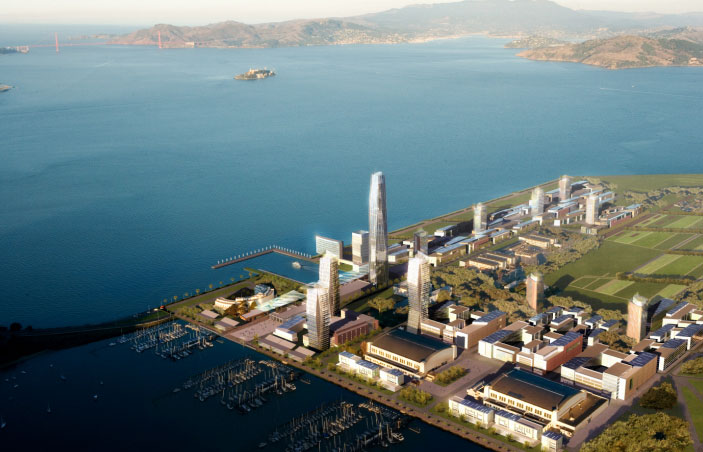
And Arc claims the island will remain contaminated (see Bronstein’s rant about radionuclides and PCBs at the beginning of this post) even after the Navy completes its toxic and radiological cleanup. That the 40-story high-rise towers will obstruct views of San Francisco from the East Bay, and vice versa. And that the project financing plan will drive the city further into debt for at least another 15 years.

Arc’s flier concludes by asserting that the whole plan is undemocratic.
“Once approved, there will be no further environmental review of project plans—ever!” Arc claims. “Once approved the project will be implemented by an unelected nonprofit corporation. There has been no outreach or involvement of East Bay residents despite traffic and view impacts. The plan repays $55 million in additional developer costs to purchase this island with hundreds of millions of dollars of impacts on Bay Area residents.”

Now, I’m sure officials for the City and the developer will have plenty of counter arguments–and possibly busloads of low-income T.I. residents/unemployed SF workers, who will be shipped into the Board’s Chambers to argue that they need the Board to approve this plan so they can have new homes and jobs. Because that’s what happened last year, when Arc and the Sierra Club and Golden Gate Audubon expressed their concerns about plans to carve up the Candlestick State Park Recreation Area and build a bridge over the Yosemite Slough. And suddenly found themselves cast as the big bad villains, when it came to the city and Lennar’s wish to ram through the Candlestick/Shipyard plan.

But regardless of whether you believe in the project, oppose it, or don’t know much about it, make sure you show up at 5pm in Room 250 at City Hall on June 7, if you want to hear what actually goes down. Especially if you work in San Francisco, and live in the East Bay, because much of the Treasure Island traffic will directly impact the East Bay. 

Or as Arc puts it, “This new project is 25 percent larger than the prior one and like the difference between a 75 degree day and a 100 degree day – this increase in size makes all the difference. The new project will overdrive bridge capacity, create too much traffic, not enough transit, reduced levels of affordable housing, and vests enormous public power in an unaccountable, unelected development authority.  Please tell the Board they don’t have to go back to the drawing board – just to the 2006 plan and recirculate the EIR.”
 

Sacramento deadline: Some key bills

0

A bunch of key bills come up in the state Legislature this week — and some of them are going to be very close. Assemblymember Tom Ammiano is pushing hard to get AB 1017, which would eliminate mandatory felony charges for pot cultivation, throught the Assembly floor (in fact, when I called his press secretary, Quintin Mecke, today (June 1) at about 11 a.m., Ammiano was on the floor making his 1017 pitch.) Ammiano also has a key tenant bill, AB 265, which would allow tenants who are a few days late with the rent to avoid eviction.


Dean Preston, executive director of Tenants Together, has a great rundown on the major tenant bills here. Sen. Mark Leno’s bill, SB 184, which is critical to protecting the rights of cities to demand affordable housing as part of a development deal, is going to be very close. So is Assemblymember Mike Feuer’s AB 934 — a nobrainer that simply clarifies tenant protections that have been threatened by recent court cases. (Preston told me that San Francisco Assemblymember Fiona Ma is not among the bill’s supporters at this point; you can call her office at  557-2312 and let her know you want her to vote for it.)


Sen. Leland Yee has gotten two bills through, one that would allow pharmacies to sell sterile syringes without a prescription and one that mandates more sunshine in the courts. His bill forcing the University of California to open up its foundation records will almost certainly clear the Senate now that UC had dropped its opposition. Tougher going, I expect, for SB 9, which would end life without parole sentences for juveniles.


Leno’s bill legalizing infusion drinks at bars cleared the Senate. He’s also pushing a Community Choice Aggregation bill, SB 790, and  the long-awaited, much-fought-over cell phone, SB 932, which would require modest disclosure of cell-phone radiation.


The difference between this session and the last one is that a lot of these bills might actually get the governor’s signature.

Not in our neighborhood

6

news@sfbg.com

San Francisco faces an enormous shortage of affordable housing for young people at risk of homelessness, but a pair of projects intended to address the issue are under fire from neighborhood activists in supervisorial District 2, home to the city’s wealthiest residents.

The proposed conversion of the defunct Edward II Hotel and the major overhaul at the Booker T. Washington Community Service Center (BTWCSC) could create a combined 74 units of affordable housing for vulnerable youth, complete with services and support systems to help young people coming from foster or homeless families.

“We are building houses for young people who are getting their start in life,” said Julian Davis, president of the board of BTWCSC. “There was a great need for foster youth housing that has been studied ad nauseam … Our center wanted to contribute.”

But both projects have run into strong neighborhood opposition that appears to have turned D2 Sup. Mark Farrell against the projects as proposed, despite initial support for the BTWCSC project by both Farrell and his predecessor, Michela Alioto-Pier. Farrell’s approach has frustrated project opponents and caused the representative of a neighboring district, Sup. Ross Mirkarimi, to sponsor the project.

“The project emanated from Michela Alioto-Pier and she supported the original project, which is why I joined her in support and it initially appeared that Sup. Farrell was joining that support,” Mirkarimi told us, noting that he is continuing to champion the project because it borders his district and because “the Booker T center has a long reach and serves clients from throughout city.”

After hearing from constituents concerned about parking, the size of the five-story building that is proposed, and other issues, Farrell dropped his sponsorship of the project and submitted alternative legislation that cut the building to four stories, presenting it to project proponents without their input as a take-it-or-leave-it proposal.

“The thing I find most puzzling about this is the lack of communication with me personally,” BTWCSC Executive Director Pat Scott said of Farrell, noting how helpful Alioto-Pier and Farrell’s staff had been before opponents convinced him to drop his support for the project. “I was a little taken aback, quite frankly. I would just assume that he’d talk to me.

But Farrell said he was simply trying to heed neighborhood concerns and craft a compromise that would get neighbors to drop their lawsuit threats and appeal of the Planning Commission’s 6-1 vote to approve the project. “I can’t control what happened in the past, I’m only here to make sure everyone is happy now,” Farrell told us. “I absolutely support the project, I think the community center is great … We’re arguing over a story.”

Yet Scott noted that project proponents already had compromised on a project that was initially proposed for eight stories, and she said that even at five stories, it isn’t coming anywhere near what the city actually needs. So while Farrell casts it as a fight over one story, Scott said, “10 units is a big thing in a city that has nothing for these kids.”

That need was outlined in a 2007 report by the Mayor’s Transitional Youth Task Force. The group of city officials and nonprofit providers, convened by then-Mayor Gavin Newsom, studied issues affecting at-risk youth between the ages 16 and 24 and one of the major needs identified was housing.

A follow-up study found that 4,500 to 6,800 young people are “homeless or marginally housed each year.” The citywide affordable housing stock for this population sat at meager 314 units at the time.

“We are not doing a good enough job as a city and as a state [to help at-risk youth],” Davis said. “Once they leave the foster care system, there is very little support for them.”

The report called for 400 new affordable housing units for this population to be completed or under construction by 2012. Edward II and BTWCSC are located in the Marina and the Western Addition, respectively, in proximity to affluent neighborhoods in a district with a dearth of affordable housing.

“With supportive housing [going] into neighborhoods that never had affordable housing, there is a certain unknown and it makes people uncomfortable,” said Gail Gilman, Executive Director of Community Housing Partnership, which owns and manages the Edward II project.

Patricia Vaughey, a resident of the Marina-Cow Hollow area since 1976, is perhaps the most vocal critic of the project. She has used the neighborhood associations and every other city forum she can find as platforms to lambaste the plans. “It just kills my soul to see this project,” she told us, voicing a variety of concerns about how the project would be managed. “I am so worried about the kids … We are asking for the best program in the country and we are not getting it.”

Yet Gilman said that considerable energy and many resources have been invested in designing Edward II and that she trusts Larkin Street Youth Service, a respected nonprofit agency, to do the programming. “We chose to partner with Larkin Street because they are the experts in this area,” she said.

Vaughey characterized the stretch of Lombard Street between Divisadero and Van Ness streets, where Edward II will be located, as marred by crime and prostitution and unsuitable for this project. “We have a little Tenderloin down here,” she said.

Gilman disputed that characterization and said the building was chosen after an extensive search and that it met the criteria of having the right sized building in a safe neighborhood with good access to public transit and open space.

But many residents have expressed concern over the pending change to zoning for the building. And if the BTWCSC project couldn’t win Farrell’s support, the Edward II project faces an even more uphill battle because Farrell told us, “There’s an even stronger level of neighborhood concern over that project…. It’s going to be a tough hill to climb.”

The contentious issue under review by the Planning Department is an application to expand the density limit from 16 units to 24.

John Miller, president of the Marina Community Association, said that “from a neighborhood dynamic perspective,” a change to density is problematic. He said changing the density for one building is a slippery slope that could hurt the entire neighborhood. “Higher density is inconsistent with the neighborhood. It could work beautifully at lower density.”

Miller said potential renters in the vicinity would be concerned with “loitering that could occur when people are coming and going … With so many people there is no sense of community”

Yet as with BTWCSC, proponents say simply slashing the project to a smaller size would kill it because then it wouldn’t pencil out financially. Making an issue of density is therefore obstruction of the project because compromise cannot be reached on the issue.

Farrell, a venture capitalist, said he ran the numbers on BTWCSC and believes it would still be a viable project at four stories if the Mayor’s Office of Housing is able to offer some unspecified assistance, as he said the officials there have pledged to him they would. “I know we need more affordable housing,” Farrell said, rejecting suggestions that D2 residents tend to oppose all affordable housing projects. “I don’t think that should be a part of this conversation.”

Farrell criticized the outreach done by Edward II proponents, telling us, “I don’t think it was done in a tactful way.” But Miller said a recent meeting with Gilman and others was positive. “It was an effort on their part to respond to the neighborhood concerns as best they can,” Miller said.

“We are confident we can partner with the community in a proactive way to address the concerns that are addressable,” Gilman said. “If we diligently work with the community, we can have positive project.”

Edward II is on track to come before the Planning Commission in mid-July, while the appeal of the BTWCSC project is scheduled to be heard by the Board of Supervisors Land Use Committee on June 6 at 1 p.m. Neither Mirkarimi nor Farrell offered predictions, but both said the issue of whether the project should be four or five stories will likely be a key part of the discussion.

“Coming through the process has made me super supportive of all plans for transition age housing. I was already a supporter but this made me a fervent supporter,” Scott said. “The amount of opposition by people who don’t care what happens to our children — it makes you want to fight.”

David Chiu helps Leland Yee

118

It’s nice, sometimes, to be in Sacramento. You can run for local office without having to vote on local issues. Witness State Sen. Leland Yee, who didn’t have to take a formal position on the Park Merced project — and now can bask in the wonder of seeing David Chiu hand him thousands of tenant votes.


Here’s the deal: Chiu and Yee are both fighting for progressive voters in the mayor’s race. Most progressive groups will endorse John Avalos, but Yee and Chiu want those second-place votes, badly. Yee’s already got his West-side base, and getting a number two nod from, say, the Milk Club or SEIU 1021 won’t hurt him a bit with those voters. But he’s not strong with Chinatown leaders (Rose Pak despises him) and he’s in a race with three (so far) Asian candidates. He’s also contending with a bunch of other center-moderate types (Dennis Herrera, Bevan Dufty) in a very crowded race.


His strategy — and it’s smart — is to court the left, get those second- and third-place nods on the East side of town and emerge from the pack when all the votes are counted. Problem is, that’s Chiu’s natural constituency (or should be) — he talks about “our shared progressive values,” was elected as a progressive and, frankly, can’t win this race just by sticking to the center. It’s just too crowded there with too many people who have won citywide races.


And Chiu just gave up a huge chunk of the city’s left by alienating every tenant group in town.


As Dean Preston of Tenants Together put it in BeyondChron (which is generally quite friendly to Chiu):


 Chiu reached a backroom deal with the developer and provided the crucial sixth vote to approve the largest demolition of rent-controlled housing in San Francisco since the redevelopment of the Fillmore. Despite a good record on tenant rights issues before his work on Parkmerced, Chiu has now earned the distrust of tenants across the city.


The tenants aren’t always a solid bloc. Mitchell Omerberg of the Affordable Housing Alliance and Ted Gullicksen at the Tenants Union don’t always agree on candidates or issues. But there was no division or dissent on this one. Omerberg, who has been known to slide to the center, was adamant that Chiu’s vote — the swing vote to move the project forward — was “deeply disappointing.” He told us: “In general it’s an unwise, immoral plan to demolish a neighborhood. When you demolish people’s homes, you always regret it later.”


So now Yee can go to progressives and say — as he did at the Democratic County Central Committee — that he has all kinds of concerns about Park Merced and make it sound as if he opposes it, and use that leverage to peel some endorsements and votes away from Chiu. It’s ironic: When he was on the Board of Supervisors, Yee was hardly known as a pro-tenant vote. His record on tenant issues, while ancient history in political terms, was going to haunt him with some progressives (and still may). But now he’s gotten a boost — if only because he and Chiu are the ones most agressively working to get endorsements from progressive groups, and Chiu just shot himself in both feet.


Held underwater

1

sarah@sfbg.com

Since the recession began four years ago, 2,000 homes have been lost to foreclosure in San Francisco. These numbers sound insignificant compared to other counties in the Bay Area, but they primarily have hit communities of color already struggling to remain in this expensive city.

As panelists at a recent seminar on foreclosures noted, the first wave hit the Bayview and the Excelsior, while the second hit the Richmond and the Sunset. And as the recession drags on and more borrowers go underwater, another 2,000 foreclosures are on the local horizon.

Although foreclosures continue to destabilize communities and drain resources from local governments, the banking lobby continues to oppose legislative reforms that would allow more people to remain in their homes. And this deep-pocketed resistance has labor, religious, and educational organizations forming the New Bottom Line coalition in an effort to find grassroots solutions to the crisis.

“Foreclosures are the new f-word,” said Regina Davis, CEO of Bayview’s San Francisco Housing Development Corporation, at SFHDC’s April 29 foreclosure seminar.

Sups. John Avalos and Malia Cohen illustrated that there is no shortage of horror stories about predatory lending and dual tracking, in which borrowers apply for loan modifications while the bank continues to pursue foreclosure. Representatives for Sup. Ross Mirkarimi and Assessor-Recorder Phil Ting noted that the banking lobby has blocked even the most modest reforms, even as uncertainty continues to devastate the housing market.

Avalos said his family underwent a housing crisis in 2009, when his wife left her job to home school their special-needs daughter. “We tried to get a loan modification and were told we could only get it by going into default,” he said, recalling how Mission Economic Development Agency (MEDA) helped them navigate the process. “If this could happen to an elected official, it could happen to anyone.”

Cohen, who lost her condo in the Bayview to foreclosure earlier this year, described foreclosure as “an incredible beast that has ravaged and wrecked the finances of many Latino, African American, and Asian communities who were sold the American dream of homeownership but then had the rug pulled away.”

Mirkarimi aide Robert Selna, a former San Francisco Chronicle reporter, said the banking industry spent $70 million last year to kill legislation by state Sen. Mark Leno (D-SF) and Senate President Darrell Steinberg (D-Sacramento) to end dual tracking. This year, the industry has been opposing SB729, Leno and Steinberg’s latest attempt to require banks to give people a definitive answer on loan modification, identify who owns the loan, and give borrowers legal recourse if banks don’t take these steps.

“SB729 gets to the heart of helping to keep people in their homes, but it’s difficult to combat the spending power of the banking industry,” Selna said.

Ben Weber, an analyst in the Assessor-Recorder’s Office, said approximately 277,000 homes in California are going through the foreclosure process; an estimated 1.8 million California residents are underwater on their mortgage; and California is sixth in “negative equity” nationwide. “Negative equity is one of the best indicators of foreclosures — so can we expect another 1.5 million to 1.6 million foreclosures statewide?” he asked.

Weber noted that Ting is supporting AB 1321 by Assemblymember Bob Wieckowski (D-Fremont), which would require that all mortgage assignments be recorded within 30 days of their execution; prevent notices of default from being recorded until 45 days after any deed of trust has been recorded; and provide consumers with better transparency about who owns their debt. Yet Ting’s office reports that the banking industry has lobbied against this and other foreclosure-related legislation

Weber said the legislation is a response to problems with the industry’s Mortgage Electronic Registration System (MERS), which was introduced 15 years ago. “The mortgage industry wanted to expedite the transfer of mortgages between entities so that they could be sold and resold on Wall Street,” Weber said, noting that the system also allowed the industry to avoid paying recording fees to counties.

MERS records an average of 6,700 deeds of trust annually in San Francisco, and MERS deeds of trust are usually transferred two to four times, Weber observed. “So MERS members avoided — conservatively — $134,000 per year in fees.”

Grace Martinez of Alliance of Californians for Community Empowerment noted that the banking lobby already killed AB935 by Assemblymember Bob Blumenfield (D-Northridge), which sought to charge a $20,000 fee to compensate for the estimated cost of a foreclosure to local government. “That money would have gone back to the city,” she said.

In an April 14 letter, the banking lobby claimed Blumenfield’s bill was a tax that increases the costs of homeownership for new borrowers. “It also serves to discourage the importation of capital into California at a time when the federal government is winding down their involvement in mortgage finance and protracts and complicates California’s economic recovery,” stated the letter, which the California Bankers Association, the California Chamber of Commerce, and other business groups signed.

But Dan Byrd, research director at Berkeley’s Greenlining Institute, reminded the mostly black and brown crowd at SFHDC’s foreclosure seminar that declining property values due to foreclosures have drained $193 billion from African American and $180 billion from Latino communities nationwide. “Folks from these communities who had credit good enough to qualify for a prime loan were given subprime loans with adjustable mortgage rates,” he said

Byrd stressed that homeowners facing foreclosures need to be more financially literate. “A lot of loan documents are written in language that people can’t understand, and they don’t have the money to hire a lawyer,” Byrd said, as he urged politicians to fund organizations that provide financial counseling and education. “Our elected federal officials just cut the budget that supports SFHDC and similar groups.”

SFHDC housing counselor Ed Donaldson said appraisal values make it hard to sell the below-market-rate units that are coming online. “So if we don’t do something about the foreclosure problem, the housing market will continue to unwind,” he said, urging people to protests banks and show up at City Hall and in Sacramento to support reform.

The Rev. Arnold Townsend, vice president of the local branch of the National Association for the Advancement of Colored People, said San Francisco likes to pretend that the foreclosure crisis didn’t really affect the city. “But it did,” he said. “It badly hit people of color that the city, by its policies, doesn’t seem to care if they leave.”

Attorney Henri Norris noted that bankruptcy can be an alternative to foreclosure. “A bankruptcy can stop a foreclosure, at least temporarily,” Norris said. He recommends that people make their loans current and try to get a loan modification approved. “But it’s going to take running a marathon.”

Avalos, who is running for mayor, noted that the city does not fund enough affordable housing and he proposed an affordable housing bond that would include assistance for mortgage assistance, ownership downpayment, seismic retrofitting, and energy efficiency. “I understand that voters see no personal benefit, but it would raise wealth in property values,” he said.

Cohen observed that the federal Homeowners Affordable Modification Program (HAMP), which President Obama unveiled in March 2009, “hasn’t worked” and that most of the important reform proposals are “happening at the state level.” She encouraged people to show support for SB729, but wasn’t ready to declare support for Avalos’ housing bond.

“I want to make sure the climate is ripe, that Sups. Carmen Chu and Eric Mar are included, because their districts will be impacted by foreclosures, and that the support is broad-based,” she said. “But folks can divest from banks that have not treated us right.”

Noting that divestment was the most effective way to end apartheid in South Africa, SFHDC’s Davis invited seminar participants to a free screening of Charles Ferguson’s documentary Inside Job, which shows how subprime loans, dual tracking, and mortgage bundling triggered the 2008 financial meltdown — and how many of the main players are still calling the shots.

But despite SFHDC’s informative seminar and the New Bottom Line campaign’s May 3 protest at Wells Fargo’s annual shareholder meetings in San Francisco, SB729 failed to make it out of committee May 4, when Sen. Alex Padilla (D-Van Nuys) announced he would introduce an alternative dual tracking bill. In addition, Wieckowski turned his MERS reform into a two-year bill, suggesting the votes weren’t there to approve it.

Paul Leonard, California director of the Center for Responsible Lending, observed that SB729 supporters include a broad array of consumer, civil rights, labor, faith-based groups, and homeowners, but the only groups in opposition were the California Bankers Association, the Mortgage Bankers Association, and the Chamber of Commerce.

“I find it remarkable that after the exposure of deep-seeded scandals about robo-signing and the systematic shortcomings of mortgage loan service operators, none of the bills intended to address these issues got out of their first committee hearing,” Leonard said.

In an April 20 letter, the banking lobby claimed that SB729 was “unnecessarily complex,” could overlap and contradict actions by federal regulators and state attorneys general, and promote strategic defaults that would negatively affect communities and cloud title for a year following a foreclosure, leaving properties vacant.

Dustin Hobbs of the California Mortgage Bankers Association claims the average time for a foreclosure is more than 300 days. “This would have dragged it out further, and the last thing we need is more vacant homes and more homes in foreclosure,” he said.

Ting noted that Wieckowski made the call to turn AB1321 into a two-year bill. “But you would have thought we were offering the end of home ownership,” Ting said, noting that the banking industry was shocked when advocates produced a MERS memo that encourages banks to record documents and pay fees. “It basically recommended our legislation,” Ting observed.

“Assignments out of MERS name should be recorded in the county land records, even if the state law does not require such a recording,” a Feb. 16 MERS memo said.

Ting describes MERS as “a Wall Street set-up, the ultimate in smoke and mirrors.”

“We did a little poking around in MERS and found that it would help if the name of the loan owner was recorded,” Ting said, noting that the confusion MERS created is bad for consumers, the real estate industry, and homeowners.

“Part of the problem is computer systems doing what banks used to do,” Ting said. “It ended up with robo-signing and foreclosures being sent to the wrong people. I thought AB1321 was a no-brainer, but we had to take it to five or six legislators before anyone would pick it up. This is a prime example of how a particular industry has made a huge amount of money and is unwilling to bend any rules to give consumers any recourse.”

But CMBA’s Hobbs described AB1321 as “part of a broader attack on MERS.” And an April 21 opposition letter from the banking industry describes it as “creating impediments for attracting capital to California’s mortgage marketplace and imposing significant new workloads on county recorders and clerks.”

Ting says he has heard lobbyists make that argument. “But my assessor recorders organization supported it — and they are mostly not elected officials,” he said, noting the group usually doesn’t get involved in promoting legislation.

Ting admits that it’s hard to get the national reforms that are needed. “San Francisco still has a big part to play. And our legislators are still very powerful, so we have no excuse not to be fighting in Sacramento where the Democrats have a supermajority. I mean, how could these bills not get out of committee? It’s not like we didn’t take amendments, but no level of amendments would have made anything happen.”

“Foreclosures typify this financial and political era,” he continued. “They are about all the things we should have seen coming — and some of us did. But even then, and now, there is political amnesia. For all the families that lost their homes, shouldn’t we do something to make sure this doesn’t happen again? Wall Street was bailed out two years ago, but Main Street is still waiting.”

Igniting a union

5

news@sfbg.com

The most contentious and pivotal election ever for the union of academic student employees at the University of California concluded May 8 in a landslide victory for reformers who will now have the chance to deliver on their promise of a more militant and democratic union. In many ways, it was a microcosm for the larger struggle over how to respond to proposals for deep cuts and tuition hikes in the public university systems.

Local 2865 of the International Union, United Automobile, Aerospace and Agricultural Implement Workers of America (UAW), represents 12,000 teaching assistants, tutors, readers, and researchers, making it the largest UAW union on the West Coast. Higher education workers make up 40,000 of the 390,000 active UAW members, just over 10 percent.

The caucus of reformers, organized under the banner Academic Workers for a Democratic Union (AWDU), won all 10 executive board positions and 45 out 80 seats at the Joint Council, taking control from incumbent leaders from United for Economic and Social Justice (USEJ), which has presided over the union for most of its 11-year history.

Voter turnout spiked tenfold over the last triennial election with 3,400 ballots cast this election cycle. Union organizers said the hike reflects intensive campaigning by both sides and a political atmosphere that is threatening both higher education in California and public employees across the country.

“This was the first real contested election our union ever had,” said Mandy Cohen, a comparative literature graduate student at UC Berkeley and the AWDU recording secretary-elect. “There was a huge increase in participation, and it was very contentious. Our leadership never had to fight for their position.”

The intensive campaigning translated into an unusually bitter battle for votes with ensuing accusations of foul play. The allegations include intimidation, personal attacks on the character of candidates, and ballot tampering. But the height of controversy and drama came once all the ballots were cast, when the USEJ-dominated elections committee suspended the vote count midway and AWDU members responded with an office sit-in of the union’s headquarters.

Each side tells a different tale for these 1,500 disputed ballots from UC Berkeley and UCLA, the two largest campuses.

From USEJ’s perspective, the sheer number of challenged ballots and the heated environment in the counting room overwhelmed elections officials, who decided to refer the matter to the Joint Council, the governing body of the local.

“AWDU had 20-plus people in the [vote-counting] room. They were continuing the intimidation and aggression. The elections committee decided that it was too much to handle,” said Daraka Larimore-Hall, outgoing president of the local. He said that USEJ elections committee members have been so harangued since the incident that they are not granting requests for media interviews.

AWDU members, who consider UC Berkeley their stronghold, think the vote-counting freeze was the first step on the road to invalidating ballots from a campus with many AWDU supporters.

“Even though we knew they were really threatened by us, the very idea that we would try to disenfranchise 800 voters from the biggest campus — and that’s how they would try to win the election — was really shocking,” Cohen said.

She defended the AWDU decision to videotape the remaining ballots via webcam and take over union offices in protest. “We weren’t taking a partisan position; we just said we wanted the votes counted. I felt like we were clearly in the right. We just wanted to defend the election — and that position was so strong.”

Counting resumed when both sides finally settled on a third-party mediator, delivering 55 percent of the vote to AWDU.

However, on May 16, USEJ released a statement documenting a slew of alleged misconduct throughout the election and calling for a rerun. “It is critical that our members have confidence that the election process is fair and democratic,” reads the statement. “It seems that several categories of problems, with many more individual examples, occurred that are serious enough to justify setting this election aside.”

Whatever happens, reformers at least will have some opportunity to translate their political platform into action. They say they will focus on two areas: increasing the participation and power of the rank and file, and a more aggressive stance toward the university administration and the budget cuts.

“There is real institutional power in this union that should be better mobilized in those fights [for public education],” said president-elect Cheryl Deutsch. “We are hoping to bring into that debate a more mobilized membership … so that we can be a stronger coalition [with others in California].”

She added that the election was already a huge victory in the long-term plan to increase involvement. A history of member indifference and vacancies in the governing board hopefully will give way to a revival in the higher education labor movement, she said.

But Larimore-Hall expressed strong disagreement with the sentiment that the election was a victory for the labor movement. He said he heard AWDU people tell workers that USEJ represents “centrist sell-outs” and “out of touch union bureaucrats,” tactics he criticized. “Going around and telling people their union leaders are corrupt union bosses … in a culture that is steeped in anti-union rhetoric is an easy thing to sell people on,” he said.

Deutsch said she couldn’t take responsibility for the actions of a few amid hundreds of supporters and activists, but that AWDU as a whole did not engage in personal attacks. She said she is proud that her winning slate came from rank-and-file workers, not from traditional union leadership and staff.

It wasn’t the first time the two factions confronted each other. The origin of the tensions can be traced to the recent wave of budgets cuts at the university, and to the ensuing protests. In the summer of 2009, the UC Board of Regents announced a 33 percent tuition hike; the resulting discontent sparked a student movement with its own fair share of ups and downs. Among the protestors were many graduate students who would go on to become AWDU leaders.

Cohen recalls that in fall 2009, there was a “huge explosion of organizing and activism on our campus trying to organize resistance to the cuts — but not within our union.”

Cohen said that she and other graduate students approached the union to encourage action, but that union bureaucracy stifled their efforts. “It was too top-down and difficult to participate. We realized the local wasn’t structured in a way that could be powerful.”

Larimore-Hall said UAW already was “one of the unions that [the university administration] fears most.” He said that AWDU’s position overlooks the union’s accomplishments on the public education front, citing a petition to Sacramento legislators that USEJ organizers got thousands of members to sign.

Early this spring, the issue of labor properly and sufficiently flexing its muscles came center stage as the UAW and the university negotiated a contract. With no concessions to management and gains such as a 2 percent wage increase and more childcare subsidies, Larimore-Hall said the contract is a resounding success.

But Deutsch says that the contract is a perfect example of her disillusionment with traditional union organizing and the previous leadership. Union members ultimately voted to ratify it despite AWDU criticism that the union didn’t seek enough input from members or push for a better deal. AWDU gained traction and established a significant public presence for the first time with this opposition.

“It’s not that I think it’s the worst contract we could have gotten,” she said, explaining that her problem is with the process, not necessarily with the results. If more members had been consulted and included, she would have been content. She mentioned the dire need for affordable housing at the Irvine campus as an example of member concerns that were not prioritized.

Peter Chester, chief contract negotiator for the university, said that in the “current budgetary circumstances,” UAW did “very well” and expressed concern that the slate, which opposed the contract, did so well among academic workers.

But the victory by reformers probably signals a new militancy in the union, which is expected to resist proposals to privatize campus services and push for a stronger voice in the tough decisions facing the university system. Cohen said that making the case for taxing the rich to pay for public education is the wider goal and the reason she ran for a position at the union.

“It’s eye-opening to be a student and benefit from education here at the UC, but also to identify as a public employee,” she said. “When I got to the UC, I was so proud. And then this struggle came to my doorstep, and I didn’t have a choice in this moment.” 


Preserving preservation

0

EDITORIAL San Francisco has a terrible record preserving its past. In the past 50 years, so many parts of the city’s history have been demolished, bulldozed, flattened, or destroyed in the name of development. The number of landmarks that are gone vastly exceeds the number of buildings or landscape features saved by historic preservation laws.

So when Sup. Scott Wiener called a hearing May 2 to discuss possible changes in the city’s historic preservation policies, it got a lot of neighborhood activists nervous. And for good reason. In a city where developers always seem to call the shots, where blocking a bad project is a difficult and expensive process, anything that removes a weapon from the quivers of the neighborhoods is potentially dangerous.

And coming in the wake of a 6-5 February vote at the board to appoint an unqualified, pro-development candidate to the Historic Preservation Commission, there’s a disturbing trend here. And the supervisors should be careful not to dismantle the protections that the 2008 ballot measure, Proposition J, put in place to protect the city’s history.

Wiener assures us he’s not out to gut preservation — he supported Prop. J and doesn’t think that the preservation movement has gone too far. “I just want to make sure that we are taking into account other policy priorities,” he said.

Wiener pointed to a few potential situations where historic preservation could get in the way of improvements to transportation and streetscapes. The street lights along Van Ness Avenue might have to be removed to make a bus rapid transit lane work — and some people might consider them historic structures. Pedestrian safety improvements along Dolores Street might require minor changes in the tree-lined median, which is not a landmark but potentially could be. He’s looking at changes in the City Planning Code provisions dealing with historic preservation — and potentially, with the way the Planning Department applies the California Environmental Quality Act.

There are always times when preservation conflicts with progress, and there will always be dubious uses of preservation law. But overall, in the course of many, many years, the pendulum has swung far in the other direction: historic preservation has been trumped again and again by the greed and political power of developers and the construction industry. And even well-meaning attempts to adjust city law will almost certainly become loopholes for more destruction.

Almost everything good in this city, from the cable cars to the Presidio, has been threatened with extinction at some point. Battling to save the city’s treasures is a full-time occupation.

There are ways to balance preservation against valid public policies like the need for affordable housing (almost never blocked by preservationists) and street improvements (one anti-bicycle character delayed new bike lanes for years, but not on the grounds of historic preservation). But there has to be a clear line: no changes or loopholes aimed at helping private, for-profit developers. Nothing that limits the ability of neighborhood groups to stop the destruction of city history.

The problem in San Francisco is not too much historic preservation, it’s that we allow too much to get lost. That’s why Wiener needs to tread lightly on this ground — and his colleagues have to make sure he doesn’t go too far. 


Editorial: Preserving preservation in San Francisco

0

 San Francisco has a terrible record preserving its past. In the past 50 years, so many parts of the city’s history have been demolished, bulldozed, flattened, or destroyed in the name of development. The number of landmarks that are gone vastly exceeds the number of buildings or landscape features saved by historic preservation laws.

So when Sup. Scott Wiener called a hearing May 2 to discuss possible changes in the city’s historic preservation policies, it got a lot of neighborhood activists nervous. And for good reason. In a city where developers always seem to call the shots, where blocking a bad project is a difficult and expensive process, anything that removes a weapon from the quivers of the neighborhoods is potentially dangerous.

And coming in the wake of a 6-5 February vote at the board to appoint an unqualified, pro-development candidate to the Historic Preservation Commission, there’s a disturbing trend here. And the supervisors should be careful not to dismantle the protections that the 2008 ballot measure, Proposition J, put in place to protect the city’s history.

Wiener assures us he’s not out to gut preservation he supported Prop. J and doesn’t think that the preservation movement has gone too far. “I just want to make sure that we are taking into account other policy priorities,” he said.

Wiener pointed to a few potential situations where historic preservation could get in the way of improvements to transportation and streetscapes. The street lights along Van Ness Avenue might have to be removed to make a bus rapid transit lane work and some people might consider them historic structures. Pedestrian safety improvements along Dolores Street might require minor changes in the tree-lined median, which is not a landmark but potentially could be. He’s looking at changes in the City Planning Code provisions dealing with historic preservation and potentially, with the way the Planning Department applies the California Environmental Quality Act.

There are always times when preservation conflicts with progress, and there will always be dubious uses of preservation law. But overall, in the course of many, many years, the pendulum has swung far in the other direction: historic preservation has been trumped again and again by the greed and political power of developers and the construction industry. And even well-meaning attempts to adjust city law will almost certainly become loopholes for more destruction.

Almost everything good in this city, from the cable cars to the Presidio, has been threatened with extinction at some point. Battling to save the city’s treasures is a full-time occupation.

There are ways to balance preservation against valid public policies like the need for affordable housing (almost never blocked by preservationists) and street improvements (one anti-bicycle character delayed new bike lanes for years, but not on the grounds of historic preservation). But there has to be a clear line: no changes or loopholes aimed at helping private, for-profit developers. Nothing that limits the ability of neighborhood groups to stop the destruction of city history.

The problem in San Francisco is not too much historic preservation, it’s that we allow too much to get lost. That’s why Wiener needs to tread lightly on this ground and his colleagues have to make sure he doesn’t go too far. 

Approve affordable housing — for youth

1

OPINION Booker T. Washington, born as a slave, risked his life to learn to read and write and went on to found Tuskegee University. At his core, he believed that economic independence and access to education were the keys to equality. He put it best when he said: “There are two ways of exerting one’s strength: one is pushing down, the other is pulling up.”

Since 1919, the Booker T. Washington Community Service Center has worked to lift up San Franciscans of every background, with a particular focus on the African American community. To continue that vision, the center is embarking on a capital project that will provide 50 units of affordable housing to youth and families, along with new athletic and educational space.

The most critical part of the project is providing housing for transitional-age youth. Many of these young people age out of foster care with no family support, few job skills, and no chance to rent a market-rate apartment in this expensive city. The project represents a real commitment to these youth, who are overwhelmingly people of color. With affordable housing funding under threat at the federal and state levels, it’s essential that shovel-ready projects get the green light from City Hall.

That is why we were thrilled when Sups. Ross Mirkarimi, Eric Mar, and Mark Farrell introduced the necessary legislation to allow this project to move forward. Joining hundreds of community leaders, countless families, and prominent African Americans, these supervisors lent their support for a project that continues the ongoing fight for economic justice.

It’s also why we are concerned that a few neighbors are using their influence to push down on the hopes of San Francisco’s youth. Some neighbors have asked that we add additional parking, even though the site is just a few blocks from Geary Boulevard and most low-income youth don’t have cars. Others have suggested that we cut nine units to make the building shorter, even though San Francisco’s housing needs are so acute. As is often the case in San Francisco, those who support progressive values need to speak up to ensure that we can overcome this campaign of misinformation and fear.

On April 28, the Planning Commission will consider whether to certify the environmental impact report for this project, and whether to approve it. We are hopeful that progressive voices speak out so we can provide hope and a future to youth in our community. As Booker T. often said: “Success is to be measured not so much by the position one has reached in life as by the obstacles one has overcome.” 

Julian Davis is president of the board and Patricia Scott is executive director of the Booker T. Washington Community Service Center, located at 800 Presidio Ave. The Planning Commission hearing is Thursday, April 28 at City Hall, Room 400.


Editor’s notes

6

tredmond@sfbg.com

The candidates for mayor of San Francisco are already lining up endorsements — the Sierra Club held its interviews April 23, which seems awfully early to me, since some of the most interesting contenders in this town (Tom Ammiano, Matt Gonzalez) have a tendency to jump in at the last minute. And the filing deadline isn’t until August.

But the sooner the big names and organizations are lined up and the money is locked in, the harder it will be for anyone to pull off an August surprise. So unless the redistricting commission seriously messes with Mark Leno’s state Senate seat or Ed Lee bows to the pressure from Willie Brown, Rose Pak, and their allies and decides to go back on his promise and seek a full term, we’re probably looking at a rough approximation of what the voters will face in November.

With John Avalos in the race, the ballot’s become a lot more attractive to progressives. It’s not as if the other major candidates don’t have a lot to offer, and in some cases, they have a lot to offer to the left. There are smart, experienced, qualified people running.

But let’s be honest here: David Chiu, Dennis Herrera, Phil Ting, Leland Yee, and Bevan Dufty all operate somewhere in the squishy political center, a place where tax breaks for corporations are okay, where “homeownership opportunities” tend to trump the needs of tenants, where deals with big private developers are sculpted around the edges but never rejected outright, and where cuts in services are a larger part of the budget solution than taxes on the rich.

Michela Alioto-Pier is off on the far right of the San Francisco political world, and if she looks at all credible and gets any significant traction (and that’s a big if) she’ll be downtown’s favorite candidate. But until now, there was nobody holding the solid progressive banner.

I don’t think that means Avalos’ appeal is limited to the left; he’s in a swing district, and he’s very popular there, and he can talk about small business and community development and open, honest government. He doesn’t sound like a crazy radical; he’s polite and respectful and listens to people.

But I’m glad we have a candidate who won’t try to argue that 25 percent affordable housing at Treasure Island is something to be proud of, or that the Twitter tax break will create jobs, or that social inequality can’t be addressed through local policy. I’m glad there’s someone who can push the discussion and debate out of the middle, can force some of the others who want progressive support to take strong stands, and can liven things up a bit. Because without him, all of the candidates were sounding a lot alike — and I really don’t want to be bored this fall.

Reject the Treasure Island plan

18

EDITORIAL After a long, long hearing April 21, as the San Francisco Planning Commission prepared to vote on an ambitious development plan for Treasure Island, Commissioner Gwyneth Borden acknowledged that the plan wasn’t perfect. But, she said, on balance it ought to be approved: “Twenty five percent affordable housing is better than zero percent.”

That’s not necessarily true.

Treasure Island is an usual piece of real estate, 403 acres of artificial land created in 1937 by dumping sand and dirt on a shallow part of the bay. It’s less than two miles from downtown San Francisco — but there’s no rail service, no BART station. The only way off the island is by boat — or by driving onto a Bay Bridge that’s already jammed way beyond capacity every morning and afternoon.

The soil is unstable, prone to liquefying in an earthquake — and if sea levels rise as high as some predictions suggest, the whole place could be underwater in a few decades.

A strange hybrid agency called the Treasure Island Development Authority, created by former Mayor Willie Brown, cut a deal with Lennar Urban (the same outfit that has the redevelopment deal for Bayview Hunters Point) and several partners to construct a neighborhood of some 19,000 people on the island. Among the features: a 450-foot condominium tower and 6,000 units of high-end housing. The developers brag that a fleet of new ferries will offer a 13-minute ride to the city and that some streets will be designed for pedestrians and bicycles.

But the fact remains that the developers want to add 19,000 new residents — almost all of whom will work off the island somewhere — to a place that has no credible transportation system. City studies show that even with an extensive (and costly) ferry service, at least half the new residents would drive cars to work (and, presumably, to shop, and go to movies, and eat and drink), joining the mob of vehicles heading east or west on the bridge. That’s almost 10,000 new cars each day trying to jam onto a roadway that can’t handle the existing traffic. The backups would stretch well onto San Francisco surface streets and as far back as Berkeley.

A rail line on the Bay Bridge would solve part of the problem. So would bike lanes. Neither option is even remotely possible in the foreseeable future. Free, or heavily subsidized ferries could, indeed, be a positive alternative — but who is going to pay for that service? Nonsubsidized ferries would be far more expensive than current Muni or BART service, a particular burden on the residents of the below-market housing.) And does anybody really think there’s going to be enough ferry capacity to carry 10,000 people a day to downtown SF, the East Bay, and the Peninsula?

The bottom line: this isn’t a good deal for San Francisco. The affordable housing level is too low. The transportation problems are nightmarish. The last thing Treasure Island needs is a 450-foot tower.

There’s no rush to approve this — and no immediate downside to waiting for a better deal. The supervisors should tell Lennar to come back with a project that has fewer residents, better transit options, and more affordable housing. Because zero is looking a lot better than what’s on the table.

PS: The 4-3 Planning Commission vote demonstrated exactly why it’s important to have key commission appointments split between the mayor and the Board of Supervisors. The mayoral appointees all rolled over — but at least the board-appointed members made strong points, forced real debate, and gave the supervisors plenty of ammunition to demand a better deal.

Editorial: Reject the Treasure Island plan

1

After a long, long hearing April 21, as the San Francisco Planning Commission prepared to vote on an ambitious development plan for Treasure Island, Commissioner Gwyneth Borden acknowledged that the plan wasn’t perfect. But, she said, on balance it ought to be approved: “Twenty five percent affordable housing is better than zero percent.”

That’s not necessarily true.

Treasure Island is an usual piece of real estate, 403 acres of artificial land created in 1937 by dumping sand and dirt on a shallow part of the bay. It’s less than two miles from downtown San Francisco — but there’s no rail service, no BART station. The only way off the island is by boat — or by driving onto a Bay Bridge that’s already jammed way beyond capacity every morning and afternoon.

The soil is unstable, prone to liquefying in an earthquake — and if sea levels rise as high as some predictions suggest, the whole place could be underwater in a few decades.

A strange hybrid agency called the Treasure Island Development Authority, created by former Mayor Willie Brown, cut a deal with Lennar Urban (the same outfit that has the redevelopment deal for Bayview Hunters Point) and several partners to construct a neighborhood of some 19,000 people on the island. Among the features: a 450-foot condominium tower and 6,000 units of high-end housing. The developers brag that a fleet of new ferries will offer a 13-minute ride to the city and that some streets will be designed for pedestrians and bicycles.

But the fact remains that the developers want to add 19,000 new residents — almost all of whom will work off the island somewhere — to a place that has no credible transportation system. City studies show that even with an extensive (and costly) ferry service, at least half the new residents would drive cars to work (and, presumably, to shop, and go to movies, and eat and drink), joining the mob of vehicles heading east or west on the bridge. That’s almost 10,000 new cars each day trying to jam onto a roadway that can’t handle the existing traffic. The backups would stretch well onto San Francisco surface streets and as far back as Berkeley.

A rail line on the Bay Bridge would solve part of the problem. So would bike lanes. Neither option is even remotely possible in the foreseeable future. Free, or heavily subsidized ferries could, indeed, be a positive alternative — but who is going to pay for that service? Nonsubsidized ferries would be far more expensive than current Muni or BART service, a particular burden on the residents of the below-market housing.) And does anybody really think there’s going to be enough ferry capacity to carry 10,000 people a day to downtown SF, the East Bay, and the Peninsula?

The bottom line: this isn’t a good deal for San Francisco. The affordable housing level is too low. The transportation problems are nightmarish. The last thing Treasure Island needs is a 450-foot tower.

There’s no rush to approve this — and no immediate downside to waiting for a better deal. The supervisors should tell Lennar to come back with a project that has fewer residents, better transit options, and more affordable housing. Because zero is looking a lot better than what’s on the table.

PS: The 4-3 Planning Commission vote demonstrated exactly why it’s important to have key commission appointments split between the mayor and the Board of Supervisors. The mayoral appointees all rolled over — but at least the board-appointed members made strong points, forced real debate, and gave the supervisors plenty of ammunition to demand a better deal. *


Green today, gone tomorrow

1

culture@sfbg.com

URBAN FARMING Green thumbs may soon be mourning the partial removal of Hayes Valley Farm. The urban agriculture education project is facing the prospect of condos being built on one of its two sections of city-issued property by Bay Area development company Build Inc., as early as February 2012. The company has been slated to build on the property since before the farm project began in January 2010, but was delayed by the recession of 2008 and its wet-blanket effects on new construction projects.

Today the farm sits on 2.2 shady acres near the heart of the Hayes Valley neighborhood. Visit on a typical day and you’ll find volunteers planting fava beans, school-age kids wandering through crops and trees on a school tour, perhaps a instructor teaching a beekeeping class, and on Sundays, a group of volunteers distributing free produce to anyone who stops by. All the while, plant and animal life buzz amid the fertile urban enclave.

But while volunteers have put hundreds of hours into making the farm what it is today — even going so far as to purify the car exhaust-infused soils to make the land arable — this green space was never intended for long-term use. Hayes Valley Farm is among a handful of ventures around the city — another one is interdisciplinary collective Rebar’s Showplace Triangle, a street at the base of Potrero Hill that has been turned into a pedestrian zone with repurposed benches and planter beds as part of the group’s Pavement to Parks project — that are aimed at making interim public space out of underutilized properties.

The current story of the land that the farm occupies starts with the 1989 Loma Prieta earthquake. The quake’s damage to the Central Freeway resulted in the city acquiring major parcels of land where the thoroughfare once stood. Since then, the city has relied on sales of those properties — which it designated as Parcels A to V — to build Octavia Boulevard and redevelop the Hayes Valley-Market Street neighborhood. Half the land was to be made into affordable housing.

But at one point, the neighborhood noticed that some of the parcels awaiting sale were attracting crime, graffiti, dumping, and otherwise unsavory activities. The Hayes Valley Neighborhood Association teamed up with the Mayor’s Office of Economic and Workforce Development to go looking for potential projects that could put these spaces to constructive use during the time that they awaiting development.

“We went out and actually sought a user for this. We got in contact with Jay Rosenberg and Chris Burley, who were interested in doing the farm, and we brought them here and asked them if this was doable,” says Rich Hillis of the Office of Economic and Workforce Development. “We were 100 percent clear that it was going to be for interim use only, and they embraced that.” Hillis and colleague Ken Rich ensured that Hayes Valley Farm received a $50,000 grant from the Mayor’s Office to get started on the work of clearing the property and setting up community programming on the land.

While it’s clear that the farm project was meant from the get-go to be an interim use for Parcels O and P, some members of the community are upset to see Parcel P turned over so soon to Build Inc. “As a citizen, I have the freedom of being able to ask what’s better for the community, this farm or more developments?” says Morgan Fitzgibbons, head of the neighborhood sustainability group the Wigg Party and farm volunteer. “The farm is an anchor of a burgeoning sustainability movement, and after seeing all the good it can do, are we still going to go in there and build? I think the issue is bigger than one city block.”

But Booka Alon, who is part of the 10 core farm volunteers who manage and run the farm, says they will not be putting up a fight. “We are very grateful to the Mayor’s Office and we’re ready to leave when asked. That’s part of our agreement.”

Alon says that the farm gives a sense of hopefulness and accomplishment to many young volunteers who are otherwise underemployed during the economic downturn, but turning Hayes Valley Farm into a long-term career commitment is not something many volunteers are itching to take on. “Planting and farming are hopeful acts, but not very lucrative in an urban setting.”

Many community members who championed the farm in the first place hope that the transition of Parcel P to Build Inc. will go smoothly so that other interim-use projects will be supported in the future. “We love the farm,” says Hayes Valley Neighborhood Association member Jim Warshell. “What they’ve done has been spectacular and wonderful, but that doesn’t mean that you don’t honor your commitment. The way we respond to Parcel P will affect how people trust us with future deals.” And while the farm’s popularity among city residents can’t be denied, some look forward to the fruition of the city’s promise that the area will be converted into homes that residents can afford.

But the sun hasn’t set on the work of Hayes Valley Farm. The group is collaborating with the city on finding another location to continue planting and teaching. And the future of Parcel O appears to be some shade of green. For now, there are no imminent development plans for the space and, unlike Parcel P, Parcel O is under the auspices of the city’s Redevelopment Agency, not a private company.

Alon says that some of the plant beds and flowers on Parcel O might someday be incorporated into the mixed-income housing developments that will eventually stand around — and possibly on — it. As for the permaculture soil that the farm hands have diligently created, she hopes it can be recycled along with the knowledge that was shared through the project. “Maybe we’ll give the soil to neighbors when it’s over. They can use it in their own gardens.”

For more information on how to support the farm, visit www.hayesvalleyfarm.com.


The Treasure Island nightmare

83

There are times when people like me, who think development should be driven by public needs, not private profit, are in something of a bind. I don’t like the Lennar plan for Bayview Hunters Point — but I agree that doing nothing isn’t a very good alternative. Sometimes, the “no-project” alternative isn’t an alternative at all — which gives the developers a huge hand up in negotiations with the city. Gee, you want affordable housing? We can give you 15 percent — or we can walk away and you’ll get nothing.


But when it comes to Treasure Island, I think we’re in a different situation. The proposed development is so out of whack, so looney, that it makes no sense to me — and the alternative of doing nothing, at least for now, isn’t so bad at all.


The plan calls for 19,000 new residents on the 403-acre artificial island in the Bay. At most, 25 percent of the units would be below-market. Which means some 13,700 rich people, virtually all of them with jobs in San Francisco, the Peninsula or the East Bay, would be plunked into a place with no viable transportation alternatives.


I wonder if any of these planners have ever tried to leave TI by car; it’s a nightmare. And there’s no way to fix it: Even if they build a new acceleration ramp (the current stop-and-go into 60-mile-an-hour traffic is a death trap), the Bay Bridge is already at full capacity during a very long rush hour in the morning and evening. And does anybody really think those 13,700 people will all take the ferry to work every day?


Impossible: There’s no way to provide enough ferry service for that population at anything resemble the cost the developers are willing to pay. How about all the Google and Yahoo and Genentech employees (and that’s a big part of the population buying new high-end condos in San Francisco)? You think they’re all going to take a ferry to downtown SF then hop on a bus or train then take another bus to the office? Not these folks. A lot of them will want to drive.


And the bridge, which is already backed up, will back up further, driving more traffic onto the streets of SOMA and creating a slowdown all the way back to Berkeley.


Meanwhile, the island is sinking, and water levels are rising. Forget the fancy engineering plans to sink stone columns deep into the clay under the Bay; what happens when the water rises? Are we going to surround the entire place with seawalls?


And here’s the bottom line: The current situation isn’t all that awful. There’s a small amount of housing out there, some of it affordable. There’s lots of open space. A little effort and the playing fields and parkland could be upgraded and TI could, for the intermediate term, be a day-use area for the city. Not a terrible alternative.


At some point, either the island’s going to sink back into the Bay or it’s going to have to be completely redeveloped. But right now, with no public money available, we’re at the whims of private developers. And what they’re offering doesn’t even remotely meed the city’s needs — and will create a catastrophic transportation problem.


So the supervisors are in a great position to negotiate. We want 50 percent affordable housing, we want the developer to pay for substantially increased bus and ferry service (or maybe we want to add a rail line to the Bay Bridge). And if that’s not something the developers want to do, fine: we’ll wait. Nothing wrong with that.


The Parkmerced investors

8

rebeccab@sfbg.com

Parkmerced is one of the largest rental properties west of the Mississippi, and with more than 1,500 rent-controlled units, it’s an important piece of the city’s affordable-housing stock. Among the residents who live in the neighborhood-scale apartment complex are seniors, young families, and working-class San Franciscans, some of whom have called it home for decades.

A plan for an extraordinary overhaul of the property envisions tearing down the existing low-rise apartments and nearly tripling the number of units with a construction project that could take up to 30 years. On March 29, after Guardian press time, the Board of Supervisors was scheduled to vote on whether to uphold the plan’s environmental impact report (EIR), a key milestone of the approval process.

The Planning Commission voted 4-3 to certify the EIR, and if the board followed suit by rejecting four different appeals filed against it, Parkmerced would be on track to clear final approval sometime in May.

San Francisco Tomorrow was among the groups that filed appeals against the Parkmerced plan. “They want to destroy a neighborhood without sufficient justification or mitigation,” said Jennifer Clary, the group’s president, citing concerns about traffic congestion, loss of an historic landscape, and the destruction of rent-controlled housing.

Julian Lagos, a resident of 18 years, filed an appeal on behalf of the Coalition to Save Parkmerced. “It’s a very blue-collar community, and they want to replace it with wall-to-wall luxury high-rise condos,” said Lagos, who lives in a unit that would be targeted for demolition under the development plan. “I call it ground zero,” he said. “And I tell my neighbors, ‘You’re living at ground zero.’ “

Mayoral development advisor Michael Yarne noted that most points highlighted in the EIR appeals had already been addressed, except one charging that there hadn’t been adequate consideration over whether a Pacific Gas & Electric Co. gas pipeline running underground near Parkmerced could be jeopardized by construction activity. “The answer to that is, that’s a really good question for PG&E,” Yarne said. But he asserted that it wasn’t a project EIR issue.

Elected officials’ reactions to the overall plan were mixed. Lagos noted that campaign filings showed that Sups. Carmen Chu and Sean Elsbernd had accepted donations from people related to the project, and he predicted that Board of Supervisors President David Chiu would be a swing vote on the issue. Chiu spent several hours touring Parkmerced the Friday before the vote. He did not return Guardian calls seeking comment.

A development agreement between the city and the developer, Parkmerced Investors LLC, promises that existing tenants will keep their rent control at the same monthly rates — even after the apartments they now reside in are razed to make way for new residential towers.

Such a plan typically wouldn’t fly under state law because the Costa-Hawkins Act prohibits a city from imposing rent control on newly constructed housing. Yet city officials, with input from the City Attorney’s Office, say they’ve constructed this deal so that it falls within one of the exceptions written into the state law, offering a legal defense in the event of a court challenge and a guarantee against affordable housing loss.

“The development agreement is like a constitution for land use,” said Yarne. “You can’t get rid of it.” If the project changed hands or the developer went bankrupt, the new owner would be bound by the same terms, Yarne said.

However, Mitchell Omerberg of the Affordable Housing Alliance cautioned that he didn’t believe there was any guarantee that rent-control housing qualified as an exception under Costa-Hawkins. “Like parking a semitruck in a motorcycle space, it’s a poor fit and a risky bet — even before you consider the antipathy to rent control of the California courts,” Omerberg wrote in an argument against the plan.

Tenants advocacy groups have pointed to recent court decisions negating affordable-housing agreements in development projects, saying the legal precedent makes the Parkmerced pact vulnerable to a court challenge. In response, Yarne said those cases had strengthened the city’s legal strategy for formulating the agreement to guard against such a challenge. “This agreement is actually greatly improved because of those cases,” he said.

Nevertheless, there’s a clear financial incentive for the developer to strip away the rent-control unit replacement and other valuable community benefits it is required to deliver under the terms of its agreement with the city. An independent analysis of the project’s financial plan found that if Parkmerced Investors LLC adheres to all the terms of the agreement as planned, its financial rate of return would be less than ideal.

Drafted by consultant CB Richard Ellis (CBRE) to provide an objective financial picture for the city, the report found that the developer’s estimated 17.8 percent rate of return was “slightly below the threshold required to attract the necessary private investment” because investors aim for at least 20 percent in this market. “This means that, based on current and reasonably foreseeable short-term market conditions, the project may not be economically feasible,” the report noted. It added a disclaimer saying that cash flow from rent payments could offset that risk.

That lower rate of return isn’t a cause for concern, Yarne said, but rather a sign of the city’s negotiating prowess, since “we’ve gotten as much as we can in terms of public benefits. That 17.8 percent rate of return shows that we’re probably at the max.”

At the same time, the financial analysis showed that the developer’s prospects improved under hypothetical “tested scenarios” where the expensive community benefits promised in the development agreement weren’t a factor. As part of the analysis, CBRE looked at how the numbers would change if the developer decided to build new market-rate units instead of replacing all the existing rent-controlled units, and found it would fetch a 19 percent rate of return. In a scenario where it stripped out additional costs such as a community garden and new transit line, the rate of return would jump to an eye-catching 23 percent.

But those scenarios are just a hypothetical way to arrive at conclusions about a project’s value, said consultant Mary Smitheran, who drafted the report. “The development agreement specifies that those items need to be provided,” she said.

City officials have given the impression that they’re nailing down a set of requirements that the developer, or any future property owner, cannot get out of. But the people behind this project are some savvy Wall Street investors who are no strangers to controversy.

Fortress Investment Group, a New York City-based hedge fund and private equity firm with directors hailing from Lehman Brothers and Goldman Sachs, gained a controlling interest in Parkmerced last year after Stellar Management couldn’t make the payment on its $550 million debt.

Stellar jointly purchased the property in 2005 with financial partner Rockpoint Group, setting up Parkmerced Investors LLC as the official ownership company. Stellar still manages the property, but Fortress has seized financial control. A recent report on the Commercial Real Estate Direct website noted that its $550 million debt had been modified recently with a five-year extension to 2016.

Fortress made headlines in 2009 after it stopped providing funds to Millennium Development Corp. for the Olympic Village project in Vancouver, British Columbia leaving the city on the hook for hundreds of millions to finish the job in time for the winter games. Meanwhile, Fortress CEO Daniel Mudd recently got formal notification from the U.S. Securities & Exchange Commission (SEC) that he could potentially face civil action relating to his former job as CEO of Fannie Mae, the government-backed mortgage giant, for allegedly providing misleading information about subprime loans.

Stellar, a New York City company run by real-estate tycoon Larry Gluck, was profiled in a 2009 Mother Jones article about Riverton Homes, a 1,230-unit Manhattan rental housing project built in a similar style to Parkmerced, which Stellar purchased in 2005. Although Stellar assured residents that their affordable rental payments would remain unaffected, hidden from view was its business plan estimating that half the tenants would be paying almost triple the rental rates by 2011. Since rents couldn’t ultimately be raised high enough to cover the debt payments, the complex went into foreclosure — but Stellar was shielded against loss because, on paper, Riverton was owned by a separate LLC.

Linh Le, a 36-year resident of Parkmerced and former Chevron employee, wrote to the Board of Supervisors in advance of the March 29 hearing to warn of the financial troubles the investors had experienced before.

“This project reflects a pipe dream that was hatched during an era of reckless spending, fake prosperity, and seemingly limitless money that has since crashed and nearly destroyed America,” he wrote. “The business model that Parkmerced based this plan on has failed and nearly ruined their enterprise. That era is over and the world has changed.”

Housing: Density and affordability

44

The way the Chron describes it, the debate over the city’s updated Housing Element is all about density. And that’s part of the issue, no doubt: For years, people on the west side of town have resisted any increased density, meaning all the new housing has to get crammed into the eastern neighborhoods. And increased density, on some level, is going to have to be part of the future in San Francisco.

But there’s another, more important, piece of the puzzle. The Housing Element draft acknowledges that, based on community needs, more than 60 percent of all new housing in San Francisco should be affordable — that is, below market rate. And the draft admits that’s not about to happen:

However, even with these strategies the City will not likely see the development 31,000 new units, particularly its affordability goals of creating over 12,000 units affordable to low and very low income levels projected by the RHNA.

In other words: Existing city policy is inadequate to meet the needs that the city formally agrees must drive public policy.

The Planning Department won’t come right out and say it, but the message is pretty clear: Our current planning and housing policy — driven primarily by the needs of the private sector — is not going to come remotely close to solving the housing crisis. Either San Francisco has to come up with a huge amount of public money — billions of dollars — to underwrite new affordable housing construction or there has to be a much greater requirement that private developers chip in.

Building market-rate condos in San Francisco is a lucrative business. It does nothing to meet the city’s needs. There’s a disconnect here, and until we resolve it, the affordable housing crisis will continue. 

Board considers extra $75.4 million for Mission Bay redevelopment

0

UPDATE: An earlier version of this post reported that the Board was meeting in closed session. This was incorrect.

The Board is meeting today  to consider amending the San Francisco Redevelopment Agency’s (SFRA)  budget to issue an additional $70 million in tax increment bonds and appropriate $75.4 million ($70 million in bond proceeds, plus $5.4 million tax increment). The request, which comes on the heels of last year’s $64 million request, represents a 109.4 increase of tax increment bonds in 2010-2011. The city says thiis has nothing to do with Gov. Jerry Brown’s proposal to eliminate redevelopment agencies. But the last-minute timing of today’s session looks a tad fishy at best. And it’s playing out as a vote on Treasure Island’s final environmental impact report approaches, and against a backdrop of extreme funcertaintly related to all things Redevelopment, as Mayor Ed Lee and other city leaders try to figure out ways to prevent or reduce the affordable housing fallout from the governor’s elimination proposal.

According to a Budget and Legislative Analyst’s summary of today’s request, the requested bond issuance and expenditure is part of the “SFRA’s normal course of fulfilling its obligations under the tax increment allocation pledge agreements between the city, SFRA and FOCIL-MB (Catellus’ successor entity at the Mission Bay redevelopment sites), and not as a result of the Governor’s proposal to eliminate local redevelopment agencies. Ms. Lee [deputy executive director at the SFRA] states, that, as of the writing of this report, the impact of the Governor’s proposal on the Mission Bay Redevelopment Project is currently unclear and ambiguous as to whether approval of the Governor’s proposal would affect the requested bond issuance and expenditure authority.”

“At the time of the development and approval of the FY 2010-2011 budget, the Agency and Tax Assessor did not have available tax roll information that resulted in a significant increase in property taxes in Mission Bay due to the accelerated assessment agreement between the Assessor and the Agency,” states today’s Board resolution that Mayor Lee sponsored, explaining why there’s a request for an additional $70 million in bonds, so soon on the heels of the $64 million that the Board approved last year.

“The Agency wishes to amend its budget for the fiscal year 2010-2011 to permit the receipt of additional tax increment of $5.44 million and bond proceeds in the amount of $70 million for the purposes of low moderate housing and for the reimbursement of public improvements made by Catellus pursuant to the tax increment allocation pledge agreement between the City and County of San Francisco, San Francisco Redevelopment Agency and Catellus made in November 16,1998 for Mission Bay North and South,” the resolution continues.

 Mission Bay North and South are two separate redevelopment areas that encompass 303 acres, bounded by King Street and AT&T Park on the north, the San Francisco Bay and the I-280 freeway on the east and west, and Mariposa Street to the south, according to Redevelopment Agency documents.

The Budget and Legislative Analyst notes that of the $5.4 million in additional tax increment, an estimated $3.48 million would fund a portion of the Agency’s required educational revenue augmentation fund payment to the state for FY 2010-2011. And that the remaining $1.95 million would be distributed to tax entities, with $870,400 to be expended on the agency’s low and moderate income housing fund.

 The BLA notes that the proposed sale of $70 million in tax increment bonds will provide $60.345 million bond proceeds, including $12 million (20 percent) to fund the construction of 1180 4th Street, a development of 150 units of family rental housing, including 25 units for formerly homeless families and $48. 276 million (80 percent) to reimburse Catellus’ successor, FOCIL-MB, LLC, for public infrastructure development that FOCIL-MB constructed..

“If the proposed resolution is approved, of the $177 million total estimated debt service, $100, 890,000 or 57 percent will be paid from the City’s General Fund. The City’s General Fund estimated additional annual cost would be $3,648,000 for the first 20 years, decreasing to $2,793,000 for the next ten years.” The BLA concludes, explaining that approval of the proposed resolution is a Board policy decision because it adds up to a total General Fund cost of more than $100 million.

 According to the BLA report, Amy Lee, SF Redevelopment Agency deputy executive director, the requested $70 million in tax increment bonds would be sold in late March 2011, “such that no debt service payments would be required in FY 2010-2011.

 The BLA also notes that if the Board approves the proposed resolution, the net effect of each property tax dollar expended for tax increment that is provided to SFRA would result in a reduction of $0.57 on each dollar from the city’s General Fund.

“In other words, for each tax increment dollar provided to SFRA, the City would no longer have to provide payments to other tax entities,” the BLA observes.

These entities include the city’s Children’s Fund, Library Preservation Fund, Open Space Acquisition Fund, and the General City Bond Debt fund, the Community College district, the San Francisco United School District, BART, and the Bay Area Air Quality Management District, which total approximately $0.43 of each property tax dollar.

It’s because of these property tax dollar equations that the annual cost to the city’s general fund for proposed increased debt service would rise, if the Board approves today’s Redevelopment resolution, by more than $100 million over the next 30 years.

And as local Democratic Party chair and former Board President Aaron Peskin explains, there’s nothing much the Board can do about the deal today, but they might want to reconsider getting into more deals like this at Treasure Island and beyond, in future.

“A deal is a deal is a deal,” Peskin said. ‘So, there’s nothing the Board could do differently, but that’s $3.648 million that otherwise would be going into the General Fund, and it’s a sign we should pay attention to, when considering Treasure Island, as deals like this will continue to impoverish the General Fund.”

 “Even though they deny it has nothing to do with Gov. Jerry Brown’s pending legislation to eliminate redevelopment agencies, I have never seen something scheduled so quickly,” Peskin added, noting that the Board’s agenda is published Thursday evening or Friday morning, but this item wasn’t on that agenda, hence the need to publish a separate notice.

Meanwhile, Treasure Island’s final environmental impact report has been released, and the way the current plan looks, will forever alter our view of the Bay.

“It will have enormous impacts on services for the City and traffic for the entire Bay Area,” Saul Bloom, executive director of Arc Ecology, told the Guardian.

On April 7, a joint session of the San Francisco Planning Commission and Treasure Island Development Authority will be meeting to consider certifying the EIR, but Arc is asking for an extension of two more weeks to provide the public with 42 days for review.

“Fourteen additional days for public review is a very modest request for a project with such significant impacts yet, the City has thus far refused,” Bloom notes.