Advice

Rambling Jerry Brown speech raises fear among Dems

22

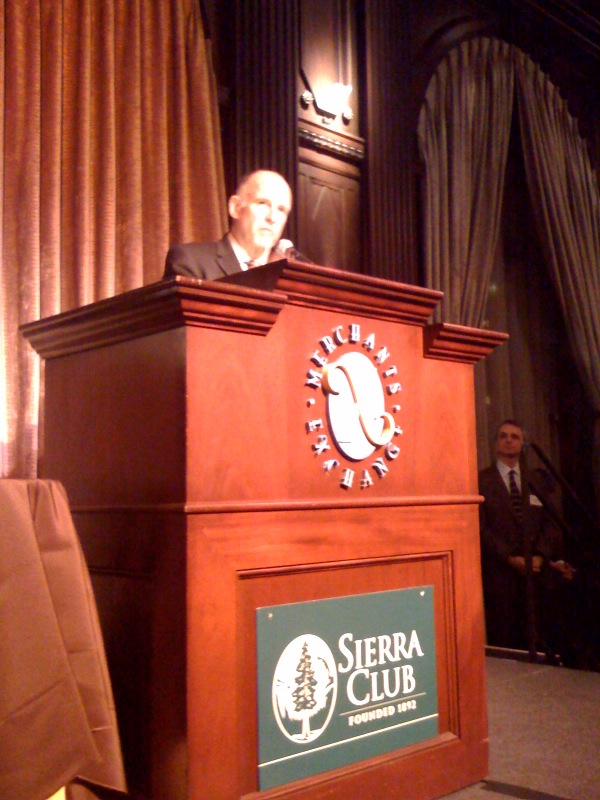
If Jerry Brown’s keynote speech last night to a gala environmentalist dinner is any indication, the Democratic Party faces an uphill battle to win this year’s governor’s race. The rambling, alternately vague and academic, and often pointless address did little to inspire or excite a large, sympathetic crowd that was loaded with top Democrats. In fact, some party luminaries were openly aghast at the poor performance, with one making this succinct (if off-the-record) assessment: “We’re fucked.”

Brown has never been a dynamic speaker, but the unscripted, half-hour speech – given at the Sierra Club San Francisco Bay Chapter’s David Brower Dinner in San Francisco, a $250 per head affair that drew top Bay Area Democrats – illustrates the danger of letting a primary be decided by legend and money rather than political persuasion.

Brown’s fundraising prowess and strong poll numbers chased Gavin Newsom and other potential rivals out of the Democratic Party gubernatorial primary, even though Brown hasn’t really outlined his political vision for California, given many extended speeches since being discussed as a candidate for governor, or even officially declared his candidacy (he and others have until March 12 to do so).

“This thing is really daunting,” Brown said of the governor’s race toward the end of the speech, seemingly unsure that he was ready to run, but saying he would make an announcement sometime in the next couple weeks.

Brown started his speech by telling the crowd that he didn’t know what he was going to talk about, so when he arrived (late) for the speech, he asked San Francisco Democratic Party chair Aaron Peskin what he should say, and Peskin told him to talk about how there were more salmon in the streams and better overall environmental health back when Brown was governor in the ‘70s.

But rather than taking that advice and giving a forceful call to strengthen environmental regulation or conjure up California’s better days, Brown meandered around and mused on that and other topics, feeding fears that the 71-year-old candidate might come off as a nostalgic, slightly senile former-Governor Moonbeam rather than an effective agent of needed change.

“During that period when I was governor, I’m not going to call it the golden age because some people think I’m in the golden age, so I don’t want to get people confused. That’s why I don’t want to talk about way back then, because there are a number of people I can see weren’t even born then, so it gets a little embarrassing and I like to pretend it was just yesterday. But in that period, California created almost twice as many jobs as the nation did. We created jobs at about 24 percent over eight years and the nation grew jobs at 13 percent, so almost twice as much. And then Deukmejian did pretty good, he had about the same, maybe half a percent more,” Brown rambled, ticking off statistics, hedging his point by noting how little governors can really do to create jobs, before working up to a decent line that was flatly delivered: “It was a time when the environment got its biggest boost, as far as public policy.”

Nobody applauded, so he continued. “I was thinking tonight, I was trying to figure out that if I did announce, what the hell would I say? And so I decided to go back and read my first announcement, January 24, 1974. I was 35 then, it was another time, I’m now a little older than that. But I talked about clean air, I talked about the energy crisis and getting new sources of energy. I talked about statewide land use planning” – that last item drawing some applause – “and I talked about jobs. And I was thinking, wow, we still got a jobs problem, we got an energy problem, we have a land use problem that feeds into the energy problem, and while the air is cleaner in many respects, it’s not clean enough, or it isn’t healthy enough.”

On substance, Brown had his moments. But even on the need for better statewide land use planning, he went off on a tangent, saying he didn’t even know what that meant when he filled out a Sierra Club questionnaire back in the ‘70s, and he’s not sure how to accomplish it now. 

“You have to make it easier to live closer to where you work,” Brown said in what of his few lines of the night that drew applause, although he didn’t begin to explain how he might achieve this goal. And on a controversial subject that is easily attacked by the right – big government wants more control over private property – Brown’s lackadaisical discussion of the issue was disconcerting.

He even rankled a few Sierra Club members by vaguely criticizing East Bay growth controls designed to reduce sprawl, which the Attorney General’s Office is seeking to overturn: “Pleasanton wants to create 50,000 jobs, but they have a housing cap – for all I know, Sierra Club probably supported that housing cap, so I want to just rub your nose in the housing cap for just a minute – the trouble with the housing cap is they want to create all these jobs.”

Brown tried to argue that allowing more housing in Pleasanton is a strategy for combating global warming because there are jobs there and it would reduce commutes, but he’s going to need to be more on his game than he is right now to win that argument. Instead, we get his fairly dismissive summary of this important issue: “Land use is a big deal, it’s difficult, lots to do on that.”

Against businesswoman Meg Whitman, the Republican gubernatorial primary frontrunner, there is real potential in Brown’s basic belief that markets need to be regulated and that running the government isn’t just like running a business. And somehow, Brown will need to find a way to better distill and deliver that message to counter the right’s pro-business sound bites. 

“There are people saying business knows best,” Brown said, meandering off about companies and widgets for a minute before continuing his point. “But when you look at what we really have to deal with, it’s not just about economics and the market. It’s also about ecology and morality, and morality is about customs, it’s about traditions, it’s about our deepest patterns of how we all relate to one another and that can’t just be assimilated into market incentives. The market assumes honesty, you meet your promises, and also assumes there’s a framework, because things can just run off the cliff and that’s exactly what’s happening. As you add more people, you have more cars, and when you have more cars, they burn fossil fuel and what’s happening in California is you have cars reproducing faster than people…That’s the real challenge here, that we’re trying to get the idea out that we’re trying to save the future.”

alt.sex.column: Ars longa

0

andrea@altsexcolumn.com

Dear Andrea:

I’m 43, good-looking, and reputedly sexy, funny, and easy to hang out with. I got laid almost daily in my 20s. But my last steady relationship was in 2007. My confidence is at an all-time low. I masturbate way too much to movies with Asian women and men who are hung to the floor, which makes me feel very small. I’m in a bad place right now and I don’t see the point of approaching women since I won’t be able to satisfy them like in the movies.

I’m a little under five inches. I’ve never felt comfortable with my size, although I did become very imaginative, creative, and kinky to give women pleasure. But I have never made a woman shake or moan with my penis. I miss female companionship, but I don’t feel man enough to try anymore. I just don’t have the confidence. Now I just fantasize about the kind of women I used to get.

Love,

Feeling Small

Dear Small:

Back when I used to answer questions at San Francisco Sex Information, we used to hear from a lot of guys who assumed that intercourse ought to go on for 90 minutes, penises ought to be at least 8 inches long, and all women achieve dramatic and very noisy orgasms from straight-ahead pounding and enjoy nothing more than a nice refreshing facial. What these guys had in common, was over-exposure to (mainstream) porn and little or no real-life experience from which to develop the kind of bullshit-o-meter one needs to protect one’s fragile sense of self-worth from most artifacts of popular culture, including Hollywood movies and all those songs about doing it all night till the morning light.

Those guys were virgins or recently devirginated, though, and were dismayed when real life failed, as it so often does, to match its own hype. You have no such excuse. You have actually done it with a real girl. Lots and lots of real girls, to hear you tell it. So buck up and back away from the giant-dick porn. Maybe try some amateur stuff, which, while still porn and still rife with porny conventions, may at least be more realistically scaled.

You do know that porn, like advertising, is aspirational and relies on a viewer’s ability to project himself into the imagined scenario, right? And it probably doesn’t work so well on people who already feel as rich, thin, powerful, well-dressed, and sexually satisfied as the people portrayed. Messages designed to make you feel unsatisfied with your own lot can be especially persuasive when you’re feeling vulnerable. So I assume that you also know that porn, however powerful, does not possess secret witch-doctor superpowers and cannot reach through the screen and SHRINK YOUR PENIS. So what the hell, dude? You were the same (admittedly smallish but hardly pathologically so) size back when you were in like Flynn. And all those women were not complaining then. Something has changed but it’s not the equipment.

I stopped making art when I stopped having the time and space (I hear these two are related somehow) to really spread out and do stuff, and I lost some confidence in my skills along the way, but a few weeks ago, sick of being a person who doesn’t do art, I dragged all my supplies out of storage and made something. If I can make art, you can … screw (despite the set-up I just could not, in the end, bring myself to say "make love").

I usually tell the unhung that they’ll have to develop mad skillz instead of relying on brute size to do the work for them. And then I add that everybody else would do well to do the same, since brute size is never a replacement for the skill that you, reportedly, already possess. And I usually throw in the fact that, speaking of not much penis, the people who report the most satisfying sex lives in all those surveys tend to be … lesbians.

To shake bad habits of thought and bad habits, period, find a cognitive-behavioral therapist. And to combat the blues from not getting laid, take a deep breath and find a date. Just don’t get the two things confused, and don’t put "has small penis" in the personals ad. Many women don’t care (and some prefer what you’ve got to offer) but it just doesn’t sound nice. You don’t have to marry this date. You don’t have to do her. Just prove to yourself that you can go.

And yes, I do know it’s not that easy. Neither is getting imaginative and kinky and giving women pleasure, and you used to do all that just fine. I would caution you, though, that thinking of women as something you (used to) "get" may have flown in 2007, but it won’t work now, bub. It’s a new decade.

Love,

Andrea

See Andrea’s other column at carnalnation.com.

Cities and memory

0

arts@sfbg.com

VISUAL ART Tucked into the first floor corner of Berkeley Art Museum’s Matrix gallery, Ahmet Ögüt’s Exploded City — installment 231 in the MATRIX series — doesn’t look like much at first glance. Originally commissioned for the Turkish Pavilion at the 2009 Venice Biennale, the installation centers around a mini-metropolis of meticulously constructed scale models of buildings arranged on concrete risers. On closer inspection, you notice that high-rise hotels abut mosques, and what look to be modest earthenware homes stand next to towering, anonymous office buildings. There is even a train, far below, that sits unmoving on tracks that loop between the risers.

What unites the buildings, sites, and vehicles of Exploded City is that all have figured in acts of violence and terrorism over the past two decades. A large, clear plastic legend features renderings of each structure and vehicle located in the model, along with its name, real world locale, and the date(s) it was subject to attack. From the Europa Hotel in Belfast, Ireland, which was damaged 33 times by Provisional IRA bombs between 1972-94, to most recently, the Oberoi, Trident in Mumbai, which was taken over in the 2008 terrorist attacks on that city, Ögüt has assembled a condensed, three-dimensional map of terrorism’s far-reaching geography.

I think it’s safe to say that most of us wouldn’t be able to identify by sight many of the buildings Ögüt has selected, or be able to piece together what grim distinction they all share. It is an ignorance set into relief by constantly going between the model and the wall key, connecting a particle board and plastic stand-in to some real life tragedy, the details of which we can only ascertain through our own empathetic imaginations. (Ögüt doesn’t give any information about how many unsuspecting people were killed at each site, or for which cause others willingly gave their lives.)

This makes the absence of the Twin Towers from Exploded City all the more pointed (the Oklahoma Federal Building is included). Ögüt’s decision to sidestep what has become a fetish object for the right wing — one that the Bush administration used to justify the atrocities depicted in Fernando Botero’s Abu Ghraib paintings, also currently on view at BAM — and instead focus on those sites which history has perhaps already forgotten, such as the two Afghani homes that were both accidentally bombed during wedding receptions, is a humbling reminder that no country or philosophy has a purchase on tragedy.

At the same time, Exploded City is not simply a necropolis. Ögüt has referred to his piece as a “3-D archive,” an index to be searched through and activated, rather than as, say, a memorial. Perhaps in a nod to its first Venetian home, a second, lengthy wall text describes the installation from the point of view of Marco Polo in Italo Calvino’s 1972 book Invisible Cities, in which Polo spends his days recounting fantastic cities from his voyages to the Kublai Khan. “This city is from the future,” Ögüt’s text reads. “Those who live there have emigrated from faraway lands, with dreams of traveling to the future. When they realized that there was no finding the future, they decided to build this city.”

A city of the future imagined by inhabitants whose real world futures would invariably be violently curtailed, Exploded City is a utopia in all senses of the word: an ideal that can never exist. Ögüt’s Polo describes meeting residents who can detail the exact manner in which they will die, and yet, it is implied, more will come to the site of the Exploded City to rebuild over their remains and the cycle will start anew. Ögüt’s model city captures that moment in freeze-frame, following the advice for survival that Calvino’s Polo dispenses at the novel’s end: “See and learn to recognize who and what, in the midst of the inferno, are not inferno, then make them endure, give them space.”

AHMET ÖGÜT: EXPLODED CITY/MATRIX 231

Through April 11, $5–$8 (free for Berkeley students/staff, and children under 12)

Berkeley Art Museum

2626 Bancroft, Berk.

(510) 642-0808

www.bampfa.berkeley.edu


Our weekly picks

0

WEDNESDAY (10th)

EVENT

Electronic Frontier Foundation: 20 Years

With technology becoming ever more an integral part of our daily lives, important issues surrounding digital rights continue to arise in new forms, be they regarding net neutrality, government wiretapping, or downloading music. The Electronic Frontier Foundation, a nonprofit civil liberties organization, was founded in 1990 to defend people’s rights in the areas of free speech, innovation, privacy and more. EFF celebrates its 20th anniversary tonight with a party and fundraiser hosted by Mythbusters’ Adam Savage, featuring music, entertainment, and tech luminaries such as Apple cofounder Steve Wozniak and Lotus 1-2-3 program designer Mitch Kapor. (Sean McCourt)

8 p.m., $30

DNA Lounge

375 11th St., SF.

(415) 626-1409

www.dnalounge.com, www.eff.org

THURSDAY (11th)

VISUAL ART

ARTEMIO: “Gersamkunstwerk”; Frankie Martin: “Through the Vortex”

Nothing sounds more disparate than “guns, grenades, bombs, and machetes” assembled into a mandala; and video of a “1,000 mile, California coastal bicycle” voyage. But who knows, juxtapositions create funny things like frisson. What distinguishes Mexico City conceptual artist ARTEMIO from New York “nomadic inter-media artist” Frankie Martin could potentially create a third work where the paradoxical polarities and politics of drug wars infiltrate the narratives of mobile subjectivity this side of the leisure-born border. I’m thinking something like Road Rash, the 1991 Sega Genesis video game where motorcyclists beat each other with chains and baseball bats in a race to the champagne and bikini line. You might see something a bit more sophisticated. (Spencer Young)

7–11 p.m. (through March 13), free

Queen’s Nails Projects

3191 Mission, SF

(415) 314-6785

www.queensnailsprojects.com

FRIDAY (12th)

FILM

“A Valentine’s Tribute Weekend to John Hughes”

When the Oscars’ people-who-died montage rolls around in March, more than one child of the ’80s will raise a fist for John Hughes, the writer-director-producer of many of the era’s most beloved teen films. Midnites for Maniacs programmer and host Jesse Hawthorne Ficks feels your pain — he’s assembled seven of Hughes’ enduring classics for a two-day feast of class- and clique-disrupting romances, multiple Ringwalds, touchy-feely grandmas, homemade prom dresses, Ferraris, the best fucking movie about travel ever (you can bet your John Candy it ain’t Up in the Air), and Bueller … Bueller … Bueller. The marathon begins tonight with Some Kind of Wonderful . Angst ahead! (Cheryl Eddy)

7:30 p.m. (Some Kind of Wonderful), 9:30 p.m. (Ferris Bueller’s Day Off) and 11:45 p.m. (National Lampoon’s Vacation); through Sat/13, $10 per day

Castro Theater

429 Castro, SF

(415) 621-6120

www.ticketweb.com

MUSIC

San Francisco Bluegrass and Old-Time Festival

Old-timey — it’s not just for lemonade, hoop skirts, handlebar mustaches, and dial-ups. It’s also for the retro-coolly acronymed SFBOT, raising its analog arms and taking over dozens of the Bay’s venues with that sweet, sweet sound of everyone’s favorite time period: yore. Loudon Wainwright III, Stairwell Sisters, Water Tower Bucket Boys, Asylum Street Spankers, and a strummin’ army of fiddlers, yelpers, crooners, stompers, hoofers, and juggers blow wildly through the roots of this 11th annual harmonic convergence. Oh yes, there shall be banjos. (Marke B.)

Various times, venues, and prices (through Feb. 24)

Tonight: Red Molly, Stairwell Sisters

8 p.m., $19.50

Freight and Salvage

2020 Addison, Berk.

www.sfbluegrass.org

MUSIC

Mahogany Soul Series: Chico DeBarge, Martin Luther

It’s Friday night — time to mellow out to some old school soul sounds. Chico DeBarge is a charismatic and skilled songwriter and producer long known for making the ladies swoon with his sensual singing style. He’s joined by fellow R&B man Martin Luther. Also in the mix is DJ Sake-1. Part of Ineffable Music Group’s Mahogany Soul Series, this event is a trifecta for R&B lovers. (Lilan Kane)

9 p.m. $16–$20

Shattuck Down Low

2284 Shattuck, Berk.

(650) 291-1732

ineffablerecords.inticketing.com

MUSIC

Badfish: A Tribute to Sublime

Badfish, named after a song on Sublime’s 40 Oz. to Freedom (Gasoline Alley/MCA, 1992), has helped keep the Sublime spirit alive. The group formed in 2001 when they met at the University of Rhode Island, where they were computer science majors. They’ve quickly garnered a fanbase in the college music scene and have played to sold out crowds since 2006. The members are also in their own non-tribute band, Scotty Don’t, which usually serves as the opening act for Badfish shows. (Kane)

9 p.m., $65–$84

Regency Ballroom

1290 Sutter, SF

(415) 673-5716

www.theregencyballroom.com

SATURDAY (13th)

EVENT

Alameda Zombie Crawl

Movies (and music videos) have taught us that zombies can run, swim, operate amusement park machinery, and perform synchronized dances. It turns out the undead even enjoy exotic cocktails — ergo, the first annual Alameda Zombie Crawl, which kicks off with drink specials (including, duh, Zombies) at the Forbidden Island Tiki Lounge. The brain-chomping masses will then head to Scobies Sports Bar and Grill and Lost Weekend Lounge, before breaking off into smaller groups to terrorize shopping malls and farmhouses in rural Pennsylvania. Come dressed to kill — er, like you’ve already been killed; there’ll be makeup assistance ashore the Island for anyone who doesn’t have Tom Savini-style gore-and-latex skills. (Eddy)

7 p.m. (makeup starting at 5 p.m., $5–$50), free

Forbidden Island Tiki Lounge

1304 Lincoln, Alameda

alamedazombie@live.com

EVENT/DANCE

Black Choreographers Festival

The Black Choreographers Festival kicks off its three-weekend run in Oakland with workshops, public discussions, $10 master classes, and seminars. New this is year is a free film series presented in partnership with see.think.dance. Starting this Saturday in Oakland, it includes documentaries, feature films, and shorts from Africa and the diaspora. Also this weekend is a Sunday morning youth meet, after which the young dancers invite the public to an afternoon concert. Despite videos and all manner of documentation, dance still gets passed on directly from one body to the next. This is an opportunity to see the next generation. Participating groups include Dimensions Extensions Dance Ensemble, Destiny Arts, Oakland School of the Arts, San Francisco School of the Arts, and On Demand. (Rita Felciano)

1–6 p.m. (also Sun/14, 4 p.m.; festival through Feb 28), free–$10

Malonga Casquelourd Center for the Arts

1428 Alice, Oakl.

(888) 819-9106

www.bcfhereandnow.com

EVENT

Workshop: “DIY Valentine — Sexy Bedroom”

Extravagant gifts and pricey candlelit dinners for the big V day have, more or less, become a thing of the past. In this economy, many are having to craft new ways of celebrating the day dedicated to all things love. Fortunately Kelly Malone is giving a sultry tutorial on how the ladies, and even gents, can spice up their bedrooms for the big night. At Workshop, you’ll learn how perfect a seductive cocktail, tease your hair like Brigitte Bardot, create alluring smoky eyes, and transform your unadorned room into a lair fit for a sex kitten. (Elise-Marie Brown)

5:30 p.m., $40 (sign-up required)

Workshop

1798 McAllister, SF

(415) 874-9186

www.workshopsf.org

DANCE

Company C Contemporary Ballet

At nine, Company C Contemporary Ballet has found its groove. Two things stood out at last month’s Walnut Creek performances that will be repeated on this side of the Bay this weekend. These are beautifully alert dancers who can shine in a wide range of repertoire. Being in a small company, they switch gears rapidly and admirably. Also, founding Artistic Director Charles Anderson has a gift for programming. He commissioned Amy Seiwert in a hot nightclub number, brought Lar Lubovitch’s flowing Cavalcade to a tough Steve Reich score, introduced Charles Moulton’s ingenious Nine Person Ball Passing to a new generation, and choreographed his own Akimbo. He knows what’s he’s doing. (Felciano)

8 p.m. (also Sun/14, 2 p.m.), $18–$40

Yerba Buena Center for the Arts

Novellus Theater

701 Mission, SF

415 978-ARTS

www.ybca.org

SUNDAY (14th)

EVENT/FILM/MUSIC

Marc Huestis Presents “Justin Bond: Close to You” and Whatever Happened to Susan Jane?

“Did he beat you, girl? You got burned if he didn’t beat you, girl.” I can’t think of any better romantic advice than that, gleaned from a scene in Marc Huestis’ San Francisco new wave comedy from 1982, Whatever Happened to Susan Jane? Besides drag queen wisdom, the flick dispenses some great back-in-vogue music, including tunes from Tuxedo Moon and Indoor Life. A DVD release screening of it is just the prelude to a night with SF girl-gone-good Justin Bond, who’ll be singing Carpenters hits with a 10-piece orchestra, and hosting special guests the Thrillpeddlers. Trash the Ipecac and be my bloody, melancholy valentine. (Johnny Ray Huston)

Susan Jane: noon, $8

Justin Bond: 8:15 p.m., $25–$75

Castro Theatre

419 Castro, SF

(415) 621-6120

www.ticketweb.com

MUSIC

Girls, Smith Westerns

Girls were last year’s critical darlings, but their tour mates the Smith Westerns have perhaps a more interesting rise to fame. Hailing from Chicago, the four members range from 17 to 19 years old. They play the sort of Nuggets rock that went out of style 20 years before they were born. With songs like “Girl in Love” and “Be My Girl,” these guys wear their hearts on their sleeves — and really, isn’t that what Valentine’s Day is all about? (Peter Galvin)

With Magic Kinds, Hunx and the Punkettes

7 30 p.m., $16, sold out

Great American Music Hall

859 O’Farrell, SF

(415) 885-0750

www.gamh.com

MUSIC

The Damned

Planting its stake in music history as the first U.K. punk band to release a single and tour the U.S., the Damned turned heads with “New Rose” and “Neat Neat Neat.” But since today is Valentine’s Day, perhaps its tune “Love Song” is most appropriate to sing along to: “I’ll be the ticket if you’re my collector/ I’ve got the fare if you’re my inspector/ I’ll be the luggage, if you’ll be the porter/ I’ll be the parcel, if you’ll be my sorter.” Join founding members Dave Vanian and Captain Sensible for a chaotic romp through the old days and slam dance with your sweetheart. (McCourt)

With Hewhocannotbenamed and the Generators

8 p.m. (7 p.m. doors), $30 ($54.95 with dinner)

Slim’s

333 11th St., SF

(415) 255-0333

www.slims-sf.com

MUSIC

Leela James

Leela James’s debut album A Change Is Gonna Come (Warner Bros., 2005) received rave reviews from critics and comparisons to Aretha Franklin and Chaka Khan. After four years and a break from a major label, she’s returned with her self-produced sophomore record, Let’s Do It Again (Shanachie Records). The album was recorded using live takes, much like the original soul recordings created at Stax and Muscle Shoals. James pays homage to her musical influences with covers by Betty Wright, Bobby Womack, and the Staples Singers, to name a few. Attention soul lovers: let loose some raw emotion on V-Day. (Kane)

7 p.m. $30

Yoshi’s SF

1330 Fillmore, SF.

(415) 655-5600

www.yoshis.com

TUESDAY (16th)

MUSIC

Fat Tuesday Mardi Gras Party!: Dirty Dozen Brass Band, Zigaboo Modeliste & the New Aahkesstra, DJ Harry D

Oh Mardi Gras, the time of year where beads almost help people avert indecent exposure and jazz bands blare throughout the streets. It’s one of those rare moments that I find myself wanting to be in a city other than San Francisco. But since some of us can’t fly down to New Orleans for the week, the next best thing to the Southern goodness that is Louisiana is the Fat Tuesday party going down at the Independent. Listen to the sounds of the Dirty Dozen Brass Band while downing a glass of bourbon, and be transported to the place of deep, dark bayous and ambrosial gumbo. (Brown)

7:30 p.m., $22

Independent

628 Divisadero, SF

(415) 771-1421

theindependentsf.com

EVENT

“Ask a Scientist: Quantum Mechanics”

Although most of us are glad to be done with school and liberated from 10-page papers and final exams, every now and then it’s nice to learn something new. With the “Ask A Scientist” series anyone can unfold the scientific mysteries that make up the world we inhabit, at least on a level that can be taught in two hours. Discover how energy and matter make up quantum mechanics, how an object can be in two places at once, and other science stuff. (Brown)

7:00 p.m., free (excluding food or drinks)

Horatius

350 Kansas, SF

www.askascientistsf.com

The Guardian listings deadline is two weeks prior to our Wednesday publication date. To submit an item for consideration, please include the title of the event, a brief description of the event, date and time, venue name, street address (listing cross streets only isn’t sufficient), city, telephone number readers can call for more information, telephone number for media, and admission costs. Send information to Listings, the Guardian Building, 135 Mississippi St., SF, CA 94107; fax to (415) 487-2506; or e-mail (paste press release into e-mail body — no text attachments, please) to listings@sfbg.com. We cannot guarantee the return of photos, but enclosing an SASE helps. Digital photos may be submitted in jpeg format; the image must be at least 240 dpi and four inches by six inches in size. We regret we cannot accept listings over the phone.


Atlanta beats the pants off SF — again

0


atlanta0110.jpg
Hot guys mostly not in their underwear at Atlanta’s 2009 Pride Parade

In general, San Franciscans deal with an existential crisis in one of two ways: binge drinking or making idle threats to move to New York. Usually, it’s a combination of both. Concerning the latter, we frequently cite the Big Apple’s better nightlife, for which we are prepared to sacrifice amazing food, outrageously mild weather, and overall happiness and sense of well-being.

Our behavior needs to stop. Listen, whatever problems you may have, New York isn’t going to solve them for you. I learned this lesson the hard way. Once upon a time, I turned threat into reality. I packed up all my things, threw myself a teary goodbye party, and got an apartment in Williamsburg. Several months later, I was happily back in San Francisco. It was embarrassing.

Here’s a piece of advice. Next time you hate your life, instead of threatening to move to New York City, why don’t you threaten to move to Atlanta?


I’m serious. Last year, a Trojan sex study revealed that Atlantans are “most sexually satisfied” out of 10 cities surveyed. San Francisco ranked dead last. 73% of Atlantans participating in the survey professed to have satisfying sex. That’s pretty good.

I know what you’re thinking. Back then, I was skeptical too. Now, I’m prepared to suspend some of my disbelief. The Advocate just published an article on the 15 gayest cities in America, based on the number, per capita, of gay couples, gay bars, cruising spots, and gay films on Netflix queues, among other criteria. The gayest city, of course, was revealed to be… Atlanta?

What is it with this place?

San Francisco wasn’t even on the list. Mike Albo writes, “This admittedly subjective search reveals spots that are much more pink than you might think. Determined by a completely unscientific but accurate statistical equation, these gayest cities may surprise you. Iowa City, Austin, and Asheville have more gays per capita than the biggies.” On Atlanta, he says, “Atlanta guys are hunky… And who doesn’t love the sweet lilt of a Georgia accent on a knockout guy or gal?”

Admittedly, the Southern accent is cute. Next time you are sexually or otherwise frustrated enough to utter that old “I’m moving to New York” platitude, why not replace “New York” with “Atlanta”? Atlanta has better weather, a lower cost of living, and good-looking people, and the stats show that, whether straight or gay, Atlantans are having a lot of great sex. Repeat after me: “I’m moving to Atlanta!”

Before I get labeled a disgraceful turncoat, I’ll admit I’m arguing Atlanta’s case on the basis of reverse psychology. Those temporarily dissatisfied with the Bay Area might finally have a cure for their existential malaise! Imagine waking up tomorrow to find yourself living in Atlanta. Let that thought marinate for a while. You live in Atlanta. Suddenly, things don’t seem so bad here, do they.


ACORN-hater O’Keefe arrested in Louisiana Watergate

0

We don’t know why O’Keefe targeted Louisiana’s Landrieu, but we do know he led the attack on ACORN in 2009

Last year, we wrote about how Karl Rove targeted ACORN in 2006 as part of a concerted Republican campaign to attack progressive organizations that were registering low-income voters and helping them fight corporate power.

Those attacks came to a seemingly salacious climax in 2009, when James O’Keefe, a conservative videographer, secretly taped some ACORN employees saying stupid things—an incident that somehow became one of the biggest political stories of the year.

And now O’Keefe is back in the political headlines, only this time as one of four men charged Jan. 26 with trying to illegally access and manipulate the phone system in a district office of U.S. Sen. Mary Landrieu of Louisiana.

We don’t yet know why O’Keefe targeted the Democratic senator from Louisiana. But his arrest has a fortunate side effect: it’s keeping the focus on the results of an official investigation into ACORN—a story that otherwise probably wouldn’t have got much coverage but is now being widely reported.

Take CNN’s coverage of O’Keefe’s arrest. It notes that, “a review by former Massachusetts Attorney General Scott Harshbarger, who was hired by ACORN to examine the issue, found no wrongdoing by ACORN employees.”

It also notes that O’Keefe and a female associate were named in a lawsuit that an ACORN worker in Philadelphia, Pennsylvania, filed Jan. 21, accusing the pair of illegally videotaping an interview with her last July and distributing it on the Internet.

“That video and others by O’Keefe and his associate led to the dismissal of four ACORN employees who appeared to offer advice to the couple and to federal legislation barring the group from receiving federal funds,” CNN notes.

Now, I don’t expect the right-wing attack machine to stop its assault on progressive organizations and individuals, any time soon, but there’s hope the truth will eventually out.

Hard Times Handbook

0

It’s tough out there. The recession is supposed to be over, although you’d never know it to walk the streets of San Francisco. But we’re here to help; our Hard Times Handbook offers tips on bargains, deals, and discounts to make those fewer dollars go further.

———-

Broke doesn’t mean bored

Eight great ways to have fun in San Francisco for $5 or less

By Johnny Funcheap

Living on a tight budget and still trying to have fun in San Francisco is a near impossible task. This is an expensive city, thanks to the reality that everyone wants to live in the tiny 49-square-mile cultural oasis — driving up rents and the cost of just about everything else.

Despite its reputation, the city is actually getting slightly more affordable, if ever so relatively. (In 2008 San Francisco actually fell in the rankings of most expensive cities in the U.S. from fourth to fifth.)

Leading the charge toward making the city a more affordable place to have fun are numerous businesses, government-run sites, and co-ops that are trying to survive in the recession themselves — and using big discounts and fun free events to try to lure you in.

Here’s a list of my favorite deals and freebies I’ve found so far for 2010.

CAFÉ ROYALE

Waving the flag high for nightlife in the Trendynob with its curved couches and velvet curtains is the cozy beer and wine bar Café Royale. This late-night venue (it’s open until 2 a.m. Fridays and Saturdays) stages more than 20 nights of free events each month, an eclectic mix of live entertainment that includes jazz bands, Beatles karaoke, book readings, slam poetry, stand-up comedy, and even the odd accordion night. You can dine on small plates and noshables until the wee hours, and wash them down with a robust selection of wines by the glass and creatively yummy Soju cocktails like the Pom Pom and Creamsicle. And for billiards fans, Café Royale has one of the few three-quarter size tournament tables in San Francisco at just 75 cents a game.

800 Post at Leavenworth. 415-441-4099. www.caferoyale-sf.com

COUNTERPULSE

More an arts and culture community hub than just a performance space, CounterPULSE serves as a home and venue for a diverse mix of local artists, dancers, and playwrights to practice and showcase their latest works. A majority of the events at this nonprofit theater (plays, dance performances, as well as classes and workshops) are free. For more elaborate productions that require tickets, CounterPULSE has a wonderful “no one turned away for lack of funds” policy. You can also get in free by donating a few hours of your time to the volunteer usher program.

1310 Mission at Ninth St., 415-626-2060. www.counterpulse.org

$5 MOVIE NIGHT

Saving money on going out to the movies used to mean you had to blag your way to a cheap ticket using a long-expired student ID or arrive by lunchtime to save a few bucks on a matinee ticket. The historic Roxie Theater has done away with all of those shenanigans, at least on Monday nights, with cheaper-than-matinee prices ($5) to all films (except for the odd film festival or special screening when regular ticket prices still apply). This stalwart of the Mission District, which recently celebrated its 100th birthday, is an independent art-house theater that shows limited-run art, music, foreign, and documentary films on two small screens.

Roxie Theater, 3117 16th St., 415-431-3611. www.roxie.com

BART DISCOUNTS AND FREE RIDES

You didn’t think BART — notoriously expensive for commuters — could be the source of cheap events, did you? Well, mybart.org, run by the transit system, lists a calendar of free events that take place close to BART stations. The site also gives you access to an constantly updated bevy of special discounts like two-for-one theater tickets, museum discounts, and heavily-discounted tickets to Warriors and Cal basketball games. For those of you who only respond to free, mybart.org also puts together ticket contests with different prizes each week, like the chance to win one of five preloaded $50 BART tickets.

www.mybart.org

PIER CRABBING

Hell with Fisherman’s Wharf and its giant crab sign. Forget the pricey crab dinners at local restaurants. You can learn how to be your own crusty crab-fisher, right in the shadow of the Golden Gate Bridge. The National Park Service staffers at the historic Fort Port (built in the 1850s) give free pier-crabbing demonstrations every Saturday morning from March to October. After the class, they’ll even loan you crabbing equipment so you can put your newly-learned skills to the test. Space is limited and advanced reservations are required.

Fort Point, Marine Drive, Saturdays, 10 a.m.–noon, March–Oct. (415) 556-1693 www.nps.gov/fopo

THE HISTORY OF BAY AREA ROCK ‘N’ ROLL

Feeling nostalgic? You can get a taste for the era when the Bay Area and the psychedelic music scene were the center of the rock ‘n’ roll universe at the Museum of Performance and Design’s free history exhibit “Something’s Happenin’ Here: Bay Area Rock ‘n’ Roll 1963-73.” On display at this one-of-a-kind exhibit are the full-size original painting that made in onto the Grateful Dead’s “Anthem in the Sun” album cover, costume pieces worn by stars like Janis Joplin and Sly Stone, and original posters from the Fillmore and the Avalon Ballroom, along with a collection of previously unseen rock photos. Visitors can also listen to rare audioclips and watch vintage film footage they probably never knew existed. Exhibit runs through Aug. 28. It’s free, but the museum suggests a $5 donation.

Museum of Performance and Design, Veterans Building, 401 Van Ness, Fourth Floor. Wed.–Sat., noon–5 p.m. www.mpdsf.org

AMERICAN BOOKBINDERS MUSEUM

If you’re really looking for a blast from the past, check out the free exhibit at this little-known museum. Bookbinding is the art of physically assembling and sewing the pages and spine of a book by hand — a skill that was made essentially obsolete (at least, for the purpose of mass-production) with the dawning of the Industrial Revolution. But the nonprofit American Bookbinders Museum, part of a working bookbindery that still practices this art, documents the history of how books used to be put together with exhibits celebrating the skilled artisans who bound books, samples of vintage papers, and a maze of large and terrifying-looking 19th- and early 20th-century binding and cutting machines (many of which could cut off all your fingers in one go if you stood too close).

1962 Harrison at 16th St., Saturdays, noon–4 p.m. and by appointment, (415) 710-9369. www.bookbindersmuseum.com

SAN FRANCISCO BICYCLE COALITION

Unless you want to walk, there’s really no cheaper way to get around town than on a bicycle. And for the tens of thousands of San Franciscans who use bikes as their main mode of transportation, the Bike Coalition is a co-op knight in shining armor. The advocacy group, whose members successfully fought more than 200 miles of bike lanes in the city as well as bike access on Muni and BART, also puts on and sponsors a handful of events each month such as free urban cycling workshops to help you navigate the city streets safely, themed guided bike rides, and many other bike-friendly events. Membership starts at $35 per year, but many of their events are free for nonmembers or for a $5 donation.

www.sfbike.org

D-STRUCTURE

Owned by former pro skater and X-Games judge Azikiwee Anderson, D-Structure in the Lower Haight blurs the line between retail store, art gallery and performance space in a big way. Every month, this self-described “lifestyle clothing brand culture store” lets local artists take over the space and use the entire store as their canvas. For launch parties, which take place several times each month, the merchandise displays of urban hoodies and t-shirts and hip beanies are pushed to the walls to make room for DJs and events that range from art openings with live painting to indie rock shows, hip hop album release parties and film screenings. And did we mention the open bar? During its nighttime events, most of which are free and open to the public, D-Structure has been known to bring in a truck load of beer; that’s what happened on New Year’s Eve.

520 Haight, 415-252-8601, Mon.–Sat., noon–8 p.m.; Sundays, noon–6 p.m. www.d-structuresf.com

Johnny Funcheap runs FunCheapSF.com, a free SF-based service that uncovers and shares a hand-picked recommendation list of more than 50 cheap, fun, unique Bay Area events each week.

———-

Drink early and often

Five great happy hours that offer bargain booze — and amazing food deals

By Virginia Miller

BAR CRUDO’S HAPPY HOUR

About the best crudo (and some of the best seafood) anywhere, Bar Crudo’s new digs on Divisadero Street provide ample room for you and your friends. You want to go at happy hour; there’s free food and you can also get sweet deal on what is arguably one of the best seafood chowders around. A creamy bowl rich with fish, mussels, shrimp, squid, potatoes, and applewood-smoked bacon goes for $5 (normally $14). Oysters from British Columbia, Prince Edward Island, and Washington are normally $2.50 each, but only $1 during happy hour. Beer and wine specials rotate, $5 for wine or $3 for beer — and we’re not talking PBR. Bar Crudo is known for a broad selection of Belgian and artisan beers, not to mention some beautiful wines.

Mon.–Thurs., 5–6:30 p.m. 655 Divisadero.415-409-0679. www.barcrudo.com

SEAFOOD HAPPY HOUR AT SWELL

For happy hour with a touch of class — and an affordable price — you can’t beat Swell, a delightful, under-the-radar crudo/seafood restaurant. The post-work crowd gets $1 oysters — and not just any oysters, but our own local Point Reyes’ bivalves. There’s ceviche with kampachi and butterfish or mackerel bruschetta with garlic-ginger oil ($8 each). For imbibing, sip $6 Bellinis and Kir Royals or $6 glasses of chardonnay, syrah, or rosé.

Mon.–Thurs., 5–7 p.m. 603 Bush. 415-956-0396. www.swellsf.com

AVENUE LOUNGE’S FREE BRATS ON SUNDAYS

I’ll give you three words: bacon bloody marys. That alone makes it worthwhile trekking to Outer Sunset’s Avenue Lounge on a Sunday. But it gets better: buy any of the $3 well drinks or draft beers ($5 to upgrade to Belvedere or Hennessy in your cocktail) and they’ll throw in free brats and chips. Yes, you heard right: dogs, beer, and football on the flatscreens for $3. At that price, you could settle in all day.

Sundays, 10a.m.–2 a.m.. 1334 Noriega. 415-731-3757

NAMU’S FREE-FOOD MONDAYS

Monday night is free food night at Namu, the Richmond District’s gem of an Asian fusion restaurant that combines Korean and Japanese cooking techniques with Cali-fresh cuisine. With an order of sake, beer, or glass of wine, you can nibble on what Namu is dubbing “drinking food”: bite-size tapas, skewers, and spreads with Asian flair. If you can’t stay out late on a Monday night, there’s a weekday happy hour from 5-7 p.m.

Mondays, 9:30–10:30pm. 439 Balboa. 415-386-8332.www.namusf.com

DOSA ON FILLMORE’S SOUTH INDIAN HAPPY HOUR

This Pac Heights wing of Dosa has the feel of a chic London Indian restaurant, with striking chandeliers and gorgeous Indian-influenced cocktails. The happy hour rocks with a rotating selection of beer (like India’s Kingfisher), wine (maybe a Dona Paula Argentinean malbec) and, yes, those cocktails (how about “Mood Indigo,” i.e., Buffalo Trace bourbon, jackfruit marmalade, Angostura bitters, and a splash of sparkling wine) for a mere $5 each. For the same price, there’s a range of South Indian snacks like cochin calamari sautéed in coconut milk and served with a julienned salad, or a mung sprout salad with fresh lentils, tomatoes, ginger, cucumber, grated coconut, chile, and mustard-seed oil.

Mon.–Thurs., 5:30–7 p.m. 1700 Fillmore. 415-441-3672. www.dosasf.com.

Virginia Miller writes about food for sfbg.com and offers advice for great meals at theperfectspotsf.com

————

Drinks on the cheap

By Caitlin Donohue

“No nation is drunken where wine is cheap, and none sober where the dearness of wine substitutes ardent spirits as the common beverage.” So said our illustrious forefather and part-time debaucher, Thomas Jefferson, on the importance of happy hour. We are proud of the brave bar-owning San Franciscan souls who have held true to his vision of a nation built on cheap booze and high spirits. Here assembled are their numbers, true patriots that they are.

BAR ON CHURCH

Some days you want to get drunk and throw peanut shells on the floor. This is a practice aided and abetted by the B.O.C., which serves up 50 cent PBR’s (that elixir from the heavens for the broke-as-hell contingent) and free peanuts from 4-8 p.m. on Saturdays. Sit down, throw one back and get nutty with it.

198 Church, SF. (415) 355-9211. www.thebarsf.com

TSUNAMI SUSHI

With more than 100 sake bottles on the menu, Tsunami is usually off-limits to those with holes in their pockets. Not so during happy Hour (Mon.-Fri. 5-8 p.m., Sat. 6-9 p.m.) when all bottles and selected maki rolls are half off. Try the Sho Chiku Bai nigori sake, a sweet, creamy, unfiltered 720 ml that’ll only run you $16 — ureshii yo!

Mon.–Fri. 5–8 p.m., Sat. 6–9 p.m. 301B King, SF. (415) 284-0111. www.dajanigroup.net

EL RIO

Ah, Mondays at El Rio. If shuffleboard and easy access to cheap burritos isn’t enough to pull you Outer Mission-ward, than peep their very special Monday happy hour: $1 Pabsts, $2 wells all the live-long day. Get you in with that and then tell us you can’t hang with the hipster hangouts.

3158 Mission, SF. (415) 282-3352. www.elriosf.com

KYOTO SUSHI

Japanese businessmen have a reputation for sealing big deals utterly, blackout snookered. Something about how you can only really know a man when he’s being slapped by the waitress for being fresh or passed out drooling on your suit jacket. At any rate, sushi restaurants like to get you drunk. Check out Kyoto, where the anytime special of draft Sapporos for 99 cents will compel you to raise one to the salaryman.

1233 Van Ness, SF.(415) 351-1234. www.kyotosushi-sf.com

BRAIN WASH LAUNDROMAT

Now here’s a multitask for you: get drunk, listen to good music, and wash your clothes. Only one spot in the city where that’s a go — and to celebrate the lineup of fresh tunes and clean threads, Brain Wash Laundromat is offering $1 Pabst during happy hour and $3 wine glasses all the time. Drop by for its acoustic open mic nights Tuesdays at 7 p.m.

1122 Folsom, SF. (415) 861-3363. www.brainwash.com

BEAN BAG CAFE

Not only does this sunny, warm café serve the most bangingest breakfast burrito and plethora of bean blends in the city, the folks there have a soft spot for the low-income set. Bean Bag proves it with $1.75 Stella Artois and 21st Amendment beers on tap; just the ticket for easing your way through that mid-afternoon caffeine-booze transition. Just don’t spill on the laptop and you’re golden, you pillar of the community, you.

Bean Bag Café. 601 Divisadero, SF. (415) 563-3634 *

————

How to fight foreclosure

By Caitlin Donohue

You’ve finally found your dream home, an apartment so well-loved even you can afford it. You settled in, cleaned the carpet, set the mouse traps … and then the eviction notice arrives: your landlord’s been foreclosed on. And the bank that owns the place now wants you out.

It’s happening a lot in this city, where tenants get caught in the financial meltdown through no fault of their own. But don’t panic: in most San Francisco buildings, foreclosure isn’t a legal grounds for eviction. But you’ll have to stand up for your rights.

Here’s what the San Francisco Tenants Union advises:

If you sense your landlord’s at the brink of foreclosure, watch for telltale signs: realtors checking out the property or repairs that go unresolved. Keep in mind that lack of money is no defense for maintaining property, so call the Department of Building Inspections at 415-558-6200 for help with holding property-owners to their repair responsibilities.

Once the eviction notice due to foreclosure arrives, find out if you are covered by rent control. If you aren’t (if your rental was built after 1979 then you definitely aren’t) the bank has the power to evict you within 90 days. If you do have rent control, you have eviction protection. This means the bank can’t evict you or raise your rent.

Unfortunately, the bank might not know that if it’s based outside the city or state. Ignore the letters to vacate and contact the bank of its property agent directly to let them know you have protection. Then file a wrongful eviction petition with the SF Rent Board, which also handles cases from Oakland, Berkeley and West Palo Alto (forms available at the office at 25 Van Ness, SF or online at www.sfgov.org/rentboard).

Rent control or no, landlords can only collect rent on foreclosed properties until the deed of trust has gone to the bank. Determine who has control of your property to avoid paying rent twice. This information is available at the City Assessor’s Office at 415-554-7915. Send letters to the bank and to your landlord saying you have the money but don’t know who to pay. Until you can determine who has control, don’t pay rent.

For more resources, check out SF Tenants’ Union Web site at www.sftu.org.

———–

Avoid check-cashing fees

By Caitlin Donohue

ATM charges, big old monthly fees, frustrating commercials — oh Lord, save us from these banks! But you can’t live without ’em either — the average unbanked American spends 5 percent of his or her income at the check-casher. In San Francisco, we drop a total of $40 million a year accessing our own money — not to mention how much goes toward money order fees.

Enter the Bank of San Francisco, the mayor’s brainchild that allows city residents to open a checking or savings account for $5 a month or less. The bank is open to those without Social Security numbers as well as residents who have a poor record with accounts in the past. Go to www.bankonsf.org for more information on the program, or keep an eye peeled for one of the 140 participating city banks that have a “Bank on SF” sign in their window. There’s no reason to pay check-cashing fees any more.

————

Food so cheap, it’s free

Let’s level here: how broke are you? Two-for-one beers and discounted oysters are all well and good for the casually unmonied, but there are times when one needs a real deal on nutrition — like, food that really is free. If we’ve got your number, here’s the Web site for you: www.freeprintshop.org, whose printable calendar lists 20 organizations that dish up meals open to all comers, including Food Not Bombs’ vegetarian dinners, which are served four times a week in U.N. Plaza. Free Print Shop gets the posthumous thumbs-up from Abraham Maslow: the up-to-date info on shelters, mental health, and neighborhood resources in the city has the bottom tier of your hierarchy of needs covered. Except for maybe the sex part; that might be another Web site. (Caitlin Donohue)

————-

Inner peace, by donation

It is said that whenever Buddha would speak to an audience that had not yet recognized him as their spiritual teacher, he would first expound on the concept of dana, or giving. If the listeners were unable to grasp this basic principle, he knew they weren’t ready for the Four Noble Truths.

Would that all yoga studios were this enlightened. I mean, $20 for 90 minutes of inner peace?

We are lucky that with a little bit of looking one can find financially accessible ayurveda even here, in the city of yoga-yuppies. Case in point: Yoga to the People, whose beautiful new Mission District studio (and fixture Berkeley location) offers three classes a day by donation, some of them by candlelight and all of them dana approved. And they’re not the only ones. Here’s a list of places that will relieve that tension you’ve been holding, including the strain in your wallet. (Caitlin Donohue)

YOGA TO THE PEOPLE

Class schedule online, donations

2673 16th St., SF

64 Shattuck, Berkeley

www.yogatothepeople.com

GREY AREA FOUNDATION FOR THE ARTS

Mondays, 6-7:30 p.m., donations

55 Taylor, SF

www.gaffta.org

SPORTS BASEMENT

Sundays, 1-2:30 p.m., free

1590 Bryant, SF

(415) 575-3000

LAUGHING LOTUS

Mon.-Fri. 2:30–3:45 p.m., donations

3261 16th St., SF

(415) 335-1600

www.laughinglotus.com

SATORI YOGA STUDIO

Mondays, 4:15– 5:15 p.m., free

40 First St., SF

(415) 618-0418

www.satoriyogastudio.com

PURUSHA YOGA

Saturdays, 11 a.m., free

Main entrance of Botanical Gardens

Golden Gate Park

Ninth Ave. and Lincoln Way, SF

(415) 694-8412

www.purushayoga.org

————

Learning to love the rec centers

With free gyms, darkrooms, and play areas, city rec centers may be the athlete (or artist’s) answer to the bum economy

By Molly Freedenberg

I’ve always though of recreation centers as places where kids took cheap summer camp classes or attended awkward junior high school dances. But these city-funded centers are actually some of the coolest, most affordable, and least appreciated resources any community has to offer — and especially so in San Francisco.

From weight rooms and basketball courts to dance studios, dog parks, and performance-ready auditoriums, SF’s neighborhood centers offer a variety of resources for budget-conscious adults as well as their kids. Use of most facilities is free (or, on rare occasions, costs a nominal fee) and classes and workshops are priced low with a sliding scale and scholarship option.

Why does the city allocate $34.5 million in general fund support to maintain these centers every year? According to Elton Pon, spokesperson for the Recreation and Park Department (which also oversees public spaces like Golden Gate Park and Coit Tower), “they keep the city sane.”

We’ve outlined the resources at some of our favorite centers, but check parks.sfgov.org for a full list, sfreconline.org for programs, or call (415) 831-5520 for information on renting rec center buildings.

CHINESE RECREATION CENTER

This Nob Hill neighborhood center caters primarily to youth in Chinatown, which is most apparent weekdays after 3 p.m. when its gym areas fill up with teenage boys. But everyone can enjoy volleyball, basketball, and even dance in its indoor gym, outdoor hoops, and mini weight room. The secret to getting some grown-up time? Visit early on weekdays or after 7 p.m.

1199 Mason. (415) 292-2017

EUREKA VALLEY REC CENTER

Well-maintained and recently renovated, this Castro District facility is a favorite for its resources and fantastic location (there’s a grocery store right next door, not to mention the full Castro shopping corridor a block away). Parents love that the indoor and outdoor play areas are especially good for toddlers. Dog-owners love the enclosed dog run. Sporty adults appreciate that the basketball court is regularly relacquered, while event planners focus on the auditorium with raised stage and 70-seat capacity. Special bonuses? An LGBT Teen Center and an especially girl-friendly gym scene.

100 Collingwood. (415) 831-6810

HARVEY MILK ARTS CENTER

Geared more toward artists than athletes, this recently reopened center in Duboce Park is a dream-come-true for creative-leaning folks on a budget. With dark room, dance studio, costume room, meeting spaces, and variety of other opportunities, HMAC is a fantastic and affordable alternative to adult education courses, expensive dance studios, and booked-up theater spaces.

50 Scott. (415) 554-9523

MISSION REC CENTER

This hidden gem, often overlooked by athletes headed to Mission Cliffs, offers everything your K-12 schools did — without the homework or early call-time. Mission Rec provides a weight area, ping pong tables, squash courts, a dance studio (complete with floor-to-ceiling mirrors and enclosed storage space), basketball court, outdoor playground area, and a full auditorium with stage and curtains (and food prep area).

2450 Harrison. (415) 695-5014

POTRERO HILL REC CENTER

Most people notice the baseball fields first — a full-block expanse of green, grassy oasis in the center of what’s still mostly an industrial area. But this city property also offers a well-maintained indoor basketball court, recently revamped playground, decent tennis courts (though lights rarely work), and a dog-friendly area that notoriously extends to the rest of the park when games aren’t in session. Not feeling sporty? Check out the infamous mural of O.J. Simpson (who apparently used to frequent the park as a kid) or the fantastic view of the city and the bridge from the south/southeast end of the park.

801 Arkansas. (415) 695-5009

RICHMOND REC CENTER

Catering primarily to the very young and the very old, people in the middle can certainly appreciate this classic neighborhood meeting spot. Play badminton, volleyball, or take advantage of the dance studio (where many city dance programs are held). Or just people-watch: weekdays are great for spying toddlers in the big indoor play area or quieter play-and-craft spot; weekends are when older Asian ping pong masters take over.

251 18th Ave. (415) 666-7020

UPPER NOE REC CENTER

Newish, bright, and clean, this well-loved and well-funded facility also is one of the few with its own Web site (hosted by friends of the Noe Valley Recreation Center). The bright, shiny spot offers indoor and outdoor basketball courts, a playground, baseball field, tennis court, dog park, and (according to parents-in-the-know), an inordinately nice sandbox. Indeed, this spot is known for being especially good for babies and toddlers. Another bonus? A multipurpose room that can be rented for small events features an A/V system, stage area with upgraded theater curtains, and a large movie screen with a projector.

30th Sreet, west of Church. (415) 695-5011. www.noevalleyreccenter.com

Dennis Herrera’s (mostly) most excellent swearing-in

0

Text, photos and video by Sarah Phelan

Dennis Herrera’s son believes his dad will do a great job–and here he says so in Mandarin.

There were a lot of things to like about City Attorney Dennis Herrera’s Jan. 7 swearing-in ceremony.

tourkpeskin.jpg
Alex Tourk and Aaron Peskin chat each other up.

It brought together a who’s who of Democratic elected officials, past and present, a string of supervisorial candidates, department heads, union leaders and other party cling-ons. In other words, prime feeding ground for sharky journalists in search of juicy pieces of chum.

lockeyer.jpg
State treasurer (and former State Attorney General) Bill Lockeyer did a good job of kicking off the event.

And it ended with cupcakes–in other words, prime feeding ground for snarky journalists in desperate need of calories.

chiunewha.jpg
Board President David Chiu, Mayor Gavin Newsom and City Attorney Dennis Herrera await the swearing-in.

And, as an unexpected bonus, we got to see Herrera’s eight-year-old son Declan get up and say, “I know you’ll do great, Dad,” (amongst other things) in English–and then switch into seemingly fluent Mandarin–a skill he apparently picked up by attending Chinese school, according to his obviously proud dad.

Dek.jpg
Declan wows the crowd with his bilingual prowess (and we suspect he speaks Spanish, too.)

But there was a protest action that marred Herrera’s otherwise flawless swearing-in–and it bothered the City Attorney no end, even though it was a silent protest and did not interrupt his ceremony.
ICEadvice.jpg

Organized by the San Francisco Immigrant Legal and Education Network (SFILEN), (oops, supporters of the action subsequently contacted me to say it was organized by the San Francisco Immigrant Rights Defense Committee) the protest sought to keep the limelight on the city’s newly amended sanctuary legislation, which the Board of Supervisors approved with a veto-proof majority last fall, but which Mayor Gavin Newsom has repeatedly said he intends to ignore.

Hererra, for his part, says he will doing everything he can to defend the amended legislation, which seeks to ensure that juveniles get their day in court before being referred to federal immigration authorities.

The legislation was amended in fall 2009, 16 months after Newsom ordered city officials to start referring suspected undocumented juveniles to ICE, when they are booked on felony charges.

Since then, immigrant advocates have documented how Newsom’s policy has needlessly ripped families apart and had a chilling effect on the local immigrant community. And they believe it’s within Herrera’s powers to tell the mayor that he must implement the new policy, which Sup. David Campos authored, personal preferences notwithstanding.

This is why a string of immigrant rights advocates showed up at Herrera;s swearing-in and silently held up signs that, pieced together, read, “Herrera’s advice sends kids to ICE”. But while their message was intended to goad Herrera into pressuring Newsom into implementing the newly amended sanctuary law, it obviously succeeded in exasperating the City Attorney, who says he is doing everything within his powers around this legislation,

Reached by the cupcakes, Herrera told me that “nothing could be farther from the truth” than the protestors’ message.

“I just say what the law is and what the risks are,” Herrera said. “Folks spreading misinformation are doing a disservice to a very serious issue. The policy objective is important. We don’t want innocent kids deported. I’ve had good meetings with immigrant advocates and lawyers. We are working with them to see what sort of arenas that might allow us some possible implementation.”

Herrera also noted that the letter his office sent to the US Attorney Joseph Russoniello, warning of possible legal action, was simply laying out a standard legal option.

“It’s not saying we are going to do it,” Herrera explained, addressing advocates’ concerns that the City was going to enter into a legal suit instead of implementing duly-enacted legislation.

Best of the Bay 2009: Shopping

0

Shopping

BEST NEW NECESSITIES

Sure, you can buy anything you want on the Internet, but there’s still a certain charm in entering a store whose items have been carefully chosen to delight the eye in three dimensions. That’s the idea behind Perch, Zoel Fages’s homage to all things charming and cheeky, from gifts to home décor. Do you need a set of bird feet salt-and-pepper shakers? A rhinoceros-head shot glass? A ceramic skull-shaped candleholder that grows “hair” as the wax drips? Of course not. But do you want them? The minute you enter the sunny, sweet Glen Park shop, the obvious answer will be yes. And for those gifty items you do need — scented candles and soaps, letterpress greeting cards, handprinted wrapping paper — Perch is perfect too. We’d recommend you stop by just to window-shop, but who are we kidding? You can’t visit here without taking something home.

654 Chenery, SF. (415) 586-9000, www.perchsf.com

BEST PENNYSAVERS FOR EARTHSAVERS

How many environmentalists does it take to change a light bulb? None: LED light bulbs last longer than environmentalists. If you think that joke’s funny — or at least get why it’s supposed to be — you might just be the target market for Green Zebra. Based on the idea that environmentally aware consumers like to save money as much as their Costco-loving neighbors, this book melds the concept of a coupon book with the creed of environmental responsibility. It’s a virtual directory of deals at local businesses trying to work outside the world of pesticidal veggies and gas-guzzling SUVs. Anne Vollen and Sheryl Cohen’s vision now comes in two volumes — one for San Francisco, and one for the Peninsula and Silicon Valley — featuring more than 275 exclusive offers from indie bookstores, art museums, coffee houses, organic restaurants, pet food stores, and just about anywhere else you probably already spend your money (and wouldn’t mind spending less).

(415) 346-2361, www.thegreenzebra.org

BEST ONE-STOP SHOP

So you need a salad spinner, some kitty litter, a birthday card for your sister, and a skein of yarn, but you don’t feel like going to four different stores to check everything off the list? Face it, you’re lazy. But, you’re also in luck. This year marks the 70th anniversary of the Standard 5 and 10, a one-stop wonderland in Laurel Village that caters to just about every imaginable whim, need, and desire of serious shoppers and procrastinators alike. Don’t be fooled by the large red Ace sign on the storefront — this is not merely a hardware store (although it can fulfill your hardware needs, of course). It’s an everything store. Walking the aisles here is a journey through consumerism at its most diverse. Greeting cards and tabletop tchotchkes fade into rice cookers then shower curtains, iron-on patches, Webkinz, motor oil…. It’s a dizzying array of stuff you need and stuff you simply want.

3545 California, SF. (415) 751-5767, www.standard5n10.com

BEST PLACE TO SINK A BATTLESHIP

Maybe we don’t have flying cars yet, but with video chatting, iPhones, and automated vacuum cleaners, we’re pretty close to living in the imaginary future The Jetsons made magical. Is it any wonder that, while loving our new technologies (hello, Kindle), we’ve also developed a culturewide nostalgia for simpler times? A perfect example is the emergence of steampunk — perhaps familiar to the mainstream as jewelry made of watch parts and cars crafted to look like locomotives. There also seems to be a less expensive, less industrial trend for the pastimes of yore: Croquet. Talk radio. And board games. The last of which is the basis of Just Awesome, the Diamond Heights shop opened by Portland escapee Erik Macsh as a temple to old-fashioned charms. Here you can pick up a myriad of boxes full of dice, cards, and plastic pieces. Head home with Clue, one of the Monopoly iterations (was Chocolate-opoly really necessary?), or a new game that came out while you were distracted by Nintendo Wii. You can even open the box and try a round or two in the shop. How’s that for old-world service?

816 Diamond, SF. (415) 970-1484, www.justawesomegames.com

BEST BORROWED CLOTHES

The nice thing about having a sister, a roommate, or a tolerable neighbor who’s exactly your size is that there’s always someone else’s closet to raid when your own is looking dismal. But what to do when you live alone, your neighbor’s not answering your calls, and you desperately need an attention-getting outfit right now? Make a new best friend: Shaye McKenney of La Library. The friendly fashionista will let you borrow a pair of leather hot pants for a Beauty Bar boogie or a German knit couture gown for that gold-digging date to the opera, all for a small pay-by-the-day price. You can even bring your makeup and get ready for the evening in front of the antique mirrors in her socialist street shop. It’s all the fun of sharing, without having to lend out any of your stuff.

380 Guerrero, SF. (415) 558-9481, www.la-library.com

BEST ROCKSTAR STYLES

Need clothes a rockstar would wear but a starving musician can afford? Look no further than Shotwell, whose blend of designer duds and vintage finds are worthy of the limelight and (relatively) easy on your budget. Think jeans with pockets the size of guitar picks, sculptural black dresses, handpicked grandpa sweaters, and reconstructed ’80s rompers that can be paired with lizard skin belts or dollar sign boots, all for less than the cutting-edge designer labels would suggest they should cost. And it’s not just for the ladies. Michael and Holly Weaver stock their adorable boutique with clothing and accessories for all chromosomal combinations. The concept’s become such a success that Shotwell’s moving from its old locale to a bigger, better space. All we can say is, rock on.

320 Grant, SF. (415) 399-9898, www.shotwellsf.com

BEST LOOKIN’

The best stores are like mini-museums, displaying interesting wares in such a way that they’re almost as fun to peruse as they are to take home. Park Life takes this concept one step further by being a store (wares in the front are for sale) and a gallery (featuring a rotating selection of local contemporary artists’ work). No need to feel guilty for window-shopping: you’re simply checking out the Rubik’s Cube alarm clock, USB flash drive shaped like a fist, and set of “heroin” and “cocaine” salt-and-pepper shakers on your way to appreciating the paintings in the back, right? And if you happen to leave with an arty coffee-table book, an ironic silk-screen T-shirt, or a Gangsta Rap Coloring Book, that’s just a bonus.

220 Clement, SF. (415) 386-7275, www.parklifestore.com

BEST LITTLE COOKING STORE THAT COULD

In a world replete with crates, barrels, Williams, and Sonomas, it’s easy to forget there’s such a thing as an independent cooking store. But Cooks Boulevard is just that: an adorable, one-stop shop for reasonably priced cooking paraphernalia, from a pastry scale or Le Creuset to a candy mold or stash of wooden spoons. And if the shop doesn’t have what you need, the friendly staff will order it for you. In fact, this Noe Valley gem has everything the big stores have, including online ordering, nationwide shipping, and a well-kept blog of missives about the foodie universe. It even offers cooking classes, on-site knife sharpening, community events such as food drives and book clubs, and CSA boxes of local organic produce delivered to neighborhood clientele. With knowledgeable service and well-stocked shelves, the Boulevard makes it easy for home cooks and professional chefs to shop local.

1309 Castro, SF. (415) 647-2665, www.cooksboulevard.com

BEST BROOKLYN ALTERNATIVE

No sleep ’til Brooklyn? Fine. But no style ’til you reach the Big Apple? We just can’t give you license for that kind of ill, especially since the Brooklyn Circus came to town last July. With its East Coast–style awning, living room vibe, and indie hip-hop style, this boutique might just be the thing to keep those homesick for NYC from buying that JetBlue ticket for one … more … week. Want to save your cash just in case? You’re welcome to chill out on the leather sofas and listen to Mos Def mixtapes. At the store you can soak in the charm of the Fillmore’s colorful energy and history, while checking out the trends that blend Frank Sinatra and Kanye West almost seamlessly. Sure, you could visit the Chicago outpost before going to the original in the store’s namesake city, but why bother? Next year’s selection will include an expanded line of locally produced goodies — all available without having to brave a sweltering Big City summer.

1525 Fillmore, SF. (415) 359-1999, www.thebkcircus.com

BEST YEAR-ROUND HOLIDAY GIFT BASKET

I know. It’s July. The last thing you want to do is think about that stupid holiday shopping season that’ll dominate the entire universe in about three months. But the gift baskets at La Cocina are worth talking about year-round, not only because purchasing one supports a fantastic organization (dedicated to helping low-income entrepreneurs develop, grow, and establish their businesses) but because the delightful packages really are great gifts for any occasion. Whether it’s your boss’s birthday, your friend’s dinner party, or simply time to remind your grandmother in the nursing home that you’re thinking of her, these baskets full of San Francisco goodness are a thoughtful alternative to flower bouquets and fruit collections ordered through corporations. Orders might include dark chocolate-<\d>covered graham crackers from Kika’s Treats, spicy yucca sticks, toffee cookies from Sinful Sweets, roasted pumpkin seeds, or shortbread from Clairesquare, starting at $23. Everything will come with a handwritten note and a whole lot of love.

www.lacocinasf.org

BEST UNDERWATERSCAPING

Aqua Forest Aquarium has reinvented the concept of fish in a bowl. The only store in the nation dedicated to a style of decorating aquariums like natural environments, Aqua Forest boasts an amazing display of live aquatic landscapes that seem directly transplanted from more idyllic waters. With good prices, knowledgeable staff, a focus on freshwater life, and a unique selection of tropical fish, the shop is not only proof that aquarium stores need not be weird and dingy, but that your home fish tank can be a thriving ecosystem rather than a plastic environment with a bubbling castle (OK, a thriving ecosystem with a bubbling castle). Part pet store, part live art gallery, Aqua Forest is worth a visit even if you’re not in the market for a sailfin leopard pleco.

1718 Fillmore, SF. (415) 929-8883, www.adana-usa.com

BEST FRIDGE FILLERS ON A BUDGET

Remember when we all joked that Whole Foods should be called Whole Paycheck? Little did we realize the joke would be on us when the only paper in our purses would be a Whole Pink Slip. In the new economy, some of us can’t afford the luxury of deciding between organic bananas or regular ones — we’re trying to figure out which flavor of ramen keeps us full the longest. Luckily, Duc Loi Supermarket opened in the Mission just in time. This neighborhood shop is big, bright, clean, well stocked, cheap, and diverse, with a focus on Asian and Latino foods. Here you can get your pork chops and pig snouts, salmon and daikon, tofu and tortilla chips — and still have bus fare for the ride home. In fact, young coconut milk is only 99 cents a can, a whole dollar less than at Whole Foods.

2200 Mission, SF. (415) 551-1772

BEST PLACE TO DISS THE TUBE

Some people go their entire lives buying replacement 20-packs of tube socks from Costco, socks whose suspicious blend of elastic, petroleum products, and God-knows-what signals to wearers and viewers alike: Warm, shwarm! Fit, shmit! Style, shmyle! Other people, even if they keep their socks encased in boots or shoes, want to know that their foot coverings are just one more indicator of their fashion — and common — sense. Those people go to Rabat in Noe Valley, where the sock racks look like a conjuring of the chorus of “Hair”: “curly, fuzzy, snaggy, shaggy, ratty, matty, oily, greasy, fleecy, shining, gleaming, streaming, flaxen, waxen, knotted, polka-dotted, twisted, beaded, braided, powdered, flowered, and confettied; bangled, tangled, spangled, and spaghettied.” Furthermore, the socks are mostly made from recognizable materials like wool, cotton, or fleece. As for you sensible-shoe and wingtip types, not to worry. Rabat also stocks black and white anklets and nude-colored peds.

4001 24th St., SF (415) 282-7861. www.rabatshoes.com

BEST BOOKS FOR KIDS YOU DON’T KNOW

Don’t let the small storefront at Alexander Book Company deter you — this three-story, independent bookstore is packed with stuff that you won’t find at Wal-Mart or the book malls. We’re particularly impressed with the children’s collection — and with the friendly, knowledgeable staff. If you’re looking for a birthday present for your kid’s classmate, or one for an out-of-town niece or nephew — or you just generally want to know what 10-year-old boys who like science fiction are reading these days — ask for Bonnie. She’s the children’s books buyer, and not only does she have an uncanny knack for figuring out what makes an appropriate gift, chances are whatever the book is, she’s already read it.

50 Second St., SF. (415) 495-2992, www.alexanderbook.com

BEST PLACE TO SELL THE CLOTHES OFF YOUR BACK

If you think Buffalo Exchange and Crossroads are the only places to trade your Diors for dollars, you’re missing out. Urbanity, Angela Cadogan’s North Berkeley boutique, is hands down the best place to consign in the Bay. The spot is classy but not uppity, your commission is 30 percent of what your item pulls in, and, best of all, you’d actually want to shop there. Cadogan has a careful eye for fashion, choosing pieces that deserve a spot in your closet for prices that won’t burn a hole in your wallet. Want an even better deal on those Miu Miu pumps or that YSL dress? Return every 30 days, when items that haven’t sold yet are reduced by 40 percent. But good luck playing the waiting game against Urbanity’s savvy regulars — they’ve been eyeing those Pradas longer than you have.

1887 Solano, Berk. (510) 524-7467, www.shopurbanity.com

BEST TIME MACHINE

Ever wish you could be a character in a period piece, writing love letters on a typewriter to your distant paramour while perched upon a baroque upholstered chair? We can’t get you a role in a movie, but we can send you to the Perish Trust, where you’ll find everything you need to create a funky antique film set of your very own. Proprietor-curator team Rod Hipskind and Kelly Ishikawa have dedicated themselves to making their wares as fun to browse through as to buy, carefully selecting original artwork, vintage folding rulers, taxidermied fowl, out-of-print books, and myriad other antique odds-and-ends from across the nation. As if that weren’t enough, this Divisadero shop also carries Hooker’s Sweet Treats old world-<\d>style gourmet chocolate caramels — and that’s definitely something to write home about.

728 Divisadero, SF. www.theperishtrust.com

BEST MISSION MAKEOVER

If Hayes Valley’s indie-retailer RAG (Residents Apparel Gallery) bedded the Lower Haight’s design co-op Trunk, their love child might look (and act) a lot like Mission Statement. With a focus on local designers and a philosophy of getting artists involved with the store, the 18th Street shop has all the eclectic style of RAG and all the collaborative spirit of Trunk — all with a distinctly Mission District vibe. Much like its namesake neighborhood, this shop has a little of everything: mineral makeup, fedoras adorned with spray-painted designs, multiwrap dresses, graphic tees, and more. Between the wares of the eight designers who work and play at the co-op, you might find everything you need for a head-to-toe makeover — including accessorizing advice, custom designing, and tailoring by co-owner Estrella Tadeo. You may never need to leave the Valencia corridor again.

3458-A 18th St., SF. (415) 255-7457, www.missionstatementsf.com

BEST WALL OF BEER

Beer-shopping at Healthy Spirits might ruin you. Never again will you be able to stroll into a regular suds shop, eye the refrigerated walk-in, and feign glee: “Oh, wow, they have Wolaver’s and Fat Tire.” The selection at Healthy Spirits makes the inventory at almost all other beer shops in San Francisco — nay, the fermented universe — look pedestrian. First-time customers sometimes experience sticker shock, but most quickly understand that while hops and yeast and grain are cheap, hops and yeast and grain and genius are not. Should you require assistance in navigating the intriguing and eclectic wall of beer, owner Rami Barqawi and his staff will guide you and your palate to the perfect brew. Once you’ve got the right tipple, you can choose from the standard corner-store sundries, including coffee, wine, ice cream, and snacks. Chief among them is the housemade hummus (strong on the lemon juice, just the way we like it). Being ruined never tasted so good.

2299 15th St., SF. (415) 255-0610, healthy-spirits.blogspot.com

BEST PLACE TO CHANNEL YOUR INNER BOB VILLA

When is a junkyard not just a junkyard? When you wander through its labyrinth of plywood, bicycle tires, and window panes only to stumble upon an intricately carved and perfectly preserved fireplace mantle which, according to a handwritten note taped to it, is “circa 1900.” This is the kind of thing that happens at Building Resources, an open air, DIY-er’s dream on the outskirts of Dogpatch, which just happens to be the city’s only source for recycled building and landscape materials. Maybe you’ll come here looking for something simple: a light fixture, a doorknob, a few pieces of tile. You’ll find all that. You’ll also find things you never knew you coveted, like a beautiful (and dirt cheap) claw-foot bathtub that makes you long to redo your own bathroom, even though you don’t own tools and know nothing about plumbing. No worries. That’s what HGTV is for.

701 Amador, SF. (415) 285-7814, www.buildingresources.org

BEST WAY TO SHOP LOCAL

It’s impossible not to be impressed with the selection at Collage, the tiny jewel-box of a shop perched atop Potrero Hill. The home décor store and gallery specializes in typography and signage, refurbished clocks and cameras, clothing, unique furniture, and all kinds of objects reinvented and repurposed to fit in a hip, happy home. But what we like best is owner Delisa Sage’s commitment to supporting the local community and economy. Not only does she host workshops on the art of fine-art collage, she carries a gorgeous selection of jewelry made exclusively by local woman artists. Whether you’re looking for knit necklaces, Scrabble pieces, typewriter keys, or an antiqued kitchen island, you’ll find ’em here. And every dollar you spend supports San Francisco, going toward a sandwich at Hazel’s, or a cup of joe at Farley’s, or an artist’s SoMa warehouse rent. Maybe capitalism can work.

1345 18th St., SF. (415) 282-4401, www.collage-gallery.com

BEST BRAND-NEW VINTAGE STYLE

There’s something grandmothers seem to understand that the Forever 21, H&M, Gap generation (not to mention the hippies in between) often miss: the value of elegant, tailored, designer classics that last a lifetime. Plus, thanks to living through the Great Depression, they know a good bargain. Luckily, White Rose got grandma’s memo. This tiny, jam-packed West Portal shop is dedicated to classy, timeless, well-made style, from boiled wool-<\d>embroidered black coats to Dolce handbags. Though the shelves (stacked with sweaters) and racks (overhung with black pants) may resemble those in a consignment or thrift store, White Rose is stocked full of new fashions collected from international travels, catalog sales, or American fabricators. In fact, it’s all part of the plan of the owner — who is reputed to have been a fashion model in the ’50s — to bring elegant chemises, tailored blouses, and dresses for all sizes and ages to the masses. The real price? You must have the patience to sort through the remarkable inventory.

242 W. Portal, SF. (415) 681-5411

BEST BOUTIQUE FOR BUNHEADS

It seems you can get yoga pants or Lycra leotards just about anywhere these days (hello, American Apparel). But elastic waists and spaghetti straps alone do not make for good sportswear. SF Dancewear knows that having clothes and footwear designed specifically for your craft — whether ballroom dance, gymnastics, theater, contact improv, or one of the good old standards like tap, jazz, or ballet — makes all the difference. This is why they’ve been selling everything from Capezio tap shoes to performance bras since 1975. The shop is lovely. There are clear boxes of pointe shoes nestled together like clean, shiny baby pigs; glittering displays of ballroom dance pumps; racks of colorful tulle, ruched nylon, patterned Lycra; and a rope draped with the cutest, tiniest tutus you ever did see. The store is staffed by professional dancers who’re not only trained to find the perfect fit but have tested most products on a major stage. And though your salesclerk may dance with Alonzo King’s Lines Ballet or have a regular gig at the S.F. Opera, they won’t scoff at middle-aged novice salsa dancers or plus-size burlesqueteers looking for fishnets and character shoes. Unlike the competitive world of dance studios, this retail shop is friendly and open to anyone who likes to move.

659 Mission, SF. (415) 882-7087; 5900 College, Oakl. (510) 655-3608,

www.sfdancewear.com

BEST GIFTS FOR YESTERYEAR’S KIDS

We weren’t sure it could get any better — or weirder — than Paxton Gate, that Mission District palace of science, nature, and dead things. But then the owner, whose first trade was landscape architecture, opened up Paxton Gate Curiosities for Kids down the street, and lo and behold, ever more awesomeness was achieved. Keeping the original store’s naturalist vibe but leaving behind some of its adults-only potential creepiness, this shop focuses on educational toys, vintage games, art supplies, and an eclectic selection of books sure to delight the twisted child in all of us. From handblown marbles to wooden puzzles, agate keychains to stop-motion booklets, and Lucite insects to Charlie Chaplin paper doll kits, everything here seems to be made for shorties from another time — an arguably better one, when kids rooted around in the dirt and made up rules for imaginary games and didn’t wear G-string underwear.

766 Valencia, SF. (415) 252-9990, www.paxtongate.com

BEST DAILY TRUNK SHOW

San Francisco sure does love its trunk shows: all those funky people hawking their one-of-a-kind wares at one-of-a-kind prices. The only problem? Shows happen intermittently (though with increasing frequency in the pre-<\d>Burning Man frenzy). Lucky for us, Miranda Caroligne — the goddess who makes magic with fabric scraps and a surger — co-founded Trunk, an eclectic indie designer showcase with a permanent address. The Lower Haight shop not only features creative dresses, hoodies, jewelry, and menswear by a number of artists, but also functions as an official California Cooperative Corporation, managed and run by all its 23 members. That means when you purchase your Kayo Anime one-piece, Ghetto Goldilocks vest, or Lucid Dawn corset, you’re supporting an independent business and the independent local artists who call it home.

544 Haight, SF. (415) 861-5310, www.trunksf.com

BEST PLACE TO GET IRIE WITH YOUR OLLIE

Skate culture has come a long way since its early surfer punk days. Now what used to be its own subculture encompasses a whole spectrum of subs, including dreadheaded, jah-lovin’, reggae pumpin’ riders. And Culture Skate is just the store for those who lean more toward Bob Marley than Jello Biafra. The Rasta-colored Mission shop features bamboo skate boards, hemp clothing, glass pipes, a whole slew of products by companies such as Creation and Satori, and vinyl records spanning genres like ska, reggaeton, dub, and, of course, good old reggae. Stop by to catch a glimpse of local pros — such as Ron Allen, Matt Pailes, and Karl Watson. But don’t think you have to be a skater to shop here: plenty of people stop by simply for the environmentally-friendly duds made with irie style.

214 Valencia, SF. (415) 437-4758, www.cultureskate.com

1, 2, 3 — do you copy?

0

a&eletters@sfbg.com

MUSIC "Is it nature or nurture?" asks David West, pondering whether garage rock is the most natural sound of San Francisco. Playing in "rough ‘n’ ready" fashion makes sense today, he thinks, given the city’s pricey rents and dense environment, whereas the psych bands of the 1960s, and ’70s art-punk bands like Chrome, Flipper, and Tuxedomoon, could better afford to have "a conceptual mind and lots of practice." An interesting hypothesis.

Rank/Xerox, a trio featuring West on guitar and vocals; Kevin McCarthy on bass, vocals, and keyboard; and drummer Jon Shade, are no "garage" band, but their music is some of the most exhilarating in San Francisco. I met with McCarthy and West at McCarthy’s house, where the pair took turns putting LPs by Thin Lizzy and the Ramones on the turntable as they discussed their group, which came together earlier this year.

Shade and McCarthy run a Web-based videozine, Mondo Vision. They had been playing music together for about a year, never finding a third player they were happy with until they met West — who recently moved to SF from Perth, Australia — in February. Their first shows came in April, and they released a split cassette with Grass Widow on Wizard Mountain Tapes shortly thereafter. Brynn Michelle, who’s played saxophone at a few Rank/Xerox gigs, overdubbed some improvised, inspired parts on these urgent, punchy cassette recordings.

"It’s still pretty up in the air as to what we’re going for — we take it song for song," McCarthy says. "We kind of have a law that we can’t say what we want." This desire to avoiding any hard-and-fast description or formula is understandable; even as Rank/Xerox’s music (thus far) resonates with the very best of the grim, mesmeric post-punk seeping out of England in the early ’80s, their bracing sound feels wholly unforced. Born of this troubled moment, it hits an anxious nerve. West reluctantly hints that the group is drawn to "more difficult punk music," and that Rank/Xerox lyrics address "power relationships, gender equality, sexual dynamics, socioeconomic issues, and love," before concluding with a laugh that "the songs are mostly about feelings."

New it may be, but Rank/Xerox already has serious connections to the Old World, sharing its name with an Italian comic book superhero created in 1978 and a song off of German punk band Hans-A-Plast’s 1979 debut, a vinyl copy of which McCarthy readily furnishes. Additionally, its only "tour" so far was through Eastern Europe in early October — a fluke occurrence stemming from the fact that all three group members happened to be there at the same time.

Rank/Xeroz’s terrific split cassette is sold out, sadly, but a new single is now available directly from the band, featuring "In a Hole," "Basement Furniture," and "Masking/Confessions." It’s the inaugural release on Shade’s own label, Mondo Bongo Top Ten Hits, and a thoroughly DIY affair: West recorded it; McCarthy made the artwork; and Shade is releasing it.

I once spotted a local Rank/Xerox fan sporting a homemade T-shirt that stated, in permanent marker, "Listen to Rank/Xerox." Earnest, homespun advice worth heeding before they’re on some future Messthetics comp devoted to SF in the good ol’ aughts. *

www.mondovision.tv/mongobongo; www.myspace.com/rankxeroxx

RANK/XEROX

part of "ATA 25"

Sun/13, 11 a.m.-10 p.m. (10 p.m. performance), $10

Artists’ Television Access

992 Valencia, SF

(415) 824-3890

www.atasite.org

Glitchy kisses

0

marke@sfbg.com

VISUAL ART "I’m interested in the destruction of everything. I was the kid who screwed up all his toys," Toban Nichols (www.tobannichols.com) says over the phone from his studio in Los Angeles. The longtime San Francisco resident and multimedia artist is still unpacking from his recent move to the capital of schmooze, but he’s been frantically yo-yoing up to the Bay to attend three concurrent gallery openings, a "trilogy of terror," of his work here. "It’s been very weird, to put it mildly. I moved to L.A. partly out of frustration with my lack of traction in the San Francisco art world, and then as soon as I get down here I’m offered three shows at once. Maybe I should have moved sooner."

Maybe he should have, although the gay club scene sure misses his smiling presence and that of his DJ husband, Jonathan. Slyly undermining notions of camp and kitsch with painterly electronic fuck-ups, Nichols’ work is as varied as it is entrancing. And the exciting threesome of shows introduces a trio of delectably unique lines of aesthetic inquiry that will tickle any deconstructivist’s — queer or otherwise — mental bone. Shall we count them off?

JIGSAWMENTALLAMA This sundry group show at David Cunningham Projects contains works from Nichols glitchy-smeary "Lockup" series, summoning contemporary architectural forms and based on machine error. If Gerhard Richter appropriated Amon Tobin CD covers, you’d probably get something like Nichols’s Giclée prints "Appaloosa" and "Unicorn," both from 2008. Other entries in the "Lockup" series keep the sharp and sensuous rainbow smudges but introduce fields of gray or black hatch marks that bring to mind both industrial metal ramping and early post-punk 12-inch single artwork. Nichols trained as a painter, but moved on when he felt painting "wasn’t speaking" to him. "I now start with a photographic image —and through a computer process I discovered completely by accident, overtax the output until it’s corrupted in a way I like," he says. In a wonderful related series, appropriately titled "Overtax," which you can see at his Web site, Nichols eerily haywires a Windows force-quit error box into an apocalyptic sleigh ride.

Through Dec. 19, free. David Cunningham Projects, 1928 Folsom, SF. www.davidcunninghamprojects.com

"THE TRAGEDY COLLECTION" Bewitched, bothered, bewildered — the "Tragedy Collection," five pieces of which are on display on the fourth floor of the LGBT Center, hilariously filters televised camp iconography through Nichols’ handheld: "I wanted to create something accessible to show I could do it, so I took pictures of the TV with my crappy cell phone and printed them." Dynasty‘s Joan Collins gnawing on a chicken bone, Tyra Banks’ legendary Top Model freakout, Bewitched‘s Agnes Moorehead hissing like a cat on a rack … the prints somehow update queer histrionics while burying traditional camp sensibilities deeper than Susan Sontag.

Through Jan. 10, 2010, free. San Francisco Lesbian Gay Bisexual Transgender Community Center, 1800 Market, SF. www.sfcenter.org

"OPPROBRIUM" Nichols’ show at Adobe Books, opening Dec. 11, is a meditative compression of Vogue’s Book of Etiquette and Good Manners (Conde Nast, 1969). "That book is so funny. It’s completely outdated, full of advice that’s so alien to contemporary readers. When you read it today there’s all kinds of complex humor from a feminist and class perspective. But that humor was on too many levels for me, I wanted to shrink it into a single joke. So I thought, ‘Why not hire an engineer to write an algorithm that replaces every third word with PUSSY?’ So I did." Two copies of the book will be on display as well as a deliberately loopy video of Nichols’ artist statement — "Who wants to stand around and read something long on a wall?" — featuring a voiceover by comedian Deven Green of Brenda Dixon parody and "Betty Bowers Explains Traditional Marriage to Everyone Else" YouTube fame, "plus some random images, whatever".

Opening reception Thursday, Dec. 11, 7 p.m.-9 p.m, free. Through Jan. 10, 2010. Adobe Books Backroom Gallery, 3166 16th St., SF. adobebooksbackroomgallery.blogspot.com

Resist the Afghanistan escalation

1

By Steven T. Jones

President Barack Obama has reportedly made the decision to send at least 30,000 more US troops to Afghanistan, a move he will explain to the American people in a speech tomorrow evening. I’ll be curious to hear how he justifies an escalation that many experts say will only make things worse, as well as what his exit strategy and financing mechanism will be, which the White House says he’ll announce during the speech.

The escalation is being opposed by everyone from progressive political leaders to soldiers, as well as Afghanistan experts such as Rory Stewart, who was a guest on Bill Moyers Journal in September. You can read or listen to that fascinating broadcast here. Stewart said the escalation will be terrible for both the US and Afghanistan, and that we need to be more realistic and smart about our goals.

“My message is: focus on what we can do. We don’t have a moral obligation to do what we can’t,” Stewart said. But he also correctly predicted that Obama would ignore his advice and escalate anyway: “I’d say President Obama has no choice. If he’s not going to send the troops, he should have stopped the General from sending in the report. He’s now completely boxed in.”

The problem is how Obama framed the decision as a presidential candidate, and one he has compounded as president by not fully repudiating the former regime’s imperial designs. So now is the time for progressives and other opponents of war to redefine this country’s role in the world and put the brakes on a policy that is likely to prove disastrous – to, in essence, save Obama from himself.

Memo to Obama on Afghanistan

0

Scroll down for an excellent analysis of Obama’s predicament by Center for American Progress.

I find most troubling President Obama’s statement that the Bush administration didn’t have the resources nor the
strategy in Afghanistan and that he will now finish the job.

I also find most troubling that his generals leaked their need for more troops to the press, so the hawks and the Republicans could start the Vietnam-style drumbeat for more troops and more war and in effect more occupation. That advice should have been presented in confidence to Obama and his military advisers.

I am more interested in hearing how many U.S. servicemen heading for Afghanistan will be on their second, third, or fourth tours? How many families in how many communities will be wrenched by this yet another war-by-surges policy? How many returning servicemen will be properly treated for their war wounds, physical and psychological? How in the world can Obama, taking on one of the world’s toughest assignments, finish the job in a country and with a government that is the most corrupt in the world behind Somalia? How can he bypass the more sensible advice from his vice-president and plunge further into the Big Muddy and once again endanger the strong reform agenda of a Democratic president? How can he put more billions into this country that nobody, from the Mongols to Alexander to the Brits to the Russians, have been able to tame? How can he spend more blood and treasure in Afghanistan when faced with the terrible job and economic problems back home in the U.S.?

We started out chasing Al Queda and we are now fighting the Taliban in a vicious civil war seemingly without end. As we should have learned long ago, it’s easy to put the troops in. It’s hell to get them out.

That is the big challenge in Obama’s speech: to show us the way out with as little collateral damage as possible. Here is one of the best analyses I have seen, from the Center American Progress.

Stmt on Obama’s Upcoming Afghanistan Decision & Press Call Monday

Center for American Progress

Statement on Obama’s Upcoming Decision on Afghanistan and Press Call Advisory

CAP Experts Brian Katulis, Lawrence Korb, and Caroline Wadhams are available for comment on this statement over the weekend, and will be hosting a press conference call on Monday, November 30th, at 12:30 p.m. More information on the call below.

Brits look into Iraq, blame US for dwindling Afghanistan support

0

Text by Sarah Phelan

There’s an interesting report in today’s UK Guardian about a British inquiry into the Iraq war that is examining the period from the summer of 2001 to the end of July 2009, including the run-up to the conflict, the ensuing military action and its after math.

Called the Chilcot inquiry, because the chair of the committee conducting the inquiry is called Sir John Chilcot, the committee was reportedly told today that, “ the government had intelligence days before the invasion in 2003 that Saddam Hussein might not be able to use chemical weapons.”

This inquiry marks the third attempt in Britain to look into the Iraq war, but while the committee has been given a wide mandate Chilcot’s allegedly close relationship with military and government figures has provoked accusations that the inquiry will be a whitewash.

But apparently a parallel Dutch inquiry could pressure Chilcot to question whether controversial British legal advice may have influenced the Dutch government to get involved, the left-leaning UK Guardian suggests.

Meanwhile another British paper, the right-leaning Telegraph, has a story in which the current British defense secretary Bob Ainsworth is reportedly blaming Obama and the US for a decline in British support for the war in Afghanistan. Hmm. It’ll be interesting to see if the British inquiry into Iraq or Ainsworth’s blame game gets any air time in the US, as Obama prepares to announce his plans for Afghanistan in a speech at West Point, this coming Tuesday, December 1.

Songs of Norway

0

MUSIC Hey Annie fans, relax. How many pop princesses are savvy enough to begin the intro verse of an album’s kickoff song with a couplet that casually and subtly incorporates the titles of Shannon’s "Let the Music Play" and Chaka Khan’s "I Feel for You"? Years in the making, Don’t Stop (Smalltown Supersound) has gone through more permutations than a combinatronics expert could comprehend, yet our girl brings the goods — the first seven songs are quip-sharp, catwalk-strut perfection, especially the initial one-two-three punch. The opener brings its introductory marching band motif back around at the climax with a potency that Tuskera Fleetwood Mac might envy. "My Love is Better" is so sassy it’s funny, and so catchy it’s near fatal. Resplendently melancholic, "Bad Times" matches the femme finesse of Saint Etienne’s best uptempo moments and the melodicism of Johnny Marr and Kirsty MacColl’s peak collabos.

The higher Annie’s feather-light voice soars, the deeper the undertow of sadness in her words, and in that regard, "Bad Times" is her second album’s "Heartbeat." It might not become everyone’s pop song of the year the way her "Heartbeat" so obviously ruled 2004, but that’s only because it’s a little too introverted. If anything, it’s more sublime.

There are some interesting subtexts or subplots at play in Don’t Stop. One is its meta-pop aspect: at least a few songs address fellow songwriters and pop stars. "I Don’t Like Your Band" delivers a series of conciliatory kiss-offs and pieces of advice. This gambit would be deadly if Annie wasn’t on point, but she serves up immaculate wit and melody. (Robyn has to admire this track.) "Songs Remind Me of You" flips the Casey Kasem-era Top 40 conceit of an old song conjuring memory of an old love — in this case, Annie wonders if the pop prince or princess she’s singing to is haunted by his or her past creations when they materialize from a nearby radio.

That "his or her" is worth noting, because Annie has almost never added gender-specific touches to her songs. For sure, when she’s put together a put-down lyric, it’s easy to imagine a boyish man on the receiving end. But Don’t Stop‘s one plaintive ode to a particular person, "Marie Cherie," addresses an ill-fated girl "who never made her sweet 16." Some unimaginable yet just-right marriage between Claudine Longet and P.J. Harvey’s "Down by the Water," it’s as seductively Sapphic — and remote — as a daughters of darkness fantasy. Annie at her best: more than strong enough for a man, but made for a woman.

Once every two weeks

0

johnny@sfbg.com

LIT I have a stack of Try magazines on my lap as I write this. The pages are white, marked by the black of letters and photocopied pen marks and the gray shades of color photos or aged pages filtered through Xerox. Some of the pieces in issues are printouts of e-mails, or maps of sites in Oakland going into foreclosure. Others are copied from typewritten pages — or bank receipts. There are numbered lists, unnumbered lists, exquisite corpses, poetic critiques of programs, hidden sonnets for the public, and mash notes from poet to poet. There are images of Peter Lorre, and images by Dean Smith. One of my favorite poems in Try is "Flipper Turns 25," by Alli Warren. Another, by Stan Apps, is partly about Big Star. One of my favorite issues has writing about Contempt (1963) and Overboard (1987). Cover stars include one of Jeff Koons’ Michael Jackson and Bubbles sculptures, at least one member of Ralph Eugene Meatyeard’s Crater family, and an erect David Wojnarowicz wearing an Arthur Rimbaud mask. It was in Try that I learned that no book by Jack Spicer is under copyright. The names of the contributors to an issue of Try are usually found on or near the back cover.

SFBG Why Try?

Sara Larsen Working with what you have at hand. Just because we don’t have much money, that doesn’t mean we can’t put out a magazine every two weeks or so. Also, we looked around us one day and realized we are surrounded by brilliant writers and artists. And that all of them really should know what the others are currently working on, that this knowing is generative and produces more work.

David Brazil We’ve seen so many people assume that it’s impossible to get anything done in the arts without institutional support, grants, or other kinds of fundraising. We intentionally designed our project to be as inexpensive as possible to produce and also to be free. We’re trying to give the lie to a whole set of assumptions — both about how something is made, and what it could be for.

SFBG How do you manage to print biweekly/bimonthly? How have Try‘s content and the submissions changed over time (if they have changed)?

DB We usually manage to print by the seat of our pants. There’s invariably some logistical or financial obstacle. We’ve tried to learn the lesson of incorporating setbacks as constraints governing the production of the product — a sort of chance operation. And as it’s turned out, issues we’ve produced in this way have often been far better than what we imagined in the first place.

SFBG The particulars: when did you begin publishing Try, what are your frameworks or structures for it, and how many issues have you done to date? What do you like about the folded 8 1/2 by 14-inch (or 2 by 7-inch) format?

DB We began publishing Try in the spring of 2008 and developed our framework as we went along. We’re in the habit of breaking rules as soon as it becomes apparent that they are rules, but we’ve done every issue staplebound on legal size paper, so that’s become habitual. I’d guess we’ve done 28, but we date them rather than number them, so sometimes even we lose track.

SL The 8 1/2 x 14 paper we fold over to make Try gives a spacious page and it’s easy — every copy store has it.

SFBG Do themes or similarities ever emerge within an issue due to happenstance?

DB As time has gone by and our slush pile has expanded, we’ve gotten into the habit of curating our issues around not themes exactly, but motifs, which can show up in subtle ways. The issues we’re the most proud of end up harmonizing the work of the individual contributors and themselves forming an aesthetic whole.

SL Sometimes we’ll know someone is coming to town to read and we’ll solicit work from them and a number of poets who we think resonate with their work. And we’ll throw in some surprises too — someone unexpected, or someone whose work is totally different from everything else in the issue.

SFBG Have you found out about any writers through their sending work unsolicited?

DB We’ve found many writers this way — and we encourage such submissions!

SFBG Who would you love to receive an unsolicited submission from?

DB and SL Lessee … Bernadette Mayer, Susan Howe, Raymond Pettibon, Dennis Cooper, Bhanu Kapil, Will Alexander, Rob Fitterman, Samuel Delany, whoever’s reading this …

SFBG What motivates you to write?

DB Ineluctability.

SFBG Do you like photocopiers? What tips do you have for people who want to use them?

DB and SL Man, we fucking love photocopiers. And materiality. What is done by hand. We are not about the Internet. We are about a physical object that contains many people’s work passing hand to hand.

DB My only real advice is, make sure to print a sample set before you run off 100 copies.

SL We are also not opposed at all to people borrowing their friends’ copies of Try, bringing it to the copyshop themselves and making more. Not many people have thought to do this, surprisingly, but we’d love it if they did.

SFBG What are you obsessed with at the moment?

DB Obsolete technologies. Prophecy and the logos. Beethoven’s Piano Sonatas. The contents of our next issue.

SL Quiet reading and writing time. Cooking greens. Study groups.


SFBG Has the experience of putting together and distributing Try changed your view of writing in the Bay Area, and if so, how?

DB We’ve always thought of Try as an attempt to provide a mirror within which a very dynamic writing community may see itself — and, hopefully, be seen by future readers. If anything, we’ve become convinced in the past year that the local scene is even more vibrant and populous than we’d previously imagined, which is very hard to believe.

SFBG What are some of the more enigmatic or strange contributions you’ve received?

DB We’ve received bar reviews, anonymous cartoons, scribbles on napkins, ATM receipts, rejection letters from MFA writing programs, texts in braille, faxes from different time zones … and lots and lots of amazing poetry.

SL We’ve also found on the ground or stuffed in library books drawings or pictures that have become our covers or part of an issue.

SFBG What would you like to see more of in Try?

DB We initially imagined Try as a testing ground for work still underway, or else brand new, provisional, still-to-be-revised — and we’d still love to see more of that kind of writing.

Try magazine is on hiatus until January, 2010. Write to Try at 3107 Ellis, Berkeley, CA 94703 or at trymagazine@gmail.com.

Do it naturally

0

culture@sfbg.com

SEX Future sexologists will pinpoint the 2000s as the decade in which the sex toy industry finally crawled from its toxic swamp toward the green light. Before now, mainstream sex toys were garish in appearance, sloppily constructed, and intended to be dumped in a landfill after a few months of use. Made in shady overseas factories by exploited workers, many contained chemicals, like phthalates, that have been linked to cancer and were powered by frequently disposed-of batteries. Virtually nothing about the assembly or life cycle of the average sex toy indicated any consideration of consumer safety, labor standards, or environmental sustainability.

Fast-forward to today. Toys are available in a range of medical-grade, recyclable, and body-safe materials that don’t threaten users with possible tumors. There are rechargeable, recyclable, hand-cranked, organic, or solar-powered erotic accoutrements for the picking. A growing number of businesses manufacture locally. Retailers are using their influence to spread the natural sex toy word. And the products are actually selling.

The Bay Area has been pivotal in catalyzing these changes. Many of the most influential and promising environmentally-minded sex entrepreneurs, retailers, and advocates are based here — we house more green-compliant adult manufacturers than any other city. In a city where the word "sexual" is happily associated with innumerable prefixes — homo-, bi-, poly-, pan-, a-, omni- — we’ve earned a new variation: ecosexual.

If you’ve turned yourself on in the past 33 years, you probably know about Good Vibrations (www.goodvibes.com), the sex-toy juggernaut that evolved from a small women-owned cooperative into a worldwide phenomenon. I met with Carol Queen, PhD and staff sexologist, and Camilla Lombard, publicity manager, at Good Vibes’ Polk Street retail location, where large posters announced a new "Ecorotic" line: "Have Sustainable Sex! Kiss uninspired evenings goodbye!" The candy-colored Ecorotic toys, rechargeable and organic, occupied the most prominent display tables and cases.

Good Vibes has influenced some of the industry’s most important ecosexual developments. In 2001, the popular German magazine Stern ran the first feature on the harmful effects phthalates in sex toys, and Queen recalled, "The [journalists] stopped at Good Vibrations on their way back from Asia, after having gone to enormous toy factories in China and Hong Kong. They thought they were going to do a Life magazine-type spread on sex toy factories there. But their photographer was a medical doctor and when he smelled the air in the factories, he knew something was wrong. So they came to us the day after they got off the plane from Asia looking for alternatives. We started that conversation well over 10 years ago." (More than 70 percent of the world’s sex toys are still manufactured in China, where safety and environmental standards can be sketchy.)

Good Vibrations was among the first major retailers to phase phthalates out of their inventory, but they are, to this day, among the minority to do so. Included in this minority is Libida (www.libida.com), which like Good Vibrations is a local, women-centered adult e-boutique. Libida’s founder, Petra Zebroff, has a doctorate in human sexuality. (While most cities can’t boast of a single sex shop with PhD-certified sexologists on staff, San Francisco, perhaps unsurprisingly has several). I asked Petroff for advice on choosing a safe product. She warned, "If you smell a strong chemical smell or it’s unusually inexpensive — phthalates are the cheap way to make a rubber pliable — it probably contains materials that are not good for you or the environment."

As an alternative, the staff at Libida and Good Vibes suggests silicone, a recyclable, hypoallergenic, and nonporous substance also used in cookware and medical devices. Both retailers stock products by Vixen Creations (www.vixencreations.com), a local woman-owned dildo company celebrating 17 successful years. Vixen develops and manufactures popular silicone toys at its San Francisco factory, where each toy is crafted by hand and given a lifetime warranty — something unprecedented in the field.

Like silicone, wood is used in body-safe and eco-conscious sex toys, but has the added benefit of being naturally beautiful. Founded in 2005, NobEssence (www.nobessence.com) sells handmade sculptural toys that resemble antique curios. CEO Jason Yoder has an environmentalist’s background, having worked as an auditor for SA8000, a global accountability standard of ethical working conditions. During a phone conversation, Yoder remarked, "We hold ourselves to that standard not because we want to seem greener but because it’s self-evident that it’s the right thing to do." NobEssence sources sustainably farmed and harvested hardwood, and suppliers sign a code of conduct designating penalties for labor or ecological violations.

Borosilicate glass is another aesthetically pleasing material option. Sexual locavores who enjoyed the recent Dale Chihuly retrospective at the de Young Museum must visit Glass Kandi (569 Geary, SF. www.glassdildome.com), where each uniquely hand-blown toy is a gleaming parcel of sexy sui generis. "I have more glass dildos in my kitchen than I do in this store," owner Samantha Liu told me mischievously. "I’d been using this stuff for years." When I heard her say "kitchen," my eyes instinctively fell upon her "Produce Collection": halcyon dildos of garden-variety cucumbers, jalapenos, and bananas — plus a Chinese bitter melon and a cob of corn. "I’ve had people send me pictures with one of these in a fruit basket," Liu said. Liu designs most of the toys herself and works with local glassblowers to materialize them into objects of desire. Borosilicate glass may not be the recyclable kind, but these crystalline baubles would be criminal to discard.

Stationary toys like glass and wood dildos have their advantages, but sometimes it’s helpful when a toy moves on your behalf. With unique technical innovations, two local companies, JuicyLogic (www.juicylogic.com) and Jimmyjane (www.jimmyjane.com), have introduced impressive reinterpretations of the traditional vibrator, clearly illustrating that the demand for green solutions has never been higher than now.

JuicyLogic, started by Zebroff of Libida, is the company behind the only solar-powered vibrator on the market. "I started JuicyLogic in an ongoing effort to focus on finding and making green sex toys," she explained. "The idea of Sola Vibe came up when we found out that the only solar-powered vibrator on the market was being discontinued. We knew there was nothing else available, and we wanted to make sure solar power was an option for vibrator users." Like many green crusaders, Zebroff hopes to reduce battery waste. "The average person uses up eight batteries per year, leaving 2.4 billion batteries disposed of each year. I thought of how vibrators use batteries as their main source of power, and I felt an obligation to advocate for other sources of energy for vibrators." When the alternative source didn’t seem to exist, she created it herself: a silicone vibrator equipped with a solar panel containing 2.5 hours of vibrating bliss.

Jimmyjane, like JuicyLogic, is an inventive young company. Founded in 2004 by Ethan Imboden, an industrial designer and engineer, Jimmyjane is recognized as the industry’s current technological leader. With patented external docking devices that power a lithium ion battery, Jimmyjane’s vibrators are sleeved in silicone, hygienically sealed, and fully operable three meters underwater, displaying a thoughtfulness of design, a mechanical know-how, and a cavalier extravagance that distinguish them from others. Jimmyjane just released the Form 2, a smaller vibrator using similar technology. The nifty items in the Form series have more functions than most cell phones and rival Apple products in sleekness of design. Why the detail? Imboden answered, "We realized early on that if Jimmyjane is going to be a part of peoples’ sexuality — because sexuality is such an intimate and a vulnerable aspect of our lives — there are a whole set of responsibilities that go with that. We don’t market ourselves as an eco-company because for us, it’s an assumption that that’s our responsibility." They’ve certainly done their part: the Forms require not a single alkaline battery.

Thrillingly, the city’s DIY-oriented sexual community is also producing ecosex craft innovations that are as groundbreaking as they are thought-provoking. Madame Butterfly (www.butterflyrope.com) is a textile artist who handspins bondage rope out of raw silk, bamboo, and other natural materials. On the more steampunk side of things, SFSU student Martin Cooper recently unveiled an attention-grabbing, water-powered fucking machine in a nine-foot wood and metal frame. If it looks a little medieval, well, that’s part of the attraction.

Back at Good Vibrations, I asked Queen why San Francisco has become the crux of the ecosex movement. "It’s the sex-positivity," she said. "I think it’s because in the Bay Area — I hate the word ‘normal’ when talking about sex — but here this discussion is normalized in a different way than it is everywhere else." It’s true that savvy entrepreneurs are just a small part of our larger, sex-positive culture. Still, the ecosexual movement may be the proof that our culture as a whole is pushing forward toward a more sustainable future. After all, everything starts with sex.

Adieu, Amuse Bouche guy

0

By Rachel Sadon
amusebouche.jpg
Street-food vendor Murat Celebi-Ariner, owner of the Amuse Bouche cart and a beloved local figure in the Mission, was deported last week back to his native France, but you still have one last chance this Saturday to sample his wares and support his family.

The mini-muffin whiz was picked up by Immigration and Customs Enforcement (ICE) agents on Oct. 28 for overstaying the 90 day Visa Waiver Program. Though recently married to an American citizen, Murat failed to file for Adjustment of Status. After his detention, the couple filed for deferred action and belatedly applied for a green card, while locals united in support. However, their requests were denied and Celebi-Ariner flew back to France on Nov. 12.

His wife, Pelin, will be joining him and recently sent out an e-mail announcing a moving-out sale. She writes:

Dear Friends, Home is where the heart is. Thus, this home must change hands, along with everything in it. This Saturday from 10am to 2pm, stop in to browse our moving out sale and have some complimentary muffins and chai. We will even have Amuse Bouche memorabilia for sale 😉

3269 22nd St. #1
between Mission and Valencia

see you then,
Pelin

The popular proprietor was an early participant in the growing food cart scene and could be found around the neighborhood selling a variety of tarts, quiches, and pita pockets. For one dollar Murat would provide you with “the ultimate recession buster breakfast” – chai and a mini-muffin – alongside a sign with the sage advice to “make your mouth happy.”

Au revoir Murat… good luck charming the French with your tasty treats.

Psychic Dream Astrology

0

ARIES

March 21-April 19

Your sign governs pioneering, and you are full of grand ideas and the energy needed to carry them out. You are not known for excellent timing, though, and that’s no accident, Aries! Everything, right away, is not a timetable — it’s compulsion. Don’t allow your ego to compel you into action. Iinstead, move at a pace you can handle emotionally.

TAURUS

April 20-May 20

Feeling anxious and overwhelmed is sometimes unavoidable, but other times giving in to those emotions can be an inconvenient and masochistic form of escapism. If you can balance your blah needs, like paying the bills and charging your phone, with your needs for love and creativity, you may find that you’re more stressed but less anxious. Deal with the real.

GEMINI

May 21-June 21

Staying focused on the good stuff is awesome, but only if it doesn’t require you to repress your fears and worries. Right now, what you resist will persist like a MF, so be willing to deal constructively with your life. Instead of fretting or hiding, make one list of all your concerns, then another of what you can do about them. Let go of the rest for now.

CANCER

June 22-July 22

You are en route to major and deep changes, and there’s no place like home. The meaningful nature of your emotional transitions may be forcing everything else to slow down or take a back seat, but that’s OK. Find your inner sanctum by catching up with your inner recluse.

LEO

July 23-Aug. 22

Investigate the line that exists between being foolhardy and not being fear-driven. You have some choices to make, and no matter what, it’s essential that you be honest with yourself about your motives. Don’t pretend you’re paying back your debts on principle when you just don’t want to see zeros in your account.

VIRGO

Aug. 23-Sept. 22

How can you have such strong yet frail shoulders, dear Virgo? You take on all of the world’s ills and carry them like Atlas with his ball. You can’t fix it, or will it away, Tough Guy. Take a leap of faith and trust that once you’ve done your part, things will work out on their own. Stop hitting yourself with that worry stick.

LIBRA

Sept. 23-Oct. 22

Don’t let cloudiness slow you down. You may find that your thinking has gotten a bad case of the fuzzies, like the SF fog has spread into your noggin. But don’t fret. This too, like the fog, will pass. Start something new or reinject energy into your recent projects and let the unknown in your life clarify itself when the time is right.

SCORPIO

Oct. 23-Nov. 21

You’re trying to make a decision by rattling the magic 8 ball or reading your horoscope. Don’t do it! This week, make decisions for yourself. Take all the advice you can from oracles, friends, and strangers, but in the end, you alone are responsible for you. Intuition is awesome, but without a clear process of evaluation, it’s likely to lead you astray.

SAGITTARIUS

Nov. 22-Dec. 21

When did you start doubting yourself so much? You are poised to affect change in a key way and you’ve got all you need to pull it off. Your energy is high and you’ve got skills. But your worries are throwing off your sense of timing, and that only brings more to fret over. Consult with your friends for a reality check.

CAPRICORN

Dec. 22-Jan. 19

Jeanette Winterson said it best when she wrote:"You play, you win; you play, you lose. You play." This is a time where the most important thing is to stay in the game and not give up. You’re struggling with a heavy heart and negative expectations. Don’t jockey for power or accept defeat. Instead, find a sense of humor about your situation and see what there is to be learned from it.

AQUARIUS

Jan. 20-Feb. 18

Sometimes you’ve just gotta pucker up and drink the lemonade from all those lemons life has handed you. There’s no deal to be struck with the fates. If there is an unpleasant reality that you’ve been writhing away from, it’s time to deal. Quit evading and wishing for things to be different, pal. You are so effective once to get to it.

PISCES

Feb. 19-March 20

You are ready to take a new course of action. It’s all about how you get where you’re going, not the destination itself. If you’re trying to lose weight, don’t focus on the numbers. Instead focus on why you eat what you do. Motive is everything. Understanding your actions will help you to change them permanently.

Jessica Lanyadoo has been a psychic dreamer for 15 years. Check out her Web site at www.lovelanyadoo.com or contact her for an astrology or intuitive reading at (415) 336-8354 or dreamyastrology@gmail.com.

Crossing the line

0

sarah@sfbg.com

Estella (a fake name she used to protect her identity) is a single mother of five who came to the United States from Latin America when her oldest daughter was a baby, hoping for a better future for her family.

But thanks to a shift in San Francisco’s sanctuary policy that Mayor Gavin Newsom ordered last year, Estella’s daughter — we’ll call her Maria, now 15 — was seized by federal immigration authorities this fall, ripped from her family and community, and shipped to a detention center in Miami.

Her crime: she got in a fight with her younger, U.S.-born sister.

The experience shattered Estella’s dreams and terrified her family, whom immigration experts describe as "mixed status" because Estella also has U.S.-born children.

It also convinced Estella to speak out publicly to try to convince Newsom that legislation that ensures due process for kids like her daughter is the right thing to do.

Last month, a veto-proof majority of the Board of Supervisors voted to support amendments to Newsom’s current policy in an effort to make sure juveniles get their day in court before being hastily and needlessly referred to federal immigration authorities.

But the next day, Newsom vetoed the legislation introduced by Sup. David Campos, claiming it violates federal law. And now Newsom is refusing to debate the issue with Campos or meet with the community whose kids are at risk of being deported because someone in local law enforcement suspects them of being here without paperwork and accuses them of committing a serious crime.

Under Newsom’s policy, which he ordered without public review in June 2008, city officials are required to refer juveniles whom they suspect of being undocumented felons to U.S. Immigration and Customs Enforcement (ICE) when they book them at Juvenile Hall.

Last month Newsom defended his policy, saying that the city’s sanctuary ordinance, as originally conceived and adopted, was designed to protect law-abiding city residents.

"It was never meant to serve as a shield for people accused of committing serious crimes in our city," Newsom wrote in his veto letter.

His comments followed close on the heels of a San Francisco Chronicle editorial claiming the majority of these juveniles detained are subsequently found guilty of serious crimes.

But this is not true: the Juvenile Probation Department’s 2008 statistics show that 68 percent of the young people arrested in San Francisco that year were found to be innocent.

And as Estella’s story shows, under Newsom’s policy juveniles who have not committed serious crimes are at risk of being reported and detained for possible deportation.

This means a teenager — a 15-year-old girl in this case — could get dropped off in a country she last saw when she was a baby, with no family to meet and take care of her. These kids are at risk of being preyed upon by criminal gangs or "coyotes," often-unscrupulous human traffickers known to abuse and abandon young people during the perilous border crossing.

Most kids in Maria’s situation would want to return to their U.S. home — to their parents, families, friends — the only community they know. But since the federal government has made border crossings increasingly perilous, getting back to the U.S. often requires several thousand dollars in smuggler fees — leaving teens open to harsh exploitation.

In other words, deportation — in Maria’s case, for the crime of a fight with her sister — could be a sentence to years of forced labor, life in a violent gang … or death.

BAD DAY AT SCHOOL


It’s not clear how Maria got into the altercation at school with her sister; fights between siblings and friends in high school are hardly a rare or even terribly remarkable experience. But in this case, Estella told us, a school official reported her daughters’ fight to a social worker, who brought a police officer to Estella’s house for questioning.

As a result, Estella’s daughter was taken to Juvenile Hall. A year ago, she would have had access to a lawyer, who would have helped sort things out. If the fight had been serious or violent, she might have been placed on supervised probation.

But thanks to Newsom’s new policy, probation officers referred her to ICE and its agents swooped in, seized her, and shipped her to Miami.

Ultimately, a juvenile judge in San Francisco recommended Estella’s daughter be put on probation — but by that time, Maria was already in Florida, in a detention center run by a private company under contract to the Department of Health and Human Services’ Office of Refugee Resettlement (ORR).

Detainees have no right to a public defender or free legal services. It’s often hard for their families to find out exactly where they are, so detainees wait in detention for immigration officials to decide what to do next.

Maria was fortunate that ORR recommended temporary reunification. Immigrant advocates say that Estella’s daughter is now back in the Bay Area with her family, but is still under deportation proceedings.

They note that one way parents can get their kids back from ICE is by giving up information — including the names, fingerprints, and addresses of other family members — to federal immigration authorities. But parents are not always willing to do that, especially if it could lead to other family members, including children, being deported.

As of press time, a super-majority on the Board of Supervisors is planning to override Newsom’s veto of Campos’ legislation at its Nov. 10 meeting. But the mayor has said he intends to ignore the Campos legislation — a posture that is not only legally questionable, but leaves immigrant parents facing the ongoing nightmare that their teens could get deported to a country they never knew for a crime they didn’t commit.

Immigrant advocates cite the case of a 14-year-old boy who is under ICE removal proceedings after he brought a BB-gun to school, and a Mexican youth who was deported, even though the District Attorney’s Office dismissed the robbery charges against him.

Patti Lee, managing attorney for the San Francisco Public Defender’s Office Juvenile Unit, described how the feds recently snatched a kid outside juvenile court, even though the District Attorney’s Office had dismissed his case.

"The kid was coming into court with his mother and the ICE agent had a photo of him, and grabbed him outside the building," Lee said. "His mom was hysterical and it was traumatic for our staff."

These are not isolated cases. ICE spokesperson Virginia Kice told us that 150 juveniles from San Francisco have been referred to ICE, and 114 have been taken into federal custody and transferred to detention facilities since Newsom ordered his policy change in 2008.

Immigration advocates say some of the kids have been sent to Yolo County, while others have been shipped to Oregon, Washington, Indiana, and Florida, making visits from family members, who may themselves be undocumented, extremely difficult.

Eric Quezada, an immigrant advocate and the executive director of Dolores Street Community Services, told us that while kids may try crossing the border to rejoin their families and friends, "lacking the serious dollars to come back, many are deported into extreme poverty or to be part of a gang."

Lee notes that federal immigration authorities have a duty to reunite children with their families. "But if the family is undocumented, its members are afraid to step forward, afraid to step into the Youth Guidance Center," Lee said. "So there are some children sent back to their alleged country of origin, without a family and resources. Because we can’t track them, that may be a death sentence."

DEATH MARCH


As a volunteer with No Mas Muertes (No More Deaths), a humanitarian camp in Arizona, SF Pride member Molly Goldberg has seen firsthand what being deported and trying to cross the border means to immigrants in terms of loss of dignity and life.

Arizona has been an immigrant rights testing ground for years. Shortly after its creation as an agency, the Department of Homeland Security provided millions of dollars to build a wall blocking the easiest terrain, forcing border crossers into the most rugged and dangerous areas, Goldberg said.

"They are bottle-necking it so folks cross in the most difficult, deadly area," she said.

Since the wall went up, the numbers crossing have gone down — but numbers dying have gone up. Goldberg said 184 people have died so far this year. But the numbers of dead could be much higher. "Because of the vultures and other scavengers, bodies are gone pretty quickly," she said.

This year, Service Employee International Union Local 1021 organizer Robert Haaland accompanied Goldberg to the border. Haaland says what he saw convinced him of the need for Campos’ amendment.

"I kept thinking about the Campos legislation in terms of seeing the impact of people crossing the border after being deported," Haaland said. He described a makeshift memorial to a 14-year-old El Salvadoran girl named Josseline whom smugglers left behind after she got sick from eating a bad can of tuna, according to her younger brother. He managed to cross the border, but Josseline died after wandering alone and without water in the border’s dry and inhospitable no man’s land for a week.

Others get left behind and die because they are wearing the wrong shoes and end up with badly blistered feet or are too weak to continue the grueling trek. Haaland recalled seeing water bottles that volunteers had left on the coyote trails but had subsequently been slashed, presumably by nativist vigilantes.

"The Border Patrol is using the desert as a weapon and harassing people who go to the border to give humanitarian aid," Haaland said.

That’s where some of the kids Newsom has sent for deportation will wind up.

WHERE ARE THEY NOW?


Although Newsom has made it clear he intends to keep referring kids to ICE, their whereabouts and fate under his policy remains somewhat of a mystery.

Kenneth Wolfe, a spokesperson for ORR, which is responsible for detained juveniles deemed "unaccompanied" (a category they could be placed in if they refuse to divulge the whereabouts of undocumented family members in the U.S.) said he can’t divulge their precise whereabouts because of juvenile confidentiality rules.

Wolfe told the Guardian that kids could be placed in juvenile halls or shelter-like facilities run by private contractors, depending on their crimes. He said ORR is required to report to Congress annually about the program, but the report for FY 2008-09 won’t be available for a few months.

In the meantime, Wolfe e-mailed the Guardian a copy of ORR’s 2007-08 report, which includes a map featuring colored circles to represent the numbers of apprehended kids based on Department of Homeland Security referrals.

The map shows that in 2007-08, less than 100 juveniles were apprehended in Los Angeles, New York, Philadelphia, and Washington; 100-250 were apprehended in San Diego; 1,000-1,600 in Phoenix; and 1,600-2,600 at the U.S.-Mexico border.

Presumably, next year’s map will include a colored circle around San Francisco, representing an apprehension rate similar to San Diego. But it probably won’t reveal which facilities these kids were sent to or whether they were ultimately deported, even though these kids were apprehended on the basis of referrals made by local city officials.

Nor will it show what the local community knows full well: that many deported kids cross back over the border to rejoin their families. Only now, because they have been deported, they are forced to go underground and are at risk if being recruited by gangs.

The federal government’s Unaccompanied Alien Children (UAC) program was transferred from ORR to the Department of Homeland Security in 2003. "The program is designed to provide for the care and placement of unaccompanied alien minors apprehended in the U.S. by Homeland Security agents, border patrol officers, or other law enforcement agencies and are taken into care pending resolution of their claims for relief under U.S. immigration law or released to adult family members or responsible adult guardians," reads the U.S. Catalog of Federal Domestic Assistance. "Resolution of their claims may result in release, granting of an immigration status (such as special immigrant juvenile or asylum), voluntary departure, or removal."

According to a 2008 ORR report, "a great number of UAC have been subjected to severe trauma, including sexual abuse and sexual assault in their home countries or on their journey to the U.S.: gang violence, domestic violence, traumatic loss of a parent, and physical abuse and neglect. In addition, UAC experience the increased probability of ongoing trauma as a result of their uncertain legal status and return to difficult life circumstances."

The report also notes that "UAC have indicated that, among other reasons, they leave their home countries for the U.S. to rejoin family, escape abusive family relationships in their home country, or find work to support their families in their home country."

ORR has approximately 7,200 UAC a year in its facilities, which are operated by organizations such as the U.S. Catholic Conference of Bishops and Lutheran Immigration and Refugee Services. There are more than 41 ORR-funded care provider facilities in 10 different states.

Last year’s ORR report noted that average length of stay in federal detention facilities is 55 days before children are released to family members and other sponsors, move into the adult system, or are returned to their home countries.

"As these programs increase and ICE increasingly places people in them, there’s a financial incentive to keep detaining people." Francisco Ugarte, an immigration lawyer with San Francisco Immigrant Legal and Education Network, told us.

But Abigail Trillin, staff attorney for Legal Services for Children, says ORR is doing a better job of handling juveniles than ICE did. "ORR has the right and obligation to try and place these kids in the least restrictive option," Trillin said. "But being reunified with your family does not in any way change the fact that you are under federal removal proceedings. So you still have a very significant risk of being deported alone to your country of origin."

Having a documented parent helps a juvenile make the case for staying in the U.S. permanently, as does having grounds for asylum. Having siblings who are U.S. citizens or having been here since you were a small child does not significantly help someone’s case.

But ending up in lockup can makes things worse. "If a child is in an ORR secure detention facility, they are less likely to fight their deportation case — a fight that could take up to two years — than if they were reunified with their family," Trillin said. "We have not yet seen a juvenile move from a secure facility to a foster home, but we have in the case of kids who are in ORR shelters for more than three months and have a legal case for staying."

Still, she said it’s possible a child could be flown to an airport in their country of origin without much subsequent support in most Latin American countries. "If they are Mexican, they are flown to the airport in Tijuana, and if there are no relatives, they are turned over to a child welfare agency in Mexico," Trillin said. "I don’t believe that level of cooperation exists elsewhere, though there might be some temporary shelters for them to wait in while their relatives are coming."

All countries of origin will have some involvement, Trillin noted, to the extent that they are contacted because all these kids need travel documentation. But that support is minimal. As she said, "Our country feels that it’s done its duty once the consulates are contacted."

LETTER OF THE LAW


In his Oct. 28 veto letter, Newsom claimed that the supervisors had changed the sanctuary ordinance by "restricting the ability of local law enforcement officers to report juveniles who are in custody after being booked for the alleged commission of a felony and are suspected of vioutf8g the civil provisions of our sanctuary ordinance."

But in a Nov. 2 response to Newsom’s veto, Campos countered that his amendment won’t shield anyone guilty of such crimes and he invited Newsom to publicly debate the issue. "The board and the people of San Francisco deserve to understand more fully why you intend to ignore this policy and the time-honored democratic processes followed in enacting it," Campos wrote. "At stake is the protection of innocent immigrant children that have been unjustly separated from their families."

He also accused Newsom of spreading misinformation about what federal law requires. "City officials have no affirmative legal duty under federal law to expend limited local resources and funding on immigration enforcement," Campos wrote, citing a July 1, 2008 public memo from the City Attorney’s Office and legal experts from Yale Law School, Stanford Law School, and UC Davis Law School who "have all agreed that there is no federal duty to inquire or report."

Noting that the City Attorney’s Office has made it clear that his proposed amendment is "a legally tenable measure," Campos concluded that "the point at which a referral of a minor is made to ICE is ultimately not a legal decision but a policy decision.

"Our criminal justice system rests on the principle that everyone is innocent until proven guilty; that is why providing youth an opportunity to contest a charge in court is a matter of basic due process," Campos continued. "The current policy is creating a climate of fear in immigrant communities, which means that immigrants who have been victims or witnesses to crimes are afraid to come forward."

The City Attorney’s Office has declined to comment on whether the mayor has the authority to ignore properly approved legislation. "We are not going to comment on legislation that’s still in the legislative process," City Attorney spokesperson Matt Dorsey told us.

But Campos believes the mayor lacks any such authority. "Can the mayor ignore legislation because he believes it’s illegal? Does he have the authority to have the final say? I don’t think so," said Campos, who is an attorney.

Trillin sees Newsom’s refusal to debate the issue with Campos as further confirmation that the Mayor’s Office doesn’t have a substantive argument that its sanctuary policy is a good one. "They can’t defend their position. They can’t win on substance," said Trillin, whose organization frequently provides legal guidance and support for immigrant youth.

She noted that the controversy that prompted Newsom’s policy change started with family reunification efforts. City officials were trying to reunite undocumented teenagers who were caught selling crack in downtown San Francisco with their families in Honduras when ICE officials intercepted them at George Bush Intercontinental/Houston Airport in December 2007 and May 2008.

These interceptions led U.S. Attorney Joe Russoniello, who opposed San Francisco’s sanctuary ordinance when it was introduced in the 1980s, to claim that flying youth back to their families without first referring them to ICE was tantamount to harboring criminals.

After the apprehended city officials claimed they were acting in accordance with San Francisco’s sanctuary ordinance, Russoniello convened a federal grand jury to investigate the city’s juvenile probation department. That investigation still hangs over JPD, even as Sen. Barbara Boxer mulls recommending candidates to replace Russoniello.

Meanwhile, right-wing activists have been blaming the city’s sanctuary policy for the tragic 2008 shootings of three members of the Bologna family, after they discovered that 23-year-old Edwin Ramos, the alleged killer and an MS-13 gang member, was apprehended by San Francisco’s juvenile justice system as a teen, but was never referred to the feds.

Facing this firestorm, Newsom caved to public pressure and followed the advice of Kevin Ryan, his Republican criminal justice director and the only prosecutor fired for cause during the 2006 U.S. attorneys firing scandal, by ordering that the city treat juvenile immigrants as adults, referring them to ICE at the moment of arrest on felony charges.

CHILDREN ON ICE


The same day supervisors approved Campos’ amendment, outgoing LAPD Chief William Bratton urged his department to keep its focus on fighting crime, not illegal immigration, plunging headfirst into the controversy over the federal 287(g) program.

Created in 1996 and expanded in the wake of 9/11 purportedly to counter terrorism and violent crime, the 287(g) program allows the federal government to enter into agreements giving local police the authority to enforce federal immigration laws. This has led many immigrants to mistrust and refuse to cooperate with local cops.

"My officers can’t prevent or solve crimes if victims or witnesses are unwilling to talk to us because of the fear of being deported," Bratton wrote in a Los Angeles Times opinion piece.

"I think what Chief Bratton is saying is different from what we are hearing in San Francisco" Campos said. "Mayor Gavin Newsom seems to be implying that San Francisco’s juvenile probation officers have no choice. But really, there is no law requiring them to refer kids to ICE. So it seems that what the mayor is doing is creating a de facto 287(g) program that gives local officers the power of federal agents."

That’s why Campos said it’s important for Newsom to participate in a public discussion of his intentions. "We need to ask the mayor if what he is saying is that JPD is an arm of ICE. If that’s the case, we need to know."

President Obama promised during the campaign that immigration reform would be part of his legislative agenda, but the White House hasn’t acted much on the issue. Yet immigration attorney Francisco Ugarte is hopeful that the tide is turning locally, as witnessed by the outpouring of support for Campos’ legislation. "Thirty-three percent of San Francisco residents are foreign-born," Ugarte observed. "That’s a really high number, a significant part of the constituency."

Russoniello told the Guardian that immigrants are not entitled to the same level of due process as citizens, implying that the U.S. has a two-tier criminal justice system. "There are citizens, and then there are people," Russoniello said.

Ugarte finds such arguments laughable. "The federal government has to make the argument that the Fourth Amendment does not apply to undocumenteds," Ugarte said. "These are hare-brained ideas that stem from hate and fear. The wonderful part of our country is that we have respect in the laws for all."

Ugarte believes that blaming the tragic Bologna murders on the city’s immigrant youth policy is like arguing that putting people on parole leads to crime. "Yes, there are going to be bad apples," Ugarte said. "But that doesn’t mean we can solve our problems by sending people to another country. L.A. thought it could get rid of gangs by deporting people to El Salvador. But guess what? They only grew the problem."

Patti Lee of the Public Defender’s Office doesn’t believe that the sanctuary policy will change unless the Board exerts financial pressure on Juvenile Probation. "I do not believe the policy will change because JPD is under orders from the mayor," Lee explained. "But JPD is supposed to comply with the legislation. So the Board of Supervisors, through its Public Safety Committee, could question JPD’s chief about his current process and why he isn’t complying with it. The board does have control over JPD’s budget, so it can put the squeeze on them."

"When police arrest and detain an undocumented child and bring them into detention charged with a felony, the minute they come in front gate, JPD has been directed to contact ICE," Lee said. "So we are not even aware until a day or two later, when we receive a police report or when we get a house list the next day, if someone is ICEed or not."

If the kids are unaccompanied and there are no family members in town, they typically go to juvenile lock-up for 30 days and then are released to ICE and get deported," Lee said.

"They are being ICEed even if they are adjudicated," Lee added, noting how her department got one youth’s charges reduced to misdemeanors but JPD reported the youth to ICE anyway, based on the current policy that any undocumented person booked on a felony should be reported at the moment of booking. "So they were ICEed without due process," Lee said. "And these are children."

Fat lot of good

0

andrea@mail.altsexcolumn.com

Dear Andrea:

I have a feeling this is not the best way to get a sympathetic response from you, but it’ a real problem for me and I like your advice, so I thought I might as well give it a try. Here goes.

My boyfriend and I have been together eight years. I can’t say I’m as cute now as I used to be, but I’m OK. "Brian," on the other hand, has gained weight every year due to a desk job and, I guess, just normal metabolism stuff. By now, he’s actually fat. And I just don’t feel attracted the way I used to. I still love him, but I’m really not feeling it in the sex department. Do I try to get him to lose weight, or just put up with a no-sex partnership (forever?), or try to find someone I do have the hots for? Help!

Love,

Size Matters

Dear Size:

Before we even consider getting into the hopelessness of pinning your future on weight loss — yours or anyone else’s — let’s talk about relationships at the seven- or eight-year mark. This is not, generally speaking, a high point. So common is the "seven-year itch" that sociobiologists have attempted to explain it, alleging that it takes seven years for a man-cub to achieve enough independence to survive without two parents regularly provisioning it. Thus, the hormonal glue that holds a couple together need last no longer than that. And it doesn’t. There are several obvious holes in this theory (it takes longer than seven years to conceive and rear a child to the age of seven; couples historically would have had more than one child, etc.) Plus, the most compelling recent research makes a strong argument against the nuclear family as the essential unit of protohuman and early human society. (See Sarah Blaffer Hrdy’s Mothers And Others [Belknap, 2009], where she demonstrates, very persuasively, that it takes a village — and always has.)

But we don’t need sociobiology to convince us that relationships often beach themselves on the rocky shoals of not-quite-a-decade together. Six or seven or eight years out, the very last of the initial biochemical rush we call "falling in love" has finally dissipated. Real life is in ascendance. And real life is nowhere near as much fun. Six-seven-eight years is also enough time for individual priorities to deviate from the original, couple-led mandate, which was basically "be together as much as possible and have lots and lots of sex." Careers, families or origin, children yea or nay or present, all conspire to pull you apart unless you make all possible effort to cleave unto each other. Have you done enough cleaving?

You can blame the wad of adipose tissue that has attached itself to your beloved’s abdomen (and I’m not saying the wad does not bear some responsibility here), but I don’t think it’s the whole story. Are you sure you do?

Now: his fat. I don’t have to tell you that he has probably noticed it himself, correct? That your pointing it out is not going to come as some great revelation? So either he does not wish to "do anything" about it; has tried, and, like nearly everyone who attempts to diet off excess poundage, has succeeded only in making himself miserable and possibly fatter; or he will take on the project in his own good time. In any event, nagging him, shaming him, even attempting to inspire him ("We’ll go running together!") are all pretty much doomed to fail. Fail you, that is. He may lose the weight. He may not. But it is his fat, his body, his life, and, well, your problem. Sorry.

I was recently reading over at Kate Harding’s Shapely Prose (kateharding.net) and if you, that is the collective "you," not, you know, you, haven’t read her, you probably should. She and her co-bloggers have the sharpest and funniest take out there on the "obesity epidemic," misogyny, feminism, and fat. Kate also recently answered this question, and she isn’t even an advice columnist. She was just fed up with the way people who are advice columnists have historically bungled it.

Dear Not Attracted to Your Spouse Anymore (writes Kate):

Get over it or get a fucking divorce. And I truly mean you should consider both options seriously. If you believe it is actually possible for you to get over it — by which I mean, you find a way to reframe the way you look at your fat partner, find him attractive again, and go back to whatever you both agree is a normal sex life — then by all means, work on that (provided everything else in the marriage is good and worth saving, which it probably isn’t if you’re not even a little bit attracted to him anymore).

If, however, you’re so hung up on your partner’s weight that you can’t even conceive of being attracted to him anymore? Get a fucking divorce already. (Writes Kate, who is not an advice columnist.)

Hear hear, say I, who am.

Love,

Andrea

alt.sex.column: Fat lot of good

0

By Andrea Nemerson. Email your questions to andrea@mail.altsexcolumn.com. Read more of Andrea’s columns here.

AltSex_Icon.jpg

Dear Andrea:

I have a feeling this is not the best way to get a sympathetic response from you, but it’ a real problem for me and I like your advice, so I thought I might as well give it a try. Here goes.

My boyfriend and I have been together eight years. I can’t say I’m as cute now as I used to be, but I’m OK. "Brian," on the other hand, has gained weight every year due to a desk job and, I guess, just normal metabolism stuff. By now, he’s actually fat. And I just don’t feel attracted the way I used to. I still love him, but I’m really not feeling it in the sex department. Do I try to get him to lose weight, or just put up with a no-sex partnership (forever?), or try to find someone I do have the hots for? Help!

Love,

Size Matters

Dear Size:

Before we even consider getting into the hopelessness of pinning your future on weight loss — yours or anyone else’s — let’s talk about relationships at the seven- or eight-year mark. This is not, generally speaking, a high point.

The zone

0

andrea@mail.altsexcolumn.com

Dear Andrea:

I read an article (I think it was in Redbook) that listed six little known erogenous zones or "hot zones." One was big toes, which they said has a direct connection to the genitals. And one was tip of the nose, which they said it is an erotic area because people get stuffy noses sometimes when they have sex. I don’t know. Is there really such a thing as an erogenous zone? What would it take for something to be a real erogenous zone? And is it worth learning these to turn my husband on? We have a good sex life, but sometimes it does seem like we just touch the same places the same way all the time.

Love,

Looking

Dear Look:

Well, don’t do that. You don’t need a list of unlikely or downright unerotic body parts (I have allergies; don’t touch it if you don’t want to get sneezed on) to inspire you to branch out a little. In the event that you do need such a list, here are some nongenital, sexually responsive spots for your perusal: nipples, necks, ears, armpits, lower backs, inner thighs, backs of knees, feet. Some of these are "erogenous" simply because they are adjacent to more traditionally eroticized areas (by the time someone’s got to your inner thigh, it’s a pretty good bet he’s going to keep going) and/or because the skin there is thin and well-supplied with both blood vessels and nerve-endings. Some do seem to have their own independent set of erotic responses (fingers, toes). And while we’re at the toes, some body parts seem to have sex lives all their own, quite divorced from any nearby genitals. Feet have their own admirers and magazines and special party nights at the sex clubs and more than 4.7 million Google hits. They don’t need a good address near the genitals to throw a party.

I think I found your article. It’s by Judy Dutton, who is, not at all coincidentally, the author of the book Redbook’s 500 Sex Tips. I guess I had Redbook filed as a "ladies’" magazine, but on closer examination, it’s more Cosmo (Dutton was an editor there too) than McCall’s. I found more "Six filthy things men want you to know" and "16 essential sex techniques you’ve never heard of" and "the top 26 mistakes you’re making in bed" articles from Redbook than I could count, though it appears the Redbook editors would have no trouble totting them up. There was even a "Top 40: excerpts from our steamiest sex articles." And in addition to what I think was our article, there were six other Redbook offerings on erogenous or "hot zones."

The Hot Zone was one of the books I read a few years ago while on an infectious diseases kick, after I had exhausted my household’s considerable stock of bubonic plague titles. So I don’t think I’m really comfortable seeing the phrase applied to, say, labia. "Erogenous zones" itself is a phrase so redolent of the ’70s, I can’t help imagining anyone who talks about them as a mustachioed gent in a denim and corduroy patchwork bell-bottomed suit. And that is not in the "hot zone," not for me. So, not knowing what to call them, here are some of the, uh, places in the article.

Big toe We’ve already established that toes and feet are both sexually responsive (to varying degrees) and the object of enormous sexual interest, but we have not established that there is any merit whatsoever to "reflexology." So there is no merit to the claim made here that stimuutf8g them "activates reflexology pathways connected to your genitals." Nor do we know that pressing on the soles of the feet can "cause energy to ‘bubble up’ the legs to the genitals." I’m not saying it can’t, mind you. Just that there’s no particular reason for it to do so.

Nose Swelling of the mucus membranes in there is a fairly common side effect of both Viagra and regular old sexual arousal. It just doesn’t particularly follow that nasal play adds to sexual arousal. And I wouldn’t pursue it during flu season.

Navel "Your navel and your clitoris have a lot in common. In the womb, these two regions grow from the same tissue, linking them neurologically in adulthood." I have no idea what this person is talking about. Also, lots of people cannot bear to have their navels prodded. It’s just too … internal. "It feels like you’re touching my soul," an old boyfriend once said. "And I don’t want you to."

We don’t really have to go on, do we? I have nothing against Redbook, but these list-type articles are a perennial favorite of lazy magazine editors, and writers gamely do their best to produce them, month after month after month. I once had a job writing lists just a tiny bit like this one for an only-just-passably-reputable men’s magazine, and you know how I managed it?

I made them up.

Love,

Andrea


(If you’re interested: www.redbookmag.com/love-sex/advice/surprise-sexy-spots-ll)

See Andrea’s other column at carnalnation.com.

Fighting for juvenile justice

0

sarah@sfbg.com

Sup. David Campos’ proposal to amend San Francisco’s sanctuary policy so that the city guarantees due process to juvenile immigrants heads for a full vote of the board next week with the support of a veto-proof majority of supervisors.

Board President David Chiu and Sups. John Avalos, Chris Daly, Bevan Dufty, Eric Mar, Sophie Maxwell, and Ross Mirkarimi have signed on as cosponsors of the amendment, which also has the support of a broad coalition of civil and immigrants’ rights organizations.

But with the mayor opposed to the bill and the daily newspapers agitating against reform, it’s important to remember what’s really at stake here.

As a team of civil rights experts notes, the Campos bill "will ensure that families are not torn apart because a youth is mistakenly referred for deportation and will encourage cooperation between law enforcement and immigrant communities by reestablishing a relationship based on trust, therefore increasing public safety."

Campos, who came to this country as an undocumented youth from Guatemala and represents San Francisco’s heavily immigrant Mission District, says his proposal is a balanced solution to the draconian policy Newsom ordered last summer, without public input, the day after the mayor launched his 2010 gubernatorial bid.

When Campos introduced his amendment this summer, after months of public conversations with law enforcement agencies and the immigrant community, Newsom responded by leaking a confidential legal memo that outlined possible challenges to the proposal.

Angered but undaunted, a group of civil rights organizations responded by issuing their own brief explaining why Campos’ proposal is legally tenable and defensible.

As Angie Junck of the Immigrant Legal Resources Center, Robert Rubin of the Lawyer’s Committee for Civil Rights, Julia Mass of the American Civil Liberties Union of Northern California, professor Bill Ong Hing of UC Davis Law School, and Angela Chan of the Asian Law Caucus explained, Campos’ proposal "will allow immigrant youths to have their day in court and be heard by an impartial judge, ensuring due process is upheld for all of San Francisco’s youth."

They argue that Campos’ legislation seeks to "lessen the risk that the city will be liable for racial profiling, unlawful detention, and mistaken referrals of U.S. citizens and lawful immigrants for deportation while bringing the city’s juvenile probation practices into compliance with state confidentiality laws for youth."

And as they point out, Campos’ proposal won’t prevent youths who have been found by a court to have committed a felony from being referred to ICE.

"The sanctuary ordinance has stood strong for 20 years, and the proposed amendment strengthens the ordinance by taking steps to bring the city’s practices more into compliance with state juvenile justice law," the brief states. "The legislation is a measured step in the right direction that will help restore accountability and fairness in the city’s treatment of immigrant youth."

Or as Campos put it: "It’s something we drafted very carefully in close consultation with the City Attorney’s Office."

ARRESTED OR CONVICTED?


Campos’ amendment seeks to shift the point at which immigrant kids get referred to ICE agents for possible deportation. Newsom’s policy allows the police to refer kids to ICE the moment they’re arrested. That means someone who turns out to be innocent and was arrested in error can still be deported. Campos wants the cops to wait until the felony charge is upheld in juvenile court.

Since July 2008, when Newsom ordered the city’s current policy shift, 160 youths have been referred to ICE, increasing the risk they will be sent to detention facilities across the country, far from their families, without access to immigration legal services, based on accusations and racial profiling.

Abigail Trillin, staff attorney with the Legal Services for Children, told us that the Newsom policy makes San Francisco bedfellows with Texas and Orange County.

"A bunch of our kids go to Yolo County and Oregon, a lot to Los Angeles, others to Miami, Virginia, and Indiana, and some have already been deported," Trillin said.

Trillin noted that Newsom’s policy is destroying families by allowing innocent kids to be reported for deportation without the basic right to due process — often for minor offenses. She has already seen youth who are documented or innocent erroneously referred to ICE by juvenile probation officers, who often lack expertise in immigration law.

She also fears this miscarriage of justice could result in abuse and even death — especially if kids try to return to their homes and families by crossing the border, which has became increasingly militarized and perilous in the aftermath of the Bush administration’s decision to spend billions to build a fence along the border.

Last week, the battle for juvenile justice took a fresh twist locally when Newsom’s newly appointed Police Chief George Gascón said he hoped for a compromise involving third party review by the District Attorney’s Office.

"I fully understand the concerns Campos brings to the table," Gascón said, referring to his previous job as chief of police in Mesa, Ariz., where he saw the anti-immigrant excesses of Maricopa County sheriff Joe Arpaio.

"I have the benefit of seeing the other side, where you have police agencies aggressively engaged in immigration enforcement, where people that were frankly not engaged in any criminal activity other than that of being here without authority, are being deported," Gascón said. He noted that being here without papers often is not a crime; it’s just an administrative violation.

"I’ve seen very young people, people that basically came to this country when they were three or four years old and are staying clean and going to school, get stopped for a traffic violation at age 17 or 18, and now all of a sudden they’re getting deported to a country where they have no roots," he said.

But the chief remains convinced that the criminal justice system needs to be able to use all legally available tools to deal with violent criminal juveniles.

"I’m not saying the district attorney needs to make the reporting. The triggering event could be the determination to file the case," Gascón said. "Frankly, I wish I’d been here a year earlier to deal with this issue," he added, noting that federal immigration hearings are "a kangaroo court."

"It’s not a beyond-reasonable-doubt standard for people to get deported," he said.

"The other side of the coin is that this would be putting people in situations where they could be federally indicted for violations of law. And you also have problems at state," he continued, noting that two federal grand juries are currently reviewing the behavior of the Juvenile Probation Department.

DUE PROCESS


Campos, a lawyer, appreciates that the new police chief is "genuinely trying to see if there is something he can do to resolve the situation. I believe if he had been in place where this discussion was going on a year ago, the mayor would have received better advice."

"The chief’s comments reflect that what is happening here is pretty extreme," Campos added. "I recognize that changing the reporting process to a third party would definitely be better than what we have now, where the final decision rests with a police officer. But while it’s better, it’s not sufficient. Due process necessarily entails giving people their day in court, and letting a judge decide what actually happens."

Sup. Chiu, a former prosecutor, also said he appreciates Gascón’s resolution attempt. "But the point of our system is that once you are arrested and charged, there are due process rights so you can respond to those charges."

Sup. Dufty, a mayoral candidate, said he expects that when the board passes laws, those laws will be implemented by Newsom. "As CEO of San Francisco, he has to comply with all legislation, including local laws the legislative body passes that he may not like," Dufty said.

"My mother was born in Czechoslovakia and was stateless when I was a boy," he added. "She had to register every year as an alien, so this is very visceral for me. If we are to be a sanctuary city, it’s because everyone has due process. It’s denying people’s humanity and dignity and creating a two-tiered system for justice."

But mayoral spokesperson Nathan Ballard continued to assert that Newsom’s current policy is balanced. "While he remains open to argument, the mayor believes the current policy strikes the right balance between protecting public safety and safeguarding the rights of accused criminals," Ballard, who had not replied to the Guardian‘s questions as of press time, told the Examiner last week.

But Trillin says she can’t stand to hear Ballard falsely claim, one more time, that the city is going to shield criminals. "Ballard keeps repeating a completely false position, because Newsom’s actual position is morally indefensible," Trillin said. "You can’t have the mayor publicly say that young people don’t deserve due process, so you have to make up stuff like this instead."