Advice

D. 10 candidates DeWitt Lacy, Tony Kelly and progressive planners blast Lennar’s plan

8

Recently, I spent some time talking with D. 10 candidates DeWitt Lacy and Tony Kelly about Lennar’s redevelopment plan for the shipyard and Candlestick Point. I also attended a Progressive Planners forum that addressed the massive development proposal. Those conversations and the issues they raised seem timely in light of the city’s crazily tight schedule for trying to ram final approvals for the project past government agencies this summer. And in light of three appeals that have been filed against the city’s recently certified final environmental impact report for the plan, raising concerns that the city will get bogged down in expensive and time-consuming litigation if it doesn’t get the plan right, while it still can.

(Lest other D. 10 candidates complain that they weren’t interviewed, too, I’d like to clarify that I’ll be covering the race between now and November, and I look forward to hearing what they all think at the Board’s July 13 meeting to hear appeals of the city’s final environmental impact report (FEIR) for the project. )

Both Lacy and Kelly are critics of Lennar’s plan, but not in a knee-jerk obstructionist way. Instead, they bring considered and informed critiques to the table at a time when the community desperately needs good advice and a workable strategy, if residents are to get needed amendments and concessions, before the developer get the green light, or before the Board puts  a moratorium on the project until the city’s FEIR flaws are ironed out.

Lacy is a bright and earnest candidate who learned lessons from the school of life, while growing up in San Jose in a working class family. Lacy says his father worked in an Adidas warehouse until he was injured on the job, and his mother worked as a secretary in Atari’s corporate office, but was laid off after two years.

Lacy recalls how his parents opened their own janitorial business, in the hope of making a better life for their six children.  He says that it was while cleaning homes alongside his mother, that he began to recognize the need for working class improvement and growth.

 In 1995, Lacy moved to San Francisco, where he has worked in the District Attorney’s office and formed his own law practice—experience that could serve District 10 well, since it’s home to many working-class residents and will be ground zero in the battle for construction-related contracts and environmental and economic justice, if Lennar’s massive redevelopment plan goes ahead,

“I know how to craft legislation for social justice,” Lacy said.

Lacy observes how Michael Cohen, Gavin Newsom’s top economic advisor in the Mayor’s Office of Economic and Workforce Development, has repeatedly told folks that land transferred to Lennar will be subject to a “right of reverter.”
This means the Redevelopment Agency may re-take ownership of the land, if the developer fails to substantially complete the infrastructure in the time frame set forth in the city’s development and disposition agreement (the DDA)

But Lacy observes that this “nuclear option” isn’t likely to happen with so much riding on the Lennar deal, and he stresses that additional controls are needed, if the city is to ensure that the deal remains in the best interest of San Francisco, not just the developer.

Lacy’s probably right about that. (Remember how hard the community had to fight to just get an extra 15 days to read and comment on the project’s six volume draft EIR over the winter holidays?)

And how much political pressure was exerted to ram the city’s EIR for this project across the certification line on June 3, five days before Santa Clara voters decided to support a stadium for the 49ers near Great America.

“What’s needed is an impartial arbiter,” Lacy said. “The city needs regulatory controls and the capacity to fine Lennar if it breaks promises to build affordable housing, create jobs and hire locals. You’re not going to be able to hold their feet to the fire without that.”

“I’m not saying that we should be obstructionists, critics who are trying to prevent stuff for the sake of a political battle,” Lacy added. “But we need new blood. The benefit of my campaign is that I’m not downtown’s candidate. I’m a civil rights attorney, who can help the district by figuring out what battles we need to be fighting and which battles are winnable. And I want to make sure there are jobs and business opportunities for working-class folks in San Francisco. You shouldn’t have to be a doctor or lawyer to afford to live here.”

Lacy believes the Navy should remove the radiologically impacted landfill on the shipyard’s Parcel E2.
“That ground has to be taken out of there,” Lacy said. “I would hope the City Attorney’s Office would get involved and advocate for the people. But leadership is about taking a stance when no one else is.”

With the city suggesting that it can still win back the 49ers, Lacy said that he too, would love it if the 49ers decided to stay.
 
“But not at the cost of our health and safety,” Lacy said, referring to the city’s repeated claim that it needed to rush certification of the final EIR for Lennar’s project, if there was to be any hope of winning back the team.

“ I don’t think the solution is the rush,” Lacy said. “I say, let’s make sure we clean up the shipyard properly—and bring back the Warriors [a professional basketball team that relocated to San Francisco in 1962, until 1971, when it moved to Oakland].”

I also hung out with D. 10 candidate Tony Kelly, at an event that POWER hosted as part of a Progressive Planners Forum, the day after Lacy and I unsuccessfully tried to access the shipyard, and the same day that POWER was also blocked from the yard.

Kelly has been tracking issues in and around District 10 for years, and, much like Lacy,  he’s not afraid to speak his mind on the issues.

For instance, Kelly is incensed by the city’s attempt to ram through approval of the final EIR for Lennar’s development, when the Navy has yet to complete an environmental impact statement related to its proposed clean up activities at the shipyard..
“Is the EIS ever a trailer to the EIR?” Kelly asked. “It’s like planning on Mars.”

Kelly has also expressed concern over the developer’s plan to build two peaker plants in the community.

And he is worried about the consequences of the city’s plan to turn the entire Bayview into a project survey area for Lennar’s Candlestick/Shipyard plan.

“How do you pay for any other improvements in the Bayview, when the shipyard redevelopment plan sucks all the air out of the room?” Kelly said

But Kelly’s biggest concern right now is that once Lennar gets its final approvals this summer, “the developer will never talk directly to the community again.”

At the Progressive Planners Forum that Kelly attended, speakers also voiced measured criticisms of Lennar’s plan.

“The plan has some important elements, especially in the job areas, but I think it adds up to gentrification, which is disruptive to the surrounding community, families and the last bastion of the black community in San Francisco,” said Chester Hartman, who has authored over 18 books on race and urban planning, including the acclaimed City For Sale: The Transformation of San Francisco.

“There is a need for a response in terms of an alternative approach,” Hartman advised.
“It doesn’t have to be a detailed, but it should include a basic philosophy and goals, and retain good parts of the original plan.”

Peter Marcuse, Professor of Urban Planning at Colombia University, said the situation at the shipyard reminded him of the ongoing oil disaster in the Gulf.

“Cap the land sounds like cap the spill,” Marcuse said, noting that in both cases the community is fighting to get folks who dumped toxins to clean them up.

Marcuse criticized the privatization of the planning process, as illustrated by the City’s claim that it has entered into a “public-private” partnership with Lennar,  and the community’s experience that the city and the developer keep ignoring or dismissing the public’s feedback and opinions.

 “There should have been a range of alternatives open for discussion,” Marcuse said. “Instead, there is a sense, of this mega project’s inevitability. And once the developer has title to the land, the city has to negotiate what should be a public matter.”

Marcuse critiqued the use of tax increment financing, which will use increased taxes on property throughout the Bayview to finance improvements in one relatively small area, the 770 acres of land that, as Marcuse put it, “got sold to Lennar for $1.”

“This is a form of government subsidy,” Marcuse warned.

“There have been some negotiations,” Marcuse continued. He pointed to the community-led Prop. F, which in the spring of 2008 sought to establish 50 percent affordable housing in the development. And the community benefits agreement (CBA) that the San Francisco Labor Council hammered out at in May 2008, in an attempt to nail down benefits for the community in exchange for the Council’s support for the Lennar-financed Prop. G in June 2008.

“But these negotiations with Lennar start on basis that Lennar’s interests have to be protected equally with those of the City and its residents,” Marcuse commented. “It ought to be a public responsibility to show the community what the alternates to Lennar’s vision are.”

Marcuse concluded by suggesting a moratorium on Lennar’s plan to allow for a community-based visioning process, in which residents could express their desire for housing, diversity, open space and protection against environmental hazards

‘The City should then come up with an alternative to Lennar’s plan—and listen to Lennar,” he said. “But this is a public responsibility, rather than a private negotiation with a corporation that has been a beneficiary of a huge subsidy and starts to make a huge profit, the minute its housing units begin to sell.”

Miriam Chion, who works for the Association of Bay Area Governments (ABAG), also expressed concerns with Lennar’s massive plan, which proposes to build thousands of mostly luxury condos at Candlestick Point, with a smaller number on the shipyard.

“We are in the 21st century, how can we continue to use same mechanisms of displacement?” Chion said. “And how can we do that to the African American community, which we have displaced over and over, and which has managed to build a community here, in spite of everything?”

According to Lennar’s plan, 68 percent of its proposed 10,000 units will be built at market rate. Of the remaining 32 percent of units, only 15 percent will be built at truly affordable rates, with an additional 15 percent geared towards the working middle-class income levels, such as those enjoyed by police, fire fighters, nurses and teachers.

But two Bayview residents who attended POWER’s progressive planners’ forum expressed frustration at what they perceived as outsiders trying to tell locals what’s best.

“If you haven’t lived here, you don’t know about the Bayview,” one resident said. “If they are going to do what they are going to do, they should do it all the way, and change things for the better. I’m tired of seeing kids under 12, playing outside at 11 p.m. So, if you are not from here, you can’t come on my ground and pass judgment. If you’d been and lived here, I don’t think you’d see this negatively.”

“$700 million has been spent on cleaning up shipyard, and producing highly technical reports on it,”  another local resident said. “Highly intellectual discussions are not helping, we need some action today.”

“No one here is against development,” countered long-term Bayview resident Espanola Jackson, while a Bayview resident named Nyese resurrected longstanding concerns that the developer fatally broke community trust when it failed to control asbestos dust at the site, when it began grading the shipyard’s Parcel A .

“Four years ago, I found out that they were sending home workers at the shipyard, without informing the surrounding community,” Nyese recalled. “My son was having excessive nosebleeds, so it was phenomenally insulting that they didn’t not notify us.”
“Lennar is just a name, a conglomeration of shareholders,” Nyese further noted. “We need development. But we don’t need it on chemically toxic land.”

These competing concerns indicate that all the candidates in the D. 10 race are going to have to be asking critical questions as they track the progress of Lennar, the city and the Navy’s plans this summer. Failure to do so will cost them credibility within the community—and possibly the supervisor’s race this fall, though downtown money will pour in to support whichever candidate is deemed most likely to rubberstamp present and future development and contracting plans. Stay tuned. It’s going to be a (politically) hot July.


alt.sex.column: Clip show

0

Dear Readers:

Nah, I’m not really going to saddle you with a “clips” column — that would be cheesy. But I do happen to have a bunch of interestingish non-question stuff from my inbox, so bear with me.

First up, an article from The New York Times called “The Perils Of Sexual Roundelays,” which is kind of refreshing because, despite the title, it actually pokes some holes in the “ZOMG hooking up and friends with benefits will be the death of love and marriage as we know it” cultural panic usually expressed in articles called “the perils of sexual” whatever. Sort of. The article (www.nytimes.com/2010/05/09/fashion/09Studied.html) describes what may be the first major study of non-monogamous behavior among adults). The study sets out to examine whether what the researchers call “non-serious relationships,” (a.k.a. “hooking up”) lead to “concurrent partnerships” (hooking up with lots of people, a.k.a. being a big old’ slut”).

The writer, Pamela Paul, keeps her head better than most, but even so it’s interesting to note the way the article treats non-monogamy not as a risk factor for STDs or eventual loneliness and heartbreak, but as an unquestioned Big Bad all on its own, something to be avoided even by those who appear to want it.

Eventually, though, Paul does come around to the sensible conclusion that “all this doesn’t necessarily mean hooking up leads to non-monogamy.”

On to the next item, a press release that may be of interest to you job hunters who may be just a little bit curious about what it might be like to work in the sexual entertainment industry. As a code monkey.

The sex industry’s premier trade show — CyberNet Expo — takes place July 8-10 in San Francisco.

This year exhibitors are making a real effort to attract and meet with jobseekers who have Web design, programming, and technical skills.

The adult online industry is hiring! Hiring companies are meeting with professionals who have skills in Web designing, photo and video editing and encoding, Web hosting and billing, and technical programming of any online language (PHP, C++, Java, etc.). Consultant and freelancers are in demand, too. Bring your resume and receive 20 percent off admission fee

You’re welcome. Good luck.

My last item is more in the way of a question for you intrepid sex scouts. I got a come-on from one of my favorite independent sexe shoppes, Babeland, and was reminded that I haven’t had an opportunity to examine either the SaSi, the very expensive smart not-a-vibrator that was last year’s big sex-toy sensation, or the more recent, vaguely comical “Sqweel oral sex simulator.” The Sqweel is a disk-shaped apparatus that resembles a small, pornographic Ferris Wheel, or my asthma meds dispenser — if my asthma meds dispenser could perform cunnilingus. It’s a little wheel studded with cute little pink “tongues” and it’s so peculiar yet promising that I need to hear from someone who’s encountered one in real life. Does it work? Does it get, um, tangled? Can you use it without laughing?

Sorry for the clips show. See ya next week.

Love,

Andrea

Got a question? Email Andrea at andrea@mail.altsexcolumn.com

Road rules

0

caitlin@sfbg.com

CULTURE Dear cars: I’m only doing my part to keep the air clean, and I promise you, I’m trying to stay in my lane when I have one. I’m looking as cute as I can astraddle my fly new ride, puffing up hills for health. Alas, your intermittent, unwarranted honk is a sorry companion to my bike high. “Get a car!” is a bummer too. Bicyclists sure enough have to put up with some shit.

Which is why we’re glad to have Eben Weiss, New York City’s outspoken Bike Snob. He’s won raves among the two-wheeled for his blog (www.bikesnobnyc.blogspot.com), which pointedly voices the frustrations of the biking masses. Sure, Weiss is opinionated — don’t get him started on brakeless bikes for civilian use — but in our recent phone interview, he articulated his ideas about transportation with an aplomb and wit I seldom hear elsewhere.

And by gosh, it’s only right he follow grand blogging tradition and put out a book. My chat with Weiss coincided with the start of his tour to promote Bike Snob: Systematically and Mercilessly Realigning the World of Cycling — he hits San Francisco Thursday, June 17 — a project that compelled him to shed the cloak of anonymity under which he had blogged for years. (Turns out he’s a looker.)

Right off the bat he told me, “There’s no such thing as ‘bike culture.'” Them’s fightin’ words in SF, which reveres the idea of a biking class that generates its own social mores, political convictions, and tasty microbrews. “As far as I’m concerned, I like to ride. So my ‘common cause’ is just to be happy. You have a lot of different kinds of cyclists. They do it for fitness, they’re into the environment … It’s like anything else: a lot of people doing a lot of things for a lot of reasons.”

Weiss is of the opinion that terms like “bike culture” have been used by the cycling industry to sell us things, a ploy that leads to the type of fashion victimology so snarkily snapped and captioned on his blog. “A decent bike and a good lock,” Weiss says. “And that’s really all you need. I think part of the reason the cycling media can drive you a little bit crazy is that there’s such an emphasis on equipment. You can spend hundreds or thousands on cycling-specific sneakers, on a bike that looks a certain way. I recommend that you get a bike, any bike. Spend as little money as possible — just you and the bike, that’s it.”

It’s refreshing advice, the kind you don’t usually hear from people who have been city-biking as long as Weiss has. I also asked him about traffic laws — he’s questioned their relevance to biking in the past. Do we obey the stop signs, Bike Snob?

“I think it’s important to remember that breaking a rule because it really doesn’t apply to you is different than breaking a rule because it’s exciting,” he tells me. “Anything that involves stopping is good. People who ride bikes think putting your foot down is an admission of defeat. I think they need to get over that. You have to be nice to pedestrians. You have to treat others with the same respect you want motorists to treat you with. Not riding on sidewalks is a good rule.”

Indeed. He’s also got words for nonbikers that they would do well to heed. Avoid referring to your cyclists friends as “Lance Armstrong,” groping on their top tubes without permission, and asking them whether they’re impotent.

And for God’s sake, quit asking if bike accident victims were wearing a helmet. Weiss, in the traffic safety chapter of his book entitled “Why is Everyone Trying to Kill Me?” has gone on record about his neutrality regarding society’s “all helmet, all the time” insistence, calling it something of a misguided fixation. This is not the politically correct line to walk for a bike activist. He’s caught flack for being seen at road races lacking the proper headgear.

But unlike other prominent figures in the bike world who rally fellow cyclists under one flag or another, Weiss doesn’t consider himself an activist so much as a curmudgeon. (Albeit a curmudgeon with a hot blog, a new book, and a heady slew of good ideas.) His popularity may be a result of his non-hectoring, yet still bitingly impish, attitude — an attitude that, whether he likes it or not, jibes well with the current bike culture. Ride on, Bike Snob, we’ll be reading.

BIKE SNOB BOOK SIGNING

Thurs/17 6:30–8 p.m., free

Sports Basement

1590 Bryant, SF

(415) 575-3000

www.chroniclebooks.com/bikesnob

alt.sex.column: Eek! Eels in my …

3

Dear Andrea:

My girlfriend asked me to demonstrate my most unorthodox masturbation techniques, and one of my inventions is the Fly on the Island. Catch a small, lively fly. Carefully remove the wings and put it into a pill bottle. Draw a hot bath and get in.

Make your Johnson a bit hard and maneuver it so just the head rises above the surface of the water. Now is the time to introduce the fly to the island. The ideal fly has no wings so he can’t fly away but is small and sprightly enough to run franticly around the island looking for a way off. When I demonstrated this, my girlfriend said I was being mean to the fly. Is this masturbatorial creativity or animal cruelty?

Dear Readers:

Every once in a while I wonder why so few people write in anymore with ridiculous, Penthouse Forum-style stories or claims of extremely unusual fetishes or practices. Fewer jackasses seem to feel the need to try to trick what they hope are earnest or unwary advice-givers into accidentally granting the desired exposure. I kind of miss them. So I can’t blame this guy for trying. Plus, he did a really good job with the details. And — he got me to run it. At any rate, it’s not nearly as gross or horrible as the story about the Chinese eel that made the rounds of my sex-geek posse last week.

It seems a gentleman was brought in, dying, to a Sichuan hospital where it took the doctors a surprisingly long time to discover the eel lodged where no eel was meant to go. Though dead, it had been alive when inserted, and eels have teeth.

The likely cause was eventually established — he had apparently been drinking with friends and had passed out. His friends had decided it would be amusing to insert a live eel into his anus while he was comatose.

I suppose it’s churlish to chide the guy after his agonizing death and all, but it does occur to me that we do get to choose our friends and one criterion we might consider while doing so is this: does this individual seem like the kind of person who would wait for me to get plastered and then stick a live eel up my ass?

No, I don’t believe this really happened, any more than I believe the fly guy. The eel story has yet to show up on Snopes, but it bears all the hallmarks of an urban legend — no names, no dates, an exotic setting that renders it unverifiable, many uses of “apparently” and “it seems.” It seems one ought not to believe everything one reads, since, apparently, much of what one reads is nonsense.

I’d like to think I’ve done a sort of public service by passing these two disgusting stories on to you, my beloved readers. Anything else you’re likely to encounter today — stepped-in dog poop, a hair in your soup — will seem positively wholesome by comparison. No need to thank me!

Love,

Andrea

Got a question? Email Andrea at andrea@altsexcolumn.com

More digital glam!

0

For this week’s Video Issue, I wrote about the YouTube beauty guru phenomenon. Read the article here. Complete interviews with the featured gurus follow!

YouTuber: Michele1218 (www.youtube.com/user/michele1218)
What you’ll find on her channel: wearable neutral looks demonstrated in easy-to-follow tutorials.

What inspired you to start making videos? How do you stay inspired?

I have always had a passion for makeup and beauty products and for as many friends as I have, none of them ever shared in my passion. When I stumbled across the beauty community on YouTube, one video in and I was hooked! I watched videos for about 3 months, learned so many amazing techniques, learned so much more about makeup and found new products that I never knew existed. Once I started to feel comfortable with myself and felt confident, I thought “Hey, this might be fun!” I knew how inspired I felt just watching some of these girls, and I thought it would be great if I can help inspire other girls as well! The rest was history! It’s not hard to stay inspired, I absolutely LOVE making videos and have had the time of my life meeting people and making friends. I have such a great relationship with my viewers and subscribers, and their comments and messages are what continue to inspire me everyday and make me want to continue making them!

http://www.youtube.com/watch?v=6b77oZaKJSI&playnext_from=TL&videos=2Dy8kgw6Xhc

What’s your favorite kind of video to make? Least favorite?

My favorite kind of videos to make are haul videos. They are my guilty pleasure! I get so crazy excited over makeup and when I shop and buy products I can’t wait to share my thoughts and opinions with the world! I don’t really have a least favorite type of video that I make, however I will say that reviews are becoming harder and harder to make. With so many companies finding out about all the YT Beauty gurus it seems like more and more review videos are becoming paid TV advertisements. Therefore viewers and subscribers are becoming more and more skeptical of the products people are reviewing. When I make a review video it seems as though I always have to defend it by saying my own money was spent and I was not sent free products or been paid to review. It’s unfortunate because there are a lot of girls including myself that never accept paid reviews and because the “bigger” gurus do it is assumed that we all do.

How much time per week do you spend on YouTube?

YouTube has seriously become like a 2nd full time job, but I wouldn’t change a minute of it! I work 9-5 and most days come home and spend about 2-3 hours at night responding to comments and answering questions. I spend a lot of my weekends on YT as well. I also enjoy watching YouTube videos from my friends and girls I am subscribed to! I would much rather watch videos than TV sometimes!!

What do you think of “haul” videos?

As I said, haul videos are my absolute favorite! When I first started watching them I would just buy and buy and spend and spend just to have things that so and so loves or so and so swears by! Now I have learned to really try and “control” my wants to go buy everything I see in haul videos, and just go for the things I know I will get use out of! It’s so addicting! I learn about so many amazing products and form a “mental” list that I take shopping with me each time! Some of my most favorite product finds were because of watching a haul video!

Who do you think your audience is? What do you hope they gain from watching your videos?

I believe my audience age ranges anywhere from 10-50 years old! I have had both age groups message me about my videos, and that is just amazing to me! If they can take anything away from my videos I hope that they learn something from my videos that will help themselves feel more confident. Whether it’s to learn less is more. or that a certain eye shadow color will really bring out their eyes! As much as we all love makeup and people always have the impression that makeup videos are superficial because people should feel beautiful without it. That is SO true, but at least for me the whole community is more than just makeup. It’s a community of girls that all share a passion and love for the same thing. We are all there for one another on such a personal level that stretches WAY beyond blush and lipstick. It’s crazy, but I have friends through YouTube that I know better and have been better friends to me than some friends in real life that I have personally known for years! It’s just a great feeling to know that if any of us needs anything, we are all there, regardless if its about makeup or not!

What has been your most rewarding YouTube-related experience?

I receive messages every day from girls all over the world of all ages thanking me for being their inspiration. Whether they had a bad day at school, broke up with their boyfriend, or were stuck in a hospital for weeks. When they write to me to tell me that watching my videos cheered them up or put a smile on their faces … THAT is the MOST rewarding experience I could ever ask for. It’s heartwarming and its something I NEVER get tired of hearing. I know how certain girls’ videos that I watch make me feel about myself and those girls whose videos I look forward to and count on to cheer me up, so the fact that I can do that to ONE person is all I need to know to keep me in front of my video camera!

If you were just starting YouTube today, would there be anything you’d do differently?

Yes! I would have chosen a different screen name! Haha! I just made up a name when I first started watching so that I could leave comments and send messages to my favorite girls. Had I known I would have made videos I would have made my username a little bit more interesting!

And a bonus question…
What’s your favorite make-up brand or beauty product?

My favorite makeup brand is MAC and my favorite product is mascara. I don’t care what brand but I can never leave the house without it on!!

YouTuber: Vintage or Tacky (www.youtube.com/user/vintageortacky)

What you’ll find on her channel: vibrant, colorful eye shadow looks.

What inspired you to start making videos? How do you stay inspired?

I just started doing this for fun, just to show other beauty lovers my tricks and my favorite stuff. I stay inspired because the atmosphere has changed, now there is a teaching element, and community element. People have written me telling me how my videos have helped them. That touches your heart and makes you want to continue helping people and sharing the fun!

http://www.youtube.com/watch?v=jZ16ePZJR_I&playnext_from=TL&videos=JL7MTgXXyCA

What’s your favorite kind of video to make? Least favorite?

Fave videos? Definitely tutorials. I love the artistic element. Least fave? Probably the ones where I need to be informative, like skincare videos. Don’t get me wrong, I love those videos too, but I’m always worried I’ll be under prepared and forget something. I’m a Virgo so I can be a bit of a perfectionist.

How much time per week do you spend on YouTube?

Probably more than I should, I average 35-plus hours give or take. I do this more than I do my day job.

What do you think of “haul” videos?

That’s an interesting question. Haul videos that are just braggy, or that are done all the time are totally ridiculous, I don’t like those. If all you do is haul videos, then your channel isn’t for me. If you find new cool beauty products and you give a mini review of each item, they can be a really great way to find something new. Rather than have 10 review videos, put it all into one. I prefer the term “Show and Tell” for my “haul” type videos.

Who do you think your audience is? What do you hope they gain from watching your videos?

Less than half my viewership is under 18, however teens have more time on their hands, so they are probably my most avid video watchers. I hope that my audience gains some perspective from watching my videos. Yes, I have a beauty channel, but I don’t always go on camera looking picture perfect. I showed my hair when I had a botched dye job, I’ve gone on camera without makeup. I try new hairstyles, hair colors, and makeup. It’s not always pretty, but it’s honest, it’s fun and creative. I hope they learn to have fun with their looks, but not to be ruled by them. I’m not a skinny, pretty, perfect girl, but I put it all out there, and I hope I inspire others to just be themselves, and be the best they can be. My motto is “Be Vintage Or Tacky, Just be Yourself!” That and to wear sunscreen.

What has been your most rewarding YouTube-related experience?

When people send me messages telling me how much my videos have helped them, with makeup, or skincare, or self worth and self esteem. Knowing that some people just like me and value my opinion and my videos has made me a more confident person, and has helped me though some tough patches in the last few years.

If you were just starting YouTube today, would there be anything you’d do differently?

I would probably have a different user name, and I wouldn’t have shared so much personal information, like my wedding blogs.

And a bonus question…
What’s your favorite make-up brand or beauty product?

Ah, the Million Dollar Question! My fave makeup brand is MAC, because of their quality and price (compared to other high-end companies, MAC is cheap), their palette system, the diversity of items, their pro line, and their recycling program. And, they don’t test on animals. My fave beauty product? Sunscreen. It’s the best anti-aging product ever.

YouTuber: Pursebuzz (www.youtube.com/user/pursebuzz)
What you’ll find on her channel: upbeat videos offering hair, makeup, and nail advice. Also, her “How to Fake Abs” makeup tutorial has over 13 million views. Respect.

http://www.youtube.com/watch?v=Rf3lcpHtbtg&playnext_from=TL&videos=cBGXiVBYNHk

What inspired you to start making videos? How do you stay inspired?

I started in 2006 on a separate channel to show my friend some makeup tips. After that I received some comments and that grabbed my interest. I was shocked that someone else wanted to know what I had to say. At the time I only saw professional makeup artists applying makeup on models but there weren’t any videos with makeup artists applying makeup on themselves or on everyday people. Sure, we would all love to have someone do our makeup and hair, but that’s not the case. I knew I had to start somewhere and I have always read in magazines on how to get (insert celebrity) look. So I broke down Carmen Electra’s look in her Max Factor ad showed it step by step, and I have loved it ever since. I am inspired each day by my readers and the things around me. I’ll watch a video about a movie, music video, or video game and I’ll just take something from there and make it my own. My viewers and readers inspire me because I do this for them. They will give me some fun requests and I am always up for the challenge.

What’s your favorite kind of video to make? Least favorite?

Favorite Video: I like videos where I can be creative and can express myself in characters. These videos are a great way to express yourself and have fun.
Least Favorite: I don’t have a least favorite, just depends on my mood. But I hate when I have deadlines and I have to stay up editing. I love my sleep.

How much time per week do you spend on YouTube?

Oh, I shouldn’t answer this. This will make me sound like a crazy person. I spend at least 3-5 hours each night answering questions, uploading, editing and catching up on videos. So I’d say at least 30 hours a week minimum.

What do you think of “haul” videos?

I love watching them. I feel like the beauty community is such a close group it is like watching a friend get things for Christmas.

Who do you think your audience is? What do you hope they gain from watching your videos?

My audiences are both genders looking expand their knowledge on cosmetic application, product reviews, and learn the latest hair styles. And some just like to watch so they can keep this information in their back pocket for that special occasion.

What has been your most rewarding YouTube-related experience?

Being able to help others. I am huge on understanding that your internal beauty is most important and makeup is just an accessory to your look. So it is rewarding to know that I have reached out to so many people and showed then how to be the best version of themselves. Like that phase “Give a man a fish and he’ll eat for a day. Teach a man to fish, and he will eat every day”.

If you were just starting YouTube today, would there be anything you’d do differently?

I wouldn’t use a digital camera on Kleenex boxes, that is for sure. I wouldn’t change anything that I have done.

And a bonus question…
What’s your favorite make-up brand or beauty product?

I love all brands. Every single brand has something unique and special. But my love of and obsession with makeup began with my MAC Parfait Amour eye shadow.

YouTuber: Lisa Freemont Street (www.youtube.com/user/LisaFreemontStreet)
What you’ll find on her channel: classy vintage hair and makeup techniques inspired by Old Hollywood and pin-up girls.

http://www.youtube.com/watch?v=9gTHiqL3i6M&playnext_from=TL&videos=dNDEliC_wAI

What inspired you to start making videos? How do you stay inspired?

Askmemakup, another YouTube guru, had a slew of really entertaining videos to offer. They were mainly retro styled makeup looks and I realized there weren’t many vintage hairstyles on the site to go with them. So I created my own tutorial for a Rita Hayworth style, using era specific music and a succinct style that would hopefully make it easier to watch. It did, I guess, because I got a lot of requests based on that one video and my channel has grown from there. These continued requests and the feedback of my viewing audience keeps me motivated.

What’s your favorite kind of video to make? Least favorite?

My series called “Diamonds and Dames” consists of requested looks by my viewers, based on their favorite hairstyles of classic film. These are the most fun for me because they require the most research. I have to figure out what setting was used to create the style or how to tailor the look to my own hair texture or length. I also include music from the year the film was released, to lend some extra credibility to the video, and I tend to really get into character by the end of filming. My least favorite videos to film are makeup application videos. I am not as comfortable with this medium and usually have difficulty getting good lighting or fitting the tutorial into the time allotted.
 
How much time per week do you spend on YouTube?

I watch videos while I work every day. I have a list of gurus that I follow faithfully and I like to keep up with their videos. On my own videos, I would say I spend about four hours a week, including actual styling time.
 
What do you think of “haul” videos?

It’s no secret that I don’t enjoy haul videos unless they also include a review of the product in question. Very quickly, a haul video can become a simple means of bragging to a large audience. However, if you are showing me something with the intention of sharing your opinion about the quality and whether it is worth my money … bravo!

Who do you think your audience is? What do you hope they gain from watching your videos?

I have come to realize that my viewers range in age from preteen to octogenarian. I love that! I get all kinds of comments from all over the world, from both men and women (the former say they watch my videos for the music … haha). The one thing I hope they take away is that if you enjoy and appreciate a vintage style, you should not let the world’s trends sway you.  Stay true to yourself and feel pretty all the time, even if you get a few odd looks along the way.

What has been your most rewarding YouTube-related experience?

I recently received an email from a teenage girl that felt overweight and unattractive amongst her peers, to the point that she felt invisible. After trying a few of the hairstyles featured on my channel, she began to develop confidence and to hold her head higher. She started to take pride in her appearance and participate in school activities. By the end of the year, her class gave her and award for “best hair” as well as a key part in the school play. Hearing that someone’s life changed by putting into practice a few simple beauty techniques that you taught them … that’s heartwarming.
 
If you were just starting YouTube today, would there be anything you’d do differently?

I think if I had known in advance how bad my lighting and camera quality was at first, I would definitely have invested in better equipment from the beginning. As it is, I will continue to try and improve my set-up so that the videos become even easier to watch and more helpful.

And a bonus question…
What’s your favorite make-up brand or beauty product?

My favorite beauty product is a plain white concealer stick. It can be used to provide a pale base for eye shadow or as a highlight for brows and cheeks.

Digital glam

2

Read our full interviews with the beauty gurus here!

cheryl@sfbg.com

VIDEO Back in April 2001, I wrote a Guardian article about home shopping networks. These days, I have a new fascination, no doubt originating in the same part of my brain that latched onto QVC: YouTube’s beauty gurus. I never did pick up any samurai swords from Shop at Home’s knife guy, but I can now do winged eyeliner like never before.

Filming themselves at their kitchen tables and bedroom vanities, the gurus (YT-speak for “expert”) upload opinions on everything from high-end mascara to dollar-store lip gloss. There are “Tag” videos, which get passed around from guru to guru (“Top 10 MAC Eye Shadows”), popular perennials (giveaway videos score high), and “haul” videos, which detail shopping-trip spoils.

Haul videos have earned mainstream media attention, with a recent New York Times story detailing how some women are making mad cash thanks to YouTube’s revenue-sharing partner program. The ultimate success story? Probably Lauren Luke, a.k.a. panacea81, a bubbly Brit who parlayed her YouTube fame into her own makeup line.

While not all gurus make money off YouTube, many have received free products from companies eager to tap into each channel’s unique audience. Late last year, the Federal Trade Commission ruled that “bloggers or other ‘word-of-mouth’ marketers” must disclose their material connections with a company when endorsing its products. You’ll notice many YouTube beauty vids now have FTC disclaimers (“I got this for free …”) accompanied by guru disclaimers (“… but this is my HONEST opinion!”) tucked into the video description box.

But them’s semantics. Most gurus, paid and otherwise, also provide tutorials of hair and makeup looks using favorite products. If you’re stressed about appearing professional at a job interview, or sexy on a date, YT gurus have got you covered. And they review everything: if you’ve been waffling over whether to drop $23 on a Nars eye shadow, fear not. Someone on YouTube has already bought it, tested it, and deemed it worthy (or not). The best gurus have the kind of charisma that can transfix thousands of viewers — even when the subject at hand is a 15-minute discussion of nail polish.

YouTuber: Lisa Freemont Street (www.youtube.com/user/LisaFreemontStreet)

What you’ll find on her channel: classy vintage hair and makeup techniques inspired by Old Hollywood and pin-up girls.

Her favorite kind of video to make: “My series called ‘Diamonds and Dames’ consists of requested looks by my viewers, based on their favorite hairstyles [from] classic films. These are the most fun for me because they require the most research. I have to figure out what setting was used to create the style or how to tailor the look to my own hair texture or length. I also include music from the year the film was released, to lend some extra credibility to the video, and I tend to really get into character by the end of filming.”

Her audience: “I have come to realize that my viewers range in age from preteen to octogenarian. I love that! The one thing I hope they take away is that if you enjoy and appreciate a vintage style, you should not let the world’s trends sway you. Stay true to yourself and feel pretty all the time, even if you get a few odd looks along the way.”

Her favorite beauty product: “A plain white concealer stick. It can be used to provide a pale base for eye shadow or as a highlight for brows and cheeks.”

YouTuber: Pursebuzz (www.youtube.com/user/pursebuzz)

What you’ll find on her channel: upbeat videos offering hair, makeup, and nail advice. Also, her “How to Fake Abs” makeup tutorial has over 13 million views. Respect.

Why she started making videos: “I started in 2006 on a separate channel to show my friend some makeup tips. After that I received some comments and that grabbed my interest. I was shocked that someone else wanted to know what I had to say. At the time I only saw professional makeup artists applying makeup on models, but there weren’t any videos with makeup artists applying makeup on themselves or on everyday people. I knew I had to start somewhere and I have always read in magazines on how to get (insert celebrity) look. So I broke down Carmen Electra’s look in her Max Factor ad, [showing] it step by step. I have loved it ever since.”

Her most rewarding YouTube experience: “I am huge on understanding that your internal beauty is most important and makeup is just an accessory to your look. So it is rewarding to know that I have reached out to so many people and showed them how to be the best version of themselves.”

Her favorite beauty product: “My love of/obsession with makeup began with my MAC Parfait Amour eye shadow.”

YouTuber: Vintage or Tacky (www.youtube.com/user/vintageortacky)

What you’ll find on her channel: vibrant, colorful eye shadow looks.

Her audience: “I hope that my audience gains some perspective from watching my videos. Yes, I have a beauty channel, but I don’t always go on camera looking picture perfect. I showed my hair when I had a botched dye job, I’ve gone on camera without makeup. I try new hairstyles, hair colors, and makeup. It’s not always pretty, but it’s honest, it’s fun and creative. I hope they learn to have fun with their looks, but not to be ruled by them. My motto is ‘Be vintage or tacky, just be yourself!’ That and to wear sunscreen.”

Her most rewarding YouTube experience: “When people send me messages telling me how much my videos have helped them, with makeup or skincare or self-worth and self-esteem. Knowing that some people just like me and value my opinion and my videos has made me a more confident person.”

Her favorite makeup brand: “MAC, because of their quality and price, their palette system, their diversity of items, their pro line, and their recycling program. And, they don’t test on animals.”

YouTuber: Michele1218 (www.youtube.com/user/michele1218)

What you’ll find on her channel: wearable neutral looks demonstrated in easy-to-follow tutorials.

What inspired her to start making videos: “I have always had a passion for makeup and beauty products and for as many friends as I have, none of them ever shared in my passion. When I stumbled across the beauty community on YouTube, I was hooked! I watched videos for about three months, learned so many amazing techniques, learned so much more about makeup, and found new products that I never knew existed. Once I started to feel comfortable with myself and felt confident, I thought ‘Hey, this might be fun!’. I knew how inspired I felt just watching some of these girls, and I thought it would be great if I can help inspire other girls as well! The rest was history!”

How YouTube has changed: “With so many companies finding out about all the YT beauty gurus it seems like more and more review videos are becoming paid advertisements. Therefore viewers and subscribers are becoming more and more skeptical of the products people are reviewing. When I make a review video, it seems as though I always have to defend it by saying my own money was spent and I was not sent free products or been paid to review. It’s unfortunate because there are a lot of girls including myself that never accept paid reviews and because the ‘bigger’ gurus do it is assumed that we all do.”

Her favorite makeup brand and beauty product? “My favorite makeup brand is MAC and my favorite product is mascara. I don’t care what brand but I can never leave the house without it on!”

Read complete interviews with the beauty gurus.


The coffee shop-dollar store king of Divco

1

One questions the need for another coffeehouse on Divisadero – seems like every time I turn around there’s another corner store churning out lattes and biscotti. But clearly I lack the vision of Haile Taddesse, owner of the 99¢ Divis Variety Discount at Divisadero and McAllister. “I am a coffee addicted person,” the Eritrean business owner tells me. “I grew up in a coffee country.” And no offense to the other establishments on his street, but he thought their coffee was mediocre. So, sick of trekking “ten blocks, or a mile even,” to find Philz or Blue Bottle, he decided to expand his business empire with a cafe next door to his dollar store.

Which makes for an interesting blend of customers. The DivCo (Division Corridor) neighborhood demographics are changing rapidly these days. Older restaurants and barbershops are ceding their storefronts to trendy new restaurants and coffee shops. Hell, some people (we won’t go into who those people are, we don’t particularly jibe with them) have even made up a name, NoPa, for the stretch, eschewing the working class implications of Western Addition.

So it’s nice to see a long time business owner successfully adapting to the winds of change. This morning when I visited, business was rolling at the five year old 99¢ Divis. A group of immigrant men chatted with Taddesse about politics (“I like Reagan and Clinton. Reagan was respected abroad. Americans, they don’t care about that.”). On the other side of the door that leads to Oasis Cafe, a cheerful barista made sandwiches and coffee for young people, and a few individuals working on their laptops.

And true to his word, Tadesse’s got some damn good coffee. Ten different kinds of beans sit behind the counter, and drinks are made on a cup by cup basis. “Most coffees around here are deceptive,” he told me. “You don’t see them make it. I am trying to make everything fresh for the neighborhood.” I tried the Divisadero blend, which I was told was the darkest of the blends that day. It gave me a rich jolt that I must admit is hard to come by at other spots down DivCo.

Seating is ample and comfortable; banquettes and deep, overstuffed leather armchairs. There’s a large mural of an oasis on the back wall, painted free of charge by a fellow cafe owner who just wanted to contribute something to Tadesse, who turns in 16 plus hours a day at his mini commercial empire. Already, an extensive menu of milkshakes, fresh juices, omelettes, and sandwiches are available — but the owner sees all this as merely the beginning for the cafe. He has plans for an Ethiopian food menu, soups, outside seating for his customers.

Business at the cafe, located on less frequented stretch of Divisadero blocks from both the Mt. Zion Hospital lunch crowds and the hot Lower Haight blocks, has already exceeded Tadesse’s expectations. Which flies in the face of the advice from the friends who wieghed in when he first concieved of Oasis.

“They said not to waste my money, that it was a bad location,” he tells me as another customer unloads an armful of cheap toiletries at the dollar store counter. “But it’s not up to the competition. It’s up to you, and your product. I said ‘don’t worry, I’ll show you.’ ”


99¢ Divis Variety Discount & Oasis Cafe All in One

901 Divisadero, SF

(415) 474-4900

Slow man

0

Dear Andrea:

My male friend ( I’m a woman) and I have been together on and off for a little over a year. The problem is, it takes him a very long time to ejaculate. He is really turned on but it still takes a long time. Is it me or him?

Love,

Slowpoked

Dear Slow:

An eternal question, but a bad one. Do you really want to know whose “fault” it is, or how to fix it?

Your letter raises more questions than it asks. The big ones: Has this always been an issue for him? Is it true of all activities, or only intercourse? Did he happen to start taking antidepressants around the time this started? Oh, and one more: Who is this a big problem, you, him, or both? It would be great to hear that it’s a problem only for you, since then I could say (in the nicest way possible, of course,),”Get over it.”

Yes, it’s a problem if intercourse drags on way past your turn-on, past any orgasms that might have been achieved or are still achievable, and straight into “getting sore now, that was great, thanks, now get out.” But a dysfunction (not that there is one) isn’t one unless he says it is. One hopes he is not blithely sawing away while you lie there in increasing discomfort. But if he’s happy with the status quo, you’re kind of stuck.

So better for you if he’s also feeling frustrated. It would be great if we could blame Prozac or one of its relatives, and that he could easily switch to a different but equally effective medication. So make sure he isn’t taking anything that could cause delayed gratification, and then, assuming he isn’t, we move on.

Next: is he only a slow-poke when penises meet vaginas, or is it a universal thing? If it’s only intercourse, then we blame intercourse. It’s too something for him: too dry, too wet, too loose, too condom’d, too shameful, not shameful enough … who knows? Men are fragile creatures. If he easily gets off on hand jobs, blow jobs, or any other sort of jobs, then your job is to figure out what he likes about the other sensations and try to recreate them.

Now let’s say that it takes that long no matter what you’re doing. What about no matter what he’s doing? Like when you’re not there? Much as masturbation can be used to unlearn premature ejaculation, it can cause the post-mature kind. Some guys are so good at getting themselves off that, frankly, no partner can compete. People — male, female, and otherwise — can get habituated to a particular, usually very strong and very focused sort of stimulation and find it hard to respond to the more diffuse and occasionally off-target sensations another human is able to provide.

The cure for this, oddly, is also masturbation. But instead of doing it efficiently, like most people do, you take your time and learn to respond to slightly less exactly-the-way-I want-it-when-I want-it stimulation.

None of this is going to happen unless you two talk about it, though.

Love,

Andrea

Got a question? E-mail andrea@mail.altsexcolumn.com

The Mitchell sister

3

sarah@sfbg.com

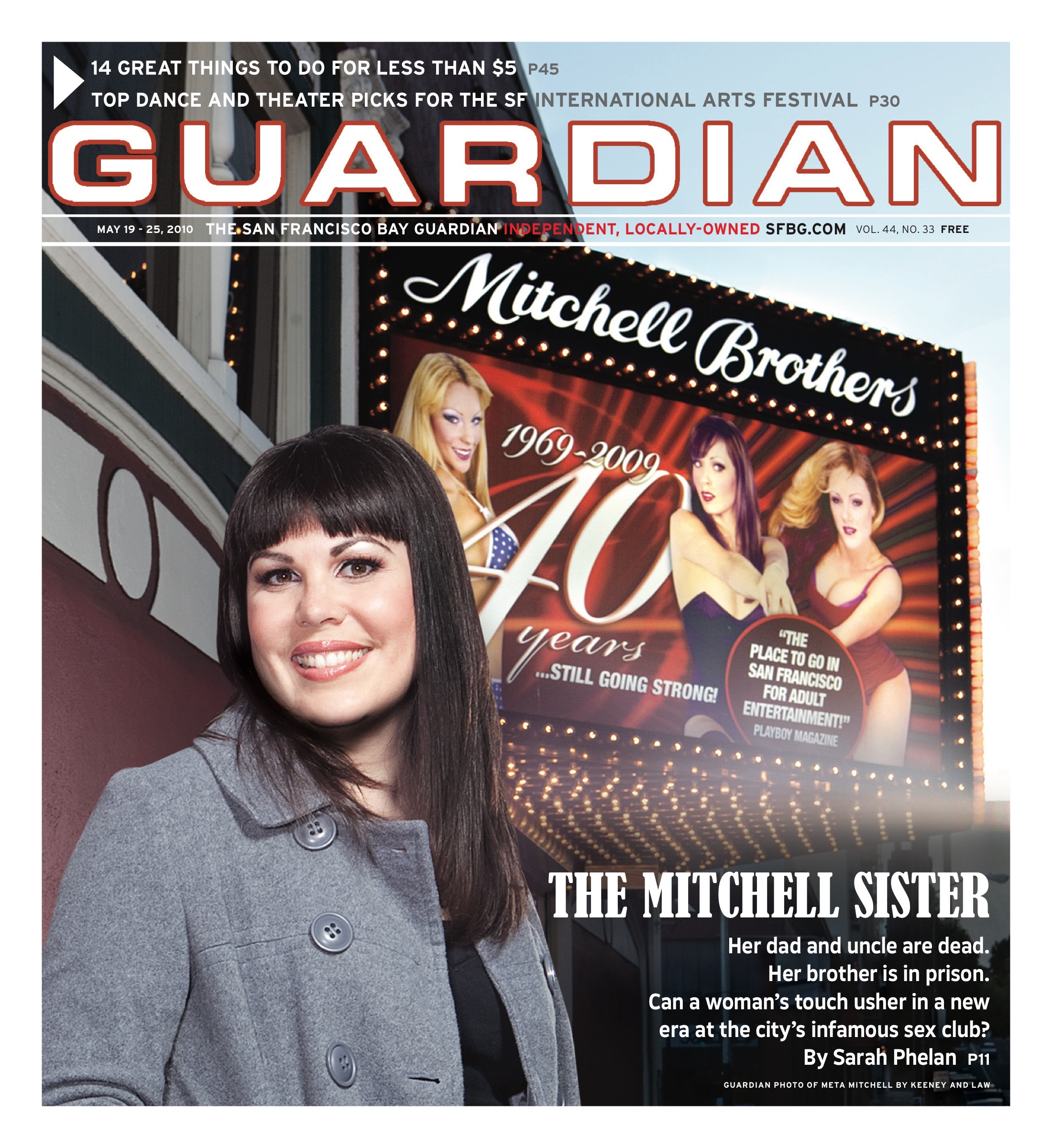
Porn heiress Meta Jane Mitchell Johnson is running a little late when I arrive at the Mitchell Brothers O’Farrell Theater, the adult entertainment establishment her father Jim Mitchell and uncle Artie Mitchell founded on the edge of the Tenderloin, just blocks from City Hall, July 4, 1969.

Johnson, 32, recently became co-owner of the theater and invited me over to discuss her vision for this notoriously hardcore strip club and the challenges she faces in an industry dominated by the Déjà Vu corporate strip club chain, in a town whose political leaders are still trying to figure out how best to regulate the clubs to ensure that their predominantly female workforce is properly compensated and protected from harassment in safe, sanitary conditions.

A young guy on the front register ushers me into a side room. The walls are decorated with photographs that recall the people and players who have made this club such a storied San Francisco institution and a landmark in the history of the sex industry.

There’s an image of a topless Marilyn Chambers, the star of Behind the Green Door, the porn film the Mitchell brothers shot and screened at the theater in 1972 and was a major hit after it became known that Chambers was also the wholesome face on Ivory Snow soap flakes box.

There is a photo of Artie with a young raven perched over his shoulder. It was taken in 1990 during a trip to Aspen, Colo., to support gonzo journalist Hunter S. Thompson, who worked at the club in the 1980s and was facing serious charges, including sexual assault and possession of drugs and explosives, that eventually got dropped.

Another shows both the Mitchell brothers, photographed when they were still young and rakish and battling the vice squad, even as they entertained the local political elite.

Today the brothers are dead, Artie from bullet wounds inflicted when Jim shot him with a rifle in February 1991; Jim from a heart attack in July 2007. And now Jim’s oldest son, James Mitchell, 28, is in jail awaiting trial for allegedly beating his ex-girlfriend Danielle Keller to death with a baseball bat in July 2009 and abducting their baby daughter, Samantha.

Unlike his father, who continued to run the Mitchell porn empire after serving less than three years for voluntary manslaughter, James is facing life behind bars.

“He is charged with six serious felonies and is facing life imprisonment with no possibility of parole,” Marin County Deputy Chief District Attorney Barry Borden said recently. Johnson told me that her brother no longer owns stock in Cinema 7, the corporation the Mitchell brothers founded to oversee their burgeoning sex business.

This latest family tragedy occurred in the wake of a $3.74 million class action suit that was settled in 2008. Brought by three MBOT dancers, the suit led to valid claims by 370 dancers who complained about Cinema 7’s “piece-rate” wage system. Under that system, the club compensated dancers solely for the number of private dances performed, waived meal and rest periods, and failed to reimburse dancers for costumes, props, and makeup.

Since then the club ended the piece-rate system, but introduced chips customers must buy to procure lap dances and encounters in small, curtained private rooms. On a recent night, the girls at the O’Farrell Theater remained smiling and bright-eyed as they succeeded in getting some customers to purchase chips for lap dances and private encounters. But the rest of the crowd remained largely silent and mostly tight-fisted as customers watched the club’s exotic dancers perform on its disco-balled stage.

All of which left me wondering if Johnson can succeed in overcoming her family history and reputation to make a difference for her workers and community while facing a nationwide recession in an industry dominated by an out-of-state chain.


THE UNLIKELY SAVIOR

Johnson greets me dressed in Ugg boots and jeans, apologizes for being tardy, and leads the way upstairs to the theater’s office so we can talk.

I first met Johnson in 2007 (“Behind the Mitchell’s Door,” 07/22/09) when she arrived at the theater in knee-high boots, clutching a massive lime handbag and a tiny dog named Baby. During that first encounter, three months after her father died, Johnson confided that when she took over the office, it was full of dildos dancers had given the Mitchell brothers. Placing her dog on the pool table that dominated the office, she said she planned to massage all this male energy toward femininity.

Today it looks as if she has started to deliver on that promise. The pool table is gone. The sofa where Hunter S. Thompson used to sit remains in the room. But now a clothesline runs between the office walls, draped with a stripper’s glove, stilettos, and a G-string emblazoned with the word “Gonzo,” presumably in honor of Thompson.

“It was a little thing we made to give away,” Johnson laughs.

She introduces her youngest brother and club co-owner, Justin. “Me and Justin are close. We are the owners and we are making some changes,” Johnson explains. “We are making the prices more reasonable so customers don’t have to spend an arm and a leg just to get a lap dance. And we’re going to hold events like poetry slams. We are trying to make the club fun again. We definitely see a hit due to the economy, but we’ve also been hit by the decision from the class action lawsuit.”

Johnson insists she and her brother aren’t “your typical strip club owners.”

Were in a symbiotic relationship with our dancers, she says. That sets us apart from other clubs. The dancers are our employees. We pay them minimum wage and workers comp. We cover their Healthy San Francisco costs. We incur a lot of expenses legally employing our dancers. But instead of crying about our handicap,’ she said, referring to treating dancers as employees, my goal is to show we can manage the club without a pimp mentality, without a How much can you shake them down for? approach.

“A lot of our employees have been here a long time and have had to deal with all the painful violent stuff too,” she continued. “And folks are still here, even though their hours got cut and they are not making as much money.

In 2007, Johnson told me that she resented the family business when she was growing up. “The boys could go inside, and I couldn’t,” she recalled. It wasn’t until 2004, when she was working as a mortgage consultant in a cubical farm in San Ramon that Johnson began to take pride in the business “as something that had taken care of us through the years.”

Johnson, who became the club’s scheduling manager in 2005, recalls the shock of losing her dad in 2007. “It was like being dumped in icy water,” she says. “At first we didn’t know how to handle it. But we learned. Five years ago, I was much more liable to listen to advice. But I need to be able to fall asleep feeling good. That involves treating people a certain way. I don’t think any other strip club in the country is being run the way this one is.”

Johnson got married and went on maternity leave in 2008. ” When my son was six months old, I came back for the club’s 40th anniversary party and I realized, they need me both of us [she and her brother]— as owners, steering the proverbial ship. No one else wants to be held accountable. We never discussed selling. Our father built this place. It’s completely shaped our lives. Good or bad, it’s ours.”


TOUGH INDUSTRY

As a nude strip club, Mitchell Brothers’ O’Farrell Theatre stands in direct competition with Crazy Horse on Market Street and the Déjà Vu-owned clubs including the Market Street Theaters, Gold Clubs and other spots in SoMa, and most of the clubs in North Beach. The exception is Lusty Lady, the only unionized, worker-owned peepshow in the country.

If you walk into the Gold Club in San Francisco, well, there are 50 other Gold Clubs in the country, so, its generic, Johnson says. But theyve got their business model. Were not trying to copy Déjà Vu or Crazy Horse. Were the Mitchell Brothers. Its been part of us and our whole history.

Dancers agree that the Lusty Lady isn’t in competition with Déjà Vu.

“They’re Walmart, and we’re the mom and pop store on the corner,” Lorelei*, a dancer at Lusty Lady, said. “At the Lusty, we pride ourselves on being alternative and having tattoos and piercings.”

Some dancers, who we’ve indicated with an asterisk after their altered names, voiced fear of being identified as critics of Déjà Vu’s business model.

“If Deja Vu found out I was shit-talking them I would probably get fired and be blacklisted from all their clubs,” Sugar* said. “If I were to get blacklisted, I’d be totally screwed because there are no other clubs in San Francisco,” where she doesn’t feel pressure to do more than dance, “which is not my thing.”

“Or the Lusty Lady, which doesn’t pay enough to cover my bills,” she continued. “But Deja Vu is notorious for being a terrible company to work for, mainly because of their outrageously high stage fees.”

Other dancers say they had to pay stage fees at the Déjà Vu-owned Hungry I, and sometimes went home empty-handed after eight-hour shifts when uninvited touching was common.

“The number one thing that would improve our work experience is if someone actually forced Deja Vu to stop charging us stage fees,” Amber* said. “Almost no one outside the industry knows that dancers pay money to go to work. A lot of customers think the clubs pay us, like, thousands of dollars. In San Francisco we pay between $100–$200 per shift, sometimes more.”

By law, dancers have the right to choose employee status, versus being considered independent contractors. “But that’s a joke,” Amber added. “If we choose employee status, we’re required to do a minimum of 10 lap dances per shift. The club keeps all that money, and we would get paid $12–$15 an hour.”

But Edi Thomas, counsel for Déjà Vus Centerfolds club, flatly denies that the dancers who perform at Centerfolds (the only nightclub in San Francisco authorized to operate as a Deja Vu Showgirls club) pay stage fees.

Rather, entertainers who perform at Centerfolds (and/or at Hungry I, the Condor, and Market Street) are paid a substantial percentage of the patron revenues generated from individual dance sales, Thomas stated.

The entertainers are issued Forms 1099 at year-end, reflecting the amounts they were paid by the nightclub, she said, which means the dancers are independent contractors, not employees. These nightclubs operate within the law and make every effort to assure that entertainers are well compensated and perform in safe and lawful environments.

There are, as in any industry, former and disgruntled workers carrying a desire to harm a nightclub or the industry for their own personal reasons, Thomas added. “But those workers do not represent the voice of the majority.


CENTER OF THE STORM

When the Mitchell Brothers founded their empire, it was against a backdrop of organized crime trying to exercise a monopoly on the porn industry. According to a 1977 U.S. Department of Justice report, members of La Cosa Nostra tried to request exclusive distribution of Mitchell Brothers’ porn films.

The Mitchells resisted for years, but DOJ claims they eventually entered into a contract with LCN’s Michael Zaffarano to distribute “Autobiography of a Flea.” the Mitchells also fought City Hall.

During the 1980s, Mayor Dianne Feinstein’s vice squad tried to close the Mitchell Brothers’ operations. But under Mayor Willie Brown, the former attorney for late Déjà Vu strip club owner Sam Conti, SFPD enforcement reportedly eased.

Then in 1997, Déjà Vu started to take control of the city’s sex clubs, introducing stage fees and private rooms. In 2002, three former MBOT dancers filed their suit against Cinema 7. The next year, three other dancers brought suits against Market Street Cinema and Century Theater. And in 2005, Deja Vu settled a class action labor suit with its dancers. Attorney Greg Walston, representing the dancers, said at the time that minimum pay rate would protect dancers from being forced into prostitution to make money.

Deja Vu threatened a counter-suit based on the allegations of prostitution at their clubs, but Walston told reporters: “The record speaks for itself.” Walston used police reports with prostitution allegations to bolster his case and said he was doing the job the District Attorney’s Office should have done.

In July 2008, when MBOT reached its $3.74 million class action settlement, Cinema 7 president Jeffrey Armstrong said that the corporation was “not able to pay the entire amount up front.” Instead, Mitchell matriarch Georgia Mitchell and her business partner John P. Morgan, then cotrustees of the Jim Mitchell 1990 Family Trust, which holds two-thirds of Cinema 7’s shares, pledged stock certificates as security interest.

But the debate about how to treat sex work in San Francisco continues. In November 2008, District Attorney Kamala Harris and Mayor Gavin Newsom opposed Proposition K, a local measure that tried to decriminalize prostitution by forbidding local authorities from investigating, arresting or prosecuting sex workers. They argued that the measure would increase prostitution on the streets, give pimps cover, and hamper efforts to stop sex trafficking. The measure failed.

At the time, Prop. K advocate Carol Leigh and cofounder of the Bay Area Sex Workers Advocacy Network said, “We feel that repressive policies don’t help trafficking victims, and that human rights-based approaches, including decriminalization, are actually more effective.”

Today, erotic dancers must identify which of a tangle of regulatory entities is the appropriate venue to lodge complaints. District Attorney spokesperson Erica Derryck said Harris is dedicated to prosecuting violent crimes committed against all San Franciscans, regardless of whether they happen in a club or an alley.

“If there are two drug dealers and one attacks the other, we’d prosecute. But that’s not to say there won’t also be consequences for underlying criminal behavior too,” she said. “But anyone who has been victimized should be confident of going to the police and reporting any incident.”

Derryck said public health and safety complaints can be lodged at entities that provide permits and licenses, including the Planning Department and Entertainment Commission.

“There might not be any criminal activity involved, but this route hits clubs in the pocket and is worth considering if dancers want to represent their grievances,” she said.

Meanwhile dancers say there is still pressure to do more than just dance in some clubs. “For some dancers, the clubs feel fine,” Lorelei says. “It’s a safe space where no ads are needed. They see it as a fair exchange. But if you just want to dance — when one girl is doing this, and another that, how are you supposed to make money?”

Other dancers wish managers wouldn’t abuse their power. “Sometimes they back you up,” Amber said. “Other nights, someone insults you and they won’t help.” And many wish management would try to make the clubs fun again.

“It used to be a party, but now it’s about the cheapest dirtiest fuck you can get,” Lorelei said. “Taking stage fees created a dark environment that carries over to the customers. It’s like we’re goats in a petting zoo begging, saying give me money, give me coke.”


FAMILY BUSINESS

Attorney Jim Quadra, who represented the dancers in the MBOT class action suit, said that for all the talk about treating dancers right, the Mitchells’ interest was money.

“At the time, a group of people thought the agenda was to get dancers to do more than dancing because that’s what brings in the revenue,” Quadra said. “But Meta comes off much better than the rest of her family.”

During the trial, Jim was asked if there were meetings where Cinema 7 personnel defined what they meant by a “lap dance” in the piece rate system.

“You need a lap for a lap dance,” Mitchell replied. “You are getting down to like, you know, lap dance, erotic theater, America. And your question is like just a waste of the public’s slender resources, like drop[ping] a basketball in the ghetto and asking, ‘Did you define what that is for them?'<0x2009>”

Johnson, who voluntarily took the witness stand, was asked if there was any reason dancers would be afraid of her father. “He can be a little gruff and he can be cranky, a grouchy old man,” she replied.

Today Johnson is moving ahead with a vision she began to outline in 2007, then put on hold until December 2009, when a law suit about the family trust fund was settled.

“We settled everything out of court in December with my grandmother, which was a nice Christmas present,” she says, confirming that she and her siblings succeeded in removing their 83-year grandmother, Georgia Mae Mitchell, as trustee of the Jim Mitchell family fund. They replaced her with their mother, Jim Mitchell’s ex-wife, Mary Jane Whitty-Grimm, who also has custody of James’s baby daughter, Samantha.

“Danielle’s mother has some personal problems … that made the court reluctant to give her custody of the baby. so they gave Samantha to Mary, who is a nice woman, who is married with a family,” former San Francisco D.A. Terence Hallinan told me, after James Mitchell replaced him with another private criminal defense attorney, Douglas Horngrad, in March.

In court filings related to the family trust fund, Mitchell matriarch Georgia Mae claimed her grandchildren’s lawsuit was intended to deny her jailed grandson James his share of the trust to defend against his serious felony charges.

“Justin asked me to take money out of the trust account of his brother James, and send it to his mother instead of paying his criminal defense attorney, Terence Hallinan,” the Mitchell matriarch claimed.

I asked Hallinan if the trust fund was the reason James Mitchell changed attorneys. “Yes and no,” Hallinan said. “It definitely had to do with money and who was going to run the club. The poor grandma, she is such a nice person. She was trying to play fair and be nice to all the kids. It’s not a really healthy family. ‘Rafe’ [James] is where he is. In my opinion, he is still not clear what happened or why.”

Johnson, for her part, says her brother James has mental health issues. “I don’t accept what he did,” she said. “I’m not making any excuses for it. He’s either insane or he’s a monster. But the family has an obligation to make sure he has legal defense. He was always a beneficiary of the trust. But he fired his lawyer, which is the worst thing he could have done.”

A restraining order Keller secured five days before she was murdered claims Mitchell abused her for years, had mood swings, used cocaine, and was addicted to methamphetamines.

“Danny should have left,” Johnson said.

It’s been painful to read the comments people leave,” she continued, referring to online reaction to her brother’s arrest that suggest the Mitchells are bad seed and should be wiped out. It’s not because James is a Mitchell, or because there’s some bad gene.”

Rather, she said he had serious unaddressed problems, “a time bomb that was going to explode and then it did in just about the most horrific way imaginable.”

“When I was 13, my father shot my uncle Artie. And when I was 31, James killed Danny,” she adds. “So I hope I don’t live to be 103.”


WOMEN’S WORK

In 1985, the O’Farrell Theater’s marquee famously read, “For show times call … ” followed by Mayor Feinstein’s phone number. But that was another era.

“I don’t know Dianne Feinstein,” Johnson says, as she shows me a cartoon R. Crumb drew in 1985 of then-Mayor Feinstein as Little Bo Peep, with a bunch of men, including political and law enforcement leaders, peeking out from under her skirts. “I know my father was never very fond of her. And I’m sure her reasons for wanting to shut the club down were based on the idea that women are being exploited and that we need to save them.”

Johnson says some of their dancers are single moms; some are young girls who can’t get enough work at retail jobs to pay their bills; and others are college students and graduates.

“There are as many stories as there are dancers. But the stereotype is that dancers are being exploited and have to be protected because they can’t protect themselves and no one really wants to dance. But when I came through the club door, I realized that many women want to do this and get upset if people try to save them. Some people feel that working in a strip club is bad, wrong, dirty. No. But it can be if you are pushed into it and don’t want to do it.”

Dancers the Guardian spoke to confirmed that they dislike being framed as victims. When we are painted as victims, we look stupid, Lorelei said. All we want is to make sure that folks are following the labor code and providing the same basic, decent working conditions youd get if you were working at a coffee shop.

But dancers know that some people are titillated by the idea of women being taken advantage of. “They don’t want that fantasy to go away, that she’s really a good girl and doesn’t want to do it,” Lorelei said. “If it turns out we are not traumatized, horrified, or disenfranchised, it ruins the whole fantasy.”

She fears that political leaders know bad things are happening but don’t want to talk about them for fear it implies they are permitting them. “The attitude is these women aren’t real, they are sex workers, so if they get raped or go missing, who cares?” Lorelei claimed. “We can’t admit they are the babysitter, the girl who sits next to you at the office.”

When Johnson began working at MBOT, she was shocked that the dancers were naked. “But no one is forcing anyone to be here,” she says. “Sure, some women dance out of necessity. But there are women who are really into it … What’s bad is the exploitation.”

It’s hard to tell from the outside whether the MBOT dancers are feeling better about their working conditions these days or whether having a woman in charge makes a big difference.

On a recent Saturday night, we were charged $40 to enter the club. The ticket gave us access to the theater’s main stage, where a succession of ethnically diverse and athletically built girls pranced, pole danced, and eventually took it all off — in tasteful fashion — as the customers threw tips on stage.

A friendly girl asked if we’d like some company but backed off gracefully when we declined to do more than chat. No one else tried to hustle us for the next hour, and we didn’t get the sense that these women were desperate to make more money. The private rooms remained empty during our visit. But there are VIP rooms that we didn’t have access to, and it’s possible more hardcore stuff was going on elsewhere in the club.

As we left, a tour bus pulled up outside, full of tourists who pressed their noses against the bus windows to eyeball the famed Mitchell Brothers establishment, drawn just to gawk at this titillating and complicated San Francisco institution.

Johnson and Mitchell believe their club gives women a path to financial independence and that having a female in charge makes a difference. They don’t need a man,” Johnson says. “In most strip clubs, the pay is all under the table, and the girls keep cash in shoe box under the bed.”

“Dodging the IRS,” Mitchell adds.

But they recognize that some dancers may be coming from abusive situations. Johnson said she realized one dancer was in trouble when she asked to be booked for every shift. “I looked at the situation and saw 16-hour days in stilettos and an exhausting schedule. It took a woman’s insight to work out what was going on.”

“It goes back to a woman’s touch, ” Mitchell says.

Johnson blames this nation’s puritanical roots for the abiding disapproval toward the sex industry and those who work in it.

“But it’s come a long way,” Mitchell interjects.” When this place first started, it got raided non-stop. Now it’s much more acceptable than 20 years ago. In the next 20 years, I’m optimistic that prostitution will be decriminalized, at least in our city, if not in our state.”

So is prostitution happening as much as some dancers say it is? “You can’t penalize people for surviving,” Johnson says. “What dancers do outside clubs is their business. We don’t have control over them. All we can do is worry about them. We don’t condone illegal activity inside the club. We don’t encourage or support it. That’s our official take.”

Johnson acknowledges the O’Farrell Theater may have the reputation for being perhaps the most hardcore club in the city. “But everything that happens here, happens elsewhere,” she says. “It’s the same exact deal except they don’t care at all, and we’re a family-run business.”

Mitchell observes that the O’Farrell Theater is huge part of the city’s tourism industry. “When conventions come through, we’re one of the prime tourist spots, along with Fisherman’s Wharf and the Golden Gate Bridge,” he said.

“San Francisco is known for its freewheeling sexuality, like the Folsom Street Fair,” Johnson adds. “People say San Francisco is Oakland’s slutty sister. And people come here because this club is an institution, a landmark in San Francisco.”

So can Johnson make a difference against this convoluted backdrop?

“It’s a benefit to have a female in management,” Johnson claims. “When we come up with an idea, I think: How will the dancers feel? We’re on the same team. I treat them like teammates. We’re not in a battle over who gets the most money. I can see through things. Women manipulate men, and dancers are in the business of manipulating men. It’s a sale. It’s a hustle. They have that mindset. But I say, no, you don’t need to make up situations. You just tell us what’s up. But that’s not the normal attitude. In most clubs, it’s ‘Shut up, do what we say, and pay your fees.'”

Johnson says she was recently at the AT&T store, and the girl asked where she worked. “I said, at a strip club. People find that incredibly interesting. This girl was 23 and she was not comfortable with the idea of dancing, but at the same time she was fascinated by it. And it’s not going away, women dancing and stripping, You can hate it; you can love it — it doesn’t matter.”

After so many years on the San Francisco scene, MBOT is striving to be a legitimate part of its neighborhood and the city’s business community. And to Johnson, some of that involves unfinished business.

Lou Silva was the artist who did the original mural of whales on the clubs wall. Thats what I remember as a child. My dad and uncle were connected to that community and the underground comic movement in the late 1970s. They made money, they wanted to spread the love around, so they did a giant art project on the side wall. And a couple of years before my uncle died, they started to redo it. But the project stopped when my uncle was shot. We are going to bring the whales back. Were working on it with an Academy of Art class. It will be far more peaceful and calm than a crazy jungle scene on the wall. We want to redo whales to demonstrate that we are interested in more than just sex and exploitation. We want to be connected to our community again.

Noting that the new mural is part of the beautification of Polk Street, Johnson concludes: The mural on the wall is unfinished because of Arties death. Now its time to finish it, not to have unfinished art on the wall because of some horrible, violent incident. Its an investment to show we are not the Mitchells everyone thinks we are.

The Daily Blurgh: Flipper goes commando and Gidget almost loses it (again)

0

Curiosities, quirks, oddites, and items from around the Bay and beyond

In the near future, Navy Marine Mammals will prevent the next diabolical underwater plot hatched by marine-loving terrorists. In fact, they’re doing it off the coast of California right now. Lest you be worried that these aquatic freedom defenders are “canaries in a coalmine” (but in water!), rest assured that, “None of the animals have been harmed in the anti-terrorist work. They never have to carry potentially catastrophic mines.”

*****
The sexual history of “Gidget.”

*****

UC Berkeley plans on asking incoming freshman and transfer students to submit DNA samples swabbed from their inner cheeks, “in an effort to introduce them to the emerging field of personalized medicine.” Yeah right. We know that UCB is going to take a page from Philip K. Dick and use the genetic data to blackmail the students when they attempt to do things like go on hunger strikes or protest budget cuts.

*****

Boing Boing has a neat-o preview of this year’s Maker Faire.

*****

Garderobe, a word now extinct, went through a similar but slightly more compacted transformation. A combination of “guard” and “robe”, it first signified a storeroom, then any private room, then (briefly) a bedchamber and finally a privy. However, the last thing privies often were was private. The Romans were particularly attached to the combining of evacuation and conversation. Their public latrines generally had 20 seats or more in intimate proximity, and people used them as unselfconsciously as modern people ride a bus.

*****

Creepiest headline of the day: Slain woman found in suitcase off Embarcadero 

*****

Most delicious word of the day: “maize’wiches

*****

Piece of Internet wisdom of the day, courtesy of Slog commenter gloomy gus:

“The internet is 45% sadness, 45% anger, and 10% things to soothe the sadness and anger, meaning: cats and advice.”


UC, CSU chiefs need to quit the Chamber of Commerce board

1

The California Chamber of Commerce is one of the most consistently right-wing organizations in the state, particularly on economic issues. The Chamber’s against pretty much all taxes and supports pretty much all cuts in government spending.

So why are the heads of the three largest public educational institutions in California, the University of California, California State University, and the California Community Colleges, members of the Chamber board?

It’s a tradition at the Chamber to put the UC president and the CSU and CCC chancellors on the board, which has about 100 members. But the three educators came under fire recently when the Chamber put out a blatantly partisan ad attacking Jerry Brown

And in fact, UC President Mark Yudof told the Chamber’s fundraising chair last year that he couldn’t donate to the CalChamberPAC because that group was trying to make sure that Democrats don’t win enough seats in the Legislature to hold a two-thirds majority. “As president of a public institution that is both in practice and in policy nonpartisan, I must decline your request for a contribution,” Yudof wrote in an Oct. 9, 2009 letter, a copy of which I obtained under the state’s Public Records Act.

But Yudof also stated: “As a member of the Board of Directors, I appreciate the Chamber’s engagement in the political process and its advocacy for a strong and vibrant California economy.”

The truth is, the Chamber’s “engagement in the political process” is almost always adversarial to the interests of the state’s public education system. The fundraising letter Yudof was responding to specifically sought money to block Democrats from holding enough seats to raise taxes — and the refusal of the governor and his GOP colleagues to seek any new revenue sources has been the major reason the state’s budget is so horribly messed up. And that’s the main reason the University of California and CSU have faced such alarming budget cuts.

Why are the people in charge of promoting public higher education willingly putting their names, and their credibility, behind what’s really a Neanderthal institution? Because that’s what’s going on here — Yudof, CSU Chancellor Charles Reed and CCC Chancellor Jack Scott aren’t on the Chamber board to offer advice. They’re on the board to give the Chamber more credibility. They help make the organization seem more friendly, more concerned with the public interest.

They help make an organization devoted to reducing the role of the public sector in this state seem supportive of public education. They help propagate a political lie.

I asked Yudof, Reed and Scott why they’re still on the board, and got pretty weak responses. Here’s Yudof’s spokesperson, Peter King:

[President Yudof] considers the California business community to be one of several key constituency groups that are important to the University, which is why traditionally higher education leaders in California have held seats on the Chamber board. In general, President Yudof has found the Chamber to be highly supportive of higher education in California. He cannot recall in his tenure as President a single Chamber proposal to reduce funding for higher education.

Um, actually that’s not true at all. The Chamber just released its 2010 “job killer” list — a roster of bills that the organization will oppose on the grounds that they’re bad for business. Among them: Assemblymember Tom Ammiano’s bill to fix a loophole in Prop. 13 (and provide more money for public education), and a bill by Sen. Leland Yee that would allow the state to recapture tax-credit money if the company that got the credits (for increasing employment in the state, for example) winds up leaving California or shipping jobs elsewhere. That money would be available for higher education.

 Passage of those bills would allow the state to stop cutting UC and CSU. The Chamber wants to kill them.

King did say, however, that after the Brown ad aired, he “has informed the Chamber that he will continue to serve on the board only if his status is changed to that of an ex officio member.” But that doesn’t mean anything; it’s his name on the letterhead that matters.

Reed’s press person, Erik Fallis, was even more vague. He would only refer me to a statement Reed and Yudof issued after the Brown ad controversy, which said, in part:

We value our inclusion on the Chamber board, which provides an opportunity to interact with business leaders on issues that are of vital importance to the future of California. This is a dialogue that has been of great benefit to higher education, the business community and the state as a whole.

Actually, the inclusion of top state education officials  is detrimental to the public interest, detrimental to public education and really bad form. Particularly now, when the Chamber is going out of its way to make sure that the state budget crisis is solved with nothing but cuts.

Scott has been openly complaining about budget cuts (PDF) but his office hasn’t responded to my questions.

Yee, a frequent critic of UC management, responded, though, and he didn’t mince words:

It would be one thing if President Yudof and Chancellor Reed used their positions on the California Chamber of Commerce board to support more revenue for our beleaguered public universities.  Unfortunately, the CalChamber is categorical in its opposition to new revenues and has become nothing short of a mouthpiece for the Republican Party.  The Chamber benefits from the prestige that Yudof and Reed bring to the table, and uses it to advance a right-wing agenda that includes questioning the validity of global warming (AB 32, 2006) and the need to protect workers from discrimination (AB 793, Jones, 2009), blocking universal health care (SB 810, Leno, 2010), and holding corporations accountable to their promises to create jobs (SB 1391, Yee, 2010).  It is outrageous that Yudof and Reed would serve as accomplices to killing bills that would increase revenue for higher education.

The top education executives need to resign from the Chamber board, now.

Lookin’ hot in the bike lane: Two-wheel tips from Meli of ‘Bikes And The City’

2

Meli Burgueno is the woman pedaling hard behind the killer San Francisco blog, Bikes And The City and after catching a glimpse of her always adorable road-friendly attire, it was time to get behind the chains and cranks to get a few style fashion-dos from the bicycle lover herself. Poking in and out of her favorite stores on Polk Street, Meli shows ladies the rules for hot cruisin’…of which she says there are none.

She rolls up on her companion of choice, “Frenchie” and parks her next to the coffee shop. Meli is sporting her usual cute; a flirty spring dress, black cardigan, gray tights and low black heels; the epitome of fearless femininity on wheels. As a biker myself, Meli and I agreed that looking lady-like in the bike lane often attracts glances from the other riders and drivers alike– there seems to be an assumption that biking requires spandex, jeans or some other bike ‘intended’ fabric. This is not true. 

“The key to bike fashion is finding stylishly comfortable pieces, which is basically anything,” says Meli with a shrug. “If you can walk comfortably in that shirt, dress or pants, you can bike comfortably in it, too.”

Meli30510

We step into Tedda Hughes and Meli’s grin goes ear to ear. “I’m a terrible shopper, but I love this store,” she says while flipping through the racks. Meli has been biking since 2003, making cycling her main mode of transportation and a huge part of her life. She encourages other women to hop on wheels and quit fussing over the details. 

“You have to get over your questions and just try it. Sometimes my shoes get dirty, but they can always be washed. And yes, sometimes I get sweaty– but isn’t that what bodies are for?” 

She picks out a frilly black skirt, made by store owner Tedda Hughes herself. Meli never wears jeans. “I have a pair, yes, but I haven’t worn them for about four years. I can’t believe people bike in jeans…but then again, I don’t think they’re comfortable to walk in.”

Meli40510

We spot this lovely Gentle Fawn jumper, which is perfect for riding around town on a summer day– comfy, sweet and ideal for modest girls won’t have to worry about flashing their panties. 

Meli60510

Meli loves bright colors, which not only look stellar, but they’re great for visibility reasons; get attention from sexy bike lane buddies and angry taxi drivers alike. This red, polka dot baby doll adaptation is another Tedda Hughes creation and Meli was drawn to the light, breathable fabric. 

“I also really like wool. It’s a great fabric for absorbing sweat and it dries fast.”

meli70510

These marine blue, suede pumps by Charlotte Ronson may look a bit freaky compared to the average bike sneaks, but Meli assures that heels are totally cool for cycling, as long as you can stand on them at the stoplight. The heel hooks around the pedal and acts like a clip, making them surprisingly ok for riding. The heels on Meli’s toes have rubber soles, which are also complimentary for her pedal style and help with grip. 

meli80510

meli90510

We walk down the block and browse through another of Meli’s must-visit shops, Picnic, which is filled with fun wares, gifts and chunky accessories. Meli is all about layers and being prepared for the various micro-climates in the city. These Tullette finger-less mitts are an ideal friend for evening rides. And then she spots the basket of tights. 

“I’m a tights whore,” she says digging through the pack and making comments about each gem she finds.

meli100510

A fine day of shopping and it’s time to hit the road. Unlocking her bike, Meli has one final bit of advice to tote before jetting off into the sunset.

“Basically I think you should just wear it– no hesitations, no questions. If you like pants or whatever you feel good in, you should wear it and just ride.”


Catch more of Meli @www.BikesAndTheCity.blogspot.com

SF nightclubs fight back with new organization

8

In the ongoing War on Fun in San Francisco, a new combatant officially entered the battlefield last night with the launch of the California Music And Culture Association (which strangely goes by the acronym CMAC rather than CMCA). It aims to be a political advocacy organization and to provide members with services such as neighbor relations advice, group insurance, and discounted legal services.

“We’re here to celebrate a new era of nightlife and entertainment in San Francisco,” CMAC President Sean Manchester, owner of Mighty and Wish, told a crowd at Mezzanine that included club owners, lawyers, promoters, performers, and politicians ranging from supervisorial candidates Scott Wiener from D8 to Debra Walker in D6. California Sen. Mark Leno also sent a formal resolution of support for CMAC.

A video prepared for the event included an even wider array of local figures extolling the importance of nightlife to San Francisco, including SF Convention & Visitors Bureau chief Joe D’Alessandro and San Francisco Planning and Urban Research Association (SPUR) director Gabriel Metcalf, who said, “I think it’s great that the nightlife industry is getting organized.”

That organization was prompted by threats and harassment from the San Francisco Police Department, the California Department of Alcoholic Beverage Control, neighbors of some clubs, and Mayor Gavin Newsom and others who have been on a campaign to demonize the industry and its regulation by the Entertainment Commission.

It’s a trend that the Guardian has been writing about for years, and one that I’ll be discussing this Tuesday as part of a panel assembled by SPUR that includes representatives from the SFPD and Entertainment Commission, as well as Sup. Bevan Dufty, who spearheaded the cancellation of Halloween in the Castro.

Pantheistic party

caitlin@sfbg.com

CULTURE “I get asked by friends and family constantly about what pagan means,” says JoHanna White, president of the Pagan Alliance’s board of directors and parade coordinator for Berkeley’s Paganfest. So, hey, what does pagan mean? “I always tell them the Alliance’s definition: earth-based, nature- and justice-centered, and observant of polytheistic faiths and traditions.”

That’s a lot to wrap one’s brain around. But be it Wicca, Hellenism, shamanism, or adherence to traditional indigenous faiths, more and more people are turning to paganism these days, evidenced by soaring attendance at events like Pantheacon, an annual gathering of rituals and healing circles that has regularly outgrown venues since its inception 16 years ago. White’s colleague, Alliance cofounder Arlynne Camire, attributes the growth to “people’s awareness of what’s happening to the Earth,” concerns over climate change, and other worrisome trends.

Camire helped start Paganfest in 2000 as a way to raise public awareness about the pagan faith, to render themselves visible. That first year involved a fair in People’s Park and a procession down Telegraph Avenue. These days the fair includes several pavilions (druid storytelling, green, arts and crafts) and a dazzling array of community altars. A ritual is usually conducted and there are prizes for best kids’ costumes and artworks. “There are pagans in every walk of life,” says Camire, a Hayward city planner. “Paganfest is essentially a pride festival.”

Public manifestations are important for any minority — especially one like paganism, a belief system that many come to in solitude, not knowing that a welcoming community of believers awaits. Festival organizers regularly provide masks to pagans who haven’t yet made the decision to share their faith publicly, a process the community has dubbed “coming out of the broom closet.”

As White tells me about the anxiety that can be associated with becoming an “out” pagan, I remark that it sounds a lot like coming to terms with one’s alternative sexuality. “You should talk to this year’s Keeper of the Light, Joi Wolfwomyn. She’s a radical faerie and knows a lot about this stuff,” she counsels. I take her up on the advice. Days later, I sit in a coffee shop in Oakland awaiting Paganfest 2010’s parade marshal, realizing I neglected to ask Joi what she looks like. I needn’t have worried. In walks a person with green dreadlocks down to the small of the back, piercings galore, and leaves tattooed over a bearded face, carrying a wooden staff and a fuzzy rainbow backpack. Joi, is that you?

It is. We talk for more than an hour and, by the end, the articulate trans person STET has taught me a lot about paganism: its inclusiveness (“To me, paganism just means you honor the earth.”), its presence in pop culture (“Avatar was a very pretty piece of paganism propaganda.”), and the advantages of embracing one’s beliefs and values publicly(“By creating myself as I have, all people have to do is be within 100 feet of me to think.”)

Of course, not all pagans have etched their faith on their epidermis. Wolfwomyn is emphatic about the community’s diversity in this respect. “There are pagan Republicans, there are pagan anarchists, there are pagan everything — but we all honor the earth.” It’s inspiring to meet a person so open to the possibilities of belief. In an instant, the possibilities of such an expansive faith dawn on me. A new kind of acceptance beckons. What has monotheism ever done for our society, anyway? 

PAGANFEST 2010

Sat/8 10 a.m.–5:30 p.m., free

Civic Center Park

Martin Luther King Jr. and Allston, Berk.

(510) 872-1188

www.thepaganalliance.org


alt.sex.column: I deserve a buzz

Dear Andrea:

How is it humanly possible that I, a 42 year old man, talented, accomplished, tall, and fit, cannot get laid to save his life? I have gone out on literally hundreds of dates, but nothing ever seems to go my way. I try not to act desperate, but women seem to smell it on me or something.

I have spent 12 years in therapy, tried whatever advice is thrown my way, but nothing seems to work. WTF?

Love,

42-Year-Old Etc.

Dear Etc:

Yikes. OK, you have legitimately got a problem. But do try to remember that while it may seem reasonable to feel that the universe owes you a boinking, any individual female owes you nothing of the kind. Forget this at your peril.

I won’t tell you that there is someone out there for you, although there may be. I will tell you, though, that it appears that the problem is not them, it’s you. Really, I am sorry. But a record like yours, well, I suppose it is technically possible that you are suffering the world’s most protracted streak of bad luck, scoring-wise, but it is simply not very likely.

I wonder what it is about all those dates that is “not going your way.” You do know you have to actually do something, right? Just waiting for things to go your way is a good way to end up a 42-year-old virgin.

Still, 42 is way old to still be a virgin, so I suggest quitting that. Seriously. Hire a pro or run a Craig’s List ad, looking not for luv and certainly not for anything as apocryphal as a soul-mate, but for some floozy who thinks the idea of contributing to the delinquency of a major sounds like hot dirty fun. In other words, just do it. Getting past the virginity element will dispel the stink of desperation (along with the fear of having to make an embarrassing confession), which ought to take some of the pressure off the next date.

Also, since I cannot see you or smell you or hear you laugh, you need some data I cannot provide. Do you know any women? Do you have female friends? Could you ask them if you seem, well, doable? Like if she weren’t married or not into men or whatever, could she imagine hooking up with you? If not, why not, and is there anything you can do about it?

At this point I’m assuming that you are stuck in a cycle of defeat and despair and that your dates can, in fact, smell it on you. But on the off chance that there is something else, some mannerism or failure of personal hygiene at work here, you really need to find out more about how people are perceiving you. You may not believe me, but it isn’t too late. Get yourself a nice, expensive escort and at least get some practice. She may even have some pointers — if there’s anyone who knows a helluva lot about what makes a man sexually unappealing, it will be her.

Love,

Andrea

Email your questions to andrea@mail.altsexcolumn.com

alt.sex.column: Rubber soul

0

Dear Andrea:

I have memories from early childhood onward of masturbating. (I’m a woman.) I’m talking when I was four years old or possibly even younger. I remember doing it in public too, like in front of family members.

It always took the form of rubbing myself against objects or the floor. I’m pretty sure I experienced orgasm too. Is it normal for a child to experiment sexually like this? And do you think it’s appropriate to discuss it with my boyfriend? I’m sure I wasn’t harmed by the experiences, but it seems like I started sexually expressing myself awfully young!

Love,

Rub It In

Dear Rub:

Pish tosh. Four-year-old (and younger) girls are well-known frotteurs, and often show an interest in ride-on toys, coin-operated bucking broncos, broomstick ponies, and the like keen enough to discomfit nearby adults. The fact that we, the adults, may be discomfited oughtn’t in any way imply that the kids are doing anything wrong. You certainly weren’t.

Every child develops on his own schedule, of course, but it’s well-documented that male fetuses can get erections in utero, and certainly infants produce them regularly (although infants are too busy learning where their feet are to bother much with genitals yet). Toddler and preschool boys, will proudly indicate theirs while crowing “Penis! Penis!” and they won’t stop without some sort of (gently diplomatic) intervention. With boys or girls, it’s best to show no emotional reaction but simply suggest that erections or frotting be achieved, displayed, and investigated in private. Adults are certainly entitled to their reactions (often amusement, sometimes shock or dismay) but in the interest of not scarring one’s children for life, it’s best to hide those.

What you were doing as a kid was perfectly normal and totally harmless and I’m really sorry you had to go through that whole guilt and repression phase. I’m kind of cheered, though, to see that it didn’t take. While it probably wouldn’t be great for either you or your boyfriend for you to have only one route to orgasm, and that rather solitary. Rubbing is a perfectly good addition to one’s repertoire.

So, yes, it was normal to do what you did when you were doing it, and many adult women continue the practice, and I can’t think of a single reason not to mention it to your boyfriend. I imagine he will counter with some similar confession and you will both laugh and yet find yourselves just a bit turned on as well. I can’t promise that either of you will be able to come up with a good, non-awkward way to incorporate rubbing against inanimate objects into your partnered sex, but have you by any chance considered adapting your formerly solitary practice to your current situation? That is to say, you have a perfectly good object for your rubbing right there next to you, provided he doesn’t mind being called an object. If he is anything like any other heterosexual male I have encountered either personally or professionally, he will not mind in the least having an attractive and in this case already beloved female grind her pelvis against him.

Love,

Andrea

Got a question? E-mail Andrea at andrea@altsexcolumn.com


Welcome to Elm Street: Part Five

0

In honor(?) of the new A Nightmare on Elm Street, we’re recapping all of the Elms so far. Find more on the Pixel Vision blog.

Here’s some friendly advice — don’t be friends with Alice. She’s a nice girl and all, but she’s kind of a getting-stabbed-to-death magnet. It’s like Greta says in Nightmare on Elm Street 5: The Dream Child (1989): “The bottom line, Alice, if anyone’s trying to hurt you, supernatural or not, they’re going to have to go through us first.” Yeah, that’s not really a problem for Freddy Krueger, who’s all too happy about dispatching Alice’s friends and lovers. Souls make him strong! Hey, remember when he was just trying to get revenge? In the words of President Barack Obama, “This shit’s getting way too complicated for me.”

Part five of the Nightmare on Elm Street series isn’t all that well-regarded, but I actually like it far more than part four. Lisa Wilcox’s Alice breaks Carol Clover’s “Final Girl” model: she has sex, she gets naked, and she survives — twice! In The Dream Child, she’s transformed from the meek and mousy victim in Nightmare on Elm Street 4: The Dream Master (1988) to a kick-ass mama bear. That’s right, she’s with child. The plot is really silly, though it doesn’t matter. As Cheryl pointed out, by this point in the series we’re mostly watching for the nightmares. And the ones here are great.

Let me break it down, nightmare-by-nightmare.

“Hey, Danny, better not dream and drive!” Even though he’s all charged up and knows better, Dan (Danny Hassel), a holdover from part four, falls asleep on his way to meet Alice. He hears his mom call him an “ungrateful, unmanageable dickweed” on the radio. Don’t worry, she also calls Alice a “bimbo-slut-whore.” The car turns into Freddy, Dan loses all control, and he flies through the windshield. But wait, there’s more! Dan only thinks he’s survived — a stolen motorcycle also takes on some frightening Freddy features. Dan gets a hot fuel injection (less sexy than it sounds) and finally crashes in a fiery heap outside of the diner where Alice works. Tragic.

“Bon appétit, bitch.” Greta (Erika Anderson) may not get a death sequence as extended as Dan’s, but holy crap is it gross. In the real world, her mom is forcing her to attend a dinner party where lecherous older men ogle Greta’s model figure. You know, a day after her friend dies in a terrible accident. When Greta dozes off, she encounters Chef Freddy, who traps her in her chair and shovels unfathomable amounts of food into her mouth. Soon she’s got the chipmunk cheeks from hell — the most disturbing visual since Freddy’s sleepwalking puppet in Dream Warriors. And then Alice sees Greta in her fridge, which is bound to kill her appetite for at least a few days. Long story short: Greta chokes to death and no one even tries to intervene.

“You’re not crazy.” Well, duh, Yvonne (Kelly Jo Minter). Is everyone in these movies willfully dense? Yes, they’re slasher flicks. I’m just saying it would be nice if for once, the Final Girl’s friends believed her right away. But I digress. Diving boards are scary enough as it is, but Yvonne almost gets destroyed by one when she falls asleep in the pool. Of course, she doesn’t actually die. Instead, Yvonne gets pulled into Alice’s dream, which turns out to be a stroke of good luck. Wading in a nasty tank for a while is a whole lot better than what the rest of Alice’s friends face. Though I’m guessing Yvonne feels pretty awkward about the whole “not trusting her bestie” thing.

“Faster than a bastard maniac, more powerful than a loco-madman, it’s Super Freddy!” Not gonna lie, I totally have a crush on dweeby comic artist Mark (Joe Seely). He also has The Dream Child’s best nightmare, because it’s by far the most absurd — and because I’m pretty sure it was inspired by A-Ha’s “Take On Me” video. Mark is pulled into his comic, and at first, he’s sort of OK with it. In the comic, Mark can become the Phantom Prowler, a dark and deadly vigilante who says things like, “Time to die, you scar-faced, limp-dick!” But movie monsters are just as resilient as superheroes. Even after getting shot repeatedly, Freddy is still able to overtake Mark, slashing the crap out of him. Well, a two-dimensional paper version of Mark. And not a single papercut joke. Color me impressed.

There’s other great stuff here. I love all the unnerving flashbacks to Freddy’s conception: something about the combination of an innocent nun and 100 horny maniacs freaks me out more than Krueger himself. We also get Alice’s creepy offspring Jacob (Whitby Hertford) — no offense to the actor, but he’s just … weird-looking. Oh, and Alice travels inside her own womb, where Freddy is hanging out on her uterine wall. As one does. Part five may not be as good as parts one through three, but it’s way more tolerable than Freddy’s Dead (1991), which Cheryl will be slogging through next.

Mexico warns citizens: use extreme caution in Arizona

7

It’s no surprise to anyone who has watched Newsom stubbornly refuse to take responsibility for the consequences of his flawed juvenile immigrant policy that the mayor is playing coy when it comes to the Board of Supervisors’ and the City Attorney’s attempts to institute a boycott of Arizona.


The real surprise in the fallout around Arizona SB 1070 is that the legislation doesn’t include a clause whereby all “aliens” must find a picture of the Arizona state flag, cut out the star in it, and wear it as a “badge,” much like the Nazis required of the Jews.


But Mexico does gets the threat this hateful legislation poses to its citizens. In a new twist on travel advisories, the Ministry of Foreign Affairs of Mexico has warned its citizens in Arizona to exercise extreme caution, whether they are demonstrating against Arizona SB 1070, going about their everyday affairs, attending classes or contemplating accepting work offered from a car on a highway.


“It is important to act with prudence and respect local laws,” the Mexican consulate states. It notes that the new law won’t take effect until 90 days after the end of the current session of the Arizona state legislature, but warns, “however, as was clear during the legislative process, there is a negative political environment for migrant communities and for all Mexican visitors.”


The consulate recommends that Mexican nationals carry available documentation, even before the new law takes place so as to “help avoid needless confrontations.”


“As long as no clear criteria defined for when, where and who the authorities will inspect, it must be assumed that every Mexican citizen may be harassed and questioned without further cause at any time,” the consulate states.


“The new law will also make it illegal to hire or be hired from a motor vehicle stopped on a roadway or highway, regardless of the immigration status of those involved. While these rules are also not yet in force, extreme caution should be used.”


The consulate concludes by reminding folks that “Mexican nationals who are in the United States, regardless of their immigration status, have inalienable human rights and can resort to protection mechanisms under international law, U.S. federal law, and Arizona state law. The functions of the five Mexican consulates in Arizona (Phoenix, Tuscon, Yuma, Nogales and Douglas) include providing legal advice to all Mexicans who consider that they have been subjected to any abuse by the authorities.”


It recommends that Mexicans requiring consular assitance in Arizona use the following toll-free number, available 24 hours a day, seven days a week:1.877.6326.6785 (1.877.63CONSUL).


Herrera to San Francisco: boycott Arizona

25

I almost visited Arizona once.
I was in Nevada, visiting the Hoover Dam which crosses the border between Nevada and Arizona and took a photo next to the Arizona state sign.

But I didn’t cross the line. I already suspected that Arizona was groundzero for wingnuts, thanks to the decision of Arizona U.S. senator, Republican John McCain, to choose then Alaska governor Sarah Palin as his running mate in the 2008 presidential election.


At least, Democrat Janet Napolitano was still governor of Arizona at the time, and so was able to veto similar attempts to pass racist immigration laws in the state of


But now Republican Jan Brewer, a former Maricopa County supervisor, is governor of Arizona and has signed Arizona’s SB  1070, I think I’ll follow San Francisco city Attorney Dennis Herrera’s advice and implement a sweeping boycott of all things Arizona.


Citing San Francisco’s “moral leadership against such past injustices as South African apartheid, the exploitation of migrant farm workers, the economic oppression of Catholics in Northern Ireland, and discrimination against the LGBT community,” Herrera offered the services of his office’s contracts, government litigation and investigations teams to work closely with city departments and commissions to identify applicable contracts and to aggressively pursue termination wherever legally tenable.


“Arizona’s controversial new law makes it a state-level crime for someone to be in the country illegally, and even criminalizes the failure to carry immigration documents at all times by lawful foreign residents,” Herrera’s April 26 press release observed. “It additionally imposes a requirement for police officers to question those they suspect may be in the United States illegally. Civil libertarians have sharply criticized the law for being an open invitation for harassment and discrimination against all Latinos, regardless of their citizenship. It has also been rebuked by the nation’s law enforcement community, with the president of the Major Cities Chiefs Association, San Jose Police Chief Robert Davis, reiterating his organization’s 2006 policy statement that requiring local police to enforce immigration laws “would likely negatively effect and undermine the level of trust and cooperation between local police and immigrant communities.”


“Arizona has charted an ominous legal course that puts extremist politics before public safety, and betrays our most deeply-held American values,” said Herrera, who is the son of an immigrant from Latin America. “Just as it did two decades ago when it refused to observe Martin Luther King Jr. Day, Arizona has again chosen to isolate itself from the rest of the nation. Our most appropriate response is to assure that their isolation is tangible rather than merely symbolic. San Francisco should lead the way in adopting and aggressively pursuing a sweeping boycott of Arizona and Arizona-based businesses until this unjust law is repealed or invalidated. My office is fully committed to work with San Francisco city departments and commissions to identify all applicable contracts, and to pursue termination wherever possible.  And my office stands ready to assist in any legal challenges in whatever way it can.”


Meanwhile, Napolitano, who is serving as Obama’s Department of Homeland Security Secretary, joined Obama in calling Arizona’s new immigration law “misguided.”


Appearing on ABC News, Napolitano said of the bill: “That one is a misguided law. It’s not a good law enforcement law. It’s not a good law in any number of reasons.”
She also warned that Arizona’s law could get other states trying to pass similar legislation, which could create a patchwork of immigration rules, instead of an an overall federal immigration system.


“This affects everybody, and I actually view it now as a security issue,” Napolitano said. “We need to know who’s in the country. And we need to know, for those who are in the country illegally, there needs to be a period under which they are given the opportunity to register so we get their biometrics, we get their criminal history and we know who they are. They pay a fine. They learn English. They get right with the law.”


Here on the streets of San Francisco, immigrant advocates are asking folks to march on May Day in solidarity with the immigrant communities of Arizona.


“In 2006, the immigrant community took to the streets in huge numbers,” a press release from the May 1st coalition stated. “Millions of undocumented working people and their families sought a pathway to legalization and to a life without fear of work-place raids or middle-of-the night deportations that tear families apart. In 2010, conditions have only worsened as hate crimes have increased exponentially; intolerance has been legitimized by the rhetoric of the Tea Party; and governments (like Arizona) have instituted harsh policing and employment practices that terrorize our communities. The federal government has failed to solve the crisis of undocumented workers in this country. In San Francisco, thousands of workers face losing their jobs because of a flawed employment verification process. Our children are deported without due process and now we must fear the codification of racial bigotry in Arizona.  State and federal governments have ineffectively solved the budget crisis on the backs of the lowest paid workers.  We march in solidarity with Arizona’s immigrants; immigrants everywhere; and the hard-working people of San Francisco who’ve unfairly endured the burden of this economic crisis.


The May 1st Coalition invites the community to join them for an April 28 poster-making party at 10 a.m, City College Mission Campus at 1125 Valencia Street in preparation for a May Day march at which Olga Miranda, President of SEIU Local 87, Jane Kim, SFUSD school board president, and Pablo Rodriguez, city college faculty, will speak.


My favorite comment on this unfunny situation comes from Daily Kos contributing editor and Las Vegas resident Jed Lewison.


“What do you call a bunch of people who not only don’t see anything wrong with Arizona’s new hate law, but blame federal inaction on immigration reform for “forcing” Arizona to enact the law while simultaneously trying to block federal immigration reform legislation?” Lewison asks. “You call them conservatives.”


alt.sex.column: No sex, please — we’re 40

0

Dear Andrea:

I’m 46 and seeking a hetro/bi woman my age who is authentically interested in a sexual relationship. I’ve heard many middle-aged women openly proclaim that they “don’t care about sex.” Since then, I’ve heard similar from many sources, including several female friends and countless craigslist meet-ups where it was volunteered without any prompting. I find this terribly depressing.

I thought a woman’s interest in sex increased as they got older. (Thanks, Anne Bancroft!). Now I’m honestly not sure what my options are. I haven’t had sex in two years.

Love,

46-Year-Old Man

Dear Old Man,

I’m surprised by the near-unanimity among your female age cohort. I wonder if you’re experiencing some sort of selection bias or selective hearing. It’s not an unusual story, but to hear it from every single woman you ask makes me wonder if you’re asking the right questions.

It’s true that what research there is often also based on the wrong questions — there’s a great deal of interest in libido-enhancing drugs for women, and a lot of statistics purporting to show an “epidemic” of female sexual desire disorders, but it’s very hard to figure out what’s really going on. Until recently, a 48-year-old woman was very likely to experience loss of libido due to being dead, or so worn-out and overworked that the best she could hope for was to be left alone.

Since a modern Western middle-class middle-aged woman now looks and feels like a 17th century 17-year-old and still has another 40-some years ahead of her, you better believe expectations have changed. They have changed so much that the slight diminishment of libido a woman might expect in her 40s is now considered a medical emergency.

In truth, many women do feel their libidos rushing back as soon as the last child earns her driver’s license. It isn’t only the temptingly empty house that does it — the role of mom, while deeply gratifying, does not produce a sense of oneself as irresistible object or roaring engine of desire. And while we should never forget that the glorious Bancroft was a wizened crone of 35 when she rolled down that famous stocking, many women in their 40s and 50s are still plenty interested in sex. Under the right circumstances.

Study after study indicates that most women require intimacy and emotional involvement even to get to the turn-on stage. Still others may have their sexuality tied up with a younger, thinner, or firmer self-image. There’s nothing like good sex to restore a sense of joy in and respect for one’s body. But again, it may take a lot of trust and a lot of affection to get there.

An interesting, attractive man of a certain age can totally get laid. But not, I suspect, if he even hints, upfront, at a need to know how many times he can expect it weekly once the deal is sealed. That’s no way to hook a lady who doesn’t even know you yet. I fear you are giving up too easily, and only hearing what you don’t want to hear.

Love,

Andrea

Got a question? E-mail Andrea at andrea@mail.altsexcolumn.com

How to run your life: today’s stand up comedians and The Believer weigh in

0


As far as advice columns go, I’ve always been partial to E. Jean’s bon mots in Elle, if only for her use of the term ‘whipsawed by confusion.’ But for a swift, re-motivating kick to the rear, I’ve never read anything like the gems dished out by You’re a Horrible Person, But I Like You, The Believer’s new tome of celebrity counsel.

By way of example, here’s Zach Galifianakis’ “ways to kick-start a satisfying life.”

1. Start reading Teen People

2. Rent a stretch Hummer to go see Noam Chomsky speak

3. Model your life after the movie Sideways, but instead of wine make your passion Mountain Dew

4. Ask a state trooper where the closest gay bar is

5. Have a Super Bowl party with no television

The book gives a few pages apiece to today’s fly young comedians — bro extraordinaire Judd Apatow, his minion Michael Cera, Janeane Garafolo, and Samantha Bee all pick up the pen, among others — and throws at them some standard  “whatdoIdo” queries. How do I tell my girlfriend she’s got a mustache? Why did my dog die? What do I do with all these grass cuttings? The conundrums of our times.

It was surprising to me how well these film and TV types can actually write. I guess film and television comics are literate, after all. 

You’re a Horrible Person scores some hits from Sarah Silverman (“You may think you’re a shut-in and that therefore you don’t wash your balls. But I’m here to tell you that you a re shut-in because you don’t wash your balls,”), and Adam McKay (“Lies and fantasy are the nectar of good lovemaking,”), and all the witty back and forth makes for a quick read for certain — far less taxing on the old noggin than the deep thinking Believer itself. 

It’s kind of a one-off deal — comedy books in general have to work pretty hard to earn a spot on my bookshelf. But the book definitely gets some guffahs. You might even pick up some advice you can use. Truly, without Michael Ian Black, I might never have thought to smooth things over with an irate father in law by making him my DJ, and as Amy Sedaris (who granted, has had some practice at this in her Believer online column “Sedaratives”) helpfully points out, “It’s called a tongue bath, and it’s not just for felines anymore.”

I’ve got to admit, E. Jean’s never weighed in on the hygenic properties of saliva baths. Take notes, blondie.


alt.sex.column: The family that plays together

0

Dear Andrea:

This summer different members of my family will be going in together on big a beach house. There’s just one thing. “Heather” used to be married to my cousin, but after they split up, my cousin moved and Heather is still invited. She also is younger. The problem? I think she’s hot.

Very very hot. Am I allowed to ask her out? It’s really hard to be around her all weekend in bathing suits and beach clothes and share a bathroom. Is this too incesty a situation? Should I just not go?

Love,

Kissin’ Cousin

Dear Cuz:

Depends on what you call a “problem. There is no legal problem here. No biological one, and no moral one, either. There may be a slight social one, though — cousin marriage may be largely legal but it is still considered freakish most places.

Cousins actually have been coupling as long as there have been cousins; in the small bands and villages of our past there may have been no other choices available. Even brother/sister incest has had its proponents, although these are few and their most famous example, the Egyptian royal families, were remarkably weak and weedy specimens, not to mention all dead now. So we won’t do that.

Ideally, we won’t all hook up with our cousins, either. The occasional intramarriage is harmless, but for the race as a whole that good hybrid vigor seems a worthy goal. Mix it up, it’s good for us! Historically, we have had a nearly universal incest taboo (for first-degree relatives, cousins are third degree and have generally been a gimme) for a reason. And not only have we historically frowned upon congress between first-degrees (people with whom you share half your genes), very few humans even seem to want to.

Does any of this have anything to do with you and your situation? Certainly not. There is no incest taboo in your case because there is no incest, period.

This is not to say that your ex-cousin-in-law will welcome your attentions, and her possible rejection, if any, will have nothing to do with incest taboos or the relative turn-on-itude of exogamy. She may just not like you that way. She may think you are old and creepy and shouldn’t be looking at young women like that. You never know. Neither can I guarantee that your real relatives, who have welcomed this young woman into the bosom of the family, will not be somewhat disgusted by your behavior. These are risks one takes any time one approaches a potential partner, of course, and if you don’t accept the risk of rejection you never get any partners at all. But most of the time when you go out on a limb and risk looking foolish, you’re alone, or in the company of friends, who might rib you a bit and then drop it. Families, as anyone who has ever taken a summer vacation with theirs can attest, never drop anything. So proceed with caution, or go to Italy this year instead.

Love,

Andrea

Got a question? E-mail Andrea at andrea@altsexcolumn.com

Quick Lit: April 14-April 20

0

Literary readings, book tours, and talks this week — including Alice Walker, Men and Dogs, Marin Poetry Festival, “Adapting to Climate Change,” and more

Wednesday, April 14

Louann Brizendine

Hear Neuropsychiatrist, author, and media commentator Dr. Louann Brizendine discuss her theories on the relationship dynamics that result from the neurobiology of the male and female brains, as outlined by her bestselling books, The Male Brain, and The Female Brain.

8 p.m., $20

Herbst Theater

401 Van Ness, SF

www.cityboxoffice.com


“Let Our Words Be Heard”

Attend this queer writing workshop and open mic that will take on the empowering, interactive process of discovering the use of words for healing, sharing histories, and celebrating community. Part of CUAV’s Safetyfest.

6 p.m., free

Modern Times Bookstore

888 Valencia, SF

www.mtbs.com


The Long Man

Best known for his work on DC Comics’ Detective Comics series in the 1970’s that produced many memorable Batman stories, Steve Englehart discusses his writing career and his new novel, The Long Man, a follow up to his first novel, The Point Man.

7 p.m., $5 suggested donation

Cartoon Art Museum

655 Mission, SF

(415) CAR-TOON


Men and Dogs

Hear San Francisco resident and author Katie Crouch discuss her new book about a girl who’s father went missing on a fishing trip in Charleston and how the mystery of his disappearance tests the whole family’s concept of loyalty and faith years later.

7:30 p.m., free

The Booksmith

1644 Haight, SF

(415) 863-8688


The Montefeltro Conspiracy

Join a humanities forum to discuss Marcello Simonetta’s The Montefeltro Conspiracy, a Renaissance mystery uncovering a nefarious plot, a murder, and a coded letter. In conjuction with the upcoming Humanities West 25th anniversary program, The Florence of the Medici: Commerce, Power, and Art in Renaissance Italy, starting April 30.

5:30 p.m., free

Commonwealth Club

595 Market, 2nd floor, SF

www.humanitieswest.org  


Thursday, April 15

If You Can Read This: The philosophy of bumper stickers

At this reading of his new book, Jack Bowen explores the philosophical ideals reflected in the most popular bumper stickers and claims that every bumper sticker holds at least a kernel of truth.

7:30 p.m., free

The Booksmith

1644 Haight, SF

(415) 863-8688


Noe Valley Celebrates the Book

Celebrate the 25th anniversary of Phoenix Books, an independent bookstore in Noe Valley, at this reading by local authors Allison Hoover Bartlett, Tony DuShane, Clare Willis, Lisa Gluskin Stonestreet and with music by Ted Savarese.

6 p.m., free

Phoenix Books

3957 24th St., SF

(415) 821-3477


Friday, April 16

Offbeat Bride

Hear Ariel Meadow Stallings discuss her new book, Offbeat Bride: Creative Alternatives for Independent Brides, where she offers inspiration, encouragement, and advice for brides on a budget.

7:30 p.m., free

The Booksmith

1644 Haight, SF

(415) 863-8688


Saturday, April 17

Adapting to Climate Change”

Attend this daylong “BioForum” about the challenges of climate change and prospective actions California could take to make a difference. Experts from UC Davis, NOAA, PG&E, and the California Academy of Sciences will be on hand to talk about impacts on local agriculture, fisheries, and energy policies. You might want to ask the PG&E representative why their company is trying to kill progressive, local Community Choice Aggregation efforts for the sake of preserving profits. 

9 a.m.; $25, lunch and coffee included

Pacific Energy Center

851 Howard, SF

1-800-794-7576


Melissa Broder

Hear Broder read from her first collection of poems, When You Say One Thing But Mean Your Mother.

6 p.m., free

Elbo Room

647 Valencia, SF

(415) 552-7788


Poetry at Pegasus

Celebrate National Poetry Month at this reading with poets Stephen Ratcliffe, Erica Lewis, and Benjamin Perez.

7:30 p.m., free

Pegasus Books Downtown

2349 Shattuck, Berk.

(510) 649-1320


“The Revolution Starts at Home”

Attend this workshop on practicing community accountability in real life with Leah Lakshmi Piepzna-Samarasinha discussing partner abuse within queer, politicized communities. Part of CUAV’s Safetyfest.

2 p.m., free

Modern Times Bookstore

888 Valencia, SF

www.mtbs.com


2048: Humanity’s Agreement to Live Together

Hear about author Kirk Boyd’s plant to draft an enforceable international agreement that could allow the people of the world to create a social order based on human rights.

7:30 p.m., free

The Booksmith

1644 Haight, SF

(415) 863-8688


Sunday, April 18

Marin Poetry Festival

Enjoy a free afternoon of poetry and music featuring Avotcja and Pedro Rosales, Dancing Bear, C.J. Sage, Adam David Miller, Michelle Baynes, and more.

2 p.m., free

Old Mill Park Amphitheater

300 Throckmorton, Mill Valley

Later in the evening, attend readings featuring San Francisco Poet Laureate Diane di Prima, winner of the 2006 National Book Award in poetry Nathaniel Mackey, and award winning poet Branda Hillman.

7 p.m., $20

Dominican University Campus

Angelico Hall

50 Acacia, San Rafael

marinpoetryfestival.com


“Writing and Publishing the Novel”

Attend this adult writers’ seminar lead by author Jason Roberts with panelists Vendela Vida, Daniel Alarcón, Rabih Alameddine, Andrew Foster Altschul, and Danielle Svetcov discussing the writing process, and issues relating to publishing, agents, and publishing houses.

6:30 p.m., $75

826 Valencia, SF

www.826valencia.org


Monday, April 19

Get Lit!

Bring your own literary contributions or those of your favorite authors to share at this candle lit, wine bar literary salon.

7 p.m., free

1550 Hyde Café and Wine Bar

1550 Hyde, SF

(415) 775-1550


Poetry at Pegasus

Celebrate National Poetry Month at this reading with poets Cheryl Dumesnil, Judy Halebsky, and Tiffany Higgins.

7:30 p.m., free

Pegasus Books Downtown

2349 Shattuck, Berk.

(510) 649-1320


Tuesday, April 20

Diane di Prima

Hear San Francisco Poet Laureate Diane di Prima discuss her career as an activist in the 1960’s, a writer of the Beat movement, author of 43 books of poetry and prose, and many more accomplishments in conversation with Alan Kaufman.

6 p.m., $12

Mechanics Institute

57 Post, SF

(415) 393-0100


For you Mom, Finally

In her latest book, food magazine editor, restaurant critic, and memoirist Ruth Reichl examines her mother’s life, giving voice to the painful truth that many women of our mothers’ generation had to sacrifice their dreams.

11 a.m., $10-18

Jewish Community Center of San Francisco

Kanbar Hall

3200 California, SF

(415) 292-1233


Alice Walker

Essayist, poet, fiction writer, and ardent social activist Alice Walker will discuss her upcoming book, Overcoming Speechlessness: A Poet Encounters “the horror” in Rwanda, Eastern Congo, and Palestine/Israel, about her travels to each of those three regions, charting the aftermath of violent conflict and political upheaval. In conversation with Michael Krasny.

8 p.m., $20

Herbst Theater

401 Van Ness, SF

www.cityboxoffice.com