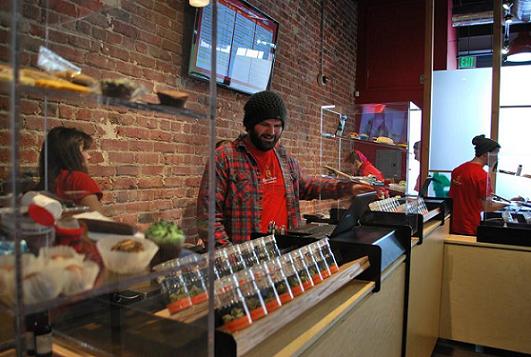
Today was the grand opening for a new dispensary just steps from the front door of Mezzanine and right down the block from a rapidly-changing Sixth Street. Long-time medical marijuana patients may recognize some familiar faces — Bloom Room employs many of the staff and management from Medithrive, the Mission Street dispensary was was forced to close “for the children” back in November of 2011.
“I was the manager of a store, and then I was the manager of a delivery service,” Bloom Room manager Stephen Rechit tells me, sitting in the dispensary vaporizing lounge area. When federal government agencies informed the cannabis club that it was too close to Marshall Elementary School, Medithrive switched to a $50-minimum, delivery-only service that owners continue to operate.
The Bloom Room’s open for business, with space for on-site vaporizing steps from the cash register
Did Rechit — who says he became Medithrive’s first employee as a new University of San Francisco graduate — consider a career change in the face of unyielding federal agents? Not for a second.
“I know this is definitely what I want to do,” he reflects. “I just really — I don’t want to get cheesy, but I believe in the plant.”
>>THROUGH MARCH 1, NEW BLOOM ROOM PATIENTS GET A SAMPLER OF THREE MARIJUANA STRAINS WITH ANY PURCHASE OF $50
Bloom Room’s downtown design, with its exposed brick walls and translucent glass marijuana leaf panels reappropriated from the defunct Medithrive storefront, may be the perfect fit for a Sixth Street neighborhood that’s on a definite upward economic swing. Rechit points out the window to the corporate offices of Burning Man, perched atop a skyscraper alongside the rest of the Mid-Market buildings that tech tenants are filling up. Burning Man’s been an earlier contributor to Bloom Room’s “Community Corner,” a space for neighborhood fliers, business cards.
Bloom Room plans to stock six to 10 strains each of indicas and sativa, and sells blackberry chocolate bars from Kiva, Auntie Dolores caramel corn, and oen of Rechit’s favorites, TerpX concentrates.
Sticky: TerpX concentrate
“TerpX is like the Girl Scout Cookies of last year,” Rechit comments, unrolling a piece of waxed paper so I can check out the golden goo.
As we chatted, Tenderloin resident Jim Murray (who, happily, bore a striking resemblance to Bill Murray in The Life Aquatic in his navy beanie) pulled up in the narrow, tall table to inquire about the availability of the clould of OG Kush pumping into the vaporizer bag between Rechit and I.
I’d seen Murray complaining about the quality of Bloom Room bud he’d picked up previously, and now he was interested in the “toast,” the spent flower already used in the vaporizer that was sitting on a piece of paper in the ashtray.
“The reason why I’m sensitive to this is because I am a senior living on a VA pension,” he informed me. “What compassionate care programs do you have here?” he asked Rechit.
FYI, Rechit says the dispensary gives away free product to patient on holidays and keeps prices low in general. Back when Medithrive’s doors were open at its Mission Street location it made monthly donations to the school around the corner that was eventually used as the excuse by the federal government to shut it down. Let’s hope Bloom Room has more luck in its new SoMa spot.
This summer, it turns out, will be about more than racing for the city’s mega-billionaire yacht-race king. The Asian Art Museum’s latest program guide notes that from June 28-Sept. 22, the museum will host “In the Moment: Japanese Art from the Larry Ellison Collection.”
The museum will present “works from the rarely seen collection of Larry Ellison, owner of cup defender Team Oracle USA. The exhibition introduces about 80 artworks spanning 1,300 years. Included are works of the Momoyama (1573-1615) and Edo (1615-1868) periods.” According to the Metropolitican Museum of Art, “this period was characterized by a robust, opulent, and dynamic style, with gold lavishly applied to architecture, furnishings, paintings, and garments.”
Oh, and it’s worth noting that the Momoyama and Edo periods were also marked by the dominance of brutal warlords who claimed much of the nation’s wealth while most subjects lived in dire poverty.
At any rate, I’m sure the stuff is nice. Beautiful, even. And pricey. Bet a philanthropist of Ellison’s stature could auction off just a couple of those 80 pieces and raise enough to pay off the entire AC budget deficit. Eh, Larry?
Strong drum beats, hip shimmies laden with bells and voices coming together in song. This show has it all. Presenting “Dance + Diaspora” two performances this Friday and Saturday — pics above are from the dress rehearsal — by choreographers Jill Parker (with her Foxglove Sweethearts troupe) and Tania Santiago (with her Movendo con Capoeira troupe) — a showcase of steamy belly dancing and heart-pumping Capoeria.
The belly dance performance includes solos, but is a mainly a group dance, with multiple belly rolls and wrist rotations happening in unison by all the dancers. Their piece also includes live music, like some pretty great clarinet and double-reeded zurna tunes. After intermission, the mood shifts and takes you to Brazil, for an energizing Capoeira piece, mixing both incredible acrobatics and traditional Afro-Brazilian folk dance. The show as a whole is a wonderful combination of music and dance, creating a true cultural dance experience.
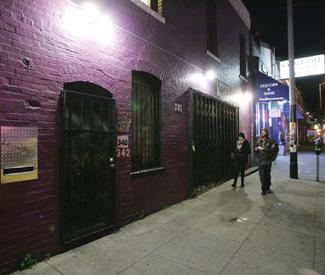
The fate of the “purple building” – which has become caught up in the clash between nightlife and residential interests on the clubgoer-saturated 300-block of 11th Street – remains undecided as the Western SoMa Community Plan heads into its first hearing before the Board of Supervisors Land Use and Economic Development Committee on Monday.
As we reported in this week’s paper, a unique citizen-based task force has spent the last eight years developing the plan, which will allow thousands of units of new housing – most of it along Folsom Street – to move forward once the plan gets final approval from the board. But the California Music & Culture Association and other nightlife advocates successfully amended the plan to ban new housing on that 11th Street block as the Planning Commission approved it in December.
Yet the commission also decided to grandfather in a 24-home project at 340 11th Street, the so-called purple building, which nightlife advocates say would put those new residents on a collision course with Slim’s, DNA Lounge, and other big nightclubs on that busy block. As we went to press, both sides and District 6 Sup. Jane Kim were all hopeful that a compromise was imminent, likely involving switching from residential to office.
But with just days to go before that hearing, building owner Tony Lo still hasn’t decided whether to make the change or fight it out in front of the supervisors. His architect John Goldman – whose residential design for the site was placed on hold by the city since shortly after he submitted it in 2005 – had hoped to hear by now but he’s still waiting for Lo to make the call.
“Based on my analysis, it looks feasible to change to offices if you want to do it, and I mean feasible financially and architecturally and planning-wise,” Goldman today told the Guardian, referring to what he told Lo.
Meanwhile, Western SoMa Task Force Chair Jim Meko – who has not been supportive of tweaking the plan after all the work he oversaw – yesterday sent out an email blast to stakeholders and supporters urging them to attend Monday’s hearing and show support for the plan.
“You don’t often get a chance to participate in making decisions about your own neighborhood from start to finish. Some special interest groups are expected to come out of the woodwork to take pot shots at the Plan so the hundreds of participants in this process need to make their voices heard. Your testimony at the hearing next week will make all the difference,” Meko wrote.
The hearing starts at 10am in board chambers in City Hall. This item might have been heard later in the day considering the agenda opens with a continuation of the controversial condo lottery bypass legislation, on which Board President David Chiu and others have been trying to forge a compromise between tenant advocates and homeowner groups. But committee Chair Scott Wiener just told us that item “will be continued. No compromise yet.”
Important: the Oscar broadcast starts at 4pm on Sunday on ABC. If tradition holds, the ceremony won’tactually beginuntil a little later, but if you want to soak up the full awkwardness of the red carpet, with its “Who are you wearing?” and its reporters mistaking Denzel Washington’s daughter for his wife (true story), you will want to tune in on time. (If you’re a true fiend, E! starts their red-carpet coverage at 2:30pm.)
As far as Oscar winners go, I thought I had it figured out, but really … it’s anyone’s game, unless your name is Daniel Day-Lewis. Fingers crossed for local filmmaker Sari Gilman to win Best Documentary Short for her Kings’ Point.
Bless Me, UltimaA mysticism that melds the Latin American shamanism with old-world Catholicism suffuses this bildungsroman of a memory movie, warmly rendered by director Carl Franklin, perhaps best known for his noirish tendencies in Devil in a Blue Dress (1995) and One False Move (1992). Here, working with Rudolfo Anaya’s landmark Chicano novel and material steeped in curandera, or shamanistic, folkways, he continues to exhibit that close attention to detail and the emotional truth of his characters that he brought to his more sensational genre work. This is a smaller, yet no less powerful, story: Antonio (Luke Ganalon) is the youngest son of a vaquero father (Benito Martinez) and a mother (Dolores Heredia) who hails from a farming family — yet perhaps his most important connection is with the woman who midwifed him, Ultima (Miriam Colon), who is taken in by his family out of respect for her deep folk magic and knowledge as a healer. Under Ultima’s close tutelage — while faithfully attending church and working his uncles’ fields — Antonio learns about life and the earth’s bounty, dangers, and cycles, particularly when one of his uncles falls prey to wicked brujas who practice blood sacrifice and Ultima is called in to help him. All of which makes for emotionally resonant storytelling that imparts the impact of Anaya’s tale and his reverence for spiritual practice — of all sorts — and our planet’s power and magic. (1:46) (Kimberly Chun)
The GatekeepersComing hard on the heels of The Law in These Parts, which gave a dispassionate forum to the lawmakers who’ve shaped — some might say in pretzel form — the military legal system that’s been applied by Israelis to Palestinians for decades, Dror Moreh’s documentary provides another key insiders’ viewpoint on that endless occupation. His interviewees are six former heads of the Shin Bet, Israel’s secret service. Their top-secret decisions shaped the nation’s attempts to control terrorist sects and attacks, as seen in a nearly half-century parade of news clips showing violence and negotiation on both sides. Unlike the subjects of Law, who spoke a cool, often evasive legalese to avoid any awkward ethical issues, these men are at times frankly — and surprisingly — doubtful about the wisdom of some individual decisions, let alone about the seemingly ever-receding prospect of a diplomatic peace. They even advocate for a two-state solution, an idea the government they served no longer seems seriously interested in advancing. The Gatekeepers is an important document that offers recent history examined head-on by the hitherto generally close-mouthed people who were in a prime position to direct its course. (1:37) (Dennis Harvey)
http://www.youtube.com/watch?v=V1pOjj49d9Y
Happy People: A Year in the Taiga The ever-intrepid Werner Herzog, with co-director Dmitry Vasyukov, pursues his fascination with extreme landscapes by chronicling a year deep within the Siberian Taiga. True to form, he doesn’t spend much time in the 300-inhabitant town nestled amid “endless wilderness,” accessible only by helicopter or boat (and only during the warmer seasons); instead, he seeks the most isolated environment possible, venturing into the frozen forest with fur trappers who augment their passed-down-over-generations job skills with the occasional modern assist (chainsaws and snowmobiles are key). Gorgeous cinematography and a curious, respectful tone elevate Happy People from mere ethnographic-film status, though that’s essentially what it is, as it records the men carving canoes, bear-proofing their cabins, interacting with their dogs, and generally being incredibly self-reliant amid some of the most rugged conditions imaginable. And since it’s Herzog, you know there’ll be a few gently bizarre moments, as when a politician’s summer campaign cruise brings a musical revue to town, or the director himself refers to “vodka — vicious as jet fuel” in his trademark droll voice over. (1:34) (Cheryl Eddy)
In my weirder ’90s paisley dreams, all clubs in Montreal look like this. In my weirder 2013 Tumblr dreams all clubs in New York look like this. But I will CERTAINLY take all clubs in the here-and-now looking like the SF quintet of fantasticality that follows. N’est-ce pas?
A 100% hardware (no computers!) performance from Chicago duo Traxx and Beau Wanzer — a wiggy bit of electronic body music to blow your mind for sure.With awesome melodic-acid guru magic Touch.
Fri/22, 10pm-4am, $15. Monarch, 101 Sixth St., SF. www.monarchsf.com
Our hometown techno team is blowing up on a global scale — the dreamy duo of Clint Stewart and Marc Smith, getting bigger every second, will be pumping up the awesome, bass-oriented Spilt Milk party (seriously, the Spilt Milk vibe is casual Cali fun and the music is goood), brought to us by the Mother Records crew. With the great Kimmy le Funk. RSVP here for free entry!
Sat/23, 9pm, $5. Milk Bar, 1840 Haight, SF. www.milksf.com
The quintessential British exile mystical disco-punk pioneer, who basically showed the current wave DJs how to play whatever they want as long as it sounds good and groovy, will do us right once again. Down the rabbit hole! he’ll be joined by one of my favorite intelligent bass-house purveyors, Falty DL.
https://www.youtube.com/watch?v=UOdSJFrLSX8
Sat/23, 9:30am-3:30am, $10-$15. Public Works, 161 Erie, SF. www.publicsf.com
Latest album The Marriage of True Minds from the beloved, former SF-dwelling duo is based on telepathy — they projected the concept for the album into the minds of certain participants and wove their responses into the results. It’s surprisingly upbeat and danceable! And it’ll be a great opportunity to encounter some of the bay’s best experimental electronic minds as Matmos plays live.
Sun/24, 8pm-12:30am, $10. Public Works, 161 Erie, SF. www.publicsf.com
Mystery, divination, revelation will all mark 2013 if you believe in age-old Chinese astrology. We’ve entered the year of the female (yin) water snake — time to get over from the brash dragon year of 2012, thank Gaia. The actual start of the Chinese New Year was on Feb. 10, but the bulk of San Francisco’s festivities take place this weekend — including the red-and-gold parade juggarnaut that’ll swamp downtown starting at 5:15pm at Second Street and Market, Sat/23. Don red for good luck, and slither on down to the parade route (or Verdi Club, depending on your celebration perogative.)
[Many thanks to Johnny Funcheap for his ever-useful round-up of affordably-priced local events, which proved indispensable in assembling this list]
Lion Dance Party
We’re not sure if promotors of this party saved the “Harlem Shake” meme with their promotional video, but the night does look damn tasty. Pop-up Vietnamese cafe Rice Paper Scissors hosts this culmination of its Vietnamese-Chinese New Year event series, pop rules the dancefloor, and professional lion dancers from Chung Ngai Dance Troupe make the thing seasonal.
Fri/22, 8pm-1am, $10-15. Verdi Club, 2424 Mariposa, SF. Facebook event
Chinatown Community Street Fair
Learn about lantern and kite-making, take in a puppet show or folkdance set or two, and shop at this explosion of vendors and artists that takes over Chinatown the weekend of the big New Year parade.
Chinese Historical Society celebrates the New Year
Those looking for indoor learnin’ on parade day should head to the Chinese Historical Society, which is in the thick of celebrating its 50th anniversary. Today, artist Frank Wong will offer a tour of his exhibition at the museum, there’s a special display of children’s Chinese New Year Hats, kids crafts, a 3pm concert for the lil’ ones, and at 1pm, a lion dance performed by the Society’s troupe itself.
Sat/23, 11am-4pm, free. Chinese Historical Society, 965 Clay, SF. www.chsa.org
Chinese Culture Center Spring Fair
Browse the Center’s new “Moment for Ink” exhibit, highlighting ink works by artists from all kinds of backgrounds, and sit in on one of these creatives, artist Justin Hoover, while he orchestrates a workshop about his paperbound creations.
Sat/23, 1-4pm, free. Chinese Culture Center, 750 Kearny, SF. www.c-c-c.org
Storytelling at the Westfield
Folktale-tellers from the Asian Art Museum will entertain families with Chinese legends, while newcomer to the mall David’s Teas dishes out complimentary cuppas.
Sat/23 and Saturdays through April 27, 11:30am-noon and 1-1:30pm, free. Westfield Centre, level two near Bloomingdale’s, 845 Market, SF. www.westfield.com
“Transformations and Renewals” Chinese history aboard the Balclutha
A poetry reading aboard a historic ship may be the best chance you have this weekend to learn about Chinese history here in the Bay Area. Chinese Whispers, a group that chronicles oral history sponsors this line-up of presentations on California Chinese culture through the ages, tours through the ship’s recreated living quarters for Chinese cannery workers, and games that teach about little-known eras along the timeline of the Bay Area.
No politically savvy San Franciscan has ever really bought the rhetoric espoused by the so-called “moderate” political action group Plan C that it’s all about finding middle ground between what its website calls “a ‘downtown’ machine, and a far-left, dogmatic, so-called ‘progressive’ machine.” As if that unbalanced labeling wasn’t enough of a indicator, the fact that its funding comes from all the biggest cogs in the downtown machine should be.
But now, as the group’s members aggressively work to open the flood gates on converting San Francisco’s rent-controlled apartments into privately controlled condominiums, it’s become more clear than ever that the C stands for Condo and that the financially motivated group is moving the agenda of the real-estate and investment interests that dominate its Board of Directors.
City Hall sources connected to the ongoing meetings that Sups. David Chiu and Mark Farrell have been holding with stakeholders on the controversial condo lottery bypass legislation sponsored by Farrell and Sup. Scott Wiener say there were indications of possible compromise that came out of the first mediation meeting.
That one primarily involved the tenant advocates who have led the charge against the legislation and the representatives for tenancy-in-common owners seeking to buy a bypass to the city’s condo conversion lottery that only allows 200 new condos per year. There were whispers that came from that meeting of a compromise that would allow a one-time bypass in exchange for shutting down the lottery for several years, or indexing it to the construction of new housing for low-income San Franciscans.
Since then, the sources say, Plan C and their partners in the real-estate industry have dominated the meetings with their dogmatic advocacy for indefinitely allowing the maximum number of condo conversions. Despite public statements by Farrell and Wiener that they just want to clear out some backlog without encouraging more landlords to convert apartments to TICs in the future, Plan C just wants to feed more affordable apartments into the expensive real estate market.
Some basic research on the group and its Board of Directors seems to show that this position is about financial self-interest rather than values or ideology.
Plan C Co-Chair Steve Adams is a regional manager for Sterling Bank & Trust, which has consistently been one of the city’s top TIC lenders and which recently sponsored a forum encouraging more conversion of apartments, promising to increase its loan volume, and painting a rosy picture of the TIC financing market that belies Wiener’s claims that TIC owners can’t get financial relief and need the city’s intervention.
One of the key presenters at that symposium was TIC attorney Lyssa Paul, who is also a Plan C board member and someone who makes her living creating more TICs. Other members of the 12-member board who make their living in the real estate industry and benefit directly for TICs conversions are Amanda Jones and Brian Hecktman. Other bankers or investment managers on the board that benefit from the TIC business are Ashley Lyon and Bob Gain.
Co-Chair Mike Sullivan is a venture capital attorney who created Plan C in 2001 and used it to help then-Sup. Gavin Newsom sell his Care Not Cash homelessness plan and run for mayor. Randy Brasche is in software marketing and got involved in the issue being frustrated with the condo lottery and [[CORRECTION/DELETION: last year]] forming the San Francisco TIC Coalition.
Board member David Fix is [[CORRECTION/ADDITION: the former]] president of the Small Property Owners of San Francisco, so it’s possible that his interest is as much ideological as financial, particularly given his past public statements against rent control. That may also be the case with Baha Hariri, a principal at A&F Properties and the former political director of the downtown-funded-and-created Committee on Jobs.
Among the downtown players that fund Plan C, which was sitting on $73,872 in the bank as of the start of this year, are the Committee on Jobs, the San Francisco Association of Realtors, PG&E, San Francisco Apartment Association, Small Property Owners of San Francisco, Shorenstein Realty, the San Francisco Chamber of Commerce, and venture capitalist Ron Conway.
So Plan C appears to be little more than Plan A’s deceptive effort to push Plan Condo. BTW, I’ve been waiting more than 24 hours now to get a call back from the Plan C board, after leaving a message with its only paid administrator, Richard Magary, who told me Sullivan and his colleagues are all quite busy now. But I’ll be happy to update this post if and when I hear back.
2/22 UPDATE: Still no call back from Plan C, but Fix made a comment requesting the two minor corrections above. C’mon, Plan C, gimme a call, what are you so afraid of?
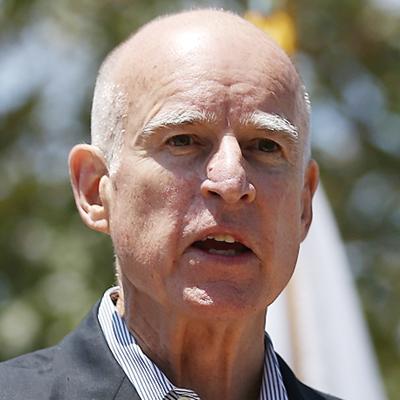
For the first time in many years, Californians seem to like their governor. Jerry Brown’s approval rating is now above 50 percent; actually, it’s closer to 60 percent. And the Legislature is more popular, too. (Although ratings of the state Leg, like ratings of Congress, are pretty bogus — I may think the Legislature as a whole is doing a crappy job, because there are too many conservatives, but I think my own Assemblymember, Tom Ammiano, and my own state Senator, Mark Leno, are excellent. Republicans feel the opposite way. Nobody likes the body as a whole, because the body as a whole will never be liberal enough for me or conservative enough for Orange County.)
So here’s the question:
In politics, one of the things you do is build capital. You build it with your reputation, by doing things well (or at least things that make some group of constituents happy). You can’t keep it in the bank forever, or it gets stale and eventually starts to fade away; at some point, you have to use it.
The typical younger politician builds capital for future races — you get high marks as a city council member or county supervisor and you cash in some of that to get elected to the state Leg, then maybe to statewide office or Congress. But our guv isn’t typical in any way, and he’s not young; he might have one more term in office, which at this point he would win easily if he seeks it. But that’s almost certainly the end of the line. For better or for worse, I just don’t see a President Jerry Brown in our future.
So what’s he going to do with his political capital? What are the Democrats in the state Leg, who finally have the confidence of the voters, going to do?
If Jer thinks he’s going to build a couple of giant tunnels under the Delta to move more water south, he’s even battier that we think; that’s never going to happen. The entire environmental world is against it, it’s way too expensive, it will wind up getting delayed by lawsuits until long after Brown is out of office, and there’s no guarantee a future governor will keep Jerry’s Big Dig alive.
He’s got high-speed rail, a much better use of money that has widespread support, but that’s also a long-term project.
So what about reforming Prop. 13? He knows it’s a policy disaster. It’s not going to be repealed, but with the governor’s support, a split-role measure or some other credible reforms could transform local government and do more for the public schools than any pointed-headed “education reform” plan will ever do.
Or single-payer health care. Everyone knows that California’s getting screwed by the insurance industry. We have to write new rules for implementing Obamacare anyway. Twice, the state Leg has passed single-payer bills that were vetoed by the governor (not this governor).
It’s actually possible to lead the way to some changes that people will remember for decades. Jerry: You won’t get this chance again.
Antwon, one of our favorite local rappers, goes all Muppets take the club in this video for “3rd World Grrl,” off new mixtape In Dark Denim.
For those concerned, yesterday Twon tweeted: “3rd world grrl isnt about girls in a third world its about being so physically close to someone but their heart being far away.” Aww.
Sina Khanifar, who runs opensignal, has been pushing to overturn a recent ruling allowing cell phone companies to prevent people who want to switch carriers from changing the firmware that controls the device.
The campaign to convince the Obama administration and Congress to overturn the ridiculous ruling continues here.
A Democratic Party resolution calling on Ed Lee to appoint a mother to the Board of Supervisors may have driven the slow-moving mayor to fill the seat of departing Sup. Carmen Chu quickly, perhaps as soon as today (Feb. 21), City Hall sources are saying.
Lee appointed Chu to fill the post of Assessor-Recorder vacated when Phil Ting moved to the state Assembly. But he’s been dragging his feet on naming Chu’s replacement.
Alix Rosenthal, a member of the Democratic County Central Committee, has put a resolution on the agenda for the group’s Feb. 27 meeting urging the mayor to name a woman with a family. Her argument:
Political office is often beyond the reach of mothers, because balancing a political life with family and work is often an insurmountable challenge. Appointing a mother to fill the District 4 seat will demonstrate the Mayor’s commitment to stemming the tide of families leaving San Francisco, and it may serve to inspire women with children to be politically engaged, and to run for office themselves in the future.
That, of course, could put the mayor’s allies on the DCCC in a tough situation. Will they vote to urge the mayor to do something he doesn’t want to — or will they vote against, you know, motherhood?
Of course, if the mayor makes an appointment before Feb. 27, the resolution becomes moot.
Rosenthal and some other politically active women are supporting Suzy Loftus, a member of the Police Commission and a mom. But D4 is more than half Asian, and has always had an Asian supervisor, so it’s unlikely the mayor would appoint a non-Asian to the job.
One obvious candidate: Katy Tang, who is now Chu’s legislative aide.
The mayor will want someone he can count on as loyal — and who he’s pretty sure can win an election. His last two appointees to elective office, Christina Olague and Rodrigo Santos, were both defeated the first time they faced the voters.
But at this point, Lee isn’t saying anything. Look for an announcement soon.
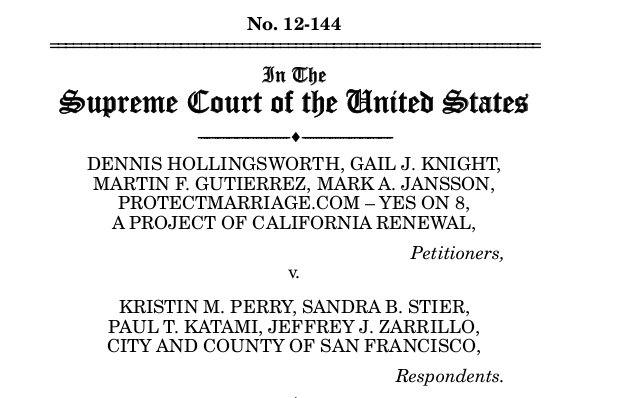
San Francisco City Attorney Dennis Herrera and his legal team today submitted written arguments to the US Supreme Court in the landmark same-sex marriage equality case it will consider this spring, with the hopes that their phrases and framing of the issue will be echoed in a civil rights ruling that could go down in history.
He argues that Proposition 8 – the California ballot measure that undid the California Supreme Court ruling legalizing same-sex marriage in a case that grew out of San Francisco’s unilateral decision to start marrying lesbians and gay men in 2004 – was unconstitutionally about “asserting the inferiority of same-sex couples….But relegating gay couples to a lesser status simply to brand them as different and less worthy than opposite-sex couples is not a legitimate purpose.”
Herrera, Deputy City Attorney Therese Stewart, and the rest of the city’s legal team also take up the notion of the “tyranny the majority” (which I explored in an earlier Guardian story on the issue) in their brief, arguing: “Petitioners’ argument derogates the most important role this Court serves in our democracy: to protect the constitutional rights of minorities from encroachment by an unsympathetic majority. The responsibility to protect individual rights does not transfer to the political process when the dispute happens to be ‘controversial.’ Quite the contrary. In this circumstance more than any other, constitutional rights ‘may not be submitted to vote; they depend on the outcome of no elections.’ West Virginia State Bd. of Educ. v. Barnette, 319 U.S. 624, 638 (1943).”
Will the Supreme Court justices borrow any of these words or ideas in their ruling, as they sometimes do in such cases, placing them in history books alongside phrases such as “separate but equal is inherently not equal,” from the 1954 Brown v. Board of Education ruling ending racial segregation, which echoed the 1896 Plessy v. Ferguson ruling that it overturned?
Herrera told us that he couldn’t help but feel that sense of momentousness as he finalized the brief: “You have a sense as to the importance of what you’re working on, and that certainly has an impression on you.”
But he also said that he’s continually had that sense through this “long struggle,” during which he said that he’s remained focused on the LGBT community that he’s fighting to protect. “It’s been frustrating when you see how some folks perpetuate the discrimination that’s gone on too long,” he told us, adding that “to finally see it come to the Supreme Court is momentous.”
And Herrera said that he does hope the Supreme Court issues a broad ruling that finally settles this issue and removes the question of same-sex rights from the political realm and deems them to be an issue of equal protection under the law. “They’ve asked the court to abdicate its responsibility because same-sex marriage is controversial,” Herrera told us, arguing that’s why the Constitution offers equal protections to all citizens, regardless of the passions or societal biases of the moment. “Those constitutional rights are not subject to majority rule.”
It’s all about choice, people. Noise Pop is a well-oiled festival machine at this point — now in its 21st year — cranking out dozens of concerts, nightlife happenings, film screenings, culture club events, photography showings, and all that good stuff we’ve come to expect from the homegrown indie fest. But given all those choices for the week of Feb. 26 through March 3, restless souls such as myself always tend to feel a bit well, overwhelmed.
Do I see headliner Toro Y Moi at one of his Independent showcases, or DIIV at Brick and Mortar Music Hall? (Shouldn’t matter much to most; those are all super sold out by now.) Do I squeeze in a Noise Pop Happy Hour after work, before the cozy Sonny and the Sunsets Bottom of the Hill concert or Kim Gordon’s new project, Body/Head at the Rickshaw Stop? How much is too much booze for one week? I can’t answer them all for you (if you want to see a sold-out show, buy a fest badge), but I can help with those pesky last-minute questions that boil down to which show to choose over another, equally appealing event.
The infographic flowchart for this appeared in this week’s issue (pg. 20 of the Feb. 20 Guardian), but for these purposes, I’ll hook you up with a video for each:
Interested in live music? Are you a “members of” type of fan? Do you prefer distorted guitar? Answer: Kim Gordon’s newest venture, Body/Head. Body/Head is the newest post-Sonic Youth project for Gordon, who teams up with free-noise guitarist Bill Nace to create noisy experimental mindfucks such as single “The Eyes, The Mouth.” https://www.youtube.com/watch?v=cQ4axZa5ZFo With Horsebladder, Burmese, Noel Von Harmonson Feb. 26, 8pm, $17 Rickshaw Stop 155 Fell, SF www.rickshawstop.com
Are you a “members of” type of fan? Do you prefer analog synth? Answer: Jason Lytle of Grandaddy. The Modesto-born Grandaddy frontperson and singer-songwriter most recently released heart-tugging solo work, Dept. of Disappearance (ANTI-, 2012). https://www.youtube.com/watch?v=M0yMQCcU6NY With Jenny-O, Will Sprott, Michael Stasis Feb. 26, 7pm, $14 Brick and Mortar Music Hall 1710 Mission, SF www.brickandmortarmusic.com
Do you like to keep it local? Do you only go to shows if they are free? Answer: Noise Pop Happy Hour with Golden Void, Wild Moth. San Francisco psych band Golden Void and local post-punk act Wild Moth (check out 2012 EP Mourning Glow, on Asian Man Records) are both acts to know now. https://www.youtube.com/watch?v=yJC3u_COifo With DSTVV March 1, 5pm, free Bender’s 806 Van Ness, SF www.bendersbar.com
Do you like to keep it local? Are you willing to spend a nominal sum on live music? Answer: Sonny and the Sunsets. By now, the band, led by prolific artist-musician Sonny Smith, is a go-to classic for quality SF garage-pop. And yet, last year’s Longtime Companion (Polyvinyl) pumped up the twang. https://www.youtube.com/watch?v=rbctzd9kW1A With Magic Trick, Cool Ghouls, Dune Rats March 2, 8pm, $12 Bottom of the Hill 1233 17th St., SF www.bottomofthehill.com
Can you get into some ’90s slow jams? Answer: XXYYXX. Woozy XXYYXX is the creation of 18-year-old Orlando, Florida producer, Marcel Everett, whose beat-driven Relief in Abstract albums, have gotten props from the likes of Kardashian baby momma/Kanye West and the like. Our very own DJ Dials brings the wunderkind West. http://www.youtube.com/watch?v=lG5aSZBAuPs With DJ Dials, Teebs, Nanosaur Feb. 28, 9pm, $25 DNA Lounge 375 11th St., SF www.dnalounge.com
Extra credit: There will be a feature story on Noise Pop 21 headliner Toro Y Moi in next week’s issue (Feb. 27). He’s playing two sold out shows at the Independent (March 1 and 2). http://www.youtube.com/watch?v=O0_ardwzTrA
And if you’re able to attend any of the other ticket-less shows, there’s also this great one: Post-punk Beach Fossils side project DIIV, recent On the Rise act Wax Idols, Sisu (fronted by Sandy of Dum Dum Girls), and Lenz. http://www.youtube.com/watch?v=L702zw6Ilqs March 2, 8pm, $15 (sold out) Brick and Mortar Music Hall 1710 Mission, SF www.brickandmortarmusic.com
Can you guess which of the 290 pages of Mitch Connell‘s jampacked new, puffy-covered-like-cheap-tablecloth art anthology he is most proud of? It is not the vaguely seedy Hanna Barbera art, commissions all for Warner Brothers that were never utilized commercially. It’s not the illustrations for porno mags, the public works benches in Chicago, several Newsweek covers, untold numbers of event flyers, or his late-1980s pop art aerial views of reclining women hoisting hot dogs.
It’s the crazy shit he drew after he discovered his wife had been chronically cheating on him. You thought the rest of it was wacky!
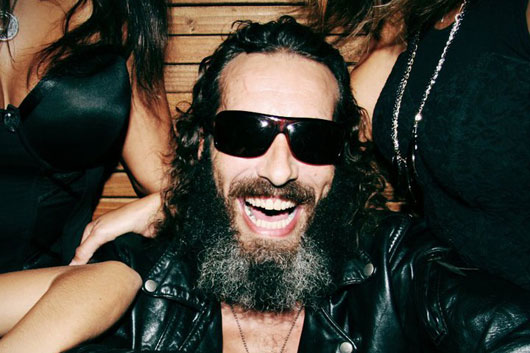
But hoist a copy of Mitch O’Connell: The World’s Best Artist — you should, it’s awesome —and there’s no telling where you’ll get lost amid the artist’s decades of work. The book is a (puffy-covered) homage to an insane career of drawing and illustration, accomplished by a man (PS, not this guy) who has managed to raise a family on his skills while steadfastly pushing the bounds of good taste. The Chicago-based artist is coming to the Bay Area tonight (Thu/21, Berkeley) and tomorrow (Fri/22, San Francisco) for book tour dates. If you like insane, and talent, and professionally insane talent, you’ll most likely be there.
We email-interviewed him, to talk.
SFBG:You did a few series of drawings for Warner Bros., how on earth did that come about? What was your highest hope for that collaboration?
Mitch O’Connell: After doing this drawing thing forever, it would be hard NOT to accumulate a long list of clients. If I hadn’t, I’d be writing this from my cardboard box estate situated on the sidewalk of Michigan Avenue.
I’ve done little bits and pieces for Warner Brothers over the years, working with art directors who must have just seen my art here and there, but the “Hanna Barbera” series was the most fun and involving. I think I pushed a few of the paintings into PG-13 territory, but they encouraged me to be irreverent. Which might not have been a good thing. Once they got the finished art and started pondering how it might look on a kid’s lunchbox it seems they rethought their initial enthusiasm and put the job on the shelf. Where it’s still collecting dust. But I still like ’em!
Your next lunchbox
SFBG: You’re favorite and/or most disturbing tattoo you’ve done?
MO: ALL the tattoos I actually tattooed into peoples flesh were disturbing. Mostly because the clients kept on squirming, screaming, and bleeding. How the hell am I supposed to get any work done with those type of folks?! Actually, now I’m just sticking with simply designing the tattoos, and leaving the actual permanent engraving to the professional tattooists. It was much too nerve-wracking trying to get the art right the first time. As for my best ones, I’m working on my fourth set off flash [ink newbs: “flash” refers to the 11″x14″ sheets of sample ink that hang in tattoo parlors] now, and I like how it’s turning out the best of all. But I’m biased. Tattoo shops, start clearing some room on the walls!
SFBG:How long did your “covering up the naughty bits” gig for Fox Magazine last?
MO: The Fox mascot will hopefully be on the cover blocking out nipples and vaginas as long as there’s a Fox magazine. I did the painting a dozen years ago, it’s all up to them where/when/how often it appears. The more the merrier!
SFBG: Besides its puffy cover (please explain that feature) what are you most proud about with this book?
MO: The graphic design work of my pal Joseph Allen Black (yes, that would be www.josephallenblack.com). He took my rough placement of where I wanted everything and made it look stunning. Think of me as the guy who delivers the 4000-pound block of marble to Michelangelo. As for the puffy glittery cover, a) I loved the look, and b) wanted my book to stand out from the millions of others. At least I’ll have a better chance of folks actually picking it up out of curiosity. Then, considering what’s inside, the better chance of them putting it back.
I kid! They’ll LOVE it!
SFBG: Advice for aspiring freelance illustrators?
MO: Try to be more creative, distinctive, easy to work with, and talented than anyone else. Sadly, you’ll never be able to be the best, because I’ve already copyrighted it.
SFBG: We must know: What does makes you the World’s Best Artist?
MO: One reason was that no matter who reviews it, they have to use the title [of the book]. That way if the opinion is “Mitch O’Connell the World’s Best Artist sucks!” I can turn that into “‘The world’s best artist!,’ raves the New York Times!”
Also, if you keep on repeating something, at some point folks might start falling for it. Think “weapons of mass destruction,” “trickle down economics,” and “guaranteed to add inches to your penis!”. And I’m STILL waiting for my money back!
Mitch O’Connell: The World’s Best Artist book tour
The phenomenal house DJ and experimental musicmaker on mainstream visibility, transgender globalism, Bay Area queer culture, and the “shopping mall diversity” of the current dance music scene.
Techno has always had room for theorists and intellectuals, from Derrick May to the Mille Plateaux label roster, and social activists, like Moodymann and Underground Resistance. Most of that discourse usually takes place musically, however, with concepts emerging from the vinyl itself. The celebrated DJ Sprinkles, a.k.a. Terre Thaemlitz, the American head of Japan-based label Comatonse, tops all that by making intellectually grounded music glimmering with poetic touches and expounding in interviews and writing on such heady, heated topics as essentialism, gender idenitity, surveillance, and authenticity. She leads workshops, goes on speaking engagements, and isn’t afraid to let loose in interviews. (For example — see below — rather than “born this way” platitudes, she considers her queer identity “beat this way.”)
It’s a beautiful thing, especially in the rare context of controversial truth and radical opinion pouring from the mouth and keyboard of an outspoken transgender major player on the stubbornly homogenous global house-techno DJ scene. Of course, it all comes down to the music — we’ll get a treat when Sprinkles (who chose the name because he wanted something that sounded “totally pussy” in opposition to macho DJ culture, to buck the testosteronal scene) performs Sun/24 at Honey Soundsystem — and Sprinkles certainly has the goods. He’s released umpteen pieces in an astoundng breadth of genres under multiple pseudonyms over the past 20 years. Masterpiece deep house album “Midtown 120 Blues” siezed the top of several best of 2009 charts and was, typically, followed by Soulnessless, a 30-hour “mp3 album” of music and video. Because why the hell not?
I got a chance to exchange emails with Sprinkles before her appearance here. It’ll be an interesting return to the Bay Area, where she lived for several years before decamping to Japan. Here’s all she had to say.
http://www.youtube.com/watch?v=UY79cyv8pH8
SFBGIt’s been 13 years since you lived in Oakland, is that correct? Can you tell me why you decided to leave and what it was like to live here then, with regards to the music, political, and queer scene?
DJ SPRINKLES Yes, it’s been a long time. I used to live across the street from a hotel where the Unabomber once stayed. Honestly, I can’t say I miss California. I never really connected with any queer or transgendered communities in SF or Oakland. Whenever I tried, they seemed immersed in West Coast spiritualism and zodiac bullshit, which I found completely alienating. Most of the transgendered people I met there were prone to metaphysics — by which I mean they were ideologically (and economically and medically) invested in defining their transgenderism in relation to a perceived split between their “physical bodies” and their “true inner selves.” I’m an anti-essentialist, non-op, materialist, anti-spiritualist… so that clearly wasn’t a match with my own transgendered identity.
There was also a weird conservatism in SF’s queer scenes that I associated with the fact a lot of people in SF had been raised in conservative Midwestern towns, so they were in SF to “live the life.” I felt there was a lot of unacknowledged parody and role play going on — people trying to overcome a life of repression and closets by wrapping themselves in rainbow flag culture. Yet, when going to buy groceries or such, I still found myself being harassed as a “fag” on the street like in any other town in the US. I felt my four years there was all quite standard. I don’t really think of the Bay Area as a “special place” for being queer and transgendered.
US identity politics have a particularly inextricable link to the concept of the ghetto — not only as a place of economic strife and forced communal ostracization from a “white middle-class mainstream,” but also as a self-invested “safe space” for non-mainstream social movements. This is part of migrant culture. For example, after my grandparents passed through Ellis Island, they immediately moved to a place where people spoke the same language as their homeland, etc. The Castro, New York’s West Village, Little Italy, China Town… these are all migrant-based communities formed by people seeking safety in numbers in the face of not being welcome elsewhere — these two dynamics of “safety” and “alienation” are inseparable to most US identity politics. So these communal zones all display the problems and contradictions of cultural identification that plague mainstream US culture as an “immigrant nation” that is simultaneously “anti-immigrant” – because the “immigrant” is a brutal reminder that there are no “real Americans” beyond Native Americans, which the majority are not. And of course, the fact that recent generations of immigrants are primarily people of color does not jibe with conventional black/white US race discourse, which continues to be largely devoid of other browns, as well as the concept of the person of color as a willing immigrant (as opposed to the descendant of a slave). This history and context is peculiar to the US social landscape, and it creates a lot of weird identity essentialisms and hostilities around gender, sexuality, race, ethnicity, class…
Not to say other countries don’t have their own fucked up ways of causing and dealing with social problems, but moving to Japan and realizing that pretty much the entirety of Western identity politics did not function here was a big life experience. It was like leaving the Earth’s gravitational pull — it didn’t mean gravity no longer existed, but almost everything I had internalized and believed I understood about my relationship to gravity was no longer helpful in understanding the dynamics of dominations at work in this other context. I wasn’t freed of gravity, but lost in weightlessness. I had to learn to feel weight in a completely different way. This is why so many of my projects dealing with my own immigration and cultural issues consistently invoke the rather limited and problematic US language of black/white race relations. It is a critical gesture intended to highlight the limitations of my having been raised amidst that US language and social conditioning, yet now living within a non-US context with few tools to work with.
Because music’s value is so often tied to an essentialist concept of racial authenticity, it becomes difficult and risky to ask an audience to question their relationships to the very value systems through which they likely purchased the album – but that is also why I choose to work with audio. Not because of its possibilities, but its all-too-clear limitations. Since I am unable to believe in the authenticity or purity of identities of any kind, when I invoke “identifiable” sounds (a “queer” sound, a “black” sound, etc.) I am doing so to question the social relationships around their construction, proliferation, and distribution. The moment we become lazy about our use of those “identifiable” sounds — the minute we take it for granted that the essentialist associations they have come to carry are unquestionable and real reflections of material social experiences — everything becomes one-dimensional and shallow. This is why almost all music is one-dimensional and shallow! [Laughs.] For example, if I can beat a dead horse, my problem with Madonna’s “Vogue” is not that it was “inauthentic,” but that its terms of discourse misrepresented its relationship to vogueing by actively erasing the very contexts of Latina and African-American transgendered culture that inspired it (via lyrics about “It makes no difference if you’re black or white, a boy or a girl”… it TOTALLY made a difference, and THAT SOCIAL REALITY is where any real discussion on vogueing BEGINS.). So I’m interested in these other directions of audio discourse that cannot even occur if one is preoccupied with conflated essentializations of identity and sound. There is never a true point of origin for anything. It’s all referential and contextual. In my opinion, there is no point in discussions focussing on identifying the source of a sound or style — that is a hopelessly futile exercise, although it is the dominant exercise! It’s a distraction from the real discussions needing to be held, and those are discussions on relations of domination.
As a DJ in the late ’80s and early ’90s, there were a lot of drag queens asking me to play Madonna’s “Vogue” when it first came out. I refused, but I could understand their requests. We all have very complicit and complex relationships to dominations, and a perverse desire to celebrate our visibility within the dominant mainstream, no matter how unfamiliar or distorted that reflection may be… often because we are conditioned to feel so unhappy with what we see in the mirror to begin with. Mainstream visibility is like getting approval of the Father. It’s a mental and abusive process. It is also totally standard. So I get it… But there is also that which remains unrepresented and invisible to most. That which existed, and may have already been lost, but did so without seeking approval of the Father. And again, this is generally not a freed or liberated space, but a space of intense hatred for the Father. These are difficult things to speak of and represent, because any act of representation has the potential to be a violation of the cultural site it wishes to speak of. So to speak of them requires obfuscating or complicating the usual functions of language – not through vague poetry, but unexpected flashes of clarity coming from unexpected vectors.
http://www.youtube.com/watch?v=R2iKF_11WbY
SFBGYou left during the first Internet boom I believe, and now SF is in the middle of a second one (although a bit different than the first — the first wave seemed to have much more geeks and freaks in it, while this one seems much more regimented and Ivy League, even while many longtime residents are still feeling the results of “global recession”). When was the last time you were back here? And what are some of your recent thoughts on how house music is being affected by economic circumstances?
DJ SPRINKLES I was only back once about 10 years ago, visiting friends for a few days. When I moved away at the end of 2000, internet and web development had already undergone a rigid formalization. Years earlier, a web designer did a bit of everything. By 2000, developers were already split into specific teams focussing on interface, coding, page flow, etc… all processes were specialized, departmentalized, corporatized. I hadn’t heard about the “second internet boom” there, but the way you describe it doesn’t surprise me since it would surely be an extension of that regimentation that took place in the first boom.
And in a way, the same can be said of this “second boom” (third?) around house music. In the same way almost all websites have taken on the same continuity and feel, so has electronic dance music. You buy an album, and all the tracks sound similar — as opposed to the old days when an electronic dance track like Donna Summer’s “I Feel Love” was tacked on to the end of an otherwise standard soul-band album that didn’t sonically match it at all. Today’s music consumer experience is much more streamlined and organized, which affects how people produce an album as well. Younger generations — 20-somethings — grew up amidst this homogenization, so I am fairly sure they do not feel what I am speaking of… although they may recognize it as a historical process.
I try to play with discontinuity and mixing things up, like in my K-S.H.E album, “Routes not Roots,” which had monologues and ambient tracks interspersed between house cuts. But I once made the mistake of reading people’s blog comments, and they really seemed upset about this kind of thing. “Way to ruin the mix,” or “Why the fuck didn’t you put that monologue at the end of the album?” They have no patience for non-homogeneity. The same goes for my Comatonse Recordings website itself — people seem utterly confused and helpless. If one doesn’t do everything completely standard and at the same level, people get disoriented. It’s a kind of cultural compression going on, similar to audio compression, where everything has to be “punched up” to the same intensity or people feel lost. What the fuck is so wrong with being lost? Why would you expect — let alone insist — your interactions with non-mainstream media to be completely mainstream in process?
http://www.youtube.com/watch?v=B8iF7JQiz50
SFBGI’ve been hanging out recently with the new, young generation of ACT-UP activists who are transcending mere ’90s revival and undertaking a lot of energizing political discourse and action. Were you involved in the queer activist movement back then — or now? Would you characterize your musical project as a form of activism, especially in its more intellectual and challenging aspects?
DJ SPRINKLES That’s nice to hear. Although you use the term “action,” I assume the real interesting stuff has little to do with demos and “direct actions,” and more to do with communal education initiatives, etc.? My direct action days were mostly during the late ’80s and early ’90s, while living in New York. Most of those activities were in conjunction with various caucuses in ACT-UP, and WHAM! (Women’s Health Action & Mobilization).
I do consider my audio and other projects “political” — in theme, and also in their attempts to (dis)engage with standard industry practices. But clearly this is something different than direct action “activism” or community outreach, because my main social engagements are with people working for labels, distributors, music festivals, museums, and other culture industries. Maybe “culture jamming” is a better way to put this kind of political activity. Personally, I found myself distanced from direct action groups because the terms of identification they cultivated out of strategic necessity so often folded back into essentialisms that excluded me on a personal level. So I was always advocating for the recognition and acceptance of something other than myself (like the way “born this way” ideologies take over discussions of LGBT rights… I consider myself more “beat this way,” my queer identity being primarily informed by material ostracism and harassment than by some mythological self-actualization and pride). That, combined with the mid-’90s move away from direct action toward CBO’s (Community Based Organizations) — largely because the tactics of direct action had been so thoroughly coopted by mainstream media – was pretty much the end of my serious direct action involvements. Over the years, enunciating this process has become the core political act of my projects and activities. I do not do this to discourage people from forms of direct action, but as a simultaneous form of critical analysis that hopefully contributes in other ways to our various attempts to react to dominations.
SFBGDo you feel that, as the means of production and distribution have been more and more democratized in the past decade, house and techno music-making and DJing have been living up to their potential as a form of resistance to mainstream capitalism and culture, or do you feel they’ve become more homogenized and/or annexed by neoliberal, bourgeois culture?
DJ SPRINKLES I do not believe the means of production and distribution have become more democratized. I take issue with the way people always confuse “commercial accessibility” with “democratization.” The breadth and variation of today’s music production strategies is no more than a shopping mall diversity. We are all working with similar software on similar platforms. Mac, Windows, Unix… Banana Republic, Abercrombie & Fitch, The Gap… Having said that, if these musics had a potential, I believe it was lost back in the ’90s when anti-sampling legislation (mostly focusing on hip-hop) laid the groundwork for today’s electronic music. It basically reinvigorated house with “musicianship,” “authorship,” and all that crap which used to play far less of a role in this genre’s early days. And the younger generation – basically, today’s 20-somethings who grew up after the whole sampling debates — really don’t seem to understand how record label legal departments work.
So they list up all the samples they recognize in a track in the comment fields of music websites, which is putting the producers they wish to support at risk. There is no sense of how we can cultivate — let alone protect — “underground” media and information in this online era. Everything is about “sharing,” when in fact we need to be developing a parallel discourse around meaningful information distribution patterns, including strategically withholding information from the web. The cliché idea of making “everything accessible for everyone” is not only naîve, but negates the social and cultural specificities that give certain forms of media their alternative values, in particular collage and sampling. Anyone who has used a random image taken from a Google image search on their blog page, and then gotten an email from Getty Images’ legal department asking for back royalties, knows what I’m talking about. Treating subcultural musics as though they are meant for “everyone” — whether this is being done by fans, or the labels and online distributors themselves — is the biggest sign of people not understanding the media they are dealing with. And since all of that is SOP these days, it’s pretty much a sign that the sample-based genres of house is dead. Is talking about house’s political potential in 2013 really all that different than the trend of talking about the radical politics of ’60s rock during the ’80s?
http://www.youtube.com/watch?v=v4M3-t9lw7o
SFBGI feel like, with parties like Honey Soundsystem, there is a huge resurgence of interest in an underground queer dance music culture — a kind of new underground opposed to corporate or low-quality dance music (yet still taking place in corporate spaces). Is this phenomenon occurring in Japan as well? Do you feel there are specific possibilities with this, not just in terms of opportunity for queer DJs to travel but of transformation of queer discourse and politically actualizing a new generation?
DJ SPRINKLES Hey, low-quality is where it’s at. It’s what it’s all about. What was Chicago house if not low quality? It’s important to place value within the “low” in order to counter conventional associations between the terms “good,” “high quality” and “upper class.” I’m not talking about celebrating kitsch, or that kind of petit-bourgeois trivialization of the “low.” I’m talking about finding other values in the “low” that cannot find expression within a language developed to express everything in terms of “low vs. high.” This is ultimately about the identification of other values amidst class struggle.
I don’t think house resonates as a queer medium anymore. Those days are over. Today it is primarily a white, heterosexual, European phenomenon. That was the case early on. I mean, how many Americans became aware of house music in the ’80s by buying Chicago house sold back to us on UK compilations? The US has always treated its own history of electronic music like utter shit… The US is such a fucking rock’n’roll shithole. So I think for people to appreciate house music’s queer roots, and to actively invest in those themes today, requires people becoming deliberate and explicit about those interests. But whether that deliberate action would focus on “queer visibility” or not is another issue. It doesn’t have to focus on “visibility” — especially since visibility has become such an oppressive aspect of dominant LGBT movements. Explicitness can also be about closets. Not only the usual closets born of heterosexism, but less considered closets around sexuality and gender that have been formed by the actions of the “born this way” LGBT mainstream. Well, that’s the direction I try to take it… reflecting on, and constructing, queer and transgendered histories that are as skeptical of Pride[TM] as they are angry about violence. And I do believe, globally speaking, queer and transgendered experiences are much more informed by violence than pride. So this should be reflected in how and where we make noise. In my opinion, music that functions in completely standard ways – socially and economically – does not have much potential for reflecting queer or transgendered contexts in politically precise, helpful or meaningful ways. You end up with essentialist, humanist shit like Lady Gaga’s, “Born This Way.” She is not somebody I would consider an ally.
You know, American media is so fixated on the idea that sexuality and gender must either be biologically predetermined, or a personal choice. The “it’s not a choice” argument is a common theme in television shows, etc. Both of these options revolve around a fiction of free will. Like, if it’s not a choice, then the only other possibility must be some supra-social, biological reason that cannot be questioned. Both of these conclusions preserve the status quo brutality of how culture forces gender and sexual binaries upon us. The thought that our absence of choice might be rooted in social tyrannies – not biological predispositions – remains unthinkable. The mainstream has it half right when they say, “it’s not a choice,” but it’s a half-truth that has been twisted into a decoy from the real issues at hand – the inescapability of the hetero/homo and female/male paradigms. We are given no other choices through which to understand our genders and sexualities. Sexuality is far greater than two or three. The same goes for gender — and yes, I’m speaking biologically, human bodies are way more diverse than A or B. To argue that the reason you deserve rights under a humanist democratic system is because of genetics is a retreat into feudalist logic. It’s the same as an aristocrat arguing that their rights and privileges were deserved because of their family blood-line and DNA. “Born this way” is antithetical to any democratic argument for rights rooted in a social capacity for understanding and transformation. It is astounding that the majority of people cannot comprehend that any “born this way” argument is a complete obliteration of their social agency. “I can’t help it, so give me the same rights as you…” Fuck that. We shouldn’t be asking to participate in the rights and privileges of those who have oppressed us. We should be trying to divest those groups of privileges. That is the best way to help ourselves and minimize the violence we enact on others.
Humanist legislative practices are still rooted in feudal ideologies, and I am convinced the long-term repercussions of this is a cultural entrenchment that makes any democratic project (including US-brand democracy, socialism or communism) an impossibility. We can already see how the post-Cold War world is retreating into clan-based, privatized, anti-state organization structures. Capitalism is increasingly liberated of democratic agendas because — surprise! — capitalism works better with slavery. Capitalism is not about the distribution of wealth, and everyone’s equal chance to partake in a petit-bourgois lifestyle. It is about the isolation of wealth. There is no doubt in my mind that today’s moral insistence that all people must work at whatever job society throws them, and the accompanying presumption that all lower-class unemployed people are “lazy” (which is perpetuated by many lower-class peoples themselves), is an argument for slavery: forced labor in return for base subsistence at best. How is that not the reality of poverty under globalized capitalism?
…and that’s why I hate Lady Gaga. [Laughs.]
http://www.youtube.com/watch?v=y-JtoRxqK8s
SFBGYou have some fascinatingly poetic thoughts about the intersection of transgender issues and immigration, the idea of “living as a ghost” in politicized and police-monitored spaces. Do you have any current thoughts on how globalization continues to affect transgender issues?
DJ SPRINKLES I think the fact that the world’s two largest economies around gender transitioning are in Thailand and Iran, yet the aesthetics of those economies follow largely western models of beauty and body, says a lot about how globalization affects transgendered issues. Thailand’s dominant transgendered culture revolves around the “Ladyboy” — a very essentialist transgendered model that is rooted in heterosexism and the cultural/ideological necessity for some men to “unbecome-man” in order for “straight men” to have sex with other men. Western transgendered discourses love to fetishize the “Ladyboy” as some kind of locally celebrated and accepted third-world transgendered native other, but this is patent orientalism. It refuses to envision how the strict regimentation of social codes for those transgendered people can be oppressive, or how the mythical “transgendered native’s special place at the edge of the village, possibly as a shaman” is a form of segregation. People also never address how such cultures are invariably patriarchies, and their models for transgenderism almost exclusively revolve around the MTF paradigm. And far as I know, Thailand has still not lifted their government prohibition on homosexual government employees, which is relatively new legislation passed just a few years back. This is all part of that context of transgendered production.
Meanwhile, Iran is a country where Islamic law prohibits homosexuality by fatwah. Since the ’70s, gender transitioning has been promoted as a way for men who have sex with men to avoid the death penalty, although many transitioned people still face the possibility of being murdered by their families or local communities. The cost of their procedures is partially subsidized by the Iranian government itself. While some Westerners have attempted to portray that as “progressive,” clearly it is the opposite. Many post-op transsexuals find themselves ghettoized, unemployed and cut off from the family structures that play such important roles in Iran’s social structure.
In both Thailand and Iran one can see how the global growth of gender-transitioning economies is connected to heterosexism and homophobia — something current Western gender analyses attempt to separate from gender transitioning through clear ideological divisions between gender and sexuality. While I believe these divisions between gender and sexuality are important and do have social value in the West, it is clear that the West is not the world. And the West has surely not overcome its heterosexism and homophobia, either. I believe it is more than coincidence that the global proliferation of gender transitioning technologies is happening parallel to medical industries’ attempts to divest of their previously blatant attempts to cure homosexuality, due to such methods falling out of cultural favor in the West and elsewhere. I also believe it is more than coincidence that today’s inescapable “born this way” arguments serve and justify today’s medical agendas so well.
For sure, my stance on medical transitioning has always been that I support peoples’ abilities to transform their bodies as they see necessary. Considering how few options for gender identification are offered to us, I can understand how a person can become no longer able to live within one’s body as it has been defined and shaped by social gender constraints. But, for obvious reasons, I am unable to believe those medical systems which propagated today’s gender binary are capable or willing to offer us a way out of our gender crises. Those industries move us further and further away from cultural environments that enable transgendered people to build medically unmediated relationships to our bodies. I just can’t accept that the medical industry’s methods for mediating our suffering are the only way. It really angers me… particularly since so many transgendered people are impoverished and without health care…
Hmm, you’re probably getting an idea as to why I am never invited to perform my more thematic projects in the US — just to DJ some house and go back home to Japan. [Laughs.]
SFBG Speaking of essentialism, ha: Any food or restaurants you miss from living here?
DJ SPRINKLES Mexican food…! It’s shockingly absent in Japan… and when you do find some, you generally wish you hadn’t. But what a weak note upon which to end this interview. [Laughs.]
I’ve dreamt of traveling to Xi’an, China and witnessing the ancient army of buried terracotta warriors practically my whole life. The uncanny legions frozen in fired clay, each individual’s features uniquely fashioned, were discovered underground in 1974, a kinda creepy burial accompaniment of the first emperor Qin Shihuang (259-210 BCE), in a tomb complex the size of a city.
Now, some of those mesmerising warriors are coming to me, via the Asian Art Museum‘s “China’s Terracotta Warriors: The First Emperor’s Legacy” where a selection of life-size figures and related objects will be exhibited Feb 22-May 27.
So of course it’s time to party, electro ’80s cult B-movie style!
In an inspired touch, the everyone-should-be-there opening party on Thu/21 will feature Cheryl, a surrealist disco performance quartet — think retro-future aerobics meets electro Warriors — from New York, as well as DJs Pink Lightning (Stay Gold), Nick, and Bay favorite Hokobo kicking out gritty jams. And, in fact, that staple of ’80s sci-fi playlist movie musts, Warriors, is providing the theme. Although with Cheryl, you never know where that theme is gonna go. Somewhere cosmically Warrior-y, I’m sure.
(I’ll be there of course, but I’m also gonna get to Xi’an someday — the food is supposed to be bonkers good.)
Thu/21, 7-11pm, $15 advance, $18 door. Asian Art Museum, 200 Larkin, SF. www.asianart.org/party
PS The Asian Art Museum has been doing these cute promotional spots from famous San Franciscans, looking for a lost terracotta warrior:
Norman Solomon is co-founder of RootsAction.org and founding director of the Institute for Public Accuracy. His books include “War Made Easy: How Presidents and Pundits Keep Spinning Us to Death.” He writes the Political Culture 2013 column.
Congress waited six years to repeal the Tonkin Gulf Resolution after it opened the bloody floodgates for the Vietnam War in August 1964.
If that seems slow, consider the continuing failure of Congress to repeal the “war on terror” resolution — the Authorization for Use of Military Force — that sailed through, with just one dissenting vote, three days after 9/11.
Prior to casting the only “no” vote, Congresswoman Barbara Lee spoke on the House floor. “As we act,” she said, “let us not become the evil that we deplore.”
We have. That’s why, more than 11 years later, Lee’s prophetic one-minute speech is so painful to watch. The “war on terror” has inflicted carnage in Iraq, Afghanistan, Yemen and elsewhere as a matter of routine. Targets change, but the assumed prerogative to kill with impunity remains.
Now, Rep. Lee has introduced H.R. 198, a measure to repeal the Authorization for Use of Military Force. (This week, several thousand people have already used a RootsAction.org special webpage to email their Senators and House members about repealing that “authorization” for endless war.) Opposed to repeal, the Obama administration is pleased to keep claiming that the 137-month-old resolution justifies everything from on-the-ground troops in combat to drone strikes and kill lists to flagrant abrogation of civil liberties.
A steep uphill incline faces efforts to repeal the resolution that issued a blank political check for war in the early fall of 2001. Struggling to revoke it is a valuable undertaking. Yet even repeal would be unlikely to end the “war on terror.”
At the start of 1971, President Nixon felt compelled to sign a bill that included repeal of the Tonkin Gulf Resolution. By then, he had shifted his ostensible authority for continuing the war on Vietnam — asserting his prerogative as commander in chief. Leaders of the warfare state never lack for rationales when they want to keep making war.
In retrospect, the U.S. “war on terror” has turned out to be even more tenacious than the U.S. war that took several million lives in Vietnam, Laos and Cambodia during the 1960s and early 1970s.
Some key similarities resonate with current circumstances. Year after year, in Congress, support for the Vietnam War was bipartisan. Presidents Johnson and Nixon preached against unauthorized violence in America’s cities while inflicting massive violence in Southeast Asia. Both presidents were fond of proclaiming fervent wishes for peace.
But unlike the horrific war in Southeast Asia, the ongoing and open-ended “war on terror” is not confined by geography or, apparently, by calendar. The search for enemies to smite (and create) is availing itself of a bottomless pit, while bottom-feeding military contractors keep making a killing.
Beyond the worthy goal of repealing the Authorization for Use of Military Force is a need for Congress to cut off appropriations for the “war on terror.” A prerequisite: repudiating the lethal mythology of righteous war unbounded by national borders or conceivable duration.
What may be even more difficult to rescind is the chronic disconnect between lofty oratory and policies digging the country deeper into endless war.
“We, the people, still believe that enduring security and lasting peace do not require perpetual war,” President Obama said in his 2013 inaugural address, after four years of doing more than any other president in U.S. history to normalize perpetual war as a bipartisan enterprise.
Repealing the Authorization for Use of Military Force will be very hard. Revoking the power to combine lovely rhetoric with pernicious militarism will be even more difficult.
Norman Solomon is co-founder of RootsAction.org and founding director of the Institute for Public Accuracy. His books include “War Made Easy: How Presidents and Pundits Keep Spinning Us to Death.” He writes the Political Culture 2013 column.
While hyperbolic coverage of what many news pundits called the ‘storm of the year’ raged across the Tri-State area, Manhattan’s would-be-mammoth blizzard arrived in the Big Apple as a pint-sized flurry that the Weather Channel dubbed Nemo. Nemo did little to deter the stilettoed, snow-shoeing pack of fashion-forward who started the morning of Feb. 8 filing into the tents at Lincoln Center for New York Fashion Week hullabaloo around 6 am.
This is the world of fashion, where a steel backbone is required. Plus, “this is New York, we have noreasters,” said a publicist with whom I scored post-show beers. “This is not a some kind of apocalypse blizzard. This is a snow storm. Put on your big girl boots and get over it.”
The action outside the white-tent runway shows of NYFW has become something of a spectacle recently thanks to the hyper-documentation of show attendees by bloggers, fashion journos, and Instagrammers. The evolution of the street scene has become almost as hyped as the collections themselves — outside-the-tent has converted into a place where writers, buyers, and industry professionals rub shoulders with blogosphere self-starters and editorial wanna-bes. Once you’ve crossed the threshold, however — moved past security and secured your seat — the herd thins out. Inside the shows, attention shifts from the amateur peacocking out front onto the belabored fashion lines themselves.
I attended two shows on February 8 — Project Runway‘s, and that of my Bay Area peers from the Academy of Art University.
Project Runway: Lacking any true designer start that has emerged from this TV series, the jury is still out on whether reality show competition breeds success or mediocrity. Regardless of who will sink or swim in Project Runway’s 11th season, fierce competition certainly yielded entertainment at NYFW.
Usually by Fashion Week, the Project Runway panel — composed of designers Michael Kors and Zac Posen, fashion editor Nina Garcia, and supermodel host Heidi Klum — has winnowed competitors down to the final three. This season, NYFW crowds were treated to the work of seven. The normal Project protocol was thrown to the wind, each designer remaining anonymous, a move that forced them to compete solely on the strength of their garments, without the crowd bias based on on-air personality.
Fashion is an exhibitionist’s sport, but flashiness is not always effective when it comes to style. Some collections at the show came out swinging, trying too hard to define a point of view. Others showed up more quietly, using complicated shapes and silhouettes without appearing self-indulgent. Most resisted the urge to disguise imperfect results with fluff. Michelle Lesniak Franklin’s collection hit the highest note, with several structured pieces rendered in soft quilted fabric, giving way to an ethereal easiness. It appeared elfin or even Zelda-esque, but retained it’s modernity in the silhouette and layering. She took the road less traveled, mixing 1980s-inspired jacket shapes with earth tones, rendering their severe structures soft in wools and knits.
In short, the show was a mixed bag, and no one went home a true winner.
Academy of Art University: Pressure is an odd catalyst. Some respond to it favorably, combining time and tension to yield extraordinary results. For others, pressure works against success, internal combustion evident in the resulting design.
Where Project Runway’s contestants are forced into a pressure cooker for 12 weeks to design, shop for, sew, and style their collections, San Francisco Academy of Art University students are incubated in a better-paced program. Here, years of planning and months of preparation produce the impressive work that the school has come to be known for. These student-designers are not working for cheap airtime or a bump in ratings for their network television handlers, but instead are putting in the hours of work for genuine academic recognition, fashion futures the old-fashioned way.
As an Academy fashion journalism student myself, I have witnessed the rigorous, extremely exhausting, but equally rewarding process firsthand. In last weeks leading up to the end of the semester, there is a pronounced hush in campus design studios, the only audible noises come in deep hums of the sewing machines, the incessant clicking of mechanical needles, and the hissing of industrial-grade irons. Each student, earbuds in, rips, measures, presses, tapes, pins, and repeats. One feels guilty even walking past such determination on the way to the bathrooms, so intense is the creative process.
This year, the collections from AAU’s multi-national student body were marked by a range of culture fusions. The show’s focal point was the visual negotiation between student, fabric, form, and heritage.
The runway sequence ebbed and flowed between moments of sparse minimalism, as in Yuming Weng ‘s simple monochromatics and plays on texture and structure, in Chenxi Li’s over-sized crushed velvet coats, rendered unique by combining elements of ‘50s Americana with traditional Chinese armor. Knitwear student Heather Scholl’s sexually charged, gender-explorative neon psychedelics stalked the lane.
Stand-out collections included show openers Janine M. Villa and Amanda Nervig’s marriage of tailored suiting and free-falling knitwear, which gave the rigid geometric patterns that adorned both fabrics fluidity, and embued the suiting with an astonishing sense of movement. Inspired by traditional Welsh blankets, Villa and Nervig’s work felt eclectic and free-spirited on the runway, the print-on-print combinations of chunky knits and embellished tailoring gave the collection an exciting and unexpected visual depth.
Heather McDonald took taut silhouettes to new heights with soaring shapes that defied gravity. These exaggerated forms were rendered in deeply-saturated angoras and wools, which brought the avant-garde down to earth. The final act was perhaps the most impressive. Qian Xie’s crystal-encrusted coat dresses and lattice-woven leather overcoats followed her apt theme “50 Shades of Grey”, and the results were lust-worthy.
Celebrating romance with power ballads, Spandex leggings, fancy panties
Although there are about 364 days of the year when I can do without it—one day of the year seems custom-made to celebrate the ignoble rise of hair metal and its greatest contribution to the musical landscape — the power ballad. From “Love Bites” to “Is This Love,” “(I Can’t Live Without) Your Love and Affection,” to “The Power of Love” — all the saccharine sentiment of brooding, pouty millionaires in ripped jeans, tight leather, and all those glorious manes — power ballads can and probably should form the soundtrack to Saint Valentine’s Day now and forever. They so perfectly tap into both the cynicism of the single person facing “the dread VD” alone, as well as offering a soaring guitar-solo boost to the cuddly nostalgia of the happily coupled.
While innamorati for hundreds of years have used February 14 as a date to shower their beloved in flowers and cards, Jeff Ross and the SF IndieFest team have used it as another excuse to party, with an annual Power Ballad Sing-along at the Roxie Theatre. Just three years after its San Francisco debut (a similar party tears it up each year in Brooklyn), PBS pours its sugar and motors through the packed house, screening subtitled MTV videos turned up to 11 of all the best bands you’d love to forget to a theatre full of eager inebriates, cutting loose in a veritable bacchanalia of communal song.
If you’re lucky enough to squeeze into the perpetually sold-out event, you’ll be handed a lighter at the door, the essential prop of the power ballad lover and although no extra credit points are handed out for costumes, this being San Francisco, plenty of people do show up in them. Spandex leggings, ripped stonewash denim, studded wristbands, and plenty of Aquanet. One enterprising soul even comes dressed as Slash — right down to the guitar — a handy prop during the obligatory screening of Guns ‘N Roses’ nine-minute orchestral dirge “November Rain”.
Unlike a karaoke night full of awkward people who have to be cajoled into singing at all, let alone bellowing REO Speedwagon songs at full volume, a sing-along allows everyone to a) hide in the dark and b) therefore sing with the full confidence that almost everyone around them sounds even worse than they do, especially after the effects of cheap whiskey and rampant silliness settles in. It’s about as egalitarian as it gets, and even though this year’s blowout was marred by technical difficulties, my sorrow at missing out on the ultimate elation of singing “You Give Love a Bad Name” en masse couldn’t spoil the gleeful satisfaction of mangling an otherwise extensive playbook of all the worst bands with the best hair: Def Leppard, Cinderella, Whitesnake, Journey.
Meantime, just up the block at the Little Roxie, Liz Worthy’s window display aka “Heist Boutique” offers a poignant love letter to the ever-changing landscape of the Mission district via a few carefully-curated *objets d’art* used to represent a psychogeographical survey of “old-school” Mission businesses taken over by others in recent years. There’s the Self Edge VHS tape (asking price $714, in honor of the address), commemorating previous tenant and nostalgic favorite Leather Tongue video store (represented cheekily by a pair of red jeans), a pair of Modern Times sunglasses ($888) named for the bookstore that until recently inhabited the space where Fine Arts Optical now resides, a Wang Fat Fish Market bikini in turquoise and red ($2199) honoring the fish store of yore, (now Zoe Bikini). The display will be up until at least the middle of March, so swing by soon to relive your own fond memories of a Mission gone by. It may be too late to hang out at the Café Macondo or Jivano’s Cutlery, but, like the power ballads of the past, it’s still not too late to reminisce about them awhile.
A Board of Supervisors committee will tomorrow (Thu/21) consider a pair of proposals to regulate the sale of ammunition in San Francisco. And while the legislation is all but certain to pass – gun control is always popular in San Francisco, even when it has minimal impact – one of the measures raises some interesting questions about our understanding of the purpose of deadly weapons.
Sponsoring Sup. Malia Cohen and Mayor Ed Lee held a press conference in December, shortly after the horrific shootings in Newtown, Connecticut, announcing proposals to require notification of the San Francisco Police Department when someone buys 500 round or more of ammunition and banning “the possession or sale of law enforcement or military ammunition.”
The latter measure concerns the sale of hollow-point bullets that are designed to expand after entering the bodies of their targets, which General Hospital Dr. Andre Campbell told those assembled at the press conference “create absolute devastation in the victims. When they strike a victim it’s like a bomb going off.”
So why do we let police officers use them? After all, while officers are instructed to shoot-to-kill when firing their guns, do we really need to make extra sure that those hit by police bullets die? I’m sure the families of the long list of people shot by police who are at most guilty of less than a capital offense — let alone innocent victims of overexuberant policing — might disagree with that approach.
Well, one reason that law enforcement sources cite for their use of hollow-point bullets is that they tend to stay in their targets, thereby reducing collateral damage from bullets exiting a victim and hitting someone else. Fine, but doesn’t that same logic also apply to criminals shooting at rivals in the street? Isn’t it better for their intended target to suffer more damage if it might save other innocent bystanders?
Incidentally, the use of hollow-point bullets was once recognized as a war crime, banned under the Hague Convention of 1899, precisely because of the extra damage they inflicted on human bodies. But now, San Francisco seeks to protect them for cops but ban them for citizens, which certainly seems to violate the spirit of the Second Amendment and intent of allowed an armed citizenry to stand against police state tyranny.
The board’s City Operations and Neighborhood Services Committee takes up the measure starting 10am in City Hall Room 263.
Some people go out to bars and drink on a Friday. But, you want to know what I do for a good time? I chant. I chill in a room full of yogis and I sing mantras in Sanskrit and I get really happy.
If you’re in the yoga tribe, you might be nodding your head here. If you’re not, you may be thinking I sound like a New Age freak who’s sniffed a little too much patchouli. I understand. I’m the city girl who first resisted yoga 15 years ago, when I moved to San Francisco, saying, “Yeah, right, I’m going to just sit there and breathe.” Like yoga, chanting can be something of an acquired taste. But, also like yoga, it can be acquired very quickly. The biggest obstacle is just getting into the room for the first time to do it.
Chanting events are often called kirtan, which is call-and-response singing led by a kirtan artist (also known as a kirtan wallah). The chants are in Sanskrit, a language that has an innate meditative quality, and the repetition of the words put you into an ecstatic mindset. Though the songs are mostly honoring Hindu gods — like Rama, Lakshmi, and Shiva — you don’t have to be Hindu (or a theist at all) to sing them. I mean, anyone can find joy in offering a Christmas gift, or have a spiritual experience while eating a latke, right? The gods are thought by most to be symbolic, representing different aspects of life and humanity. Ultimately, kirtan is a practice of devotion or bhakti. It doesn’t matter what it is you are devoted to — God, trees, your pup or your honey — so long as love is at the center.
There are kirtan events frequently happening in the Bay (see the listings below), and there are touring kirtan bands constantly coming through here to share their music. One of my favorite kirtan musicians is David Newman (aka Durga Das), a Philly-born yogi who has the soul of an angel and the vibe of an indie rock singer-songwriter. He and his band (pictured above: Dave Watts, Clay Campbell, David Newman, and Philippo Franchini) played a small, intimate house concert this past weekend. It was my favorite kind of Friday night: music, tea, a dimly lit room, and a feeling like each person in the room was somehow destined to be there. But that’s often what it feels like at kirtan. It’s as if time somehow stops, and we’re all just there to linger in the pause.
Video of David Newman and band by Dazza Greenwood: http://www.youtube.com/watch?v=UNzopGaXyQA
Karen Macklin is a writer and yoga teacher in San Francisco — her On the Om Front column appears biweekly here on SFBG.com.
PLACES TO FIND KIRTAN IN THE BAY AREA
by Joanne Greenstein
Weekly: Wednesday Night Kirtan around the fire pit 8pm–9pm, by donation Yoga Society, 2872 Folsom, SF. More info here
Sunday Night Kirtan 7pm, $10-$15 First Sunday: Stephanie Winn Second Sunday: Kozmik Kirtan with Evelie Posch Third Sunday: Art of Living Foundation Last Sunday: Sean Feit Yoga Tree Telegraph, 2807 Telegraph, Berk. More info here
Monthly:
Open Secret Kirtan with Mirabai & Friends 3rd Thursday of the month This month: Thursday, 2/21, 7:30–9pm, $10-$20 Open Secret, 923C Street, San Rafael More info here
Kirtan: An Evening of Devotional Chanting & Music with Bhakti Heart Last Saturday of the month with some exceptions This month: Saturday, 2/23, 7:45–9:15pm, by donation Mindful Body, 2876 California, SF. More info here
Upcoming:
Community Kirtan with Andrew Thomas Fisher and Erin Lila Wilson All are invited to lead a chant, join in the response or listen to the sweet sounds. Feel free to bring instruments. Sat, 2/23, 7–8:30pm, by donation Integral Yoga Institute, 770 Dolores, SF. More info here
Complete Immersion:
Bhakti Fest A full-on kirtan festival in the Joshua Tree desert, the September Bhakti Fest (and its May sister festival, Shakti Fest) features around-the-clock chanting, premiere yoga classes and inspiring lectures. All the top international kirtan artists play at these festivals. Shakti Fest, May 17-19 Bhakti Fest, September 5-9 More info here
UC Berkeley basketball coach Mike Montgomery’s spur of the moment shove of star Cal player Allen Crabbe during Sunday’s game against USC has garnered quite a bit of attention from the sports media. It also elicited a strong written condemnation from Senator Leland Yee, who is calling for Montgomery’s suspension. Yee, who got a degree in psychology from UC Berkeley, said the following in a press release:
While I have a lot of respect for Coach Montgomery and I appreciate his apology, his actions at last night’s game were completely unacceptable. As a psychologist, I can assure the university and Coach Montgomery that physically pushing a student-athlete does nothing to motivate them. We do not accept such behavior by our professors and administrators, and we should not tolerate it with our coaches.
The game was an emotional one, but representatives of UC – especially adults – need to be able to control their emotions and refrain from physical altercations with students. I urge the university to take swift disciplinary action of at least a one-game suspension and I wish the Cal basketball program the very best as they enter the final games of the season.
It’s unclear whether UC officials are likely to cave to pressure from Yee. So far the matter rests with a reprimand from Pac-12 Commissioner Larry Scott. Lee has made it clear that he thinks such a response is inadequate. He told the media that he would be calling UC officials personally on Tuesday.
Yee’s chief of staff, Adam Keigwin, confirmed that Yee did indeed spend about 30 minutes yesterday talking with Athletic Director Sandy Barbour.
“He expressed why he was concerned with the situation—as an alum, and as a father who has sent his kids to the UC, and as a grandfather who hopes to send his grandkids to the UC,” Keigwin explained. “As a psychologist, he has seen these cases where kids get pushed around, and that just leads to more aggressive behavior and eventually violence.”
Keigwin said that Barbour seemed to agree with Yee, although regarding a harsher punishment she made no promises. Yee would like to see a one-game suspension, or a redaction of his pay for the USC game.
“We’re still waiting to see what she’ll do with that,” said Keigwin. “We’ll give her a day or two to determine what the outcome is going to be.”
The magnitude of Yee’s response might seem odd, but in fact he rarely misses an opportunity to criticize the UC administration. In the past, he has very publicly battled with UC officials over issues of transparency and a controversial nomination to the Board of Regents.
“Trying to get into kids’ faces every now and again just to get them going is kind of what you need to be able to do.” said Montgomery. “[It was] just a bad choice of motivational techniques on my part.”
A San Francisco entrepreneur is trying to get the Obama administration to overturn a stupid anticonsumer law that protects cell phone makers and phone companies.
Sina Khanifar, co-founder of opensignal, has collected more than 80,000 signatures on a White House petition calling for a restoration of the right to “unlock” a cell phone — that is, to alter its programming so it can be used on a different carrier’s network.
It is, Khanifar told me, a fairly simple issue: If I buy a cell phone, it ought to be mine to use as I wish — and if that includes taking it apart, rewiring it, or changing the programming, that’s my business.
As he notes:
Intuitively we understand that once we’ve purchased a product it’s up to us how we use or modify it. Replacing the hard drive on a Macbook may invalidate our warranty, but it isn’t, and shouldn’t be, illegal.
But under a recent ruling by the Library of Congress, which oversees parts of the Digital Millenium Copyright Act, cell phone companies have the right to demand exclusive use of the devices.
That means when you buy a phone from, say, Sprint, it comes with a code that ensures it will work only on Sprint’s network. You can’t take that same phone and move your account to, say, Verizon or AT&T; you’d have to buy a new phone.
Khanifar has made something of a business out of resetting phones to work on other networks, which is particularly useful for people who are moving or travelling out of the country, where it often costs a fortune to use a US cell phone. Several years ago, Motorola tried to sue him — but with the help of a pro bono lawyer, he was able to beat the giant company back.
But the new rules mean someone who tries to change the code on a device he or she legally owns can be subject to as much as five years in prison and a $500,000 fine.
Cell phone companies say the law is needed to protect their interests; after all, that smart phone you bought for $99 when you signed a contract with your carrier actually retails for about $700. You get the discount by signing a contract to use the company’s network for a period of time, typically two years.
But Khanifar says — correctly — that those contracts already include hefty cancellation fees that more than cover the investment the company made in giving you a discounted phone.
In other words, he says, this is a corporate giveaway that undermines consumer rights. Ultimately, it will take an act of Congress to change the rules, and so far, only one member, Rep. Peter DeFazio (D-Oregon) has shown any interest. “But right now, we’re just trying to get this on the administration’s radar,” Khanifar said.
He needs 100,000 signatures to get an official White House response, and the deadline is Feb. 23. Sign up.