SFBG Blogs

Si Se Puede: The legacy of Cesar Chavez

0

(Scroll down for a personal note from Dick Meister)

March 31st is a special day in eleven states, including California, and in dozens of cities and counties nationwide– and should be. It’s Cesar Chavez Day, honoring the late founder of the United Farm Workers union on the 83rd anniversary of his birth.

Certainly there are few people in any field more deserving of such an honor, certainly no one I’ve met in more than 50 years of labor reporting.

I first met Cesar Chavez when I was reporting on labor for the SF Chronicle.  It was a hot summer night in 1965 in the little San Joaquin Valley town of Delano, California. Chavez, shining black hair trailing across his smooth brown forehead, wearing a red plaid shirt that had become almost a uniform, sat behind a makeshift desk topped with bright red Formica, deadly serious but quick to smile.

 “Si se puede,” he said repeatedly to me, a highly skeptical reporter, as we talked deep into the early morning hours there in the cluttered shack that served as headquarters for him and the others who were trying to create an effective farm workers union.  “Si se puede — it can be done!”

But I would not be swayed.  Too many others, over too many years, had tried and had failed to win for farm workers the union rights they had to have if they were to escape the severe economic and social deprivation inflicted on them by their grower employers.

Although they did the indispensable work of harvesting the food that sustains us all, farm workers typically were paid at or below the poverty level, had few fringe benefits and very little legal protection from employer mistreatment. Most lacked even such on-the-job amenities as toilets and fresh drinking water, and were regularly exposed to pesticide poisoning and other hazards. Their living conditions were generally as abominable.

The futile attempts to arm the workers with the essential weapon of unionization began with  the Industrial Workers of the World,  who stormed across western fields early in the last century. Next came Communists, socialists, AFL and CIO organizers. All their efforts had collapsed under the relentless pressure of growers and their powerful political and corporate allies.

I was certain Chavez’ effort would be no different.  I was wrong.  I had not accounted for the tactical brilliance, creativity, courage and just plain stubbornness of Cesar Chavez, a sad-eyed, disarmingly soft-spoken man who talked of militancy in calm, measured tones, a gentle and incredibly patient man who hid great strategic talent behind shy smiles and an attitude of utter candor.

Chavez grasped the essential fact that farm workers had to organize themselves.  Outside organizers, however well-intentioned, could not do it. Chavez, a farm worker himself, carefully put together a grass-roots organization that enabled the workers to form their own union, which then sought out — and won — widespread support from influential outsiders.

The key weapon of this United Farm Workers union was the boycott. The UFW’s boycotts against grape and lettuce growers and wineries in the late 1960s won the first farm union contracts in history.  That in turn led to enactment in 1975 of the California law — also a first — that requires growers to bargain collectively with workers who vote for unionization. That has brought  substantial improvements in the pay, benefits, working conditions and general status of the state’s farmworkers.

The struggle was extremely difficult for the impoverished workers, and Chavez risked his health — if not his life — to provide them extreme examples of the sacrifices necessary for victory.  Most notably, he engaged in lengthy, highly publicized fasts that helped rally the public to the farm workers’ cause and that may very well have contributed to his untimely death in 1993 at age 66.

Fasts, boycotts.  It’s no coincidence that those were among the principal tools of Mohandas Gandhi, for Chavez drew much of his inspiration from the Indian leader.  Like Gandhi and another of his models, Martin Luther King Jr., Chavez believed fervently in the tactics of non-violence. Like them, he showed the world how profoundly effective they can be in seeking justice from even the most powerful of opponents.

As Chavez explained,  “We have our bodies and spirits and the justice of our cause as our weapons.”

What the UFW accomplished, and how the union accomplished it, will never be forgotten — not by the millions of social activists who have been inspired and energized by the farm workers’ struggle, nor by the workers themselves.

The struggle continues, for despite the UFW’s successes, most farm workers are still mired in poverty. But because of the union, they have a genuine hope of bettering their condition.

The UFW won important legal rights for them.  But more than union contracts, and more than laws, farm workers now have what Cesar Chavez insisted was needed above all else.  That, as he told me so many years ago, “is to have the workers truly believe and understand and know that they are free, that they are free men and women, that they can stand up and say how they feel.”

Freedom.  No leader has ever left a greater legacy.

Dick Meister, former labor editor of the SF Chronicle and KQED-TV Newsroom, is co-author of “A Long Time Coming: The Struggle to Unionize America’s Farm Workers (Macmillan). Contact him through his website, www.dickmeister.com.

Sidebar: Let’s truly honor Cesar Chavez

It’s way past time that Congress declared the birthdate of Cesar Chavez a national holiday. President Obama agrees. So do the millions of people who are expected to sign petitions being circulated by the United Farm Workers, the union founded by Chavez. And so do Democratic Rep. Joe Barca of California and 43 co-sponsors who have introduced a bill designating March 31st as Cesar Chavez Day nationwide.

President Obama says Chavez should be honored  “for what he’s taught us about making America a stronger, more just, and more prosperous nation” and for providing inspirational strength “as farm workers and laborers across America continue to struggle for fair treatment and fair wages.”

Like Martin Luther Jr., who’s rightly honored with a national holiday, Chavez inspired and energized millions of people worldwide to seek – and to win – basic human rights that had long been denied them, and inspired millions of others to join the struggle.  He, too, showed that the poor and oppressed can prevail against even the most powerful opponents – if they can organize themselves and adopt non-violence as their principal tactic.

A national holiday would be a well-deserved tribute, not only to Chavez, but also to Latinos generally, to organized labor and to all those who do the hard, dirty and dangerous work that puts food on our tables.

–Dick Meister

Levada takes on the Times

7

Cardinal William Levada, former archbishop of San Francisco Catholic Archdiocese of San Francisco, has penned a caustic response to recent New York Times articles and editorials that were critical of how the church and Pope Benedict XVI have handled sexual abuse cases involving priests over the years, calling the coverage “deficient by any reasonable standards of fairness that Americans have every right and expectation to find in their major media reporting.”

This bold, Spiro Agnew-like counterattack on the press during a time of mounting evidence of a covered-up pedophilia epidemic in the church is all the more notable given that Levada is the Prefect of the Congregation for the Doctrine of the Faith, an office then-Cardinal Ratzinger held before becoming Pope Benedict XVI, helping to place that office in charge of all reports of pedophiliac priests, a move that critics have charged was made to shield the church from criticism.

“I ask the Times to reconsider its attack mode about Pope Benedict XVI and give the world a more balanced view of a leader it can and should count on,” Levada writes, giving a far more charitable view of the current pope than the general public is feeling right now.

Rather than these defensive counterattacks on the Times’ solid journalism and analysis, Levada should realize that this tactic is precisely the attitude that has people concerned about the church, which has yet to fully atone for its many sins, including those committed by the Pope.

Back home in San Francisco, the church continues to stiff the city for millions of dollars in real estate transfer taxes involving the deed transfers of hundreds of properties under Levada’s leadership, a strange move that many critics have speculated was done to shield church assets from the claims of sexual abuse victims.

To me, this seems deficient by any reasonable standards of morality and openness that Americans have every right and expectation to find in their major religious institutions, particularly one that aspires to leadership that we can and should count on.

Zion I is home and grown

1

Marriage, jobs, cars— ten years can be a stretch for a lot of things in our world, but the hip-hop created by Zion I is still fresh after a decade, the signs of wear and tear only showing on the albums themselves. Producer AmpLive and emcee Zumbi make up the Bay Area duo—playing Thurs/1 at the Rickshaw Stop and Fri/2 at the Independent— who have just returned from a 35-city tour around the country. Zumbi says they’re officially “ready to vibe with the hometown crowd.”

“The tour was great, but I need to get my life and routine back together,” Zumbi said over the phone while prepping for his regular show on Oakland’s Youth Radio. Sharing the bill with Cali-raggae stars Rebelution and Soja, the laid-back hippy crowd proved to be quite different than the fans Zion I usually sees when they share the stage with other hip-hop artists. 


“A lot less ego and a lot more energy,” he said, noting that the tour consistently had an average of one to three thousand people in the audience. “Usually on a tour, it fluctuates. Some nights are big and others just have 50 people. The consistency brought out a lot of energy. Every night was so exciting— never a drag.”


His favorite stop on the tour was definitely New Orleans. The massive amounts of reconstruction throughout the city reminded him a lot of where he calls home— West Oakland. 


“The old Victorian houses, next to the new condos and all the construction. New Orleans was like my neighborhood three times over. It was nuts.”


Zion I


Back on his home turf, Zion I is the same cat you met back in the late ‘90s: prominently loaded with thick, luscious beats from AmpLive’s unpredictable bag of tricks and smooth, conscious lyrics from the mouth of Zumbi. Funk, soul, D&B, and space vibes remain as they have throughout Zion I’s career, but their sixth and most recent release, The Takeover (Gold Dust Media, 2009), really hits home by honing in on these qualities. Sharp hooks, anchored melodies and beats that bump make this album congruent with Kanye-style hits. 


“We switched up our process and did lots of revisions on this album. We’d change up one song like two, three or four times. I’d write three or four raps for each beat,” he said, which is quite a contrast to the previously process: Amp would make the beat, Zumbi would write the rhyme and they’d record. 


Such a drastic change in work ethic doesn’t just come out of nowhere. 


“Well, we’ve been in this for ten years…” he starts out. “And Amp just got married and had baby. And we both just bought houses.” The truth comes out: they’ve grown up. And so has their music. “We’re ready to take on more responsibilities. This is where we are. We are grown men with something to say.”


Zumbi considers each song like a journal entry, a story in each song that reflects where these two men have been, what they’ve seen and the thoughts the journey has inspired. 


And he wraps it up in one perfect statement: “One of the most beautiful things in life is to watch an artist evolve.”


Zion I


Thurs/April 1

Rickshaw Stop 

155 Fell St, SF

9pm, $18/20

www.rickshawstop.com


Fri/April 2

Independent

628 Divisadero Street, SF

9pm, $18/20

www.theindependentsf.com


Ross on the road: The great white north

1

Editors note: Guardian correspondent John Ross is traveling across the nation pomoting his new book, El Monstruo — Dread & Redemption in Mexico City, and is sending us dispatches from the road. This week: Twin Cities, Madison and Northern Michigan.


 1. BLUE IGLOO


As I deplaned the Southwest Shuttle from Denver wrapped in my blue igloo, a puffed up garment that doubles my skeletal girth, a sudden spasm of panic punched me in the gut. Had I slept through my stop and disembarked in Fargo, North Dakota instead?
Minneapolis might just as well have been Fargo. The dead winter landscape lay frozen under week-old snowdrifts and the Twin Cities shivered in negative wind chill numbers beneath a leaden sky from which a cold hard rain would pelt down for a week. Fargo or Minneapolis? It didn’t much matter where I had landed – just don’t toss me into the wood chipper.


On my first evening in this desolate region, I was invited to dialogue with the Minnesota Immigrant Freedom Network at a community center in St. Paul. About 15 transplanted Mexicans, many of them related by marriage or friendship, pulled together in a circle in the gymnasium while the kids romped in the other room. Each called out his or hers’ “patria chica,” their home state or region or town. I talked about Mexico down on the ground today in the cheerless winter of 2010, the 100th anniversary of a distant revolution. How four out of every ten heads of households are out of work. 10,000 farmers and their families forced to abandon their milpas as millions of tons of NAFTA corn inundate the country. 19,000 dead in Felipe Calderon’s disastrous attempt to beat down the drug cartels. Who will be next?


Those in the circle leaned forward on their folding chairs, bending into my words as if I was a messenger bringing bad news from home. One woman began to weep and another rose to comfort her.


Later, I pulled out my book, El Monstruo – Dread & Redemption in Mexico City to show them what I had written. Families who would probably not eat meat for a week if they bought one snapped up three Monsters and asked me to sign them for their children — Alejandra, Yesica, Jeni, Alfonso, Jonaton — so that they could learn about the country they had been forced to abandon, in their new language.


As the session wound down, Mariano (not his real name) invited the families to a Jewish Seder the next week at a progressive Minneapolis schul. Then they would get on the buses and head for Washington D.C., a 150 hour round trip, to march for immigration reform on March 21st, the first day of spring. In the nooks and crannies of Obama’s America, Mexicans were beginning to come out of four years of social hibernation to rally for immigration reform, not a hot button issue in this economically strewn landscape.


I hung up with my old camarada Tomas Johnson, one of the apostles of fair trade Zapatista coffee — similar dispensaries like Just Coffee in Madison and Higher Grounds in Michigan are sprinkled over the frigid Midwest. Café has played a diminished role in the slender Zapatista economy ever since Muk’Vitz, a Tzotzil Indian cooperative, imploded when coffee prices soared — coyotes, bottom-feeder speculators, started showing up on the members’ doorsteps offering a few pesos more than the fair trade price.


Coffee is not an ideal resource upon which to build Zapatista autonomy — the price is set far away on commodity exchanges in London and New York and the product itself is destined for the jaded palettes of the connoisseur class in the cities of the north. Moreover, the coffee crop soaks up corn land and adds nothing to indigenous nutrition.


I marked my journey into my 73rd year at a house fiesta hosted by Tomas’s steady squeeze, an audiologist who gifted me with a hearing aid so that I might be able to decipher that questions hurled at me from the small audiences I address. This time last year, I was being wheeled into a green, antiseptic operating room for a round of chemotherapy that would k.o. the tumor that had taken over my liver. This birthday is the real gift.


I entertained privileged white students at several universities during my stay in the Twin Cities, got hopelessly lost in a frigid wasteland trying to find a Lutheran college, told tall tales to a handful of Raza at the U. of Minn, and attended a showing of the Benny More bio-pic at a jam-packed local theater. Benny’s scintillating calor radiating from the screen in waves of tropical heat juxtaposed oddly against the backdrop of the frozen north. Minneapolis-St Paul, with their new populations of color – Somalis, Ethiopians, Eritreans, Hmung, and Latinos – spice up this staid old state with exotic flavors. The music has changed: Reggaeton and Rancheros have replaced Spider John Koerner. I drink in the Albert Ayler-like contortions of a longhaired white boy at a jam session downstairs at the Clown Lounge.


Politics too are not as usual in this once-upon-a-time farmer-labor socialist paradise: Keith Ellison is the nation’s first Muslim congress person and a middle-of-the-road Democrat comedian stands small in the shoes of Paul Wellstone. In the other corner, the pit viper Michelle Bachman spits her venom into the black lagoons of Obamalandia.


II. TURKEY MOLE


I’m back on the Big Dog — there are plenty of Mexicans here but no Mexican bus. On the jump over to Madison, I chat with a well-seasoned black man during a smoke break. He wants to know where I’m headed. I’m on a low-rent book tour, I explain, I move from city to city to sell my books. “I’m on a book tour myself,” he laughs, “I get off where I want to and see if I like it or not. Hung up in Oswego for eight days but wasn’t anything there for me…”


There is a down-at-the-heels traveling class — the evicted and foreclosed, laid off and uprooted — rolling around the underbelly of this damaged country with no fixed destination in mind, looking for a place to light, some place that feels like home.


Norm Stockwell, who keeps WORT-FM, the Voice of Madison’s Voiceless, choogling, picks me up at the Greyhound depot, a furniture-less warehouse that resembles an immigrant detention center on the outskirts of town, and drives me over to the once-a-month Socialist pot-luck, but only scraps and few stained paper plates are left. A few hours earlier, the Madison P.D. visited the premises at the behest of the Wisconsin Socialist Party to remove a truculent member who had been abruptly expelled from its ranks, an astonishingly unpolitical resolution to a political dispute.


Madison is a city that doesn’t leave much up to chance. Cops are ever at the ready to surveil radical meetings. One cannot post a hand-scrawled street sign protesting injustice without first obtaining a permit from the city. No household is allowed to house more than three chickens (no roosters), a law that necessitates chicken inspectors and has given birth to the Chicken Liberation Front.


The State Capitol, a knock-off the Nation’s, is forever on the eyeline in Madison to remind one of the power of the State, I expect. The city is laid out on a grid so that all avenues spoke off from its monstrous dome – you have to move out of town to escape the radiation.


On Saturday, March 20th, a fistful of eternal protestors gathered at the foot of this granite beast to mark the start of the eighth year of the illegal invasion and occupation of Iraq and the decimation of millions of its people. As I trudged up State Street towards the Capitol, I flashed back to our feverish days as Human Shields in Baghdad in March 2003 and thought about Sasha for whom the war never goes home, climbing the hills of Amman, delivering collateral repair from dawn to dusk to the million Iraqi refugees that forgotten war has exiled to the Jordanian capitol.


Our presidents invade so many foreign countries that they can’t even remember the name of the last one they destroyed. Iraq has been erased from the North American mind screen in favor of Afghanistan, the Good War on Obama’s agenda. Last month, Sasha and Mary’s Collateral Repair Project took in just $50 in donations and CRP is in danger of folding. Send them some Yanqui shekels at (www.collateralrepairproject.org.)


The annual commemoration of the Iraqi genocide draws smaller and smaller knots of humanity each year — 80 or so souls in Madison, 500 in San Francisco, not 10,000 in Washington. But the next day, as Baracko’s Dems braved the racist jibes and hard fruit of the Teabaggers to enter the hallowed halls of Congress and narrowly vote up a phony health care reform bill that excludes immigrants from coverage and leaves the insurance congloms on top, 200,000 assembled outside to back up a proposed immigration reform that smells just as cheesy as Obamacare.


The rally proved to be the largest confluence of immigrant workers since that miraculous May 1st four years ago when millions came out of the shadows to shout “aqui estamos y no nos vamos.” After that milestone moment, the immigrant rights movement was driven into the underground by Bush’s ICE raids, Lou Dobbs, the Minutemen, real-time Mexico bashing with knives and bottles, Sheriff Joe’s Arizona storm troopers, good ol’ American-as-apple-pie racism, and the squeamish response of the official Latino leadership.


Now the indocumentados are taking their first baby steps back into the maelstrom of U.S. politics. Hundreds of grassroots groups like the Minnesota Immigration Freedom Network rented buses and drove off to Washington on the first day of spring and May 1st, the day on which immigrant workers first took to the streets of America 124 years ago in the battle for the eight hour day, now looms large on the calendar of resistance.


Lester Dore is a graphic artist who operates under the influence of the king of the calaveras Jose Guadalupe Posada, the brothers Flores Magon, and the breathtaking explosion of popular art that detonated on the walls of Oaxaca during the 2006 uprising in that southern city. Lester whips up a pair of prints to celebrate the publication of “El Monstruo” and the life after death of Praxides G. Guerrero, the first anarchist to fall in the 100 year-old-this-year Mexican revolution. He serves up a big pot of Mole de Guajalote (Turkey) and invites us over. Three compas from Toluca in Mexico State share the sumptuous repast and the conversation quickly slides into Mexican. I learn the origin of the Chilango-ismo “teparocha” (falling down drunk) but eschew the vino (the liver lives on.)


III. SANCTUARY IN THE HEARTLAND


Driving the long route around Lake Superior into northern Michigan, the first tentative fingers of spring have brought a thawing to the land. The cherries that draw thousands of migrant workers to the Lower Peninsula are threatening to burst into bud. Gladys Munoz (her real name) directs Migrant Health Services for seven northern Michigan counties. She is based in Traverse City, a comfortable upper crust enclave — the billion buck mansions out on the peninsula are in the El Chapo Guzman category of ostentation (Michael Moore is rumored to be in residence in the environs ensconced in a lavish log cabin roughly the size of downtown Flint.)


Gladys knows where the bodies are buried. We ply the backroads to the labor camps hidden away down in the dank gullies. Guatemalans and Mexicans stream into this region each spring to do the stoop labor no gringo will do and pick the Maraschinos that top off the parfaits of the few upwardly mobile Americans left in the wake of the ravaged economy (Michigan unemployment clocks in around 15%.) Gladys tells me about three babies born without brains — she suspects pesticides. She speaks about a man from Chiapas who hung himself when he found out that he had contacted AIDS — a priest was called upon to perform an exorcism at the house where he expired. And a young Triqui Indian mother from Oaxaca picking cucumbers for a Vlasic pickle contractor who was stranded in a country that doesn’t recognize her language after her husband went fishing for supper without a license and Fish & Game turned him over to the Migra.


We visit with Liliana (not her real name) from the drug war-riddled hot lands of Guerrero state. The patron is a kindly old farmer who has installed cable TV for the workers and we watch Barack Obama extol the wonders of his tarnished health care bill. Liliana’s husband is picking oranges in Florida but will soon return to work the cherry. She says he doesn’t much believe that an immigration reform measure will make it out of congress – “just some more blahblahblah…” But Liliana will march this May 1st if she can get a ride — undocumented workers are not permitted drivers’ licenses in the state of Michigan.


Traverse City is good to me. I perform at a local organic coffee roaster for a roomful of social change agents. The next morning, Jody T. who gave up her life to drive this garrulous old gaffer around the bioregion, steers the Viva into a trepidatious triangle. Cadillac was once the home base for Timothy McVeigh and the Michigan Militia, a recent flashback on the Ten O’clock News after a Christian posse purportedly targeted cops for blood sacrifice in preparation for the appearance of the Anti-Christ. To the west, small towns with Dutch-inflected names like Holland and Zeeland and Vreland dot the lakeside.


White clapboard outposts of the Dutch Reform Church, the architect of South African apartheid, their steeples spiring piously into the spring breeze, hug the highway. The Dutch Reform Church is the spiritual home of the Prinz family whose most celebrated spawn, Eric, is the go to guy at Blackwater. Further south we slide into Grand Rapids where the similarly affiliated DeVos dynasty’s Amway holds sway. The Prinzes and the DeVoses (a good reason not to root for the Orlando Magic) finance such repositories of right-wing fanaticism as Focus On The Family and Operation Rescue. The largesse of Dick DeVos rivaled the Mormon Church in putting California’s homophobic Proposition 8 over the top.


Grand Rapids, once the furniture capitol of the known universe and now the home of the Gerald Ford Museum of Presidential Imbeciles, is a good boxing town (Buster Mathis and Roger Mayweather have gyms here) and a swelling Latino population has changed the complexion of the city. Despite the downturn, Grand Rapids is trying to upgrade its downtown but the further one gets from the core of the city, the seedier things look.


Koinonia House is a sanctuary near the old demolished heart of Grand Rapids — in fact, it is the only structure left standing on its block. Established by disaffected seminarians like Jeff Smith in the early 1980s when the U.S. waged war on Central America, K House became a station on the underground railroad built by the Sanctuary Movement. The first refugees were Guatemalan Indians fleeing the scorched earth genocide of Efrain Rios Montt. In recent years, K House has taken in Mexicans fleeing that “desgraciada pobreza” back home, like Carlos and Alynn (their real names) who have brought their remarkable art with them to El Norte.


Jeff kicks back and reminisces about the fates of former tenants. The big-bellied wood stove belches out waves of warmth on a chill late March morning. The big arms of the fluffy old lounger envelop a weary traveler and hold him close. K House remains a sanctuary deep in the heart of a wounded land.


Stay tuned. Chicago, St Louis, Jackson Mississippi – there is still a whole lot of traveling to do as the Monstruo tour moves eastwards.               


FIN


John Ross and “El Monstruo – Dread & Redemption in Mexico City” will visit St. Louis April 4th-7th, and Millsaps College Jackson Mississippi April 9th for a symposium on Mexico City – he will tour Baltimore, Washington, New York, and Boston April 19th through May 1st. For details write johnross@igc.org.


Hump Day headliner: The White Mice

0

The screaming, banging, clanging, and screeching I can handle for a couple minutes, but the big, bloody, rodent costumes? No way. Pretty sure I’m a masklophobe, meaning I’m already totally creeped out by people dressed up in oversized, animal and mascot costumes, even if they’re smiling and semi-cute. The grindcore metal-heads, The White Mice—playing Wed/31 at 21 Grand— take it to an all-new low with their chosen stage attire, beyond the crypt and into a the most terrifying science lab possible. 

Three guys in three red-stained lab coats, the Rhode Island Mice hide their faces behind papier-mâché mouse masks on stage, experimenting with their abrasive, totally rude, nasty metal sounds. 

Categorize them as you will, their brand of metal is industrial and distorted, a batch of chemically treated sounds concocted by the hand of a mad scientist. The guitars rip and rage with machismo. The vocals growl. The pounding bass and steadfast drums claw your organs from the inside out— sound appealing?


whtmice0310


The strangest part about The Mice is their “cheesy” sense of humor. Their song titles are often mice-related, like “Gouda and Evil” and “Cheesus Saves.” Funny and scary— these guys would be hot on the dating market. 


The show is being put on by Club Sandwich, an East Bay collective who organizes events for local, and touring, under-the-radar musicians. The show is all-ages, meaning you could tote along your whiney little brother and really scare the shit out of him, Donnie Darko style. 


The White Mice w/Lesbian and Nuclear Death Wish

Wed/31, 8pm, $6

21 Grand 

416 25th St., Oakland

www.21grand.org


Foals ride a cold Saharan wave

0

It’s sunny at the moment in SF, but Guardian faves Foals bring a glowing, dark Nordic vibe in their latest video “Spanish Sahara” — hirsute cutie singer Yannis Philippakis’ tears and all. Second album Total Life Forever comes out May 11.

Benefits: March 31-April 6

0

Ways to have fun while giving back this week

Wednesday, March 31

Wet Wednesday
Party for a great cause at this benefit for the Edgewood Center for Children and Families, a center that provides services for children, teens, and families. Enjoy free food, music by DJ Paul, a raffle for a $450 gift certificate to Las Olas Surfboards and other prizes, and Sierra Nevada beer who will donate $1 for every pint sold.
8 p.m., free
Riptide Cocktails
3639 Taraval, SF
www.riptidesf.com

Friday, April 2

Benefit for Ed Hannigan
Attend this WonderCon Weekend party where a portion of the proceeds will go to the currently exhibited comic book artist Ed Hannigan who suffers from multiple sclerosis. Featuring a silent auction and food and drink.
8 p.m., $10-35 sliding scale
Cartoon Art Museum
655 Mission, SF
(415) CAR-TOON
www.cartoonart.org

Saturday, April 3

Shoebox Studios
Help Shoebox Studios celebrate their recent move to a larger location, which will help them to offer their body positive, safe dance, art, and martial arts classes to more members of the community. Cocktail reception and silent auction of goods, services, and artworks followed by party featuring live music by Rhubarb Whiskey, dance performances, and more.
Cocktail reception and silent auction: 5 p.m., free
Party: 7 p.m., $5 donation
Shoebox Studios
864 Folsom, SF
(415) 861-5976

Monday, April 5

“Relief”
Attend this San Francisco Art Institute MFA candidate silent auction event, where all proceeds will be donated to the Clinton Bush Haiti Fund. Work of painters, photographers, sculptors, designers, filmmakers, and more will be showcased. Featuring music performances and hors d’oeuvres.
5 p.m.
San Francisco Art Institute
Courtyard
800 Chestnut, SF
www.sfai.edu

Quick Lit: March 31-April 6

0

Literary readings, book tours, and talks this week

Wednesday, March 31

Vito Acconci
Hear writer/visual artist turned designer and architect, Vito Acconci, talk about “Words/Action/Architecture,” where he will discuss recent and upcoming projects of Acconci Studio like an artificial island in Graz, an elevated subway station in Coney Island, and a street that runs through a building in Indianapolis.
7:30 p.m., free
Mills College
Lisser Theater
5000 MacArthur, Oak.
(510) 430-2164


Performing South Africa’s Truth Commission: Stages of Transition
Join author Catherine M. Cole as she discusses South Africa’s Truth and Reconciliation Commissions, which helped to end apartheid by providing a public forum to exposed human rights abuses, and how the truth commission as public ritual and national theater provided a medium for performing evidence and truth to legitimize a new South Africa.
5:30 p.m., free
University Press Books
2430 Bancroft, Berk.
(510) 548-0585


Thursday, April 1

James Hannaham and Andrew Sean Greer
McSweeney’s and Modern Times Bookstore present an April Fool’s Day evening of literary debauchery with James Hannaham reading from his award-winning novel, God Says No, and Andrew Sean Greer reading his acclaimed NASCAR piece from the McSweeney’s publication, San Francisco Panorama.
7 p.m., free
Amnesia
853 Valencia, SF
(415) 970-0012
www.mtbs.com

April Martin Chartrand
Attend this audio visual presentation of April Martin Chartrand’s book, Angel’s Destiny: A novel story of poems and illustrations, and experience the emotional life of a multi-cultural woman in the United States trying to overcome violent adversities and embrace self-love.
6 p.m., free
San Francisco Main Library
100 Larkin, SF
angelsdestiny2009.blogspot.com

K.M. Soehnlein
Hear Soehnlein read from his new book, Robin and Ruby, a sequel to The World of Normal Boys where he introduces the character Robin MacKenzie. In this new story of love and loss we meet Robin’s sister Ruby.
7:30 p.m., free
Books Inc.
2275 Market, SF
(415) 864-6777

Surviving the Dragon
Hear author Arjia Rinpoche share his inspiring survival story of the years he spent in Tibet during the Cultural Revolution at this reading for his book, Surviving the Dragon: A Tibetan Lama’s life under Chinese rule. Rinopoche witnessed the torture and arrest of his monastery family, spent 16 years in a forced labor camp, and endured many other hardships before he escaped to the United Stated in 1998.
7:30 p.m., free
The Booksmith
1644 Haight, SF
(415) 863-8688
www.booksmith.com

World Poetry Night in the Oral Tradition
Enjoy recited poetry from diverse cultures and time periods in the “oral tradition,” where one poem inspires another from classics such as Rumi, Sappho, Hafiz, Whitman, Shakespeare, T.S. Eliot, Dickinson, Neruda, and more.
7 p.m., $12
Mechanics’ Institute
57 Post, SF
(415) 393-0100
www.milibrary.org

Friday, April 2

Litpunk
Enjoy intense, punk-edged lit readings and music at this punk rock alternative to the popular Litquake annual reading series. Featuring Penelope Houston, lead singer of the Avengers, reading poetry, prose, and singing, John Shirley, author and former lead singer of SadoNation, Eddie Jetson, of Ice 9, “Jennifer Blowdryer,” Johnny Genocide, and more.
7:30 p.m., $5
Makeout Room
3225 22nd St., SF
(415) 647-2888


Reality Hunger: A manifesto

Author David Shields argues that our culture is obsessed with reality because we experience hardly any. At this reading, Shields will share his stance that aims to reframe how we think about “truthiness.”
7:30 p.m., free
The Booksmith
1644 Haight, SF
(415) 863-8688
www.booksmith.com

Saturday, April 3

Indivisible: An anthology of Contemporary South Asian American Poetry
Kick off national poetry month at this book launch, reading, and signing of this collection of poetry from contemporary American poets from different cultures and faiths who trace their origins back to Bangladesh, India, Nepal, Pakistan, and Sri Lanka. The anthology aims to capture the simultaneous tensions of belonging and not belonging in America.
Featured contributors: Ravi Chandra, Tanuja Mehrotra, and Swati Rana
7:30 p.m., free
Booksmith
1644 Haight, SF
(415) 863-8688
www.booksmith.com

Monday, April 5

The Hills in Berkeley
Attend this UC Berkeley geology talk where professor Dr. Doris Sloan will discuss the formation of the Hills in Berkeley.
7:30 p.m., $5
The Hillside Club
2286 Cedar, Berk.
(510) 848-3277
www.hillsideclub.org

Tuesday, April 6

Homero Aridjis with Lawrence Ferlinghetti
Hear Mexican poet, novelist, and environmentalist, Homero Aridjis read from his new collection of poetry, Solar Poems, addressing both his ecological concerns and a mystical relationship to the sun. Lawrence Ferlinghetti will also read several poems from the new bilingual edition of his book, What is Poetry?/¿Qué es la Poesía?, which Aridjis translated.
7 p.m., free
City Lights Bookstore
261 Columbus, SF
www.citylights.com

Biking Book Club
Join members of the SF Bike Coalition and other biking enthusiasts for this book club and discussion group about bike and transportation related books. The current book up for discussion is Traffic: Why we drive the way we do by Tom Vanderbilt. Bring ideas for future reads.
6:30 p.m., free
San Francisco Bicycle Coalition
995 Market, SF
www.sfbike.org/books

Insectopedia
Hear author Hugh Raffles discuss his new book that pays tribute to bugs of all kinds in this collection of 26 offbeat and bizarre essays and philosophical musings.
7 p.m., free
BookShop West Portal
80 West Portal, SF
(415) 564-8080

Snap Sounds: Dum Dum Girls

0

DUM DUM GIRLS

I Will Be

(Sup Pop)

Dee Dee. Jules. Bambi. Frankie Rose. Their names would be perfect for the pole and dollar-bill dances, but the only stage these four L.A. ladies take on is one with a mic. Together they are The Dum Dum Girls and today these bad-ass babes put out their first full-length record, I Will Be. Primarily dirty garage-pop with a shot of girl-group charm, the Dum Dum’s combination of sweet and ratty comes off with a second-wave feminist punch. Hot harmonies, lo-fi fuzz, sexy black outfits, and sassy melodies that stick like bubblegum. 

I Will Be recieved a little love and audible inspiration from industry vet Richard Gottehrer, who co-wrote “My Boyfriend’s Back” and produced albums by lovely legends Blondie and the Go-Go’s back in the day. Dee Dee (a.k.a. Kristin Gundred) runs the girl gang of musicians and says she grew up listening to sick chart toppers like Mariah Carey until her pops introduced her to the good stuff, like Jefferson Airplane and Grace Slick– thanks Dad! And props to her mom, whose baby face adorns the cover of the new album. 

Taking hints from the grand ol’ ’60s, while spicing things up with some grungy shoe-gazing guitar, The Dum Dum Girls are a sexier version of The Vivian Girls and a perfect upper to any downer. 

Dum Dum Girls – Jail La La from Sub Pop Records on Vimeo.

A 40-year Last Gasp that’s getting stronger

0

By Cécile Lepage

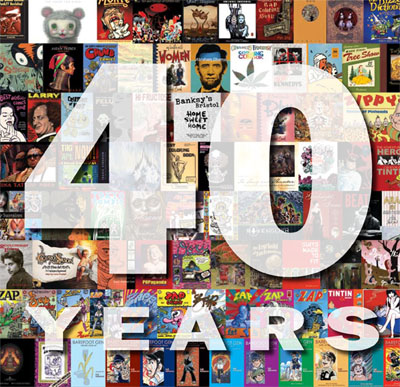
Last Gasp, San Francisco’s landmark independent and underground publisher, is turning 40. To celebrate this feat – in four decades, Last Gasp has spawned more than 300 comics and 250 books – it is throwing a party and an art show Thurs/April 1 at 111 Minna Gallery.

Who dared wager, in the mid-1970s, that Last Gasp would survive the withering of the underground comix scene? Head shops, the main outlet for unedited explicit sex-, drug-, and violence-ridden content (the “x” in comix stands for X-rated), were being prosecuted and forced to shut down due to anti-drug paraphernalia laws. Comics stores favored the more mainstream adventures of masked men in tights. Finally,“there wasn’t the same appetite for comics anymore,” according to Colin Turner, associate publisher to his dad Ron, who founded Last Gasp. No matter: the small venture outlived its peers by continually adapting, tuning to consumer demand and catering to bookstores’ standards and their stapled-leaflet scorn. Over the years, Last Gasp branched out into artist monographs, coloring pads, music-related books and graphic novels.

Yet, browsing its odds-and-ends catalogue, one gets the sense that Last Gasp hasn’t compromised its bizarre and satirical bent. Sure, it might carry such mundane items as coloring books, but beware of the twist! Gangsta Rap Coloring Book flaunts 48-pages of line drawn gangsta rappers. As for Tee Corinne’s Cunt Coloring Book, well, the title says it all. Last Gasp may have diversified, but it never reneged on complete artistic license, the hallmark of underground comix.

Today, Last Gasp thrives in the areas of lowbrow art and pop surrealism. Lowbrow is an umbrella label for “art forms that are popular and wonderful, that people love, but that aren’t respected in the fine art world”, according to Colin. It ranges from tattoos and Kustom Kulture to street art and graffiti – artistic expressions rooted in pop culture that take place on canvases ranging from car exteriors to skin..

As for pop surrealism, the genre emerged from cartoon-y visuals only to reclaim traditional old master painting craftsmanship. Artists such as Scott Musgrove, Camille Rose Garcia and Mark Ryden colonize canvasses with impeccably-rendered phantasmagorical creatures and weird visions. Neglected for years by art institutions, the loose-knit community of lowbrow artists is gradually being endorsed by upscale galleries and museums, a shift that once again attests to Ron Turner’s prescient flair. Back in the day, he promptly discerned underground comix’ wide appeal and cultural relevance, supporting the work of then-young and aspiring artists such as R. Crumb, Bill Griffith, and Spain Rodriguez, all of whom matured into cult or mainstream icons.

It could be said that Ron Turner got sidetracked into publishing. In the late 1960s, the Fresno native enrolled in the SF State psychology department. The Peace Corps volunteer, freshly returned from a stint in Sri Lanka, was thrust into the Bay Area countercultural upheaval and its myriad of grassroots movements. As a Berkeley Ecology Center activist, he figured that he could raise funds by releasing an environmentally-oriented comic book.

“I thought the graphic approach would engage teenagers, help them thwart authority figures, and provide answers to ecological concerns”, Ron recalls. With the mentorship of Gary Arlington, the San Francisco Comic Book Company owner who was selling Zap Comix under the counter, he compiled and printed 20,000 copies of Slow Death Funnies 1. By that time, his Ecology Center accomplices had dispersed, and their successors only agreed to redeem 10 copies of the title. “My garage was filled with 19,990 Slow Death Funnies 1 and I had to find a way to get rid of them”, he laughs.

This task proved easier than one might initially presume: with his good-humored nature, Turner unloaded his goods at 200 locations, not just head shops but also universities, hairdressers and even a leather jacket store. Eventually,Last Gasp reprinted the comic and sold around 45,000 copies. After this initiation, the socially-aware Turner satyed in the business because “it was a kooky way to shed some light on issues that needed attention.”

Last Gasp’s second publication was the all-woman feminist first It Ain’t Me Babe. “At the time, I was living alone with my newly-born daughter and I was drawing comics,” says Trina Robbins, who put together the title. “But you wouldn’t know it, because the 98% male underground comix industry had shut me out. I heard that Ron was looking for material for a women’s liberation comic book. I phoned him. The next day he visited me, wrote me a check for $1,000 — which in those days was quite an amount of money — and voilà!”

The 1975 book Amputee Love probed another rarely addressed topic, the sexual life of a crippled couple. “UC medical centers purchased some copies to sensitize nurses to the fact that amputation does not mean death of sexuality,” says Ron Turner. Other notable contributions to unconventional subject matters include Anarchy (1978) and Cocaine Comix (1976).

According to Ron Turner, cartoonists hold the highest rank in creativity because they can communicate their vision the most clearly: “Most art is some form of propaganda. The artist wants to sell you on his vision and what it leads to.” Turner’s fascination with human behavior conditioning stems from his psychology studies.

At 70, Ron Turner still sports a hippie hairstyle: a white hair ponytail and an eccentric plaited beard running down to the navel of his buddha-like belly. Comix aficionados regard him not only as a pillar but also as a guardian angel. “Last Gasp is unique in that it’s a publishing house and also a distributor. It has kept many smaller and larger presses afloat,” explains Cartoon Art Museum curator Andrew Farago.

Niched in a corner room of Last Gasp’s Florida Street offices, Turner’s personal collection of popular art is an eclectic mix of original drawings and paintings, side show banners, circus items and vinyl sculptures. “Are these for real?”, hollers a guy named Charlie, who is lending a hand in preparing the anniversary art show. He has uncovered a pile of four framed paintings that serial killer John Wayne Gacy made while on death row. Lowbrow art is definitely not for the fainthearted.

The state budget isn’t growing

11

I heard a great show on NPR the other day about the new rules on compensation for executives whose banks got federal bailout money. The feds have cracked down (a bit), and some of those massive salaries have been cut and top bankers are now accepting much less pay, and stock that can’t be sold for three years.


And guess what: More than 80 percent of these people are still hard at work at their desks, including almost all of the most senior folks. Very few have left. It puts the lie to this notion that extreme salaries are needed to attract and retail the top talent; even after those salaries have been cut by more than half, the “talent” doesn’t flee.


There’s a new study by the California Budget Project (PDF) that says makes the same kinds of points. Jean Ross, the director of the nonprofit, nonpartisan group, says that urban legends die hard, so she’s chosen the top ten myths about the state budget and demonstrated how utterly inaccurate they are.


For example, the anti-tax folks love to crow about the massive growth in state spending and how the budget is “out of control.” Truth:


Current year spending is $16.9 billion below 2007-2008 levels and proposed 2010-2011 spending is $20.1 billion below  2007-2008 levels.


2009-2010 spending is $21.5 billion below the baseline levels projected by the Legislative Analysts Office in 2004.


As a share of the state’s economy, state spending is at its lowest levels since the early 1970s.


And it’s not just the recession:


State spending as a share of personal income has declined significantly in recent years.


And guess what: taxes aren’t driving businesses out of the state — or hampering personal wealth creation.


The number of millionaire taxpayers has increased more rapidly than the number of taxpayers as a whole since the passage of Prop. 63, which imposed an additional tax on high-income individuals.


And guess what, you bureaucracy bashers:


California ranks 41s [among the 50 states] with respect to the number of state and local government employees per 10,000 population.


So no, California doesn’t have a spending problem. The state has a revenue problem.

Editorial: CCA: Get it done by the deadline

1

If the mayor and his handpicked PUC director, Ed Harrington, and his handpicked commissioners dawdle and delay, they’ll be giving a corrupt private utility exactly what it wants

EDITORIAL San Francisco has been talking about creating a community-choice aggregation system to sell cleaner electricity for five years now. There have been hearings, studies, debates, discussions, and negotiations. And now it’s coming down to the wire: to avoid the prospect of a Pacific Gas and Electric Company initiative on the June ballot that cuts the city’s effort off at the knees, San Francisco officials need to get CCA up and running before June 8.

But the mayor and the Public Utilities Commission don’t seem to have any sense of urgency. And the slow pace of negotiations with the contractor that would handle the electricity purchases is playing right into PG&E’s hands. If the mayor and his handpicked PUC director, Ed Harrington, and his handpicked commissioners dawdle and delay, they’ll be giving the corrupt private utility exactly what it wants.

It’s particularly frustrating since Marin County – which, unlike San Francisco, has no federal mandate for public power – is far ahead of this city, has a CCA program ready to go, and most likely won’t be affected by the PG&E initiative. What on earth is wrong with San Francisco?
CCA would allow the city to create the equivalent of an electricity buyer’s co-op, so that San Francisco could purchase electricity in bulk from providers that offer a more renewable mix. PG&E gets only a tiny portion of its power from renewables. With the advantage of wholesale purchases and no corporate profit, the city ought to be able to offer lower rates.

The contractor that won the bid to put the co-op together, Power Choice LLC, is run by people with substantial experience in the electricity business. The city’s been in talks with Power Choice about a contract since Feb. 9 – but progress is slow.

Harrington told us that he expects to have “a contract as soon as we can get a contract” but there’s no deadline. That’s crazy – there’s a very real deadline looming, a time bomb planted by PG&E, and the city needs to take it seriously. PG&E has used vast sums of corporate money to place a measure on the June ballot that would make it almost impossible to create new public-power entities; Proposition 16 would mandate a two-thirds local vote for any public agency that wants to sell retail electricity. And the company is spending $35 million on a campaign to get it passed.

That election is barely two months away – and if Prop. 16 passes before San Francisco has a signed contract and a CCA program under way, five years of work, led by Sup. Ross Mirkarimi and the Local Agency Formation Commission, could be for nothing. The best chance the city has to fight global warming, promote renewable energy, take control of its own energy future, and offer more stable, cheaper rates to customers could be gone, forever.

What’s the hang-up? Nobody’s talking, since the negotiations are still ongoing, but from what we hear, Harrington, Newsom, and the PUC members are worried about “risk” – that is, the risk that the San Francisco CCA might have to raise rates above what PG&E is currently charging to make the numbers pencil out. (Part of the risk: PG&E will have 60 days to try to convince customers to "opt out" of the CCA and stay with the private utility. If a critical mass of residents and businesses doesn’t stick with the CCA program, the economics could be dicey.)

But the risk discussions are missing a critical point: PG&E’s rates are going to go up, dramatically, over the next few years. The company already has an application for a stiff rate hike this year, and it’s inconceivable that the utility’s prices will do anything but continue to climb. So meeting the current rates is a moot point. And as Harrington acknowledged, renewable power rates are "much, much more stable than natural gas, oil, those kinds of things."

Besides, the real risk is that San Francisco will continue to violate the Raker Act and allow PG&E’s illegal monopoly to continue unabated. The PUC needs to get moving, now. Harrington should set a deadline, well in advance of the June election, and direct his staff to make every possible effort to get the program going by then. Newsom should publicly announce his support for the project and demand that the PUC finish its work in time to beat PG&E’s anti-public-power measure (unless he wants to run for lieutenant governor as the mayor who went back on his own positions and allowed PG&E to control the city).

Because right now, the only thing that has to happen for PG&E to win is nothing. *

Yee’s two-fer: Bashing Palin while promoting sunshine

5

Sen. Leland Yee scored a two-fer yesterday when he blasted a California State University organization for hiding how much it’s playing Sarah Palin for a speaking gig, raising an important sunshine issue and knocking Palin’s populism-for-pay schtick in the process. And at the heart of the issue is how public education institutions increasingly use foundations to avoid accountability.

That issue was recently raised in San Francisco, when City College Foundation sought to keep its financial dealings secret. The Guardian sounded the alarm last month, and City College Trustee John Rizzo, who led the fight for more sunshine, negotiated a more open arrangement that the Board of Trustees unanimously approved last week.

“We got most of what we wanted,” Rizzo told us. “Most of the things are open and they have to give us a quarterly report on donations.”

Yee – who the Society of Professional Journalist-NorCal recently honored with a James Madison Award for his struggles to promote greater government transparency and protections for journalists – has long been fighting for more sunshine in the CSU and UC systems, which is particularly important as they make deep cuts to higher education spending. For example, Yee’s Senate Bill 330 would explicitly require those systems to adhere to the California Public Records Act.    

“These are public institutions that should embrace transparency and accountability,” Yee said yesterday in a press release announcing his request that CSU-Stanislaus’s foundation disclose how much it is paying Palin for a $500 per head speech on June 25. The press release triggered a front-page story in today’s San Francisco Chronicle, with CSU and foundation officials rebuffing Yee’s request.

So now, Yee gets to bash Palin and make an important stand for sunshine, both of which will likely help his nascent campaign to be elected mayor of San Francisco next year.

As Yee wrote in a letter to campus President Hamid Shirvani, who also serves as the chair of the foundation: “The sensational nature of former Governor Palin’s political commentary, coupled with an ongoing book tour, has allowed her to charge top dollar for speaking engagements. As was reported in the media, her speaking appearances typically command $100,000 per event. To that end, I request the foundation to respond to the following issues: 1. Is the former governor being compensated by the CSUS Foundation in any form for her participation in the event on June 25th?  If so, please describe the amount and nature of the compensation being awarded to the former governor.  2. Please disclose any contracts between the former governor and the CSUS Foundation involving the June 25 speaking engagement.”

Later in the press release, he added: “The CSU should immediately disclose how much money is being diverted from students to pay Sarah Palin’s exorbitant speaking fees. At a time when students are struggling to afford an education at CSU, I would hope that spending potentially hundreds of thousands of dollars on a guest speaker for a black-tie gala would be low on the priority list.  Money that is spent on bringing an out-of-touch former politician to campus could be spent on scholarships and other financial assistance during these challenging budget times.”

Win or lose, this is the right fight for Yee, both morally and politically. Go git ‘er!

Study: Cuts to health programs a bad plan for state economy

It doesn’t take a Ph.D. to understand that people who earn less shell out a greater percentage of their income from month to month than those occupying more elite ranks. Anyone fortunate enough to be holding down even a low-paying gig in a state where unemployment stands at 12.5 percent knows that basic living expenses can quickly consume a paycheck in San Francisco.

A study released by the Center for Labor and Research Education at the University of California at Berkeley has found that cutting relatively low-paying jobs in the state’s health and human services sector would deal a harsher blow to California’s financial health than alternative budget-balancing measures, like raising taxes on the wealthiest residents. Gov. Arnold Schwarzenegger has proposed cutting $6.4 billion from California’s health and human services budget, part of his solution for closing a roughly $20 billion budget gap.

“The budget proposals that the governor is making would … significantly worsen the economic crisis in the state, rather than pull us out,” said Ken Jacobs, chair of the Labor Center at UC Berkeley.

The report highlights “multiplier” effects of hypothetical cuts to statewide health and human services programs. The study examined the impacts of cutting $1 billion each from Medi-Cal, Healthy Families, and CalWORKS – state programs that assist low-income families – and found that the resulting losses would total 98,600 jobs for all three combined. The worst impacts from cuts to those programs would come from indirect consequences, according to Jacobs. Since those programs are funded in part from federal dollars, a loss in federal funding matched for every dollar the state invests also takes a toll.

A $1 billion cut to state funding for In-Home Supportive Services (IHSS), which aids disabled and elderly people who want to remain in their homes, would result in a statewide loss of 215,900 jobs, the report found.

Meanwhile, generating that same $1 billion through taxes from households in the highest income bracket in California would result in a comparatively lower job loss of 6,400, the research group estimated.

Health Access, a nonprofit consumer advocacy group, used the study’s findings in its own report to predict ramifications of the actual proposals in Schwarzenegger’s budget. According to Health Access, a minimum of 42,384 jobs would be lost as a result of proposed health cuts to Healthy Families and Medi-Cal, with more than $2.7 billion lost in business activity. It predicted 370,000 jobs would be wiped out if IHSS were eliminated altogether.

In a tumultuous economic downturn like the one facing California right now, “the best stimulus is funds in the pockets of low-income families,” according to Jacobs. Cutting these health and human service programs, which employ low-income workers and serve residents living near the poverty line, would do just the opposite.

Speaking of multipliers, Jacobs noted that corporate tax cuts produce the absolute worst bang for the buck out of any other schemes to fix the economy.

Live Shots: Air, Fox Theater, 03/26/2010

0

It was the first time I traveled by myself. I was exploring Boston, meandering along the red line that winds its way from one historical site to another, while the discman in my purse blasted Air. The red line (aka The Freedom Trail) ends at Bunker Hill. The sun was brilliant on that June day and I lay in the grass, squinting up at the clouds. Cherry Blossom Girl started playing. I watched a little girl do somersaults in the grass and dance. Her tumbles were in perfect time with the soft rhythm of the song. The little girl was pure joyfulness. She found a feather in the grass and for some reason brought it over to me and said “This is for you.” Then her dad called to her, telling her it was time to go home.

That was seven years ago. I’ve written about this before, how music becomes so connected to moments in life, how songs can bring back smells and emotions that would otherwise be long lost in the tangled mess of experiences we have over a lifetime. The music by the French band Air is so fluid and hypnotic. It glues itself to beautiful moments that forever stay ingrained in our minds. Air performed this past Friday at the Fox Theater in Oakland, as part of a tour to debut their new album entitled Love 2. With their classic electronic beats against a trippy slide show backdrop, there wasn’t a single audience member whose eyes and ears weren’t completely super-glued to the stage. AM, opened for Air and played everything from classic rock to Brazilian classics — new album Future Sons and Daughters came out last month.

I still have that feather from the little girl on Bunker Hill. It reminds me of summer, sunshine, and that feeling of floating on air.

Appetite: It’s Passover — so come on over

0

As Passover begins tonight through next Monday, here’s a few places where you know you can eat quite well and stay quite kosher:

4/5 – SLOW FOOD Seder at Mission Beach Cafe
Heeb magazine teams up with one of my favorite neighborhood restaurants, Mission Beach Café for a Slow Food Seder. Yes, that’s slow food principles, modern cooking sensibilities, traditional Jewish dishes. In fact, with each course, you have the choice of traditional or California-style dishes, each made with local ingredients. Will it be smoked black cod with potato kugel or matzo flatbread with haroset, balsamic reduction, basil scallion pesto and messo seco cheese?

Braised Prather Ranch lamb shank with butter beans, oyster mushrooms, baby carrots and red pearl onions or roasted duck with Israeli couscous, Jerusalem artichokes, pea shoots and orange sabayon? Thankfully, Mission Beach’s wonderful pastry chef, Alan Carter, has dessert in hand.
$55 for four courses, excluding tax and tip
Monday, April 5
5:30-10:30pm
Mission Beach Café
198 Guerrero Street
415-861-0198
www.missionbeachcafesf.com


Firefly’s Eight Days of Passover menu
Right by my former home in Noe Valley, beloved Firefly does an “Eight Days of Passover” menu all week long, a bevy of Jewish greats made with Firefly’s usual homey, gourmet flair: chopped chicken livers, Grandma Rose’s matzo ball soup, owner, Brad’s housemade gefilte fish, vegetable matzo kugel, grilled lamb sirloin and beef brisket (or vegan brisket, if you so desire).
March 29–April 5
a la carte menu during regular hours
4288 24th Street, SF.
415-821-7652
www.fireflyrestaurant.com


TAKE-OUT at Sweet Jo’s
Jo and her best-there-is biscuits  are always available at Sweet Jo’s in the Jewish Community Center, but she also knows Passover foods and has plenty for you to take home to suppliment or be your complete Passover meal. Maybe braised Kobe beef brisket, felfite fish, potato kugel, mashed potatoes, rosemary broccoli, and a side of horseradish cream?
Available for pick-up a la carte or to eat in the cafe through Passover
Sweet Jo’s, inside the Jewish Community Center
3200 California, SF.
415-345-0090
www.sweetjoscafe.com

Bay Area Sistah Sound celebrate two years of femme beats

0

The ladies of Bay Area Sistah Sound know their place — and it’s in the beat kitchen. The all female DJ crew (which includes DJ Zita, the legendary Pam the Funkstress and newest addition to the cast, DJ Similak Chyld) is celebrating its second anniversary at 111 Minna on Fri/2. It seemed like a good time to reflect with the women on their past two years.

A lot has changed around these parts since DJ Zita moved back to the Bay area after living for a spell in Hawaii. Upon her return to San Francisco, she found the famously inclusive city lacking on the female pride front. “I noticed the fact that the [hip hop DJ] scene was male dominated. There were a lot of women, but they were all doing their own thing. There was no solidarity.” Zita, a founding member of Sisters in Sound, the first all woman group of DJs on the islands, decided to change all that.

It’s still true that when you go into a lot of the larger hip hop/R & B clubs in town these days, you’ll still encounter a dude heavy clientele. But the number of women-run groups and women-featured nights — and no, we’re not talking about the Lusty Lady — is on the rise. You’ve got Coo-yah Wednesdays at Paradise Lounge, with resident reggae spinners Daneekah and Green B, RRS Feed, Peaches at Skylark on Thursday nights, a funky — a funky, souly, hip hop affair orchestrated by promoter Masaye Waugh, who formerly slung drinks at Everlasting B.A.S.S. when the party was at club 330 Ritch.

“I really love the B.A.S.S. party,” says Waugh. “That was right around when I was learning about what it means to be a female DJ in the business.” Later, Masaye texts me “I was so excited and inspired by [Everlasting B.A.S.S.] and it made me understand/appreciate more what I had gotten into. Have you seen Pam scratch with her boob? That’s a party!”

Waugh understands why more and more women are choosing to work together, B.A.S.S. style. “It’s that communal feeling of working with other women,” she says. That sentiment of solidarity was what led DJ Zita to round up Pam the Funkstress and DJ Neta, who has since left to pursue family life and a PhD, to form a mainland female DJ crew. “Pam [of activist hip hop duo The Coup] and Neta were veterans,” Zita tells me. “They’d been holding down for a minute.”

Zita started inviting female singers and B-girls to perform with them each month, and found they were able to spin their own kind of nightlife. “There’s more of a vibe of respect for women at our parties,” says Zita, whose B.A.S.S. crowds tend to be majority female.

The DJ is excited to see B.A.S.S.’s contribution to women run nightlife in the city. “We’re inspiring other female DJs to come out,” says Zita, who had to upgrade from last year’s anniversary space to two room 111 Minna in order to accommodate B.A.S.S.’s growing fan base and lineup (eighteen woman DJs will be featured on Friday).

So what does year three hold for the ladies of B.A.S.S.? The addition of DJ Similak Chyld, for one. Similak, whose also scratched with Future Primitive Sound, had never been in an all female project before, and initially had some hesitations. But after having done some shows with the crew, she’s noticed some upsides to a gender specific crowd. “There’s no dudes that are there just to gawk,” the diminutive DJ says. “If there’s so many women, they tend to just shut the fuck up.” Plus, it’s a chance to spin with some women she’s looked up to for awhile. “Zita called me [to ask me to be a part of B.A.S.S.]- who calls people anymore? I remember being humbled and blown away. I mean, I saw Pam’s shows over ten years ago!”

Zita says future plans include the continued expansion of B.A.S.S.’s lineup, as well as global takeover. “We’d like to start touring beyond the Bay- down to Southern California, across the country, or… world tour! It’s going to be exciting to see what 2010 brings.”

Everlasting B.A.S.S. Two Year Anniversary

Fri/2 9 p.m., $5-20

111 Minna

111 Minna, SF

www.bassladydjs.com

A good, stubborn Irishman

0

He was one of the last of the old-line labor leaders who once had great influence in many cities. He was Irish-Catholic, of course, a resident of the city’s principal working class district, and from one of the blue-collar trades.

 His name was Joseph Michael O’Sullivan. He had been president of the San Francisco Building and Construction Trades Council and for four decades head of its main carpenters union local.
 
Those who would truly understand the history of San Francisco and in  particular the key role organized labor has played in the city’s development, as in that of so many other cities, must pay attention to the memory of Joe O’Sullivan.

 He was a very good man. He also was a very stubborn man. I remember, for instance, that time in 1976 when he insisted on going to jail.

 O’Sullivan and three other construction union officials had been sentenced to jail for having led a strike by municipal craftsmen — who, as public employees, supposedly did not have the legal right to strike. O’Sullivan — then aged 74 and ailing — didn’t have to go to jail, since union lawyers were certain they could overturn the sentences, as they ultimately did.

The other union officials were content to have the lawyers handle the matter through court appeals, but O’Sullivan refused to be “a damned labor bureaucrat.” He preferred to be a labor activist, and so turned himself over to the San Francisco County sheriff for a five-day stay behind bars.

 O’Sullivan thought that was a small price to pay for the badly needed opportunity it would give the city’s unions to bounce back from the severe beating they had suffered in the craftsmen’s strike. Surely, he thought, the unions would mount a major campaign to protest the jailing of one of their best known and most respected leaders over one of the most fundamental of labor rights.

 That would draw maximum attention to the injustice of a court ruling which had denied that fundamental right to thousands of working people. It would show that the unions still were capable of the militancy that had earned San Francisco a reputation as one of the country’s premier “union towns.”

And it would be an ideal way for the unions to seek the support essential to restoring their former influence — the support of public employees and others in the heavily non-union white collar occupations that had come to dominate the city’s economy and that of so many other cities as unionized blue collar occupations once did.

 But the unions allowed Joe O’Sullivan to enter jail, and to leave jail, quietly and alone.  There were no protest rallies. no demonstrations, no marches, no angry speeches, no picketing, no sympathy strikes, none of the militant actions that had marked labor’s rise to economic, political and social prominence.
 There was only grumbling, among most of the city’s other labor leaders, that O’Sullivan was “grandstanding” in trying to get them top rely on more than just largely unpublicized courtroom arguments.

 But the arguments won the unions very little. About all they got was a narrow court ruling that, although indeed overturning the decision which had ordered the strike leaders to jail, did so on purely technical grounds. The ruling did not upset the previous finding that city employees could not legally strike.

Union strategists argue to this day whether activist tactics would have countered that anti-unionism of the 1970s, as they argue whether such tactics would be the best way to counter the anti-unionism that has plagued the labor movement of San Francisco and other cities ever since.
 
Such questions rarely even occurred to O’Sullivan. Activism was virtually the only tactic he knew. He learned it very early in life, as an 11-year-old telegraph messenger working with the Irish Republican Army in 1913, against the British forces occupying his native village of Tralle, County Kerry.

 Young O’Sullivan, entrusted by the British authorities to deliver messages to the occupying British troops, showed the messages first to local IRA leaders — despite the leaders’ warnings “that if I was caught, it would be the finish for me.”
 
 So why did he do it? “The messages were very important, they wanted them, and I felt that whatever I could do for Ireland … well, I would do it.”
 
 O’Sullivan left the messenger’s job to work with his father, a master carpenter and secretary of the carpenters union in Tralle, but continued his IRA activities.
 
“Whenever they were going to ambush a British lorry,” he recalled, “the IRA had to know when it was leaving to come out in the country. So I would put out a gas lamp, then another boy a mile away would see that and he would put out another one.  That would be the signal. The IRA would did a trench in the road and the lorry would fall into it. Our guys would call on them to surrender. We’d take the rifles and ammunition, and their shoes, and then make them walk back into town. . .
 “We never went to kill them — though people were killed, that was for sure . . . But there was more caskets going back to England than were being lowered in the ground in Ireland.”

 O’Sullivan’s IRA activities ended abruptly one night when two British soldiers burst into the cottage where he lived and dragged him away at gun point after O’Sullivan’s mother, certain he was to be killed, “started throwing holy water on me.”  Once outside the cottage, O’Sullivan knocked away the rifle of one of the soldiers and ran. Although wounded by the other soldier, he escaped, eventually making his way to the United States.

 O’Sullivan arrived in San Francisco in 1925, seeking work through the carpenters union local he eventually would head. At the time, the local was leading a major strike aimed at forcing contractors to bargain with construction unions on pay and working conditions.  Contractors had brought in more than 1,000 non-union strikebreakers from Southern California to replace the strikers, and they became the striking union’s main targets.

 “We formed ‘wrecking crews’ — ‘thugs,’ they used to call us in the newspapers — and got $1.50 a day from the union to get into a job, roust the scabs, break their tools,” O’Sullivan remembered. “When we shut a job down, nobody worked — they got out fast. We just used our hands, but we worked the scabs over good …. Maybe it was the right thing to do, maybe it was wrong — but that’s the way it got done.”

 At one point, O’Sullivan and the six other members of his “wrecking crew” were arrested for the murder of a strikebreaker. They were held three weeks, until two other men confessed to the killing.

 The construction unions lost the strike after a year of fierce struggle and O’Sullivan, blacklisted by employers, had to move to the  city of Vallejo across San Francisco Bay to find work. But he later returned to San Francisco and, in 1935, was elected to head Carpenters Local No. 22.  O’Sullivan held that job until 1977, helping lead carpenters and other building tradesmen in the struggles that finally won them the right to effective union representation.

 The relatively high pay and benefits and decent working conditions of the tradesmen today are taken for granted. But the workers wouldn’t have them if it wasn’t for their unions, which had to fight hard to get employers to grant even the simplest amenities.  O’Sullivan’s nephew James vividly recalled his uncle’s great pride in getting “fresh water and toilets on the job for the carpenters and a pension plan to take care of them when they grew old.”

O’Sullivan was stubborn to the end. He left union office only because of the adoption, over the strong objections of O’Sullivan and many of his local’s members, of an amendment to the carpenters’ national constitution that prohibited anyone over 70 — O’Sullivan included — from seeking union office.

But he was no grim advocate, despite his stubbornness, dedication and determination. I recall watching him turn on his considerable Gaelic charm in Israel, where he had gone with a delegation of touring labor leaders in 1973. The most important day of the tour was March 17, when the leaders were to confer with David Ben-Gurion.

As the senior member of the delegation, O’Sullivan greeted the legendary former prime minister, who stood before the visitors with an air of immense and almost forbidding dignity.  Joseph Michael O’Sullivan, looking and sounding only as someone who had been baptized in Ireland with such a name could look and sound, quickly broke the ice.

 “Mr. Ben-Gurion,” he said, “let me be the first to wish you a happy St. Patrick’s Day.”

Dick Meister, formerly labor editor of the SF Chronicle and KQED-TV Newsroom, has covered labor and politics fror a half-century. Contact him through his website, www.dickmeister.com, which includes more than 250 of his recent columns.

Deadline looms for San Francisco’s green power program

Negotiations between city government and Power Choice LLC, a contractor selected to implement San Francisco’s Community Choice Aggregation (CCA) program, began Feb. 9. Almost seven weeks later, there’s still no end in sight — but if a deal isn’t secured soon, San Francisco could risk losing an opportunity to implement a cutting-edge green power program that would significantly reduce the city’s reliance on fossil fuels and give customers an alternative electricity provider.

About a half-decade of studies, debate, public meetings, and input from all sides have brought San Francisco’s CCA to the threshold of finally becoming a reality. The program would offer an energy mix comprised of 51 percent renewable power by 2017 for those who opted in.  

Assuming the program can operate successfully without an adverse impact to customers’ wallets, San Francisco could become a shining example of how to transition to a more sustainable energy model. It could represent giant step — rather than an inch-by-inch crawl — toward carbon-free power generation serving the needs of a major U.S. city.

As the negations drag on and a serious deadline looms closer and closer, some observers are growing anxious. No one can tell for sure what’s happening behind closed doors, but one thing is certain: PG&E is spending millions to try and torpedo CCA through a sophisticated public relations campaign, and it would have a much easier time derailing the project if it met with delays. PG&E would lose some of its customer base if the CCA program were a success.

PG&E has, intentionally or not, imposed a critical deadline on San Francisco’s CCA program implementation by introducing Proposition 16 — a ballot initiative that could slam shut this window of opportunity. Prop 16 would require a two-thirds majority vote before any CCA statewide could get off the ground, making it almost impossible to move forward.

If San Francisco’s CCA program hasn’t gotten underway by June, when Californians will vote on Prop 16, years of effort could be rendered futile if the initiative passes.

As SFPUC General Manager Ed Harrington told the Guardian, “We will get a contract as soon as we can possibly get a contract — but I can’t tell you the date.”

Several things would have to happen before the June deadline in order to guarantee that the city’s CCA would not be affected by the outcome of Prop 16. The program contract would have to be approved by the SFPUC, signed off on by the Board of Supervisors, and a 60-day opt-out period would need to be initiated before the start of service.

With so much to do in such little time, some observers are worried that the whole thing could fall apart. “Something seems to be awry,” noted John Rizzo of the Sierra Club, noting, “The PUC has historically fought and delayed CCA.”

The program is the product the joint efforts of two city bodies, the SFPUC and the Local Agency Formation Commission (LAFCo), which is chaired by Sup. Ross Mirkarimi. Historically, LAFCo and the SFPUC have not worked well together, with Mirkarimi trying to prod the power-and-water agency forward, and publicly bemoaning its recalcitrance.

Mayor Gavin Newsom — who has forged partnerships with PG&E in the past, received several campaign contributions from high-ranking PG&E employees, and traveled to Mexico on the utility’s dime — appoints commissioners to the SFPUC. The mayor’s apparent alliance with PG&E combined with his sway over the SFPUC has led program advocates to voice suspicion over the years that its progress was being hampered by something more than ordinary bureaucracy.

Harrington, who heads up the SFPUC, said everyone sitting at the negotiating table is well aware of the Prop 16 deadline.

“The hope is to do it, obviously, as fast as possible,” he said. “I think that we are doing well in terms of rate discussion [and] renewable discussion, they’re very much with us in terms of getting renewables as fast as possible, and meeting the goals that the Board [of Supervisors] and everybody else has set for years now.”

“But the real discussion at this point is risk,” he said. “And trying to figure out how that risk is done in a way that protects our customers and the city is a big deal.” A key program goal since the beginning has been to meet or beat PG&E rates, which will climb by some 30 percent in the next few years if its current rate-hike proposals are approved by state regulatory bodies.

“The other part is just how do you implement this?” Harrington continued. “You’re going to have to contract with people who will in turn contract with generators. What if one of them went under, what if there are price hikes? How do we step in for them?”

At the same time, Harrington acknowledged that in the long-term, this program has the capacity to shift the city’s electric and economic outlook by offering more stability, and minimizing risk.

“In general, the kinds of renewable power that we’re talking about are much, much more stable than natural gas, oil, those kinds of things,” he said. “And so while at the very first day of this we’re not going to own anything … as you start to have ownership interest in power supplies that are sustainable, renewable power, that price fluctuation should be a whole lot less, and our customers should be exposed to a whole lot less price fluctuation and risk than people who still have big things that are in natural gas and those areas.”

Harrington said he believed the CCA program would be attractive to San Franciscans because of its environmental edge. “I think people here want to take care of the world, they want to do things that are right. They probably don’t want to spend a lot of money to do it — and I don’t think they have to,” he said. “That’s the part that makes me crazy: If we can provide greener power for equal to or less than PG&E … why wouldn’t we try to do that for the city?”

The pot initiative’s going to win

9

It seems pretty clear to me that, with polls showing widespread support and money pouring in for the campaign, the initiative to legalize pot in California is going to pass. So why are all of the candidates for governor, even Jerry Brown (who may have smoked a joint or two in his time) coming out so strongly against it?


Jerry knows that legal pot isn’t going to create new law-enforcement problems; quite the contrary. It’s going to save huge amounts of money that the state and local governments now waste enforcing a silly law that nobody respects, will cut down on the jail population and discourage the environmentally damaging (and sometimes violent) gangs of rogue growers who plant on public land.


And he ought to know that this kind of a stand isn’t going to help him get elected. Once you take the hard-core Republicans who would never vote for Brown anyway out of the equation and look at the universe of potential Brown voters, legalizing pot probably gets more than 60 percent approval.


If you asked me back in 1978 whether I could imagine a day when Jerry Brown would oppose a marijuana legalization measure that was polling at 60 percent, I would have said: Whoa, man, no way. But then, I inhaled.

Us and the Weekly: It wasn’t personal

4

I really liked The Stranger’s article a couple of weeks ago about our battle with SF Weekly and it’s corporate parent, Village Voice Media. Eli Sanders is a good reporter, and he got most of it right.


But he did the same thing that a lot of people covering this legal battle have done, and it’s starting to get annoying. Everyone seems to want to play this as a battle of egos between Guardian Editor and Publisher Bruce Brugmann and VVM Executive Editor Mike Lacey. It’s as if we filed suit against them — and endured years of litigation and now collection efforts — just out of spite. It’s as if we were willing to go through all this just because Bruce didn’t like Mike Lacey.


Here’s Sanders’ spin:


These two men have hated each other for decades, but with increasing venom since 1995, when Lacey showed up in San Francisco in cowboy boots to announce that he and his partners had just purchased the tiny SF Weekly and planned to make a huge success of it.


The thing is, Bruce and Mike haven’t hated each other for decades. They weren’t terribly close, but they got along fine — and sometimes, they were political allies. In 1997, three years AFTER Lacey’s company bought our competitor, SF Weekly, the two joined forces at an Association of Alternative Newsweeklies convention in Montreal to help push a bylaws measure that kept daily newspapers out of our trade association. And as the picture above shows, they were almost, sorta, kinda pals. At least for a few minutes.


The last thing we wanted to do was sue these guys. It wasn’t personal; we had no choice. Sure, the Guardian and VVM have very different approaches to journalism and politics, but we’d have been happy to compete with them — the way newspapers with different viewpoints should, on a level playing field. And for all the rhetoric on all sides, the legal animosity only started when the Weekly actively tried to put us out of business by selling ads below cost.


I dunno; the VVM people have been awfully rude to me of late, and I guess they like this mano-a-mano shit, but the reality is: We sued to stop illegal conduct that was threatening our business. That’s the real story.


Street Threads: Look of the Day

0

Today’s Look: Raeann, Van Ness and Washington

Tell us about your look: “I got these from Forever 21.”

Could he be — the worst pope ever?

15

In The Decline and Fall of the Roman Empire, Gibbons reports on the trial of Pope John XXIII in 1415, during which “the most scandalous charges were suppressed: The Vicar of Christ was accused only of piracy, murder, rape, sodomy and incest.”

And he wasn’t even the worst of them. Jesus, there have been some bad popes over the years. Even in modern times, we’ve had a few serious losers; Pius XII, by many accounts, was way too friendly with Adolf Hitler.

So it’s pretty hard to call the current occupant of the Throne of St. Peter the worst pope ever; there’s plenty of competition.

But folks, the former Cardinal Ratzinger is turning out to be so awful that he’s going to go down in history as one of the all time horrible leaders of a crumbling Catholic Church. This guy was actively involved in covering up child abuse scandals. He knew what was going on, and he not only ignored it — he ordered the bishops to report the crimes only to Rome, and not to civil authorities. He’s guilty not only of protecting the worst kind of criminals — authority figures who prey on children — but of actively seeking to prevent them from facing the consequences of their crimes.

If Bill Clinton was charged with obstruction of justice for lying about a (consensual) blow job (involving two adults), then Pope Benedict XVI ought to be indicted in every country that has similar statutes, starting with the United States. All it takes is one district attorney, one grand jury. The evidence is pretty clear. Then Interpol can put out a warrant for his arrest.

Of course, all that would do is keep the guy holed up in his nice, big house in Rome; the Vatican is its own sovereign nation, with its own laws and rules — and I don’t think Canon Law provides for obstruction charges (or any charges) against the head of state.

See, that’s the thing: Nobody can touch the pope (bad metaphor). There’s no procedure for impeachment. He’s the least accountable head of state in the world; even military juntas and dictators can be overthrown by force, but I don’t see any revolutionary cadre of young Cardinals rising up and turning the Swiss guards on Il Papa. Too bad: A nice middle-ages-style coup in the Vatican might be just the thing to shake up that moribund institution and remind its leaders that the rest of the world will only take so much abuse. 

Lawsuit could expose SFPD-ABC collaboration

43

Imminent legal actions against San Francisco, its Police Department, and the California Department of Alcohol Beverage Control could reveal whether a pair of undercover agents went rogue in harassing nightclubs and aggressively busting parties or whether they were acting at the direction of top officials.

Attorney Mark Webb – whose work on a racketeering lawsuit against the policing agencies was the subject of cover stories in the Guardian and the SF Weekly – told us that on Monday, he plans to file that racketeering claim against the city (which will then become a lawsuit if the city rejects it, as it routinely does) and a related lawsuit in Superior Court involving the rough, unnecessary arrest of bartender Javier Magallon and harassment of Mike Quan, owner of The Room, Playbar, and Mist. Narrated surveillance video associated with the case was posted on YouTube yesterday.

Central figures in the lawsuit are SFPD Officer Larry Bertrand and ABC agent Michelle Ott, plain-clothes partners in an aggressive crackdown on nightlife over the last year. Webb said he plans to immediately seek police records and communications and to depose Bertrand and Ott to try to determine who ordered the crackdown, why, and when higher-ups became aware of their aggressive tactics.

“I would like to know if Bertrand is being sent places or if he’s just a lone wolf, and the CADs will show that,” Webb said, referring to computer-assisted dispatch reports that track activities and communications involving individual officers. Those and other records that Webb can access through the court-ordered discovery process could finally shed light on what’s behind the crackdown.

Webb had sought to have Mayor Gavin Newsom mediate this dispute before the cases were filed, saying the racketeering lawsuit will be expensive and divisive, and all the nightlife community really wants is an end to the harassment and assurance that it wouldn’t restart once the media attention passes. And Webb did have conversations with top Newsom aide Mike Farrah and with Nicolas King, Newsom’s liaison to the SFPD, but neither indicated that Newsom was willing to get personally involved. Newsom spokesperson Tony Winnicker also told us Newsom preferred to let Police Chief George Gascon handle the matter.

So Webb said he now plans to move forward with litigation. “If they’re not answering the call at City Hall, let’s get into the arena,” Webb told us.

Webb is an experienced litigator who has won multi-million judgments and who started his career in New York City helping prosecute Racketeer Influenced and Corrupt Organizations (RICO) Act cases against the mob, and now he plans to use RICO laws against what he says is a city-state enterprise to interfere with lawful nightlife activities in San Francisco.

“Webb gets it. It’s a weird mentality, the really good trial attorneys, and Webb is that,” said attorney Mark Rennie, who has spent decades working with the city’s entertainment industry and has helped advise Webb on the case.

Among the parties involved in the RICO claim are those involved in Webb’s other lawsuit against the city, as well as Club Caliente, its owner Maurice Salinas, Azul, its owner John Bauer, New York nightclub owners Phillipe Rieser and David Brinkley, Vessel, and Siobhan Hefferman, who was arrested by Bertrand and Ott at a private party. Others may be added soon.

Great American Music Hall, Slims, and DNA Lounge also claim to have been harassed by the ABC and have been involved in several meetings that led up to Webb’s lawsuit, but they’re not taking part in the lawsuit yet, partially because they fear retribution from the ABC.

“I probably would have jumped in, but I don’t want to walk into a hearing suing the ABC,” Slims and GAMH general manager Dawn Holliday told us, referring to Slims’ April 1 appeals hearing stemming from noise complaint citations triggered by one particularly cranky neighbor.

DNA Lounge, which has regularly documented the harassment campaign on its blog, decided to wait with the other two clubs before joining the suit. “We thought it was important to stand as a community and there were too many venues that were worried about retribution from the police or ABC if they joined the suit,” DNA general manager Barry Synoground told us. 

But Synoground said he’s anxious to see what Webb’s suit unearths, noting that Bertrand and Ott haven’t been visible in recent weeks as complaints against them went public, and saying he thinks Commander James Dudley and other top SFPD brass are really driving this crackdown: “We may have taken one of his tools off the street, but he’ll find another.”

Synoground said most SFPD officers are very professional and they have no problem working with them, but Bertrand and Ott have unnecessarily and aggressively interfered with their business. Holliday goes even further in praising the SFPD, saying she has a good relationship with Bertrand and everyone in Southern Station, blaming her clubs’ troubles on the ABC and the unwillingness of top city officials to stand up for them.

So the internal SFPD communications, and those between the city and the ABC, could prove revealing. “On April 17, I can send out subpoenas to the cops and I can take Bertrand’s deposition 30 days from Monday,” Webb said, citing statutory response periods.  

Webb expressed confidence in his case and said the police shakedowns and harassment fit well with the RICO statute, which has been used against a wide variety of enterprises over the years, including government agencies.

In fact, an American Bar Association book, “Civil RICO: A definitive guide,” by Gregory P. Joseph, seems to support Webb’s confidence. “Any person injured in his business or property by reason of a violation of Section 1962 of this chapter may sue therefore in any appropriate United States district court and shall recover threefold the damages he sustains and the costs of the suit, including reasonable attorney fees.’ This simple sentence has generated an avalanche of litigation,” the book begins.

It makes clear the intent of Congress that RICO laws “shall be liberally construed to effectuate the remedial purposes” of targeted individual seeking protection from harassment. A 1981 U.S. Supreme Court ruling (U.S. vs. Turkette) made clear even legitimate enterprises such as government agencies could be sued, and a 1994 ruling (NOW vs. Scheidler) settled a long dispute over whether the racketeering needed to be economically motivated, finding that it doesn’t.

Racketeering was defined by Congress as simply committing any of a long list of “predicate acts,” which include violence or the threat of violence, kidnapping (including false arrest), extortion, physical interference with business, malicious prosecution, and abuse of authority, all of which Webb says apply in his case. He is also reviewing the Guardian’s Death of Fun coverage from the last four years to find more examples of predicate acts involving the SFPD.

The hardest part of proving his case could be to show that it interfered with interstate commerce, although Webb said that’s met by efforts by Bertrand and Ott to prevent Rieser and Brinkley from transferring a liquor license from New York. But “Civil RICO” also said caselaw has established that “RICO requires no more than a slight effect upon interstate commerce,” citing the 1989 case U.S. vs. Doherty.

Like many who have had run-ins with Bertrand and Ott, Webb said he’s anxious to see what he finds in discovery: “What’s fascinating about this is you can uncover the whole system.”