SFBG Blogs

alt.sex.column: Rubber soul

0

Dear Andrea:

I have memories from early childhood onward of masturbating. (I’m a woman.) I’m talking when I was four years old or possibly even younger. I remember doing it in public too, like in front of family members.

It always took the form of rubbing myself against objects or the floor. I’m pretty sure I experienced orgasm too. Is it normal for a child to experiment sexually like this? And do you think it’s appropriate to discuss it with my boyfriend? I’m sure I wasn’t harmed by the experiences, but it seems like I started sexually expressing myself awfully young!

Love,

Rub It In

Dear Rub:

Pish tosh. Four-year-old (and younger) girls are well-known frotteurs, and often show an interest in ride-on toys, coin-operated bucking broncos, broomstick ponies, and the like keen enough to discomfit nearby adults. The fact that we, the adults, may be discomfited oughtn’t in any way imply that the kids are doing anything wrong. You certainly weren’t.

Every child develops on his own schedule, of course, but it’s well-documented that male fetuses can get erections in utero, and certainly infants produce them regularly (although infants are too busy learning where their feet are to bother much with genitals yet). Toddler and preschool boys, will proudly indicate theirs while crowing “Penis! Penis!” and they won’t stop without some sort of (gently diplomatic) intervention. With boys or girls, it’s best to show no emotional reaction but simply suggest that erections or frotting be achieved, displayed, and investigated in private. Adults are certainly entitled to their reactions (often amusement, sometimes shock or dismay) but in the interest of not scarring one’s children for life, it’s best to hide those.

What you were doing as a kid was perfectly normal and totally harmless and I’m really sorry you had to go through that whole guilt and repression phase. I’m kind of cheered, though, to see that it didn’t take. While it probably wouldn’t be great for either you or your boyfriend for you to have only one route to orgasm, and that rather solitary. Rubbing is a perfectly good addition to one’s repertoire.

So, yes, it was normal to do what you did when you were doing it, and many adult women continue the practice, and I can’t think of a single reason not to mention it to your boyfriend. I imagine he will counter with some similar confession and you will both laugh and yet find yourselves just a bit turned on as well. I can’t promise that either of you will be able to come up with a good, non-awkward way to incorporate rubbing against inanimate objects into your partnered sex, but have you by any chance considered adapting your formerly solitary practice to your current situation? That is to say, you have a perfectly good object for your rubbing right there next to you, provided he doesn’t mind being called an object. If he is anything like any other heterosexual male I have encountered either personally or professionally, he will not mind in the least having an attractive and in this case already beloved female grind her pelvis against him.

Love,

Andrea

Got a question? E-mail Andrea at andrea@altsexcolumn.com


Benefits: April 28-May 4

0

Ways to have fun while giving back this week


Wednesday, April 28

Save the Waves
Attend this benefit for Chile, where donations will go to directly aid small coastal areas that were hit hardest by the Feb. 27th earthquake and following tsunamis, featuring free food, surf flicks, raffles, and DJs Paul McNitt and Paul Hobi spinning soul, funk, house, breaks, and reggae.
8 p.m., free
Riptide
3639 Taraval, SF
www.savethewaves.org

Thursday, April 29

Hospitality House Art Auction
Help support Hospitality House’s Community Arts Program (CAP), a free fine arts studio and gallery space that provides professional instruction, materials, and sales and exhibition support for poor and homeless Tenderloin artists. This 25th anniversary auction will feature more than 150 unique pieces of art from a diverse collection of regional artists.
6 p.m., $30
Andrea Schwartz Gallery
525 2nd St., SF
www.hospitalityhouse.org

Toe to Toe
Attend this benefit for ODC Dance Commons and Cal Athletics featuring a live competition between ODC/Dance’s contemporary dance company and top student athletes from UC Berkeley to see who’s the better athlete: dancers or sports stars. Judges to include San Francisco 49ers Ronnie Lott, Harris Barton, Nate Clements, MC Hammer, and more. Hosted by Warren Hellman.
6:30 p.m., $125
Herbst Pavilion
Fort Mason Center, SF
www.slimstickets.com

Friday, April 30

Blue Ribbon Luncheon
Help support the San Francisco Child Abuse Prevention Center, an organization dedicated to the prevention of child abuse and neglect, at this luncheon featuring three-time Super Bowl champion and former 49er Riki Ellison, and Emmy-award winning co-anchor of ABC 7/KGO TV Cheryl Jennings as master of ceremonies.
Noon, $250
Westin St. Francis Hotel
335 Powell, SF
www.sfcapc.org

Hold the Light for Haiti and Chile
Join Bay Area poets as they gather in support of efforts to assist the men, women, and children in Haiti and Chile who have been devastated by the recent earthquakes. Poets to include Diane di Prima, Al Young, Devorah Major, Mary Rudge, Deborah Grossman, and many more. Proceeds will be donated to Doctors Without Borders.
6 p.m., $5-10 suggested donation
Islamic Cultural Center
1433 Madison, Oak.
www.penoakland.org

Noe Valley Uncorked
Learn about and sample Argentinean wine at this wine event featuring on-hand experts and hors d’ oeuvres. Door proceeds benefit the Noe Valley Ministry.
6 p.m., $35
Noe Valley Ministry
1021 Sanchez, SF
www.noevalleyministry.org

Saturday, May 1

Bay Area Brain Tumor Walk
Attend this inspirational, all-ages fundraising walk to support the fight against brain tumors, featuring food, music, prizes, and more.
9 a.m.; raise a minimum amount of $350 or donate what you can
Speedway Meadow
Golden Gate Park
299 Tansverse, SF
www.bayareawalk.org

Sunday, May 2

Bliss 2010
Help support Maitri, the only AIDS-specific residential care facility left in the Bay Area, at this gala and auction featuring stand-up comedian Sandra Bernhard and designer Carmen Marc Valvo and food from top SF restaurants, drinks, live music, and more.
6 p.m., $150
Golden Gate Club
Presidio, Fisher Loop, SF
www.maitrisf.org

Mother’s Day Diaper Drive
Bring your kids to this fundraiser family day to benefit Help a Mother Out (HAMO), a grassroots advocacy campaign dedicated to improving the lives of mothers, children, and families, featuring games, crafts, pizza, cupcakes, and complimentary kiddie photo sessions. Proceeds will be used to purchase diapers for HAMO’s Bay Area partners. 
3 p.m., $40 per family
Peekadoodle Kidsclub
900 North Point, suite F100, SF
www.helpamotherout.org

Wanderlust at the Fillmore
In the spirit of the Wanderlust festival in North Lake Tahoe, this yoga and music festival will offer yoga classes during the day courtesy of Yoga Tree and live music performances featuring Rupa and the April Fishes at night. A portion of the proceeds benefit
Off the Mat, Into the World.
4 p.m. yoga, 7 p.m. concert; $25-$55
Fillmore
1805 Geary, SF
www.yogatreesf.com

Monday, May 3

“Aurora Borealis”
Wine and dine for a cause at this fundraiser for the Aurora Theater Company’s live performances, education program, and the Global Age Project, featuring specialty wines, silent auction, three-course meal, live entertainment, and more.
6 p.m., $200
Hotel Shattuck Plaza
Crystal Ballroom
2086 Allston, Berk.
(510) 843-4042, ext. 312

Reading the tea leaves in the Arizona Governor race

6

A newly released survey of the AZ governor’s race at Public Policy Polling shows a tight race, with Attorney General Terry Goddard, a Democrat, leading all the GOP candidates, including current Arizona governor Jan Brewer, who just signed the state’s racist immigration bill, and Sheriff Joe Arpaio, who has been treating undocumented Mexicans like animals for years.


 “The remainder of the race could hinge on the popularity of the controversial new immigration law which Brewer signed, Goddard opposes, and Arpaio, naturally, has lauded,” said Dean Debnam, President of Public Policy Polling. “Brewer and Arpaio could both beat Goddard if they rally illegal immigration opponents.”

According to Public Policy Polling’s analysis, Brewer’s handling of the immigration bill gave her a much needed boost among Republicans in her quest to snatch the GOP gubernatorial nomination from Arpaio and other Republican candidates. But Democrats and Latinos are now flocking to Goddard in droves, as calls for a nationwide boycott of Arizona grow.

Welcome to Elm Street: Part Five

0

In honor(?) of the new A Nightmare on Elm Street, we’re recapping all of the Elms so far. Find more on the Pixel Vision blog.

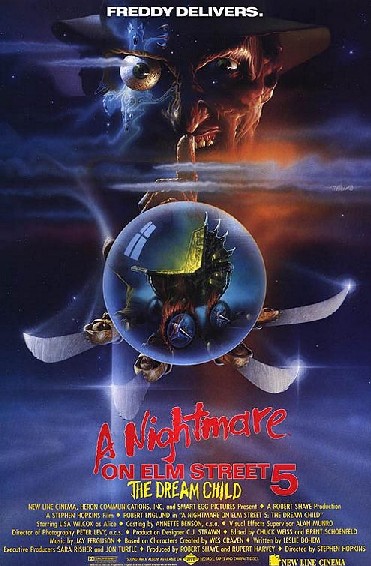
Here’s some friendly advice — don’t be friends with Alice. She’s a nice girl and all, but she’s kind of a getting-stabbed-to-death magnet. It’s like Greta says in Nightmare on Elm Street 5: The Dream Child (1989): “The bottom line, Alice, if anyone’s trying to hurt you, supernatural or not, they’re going to have to go through us first.” Yeah, that’s not really a problem for Freddy Krueger, who’s all too happy about dispatching Alice’s friends and lovers. Souls make him strong! Hey, remember when he was just trying to get revenge? In the words of President Barack Obama, “This shit’s getting way too complicated for me.”

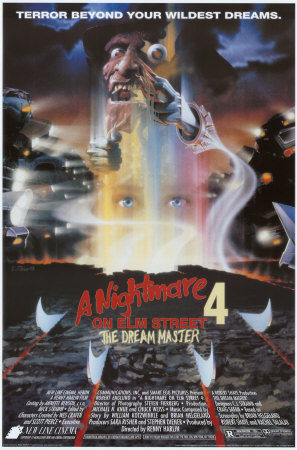
Part five of the Nightmare on Elm Street series isn’t all that well-regarded, but I actually like it far more than part four. Lisa Wilcox’s Alice breaks Carol Clover’s “Final Girl” model: she has sex, she gets naked, and she survives — twice! In The Dream Child, she’s transformed from the meek and mousy victim in Nightmare on Elm Street 4: The Dream Master (1988) to a kick-ass mama bear. That’s right, she’s with child. The plot is really silly, though it doesn’t matter. As Cheryl pointed out, by this point in the series we’re mostly watching for the nightmares. And the ones here are great.

Let me break it down, nightmare-by-nightmare.

“Hey, Danny, better not dream and drive!” Even though he’s all charged up and knows better, Dan (Danny Hassel), a holdover from part four, falls asleep on his way to meet Alice. He hears his mom call him an “ungrateful, unmanageable dickweed” on the radio. Don’t worry, she also calls Alice a “bimbo-slut-whore.” The car turns into Freddy, Dan loses all control, and he flies through the windshield. But wait, there’s more! Dan only thinks he’s survived — a stolen motorcycle also takes on some frightening Freddy features. Dan gets a hot fuel injection (less sexy than it sounds) and finally crashes in a fiery heap outside of the diner where Alice works. Tragic.

“Bon appétit, bitch.” Greta (Erika Anderson) may not get a death sequence as extended as Dan’s, but holy crap is it gross. In the real world, her mom is forcing her to attend a dinner party where lecherous older men ogle Greta’s model figure. You know, a day after her friend dies in a terrible accident. When Greta dozes off, she encounters Chef Freddy, who traps her in her chair and shovels unfathomable amounts of food into her mouth. Soon she’s got the chipmunk cheeks from hell — the most disturbing visual since Freddy’s sleepwalking puppet in Dream Warriors. And then Alice sees Greta in her fridge, which is bound to kill her appetite for at least a few days. Long story short: Greta chokes to death and no one even tries to intervene.

“You’re not crazy.” Well, duh, Yvonne (Kelly Jo Minter). Is everyone in these movies willfully dense? Yes, they’re slasher flicks. I’m just saying it would be nice if for once, the Final Girl’s friends believed her right away. But I digress. Diving boards are scary enough as it is, but Yvonne almost gets destroyed by one when she falls asleep in the pool. Of course, she doesn’t actually die. Instead, Yvonne gets pulled into Alice’s dream, which turns out to be a stroke of good luck. Wading in a nasty tank for a while is a whole lot better than what the rest of Alice’s friends face. Though I’m guessing Yvonne feels pretty awkward about the whole “not trusting her bestie” thing.

“Faster than a bastard maniac, more powerful than a loco-madman, it’s Super Freddy!” Not gonna lie, I totally have a crush on dweeby comic artist Mark (Joe Seely). He also has The Dream Child’s best nightmare, because it’s by far the most absurd — and because I’m pretty sure it was inspired by A-Ha’s “Take On Me” video. Mark is pulled into his comic, and at first, he’s sort of OK with it. In the comic, Mark can become the Phantom Prowler, a dark and deadly vigilante who says things like, “Time to die, you scar-faced, limp-dick!” But movie monsters are just as resilient as superheroes. Even after getting shot repeatedly, Freddy is still able to overtake Mark, slashing the crap out of him. Well, a two-dimensional paper version of Mark. And not a single papercut joke. Color me impressed.

There’s other great stuff here. I love all the unnerving flashbacks to Freddy’s conception: something about the combination of an innocent nun and 100 horny maniacs freaks me out more than Krueger himself. We also get Alice’s creepy offspring Jacob (Whitby Hertford) — no offense to the actor, but he’s just … weird-looking. Oh, and Alice travels inside her own womb, where Freddy is hanging out on her uterine wall. As one does. Part five may not be as good as parts one through three, but it’s way more tolerable than Freddy’s Dead (1991), which Cheryl will be slogging through next.

Daggle’s “avoid Arizona option” is awesome

3

Daggle is sporting an “avoid Arizona option” in an awesome parody of Google Maps.


“Headed cross-country and worried about a new law that might get you stopped by the police in Arizona because you look like an illegal immigrant?” writes Daggle creator Danny Sullivan. “Not to fear! Google has now added an “Avoid Arizona” option for those generating directions.”


As Sullivan points out, this option isn’t real, but sadly Arizona SB 1070 is a real law.


The Daily Blurgh: Staples city

0

Curiosities, quirks, oddites, and items from around the Bay and beyond

Shocker! San Francisco-based company set to profit off of humans willing to pay for amorous companionship.

*****

I Live Here: SF to live at SomARTS this fall.

*****

Google Maps gets you where you want to go (without going through Arizona).

*****

The gist: Breaking down the five, big legal questions in the iPhone case

*****

Which staple city would you rather live in: Ephemicropolis

or The Big Apple?

*****

I’ll see your KFC Double Down and raise you a cheesecake-stuffed pancake. (Offer very valid in Qatar.)

*****

But even if you’re only scarfing down the sprouted wheat bread, you’re still gonna die.

*****

Once-local, now big-in-France melancholy chanteuse Emily Jane White gets some love from NPR for her new album Victorian America.

*****

And speaking of sadness: “It is such a secret place, the land of tears.”  — Antoine de Saint-Exupéry

Newsom’s opponent Hahn calls for LA boycott of Arizona

The Arizona legislation that has sparked fury nationwide and even prompted City Attorney Dennis Herrera to call for a boycott of all things Arizona has also served to highlight a difference in opinion between Mayor Gavin Newsom and his opponent in the Lieutenant Governor’s race, Los Angeles City Councilwoman Janice Hahn.

In a Chronicle story today, Newsom took a murky stance on the Arizona boycott idea:

“Newsom argued that a total boycott of Arizona businesses could bring the city a wide range of problems that haven’t even been considered. ‘The notion of boycotting a state and every business that does business in the state is an extraordinarily complicated matter,’ he warned.”

To Hahn, the matter isn’t so complicated. According to a press release we received from her campaign:

“In response to newly-enacted legislation in Arizona which will require immigrants to carry documents about their immigration status at all times, and will allow police officers to question residents about their immigration status, today, Councilwoman Janice Hahn will introduce a resolution calling on the City of Los Angeles to boycott the State of Arizona. The resolution will call for Los Angeles, and all of its departments, to end any and all contracts with Arizona-based companies and to stop doing business with the state.”

Burning Man announces its funded art projects

3

Black Rock City LLC has announced its art grants for Burning Man 2010, with its theme “Metropolis: The Life of Cities.” Thirty-five projects were funded to the tune of almost $440,000, which is more than most years but not its peak.

Those receiving funding include well-known burner artists such as Michael Christian, Karen Cusolito and Dan DasMann, Kate Raudenbush, and Doctor Megavolt. The venerable SF-based fire arts collective Flaming Lotus Girls isn’t doing a funded project this year, but veteran FLGs Rebecca Anders and Jessica Hobbs (along with PK Kimelman, an architect and principal member of the local Space Cowboys sound collective) are leading construction of this year’s Temple (known as the Temple of Flux) with support from a gaggle of FLGs and many other Bay Area collectives in Oakland’s American Steel warehouse (the home base for Cusolito and DasMann).

I’ll be working with the Temple crew this year and profiling the project in the Bay Guardian later this summer, just as I did for the FLG’s Angel of the Apocalypse project in 2005 (all of which will be part of my upcoming book, “The Tribes of Burning Man: How an Experimental City in the Desert is Shaping the News American Counterculture,” due to be released in November by CCC Publishing).

Like many of the projects, the Temple of Flux is only getting a small portion of its funding through the art grants (which are funded through ticket sales) and will be holding a series of fundraisers in the coming months, the first being this Saturday night, May 1, at Kelly’s Mission Rock.

Meanwhile, Burning Man founder Larry Harvey will be speaking tonight (April 27) at the offices of the San Francisco Planning and Urban Research Association, which has been excitedly promoting this year’s Burning Man focus on urbanism.

School Board fireworks

2

Look for some interesting heat and maybe some light at the school board meeting tonight (April 27). The teachers union is holding a march and members will be speaking out against the layoffs (PDF), since this is the last board meeting before pink slips to more than 800 teachers and 300 para-professionals. The district, of course, is broke, since most of the money comes from the state, and the state is broke for all the reasons we all know, and I don’t envy the job of the school board and the superintendent, who have to somehow balance the books. The teachers think there should be more cost-cutting at the central office and that the district should dip into reserve fund, which will be about $8 million to the good at the end of this year.


It’s complicated, but the state requires the district to keep 2 percent of its budget total in reserve; that’s a sound policy. Right now, according to information that SFUSD spokesperson Gentle Blythe sent me, the reserve is at $33.6 million, much more than is needed, but some of that is temporary federal stimulus money.


Here’s how the distict outlines the situation:


Our baseline projections (i.e., the fund balance that would result if no steps were taken to address the budget shortfalls) are that our Unrestricted General Fund (UGF) balance would be $24.2 million, negative $37.9 million, and negative $97.6 million at the end of the three respective years. At the end of FY 2009-10, we would have $8.4 million more in fund balance than the $15.8 million required. However, we would fall short of our required fund balance in the following two years by $53.7 million and $113.4 million, respectively. If the Superintendent’s Budget Deficit Action Plan were implemented, our UGF fund balance would be $33.6 million, $23.6 million, and $15.8 million at the end of the three respective years.  


That, of course, assumes that the economy will still be awful in the next two years, that the state won’t have or allocate any additional money to education and that this same horrible fiscal situation will continue. Which may be true — but it may also be true that things will get better with a Democrat in the Governor’s Office, and the projections might not be so dire.


Meanwhile, the board will also be taking up a truly awful bill called SB 955, which attacks teacher seniority. It’s an informational item only, but should generate some discussion, since board member Rachel Norton has already weighed in on it in her sfgate blog post:


Still, it’s clear that there is political traction for California to weigh in on the national conversation happening on teacher seniority and evaluation, and I’m told that an alternative bill is likely to be introduced by a Democratic sponsor. If that happens, it will be important for the Board to have a position on what provisions should be included or dropped.

At this point, there’s no Democratic alternative bill in Sacramento, but there are plenty of moderate Democrats who could come up with one. And it raises the whole touchy issue of how to handle staff reductions in a district where many of the senior teachers have managed to get themselves assigned to top-performing schools. “We just sent layoff notices to 60 percent of the staff at Alvarado,” Board President Jane Kim told me. “And some schools on the west side will have only 10 percent layoffs.”

I cna’t imagine a majority of this school board coming down on the side of reducing seniority for teachers. But the fact that Norton is talking about the board looking at other alternatives, and how a counter to SB 955 might be structured, suggests that this issue isn’t going away. 

Mexico warns citizens: use extreme caution in Arizona

7

It’s no surprise to anyone who has watched Newsom stubbornly refuse to take responsibility for the consequences of his flawed juvenile immigrant policy that the mayor is playing coy when it comes to the Board of Supervisors’ and the City Attorney’s attempts to institute a boycott of Arizona.


The real surprise in the fallout around Arizona SB 1070 is that the legislation doesn’t include a clause whereby all “aliens” must find a picture of the Arizona state flag, cut out the star in it, and wear it as a “badge,” much like the Nazis required of the Jews.


But Mexico does gets the threat this hateful legislation poses to its citizens. In a new twist on travel advisories, the Ministry of Foreign Affairs of Mexico has warned its citizens in Arizona to exercise extreme caution, whether they are demonstrating against Arizona SB 1070, going about their everyday affairs, attending classes or contemplating accepting work offered from a car on a highway.


“It is important to act with prudence and respect local laws,” the Mexican consulate states. It notes that the new law won’t take effect until 90 days after the end of the current session of the Arizona state legislature, but warns, “however, as was clear during the legislative process, there is a negative political environment for migrant communities and for all Mexican visitors.”


The consulate recommends that Mexican nationals carry available documentation, even before the new law takes place so as to “help avoid needless confrontations.”


“As long as no clear criteria defined for when, where and who the authorities will inspect, it must be assumed that every Mexican citizen may be harassed and questioned without further cause at any time,” the consulate states.


“The new law will also make it illegal to hire or be hired from a motor vehicle stopped on a roadway or highway, regardless of the immigration status of those involved. While these rules are also not yet in force, extreme caution should be used.”


The consulate concludes by reminding folks that “Mexican nationals who are in the United States, regardless of their immigration status, have inalienable human rights and can resort to protection mechanisms under international law, U.S. federal law, and Arizona state law. The functions of the five Mexican consulates in Arizona (Phoenix, Tuscon, Yuma, Nogales and Douglas) include providing legal advice to all Mexicans who consider that they have been subjected to any abuse by the authorities.”


It recommends that Mexicans requiring consular assitance in Arizona use the following toll-free number, available 24 hours a day, seven days a week:1.877.6326.6785 (1.877.63CONSUL).


The CCA “conundrum”

The negotiations for the city’s green municipal power program still haven’t resulted in a finalized contract, and time is running out.

In 42 days, voters will decide whether Prop 16, the ballot initiative dubbed the “Taxpayers Right to Vote Act,” ought to be enshrined into state law. If a simple majority votes yes, the state constitution will be changed to require a two-thirds supermajority vote at the ballot before any municipal electricity program can move forward, effectively making it impossible for local governments to offer alternatives to investor-owned utility companies. Pacific Gas & Electric Co., the 105-year-old utility that gained infamy with the movie Erin Brockovich after it was accused of causing groundwater pollution which led to a cancer cluster in Hinkley, Calif., is poised to spend $35 million to pass Prop 16.

Here in San Francisco, where the vision for a green municipal power program goes back at least half a decade (and PG&E’s monopolistic grip dates back much farther), the plan’s most dedicated proponents have come to view Prop 16 as “the grim reaper.” At a meeting in City Hall last Friday about CleanPower SF, the community choice aggregation (CCA) program that could provide San Franciscans with 51 percent renewable electricity, Sup. Ross Mirkarimi repeated a mantra he’s intoned since approximately last year at this time: “All hands on deck.” Mirkarimi’s face looked tense, and his anxiety about the closing window of opportunity was plain even as he tried to display optimism. If a CleanPower SF program contract is not signed before June 8, when Prop 16 is decided, years of hard work and effort could be lost. With $35 million worth of carefully crafted PR messaging that reveals nothing about the sole financier of the measure or its anti-competitive intentions, Prop 16 has a decent shot at voter approval.

The race against the clock has been intensified by the fact that the San Francisco Public Utilities Commission, the city agency tasked with implementing CCA, has been unable (or unwilling, some critics charge) to broker a deal with Power Choice Inc., the energy service provider selected for CCA. Negotiating sessions have been ongoing since February, with SFPUC staff members, SFPUC General Manager Ed Harrington, three city attorneys, and staff of the Local Agency Formation Commission devoting hours to negotiations. “We are continuing to work hard to secure a contract,” SFPUC Assistant General Manager of Power Barbara Hale told the Guardian.

Yet as the days pass, the absence of a signed contract in hand has program advocates increasingly worried, frustrated, and suspicious of the SFPUC. “My sense, and my fear quite frankly, has been that the level of commitment [from the SFPUC] isn’t there, and if it were there … then we would have a finalized contract,” Sup. David Campos noted at a joint meeting between LAFCo and the SFPUC on Friday.

John Rizzo of the Sierra Club told the Guardian that Harrington approached the environmental group last week requesting that it join the SFPUC in issuing a press release blaming PG&E’s Prop 16 for marring CCA’s prospects. Harrington was ready to announce that the CCA had reached a preliminary contract, but not really a contract at all, since key terms such as a rate structure would not be hammered down till after the June 8 election. The Sierra Club declined to go along with that idea. Such a move would have jeopardized the program’s shot at success. Campos highlighted this problem at the meeting, saying, “Even though there are risks associated with CCA, the risk of not doing this and not having as concrete a contract by the election is greater.”

Green power advocate Eric Brooks noted that he had received a call from Nancy Miller, the executive director of LAFCo, notifying him that the SFPUC felt that Prop 16 had created a climate that made it too difficult to negotiate, and that a press release would be issued explaining as much. In the end, the SFPUC agreed to stay the course at the negotiating table. At Friday’s meeting, there was no mention of pushing the contract back to a later date. Instead, everyone nodded in polite agreement that all hands were, indeed, on deck.

But during his presentation to commissioners, Harrington emphasized the difficulty in meeting the twin program goals: green power on one hand, and competitive pricing on the other. He displayed charts showing how much more expensive wind and solar were than “brown power,” the fossil fuel and nuclear variety currently offered by PG&E. When challenged on the SFPUC’s commitment, Harrington responded tersely, “Staff commitment does not change the economic reality of the world.”

Brooks, who has weighed in and watched the process unfold since the beginning, later charged that Harrington was presenting a wholly different picture from what was originally agreed to as a way of subverting the program. “He purposely showed the numbers so that they would look worse,” Brooks said. “His key trick was … allowing the contractor the option of a 3-to-5 year contract. No one thinks you can pay renewable energy off in three years, that’s ridiculous. … He knows that the plan was to pay this off over 15 years. There’s no way he didn’t know that the idea is to pay it off in 15 years.”

Harrington was not available for comment. But Hale, who did speak with the Guardian, told us, “We’re absolutely open to a longer-term contract.” The problem, she said, has been determining a rate that makes sense both to guarantee the long-term viability of the program while meeting the renewable-energy program goals and the financial commitment necessary to make it worthwhile for the service provider. It’s like a big control board with multiple dials, and the problem seems to lie in twisting the knobs to find the appropriate setting. So far, they haven’t hit the sweet spot.

Meanwhile, the political backdrop of this “conundrum,” as Harrington called it, is that Mayor Gavin Newsom, now a candidate for Lieutenant Governor, would be placed in an awkward position if a Board-approved contract for the CCA program landed on his desk before June 8. If he endorsed the contract with his signature, he would earn the ire of PG&E, a moneyed political ally that could help him reach the office he aspires to. But if he vetoed CCA, it would amount to a stunning display of hypocrisy, since he would be a green mayor rejecting the greenest municipal power program ever attempted. Newsom, who wants to name a street after former Mayor Willie Brown even as Brown is publicly arguing in favor of Prop 16, could avoid that dilemma altogether if the contract negotiations just imploded, or were at least delayed till after June 8.

What’s wrong with taxing car owners?

13

It’s almost as if we need a full-time blogger to monitor the backwards ideas coming from the Chron’s C.W. Nevius. Today’s case in point: Nevius thinks the idea of charging for Sunday parking is “the dumbest idea since the imitation crab meat cocktail.” 


His brilliant investigative observation:


For all the talk about the fees on Sunday turning over parking spaces, you never read very far into one of these parking enforcement stories before you get to the bottom line — an estimated $2.8 million a year in this case if the Sunday-charge system was implemented citywide.


That’s exactly right, Chuck: This is a way to bring in money for Muni. And I don’t get what’s wrong with that. People who drive cars (and I admit, I’m one of them) have an outsized impact on the city; they take up a huge amount of space (San Francisco devotes more urban land to streets than parks), they pollute the air, they increase the nation’s reliance on fossil fuels and they contribute to global warming. And they don’t pay anywhere near enough taxes and fees to mitigate the impacts of their behavior.


I’m all for higher gas taxes, for example; taxes should not just be a source of revenue but should, when possible, be targeted to discourage socially detrimental behavoir. And charging people a little money to drive their cars to Sunday brunch instead of walking or taking public transit isn’t a terribly radical, unusual or disturbing idea. (In fact, we ought to charge the churches for the right to turn the streets into private parking lots on Sunday mornings).


Nevius complains that car drivers aren’t bad:


But c’mon. These aren’t evil people. They aren’t trying to scam the city, pee on the street, or break car windows and steal backpacks. We could fine the aggressive panhandler and the petty break-in artists, but they don’t have any money.


And I agree: They aren’t bad. But the same way taxes on cigarettes both defray the social cost of tobacco use and discourage the dangerous and noxious habit, a modest little fee for parking your car helps pay for public transit and might just encourage a few people not to drive their cars. That’s something everyone in the city should support.

Street Threads: Look of the Day

0

Today’s Look: Lydia, Dolores Park

Tell us about your look: (Breathlessly) “Practicing hooping in the park!”

No more stalling on CCA

0

EDITORIAL There’s nothing wrong with city officials taking tough stands in negotiations with private contractors. Hundreds, thousands of times in the past few years, San Francisco department heads have rolled over and given away the store in sweetheart deals that put the city on the hook for all the money, make the public take all the risk, and give a private outfit all the profit. Pacific Gas and Electric Co. (remember the Tulock-Modesto sellout contract?), Lennar Corp., Recurrent Energy, and countless other developers, builders, suppliers, and service providers have easily taken the public to the cleaners with contracts that never seemed to get stuck in the due diligence process.

But when there’s a looming deadline, hundreds of millions of dollars, and the city’s energy future and environmental footprint at stake, why is the San Francisco Public Utilities Commission moving so incredibly slowly to hammer out a deal for the city’s community choice aggregation (CCA) program? And why is PUC general manager Ed Harrington doing everything in his power to make sure that nothing happens that might put the city in the power business until after PG&E’s initiative, Prop. 16 — which would block public power efforts — passes at the polls?

It’s infuriating — and the supervisors need to tell the PUC that they won’t approve anything the agency does or wants to do until this contract is completed.

Harrington’s shop has known for more than a year that it needed to work out a business deal with a supplier that could replace PG&E and manage a program to buy greener, cheaper power in bulk and resell it to San Francisco residents. Marin County is setting up a similar program and is far ahead of San Francisco. The city has chosen a vendor, Powerchoice Inc., run by people completely qualified to handle the business.

And now there’s a absolute, drop-deal mandate: the city has to complete negotiations and get the program underway before the June 8 election. That’s because PG&E is spending $35 million to try to pass an initiative that would mandate a two-thirds vote of the public before any new CCA can begin selling power to customers. If San Francisco wants to present a solid legal case that its CCA is already in business, the contract with Powerchoice needs to be completed and signed, now.

But Harrington has, to put it kindly, been dragging his feet. The negotiations are hung up on a few points, although none are deal-breakers; Powerchoice already has agreed to assume some of the financial risk, which was the biggest obstacle to a deal. Now it’s just a matter of hammering out the details — but the PUC staff isn’t acting as if there is any time pressure at all.

In fact, last week Harrington circulated a draft press release all but announcing that he was tossing the whole deal under the bus and postponing negotiations until after the June election. He wanted to say that the "uncertainly" surrounding Prop. 16 made a deal impossible.

But Powerchoice isn’t walking away or complaining about the initiative. The company’s CEO, Sam Enoka, made it clear to us in an interview April 26 that he is eager to move forward. If Harrington — an experienced negotiator with a large staff at his disposal — and his boss, Mayor Gavin Newsom, wanted a deal, it could be finished well ahead of the deadline.

Instead, Harrington showed up at the Local Agency Formation Commission meeting April 23 with charts and a PowerPoint presentation purporting to show that renewable energy is too expensive to sell at rates comparable to what PG&E charges local customers. That misses the point — PG&E’s rates are going up every year and renewables are coming down, and the greatest risk to the city, the ratepayers, and the planet is sticking with the unreliable private utility that relies on fossil fuels and nuclear power for much of its electricity portfolio.

If the city has legitimate issues with Powerchoice, fine: Sit down and begin working them out. Now. But the only thing we can see at this point is the administration of a mayor who wants to be lieutenant governor intentionally delaying the process and giving PG&E exactly what it wants. (We called the PUC April 26, our print deadline, to ask why there were no talks scheduled that day, but Harrington wasn’t available; he was taking the day off.)

Sups. Ross Mirkarimi and David Campos suggest that the board simply refuse to sign off on any contracts, appropriations, or other approvals for anything the SFPUC does until this contract is completed. That’s a fine idea; they should start today.

Warriors, come out and play! (with this squeaky mouse)

0

Blossompaw jumped down from the wall and headed past the plants Jayfeather had carefully nurtured. The scent of them made Ivypaw’s mouth water, but she knew the warning given to every Clan cat: Stay away from the catnip.

Worry not for our youth in the post-Harry Potter era; there’s a new line of young adult fiction that’s got all the kids a’ reading. And it’s about fighting clans of kitties — my favorite! The Warriors, a series which to date includes over thirty titles, is a lot like Brian Jacques’ Redwall books — a small universe of carefully plotted minutiae following the escapades of animals in epic form.

But we’re going to the next level here.The Warriors see the Redwall sci-fi/fantasy nerd love of quests, battles, and prophecies, then raises it an all kitteh cast of characters. Oh yes, whiskers and all.

Warriors’ slightly confusing authorship (the books’ byline, Erin Hunter, actually refers to four women, none of them named Erin) begins each book with a comprehensive listing of each kitty in all four of the forest’s clans. Kits to clan leaders, pelt and eye colors included. For example, Dovepaw, one of the protagonists of Fading Echoes (book number two in the Omen of the Stars sub-series), is an apprentice of Shadow Clan, “a pale she-cat with blue eyes,” who is mentored by Lionblaze, “a golden tabby tom with amber eyes.” Leaving aside the complex belief structure and social hierarchy of the Warriors’ world, with 113 cats in the four mortal (oh yeah, it goes there) clans alone, it’s important to keep track of these details.

And readers do. Oh, but they do! A quick foray to The Warriors website reveals the true depths of fandom the kitties muster. Message boards require one to select a kitty avatar  to chat with the other kitties.

Which I did, all in the name of journalism of course (a golden she-cat with yellow eyes I named “Quillpaw”), and regardless of the fact that many of the conversation threads were a bit beyond my reckoning, most having to do with complex spoiler theories and desperate purrs for a single tom to mate with. Scandalous!

I meowed at my kitty friends online about why they liked this magical, mystical world of claws and fresh-kill, and I found Twilightfoot (who appears to be a fan fic writing, gender neutral black deputy cat with green eyes from he/she’s profile picture)’s answer to be the most endearing. I quote:

What do I like about Warriors?:

They are VERY interesting, and have a good plot that I can relate to.

It is NOT a G-rated series, which I <3!

I get very, um, connected with the characters, which I can rarely do with a book.

In this day and age, connection is really the pith of the matter, isn’t it? Cheers to you, Twilightfoot. And cheers to you, Warriors books — I never really liked reading about people, anyway.

Welcome to Elm Street: Part Four

0

In honor(?) of the new A Nightmare on Elm Street, we’re recapping all of the Elms so far. Find more on the Pixel Vision blog.

In the immortal words of the Fat Boys: are you ready for Freddy?

Well, duh. By 1988’s A Nightmare on Elm Street 4: The Dream Master, everyone and their (human-faced) dog was ready for Freddy, whose status as a grinning, quotable pop culture icon would only be enhanced by his latest film. The Dream Master is the first of the Nightmare movies to basically do away with any semblance of a plot; instead, the film exists to provide variously surreal, outlandish, and repulsive nightmare sequences that inevitably end in the death of whatever character is chiefly involved.
And that ain’t such a bad thing. Though the behind the scenes credits are sorta impressive, actually — Renny Harlin, who’d go on to make Die Hard 2 (1990), Cliffhanger (1993), and Deep Blue Sea (1999), directed; Brian Helgeland, who shared a screenwriting Oscar with Curtis Hanson for 1997’s L.A. Confidential, and was later nominated for adapting 2003’s Mystic River, is among its co-writers — this movie is utterly ridiculous anytime Freddy’s not the center of attention.

Thankfully, that’s not often. As Louis described in his post on Nightmare 3, the remaining Elm Street kids/Dream Warriors — now more or less integrated into Springwood’s normal high school population —  are the first to go, and they go fast. But wait, you say! Didn’t Freddy get buried in consecrated ground, etc. etc., at the end of Dream Warriors? Yeah, but no matter: before Kincaid (Ken Sagoes) dies, he dreams his dog, Jason (zing!), turns demonic and pees a fiery stream into Freddy’s junkyard grave. Naturally, Freddy comes back to “life,” except he was already dead, or undead, or something, to begin with, wasn’t he? “You shouldn’t have buried me. I’m not dead!” Whatever, he’s back.

Before you can sing a slo-mo jump rope rhyme, Kincaid gets gloved, and ever-horny Joey (Rodney Eastman) drowns in his waterbed. Kristen (now played by Tuesday Knight, who’s no Patricia Arquette) meets a fiery end, but not before courteously extending Freddy’s nightmare-entering capabilities beyond the Elm Street circle: she pulls innocent, mousy Alice (Lisa Wilcox) into her fatal dream. (Freddy’s response: “How sweet! Fresh meat!”) Logically, of course, this means Freddy can now terrorize Alice and all of her friends, including her kung fu-fighting brother, Rick (Andras Jones); asthmatic nerd Sheila (Toy Newkirk); bug-phobic workout-aholic Debbie (Brooke Theiss); and letter-jacketed love interest Dan (Danny Hassel).

The death scenes benefit from what appears to be a bigger special-effects budget than previous films, with Debbie’s transformation into a giant cockroach remaining my personal favorite. There’s also a nice bit where Alice gets pulled into a movie screen, and an attempt at near-artsyness when a scene repeats multiple times to slow Alice and Dan from saving one of their imperiled, snoozing friends. I’m also a huge fan of the scene where Freddy visits Alice’s workplace, the Crave Inn (zing!) diner. Seems Freddy, in a particularly sassy mood, has ordered himself a pizza. A pizza covered in heads! Screaming heads! Freddy spears a head-meatball with one of his claws and excitedly smacks his lips: “My faaaaavorite!” The chewing sounds are amazing.

Later, Alice turns Perseus and “kills” Freddy by showing him his reflection in a piece of stained glass (but not before Freddy reminds us that “I. Am. Eternal!”) And since Freddy has now become not just a slaughterer-of-the-sleeping, but a taker-of-souls (when and how did that happen, exactly?), his captives sail to freedom past Alice in a wash of white light, as if Zelda Rubenstein was showing them the way. Yeah, that’s the end of him, for sure! Er … one more thing about Dream Master is its determined-to-be “hip” soundtrack, with Sinead O’ Conner, Dramarama, Blondie, and other artists contributing tunes. But you can’t go wrong with the Fat Boys.

Welcome to Elm Street: Part Three

0

In honor(?) of the new A Nightmare on Elm Street, we’re recapping all of the Elms so far. Find more on the Pixel Vision blog.

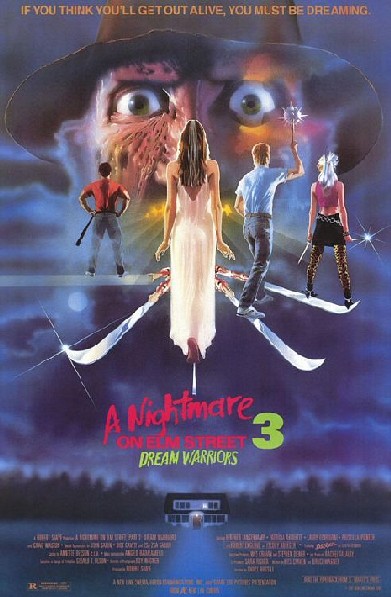
“Live together, die alone.” I stole that line from Lost, but it sums up A Nightmare on Elm Street 3: Dream Warriors (1987) all too well. The remaining Elm Street kids — you know, the ones whose parents enacted mob justice on Fred Krueger — find themselves locked in a psych ward. They’re not really crazy: they’re just having bad dreams. But these teens are (mostly) smarter than their predecessors, and they refuse to go down without a fight. The “dream warriors” pick up on two important facts: there’s safety in numbers, and you can do awesome shit when you’re dreaming. I believe The Simpsons’ Ralph Wiggum said it best: “Sleep! That’s where I’m a Viking.”
No Vikings in this bunch, sadly, but these kids do have pretty nifty powers and thus a fighting chance against Freddy. In case you’re planning on assembling your own team of dream warriors — and honestly, it’s not a bad idea — I thought I’d break down the pros and cons of part three’s heroes. Yes, most of them end up dead and those that don’t (spoiler alert) are offed in part four. But hey, it’s good to know what skills to look for and what faults to avoid when you’re trying to save your ass.

Presenting the dream warriors, in the order in which they bite it.

Phillip (Bradley Gregg)
Pros: Bitchin’ ‘80s hair.
Cons: Sleepwalker. First to die, with the most disturbing death scene by far. He really doesn’t have a lot going for him.

Jennifer (Penelope Sudrow)
Pros: Has a (somewhat painful) system for staying awake. Burning oneself with cigarettes shows serious motivation.
Cons: Smoker. Thinks she’s going to be an actress — yeah, she’s one of those. And, of course, the second to die. “Welcome to prime time, bitch.”

Taryn (Jennifer Rubin)
Pros: Stands her ground. That means not putting out for skeezy orderlies. Gets the best line of the movie: “In my dreams, I’m beautiful. And bad.” Switchblades.
Cons: Attitude. Really needs to comb that hair. Pesky heroin addiction, which Freddy exploits with terrifying fingerneedles.

Will (Ira Heiden)
Pros: Nerdy charm. In his dreams, he can walk — not to mention be the Wizard Master. That’s right, he can blow up evil wheelchairs with green lightning (in the name of Lowrek, Prince of Elves).
Cons: Even as a wizard master, he’s still just a dweeb. And eventually, a dead one.

Nancy Thompson (Heather Langenkamp)
Pros: She’s been here before. Check out that grey streak: it screams “survivor.” Prescription for Hypnocil. Won’t take getting killed lying down.
Cons: Lots of baggage. Dead friends, dead boyfriend, dead mom — rewatch the first Nightmare on Elm Street if you need a refresher. Kind of naïve, inevitably. You really thought ghost dad was legit?

Kristen (Patricia Arquette)
Pros: Good at art. Marvel at her popsicle stick recreation of Nancy’s house! Does flips. Can bring people into her dreams.
Cons: Can bring people into her dreams. Hey, that’s a bad thing when you’re trying to avoid getting murdered. Poor common sense. All the Freddy fan-art is asking for it, don’t you think?

Kincaid (Ken Sagoes)
Pros: Tells it like it is, which means more great lines: “Let’s go kick the motherfucker’s ass all over dream land!” “Yo, Freddy! Where you hidin’ at, you burnt-face pussy?” Also, dreams give him super strength!
Cons: Gets thrown in the quiet room a lot, so you know he’s bad news. Nasty habit of antagonizing Freddy Krueger.

Joey (Rodney Eastman)
Pros: Knows to wake up his friends when necessary. Dream scream can break mirrors and banish the boogeyman.
Cons: But mostly quiet. Too quiet. Ball of teenage hormones, which inspires him to follow the hot nurse from hell and get himself comatose.

Dr. Neil Gordon (Craig Wasson)
Pros: The only doctor who actually believes that his patients are being killed by Freddy Krueger. Master hypnotist. Sees dead people — or dead nuns, at least.
Cons: Not a teenager. Might we say he’s getting too old for this shit? Can’t even fight a skeleton.

So there you have it. Now you can — I’m so sorry for this — pick your own dream team. And if you’d like to recruit me as a dream warrior, you should know that I’ve seen countless horror movies and know how to survive relatively unscathed. On the other hand, I’m pee-my-pants frightened of Freddy, so let’s call it a draw.

Live Shots: Dance Mob Kick-Off for Bay Area National Dance Week, Union Square, 4/23/10

0

Don’t be alarmed if you happen to feel the floors shaking throughout the next week. It’s not an earthquake, it’s the Bay Area National Dance Week , an amazing event offering tons of free dance through May 2nd.

As a kick-off to celebrate a week of booty-shaking and funky foot moves, several hundred dancers gathered in Union Square this Friday to perform one dance in unison, which they incorporated into pieces that each group choreographed on their own:

http://www.youtube.com/watch?v=50fUbBsG3ek

The variety of dance styles ranged from hip-hop and belly dancing, to square dancing and even a few free-flowin’ dancers who joined in from the audience. There were 19 groups involved in the dance mob, which included high school students from all over the Bay Area, and several dance companies. If you’re new to dance, but fascinated by flamenco, or a long time dancer who wants to brush up on her salsa turns, this is the week for you. And even if you don’t want to physically join in the fun, there are lots of performances to take a peek at. So, get those dancing shoes on and shake things up a bit!

The Daily Blurgh: Terrorists get Triscuits, fascists get beans, gingers get MIA

0

Curiosities, quirks, oddites, and items from around the Bay and beyond.

Today in refried beans: from ingredient of burrito indulgence, to bane of the greenhouse, to weapon of protest. Even Dennis Herrera is (rightfully) pissed. Arizona goddam!

*****

In “Calfornia lawmakers with no grip on reality” news: this again? When will you learn, Maude Flanders of Sacramento? Whatever kids won’t be able to glean from Left 4 Dead 2 because of your “good intentions,” they can easily pick up in any one of the Saw films (or the evening news). What you gonna do when the zombies come, anyway?

*****

Debate: If a street artist who has already sold out (but is hip to that fact, so “selling out” becomes a meta-commentary on selling out), goes shopping for pricey, “heritage” jeans spun from the souls of kodama on looms built from the remnants of the true cross, is he still a sell out?

*****

It doesn’t matter what your favorite crackers or cookies are. They are not more important than the hegemonic wars the West is fighting against Islam.”

*****

“Walter Benjamin, or rather, the now-beloved figure of Benjamin — shuffling, myopic, mustachioed, fat, unhealthy, small round glasses glinting like flashlights — was largely unattractive in his own lifetime.” I smell an Oscar-in-waiting for Richard Dreyfuss.

*****

98 years ago: man in drunk-tank saved from fiery death by boozy ways, Providence.

*****

Yes, but what, exactly, is she getting political about? (Besides swiping that riff from Suicide — sampling kills!) NSFW, unless W is Xe.

Herrera to San Francisco: boycott Arizona

25

I almost visited Arizona once.
I was in Nevada, visiting the Hoover Dam which crosses the border between Nevada and Arizona and took a photo next to the Arizona state sign.

But I didn’t cross the line. I already suspected that Arizona was groundzero for wingnuts, thanks to the decision of Arizona U.S. senator, Republican John McCain, to choose then Alaska governor Sarah Palin as his running mate in the 2008 presidential election.


At least, Democrat Janet Napolitano was still governor of Arizona at the time, and so was able to veto similar attempts to pass racist immigration laws in the state of


But now Republican Jan Brewer, a former Maricopa County supervisor, is governor of Arizona and has signed Arizona’s SB  1070, I think I’ll follow San Francisco city Attorney Dennis Herrera’s advice and implement a sweeping boycott of all things Arizona.


Citing San Francisco’s “moral leadership against such past injustices as South African apartheid, the exploitation of migrant farm workers, the economic oppression of Catholics in Northern Ireland, and discrimination against the LGBT community,” Herrera offered the services of his office’s contracts, government litigation and investigations teams to work closely with city departments and commissions to identify applicable contracts and to aggressively pursue termination wherever legally tenable.


“Arizona’s controversial new law makes it a state-level crime for someone to be in the country illegally, and even criminalizes the failure to carry immigration documents at all times by lawful foreign residents,” Herrera’s April 26 press release observed. “It additionally imposes a requirement for police officers to question those they suspect may be in the United States illegally. Civil libertarians have sharply criticized the law for being an open invitation for harassment and discrimination against all Latinos, regardless of their citizenship. It has also been rebuked by the nation’s law enforcement community, with the president of the Major Cities Chiefs Association, San Jose Police Chief Robert Davis, reiterating his organization’s 2006 policy statement that requiring local police to enforce immigration laws “would likely negatively effect and undermine the level of trust and cooperation between local police and immigrant communities.”


“Arizona has charted an ominous legal course that puts extremist politics before public safety, and betrays our most deeply-held American values,” said Herrera, who is the son of an immigrant from Latin America. “Just as it did two decades ago when it refused to observe Martin Luther King Jr. Day, Arizona has again chosen to isolate itself from the rest of the nation. Our most appropriate response is to assure that their isolation is tangible rather than merely symbolic. San Francisco should lead the way in adopting and aggressively pursuing a sweeping boycott of Arizona and Arizona-based businesses until this unjust law is repealed or invalidated. My office is fully committed to work with San Francisco city departments and commissions to identify all applicable contracts, and to pursue termination wherever possible.  And my office stands ready to assist in any legal challenges in whatever way it can.”


Meanwhile, Napolitano, who is serving as Obama’s Department of Homeland Security Secretary, joined Obama in calling Arizona’s new immigration law “misguided.”


Appearing on ABC News, Napolitano said of the bill: “That one is a misguided law. It’s not a good law enforcement law. It’s not a good law in any number of reasons.”
She also warned that Arizona’s law could get other states trying to pass similar legislation, which could create a patchwork of immigration rules, instead of an an overall federal immigration system.


“This affects everybody, and I actually view it now as a security issue,” Napolitano said. “We need to know who’s in the country. And we need to know, for those who are in the country illegally, there needs to be a period under which they are given the opportunity to register so we get their biometrics, we get their criminal history and we know who they are. They pay a fine. They learn English. They get right with the law.”


Here on the streets of San Francisco, immigrant advocates are asking folks to march on May Day in solidarity with the immigrant communities of Arizona.


“In 2006, the immigrant community took to the streets in huge numbers,” a press release from the May 1st coalition stated. “Millions of undocumented working people and their families sought a pathway to legalization and to a life without fear of work-place raids or middle-of-the night deportations that tear families apart. In 2010, conditions have only worsened as hate crimes have increased exponentially; intolerance has been legitimized by the rhetoric of the Tea Party; and governments (like Arizona) have instituted harsh policing and employment practices that terrorize our communities. The federal government has failed to solve the crisis of undocumented workers in this country. In San Francisco, thousands of workers face losing their jobs because of a flawed employment verification process. Our children are deported without due process and now we must fear the codification of racial bigotry in Arizona.  State and federal governments have ineffectively solved the budget crisis on the backs of the lowest paid workers.  We march in solidarity with Arizona’s immigrants; immigrants everywhere; and the hard-working people of San Francisco who’ve unfairly endured the burden of this economic crisis.


The May 1st Coalition invites the community to join them for an April 28 poster-making party at 10 a.m, City College Mission Campus at 1125 Valencia Street in preparation for a May Day march at which Olga Miranda, President of SEIU Local 87, Jane Kim, SFUSD school board president, and Pablo Rodriguez, city college faculty, will speak.


My favorite comment on this unfunny situation comes from Daily Kos contributing editor and Las Vegas resident Jed Lewison.


“What do you call a bunch of people who not only don’t see anything wrong with Arizona’s new hate law, but blame federal inaction on immigration reform for “forcing” Arizona to enact the law while simultaneously trying to block federal immigration reform legislation?” Lewison asks. “You call them conservatives.”


Welcome to Elm Street: Part Two

2

In honor(?) of the new A Nightmare on Elm Street, we’re recapping all of the Elms so far. Find more on the Pixel Vision blog.

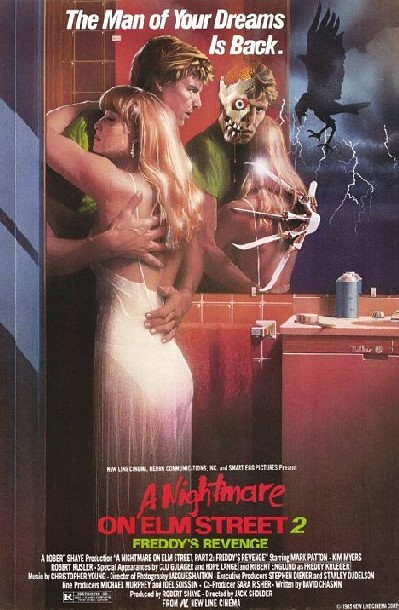
A Nightmare on Elm Street, Part 2: Freddy’s Revenge (1985) is probably the most reviled of all the Nightmare movies. Which is silly, because it’s awesome. OK, there are serious continuity problems and an utter lack of interior logic. You could skip right to part three without missing a beat — in fact, maybe you should. Freddy’s Revenge works better outside the context of the series. You have to appreciate this movie for what it is: a campy, homoerotic comedy. Dark comedy, but still.

Nancy (Heather Langenkamp) has been replaced by adorkable dweeb Jesse (Mark Patton). Freddy (Robert Englund) doesn’t want to kill Jesse; he wants to—wait for it — get inside him. And if you’re wondering how this Freddy relates to the original, don’t bother. Part 2’s Freddy seems to be able to torment people who are awake. He doesn’t murder teens on his own: he has to work through Jesse’s body. Or something. Screw the plot — the fun of Freddy’s Revenge is noting all the queer subtext.

Here’s my list of the 14 gayest things in this movie.

1.    Jesse’s uber-femme scream is way more piercing than Nancy’s. Now, I don’t want to make assumptions. I’m sure lots of straight boys scream like that. But in context, it’s suspect.

2.    Jesse is terrible at sports. Again, not trying to play into stereotypes. Well, no more than the movie is.

3.    Grady (Robert Rusler) queers things further when he pulls down Jesse’s pants. Then the boys start wrestling. Coach Schneider (Marshall Bell) offers the only appropriate response: “Assume the position.”

4.    To borrow a line from Buffy, “the subtext is rapidly becoming text.” “Guy gets his rocks off like this,” Grady says. “Hangs out at queer S&M joints downtown. He likes pretty boys like you.” Smile, Jesse. Grady thinks you’re pretty.

5.    Diagram of an ass on the chalkboard. Giant snake rubbing against Jesse’s face. Paging Dr. Freud!

6.    Jesse’s dance routine evokes painful memories for gay men everywhere who recall similar embarrassments. Relatedly, I love his Lady Gaga glasses.

7.    “Schneider’s always got a stick up his ass.” Cough.

8.    Look, I’m not saying sleepwalking isn’t real. I’m just saying sleepwalking into the aforementioned gay S&M club is a little hard to swallow. No pun intended.

9.    Coach Schneider’s death scene is where things get really interesting: he’s tied up, stripped, and ravaged in the shower. Need I mention the towel repeatedly slapping his ass? Or the fact that the showerheads are obviously penises?

10.    Jesse’s beard/love interest Lisa (Kim Myers) insists that she wants to help him. I think she means “cure” him, but we all know that never works.

11.    Once Jesse does try to hetero it up by making out with Lisa, he finds himself rudely interrupted. See, Freddy’s tongue is in his mouth.

12.    Where does he run? To (shirtless) Grady’s room, of course. This leads to the film’s most surreal exchange yet: “Something is trying to get inside my body.” “Yeah, and she’s female and she’s waiting for you in the cabana. And you want to sleep with me.”

13.    It doesn’t stop there. “He’s inside me,” Jesse whines. “I’m scared.” Just relax. “He’s inside me and he wants to take me again!” That Freddy — he’s insatiable!

14.    Fast-forward to Lisa’s intervention. “I love you, Jesse,” she says. Then she has the audacity to kiss Freddy, and you better believe he freaks. (Ew, girls.)

So in the end, Lisa’s love destroys the evil (read: queer) Freddy. A sadly homophobic twist to this otherwise gay romp. How would I have ended Freddy’s Revenge? Krueger realizes he’s just a metaphor for repressed sexuality and scampers off to part three, where he can be legitimately scary again. Meanwhile, Jesse and Grady ride off into the sunset, and any further bodily penetration is completely consensual.

A fitting memorial to labor’s dead and injured

0

Dick Meister, formerly labor editor of the SF Chronicle and KQED-TV Newsroom, has covered labor and politics for a half-century.

We’re coming up on another Workers Memorial Day April 28 – a day when organized labor and its allies honor the millions of men and women who’ve needlessly suffered and died because of workplace hazards and to demand that the government act to lessen the hazards.

It’s certain that unless federal authorities do act to expand and adequately enforce the neglected job safety laws, the number of victims will remain at a terrible and unnecessarily high level.

Every year, more than 6,000 Americans are killed on the job. More than 6 million are injured, at least half of them seriously. Another 60,000 die from their injuries or from cancer, lung and heart ailments and other occupational diseases caused by exposure to toxic substances.

 Think of that: An average of at least 16 workers killed and nearly 5,500 badly hurt on each and every day, plus 135 or more dying daily from job-related illness. The financial toll also is high: More than $3 billion in health care expenses and other costs to employers and workers, such as lost wages and production.

Trying to reduce workplace dangers, always a difficult task, became even more difficult when the Bush administration took office in 2000 and began eight years of what the United Auto Workers accurately cited as  “a harsh, vindictive attack on health and safety standards.”

Under President Bush, important new health and safety regulations proposed by experts were brushed aside by the Labor Department. Job-site inspections were all but abandoned and employers were asked merely to certify that they had voluntarily complied with the existing regulations.  Fines for violations were rare, in any case, as were criminal charges against employers whose willful violations led to injury, illness or death.

There was, in short, very little enforcement of the job safety laws, and absolutely no progress in reducing workplace dangers or the ever-mounting number of work-related injuries and fatalities.

But under President Obama, there’s genuine hope for change. As Obama’s Secretary of Labor, Hilda Solis, made clear at her swearing-in: “There’s a new sheriff in town.”

Solis has shifted from reliance on voluntary compliance to stricter enforcement, hiring hundreds of new investigators and enforcers for the Labor Department’s Occupational Safety and Health and Mine Safety Administrations. Most of them are longtime advocates for working people, some of them from organized labor. They’re holding jobs held during the Bush years by employer advocates whose main concern was shielding employers from the costs of making work safer.

Solis’ team has moved to enforce new rules to better protect some of the most endangered workers, including mine workers and crane operators. She’s also stressing the need to help the millions who suffer chronic pain in the neck, back, shoulders, arms or wrists and other suffering resulting from the endlessly repetitive movements and often heavy lifting required in many jobs today.

Those so-called ergonomic injuries are the most common  – and most neglected – of the  serious injuries suffered by U.S. workers.

Solis has put a task force to work designing a much tougher enforcement program for serious or repeat offenders, who will face mandatory job-site inspections. What’s more, she and Obama have named one of the country’s most distinguished safety experts, David Michaels of Georgetown University, to head the Occupational Safety and Health Administration (OSHA).

Michaels’ main goal is to get employers and workers and their unions to jointly develop programs that would include safety training for workers as part of an effort to meet what Michaels and other safety experts see as a great need to change  OSHA’s  direction and philosophy.

Michaels and Solis have gotten important help from congressional Democrats who introduced legislation to strengthen the safety laws, in part by increasing  penalties imposed on violators. Penalties now are so minimal that many employers simply ignore the law and consider the fines, if any, a routine cost of doing business.

The measures also call for more strongly protecting workers who report safety violations by their employers, extending the laws’ coverage to farmworkers, local and state government employees and other groups not currently covered, and otherwise strengthening workers’ job safety rights.

It’s certain, at any rate, that labor, Obama, Solis and their supporters will indeed wage the major battle for true job safety that they’ve promised and have, in fact,  already started. There could be no more fitting a memorial to the millions who’ve been needlessly maimed or killed while working to sustain themselves and their families.

Dick Meister, formerly labor editor of the SF Chronicle and KQED-TV Newsroom, has covered labor and politics for a half-century. Contact him through his website, www.dickmeister.com, which includes more than 350 of his  recent columns.

Welcome to Elm Street: Part One

0

In honor(?) of the new A Nightmare on Elm Street, we’re recapping all of the Elms so far. Find more on the Pixel Vision blog.

It’s with a certain sense of outrage, but not surprise, that horror fans greet the remake of 1984’s A Nightmare on Elm Street. Truly, nothing is sacred anymore. (I mean, Michael Bay’s do-over-ator already had its way with that holiest of holys, 1974’s The Texas Chainsaw Massacre, in 2003.) I can only guess that Freddy Krueger is frikkin’ pissed off right now. (Jackie Earle Haley may be an Oscar nominee, and, OK, a pretty cool actor — but Robert Englund’s the only rightful Krueger in my book.) Pretty much the only thing you can do right now is pull that A Nightmare on Elm Street box set off the shelf and start watching ‘em all. (There are seven, plus 2003’s Freddy vs. Jason, which of course you purchased separately.) Get to it!

Alternatively, you can simply follow Guardian movie geek Louis Peitzman and myself as we recap each film in the week leading up to the new A Nightmare on Elm Street’s release Fri/30. Since I have a little bit of a Freddy obsession (just part of my collection pictured here), I’ll be getting the ball rolling, with a post by Louis on A Nightmare on Elm Street 2: Freddy’s Revenge (1985) to follow later today. Whatever you do, don’t fall asleep! (Or be surprised by spoilers, because these movies are like two decades old, people.)

The sporadically inaccurate but nonetheless helpful (and gloriously illustrated) volume The Nightmare Never Ends: The Official History of Freddy Krueger and the Nightmare on Elm Street Films, by William Schoell and James Spencer, is dedicated to “Jason and Michael — because they’ll always be second best.” And indeed, when Freddy Krueger was introduced to the world, audiences were already familiar with Misters Voorhees and Myers. (Hell, Friday the 13th was already up to part four, the hilariously misnomered The Final Chapter, by 1984.) But Freddy had something neither of those dudes had: a voice. He actually spoke to his victims! With a sense of humor to boot! (Though by mid-series he was communicating mostly in bad rhymes and even worse puns. But I digress.)

Legend states that Nightmare writer-director Wes Craven named his most famous character after a junior high rival (no word if the real Freddy ever realized his influence on movie-monster history). The last name came from Krug, the evil prison escapee from Craven’s first film, 1972’s Last House on the Left. Nightmare’s opening credits, which depict Krueger fashioning his trademark glove, feature the immortal words “introducing Johnny Depp;” they also present Englund as “Fred” Krueger. In later films, Englund would get above-title billing. But in 1984, nobody knew who Freddy was, or that they and everyone they knew would probably dress up as him for Halloween at least once. Certainly young Nancy Thompson (Heather Langenkamp), who lives in the white house with the red door on Elm Street in Springwood, Ohio, has never heard of him. But her bitterly divorced parents (Ronee Blakley, loopy star of 1975’s Nashville, plays her drunk mom; cult actor John Saxon plays her cop dad) know a little something about a child killer named Krueger. Seems they executed mob justice on his sweater-clad ass some years before. So why are Nancy and her friends (including Depp as her boyfriend, cut-off sweatshirt-clad Glen) meeting the allegedly dead Freddy in their dreams?

Freddy seeks revenge, of course, and little did those murderin’ parents know their quarry had supernatural powers: when the kids die in their dreams, they die in real life. Even though the parents know all about Krueger, they act like they don’t believe their bratty, rebellious teenagers. (With that rakish fedora, how could they even pretend to forget such a character?) This is a recurring theme in the Nightmare films: parents just don’t understand. Sometimes, they’ll even put bars on your bedroom window to “protect” you after they tuck you into bed, not realizing that growing up is hard, man. Especially when there’s a creepy creep chasing you with fingerknives through your dreams.

Nancy’s the wisest character here (evidenced in part by the gray streak that suddenly appears in her voluminous ‘80s coif after a harrowing Freddy encounter). Not only does she start mainlining caffeine to stay awake, she obtains a militia handbook (“I’m into survival!”) and begins plotting her naps with battlefield-worthy precision (with plenty of booby traps in place). Meanwhile, since Nancy actually doesn’t save anyone except herself, Craven’s behind-the-scenes team does wonders with special effects. Glen being sucked into, and bloodily vomited out of, his own bed is particularly memorable.

The film’s ending is the worst thing here. According to The Nightmare Never Ends, Craven and producer Robert Shaye disagreed on how to wrap up the story, with Craven believing it should end after Nancy defeats Freddy by taking back the power she’s unknowingly given him. Bam! End of Freddy. Shaye wanted more of a “Gotcha!”, which every other slasher movie in the history of the world has, and will always have. Guess who won? Eight — no, now nine movies later — we’re still expecting Freddy to come back.

Nevius makes the case for a progressive DCCC

27

Chronicle columnist C.W. Nevius made an excellent argument for supporting the Guardian’s slate of progressive candidates for the Democratic County Central Committee in Saturday’s paper, even though he was trying to do just the opposite. But I suppose that perspective is everything.

Our perspective at the Guardian is one of great pride in San Francisco and its left-of-center values. Nevius looks at San Francisco from his home in Walnut Creek and sees a scary place where people question authority figures and don’t simply trust developers, big corporations, and the Chamber of Commerce to act in the public interest.

“The next two months will see a battle for the political soul of the city. It will pit the progressives against the moderates in a face-off that will have huge implications in the November elections and, perhaps, the election of the next mayor. The key is control of an obscure but incredibly influential organization called the Democratic County Central Committee,” Nevius writes, and he’s right about that.

But he’s wrong when he assumes most San Franciscans agree with him and others who want to make the city more like the sterile suburbs that they prefer. Nevius values “safe streets,” which is his code for giving police more power through the proposed sit-lie ordinance and other unpopular crackdowns, despite the fact that he sat in the back row and watched the DCCC voted overwhelmingly against sit-lie after nobody presented a credible case for it.

Nevius is so utterly blind to the fact that most San Franciscans want adequate mitigation and community benefits from development projects that he recently ranted and raved about the defeat of the 555 Washington project, even though it was unanimously rejected by the Board of Supervisors for inadequately addressing these requirements.

The “moderate values” that Nevius champions are actually quite extreme: give downtown and developers everything they want, never question the behavior of cops or the Fire Department’s budget, keep cutting taxes until city government becomes incapable of providing services or regulating the private sector, ignore the cultural value of nightclubs and artists, and deport all the undocumented immigrants.

This is the Democratic Party that Nevius and his allies like Sup. Michela Alioto-Pier and supervisorial candidate Scott Wiener (a conservative attorney who would be the best friend that the suburban cowboy cops could ever have on the board) want to promote, and it looks more like the Republican Party than a political party with San Francisco values.

But they aren’t honest about that intention, instead trying to fool people into believing that progressives are the extremists. “But when Mrs. Jones receives her Democratic voter guide in the mail…she’s thinking of the party of Barack Obama, not the party of Aaron Peskin and (Supervisor) Chris Daly,” Wiener said.

But in the Democratic presidential primary election, it was Daly and Peskin who were the strongest early supporters of Barack Obama, while Wiener backed John Edwards and Alioto-Pier, Mayor Gavin Newsom, and the rest of the “moderate” party stalwarts supported Hillary Clinton. That’s not a huge deal, but it’s a sign of how the so-called moderates are willing to distort political reality.

So Nevius is right. This is an important election and it is about the soul of the city. Do you support scared suburban twits who disingenuously try to hide behind the “moderate” label in order to seem more reasonable, or do you support progressive candidates who have integrity and won’t moderate their values in order to appease the cops or the capitalists?

If it’s the latter, support the Guardian’s slate (which is substantially similar to the slates approved by the Harvey Milk LGBT Democratic Club, the San Francisco Tenants Union, the Sierra Club’s SF Bay Chapter, and other progressive groups).

And if you want that slate to have some money to mail out a Guardian slate card, come to a fundraiser this Thursday evening at CELLspace, 2050 Bryant, featuring the candidates and some great exemplars of the culture they support, including amazing singer/songwriter Valerie Orth, the zany dance troupe Fou Fou Ha, and DJs Smoove and Kramer, who regularly rock the best clubs and community-based parties in town.

And by “town,” I mean San Francisco, not Walnut Creek.