SFBG Blogs

Live Review: Holy Ghost!, Fillmore, 6/3/2010

0

By Peter Galvin

While much of the mainstream is still poking fun at the hair bands and taking pot-shots at the easy-listening fluff, the ’80s have snuck back in for a full-on revival. Kids who grew up in the decade of Ninja Turtles and parachute pants surely have the fondest memories, and two of those kids play poker-faced homages to the era as Holy Ghost! Full of flashy synths and smooth vocals, Holy Ghost goes a step beyond the copycat ambiance of Ariel Pink or the sly winking of Francis and the Lights or Chromeo, passing up tongue-in-cheek for reverence.


The band played a flawless five song set in the opening slot for LCD Soundsystem on Thursday night, with the duo of Alex Frankel and Nick Millhiser filling out to six members who played it tight and close to the vest. Drum conversations between Millhiser and Frankel were synched perfectly, their clean sound much better suited to a live setting than headphones. Five songs felt a bit short, but, with just the Static on the Wire EP (DFA) out, it may well have been the extent of the band’s music at this point.

With the draw of the headliner the way James Murphy injects contempo beats onto ’70s art-rock music, Holy Ghost!’s deadpan renditions may have been too much for The Fillmore’s more mainstream concert-goers. Reading the hesitation in the crowd, Millhiser spoke little and thanked the audience “for sitting through our set” before launching into their final song of the night. Inclusion on the DFA roster guarantees any band a ton of reviews and buzz, but I wonder if joining LCD Soundsystem on their US tour will win Holy Ghost! many fans of their own in the long run. I’d certainly love to see them return as headliners.

Hot air: The passion and Hot Lixx of air guitar

0

By Zach Ritter

Someday, an enterprising cultural archivist is going to compile a history of air-musicianship. I’ve got to assume that the phenomenon long predates the headbanging era. Maybe it’s just because I get a kick out of imagining top-hatted fops sawing away on invisible violins, but the instinct to mime an instrument just seems so natural that I have to assume people have been doing it for centuries. I mean, nobody teaches you air guitar. When you hear a sufficiently righteous riff, the hands just take over.

Which is why, at first, the idea of a national Air Guitar Championship seems so counterintuitive. Air guitar’s not supposed to be something you practice. You do it when you’re drunk at a concert, between shouts of “Freebird.” You do it in front of your bedroom mirror, with the door securely locked.

But at the same time, there’s a certain brilliance to the idea of formalized, stadium-centric air guitar performances. Air guitar is rock and roll stripped down to its pure, unpretentious essence — it’s the ultimate triumph of style over substance, swagger over scales. So bear that in mind when you go to the Sat/5 SF round of the US Air Guitar Championships at the Fillmore. The airy axmen and axwomen who’ll be competing are, in a very real sense, the true descendents of Page and Hendrix. With apologies to Don Mclean, these people believe in rock and roll, and that music can save your mortal soul. Prepare accordingly.

Hot Lixx Hulahan, the 2008 Air Guitar World Champion and current top contender in the nationals:


The Daily Blurgh: Justice, mad scientists, C.R.E.A.M.

0

Curiosities, quirks, oddites, and items from around the Bay and beyond

Assholes: Hit-and-run driver arrested!

*****

Science: Stanford whiz kids develop buggy-like electric car; resemble Beverly Hillbillies.

*****

Art: Alvin Lucier’s “I Am Sitting in a Room” updated for YouTube.

*****

Economics: Happiness is 60k a year?

*****

Enviornment: Global warming projected to continue fucking up Nor Cal coasts.

*****

Ideas: “PROP E-2: For the LAST FUCKING TIME, it is STAND RIGHT, WALK LEFT on the fucking escalator. First offense results in being thrown down the escalator. Second offense is death. If the offender isn’t dead already from being thrown down the escalator the first time. This includes you, grandma, so heads up and look alive. If you’re too grizzled to hoof it up to 24th Street, stand on the fucking right side. Seriously people.”

*****

Tech: Spoiler alert! Apple to unveil latest iPhone on Monday.

*****

Lifestyles/Porn:

Delorean is pulling for Rafa

1

Soon I’ll be posting my interview with Ekhi Lopetegi of the Barcelona group Delorean, whose new album Subiza might be the year’s most resplendent. Lopetegi had things to say about luminsecent atmosphere, building songs from vocal samples, the greatness of Prefab Sprout, the rewards and dangers of love, and the rude brilliance of New Order, as well as the looseness of Barcelona’s community of musicians. But for the sake of timeliness, I’m posting his thoughts on Rafael Nadal, before Nadal faces his arch-nemesis and the only player to have beaten him at Roland Garros, Robin Soderling, in the Sunday final of the French Open.

Clay-court tennis brings out nationalistic partisanship. When I interviewed the Björn Borg-influenced Swedish-born electronic duo Tennishero, they made their antipathy for Nadal clear, and Soderling, an entirely different style of player from Borg’s homeland, is now on the brink of wresting control of the clay courts away from Nadal and Spanish dominance. But Lopetegi’s thoughts were a bit more reflective.

SFBG Are you rooting for Nadal to win the French? Do you like him?

EKHI LOPETEGI I was just doing an interview in which the guy asked if I wanted him to win. I definitely was pretty sad when Nadal got injured and struggled for a while and couldn’t find his game. His playing — I like the way he plays, it’s pretty raw, strong and intense. He needs to master his energies better and he has been working on that.

Federer is very classy, like a ballet dancer. Nadal is like a working class player.

I like sports. It’s not just about people competing, it’s something else as well. We’re big soccer fans, and Barcelona and Madrid represent two completely different styles and ideas of what soccer means.

http://www.youtube.com/watch?v=9vrm436HtZQ


Ethics boss finally ousts Luby, a crusading public advocate

13

Oliver Luby has long been the most public-spirited employee of the San Francisco Ethics Commission, the one person in that office who repeatedly exposed powerful violators of campaign finance rules and blew the whistle on schemes to make the system less transparent and effective, drawing the ire of Director John St. Croix and Deputy Director Mabel Ng in the process.

St. Croix repeatedly tied to silence and punish Luby, who fell back on civil service and whistle-blower protections to save his job as a fines collection officer and continue doing it properly. But it appears St. Croix has finally succeeded in ousting Luby, who this week was notified that his last day will be June 11.

During budget season last year, at a time when St. Croix was trying to punish Luby for sounding the alarm about a new campaign finance database would effectively delete important data (something St. Croix defended but the vendor, NetFile, later corrected), St. Croix quietly removed a special condition for Luby’s job that required at least 12 months campaign finance experience.

So when Mayor Gavin Newsom ordered more than 400 layoffs of city employees to balance the budget, Luby’s job was just another 1840 level position, subjected to being taken by someone from another department with more seniority, which is what happened when Ernestine Braxton, a junior management assistant with the Department of Public Works, took the job.

When I asked St. Croix about why he removed the special condition from Luby’s job and whether it was retaliation for his battles with Luby, St. Croix told me, “You want me to talk about a personnel matter and I’m not going to talk about it.”

Yet Luby says its clear the St. Croix targeted him for removal. “Once that condition was removed, it was only a matter of time before I was bumped by someone in the same civil service job class but with greater seniority,” Luby wrote in a message to supporters, adding that he’s still figuring out what his options are.

Luby first got on the wrong side of Ethics Commission management back in early 2004 when he and fellow employee Kevin DeLiban accidentally were sent a memo from the office of campaign attorney Jim Sutton, treasurer for the Newsom for Mayor campaign, detailing a scheme to illegally pay off campaign debts with money laundered through Newsom’s inauguration committee.

Ng and then-director Ginny Vida ordered them to destroy the document, but they saved a copy and exposed the scheme, which Sutton then backed away from implementing (the pair was publicly honored for their efforts). But Luby continued to have professional differences with Vida’s replacement, St. Croix, often over the favorable treatment given the clients of Sutton, who runs the most expensive and deceptive campaigns on behalf of powerful downtown corporations and organizations (and whose hiding of a late PG&E contribution to defeat a 2002 public power measure resulted in a largest fine Ethics ever ordered).

For example, in 2007, Luby wrote a memo showing how enforcement actions by Ethics disproportionately targeted small campaigns (often by progressive candidates) and ignored serious violations by the most powerful interests in the city (which, if pursued, would have resulted in big fines, money the city desperately needs). We at the Guardian obtained the memo and wrote a story, causing St. Croix to order Luby to not longer write memos recommending way to improve operations at Ethics. And in November 2008, Luby wrote an op-ed in the Chronicle showing how St. Croix had ignored and covered up campaign finance law violations at City College of San Francisco that later led to the criminal indictment of former Chancellor Phil Day (whose trial is expected to begin later this year).

With each of these battles, Luby was threatened by St. Croix and had to seek support from his union, SEIU Local 1021, and the protection of civil service and whistleblower laws. But now, it appears that San Franciscans are losing the only person in the Ethics Commission that could be trusted to act in the interests of the city and the public.

In Mexico, turtles and oil privatization

0

MEXICO CITY (June 3rd) — The turtles of Caribbean Mexico are an ancient race. Their ancestors paddled with dinosaurs and prehistoric fish. Kemp’s Ridley turtles were burying their eggs in Gulf Coast sanctuaries countless millennia before the Olmecs, Mexico’s matrix civilization, installed their mysterious giant heads on the Veracruz plain. The presence of turtles in indigenous iconography is evidenced by artifacts displayed in anthropological museums in Mexico City and Jalapa Veracruz. The 20th Century naturalists recorded “arribos” (“arrivals”) of tens of thousands of Kemp’s Ridley females at Rancho Nuevo beach Tamaulipas; with few exceptions, Kemp’s Ridleys (named for an amateur turtle-ologist and the smallest and rarest of all sea turtles) nest only at Rancho Nuevo and Padre Island, Texas.


But for Gulf waters, turtles are like canaries in the coalmines. The 1979 blowout of Ixtoc 1, a Mexican National Petroleum Company (PEMEX) platform off the southern state of Tabasco, gushed uncontrollably for nine months. Some 3,000,000 barrels spewed into the Gulf of Mexico, fouling beaches and nesting grounds. The Rancho Nuevo arribos shrank below 4,000. Although Mexican Kemp’s Ridleys have staged a modest comeback (the population is now calculated at 8,000), the April 20th explosion of a British Petroleum deep-sea drilling rig on the Macondo Prospect (with apologies to Gabriel Garcia Marquez) 130 miles southeast of New Orleans could spell doomsday for these primordial creatures.


Across the Gulf, Mexican authorities are watching this travesty unfold with furrowed brows. The blow-out of the Deepwater Horizon platform that killed 11 and wounded 17 workers is now the largest oil spill in U.S. history, almost doubling the size of the Exxon Valdez fiasco in Alaskan waters (10,000,000 gallons) and threatening biblical devastation of Caribbean wildlife from Mexico to Cuba. Already, Gulf Coast fishing grounds have been shut down, shrimp and oyster beds contaminated, colonies of marine mammals such as dolphins and manatees are menaced, and bird life, particularly brown pelicans, is at extreme risk. In just the first 20 days of the catastrophe, 156 dead Kemp’s Ridley sea turtles were counted.


The good news — at least for Mexico — is that deep-water oil plumes have been caught up in loop currents that threaten environmental mayhem as far east as the Florida Keys and Communist Cuba, but will not touch home. The bad news is that, come August, when the hurricane season blows in (2010 is being touted as a record year for tropical hurricanes with 15 giant storms headed for the Caribbean and the Gulf of Mexico), those currents will shift dramatically south towards Mexico. Even now, deep water “cyclones” are sweeping gobs of oil towards Veracruz and Tamaulipas turtle breeding grounds, and Mexico’s environmental secretary, Rafael Elvira, is preparing to file suit against BP, whose $325 billion earnings in 2009 is larger than Mexico’s total annual budget.


BP efforts to plug the leak with everything from old tires to tons of mud, robot submarines and never-before-tested “domes” have met with serial failure. A slant drill to relieve pressure on the undersea gusher will not be in place until August, when the currents turn towards Mexico. Kemp’s Ridleys nest from April through August.


President Felipe Calderon’s brow is further corrugated by the prospect that the mammoth BP spill will torpedo his pledge to privatize (he calls it “modernize”) both Mexico’s oil industry and PEMEX, the national petroleum consortium. The explosion of the Deepwater Horizon, a joint venture between BP, Halliburton, and TransOcean (controlled by a Swiss holding company), has certainly slowed, if not slain, Calderon’s plans to contract similar transnationals for deep sea drilling in Mexico’s slice of the Gulf.


According to U.S. Department of Energy evaluations, Mexico has only nine years of proven reserves left before it becomes a net oil importer. Major offshore wells like Cantarell in the Sound of Campeche are played out, and no new land-based deposits have been located. Rummaging through the remains of the old Chicontepec field in Veracruz (Halliburton is an important subcontractor) has yielded meager results.


One joke making the rounds has Calderon delighted by the BP spill, because it will bring more oil to Mexican waters.


In the vision of Big Oil, Mexico’s only hope for economic survival lies in its “aguas profundas,” or deep waters, five miles down in the Gulf. Of course, only Big Oil has the technology to get at these riches. According to the transnationals, PEMEX must be reformed and partner up with them (“an association of capitals”) for a percentage of the take. So-called risk contracts are currently barred by the Mexican Constitution. 


Following orders from his backers (Halliburton, the number one PEMEX subcontractor, was a generous contributor to Calderon’s fraud-tarred 2006 election victory), the Mexican president submitted “energy reform” legislation to Congress in 2008 that laid out a “strategic alliance” with Big Oil and “flexibilization” of PEMEX opening the state company to private investment and risk contracts. The Calderon media machine cranked up an infomercial campaign depicting an azure Caribbean under which Mexico’s true wealth lay buried. “The Treasure of Mexico” was repeatedly shown at prime time on this distant neighbor nation’s two-headed television monopoly, Televisa and TV Azteca.


Mexico is fast running out of oil, the president warned to make his point. Deep sea drilling is the only option. “Energy reform” was put on congressional fast track.


By seeking to privatize Mexico’s petroleum industry, Felipe Calderon is swimming against global currents. World-class producers like Russia and Saudi Arabia are consolidating their state-run oil companies, Glasprom and Aramco, rather than selling them off to the private sector.


Petroleum is a volatile liquid in the Mexican mix. Oil and sovereignty have been joined at the hip ever since depression-era president Lazaro Cardenas expropriated and nationalized the industry in 1938 from Anglo and American owners — the so-called Seven Sisters — when they defied the Mexican Supreme Court during an oil workers’ strike. Those opposed to Calderon’s scheme went into hullabaloo mode to push back his privatization legislation.


Ex-left presidential candidate Andres Manuel Lopez Obrador, from whom many Mexicans believe Calderon stole the 2006 election, organized his social base and the “Adelitas,” women partisans dressed up as “soldaderas” or female fighters in the Mexican revolution, donned sombreros and long skirts, toy carbines and bandaleros of fake bullets crisscrossed across their breasts, and encircled the Mexican Senate. Inside both houses of congress, Lopez Obrador’s colleagues seized the podiums and paralyzed all legislative activity for ten days.


The stand-off resulted in a series of nationally televised debates over the next four months during which energy experts, academics, Big Oil reps, PEMEX honchos, lawyers, leftists, senators, deputies, impresarios, and even a poet or two argued about the privatization proposal. The debates were carried live on a big screen in the great Zocalo plaza, where hundreds of outraged citizens gathered every afternoon to cuss out the privatizers.


By autumn 2008, a compromise was struck between Calderon’s PAN party and the former ruling PRI, which still holds a majority in both houses. Anti-Lopez Obrador elements within the left-center PRD also signed off on the deal, which delineated hundreds of exploration tracts in Mexican deep sea waters, but put a hold on transnational participation and risk contracts. The compromise did not please the transnationals, but Calderon okayed it reluctantly and was preparing fresh legislation to assuage their concerns when the Deepwater Horizon blew out at the bottom of the Gulf, putting the kibosh on Big Oil’s pipedreams.


The struggle to stop the privatization of PEMEX is symbolic and illusory. Thirty one out of the company’s 41 divisions are, in effect, subcontracted out to the likes of BP and Halliburton;  most contracts are concentrated in the PEP or exploration and perforation sector. Ironically, players like BP, the biggest producer in the Gulf of Mexico today, and Shell are reincarnations of British interests that dominated petroleum production in Veracruz before expropriation — Royal Dutch Shell evolved from Lord Cowdry’s (Weetman Pierson) Aguila Oil. Moreover, Exxon is reported to be dickering for BP (which now incorporates Amoco and Atlantic-Richfield), a merger that would restore John D. Rockefeller’s Standard Oil taken down by trustbusters in 1911. Standard Oil’s James Doheny and Pierson ruled Mexican oilfields before 1938, and once threatened to secede and form their own “Republic of The Gulf of Mexico.” 


The U.S. and Mexico dispute a pair of potentially abundant fields in the deep waters of the Gulf. Designated “Donas,” the eastern polygon is triangulated between the Yucatan, New Orleans, and Cuba. The much-larger (16,000 square kilometers) western polygon sits between Tamaulipas and Texas. Mexico’s share of the western “Dona” (62%) purportedly holds up to 34,000,000,000 barrels, twice current reserves.


Preliminary delineation of the Donas was agreed upon by Washington and Mexico City in 2000, and deep-sea drilling is set to begin as early as next year. Chevron and Shell have reportedly already won contracts to work the U.S. sites. But Mexico does not have the technology to get at its “treasure” and Houston oil guru George Baker confirms that it will be another decade before PEMEX comes into possession of the tools to drill baby drill at such depths.


Advocates for continued state control of Mexico’s oil like Professor Fabio Barbosa of the National Autonomous University (UNAM) rebut the claim that PEMEX cannot drill deep, citing development of the Nab platform in mile-deep waters off Yucatan  (the Dona reserves are thought to be three to five miles down in the Gulf.)


In a recent El Universal op-ed, Barbosa recalled then-BP vice president Cris Sladen’s warning to a 2006 oil conference in Veracruz that Mexico would go belly-up if it didn’t dissolve PEMEX and let the latest version of the Seven Sisters handle the deep sea exploration and drilling.


Closer to the bottom of the food chain, the voices of the turtles are not heard in this debate between privatizers and nationalists. Deep sea drilling presages unprecedented carnage for their already exhausted species. BP itself has an unblemished record of species genocide — its Arctic projects threaten protected bowhead whales in the Beaufort Sea and a 900,000 gallon spill in Prudhoe Bay in 2000 plus its plans to trash the Alaska National Wildlife Refuge put dozens of species, from Polar bears and caribou to the Arctic tern, the longest-flying migratory bird on Planet Earth, on the brink of extinction.


In an exhibition of unbridled cynicism, BP greenwashes its tarnished image with full-page New York Times professions of its concern for the environment and by handing out conservation awards and grants. So far as is known, no Kemp’s Ridley sea turtle has ever won one.


The indigenous peoples of the Pacific Northwest liken the American continent to the back of a turtle — humans are allowed to live on it but must do so in harmony with the planet. “Turtle Island” is the translation of the name of the place where we live in several Indian languages, a designation that once lent its name to Gary Snyder’s Pulitzer Prize-winning poems imploring environmental respect and salvation.


But the poet’s metaphors do not carry much weight in the boardroom. BP and its cronies in corporate crime and capitalist greed have put Turtle Island at the top of their hit list.          


John Ross is back in “El Monstruo,” the title of his latest cult classic (“pulsating and gritty” the NY Post) and can be reached at johnross@igc.org


Mandela Food Cooperative gets the Redford nod

0

The following is a sentence you wouldn’t be reading a year ago. Yesterday, I went grocery shopping in West Oakland. But, thanks to James Berk, and his fellow worker-owners at the Mandela Foods Cooperative, I did – and way more importantly, residents in an area that went without a source of produce and other healthy foods for years now have a place to buy the food they’ll need to make dinner. Berk’s being honored for his work by the Robert Redford Center’s “The Art of Activism” award (Wed/9), another fist pump from Bob for the Bay’s finest community leaders.

“Having been a resident of West Oakland,” the 19 year old Berk told me in a phone interview “I didn’t have a car. [If you’re] not going to go to Pack N Save, your options were Hungry Man dinners and Hot Pockets.” Berk was sick of it. He took his first steps towards addressing the problems that face Oakland’s low income neighborhoods in 2007, when the executive director of Mandela Marketplace (the food co-op’s umbrella organization), Dana Harvey, came to his high school looking for help with a survey that would address the area’s issues and needs.

Berk jumped on the project, and the survey confirmed what was already obvious to those that responded; corner stores weren’t cutting it when it came to the nutritional needs of families. Thus began a lengthy process to do something about it, a process that Berk was an integral part of. Two years later, on June 6th, 2009, Mandela Food Cooperative opened the doors to its 2,500 square foot storefront in the Mandela Marketplace complex, a colorful stand of buildings across the street from the West Oakland BART stop.

On my trip to see what the Cooperative was all about (and yes, buy groceries), I realized that the store’s aim was to improve more than just the contents of West Oakland’s refrigerators. Small placards near the stacks of fresh (a mix between organic and conventionally grown) veggies and fruits signal one of the place’s least heralded aspects; its purchasing practices don’t just support low income consumers, but producers as well.

Carrots where there once was none in West Oakland

Each card has a photo of one of the co-op’s produce suppliers, and a short note on how they run their farm. “Mandela Marketplace buys direct from small minority farmers, who in a lot of cases wouldn’t be able to provide enough of a harvest to sell to the bigger supermarkets,” Berk tells me. Black and Latino faces beam out from the pictures on the walls, proof that the co-op is working on the larger issue of an inequitable food system that provides no easy breaks for the little guys on the production end, either.

“There’s been a lot of positive feedback,” Berk says. “We have customers we see on a day to day basis, but we can still do more.” With zero storage space, there was initially problems keeping food on the shelves – demand can be difficult to predict, which has been part of the learning process for the store’s worker-owners.

But logistical issues haven’t slowed down the staff of Mandela Food Cooperative, which also runs pop-up markets at senior centers, where limited mobility would otherwise curtail residents’ ability to do their own shopping. Every Saturday in the store, a nutritionist holds an open health and disease prevention class, occasionally cooking with ingredients like quinoa to highlight their role in a healthy diet. The families that come through while I’m in the store can choose among two aisles of bulk foods, locally produced cheeses, soy products, and items from the butcher counter. Berk sees the neighborhood’s enthusiastic reaction to the market as proof it has the power to improve the way people eat.

Nowadays, Berk works a couple days a week at the co-op, does youth empowerment work with WYSE (West Oakland Youth Standing Empowered), and works on Mandela Marketplace’s program that focuses on getting nutritious food and positive businesses practices into convenience stores, the Healthy Neighborhood Stores Alliance. He’s a community leader who tends to minimize his own role in the change he’s helped to create and focus on what it means that his groups have found success.

Berk will share the stage at the Redford Center awards ceremony with co-honorees, actress Rosario Dawson (who in addition to being smokin’ hot, co-founded Vote Latino, and is active in a variety of social causes), and Martha Ryan, whose San Francisco Homeless Prenatal Program has provides medical care and support services to over 3,000 unhoused families a year. Berk’s hopeful that the recognition he and his program are receiving spreads the taste for change to others who are in the same place he was back in 2007.

“Residents who have no prior business experience were able to make this happen,” Berk says. “If we can do it, than others can too. In areas like West Oakland throughout the country, people don’t always have the power to get a loan from the bank. But they have the power to make something like this happen.”

“The Art of Activism”

Wed/9 7-9 p.m., $20

Sundance Kabuki Cinemas

1881 Post, SF

(510) 809-0790

www.redfordcenter.org

About Peskin’s “coup”

45

It’s interesting that the Examiner and Chron both seem to be pushing the same slate of 24 candidates for the Democratic County Central Committee — and most of the folks on the list are not incumbents. Electing the so-called “moderate” slates would, in fact, mark a dramatic change in the politics of the DCCC — and yet, the Ex’s Ken Garcia still talks about a “progressive coup.” As if somehow the left is trying to take over a committee that hasn’t really changed all that much in years.


Garcia:


A few years back, the local Democratic party organization was the object of a coup engineered by former Supervisor Aaron Peskin and the aforementioned Daly that rid the group of many of its moderate members and replaced them with like-minded ultra-liberals, several of which were elected to the Board of Supervisors in large part because of the support of the DCCC, which controls slate mailers, raises money and otherwise does everything in its power to increase its power.


In fact, in 2008 Peskin was elected to the DCCC and became chair. But it was hardly a dramatic change in the commitee’s politics. Let’s look at the numbers.


You can read the list of candidates who won slots on the committee in 2006, before the supposed “takeover,” here. And you can see the list of candidates who won in 2008, the “coup” year, here. Guess what? They’re remarkably similar. In the 12th Assembly District, only three of 12 seats changed hands. Susan Hall, a progressive, retired. Dan Dunnigan and Jason Wong, both part of the more moderate wing, lost. Jake McGoldrick, Eric Mar and Michael Bornstein, all progressives, were elected. Net political change: exactly two sets for the progressives.


In District 13, Sue Bierman, an incumbent in 2006, died and was replaced by David Chiu, who was re-elected in 2008. Gerry Crowley retired, and exactly two other incumbents — Holli Thier and Bill Barnes — were unseated, replaced by Peskin and Chris Daly.


“Many of the moderate members,” Ken? Try four. Out of 24 elected seats. That’s a turnover rate of about 16 percent. Some coup.


As it turns out, the balance of power in the committee shifted just enough for Peskin to get elected chair, in a very close vote. But most of the votes on the committee, on most of the key issues, are fairly lopsided; a motion to oppose the sit-lie law, for example, passed overwhelmingly.


So the real coup attempt here is a well-funded move by downtown to oust the current incumbents and move the Democratic Party to the right. That’s what this election is about. 

SFBG Radio: Johnny and Sarah talk about garbage

5

Today, Johnny talks to Sarah Phelan about the garbage that is threatening to bury us all — and that state’s new move to ban paper and plastic bags at grocery stores. You can listen after the jump.

SFBG.COM Radio 632010 by SFBG

Newsom and his commissioners just love Candlestick/Shipyard report

4

 Text by Sarah Phelan, photos by Luke Thomas

Today, I’m dedicating Michael Franti’s  “Say hey, (I love you)” to the entire Redevelopment Commission and the four Planning Commissioners who approved the City’s final Environmental Impact Report plan for Lennar’s Candlestick/ shipyard development. I’m doing so, not because I love these commissioners, who are  all mayoral appointees, but because they all seem to love everything about the final report, despite ongoing concerns about building a bridge over an environmentally sensitive slough, taking park land for luxury condos and unresolved questions about the Navy’s cleanup of the shipyard.(Yes, the EIR doesn’t address the toxic cleanup, but does it make sense to approve it before the Navy has completed its cleanup assessment plan?)

I’m also dedicating Franti’s bubbly soul-lifting song to Planning Commissioners Christina Olague. Kathrin Moore and Hisashi Sugaya for refusing to rubberstamp the final EIR or the related CEQA findings. Thanks guys for having some moral backbone!

Mayor Gavin Newsom, presumably tweeting while leaving town again on the Lt. Governor campaign trail, hailed yesterday’s rubberstamping process as a critical milestone.
“This is a major milestone for our efforts to transform the shipyard from an environmental blight to a showcase of jobs, affordable housing, parks and green-technology investment for the Bayview and our entire City,” Newsom said in a press release. “The approvals of the EIR and Redevelopment Plan reflect the years of hard work, rigorous study and extensive community involvement invested in revitalizing our City’s Southeastern Waterfront…our progress today is a testament to their leadership and commitment to thoroughly cleaning up the Shipyard so we can forge ahead towards a new vision for Hunters Point.”

One of the key points to emerge from last night’s hearing is the bifurcated nature of the process, which yesterday let the city push the EIR certification through, before the Navy completes a related EIS (environmental impact statement) about the cleanup on the shipyard—including areas of land where Lennar hopes to develop homes if the 49ers leave.

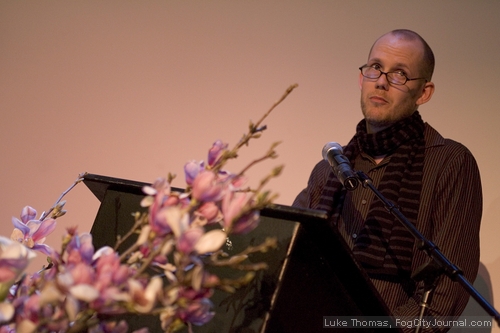
Fog City Journal’s Luke Thomas told me today that during public comment, the Nation of Islam’s Minister Christopher Muhammad called the commissioners “paid prostitutes” and “political whores” and said there would be a “political earthquake” if the commissioners go forward with EIR. 

“However, I don’t think he understood that the EIR and the EIS (which deals with the toxic cleanup) are two separate documents,” Thomas said, accurately noting that the joint commission was only voting on the EIR yesterday.

(According to Thomas, the Minister also promised that coalition of activists that would dog Newsom up and down the State during his campaign for Lt. Governor to expose Newsom’s record, so expect more fireworks along the campaign trial this summer.)

Another key fact to emerge from yesterday’s hearing was the lack of public comment on the part of almost all the candidates running to replace D. 10 Sup. Sophie Maxwell, whose district includes this massive development. Only Kristine Enea, Tony Kelly and Espanola Jackson spoke on the record—with Enea in favor of the plan with amendments, and Kelly and Jackson opposed as things currently stand.

Now, you’d think that everyone running in this race would be eager to show D. 10 constituents (and beyond) that they were at the meeting, not only silently tracking, but also publicly expressing their opinions. And while it’s true that Marlene Tran and DeWitt Lacy filled in speaker cards, Chris Jackson showed up during the proceedings, and Lynette Sweet got ushered into the press box by Sup. Bevan Dufty, none of these D. 10 candidates got their thoughts in the public record. Now, no doubt Cedric Akbar, Bill Barnes, Isaac Bowers, James Calloway, Malia Cohen, Ed Donaldson, Marie Franklin, Rodney Hampton Jr., La Vaughan Moore, Geoffrea Morris, Steve Moss, Jacqueline Norman, Nina Pickerrell, Dwayne Robinson, Diane Wesley Smith, Eric Smith, (and the many others rumored to be running) had their reasons for not being there, and I’d be happy to hear all about it from all of them between now and the November election.

But it doesn’t instill confidence in candidates when they won’t say in public what they are only too willing to say off the record. So, kudos to Enea, Kelly and Jackson for taking that leap and refusing to act like politicians before they have even been elected.

“So much of it was shocking but not surprising,” Tony Kelly told me today, after he recovered from last night’s meeting which lasted until 2 a.m. ‘Everyone knew there would be a snappy 4-3 decision by the Planning Commission on the stuff that mattered. And in a way, I can see why the mayoral appointees on the Commission would decide that they would leave it to the elected officials on the Board to stop this plan. But there was zero excuse for the lameness of the Redevelopment Commission [who are all mayoral appointees]. Still, it showed what the Planning Commission [which today consists of four mayoral appointees, and three Board appointees] must have been like  before it was reformed [and still consisted solely of mayoral appointees].”

“It was heartbreaking to see the endless parade of Bayview Hunters Point residents saying, ‘I need a job,’ or ‘ I need to live in a new house,’ as they argued in favor of certifying the project’s final EIR, despite all the flaws,” Kelly acknowledged.

Still, as Kelly points out, the city could have pushed to acquire foreclosed housing in D. 10 so residents in substandard public housing could be relocated into decent units now, instead of having to stay at least another five years, or longer, in rat, cockroach and sewage inundated units, under Lennar’s plan.

Kelly also notes that the city could have used the Redevelopment Agency’s “massive power” to do stuff up and down Third St, where unemployment is especially visible.

“Having done planning elsewhere, this plan [for Candlestick and the shipyard] is like planning on Mars,” Kelly said. ‘This is a bigger badder version of 555 Washington.”

Last but not least, Kelly voiced concern that a couple of peaker plants will be built within Lennar’s project area.
.“There are going to be two combustion turbines generating steam heat, but not electricity within the project boundaries,” Kelly clarified. “That means they don’t have to register as a power plant, but they will be generating greenhouse gases. The only difference is they won’t be generating electricity.”

So, now the charade of approvals heads to the Port Commission, which has got some folks asking whether Port Commissioner Stephanie Shakofsky, another Newsom appointee should recuse herself , given that her non-profit is clearly such a fan of the project.


Street Threads: Look of the Day

0

Today’s Look: Whitney, 18th Street and Lapidge

Tell us about your look: I just bought this hat — and this backpack because I had too much stuff to carry around.

You down with ICP? The perils and wisdom of being just a Juggalo in 2010

1

By Zach Ritter

Do you remember the first time you heard of Insane Clown Posse? What was your reaction? Did you laugh? Recoil in horror? Or did you thank the trickster gods of pop culture for allowing such a band to exist?

Now, when confronted with a pair of sneering rappers in greasepaint who call themselves Violent J and Shaggy 2 Dope, most people are going to resort to mockery. It’s really the only reasonable response. At the same time, though, it’s beginning to seem as if the whole cottage industry of ridicule that’s sprung up around the band has jumped the shark. Yes, ICP are absurd. Yes, the elaborate “Dark Carnival” mythology that surrounds their albums is profoundly stupid. These are facts, and few non-Juggalos would dispute them. At this point, though, even SNL is doing ICP-themed sketches, which I think is a pretty good indication that the joke has run its course.

So instead of mocking ICP, I instead invite you to consider the implications of their fame. There are few American bands that can lay claim to a fanbase as dedicated as ICP’s Juggalos. It’s possible that this has something to do with misery loving company — the more critically scorned a band becomes, the more its fans close ranks, drawing defiant strength from their shared marginality. But I think there are other forces at work here. ICP can be justly accused of a lot of aesthetic sins, but insincerity isn’t one of them.

This is a bigger deal than it might seem. “Legitimacy” in music has become an increasingly fraught concept, especially in the irony-suffused world of indie rock. A lot of music fans seem to spend an inordinate amount of time trying to figure out whether or not their favorite bands are pulling one over on them. Juggalos don’t have that problem. Juggalos know that J and Shaggy mean, with all their hearts, every last word of the goofy shit they spout on their albums. Case in point: the following video. Either these guys are the most sincere lunatics ever to rock a mike, or they’re the greatest surrealist comics of our time.

So when ICP rolls into San Francisco on June 5, and the Juggalo legions descend upon the Warfield, you might want to actually check out their show. I’m not saying that you’ll have an unironic good time, but you might figure out something that everyone else has missed.

INSANE CLOWN POSSE
With Kottonmouth Kings, Coolio, Kittie, and Necro
Sat/5, 7 p.m. (doors 6 p.m.), $32.50-$35
The Warfield
982 Market, SF
(800) 745-3000
www.ticketmaster.com


Nevius family values

6

The Chron’s C.W. Nevius has made a big deal of moving back into town from the suburbs — and the offhand comment by Steve Jones in an email to Nevius has almost become a sticky nickname. In fact, his own newspaper’s website, sfgate, headlined his column “Suburban twit moves to city.”

But Chuck’s got some work to do before he starts to understand San Francisco values.

Take his latest column, about the Democratic County Central Commitee. Now, any Chron columnist (or anyone else) has the right to endorse and advocate for any candidates he or she wants. And Nevius is absolutely right to point out that the DCCC race is crucial, that control of the committee will have a significant impact on the fall supervisorial elections.

Here’s what made me want to scream:

“So, if you’re happy with the far-left agenda, check out the Bay Guardian. (Progs with name recognition like Peskin, David Campos, David Chiu, and John Avalos are probably shoo-ins. Daly is not running.) For those who’d like to see a swing to families, kids, and civility on the streets, here are some suggestions.”

 A swing to families and kids? You must be kidding.

The single greatest issue facing families and children in this city is the cost of housing. That’s why Coleman Advocates for Children and Youth, which almost everyone agrees is the premier family-advocate group in the city, has made affordable housing a huge priority.

Some of what a recent Coleman report says:

 “Two-thirds of all children in the city do not have a secure future in San Francisco

More families in San Francisco are low-income (43%) than middle-income (23%), and face economic hardship even when working full-time jobs.

Extreme racial disparities in family income and access to opportunity mean that the majority of children who do not have a secure future in SF are children  of color, and the majority of children who do have a secure future are white.”

Coleman’s recommendations: Build and preserve affordable housing for families — not market-rate condos, not condo conversions, but below-market-rate housing.

From the report:

“1. Prioritize the needs of 45,000 children growing up in 20,000 extremely-poor and low-wage working families.  trategies must combine investing in a stronger social safety-net for families now, and investing in anti-poverty strategies that will prepare today’s poor children to become economically secure San Franciscans of the future. The city’s housing and educational policies must focus on the children and families with the greatest need, and not get sidetracked by the demands of middle-income or upper-income families whose needs are legitimate but not as urgent.

 2. Invest in affordable homeownership programs for middle-income families, but focus the vast majority of limited housing resources on building permanently affordable family rental housing.”

That is exactly what the progressives — the “far left” folks that Nevius decries — have been talking about all these years. The candidates Nevius endorses are of the political camp that advocates more market-rate housing, more condo conversions, fewer tenant protections — more of the kind of things that drive lower-income families out of the city.

The next priority is education. Families that don’t have a lot of money have no option other than the public schools, and a lot of us who might be able to afford private schools still think public education is the way to go. What the schools need in San Francisco is pretty simple: They need more money. The “moderates: Nevius endorses — who actually count as fiscal conservatives, by San Francisco standards — are generally against raising taxes, as is our mayor. The San Francisco city government doesn’t oversee the schools, and most of the education money in California comes from the state — but San Francisco’s Rainy Day Fund, and the willingness of the supervisors to put money into the local schools, has saved hundreds of teacher layoffs and helped the quality of the local public schools.

 Where did that idea come from? Progressive leader Tom Ammiano.

I’m a San Francisco parent with two kids, and I have a lot of friends who are San Francisco families, and none of us see the Nevius agenda as family-friendly. That’s why we’re supporting the progressives.

The Daily Blurgh: Viral kittens, punking BP

0

Curiosities, quirks, oddites, and items from around the Bay and beyond

Asshole: “I’d do it again”

*****

Another asshole: “A man driving a crossover sport utility vehicle hit four bicyclists in the Mission District and Potrero Hill neighborhoods in a six-minute rampage Wednesday night before crashing the vehicle and running away, San Francisco police said.”

*****

Agitprop: An annotated guide to images from the anti-BP movement.

*****

Science: All your kittehs belong to the alien virus that makes cats (and the people who love them) do craaaazy things!

*****

Snark: “20 Young Writers Earn the Envy of Many Others”

*****

Fashion: Handbags, now with less lead.

*****

Environment: BYOB (as in non-single-use bag, not beer) is now California law.

*****

Bummers: RIP Rue McClanahan. Thank you for being a friend (to all the cats):

Bicycists don’t deserve hate or violence

42

Today’s Chronicle story about an SUV driver purposely running down four bicyclists in San Francisco last night is disturbing enough, but the neanderthals who commented on that story to support this murderous rampage and blame bicyclists’ behaviors for encouraging the attack are truly outrageous and should be universally condemned. Has civil society broken down to the point where advocating violence against innocents is acceptable?

I’ve been the target of such rhetorical attacks for promoting bicycling, but when someone deliberately runs over a series of unrelated bicyclists, it’s time for all of us to reevaluate our use of hateful rhetoric and consider its impact on the mentally unbalanced, as this driver clearly was. Words don’t hurt, but when those words condone and promote violence, it’s time for all public-spirited individuals to apply the brakes.

Most people have long since abandoned any sympathy for the position that the rape victim was asking for it because she wore a short skirt, or that the gay beating victim shouldn’t have been so flagrantly making out in public, or that the lynching victim was getting a little uppity.

Similarly, even the most obnoxious, red-light-running, Critical Mass-riding, pedestrian-threatening bicyclist doesn’t deserve to be intentionally run over by an SUV. And when people blame a heinous attack like this on how bicyclists ride, even if just making a joke, they validate a hatred that we all should be condemning, no matter how you feel about bikes.

Bongtastic!

0

Science: it brought us non-stick saute pans, the Internet, timed traffic lights — and now, once again, it is making our lives better through the advancement of empirical knowledge. Of course, I’m referring to the findings enclosed in the new publication from Berkeley’s Ten Speed Press, Bongology.

Author Chris Stone is hardly one to rest on his laurels. Indeed, he has made significant contributions to the world of science, art, and culinary wisdom. The fruits of his endeavors can easily be referenced by his three publications; Spliffgami, Bongology, and the upcoming Baked: Marijuana Munchies to Make and Bake. A true renaissance man, a man for our time.

In honor of his achievements, I’ve assembled here a top ten list of his most illustrious designs for the scientifically correct consumption of herbals. You too, can be a scientist. By making bongs, people, lots of bongs. (*Insert golf claps)

  1. “Mini Liquor Bottle Vaporizer”: Airplane people, you tell me I can’t bring my pipe on the plane. So, whatever, that’s cool. I’m just gonna smoke out of your in flight service refreshments. Thanks, Dr. Stone! Ba-bam!

  2. “The Party Hookah”: What to do when the entire party wants to get high at once? Emily Post, to my knowledge, has never codified etiquette for the situation. The smart hostess will have at least one of these homemade beauties on hand, which can accommodate five super buddies at once.

  3. “Office Bong”: Again, big ups Doc Stone, this time for helping me understand the world around me. I finally grok the “caffeine addiction” of my Guardian editors. (No one in particular, mind you. Cough Marke B. cough.) This little gem of creativity needs only your standard to-go coffee cup, some everyday office supplies, and a healthy regard for creativity in the workplace.

  4. “Jam Jar Hookah”: God I love precious things. This has immense potential to be, scientifically speaking, the cutest fucking thing ever.

  5. “Earth Pipe”: Dude, I love the Earth. Wanna smoke out of it? No lie people, Dr. Stone (his real name, fancy!) has pioneered a way to use the very dirt beneath your feet to get lifted.

  6. “The Lung”: Actually, the illustration of the finished product of this particular model makes my stomach turn a little. But a large plastic bag inflating and collapsing into a liter bottle is just… so… sciencey — it makes the top ten!

  7. “Teapot Bong”: Granny will love it! I hear this is how they smoke in England.

  8. “Backyard Bong”: Finally, put those watering cans to use! I hear this is how they smoke in Berkeley.

  9. “Recorder Pipe”: Everyone was required to learn “Three Blind Mice” on their recorder in fifth grade. Didn’t they know that music is a gateway drug?    

  10. “The Bathroom Bong”: Don’t get squeamish on me now, people! We’re just delving deep into the realms of science. The first step to deployment of this specimen requires making your toilet cistern air tight. And that’s all I’m authorized to release.  

aaaand my least favorite: “The Mask”: No, no, no! I refuse to put a gas mask on my face and fill it with weed. I don’t care what cutting commentary it is on the futility of war, it’s just freaky and vaguely unsafe.

SFBG Radio: Tim and Johnny on nationalizing BP

11

Today, Tim and Johnny discuss BP’s utter failure in the Gulf of Mexico — and Robert Reich’s suggestion that Obama simply nationalize the oil company’s interests in the United States and take over the repair and cleanup. You can listen after the jump.

SFBGRadio6/3/2010 by SFBG

Leno cell-phone bill faces crucial test

7

By Brittany Baguio


The State Senate is set to vote as soon as June 3rd on legislation that could require cell phone companies to disclose the level of radiation their devices emit. The bill, by Sen. Mark Leno, is the latest effort to expand consumer awareness of a potential problem that become the center of a heated scientific debate.


Leno’s measure, SB 1212, would mandate that manufacturers and phone providers disclose radiation levels, or Specific Absorption Rate (SAR), on their Internet websites and online user manuals. The SAR would be placed next to the purchasing price. They would also be required to state the maximum SAR value, and what it means.


“The federal government has set a standard for this type of radiation and already requires reporting,” Leno told us, “At the very least, consumers should have the right to know about the relative risks of the products they’re buying.”
       
There’s a similar measure in the works in San Francisco. The Board of Supervisors City Operations and Neighborhood Services Committee May 24th passed Mayor Gavin Newsom’s plan to require retailers in the city to reveal the amount of radiation released by cell phones. That would make San Francisco the only city in the United States mandating that retailers acknowledge radiation information.


Leno’s bill is a response to studies suggesting that radiation levels emitted from cell phones have potential to cause brain tumors and other health problems.


The most recent and largest study focusing on cell phone radiation, the Interphone Study, was released this year. Conducted by 21 scientists, with Australia, Canada, Denmark, Finland, France, Germany, Israel, Italy, Japan, New Zealand, Norway, Sweden, and the United Kingdom all participating, the study looked at the long-term risks of certain brain cancers.


The results are mixed and a bit confusing. The study found some results of increased risks of tumors, although the authors could not agree on how to interpret the results


The researchers surveyed 5,000 brain-cancer patients, and found that people who were “heavy” cell-phone users (defined as using the phone 30 minutes or more a day) had a slightly higher risk of some kinds of cancer. And, as an Environmental Working Group analysis of the study noted, “most of the people involved …. used their cell phones much less than is common today.”


Cell phones emit radio waves through their antennas, which in newer models are often embedded in the phone itself. The closer the distance from the antenna to a person’s head, the more exposed he or she is to radiofrequency energy.


However, as the distance between the antenna and a person’s body increases, the amount of radiofrequency energy decreases rapidly. Consumers who keep their phones away from their body by doing activities such as texting are absorbing less radiofrequency energy.


The Federal Communications Commission has set a safety level for Standard Absorption Rate —  a measure of radiation energy — at 1.6 watts per kilogram of bady mass. All cell phone manufacturers must produce phones at or below this level.


The intensity of radiofrequency energy also depends on signal strength. When a person makes a call, the antenna sends a signal to its closest base station antenna and is then transferred to another person’s cell phone. The further the distance between the cell phone and the base station, the more power it takes to keep the call going.


A study done by Joachim Schuz in Germany in 2006 found a 120% increased risk for a brain tumor, glioma, among people who had used cell phones for at least 10 years. In addition, a study done in 2005 by MJ Schoemaker in Sweden suggested an 80% increased risk of acoustic neuroma, an intracranial tumor, on the side of the head of people who continually used cell phones for at least 10 years.


A study done by Siegal Sadetzki in Israel in 2008 suggested that there was a 49 to 58% increased risk of salivary gland tumors among frequent cell phone users on the same side of the head where the phone is used.


But there are some studies that suggest that cell phones pose no significant health effects to its users. According to California’s Environmental Working Group director, Renee Sharp, those studies produced such results because they focused on acute and medium term effects rather than long term effects. “We aren’t trying to say that cell phones are dangerous because we don’t have definite answers yet and we need more research done,” Sharp told the Guardian, “But when you look at studies with long term use of 10 years of longer, you see increases in certain kinds of brain tumors. We are trying to give people as much information as we can to make informed decisions because it may or may not impact their health.”


Part of the reason consumers are unaware of the radiation levels emitted from their cell phones is that cell phone manufacturers aren’t required to disclose that information directely to phone buyers. Instead they send the data to the FCC. Although the FCC makes this information available on its website, the information is not easily locatable and some links direct visitors to a manufacturer’s website that contains no SAR information. A list of cell phone model SAR information compiled by the Environmental Working Group can be found here.


Based on the Environmental Working Group’s cell phone list, some of the most popular cell phones emit the most SAR. For example, the Apple iPhone 3G can emit from 0.24 W/kg to 1.04 W/kg. The HTC Droid Eris emits 1.19 W/kg. The T-Mobile Sidekick emits 1.34 W/kg. But the award for the cell phone that emits the most radiation goes to the Blackberry 8820, which emits 1.28 to 1.58 W/kg — just below the federal safety limit. The more power a cell phone requires to load extra features and applications, the more radiation the cell phone emits.


According to Sharp, another part of the problem is the FCC’s standards are not protective enough. “The FCC set SAR standards 14 years ago and has not updated them since then,” Sharp told us. “This was before we found out that children have thinner skulls and are more susceptible to radiation effects and before phones developed and exploded into what they are now.”


Other countries echo Sharp’s concern for public safety. Although no country in the world has officially adopted a law requiring a disclosure of cell phone radiation information, some countries have already taken steps make consumers more aware of the potential danger radiation can cause. Consumer advocates in France a pushing a law that would ban advertisements promoting the sale of cell phones to children younger than 14. Countries such as the United Kingdom, Canada, Israel, and Finland have all created recommendations to prohibit children from using cell phones, only use cell phones if necessary, and to use hands free devices to talk on the phone.


The cell phone industry is strongly opposing Leno’s bill. Representatives from Tech America, which represents the industry, and AT&T, a major political player in Sacramento, could not be reached for comment.

Should Antonini recuse himself from Lennar vote?

1

As a Newsom appointee, Planning Commissioner Michael Antonini is expected to be a key vote today in favor of Lennar’s massive redevelopment plan at Candlestick Point-Hunters Point Shipyard.

And then there’s the fact that he wrote an op-ed for the San Francisco Business Times in December 18, 2009, suggesting that business, civic, labor and government leaders can keep the 49ers in town by “joining forces to assist in needed repairs and improvements to Candlestick Park and to expedite development of the Candlestick Point Hunters Point Shipyard, a project that features a “state-of-the art,” 69,000-seat football stadium.”
(The full text of Antonini’s op-ed is included at the end of this post to put his words into full context.)

But Antonini’s cheerleading has got some folks questioning his impartiality when it comes to the decisions that members of the Planning and Redevelopment Commissions will make today around certifying the project’s Final Environmental Impact Report (FEIR) and adopting related environmental findings.

In a June 2 letter to Planning Commission president Ron Miguel, Arthur Feinstein of the Sierra Club, Mike Lynes of the Golden Gate Audubon Society, Jennifer Clary of San Francisco Tomorrow and Jaron Browne of POWER (People Organized to Win Employment Rights) claim that “Commissioner Antonini has clearly prejudged the proposed project and become a strong advocate for locating a football stadium for the 49ers at the Hunters Point site as part of this project.”

“He has publicly urged others to support that stadium and cannot impartially review the record before him to determine whether the EIR is adequate, accurate and objective and whether adequate measures are required to protect the environment,” the foursome continue.

 Noting that he could have chosen to sign the December 2009 op-ed as a Member of the Republican County Central Committee, Feinstein, Lynes, Clary and Browne observe that Antonini “ instead identified himself in the capacity where the law requires him to act impartially – as a Planning Commissioner.”

With others arguing that Antonini’s right to express his opinion is protected by the First Amendment, and Antonini planning to read a rebuttal into the record at 1 p.m. today, it sounds like there’ll be plenty of drama at today’s hearing.

Antonini’s Op Ed in San Francisco Business Times

Friday, December 18, 2009
Business leaders can save the Niners
San Francisco Business Times – by Michael J. Antonini

“The 49ers are deeply and historically identified with San Francisco. San Franciscans Vic and Tony Morabito founded the team in 1946, many years before the Giants moved from New York and the Warriors from Philadelphia.

Hence business, civic, labor and government leaders are joining forces to assist in needed repairs and improvements to Candlestick Park and to expedite development of the Candlestick Point Hunters Point Shipyard, a project that features a “state-of-the art,” 69,000-seat football stadium. Leaders from the Committee on Jobs, the San Francisco Chamber of Commerce, Recreation and Park and others are asking businesses and individuals to help with funding of improvements at Candlestick in return for advertising. These improvements could translate into increased revenue for the contributor, the city and the team. Replacement of aging seats and a highly visible new luxury section are two concepts being studied.

Naming rights to Candlestick Park is an attractive opportunity for a company or an entity to gain nationwide exposure and local acclaim — and, perhaps, position itself to be a key contributor when a new stadium is built at Hunters Point. No new stadium can be built anywhere without significant private investment, in addition to $100 million assured from Lennar Corp. as a precondition of development rights and the amount which the 49ers ownership would invest.

On Thursday, Dec. 17, the San Francisco Planning Commission was to hear comment on the Draft Environmental Impact Report for the Candlestick Point Hunters Point Shipyard Plan. Because this plan features many diverse uses, particularly huge amounts of housing, funding is being rapidly obtained for greatly improved transit and traffic access.

San Francisco must avoid the errors of the past, when we failed to build an arena for indoor sporting, major conventions and entertainment events. Such a facility could have brought huge amounts of revenue to San Francisco businesses.

Leaders have twice stepped up to save the San Francisco Giants. One would expect no less from our leaders when dealing with our home grown, five- time Super Bowl champion San Francisco 49ers!

Michael J. Antonini is a planning commissioner for the City and County of San Francisco.”


alt.sex.column: Eek! Eels in my …

3

Dear Andrea:

My girlfriend asked me to demonstrate my most unorthodox masturbation techniques, and one of my inventions is the Fly on the Island. Catch a small, lively fly. Carefully remove the wings and put it into a pill bottle. Draw a hot bath and get in.

Make your Johnson a bit hard and maneuver it so just the head rises above the surface of the water. Now is the time to introduce the fly to the island. The ideal fly has no wings so he can’t fly away but is small and sprightly enough to run franticly around the island looking for a way off. When I demonstrated this, my girlfriend said I was being mean to the fly. Is this masturbatorial creativity or animal cruelty?

Dear Readers:

Every once in a while I wonder why so few people write in anymore with ridiculous, Penthouse Forum-style stories or claims of extremely unusual fetishes or practices. Fewer jackasses seem to feel the need to try to trick what they hope are earnest or unwary advice-givers into accidentally granting the desired exposure. I kind of miss them. So I can’t blame this guy for trying. Plus, he did a really good job with the details. And — he got me to run it. At any rate, it’s not nearly as gross or horrible as the story about the Chinese eel that made the rounds of my sex-geek posse last week.

It seems a gentleman was brought in, dying, to a Sichuan hospital where it took the doctors a surprisingly long time to discover the eel lodged where no eel was meant to go. Though dead, it had been alive when inserted, and eels have teeth.

The likely cause was eventually established — he had apparently been drinking with friends and had passed out. His friends had decided it would be amusing to insert a live eel into his anus while he was comatose.

I suppose it’s churlish to chide the guy after his agonizing death and all, but it does occur to me that we do get to choose our friends and one criterion we might consider while doing so is this: does this individual seem like the kind of person who would wait for me to get plastered and then stick a live eel up my ass?

No, I don’t believe this really happened, any more than I believe the fly guy. The eel story has yet to show up on Snopes, but it bears all the hallmarks of an urban legend — no names, no dates, an exotic setting that renders it unverifiable, many uses of “apparently” and “it seems.” It seems one ought not to believe everything one reads, since, apparently, much of what one reads is nonsense.

I’d like to think I’ve done a sort of public service by passing these two disgusting stories on to you, my beloved readers. Anything else you’re likely to encounter today — stepped-in dog poop, a hair in your soup — will seem positively wholesome by comparison. No need to thank me!

Love,

Andrea

Got a question? Email Andrea at andrea@altsexcolumn.com

Street Threads: Look of the Day

0

Today’s Look: Camille, 24th and Bartlett

Tell about your look: “Classy and sophisticated”

The Daily Blurgh: Sex spray, tasty jerky

0

Curiosities, quirks, oddites, and items from around the Bay and beyond

Local art thief nabbed, ID-ed.

*****

New spray could help the ‘one minute men’ in your life (and it’s not Axe).

*****

Looking for a new stereo receiver? Wanna swap that old guitar? Need maracas? The Mission’s Music Flea Market is back this Saturday.

*****

“Once upon a time, he was a local celebrity. He earned his nickname after doing a tv commercial for a Round Table pizza named The Big Vinny. For over twenty years, he was the face and voice of a successful used car business in small town Alameda. He sold and he sold and he sold and Californians drove away happy. Today, everything has changed. The business is dead. The lots sit empty. Big Vinny is out of work. But he still remembers the good times.”

*****

Raising children is expensive. Parents, take a tip from Babies and swap out those pre-K math tutoring sessions for a bleached bone.

*****

Hello? Silent Spring, anyone? “The California Department of Pesticide Regulation has proposed registering methyl iodide as a pesticide in California to the dismay of scientists and environmental groups, who say it is so toxic that even chemists are reluctant to handle it.”

*****

Local, sustainable, leather-like: Is jerky poised to become the next SF food micro-trend?

*****

Type dirty to me.

Labor’s small business friends

0

Dick Meister, former labor editor of the SF Chronicle and KQED-TV Newsroom, has covered labor and politics for a half-century. Contact him through his website, www.dickmeister.com, which includes more than 250 of his recent columns.

The U.S. Chamber of Commerce and other outspoken foes of organized labor like to claim that small business owners are as anti-union as the notoriously anti-union Chamber and its big business members. But don’t you believe it.

Unfortunately, plenty of people do believe it. They accept the conventional wisdom that employers, large or small, don’t like unions in general and especially don’t like their employees joining or organizing unions to represent them in determining their working conditions.


Certainly many employers resist unionization. But what the Chamber of Commerce and its corporate friends don’t tell you is that many employers welcome unions for a variety of pragmatic as well as philosophical reasons.

Listen, for instance, to a small business owner in Virginia who was included in a representative sampling of some 1,200 small business owners and self-employed workers who were surveyed recently by American Rights at Work, a respected labor advocacy group:

“When workers form unions, they can secure benefits and rights in the workplace, including a decent wage and health care. They have economic and job stability. Unions lift workers and workers lift the economy. It’s as simple as that.”

The survey included much more that you’re not likely to hear from the Chamber of Commerce. “Unions,” said one small businessman, “help level the playing field for companies that voluntarily treat their employees right and compensate them fairly, When companies compete on equal footing, consumers fare better.”

Among the many other contradictions of the Chamber of Commerce ‘s anti-union line was this from a small businesswoman in Boulder, Colo.:

“The free market system is driven b y workers’ productivity and unions tend to produce more educated and well-trained – and therefore productive – employees. When competitors prevent their employees from forming a union, it is usually a pretty good indication that they are also underpaying their employees. That hurts our business and others in the industry because it allows them to unfairly undercut the market.”

Kimberly Freeman Brown, executive director of American Rights at Work, noted that unionization not only helps individual businesses and their employees, but also “makes the free market system stronger by increasing consumer purchasing power – which is good for their businesses’ bottom line.”

Eighty percent of the small business owners surveyed by Brown’s organization agreed. Other significant findings:

* About half of those surveyed expressed “strong concern that unions have been weakened so much our economy has actually been hurt.”

* More than half agreed that “strong unions make the free market system stronger.”

* Almost 60 percent “strongly agreed that labor unions are necessary to protect the working person.”

* Nearly 70 percent said it was very important for their businesses that Congress “enact legislation that rewards employers who respect their workers’ right to join a union.”

* More than 70 percent agreed that “a good business person can make a profit and respect their workers’ choice to form a union.”

* Eighty-two percent “strongly agreed that it’s morally wrong for employers to fire or threaten employees for wanting to form a union.”

So, despite conventional anti-union wisdom, many small businesses are quite aware that unionization benefits them, their employees and society in general.

The U.S. Chamber of Commerce and its anti-union members and allies know that, but their interest is not in benefitting those who do the work of society. Their interest, of course, is in maximizing the profits of big business.

Dick Meister, former labor editor of the SF Chronicle and KQED-TV Newsroom, has covered labor and politics for a half-century. Contact him through his website, www.dickmeister.com, which includes more than 250 of his recent columns.