SFBG Blogs

Farewell, Mayor Michael Cohen

2

No one who has been closely tracking the shipyard development will be surprised that Michael Cohen. Mayor Gavin Newsom’s top economic advisor, is leaving City Hall.  Folks have long speculated that city officials would start jumping ship–and even become real estate developers themselves–the minute the ink dried on Newsom’s signature on the deal.

But they might be surprised to know that during Cohen’s visits to China, the media has been describing him  as “Deputy Mayor of San Francisco.”

http://www.chinadaily.com.cn/metro/2009-10/13/content_8786067.htm

But as DCCC chair Aaron Peskin recently quipped, “The Chinese media got it all wrong. That’s because Cohen is the real mayor of San Francisco.”

Cohen told the Examiner today that he does not plan to work for the big companies that he has been doing business with in recent years….so, stay tuned.

The Performant: The Witching Hour — Puritan girls gone wild and midnight museum marauders

0

Checking out the local arts and culture scene …

There’s no doubt about it—San Franciscans love a rock opera. From the faux-real heavy metal anthems of “Live Evil” to the afterlife explorations of “Exit Sign,” the suicide art movement of “Thanatics” to the human sacrifices of “Wicker Man,” we like our rock operas loud, messy, and tinged with darkness and humor both. So an original rock opera about the Salem Witch Trials seems an obvious pairing between our love of the darkside plus power chords. Appropriately held at the Temple nightclub on Howard, “Abigail the Rock Opera” straddles the SF rock opera line between serious and silly.

There’s some damn fine singing, particularly from Alexis Lane Jensen who plays Betty Parris, and Daniel Knop, who plays her father Samuel Parris as well as a curiously fey Giles Corey in a silver mop-top/Andy Warhol wig and every 60’s British Invasion mannerism to ever make it onto the Ed Sullivan show. There’s some really solid rocking out thanks to the band, particularly guitarist Kurt Brown (who not coincidentally co-wrote the music with Knop). Plus there are dead babies, bloody aprons, moonlit excursions in the woods, goth-y girls in leather corsets and modest bonnets, and angry men wearing glittery facepaint, Thanksgiving pageant hats, and smug patriarchal entitlement.

There are some downsides too—namely over-reliance on video projection, hard-to-follow lyrics, and not enough campy abandon. I’d have liked to see the goth angle played up more as well as the glam. Perhaps a Klaus Nomi or Gary Numan homage tucked in between the standard rock anthems, or even a little synthesized EBM and some serious stomping. But for now they’ll be performing every Thursday at 9 p.m. through September, and one hopes they’ll make it at least to Halloween, with or without a darkwave makeover.

Meanwhile, it may have been midnight, but the YBCA was far from dark during the DIYbca party last Saturday. People dressed in hand-crafted costumes floated through the hallways of the museum like so many neon-colored moths, drawn to the flames of creative crowd-sourcing and hi tech/lo brow design hacks. In the Forum, reality television was getting a send-up with the Drinking and Dancing competition featuring fun-guy trio Adonisaurus, while in the gallery, old-school industrial noisemakers Kwisp jammed on bicycle parts, metal sheets and springs, and bits of old electronics before leading a hands-on, build-your-own thumb piano workshop (the best use for bobby pins and cigar boxes ever!).

A stencil workshop with queer street artist Jeremy Novy, creative cobbling with Mrs. Vera and SCRAP, a Puma shoe design competition, and a create your own techno music lab hosted by LoveTech rounded out the midnight hour, blurring the line between performer and participant to its most malleable degree. In other words, even the fun was being crowd-sourced, and pretty successfully so. Party promoters take note. You can hire all the big brand bands and fog machines and light-show designers you want, but for a really memorable event, you might want to consider adding a crafting circle to your lineup. Just saying. [Editor’s Note for craft aficionados — there is a wild Haute Gloo craft table every Friday night at the Stud‘s Some Thing drag party! And it totally works.]

Obama’s God

18

This country has become seriously weird. Now the president’s press secretary has to tell us all that his boss is a Christian, god dammit, and he “prays every day.”

Of course, Muslims pray every day, too, three times a day I think. But somehow, the Obama administration — which has a few actual problems to worry about — is concerned that some people might be confused about the president’s religion.

The pollsters never call me (imagine that) or I would have said they were missing a question. How many people don’t give a single hairy shit about the president’s belief in God? How many would prefer he stop praying and get moving on putting people back to work?

SFBG Radio: Oil companies, Prop. 23 and Whitman’s decline

0

Today Johnny and Tim talk discuss the oil companies’ attempts to derail California’s Green Law and express gratitude to Meg Whitman for burning the public out on political ads. You can listen after the jump.

sfbgradio8/19/2010 by jangellw

What does Chuck Nevius want?

29

I’m not sure even Freud could answer that question, particularly re: his latest Chron column, which seems to be complaining that middle-class families don’t get a fair shake in the school lottery.


Nevius tells the tale of a couple who lost out in the school-choice lottery. It happens; I know that, because it happened to me. When my son was headed for kindergarten, we carefully chose seven schools we liked, and when the computer was done, we got none of them.


We also went through the second round, and wound up with a wonderful school, McKinley, that has been perfect for our kids. When we first got there, six years ago, it wasn’t considered a “top” school, one of the ones that everyone applies to; now, thanks to a dedicated staff and increasing parent involvement, McKinley’s on everyone’s list.


But that’s a different story. What Nevius says is this:


The system is a wildly confusing method of allowing parents to choose the school for their children while also attempting to encourage diversity. Parents need to pick schools they’d like to attend. But the system factors in diversity, whether their child went to preschool and a family’s income. A new system will be implemented next year that should be an improvement, but there is still considerable confusion.


And:


At issue is the fact that San Francisco continues to lose families with children, many of whom are middle-class, two-income, motivated parents who could make a huge difference in struggling schools.


“How can you have a healthy city when families are constantly leaving?” asked Todd David, who headed up a group of about 30 families from the Jewish Community Center preschool who all “went 0-7” last year. Two-thirds of them, David says, ended up at a private school.


Actually, I’m not sure the new system next year will be an improvement; it won’t for me. It’s based too much on keeping kids in their neighborhoods — which means if, by chance, the middle school in your neighborhood isn’t right for your kid, you’re SOL. And I’ll admit, the current system isn’t perfect — but what I want to know, as someone who has studied this and thought about it and written about it and argued about it for six years now, is this:


What’s the C.W. Nevius plan? What system would be more fair that what we have now? Because he hasn’t offered an alternative.


There are three essential problems that the SF school district faces:


1. There’s not enough money. Nowhere near enough money. So not every school is going to have every facility and program that’s perfect for every kid.


2. The city is still racially and socioeconomically segregated, so if every kid goes strictly to a neighborhood school (the plan some parents in more upscale areas want) you will have decidedly segregated (illegal) and even more unequal (unfair) schools.


3. Some parent want to stick to their neighborhood schools, but most parents also want a choice. Not every elementary school has Spanish or Chinese immersion; some parents really want that. Not every middle school has a GATE or honors program; some parents really want that. And, frankly, some schools are better than others, and while the ultimate goal is to improve all the schools for all the kids, see (1.) above. And parents want the right to choose a “better” school.


Since the Supreme Court says the district can’t use race as a factor in creating diversity, there has to be something else — and SFUSD has, properly, added in socioeconomic indicators that aren’t just race-based, like the educational level of the mother. Since not everyone can get into the most popular schools, there has to be some kind of lottery. Add in factor (3.), and you get a situation that’s almost impossible to solve in a way that makes everyone happy.


Particularly since there are bound to be some families who don’t get what they want.


I think the district is telling the truth when the folks there say that the vast majority of San Francisco families get one of their seven choices (around 80 percent, last time I checked). That’s not perfect, but it’s not awful. Some of those who don’t get the school of their choice will flee for private schools, and that sucks, since the district needs more enrollment and more engaged parents. (Others will stick with the system and work to improve the schools they do get — and I can tell you from experience, that works.)


But I keep coming back to the basic situation:


1. We can’t allow segregated schools, and we don’t want to.


2. The school district can’t change the demographics of the city.


3. There’s no way to make this work without a lottery and


4. No lottery is going to be perfect.


I don’t love the current situation; my solution is to repeal Prop. 13 (at least on commercial property) and double the per-student funding. Then this wouldn’t be an issue.


What’s the Nevius plan? Dunno; I asked him, and all he said was that he plans to follow up. We’re all waiting for your brilliance, Chuck. 


The more Whitman spends, the more people hate her

7

Johnny Angel and I have been talking about this trend for months, and now there’s evidence to support our conclusion: Meg Whitman’s massive blitz of campaign ads is doing her more harm than good.


From Calitics:


Jerry Brown’s campaign manager, Steve Glazer, took to the campaign’s blog today to offer his thoughts on the state of the race. In that post, Glazer offered this fascinating nugget of information:


    A survey we completed three days ago found most people who have seen a Whitman ad don’t believe her claims are true. When we asked whether these ads have improved or worsened their opinions of the candidates for Governor, the results were as follows:


    Attorney General Jerry Brown: 6% improved; 4% worsened; 58% unchanged


    Meg Whitman: 8% improved; 27% worsened; 31% unchanged


    In more than 30 years of working on campaigns, I have never seen a candidate’s ads have such a negative effect on that same candidate.


Amazing, but it makes sense. The ads are becoming annoying — you can’t turn on the radio or TV in California without being assaulted by Meg, Meg, Meg — and her mesage is so flat and lacking in credibility that the voters can apparently see through it.


There’s an interesting possibility that Whitman will lose and Prop. 23 will lose, and combined with PG&E losing on Prop. 16 this spring, the notion that money alone can buy a California election may be changing. A little.

Eating humble pie with Glendon “Anna Conda” Hyde

22

It was with a sinking feeling that I read the comments that Glendon “Anna Conda” Hyde’s supporters left on the Guardian’s website last week, after I wrote about the DCCC questionnaires last week—and managed to screw up by omitting Conda/Hyde from my hasty round up.

“How is it that you’ve omitted Anna/Glendon from your election roundup?” was one of many similar comments made by Conda/Hyde’s outraged supporters. “This looks awfully like PREJUDICE, darlings. You should be ashamed of yourselves. Anna/Glendon’s candidacy is not a joke. S/he is one of the most promising progressive voices in SF. Wake up.”

So, I picked up the phone, and called Conda/Hyde to offer my humble apologies.

And today we sat down and talked about the role of the media and political endorsement clubs in propping up the marginalization of marginalized candidates and communities—and the role of radical queers in pushing back against the status quo and the political machines.

Conda/Hyde kicked off by recalling how the DCCC offered congratulations on the campaign’s artwork.

“But then they said you are not a viable candidate, and have you thought about taking the spotlight off yourself,” Conda/Hyde claimed.

(After our interview, I put in a call to DCCC chair Aaron Peskin. He had no recollection of the conversation going down quite like that. But Peskin also noted that the DCCC had done a ton of interviews recently.

“I like Glendon and I remember him appearing,” Peskin said. “But I don’t remember anyone telling him he was not viable.”

But with 26 candidates in the D. 6 race, and 27 candidates in the D. 10 race, it’s likely that some similar-minded candidates in those contests may decide, or be advised, to rally together between now and the election to increase the chances that  “the bad guys” don’t win, right?

“You’d think,” Peskin said. “That’s why I dropped out of the Board of President’s race when Willie Brown’s guy looked like he was going to win, and as a result, Matt Gonzalez won the race.”)

Anyways, back to my interview with Conda/Hyde, who also claimed that D. 6 candidate h.brown recently got barred from a small business debate in SoMa.

I wasn’t at that particular forum, or the D. 10 debate that the SF Young Dems recently hosted in the Bayview.

But I have watched videos of the outrage that was triggered at the Young Dems forum, when D. 10 candidates Dianne Wesley Smith, Nyese Joshua, Ed Donaldson, Marie Harrison and Espanola Jackson were excluded from the debate, even though the Bayview is where they are based.

And it’s similar to the outrage that Conda/Hyde supporters understandably felt when their candidate’s positions on issues like Mayor Gavin Newsom’s sit-lie legislation weren’t included in my original summary of the DCCC questionnaire. Especially since Conda/Hyde led the pushback against Newsom’s sit-lie measure.

“Marginalized districts, marginalized candidate voices,” Conda/Hyde observed.

The point Conda/Hyde is making here is that all candidates bring unique voices and perspectives to a race, and they provide marginalized communities with a rare opportunity to push back against powerful interests and ill-advised measures before this or that political machine can shoe horn its preferred slate into office.

“I was the first candidate to come out against sit-lie aggressively,” Conda/Hyde noted, by way of example.

At this point in our conversation, Labor leader and DCCC member Gabriel Haaland, who sat in on today’s meeting and voiced sharp criticism of my Conda/Hyde omission last week, chimed in.

“So many candidates were ducking sit-lie, so when I introduced a resolution opposing sit-lie at the DCCC, so many people were pissed off,” Haaland said. “And it was refreshing to see Anna Conda vocally opposing sit-lie in drag on Polk Street.”

Haaland added that he’d be working for Conda/Hyde’s campaign, “if not for a 15 year friendship with Debra Walker.”

And then he pointed to the central role that radical queers have played in pushing for political change.

“The first queer to run for elected office was a drag queen,” Haaland observed. “Radical queers have always been leading the movement, busting a move and changing the world. And Anna Conda is more the Harvey Milk of the race, in my opinion.”

“You reflect my radical queer positions more,” Haaland continued, addressing Conda/Hyde direct.  “And you have a real base in the district in a way that Theresa Sparks does not. But people are moving into the district and having bases created for them.”

Conda/Hyde then observed that plans are afoot for an inclusionary District 6 forum.

“Jane Kim and I are getting together to do a forum that includes all the D. 6 candidates,” Conda/Hyde said, “We’ll be including James Keys, Dean Clark and Fortunate ‘Nate’ Payne, who are all out there working hard on their campaigns, as well.”

The ability to raise funds is often an indicator of whether a candidate is viable. Campaign finance records show that Conda/Hyde has applied for public funds, the application is under review, and that Jane Kim, Jim Meko, Theresa Sparks, Debra Walker and Elaine Zamora have qualified for public financing in the D. 6 race.

That level of public fund raising is only bested by D. 10 where Malia Cohen, Kristine Enea, Chris Jackson, Tony Kelly, DeWitt Lacy, Steven Moss, Eric Smith and Lynette Sweet have already qualified for public financing, and Diane Wesley Smith, has her application under review.

(In D. 2, Kat Anderson and Abraham Simmons have already qualified for public funding. In D. 8, Rafael Mandelman, Rebecca Prozan and Scott Wiener have already qualified, and Bill Hemenger’s application is under review.)

At the end of our meeting, Conda/Hyde talked about name recognition problems.
“I have a lot of name recognition as Anna Conda, and not as much as Glendon Hyde,” Conda/Hyde noted, choosing to pose as Glendon Hyde next to his D. 6 campaign sign.
“I think I’ve already proven that I’m a drag queen,” Hyde explained.

“And not just a pretty face,” Haaland concluded.



Hot sexy events Aug 18-24

0

Two words to understand why sex at Burning Man requires some amount of pre-playa study: alkaline dust. You do not want the stuff getting in while you do, lemme tell ya. So it is a very, very nice thing that Pink, one of Mission Control’s pansexy sex parties, is providing a primer on playa pussy (Fri/20). Subjects covered in the course? How to look for sexy in the barely clothed insta-city, tips for romping through the heat and psychedelia, and the importance of spray bottles when you’re getting with that neon fur-clad bunny you met by the ice stand.


Queer, Poly, and Under 30

So, what’s that like? Apparently, enough are interested in the successful maneuverings in the world of polyamory by the under-30 set that the Center for Sex and Culture planned a panel on the subject. Your experts? Among others, Jiz Lee, genderqueer porn star; Allison Moon, former mayor of Burning Man’s Camp Beaverton’s Home for Wayward Girls, and moderator Reid Mihalko, sex-help web guru. 

Thurs/19 7-9 p.m., $10 suggested donation

Center for Sex and Culture

1519 Mission, SF

(415) 255-1155 

www.sexandculture.org


Spunk

You know us youngsters, always listening to them iPod contraptions. Well now there’s a way for the gay men among us to shuffle up the tunes and their partners at the same time. I’m talking about Spunk, the weekly party for 18-29 year old members at Eros, which promises that the evening’s soundtrack will be comprised of “music most often heard on ipods, and swapped among friends.” Mmmm racy vagueness… 

every Thursday 4 p.m.- 12 a.m., $8

Eros 

2051 Market, SF

(415) 255-4921 

www.erossf.com


Pre-Pink Playa Sex Playshop

Pay good attention to your teachers – Doctor Friendly and Miss Pringle know what they’re talking about when it comes to Black Rock booty. Stay after the course for a little pre-fest warmup: the Pink party is on directly after. Come gussied up in next week’s costume to inject an extra hit of playa pizazz.

Fri/20 9-10:15 p.m., $20-30 members only

Mission Control 

2519 Mission, SF

www.missioncontrolsf.org


The Mystery and Seduction of Electro Play

Lady Ripplee Severin has this to say about her first, electrifying BDSM experience: “I found myself seduced and lured to the sound, sent and feel of this visceral form of BDSM play. The first time that violet wand touched my skin, I knew then I was hooked.” She sure sells the shock, no? Bring your electrical device if you’re well-versed in this kind of play – and curious bottoms, come prepared to be turned on. 

Sat/21 6-8 p.m.

Email BigPinkHouseSF@gmail.com for location and price

www.soj.org/calendar


Keeping It Hot in an LTR

It sounds like a sexy sportscar, no? But Lisa Skye Carle is actually using “LTR” to refer to a “long term relationship” – shhh don’t let the secret get out! Sometimes, the fact that you and your sweetie have been together forever can seem like a fact you want to forget in the bedroom. But it just doesn’t have to be like that. This course promises to show you lust and laviciousness, even in eyes you know as well as your own. 

Tues/24 6-8 p.m., $25-30

Good Vibrations

1620 Polk, SF

(415) 345-0400

www.goodvibes.com


The Eyes Have It/Swap It Out!

So you’ve got your Folsom Street Fair outfit picked out, but that black eyeliner is hard to apply! And come to think of it, the black platforms you have aren’t quite the same black as your bustier and cape… man, something just isn’t right. No worries, my leather love, the Citadel’s got you covered. Bethie Bee is presenting a two part course on makeup and fashion this week. Makeup is Tues, when basic looks are covered, and on Wednesday a clothing swap is being held to make sure you’re fly for the Fair.

Tues/24 8-10 p.m., $20

Weds/25 7:30-9:30 p.m., free if you bring 5 items or more

SF Citadel 

1277 Mission, SF

(415) 626-1746

www.sfcitadel.org


Arnold’s budget casts most vulnerable as The Expendables

5

As California’s Budget Conference Committee moves forward with negotiations for the 2010 budget, Assembly member Nancy Skinner (D-Berkeley) is promoting her movie, “Faces Behind the Governor’s Cuts,” to different Bay Area venues in an effort to send a message to Gov. Arnold Schwarzenegger that his proposed cuts on services ignore the needs of the poor, parents who use child care facilities, and the elderly.
http://www.youtube.com/watch?v=cA3UieZCYj0

Skinner had her first screening of the movie just days after the blockbuster premiere of “The Expendables,” which includes a Schwarzenegger cameo. Yet instead of high packed action featuring a slew of legendary actions stars, Skinner presents a one minute short featuring interviews with home care workers, a single mother, a teacher, and an elder day care provider – all of whom would be severely impacted by the Schwarzenegger’s budget proposals.

The Budget Conference Committee released its balanced budget on August 4, rejecting Schwarzenegger’s cuts on jobs, senior care, and closure of child care centers – exactly the issues that the stars of Skinner’s film address. The committee suggested ways of raising revenue in lieu of cuts on vital services, such as closing the oil drilling loophole and delaying new corporate tax breaks. Despite the Committee settling on a budget with $14 billion in spending reductions and $4 billion in new revenue, Schwarzenegger still wants more cuts.

Yet Skinner says that Schwarzenegger’s plan would cost more than 430,000 private sector, local government and school jobs. The committee’s budget protects these jobs and creates thousands of new jobs from a $300 million private sector jobs fund.

“Unemployment is not the path to economic recovery,” Skinner told the Guardian. “There’s a way to craft a budget that protects people and jobs and it’s going to require a little revenue. There’s no way to do an all cuts budget – at this point in time – that doesn’t bring harm.”

Schwarzenegger spokesman Aaron McLear didn’t see Skinner’s movie, but responded to Skinner’s concerns, telling us, “We understand Assemblywoman Skinner supports a massive tax increase to protect public employee pensions and the status quo for unions. We simply disagree.”

But looking beyond tensions between Schwarzenegger’s camp and the budget committee are the people these budget decisions affect – parents who work full time and use state-subsidized care for their children and the in-home attendants who the elderly rely on for care.

Daniel McGrath is an in-home supportive services (IHSS) caregiver who takes regular trips to Sacramento to speak out about the issue. “Life and death should never be on the table,” McGrath told us. “These disabled, elderly, and sick community members – our grandparents, brothers, sisters, cousins – are the most vulnerable in our society and the fact that they have to fight for themselves is ridiculous.”

McGrath accompanies his clients, Mark Beckwith, to Sacramento despite a health condition that only allows Beckwith to move his fingers. Beckwith comes to Sacramento to send the message that “the IHSS program saves the state so much money. In institutions like nursing homes, it costs five times as more.”

In addition to cuts to elderly care, Schwarzenegger’s budget plan cuts eliminates child care programs – a blow to parents who work full time and cannot afford to pay for market rate child care and will have no choice but to quit their jobs to take care of their children full time.

Michelle Alvarez, an administrative assistant at UC Berkeley, said in a written statement, “I don’t think my family would have been able to survive with out the help of BUSD preschools and after school programs. The state childcare has allowed me to have a stable job here at UC Berkeley for the past 8 years. Without the state childcare, it would be hard for not just my family, but other low income families to keep our jobs or go to school and care for our kids.”

As the budget committee and Schwarzenegger continue to duke out their differences, the fate of these people lingers in the distance. But Skinner poses a question for Schwarzenegger to think about: “For the governor, it appears that the numbers math is easy, but what about the human math – the impact on people, their livelihood, their jobs, and the ability to live independently?”

SF Chamber attacks — lamely

0

The right-wing San Francisco Chamber of Commerce has had a pretty bad track record in local electoral politics in recent years, and its latest attack ads on progressive members of the Board of Supervisors demonstrates why: the group’s muddled and hypocritical messaging is barely comprehensible to the average San Franciscan.

The San Francisco Chronicle this morning announced the new ad campaign, the first salvo resulting from strategy sessions with Mayor Gavin Newsom and other downtown players, and the article included a funny conflict about whether or not the Chronicle is giving free advertising space to the effort.

But the ads themselves are even funnier – although inadvertently so – asking voters whether “your city supervisor” prefers “buses or benefits,” “parks or pensions,” or “paychecks or pinkslips.” Apparently, the Chamber is trying to capitalize on this political season’s fashionable attacks on public employee pensions and benefits, but the false choices that the Chamber sets up actually say more about its own promotion of this sort of zero-sum game within the public sector.

Hundreds of city employees have gotten pink slips in the last couple years directly because Newsom and the Chamber have sabotaged proposed revenue measures, even those that would help small businesses. They’ve played cynical political games that have cut Muni service and caused fares to double since Newsom became mayor, with Muni money diverted to help fund the paychecks, benefits, and pensions of police and firefighters – core Newsom constituencies to whom he gave overly generous deals to secure their early support for his 2007 re-election – while recently negotiating a deal that would exempt them from being affected by Jeff Adachi’s pension reform measure for another two years.

But targets of the ads don’t even need to know this whole backstory to see that the ads are simply false choices, lamely presented. Another swing and a miss from the once-mighty Chamber.

Why I support gun control

51

I admit I don’t know the details, but it hardly matters: An Oakland kid just died because he was playing with a handgun.


My nephew, who has a couple of rifles and loves to go the the range and shoot at targets, calls me every now and then to tell me that “my president” — you know, Obama — wants to take away his guns. I tell him Obama doesn’t want his guns, and I don’t, either. And I’m a carnivore, so I can’t even say I’m against hunting.


But I am against easy access to handguns, which really have no purpose except to kill other people. And since all the angry libertarians are going to slam me and talk about self-defense, let me remind you: The odds that your gun will kill you or someone you love are much greater than the odds that you’ll ever actually use it for effective self-defense. One less handgun in Oakland might mean one more kid alive today.


Street Threads: Look of the Day

0

Today’s Look: Nookkie, Bannan and Green

Tell us about your look: “I got this hat from a festival in San Francisco. I’m from Thailand.”

Two steaming non-scandals

24

The political press is all over two of the big non-scandals of the day, Jerry Brown’s pension and Jeff Adachi’s budget. Let’s start with ol’ Jer’.


You can say a lot of things about Jerry Brown, and I’ve said a lot of them myself, but the guy has never tried to enrich himself off the public dollar. Fact is, Jerry’s about as cheap as you can get, and hates to spend money — his money, campaign money, public money. In some ways, he’s responsible for Prop. 13, because he was such a cheapskate as governor in the 1970s that he ran up a huge billion-dollar-plus surplus in Sacramento at a time when property taxes were soaring.


But Matt Drudge, playing off public anger at state employee pensions, decided that Brown was “double dipping,” citing and OC Register report, and suddenly, the former gov’s secret pension was big news. But wait, the Chron actually figured it out: Brown isn’t drawing any pension at all right now. If he were to retire after about 25 years of service as secretary of state, governor, mayor of Oakland, attorney general and a Supreme Court clerk, he’d be eligible for a pension of $78,450 — considerably less than your average San Francisco cop or firefighter. Knowing Jerry, he’ll probably decline it anyway.


In other words: No story.


Then there’s Jeff Adachi’s budget. I know, it looks bad for a guy who’s trying to cut worker pensions and health care to be seeing budget increases and still leave the city with a $2 million legal tab for work he refused to handle. But really, this is old news — Adachi’s been warning for a couple of years that he was going to have to decline cases (and thus stick the city with a private legal bill). And let’s remember: The staff in the Public Defender’s Office handles almost twice as many cases as they ought to.


Adachi’s ballot initiative annoys me — he’s going after city employee benefits instead of looking at where the city can raise new revenue. And he’s acting like a lone wolf, demanding that his office is properly staffed and launching an initiative that attacks public employee unions instead of trying to work with them.


But I don’t blame him for being agressive in pushing for adequate funding for his shop — I wish the director of public health was willing to try as hard to avoid cutbacks instead of going along with whatever the mayor proposes. And his current budget is nowhere near as scandalous as what happens every single year with police and fire.


The real reason GOP is obssessing on the Ground Zero mosque

4

Daily Kos contributing editor Jed Lewison suggests that it’s because the Republican Party has nothing else to contribute to the conversation, as the election nears.

It’s an interesting theory.

As Lewison writes, “Despite polling that shows most Americans — including Democrats and even many liberals — oppose building a mosque two blocks from Ground Zero, Republicans are making a big mistake in building their fall campaign around the issue, in the process handing Democrats a big opportunity.

“GOPers obviously believe that the symbolism of the mosque issue makes it ripe of exploitation,” Lewison continues. “And it might be true that the mosque is the best issue they’ve got going for them, even if the public debate about it has been fueled by bigotry and false characterizations of the proposal. Nonetheless, their decision to exploit it says more about the fundamental weakness of GOP than it does about their political prowess.”

“Here’s why: the mosque issue is far less important than the economy, and every moment that the GOP spends focusing its message on the mosque provides Democrats with the chance to point out that Republicans are fundamentally unserious about doing what it takes to get the economy going again,” Lewison concludes. “Every poll shows the economy is priority #1, #2, and #3, yet Republicans haven’t offered a single economic plan other than to do nothing.”

SFBG Radio: Meg’s poll slide and Jerry’s green plan

6

In today’s episode, Johnny and Tim talk about Meg Whitman’s poll slide, Jerry Brown’s green-jobs plan — and why affordable housing is key to the city’s future as a center for cutting-edge arts. You can listen after the jump.

sfbgradio8/15/2010 by jangellw

Reading Hef for the articles

0

“Did you see the film? Are you one of the ones who thinks it was biased?” So begins my phone interview with Briggitte Berman, director of the new documentary Hugh Hefner: Playboy, Activist, Rebel. Her movie, (which Dennis Harvey will review in this week’s SFBG) has been criticized for being an overly laudatory look at the life of the man who’s sparked a thousand sexual hegemonies, though few would deny that Berman’s put together an entertaining ride. But enough about cinematic merits. Did she get loose at the Playboy mansion while filming? What are those things like for a woman actually wearing clothes?

Wrong question. “I don’t like big parties. I don’t go to big parties. I am a film maker,” Bergman replies, stiffly. 

Now, were I composing a piece on the Sultan of Smut, Hefner’s bacchanals would be one of the first places I’d hit to get background — even if that film, as Berman is quick to specify, seeks to examine not “merely” Hef’s personal life so much as the social legacy he’s created. 

And let’s be real, the man is a walking reality TV show: his personal excesses are the social legacy. Perhaps therein lies the key to the way the film shies away from the meaty dilemma at the heart of Hef. Berman just doesn’t care for the naughty bits.

After all, she clearly prefers Hef’s famously couth intellectual side. The filmmaker first came into contact with the icon via his admiration for her film on the jazz musician Bix Beiderbecke. Their acquaintance has taken place not in the grotto, but in the well-appointed Mansion dens where Hefner stages his regular film nights, screening old classics for an audience of similarly ancient chums. 

Couth Hef, gettin’ things done. Photo courtesy of Playboy Archives

This is the Hefner one reads for the articles, and it’s the one that Playboy, Activist, and Rebel makes the most of. We get to hear much about the man’s pro-integration stance (his Playboy clubs were the first mixed-race venues to host Black stand-up comedians), his crusade for women’s reproductive rights, and his battles with governmental persecution – his persistence in hiring black-listed artists for his TV shows was truly admirable. Berman catches Jesse Jackson on-screen calling Hef an activist, for chrissakes.

It’s all, like I said, really interesting, and will probably teach viewers a thing or three about the civil rights movement and precursors to the Sexual Revolution. But the key word here is precursors. When we look back on the magazine’s heyday from our queasy 21st century enlightenment, it’s plain to see all was not groovy in the land of rabbit ears. 

Which brings us to the bunny suits, the corset, heels, and floppy ear ensemble sported by the female employees of Hef’s infamous string of nightclubs. It always comes back to the bunny suits. Now, I’m not one to cry foul on the basis of corset alone – I know many a woman who gets off on having a cinched waist and four-inch spikes on her hind paws. There’s a moment in the film where Hefner is called out on a talk show by two feminists. They ask him, if the bunny suits aren’t meant to be demeaning and reductive, why doesn’t Hef strap on one of those cotton tails himself? 

His answer is unconvincing, and the women have a valid point. If Hefner was so into being more open about our sex lives, why were men never shown cavorting through the debaucherous scenes of his pictorials? “What I was trying to say quite frankly,” he shares in one of his many lengthy on-screen interviews in Playboy, Activist, and Rebel “is that sex is okay and nice girls like sex too.” Well, we all know what Hef’s “nice girl” looks like. Leaving aside all issues of body type normativity on the pages of Playboy, (we shouldn’t) is/was this really a vision of sexual freedom, or the freedom of one man to be sexual in his one, very particular way?

Berman didn’t look at this, and she should have. “I have made several documentaries about complex individuals and he is a very complex man. I didn’t make a film about dolphins. I leave that to other filmmakers,” she tells me (oh snap, The Cove, you Lisa Frank binder, you – Berman’s calling you out!). But the Hefner film differs from Berman’s other depictions of complex figures in that we already know how the person in question has colored our lives. Hef is a pop culture powerhouse, unlike Bix Beiderbecke or Artie Shaw, some of Berman’s previous targets.

So it’s not enough to give token opposition air time to one or two Boomer feminist thinkers who will merely tell us the same things we already know about disrespectful imagery and the like. For me, they didn’t come close to countering Gene Simmons telling the camera that women are “more sexually disconnected” because our genitals aren’t rubbing against our pants leg 24/7. Scenes with Dr. Ruth notwithstanding, it was time for Berman to roll out someone who understands the value of what Hef did, but also someone who could critique his methods in a way that’s constructive to the generations that are not scandalized by that Marilyn Monroe centerfold in Playboy’s debut issue. 

Before we hung up, I had one more query for Berman. “Does Hef get it when people called him misogynistic? Does he see what they taking issue with?” 

“If you ask me whether he has a sense,” she began. “I suggest you ask him that. The totality of who Mr. Hefner is – no film can ever reveal that. Sometimes the person him or herself doesn’t know that.”

But at the ripe old age of 84, one would like to think Mr. Hefner would be working on it. Berman could have spent her time on this film getting her hands a little dirty. She could have asked Hef to consider how he might have constructed the imagery of his empire – gasp! — differently. Now that would be some good reality TV. 


Hugh Hefner: Playboy, Activist, and Rebel starts Fri/20 at Lumiere Theatre and Shattuck Cinemas


Man charged in fatal hit and run

Last week’s Guardian cover story highlighted a number of efforts to make cycling safer and more viable in San Francisco, such as ongoing San Francisco Bike Plan projects that will create separated bike zones. Sadly, none of it was enough to prevent the tragic death of a German tourist who was hit while riding a bike on Friday, Aug. 13, by an intoxicated driver behind the wheel of a 1989 Mercedes Benz.

Police had little information about Nils Linke, who would have turned 22 next month, other than that he was visiting San Francisco from Germany. Linke was hit at 10:39 p.m. Friday night on Masonic Avenue near Turk Boulevard, according to police spokesperson Lt. Lyn Tomioka. “They are really working very hard on this case,” Tomioka said. “It is an active and ongoing investigation.”

Joshua Calder, 37, was arrested and charged with gross vehicular manslaughter while intoxicated, felony drunk driving, felony hit-and-run causing death, driving with a blood-alcohol content above the legal limit, and driving without proof of insurance. Police originally believed Calder to be an Oakland resident, but he gave a San Francisco address, Tomioka said.

SF Streetsblog picked up the story, providing an insider’s scoop on efforts to address traffic conditions in that area. Here’s an excerpt:

“For years now, advocates and residents who live on and near Masonic Avenue have been trying to get the SFMTA to turn Masonic into a complete street, replete with bicycle and pedestrian amenities that would slow traffic, and make it a safer place for everyone. At a recent community meeting, the agency offered four options to do that, including a cycle track.

The [San Francisco Municipal Transportation Agency] has been hearing loud calls to fix Masonic since 2008 when 500 residents signed a petition citing speed concerns. It was hand delivered to SFMTA Chief Nat Ford. … “We’ve put about four options out there now to really look at how to redesign that street,” said Ford. “Unfortunately, Masonic could use some traffic calming. I have to be cautious, because you can imagine, this is a very litigious situation. Our hearts go out to the family of the young man who got killed, but we have to also make sure that we’re making prudent legal steps going forward in dealing with this issue.”

The Streetsblog report also notes that a group called Fix Masonic — which has been working to improve safety conditions in that area — has been receiving phone calls about the incident.

Linke is the second German tourist to be killed in San Francisco since the start of August. On Aug. 8, Mechthild Schroeer, 50, was killed after being caught in the crossfire of a gun battle near a Union Square venue. Efforts have been made recently to clamp down on violence outside San Francisco nightclubs, with Mayor Gavin Newsom signing legislation last week to strengthen the Entertainment Commission’s ability to revoke permits for clubs that attract trouble. While drunk driving was clearly a factor in this latest hit and run, city efforts to adress community concerns near Masonic and to crack down on dangerous driving that endangers cyclists could serve to prevent tragedies like the one that took Linke’s life.

Street Threads: Look of the Day

0

Today’s look: Shan, Washington Square Park

Tell us about your look: “I got this skirt at a street fair in Chiang Mai, Thailand, and it always comes out on special occasions.”


Orgone heats up the Independent with fresh funk, 8/6/10

0

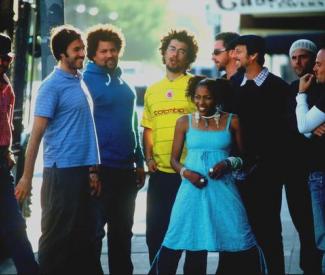
It was freezing (as usual) outside SF’s Independent last Friday. Thankfully, Orgone kept the packed venue warm and sweaty inside with funky rhythms, thick bass lines, sexy vocals, and swanky brass melodies. On stage, like old friends jamming together, the nine-member band emulated the upbeat enthusiasm and down to earth cool (that’s not too cool to get down) that their unique sound embodies. Merging old-school funk and jazzy hip swaying grooves with experimental psychedelic undertones, Orgone delivered upbeat funk with a mellow modern swagger.

With such a large instrumental band (guitar, keys, bass, percussion, trombone, trumpet, saxophone, drums) Orgone manages to create a complex sound that engages and yet never overwhelms. Striking the perfect balance between driving grounded sounds and more airy, free flowing vibrations, the ensemble definitely knows how to get people dancing. Their passion for feel-good, dance-y music is no more apparent then in the way they play together. Vibing off each other, their contagious energy ignited an on-stage fire that lit up their audience of glowing, dancing fans. 

While each band member played an equally integral part in Friday night’s show, the smooth, passionate voice and fiery stage presence of lead vocalist Fanny Franklin, the only female on stage, deserves special mention. With sexy ease and captivating charisma, this goddess knows how to command a stage. If you’re feeling nostalgic for the good ‘ol days, when live instruments trumped laptop beats, Orgone’s got what you want. 

Video: http://www.youtube.com/watch?v=o0bMoDUyRxk 

PayPal freezes out other groups, who turn to WePay (UPDATED)

11

PayPal has lost customers and credibility after freezing the accounts of Burning Man’s Temple Flux – a story we broke this week that triggered an overwhelming response that caused the company to back down – with many of them flocking to the more community-based alternative WePay.com. But the publicity has also unearthed even more stories of nonprofit groups getting their assets frozen by PayPal.

Groups ranging from the National Association of Injured Workers to Burning Man camps Comfort and Joy and Black Rock Diner tell the Guardian they’ve recently had their assets frozen without warning by PayPal, a multinational company owned by eBay that reported $2.2 billion in revenue last year and makes its profits mostly from interest and other returns from the money it holds for others.

“There was never a time they said this was going to affect our ability to access our funds,” Temple of Flux treasurer Colinne Hemrich said of the group’s fairly impersonal dealings with PayPal, which froze the group’s funds just as it was leaving for the playa to build the project. Under public pressure, the company freed the funds, letting Temple members know “they were doing us a big favor,” project manager Catie Magee told us, yet the delay soured these burners and others on PayPal.

But smaller groups haven’t been so lucky. “It’s not on the same scale as the Temple, but proportionately and to us, it’s still a really big deal,” Michael Williams said of his Black Rock Diner camp, which is in final preparations for heading to Burning Man and said PayPal recently froze their account, also because they weren’t able to prove their nonprofit status.

“It’s just people in our camp who have been using PayPal to send us dues, so this is very frustrating,” he said. “I’m never going to use PayPal ever again.”

Sam Gold, founder of the National Association of Injured Workers, a nonprofit that helps workers navigate the complex system for filing nonprofit claims, has been fighting PayPal for months since it froze the group’s account, in the meantime learning more about their business practices and preparing to file a lawsuit.

“There are all sorts of people they’re doing this to, thousands and thousands of people…And it’s all about collecting interest of their money,” Gold said, citing stories on websites such as PayPalSucks.com about how the company falls through the cracks of serious regulation by any government agency and routinely settles legal claims before they grow into larger problems for the company.

“PayPal is taking small charitable nonprofits and making them jump through all kinds of hoops and face long delays to get their money. They can get away with it because nobody knows who’s supposed to be regulating these guys,” Gold said. “I want to see their dirty wash on the public clothesline because only then will [Attorney General] Jerry Brown and the district attorneys take note of this scam.”

PayPal spokesperson Anuj Nayar, who spoke to the Guardian earlier this week as the company decided to release the Temple funds, couldn’t be reached for comment on the latest allegations and told us he couldn’t go into detail on why they freeze accounts, saying only “we are under certain regulations.”

But he did note that the company has 87 million accounts and moves about $2,600 per second. “When there are issues that come up, we do our best to address them as quickly as possible,” he said. That volume of transactions and the difficulty in getting any kind of personal attention from the company (which does not list telephone numbers on its website) is part of the criticism from small groups, and why Rich Aberman (who we reached quickly and easily) says he started WePay (ironically, with funding from PayPal founder Max Lezchin, who Aberman said was concerned that PayPal became too big and impersonal after it was acquired by eBay in 2002).

“At this point, PayPal’s main business is setting up purchase accounts for online businesses. So they treat all their customers as if they’re businesses,” Aberman said. “Our ideal customer is a normal person who is collecting money for some project.”

While Aberman said he understand PayPal trying to protect its interests by making sure its nonprofit clients have filed all the necessary paperwork, the scale of the company makes it difficult to work with groups doing good things and taking in money from people who clearly want to support those groups.

“Since our customers are different, we handle them differently,” Aberman said, noting how they simply ask for the Social Security number of a project principal in case any tax issues arise later, rather than freezing a group’s assets. “At the end of the day, we’re just trying to get people set up as quickly as possible so they can do their thing.”

UPDATE: PayPal spokesperson Anuj Nayar just responded to my latest inquiry and said, “There are a number of reasons why we may put a hold on an account, particularly concerning 501c3 [nonprofits].” Yet when I asked for specific regulations and agencies that would require all a customer’s assets to be frozen — rather than holding a smaller deposit or simply reporting the information — he said that he would need to check on that and get back to me. As to whether the company’s practices slip through the regulatory cracks, he said the company operates in 36 states and 190 markets and faces regulations in each one.

Jamie Stewart on orange juice, armpits, bird calls, and ambient music

0

On Friday 8/13, Berkeley Art Museum is hosting a project that is threefold: the visual art of David Wilson, short films curated by Max Goldberg, and the music of Jamie Stewart (Xiu Xiu). To find out more about this unusual collaboration, I spoke to Mr. Stewart on the phone about his contribution and how he anticipates the night will go down.

SFBG The BAM website says that you’re debuting a “new composition in field recording inspired by the night, animal calls, and quietness.” This is a little vague, so could you tell me more about what your performance is going to be?
Jamie Stewart I’ve always been really impressed with people who went to art school but I’ve never had any opportunity. Probably in the past six or seven years I’ve become a really avid birdwatcher and one of the things that I initially, having been so involved in music, enjoyed about birdwatching is that it was something completely visual for me. Most bird calls are completely bizarre so I had since become almost focused on listening to bird calls but almost in a way that’s detached from the birds itself. In the middle of this increased interest I find myself inexplicably in North Carolina and a big part of the recreational culture here is hunting. There’s a lot of hunting stores and being a vegan obviously, I’m not totally interested in hunting. In these stores there were rows and rows of different animal calls and a lot of these are really horrifying-sounding. If you blow into them, you hear some of the most harsh noise music ever imaginable. A lot of the hunting bird calls sound like the environment completely exploding. So I’ve racked up a pretty hardy collection of these.

SFBG How might you categorize this work into a genre?
JS It’s an ambient piece. I have a really extensive collection of gongs and animal calls and I will be using these together but with long periods of silence. It’s an attempt to incorporate ideas of 1950s minimalist composition insofar as focusing on the pauses in sound, animal sounds, and a certain amount of physicality.

SFBG How are you going to do it?
JS I think I’ll be running mostly. It will end up utilizing a fair amount of space. So far, there will be gongs placed on two different sides of the room and I have these two gongs I got in Korea recently, and various bird calls will be placed throughout the room. Part of the idea is to have [the piece] be in relative darkness and move as quickly as possible at predetermined intervals with each of the items that can make sound, to have a combination of intense rustling and physicality, and intense sounds, in addition to certain electronica. Short periods of super intense activity and miserable, intense sound, and then no source of sound.

SFBG How is this similar or different to Xiu Xiu?
JS It has absolutely nothing to do with Xiu Xiu at all. That has a specific aesthetic and philosophy, whereas this is more about being less defined, about subconscious experiences, and to be more experiential, whereas Xiu Xiu is an attempt to be about something that is very linear. I can feel what it is about but it is difficult to say what it is about. I think it will be emotionally clear but I think to put it into words will be more difficult, which is something I appreciate because usually I have to be as clear as possible.

SFBG Is this your first venture into museums and visual art?
JS When I was growing up, I used to do a lot of disruptive performance art –– we would shave our armpits into orange juice, the dumbest things possible. It wasnt a performance, I think we were just trying to irritate people. I’ve played the Gameboy occasionally. I’ve composed a fair amount of ambient music. I recorded a 13-disc series [available with a subscription]. I didn’t put it online, so I guess it was available to 50 people on Earth. This piece is probably more minimalist than some of that.

SFBG Who are some ambient artists that have inspired you in the making of this work?
JS A couple (like Rhys Chatham) but it was really inspired by natural sounds and more of a coming to terms with different ways in how people regionally deal with ideas of nature. [Being from California] I have a hippie-ized idea of what nature is for. Rhys Chatham is so preposterously minimalist. Chestnut and I saw how long we could endure listening to it. It’s called “Two Gongs” but my piece plays differently. Two gongs for an hour, very limited changes in the tonal shading. A lot of ambient music that I find difficult to endure or that is unpleasant I find particularly fascinating. It ends up being less of a musical experience and more of a psychological and physical experience. Its a combination of being inspired by the sonic tools that people use to destroy nature. Hopefully it’s just interesting. I don’t think Rhys Chatham was trying to do anything unpleasant either.

PG&E CEO paints a rosy picture for CPUC

2

Pacific Gas & Electric CEO Peter Darbee’s address to the California Public Utilities Commission yesterday focused on his company’s national reputation as a corporate advocate for addressing climate change, largely ignoring PG&E’s $46 million waste of ratepayer money supporting June’s failed Proposition 16, which was designed to expand the utility’s monopoly in California and thwart local renewable power projects.

CPUC President Michael Peevey warmly introduced Darbee to the crowd, calling the CEO an upfront thought leader on climate change — a very different message from the same man who harshly criticized PG&E’s spearheading of Proposition 16 before its defeat in June.

“There is something fundamentally wrong with the idea that one company, spending $35 million can, by majority vote of the electorate, seek and obtain a two-thirds vote protection in our State Constitution,” Peevey wrote in an opinion published in the San Jose Mercury News in May. “The purpose of the Constitution is to protect our sacred rights as citizens. It is not to protect the narrow private interests of a particular utility company.”

Darbee’s only comment on Proposition 16 came near the end of his speech, when he attempted to justify PG&E’s spending on failed campaign that some have said should have cost Darbee his job. Referring to the company’s regular opposition to public power campaigns, he said, “$45 million versus $15 million a year – financially it made sense.” But it wasn’t news to anyone that PG&E had an economic interest in essentially killing public power start-ups.

Instead, the CEO chose to focus PG&E efforts in Washington D.C. to nationally address climate change and his company’s support of AB 32, a 2006 law that requires California to reduce its greenhouse gas emissions to 1990 levels by 2020, and PG&E’s opposition to Proposition 23, a November ballot initiative that would freeze AB 32 until California’s unemployment levels drop below 5.5 percent and stay there for at least one year – a rare occurrence in modern economies.

Local environmental activists call PG&E’s purported concern over climate change greenwashing and hypocrisy. “That’s complete crap,” San Francisco Green Party Sustainability Chair Eric Brooks told the Guardian. “For them to claim that they’re a green company is a joke. They do the same thing that tobacco companies used to do; they spread a little money around supporting renewables that aren’t even part of their energy portfolio.”

Brooks said that AB 32’s mandates were flexible enough not to really harm PG&E’s profit margins, so the company can oppose Proposition 23 without impacting its bottom line. Steven Maviglio, spokesman for No on 23 — Stop the Dirty Energy Proposition told the Guardian PG&E had reported no contributions opposing Proposition 23, a far cry from the more than $46 million the company spent championing Proposition 16 in June.

“Thing about Prop. 23 is [that] AB 32 doesn’t really box them in,” Brooks told us. “If we switch to localized, renewable energy, that puts PG&E out of business. Prop 16 would have been much more effective at eliminating green energy in California than anything else like Prop 23.”

Yet the main controversy aired at the CPUC meeting wasn’t about greenwashing or Prop. 16, but smart meters. About a dozen protesters gathered at the steps of the California Public Utilities Commission before Darbee started speaking. The group is concerned about PG&E’s construction of a “smart grid” of wirelessly transmitting electronic meters critics say can cause cancer due to electromagnetic radiation as well as immediate discomfort for those who are electrically sensitive.

Joshua Hart of Scotts Valley Neighbors Against Smart Meters interrupted Darbee near the beginning of his speech. “Mr. Darbee, your smart meter program is a false solution to climate change,” Hart shouted as he presented Darbee with a “dumb meter,” a cardboard box with photos of smart meters pasted to it in which the word “smart” was replaced with the word “dumb,” Hart told the Guardian.

Hart was escorted out by a CHP officer, but he was not arrested or cited. Darbee finished his opening remarks before addressing first concerns about false billing information that had been transmitted by a small percentage of the more than 6 million smart meters already installed in California, then radiation generated by the devices.

Darbee said residents of Bakersfield were confused about rate tiers in July 2009, which had more days with temperatures exceeding 100 degrees than the year before, but he insisted the meters were not to blame for high energy bills.

However, PG&E has acknowledged that some of its new smart meters malfunctioned and were broadcasting energy usage reports that resulted in higher bills for consumers. But the company insists that less than 1 percent of installed smart meters have malfunctioned.

San Francisco City Attorney Dennis Herrera petitioned the CPUC in June to immediately halt installation of smart meters until state regulators conclude an investigation into whether the meters are accurate. The CPUC has not stopped PG&E from installing the devices.

“This is Peevey’s legacy,” Hart told the Guardian referring to CPUC President Michael Peevey, “a ‘smart grid’ in California.”

Darbee next addressed the electromagnetic radiation generated by the smart meters’ wireless transmissions by describing a comparison PG&E did between the new meters and cell phones.

“Let’s be conservative,” he told the crowd. “Let’s assume the smart meter is 10 feet away, and there are no walls between you and the smart meter, which of course there are. And let’s assume the person is only on the cell phone 10 minutes per day … If you live in a home with a smart meter, you have to live in that home for 13,000 years before it compares to your use of a cell phone for one year.”

But Hart rejected PG&E’s study and said he didn’t believe the Federal Communication Commission’s limits on electromagnetic radiation were actually safe. “The FCC regulations on EMF [electromagnetic field] safety were written by the telecommunications industry,” Hart told the Guardian. “If the smart meters were being installed in Russia, they would be illegal.”

Sebastopol resident Janhavi Hubert attended the protest and speech as a representative of people who are “electronically sensitive.” “When they put a smart meter on my neighbor’s house 25 feet away, I didn’t expect to feel anything,” Hubert told the Guardian. “I had heart palpitations, which I’ve never had before, heart arrhythmia, and headaches, and when I go away from the house, it goes away.”

Rebecca Bowe contributed to this report.

Veterans of discrimination

0

So you’re a gung-ho Hawaiian high schooler who wants to protect your country back in the early ’40s. You join the ROTC, which leads to a spin through the Territorial Guard. You’re then kicked out of service, because of where your family’s from. In fact, you’re now considered an enemy alien! Fancy. Such was the plight of the protagonists of Junichi Suzuki’s 442: Live With Honor, Die With Dignity (which starts Fri/13 at Viz Cinema), Japanese-Americans who went on to become one of the most decorated squadrons in U.S. military history.

How would you react in a similar situation? In anger, disgust, maybe by sewing a maple leaf on your rucksack and thumbing for passage to points north on passing ocean liners? Oddly, the young men from the film did the opposite. They reinvested in their home, forming a club that reflected the closest thing to service in the military they could still rope down and jumping in flat bed trucks to help their peers still in the armed forces out with construction projects around Honolulu (in Hawaii, it was deemed “not practicable” to export the vast Japanese immigrant to internment camps and instead strict curfew laws and energy blackouts were enacted). The Varsity Victory Volunteers, they called themselves. 

Junichi Suzuki’s 442: Live With Honor, Die With Dignity

Eventually, the army realized the guys weren’t terrorists and put them to work, stationing them on the front lines of WWII’s most dangerous conflicts. They done real good in battles – but paid for it, suffering 93% casulty rates by the military’s conservative counts (9,486 Purple Hearts were awarded and the company started out with only 3,000 soldiers!), all while many of their family members on the mainland were imprisoned in massive U.S. detention centers. 

It’s a compelling story about racism in our country, and I’m glad Suzuki tracked it down. But at its heart, 442 is still a war movie: grainy original footage and those slow zoom-ins on photos that the History Channel so dearly wishes was an appropriate stand-in for action. The most vivid scenes are those of the surviving members of the company that the filmmaker tracked down for an interview. They’re men who move slow, play golf, farm plots of land with their families. Veterans, dig? Doing what they wanted to do all along: be a legitimate, unconditional citizen of our country. 

The film is being shown as part of Viz Cinema’s multi-movie look at the work of Junichi Suzuki, whose been kicking around in director’s chairs forI over 27 years. Previously, the theater showed Suziki’s Toyo’s Camera, which includes footage from a camera that Toyo Miyatake snuck into the internment camp where he was sent during the war. From whence does Suzuki’s motivation spring to make such exhaustively well-researched looks at our country’s past and the history of his people? You can as him yourself — he’ll be at every screening of 442 on Fri/13 and Sat/14 at Viz.


442: Live With Honor, Die With Dignity

opens Fri/13 (through Thurs/19) 2:50, 7 p.m., $10

Viz Cinema

New People

1746 Post, SF

(415) 525-8600

www.newpeopleworld.com


SFBG Radio: A glorious future without PG&E

0

In this week’s episode, Johnny and Johnny talk asinine budget impasse, Americans suckered into voting against their interests and a glorious future without PG&E.


VenomClassWarScrewPGE by jangel