SFBG Blogs

Lt. Gov. Press Release

2

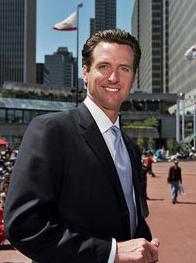
We used to call Gavin Newsom Mayor Press Release because he was always ready to go before the cameras and announce some bold plan that never amounted to anything. And now he’s at it again.

Newsom — to his credit, I must admit — was the only member of the Board of Regents who didn’t flee when the protesters arrived. Instead, he sat down with some of them and announced that “you have my support.”

In fact, he’s happy to denounce the cuts to higher education:

In an interview Thursday, Newsom said he was deeply alarmed by what he called the dismantling of the UC and CSU systems and gently criticized the budget deal struck by Gov. Jerry Brown last year that included steep cuts to financing for both institutions.

“You can’t cut $650 million from both systems and tell me you value the system,” he said. “I believe we could’ve avoided a substantial portion of these cuts.”

Yes: you could have avoided those cuts by raising taxes. But that’s something Newsom refused to do as mayor. He mentions nothing on his website about tax increases on the rich. He said nothing in his campaign about taxes. And unless I’ve missed something, he hasn’t endorsed any of the possible tax measures that might be headed for the November ballot.

So he’s going to go after the student vote in his next campaign — but without alienating big corporate supporters who don’t want to pay more taxes. And with that approach, nothing will happen to improve higher education in the state.

California, meet Lt. Gov. Press Release.

PS: I called and emailed Newsom’s media person, Francisco Castillo, to see if the Lite Gov was going to support any of the November tax measures. If they get back to me, I’ll let you know.

More backroom policy talks with the California Public Utilities Commission

On Dec. 8 and 9, high-ranking state government officials will attend a private conference with executives from Pacific Gas & Electric Co. (PG&E), Chevron, AECOM, and other major energy industry players at Cavallo Point, a luxury resort in Marin County to talk about distributed generation, a decentralized system for renewable power. It’s a gathering of top governmental officials and industry leaders to talk about policy issues with far-reaching effects on California’s energy future, but members of the general public are not invited.

As officials pack their bags for the conference at the plush resort, California Sen. Leland Yee is preparing two separate pieces of legislation designed to promote transparency within the California Public Utilities Commission (CPUC) and to make it harder for energy company executives to transition seamlessly into posts at the CPUC, the governing body that regulates utilities.

The conference is being organized by the California Foundation for the Environment and the Economy (CFEE), a nonprofit funded by investor-owned utilities and other corporations that wield tremendous influence in the Bay Area.

The Guardian spotlighted CFEE in an article about California Public Utilities Commission (CPUC) President Michael Peevey, who regularly participates in educational travel excursions funded indirectly by the companies his commission oversees.

When CFEE spokesperson PJ Johnston was interviewed for that article, he justified CFEE events by saying, “The idea for us was that it made sense to have someplace where it was nonconfrontational to engage in policy, work-type discussions,” and added they’re “all about policy, on the 30,000-foot level.”

Peevey will be attending this conference, according to a list of participants posted on CFEE’s website. So will PUC commissioners Mark Ferron, Michael Florio, and Nancy Ryan. By press time, the CPUC had not returned calls seeking comment about why commissioners are participating.

More than a dozen California senators and assembly members are listed as conference participants, as are the director and deputy director of Gov. Jerry Brown’s Office of Planning and Research, Ken Alex and Wade Crowfoot. (Crowfoot previously served in former Mayor Gavin Newsom’s administration as an environmental advisor. Newsom now serves at the state’s lieutenant governor.) Executives from Shell Energy North America, the Alliance of Automobile Manufacturers, Southern California Edison, and other heavy hitters in the industry will attend the conference too.

The conference agenda features educational sessions on distributed generation and state renewable energy goals. Several environmental and consumer advocacy groups will be present as well.

Mark Toney, executive director of The Utility Reform Network (TURN), a consumer advocacy group, also plans to attend. “Events like this give the utility industry and energy regulators an opportunity to have policy discussions and to influence policy decisions outside of the political process. It’s a privileged space,” Toney acknowledged. “We don’t think this is a good way to make policy.”

Yet he said advocacy groups like his own face a dilemma when deciding whether to participate in such events. “On one hand, we could decide we want to have nothing to do with it. But if TURN isn’t represented, then the view of ratepayers and consumers won’t be represented by anybody.” He stressed that while TURN attends daylong conferences hosted by CFEE in order to gain access and hopefully have a positive influence within that priveleged space, the group does not participate in travel excursions organized by the organization, which have drawn controversy in the past. “It’s kind of a judgment call,” he added.

Closed-door, backroom policy discussions aren’t the only CPUC transparency problem drawing scrutiny lately. Recent press reports have spotlighted instances of the CPUC denying public access to safety reports, a highly sensitive issue given the fatal pipeline explosion that destroyed a neighborhood in San Bruno last year.

On Nov. 29, Sen. Yee announced he would introduce legislation in early 2012 to subject the CPUC to the California Public Records Act, by stripping away provisions that allow the commission to block the release of information. It would place the body on the same footing as other state agencies with regards to information sharing.

“If you want anything out of the PUC, it takes an affirmative vote of the commission,” explained Adam Keigwin, Yee’s legislative aide. Secretary of State and former Assembly Member Debra Bowen initiated a similar push for transparency at the CPUC in 2006, but the effort did not go anywhere. On Nov. 30, Yee sent a letter to Peevey, the CPUC president, asking for the results of a study on transparency issues that the commission was supposed to undertake nearly six years ago when Bowen was pushing for the bill.

Keigwin added that Yee is also looking at legislation that would bar utility executives from serving on the PUC for a certain length of time, so as to prevent undue influence.

The Performant: TLC for the holidays

0

Try to ignore it as we might, the end of another year draws near, accompanied by all its attendant solstice-cycle celebrations — last ditch attempts to keep warm perhaps. Well, spike the eggnog with everclear and pass the bacon-wrapped latkes, in my book a little conviviality goes a long way in making bearable the quickly darkening days, the applejack-crisp night air. Sure, shaking off the hibernation vibe can be hard to do, but a good compromise between comatose and cabin crazy is to cuddle up to nightlife’s cozier side: intimate venues, good company, low lights, warm interiors. The Lost Church provides all of the above with its lushly-appointed “parlor performance” space and a tight-knit crew of regulars who call the venue their artistic home, plus homegrown music, a multi-media nod to vaudevillian theatre, and quiet cheer.

An ambitious TLC bill awaits the intrepid each Saturday night through December 17. Actually, ambitious musical lineups abound on Thursdays, Fridays, and even one Sunday (the 11th), but in December, Saturdays include a tongue-in-cheek, meta/metaphysical musings of a brief one-act entitled “The Golden Goddess, Demon Dan, and the Doorway to Darkness,” nestled in the center of the evening, the jelly in the sugar donut. A brashly conniving demon (Dan C.) finds himself in literally the middle of nowhere where an extremely bored goddess (the projected image of Jessica K.) is spending her eternity guarding a doorway that no-one wants to open. No-one but Dan, that is, and his persistent, flirty wheedling, rendered de facto charming by a wise-guy cockney accent, gradually wears down the goddess’ resolve. The battle-of-the-immortal-sexes dialogue is interspersed with snatches of Rolling Stones songs (“Sympathy for the Devil,” “It’s All Over Now,” “The Last Time,”) provided by a rock n’ roll “Greek Chorus” fronted by bodacious blues chanteuse Kim K., by far the heavenliest presence on the stage.

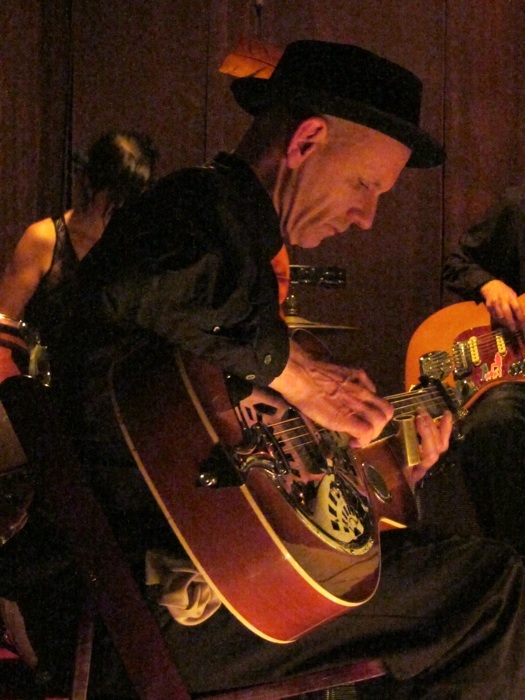
Taking a page from the hootenanny handbook, the theatrical portion of the event is bookended by an assortment of musical acts, a little something something for everyone. Last weekend, the evening opened with Brian B. playing a variety of instruments including a sultry slide guitar, an accordion, and the harmonica while singing a series of introspective ballads which began on a blue note with a love lost and spiraled further downward and outward encompassing junkyards, street corners, and a nod to St. Cecilia, martyred patron saint of music. A quick flurry of rock songs from venue hosts Brett and Elizabeth C. in their joint bass n’ drum incarnation as “Juanita and the Rabbit” followed, and the post-show glow was further prolonged by more singing from the divine Kim K. An evolving work-in-progress, TLC has carefully crafted a tempting cocktail of home comfort blended with retro cool and hot licks, all of which make it a great place to spend the
 holiday, or any, season.

Give The Performant a reason to Twit. Follow @enkohl for of-the-minute updates from the underground.

Art Basel frontlines: Thursday night in Wynwood

0

All I did was program in the coordinates of a wall my friend was painting in the midst of Miami’s mega Art Basel weekend and all of a sudden I’m in mural heaven. Going traffic snail-slow down the Wynwood neighborhood’s Second Avenue (at one time a Puerto Rican enclave, now a place where corner restaurants are popping up with floor-length windows that display spindly humanoid statues clad in multi-colored sweater), all I could see were flood light-illuminated muralists in the finishing stages of turning the street into the most painted lane I’ve ever seen.

The art galaxy has descended upon Miami for the week. It’s a big blender-fuck of small dresses, dyed eyebrows, free drinks (hell yes), and mmhmm, ART. You can read a little bit about the general mayhem in Erick Lyle’s twopart story for the Guardian about 2009’s festival — arts writer Matt Sussman and I will be covering the festival for y’all this year.

Wynwood is serving as ground zero for the street art world, which explains why Art Basel established the “Wynwood Walls” courtyard in 2009 in the neighborhood, though since then side streets and new galleries have added their own murals to the week’s list of must-sees. 

This year, Wynwood Walls has been decked out by names that even the most high brow art lover will recognize: Shepard Fairey, the Brazilian whimsy-worlders Os Gemeos. Retna, the early front-runner for the festival’s 2011 street art darling, has a massive wall here, plastered with his recognizable columns of symbols and big block painting. 

Danilo Gonzalez, a Dominican who moved to Miami two years ago to open his gallery at 2722 Second Avenue, says the weekend is a marked difference from the rest of the year when “it’s really quiet.” Though his gallery featured three modern Dominican artist (including his own thicket of wooden abstract shapes, “Forest”) he says a lot of the art scene here was “too fancy” for his tastes.

Wynwood’s residents get in on the action too — kind of. Though signs of neighborhood art are not forthcoming, many of the neighbors themselves have set up informal valet systems and viewing parties. They’re probably hoping that girl in the Gaga heels is going to trip in front of their lawn. I kind of am too… 


Occupy the Mission?

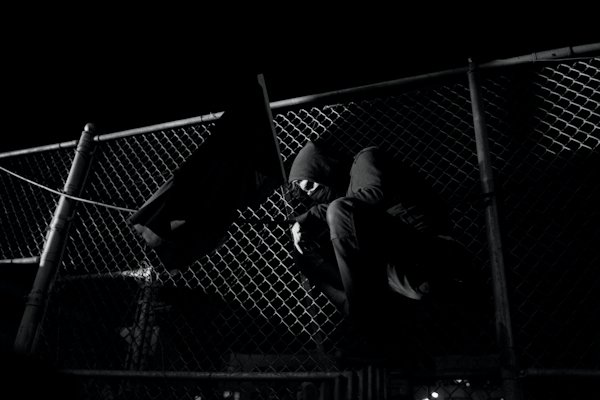
Photo taken by Geoff King outside 1950 Mission Street on May 1, 2010.

As the Guardian reported yesterday, protesters camped out at Occupy SF rejected the city’s offer to grant use of 1950 Mission Street, the fenced-in site of a shuttered school near 16th and Mission streets, in exchange for clearing out of Justin Herman Plaza.

Occupiers ultimately opted not to sign a facility license agreement prepared by the city that would have granted them use of the empty lot and some structures — with about 17 strings attached, including rules banning minors or pets from the site. However, some occupiers noted at a meeting yesterday that they saw potential in the space and liked the idea of relocating to the Mission.

It’s worth noting that this offer isn’t the first time the site, which formerly housed the Phoenix Continuation School, has been linked with economic justice activism. On the evening of May 1, 2010, around 100 activists — many of them clad in black with bandanas covering their faces — participated in a May Day march that culminated with a takeover of this very same abandoned lot.

While it was more common to hear rallying cries of “reclaim” than “occupy” at that point in time, the action was meant to draw attention to the fact that the abandoned school could be put to better use. After people broke into the property and mingled around within the fenced-in area, announcing they wished to hold the space and ultimately turn it into a free school, police wound up cutting off access to the street and making arrests.

UPDATE: Meanwhile, a raid at Occupy SF seems imminent. According to a text update from the Guardian’s Yael Chanoff, who has been closely following Occupy SF since its inception, about 80 officers were on the scene as of 6 p.m. Dec. 1, and police barricades were already beginning to surround the camp.


Morrissey’s show at the Fox is canceled

1

It is with a heavy heart that we must give you this news, Morrissey’s show at the Fox in Oakland tonight has been canceled.

If you read this week’s issue, you know that we were worried this might happen, given his track record here, yet remained positively optimistic that he’d show. No excuse for the cancellation was given as of yet, but we’ll update as we learn more.

UPDATE: The cancellation was due to an eye injury sustained by Morrissey’s drummer, Matt Walker.


The She’s on Girls, Women’s Audio Mission, and soccer practice

0

The She’s have opened for Girls, played with Thao with the Get Down Stay Down, and this month, released an infectious, surfy garage-pop debut album, Then It Starts To Feel Like Summer (the record release show is this Saturday at Bottom of the Hill).

Oh, and the band members – bassist Samantha Perez, vocalist Hannah Valente, guitarist Eva Treadway, and drummer Sinclair Riley – are all juniors in high school. But don’t diminish their talent by seeing She’s as a novelty, “young, all-girl band.” They’ve got the chops. I got the lowdown from the Bay Area quartet after school this week, discussing playing against stereotypes, life with punk parents, dream shows (hint: they’ve already played theirs), and kindergarten enemies.

San Francisco Bay Guardian: What were the first concerts you attended?
Hannah Valente: One of the first concerts we attended as a group was Blondie at the Fillmore. It was really inspiring to see a woman with such a powerful voice.
Samantha Perez: For me, I went to a lot of punk shows with my parents growing up because they were in the punk scene. It inspired me to begin playing music because I love the atmosphere and energy at shows.
SFBG: When did you start playing music and what influenced that?
Eva Treadway: We all grew up with music around us, both from our parents and also from growing up in SF. I was raised on a mix of old country blues records from my dad and Grateful Dead jams from my mom, which, come to think of it, is an interesting mix. As a kid I was crazy about the Beatles, and that was what really sparked my interest in picking up a guitar. I asked my parents for lessons and I had my first few lessons when I was about 10. When I started songwriting with the other members of the band, making music got really exciting for me again. Because we all come from different musical backgrounds – there was by no means Grateful Dead in Sami’s household growing up – but we also share really similar ideas and tastes in music.
Sinclair Riley: I started playing piano when I was about seven, then a few other classical instruments, but I didn’t start playing drums until the beginning of The She’s. My dad had a Beach Boys CD that he would always play in the car when he was driving, and I always liked driving with him so that I could listen to it because it was so much more interesting to me, I loved it so much more than anything I was playing on piano.
SP: I started playing guitar when I was seven years old. I was really resistant to play guitar, but my dad bought me a pink daisy-shaped one, so I got into it. As the years went on, I liked it more and more and then I started to sing in the San Francisco Girls Chorus, but I really wanted to start writing songs and start preforming.
HV: I was really influenced by my dad. He always seemed to be playing guitar around the house, so I just started singing with him. When I was like, three, I would sing with him while I took baths. I always liked music because it helped me connect to people. I’m shy, so it’s nice to have another way to communicate.
SFBG: How did you meet?
SP: We all met in kindergarten, and we were really close friends except me and Eva. We were enemies. In fifth grade we started playing music together and through that we became closer friends. It all started one day after soccer practice when Hannah said she had learned to play the Aly & AJ version of “Walking on Sunshine.” Eventually, the whole soccer team was in the band, but in the end it came down to just us four.
SFBG: Can you tell me a little about the process of making Then it Starts to Feel Like Summer?
SR: It was a pretty long yet satisfying process. About half the songs we already had written, and the others we wrote during the process of recording. It was so wonderful to get the opportunity to record at Women’s Audio Mission. It was really fun being in the studio and getting to take our time on this one. On this album we tried to capture the sound of what we play live. The ladies there are so nice and also taught us a bout the engineering aspect as well.
SFBG: What influences your sound? Who influences you personally?
HV: We are said to be a cross between the Ramones and the Ronettes, we really like the Beach Boys and other ’60s garage music. We’re always listening to new types of music, like ’60s country, local bands, and of course, pop.
ET: We’re influenced by going places and walking around San Francisco.
From listening to great songs, Lennon/McCartney of course, Brian Wilson, George Harrison, Phil Spector, even Britney Spears. Pretty much everything Christopher Owens from Girls writes I find inspiring.
SFBG: Where do you write music? Is it a group effort?
SR: Normally what happens is someone will bring in a guitar part or a melody or some part of a song, and we’ll all work together in our practice area (Hannah’s basement) to finalize the song – add lyrics, harmonies.
SFBG:  What’s been the most surreal experience thus far in the band? The weirdest?
HV: Hand’s down the most surreal show was playing with Girls at the Fillmore. Not only did we get to play with one of our favorite bands to listen to, but we also got to play on a stage where so many inspirational artists have performed.
SP: Playing at such a historic venue was unbelievable. The audience was great, the sound was great, the food backstage was great…it just really couldn’t have turned out any better. On the other hand, the weirdest experience we’ve had was probably when we were asked to play on TV on an early news broadcasting at like, 5 a.m.. We stayed the night in San Jose on a school night so that we could get to the studio at 3 a.m. and still be on time for school. However, we just happened to be there the same day that the San Bruno pipelines exploded, which meant our segment was canceled. It was a long, sleepy ride to school that morning, but at least we looked TV ready for all our peers!
SFBG. Who would play your dream show?
HV: Our first dream show would be to play with Girls, but then that actually happened. Then I would say to play with Magic Kids, but that also happened. After that, it would be the Morning Benders, but yes, that happened, too.
SP: Perhaps now our dream show would be with the early Beach Boys, once we build a time traveling machine, maybe that will be possible.
SFBG: Is it difficult working as an underage band in the San Francisco music scene?
EV: I think the most difficult part about being an underage musician (apart from sometimes not being allowed into to our own shows) is being treated as some sort of novelty act. It seems like a lot of times people feel that it is enough to describe our band as a “young all-girl band”, which really says nothing about our music. When people write reviews I wish they would remember that our age and gender are facts, and it doesn’t really go much deeper than that. It is true that being teenagers in the SF music scene is exciting for us. We’ve gotten to meet and even perform with some of our idols, and I know that that is something most teenagers don’t have the opportunity to do. I am proud of what we’ve done at this point in our lives, both as a band and as individuals and I feel fortunate to know what I am passionate about early on. The way I see it, it only leaves us time to grow.
SFBG: Is the She’s an intentionally all-female band?
SR: Not really, it just happened. We formed the band at that age when boys have cooties, and it’s been no boys ever since. We get treated differently since we’re a young all-girl teenage band though, and it’s made us stronger. We can go against the stereotype that girls and teenagers aren’t as capable as others.
SFBG: Do you consider yourselves feminists?
HV: We want women to be taken more seriously in the whole music industry. Every step of the way, our album was made by women. We hope to inspire other girls to get involved in this industry because women are way underrepresented.

The She’s
With Tijuana Panthers, Melted Toys
Sat/3, 10 p.m., $10
Bottom of the Hill
1233 17th St., SF
(415) 621-4455
www.bottomofthehill.com

“HIV Is Not a Crime”

2

It’s World AIDS Day — and AIDS itself is still with us, of course. But did you know that just being HIV+ and having sex is a crime in many parts of the country? That people with HIV can be classified as sex offenders for life if they don’t disclose their status? This short film, directed by Sean Strub and edited by former SFer Leo Herrera, explains:

Live Shots: Red Hots Burlesque at El Rio

0

The holidays are in full force, so it’s time to start getting that warm fuzzy feeling, and how better to start getting heated up than by seeing some Red Hots Burlesque?

I stopped by one of the two shows the troupe puts on at El Rio every week (Wednesdays and Fridays at 7:30 p.m.), and girl – they’ve got you (un)covered when it comes to all that is sexy, steamy, and silly!

The evening featured performances by Dottie Lux, hostess with the mostess; Dorian Faust, in something very dark and moody; Sheba Queenofthenight, trying to clean up but ending up getting dirty; and Kiss Me Kate, making every Star Wars fan’s wet dream come true.

There’s a little something for everyone and very little being worn on stage. I know you’re curious, so go check them out. But make sure to bring a pair of oven mitts – cuz you’re guaranteed to catch some mighty hot buns.

http://www.youtube.com/watch?v=QVipvV_TwfU

UC-Davis: Where real education begins (3)

0

Madeline Perez, our correspondent at UC-Davis,  this afternoon 11/30/11) reports  that the many letters published on the opinion section of the school newspaper, the California  Aggie, reflect the issue of Davis, known for its bucolic ways,  band festivals and agriculture and viticulture classes,  suddenly finding itself thrust into the international spotlight because of the pepper spraying incident.
http://www.theaggie.org/2011/11/21/letters-to-the-editor-response-to-uc-davis-protests

The Performant: Hamburger helpers

0

There’s certainly no shortage of live comedy in the Bay Area, but you have to hand it to Club Chuckles for keeping it weird. Avoiding line-ups packed with middle-aged men whining about their therapy bills, or cosmonaut princesses with pubic hair obsessions, Club Chuckles can often be found lurking in the rock-saturated shadows of the Hemlock Tavern’s back room performance space, infused with the kind of punk rock vibes you’ll never pick up at the buttoned-down, two-drink minimum comedy clubs. The sold out, eight-year anniversary show at the considerably swankier digs of the Verdi Club might have been better lit, but the rowdy element still prevailed, as an entire line-up devoted to the comedy of the awkward braved the hecklers to bring the laffs.

Imagine if you will an idiot savant of the yo-yo who turns out to just be an idiot, and you’ve got a good idea of what to expect when Kenny “K-Strass” Strasser takes the stage. The befuddled alter-ego of Mark Proksch, “K-strass” is a yo-yo wielding man-child out to save the environment from the ill-effects of too much toilet flushing. Determined to wow the crowd with one of his patented yo-yo tricks, The William Tell, Strasser put a bucket and an apple on the head of his first of two volunteers, who quipped, “is this like Guantanamo?” “I don’t know him,” Strasser responded immediately, nervously readying his yo-yo to fly, uncontrolled, in the general direction of the apple.

The most traditional comic of the evening, affable Duncan Trussell delivered a stand-up set filled with references to medical marijuana, tripping at Great America, and the embarrassment of being human. But then he veered into prop comedy territory with a long rambling story about his Wiccan parents and The Book of Shadows, which culminated in an impromptu séance and an appearance by ventriloquist dummy “L’il Hobo”. A classic, hinge-jawed variant, L’il Hobo became apparently possessed by Lucifer halfway through the otherwise standard dummy/ventriloquist act, culminating in an eerie duet of “Wish You Were Here,” and the devil’s gruff demand for worship.

Dressed like a turn-of-the-nineteenth-century butterfly collector, Tim Heidecker of Tim and Eric Awesome Show fame, launched into his bumbling act clutching a cheat sheet like a lifeline, dropping his punchlines as often as he dropped the mic. Declining to indulge in any of his recently released Herman Cain-inspired anthems (“Cainthology: Songs in the Key of Cain”), he instead turned his affection to Newt Gingrich’s presidential aspirations, and introduced an ambitious high-speed rail project dubbed “Zazz Rent-a-Train.” “Why own when you can rent?” intoned the movietone narrator of the video-screened infomercial on the rail project designed to connect all the continents by rail.

Kicking the emotionally tone-deaf dial to eleven, headliner Neil Hamburger emerged at last, his trademark greasy comb-over and bow-tie suggesting the desperation of the small-time Vaudeville circuit. “Get some drinks up here asshole,” he snarled at booker Anthony Bedard, before launching into a series of dead-weight knock-knock jokes, a lengthy segment focused on the dubious “talents” of Britney Spears, embittered rants against various oddience members (“laugh your fool head off…this is fun. Everyone else is having fun…with your girlfriend”), and “an award-winning tribute to ice cream” which segued into a ribald joke about Ben and Jerry’s and prostitutes.

Like Kenny “K-Strass” Strasser, the Hamburger character is a long-inhabited alter ego, whose public appearances often appear more painful for the character than for his cringing fans, who really ought to have some kind of convenient moniker by which to call themselves, like “Hamburger-heads,” or “total masochists.” And indeed, by the show’s end only the true total masochists remained, each empty seat in the rows attesting to that peculiar comedic format of anti-success that Hamburger wields so well.

The impact of Occupy

8

With the city getting ready to crack down on OccupySF, and Occupy encampments around the country under attack, it’s easy to get discouraged. And I know that a lot of the Occupiers aren’t thinking about specific legislation or how the movement translates into action in Washington.

But it does — it does:

In the world where Occupy had never happened, Republicans would’ve held these tax cuts hostage without suffering any ill repercussions. Why would they? The chattering class and Beltway media would be droning on endlessly about deficits and other things that didn’t matter.

In this world, Occupy has thrust income inequality to the forefront of the political debate — so much so that typically immovable Republicans are afraid to feed that narrative.

In other words, a ragtag bunch of hippies with supposedly no demands have done what Democrats have never been able to do — get Republicans to cry “uncle”

And this is just the beginning.

OccupySF awaits police raid after rejecting city ultimatum

5

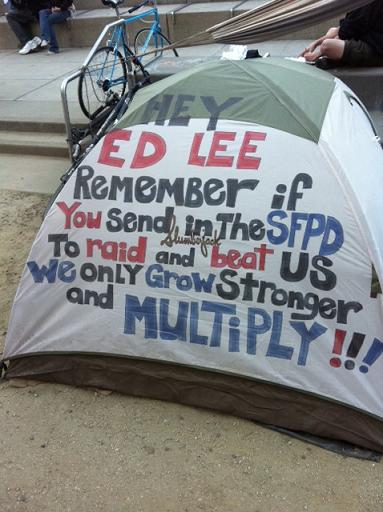
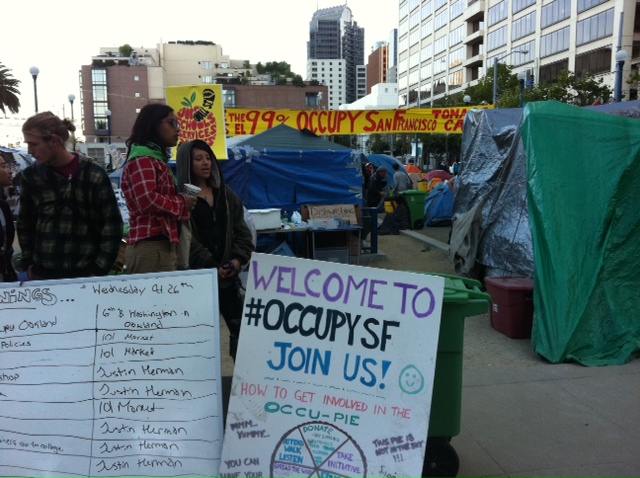
A police raid that could wipe out OccupySF, one of the country’s largest remaining Occupy camps, now seems imminent after the protest group rejected the city’s ultimatum to either voluntarily move to school district property at 1950 Mission Street or face forced eviction.

OccupySF received a written document laying out the terms of this potential agreement yesterday. After a long day of discussion, including a General Assembly meeting last night, OccupySF is refusing to sign the agreement, largely because of concerns about autonomy, as well as visibility and livability at the new site.

This marks the end of almost a week of talks with the city during which no raids were threatened on the camp. Now that OccupySF has rejected the ultimatum, police are expected to enter the camp and attempt to clear it out tonight or tomorrow night. That could destroy the longest continuous large Occupy encampment in the country. Protesters have been sleeping in public spaces in the Financial District under the name OccupySF since Sept. 17, enduring two previous police raids that only increased support for the group.

After last night’s General Assembly, a working group is meeting to form a defense plan in case of a raid, and it’s still unclear how the standoff will unfold.

The rejection of the offer comes after days of debate at the camp, including a session that took place after the city made clear the exact terms of their proposed contract yesterday afternoon. Around 3:30 p.m., OccupySF liaisons to the city handed out photocopies of a document entitled “Facility License Agreement: 1950 Mission Street.”

If signed, the agreement would have allowed the group to use the former school site until May 31, 2012. There were 17 expectations listed, including no animals or pets, no minors, “no sound/noise greater than 45dBA between 10:00pm and 7:00am,” “no panhandling or loitering,” and “no stoves, flammable liquids, wood storage or gases, open flames allowed on the site.”

What the city called an “agreement” and an “offer,” protesters saw as an ultimatum and, for some, a “veiled threat.” Katt Hobin, one of OccupySF’s key organizers, told the group, “We are operating under violent coercion. They are threatening violence if we don’t evacuate this space.”

Under the agreement, the city would have been the tenants, renting the space from the school board for $2500 per month. The space is a lot surrounded by a 15-foot chain link fence and has several portable buildings. Protesters would have had access to toilets, electricity, and indoor space at the site.

At the current camp at Justin Herman Plaza, which they renamed Bradley Manning Plaza, protesters debated how accepting the agreement would affect their branch of the Occupy movement in terms of autonomy, ability to expand and grow, inclusivity, and long-term viability.

Around 4 pm, hundreds paced camp, talking to each other about how to move forward. Some were interested in the possibility of a deal with the city but felt they could not accept the terms, especially prohibitions on minors and animals.

There seemed to be an understanding that the police would attempt to clear out the current camp in the coming days. Yet many seemed assured that the OccupySF network would stick together even after such a raid. One organizer invoked George Washington, saying, “He knew his army didn’t have to win battles, they just had to stick together. They would lose and they would retreat to a new place, but everyone would know that revolutionary army is still out there.”

Others saw the group’s place in revolutionary history differently. One protester reflected, “I think this is history being made right now. We can take the space and do so much with it. There are inside spaces for the sick and the elderly.”

Dozens of protesters had made up their minds to take the space. They waited with their belongings on the Steuart St and Don Chee Way corner of the plaza. “Jerry the Medic” Selness, who had been acting as OccupySF liaison to the city and speaking with Director of Public Works Mohammed Nuru, had relayed the message that DPW trucks would be coming to pick up those who wanted to move to the new site that afternoon.

One protester said that he and about 30 others had signed a symbolic petition stating that they wanted to accept the space. “We don’t need to sign it as OccupySF,” he said. “We’re Occupy Mission.”

Some had been waiting since the early morning. Around 5 pm, Selness got a call that no trucks would be coming that day because the city was awaiting the General Assembly’s response to its offer. About 100 people convened for the daily General Assembly at 6 pm. Around 9 pm, it was clear that OccupySF would not be signing the agreement as it stood.

The assembly did not object to any individuals or autonomous groups who might want to sign the document. They planned to write a response letter detailing their reasons for the rejection, the text of which will be discussed in a General Assembly tonight (Wed/30) at 6 pm.

Many came and went during the General Assembly, including dozens of people who were coming through OccupySF for the first time. Many organizers and supporters who had been there since the beginning but who not attended for days or weeks came back to discuss this issue, which many believed was important “for Occupy movements across the country.” Representatives from Occupy San Rafael, Occupy Santa Rosa, Occupy Berkeley, Occupy Oakland, Occupy USF, and Occupy Gainesville, FL spoke up, expressing solidarity, requesting support, and giving advice.

One homeless woman who had been living in the camp but had never spoken in GA expressed the opinion that to move would be to get out of the public eye and to concede to the city’s attempts to contain the movement, a much-expressed sentiment at the meeting. She cried, “You can’t move and live limited with their rules and regulations. You’re an eyesore, that’s why they want you to move. It’s political.”

Another woman agreed, declaring, “They can’t tell us how to protest or where to protest.”

Others cautioned against accepting the offer for different reasons. One man who spoke up at GA said that he was a teacher at Civic Center Secondary, formerly Phoenix Continuation School, the previous tenants of the offered space. He warned that the school had moved because of instability and health issues surrounding the flow of Mission Creek underground. Another worker familiar with the area recounted a tale of power-washing the sidewalk on the proposed site only to be confronted with “thousands of rats who poured up from the streets”; an OccupySF member who had surveyed the site earlier that day confirmed that the buildings had several holes in the walls, seeming to indicate a rat infestation.

One of the attendees, a young child, expressed the opinion that “we should stay strong and stay here,” amplified by the Peoples Mic. She also helped keep the meeting’s energy high and going in the right direction, showing aggressive “downward twinkle fingers” that signal disagreement at the proposed prohibition of minors on the site, and yelling “there are children present!” when adults used curse words in their impassioned statements.

Many agreed with Diamond Dave Whitaker, local celebrity in the poetry and radical communities and OccupySF organizer, when he stated: “OccupySF is citywide. We’re an autonomous entity as part of a worldwide network. We’re going to see a number of autonomous occupations arising.”

Whitaker mentioned a planned Occupy USF action to take place Dec. 1, as well as the small contingent that is currently “occupying” outside of Wells Fargo at 1 California Street, across from the former occupation site at 101 Market Street. That site is still blocked off by police barricades.

Occupy LA issued a similar rejection letter November 23, which might form the basis of OccupySF’s letter (Link: http://losangelesga.net/2011/11/assembly-authored-city-response/ ). That camp was raided and disbanded last night.

OccupySF plans to put out a formal response to the proposal and explanation of their decisions tonight.


SFBG Radio: Censoring the Internet

0

Some observers are saying that new Congressional legislation could destroy the Internet as we know it. Johnny and Tim discuss the threats to free speech, what can be done — and why it will never work — after the jump.

SOPASucks by endorsements2011

Style Paige: Sneaking peeks at the studio of Peeko Apparel

1

While browsing through the handmade scarves and mixed stone necklaces on Etsy, I came across Peeko Apparel, a women’s indie fashion brand with daring patterns and dramatic shapes. From sweaters, harem pants, and leggings to tote bags, necklaces, and turban headbands, I wanted it all.

So I decided to pay designer Brooke Fung, creator of these online treasures, a visit. When I walked into her studio apartment mellow acoustic music was playing in the background. Past the living room were sewing machines, crafting tables, and mannequins modeling elastic harness bodices. Plastic containers were neatly stacked against the wall, reaching the ceiling. A rack of Peeko Apparel clothing seemed to be inviting me to browse through it, but I avoided the urge — I didn’t want to be rude. After all, I was standing in a fashion designer’s perfect little designing nook, this was her world.

Fung was wearing all black accented with silver jewelry. With large floral gauges stretching out the 31-year old’s ears and noticeable tattoos on her hand and neck, Fung’s striking exterior was balanced with cute dimple piercings in each check.

She told me she’s inspired by utilitarian and military wear, but also loves to incorporate ethnic fabrics into her designs. With a bachelor’s degree of fine arts degree in fiber and textiles from the Alberta College of Art and Design. Peeko Apparel is sophisticated and chic. Some of my favorite pieces from the line include Fung’s oversized open-back draped sweater dress, which she styles with tribal print leggings on her Etsy page. Then there’s the loosely draped tie-dyed screen-printed tunic tank worn with a long maxi skirt. Similar to labels like Proenza Schouler or Kenzo, Peeko designs employ bold patterns and aren’t afraid of playing with shapes – only unlike those brands, these outfits come with a price tag that won’t ravage your wallet.  

Sitting in her studio, Fung told me about the first pair of fat pants she sewed when she was a 16-year old raver. 60 inches of fabrics per leg, dimensions that at the time you just couldn’t buy at a department store. That was her thing, sewing her own club clothes, and not just skimpy dresses — these were head-to-toe outfits. When she went to parties, girls were constantly asking, “Where’d you get your clothes?”

Fung has a talent for the rare sihoulette. Her geometric epaulettes are made from reclaimed vintage satin with matte and shiny pinstripes. They can be pinned to anything from jackets to collared shirts to tanks, giving the simplest of outfits a high-ranking feel.

She has been selling Peeko Apparel on Etsy for more than two years, and although she envisions a showroom or store in the near future, she doesn’t see herself selling her soul to a corporate monster, which might compromise her designs.

“If I couldn’t make stuff, I would be not a happy camper,” Fung said. It is, after all, her thing. 


UC Davis: Where real education begins

0

Madeline Perez, our UC-Davis correspondent, reports this morning (11/30/11) that the tents of occupation are still standing on campus, students are sleeping in them, one professor has a sign on his tent saying “office hours,” and the campus is abuzz with organized Occupy activities put on by the students. She emailed us the following items:

Read the list of organized activities as reported in the California Aggie, the school paper, and as handed out in flyer form on campus. There’s everything from workshops on “cops off campus–the safer university” to “reflect on the now–where is occupy in the future of protests” to “budget blues–UC fiscal structure.”  http://www.theaggie.org/2011/11/28/an-abridged-schedule/

Read the Aggie’s  main webpage.http://www.theaggie.org/

Listen to the first six minutes of the  Daily Show with Jon Stewart and his excellent skit on the the pepper spraying incident (“There must be a better way of getting students to move.”) And  mimicking  in guttural tones  the words of Chancellor Linda Katehi {“The chancellor has spoken” to budget ) http://www.hulu.com/watch/305032/the-daily-show-with-jon-stewart-mon-nov-28-2011

Repeating for emphasis: As the Louis Dunn cartoon put it so eloquently in the previous Bruce blog: UC-Davis: Where real education begins.

Graphic by Louis Dunn

Guardian graphic by former Guardian art director and cartoonist Louis Dunn. For more Dunn and his unique graphics,  go to www.louisdunndrawings.com

In her words: SF Occupier Kelly

0

We spoke with Kelly at Occupy SF on Monday, November 21. Originally from Michigan, she stumbled upon the Occupy camp and has remained for more than a month. Listen to our interview with Kelly after the jump.

OccupySF_Kelly by SFBayGuardianSounds

Meet more faces of Occupy here.

Millionaires eyeing Potrero Hill

60

I hate to harp on this (well, no I don’t) but when people tell me that we don’t have to worry so much about gentrification these days, that we’re living in a different world than the days of the dot-com boom, I have to wonder: Am I the only one reading the business pages?

Because in the real world of San Francisco business, the real-estate boom is on and housing prices — particularly in the southeast part of the city — are about to start soaring again.

In fact, according to the Chron, the market is already flying high — and dealing with the influx of new wealth and the continuing change in the demographics of the city will be very much a serious issue for Mayor Lee over the next year:

ZipRealty just completed a study on the millennial home buyer, pointing out that this generation, born after 1982,  is the largest in American history, larger even than the Baby Boomer generation. To these buyers, walkability and a vibrant urban community are huge draws in a home purchase. The ZipRealty study seems confirmed by this recent mini-boom in neighborhoods close to SoMa’s flourishing tech industry: newly minted millionaires in their 20s and 30s have the buying power to drive prices up.

Want proof? We’ve got it. The median price of a single-family home in San Francisco County was $745,000 in October, up $10K from October of 2010. In the neighborhoods in question though, the increase is more striking. In Noe Valley this October, the average price-per-square-foot was up 5% from last year for the third month in a row; in SoMa, up 11%; in eastern Potrero Hill, up 16%.

So: When Zynga goes public in a few months, a whole lot of young millionaires will want to buy houses in Potrero Hill. Dogpatch, and the southern end of SOMA. Oh, and the Mission. Rents will go way up. Housing prices will go even further beyond the level that ordinary, non-millionaire working people can afford.

I’m happy for all the Zyngites, and I’m glad the company is here in SF and generating economic activity. But one of the lessons of the dot-com boom is that the city, as a matter of policy, has to protect existing neighborhoods and residents (and existing industrial blue-collar businesses and jobs) from displacement. Otherwise the horrors of the late 1990s will start creeping back.


Guardian editorial: The problem of U.C. police

7

GUARDIAN EDITORIAL Twenty years from now, when people look back on the Occupy movement, one of the indelible images will be the video of the University of California police officer casually dousing a group of peaceful, seated students in Davis with pepper spray. It’s a video that’s been seen millions of times around the world. It reflects a serious problem not just with one officer but with the way officials at all levels have responded to the protests — and with the way institutional police forces operate in this state.

In the video, a group of students involved in the OccupyUC movement are seated on the ground with arms linked. Lt. John Pike walks up and down the row, indiscriminately shooting the orange spray — which causes severe pain and breathing problems — over the students, who make no move to resist. It’s horrifying and stunning, the sort of thing that you wouldn’t believe unless you saw it yourself.

The Davis chancellor, Linda Katehi, has been reeling from the incident and is facing calls for her resignation. Pike and the chief of the U.C. Davis police have been put on administrative leave pending an investigation.

But now Assemblymember Tom Ammiano of San Francisco told us he  wants to go a step further — he  he plans  to hold hearings in Sacramento not just on this incident but on how police agencies across the state have dealt with mostly nonviolent protesters. He’s absolutely right — and his hearings should also raise a critical question: Why does the University of California need its own armed police force?

The problems with the police at Davis mirror problems with the behavior of the U.C. Berkeley police — which mirror problems with the BART police. And all of them stem from a central problem: These little police fiefdoms have poor supervision, poor training,  and limited civilian oversight.

The chancellor of U.C. Davis doesn’t know anything about running a police department; she’s an electrical engineer and an academic. If she resigns, she’ll be replaced by another academician who knows nothing about law enforcement. And if the U.C. police misbehave, where do people go to complain? There’s no independent auditor, no office of citizen complaints.

If the Oakland police ran rampant — and they have been known to do exactly that — at least the elected mayor can be held accountable. Same for any city that has a municipal force. But when campus and transit security operations turn into armed paramilitary agencies, it’s a recipe for trouble.

At the very least, the U.C. police — like the BART police — need an independent oversight agency to handle complaints. But it might be time to discuss whether campuses can best be protected with unarmed security guards supported by local municipal police. The University of California will never take that step on its own, so the state Legislature needs to evaluate whether lawmakers should force the issue.

Postscript: STOP SHOOTING STUDENTS:  The real problem for U.C. Davis’s Kotehi and other U.C. chancellors was illustrated by  this classic J’Accuse open letter by Nathan Brown,  U.C/Davis.assistant professor in the Department of English.

Occupy standoffs continue as poll finds public support for the movement

11

As OccupyOakland moves to reoccupy Frank Ogawa/Oscar Grant Plaza today and the burgeoning OccupySF encampment braces for another long-threatened raid by police, a new Field Poll finds that about half of registered California voters identify with the Occupy movement and support its goals, which include taxing the rich and limiting the ability of large corporations to corrupt the political and economic systems.

As the San Francisco Chronicle reports, 46 percent of respondants said they identified with the Occupy movement and 58 percent agree with the cause that prompted it, compared with 32 percent who say they disagree with it. Unsurprisingly, those on the left were more likely to support Occupy while those on the right were more likely to oppose it. A previous Field Poll at the height of the right-wing Tea Party movement found it had only about half as much support as Occupy now enjoys.

Still, as it enters its third month and winter descends on the encampments, Occupy faces myriad challenges. In San Francisco, the mainstream media — particularly curdmugeonly Chronicle columnist CW Nevius — has regularly highlighted conflicts and other conditions in the camps and pushed Mayor Ed Lee to follow-through on his threats to clear the tents from Justin Herman/Bradley Manning Plaza. Rumors abound that a raid could come on Wednesday night, when SFPD beefs up its staffing for training exercises.

In Oakland, the site of some of the most violent police crackdowns on Occupy encampments, OccupyOakland members are right now (noon, Tues/29) marching back into their former home and pledging to set up a 24/7 protest in defiance of city officials. While they seem to be stopping short of a full-blown occupation and tent city, they claim to be setting up a model for the next phase of the Occupy movement.

The group’s press release follows:


FOR IMMEDIATE RELEASE:

Contact:

Phil Horne, Esq., Occupy Oakland Vigil Committee

415-874-9800; occupylaw@riseup.net

www.occupyoakland.org

OCCUPY OAKLAND— RE-OCCUPYING OSCAR GRANT a.k.a. FRANK OGAWA PLAZA

On Tuesday, November 29, 2011 at noon, Occupy Oakland activists will retake Frank Ogawa a.k.a. Oscar Grant Plaza in downtown Oakland with a 24-hour, 7 day-a-week vigil.  Occupiers hope to create a model for a new wave of “Occupation” protest throughout the United States. With the vigil, Occupiers will continue asserting rights guaranteed by the United States Constitution to assemble, speak, and petition government for redress of grievances.  The vigil is not the product of a bargain with Mayor Quan, nor is it negotiated with law enforcement–permission from the city is not required to exercise these constitutionally guaranteed rights.

The structures in the plaza will be symbolic and part of the vigil protest. A teepee will remind the public of the former Occupy camp and historic struggles of the Sioux Indians on the Plains of the U.S.; homeless workers in Hoovervilles during the Great Depression; the “Bonus March” to Washington D.C. by unpaid and unemployed veterans in 1932; Resurrection City following the assassination of Martin Luther King; the AIDS vigil of 1980s San Francisco; and the redwood occupations of Judi Bari and Running Wolf.

Occupy Oakland continues its occupation because residents of Oakland and across the US are still fighting for food, shelter, medical care, school, childcare, and other necessities.  The 1% enjoy 40% of U.S. wealth and 50% ownership of Wall Street stocks and bonds.  The bottom 80% split 7% of the former and just 5% of the latter.  The average 35-year-old in the 99% has a net worth less than $3,000.00.  Occupiers ask the public to consider, “How long does it take an unemployed member of the 99% to go through $3,000.00 and become homeless.” In Oakland, the unemployment rate is nearly double that of the national average. These are issues of crucial relevance to our city.

Occupy Oakland’s vigil declares, “If the 1% won’t share voluntarily through a sense of morality and concern for the well-being of all, then through protest and direct action, we will force change!  Occupy the Plaza!  De-colonize the 99%!”

Occupy Oakland will have sign-up sheets starting Tuesday at 11 am. at the Plaza, but sign up is not a prerequisite for participation in the vigil. Supporters are encouraged to come out day or night to participate.  The Plaza is fully accessible to the differently-abled.

About OccupyOakland:

Occupy Oakland is an emerging social movement without leaders or spokespeople. It is one of 1,570 occupations currently occurring around the world in solidarity with Occupy Wall St. For more information about the other occupations, see: http://www.occupytogether.org/

An up-to-date calendar announcing Oakland actions, and more information can be found at:

http://www.occupyoakland.org/


Localized Appreesh: Symbolick Jews

0

Localized Appreesh is our weekly thank-you column to the musicians that make the Bay. Each week a band/music-maker with a show, album release, or general good news is highlighted and spotlit. To be considered, contact emilysavage@sfbg.com.

I must admit, the first thing that endeared me to Symbolick Jews was the name. It’s a good name. But when I actually took a listen, I was still hooked – and amused. Good name, good hooks, good sense of humor.

The weirdo experimental San Francisco band has a handful of tripped out releases, including American Masters Volume 5, which came out this month. With dragging bass and creepy, haunted voices matched to high pitched squeals piping up from nowhere, there are jumbly moments of Mr. Bungle greatness seeping in often.

Take a solitary hour and listen to everything that’s happening on the release – there’s much to contemplate. Then get up and check out the Symbolick Jews show; live music waits for no thought process. The Jews play the Stork Club tomorrow night. Get to know them first below.

Year and location of origin: Late 2009, San Francisco.
Band name origin: We flipped through a dictionary and the first word we put our finger down on was, “Chumbawumba,” so we just went with Symbolick Jews. The additional ‘k’ is for ‘kindness.’
Band motto: “Are we getting paid tonight?”
Description of sound in 10 words or less: The fear of God.
Instrumentation: Adam – Vocals, Brian – Drums, Jasper – Guitar/Vocals, Burd – Bass/vocals, Paul – Guitar/vocals, Vanessa – Keyboard/vocals
Most recent release: Slave to Love
Best part about life as a Bay Area band: Everyone in the Bay Area loves our music and won’t stop talking about us.
Worst part about life as a Bay Area band: Living in the shadow of Third Eye Blind and Flipper.
First record/cassette tape/or CD ever purchased: Weird Al Yankovic, Bad Hair Day.
Most recent record/cassette tape/CD/or Mp3 purchased/borrowed from the Web: Robert Anton Wilson Explains Everything.
Favorite local eatery and dish: The Philly cheese steak at Mission Kitchen is forged in the fires of gastro-intestinal hell, and I stand by its superiority over any other cheese steak in the city. 

Symbolick Jews
With Dimples, Grandma’s Boyfriend, Curse Words, Burgers
9:30 p.m., $5
Stork Club
2330 Telegraph, Oak.
(510) 444-6174
www.storkcluboakland.com

Dick Meister: Jobless in wonderland

0

By Dick Meister

Dick Meister, former labor editor of the SF Chronicle and KQED-TV Newsroom, has covered labor and politics for more than a half-century. Contact him through his website, www.dickmeister.com, which includes more than 350 of his columns.

Finding a job is hard enough for the many millions of unemployed American workers. But, believe it or not, the fact that they are jobless keeps many employers from hiring them.

That’s right, being jobless keeps many workers from being hired for many of the jobs that are available.

It’s crazy, I know. But once they’re unemployed, many workers are destined to remain unemployed. Many employers are saying, in effect, that workers who are laid off by other employers, or who can’t get other employers to hire them, must automatically be considered bad workers who they don’t want to hire either.

Up to now, that bizarre practice has generally affected only workers who have been jobless for more than six months, but recent studies show it will soon affect a majority of all the unemployed. That would be particularly rough on women and minorities, whose unemployment rates and length of unemployment are much greater than those of other workers.

So precisely why do employers do it? The National Employment Law Project, which has conducted a major survey of the practices, says “the precise rationale is unknown, but with so many applicants for every job opening, screening out the unemployed is a convenient device for reducing the workload associated with the hiring process.”

Or it may be that “employers presume that workers who are currently employed are more likely to be good performers and have a stronger work ethic than those who are unemployed.” That, of course, “completely ignores the realities of the current labor market, in which millions have become unemployed through no fault of their own.”

As reprehensible and outrageously illogical as the practice of denying available jobs to the unemployed is, some employers don’t bother to hide their part in it. They openly say in ads seeking workers that the long-term unemployed need not apply or that the employer will only consider applicants who are currently employed.

The federal Economic Employment Opportunity Commission (EEOC) is investigating whether to charge such employers with discrimination, which they so very obviously are practicing.

What’s more, President Obama’s American Jobs Act and two companion bills pending in Congress would make it illegal for companies with 15 or more employees to turn down or fail to seek jobless workers to fill vacancies solely because the workers are unemployed.

New Jersey has enacted a state law similar to the proposed federal law, and moves are underway to enact similar laws in at least three other states – New York, Michigan and Illinois.

The federal and state bills cover employment agencies as well as employers and prohibit want ads that disqualify applicants because they are jobless. But what if the agencies and employers had legitimate reasons to find out why applicants lost their previous jobs? Or if they want to otherwise examine their employment history?

That would be perfectly legal. It would not be legal, however, to reject job applicants simply because they lost their last jobs. The EEOC would protect workers who complain of such blatant discrimination from retaliation.

The commission also could order employers to pay workers damages covering the pay and other compensation they lost because of the employer’s violation of the law and at least part of fees workers might pay to attorneys arguing their case.

Although organized labor generally seems satisfied with Obama’s American Jobs Act and its goal of creating two million new jobs, many in labor and elsewhere on the political left consider it an inadequate response to the nation’s massive unemployment problem.

But this much is clear: The act would ban one of the most outrageous practices ever perpetrated on American workers. You need a job because you’re unemployed? Sorry, says the boss, no job for you because you’re unemployed.

Have we fallen into Alice’s Wonderland?

Dick Meister, former labor editor of the SF Chronicle and KQED-TV Newsroom, has covered labor and politics for more than a half-century. Contact him through his website, www.dickmeister.com, which includes more than 350 of his columns.

What’s Jerry Brown afraid of?

5

I have to wonder — as I often do, I’m afraid — just what exactly Gov. Jerry Brown is thinking. He was out of town — at an undisclosed location — when the UC Davis pepper spray incident happened, and he issued no statement. Now he’s back, presumably in his office, and he still hasn’t said anything.

The folks at CalBuzz have a good suggestion for the statement he could have made:

The use of pepper spray and night sticks against peacefully protesting students at UC Davis represents exactly the wrong message our great universities should be sending to our young people.

Instead of supporting and encouraging students who have become productively and non-violently engaged in the important issues of the day, university authorities unleashed overwhelming military force against them.

It is not enough for University of California officials to call for a review of policies and procedures. Those responsible for this outrageous assault on human rights must be held fully accountable, Students and parents must be reassured that the University of California and all higher education institutions in this state respect and applaud young people who reject apathy and embrace personal involvement in what ails society.

I could go further: There’s video of a police officer breaking the law, and he should have been arrested and charged with assault. Not saying he should go to jail or anything, but when there’s clear evidence of a crime, typically the perp is arrested and the courts sort it out later.

But what is going through Jerry’s mind? Does he condone this shit? (I’ve known him a long time, and I can’t imagine he does.) Is he so far out in space that he doesn’t realize how bad it looks for him to stay silent?

Is he worried that the cops won’t like him if he says something critical? Because a lot of other people are mad that he’s said nothing at all.

This isn’t an isolated local incident that he can kick down to the city or county authorities. The University of California is a state agency, and its cops are state employees, who more or less indirectly work for the governor.

Jerry: Silence is consent. Quit ducking.