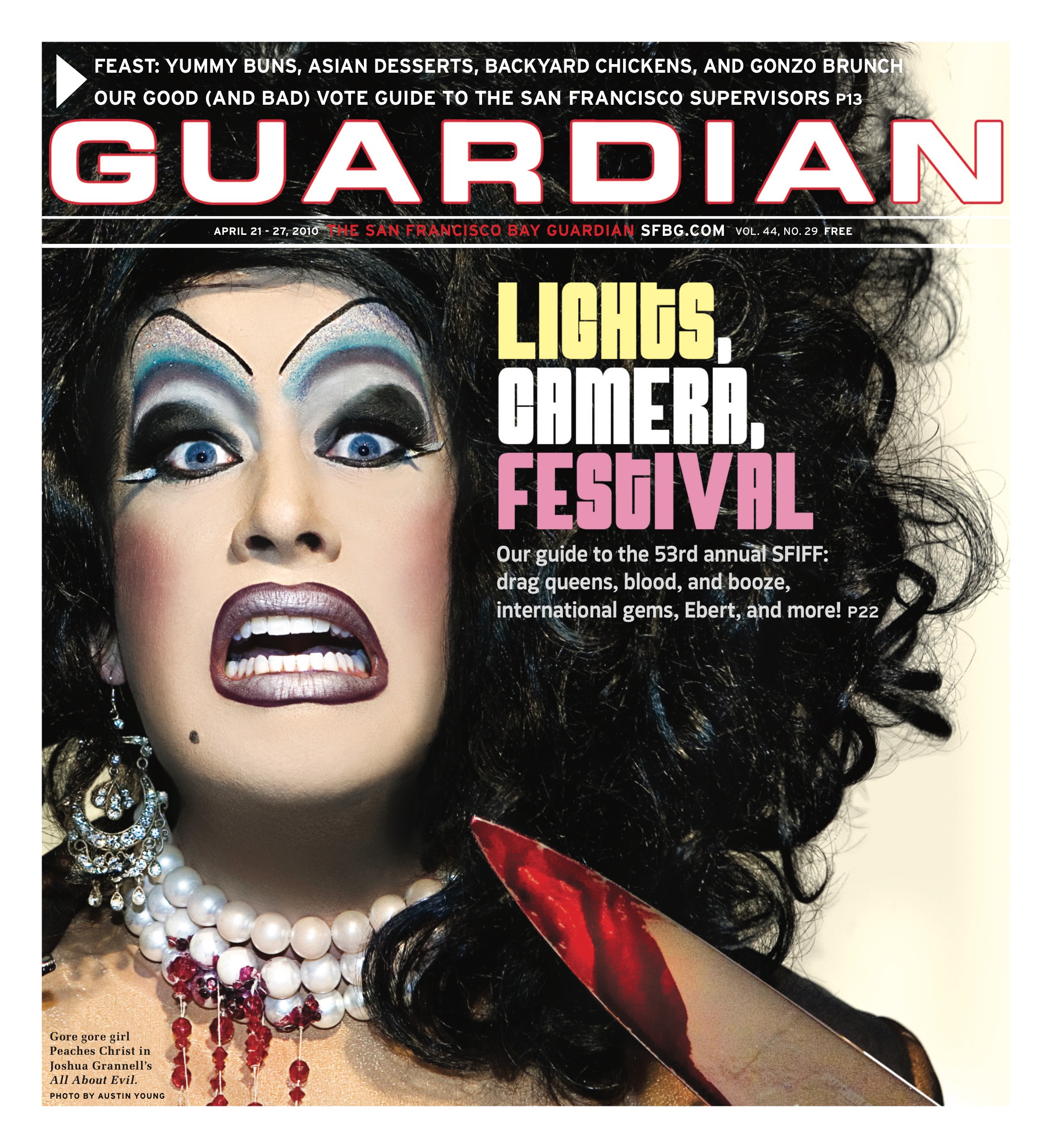
Print sections as they appeared in the early 2010s

To find articles by keyword or author, you may want to use our Search function.

Print Sections

Red, blonde, and blue

0

johnny@sfbg.com

SFIFF The evening breeze caresses the trees tenderly early on in João Pedro Rodrigues’s To Die Like a Man. This shift from the furious winds of Rodrigues’ Odete (a.k.a. Two Drifters, 2005) is a signal that the director, ever aware of the lexicon he’s blooming, is adopting a languid pace. Rodrigues’ third feature film isn’t immune to irony, a main one being that slow death allows his cinema to breathe most deeply.

At the onset, To Die Like a Man does not seem like the story of a drag queen perishing from poisonous silicone implants. Rodrigues begins in a nighttime jungle of young male longing, in a nod to Apichatpong Weerasethakul’s Tropical Malady (2004), though his vision is much less chaste. Greasepaint is applied to a beautiful young soldier’s face, and upon wearing that militaristic form of drag, he’s soon fucked by the masculine makeup artist. Moments later, the two enlistees happen upon a lone mansion and peer through a window. The pair of ladies within are … not quite ladies. We are in a world where a lush garden is gradually revealed to be a terrarium, and that terrarium is soon visually rhymed with an aquarium. Nothing is what it seems, except that which flowers and dies.

It isn’t until after a gunshot and Rodrigues’ trademark blood-red letter credits that we are introduced to Tonia (Fernando Santos), a buxom blonde who bears a familial relation to one of the soldiers. Not quite weary enough to dispense with her wry wit, Tonia makes her living performing drag numbers at a club, where a beautiful and quite opposite heir apparent (Jenni La Rue) looks down at her from the other side of a mirror. At home, she cares for her drug-addled, dress designer boyfriend Rosario (Alexander David). Her chief confidante, her little white dog Augustina, appears to be slightly more obedient.

Santos’ presence at the heart of To Die Like a Man opens up Rodrigues’ distinctive world view, giving this musical without (much) music a true voice besides that of the director — quite literally in one bravura sequence, where Tonia half-whispers, half-sings a song long after Rosario angrily snuffs it from the car radio, as the world passing by is reflected in a car window adorned with raindrops. The hot-as-hell garbageman of Rodrigues’ O Fantasma (2000) and the leggy lunatic of his schematic Odete are as mute as they are ravishing, but Tonia has something to say, in tones that are smoky and relaxed and resigned to fate. Within English-language films, Divine’s siren song in Hairspray (1988) and Dorian Corey’s backstage aria of wit in Paris is Burning (1990) are the best touchstones for Tonia — ones that reveal the heft of Santos’ performance.

In life, Tonia has not fully crossed over to the other side. To illustrate her ladylike sensitivity, she complains to her transsexual friend and hairdresser, Irene (Cindy Scrash), about a doctor’s blunt, origami-like demonstration of how a penis is transformed into a vagina through surgery. But the man beneath Tonia isn’t immune to a cruise through the dark for a grope in the park.

A true auteur who hasn’t fallen prey to the excessive worship that has hindered influences such as Tsai Ming-liang, Rodrigues is cultivating his craft. He’s aware that he’s still developing, yet comfortable enough about his formidable command that he can casually deploy the motifs of great filmmakers as pivot points. If Odete‘s peculiar double-vision was constructed from the eyes of Hitchcock and Warhol, To Die Like a Man is his In a Year of 13 Moons (1978), or 1999’s All About My Mother changed to All About My Father. (A Marnie poster hints which wing of the Hitchcock library Rodrigues currently resides in, exploring patriarchal and matriarchal ties.) Fassbinder and the larger specter of "’60s and ’70s European art film is hilariously invoked through the character of Maria Bakker (the superb Gonçalo Ferreira De Almeida), a sweet beacon of death prone to epigrams and fits of vamping. In the film’s key moment of ominous reverie, she and Tonia and their sidekicks sit down in the woods and are softly serenaded by Baby Dee’s song "Cavalry."

Rodrigues has a way with sound and image, and the queeniness of the characters here allows him and longtime partner and art director João Rui Guerra da Marta to indulge their own flouncier yet symbolically rich impulses. Tonia wraps a car gift for Rosario in silver foil, and her cell phone holder is a porcelain leather pump — with a puff ball at the heel. Her backstage mirror is decorated with photo mementos of Brad Renfro and Cristiano Ronaldo, and one of her chief stage outfits is like Dorothy’s red slipper turned into an entire dress. In a single shot, a bath towel, bath mat, and dog offer variations of furry whiteness. Twice, the aesthetically heightened naturalism of Rui Poças’s cinematography gives way entirely to fluorescent pastel hues.

Tonia’s story is about uncovering what is buried before one’s body is laid to rest. Her journey crosses through some of the Lisbon landmarks of Rodrigues’ previous films — the fatal intersection and cemetery walls of Odete, for example — while finding rare blooms on the edges of urbanity. A farewell tour as long as Cher’s, To Die Like a Man never tests one’s patience. Forget-me-not is one of the ever-referential Rodrigues’ secret mottoes as a director. Even if life and drag — and the drag of life — persist beyond the end of Tonia, he’s created a film to remember.

TO DIE LIKE A MAN

May 1, 9 p.m., Clay

May 3, 12:15 p.m., Kabuki

May 4, 6:15 p.m., Kabuki

Love, guts, and glory

0

arts@sfbg.com

SFIFF Though there were far starrier, more expensive films debuting in the Midnight Madness section of last year’s Toronto Film Festival, the category’s prize and foot-stomping audience favor was stolen by a low-budget Australian film that arrived with no fanfare, no name actors, and a writer-director who’d made no prior features.

Sean Byrne’s The Loved Ones focuses on small-town teenager Brent (Xavier Samuel), who’s severely depressed from a recent tragedy but rouses himself to attend the school prom — or would have, if he wasn’t hijacked instead for one of the most harrowing first dates in film history.

Pegged by some as "Misery meets Pretty in Pink," this instant horror mini-classic is by turns poignant, funny, grotesque, alarming, and finally very, very satisfying. It’s sure to be a hit again in the San Francisco International Film Festival’s Late Show section. Between festival travels, Byrne was back home in Melbourne when he answered my e-mail queries.

SFBG The movie really throws you for a loop by spending the first stretch on serious psychological drama, then springing something entirely different.

Sean Byrne Well, I needed [to establish] a hero who was uniquely qualified to survive hell. Someone who is conditioned to pain, who feels like they deserve to suffer. He’s a cutter or self-mutilator, someone who tries to block out emotional pain with physical pain. He’s a kid with a death wish who’s forced to endure a literal hell, and in the process realizes he’s got everything to live for.

SFBG Your central female character is more interesting than the usual horror movie villains in that she’s so spoiled she thinks she’s a victim, which then excuses her behaving monstrously. Where did that come from?

SB I was thinking about what could make a signature, iconic, highly marketable villain and I noticed how my five-year-old niece, along with almost every little girl, is obsessed with wearing pink. It’s part of the magic and fantasy stage of childhood, where they actually believe the Disney line "someday [my] prince will come." So then I started thinking, well, what if our villain is a teenager with raging hormones but still somehow stuck in this spoiled, childish, preoperational stage of development. I imagined "Princess" as a teenage version of that irritating kid in the supermarket who demands lollies and won’t stop screaming until she gets them.

SFBG I like that her favorite song is self-pity anthem "Not Pretty Enough." Has Kasey Chambers had any reaction to the film?

SB I tried to stay within the horror genre but at the same time subvert the conventions. And having our troubled hero listen to heavy metal (the "devil’s music") and our villain listen to a top-of-the-pops ballad like "Not Pretty Enough" was a way of doing that. As far as I know, Kasey hasn’t seen the film. I’m dying to know how she’ll react.

SFBG A difference between this movie and those associated with "torture porn" is that here both the victims and the perps are pretty complicated characters.

SB I hope so. I did my research and tried to get inside the heads of these characters before I started writing. Characters in horror movies are often one-dimensional cardboard cutouts. But really great ones like The Shining (1980), The Exorcist (1973), and Rosemary’s Baby (1968) delve into the psychology of the moment. They answer the question: how do ordinary people react to extraordinary situations honestly? They explore our base instincts with emotional authenticity.

SFBG The film really does dish out some horrifying abuse, though — did you ever pull back on how graphic it would be?

SB No. Never. I’m not a fan of PG-13 horror. The middle ground is pretty boring — that’s why it’s called the middle ground.

THE LOVED ONES

May 2, 10:30 p.m., Castro

May 6, 3 p.m., Sundance Kabuki


MORE ON SFBG.COM For an extended version of Dennis Harvey’s interview with Sean Byrne, visit www.sfbg.com/pixel_vision

Not fade away

0

arts@sfbg.com

SFIFF Returns are dangerous. The story of Lot’s wife tells us that looking back is enough to be compromised. In cinema, the figure of return can stretch the basic spatiotemporal properties like so much silly putty. Take the two San Francisco International Film Festival speculative nonfictions that allow archival footage to overflow its conventional containers: 14-18: The Noise and the Fury, an epic reexamination of World War I narrated by a fictional French soldier, and Henri-Georges Clouzot’s Inferno, Serge Bromberg’s dogged excavation of the eponymous French director’s famously unrealized film. Then there’s Claire Denis’ return to Africa (White Material), a Chinese documentary portrait of a family’s fraught journey home (Last Train Home), and American filmmaker Tanya Hamilton’s Night Catches Us, a double return (the story of a Black Panther’s homecoming to his troubled neighborhood and a reconstruction of 1970s Philadelphia).

The cliché that “you can never go home again” is made freshly acute in Kamal Aljafari’s Port of Memory, a melancholic study of the Palestinian community of Jaffa where Aljafari is from. The film reminds me of The Exiles (1961) in its urban-fragmentary scenario, well-portioned running time, and lovingly quotidian portrait of a marginalized group. Port of Memory doesn’t announce that the fretful middle-aged woman who goes through the motions of housekeeping and caretaking is Aljafari’s mother and the man who wanders Jaffa’s crumbling streets his uncle — we’re left to piece together these intimate views on our own. As a narrator, Aljafari is discreet but hardly complacent: he intercuts establishing shots of his uncle’s promenades with footage from old Israeli and American films (for example, the 1986 Chuck Norris vehicle, Delta Force) that use the same streets for dubious spectacles of violence and nationalism. Doubling back on these inadvertent documents of occupation, Port of Memory‘s thin line of fiction has the now off-screen Israelis acting as a gentrifying force.

Like Aljafari’s film, Pedro González-Rubio’s gorgeous Alamar (“to the sea”) is set between landscapes (land and sea) and ways of telling (fiction and documentary). The bare frame of a plot places a young boy with his father and grandfather, Mayan fishermen working the Mexican Caribbean. The sweetness of this idyll is tempered by its provisional bounds: the boy will return to his mother in Rome at the end of his compressed experience of a father’s love. Every shot is earned: there are several in which the camera bucks with the boat, physically linked to the actors’ experience. The child is at an age of discovery, and González-Rubio channels this openness by fixing on the details of the fisher’s elegant way of life and the environmental contingencies of their home at sea.

The same well of patrimony and nature has been poisoned in Vimukthi Jayasundara’s surreal fable of destruction, Between Two Worlds. In this mythopoetic work, Sri Lanka’s 30-year civil war ravages on in screaming city streets and darkened forest visions. We first see the film’s central figure — a nameless wanderer resembling many other “chosen ones” — in a death pose, splayed on the beach with crabs crawling over him. Two fishermen trade variations of the story of a prince destined to survive great bloodshed to kill his powerful uncles, and several forest dwellers seem to think our protagonist is the man. The slipperiness of Between Two Worlds‘ reality, in which visions are liable to be doubled or outright contradicted, evokes both the shifting ground of trauma and different rules of oral storytelling. In its best moments, the film put me in the mood of Jeff Wall and Raúl Ruiz; in its least, a slow-motion Lost. But Between Two Worlds amply demonstrates that returning is not always a matter of volition: such is fate and endless war.

Top pic picks

0

The White Meadows (Mohammad Rasoulof, Iran, 2009) This latest by the recently jailed Iranian director of Iron Island (2005) is a stark, visually striking allegory whose natural settings (the salt formations of Lake Urmia) could hardly be more surreal. Aging Rahmat (Hasan Pourshirazi) rows his little boat from one tiny island community to another, collecting tears from variably aggrieved locals so they can be absolved of their sins — just how, neither they or we know. During his latest travels he gains a teenaged stowaway, then a blind-struck painter as passengers; witnesses a couple of village rituals that prove fatal for their main participants; and experiences other curious events that scarcely prompt a raised eyebrow from him. As with so much modern Iranian cinema, Mohammad Rasoulof’s film carefully renders its political symbolism so abstract you can dig endlessly for hidden meanings, or simply lose yourself in the hypnotic black-and-white-in-color imagery of black-clad people on bleached landscapes. Fri/23, 6:30 p.m., Kabuki; Sat/24, 9:30 p.m., Kabuki; Sun/25, 8 p.m., PFA. (Dennis Harvey)

Nymph (Pen-ek Ratanaruang, Thailand, 2009) Boy meets girl. Boy and girl fall in love. Girl cheats on boy with boss. Boy falls in love with tree. So are the broad strokes of Thai director Pen-ek Ratanaruang’s jungle-horror, Nymph, a city-to-country romance that deftly weaves strands of urban anomie, sexual dysfunction, and rural mythos into a dreamy, arboreal fantasia. One might be tempted to reference Lars von Trier’s Antichrist (2009) and fellow Thai helmer Apichatpong Weerasethakul’s 2004 breakout, Tropical Malady, as obvious points of reference, but that would derogate the potency and intensity of Ratanaruang’s singular, artistic design. The director of Last Life in the Universe (2003) and Ploy (2007) creates a tropical mise-en-scène that is less cinematic than immersive, developed largely by his use of tight, suspenseful close-ups, fluid camera work (including a 10-minute opening sequence that is practically gymnastic), and a transfixing ambient score. But unlike Tropical Malady, which leveraged much of its second-half’s novelty from overwrought, homoerotic tropes and a condescending nativism, Nymph‘s descent into the jungle is only the beginning of this powerful love story. Fri/23, 9 p.m., Kabuki; Sat/24, 4:30 p.m., Kabuki; April 28, 4:45 p.m., Kabuki. (Erik Morse)

Around a Small Mountain (Jacques Rivette, France/Italy, 2009) Around a Small Mountain (or 36 vues du Pic Saint Loup) is New Wave doyen Jacques Rivette’s return to the whimsy of 1984’s Love on the Ground, another exploration of theater staring eternal demoiselle Jane Birkin. In Mountain, Birkin plays Kate, a prodigal daughter who has returned to her deceased father’s circus after an unspecified trauma forced her into a 15 year absence. En route she encounters Vittorio (Sergio Castellitto), a peripatetic who instantly discovers in Kate a fellow improviser for his acrobatic feats of conversation. In hopes of learning her secret past, Vittorio follows Kate and her shabby troupe from performance to performance through the tiny towns of the Cevennes. Along the way, Rivette treats his audience to a mish-mash of sideshow sketches, enchanting dialogues and haunting soliloquies, all beneath the magical totem of the big top. The film is spellbinding ode to the theatre of everyday life and the actors who prance in and out of its cirque. Fri/23, 9:30 p.m., Kabuki; Sat/24, 4:15 p.m., Kabuki; April 28, 6:30 p.m., PFA. (Morse)

Way of Nature (Nina Hedenius, Sweden, 2008) Save for when Werner Herzog is doing the talking, documentaries about the natural world often benefit from a lack of voiceover narration. Nature’s seasons, cycles, and rhythms provide their own narrative structure, and simply, silently observing what happens can make for fascinating viewing. Nina Hedenius understands this. Her engrossing year-in-the-life portrait of Lisselbäcka Farm in northern Sweden is cut around creatures great and small — horses, cows, goats, chickens, dogs — and their routines. Although humans are part of the bucolic scene Hedenius so meticulously orchestrates (the sound editing is such that the film would be no less immersive if you watched it blindfolded), they are merely supporting actors. After watching, for the fourth time, another gangly offspring leap to its feet, minutes after being born, you start to realize the ways in which our species is quite helpless. If their keepers suddenly passed away, the animals of Lisselbäcka — domesticated though they may be — would probably manage to carry on. The way of nature is instinct, not mastery. Sat/24, 2 p.m., PFA; Sun/25, 3:45 p.m., Kabuki; Mon/26, 1 p.m., Kabuki; April 28, 6:30 p.m., Kabuki. (Matt Sussman)

Between Two Worlds (Vimukthi Jayasundara, Sri Lanka, 2009) Part vision quest, part historical allegory, Vimukthi Jayasundara’s lush and beguiling head-scratcher unfolds like the mutable folktale told between two fishermen in one of the film’s asides. A synopsis would go something like this: an unnamed South Asian man falls from the sky into an unspecified South Asian country (although the Sinhala the actors speak places us in Sri Lanka) under siege by revolutionaries intent on destroying all means of communication and killing any remaining young men. Fleeing a riot-ravaged city he winds up in the countryside where he reconnects with his sister-in-law, and undergoes several mysterious and mystical experiences at a nearby lake. “It’s possible that one can see today what has happened in the past,” cautions an old man to our protagonist, and Jayasundara — with an eye for arresting mise-en-scene, gorgeously photographed by Channa Deshapriya — attempts to offer a way to re-see the traumas of the civil war that ravaged Sri Lanka for over three decades. Like a freshly remembered dream, Between Two Worlds is as stubbornly oblique as it is hard to shake. Sat/24, 6:15 p.m., Kabuki; Sun/25, 9 p.m., Kabuki; Mon/26, 9:15, Kabuki. (Sussman)

Transcending Lynch (Marcos Andrade, Brazil, 2010) Picture it: everyone’s favorite psycho-thriller filmmaker and coffee retailer waxing beatific about peace, love, and “infinite bliss,” his American Spirit–stained teeth frozen in a perma-grin as he extols the virtues of the “unified field” of consciousness. At certain moments in Transcending Lynch, an exploration of infamous auteur David Lynch and his 35-year devotion to transcendental meditation, the director comes across as flakier than the celebrated piecrust at Twin Peaks‘ Double R diner. (At one point he even utters the phrase “Holy jumping George!”) For the irony-soaked, all the TM talk may be a little TMI, but for Lynch the practice is nothing short of the very source of his creative wellspring. Marcos Andrade’s documentary, which follows Lynch on a 2008 Brazilian book tour, won’t offer the mad-genius Eagle Scout’s more rabid followers much new insight. While the movie strives to be meditative, it’s more of an amalgam of trippy travelogue and pitch meeting. Even more frustrating, we get only teasing glimpses of how TM has directly informed and impacted the artist’s work. Lynch may be on the path to universal enlightenment, but when it comes to the man himself, the rest of us ignoramuses are still mostly in the dark. Sat/24, 6:30pm, Kabuki; Mon/26, 9pm, Kabuki; Tues/27, 12:30pm, Kabuki. (Michelle Devereaux)

14-18: The Noise and the Fury (Jean-Françoise Delassus, France/Belgium, 2009) Made for French TV, Jean-Françoise Delassus’ unclassifiable film would be arresting simply for cobbling together seldom-seen archival footage reflecting all aspects of the First World War, from its leaders to its trenches. But he and co-scenarist Isabelle Rabineau have shaped that footage into a narrative driven by the writings of a (fictional) French everyman soldier who somehow manages to survive and serve in most of its major conflicts. The result melds exquisite color tinting, first-person narration, clips from commercial films about the war (by D.W. Griffith and Chaplin as well as European directors), and ambient sound to create a brilliant kind of living history lesson that makes the events of nearly a century ago seem as immediate as yesterday’s. Mon/26, 4:30 p.m., Kabuki; May 1, 2 p.m., Kabuki; May 3, 9 p.m., Kabuki. (Harvey)

The Peddler (Eduardo de la Serna, Lucas Marcheggiano, and Adriana Yurkovich, Argentina, 2009) Daniel Burmeister is a traveling filmmaker. He drives his infirm jalopy from one small Argentine town to the next, hoping to set up camp for a month and make a movie with the locals. He’ll need food, a place to stay, and a camera. Whatever camera they can find. Usually the mayors are easy to convince, because Burmeister is essentially a regional attraction, a one-man circus they know about from the neighboring towns. It’s this strange repurposing of the filmmaking experience that makes the documentary so distinctive and special. And just watching the old man hustle from shot to shot with his bashful actors, working efficiently from one of the handful of scripts he’s been cycling through for years, is an absolute pleasure. Directors Eduardo de la Serna, Lucas Marcheggiano, and Adriana Yurcovich capture the jury-rigged process with unobtrusive admiration and an absence of condescension. As I watched it I kept thinking it was like the soul that was missing from Michel Gondry’s 2008 warmed-over DIY manifesto Be Kind Rewind. Mon/26, 6:30 p.m., PFA; May 1, 12:30 p.m., Kabuki; May 4, 6:30 p.m., Kabuki. (Jason Shamai)

Russian Lessons (Olga Konskaya and Andrei Nekrasov, Russia/Norway/Georgia, 2010) I remember watching the news two summers ago and feeling confused by the details of the Russia-Georgia War, the culmination of a dispute over the territory of South Ossetia. There seemed to be a haziness about who started what. Russian Lessons offers Olga Konskaya and Andrei Nekrasov’s version of what happened that summer and indicts Russian and mainstream international news organizations for exactly that failure to present a satisfactory chronology. Konskaya, a theater director and documentary producer, filmed events as they unfolded on the Northern end of the conflict while Nekrasov, a veteran documentarian, filmed in the South. The result is a collection of interviews with residents of recently bombed Georgian towns, confrontations with Russian soldiers, and investigations of still-smoldering battle sites. The filmmakers spend an equal amount of time scrutinizing source footage from the war and its antecedents, exposing how it was used to mislead the international community. It’s a disturbing and persuasive rebuttal to the Putin administration’s official side of the story. April 28, 3:15 p.m., Kabuki; April 29, 12:30 p.m., Kabuki; May 1, 6:15 p.m., Kabuki. (Shamai)

Restrepo (Tim Hetherington and Sabastian Junger, USA, 2010) Starting mid-’07, journalists-filmmakers Tim Hetherington and Sebastian Junger spent some 15 months off and on embedded with a U.S. Army platoon in Afghanistan’s Korengal Valley, a Taliban stronghold with steep, mountainous terrain that could hardly be more advantageous for snipers. Particularly once a second, even more isolated outpost is built, the soldiers’ days are fraught with tension, whether they’re ordered out into the open on a mission or staying put under frequent fire. Strictly vérité, with no political commentary overt or otherwise, the documentary could be (and has been) faulted for not having enough of a “narrative arc” — as if life often does, particularly under such extreme circumstances. But it’s harrowingly immediate (the filmmakers themselves often have to dive for cover) and revelatory as a glimpse not just of active warfare, but of the near-impossible challenges particular to foreign armed forces trying to make any kind of “progress” in Afghanistan. April 30, 3:45 p.m., Kabuki; May 2, 4:15 p.m., PFA; May 4, 9:30 p.m., Kabuki. (Harvey)

Animal Heart (Séverine Cornamusaz, France/Switzerland, 2009) This first feature by Séverine Cornamusaz has a story that would have fit just as well into the cinema of 1920 — or the literature of Thomas Hardy or George Eliot 50 years earlier. Paul (Olivier Rabourdin) is the gruff owner of family lands in the Swiss Alps, raising livestock whom he treats better than wife Rosine (Camille Japy). When he’s forced to hire a seasonal hired hand in the form of Eusebio (Antonio Bull), the easygoing Spaniard’s concern for ailing Rosine incites not Paul’s compassion but his brute jealousy. This elemental triangle set amid the severe elements of its spectacularly shot setting has a suitably blunt (but not crude) power; it leads not where you might expect but to a hard-won fadeout of audacious intimacy. April 30, 4 p.m., Clay; May 2, 9:15 p.m., Clay; May 3, 6 p.m., Kabuki. (Harvey)

Henri-Georges Clouzot’s Inferno (Serge Bromberg and Ruxandra Medrea, France, 2009) A painstaking craftsman who left nothing to chance, French suspense master Clouzot (1955’s Diabolique, 1953’s The Wages of Fear) decided to push his own envelope a little in 1964. He cast Serge Reggiani as a resort innkeeper who becomes pathologically, paranoically possessive of his gorgeous wife (Romy Schneider). Convincing himself she’s having an affair, he gradually snaps tether — and the film itself would reflect that downward spiral by increasingly illustrating his mental stage in distortive image and sound. Unfortunately, the project also drove Clouzot mad in a way, as his grapplings at a new filmic language ran counter to the kind of creative discipline that normally storyboarded everything within an inch of its life. Shooting endless footage, spending endless money, he finally admitted defeat and abandoned ship. Never completed, the film’s surviving pieces were restored for this absorbing unmaking-of documentary — even if the original clips, daring then but now looking like psychedelic kitsch, suggest Inferno would likely have been no masterpiece but a fascinating, instantly-dated failure. May 2, 1:45 p.m., Kabuki; May 5, 6:15 p.m., Kabuki. (Harvey)

Presumed Guilty (Roberto Hernández and Geoffrey Smith, Mexico, 2009) A fan of true crime TV programming, I all but take for granted that little coda at the end of each episode reminding viewers that the suspects shown are innocent until proven guilty. I sometimes forget that such rights are not the case in all countries, such as in Mexico where the criminal justice system employs a reverse practice requiring the accused to prove themselves innocent. In Presumed Guilty, filmmakers, lawyers, and UC Berkeley students Roberto Hernández and Layda Negrete use rarely-seen, up-close footage of the Mexican trial process in their effort to exonerate a young Mexico City street vendor who is falsely accused of murder in 2005. The proceedings, which require the defendant to stand for hours on end and are performed sans jury, is riveting stuff for fans of those A&E true crime shows and is sure to ruffle the feathers of a few sympathetic humanitarians. May 2, 3:30 p.m., Kabuki; May 3, 6:30 p.m., PFA; May 6, 3:15 p.m., Kabuki. (Peter Galvin)

Lebanon (Samuel Maoz, Israel, 2009) “Das Boot in a tank” has been the thumbnail summary of writer-director Samuel Maoz’s film in its festival travels to date, during which it’s picked up various prizes including a Venice Golden Lion. On the first day of Israel’s 1982 invasion (which Maoz fought in), an Israeli army tank with a crew of three fairly green 20-somethings — soon joined by a fourth with even less battle experience — crosses the border, enters a city already halfway reduced to rubble, and promptly gets its inhabitants in the worst possible fix, stranded without backup. Highly visceral and, needless to say, claustrophobic (there are almost no exterior shots), Lebanon may for some echo The Hurt Locker (2009) in its intense focus on physical peril. It also echoes that film’s lack of equally gripping character development. But taken on its own willfully narrow terms, this is a potent exercise in squirmy combat you-are-thereness. May 2, 9 p.m., Kabuki; May 5, 9:30 p.m., Kabuki. (Harvey)

The Day God Walked Away (Philippe van Leeuw, France/Belgium, 2009) Director Philippe Van Leeuw states in the press materials that he made The Day God Walked Away in an attempt to understand how the assassins of the 1994 Rwandan genocide could do what they did and how others could stand by and watch. I walked away from Day with a better understanding of what might draw a person to choose defeatism over an unlikely survival. The film opens as a Tutsi housekeeper (Ruth Nirere) finds herself trapped in her Belgian employers’ house, fearing for her children and surrounded by gun-toting murderers. Light on scripted dialogue and featuring local actors, van Leeuw’s nonintrusive filming lends the film an authentic atmosphere that can be slow but is never boring. In lensing the film’s horrific scenes in a simple and matter-of-fact fashion, he eerily replicates the emotional separation that survivors of the massacre were forced to adopt in order to live. May 3, 6:45 p.m., Clay; May 4, 4 p.m., Kabuki; May 5, 4:15 p.m., Kabuki. (Galvin)

The Practice of the Wild (John J. Healey, USA, 2009) “The way I want to use ‘nature’ is to refer to the whole of the physical universe,” explains the poet Gary Snyder in John J. Healy’s succinct but penetrating documentary on the octogenarian poet, essayist, and environmental activist. Snyder’s expansive definition conjoins the two areas to which he has devoted his life and creative practice to better being at peace with: the terrestrial and the existential. Healey provides the back story — covering Snyder’s farmstead childhood, his discovery of his love for the outdoors, his association with the Beats and later immersion in Zen Buddhism, and his two marriages — told in part through the obligatory scan-and-pan photography and contextual talking heads. The film’s highpoints, however, are the many lively conversations Snyder engages in with his friend and fellow writer Jim Harrison, whose grizzled countenance and chirpy demeanor make him a character in his own right. May 3, 6:45 p.m., Kabuki; May 5, 1:30 p.m., Kabuki. (Sussman)

Joan Rivers: A Piece of Work (Ricki Stern and Annie Sundberg, USA, 2010) Whether you’re a fan of its subject or not, Ricki Stern and Annie Sundberg’s documentary is an absorbing look at the business of entertainment, a demanding treadmill that fame doesn’t really make any easier. At 75, comedian Rivers has four decades in the spotlight behind her. Yet despite a high Q rating she finds it difficult to get the top-ranked gigs, no matter that as a workaholic who’ll take anything she could scarcely be more available. Funny onstage (and a lot ruder than on TV), she’s very, very focused off-, dismissive of being called a “trailblazer” when she’s still actively competing with those whose women comics trail she blazed for today’s hot TV guest spot or whatever. Anyone seeking a thorough career overview will have to look elsewhere; this vérité year-in-the-life portrait is, like the lady herself, entertainingly and quite fiercely focused on the here-and-now. May 6, 7 p.m., Castro. (Harvey)

THE 53RD SAN FRANCISCO INTERNATIONAL FILM FESTIVAL runs April 22–May 6 at Sundance Kabuki Cinemas, 1881 Post, SF; Clay Theatre, 2261 Fillmore, SF; Castro Theatre, 429 Castro, SF; and the Pacific Film Archive, 2575 Bancroft, SF. Tickets (most shows $12.50) are available by calling (925) 866-9559 or by visiting www.sffs.org>.


Join the cult!

0

cheryl@sfbg.com

SFIFF If you know San Francisco’s cult movie culture, you know Midnight Mass, the Bridge Theatre’s long-running celebration of late-night movies. And if you know Midnight Mass, then you most certainly know Peaches Christ, the event’s fabulously dressed and tressed hostess.

Many local film fans are already hip to the reason Peaches — and her civilian alter ego, Joshua Grannell — declared that 2009 would be the last year for Midnight Mass’ popular summer-weekend series. Grannell just completed his first feature film, All About Evil, about a mousy librarian named Deb (a killer Natasha Lyonne) who blossoms, rather terrifyingly, into a horror filmmaker named “De-bor-ah” after she inherits the Victoria Theatre. Deborah’s frighteningly, er, realistic short films begin drawing crowds to the struggling, single-screen movie house, with teenage horror geek Steven (Thomas Dekker of Terminator: The Sarah Connor Chronicles) looking on first in admiration, then suspicion. Also along for the ride are some familiar faces from Midnight Mass, including John Waters superstar Mink Stole and Cassandra “Elvira” Peterson.

A perfect fit for San Francisco International Film Festival’s Late Show series, All About Evil makes its world premiere at the fest, though it’ll be screening at the Castro Theatre rather than the Victoria, its central filming location.

“The Castro is just like, how can you not want to be at the Castro?” Grannell said. We were sitting outside of Farley’s on Potrero Hill — not one of Grannell’s usual haunts, but multiple friends of his still happened by. Peaches Christ is well-loved in this town, people. “I definitely didn’t want [the premiere] to be at the Kabuki, mostly because of what the movie is about. I think they’ve done a nice job with the Kabuki, but I was writing the movie while living and breathing at the [single-screen] Bridge.”

And lest ye forget, the Castro has a glorious stage. The SFIFF screening will be “like Midnight Mass,” Grannell explained. “But because it’s gonna be the world premiere and I have access to some of the cast, we’re actually incorporating them into the show. Natasha will be there and will do the Q&A. Mink is doing a number with me, and Thomas is doing his own rock number with all the young cast. Which is kind of unique — when do you get to go to a movie, and the cast is doing a show before the screening?”

Of course, Peaches Christ, who has a pretty delightful cameo in the film, will also host. “It’s kind of a marrying of Midnight Mass with All About Evil,” Grannell said. “And it’s kind of a surreal moment for me. We’ve spent 13 years creating live entertainment to celebrate all my favorite movies and now we get to do it for our own movie.”

Fortunately, the celebration isn’t going to be limited to one night. After SFIFF, Peaches and company plan to hit the road, taking the film and a scaled-down version of their live show to different venues (Austin, Texas’ Alamo Drafthouse is tops on the list). Grannell said that All About Evil will also have a limited theatrical release (playing midnight circuits, of course). For faithful locals, he’s giving the Victoria its due later this year.

“I thought, what are we gonna do in San Francisco? The world premiere doesn’t seem like enough. So we’re going to do a run with a full stage show in October,” he said. “We’re calling it ‘environmental theater,’ where we transform the Victoria back to the character it plays in the movie. I kind of think of it as a haunted house, where the characters will be interacting with you as you walk through the doors.”

Grannell is a huge cult movie fan, and his movie clearly references that. But he’d rather you didn’t call his movie a cult film just yet.

“[If All About Evil became a cult movie], that would be a dream come true. But it’s not that yet. There’s a long, long way to go, and only a few movies become that, truly,” he said. “But it’s sort of frustrating: ‘New cult movie All About Evil to have its world premiere!’ It’s like, how can it be a cult movie? Nobody’s seen it yet! I’m hoping that maybe someday I can go see All About Evil at someone else’s Midnight Mass. Someone else’s midnight series. Because then it’s really pure. Cause then it’s like, wow.”

ALL ABOUT EVIL

May 1, 10:45 p.m.

Castro

429 Castro, SF

www.sffs.org

The O word

0

johnny@sfbg.com

VISUAL ART There is no doubt that “James Castle: A Retrospective” is a treasure trove. On view at the Berkeley Art Museum, this comprehensive gathering of the self-taught artist’s many and varied works would be utterly overwhelming if its many miniature pieces and slight changes of form and approach didn’t encourage a certain freedom on the viewer’s part. In this regard it’s quite different from the recent traveling Joseph Cornell retrospective that had a stay at SFMOMA, where in a single viewing Cornell’s box constructions quickly became exhausting to engage with due to the sheer relentless volume and repetition of the presentation.

Cornell’s name is a charged one to evoke in relation to Castle, because just as one could — though perhaps few writers do — draw comparisons between the artistic themes and tactics of Cornell’s art and the art of Henry Darger, Castle also shares some traits with Cornell (and, in turn, with Darger). In the realm of Castle, it is helpful to flip the script so to speak, and see that whereas Cornell is renowned for his boxes, Castle frequently turned box material — cardboard — into imaginative open space. Of course, a certain invisible wall separates, or separated, the eccentric but successful Cornell from Darger, who toiled in near-absolute obscurity and isolation, and from Castle, a deaf man who created at home in a familial farm environment with little public recognition until late in his life.

Which brings us to the word outsider, ever-present in art-speak during Darger’s 1990s rise to posthumous cult stardom, yet curiously absent from the majority of writing about Castle. To be sure, notions of outsider art far predate Darger, even if he has become its best-known recent representative. Roger Cardinal’s book Outsider Art, first published in the U.S. in 1972, catalogs its definition of the term, with an emphasis on outré words such as madness and primitive, and a focus on violent creative forces such as Adolf Wölfli. With the coronation (however rightful) of Darger, it’s as if outsider art became cuter, with even Darger’s romantic and gender-bent view of little girls discussed in relative terms of endearment. Kid gloves, as it were — since Darger was so thorough an outsider, locked in imagination instead of literal action, he was safe.

No such illegal undercurrent runs through Castle’s work, even if, like Cornell and Darger (and a plethora of artists and other human beings today) he recreates pop images of childhood and innocence. But the measured focus of the meticulous and valuable discourse around Castle’s work — traits shared by Tom Trusky’s biography James Castle: His Life & Art; Jeffrey Wolf’s documentary of the same year, James Castle: Portrait of an Artist; and editor-writer Ann Percy’s monograph for the Castle retrospective — risks the creation of an overtly (perhaps the t should be subtracted from that last word) self-aware viewpoint. The evidence is in the flatness of the titles. If Castle is to claim a rightful place among great American 20th-century artists, here’s to future dialogue about him that allows for the same irreverence and uncensored opinion afforded those who were wined and dined and made megabucks. In addition, he could be spoken of in the same breath as talents as disparate as Darger and Wölfli in a manner that rescues outsider art from shame-based erasure.

The aforementioned o word doesn’t appear until the halfway point of James Castle: A Retrospective, which also rejects the idea of Castle as folk artist. (Interesting, since Darger’s commercial apex has occurred with New York folk museum realms.) Even then, it’s placed within conversational quote marks by the painter Terry Winters. Encouragingly, Winters later flips the notion and mentions “insider” art, a notion that probably is intended in commercial terms, but could just as easily signify those artists whose creative life has an inbuilt insularity. For now, the atmospheric and perhaps emotional darkness of so many of Castle’s soot-and-spit works is in the light, and it would be an honest mistake to view those works as cute. His books, assemblages, and drawings are as complicated as the people they render, and possess as many open doors as the houses or homes they depict. 

JAMES CASTLE: A RETROSPECTIVE

Through Sun/25, $5-$8 (members and children under 12 free)

Berkeley Art Museum

2626 Bancroft, Berk.

(510)642-0808

Bring it back?

0

UPDATE: Oh dear, the Talvin Singh show’s been cancelled. More Volcano fallout? Hopefully he’ll be back soon, tablas in hand.

superego@sfbg.com

SUPER EGO One thing I’ve noticed recently, with equal parts pleasure and mind-warping “oh jeez”-ness, has been the unashamed use of the terms electronica and trip-hop in party promotions. I know we’re in a moment of total 1990s nostalgia — and, yikes, rap-rock was the byword at Coachella, according to the New York Times — but can we finally chuff off the wallpaper blahs of these musty genres and renew them? This week sees a plethora of well-known older acts like Talvin Singh, Bonobo, Signal Path, and Bluetech coming to town — all with live instrumentation. Maybe the moment to reshine has arrived, live? Ping me when DJ Shadow steps up with the Dap-Kings or Boards of Canada melts into Mastodon. Or Owl City grows some Orbs.


TALVIN SINGH

It’ll be tablatastic when the British legend, who laced drum and bass with acoustic Asian-flavored classical effects (and took Indian dance music out of the bhangra and into the digital) with seminal album OK in 1998, brings his live act to town. Yes, he’s calling his sound tablatronica, and, yes, he has invented an electronic instrument called the Tablatronic. The future is here again. Tabla!

Wed/21, 8 p.m., $25. Bimbo’s 365 Club, 1025 Columbus, SF. www.bimbos365club.com


SIGNAL PATH

Montana — known for its live electronic musicians? For the past decade and change, Missoula duo Signal Path have been representing with a bop-worthy blend of live instrumentation and “computer-generated production.” (Think all kinds of wired hijinks plus live drums and guitar.) The effect is surprisingly free of pretension, almost jam-bandish, but without all that twirling patchouli. They’ll be joined by energetic SF groovers MO2 — no relation to Montana.

Thu/22, 9 p.m., $10. Boom Boom Room, 1601 Fillmore, SF. www.boomboomblues.com


BLOODY BEETROOTS

One thing about the last decade’s electro-filter explosion — the music may not survive, but future anthropologists will forever be puzzled by the profusion of masked DJs. Italian duo Bloody Beetroots are among the few big names standing in terms of ear-splitting squelch and spangle (and their original Bizarro Spider Man masks are still de rigueur), perhaps by expanding their onslaught to include quiet moments of finely sculpted beauty — and a live drummer. Plus, they quote Baudelaire on the MySpace.

Thu/22, 9 p.m., $20. The Independent, 628 Divisadero, SF. www.theindependentsf.com


BONOBO

I’ve seen trip-hopper Bonobo several times in his DJ guise, and while he pushes all the right sonic buttons for a toke-tastic night of bass-heavy sway, it always seemed his mind was more on mental trips than dance-floor hips. On new album Black Sands, he’s added live horns, strings, vocals, and percussion that allow his more cerebral compositions to take on fuller force and rumble. He’ll hit Mezzanine with the whole works.

Fri/23, 9 p.m., $25. Mezzanine, 444 Jessie, SF. www.blasthaus.com


SATORI SOCIAL

Set on expanding his musical palette beyond mere laptopping, Hawaii’s ambient wizard Bluetech has gone live with his new band Satori Social, adding a vocals, flute, horns, and percussion to his mellow glitching. Can a Burner-heavy crowd vibe on a little jazzy soul and reggae-ish sunshine? Whatever the answer, the question-wrestling should be a joy to watch and hear. Contempo Brit dubber Ott and hometown acid-crunky an-ten-nae open up.

Fri/23, 10 p.m.- 4 a.m., $15. 103 Harriet, SF. www.1015.com


A+D

Oh dear and good goddess, they’re back. DJs Adrian and the Mysterious D are two of our finest exports, delivering genre-defying bootlegs and monster mashups to needy hordes from Budapest to Hong Kong. They’re back from roving the world on a giant tour to helm once again their little famous party, Bootie, here at home. Will they be bringing back any Finnish death rock to pervert?

Sat/24, 9 p.m., $12. DNA Lounge, 375 11th St., SF. www.bootiesf.com


PRINCE KLASSEN

More striking disco re-edits on the scene, this time coming from Austin, Texas — and, oddly, from a member of the Fully Fitted crew that includes ho-hum hipster-electroids Amanda Blank and Pase Rock. Don’t let that scare you away. If you’re into warm, red classics made warmer and redder and no neon posing, Prince Klassen (not to be confused with Prince Language, the NYC re-edit master) can provide. Disco love is a drug.

Sat/24, 9 p.m.- 3 a.m., $5. Deco Lounge, 510 Larkin, SF. www.decosf.com *

La Trappe

4

paulr@sfbg.com

DINE Trappist monasteries are renowned for their contemplative silences, during dinner in particular, as well as for their beer-brewing. To get a sense of how these conflicting tendencies work themselves out in the great world, all you need to do is step into La Trappe Cafe, which could be the city’s only Belgian restaurant and whose signage describes it as a “Trappist lounge.” If this is true, it’s certainly in the beer sense and not the silent sense. Of course, beer does not conduce to silence, especially in the young — at least not right away — and La Trappe is nothing if not a haven for the young. And it’s in North Beach! North Beach has young people, tons of them, not just aging Italian tailors. They come pouring through the door in groups of two, three, and more and head immediately downstairs.

Downstairs is where the action is at La Trappe. Upstairs, on the main floor, is a perfectly nice North Beach storefront restaurant with lots of windows and an exhibition kitchen. But descend the curvy stairway and you find yourself in a moodily lit realm that’s like a cross between a speakeasy and a medieval monastery — only louder. St. Benedict, the sixth-century figure whose rules guided Trappist monks from their beginnings in 17th-century Normandy, surely would not be pleased by the din. But he might well approve of the many varieties of beer on offer; some of the labels, such as Chimay (brewed by “pères Trappistes”), are among Belgium’s best-known exports.

How different is Belgian food from Dutch food or, for that matter, German food? The potato plays an outsize role in all these cuisines. In Belgium, the spud is turned into glorious fries, served with mayonnaise for dipping (a hint there of French influence, about which more anon), and La Trappe’s version ($6) of this national dish is beautifully rendered. The fries are properly ectomorphic, with sturdy, crunchy exteriors and voluptuous, creamy insides. That are served in the traditional paper cone along with two dipping sauces of your choice. These range widely and include several kinds of mayo (regular, wasabi, Dijon) as well as curry ketchup, which will be familiar to aficionados of the German treat Currywurst and is quite gingery — an index of freshness, I would say.

Belgium, though small, is an interestingly fractured land. The capital city, Brussels, is mainly French-speaking, while in the more northerly city of Antwerp the dominant tongue is Flemish, a language related to Dutch and Low German. La Trappe describes its asparagus ($8) as prepared “Flemish style,” and this means the spears are steamed, then sprinkled with what looks like a light snowfall of grated Parmesan but is in fact shredded hard-boiled egg. I would have preferred the cheese. The egg added nothing to what is one of the most prized vegetables in French cuisine.

But such blips are a rarity at La Trappe. The food is solid and satisfying across a broad range that runs from California familiars like calamari salad ($10), dotted with halved cherry tomatoes and dressed with a red-wine vinaigrette subtly sweetened, I thought, with a dash of balsamic, to Belgian dishes such as Oostend fish gratin ($12), which looked like a small shepherd’s pie: a crust of melted cheese atop mussels and chunks of cod swimming in béchamel sauce. One of its near relatives has to be macaroni and cheese, with seafood substituting here for the pasta.

In a city of bad burgers, La Trappe’s ($11) is exceptional. The menu card announces that the beef is grass-fed and organic, from Marin Sun Farms, and usually I would interpret these proclamations of virtue as a warning that the burger will turn out to be dry and tasteless. But not here. If you order it medium-rare, you’ll get it that way, with a well-seared crust around a succulent, rosy core. Add a slice of Gouda on top ($1.50) and have the brioche bun, and you might be holding the best burger in town, certainly one of them. The fries are probably superfluous, since you’ve almost certainly had a coneful or two as a starting nibble, but they’re also irresistible.

The dessert menu contains at least one item of genuine interest, a parfait ($6) layered with strawberries, whipped cream, and pulverized Belgian biscuits our server likened to ginger snaps. You even get a whole biscuit so you can see what it looks like in its pre-pulverized form. By order of St. Benedict?

LA TRAPPE CAFE

Dinner: Tues.–Sat., 6–11 p.m.

800 Greenwich, SF

(425) 440-8727

www.latrappecafe.com

Beer and wine

DS/MC/V

Deafening downstairs

Tricky wheelchair access


That po’ boy

0

le.chicken.farmer@gmail.com

CHEAP EATS There is something pretty exquisite about being stood up by a date. When I find out what it is, I’ll be sure to let you know. Meanwhile, you’ll just have to take my word for it. Words.

The stander-upper was someone I’d bonked back before I accidentally fell in love with whatsername. We’d had a long coffee date that turned into a long walk in the park that turned into making out for a long time on a park bench, which of course turned into going to the grocery store to buy pork.

And a bottle of wine.

Now, I had a very strict policy back then of never having sex with someone on a first date. I have since added an amendment forbidding me to have more than one date with a person in a single day. Because somewhere between the pork and the wine we determined that since we’d driven separate cars from the grocery store to my house, this dinnery business was technically our second date.

So, yes, sex happened. Then, like a lot of guys who sleep with me once, he became obsessed with two seemingly contradictory thoughts: how to sleep with me again, and how to never ever, under any circumstances, sleep with me again. Thus he would e-mail me every other night: He had to see me immediately or else, as I read it, his hair would catch on fire and his penis would rocket away from his body, through the roof of his house, into outer space, and then back down into the atmosphere where of course it too would be consumed in flames and therefore ruined.

Not wanting that, I would cancel whatever plans were cluttering my calendar and we’d make a date — which he would cancel at the last minute because his mom had a tumor, or his car blew up, or his son or sister (or in many cases both) had been taken aboard an alien spacecraft and needed everyone’s prayers for a while.

I’m a trusting sort, and pretty patient, I think, but after 60 times I told this cat to get lost. Instead, he went into therapy. So I got lost. In Germans and Germany and so forth. Well, around the time things were busting apart for me there, I got another e-mail from him here saying he can’t stop thinking about me, he can’t believe he blew it with me, he’s gotten his shit together finally and wondered if I would give him another chance.

The man is tall. Very tall. So tall that I can wear four-inch heels and still only come up to his chin. For the first time in nine months, I wrote back. I said I was a broken woman, that I was coming home, and that eventually I would have coffee with him. That that was all we would have this time. No pork.

So we did, eventually, have our second first date — just coffee — and then, even more eventually, a very nice and only slightly less platonic dinner date, which ended with a soft, sweet kiss in his car.

It was our third (or in other words, fifth) date when he stood me up. And as I sat there waiting at my for-real favorite restaurant, Just For You, listening to live violin music, I decided that being stood up was pretty exquisite, maybe because it implies just dating, which implies uncertainty — and then when you finally give up and place your order, and the waitressperson as-discreetly-as-possible clears away that other place setting … then you do know. It’s decided, done, or over before it started, and sad, yes — but it’s a delicious sadness, because you still get to eat.

As I drenched my fried oyster po’boy in Crystal hot sauce, which somehow seemed even more romantic than violins, I decided that even if he was in the hospital having heart attacks, I would not give this tall man another “another chance.”

Three days later I finally heard from him. By e-mail. He’d been in the hospital, having heart attacks. Hopes I’ll still see him.

That same day eating with Last Straw’s childerns at Sunflower, Larkstraw, age 10, who aspires to be a writer, asked how long I’d been writing about restaurants, how much I get paid, do I ever write about the same place more than once, and if so, why?

“Any excuse I can find,” I said. Happy 20-Year Anniversary to: 

JUST FOR YOU

Mon.–Fri. 7:30 a.m.– 9 p.m.; Sat.–Sun. 8 a.m. – 3 p.m.

732 22nd St., S.F.

(510) 647-3033

MC/V

Beer and wine


Rolling forward

7

By Adrian Castañeda

news@sfbg.com

San Francisco’s Potrero del Sol Skatepark is often packed with skaterboarders, a testament to the sport’s popularity and to the dearth of places in the city where it’s legal to skate. But that will soon change with the city’s commitment to build two new skateparks: one in SoMa and the other in the Haight.

Both have been tentatively approved by the Board of Supervisors. But before any concrete is poured, the skaters will have to overcome budget crises, angry homeowners, and their own bad reputations, particularly in the Haight, where the proposed park has gotten caught up in the furor over vagrants and the proposed sit-lie ordinance.

San Francisco has long been a skateboarding hub, yet there’s always been friction with police, businesses, and everyday city life. Even though it’s legal, there just aren’t that many places to do it anymore, partially because the city and property owners routinely attach barriers to any surfaces that might be appealing to skaters.

Skateboarders, long accustomed to being ignored and disenfranchised, have responded in their usual DIY fashion, such as building a few obstacles in an empty parking lot under a freeway overpass. The city took notice of the demand and after three years of planning and meetings, the newest of San Francisco’s skate parks has finally been allotted the necessary funds to begin construction around the end of summer.

The Central Freeway Skate Park will be located in what is now a parking lot at the intersection of Duboce and Stevenson streets in the north Mission District area. With $2 million collected through the Central Freeway Corridor Housing and Transportation Improvement Act of 1999, which provides for the sale and lease of parcels of city land that were under the now-demolished freeway, officials plan to develop the park to eventually include basketball courts and a dog run.

Rich Hillis of the Mayor’s Office of Economic Development said the city is considering a variety of improvements, but confirmed that “we think the skate park is the priority.” He attributes the park’s relatively unopposed approval to the demands of the city’s skaters and to the community as a whole. “They embraced the idea of a skatepark early on,” Hillis said of the forward-thinking residents of the area. He jokingly adds that the park should be named “Hornbeck Park” after Bryan Hornbeck, director of the San Francisco Skateboard Association. Hornbeck and his associates started the SFSA to push the city to build new parks designed with skaters in mind.

“San Francisco has to have a world-class skatepark,” Hornbeck said at one of the many skate events his group organizes. Hornbeck said the city has been receptive, working with skaters on the design of the park, but left SFSA to organize skaters and raise the funds. “It’s bake sale; it’s lemonade stand; it’s the best we can do,” Hornbeck said. “We’re not trying to take anything, we’re trying to make our own thing.”

Plans for the park, drawn up by notable skatepark design firm New Line Skateparks, are currently under review by civil engineers. After the plans are finalized, the project will be bid out to find a contractor. Tentative 3-D renderings have been online for months, sparking heated debate on skateboarding Web sites.

When the acclaimed Potrero del Sol Skatepark opened in 2008, many skaters felt that while it was well-designed and enjoyable, it didn’t have enough terrain that mimicked street riding. New Line has designed a number of skating plazas, most recently in Los Angeles. Its involvement gives many skaters hope that the new park will incorporate obstacles that represent the city’s rich street skating history.

But things are not moving as swiftly for the city’s other planned skate park, just beyond where Waller dead-ends at Stanyan in the Haight, which doesn’t have the same guaranteed funding stream. While bids for a design have been submitted, the Recreation and Park Department needs to get approval for $1 million–$2 million in construction funds before moving forward. The city proposed the 120,000-square-foot cul-de-sac at the end of Waller and next to SFPD’s Park Station after the original site near the Golden Gate Park horseshoe pits was found to be too small and lacking the necessary sight-lines for safety. But according to some residents groups, the parking lot is less safe for youths.

Citing police incident reports, Lena Emmery, president of the Cole Valley Improvement Association, told us the Waller park would be in an area with a high number of reported assaults and drug arrests and would add to noise pollution. “This location puts a skateboard park too close to a dense residential area, as well as some businesses that would be negatively impacted by the noise from the skaters,” she wrote via e-mail.

While the lot is occasionally used for bicycle safety classes and overflow parking at Kezar Stadium, it sits empty most of the year, although a farmers market will hold its grand opening there April 28. Will Keating, a Waller Street resident and skateboarder who works on Haight Street, is excited about the proposed park. He disagrees with claims that the park would be a negative impact on his neighborhood. “I hear homeless mutants going crazy outside my window every night, I would much prefer skateboards,” Keating said of the current noise pollution.

The Haight Ashbury Improvement Association, which is leading the charge for a sit-lie ordinance, conducted a survey on its Web site and found that many of its visitors feel the skatepark would increase noise and safety problems in the Haight. Visitors to the site also said the lot would be better used as a farmers market. Yet city officials say the two are not mutually exclusive, and early designs for the project are said to include a large public plaza adjacent to the park intended for community events.

“We realize this is going to be a multiuse space,” said Nick Kinsey, property manager for the Recreation and Park Department. “Throughout San Francisco there are thousands and thousands of skateboarders but only two places where it is legal to skate.” Kinsey called the park is “a done deal,” citing a 2007 ordinance introduced by Sup. Ross Mirkarimi that mandates the department build a skatepark on the cul-de-sac.

Kent Uyehara, merchant chair for the HAIA and owner of FTC skateshop on Haight, said the community’s fears about pedestrian safety are understandable, but that fears of increased violence and drug use are irrational. “If you can’t have a skate park next to a police station, then basically you are saying you can’t have it.”

If the city enacts the sit-lie ordinance, which Uyehara supports, it would be easy to imagine that a skate park would be a magnet for homeless and others looking to escape police harassment. But Uyehara is adamant that the park would not become a haven for Haight Street refugees. “Skateboarders self-police their own areas,” he said. “We’re not trying to kick the homeless out,” he added. “We’re trying to make the neighborhood attractive for everyone, whether they’re buying something or not.”

Uyehara is no stranger to opposition. When his shop first moved to the Haight in 1994, he had to deal with threats from residents and a neighborhood organization, similar to the one he is now a part of, because of what skateboarding represented to them. Since then skateboarding and his business have prospered, and FTC now has four locations worldwide. “For a city that hosted the X-Games, it’s pathetic how skateboarding has been treated.”

Uyehara says the Waller park, along with the Central Freeway and Potrero del Sol parks, are part of a plan developed by the San Francisco Skate Task Force, created in 2002 by then-Sup. Gavin Newsom to address the growing friction between the city and its skateboard population. The task force envisioned “a series of five parks located in a star pattern, and one in the middle of the city, [that] would make it possible for users to easily get to a park within at least two miles of their home.”

All the meetings and fundraising will be in vain if the park is poorly designed and built, said Jake Phelps, editor-in-chief of Thrasher Magazine. He says locals should design the park “so we have no one to blame but ourselves,” and avoid another flawed park like Crocker Amazon in Sunnydale where, he says, “the fence costs more than the skatepark.” Unimpressed with preliminary designs for the park on Duboce, the notoriously blunt Phelps says, “They’re going to come to our town, drop a turd, and leave.”

The veteran skater is wary of “landscape designers” with grandiose ideas. “There are people who get too involved. They don’t skate. Who are they to tell anybody what it is?” Newer skateparks are too crowded with obstacles trying to please all different kinds of skaters, he said. Instead, he urges a simple design similar to the streets of downtown. “The whole idea of skating is being utilitarian with your environment.” Regardless of the design, he believes it won’t have a dramatic effect on the Haight community: “Homeless people are gonna sleep there,” he said. “People are gonna tag on it and think it’s theirs.”

“The whole city’s a park, but people need somewhere to go when they get kicked out of everywhere,” says pro skater Tony Trujillo, who is able to skate to the Potrero park from his house and thinks others should have the same proximity to hassle-free skating. Julien Stranger, another local pro, feels a park in the Haight would benefit youth in the area by giving them a healthy, creative outlet, something the Haight symbolizes to many. “I don’t think that the neighborhood should be complaining about the energy a skate park will bring,” he said. “Skate parks are pretty positive.”

Earlier this month, an informational meeting hosted by the Haight Ashbury Neighborhood Council, Kinsey, Hornbeck, and other residents raised concerns that noise pollution and property damage would increase because of the skate park. “There’s been no public outreach,” said Martha Hoffman, who lives across from where the park is slated to be built. “If we’d known about it sooner, we would have opposed earlier.”

Thuy Nguyen of the SF Skate Club, an after-school program that promotes skateboarding as a safe and positive activity, urged residents to look beyond their property values and consider the benefits for the city’s youth. “It’s important for kids who feel that traditional sports aren’t for them.” Her partner, Shawn Connolly, added that skateboarding has grown in popularity with children. “It’s right after baseball,” he said.

“If the city doesn’t have a skatepark, the city is the skatepark,” Hornbeck said of the Waller Street lot where he often hosts skate events with donated ramps to ease the community into the idea of skateboarders using the area. But until the city budget can provide for skateboarders, the debate over the park will rage — and the underused parking lot at the end of Waller will remain just that.

The inside angle

0

rebeccab@sfbg.com

Josh Wolf’s second spell in the hot seat — and other penalties brought down against independent journalists documenting California’s defiant student movement — raise some important questions about the freedom of the press at civil disobedience protests.

Wolf, a student at UC Berkeley’s Graduate School of Journalism, faces a possible academic suspension for violating the student conduct code during a Nov. 20 student occupation of a campus lecture hall. But Wolf says he was there to document the moment as a reporter.

Brandon Jourdan, an independent journalist who was also inside the hall with Wolf, now faces his own set of misdemeanor charges after capturing footage of a March 4 student protest that broke onto a West Oakland freeway. And David Morse, a journalist and Indybay collective member who reported on a raucous Dec. 11 protest at the UC Berkeley chancellor’s residence, is now fighting the seizure of his camera and a search warrant issued by UC police for his unpublished photographs — something the First Amendment Project maintains is in violation of state law.

The footage that Wolf and Jourdan took on Nov. 20 and March 4 captured police use of physical force against protesters and documented the widely publicized actions from unique perspectives. The reports were broadcast on Democracy Now!, a popular independent news program that airs nationally on satellite television stations, public access channels, and online.

The gutsy camerapersons aren’t the first to face criminal charges. After nine reporters followed several hundred protesters seeking to block construction of the Black Fox Nuclear Power Plant onto private property in June 1979 and were arrested, an Oklahoma court of appeals ruled the First Amendment guaranteed them no immunity from prosecution for trespassing.

“That makes the position of a journalist very difficult, in areas where demonstrators are essentially exercising civil disobedience to make a point,” notes Terry Francke, executive director of Californians Aware, a watchdog organization focused on First Amendment issues. “There’s no free pass for journalists in the crowd recording what’s going on. Their principled position would presumably be yes, like [protesters] risk arrest and consequences for the greater good, they’d risk the same for the sake of giving the public … a close-up picture of what it’s like to be in those circumstances.”

Without that journalistic witness, “When you hear stories about what went on in the middle of a police and demonstrators’ confrontation … you’ll have two irreconcilable versions, from only directly interested parties,” Francke points out.

There’s been no shortage recently of civil disobedience on California college campuses, where operations have been ravaged by budget cuts. The Nov. 20 occupation was staged early in the morning at Wheeler Hall, when students barricaded themselves inside to protest a 32 percent fee hike imposed by the UC Board of Regents. While most reporters gathered outside the building or flew over in helicopters, Wolf was inside, and he’s the only student to claim being there in a journalistic capacity. He says he wore a police-issued press badge.

Wolf, a video journalist, enjoys a sort of celebrity status because he spent 226 days in jail after resisting a subpoena to testify before a federal grand jury. It started when he shot a film of a 2005 protest in San Francisco, which police tried to obtain because they believed it could help them pinpoint demonstrators who vandalized a police car and injured an officer. Since the case was pursued at the federal level, he was unable to invoke California’s shield law protecting journalists from being compelled to reveal unpublished material.

Democracy Now! aired a lengthy report of the Nov. 20 occupation featuring footage that the two embedded reporters had captured from the interior of Wheeler, coproduced by David Martinez. Show host Amy Goodman specifically named Wolf as a co-contributor when the report aired.

Now Wolf is facing a possible seven-month suspension by the campus Center for Student Conduct, which charges him with violating the student conduct code on multiple counts. “Their perspective is that I am a student and that I am a journalist,” Wolf explained. “My responsibility is no different from anyone else’s in there, and therein, my punishment should be reflective of that of everyone else.” Wolf said he had the backing of the journalism school, which confirmed to the Guardian that the dean wrote a letter of support for Wolf.

David Morse, 42, is a journalist who has covered hundreds of Bay Area protests on Indybay, an online news site that spotlights grassroots movements and protests. In a motion filed against UCPD, the First Amendment Project charges that Morse was arrested and had his camera seized Dec. 11 despite repeating six times that he was a journalist and displaying a press pass. “They told me, ‘You have a camera, we want your camera,'<0x2009>” Morse recounted. The next morning, as reports of angry, torch-wielding students storming the chancellor’s home and smashing windows made headlines, Morse was still sitting in jail in Santa Rita. “My voice as an eyewitness was completely silenced,” he said. His charges were dropped, but now he is challenging the search warrant to get his memory discs back.

When the police department sought a search warrant for Morse’s unpublished photos, they didn’t mention that he had identified as a journalist, the FAP charges. The legal nonprofit filed a motion to quash the warrant on grounds that it violates a provision in the penal code barring search warrants for journalistic work products, invoking the state shield law.

Jourdan, meanwhile, faces five misdemeanor charges after filming the March 4 freeway protest and subsequent police response, which many have characterized as excessive. (In one clip, an officer can be seen striking an individual who doesn’t appear to be resisting with a baton.) He was arrested along with two other videographers who also face criminal infractions. Footage Jourdan and Martinez captured from March 4 aired on Democracy Now!, and Jourdan’s report was also featured as a lead story on the Huffington Post. Jourdan says he wore press credentials.

“It’s unfair for them to file charges against me when they’ve dropped charges against others,” Jourdan said. The Oakland Police Department confirmed to the Guardian that Jourdan had been charged with crimes such as unlawful assembly and obstruction of a thoroughfare, but did not respond to a message asking what set him apart from other reporters.

Jourdan, who has also contributed to Reuters, The New York Times, and other outlets, has managed to capture a variety of similar events on film, including Amy Goodman’s arrest during protests outside the Republican National Convention in 2009. “Barely a month goes by that some lawyer isn’t calling me up trying to get footage of some one getting beat up,” he said. But he maintains that documenting these intense moments is crucial, not for resolving disputes, but to document these moments in history.

Reporters from mainstream television news programs toting bulky cameras were also filming on the freeway, but were allowed to leave. Guardian news intern Jobert Poblete and multimedia producer Cameron Burns with UC Berkeley’s Daily Californian were arrested on the freeway too, but their charges were later dropped after state Sen. Leland Yee intervened. “Journalists are generally provided greater access to cover news stories than other members of the public,” Yee wrote in a letter to the Alameda County District Attorney’s Office. “Unfortunately, law enforcement did not provide such leeway in this case.”

Adam Keigwin, Yee’s chief of staff, said the senator’s office got involved on behalf of the Guardian and the Daily Cal because he knew those publications. “We just need to know more about this,” Keigwin said. “Once credentialed media is present, it’s the senator’s perspective that journalists should have the right to cover these things and should not be charged.”

But when asked if there is a deficiency in state law since that right doesn’t technically exist, Keigwin responded, “This may be something we should consider.”

Driving up the cost of housing

0

By Jobert Poblette

news@sfbg.com

GREEN CITY If you think living in the Bay Area is expensive, think about what it would be like if you didn’t have access to public transportation. A new report by Chicago-based think tank Center for Neighborhood Technology (CNT) considers just that problem, offering a new way of understanding just what constitutes affordable housing.

The CNT report — dubbed the Housing and Transportation (H+T) Affordability Index (www.htaindex.cnt.org) — maps housing affordability for 337 metropolitan areas and provides before-and-after snapshots that show how affordability changes when transportation costs are taken into account.

Affordable housing is usually defined as consuming 30 percent or less of a household’s income, but CNT proposes a redefinition. Under CNT’s new definition, housing is only considered affordable if the sum of housing and transportation costs constitutes 45 percent or less of household income. That redefinition would have dramatic effects on the Bay Area’s affordability picture.

Many communities in the region that would have been considered affordable under the old definition — including large swaths of Hayward, Marin County, Sacramento, and Stockton — would be unaffordable under the new standard. And San Francisco, well served by public transit, would be deemed a lot more affordable.

The difference that smart planning and public transportation make can be huge, especially for households already feeling the pinch of a weak economy. According to CNT, transportation costs in “location efficient” neighborhoods — its term for “compact, mixed-use communities with a balance of housing, jobs, and stores, and easy access to transit” — can be as low as 12 percent of a household’s budget versus up to 32 percent for less efficient neighborhoods where residents must drive to jobs and services.

For example, CNT calculated an annual transportation cost difference of $2,780 between Oakland’s Rockridge neighborhood, which it calls “compact,” and the city of Antioch, which it considers “dispersed.”

CNT says “location efficiency” in development can translate to big savings. According to its report, if 50 percent of new growth in the Bay Area occurs in compact rather than dispersed neighborhoods, the region could collectively save more than $1.1 billion in transportation costs.

Besides reducing a community’s environmental impact and improving residents’ quality of life, the report argues that things like walkability, proximity to jobs and services, and efficient public transportation help make an area more livable and affordable. The report also raises questions about the wisdom of cutting public transportation, especially in a period when many households are being forced out of their homes.

CNT hopes that its analysis will lead to more awareness for policy makers and more transparency for consumers. “What we’re looking for is a new definition of affordability, transportation cost disclosures for consumers, and incentives to build more compact communities around transit,” CNT spokesperson Nicole Gotthelf told us.

Gotthelf said the Bay Area has been at the forefront of this issue, specifically mentioning the work of the Bay Area Metropolitan Transportation Commission (MTC), the agency that plans, coordinates, and finances transportation in the nine counties that make up the region. “They’ve been actively trying to understand the housing and transportation trade-offs for Bay Area households.”

In turn, MTC offered support for the principles behind the CNT study. “We agree that it is good policy to promote the development of affordable housing at or near transit hubs,” MTC spokesperson John Goodwin told the Guardian.

In its “Transportation 2035 Plan for the San Francisco Bay Area,” which outlines how the agency will spend $218 billion in transportation funds over the next 25 years, MTC even sets out a goal of “decreas[ing] by 10 percent the combined share of low-income and lower-middle-income residents’ household income consumed by transportation and housing.”

Goodwin told us the agency is committed to smart growth principles: “The Bay Area is not unique, but I think the Bay Area is part of a vanguard … We are among the leading metro areas in making this a policy priority, and I feel confident in saying that this priority will continue to be affirmed.”

Goodwin pointed to the agency’s Transportation for Livable Communities (TLC) program, which is designed to promote development that “revitalizes central cities and older suburbs, supports and enhances public transit, promotes walking and bicycling, and preserves open spaces and agricultural lands.” Now in its 12th year, the TLC program has helped fund scores of transportation-related and affordable housing projects.

The MTC also administers the Housing Incentive Program, which “rewards communities … when they successfully promote high-density housing and mixed-use developments at transit stops to support transit use.” The program provides up to $3 million in grants to local governments that partner with developers to build housing near transit hubs.

Conversely, the agency also won’t approve funding for new transit stops that aren’t in dense areas. The thresholds require a minimum number of housing units within a half-mile radius of new transit stops, from 750 units for new ferry terminals to 3,850 units for new BART stations.

But the MTC’s efforts represent only one part of the equation. Goodwin said that coordination is key. “What we have here in the Bay Area is that decisions about transportation funding — for the most part — are conducted at the regional level, while land-use decisions are made at the local level. So it requires coordination between regional agencies like MTC and local cities and counties.”

In spite of the MTC’s efforts, huge problems plague the region. Housing costs in the Bay Area are among the highest in the nation. A recent report conducted by the Urban Land Institute — based on research conducted by CNT — found that, on average, Bay Area households spent $41,420 a year on housing and transportation, a whopping 59 percent of median income.

With budget crises affecting many of the region’s public transit providers, service cuts and fare hikes make the picture bleaker. Recently, AC Transit and Muni services were cut by almost 10 percent, causing longer waits and crowded buses — and a huge budget deficit could mean deep cuts in Caltrain service this summer. If these cuts force more Bay Area households to turn to cars, the region’s affordability can be adversely affected, even as households deal with the pressures of a weak economy.

On the national stage, several developments offer signs that smart growth principles — including the link between housing affordability and transportation — may be gaining wider traction. These developments are presenting smart growth and public transportation advocates with opportunities to push for reform.

Last year, three federal agencies — the Department of Housing and Urban Development, the Department of Transportation, and the Environmental Protection Agency — announced a partnership that would have the agencies working together on housing and transportation initiatives. The partnership laid out six “livability principles,” including commitments to provide more transportation choices, “promote equitable, affordable housing,” support existing communities, and “value communities and neighborhoods.” The new partnership’s rhetoric includes references to location and energy efficiency, transit-oriented and mixed-use development, and walkable neighborhoods.

On Capitol Hill, Congress is working on a new omnibus transportation bill to replace a bill that expired in 2009. The bill would provide billions in federal funding for highways and other forms of surface transportation. Consideration of the new bill in both the House and Senate has stalled, but some proposals emphasize the creation of transportation choices and livable communities. Transportation for America (www.t4america.org), a coalition of housing, transportation, environmental, and other groups, is mobilizing to promote public transportation and sustainable development in the new transportation bill, seeking to make CNT’s way of looking at the world into official U.S. policy.

Appetite: 3 food memoirs with heart

0

While reading Kim Severson’s new gem of a food memoir that came out last week, I started reminiscing about other food memoirs in recent years that travel well beyond food… the kind of books that leave one simultaneously comforted, satiated and challenged to live a more authentic life.

Spoon Fed: How Eight Cooks Saved My Life by Kim Severson
Kim Severson, a New York Times food journalist, just debuted Spoon Fed, sharing about eight cooks who taught her important life precepts. I read a lot of food memoirs but when this one hit my desk a few weeks ago, I couldn’t put it down. It contains stories (each accompanied by a recipe) of food trailblazers, from Alice Waters to Marion Cunningham. I related not only to Severson’s stories of life on both coasts (and in the Midwest) or as a food writer, but was touched by her tender honesty, blanketed in warm frankness. Severson’s life lessons are never heavy-handed and, in fact, are so vulnerable, I came away renewed to face my own hang-ups, while understanding others’. I particularly loved “Popular Girls,” a chapter on Ruth Reichl and self-acceptance, or lessons on faith and tenacity in New Orleans from the wonderful Leah Chase, even embracing authenticity and ambition from Rachael Ray. Severson’s own stories carry impact due to the heartfelt candor with which she shares her insecurities and fears, and what she has achieved in facing them.

A Homemade Life: Stories and Recipes from my Kitchen Table by Molly Wizenberg
Molly Wizenberg is an author who grew up in Oklahoma (where I was born), exhibiting a youthful yet mature-beyond-her-years hominess in her writing and comforting recipes. A Homemade Life pulsates with accessible heart but not naivete. This was a favorite memoir in recent years, laden with bittersweet sadness from her father’s cancer, the rejuvenating joy of re-discovering herself and her love for food upon returning to Paris after his death, the surprise of starting a blog, Orangette, that gained her an international following… and even more suprising, meeting the love her life through the blog. Her recipes are delicious, whether cider-glazed salmon or a ginger chocolate banana bread that’s become a staple in my own kitchen.

Tender at the Bone and Comfort Me With Apples by Ruth Reichl
One of Kim Severson’s aforementioned inspirations, Ruth Reichl has also long been a favorite of mine. Her memoirs are enjoyable reads, including delightful stories of life and disguises as a NY Times food critic in “Garlic and Sapphires”, or understanding her mother in “Not Becoming My Mother”. Reading Severson brought to mind Ruth’s first two memoirs, Tender at the Bone (1998) and Comfort Me with Apples (2002). Whether bluntly proclaiming she wasn’t “pretty or funny or sexy” but could attract people with food, or, in “Comfort Me…” (I recommend this one if you haven’t read her books), where she reveals, via colorful food and travel stories, the heartbreak of the dissolution of her first marriage or the agony of nearly adopting a child. Ruth’s bright candor, adventurous palate and lack of self pity make these food memoirs worth returning to.

Visit Virginia Miller’s food itinerary and review site, www.theperfectspotsf.com

Crime Bomb

1

Editors note: This story was originally published May 31,  2001.


They found Virginia Lowery lying in the garage of her Excelsior home, an electrical cord around her throat, an ice pick jammed through her skull — in one ear and out the other. For the next 11 years San Francisco homicide detectives made no progress on the case. Promising leads turned into dead ends. Theories collapsed. The cops assigned to the case retired. It looked like Lowery’s 1987 slaying would never be solved.


Then in April 1998, by pure chance, police found Robert C. Nawi. Or rather, they found his fingertips.


When Nawi, a 57-year-old carpenter, got in a shouting match in a North Beach watering hole, he was picked up by the cops on misdemeanor charges and shuttled to county jail, where he was fingerprinted and booked. The computer spat out some interesting news: Nawi’s digits, according to the database, resembled a fingerprint found at the scene of Lowery’s slaying.


Soon thereafter, police evidence analyst Wendy Chong made a positive print match, and the new suspect found himself facing murder charges and life in a cage.


Nawi’s fate, to be decided at trial next year, rests largely on police readings of his fingerprints, as well as some DNA gathered by the coroner. Which raises some questions: How, exactly, did the cops and their computers analyze the evidence? Did they get it right? Is anybody checking their work?


Making a match between the distinguishing ridges and whorls, often microscopic, of two fresh fingerprints is a relatively simple task for a print expert. However, cases like Nawi’s aren’t so clear-cut: the print collected in Lowery’s garage is faint, smudged, and missing in patches.


Michael Burt, the resident forensicscience guru at the San Francisco Public Defender’s Office, shows me an 8-by-10-inch enlargement of the print discovered at the murder scene; it’s blurry, grainy, and only about 60 percent complete. To my layperson’s eye, it bears little resemblance to the clear, fresh mark left by Nawi at his booking. “The one print is so washed out you can’t see anything,” says Burt, who is representing Nawi. “This is not science at all; it’s subjective and shouldn’t be allowed.”


Burt, a 22-year veteran defense lawyer known around the Hall of Justice for his trademark cart full of documents, has plenty of cause to doubt the cops’ evidence. Despite what you may have seen on Law and Order, fingerprint examiners can — and often do — get it wrong. Last year 141 of America’s top forensic labs were tested to see if they could accurately match two fingerprints: 39 percent failed; 11 labs made false IDs. San Francisco analysts are rarely, if ever, graded for accuracy.


Jim Norris, head of the San Francisco Police Department’s forensics division, argues that new computer imaging tools are making it possible to match even sketchy, partial prints. “When somebody shows a print that was originally collected at the crime scene, and it looks very difficult to deal with, what they’re not looking at is the image that has been [digitally] enhanced,” Norris explains. “It’s a lot easier to deal with.” Norris admits that the department has seldom tested its print examiners for accuracy, but he says their work is constantly checked by superiors.


According to Burt, in this particular instance analysts didn’t turn to computers but simply enlarged the prints before making the call. The district attorney’s DNA evidence against Nawi is equally flawed, he says. When coroner Boyd Stephens autopsied the corpse, he — per routine — snipped the woman’s fingernails with a household nail clipper and stuck them in an envelope. Unrefrigerated, the clippings slowly rotted for more than a decade, until, in the wake of Nawi’s arrest, prosecutor John Farrell had them tested for DNA.


When the crime lab got the evidence, in 1998, DNA analyst Alan Keel scraped all 10 nails with a single cotton swab, combined the scrapings into one tiny pile, and dropped them into a genetic-typing device. According to standard forensic procedure, each nail should’ve been swabbed and tested separately.


Now, Burt contends, the sample has deteriorated because of a lack of refrigeration and has been contaminated with the DNA of more than one person. “[Keel] says there are three, possibly four different individuals underneath her fingernails,” the lawyer says. “He’s trying to grab my client out of that mixture. There’s no scientific way to do that.”


Norris disagrees: “There are ways to deal with [DNA] mixtures; it’s not a common problem luckily, but it’s something that comes up — for example, in rape cases where there are multiple assailants. There are ways to deal with it.”


I run down the scenario for Dr. Simon Ford, a Ph.D. biochemist and DNA expert who heads up San Francisco–based Lexigen Science and Law Consultants. “That’s not good,” Ford tells me. “You should deal with each hand separately, at least, and probably each nail separately. I don’t think combining all the nails together is a good idea.”


The dispassionate examination of crime scene evidence — narcotics, fingerprints, hair and fibers, genetic material, firearms, and everything else — is a cornerstone of the American justice system. The work, which can mean the difference between life and death for a suspect, is carried out by more than 500 labs nationwide, most of them run by law enforcement agencies.


In the public imagination — as shaped by endless cops-and-lawyers TV shows — forensic science is a perfectly impartial arbiter of justice. Eyewitnesses get confused. Police may be corrupt. Lawyers can corkscrew facts. Juries, not always composed of the brightest lights, can be swayed by mob dynamics. But science doesn’t lie. If the analyst says the bullet came from the suspect’s gun, then it must have.


It’s a comforting thought.


There’s just one problem: All forensic science is performed by humans, and all people make blunders. They mislabel samples. They use malfunctioning equipment. They inadvertently drop a flake of skin in a vial of blood, thus adding their own DNA to the sample.


Subjectivity, too, plays a starring role in forensic science, much of which depends on human-made comparisons. In one case heard last year by San Francisco Superior Court Judge Robert Dondero, two DNA experts couldn’t agree on the meaning of a genetic sample.


In addition to honest mistakes born of incompetence and overwork, there are continuously uncovered examples of fraud: the lab analyst, believing that the verdict justifies the means, willing to lie on the stand or fake test results. While the scientific question of DNA accuracy has been hashed out extensively in court rooms and the media, the issue of police crime lab accuracy has gone ignored, both by press and government regulators.


Each year California cops make 1.5 million arrests. Each of the state’s 19 local crime labs — run by sheriffs, prosecutors, and cops — performs thousands of analyses annually. Each of those tests, if faulty, could put an innocent person behind bars, or set a guilty soul free.


And in the wild world of forensics there are precious few safeguards against human bias and error: Crime labs are almost entirely unregulated. There are virtually no federal laws governing their operation; no law that says, “Bullet comparisons must be done using the best, most accurate techniques”; no law that says, “DNA examiners must meet these basic educational criteria”; no requirement that crime labs be audited and inspected. In California only DUI-<\h>testing procedures are regulated by state law.


“There’s more regulation in whether some clinical lab can give a test for strep throat than there is on whether you can use a test to put somebody in the gas chamber,” public defender Burt says. “That to me seems backwards. The stakes are the highest in the criminal justice system. These people are deciding who lives or dies.”


The ramifications spread beyond individual cases. While billions of dollars have been poured into police departments and prisons over the past two decades, pols and badge wearers have shown little interest in adequately funding or regulating crime labs. California’s facilities need hundreds of millions of dollars in repairs and equipment upgrades. The idea of public oversight is off the radar entirely.


The nonprofit American Society of Crime Laboratory Directors (ASCLD) is the closest thing forensics has to a regulatory agency. Created in the early 1970s to “improve the quality of laboratory services provided to the criminal justice system,” the group runs a voluntary accreditation program for forensic facilities. To get the society’s stamp of approval, a facility must pass a 149-point inspection. (Sample question: “Are the procedures used generally accepted in the field or supported by data gathered in a scientific manner?”) To maintain the certification, a lab must be tested annually and be reinspected every five years.


Of the approximately 500 labs in the United States, a mere 187 are accredited by the ASCLD. Only 11 of California’s 19 local crime labs have the group’s seal of approval. The San Francisco police facility isn’t one of them. Neither is the Contra Costa sheriff’s lab. Nor the San Mateo sheriff’s forensic unit.


“Got dope?” asks the white-coated woman who opens the locked door to the SFPD crime lab. She’s expecting cops bearing drug-filled baggies, to be weighed and tested and filed away until the courtroom beckons. Crime lab chief Martha “Marty” Blake steps out of her windowless office to greet me.


A few months back, Blake and her 18-person team traded overstuffed quarters in the city’s central cop shop at Eighth Street and Bryant for expansive new $1.5 million digs out in the asphalt wastes of the Hunters Point shipyard. “I’m getting ready to apply for accreditation, hopefully by next spring,” she says, pointing to a file cabinet emblazoned with the ASCLD seal. “We couldn’t get accredited in that facility when we were downtown at the Hall of Justice. It was too cramped. There was no way we could guarantee there would never be any chance for any contamination of the evidence when we had four people crammed into a little room trying to look at clothing, for example.”


Blake’s operation has taken its lumps over the years. In 1994 analyst Allison Lancaster was canned after she was videotaped faking drug tests. Last year Superior Court Judge Dondero slammed the lab’s lead DNA expert for “engaging in shortcuts,” “performing missteps,” and harboring a questionable “degree of bias” against defendants. Defense lawyers like Burt continue to hammer the lab for its lack of credentials.


With her eyeglasses and graying hair Blake looks more like a schoolteacher than a cop. She pulls a xeroxed sheet of paper out of a drawer and eagerly places it in front of me. “We just switched to a new case review process. This is the sort of thing we have to implement for accreditation. Every case we produce has to go through a review by a supervisor,” she explains. “This wasn’t happening before; a review happened before, but you’d just glance over [the work] and say, ‘Hmm, looks good to me,’ and initial it. It was sort of lightweight.” Bolstered by an increased budget and a growing staff, the lab’s procedures are improving across the board, according to Blake.


Why should forensic labs, which can land someone on death row, go without government oversight? “I’d like to think we can do this ourselves,” Blake replies, noting that the state’s management of the DUI testing program has been less than stellar. “I’m a little nervous about other agencies getting involved in regulation,” she says, because they don’t “really know the science.”


Nationally, the accountability vacuum is producing a steady stream of scandals, raising unsettling questions about the way we administer justice in this locked-down nation. A small sampling:
• Let’s start with the trial of the century, wherein O.J.’s defense team put the forensic bunglings of the Los Angeles Police Department on display for “unacceptable sloppiness,” pointing out a dozen major instances of possible evidence contamination. After losing the Simpson trial, the lab promptly began a thorough overhaul.
• In 1993 the West Virginia Supreme Court found a police blood expert guilty of fabricating or misrepresenting evidence in a staggering 134 cases. The man, one Fred Zain — employed by the state cops during the 1980s — was put on trial for perjury, while the state freed several unjustly imprisoned death row inmates and paid out millions to people who had been wrongfully convicted. Bexar County, Texas, where Zain worked in the early ’90s, also prosecuted him for perjury.
• A few years later, in 1997, the reputation of the Federal Bureau of Investigation crime lab — at the time widely regarded as the pinnacle of forensic science — was shredded by the allegations of a whistle-blowing scientist. The bureau’s lab practiced shoddy science and regularly presented inaccurate, pro-prosecution testimony, charged Dr. Frederic Whitehurst, one of the agency’s top explosives experts. The FBI denied the allegations and tried to discredit Whitehurst, but a scathing 517-page report by the Justice Department’s inspector general corroborated many of the scientist’s major claims and recommended disciplinary action against five agents.


• An April 1997 front-page story in the Wall Street Journal brought more unflattering publicity to the FBI lab, scrutinizing the track record of agent Michael Malone, a hair and fiber analyst. The paper quoted three well-known forensic scientists who challenged Malone’s analyses (one labeled him a “fraud”), illustrated numerous cases where the agent seemed to be fudging the evidence — and noted that courts were busy overturning convictions obtained with his testimony. “The guy’s a total liar,” one defense lawyer told the Wall Street Journal.
• In 1998 San Diego jurors convicted a top county police DNA expert of embezzling $8,100 in cash seized as evidence in murder cases. That same year the San Diego Police Department embarked on a 10-month internal investigation into charges of sloppy work and missing evidence at its crime lab, and it admitted that it had lost crucial evidence in an unsolved homicide case.
• Last year a crime lab chemist in Prince George’s County, Md., claimed that the police department was using improperly calibrated drug analysis equipment. Defense lawyers promptly challenged some 100 pending drug cases.


California is one of the few states that has actually scoped the inner workings of its local crime labs. The results of that onetime review, performed in 1998 by the state auditor’s office, are disturbing. Quality control was lacking at most of the facilities. Many of the labs were using “outdated and improperly working equipment.” As in San Francisco, many didn’t make their scientists undergo regular proficiency testing.


Without quality assurance measures — minimal at 13 of the 19 labs — the potential for error shoots through the roof. California auditor Elaine Howel says the study raised serious questions. “There are several issues,” she says. “Is the evidence being handled appropriately so there’s no potential for contamination?” Labs, according to Howel, should “make sure they are consistently applying the methodology so one forensic examiner isn’t using one technique and someone is using a different technique to conduct the same type of testing. That ties back to the credibility of the results.”


Ten of the outfits were relying on “outmoded” technology that needed replacement. At the Huntington Beach Police Department lab, staffers worked up a Rube Goldberg–<\d>esque scheme to revive a broken arson analysis gadget. Sort of. “Because the laboratory does not have the funds to replace this equipment, staff found a creative way to cool the [machine] using hoses rigged to a faucet,” auditors found. But, they noted, “this method could negatively affect the analysis of the evidence processed by this instrument.”


Then there was the question of whether the analysts themselves were up to par. “We think forensic examiners need to be tested every year to make sure they’re maintaining competence in their ability to perform the forensic examinations they’re doing,” Howel tells me. Eight of the labs had no proficiency testing for their staffers.


“It helped us put our operation in perspective to the rest of the state,” says S.F. lab chief Blake, who thinks the audit was fair. “We did look like we were swamped. It helped us get our additional staff.”


Whitehurst, the former top explosives expert at the FBI, doesn’t like the term ‘whistle-blower.’ “We’re simply scientists, and we disagree with the type of science that’s being practiced — because it’s not science,” he told me. “Our forensic labs are dictating truth; they’re not discovering it.” Whitehurst says he constantly hears from irate crime lab scientists claiming their operations are riddled with improprieties.


The Ph.D. chemist spent eight years at the bureau combing the rubble of bomb blasts for clues. And complaining. During his tenure with the bureau, he made 237 written complaints concerning what he saw as a pattern of bunk science and bogus testimony on the part of his colleagues. The charges spurred an 18-month probe by the Justice Department, the phone-book-size results of which were made public in 1997, undoubtedly marking one of the FBI’s worst public embarrassments.


The special-inspection team, an international panel of renowned forensic scientists, had few kind words for the lab, finding “significant instances of testimonial errors, substandard analytical work, and deficient practices” in numerous investigations, including the Unabomber, Oklahoma City, and World Trade Center bombings. Among the skeletons in the bureau’s closet: “scientifically flawed reports”; examiners devoid of the “requisite scientific qualifications”; and five agents who couldn’t be trusted.


Whitehurst’s experiences have led him to believe that crime labs should be overseen by federal or state authorities, rather than by ASCLD and its voluntary certification program. “It’s a foregone conclusion; there’s no question in my mind in five years forensic labs will be regulated, and they will be audited,” said Whitehurst, who now lives in Bethel, N.C., and acts as an expert witness in criminal trials. “There’s too much discovery happening.”


Lab directors argue that their work is constantly reviewed by the courts — juries don’t have to believe a forensic expert; judges can overturn verdicts based on forensic evidence — making their profession among the most scrutinized.
Whitehurst disagrees, saying juries, defense lawyers, and judges are often baffled by the science presented to them. “Listen to this phrase: pyrolisis-gas chromatography/mass spectrometry,” he says. “Do you know what that is? Let’s try this one: fourier transform infrared spectrometry. I’ve got a doctorate in chemistry and a jurisdoctorate also. What I’m saying to you are completely foreign concepts. When I try to explain how a ultraviolet spectraphatometer works, or how a micro spectraphatometer works, just saying the words begins the glass-over of the eyes.”


The Alameda County Sheriff’s crime lab is housed in a two-story building in the foothills just off 150th Avenue in San Leandro. On the second floor, in a series of linoleum-tiled rooms connected by a cluttered hallway, the lab’s technicians scope the physical remnants of crime, putting bullets beneath microscopes, lifting latent fingerprints from knife handles, culling DNA strands from splattered blood.


Each year the operation, which analyzes evidence for most of the county’s police forces, handles some 200 “major” investigations, most of them murders and rapes. But drug cases (1,800 to 2,000) and DUIs (more than 4,700) make up the bulk of the work. There are only eight lab technicians to handle the massive load.


“Every analytical report has to be right on the mark,” said lab director Tony Sprague, who has worked at the facility for 30 years. “We have a huge responsibility to make sure all the results are accurate.”


Sprague guides me through the building, showing me a single lead particle, as magnified 10,000 times by a monstrous, $270,000 scanning electron microscope. Next door a white-<\h>coated technician sits glued to a conventional microscope, studying a handgun cartridge. Across the hall are the analysts’ personal workstations: on one of the wide-topped tables sit the innards of an auto; on another lie sheets of paper covered with boot prints.


Sprague is an amiable gearhead and explains in detail how each of the machines works. The gas chromatograph/mass spectrometer, an ovenlike slab of a machine, can detect the presence of gasoline or kerosene in air samples collected at the scene of a suspected arson fire. Another device uses infrared light to determine the chemical composition of a given substance — a bag of white powder for instance.


The lab’s ASCLD accreditation in June 1999 was a huge undertaking, according to Sprague. “It took us about two years [to get certified],” he says. “It was costly from the standpoint that you have to take dedicated staff time away from analytical work to get the paperwork done for the accreditation process. In our case we really didn’t change our ways of doing forensic science to meet accreditation standards. There was really no issue about doing things differently — the thing we had to do, we had to document all the policies, the procedures, all of our quality assurance records had to be brought up to a little bit higher level.”


Voluntary reviews by the nonprofit ASCLD are enough regulation for Sprague, who views government oversight as a losing proposition. “Some mandated federal program? I don’t know that that’s really the answer,” he says. “That would involve a huge bureaucracy. It would be a very difficult situation.”


Ralph Keaton, executive director of ASCLD’s accrediting board, agrees. “I think crime laboratories should have some kind of program to review the quality of the work being produced by the laboratory — and that’s the reason we came into existence,” he tells me via telephone from the organization’s headquarters in Garner, N.C. “It’s my opinion that no one can evaluate the type of work being done better than the actual practitioners of that discipline. Just like the oversight of the medical profession is best done by the doctors themselves.”


Speaking to me in his office library, Sprague tells me he is proud of the work his team does, proud to be acknowledged by his peers. But he admits to a certain frustration, saying that his lab is seriously short-staffed: “We’re about one-third the strength we should be at for what we’re doing.”

Crime Bomb

0

Editors note: This story was originally published in 2001.


They found Virginia Lowery lying in the garage of her Excelsior home, an electrical cord around her throat, an ice pick jammed through her skull — in one ear and out the other. For the next 11 years San Francisco homicide detectives made no progress on the case. Promising leads turned into dead ends. Theories collapsed. The cops assigned to the case retired. It looked like Lowery’s 1987 slaying would never be solved.
Then in April 1998, by pure chance, police found Robert C. Nawi. Or rather, they found his fingertips.
When Nawi, a 57-year-old carpenter, got in a shouting match in a North Beach watering hole, he was picked up by the cops on misdemeanor charges and shuttled to county jail, where he was fingerprinted and booked. The computer spat out some interesting news: Nawi’s digits, according to the database, resembled a fingerprint found at the scene of Lowery’s slaying.
Soon thereafter, police evidence analyst Wendy Chong made a positive print match, and the new suspect found himself facing murder charges and life in a cage.
Nawi’s fate, to be decided at trial next year, rests largely on police readings of his fingerprints, as well as some DNA gathered by the coroner. Which raises some questions: How, exactly, did the cops and their computers analyze the evidence? Did they get it right? Is anybody checking their work?


Making a match between the distinguishing ridges and whorls, often microscopic, of two fresh fingerprints is a relatively simple task for a print expert. However, cases like Nawi’s aren’t so clear-cut: the print collected in Lowery’s garage is faint, smudged, and missing in patches.
Michael Burt, the resident forensic-<\h>science guru at the San Francisco Public Defender’s Office, shows me an 8-by-10-inch enlargement of the print discovered at the murder scene; it’s blurry, grainy, and only about 60 percent complete. To my layperson’s eye, it bears little resemblance to the clear, fresh mark left by Nawi at his booking. “The one print is so washed out you can’t see anything,” says Burt, who is representing Nawi. “This is not science at all; it’s subjective and shouldn’t be allowed.”
Burt, a 22-year veteran defense lawyer known around the Hall of Justice for his trademark cart full of documents, has plenty of cause to doubt the cops’ evidence. Despite what you may have seen on Law and Order, fingerprint examiners can — and often do — get it wrong. Last year 141 of America’s top forensic labs were tested to see if they could accurately match two fingerprints: 39 percent failed; 11 labs made false IDs. San Francisco analysts are rarely, if ever, graded for accuracy.
Jim Norris, head of the San Francisco Police Department’s forensics division, argues that new computer imaging tools are making it possible to match even sketchy, partial prints. “When somebody shows a print that was originally collected at the crime scene, and it looks very difficult to deal with, what they’re not looking at is the image that has been [digitally] enhanced,” Norris explains. “It’s a lot easier to deal with.” Norris admits that the department has seldom tested its print examiners for accuracy, but he says their work is constantly checked by superiors.
According to Burt, in this particular instance analysts didn’t turn to computers but simply enlarged the prints before making the call. The district attorney’s DNA evidence against Nawi is equally flawed, he says. When coroner Boyd Stephens autopsied the corpse, he — per routine — snipped the woman’s fingernails with a household nail clipper and stuck them in an envelope. Unrefrigerated, the clippings slowly rotted for more than a decade, until, in the wake of Nawi’s arrest, prosecutor John Farrell had them tested for DNA.
When the crime lab got the evidence, in 1998, DNA analyst Alan Keel scraped all 10 nails with a single cotton swab, combined the scrapings into one tiny pile, and dropped them into a genetic-<\h>typing device. According to standard forensic procedure, each nail should’ve been swabbed and tested separately.
Now, Burt contends, the sample has deteriorated because of a lack of refrigeration and has been contaminated with the DNA of more than one person. “[Keel] says there are three, possibly four different individuals underneath her fingernails,” the lawyer says. “He’s trying to grab my client out of that mixture. There’s no scientific way to do that.”
Norris disagrees: “There are ways to deal with [DNA] mixtures; it’s not a common problem luckily, but it’s something that comes up — for example, in rape cases where there are multiple assailants. There are ways to deal with it.”
I run down the scenario for Dr. Simon Ford, a Ph.D. biochemist and DNA expert who heads up San Francisco–<\d>based Lexigen Science and Law Consultants. “That’s not good,” Ford tells me. “You should deal with each hand separately, at least, and probably each nail separately. I don’t think combining all the nails together is a good idea.”
Blinding them with science
The dispassionate examination of crime scene evidence — narcotics, fingerprints, hair and fibers, genetic material, firearms, and everything else — is a cornerstone of the American justice system. The work, which can mean the difference between life and death for a suspect, is carried out by more than 500 labs nationwide, most of them run by law enforcement agencies.
In the public imagination — as shaped by endless cops-and-<\h>lawyers TV shows — forensic science is a perfectly impartial arbiter of justice. Eyewitnesses get confused. Police may be corrupt. Lawyers can corkscrew facts. Juries, not always composed of the brightest lights, can be swayed by mob dynamics. But science doesn’t lie. If the analyst says the bullet came from the suspect’s gun, then it must have.
It’s a comforting thought.
There’s just one problem: All forensic science is performed by humans, and all people make blunders. They mislabel samples. They use malfunctioning equipment. They inadvertently drop a flake of skin in a vial of blood, thus adding their own DNA to the sample.
Subjectivity, too, plays a starring role in forensic science, much of which depends on human-<\h>made comparisons. In one case heard last year by San Francisco Superior Court Judge Robert Dondero, two DNA experts couldn’t agree on the meaning of a genetic sample.
In addition to honest mistakes born of incompetence and overwork, there are continuously uncovered examples of fraud: the lab analyst, believing that the verdict justifies the means, willing to lie on the stand or fake test results.
While the scientific question of DNA accuracy has been hashed out extensively in court rooms and the media, the issue of police crime lab accuracy has gone ignored, both by press and government regulators.
Each year California cops make 1.5 million arrests. Each of the state’s 19 local crime labs — run by sheriffs, prosecutors, and cops — performs thousands of analyses annually. Each of those tests, if faulty, could put an innocent person behind bars, or set a guilty soul free.
And in the wild world of forensics there are precious few safeguards against human bias and error: Crime labs are almost entirely unregulated. There are virtually no federal laws governing their operation; no law that says, “Bullet comparisons must be done using the best, most accurate techniques”; no law that says, “DNA examiners must meet these basic educational criteria”; no requirement that crime labs be audited and inspected. In California only DUI-<\h>testing procedures are regulated by state law.
“There’s more regulation in whether some clinical lab can give a test for strep throat than there is on whether you can use a test to put somebody in the gas chamber,” public defender Burt says. “That to me seems backwards. The stakes are the highest in the criminal justice system. These people are deciding who lives or dies.”
The ramifications spread beyond individual cases. While billions of dollars have been poured into police departments and prisons over the past two decades, pols and badge wearers have shown little interest in adequately funding or regulating crime labs. California’s facilities need hundreds of millions of dollars in repairs and equipment upgrades. The idea of public oversight is off the radar entirely.
The nonprofit American Society of Crime Laboratory Directors (ASCLD) is the closest thing forensics has to a regulatory agency. Created in the early 1970s to “improve the quality of laboratory services provided to the criminal justice system,” the group runs a voluntary accreditation program for forensic facilities. To get the society’s stamp of approval, a facility must pass a 149-point inspection. (Sample question: “Are the procedures used generally accepted in the field or supported by data gathered in a scientific manner?”) To maintain the certification, a lab must be tested annually and be reinspected every five years.
Of the approximately 500 labs in the United States, a mere 187 are accredited by the ASCLD. Only 11 of California’s 19 local crime labs have the group’s seal of approval. The San Francisco police facility isn’t one of them. Neither is the Contra Costa sheriff’s lab. Nor the San Mateo sheriff’s forensic unit.
Renewing the review process
“Got dope?” asks the white-<\h>coated woman who opens the locked door to the SFPD crime lab. She’s expecting cops bearing drug-filled baggies, to be weighed and tested and filed away until the courtroom beckons. Crime lab chief Martha “Marty” Blake steps out of her windowless office to greet me.
A few months back, Blake and her 18-person team traded overstuffed quarters in the city’s central cop shop at Eighth Street and Bryant for expansive new $1.5 million digs out in the asphalt wastes of the Hunters Point shipyard. “I’m getting ready to apply for accreditation, hopefully by next spring,” she says, pointing to a file cabinet emblazoned with the ASCLD seal. “We couldn’t get accredited in that facility when we were downtown at the Hall of Justice. It was too cramped. There was no way we could guarantee there would never be any chance for any contamination of the evidence when we had four people crammed into a little room trying to look at clothing, for example.”
Blake’s operation has taken its lumps over the years. In 1994 analyst Allison Lancaster was canned after she was videotaped faking drug tests. Last year Superior Court Judge Dondero slammed the lab’s lead DNA expert for “engaging in shortcuts,” “performing missteps,” and harboring a questionable “degree of bias” against defendants. Defense lawyers like Burt continue to hammer the lab for its lack of credentials.
With her eyeglasses and graying hair Blake looks more like a schoolteacher than a cop. She pulls a xeroxed sheet of paper out of a drawer and eagerly places it in front of me. “We just switched to a new case review process. This is the sort of thing we have to implement for accreditation. Every case we produce has to go through a review by a supervisor,” she explains. “This wasn’t happening before; a review happened before, but you’d just glance over [the work] and say, ‘Hmm, looks good to me,’ and initial it. It was sort of lightweight.” Bolstered by an increased budget and a growing staff, the lab’s procedures are improving across the board, according to Blake.
Why should forensic labs, which can land someone on death row, go without government oversight? “I’d like to think we can do this ourselves,” Blake replies, noting that the state’s management of the DUI testing program has been less than stellar. “I’m a little nervous about other agencies getting involved in regulation,” she says, because they don’t “really know the science.”
Beyond O.J.
Nationally, the accountability vacuum is producing a steady stream of scandals, raising unsettling questions about the way we administer justice in this locked-down nation. A small sampling:
• Let’s start with the trial of the century, wherein O.J.’s defense team put the forensic bunglings of the Los Angeles Police Department on display for “unacceptable sloppiness,” pointing out a dozen major instances of possible evidence contamination. After losing the Simpson trial, the lab promptly began a thorough overhaul.
• In 1993 the West Virginia Supreme Court found a police blood expert guilty of fabricating or misrepresenting evidence in a staggering 134 cases. The man, one Fred Zain — employed by the state cops during the 1980s — was put on trial for perjury, while the state freed several unjustly imprisoned death row inmates and paid out millions to people who had been wrongfully convicted. Bexar County, Texas, where Zain worked in the early ’90s, also prosecuted him for perjury.
• A few years later, in 1997, the reputation of the Federal Bureau of Investigation crime lab — at the time widely regarded as the pinnacle of forensic science — was shredded by the allegations of a whistle-<\h>blowing scientist. The bureau’s lab practiced shoddy science and regularly presented inaccurate, pro-<\h>prosecution testimony, charged Dr. Frederic Whitehurst, one of the agency’s top explosives experts. The FBI denied the allegations and tried to discredit Whitehurst, but a scathing 517-page report by the Justice Department’s inspector general corroborated many of the scientist’s major claims and recommended disciplinary action against five agents.
• An April 1997 front-page story in the Wall Street Journal brought more unflattering publicity to the FBI lab, scrutinizing the track record of agent Michael Malone, a hair and fiber analyst. The paper quoted three well-known forensic scientists who challenged Malone’s analyses (one labeled him a “fraud”), illustrated numerous cases where the agent seemed to be fudging the evidence — and noted that courts were busy overturning convictions obtained with his testimony. “The guy’s a total liar,” one defense lawyer told the Wall Street Journal.
• In 1998 San Diego jurors convicted a top county police DNA expert of embezzling $8,100 in cash seized as evidence in murder cases. That same year the San Diego Police Department embarked on a 10-month internal investigation into charges of sloppy work and missing evidence at its crime lab, and it admitted that it had lost crucial evidence in an unsolved homicide case.
• Last year a crime lab chemist in Prince George’s County, Md., claimed that the police department was using improperly calibrated drug analysis equipment. Defense lawyers promptly challenged some 100 pending drug cases.
Under the microscope
California is one of the few states that has actually scoped the inner workings of its local crime labs. The results of that onetime review, performed in 1998 by the state auditor’s office, are disturbing. Quality control was lacking at most of the facilities. Many of the labs were using “outdated and improperly working equipment.” As in San Francisco, many didn’t make their scientists undergo regular proficiency testing.
Without quality assurance measures — minimal at 13 of the 19 labs — the potential for error shoots through the roof. California auditor Elaine Howel says the study raised serious questions. “There are several issues,” she says. “Is the evidence being handled appropriately so there’s no potential for contamination?” Labs, according to Howel, should “make sure they are consistently applying the methodology so one forensic examiner isn’t using one technique and someone is using a different technique to conduct the same type of testing. That ties back to the credibility of the results.”
Ten of the outfits were relying on “outmoded” technology that needed replacement. At the Huntington Beach Police Department lab, staffers worked up a Rube Goldberg–<\d>esque scheme to revive a broken arson analysis gadget. Sort of. “Because the laboratory does not have the funds to replace this equipment, staff found a creative way to cool the [machine] using hoses rigged to a faucet,” auditors found. But, they noted, “this method could negatively affect the analysis of the evidence processed by this instrument.”
Then there was the question of whether the analysts themselves were up to par. “We think forensic examiners need to be tested every year to make sure they’re maintaining competence in their ability to perform the forensic examinations they’re doing,” Howel tells me. Eight of the labs had no proficiency testing for their staffers.
“It helped us put our operation in perspective to the rest of the state,” says S.F. lab chief Blake, who thinks the audit was fair. “We did look like we were swamped. It helped us get our additional staff.”
Busting the FBI
Whitehurst, the former top explosives expert at the FBI, doesn’t like the term ‘whistle-blower.’ “We’re simply scientists, and we disagree with the type of science that’s being practiced — because it’s not science,” he told me. “Our forensic labs are dictating truth; they’re not discovering it.” Whitehurst says he constantly hears from irate crime lab scientists claiming their operations are riddled with improprieties.
The Ph.D. chemist spent eight years at the bureau combing the rubble of bomb blasts for clues. And complaining. During his tenure with the bureau, he made 237 written complaints concerning what he saw as a pattern of bunk science and bogus testimony on the part of his colleagues. The charges spurred an 18-month probe by the Justice Department, the phone-book-<\h>size results of which were made public in 1997, undoubtedly marking one of the FBI’s worst public embarrassments.
The special-inspection team, an international panel of renowned forensic scientists, had few kind words for the lab, finding “significant instances of testimonial errors, substandard analytical work, and deficient practices” in numerous investigations, including the Unabomber, Oklahoma City, and World Trade Center bombings. Among the skeletons in the bureau’s closet: “scientifically flawed reports”; examiners devoid of the “requisite scientific qualifications”; and five agents who couldn’t be trusted.
Whitehurst’s experiences have led him to believe that crime labs should be overseen by federal or state authorities, rather than by ASCLD and its voluntary certification program. “It’s a foregone conclusion; there’s no question in my mind in five years forensic labs will be regulated, and they will be audited,” said Whitehurst, who now lives in Bethel, N.C., and acts as an expert witness in criminal trials. “There’s too much discovery happening.”
Lab directors argue that their work is constantly reviewed by the courts — juries don’t have to believe a forensic expert; judges can overturn verdicts based on forensic evidence — making their profession among the most scrutinized.
Whitehurst disagrees, saying juries, defense lawyers, and judges are often baffled by the science presented to them. “Listen to this phrase: pyrolisis-gas chromatography/mass spectrometry,” he says. “Do you know what that is? Let’s try this one: fourier transform infrared spectrometry. I’ve got a doctorate in chemistry and a jurisdoctorate also. What I’m saying to you are completely foreign concepts. When I try to explain how a ultraviolet spectraphatometer works, or how a micro spectraphatometer works, just saying the words begins the glass-over of the eyes.”
Understaffed in Alameda
The Alameda County Sheriff’s crime lab is housed in a two-<\h>story building in the foothills just off 150th Avenue in San Leandro. On the second floor, in a series of linoleum-<\h>tiled rooms connected by a cluttered hallway, the lab’s technicians scope the physical remnants of crime, putting bullets beneath microscopes, lifting latent fingerprints from knife handles, culling DNA strands from splattered blood.
Each year the operation, which analyzes evidence for most of the county’s police forces, handles some 200 “major” investigations, most of them murders and rapes. But drug cases (1,800 to 2,000) and DUIs (more than 4,700) make up the bulk of the work. There are only eight lab technicians to handle the massive load.
“Every analytical report has to be right on the mark,” said lab director Tony Sprague, who has worked at the facility for 30 years. “We have a huge responsibility to make sure all the results are accurate.”
Sprague guides me through the building, showing me a single lead particle, as magnified 10,000 times by a monstrous, $270,000 scanning electron microscope. Next door a white-<\h>coated technician sits glued to a conventional microscope, studying a handgun cartridge. Across the hall are the analysts’ personal workstations: on one of the wide-<\h>topped tables sit the innards of an auto; on another lie sheets of paper covered with boot prints.
Sprague is an amiable gearhead and explains in detail how each of the machines works. The gas chromatograph/mass spectrometer, an ovenlike slab of a machine, can detect the presence of gasoline or kerosene in air samples collected at the scene of a suspected arson fire. Another device uses infrared light to determine the chemical composition of a given substance — a bag of white powder for instance.
The lab’s ASCLD accreditation in June 1999 was a huge undertaking, according to Sprague. “It took us about two years [to get certified],” he says. “It was costly from the standpoint that you have to take dedicated staff time away from analytical work to get the paperwork done for the accreditation process. In our case we really didn’t change our ways of doing forensic science to meet accreditation standards. There was really no issue about doing things differently — the thing we had to do, we had to document all the policies, the procedures, all of our quality assurance records had to be brought up to a little bit higher level.”
Voluntary reviews by the nonprofit ASCLD are enough regulation for Sprague, who views government oversight as a losing proposition. “Some mandated federal program? I don’t know that that’s really the answer,” he says. “That would involve a huge bureaucracy. It would be a very difficult situation.”
Ralph Keaton, executive director of ASCLD’s accrediting board, agrees. “I think crime laboratories should have some kind of program to review the quality of the work being produced by the laboratory — and that’s the reason we came into existence,” he tells me via telephone from the organization’s headquarters in Garner, N.C. “It’s my opinion that no one can evaluate the type of work being done better than the actual practitioners of that discipline. Just like the oversight of the medical profession is best done by the doctors themselves.”
Speaking to me in his office library, Sprague tells me he is proud of the work his team does, proud to be acknowledged by his peers. But he admits to a certain frustration, saying that his lab is seriously short-staffed: “We’re about one-third the strength we should be at for what we’re doing.”<\!s>v

Rep Clock

0

Schedules are for Wed/21–Tues/27 except where noted. Director and year are given when available. Double features are marked with a •. All times are p.m. unless otherwise specified.

ARTISTS’ TELEVISION ACCESS 992 Valencia, SF; www.atasite.org. $6-8. Crime Wave (Paisz, 1986), Fri, 8. Films by Kerry Laitala with music by Eats Tapes, Sat, 8:30.

CAFÉ OF THE DEAD 3208 Grand, Oakl; (510) 931-7945. Free. "Independent Filmmakers Screening Nite," Wed, 6:30.

CASTRO 429 Castro, SF; (415) 621-6120, www.castrotheatre.com. $7.50-10. The Lady from Shanghai (Welles, 1948), Wed, 7:30. Presented by Turner Classic Movies with Peter Bogdanovich and Jan Wahl introducing the film; sign up for free tickets at www.tcm.com/roadtohollywood. San Francisco International Film Festival, Thurs. See film listings. "Kubrick:" •Full Metal Jacket (1987), Fri, 7, and The Shining (1980), Fri, 9:15; •A Clockwork Orange (1971), Sat, 2:15, 8:30, and Barry Lyndon (1975), Sat, 5; •Spartacus (1960), Sun, 1:15, 7, and Paths of Glory (1957), Sun, 5:10; •The Killing (1956), Tues, 1:30, 5:10, 8:55, and Dr. Strangelove (1964), Tues, 3:15, 7.

CHRISTOPHER B. SMITH RAFAEL FILM CENTER 1118 Fourth St, San Rafael; (415) 454-1222, www.cafilm.org. $6.50-10. Exit Through the Gift Shop (Banksy, 2010), call for dates and times. The Girl With the Dragon Tattoo (Oplev, 2009), call for dates and times. The Greatest (Feste, 2009), call for dates and times. Vincere (Bellocchio, 2009), call for dates and times. May I Be Frank, Thurs, 6:30. Benefit for Beyond Hunger; tickets are $20-40. "Red Riding Trilogy:" Red Riding 1974 (Jarrold, 2009), Fri and Tues, 6:30; Sat, 2; Red Riding 1980 (Marsh, 2009), Sat and April 28, 6:30; Sun, 2; Red Riding 1983 (Tucker, 2009), Sun-Mon and April 29, 6:30.

FOUR STAR 2200 Clement, SF; www.lntsf.com. $7-9. Sleeping and Waking, Fri-Tues, check website for times.

HUMANIST HALL 390 27th St, Oakl; www.humanisthall.org. $5. A Sea Change (Ettinger, 2009), Wed, 7:30.

JACK LONDON SQUARE PAVILION THEATER 98 Broadway, Oakl; www.oakuff.org. Free. "Oakland Underground Film Festival: Leading Local Talent:" Everyday Black Man (Madden, 2009), Fri, 7:30; A Life Taken (Banville, 2009) with "A Day Late in Oakland" (Stauffer, 2008), Fri, 9:30.

MECHANICS’ INSTITUTE 57 Post, SF; (415) 393-0100, rsvp@milibrary.org. $10. "CinemaLit Film Series: Day and Noir:" Side Street (Mann, 1950), Fri, 6.

MUSEUM OF THE AFRICAN DIASPORA 685 Mission, SF; (415) 358-7200, www.moadsf.org. $5-10. Sabar: Life is a Dance (Nwoffiah, 2009), Fri, 5 and 7:30; Sat, 4 and 7.

PACIFIC FILM ARCHIVE 2575 Bancroft, Berk; (510) 642-5249, www.bampfa.berkeley.edu. $5.50-9.50. "Film 50: The History of Cinema:" The Beaches of Agnès (Varda, 2009), Wed, 3. "Dotted Lines: Women Filmmakers Connect the Past and the Present:" DDR/DDR (Siegel, 2008), Wed, 7:30. San Francisco International Film Festival, April 23-May 6. See film listings.

PIEDMONT 4186 Piedmont, Oakl; (510) 464-5980. $5-8. "Cult Classics Attack 5:" Coffy (Hill, 1973), Fri-Sat, midnight.

RED VIC 1727 Haight, SF; (415) 668-3994. $6-10. "Invisible Children Film Festival," films about Uganda, Wed, 7. "Celestial Navigations: The Short Films of Al Jarnow," Thurs, 7:15, 9:30. Labyrinth (Henson, 1986), Fri-Sun, 7:15, 9:25 (also Sat-Sun, 2, 4:15). Youth in Revolt (Arteta, 2009), Mon-Tues, 7:15, 9:15.

ROXIE 3117 and 3125 16th St, SF; (415) 863-1087, www.roxie.com. $5-9.75. Breath Made Visible (Gerber, 2009), Wed-Thurs, 8:30. It Came from Kuchar (Kroot, 2009), Wed-Thurs, 7, 9. The Most Dangerous Man in America: Daniel Ellsberg and the Pentagon Papers (Ehrlich and Goldsmith, 2009), Wed-Thurs, 6:30. Call for Fri-Tues shows and times.

SAN FRANCISCO PUBLIC LIBRARY Koret Auditorium, 100 Larkin, SF; www.sfpl.org. Free. "Canines on Camera:" Year of the Dog (White, 2007), Thurs, noon.

STONESTOWN TWIN 501 Buckingham, SF; (415) 221-8182. $7.50-10.25. The Harimaya Bridge (Woolfolk, 2009), April 23-29, call for times.

VIZ CINEMA New People, 1746 Post, SF; www.newpeopleworld.com/films. $8-10. Gravity’s Clowns (Mori, 2009), Wed-Thurs, call for times.

YERBA BUENA CENTER FOR THE ARTS 701 Mission, SF; (415) 978-2787, www.ybca.org. $6-8. "The Word and the Image: Films by Marguerite Duras:" Nathalie Granger (1972), Thurs, 7:30. "Renée Green: Endless Dreams and Time-Based Streams:" The Last Angel of History (Akomfrah), Sat, 2.

Stage listings

0

Stage listings are compiled by Guardian staff. Performance times may change; call venues to confirm. Reviewers are Robert Avila, Rita Felciano, and Nicole Gluckstern. Submit items for the listings at listings@sfbg.com.

THEATER

OPENING

Peter Pan Threesixty Theater, Ferry Park (on Embarcadero across from the Ferry Bldg); www.peterpantheshow.com. $30-125. Previews Tues/27 and April 29, 7pm; April 30-May 1, 7:30pm (also May 1, 2pm); April 28 and May 5, 2pm; May 2, 1 and 5pm. Opens May 8, 7:30pm. Runs Tues and Thurs, 7pm; Fri-Sat, 7:30pm (also Sat, 2pm); Wed, 2pm; Sun, 1 and 5pm. Through August 29. JM Barrie’s tale is performed in a specially-built 360-degree CGI theater.

Tartuffe Studio 205 at Off-Market Theater, 965 Mission; 377-5882, http://generationtheatre.com. $20-25. Opens Fri/23, 8pm. Runs Fri-Sat, 8pm; Sun, 3pm. Through May 16. Generation Theatre performs a new English translation of Molière’s classic, in Alexandrine verse.

BAY AREA

Oliver! Julia Morgan Center for the Arts, 2640 College, Berk; www.berkeleyplayhouse.org. $24-33. Opens Sat/24, 7pm. Runs Fri, 7:30pm; Sat, 2 and 7pm; Sun, 1 and 6pm. Through May 16. Berkeley Playhouse performs the Dickens-based musical.

ONGOING

An Accident Magic Theatre, Bldg D, Fort Mason Center, Marina at Laguna; 441-8822, www.magictheatre.org. $25-55. Opens Wed/21, 8pm. Runs Wed-Sat, 8pm (also Sat, 2:30pm); Sun, 2:30pm; Tues, 7pm. Through May 9. Magic Theatre closes their season with Lydia Stryk’s world premiere drama.

*…And Jesus Moonwalks the Mississippi Cutting Ball Theater, 277 Taylor; 1-800-838-3006, www.cuttingball.com. $15-30. Thurs/22-Sat/24, 8pm; Sun/25, 5pm. In this inspired poetical-historical counter-narrative from Bay Area playwright Marcus Gardley, Greek mythology, African American folklore, personal family history, and Christian theology are all drawn irresistibly along in a great sweep of wild and incisive humor, passion, pathos and rousing gospel music as buoyant and wide as the Mississippi — or rather Miss Sippi (the impressive Nicole C. Julien), personification of the mighty and flighty river. The Cutting Ball-Playwrights Foundation coproduction, lovingly directed by Amy Mueller, sports exquisite design touches from Cutting Ball regulars like Michael Locher, whose gorgeous plank-wood set serves as the ideal platform for a work both magnificently simple and eloquently evocative. (Avila)

Andy Warhol: Good For the Jews? Jewish Theatre, 470 Florida; 292-1233, www.tjt-sf.org. $15-45. Thurs-Sat, 8pm; Sun, 2 and 7pm. Through May 16. Renowned monologist Josh Kornbluth is ready to admit his niche is a narrow one: he talks about himself, and more than that, he talks about his relationship to his beloved late father, the larger-than-life old-guard communist of Kornbluth’s breakthrough Red Diaper Baby. So it will not be surprising that in his current (and still evolving) work, created with director David Dower, the performer-playwright’s attempt to "enter" Warhol’s controversial ten portraits of famous 20th-century Jews (neatly illuminated at the back of the stage) stirs up memories of his father, along with a close family friend — an erudite bachelor and closeted homosexual who impressed the boyhood Josh with bedtime stories culled from his dissertation. The scenes in which Kornbluth recreates these childhood memories are among the show’s most effective, although throughout the narrative Kornbluth, never more confident in his capacities, remains a knowing charmer. But the story’s central conceit, concerning his ambivalence over presenting a showing of "Warhol’s Jews" at San Francisco’s Contemporary Jewish Museum, feels somehow artificial. It’s almost a stylized rendition of the secular-Jewish moral quandary and neurotic obsession driving Kornbluth works of the past — or in other words, all surface, not unlike the work of another shock-haired artist, but less meaningfully so. (Avila)

The Diary of Anne Frank Next Stage, 1620 Gough; 1-800-838-3006, www.custommade.org. $10-28. Thurs-Sat, 8pm; Sun, 7pm. Through May 1. Custom Made performs Wendy Kesselman’s modern take on the classic.

"DIVAfest" Exit Theatre, 156 Eddy; 673-3847, www.theexit.org. Check website for dates and times. Through May 1. The ninth annual festival features plays and performances by women artists.

Eat, Pray, Laugh! Off-Market Theaters, 965 Mission; www.brownpapertickets.com. $20. Wed, 8pm. Through April 28. Off-Market Theaters presents stand up comic and solo artist Alicia Dattner in her award-winning solo show.

Frau Bachfeifengesicht’s Spectacle of Perfection Stage Werx Theatre, 533 Sutter; 1-800-838-3006, www.circusfinelli.com. $15-20. Fri/23-Sun/25, 8pm. San Francisco’s all-women clown troupe, Circus Finelli, performs their comedy show inspired by European circus acts and American vaudeville.

*Loveland The Marsh, 1074 Valencia; 826-5750, www.themarsh.org. $15-50. Sat/24, 8:30pm; Sun/25, 7pm. Starting May 8, runs Sat, 5pm and Sun, 2pm at the Marsh Berkeley, 2120 Allston, Berk. Through June 13. Los Angeles–based writer-performer Ann Randolph returns to the Marsh with a new solo play partly developed during last year’s Marsh run of her memorable Squeeze Box. Randolph plays loner Frannie Potts, a rambunctious, cranky, and libidinous individual of decidedly odd mien, who is flying back home to Ohio after the death of her beloved mother. The flight is occasion for Frannie’s own flights of memory, exotic behavior in the aisle, and unabashed advances toward the flight deck brought on by the seductively confident strains of the captain’s commentary. The singular personality and mother-daughter relationship that unfurls along the way is riotously demented and brilliantly humane. (Avila)

Macho Bravado Thick House, 1695 18th St; http://machobravado.eventbee.com. $15-25. Thurs/22-Sat/24, 8pm. Asian American Theater Company performs Alex Park’s drama about a Korean-American soldier dealing with life on the home front after fighting in the Middle East.

*Master Class New Conservatory Theatre Center, 25 Van Ness; 861-8972, www.nctcsf.org. $22-40. Wed-Sat, 8pm; Sun, 2pm. Through May 2. Terrence McNally’s lovingly clever and thoroughly engaging portrait-play about opera icon Maria Callas takes the inspired notion of post-career Callas (Michaela Greeley) teaching a Julliard master class of eager young singers, while naturally finding herself unable to resist dominating the stage once more. Through a set of arias performed to piano accompaniment (by Kenneth Helman) by a cast of actor-singers (Alyssa Stone, Holly Nugent, Gustavo Hernández), Callas’s unselfconsciously curt and even brutal interactions with the students finally evoke for this deeply proud yet insecure woman both past theatrical glories and backstage heartaches. The play receives an impressive, all-around satisfying production at New Conservatory Theatre under Arturo Catricala’s astute direction. Of course, even with decent to excellent work on and off stage by the entire production team — including a stately mood-setting scenic design by Kuo-Hao Lo — it would no doubt amount to little without a formidable lead actor to fill Callas’s elegant but slightly over-the-top shoes. Here a marvelously imposing yet charming Greeley delivers the part as if she were born to play it, and all goes swimmingly as a result. (Avila)

Pearls Over Shanghai Hypnodrome, 575 Tenth St.; 1-800-838-3006, www.thrillpeddlers.com. $30-69. Fri-Sat, 8pm; starting July 10, runs Sat, 8pm and Sun, 7pm. Extended through August 1. Thrillpeddlers presents this revival of the legendary Cockettes’ 1970 musical extravaganza.

The Real Americans The Marsh, 1062 Valencia; 826-5750, www.themarsh.org. $18-50. Wed-Thurs and May 28, 8pm; Sat, 5pm; Sun, 3pm. Through May 30. The Marsh presents the world premiere of Dan Hoyle’s new solo show.

SexRev: The José Sarria Experience Mama Calizo’s Voice Factory, 1519 Mission; 1-800-838-3006, www.therhino.org. $10-25. Previews Wed/21-Fri/23, 8pm. Opens Sat/24, 8pm. Runs Wed-Sat, 8pm; Sun, 2pm. Through May 2. Theatre Rhinoceros presents John Fisher’s musical celebration of America’s first queer activist.

Shopping! The Musical Shelton Theater, 533 Sutter; 1-800-838-3006, www.brownpapertickets.com. $27-29. Fri-Sat, 8pm. Ongoing. The musical is now in its fifth year at Shelton Theater.

Tell It Slant Southside Theater, Fort Mason Center, Bldg D, Marina at Laguna; www.tixbayarea.com. $20-40. Fri-Sun, 8pm (also Sun, 2pm; no 8pm show May 16). Through May 16. BootStrap Foundation presents Sharmon J. Hilfinger and Joan McMillen’s musical about Emily Dickinson.

"Wanton Darkness: Two Plays By Harold Pinter and Conor McPherson" Phoenix Theatre, 414 Mason; 335-6087. $24-28. Thurs-Sat, 8pm; Sun, 2pm. Through May 8. 2nd Wind Productions performs Ashes to Ashes and St. Nicholas in repertory.

What Mama Said About Down There Our Little Theater, 287 Ellis; 820-3250, www.theatrebayarea.org. $15-25. Thurs-Sun, 8pm. Through July 30. Writer-performer-activist Sia Amma presents this largely political, a bit clinical, inherently sexual, and utterly unforgettable performance piece.

BAY AREA

*East 14th: True Tales of a Reluctant Player Marsh Berkeley, 2120 Allston, Berk; www.themarsh.org. $20-35. Sun/25, 2pm; April 30 and May 7, 9pm; May 1 and 8, 8pm. Through May 8. Don Reed’s solo play, making its Oakland debut after an acclaimed New York run, is truly a welcome homecoming twice over. (Avila)

Equivocation Marin Theatre Company, 397 Miller, Mill Valley; (415) 388-5208, www.marintheatre.org. $34-54. Tues and Thurs-Sat, 8pm (also Sat/24 and May 1, 2pm; no show April 30); Wed, 7:30pm; Sun, 2 and 7pm. Through May 2. Marin Theatre Company presents playwright Bill Cain’s award-winning hit, a sparksy drama that steeps itself in the history of Shakespeare’s life, labors and times to, among other things, draw pointed references to a barbaric period of fear, witch-hunting and state-sponsored torture ("Politics is religion for people who think they’re god," as one character has it). As staged by artistic director Jasson Minadakis, the play is nervously kinetic and pitched rather high by a cast of first-rate actors delivering surprisingly lackluster performances. The fact is Cain also bites off quite a bit in Equivocation, including "Shagspeare"’s (Charles Shaw Robinson) fraught relationship with his morosely clever daughter (Anna Bullard), neglected twin of the beloved son he lost — which is perhaps why some of it seems only half chewed by the end. The play — set in designer J.B. Wilson’s metallic two-tiered semi-circle representing the storied Globe Theatre, where the Bard wrote and occasionally acted alongside his fellow King’s Men as co-proprietor — has also a wearying tendency to spell its morals in block letters. Some genuine insight into the plays and their meaning then and now lifts interest in the fictionalized action, which otherwise skirts by on mild amusement, somewhat strained dialogue and familiar post-9/11 indignation. (Avila)

Girlfriend Berkeley Repertory Theatre, Thrust Stage, 2025 Addison, Berk; (510) 647-2949, www.berkeleyrep.org. $27-71. Wed, 7pm; Thurs-Sat and Tues, 2pm (also Sat, 2pm); Sun, 2 and 7pm. Through May 9. If you like Matthew Sweet’s songs you’ll probably like the spirited renditions in this new boy-meets-boy musical, which borrows its title from Sweet’s famous 1991 album. The songs, backed by a solid band in a recessed fake-wood-paneled den at the back of the stage, underscore the fraught but exhilarating emotional bond between two Nebraska teens at the end of their high school careers and the cusp of an anxious, ambiguous independence. The performances and chemistry generated by actors Ryder Bach and Jason Hite under Les Waters’ sharp direction are marvelous, delivering perfectly the inherent honesty and feeling in Todd Almond’s book, while Joe Goode’s beautifully understated choreography adds a fresh, youthful insouciance to the staging. But the story is a small one, not just a small town story, and its short, predictable arc makes for a slackness not altogether compensated for by the evocative tension between the lovers. (Avila)

A History of Human Stupidity LaVal’s Subterranean Theatre, 1834 Euclid, Berk; (510) 499-0356, www.randt.org. $16-20. Thurs/22-Sat/24, 8pm; Sun/25, 7pm. Rough and Tumble presents a new play about an old subject, human folly. Actually, Andy Bayiates’ play — which under Cliff Mayotte’s direction takes the form of an out-to-the-audience physicalized history lesson before a blackboard wall — is less than comprehensive, leaping from a Dawn-of-Man slugfest to a familiar recounting of Western imperial history under an evolving definition of stupidity — initially, "a good idea gone bad." Performed unevenly by a five-member female cast, the wordier humor leans toward the quirky or goofy, while the slapstick lacks much of a punch, despite a fair amount of punching. In the end, the insights and irreverence are too pedestrian to sustain even those theoretically receptive to a wacky lecture on familiar themes. (Avila)

John Gabriel Borkman Aurora Theatre, 2081 Addison, Berk; (510) 843-4822, www.auroratheatre.org. $34-55. Tues and Sun, 7pm (also Sun, 2pm); Wed-Sat, 8pm. Through May 9. A former bank manager (James Carpenter) who did time for illegally speculating with customer accounts to the ruin of all now paces like a lone wolf (in the operative metaphor) in his upstairs study, planning a return to respectability, as his estranged wife (Karen Grassle) occupies the rooms below along with a testy housekeeper (Lizzie Calogero), where her sister (Karen Lewis) competes for the love and loyalty of the patriarch’s grown son (Aaron Wilton), who contrary to the designs of all his elders is determined to marry a charming widow (Pamela Gaye Walker) and "live," as he is compelled to reiterate. Ibsen’s play has an enduring topicality that is hard to miss of course, but Aurora’s production, directed by veteran hand Barbara Oliver, also inadvertently suggests why this leaden, slightly ridiculous work is so rarely produced, despite some solid acting, especially from an imposing yet slyly comical Carpenter in the title role. (Avila)

The Lysistrata Project Regent House, 2836 Regent, Berk; www.crowdedfire.org. $10-15. Thurs/22-Fri/23, 8pm. Crowded Fire presents Elana McKernan’s Aristophanes-inspired tale as part of its Matchbox Production development program for new works.

*A Seagull in the Hamptons Ashby Stage, 1901 Ashby, Berk; www.shotgunplayers.org. $15-30. Wed/21, 7pm; Thurs/22-Sat/24, 8pm; Sun/25, 5pm. Emily Mann’s free adaptation of Chekhov’s Seagull captures the essence of his early "comedy" — very much a human comedy, brimming with pain, turmoil and tragedy in equal measure with laughter, love and folly — and yet manages to be completely of its own (our own) time and place, so effortlessly as to seem a little miraculous. It helps, naturally, that director Reid Davis has assembled a very solid and enjoyable ensemble cast for this wonderfully tailored Shotgun Players production. (Avila)

To Kill a Mockingbird Mountain View Center for the Performing Arts, 500 Castro, Mtn View; (650) 463-1960, www.theatreworks.org. $27-62. Tues-Wed, 7:30pm; Thurs-Sat, 8pm (also Sat, 2pm); Sun, 2 and 7pm. Through May 9. TheatreWorks performs Christopher Sergel’s adaptation of Harper Lee’s literary masterpiece.

PERFORMANCE/DANCE

Alonzo King LINES Ballet Novellus Theater, Yerba Buena Center for the Arts, 700 Howard; 978-2787, www.linesballet.org. Wed-Thurs, 7pm; Fri-Sat, 8pm; Sun, 5pm. The company performs its 2010 spring season.

"Bay Area National Dance Week" Various locations; www.bayareadw.org. April 23-May 2. Over 400 free events, including performances and classes, hightlight this 12th annual celebration of dance.

"The Cat’s Pajamas" Make-Out Room, 2335 22nd St; www.makeoutroom.com. Mon, 8pm, $5. Cabaret show featuring a variety of acts under the theme "ModMambo."

"CubaCaribe Festival of Dance and Music" Dance Mission Theater, 3316 24th St; www.cubacaribe.org. Fri-Sat, 8pm; Sun, 7pm; Sun/25, 3pm. Through May 2. $12-22. The sixth annual fest showcases Cuban and Caribbean performers from the U.S. and abroad.

"Diaspora Tales #2: 1969" CounterPULSE, 1310 Mission; www.brownpapertickets.com. Fri-Sat, 8pm. $15. Asian Improv Arts, Asian Pacific Islander Cultural Center, and Oakland Asian Cultural Center collaborate on this interdisciplinary work.

"Evolution of a Kiss" Shotwell Studios, 3252-A 19th St; www.brownpapertickets.com. Fri-Sat, 8pm. Through May 1. $10-15. Cynthia Brinkman performs her solo show based on real-life accounts of first kisses.

"Kindergarde: Avant-Garde Poems, Plays, Stories, and Songs for Children" California College of Arts, 1111 Eighth St; www.sptraffic.org. Sun, 5:30pm, $5. Small Press Traffic presents this eclectic performance.

"Performance Art in Front of an Audience Ought to Be Entertaining" Marsh Studio Theater, 1062 Valencia; www.themarsh.org. Wed, 7:30pm. $10-20. Phillipe Coquet and Carla Pauli perform Sean Fletcher and Isabel Reichert’s drama set amid the 1980s avant garde art scene.

"La Semilla Caminante/The Traveling Seed" Intersection for the Arts, 446 Valencia; 626-2787. Fri-Sun, 8pm. $5-15. Intersection and Campo Santo present a new multimedia performance work by Celia Herrera Rodriguez, Cherrie Moraga, and Alleluia Panis.

"Springboard V" Meridian Gallery, 535 Powell; www.brownpapertickets.com. Fri-Sat, 8pm; Sun, 7pm. $10-25. Jump! Theater presents this staged reading of excerpts from plays by local writers.

Music listings

0

Music listings are compiled by Paula Connelly and Cheryl Eddy. Since club life is unpredictable, it’s a good idea to call ahead to confirm bookings and hours. Prices are listed when provided to us. Submit items at listings@sfbg.com.

WEDNESDAY 21

ROCK/BLUES/HIP-HOP

*Bronx, Violent Soho, Mariachi El Bronx, Sean Wheeler and Zander Schloss Independent. 8pm, $20.

Camera Obscura, Best Coast Great American Music Hall. 8pm, $20.

"Eclectic Live" Harlot, 46 Minna, SF; www.harlotsf.com. 9pm, $5. With Shande and Kill Moi.

His Name is Alive, Orange Peels, Kitten Bottom of the Hill. 9pm, $10.

Norah Jones, Sasha Dobson Fillmore. 8pm, $60.

Jookio Duo, Phil Musra Trio, Cottom Museum Café du Nord. 8:30pm, $15.

Panthelion Madrone Art Bar. 9:30pm, $5.

Talvin Singh presents Tablatronica Live, Janaka Selekta Bimbo’s 365 Club. 8pm, $25.

Taargus Taargus, Cola-Cola, What Now? Hemlock Tavern. 9pm, $6.

DANCE CLUBS

Booty Call Q-Bar, 456 Castro, SF; www.bootycallwednesdays.com. 9pm. Juanita Moore hosts this dance party, featuring DJ Robot Hustle.

Machine Sloane, 1525 Mission, SF; (415) 621-7007. 10pm, free. Warm beats for happy feet with DJs Sergio, Conor, and André Lucero.

Mary-Go-Round Lookout, 3600 16th St, SF; (415) 431-0306. 10pm, $5. A weekly drag show with hosts Cookie Dough, Pollo Del Mar, and Suppositori Spelling.

RedWine Social Dalva. 9pm-2am, free. DJ TophOne and guests spin outernational funk and get drunk.

Respect Wednesdays End Up. 10pm, $5. Rotating DJs Daddy Rolo, Young Fyah, Irie Dole, I-Vier, Sake One, Serg, and more spinning reggae, dancehall, roots, lovers rock, and mash ups.

Synchronize Il Pirata, 2007 16th St, SF; (415) 626-2626. 10pm, free. Psychedelic dance music with DJs Helios, Gatto Matto, Psy Lotus, Intergalactoid, and guests.

Yoruba Dance Sessions Bacano! Som., 2925 16th St, SF; (415) 558-8521. 9pm, free. With resident DJ Carlos Mena and guests spinning afro-deep-global-soulful-broken-techhouse.

THURSDAY 22

ROCK/BLUES/HIP-HOP

B Foundation, Pigeon John, Cubik and Origami Bottom of the Hill. 9pm, $12.

*Bar Feeders, Los Dryheavers, Steeples Knockout. 10pm, $6.

Bloody Beetroots, Tenderloins, Nisus Independent. 9pm, $16.

*Cuban Cowboys, Chicha Libre Rickshaw Stop. 8pm, $12.

Jrod Indigo Coda. 9:30pm, $7.

Mofo Party Band Bimbo’s 365 Club. 8pm, $16.

Phantom Kicks, Spesus Christ, Soap Collectors Hotel Utah. 9pm, $6.

*"RockAria" Davies Symphony Hall, 201 Van Ness, SF; www.sfgmc.org. 8pm, $15. San Francisco Gay Men’s Chorus, with guest Mission High School Chorus, perform rock tunes.

Sonata Arctica, Mutiny Within, Powerglove Slim’s. 8pm, $23.

Yo La Tengo, Camera Obscura Fillmore. 8pm, $26.50.

DANCE CLUBS

Afrolicious Elbo Room. 9:30pm, $5-7. DJs Pleasuremaker and Señor Oz spin Afrobeat, Tropicália, electro, samba, and funk.

Blue Moon Revue DNA Lounge. 9pm, $20. Swing, cabaret, and more.

Caribbean Connection Little Baobab, 3388 19th St, SF; (415) 643-3558. 10pm, $3. DJ Stevie B and guests spin reggae, soca, zouk, reggaetón, and more.

Drop the Pressure Underground SF. 6-10pm, free. Electro, house, and datafunk highlight this weekly happy hour.

Good Foot Yoruba Dance Sessions Bacano! Som., 2925 16th St, SF; (415) 558-8521. 9pm, free. A James Brown tribute with resident DJs Haylow, A-Ron, and Prince Aries spinning R&B, Hip hop, funk, and soul.

Gymnasium Matador, 10 Sixth St, SF; (415) 863-4629. 9pm, free. With DJ Violent Vickie and guests spinning electro, hip hop, and disco.

Half-way to Mitchfest El Rio. 6pm, $10-20 sliding scale. With DJ Sarah Westlake spinning funk disco and live performances of music, poetry, and more.

Kelley Stoltz Jukebox Amnesia. 10pm, free.

Koko Puffs Koko Cocktails, 1060 Geary, SF; (415) 885-4788. 10pm, free. Dubby roots reggae and Jamaican funk from rotating DJs.

Mestiza Bollywood Café, 3376 19th St, SF; (415) 970-0362. 10pm, free. Showcasing progressive Latin and global beats with DJ Juan Data.

Peaches Skylark, 10pm, free. With an all female DJ line up featuring Deeandroid, Lady Fingaz, That Girl, and Umami spinning hip hop.

Popscene 330 Rich. 10pm, $10. Rotating DJs spinning indie, Britpop, electro, new wave, and post-punk.

Tropicana Madrone Art Bar. 9pm. Salsa, cumbia, reggaeton, and more with DJ Don Bustamante and Sr. Saenz.

FRIDAY 23

ROCK/BLUES/HIP-HOP

Casual, BPos, Chosen Few, Sound Earth El Rio. 9pm, $10.

*Children of the Damned, Hatchet, Witchaven, Invection, DJ Rob Metal Thee Parkside. 9:30pm, $8.

Dark Star Orchestra Regency Ballroom. 8pm, $33.

Dear Hunter, Kay Kay and His Weathered Underground, Pine and Battery, Kinzie Affair Bottom of the Hill. 7pm, $12.

*Early Graves, He Who Cannot Be Named, Bomber Hemlock Tavern. 9:30pm, $6.

Japandroids, Avi Buffalo Independent. 9pm, $15.

Shelby Lynne, Findlay Brown, Ann Atomic Great American Music Hall. 9pm, $22.

Lydia Pense and Cold Blood Biscuits and Blues. 8 and 10pm, $20.

John Richardson Socha Café, 3235 Mission, SF; (415) 643-6848. 8:30pm, free.

"Rock, Strip, N Roll" Blue Macaw, 2565 Mission, SF; www.liveevilrocks.com. 9pm, $10. With Live Evil, Wildside, and Cookie Mongoloid, plus burlesque by Clandestine, Twilight Vixen Revue, and Sparkly Devil.

Josh Rouse, Bart Davenport Bimbo’s 365 Club. 9pm, $22.50.

Slackers, Phenomenauts, TomorrowMen, DJ Big Dwayne Slim’s. 9pm, $16.

Stripmall Architecture, Geographer, Delle Vellum Café du Nord. 9:30pm, $12.

Yo La Tengo, Thee Ohsees Fillmore. 9pm, $26.50.

Zoo Station, Minks Red Devil Lounge. 9:30pm, $10.

JAZZ/NEW MUSIC

Audium 9 1616 Bush, SF; (415) 771-1616. 8:30pm, $15.

Black Market Jazz Orchestra Top of the Mark. 9pm, $10.

Booker T. Herbst Theatre, 401 Van Ness, SF; www.sfjazz.org. 8pm, $25-55.

Eric Kurtzrock Trio Ana Mandara, Ghirardelli Square, 891 Beach, SF; (415) 771-6800. 8pm, free.

Madeline Peyroux Yoshi’s San Francisco. 8 and 10pm, $26.

Tin Cup Serenade Revolution Café, 3248 22nd St, SF; (415) 642-0474. 8:45pm, free.

FOLK/WORLD/COUNTRY

Locura, Makru Elbo Room. 10pm, $10.

Lucky Road Amnesia. 9pm, $5.

Rob Reich and Craig Ventresco Amnesia. 7pm, free.

Toshio Hirano Mercury Café, 201 Octavia, SF; (415) 252-7855. 7:30pm, free.

DANCE CLUBS

Activate! Lookout, 3600 16th St, SF; (415) 431-0306. 9pm, $3. Face your demigods and demons at this Red Bull-fueled party.

Alcoholocaust Presents Riptide Tavern. 9pm, free. DJ What’s His Fuck spins punk rock and other gems.

Blow Up Rickshaw Stop. 10pm, $10. With rotating DJs.

Bonobo Mezzanine. 9pm, $22.50. With YPPAH.

Exhale, Fridays Project One Gallery, 251 Rhode Island, SF; (415) 465-2129. 5pm, $5. Happy hour with art, fine food, and music with Vin Sol, King Most, DJ Centipede, and Shane King.

Fagsweat Rickshaw Stop. 6pm, $3. DJ Kuze spins at this happy hour for gay athletes and friends.

Fat Stack Fridays Koko Cocktails, 1060 Geary, SF; (415) 885-4788. 10pm, free. With rotating DJs Romanowski, B-Love, Tomas, Toph One, and Vinnie Esparza.

Gay Asian Paradise Club Eight, 1151 Folsom, SF; www.eightsf.com. 9pm, $8. Featuring two dance floors playing dance and hip hop, smoking patio, and 2 for 1 drinks before 10pm.

Good Life Fridays Apartment 24, 440 Broadway, SF; (415) 989-3434. 10pm, $10. With DJ Brian spinning hip hop, mashups, and top 40.

Gymnasium Stud. 10pm, $5. With DJs Violent Vickie and guests spinning electro, disco, rap, and 90s dance and featuring performers, gymnastics, jump rope, drink specials, and more.

Hot Chocolate Milk. 9pm, $5. With DJs Big Fat Frog, Chardmo, DuseRock, and special guest Sunshine Jones spinning old and new school funk.

House of Voodoo Medici Lounge. 9pm, $5. With DJs voodoo and Purgatory spinning goth, industrial, glam rock, and more.

J. Rocc Mighty. 10pm, $10.

Kev Choice with DJ Anannda Coda. 10pm, $10. Hip-hop, soul, and funk.

Look Out Weekend Bambuddha Lounge. 4pm, free. Drink specials, food menu and resident DJs White Girl Lust, Swayzee, Philie Ocean, and more.

M4M Fridays Underground SF. 10pm-2am. Joshua J and Frankie Sharp host this man-tastic party.

Psychedelic Radio Club Six. 9pm, $7. With DJs Kial, Tom No Thing, Megalodon, and Zapruderpedro spinning dubstep, reggae, and electro.

Rockabilly Fridays Jay N Bee Club, 2736 20th St, SF; (415) 824-4190. 9pm, free. With DJs Rockin’ Raul, Oakie Oran, Sergio Iglesias, and Tanoa "Samoa Boy" spinning 50s and 60s Doo Wop, Rockabilly, Bop, Jive, and more.

Trannyshack DNA Lounge. 10pm, $12. Michael Jackson tribute with performances by Holy McGrail, Raya Light, Candi Gurl, Suppositori Spelling, and more.

SATURDAY 24

ROCK/BLUES/HIP-HOP

Angel Island, Sons of Doug, Manzanita Hotel Utah. 9:30pm, $6.

Seth Augustus Revolution Café, 3248 22nd St, SF; (415) 642-0474. 8:45pm, free.

Dark Star Orchestra Regency Ballroom. 8pm, $33.

Dr. Dog, Sean Bones, Pepi Ginsberg Great American Music Hall. 9pm, $20.

Rick Estrin and the Nightcats Biscuits and Blues. 8 and 10pm, $20.

*Finntroll, Moonsorrow, Swallow the Sun, DJ Rob Metal Thee Parkside. 9pm, $20-40.

Ruth Gerson Hotel Utah. 8pm, $10.

HIJK, Teen Challenge, Wendy Darling Hemlock Tavern. 9:30pm, $7.

Hotel Eden, Kevin Beadles, Bias Tape Brainwash Café, 1122 Folsom, SF; www.brainwash.com. 8pm, free.

Alee Karim, Dry Spells, Sarees, Lake Millions Amensia. 9pm, $7.

Luce, Brad Wolfe, Felsen Slim’s. 9pm, $15.

*Rykarda Parasol, Tiny Television, Chambers Café du Nord. 9:30pm, $12.

Picture Atlantic, Bird By Bird, Please Do Not Fight Bottom of the Hill. 9pm, $12.

Re-Volts, Compton SF, Started-Its El Rio. 10pm, $7.

Reefrider, Lloyds Garage, Suck It Thee Parkside. 3pm, free.

Sleepy Sun, Late Young Rickshaw Stop. 8:30pm, $12.

*Wedding Present, Mister Loveless, Surf Cinema Independent. 9pm, $15.

Yo La Tengo, Sic Alps Fillmore. 9pm, $26.50.

JAZZ/NEW MUSIC

Audium 9 1616 Bush, SF; (415) 771-1616. 8:30pm, $15.

Eric Kurtzrock Trio Ana Mandara, Ghirardelli Square, 891 Beach, SF; (415) 771-6800. 8pm, free.

Marlena Teich Quintet Savanna Jazz. 8pm.

Madeline Peyroux Yoshi’s San Francisco. 8 and 10pm, $26.

Ricardo Scales Top of the Mark. 9pm, $15.

FOLK/WORLD/COUNTRY

Bossa 5-0 Socha Café, 3235 Mission, SF; (415) 643-6848. 8:30pm, free.

Gamelan Sekar Jaya School of the Arts, Main Theater, 555 Portola, SF; (510) 655-1227. 7pm, $20.

Ghost The Music Store, 66 West Portal, SF; (415) 664-2044. 2pm, free.

Ana Moura Palace of Fine Arts, 3301 Lyon, SF; www.sfjazz.org. 8pm, $25-55.

Tito Y Son de Cuba Red Poppy Art House. 8pm, $15.

DANCE CLUBS

Bar on Church 9pm. Rotating DJs Foxxee, Joseph Lee, Zhaldee, Mark Andrus, and Niuxx.

Barracuda 111 Minna. 9pm, $5-10. Eclectic 80s music with Djs Damon, Phillie Ocean, and Javier, plus free 80s hair and make-up by professional stylists.

Bootie DNA Lounge. 9pm, $6-12. Mash-ups with Adrian and Mysterious D.

Ceremony Knockout. 9pm, $10. With David J, Vinsantos, and DJ Yule B Sorry.

Colombia y Panama Coda. 10pm, $5. Latin with DJs Beto, Vinnie Esparza, and Guillermo.

Dead After Dark Elbo Room. 6-9pm, free. With DJ Touchy Feely.

4OneFunktion Elbo Room. 10pm, $5-10. Hip-hop with Eric Bobo, Rhettmatic, and F.A.M.E.

Go Bang! Deco SF, 510 Larkin, SF; (415) 346-2025. 9pm, $5. Recreating the diversity and freedom of the 70’s/ 80’s disco nightlife with DJs Steve Fabus, Nicky B., and special guest Prince Klassen.

HYP Club Eight, 1151 Folsom, SF; www.eightsf.com. 10pm, free. Gay and lesbian hip hop party, featuring DJs spinning the newest in the top 40s hip hop and hyphy.

Junk Food Love Madrone Art Bar. 9pm, $5. Hip-hop, soul, and reggae with DJ A-Ron, Sneak-E Pete, and Chilipino and Chardmo.

Reggae Gold Club Six. 9pm, $15. With DJs Daddy Rolo, Polo Mo’qz, Tesfa, Serg, and Fuze spinning dancehall and reggae.

Social Club Lookout, 3600 16th St, SF; (415) 431-0306. 9pm. Shake your money maker with DJs Lee Decker and Luke Fry.

Spirit Fingers Sessions 330 Ritch. 9pm, free. With DJ Morse Code and live guest performances.

SUNDAY 25

ROCK/BLUES/HIP-HOP

Aqua Teen Hunger Force Regency Ballroom. 8pm, $25.

Blue Oyster Cult, Medieval Knievel Slim’s. 8pm, $30.

Dr. Dog, Sean Bones, Pepi Ginsberg Great American Music Hall. 9pm, $20.

Sue Foley and Peter Karp Biscuits and Blues. 7:30 and 9:15pm, $20.

Mallard, Le Switch, Whispering Pines Hemlock Tavern. 9pm, $6.

Shearwater, Wye Oak, Hospital Ships Bottom of the Hill. 9pm, $12.

Shotwell, Kreamy ‘Lectric Santa, Dakota Slim Thee Parkside. 8pm. Benefit for Haiti. Other artists include Welfare Waifs and the Exhibionette, Alabaster Choad, Aquitted, Lost Perros Locos, and Ben the Comedian.

Emily Wells, Gabriel Kahane and Rob Moose, Timmy Straw Café du Nord. 8pm, $10.

JAZZ/NEW MUSIC

Charles Lloyd New Quartet Palace of Fine Arts, 3301 Lyon, SF; www.sfjazz.org. 7pm, $30-70.

Jazz Mafia’s Brass Bows and Beats Yoshi’s San Francisco. 3 and 7pm, $10-75.

Noel Jewkes, Larry Vuckovich, and Marky Quayle Bliss Bar, 4026 24th St, SF; (415) 826-6200. 4:30pm, $10.

Quijerema Coda. 8pm, $10.

FOLK/WORLD/COUNTRY

Gen-11, Longliner Thee Parkside. 3pm, free.

Underskore Orkestra, Mad Maggies Amnesia. 9pm, $7-10.

DANCE CLUBS

DiscoFunk Mashups Cat Club. 10pm, free. House and 70’s music.

Dub Mission Elbo Room. 9pm, $6. Dub, roots, and classic dancehall with Ludachris and Vinnie Esparza.

45Club Knockout. 10pm, free. Funky soul with dX the Funky Gran Paw, Dirty Dishes, and English Steve.

Fresh Ruby Skye. 6pm, $25. With the Perry Twins.

Gloss Sundays Trigger, 2344 Market, SF; (415) 551-CLUB. 7pm. With DJ Hawthorne spinning house, funk, soul, retro, and disco.

Honey Soundsystem Paradise Lounge. 8pm-2am. "Dance floor for dancers – sound system for lovers." Got that?

Jock! Lookout, 3600 16th St, SF; (415) 431-0306. 3pm, $2. This high-energy party raises money for LGBT sports teams.

Kick It Bar on Church. 9pm. Hip-hop with DJ Zax.

Lowbrow Sunday Delirium. 1pm, free. DJ Roost Uno and guests spinning club hip hop, indie, and top 40s.

Religion Bar on Church. 3pm. With DJ Nikita.

Stag AsiaSF. 6pm, $5. Gay bachelor parties are the target demo of this weekly erotic tea dance.

MONDAY 26

ROCK/BLUES/HIP-HOP

Keith Emerson and Greg Lake Regency Ballroom. 8pm, $41-65.

"Felonious Presents Live City Revue" Coda. 9pm, $7.

Nanci Griffith Yoshi’s San Francisco. 8pm, $40.

Growing, Eric Copeland, Death Sentence: Panda! Bottom of the Hill. 9pm, $14.

Sam Flax Keener and Higher Color, Part Time, Cosmetics Knockout. 9pm, $7.

Leon Redbone Great American Music Hall. 8pm, $25.

DANCE CLUBS

Bacano! Som., 2925 16th St, SF; (415) 558-8521. 9pm, free. With resident DJs El Kool Kyle and Santero spinning Latin music.

Black Gold Koko Cocktails, 1060 Geary, SF; (415) 885-4788. 10pm-2am, free. Senator Soul spins Detroit soul, Motown, New Orleans R&B, and more — all on 45!

Death Guild DNA Lounge. 9:30pm, $3-5. Gothic, industrial, and synthpop with Decay, Joe Radio, and Melting Girl.

M.O.M. Madrone Art Bar. 6pm, free. With DJ Gordo Cabeza and guests playing all Motown every Monday.

Manic Mondays Bar on Church. 9pm. Drink 80-cent cosmos with Djs Mark Andrus and Dangerous Dan.

Monster Show Underground SF. 10pm, $5. Cookie Dough and DJ MC2 make Mondays worth dancing about, with a killer drag show at 11pm.

Moonshine Mondays Dalva. 6pm, free. With DJ Blaze Orange spinning vintage country.

Network Mondays Azul Lounge, One Tillman Pl, SF; www.inhousetalent.com. 9pm, $5. Hip-hop, R&B, and spoken word open mic, plus featured performers.

Skylarking Skylark. 10pm, free. With resident DJs I & I Vibration, Beatnok, and Mr. Lucky and weekly guest DJs.

TUESDAY 27

ROCK/BLUES/HIP-HOP

Aqualung, Krista Polvere Swedish American Hall (upstairs from Café du Nord). 8pm, $20.
Everybody Was in the French Resistance … Now, AB and the Sea, Carletta Sue Kay Bottom of the Hill. 9pm, $12.
Nanci Griffith Yoshi’s San Francisco. 8pm, $40.
Larry and His Flask, Kemo Sabe, T&A Knockout. 6pm, free.
Liars, Fol Chen Slim’s. 8:30pm, $15.
Mary Onettes, Magic Bullets, Here Come the Saviours Rickshaw Stop. 8pm, $12.
Tempo No Tempo, Dinowalrus, Ingot Rot Hemlock Tavern. 9pm, $6.
Le Vice, Audia Fauna, Wooster Elbo Room. 9pm, $6.
DANCE CLUBS
Alcoholocaust Presents Argus Lounge. 9pm, free. "Stump the Wizard" with DJ Wizard and DJ What’s His Fuck.
Eclectic Company Skylark, 9pm, free. DJs Tones and Jaybee spin old school hip hop, bass, dub, glitch, and electro.
La Escuelita Pisco Lounge, 1817 Market, SF; (415) 874-9951. 7pm, free. DJ Juan Data spinning gay-friendly, Latino sing-alongs but no salsa or reggaeton.
Share the Love Trigger, 2344 Market, SF; (415) 551-CLUB. 5pm, free. With DJ Pam Hubbuck spinning house.


Events listings

0

Event Listings are compiled by Paula Connelly. Submit items for the listings at listings@sfbg.com.

WEDNESDAY 21

"Out in Israel" Various locations, visit www.outinisraelsf.org for more details. It’s not too late to catch some of the events taking place across the Bay Area in celebration of queer Israeli culture. On Wed/20 folk singer Yael Deckelbaum will be performing at Muse Gallery (614 Alabama, SF; (415) 279-6281) at 8:30pm, free. On Thurs/21 Israeli chef and TV personality Gil Hovav will takeover Regalito’s Restaurant (3481 18th St., SF; (415) 503-0650) for a 6pm and 8pm seating wherehe will entertain guests while making traditional Israeli cuisine with a Mexican influence available at two pre fix price points of $25 or $40. For more free events, talks, and performances, visit www.outinisraelsf.org.

"Water Dilemma – Bottled or Tap?" San Francisco Main Library, Latino Hispanic Room, 100 Larkin, SF; (415) 557-4400. 6pm, free. Consumers are provided with yearly test results on contaminant levels in tap water, but the bottled water industry is not required to disclose any testing results. Hear the Director of the California Office of the Environmental Working Group (EWG) Renee Sharp discuss this disparity and the EWG’s recent discovery of array of chemical contaminants found in every bottled water brand.

THURSDAY 22

Book Arts and Environmental Awareness San Francisco Center for the Book, 300 DeHaro, SF; (415) 565-0545. 1pm, free. Celebrate Earth Day by taking part in free activities like free printmaking, green typography, making "Save – Don’t Pave – the Bay" postcards that can be mailed to elected representatives, and more.

FRIDAY 23

Academy of Sciences Neighborhood Days California Academy of Sciences, 55 Music Concourse, Golden Gate Park, SF; www.calacademy.org. Through June 13. Look up which weekend your zip code gets you a free pass into the Academy of Science, grab your housemates and photo ID with proof of residency, and get your science on. The Parkside and Sunset (94116, 94122) neighborhoods are up first.

Earth Day at City College City College of San Francisco, 50 Phelan, SF; (415) 239-3580. 11am, free. Attend this environmental fair featuring live music, instructions on how to compost including information about the new city ordinance, how to fix your bike, how to recycle, and more.

Free Dance Classes ODC Dance Commons, 351 Shotwell, SF; (415) 863-6606. Various times through May 2, free. In honor of National Dance Week, ODC is offering free dance classes in many different styles, like Afro-Cuban modern, tango, hip hop, ballet, contemporary, flamenco, belly dancing, and more.

SATURDAY 24

Swan Day Hanuman Center, 4450 18th St., SF; www.womenarts.org. 10am; $35 all day pass, individual event passes available for less. Show your support for women in the arts at this all day festival featuring a multicultural blessing, a Haitian dance workshop, an open mic, screenings of short films, and more.

Twin Peaks Bioregion Meet in Golden Gate Park, SF; call (415) 564-4107 or email iris@natureinthecity.org to RSVP and for exact meeting location. 4pm, $10-20 donation to support nature in the city. Explore the wilderness of the live oak woodlands of Golden Gate Park, Mt. Sutro, Twin Peaks, and Glen Canyon and learn about species and habitats, issues and controversies.

BAY AREA

Salute to the Women of Congo Fotovision, 5515 Doyle, Emeryville; (415) 725-1636. 1pm, $1-35 suggested donation. Make creative cards to show your support and recognition of the courageous women in the Democratic Republic of Congo. Postcards will be distributed to women on the Congo as an act of solidarity and compassion. Materials are provided, but you are welcome to bring your own photographs.

SUNDAY 25

Hot.Fat.Femmes Good Vibrations, 603 Valencia, SF; (415) 522-5460. 7pm, free. Enjoy a fiercely intellectual panel of voluptuous vixens, fattiesexuals, and fat activists at this evening of body positive, sex positive and size affirming fat girl love hosted by Virgie Tovar. Tovar will read from her most recent work and there will be a photo exhibit featuring hot fatties.

People’s Earth Day Women’s Building, 3543 18th St., SF; www.greenaction.org. 2pm, $10-$50 suggested donation. Join Greenaction and youth and women community leaders from Kettleman City and Bayview Hunters Point for an afternoon of live theater, local foods, and solidarity with these polluted communities that are fighting for health and justice.

Poem for Mother Earth Galeria de la Raza, 2857 24th St., SF; (415) 826-8009. 4pm, $5. Take part in this indigenous healing day for Earth Day featuring poets, artists, musicians, and story-tellers of all ages presenting an afternoon of Bi-lingual performance and action. In conjunction with POOR magazine, a poor and indigenous people led, non-profit grassroots arts organization.

BAY AREA

People’s Park Anniversary Concert People’s Park, Telegraph at Dwight, Berk.; www.peoplespark.org. Noon, free. Enjoy music from Antioquia, Funky Nixons, Phoenix, Wingnut Breakfast, and many more as well as activities, a circus workshop, drum circle and more to celebrate the 41st anniversary of People’s Park.

MONDAY 26

"Leaders at the Lab" Margaret Jenkins Dance Lab, suite 200, 301 8th St., SF; (415) 861-3940. 7pm, free. Choreographers, dancers, dance-makers, and enthusiasts are invited to attend this talk with choreographer Alonzo King, who will discuss the career choices he made in order to succeed in the ever-changing climate of dance-making art.

TUESDAY 27

Underground Market San Francisco Art Institute, 800 Chestnut Street, SF; foragesf.com. 4pm, free. Taste and purchase food that is being produced in backyards and home kitchens in the Bay Area at this underground market presented by Forage SF. The market will feature live music, homemade baked goods, raw chocolate, raw honey, jams, jellies, pickles, kombucha, and more.

The danger of Props. 16 and 17

0

EDITORIAL The California Democratic Party voted at its statewide convention April 17 to oppose Propositions 16 and 17. The San Francisco Chronicle — no friend of public power and consumer rights — endorsed strongly against both measures April 18. In fact, most major newspapers and civic groups have come out against what amounts to the most blatant attempt in California history by a pair of big corporations to buy favorable legislation at the ballot box.

And for Pacific Gas and Electric Co. and Mercury Insurance, none of that matters much.

This campaign is all about money — big gobs of money — and PG&E and Mercury have it and their opponents, so far, don’t. And if that doesn’t change in the next few weeks — if Democratic Party leaders, starting with Speaker of the House Nancy Pelosi and Sens. Dianne Feinstein and Barbara Boxer — don’t immediately start making the defeat of these two measures a priority, California will send a signal to every big corporate interest in the world that its laws and policies are for sale.

Prop. 16 is being sold — in slick TV ads and mailers so deceptive they can only be called intentional lies — as giving the voters the right to have a say before local government gets into the business of selling electricity. The proposition, one PG&E flyer notes, "is our best protection against government spending your money to get into a business they [sic] know nothing about."

Actually, government knows a lot about the electricity business. All over California, public power agencies offer better service and lower rates than the private utilities. Nationwide, residents of more than 2,000 communities have public power — and few want to give it up and return to buying electricity from private utilities.

But that’s not the point. Prop. 16 exists entirely because PG&E wanted to stop competition. The company is spending at least $35 million of its money to pass a law that would require a two-thirds vote (a nearly insurmountable obstacle) before any local agency can offer or expand local electricity service. The Chronicle, which has always opposed public power in San Francisco, argues that "Californians should be skeptical of any local government’s claim that it can deliver cheaper and cleaner power than an established utility. But they should be at least as wary when that monopoly utility wants to deprive them of that choice."

Prop. 17 is another blatant single-interest measure, sponsored and underwritten entirely by one giant insurance company, to change the way car insurance is regulated in California. It would, among other things, allow insurers to raise rates for people who don’t already have coverage. Give up your car for a year (because you lost your job and couldn’t afford it, or decided that you could commute just as well by bicycle, or for any other reason) and the next time you buy insurance, your rates could soar — even if your driving record was clean.

The problem here is not just two awful laws — it’s the idea that a single company, with loads of cash, can utterly subvert not only the intent of California’s initiative law but the basic premise of Democracy. PG&E and Mercury were unable to get the state Legislature to do what they wanted, so they hired campaign consultants, paid millions for people to gather signatures on petitions, put the self-serving measures on the ballot, and are now flooding airwaves and mailboxes with well-crafted, effective lies. If they succeed, what’s going to stop every other sleazy big-money interest from doing the same?

Well, right now, nothing.

It’s absolutely critical, both for the issues of public power and consumer rights and for the fundamental notion that you can’t simply buy a new law, that Props. 16 and 17 are defeated. But we’re not seeing a lot of evidence that any of the most influential people in California are taking this seriously.

State Sen. Mark Leno has done tremendous work in getting the state party to oppose Prop. 16. Assembly Member Tom Ammiano has been working nonstop in Sacramento to try to get some money into the No on 16 coffers. San Francisco Sup. Ross Mirkarimi has led the statewide organizing efforts. And San Francisco City Attorney Dennis Herrera joined a lawsuit to invalidate the law.

But in all the speeches and public statements that Pelosi, Boxer, Attorney General Jerry Brown, Lt. Gov. candidates Janice Hahn and Gavin Newsom, party chair John Burton, and others delivered at the state party convention, there was nary a mention of the fundamental importance of voting no on 16 and 17. None of the people who are capable of raising millions of dollars, the sort of money needed to defeat these measures, is making much of an effort to do it.

Props. 16 and 17 can be defeated. All it takes is a massive campaign to educate voters in a low turnout election about what these two measures actually are. But if the state’s political leaders allow these two measures to pass, California in 2010 will go down in history as the most corrupt and ungovernable state in America. And it’s very close to happening.

Editor’s Notes

0

Tredmond@sfbg.com

The San Francisco Chamber of Commerce decided this month to release a scorecard ranking the members of the Board of Supervisors on business-related issues. The idea was pretty clear: make the progressives on the board appear “anti jobs” — although some of the selections (naming rights for Candlestick Park?) weren’t really jobs issues at all. And the scorecard wasn’t about jobs (after all, the biggest employers in San Francisco are public agencies); it was about the downtown agenda.

We typically wait until election time to review how the supes voted over the past two years, but since the Chamber is launching its assault early, we thought we’d add a dose of reality. On page 13, you can find our list of 20 key votes on a broad range of progressive issues and see how the district supervisors did.

There’s another guide in this issue, too — our annual look at the San Francisco International Film Festival. And in honor of the festival, we’ve done something unusual. There are two different versions of the Guardian cover, highlighting two different movies. Go ahead — collect ’em both. 


What do you get for your tax dollars?

0

By Steven Hill

OPINION Most Americans seem to regard April 15 — the day income tax returns are due — as a recurring tragedy akin to a biblical plague. Europe frequently plays the punching bag role during these moments because there is a perception that the poor Europeans are overtaxed serfs.

But a closer look reveals that this is a myth that prevents Americans from understanding the vast shortcomings of our own system.

The fact is, in return for their taxes, Europeans receive a generous support system for families and individuals that Americans must pay for exorbitantly, out-of-pocket, if we are to receive it at all. That includes high-quality health care for every single citizen, the average cost of which is about half what Americans pay, even as various studies show that Europeans achieve healthier results.

But that’s not all. In return for their taxes, Europeans also receive affordable childcare, a decent retirement pension, free or inexpensive university education, job retraining, paid sick leave, paid parental leave, ample vacations, affordable housing, senior care, efficient mass transportation, and more. To receive the same level of benefits as Europeans, most Americans fork out a ton of money in out-of-pocket payments, in addition to our taxes.

For example, while 47 million Americans have no health insurance, many who do pay escalating premiums and deductibles. Anthem Blue Cross of California announced that its premiums will increase by up to 40 percent. But all Europeans receive health care in return for a modest amount deducted from their paychecks.

Friends have told me they are saving nearly $100,000 for their children’s college education, and most young Americans graduate with tens of thousands of dollars in debt. But European children attend for free or nearly so (depending on the country).

Childcare in the U.S. costs over $12,000 annually for a family with two children; in Europe, it costs about one-sixth that amount, and the quality is far superior. Millions of Americans are stuffing as much as possible into their IRAs and 401(k)s because Social Security provides only about half the retirement income needed. But the more generous European retirement system provides about 75 percent to 85 percent (depending on the country) of retirement income. Either way, you pay.

Americans’ private spending on old-age care is nearly three times higher per capita than in Europe because Americans must self-finance a significant share of their own senior care. Americans also tend to pay more in local and state taxes, as well as in property taxes. Americans also pay hidden taxes, such as $300 billion annually in federal tax breaks to businesses that provide health benefits to their employees.

That’s something to keep in mind as you pay your income taxes.

Steven Hill is the author of the recently published Europe’s Promise: Why the European Way is the Best Hope in an Insecure Age (www.EuropesPromise.org) and director of the Political Reform Program for the New America Foundation.