• No categories

Politics Blog

Does Ed Lee think moms can’t be supes?

40

As I expected, Mayor Lee appointed a new supervisor before the Democratic County Central Committee had a chance to weigh in on a resolution suggesting he appoint a mother. The resolution is moot now; Lee named Katy Tang, an aide to outgoing Sup. Carmen Chu, and my most accounts Tang is a smart young woman with plenty of experience in the district who will likely carry on the more conservative politics of her former boss. She will have to face the voters in November, but in a district where more than half the voters are Asian — and where Chu was popular, and Tang has been out and about on the streets for years — she’s going to be in a strong position to win.

So that should be over, and Rosenthal’s suggestion consigned to the Oh Well, That Was A Nice Idea file, and it would be … except that the mayor made a kinda stupid comment on KTVU. When asked about Rosenthal’s suggestion, he said there were lots of qualifications for office, one of them being “somone who’s going to be spending a lot of their personal time on the weekends.”

Now: I’m sure the mayor didn’t really mean to say that a woman with kids can’t hold a demanding public office, or that women with kids can’t spend time working on the weekends. “I know a dozen female law partners who would scoff at the idea that mothers don’t work at night and on weekends,” Rosenthal told me.

Sup. John Avalos has kids, and does a fine job on the board. Former Sup. Sean Elsbernd had a young family, and nobody ever said he didn’t devote enough time to the district. Sup. Eric Mar has a daughter, and just won a tough re-election race.

It’s absolutely true that none of the four women on the board right now has kids. I think that was sort of Rosenthal’s point. I don’t know; it’s 2013, and maybe I’m reading too much into this, but did the mayor of San Francisco just imply that women with kids don’t have the time to handle the responsibilities of elective office? I hope not.

Who’s hungry for a ‘Shrimp Dufty’? UPDATED

30

I’m not really sure what the connection is between “homeless czar” and former Castro district supe Bevan Dufty embracing pescetarianism on his 58th birthday and raising money for an LGBT-friendly homeless shelter, but Sliderbar is certainly making it.

Tonight, Tue/26, 6-10:30pm, the Castro burger joint is hosting a fundraiser celebrating Dufty’s birthday and creating a “shrimp sandwich” especially for him. (In case you’re not up on such things, every successful restaurant opening in the Castro lately has been burger-based — not sure if it’s something to do with mainstreaming of gay culture or what but it’s sizzling red meat everywhere — so a seafood option is certainly welcomed. No horsemeat, please! j/k, Sliderbar, j/k)

Accidental equestrivorianismy aside, this is a great cause — many queer homeless people have reported harassment at shelters due to their sexual orientation, and the creation of an LGBT-friendly shelter would be a relief — especially as, well, evictions are rising in the Castro (and everywhere else). Dolores Street Community Services is on it, and 50% of the proceeds from food and drink tonight go to the cause (plus $1 from every pescatarian slider throughout March).

UPDATE: The sandwich is actually called a Pickled Pink.

So grab a slidey piece of our Director of Housing Opportunities, Partnerships and Engagement tonight, it promises to be a bit of a scene. Shrimp sliders, ahoy! I am not going to tell you what shrimping means.  


Western SoMa Plan changed to lessen development impacts to nightlife and Muni

14

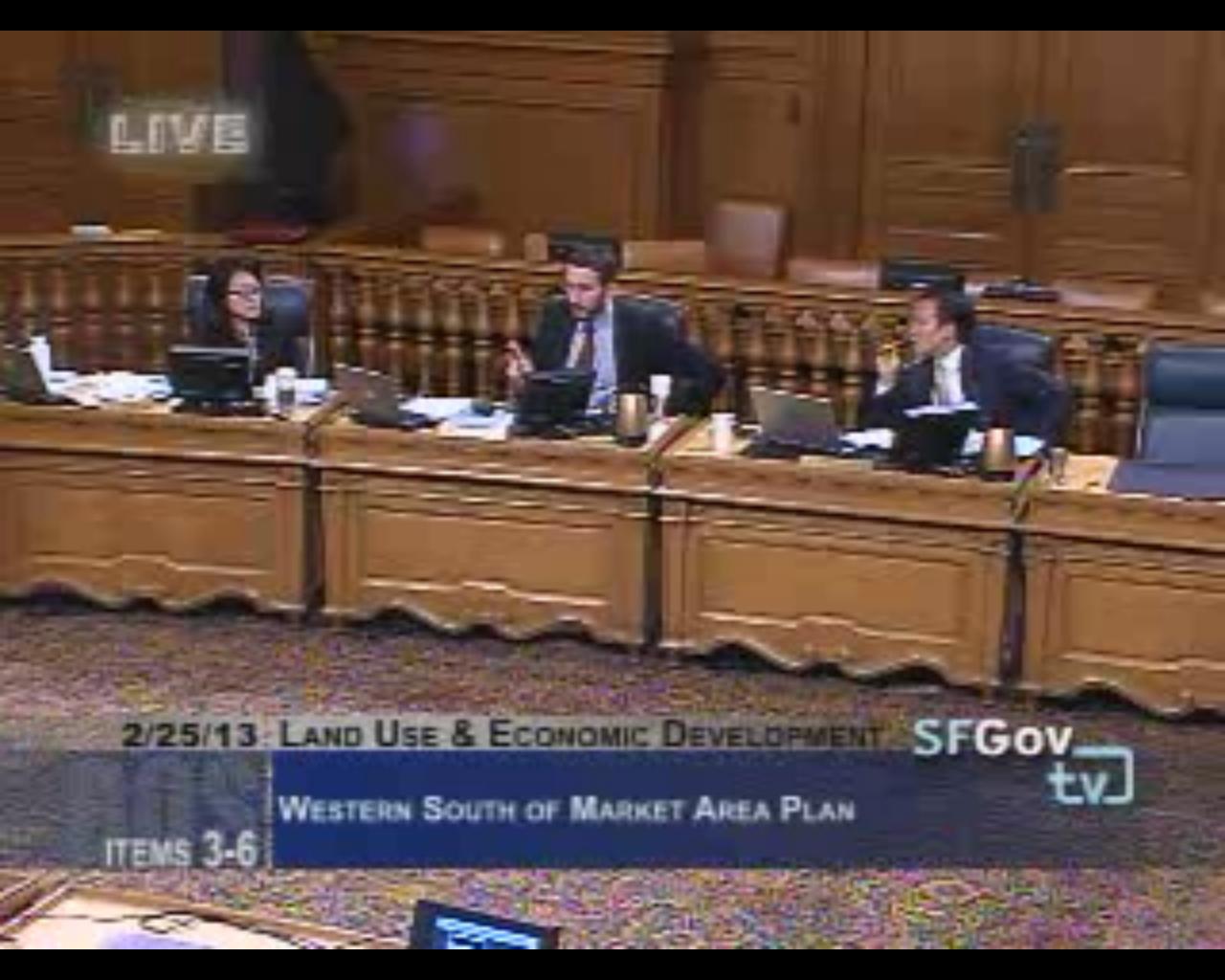
The Western SoMa Community Plan had its first hearing before the Board of Supervisors Land Use and Economic Development Committee today, with dozens of speakers praising the eight-year citizen-based planning effort that developed it but with much of the testimony criticizing the plan’s emphasis on facilitating housing development to the exclusion of other goals.

As we’ve reported, the nightlife community has in recent months been pushing for changes to the plan that would better protect nightclubs from complaints and pressure from nearby residents, particularly along 11th Street. Area Sup. Jane Kim has supported that effort and those concerns were echoed by Sup. Scott Wiener, the committee chair and a strong nightlife advocate.

“I have had significant concerns about this plan…and I’m hoping we can address them over the course of this hearing,” Wiener said.

Wiener also opened another front of attack on the plan by noting that it doesn’t adequately pay for the impact that thousands of new housing units would have on Muni and other aspects of the transportation system. In particular, he criticized a policy in the plan that would let 13 large properties get increased density in exchange for higher affordable housing fees that would be offset by lower transit and other impact fees paid to the city.

“What are we doing to make sure our transportation system keeps pace?” Wiener asked of Planning Department staff, later asking again, “Where would we get the money to improve transit for these increased residents?” Wiener didn’t get back any answers that seemed to satisfy him, so he asked for a more detailed report when the plan returns next week for a second hearing. That concern was echoed by the third committee member, Board President David Chiu, who said, “Building housing without money for transit will lead to long-term problems.”

The concern seemed to revive a losing fight that Wiener led in December over expanding who pays the city’s Transit Impact Development Fee, which pitted transportation advocates against affordable housing activists. Fernando Marti of the Council of Community Housing Organizing rued the revival of that conflict. “We’ve been here before, pitting [transportation against affordable housing needs] as if it were a zero sum game,” Marti told the committee, noting the importance of policies to balance out market rate housing and calling it a “plan for stability in a neighborhood facing large-scale gentrification.”

Marti’s COCHO colleague Peter Cohen, who was closely involved with the plan’s creation, also urged the committee not to tweak the housing policies or the revenues it creates for affordable housing. “This is a major upzoning,” Cohen said. “In 20 years, perhaps all the market rate stock [of housing in the plan area] will be gentrified.”

But the issue raised most often during more than two hours of public testimony involved nightlife and the need to strike a better balance between housing development and entertainment, much of the input stirred up by the California Music and Culture Association, a industry-backed trade group that formed largely in response to crackdowns on clubs in SoMa.

“It’s often said San Francisco can plan more for fun, and this is a great opportunity to do that,” said Guy Carson, a CMAC founder who owns Cafe du Nord. Longtime nightlife advocate Terrence Alan took part in the Western SoMa Task Force for four years before resigning in frustration, and he told the committee, “We are bringing up issues we felt marginalized in bringing up earlier.”

But several people involved with the task force, as well as speakers representing development interests, urged supervisors to pass the place without significant modifications. “There are dozens or hundreds of compromises in this plan,” Cohen said, urging supervisors not to upset that careful balance.

Task Force Chair Jim Meko – whose leadership was widely praised in the testimony – detailed the extensive outreach and detailed work that went into the plan, and offered a simple plea to the committee: “Please pass this plan so we can get on with our lives.”

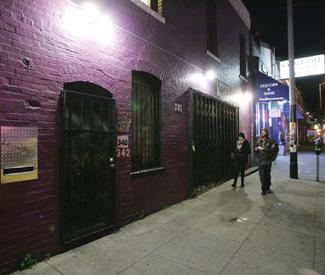
The committee unanimously voted to support the change made to the plan by the Planning Commission to ban new residential development on the raucous 300-block of 11th Street, but to reverse the commission’s decision to grandfather in one final 24-home residential project on that block, in the so-called “purple building” at 340 11th Street. A number of other small changes to the plan were also unanimously approved.

But Kim objected to Wiener’s motion to eliminate the plan provision that would reduce the transit and open space fees and raise the affordable housing fees that developers of those 13 large parcels would pay. “I don’t think it’s good policy to reduce transit impact fees when we’re increasing population,” Wiener said.

“This has gone through an extensive community process,” Kim countered, adding that, “I hate that we’re always having this discussion about transit versus affordable housing.”

But Chiu sided with Wiener and the amendment was approved on a 2-1 vote with Kim in dissent. Yet Chiu held open the possibility of changing his mind next week when the plan returns to committee for a final vote – the delay prompted by the other revisions in the plan – when Planning staff will provide more information on the fee structure and its impacts.

If the committee gives final approval to the plan next Monday, it could be before the full board for approval the next day.

No traffic for the rich

147

The more libertarian elements of the Bay Area have been complaining for years about carpool lanes on the freeways. If everyone’s stuck in traffic, and those lanes are open, why can’t everyone use them — and cut back on congestion?

Now, heeding those complaints (and moving in the fast lane toward privatization of the highway system), the Metropolitan Transportation Commission is moving to allow single-occupant vehicles to use the carpool lanes — for a price.

So the people who can afford to spent ten bucks extra a day can save time, too — and everyone else has to sit in traffic. A couple of problems with this scenario.

For one thing, the idea that moving more cars to the carpool lane will ease congestion on the rest of the road has no basis in fact or reality. Freeways are like jails — the more you build, the faster they fill up. Double the size of I-80 and soon it will still be as crowded. Build another Bay Bridge and it will be choked with cars in a year. That’s been the entire experience of American highway construction since World War II.

An open freeway encourages people to drive. When the price of waiting in traffic gets high enough, people either use transit or … carpool.

Which is the point of the carpool lanes. If a couple of people leave their cars at home, freeing up space for everyone else and in the process cutting down on fossil-fuel emissions, then they get to ride in a less-crowded lane. The carpool lanes are supposed to be more empty; that’s the idea.

Then there’s this notion of first-class and second-class highway travel.

In a perfect world, people whose time is worth more money would sacrifice cash to get where they’re going, and by sitting in traffic for half an hour less would earn tha extra money back at work, and all would even out. But even the most academic-minded economists know that’s not how the real world works. (Of course, in a perfect world we’d have such fast, cheap and effective transit systems that nobody would drive around the Bay Area at all.)

No: What will really happen is that wealthier people who want to go shopping or out to dinner or whatever and drive without sitting in traffic will get to do that, and poorer people will lose even more of their time to the commute, which they can’t afford to do anyway, and the level of economic inequality in the Bay Area will get worse. So will the air quality.

Brilliant idea.

A fine use for Larry’s fine art

23

A loyal reader contacted us with a great suggestion to solve all the fundraising problems of the America’s Cup.

This summer, it turns out, will be about more than racing for the city’s mega-billionaire yacht-race king. The Asian Art Museum’s latest program guide notes that from June 28-Sept. 22, the museum will host “In the Moment: Japanese Art from the Larry Ellison Collection.”

The museum will present “works from the rarely seen collection of Larry Ellison, owner of cup defender Team Oracle USA. The exhibition introduces about 80 artworks spanning 1,300 years. Included are works of the Momoyama (1573-1615) and Edo (1615-1868) periods.” According to the Metropolitican Museum of Art, “this period was characterized by a robust, opulent, and dynamic style, with gold lavishly applied to architecture, furnishings, paintings, and garments.”

Oh, and it’s worth noting that the Momoyama and Edo periods were also marked by the dominance of brutal warlords who claimed much of the nation’s wealth while most subjects lived in dire poverty.

At any rate, I’m sure the stuff is nice. Beautiful, even. And pricey. Bet a philanthropist of Ellison’s stature could auction off just a couple of those 80 pieces and raise enough to pay off the entire AC budget deficit. Eh, Larry?


Supervisors consider Western SoMa Plan, lots of new condos, and “the purple building”

129

The fate of the “purple building” – which has become caught up in the clash between nightlife and residential interests on the clubgoer-saturated 300-block of 11th Street – remains undecided as the Western SoMa Community Plan heads into its first hearing before the Board of Supervisors Land Use and Economic Development Committee on Monday.

As we reported in this week’s paper, a unique citizen-based task force has spent the last eight years developing the plan, which will allow thousands of units of new housing – most of it along Folsom Street – to move forward once the plan gets final approval from the board. But the California Music & Culture Association and other nightlife advocates successfully amended the plan to ban new housing on that 11th Street block as the Planning Commission approved it in December.

Yet the commission also decided to grandfather in a 24-home project at 340 11th Street, the so-called purple building, which nightlife advocates say would put those new residents on a collision course with Slim’s, DNA Lounge, and other big nightclubs on that busy block. As we went to press, both sides and District 6 Sup. Jane Kim were all hopeful that a compromise was imminent, likely involving switching from residential to office.

But with just days to go before that hearing, building owner Tony Lo still hasn’t decided whether to make the change or fight it out in front of the supervisors. His architect John Goldman – whose residential design for the site was placed on hold by the city since shortly after he submitted it in 2005 – had hoped to hear by now but he’s still waiting for Lo to make the call.

“Based on my analysis, it looks feasible to change to offices if you want to do it, and I mean feasible financially and architecturally and planning-wise,” Goldman today told the Guardian, referring to what he told Lo.

Meanwhile, Western SoMa Task Force Chair Jim Meko – who has not been supportive of tweaking the plan after all the work he oversaw – yesterday sent out an email blast to stakeholders and supporters urging them to attend Monday’s hearing and show support for the plan.

“You don’t often get a chance to participate in making decisions about your own neighborhood from start to finish. Some special interest groups are expected to come out of the woodwork to take pot shots at the Plan so the hundreds of participants in this process need to make their voices heard. Your testimony at the hearing next week will make all the difference,” Meko wrote.

The hearing starts at 10am in board chambers in City Hall. This item might have been heard later in the day considering the agenda opens with a continuation of the controversial condo lottery bypass legislation, on which Board President David Chiu and others have been trying to forge a compromise between tenant advocates and homeowner groups. But committee Chair Scott Wiener just told us that item “will be continued. No compromise yet.”

Plan C, and the C stands for Condo conversions

229

No politically savvy San Franciscan has ever really bought the rhetoric espoused by the so-called “moderate” political action group Plan C that it’s all about finding middle ground between what its website calls “a ‘downtown’ machine, and a far-left, dogmatic, so-called ‘progressive’ machine.” As if that unbalanced labeling wasn’t enough of a indicator, the fact that its funding comes from all the biggest cogs in the downtown machine should be.

But now, as the group’s members aggressively work to open the flood gates on converting San Francisco’s rent-controlled apartments into privately controlled condominiums, it’s become more clear than ever that the C stands for Condo and that the financially motivated group is moving the agenda of the real-estate and investment interests that dominate its Board of Directors.

City Hall sources connected to the ongoing meetings that Sups. David Chiu and Mark Farrell have been holding with stakeholders on the controversial condo lottery bypass legislation sponsored by Farrell and Sup. Scott Wiener say there were indications of possible compromise that came out of the first mediation meeting.

That one primarily involved the tenant advocates who have led the charge against the legislation and the representatives for tenancy-in-common owners seeking to buy a bypass to the city’s condo conversion lottery that only allows 200 new condos per year. There were whispers that came from that meeting of a compromise that would allow a one-time bypass in exchange for shutting down the lottery for several years, or indexing it to the construction of new housing for low-income San Franciscans.

Since then, the sources say, Plan C and their partners in the real-estate industry have dominated the meetings with their dogmatic advocacy for indefinitely allowing the maximum number of condo conversions. Despite public statements by Farrell and Wiener that they just want to clear out some backlog without encouraging more landlords to convert apartments to TICs in the future, Plan C just wants to feed more affordable apartments into the expensive real estate market.

Some basic research on the group and its Board of Directors seems to show that this position is about financial self-interest rather than values or ideology.

Plan C Co-Chair Steve Adams is a regional manager for Sterling Bank & Trust, which has consistently been one of the city’s top TIC lenders and which recently sponsored a forum encouraging more conversion of apartments, promising to increase its loan volume, and painting a rosy picture of the TIC financing market that belies Wiener’s claims that TIC owners can’t get financial relief and need the city’s intervention.

One of the key presenters at that symposium was TIC attorney Lyssa Paul, who is also a Plan C board member and someone who makes her living creating more TICs. Other members of the 12-member board who make their living in the real estate industry and benefit directly for TICs conversions are Amanda Jones and Brian Hecktman. Other bankers or investment managers on the board that benefit from the TIC business are Ashley Lyon and Bob Gain.

Co-Chair Mike Sullivan is a venture capital attorney who created Plan C in 2001 and used it to help then-Sup. Gavin Newsom sell his Care Not Cash homelessness plan and run for mayor. Randy Brasche is in software marketing and got involved in the issue being frustrated with the condo lottery and [[CORRECTION/DELETION: last year]] forming the San Francisco TIC Coalition.

Board member David Fix is [[CORRECTION/ADDITION: the former]] president of the Small Property Owners of San Francisco, so it’s possible that his interest is as much ideological as financial, particularly given his past public statements against rent control. That may also be the case with Baha Hariri, a principal at A&F Properties and the former political director of the downtown-funded-and-created Committee on Jobs.

Among the downtown players that fund Plan C, which was sitting on $73,872 in the bank as of the start of this year, are the Committee on Jobs, the San Francisco Association of Realtors, PG&E, San Francisco Apartment Association, Small Property Owners of San Francisco, Shorenstein Realty, the San Francisco Chamber of Commerce, and venture capitalist Ron Conway.

So Plan C appears to be little more than Plan A’s deceptive effort to push Plan Condo. BTW, I’ve been waiting more than 24 hours now to get a call back from the Plan C board, after leaving a message with its only paid administrator, Richard Magary, who told me Sullivan and his colleagues are all quite busy now. But I’ll be happy to update this post if and when I hear back.

2/22 UPDATE: Still no call back from Plan C, but Fix made a comment requesting the two minor corrections above. C’mon, Plan C, gimme a call, what are you so afraid of?

Everybody likes Jerry; now what?

12

For the first time in many years, Californians seem to like their governor. Jerry Brown’s approval rating is now above 50 percent; actually, it’s closer to 60 percent. And the Legislature is more popular, too. (Although ratings of the state Leg, like ratings of Congress, are pretty bogus — I may think the Legislature as a whole is doing a crappy job, because there are too many conservatives, but I think my own Assemblymember, Tom Ammiano, and my own state Senator, Mark Leno, are excellent. Republicans feel the opposite way. Nobody likes the body as a whole, because the body as a whole will never be liberal enough for me or conservative enough for Orange County.)

So here’s the question:

In politics, one of the things you do is build capital. You build it with your reputation, by doing things well (or at least things that make some group of constituents happy). You can’t keep it in the bank forever, or it gets stale and eventually starts to fade away; at some point, you have to use it.

The typical younger politician builds capital for future races — you get high marks as a city council member or county supervisor and you cash in some of that to get elected to the state Leg, then maybe to statewide office or Congress. But our guv isn’t typical in any way, and he’s not young; he might have one more term in office, which at this point he would win easily if he seeks it. But that’s almost certainly the end of the line. For better or for worse, I just don’t see a President Jerry Brown in our future.

So what’s he going to do with his political capital? What are the Democrats in the state Leg, who finally have the confidence of the voters, going to do?

If Jer thinks he’s going to build a couple of giant tunnels under the Delta to move more water south, he’s even battier that we think; that’s never going to happen. The entire environmental world is against it, it’s way too expensive, it will wind up getting delayed by lawsuits until long after Brown is out of office, and there’s no guarantee a future governor will keep Jerry’s Big Dig alive.

He’s got high-speed rail, a much better use of money that has widespread support, but that’s also a long-term project.

So what about reforming Prop. 13? He knows it’s a policy disaster. It’s not going to be repealed, but with the governor’s support, a split-role measure or some other credible reforms could transform local government and do more for the public schools than any pointed-headed “education reform” plan will ever do.

Or single-payer health care. Everyone knows that California’s getting screwed by the insurance industry. We have to write new rules for implementing Obamacare anyway. Twice, the state Leg has passed single-payer bills that were vetoed by the governor (not this governor).

It’s actually possible to lead the way to some changes that people will remember for decades. Jerry: You won’t get this chance again.


Cell phone petition gets 100K signatures

2

A San Francisco entrepreneur’s petition to allow consumers to unlock their cell phones has gathered more than 100,000 signatures, and now the White House will have to offer an official response.

Sina Khanifar, who runs opensignal, has been pushing to overturn a recent ruling allowing cell phone companies to prevent people who want to switch carriers from changing the firmware that controls the device.

The campaign to convince the Obama administration and Congress to overturn the ridiculous ruling continues here.

Look for a quick decision on D4 appointment

44

A Democratic Party resolution calling on Ed Lee to appoint a mother to the Board of Supervisors may have driven the slow-moving mayor to fill the seat of departing Sup. Carmen Chu quickly, perhaps as soon as today (Feb. 21), City Hall sources are saying.

Lee appointed Chu to fill the post of Assessor-Recorder vacated when Phil Ting moved to the state Assembly. But he’s been dragging his feet on naming Chu’s replacement.

Alix Rosenthal, a member of the Democratic County Central Committee, has put a resolution on the agenda for the group’s Feb. 27 meeting urging the mayor to name a woman with a family. Her argument:

Political office is often beyond the reach of mothers, because balancing a political life with family and work is often an insurmountable challenge.  Appointing a mother to fill the District 4 seat will demonstrate the Mayor’s commitment to stemming the tide of families leaving San Francisco, and it may serve to inspire women with children to be politically engaged, and to run for office themselves in the future.

That, of course, could put the mayor’s allies on the DCCC in a tough situation. Will they vote to urge the mayor to do something he doesn’t want to — or will they vote against, you know, motherhood?

Of course, if the mayor makes an appointment before Feb. 27, the resolution becomes moot.

Rosenthal and some other politically active women are supporting Suzy Loftus, a member of the Police Commission and a mom. But D4 is more than half Asian, and has always had an Asian supervisor, so it’s unlikely the mayor would appoint a non-Asian to the job.

One obvious candidate: Katy Tang, who is now Chu’s legislative aide.

The mayor will want someone he can count on as loyal — and who he’s pretty sure can win an election. His last two appointees to elective office, Christina Olague and Rodrigo Santos, were both defeated the first time they faced the voters.

But at this point, Lee isn’t saying anything. Look for an announcement soon.


SF aims for the history books, filing its same-sex marriage brief with the Supremes

10

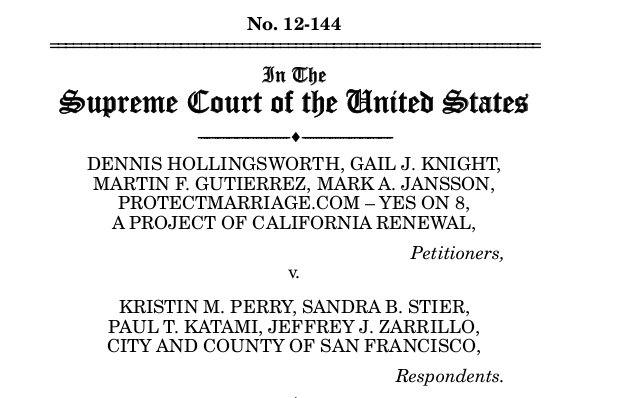
San Francisco City Attorney Dennis Herrera and his legal team today submitted written arguments to the US Supreme Court in the landmark same-sex marriage equality case it will consider this spring, with the hopes that their phrases and framing of the issue will be echoed in a civil rights ruling that could go down in history.

He argues that Proposition 8 – the California ballot measure that undid the California Supreme Court ruling legalizing same-sex marriage in a case that grew out of San Francisco’s unilateral decision to start marrying lesbians and gay men in 2004 – was unconstitutionally about “asserting the inferiority of same-sex couples….But relegating gay couples to a lesser status simply to brand them as different and less worthy than opposite-sex couples is not a legitimate purpose.”

Herrera, Deputy City Attorney Therese Stewart, and the rest of the city’s legal team also take up the notion of the “tyranny the majority” (which I explored in an earlier Guardian story on the issue) in their brief, arguing: “Petitioners’ argument derogates the most important role this Court serves in our democracy: to protect the constitutional rights of minorities from encroachment by an unsympathetic majority. The responsibility to protect individual rights does not transfer to the political process when the dispute happens to be ‘controversial.’  Quite the contrary.  In this circumstance more than any other, constitutional rights ‘may not be submitted to vote; they depend on the outcome of no elections.’ West Virginia State Bd. of Educ. v. Barnette, 319 U.S. 624, 638 (1943).”

Will the Supreme Court justices borrow any of these words or ideas in their ruling, as they sometimes do in such cases, placing them in history books alongside phrases such as “separate but equal is inherently not equal,” from the 1954 Brown v. Board of Education ruling ending racial segregation, which echoed the 1896 Plessy v. Ferguson ruling that it overturned?

Herrera told us that he couldn’t help but feel that sense of momentousness as he finalized the brief: “You have a sense as to the importance of what you’re working on, and that certainly has an impression on you.”

But he also said that he’s continually had that sense through this “long struggle,” during which he said that he’s remained focused on the LGBT community that he’s fighting to protect. “It’s been frustrating when you see how some folks perpetuate the discrimination that’s gone on too long,” he told us, adding that “to finally see it come to the Supreme Court is momentous.”

And Herrera said that he does hope the Supreme Court issues a broad ruling that finally settles this issue and removes the question of same-sex rights from the political realm and deems them to be an issue of equal protection under the law. “They’ve asked the court to abdicate its responsibility because same-sex marriage is controversial,” Herrera told us, arguing that’s why the Constitution offers equal protections to all citizens, regardless of the passions or societal biases of the moment. “Those constitutional rights are not subject to majority rule.”

You can read city’s full 62-page legal brief here.


Why do cops use hollow-point bullets?

100

A Board of Supervisors committee will tomorrow (Thu/21) consider a pair of proposals to regulate the sale of ammunition in San Francisco. And while the legislation is all but certain to pass – gun control is always popular in San Francisco, even when it has minimal impact – one of the measures raises some interesting questions about our understanding of the purpose of deadly weapons.

Sponsoring Sup. Malia Cohen and Mayor Ed Lee held a press conference in December, shortly after the horrific shootings in Newtown, Connecticut, announcing proposals to require notification of the San Francisco Police Department when someone buys 500 round or more of ammunition and banning “the possession or sale of law enforcement or military ammunition.”

The latter measure concerns the sale of hollow-point bullets that are designed to expand after entering the bodies of their targets, which General Hospital Dr. Andre Campbell told those assembled at the press conference “create absolute devastation in the victims. When they strike a victim it’s like a bomb going off.”

So why do we let police officers use them? After all, while officers are instructed to shoot-to-kill when firing their guns, do we really need to make extra sure that those hit by police bullets die? I’m sure the families of the long list of people shot by police who are at most guilty of less than a capital offense — let alone innocent victims of overexuberant policing — might disagree with that approach.

Well, one reason that law enforcement sources cite for their use of hollow-point bullets is that they tend to stay in their targets, thereby reducing collateral damage from bullets exiting a victim and hitting someone else. Fine, but doesn’t that same logic also apply to criminals shooting at rivals in the street? Isn’t it better for their intended target to suffer more damage if it might save other innocent bystanders?

Incidentally, the use of hollow-point bullets was once recognized as a war crime, banned under the Hague Convention of 1899, precisely because of the extra damage they inflicted on human bodies. But now, San Francisco seeks to protect them for cops but ban them for citizens, which certainly seems to violate the spirit of the Second Amendment and intent of allowed an armed citizenry to stand against police state tyranny.

The board’s City Operations and Neighborhood Services Committee takes up the measure starting 10am in City Hall Room 263.

Yee says Cal coach’s shove was damaging and deserves punishment

41

UC Berkeley basketball coach Mike Montgomery’s spur of the moment shove of star Cal player Allen Crabbe during Sunday’s game against USC has garnered quite a bit of attention from the sports media. It also elicited a strong written condemnation from Senator Leland Yee, who is calling for Montgomery’s suspension. Yee, who got a degree in psychology from UC Berkeley, said the following in a press release:

While I have a lot of respect for Coach Montgomery and I appreciate his apology, his actions at last night’s game were completely unacceptable. As a psychologist, I can assure the university and Coach Montgomery that physically pushing a student-athlete does nothing to motivate them. We do not accept such behavior by our professors and administrators, and we should not tolerate it with our coaches.

The game was an emotional one, but representatives of UC – especially adults – need to be able to control their emotions and refrain from physical altercations with students. I urge the university to take swift disciplinary action of at least a one-game suspension and I wish the Cal basketball program the very best as they enter the final games of the season.

It’s unclear whether UC officials are likely to cave to pressure from Yee. So far the matter rests with a reprimand from Pac-12 Commissioner Larry Scott. Lee has made it clear that he thinks such a response is inadequate. He told the media that he would be calling UC officials personally on Tuesday.

Yee’s chief of staff, Adam Keigwin, confirmed that Yee did indeed spend about 30 minutes yesterday talking with Athletic Director Sandy Barbour.

“He expressed why he was concerned with the situation—as an alum, and as a father who has sent his kids to the UC, and as a grandfather who hopes to send his grandkids to the UC,” Keigwin explained. “As a psychologist, he has seen these cases where kids get pushed around, and that just leads to more aggressive behavior and eventually violence.”

Keigwin said that Barbour seemed to agree with Yee, although regarding a harsher punishment she made no promises. Yee would like to see a one-game suspension, or a redaction of his pay for the USC game.

“We’re still waiting to see what she’ll do with that,” said Keigwin. “We’ll give her a day or two to determine what the outcome is going to be.”

The magnitude of Yee’s response might seem odd, but in fact he rarely misses an opportunity to criticize the UC administration. In the past, he has very publicly battled with UC officials over issues of transparency and a controversial nomination to the Board of Regents.

Meanwhile, Montgomery—who initially responded to the incident by saying simply: “Worked, didn’t it?”—has since issued a full apology.

“Trying to get into kids’ faces every now and again just to get them going is kind of what you need to be able to do.” said Montgomery. “[It was] just a bad choice of motivational techniques on my part.”

Free the cell phones! Sign the petition

2

A San Francisco entrepreneur is trying to get the Obama administration to overturn a stupid anticonsumer law that protects cell phone makers and phone companies.

Sina Khanifar, co-founder of opensignal, has collected more than 80,000 signatures on a White House petition calling for a restoration of the right to “unlock” a cell phone — that is, to alter its programming so it can be used on a different carrier’s network.

It is, Khanifar told me, a fairly simple issue: If I buy a cell phone, it ought to be mine to use as I wish — and if that includes taking it apart, rewiring it, or changing the programming, that’s my business.

As he notes:

Intuitively we understand that once we’ve purchased a product it’s up to us how we use or modify it. Replacing the hard drive on a Macbook may invalidate our warranty, but it isn’t, and shouldn’t be, illegal.

But under a recent ruling by the Library of Congress, which oversees parts of the Digital Millenium Copyright Act, cell phone companies have the right to demand exclusive use of the devices.

That means when you buy a phone from, say, Sprint, it comes with a code that ensures it will work only on Sprint’s network. You can’t take that same phone and move your account to, say, Verizon or AT&T; you’d have to buy a new phone.

Khanifar has made something of a business out of resetting phones to work on other networks, which is particularly useful for people who are moving or travelling out of the country, where it often costs a fortune to use a US cell phone. Several years ago, Motorola tried to sue him — but with the help of a pro bono lawyer, he was able to beat the giant company back.

But the new rules mean someone who tries to change the code on a device he or she legally owns can be subject to as much as five years in prison and a $500,000 fine.

Cell phone companies say the law is needed to protect their interests; after all, that smart phone you bought for $99 when you signed a contract with your carrier actually retails for about $700. You get the discount by signing a contract to use the company’s network for a period of time, typically two years.

But Khanifar says — correctly — that those contracts already include hefty cancellation fees that more than cover the investment the company made in giving you a discounted phone.

In other words, he says, this is a corporate giveaway that undermines consumer rights. Ultimately, it will take an act of Congress to change the rules, and so far, only one member, Rep. Peter DeFazio (D-Oregon) has shown any interest. “But right now, we’re just trying to get this on the administration’s radar,” Khanifar said.

He needs 100,000 signatures to get an official White House response, and the deadline is Feb. 23. Sign up.


Can we have cool new additions without gentrifying the Mission?

44

Do livability and gentrification go hand-in-hand? In other words, as you improve a neighborhood like the Valencia Street corridor with bike lanes, wide sidewalks, parklets, and other improvements that are part of the so-called “livability agenda,” does that necessarily drive up rents and force out the working class?

That was a contention made to me recently by owner of nightclubs and small business advocate Michael O’Connor, who has been critical of the Valencia Street improvement project and other initiatives supported by the group Livable City and its Executive Director Tom Radulovich. And it’s part of a larger discussion about whether neighborhoods pay a price for their own success.

O’Connor says the toll taken by livability projects is just too high in the form of rising rents and lost diversity, which is why he’s focused on Oakland for his latest business ventures. Radulovich understands the concern, but he says that safety measures like pedestrian-friendly design and lighting improvements shouldn’t be avoided simply because they make a neighborhood more attractive, and that the answer is making sure social justice and equity remain part of these political conversations.

Frankly, as a resident of the Mission, I had to admit O’Connor’s point that the Valencia Street Improvement Project – in combination with condo conversions, the latest dot-com boom (those dreaded Google-busers), and other upward pressures on cost of living – had the the effect of sterilizing and gentrifying that once-vibrant corridor.

Now, those who want to open cool new businesses in the area have turned to Mission Street, where the commercial rents are still reasonable but also rising, and there are some people wringing their hands about that now too. It’s sort of an economic development domino theory in reverse.

The Mission Local blog last month ran a post that mentioned my friend Illy McMahan’s groovy new store on Mission near 20th Street: Carousel SF, a consignment store featuring the stylishly re-purposed furniture, golden flea market finds, and the works of local artists (many from the Burning Man world, where McMahan met her business partner Kelley Wehman among the indie circus freaks of the Red Nose District).

The article presented that and other more upscale new Mission Street businesses – including Hi-Lo BBQ and Mission Oyster Bar – as spilling over from their “saturation” of Valencia Street, and some comments denigrated the “yuppie real estate developers” behind the trend and said, “Will the last Latino left in the Mission please turn off the lights on the way out.”

I understand the sentiment, but I’m still troubled by it in the same way that I am with O’Connor’s belief that livability improvements should be abandoned because they can gentrify an area. As I’ve argued before, it’s up to San Francisco’s political class to find a way to maintain the city’s affordability and diversity and balance that against its relentless economic development promotion.

After all, McMahan is a single mother of modest means, and the fact that she has an opportunity to start a business based on her sense of style and network of contacts with artists should be a good thing for San Francisco. She and Weham went through The Women’s Initiative training program to learn about operating a small business, getting a loan to open through its Working Solutions affiliate.

“Since 1988, Women’s Initiative has been assisting high-potential low-income women who dream of business ownership,” reads a description on its website, noting that 99 percent of participants are low-income women and 78 percent are women of color. Combine that with McMahan and Wehman’s artistic roots in the Burning Man world — and the need for artists to have outlets to sell their works here — and it’s hard to imagine a business that is more quintessentially San Francisco than this one.

“This store represents our take on aesthetics and our mutual love for all things previous and peculiar. It also gives us the opportunity to showcase the incredibly talented artist communities we’re fortunate to be a part of, while keep the pricing at an affordable level throughout the store,” McMahan says in a press release announcing the recent opening of Carousel SF.

Will this cool new business attract other ones near it? I’m sure they hope so. Will that begin to cause Mission Street to go the way of that parallel universe a block away on Valencia, with rising rents and the calls for livability improvements that inevitably follow? I sure hope not. But our challenge now is to facilitate the dreams of low-income women who strive to be small business owners while ensuring that they can remain welcome and stable in the neighborhoods that they’re helping to improve.

Oil pipeline protest coming to San Francisco

Forward on Climate, an event billed as the largest climate rally in history, will have a presence in San Francisco on Feb. 17. With most activity centered in Washington, D.C., organizers of the nationwide mobilization hope to convince President Barack Obama to reject the development of the Keystone XL pipeline, an extension of a tar-sand oil pipeline that connects Alberta, Canada and multiple Midwest cities.

In San Francisco, protesters plan to surround the U.S. State Department building at One Market Plaza to demonstrate opposition the pipeline project. “Since the pipeline crosses the international boundary with Canada, the State Department has to approve the permit, so symbolically that’s why we chose it,” explained Taylor Hawke of 350 Bay Area.

More than 70 organizations are partnering to promote the event, including 350.org, the Sierra Club, the National Resources Defense Council, CREDO Action and others. Sup. John Avalos will join student groups, indigenous organization Idle No More, and others in speaking at the rally. Organizers expect a turnout of more than 2,000 with participants traveling to San Francisco from Chico, Sacramento, Santa Cruz and University of California campuses at Davis and Merced.

Jessica Dervin-Ackerman of 350 Bay Area says activists “intend to send a strong message to President Obama that immediate action is needed to stop climate disruption and to protect current and future generations,” and that “the U.S. needs to be an international leader in the diplomacy of cutting greenhouse-gas emissions.” A recent HSBC report underscored the role of national governments in fighting climate change, noting that 90 percent of the world’s oil and gas is held by governments or state-owned oil companies.

Some climate activists aren’t waiting until Feb. 17 to get their message across. Protestors from 350.org and the Sierra Club, along with many other organizations, sat outside the gates of the White House Feb. 13 in an act of civil disobedience meant to raise awareness about the Keystone XL pipeline extension. Many were arrested, including actress Daryl Hannah, and released the following day.

Bill McKibben, co-founder of 350.org, touched on Obama’s apparent contradiction on climate change in a recent Rolling Stones article. While the President has made promises to work on wind and solar energy, McKibben said, he’s also emphasized a goal of “producing more oil and gas here at home.” The pipeline would financially benefit the Canadian government, which is anxious to export its most lucrative commodity. The tar sands in Alberta contain as much as 240 gigatons of carbon, representing half the amount carbon scientists say can be “safely” burned by 2050.

Big oil companies stand to lose the most if the Forward on Climate movement succeeds. Oil reserves represent corporate assets that lay buried underground, and that’s where organizations like 350.org want them to stay. “The key to everything is this,” Hawke said: “From the latest science, we now know that the climate crisis is the greatest moral issue of our time.”

TransCanada, the pipeline developer, claims the project would provide tens of thousands of jobs, but the U.S. State Department estimates that it would be closer to five or six thousand temporary construction jobs. A more sustainable approach, says Frances Aubrey of 350.org, would be to create new jobs by investing in renewable energy. The only ones who will benefit from fossil fuels, she added, are the oil companies and the politicians whose campaigns they fund. “Oil companies are willing to change the planet beyond what people can survive,” says Aubrey, “to make a profit.”

Will it fly? Drones in Alameda County and (almost) San Francisco

During what one official called the “show-and-tell” portion of a public hearing held yesterday by a committee of the Alameda County Board of Supervisors, a representative from the Sheriff’s Office held up a drone so the crowd of 100 or so attendees could have a look. The small, lightweight device consisted of a plastic box to house technical equipment, a camera, and four spidery legs affixed with tiny black propellers.

“It’s cuute!” someone exclaimed. But that was likely a sarcastic wisecrack – concerned citizens had packed the board chambers in hopes of convincing the two-person Public Protection Committee that the civil liberties implications of surveillance drones were too great to justify flying them over Oakland and other cities. 

Last summer, Alameda County Sheriff Gregory Ahern submitted a Department of Homeland Security (DHS) grant request for an “unmanned aircraft system” (UAS), police-speak for drone. The agency intends to purchase one or two, depending on the manufacturer, for uses ranging from thermal imagery to crime detection.

The Sheriff now seeks supervisors’ approval, and is working to secure a Certificate of Authorization (COA) from the Federal Aviation Administration, required for aircraft flown at 400 feet. But the Sheriff’s plan has been met with strong resistance from civil liberties advocates worried that drones would open the gates to aerial surveillance and runaway data collection.

Concerns revolve around surveillance

Representatives from the Northern California chapter of the American Civil Liberties Union (ACLU), the Electronic Frontier Foundation (EFF) and the grassroots Alameda County Against Drones voiced myriad concerns about what they viewed as flimsy privacy protections put forward by the department. “The potential concerns with drones are too great to justify any use of drones at all in Alameda County,” said Nadia Kayyali of Alameda County Against Drones.

In turn, Sheriff representatives sought to defend its plan to use the devices, at one point practically asking critics to think of the children.

“We get several hundred calls a year for search and rescue, and deployment of our teams, to find lost children, lost hikers, or elderly persons,” Capt. Tom Madigan explained, and his co-presenter even referenced the case of famed kidnap victim Jaycee Dugard as a possible scenario where a drone could have been deployed. Commander Tom Wright assured supervisors that the drones would not be equipped with weapons, and stated that UAS devices would “not be used for indiscriminate mass surveillance.”

Yet the use of drones for surveillance and intelligence gathering lies at the heart of the controversy. “Data collected in the name of search and rescue could be retained for intelligence gathering and analysis,” ACLU staff attorney Linda Lye warned in comments delivered to the Public Protection Committee. “In conjunction with other existing policies, this would lead to the submission of UAS-collected data to the Northern California Regional Intelligence Center, also known as a ‘fusion center,’ where data – in some instances, about constitutionally protected activity –are stockpiled and analyzed in the name of so-called terrorism prevention.”

According to documents obtained by EFF and MuckRock News, the Sheriff’s Office indicated in its grant request that the unmanned aircraft could be used for “surveillance (investigative and tactical),” “intelligence gathering,” “suspicious persons” or “large crowd control disturbances,” the latter bringing to mind street clashes that flared up in downtown Oakland in 2011 when riot police sought to crush protests organized under the banner of Occupy Oakland. 

If the Alameda County Sheriff’s Department obtains drones, the unmanned aircraft could be deployed anywhere from Monterey to the Oregon border, Madigan noted, if regional law enforcement agencies determined that emergency circumstances warranted jurisdictional waivers.

Technology advancing

Unlike helicopters, drones can gather high-resolution footage and other kinds of data without detection, transmitting live video feed to a command post for real-time viewing. While the Sheriff’s Department is eyeing drones that travel a quarter of a mile from base with a 25-minute flight time capacity, the technology is advancing quickly. It’s technically possible for drones to be equipped with facial recognition technology, radar, or license-plate readers.

Those growing capabilities are part of the reason civil liberties advocates are so focused on hammering out strong privacy safeguards. “We’re wading into uncharted waters here,” Lye cautioned, noting that any privacy safeguards established for these drones would apply to more advanced models down the line. “We have to bake in the privacy safeguards into this template.”

The Alameda County Board of Supervisors held off on approving a drone purchase by the Sheriff Department late last year when faced with controversy. It was originally included as an agenda item before any public meeting had been scheduled, but was later removed after civil liberties advocates intervened. At a December meeting, Undersheriff Richard Lucia told supervisors that including drone approval on the agenda had been “an oversight.”

If Alameda County obtains a drone, it will be the first California law enforcement agency to do so. Several other cities are proceeding cautiously: Last week, for example, Mayor Mike McGinn of Seattle canceled a drone program amid heated controversy.

San Francisco also sought a drone 

Meanwhile, the Alameda County Sheriff’s Department is not the only Bay Area law enforcement agency eyeing unmanned aircraft devices. According to a document unearthed by an EFF and MuckRock News, the San Francisco Police Department (SFPD) submitted a $100,000 funding request to the Bay Area Urban Areas Security Initiative for a “remote pilot video camera,” basically a drone, that could be outfitted to “transmit real-time, geo-coded data to command centers.” The SFPD initially hoped to clear the FAA approval process by June of 2013, according to the document. However, its funding request was rejected. (It is unclear why San Francisco’s funding request for a drone was more than three times the funding request submitted by Alameda County.)

The grant request form notes that Lieutenant Thomas Feledy of the SFPD’s Homeland Security Unit sought funding for “the deployment of mobile compact video cameras in the visual and infrared spectrum … to provide live overhead views of critical infrastructure” in the event of a terrorist attack or natural disaster.

“It was rejected,” Officer Albie Esparza told the Guardian when we called SFPD media relations to ask about it. “And we have no plans of getting a drone.”


Supes scramble to find TIC deal

158

Some San Francisco supervisors are scrambling to find an acceptable compromise that would prevent condo-conversion legislation by Sups. Scott Wiener and Mark Farrell from becoming a bitter battle that could be a no-win situation for centrists.

Board President David Chiu is meeting with tenant groups and trying to craft an alternative to the proposal, which would allow some 2,000 tenancy in common units to convert to condominiums. Wiener says the legislation is needed to provide housing stability to people in the almost-but-not-quite-a-condo world of TICs. Tenant activists who have met with Chiu say he’s discussing ways to limit speculation, which might include a five-year ban on the resale of converted condos. But that won’t be anywhere near enough for the tenant groups.

In fact, tenant and landlord groups are both talking to Sup. Norman Yee, who will be one of the swing votes, and who could introduce a series of amendments to the Wiener/Farrell bill that would be more palatable to tenants.

“They’ve had a couple of meetings,” Yee told me. “We’re just examining the issues to see if there’s a compromise. It would be great if we could work something out so the supervisors could feel better about voting on this.”

But any deal, Ted Gullicksen of the San Francisco Tenants Union told me, would require “structural reform of the future condo-conversion process.”

Yee could probably get away with that — he’s never relied on landlords or real-estate interests for his campaign money, and there aren’t that many TIC owners in his district, which is largely single-family homes. This won’t be a vote that will make or break his future in District 7.

On the other hand, it could be a huge issue for Sup. London Breed, who represents a district with a huge majority of tenants and the most progressive voting record in the city. Breed insists that she hasn’t made up her mind on the issue, and she told me she agrees she’s on the hot seat here: Much of her political and financial support came from Plan C and real-estate interests that want more condo conversions, but she would face furious policial fallout if she voted against tenants. “I am open to a compromise, but only if it’s good policy for the city,” she said.

Supervisors David Campos and John Avalos are strongly against the TIC bill, and it’s likely that Sups. Eric Mar (who got immense support from tenants in his recent re-election) and Jane Kim (who didn’t support the measure in committee) will oppose it unless it’s altered in a way that tenants can accept.

Naturally, Farrell and Wiener are on the yes side, as is, almost certainly, Sup. Carmen Chu.

That leaves Breed, Chiu, Yee, and Sup. Malia Cohen — and three of them have to vote Aye for the bill to pass. Chiu wants to run for state Assembly from the tenant-heavy side of the city, but, as always, he’s looking for a way to avoid an ugly fight.

The problem is that the tenants aren’t going to sign off on anything modest; if they’re going to accept the conversion of 2,000 units that used to be rental housing, they’re going to want to be absolutely certain it doesn’t happen again — and that there are new rules in place that halt the rampant assault on existing rent-controlled housing.

So either the folks in the center — Yee, Breed, Chiu, and Cohen — are going to have to force the landlords to accept some long-term reforms that they won’t like, or politicans like Breed are going to be forced to take a yes or not vote that could come back to haunt them.


Love for women flows through the streets of San Francisco

0

Can you feel the love, San Francisco? Cuz it’s flowing through the streets right now, taking many forms on this unusually busy and politically active Valentine’s Day, with a strong theme of protecting the interests of women.

As I write these words, hundreds of SEIU Local 1021 members – many clad in Cupid-inspired costumes – are rallying outside the San Francisco Department of Human Resources office at 1 South Van Ness. They’re calling for the city not to slash the salaries of 43 different city job classifications that are disproportionately staffed by women and minorities (check my story in this week’s paper for details on that issue).

Meanwhile, over in Dolores Park, members of the Mission Rising collective are massing up amid live bands and other festivities and preparing to dance their way through way through the Mission this afternoon en route to join us with the One Billion Rising movement protesting violence against women and girls in all its many forms. Check the One Billion Rising website for live feeds from about 200 events around the world.

The biggest local manifestation of that global event will start at 4pm outside of City Hall, with speakers and a massive flash mob dance party at 5:30pm (as the Guardian’s Rebecca Bowe reported yesterday, the One Billion Rising event will even include a flash mob dance party within San Francisco County Jail, as well as an event at 3pm in Union Square focused on migrant women).

Or if you prefer your flash mob madness to be politics-free, there’s always the annual Valentine’s Day Pillow fight in Justin Herman Plaza at 5:30pm, which is always a feather-filled good time. However you choose to spend your day, do it with love.

Should city employees be commissioners?

6

Mayor Ed Lee had to do something radical with the Housing Authority, and I’m glad he did. The commissioners who oversee this mess, particularly the chair, Rev. Amos Brown, were nothing but syncophants for Director Henry Alvarez, who clearly has to go. Firing all but one of the commissioners was the right way to go.

(Although technically, the mayor must have gotten them all to resign. The City Charter says a Housing Authority Commission member can only be removed “for inefficiency, neglect of duty, or misconduct in office, after serving written charges and providing an opportunity for a hearing.”)

That said, his replacement commissioners raise an interesting question. Every one of them is a city employee. Four of the five are either department heads or senior staffers, all of whom work for the mayor or one of his appointees. The other is a deputy district attorney.

Commissions are set up to provide a degree of indepedent oversight over city agencies; there’s a reason the mayor doesn’t directly hire and fire the police chief, the fire chief, the planning director, etc.; there are commissions to give members of the public some role in monitoring those departments. Obviously, the mayor appoints most of the commissioners, and most mayors expect a degree of loyalty, but there’s a least  a chance that appointees will speak up when the mayor is doing the wrong thing. (Planning Commissioner Dennis Antennore used to defy Mayor Willie Brown routinely; he ultimately got fired for it, but at least the public got a chance to hear another point of view.)

Now we have people whose day job — and income — depends directly on the mayor’s will (these are not civil servants; they’re all high-level workers who can be fired any time) running a commission. The idea that any of them will ever cross the mayor is now out of the question.

Oh — and do you think there might ever be a time when the District Attorney’s Office has to investigate the Housing Authority for criminal conduct? Maybe? Could that ever happen? And how would Deputy D.A. and Commissioner Eric Fleming handle that?

It’s perfectly legal for city employees to be commissioners, according to a detailed 2010 memo from the City Attorney’s Office. Former Sup. Aaron Peskin tried before he left the board to change that, but he fell short (in part because labor didn’t like the idea; why should city workers be deprived of the ability to participate in the public process?) But we’re not talking about rank-and-file workers who have union protections and can speak their minds and engage in political action freely; we’re talking about direct appointees of the mayor and the city administrator who have no choice but to do the bidding of their bosses.

This just doesn’t seem like a good idea.


It’s about housing, not taxes

48

Texas Guv Rick Perry made a spectacle of himself trying to take businesses away from California, but as everyone with any sense predicted, his trip was a bust. Fact is, very few businessess anywhere make major relocation decisions because of taxes and regulations. But as Calitics points out (with a nice chart), the real reason people have left California of late is the cost of housing.

The so-called “job creators” have enough money to afford to live here, so they aren’t going anywhere. What’s happening is that the rest of the workforce, particularly the middle-class workforce, is finding the gap between the amount they can earn and the amount they have to pay for a home is getting so radical that they’re leaving altogether.

That’s happening in San Francisco, as evictions are driving people out of the city. Some may move to other parts of the Bay Area, creating what most environmentalists and economists agree is an unsustainable situation: Workers living so far from their jobs that vast amounts of energy have to be expended getting them back and forth. But the data shows that people are leaving California altogether. Calitics:

If we are to really continue our growth, we must address the housing crunch that is going on, especially along the coast. That isn’t accomplished through slashing services and budgets, but rather working to create new affordable housing solutions and ways for young families to stay here in California, where most would rather stay.

And let’s remember: One of the biggest factors that does drive business location decisions is the availability of skilled labor. If people are leaving the state because they can’t afford to live here, who’s going to work in the industries that are the biggest employers in San Francisco (hint: It’s not tech)? Tourism is this city’s greatest economic engine, and jobs in the hospitality industry don’t pay enough for housing in the city that depends on it.

That’s a dilemma we all ought to be talking about — and Rick Perry trying to get businesses to go to Texas is not.


Earthquake safety legislation could hit renters hard

42

Pending legislation that would require seismic retrofitting of thousands of properties at the building owners’ expense could hit renters harder than anyone, causing evictions and increasing rents by up to 10 percent, impacts that tenant advocates are trying to get the Mayor’s Office and sponsoring Supervisors David Chiu and Scott Wiener to address.  

As stated in the Earthquake Safety Implementation Program (ESIP) Workplan, retrofit costs are expected to range from $10,000 to $20,000 per dwelling unit. In a five-unit building, this could add up to as much as $100,000. According to a public statement by Mayor Ed Lee, before the first retrofit is required, they will “develop financial incentives and assistance programs to help defray costs for property owners.”

But with apartment owners allowed to pass the cost of the work on to their tenants — a class of San Franciscans already being hit with rising rents, a wave of evictions, and legislation that would encourage more conversation of apartments into condos — this earthquake safety measure could make their situation even worse.

“We have concerns about this, mainly that landlords will be able to pass on the costs to tenants and that landlords will use it as a pretext to evict long-term tenants with affordable rents, so we’ll be working to increase tenant protections in this plan,” says Ted Gullicksen from the San Francisco Tenants Union.

According to the San Francisco Rent Board (SFRB) website, for seismic work that is required by law, 100 percent of the capital improvement cost may be passed through to the tenants, regardless of property size, over a period of 20 years. The increases are subject to an annual limitation of 10 percent of the tenant’s base rent. Gullicksen says that rent increases will be up to $100 a month for many tenants, which is on top of the annual 1.9 percent increase landlords are allowed to impose in rent-controlled apartments.

Another worry for long-term tenants is the possibility of eviction. The SFRB also states some of the just cause evictions these landlords could use would be “…non-payment or habitual late payment of rent… to perform capital improvements which will make the unit temporarily uninhabitable while the work is being done, and… to perform substantial rehabilitation of a building that is at least 50 years old, provided that the cost of the proposed work is at least 75 percent of the cost of new construction.” This would mean rent increases and nearly any construction could be the reason a long-term tenant would be evicted.

This seismic retrofitting could drive up rent prices around the city and be one more obstacle tenants have to face. As Gullicksen said, “I think the mayor and sponsors don’t understand the impact this will have on tenants, so we will look to educate them and press for amendments to lower the rent increases.”

The end of Joe the Rat

10

I grew up in the Catholic Church, went to Transfiguration Carmelite School, got beaten with a ruler by the nuns, had a priest try to teach us sex ed, and was so turned off by it all that by high school I was a committed atheist. But I have always maintained a fascination with the Church, the Pope, the Roman Curia and the whole deeply secretive Vatican operation, which makes for some of the most amazing conspiracy theories in the world.

And now there’s a new one — why did Pope Benedict, Cardinal Ratzinger, the guy known by Catholics facing his Inquisitional wrath a Joe the Rat — do the unthinkable and quit?

Did you know that lightening hit the Vatican just hours after he made his announcement? Does that mean the God (s) on high are/were happy — or angry?

Is he fleeing a new child-abuse scandal? Is there something else we don’t know? Does it have something to do with the Prophecy of Bishop Malachy in 1140? Was it the Knights Templar?

Or is the guy really just too old and tired to live up to the fact that he’s been a failure as a leader of a church that is in serious decine in all but the developing world, where its current growth won’t last?

The Catholic Church is has for much of the past several hundred years been a creature of the Western, developed world — where even Catholics don’t take its teachings very seriously any more. Nobody in Europe or North America wants to be a priest in a religion where celibacy is mandatory, women are second-class citizens, and the theology you’re supposed to teach is so horribly retrograde that 90 percent of the parishoners think it’s perfectly fine to ignore it. The median age of Catholic priests in this part of the world is about 65; that’s really not a sustainable situation.

When I was growing up, Catholic families looked at Pope John XXIII as a revered figure who brought the Church into the modern age; people talked about the Second Vatican Council the way they talked about politics, which, of course, it was, and there was a feeling that the members of the Church — the ones, after all, who pay for the whole thing — might have something of a say in how it was run.

But as the rest of the world moved forward, the Church moved back. The child-abuse scandal was just the outcropping; the Church was run by a clueless bunch of old white guys who became more insular and more conservative as the people who attend their church became more progressive and more interconnected. Now most of the Catholics I know think the Pope is a doddering old fool who has no idea what the world is like. Hell, he’s attacking the nuns because they aren’t homophobic enough.

The Catholic Church remains popular in parts of the developing world, but that’s not going to last. Either the leaders of this religion are going to realize that their ancient dogma has nothing to do with the actual teachings of Jesus and everything to do with money and power (would Jesus really object to gay marriage? Really?) and start to change — or the next Pope will, indeed, oversee the decline of his mission.

Maybe Joe the Rat didn’t want it to happen on his watch.