• No categories

Politics Blog

“Greed is an issue we’ve got to deal with”

6

As President Barack Obama and other top Democrats cravenly negotiate a surrender to Republican extortion and class warfare on behalf of the greedy rich, Sen. Bernie Sanders (I-Vermont) took to the floor of the U.S. Senate to give a full-throated denunciation of the effort and the “war being waged by some of the wealthiest and most powerful people in this country against the working families of the United States of America.”

It’s an extraordinary speech that everyone should watch:

http://www.youtube.com/watch?v=H5OtB298fHY

Sanders correctly notes the hypocrisy of right-wingers who complain about the budget deficit when the topic is social programs or extending unemployment insurance, but then turn around and advocate for extending $700 billion in tax cuts to the richest 2 percent of Americans and abolishing the estate tax, which would give $1 trillion to the richest one-third of 1 percent.

“Their greed has no end, and apparently there is very little concern for the country or the people of this country if it gets in the way of the accumulation of more and more wealth and more and more power,” Sanders said as he compared the U.S. to a banana republic and cited statistics showing the grossly unbalanced distribution of income and wealth is at one of the worst points in our history, and far worse than any other industrialized country in the world. “And still they want more!”

Obama and the Democrats: Please listen to Sanders! History, and the working people of this country, are watching. As Sanders said, “Greed is a issue we’ve got to deal with.”

Rec & Park trashes HANC Recycling Center

At yesterday’s Recreation & Park Commission meeting on Dec. 2, hundreds of San Francisco residents turned out to urge commissioners not to replace the Haight Ashbury Neighborhood Council (HANC) Recycling Center with a community garden. Their pleas fell on deaf ears.

It didn’t matter that a sunnier spot for a community garden had already been identified in the same area, with funding approved by the commission more than a year ago. It didn’t matter that thousands of people use the recycling center every month, and that the nonprofit bolsters community gardens throughout the city with donations and funding. It didn’t matter that we’re in a recession and there were jobs on the line. It didn’t matter that HANC pays rent to a city department facing a $12.5 million deficit, but the community garden would cost $250,000.

All that mattered in the end was that Rec & Park, and Mayor Gavin Newsom, wanted the HANC recycling center out. They thought removing it might discourage homeless people from sleeping in the park and hanging around the neighborhood. After nearly four hours of listening to residents urge them not to do it, the commissioners yawned and pushed the eject button. They unanimously voted in favor of the community garden. A 90-day eviction notice is expected to go out to HANC today.

The fight over HANC’s eviction has been described as a political battle between progressives and moderates, a showdown between heroes who stand up for public safety versus intimidating thugs and the lefties who enable them, and even a sequel to the sit /lie controversy. I think there’s an 800-pound gorilla sitting in the middle of this fight that no one wants to talk about: Class.

Community gardens are wonderfully empowering. I used to volunteer at one at a public housing complex in North Carolina. It was especially important for people who lived in that low-income community, since they benefited from nutritious produce that also lowered their grocery bills. Under the city’s plan for this new, gated community garden, 30 of the 40 garden plots will go to area residents. Given the affluence of that neighborhood, the garden beds will likely go to people who can afford organic groceries at Whole Foods without breaking into a sweat. For well-to-do San Franciscans, growing produce is not a means of survival — it’s about feeling good, and being green. By itself, there’s nothing wrong with that.

The problem is that it will be installed at the expense of a long-standing community resource that employs 10 people and lightens the load for hundreds of others during a recession, when people are truly struggling to get by. The Rec & Park Commission has essentially decided that this parcel of public space should be taken from a nonprofit that benefits people of all classes, and given to a small number of residents who’ve voiced complaints about “quality-of-life issues.”

In its current function, the HANC Recycling Center is empowering to many different kinds of people. Most aren’t homeless. Tough-as-nails Asian grandmas show up with bags full of cans that they can exchange for some extra spending money. Urban gardeners purchase native plants in hopes of pleasing native insects and birds. People on fixed incomes get a small financial boost by turning in recyclables.

A small number of the HANC Recycling Center patrons do sleep outside. In order to earn small amounts of cash for things like food, many of them have to go digging around in garbage cans, which is gross and humiliating. Why would someone paw through the garbage for hours, battling bees and germs, and then haul smelly bottles uphill in a shopping cart just to make a few bucks? My guess is that it’s to ward off desperation. They make their own work, and they get to eat.

“Some of them may use drugs,” one of the speakers acknowledged last night. “But,” he paused for dramatic effect. “Some of us use drugs, too.”

When sit / lie was under debate, critics wondered where the homeless were supposed to go, if they couldn’t sit on the sidewalks. Often, the reply was that they could go to the parks. But this latest attack on the homeless shows that they aren’t welcome there, either.

This is an opinion piece.

Amazing data: How taxes used to be

3

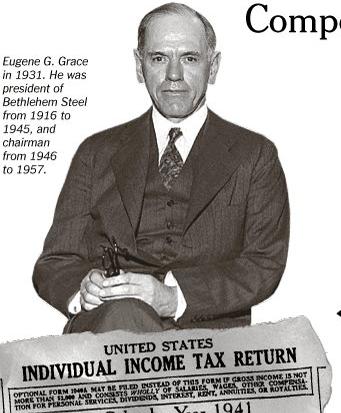
The New York Times has a truly amazing graphic presentation of how the rich used to pay taxes. Check out the image here. The data comes from old IRS filings, made public through the National Archives. They show, for example, that in 1941 — PRIOR to the WWII tax hikes — Eugene Grace, the president of Betehem Steel and one of the highest paid Americans, earned $522,637 (the equivalent of about $7.5 million today), had an adjusted gross income of $336,953 — and paid 66 percent of it, or $114,902, in federal income taxes. Thomas Watson, the president of IBM, paid 69 percent of his AGI in taxes.


Back then, the top marginal tax rate was 81 percent.


And guess what? Those folks were still very rich, still worked hard, still built big companies and created the most poweful economy in the world.


In fact, I could argue that it was precisely BECAUSE OF those high marginal rates that America grew so prosperous in what are now seen as the good old days.

SFBG Radio: From Wikileaks to class warfare

0

In today’s episode, we talk about Wikileaks, why there’s more outrage about embarassing leaks than about really dangerous leaks — and why everybody’s so afraid of talking about class warfare. Cuz we aren’t. Listen up after the jump.


sfbgradio12/3/2010 by endorsements2010

SF Weekly gets it all wrong

4

This is a few days late, but still worth noting. After the Supreme Court ruled in our favor and shot down SF’s Weekly’s final appeal in our predatory pricing lawsuit, the Weekly’s Andy Van De Voorde launched another of his notorious screeds aimed at dismissing all of the proven, factual assertions in our case. Fron day one, Van De Voorde’s been wrong about everything — he said the case was stupid and would be quickly dismissed, he said we’d lost at trial, he said we’d lose on appeal … and every step of the way, he’s been proven wrong. Now he’s going after the judges:


Brugmann certainly has been treated like royalty by the city’s elected judges, who function as the legal arm of the local Democratic machine.


But as Bob Egelko, the Chron’s widely respected court reporter, noted in a remarkable blog post, Van De Voorde is simply factually wrong:


The judge who presided over the trial in San Francisco Superior Court, and more than doubled the jury’s damage award against the Weekly, was Marla Miller — appointed by Republican Gov. Arnold Schwarzenegger. The appeals court justice who wrote the ruling upholding the verdict was Robert Dondero — first appointed to the bench by Republican Gov. Pete Wilson, and named to the appeals court by Schwarzenegger. And of the six Supreme Court justices who voted to deny a hearing on the Weekly’s appeal, five were appointed by Republican governors.


I can go even further. The first judge who handled the case, Richard Kramer — who refused to dismiss the suit and tossed most of the Weekly’s pre-trial motions out the door — was appointed by a Republican (Pete Wilson). Of the three judges on the Appeals panel, two — Dondero and James Marchiano — were appointed by Republicans. And while the third justice, Sandra Margulies, was elevated to the appelate bench by Gray Davis, her first judicial appointment to the Superior Court came from a Republican, George Deukmejian.


So there really weren’t any elected Democratic judges in the mix. (And the judges certainly aren’t part of any political machine; the entire local bench, including every single judge, Democrat, Republican or Independent, supported the re-election of Judge Richard Ulmer in November, while the Democratic Party, and the Bay Guardian, supported challenger Michael Nava.)


Sorry, Andy — as has been the case from day one, the facts speak louder than your ranting. The Guardian won this case on the evidence and the legal merits, all the way along.

Tax breaks we can’t afford

18

The big front-page headline on today’s Examiner: “Workers we can’t afford.” It’s a classic story of the Ex genre, a look at how much labor costs are increasing and eating a hole in the city budget. But what gets me is thal it’s not just the Ex; the Chron takes this line, too, and so do news outlets all over the state (and all over the country). The problem is always labor.


You never see a big headline telling the other side of the story: “Tax breaks we can’t afford.”


The thing is, tax cuts and tax breaks are expenses, just like labor costs. The impact the budget in the same way. And at least city workers DO something; a lot of the tax cuts don’t.


I was watching the City Channel last night (yes, Mr. Mayor, I was one of the “ten people” you joked about who were actually watching) and Newsom was giving a speech out at Mission Bay, welcoming a new biotech outfit to the city. And he went on and on about how his administration has attracted all these companies by giving them tax breaks.


He said that, unlike South San Francisco, this city “taxes jobs.” (That’s just silly; we have a payroll tax because you have to have some form of business tax, and the state won’t let us tax corporate income, and a gross receipts tax also has problems, and a payroll tax is at least an approximation of the size of a company. If we taxed gross receipts instead he’d complain that we were “taxing success.”)


And then when he was done with his prattle, the guy from UC who sets up the Mission Bay incubator space for biotech businesses spoke, and talked about all the reasons busineses want to move into the area, mainly the direct connection with UC researchers and experts in business development and the quality of the workforce. He didn’t say a word about taxes.


Because taxes, particularly the very modest payroll tax the city charges, are such a minor factor in business location decisions that tax breaks like Newsom’s don’t do much good in attracting employers. But they do cost the city money.


And those are expenses — yes, expenses — that we can’t afford.


Privatizing the parks

23

I’m not going all crazy on the idea of pretzel stands in Golden Gate Park, or even a lobster-roll place behind the bandshell. I’m kind of against the lease change at Stowe Lake because I hate to see an out-of-town operator take over a local concession (and I like the funky boats, and the popcorn, and the overall 1950s-era quality of the food stand, which — by the way — makes the best soda water anywhere in town, yumm, so extra fizzy and nice ….).


But it’s worth sounding the alarm about the direction that Phil Ginsberg and Mark Buell are taking the Recreation and Park Department. And it’s not just evicting the HANC recycling center.


I realize that the city’s broke, and Rec-park is broke, and if they can’t raise money by selling coffee and lobster rolls they might have to lay off even more recreation directors. I fell the pain. But there’s a dangerous road ahead, and it looks like this:


Once you decide that parks have to pay for themselves, you’ve destroyed the whole notion of public space.


Check out what happened at the Presidio, where a plan by Rep. Nancy Pelosi to tun the park into essentially a private outfit, with the mandate to reach financial self-sufficiency, led to all sorts of problems and set the stage for a debate over privatizing more parks.


This is, of course, part of a larger discussion, but parks are by their very nature supposed to be places that the community — the taxpayers — support and preserve for the good of all. They aren’t supposed to pay for themselves. You’re not supposed to charge admission. Any commercial activity ought to be designed to benefit the users (it’s nice to have a place to buy a bottle of water on a hot day or a snack for your kids) and not to pay the maintenance bills for the facility.


This is what annoys me more than anything else about Gavin Newsom. He talks about vision and sounds like an environmentalist and progressive, but he misses the whole point. You fund public services with tax dollars, not by auctioning them off to the private sector.


At least, you used to.

EDITORIAL: Save the HANC recycling center

11

The foes of the Haight Ashbury Neighborhood Council recycling center — including the mayor and Rec-Park Director Phil Ginsberg, who desperately want to get the low-income riff-raff who sell cans and bottles for a living out of the Haight and Inner Sunset — pulled out all the stops Dec 2, dragging good ol’ Chuck Nevius, who’s always ready to stand up for what isw clean and well-manicured and free of urban grit, into the fight. The Nevius column in the Chron is almost too perfect; he describes the center as “a noisy, ugly industrial plant” that doesn’t belong in Golden Gate Park. Well, the center is technically in the park, I suppose, but it’s not exactly smack amid Speedway Meadow or the Arboretum; it’s way off on the edge, in an area that most people don’t even think of as the park.

But see, here’s the real issue:

It is a magnet for the down and out, some of whom use the can and bottle payout as an ATM for booze and drugs, and even raid the neighborhood bins to fill their carts.

Imagine: A magnet for the “down and out” in the Haight. Imagine: A way for people to make some money without panhandling (which Nevius dislikes) or hassling tourists (which Nevius dislikes) or selling drugs (which Nevius dislikes) or stealing (which all of us dislike). Imagine: A community-run institution that actually creates green jobs for people who might otherwise be homeless (and doing things that Chuck Nevius dislikes).

The real issue is that the mayor never liked HANC (since he lives in the Haight, he ought to stop by a HANC meeting sometime; it’s really not that scary) and doesn’t like the idea of homeless people congregating around the recycling center, and would just as soon get rid of anything that doesn’t fit his vision of a squeaky clean, fully gentrified city.

And it’s not as if Ginsberg wants to restore that corner of the park to native flora; it will be, in his vision, a community gardening center. Nice, but not exactly a natural space. The new center would also attract small crowds — but of a very different demographic. Which, again, is what this is all about.

The HANC recycling center does everything that Gavin Newsom claims to support. It provides green jobs. It offers employment opportunities for people who are on the margins of society, and lets them get back on their feet — without a penny of taxpayer money. It promotes recycling and sound urban ecology.

The private company that collects our garbage and recycling, which is called Recology, doesn’t like the fact that poor people go around and collect cans and bottles from the blue bins on the sidewalk; the stuff is worth money, and the company would rather keep it. But in the end, the material goes to the same place and stays out of the landfills, which ought to be the point. And honestly, isn’t scavenging and recycling cans and bottles a better occupation than agressive panhandling and crime?

The center’s a bargain for San Francisco, and the personal peeves and suburban sensibilities of Newsom, Ginsberg and Nevius shouldn’t shut it down. The Recreation and Parks Commission should direct Ginsberg to back off on eviction proceedings and let the center stay.


Let’s play the “local hire” numbers game

0

There’s been a lot of discussion at City Hall about the pressing need for mandatory local hire legislation, as opposed to San Francisco’s current “good faith” efforts. And it seems that everyone agrees upon is that something needs to be done, as the Board prepares to vote December 7 on Sup. John Avalos’ local hire proposal, which seeks to ensure that 50 percent of workers hired on city-funded construction projects will be local residents.
The move comes at a time of high unemployment in the recession-hit construction industry, but would kick in as San Francisco stands poised to spend $27 billion on public works projects over the next decade.
‘The city needs to leverage its funding position to ensure that our residents benefit from these investments,” Avalos said at a Dec. 1 committee hearing on his legislation, which would require 25 percent of hours on city-funded construction projects, to be worked by local residents in the first year. This rate would rise 5 percent each year to 50 percent.
It would also require 50 percent of apprentice hours to be worked by local residents in the first year (with out-of-state workers exempt from these requirements).

These requirements currently apply to each individual construction trade (carpenters, painters, laborers, operators, brick masons, plasterers) and not to overall project hours.

The city would pay incentive bonuses to contractors that exceed the requirements.
Contractors who failed to meet the requirements would have the option of paying liquidated damages to the city, or sponsoring apprentices during the project.

But a December 1 report from Ted Egan, the city’s chief economist, estimates the legislation would raise the city’s contracting costs by $9.3 million per year, while creating 350 jobs.
 
Egan breaks down the city’s estimated $9.3 million in contracting and administrative costs into three distinct piles: $2 million in higher bid costs from hiring the unemployed, $4.5 million in higher bid costs from hiring the already unemployed, and $2.8 million in higher costs associated with penalties.

‘This cost represents approximately 1 percent of the city’s $934 million estimated annual spending on covered projects,” Egan noted, adding that the cost to the city will be lower in early years, because unemployment is high now and labor is widely available.

“This is a conservative estimate,” Egan added, “as it assumes no contractor exceeds the target and receives incentive bonuses from the city, and also excludes any contractor productivity losses caused by breaking up core crews.”

Egan acknowledges that most city expenses are associated with inflated contractor bids.
“These will occur because the local supply of skilled trades workers is insufficient to meet the local hiring requirements of the legislation,” he observed. “Contractors will be forced to pay above-the-market wages to workers that already have jobs, and pay the city penalties because resident labor is unavailable in many trades. These costs will be passed on to the city. This excess cost to the city could largely be mitigated by choosing local hiring targets that better reflect local supply.”

“The legislation will increase local employment and associated spending at local businesses, at the cost of higher City contracting costs,” Egan warned. “The legislation creates a net spending and jobs benefit, as written; with recommended mitigations, the positive economic impact can increase, and the cost to the city can decline.”

Egan calculated that estimated costs to the city could be reduced to $2.4 million, if Avalos’ proposed legislation is amended in the following ways:

1.    Replace across-the-board 50 percent mandatory requirements with trade-specific mandates to reflect “supply and demand in each trade.”
Egan argues that across-the-board requirement would lead to higher contracting costs “for several trades where required demand exceeds current supply.”
These impacted occupations include operators, brick masons and plasterers, and represent 50 percent of projected demand for city projects, over the next ten years, Egan said.
“Other occupations, such as carpenters, painters, laborers, and drivers are less impacted and can sustain the scheduled mandate, provided goals are set on an industry-wide and not a project-by-project basis,” Egan stated.

2.    Require a study every two years “to modify requirements and assess progress to a 50 percent mandatory requirement.”
Egan’s report suggests that the city conduct a review for two years, and then set mandatory participation levels for two years for brick masons, block masons, stone masons, cement masons, carpet, floor and tile installers and finishers, concrete finishers and terrazzo workers, construction equipment operators (except paving, surfacing and tamping equipment operators), drywall installers, ceiling tile installers and tapers, electricians, pipe layers, plumbers, pipe fitters and steam fitters, plasterers, stucco masons, roofers and sheet metal workers.
Egan’s proposal is that the city assess the length of time required for each of these trades to develop a pool of qualified resident workers to support a 50 percent local hire mandate, and then, if necessary, propose amendments to the mandatory levels for these trades.

3.    Allow contractors to transfer credit hours
Egan suggests that contractors and sub-contractors could accumulate credit for hiring local residents on non-City funded projects, transfer those accumulated credit hours to other contractors, and apply those credit hours to contracts for covered projects to meet the applicable minimum mandatory hiring requirements, or work off assessed liquidated damages. “Transferred credit hours may only be applied against mandatory hiring requirements for the trade in which they were accumulated,” Egan’s report states.

4.    Eliminate incentive payments
Egan recommends eliminating incentive payments, “since the ability to transfer accumulated credit hours provides a similar, and more efficient, incentive for contractors to exceed targets.”

Egan notes that his analysis assumes that annual public works spending is equal to the 10-year average in the city’s capital plan, which is $3.1 billion.
“60 percent of that will be spent on projects not covered by the legislation, because they are state- or federal-funded,” Egan stated.

He predicts that unemployment in the trades will average 10 percent in the next decade.
“Current unemployment in construction is 20 percent in San Francisco,” Egan said.

Egan argued that allowing contractors that exceed local hire requirements to transfer the additional hours, within a trade, to other contractors “would allow the same local hiring targets to be met on an industry-wide basis, not a project-by-project basis.”

He also recommended eliminating proposed incentive payments.
‘Giving contractors the ability to sell their excess hours creates a private incentive to exceed hiring targets. Contractors which do not meet the local hire requirements will compensate those that do,’ Egan wrote.

But at a Dec. 1 hearing by the Board’s Budget and Finance committee, not everyone agreed with Egan’s findings.

Missing from his “economic costs” equation, some speakers observed, were estimated savings from reduced law enforcement costs and poverty rates, if residents got jobs.
Egan acknowledged that his report does not factor in socio-economic benefits of the plan.
‘It’s a very fair point, but it’s hard to quantify,” Egan told the Guardian.

And while Avalos’ legislation proposes to phase in the local hiring mandate over the course of six years, Egan’s report simply focuses on costs when the city hits 50 percent.

Egan said he could have broken down his report into a phased-in, year by year, basis.
“But it gives the impression of greater certainty,” Egan said, noting that it’s not clear how much the city is going to spend on construction next year. “So, given what we’re planning to spend over the next 10 years, here’s an average estimate,” he explained.

I asked Egan about his report’s claim that there is a 20 percent unemployment rate in the construction industry in San Francisco, given that other city officials, including Mayor Gavin Newsom and Sup. John Avalos, have cited a 40 percent rate.

“The 2009 census figures came out in November and it said that 20 percent of San Francisco residents who are in construction say they are unemployed,” Egan said.

He acknowledged that the 40 percent unemployment rate that Newsom and Avalos cited likely refers to unemployment among folks who work in San Francisco’s construction industry, but live outside the city, where housing prices are cheaper.

Asked if his office was recommending that the local hire percentage start at 20 percent, as some building trades requested during the Budget Committee hearing on Avalos’ proposal Egan indicated this was not the case.
“We don’t see a problem in year one,” Egan explained. “There are a lot of unemployed people in year one that are available, so that target is not hard to meet.

The main problem, to Egan’s mind, was not the mandatory 50 percent local hiring goal, per se, but the requirement that it be achieved by every individual trade.
“That’s why we recommend doing a process every two years to take a look at how good a job individual trades are doing, and then set targets based on the rates of producing a supply of qualified workers,” he said.

“Some won’t take seven years to achieve a 50 percent rate, but others could take much longer,” Egan explained. ‘Otherwise, contractors, will have to raise bids so they can afford to pull qualified workers off other contracts. That would lead to shuffling people around, and the city paying for it, without new people being trained.”

So, that’s where the conversation seems to be headed going into Tuesday’s Board meeting, with the building trades still pushing for amendments, and Avalos, the chief sponsor of the legislation, reportedly trying to win support from Sup. Bevan Dufty, so that he can pass veto-proof legislation before the end of the month. Stay tuned.

SFBG Radio: He won’t be back — grading Arnold

5

In today’s episode, we talk about the outgoing governor, and how to grade his record. Hint: When you think of Arnold Schwarzenegger’s legacy, does anything of substance come to mind (except financial disaster)? Anything? Listen after the break

sfbgradio12/1/2010 by endorsements2010

Newsom and downtown groups court Cohen

18

A rogue’s gallery of downtown power brokers and moderate politicians is lining up to give D10 supervisor-elect Malia Cohen money during a fundraiser at Democratic Party money man Wade Randlett’s house tonight (Wed/1). And while the group may be trying to buy the support of a candidate they didn’t support in the election, Cohen and some of her progressive supporters say she’s been open to developing relationships across the ideological spectrum.

“Fear not,” Cohen told us when we raised an eyebrow at the host committee, and she noted that most of those on the list didn’t endorse her candidacy. “It is a fundraiser event, and now that I’m a newly elected supervisor, I look forward to meeting everyone.”

The guest list includes Mayor Gavin Newsom, former Mayor Willie Brown, Sup. Sean Elsbernd, Assembly member Fiona Ma, Building Owners and Managers Association director Ken Cleaveland, lobbyist Sam Lauter, Brook Turner with Coalition for Better Housing, Kevin Westlye of Golden Gate Restaurant Association, Janan New of San Francisco Apartment Association, as well as building trades head Michael Theriault and Tim Paulson of the San Francisco Labor Council.

“That’s not my perception of it,” Randlett – who used to run the downtown political organization SFSOS – told us when we asked about downtown’s attempt to buy influence with a candidate who finished the campaign about $20,000 in debt. He also rejected the characterization that it was a high-roller event, noting that prices initially listed at $100-$500 have since been lowered to $50. “Anyone who wants to attend at any price is welcome,” he said.

“I think it’s smart of their part, because they didn’t support her in the election, to try to give her money in the end,” said Gabriel Haaland of SEIU Local 1021, which did endorse Cohen. “It remains to be seen where she’s going to land [politically], but it seems clear what this group is attempting to do, to influence her votes.”

Cohen also received endorsements from the San Francisco Democratic County Central Committee, its Chair Aaron Peskin, and Board of Supervisors President David Chiu, who says he isn’t concerned about the Randlett fundraiser. “I understand that she has been celebrating with people from across the ideological spectrum,” Chiu said.

Indeed, Cohen said she is anxious to get to know representatives of San Francisco constituencies across the spectrum, borrowing a line from Shirley Chisholm, the first African-American women elected to Congress, in calling herself “unbought and unbossed.” Cohen said, “I will do a great job representing everyone. I will protect the interests of District 10 residents.”

Randlett, who flamed out with SFSOS before reviving his standing as a top-tier Democratic Party fundraiser by being an early backer of Barack Obama’s presidential bid, told us that was a connection he shares with Cohen. “The only reason I supported Malia from the beginning and am hosting the event for her is that like me she was there for Barack from Springfield through election night, never wavered in her support for him, and continues to stick by him now, when fair weather friends are carping from the sidelines,” Randlett told us.

Paulson told us that Cohen asked him to co-host a fundraiser with Newsom – who Cohen once worked for although he didn’t support her in this election – and that he didn’t see the complete roster until a couple days ago. “I am surprised there was this list,” Paulson said of the groups that regularly oppose progressive candidates and legislation.

But Haaland said that labor and the left will also be reaching out to Cohen, whose lack of a strong ideological grounding and representation of a district slated for the city’s most ambitious redevelopment plans will make her a pivotal vote on the new board. “We have to do our best to reach out to her as well,” Haaland said.


Slideshow from Mission High DREAM Act rally

1

Click here to read the Guardian’s coverage of the DREAM Act rally outside Mission High, nationwide efforts to rally support for this legislation which Congress will vote on during its lame-duck seesion, and how the proposal could offer a pathway to citizenship for thousands of undocumented youth.

Emergency forum Tues. / 30 on HANC recycling center eviction

8

An emergency community forum will be held tonight, Nov. 30, about the Recreation and Parks Department’s plan to evict the Haight Ashbury Neighborhood Council (HANC) Recycling Center from a parking lot in Golden Gate Park. If Mayor Gavin Newsom and his former chief of staff, Rec & Park General Manager Phil Ginsburg, succeed in their plan to evict the 36-year old recycling center, they’ll kill 10 green jobs, eliminate a rare source of income for poor people, and put an end to a community resource that costs San Francisco taxpayers nothing.

HANC believes the recycling center is being targeted by Newsom’s administration as a form of political payback, since the progressive organization opposed Proposition L, the sit / lie ordinance, which Newsom supported.

Ginsburg wants to evict the recycling center, which pays rent to the city, and replace it with a community gardening center that would cost $250,000. The shaded lot doesn’t seem like an ideal site for growing produce.

A memo issued Nov. 29 from Ginsburg to Rec & Park Commissioners notes that it is legal for the department to move forward with the eviction without commission approval. Apparently, Newsom’s administration intends to send 10 people to the unemployment line and kick a 36-year-old green resource to the curb without any public input, despite receiving 400 postcards from San Francisco residents opposing the eviction. The Rec & Park Commission will take up the issue of the new community garden center at its Thurs., Dec. 2 meeting.

Tonight’s emergency forum, organized by Keep Arboretum Free, is an attempt to open up a space for public dialogue.

A stakeholder meeting took place this afternoon with Ginsburg, District 5 Sup. Ross Mirkarimi, Department of the Environment Director Melanie Nutter, representatives from the San Francisco Police Department, represenatives from the offices of Assembly Member Tom Ammiano and City Attorney Dennis Herrera, HANC, and area residents.

Jim Rhoads of the HANC Recycling Center told the Guardian just after the meeting, “They’re going to evict us by the end of December. That’s their goal. The mayor has it in for us and he wants to get us out before he leaves.”

The recycling center, located at Frederick and Arguello streets, operates a buyback program for recyclable materials as well as a San Francisco native plant nursery. Residents from the Inner Sunset Park Neighbors have voiced complaints about “quality-of-life issues” that they link with some of the center’s patrons. During buyback hours, held from 10 a.m. to 3 p.m., people arrive with shopping carts filled of cans and bottles to exchange for small amounts of cash. Some of them are homeless.

Representatives from HANC, Rec & Park, and the Inner Sunset Park Neighbors have been invited to speak at tonight’s forum. “There are strongly felt opinions on both sides,” a flier for the event notes. “In the interest of a broad discussion, a number of long time local residents organized this forum for a full public airing of the issues prior to the Dec. 2 Commission meeting.”

The forum will be held tonight, Tuesday, Nov. 30, from 7 to 9 p.m. at St. John of God, 5th Avenue at Irving St.

To voice your opinion about Rec & Park’s plan to evict HANC, call Phil Ginsburg at 415-831-2701 or email him at Philip.Ginsburg@sfgov.org.

Where the plastic bag ban started

8

Even Gov. Schwarzenegger is now supporting a ban on plastic bags in California, saying the measure, which narrowly failed in the state Senate last session, is a top environmental priority. But let’s remember:

While Debra Saunders is making fun of those wacky supervisors in San Francisco who try all these crazy things, it was Sup. Ross Mirkarimi, who pushed the first ban on plastic bags, and the San Francisco supervisors who approved it.

Of course, when the rest of the country starts to realize that pushing high-fat, high-calorie foods to kids by hawking plastic toys is a bad public policy idea, Saunders will be making fun of something else.

SFBG Radio: No austerity for the rich

1

Everyone’s talking about austerity these days, from the prime minister of Ireland to the president of the United States, who wants to freeze wages for federal workers. But somehow, there’s one class of people who aren’t facing any austerity at all. Funny thing about that. Check out the discussion after the jump.

sfbgradio11/29/2010 by endorsements2010

There are no secrets

0

I see Hillary Clinton is all indignant about the latest Wikileaks release. And there will be no end of hand-wringing in journalistic and political circles about whether this material should have been leaked, released, published etc. (But you have to admit, it’s great stuff; I particularly like the comments about the the looney leader of North Korea is still “quite a good drinker.”) And there is, of course, important data that the public ought to have, and I think the NY Times did the right thing by publishing the material.


But there’s another side of this, something that Clinton and Obama and the whole CIA/national security/spy apparatus ought to already know: These days, it’s really hard to keep anything secret for long.


Daniel Ellsberg had to make clandestine photocopies of thousands of pages of Pentagon Papers docs, then smuggle them out of his office and slip them to a Times reporter in a hotel room. These days? Click of a mouse. Hard to trace, impossible to stop. Once documents of any sort have gone to more than one or two people, you might as well assume they’re going out to the whole world.


Anyone who uses email on a professional basis has been told that. Think of poor Brad the Cad. About time the secretary of state caught on.


Why selling state buildings is so dumb

18

To stem the massive hemorrhaging in the budget, the state of California has authorized the sale of 24 state-owned office buildings across the state to private investors. The state would then rent back the office space.


It’s a classic case of short-term thinking: In the end, the state will end up paying more money in rent than it will gain from the sales. The nonpartisan Legislative Analyst’s Office reported in April that over the next 30 years, the lease payments will likely cost $5  billion more than if the property had stayed in the state’s possession.


But it would provide an immediate injection of $1.2 billion into the state’s general fund.


But there’s an interesting twist that hasn’t been reported on: The state buildings are currently exempt from local property taxes. Once they’re in private hands, county assessors can put them on the tax rolls.


And the way the deal is structured, the state — that is, the taxpayers — will be subsidizing the private owners to cover the local property tax bills. In effect, the deal means that the state will be shifting more money from its general fund to local government — a good thing for counties, but not a terribly good deal for Sacramento.


According to Eric Lamoureux, spokesperson for the Department of General Services, if the local cities decide to tax the new owners, the rent state agencies pay would increase to make up the difference. The private owners would pay nothing.
“The [cost of the tax] is built into lease terms. Ultimately, the state would be paying that.” Lamoureux said.


And while San Francisco City Attorney’s office is still unsure of the exact terms of the sale-lease back agreement, they plan on looking out for the city’s best interests.


 “The city attorney is going to be extremely diligent with the recorder-assessor to collect all the taxes that are owed,” Matt Dorsey, press spokesperson for City Attorney Dennis Herrera, told us. And by collecting property tax, the local city governments would get a nice boost in revenue.


The sale to California First LLC, a partnership between Hines Interests and Antarctica Capital, has already been met with opposition including a lawsuit and an injunction trying to prevent the deal.

Caretaker mayor concept blasted by Daly

18

There’s been much talk about naming a “caretaker mayor” to replace Mayor Gavin Newsom in January – most of it coming from downtown-oriented politicians, advocates, and publications, who are in the minority on the Board of Supervisors – but Sup. Chris Daly offered a full-throated denunciation of the idea this week.

At the end of Tuesday’s long debate on adopting a procedure for choosing a successor mayor, Daly appealed to his colleagues, “Can we please spend a minute talking about what we’d like to see in the new mayor of San Francisco?” And in his remarks that followed, he focused on shooting down the notion that a caretaker mayor is what this troubled city needs.

The idea behind a caretaker would be to choose a technocrat who would pledge not to run for reelection in the fall, thus keeping any prospective candidate from gaining an advantage from incumbency. Names most frequently cited by moderate politicians and media voices are SFPUC head Ed Harrington, Sheriff Michael Hennessey, and City Administrator Ed Lee. Some more progressive caretaker names that get dropped include former Mayor Art Agnos and SF Democratic Party chair Aaron Peskin.

But Daly – publicly sounding a perspective that’s been widely discussed in progressive circles, who question why the board’s progressive majority would purposefully punt away the chance to lead – said the idea is fundamentally flawed: “You would be putting someone in office who is necessarily weak and hamstrung.”

While Daly acknowledges that he’d like to see a progressive in Room 200 and that “the political divide is real” between progressives and moderates, he said the flaws in installing a caretaker mayor should be apparent to everyone. To deal with a $400 million deficit and other structural budget issues, the new mayor is going to have to show leadership and have a base of support, which a caretaker mayor wouldn’t.

Although the Hearst-owned Chronicle has been promoting the idea of a caretaker mayor now, Daly noted that the Hearst-owned Examiner editorialized against the idea last time the city was in this position, in 1978 after Mayor George Moscone was assassinated and the board picked Dianne Feinstein to become mayor. “The City should not have to accept a “caretaker” mayor invested with only a thin veneer of authority,” editorialized the Examiner.

“It would be a colossal mistake,” Daly said of choosing a caretaker mayor. “We need to do better than just someone who knows the inner workings of city government.”

But the fear that the board’s progressive majority would put a progressive in office – or even a moderate politician with some progressive inclinations and connections – seems to be downtown’s greatest fear right now. The fun begins Dec. 7 when the board resumes its discussion of the issue and could start taking nominations.

Chronicle finally uses the P word: Progressive

41

The San Francisco Chronicle ran a good story yesterday on progressives hopes for appointing one of our own as the next mayor. But beyond being fair to progressives that are often demonized by a newspaper whose political sympathies lie with the downtown crowd, the article was notable for something else: it’s use of the word “progressive.”

For years, Chronicle editors have refused to use the word that is most commonly used to describe the people and ideology that controls a majority of the Board of Supervisors, opting instead to label progressives as “far-left” or “ultra-liberal,” while the economic conservatives in town get the reasonable-sounding label “moderate.”

Sources tell the Guardian that this bit of Orwellian wordsmithing started with former Editor Phil Bronstein and was fueled by Mayor Gavin Newsom complaining to Chronicle editors that calling his political enemies “progressives” made us sound too reasonable, rather than the wild-eyed radicals he considered us to be.

I and others have discussed this with Chronicle Metro Editor Audrey Cooper, and her bewildering argument is that progressive “is a politically loaded term that doesn’t mean much to our readers.” I’ve pointed out that the word is quite descriptive and has deep historical roots in California and its own caucus in Congress – and that labeling us “ultra-liberal” is far more loaded and pejorative – but to no avail.

I ran into the writer of yesterday’s story – Rachel Gordon, a solid reporter and former colleague from the City Desk NewsHour television program – at the Board of Supervisors meeting yesterday afternoon and she said that political reporters at the Chronicle have long been pushing to use “progressive” and the editors finally changed the policy.

I have a message in to Cooper and I’ll follow up in Comments if I learn anything more about how and why the decision was made. But it’s good to know the paper of record is now letting progressives be progressives. Maybe now we can get rid of the “moderate” label. How about SoLibEconoCons (socially liberal economic conservatives)? OK, maybe that still needs some work.

Released, Steve Li urges passage of DREAM Act

8

On a cold and sunny morning in late November, as sharp winds stirred up fallen leaves, and most folks were beginning to slow down in anticipation of Thanksgiving, Shing Ma “Steve” Li, a 20-year-old nursing student from San Francisco who narrowly avoided deportation to Peru, whipped the local media into a energized frenzy by advocating for the passage of the DREAM Act during a press conference at the Asian Law Caucus, whose offices sits close to the Transamerica Pyramid, and a stone’s throw from the lantern-decorated streets of Chinatown and the neon-lit strip clubs of North Beach, in San Francisco.

The purpose of the press conference was to give thanks for Li’s release four days earlier from a federal detention facility in Arizona, outline why a hardworking student who has lived in San Francisco since he was 12, has no criminal record, and speaks Cantonese, English, French and Spanish, was incarcerated for two months and threatened with deportation. And ultimately, the event was aimed to stir up support for the DREAM ((Development, Relief and Education for Alien Minors) Act, bi-partisan legislation that leading congressional Democrats plan to put to a vote this month.

Senate Majority leader Harry Reid and House Speaker Nancy Pelosi have promised to move to a vote on the DREAM Act on November 29, during Congress’ lame duck session, a brief window of opportunity to complete action on stalled bills, before Republicans take charge of the House, and Democrats see their majority in the Senate shrink, come January 2011.

Li, his family and his legal counsel Sin Yen Ling, a senior staff attorney at the Asian Law Caucus, kicked off the press conference by acknowledging the many supporters whose phone-calling, letter writing and protesting outside Sen. Barbara Boxer’s offices in San Francisco, helped secure Li’s Nov. 19 release from a federal detention center in Arizona, after Sen. Dianne Feinstein introduced a private bill to delay Li’s deportation.

“I believe his removal would be unjust before the Senate gets to vote on the DREAM Act,” Feinstein said in a Nov. 19 press statement. Feinstein’s bill guarantees Li protection for 75 days after Congress’ lame-duck session end. And Li’s attorney Ling says Feinstein may reintroduce her private bill next year, and that ICE isn’t likely to deport Li in future, now that he is no longer considered a fugitive.

“We don’t feel that Feinstein’s private bill will pass, because of the result of the Nov. 2 election and the reality of partisan politics, but it’s unlikely that Steve will get deported again,” Ling said.

If passed, the DREAM Act would grant undocumented immigrants a pathway to citizenship, if they entered the United States before age 15 and have attended college or served in the military for two years.

Li’s ordeal—and his ensuing conversion to an ardent DREAM Act advocate—is happening against the backdrop of an increasingly anti-immigrant mood in the United States, as witnessed in Arizona, where state legislators passed SB 1070 earlier this year, and now in California, where a Tea Party member from Belmont wants California voters to weigh in on a similar initiative in 2012. And then there’s the sobering reality that come January, congressional Republicans, who are facing challenges from the far right-wing Tea Party,  take control of the House and are unlikely to advocate for immigration reform.

But Li, who is ethnically Chinese, and was born and raised in Peru until he was eleven years old, after his parents left China in the 1980s to escape its one-child policy, remained optimistic, as he drew on his recent experience to illustrate why Congress needs to passes the bi-partisan DREAM Act now.

“I’m still at risk of being deported,” Li said, noting that, each year, about 65,000 U.S.-raised students graduate from high school and would qualify for the DREAM Act, which addresses the fact that federal immigration law has no mechanism to consider the circumstances of youth who were brought here as minors and call the U.S. home, but can’t work legally, face barriers to accessing higher education, and live in constant fear of deportation.

“We have to work to do something to stop these students from being deported,” said Li, who wasn’t aware that a final deportation order had been issued against his family, when he was 14 years old and the U.S. denied his parents’ application for political asylum. “It’s important we push Congress, so no other student has to go through the same thing I did.”

“How many future doctors, engineers and scientists will the US lose,” Li added, questioning whether the US could end up deporting geniuses who might otherwise have discovered a cure for cancer, or invented ground-breaking sustainable energy technologies. “We are America’s future and we want to make a difference,” he said. “I still believe America is a great nation, a moral nation, and that Americans, if given all the information, will do the right thing.”

Li’s legal counsel Ling, recalled how Li and his parents were arrested on Sept. 15 by Immigration and Customs Enforcement (ICE) agents, and detained at ICE’s offices in downtown San Francisco, before being transferred to a jail in Sacramento County. “They were arrested as part of ICE’s fugitive operations program, which targets people who have failed to comply with final deportation orders,” she said.

The family was held there for three weeks, Ling said, before Li’s parents were released back to San Francisco, wearing electronic monitoring anklets. But Li was involuntarily transferred to a federal detention facility in Florence, Arizona, where he remained until mid-November. His transfer also made it impossible for his parents to visit, since, under the terms of their electronically monitored release by ICE, they are not allowed to leave San Francisco.

Ling said ICE blames a lack of bed space in the Bay Area for why they must transfer folks from San Francisco to Arizona, Texas or a facility near Bakersfield, California. But either way, the practice serves to isolate immigrant detainees from family and friends as they await deportation.

“Steve was released from Florence, Arizona, on Friday, Nov. 19, and then took a Greyhound bus, which arrived in San Francisco Saturday afternoon,” Ling said, noting that ICE wasn’t planning to notify her or Li’s family of his release, and that they typically drive folks to Phoenix and drop them off at the bus station.

Li’s mother Maria addressed the media in Cantonese, as she thanked Sen. Feinstein for allowing her son “to return to his mother’s embrace.”

And then Li, who says he is “a huge Giants fan” and “grew up reciting the pledge of allegiance at school, just like everybody else”, described his ordeal
.
“I always viewed myself as an American,” Li said, recalling how that perception was challenged when ICE raided his home and threw him in jail, this fall.
“I was shocked and confused, I felt it must have been a mistake” Li said, recalling that he was in the bathroom getting ready for school when the doorbell rang on Sept. 15.
“I didn’t expect anyone, so I woke up my mother, and she answered the door,” Li said.“Next thing, immigration agents came into the house. I didn’t know what was going on.They said they had to take me somewhere, that I had to be deported. “

Li said he was immediately separated from his mother and not allowed to ask ICE questions.
‘They searched me, threw me in the car, handcuffed me and took me to the immigration center,” Li said, referring to ICE’s office in downtown San Francisco.
“It was intimidating. I was scared of what was going to happen to me,” Li continued, describing how he was held for the rest of the day in a cell that contained 20 other people, some of whom had been transferred from other detention facilities and were already wearing prison clothing.

“I was fingerprinted, my photograph was taken and my situation was explained to me,” Li said, describing his shock at then being transferred in handcuffs and shackles by bus to a jail in Sacramento County with his parents, who were also handcuffed and shackled.
“It was traumatic to see my parents, who are hard-working people, be treated like that,” he said,

In Sacramento County, Li and another detainee were placed in a cell that contained bunk beds, a small table, a toilet and a sink.
“We could only go to the day room and watch TV for one hour a day,” he said. “The immigration authorities didn’t tell me anything, they just threw me from place to place.”

After three weeks, Li thought he was going to be released, when the prison authorities returned his clothes and got him to sign some paperwork. But instead, he was transferred to ICE’s San Francisco office on Sansome Street, put him in a holding cell, and told him he was being sent to Arizona to be processed for deportation,

“My whole world came down,” Li said. “I couldn’t talk to my parents, who had already been released. I thought of never being able to see my family and friends again. It was depressing.”

Things got worse when he was shackled, handcuffed, and loaded onto a bus which took him to Oakland airport, where he was put on a plane with a bunch of other deportation detainees.
“We were handcuffed and shackled to our seats, and I wondered what would happen if the plane went down,” Li said, describing a seemingly interminable journey to Arizona, which involved making landings in Los Angeles and San Diego.
“In San Diego, they took Mexicans off the bus, presumably to drive them to the border,” Li said.

Arriving in Arizona the following morning, Li was driven to an isolated federal detention facility in Florence, which is about 800 miles from San Francisco, where he was only allowed outside his cell for an hour a day.
“We were incarcerated all day and body searched multiple times in a facility, where there were three toilets and four showers between 64 people,” he said.

Locked up with 400 fellow detainees, Li heard a lot of stories that were similar to his: students who’d received a higher education and were very talented, but didn’t have legal status.

In particular, Li remembers one student he met during his Arizona incarceration.
“Like me, he came here with his parents and had no say in that decision, but was picked up as a result of new legislation in Arizona, “ he said.

Li’s arrest means he missed a semester of school, but he vows to continue his studies. And despite his traumatic experience, Li says he is not bitter.
“It went through my mind,” he said, “But I have learned a lot, including the fact that we have a broken immigration system. I urge everyone who qualifies for the DREAM Act to use their voice. They need to find the courage to use it and fight to change the law.”




Progressives show unity as board approves mayoral succession process

21

The San Francisco Board of Supervisors unanimously approved a process for replacing Mayor Gavin Newsom last night after the progressive majority stuck together on a pair of key procedural votes and some parliamentary jousting provided a preview of the high-stakes power struggle that will begin Dec. 7.

Sup. Sean Elsbernd led the board moderates (Sups. Carmen Chu, Michela Alioto-Pier, Bevan Dufty, and Sophie Maxwell) in trying to dilute the voting power of the six progressives on the board (Sups. David Chiu, Chis Daly, David Campos, Eric Mar, Ross Mirkarimi, and John Avalos) and ensure they can’t vote as a bloc to choose the new mayor.

State conflict-of-interest rules spelled out by the California Political Reform Act and associated rulings prevent supervisors from voting in their economic interests, as becoming mayor would be. So Board Clerk Angela Calvillo and the Santa Clara County Counsel’s Office (legal counsel in the matter after our own City Attorney’s Office recused itself) created procedures whereby all nominees leave the room while the remaining supervisors vote.

But as Daly noted, clearing several supervisors from the room would make it unlikely that those remaining to come up with six votes for anyone. He also said the system would deny too many San Franciscans of a representative in this important decision and allow sabotage by just a few moderate supervisors, who could vote with a majority of supervisors present to adjourn the meeting in order to push the decision back to the next board that is sworn in on Jan. 11.

“The process before us is flawed,” Daly said.

So Daly sought to have the board vote on every nomination as it comes up, but Elsbernd argued that under Robert’s Rules of Order, nominations don’t automatically close like that and to modify a board rule that contradicts Robert’s Rules requires a supermajority of eight votes. Calvillo, who serves as the parliamentarian, agreed with that interpretation and Chiu (who serves as chair and is the final word on such questions) ruled that a supermajority was required.

Although some of his progressive colleagues privately grumbled about a ruling that ultimately hurt the progressives’ preferred system, Chiu later told the Guardian, “I gotta play umpire as I see the rules…We need to ensure the process and how we arrive at a process is fair and transparent.”

Nonetheless, Chiu voted with the progressives on the rule change, which failed on a 6-5 vote. But Daly noted that supervisors may still refuse nominations and remain voting until they are ready to be considered themselves, which could practically have the same effect as the rejected rule change. “If we think that’s a better way to do it, we can do it, but we don’t need to fall into the trap and subterfuge of our opponents,” Daly told his colleagues.

Elsbernd then moved to approve the process as developed by Calvillo, but Daly instead made a motion to amend the process by incorporating some elements on his plan that don’t require a supermajority. After a short recess to clarify the motion, the next battleground was over the question of how nominees would be voted on.

Calvillo and Elsbernd preferred a system whereby supervisors would vote on the group of nominees all at once, but Daly argued that would dilute the vote and make it difficult to discern which of the nominees could get to six votes (and conversely, which nominees couldn’t and could thereby withdraw their nominations and participate in the process).

“It is not the only way to put together a process that relies on Robert’s Rules and board rules,” Daly noted, a point that was also confirmed at the meeting by Assistant Santa Clara County Counsel Orry Korb under questioning from Campos. “There are different ways to configure the nomination process,” Korb said. “Legally, there is no prohibition against taking single nominations at a time.”

So Daly made a motion to have each nominee in turn voted up or down by the voting board members, which required only a majority vote because it doesn’t contradict Robert’s Rules of Order. That motion was approved by the progressive supervisors on a 6-5 vote.

Both sides at times sought to cast the other as playing procedural games, and both emphasized what an important decision this is. “This is without a question the most important vote that any of us will take as a member of the Board of Supervisors and one that everyone is watching,” Elsbernd said of choosing a new mayor.

So after the divisive procedural votes played out, Chiu stepped down from the podium and appealed for unity around the final set of procedures. He said that San Franciscans need to have confidence that the process is fair and accepted by all, and so, “It would be great if we have more than a 6-5 vote on this.”

As the role call was taken, Carmen Chu was the first moderate to vote “yes,” and her colleagues followed suit on a 11-0 vote to approve the process. At that point, the board could have begun taking nominations, but it was already 7 p.m. and both Daly and Chiu argued to delay that process by couple weeks.

“We owe it to ourselves and this city to have a discussion [of what qualities various supervisors want to see in a new mayor] before we get into names and sequestration,” Daly said.

He and other progressive proposed to continue this discussion to Dec. 7, but Elsbernd – who was visibly agitated by the discussion – suddenly moved to table the item (which would end the discussion without spelling out the next step), a motion rejected on a 4-7 vote, with Maxwell joining the progressives.

The discussion ended with a unanimous vote to continue the item to Dec. 7, when supervisors will discuss what they want in a new mayor and possibly begin the process of making and voting on nominations. Anyone who receives six votes will need to again be confirmed during the board meeting on Jan. 4, a day after Newsom assumes the office of lieutenant governor.

Prison report: The madness of parole

10

By Just A Guy

Editors Note: For much of 2009, Just A Guy wrote reports for us from a California state prison (here’s an example). He was released last November, but continues to send us commentary every now and then.

 
So, it’s been some time since any of you have heard anything from me. Here’s a story for you about how poorly the parole system works.

As many of you will remember, I was released in November of last year, but paroled to a state out of California.


Since that time I have had no problems whatsoever, have been very successful on parole, worked and travelled for business all over the country, supported my family, and been an upstanding citizen.

Earlier this year, I met some people at an industry meeting, and the discussion resulted in my being offered a job that required my moving to a state different than where I was on parole. The transfer paperwork allowing me to move from the controlling state to the new state was initiated a short time after I accepted the position, but the paperwork that was submitted through the Interstate Compact Office was somehow lost.
 
Meanwhile, I moved to the new state in order to start my new position; though I was having to go back monthly to my old state to report for parole, as one isn’t allowed to be out of state on a travel permit for more than 30 days without reporting back to the controlling state. In the beginning of October — three months later — I found out that the transfer paperwork had been lost and had to be re-submitted; meanwhile I had to spend a minimum of $600 a month to go back to my controlling state and report in. Being proactive, I called the out-of-state parole office in California to find out what was going on and explained the situation. California “fast-tracked” my paperwork to get the out-of-state transfer done. Fortunately my parole officer at the time was very understanding and didn’t make me come in to report the last time I was supposed to since the paperwork was confirmed as being processed by California.

Ultimately, in the last week of October, my transfer paperwork came through and I am now officially under the supervision of the new state.

Why does any of this matter? It’s been a year since I left prison, and my parole should be ending. I would have been a “no brainer” to be discharged from supervision in the state I just transferred out of — but because I just moved to a new state, the California Parole Division has recommended I remain on parole because I don’t have a proven track record of success in the new state — even though I have been successfully employed here for four months, and was previously successfully employed in the old state for eight months.

Apparently, it doesn’t matter — because I’m in a new environment and they want to make sure I’m abiding by the rules and regulations of parole in the new environment, which, really are about the same as the old environment.

The irony of all of this is that I went above and beyond in trying to make sure I was doing things right and following the rules of California and the other two states. I even called the California Interstate Office to find out what the problems in facilitating my transfer were and got them resolved. Had I just gone back and forth between the state where I was residing and working (costing $600 a month in travel) and let the system do its slow meandering work, my transfer probably still wouldn’t have gone through — it would have shown I was successful in the “old state” and I would be recommended for discharge.
Now, because I tried to keep things on the up and up, I’m getting punished.

It’s very frustrating. I have to travel with some frequency for my job, but the new state is less permissive with business travel and that affects my ability to do my job and support my family and be successful. I have always been under the impression that parole was meant to help protect the public AND help the parolees make a successful transition back to society. I have done everything humanly possible to be successful, but the process just gets in the way.

I am being recommended to be retained on parole because I started a new job – crazy, since that makes our family’s life better.

Another crazy thing, the reason I had to call the California Interstate Office, is that parole agents are not allowed to contact each other directly. In other words, my parole agent in the state I transferred out of is not allowed to contact the parole office in California directly. I can do it but she can’t. EVERYTHING has to go through Interstate Compact; no direct interaction between agencies is allowed. How’s that for effective.

Bottom line, there’s still a chance the Board of Parole may grant my discharge against the recommendation of the California Parole Unit, but what’s the likelihood of that? After all, now that I’m not in California it doesn’t cost them any money to keep me on parole in the new state! I promise you if I were in California or the previous state it would be rubber stamped.

The worst part is, I don’t get an opportunity to argue my case in front of the board, I don’t get to see the recommendation, I don’t even know when the discharge hearing is going to be.
Result: stuck on parole for another year for doing things the right way, ability to affectively my business greatly disabled. Way to go California, keep up the good work.

Supreme Court rejects SF Weekly appeal

14

The California Supreme Court let stand Nov. 23rd a landmark ruling protecting small business from predatory chains, denying without comment an attempt by SF Weekly and its chain parent to get the high court to hear the case.


The decision brings to an end more than two years of appeals by the Weekly and Village Voice Media and effectively concludes the legal case.


The Bay Guardian sued the Weekly and the New Times chain, now known as Village Voice Media, in 2004, charging that the Weekly had systematically sold ads below cost in an effort to harm the local, independent competitor. By taking advantage of the resources of a large company, the Weekly was able to stay in business despite losing money every year, and was using below-cost pricing as a way to take ads away from the Guardian.


“We have before us the case of an ongoing, comprehensive, below-cost pricing scheme,” the Appeals Court concluded. You can read that ruling here (pdf)


The Appeals Court noted that shortly after New Times bought SF Weekly in 1995, New Times Executive Editor Mike Lacey announced that he would use the chain’s deep pockets to assault the Guardian. “The essence of Lacey’s message was that he wanted to ‘put the Guardian out of business,'”he ruling states. “The sales representatives were made aware that advertising could be ‘sold below cost’ if needed ‘in order to make a sale’ and the resources of New Times would cover the loses, even over a term of many years.”


That sort of behavior is specifically barred by California’s Unfair Practices Act, which was designed to protect small business from big chains.


SF Weekly and VVM tried to argue in their appeals that the state law should be consistent with federal antitrust law, which sets a much higher standard for proving predatory pricing. But the Appeals Court and the Supreme Court disagreed. California, the ruling now says, has every right to provide greater protections for small business than the federal government does.


There are 20 other states that have laws similar the the California Unfair Practices Act.


The ruling is a victory not just for the Bay Guardian but for small business across the state. The appellate courts have made it clear that predatory pricing is a violation of law — and the ruling can now be used by any independent merchant fighting big chains. As Ralph Alldredge, one of our laywers, noted after the Appeals Court ruling: “Think of what that means for big-box retailers, which have used below-cost selling on some products to attract customers away from small, independently owned grocery, hardware, drug, and department stores.”


Editorial: The screwy process for selecting a mayor

19

The clerk of the Board of Supervisors, at the request of Board President David Chiu, has released a proposal for the selection process for a new mayor, and it’s about as complicated and confusing as everyone expected. That’s in part the result of the vagueness of the City Charter, which simply specifies that a vacancy in the office of mayor shall be filled by a San Francisco registered voter chosen by a majority of the supervisors but offers no procedural clues on how to get there. And the Political Reform Act sets very strict limits on conflicts of interest for elected officials in California; a supervisor, for example, can’t vote for himself or herself or do anything to promote his or her candidacy for an office that comes with a pay raise.


In the end, the proposal leaves limited room for public input — and makes it very difficult for any sitting supervisor, particularly one of the progressives, to wind up winning the job.


The way the rules are laid out, the board would accept nominations — but any sitting supervisor who accepted the nomination would have to leave the room at once, cease all communication with his or her colleagues, and play no role in further deliberations or voting. Since it’s entirely possible that several supervisors — and possibly several progressives — could be nominated, the process would cripple the final outcome since the only ones allowed to vote would be the remaining board members whose names aren’t in the mix.


That skews the outcome heavily toward one of two options: the supervisors appoint someone who isn’t on the board — or Chiu winds up as both acting mayor and board president because nobody else can muster six votes. The only other option: The progressives all stick together, line up in advance behind a candidate who’s currently on the board, and find one more vote for that person.


The whole thing is so screwy that the supervisors ought to make some changes before they adopt it and try, to the extent that it’s legal, to inject some sanity into the process.


For example: Instead of opening the nominations, collecting a long list of names, sending all of the sitting supervisors on that list out of the room and then voting, the board could take the names one at a time. A supervisor gets nominated, leaves the room, and the votes are tallied; if he or she has fewer than six, the process starts again. (The problem: who goes first — because the first person eliminated can’t be nominated again. To be fair, there would have to be some sort of random drawing of which supervisor could make the first nomination — which alone might add too much random chance to the outcome.)


Then there’s the question of when this all takes place. If the process starts now and an interim mayor is chosen, the board will have to reconfirm that person Jan. 4 when Gavin Newsom actually resigns to take over as lieutenant governor. There’s a chance something could go wrong in the meantime and the board would have to change its vote, and there’s a chance that state law would prevent a supervisor who won from acting in any way to influence the final vote. But those are better risks than the option of leaving everything to the last day. And if the board decides that it can’t or shouldn’t act until Jan. 4, special meetings ought to be calendared for Jan. 5, 6, and 7 to give the current board more than one day to make the final decision.


And before anything happens, the board needs to schedule at lest one open hearing to get input from the public on the qualifications for the next mayor and on potential candidates.


The bottom line: any candidate who wants to get progressive support needs to be willing to do more than sign legislation and manage the city. He or she needs to be willing to use political capital and the mayor’s bully pulpit to make the case for progressive change — on taxes, services, the budget, and an overall civic vision. And the six board members on the left need to stick together, or that won’t happen.