• No categories

Politics Blog

Mystery of the school lunches — revealed!

0

Editors note: My son, Michael, constantly complains that none of the reporters who cover the public schools (including me) ever talk to the students. We listen to school board members, adminstrators, parents, sometimes teachers — but the kids never get a voice. I agree — it’s a problem. So when his sixth grade Language Arts class at Aptos came by the Guardian for a field trip (thanks, Ms. Oryall), I decided to let them write their own story, about whatever was bothering them. Here’s the result; I have edited it only for style.

Did you know that the school lunches are made in Illinois? They’re not always organic; in fact, at best they’re only organic once a month.


The district spends $18 million a year on about 4 million lunches.

They’re shipped in a refrigerated truck about 2,000 miles – releasing CO2 emissions.

We got this information by calling Nancy Waymack, executive director of policy and operations for SFUSD.

The lunches are made, she said, by human beings but are packaged by machine. The salads are grown in California and the bread is made in the Bay Area, but those are the only local parts of the lunch.

Aleta Oryall, sixth grade teacher who has worked at Aptos for 12 years, said that for the first nine years she was at the school, food was made at the cafeteria. “They would bake real chickens,” she said. “They served turkey over sweet potatos. It was good.”

Why has it changed?

Waymack said the reason the district can’t go back to local cooking is that it would take more labor, more time and more money. “The district would have to charge $5 or $6 for lunches.”

Students at Aptos are not thrilled with the quality of the lunches. “Most lunches are good, but they are not priced well,” said Jimmy Paterson. “They should be made in the kitchen.”

Jie Tao Tan said that “some are good, but the ones that aren’t good are disgusting because they are soggy.”

Emmanuel Nwabueze said that they lunches were “bad because they’re cold, and they should be made by real people.”
 
Editor’s PS: When Margaret Brodkin was running for school board, she proposed the district do a bond act to pay for a new central kitchen so all the district’s lunches could be made locally. She didn’t win, but it’s still a good idea.

Hilton breaks ranks and reaches a deal with its workers

1

After an 18-month contract impasse, hotel workers in San Francisco landed a breakthrough deal when Hilton decided to settle with its union’s negotiating team, which was announced by both parties in a press conference today.

The tentative contract, which is to last until August of 2013 if ratified by a final union vote, secures healthcare and pension benefits as well a pay increase for more than 800 workers at Hilton San Francisco Union Square, the city’s largest hotel. The deal doesn’t cover other Hilton hotels in the city, whose management Hilton contracts out to other companies.

“With this agreement, workers and the company alike can look forward with confidence as the hospitality sector continues to emerge from the recent recession,” said UNITE HERE Local 2 President Mike Casey.

Hilton General Manager Michael Dunn said, “We are glad to have a contract that is fair to the hotel and the union.”

The settlement includes provisions for continued, fully-paid health benefits, pension improvements, a $2 per hour wage increase and workload reductions. Union leaders would be able to take up to four days off a year specifically for leadership trainings as well

As for why they reached a settlement at this moment, both sides pointed to the recent increase in occupancy rates and the length of the stalemate.

But Casey also stressed the importance of the unified struggle by workers. “By and large it is the workers’ determination to go one day longer than the bosses. [Management] settles when the cost of the fight exceeds the cost of settlement. It is a business decision for them.”

About 8,000 hotel workers in San Francisco still await a resolution to their negotiations and the Hilton contract is largely seen as the blueprint for all pending deals. Hilton broke rank with the other big hotels in the city in a move that many said is characteristic of its “leadership.” Dunne said, “the decision is strictly for Hilton” and was not made in coordination with other hotels.

The Hotel Council of San Francisco has yet to respond to requests for comment. The union officially called an end to the boycott against Hilton and will now focus on winning contracts in the remaining campaigns. “While this is a watershed event in this campaign, the fight is by no means over,” Casey said. “There are still 50 plus hotels that need to come to their senses and settle with us.”

The rank and file of the union echoed the same sentiments. Weary after a prolonged struggle they are nevertheless determined to extend support to other workers. Jacov Awoke, a Hilton doorman for 20 years said, “Our struggle continues with other corporations. Our sisters and brothers need the same contract.”

Connie Hibbard who has been a server for almost 30 years at the Westin St Francis Hotel, said she was “hopeful. I have the confidence they understand and respect their employees.”

It is unclear at this point whether the Starwood Hotels and Resorts Worldwide, owner of the Westin St Francis, plans to follow suit, however, since they canceled scheduled labor negotiations at the last minute, after hearing about the Hilton deal. Casey said they “continue to be extremely hostile to interests of workers.” But that the “boycott that is going to escalate,” using resources freed up by the Hilton deal. He also said that the campaign to pressure Hyatt would also be important in the coming weeks.

Neither hotel chain had yet responded to requests for comment. Casey recognized the importance of this win for labor in the midst of a massive struggle for unionized public employees all over the county. He said, “We are one movement. What happens in one industry affects other industries.”

SFBG Radio: From Rodney King to Tasers

1

Today we remember the 20th anniversary of the Rodney King beating — and talk about police accountability, videos and why the SFPD should not have Tasers. Listen after the jump.

sfbgradio372011 by endorsements2010

Keep David Crane away from your government

24

Sen. Leland Yee continues to strongly push his case against confirming San Francisco venture capitalist David Crane to the UC Board of Regents, finding allies among labor unions and Sen. Ted Lieu (D-Torrance), chair of the Senate Labor Committee, but failing so far to win over legislative leaders that Yee has alienated himself from with his quixotic budget stands of recent years.

It’s a sign of just how bad things have gotten for public employee unions that Crane, a last minute appointment by former Gov. Arnold Schwarznegger, wasn’t immediately rejected by Legislature after writing an op-ed siding with right-wing attacks on public employees in Wisconsin and calling for an end to public employee union’s collective bargaining rights in California.

After all, Crane – while he considers himself a Democrat – is little more than a right-wing shill wielding misleading data to justify his thinly veiled contempt for the public sector. He didn’t return my call about the latest controversy, but I did interview him a few years ago as he and Arnold tried to torpedo the California high-speed rail project before voters could approve it.

I didn’t expect much from a corporate Democrat who was working for a Republican governor, but I was still fairly astounded by his arrogant condemnation of public officials and agencies and his indignation at being challenged in his basic belief in the infallibility of capitalists. Simply put, the guy was a world-class jerk (an opinion that’s widely shared) who has no business working for government agencies because his only interest in them seems to be to weaken or destroy them.

George W. Bush loved to put guys like this in charge of government agencies, which is why Halliburton fleeced taxpayers, FEMA utterly failed New Orleans after Hurricane Katrina, oil companies ran dangerously amuck, and on and on. But in California under Gov. Jerry Brown and a big Democratic majority in the Legislature, someone like David Crane should have the door to government quickly slammed in his face if there’s any integrity left to the political system.

UPDATE: Crane just returned my call, but he did little to forthrightly answer my questions, instead referring me to his interview with KGO’s Ronn Owens last week. When I asked whether he thinks it’s fair that his critics are calling him hostile to the public sector, he told me to read his op-ed. And when I said that I did and the he seemed to be siding with the Republican governor of Wisconsin, he said disdainfully, “That’s an interesting interpretation.”

That seemed to be the clear intention of his piece, to tell readers that they’re simply wrong in seeing Wisconsin (and then Ohio, and other states that might eventually include California) as a right-wing attack on public employee unions, which is itself part of a long-running attack on the public sector by conservative capitalists like Crane. As Crane wrote in his first sentence, “The battle in Wisconsin is not over collective bargaining rights generally but rather the appropriateness of those rights in the public sector.”

Sure, this former attorney tries to couch his narrow, convoluted argument in legalisms and distorted history lessons, but the message seems clear, even if he acts as people just aren’t smart enough to understand his wise point (one that he didn’t use the opportunity of our interview to clarify). And when I noted that he has a history of anti-government animus, including trying to derail the high-speed rail project, he said indignantly, “I’m responsible for that thing making the ballot.”

By which he probably means that after trying and failing to delay the vote, he led the effort to require more detailed financial analysis of the project’s fiscal challenges, which he helped execute — and which had nothing to do with voters approving a measure that the Legislature had placed on the ballot years earlier, only to go along with Arnold’s efforts to delay it twice.

Or maybe I’m wrong and this self-described libertarian really just wants to make government stronger and more efficient. What do you think?

Domestic workers celebrate Women’s Day with call for justice

3

On the fifth floor of a building in Chinatown salty porridge, fried pastry, and oranges were being passed for at a special Women’s Day meeting of the Chinese Progressive Association. Of course, the day itself is Tuesday, but as member Wen Lan Rong told me (through an interpreter), in China the holiday is a much bigger deal: women often get the day off work to go out to special meals or outings with their lady friends. Staff and volunteers passed out roses and folic acid vitamins to the females in the room, but the morning played host to a discussion of a campaign that, if successful, could be a much more substantial way of honoring women in our society: the Domestic Workers’ Bill of Rights and attendant legislative drive.  

Rong said that she first heard of the domestic worker campaign when the CPA went to the US Social Forum last summer in Detroit. New York was a month away from passing the bill, which now guarantees overtime pay, rest days, and protection against harassment from employers in an industry that mainly employs immigrant women and that used to be subject to negligible oversight. An ex-restaurant worker that is currently involved in the CPA’s struggle for labor law enforcement in the service industry, Rong is ready to be an ally in the campaign’s new struggle to become law in California. “We fight not just for our rights, but the rights of all men, women, and children,” she said, mentioning the CPA’s support of the Filipino caregivers who fought for and won $70,000 in back pay from unfair employers last year.

And after a CPA organizer’s Power Point presentation on California’s plan to mimic New York’s results – and even improve on them, as our state’s proposed bill includes the right to advance notice of termination, an uninterrupted eight hours of sleep for live-in workers, and the right to cook one’s own food at work – many of Rong’s fellow community activists agreed. 

Which is how we found ourselves making an activist day of it – heading from Chinatown meeting to the Women’s Building for the domestic workers’ campaign kick-off. Originally slated to be in Dolores Park, the California Household Workers Rights Coalition of women’s and other community groups – including Mujeres Unidas y Activas, Filipino Advocates for Justice, and Hand in Hand, a coalition of domestic worker employers – packed itself into the community center’s Audre Lorde room (forced by the drizzle outside) for skits, songs, testimonials from local domestic workers, and the warm, fuzzy feeling of female solidarity. 

Among the guest speakers were several domestic worker employers, one of whom testified from her wheelchair that her success in life wouldn’t be possible without the help her domestic workers provide her in getting her ready for her days. “Without my attendants, I never would have been able to get my master’s degree.” A representative of the female clergy community read a letter about the significance of the campaign on the 100th anniversary of the holiday to promote women’s rights, on behalf of her colleagues that couldn’t attend (apparently they’re busy on Sunday). “Some think there are no battles to be won, but let us not be decieved. One arena where the struggle still exists in the US is that of the domestic workers, who work without many rights in the workplace.”

Cuz let’s be frank, there are definitely male domestic workers – I should know, in my younger days I worked on SEIU’s childcare and homecare worker campaign up in Oregon and there were lots of engaged, awesome men that worked in other peoples’ homes. But cooking, cleaning, and caring for the young, the old, and the differently-abled has traditionally been regarded as “women’s work” in our society – and as such, minimized and denigrated to the point where workers in these fields rarely receive the respect and compensation they deserve. Not to mention the fact that unlike most workers, domestic workers tend to only have a coworker or two, if any, at their worksite, making organizing campaigns like this one all the more difficult. 

So it was nice to see that not only is California responding to New York’s cue, but that the charge is being led by women’s groups themselves. Go on, ladies. After Maria Luna, a member of Mujeres Activas y Unidas, gave a shout-out to the three generations of females in her family in the audience, she sang a song she’d composed for the occasion, sung to the tune of  “Cielito Lindo.” 

Ay yi yi yi, somos mujeres (Ay yi yi yi, we are women)

Mujeres haciendo cambios en nuestras vidas (Women making changes in our lives)

Somos mujeres (We are women)


California domestic workers expert tribunal

April 1 1:30-5 p.m., free

State Office Building

455 Golden Gate, SF

www.nationaldomesticworkeralliance.org


SFBG Radio: protecting obnoxious speech

13

In today’s episode, Johnny Angel and Johnny Venom talk about the Supreme Court, free speech, the asshole Fred Phelps — and why we have to stand up for the rights of people to be really, really obnoxious. Listen after the jump.

sfbgradio342011 by endorsements2010

Divergent views on Chiu’s challenge

86

The political season is definitely upon us, and despite all the sunny statements coming from mayoral hopefuls, I predict is going to get ugly. One gauge was the split reactions to my stories on David Chiu getting into the mayor race and how his belief that “there’s always common ground” to be attained on big issues will be tested this year.

Some in his camp were mad at how I characterized the problems progressives have with Chiu, believing it was unfair to blame two years worth of bad budget compromises and aborted progressive initiatives on him (indeed, some of his progressive colleagues did go along with some of those decisions). Then again, Green Party activist Eric Brooks was outraged that I went too easy on Chiu, writing in an online comment that Chiu has “totally betrayed and stabbed in the back the progressives who got him elected.”

As for Chiu, he was a little more circumspect about his role, and he basically agreed with the premise of my article that he’s uniquely positioned to prove or disprove his theory on governance as the board wrestles with some big issues this year.

“We have a lot of decisions coming up before us at the board on which I’ll be working with our colleagues to see if we can bridge differences and address everyone’s concerns,” Chiu told me, citing the upcoming debates over pension reform and the CPMC and ParkMerced projects as examples that will test his consensus-building approach.

An even earlier test will be the mid-Market tax breaks that he’s pushing with Sup. Jane Kim and the Mayor’s Office. All three entities have been trying to cast that vote as an unavoidable fait accompli, but many progressives and union activists are gearing up for a fight when that measure is heard by a board committee, probably on March 16.

In his campaign kickoff speech on Monday, Chiu alternatively sounded progressive themes and those of the fiscally conservative corporate Democrats. “We need to stop being a bedroom community for Silicon Valley and actually compete with Silicon Valley,” Chiu said.

Now, if competition means getting into a bidding war over which cities can offer tech companies the lowest taxes and most taxpayer-subsidized benefits, Chiu’s problems with progressives are only going to get worse. But if he’d like to address the “bedroom community” problem by building more affordable housing that working class San Franciscans can afford – rather than all the luxury condos favored by the Google set – that’s something progressives could get behind.

But Chiu’s actions this year will speak far louder than his words. And with lots of chatter still rippling through progressive circles about someone else jumping into the mayor’s race – a play that would probably come in mid-to-late summer – the clock is running for Chiu or someone else to win over the left.

Accusations against SFPD officers impact D.A.’s race

2

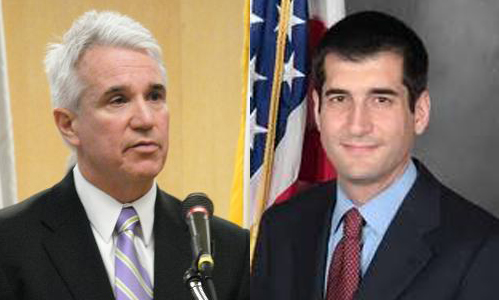
The decision by San Francisco prosecutors to drop a drug case that involved four of six plainclothes officers currently under investigation for illegally raiding residential hotel rooms and then lying about the busts in police reports, came one day after the Public Defender’s Office released videos that contradicted police reports in two separate cases. And it’s thrown another curve ball into the D.A.’s race, which veered into weird and uncharted territory the minute former Mayor Gavin Newsom appointed the city’s top cop George Gascón as SF’s next D.A.

The D.A.’s Office and the San Francisco Police Department have both announced that they have launched internal investigations into the SFPD officers after video footage from busts at the Henry Hotel in December and January was released. And D.A. spokesperson Erica Derryck sought to clarify that the D.A.’s office dropped the case because of ongoing investigations into the alleged misconduct, and that the D.A.’s investigation is independent of SFPD.

“As the District Attorney’s Office of this County, we are conducting our own, independent investigation into this matter,” Derryck said. “If there is criminal wrong-doing found it will be handled accordingly. Our Justice Integrity Unit will conduct an independent investigation to determine if any criminal conduct has occurred. This is separate from any SFPD investigation. Our Trial Integrity Unit will examine on a case-by-case basis, what, if any, cases may be affected by this investigation and the alleged conduct of these officers.”
 
But former Police Commissioner David Onek, who is running against Gascon in the D.A.’s race this fall, called for a completely independent investigation, citing the conflict of interest created by Gascón’s investigation of alleged officer misconduct that occurred during his tenure as San Francisco’s top cop,
“There is a clear conflict of interest when our current District Attorney investigates potential criminal activity that took place at the SFPD under his watch,” Onek said. “The foundation of a safe city is earning and keeping the public’s trust. And that requires calling in outside agencies when this trust will be undermined by a conflict of interest, such as the one presented by these facts.”

“Whatever decision Gascón now makes, he will highlight to the public his conflict of interest as the former police chief,” added Onek, who is the founding executive director of the Berkeley Center for Criminal Justice. “If he decides not to charge the officers, the public will question if he did so to protect his former officers or his former administration. If he decides to press charges, the officers themselves will ask if he is doing so because he is a candidate for office and feels the need to show a tough attitude towards his former department. In the interest of justice, former chief Gascón should recuse himself and his agency from investigating the SFPD  in cases that occurred when he was chief. If you are conducting a fair investigation, you not only review the conduct of individual officers, you also explore if this alleged conduct was the result of issues with training and supervision. No fair investigation of these facts can be conducted by the individual responsible at the time for that training and supervision.”

Newsom’s fancy gift, trip to China

The Chronicle’s got a story today about how Lt. Gov. Gavin Newsom’s personal investments and earnings, documented in an economic disclosure form released by the Fair Political Practices Commission (FPPC), make him a lot richer than his boss, Gov. Jerry Brown.

The form also discloses travel payments and gifts Newsom received in 2010, which makes for some interesting reading. For one, San Francisco’s former mayor evidently received a very expensive pen (made by Louis Vuitton and valued at $398) last year from this guy.

The most significant item in the travel and gifts category, of course, was Newsom’s trip to Shanghai last June, valued at $9,082 and paid for by the San Francisco-Shanghai Sister City Committee. He traveled there with former Mayor Willie Brown and some others for San Francisco week at Expo 2010 Shanghai China.

Evidently, it was a week filled with dancing, singing, and celebration. (And dressing to impress. Check out the creamy, eco-friendly suit Brown wore at this “dazzling” event.)

http://www.youtube.com/watch?v=NZ8rKho15dw

Since becoming lieutenant governor of California, Newsom has continued his efforts to improve business relations between China and San Francisco. Just have a look at his recent article in China Brief, a magazine published by the American Chamber of Commerce in the People’s Republic of China (AmCham-China).

In the article, penned in late January of 2011, Newsom wrote:

“China’s central government stresses the importance of developing their innovation industry sectors–including clean-tech, biotech and information technology (IT)—and is projected to commit over $600 million of government funds to support this development. This overlaps with San Francisco’s core industry sectors. With over 500 tech and new media companies (including leaders such as Salesforce.com, Zynga and Twitter), more than 225 clean-tech companies and a worldclass biotech hub (anchored by the University of California San Francisco), San Francisco brings together internationally-recognized leadership in each of these sectors.”

Meanwhile, a few items on that economic disclosure form suggest that what’s good for business in China is also good for Newsom. His wife’s investment portfolio, the Jennifer Siebel Newsom Trust, includes stocks ranging from $10,001 to $100,000 each in China Valves Technology, a for-profit, “e-learning services provider” called  Chinacast, and a Chinese motor manufacturer called Harbin Electric.

A game of GOP chicken in Sacto

2

Will any Republicans crack and allow a vote on taxes in June? That’s what everyone in Sacramento is wondering, and the insiders I’ve talked to say they think it’s an even bet. Without a couple of GOP votes, Gov. Brown and the Legislature won’t have the two-thirds majority they need to put a measure before the voters that would stave of horrifying cuts.


But there’s plenty of backroom intrigue: Calitics points out that


The Republicans understand that there have to be some additional revenues.  They know that even they couldn’t come up with the full $25 Billion in cuts in any way that could possibly help them politically. But, on the other side, they are terrified of their own base.


So what they’re trying to do is force the Democrats to do it without a two-thirds majority. There are some tricky legal ways to maybe make that happen — to place the measure on the ballot with a simply majority vote — and it now looks as if the GOP is actually pushing that alternative. The idea: Accept taxes that they know the state needs — but blame the Democrats for it and keep the no-new-taxes types happy.


And the Assembly speaker isn’t going for it. From the Sacramento Bee:


“I know that Senator Dutton has suggested that there’s a way for us to do this as a simple majority effort. Had I proposed it, the Republicans would have been up in arms, saying that I was trying to thwart the will of the public,” Pérez said.


The Assembly speaker accused Republicans of “trying to abdicate their responsibility as elected officials” by suggesting that Democrats could decide the issue without Republican support.


Yep: That’s exactly what they’re doing.


The problem, of course, is that the Dems need the tax vote, too (and I think some of them actually care about the future of the state, which no Republicans do). Who’s going to blink first?


The future of the San Francisco left

72

That, at least, was the title of the Milk Club forum March 1. Quite a panel, too: Sups. Avalos, Campos, Chiu, Kim and Mar. Tim Paulson from the Labor Council. Former Milk Club Prez Jef Sheehy. Tiny from Poor Magazine. And me.


I told the assembled that it was worth reminding ourselves how far we’ve come — when I started in this business, in 1982, Dianne Feinstein was mayor, there was exactly one reliable progressive on the Board of Supervisors (Harry Britt) and it was impossible for grassroots types without big gobs of money to get elected to high office. I’ve lived through Feinstein, Agnos, Jordan and Brown, all (until the end of the Brown Era) with at-large boards. It was awful trying to get anything good done; all we could do was fight to prevent the truly horrible from happening. Under Brown, as Sheehy noted, San Francisco politics was locked down, tight; the machine ruled, the Democratic Party was not a force for progressive issues and only a few exceptional leaders, like Tom Ammiano, kept the spirit alive.


Today, the very fact that five supervisors showed up at a Milk Club event to talk about progressive politics shows how district elections has transformed the city and how far we’ve come.


That said, we’ve still failed to make much progress on the most important issue of the day — the gap between the rich and the poor, the fact that this city has great povery and great wealth and the utterly unsustainable economic and tax system that has made us the most socially unequal society in the industrialized world.


Sheehy talked about the schools (both he and are are parents of kids in the public schools). Good schools, he said, are one of the most important socialequalizers; with a good education, poor kids have a chance. But while our local billionaires enjoy nice tax breaks, we’re starving the schools.


Kim talked abou the need for summer school and longer school years (I would add longer school days). These are things San Francisco can do — if we’re willing. “We’re talking about taxes,” Sheehy said, and he’s right.


In the past five years, I think we’ve cut about a billion dollars out of the General Fund, labor has given back more than $300 million — and we’ve raised $90 million in new taxes. Not good enough, not even close.


Yes, the bad economy is to blame for our fiscal problems, but so is the fact that we have a tax structure that systematically underfunds the public sector. (And yes, my conservative friends, cops shouldn’t retire with $250,000 a year pensions. Got it.)


Tiny made a strong statement about the essential problem facing the city when she asked, “who isn’t here?” She didn’t just mean that there were too many white people in the room (althought that was true); she meant that there were were too many working-class and poor people who can no longer live in San Francisco.


Sheehy was even more blunt: “In five years,” he said, looking out at the room, “none of us are going to be here.”
And my essential message to the crowd (and the elected officials on the panel) was: We don’t have to accept that. These are problmes we can address, right here in San Francisco. If we want to, we can shift the burden of paying the costs of society at least a little bit off the backs of the poor and middle class and onto the rich.


Nobody directly disagreed with me. In fact, Chiu announced that “income inequality is something all of us care about.”
How agressively he and others try to turn that concern into legislation will tell us something.


Two other interesting moments:


1. Every single person on the panel talked about how important Tom Ammiano was to the modern progressive movement. One by one, every panelists described the 1999 Ammiano for Mayor campaign as a defining moment in their lives and in the emergence of today’s progressive politics. Good to see the guy get the recognition he so richly deserves.


2. Campos, who was sitting next to Chiu, made a point of saying that there’s no longer a progressive majority on the board, and he pointed to the committee assignments that gave conservatives control of some key panels. Chiu responded: “At the end of the day, we have a progressive majority on the board that will serve as a backstop” to anything bad that comes out of committees.


It was curious; it sounded almost as if Chiu was disappointed in his own assignments. Why would you need a “backstop” if the committees were good in the first place?


So I called him the next day and asked him about it. First he said he thought the commitees were balanced and it was all going to be fine. But when I asked him directly — why not appoint progressive majorities on the key committees? — he responded:


“I wish the board presidency vote hadn’t turned out the way it did.”


In other words: If the progressives had all voted for Chiu, he wouldn’t have appointed conservatives to key posts of power. Instead, some progressives voted for Avalos, and Chiu won with the votes of Carmen Chu, Scott Wiener, Sean Elsbernd and Mark Farrell (along with Kim and Mar). The payback, the deal, the whatever you want to call it, means that bad decisions will be made at Land Use and Rules and maybe in the Budget Committee, and Chiu as much as admitted that the progressive majority will have to go to unusual lengths to undo them.


I know how politics works; I know you have to dance with the ones that brung you and all that. But it would be nice if every now and then someone would do something just because it was the right thing to do, and to hell with the political consequences.


I suppose that’s too much to ask.


Redevelopment debate full of bum choices

3

At the Potrero Hill Democratic Club’s debate about Gov. Jerry Brown’s proposal to ax local redevelopment agencies to balance the state’s $26 billion deficit, folks attempted to evaluate if redevelopment agencies are essential for job creation and community revitalization, if reform, not total destruction, is possible, and if bum choices are all we have to look forward to.

The Chronicle’s Marisa Lagos, who moderated the debate, noted that redevelopment agencies were created over 60 years ago to create economic development opportunities by borrowing against future tax increases that agencies think they can create.

 “That’s a fancy way to say ‘borrow against future taxes,’” Lagos joked, pointing to the Candlestick Point/Hunters Point Shipyard project as an example of an ongoing project, and the Yerba Buena project as an example of a completed success.

 “The Governor is arguing that when the state is cutting schools and other essential services, this is not the best use of tax dollars,” Lagos stated.

 Panelist Olson Lee, deputy executive director of San Francisco’s Redevelopment Agency, pointed to affordable housing as evidence of the agency’s positive impact.

 “I think Redevelopment is important because of the good things it has done,” Lee said, pointing to 11,000 units of affordable housing that the agency helped build in the city.

 Panelist Carroll Wills, the communications director for the California Professional Firefighters, said “many wonderful projects” have occurred under Redevelopment. But he pointed to what he called “a decade of tricks and games,” on the part of Redevelopment agencies as one reason why the state is in a fiscal crisis that threatens firefighters’ jobs.

 “Concrete does not trump core services,” Wills said, arguing that it’s not clear that many affordable housing projects would not have been built without redevelopment aid

Arc Ecology’s Saul Bloom accused Gov. Brown of “short-circuiting” what could have been an important statewide discussion about redevelopment reform, with his bombshell suggestion in January to eliminate redevelopment agencies entirely

 “I’m sympathetic to the argument that Redevelopment takes money away from core services,” Bloom said. “But what do we do to replace it? And is economic development versus core services a false choice?”

Lee pointed to Mission Bay as further evidence of Redevelopment’s success.

“It was considered a brown field, and through development, it’s much different,” Lee said, noting that 20 percent of tax increment financing goes to the General Fund to pay for redevelopment infrastructure. “Clearly the university would not have been there. It was an opportunity to place UC there and generate economic opportunities.”

 Wills argued that Redevelopment Agencies are a luxury we can no longer afford, even as he acknowledged being unfamiliar with local redevelopment projects.

“At best, redevelopment moves around the pieces,” Wills said. “It doesn’t increase economic development and it doesn’t necessarily pay for itself.”

Bloom noted that developments like Mission Bay are dependent on large institutions, like the University of California, which can’t be forced to implement city laws like local hire.

And he said he found it “disappointing” that there wasn’t much more of a dialogue around the plans to redevelop Candlestick Point and the Shipyard, despite the fact that the city held hundreds of meetings over the past decade.

“It was more a case of, Here’s our idea, tell us what you think of it,’” Bloom said. “Perhaps if we had invited the nation’s largest industrial developer, instead of the nation’s second largest home developer, we would have had a different dialogue.”

 Lee replied that the Shipyard has been under discussion for 15 years.

“It’s a very large project, the largest in the Western United States,” Lee said. “It’s a brownfield, though I know Espanola will say it’s a Superfund site,” he continued, as Bayview elder Espanola Jackson bristled under her hat, and the audience wondered if Lee meant that the US E.P.A. somehow got it all wrong.

Lee further shocked audience members by saying Treasure Island was not a redevelopment project (leading Bloom to clarify that Treasure Island is under the jurisdiction of the local Treasure Island Development Authority, if not the SF Agency).

“People felt they wanted economic development at the shipyard,” Lee continued, noting that the neighborhood suffered after the Navy withdrew from the shipyard in the 1970s. But he did not mention that major bones of contention around the redevelopment proposal, centered on plans to build 10,000 mostly market-rate condos, a bridge over an environmentally sensitive slough, the taking of a chunk of the community’s only major park, and no proof that thousands of promised jobs will materialize.

Wills noted that most local redevelopment commissions are peopled by the members of each municipality’s city council, a situation he believes leads to a lack of accountability. But members of the audience, including this reporter, noted that San Francisco’s Redevelopment Agency consists entirely of mayoral appointees, who, unlike elected officials, can’t easily be voted off the proverbial island.

It was at this point that panelist Calvin Welch, a longtime housing activist, showed up at the debate, apologizing for being late, but blaming his tardiness on being on a phone call with Sen. Mark Leno to discuss Brown’s redevelopment proposal.

And from there, the conversation veered towards discussions of what could happen to existing redevelopment projects if Brown goes through with his elimination threat.

 Lee noted that if projects simply had a disposition and development Aagreement (DDA), but Redevelopment was no longer there, there would be no project financing. “The devil’s in the details,” Lee said. “Because if you don’t have bonds, what’s the point of having an agreement.”

 Wills opined that Gov. Brown’s proposal has “a vehicle to roll back the bum’s rush” of projects that local municipalities have been trying to push across the finish line, ever since Brown dropped his Redevelopment elimination bomb in January.

 Welch went off on a historical riff about how the San Francisco Redevelopment Agency (SFRA) was met with controversy and outrage until 1988, when Art Agnos was elected mayor, and brokered a deal under which SFRA could do tax increment financing, provided the majority of funds were used for affordable housing.

“It became a finance agency to build infrastructure and affordable housing,” Welch said, noting that attempts to build out Mission Bay around commercial offices and high rises failed, until the Agency used tif to redevelop the site.

 “But mark my words, Lennar is going to come out of this just fine,” Welch added, reminding me of a recent comment that former Lennar executive Emile Haddad reportedly made that suggests Haddad believes the California housing market is poised for a rebound.

(The article outlined how Haddad sold 12,000 acres in California for a $277 million profit at the housing market’s peak four years ago, reacquired it at half the price in 2009, and is now saying it’s time to build in his new role as CEO of FivePoint Communities Inc., which is developing four new master-planned communities with a combined 45,000 residences at Newhall Ranch north of L.A., the El Toro Marine Corps Air Station in Orange County, the Candlestick Point/Hunters Point shipyard and Treasure Island  in San Francisco, with investors including Lennar, Michael S. Dell’s MSD Capital LP, Ross Perot Jr.’s Hillwood Development Co. and Rockpoint Group LLC. “I don’t want the party to show up and I’m not dressed,” Haddad, 52, reportedly said in a recent interview. “When the market says ‘I’m here,’ we’ll be one of the few that can deliver inventory.” 

(The Haddad article, which appears to be a non-bylined reprint from Bloomberg News, also claimed that Hunters Point sales are set to begin by late 2012 with prices starting at $525,000, as the Navy continues its cleanup of the 700-acre site. And that the plan now calls for as many as 12,000 homes, 3 million square feet (of commercial space and a new stadium for the 49ers. And that 7,000 homes may eventually be built on Treasure Island and adjoining Yerba Buena Island, under terms of a final development agreement that may go before the San Francisco Board of Supervisors for approval in May, with units averaging  $800,000 and reaching up to $2 million, according to Lennar V.P Kofi Bonner.)

And during the Potrero Hill Dems debate, Bloom noted that the Treasure Island plan is being “sped up” and that the Board is expected to vote on the plan as soon as possible. “But since these plans were not bonded before January [when Gov. Brown took office], what’s the point of speeding up the process?” Bloom asked.

“We’re basically seeing a brick wall,” Welch interjected. “There are virtually no funds for permanent affordable housing in San Francisco.But Jerry Brown is not going to commit financial hari kari. Every major developer of market rate housing will come out just fine, because of state actions, not because of a local vote. Deals are going to be made. It’s the question of affordable housing that’s our challenge. You’re gonna be stuck with public housing, as it is, unless there’s affordable housing financing.”

 Wills claimed that Prop. 22, which voters approved last November, “created a mechanism so rigid,” that the state’s only option was to eliminate redevelopment. “Basic services are dying on the vine,” he said. “We can’t afford to give developers subsidies.”

 Lee noted that SFRA built thousands of affordable units over the years that saved the city thousands in terms of core services it would otherwise have to provide. “Affordable housing is so basic, you can’t do things we take for granted if you are living under a freeway,” he said.

 Bloom suggested Redevelopment could do a better job of economic development, including the creation of permanent and sustainable jobs, like his proposal to create maritime uses at the Shipyard—something not entertained under the city’s Shipyard plan.

 Welch connected the dots between the taxpayer revolt that led to Prop. 13’s passage and the current fiscal woes of municipalities unable to raise taxes on commercial development. “That’s a killer,” he said, noting that housing costs more to build and maintain than it generates property taxes, especially if it’s family housing. ‘It’s those damn kids,” he joked.

Welch noted that Gov. Brown used redevelopment money to enable market rate development in downtown Oakland when he was mayor of Oakland—and claimed that Brown equated affordable housing with crime, at the time.

“We love Brown better than Meg Whitman, but it’s 2011 and we face bum choices.”

Community advocate Sharen Hewitt, who heads the C.L.A.E.R. project, asked if the panel thought San Francisco could be a “demonstration model” for using Redevelopment funds to build 50 percent affordable housing.

Welch said conversations have “already happened” between Mayor Ed Lee and Gov. Jerry Brown that have led him to believe that, “all of San Francisco’s redevelopment projects will be made whole, affordable housing will be protected and Brown will be committed to a San Francisco model.”

“It’s like the film Casablanca, when people are shocked to find out that gambling is going on in a casino,” Welch said. “People are shocked to find out that capital talks in a capitalist system.”

 Espanola Jackson asked Welch what will happen to the shipyard development, in face of a lawsuit that POWER brought that’s due to be heard March 24.

“The shipyard plan has a political function,” Welch said, noting that it was the result of a citywide vote in 2008. ‘We opposed it, but we lost. The structure of that deal flows from the vote.”

 City College Board member Chris Jackson expressed frustration that the Redevelopment conversation had devolved into a housing conversation.

“Mission Bay is all about biotech, but who works at UCSF?” Jackson said, noting that Redevelopment, as a state-funded agency, does not have to agree to the city’s newly approved local hire law.

Welch acknowledged that there has never been a study to determine the tipping point required to lift the Bayview out of poverty.

Lee admitted that Redevelopment’s focus has been housing, “because San Francisco is such an unaffordable city.” But he claimed that SFRA had a “much more aggressive program on local hire than the city, for many years.” Noting that SFRA has tried to attract restaurants and food establishments to Third Street, over the years, Lee said, “It hasn’t been something we’ve been particularly successful at.”

Welch opined that the “skills and abilities of the San Francisco community are far greater at stopping projects and protecting neighborhood character, but we can’t figure out how community-based organizations can employ their own people.”

 And then it was time to go back out into the cold March wind and try to wrap our minds about the true meaning of “bum choices” in 2011.


Sorry, Chuck, it’s not over yet

A Saturday editorial by the Chronicle’s C.W. (Chuck) Nevius suggested that the Haight Ashbury Neighborhood Council (HANC) Recycling Center would face final closure this coming Friday, March 4, because the Recreation & Park Department had issued a notice stating that the lease would be terminated on that date.

“There are rumors that recycling director Ed Dunn might channel his spirit of the Haight in the ’60s and chain himself to the fence in protest,” Nevius wrote in a derisive column which ended with the phrase: “But this is over.” These fighting words inspired HANC to issue a press release of its own, announcing it was in need of thousands of feet of chain for a possible March 4 showdown. But that, apparently, was meant to be tongue-in-cheek. It’s now sounding as if there won’t be much happening at the recycling center that day at all, except maybe some recycling, native plant sales, and compost turning.

There will be more to report on this subject soon, including new legal questions surrounding the eviction. But for now, the Guardian has received word from the San Francisco Sheriff’s Department that the Sheriff has no plans to carry out a HANC eviction on March 4.

“We will not be involved in any way until we get a valid court order,” explained Sheriff spokesperson Eileen Hirst. “We’ve heard nothing ordering us to carry out an eviction,” she said.

Generally, Hirst added, the Sheriff’s department only carries out evictions on Wednesdays, covering half the city’s territory at a time. The department typically posts a notice before going through with an eviction.

SFBG Radio: The right’s agenda failed

15

Today Johnny has a profound revelation at the gym: For 30 years, the right wing in this country has had its way. Almost every part of the right’s economic and foreign-policy agenda — tax cuts for the rich, cuts in welfare, deregulation of financial institutions, dramatic increases in the military budget — has come to pass. We’ve seen, and we see today, the results of that agenda. It doesn’t work. So why does anyone still take it seriously? Listen after the jump.

IFoughtTheRightAndTheRightWon by endorsements2010

Yee plans to block Crane’s UC Regents confirmation

11

Citing UC Regent David Crane’s op-ed in the Chronicle, in which Crane questioned if public sector workers should have collective bargaining rights, Sen. Leland Yee says he wants to stop Crane’s UC Regents confirmation and protect the vital services provided in our communities by public employees.”

In his op-ed, Crane argues that “collective bargaining for public employees in California changed the balance of power and – most importantly – gave public employees power over their compensation and benefits.”

But Yee, who is running in the San Francisco mayor’s race this fall, counters that the only public employees at the UC that have any real power over their compensation are the top executives.

“The Regents consistently cater to the elite and ignore their unionized workers – nurses, janitors, technicians, bus drivers, teaching assistants, and others,” Yee stated. “Collective bargaining is vital in addressing this disparity and fighting the unconscionable acts of UC administrators.”

Crane, who identifies as a Democrat, was an adviser to Republican Gov. Arnold Schwarzenegger, who appointed him to the Board of Regents during his final days as governor. And Crane awaits final confirmation to the Board of Regents by the Senate.

But Sen. Yee and a bunch of community members and public employees hope to block Crane’s confirmation, starting with a noontime rally in San Francisco on Friday, March 4, at UC’s Medical Center at 513 Parnassus Avenue.

“UC Regent David Crane recently took his cue from Republican Wisconsin Governor Scott Walker and called for an end to collective bargaining rights for California’s teachers, nurses, firefighters, university employees, and other public sector workers,” Yee stated in a press release. “While the Regents approve million dollar contracts for their top administrators, David Crane wants to take away the rights of working class families. It is time for Regent Crane to put away his Wisconsin playbook and come down from his ivory tower.”
 
“While the Regents have approved million dollar contracts for their top administrators, they allow many UC workers and their families to live in poverty,” Yee continued. “Now, Regent Crane wants to take away their only avenue to earning a livable wage and a respectable retirement – their collective bargaining rights.”

Yee notes that UC service workers wages’ can be as low as $13 an hour. That 96 percent of these workers are income eligible for at least one of the following public assistance programs: food stamps, WIC (women, infants, and children), public housing subsidies, and reduced lunch. That many work two or three jobs to meet their families’ basic needs.  And that all this is happening against a backdrop in which the UC Board of Regents has consistently provided double-figure raises to their top administrators. 

Yee cites the “retention salary adjustment” for UCLA Medical Center CEO David Feinberg, whose salary was recently increased by an additional $160,300 per year to $900,000.  The Regents also voted to award Feinberg an additional $250,000 annual retention bonus. And if you add in his annual Medical Center incentive payment, Feinberg’s annual compensation is more than $1. 3 million. UC President Mark Yudof also pulls in over a million annually, when salary, housing, and benefits are factored in.


Messages to the next police chief

While researching Tasers in the wake of last week’s police commission hearing, I came upon an online series published while the city of San Jose was considering candidates for police chief. Created by Silicon Valley De-Bug as part of an effort with San Jose’s Coalition for Justice and Accountability, the project featured the messages of people who wished to share their personal stories with the next top cop. Each week leading up to the selection of the new chief, the group posted another “Message to the Next Police Chief.”

One video featured Art Calderon, whose 68-year old father was beaten by San Jose police, addressing how officers could improve their relationship with the Latino community. A young homeless person weighed in on their interactions with the police. Another contributor wrote that he was bipolar and wanted the next chief to train officers to be sensitive to people with mental-health issues, since he was slammed against a squad car once while delusional.

Raj Jayadev, director of Silicon Valley De-Bug, told the Guardian that the project also included surveying 3,000 community members in three different languages, and organizing seven community forums to generate input from communities of color on what qualities and characteristics they hoped to see in the next chief. When the former chief retired, “We knew for sure that we were standing at this really historic moment,” Jayadev said. “We wanted to get as much community input as possible.” The coalition was motivated to improve relations between police and communities of color in San Jose amid a history of fatal officer-involved shootings, accidental deaths following deployment of Tasers, and disturbing accounts of excessive use of force, particularly against young people of color.

The group focused their questions on three “hot-button issues,” Jayadev said, including use of force, racial profiling, and concern surrounding police cooperation with federal immigration authorities. Based on a review of the survey responses, the coalition generated a list of six tenets they hoped would guide the selection process for the new police chief.

San Jose Police Chief Chris Moore, who was sworn in last week, wasn’t DeBug’s first choice, Jayadev said. However, Moore has met with the Coalition for Justice and Accountability and plans to sit down with them a second time. Although the community lacked decision-making power, Jayadev noted, thanks to De-Bug’s project “there’s going to be clarity on what the community wants.”

Meanwhile, San Francisco is undergoing its own process of selecting a new police chief, and the San Francisco Police Commission is expected to submit the names of up to three applicants to Mayor Ed Lee by March 15. The process is overshadowed by the mayor’s race, since a newly elected mayor could opt to initiate a new candidate search if he or she isn’t satisfied with Lee’s pick.

That uncertainty hasn’t discouraged the 75 hopefuls who reportedly submitted applications. Police Commission Secretary Lt. Tim Falvey told the Guardian that the number of candidates under consideration was recently whittled down to 25, but he declined to say how many candidates were to be interviewed by commissioners. Nor would he say when the interviews were taking place, or where they were being held.

Meanwhile, the San Francisco Police Commission held three community meetings in February to garner community input on the selection of the next chief, with three commissioners present at each forum. Asked if there were any notes, recordings, or other documentation of those meetings available, Falvey said nothing like that was required since they weren’t official commission meetings. “I don’t know if [commissioners] just took mental notes, or maybe they took notes for themselves, but that’s not something I have here,” he said.

Falvey said the turnout ranged from 25 to 45 people at the three meetings, which were held at the United Irish Cultural Center on 45th Avenue, the Southeast Community Facility in the Bayview, and the San Francisco LGBT Center in the Castro. “A lot of people wanted a track record in community policing,” Falvey noted when asked what points came up repeatedly during the community forums. Another common issue was improved relations with the nightlife and entertainment industry, he said.

At the end of the day, the choice lies with the police commissioners — four of whom were appointees of former Mayor Gavin Newsom — and of course, Mayor Lee.

Falvey said that candidates had expressed concern that they did not want their names publicized, and that every effort was being made to keep the applicants’ identities secret until Mayor Lee makes his final announcement.

What do San Francisco community members want in a new police chief? And in the end, how much will their opinions matter?

Why does anyone still trust PG&E?

31

The Bay Citizen’s got a good report on how PG&E cobbled together the San Bruno gas pipe out of bits and pieces of whatever was around, and a nice liveblog of the NTSB hearing on the explosion. The message is pretty clear: PG&E is utterly unreliable, can’t keep track of its own records, doesn’t know what’s in its own system, can’t figure out why it doesn’t know what’s where and is still stumbling over the next steps:


11:59 a.m. PG&E’s Fassett: PG&E realizes it must “look further” into the manufacturing processes of “vintage” pipelines, such as the 1940s and 1950s segments of pipeline that ruptured beneath San Bruno


Um, and why hasn’t that process started already?


Look: This is a company that delivers natural gas through pipes that officials there must have known were old, of dubious quality (esp. the ones from the immediate post-War era) and dangerous. Yet nothing’s been done about it. There are more San Bruno’s out there — and even PG&E doesn’t know where.


This isn’t just corporate self-interest and greed. It’s utter, obvious, blatant incompetence. 


I remember an old joke that former Sup. Bill Maher — and avid PG&E ally — once told about public power. If the city runs the electrical system, he said, “when I hit the light switch my toilet will flush.” Ho ho ho. How about: Next time you turn on your stove, the entire street will blow up, killing 8 of your neighbors? Because that’s the level of buffoonery we’re talking about here.


It’s worth noting the Palo Alto — a city, a government agency — runs its own gas and electric utility, and not only do the pipes not explode, the system wins awards for safety and replaces its pipes well before the end of their projected lifespan. Palo Alto — a city, a government agency — knows what’s under its streets. The efficient private-sector company called PG&E can’t find its own files.


So you have to wonder why Mayor Ed Lee is still saying that it’s a bad idea to get rid of PG&E. Why, at this point, would anyone trust this bunch of idiots? How could any public power agency possibly be worse run? It’s not even an argument any more; PG&E has demonstrated that the private sector can be both greedy, corrupt AND an operational failure. The sooner they’re out of San Francisco, the better.


The Chronicle doesn’t like democracy

15

Remarkable editorial in the Chron today on the mayor’s race. The point seems to be that there are too many candidates:


If most of this herd stays in the race, no door knob, mail slot or voice-mail queue will be safe.


Too many people running for office. Too many choices for the voters. Imagine how awful that could be. And to what do we owe this tragic set of circumstances? Ranked-choice voting and public financing.


. Public financing and ranked-choice voting both won voter approval, though it’s fair to say that this season’s prospects were never imagined. Now comes the hard part of living with the results.


There’s nothing in the editorial that says why more democracy is bad, except that San Franciscans will get a lot of campaign fliers and voice mails. And I think the Chron is utterly wrong: this season’s prospects were exactly what supporters of those two progressive refroms had in mind.


Public financing means a wider range of candidates, with a wider range of perspectives, can enter the race. When it was all about who could raise the most money, nobody really had a prayer of getting elected without a million dollars — and there’s no way all eight of the current serious contenders could have raised that kind of money. So a candidate with less proven fundraising ability (say, David Chiu) would be pushed aside by someone like Leland Yee, who has been around longer, has statewide fundraising capability and brought in a huge war chest for his last Senate race. Without public financing, the race would come down to a small number of candidates; the voters would have fewer choices. The current system opens the election to a wider and more diverse group of candidates — that was the whole idea.


Same goes for RCV. Under the old system, some would be arguing that with three Asians in the race —  Yee, Chiu and Phil Ting — the Asian votes would be split and diluted and none of the three would win. With RCV, the opposite’s likely to happen — three Asian candidates means more Asian voter interest, and all three candidates benefit from that.


There may be more candidates; nothing wrong with that. Except that the San Francisco Chronicle doesn’t seem to like democracy.


John Ross memorial takes the streets

1

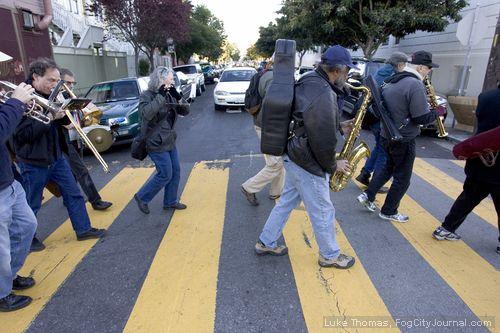
A standing-room-only crowd gathered at United Mission Presbyterian Church on 23rd and Capp Feb. 25th to remember Guardian correspondent and hell-raising investigative poet John Ross. John’s old friends Q.R. Hand, Hermann Bellinghausen, Frank Bardacke, Kevin Quigley and me spoke; his kids, Carla Ross-Allen and Dante Ross, gave moving remeberances. Then we marched through the Mission, led by the Musicians Action Group playing the Internationale. It was a perfect Ross moment: A few of the celebrants put pieces of yellow tape across their chests and stood in the streets halting traffic to the let the procession pass. A couple of confused bicycle cops went by, but took no action, which was good for all involved.


When we reached Cafe LaBoheme, the crowd took over much of 24th Street — but the air of fun and solidarity was so visible and loud that most of the cars simple stopped and waited patiently for room to crawl past. A wild, crazy anarchist funeral mob on the streets of San Francisco; we sent him off right.


PS: The generally nice obituary in the Chronicle described Ross as


“an author, poet, liberal activist and journalist who toiled against perceived injustice from the jungles of Chiapas, Mexico, to the baked streets of Baghdad.”


Which is wrong on two accounts. First of all, there was nothing “perceived” about the injustice Ross saw and wrote about; it was very real. But that’s just a daily paper trying to be objective in a way that turns out to be embarassing. More to the point, as his longtime friend Elizabeth Bell noted, calling Ross a “liberal”  is wildly inaccurate.


Here’s the letter she sent to the Chron:


Although some time has gone by since the Chronicle’s obituary of Bay Area activist and poet John Ross, I must correct a glaring inaccuracy–indeed, slander–that appears in the very first sentence of your otherwise adequate write-up.  John Ross was not at the time of his death, nor had he ever been, a “liberal.”  He was not a liberal-diaper baby, his pioneering refusal to serve in the Vietnam war was not the act of a liberal, nor was placing his body between Palestinian olive farmers and club-wielding Israelis.  His response to a Mexican journalist who asked his profession, “Soy comunista,” does not translate to “I’m a liberal.”  A raucous rebel and man of the people, Ross believed to his dying day that revolution in the United States was necessary and possible. A brief vocabulary lesson, Mr. Coté: Gavin Newsom is a liberal. John Ross was a liberal like a Molotov cocktail is a gin rickey.


SFBG Radio: North Africa, oil, and cotton

2

Today Johnny talks to economist Johnny Venom about the situation in North Africa and explains how there’s a surplus of oil right now in the United States, how the real price hike is going to be cotton — and how the revolutionary fervor is going to play out over the next few weeks. Listen after the jump.

sfbgradio2/28/2011 by endorsements2010

Chiu announces run for mayor

64

Board of Supervisors President David Chiu announced his candidacy for mayor today, becoming the eighth major candidate in a field that will likely continue shaking out in the coming months.

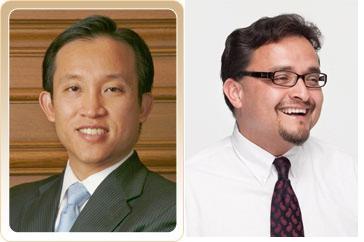
Chiu has been considering the move since at least the start of this year, when he played kingmaker as the swing vote to name Ed Lee as interim mayor, parting from his progressive colleagues to do so. With no strong progressive candidate yet in the mayor’s race, the question now is whether Chiu will try to win over the left and if he can be successful in doing so after making several more moderate moves in recent years.

Chiu’s initial political base will be allies of Chinatown Chamber of Commerce boss Rose Pak, who has pledged to block Sen. Leland Yee from becoming mayor, is close to Chiu, and has been courting someone to run. There have even been widespread rumors recently that Pak and ally Willie Brown have been trying to convince Lee to run, a possibility that those in Chiu’s camp dismiss.

Chiu will made his announcement at 11 am on the steps of City Hall. Sources say Chiu has spent weeks lining up support for his run, so it could be telling to see who shares the stage with Chiu beyond Sup. Jane Kim and others from his immediate political circle. Chiu and Kim are sponsoring the mid-Market tax break that the Mayor’s Office crafted to keep Twitter from leaving town, the most controversial legislation of the year, a proposal that has drawn opposition from many progressives. Some other mayoral campaigns have privately started to grumble about the deal, so it could become a mayoral campaign issue, particularly if the Office of Economic Analysis concludes it will be a drain on city coffers when that report is issued by week’s end.

For more on the implications of Chiu’s leap into the race, read this week’s Guardian.

Local hire victory party a political who’s who

2

The atmosphere at the local hiring victory party that Laborers Local 261 held at its Union Hall this week  was positively elated. Beer, wine and yummy pupusas flowed, commendations were made, and live drumming gave the event a playful edge. And it didn’t hurt that the place was crammed with political candidates, past, present and future, as San Francisco gears up for a a mayor, D.A. and sheriff’s race, this fall.

Sup. David Campos, who hasn’t thrown his hat in the mayor’s race, at least not yet, described the mood as “exciting.” “Who would have thought a year ago that we’d be having this victory,” Campos said, crediting fellow progressive Sup. John Avalos and the community for “great legislative work.”

Sup. John Avalos, who isn’t showing signs of running in the mayor’s race despite his legislative victories, saw implementation and resistant building trades as the biggest hurdles, moving forward. But he felt city departments will lead the way in showing how to implement the new law, when it kicks in March 25. “The San Francisco PUC has shown that local hire can be successful,” he said. “The new PUC building is at 48 percent local hire across all trades.”

Avalos hoped the building trades will come to see local hire in a more positive light. “They need to understand that it’s good for this city, their unions and union membership,” he said.

Avalos noted that he recently met with members of the San Mateo Board of Supervisors to address concerns that SF’s local hire would lead to job losses in San Mateo.Just before Christmas, the San Mateo supes voted unanimously to urge Newsom to veto Avalos’ local hire policy, but it turns out they had been misled around the law’s impacts. ”I met with [County Sups.] Carole Groom and Adrienne Tissier and said, ‘We have a huge misunderstanding,” Avalos said, noting that Jerry Hill’s recent grandstanding against local hire appears to be going nowhere.

Mayor Ed Lee, who insists he’s not planning to run for mayor in November, urged folks to focus on implementation of Avalos’ legislation.
“We are not just here to celebrate a legislative victory but the first jobs we create,” Lee said. “The world does not just turn by signing legislation.”

Board President David Chiu, who dropped by towards the end of the party with Sup. Jane Kim,Board President David Chiu, said he is “still thinking” about running for mayor, and acknowledged that the road to implementing local hire could be challenging. “But during this Great Recession, we have to do everything we can to make sure San Francisco residents get put to work, and local hire is an important part of that.”

Sup. Ross Mirkarimi, who has just announced that he is running for sheriff, linked high recidivism rates in San Francisco to the need to do a better job of hiring local residents. “We have a 70 percent repeat offender rate,” Mirkarimi said. “That’s 3 out of 4 folks.” Noting that there are 1800 parolees in San Francisco daily, Mirkarimi observed that if folks can’t get a job when they come out of the criminal justice system, they are way more likely to re-offend.

Bayview resident Deanna Rice, who got out of a federal penitentiary a year ago, and is still looking for work, said unemployment is another barrier in the way of her trying to regain custody of her kids, who are 9 and 10 years old.

Laborers Local 261 Business Manager Ramon Hernandez acknowledged that more work needs to be done to make local hire a go.
“We will try to do the best we can to get everyone on the same page,” he said

Local 261 Secretary-Treasurer David De La Torre said their membership is struggling and hurting, existing members and residents are not working
“Local hire is not about a sense of entitlement,” he said. “We gotta put people to work and build the local economy. It’s not about race. It’s about community, a disadvantaged community.”

Greg Doxey of the Osiris Coalition pointed to the economic benefits of local hire.
“If you hire local, people are going to shop two, three blocks from home, the economy will get stronger, they’ll be more tax revenue, and folks could even qualify to buy homes

CityBuild’s Guillermo Rodriguez praised the Board, department heads and Mayor Ed Lee “for getting together with labor” to pass Avalos local hire legislation.

But despite the happy vibes at the party, I left wondering if there is going to be adequate investment in workforce development side come budget time, if folks will try to game the system by using the address of locally-based subcontractors to establish local residency, and whether local efforts to sabotage the legislation are going to escalate now that the San Mateo Board no longer seems opposed to the law. But I also left knowing that folks like James Richards, President of Aboriginal Blacks United, have made it clear that if local hire doesn’t get  implemented, they’ll keep protesting until it does. So, stay tuned….