• No categories

Pixel Vision

The Performant: In the Flash

0

Bodies and words collide in ‘this.placed’

It’s easy to overlook them, two dancers, still as mannequins, positioned near the entrance to the performance space, a silent video of a wet fleshy mouth, open wide as if ready for a filling, projected onto their motionless bodies. Just before the lights go down, they disappear, as does the fleshy mouth. Onstage a much larger projection of mouth, nose, cheek, fills the back wall, as the sounds of kissing, mumbling, chewing, and lip popping create a fanfare for the two dancers (Jill Randall and Amanda Whitehead), who enter while stretching their own faces into humorously exaggerated positions. Finally, Whitehead opens her mouth normally, to recite the jumbled text of Britta Austin’s Flash Fiction “Bite Marks,” which substitutes for music in their energetic duet.

“Her mouth was broken, there was a broken insistence to it….the insistence in her broken mouth was in her tongue, constantly poking out… to taste: citric acid honey pencil shavings the pages of her books the undersides of her fingernails…”

Choreographed by Nina Haft, five Flash Fiction-driven dances premiered last weekend at ODC in a collaborative venture with Sue Li Jue, who directed four additional pieces. (Read Guardian dance critic Rita Felciano’s take on the performances here.) Haft has choreographed work from Austin’s quirkily unsettling short-shorts before. In 2008, Austin’s publisher Watchword with Intersection for the Arts presented a radical interpretation of her works, in a multi-faceted showcase which included visual, theatre, and dance artists entitled “Notecards, a Living Museum”. In this.placed simultaneously earthy and beguiling lines such as “what can be written that doesn’t carry the stench of concepts digested before?” and “in a world where we are trained to be embarrassed by other peoples’ sex lives…I am faulty,” propel each action on a stage almost too wide to closely embrace the painful intimacy of the language.

Like dance, the art of Flash Fiction can be described as a series of fleeting yet powerful moments, caught as if in a headlight or camera-shutter, a brief transcendence. In “Flesh, Taste, Friction,” a mesmerizing Frances Sedayao stands in the foreground in a shaft of light with the appearance of a half-open window blind, while fellow dancers Rebecca Johnson and Edmer Lazaro, each in their own shaft of light, imitate the postures of her unsuspecting neighbors. “What She Asked,” an intense duet between Lisa Bush and Carol Kueffer veers into territories of suffocation and uncontrolled rage as Kueffer, breaking free from Bush’s persistent, over-bearing embrace, angrily demands that her body be “inside the room, my head outside the room, and the door shut…” before shuddering in a fit of whole-body emotion.

Sue Li Ju’s four pieces, each based on a particular degree of body awareness or circumstance, provide a balanced counterpoint to Haft’s snapshots of the vagaries of the human mind. “Half the Sky,” focuses on identity from the pov of adopted Chinese children while “Not What She Seams,” explores the conditions of textile factory workers, and includes some particularly colorful sequences involving billowing waves of fabric mirroring the movements of the dancers, adding startled beauty to the grimness of their toil. A flash of bright fiction requiring no words.  

American Idol: Whitney and Stevie edition

0

The elimination round begins with the boys singing Stevie Wonder and the girls singing Whitney Houston. I think the boys got the worse end of it — Whitney’s a tough act to follow, particularly since she’s dead, but Stevie Wonder songs were never meant to be sung by anyone but Stevie Wonder. Thing is, he’s a great musician and singer, but a terrible lyricist, so when anyone else does his stuff it can easily sound stupid. And since the guys were weaker anyway, I was worried about a male train wreck of a night.

But it wasn’t that bad. Only a couple of moderately lame performances, and a few really good ones. A couple of the women were a little shrieky and off key, but there were some amazing moments, too.

The rundown:

J-Lo is spectacularly beautiful in a white top and pants. Randy is wearing some kind of odd jacket with what I have to hope is a fake leopard collar and a pin that looks like it’s made of smashed lego or something. Very odd. I don’t get the point.

Joshua does “I Wish.” Meh. Judges liked it, I wasn’t impressed. Too hard a song for the non-Stevies of the world. 

Elise: “I’m Your Baby.” Meh. Jeremiah: “Knocks Me Off My Feet.” Meh.

Erica, the wild card girl, wearing a dress that looks exactly like the Coke bottles that are everywhere in the background. “I Believe in You and Me.” Best so far; she’s got a great voice and she gives J-Lo “the goosies,” which gets me excited just thinking about it. When I mention that, Vivian says I’m “way too old” to go out with Jennifer Lopez, and that she’d have a terrible time on the date if we ever did. Good to know my daughter has my back.

Colton. “Lately.” Tough start but he pulled it together at the end. The judges loved it. Me and Viv? Meh.

Shannon. “I Have Nothing.” Nice try, but she was so nervous she could barely spit out the words. Deandre, the other wild card: “Master Blaster.” He can whip his hair back and forth, but he didn’t tonight. Viv: Eeew.

Skyler: “Where Do Broken Hearts Go?” One of my faves, going to the top four. Does Whitney like country, and it works. The girl can sing.

Heejun. My Number One. The kid’s really, really funny in a deadpan kind of way. He hands the singing coaches little pics of himself; the one to Jimmy says “I love you.” The one to Mary says “I love you more than Jimmy.” He does “All’s Fair in Love,” and the judges all like it, but it’s almost beside the point. He wins this on personality.

Holli. Amazing. Stunning. She looks like she’s 12 and sings like a seasoned pro. Jeremy: Meh.

And then Jessica. Whoa. “I Will Always Love You,” and she’s almost better than Whitney. Wow. Amazing. An Idol moment. If J-Lo talks about “the goosies” one more time I’m going to have to leave the room.

Philip Phillips. “Superstition.” Okay, sure. Whatever.

Elise and Jeremy go home tonight. You read it here first. And I’m absolutely always wrong.


The truth hopes: A preview of the Magic Johnson ESPN doc

0

The votes are in: Magic Johnson is one of the most amazing human beings to walk the earth. The basketball player’s announcement on November 7,1991 that he had the HIV virus forever changed the face of the disease. As the Nelson George-directed ESPN documentary, The Announcement — which premieres Sun/11 — tells us, after Johnson came out, suddenly everyone knew someone with HIV.

Hey, you just got diagnosed with a life-threatening mystery disease. Now go tell the world!

Most people know the basic plot of The Announcement. This was one of the league’s most talented players, a young pointguard who led his team, the Los Angeles Lakers. But Johnson’s five NBA championships required a lot of celebrating and he partied hard, without a condom, with a lot of women, at the chagrin of his long-suffering college sweetheart Cookie Kelly, who he later married. 

The movie’s candid treatment of Magic’s infidelities serve as the right dash of reality to temper Nelson’s film’s hero worship. You need a little texture to your protagonist, even if he is by most any definition The Man, which I mean in the awesome way and not in the don’t-let-him-get-you-down way. Seriously, that smile? Look at Magic Johnson’s smile. He is clearly the most handsome man who has ever lived. 

And then he got HIV. 

“This is not like my life is over, because it’s not.” When Johnson stood in front of cameras at that now-infamous press conference, most people probably didn’t believe those words. Back then, HIV was seen as a death sentence. The movie does a superlative job of capturing the fear tornado that surrounded the disease. 

Not to mention the crippling ignorance that led fellow NBA players like Karl “The Postman” Malone of the Utah Jazz to question whether it was safe to even play basketball with an HIV-positive person. Malone emerges as the movie’s villan, unrepentent about his harsh words even in the interviews director George shot recently. “He manned up,” he says of Johnson’s continued health after 20 years of living with the disease, a statement that caused boos to emerge spontaneously from the group I watched the advance copy of the movie with. The NBA developed “infection control procedure” inspired by Johnson’s diagnosis. Humiliating treatment for a player who used to be the king of LA. 

So yes, The Announcement is a heartstring-tugger. The musical score is a bit after-school special. (It’s actually the only thing about the movie that I just COULDN’T, with its treacle-y manipulation. The scene after Arsenio Hall recounts how he heard the big news for the first time — the driving piano chords made me laugh out loud, like a total asshole who is laughing out loud at a movie about AIDS.) There is one scene from an educational TV special Johnson made in which he is talking to HIV-positive children about what it’s like to live with the virus that is emotionally crushing. 

That the movie is good should come as no surprise — ESPN’s been making some phenomenal films over the last few years, most notably The Two Escobars, the Zimbalist brothers’ look at the braided paths of Colombia’s drug empire and its professional soccer scene. Sports serve as an epic canvas on which to make points about society, and that’s clearly being explored in some of the productions coming out of the media company. George is a budding film talent himself, and has proven himself to be an apt documentarian of the African American experience in his books on hip-hop culture and the intersections of art and sociology.

Humans triumphing over adversity! In The Announcement, George portrays Johnson as a preternaturally positive individual, smiling that god-like smile throughout a trial that would have sunk, if not killed someone less proactive. Johnson’s All-Star Game MVP award, won during the same season as “the announcement,” his Olympic gold medal, the way he calls Elizabeth Glaser, AIDS activist and wife of Paul Michael Glaser, a.k.a. Dectective David Starsky of Starsky and Hutch, for advice on living with the disease. Even before he is diagnosed with AIDS, his moves! His off-court outfits! Those belted purple short-shorts, the fur coat that looks like he’s wearing the largest lion’s mane of all time. 

The main emotion evoked by the film is relief. HIV, even AIDS, is no longer a death sentence. People no longer protest HIV-positive children in public schools or think the virus can be transmitted through sweat. It’s no considered a problem exclusive to gays. Johnson was the man most involved in changing those perceptions, so if the background music gets a little dramatic when he’s onscreen in The Announcement, that’s okay — the guy earned it. 

The Announcement premieres on ESPN Sun/11 at 9 p.m. For information on other screening times go here 

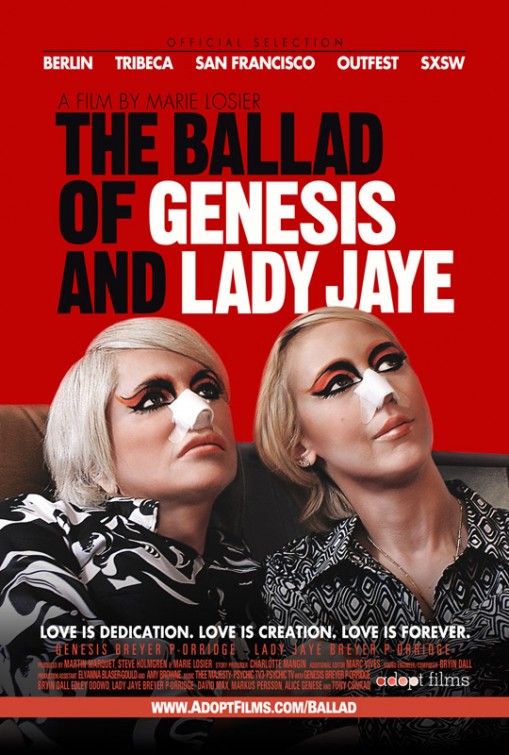
Genesis Breyer P-Orridge on “The Ballad of Genesis and Lady Jaye”

0

Read Nicole Gluckstern’s interview with documentary filmmaker Marie Losier about her new film, The Ballad of Genesis and Lady Jaye, here. Below, extended thoughts from Losier and film subject and musician-performance artist Genesis Breyer P-Orridge.

On serendipity:
Genesis Breyer P-Orridge:
It was Lady Jaye, when we started to take the whole idea of pandrogeny more seriously and dedicate our lives to it, she immediately said, “We really need to find somebody to just follow us around and film us.” And within a week we’d met Marie. We call it the “of course” factor. “Of course” we met Marie, because we were supposed to meet Marie, and it’s amazing how often that comes up, the “of course” thing. So from then on it wasn’t conscious anymore, it was just that Marie was around whenever she felt there was something to film, or she would say “I have this idea that I would like you to dress as a mermaid and pretend to swim with a house on your back….”

On influence:
Marie Losier:
Mike [Kuchar] is the person who taught me how to make films, just to make them. He’s actually the first person I made a film with, ever … the person who taught me how to load a roll of film in my camera. And he’s so clumsy, and everything always falls apart … so I didn’t think twice, like “Oh, ok, if I can make a film that way I don’t have to think too much [about the process], no worry.” And it works. It’s also a joy. Mike and George [Kuchar] were always like, “filmmaking is a hobby, just enjoy it.”


On DIY filmmaking:
ML: It took a long time, [seven years]. I had no budget and I did everything on my own time and budget. No crew, no producer. [I had] this tiny 16mm Bolex with no sound or anything, so it was a pretty archaic way of entering that world, but for me, it became very very beautiful because I was there and I was a part of it, but also, like a ghost who would just record beautiful moments…but was not intruding.

On pandrogeny:
GPO: In the beginning, as you know, it was basically just driven by [my and Lady Jaye’s] insane love for each other, the sense of wanting to literally consume each other and just find away we could somehow blend our bodies together as well as our minds and become a new-formed being whether it was in this dimension or another. But during that we had a lot of dialogues … about the implications and possibilities, and at some point it came back into my mind [something that William S.] Burroughs said to me in 1971: “How do we short-circuit control, and where is control located?”

It came to us that control is a recording, and DNA is a recording, and it terms of the human body and its potential and its ability to mutate and evolve, then where you have to look is DNA. And if you want to change the recording, you cut it up, you deny it its natural flow. And that’s what we realized we were doing, that we were quietly saying we will not let our bodies grow and look the way that DNA expects us to. We will say “we refuse,” and that became a really powerful thought for us … it loosened up our way of seeing things. We both thought, if we can break the pattern of DNA, even in simple ways, perhaps that will give people the breathing space to think about the future. If you can imagine that the body can become basically anything once you remove DNA as a monopoly … or suppressive doctrine … once you take away this idea that the body is sacred and a finished item, which it’s not, in our opinion, far from it, then everything becomes possible.

On the sweet hereafter:
GPO: Myself and [the late] Lady Jaye [are still] involved in pandrogeny, [just] she is now working in the immaterial dimension. The ultimate point for us personally was that when my body is dropped for her to maintain a sense of individual spirit through it so that when it’s my turn to leave this body we can literally find each other and literally become one. There’s lots of things that she noted that are still being manifested. She’s absolutely always around.

On love:
SFBG:
One thing I really like about the film are all the domestic scenes, people running around the kitchen and throwing barbecues. Do you have a sense of relief that that side of you is now in the public view, that people can associate you with domestic tranquility?

GPO: Definitely, thank goodness. The only thing that Jaye wanted to achieve was to be remembered as a great love affair, so for all of us involved, the band, our friends, are really thrilled that that’s what happened.

The Ballad of Genesis and Lady Jaye opens Fri/9 in Bay Area theaters.

Gamer: Sony PlayStation Vita top picks (and games to skip)

0

Read Peter Galvin’s review of the Sony PlayStation Vita in this week’s Gamer column.

Most of the Vita’s launch games exist to show off what the system can do. Mini games, short races, puzzlers; a lot of this initially sounds like phone gaming. But, even with all of Sony’s efforts to ape the success of Apple’s app store, don’t discount the Vita’s sticks and buttons, a fundamental that phone gaming has yet to overcome. Real games have buttons, people.

Little Deviants
This mini-game collection came as a pack-in with early orders of the Vita and seems specifically designed to show off the system’s novelties. Think WiiSports, but instead of a remote, you have touch screen games and “augmented reality” that uses the rear camera to allow you to shoot aliens in your house. Each game is fairly one-note and, for all but children, the novelty will grow old fast.

Uncharted: Golden Abyss
For everyone who thinks their phones can play games, play Golden Abyss. While this third-person shooter may stack less favorably against its console brethren, as a handheld title it’s simply stunning. An Uncharted adventure with very few concessions, Golden Abyss is closest to a home experience you’re likely to get on a handheld.

Super Stardust Delta
A score-attack twin-stick shooter where you wipe out asteroids as a tiny spaceship, Stardust has been a fixture on the PlayStation, and this handheld version might be the prettiest and most addicting entry yet.

Escape Plan
Early shoo-in for most unique downloadable title in the launch, Escape Plan has a gloomy black-and-white aesthetic that recalls Limbo and early Tim Burton. Basically a point-and-click adventure game, Escape Plan probably tries to do too much, but its distinct style is worth a look.

WipEout 2048
The best racing game at launch, WipEout offers a lot of content, a great sense of speed and a steady increase in difficulty — and it means you can skip the depressingly shallow ModNation Racers: Road Trip and Asphalt Injection.

Hot Shots Golf: World Invitational
This entry in the Hot Shots Golf series is largely uninterested in the Vita’s touch-screen, but golf mechanics are tight and short rounds create an addicting “just one more hole” experience that would seem to go against the sport’s generally calming nature.

Lumines Electric Symphony
Lumines may be the most addictive puzzle game. The Tetris-esque gameplay seems simple, but Lumines is more of an audio-visual experience that challenges you to beat your own — and the world’s — high scores to some pretty rave-y electronic music. Wear headphones!

Rayman Origins
Rayman Origins may be a port, but it’s a port of a full length console game and remains one of the best platformers of this generation. Even without co-op play, the colorful and fast-paced stages are masterfully designed and it’s nice to have them on the go.

C’mon inside “Silent House” with co-director Laura Lau

0

Yep, it’s another remake of a foreign horror movie — but Uruguay’s La casa muda is obscure enough that Silent House, which recycles its plot and filming style, feels like a brand-new experience. Co-directors Chris Kentis and Laura Lau, last seen bobbing in shark-infested waves for 2003’s similarly bare-bones Open Water, apply another technical gimmick here: Silent House appears to be shot in one continuous take.

Though it’s not actually made this way, each shot is extraordinarily long — way longer than you’d expect in a horror film, since the genre often relies on quick edits to build tension. Instead, the film’s aim is “real fear captured in real time” (per its tag line), and there’s no denying this is one shriek-filled experience.


The dwelling in question is an isolated, rambling lake house being fixed up to sell by Sarah (Elizabeth Olsen), her father (Adam Trese), and uncle (Eric Sheffer Stevens). The lights don’t work, the windows are boarded up, most doors are padlocked shut, and there are strange noises coming from rooms that should be empty. Much of the film follows Sarah as she descends into deeper and deeper terror, scrabbling from floor to floor trying to hide from whoever (or whatever) is lurking, while at the same time trying to bust her way out. Though the last-act exposition explosion is a little hard to take, the film’s slow-burn beginning and frantic middle section offer bona fide chills.

I caught up with the Tiburon, Calif.-born, New York-based co-director and writer Laura Lau just prior to Silent House‘s release.

SFBG: Like Open Water, which used a minimal crew and took place, for the most part, in the middle of the ocean, Silent House combines a streamlined story with a complicated technical set-up — the illusion of one long take. What do you think attracts you and co-director Chris Kentis to these types of films?

Laura Lau: I think it’s true that we want to challenge ourselves as filmmakers. We don’t want to repeat what’s already been done. We want to try and do things that are different — that makes it interesting for us. I think that’s absolutely true about both of these projects. Each one of them had its own really unique challenges. But of course it’s all about telling a story, and what it is that, emotionally, creates a reaction in us. Both of these films were really about certain kinds of horrors, true horrors that really spoke to us and we wanted to make films about.

http://www.youtube.com/watch?v=Wc7-biVJlJQ

SFBG: And just to clarify, Silent House is not really one continuous shot. You did cut sometimes.

LL: Yes. It is a seamless, continuous shot, and the experience for the viewer is that it is one continuous take. However, to achieve that we did that in very long takes, but they were different shots that we stitched together.

SFBG: But the takes are, as you say, a lot longer that what you would see in an average film.

LL: Absolutely. And not only that, but all of the sort of usual filmmaking tools that you have were taken away from us. We didn’t shoot any coverage at all. Usually, you go on a film shoot and you shoot a lot of coverage, and then you go and make your movie in the editing room. In our situation here, we had to make all those decisions ahead of time; what we shot was what we had. And all of the usual ways that you would control pacing, revealing information, even sculpting performances were taken away from us.

SFBG: The lighting appears to come only from on-set sources, mostly flashlights. Was this really what happened?

LL: Well, the whole house was pre-lit from above, and it was all on a dimmer board. We had a dimmer board operator who had to ride those lights. That was one of the elements that made it tricky, because not only was there performance and camera choreography, but there were elements like the lights, like the [assistant director] department hitting cues, like props. All of those things that were critical to actually getting the shot the way we wanted it — if any one of those elements went awry, we would have to start over again.

SFBG: Did you do a lot of rehearsing?

LL: We did. After I had written the script, and then, once we had gotten the location, I re-wrote the script. And then Chris and I just started to run the movie from top to bottom. I would actually just act out Sarah’s part, and we could run it over and over again. Especially since the script was like, 60 pages, so it was short for a feature, and there was a lot of trepidation about whether it was feature-length. Which it was, but nobody knew, because nobody in our crew had made a movie in this way, and of course [neither had any of the] producers. So, there was that process of Chris and I basically running it through, and our [director of photography], Igor Martinovic, came on, and we ran it with him. And then we went into rehearsal. We had two weeks of rehearsal with the actors, and then we had three weeks to shoot the movie. We had 15 days.

SFBG: Martinovic has a lot of documentary experience (2010’s The Tillman Story; 2008’s Man on Wire). Did that play into your decision to work with him on Silent House?

LL: Absolutely.

SFBG: Silent House isn’t part of the “we’re filming ourselves!” trend in films right now, but it has some similarities to those types of movies.

LL: I can see why you would say that, and I think it’s because the continuous shot is entirely coming from one person’s experience. Since there’s no cutting, you really are trapped with this character, who is trapped in a nightmare, in a terrifying situation. We hope that the experience is that you really feel like you are there with her as she’s going through this.

SFBG: How did you approach building tension and suspense within the continuous shots?

LL: I think that actually the continuous take is what really builds the tension. If you can’t release yourself, and there’s no cutting, I think it just builds the intensity. You can’t get away from this character and you can’t get away from her experience. I think that the story I wanted to tell with this technique of the continuous take was really about one woman’s experience. It’s about her experience and what it is that she’s going through.

SFBG: How did you cast Elizabeth Olsen as Sarah?

LL: We had been working with casting directors Kerry Barden and Paul Schnee on previous projects that we’d been trying to get off the ground, and as soon as they read the script, they said, “Oh, we know who Sarah has to be.” They had cast Jennifer Lawrence in Winter’s Bone the year before. So [Olsen] came in as the girl our casting directors had already cast, and they were right! She had the charisma and the luminosity and the depth, because again, this is a film where we knew that we were going to be watching one character, and she had to be somebody that we wanted to watch, and somebody that we would care about.

SFBG: A lot of what’s scary about Silent House are the unseen elements, including mysterious noises throughout the house. Did you choreograph the sounds as carefully as the lighting and performances?

LL: Yes, of course, the sound and the score were all part of the design of conveying Sarah’s experience. What she was going through, throughout the film. So everything was working together through the entire film.

SFBG: You mentioned earlier that you’re interested in making movies that don’t repeat what’s already been done. Silent House is a remake, but the source film hasn’t been seen in the U.S., has it?

LL: No, it has not. And I think the last time a film that was a continuous take has been seen by American audiences was Hitchcock’s Rope, in 1948. It’s been a long time. It really is a very different cinema experience, we think. And Rope is not a horror movie. It’s a very different genre. It feels very theater-like; all of the action takes place in two rooms, it could really almost be like a theater stage. It’s quite different from our film. We were just thrilled when we were offered to do the remake, because it was really an opportunity to do something different. And how often do you get to actually do something different?

Silent House opens Fri/9 in Bay Area theaters.

15 lipsmacking cocktails for $5 and under

0

Screw on your drinking hats, cheapos — we tracked down 15 watering holes that’ll leave you toasted, in a financially stable kind of way. 

1. Tempest Bar’s $5 boilermaker

A shot of Jim Beam in a pint of PBR. Is this a terrible idea? Yes. Should you do it anyways? Yes. 

431 Natoma. (415) 495-1863

2. Phone Booth’s $4 tequila sunrise 

It’s a small place, but is embellished with awesome décor, cute bartenders, an eclectic mix of people, and really strong, cheap drinks. Their jukebox will have you coming back for more.  

1398 S. Van Ness, SF. (415) 648-4683


3. Moby Dick’s $6 2-for-1 margaritas 

Put both straws in your mouth, ease in to your brain freeze, and distract yourself with any of the three music videos playing on the screen overhead — a flawless solution for the worst of dates. 

4049 18th St., SF. (415) 861-1199, www.mobydicksf.com


4. Edinburgh Castle Pub’s $5 Jameson and coke 

It kind of looks like a barn — and this isn’t necessarily a bad thing. It’s a dive bar with a second floor, and is a fun place to go with a big group of friends.  

950 Geary, SF. (415) 885-4074, www.castlenews.com


5. Gold Cane Cocktail Lounge’s $4 bloody mary

The back patio here makes you forget you’re in a bar and feel like you’re in someone else’s backyard. The bartenders are sweet, the regulars always have a crazy story or four to share, and there’s free books in the back. 

1569 Haight, SF. (415) 626-1112


6. Butter’s $5 trailer tea 

Trailer tea, for those who were wondering, is sweet tea vodka. Butter also serves Prom Night punch in mason jars and has deep-fried Twinkies and SpaghettiOs. 

354 11th St., SF. (415) 863-5964, www.smoothasbutter.com 


7. You See Sushi’s $2.75 hot sake 

Now you see it, now you don’t. Your third round of sake will bring a whole new meaning to the restaurant’s name. 

94 Judah, SF. (415) 681-4010, www.youseesushi.com 


8. The Blue Light’s $3 SF Giant’s shot 

There’s not as much blue light as you think there would be, which is kind of disappointing. But their SF Giant’s shot — Harlem liqueur mixed with orange soda — will make you forget all of that anyway. 

1979 Union, SF. (415) 922-5510, www.thebluelightsf.com 


9. Delaney’s $4 vodka cranberry

A wonderful breath of dive bar air away from the typical Marina bars. Fully quipped with a jukebox, popcorn machine, and a Galaga/Pacman sit-down video game. 

2241 Chestnut, SF. (415) 931-8529 


10. Tornado’s $5 pomegranate cider 

This is a no-nonsense kind of bar. Know what you’re going to order, grab your drink, and gulp it down with a sausage from Rosamunde next door. 

547 Haight. (415) 863-2276, www.tornado.com


11. Lucky 13’s $4 whiskey sour

This dimly lit bar has cheap drinks, a good looking juke box, and free movie-grade popcorn (think butter). And the cutest dogs show up too.  

2140 Market, SF. (415) 487-1313 


12. Mission Bar’s $4 Manhattan

The red “BAR” sign that hangs outside lets you know this place gets straight to the point. Forget about names, just drink your drink. 

2695 Mission, SF. (415) 647-2300 


13. Specs’ Twelve Adler Museum Cafe’s $5 dirty vodka martini 

Postcards from around the world adorn the walls, a bluesy pianist playing in the corner, and an old school vibe that will take you back. 

12 William Saroyan, SF. (415) 421-4112 


14. Pittsburgh’s Pub’s $4 Ketel One and tonic 

If you ever fall asleep on the N-Judah and end up at the end of the Muni line, pick yourself up with any of the many cheap drinks at Pittsburgh’s Pub. 

4207 Judah, SF. (415) 664-3926 


15. Lexington Club’s $1 Margarita Fridays 

The only time it is perfectly okay to drink five margaritas in one sitting is at Lexington before 10 p.m. on Fridays. 

3464 19th St., SF. (415) 863-2052, www.lexingtonclub.com

Green Film Fest shorts: Just Do It

0

Activist ire need a jump start? The Green Film Festival takes over Japantown’s San Francisco Film Society Cinema now through Wed/7. Go for tidings on the fight for our planet around the world — documentaries, expert panel presentations, and short films will be taking place. Check out Ali Lane’s previous reviews from the festival here.

Just Do It

In this intimate peek inside the world of “Environmental Direct Action,” viewers will marvel at the organization and cooperation displayed by the film’s English subjects. Occupy Oakland could really learn a thing or two from these self-proclaimed “domestic extremists,” champions against climate change, who the filmmakers followed for a year. The film starts off in the lead-up to “Climate Camp,” a literal camp-out of protesters in a secret location on a hill above London. From here, the protesters plan an “action.” Their actions seem pretty harmless and whimsical: gluing their hands together and invading the trade floor of RBS to sing songs; putting up posters at the entrance of a bank that says “Undergoing Ethical Renovation”; handcuffing themselves to the front gate of an MP’s home in order to publicly berate his policies. But these protests work. They get the news media to cover topics that were previously ignored.

The subjects of this film are mainly photogenic young people, with a few seasoned veterans as well, like . Some are Cambridge educated. All are uniformly anti-capitalist, as they believe capitalism inevitably leads to exploitation of the environment. They designate spokespeople, meticulously map out their “actions,” and memorize the legal consequences and potential charges faced, making sure to minimize any criminal property damage along the way. Before going out on an action, they write the phone number of their organization’s legal counsel on their forearms. What they’re doing is certainly risky, disobedient, and outside the margins of normal behavior, but the viewer gets the sense that these people have their act together and aren’t much of a threat to civil society.

This is a very sympathetic portrait of a movement, and it’s clear where director Emily James’s heart is. Her subjects’ enthusiasm for the cause, and for activism in general, is infectious. By the end it’s hard not to feel like a lazy bum as one subject intones, “Anyone out there thinking, ‘I wanna do more,’ just do it!” Indeed, this film doesn’t just give an impetus, but also a blueprint for how such things can be done.

The lingering question I had while watching the film, however, remained unanswered: where did these people get their money, for camp tents, and massive amounts of food, and buses, and superglue, and d-locks, and ladders: everything that it takes to protest, and live full-time as a protestor. Where do those funds come from? Perhaps this is a question to ask the filmmakers at the closing night party.

Green Film Festival closing night film and party

Wed/7 7:30 p.m., $12 for film, $15 for film and party

SF Film Society Cinema

1746 Post, SF

(415) 742-1394

www.sfgreenfilmfest.org


Green Film Fest shorts: The Global Catch

0

Chins up, enviros — this week there’s a slew of movies showing that prove that you’re not alone in fighting the good fight. The Green Film Festival takes over Japantown’s San Francisco Film Society Cinema now through Wed/7, and includes looks at exciting new forms of activism, as well as the film work from intrepid whistleblowers the earth over. Drop through for tidings on the fight for our planet around the world — documentaries, expert panel presentations, and short films. And be sure to check out the rest of Ali Lane’s reviews of Green Fest flicks.

Sushi: The Global Catch

The opening of this film shows Tokyo chef Mamoru Sugiyama carefully placing gorgeous transparent and artistically sliced pieces of nigiri atop perfectly formed mounds of vinegar rice, in his Michelin-starred restaurant kitchen. If you’re the kind of person who loves sushi, this scene makes your mouth water. It’s such a cruel tease. The film proceeds to tell you all the reasons why your San Franciscan appetite for sushi, so geographically remote from the land of its creation, is actually a very destructive thing.

The construction of sushi, in classical Japanese style, is a precise and elegant process, that this film does a beautiful job of exploring. It takes aspiring chefs two years of apprenticeship just to learn how to properly prepare the rice. But sushi is now being mass-produced all over the world, to feed a growing international taste for this once esoteric Japanese delicacy. Elegance and precision have fallen by the wayside, in favor of quantity and expediency. As with most such trade-offs, the environment is suffering for it. Of course the story revolves around money – as the demand has exploded, Bluefin Tuna has become a piscine gold for fisherman.   At legendary Tsukiji fish market in Tokyo, tuna can be auctioned for as much as $1200 per pound. Tuna has been so overfished that at this point, some propose to put it on the endangered species list.

This is a story of global food trends, an intimate cultural portrait of a revered Japanese tradition, and a conservationist’s field guide to seafood. The message is clear: don’t eat more than the earth can comfortably provide. But if, after watching, you still can’t help but crave a bite of sushi, head over to Tataki, San Francisco’s first sustainable sushi bar, profiled in the film and located in Pacific Heights.

Screening followed by panel: “Sushi, Sustainability, and the Fate of Fish”

Sat/3 1:00 p.m., $12

SF Film Society Cinema

1746 Post, SF.

(415) 742-1394

www.sfgreenfilmfest.org


Green Film Fest shorts: You’ve Been Trumped

0

Activist ire need a jump start? The Green Film Festival takes over Japantown’s San Francisco Film Society Cinema now through Wed/7. Go for tidings on the fight for our planet around the world — documentaries, expert panel presentations, and short films will be taking place for the next six days. Check out Ali Lane’s review of Blood in the Mobile (screening Sun/4), and stay tuned for more Green Film Fest reviews next week. 

You’ve Been Trumped

If you needed another reason to hate Donald Trump, besides the crazy hair and enormous ego, this is the film to watch. Turns out he’s destroying Scotland! The documentary follows the land preservation efforts of the town of Aberdeen in Scotland, in the face of the development of Trump’s new multi-million dollar golf resort. The entire project is based on international tourism, bound to generate huge carbon costs associated with jetting people to what Trump claims will be the “world’s greatest golf course.”

This is the story of a big, rich bully and a small, plucky town determined to stare him down. Of course, since it’s nonfiction, it’s actually more complicated than that. It’s also the story of sheep farmers and sand dunes, of neighbors and fences, and a country divided by a single issue. Trump’s initial plan to develop the land in Aberdeen was rejected due to sustainability concerns, but later the Scottish National government overturned these objections, lured by the smell of Trump’s money. The film is a vivid portrait of American greed, and how it warps the local culture of Aberdeenshire, turning its police against its people and stirring up a lot of anger. People are arrested on their own property for “trespassing,” reporters are thrown in jail for covering the story, and the townspeople are forced to suffer thousands of small indignities in order to appease the land appetite of this prototypical tycoon. Even though we live very far away from Aberdeen, the righteous ire that this film generates feels very close to home. We’re all part of that 99 percent Trump so gleefully tramples over.

Double bill with Local Hero

Fri/2 7:45 p.m., $12

SF Film Society Cinema

1746 Post, SF.

(415) 742-1394

www.sfgreenfilmfest.org


The Performant: The Secret to Life, the Universe, and Nothing in Particular

0

“Celestial Observatories for Cyanobacteria” illuminate the knowledge gap at the San Francisco Arts Commission

“The purpose of our lives is to celebrate the grandeur of the cosmos” — William Kotzwinkle, Dr. Rat

At the age of eight, possibly inspired by my first encounter with Madeleine L’Engle’s A Wind in the Door, the notion occurred to me that just as individual cells were undetectable (to the naked eye) in the human body, so were individual human beings virtually undetectable on the great organism that is the world, and just as the planet earth was virtually undetectable in the vastness of a single galaxy, that single galaxy was virtually undetectable within the infinite scope of the universe.

As I imagined that individual cells were equally incapable of fully comprehending the individual body or organism that they inhabited, so I became aware that mere specks such as human beings could never hope to comprehend the universe entire. Not really a ground-breaking theory, you understand, but heady conjecture for an eight year-old.

It’s precisely that gap of comprehension between the very large and very small that conceptual artist Jonathon Keats addresses with his “Celestial Observatories for Cyanobacteria,” aka the Microbial Academy of Sciences.

At first glance you might mistake it for the leftovers from a classroom science experiment, a tabletop of uniform petri dishes each filled with clear liquid (“brackish water” the description clarifies). But when you bend over the otherwise unremarkable display, a projection of Hubble telescope imagery shimmers into view, a colorful array of swirling galaxies and sparkling stars, spread out across the patient petri plates, an exotic tapestry.

What you can’t really tell about the contents of the petri dishes just by looking is that each one contains cyanobacteria, oft-referred to as blue-green algae, a photosynthetic bacterium with an ability to withstand almost any environmental extreme. But whisked from the relative comfort of their “homes”, these particular bacteria are being exposed to the grandeur of the cosmos for a reason—so that they might tackle the knotty conundrum that has plagued human scientists for generations—that of a unified theory of everything. “Might it be,” wonders Keats in his artist statement, ”that organisms simpler than us are better able to grasp the simplicity underlying the universe?” If so, the cyanobacteria aren’t telling—not in a language we can comprehend anyhow. But after their higher education is over (presumably when the show closes), the plan is to introduce them back to where they originated, so that they might further educate their bacterial peers in whatever grand hypotheses they might have hit upon. 

Just one exhibit of several at the San Francisco Art Commission’s “Vast and Undetectable” show, a collection of artworks exploring the stated theme in a variety of mediums, Keats’ piece comes closest to identifying the unknowable on both sides of the undetectability spectrum—from the unfathomable expanses of the cosmos, to the infinitesimal recesses of the micro-universe. And though we may never know how their exposure to astronomy will affect the microscopic “students” of Keats’ academy, we can follow their example, however briefly, by pondering the implications of a space race between beings so fundamentally disparate they might never even know that they are in competition.


American Idol: Jeremy Lin and the women

0

Our story so far:

The season has opened with a lot less weeping and drama than last year. The producers focused more on the winners than the losers, the `personal profiles weren’t so bad and other than Steven Tyler diving naked (TMI) into a hotel pool and telling St. Louis Cardinals pitcher Joe Magrane that his 15-year-old daughter Shannon was “hot, humid, and happening” (just like Boston in the summer), it’s all been relatively smooth.

Tyler looks half the time like he’s wearing his pajamas. J-Lo has been looking great, except for Feb 29, when the red lipstick was out of control and her shirt looked like a paper bag with some sort of rodent on the shoulder.

The background visuals are even worse this year than ever. With all the money going into this show, can’t they hire an artist who can do better than random flames, trees and pictures of the ocean?

And then there’s the singing. The last five winners have been guys — and the women have been, overall, the stronger contestants. This year it’s even more dramatic: Of the 12 women who sang in the first round, not one had a really bad performance, and some were outstanding. Of the 12 guys, only one or two were more than mediocre.

The star in the boy set: Heejun Han, who grew up in Korea and told the judges that he wanted to show how great Asian singers can be and who is already being called American Idol’s Jeremy Lin. He’s really funny, too:

Q: We haven’t had an Asian Idol, have we?

A: There are a couple. But they are all ugly. I am good looking.

Q: Do you have a problem walking down the street? Do women throw themselves at you?

A: I throw myself at them, actually.

Q: Is there a love connection with Fox 5 reporter Julie Chang? She offered to buy you dinner if you made it to the next round of the contest.

A: Julie Chang loves me. I think it should be like that for every girl. But it is just Julie Chang for now.

And he said it was every Asian man’s dream to hug J-Lo, which he got to do and it made him cry, which he’s very proud of.

And the guy can sing. He’s absolutely my favorite of the guys, although if a woman doesn’t win this year, my daugher will boycott Fox for life and I’ll start to wonder if the whole thing isn’t rigged.

J-lo and Steven really like Phil Phillips, who works in a pawn shop which makes me like him, too, except that he doesn’t really sing that well. Viv kind of likes Eben, who is 15 and looks like Justin Bieber, but I wasn’t impressed. Joshua really has the pipes, but he’s a little too gospel for my taste.

So Viv and me are sticking with Heejun.

On to the girls. A lot of tall blondes with the same kind of hairstyles. Three country singers. Lots of strong performers.

Chelsea’s one of the country girls, did a very predictable song, but did it well. Erica hit all the notes on “what about love,” even if she’s kind of breathy.  Jen did an Adele song and Viv (who loves Adele) says it’s the best cover she’s ever heard. Breall did “sitting on the dock of the bay” and rocked it. Skylar did Rod Stewart, which is really hard, and she nailed it, hilarious, great rocking country approach. Bailey had by far the hottest outfit of the night and sang well. Hollie has a dog named Shankly so I already love her, and she’s a torch-song type like Pia, who got robbed last time. Jessica sang with a sore throat and blew everyone away.

Haley’s the only one who had a weak night; Randy called her performance “a little train-wrecky,” which was, sadly, accurate.

Tonight we find out who makes the next cut.


Green Film Fest shorts: Blood in the Mobile

0

San Francisco is, famously, home to film festivals that wanna make a difference. The Transgender Film Festival, the Anti-Corporate Film Festival, the Bicycle Film Festival — the list and cameras roll on. There’s a reason for all these cinematic communes. The power of a film festival to make people sit down and hang out with open eyes and enough snacks to keep them in one place is formidable. It’s prime time to absorb information — or just catch that activist flame that the whipping winds of a presidential election year can threaten to extinguish. 

This week, the second annual Green Film Festival hits the big screen starting today, from Thu/1-Wed/7, taking over the must-see-if-you-haven’t-yet SF Film Society Cinema in the basement of Japantown’s New People mall. So thrilled were we by its enviro-conscious, better world-making fervor (and its capable, enjoyable program of films) that we will be running brief reviews of its offerings for the next four — business, c’mon now — days. Here’s the first of these, a Sun/4 screening that explains the connection between conflict and Africa and your cell phone. Blood in the Mobile‘s screening will be followed by a panel discussion on how consumer products can be made more sustainably, and built to last. 

Blood in the Mobile

Social consciousness rises to a whole new level in Danish director Frank Poulsen’s film about the minerals used in mobile phones. Poulsen goes deep into the mines of the Democratic Republic of the Congo in a first-person investigation that implicates the viewer along its dark and frightening course. The film manages to be both extremely informative, as well as thrilling in a way that is usually curtailed to the domain of Hollywood action films. Gorgeous camera work accentuates the intimacy of Poulson’s revealing interviews. One example: the Congo colonel who shows off his collection of combat uniforms with a childlike pride. Poulsen and his camera get to know his subjects in a three-dimensional way, capturing many real spontaneous moments of connection. The viewer comes away shocked by both how cell phones are made, and by how other people must live in order for such things to continue to be made. A beautiful, intense, and emotionally draining film, Blood in the Mobile literally takes you to hell and back. The inside of those mines are pitch-dark, and crammed with sweating bodies; children as young as 12 hammer away so that we can all text our friends.

Sun/4 3 p.m., $12. SF Film Society Cinema, 1746 Post, SF. www.sfgreenfilmfest.org

Arting around: Monthly Polk Street art cruise debuts today

0

Lower Polk has surged forth as one of the city’s more exciting hubs of gallery art. So it’s no surprise that the neighborhood is expanding its quarterly art walk into a monthly event — the Lower Polk Art Walk, which will take over the sidewalks every first Thursday, starting today. 

The beauty of an art walk is that there is no start point or end point — and there’s plenty of chin-scratching and ah-oohing to be done at galleries up and down Larkin and Polk Streets. So throw away your itinerary and let your feet do the planning for you as you peruse the participating eight galleries. Just make sure to meander into the showing by Larkin Street Youth Services, a collection of works by the young people who are participants in its programs geared towards homeless youth. Here’s three other gallery spaces that’ll be worth a look: 

Art installation in former “Leftovers” furniture store

Pretty much, there it is. Chad Hasegawa and other artists are rumored to be involved in this pop-up art exhibit in an old furniture store, repurposing the Polk Street milieu for the debut of this new monthly art event.  

1300 Polk, SF

“Calamity” a solo show by Mary Iverson at Shooting Gallery 

Iverson’s exhibit includes five large-scale oil paintings and six to ten smaller acrylic on panel works, and feature shipping containers superimposed on sublime landscapes. She critiques the tolls that have been taken on the environment for the sake of private profit by integrating cutouts from environmental magazines and basing much of her paintings off views of national parks. Her signature marks are the measurement lines that she leaves sprawling to the edges of the canvas. 

839 Larkin, SF. www.shootinggallerysf.com

“Young and Free” at 941 Gallery

Sun, surf, boxing kangaroos — sorry, that’s reductive, but you do get the general sense of youth and devil-may-care-ity when you think of Australia. Time to move beyond the stereotypes? Check out what is being created Down Under at this group show, which highlights the work of 13 of Oz’s most talented “urban” (the new term for art traditionally on the street that’s being shown into gallery) creatives. 

941 Geary, SF. (415) 931-2500, www.941geary.com

Lower Polk Art Walk

First Thursdays

Thurs/1 6-10 p.m., free.

Polk and Larkin between Geary and Bush, SF

lowerpolkartwalk.blogspot.com

Son burn: “We Need to Talk About Kevin” review

1

It’s inevitable — whenever a seemingly preventable tragedy occurs, there’s public outcry to the tune of “How could this happen?” (Exhibit A: recent events in Ohio.) But after the school shooting in We Need to Talk About Kevin, the more apt question is “How could this not happen?”

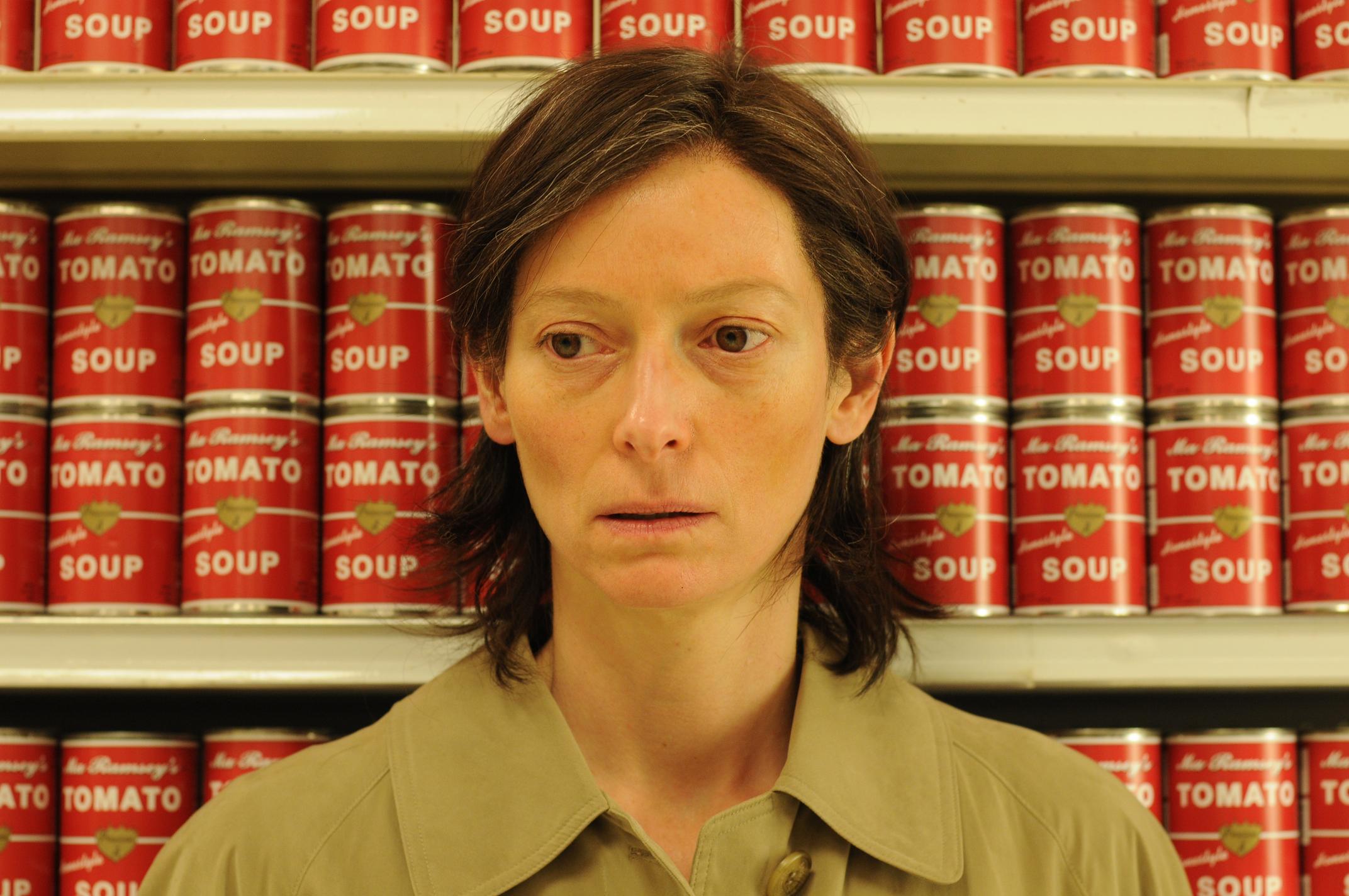
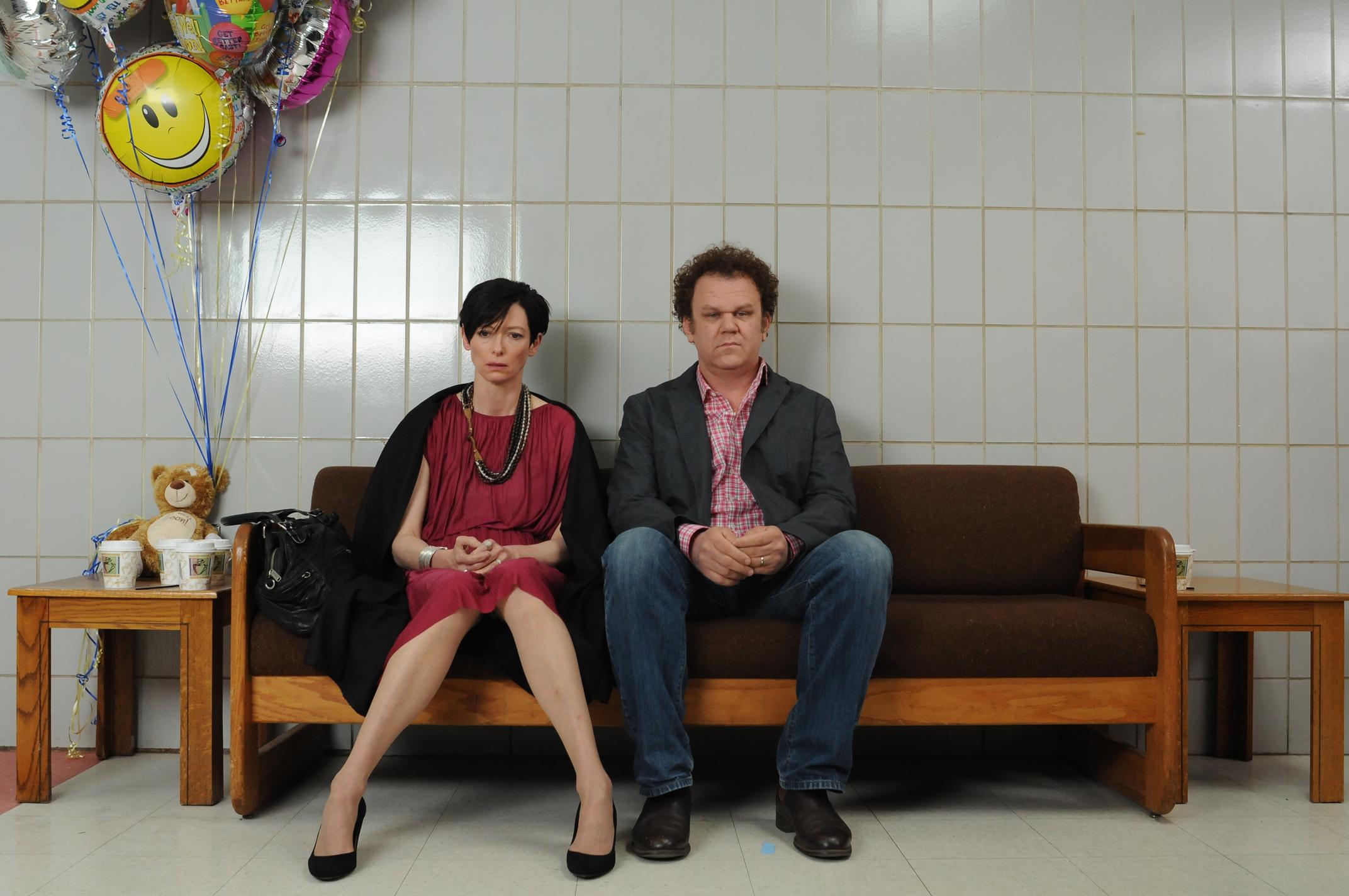
Lynne Ramsay (2002’s Morvern Callar) — directing from the script she co-adapted from Lionel Shriver’s novel — uses near-subliminal techniques to stir up atmospheric unease from the very start, with layered sound design and a significant, symbolic use of the color red. While other Columbine-inspired films, including Elephant and Zero Day (both 2003), have focused on their adolescent characters, Kevin revolves almost entirely around Eva Khatchadourian (a potent Tilda Swinton) — grief-stricken, guilt-riddled mother of a very bad seed (played as a teen by Ezra Miller, at age seven-ish by Jasper Newell, and as a baby by Rocky Duer).

The film slides back and forth in time, allowing the tension to build even though we know how the story will end, since it’s where the movie starts: with Eva, alone in a crappy little house, working a crappy little job, moving through life with the knowledge that just about everyone in the world hates her guts.

Motive was a hot topic post-Columbine. Both of the Colorado killers kept rage-filled diaries, but their home life has remained largely enigmatic. Dylan Klebold’s mother penned an essay for O magazine in 2009, titled “I Will Never Know Why.” It describes her shock upon realizing that her beloved son was involved in the massacre, and her enduring regret at not doing more to prevent it. She also touches on her experiences after the event: “I was widely viewed as a perpetrator or at least an accomplice since I was the person who had raised a ‘monster.'”

Eva shares these feelings of shock and guilt, and experiences, as Susan Klebold describes, constant public shame. She can’t leave her house without experiencing humiliation, thanks to the vandals who’ve splashed her porch and car with crimson paint. (The grim, practiced way she takes a sander to her sullied front door suggests it’s not an infrequent occurrence.) Forget about blending in when everybody knows your face — or your last name is as memorable as “Khatchadourian.”

But Eva’s guilt runs even deeper. Kevin‘s flashback scenes are stuffed with rock-solid evidence that her kid was born a complete psycho, and that Eva is fully aware of it.

What’s worse, she suspects it’s her own fault. She didn’t even want a baby in the first place, really; husband Franklin (played with gee-whiz oblivion by John C. Reilly) passive-aggresses her into domesticity. “Stop resisting,” the doctor urges as she’s giving birth, but it seems resisting would’ve saved her a lot of anguish. The baby screams all day (Eva’s only relief: parking the stroller at a construction site, where the sounds of a jackhammer drown out his cries); later, when the family moves to the ‘burbs, he grows into a scowling child who spends every waking minute terrorizing his mother. Even worse, he adopts a fake-sweet personality whenever Franklin is around.

Frustrated, Eva takes him to the doctor, who concludes, “There’s nothing wrong with him.” So, is Eva what’s wrong with him? Later, when she’s scouring high school-aged Kevin’s room, she finds no Columbine-style diaries, only a CD-ROM marked “I Love You.” It’s the only time love and Kevin are presented as part of the same thought — and, naturally, the “I Love You” disc actually contains a crippling computer virus.

Kevin is very nearly a full-blown horror movie, and the demon-seed stuff does get a bit excessive. But it’s hard to determine if those scenes are “real life” or simply the way Eva remembers them, since Kevin is so tightly aligned with Eva’s point of view. Though she’s miserable in the flashbacks, the post-tragedy scenes are even thicker with terror. The film’s most unsettling sequence unfolds on Halloween, horror’s favorite holiday; Eva drives past a mob of costumed trick-or-treaters as Buddy Holly’s “Everyday” (one of several inspired music choices) chimes on the soundtrack. Masked faces are turn to stare — accusingly? Coincidentally? Do they even know she’s Kevin’s mother? — with nightmarish intensity heightened by slow motion.

And indeed, “Everyday” Eva deals with accepting her fate; the film is sympathetic to her even while suggesting that she may actually be responsible. When a woman walks up to her on the street and punches her in the face, screaming “I hope you rot in hell!”, Eva brushes off help from a stunned bystander: “It’s OK. It was my fault.” Whether or not Eva will forgive her son is uncertain. Clearly she’ll never forgive herself.

We Need to Talk About Kevin opens Fri/2 in Bay Area theaters.

Talking with “We Need to Talk About Kevin” director Lynne Ramsay

0

As I sat in a hallway at the 2011 Toronto International Film Festival, waiting for director Lynne Ramsay to finish a photo shoot with We Need to Talk About Kevin star Tilda Swinton, I realized that Kirsten Dunst was stepping over me. I quickly stood up, apologetically, just in time to let a sunglasses-wearing Kiefer Sutherland pass by. They were both doing interviews for Lars Von Trier’s Melancholia.

But there was no time for stargazing: I was about to chat with one of cinema’s most important filmmakers, the creator of Ratcatcher (1999) and Morvern Callar (2002). As Swinton, Ramsay, and I headed down the hallway, passing paparazzi, I reached out for Ramsay’s coat and said, “Don’t lose me!” Ramsay grabbed my arm, pulled me into the crowd and said, “We’re sticking together.”

San Francisco Bay Guardian: There’s so many people that wanna talk to you!

Lynne Ramsay: You’re all working me!

Tilda Swinton: But remember, it’s a very, very good thing.

LR: It is, right?

TS: It is! It’s a very, very good thing! I remember last year — no, wait, two years ago — being taken over to some interview with some television guy and when we arrived, the people were like, “What film are you with?” We said, “It’s Italian: I Am Love.” And they said, “We don’t know anything about it! We’re not gonna write about that.” And we had to walk back across Toronto.

LR: Oh no!

TS: They had no interest in talking to us!

LR: (Shrieking) Really?

SFBG: So this is a good thing!

TS: This is a great thing!

(Swinton bids us farewell)

SFBG: So, as soon as your film ended last night, the Toronto folk sitting around me immediately began questioning Tilda’s character and her parenting skills. (Ramsay laughs hysterically.) They were all like, “I would never have let him — .” Or “He would have gotten a smack across the — .”

LR: (Laughing) Totally! Totally!

SFBG: And this immediately made me realize since I don’t have kids, how just the plot alone will provoke audiences to have extremely different perspectives towards your film. It really is a film that could be watched multiple times, which is exactly what I wanted to do as soon as it was over. The structure, the editing, the sound, it all made me want to be smarter.

LR: I’m not really that “smart” myself. (Laughs) I mean everyone who worked on the film is gorgeous, but the script was completely edited. We had no money; we had absolutely no time. I had to be so precise about the images. [Editor Joe] Bini is a musician and so is [my husband, Rory Kinnear], who was a co-writer on the film. So I think that helps as well. [Bini] also edited [Werner] Herzog’s new film Into the Abyss! He’s so sweet and such a great editor.

I’m also a big fan of music and I think we constructed a lot musically, added to that the soundtrack by Johnny [Greenwood, of Radiohead], and the amazing sound editor Paul Davies, who has done all my movies starting with my short films.

SFBG: Gasman (1998) and Ratcatcher (1999)?

LR: Yes, he did both. You know, I wanted to be a mixer in another life! It’s so much fun. Cinema is an atmosphere and …

SFBG: Well, your cinema is.

LR: [We Need to Talk About Kevin] was really constructed in the script. The sound design is even in there. It was pretty arduous trying to get — I mean it was 87 pages so there wasn’t a bit of fat on it. I was still asked to cut stuff because they were like “There’s no fucking way you’re gonna make this!” And in 30 days! Are you kiddin’? We didn’t believe it.

SFBG: 30 days?

LR: I don’t believe it myself, you know! Fuckin’ producers, bastards. We were gonna do it but we were broke as well, me and my husband and it had to all be prepared, it’s a high maintenance movie.

SFBG: Were you eating?

LR: (Laughs) Not really. We had smokes. But Seamus [McGarvey] was very generous with his time; he’s the DP [and an Oscar nominee, for 2007’s Atonement]. The gaffer, Jim McCullagh, had worked on The Godfather III and he really got behind us. The script supervisor Eva Cabrera had done a Malick film [The New World] and [production designer] Judy Becker had done Brokeback Mountain. They were all working for nothing because they loved the script.

SFBG: And maybe they loved you?

LR: (Laughs) Well, actually, they loved Seamus.

SFBG: Ratcatcher and Morvern Callar are such amazing films. I’m curious how Morvern was received in the UK, because it felt like at the time the film sort of went under radar in the states.

LR: It’s never been totally embraced. But I think it was a little bit ahead of its time because people seem to be finding it now. But at the time people were like “How dare you make this movie?”

SFBG: So let’s talk about the music. Johnny Greenwood’s score is so haunting but I’m curious about your choices of songs in both Kevin and Morvern.

LR: It was actually Rory who chose a lot of the tracks. This is a guy who I love, he’s an artist and he’d never done music in a film before. So we made mix tapes before we started and I love that because sound is such an integral part. Morvern is my little lush child and I love Samantha [Morton]. I want to work with both Tilda and Samantha again! They’re my kind of actors.

SFBG: You know, they are a very similar type of actor. In fact, [Kevin star] John C. Reilly falls into their category as well. They all know how to be the most interesting character on the screen in pretty much every movie they’re in. Yet you’ve taken them and put them in lead roles.

LR: I love the couple in Don’t Look Now (1973) because it’s Julie bloody Christie and Donald Sutherland, who isn’t the best looking guy but it all felt real, they weren’t this carbon copy couple. And in the book John C. Reilly’s character is more 2D, an all-American guy: “Golly gee, buddy.” And I thought that would make things way too flat if you cast a typically good-looking blonde guy.

SFBG: Tilda and John are so sweet together onscreen.

LR: They loved each other on set too, hanging out together. John came to my house and I would make him dinner! It was really cool shit! He bought me this beautiful guitar; it’s like a 1956 Gibson.

SFBG: Are you kidding?

LR: No! I know, right?

SFBG: Why?

LR: Well, we went to this guitar shop together and I was looking at this guitar and me and my husband were kinda too broke at the time but we were hoping that after the film was made, well maybe … if things went well … well, John just went and bought it. It was such a lovely gesture! He also recorded a song for my niece who came to the film set as my little assistant.

SFBG: I wanna hear that song.

LR: It’s so sweet. Her name is Shawn and he made the song called “Wee-Shawn,” and it’s so beautiful.

SFBG: Reilly, in my opinion, is one of the funniest men in Hollywood. How did you get him? Why would you think of him as the husband?

LR: Well, in fact, he contacted me! He had made a list of five directors he wanted to work with. He knew I was working on something and I was like, “I only have a minor part, and I’d love to give you a main part but this is a minor part,” and he was like “Dude, I’ll do it, yeah!” And he totally “got it.” You know?

SFBG: I do! I “got it” from him. His character is such a sweet ninny. Like a very sweet male who’s placed himself with a very commanding female.

LR: Totally, totally. A ninny who brings a certain kind of love, sort of an unconditional love because he doesn’t want you to see the bad side. And of course Ezra [Miller]’s Kevin responds quite well to him, but John brought so much depth to the character especially since it’s not the biggest part. He’s just amazing. Even Tilda brought her kids on set and John loved hanging out with them!

At Cannes, he hung out with my Mom and my sisters. He was in love with them. He’s a real part of the family now. Anytime I go to L.A. I just wanna hang out with John. We come from a very similar background you know, he’s a blue-collar guy and half-Irish.

SFBG: Kevin is so different from Ratcatcher and Morvern Callar yet you havn’t lost your voice. I am so excited for this film to hit the rest of the world.

LR: It was hard to make a movie in the U.S., an alien country for me. It was terrifying, in terms of the union and the money which doesn’t go the same way in America. Just getting a jackhammer seemed to be Kafka-esque! It was like, there’s a union who does do this and a union who does do that and I was laughing and going insane and I just wanted a meeting so I could say “get a fucking jackhammer! It’s an important scene and I need it!”

SFBG: So you were basically like Tilda’s character in the movie.

LR: Yes! But once we were up and running, the crew in New York was fantastic. They really get behind us.

SFBG: I love that there is no narration in this movie. In fact all of your films stress the image over dialogue. Does your brain look like these films?

LR: Are you calling me a weirdo? (Laughs) I’ve always thought very visually. When I was a kid, you could put me in the corner with some paper and some pencils and I’d be happy for the entire day. My mum thought it was great because my younger sister was super-clingy and I was the easy one. I didn’t even need TV. I’d just go into my own world. But again, even though my family was blue collar, there were lots of jazz drummers and saxophonists. Even my godfather was a painter.

SFBG: That’s this movie! This movie is jazz cinema!

LR: It’s crazy you’re saying that. We were just talking about that a couple of days ago!

SFBG: I said earlier I wanted to watch it again as soon as it ended, mainly because toward the end of the film, I swore I heard specific sounds that you had used in the beginning! Your films are so layered. They sincerely remind me of Orson Welles’ movies. They really are made for repeat viewings.

LR: I never went to school. So really, it’s just all street smarts. My mum was a cleaner and she’d go to work at six o’clock in the morning, she’d get us ready for school, I’d go out and then I’d come back when she was away, climb through the window, go back in and I’d be so much happier! I just wasn’t learning that much at school. There were too many people in the class, all these zombies, you know? People throwin’ things, half of the class was just destruction, you know? So what was the point?

(Ramsay pauses and smiles) You know, my dad was smart in my eyes. He just died; well, not totally recently but … and he loved crossword puzzles. And you know, that’s what I think it all is. You just need to put together the right puzzle pieces.

http://www.youtube.com/watch?v=bV7Y5cylhNc&feature=related

We Need to Talk About Kevin opens Fri/2 in Bay Area theaters.

Jesse Hawthorne Ficks teaches at the Academy of Art University as the Film History Coordinator and programs the film series Midnites for Maniacs.


Image Comic Expo showcases new stars and the old guard

1

Comic cons serve a variety of functions. They can be press junkets, costume parties, swap meets, social retreats, even museums. Comics writer Warren Ellis has a habit of referring to San Diego’s huge Comic Con as “nerd prom,” which perfectly captures the glow of excitement for mass socialization in funny costumes. By contrast, this year’s Image Comic Expo was more like a nerd Sadie Hawkins dance – a deliberate reversal of the standard hierarchy, where creator-owned books are championed over the widely beloved DC and Marvel franchises that sometimes seem to oversaturate the comics market. It was also a little less garish and hectic than some larger cons, but the sense of community and pride was still richly evident.

The event coincided with two historic peculiarities – the twentieth anniversary of Berkeley-based Image Comics and the migration of San Francisco’s WonderCon to Anaheim this year. And, fittingly, there was no shortage of Image worship over the con’s three days. In the center of the convention floor like a hub was the main Image vendor, which sold books, distributed tickets to panels and workshops, and hosted signings, all in the shadow of a massive edifice with Image book covers on one side and images from Robert Kirkman’s Skybound imprint on the other.

Local vendors were well-represented on the con floor, with Berkeley’s Fantastic Comics (shout-out to my hometown comic book guys and gals) and Escapist Comic Bookstore, and San Francisco’s Two Cats Comic Book Store, among others. The “artist alley” was rife with independent artists and creators selling their wares and producing sketches, while several Image creators, including Jonathan Hickman (Red Wing), Nick Spencer (Morning Glories), and the MAN OF ACTION gents, got their own booths around the con.

As for the sort of crowd the Image Expo attracted, based entirely on my casual observations, there was a notable diversity of age, gender, and ethnicity. There were strikingly few cosplayers, though I spotted one full-blown Aang from Avatar: The Last Airbender, a group of ladies in anime-inspired dress (I made out one Sailor suit), and two young’uns dressed as Batgirl (or a female Batman) and Captain America. Among con guests, the Skybound booth featured an Atom Eve cosplayer, and the comedians of Dipstick Swagger sported a variety of disguises including their own mascot, Luchacat.

By virtue of the con’s Image-centric organization, the panels which ran through Saturday and Sunday were occasionally redundant, with guests like Kirkman, Joe Casey, and Brian K. Vaughan each appearing in multiple places. But breaking announcements and a sense of fan enthusiasm for these beloved creators’ upcoming work kept it all going. Among the exciting announcements at Friday night’s keynote speech by Image publisher Eric Stephenson: the long-awaited sequel to Howard Chaykin’s Black Kiss, a third volume of Phonogram from Gillen/McKelvie, a collaboration between Grant Morrison and Darick Robertson called Happy, and several other new titles.

The most enjoyable panels were the ones that featured folks with a less-established fanbase, who were in a position to introduce new readers to their ideas. The inaugural Saturday panel, moderated by G4’s Blair Butler, focused on the forthcoming Kickstarter-funded collection Womanthology, a showcase for comics by female creators. The panel featured Trina Robbins, Mariah Huehner, Nicole Sixx, Fiona Staples, and Bonnie Burton, all of who contributed in various capacities. The audience, though smallish, was enthusiastic about both the cause and the content, and discussions of such exasperating issues as the “brokeback pose” (slightly NSFW tumblr here) drew applause and thoughtful questions.

Also engrossing was Sunday’s “Image Introduces…” panel, with a slate of recently recognized creators whose series are still in their early issues, including Joe Keatinge (Glory, Hell Yeah), S. Steven Struble and Sina Grace (Li’l Depressed Boy), Daniel Corey (Moriarty), Jim Zub (Skullkickers), Brandon Seifert (Witch Doctor), and Kurtis J. Wiebe (Peter Panzerfaust). It was a joy to see their pride in their creations and their genuine pleasure at getting to share their work with potential new fans.

But let us not forget the old guard: at the “Twenty Years of Independence” panel, the founders of Image told their story and the audience got a chance to witness controversial icons like Todd McFarlane and Rob Liefeld; the “Stories and Scripts: Writing Comics” panel featured Image’s hottest properties, including Jonathan Hickman, Ed Brubaker, Nick Spencer, John Layman, Joe Casey, Steven T. Seagle, and Brian K. Vaughan, who basically all teased each other and had a grand old time.

Since it was an Image-minded convention, creators came first, which is always refreshing, especially for less iconic newcomers with a lot to offer, but the apotheosis of one publisher might wear thin if the convention continues in subsequent years. With a bit of expansion, though, an East Bay comics event might differ enough from WonderCon to hold an audience.

All photos by Taryn Erhardt


Muralation: Swoon’s wheatepaste is reborn, in color this time

4

Swoon’s work has been haunting me. On a recent trip to DJ Rusty Lazer’s house in New Orleans it was there, bedecking a rundown Bywater neighborhood fence that concealed a village of homes that can be played as a symphony (she also designed a structure for the mini-city, a dream tree house atop stilts). As one strolls though the world one sees it here, there – fairy webs of delicate wheatpaste strands on city walls. 

So it’s no surprise that the Mission’s been eager to replace the wheatpaste Swoon (also known as Caledonia Curry) installed on Tony’s Market at 24th Street and Hampshire. Rejoice: after the original was defaced in August 2011, the female street artist’s new piece will finally adhere to Tony’s on Tue/28.

Goddess knows there are superlative female street artists based in San Francisco. Mona Caron, Juana Alicia — but here as in other places in the world women still (still!) haven’t gained the firmest of footholds in the street art world. Swoon is probably the best-known XX-chromosoned public artist out there, along with NYC’s Lady Pink.

So it was nice to have her around the city. Mission Local’s Molly Oleson penned a rather lovely little account of how Swoon’s piece — originally an image of a woman who had been kidnapped in Mexico’s spates of femicide — came to be on 24th Street and Hampshire. It has to do with Chicken John’s house, says Chicken John. 

The neighborhood liked it very much. But in one of the more bizarre cases of vandalism I’ve heard of, someone wrote the word ‘VOTE’ over it in big, artless red letters last August. Subsequent efforts to scrub off the letters half-obliterated Swoon’s work, so a team of concerned creative types including street art book editor Annice Jacoby, Lesley Freeman, and Chicken John contacted Swoon for a replacement, which she was reportedly happy to make. Oleson’s story includes a slightly humorous retelling of the moment when the team realized the replacement piece Swoon had sent wasn’t going to work out — happily for San Francisco, she was happy to create a second version of the replacement. 

This version, Swoon says in an artist’s statement, is a commentary on water issues surrounding the Gulf disaster in New Orleans. And the rendering that’s been done of the piece shows that its in color, not always the case in Swoon’s body of work. You’re welcome to go check out the piece getting put up tomorrow, and hear more about the inspiration behind the design in the video Swoon shot for Time Out New York below: 

Swoon mural re-installation

Tue/28 noon, free

Tony’s Market

24th Street and Hampshire, SF


6 great author readings in the next 12 days

0

Opt for a night sans sloppy drunks, covers, reality TV, or morning-after regret. Opt for a book reading — here, we’ll get you started with a list of upcoming page-turners. 

Joshua Foer: Moonwalking with Einstein

Foer investigates the inner workings of our brain by drawing on scientific research, cultural history of memory, and personal explorations of different memory techniques.  

Fri/5 7:30 p.m., free. The Booksmith, 1644 Haight, SF. (415) 863-8688, www.booksmith.com.

Karen Joy Fowler: The Jane Austen Book Club 

Fowler is an American science fiction and fantasy author who writes mostly about the lives of women. Her readings will be a part of Babylon Salon’s Spring 2012 reading and Performance event. 

Sat/ 3 7 p.m., free. Cantina SF, 580 Sutter, SF. (415) 398-1095, www.cantinasf.com. 

Joy Wilson: Joy the Baker Cookbook

Wilson loves butter, sugar, and dark chocolate, and shares her creative and delicious baking methods in her cookbook. We’re hoping she’s bringing brownies. 

Sun/4 3 p.m., free. Omnivore Books, 3885 Caesar Chavez, SF. (415) 282-4712, www.omnivorebooks.com. 

Kim Harrison: Perfect Blood

Harrison’s newest book is centered on a witch turned day-walking demon who is fleeing from human hate groups. She has fought against vampires and werewolves before, but humans are turning out to be the trickiest opponent of all.  

Mon/5 7 p.m., free. Borderlands Cafe, 870 Valencia, SF. (415) 970-6988, www.borderlands-cafe.com. 

Aaron Shurin: Citizen

Shurin uses lyrical prose and visceral language as he explores the nuances of civic and domestic life in his collection of poems. 

Mon/5 7:30 p.m., free. Moe’s Books, 2476 Telegraph, Berk. (510) 849-2133, www.moesbooks.com. 

Pamela Druckerman: Bringing Up Bebe

Druckerman investigates cultural differences involved in American and Parisian childbearing. 

Tues/6 7 p.m., free. Bookshop West Portal, 80 West Portal, SF. (415) 564-8080, www.bookshopwestportal.com


Ice Cream Bar’s soda fountain revives the ’30s jerk

0

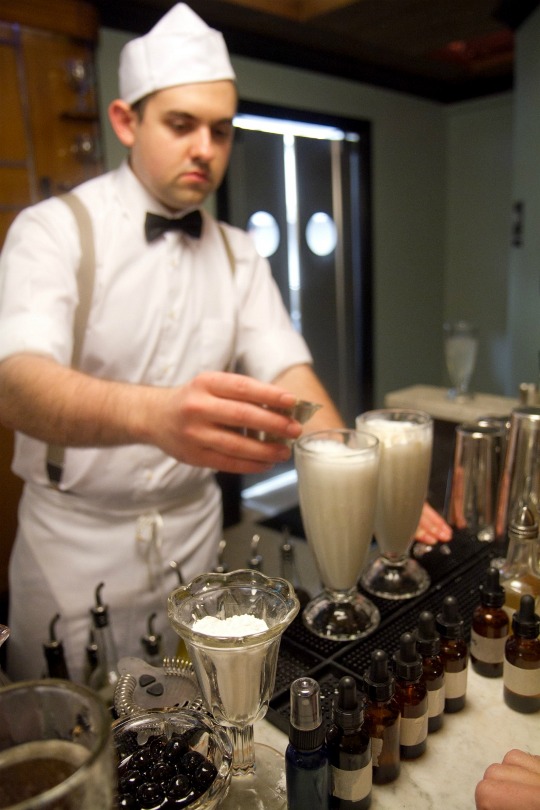
In this week’s Appetite food and drink column in the paper, I relished the opportunity to return to a time of delicious handmade fountain drinks at Cole Valley’s new Ice Cream Bar (albeit with some innovative contemporary flavor twists). In between sips of wild cherry phosphate, I got to talk to Russell Davis, the bartender who developed the fantastic soda fountain program, about the soda jerk revival — and got him to share some of his sassafras secrets.

SFBG Why is Ice Cream Bar different from other soda fountain revival spots in the US?

Russell Davis There are a few spots in the country supporting the “revival” of the soda fountain and its lost drinks, but none take it to the extent and level that we do at Ice Cream Bar. From top to bottom, our menu is not just based on using quality ingredients and refined processes, but also on its inherent historical value. Our syrups are all fresh, cold agitated and our ice is all hand cut. Even our floats are built to the same specifications as they would have made them in 1894 Chicago. We are not playing around.

SFBG What connection do you see between classic and creative cocktails, the world you come from, and old fashioned soda fountain drinks?

RD Many bartenders who didn’t flee the country during Prohibition to practice their craft became soda jerks. There was a beautiful way of mixing that was refined during this period. Also, the techniques that we apply to soda fountain drinks can, and I believe will, be used in the crafting of a refined cocktail.  What I’ve noticed as the biggest difference between mixology and soda jerking is that whereas bartenders focus on using fresh fruits and other seasonal ingredients, soda jerks try to capture flavors (in a tincture or extract)….

SFBG Tell me about the sassafras root beer featured at ice Cream Bar. How is this different from other homemade root beers?

RD First, it’s made using fresh sassafras and a house built sassafras extract, something that you do not find in mass-produced root beer because, by USDA standards, it is illegal due to its slightly carcinogenic properties. But, there is nothing to be afraid of: it’s about as dangerous as cinnamon or nutmeg.  Most people use wintergreen, spearmint, and licorice or anise to replicate that sassafras flavor that was in the original old school recipes of root beer, but nothing compares to the flavor of the true stuff. Next, I use black and jasmine tea as a base combined with a variety of other herbs, then cold brew it with ground marshmallow root to create a thick creamy texture and give it head. Lastly, I add a little bit of St John’s Wort in so, hopefully, it will put you in a good mood as well.

SFBG Given more than 75 tincture options and house-made extracts, what crazy concoction would you order if you wanted something unusual?

RD [Laughs] You’ll just have to wait and see when the next menu comes out!

Subscribe to Virgina’s twice-monthly newsletter, The Perfect Spot, www.theperfectspotsf.com

Justin Vivian Bond talks Occupy Wall Street, the power of language, and the politics behind the music

1

When Justin Vivian Bond was a little kid, v (more about that unique pronoun below) confidently wore Iced Watermelon lipstick to school and, inspired by feminist movements of the time, brandished a sign reading “Kids Lib!” Adults told the young Mx. Bond that these things were wrong, but v knew how right they felt, and represents for queer pride and radical poltics to this day. The writer, singer and activist is best known for v’s role as Kiki DuRane in Kiki and Herb, a drag cabaret show with partner Kenny Mellman. The show started in San Francisco and made it to Broadway, and was nominated for a 2007 Tony award. V’s memoir Tango: My Childhood, Backwards and in High Heels was released this year (wherein Bond tells the lipstick story and a lot more about growing up gender-free). Bond is still touring and will be back in San Francisco Feb. 23, performing from v’s new album, Dendrophile. I talked with v about the upcoming concert, v’s recent performance at Occupy Wall Street, and how music can bring people together.

SFBG What can people expect at your upcoming concert?

JVB I’m going to be performing songs from Dendrophile. I did my release concert when I was in the Bay Area in the spring. So some songs from that, some others songs, and some monologues about contemporary political observations. Also– 20 years ago I married a local performer by the name of Leigh Crow, aka Elvis Herselvis, and she and her band the Whoa Nellies are going to be opening. So it’s going to be an anniversary celebration.

SFBG You performed at Occupy Wall Street. What was that like?

JVB It was really awesome. I performed for the Trans-form the Occupation rally Nov. 13. It was a lot of trans activists talking about trans issues and establishing a presence of trans people within the revolution. It was so inspiring, empowering and exciting for me to perform my song on the Peoples’ Mic. The song, New Economy, is about the current obsession with whether people have enough and who has it. It was such a great experience.

Of course, the next day the police came in and closed Zuccoti park down. In my show I joked that once the queers and the trans people started making their presence known the police they realized they’d better shut it down. They were probably having flash backs to the ACT UP and Queer Nation days!

SFBG Do you think there has been a good presence of queer and trans issues in the Occupy movement?

JVB There certainly was that day. We didn’t get to see how that manifested within the community at the park. But I do feel that there are a lot of queer and trans people involved in raising awareness about social and economic disparities within our culture, so I think that its an inevitability that the subjects are going to be part of the Occupy conversation. Because trans people are constantly being oppressed and harassed.

SFBG How do you think music can help bring that kind of political awareness?

JVB I think that music is a way of bringing people together, especially people that may not realize how much they have in common, or may not have an excuse to be in the same space. If there’s an artist who starts voicing thoughts, ideas, and political sentiments, that’s one person making a statement, and people all of a sudden find themselves in a room with like-minded people. Community is formed. That community can become a larger voice, and that’s a powerful way of affecting the culture. Historically, music and artists have been a rallying potent for great and powerful change.

SFBG What’s your most powerful political song?

JVB Probably New Economy, this song that I did at occupy Wall Street . There’s also my cover of 22nd Century, which was written by Exuma, whose a Bahamian voodoo priest and spiritual revolutionary writer. That one really seems to get people going.


SFBG What inspired New Economy?

JVB I wrote it when the stock market was collapsing and everybody was freaking out. People were losing their 401k plans or health insurance. As an artist, I’ve never had those things. So seeing people freaking about something I’m so used to dealing with was kind of comforting. It was like, we are all going to be on a similar level for a while and try to figure out how to solve peoples problems. The song is about our commonality. The final line is “take what you need and give a little back,” because I believe there is enough out there for everybody.

SFBG
You’ve been involved with Radical Faeries, a group that celebrates queer sexuality, connection with the earth, and community. Have you been involved recently, and what does it mean to you?
 

JVB I haven’t been to a Faerie Gathering since the fall, but yes, I’m still involved. Its about community, and its about finding alternative economies, and ways of sharing and supporting each other on a very human, person-to-person level. That’s as opposed to having your reality dictated by the mass media and corporations.

SFBG Last year, you announced your official pronoun: V. You also use the honorific Mx. The move raised awareness for genderqueer and non-gender-conforming people, and also created backlash. It’s been a year now—how are you feeling about your pronoun decision?

JVB It’s been really great for me. Of course there’s frustration with people who somehow feel like they know me or my trip better than I do. But in general its been really liberating. And on a social level, I’ve met a lot of wonderful people who are going through similar experiences, that are not interested in being part of a fundamentalist or gender-fascist paradigm. So it’s nice to meet other people who feel this same way, and amazing to find out how many of those people there are out there.

SFBG
I know some writers don’t like using gender-neutral pronouns (some commonly-used pronouns that don’t signify a particular gender include ze and they.) But as a writer who has used the incorrect pronoun for somebody in the past, then edited the piece, I feel– it’s not that hard to respect how people identify!

JVB
I’ve been shocked to find out how heavily invested some writers are are in what they’re used to. For people that make their living using words, I’m almost shocked at how inflexible they can be. As for me, I love language and the power of it. The conversation that the pronoun provokes has been a great conversation to have with so many people. There have been times when people have done that same thing with me, then they fix it online and apologize, so that’s a nice thing.

SFBG Well thank you, and we’re excited for your concert.

JVB It’s going to be really fine show. It’s going to be a celebration, and I’m looking forward to it.