News and Politics | San Francisco Bay Guardian

News & Opinion

Get tough with defiant disrupters

8

EDITORIAL It may sometimes seem like we at the Bay Guardian don’t like the technology industry, but nothing could be further from the truth. We tweet, click, post, and share, playing with all the hot new tech toys that spring from the innovative minds of Bay Area residents. This is an important sector of the local economy, one that often empowers people who were just getting by to remain in expensive San Francisco.

Yes, we do regularly criticize tech (and some of its biggest neoliberal cheerleaders in City Hall), as we do to Airbnb, Lyft, and other so-called “shareable economy” companies in this issue. But that’s only because we strongly believe in open and transparent discussions about public policy and the needs of city residents.

And frankly, that’s not happening these days.

Instead of engaging directly and honestly with the people and our elected representatives, Airbnb has chosen to duck its obligations to the city of its birth and dodge attempts to create a public dialogue about its dangerously flawed business model. Same thing with Lyft, another company that acts as if it’s entitled to undermine civic institutions without so much as a public conversation first.

Yes, these companies have come up with cool ideas that have become popular with Bay Area residents. In a city where it was tough to find a cab on Saturday nights, Lyft made it easier to find rides and allowed people to make some extra cash off their cars. Airbnb was also a great idea that makes travel cheaper and more personal.

The beauty of these ideas is their simplicity — but that is also their main flaw, because San Francisco isn’t a simple city. It’s a complex, dynamic city with difficult landlord-tenant dynamics, and a congested city that tries to achieve the right balance of cabs on the roadways, both systems that are the products of decades-long struggles that have spawned reams of regulations.

These tech-savvy fortune hunters, who don’t understand or appreciate that history, think it’s enough to have a good idea and some rich venture capitalists willing to back it. They espouse vaguely libertarian ideas about “disruptive” technologies empowering people, but then they wait for government officials to solve the problems with their business models, raking in millions of dollars in profits in the meantime and delaying their day of public reckoning as long as possible.

For example, in a May interview on KQED’s Forum, Airbnb’s David Hantman was asked why the company was defying a city ruling that it must pay the transient occupancy tax, he said they were waiting for the city to adopt a new regulatory structure first.

That’s not an acceptable or defensible position, and it is only continuing because Mayor Ed Lee has publicly supported the company’s defiance of city law and rulings. Mr. Mayor, if these are the types of “jobs” you’re creating — part time jobs with no benefits in an underground economy that cannibalizes other industries, breaks city laws, and won’t pay local taxes — then this city is in real trouble.

We’re happy to see Board President David Chiu trying to solve Airbnb’s problems, but he needs the support of other top city officials who are willing to put pressure on the company to bargain in good faith. And yes, we’re talking to Mayor Lee, Tax Collector Jose Cisneros, and City Attorney Dennis Herrera, among others.

If you make the city appear impotent to enforce its own laws or too willing to go easy on wealthy corporations, it will only embolden more young opportunists to disrupt the city’s regulatory authority and its social fabric. You work for us, not the venture capitalists, and it’s time to show some spine.


Alerts: August 7 – 13, 2013

0

WEDNESDAY 7

Whither Modern Times? 2919 24th St., SF. moderntimesfuture@gmail.com. 7-9pm, free. Venerable indie bookstore Modern Times is in flux, but its collective members have been hosting town hall meetings to envision, as a community, what the future holds. Feel compelled to chime in? Are you a skilled event organizer or fundraiser? Join the conversation, bring a friend, or help spread the word that this beloved, lefty bookstore needs a boost.

THURSDAY 8

Boing Boing and the Beats Contemporary Jewish Museum, 736 Mission St., SF. www.thecjm.org. 6:30-8pm, $12. Presented in conjunction with the exhibit Beat Memories: The Photographs of Allen Ginsberg, this panel talk, exploring the Beats Influence in Underground Publishing, will be moderated by David Pescovitz of Boing Boing. Panelists include Ron Turner of Last Gasp Books; RU Sirius of Mondo 2000 cyberpunk magazine, V.Vale of RE/Search Publications and Layla Gibbon of Maximum RocknRoll.

From MLK to Trayvon Redstone Building, 2940 16th St, SF. 7-9pm, free. Award-winning columnist Gary Younge, who writes for the Guardian UK and The Nation and authored The Speech: The Story Behind Dr. Martin Luther King Jr.’s Dream, will lead this discussion on past and modern movements against racism. In the wake of the acquittal of George Zimmerman for the killing of Trayvon Martin, people have taken to the streets nationwide for rallies and vigils. Now, momentum is building for an upcoming rally in D.C. commemorating MLK’s “I have a dream” speech. What are the parallels between now and then?

Life During Wartime: Resisting Counterinsurgency La Peña Cultural Center, 3105 Shattuck Ave Berk. Lapena.org/events. 6pm, free with donation requested. This speaking tour on the military strategy of counterinsurgency will feature Kristian Williams, author of Hurt: Notes on Torture in a Modern Democracy, and Kevin Van Meter, co-editor of the collection Uses of a Whirlwind. The discussion will revolve around essays published in Life During Wartime, exploring U.S. counterinsurgency tactics.

SATURDAY 10

Eviction Free Summer: Landlords in the crosshairs San Francisco Tenants Union, 558 Capp Street, SF. ellishurtsseniors.org. 10:30am, free. Eviction Free Summer is a newly formed band of activists that has developed the unnerving habit of noisily visiting landlords who’ve sent out eviction notices. They would like you to join them. On this day they plan to target property owners who are using the Ellis Act to evict Jeremy, a disabled senior living with AIDS who’s lived in the Castro for over four decades.

SUNDAY 11

Trip out on the future with Jaron Lanier Diesel Bookstore, 5433 College, Oakl. tinyurl.com/whowns. 3pm, free. Author Jaron Lanier will be present for a discussion and book signing of his new work, Who Owns the Future? In it, the writer, computer scientist, and classical music composer explores the rise of digital networks as it relates to the recession and the decimation of the middle class.

Immigrants vulnerable to domestic violence

0

In San Francisco Sup. John Avalos’ District 11, half of all residents were born outside the U.S. In Sup. Jane Kim’s District 6, more than a third of residents are foreign-born, and almost half speak a language other than English.

Given the sizable immigrant population in San Francisco, it may not come as a surprise that Secure Communities (S-Comm), a federal immigration program administered by the U.S. Immigration and Customs Enforcement (ICE), is highly unpopular. What might not be so obvious is how dramatically S-Comm can impact the lives of foreign-born women who are survivors of domestic violence.

The reason for this is simple. “If you are a victim or a survivor of domestic violence and you call the police, you do not want to end up deported,” Beverly Upton of the San Francisco Domestic Violence Consortium explained at a July 23 rally, where advocates from organizations such as Mujeres Unidas y Activas, Causa Justa, the Filipino Community Center, and others stood and held banners demonstrating opposition to S-Comm. “We want it to be safer to call the police, not less safe.”

A member of Mujeres Unidas y Activas who introduced herself as Lourdes and spoke through a translator delivered a personal account of feeling fearful of police as well as an abusive partner. “Many times, abusers tell us not to call the police, because the police will not believe us. They say the police will probably deport us.”

The domestic violence and immigrant community advocates were there to champion Avalos’ Due Process for All Ordinance, which is being introduced at today’s Board meeting and is co-sponsored by seven other supervisors, essentially guaranteeing its passage. Avalos himself didn’t speak, and Sups. David Campos and Board President David Chiu, co-sponsors of the legislation, sent female staff members to make statements on their behalf as part of the all-female roster of speakers.

The legislation prohibits law enforcement officials from detaining individuals solely in response to immigration detainer requests issued by immigration authorities under S-Comm. As things stand, “the request has been honored in many cases,” Avalos explained in comments to the Guardian, even though California Attorney General Kamala Harris has affirmed that local law enforcement agencies are not obligated to comply with ICE detainers because they are mere “requests” and not legally binding. Since 2010, according to data provided be Avalos’ office, 784 San Franciscans have been deported after being turned over to federal authorities due to ICE detainers.

Sup. Jane Kim called S-Comm “a giant step backward when it comes to equality and fairness,” and added that S-Comm “makes our neighborhoods less safe.”

Legal Counsel Freya Horne read a statement on behalf of San Francisco Sheriff Ross Mirkarimi, stating that the sheriff has reduced the number of ICE detainers leading to deportations, and was supportive of Avalos’ legislation. She added that Mirkarimi had made it a policy to honor immigration detainer requests only in cases of criminal convictions of serious or violent felonies.

Avalos said he was compelled to move the legislation forward because “I’ve talked to so many people whose families have been separated, and have been devastated,” due to deportations under S-Comm. “We want to make sure we’re maintaining a level of due process,” he added, since the detainer requests are routinely issued without warrants or a requirement to show probable cause.

Chiu: centrist compromiser, effective legislator, or both

0

At the start of this year, when I wrote a Guardian cover story profile of Sup. Scott Wiener (which SF Weekly and San Francisco Magazine followed shortly thereafter with their own long Wiener profiles), he seemed like the one to watch on the Board of Supervisors, even though I noted at the time that Board President David Chiu was actually the more prolific legislator.

Now, it’s starting to seem like maybe we all focused on the wrong guy, because it is Chiu and his bustling office of top aides that have done most of the heavy legislative lifting this year, finding compromise solutions to some of the most vexing issues facing the city (ironically, even cleaning up some of Wiener’s messes).

The latest example is Wiener’s CEQA reform legislation, which the board unanimously approved on July 23, a kumbaya moment that belies the opposition and acrimony that accompanied its introduction.

That effort comes on the heels of Chiu’s office solving another big, ugly, seemingly intractable fight: the condominium lottery bypass legislation sponsored by Wiener and Sup. Mark Farrell. To solve that one in the face of real estate industry intransigence, Chiu showed a willingness to play hardball, winning over swing vote Sup. Norman Yee to get six votes using some hostile amendments.

In the end, Chiu won enough support to override a possible veto by the waffling Mayor Ed Lee, who has always echoed Chiu’s rhetoric on seeking compromise and consensus and “getting things done,” but who lacks the political skills and willingness to really engage with all sides. For example, it was Chiu — along with Sups. Farrell and David Campos — who spent months forging a true compromise on the hospital projects proposed by California Pacific Medical Center, replacing the truly awful CPMC proposal that Lee readily accepted.

“It’s been a very long year,” Chiu told the Guardian. “It’s been important for me to not just to seek common ground, but legislative solutions that reflect our shared San Francisco values.”

Next, Chiu will wade into another thorny legislative thicket by introducing legislation that will regulate the operations of Airbnb, the online housing rental corporation with a problematic business model.

After posting the preceding analysis of Chiu on the SFBG.com Politics blog on July 23, we heard lots of back channel concerns and complaints from progressive San Franciscans (and even some from moderates and conservatives who consider Chiu a raving socialist for helping suspend the condo lottery).

Nobody really wanted to speak on the record against Chiu, which is understandable given the powerful and pivotal position that he’s carved out for himself as a swing vote between the two ideological poles and on the Land Use Committee, whose makeup he personally created to enhance that role.

The main issue seems to be that Chiu allows both progressive and anti-progressive legislation to be watered down until it is palatable to both sides, empowering the moderates over the progressives. That’s a legitimate point. It’s certainly true that Chiu’s worldview is generally more centrist than that of the Guardian and its progressive community, and we’ve leveled that criticism at Chiu many times over the years.

The fact that he ends up in a deciding role on controversial legislation is clearly a role that Chiu has carved out from himself, no doubt about it. And that’s certainly why he played the pivotal role that he has this year. But when he uses that role to empower and support tenant groups, as he did on the condo lottery bypass measure, I think that’s something worth noting and praising.

On the CEQA reform legislation, it’s also a valid criticism of Chiu to note that Sup. Jane Kim had five votes for her legislation and that it was only Chiu who stood in the way of its passage (whether Mayor Ed Lee would have vetoed it, necessitating the need for two more votes, is another question).

In the end, Chiu can be seen as an effective legislator, a centrist compromiser, or both. Perspective is everything in politics.

Plan Bay Area: better, but it still gentrifies

0

By Peter Cohen and Fernando Martí

Council of Community Housing Organizations

OPINION On July 18, the Metropolitan Transportation Commission (MTC) and the Association of Bay Area Governments (ABAG) adopted the region’s first so-called “sustainable communities strategy,” as required under new state environmental laws. Plan Bay Area will direct the largest share of the region’s growth to the region’s urban cores — two-thirds of the region’s overall housing production is directed to 15 specific cities.

The vision is what environmentalists refer to as “smart growth” — shrinking the footprint of the region’s future development as a more environmentally friendly and geographically efficient pattern to absorb ever-increasing population. San Francisco alone has a very tall order: Our city will absorb 25 percent of new urban development, which equates to 92,000 new housing units and a pace of housing construction averaging around 3,100 units annually (a rate that has been reached only twice over the last 50 years since the era of 1960s urban renewal development).

The question that framed debates through the three-year process in drafting and finally adopting the plan is how that amount of new growth can be “done right;” that is, without gentrifying working class and poor communities and ensuring that infrastructure, including affordable housing and transit service, will keep up with that pace of growth. Tim Redmond’s feature article in the June 4 issue of the Guardian (“Planning for displacement”) and a June 12 forum sponsored by the Guardian, CCHO, and UrbanIDEA very thoroughly laid out the issues and critiques of the Plan Bay Area draft that was released by MTC/ABAG earlier this spring.

With such fundamental flaws when the draft plan was released in April, how did the July 18 adopted final Plan Bay Area fare? First, there is no question this regional “smart growth” plan will make combating gentrification at ground-level harder. But second, the plan could have been worse if not for a tremendous final pushback by progressive advocates from San Francisco and throughout the region loosely united in a “Six Wins for Social Equity” coalition and the committed leadership of a small core of progressive regional leaders — including two of San Francisco’s representatives, David Campos (MTC) and Eric Mar (ABAG) — who championed some final amendments.

Those “wins” (in reality, concessions by MTC/ABAG) achieved in this final push include: adding a public process to develop priorities for the Bay Area’s $3.1 billion share of state cap and trade funding, such as to affordable housing and local transit operations; strengthening the $14 billion transportation block-grant funds program (“OBAG”) to link it directly to local cities’ affordable housing production and displacement-prevention policies; and adding a requirement for MTC to develop a comprehensive strategy to prioritize funding of local transit service and transit maintenance.

Though the details of those amendments are fairly squishy and do not alter the development trajectory of the plan, they are potentially valuable handholds to work with going forward as Plan Bay Area gets implemented (and updated in four years).

That said, San Francisco’s front line working class neighborhoods and communities of color still stand to take the brunt of potential negative impacts from this regional “smart growth” plan. Theoretically they could receive the potential benefits of public infrastructure investments and stimulated economic activity. But while the risks are real, the potential benefits are still illusory.

We must become more engaged if we are to move Plan Bay Area beyond policy statements and promises of future “best-practices” to make sure vulnerable people are not displaced from their neighborhoods in the tide of infill real estate development and are guaranteed a real share of the fruits from “equitable” smart growth.

Building on progress

0

news@sfbg.com

A month-long labor standoff at the Hunters Point Shipyard redevelopment project has been put on hold as the city steps in to provide workforce mediation and oversight. But community-based organizations are left wondering how their workers will actually benefit.

Aboriginal Blackman United (ABU), a Bayview organization representing roughly 300 construction workers, announced on July 15 that it was calling off demonstrations at the construction site that had begun just before a June 26 groundbreaking ceremony (see “Lennar finally breaks ground amid controversies,” July 10).

ABU President James Richards suspended the protests after the Successor Agency to the San Francisco Redevelopment Agency informed him that Young Community Developers (YCD), another neighborhood nonprofit, would no longer exclusively manage job placements at Lennar Urban’s shipyard project.

The Hunters Point construction is expected to create 1,500 jobs annually, over the course of a 15- to 20-year build out. But critics have taken issue with local hiring guidelines hashed out in a 2003 development agreement with Lennar Corp. that are limited to good-faith promises rather than binding quotas.

Since then, community-based organizations have urged Lennar and the Building Trades Council to formalize their commitment to hiring from within the Bayview-Hunters Point community.

Building Trades Secretary-Treasurer Michael Theriault has so far been resistant to these efforts. “There is no inherent flaw in good faith,” Theriault said of local hire promises by Lennar. “Like any system, you have to enforce it.”

Until last week, Young Community Developers (YCD) was tasked with meeting local hire goals by recruiting and training tradespeople from the neighborhood and facilitating their placement on the project.

But Richards and other community advocates were skeptical of this arrangement because Theriault is vice president of YCD’s executive board. “How can [Theriault] be against mandatory hiring and be on YCD’s board?” asked Richards, who viewed it as an obvious conflict of interest.

ABU’s protests finally prompted Lennar and the Building Trades Council to seek the involvement of CityBuild, a workforce-training program and centralized referral network administered by the San Francisco Office of Economic and Workforce Development.

YCD Executive Director Shamann Walton said a meeting between the two organizations produced “a gentleman’s agreement that there will be an MOU in place between YCD and CityBuild,” designating CityBuild, rather than YCD, as the primary recruiting coordinator on the project.

YCD will be just one of a handful of community-based organizations that will assist in training and placement — others will include ABU, Anders & Anders, and the A. Philip Randolph Institute (APRI). APRI San Francisco Executive Director Jacqueline Flin says she supports a switch to CityBuild because it provides “a very good prospect of goal delivery. They have a fair process that’s been proven to work and the city’s invested in the effort.” Flin added, however, that she hadn’t yet heard any real details of the new arrangement with CityBuild. SFOEWD did not respond to the Guardian’s requests for comment. Terry Anders, director of the Anders & Anders Foundation, expressed disappointment that negotiations were taking place behind closed doors. Anders wants to see all the stakeholders brought to the table. He was quick to point out that, though CityBuild promises to be above board, “it is not a neighborhood organization.” “Somebody is making backroom deals,” Anders asserted, “and I am not for it. I don’t like being left out of the process.” He demanded an inclusive and transparent discussion, but a week after bargaining seemingly began and ended, it was unclear whether he would get one. “Lennar’s main concern is getting the buildings up, and they don’t care who does it,” he said. And though Richards is hopeful that CityBuild will be an improvement over YCD, he too was measured in expressing full confidence in the municipal agency just yet. For a lasting solution, CityBuild will need to work very closely with ABU and others. “We stopped all traffic ongoing to the shipyard and coming out for about a month,” to get this far, explained Richards, “the only way we guarantee that our people get jobs is that we are involved.”

Under fire again

0

rebecca@sfbg.com

At a recent hearing on San Francisco’s Health Care Security Ordinance — once-controversial legislation that is now in the business community’s crosshairs once again — a nursing student stood at the podium to address members of the Board of Supervisors Neighborhood Services & Safety Committee.

She told them about her mother, who battled illness but did not have access to healthcare for 14 years due to her immigration status, recalling a day when her mother explained why she wasn’t seeking medical attention: “If I go to the hospital, I’ll bury you in debt.”

For the uninsured and undocumented, going without medical care or going into insurmountable debt could be the only options if it weren’t for Healthy San Francisco, a medical services safety net that was created by the HSCO in 2006. The program is expected to continue to provide care for undocumented enrollees who won’t be eligible for federal assistance once the Affordable Care Act, also called Obamacare, takes effect early next year.

The HCSO’s mandate that businesses provide some healthcare coverage for their employees was fiercely opposed by the business community, which challenged it all the way to the US Supreme Court. Now, those same powerful forces are gearing up for a fresh challenge that could jeopardize HCSO’s potential to fill coverage gaps that will be created under Obamacare.

Under federal health care reform, two-thirds of the enrollees in Healthy San Francisco will become ineligible to continue receiving coverage because they will automatically gain eligibility for some form of federal assistance. Those earning up to 138 percent of the federal poverty level will be guaranteed coverage under Medi-Cal. But for low-income earners whose wages hover around $14 an hour, things are far less certain because they will be eligible to enroll in the federally created health benefit exchange, Covered California, although they won’t necessarily be able to afford it. For someone earning around $30,000 per year before taxes, the estimated monthly cost for a health insurance plan under Covered California hovers at more than $200 per month, in many cases making it too much of a stretch.

As things stand, uninsured San Francisco employees who earn too much to qualify for Medi-Cal, but not enough to afford enrollment in Covered California — despite being eligible — can still access funds set aside for them in medical reimbursement accounts under the HCSO. This option may provide enough of a financial boost for low-wage earners to take advantage of federally subsidized health insurance after all.

“For working people, the implementation of the Affordable Care Act actually makes the Health Care Security Ordinance more important,” explains Ian Lewis, research director at UNITE-HERE Local 2. “There are many consequences of the ACA … and the Health Care Security Ordinance is a buffer against them.”

As it stands, the local law “makes Covered California actually work in a high-cost city like ours,” Lewis added.

Under HCSO, San Francisco employers are required to contribute toward employees’ health care on a per-hour basis for each employee working more than eight hours per week, regardless of immigration status or city of residence, amounting to an estimated $255 per participant per month.

This mandate, known as the Employer Spending Requirement, has been the target of multiple lawsuits brought against the city by the Golden Gate Restaurant Association since the landmark health care ordinance, authored by then-Sup. Tom Ammiano, was first enacted in 2006.

That same requirement also makes the local ordinance stronger than the federal law when it comes to worker protections, because the federal mandate only requires employers to offer coverage for workers who put in 30 hours a week or more. That has prompted businesses nationwide to reschedule their workers down to 29 hours per week in a gesture of opposition to health care reform, but no such incentive exists in San Francisco because of the hourly contribution requirement.

Now that federal health care reform is poised for implementation, with enrollment set to begin in October and a transition to the new system slated for early next year, GGRA and the San Francisco Chamber of Commerce are urging the city to open up a new policy dialogue about employer requirements under the local health care law — and Mayor Ed Lee has been receptive.

“We question whether Healthy San Francisco should continue in its current form with the ACA coming in,” Small Business California President Scott Hauge told the San Francisco Business Times (“Healthy San Francisco, related program to shrink dramatically, but not price tag,” July 16). Hauge has met with Jim Lazarus, the Chamber’s senior vice president for public policy, and GGRA Director Rob Black on the issue, the article noted.

Reached by phone, Black emphasized to the Guardian that GGRA employers are merely seeking guidance on how businesses should comply with the local and federal mandates. “It’s important that we really focus on getting together, and getting together quickly,” Black said, to ensure “San Franciscans have access to the full benefits and subsidies of the Affordable Care Act.”

Longtime advocates of Healthy San Francisco and progressive policymakers are watching closely. “They’ve been trying to get out of their responsibility to provide worker’s health care since the law was passed,” Hillary Ronen, a legislative aide for Sup. David Campos, said of business interests who are airing complaints about employer requirements.

Once the federal law takes effect, San Francisco employers will have the option of either providing coverage, or contributing to a city program that establishes medical reimbursement accounts for employees administered by city government, Ronen explained. A third option, “standalone health reimbursement accounts,” under which employers manage reimbursement funds for employees, will be rendered illegal under Obamacare. That system generated controversy in recent years because employers were placing undue restrictions on the use of those funds, and in some cases even pocketing the money after neglecting to inform their workers that it was available (see “Check, please,” 4/23/13).

On July 25, Lee announced that the city’s Universal Health Care Council, a body previously tasked with guiding local health care policy, would be reconvened to “examine San Francisco’s implementation of the Federal Affordable Care Act (ACA) and engage stakeholders in identifying necessary local policies” to support the transition.

In response to signals that the business community is gearing up for a fresh challenge to the city’s health care law using the ACA as ammunition, Campos convened a hearing July 25 to discuss the importance of the HCSO in relation to the federal law.

For several hours, advocates of Healthy San Francisco — many of them members of the immigrant community who would have no other options if it weren’t for the program — delivered passionate defenses of the current program. Campos emphasized that federal health care reform stood to be a great success in combination with the local health care ordinance, which would serve to fill in any gaps in coverage.

Deputy Director of the Department of Public Health Colleen Chawla explained during the hearing that of the 60,000 San Franciscans currently enrolled either in Healthy San Francisco or SF Path, a second medical assistance program, roughly 40,500 will automatically become eligible to enroll either in Medi-Cal or Covered California under federal health care reform come January. The remaining 19,500 won’t be eligible, however, mostly due to immigration status. Healthy San Francisco is expected to continue providing a safety net for those who would otherwise fall through the cracks. But when it comes to the two-thirds who are eligible for federal assistance, but may not be able to actually afford it, things would be thrown into uncertainty if the Employer Spending Requirement were altered or eliminated. “Folks in the business community would be happy to say, the Affordable Care Act is enough, and businesses shouldn’t be complicated with an additional burden,” notes Le Ly, program director at the Chinese Progressive Association. But the HCSO “is an important pillar of the total continuum of care,” he said. “We see it as continuing to complement and strengthen health care coverage.”

Supporting unions helps all workers

0

EDITORIAL The San Francisco Bay Area has traditionally been very pro-labor, from the days when legendary longshoreman leader Harry Bridges led the San Francisco General Strike of 1934 to the modern era when labor unions have lent the muscle and money to myriad progressive reforms that San Francisco and California have proudly exported to the rest of the country.

But sadly, that sense of solidarity seems to be changing during these times of widespread economic anxiety, declining union membership, increasing urban gentrification, and a divide-and-conquer political climate created by both major parties. Too often, Bay Area residents are indifferent or even hostile to the plight of the working class.

We’ve seen it in the public reactions to the labor contract impasse and strikes at Bay Area Rapid Transit, whose unions staged a four-day strike that ended July 4 and which could resume again after a 30-day contract extension and cooling off period ends on Aug. 4. If the strike resumes — which seems likely at this point, disrupting commutes on a non-holiday workweek — the public’s anger and finger-pointing could be even worse than last time.

We heard similar resentments expressed in reaction to last week’s cover story (see “Striking Out,” July 24) about the stadium concession workers at San Francisco Giants’ games, who have been without a contract since 2010 and are even denied tip jars to supplement pay that is actually less than San Francisco’s minimum wage in many cases.

The common criticism is that these workers should just be glad to have a job, regardless of pay and benefits. And when it comes to the full-funded pensions of BART workers, critics rightfully point out that few of us enjoy that kind of retirement security.

But that criticism turns the real problem on its head. We all need far more retirement security than we have now, a reality that will hit hard in the coming years as the so-called “silver tsunami” breaks, leaving families and society to care for baby boomers who run out of retirement savings (which could happen quickly given that three-quarters of Americans aged 50-64 have less than $30,000 in retirement savings).

Bay Area residents should be supporting our brothers and sisters in organized labor, helping them so they can in turn help us, as SEIU Local 1021 and other unions are trying to do on the issue of retirement security for all (last year’s approval of SB1234 in California was a good start, but far more is needed).

When unions win good contracts, it generally increases wages and benefits in the region, even for non-union jobs (the opposite is also true, that wages stagnate when unions lose these fights), so it should be in our enlightened self-interest to support BART and Giants workers. Particularly during these times of economic uncertainty and woe, it’s important to overcome our resentments and stand in solidarity with our fellow workers — for their sake, for our own, and for the long-term best interests of our region and country.

Pedaling slowly

0

news@sfbg.com

With San Francisco bicycle rental companies such as Blazing Saddles and Bay City Bicycle Rentals and Tours having bike fleets numbering in the thousands, why does the new San Francisco bike share program only have 350 bikes? And can that really be effective?

In August, San Francisco and a handful of other Bay Area cities will join the ranks of the dozens of cities in the country that have bicycle share programs, although most are more robust than ours. For example, New York City’s bike share program offer 6,000 bikes.

Sponsored by the Bay Area Air Quality Management District and bankrolled by the Metropolitan Transportation Commission with more than $7 million, the program will bring 700 bikes to the region — half of which will make their way to San Francisco.

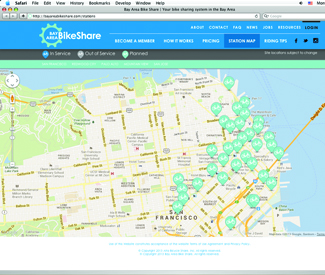
In the following months, San Francisco could be allotted 500 total bikes. For the initial launch, 35 bike share stations will be spread throughout the city, and when the bicycle count rises, the number of stations will jump to 50.

MTC spokesperson Sean Co told us that most of the money for the program goes to the cost of the bikes themselves. Each bike costs $5,000, is outfitted with tracking technology, and is expected to last 10 years. In addition to being high-tech, all bike share bikes are unique to Alta Bike Share Systems, and require special tools to be taken apart, another factor in the high price tag.

The rest of money goes toward the stations and fees for a consultant that helps run the program. Co believes that the membership fees alone will make up for the over $7 million spent on the program. But that’s assuming the program isn’t a flop, which some fear it could be given the anemic number of bikes being offered.


WHY SO FEW?

New York City’s bike share, Citi Bike — financed completely by Citigroup Inc. with no public funds — launched in May with 6,000 bikes and 300 stations. That program is already approaching a million total rides. Chicago’s Divvy bike share system started off with 750 bikes at the beginning of July and will increase to 3,000 at the end of August.

Kit Hodge, deputy director of the San Francisco Bicycle Coalition, is one of the people who says that 350 bikes just isn’t enough for San Francisco. “The city and SFMTA have estimated that it would take 3,000 bikes to have an effective bicycle share,” Hodge told us. “We definitely are pushing for more bikes.”

But San Francisco’s bicycle share may get the thousands of bikes that some believe it needs. The Board of Supervisors recently passed a resolution that calls on the San Francisco Municipal Transportation Agency and Department of Public Works to have a much larger system by 2014.

“Five hundred bikes isn’t enough for a citywide bike share,” Sup. Scott Wiener, who sponsored the resolution, told us. “If you look at other cities with a large population and a lot of people biking, bicycle share stations have to be heavily concentrated in many different areas. With the 500 bikes, other areas of the city will be excluded.”

But critics like Wiener and Hodge may not have taken into account that this program is only a trial run, with enough funding to last a year, according to BAAQMD representatives.

BAAQMD Director of Strategic Incentives Damian Breen told us the program is just the right size: “We feel the pilot is appropriately sized. I don’t think we’ve limited ourselves at all. This is to test the waters and see what it can grow into.”

Breen also thinks that mainly focusing on San Francisco for the Bay Area-wide bicycle sharing program would be unfair to other cities. Unlike other bicycle sharing programs, such as New York City and Chicago, San Francisco’s bicycle sharing system is just one part of a regional program that includes Redwood City, Palo Alto, Mountain View, and San Jose.

“This stage of the program is to see what works and what doesn’t,” Breen said. “Maybe the bicycle share might be used more in the suburbs than in San Francisco. When you do something regionally you have to take all cities and all outcomes into account.”

When asked if the bicycle sharing program would have increased the number of bikes in San Francisco if there was additional funding, he said no.

“I think obviously all partners would have liked the program to be bigger in certain areas,” Breen said. “Whether or not it would have been bigger in places like San Francisco, if there was more funding, I cannot say.”

Breen says BAAQMD will consider corporate sponsorship for the bike share once the initial money from the pilot runs out.


THE LAST MILE

The possibility of more stations and bike share rides in the city isn’t appealing to Blazing Saddles bicycle rental company owner Jeff Sears.

“If stations are placed in areas like the Fisherman’s Wharf, or North Beach, people may be tempted to use bike share instead,” Sears said. “But, we’ve been assured by the BAAQMD that that’s not going to happen.”

Breen says the service is directed at residents who commute, and may need the bike for that “last mile” of their trek.

“This is different than bicycle rentals, which are usually meant for a day of riding,” Breen said. “They are designed for 30 minute use — the main audience is folks who are looking for that last mile after they get off of Caltrain or BART.”

Breen went on to say that areas with bicycle sharing programs also saw bicycle renting programs go up as a whole. But Jeanne Orellana of Bay City Bicycle Rentals and Tours believes otherwise.

“We absolutely feel that it would affect business,” Orellana said. “We wish that it would coexist with our business, but other cities with bicycle sharing programs have seen bicycle rental shops close down due to the competition.” A scenario similar to what Orellana imagined played out in Miami Beach, Fla. Unlike the program in store for the Bay Area, Miami Beach’s DecoBike offers pricing plans for residents and tourists, and many of the tourists find themselves choosing the bike share over rental shops in the area, causing business in bicycle rental shops to reportedly drop 40 to 50 percent. Wiener acknowledges the reservations that Orellana and Sears hold about bike share, but he said that both options can coexist in the same city. “They’re two completely different markets,” Wiener said. “I understand the concerns that they have but comparing bike sharing and bicycle rental is like comparing apples to oranges.” And the BAAQMD, SFBC, SFMTA, and Wiener all agree on one thing: Tourists choosing bike share over bicycle rental companies just doesn’t make sense economically. Renting a bicycle for a day at Bay City Bicycle Rentals and Tours is $32. Taking a bicycle out for the day at the bike share comes at a heftier price. For $9, customers can get a 24-hour subscription with unlimited 30 minute rides from station to station. But after those 30 minutes are up, fees get added. A 31- to 60-minute ride costs $4, and each 30-minute increment after that costs $7, which can build up to over $150 in a day if the bicycle is not returned to a station. In the meantime, Orellana hopes that consumers will make the right decision for themselves. “I trust and hope that many people will do the math and find that bike share isn’t cheaper for exploring the city,” Orellana said. Co said that more than 300 people purchased memberships for the Bay Area bicycle share 24 hours after memberships were up for grabs a couple weeks ago. BAAQMD is pleased with the results, and viewed it as a good turnout. The official launch date has not been released, but its infrastructure is now being put into place with its imminent launch.

Alerts: July 31 – August 7, 2013

0

Whose paper? Your paper! A community forum about the Guardian LGBT Community Center, 1800 Market, SF. tinyurl.com/lvl9vla. 6-8pm, free. Join the staff of the SF Bay Guardian for a community forum on the future of San Francisco’s oldest alternative newsweekly. Nearly a month after longtime editor-publisher Tim Redmond left the newspaper after 31 years, Guardian staff members have reached an agreement with our parent company ensuring full editorial autonomy and control. This forum will help us determine where to go from here. We will seek community input, engage in dialogue with our readers, and discuss the Guardian’s important role in the Bay Area media and political landscape as we work to rejuvenate the newspaper and reach a new generation of readers.


Hear Alice Walker’s deliciously enlightened poetry and prose First Congregational Church of Berkeley, 2345 Channing, Berk. tinyurl.com/lqcsfph. 7:30pm, $15–$18. Internationally celebrated author, poet and activist Alice Walker will speak at this benefit for KPFA Radio and read from her recent works, The Cushion in the Road: Meditation and Wandering as the Whole World Awakens (Essays); and The World Will Follow Joy: Turning Madness Into Flowers (New Poems) Walker has written seven novels, four collections of short stories, four children’s books, and many volumes of essays and poetry. She’s best known for The Color Purple, the 1983 novel for which she won the Pulitzer Prize in Fiction. This event will be hosted by Brian Edwards Tiekert.

THURSDAY 1

Rally for a human rights attorney stuck in prison with cancer Federal Building, 90 Seventh St., SF. lynnestewart.org. Noon-2pm, free. Roughly 10 years ago, the Guardian wrote about the case of Lynne Stewart, a National Lawyers Guild member and radical human rights attorney who dedicated her career to representing unpopular clients who faced civil liberties violations. She was convicted of providing material support to terrorists in 2005, an accusation supporters say is false, and was eventually sentenced to federal prison for 10 years. Now age 73, Stewart is battling cancer behind bars and has petitioned the Federal Bureau of Prisons for compassionate release. The request has been denied, and so supporters are rallying to show their support for Stewart.

FRIDAY 2

Panel: How to win the environment Nourse Theater, 275 Hayes, SF. tinyurl.com/n77mqsv. 7pm, $10. Want to know how the build “a winning movement” on climate change? If so, these folks know what they’re talking about. Bill McKibben, founder of 350.org, will speak on this panel along with Gopal Dayaneni of the Oakland-based Movement Generation Justice and Ecology Project, Rev. Sally Bingham of Interfaith Power & Light, Katy Roemer of the California Nurses Association, and Antonia Juhasz, author of The Tyranny of Oil and Black Tide.

New Guardian leadership wants your input

0

San Francisco Print Media Company last week named Marke Bieschke as publisher and Steven T. Jones as editor of the San Francisco Bay Guardian, elevating two longtime Guardianistas into the top spots, guaranteeing them editorial autonomy, and letting them work with the community to chart its future.

As a first step in that process, the Guardian will hold a public forum on July 31 from 6-8pm in the LGBT Center, 1800 Market Street, to solicit input and discuss the Guardian’s unique role in the Bay Area’s political and journalistic landscape. Helping to coordinate the forum is Guardian writer Rebecca Bowe, who has accepted the position of news editor. The forum and subsequent discussions will form the basis for a strategic plan that will help guide the Guardian into a new era.

The newspaper’s future was uncertain a month ago following the abrupt departure of longtime Guardian Editor-Publisher Tim Redmond in a dispute with the owners over layoffs and the Guardian’s autonomy. The company’s Vice President of Editorial Operations Stephen Buel, who is also editor of the San Francisco Examiner, was named interim Guardian publisher and Bieschke its interim editor.

Heeding concerns in the community about whether the Guardian would remain an independent, progressive voice in San Francisco, Bieschke and Jones negotiated terms with SF Print Media Company CEO Todd Vogt that guarantee them full editorial control, the addition of three new advertising sales positions and another staff writer, and guaranteed minimum staffing levels during a rebuilding period.

Bieschke and Jones, who are in their early 40s and have been with the Guardian for around 10 years each, say they are excited for the opportunity to work collaboratively with Guardian staff and its community to rejuvenate the paper, attract new readers, and achieve economic sustainability.

“Losing Tim’s leadership was hard on all of us at the Guardian, and we struggled with what to do next. But ultimately, the Guardian plays such an important role in San Francisco — particularly now, at a pivotal moment for this gentrifying city and its progressive movement — that we wanted to find a way to keep that voice alive, maintain our credibility, and reach out to a new generation of Bay Area residents,” Jones said.

The San Francisco Bay Guardian was founded in 1966 by Jean Dibble and Bruce B. Brugmann, who continues to blog and serve as editor-at-large for the Guardian. The couple retired from regular duties when the financially troubled paper was sold to Canadian investors headed by Vogt in the spring of 2012, a deal engineered by Redmond, whose writing is always welcome in the pages of the Guardian as he pursues a new media venture.

“I’m stoked to bring a different energy and openness to innovation to the Guardian, while respecting our legacy and strengthening our bonds with the progressive, alternative community,” Bieschke said. “Obviously, Steve Jones and I stand on the shoulders of giants, and we’re so grateful to our Guardian family, past and present, for blazing a trail for world class progressive journalism, arts and culture coverage, and community-building in the Bay Area. In that spirit, I’m eager to reconnect with our readers and partner with them to amplify the Guardian voice and continue to change the Bay Area for the better.”

Vogt said he’s excited by the prospects of new generation of Guardian leadership: “I’m happy about this. I think it’s appropriate that two recognized leaders in the progressive community are in charge of the Guardian and I look forward to seeing what they do with it.”

Years of cutbacks have distilled the Guardian newsroom down to just a few excellent journalists, but all say they’re excited for the chance to rejuvenate the paper, build its readership and revenues, and work more closely with the community.

“We all hope you’ll help us to guard San Francisco’s values, appreciating all of its best cultural, artistic, and culinary offerings in the process,” Jones said. “We love the San Francisco Bay Area, in all its messy urban glory, and we think it’s worth fighting for.”

New director triggers a brain drain at SFDPH

1

The San Francisco Department of Public Health has seen an exodus of top officials over the 18 months since Barbara Garcia took the reins from longtime chief Mitch Katz, the most recent being Environmental Health Director Dr. Rajiv Bhatia, who was placed on administrative leave last month pending an investigation into unspecified concerns.

Bhatia has been a hero to many progressive San Franciscans and public health professionals for his innovative work supporting expanded worker protections, regulation of cannabis dispensaries and restaurants, environmental justice initiatives, and other work that has landed him in the pages of the Guardian many, many times.

“The poorest Americans are about two times as likely to die. People in low-wage jobs have less access to health care … food, shelter, clothing, and transit,” Bhatia testified during the 2002 Board of Supervisors hearing that led to the creation of a city minimum wage.

Neither Bhatia nor the department would comment on his leave, although sources tell us that he has not been informed of the charges against him (which an item in the Chronicle last month suggested was a possible conflict of interest issue relating to his regulation of restaurants) and that Garcia has clashed with many top officials in the department since taking over.

Among those who have left the department are Dr. Susan Fernyak, Director of Communicable Disease Prevention and Control; Dr. Masae Kawamura, Director of TB Control; Dr. Grant Colfax, Director of HIV Prevention; Elizabeth Jacobi, Director of Human Resources; Tangerine Brigham, Director of Healthy San Francisco; Mark Trotz, Director of Housing and Urban Health; and Dr. Erica Pan, Director of Emergency Preparedness.

“SFDPH has a national and worldwide reputation for innovative solutions to traditional public health problems. As a citizen of this city, I’m concerned that the current leadership is fostering an environment that is driving out and stifling that innovation to the detriment of all of us. A number of staff people have told me they have been instructed not to stretch themselves to innovate, to do only what their job description says and no more,” said the source, who works for a nonprofit that partners with the department.

Asked to comment on the exodus and her role in it, Garcia issued the following statement in response to questions from the Guardian: “Three staff that reported to me directly were recruited and provided promotions in the Los Angeles Department of Health Services. I’m very proud of these staff who are now involved with Health Care Reform efforts for the Los Angeles area. Several other staff that reported to our Public Health Division left for positions that were closer to home and the majority of these departures were promotions. All staff left in good standing with the San Francisco Department of Public Health.”

Meanwhile, 93 “members of the public health, social and environmental justice, foundation and education communities” wrote a signed letter to Mayor Ed Lee on July 10 on behalf of Dr. Bhatia, highlighting his work and appealing for a just resolution to the situation.

“Many across the nation have been grappling with how to improve the social and environmental conditions that are the cause of poor health and health inequities. Under Dr. Bhatia’s leadership, the San Francisco Department of Public Health Environmental Health Section has found practical ways — using research, policy, regulation, and cross-sector collaboration — to produce measurable improvements to environmental and social conditions throughout San Francisco’s diverse communities,” they wrote.

While writing that they “have no knowledge or commentary on the details of the leave or investigations, they went on to note the initiative that Bhatia has shown in going beyond his prescribed duties to work with various San Francisco constituencies to support equitable solutions to this city’s problems: “He takes his responsibilities as a public servant seriously, working well beyond required hours, and he is committed to improving the life-chances of socially, economically, and politically marginalized communities.”

After Oscar, after Trayvon…

49

rebecca@sfbg.com

Even before Cephus “Uncle Bobby” Johnson picked up the phone on Feb. 27, 2012, he wasn’t having an easy day. His nephew, Oscar Grant, would have celebrated his 26th birthday on that date if he had not been killed by a gunshot wound on Jan. 1, 2009.

Grant was shot by BART police officer Johannes Mehserle while lying face down on a train platform, an incident that was caught on film, prompted riots in Oakland, drew international scrutiny, and became the subject of the award-winning film Fruitvale Station by Oakland filmmaker Ryan Coogler.

In the years since Grant’s death, Johnson and his wife, Beatrice X, founded the Oscar Grant Foundation to develop a support network for families who’ve lost loved ones due to police violence. It was his involvement in this work that led Johnson to be contacted that day, and informed that a 17-year-old boy named Trayvon Martin had been gunned down in Florida one day earlier.

It wasn’t a police shooting but nevertheless, “We knew at this point that we had to go to Florida,” Johnson recalled. “What we’ve decided is that whenever a family experienced that, we would definitely try and get to them.”

Fast forward to July 13, almost exactly three years after violent protests erupted in Oakland following the news that Mehserle, who was charged with second degree murder, had been convicted of involuntary manslaughter instead. A new wave of demonstrations flared up as word spread that George Zimmerman, the neighborhood watch volunteer who killed Martin, had been acquitted.

“We weren’t surprised,” Johnson, who returned to Florida last month to observe the jury selection process for Zimmerman’s trial, told the Guardian. “But it was still painful.”

The verdict in this high-profile case has brought discussions about racial profiling and unequal treatment in the criminal justice system to the forefront. Even President Barack Obama touched on the theme in comments to White House reporters on July 19, saying, “Trayvon Martin could have been me 35 years ago.”

At the national level, new findings on “implicit bias” — unconscious prejudices that research in psychology has shown can persist in individuals (including poorly trained police officers), even if they consciously reject racial stereotypes — has started to inform policy debates around racial profiling.

“Policy needs to recognize that implicit bias exists,” Maya Wiley, founder and president of the New York City-based Center for Social Inclusion, told us. “Rep. John Conyers introduced a bill last year to prohibit racial profiling in law enforcement. That bill, if made law, would collect data on stops by race, as well as provide resources for training. That is a step in the right direction.”

But things get complicated, Wiley says, because “research shows that people of color, women, the elderly, may all experience discrimination as a result of implicit bias. There is no remedy in the law for this. … I think what is important now is to fight Stand Your Ground Laws which empower people to act on their implicit biases.”

At a July 16 rally held on the steps of San Francisco City Hall, Rev. Malcolm Byrd, pastor of San Francisco’s First A.M.E. Zion Church, illustrated his point about racial profiling by donning a hoodie and sneakers at the rally.

“I wanted to come looking suspicious,” he explained. “I wanted to give you an image that America has of young black men. I look suspicious. This is my country. I love my country. Yet, I look suspicious.”

Last year, Mayor Ed Lee’s proposal to introduce a stop-and-frisk policy, which would have allowed police officers to randomly stop individuals who appeared to be suspicious in an effort to get weapons off the streets, was abandoned in the face of widespread community concern.

Officers who undergo training at the San Francisco Police Department Academy must complete 52 hours of “cultural diversity” training, according to SFPD spokesperson Sgt. Dennis Toomer, which includes a mandatory four-hour intensive geared toward preventing racial profiling. State law mandates just 16 hours for such training for law enforcement agencies, Toomer told us.

But despite supplemental police training and the efforts of grassroots organizations that carefully monitor police activity, the Bay Area has witnessed a number of fatal shootings at the hands of police since Grant’s death, and many draw a link between these cases and the broader issue of racial profiling.

When asked about the outreach efforts of the Oscar Grant Foundation, Johnson began to rattle off a long list of names — mostly young black men, from places ranging from Oakland to Vallejo to Stockton to San Leandro — who were killed by police, and whose families his organization has reached out to.

They have also been in touch with several families in New York City who lost loved ones in similar situations, Johnson said. In many cases, the individuals were killed despite being unarmed, and officers later explained their actions by saying they’d mistakenly believed the shooting victims had firearms.

After several years of taking an up-close look at the investigative and legal proceedings that unfold in the aftermath of officer-involved shootings, Johnson has reached the conclusion that from case to case, “The playbook is pretty much the same. The officer first alleges he felt threatened — it’s all about the thought process of the officer. It’s always found to be justifiable because the officer feared for his life.”

One long-term goal of the Oscar Grant Foundation is to build up a coalition that can mount a meaningful challenge to the California Peace Officers Bill of Rights, a law enacted some 30 years ago that affords special protections for law enforcement officers facing misconduct charges. Johnson and others are critical of provisions such as officers’ rights to keep confidential information out of their personnel files, which can prevent significant information from being disclosed during a criminal trial. Meanwhile, others throughout the Bay Area seem primed to push for change in the wake of the Zimmerman verdict. “On Sunday, every black church in the nation was talking about what? Trayvon Martin, and what we need to do,” Andrea Shorter, a member of the San Francisco Commission on the Status of Women, said during the July 16 rally. “Two weeks ago, and we were all standing here as San Franciscans to rejoice … because we knew that LGBT people could be treated as first class citizens. The job is not done.” San Francisco NAACP President Rev. Amos Brown, who organized the rally, vowed that his organization “will push for a civil suit to bring this Zimmerman gentlemen to justice.” The national NAACP is petitioning U.S. Attorney General Eric Holder to open a civil rights case against Zimmerman. Sups. London Breed, Malia Cohen, Jane Kim, and David Campos also delivered speeches at the rally. “For the first time in my life, after growing up and going to funeral after funeral after funeral after funeral, of all boys and black men throughout my life, I see people in this audience who are not African American, who are just as hurt as I am, who are just as sick of this as I am,” Breed said. “And we are all in this together. We have got to work together if we want to change it.”

Privatizing the Botanical Gardens

48

news@sfbg.com

The Board of Supervisors last week voted to continue the collection of “non-resident fees” at the Botanical Gardens in Golden Gate Park for a minimum 10-year period. Then it approved a companion measure to allow construction of a new, privately run nursery that will be the home of corporate parties and members-only activities, giving a private group unusual control over a public space.

The proposed plan will replace the existing nursery with a new Center For Sustainable Growth, funded as a “gift-in place” from the San Francisco Botanical Garden Society, a nonprofit that has supported the gardens since 1955, when it was known as Strybing Arboretum.

“This vote means we are basically privatizing 55 acres of Golden Gate Park and handing it over to a nonprofit with no public accountability,” Harry Pariser, a longtime resident of the Inner Sunset, activist, and author told the Bay Guardian. “Essentially we’re allowing the government to make us show an ID to come onto public land. It’s also going to be a space where there’s going to be a lot more commercial activity. I think inevitably there is going to be fees for everyone.”

The new agreement consists of demolishing an existing 4,600 square foot greenhouse, which will be replaced by a new 9,800 square foot nursery. A real estate evaluation report on the nursery project performed by Clifford Advisory, a limited liability corporation, compares the project to allegedly positive public-private development efforts such as the Hunter’s Point Shipyard project.

The lease agreement between the Botanical Garden Society and the City of San Francisco allows the society to use the premises for “special events,” designate members-only hours for the facility, and waive the non-resident fee for those events. According to the lease, the city shall avoid interfering with the Society’s “quiet use and enjoyment of the premises,” namely by allowing them to throw private parties.

“The Botanical Gardens is an incredible asset to the city, it’s a great place for families and kids, and now they’re no longer treating it as a public asset,” Sup. John Avalos, who recently voted against the non-resident fees and the lease agreement, told the Guardian. “They’re making it more exclusive.”


LAND GRAB

The SFBGS has a history of campaigning for private exclusivity on public land as well as generating new revenue sources. In 2010, Avalos pushed a plan to replace the revenue brought in by non-resident fees with $250,000 pulled from the city’s real estate transfer tax.

SFBGS, backed by London Breed before she was elected the supervisor of District 5, which includes the Botanical Gardens, opposed Avalos’ effort and helped shoot down the proposed plans, continuing the fee collections.

A large part of the board’s approval is derived from the lobbying efforts of Sam Lauter, a lobbyist hired by SFBGS who has continually pushed for permanent fees and the new conservatory. Lauter also helped support and fund Breed’s supervisorial campaign last year.

While the lease and management agreement purports that the SFBGS’s management shall be subject to the city’s definition of the gardens as a public space, it offers an exception in cases of SFBGS-sponsored special events, circumventing its status as a public space. The lease also allows the Society to use other buildings on the premises, such as the County Fair Building, for special events, free of charge.

Although the SFBGS is essentially taking over operation of the gardens, the city will continue to pay for utilities and offer a “rent credit” that requires the Society to pay just $100 in rent annually. Additionally, SFBGS will be reimbursed for non-resident fee collection expenses.

“We understand the logic of providing benefits for people who donate to the facility,” Breed legislative aide Conor Johnston told us. “It’s very important to remember all San Francisco residents have free access and [organized groups of] youth from outside the city have free access. This structure allows the arboretum to stay open.”

While San Francisco residents still have free access, the agreements with the SFBGS strongly limit this access by instituting members-only hours, forcing residents to show identification at security gates, and renting out buildings for exclusive corporate parties.

Another part of the Botanical Garden’s master plan consists of providing food services in a new visitors center. Consequently, the “public” gardens will enforce a rule barring visitors from bringing in outside food. The plan also details the SFBGS’s plan to bring in new revenue streams through corporate events.

“This is about weeding people out, controlling people and deciding who has access to this place,” said Pariser. “They put up a wall that must cost thousands of dollars and they destroyed this meadow that even London Breed was appalled by. They control this place like it’s a domain and you’re not allowed to say anything.”


QUIET TRANSFER

The lack of public outreach and input on the SFBGS’s buyout has left residents like Pariser feeling robbed of public land that their taxes pay to support. Nancy McNally, founder of the San Francisco AIDS Grove, voiced similar concerns regarding the misplaced priorities of both SFBGS and the Recreation and Parks Department, which in recent years has been under growing criticism for monetizing public spaces (see “Parks Inc.,” 7/12/11).

“For me, I can’t even be in the same room as Recreation and Park Director Phil Ginsburg. I think he has done so much harm to the parks,” McNally told us. “He’s created a ton of positions in the marketing and PR department. What do they need four people for to run public marketing for a public space?”

Frederick Law Olmsted, the co-designer of Central Park, is said to have influenced the style of Golden Gate Park. Olmsted’s theory was to bring wilderness into the city. For McNally, this non-manicured, rustic aspect of Golden Gate Park is what makes it so appealing.

“They’re taking away the basic foundation of the park, which is wildness,” said McNally. “The new building is so big, obtrusive, and unnecessary. It’s only about income for the Botanical Society’s select group.”

McNally views the RPD and SFBGS as predatory entities who target residents attempting to use the land by charging egregious fees for weddings, memorials, and other events.

McNally recalled a friend who wanted to have a memorial for another gardening enthusiast in the Arboretum. For 10 people, the RPD wanted $1,000 and to hire a security guard for a group of elderly gardening enthusiasts.

SFRPD did not return the Guardian’s phone calls regarding the management under the SFBGS, which also did not return our call.

Jane Glasby, an ex-librarian for the SFBGS, whose job was terminated in 2010 due to widespread cuts to the garden’s education program, expressed her inside views on the changing tides of park’s atmosphere in a letter written to “friends and garden lovers” as her tenure came to an end.

“Over the last few years, the library budget has been slashed, the children’s program cut back, and the adult education program all but eliminated,” Glasby wrote at the time. ‘With money available to pay a firm to lobby for an entrance fee $10,000 every month for at least the last seven months, it looks very odd to close the library [that was at the Arboretum] with the excuse of saving just $10,000 a year. Charging admissions would put the garden in danger of becoming an exclusive but shallow and flashy entertainment (I am thinking of the Tea Garden and the Academy [of Science]), rather than the living museum that we all love and respect.”

While Glasby’s comments refer to cutbacks dating back to 2010, her experience denotes what is seemingly becoming the protocol of SFBGS. Three years later, the Society has succeeded in charging non-residents indefinitely and turning what was once a public place of solitude for residents and non-residents alike into an increasingly privatized hub for members willing to pay extra for exclusivity of an allegedly public space.

McNally, who is now retired, has taken it upon herself to document the decreasing local attendance of the arboretum, which was once a frequent lunch spot for residents and nearby UCSF students. “On a sunny day at noon it used to be to be carpeted with people having lunch. It’s not anymore,” said McNally. “I have four years of documentation of that empty lawn at high noon, showing it completely empty, with just geese shitting everywhere.”


Corrections: The permit fee for the gardening club was corrected. We also added the parenthetical to Johnston’s quote to clarify visitor fees.


Why democracy matters

21

EDITORIAL There’s a troubling anti-democratic trend taking place in this country, one that’s been recently reflected everywhere from the US Supreme Court’s decision to strike down key provisions of the landmark Voting Rights Act to City College of San Francisco losing its accreditation and being placed under state control.

Maybe you’ve only been passively following the City College story, either because it doesn’t seem to directly affect you or simply because of mid-summer distractions, but here’s why you should care: power has been unilaterally stripped from the Board of Trustees, the people we elect to carry out our will, spend our money (including the parcel tax for CCSF that local voters overwhelmingly approved just last year), and strike the right balance between training students for jobs and universities and offering more community-based programming.

That can be a difficult balance to strike in San Francisco, with its multitude of interests and needs, and we can legitimately criticize how decisions are made or not made by this often dysfunctional board (as we’ve repeatedly done in these pages over the years). Democracy isn’t always the cleanest or most effective way to govern, but we as a country long ago decided that it’s an important experiment worth trying, and that it beats more autocratic alternatives.

But Mayor Ed Lee has been all too eager to give up on that experiment when it comes to City College, as he’s made clear in repeated public statements since the decision. Asked about the issue during the July 9 Board of Supervisors meeting, including the loss of local control over vital public assets and meeting halls, Lee once again praised the move “to save City College through a state intervention.”

Maybe that’s not a surprising position coming from a career bureaucrat who was appointed mayor with the support of powerful economic interests, but it should trouble those of us who haven’t yet given up on democracy, which is the stuff that happens between elections even more than casting ballots every couple years.

It’s about process and protests, coalitions and consensus-building, trial and error. As strange as it may seem to some, the Egyptian military’s recent removal of President Mohamed Morsi, whose unilateral dismantling of democratic mechanisms prompted widespread protests, was essentially a democratic act (albeit an imperfect choice between untenable options). That’s because that unilateral action was driven by popular will and accompanied by strong assurances to rapidly restore democratic institutions and leadership — something that has not yet happened in relation to City College.

Detroit has long been one of the most troubled big cities in the US, thanks to this country’s evaporating industrial sector and other factors. But when Michigan Gov. Rick Snyder implemented a state takeover of the city in March, fully half of the state’s African-American population was denied democratic representation. And since then, Snyder and other Republican leaders have magically found the funds that could and should have been offered in the first place to bail this city out. Instead, they’ve begun packaging up Detroit for the capitalist speculators.

If we aren’t vigilant, financially troubled California cities such as Vallejo and Stockton could be next on the urban auction block, and that list could grow from there given the ability of coordinated capitalists to withdraw investments and cripple any jurisdiction that opposes their interests (as writer Naomi Klein compellingly showed in her 2007 book The Shock Doctrine: The Rise of Disaster Capitalism).

Are we being a little alarmist about the state takeover of one, small democratic institution? Maybe, but there is good reason to draw bright, clear lines in defense of our experiment in democracy. The conservative-dominated US Supreme Court has already signaled its willingness to grease this slippery slope, led by Chief Justice John Roberts, who clearly is playing the long game and will likely be quarterbacking this effort for decades to come.

As the New York Times and other legal analysts noted after the court’s latest session ended, Roberts has been carefully laying the groundwork for an undermining of democracy, even when issuing rulings that ostensibly side with the liberals, as he did in helping strike down Prop. 8.

While we in San Francisco cheered the resulting legalization of same-sex marriage, what the ruling actually did was limit the power of the people to defend decisions made through the initiative process. And earlier that week, Roberts also wrote the ruling that the racial discrimination guarded against in the Voting Rights Act no longer existed, despite aggressive current efforts by Republicans to disenfranchise African American, Hispanic, and poor voters through disingenuous voter fraud laws, scrubbing voter rolls, and other mechanisms.

It was Thomas Jefferson, the greatest advocate for democracy among our founding fathers, who said, “The price of liberty is eternal vigilance.” In other words, we lose our liberty a chunk at a time if we don’t resist those who would trade democracy for efficiency (or in the parlance of Mayor Lee, “getting things done.”).

So the loss of local control over City College is something that should not stand, and we should all put be putting pressure on Lee and other locally elected representatives to demand a clear plan for when and how this important institution will be returned to local democratic control. If the Egyptian military can do it, clearly state education officials can as well.

Alerts: July 24 – 31

0

WEDNESDAY 24

Milk Club Dinner & Gayla Roccapulco Supper Club, 3140 Mission, SF. http://milkdinner2013.eventbrite.com. 7-10pm, $40 and up. Join the Harvey Milk LGBT Democratic Club in celebrating 37 years of queer progressive leadership. Featuring U.S. Army Lieutenant Dan Choi, staunch advocate for the successful repeal of the U.S. military’s “Don’t Ask, Don’t Tell” policy affecting LGBT service members, as keynote speaker. Milk Club honorees include whistleblower Bradley Manning, queer activist group ACT UP, the San Francisco Gay Men’s Chorus and others.

THURSDAY 25

Forum: The worst international trade deal you’ve never heard of First Unitarian Universalist Society of San Francisco, 1187 Franklin, SF. 7-9pm, free. You may or may not have heard of the Trans-Pacific Partnership, a multinational “free-trade” agreement that’s being hashed out largely behind closed doors. Why should you are? Here’s a hint: It’s being orchestrated by the likes of Chevron, Halliburton, Walmart, and major financial firms among others. Join experts in globalization and learn about international resistance to this shady trade deal.

SATURDAY 27

Party with Meiklejohn Civil Liberties Institute 1715 Francisco St., Berk. (510) 848-0599. 1:30-4pm, donation requested. This benefit gathering for a unique think tank on human rights will include a special treat: Oakland attorney Walter Riley will deliver a talk on “getting the Oakland Police Department to obey the law.” And just in case you require more discussion on our eroding civil liberties to make your hair stand up, there will also be discussion about how drones violate the California Constitution.

TUESDAY 30

Teach-in: immigration and labor ILWU Local 34 union hall, 801 2nd St., SF. (415) 362-8852, http://www.lclaa.org. 7-9pm, free. Join the International Longshore and Workers Union for this Laborfest event, offering a concise history of labor and immigration in California. The history of the Bracero Program is key to understanding the current Congressional debate about immigration reform. Featuring members of the Association of Braceros of Northern California. Al Rojas, a labor organizer and with Labor Council For Latin America Advancement, LCLAA, of Sacramento, will discuss the continuing struggle of California Braceros for justice and the connection of the struggle for immigrant rights.


Trayvon Martin: Guns escalate conflicts

86

OPINION The tragedy of Trayvon Martin’s death is not merely the loss an innocent young boy’s life, nor the criminal justice system’s failure to provide justice, though those are wounds we struggle to bear. The tragedy is that these wounds are not unique. We have felt this pain before. Trayvon is but one of thousands of young African American men who have lost their lives to gun violence. And George Zimmerman’s acquittal represents the dismissive attitude our country seems to have about those lives.

People from all walks of life are angry about Trayvon’s death and George Zimmerman’s acquittal. Our anger in the face of such tragedy is understandable. I share it. But I also believe that even in our darkest hours, there is hope. There is something to be learned here.

Let this be the start of a greater debate on gun laws, racism, and our national climate of fear for our own personal safety and the safety of our children.

We have to do something about the prevalence of guns in our society. If not for the introduction of a gun into the situation, Mr. Zimmerman likely would have been beaten up—something he probably deserved—and that would have been the end of it. His firearm needlessly escalated the situation far beyond where it needed to go.

This case is a very real example of a nation that puts someone’s right to carry a handgun over someone’s right to not be pointlessly murdered. Let me add my voice to the multitudes calling for greater firearm accountability.

And why did the situation that night begin in the first place? “Neighborhood Watch” means “watch” and “report suspicious activity,” not “chase” or “pursue.” What is so suspicious about walking, wearing a hoodie, and talking on a cell phone? Nothing. Unless you are black.

Although the African American community is, sadly, used to being profiled, used to grieving the loss of our young boys and men to gun violence, Trayvon’s case has opened the eyes of others who are finally as outraged as we are. For the first time, I feel that something has changed. The outpouring of support from non-African Americans for Trayvon Martin and his family has given me hope that our cries for boys and men in our community are finally being heard.

Anger is a great motivator. And progress is often borne from tragedy. I hope for the African American community and for our country that this tragedy is more than just a passing media spectacle. I hope it’s the beginning of something meaningful, a reevaluation of gun laws, of the violence young black men face every day, and of the way we empower our communities.

London Breed represents the Western Addition and the Haight on the Board of Supervisors


Trayvon Martin: Can it happen here?

25

OPINION Like many others I have been captivated by the proceedings in the Trayvon Martin case. Personally, and as a member of the Board of Supervisors, it has inspired disappointment, outrage, frustration, and more questions about our criminal justice system than I have answers. But more than anything else this case prompts me to ask: Can this happen here?

However you feel about this particular case, we all like to think that in San Francisco we are more advanced than the rest of the country, and in most ways we are. From our Sanctuary City to our community policing strategies, we have always been conscious about race in our criminal justice system and City policies.

The neighborhoods I represent have 33 percent of the City’s African American population, more than any other area of our City, and we also have the highest concentration of young people, nearly 23 percent. More than half of the individuals who are incarcerated in San Francisco are African American and last year District 10 had the City’s highest number of youth on probation.

Regardless of their ethnicity, residents of areas that experience public safety challenges have a heightened sense of awareness or tension about what goes on in their neighborhoods. Unfortunately, sometimes seeing a young African American man is a trigger. It is a trigger to walk faster, be more alert, notify neighbors, or even call the police to report suspicious behavior.

This is the exact tension that a year ago led Mayor Lee to discuss implementing a version of New York City’s controversial Stop and Frisk Policy. Under this policy, each year police officers stop hundreds of law abiding citizens, the vast majority of which are African American, Latino, and young men on the suspicion that they may be engaging in illegal behavior. I was proud to join with many residents, faith leaders, and even our Police Chief in outlining more productive ways that we can interrupt violent behavior without instituting a policy based on racial profiling.

Thankfully, Stop and Frisk was never implemented in San Francisco, but the debate we had about it demonstrated that we still struggle with the role race plays in our criminal justice system and crime in our neighborhoods.

This verdict serves as a call to action for all of us that if we don’t want a similar tragedy to occur here, we must continue to do what San Francisco has always done best — lead the way. I will continue to push our City to have open dialogues about race in all of our public safety policies. I have spent the last year and will continue to do everything possible to strengthen our City’s regulations on gun control and work collaboratively with all of our communities to develop real solutions to violence that are rooted in protecting and supporting our neighborhoods instead of racial profiling.

Malia Cohen represents southeast San Francisco on the Board of Supervisors.

Giraudo (and activists) close CPMC deal

18

The takeaway message from a July 11 press conference held in the Mayor’s Office touting legislation authorizing California Pacific Medical Center’s construction of two new San Francisco hospitals was seemingly this: Everyone hearts Lou Giraudo.

A part owner of Boudin Bakery and former president of the San Francisco Police Commission, Giraudo was called in last year to help mediate a deal that seemed doomed when CPMC, city officials, and a coalition of labor and community organizations were unable to hash out an agreement that was acceptable to all sides.

Negotiations have been contentious over the past year due to early indications that CPMC would not guarantee that St. Luke’s, a health care facility relied upon by many low-income San Franciscans, would keep its doors open as a condition of moving forward with the new Cathedral Hill facility, a centerpiece of CPMC’s $2.5 billion project.

Enter Giraudo, who was, according to a not-so-subtle hint dropped by former Mayor Willie Brown in his San Francisco Chronicle column last year, “quietly brought in” by the mayor’s office to fix the half-baked mess that the CPMC deal had evidently devolved into.

Sup. David Campos sang Giraudo’s praises, saying, “I have yet to meet a finer public servant,” and calling Giraudo “a real hero of mine.”

Giraudo himself told the Guardian that his strategy was “to de-politicize the process and get people to think about the community.”

Board President David Chiu, who worked closely with Campos and Sup. Mark Farrell to negotiate with CPMC and other parties on behalf of the Board, went so far as to compare Giraudo to Batman. He even joked that he was going to shine a bat signal the next time a negotiator was needed, in hopes that Giraudo would save the day.

Yet while Giraudo may have provided the catalyst needed for a deal, it was community advocates who ensured that the public at large benefited from the CPMC plan more than they would have otherwise — since the mayor’s office seemed willing to go along with the health care giant’s original terms.

Long before Giraudo’s involvement, a coalition of labor and community organizations waged a campaign to rebuild CPMC “the right way,” holding strong on the issue of St. Lukes and refusing to agree to anything that would leave open the possibility that the hospital, a critically important facility for low-income patients, would be shuttered. “That coalition has been working for quite some time … to save St. Lukes,” Campos said of the diverse coalition of community and labor leaders, who formed under the name San Franciscans for Healthcare, Housing, Jobs and Justice. “It kept working for many years.” Under the terms of the agreement that was ultimately agreed upon, St. Luke’s will have a number of specified services to ensure it remains a full-service hospital, and CPMC will commit to providing services to 30,000 charity care patients and 5,400 Medi-Cal managed care patients per year. CPMC will also contribute $36.5 million to the city’s affordable housing fund, and it will pay $4.1 million to replace the homes it displaces on Cathedral Hill. While many advocates for San Francisco’s most vulnerable populations heralded the deal, some were disheartened that it did not dedicate space for psychiatric care.

Kiwis score points as Oracle regroups

0

After a week of one-boat “races,” an argument over rules, and an angry sponsor making waves in international media, it would be easy to write off the America’s Cup as the lamest party in town (so lame, in fact, that the organizers have ceased broadcasting the one-boat shows on YouTube).

But, it was a week of wins for Emirates Team New Zealand, most obviously the solid drubbing they delivered to Luna Rossa on Saturday (7/13) during the first race at which two boats actually showed. A smart “hook” by ETNZ blocked Luna Rossa from the start line and gave the Kiwis a five second advantage that stretched to over five minutes during the seven legs of the race. Unfortunately, that was the peak of the action as the gap between the boats grew so great and Luna Rossa officially earned a “did not finish” result for exceeding the five minutes allowed to cross the finish line after ETNZ. Overall, the match was almost as boring to watch as the single-boat snoozefests of earlier in the week, however it did show off the capabilities of the Kiwi crew, who are clearly mastering foiling while jibing, a key move for maintaining high speeds downwind. Which brings us to the other big win for the New Zealanders this week. On Thursday, the international jury ruled in favor of ETNZ and Luna Rossa, who protested a new rule requiring larger, symmetrical rudder elevators as a matter of safety. The jury decided that allowing the larger rudder elevators — which Oracle have been using on their boat since they relaunched in April after a pitch-pole in October destroyed their wing sail — would violate the AC72 Class Rule that governs the design specifications of the boats.

They said regatta director Iain Murray couldn’t change this rule without buy-in from all the competitors and that voluntary compliance of the other safety rules would appease the Coast Guard, which permitted the event based on the additional safety measures made after Andrew Simpson died. The rudder elevators help stabilize the lightweight boats while foiling, or lifting off the surface of the water to hit speeds of over 40 knots — ETNZ saw 42.3 on the speedometer on Saturday while Luna Rossa maxed out at 39.9 knots. The crew that masters this move and can maintain it over the course of a race will likely come out ahead. ETNZ is doing it now and will likely get better and better at it over the coming weeks as they continue to race the course through the multiple round robins of the Louis Vuitton Cup.

Meanwhile, Oracle will have to return to the drawing board and Ellison’s crew will need to get out on the water and re-learn how to handle their boat with a new rudder that complies with the Class Rule. Oracle has been tight-lipped on the subject, with just a brief statement from general manager Grant Simmer on the jury’s decision. “We continue to support the Regatta Director and we believe all teams have benefited from his review. We don’t have an issue complying with the Class Rule, and we will be ready to race under the rules affirmed by the Jury.” However, they may have an issue playing catch-up to the Kiwis, who have a lot on the line. If they aren’t able to wrest the Auld Mug from Larry Ellison’s hands, it’s likely the New Zealand government won’t chip in for a future campaign — especially if high-tech, billion-dollar boats remain the name of the game. The Kiwis have already chalked up four points and will need to win just one more of the next three bouts with Italy to advance to the Louis Vuitton Cup semifinals, during which the Swedish team, Artemis, should be back on the water. Spectators won’t see Oracle on the course until September 7, when the America’s Cup final matches commence, however there should be plenty of opportunities to observe their practice sessions with a newly rule-compliant boat. To that end, it’s worth noting that situating the race close to land for the first time in the Cup’s history, and with a short course completed in multiple laps, was supposed to draw crowds to the shoreline and the television screen. Now that I’ve seen the boats live and on television, I have to admit that so far it’s still a pretty boring sport to watch. Standing near the start line at Marina Green or the finish line at Piers 27/29 may get you flashes of action and watching it on television is like watching a video game.

The best of both worlds is to park as near as possible to the water and get your hands on a portable marine VHF radio tuned to channel 20, which transmits the official America’s Cup broadcast. Then you can hear details on speed and tactics while actually seeing the most unforgettable part of this race — the boats jibing downwind, hitting freeway speeds while foiling with spray flying and crewmembers bouncing from one hull to the other.

That’s still drawing gasps and cheers from the crowd.

Beginning on broke

1

news@sfbg.com

Despite signs of economic recovery, many young people still face hard times due to high unemployment, low wages, and a lack of job opportunities. San Francisco Mayor Ed Lee recently sought to tackle this issue locally with the rollout of Summer Jobs + 2013, a public-private partnership with an ambitious goal of providing 6,000 jobs and paid internships for San Francisco’s young adults. It was the most ambitious goal ever pursued in a city jobs initiative, with particular emphasis on low-income youth.

“I’m calling on all San Francisco companies to take on this challenge to support the youth of San Francisco,” Mayor Lee said at a press conference in April, when he joined House Democratic Leader Nancy Pelosi in unveiling the program, the local manifestation of an Obama Administration jobs initiative. “Creating meaningful employment opportunities for our young people today will set them up for success now and in the future.”

But Summer Jobs + is falling far short of its goal, resulting in the creation of only 3,200 summer jobs. The Mayor’s Office is still holding out for a possible influx of hires next month that could bring it closer to the goal before summer’s end, Gloria Chan with the San Francisco Office of Economic and Workforce Development told us.

Last summer, the Mayor’s Office launched a similar initiative aimed at providing 5,000 youth jobs and internships, and ultimately exceeded the goal by 200 positions. Roughly 32 percent of those jobs were in the private sector, predominantly tech. At the end of the day, only about 14 percent of the program’s participants locked down private-sector jobs, with employers ranging from Starbucks to Bank of America to Twilio.

Despite some success in helping young San Franciscans find work, the efforts so far amount to a kind of Band-Aid solution to a problem that goes much deeper and cannot be solved by simply teaching young people to draft polished resumes. Youth unemployment, particularly among low-income and marginalized groups, has worsened over time and is linked to a broader trend of economic inequality.

The Urban Institute, a nonpartisan think tank, recently turned an eye toward economic pressures facing young people with the release of a study titled, “Lost Generations? Wealth Building among Young Americans.” (see “Wealth vs. work,” May 1).

The institute found that among young people, “Average wealth in 2010 was 7 percent below that of those in their 20s and 30s in 1983. Even before the Great Recession, young Americans were on a strikingly different trajectory. Now, stagnant wages, diminishing job opportunities, and lost home values may be merging to paint a vastly different future for Gen X and Gen Y. Despite their relative youth, they may not be able to make up the lost ground.”

In the aftermath of the Great Recession triggered by the economic crash of 2009, millennials ages 16 to 24 have faced dramatically lower employment and income rates in comparison with their elders, according to Bureau of Labor Statistics data.

In California, where unemployment stands at 10.5 percent, the millennial unemployment rate is 20.2 percent. Additionally, the median income of employed young adults in California fell from about $35,000 to $32,000 from 2005 to 2011, while other age groups recovered on average. In San Francisco, the unemployment rate for young people aged 16 to 24 was just shy of 14 percent in 2011, double that of individuals spanning ages 18 to 34.

“We know that there’s been a lot of reporting out there that the recession was particularly hard for young adults, but it’s also important to note that they are in a much bigger hole than everyone else,” Rory O’Sullivan, a policy director for Young Invincibles, told the Guardian.

Young Invincibles is a national organization that works to expand opportunities for young adults in education and employment, and to bring attention to the oft-ignored economic plight of young adults seeking a foothold in the job market.

Young Invincibles found the Great Recession hit young adults harder than any previous recession in recent history. A quarter of job loss experienced by millennials occurred after the recession ended, while the unemployment rate for 18 to 34 year olds has consistently been double that of those 35 and up.

“Young people usually take a big hit in a recession,” said O’Sullivan. “Since they’re often the first fired, last hired in a seniority system. You’re going to let go of recent hires and not the more experienced folks.”

It’s a problem that can potentially have broader effects in the long run. “There are huge consequences for the economy down the road if we have a whole generation out of work,” explained O’Sullivan. “Lack of internships and first jobs can really hurt a young person’s wages. If a young person graduates in a recession, their wages will take a hit for decades afterwards — and that could have huge consequences. We’re still a long way behind.”

There’s no easy fix for the myriad economic pressures surrounding young adults, but O’Sullivan points to public-private partnerships as a way to get young people back in the market, even though that doesn’t seem to be working in San Francisco. O’Sullivan said Young Invincibles would like to see more public service jobs created for young people. “There’s a huge demand,” O’Sullivan said. “Rebuilding after national disasters, building houses, tutoring. We have to do a better job of connecting young people to this workforce.”

Power struggles

12

rebecca@sfbg.com, steve@sfbg.com

Opposition from the San Francisco Labor Council scuttled the San Francisco Public Utility Commission’s plans to approve CleanPowerSF on July 9. But activists supporting the renewable energy program actually welcomed that new roadblock, saying it could trigger a more robust rollout of renewable energy projects that they’ve been seeking all along.

“It gives us leverage,” Eric Brooks, an organizer with Our City who has pushed the SFPUC to adopt a more aggressive CleanPowerSF, told us. “They’re insisting on local union jobs and California union jobs, and we’re glad they said that.”

Brooks said labor’s insistence on union job guarantees places the SFPUC under renewed pressure to implement a more aggressive buildout of local energy projects, from building retrofits to wind power generation facilities.

The SFPUC has already come under attack for the program because Shell Energy was the sole bidder to do the initial energy purchases. International Brotherhood of Electrical Workers Local 1245, which represents PG&E workers, has used the Shell contract as ammunition in a campaign against CleanPowerSF.

Shell’s involvement also helped IBEW persuade the Labor Council to oppose the project, despite its longstanding support for community choice aggregation, the model for pooling customers into renewable power programs on which CleanPowerSF is based.

“The Labor Council is for community choice aggregation, we just don’t like how the players have shaped up,” Tim Paulson, the council’s executive director, told us. “It really makes us hold our nose that Shell Oil is going to have a role … one of the worst labor law violators in the world.”

While the council’s May 13 resolution criticizes Shell, it also expresses support for renewable energy generation in the city to “help San Francisco meet its climate action goals.”

Brooks and other progressive activists share labor’s disdain for Shell. They’re trying to limit its involvement to merely purchasing the first 20 megawatts of power so CleanPowerSF can get underway with enough customers.

The SFPUC should then take over on power purchases, Brooks says, and start issuing revenue bonds against the CleanPowerSF customer base to build green power projects. New research by consultant Local Power shows CleanPowerSF could create 1,500 local jobs per year for 10 years.

Brooks also doesn’t like Shell’s involvement, but he said it was an acceptable means to the end, which was being able to roll out a CCA program that was competitive enough on price with PG&E that at least 80 percent of its targeted customer base would not choose to opt out, the level he believes they need to fund the buildout, which would bring prices down even more.

When we left a message for Local 1245 spokesperson Hunter Stern to ask whether the union would support CleanPowerSF if it guaranteed more union jobs, he referred questions to Paulson, who wouldn’t go beyond his initial statements.

“If it wasn’t for PG&E’s pressure, Local 1245 probably wouldn’t be doing this,” Brooks said of the union’s aggressive campaign against CleanPowerSF.

Representatives from the San Francisco Public Utilities Commission told the Guardian that the agency intends to pursue a buildout of green power infrastructure, although CleanPowerSF director Kim Malcolm says only a few million dollars a year will initially be invested in renewable and efficiency projects.

“That line item is one of the reasons why the advocates are pretty much unanimously supporting this program,” SFPUC spokesperson Charles Sheehan noted. “We listened to them. They wanted a lower rate, they wanted dedicated money for local buildout.”

But to overcome labor’s opposition, those activists want the SFPUC to go further. Malcolm sounded a note of skepticism on Local Power’s job estimate, saying it was based on the assumption that the agency would issue bonds totaling a billion dollars.

“We have no confidence that we could issue a billion dollars worth of bonds in the first few years of the program,” Malcolm said, instead saying the highest the agency expected to go was closer to $200 million.

Brooks wants the Local Agency Formation Commission to hold a public hearing vetting the buildout studies by Local Power, showing the SFPUC and the general public that they are viable. Brooks said that hearing will likely take place in the next two weeks, before SFPUC votes on CleanPowerSF in late July or early August.

Asked about opposition to the program from the San Francisco Labor Council, Malcolm said the SFPUC was in talks to address their concerns. “We have this week been talking to representatives of the Labor Council about those conditions, and how they might actually be implemented in ways that might be practical and promote a sustainable program,” she said.

Brooks said he’s feeling more hopeful than ever about CleanPowerSF, particularly now that the SFPUC has gotten the price down to about 11.5 cents per kilowatt hour, about the same as what PG&E would offer for its proposed green energy program and just $6 more per month than its current brown power service.

“We’ll now hit that sweet spot on prices, and that’s when we can say, ‘Now let’s go for the buildout,” Brooks said. “We know we’re not going to win this if we don’t have labor behind us.”