• No categories

Bruce Blog

State by state, unions matter

0

Dick Meister, former labor editor of the SF Chronicle and KQED-TV Newsroom, has covered labor and politics for a half-century. Contact him through his website, www.dickmeister.com, which includes more than 250 of his recent columns.

Union members invariably have better pay and benefits than non-union workers. But, as a new study shows, the number of workers who’ve joined unions varies widely from state to state.

Even in some states with a relatively high number of union members, the number is only a small percentage of the state’s overall workforce, according to the study by the Center for Economic and Policy Research.

For example: Texas , the country’s second largest state, has the eighth highest number of union members — 615,000. But that’s only 6 percent of the Texas workforce. It is, in fact, the country’s fourth lowest rate of unionization and less than half the national average of 13.6 percent.

It’s no coincidence that Texas is a so-called right-to-work state that prohibits unions from negotiating contracts that include union shop provisions which require workers to join the union that represents them in dealing with employers. So why should workers in those states join the union when they can get the union’s services and the pay and benefits it negotiates without even paying dues?

Twenty-one other states have right-to-work laws, most in the South, Southwest and Midwest. They include North and South Carolina, where the percentage of workers in unions is at a national low of less than five percent.  It’s at a national high of more than 25 percent in New York and Hawaii.

California, the nation’s largest state, has the most union members — 2.6 million or 18 percent of its workers.  At the other end of the national scale, the numbers drop way down to Wyoming’s total of less than 20,000 unionized workers, only 9 percent of that right-to-work state’s workforce.

Public employees, who make up 10 to 20 percent of the states’ workforces, have unionization rates ranging from below 30 percent to more than 60 percent.
But what, specifically, do they and the 17 million other U.S. workers who’ve unionized get that other workers don’t get?

 The Center’s study found that union members’ pay is generally about 15 percent higher than that of non-union workers — roughly $2.50 or 15 percent more an hour for an average hourly rate of $6.25.  Union members also typically get benefits that many, if not most, non-union workers lack, such as employer-financed health insurance and pensions.

The conclusion should be obvious. The study’ s author, John Schmitt, noted that the findings show clearly that “unions substantially improved the pay and benefits of workers in every state.”

Beyond that, unionized workers have a greater say, not only about their working conditions, but also in political affairs and community activities, given organized labor’s prominence in such matters.

A large part of the reason many workers nevertheless remain outside of unions is the notoriously lax enforcement of the laws that were designed to guarantee working Americans the unfettered right to unionization. 

His findings, said Schmitt, “strongly suggest that better protection of workers right to unionize would have a substantial positive impact on the pay and benefits of workers in every state.”

The Employee Free Choice Act that’s long been stalled in Congress would provide the needed protection by cracking down on the widespread violation of labor laws. Many employers illegally interfere in unionization drives by disciplining, firing or otherwise intimidating union organizers and supporters.  Even those employers who recognize a union as their employees’ representative often refuse to bargain with the union and discipline employees who protest.

Until the Free Choice Act or something much like it is enacted, the growth of unions in California and every other state will be stunted.
                                         
Dick Meister, former labor editor of the SF Chronicle and KQED-TV Newsroom, has covered labor and politics for a half-century. Contact him through his website, www.dickmeister.com, which includes more than 250 of his recent columns.

Robert Skidelsky: The big bank fix

4

If reformers are to win, they must be prepared to fight the world/s most powerful vested interest

By Robert Skidelsky 

Robert Skidelsky, a member of the British House of Lords, is Professor emeritus of political economy at Warwick University, author of a prize-winning biography of the economist John Maynard Keynes, and a board member of the Moscow School of Political Studies.

LONDON – Two alternative approaches dominate current discussions about banking reform: break-up and regulation. The debate goes back to the early days of US President Franklin D. Roosevelt’s “New Deal,” which pitted “trust-busters” against regulators. 


In banking, the trust-busters won the day with the Glass-Steagall Act of 1933, which divorced commercial banking from investment banking and guaranteed bank deposits. With the gradual dismantling of Glass-Steagall, and its final repeal in 1999, bankers triumphed over both the busters and the regulators, while maintaining deposit insurance for the commercial banks. It was this largely unregulated system that came crashing down in 2008, with global repercussions.

At the core of preventing another banking crash is solving the problem of moral hazard – the likelihood that a risk-taker who is insured against loss will take more risks. In most countries, if a bank in which I place my money goes bust, the government, not the bank, compensates me. Additionally, the central bank acts as “lender of last resort” to commercial banks considered “too big to fail.” As a result, banks enjoying deposit insurance and access to central bank funds are free to gamble with their depositors’ money; they are “banks with casinos attached to them” in the words of John Kay.

The danger unleashed by sweeping away the Glass-Steagall barrier to moral hazard became clear after Lehman Brothers was allowed to fail in September 2008. Bail-out facilities were then extended ad hoc to investment banks, mortgage providers, and big insurers like AIG, protecting managers, creditors, and stock-holders against loss. (Goldman Sachs became eligible for subsidized Fed loans by turning itself into a holding company). The main part of the banking system was able to take risks without having to foot the bill for failure. Public anger apart, such a system is untenable.

Premature rejection of bank nationalization has left us with the same two alternatives as in 1933: break-up or regulation. Taking his cue from Paul Volcker, a former chairman of the US Federal Reserve, President Barack Obama has proposed a modern form of Glass-Steagall.

Under the Obama-Volcker proposals, commercial banks would be forbidden to engage in proprietary trading – trading on their own account – and from owning hedge funds and private-equity firms. Moreover, they would be limited in their holding of derivative instruments, and Obama has suggested that no commercial bank should hold more than 10% of national deposits. The main idea is to reduce the risks that can be taken by any financial institution that is backed by the federal government.

The alternative regulatory approach, promoted by Nobel Laureate Paul Krugman and the chairman of Britain’s Financial Service Authority, Adair Turner, seeks to use regulation to limit risk-taking without changing the structure of the banking system. A new portfolio of regulations would increase banks’ capital requirements, limit the debt that they could take on, and establish a Consumer Financial Protection Agency to protect naïve borrowers against predatory lending.

This is not an either-or matter. In testimony to the Senate Banking Committee in early February, MIT’s Simon Johnson endorsed the Volcker approach, but also favored strengthening commercial banks’ capital ratios “dramatically” – from about 7% to 25% – and improving bankruptcy procedures through a “living will,” which would freeze some assets, but not others.

Many details of the Obama package are unlikely to survive (if, indeed, the plan itself does). But there are powerful arguments against the principles of his approach. Critics point out that “plain old bad lending” by the commercial banks accounted for 90% of banks’ losses. The classic case is Britain’s Royal Bank of Scotland, which is not an investment bank.

The commercial banks’ main losses were incurred in the residential and commercial housing market. The remedy here is not to break up the banks, but to limit bank loans to this sector – say, by forcing them to hold a certain proportion of mortgages on their books, and by increasing the capital that needs to be held against loans for commercial real estate.

Moreover, many countries with integrated banking systems did not have to bail out any of their financial institutions. Canada’s banks were not too big to fail – just too boring to fail. There is nothing in Canada to rival the power of Wall Street or the City of London.  This enabled the government to swim against the tide of financial innovation and de-regulation. It is countries like the US and Britain, with politically dominant financial sectors competing to take over financial leadership of the world, that suffered the heaviest losses.

This is the point that the well-intentioned regulators miss. At root, the battle between the two approaches is a question of power, not of technical financial economics. As Johnson pointed out in his Congressional testimony, “solutions that depend on smarter, better regulatory supervision and corrective action ignore the political constraint on regulation and the political power of big banks.”

Such proposed solutions assume that regulators will be able to identify excess risks, prevent banks from manipulating the regulations, resist political pressure to leave the banks alone, and impose controversial corrective measures “that will be too complicated to defend in public.” They also assume that governments will have to the courage to back them as their opponents accuse them of socialism and crimes against freedom, innovation, dynamism, and so on. In fact, this chorus of abuse has already started, led by Goldman Sachs Chairman Lloyd Blankfein.

There is another interesting parallel with the New Deal. Roosevelt got the Glass-Steagall Act through Congress within a hundred days of his inauguration. Obama has waited over a year to suggest his bank reform, and it is unlikely to pass. This is not just because the banking crisis in 1933 was greater than today’s crisis; it is because much more powerful financial lobbies now stand between pen and policy. If reformers are to win, they must be prepared to fight the world’s most powerful vested interest.

Robert Skidelsky, a member of the British House of Lords, is Professor emeritus of political economy at Warwick University, author of a prize-winning biography of the economist John Maynard Keynes, and a board member of the Moscow School of Political Studies.

Copyright: Project Syndicate, 2010.
www.project-syndicate.org

Action alert: Stop the banks!

0


Let’s have a show of hands.

To those of you in small business: have you noticed the banks getting tough with you on credit?  To customers of banks: have you noticed all the funny business with higher fees and shorter grace periods with credit cards? Does it annoy you that the big banks and Wall street get bailed out with little oversight or accountability,  and the rest of us on Main Street and the neighborhoods of San Francisco and beyond suffer with no relief in sight?

Here’s one thing you can do.  Sign a petition from the Consumer Watchdog, a militant warrior for consumer rights in Washington, D.C., demanding that Sen. Dodd, a heavily bank-financed Democrat from Connecticut,  support an independent Consumer Financial Protection Agency.  Carmen Balber, Consumer Watchdog’s DC director, supplies the details on the petition and  Dodd’s dancing and waffling. Balber writes in her email alert:

The Senate’s Wall Street reform bill will be public any day now but its author, Senate Banking Committee Chairman Chris Dodd, still won’t say where he stands on consumer protection.

Sign your name to our petition today. Demand that Senator Dodd stand up for consumers, not Wall Street, by supporting an independent Consumer Financial Protection Agency with full power to write, oversee and enforce new rules of the road to hold the big banks accountable.

In November, Dodd released a reform bill with a strong consumer protection agency. But news reports in January said he might abandon it, in February that it was back on track, and just last week that the consumer regulator was in doubt once again.

What’s the real story?

Tell Senator Dodd it’s time to make his choice. Will he stand with Wall Street or Main Street?

Sign the petition demanding Senator Dodd stand up for an independent Consumer Financial Protection Agency.

Thanks for signing,

Carmen Balber
Consumer Watchdog’s DC Director

Consumer Watchdog is a nonprofit, nonpartisan consumer protection organization.
To support their work, please make a tax-deductible contribution here.

Editorial: How to create jobs in San Francisco

3

If Newsom decides to solve the city’s $520 million deficit with cuts alone, he will be taking more than $1 billion out of the local gross domestic product

EDITORIAL If Mayor Gavin Newsom is serious about stimulating the San Francisco economy, he ought to start with a basic number that the city’s own economist, Ted Egan, passed along to us this week. The number is 2.11 — and Egan says that’s the multiplier effect of cuts in local public spending.
In other words, every dollar Newsom cuts from the city budget has a ripple effect of taking $2.11 out of the San Francisco economy. Which means that if the mayor decides to solve the city’s $520 million deficit with cuts alone, he’ll be taking more than $1 billion out of the local gross domestic product.
And that, in a nutshell, is the problem with the mayor’s economic stimulus package: it’s entirely aimed at the private sector, with no regard for how it will hit public spending.
A dose of reality here — public-sector jobs are also jobs. People who work in the public sector pay rent and mortgages and buy clothes and food for their kids and go shopping in local stores and go to local clubs and restaurants and pay taxes — and have the same economic impacts on the economy as private-sector workers. If you lay off nurses and recreation directors, those people stop spending money in town, and you continue the vicious cycle that has made this recession so deep and painful.
And if your entire economic stimulus program is aimed at cutting private sector taxes, it’s going to lead to public sector job losses. And those losses will undermine much of the impact of any gains you might get from private sector job growth.
Egan predicts that Newsom’s program of eliminating the payroll tax for new hires would create 4,330 new jobs in the city. We find that something of a stretch — it’s hard to imagine how any struggling small business would find eliminating a small tax enough reason to hire a new worker, and small businesses provide the vast majority of the private-sector jobs in San Francisco. But even if it’s accurate, it’s a fairly tiny gain. The city’s lost more than 35,000 jobs since 2007, and when the economy rebounds in the next two years, Egan predicts about 20,000 new jobs in the city even without the stimulus.
Egan also acknowledged to us last year that “the consensus among economists is that most of the time government spending stimulates the economy more” [than tax cuts].”
That’s particularly true in a city where the largest employers are all in the public sector (see opinion piece this page).
If the mayor and the supervisors actually want to create jobs in San Francisco, there are plenty of things they can do — starting with finding ways to close as much of the budget gap as possible without layoffs. Here are some possible approaches.
• Put a major revenue measure on the November ballot that saves city jobs without costing private sector jobs. There are several ways to do this, but all of them start with the well-demonstrated concept that transferring wealth from the rich to the poor and middle-class — that is, giving money to people most likely to spend it — is good for job creation. One option: shift the payroll tax to a gross receipts tax and charge bigger companies a higher rate. Another: a commuter tax on income earned above $50,000 a year would charge wealthier people who use city services and don’t pay for them.
• Issue infrastructure bonds. The notion that cities can’t borrow money the way the federal government does to fund economic stimulus programs is just wrong. San Francisco can sell bonds for a wide range of projects, from affordable housing to alternative energy projects to public works programs that are badly needed and could put San Franciscans directly to work. But it can’t be small-time projects; to make a difference, direct stimulus needs to be big, perhaps $1 billion. San Francisco’s property owners, who ultimately are on the hook for the bonds, are by and large (thanks to Prop. 13) entirely able to handle more payments.
• Lend more money to small businesses. The biggest obstacle to small business hiring isn’t taxes but a lack of credit. The $73 million Newsom is going to spend on tax cuts would create far more jobs as part of a city-sponsored microloan fund. Newsom’s efforts on that front are still very small scale.
There’s so much more the city can do — but cutting taxes and losing city jobs is the wrong way to turn around the economy.

A union that made black history

0

The Brotherhood of Sleeping Car Porters was a pioneering union that led the battle from the l930s to l950s against racial discrimination that laid the groundwork for the civil rights movement of the l960s. 

Few of the groups that we should honor during Black History Month are more deserving than the Brotherhood of Sleeping Car Porters, a pioneering union that played a key role in the winning of equal rights by African Americans. The union, the first to be founded by African Americans, was involved as much in political as in economic activity, joining with the NAACP to serve as the major political vehicle of African Americans from the late 1930s through the 1950s. It led the drives in those years against racial discrimination in employment, housing, education and other areas that laid the groundwork for the civil rights movement of the 1960s.

The need for a porters’ union was distressingly obvious. Porters commonly worked 12 or more hours a day, six or even seven days a week, on the Pullman Company’s luxurious sleeping car coaches for a mere $72.50 a month. And out of that, they had to pay for their meals, uniforms, even the polish they used to shine passengers’ shoes. They got no fringe benefits, although they could ride the trains for half-fare on their days off – providing they were among the very few with the time and money to do so. And providing they didn’t ride a Pullman coach. Pay was so low porters often had to draw on the equally meager earnings of their wives, almost invariably employed as domestics, to pay the rent at month’s end. It was a marginal and humiliating experience.

Porters were rightly proud of their work, a pride that showed in their smiling, dignified bearing. But they knew that no matter how well they performed, they would never be promoted. They could never be conductors. Those jobs were reserved for white men. Porters knew most of all that their white passengers and white employers controlled everything. It was they alone who decided what the porters must do and what they’d get for doing it. No point in arguing. No point in even correcting the many passengers who called all porters “George” — as in George Pullman, their boss — whatever their actual names, just as slaves had been called by their masters’ given names. When a passenger pulled the bell cord, porters were to answer swiftly and cheerfully. Just do what the passengers asked – or demanded. Shine their shoes, fetch them drinks, make their beds, empty their cuspidors. No questions, no complaints, no protests. No rights. Nothing better epitomized the huge distance between black and white in American society. Hundreds of porters who challenged the status quo by daring to engage in union activity or other concerted action were fired.

But finally, the administration of President Franklin D. Roosevelt granted workers, black and white, the legal right to unionize, and finally, in 1937, the Brotherhood of Sleeping Car Porters won a union contract from Pullman. The contract was signed precisely 12 years after union founder and president A. Philip Randolph had called the union’s first organizing meeting in New York City. But the long struggle was well worth it. The contract pulled the porters out of poverty. It brought them pay at least equal to that of unionized workers in many other fields, a standard work week, full range of fringe benefits and, most important, the right to continue to bargain collectively with Pullman on those and other vital matters. Union President Randolph and Vice President C.L. Dellums, who succeeded him in 1968, led the drive that pressured President Roosevelt into creating a Fair Employment Practices Commission aimed at combating discrimination in housing as well as employment. FDR agreed to set up the commission — a model for several state commissions – only after Randolph and Dellums threatened to lead a march on Washington by more than 100,000 black workers and others who were demanding federal action against discrimination.

Dellums and Randolph struggled as hard against discrimination inside the labor movement, particularly against the practice of unions setting up segregated locals, one for white members, one for black members. Randolph, elected in 1957 as the AFL-CIO’s first black vice president, long was known as the civil rights conscience of the labor movement, often prodding federation President George Meany and other conservative AFL-CIO leaders to take stands against racial discrimination.

The sleeping car coaches that once were the height of travel luxury have long since disappeared, and there are very few sleeping car porters in this era of less-than-luxurious train travel. The Brotherhood of Sleeping Car Porters is gone, too. But before the union disappeared, it had reached goals as important as any ever sought by an American union – or any other organization. Dick Meister, formerly labor editor of the SF Chronicle and KQED-TV Newsroom, has covered labor and politics for a half-century. Contact him through his website, www.dickmeister.com, which includes more than 250 of his recent columns.

(Dick Meister, formerly labor editor of the SF Chronicle and KQED-TV Newsroom, has covered labor and politics for a half-century.)

Editorial: The attack on district elections

0

Nobody can honestly say that the district supervisors have ignored citywide issues or that they don’t have a citywide perspective.

The Chamber of Commerce, the Mayor’s Office, and the San Francisco Chronicle have created, apparently out of whole cloth, a new attack on district elections of supervisors. And although there’s no campaign or formal proposal on the table, the new move needs to be taken seriously.

And it’s important to understand from the start what this is really about.

The Chamber and the Chron are talking about the need for more “citywide perspective,” trying to spin the notion that supervisors elected by district care only about micro-local, parochial issues. But after 10 years of district elections, the record is exactly the opposite. District-elected supervisors have devoted themselves to a long string of exceptional citywide reform measures and have been guilty of very little district pandering.

Consider a few examples:

Healthy San Francisco, the local effort at universal health care that has drawn national attention and plaudits from President Obama, was a product of the district board, led by then-Sup. Tom Ammiano. So was the rainy day fund, which has provided millions to the public schools and prevented widespread teacher layoffs.

The district board reformed the makeup of the Planning Commission, Police Commission, and Board of Appeals.

District-elected Sup. Ross Mirkarimi’s legislation restricting the use of plastic bags has been hailed by environmental groups all over the country.

The district board passed the city’s minimum wage and sick day laws.

The district board created a citywide infrastructure plan and bond program.

Community choice aggregation, a direct challenge to Pacific Gas and Electric Co. that will bring San Francisco clean energy and lower electricity rates, is entirely a product of the district board. So is campaign finance reform, sanctuary city protecting for immigrants, a long list of tenant-protecting laws … the list goes on and on. What significant policy initiatives came out of the previous 10 years of at-large supervisors? Very little — except the promotion of hyper-expensive live-work lofts; the displacement of thousands of tenants, artists, and low-income people; and the economic cleansing of San Francisco, all on behalf of the dot-com boom, real estate speculators, and developers.

People can agree or disagree with what the board has done in the past decade, but nobody can honestly say that the district supervisors have ignored citywide issues or that they don’t have a citywide perspective.

No, this has nothing to do with citywide issues vs. district issues. It’s entirely about policy — about the fact that district supervisors are more progressive. About the fact that downtown can’t possibly get a majority under a district system — because with small districts, big money can’t carry the day.

Under an at-large system, nobody can seriously run for supervisor without at lest $250,000, and candidates who start off without high name recognition need twice that. There’s only one way to get that kind of money — and it’s not from protecting tenants and immigrants and fighting developers and PG&E.

In a district system, grassroots organizing — the stuff that labor and nonprofits and progressive groups are good at — is more important than raising money. So district supes are accountable to a different constituency.

Polls consistently show that people like having district supervisors — and for good reason. With at-large elections, the only people who have regular, direct access to the supervisors are big donors and lobbyists who can deliver money. District supervisors are out in the neighborhoods, take phone calls from community activists, and are far more accessible to their constituents.

So instead of trying to repeal the district system, the Chamber has come up with this “hybrid” effort. The idea would be to reduce the number of districts to seven and elect four supervisors citywide.

What that means, of course, is that a third of the board, elected on a pile of money, will be pretty much call-up votes for downtown. With two more from the more conservative districts, you’ve got a majority.

So this is about money and political control, and about the political direction the city is going, and about who’s going to set that direction. That’s the message progressive leaders need to start putting out, now. And every incumbent supervisor, and every candidate for supervisor, needs to make preservation of district elections a public priority


Memorial for Charles Lee Smith (1925-2010), passionate pamphleteer

1

Memorial services for Charles Lee Smith, a classic liberal activist whose hero was Tom Paine and whose passion was pamphleteering, will be held at 3 p.m. on Friday, Feb. 12, at the Friends Meeting House, Walnut and Vine, in Berkeley. He died at his Berkeley home on Jan. 7 at 84.

His wife Anne said that Charlie, as we all called him, fell in December and never fully recovered. She brought him home under hospice care on Jan. 5 and she and his two sons Greg and Jay were with him his last three days.

Charlie first contacted me in the early days of the Guardian in the late l960s. I soon realized that he was my kind of liberal, always working tirelessly, cheerfully, and quietly to make things better for people and their communities. He was a remarkable man with a remarkable range of interests and causes that he pursued his entire life.

He campaigned endlessly for causes ranging from the successful fight to stop Pacific Gas and Electric Co. from building a nuclear power plant on Bodega Bay to integrating the Berkeley schools to third brake lights for cars to one-way tolls on bridges to disaster preparedness to traffic safety and circles to public power and keep tabs on PG@E and big business shenanigans.


When he first began sending tips our way, he was working with, among many others, UC Berkeley Professor Paul Taylor with his battles with the agribusiness interests. He was helping UC Berkeley professor Joe Neilands on his public power campaigns. I remember a key public power meeting that Joe and Charlie put together in a Berkeley restaurant. It brought together the sturdy public power advocates of that era. Charlie did much of the staff work and was seated at the speaker’s table next to the sign that read, Public Power Users Association.

I credit that event and its assemblage of public power activists as inspiring the Guardian to make public power and kicking PG@E out of City Halls a major crusade that continues to this day. Charlie and Joe rounded up, among others, then CPUC commissioner Bill Bennett, consumer writer Jennifer Cross, William Domhoff, the UC Santa Cruz political science professor who was the main speaker, and Peter Petrakis, a student of Neilands’ in biochemistry who researched and wrote the Guardian’s early pioneering stories on the PG@E/Raker Act scandal. (See Guardian stories and editorials since l969.) The room was also full of veteran public power warriors from PG@E battles in Berkeley, San Francisco, and around the bay.

Charlie was a lifelong volunteer for the Quakers and pamphleteered on many of their projects.

My favorite story was how he was helping Dr. Ben Yellen, a feisty liberal pamphleteer in Brawley. Yellen and Charlie were political and pamphleteering soulmates, but Charlie was operating in liberal Berkeley and Yellen was in very conservative Imperial County.

Yellen was blasting away at the absentee land owners who were cheating migrant laborers on health care, on high private power costs of city dwellers, and the misuse of government water subsidies. And so he had trouble getting his leaflets printed in Brawley. He would send leaflets up to Charlie and Charlie would get them duplicated and then send the copies back to Yellen. Yellen would distribute them, mimeographed material on legal-sized yellow construction paper, under windshield wipers during the early morning hours and into open car windows on hot afternoons.

Charlie relished promoting Yellen as a classic in the world of pamphleteering and loved to talk about how Yellen followed up his pamphleteering with several pro per lawsuits, an appearance on CBS’ 60 Minutes television show, and a case that went to the U.S. Supreme Court.

Charlie liked to talk about his triple play of information distribution. He pamphleteered on street corners, prepared more than 50 bibliographies of undiscussed issues (including the best bibliography ever done on San Francisco’s Raker Act Scandal), and circulated his personal essays and cut and pasted newspaper articles. Almost every day, he would take the newspapers from the sidewalk near his house and put them on the front porches of his neighbors. He got some exercise, since his house was on a Berkeley hill, and he endeared himself to his neighbors. He was given the title of “Mayor of San Mateo Road.”

Charlie pamphleteered on more than l50 “undiscussed subjects,” as he called them, in Berkeley, Oakland and San Francisco. He sometimes went out to Palo Alto, Santa Rosa, and Napa, with occasional excursions to Boston and London. His subjects were practical and straightforward but breathtaking in their range: humanizing bureaucracy, employee suggestions, penal reform, illiteracy, migant labor, water, energy, land reform, ombudsmen, coop issues, library use, land value taxation, transportation, disaster recovery planning. He handed out KPFA folios and an occasional Bay Guardian.

He often combined pamphleteering with doing bibliographies to spread the word about the undiscussed subjects.  On the first Earth Day in l970 at California State University, Hayward, Charlie spoke about the evils of automoblies. Then he distributed his bibliography of the Automobile Bureaucracy. In recognizable Charliese, he produced a blizzard of numbered citations on a summary of his speech so the audience could read further on his issues.

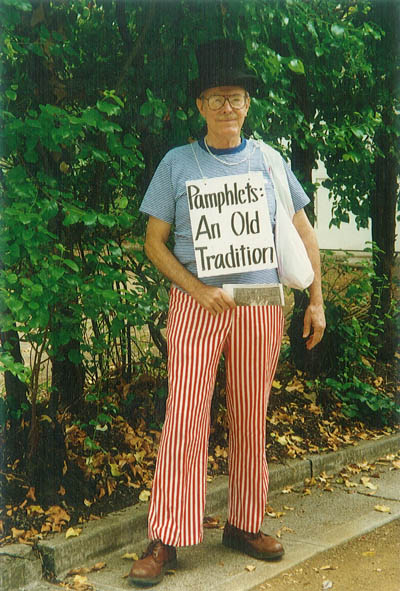
He considered pamphleteering as a noble form of communication that “went on during the colonial Period for a l00 years before the revolution and the arrival of Tom Paine in l775,” as he put it in his own pamphlet, “Pamphleteering: an old tradition.” He wrote that his main contribution “is the novel use of sandwich boards to screen out the disinterested while reaching the already-interested and open-minded persons with leaflets on the street, but not invading anyone’s privacy.”

Sometimes, Charlie had news close to home.

He said that giving out pamphlets to one or two people at a time was like holding a meeting with those persons and thus it was possible to have a “meeting” with several hundred people nearly anywhere within reasonable limits. He concluded that pamphleteering was “basic to building support for worthwhile projects” and claimes that it “may even be more effective than other forms of expensive communication.”

Charlie knew how to work the streets, but he also knew how to work inside the bowels of the bureaucracy. He worked for the California Division of Highways (now Caltrans) from l953 to 1987, mostly in an Oak Street office in San Francisco. I admit when Charlie talked to me about fighting bureaucracy, as he often did, I had trouble understanding how he was going about it. But Charlie had his ways.

Executive Editor Tim Redmond recalls that Charlie worked for Caltrans back in the days when the very thought there might be transportation modes other than highways was heresy.

He was an advocate of bicycles, carpools and public transit and Redmond thought that, when he first met Charlie in l984, “he must be like the monks in the middle ages, huddled in a corner trying to preserve knowledge. Nobody else at Caltrans wanted to talk about getting cars off the roads. Nobody wanted to shift spending priorities. Nobody wanted to point out that highrise development in San Francisco was causing traffic problems all over the Bay Area–and that the answer was slower development, not more highways.

“But Charlie said all those things. He told me where the secrets of Caltrans were hidden, what those dense environmental impact reports really showed, and how the agency was failing the public. I had a special card in my old l980s Rolodex labeled ‘Caltrans: Inside Source.’ The number went directly to Smith’s desk.” Charlie usually carpooled from Berkeley to his San Francisco office.

Charlie wrote a leaflet about the “Work Improvement Program” that then Gov. Pat Brown instituted in l960. It was, he wrote, a “novel program to get all state employees to submit ideas to improve their work.” Charlie labeled it “corrupt” and laid out the damning evidence. No appeal procedure. No protection for the employee making suggestions that the supervisor or organization didn’t want to use. No requirement for giving the employee credit for the idea or for following up the idea.

Charlie noted that he was a generalist with lots of ideas, read lots of publications, and was “sensitive to the problems that bother people.” He noted that there were l,500 employees in his Caltrans district who submitted 236 suggestions. Charlie submitted 35 of them.  But, he noted wryly, “my supervisor, Charles Nordfelt, did not respond at all to any of my suggestions.” And then, to make neatly make his point, Charlie listed a few of his suggestions, all of them practical and useful.

Many were adopted without Charlie ever getting credit. Others were adopted decades later. For example, he pushed the then-heretical idea of collecting tolls on a one-way basis only, instead of collecting them two ways. He noted that the tolls are now  being collected on the wrong side of the bridge. They should, he argued,  be collected coming from  the San Francisco side, where the few lanes of the bridge open up to many lanes. This would reduce or eliminate congestion. .

He listed other suggestions that showed his firm and creative grasp of the useful idea. Putting the third stop light on vehicles (which was finally put into effect in 1985). Numbering interchanges. Installing flashing red and yellow lights at different rates. (He  explained that his wife’s grandfather was color blind and drove through a flashing red light when she was with him.) Getting vehicle owners to have reflective white strips on the front bumpers of their cars, helping police spot stolen vehicles. Some of his suggestions are still percolating deep in the bureaucracies and may yet go into effect.

Charlie never got the hang of the internet but he covered more territory and reached more people in his personal face-to-face way than anybody ever did on the internet.

Charlie was born on a homestead farm eight miles from Weldona, Colorado. He attended a one-room school house and then moved on to a middle and high school in Ft. Morgan, Colorado. He got “ink in his blood,” as he liked to say, by working on the school paper called the Megaphone and then as a printer’s devil at the weekly Morgan Herald.

He was drafted into the army in l943 and served as an infantryman with the 343rd regiment, 86th Infantry Division. He was severely sounded in 1945 in the Ruhr Pocket battle near Cologne, Germany, the last major battle of the war. He suffered leg and hip injuries and had a l6 inch gouge  out of his right hip that cut within a quarter inch of the bone. He spent six months in the hospital. He was recommended for sergeant but he refused the promotion and ended the war as a private first class.

After his recovery, Charlie came to the Bay Area and took his undergraduate work at Napa Community College and San Francisco State, then did graduate work in sociology at the University of Washington, and in city and regional planning at the University of California-Berkeley.

In 1949, Charlie joined the American Friends Service Committee and became a lifelong volunteer, working on a host of projects. He did everything from helping with a clothing drive in Napa to being part of the crew that built the original Neighborhood House in Richmond.

Charlie met Anne Read in l954, a college student in Oregon, when she was on an AFSC summer project in Berkeley. Charlie visited the project, spotted Anne, and double dated with her. When she returned to Oregon State for her senior year, Charlie wrote her every single day. The two were married the following summer in June of l955.

Charlie is survived by Anne, two sons Greg and Jay, daughter-in-laws Karen Vartarian and Andrea Paulos, and granddaughter Mabel.

The family asks that, in lieu of flowers, please send a donation in Charlie’s name to the American Friends Service Committee, 65 9th St., San Francisco, Calif. 94l03.

I asked Anne why Charlie, the inveterate communicator, had not taken to the internet. Charlie, she replied, was a print guy and simply could not understand the internet. “He never ever used email,” she said. “He still thought he had to go to a library to make up a bibliography. I think Charlie was so sure that making a bibliography meant a lot of hard work, he couldn’t possibly do it on the internet.”

Well, Charlie, you may have missed the internet but you covered more territory and reached more people in your direct personal way with good ideas than anybody ever did on the internet.

Here are some of Charlie’s favorite pamphlets:
Governor Pat Brown’s Work Improvement Program
Pamphleteering: An Old Tradition
Short Statement on Plamphleteering


Dick Meister: Combating workplace violence

0

Organized labor and its allies are rightly alarmed over the high incidence of on-the-job accidents that have killed or maimed many thousands of workers. But they haven’t forgotten – nor should we forget – the on-the-job violence that also afflicts many thousands.

Consider this: Every year, almost two million American men and women are the victims of violent crime at their workplaces. That often forces the victims to stay off work for a week or more and costs their employers more than $60 billion a year in lost productivity.

The crimes are the tenth leading cause of all workplace injuries. They range from murder to verbal or written abuse and threatening behavior and harassment, including bullying by employers and supervisors.

Women have been particularly victimized. At least 30,000 a year are raped or otherwise sexually assaulted while on the job. The actual total is undoubtedly much higher, since it’s estimated that only about one-fourth of such crimes are reported to the police.

Estimates are that more than 900,000 of all on-the-job crimes go unreported yearly, including a large percentage of what’s thought to be some 13,000 cases annually that involve boyfriends or husbands attacking women at their workplaces.

The Retail, Wholesale & Department Store Union (RWDSU), which represents many of the victimized workers, cites that as an example of the job violence problem that is often distorted by media coverage that “would lead us to believe that most workplace violence involves worker against worker situations.”

The union says that has focused many employers “on identifying troubled employees or disgruntled workers who might turn into violent predators at a moment’s notice. But in fact, 62 percent of all violence at worksites is caused by outsiders.”

As you might expect, those most vulnerable to the violence are workers who exchange money with the public, deliver passengers, goods or services, work alone or in small groups during late night or early morning hours in high-crime areas or wherever they have extensive contact with the public.

That includes police, security guards, water meter readers and other utility workers, telephone and cable TV installers, letter carriers, taxi drivers, flight attendants, probation officers and teachers. Convenience store clerks and other retail workers account for fully one-fifth of the victims.

The American Federation of Teachers is so concerned that it has provided each of its 1.4 million members a $100,000 life insurance policy payable if the teacher dies as the result of workplace violence.

The major violence victims also include health care and social service workers such as visiting nurses, and employees of nursing homes, psychiatric facilities and prisons. They suffer two-thirds of all physical assaults. Many of the victims regularly deal with volatile, abusive and dangerous clients, often alone because of the understaffing that’s become all too common.

It could get even worse, at least for some workers. The RWDSU warns that today’s troubled economic times create additional threats. The danger is especially great for retail workers whose stores are likely to face increased incidents of theft, some involving gun-wielding robbers.

The RWDSU and other unions have been pushing for recognition of workplace violence as an occupational as well as criminal justice issue. That would put it under the purview of the federal Occupational Safety and Health Administration (OSHA) and state job safety agencies.

The federal and state agencies could then issue enforceable regulations designed to lessen the on-the-job dangers of violence, as they do for other hazardous working conditions. A few states do that already, but only for a very limited number of industries.

OSHA has issued guidelines for workers in late-night retail jobs, cab drivers and some healthcare workers, but the guidelines are strictly voluntary. Although the unions’ top priority is for legally binding regulations, they also are pressing employers to meanwhile voluntarily implement violence prevention programs.

Currently, only about one-fourth of them have such programs or any guidelines at all. The RWDSU ‘s Health and Safety Department is offering to help the other employers develop programs.

We have federal and state standards, laws and regulations designed to protect working Americans from many of the serious on-the-job hazards they face daily. Yet we have generally failed to lay down firm guidelines for protecting workers from the workplace violence that’s one of the most dangerous hazards of all.

Dick Meister, former labor editor of the SF Chronicle and KQED-TV Newsroom, has covered labor and politics for a half-century. Contact him through his website, www.dickmeister.com, which includes more than 250 of his recent columns.

Joseph Stiglitz: Muddling Out of Freefall

0

Here is our monthly installment of Joseph E. Stiglitz’s Unconventional Economic Wisdom column from the Project Syndicate news series. Stiglitz is University Professor at Columbia University and the winner of the 2001 Nobel Prize in economics. His new book is Freefall.

NEW YORK – Defeat in the Massachusetts senatorial election has deprived America’s Democrats of the 60 votes needed to pass health-care reform and other legislation, and it has changed American politics – at least for the moment. But what does that vote say about American voters and the economy?

It does not herald a shift to the right, as some pundits suggest. Rather, the message it sends is the same as that sent by voters to President Bill Clinton 17 years ago: “It’s the economy, stupid!” and “Jobs, jobs, jobs.” Indeed, on the other side of the United States from Massachusetts, voters in Oregon passed a referendum supporting a tax increase.

The US economy is in a mess – even if growth has resumed, and bankers are once again receiving huge bonuses. More than one out of six Americans who would like a full-time job cannot get one; and 40% of the unemployed have been out of a job for more than six months.

As Europe learned long ago, hardship increases with the length of unemployment, as job skills and prospects deteriorate and savings gets wiped out. The 2.5-3.5 million foreclosures expected this year will exceed those of 2009, and the year began with what is expected to be the first of many large commercial real-estate bankruptcies. Even the Congressional Budget Office is predicting that it will be the middle of the decade before unemployment returns to more normal levels, as America experiences its own version of “Japanese malaise.” 

As I wrote in my new book Freefall, President Barack Obama took a big gamble at the start of his administration. Instead of the marked change that his campaign had promised, he kept many of the same officials and maintained the same “trickle down” strategy to confront the financial crisis. Providing enough money to the banks was, his team seemed to say, the best way to help ordinary homeowners and workers.

When America reformed its welfare programs for the poor under Clinton, it put conditions on recipients: they had to look for a job or enroll in training programs. But when the banks received welfare benefits, no conditions were imposed on them. Had Obama’s attempt at muddling through worked, it would have avoided some big philosophical battles. But it didn’t work, and it has been a long time since popular antipathy to banks has been so great.

Obama wanted to bridge the divides among Americans that George W. Bush had opened. But now those divides are wider. His attempts to please everyone, so evident in the last few weeks, are likely to mollify no one.

Deficit hawks – especially among the bankers who laid low during the government bailout of their institutions, but who have now come back with a vengeance – use worries about the growing deficit to justify cutbacks in spending. But these views on how to run the economy are no better than the bankers’ approach to running their own institutions.

Cutting spending now will weaken the economy. So long as spending goes to investments yielding a modest return of 6%, the long-term debt will be reduced, even as the short-term deficit increases, owing to the higher tax revenues generated by the larger output in the short run and the more rapid growth in the long run.

Trying to “square the circle” between the need to stimulate the economy and please the deficit hawks, Obama has proposed deficit reductions that, while alienating liberal democrats, were too small to please the hawks. Other gestures to help struggling middle-class Americans may show where his heart is, but are too small to make a meaningful difference.

Three things can make a difference: a second stimulus, stemming the tide of housing foreclosures by addressing the roughly 25% of mortgages that are worth more than the value the house, and reshaping our financial system to rein in the banks.

There was a moment a year ago when Obama, with his enormous political capital, might have been able to achieve this ambitious agenda, and, building on these successes, go on to deal with America’s other problems. But anger about the bailout, confusion between the bailout (which didn’t restart lending, as it was supposed to do) and the stimulus (which did what it was supposed to do, but was too small), and disappointment about mounting job losses, has vastly circumscribed his room for maneuver.

Indeed, there is even skepticism about whether Obama will be able to push through his welcome and long overdue efforts to curtail the too-big-to-fail banks and their reckless risk-taking. And, without that, more likely than not, the economy will face another crisis in the not-too-distant future.

Most Americans, however, are focused on today’s downturn, not tomorrow’s. Growth over the next two years is expected to be so anemic that it will barely be able to create enough jobs for new entrants to the labor force, let alone to return unemployment to an acceptable level.

Unfettered markets may have caused this calamity, and markets by themselves won’t get us out, at least any time soon. Government action is needed, and that will require effective and forceful political leadership.

Joseph E. Stiglitz, winner of the 2001 Nobel Prize in economics, served as Chairman of the Council of Economic Advisers from 1995 to 1997. He is the author of the recently published bestseller, Freefall: America, Free Markets, and the Sinking of the World Economy.

Copyright: Project Syndicate, 2010.
www.project-syndicate.org
For a podcast of this commentary in English, please use this link: http://media.blubrry.com/ps/media.libsyn.com/media/ps/stiglitz122.mp3


An interview with a guitar-playing teabagger

0

By Jess Brownell

(Jess Brownell is our Voice of the Midwest, a freelance writer living in Milwaukee, Wisconsin.)

In the Feb. 1 issue of the New Yorker there’s a story about the Tea Party people the point of which seems to be that this is a genuine grass-roots movement rather than just a side-line activity for Fox News analysts taking a little time off from the competition to be the next Joseph Goebbels when their Adolph comes along. These Tea Partiers are just regular folks, according to the article. The actual people the New Yorker writer, Ben McGrath, interviewed seemed a little weird to me, to be honest, but if by regular he means there are a lot of them out there, I can’t argue.

After those interviews and a general discussion of the political power this group now wields, the article ends with a description of a meeting of enthusiasts in Brooklyn that concludes with the singing of a folk-style anthem about taking back America led by a gray-haired man with an acoustic guitar.

(Okay, let me ask right here: Just who the hell are these people who claim the right to “take back” America? Do they have any proof that they ever owned it in the first place? Do they have deeds? Where is their provenance? Are they really directly descended from the pioneers who stole it from the Indians or are they just the children of late-arriving immigrants like most of the rest of us? I want to see some documentation, damn it. I want to see some birth certificates.)

Editorial: SF pension reform, a way forward

0

If Sup. Elsbernd and the progressives can make a deal, there’s a lesson here for the mayor

EDITORIAL Sup. Sean Elsbernd is taking on one of the most complicated and politically tricky issues in San Francisco — reforming the pension fund and health care system for retired city employees. He’s right that the system needs reform — but his measure has some serious drawbacks and needs some significant amendments.
The problems facing the system are so confusing, and the legal and financial aspects so arcane, that it’s hard for anyone to grasp the full situation. But we can sum it up pretty simply:

San Francisco’s pension fund is in far better shape than pension funds in many cities and is a long way from any financial crisis. But over the next few years, thanks to weak stock market performance, the city’s cash obligation — the amount of general fund money that must be paid into the retirement system — is going to rise quickly into the hundreds of millions of dollars.

Calvin Trillin: Pat and Rush on Haiti

0


Pat Robertson and Rush Limbaugh on Haiti

A pact with the Devil’s what Robertson says

Has caused folks in Haiti distress.

If they had consulted Pat’s Jesus instead,

Tney’d now be a smashing success.

And Rush says Obama’s just scoring some points

With all of his darker-skinned backers.

We’ve alread given to Haiti, Rush says:

Our taxes supported those slackers.

When listening to what the two of them spew,

These theories bizarre and rococo,

It’s hard to decide who’s racist and mean

And who just needs help ’cause he’s loco.

Calvin Trillin, Deadline Poet, The Nation (2/08/l0)

Meister: Obama’s promise to women

0

It’s time to enact the Paycheck Fairness Act that would allow women to negotiate with employers for equal pay with men

By Dick Meister

(Dick Meister, former labor editor of the SF Chronicle and KQED-TV Newsroom, has covered labor and politics for a half-century.)

One of the most important promises made by President Obama in his State of the Union address has been largely overlooked – his promise to “crack down on violations of equal pay laws, so that women get equal pay for an equal day’s work.”

The need for that is great. Despite the 47-year-old law that promises women equal pay, their earnings remain well below men’s pay. They average only 77 cents for every dollar earned by men, even though their work is obviously every bit as valuable to employers and society at large as the work of men.

The pay discrepancy is even greater for women of color. African American women earn 63 cents and Latinas 52 cents for every dollar earned by men.

It’s estimated that if women were granted equal pay, they could earn as much as $2 million more over the whole of their working lives. It’s also estimated that if women were paid equally, the number of families living in poverty could be reduced by as much as half. Women’s earnings are needed by most families, and in many cases, women are their family’s only breadwinner.

Even women doing the same work as men, or work that’s as valuable to employers as that of their male counterparts, almost always are paid less. It’s as bad for women in the professions as for others. Female nurses, for instance, physicians and surgeons, professors, school teachers and lawyers earn as much as 30 percent less than men in their fields.

President Obama already has signed a bill that should help narrow the male-female pay gap. It was, in fact, the very first bill he signed after taking office – the Lilly Ledbetter Fair Pay Restoration Act. It’s named for a retired tire plant supervisor in Alabama who discovered after nearly 20 years on the job that she was being paid less than male supervisors.

Ms. Ledbetter sued for discrimination under the 1964 Civil Rights Act. But the Supreme Court ruled in 2007 that the law requires workers to sue no later than 180 days after their discriminatory pay rate was set – even if, like Ms. Ledbetter, they don’t discover the pay discrimination until years later. As the result of the decision, hundreds of pay discrimination cases were thrown out of court.

Shortly after the Supreme Court acted, the House passed a bill that would have overturned the court’s outrageous decision. But Senate Republicans, claiming the bill would lead to a flood of unfounded suits against employers, blocked a vote, and President Bush vowed to veto the bill if it ever crossed his desk.

The bill that finally reached Obama’s desk for signing provides that the 180-day time limit for filing lawsuits under the Civil Rights Act doesn’t begin to run until the last discriminatory act by an employer.

What’s most needed now is enactment of the Paycheck Fairness Act that’s been pending for a dozen years. The bill made it through the House last year, but was blocked by Senate Republicans. Obama, who voted for the bill as a senator, is certain to sign the new bill – if it’s not kept from him by a Republican filibuster in the Senate.

The Fairness Act would close loopholes in the 1963 Equal Pay Act that have made it relatively easy for employers to pay women less than their male co-workers holding the same jobs. The law would empower women to negotiate with employers for equal pay; prohibit retaliation against workers who share salary information with co-workers; strengthen government outreach, education and enforcement, and generally make the law much stronger.

There ‘s no doubting President Obama’s firm support for the act. As he’s said, “We won ‘t truly have an economy that puts the needs of the middle class first until we ensure that when it comes to pay and benefits at work, women are treated like the equal partners they are.”

Dick Meister, former labor editor of the SF Chronicle and KQED-TV Newsroom, has covered labor and politics for a half-century. Contact him through his website, www.dickmeister.com

Editorial: Just say no on tasers

0


A taser should be treated like any other lethal weapon only when deadly force would be authorized

The BART police officer who pulled a weapon and killed Oscar Grant on Jan. 2, 2009 claims he didn’t intend to use lethal force. Lawyers for Johannes Mehserle say their client meant to pull a Taser gun to subdue Grant and grabbed his service pistol by mistake.

That, of course, is a debatable proposition, and a jury in Mehserle’s homicide case will have to sort it out. But it shows the danger of a new San Francisco Police Department report suggesting that Tasers might have saved the lives of some of the eight people shot and killed by San Francisco cops between 2005 and 2009.
The report, written by Assistant Chief Morris Tabak, focuses on 15 incidents in which local officers shot at suspects. Seven of those shootings led to nonfatal injuries, but eight ended with the suspect dead. Some of the shootings were, at best, dubious.

In 2005, for example, two officers shot and killed a mentally disturbed man, Asa Sullivan, who was unarmed and hiding in an attic (see “Why is Asa Sullivan dead?” 6/21/06). If the police had a viable less-lethal alternative, the report states, the outcome might have been different. The death of Idriss Stelley at the hands of the SFPD isn’t mentioned in the report, since that happened in 2001,. But Stelley was also mentally ill, and some critics say he should never have been shot .

It’s no secret that Chief George Gascón supports arming the police with Tasers, which use high-voltage electrical current to disrupt a person’s nervous system and render him or her temporarily unable to move. Tasers aren’t exactly nonlethal; by some accounts, 250 people have been killed by Taser shots. They can be particularly hazardous to people with heart conditions.
And they also can be badly abused by police officers who see them as a tool to subdue unruly suspects who otherwise would not be subject to the use of lethal force. Nobody argues, for example, that Oscar Grant (who was lying on the ground, unarmed) was enough of a threat that the use of lethal force was an appropriate police response.

The BART officers on the scene, however, apparently thought that using a Taser was fine.
If that’s how the SFPD is going to see the use of Tasers, then the city’s better off without them.
We agree: if the officers who shot Asa Sullivan had used a Taser instead, the young man might still be alive today. (Assuming he wasn’t one of those whose medical condition would render a Taser attack fatal). And it’s always better to subdue a suspect without the use of lethal force. And Tabak is right — if the local cops had (and used) an alternative to their firearms in some of the fatal shootings, live might have been saved.
And if that’s how Tasers are used — and that’s the only way they’re used — there’s a case for adding them to the city’s arsenal.
But when the Police Commission reviews the Tabak report and discusses a policy change that could allow the SFPD to carry Tasers, it should start and end with one rule: a Taser should be treated like any lethal weapon, and used only when deadly force would be authorized.

The danger of less-lethal weapons is not just the fact that they can be fatal to some people, or that they can be mistaken for a firearm. If the cops think they can use the devices any time they want a shortcut to other forms of physical restraint, then Tasers become a liability that can lead to tragic consequences.<0x00A0>2

Meister: Labor’s big election loss

0


The loss of a filibuster majority in the U.S. Senate is virtually certain to doom attempts to revive the barely functioning National Labor Relations Board

By Dick Meister

(Dick Meister, formerly labor editor of the SF Chronicle and KQED-TV Newsroom, has covered labor, politics and other matters for a half-century.)

The Senate Democrats loss of a filibuster-proof 60-vote majority seems almost certain to doom attempts to revive the barely functioning National Labor Relations Board, the country’s chief labor law administrator and enforcer.

That, along with its effects on health care reform, is certainly one of the most serious consequences stemming from the election of Massachusetts Republican Scott Brown to the seat formerly held by the late Ted Kennedy.

For more than two years, the five-seat NLRB has limped along with only two members, a Republican appointee of President George W. Bush and a Democratic appointee of President Bill Clinton. The other three seats had been held by Republicans, but were vacated when their five-year terms expired. Democrats, who by then controlled the Senate, refused to confirm the anti-labor Republicans that Bush nominated to replace them.

Solomon: Democrats boosting rightwing populism

0

The Democratic leadership on health care and bank bailouts has been so corporate that it has demobilized and demoralized the Democrat ic base and the Republicans have found it easy to play populist

By Norman Solomon

(Norman Solomon is national co-chair of the Healthcare NOT Warfare campaign, launched by Progressive Democrats of America. His books include “Made Love, Got War: Close Encounters with America’s Warfare State.”)

In his triumphant speech on election night, the next senator from Massachusetts should have thanked top Democrats in Washington for all they did to make his victory possible.

For a year now, leading Democrats have steadily embraced more corporate formulas for “healthcare reform.” In the name of political realism, they have demobilized and demoralized the Democratic base. In the process, they’ve fueled right-wing populism.

Editorial: Stop the Transamerica condo high-rise!

0

What’s the endgame here? What does the city get for bestowing a developer with a huge basket of favors?
If Newsom and his planning commissioners alllow 555 Washington to proceed, it will signal that city planning is entirely in the hands of private developers

Editorial: The San Francisco Planning Commission and Recreation and Park Commission will hold a special joint meeting Jan. 21 to decide whether to allow the owner of the Transamerica Building to construct a 400-foot condo tower next door that would violate so many elements of the city’s Planning Code and rational planning policy that it’s almost impossible to list them all.

The building, which would contain 248 luxury housing units — something the city doesn’t need — would cast shadows on two city parks, make downtown traffic and air quality much worse (thanks to a four-level underground parking garage), and require special spot zoning to double the allowable height from 200 feet to 400 feet.

Meister: MLK was a working-class hero

0


One of the most important reasons to remember Dr. King was his championing the cause of Memphis strikers and others who sought union recognition

By Dick Meister

(Dick Meister, former labor editor of the SF Chronicle and KQED-TV Newsroom, has covered labor and politics for a half-century.)

“I AM A MAN,” the signs proclaimed in large, bold letters. They were held high, proudly and defiantly, by African-American men marching through the streets of Memphis, Tennessee, in the spring of 1968.

The marchers were striking union members, sanitation workers demanding that the city of Memphis formally recognize their union and thus grant them a voice in determining their wages, hours and working conditions.

Hundreds of supporters joined their daily marches, most notably Martin Luther King Jr. He had been with the 1,300 strikers from the very beginning of their bitter struggle. He had come to Memphis to support them despite threats that he might be killed if he did.

Editorial: Indict PG&E

0

Kamala Harris is in a perfect position as the San Francisco D.A. to file charges against PG&E for violating state law

EDITORIAL When Carole Migden, then a state senator, introduced the bill that allowed cities to form electricity co-ops through community choice aggregation in 2002, Pacific Gas and Electric Co. was at the table. Migden didn’t kick PG&E out or deny the private utility its chance to have input on the bill — for better or for worse, according to all participants, PG&E was part of the process that led to the bill’s passage. And in the end, the company actually supported the measure.

But now that cities and counties are trying to implement it, PG&E has shifted position and is spending millions on a statewide initiative that would, for all intents and purposes, destroy CCA. The initiative would mandate a two-thirds vote in every community before any public power effort, including CCA, could take effect. That’s an almost impossible threshold — particularly when PG&E will be opposing every single proposal and using its almost unlimited resources to do so.

Meister: Get off the bandwagon, Willie

0


City employees and working people generally need all the friends they can get in these perilous times. Willie Brown is not likely to be one of those friends in need.

By Dick Meister

(Dick Meister, former labor editor of the SF Chronicle and KQED-TV Newsroom, has covered labor and politics for a half-century.)

As former Mayor Willie Brown suggested in his Sunday Chronicle column on Jan. 3, “it’s time for politicians to begin an honest dialogue” about civil service. For starters, Willie should get his facts straight and get off the anti-public employee bandwagon that so many politicians are riding these days.

Brown said, for instance, that “the deal used to be that civil servants were paid less than private sector workers in exchange for an understanding that they had job security for life.”

Not so, Willie. Public employees were paid less because, if they were qualified for their jobs – as shown by civil service tests and other means – they were more likely to continue working for the government and were willing to accept long-term benefits – primarily health care and pensions – in lieu of higher pay.

Calvin Trillin on the disappearing public option

0

THE PUBLIC OPTION, WHICH A MAJORITY OF AMERICANS

FAVOR, IS DROPPED FROM THE HEALTHCARE BILL

That option is out of the bill now,

And senators have no remorse.

For no one was really behind it–

Except for the public, of course.

Calvin Trillin: Deadline Poet

The Nation (l/l1/10)

Stiglitz: Overcoming the Copenhagen Failure

0

Here is our monthly installment of Joseph E. Stiglitz’s Unconventional Economic Wisdom column from the Project Syndicate news series. Stiglitz is University Professor at Columbia University and the winner of the 2001 Nobel Prize in economics. His forthcoming book Freefall will be published this winter.

Overcoming the Copenhagen Failure

By Joseph E. Stiglitz

NEW YORK – Pretty speeches can take you only so far. A month after the Copenhagen climate conference, it is clear that the world’s leaders were unable to translate rhetoric about global warming into action.

It was, of course, nice that world leaders could agree that it would be bad to risk the devastation that could be wrought by an increase in global temperatures of more than two degrees Celsius. At least they paid some attention to the mounting scientific evidence. And certain principles set out in the 1992 Rio Framework Convention, including “common but differentiated responsibilities and respective capabilities,” were affirmed. So, too, was the developed countries’ agreement to “provide adequate, predictable and sustainable financial resources, technology, and capacity-building….” to developing countries.

Dick Meister: Know your class

0

‘Know your class’
By Dick Meister

(Dick Meister, former labor editor of the SF Chronicle and KQED-TV Newsroom, has covered labor, politics and other matters for a half-century.)

When Jack Hall died, flags were flown at half-staff throughout Hawaii, longshoremen closed the ports of San Francisco, Los Angeles and San Diego for 24 hours, and thousands of other workers in Hawaii and all along the west coasts of the United States and Canada also stopped work to show their respect.

That was 40 years ago. Yet Jack Hall, one of America’s greatest labor leaders, is still remembered fondly by many working people. In Hawaii, where he was regional director of the International Longshoremen’s and Warehousemen’s Union, many ILWU members had a paid holiday on Jan. 2, the date of his death. Others will have a holiday on the Feb. 28th anniversary of Hall’s birth.

Know Your Class

0

(Dick Meister, former labor editor of the SF Chronicle and KQED-TV Newsroom, has covered labor, politics and other matters for a half-century.)

When Jack Hall died, flags were flown at half-staff throughout Hawaii, longshoremen closed the ports of San Francisco, Los Angeles and San Diego for 24 hours, and thousands of other workers in Hawaii and all along the west coasts of the United States and Canada also stopped work to show their respect.

That was 40 years ago. Yet Jack Hall, one of America’s greatest labor leaders, is still remembered fondly by many working people. In Hawaii, where he was regional director of the International Longshoremen’s and Warehousemen’s Union, many ILWU members had a paid holiday on Jan. 2, the date of his death. Others will have a holiday on the Feb. 28th anniversary of Hall’s birth.

It would be hard to exaggerate Jack Hall’s importance. He was director of organization for the ILWU and one of its two vice presidents when a stroke killed him in 1971 at age 55 in San Francisco. But it was not what he had done during the previous 18 months in the drafty, run-down headquarters presided over by the legendary Harry Bridges that made Hall extraordinary.

Rather, it was what Hall had done before then in Hawaii, where he served for more than a quarter-century as the ILWU’s regional director. He was the key leader in bringing industrial democracy to Hawaii, transforming Hawaii from virtually a feudalistic territory controlled by a few huge financial interests into a modern pluralistic state in which workers and their unions have a major voice.

As former Gov. John Burns of Hawaii said, Hall Brought about “the full flowering of democracy in our islands.”

Hall’s first job was as a sailor in 1932. He sailed to the Far East, where he saw grinding poverty that sickened and angered him and, he later recalled, “determined which side of the fence I was on.” Hall landed in Hawaii four years later, a tall, skinny 26-year-old sent by the Sailors Union to help striking longshoremen win union recognition. Hall soon emerged as a leader of the longshoremen and later as a principal leader in organizing sugar and pineapple plantations.

Virtually all phases of life in the islands were controlled by five extremely powerful holding companies, popularly known as “the Big Five,” that owned the plantations. The workers, Japanese, Filipino, Chinese, Portuguese, Spanish, Puerto Rican and others, were purposely segregated by race and ethnicity to keep them from acting jointly. They lived in company housing on the plantations where they worked, bought their food and clothing in company stores there, and had little choice but to do exactly what the bosses told them to do, at pay of less than 50 cents an hour.
The battles waged by Hall and his fellow organizers to overcome the employers’ absolute domination of their workers’ lives often got brutal. There were beatings, an attempt on Hall’s life, and a great furor over Hall’s admitted political radicalism.

The strike was the only weapon available to the workers. But when workers of a particular nationality struck to demand union rights, they’d be replaced immediately with workers of another nationality.

Hall, a tough, plainspoken, hard-drinking man, talked with the workers endlessly about the obvious need to bring them together in a single union. He spoke to them individually and often in meetings that were held in secret, outside the closely guarded plantations. He told the workers over and over that they could not achieve the unified strength necessary to overcome exploitation if they continued to remain apart because of racial and ethnic differences.

“Know your class,” Hall told them, “and be loyal to it.”

Finally, by the mid-1940s, the ILWU managed to organize workers on the plantations, as well as on Hawaii’s waterfronts. That gave the ILWU a powerful role in Hawaii’s economy that led the union quickly to a major role in Hawaii’s political life as well.

Hall helped put together a political league that became one of the most important political forces in Hawaii and the most racially and ethnically mixed such group anywhere. The union league helped break 50 consecutive years of Republican control of the State Legislature, which in turn led to passage of the most progressive laws of any state and helped make the ILWU as dominant in Hawaiian life as were the Big Five plantation owners before the coming of the union.

Plantation and longshore workers still are the backbone of the ILWU in Hawaii, but Hall long ago led the union into just about every other industry in the islands. Bakers, factory workers, automobile salesmen, supermarket clerks and a wide variety of other workers, especially including hotel workers and others in Hawaii’s ever-expanding tourist industry – all carry union cards.

Union membership is their guarantee of economic and political rights and rewards, of dignity and self-respect and the chance to determine their own destinies, of an effective voice on the job and in their communities, of fair and equal treatment their forebears could only dream of.

Jack Hall left a truly remarkable legacy.

Dick Meister, former labor editor of the SF Chronicle and KQED-TV Newsroom, has covered labor, politics and other matters for a half-century. Contact him through his website, www.dickmeister.com, which includes more than 250 of his recent columns.