Volumes

Half a decade of war

0

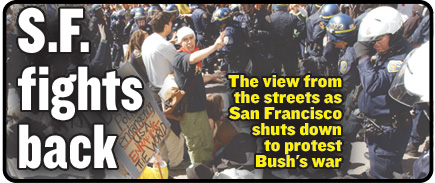
EDITORIAL Five years ago, the antiwar movement shut down San Francisco. It was a moment in history, one of those times that those of us who were there will never forget. No cars on Market Street. No cars on Mission Street. No business as usual anywhere downtown. Just a powerful statement that the city was not going to pretend that invading Iraq was an acceptable move.

And yet, for five years, the war has gone on. Sometime this spring, it’s likely the total number of American soldiers killed in the pointless military adventure will pass 4,000. And that’s just a fraction of the carnage: according to iraqbodycount.org, more than 89,000 civilians have died since the George W. Bush administration launched the invasion in March 2003.

There will be any number of newspaper stories, special reports and anniversary programs in the next few weeks, but of all the facts and statistics they’ll cite about the war, one ought to be at the top:

The antiwar movement was right.

Everything that the activists in the streets (and the very few newspapers that supported them, like this one) said at the time would prove to be absolutely true. As Steven T. Jones notes on page 14, there were no weapons of mass destruction. There was no link between Saddam Hussein and al-Qaeda. Iraq had nothing to do with Sept. 11. United States troops were not welcomed as liberators. There is no functioning Iraqi democracy. The situation in the Middle East is more unstable now than it was five years ago. Nothing has come of this war except disaster, death, and a bill to the American people that could reach $3 trillion.

In fact, Bush’s war is one of the main reasons that the economy is such a mess today — and that’s something the Democratic presidential candidates need to be talking about.

There has been nowhere near enough debate over the cost of the war. Bush has managed to fund the entire effort through supplemental appropriations, without once presenting a full budget to Congress. And the Democrats, fearing political criticism if they cut funding to troops who are in harm’s way, have gone along with every single spending request.

That’s been a huge factor in the nation’s mounting budget deficits and rapidly growing debt. And unlike deficit spending that funds social and infrastructure priorities, the red ink has done little to create jobs or improve the economy. It’s well known that military spending does less to help economic growth and recovery than any other type of government program. Put another way: If the $3 trillion that will go to the Iraq war were put into any other public venture, it would have tremendous positive consequences for society. It could, for example, preserve Social Security for another entire generation without new taxes or benefit cuts.

But those sorts of choices haven’t been presented to the public, because the war has been sold as a painless effort that requires no national sacrifice. And the bills won’t all come due until this president is gone and his successor has to deal with a deep recession, a horrible budget mess, growing unemployment, and a legacy of international distrust.

The good news is that the antiwar activism has forced both presidential candidates to pledge to bring the troops home — and Barack Obama could be the first president in years to be elected in large part on the basis of a strong grassroots peace movement. But the next president won’t stop the war without continued, constant pressure. It’s easy to think of the antiwar movement as a failure and to get discouraged — but this is not time to let down. If a Democrat wins the White House, visible and organized activism will be more important than ever. And this time, it might actually change American politics.

Editor’s Notes

0

"At 11 a.m., Thursday, March 20, I found myself at the corner of Market and Beale streets, looking at the startling emptiness of the Financial District." (See "The days SF stood still," [03/26/03]).

That’s where I was five years ago. You remember where you were, too: it was one of those moments in time that nobody forgets. Shock and Awe lit up the sky over Iraq, President George W. Bush announced the glorious military victory that was on the way, and the politicians — even the Democrats — were so busy praising the troops in the field that nobody stopped to ask how this was all going to end.

As we report this week, the major newspapers didn’t, either. In fact, in a survey by Editor and Publisher magazine, more than 75 percent of the papers supported Bush’s arguments for war. The airwaves were filled with generals and admirals talking up the invasion; the antiwar movement was marginalized.

And while the mainstream media were waving flags and cheering, the alternative press was presenting the other side of the issue. "Bush’s war represents a dangerous turning point for the United States," we wrote on March 26, 2003.

I sent out an e-mail to my colleagues in the Association of Alternative Newsweeklies this week asking how many of the weeklies were strongly against the war, and the answers started pouring in immediately. Tucson Weekly. San Diego City Beat. Boulder Weekly. Monterey Coast Weekly. Boston’s The Phoenix. The North Coast Journal. Random Lengths. The Memphis Flyer. Rochester City Newspaper. Creative Loafing. And that’s just a few of the names on the list.

Overall, the independent and alternative media were in the vanguard, providing the information that the big outfits wouldn’t.

Newsom’s commission games

0

EDITORIAL Mayor Gavin Newsom didn’t want Debra Walker, an artist and activist, running the Building Inspection Commission. He doesn’t want Theresa Sparks, a transgender woman and community leader, running the Police Commission. And now, we’ve learned, he doesn’t want Robert Haaland, a labor activist and one of the city’s most visible transgender leaders, to serve as vice president of the Board of Appeals.

But of course, the mayor thinks it’s perfectly fine to put two employees of Pacific Gas and Electric Company — an outfit that is suing the city, breaking the law, trying to subvert public power and cheating the public out of hundreds of millions of dollars a year — on city commissions.

This is what the second term of Mayor Newsom, who is now openly running for governor, looks like. It’s not pretty.

We knew the mayor had his sights on higher office, but now that it’s out in the open, almost everything he does at City Hall seems to be aimed not at improving San Francisco but at increasing his odds of moving up in the political world. Why, for example, would Newsom appoint Mary Jung, a PG&E customer services manager, to the Civil Service Commission, and Darlene Chiu, a PG&E City Hall flak, to the Small Business Commission? What possible qualifications could someone whose job involves promoting the interests of a giant corporation that routinely screws small business people have as an advocate for the city’s local merchants? Why would the Civil Service Commission, which deals with city employee issues, need the expertise of someone whose employer wants to prevent the city from creating more public jobs?

Why would Newsom be doing this — if he didn’t need the support of PG&E and its allies for his next political step?

Why would he be directing his appointees to keep out of leadership posts anyone with strong progressive credentials if he weren’t trying to build new bridges to the developers, the big employers, the police unions, and the more conservative interest groups he’ll need for a statewide campaign?

The bottom line is, Newsom needs to stop thinking about running his next campaign and start running the city — because this sort of commission funny business, this practice of treating important agencies that manage key city departments as nothing more than political patronage posts for rewarding allies and punishing enemies, is terrible for San Francisco.

It’s too late to do anything about Mary Jung, but the supervisors can, and should, overturn the Chiu appointment — and let the mayor know that putting PG&E executives on city commissions is unacceptable under any circumstances.

Meanwhile, the Board of Appeals votes for new officers March 19. By tradition, the top posts on the five-member panel rotate based on seniority, with an appointee of the mayor holding one job, and a board appointee the other. But Newsom’s three members have indicated that they won’t allow Haaland — a conscientious commissioner with an excellent record — to serve as vice president. That’s a slap in the face to labor, the queer community, and the supervisors. Newsom ought to show some political integrity and tell his appointees not to suddenly change the rules.

Resistance is futile — or is it?

0

It was a time without precedent in American history. The commander-in-chief voiced his intention to take the country to war — a voluntary, preemptive war with no clear catalyst, no faraway invasion or Pearl Harbor or sinking of the Maine and millions of people shouted their opposition. With plenty of time to avert war, the protesters warned the invasion would be a costly disaster.

They were right. And it didn’t matter.

The war in Iraq was a test of our democratic ideals. It was a test that this country failed, a failure that has been felt by the people of the United States, Iraq, and elsewhere for the last five years. For many, the refusal of the US government to heed the demands of its citizens left them disillusioned and disempowered.

But others say it sparked a political change that woke up an apathetic citizenry, pulled the Democratic Party back to the left, and may have averted war with Iran.

It’s certainly arguable that the presidential campaign of Barack Obama owes its energy and success in part to the antiwar movement — and if Obama wins, he will be the first president in a long time who took office thanks to the support of a strong grassroots progressive movement.

Nowhere was the clash of people power and government will more acute than on the streets of San Francisco, where a series of massive marches, some drawing nearly 100,000 people, filled the streets prior to the invasion of Iraq on March 19, 2003. The onset of war led protesters to effectively shut down the city, resulting in about 2,300 arrests and millions of dollars in costs to the city.

President George W. Bush dismissed the protests, of course, but he wasn’t the only one. Political leaders such as Rep. Nancy Pelosi, then-Mayor Willie Brown and soon-to-be Mayor Gavin Newsom (who didn’t attend any of the marches, unlike progressives on the Board of Supervisors) condemned the peace movement for hurting an innocent city. But with the “battle for San Francisco” making international news, the protesters were more concerned with the global audience.

A month earlier, on the weekend of Feb. 15 and 16, there were coordinated protests against the impending war in about 800 cities around the world, drawing around 10 million people. The peace march in Rome included about 3 million people, earning a listing in the Guinness Book of World Records as the largest anti-war rally in history. People have never made such a loud and clear statement against an incipient war.

Beyond the numbers, the antiwar movement was also right. On every major issue and prediction, the messages from the street proved correct while those from the White House were wrong. The US wasn’t welcomed as liberators. There were no weapons of mass destruction. Iraq after the invasion isn’t a stable democracy or shining beacon to anyone but the new generation of jihadis Bush created.

We can blame a hard-headed president, ineffectual opposition party, failure of the national media, or the national climate of fear following Sept. 11. But rather than refighting that lost battle, now is the time to gain perspective on the events of five years ago and determine what it means for democracy and the post-Bush national agenda.


TO THE STREETS

There were two main umbrella groups organizing protests before the war: Direct Action to Stop the War (DASW) and International ANSWER (Act Now to Stop War and End Racism). ANSWER has remained active and DASW has recently been reconstituted for the fifth anniversary of the war, using direct action in San Francisco as well as other urban centers and outposts like Chevron’s refinery in Richmond, which has reportedly been processing Iraqi oil.

“With the fifth anniversary coming up, we’re going back to direct action on the streets,” said Henry Norr of DASW. “But I don’t have any illusions that it’s going to be like it was five years ago.”

The maddening march to an ill-advised war created a political dynamic in which a broad cross-section of Americans was willing to hit the streets.

“We had a wonderfully diverse group of people, from soccer moms to anarchists,” said Mary Bull, who cofounded DASW, a collective of various affinity groups and concerned individuals formed in October of 2002 as Bush started beating the drums of war.

It was a group fiercely determined to prevent the war — and really believed that was possible. In fact, Bull recalls how she and other members of the group burst out crying at one meeting when a key activist said the war was going to happen.

Richard Becker, who cofounded ANSWER and serves as its West Coast coordinator, said that in the summer of 2002, “we came to the conclusion that [the war] was going to happen.” The group called its first big protest for Sept. 15, 2002, and another one two weeks later. But the movement really exploded on Oct. 26 when almost 100,000 people took to Market Street, much of it a spontaneous popular uprising.

“We were overwhelmed,” Becker said. “We were in a perpetual state of mobilization to keep up with what was going on. But then it didn’t stop the war.”

Did he think they could?

“I think a lot of people thought maybe it was possible to stop it. And we thought maybe it was possible to stop it,” Becker said.

The high point, according to Becker and Norr, was Feb. 17, 2003, when the New York Times ran a front page analysis piece entitled “A new power in the streets” that claimed “the huge anti-war demonstrations around the world this weekend are reminders that there may still be two superpowers on the planet: the United States and world public opinion.” But then Colin Powell went to the United Nations to argue for the invasion, and the Democrats in Congress did nothing, and it became clear war was coming.

Norr stayed out there protesting, being arrested several times and even shot in the leg by Oakland police with a rubber bullet during a protest at the Oakland docks. And he thinks some good came from the experience.

“The lesson for people is the political and economic elites are committed to preserving and extending empire. And they basically say as much in their own writing,” Norr said. “Wars are not anomalies.”

Despite being a frustrating and depressing exercise, most saw benefits to the failed movement. “People got an incredible education about how the system really worked,” Becker said. “Building a movement is mostly about a series of setbacks.”

Medea Benjamin, cofounder of both Global Exchange and CodePink and fixture of the anti-establishment peace movement for years, was upbeat about the protests. “We did our job as citizens. We did what we were supposed to do: organize, get people to take action, get people onto the streets,” she said. “We did everything we could think of.

“What you take from it is we don’t have a very well-developed democracy because the people spoke and the government didn’t listen.”

25war2_Lars1.jpg The ever-evolving “Democracy Wall” on Valencia Street, March 2003, helped stir up debate (Photo by Lars Howlett)


FACING ARREST

The collective action of five years ago starts with a series of personal stories — tens of thousands of them — so let me briefly begin with mine.

My arrival in San Francisco was closely tied to the march to war. I was living in Sacramento and working as the news editor of the Sacramento News & Review when Bush began his saber rattling against Saddam Hussein, but by the end of 2002 I had a falling out with my boss and found myself jobless.

Like most Northern Californians who opposed the war, I came to San Francisco on Jan. 18 to make my voice heard and experienced a bit of serendipity on my way to Justin Herman Plaza: while reading the Guardian on Muni, I saw their advertisement for a city editor, a job that was ideal for me at a paper I’ve always loved. Needless to say, it was a great day, empowering and full of possibilities.

Less than two months later I was on the job, and on the second week of that job I was back on the turbulent streets of San Francisco, part of a Guardian team covering the eruption of this city on the first full day of war. When I stepped off the cable car just after 7 a.m., people were streaming up Market Street and I joined them.

When a large group stopped at the intersection of Market and Beale, I stopped too, taking notes and bearing witness to this historic, exciting event. I had a press pass issued by the California Highway Patrol that allowed me to cross police lines, so when police in riot gear surrounded us and threatened arrest, I held my ground with 100 or so protesters.

After interviewing about a dozen people about why they were there and that they hoped to accomplish (see “On the bus: Journalists, lawyers, four-year-olds — the cops were ready to bust anyone Thursday morning“), I was arrested with the others and taken to a makeshift jail and processing center at Pier 27 (no charges were filed in my case, and charges against all of the 2,300 people arrested here in those first few days of the war were later dropped).

I recently tracked down a few of the people who appeared in my article, including Daphne and Ross Miller, who were at the center of the most interesting drama to play out during our standoff with the police. She’s a family practice physician, he’s an architect, and they live in Diamond Heights with their two children, Emet, who is almost 9, and Arlen, 12, who was away on vacation when the war began.

“We were genuinely shocked that the war started,” Ross told me. “We were at some of the earlier protests and really thought there was no way [Bush] could do it.”

They woke up March 20, 2003, to news that the war had begun and immediately walked to the BART station with Emet and rode to the Embarcadero station, not really planning for the day ahead but just knowing that they had to make themselves heard.

“We were pissed as hell. I don’t think I’ve ever been so angry in my life,” Daphne said.

They quickly came up with a plan. “We basically decided that if anyone was going to be arrested, it was going to be Ross and I’d stay with Emet. But it didn’t end up that way and I ended up in the arrest circle.”

Daphne had their house keys and threw them over the police line to Ross at one point. A photographer in the circle had gotten shots of a man named Roman Fliegel being roughed up by police as they pulled him off his bicycle, which was towing a trailer with a sound system, and decided to throw his backpack with camera gear out as well. When Ross — who had four-year-old Emet on his shoulders — caught it and refused police orders to give it to them, police grabbed Emet and roughly arrested Ross, leaving a gash on his forehead.

“Rage surged through the crowd, and it seemed as if things might get ugly, but the police kept a tight lid on the situation, using their clubs to shove back protesters who had moved forward,” I wrote at the time.

Emet was delivered into the circle with Daphne as the arrests continued, many quite rough. “At that point, as a mom, I had to exercise the most restraint ever,” said Daphne, who was angry about the situation but fearful about what she was exposing her son to. “Please, don’t let any violence happen here,” she pleaded with the crowd. Eventually, commanders on the scene let the mother and child go.

“The officer who let me go said that if he saw me again out there, he would call Child Protective Services on me,” Daphne said. But two days later, still brimming with outrage at her country’s actions, she ditched a downtown medical conference to rejoin the street protests, this time solo.

The couple say they’ve lost friendships over the war and have become more engaged with politics, coming to believe that Bush and the neocons are malevolent figures who knew how badly the war would go and did it anyway to establish a large, permanent military base in Iraq.

“Since that day, we’ve been far more active,” Ross said. “We realized you can’t just trust the system. You have to push.”

But that determination was mixed with feelings of disempowerment and depression. They attended some of the protests that following year, but the couple — like most people — just stopped going at some point because they seemed so futile.

“There was a horrible sense of resignation and a genuine depression that followed,” Ross told me.

The nadir was when Bush was reelected and they considered leaving the country. But then, Ross said, “we decided we’re not just going to run away and we’re not going to accept this.” Looking back, even with the scare over Emet, they express no regrets.

“It was the right thing to do because it was the wrong war to have. I’d do it again and again and again if I had to,” Ross said

They’re guardedly hopeful that Barack Obama could begin to turn things around if he’s elected. “I think the right president can at least start to dismantle this,” Daphne said. “I think thousands of people marching in the streets is something he would listen to.”

25war3_Charles1.jpg A die-in on the streets of San Francisco in March 2007 marked the fourth anniversary of the invasion (Photo by Charles Russo)


WITNESS TO HISTORY

Covering the peace movement in those early days was a heady experience, like reporting on a revolutionary uprising or working in a foreign country where the people are organized and active enough to be able to shut down society and brave enough to risk bodily injury for their beliefs.

I was at the founding meeting of CodePink — which became the most effective group at personally confronting the warmongers and keeping the war in the public eye — one evening at Muddy Waters in the Mission District shortly after the war started.

Looking back, Benjamin rattled off a long list of the alliances the group built — with labor, churches, businesses, and a wide array of social movements — and creative actions intended to build and demonstrate popular support for ending the war.

“We’ve done so many things and what did we get? We got a surge,” she said. “It shows the crisis in our democracy, the crisis of the two-party system, the crisis of a dysfunctional opposition party.”

Yet she said the peace movement has been remarkably successful in convincing the public that the war was a mistake and that it’s time for the troops to come home, even if the Democrats have been slow to respond to that shift.

“The progress we’ve made is turning around public opinion and that’s going to play a big role in the upcoming elections,” she said. For Norr, the role of the news media is a particular sore spot. He was a technology reporter for the San Francisco Chronicle who called in sick on the first full day of war and was arrested on Market Street with his wife and daughter, resulting in suspension by editor Phil Bronstein for his actions.

I wrote several stories on the issue, which culminated in Norr being fired and Bronstein unilaterally banning Chron employees from peace protests. I even borrowed CodePink’s guerilla tactics when Bronstein repeatedly refused to return my calls or address why he had singled out antiwar protesters for uniquely punitive treatment. I confronted him during a speech he gave at the Commonwealth Club (see “Lies and half-truths,” 5/7/03). That was the tenor of the times: we were all tired of being lied to and we decided to push back.

Norr was particularly frustrated with his own paper’s reporting of the war and started sending articles by the foreign press to his paper’s news desk, trying to wake his colleagues up to the pro-war propaganda being passed off as journalism in this country.

He was also disappointed with the country and with the Chronicle — both the management and his fellow reporters, who did little to support him — but the experience caused him to return to his roots as a progressive activist.

“The war and losing the job and everything brought an abrupt end to my consumerist phase and dumped me back into the world of being an activist,” said Norr, who serves on the KPFA 94.1 FM local station board and has made three recent trips to the Palestinian territories while working with the International Solidarity Movement.

Benjamin said Americans shouldn’t expect the next president to end the war — not without lots of pressure from a renewed and vocal peace movement. “This is the time to set the stage for the post-Bush agenda,” Benjamin said. “Don’t put your hopes in Barack Obama in getting us out of Iraq. Put your hopes in the people.”

25war4_Lane1.jpg A rally and nonviolent direct action at the Richmond refinery targeted Chevron on March 15 (Photo by Lane Hartwell)


THE AFTERMATH

The San Francisco Police Department, which spent more than $2 million on overtime costs responding to peace protests between March 15 and April 16, 2003, generally behaved with restraint and professionalism, but there were several exceptions.

The most costly and disturbing incident came when Officer Anthony Nelson began aggressively swinging his long riot baton at protesters, badly shattering the arm of peaceful protester Linda K. Vaccarezza, who suffered a permanent disability in her career as a court reporter.

Nelson’s incident report falsely stated that Vaccarezza had threatened him with a sign attached to a solid pole, but video of the incident later clearly showed there was no pole and that she was retreating when he teed off on her (see “The home front,” 05/19/04).

Vaccarezza received an $835,000 settlement from the city in November of 2004. On Oct. 5, 2005, two and a half years after the incident, SFPD fired Nelson for lying about what happened that day, and the City Attorney’s Office has been successfully fighting Nelson’s appeals in court ever since, putting in more than $100,000 in attorney time and costs into the Nelson and Vaccarezza cases.

The other significant ongoing litigation from the antiwar protests involved Mary Bull, who was arrested during an early protest for pouring fake blood in front of the entrance to Chevron’s San Francisco office before being allegedly strip searched and left naked in her San Francisco Jail cell for 36 hours.

Ironically, Bull was among those who brought a successful class action lawsuit against Sacramento County after she and others protesting a logging plan were strip searched, setting a precedent and led most counties to reform their strip-search policies. She used her share of the $15 million judgment to buy an organic permaculture farm in Sebastopol.

Her San Francisco case, in which Bull won a multimillion-dollar judgment, is still under appeal and now in mediation. Bull said the protests five years ago did make a difference, something she tells those who fret about its apparent failure. “I tell them to look at what issues the candidates are talking about now and I thank them for protesting then.”

“Even though we had millions throughout the world, we were sort of blocked, but now we’re regaining that momentum,” Melodie Barclay, a massage therapist who was also arrested with me on the first day of the war, told me recently. “We can’t judge it by the fact that we didn’t get the momentum we wanted.”

Norr started his antiwar activism working with Students for a Democratic Society in Boston, protesting the Vietnam War, which he said shares many similarities with the current situation, for good or for ill. He said that people tend to forget that while the protests then were huge and helped end the war, the movement did wane after Nixon ended the draft and substituted massive aerial bombardment for boots on the ground.

“The protests dropped off considerably,” he said. “A lot of the things that drove people to take risks in the late ’60s had faded by the early ’70s.”

He thinks the current administration learned a lesson from those days: it’s easier to maintain a war effort if the average citizen isn’t affected.

But there are other factors as well keeping a lid on the antiwar outrage.

“The culture has changed too. Young people are oversaddled with debt. People in schools seem to be docile. The culture as a whole seems to be more individualist and consumerist,” Norr said.

Yet some young people have woken up and many of them are funneling their energies into a peace group that was formed in the summer of 2005: World Can’t Wait, as in: the world can’t wait for the end of Bush’s second term before we change our direction and leadership.

“We don’t just want them gone, we need to repudiate their program,” said Giovanni Jackson, a 26-year-old WCW student organizer. “If we’re going to change anything, we need the youth.”

Jackson was at WCW’s founding convention in New York City, which came just as New Orleans was being flooded and then essentially abandoned by the federal government.

“When [Kerry] lost, people felt demoralized and World Can’t Wait kind of stepped into that situation,” Jackson said. “There was a lot of demoralization in the antiwar movement at that time.”

The group organized protests and student walkouts on Nov. 2, 2005.

“Everyone has their moments of doubt,” he said, “but I’m motivated by the crimes we see everyday.”


THE LESSONS

One of the biggest barriers to galvanizing people and turning the fifth anniversary of the war into something that might make a difference is the presidential election, which is diverting the energy of many potential protesters — and at the same time, offering some hope that a new president may lead to peace.

After all, every single one of the Democratic presidential candidates has promised to withdraw troops from Iraq, with varying timelines and numbers of US personnel left behind. And with enough encouragement, they might be willing to help change the status quo.

Many of the activists who volunteered their time and money to help move the Obama campaign into its front-runner position came out of the antiwar movement, and Obama’s strong stand against the war has been a key factor in his popularity.

Becker and some other activists don’t have much faith that a change in presidents will change the course in Iraq, although he agrees that much of the energy now surrounding Barack Obama derives directly from the antiwar movement.

“There’s been a huge upsurge of hope for Obama and that he might bring about the kind of change we need,” Bull said, adding that she doesn’t share that hope, believing the only path to peace is to pressure Obama and other leaders to commit to more progressive positions.

Norr said, “On one level, people have illusions about the power of peaceful protests. People believe in democracy, as well they should. We feel like the rulers should be paying attention to public opinion.

“It’s a remarkable story how broadly and quickly the American people have turned against the war. Public opinion was certainly ahead of the Democrats.”

And people will only grow more disenchanted with Iraq and its multitude of costs. “The people here are paying for this war, and everyday we have new stories about health clinics being shut down,” Becker said.

Becker was amazed last March as massive demonstrations for immigrant rights seemed to explode out of nowhere. “We think there will be more things like that,” he said.

Because after five years of organizing communities to resist the military-industrial complex’s plans, Becker thinks there’s been some visible progress.

“There isn’t a town or hamlet in the US that doesn’t have activism going on, but you wouldn’t know it from the corporate media,” Becker said. “It’s a mistake for people to feel discouraged.”


The Guardian Iraq War casualty report (03/17/08)

0

At least 39 Iraqi civilians were killed today in a suicide bombing at a mosque in Karbala, according to the Associated Press.

For a breakdown of the positions that relevant politicians are taking on the war in Iraq, visit the slate.com link below. 36 U.S. soldiers were killed this month, which means at least one U.S. soldier was killed for every day that passed. Click here to view.

Casualties in Iraq

Iraqi civilians:

82,199 – 89,710: Killed since 1/03

Source: http://www.iraqbodycount.net

For a list of recent events that have resulted in Iraqi casualties, visit :
http://www.iraqbodycount.org/database/recent/

For first hand accounts of the grave situation in Iraq, visit some of these blogs:
ejectiraqikkk.blogspot.com
healingiraq.blogspot.com
afamilyinbaghdad.blogspot.com

U.S. military:

4,266: Killed since the U.S. invasion of Iraq 3/20/03

Source: http://www.icasualties.org/

145: Died of self-inflicted wounds, according to http://www.icasualties.org/

For the Department of Defense reports go to: http://www.defenselink.mil/

For a more detailed list of U.S. Military killed in the War in Iraq go to: www.cnn.com

To view a breakdown of U.S. military casualties by state of residence, click here.

Iraq Military:

30,000?: Killed since 2003

Source: http://www.infoshout.com

Journalists:

127: journalists have been killed since the start of the war in March, according to www.cpj.org.

Refugees:

2.2 million: Iraqis displaced internally

2 million: Iraqis displaced to neighboring states

Incessant violence across much of Iraq’s central and southern regions has forced tens of thousands of people to leave their homes every month, presenting the international community with a humanitarian crisis even larger than the upheaval aid agencies had planned for during the 2003 war, according to United Nations High Commissioner for Refugees’ estimates.

U.S. Military Wounded:

132,199: Wounded from 3/19/03 to 3/01/08

Source: http://www.icasualties.org/


The Guardian cost of Iraq war report (03/17/07): So far, $503 billion for the U.S., $63 billion for California and $1 billion for San Francisco.

Compiled by Paula Connelly

Here is a running total of the cost of the Iraq War to the U.S. taxpayer, provided by the National Priorities Project located in Northampton, Massachusetts. The number is based on Congressional appropriations. Niko Matsakis of Boston, MA and Elias Vlanton of Takoma Park, MD originally created the count in 2003 on costofwar.com. After maintaining it on their own for the first year, they gave it to the National Priorities Project to contribute to their ongoing educational efforts.

To bring the cost of the war home, please note that California has already lost $63 billion and San Francisco has lost $1 billion to the Bush war and his mistakes. In San Francisco alone, the funds used for the war in Iraq could have been used to provide 3,144,442 homes with renewable electricity, 726,370 people with health care, or 31,528 public safety. For a further breakdown of the cost of the war to your community, see the NPP website aptly titled “turning data into action.”

For more information on what the war is costing the United States visit the American Service Friends Committee website here.

Desperately seeking cinema

0

> a&eletters@sfbg.com

Jennifer Reeves’s movies are personal wishing wells, each a repository of dreams and worries. As we see ourselves reflected in the water’s surface after tossing in a coin, so too is Reeves’s presence apparent in the handmade, fussed-over quality of her moving pictures. I use that broad designation pointedly, as her films are as varied in material and form as they are prosaic in mood and temperament. Over 15 years of independent filmmaking, the New York–based artist has created hand-painted films in the style of her mentor Stan Brakhage, freewheeling shorts, fiction fantasias, 16mm double-projections, feature narratives, and experiments in high definition. San Francisco Cinematheque hosts the formally restless filmmaker for a three-program tour.

Reeves’s early shorts channel riot-grrrl spark with scratched-up film stock. Elations in Negative (1990) is a good sample of the celluloid-mad sexual politics of these 16mm beaters, though Taste It Nine Times (1992), with its vivid pickle-biting innuendos, will be missed from the Cinematheque run. In painted films like The Girl’s Nervy (1995) and Fear of Blushing (2001), Reeves’s appropriation of Brakhage’s technique conveys playful femininity in color, pattern, and music.

Though Reeves toyed with narrative early on, most notably in 1996’s psychodrama Chronic, 2004’s The Time We Killed represented a kind of breakthrough. An unhurried 94 minutes passes through the dark mirror of an agoraphobic poet keeping to her New York apartment during the buildup to the Iraq War. "Terrorism brought me out of the house, but the war on terror drove me back in," Robyn (Lisa Jarnot) says in her peripatetic voice-over, adding later, "I’m afraid of catching the amnesia of the American people." Reeves’s magnetically immersive filmmaking is such that the political situation neatly folds into an extended experiment in subjectivity — besides being an unstinting portrait of madness (it’s everywhere in this film: in a record’s spin and neighbors’ voices echoing through the walls, in dogs’ faces, bathwater, and masturbation), The Time We Killed also serves as an understated chronicle of the collateral psychic and moral damage of our country’s manufactured warmongering.

The Time We Killed is heavier than Reeves’s other work, though it’s not without humor; she finds the ridiculous, unwieldy side of depression in Robyn’s litany of death fantasies and a painfully misguided interaction with a curious neighbor. Robyn’s locked in, but Reeves is formally unfettered, mixing conventional 16mm footage with lyrical, associative streams of inner life shot in high-contrast black-and-white. The filmmaker raids her home-movie archive for the film, in addition to using her own apartment and acting as Jarnot’s body double during the extended shooting. This air of transference makes The Time We Killed weirdly transparent, so we feel as intimately connected to Reeves’s isolated work in the editing room as we do to Robyn’s experience in the apartment.

Since The Time We Killed, Reeves has returned to more typically experimental filmmaking. Her 2006–07 Light Work variations strike an ideal balance of abstract and representational visions, in the process cataloging the changing textures of cinema. In the affecting He Walked Away (2007), Reeves dissects, refracts, and abstracts footage from her older movies to create a tri-tipped memorial piece in which the intrinsically elegiac nature of cinema is connected to the dissolution of film technology, which is then tied to the disappearing loves and friendships that shadow personal lives.

As with Guy Maddin — another filmmaker who favors overheated evocations — one has the sense that Reeves could make a hundred interesting movies from the same scraps of footage. "I want to counter the turncoats who say film’s dead," Reeves announces on her excellent new blog. "Try telling a painter that she can only use digital paint on a Mac for the rest of her life. She’d be pissed." But if she were Jennifer Reeves, she certainly wouldn’t slow down.

IMMERSIVE CINEMA: JENNIFER REEVES

Artists’ Television Access, Sat/15, 8:30 p.m.

Yerba Buena Center for the Arts, Sun/16, 7:30 p.m.;
Tues/18, 7:30 p.m.; $6–$8

See Rep Clock for venue information

Martial bliss

0

TAKE ACTION Hey, Donnie Yen fans! Director Wilson Yip’s Flash Point — in which the charismatic martial arts star (2002’s Hero, 1993’s Iron Monkey) plays an aggro cop on gangster-beatdown detail — is actually getting a local theatrical release. Currently, Yen is in Shanghai shooting Yip Man, which he describes as "the story of Bruce Lee’s teacher, a master of the Wing Chun kung fu style." He’s a busy guy, and he could probably flatten any fool with a flick of his pinky finger. Fortunately, he typed up some answers to my e-mailed questions instead.

SFBG On Flash Point — among other films — you’re credited as the "action director." How does that role differ from "fight choreographer," which you’ve served as on films like 2002’s Blade II and 2005’s SPL (a.k.a. Kill Zone)? Is it difficult to direct yourself when you’re also acting in the scene?

DONNIE YEN I think it’s a difference between the way action is treated in Hong Kong and in Hollywood. [In Hong Kong,] my job is to "direct" the action, and when I’m shooting the fight sequences, I take over the set. I choose the camera angles and see how the drama intercuts with the action. In Hollywood, you "choreograph" working with the main director. In the old days of Hong Kong action cinema, when the action director worked, the "drama" director went home!

SFBG Which fight scene are you most proud of?

DY Of my own stuff? I’d have to say the final fight in Flash Point, between Collin Chou and myself. That was definitely the toughest action scene of my career, and I think it shows! I really like the way we managed to apply MMA [mixed martial arts] techniques on-screen, especially some of the dynamic takedowns, which we haven’t really seen before.

SFBG You’ve worked on both Chinese and American films. What’s the biggest difference between the two industries? Are you interested in having a Hollywood breakthrough like Jackie Chan or Jet Li?

DY As I mentioned earlier, I have much more control over the final product in Hong Kong. I mean, on Flash Point, I’m the producer, the star, the action director…. Of course, I have to give credit to [director] Wilson Yip, who I have a great relationship with. This is our third film together. However, I would still like to work in Hollywood, providing it’s the right role in the right project.

SFBG Flash Point is a "modern" film, but you’re best known for period films like Hero. Which do you prefer?

DY Honestly, I just like to keep challenging myself. For example, Flash Point has a really raw action style, very MMA influenced, but now I’m starting Yip Man, which is about Bruce Lee’s teacher, and so it’s all classical kung fu movements but presented, hopefully, in a new and dynamic way. I would say that, technically, period films are more challenging, because, like with Hero, you’re performing in traditional Chinese clothing, and the movements tend to be more complicated. The modern films, like Kill Zone and Flash Point, are tough because of the degree of real contact when you get slammed about during a fight scene. They’re both challenging in different ways.

SFBG What are your thoughts on CGI-enhanced fight scenes versus the old-fashioned kind?

DY We used a lot of CGI in [2006’s] Dragon Tiger Gate, because the story and the style of action demanded it. I think it’s probably been overused in some films to compensate for the fact that the stars of the films can’t actually do their own action! In my own films, I tend towards keeping it as real as possible, and we only use CGI for shots that would really be impossible to do live on the set. There’s definitely very little CGI in Flash Point!

Flash Point opens Fri/14 in Bay Area theaters

Youth gone wild

0

› a&eletters@sfbg.com

It’s hard for a contemporary reader to fathom why — indeed, it was probably hard for many non-Eire readers to fathom even then — but when Edna O’Brien’s debut novel, The Country Girls, came out in 1960, she was considered a disgrace to all of Ireland. Priests burned it in churchyards and denounced it from the pulpit. Her books — soon to include two Country Girls sequels, as the original was a hit everywhere else — were banned from the Emerald Isle as late as 1977.

Just what could have been so offending about a book now described in reference books as "comic and charming," in contrast to her more "somber and sophisticated" later works? Not a whole hell of a lot, by current standards. In The Country Girls, O’Brien’s two young female protagonists drink, disrespect the clergy, use bad language, and flirt with men. Actually, only the naughty one commits most of these "sins." But even the "nice" one becomes dangerously attached to a married man. Painted as boozy, abusive, and unreliable, Irish manhood in general doesn’t come off too well in the boisterous yet coolly told chronicle of these Girls. Which might be the real reason that it incited such public condemnation, notwithstanding all expressions of moral outrage.

In addition to her literary fiction (which got a whole lot more sexually frank in subsequent years), O’Brien has written screenplays and teleplays since the early 1960s, and stage scripts for many years as well. Lately she’s developed a rather simpatico relationship with the Magic Theatre. Tir na nóg, a nearly-half-century-later theatrical adaptation of The Country Girls, is her third Magic premiere. It follows the rather dreadful hair-pulling lady fight over one husband in Triptych (recurrent focus on such male-companion neediness is why O’Brien is a major female author seldom embraced by feminist academics or critics) and the structurally conventional, enjoyably juicy imploding-family melodrama Family Butchers.

Tir na nóg is something else, "a play with song" (its initial title) that tries mixing music, dance, a source narrative boiled down to rapid-fire outline, and yea more elements into a meta-theatre experience. It doesn’t entirely work, due more to the text than any failings in departing Magic artistic director Chris Smith’s resourceful production. But it’s still an arresting evening, with fine work from the largely multicast nine-member ensemble.

The "country girls" here are two authorial alter-ego halves. Kate (Allison Jean White) is the only child of a long-suffering mother (Cat Thompson) and drunken, abusive pa (Matt Foyer). Baba (Summer Serafin) is only child to the western village’s wealthiest couple, a flame-haired bratty terror.

Once the two girls are later sent off to convent school, the bad girl predictably gets them both expelled. After intermission, they make a first stab at adult life in big-city Dublin: serious-minded Kate as a working student carrying on a fitful affair with ardent-yet-married-to-a-mental-case "Mr. Gentleman" (toweringly suave Robert Parsons); Baba as an aspiring vamp stealing thrills from her own less-discriminatingly-chosen cheating beaus.

The book isn’t exactly a blur of incident. But in its first half O’Brien’s adaptation too often feels like a careless cinematic downsizing of highlights into too-short scenes, glue-gunned together by variably vocalized song snippets.

After the break, however, Tir na nóg (which translates as "land of youth") slows down for several poignantly deep scenes, notably between Kate and her stern Austrian landlady (Darragh), as well as a couple of unsuitable suitors. Beautifully handled by Smith and his design collaborators, the play goes off-rails a bit when O’Brien imposes as ending a flashback-memory montage, with principal characters (including dead ones) drifting back onstage to speak prior best lines in echo! echo! echo! recollection. Yet there’s a certain charm to ex-Riverdance choreographer Jean Butler’s ensuing ensemble step-dance finale.

If the novel’s Kate came off as a guileless blank slate — passively dragged down again and again by Baba’s misdeeds — White fills out that character with impressive gravitas. Serafin is a marvel as the antsy-panted best friend who simply can’t repress her disrespect for authority, or precocious aspirations as a va-voom mantrap.

TIR NA NÓG


Through March 23

Wed-Sat, 8 p.m.; Sun, 2:30 and 7 p.m., $40-$75

Magic Theatre

Fort Mason Center, Marina and Buchanan, Bldg. D, third floor, SF

(415) 441-8822

www.magictheatre.org

White made right

0

Although "white" carries generally favorable connotations in our race-haunted society, the spell breaks at the gates of the wine kingdom. When Californians mention wines they like, the wines are almost always red ones — and more often than not, cabernets sauvignons. White wines? What are those?

To an extent, this bias can be explained by the great and unexpected success of (red) California wines at the famous Paris blind tasting of 1976, in which French judges ended up preferring the New World wines. But the vestigial glow of this triumph doesn’t explain why so many young people I know, many of them recently converted from beer to wine, already equate "wine" with red wine. Are red wines inherently superior?

Part of the issue could have to do with the fact that white wines are by nature more naked and skeletal than their red cousins. Their flaws tend to show, and they don’t have rich color or fruit-bomb radiance to distract us from noticing them. Another and more pertinent factor is the lackluster quality of so much California white wine. Many of the best whites still come from difficult little swatches of Europe (rainy Galicia, stony Sardinia, chilly Burgundy, the chalky Loire Valley), while our homegrown grapes, having lived the high life in rich soil and warm sunshine, too often produce wines that are flabby and flubbery (in the case of chardonnay) or aggressively grassy (in the case of sauvignon blanc).

Of course, I overgeneralize — but with intent. There are good white wines of California provenance to be found, and it’s fun to try to find them. You might have met despair while locked in the bathroom at a party, spitting up yet another overcooked chardonnay, but you will be all the more grateful when you take your first silvery sip of Navarro’s dry riesling, or Dry Creek’s utterly Loire-like chenin blanc — or if you are bound and determined to find a good California chardonnay, the unoaked chardonnay from Clos LaChance. The winery is slightly off the beaten path, in the foothills south of San Jose, and the wine is nearly Burgundian in its well-managed acidity (like a sharp knife with a sumptuous handle), crisp apple-y character, and wondrous lack of buttery bloat. If you’ve gagged on your last slug ever of party chardonnay, a gentle tipple of this stuff should settle you down nicely.

Paul Reidinger

› paulr@sfbg.com

Hope Mohr Dance

0

PREVIEW After training in ballet, San Francisco native Hope Mohr moved to New York City, where she danced with Lucinda Childs and Douglas Dunn before spending four seasons with the Trisha Brown Dance Company. After eight years, she decided that she could continue her career back in her hometown. Significantly, upon returning in 2005, she joined the company of Margaret Jenkins, who had also left the Big Apple to resettle in her Bay Area stomping grounds more than 30 years ago. Even then, however, Mohr knew that she would eventually want her own group. This upcoming concert is the debut of her newly formed Hope Mohr Dance troupe, in which she’ll present four pieces with 13 dancers. Of key interest is her 2007 collaboration with video artist Douglas Rosenberg, Under the Skin, a commissioned work from Stanford University that grew out of a series of workshops Mohr conducted with breast cancer survivors. Five trained dancers and three survivors perform together in the piece. When Bill T. Jones created his 1994 Still Here, conceived on a similar premise, it raised a firestorm of criticism about so-called "victim art." Mohr is confident that the fertile tension between the subject matter and the dance’s formal demands has allowed her to create a work that stands on its artistic merits. The other three pieces, Moments of Being (a premiere), Elision, and more awake than dreaming, are non-narrative investigations of what gave Mohr’s debut program its title, "Let the Body Speak."

HOPE MOHR DANCE Fri/14-Sun/16, 8 p.m. Dance Mission Theater, 3316 24th St, SF. $18. (415) 273-4633

San Francisco Contemporary Music Players

0

PREVIEW While electronics have transformed the very core of contemporary dance music, rap, and pop, so-called art music of the concert hall persuasion still centers on acoustic instruments reverberating in real time. But some of the earliest feats of sound manipulation, predating the Beatles’ trippy tape loops and even the ’60s soul tracks destined for an afterlife in eternal sampledom, were achieved by German composer Karlheinz Stockhausen, who was decidedly not a populist. In current terms, "electronic" music tends to denote the limitless reorganization of beats and breaks, but Stockhausen dispensed with regular rhythms altogether, turning his attention to the most basic components of sound itself, using now-primitive equipment to generate sine waves and splice magnetic tape. The most famous result of his experiments, aside from a nod from the Fab Four on the cover of Sgt. Pepper’s, may be the 40-minute tape-based work Kontakte, for piano, percussion, and electronics, premiered in 1960. Pianist Julie Steinberg, who also moonlights as a percussionist for this performance by the San Francisco Contemporary Music Players, emphasizes the prohibitive complexity of performing Kontakte live. "We have to know the electronics perfectly," she says of playing along with Stockhausen’s original four-channel futuristic noise collage, now a digital version realized by a sound projectionist as the performers play. Conceived in recognition of the late composer’s 80th birthday by percussionist Willie Winant, whose cutting-edge creds include work with Mr. Bungle, John Zorn, Sonic Youth, Wilco, and the Mystic Knights of the Oingo Boingo, this is a rare realization of what Winant calls "a masterwork" and a "seminal piece."

SAN FRANCISCO CONTEMPORARY MUSIC PLAYERS Mon/17, preconcert talk 7:15 p.m., concert 8 p.m.; $10–$27; Yerba Buena Center for the Arts, 701 Mission, SF; 978-ARTS, www.sfcmp.org

Lagerfeld Confidential

0

REVIEW As far as I know, Karl Lagerfeld is the only fashion designer to have had his likeness made into a collectible figurine. With his instantly identifiable uniform that foppishly mixes old (the white ponytail and high starched collars) and new (his omnipresent sunglasses, a small mine’s worth of silver jewelry, exquisitely cut clothes in every shade of black), he has become as iconic as the Chanel bouclé suits he has designed for the house for 20-plus years. Rodolphe Marconi’s documentary Lagerfeld Confidential performs a nice trick in letting us think we’re getting a candid portrait of the man behind the sunglasses. Depth, though, is a tall order when his subject declares, "I don’t want to be real in other people’s minds; I want to be an apparition." What we do learn across this extended interview, goaded on by Marconi’s softball needling, is that Lagerfeld’s mother was a formative influence (she "exuded frivolity" and "made slaves of everyone") and that he was a sexually precocious youth. But as Wilde and Warhol have shown, the dandy’s mode of address is aphoristic, not confessional. Given the frequency with which he dispenses such obfuscatory pronouncements as "Every friendship needs a sword of Damocles hanging over it" and "Fashion is ephemeral, dangerous, and unfair," perhaps Lagerfeld’s next project should be a little book of quotations à la Chairman Mao. Of course, Lagerfeld’s would be bound in black leather.

LAGERFELD CONFIDENTIAL opens Fri/14 at the Roxie Film Center.

Falling flat

0

It was clear early on that the Slow Beer Festival, presented March 1 by Slow Food San Francisco and the San Francisco Brewers Guild, was more of an excuse to get drunk in a convention hall on a Saturday afternoon than to explore how beer could be sustainable. Twelve NorCal microbreweries lined the green-hued cement walls of the County Fair Building — Marin Brewing, Speakeasy, Anderson Valley, Red Seal, and so on. An administrator at the front desk, though, couldn’t tell me what the difference was between a Slow Beer and your everyday microbrew (though she did say it was "a good question"). The man at the nationally distributed Gordon Biersch stand said bluntly, "Yeah, we’re a corporation."

Normally I’d say, "Fill up my glass and pass me another Gambone-mushroom-and-cheese skewer [drizzled in salsa verde]!" Here, though, I began to actually wonder how beer could be incorporated in the Slow Food ideology. As the manifesto says, "May suitable doses of guaranteed sensual pleasure and slow, long-lasting enjoyment preserve us from the contagion of the multitude who mistake frenzy for efficiency."

The Slow Foodists seek not just to change the food we consume but to change how we consume it as well. So isn’t a sterile room for beer tasting just stripping beer down to its flavor, and not about the way we experience it? At the festival, on one side of the gate there was a crowded room with a slender outdoor food garden and (by my estimate) 200 gallons of beer; on the other side, a park blanketed in sunshine. The latter setting might be better for bringing out the true sensual pleasures of beer. Next year, why not save money on the room deposit and hold the event in Michael Pollan’s backyard?

“Friedlander”

0

REVIEW Throughout Lee Friedlander’s 50-year oeuvre, much of which is now on display at San Francisco Museum of Modern Art, the photographer has been lauded for his liveliness, optimism, and mobility. Yet his paean to modern Americana often resembles monochrome memento mori. Taken as a whole, Friedlander’s work has always seemed driven to two poles: the ephemeral and the haunting.

Heavily impressed by the avant-naturalism of European photographers Eugène Atget and Henri Cartier-Bresson, as well as the post–World War II experimentalism of Robert Frank, Friedlander staked his claim at a moment in the 1950s when the photograph transcended the moribund category of journalistic tool and became its own art form. Modeling much of his working method around Cartier-Bresson’s so-called decisive moment, Friedlander’s timeless images still have a striking past tense about them. Now ossified on film, these thousand microcosmic moments, captured throughout the 1960s and ’70s, seem like lively obituaries.

While Friedlander first made a name for himself as a contractor for Atlantic Records — where he shot such musicians as Ornette Coleman — he was never a celebrity photographer. In fact, his most intriguing work resulted from a personal obsession with traveling and shooting the country, crisscrossing between New York and his home state of Washington. And so the images of nocturnal motel rooms, cycloptic TV sets, and storefront tessellations conjure the American dynamism and dread of Vladimir Nabokov or David Lynch. The plethora of windows and mirrors in his street photography admit countless apertures through which to see his subjects. But Friedlander’s playful sense of humor always appears just within the clutches of something inexplicably sinister — like the cartoonish shadows that often hover into his frame. Though his more recent work — in portraiture, nudes, and particularly in nature — may suffer slightly from the inevitable cooling of youth’s ambition, Friedlander’s baroque attention to detail and depth of field are unmatched. This is a definitive exhibition on one of America’s most ingenious, albeit conflicted, photographers. The photographer’s son Erik Friedlander will perform pieces from his album Block Ice and Propane (SkipStone, 2007) on April 24, 8 p.m., $12–$15, at Phyllis Wattis Theater.

"FRIEDLANDER" Through May 18. Mon.–Tues., Fri.–Sun., 11 a.m.–5:45 p.m.; Thurs., 10 a.m.–8:45 p.m.

$7–$12.50, free for members and 12 and under. San Francisco Museum of Modern Art, 151 Third St., SF. (415) 357-4000, www.sfmoma.org

Reveille in reverb

0

› a&eletters@sfbg.com

The first thing fans will notice about Beach House’s second album, Devotion (Carpark), is that it hews to the same gauzy sonic architecture of their 2006 eponymous debut. An elegant combination of keyboard beats, organ drones, apparitional electric slide guitar, and Victoria Legrand’s molasses vocals gave Beach House a golden glow that sent music scribes running to their thesaurus for "autumnal" synonyms. These elements sound thicker on Devotion, though a few spins down the line it becomes apparent that the difference lies more in the compositions themselves than in any studio trickery.

This isn’t a small distinction, given our tendency to fetishize certain sounds. Phil Spector productions, Dusty Springfield laments, and Lee Hazelwood bonanzas all have brilliant surfaces, but they also have the depth of classical songwriting, complete with bridges, vamps, and theatrical flourishes. Legrand, the niece of French film composer Michel Legrand, grew up in a musical atmosphere. The two of us have a phone date, but work and a sick dog interfere, leaving her to e-mail me from her Baltimore home about her glam-rocking father ("My papa wore tight purple satin pants, with hair down to ‘there’<0x2009>") and her studies at Paris’s International Theatre School Jacques Lecoq ("I was trained classically, and I know Alex [Scally, her Beach House bandmate] also has an affinity towards the classical, old-fashioned world, so I think it’s a given we’d be into the Zombies and . . . watered-down show-tune buildups").

And so we get a folded gem like Devotion‘s "Heart of Chambers," in which Legrand breathily asks, "Would you be my longtime baby?" On "Holy Dances," a drowsy, shaker-spurred verse flowers into the sunburst of Scally’s arpeggios. The centerpiece chorus of "All the Years" echoes with the same kind of distant regret running through the best of old girl-group records. Still, the purest pleasure on Devotion might be its sole cover, a version of Daniel Johnston’s "Some Things Last a Long Time": Beach House distills the song to a plucked melody, lolling drum beat — it’s like listening to a "Be My Baby" single at 33 rpm — and Legrand’s barely there inflection. "We felt compelled by the fragile essence of the song and merely wanted to capture it, if only for a brief moment," she writes.

Across Devotion, Legrand’s phrasing emerges as a major shaping force. She knows how to pause — inserting the breath before the chorus in "Turtle Island" and a delicious lingering note over at the end of "You Came to Me." And her sometimes slumberous drawl gives the 1960s pop orchestrations a European edge — Nico comes to mind — and from that same era Legrand also seems to have picked up the special knowledge that spelling a word out, as with "D.A.R.L.I.N.G.," always makes it sexier.

"We don’t have full rock band power, but that can also be detrimental to songwriting," Legrand writes. "Being a duo enables us to start simply and build from there." It also allows the twosome to maintain a key measure of intimacy. Though their preproduced effects emulate yesteryear’s studio magic, listeners never lose sight of the modest means of this music. Devotion‘s cover image strikes a similar balance, signaling formality — Legrand and Scally sit at a candlelit table — while admitting a homegrown touch: the album’s title is spelled out in a cake’s icing, and Legrand’s casual bare foot peeks out at the bottom of the frame.

If Beach House established the group’s palette, Devotion sees the duo working more confidently with the brush. When I describe some of the new disc’s brightest passages as "Technicolor moments" to Legrand, she replies: "I personally heard Technicolor in ‘Turtle Island’ during the bridge because all of a sudden the voices burst out, and it feels literally like paint and light are bursting through . . . a soft burst like a bubble in slow motion." That beats "autumnal" any day.

BEACH HOUSE

With Anaura and Best Wishes

Sat/15, 10 p.m., $12

Bottom of the Hill, 1233 17th St., SF

www.bottomofthehill.com

Freedom is a ’69 Dodge

0

When searching for recent signs of life in and recognition of country music’s biracial heritage beneath the rhinestone crust of NashVegas culture, I became an unwitting fan of Tupelo, Miss., singer-songwriter Paul Thorn via his "Mission Temple Fireworks Stand," as covered by Sawyer Brown with black sacred-steel whiz kid Robert Randolph. Then there were the good words passed on from Thorn’s participation last year at a Birmingham, Ala., medicine show for my friend Scott Boyer of Cowboy. Nor does it hurt that my all-time hero, Kris Kristofferson, has claimed, "Paul Thorn may be the best-kept secret in the music business. He and writing partner Billy Maddox turn out songs like a Mississippi Leiber and Stoller that put me in mind of Harry Crews’s creations — absolutely Southern, absolutely original." And when I finally caught up with this paragon last month at Manhattan’s Living Room, it was clear from the intimate set that Thorn lived up to the promise.

The goodwill extends to Thorn’s eighth album, A Long Way from Tupelo (on his Perpetual Obscurity imprint), although it gets off to an underwhelming start. Openers "Lucky 7 Ranch" and "Everybody Wishes" sound like subpar Bruce Springsteen — sans polemical stridency. Yet the slow-building, smoldering third cut gets to the heart of Thorn’s voice. "A Woman to Love" is an instant soul classic, and a great retro-nuevo standard for the postmodern South. His muse proceeds to get happy on the funky gospel of "I’m Still Here" and the passionate, torchy "Burnin’ Blue." Grammy darling and rockist hard-liver Amy Winehouse could make hay from "Crutches" — and should be encouraged to heed its message closely. And even soul twangmaster Travis Tritt’s recent The Storm (Category 5, 2007) could have been improved by including a cover of Thorn’s title track with its brimstone-full blues-rock power and tale of illicit romance. Thorn, raised by a preacher father in the Church of God, gets back to sanctified roots on "What Have You Done to Lift Somebody Up." Yass, y’all, the song comes quick with the holiness as it spreads a simple message of human kindness. Tupelo is an interesting case of an album getting stronger as it goes on, instead of kicking off with the expected fury. The later songs are suffused with soul and spirituality, as well as Thorn’s lyrical mix of home folks’ vernacular and trademark offbeat tragicomedy previously seen on beloved Thorn compositions like "Burn Down the Trailer Park." And the references to other artists demonstrate his creative possibilities and reach across roots-regarding genres. In this tricky transatlantic cultural moment, Thorn seems poised to emerge strong from his decade of steady toil at the margins of assorted scenes, including the Americana ghetto. Whereas in the past he has benefited from rich mentoring — friend and collaborator Delbert McClinton, Police manager Miles Copeland, late outsider artist the Rev. Howard Finster — Thorn may finally make it big purely on the strength of what’s unique to him. He charmingly makes his down-home allegiances plain by donning a Piggly Wiggly muscle T on Tupelo‘s back cover.

Thorn is prescient and fortunate enough to be releasing this effort amid what’s starting to look like another boom of magnificent Southern expression and genius — as demonstrated by a range of recent releases from Donnie, überATL-ien Janelle Monáe, Thorn’s homeboys the North Mississippi All-Stars, current toast Bettye LaVette, her producers the Drive-by Truckers, and Gnarls Barkley. Yes, such industry moves as appearances at South by Southwest and a Late Night with Conan O’Brien debut await Thorn this month, but what ultimately seems likely to put him across is the flexibility to open for and vibe with Toby Keith while reifying the wisdom of a black roadside Pentecostal preacher.

Right now, in their desperation, the music business and the scenes that orbit it seem more open to sounds beyond the overprocessed mainstream — even if the art boasts elements that tend to induce coastal prejudice like Thorn’s thick-as-molasses accent and his statement to Lone Star Music that "my music’s kind of like going to church with a six-pack." As for me, I’ll be down at the Piggly Wiggly preparing to tote a bouquet of pig’s feet and some RC Cola to this Renaissance man’s South by Southwest show.

PAUL THORN

March 25, 8 p.m., $15–$17

Little Fox Theatre

2215 Broadway, Redwood City

(650) 369-4119

www.foxdream.com

Big “Footprints”

0

› a&eletters@sfbg.com

Since its inception in 2004, the SFJAZZ Collective has changed out six of its eight original members. But now in the midst of its fifth season, the band sounds and, more importantly, interacts more cohesively than ever.

"All the people we’ve had, have been very beneficial to the band," says pianist and original member Renee Rosnes, during a recent rehearsal at the Masonic Auditorium. "They just bring another color to the music." Veteran saxophonist Joe Lovano, who joined last summer and replaced Joshua Redman, now nominally serves as resident sage, the position formerly held by vibraphonist Bobby Hutcherson. Also last summer, youthful Stephon Harris took Hutcherson’s slot, and this spring trombonist Robin Eubanks was added for the San Francisco residency and both the national and European tours. Despite the shifts, the ensemble’s firepower hasn’t diminished and the members are especially eager to tackle Wayne Shorter’s quixotic music, which they’ll be playing along with their own.

Saxophonist Shorter’s career has evolved from writing and playing on the front line of hard-bop standard-bearing Art Blakey’s Jazz Messengers to a similar position with Miles Davis’s great shape-shifting quintet of the early ’60s. While playing with Davis, Shorter compiled one of the most distinguished solo careers ever with an incomparable series of albums on Blue Note (1964’s JuJu and Night Dreamer and 1965’s The All Seeing Eye) that forever cemented his stature as a major composer. Subsequent turns as the cofounder of Weather Report and now the leader of an exquisite quartet have simply embellished Shorter’s reputation.

Rosnes considers her time playing with Shorter a revelation. "It was such an impactful experience," Rosnes explains. "The intensity and passion that he played with literally took my breath away."

On the brief 1988 tour that took the all-star band through the United States and Europe, Rosnes played a nightly duet with Shorter on his Brazilian ballad "Diana." "There was complete spontaneity from night to night. He cherishes a lot of freedom within the music, and that really opened up my mind," she says.

Since each Collective member arranges a tune from the season’s composer, Rosnes has written the chart for "Diana" as well as Shorter’s classic "Footprints." Other arrangements include "Armageddon" by saxophonist Miguel Zenón, "Aung San Suu Kyi" by trumpeter Dave Douglas, "El Gaucho" by bassist Matt Penman, "Yes or No" by drummer Eric Harland, and "Infant Eyes" by saxophonist Lovano. Rosnes says the arrangements give the band a more personal voice, which is appropriate when considering Shorter’s considerable body of work. "He plays life," Rosnes says, "through his horn."

SFJAZZ COLLECTIVE

Sat/15, 8 p.m., $34–<\d>$52

Zellerbach Hall

UC Berkeley, near Bancroft at Telegraph, Berk.

www.calperfs.berkeley.edu

Dress sharp

0

REVIEW Don’t tell anyone, but I have a secret fetish. Nothing turns me on like a new pair of shoes, and few bring me to shoegasm like sexy stilettos. So I put on my favorite pair of Gucci patent-leather tuxedo shoes and headed down to Stiletto, clubutante Parker Day’s arty party at Asia SF, in search of the perfect footwear.

Day named the night after the seductive heels, but it also alludes to the discreetly slim knife — both of which are deadly in the hands of the Pam Anderson B-movie character Barb Wire. "It’s sharp and it’s sexy," Day said. "It gets to the point." But it was The Warriors, a 1979 cult classic about New York City street gangs at war, that set the theme for that night’s party. As footage from the film was projected onto a side wall, the music morphed genres, from hip-hop and hit pop to electronic and indie-rock remixes for an audience as diverse as The Warriors‘s cast — and equally reminiscent of the early-’80s Big Apple. Fab Five Freddy, Blondie, and Madonna occupy the same turf without incident.

The crowd’s footwear was just as varied, but cowboy boots and Converse All-Stars were the most heavily represented in The Warriors–inspired fashion show. Taking cues from the movie, models worked leather vests and gunmetal belts into fierce ensembles, which they paraded down the runway like gangsters. A bit later, audience members were able to participate in a Warriors–themed costume contest. Not to ruffle anyone’s fab feathers, but I think my own shoes were the ultimate winners.

STILETTO

Third Friday of the month, 10 p.m.–3 a.m., $8

Asia SF

201 Ninth St, SF

http://www.myspace.com/stilettosf

Big book, tiny topic

0

› johnny@sfbg.com

REVIEW This week, I’m reviewing a book about toothpicks, a book about citrus, and a book about pigeons. When I first mentioned this plan to a fellow editor, she said it prompted visions of a surrealist game of Clue: the orange stabbed the pigeon in the study with a toothpick.

In truth, my motivation is pragmatic. I want to draw attention to the publishing industry’s love of big books devoted to tiny topics. It seems that one surefire way of selling a nonfiction tome is by focusing on a very specific subject. For evidence, one need only look at recent efforts such as Pierre Laszlo’s Citrus: A History (University of Chicago Press, 252 pages, $25), Henry Petroski’s The Toothpick: Technology and Culture (Knopf, 443 pages, $27.95), and Andrew D. Blechman’s Pigeons: The Fascinating Saga of the World’s Most Revered and Reviled Bird (Grove Press, 239 pages, $24).

Without snappy cover art and a colon followed by a subtitle, these books would be ready for inclusion in the next edition of Russell Ash and Brian Lake’s Bizarre Books: A Compendium of Classic Oddities (Harper Perennial, 224 pages, $14.95), a collection devoted to ridiculous and arcane tomes. Today, the colon (note that Ash and Lake’s book also sports one) is a way for author and publisher to assert an awareness of the potential absurdity that might arise from inscribing a world history on the head of a pin — or the tip of a toothpick.

Which brings us to The Toothpick. It’s the latest endeavor by a writer who specializes in large books on tiny topics. Petroski’s previous lengthy portrait in words was devoted to the toothpick’s cousin of sorts, the pencil. He brings an ease born from familiarity to his latest project. He also brings an anti-Wikipedia agenda, beginning his toothpick odyssey with a collection of false "stuff rustled up from the wild, wild Web." In the United States, the toothpick does have ties to Charles Forster — as claimed by answers.com and other Web sites — but Forster did not "invent" it, as one online source of misinformation states. If you read The Toothpick, you’ll learn about Forster and about Benjamin Sturtevant, a contemporary who has been erased from the toothpick’s United States–origin myth. Neither Forster nor Sturtevant are the most fascinating men ever to have probed their gums.

The point of Petroski’s toothpick testament is sharpest when he uses his small subject to touch upon ideas from different eras and cultures. Thus, before Forster and his Charles Foster Kane–like name (though not, alas, story) take over, The Toothpick cites a long passage from James Joyce’s 1916 A Portrait of the Artist as a Young Man that cries out for a toothpick, provides illustrations of Chinese toothpicks that look like chandeliers, and notes that the Renaissance was "the golden age of toothpicks." Perhaps literally — there are golden toothpicks, as well as ones made from walrus whiskers.

As its title might suggest, Laszlo’s Citrus: A History presents a fruit-centric — though by no means fruitopian — history of the world. Via the erudite Laszlo, the travels of an orange can blossom into a discussion of religious persecution. Laszlo is a retired professor of chemistry, and his prose presents a mix of stuffiness and frolic, whether imagining a correspondence with the first person ever to write a book about citrus (an 11th-century Chinese governor named Han Yen-Chih), randomly leaping from a descriptive passage into a recipe, or redundantly telling the reader that he is about to tell a story. Ultimately, Citrus does have the passion — if not always the juice — of a labor of love, even when its author favors the kind of obvious symbolism found in this sentence.

In comparison, Pigeons author Blechman is a storyteller who has a way with a hilarious turn of phrase. He writes of "backyard geneticists" who create birds "more akin to a Dresden figurine than a child of nature," notes that the pigeon "has been prized as a source of companionship (and protein)," and confesses his fondness for the Frillback, a breed with feathers that look like they "were dipped in Jheri Curl." Over the course of one winter, he meets as many breeds of pigeon obsessives as he does pigeons. The wildest marriage might be between Parlor Rollers and their owners. Parlor Rollers somersault backward up to 600 feet in a single effort, a display that Blechman deems "the avian equivalent of obsessive-compulsive disorder." When Blechman asks one owner why the birds do what they do, the man replies, "Because they’re retarded, that’s why."

Actually, Pigeons makes a strong case for recognizing and respecting the oft-abused pigeon, a case drawn from no less a source than Charles Darwin’s 1859 On the Origin of Species. Blechman’s book contains some disturbing passages (especially a foray into a Pennsylvania town that made bird slaughter into an annual holiday replete with teen boys delivering body slams) and no shortage of funny adventures. By the end, it transformed the way I view pigeons. Though I’m a vampire for blood oranges and I abuse toothpicks like an addict smokes cigarettes, I’m afraid the other two books didn’t have quite the same impact.

Beautiful losers

0

Great movies stay with you in the oddest ways. In the days after I first saw Gus Van Sant’s Paranoid Park, I was preternaturally attuned to the sound of skateboards dragging the street outside my bedroom window—the slow tug of concrete, the bumping waves of wheels. This ambient strain surrounds Paranoid Park‘s cherubic point of focus: Alex (Gabe Nevins), a sleepy-eyed skater waiting out his parents’ divorce in a Portland, Ore., suburb. He occupies most of the film’s exquisitely composed frames, though he’s more a figure etched in light than a proper protagonist.

Figure-eight narrations and slow-moving Steadicam tracks have underpinned Van Sant’s last couple of films (2003’s Elephant, 2005’s Last Days), though they’re more artfully embedded in Paranoid Park‘s fragrant sprawl, not least because of the visual equivalencies provided by the film’s skateboarding footage. Blake Nelson’s airless young-adult novel presents Alex’s story as an extended confessional letter. Van Sant dissembles chronology and inflects the narration with associative freedom.

Most immediately, Van Sant folds Nelson’s plot to delay the central trauma, which first enters our vision peripherally through a detective’s investigation and a local news report. With that said, narrowing the effect of this organizing principle is a little like trying to get a fix on Phil Spector’s reverb or Gerhard Richter’s gray — Van Sant’s placid puzzling is a textural aesthetic before it’s a device. Where Nelson’s moral tale is a streamlined account, Van Sant’s adaptation aims for something more transparent and sublime. His Alex is at once layered and laid bare.

This channeling begins with a slow-creeping tracking shot as Alex is interviewed by a detective. What begins as a conversation eventually lands as a full-frame portrait of the adolescent, the detective’s words ("What’s your parental situation?") left hanging in the air, irrelevant. As Nevins garbles his lines, the boundary between the nonprofessional actor and his character becomes palpably blurred. Does Van Sant’s MySpace casting call automatically qualify as tawdriness? Not when Paranoid Park maintains its enigmatic distance. Indeed, Van Sant renders the film’s MacBook surfaces — the subdued luminescence, boxy 4:3 aspect ratio, and soundtrack shuffle from Elliot Smith to the Juliet of the Spirits score all evoke a MacBook — as something unique and refined.

Like so many high school boys, Alex is essentially passive (see the film’s hilarious sex scene, with talky girlfriend Jennifer’s blond wisps dissolving Alex’s face like something from Maya Deren’s 1943 Meshes of the Afternoon). Van Sant captures this state via formal permeability, rigorously designing Paranoid Park‘s memory machine as a head trip. Strips of slow motion, a narrow-depth-of-field, ping-ponging sound, a mumbled voice-over — all these elements serve to cover the largely amateur cast but also to project Alex’s environmental interiority. This tendency reaches a swollen apex during a posttraumatic shower. The camera again draws in, and Christopher Doyle’s typically luscious lensing isolates every droplet; the lighting darkens, and the blistering sheets of water-noise are overlaid with thick forest sounds as Alex drops his head, revealing the bathroom wallpaper’s bird motif.

There’s no buried logic to Paranoid Park, and even though it’s shaped as much like a jigsaw as Donnie Darko (2001) and Rian Johnson’s underappreciated Brick (2005), it doesn’t invite solutions. Whether or not Alex’s withholding aura is read as a symbolic closeting, Van Sant’s direction is some kind of sorcery, especially in those B-roll streams of easy riders through which the film’s story expands to encompass all breathless teenage riots. Paranoid Park ends with these images after cutting from Alex asleep in biology class, dreaming of flying. He never touches the ground, always hovering between idyll and responsibility, the dream and his place in it. (Max Goldberg)

PARANOID PARK

Opens March 21 at Bay Area theaters
www.myspace.com/gusvansant

Diamonds are harder than gym bodies

0

Black Lizard made me gay. Or, at the very least, Kenji Fukasaku’s 1968 jewel-toned mod noir opened my quasicloseted 16-year-old eyes to a certain queer aesthetic — one which foregrounds its own artifice by using Aubrey Beardsley’s illustrations for Oscar Wilde’s Salome as wallpaper; one which dresses deviance in a gown with a 25-foot-long feathered train; and one which knows that the flipside of fabulousness is utter ridiculousness. It certainly wasn’t something I was seeing in the twink-filled issues of XY foisted upon me by my Pride ring–wearing, secret community college beau, but something closer to what I later found in John Waters’s films with Divine, James Bidgood’s diaphanous beefcake photography, and Ronald Firbank’s deeply purple prose.

However, unlike the above artists, Fukasaku was heterosexual, and Black Lizard represents an anomaly within a career that included much macho studio boilerplate. Even at his finest, Fukasaku had a flair for rough stuff: he directed some of the best yakuza films ever made (Battles Without Honor and Humanity [1973–74]) and ended his career with 2000’s controversial adolescent bloodbath and political fable Battle Royale. Yet, as with Joseph L. Mankiewicz’s practically flaming 1959 adaptation of Tennessee Williams’s Suddenly, Last Summer, there was just the right combination of elements (and most importantly, the right combination of peacocks involved) to make Black Lizard one of queer cinema’s unsung gems. Which is precisely why freelance curator T. Crandall chose the film to kick off his rep series, "The Revival House: Classic Queer Cinema," at Artists’ Television Access.

As clichéd as such a phrase may be, Black Lizard is awash in precious stones and glittering surfaces — but none shine with as much brilliance as the transvestite Akihiro Miwa (credited as Maruyama), who plays the titular jewel connoisseur and criminal mastermind that kidnaps specimens of human beauty to freeze them in eternal tableaux vivant on her island lair. The film is completely Akihiro’s: her entrances stop time, her song is a siren call which causes men to become her slaves, her lavish outfits become more so with each new scene. "The face of Garbo is an Idea, that of Hepburn, an Event," quipped Roland Barthes (referring to Audrey, not Kate). Miwa’s face, whose mouth morphs rubber band–like from a sour moue into the devouring O of a deep cackle unleashed, is a gloss on Barthesian idealness.

Prior to Fukasaku’s film, Miwa had appeared in the same role in Yukio Mishima’s long-running stage adaptation of pre-World War II mystery and suspense novelist Edogawa Rampo’s 1934 short story "Black Lizard." Rampo’s tale was one of many starring his Sherlock Holmes, the brilliant detective Gogoro Akechi, who in Mishima and Fukaaku’s retelling falls heart-first into a dangerous pas de deux with his androgynous quarry. Miwa was a successful nightclub entertainer active in avant-garde theater (and she still is: last year, she starred in a Tokyo production of Jean Genet’s The Eagle Has Two Heads) when she met Mishima — our second of the aforementioned peacocks — who was haunting Tokyo gay bars to "research" his 1953 novel Forbidden Colors.

It’s not hard to see why Rampo’s story of a moribund ice queen obsessed with changeless beauty appealed to Mishima. By 1968, Mishima was that queen, fully immersed in his own homoerotic brand of aestheticized Emperor worship, which would reach its grisly apogee in his ritual suicide four years later. Prior to Black Lizard, his muscular body had already been given the coffee table book treatment in Ba-ra-kei: Ordeal by Roses (Aperture, 1971), where Hosoe Eiko’s photographs present the author posed as a martyred St. Sebastian or as a snowbound samurai. Appropriately, he makes his cameo in Fukasaku’s film as one of Black Lizard’s frozen exemplars of aesthetic perfection— a brawny sailor, no less.

In the end, though, diamonds are harder than gym-wrought muscle, and it was Miwa’s flash, not Mishima’s flesh, that held my attention — at least consciously — upon my first adolescent exposure to Black Lizard. Many viewings later, Mishima seems pathetically unaware of the self-parody he’s partaking in. But Miwa’s exquisite luminescence remains untarnished.

THE REVIVAL HOUSE: BLACK LIZARD

March 19, 8 p.m.; $6

Artists’ Television Access

992 Valencia, SF

(415) 824-3890

www.myspace.com/therevivalhouse

There won’t be blood

0

› a&eletters@sfbg.com

Michael Haneke would likely be offended if you said you enjoyed his movies — though no doubt he would enjoy hearing you were offended by them. The chill surface neutrality of a Haneke feature such as Caché (2005) is designed to intrigue and then frustrate — by depriving extreme situations of their usual sensationalism and neat narrative resolution so that we end up implicated by our own thwarted expectations. Even as a scold, Haneke is too disciplined to let us join him on his soapbox. The whole point lies in being discomfited.

The "normal" boy who kills a girl in Benny’s Video (1992); the bourgeoisie unraveling due to exposure of their own race and class prejudices in Code: Unknown (2000) and Caché; and an entire society reverting to primitive behaviors after unspecified catastrophe in Time of the Wolf (2003) are all so disturbing because they’re so banal. Even when portrayed by movie stars, these figures are willfully ordinary, observed at length performing dull tasks or making poor decisions for petty reasons. The one time he approached a conventional melodramatic arc and larger-than-life protagonist (if an antiheroine) was in the Elfride Jelinek adaptation of The Piano Teacher (2001) where Isabelle Huppert’s character embodies the masochistic role usually played by his viewers themselves.

None of these films are exactly date movies, but they still orbit an audience’s comfort zone more closely than Haneke’s most notorious film, the original 1997 Funny Games. Now, Haneke has made the seemingly perverse choice of creating a shot-for-shot remake as his first English-language feature. Actually, it’s a decision as coolly logical as any he’s made, since he has said more than once that the original is more a comment on US society and media than their Austrian equivalents.

Beyond its sheer unpleasantness, both language and subtitling prevented the original from reaching his target audience. Still, it’s unlikely people will be turning out en masse for Funny Games U.S., as the movie is being called everywhere but here. Those who do take the plunge are likely going to hate, hate, HATE it — which will be one way of gauging that Haneke’s subversion of standard genre rules is working as planned.

We meet the Farber family via eye-of-God aerial shots following their car to the exquisitely leafy countryside where their expansive lakeside summer home resides. With little Georgie (Devon Gearhart) in the backseat, Ann (Naomi Watts) and George (Tim Roth) play guess-the-classical-composer. It’s too perfect and we know it, because Haneke incongruously interrupts their banter with a jarring blast of cacophonous death metal (actually a John Zorn piece) — the only music heard in the film that’s not ostensibly played from CD by an onscreen character. Horror, it suggests, might just be a dial flip away from intruding on this cozy trio.

Stopping short of their own electronic gate, the Farbers greet strangely uncommunicative neighbors standing on their lawn with two unknown men. Later, while father and son prep the sailboat, Ann gets a visit from Paul (Michael Pitt), who says he’s staying with the aforementioned neighbors and has been sent to borrow some eggs. Apologizing profusely, he nonetheless quickly manages to turn her hospitality into sputtering rage. Meanwhile, the dog disappears. Soon Paul is joined by Peter (Brady Corbet), his doppelgänger in tennis whites and floppy bangs. They look like consummate squeaky-clean preppies — or Hitler Youth. They have a not-long-hidden agenda. Things degenerate very quickly.

For all their sadism, Peter and Paul aren’t so much conventional villains as they are abstracts — tools to indict the viewer for participating in these games, or expecting anything like the usual fictive payoffs. The casting of the instantly recognizable Watts and Roth distracts at first, but Haneke’s approach (which employs agonizingly long takes, including one extreme instance that approaches 10 minutes in duration) and the actors’ grueling expressions of physical and emotional distress hit the right note of violated ordinariness.

It’s worth noting that perhaps Haneke’s most ingenious (and frequently overlooked) gambit is that there is almost no onscreen violence. As much as Funny Games feels like particularly merciless, graphic torture porn, the actual moments of assault are almost always cut away from or just out of frame. The one exception turns out to be Haneke’s single cruelest joke — and naturally, it’s on you. Without coming right out and saying it, Funny Games is now very much an answer to Hollywood norms and a larger cultural denial: here, violence is all suffering and no spectacle. *

FUNNY GAMES

Opens Fri/14 at Bay Area theaters

wip.warnerbros.com/funnygames