Tim Redmond

Newsom’s out

10

By Tim Redmond

So Gavin Newsom made official what so many have been speculating on for so long: He’s out of the governor’s race.

And I suspect that means he’ll be in the city until his term ends in 2012.

There’s been a lot of talk of him running for lieutenant gov, but one source in City Hall who is close to Newsom told me that’s unlikely — because if he won the second-tier post and left the city for Sacramento, the Board of Supervisors would be able to choose his replacement.

“His supporters here would be furious,” the source said. “It’s one thing to turn the city over to David Chiu and Aaron Peskin to take over as governor of California. But to do it for the worthless lieutenant governor job? The money people would never forgive him.”

A key public records victory

1

By Tim Redmond

The Arizona Supreme Court has just ruled that metadata — that is, internal electronic coding embedded in word-processing documents — is a matter of public record.

That’s a major ruling: It’s the first time a court has said that government agencies have to produce the metadata in their records — something public-records activists have been pushing for several years now.

The ruling doesn’t directly apply in California, but it could have an impact in San Francisco, where sunshine advocates have been fighting for access to metadata. Too early to know if the city attorney will now accept the AZ precedent, but Kimo Crossman and the Sunshine Posse will be pushing the issue.

The gov’s f-bomb explodes

10

By Tim Redmond

Wow, even the San Francisco Chronicle is critical of Gov. Schwarzenegger’s elementary-school-level prank. (My ten-year old son saw the letter on my desk yesterday and read it and said: “Is that guy really the governor of California?”)

It’s been fun watching the national news media go gaga over this, in part because nobody wants to use the word “fuck.” Here’s the New York Times:

The message can be seen only by a careful reading of the printed version of the veto statement. By taking the first letter of each line, beginning with the third line, two words emerge: The first is obscene; the second is “you.”

The Times also had trouble with Ammiano telling the guv to “kiss my gay ass.” That came out like this:

Mr. Ammiano, who is gay and was upset over cuts to state-financed AIDS programs, shouted at the governor, calling him a liar. Mr. Ammiano also apparently shouted another — more vulgar — insult.

Most of the news coverage, though, has missed one of the key points — this was a bill that would have helped San Francisco finance port repairs. It was uncontroversial, he no opposition, and would have cost the state nothing. So the Guv not only made an ass of himself; he hurt the city of San Francisco in the process.

The odds of Arnold’s Fuck You

17

By Tim Redmond

Wow, this thing got a lot of attention — I think it shows how much fascination the world has with our lame, incompetant and famous governor. Check out the comments and you’ll notice something else: The minute Matier and Ross on sfgate picked this up, the right-wing nuts started weighing in, which makes you wonder (or not wonder) who exactly reads the San Francisco Chronicle.

At any rate, Supervisor David Chiu has done the math and concludes that it’s highly unlikely this was a mistake:

Assuming it was real, I calculated the probability that this is pure
chance. Assuming it’s a 1/26 chance for each particular letter, the
probability that this is random is one out of 8,031,810,176.

Editor’s Notes

0

Tredmond@sfbg.com

The new police chief, who started out with a lot of promise, has been sending some very bad signals the past week.

Chief George Gascón told us earlier this month that he was sympathetic to the efforts of Sup. David Campos to protect immigrant kids from deportation. He also said he agreed that the cops and probation officers shouldn’t be deciding when to call in the federal immigration authorities. Yet now that the mayor said he will defy the Campos legislation (see page 11), Gascón told the San Francisco Chronicle he’s siding with Newsom. That’s a pretty cosmic wimp-out — and it only took a few days.

Then there’s the shake-up of top staff — which looks to me like a total cave-in to the Police Officers Association. The POA types (who have been associated with a lot of bad stuff over the years) got tough-guy cop Greg Corrales assigned back as captain of Mission Station (where he got in trouble during the Fajitagate scandal, but ultimately faced no discipline. They got Greg Suhr, who had been demoted on a pretty bogus technicality, a new career shot as captain of the Bayview station.

Paul Chignell, one of the rare almost-liberals in the department who was doing a good job at Taraval Station, has been exiled to the night shift. Al Casciato, who supported community policing, has been bounced out as captain of Northern Station in the Western Addition. "This completely belies Gascón’s promises about community policing," Sup. Ross Mirkarimi told me. "These unannounced and unplanned rotations (of district captains) undermine the whole community-policing idea."

And perhaps most alarming, the chief wants to bring back the old SFPD intelligence unit — once again turning local cops into spies.

The intelligence squad was a nightmare. Back in the early 1990s, an intel cop was spying on Arab American and Palestinian groups and passing along the data to the private Anti-Defamation League of B’nai B’rith. Cops were spying on peace activists and protesters. They even had a file on me. When all that started to come out, the city properly shut the spy shop down.

Now Gascón wants to bring it back, citing fears about terrorism. As if there aren’t enough government agencies spying on people already. And SFPD has enough trouble solving murders and keeping its own house in order — opening a spy agency is a really, really bad idea.

Gascón is also refusing to tell Mirkarimi and the other supervisors how much taxpayer money gets spent sending officers around with the mayor as he campaigns up and down the state. I could argue that the Newsom for Governor campaign ought to reimburse the city for those expenses — but Gascón won’t even produce a gross figure. His claim: Telling the taxpayers how much the mayor’s security detail costs threaten Newsom’s security.

I don’t buy it. We’re not asking for protection plans, schedules, deployments, or anything else — just a bottom-line cash number. SFPD doesn’t need spies or a black budget. If Gascón thinks that style is going to work here, he’s going to run into trouble, quick.

The problem with chain stores …

3

By Tim Redmond

…. is that even chain stores like Whole Foods, which a lot of people don’t think of in the same way they think of Home Depot and Starbucks, can spell the death of locally owned, independent businesses. I love Drewes Brothers meats on Church St. The people who work there are friendly and informative, and it feels like a real butcher shop. It’s also been there about 100 years.

And now, thanks to Whole Foods, it’s in serious trouble.

Which means all the money that once went to a local, independent store is now going to get sucked out of town every night and off to Whole Foods HQ in Austin, Texas.

Places like Whole Foods come and go, but when you lose a Drewes Bros, it’s gone forever — and so is part of San Francisco.

Arnold to SF: Fuck You

201

By Tim Redmond

It was hardly a bill of cosmic import, but Assemblymember Tom Ammiano’s AB 1176 would have helped the Port of San Francisco with some financing issues. It’s the kind of bill that legislators offer on behalf of their cities all the time — and generally, they are non-controversial. This one was the same — no substantive opposition, it passed both houses easily — and normally, the governor would sign it with little fanfare.

But no: Arnold Schwarzenegger vetoed the bill — and sent Ammiano and the legislators a remarkable veto letter. The letter says nothing about the substance of the bill; in fact, the language is really convoluted and it’s hard to figure out what the gov is really saying.

Here’s the official message:

1027arnold.jpg

But wait — there’s a real message, an actual missive from the Gov to Tom, embedded in this text. And it’s not hard to find — in fact, it’s hard to believe it could have been a coincidence.

Read down the letters on the left side of the message

1027fu.jpg

Well, maybe Arnold is still mad at being told to “kiss my gay ass”, but this is a rather puerile way for the governor of California to be spending his time.

Let’s not forget — there was a substantive bill here that would have helped San Francisco. So the gov is not just telling the entire Legislature Fuck You, he’s also saying it to the city and county of SF.

What an asshole. No wonder it’s hard to get anything done in Sacramento; the gov’s office is full of frat boys spending hours (and it would have taken hours to get this exactly right) making stupid little-boy jokes.

(His press office hasn’t returned my call seeking comment on this; I’ll let you know if they do.)

More on SFBG:

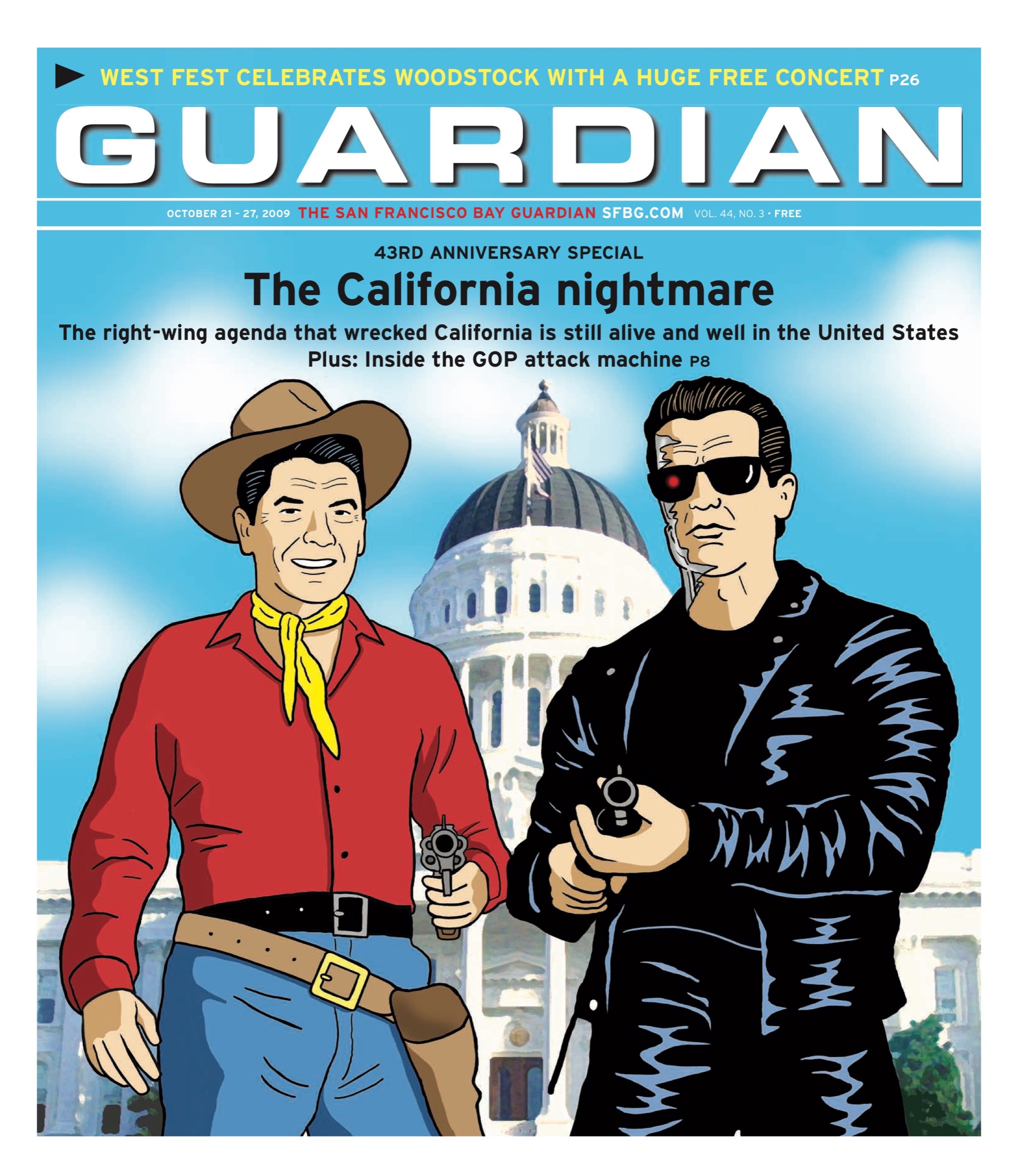
>>The lesson of California: The Golden State that invented the tax revolt is failing, but the conservative movement presses on

>>Attack of the right-wing nuts: The manipulations and media machine behind the assault on progressive ideas

Guardian graphic by Ben Hopfer

West Fest: The fun and the photos

0

Text and photos by Lisa Weiss

Photos from the 40th anniversary Woodstock celebration at Speedway meadow:

1terry[2].jpg
“This is righteous! It’s a part of history!” Terry Kennedy makes up the seriously daunting security behind the scenes at this year’s West Fest. He, along with many of his fellow security handlers and 2B1 record employees, lent a hand to the celebrations to commemorate the majestic memories from Summer of Love and Woodstock.

More pix after the jump

A revealing Newsom interview

2

By Tim Redmond

It’s taken me a few days to find the time to listen to the whole thing, but the Calitics interview with Gavin Newsom is interesting — for what he says and for what he doesn’t.

Most of the time, Newsom talks in sound bites and platitudes, much as you would expect from a candidate for governor. (“We need order of magnitude change, I’m not running to fail more efficiently.”)

And he says, toward the end of the interview, that he supports and oil severance tax and a $1.50 a pack cigarette tax to fund education. He also says that California should tax services and lower the overall sales tax rate. And like many Democrats, he would restore the vehicle license fee that Gov. Schwarzenegger cut. Which all makes perfect sense.

But on the larger issue about revenue and services, he’s awfully squirrelly. He talks about how San Francisco funds universal health care and universal preschool — “we value these programs by funding them, finding the resources and funding them.” But then talks about “reform” — redirecting money from one program to another. (For example, right now he’s redirecting money away from front-line health-care workers).

And he proclaims:

“Let’s not accept the parameters that we have to tax or cut.”

Actually, that’s bullshit. Because in the end, you can find some waste and redirect it (we could, for example, release all drug offenders from prison and save a few billion dollars), but it’s almost impossible politically to do anything that saves that kind of money. The waste and redirection gets you pennies. In the end, the state’s actual spending hasn’t even kept up with population growth — and that’s at a time when federal services have been cut and state and local government has had to take up the slack.

So actually, Mr. Mayor, you DO have to tax or cut. And what I haven’t heard him say yet is exactly how he’s going to make those decisions.

I also really like this line: “My number on priority in San Francisco has been job creation.” This from a mayor who has been responsible for about 1,000 layoffs of public-sector workers. Guess those jobs don’t count.

Prison report: The feds will take over

5

By Just A Guy

Editors note: Just A Guy is an inmate in a California state prison. His dispatches run twice a week.

Well, how do I put this? There’s really only one way: I told you so.,

Below is my blog posted on 9/16/09 in which I address the non-plan plan, in which I predicted what would happen.

I find it laughable that Gov. Schwarzenegger says he’s furious at the three-judge panel’s comdemnation of the state government’s weak plan and said that it is not the feds place to interfer with state government running prisons.

It’s like the biggest secret everyone knows — California officials can’t wait to wash their hands of the prison fiasco and have the feds take over so they can avoid the perceived political suicide of early releases.

My next prediction is that the plan due in less than three weeks will still not measure up and the feds will take over. Enjoy the repost.

The old Gov. Moonbeam shit

1

Okay, I’ve got a lot of problems with Jerry Brown. He was an awful mayor of Oakland, sided with the developers and the cops, and seemed to lose almost all of his progressive insticts. He’s against raising taxes on the rich. He won’t even support marijuana decriminalization.

There are good reasons to criticize the guy, and I’m right there at the front of the line.

But I fear that’s not what the press is going to do over the next year. It’s way too much fun to dredge up the old Gov. Moonbeam shit

Check out Carla Marinucci today:

now’s a good time to re-introduce you to author Jerry Brown, whose ’90s book “Dialogues” also contains a few memorable quotes that may end up in some 2010 gubernatorial campaign ads …. For Brown fans, the material illustrates the intellectual curiousity and independence that they say set him apart in the current pack of pols. For conservatives, it’s more proof he’s still that ultra-liberal, wacky “Moonbeam” character.

(btw, ultra-liberal is the Chron’s disparaging term for progressive. Although C.W. Nevius seems to like “militantly liberal.”)

So here are some of the examples of questions Brown asked in his interviews that the Chron thinks are utterly wacky:

*To author and philosopher Noam Chomsky:

*”How would you compare the propaganda system in the so-called free world to an authoritarian system? What are the differences?”

Umm, Chomsky is a brilliant linguist, an expert on the use of words. That’s a perfectly legit question to ask him. And it’s based on what anyone who follows the news media knows very well — that a lot of what is presented as unbiased news is actually slanted to promote a point of view. Why is that strange or wacky?

OR:

*To Judi Bari, late “Earth First!” enviromental activist:

*”None of us is an isolated monad with this bundle of private property rights outside the fabric of these larger obligations. So I very much believe that it’s time to take another step in the evolution of capitalism. Right now, I don’t think the federal government can make that happen…it can’t even operate what it owns, so that’s not the answer. But we’re on a track of real destruction socially and ecologically and we have to understand that as clearly as we can in order to come up with a better set of rules.”

*To Wolfgang Sachs, author and enviromental researcher:

*”As you observe modernizing projects in the world today that are operated by multinational corporations without much interference from national governments, do you see fascistic elements there? There are certainly enormous changes imposed without the consent of the governed.”

Again: Brown’s points are pretty basic, pretty clear — and almost indisputably correct.

The Sacramento Bee has had fun with some of Brown’s old lefty stuff on KPFA, but again, I have to ask: What did he say that was wrong?

He called capital punishment “state murder” and said U.S. Sens. Dianne Feinstein and Barbara Boxer, both Democrats, had “sold out” U.S. truck drivers by letting their Mexican counterparts drive uninspected vehicles into the United States.

In one of the most controversial excerpts, Brown called the prison system a racket that pumped profits out of the poor’s misfortunes and into the pockets of prison guards.

“The big lockup is about drugs,” Brown stated in an excerpt from late 1995. “Here’s the real scam. The drug war is one of the games to get more convictions and prisoners. There’s a lot of chemicals out there and when certain ones are made illegal, they become a huge profit opportunity and bring violence, crime and more people to imprison.”

Again: What, exactly, is wrong with anything he said? It’s all perfectly true.

More from the Bee:

Garry South, a top strategist for Democratic gubernatorial candidate Gavin Newsom, said the KPFA (94.1 FM) broadcasts would make Brown vulnerable if he reaches the general election.

Brown opened an exploratory committee for a gubernatorial run last month but has not officially announced his candidacy.

“California Democrats need to ponder very seriously the prospect of putting up a candidate for governor who comes with reams of radio-show rantings and ravings like Brown,” South wrote in an e-mail.

Rantings and ravings? Does Newsom support the death penalty? NAFTA? The drug war? If he does, that’s a bigger problem than Brown’s off-the-cuff radio remarks.

Does Newsom protest too much?

2

By Tim Redmond

Gavin Newsom is strongly denying the “swirling rumors” that he might drop out of the race for governor and settle for second fiddle. He kind of has to do that if he wants to keep raising money — although all these reports, some of which come from his own shop, aren’t going to help him. And the more vocally he insists he will never drop out of the governor’s race, the more embarrassing it will be if he gets to the point where he has no choice. I don’t think he’ll stay in the race to the bitter end if the polls and the money show him getting clobbered; nothing worse for a political career than a 20-point loss in a primary.

I agree that the polls at this point are pretty meaningless — it’s mostly about name ID and the few issues Newsom is known for, like same-sex marriage (which plays badly with older voters, who are the ones most likely to be contacted by pollsters. Newsom’s voters all use cell phones.) What’s more significant is that our mayor is having trouble raising money — and sadly, in California, it take tens of millions to reach voters who might not know much about you (and need to change their opinions pretty radically).

So I can understand why some Newsom allies think he should just cut a deal with Jerry Brown and run for lieutenant gov. It makes a certain amount of political sense: Newsom is young, and the Lt. job is perfect for him — it’s all about holding press conferences and cutting ribbons. Four years of that, plenty of time to make statewide connections, build a donor base and create the image he wants, and he’ll be ready to go for the top job — which might very well be open. Brown is 71; by the time he’d be up for re-election he’d be 76, and looking at serving in one of the toughest jobs in American into his 80s. One term might be all he’s up for.

And besides, not to be ghoulish or anything, but whenever you take the Number Two spot behind a septuagenarian office holder, the possibility that you’ll wind up Number One is always on your mind. Brown is pretty damn healthy; all that meditation and stuff is good for you. But you never know.

The problem is that someone else will want the LT job, and if he waits too long, it looks like he’s taking the consolation prize and doesn’t really care about it, and all these quotes will come back to haunt him. Imagine how much it would suck to agree to be the understudy — and then get beat for that job.

Conspiracy to get deported

2

By Tim Redmond

1021exam.jpg

I was arrested once for “Conspiracy to Loiter.”

Think about that, for a second. Try to figure out what that exact crime entails. Then consider that it took place in the Federal Building in San Francisco, and under federal law, conspiracy to commit a misdemeanor can be charged as a felony. So my crime, as it were, could have landed me in a federal pen, serving five years hard time.

I was actually just a reporter, wearing an press pass issued by the SFPD, covering a demonstration that involved some activists chaining themselves to the front door of the Federal Building. Most of the reporters were outside, trying to do interviews as the cops blocked off access to the protesters. So I walked around to the side door, walked into the (public) building and started doing interviews as the chain gang was broken up and taken into custody.

An infuriated member of the Federal Protective Service pointed to me and told his assistant to “arrest that man.” When the younger cop asked what the charge would be, the red-faced officer blurted out “uh, conspiracy to loiter.”

So that’s what went down on the paperwork, and as a suspected felon, I was chained to a radiator in the FPS office while they figured out what to do with me next. It took an hour or two for some U.S. attorney to get involved and realize that there was no such crime as conspiracy to loiter, and if there was I hadn’t committed it, and eventually I was unchained and released. I still had to get a lawyer to get the charge formally dismissed.

All these years later, it’s just a funny story — but if I had been a young person with brown skin who had arrived in the United States with his parents at age two and never attained proper legal status, I could have been deported, to a country I’d never known where I had no ties or connections and might not even speak the language.

That’s one of the problems with deporting people just on the basis of an arrest — sometimes people get arrested by mistake. Sometimes they turn out to be not guilty.

That’s why the Examiner’s front page headline — “Commit a crime, stay in The City” — is so crazy. You don’t have to commit a crime to get arrested. Any young man with black or brown skin in this country knows that.

There’s a reason why people have the right to a preliminary hearing and a trial before they have to pay for a crime. Maybe they didn’t do it.

All that David Campos’ legislation does is move the time when you refer someone for potential deportation (which, frankly, is worse punishment than most of the sentences most people will get for the crimes in question) from the arrest period to the conviction period.

It’s pretty simple, really. And I remain convinced that the only reason Mayor Newsom opposes it is that he’s running for governor and doesn’t want to look soft on crime.

Mexico report: The electricity meltdown

0

By John Ross

MEXICO CITY — Monday morning, Oct. 12, broke broodingly over Mexico City. The headlines on a score of newspapers hanging from Vicente Ramirez’s kiosk were universal loas for Calderon’s heroic seizure of Luz y Fuerza del Centro. As usual, La Jornada, the capital’s left daily, was the exception. Political columnist Julio Hernandez noted that on the eve of the centennial of the Revolution of 1910-1919, Mexico stood at a decisive moment: if Calderon was allowed to validate the takeover of the company and destroy the SME, the left’s goose was cooked.

Around the counter at the Café La Blanca, sullen faces were buried in their newspapers. Isidro Zuniga talked about putting 34 years in at a box factory before being shown the door – “I gave them my youth for a handful of pinche lentils. This is how the bosses fuck us. Chinga su Madre Senor President! We will stand with the SME…”

Benito Ruiz, the driver at the hotel where I’ve lived for 25 years, was steaming. Calderon was like the dictator Porfirio Diaz who was dumped by the Revolution, like the president Gustavo Diaz Ordaz who had ordered the massacre of hundreds of students on the eve of the Olympics in 1968. “Watch your back, Senor John,” he warned, “these bastards will stop at nothing…”

Others had less sympathy for the workers. Don Juanito Lopez, a tailor here in the old quarter, was dismissive of Luz y Fuerza which he thought rotten to the core with corruption. When you complained about your light bill or wanted to get something fixed, employees demanded a “stimulus” bribe. Sky-high electric bills have driven a wedge between Luz y Fuerza workers and the general public.

I walked over to the neighborhood Luz y Fuerza office on Carranza Street. It was locked up tight but the Mexican flag was still flapping from the roof. Handwritten signs (“Listen up people! The SME is fighting for you!”) were taped to the dusty windows. A young woman who said she was the daughter of an electricista, handed me a leaflet that explained what Calderon had done “is called fascism just like under Hitler and Mussolini and Pinochet and Diaz Ordaz.”

Killing the dream

0

tredmond@sfbg.com

When the first issue of the Bay Guardian hit the stands in 1966, it was still really possible to talk about the California dream. The state had seemingly limitless potential and was in many way a model for the nation — a free public university system that was the envy of the world, an economy that provided jobs to hundreds of thousands of new arrivals, the beginnings of what would be the nation’s premier environmental movement pushing to save San Francisco Bay, save the coast, save Lake Tahoe … and the Free Speech Movement, the Summer of Love, the United Farm Workers Union, and so much more that was transforming politics and culture in the United States from the West Coast.

Twelve years later, it was all falling apart. Eight years of Gov. Ronald Reagan and then the passage of Proposition 13 launched a very different kind of movement out of the West, a movement that sought to dismantle the public sector and the social safety net, to treat government as the enemy, and to use culture wars to convince working-class Americans to vote against their own economic interests.

And now California is being described as the nation’s first failed state. Gov. Arnold Schwarzenegger — the second Republican actor to hold that role — has driven the state to the brink of bankruptcy. The University of California is drowning in red ink, raising fees and turning away students. The state’s water system is a mess; cities and counties are in fiscal collapse; the economy’s in the tank; and nobody seriously talks about a California dream anymore.

The story of how that happened — and how the diseases of tax-revolts, privatization, government corruption, and public disempowerment spread east from California — is the focus of this 43rd anniversary issue. It’s both enlightening and a bit scary to read through old issues, because in hundreds of stories over the past four decades, the Guardian has warned of exactly what was to come.

The very first issue of the Bay Guardian talked about the "historic election" pitting the incumbent, Democrat Pat Brown, against Reagan. A lot of people in the emerging "new left" were arguing that there wasn’t a bit of difference between the two, and that you might as well sit out the election. But the Guardian had a different take. The election was really about the direction California wanted to go, the paper said, a choice between a state that cares about the public sector and social welfare and a state where those things don’t matter.

"Reagan’s stands typify the temper of the cause," the Nov. 7, 1966 editorial stated. "He is on record, at various times, in opposition to the progressive income tax, Social Security, Medicare, the anti-poverty program, farm subsidies, the TVA, the Civil Rights Act, the Voting Rights Act, public housing, federal aid to education, and veterans hospitalization for anything other than service-connected disabilities. How can a man or a movement govern the state of California with such a political philosophy?"

Reagan’s election may have seemed like a fluke, but it was nothing of the sort. By the mid 1960s, with the counterculture — and equally important, the economic left — looking to make major inroads in American policy, the broad outlines of a right-wing attack plan were in place.

That’s something the Guardian always recognized — that powerful people who moved the levers of government typically did so with a long-term plan.

In San Francisco, part of that plan was the transformation of a human-scale city to a West Coast version of Manhattan. The idea: tear up South of Market (then mostly low-income housing) for a shiny new convention center and hotels. Dump dozens of big high-rise office buildings downtown. Construct a fixed-rail system to carry suburban commuters into the dense downtown. Drive up property values — massively — and if that means blue collar jobs and working class people had to go to make way for wealthier office workers, so be it. In the end, of course, the architects of the plan — landowners, developers, bankers, and big business leaders — became immensely wealthy.

On the state and national level, their plans were broader. Even so, they had one major aim: throttle the pubic sector. Cut off the funding for government programs, reduce regulations, undermine any concept of a welfare estate — and cut taxes on the rich.

As we report on page 8, the architects of this plan are happy today to talk about how it worked — how Reagan launched his war on government back in the 1970s, how a group of well-funded think tanks developed plans, and political consultants took advantage of people’s fears (and the Democratic Party’s failures) to put those plans into action.

The movement really got off the ground in 1978 with the passage of Proposition 13.

Prop. 13 emerged from a state in the middle of a massive growth spurt and a heated political cauldron of money, race, and Legislative failure. Howard Jarvis, a Republican landlord lobbyist who hated taxes, hated government, hated public schools, and disdained most Californians — "63 percent of [public school] graduates are illiterate" and would have no need for public libraries, he once quipped — took advantage of a gaping hole in political leadership and set off a movement that would cripple the United States of America.

The measure marked the final, fatal end in California of the era known as the ’60s — a period when the left was ascendant, when taxes on the wealthy funded education, infrastructure and programs for inner cities, and when economic and cultural liberalization seemed to be spreading across the nation.

Rising property values, driven by rapid population growth, were driving up property taxes — and the problem was real. Long-time residents, particularly people on fixed incomes, saw their taxes rise so high they couldn’t afford to stay in their homes. The Legislature could have addressed that (with, say, a split-roll measure that taxed residential and commercial property at different rates) but utterly failed to move on the crisis.

A series of assessor’s office scandals didn’t help, either. And, at the same time, the California Supreme Court ruled that rich school districts had to share revenue with poor districts, infuriating wealthy white property owners.

Jarvis and his partner Paul Gann circulated petitions to roll back property taxes and make it almost impossible to raise taxes in the future. It passed with 65 percent of the vote.

Of course, big businesses (particularly utilities) were the big winners. As the Guardian pointed out on June 1, 1978, the top five utilities in California alone (including Pacific Gas and Electric Co.) would gain billions from the tax cuts.

But beneath it all was a simmering discontent with government — something Jarvis had set afire and would later be used by Ronald Reagan and the right-wing operatives who backed him to undermine the New Deal, the social safety net, and the basic social contract in America. The antitax folks played to white people who didn’t want to see their money going to minorities, to the middle-class folks who thought (thanks to the assessor scandals) their tax money was being wasted by corruption — and to a lot of younger people coming out of the 1960s who had learned from Vietnam, COINTELPRO, and Watergate not to trust government.

The Bay Guardian opposed the measure strongly: "Most analyses indicate that without replacement taxes, hundreds of thousands of California public servants would be thrown out of work (which is exactly what Howard Jarvis intends) … " a May 18, 1978 editorial noted. "Vote for Prop. 13 only if you favor decreased government services (including cutbacks in everything from libraries to schools to street-cleaning crews and possibly police and fire departments) and are fond of half-baked measures that favor the rich."

Prop. 13 set off a national movement to cut taxes — and riding that wave, Reagan was elected president in 1980. He immediately set about attempting to slash taxes on big business and the wealthiest Americans, and eliminate environmental, workplace safety, and employment regulations.

You can see the results in California — and across the nation. The very strategies that emerged in this state and that the right has supported over the years have come very close to destroying the United States economy, leaving millions out of work — while the gap between the rich and the poor has risen to unsustainable levels.

Part of the reason this national attack on government and the public sector worked was the failure of Democrats to recognize that corruption matters. It was no small wonder that Californians were losing faith in government — in the 1970s and 1980s, the state Legislature, under the Democratic control of Speaker Willie Brown, was awash in sleaze, paralyzed by lobbyist influence and campaign money. Yet leading Democrats, fearful of Brown’s power, did little to reign in the appalling corruption.

In fact, when Brown became mayor of San Francisco, the entire Democratic Party, from the president of the United States on down, seemed to treat him as royalty — despite the fact that he was selling the city to every developer and corporate lobbyist who waved money under his nose. When taxpayers knew that a large part of their money was going to fund juicy jobs for Brown’s cronies and pet projects, it was hard to argue for higher taxes.

And it was the Democratic Party leadership in San Francisco who presided over two of the greatest examples of privatization of public resources in modern history: the Presidio and the Raker Act. Rep. Nancy Pelosi was the author of the bill that, for the first time, turned a national park over to the private sector — and hardly a Democratic leader in the city dared to lift a finger in opposition. And for decades — since the Guardian first broke the story in 1969 — the city’s Democratic power brokers have bowed and genuflected to PG&E and allowed the private utility to control the local electric grid and block implantation of the federal law that mandates public power for San Francisco.

And now PG&E wants to pull off one of the greatest feats of privatization in American history. The company has launched a ballot initiative that would wipe out any further attempts at public power in California, essentially guaranteeing that private companies, not the public sector, control the vast, critical resource of electric power in this state.

It’s the latest big battle between two divergent visions of America — and this time, the folks who have done so much damage to this state and this nation can’t be allowed to win. In fact, maybe the campaign against PG&E can be the turning point, the time when California realizes that privatization, attacks on the public sector, tax cuts for the rich, and political sleaze are a formula for disaster.

The lesson of California

0

news@sfbg.com

Much of the right-wing agenda that has thrown this nation into economic chaos can be traced back to what was once called the Golden State.

The tax revolts that started here under Gov. Ronald Reagan and continued to sweep the country and the world under President Reagan never abated. Indeed, they have only been strengthened by the big business power that created and benefited from them.

But now that California is showing signs of being the country’s first failed state — caught in fiscal freefall and mired in political gridlock as a generation’s worth of neglected problems surge to the surface — this state has become a cautionary tale for that anti-government ideology.

Trends in America tend to start out west, and the economic and political disaster that California has become contains critical lessons for the rest of the country.

Lewis Uhler — president and founder of the National Tax Limitation Committee — speaks candidly and proudly of his key early role in helping build a conservative movement to limit the size of government and do battle with those who want the public sector to actively promote social and economic justice.

Uhler, a UC Berkeley Boalt Hall School of Law graduate who did legal work for conservative causes in the 1960s, was tapped by then-Gov. Reagan in 1970 to be the director of the Office of Economic Opportunity, a federally-funded legal assistance program created as part of President Lyndon Johnson’s war on poverty.

While that may seem like a strange role for an avowed conservative and former member of the John Birch Society, Uhler says Reagan basically brought him in to wreck the program and fight the feds. “I was asked to put my money where my mouth was for my conservative philosophy,” Uhler told the Guardian. “OEO was set up to ensure conflict and confrontation … The mission of legal services was to change public policy through lawsuits they decided to file. I thought it was a corruption of the legal system.”

At the time, public-interest law and liberal economic and social policies were on the rise in California and spreading to the rest of the nation. So the Reaganites fought back.

Rather than helping poor plaintiffs file environmental, consumer protection, equal rights, or other types of lawsuits designed to level the playing field with powerful interests, Uhler blocked lawsuits brought by attorneys he calls “ambulance-chasers” and gutted the program. “Ultimately,” he said, “we vetoed funding for California Rural Legal Assistance.”

And for his efforts, Uhler was rewarded with a cabinet-level position: assistance secretary of the Health and Welfare Agency. Again, his role wasn’t to make the agency more effective, but to make it less effective in a realm where he believes government was too big and too active.

“The problem was uncontrolled state and local spending,” Uhler said. “Intuitively, everyone who gathered around Reagan shared the same philosophy that government doesn’t really contribute anything to economic growth.”

In 1972, Reagan gave Uhler the opportunity to work more directly on the mission of cutting taxes and shrinking the size of government, naming him chair of the Governor’s Tax Reduction Task Force. It was, in many ways, the beginning of the vast right-wing conspiracy.

“I asked to be given the chance to go across the country and find the best free market minds in the country to develop these policies,” Uhler said, explaining that he wanted to borrow the liberal strategy of giving an academic veneer to their ideas, as presidents Kennedy and Johnson had done in the realm of foreign policy. “Our side had never really done that.”

Uhler’s first stop was the University of Chicago School of Economics, where he met with noted free market economists Milton Friedman, James Buchanan, and George Stigler, who were brought into the cause.

Today’s vast network of conservative think tanks didn’t exist at that time, so Uhler tapped conservative thinkers from the American Enterprise Institute and the Hoover Institute at Stanford University, as well as other conservative economists such as Peter Drucker from Claremont McKenna College.

“There were 35 people who helped us design the first effort at a constitutional initiative in California to limit year-over-year growth of the state’s general fund,” Uhler said. “All of us as free market enthusiasts and economists all shared the belief that government beyond a certain level eats the seed corn of the nation and doesn’t produce anything.”

While voters narrowly rejected their group’s first effort to cap government growth — Proposition 1 on the November 1973 ballot — the ground had been prepared and the seeds had been sown for the tax revolts that would sweep the country in the late 1970s, with many of the campaigns coordinated by Uhler and the organization he formed for that purpose in 1975, the National Tax Limitation Committee, and a rapidly growing network of similar, interconnected organizations.

As Uhler worked with Reagan to weaken California’s government from within, his fellow travelers were developing national and international strategies to create aggressive, coordinated, well-funded campaigns to attack government and spread the free market dogma.

In August 1971, Lewis Powell — a conservative corporate attorney who President Richard Nixon had just nominated to the U.S. Supreme Court (where he served from 1972-87) — wrote a confidential memorandum to the leadership of the U.S. Chamber of Commerce titled “Attack on the American Free Enterprise System.”

He sounded the alarm that the ascendant environmental and consumer movements were going to destroy capitalism in the country unless corporate America aggressively fought back in a coordinated fashion, which he spelled out in great detail.

He called for all major corporations to develop aggressive legal and public relations strategies for fighting the left, creation of a network of think tanks and media outlets to push the conservative message, manipulation of the legal system, and sponsorship of university programs to study conservative ideas and incubate future leaders — which all came to pass in the coming decades.

“American business [is] ‘plainly in trouble’; the response to the wide range of critics has been ineffective and has included appeasement: the time has come — indeed, it is long overdue — for the wisdom, ingenuity, and resources of American business to be marshaled against those who would destroy it,” Powell wrote.

Part of that strategy involved having the federal government promote and popularize free market economic theories being developed by Friedman and his colleagues at the University of Chicago, a movement that is well-documented by journalist Naomi Klein in her book The Shock Doctrine: The Rise of Disaster Capitalism.

In 1971, Friedman and his colleagues began working with rich conservatives in Chile who were allied with Gen. Augusto Pinochet, who in turn were conspiring with the CIA to overthrow and assassinate the democratically elected, leftist President Salvador Allende, which they successfully did on Sept. 11, 1973.

Friedman’s economic theories called for a radical restructuring of society — slashing taxes and social spending; removing most regulation and trade restrictions; crushing labor unions; promoting economic growth at any cost — and Pinochet executed the strategy in brutal fashion, ordering the death of at least 3,200 of his political opponents, including the car-bomb assassination of economist Orlando Letelier in Washington, D.C., in 1976.

Friedman and Pinochet consulted openly and shared a basic disdain for social programs and progressive taxation. “The major error, in my opinion,” Friedman wrote in a letter to Pinochet in 1975, referring to the government antipoverty programs Pinochet dismantled, was “to believe that it is possible to do good with other people’s money.”

The model Pinochet and Friedman developed in Chile would eventually go global — promoted by its top cheerleaders, Reagan and British Prime Minister Margaret Thatcher — and be implemented (with disastrous results for most citizens but creating huge profits for wealthy individuals and corporations) in Indonesia, Bolivia, Argentina, Peru, Russia, Poland, South Africa, Japan, and elsewhere.

But with the corporate media and conservative opinion-shapers focused mostly on economic growth — ignoring persistent poverty and the brutal tactics used to suppress the popular movements that tried to resist Friedman’s “economic shock therapy” — Friedman had become a sort of free-market prophet by the time he died in 2006.

“In the torrent of words written in eulogy to Milton Friedman, the role of shocks and crises to advance his worldview received barely a mention,” Klein wrote. “Instead, the economist’s passing provided an occasion for a retelling of the official story of how his brand of radical capitalism became government orthodoxy in almost every corner of the globe.”

California’s fiscal shackles have been in place since 1978, when Proposition 13 and subsequent measures capped property taxes and required an undemocratic two-thirds vote to either raise taxes or pass the annual budget.

A Republican landlord lobbyist named Howard Jarvis charged onto the field that Reagan, Uhler, and their team had prepared and took advantage of a gaping hole in political leadership to set off a movement that would cripple the United States of America.

There was some logic to it then. Times were good in California in the 1970s, good enough that people were flocking to the state by the millions. That was driving up property values — and thus property taxes.

Jarvis bought his home for $8,000 in 1946; 30 years later, it was assessed at $80,000. In fact, inflation was running at close to 10 percent a year in California. Homeowners were getting huge tax hikes each year, and tenants were getting huge rent hikes at a time when state government had a budget surplus.

Homeowners saw millions of dollars sitting in the coffers in Sacramento while they couldn’t pay their tax bills. Yet nobody in the Legislature or governor’s office came up with a solution.

So when Jarvis showed up with petitions to roll back property taxes and prevent future increases, he found a broad base of support. Even tenants went along — Jarvis and his gang promised that property-tax cuts would be passed on to tenants and would mean the end of the escautf8g rent hikes.

Jarvis collected signatures for a radical measure that essentially blocked all property tax increases and allowed new assessment only when a parcel sold. It was, in the end, a huge tax giveaway to major corporations. Since commercial property turned over far less often than residential property (and since commercial sales could be hidden as stock transfers), big businesses wound up paying far less of the state’s tax burden. Corporations used to pay about two-thirds of the state’s property taxes, and individuals one-third; now that is reversed.

It didn’t help tenants, either. Few of the landlords who saw the benefits of Prop. 13 passed the money along to their renters. Most just kept it. San Francisco activist Calvin Welch likes to say that Howard Jarvis was “the father of rent control.”

The campaign against Prop. 13 warned of the dangers of cutting local government; police and fire chiefs appeared in ads opposing it. But the No on 13 folks never talked about the huge windfall big corporations would get from the measure, or the huge disparities in wealth that would be created by defunding government and dereguutf8g corporations.

If the goal was to skew the concentration of wealth in the state, it worked brilliantly. According to the California Budget Project (CBP) of the Franchise Tax Board, recent data taken before the current economic recession illustrates an ever-widening chasm between the wealthiest taxpayer and the working-class person.

The total adjusted personal income for Californians rose by nearly $64 billion in 2006-07 — with approximately three-quarters of that increase going to the top fifth of wealthiest taxpayers, and 30 percent going to the top 1 percent. That left only $19 billion for everyone else.

“The average taxpayer in the top 1 percent experienced a $128,261 increase in AGI [adjusted gross income] between 2006 and 2007, which was more than three times the total AGI of the average middle-income taxpayer in 2007 ($36,115),” stated the June 2009 report.

This continues a long-term trend in which the wealthy continue to leave the average income-earner behind in a trail of dollar-sign dust. From 1995 to 2007, income gains for that top 1 percent come to a whopping 117.3 percent increase — nearly 13 times more than the gains of the middle-income taxpayer.

The nation’s income gap has reached a “level higher than any other since 1917,” according to a paper by University of California, Berkeley economic professor Emmanuel Saez. According to Saez’s analysis of census data, there’s been a steady increase in the income gap since the 1970s, rising 20 percent over the years.

Yet even today, the defenders of Prop. 13 continue to sound the same consistent themes. “Those who are directly involved in government are a militant special interest,” Howard Jarvis Taxpayer Association executive director Kris Vosburgh told us. “They don’t like anything that limits their revenue stream.”

While that last statement could be applied equally to corporations or other private sector enterprises, as Vosburgh reluctantly admitted when asked, he continues to imply malevolence to those who defend government. He said the state’s current fiscal collapse can only be solved by slashing government expenditures.

“It is not valid to be talking about revenue-side solutions,” he said. “Our position is the state has enough money to accomplish its goals.”

People have never liked paying taxes, but the antitax movement is about far more than just that basic individual desire to hold onto our money.

The attacks were well planned, carefully targeted, and part of a much larger effort aimed at maintaining corporate and conservative power, undermining the New Deal, reducing taxes on the rich, and radically reducing the size and scope of the public sector.

As Powell called for, corporations have aggressively challenged, in legal courts and those of public opinion, every significant progressive advance — from San Francisco’s attempt at universal health care to California’s tentative first steps to address global warming.

With a level of discipline unheard of on the left, conservative opinion-shapers pound their talking points and enforce party unity through mechanisms like the “no new taxes” pledge that every Republican in the California Legislature has signed and heeded, under the very real threat of recall.

Opposition to taxes is now so deeply embedded into the psyche of the California electorate, and such a core tenet of today’s Republican Party, that elected officials who tout fiscal responsibility allowed the state’s debts to go unpaid (destroying its credit rating in the process) and its education and transportation systems to be decimated rather considering new revenues.

Gov. Arnold Schwarzenegger’s spokesperson Aaron McLear told us, “He believes we ought to live within our means and pay for only the programs we can afford.”

That simple talking point gets repeated no matter how the question is asked, or when we point out that it means we’re being forced to live within historic lows this year. But they claim the people support them.

“We had tax increases on the May ballot and they were rejected by a 2-1 margin. We should listen to the will of the voters,” McLear said.

Never mind that this regressive, dishonest package of temporary tax hikes was opposed by the Guardian and a variety of pro-tax progressive groups. McLear wouldn’t even admit that point or respond to it honestly.

And he’s certainly right that most polls show a majority of Californians don’t want new taxes. But these polls also show that people want continued government services, more investment in our neglected state infrastructure, and a whole bunch of other contradictory things.

That’s why newspapers and analysts around the world are looking at California, the world’s eighth largest economy, and wondering (as the Guardian of London headline asked Oct. 4): “Will California become America’s first failed state?”

In many ways, it already is. The question now is whether we’ll try to learn from and correct our mistakes. Ryan Riddle contributed to this report. ———–

THE CONSERVATIVE RELIGION

When I asked Lewis Uhler, one of the architects of the Reagan revolution, what Americans believed in these days — where the people he likes to talk about who hate the government (but are also admittedly disillusioned with Wall Street) turn — he answered simply: religion.

It should come as no surprise that many religious fundamentalists tend to side with the free market conservatives — both ideologies require a leap of faith and ignoring certain troubling facts, such as increasing disparities of wealth, natural resource depletion, and global warming.

Their arguments mostly make sense — until these inconvenient truths come up.

Certainly, turning over more public resources to free market capitalists, cutting taxes, and slashing government regulation will spur private sector economic growth, just as advocates claim.

But that growth has a cost. The wealth won’t be shared by everyone. Indeed, poverty has persisted even through even the economic boom of the 1990s — but almost everyone will be affected by underfunded road, education, public safety, and other essential systems.

As the conservative movement has successfully limited taxes and cut regulation over the last 40 years, working class wages have stagnated as the rich have gotten richer. Many of the world’s oil reserves have peaked and gone into decline, and rapidly increasing carbon emissions have collected in the atmosphere and caused global warming.

So how do conservatives respond to these realities as they argue for the continued dismantling of government, which is the only entity with the scope and incentive to deal with these problems? They simply deny them.

Uhler decried the “pseudoscience of climate change” as hindering economic progress and claimed that there’s actually been a global cooling trend in the last 10 years. (Actually the last 10 years have been some of the hottest on record, causing glaciers around the world to melt, according to data and observations from a consensus of the world’s climate scientists, including NASA, the Union of Concerned Scientists, and the United Nations Climate Change Conference.)

It’s the same story with the consolidation of wealth, which hurts the free market fantasy that letting the super-wealthy keep more money will eventually trickle down to benefit us all. Uhler simply denied the growing disparity of wealth, saying the “movement between quintiles is significant.”

He was talking about people’s ability to go from poor to rich with a little hard work and initiative, the core idea of free market conservatives. But data from the U.S. Census Bureau and many other entities indicate that median wages have been stagnant for decades (which wouldn’t be true if there was lots of upward mobility) and that most of the wealth created in the U.S. over the last 40 years has pooled with the top 1 percent.

In fact, when it comes to measuring social impacts, Uhler has simply one metric: “Governments at all levels are twice the size they should be to maximize economic growth.” (Steven T. Jones)


 

In Mexico, a bitter battle over electricity

0

By John Ross

MEXICO CITY — During the first week of October, the increasingly unpopular government of Felipe Calderon stepped up its ongoing war of words against the Mexican Electricity Workers Union (SME), one of the nation’s oldest labor organizations founded at the apogee of the landmark Mexican Revolution in 1914 when workers repeatedly shut down the Canadian-owned Mexican Light & Power Company. Now, with the centennial of the Revolution on deck in 2010, the SME’s survival as a union is in jeopardy and it may never make it to the birthday party.

Following the nationalization of electricity generation and distribution under President Adolfo Lopez Mateos in 1960, the SME (“Esmay”) won collective bargaining agreements for the newly created Luz y Fuerza Del Centro that distributes about a fifth of the nation’s energy to Mexico City and four surrounding states. Mexico’s second power utility, the Federal Electricity Commission (CFE) services the rest of the country and its workers are represented by a “charro” (company) union under the thumb of the Institutional Revolutionary Party (PRI) that ran the lives of Mexicans from the cradle to the grave for 71 years until it was displaced from power by Calderon’s rightist PAN in 2000.

Although the SME had longstanding ties to the PRI, it maintained a modicum of critical independence. Communists and Trotskyists wielded influence in union circles and decorated the walls of the union headquarters with proletarian murals. The Sindicato Mexicano de Electricistas has always been good for 40,000 boots on the ground when it comes to social protest. After the 1985 Mexico City earthquake that took up to 30,000 lives, SME workers rescued victims trapped in the rubble of fallen buildings and worked tirelessly around the clock to restore power in working class colonies. In contrast, the PRI-run government abandoned “los de abajo” (“those down below”) to their own fate.

Three years ago, after hotly contested presidential elections, the SME cautiously lined up with Andres Manuel Lopez Obrador (AMLO) after Calderon was awarded victory over the leftist leader in fraud-marred balloting. Calderon has never forgiven the union’s 66,000 members – 44,000 active workers and 22,000 pensioners – for this partisan sin.

Prison report: The New Yorker bungles the story

0

By Just A Guy

Editors note: Just A Guy is an inmate in a California state prison. His dispatches run twice a week.

Shame on Ian Frazier and the New Yorker.

Frazier is a writer for that bastion of liberal magazines, and he published an article (puff piece) about cell-phone sniffing dogs in the New Jersey correctional system.

No, it’s not really a puff piece — “puff pieces” generally don’t have a deleterious affect on people or segments of society, as Frazier’s piece does on inmates throughout the country.

The piece does a great job of allowing New Jersey corrections officials to laud their own efforts to overthrow that most evil beast, the cell phone in prison. The piece goes on to report about New Jersey corrections training its own dogs on how to sniff out cell phones, and the wonderful results of that training, which is the seizure of more than 130 cell phones from us dastardly, evil inmates.

New Jersey corrections ballyhoos itself quite well about how much the agency is saving over states like California, which has contracted cell phone sniffers to come in at exorbitant rates, depleting our already woefully depleted budget. At least the New Jersey corrections folks got something right.

The corrections agency goes on to say how dangerous and threatening all us inmates are with cell phones, how it’s pretty much only gang members and drug dealers who purchase the phones and call out hits on unsuspecting witnesses and victims.

Prop. D and privatization

5

By Tim Redmond

Randy Shaw has a piece in Beyond Chron today that takes issue with our endorsement on Prop. D.

It’s a fair discussion and a reasonable debate — I understand why some progressives support Prop. D, and I don’t think they’re wrong or evil for doing so. This one’s a tough call — I’m willing to accept stuff like electronic billboards that I don’t want to see in most parts of the city if it will really bring new life mid-Market, which desperately needs investment and energy.

But Shaw’s piece brings up a larger issue, one that’s part of the topic of our anniversary issue next week, so it’s worth comment.

Here’s what he wrote:

The San Francisco Bay Guardian said many good things about Prop D, but urged a No vote after focusing on the CBD factor: “But the process this measure describes isn’t at all democratic. The CBD board selects its own members, and the only oversight the city has is the ability of the Board of Supervisors to abolish the agency.”

Of course, any funding allocation process used by Prop D could have been similarly attacked. Would the Guardian prefer that the Mayor’s Office allocate Prop D funds? If so, its editorial board should reread my pieces on the Newsom Administration’s rigged RFP/RFQ processes.

Hard to argue with that, on the surface: Yes, the bidding process out of the Mayor’s Office is fucked up. Yes, there is almost always some level of corruption at City Hall (any City Hall).

But that doesn’t mean that the private sector ought to take over thing like zoning and resource allocation.

Private nonprofits like the Central Market Community Benefits District play a role in the city’s life, and that’s fine. Some nonprofits (like the one Randy Shaw runs) get city contracts to do work the city can’t do very well, and that’s also fine.

But the public sector — however flawed, however corrupt at times — still has to have the final say over regulations and the way money gets spent on public services. That’s how democracy works.

I remember once when we were intervieweing a very appealing, smart and generally progressive candidate for city assessor a few years back, and we asked him how he would go about bringing in more revenue. He told us he wasn’t sure that was a good idea, because “Willie Brown and his friends will just waste it.”

True — Brown and his friends wasted a lot of money. And that kind of corruption in government has helped the right wing push its anti-public-sector agenda. And people who says that “at least Willie Brown made the trains run on time” miss the point – corruption undermines faith in government.

But overall, using that argument to push for privatization of public resources is a dangerous way to go.

Remember: The money that would be paid by billboard owners to the CBD amounts to a tax on the new billboards. That tax ought to be collected by the city, and elected city officials should decide how it’s spent. Proponents of the measure told us they didn’t want to let the supervisors hold hearings, write the legislation or put it on the ballot because the city would then have control over the final shape of the measure. For example, Sup. Chris Daly wanted much of the billboard money to go for low-income housing — which isn’t where the CBD folks wanted it to go.

Sorry, but that’s a decision for elected officials to make. I’ll support new billboards when I know that there will be a public process (and public-sector process) determining how the boards are sited, how they’re taxed and where the extra cash is spent.

Prison report: Addiction behind bars

8

By Just A Guy

Editors note: Just A Guy is an inmate in a California state prison. His blogs run twice a week.

Something I’ve neglected to talk about at length since my blog began back in April is addiction in prison.

Obviously, a very large percentage of us in prison are here for things that ultimately were related to drugs. From possession to robbery to murder, in one way shape or form, 90 percent of us committed our crimes while on drugs or alcohol, while trying to get drugs or alcohol, or pursing the “rewards” of selling drugs and hurting people in that pursuit.

I’ve blogged about cell phones, specifically twice, and have touched on that subject numerous times, but I’ve not really dug into the drug problem.

I guess to some degree I was caught up in the heart of the “cell phone wars” from an inmates point of view, but the cell phone dilemma has done an excellent job of overshadowing what I perceive to be a much bigger threat to public safety — drug and alcohol addiction in prison.

In my defense, it’s easy to get caught up in the cell phone question because the California Department of Corrections and Rehabilitation’s rationale is ludicrous in light of the problems caused by addiction and drugs in prison. It’s almost as if they’re using cell phones to take our attention away from the real problem.

First of all, drugs in prison are quite plentiful and easy to get, and cause a whole host of problems, from gang trouble to debt trouble to race trouble — not to mention the spread of disease. (I had never seen heroin until I went to prison.)

Our endorsements

1

For the Nov. 3 election are here. We’ve also endorsed John Garamendi for Congress in District 10. Fell free to comment if you disagree with us ….

New coach, new approach

0

news@sfbg.com

The chief was running late. As a group of Guardian reporters filed into his modest, comfortable conference room on the fifth floor of the Hall of Justice, an aide told us that Police Chief George Gascón was still meeting with Mayor Gavin Newsom at City Hall, and that we’d all have to cool our heels for a while.

While we were waiting, Michelangelo Apodaca, a public affairs officer in the chief’s office (he called himself an “image strategist”) stressed the recent sea change at SFPD, labeling it “new coach, new approach.” (It appears, however, that the mayor is still pushing his so-called “quality of life” agenda. “I just came from a meeting where I got beat up for not doing enough about public drinking and public disorder,” the chief belatedly told us.)

But once we got into the interview, Gascón was friendly, candid, thoughtful, and accommodating, and spent nearly an hour discussing his philosophy of law enforcement, his vision for San Francisco, and his positions on some tricky and divisive problems.

We left with the impression that the new chief, although hardly in agreement with us on a number of issues, is far more open than his predecessor, willing to shake things up in the moribund department — and sometimes, interested in discussion and compromise on progressive concerns.

“My philosophy of policing is very heavy in community involvement, very transparent,” Gascón told us.

Gascón said he’s moving quickly on implementing many of the items that he’s promised, such as creating a COMPSTAT (computerized crime and staffing statistics) system that will be accessible to the public. He plans to launch it Oct. 21.

And beyond the technology, he seems interested in shifting the top-down structure of the department. “I said that we would reorganize the department in certain levels and do certain levels of decentralization to increase resources at the neighborhood level so that we actually have people within the police department who have greater ownership of neighborhood issues,” he said. “And we’re going to do that in November. I stated that we would have community police advisory boards at each of the stations, and those basically will be neighborhood-level people, anywhere from 10 to 20, for each station. We’ll work with our local captains on neighborhood-related issues.”

He said that improving how the department does community policing will have a two-fold impact. “One is, the cops get to understand better what the community really wants. The other is that the community gets to understand better what the resources really are.

“Everybody wants a foot-beat cop,” he continued. “Everybody wants a fixed-post cop. Everybody wants a cop in every bus. If we had 10,000 people, then perhaps we could fulfill all those wishes. The reality is that we don’t.”


EXPENSIVE CRACKDOWN

But the most tangible impact of Gascón’s tenure so far has been his crackdowns on drug-related activity in the Tenderloin, where more than 300 people at a time have been swept up in sting operations, and on marijuana-growing operations in the Sunset District, where 36 locations were raided (four of which Gascón said were discovered to be “legitimate” medical marijuana growers who had their crops returned by police).

The arrest surge generated a lot of positive press — but also is costing the city a bundle. Sheriff Michael Hennessey, who runs the county jail, told us that he had to reopen several jail housing units that had been slated to close to meet his budget for the current fiscal year. He said the average daily jail population in July was 1,861, but that it has risen to 2,146 in September, a 285 inmate increase.

If it stays at this level, Hennessey estimates that he’ll need up to $3.5 million in additional annual funding to house the larger population, as he indicated in a letter that he wrote to the Board of Supervisors last month, letting them know that he will probably need a supplemental budget appropriate this year.

When we asked Gascón whether affected city agencies — including the Sheriff’s Department, District Attorney’s Office, and Public Defender’s Office — should increase their budgets to deal with the SFPD’s new approach, he said they should.

There’s a touch of the corporate manager about Gascón. When we challenged him to defend the efficacy of the crackdowns, Gascón pulled out a pen and paper and started drawing a Venn diagram, with its three overlapping circles. He explained that many criminal justice studies have shown that about 10 percent of criminal suspects commit about 55 percent of the crime, that 10 percent of crime victims are the targets of about 40 percent of crimes, and that crime is often concentrated in certain geographic areas.

By concentrating on the overlap of these realms, Gascón said police can have a major impact on crime in the city. Although Gascón admits that “police can never arrest themselves out of social problem,” he also said “there are people who do need to be arrested … Most of the arrests are for serious felonies.”

It’s a potentially tricky approach — in essence, Gascón is saying that when you mix some people and some places (in this case, mostly people of color and mostly poor neighborhoods) you create crime zones. The difference between that and racial profiling is, potentially, a matter of degree.

But Gascón defended the surge in arrests over the last two months as targeting those who need to be arrested and, just as important, sending a message to the greater Bay Area that San Francisco is no longer a place where open-air drug dealing, fencing stolen goods, and other visible crimes will be tolerated.

“We need to adjust the DNA of the region,” he said.

And while Gascón said the arrest surge might not be sustained indefinitely, he also frankly said that the city will probably need to spend more money on criminal justice going forward. In other realms of the recent crackdown, such as the police sweeps of Dolores Park and other parks ticketing those drinking alcohol, Gascón said that was more of a balancing act that will involve ongoing community input and weighing concerns on both sides of the issue.

It was when we pushed for the SFPD to ease up busting people in the parks who were drinking but not causing other problems that Gascón told us that the mayor had a different opinion and had been chiding his new chief to be tougher on public drinking.

In light of several recent shootings by SFPD officers of mentally ill suspects, we asked Gascón whether he’s satisfied with how the department and its personnel handle such cases. He didn’t exactly admit any problems (saying only that “there’s always room for improvement”) but said he was concerned enough to create a task force to investigate the issue last month, headed by Deputy Chief Morris Tabak.

When we asked if we can see the report on the 90-day review, Gascón didn’t hesitate in answering yes, “the report will be public.”


FIRE TEN COPS?

If Gascón follows through with his promises, internal discipline — one of the worst problems facing the department — could get a dramatic overhaul. The new chief wants to clear up a serious backlog of discipline cases, possibly by reducing the penalties — but claims to be willing to take a much tougher stand on the serious problem cases.

In fact, Gascón said he wants the authority to fire cops — that power now rests entirely with the Police Commission — and said there are eight to 10 police officers on the San Francisco force who should be fired, now, for their past record of bad behavior. That would be a radical change — in the past 20 years, fewer than five officers have ever been fired for misconduct, despite the fact that the city has paid out millions in legal settlements in police-abuse cases.

Gascón also discussed controversial legislation by Sup. David Campos that would require due process before undocumented immigrant youths arrested by the SFPD are turned over to federal immigration authorities, an amendment to the sanctuary city policy that was weakened by Newsom.

Just days after arrived in town, Gascón had made comments to the San Francisco Chronicle supporting Newsom’s position and saying that under Campos’ legislation, “drug or even violent offenders could be released by judges on reduced charges in lieu of reporting them for possible deportation.”

But in the interview with us, while not backing away from his previous statement, Gascón seemed to take a more nuanced position that pointed toward the possibility of compromise. He reminded us that he’d spent time in Mesa, Ariz., tangling with a county sheriff, Joe Arpaio, who has gone far beyond any reasonable standard in trying to arrest and deport undocumented residents. He also told us that he doesn’t think the cops, by themselves, should decide who gets turned over the feds for deportation.

That alone is a significant step — and suggests that Gascón could turn out to be one of Newsom’s best hires.

————-

GASCON ON IMMIGRATION

SFBG Are you still concerned about waiting for the courts to determine a suspect’s guilt before turning him over to the feds? Gascón Yes, it’s very much a concern. And by the way, I fully understand the concerns Sup. David Campos brings to the table.

I have the benefit of being on the other side also, where you have police agencies aggressively engaged in immigration enforcement, where people that frankly were not engaged in any criminal activity other than being here without authority — which sometimes, by the way, is not criminal. In fact, depending on whose numbers you listen to, anywhere from 30 to 50 percent of people who are here without authority in this country have not committed a criminal violation; they have committed an administrative violation.

And people get deported. I have seen very young people, people that basically came to this country when they were three, four years old, they are actually staying clean, they are going to school, and they get stopped for a traffic violation at age 17 or 18, and now all of a sudden they are getting deported to a country where they really have no roots at all. I have seen that, and I’m very sensitive to that.

On the other hand, I think it’s important also to recognize that in any group, whether you were here legally or not legally, whether you were born here or not, whether you are green, red, or brown, there are people that for a variety of reasons aren’t willing to live by the social norms we all need to live by to be able to have a peaceful environment.

I think that allowing the process to go all the way to the point where a judge decides whether to allow this to continue … is probably too far down the food chain for my comfort level. On the other hand, I would not want to have police officers on the streets stopping people and trying to assess whether they are here legally or not.

So I think we need to find somewhere down the middle, that if person is arrested, there is a non-law enforcement review. And quite frankly, probably the best person would be the D.A. They determine whether they have a prosecutable case or not. If it’s prosecutable case and a predictable offense that requires reporting, then that would be a good time where a flag could go up.

SFBG But that’s not the process right now.  Gascón No, the process now is triggered by the Probation Department, which is a law enforcement entity. So I think we have a process where law enforcement is making a decision and Sup. Campos is looking at a process of adjudication.

SFBG It sounds as if you agree substantially with Sup. David Campos. Is there room for compromise? 

Gascón I’m hoping there is room for compromise, that is something we’re trying to work with.

Sarah Phelan and Rebecca Bowe contributed to this report.

An abomination in the Mission

17

By Tim Redmond

101309mish.jpg

Thanks, MissionMission for alerting us to the abominable project proposed for 17th and Mission. Ick. Talk about out of place.