Caitlin Donohue

FEAST: 7 burrito-free late nights

0

We’re spoiled rotten living in the city where if you fling an ankle boot, it’s bound to hit a taqueria open past last call. Its like a burrito vortex — go out in San Francisco and at some point you will get wrapped up in flour tortilla and snuggle in with your old buddies, carnitas and shredded cheese. But gooey and warm as it is in there, you must resist the pull to turn into a burrito. I know, I know, we’re gonna hold your hand through this one. We’ve assembled the meeting places for Burritos Anonymous: purveyors of snacks so fine — and open at least until 1 a.m. on weekends — that your frijoles negros withdrawal-twitches will subside and your post-bar, pre-bed caloric intake will rejoin your regularly programmed San Francisco culinary adventuring. We’re talking calamari bulgogi, vegan smoked duck sandwiches, chilaquiles, pambazos, and beef brisket with a side of cucumber salad. We’re talking late night. Clip this page and store it near your bus fare.

TOYOSE

There’s a converted garage in the heart of the Sunset District stuffed with carousing young’uns into the wee hours. Its charmingly narrow dining area has enough foliage and hanging screens between tables to hide 1 a.m. sloppiness — and enough Korean delicacies to entertain the most rabble-rousing group for hours. Try their noodle dishes, which can feed four with their toss-it-yourself mounds of veggies, cold rice noodles, and chile sauce. House favorites include the seafood pancake, kimchee fried rice, bulgogi, soju smoothies, and the damn largest bottles of Korean lager seen this side of the Pacific.

Open until 2 a.m. daily.

3814 Noriega, SF, (415) 731-0232


NOMBE

A hip izakaya whose name roughly translates to “he who doesn’t remember the walk over.” Nombe’s menu can be boggling, but that doesn’t detract a smidge from the table of pickled daikon, stewed onion pork belly, steaming bowls of ramen, and sake flights that is apt to materialize after speaking with the friendly serving staff. Motor skills eschewing spoons and forks for the moment? Play swords with something off the tasty skewer menu.

Open until 2 a.m. weekends

2491 Mission, SF. (415) 681-7150. www.nombesf.com

REACTION RESTAURANT

When the owners of all-ages art-punk venue Sub-mission decided to open up a dining room next door, they kept it accessible. Reaction’s got a menu full of little-seen Mexico City specialties that won’t break the bank of their underage clientele, but still don’t relapse into the boring realm that sub–$5 food often falls. Our favorite is the pambazo, a roll that’s been dipped in red sauce, grilled, then stuffed with your choice of meats or beans. You’ll also find huaraches, gorditas, and burgers — all in a sleek, red and black ambience that won’t harsh your buzz.

Open until 3 a.m. weekends

2183 Mission, SF. (415) 552-8200

J & V CAFE

There’s late night, and there’s late night. If the sun’s coming up and you’re not ready to mix and mingle with the morning suits, head to Bayview. Not that J & V will be filled with drunken sops like you — a well-turned, few-frills cafe located in the middle of SF’s wholesale produce market, the work day here begins in the dark of the night. Standard diner fare, decent espresso, a few quality Mexican specials — no b-words, but plenty of heaping chilaquiles plates to palliate that come-down.

1 a.m.-2 p.m. Mon.-Fri.

2095 Jerrold, SF. (415) 821-7786. www.jandvcatering.com

THE LIBERTIES

A place that takes no liberties with the notion of good pub food available when you need it most. The Liberties offers stomach-liners like mashed potato-topped cottage pie, bangers, and Anglo-happy chicken curry for those who’d rather have their biggest meal of the day post their biggest pints of the day.

Open until 2 a.m. weekends

998 Guerrero, SF. (415) 282-6789. www.theliberties.com

TOMMY’S JOYNT

With an exterior decorated in shades of circus tent, the 63-year old legend is a great place for Mom’s cooking at hours Momma woulda freaked had you started rustling around in the kitchen. Hofbrau service has you line up with a tray and point to which braised meat and starch you’d like heaped on your plate. Beef brisket? Buffalo stew (their specialty)? Veggiesaurus? No worries. Scoops of pasta salad, greens, and potatoes await.

Open until 1:40 a.m. daily.

1101 Geary, SF. (415) 775-4216. www.tommysjoynt.com

LOVE N HAIGHT DELI & CAFE

Stating the obvious: vegans get short shrift when it comes to late night. Seriously, how often can you order the same thing Carnivorous Carl is having … minus the protein and sauce? Unfair. Pay it no mind — with Love N Haight’s head-whirlingly large menu of vegan (and some meat) sandwiches, you’ve got the upper hand. Sure, the fake roast duck may taste similar to the fish and the chicken — but its a chewy, satisfying kind of same.

Open until 2 a.m. weekends.

553 Haight, SF. (415) 252-819


Hot sexy events: October 27th-November 2nd

0

So you loved it when the princess in Disney movies was tied up, but aren’t quite sure if you’re ready to make the move to complicated (read: spendy) ropes and harnesses? No fear, my dear! Alluring ropes lady Midori is here to teach you how to hold down your naughty loved one with the aid of but a few handy scarves at her upcoming Good Vibrations class (Mon/1). Can you believe you can make a dildo harness from a kicky accessory? Come to think of it, dildo harnesses might just be the most kicky accessory of them all…


Erotic Reading Circle

Because where oh where will all those literary dirty thoughts in your head go, if not out your mouth and onto the printed page? An opportunity for all those venturing into erotica writing to test out their material in front of a welcoming, sex-positive crowd, hosted by Carol Queen and Jen Cross of Writing Ourselves Whole.

Wed/27 7:30-9:30 p.m., free

Center for Sex and Culture

1519 Mission, SF

(415) 552-7399

www.sexandculture.org


Halloween Pansexual Play Party

For all voyeurs, tops, bottoms, switches, here’s the perfect chance to check out Oakland’s relatively new dungeon space. Space mistresses Jezebel and Isabella will be more than happy to aide you in your BDSM hauntings. 

Fri/29 8 p.m.-1 a.m., $20 single-$35 couple

The Looking Glass Dungeon

Jack London Square, Oakl.

 www.myspace.com/thelookingglassdungeon 

mail@thelookingglassarts.com 


Kinky Salon XXX Haunted Funhouse

I’m not really sure how you’ll find time to engage in copulation at this fake blood scare sex session. Between beats by clown-hop Burner DJ http://gooferman.com/ Gooferman, demon summonings, seances, zombie strippers, and ahem, fake spiders on strings (watch that he doesn’t dangle into unwelcoming orifices, will ya) – well, I’m sure you’ll find time. After all, it’s a two-night party.

Fri/29 and Sat/30 10 p.m., $25-$30 members only

Mission Control

2519 Mission, SF

www.missioncontrolsf.org


Wonderland at the Citadel

The Citadel is quick to note that unlike Wonderland, events at the Citadel do not inspire with the mere ingestion of fungi or snack treats – although that’d be awesome if they did. This is why they are having this fundraiser, which will plunge the appreciative perv into the White Rabbit, the Mad Hatter, various tea party refreshments, burlesque, and a dirty singalong of “My Favorite Things.” Plus an auction will be held where things like corsets, gags, sensual cupping scenes, and rattan canes can be had for a bid. 

Sat/30 3-6 p.m., $10

SF Citadel

1277 Mission, SF

(415) 626-2746

www.sfcitadel.org


Citadel Cinema: Rob Zombie’s Halloween

How often during the course of your dungeon play party do you look up and think man, I wish there was a big screen TV over there? Well, all you screen-addicted creatures of the 21st century, your time is now! In honor of the scariest time of year besides Fleet Week, the Citadel is playing one of Rob Zombie’s gore fests – with It’s the Great Pumpkin, Charlie Brown as a bonus teaser. Invite says bring your own pillows and blankets, uh-oh!

Sun/31 6-10:30 p.m., $5

SF Citadel

1277 Mission, SF

(415) 626-2746

www.sfcitadel.org


Wrapped for Pleasure: Easy Bondage for Steamy Sex

You need not have a fully-equipped dungeon to have fun with toys. Let an expert teach you the utility of a few well-placed scarves and cushions. Viola! You are now kinky. 

Mon/1 6-8 p.m., $20-$25

Good Vibrations

1620 Polk, SF

(415) 345-0500

www.goodvibes.com


Dia de los San Franciscanos

0


caitlin@sfbg.com

ARTS AND CULTURE Rene Yañez, the godfather of San Francisco’s Dia de los Muertos, is showing off the art for his new 3-D altar. The artist is hardly one to adhere to traditions, though he played a large role in creating one of the city’s most distinctive and popular interpretations of another country’s cultural celebrations.

Yañez’s elastic sense of the holiday’s expression mirrors the way his city has interpreted the Mexican holiday. Traditionally, Dia de los Muertos marks the time of year when the boundaries of the dead and living blur. Towns south of the border celebrate the day (which was synced with All Saint’s Day by the Catholic Church to capitalize on the cultural resonance of an indigenous celebration) by decorating the graves of loved ones with favorite treats and trinkets of those who’ve passed on.

But kicking the bucket doesn’t preclude your party pass on Dia de los Muertos. “The whole point of Day of the Dead is that we’re honoring death but mocking it,” says Martha Rodriguez, a Mexico City musician who curates the Dia de los Muertos San Francisco Symphony family concert that celebrates this year’s centennial of the Mexican Revolution.

“Through all the uprisings and death, there’s always space for fun,” Rodriguez says. “That’s kind of how Mexicans survive — we do not stop celebrating.”

Perhaps it’s the mix of spiritual connection, gravity, and levity — not to mention the stylin’ calaveras and brightly-colored floral iconography — that has made the celebration resonate here. The city hosts what is arguably the largest Muertos festivities in the country, featuring altar displays at SOMArts, the Mission Cultural Center for Latino Arts, and Garfield Park, as well as a procession that organizers expect to attract 100,000 participants.

Yañez and son Rio are the curators of the SOMArts’ epic yearly altar installation — an atmospheric production that transforms SOMArts’ drafty main hall into a series of reflective spaces that pay homage to fallen family members, casualties of natural disasters, manmade conflict, and even beloved gatos who have gone to that litter box in the sky.

The elder Yañez’s involvement with SF Dia-ing goes back to the early 1970s when he was artistic director at Mission’s Galeria de la Raza, a time when the neighborhood was absorbing political exiles from political strife in South and Central America. A way to observe the day of remembrance was needed. “We talked about creating a ritual, a ceremonial exhibit,” he says.

At first it was people from the neighborhoods who came to see the altars put together by the de la Raza artists. But eventually, word spread. “The exhibit proved very popular and the schools started coming around,” Yañez remembers.

The altars were a way of talking about Mexican culture and the Galeria started to print lesson plans for teachers. Eventually Yañez organized a procession through the neighborhood, like the ones held in Mexico. The first year, which current procession organizer Juan Pablo tells me was 1978, attracted somewhere between 75 to a few hundred people. But that was going to change.

“It’s the one thing that unites us, the cycle of life and death,” Pablo said in a phone interview. The thousands who attend these days see far more than traditional Mexican spirituality, Pablo said, with Wiccans marching in the parade, the Sisters of Perpetual Indulgence granting indulgences, and tributes being paid to issues worse than old age and mortality. Last year, for example, a walking altar called attention to the 5,000 unsolved assassinations of women in the Mexican border town Juarez.

Any description of SF’s festivities would be remiss if it didn’t mention the influx of Burning Man culture, with its preponderance of elaborately-costumed young people, the stilters, and the skeletons.

They make for a visually stunning event but produce ambivalent cultural connotations. Local blogs have facetiously proclaimed that with the entrenched multiculturalism of SF’s Dia, the holiday celebrations can be more appropriately titled “Day of the Dead Gringos.”

Rio Yañez grew up during this evolution. “The neighborhood’s changed so much, the parade is a reflection of that,” he says. “It’s a way of sharing culture. Even with all the drunk hipsters just having a good time marching, there’s still a good community spirit.”

That’s not to say there isn’t disagreement over how the holiday should be celebrated here. A dispute over who is the source of police complaints about overcrowding and public drunkenness led to a split between Juan Pablo’s collective’s march and the Marigold Project’s altar installations in Garfield Park. “They want to create a party atmosphere, and that’s not what it’s about,” Pablo said. “It’s about honoring the dead.

“The procession is a moving target without any of the hassles of a fixed location,” replies Kevin Mathieu, Marigold Project organizer.

Maybe nothing is ever completely at rest in a San Francisco — even the dead are caught in the winds of our city’s ongoing envisioning of the our culture’s true nature.


Not yo momma’s pole dance

4

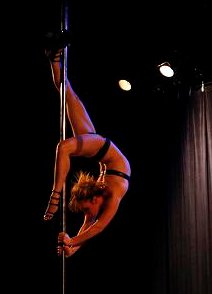
… Or should I say, father’s? After all, your momma probably didn’t get a chance to check out the ladies of the pole in her day — unless, of course, the parentals met at The Lusty Lady. What I’m trying to say here is that sexy on a stick is now an official fitness sport. And its participants are often a lot more athletic than synthetic.

A fact which I learned all about from US Pole Dancing Federation co-founder Anna Gundstrom, who explained to us in a phone interview why you’ll wanna make the trek up to Redwood City for the thigh holds of the west coast regional championships November 6th. “I’m not going to say its not a sensual form of dance — that’d be silly to say since it did start in strip clubs,” Gundstrom tells me.

Competitive pole dancing — competitive for more than boners and ten spots, that is — then, is not a rejection of the art (sport? seduction?) form’s inherent sexiness, but rather a forum in which it can coexist without conflict with strength. Gundstrom started the federation with business partner Wendy Traskos, who she met at a pole dancing studio. Traskos came from a competitive fitness background, echoes of which can be find in many of the USPDF competitors’ hard bodies. Gundstrom and Traskos saw the work being done on poles as deserving of athletic medals as any figure-skating routine — a sport which eventually inspired the duo’s scoring system.

At the time of the league’s inception, most pole dance competitions were held in clubs, where Gundstrom says “they were decided by crowd cheering, which wasn’t really a fair show. Our goal was to host credible pole dance competitions where people could come and compete and be judged by a fair system.” That fair system is a two-round pony, the first dance being a compulsory routine of 60-90 seconds during which the pole dance contestants have to pop, drop, and lock their way into six to eight required poses. 

Amy Guion rides the pony at the 2010 USPDF Championships. Photo by Laura Ganzero

And what poses they are! Gundstrom elaborates on one, the inner thigh hold. “In this one, you have to have 75 percent of your body weight held by your inner thighs — what they call a super man pose is one example.” Fly baby, fly. Attire is also strictly monitored — no nudity for the USPDF ladies, no thongs, no tassels, but your heels in the compulsory round rise to titty club altitudes: five inches is the minimum.

Of course, the women aren’t spending too much time on their feet. Back-bending, serpentine twirls around the pole blend into iron woman holds on the pole in most routines, the most hard core finding ways to suspend themselves by a single inner knee, or by their two hands, body at an impressive parallel with the floor far below. Songs skirt along lines well-worn by the strip club set, just watch the swear words. “They can pick any music they want, except for vulgar music – we don’t want to offend the audience,” says Gundstrom — who adds that it’s mainly women who fill the seats at USPDF events. 

Perhaps no athlete embodies the USPDF ethos better than Alethea Austin, 2010’s US pole dance champion. Austin isn’t one to shy from sexuality — her pole dancing website displays downloadable desktop patterns for her fans that feature Austin in splits that would make a body builder blush, and she’s performed with one wrist handcuffed to the pole on occasion.  

But the intense strength building regimen Austin undergoes belies the notion that she’s just a pretty ass. Her routine from this year’s national championships, performed to Guns ‘N’ Rose “Paradise City” saw Austin’s stomach “Heartland” tattoo (Midwestern and proud, she is) flip upside-down for a handheld back bend that betrays also a childhood spent in gymnastic training facilities.

Her mirrored five inchers dangle, glittering, overhead. Damn girl, damn.

US Pole Dancing Federation West Coast Regionals

Nov. 6, 7 p.m., $45-$65

Fox Theatre

2223 Broadway, Redwood City

www.uspoledance.com


What not to wear

0

Predictably, I have no idea what I will be wearing for Halloween. The predicament of an anti-brand costume shopper is a dire one in today’s Halloweenie world — we are forced down one of two routes when celebrating everyone’s favorite not-for-kids-anymore holiday. You can (a) do the decent thing and spend hours rummaging through every Goodwill in the city for high five kudos at the house party this weekend or you can (b) drop a cool fifty on a prepackaged ‘stume everyone’s going to “get” immediately. All this is to say I flirted with Spirit, that perennial pop-up store. Enclosed, please find my safari shots.


The cheapest seats

0

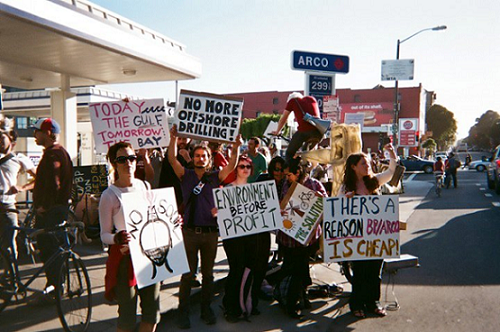
Of course the Guardian staff didn’t have the dough for tickets to Game Five of the Giants and Phillies battale royale for the National League crown. But hey, the real party was outside the park — so Caitlin Donohue (by land) and Rebecca Bowe (by sea) staked out where the real fans were hangin’ — and caught a little animalistic behavior and political fracas in the bargain. What more could you ask of a ball game? Game Six is on Sat/23 at 4:57 p.m.

Erotic Exotic Ball putting its clothes back on

9

It’s a dark day for voyeurs of Dutch fetish models, mini Michael Jacksons, and lovers of spectacular: Exotic Erotic Ball and Expo 2010 has been canceled. The reason for the kibosh on this 31-year old SF tradition? Not as many people trying to get freaky this year. This from Exotic Erotic PR perv, Christopher Buttner:

The producers site a drop in ticket sales during the pivotal final days leading up to the event, plus unexpected cost overruns, [and] operational issues as the causes for cancellation. More details will be forthcoming shortly. 

The producers would like to extend their heartfelt thanks and gratitude to the contractors and entertainers who worked so hard to try and make this year’s Ball an extraordinary experience. In addition, they deeply regret causing any disappointment to those fans who have enjoyed attending the Ball as a source of entertainment and celebration of personal freedom for the past 30 years.

So maybe Ticketmaster wasn’t responsible for past years of the event’s disappointing ticket sales after all… But hey! Don’t let your whips and tassels droop, this is still the smut capital of America — we’ve got plenty more sexy events to get you through this wicked, wicked week. Wait — does this mean would-be EEB performer Ancilia Tilia needs a date this weekend? Get on that.


Hold onto yer Wiggs, change comin’ to Western Addy

0

Morgan Fitzgibbons isn’t thinking small when it comes to goals for his Western Addition sustainability group, the Wigg Party. “We want to make our community a leader in the transformation in resilience,” he tells me during our coffee date to discuss the group’s upcoming anti-boycott “carrotmob” at Matching Half Cafe (Sat/23). 

It’s no coincidence that his language sounds a little new age-y. The basis for Fitzgibbons’ vision for the Wigglers seems grounded in the PhD of Philosopy, Cosmology, and Consciousness he received at California Institute for Integral Studies. “We’re these sacred beings,” he tells me earnestly of his San Francisco community. “This is a sacred movement – I want people to look back in a hundred years and see that.”

Woo-woo? Well yeah, but hold your jaded mutterings until you hear what the guy’s done with his convictions in “cosmological evolution,” as he puts it. Fitzgibbons has assembled a core group of Western Addition residents who operate in four different arenas of turning the area around SF’s “Wiggle” (the well-trafficked bike route through the Panhandle and between the hills in Lower Haight and Duboce Triangle) into a leader in scaled-back, neighborhood-focused living.

Bicycling barristers: Morgan Fitzgibbons and Wigger Dave Bryson on a city-wide urban farms bike tour. Photo by Jenny Sherman

Their areas of attack, you ask? There’s a sustainable business group, who works on incentives for local outfits that find ways of greening their ways. For example, this Saturday’s carrotmob (you can read more about the nationally recognized concept here) is a concentrated effort to storm Matching Half’s doors with business in support of their pledge to buy a bike trailer to transport farmer’s market-purchased goods, switch to organic milk, and chuck the plastic wrap for reusable food containers. 

There’s also a local food group who works with local markets to freecycle unpurchased produce at the neighborhood’s Hayes Valley Farm, a “rescaling” group focusing on ways to limit commercial consumption, and the Wiggle Transformers, who are collaborating with the SF Bike Coalition on the Wiggle portion of their Connecting the City Initiative, a comprehensive plan to improve bike passage throughout San Francisco.

Like I said, comprehensive. And most of the core group – which Fitzgibbons pegs at around 20 party members – are under 30 years old. Which is neat-o, and most likely made possible by the group’s party ethos when it comes to fighting for what they believe. I mean, I say fighting but I think I really mean loving, or something equally hippie. A bunch of them live in a place called the Sunshine Castle, for god’s sakes, where they throw “shenanigans” (according to Fitzgibbons) after-parties for their events, like the recent 10/10/10 day of action that saw the Wigglers conduct a 50-60 person bike tour of the city’s urban farms and a coordinated garden plant in collaboration with Kitchen Garden SF

In the works are plans for a Bernal Bucks-esque local currency, which the group hopes will inspire Western Addition residents to patronize more heavily the wealth of small businesses along the Divisadero Corridor and surrounding areas (holler, happy hour at Bean Bag). 

Fitzgibbons says the hyper-localism of the Wigg Party is perfectly suited for the history and relative youth of the Western Addition neighborhood.

The Wiggle itself provides a apt symbol for the group. The Wiggle Transformers’ work is making bike traffic better for everybody, but also a physical passage that Fitzgibbons hopes will say “you’re stepping into a different place now” to bikers entering the Western Addition.

“San Francisco has always been a seed of revolution,” he reflects. “Of the younger neighborhoods – the Mission and Western Addition – Western Addition is a lot less nihilistic. With University of San Francisco near the area, there’s always going to be a lot of young people living out here, and that’s who our message resonates with. It’s such a new community.”

This last comment raises a red flag in my mind. The parties, the bike tours, it all sounds grand, but given that all this is coming from a twenty-something guy with a complicated mullet and a hoody, how much does the Wigg Party truly represent the Western Addition, an area that’s been wracked by recurring waves of gentrification and is subject, like everywhere else in the city these days, to ever-increasing rent prices and displacement of long time residents? Despite the free food at Hayes Valley, are we being sustainable, or are we being hipster-sustainable? 

“To be a truly successful movement, we’ll have to organize everybody,” Fitzgibbons says, who himself has lived in the neighborhood for three years. Among those that regularly attend Wigg meetings, there is but one long-time resident, he tells me, who plays an active role advising on how to better integrate with the neighborhood’s ongoing goals and activities. Past that, “there’s tacit support among the long-term residents, and we get a lot of family participation in our Wiggle events,” Fitzgibbons tells me.

But I trust that he’s learning as he goes. After all, in explaining his philosophy on activism to me, Fitzgibbons appropriates that sustainability champion himself: Socrates. “The only thing I know is I don’t know everything,” he smiles. “We don’t have to have all the t’s crossed and i’s dotted, but we can whip up excitement and hopefully inspire people to do this in their communities. Create that showcase.” And if figuring it all out looks like a party in the streets, sayeth the Wigglers, so be it. 

Wigg Party Carrotmob

Matching Half Cafe

Sat/23 3-6 p.m., free

1799 McAllister, SF

www.wiggparty.org


Right back atcha, Big Brother

1

I’ve been dabbling in dystopia of late. A little Year of the Flood by Margaret Atwood, a little Brazil (1985) and bam! I’m up to my ears in fears of bureaucracy and government subterfuge and omnipresence – as if that’s a new thing. 

But on the real, it is a bit discomfiting, the similarities between our culture’s visions of the fall. This discomfort sharpens with “black sites” researcher Trevor Paglen‘s monograph Invisible: Covert Operations and Classified Landscapes (Aperture), an eerie book of photos and artifacts that acts like a show-and-tell of why we can’t trust The Man to level with us. Paglen will be presenting it at City Lights – those anarchos, of course! – Thurs/21.

“There are many kinds of invisibility. There is the invisibility of what is so taken for granted that few see it, the custom of the country, the water in which the fish swim. Thus to perceive that the U.S. is an empire on a permanent wartime basis is to be alien to, or become alienated from, the mainstream.”

So says writer Rebecca Solnit in her introduction to Invisible, which happens to be an excellent sourcebook for those wishing to be party to this alienation themselves. The book is a product of years of research on the part of Paglen, and is mainly comprised of photos he managed to take of things we are not supposed to see, like massive bunkers in the desert and streaking surveillance objects in the night sky. Though the photos – some taken from miles away, using high grade camera surveillance equipment – that Paglen has assembled of classified military compounds in the deserts of Southwestern United States are disturbing, what really got to me in his monograph were the badges. 

What in the god damn god damn? From left, military patches from an unknown mission, the Desert Prowler program, and the 1990s launch of an intelligent spacecraft. From Trevor Paglen’s Invisible: Covert Operations and Classified Landscapes

A freaky-weird Illuminati eye shooting lightning bolts. A dragon wrapping its scaly body around a globe. Inexplicable star patterns. These are the images created for the insignia patches worn by personnel of our government’s top secret missions. Sure, we know a little bit about them – a woman’s golden umbrella is explained by Paglen to be a symbol for the gold plate satellite systems that a particular mission helped to install – but for the main part they seem to use American English to speak a language that the rest of us aren’t aware of. 

A world supported by taxpayers, yet not seen by them. It’s for our safety, right? Again, Solnit: “If war is an act of violence to compel others to do our will, you can speculate on how the American people have been essentially subjugated by the war economy to keep paying for it.”

Seen in this way, the research that Paglen does seems to be a form of liberation. Hours spent in libraries (some with SFBG contributor A.C. Thompson at his side) have yielded passports that show people that are not people – CIA operatives, in fact, charged with the disappearance of terror suspects. 

There are long exposure photos of classified satellites tearing through the sky. Some of these are quite lovely, a craggy, water-surrounded peak in one under a phalanx of light diagonal streaks in the sky above. There’s nothing lovely though, about the fact that amateur astronomer network The Other Night Sky (of which Paglen is a part) has identified almost two hundred secretly-purposed objects in our atmosphere, placed there by our government for reasons that surely have to do with eminent safety matters. Right?

This was the dillemma presented by Invisible. Meaning: if these things are indeed so ubiquitous and codified – water and war, in Solnit’s example — are they normal? Should we be worried? Should we all take to the hills of Nevada with a backpack full of digital cameras and squint mightily past lines of no-entry?

Maybe we’ll depend on Paglen to do it for the moment. And, of course, look at his photo books. 

Trevor Paglen: Invisible: Covert Operations and Classified Landscapes

Thur/21 7 p.m., free

City Lights Bookstore

261 Columbus, SF

(415) 362-8193

www.citylights.com


Hot sexy events October 20-26

0

You thought the real Halloween parties started next weekend? Ha! Wrong on two counts.

For one, you’re in San Francisco, so you know this is gonna be a ghoul gala that leaks out into the preceding and following weeks, if not months. Two, the portal to the other world opens the 22nd, not the 31st! (silly) Luckily, you have your deranged BDSM maniacs at the SF Citadel to remind you of the fact with Chamber of Horrors. For those together enough to have assembled their monster ‘fit early, a swell party to play out this journey into another realm where “the gods of old reach out from their dark place,” according to the press release. After all, what better place to witness the chaos that will ensue than a good old-fashioned dungeon? Whips at the ready, there’s gonna be evil spirits to subdue.

Air Sex Championships

Will this be sexy? Will you learn anything from a passel of performers humping the air, licking the air, squeezing the air’s titties? This grand tradition was started by a Japanese chap bereft of solid human beings to sex up. Now people across the world pretend, solo, on-stage, to being sexing – with clothes on. But will it… turn you on? For now, let’s file under maybe, but the event warrants exploration.

Wed/20 8 p.m., $15

The Independent

628 Divisadero, SF

(415) 771-1421

www.theindependentsf.com


Anal Pleasure for Couples

Honey a little wary of rear entry? Best to leave some things to the experts. Reassure them that nothing but good will befall them at this class with Lolo Winters, sex educator, who’ll be teaching on toys, position, and pleasure. Open to all genders and orientations.

Wed/20 6-8 p.m., $20-$25

Good Vibrations

1620 Polk, SF

(415) 354-0500

www.goodvibes.com


Chamber of Horrors

Hobgoblins and naughty, naughty night horrors reign at this dungeon play party. Get the Halloween heebie-jeebies started early and get in touch with your evil side. 

Fri/22 8 p.m., $25

SF Citadel 

1277 Mission, SF

(415) 626-1746

www.sfcitadel.org


Steamworks Full Moon Party

Steamworks launches a new play party! How’s it going to be different from their standard showers ‘n’ sex-a-thon? DJs? A $5 off discount when you tell them about the ad on their website? Sexy full moon graphics on the flier? Does it really matter – you’re getting laid!

Fri/22-Sat/23 8 a.m., $17-55

Steamworks

2107 4th St., Berk.

(510) 845-8992

www.steamworksonline.com


Exotic Erotic Ball and Expo

Time for marabou, corsetry, and befeathered top hats! Exotic Erotic is back for its 31st year of SF-born and bred debauchery. This year the whole shebang is on the water at Craneway Pavilion and there will be porn star performers from across the globe (even a chance to make it with your favorite!), orgasmic bingo, the Family Stone on stage, and a slew of fine purveyors of lust capitalism at the accompanying EE Expo.

Expo: Fri/22 4 p.m.-midnight and Sat/23 noon-6 p.m., $20

Ball: Sat/23 8 p.m.-2 a.m., $79-169

Craneway Pavilion

1414 Harbour Way South, Richmond

www.exoticeroticball.com


Breast Workshop Fiesta

Because you know it’s breast cancer awareness month – why not make it breast awareness month? Talking of tricks with the titties, Femina Potens is holding a special night of boobies, starring busty starlets Maxine Holloway and Bella Rossi, whose proceeds go straight to Shanti’s Lifelines breast cancer program. Squeeze ’em, ladies. 

Mon/25 6 p.m., $7-$20 sliding scale

Femina Potens

2199 Market, SF

(415) 864-1558

www.feminapotens.org


How they’re sitting

182

caitlin@sfbg.com

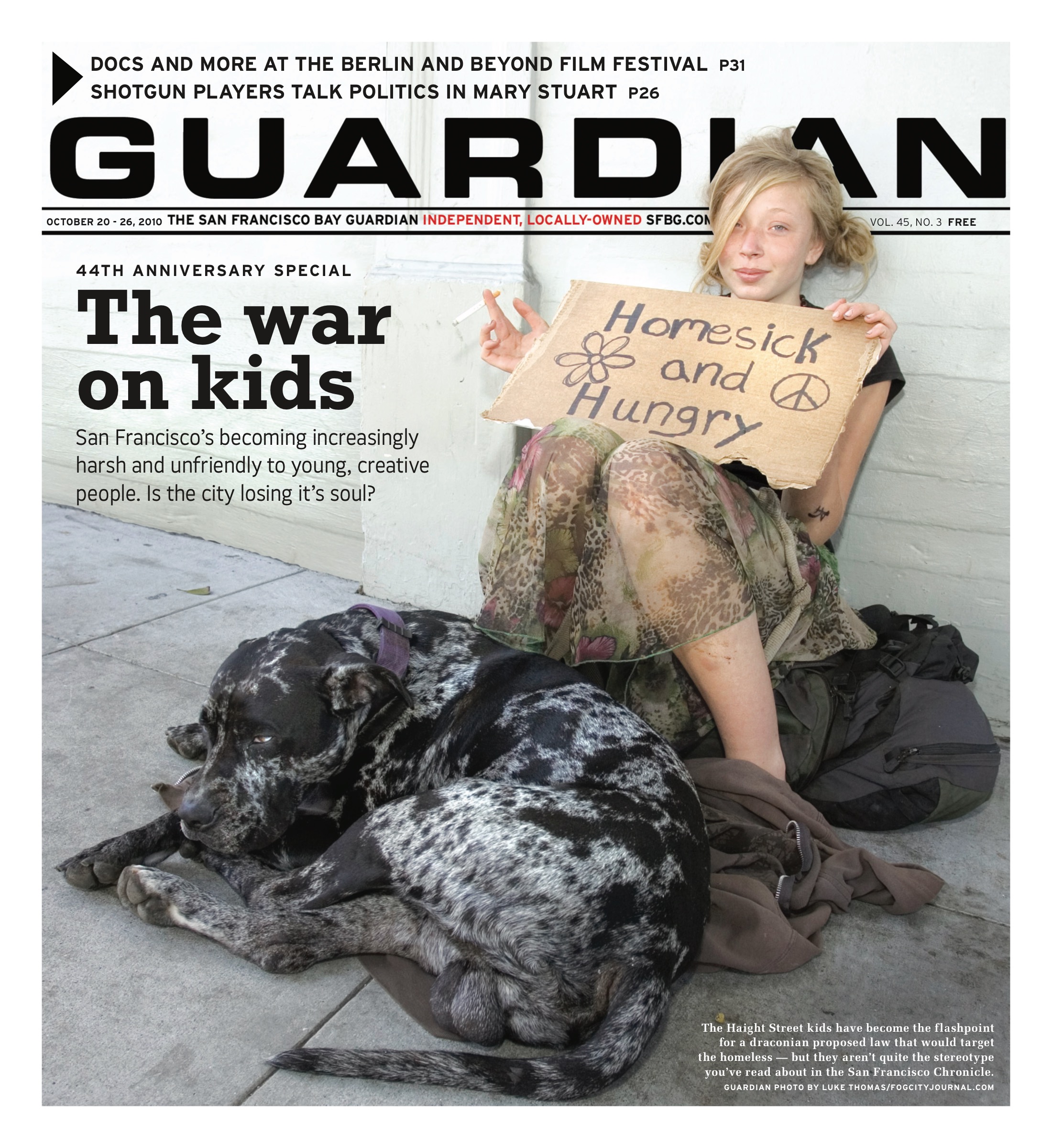
I’ve been hanging out with the Haight Street kids. Over the course of a week or so, I smoked weed, drank malt liquor, witnessed nasty run-ins with police officers — all events that anyone who has walked down the sidewalks of that legendary street would expect. But I also met people who’d give away their last dollar to a friend, people who know a thing or two about community, and people who don’t see sidewalks only as thoroughfares to commerce.

Ironically, though the homeless kids on Haight are the explicit inspiration for Proposition L, the sit-lie measure on the Nov. 2 ballot, their voices have been significantly absent from the vitriolic debate on its merits and faults. Ironic because of all people, it’s these young men and women — and the citizens of San Francisco who interact humanely with them — who could teach us the most about what public space in San Francisco could be.

I didn’t just stand with a notebook, fire questions, and walk away. I took a seat and spent time with the kids, to see for myself whether its true that they’re harassing people, letting their dogs run amok, and generally ruining everyone’s lives as much as sit-lie supporters say they are. That it turned out to be uplifting was an added bonus. I got to see what many don’t on their way to shop for souvenir bongs, retro dresses, and designer skateboards — the reason young people from around the country come to the neighborhood.

It doesn’t have anything to do with fancy Victorians and boutiques, which may explain the disconnect between the street kids and their detractors. They come for the legacy of individuals brave enough to slough off social mores that Haight-Ashbury residents are so ostensibly proud of — not to mention the companionship of others who are comfortable with their rejection of and by society. They come to share stories and pipes and encouragement, and it was cool to watch a streetscape in San Francisco that wasn’t geared solely to commerce.

And while the young people I talked to told me how much they liked to travel, to live free of convention and without ties to the workday world, after a while most acknowledged that they had left behind families who couldn’t or didn’t care for them, home situations that were uncomfortable enough to make life on the streets seem like a better alternative.

Although violent incidents, uncivil behavior, and threatening dogs are well-documented by other news sources, I didn’t see any of that when I was hanging out on Haight. That doesn’t mean that these things don’t exist — but it might suggest that some of the strident supporters of Prop. L are seeing what they want to see.

SPANGING

Steven, who asked us not to use his full name, is 20 and homeless. He grew up in Stockton, became a welder after high school, then decided he “didn’t want the hassle” of staying put for a wage job. His fingernails play host to an ungodly amount of dirt, but his tight blonde curls, pretty golden eyes (“they look like a lion’s!” says one friend in amazement) and mellow, generous demeanor make him a popular hub among his homeless peers.

It doesn’t hurt that he sells weed, small amounts at a time to passing tourists and acquaintances. He silently passes a pipe around to his companions with the slightest provocation. Steven approached me on the street before he knew I was a journalist, a fact that seemed to make little difference to him.

He says he came to the Haight “for the people,” for the area’s reputation of open souls and unconventional artists that originated in the glory days of Janis Joplin and the Grateful Dead. Like most of the kids I talked to, he eschewed the often dangerous shelter scene to sleep in Golden Gate Park or nearby Buena Vista Park despite the police surveillance that could result in spendy fines for park camping.

Although Steven’s worldly possessions fit into the large camping backpack he carries with him 24 hours a day, and even though he’s been living on Haight less than nine months — broken by a jaunt to Eugene, Ore., where he found it “too rainy” to join the town’s expansive street kid community — he doesn’t plan on being homeless forever. It’s just that nothing about this economic climate inspires him to sell his freedom for a paycheck. He plans to go to a four-year college eventually. He sees an education as the only way to get a “real” job. “But until then, why not do this?” he asks. I’m not sure if he’s waiting for my answer.

“This” is sit on Haight Street and “spange,” the term used for “flying a sign” and asking shoppers and neighbors walking by for money, often in a creative way. Of the many crimes street kids are guilty of in the eyes of supporters, spanging is the only one Prop. L would effect.

If Francisco voters approve it, anyone who sits or reclines on the sidewalk (with exceptions for the handicapped and those with permits — but not for the tired, workers on breaks, or people waiting for buses) will be subject to a fine of $50 to $100 for the first offense and $300 to $500, or a maximum of 10 days in jail, for someone found guilty twice within 24 hours of unduly supporting his or her body on the sidewalk between 7 a.m. and 11 p.m. Similar laws can be found up and down the West Coast — although Portland’s was pulled from the books last year after being found unconstitutional because it targeted the homeless.

I ask street kid after street kid why they’ve chosen this lifestyle. Many wouldn’t have it any other way. “Why do people want us off the street?” says Oz, a 21 year old from upstate New York who deals alongside Steven. “Probably because they can’t do this themselves.”

Though I’m skeptical at first, after a while I see why the unconventional group of “travelers” on Haight choose to spend their time spanging. Conversations get struck up with the most unusual people — the old hippie who bought a new Mad Hatter cap for the weekend, the suburban woman who might or might not like to buy some weed (she can’t decide). When a few businesses ask us to move so they can sweep the sidewalk or clear a doorway, the street kids I’m watching relocate with little protest. Many who walk past Steven seemed to find humor in his sign, which that day reads “Are you one paycheck away from having this be your job too?” He says he likes to switch his message daily. “Keep it fresh.”

By hanging out with the spangers, I get to see a Haight Street with human interaction at its core. People walk by, often dropping off surprisingly generous gifts: a ex-Grateful Dead roadie with a massive beard who lives in Fairfax and stopped by the neighborhood for a quick lunch with his daughter parks in front of Steven’s group and approaches them. “You kids hungry? You look like you could use a pizza.”

He emerges a half-hour later with a large cheese pie and drives away after chatting for a few minutes about the old days, to the glee of the group (many of the street kids are Dead Heads). The kids eat their fill, then start handing out the remaining pizza to people walking by, a comic role reversal. “I like to support the community — they get back all the money they get sucked out of them,” Steven tells me.

“NARCOTIC FUELED, ANTISOCIAL THUGS”

The campaign to put a sit-lie ordinance into effect in San Francisco kicked into gear with a Saturday morning stroll. As San Francisco Chronicle columnist C.W. Nevius — who regularly publicizes complaints against the Haight street kid culture — reported Feb. 27, Mayor Gavin Newsom recently relocated to the neighborhood and saw evidence of drug use on the main stretch of Haight where he was walking with his infant daughter. “As God as my witness, there’s a guy on the sidewalk smoking crack,” Newsom reportedly said.

The mayor threw his support behind a sentiment already being voiced by the Haight Ashbury Improvement Association, a resident-merchant alliance in the area. HAIA sees the street kids as disruptive outsiders. “These are not the flower children of the 1960s. It’s narcotic fueled, antisocial thugs who act like a quasi-gang,” Ted Loewenberg, president of the association, was quoted as saying in Business Week.

Adds the Prop L website: ” … the Haight-Ashbury district — once synonymous with peace and love — this corridor is now a hot spot for street bullies, pit bulls, and drug abuse.” It’s a deft cultural lobotomy that dissociates drugs from the Summer of Love, and a devious one that implies that street kids weren’t major players in that social revolution.

As for the bullies, I didn’t see any violence from the street kids in the days and nights I spent out on Haight Street.

I couldn’t get cops to talk to me about it, either. There were two police officers on foot traversing Haight’s main strip and I introduced myself when they stood chatting with a coffee shop owner in the afternoon sunshine and asked them about the sort of neighborhood complaints they regularly received about the street kids.

“No comment,” Cop No. 1 told me. Okay, Cop No. 2, your thoughts? “I don’t speak English.”

To my requests that they share their view of crime on Haight, I could get one response: “It’s complicated.” Later, when I returned to write down their badge numbers, they were standing silently, staring at a lone young man sitting against a wall next to his skateboard. The kid was looking at the ground. Eventually they handcuffed him and put him in a police car while he pleaded meekly about it “only being a little bit of weed — and I was only skateboarding on the sidewalk.”

The most aggression I witnessed from any party took place while I was tapping my feet to a group of traveling bluegrass musicians performing around 10 p.m. on a Thursday. Their cover of Del Shannon’s “Runaway” had inspired an older homeless man to strike up a curiously graceful stomp dance on the sidewalk. He was so drunk and fully immersed in the music that the bottle of Jim Beam in his flailing hand didn’t even register when the police officer approached him and asked, “What do you think you’re doing?”

The musicians began to pack up. “I could have told you this would happen 20 minutes ago,” one tells me, nodding toward the old man. “Don’t say a word or I’ll fucking take you in,” said the cop, who poured out the half-full bottle and wrote a ticket for the older man, who had made a few feeble protests that ended abruptly with the cop’s obscenity.

The officer said he’d received a complaint about the music, a line I heard from each cop I came into contact with on Haight — including one officer who cautioned a family with a toddler to pack up the bracelets they were selling to pay the towing charges on their van. “People don’t like to see people with kids out here, you better move it along,” the cop said.

“I’ve seen aggression because people start shit,” Steven tells me when I ask him about his experience with street violence. A man has just walked by chanting “dirty, dirty” in Steven’s and his friends’ faces. “They don’t like to see people sit on the ground.”

“There are people who come down here just to make themselves look better,” chimes in Oz. “Like ‘ha ha ha, I have air conditioning.’ All kinds of people start shit”

I asked if they knew they were the focus of a massive political debate in San Francisco. “No, what debate?” asked Steven.

“You mean sit-lie?” Oz asks. “It probably has to do with tourism. I don’t see why else they would do that.”

Even the most well-known recent case of Haight Street violence — which was reported June 11 by New York Times reporter Scott James as having “inspired a grass roots movement” that propelled Prop. L, seems to be a question of mutual aggression on the two sides of the street kids issue.

The story goes that a man named Thomas was hosing down the sidewalk in front of his house — a practice that is growing more common in the Haight to make property inhospitable to the homeless. He found himself “surrounded and engaged in a heated confrontation,” as James reports. Thomas reportedly shouted “Do you want a piece of me?” and a scuffle erupted between him and Chad Potter, a 26-year old homeless man, culminating with Potter being arrested and set free the next day. Thomas says Potter and friends continued to harass him after the incident.

James Orr, 24, is busking with his flute when I meet him sitting by a store that sells flowing hippie skirts and bumper stickers that command future tailgaters to “Coexist.” He’s looking to trade his wind instrument for a banjo, which he plays in addition to guitar. A rolling stone, Orr is in town for the Hardly Strictly Bluegrass festival that weekend — he travels the country going to festivals, and even scored a job recently at upstate New York’s Mountain Jam for the event’s blog site, taking photos with a borrowed camera of performances by (ex-member of The Band) Levon Helm and Michael Franti.

Orr’s quite erudite and eager to “say something articulate” about the situation of the street kids and travelers on Haight. He tells me that yeah, he’s seen aggression go down here on occasion. But he resents those situations leading to laws against sitting on the street.

“It’s another example of the few that do mess up casting a bad light on everyone else. Most of us just want to make some money, put a smile on someone’s face.” As a busker, he finds it baffling that people who are against the presence of the homeless would want him to stop plying his trade by making sitting illegal. “You should point out also that it’s how we make money!” he exclaims.

THE PIT BULLS

Snarling ruffians on frayed rope leashes stalking the city streets! As evidenced by the Civil Sidewalks campaign, dogs — specifically pit bulls — are another source of controversy on the pavement. Last December, SFist identified a C.W. Nevius tirade against the breed as example of its ongoing feature “Pit Bull Hate Watch.” The paper has pointed out that the demonized dogs can make great members of society and are often the subject of a media smear campaign.

But for many homeless youth, their dogs aren’t the means of imposing chaos on the gentry. They keep them for the same reasons we do: friendship, protection, love — and during the days I spent on Haight, it was a pleasure to pat the doggies while interviewing their owners. Most were as gentle and laid back as the kids they sprawled next to, a reasonably expected result from the 24 hours a day of socialization with humans that the homeless lifestyle affords.

Smiley is an inveterate street kid unlikely to go indoors anytime soon. “I don’t know how to do anything else,” she tells me. Now in her early 20s with a shock of magenta, purple, and dirty blonde hair and fanciful purple ear plugs that pierce her lobes before spiraling nearly to her shoulders, she’s been traveling since she was 12 — “a Bohemian by blood,” as she puts it. Not only did her parents move their household regularly throughout her childhood, but their heritage is Romani, from the traveling tribes of Eastern Europe.

For Smiley, travel outside the bounds of business trips and weekend vacations is her life’s norm, and Haight Street’s legacy resounds in her nomadic soul. “Most of the people that travelers idolize were here,” she tells me.

Smiley has a year-old behemoth black mutt with droopy eyes. He obliges her as she leans into him holding her spanging sign, which tells the world the pup needs Benadryl for an upcoming van ride to Southern California. “He’s carsick,” she tells me sheepishly. She admits that the dog can limit her mobility on public transportation, but his benefits outweigh his cost. He keeps her warm at night — and, more important for a young woman who is often on her own, he protects her. For a moment breaking out of tough girl mode, she tell me, “oh yeah, I don’t have to worry about anything when he’s around.”

We talk about the perceived threat of dogs on Haight Street. “They want us to leash them, which I guess I understand — but look at that!” A well-dressed woman in her 40s has her Chihuahua off its leash and it has run into the busy street, with her in hot pursuit. “That dog’s out of control,” Smiley smiles.

PISS

Sitting against a mural on a wall where Haight meets Clayton, I watch Piss, an outgoing, gangly guy in his early 20s with a curly blonde mohawk in a growing-out stage. I ask him where he got his unusual moniker. “I like to get drunk and piss on things,” he says.

Well. Originally from Billings, Mont., Piss has been traveling since his mid-teens. “Let’s just say me and my family don’t get along,” he tells me.

His answers to my questions about why he’s on the streets follow a path I see with many of the younger homeless youth: they insist that the lure of the open road was too hard to ignore, but eventually reveal that their parents kicked them out or were unable to care for them at a young age. Many, like Juju, another small-time weed dealer I met, bounced from family member to family member until frictions with them and their significant others left no recourse but the street.

Piss says he’s been to every state in the country, plus Canada and Mexico. With so many years on the road, he is, as they say, letting his freak flag fly. Piss has a blue, vaguely tribal tattoo that curls around his right eye. He’s wearing white tube socks on the dirty pavement. At first glance, he could be crazy — and maybe he is. Whatever his motivation for travel, it’s not to blend in with the locals.

Piss is also actively spanging passersby in a manner that oscillates between off-putting and charming. “You got some money for some crack and ice cream?” he inquires of a passing trio of young women. They shake their head, but before they’re gone completely he continues “I’m just kidding! I don’t like ice cream! Hey miss, you have a nice ass … day!”

Over the course of the hour that I watch him a stand up routine emerges. Beneath the grime, he’s a charismatic kid with an enviable sense of comedic timing.

As he ranges up and down a 20-foot stretch of sidewalk, belly laughs are elicited from a few targets, dollars surfacing here and there. One man carrying an accordion and wearing an expensive-looking pair of leather Chaco sandals donates a handful of strawberries to Piss and to those of us acting as his entourage.

But Piss’ play is a little rough — like a big puppy — and he’s alienating the people who don’t crack up over crack. A couple of people walk away quickly from his petitions shaking their heads over one of the zingers, their suspicions confirmed about those rowdy Haight Street kids.

He’s not doing anything more than what young travelers do all over the world. Thousands of families bid see you later to young adults en route to Prague, Peru, and Perth each year, where they lug their dirty backpacks through the world’s most wondrous towns.

Of course, these kids aren’t sleeping in the public parks of Cuzco — but in countries with plenty of cheap travelers’ hostels, you don’t have to. And though international flights cost more than the van rides and freight train hops that brought in most of the Haight Street kids, backpackers abroad do the same things: take fewer showers and flaunt social norms — not because they want to cause a problem for the natives of the lands they pass through, but because they are young, and discovering themselves for the first time, and can’t see much past that. Piss isn’t being violent, but he has lost the language to deal with “normies” and he’s seen as unpredictable to the not-traveling, not-disenfranchised around him. Which to those who see public space as a place that should be predictable, mean he’s a threat.

The clash between the settled and transient in the Haight is not new. Indeed, it’s what made the neighborhood famous. As far back as the mid-1960s, officials have been simultaneously fighting and publicizing the Haight’s worldwide reputation as a traveler’s meeting place, a place with a culture of loosened societal moorings and enlightenment through free love, drugs, and art.

Businesses claim that the omnipresent homeless drive away paying customers from Haight Street. It a curious claim in an area where the vagrant hippie culture made the place the tourist attraction it is today, and one that is belied by the entry of Whole Foods, which plans to open a branch this year at a lot at Haight and Stanyan vacant since 2006. When contrasted with the Tenderloin — another neighborhood with a visible street community — and its chronic problems attracting a grocery store, the Haight street kids’ effect on local commerce doesn’t seem to be all that grave.

They certainly aren’t making the place any less desirable of a neighborhood to live in for the wealthy. Real estate website Trulia.com puts the median listing price for homes in the Haight-Ashbury neighborhood at $962,264.

The Haight Street kids I spoke could all too easily see what sit-lie would mean for San Francisco. When you control public space, you control who is in public space — and they have no illusions about whether or not they’re included in the perfect world of those who push the measure. If it’s enacted, the subculture that made Haight famous — part of which still survives today in a different form — would be gone, leaving it sterile and safe for the head shops and clothing boutiques, an even less authentic version of the ’60s love fest their patrons come to the street for. One wonders if a scrubbed-clean Haight is even what the residents and business owners who have thrown their lot behind sit-lie truly want, or if they’ve been duped into sit-lie’s efficacy by the same forces that on a national level have convinced us that curtailing civil liberties will lead to freedom for the real Americans. It comes down to this: What do we want Haight Street to be? Do we want to capitalize and benefit from the accepting, messy, wildly creative legacy the 20th century endowed our streets, or do we want a clean, friendly, outdoor mall? The powers of homogenization and gentrification can demonize the little heathens on Haight Street all they want, but they’ve miscalculated if they think that they don’t belong in San Francisco — after all, Haight created them, not the other way around.

Our 44th Anniversary Issue also includes stories by Sarah Phelan on SF’s disadvantaged youth, Rebecca Bowe’s look at ageing out of the foster care system, and Tim Redmond’s editorial on the issues facing our rising generation

On the cheap listings

0

Events listings are compiled by Caitlin Donohue. Submit items for the listings at listings@sfbg.com.

WEDNESDAY 20

hell strung and crooked Release Party The Beat Museum, 540 Broadway, SF; www.thebeatmuseum.com. 6pm, free. The Beat Museum helps to present a night of intensely creative bards from the world over in anticipation of the release of their new poetry tome.

Smack Dab Open Mic Magnet, 4122 18th St., SF; wwwmagnetsf.org. 8pm, free. All ages and genders are welcome to this open mic, which sets a medley of musicians and poets onstage to the tune of five minutes a piece. No open mic traumas here, people.

THURSDAY 21

Art Attack One Year Anniversary supperclub, 657 Harrison, SF; www.visualsby3.com. 9:30 pm, $8. The flopsy, floozy art performance group celebrates its first 365 days on this earth with a burlesque-off featuring Alotta Boutté, Scotty the Blue Bunny, and more local A-listers from the world of tassels and tease.

"Graphic Details: Confessional Comics by Jewish Women" Cartoon Art Museum, 655 Mission, SF; (415) CAR-TOON, www.cartoonart.org. 7pm, $5. Beyond the kvetch and kibitz, female Jewish cartoonists have proven themselves adept at a stark, honest rendering of life in the 21st century. Hear them discuss their art at this panel discussion.

Jo Scott-Coe Books Inc., 2275 Market, SF; (415) 864-6777, www.booksinc.net. 7:30 pm, free. An ex-public school teacher exposes the subtle and overt forms of violence in the education system in her latest book, which she’ll discuss at this bookstore klatch.

BAY AREA

Homeless Connect Health Fair Multi Service Center, 2362 Bancroft, Berk; (510) 809-8516, www.sites.google.com/site/bfhphealth. Noon, free. Vision screenings, STD tests, flu shots, therapist and addiction referrals, haircuts, and more at this gathering of service providers for the homeless.

FRIDAY 22

UN-65 Muir Woods Walking Tour Cathedral UN Grove, Muir Woods, Sausalito; (415) 267-1866; www.una-sf.org. 11am, free. Advance registration requested. Mark 65 years of the United Nations’ brand of global collaboration with this trek through the redwoods, a cup of tea, and some Qi Gong — a path braved by UN founders in 1945.

Fog City Necropolis 354 5th St., SF; (415) 606-2503. 7pm, 10pm. Take a tour through SF’s interactive haunted house, whose theme this year is a truly scary trope: eviction! Evade the undead grasp of Jack Kerouac, Frida Kahlo, the crazy cat man of the Presidio, and more so that you can live to pay rent again.

BAY AREA

"Analysis of the Tea Party Movement" UC Berkeley Alumni House, Bancroft and Telegraph, Berk; www.ccsrwm.berkeley.edu/conferences. 8:30am-5:30am, free. Political scientists and sociologists take a look at America’s most grating political movement: are the Tea Partiers part of a grass roots campaign, a media-driven construction, or something in between?

SATURDAY 23

Actors Theatre Season Kick-Off Actors Theatre, 855 Bush, SF; (415) 345-1287; www.actorstheatresf.org. 7 pm, $10. A cabaret to celebrate the new stage season, featuring the psychedelic tropes of comedian Wil Franken, and the world premiere of William Blake Sings the Blues, penned by the theater’s own company member.

Bernal Yoga Literacy Series Bernal Yoga, 461 Cortland, SF; (4125) 643-9007, www.bernalyoga.com. 8pm, $5 suggested donation. Tsering Wangmo Dhopma and Stephen O’Connor, writers both, will fill the chakras of this neighborhood ayurvedic space with readings from their recent publications.

Bring Your Own Queer Festival Music Concourse, Golden Gate Park, SF; www.byoq.org. Noon-6pm, free. Pack a gay in your rucksack for this community collaboration of art, performance, and music, featuring DJ collectives Honey Soundsystem and Hard French, the Bay Area Derby Girls, and a rescue dog fashion show.

Drag Racing Day Velma’s, 2246 Jerrold, SF; (415) 824-4606. Noon, by donation. A Bayview family needs help raising funds for their drag racing team. They make their own motors and transmissions! Grab a bite at this neighborhood restaurant while you watch racing footage and dad Mike Henery’s presentation to interested young people.

Potrero Hill History Night International Studies Academy, 655 De Haro, SF; (415) 863-0784. 5:30 pm barbeque, $6; 7 pm historical program, free. A movie on Potrero Hill public housing, urban gardening in the neighborhood, and hood tales from 50-year residents like "Goat Hill Phil."

Seismic Safety Fair San Francisco General Hospital, 1001 Potrero, SF; www.sfdph.org/dph/rebuildsfgh. 9am, free. Feeling a little shaky? SF General’s setting aside a day to explain the base-isolated design of its new earthquake retrofitting. It’s meant to be the most seismically-resistant plan available today, so go on and get grounded.

BAY AREA

Cal Science and Engineering Festival Haas Pavilion, Bancroft, Berk; (510) 642-0352, www.scienceatcal.berkeley.edu/festival. 10am, free. Kids been clamoring to touch a real human brain? Bring ’em to this hands-on extravaganza of natural science — for free.

Fantastic Fountain Thistle Recovery Work Party Highway 92-W and I-280-N, San Mateo. 9am, free with RSVP. Remove invasive pampas grass and Australian tea tree so that our small bristly friend the fountain thistle can continue to live long and prosper in the Bay Area.

SUNDAY 24

Sunday Streets: Civic Center and Tenderloin Civic Center Plaza, SF; www.sundaystreetssf.com. 10 am- 3pm, free. The last Sunday Streets car-free community event takes the action to the heart of downtown, with clear biking and walking from a roller disco outside the Asian Art Museum to the Tenderloin National Forest.

Tricycle Music Fest West Various libraries and times, SF; www.sfpl.org/tricycle. Free. Three wheel from library to library or plunk the kiddies in front of a show of their choosing for this day of kids’ music, that effervescent establisher of early literary skills.

Exotic Erotic’s 31st round

1

Perhaps you’ve seen them around town. The neon pink fliers announcing that SF’s most gloriously trashy tradition, the Exotic Erotic Ball and Expo, beckons saucily to you this weekend (Fri/22 and Sat/23). Were you curious about the providence of the posters’ graphic design, this just in from founder-behatted cartoon character Perry Mann: “we’re very aware that it’s breast cancer month.”

Well that would explain all the boob examiners! 2010 marks Mann’s 31st year of organized orgy, which nowadays draws in around 10,000 gawkers and pervs a year for onstage sex shows by world famous porn performers, elaborate fetish costuming, ribald entertainment (“we’ve got… orgasmic bingo? I don’t know what that is,” Mann admits to me on the phone), and surprisingly serious musical guests. Sort of. This year is the Family Stone, minus Sly. “We reached out to Sly,” Mann tells me. “If he can get off his crack pipe, he’ll show.”

Mann, who started the Ball famously as a fundraiser for buddy Louis Abolafia’s Nudist Party run at the presidency, has endured his fair share of setbacks in holding the event. A venue change under fractious circumstances (there’s been a few of them over the years associated with the ball, as the East Bay Express recently reported, including complaints that organizers withhold promised prizes from contest winners) has left the EEB with a venue that’s a touch more intimate than last year’s Cow Palace: the Craneway Pavilion, which has about 15 percent less capacity as the Cow. 

A consummate promoter, its difficult to get Mann off his press release script on the phone. We don’t chat about his assertions that disappointing ticket sales in years past were due to corrupted ticket-selling websites. We do, however, manage to cover event logistics. The Pavilion is basically a large glass box on the water, which is… less than ideal? ideal? for a show full of dedicated exhibitionists. The VIP section takes the aquatic escapade to another level: guests willing to pony up the $169 get to shiver their timbers on the San Francisco Belle, a riverboat whose very girth and heft seemed to impress Mann. 

This year’s VIP performance takes on occult themes – vampires being the sex gods of 2010 that they are. Those interested in taking the ticket price plunge can find a preview of events on the Belle at sex blogger (and performer that night), Fleur De Lis SF’s account of dress rehearsals.

And for the pervs off the A-list, don’t worry gang, Exotic Erotic is nothing if not democratically-inclined. In fact, big money’s on the random hallways and corners around Craneway to be where the real action’s at – but if you’re going for the canned stuff, the stages will play host to shows by Noname Jane, Dutch fetish model Ancilia Tilia, Eden Berlin, The Men of Exotica, and the Surreal SF Devil Girls.

Ready yet? Not til you’ve got your outfit, you’re not. The Ball has an anything-goes philosophy when it comes to, well, most things – and the motto definitely extends to sartorial affairs. Past attendees have rocked Bumblebee Transformer ‘fits, every possible form of lingerie — even, Mann tells me, a functioning bathtub that housed three friends for a night. 

“The whole event is about love, it’s really all about love,” says Mann, who himself will be rocking his customary top hat tricked out with “XXXI” in honor of the event’s 31st year spelled out in diamonds. Given his hopes that this year will correct a string of lackluster lust profiteering, his next comment should be a given. 

“Not real diamonds,” he clarifies. 


Exotic Erotic Ball and Expo

Expo: Fri/22 4 p.m.-midnight and Sat/23 noon-6 p.m., $20

Ball: Sat/23 8 p.m.-2 a.m., $79-169 

Craneway Pavilion

1414 Harbour Way South, Richmond

www.exoticeroticball.com


Markus James’ West African happiness surplus

0

In an age of endless crossover between most conceivable forms of music, it’s but small surprise that a Caucasian man from Virginia is making blues with West African witch doctors. What rarely gets discussed in these cross-ocean collaborations is the social aspect of the fusion. What did the artists eat for lunch the day they recorded that track? In what language was the “and-a-one” that started off the first take? 

We had the opportunity to chat over the phone with Bay Area artist Markus James, who has parlayed his time with Malian string musicians into elemental blues tracks. You can hear them on both his new album, Snakeskin Violin, and at his live show (at the Ashkenaz, Fri/22) with The Wassonrai, who are West African musicians that rep for jam band track longevity – strains of which James says is indigenous everywhere from Mali to Jackson, Mississippi — into their already formidable blend of blues past and present. James said (and we’re paraphrasing here) that the secret to fusion collaborations all lies in your location-resonation, but that’s just his perspective.


San Francisco Bay Guardian: When did you first hear African music? Did you know right at the start the depths you would dive into it?

Markus James: I don’t know if anyone really knows what is going to take them. The lights really went on for me when I heard Ali Farka Toure. He played traditional West African music on the electric guitar and it came out sounding like John Lee Hooker. That was where I really felt the powerful connection between all the music I grew up loving: rock, and soul music, and of course blues music, and the connection between that and its ancient roots in West Africa.


SFBG: What did African music pick up in the United States to become blues?

MJ: The roots of blues music go way back, specifically to pentatonic [five note as opposed to our eight note system] music traditions there. Pentatonic music really resonates with what we think of as blues music. There is a direct correlation between what I call country blues, or old school blues music, and some of these music traditions that I’m talking about in West Africa. Not just the notes and the musical scale, but the groove, the rhythm. For example, in West Africa women are often pounding the millet for that evening’s food. The have this six-foot tall piece of wood – it’s like a mortar and pestle. Another woman, or a girl, is scooping it back underneath so that the wood hits the grain. They get these rhythms going that are like goom-chack-goom-chack. Then people start playing on calabashes with this rhythm, and the rhythm is virtually identical to what we call the shuffle rhythm that you hear in a lot of old blues music, Chicago blues music, and rock music. If you go over to West Africa and you start playing what we call country blues, people will just start playing along with it and they’ll say oh, that’s our music.


SFBG: On “I Won’t Let It” you perform spoken word over the music. Is there a legacy in African music of that spoken word tradition?

MJ: Absolutely. There’s a whole caste of artists called griots. Their specialty is preserving history through story-songs, but also singing praise songs to whoever’s in power at the time. They will break into long passages of rhythmically chanted tone-poem language. That’s all there. 


SFBG: You do a lot of cross-culture collaboration. Does the dynamic get tricky when you come from one of the wealthiest nations in the world?

MJ: Not really. I’ll give you an example. I was introduced to a 75-year old man who is the spiritual leader of the Holehoire religion in Timbuktu, Mali. He is what we would call a healer, or in older parlance, a witch doctor. He is like a medium, and his whole role in the community is to communicate with the jinn, their spirits. His instrument is a gourd with the skin of a river snake stretched across it, the string is horse hair. He has a whole repertoire of melodies and rhythms that he plays, the purpose of which are to call certain spirits for certain purposes, to ask for rain, or to ask for good luck, a million things.

He came over to our adobe-walled house where I had my little set-up going and we started playing music together. I was playing guitar and he was shifting back and forth between his two instruments, and he would sing a little line and I would sing something. I told him, I’m making a recording in blues, which is an African-American tradition, if this thing turns out pretty good I might put it on a CD – and I’m paying him, which he’s happy about. And I said before I do anything I want to bring it back to you because I know this is really – I don’t know how I said it to him but I’d say it to you, this is really deep waters. This is considered the pre-voodoo religion. He said sure, fine, great, I hope somebody enjoys it.

The next year I came back and I played him what I had made out of it, it’s this song on Snakeskin Violin, it’s called “Sundown Pearl” I played it for him and he started beaming and smiling and saying this is very good, this is going to be very successful. When I see him I give him something which anticipates the day when I might get some royalties from it. My friends that I’ve made there, it’s hard for them to understand that I’m not really selling a lot of CDs here but they’re very happy that there’s a revenue stream.


SFBG: You’re a vegetarian. I’m curious — I’m a vegetarian too – how is it to travel in Africa without eating meat?

MJ: They assumed at first that I must be deranged. It was absolutely inconceivable that someone could live without eating meat. Even the West African artists I perform with here in the US, it’s taken them awhile to accept it, even though they know other people here. I’m trying to think what it would be like to tell someone here. It’d be like saying I went down to the Bay and I just skipped across it to Berkeley. 


SFBG: You can’t even do it with food — our society has such an individualized view of eating. 

MJ: You know, I’m eating rice down there without the meat sauce, but I’m still in this communal meal zone. My friends will explain, he’s a vegetarian, and that means he doesn’t believe in eating meat, and he appears to be healthy. Something that I could not have foreseen was that I’d become a emissary for vegetarianism in West Africa.

People say, you come from a rich country, and they come from a poor country, so what is politically correct? I think when some people go to West Africa they resonate with it, they connect with it. You come to realize that what we think of as wealth and poverty is very relative to our perspective. Here you might say that we’re wealthy because we have a car, or a house, or roads that allow you to go 60 miles per hour. What we have may not necessarily translate into what they would consider to be joy, happiness, abundance, peacefulness. They’re certainly not stuck in traffic jams and trying to make mortgage payments. We might be looking at a little of a joy deficit and over there they have a happiness surplus. I know that’s simplistic, but that’s my perception. 


Markus James and the Wassonrai

Fri/22 9:30pm, $10-12

Ashkenaz

1317 San Pablo, Berk.

(510) 525-5054

www.ashkenaz.com


Beating chest for APE

0

I used to live in a town where the alternative-alternative (holler!) weekly had a comics page. Paging to the back of said volume each seven days I’d look for Tony Millionaire’s joint, Maakies. Millionaire’s rounding out a phalanx of guest speakers at this weekend’s APE (Sat/16 and Sun/17), so I’m thinking back to the days when his preciously drawn little derelicts marked my Wednesdays.

The motivation behind my penchant remains slightly cloudy – for why did I seek out these troublemakers? The Maakies are a band of animals and multilated pirate-types (maybe they’re all animals, come to think of it, just horribly alcoholic, crass animals who enjoy tweezing their own belly button hair). A perennial reader favorite, Drinky Crow does little more than you’d think he would – a standard DC portrayal captures a moment in time when some unidentified bottle of hooch hangs suspended in the air, supported only by the gullet into which it is pouring. His eyes are mainly x’s. He does not wear a hat, but his monkey (?) friend Gabby does. They do foul things involving body functions and emotional pathology.

The Maakies occupy a world known by most faves of alternative comics — a dark world, yes, one that is stacked against the protagonists, but none the less a world in which fun can be had. Not the least of which is that fun that is perpetuated by the comic characters against those around them. Can’t deal? Drink yourself into a stupor! End frame. See you next week.

APE artists self-portraiture (clockwise from top left): Lynda Barry, Daniel Clowes, Megan Kelso, Tony Millionaire, Tommy Kovac, and Rich Koslowski 

This is the sort of comic made possible by the alterna-crowd, the alterna-paper, the alterna-comic – all of which will be celebrated and feted as is their due at this year’s Alternative Press Expo. It is part of the juggernaut that is Wonder Con-Comic Con, although attendees at APE assume much less widely known personas in their Lycra and face paint.

This year features the usual reams of special guests. Lynda Barry lends her star power, a maker of ‘zine style comics about horribly awkward, dastardly endearing adolescent girls. Also present will be Ghost World penner Daniel Clowes, Megan Kelso, and Renée French. Most of these writer-illustrators have a solid decade or more under their belt of paneling for society’s disenfranchised.

And new to the APE stage is an innovative new style of meet and greet, always an informal function at these mega-events. Writers and artists will get a chance to speed date at the Comics Collaboration Connection, shopping for creative partners in a dance of I-like-you-do-you-like-me furtiveness. Drop your card in the designated envelope if you want to make a graphic novel! Of course, there will be aisles upon aisles of purveyors of already-collaborated-on comics to inspire you, as well.

Anyways, Tony Millionaire will be there, which is exciting. Sources tell me he’ll be the gentleman wearing a tux in the artist spotlight from 5-6 p.m. on Saturday. Get ready for some inquiries into zero gravity bottle support, Mr. Millionaire – I’ll have what Drinky’s having. 

Alternative Press Expo (APE) 2010

Sat/16 and Sun/17 11 a.m.-6 p.m., $10-$20

Concourse Exhibition Center

635 Eighth St., SF

www.comic-con.org


Hot sexy events October 13-19

0

Support your local sex workers! We are lucky to live in a city where those salacious somebodies that will take their kits off in the name of our pleasure and payment don’t have to lay down and take it when the man gets all censorious and grabby – lucky to live in a city where St. James’ Infirmary exists, that is. The Lusty Ladies agree, and on Sat/16 they’re holding their annual Playday for St. J’s – 16 hours of girl-on-girl-on-call for justice.

For there was a time where if you got picked up providing sex to paying customers, you got stuck. We’re talking hypodermic needles – part of a policy that used to go down in SF that forced sex workers to give up blood samples in jail for mandatory STD testing. As you can imagine, this was not always done in the most respectful of manners. Enter St. James’, founded by sex worker advocacy group COYOTE (Call Off Your Old Tired Ethics). The center holds a health clinic, trainings and support groups, hormone therapy programming, peer counseling, and oh so much more. Why on earth not head down to the Lusty to make sure our ladies – and gentlemen – of the night continue to be treated as such?

Original Plumbing Bathhouse Reception

Celebrate the notion that a photo-heavy magazine of transmen is one of the most hot publication debuts to hit the racks in 2010 – Original Plumbing’s fourth issue is out! And it features a hunky lineup of working stiffs, all of whom will be at the wine and cheese reception, open to all genders and levels of ab definition.

Thu/14 7 p.m., free

Eros

2051 Market, SF

(415) 255-4921

www.originalplumbing.com


Spanking and Paddling

Don’t worry, consoles the description of this Edu Kink offering: “there will be plenty of spanking time.” That’s because even though this is technically a class on spanking – its possible childhood associations, how to deal with them should they arise, on technique, and enjoying the spank on the receiving end – Edu Kink’s Paideia workshop series has a focus on lecture leading to experience. So prepare you that booty, naughty kids.

Fri/15 7:30-10:30 p.m., $15-$25 sliding scales

SF Citadel

1277 Mission, SF

(415) 626-1746

www.edukink.org


Pink Blues Dance

What better way to amp up for Mission Control’s pansexual play party than this week’s warmup: a chance to swing those hips to the down ‘n’ out blues on the dance floor. Costumes not required, but membership to the club (and a smile) is. 

Fri/15 9 p.m.-2:30 a.m., $20-$30 members only

Mission Control 

2519 Mission, SF

www.missioncontrolsf.org 


Naked Girls Reading

What’s that chill that just ran down your spine? Are you frozen in fear by a classic ghost story, channeling the pre-Halloween vibe – or are you just naked? It could easily be both at this storytelling series that pairs the city’s sexologists and stage presences with a favorite book, a mic, and little else. Watch for the SF Ghost Society’s Elissa Fricano’s tales of personal encounters with the world beyond.

Sat/16 8 p.m., $15-$20

Center for Sex and Culture

1519 Mission, SF

(415) 225-1155

www.sexandculture.org


Peter Acworth’s Birthday Deviance

Everyone needs a little extra attention on their birthday. And on the founder of Kink.com’s 40th, you can only imagine what form that personal touch will take. Our town’s foremost world-class fetish porn palace opens its virtual doors to members who want to join in on the fun online. Visit www.theupperfloor.com on Saturday evening and watch live as hot doms and slaves create sexy mayhem during a celebratory dinner in Peter’s honor.

Sat/16 6:30-11 p.m., free for Kink.com members, $.25 cents per minute for nonmembers

www.theupperfloor.com


Lusty Lady Playday RXXX

That’s right, get your dirty, dirty prescription for a Saturday in the hospital – or rather, nurse’s office. The Lusties will be pulling on the rubber gloves for a day of sexual healing. Girl-on-girl action all day long, with a portion of the proceeds going to everyone’s favorite hustler health care provider, St. James’ Infirmary.

Sat/16 11 a.m.-3 a.m., $5 before 10 p.m., $10 after

The Lusty Lady

1033 Kearny, SF

(415) 391-3126

www.lustyladysf.com


How To Be a Top Presenter

Have you been there, done that when it comes to the sex education classes at Good Vibes and the host of other venues around our pervy city that like to teach on the tactics of titillation? Take your love of lovin’ to the next level with this little one-off. Dr. Charlie Glickman is sharing the secrets of his sexpert trade: how to plan and orchestrate sex ed for adults.

Tues/19 6-8 p.m., $20-$25

Good Vibrations

1620 Polk, SF

(415) 345-0500

www.goodvibes.com


Whiskeyfest whispers

0

What words could be more beautiful to hear upon entrance into the skyscraper-y, shiny den of downtown’s Marriot Marquis? From the mouth of a woman in a blazer and matching knee-length skirt: “It smells like a frat house on a Saturday morning!” Ah, last Friday’s Whiskeyfest, you came to conquer my liver, but you left after conquering my heart.

To the tune of 250 whiskies, no less! Once ensconced in the hotel’s basement ballroom and properly attired with our souvenir tote and tasting glass, naught could be seen but opportunities to drink myself into an unproductive Saturday of cowering from the Blue Angels. Row upon row of the finest whiskies – the even finer ones available only for the special VIP tasting hour, whose $150 price tag may have seemed a little step were one not aware of the general admission’s $110 bar tab.


And who, pray tell, is buying these steeply priced passes into madness? Well, from the looks of Whiskeyfest SF, mainly older white men. Shocking. But more interestingly, also a secret cabal of rumor-mongers and shit-stirrers! Indeed. SFBG received this mind-blowing scoop (along with a pair of hefty pours of the 23-year aged malt) from Old Rip Van Winkle‘s crown prince of marketing management, J. Preston Van Winkle. 

See, Old Rip’s got little to prove in this big old world of bourbon. Our SFBG resident spirits expert, Virginia Miller (who will know doubt be sniffing and sipping through a slightly more sophisticated, taste and mouth feel-oriented version of this coverage later this week) pointed me towards their table right off the bat, so we knew it would be good and smooth beyond measure. 

Their brand has been starting fights and making horses kick since the days before Prohibition, and its Pappy Van Winkle’s Family Reserve is the highest rated bourbon whiskey in the world. In. The. World. Thank you, Kentucky. Preston tells me that at this stage, there’s not too much marketing to be done. “It’s more like relationship management now,” he tells me, standing next to dad Julian the Third at their pouring table. 

So why the devil would one pay the reported price of $1,200 to have a Whiskeyfest booth and suffer the badgering of alternative newspaper reporters? Preston says there’s more at stake here than mere sales figures. And now we’re talking honor – or at least the Internet’s perception of it. “There’s a whole subculture of whiskey people,” he begins, not sounding too much like he cottons to this particular set of website forum-frequenting deviants. “There’s an active rumor mill. As soon as we don’t show up, there’s ‘a hostile takeover,’ we’re ‘shutting the doors.’ ”

“Yep, we’re still here pops. Get used to it.” Preston Van Winkle (left, navy polo) deflects the haters at Whiskeyfest 2010. Photo by Paula Connelly

The message board freaks seem to have won this round. “It’s easier just to come to [Whiskeyfest] and suffer the consequences and generate buzz that we don’t need. That and John Hansell has been good to us,” he smiles, a twinkle appearing at the mention of the kingpin behind the Fest-editor of sponsoring rag Malt Advocate, a twinkle which hopefully eclipsed the pain he must endure by unhelpfully-generated buzz. 

So rapt was I held by these revelations from the junior Van Winkle, I began to venture further into his whiskey wonderland. It gets weirder. Turns out, his family didn’t start their eponymous whiskey brand. Pappy Van Winkle actually brought the brand from another bloke after Prohibition. What is truly nutty is that Pappy had been making whiskey all along, just not with his last name as the brand (he sold his original three brand names in favor of reinvigorating the Van Winkle label). Preston and I surmise that the original owners were playing on the fairytale story of the man who sleeps for twenty years after escaping his nagging woman and drinking some booze belonging to ghosts partial to lawn bowling. Good whiskey being that which knocks you out so long you miss your harpy wife’s death.

Preston, when did you start drinking whiskey yourself? Answer: one year old. “My parents didn’t believe in store bought cough syrup,” he tells me in a slight Louisville drawl. 

The Van Winkle wares having been thoroughly sampled, our cadre moved on, threading amidst the refrigerator-shaped men in blazers and kilts through the tables of un-aged Koval white whiskey, of Japanese whiskey, of ryes, bourbons, scotchs, and a host of non-whiskey related items like Crop’s Bloody Mary-ready organic tomato vodka and Quelque Chose, a beer from the Unibroue brewery of Quebec that is meant to be boiled in its own bottle, then served hot at the temperature at which its foam emerges. Like mulled wine it was, a perfect antidote to the October pre-anxiety over Christmas commercials and family visits.

We emerged at the other side predictably weary, having missed all 12 of the expert seminars (who were we, really, to attend?), but done our darnedest to sample what we could of the high rolling whiskey lifestyle – as well as having reinforced the notion that the high rolling whiskey lifestyle is an elixir best meant to be sipped, and preferably not at a level of motion characterized by the lurch to the next nearest table of sampling whiskies. Also, even men in suits get fresh after too many fancy scotches. Whiskeyfest, til we meet again. 


Open Studios spotlight: Calixto Robles

1

Because Open Studios is about more than just the free wine and occasional sushi board score. Really! The annual organized voyeurism of creative space in the city will showcase artists’ studios in different neighborhoods each weekend this month. In gleeful anticipation, we visited screen-printer and long time Mission visual artist Calixto Robles, who is helping to throw open the doors to his Life Art Studios (151 Potrero, SF) this weekend.


“Meeting new people, that’s the best thing.” Robles is sitting in his studio of six years, surrounded by shelf upon shelf of his lucid dream style paintings, screen printed posters, and a new project that will be on sale at this weekend’s Open Studios: T-shirts covered in iconic prints from the world’s religions, their overlapping designs forming a riotous invocation of peace.

Get inside Calixto’s mind… or at least his print shop

The T-shirts designs are echoes of similar schemas on canvasses that sit on the ground near Robles’ desk area. The Virgin of Guadalupe (herself a figure with one foot in Catholic lore and another in indigenous Mexican faith), Buddha, and Hindu gods, the word “peace” thrown in at intervals for good measure. The brightly colored collages are a favorite of Carlos Santana, who is a good friend of Robles. In fact, the canvasses by Robles’ feet represent different options for Santana to peruse for his family Christmas card this year. 

The beauty of Open Studios is the ability to sample divergent snippets of San Francisco artistic life. In addition to Life Art’s neighborhood in the corner of the Mission that abuts SoMa and Potrero Hill, this weekend’s event will feature open doors in Bernal Heights, Castro, Duboce, Eureka Valley, Glen Park, Mission, Noe Valley, and Portola. Art Span, the organization of artists that coordinates the event, does so to connect artists with budding art aficionados in the hopes of connection at the point of inspiration.

Robles, a longtime Mission resident from Oaxaca who was part of the art movement that erupted in opposition to the dot com evictions of the late ’90s, has participated in for “fix or six years” in Open Studios. He’s exhibited his art for visitors in both group studios and in his home on Guerrero Street, relishing the opportunity to let passers-by into his private creating space. 

Lotus hearts, community art at Open Studios 2010

He’s famous for his screen prints. Wife and fellow artist Alexandra Blum and he bought an ancient printing press from UC Berkeley years ago. It now sits in the center of his studio, an aluminum print  on top of it featuring a “Justicia” banner that a friend drew for Calixto to print. One wall of the lobby gallery of Life Art is still covered in handmade Mexican propaganda posters that Robles and friends displayed in a recent exhibition of political art. 

The beauty of Open Studios, Robles says, is not always the financial bottom line. Rather, it’s the chance to share art with those around us, people with whom you’d never otherwise find yourself discussing artistic vision. 

This weekend will be the first time that Life Art hosts a group show — exciting for that particular artist community, whose artist produce disparate works from Calixto’s peace prints to massive canvasses covered with a mixture of adhesive and table salt. The artists hope to benefit from the foot traffic of people strolling between SOMAarts Cultural Center and Art Explosion, the massive warren of studios that both sit a block from Life Art and will also be participating in this weekend’s Open Studios. 

Some people, Robles tells me, pass through quickly after scanning the works on the wall – but other art fans will go for the more interactive experience. Chill with the guy who makes Carlos Santana’s Christmas cards? It’s a good reason to hit the studio circuit. 


Open Studios: Bernal Heights, Castro, Duboce, Eureka Valley, Glen Park, Mission, Noe Valley, Portola

Sat/9 and Sun/10 11 a.m.-6 p.m., free

151 Potrero, SF

www.artspan.org


Hot sexy events Oct 6-12

0

It’s about that time, cats and kittens. Time to start fantasizing — Halloween is just around the corner. And though everyone and their mother is going to be Stephen Colbert’s Muslim vampire this year, many will seize the autumnal juncture as an opportunity to whore it up and out – in a good way! 

After all, who doesn’t love the sexy nurses, kitties, police officers, and Snookies that stalk the city bars each year on the 31st? Look, the point is that on this day of days society indulges those that follow their dreams. May as well make it a wet dream, no? Sexy Muslim vampire it is! Oh, and here are some sexy events that’ll wet your whistle this week, with an emphasis on finding that alluring inner equilibrium.

Bawdy Storytelling

Two events this week to get you hooked into what’s happening in Dixie De La Tour’s recurring sexcapade storytelling series: one, a best-of edition featuring writers and comedians from around town (Wed/6) and two, a back alley Lit Crawl edition of Bawdy that’ll have Clarion Alley echoing with the retelling of disastrous dates and tales of unconventional canoodling.  

Bawdy Storytelling: Graphic Confessions

Wed/6 8 p.m., $10

The Blue Macaw

2565 Mission, SF

www.bawdystorytelling.com


Bawdy in the Alley

Sat/9 8:30-9:30 p.m., free

Clarion Alley between 17th and 18th St., SF

www.bawdystorytelling.com


Declaring Our Erotic

Jen Cross knows that erotic writing isn’t just a pleasure to read – for some, the act of writing down passions can be a cathartic, even therapeutic event. That’s why she’s offering this eight-week class for survivors of LGBT sexual trauma. The syllabus promises a safe space to reconnect with your body’s desires and memories. And of course, a chance to write some hot, dirty smut. 

First class Thu/7 6:30-9 p.m., $225-250

email jennifer@writingourselveswhole.com for details


Urge

Put the Citadel’s 5,400 square feet of devious dungeon to use to use for the whipping, slapping, burning, and loving of young loins – hot young male whippersnappers will be the only ones invited to this get together of BDSM blowout. 

Fri/8 9 p.m.- 1:30 a.m., $25

SF Citadel

1277 Mission, SF

(415) 626-1746

www.sfcitadel.org


Steven Saylor

Love, sex, and intrigue in the palace! But this ain’t no corset-buster. No, Steven Saylor’s new book Empire is a males-only play space – the plotline follows Emperor Nero’s eunuch lover Sporus, who becomes the hottest piece of tranny ass on the Forum. Let Saylor woo you into a new love of history at this talk about his latest historical tome of carnal knowledge.

Mon/11 7:30 p.m., free

A Different Light Bookstore

489 Castro, SF

(415) 431 0891 

www.adl-books.blogspot.com


Grizzly’s Bullwhips by the Bay

Don’t worry baby, they got loaner whips. Put your lusted one’s mind at ease by polishing up your whipping skills at this bimonthly peer skill share class by the sea. It’s about safety, kids! After all, when the singletails start flying, you can’t always guarantee that Grizzly, the organizer of the get-togethers, will be there with spare protective goggles to guard those bedroom eyes.

Sun/10 11:30 a.m.- 1 p.m., free

Southeast of the Golden Gate Park Polo Fields, SF

www.laughingbear.org


Body Love for Better Sex

How would you spread your legs if you weren’t worried about chunky inner thighs? Body anxiety can be the nemesis of good sex –  but Virgie Tovar, fat positive sex educator, is here to help you titter about Miss Body Anxiety until she drops out of school due to social anxiety. Which is to say, help you feel as pretty as you are. Aww. No more naked nervousness, bam.

Mon/11 6-8 p.m., $20-25

Good Vibrations

1620 Polk, SF

(415) 345-0500

www.goodvibes.com


The family Yañez and their evolving altars

0

To hear father and son artistic team Rene and Rio Yañez talk about San Francisco’s Day of the Dead celebration is to realize how much the holiday has taken on its own light here in the city. “It’s about personal experience, but also politics,” Rene says. The duo have crafted another year of homage to the dead around us — and in so doing also reflect a shifting scene in San Francisco art.

No art event in the city reflects evolving tradition more than the Yañezs’ yearly exhibit of Dia de los Muertos altars at SOMArts Cultural Center (opening Fri/8). As the three of us sit in Rene’s office at SOMArts next to the cow brain in a mason jar on top of which the elder Yañez — the center’s director of special projects — has stacked a pair of headphones and a plush Taco Bell chihuahua, Rene tells his son and myself about the first public Day of the Dead celebration in San Francisco.

Rene, a seminal figure in the Mission art scene, held the first year of the altar installations in the early ’70s at his neighborhood community art hub from that time, Galería de la Raza. In an area full of Central and South American activists who had lost their home due to oppressive regimes and political exile, he and other artists figured it was time to start acknowledging the Mexican holiday of death, parody, and remembrance in their new community. 

In Mexico, Dia de los Muertos is celebrated by the gathering of family, of processions to the cemetery to mark loved ones’ graves with ofrendas of marigolds, sugar skulls, and refreshments. In the Mission, that feeling of community and import was to be replicated with a distinctly San Franciscan twist. “We talked about creating a ritual, ceremonial exhibit,” Rene says.

In those early days, it was mainly the Latinos that lived in the neighborhood that came to see the altars that Yañez and fellow artists created in the Galería. But soon, word of the popular exhibit spread, and it became a teaching moment for those outside the culture. School groups would come by for a field trip, occasions for which the Galeria printed out Day of the Dead lesson plans. 

Still, not every one immediately understood the holiday’s significance. “It’s not really a morbid holiday,” Rene tells me. “People use it to make fun of death, some people make political statements, some people use humor.” That approach “made some people preoccupied,” Rene says, a smile flickering over his face. “They were seeing skulls and things like that.” “It’s about celebrating death as a part of life,” Rio supplies.

Of course, things have changed over the last forty years. Nowadays, the esoteric procession that began in the Mission in the ’80s to mark the holiday has grown into a 15,000 person yearly event, and has been jokingly termed “Day of the Dead Gringos” and “Gringos Gone Wild” by some local blogs for the Burning Man-style theatrical costumes, stilting, and concept artwork contributed by those with nary a drop of Latino blood in their body.

Which, Rio Yañez says, is just fine. Rio – who dad Rene jokingly calls “a cholo hipster” – was born and raised in the Mission, watching his family stave off eviction notices during the dot com boom and beyond during times when rent prices in his neighborhood have soared. Unlike many of his childhood friends, he has chosen to remain in the Mission, and having graduated from CalArts, now partners with his father at SOMArts. 

In the Day of the Dead celebration’s cultural inclusivity, Rio finds a positive benefit for the city’s diverse tribes. “It’s a way of sharing culture – even with all the drunk hipsters just having a good time marching there’s still a community spirit.” When I ask him whether the Mission Latino community can still claim ownership of the procession, he replies diplomatically. “The neighborhood has changed so much — the parade is a reflection of that.”

Rene concurs. “I haven’t experienced a neighborhood that hasn’t changed,” he tells me.

That kind of cultural shift is reflected in the Yañez-curated SOMArts exhibition. Past years’ exhibits have paid homage to deceased family members, to the victims of disasters like Hurricane Katrina, and even to the artists themselves – last year one contributor passed away during the altar’s run at SOMArts, and her installation was augmented by fellow mourners to reflect the snuffing of a creative life. Although the papel picado and traditional iconography remain a part of the vast labyrinth of artists’ contributions at SOMArts, the things mourned and celebrated ring universal, hurts and hopes accessible to everyone present in the melting pot of the city.

This year, the Day of the Dead artists come from all over, and hail from all age groups. Some, like CJ Grossman, Susan Matthews, and Jos Sances have been working with Rene on the exhibit since the late ’80s. Others, like photographer Amanda Lopez, have been brought in by Rio, who is aiding in the transition to online culture, contributing his own photographic skills to the effort, and scouts talent from the younger artistic circles he runs in.

Which isn’t to say that Rene hasn’t taken advantage of some of today’s most cutting edge art technologies, including the Avatar-inspired mania for 3D. Before I leave SOMArts, he produces a sheaf of 3D renderings he’s created on the computer and a flashy pair of red and blue-lensed glasses – far more impressive than anything that I’ve been handed en route to Toy Story 3

I put them on, and a galaxy of Mexican masked wrestlers, women, and designs pop up at varying levels in front of my eyes. The images, Rene tells me, will be projected on the walls of the Day of the Dead exhibit to create a saturated visual experience. More evidence of tradition – and the family Yañez – gathering no moss in the name of art. 


Dia de los Muertos Exhibition: Honoring Revolution With Visions of Healing

(through Nov. 6)

Opening reception: Fri/8 6- 9 p.m., $5-10 sliding scale

SOMArts Cultural Center

934 Brannan, SF

(415) 863-1414

www.somarts.org


Ebony Hillbillies string along Hardly Strictly’s biggest year yet

1

Nine hundred thousand people and over 70 bands braved the drifting fog banks for this weekend’s 10th annual Hardly Strictly Bluegrass Festival. With a crowd that size, you have to think logistics. So at my interview with HSB bankroller-birthday boy Warren Hellman well before the madness, I asked who were the up and comers to look out for. I chicken-danced our way through Speedway Meadows accordingly.

“The Ebony Hillbillies,” Hellman told me, chuckling over lead singer – and as the band’s press kit explains, “bones” of the group — Gloria Gassaway’s penchant for abrupt audience interaction. The HSB performance would be its first in the Bay Area, and Hellman was happy to have been its means of infiltration, particularly for Gassaway’s no-nonsense stage presence. “She’s quite a woman,” he said.

Quite a woman indeed. the Hillbillies, hailing from Jamaica, Queens, are helping to sustain the tradition of African-American string bands that started with the genre’s inception in the Appalachians in the 1920s. Black pioneers in the music can seem ironic now, particularly at events like Hardly Strictly where the audience is majority white. 

But so it goes — and some of the weekend’s most exciting shows flew from the fiddles, banjos, and diddly bows of black groups like the Hillbillies and Carolina Chocolate Drops, firmly establishing that bluegrass (and neo-bluegrass, and string bands, and jazz, blues, rockabilly, country, rock ‘n’ roll, everything else that falls under “hardly) doesn’t have to be just for the honkies.

“I love making the audience have a good time. You come to see the show, you want to be entertained, but you also want to enjoy yourself,” Gassaway tells me when we catch up with her after the group’s set on Friday. 

Sporting matching moccasins with fiddle player Henrique Prince, and with purple feathers threaded into her hair, the ebullient Gassaway exchanged my compliment on her flair with an insight into her cultural heritage. Although they were born with blood from the Catawba tribe of the South and North Carolina borderland, Gassaway’s father instructed Gassaway and her siblings never to reveal the secret of their Native-American-ness to teachers at school so that they could avoid possible discrimination. 

“He told us, tell them you’re from Mexico, or African-American, or something – just not Native,” she says. She says she held onto that learned denial until a trip to Europe, during which she realized the beauty of her background. Now Gassaway sports turquoise jewelry onstage while playing the string music that her Black and Native ancestors must have heard almost a hundred years ago. “I’m Native, and I wear my heritage proudly,” she tells me.

Although the Hillbillies’ current configuration experienced its debut in San Francisco this weekend, it was by no means the first time individual band members had played in the City by the Bay. Bass player William Saltner recalled his last time here in the early ’60s. Saltner, a two-time Grammy winner for songwriting – he wrote “Where is the Love?” and co-wrote “Just the Two of Us” – was working with Miriam Makeba, who at the time was exiled from her home in apartheid South Africa. 

“We don’t play bluegrass, we play old tyme music,” Saltner clarifies backstage. “But we claim bluegrass in this crowd,” he continues with a sly smile.

That kind of genre-bending, always evident at HSB, continued throughout the three days of 2010’s festival. MC Hammer kicked off the weekend at his yearly performance at the middle-schooler’s show on Friday morning. Randy Newman, a newly bluegrass-friendly Elvis Costello, Robert Earl Keen, the Avett Brothers, Joan Baez, and Patti Smith all turned in stellar sets that could hardly fall into the “strictly” category. The diversity was reflected in the varying age demographics of the crowd, who for the most part eschewed the sanctity of the blanket that had reigned in years past – those faithful early risers that spread their tarps in front of stages in the small hours of the morning saw their space quickly infiltrated by standing room-only, stage-switching attendees. 

Temperatures in the high 60s did nothing to stem the tide of music fans that flooded the peaks and valleys of Golden Gate Park for the free festival, but they did threaten the Hillbillies’ chances of starting up a dance party with their stomp-ready old tyme strings with their opening act at the Banjo Stage on Friday. “Are you cold?” Gassaway inquired from her seat on stage. “Because I sure am!”

The cold weather seemed to make it difficult to keep strings in shape – the action stopped a few times so that a stoic Norris Bennett could tune his diddley bow, and then later his banjo to perfection. But the challenge seemed to energize the group’s firestarter. Of course, it doesn’t hurt when you can pull Hellman onstage for a little unscheduled entertainment, which Gassaway managed to accomplish in a moment when she spotted the man enjoying the show from the stage’s sidelines.

Perhaps he had it coming for hyping Gassaway’s sass. Hellman did his best to represent the honkies though, bowing out his legs and wagging his elbows in a “broke-legged chicken” dance on her command. But for all his obedience, he’s got a ways to go as far as Gassaway is concerned. A fact which she let him (and us now) know in the intro of a song entitled “Big Fat Men,” an ode to the joys of obese lovers.

Which the wiry Hellman could hardly be described as. Yet. But he’s got a good coach. “I’ve been feeding him cheesecake,” Gassaway tells me. Blow out the candle first, Warren – number ten was a good year for Hardly Strictly.