youth

Free Muni for kids

19

Sup. David Campos is talking about offering free Muni rides for some of San Francisco’s youth, and he’d like free passes for all school kids next year. That’s a great way for the city to work with SFUSD; the school district spends a huge amount of money on buses. In fact, transportation is the second biggest item in the district’s budget (after salaries). There ought to be a way for kids (above a certain age; maybe fifth grade) who now take SFUSD buses to get on Muni instead.


And let me tell you all a little secret: Most of the middle-school kids who ride Muni never pay anyway. They all pile on the bus after school and some have passes and some don’t and the driver can’t possibly keep up with who’s got what when 50 young people are climbing aboard all at once.


So if we can let them all ride free we can save money for the schools, which can go into the classrooms, and make life easier on the drivers and kids who can avoid the crazy scramble.


And if we can’t do that, or if the city wants some sort of reimbursement, there’s an easy solution: Sell Muni passes in the schools. Not to get too bureaucratic, but SFUSD already keeps track of family income levels (that’s how they do the free lunches) and it wouldn’t be that hard to issue Clipper cards that allow low-income kids to ride free. Kids who can afford it would get a card at the beginning of the year and their parents could put money on it at the Clipper web site (or the kids could do it themselves with a machine in the school office.)


I know it sounds complicated, but it’s way more complicated now; you have to take your kid in person to buy a youth pass and present a birth certificate. Way easier to do it at the schools, where that data is already in the system. A good deal for all: SFUSD agrees to devote one staffer at each middle and high school to the (part-time) job of issuing bus cards, and in exchange SFUSD students get to ride Muni free or cheap — and SFUSD gets to cut its transportation budget.


Why is this not a no-brainer?  


Aerial revolution

0

Consider the rise of the extreme athlete: generations of youngsters (and increasingly, brave older folks) competing to see who could pull the sweetest stunts and survive. Ever wonder how is it that a person can make the transition from earthbound and bipedal to gravity-be-damned dare-devilry? When exactly is the moment that a skater, skier, or snowboarder just lets go and trusts their body to take them up, over, around, and (hopefully) gracefully down to the ground?

Last Tuesday, I attended a press event at House of Air – the newest member of Crissy Field’s collection of renovated airplane hangars in San Francisco’s historic Presidio – where I was treated to a glimpse of how such a transformation might become reality. Not to mention a new way that a public sports facility can play with its community.

Given the Presidio’s military history, you may have been tempted to think the newly opened space at 926 Mason is home to helicopters and jets. But the pilots in House of Air aren’t crew-cutted cadets, and the only high-tech equipment in the corrugated steel hangar is an impressive array of custom-made trampolines. Every day in this house-of-bounce, tomorrow’s extreme sportsters are earning their wings – and there isn’t a major commander in sight.

House of Air is the brainchild of Dave Schaeffer and Paul McGeehan, two extreme sports aficionados who trained together on the Lake Tahoe snowboarding circuit. Their concept was helped off the ground (so to speak) by former Olympic skier Jonny Moseley. All three use trampolines to perfect their aerial artistry, and could commiserate over the difficulty of finding a facility where they could train with their respective equipment. According to Moseley, who raised eyebrows as a youth by flipping over his skis in a gymnastics studio, trampolines were few and far-between and most were used for coaching gymnasts and tumblers.

Large-scale trampolines provide the air time necessary for an athlete to teach his body to do tricks like corkscrews and 360s, serving as crucial incubators before a pro takes to the water, pavement, or snow with a new trick. But until House of Air, the idea of a dedicated facility for extreme athletes was unheard of. Now, the studio fills the void with over 2,000 square feet of trampoline space where serious athletes can perfect their skills in a safe (and soft) environment – and where, I was thrilled to find, even the not-so-extreme can have a blast.

House of Air provides lessons to beginners and more serious students of all ages. Instructors with backgrounds in everything from professional snowboarding to circus acrobatics use a specially designed high-performance trampoline deck to teach techniques to budding athletes. The center’s growing team also supervises two segmented jumping arenas, each about the size of a regulation basketball court, complete with angled trampoline enclosures that extend the bounce factor right up the walls. The facility also includes a kiddy bounce house for the younger set, special event rooms, lockers, and showers.

An average person arriving on the scene would begin their foray into the art of flight by checking out a pair of special House of Air shoes – modified wrestling shoes that provide ankle support. They would then have the option of renting some basic bounce time, participating in an organized game (think P.E. classics gone crazy: dodgeball or volleyball are both served up with a side of spring), or taking a class on the foundations of flying, which is where I wound up bouncing on my visit.

I was a bit apprehensive (read: terrified) as Moseley ushered me up to the trampoline deck and demonstrated a few tricks. He flopped through some sick twists, turns, and flips without missing a beat in our conversation. Then it was my turn.


Our intrepid reporter takes to the air at SF’s bounce palace. Photo courtesy of Jonny Moseley

I started with the aptly named “butt-drop”: a move in which the trampolinist replaces a single bounce with a fall on their bum and then – this is the crucial part – returns to her feet without missing a beat. After that, I moved onto “swivel-hips,” wherein the butt-drop is supplemented by a 180 degree revolution on the up-swing. For my final trick, I tried my hand at the sequence that leads up to a front flip: a jump, a fall to all fours, and then a forward rotation that landed me flat on my back. All in all, I wasn’t quite ready for the X Games, but it was killer on the knees and had my quads burning. I had new respect for the little groms busting board-grabs and aerials — and for the brave adults who come to House of Air for the “air conditioning” classes and company team-building sessions. Trampoline dodgeball: a fantastic way to build office camaraderie, or at the very least a good excuse to pummel that passive-aggressive co-worker with a deluge of flying foam rubber.  

Final impressions from the House of Air? Besides the sore thighs, of course? The center seems to be re-thinking the role of the public sports facility, from its boardrooms for the business set to its specially-manufactured props that emulate sports equipment for practicing athletes, like lightweight foam snowboards and a tow rope akin to what a wakeboarder would utilize on the waves. Even the layout of the building itself, which makes use of those large hangar doors to provide jumpers with such an excellent view of the bay one gets the feeling that with one wild leap one might land in the waves, helps to make House of Air a unique resource for the SF community.  

Given the chance to train in a facility like this one as a child, Moseley says he would have been thrilled – and possibly less banged-up in the bargain. “This is the way kids learn to be professionals — without getting hurt.”


House of Air, 926 Mason, SF. (415) 345-9675, www.houseofairsf.com


Obama addresses DREAMer Steve Li’s video

0

Earlier this week, I posted a video clip that Community College nursing student Steve Li, who narrowly avoided deportation from San Francisco to Peru last year, submitted to the White House in answer to Obama’s groundbreaking online State of the Union outreach effort. And yesterday, Obama addressed Li’s video (featured at 33.10 minutes into a Jan. 27 interview that YouTube’s Steve Grove moderated) as he answered questions on a wide range of issues submitted by and voted on by YouTube users.

Li is a supporter of the DREAM Act, which would allow undocumented youth who attend college and/or serve in the military to apply for citizenship. And while the DREAM Act failed to get the necessary votes last year, advocates like Li have vowed to keep up the pressure until it becomes law. And Obama indicated yesterday that he believes expelling undocumented youth who are ready to serve in the military or at college makes no sense.

“Let’s stop expelling talented, responsible young people who can staff our research labs, start new businesses and further enrich this nation,” Obama said

DREAMers like LI and their allies will doubtless take Obama’s words and try to get the president to back them up with concrete actions, so stay tuned as the seemingly endless fight to reform the federal immigration system in a humane way continues.

DREAMer Steve Li asks Obama for a moratorium

0

Steve Li is a nursing student at San Francisco’s City College who narrowly avoided deportation to Peru last November, after a massive outpouring of community support and Sen. Dianne Feinstein’s decision to introduce a private bill to delay his removal from the United States. Now,  Li has issued a short video in anticipation of the President’s State of the Union address, in which he asks Obama  if he can commit to a moratorium on deportations of DREAM Act-eligible youth.

Watch Li’s video:

then watch the President’s address to see what happens.

SF’s new political era

31

news@sfbg.com

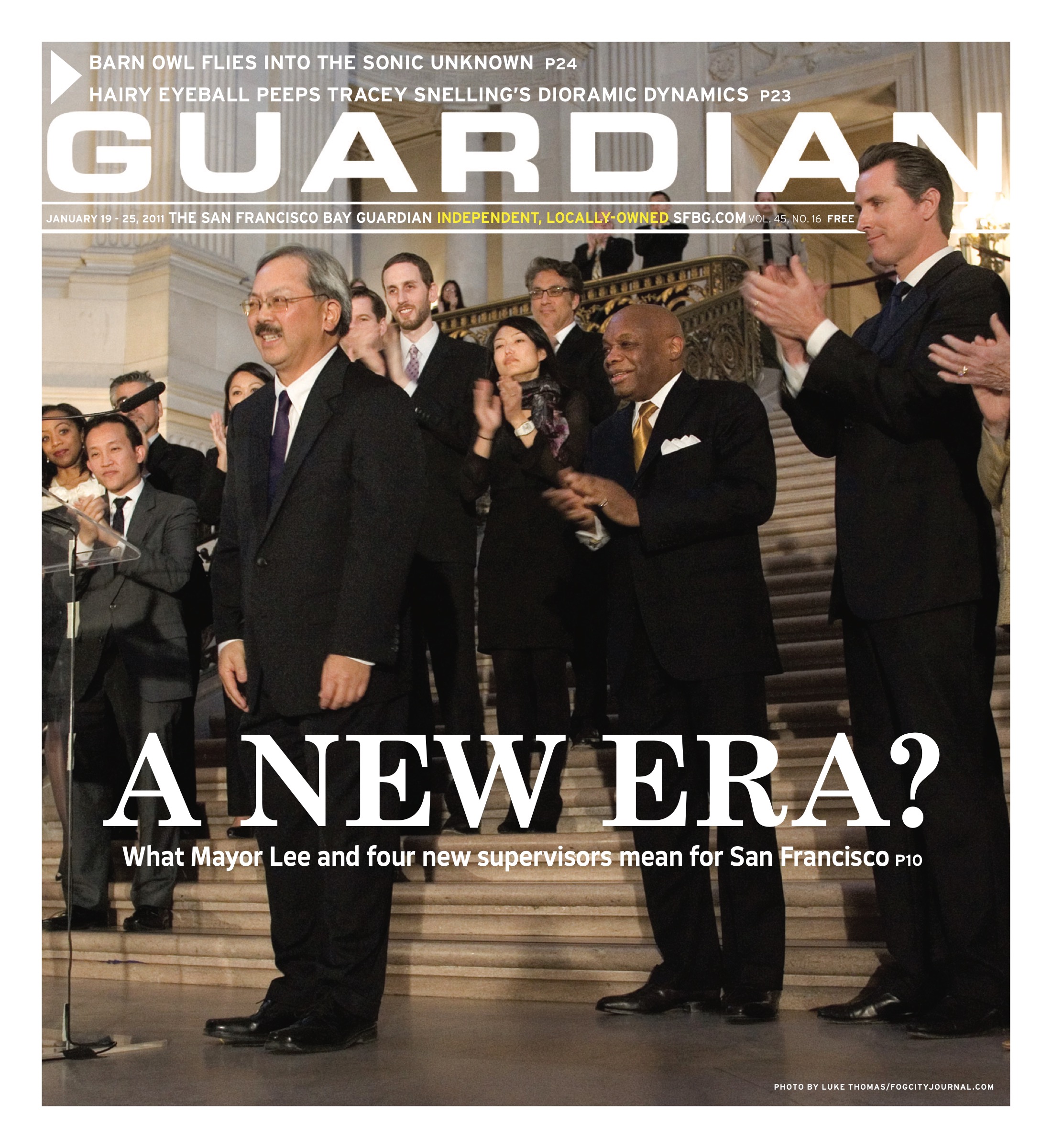
You can argue about what the word “progressive” means, and you can argue about the process and the politics that put Ed Lee in the Mayor’s Office. And you can talk forever about which group or faction has how much of a majority on the San Francisco Board of Supervisors, but you have to admit: this city has just undergone a significant political realignment.

Some of that was inevitable. The last members of the class of 2000, the supervisors who were elected in a rebellion against the sleaze, corruption, and runaway development policies of the Willie Brown administration, have left office. Gavin Newsom, the mayor who was often at war with the board and who encouraged a spirit of rancor and partisanship, is finally off to Sacramento. For the first time since 1978, the supervisors will be working with a mayor they chose themselves.

For much of the past 15 years, progressive politics was as much about stopping bad things — preventing Brown and then Newsom from wrecking the city — as it was about promoting good things. But the “politics of anti,” as San Francisco State political scientist Rich DeLeon describes is, wasn’t a central theme in the November elections, and this generation of supervisors comes into office with a different agenda.

Besides, one of the clear divisions on the board the past seven years was the Newsom allies against the progressives — something that dissipated instantly when Lee took over.

But the realignment goes deeper.

Until recently, the progressives on the board had a working majority — a caucus, so to speak — and they tended to vote together much of the time. The lines on the board were drawn almost entirely by what Newsom disparagingly calls ideology but could more accurately be described as a shared set of political values, a shared urban agenda.

There are still six supervisors who call themselves progressives, but the idea that they’ll stick together was shattered in the battle over a new mayor — and the notion that there’s anything like a progressive caucus died with Board President David Chiu’s election (his majority came in part from the conservative side, with three progressives opposing him) and with Chiu’s new committee assignments, which for the first time in a decade put control of key assignments in the hands of the fiscal conservatives.


A PROGRESSIVE MAJORITY?

The progressive bloc on the board was never monolithic. There were always disagreements and fractures. And, thanks to the Brown Act, the progressives don’t actually meet outside of the formal board sessions. But it was fair and accurate to say that, most of the time, the six members of the board majority functioned almost as a political party, working together on issues and counting on each other for key votes. There was, for example, a dispute two years ago over the board presidency — but in the end, Chiu was elected with exactly six votes, all from the progressive majority that came together in the end.

That all started to fall apart the minute the board was faced with the prospect of choosing a new mayor. For one thing, the progressives couldn’t agree on a strategy — should they look for someone who would seek reelection in November, or try to find an acceptable interim mayor? The rules that barred supervisors from voting for themselves made it more tricky; six votes were not enough to elect any of the existing members. And, not surprisingly, some of the progressives had mayoral ambitions themselves.

When state Assemblymember Tom Ammiano — who would have had six votes easily — took himself out of the running, there was no other obvious progressive candidate. And with no other obvious candidate, and little opportunity for open discussion, the progressives couldn’t come to an agreement.

But by the Jan. 4 board meeting, five of the six had coalesced around Sheriff Mike Hennessey. Chiu, however, was supporting Ed Lee, someone he had known and worked with in the Asian community and whom he considered a progressive candidate. And once it became clear that Lee was headed toward victory, Sup. Eric Mar announced that he, too, would be in Lee’s camp.

A few days later, when the new board convened to choose a president, the progressive solidarity was gone. Sups. David Campos, John Avalos, and Ross Mirkarimi, now the solid left wing of the board, voted for Avalos. Chiu won with the support of Mar, Sup. Jane Kim, and the moderate-to-conservative flank.

Now the Budget Committee — long controlled by a progressive chair and a progressive majority — will be led by Carmen Chu, who is among the most fiscally conservative board members. The Land Use and Development Committee will be chaired by Mar, but two of the three members are from the moderate side. Same goes for Rules, where Sup. Sean Elsbernd, for years the most conservative board member, will work with ideological ally Sup. Mark Farrell on confirming mayoral appointments, redrawing supervisorial districts, and promoting or blocking charter amendments as Kim, the chair, does her best to contain the damage.

You can argue that having independent-minded supervisors who don’t vote as a caucus is a good thing. You can also argue that a fractured left will never win against a united downtown. And both arguments have merit.

But you can’t argue any more that the board has the same sort of progressive majority it’s had for the past 10 years. That’s over. It’s a new — and different — political era.

What happens now? Will the progressives hold enough votes to have an influence on the city budget (and ensure that the deficit solutions include new revenue and not just cuts)? What legislative priorities will the supervisors be pushing in the next year? How will the votes shake out on difficult new proposals (and ongoing issues like community choice aggregation)?

Mayor Lee has pledged to work with the board and will show up for monthly questions. How will he respond to the sorts of progressive legislation — like tenant protections, transit-first policies, immigrant rights measures, and stronger affordable housing standards — that Newsom routinely vetoed?

How will this all play out in a year when the city will also be electing a new mayor?


IDENTITY POLITICS?

When Sups. Chiu, Mar, and Kim broke with their three progressive colleagues to support Chiu for board president — just as Chiu and Mar helped clear the path for Ed Lee to become mayor days earlier — it seemed to many political observers that identity had trumped ideology on the board. There’s some truth to that observation, but it’s too simple an explanation. There’s also the fact that Chiu strongly supported Kim, who is a personal friend and former roommate, in her election, so it’s no surprise she went with him for board president.

And the phrase itself is so laden with baggage and problems that it’s hard to talk about. It has come to signify a wide range of political activity and theorizing founded in the shared experiences of injustice of members of certain social groups. “Rather than organizing solely around belief systems, programmatic manifestoes, or party affiliation, identity political formations typically aim to secure the political freedom of a specific constituency marginalized within its larger context,” says the Stanford Encyclopedia of Philosophy, an ongoing research project by the students and faculty at Stanford University.

Although the notion of identity politics took hold during the social movements of the 1960s and ’70s — when liberation and organizing movements among women and various ethic and other identity groups fed a larger liberal democratic surge that targeted war, economic inequity, social injustice, and other issues — it’s also a political approach that has divided the populace.

“One of the central charges against identity politics by liberals, among others, has been its alleged reliance on notions of sameness to justify political mobilization,” says the Stanford Encyclopedia. “Looking for people who are like you rather than who share your political values as allies runs the risk of sidelining critical political analysis of complex social locations and ghettoizing members of social groups as the only persons capable of making or understanding claims to justice.”

Mar explains that the reality of identity politics and whether it’s a factor in the current politics at City Hall is far more complex.

“With me, David Chiu, and Jane Kim as a block of three progressive Asians — and I still define David Chiu as a progressive though I think some are questioning that — we all come out of what I would call a pro-housing justice, transit-first, and environmental sustainability [mindset],” Mar told us. “But I think because of our ethnic background and experiences, we may have different perspectives at times than other progressives.”

For example, Mar said, many working class families of color need to drive a car so they’ll differ from progressives who want to limit parking spaces to discourage driving. He also has reservations about the proposed congestion pricing fee and how it might affect low-income drivers.\

“I think often when progressive people of color come into office — Jane Kim might be one of the best examples — that sometimes there’s an assumption that her issues are going to be the same as a white progressive or a Latino progressive,” he said. “But I think kind of the different identities that we all have mean that we’re more complex.”

Campos, a Latino immigrant who is openly gay, noted that “as a progressive person of color, I have at times felt that the progressive movement didn’t recognize the importance of identity politics and what it means for me to have another person of color in power.”

But, he added, “I don’t think identity politics alone should guide what happens. A progressive agenda isn’t just about race but class, sexual orientation, and other things. It’s not enough to say that identity politics justifies everything.”

University of San Francisco political science professor Corey Cook told the Guardian that identity has always been a strong factor in San Francisco politics, even if it was overshadowed by the political realignment around progressive ideology that occurred in 2000, mostly as a reaction to an economic agenda based on rapid development and political cronyism.

“I’m not sure that identity wasn’t relevant, but it was swamped by ideology,” Cook told the Guardian. Now, he said, another political realignment seems to be occurring, one that downplays ideology compared to the position it has held for the last 10 years. “I’m not sure that ideology is dead. But the dynamics have definitely changed.”

Cook sees what may be a more important change reflected in Chiu’s decision to put the political moderates in control of key board committees. But he said that shift was probably inevitable given the difficulties of unifying the diverse progressive constituencies.

“It’s hard to hold a progressive coalition together, and it’s amazing that it has lasted this long,” he said.

There’s another kind of identity politics at play as well — that of native San Franciscans, who often express resentment at progressive newcomers talking about what kind of city this is, versus those who see San Francisco as a city of immigrants and ideas, a place being shaped by a wider constituency than the old-timers like to acknowledge.

“I’m honored to join Sups. Elsbernd and Cohen in representing the neighborhoods they grew up in,” Sup. Mark Farrell said during his opening remarks after being sworn in Jan. 8., sobbing when he thanked his parents for their support.

As he continued, he fed the criticism of the notion of ideology-based politics that has been a popular trope with Gavin Newsom and other fiscal conservatives in recent years, telling the crowd he wanted “to turn City Hall into a place based on issues and ideas, not ideology.”

Cohen also placed more importance on her birthright than on her political philosophy, telling stories about entering board chambers through the back door at age 16 when she was part of a youth program created by then-Mayor Frank Jordan, and with former Mayor Dianne Feinstein coming to speak at Cohen’s third-grade class. “I am a San Francisco native, and that is a responsibility I take seriously,” said Cohen, who graduated from the Emerge Program, which grooms women for political office,

“We will have another woman as president of the Board of Supervisors, and we will have a woman as mayor of San Francisco,” she added. And as the sole African American on the board, she also pledged, “I will be working to add more members of the African American community to the elected family of San Francisco.”

But what issues she plans to focus on and what values she’ll represent were unclear in her comments — as they were throughout her campaign, despite the efforts of journalists and activists to discern her political philosophy. In her public comments, her only stated goal was to build bridges between the community and City Hall and let decisions be guided by the people “not political ideologies.”

Oftentimes in recent San Francisco history, identity and ideology have worked in concert, as they did with former Sup. Harvey Milk, who broke barriers as the first openly gay elected official, but who also championed a broad progressive agenda that included tenants rights, protecting civil liberties, and creating more parks and public spaces.

Sup. Scott Wiener, shortly after being sworn into office, acknowledged the legacy of his district, which was once represented by Milk and fellow gay progressive leader Harry Britt, telling the crowd: “I’m keenly aware of the leadership that has come through this district and I have huge shoes to fill.”

Yet Wiener, a moderate, comes from a different ideological camp than Milk and Britt and he echoed the board’s new mantra of collaboration and compromise. “I will always try to find common ground. There is always common ground,” he said.


GETTING THINGS DONE?

Chiu is making a clear effort to break with the past, and has been critical of some progressive leaders. “I think it’s important that we do not have a small group of progressive leaders who are dictating to the rest of the progressive community what is progressive,” he said.

While he didn’t single out former Sup. Chris Daly by name, he does seem to be trying to repudiate Daly’s leadership style. “I think that while the progressive left and the progressive community leaders have had very significant accomplishments over the past 10 years, I do think that there are many times when our oppositional tactics have set us back.”

When Chiu was reelected board president, he told the crowd that “none of us were voted into office to take positions. We were voted into office to get things done.”

Some progressives were not at all happy with that comment. “I thought that was a terrible thing to say,” Avalos told the Guardian, arguing the positions that elected officials take shape the legislation that follows. As an example, he cited the positions that progressive members of Congress took in favor of the public option during the health care reform debate.

Talking about getting things done is “a sanctimonious talking point that fits well with what the Chronicle and big papers want to hear,” Avalos said. He said the Chronicle and other downtown interests are more interested in preserving the status quo and blocking progressive reforms. “It’s what they want to see not get done.”

Campos even challenged the comment publicly during the Jan. 11 board meeting when he said, “It’s important to get things done, but I don’t think getting things done is enough. We have to ask ourselves: what is it that we’re getting done? How is it that we’re getting things done? And for whom is it that we’re doing what we’re doing? Is it for the people, or the downtown corporate interests? I hope it’s not getting things done behind closed doors.”

Chiu said that, for him, getting things done is about expanding the progressive movement and consolidating its recent gains. “I think we all share a political goal. As progressives, we all share a political goal of getting things done and growing mainstream support for our shared progressive principles so that they really become the values of our entire city.”

To do that, he said, progressives are going to need to be more conciliatory and cooperative than they’ve been in the past. “I think it’s easy to slip into a more oppositional way of discussing progressive values, but I’m really pushing to move beyond that.”

The biggest single issue this spring will be the budget — and it’s hard to know exactly where the board president will draw his lines. “I have spoken to Mayor Lee about the need for open, transparent, and community-based budget processes and he’s open to that,” Chiu told us — and that alone would be a huge change. But the key progressive priority for the spring will be finding ways to avoid brutal budget cuts — and that means looking for new revenue.

When asked whether new general revenue will be a part of the budget solution, instead of Newsom’s Republican-style cuts-only approaches, Chiu was cautious. “I am open to considering revenues as part of the overall set of solutions to close the budget deficit,” he said. “I am willing to be one elected here that will try to make that argument.” But with his political clout and connections right now, he can do a lot more than be one person making an argument.

Chiu has always been open to new revenue solutions and even led the way in challenging the cuts-only approach to both the city budget and MTA budget two years in a row, only to back down in the end and cut a deal with Newsom. When asked whether things will be better this year given his closer relationship to Lee, Chiu replied, “I think things are going to be different in the coming months.”

During the board’s Jan. 7 deliberation on Lee, Sup. Eric Mar also said that based on his communications with Lee, Mar believed that the Mayor’s Office is open to supporting new revenue measures. He echoed the point later to us.

In addition to supporting the open, inclusive budget process, Mar called for “a humane budget that protects the safety net and services to the most vulnerable people in San Francisco is kind of the critical, top priority.

“I think it’s going to be difficult working with the different forces in the budget process,” he added. “That’s why I wish it could have been a progressive who was chairing the budget process.”

Mar said progressive activism on the budget process is needed now more than ever. “The Budget Justice Coalition from last year I think has to be reenergized so that so many groups are not competing for their own piece of the pie, but that it’s more of a for-all, share-the-pain budget with as many people communicating from outside as possible, putting the pressure on the mayor and the board to make sure that the critical safety net’s protected.”


CUTS WILL BE CENTER STAGE

But major cuts — and the issue of city employees pay and benefits — will also be center stage.

At the board’s Jan. 11 meeting, before the supervisors voted unanimously to nominate Lee as interim mayor, Sup. Elsbernd signaled that city workers’ retirement and health benefits will once again be at the center of the fight to balance the budget.

Elsbernd noted that in past years he was accused of exaggerating the negative impacts that city employees’ benefits have on the city’s budget. “But rather than being inflated, they were deflated,” Elsbernd said, noting that benefits will soon consume 18.14 percent of payroll and will account for 26 percent in three years.

“Does the budget deficit include this amount?” he asked.

And at the after-party that followed Lee’s swearing-in, Public Defender Jeff Adachi, who caused a furor last fall when he launched the ill-considered Measure B, which sought to reform workers’ benefits packages, told us he is not one to give up lightly.

“We learned a lot from that,” Adachi said. “This is still the huge elephant in City Hall. The city’s pension liability just went up another 1 percent, which is another $30 million”

Chu agreed that worker benefits would be a central part of the budget-balancing debate. “Any conversation about the long-term future of San Francisco’s budget has to look at the reality of where the bulk of our spending is,” she said.

Avalos noted that he plans to talk to labor and community based organizations about ways to increase city revenue. “I’m going to work behind the scene on the budget to make sure the communities are well-spoken for,” Avalos said, later adding, “But it’s hard, given that we need a two-thirds majority to pass stuff on the ballot.”

Last year, Avalos helped put two measures on the ballot to increase revenue: Prop. J, which sought to close loopholes in the city’s current hotel tax and asked visitors to pay a slightly higher hotel tax (about $3 a night) for three years, and Prop. N, the real property transfer tax that slightly increased the tax charged by the city on the sale of property worth more than $5 million.

Prop. N should raise $45 million, Avalos said. “I’ve always had my sights set on raising revenue, but making cuts is inevitable.”


THE IDEOLOGY ARGUMENT

Newsom and his allies loved to use “ideology” as a term of disparagement, a way to paint progressives as crazies driven by some sort of Commie-plot secret agenda. But there’s nothing wrong with ideology; Newsom’s fiscal conservative stance and his vow not to raise taxes were ideologies, too. The moderate positions some of the more centrist board members take stem from a basic ideology. Wiener, for example, told us that he thinks that in tough economic times, local government should do less but do it better. That’s a clear, consistent ideology.

For much of the past decade, the defining characteristic of the progressives on the board has been a loosely shared urban ideology supported by tenants, immigrant-rights groups, queer and labor activists, environmentalists, preservationists, supporters of public power and sunshine and foes of big corporate consolidation and economic power. Diversity and inclusiveness was part of that ideology, but it went beyond any one political interest or identity group.

It was often about fighting — against corruption and big-business hegemony and for economic and social equality. The progressive agenda started from the position that city government under Brown and Newsom had been going in the wrong direction and that substantive change was necessary. And sometimes, up against powerful mayors and their well-heeled backers, being polite and accommodating and seeking common ground didn’t work.

As outgoing Sup. Daly put it at his final meeting: “I’ve seen go-along to get along. If you want to do more than that, if you think there’s a fundamental problem with the way things are in this world, then go-along to get along doesn’t do it.” When Chiu announced that the new progressive politics is one of pragmatism, he was making a break from that ideology. He was signaling a different kind of politics. He has urged us to be optimistic about the new year — but we still don’t know what the new agenda will look like, how it will be defined, or at what point Chiu and his allies will say they’ve compromised and reached out enough and are ready to take a strong, even oppositional, stand. We do know the outcome will affect the lives of a lot of San Franciscans. And when the budget decisions start rolling down the pike, the political lines will be drawn fairly clearly. Because reaching across the aisle and working together sounds great in theory — but in practice, there is nothing even resembling a consensus on the board about how the city’s most serious problems should be resolved. And there are some ugly battles ahead.

They have issues: Members of the new Board speak

20

Board President David Chiu touched off a broad political discussion in recent weeks with his statement that officials were elected “not to take positions, but to get things done.” Delivered just before his reelection as Board President with the solid backing of the board’s moderate faction, Chiu’s comment has been viewed in light of City Hall’s shifting political dynamic, a subject the Guardian explores in a Jan. 19 cover story. Politics aside, Chiu’s statement also begs the question: Just what do members of the board hope to get done, and how do they propose to accomplish the items on their agenda?
Last week, Guardian reporters tracked down every member of the board to find out. We asked, what are your top priorities? And how do you plan to achieve them? Some spoke with us for 25 minutes, and others spoke for just 5 minutes, but the result offers some insight into what’s on their radar. Not surprisingly, getting the budget right was mentioned by virtually everyone as a top priority, but there are sharp differences in opinion in terms of how to do that. Several supervisors, particularly those in the moderate wing, mentioned ballooning pension and healthcare costs. Aiding small business also emerged as a priority shared by multiple board members.

Sup. Eric Mar
District 1

Issues:
*Budget
*Assisting small businesses
*Programs and services for seniors
*Food Security
*Issues surrounding Golden Gate Park

Elected in 2008 to represent D1, Sup. Eric Mar has been named chair of the powerful Land Use & Economic Development Committee and vice chair of the City Operations and Neighborhood Services Committee.

Asked to name his top priorities, Mar said, “A humane budget that protects the safety net and services to the must vulnerable people in San Francisco is kind of the critical, top priority.”

It’s bound to be difficult, he added. “That’s why I wish it could have been a progressive that was chairing the budget process. Now, we have to work with Carmen Chu to ensure that it’s a fair, transparent process.”

A second issue hovering near the top of Mar’s agenda is lending a helping hand to the small businesses of the Richmond District. “There’s a lot of anxiety about the economic climate for small business. We’re trying to work closely with some of the merchant associations and come up with ideas on how the city government can be more supportive,” he said. Mar also spoke about the need to respond to the threat of big box stores, such as PetCo, that could move in and harm neighborhood merchants. “I’m worried about too many of the big box stores trying to come in with an urban strategy and saying that they’re different — but they sure have an unfair advantage,” he noted.

Programs and services for the senior population ranked high on his list. Mar noted that he’d been working with senior groups on how to respond to a budget analyst’s report showing a ballooning need for housing – especially affordable housing – for seniors. “It’s moving from the Baby Boom generation to the Senior Boomers, and I think the population, if I’m not mistaken, by 2020 it’s going up 50 percent,” he said. “It’s a huge booming population that I don’t think we’re ready to address.”

Addressing food security issues through the Food Security Task Force also ranked high on Mar’s list, and he noted that he’s been working with a coalition that includes UCSF and the Department of Public Health to study the problem. “We’ve had a number of strategy meetings already, but we’re trying to launch different efforts to create healthier food access in many of our lowest income neighborhoods,” Mar said.

Finally, Mar talked about issues relating to the park. “I do represent the district that has Golden Gate Park, so I’m often busy with efforts to preserve the park, prevent privatization, and ensure enjoyment for the many residents not just in the Richmond but throughout the city that enjoy the park.” Although it’s not technically in his district, Mar noted that he is very supportive of HANC Recycling Center – and plans to advocate on their behalf to Mayor Lee.

Sup. Mark Farrell
District 2
Issues:
*Pension reform
*Long-term economic plan for city
*Job creation
*Quality-of-life issues

Elected to replace termed-out D2 Sup. Michela Alioto-Pier, Farrell has been named vice-chair of the Government Audits & Oversight Committee and a member of the Rules Committee. A native of D2, Farrell told the Guardian he believes his roots in the city and background as a venture capitalist would be an asset to the city’s legislative body. “I know at the last board, Carmen [Chu] was the only one who had any finance background,” he said. “To have someone come from the private sector with a business / finance background, I really do believe … adds to the dialogue and the discussion here at City Hall.”

Along those lines, Farrell said one of his top priorities is the budget. “I’m not on the budget and finance committee this time around, but given my background, I am going to play a role in that,” he said.

So what’s his plan for closing the budget deficit? In response, he alluded to slashing services. “In the past, there have been views that we as a city don’t provide enough services and we need to raise revenues to provide more, or the perspective that we first need to live within our means and then provide more services. Everyone’s going to disagree, but I’m in the latter camp,” he said. “I do believe we need to make some tough choices right now – whether it be head count, or whether it be looking at …pension reform. I do believe pension reform needs to be part of the dialogue. Unfortunately, it’s unsustainable.”

He also said he wanted to be part of “trying to create and focus on a framework for a long-term financial plan here in San Francisco.”

Secondly, Farrell discussed wanting to put together a “jobs bill.”

“Jobs is a big deal,” he said. “It’s something I want to focus on. There are only so many levers we can pull as a city. I think the biotech tax credits have spurred a lot of business down in Mission Bay.”

Next on Farrell’s agenda was quality-of-life issues, but rather than talk about enforcing San Francisco’s sit/lie ordinance – supported by political forces who organized under the banner of maintaining ‘quality-of-life’ – Farrell revealed that he is incensed about parking meter fines. “It is so strikingly unjust when you are 1 minute late to your parking meter and you have a $65 parking fine,” he said.

Farrell also mentioned development projects that would surely require time and attention. “CPMC is going to be a major dominant issue,” he said. He also mentioned Doyle Drive, and transitional age youth housing projects proposed in D2 – but as far as the housing project planned for the King Edward II Inn, which has generated some controversy among neighborhood groups, he didn’t take a strong position either way, saying he wanted to listen to all the stakeholders first.

Board President David Chiu
District 3
Issues:
*Budget
*Preserving neighborhood character
*Immigrant rights
*Preserving economic diversity
*Transit

Elected for a second two-year term as President of the Board, D3 Sup. David Chiu is rumored to be running in the mayor’s race, after he turned down former Mayor Gavin Newsom’s offer to appoint him as District Attorney. That offer was made after Kamala Harris won the state Attorney General’s race this fall. And when Chiu turned it down, former Mayor Gavin Newsom shocked just about everybody by appointing San Francisco Police Chief George Gascon, who is not opposed to the death penalty and was a longtime Republican before he recently registered as a Democrat, instead.

A temporary member of the Board’s Budget acommittee, Chiu is also a permanent member of the Board’s Government Audits & Oversight Committee.

Asked about his top priorities, Chiu spoke first and foremost about  “ensuring that we have a budget that works for all San Franciscans, particularly the most vulnerable.” He also said he wanted to see a different kind of budget process: “It is my hope that we do not engage in the typical, Kabuki-style budget process of years past under the last couple of mayors, where the mayor keeps under wraps for many months exactly what the thinking is on the budget, gives us something on June 1 for which we have only a couple of weeks to analyze, and then engage in the tired back-and-forth of debates in the past.” Chiu also spoke about tackling “looming pension and health care costs.”

Another priority, he said, was “Ensuring that our neighborhoods continue to remain the distinctive urban villages that they are, and protecting neighborhood character,” a goal that relates to “development, … historic preservation, [and] what we do around vacant commercial corridors.”

*Immigrant rights also made his top-five list. “I was very sad that last November we didn’t prevail in allowing all parents to have a right and a voice in school board elections,” he said, referencing ballot measure Proposition D which appeared on the November 2010 ballot. “I think we are going to reengage in discussion around Sanctuary City, another topic I have discussed twice already with Mayor Lee.”

Another issue for Chiu was  “ensuring again that hopefully San Francisco continues to remain an economically diverse city, and not just a city for the very wealthy.” He spoke about reforming city contracts: “In particular, dealing with the fact that in many areas, 70 to 80 percent of city contracts are awarded to non-San Francisco businesses. … I think there is more significant reform that needs to happen in our city contracting process.” Another economic-diversity measure, he said, was tax policy, “particularly around ensuring that our business tax is incenting the type of economic growth that we want.”

Finally, Chiu spoke about “Creating a transit-first city. This is not just about making sure MUNI is more reliable and has stable funding, but ensuring that we’re taking steps to reach a 2020 goal of 20 percent cycling in the city. Earlier this week I called for our transit agencies to look at pedestrian safety, because we are spending close to $300 million a year to deal with pedestrian deaths and injuries.”

Sup. Carmen Chu
District 4
*Budget
*Core Services
*Jobs
*Economy

Chiu has just named Sup. Carmen Chu as chair of the powerful Board and Finance Committee. And Chu, who worked as a budget analyst for Newsom’s administration, says the budget, core services, employment and the economy are her top priorities.

“My hope is that this year the budget is going to be a very collaborative and open process,” Chu said.

Chu believes workers benefits will be a central part of the budget-balancing debate.
“Any conversation about the long-term future of San Francisco’s budget has to look at the reality of where the bulk of our spending is,” she said.

Chu noted that the budget debate will have to take the state budget into account.
“At the end of the day, we need to take into account the context of the state budget, in terms of new cuts and taxes, because anything we do will be on top of the state level.

“We need to ask who do these measures really impact,” she added, noting that there were attempts to put revenue measures on the ballot last year.

Sup. Ross Mirkarimi
District 5
* Local Hire / First Source / Reentry programs
* Budget / generating revenue
* Infrastructure improvements
*Reversing MTA service cuts

With only two years left to serve on the Board, D5 Sup. Ross Mirkarimi has been named chair of the Board’s Public Safety Committee and vice-chair of the Budget and Finance Committee.

“One of my top priorities is building on and strengthening the work that I’ve already done and that Avalos is doing on mandatory local hire and First Source programs,” Mirkarimi said. He also spoke about “strengthening reentry programs for those coming out of the criminal justice system, because we still have an enormously high recidivism rate.”

The budget also ranked high on Mirkarimi’s list, and he stressed the need for “doing surgical operations on our budget to make sure that services for the vulnerable are retained, and looking for other ways to generate revenue beyond the debate of what’s going on the ballot.

“For instance, I helped lead the charge for the America’s Cup, and while the pay-off from that won’t be realized for years, the deal still needs to be massaged. What we have now is an embryonic deal that still needs to be watched.”

Mirkarimi mentioned safeguarding the city against privatization, saying one of his priorities was “retooling our budget priorities to stop the escalating practice of privatizing city services.”

 He spoke about “ongoing work citywide to make mixed-use commercial and residential infrastructure improvements, which coincide with bicycle and pedestrian improvements.”

Finally, Mirkarimi said he wanted to focus on transportation issues. “As Chair of the Transportation Authority, if I even continue to be chair, to take the lead on signature transit projects and work with the M.T.A. to reverse service cuts.”

Sup. Jane Kim
District 6
Issues:
*Jobs
*Economic Development
*Small Business
*Pedestrian Safety
*Legislation to control bedbug infestations

Elected to replace termed-out D6 Sup. Chris Daly, Kim has been named chair of the Rules Committee and a member of the Budget & Finance committee.

Kim believes that she will prove her progressive values through her work and she’s trying to take the current debate about her allegiances on the Board in her stride.

“The one thing I learned from serving on the School Board was to be really patient,” Kim told me, when our conversation turned to the issue of “progressive values.”

“I didn’t want to be President of the School Board for the first few years, because I loved pushing the envelope,” Kim added, noting that as Board President David Chiu is in the often-unenviable position of chief negotiator between the Board and the Mayor.

But with Ed Lee’s appointment as interim mayor, Kim is excited about the coming year.
“There are a lot of new opportunities, a different set of players, and it’s going to be very interesting to learn how to traverse this particular scene.”

Kim is kicking off her first term on the Board with two pieces of legislation. The first seeks to address bedbug infestations. “Particularly around enforcement, including private landlords,” Kim said, noting that there have also been bedbug problems in Housing Authority properties.

Her second immediate goal is to look at pedestrian safety, a big deal in D6, which is traversed by freeways with off-ramps leading into residential zones.
“Pedestrian safety is a unifying issue for my district, particularly for all the seniors,” Kim said, citing traffic calming, speed limit enforcement and increased pedestrian traffic, as possible approaches.

Beyond those immediate goals, Kim plans to focus on jobs, economic development and small businesses in the coming year. “What can we do to create jobs and help small businesses? That is my focus, not from a tax reduction point of view, but how can we consolidate the permitting and fees process, because small businesses are a source of local jobs.”

Kim plans to help the Mayor’s Office implement Sup. John Avalos’ local hire legislation, which interim Mayor Ed Lee supports, unlike his predecessor Mayor Gavin Newsom.

“Everyone has always liked the idea of local hire, but without any teeth, it can’t be enforced,” Kim observed. “It’s heartbreaking that young people graduate out of San Francisco Unified School District and there’s been not much more than retail jobs available.”

She noted that jobs, land use and the budget are the three overarching items on this year’s agenda. “I’m a big believer in revenue generation, but government has to come half-way by being able to articulate how it will benefit people and being able to show that it’s more than just altruistic. I think we have to figure out that balance in promoting new measures. That’s why it’s important to be strong on neighborhood and community issues, so that folks feel like government is listening and helping them. I don’t think it’s a huge ask to be responsive to that.”

Kim said she hoped the new mayor would put out a new revenue measure, enforce local hire, and implement Sup. David Campos’ legislation to ensure due process for immigrant youth.

“I think Ed can take a lot of the goodwill and unanimous support,” Kim said. “We’ve never had a mayor without an election, campaigns, and a track record. Usually mayors come in with a group of dissenters. But he is in a very unique position to do three things that are very challenging to do. I hope raising revenues is one of those three. As a big supporter of local hire, I think it helps having a mayor that is committed to implement it. And I’m hoping that Ed will implement due process for youth. For me, it’s a no brainer and Ed’s background as a former attorney  for Asian Law Caucus is a good match. Many members of my family came to the U.S. as undocumented youth, so this is very personal. Kids get picked up for no reason and misidentified. People confuse Campos and Avalos, so imagine what happens to immigrant youth.”

Sup. Sean Elsbernd
District 7
Issues:
*Parkmerced
*Enforcing Prop G
*Pension & healthcare costs
*CalTrain

With two years left to serve on the Board, D7 Sup. Sean Elsbernd has been named vice-chair of the Rules Committee and a member of the City Operations & Neighborhood Services Committee. He was congratulated by Chinatown powerbroker Rose Pak immediately after the Board voted 11-0 to nominated former City Administrator Ed Lee as interim mayor, and during Lee’s swearing-in, former Mayor Willie Brown praised Elsbernd for nominating Lee for the job.

And at the Board’s Jan. 11 meeting before the supervisors voted for Lee, Elsbernd signaled that city workers’ retirement and health benefits will be at the center of the fight to balance the budget in the coming year.

Elsbernd noted that in past years, he was accused of exaggerating the negative impacts that city employees’ benefits have on the city’s budget. “But rather than being inflated, they were deflated,” Elsbernd said, noting that benefits will soon consume 18.14 percent of payroll and will account for 26 percent in three years. “Does the budget deficit include this amount?” he asked.

And at the afterparty that followed Lee’s swearing in, Public Defender Jeff Adachi, who caused a furor last fall when he launched Measure B, which sought to reform workers’ benefits packages, told the Guardian he is not one to give up lightly. “We learned a lot from that,” Adachi said. “This is still the huge elephant in City Hall. The city’s pension liability just went up another 1 percent, which is another $30 million.”

As for priorities, Elsbernd broke it down into district, city, and regional issues. In D7, “Hands-down, without question the biggest issue … is Parkmerced,” he said, starting with understanding and managing the environmental approval process. If it gets approved, he said his top concerns was that “the tenant issue. And the overriding concern of if they sell, which I think we all think is going to happen in the near-term – do those guarantees go along with the land?”

Also related to Parkmerced was planning for the traffic conditions that the development could potentially create, which Elsbernd dubbed a “huge 19th Avenue issue.”

Citywide, Elsbernd’s top priorities included enforcing Proposition G – the voter-approved measure that requires MUNI drivers to engage in collective bargaining – and tackling pension and healthcare costs. He spoke about “making sure that MTA budget that comes to us this summer is responsive” to Prop G.

As for pension and healthcare, Elsbernd said, “I’ve already spent a good deal of time with labor talking about it, and will continue to do that.” But he declined to give further details. Asked if a revenue-generating measure could be part of the solution to that problem, Elsbernd said, “I’m not saying no to anything right now.”

On a regional level, Elsbernd’s priority was to help CalTrain deal with its crippling financial problem. He’s served on that board for the last four years. “The financial situation at CalTrain – it is without question the forgotten stepchild of Bay Area transit, and the budget is going to be hugely challenging,” he said. “I think they’ll survive, but I think they’re going to see massive reductions in services.”

Sup. Scott Wiener
District 8
Issues:
*Transportation
*Reasonable regulation of nightlife & entertainment industry
*Pension reform

Elected in November 2010 to replace termed-out D8 Sup. Bevan, Wiener has been named a temporary member of the Board’s Budget and Finance Committee and a permanent member of the Land Use and Economic Development Committee.

“Transportation is a top priority,” Wiener said. ‘That includes working with the M.T.A. to get more cabs on the street, and making sure that the M.T.A. collectively bargains effectively with its new powers, under Prop. G.”

“I’m also going to be focusing on public safety, including work around graffiti enforcement, though I’m not prepared to go public yet about what I’ll be thinking,” he said.

“Regulating nightlife and entertainment is another top priority,” Wiener continued. “I want to make sure that what we do is very thoughtful in terms of understanding the economic impacts, in terms of jobs and tax  revenues, that this segment has. With some of the unfortunate incidents that have happened, it’s really important before we jump to conclusions that we figure out what happened and why. Was it something the club did inappropriately, or was it just a fluke? That way, we can avoid making drastic changes across the board. I think we have been very reactive to some nightclub issues. I want us to be more thoughtful in taking all the factors into consideration.”

“Even if we put a revenue measure on the June or November ballot, we’d need a two-thirds majority, so realistically, it’s hard to envision successfully securing significant revenue measure before November 2012,” Wiener added. “And once you adopt a revenue measure, it takes time to implement it and revenue to come in, so it’s hard to see where we’ll get revenue that will impact the 2012 fiscal year. In the short term, for fiscal year 2011/2012, the horse is out of the barn”

“As for pension stuff, I’m going to be very engaged in that process and hopefully we will move to further rein in pension and retirement healthcare costs.”

Sup. David Campos
District 9
Issues:
*Good government
*Community policing
*Protecting immigrant youth
*Workers’ rights and healthcare

Elected in 2008, D9 Sup. David Campos has been named chair of the Board’s Government Audit & Oversight Committee and a member of the Public Safety Committee. And, ever since he declared that the progressive majority on the Board no longer exists, in the wake of the Board’s 11-0 vote for Mayor Ed Lee, Campos has found his words being used by the mainstream media as alleged evidence that the entire progressive movement is dead in San Francisco.

“They are trying to twist my words and make me into the bogey man,” Campos said, noting that his words were not a statement of defeat but a wake-up call.

“The progressive movement is very much alive,” Campos said. “The key here is that if you speak your truth, they’ll go after you, even if you do it in a respectful way. I didn’t lose my temper or go after anybody, but they are trying to make me into the next Chris Daly.”

Campos said his overarching goal this year is to keep advancing a good government agenda.

“This means not just making sure that good public policy is being pursued, but also that we do so with as much openness and transparency as possible,” he said.

As a member of the Board’s Public Safety Committee, Campos says he will focus on making sure that we have “as much community policing as possible.

He plans to focus on improving public transportation, noting that a lot of folks in his district use public transit.

And he’d like to see interim mayor Ed Lee implement the due process legislation that Campos sponsored and the former Board passed with a veto-proof majority in 2009, but Mayor Gavin Newsom refused to implement. Campos’ legislation sought to ensure that immigrant youth get their day in court before being referred to the federal immigration authorities for possible deportation, and Newsom’s refusal to implement it, left hundreds of youth at risk of being deported, without first having the opportunity to establish their innocence in a juvenile court.
‘We met with Mayor Lee today,” Campos told the Guardian Jan. 18. “And we asked him to move this forward as quickly as possible. He committed to do that and said he wants to get more informed, but I’m confident he will move this forward.”

Campos also said he’ll be focusing on issues around workers’ rights and health care.
“I want to make sure we keep making progress on those fronts,” Campos said.

“It’s been a rough couple of days,” Campos continued, circling back to the beating the press gave him for his “progressive” remarks.“But I got to keep moving, doing my work, calling it as a I see it, doing what’s right, and doing it in a respectful way. The truth is that if you talk about the progressive movement and what we have achieved, which includes universal healthcare and local hire in the last few years, you are likely to become a target.”

Sup. Malia Cohen
District 10
Issues:
*Public safety
*Jobs
*Preserving open space
*Creating Community Benefit Districts
*Ending illegal dumping
Elected to replace termed-out D10 Sup. Sophie Maxwell, Cohen has been named chair of the City & School District committee, vice chair of the Land Use and Economic Development Committee and vice chair of the Public Safety Committee.

Cohen says her top priorities are public safety, jobs, open space, which she campaigned on, as well as creating community benefits districts and putting an end to illegal dumping.

“I feel good about the votes I cast for Ed Lee as interim mayor and David Chiu as Board President. We need to partner on the implementation of local hire, and those alliances can help folks in my district, including Visitation Valley.”

“I was touched by Sup. David Campos words about the progressive majority on the Board,” she added. “I thought they were thoughtful.”

Much like Kim, Cohen believes her legislative actions will show where her values lie.
“I’d like to see a community benefits district on San Bruno and Third Street because those are two separate corridors that could use help,” Cohen said. 

She pointed to legislation that former D10 Sup. Sophie Maxwell introduced in November 2010, authorizing the Department of Public Works to expend a $350,000 grant from the Solid Waste Disposal Clean-Up Site trust fund to clean up 25 chronic illegal dumping sites.
“All the sites are on public property and are located in the southeast part of the city, in my district,” Cohen said, noting that the city receives over 16,000 reports of illegal dumping a year and spends over $2 million in cleaning them up.

Sup. John Avalos
District 11
*Implementing Local Hire
*Improving MUNI / Balboa Park BART
*Affordable housing
*Improving city and neighborhood services

Sup. John Avalos, who chaired the Budget committee last year and has just been named Chair of the Board’s City Operations and Neighborhood Services Committee, said his top priorities were implementing local hire, improving Muni and Balboa Park BART station, building affordable housing at Balboa, and improving city and neighborhood services.

“And despite not being budget chair, I’ll make sure we have the best budget we can,” Avalos added, noting that he plans to talk to labor and community based organizations about ways to increase city revenues. “But it’s hard, given that we need a two-thirds majority to pass stuff on the ballot,” he said.

Last year, Avalos helped put two measures on the ballot to increase revenues. Prop. J sought to close loopholes in the city’s current hotel tax, and asked visitors to pay a slightly higher hotel tax (about $3 a night) for three years. Prop. N, the real property transfer tax, h slightly increased the tax charged by the city on the sale of property worth more than $5 million.

Prop. J secured only 45.5 percent of the vote, thereby failing to win the necessary two-thirds majority. But it fared better than Prop. K, the competing hotel tax that Newsom put on the ballot at the behest of large hotel corporations and that only won 38.5 percent of the vote. Prop. K also sought to close loopholes in the hotel tax, but didn’t include a tax increase, meaning it would have contributed millions less than Prop. J.

But Prop. N did pass. “And that should raise $45 million,” Avalos said. “So, I’ve always had my sights set on raising revenue, but making cuts is inevitable.”

Music Listings

0

Music listings are compiled by Cheryl Eddy. Since club life is unpredictable, it’s a good idea to call ahead to confirm bookings and hours. Prices are listed when provided to us. Submit items for the listings at listings@sfbg.com. For further information on how to submit items for the listings, see Picks.

WEDNESDAY 12

ROCK/BLUES/HIP-HOP

Anthony B Independent. 9pm, $25.

Buxter Hoot’n, Mark Matos and Os Beaches, Magic Leaves Bottom of the Hill. 9pm, $8.

Family Stone Yoshi’s San Francisco. 8pm, $26.

Foolproof Four Grant and Green. 8pm, free.

Gypsy Moonlight, Horror-X Hemlock Tavern. 9pm, $5.

Makepeace Brothers, Essence, Love Isabel Café Du Nord. 8:30pm, $10.

Otis Taylor Band Biscuits and Blues. 8 and 10pm, $20.

Sprains, Hail the Sun, Daikon El Rio. 8pm, $5.

JAZZ/NEW MUSIC

Gaucho, Michael Abraham Amnesia. 7pm, free.

Little Vamp Tomato and friends Revolution Café, 3248 22nd St, SF; (415) 642-0474. 8:30pm, free.

Ben Marcato and the Mondo Combo Top of the Mark. 7:30pm, $10.

Vanessa Tomlinson zBug Meridian Gallery, 535 Powell, SF; www.meridiangallery.com. 7:30pm, $10.

FOLK/WORLD/COUNTRY

*Willie Nelson Fillmore. 8pm, $55.

New World Ape, Osseynou Kouyate Yoshi’s San Francisco Lounge. 9pm, $7.

DANCE CLUBS

Booty Call Q-Bar, 456 Castro, SF; www.bootycallwednesdays.com. 9pm. Juanita Moore hosts this dance party, featuring DJ Robot Hustle.

Cannonball Beauty Bar. 10pm, free. Rock, indie, and nu-disco with DJ White Mike.

Hands Down! Bar on Church. 9pm, free. With DJs Claksaarb, Mykill, and guests spinning indie, electro, house, and bangers.

Jam Fresh Wednesdays Vessel, 85 Campton, SF; (415) 433-8585. 9:30pm, free. With DJs Slick D, Chris Clouse, Rich Era, Don Lynch, and more spinning top40, mashups, hip hop, and remixes. Mary-Go-Round Lookout, 3600 16th St, SF; (415) 431-0306. 10pm, $5. A weekly drag show with hosts Cookie Dough, Pollo Del Mar, and Suppositori Spelling.

Obey the Kitty Vessel, 85 Campton, SF; www.vesselsf.com. 9pm, free. All genres of music from DJ Cobra with a fashion element provided by Betsey Johnson.

Respect Wednesdays End Up. 10pm, $5. Rotating DJs Daddy Rolo, Young Fyah, Irie Dole, I-Vier, Sake One, Serg, and more spinning reggae, dancehall, roots, lovers rock, and mash ups.

“Subcon and Beyond Fest” Elbo Room. 8:30pm, $20. With Cevin Key, Tokyo Decadence, Dead Voices on Air, and more.

Synchronize Il Pirata, 2007 16th St, SF; (415) 626-2626. 10pm, free. Psychedelic dance music with DJs Helios, Gatto Matto, Psy Lotus, Intergalactoid, and guests.

THURSDAY 13

ROCK/BLUES/HIP-HOP

Chris Kid Anderson Biscuits and Blues. 8 and 10pm, $15.

Family Stone Yoshi’s San Francisco. 8 and 10pm, $20-26.

Floozy, Influence, Trillick Kimo’s. 9pm.

Love Dimension Revolution Café, 3248 22nd St, SF; (415) 642-0474. 8:30pm, free.

Michael Musicka, Obo Martin, F Pod B Pod Hemlock Tavern. 9pm, $6.

Reverse Gravity, Mavalour, Whiskey Pils Fiasco Bottom of the Hill. 9pm, $8.

Trainwreck Riders, Jesse Morris and the Man Cougars, Cutter, Slow Poisoner Eagle Tavern. 9:30pm, $7.

JAZZ/NEW MUSIC

“SF Jazz Hotplate Series” Amnesia. 9pm.

Stompy Jones Top of the Mark. 7:30pm, $10.

FOLK/WORLD/COUNTRY

Beauty Operators Bluegrass Band 50 Mason Social House, 50 Mason, SF; (415) 433-5050. 9pm, free.

Jarrod Dickenson, Dave Hanley Club Waziema, 543 Divisadero, SF; (415) 346-6641. 8pm.

Huun Huur Tu Great American Music Hall. 8pm, $26.

Kentucky Twisters Atlas Café. 8pm, free.

Possum and Lester, Earl Brothers, Hang Jones, Walking in Sunlight Café Du Nord. 8pm, $10-20.

Ziva Red Poppy Art House. 7pm, $10-15.

DANCE CLUBS

Afrolicious Elbo Room. 9:30pm, $10. DJs Pleasuremaker and Señor Oz spin Afrobeat, tropicália, electro, samba, and funk.

CakeMIX SF Wish, 1539 Folsom, SF; www.wishsf.com. 10pm, free. DJ Carey Kopp spinning funk, soul, and hip hop.

Caribbean Connection Little Baobab, 3388 19th St, SF; (415) 643-3558. 10pm, $3. DJ Stevie B and guests spin reggae, soca, zouk, reggaetón, and more.

Drop the Pressure Underground SF. 6-10pm, free. Electro, house, and datafunk highlight this weekly happy hour.

Good Foot Som., 2925 16th St, SF; (415) 558-8521. 10pm, free. With resident DJs Haylow, A-Ron, Prince Aries, Boogie Brown, Ammbush, plus food carts and community creativity.

Guilty Pleasures Gestalt, 3159 16th St, SF; (415) 560-0137. 9:30pm, free. DJ TophZilla, Rob Metal, DJ Stef, and Disco-D spin punk, metal, electro-funk, and 80s.

Jivin’ Dirty Disco Butter, 354 11th St., SF; (415) 863-5964. 8pm, free. With DJs spinning disco, funk, and classics.

Kissing Booth Make-Out Room. 9pm, free. DJs Jory, Commodore 69, and more spinning indie dance, disco, 80’s, and electro.

Koko Puffs Koko Cocktails, 1060 Geary, SF; (415) 885-4788. 10pm, free. Dubby roots reggae and Jamaican funk from rotating DJs.

Motion Sickness Vertigo, 1160 Polk, SF; (415) 674-1278. 10pm, free. Genre-bending dance party with DJs Sneaky P, Public Frenemy, and D_Ro Cyclist.

Peaches Skylark, 10pm, free. With an all female DJ line up featuring Deeandroid, Lady Fingaz, That Girl, and Umami spinning hip hop.

Popscene Rickshaw Stop. 9pm, $15. With Wombats and Magician plus DJs Aaron and Omar.

FRIDAY 14

ROCK/BLUES/HIP-HOP

Seth Augustus Revolution Café, 3248 22nd St, SF; (415) 642-0474. 9pm, free.

Colin L. Orchestra, Common Eider King Eider, CSC Funkband Hemlock Tavern. 9:30pm, $7.

DRI Slim’s. 8pm, $17.

English Beat, Impalers AKA Bimbo’s 365 Club. 9pm, $30.

Infamous Stringdusters, Arann Harris and the Farm Band Independent. 9pm, $14.

Dennis Jones Biscuits and Blues. 8 and 10pm, $20.

Chaka Khan, Chrisette Michele Warfield. 8pm.

Maus Haus, Sleeptalks, DJ Neil Martinson Knockout. 9pm, $7.

La Plebe Bottom of the Hill. 9pm, $12.

*Public Enemy Yoshi’s San Francisco. 8 and 10pm, $40.

Martha Reeves Rrazz Room. 8pm, $40-45.

Still Flyin’, Social Studies, La Corde Rickshaw Stop. 8:30pm, $10.

Sweet Apple, Dead Meadow, Carlton Melton Café Du Nord. 9:30pm, $15.

Tortured Genies, Lambs, Coconut El Rio. 9pm, $5.

Tribal Seeds, Fortunate Youth, Thrive Great American Music Hall. 9pm, $16.

JAZZ/NEW MUSIC

Black Market Jazz Orchestra Top of the Mark. 9pm, $10.

FOLK/WORLD/COUNTRY

California Honeydrops Red Poppy Art House. 8pm, $15.

DANCE CLUBS

Club Dope’s Dope Ass Winter Ball II Club Six. 9pm, $10. Hip-hop with Planet Asia, Dub Esquire, and more.

Exhale, Fridays Project One Gallery, 251 Rhode Island, SF; (415) 465-2129. 5pm, $5. Happy hour with art, fine food, and music with Vin Sol, King Most, DJ Centipede, and Shane King.

Fat Stack Fridays Koko Cocktails, 1060 Geary, SF; (415) 885-4788. 10pm, free. With rotating DJs B-Cause, Vinnie Esparza, Mr. Robinson, Toph One, and Slopoke.

Fubar Fridays Butter, 354 11th St., SF; (415) 863-5964. 6pm, $5. With DJs spinning retro mashup remixes.

Good Life Fridays Apartment 24, 440 Broadway, SF; (415) 989-3434. 10pm, $10. With DJ Brian spinning hip hop, mashups, and top 40.

Heartical Roots Bollywood Café. 9pm, $5. Recession friendly reggae.

Hot Chocolate Milk. 9pm, $5. With DJs Big Fat Frog, Chardmo, DuseRock, and more spinning old and new school funk.

Hubba Hubba Revue: Soviet Union DNA Lounge. 9pm, $10-15. Bolshevik burlesque and communist comedy.

Indy Slash Amnesia. 10pm. With DJ Danny White.

Rockabilly Fridays Jay N Bee Club, 2736 20th St, SF; (415) 824-4190. 9pm, free. With DJs Rockin’ Raul, Oakie Oran, Sergio Iglesias, and Tanoa “Samoa Boy” spinning 50s and 60s Doo Wop, Rockabilly, Bop, Jive, and more.

Some Thing Stud. 10pm, $7. VivvyAnne Forevermore, Glamamore, and DJ Down-E give you fierce drag shows and afterhours dancing.

Treat ‘Em Right Elbo Room. 10pm, $5. DJs Vinnie Esparza and B. Cause spin hip-hop, funk, and reggae.

Vintage Orson, 508 Fourth St, SF; (415) 777-1508. 5:30-11pm, free. DJ TophOne and guest spin jazzy beats for cocktalians.

SATURDAY 15

ROCK/BLUES/HIP-HOP

Nicki Bluhm, Blank Tapes, Dave Mulligan, DJ Charles Gonzalez Café Du Nord. 9:30pm, $12.

Budos Band Independent. 9pm, $20.

Company Car, Seeking Empire, Please Do Not Fight Bottom of the Hill. 10pm, $10.

Crocodiles, Fresh and Onlys, Magic Bullets Slim’s. 9pm, $15.

Dashboard Confessional, Chris Conley, Lady Danville Regency Ballroom. 8pm, $28.

Fawnmower, Butch Berry, Symbolic Jews Brainwash, 1122 Folsom, SF; (415) 861-3663. 9pm, free.

Gestapo Khazi, Airfix Kits, Better Maker, Culture Corpse Hemlock Tavern. 9pm, $7.

K-9, Earwigs Thee Parkside. 3pm, free.

*Neurosis, YOB, U.S. Christmas Great American Music Hall. 9pm, $21.

Public Enemy Yoshi’s San Francisco. 8 and 10pm, $40.

Reducers SF, Meat Sluts, Complaints, Paper Bags Thee Parkside. 9pm, $7.

Martha Reeves Rrazz Room. 8pm, $40-45.

Lavay Smith Biscuits and Blues. 8 and 10pm, $20.

Wee the Band, Aaron Blyth El Rio. 6pm, free.

JAZZ/NEW MUSIC

Blue Belles Revolution Café, 3248 22nd St, SF; (415) 642-0474. 9pm, free.

Los Angeles Guitar Quartet Herbst Theatre, 401 Van Ness, SF; www.sfperformances.org. 8pm, $30-45.

zBug Meridian Gallery, 535 Powell, SF; www.meridiangallery.com. 8pm, $10.

FOLK/WORLD/COUNTRY

Charming Hostess Red Poppy Art House. 8pm, $12-20.

One Soul Music Collective Plough and Stars. 9pm, $6.

Craig Ventresco and Meredith Axelrod Atlas Café. 4pm, free.

DANCE CLUBS

Bar on Church 9pm. Rotating DJs Foxxee, Joseph Lee, Zhaldee, Mark Andrus, and Nuxx.

Bootie: The Donner Party DNA Lounge. 9pm, $6-12. Mash-ups with a stage-show-meets-DJ-set paying tribute to cannibal pioneers by John!John!

Fire Corner Koko Cocktails, 1060 Geary, SF; (415) 885-4788. 9:30pm, free. Rare and outrageous ska, rocksteady, and reggae vinyl with Revival Sound System and guests.

Fringe Madrone Art Bar. 9pm, $5. Indie music video dance party with DJ Blondie K and subOctave.

Full House Gravity, 3505 Scott, SF; (415) 776-1928. 9pm, $10. With DJs Roost Uno and Pony P spinning dirty hip hop.

HYP Club Eight, 1151 Folsom, SF; www.eightsf.com. 10pm, free. Gay and lesbian hip-hop party, featuring DJs spinning the newest in the top 40s hip hop and hyphy.

Non Stop Bhangra Rickshaw Stop. 9pm, $15. Bhangra beats with live drumming and dancing.

Rock City Butter, 354 11th St., SF; (415) 863-5964. 6pm, $5 after 10pm. With DJs spinning party rock.

Saturday Night Soul Party Elbo Room. 10pm, $5-10. Sixties soul with DJs Lucky, Phengren Oswald, and Paul Paul.

Spirit Fingers Sessions 330 Ritch. 9pm, free. With DJ Morse Code and live guest performances.

Strobe Deco Lounge, 510 Larkin, SF; www.decosf.com. 9pm. Disco with DJ Tweaka Turner, BeBe Sweetbriar, and Duplicity Dilemma.

SUNDAY 16

ROCK/BLUES/HIP-HOP

Bad Books, Right Away Great Captain!, Gobotron Biscuits and Blues. 7:30pm, $17.

“Battle of the Bands” DNA Lounge. 5:30pm, $12. With Swain Turay, Mahgeetah, Genius of Jack, and more.

Budos Band Independent. 9pm, $20.

Cowboy Mouth, Dash Rip Rock Slim’s. 8pm, $22.

Gregory Douglass, Acoustic Minds Café Du Nord. 8pm, $10-25.

Jerry Lawson and Talk of the Town Yoshi’s San Francisco. 7pm, $30.

*Neurosis, Saviours, U.S. Christmas Great American Music Hall. 9pm, $21.

Rantouls, Wrong Words, Tropical Sleep Hemlock Tavern. 9pm, $6.

Martha Reeves Rrazz Room. 7pm, $40-45.

Twice as Good Biscuits and Blues. 8 and 10pm, $15.

JAZZ/NEW MUSIC

Michael Zisman, Larry Vuckovich, Nat Johnson Bliss Bar, 4026 24th St, SF; www.blissbarsf.com. 4:30pm, $10.

FOLK/WORLD/COUNTRY

Everlovin’, Coburns Thee Parkside. 4pm, free.

Woody Pines Revolution Café, 3248 22nd St, SF; (415) 642-0474. 9pm, free.

DANCE CLUBS

DiscoFunk Mashups Cat Club. 10pm, free. House and 70’s music.

Dub Mission Elbo Room. 9pm, $15. Dub, roots, and classic dancehall with DJs Sep and guest Zion Train featuring Neil Perch and Rocker T.

Gloss Sundays Trigger, 2344 Market, SF; (415) 551-CLUB. 7pm. With DJ Hawthorne spinning house, funk, soul, retro, and disco.

Honey Soundsystem Paradise Lounge. 8pm-2am. “Dance floor for dancers – sound system for lovers.” Got that?

Kick It Bar on Church. 9pm. Hip-hop with DJ Zax.

Religion Bar on Church. 3pm. With DJ Nikita.

Swing Out Sundays Rock-It Room. 7pm, free (dance lessons $15). DJ BeBop Burnie spins 20s through 50s swing, jive, and more.

MONDAY 17

ROCK/BLUES/HIP-HOP

Songs for Snakes, Time Traveling Assassins, Bite El Rio. 7pm, $5.

Velvetwinos, Brian Ravizza Café Du Nord. 8pm, $10.

JAZZ/NEW MUSIC

Amiri Baraka and Roscoe Mitchell Yoshi’s San Francisco. 8 and 10pm, $12-18.

Lavay Smith Swinget with Jules Broussard Enrico’s, 504 Broadway, SF; (415) 982-6223. 7pm, free.

DANCE CLUBS

Black Gold Koko Cocktails, 1060 Geary, SF; (415) 885-4788. 10pm-2am, free. Senator Soul spins Detroit soul, Motown, New Orleans R&B, and more — all on 45!

Death Guild DNA Lounge. 9:30pm, $3-5. Gothic, industrial, and synthpop with Joe Radio, Decay, and Melting Girl.

Krazy Mondays Beauty Bar. 10pm, free. With DJs Ant-1, $ir-Tipp, Ruby Red I, Lo, and Gelo spinning hip hop.

M.O.M. Madrone Art Bar. 6pm, free. With DJ Gordo Cabeza and guests playing all Motown every Monday.

Manic Mondays Bar on Church. 9pm. Drink 80-cent cosmos with Djs Mark Andrus and Dangerous Dan.

Network Mondays Azul Lounge, One Tillman Pl, SF; www.inhousetalent.com. 9pm, $5. Hip-hop, R&B, and spoken word open mic, plus featured performers.

Skylarking Skylark. 10pm, free. With resident DJs I & I Vibration, Beatnok, and Mr. Lucky and weekly guest DJs.

TUESDAY 18

ROCK/BLUES/HIP-HOP

Defiance Ohio, Kimya Dawson, Songs for Moms Thee Parkside. 8pm, $8.

Entrance, 3 Leafs, Nectarine Pie, Moccretro Slim’s. 8pm, $5.

Era Escape, Tokyo Raid, DownDownDown Bottom of the Hill. 9pm, $8.

Moondoggies, Quiet Life Independent. 8pm, $12.

Ryp, Carmichael and the Frijalitas El Rio. 7pm, free.

Shants, Son Cats, Cave Country Hemlock Tavern. 9pm, $6.

Snoop Dogg Fillmore. 8pm, $37.50. FOLK/WORLD/COUNTRY Aurelio Martinez Group Yoshi’s San Francisco. 8pm, $20. Bhi Bhiman Revolution Café, 3248 22nd St, SF; (415) 642-0474. 8:30pm, free. JAZZ/NEW MUSIC Ricardo Scales Top of the Mark. 6:30pm, $5. Paula West and the George Mesterhazy Quartet Rrazz Room. 8pm, $35. DANCE CLUBS Alcoholocaust Presents Argus Lounge. 9pm, free. With DJ Big Dwayne and DJ Eye-Man. Brazilian Wax Elbo Room. 9pm, $7. With Grupo Das Sete featuring Eric Dos Santos, featuring DJs Carioca and P-Shot. Eclectic Company Skylark, 9pm, free. DJs Tones and Jaybee spin old school hip hop, bass, dub, glitch, and electro. Extra Classic DJ Night Little Baobab, 3388 19th St, SF; www.bissapbaobab.com. 10pm. Dub, roots, rockers, and reggae from the 60s, 70s, and 80s. Salem, Disco Shawn Rickshaw Stop. 8pm, $10. Share the Love Trigger, 2344 Market, SF; (415) 551-CLUB. 5pm, free. With DJ Pam Hubbuck spinning house. Womanizer Bar on Church. 9pm. With DJ Nuxx.


Release me

1

arts@sfbg.com

MUSIC As 2011 begins, Bay Area rock is wasting no time staking its claim. This month brings noteworthy albums by at least a handful of local groups and artists. I’ll be covering them over the course of the next two weeks, beginning with a trio of new releases:


YOUNG PRISMS’ FRIENDS FOR NOW

Since the late-2009 release of Young Prisms’ self-titled EP on Mexican Summer, this Cali quintet has been hard at work. It put out three different split 7-inches: one with Weekend on Transparent; one with Small Black on Big Love; and one with Mathamagic on Atelier Ciseaux. In the wake of performances at last fall’s CMJ conference, the band is set to release its first full-length, Friends For Now (Kanine Records), Jan. 19.

Once you get past Friends for Now‘s NSFW cover art — it’s just a little nip, and only one at that — you’ll enter into the title track, which blissfully rattles forward with undecipherable vocals, like a sun-bleached step into euphoria. “If You Want To” floats over waves of distortion; the only discernible lyrics are the title lines, nonchalantly chanted like an existential mantra. The single “Sugar” picks up the pace with yowling guitars.

The band also makes sure to include a smoke-break track, just as it did with “Four Twenty Friendly” on the Mexican Summer EP. Titled “All Day Holiday,” this one is an under-a-minute wash of echoes and effects. The opening notes of “In Your Room” are dramatic, then radiant guitars emerge over rumbles of distorted bass. Friends For Now rounds out with tightened mixes of “Feel Fine” and “I Don’t Get Much,” which were both previously released, and closes with the hypnotic “Stay Awake.” Taken together, the collection of songs is cohesive, capturing a sunlit aesthetic while giving the illusion of chaos.


SONNY SMITH’S 100 RECORDS, VOLUME TWO: I MISS THE JAMS

Sonny Smith’s approach to recording and issuing music is unique, accentuating its connections to visual art. Using his imagination along with the help of a rotating band, he assembled “100 Records,” an art show that opened at San Francisco’s Gallery 16 and then traveled to other venues. In “100 Records,” Smith created releases by 100 different bands, coming up with names, bios, songs, and album art. Now Smith is releasing 10 of those songs as 100 Records, Volume Two: I Miss the Jams, a package of five, 7-inch singles or a single CD.

Listening to I Miss the Jams, you’ll never think “every song sounds the same,” since each fabricated band has its own rock ‘n’ roll aesthetic. The album opens with Zig Speck’s “One Times Doomsday Trip to Nowhere,” an unshackled surf-jam sung by Ty Segall. Starting off with a bang, “Teenage Thugs” is complete with gunshots and Spanish verses. The doo-wop track “I Wanna Do It” includes a surf-rock wipeout interlude and showcases Heidi Alexander’ (from the Sandwitches) wailing cries, which evoke a classic pin-up doll. Hank Champion’s country track is spoken, and more straightforward than a Doors song, with literal lyrics that tell the depressing tale of its title character, “Broke Artist at the Turn of the Century,” and how he got there.

Smith plays with rock star cliché, but never makes his characters seem two-dimensional. Providing us with a Bay-Area-rock-scene parallel universe, Smith makes us question what is real and what is not.


SIC ALPS’ NAPA ASYLUM

Sic Alps has been recording and releasing music since 2004. The band had a prolific 2008, putting out two full-lengths. In the fall of 2009, it released a 7-inch single on Slumberland, toured with Magik Markers, and made up one-half of a 12-inch split release on Yik Tak. The next year began with a handful of shows opening for Sonic Youth. And then Sic Alps went quiet for a bit … but the wait has been worth it. Now a trio, the group is set to release the new double-LP Napa Asylum (Drag City) on Jan. 25.

Napa Asylum displays Sic Alps’ flair for irresistible hooks and torrid experimentation. As usual, the new tracks were recorded with “a delay pedal, reverb tank, two microphones, $100 preamp, and Tascam 388.” There are 22 cuts in just under 48 minutes, with some delicious pop-rock morsels, including “Cement Surfboard,” “Ball of Flame,” and “Zeppo Epp.”

What’s new is how often this San Francisco no-fi band slows its tempo and explores the psychedelic side of its sound, like on the serene “Low Kid,” reverb-riddled “Ranger,” and the closer, “Nathan Livingston Maddox,” which is based on a dream Mike Donovan had about the late Gang Gang Dance member, who was killed by lightning. Napa Asylum‘s other bizarre lyrical ruminations on magic and schizophrenia prove Sic Alps, as ever, aren’t afraid to wander into new sonic and poetic terrain. *

YOUNG PRISMS

With Ganglians, Melted Toys, and Speculator

Jan. 19, 8:30 p.m., $10

Bottom of the Hill

1233 17th St., SF

(415) 621-4455

www.bottomofthehill.com

SONNY SMITH

With the Blow

Jan. 30, 8 p.m., $15

Great American Music Hall

859 O’Farrell, SF

(415) 885-0750

www.gamh.com

SIC ALPS

With Thee Oh Sees.

Feb. 9, 8 p.m., $13–$16 (benefit for the Coalition on Homelessness)

Great American Music Hall

859 O’Farrell, SF

(415) 885-0750

www.gamh.com

Highlights of Ed Lee’s nomination

25

An awful lot went down at City Hall today: four Board members were termed out, new Board members were moving into their offices, the old Board nominated Ed Lee as interim mayor, and Gavin Newsom revealed he’ll be gone as mayor by Monday afternoon. Here in no particular order are some of the highlights:


When termed-out D6 Sup. Chris Daly suggested that Rose Pak be nominated mayor, since she apparently managed to broker the Lee deal in three short days, Pak shot back, “I would do it, only if Chris Daly would be my Chief of Staff.”


Pak told me that she persuaded Lee to take the job, over the cell phone, while he was at the airport in Hong Kong.


Pak outlined her reasons for supporting Ed Lee as mayor. “Ed Lee has devoted 35 years to San Francisco. He’s earned his stripes. He’s the most qualified, the most unifying agent, and the most talented.”


 The crowd of seniors from the Self Help for the Elderly non-profit who crammed City Hall today are a likely preview of things to come during the mayor’s race.


 Board President David Chiu’s insistence that there were no back room deals. “Shortly after Gavin Newsom was elected Lt. Governor, I said Ed Lee should be considered as a candidate,” Chiu told me. “There was never a deal.”


The strong sense that Chiu is running for mayor in November, though he hasn’t filed. Asked if he was running, Chiu said. “I’m here at the Board focused on the work.” Asked if he wasn’t running, Chiu said, “I’m here at the Board focused on the work.” (That’s not a very convincing denial, David!)


On being reminded that the Year of the Rabbit kicks off in February, Chiu added,  “Hopefully, this will be a very fortunate year for San Francisco.”


Oakland and San Francisco will both have Asian American mayors—160 years after Chinese immigrants first settled in San Francisco and 129 years after the Chinese Exclusion Act sought to prevent these immigrants from rising to the top.


The rejoicing that reportedly is going in the Asian community, right now.“Chinatown is excited,” a reporter for Sing Tao Daily told me. “Ed Lee is a low-key kinda guy. No one really knows him, but as former DPW director, he was always filling up pot holes.”


The stated hope that Lee will support Sup. Avalos local hire ordinance, which kicks in Feb. 23, implement Sup. David Campos’ due process for immigrant youth ordinance, and enforce the recommendations of the Mayor’s African American Out Migration Task Force.


The growing sense that Sup. John Avalos is a strong contender as new Board President.


Sharen Hewitt’s observation that burgeoning racial tensions between African Americans, Asian Americans and Latinos need to be addressed. Now.


Julian Davis’ observation that while the way Lee was appointed is not something San Francisco should be proud of, the fact that we now have an Asian American mayor with the almost unanimous support of the old Board is (Daly was the lone dissenter).


Newsom’s reminder that the old Board’s vote was symbolic.“Today was an extraordinary historic vote,” Newsom said. “But remember, it’s symbolic. The new Board will make the appointment.”


 Newsom’s description of Lee as a ‘recruitment” as he, too, insisted there were no backroom deals. “There were no deals, no backroom deals,” Newsom insisted. “He’s the right person at the right time.”


Newsom’s claim that this isn’t about Lee (or anyone else who’d been nominated.) “It’s not about you,” Newsom said, recreating a conversation he allegedly recently had to convince Lee, who’d just been guaranteed five more years employment as City Administrator, to become interim mayor for the rest of 2011. “You are that something more, that something better. You’re the one guy who can pull it altogether, including if disaster strikes, which is my biggest fear.”


Newsom’s relief that he only needs to prepare a 3-page budget brief. “Someone who understands so much of the process doesn’t need 20 pages,” he said.


Newsom’s claim that ideologues make terrible mayors.”If this city gets off track, plays some ideological game, it impacts the entire region,” he said. “I love that Lee is not even in the country. If he had been here, he’d probably have been convinced not to do it. Ideologues make terrible mayors, and mayors make terrible ideologues.”


Newsom’s explanation of how Lee will be able to get back his job, though the charter prohibits people who served in elected office from working for the city for at least a year.
”Hopefully, the Board will make it easy for him. Four members of the Board can put a charter amendment on the ballot. Or Lee can do it himself.”


Newsom’s revelation that he will be sworn in as Lt. Governor at 1:30 p.m, Jan. 10, and San Francisco will find out who the next District Attorney is by then.


Newsom’s claim that 2010 was an “incredible” year. “The Shipyard, Treasure Island, the America’s Cup, Doyle Drive, the Transbay Terminal. All these things are groundbreaking,” he said.


Stage Listings

0

Stage listings are compiled by Guardian staff. Performance times may change; call venues to confirm. Reviewers are Robert Avila, Rita Felciano, and Nicole Gluckstern. Submit items for the listings at listings@sfbg.com. For further information on how to submit items for the listings, see Picks. For complete listings, see www.sfbg.com.

THEATER

OPENING

Lost in Yonkers Kanbar Hall, Jewish Community Center SF, 3200 California; 292-1233, www.jccsf.org/arts. $20-39. Previews Thurs/6-Fri/7, 8pm. Opens Sat/8, 8pm. Runs Thurs-Sat, 8pm; Sun, 2 and 7pm. Through Jan 16. The jewish Theater presents Neil Simon’s coming of age tale.

ONGOING

*Candid Dance Mission Theater, 3316 24th St; 273-4633, www.sweetcanproductions.com. $15-60. Call for dates and times. Through Sun/9. Sweet Can’s cosy pocket-circus at Dance Mission holds plenty of big-tent talent in its five-person cast (Jamie Coventry, Natasha Kaluza, Kerri Kresinski, Nobutaka Mochimaru, Matt White), backed by the ample multi-instrumental musicianship of Eric “EO” Oberthaler. This fleet 60-minute charmer (directed with strong ensemble choreography by Zaccho Dance Theatre’s Joanna Haigood) finds opportunities for creative expression and dazzling feats with whatever comes to hand (including using hands as feet). Performers dance around in trashcans, make hay with newspaper, or get seriously Fred Astaire with a broom (in White’s wowing solo). Goofy, family appropriate, but widely appealing and frequently eye-popping (Kaluza rocking 20 hula hoops, for inst, or Kresinski’s powerful aerial dance), Candid is can-do entertainment. (Avila)

Dirty Little Showtunes! A Parody Musical Revue New Conservatory Theatre Center, 25 Van Ness; 861-8972, www.nctcsf.org. $24-40. Wed-Sat, 8pm; Sun, 2pm. Through Jan 16. Tom Orr’s adults-only holiday show returns, with direction by F. Allen Sawyer and musical direction by Scrumbly Koldewyn.

*Forever Tango Marines’ Memorial Theatre, 609 Sutter; 771-6900; www.marinesmemorialtheatre.com. $45-100. Call for dates and times. Through Jan 12. Luis Bravo’s atmospheric showcase is a slick, showy mélange of music and dancing whose fluid precision and assemblage of talent make it hard to resist. Cheryl Burke heads up an amazing 13-member ensemble of very stylishly draped dancers (exquisite costuming by Argemira Affonso) who singularly, all together, and of course in dramatic couplings, blend supreme control and dramatic restraint with unabashed sexual allure and volcanic energy. The orchestra, meanwhile, under direction of Eduardo Miceli, creates the intoxicating ether that sets everything in motion. (Avila)

The Lion in Winter Actors Theatre, 855 Bush; 345-1287, www.ticketweb.com. $26-38. Wed-Sat, 8pm. Through Jan 15. Actors Theatre of SF presents James Goldman’s play of palace intrigue.

Party of 2 – The New Mating Musical Shelton Theater, 533 Sutter; (800) 838-3006, www.partyof2themusical.com. $27-29. Sun, 3pm. Open-ended. A musical about relationships by Shopping! The Musical author Morris Bobrow.

*Pearls Over Shanghai Thrillpeddlers’ Hypnodrome, 575 Tenth St; 1-800-838-3006, www.brownpapertickets.com. $30-69. Sat, 8pm. Through April 9. Thrillpeddlers’ acclaimed production of the Cockettes musical continues its successful run.

Siddhartha, the Bright Path The Marsh Studio Theater, 1074 Valencia; (800) 838-3006, www.themarsh.org. $15-35. Call for dates and times. Through Sun/9. Marsh Youth Theater presents a holiday celebration, directed by Lisa Quoresimo.

BAY AREA

Becoming Julia Morgan Berkeley City Club, 2315 Durant, Berk; (510) 984-3864, www.brownpapertickets.com. $24-30. Fri-Sat, 8pm; Sun, 5pm. Through Sun/9. Janis Stevens stars in Belinda Taylor’s play about the trailblazing architect.

East 14th – True Tales of a Reluctant Player The Marsh Berkeley, 2120 Allston Way, Berk; (800) 838-3006, www.themarsh.org. $20-50. Call for times. Through Feb 13. Don Reed’s one-man show continues its extended run.

Lemony Snicket’s The Composer is Dead Berkeley Repertory Theatre, Roda Theatre, 2015 Addison, Berk; (510) 647-2949, www.berkeleyrep.org. Call for dates and times. Through Jan 15. Berkeley Rep premieres the new musical, written by Lemony Snicket, with music by Nathaniel Stookey.

Of the Earth – The Salt Plays: Part 2 Ashby Stage, 1901 Ashby; (510) 841-6500, www.shotgunplayers.org. $17-30. Thurs-Sat, 8pm; Sun, 5pm. Through Jan 30. Shotgun Players present the second half of writer and director Jon Tracy’s Odyssey-inspired tale, with music by Brendan West.

PERFORMANCE/DANCE

All My Children The Marsh MainStage, 1062 Valencia; (800) 838-3006, www.themarsh.org. Tues/11, 7:30pm. $10-15. A Marsh Rising performance of a play by Matt Smith, directed by Bret Fetzer.

Comedy Returns to El Rio! El Rio, 3158 Mission; 522-3737, www.koshercomedy.com. Mon/10, 8pm. An evening of comedy with Maureen Langan, Harmon Leon, Ray Ferrer, Candy Churilla, and Lisa Gedulgig.

Will Franken: “Scenes in Every Sunset” Purple Onion, 140 Columbus; www.willfranken.com. Fri/7, 8pm. $20. The comedian presents a one-man show.

A Funny Night for Comedy Actors Theatre, 855 Bush; 345-1287, www.NatashaMuse.com. Sun/9, 7pm. $10. Natasha Muse and co-host Ryan Cronin present an evening of comedy, with headliner Mary Van Note.

Tim Lee Punch Line Comedy Club, 444 Battery; 397-7573, www.punchlinecomedyclub.com. Tues/11, 8pm. $20. The local comedian and former biologist performs.

BAY AREA

SF Ethnic Dance Festival Auditions Zellerbach Hall, UC Berkeley campus, Berk; 474-3914, www.worldartswest.org. Sat/8, 10am-6pm; Sun/9, 10am-7pm. $10. The first of two weekends of auditions for this year’s festival, open to the public.

Going commando

0

CHEESY, SLEAZY CINEMA Last year found Jack Abramoff a peculiarly hot commodity at the movies, especially if you consider he spent most of the year in federal prison and hadn’t exercised his own Hollywood ambitions in nearly a quarter-century.

But then his recent on-screen exposure was not of an ilk he’d have chosen for himself: as subject of a documentary (2010’s Casino Jack and the United States of Money) and biographical drama (plain Casino Jack, also 2010) both depicting the now-infamous Washington, D.C., lobbyist as personification of that Shrub Era conservative jingoism, corrupt backdoor business deals, egomania, and greed that helped land us in our current economic craphole. And which got him four years, ending last month even as former Republican House Majority leader and BFF Tom DeLay faced the start of his own money-laundering slammer stint.

Abramoff was not likely to have enjoyed either portrait, not even as semi-sympathetically (albeit poorly) portrayed by Academy Award-winning thespian Kevin Spacey in the weaker film. If he’d been able to invent his own starring vehicle, no doubt it would have been more a flatteringly bold cross of 1987’s Wall Street (the Michael Douglas part), 1960’s Exodus (the Paul Newman as he-man crusader for Israel part) and 1980s Rocky-Rambo Stallone (the whole enchilada, from bulging biceps to rippling Old Glory and Commie-wasting weaponry). In the Reagan America of his physical if not yet political prime, he really was a bit of all those things: bodybuilder, Zionist, rabid anti-Red.

Whether he ever harbored dreams of being a celluloid hero, or was always content to become a real-life Supermensch, Abramoff did once make a movie — exactly one — exemplifying his beliefs and self-image in suitably cartoonish fashion, before realizing Hollywood’s corridors of power were puny game for a real man. So he moved on to the more hallowed halls of D.C. and Manhattan. But first, there was Red Scorpion.

This 1988 actioner starred 6-foot, 5-inch Swedish meatball Dolph Lundgren, hot from playing the robo-Russkie villain in Rocky IV (1985) and He-Man in Masters of the Universe (1987), as a “perfect killing machine” sent by evil Soviet commanders to assassinate a resistance leader in a fictive African nation under the thumb of Communist oppressors.

Tending not to play well with others, Lt. Nikolai Rachenko spends his first night here in jail for “disorderly conduct” — after a few drinks he’d kicked open a saloon door, beat up half the patrons, and machine-gunned the joint. Boys will be boys. He shares a cell with a local freedom fighter (Al White) and an American reporter (M. Emmet Walsh at his formidably most-obnoxious). For no obvious reason our steroid miracle of a KGB enforcer decides moments later to switch sides and help them escape. This effort requires killing about a million extras playing Russian and Cuban military occupiers to the tune of Little Richard’s “Good Golly Miss Molly.” (Because nothing says “Democracy rocks!” like the orgasmic trills of an African American queen.)

Slowly-dawning ability to feel empathy for suffering peoples indicated by the heavings of his perpetually oiled torso and completely unintelligible mutterings, Nikolai is recaptured by former masters and made to endure homoerotic torture. He escapes again, staggering through the desert alone, shirtless and shiny. Bushmen rescuers teach this Golden Bwana something or other — like Billy Jack, he sweats, grunts, and hallucinates toward enlightenment — and give him a scorpion tattoo as diploma.

Now armed spiritually as well as abdominally to do good, his reappearance in civilization spurs Walsh to call this juiced Russki “the gutsiest goddamn sonuvabitch I ever met.” (Arne Olsen’s screenplay, from the brothers Jack and Robert Abramoff’s story idea, is seldom even this articulate.)

The climactic triumphant popular uprising at one point hinges on Lundgren lifting a truck out of a sandtrap with his bare bulging guns, a bit included purportedly because Jack Abramoff was an iron-pumping addict himself at the time. (What makes the scene funnier is that it evidently occurred to no one that Nikolai’s load would be lightened if Walsh got his fat ass out of the truck cab for a minute.)

A movie rife with bad dialogue badly spoken — you’ll gulp as White seemingly enthuses “When we arrive there will be a celebration and much fisting!” — ends aptly with the worst pronunciation ever of “Fucken’ A.” Our heroes are then freeze-framed while strolling over another umpteen freshly killed Commies.

Red Scorpion was shrugged off as what it basically was, yet another Rambo ripoff arriving toward the tail end of that subgenre’s lifespan. (A theatrical flop, it did well enough on tape and cable to prompt 1994’s in-name-only sequel Red Scorpion 2, on which the Abramoffs got executive producer credits.) There certainly are more cheap, inept, laughable, senseless, just plain dumb films of its ilk — though this one does excel at dumbness — and unlike many it does have one good joke, involving a grenade and a decapitated hand. Otherwise, if not for its primary motivator’s subsequent antics, Red Scorpion would be just another forgotten B-grade cultural relic.

But the Beverly Hills-raised Abramoff — who spent the earlier part of the 1980s as an aggressive far-right youth activist — intended this first-last cinematic venture as a stealth combo of dynamite popular entertainment and anti-Red Menace propaganda. He modeled the character of “Mombaka’s” resistance savior Sundata (played by Ruben Nthodi) on real-life Angolan anti-Marxist rebel warlord Jonas Savimbi, a darling of later Cold War hawks. (Others would soon call him “a charismatic homicidal maniac.”)

It is still debated whether Red Scorpion‘s $16 million budget was secretly funded primarily by the South African government and/or military. Abramoff denies it — though he had already spearheaded support of the apartheid regime as College Republican National Committee chairman and founder of the dubiously named think tank, International Freedom Foundation. In any case, once protestors got wind of the production shooting in South Africa-controlled Namibia — defying an international boycott — a skittish Warner Bros. pulled out as distributor. (Scorpion was then picked up in the U.S. by Shapiro-Glickenhaus, who later gave us 1990’s Frankenhooker and 1992’s Basket Case 3: The Progeny.)

The shoot was fraught. Some actors and crew complained they were never paid; production was suspended for three months when money ran out; star attraction Lundgren was apparently quite the hulking handful on and off set. Afterward, Abramoff — who’d converted to Orthodox Judaism at age 12 after seeing Fiddler on the Roof (1971) — blamed the film’s potty-mouthed and violent excesses on director Joseph Zito (of future Tea Party fan Chuck Norris’ own 1985 anti-Commie classic Invasion U.S.A.) He founded something called the Committee For Traditional Jewish Values in Entertainment as penance.

That noble latter endeavor was abandoned about five seconds later, however, since by then Abramoff realized he had better things to do than mess around with pansy-ass showbiz. Among his future, better-known achievements — the ones that got him top billing as Inmate 27593-112 — were bilking casino-owning Native American tribes, keeping third world factory sweatshops safe from investigation, pimping Congress to myriad corporations, and otherwise pedaling corruption ’round the globe, all while clutching family values and raving against the Godforsaken liberals. He was ever so righteous about doing wrong.

Today, he’s free, if uncharacteristically silent, having finished both his hoosegow stint and a halfway-house stay during which he worked for below minimum wage at a Baltimore kosher pizzaria. One suspects he will not be flippin’ pie in the future, however. Sibling Robert Abramoff is still in the biz, producing such fascinating-sounding recent projects as 2009’s Pauly Shore and Friends, 2009’s Jesus People: The Movie, and 2010’s Dino Mom.

Lundgren, recently looking fine (if downsized) in 2010’s all-star Expendables, now directs his own direct-to-DVD action vehicles. Still fighting the good fight, alongside Israeli special forces and South African mercenaries, Savimbi died in a hail of machine-gun fire eight years ago. That event helped end Angola’s civil war after nearly three decades. And Red Scorpion lives on, more or less. I found my used VHS copy at Rasputin Music for 50 cents. Fucken’ A!

The 2010 Lamebow Awards

0

marke@sfbg.com

I’m sorry. I was totally going to rundown all the most drag-queen-slappingiest moments of the incredibly homo-fixated year that was 2010. But then I thought, “Wait a minute! If I know so much about the gays, doesn’t that mean people will know that I’m gay? I can’t possibly come out — I don’t even have a book deal yet! Goddess damn you, Ricky Martin, for setting the bar so high. Nor do I have a book deal AND an autobiographical country record release date! Gee thanks, Chely Wright! (But also, thank you for one-upping Ms. Martin.)”

Anyway, that was a really long thought for me. So let’s just award those two a couple of nice, shiny, Degeneres-shaped 2010 Lamebows for Best Commercial Coming Out and move on. I’m queer, I’m here, I don’t have an agent, oh well. Speaking of commercial outings, let’s lob a Lamebow, too, at Richard Chamberlain, who helped pioneer the apparently lucrative form in 2003 with his autobiography Shattered Love (!). In December, he warned famous actors to stay in the closet because of persistent Hollywood homophobia. Way to monopolize, Dicky! Also: did you know that the most flamboyant cast member of Will and Grace is light and loafy? Shocking. A Lamebow to you, Sean Hayes, for coming out this year and finally putting our frantic speculation to rest at last.

The year 2010 was also when we learned that it only took six horrific teen suicides being reported in one month to remind old gay people that there are young gay people, and that being a young gay person is pretty damn tough. I have no idea how old gay people forgot this, considering several of them must have been young once, but I suspect something involving tiny dogs and/or tribal tattoos. Our major response to deadly homophobic bullying? Just deal with it, twerps. Sure, the “It Gets Better” campaign was wonderful as a high school survivor support group, a risk-free youth outreach effort, and proof that us olds knew how to work the YouTube. But the underlying message — “Don’t bother trying to change the world. One day you can move somewhere you’ll feel normal like us!” — was awfully regressive. We didn’t even have to leave the comfort of the Internet to feel like we did a little something. Shoulder pat! Still, like the obituaries, it was a rare chance to hear non-celebrity gay people’s personal stories, so there’s that.

Finally, a big, sparkly Lamebow must be parachuted in to the numbskulls who thought repealing “don’t ask, don’t tell” was such a splendid idea. Yes, I feel sorry for people who have to lie to serve. And I’m not pissed off because now my hot gay ass can get drafted. I love Canada, it’s full of bears. No, I’m pissed because the successful repeal has probably ruined gay military porn forever. Look, there’s a very good reason why no porn is set in foofy gay bars with a tranny lipsyncing Lady Gaga in the background. Gays only like gay porn that has next to zero possibility of actual gay-acting people appearing in it. Now I have to worry that I’ll pop in my copy of Assghanistan: Taking Kabul by the Horns or Packin’ Stan: Assghanistan II and some Mary in fatigues will prance out a Katy Perry number with her bunkmates, sigh. Thanks a lot, America.

Joining the journey

0

news@sfbg.com

Malcolm X once said “Tomorrow is for those who prepare for it today.” And today, Malcolm Shabazz, the eldest grandson of Malcolm X, says he is trying to carry on the storied legacy of the radical advocate for African American civil rights and leading voice for the Nation of Islam.

Shabazz, 26, was recently in San Francisco discussing that legacy, as well as his own spiritual and personal journeys, which included making the pilgrimage to Mecca for the hajj in November, a requirement for Muslims that his grandfather also undertook in 1964, the year before he was assassinated.

It was the latest chapter in a long and complicated story. At the age of 12, Shabazz started a fire in his Yonkers home that left his grandmother (Malcolm X’s wife, Betty) with burns over 80 percent of her body, which led to her death a few days later. Shabazz has spent more of his adolescence and adulthood in prisons and other institutions than in the real world.

After serving four years in juvenile correctional facilities for arson and manslaughter charges for the fire, Shabazz pleaded guilty to attempted robbery in 2002. He served three and a half years in prison for that crime and then went back to prison months after his release for punching a hole in a store window.

Although he is often portrayed in media accounts as disturbed, Shabazz seemed calm and reflective during a two-hour interview with the Guardian. A soft-spoken man with few but well-chosen words, Shabazz is not unafraid to speak his mind about the state of the country and his grandfather’s legacy.

“If you want to know anything, then go back to the source,” he told us, which is what we did, reviewing his long, twisted journey to Mecca.

As the oldest male heir to Malcolm X, Shabazz was born into a fascinating family. Media accounts have documented him as a troubled young man, shuttled back and forth among family members. Like his grandfather, he spent time on the streets and in jail. Like his grandfather, it was behind bars that he finally regained his faith and found himself fully immersed in Islam. Shabazz explains that while he was born into Islam, he finally began to fee its presence in his life during his most recent incarceration period. While quarantined in Attica Correctional Facility in New York, Shabazz explained that he “didn’t have any hygiene supplies, I didn’t have any reading materials.”

But it was during his time in Attica that he met another prisoner — half Mexican, half Iranian — who identified himself as a Shia Muslim. “He asked me ‘Are you in a lie? Or are you a real Muslim?’ ” Shabazz recalled. He answered that he was a real Muslim. “He gave me reading materials to read in my cell.”

According to Shabazz, this was the man who discussed and poured over religious texts with him during their time together, and the one who inspired him to convert from the Sunni sect to Shia.

“I was raised a Sunni, everyone in my family was Sunni,” he said. There is much antagonism between the two sects, so his conversion caused a backlash akin to when his grandfather left the Nation of Islam in 1964 and declared himself a Sunni, which let to his assassination the following year.

When word spread of Shabazz’s conversion, various Sunni leaders and community members expressed their discomfort with what he had done. He explained that many people wrote to him asking him, “How could you become a Shia?”

After his release, Shabazz decided to move to Syria to study at an Islamic institute and then spent the following eight months teaching English to children. “I came home from prison [and] I wanted to get away for a little while,” he explained.

After arriving back from Syria in April, Shabazz went to Miami and worked on his memoirs, which he said are due to come out this May. The book discusses Shabazz’s life and tribulations, noting that “there are misconceptions that I would like to clear up.”

Once he returned to the United States, Shabazz decided to follow his grandfather’s footsteps and make the pilgrimage to Mecca, where, he said “the air felt different.” But he also explained how the people he saw on the pilgrimage seemed less willing to impose their rules on Americans.

“It seems like they have more fear [of] Americans than they do for Allah,” he said. “If they know you’re American, I don’t know what it is, but they leave you alone.”

Shabazz said he had the experience of a lifetime and proved his intense vigor for the Islamic faith. He circled the Kaa’ba, and despite swollen feet and a bad case of the flu, carried on his pilgrimage like a true believer. “I never saw this many people at one place at one time. It was much more of a struggle than I had anticipated,” he said. “But everything was earned.”

Decades before, his grandfather Malcolm X made his mark on American culture, taking a radical approach to demanding equal rights. When asked if his grandfather would admire President Barack Obama if he were alive today, Shabazz replied, “Definitely not. To me, Obama is no different than [George W.] Bush.”

He said that democracy in this country is a sham, an illusion effectively perpetuated by the ruling elite. “The U.S. is a land of smoke and mirrors, and they’re the best at doing what they do,” he said. “My grandfather? Hah. He wouldn’t have supported any of those dudes.”

Although Shabazz doesn’t particularly admire Obama so far, he does hope that the election of the first African-American president will “boost the esteem of the young black youth.” And he said that the messages of Malcolm X are more important today than ever.

“My grandfather once stated that there are only two types of power that are respected within the United States of America — economic power and political power — and he went on to explain how social power derives from these two. Unfortunately, the majority of the people [today] are economically illiterate and politically naive. They believe most of what they see on television and read in the papers. I say believe half of what you see, and none of what you hear.”

For his own personal politics, Shabazz said change begins with education and unity. “[Education] could be done through music, spoken word poetry, art, preaching from the pulpit, or putting in physical work right in the trenches,” Shabazz said.

In terms of unity, he cited the European Union, explaining that it is an organization “where nations that don’t necessarily like each other [but] have at least enough common sense to come together for a cause, to achieve a common goal, or to stand up against a common enemy. When it’s time to put niggers in check, they know how to come together.”

Almost 10 years after the 9/11 attacks, Shabazz sees growing potential for Islam to exert an influence in the U.S. “After 9/11, a lot of people did not know too much [about Islam]. But they started to investigate and learn more.”

Although many people’s first reaction was to turn away from the religion of jihad, Shabazz feels that many people also felt the need to educate themselves on the matter — and found that there is much more to Islam than the mainstream media portrays. And for a young man who has already led a turbulent life, Shabazz is seeking something basic from his newfound faith: “I want a peace of mind.”

Boogie blows up

2

“It was an honor to be a part of history. The rest is history.” Spray paint artist Chor Boogie (www.chorboogie.com) is hanging out amid spurts of December rain in Clarion Alley, standing before his mural debut in the heralded Mission community art space. But he’s talking about a different piece, on a different chunk of creative community space, in a city halfway around the world: The Eyes of the Berlin Wall, which Boogie painted on an actual section of the Berlin Wall and was reported to have sold for 500,000 euros this fall.

The real story is a bit more complicated — and perhaps speaks to the uncertain position in which street art finds itself. After all, we’re at the close of a few years of pop culture re-ascendance, during which Banksy made a stencil art photographer of every major city tourist and that are ending with Brazilian muralist Blu’s commission of a massive mural facing a World War II memorial by Los Angeles’ Museum of Contemporary Art that was subsequently whitewashed when he painted a wall of coffins draped with dollar bills.

What is street art’s role today? A form once used by inner city youth to reintroduce their stifled voices into their surroundings is now heralded in the upper echelons of the art world and hipsterdom alike. Still, many so-called street artists are getting stuck in stale, reductive modes of being presented to the public — stale because many do public art as a form of getting known, fluidly moving back and forth between the corner and the gallery. What are we to call these artists?

I know one name for them: Chor Boogie. After a tough youth spent tagging in San Diego, Boogie, borne on the wings of a technique and style that pushes the capabilities of the aerosol can (he never paints without it) has achieved artistic notoriety. His low pressure, inverted style of spraying and rejection of stencils and other tools gives birth to kaleidoscopic psychoscapes — but why don’t we let Boogie describe Boogie?

“A surrealistic expressionism of a street romantic voodoo. Emotional landscapes of a melodic symphony through color therapy — that’s my style in a nutshell,” he tells me, pointing up at the twisted face-in-purgatory that he recently completed in Clarion, a piece that extends a full foot above the boundary delineated by the alley’s mural collective and onto the high priced condo above.

Boogie has painted at the Beijing Olympics, done portraits for Hugh Hefner and Jay-Z, has vast, stained glass-cosmos murals all over town, and gallery shows up and down the coast. His name gained widespread recognition when some kids tried to steal a few of his cans while he painted a Market Street mural in late 2009. He chased them into a dark alley and was stabbed twice. “I didn’t feel it at all because I was drawing,” he says, despite one wound landing an inch from his lower intestine.

His distinctive style may have been what drew the fateful attention of Patrice Lux at Berlin’s Stroke Urban Art Fair. For two days, the German art collector had scrutinized Boogie while painting at his festival booth. Boogie had no idea who the guy was. “He was studying my every move — finally, he walked up to me, asked me what my name was, and asked me if I’d like to paint the Berlin Wall. He took me up to his studio and he had a piece of the wall with Michael Jackson painted on it. I was like, ‘You want me to paint over that? Because I will!’ I think he thought it was kind of cool to have an American artist painting over this American pop star.”

Boogie was signing up to paint on a piece of graffiti history. When first erected, artists came from around the world to cover the western side of the wall in color, often working under the ominous gaze of East Berlin patrollers who kept the eastern surface sterile. “Artists risked their lives painting that wall. You went there at night and painted quickly,” says James Prigoff, an international street art photographer.

But by his visit in 1985, Prigoff was underwhelmed by what he saw. “It had become a funny zoo,” he remembers, tourists gawking at East Berliners and tagging the wall with shout-outs to relatives in Des Moines.

Although Keith Haring and Quick subsequently created memorable pieces on the wall, Prigoff thinks the site’s sociopolitical significance has shrunk. “Chor Boogie is a great artist, he deserves all the attention he gets. But [his painting on the wall] doesn’t do anything for me in the context of art. There are a lot of walls in the world, and that’s just one of them.”

Not everyone agrees. Lux tipped off Die Bunte Zeitung, one of Berlin’s major newspapers, that he would be looking for 500,000 euros for the piece of the wall Boogie had painted — dwarfing sales of individual wall pieces in the past. The day after the article ran, they had an offer. The piece still wasn’t finished. After that, Boogie had an audience of 100-plus people watching him complete his cash cow.

Back in San Francisco among the streets he’s helped to make more beautiful, Boogie’s not sure what’s going on with the deal — and perhaps almost as important, all that cash — vagaries of “contracts and commissions,” he says. Improbably, he’s washing his hands clean of the matter, for now.

“What’s the next one?” He smiles, possibilities dancing across his face. “The Great Wall of China!” He’s joking, but the future for Boogie — and street art in general — will invariably include larger canvasses. 


CHOR BOOGIE’S URBAN OSMOSIS NYE OPENING PARTY

Fri/31 7 p.m.–late, free

Space Gallery

1141 Polk, SF

www.spacegallerysf.com

Stage Listings

0

Stage listings are compiled by Guardian staff. Performance times may change; call venues to confirm. Reviewers are Robert Avila, Rita Felciano, and Nicole Gluckstern. Submit items for the listings at listings@sfbg.com. For further information on how to submit items for the listings, see Picks. For complete listings, see www.sfbg.com.

THEATER

ONGOING

*Candid Dance Mission Theater, 3316 24th St; 273-4633, www.sweetcanproductions.com. $15-60. Call for dates and times. Through Jan 9. Sweet Can’s cosy pocket-circus at Dance Mission holds plenty of big-tent talent in its five-person cast (Jamie Coventry, Natasha Kaluza, Kerri Kresinski, Nobutaka Mochimaru, Matt White), backed by the ample multi-instrumental musicianship of Eric “EO” Oberthaler. This fleet 60-minute charmer (directed with strong ensemble choreography by Zaccho Dance Theatre’s Joanna Haigood) finds opportunities for creative expression and dazzling feats with whatever comes to hand (including using hands as feet). Performers dance around in trashcans, make hay with newspaper, or get seriously Fred Astaire with a broom (in White’s wowing solo). Goofy, family appropriate, but widely appealing and frequently eye-popping (Kaluza rocking 20 hula hoops, for inst, or Kresinski’s powerful aerial dance), Candid is can-do entertainment. (Avila)

Cavalia: A Magical Encounter Between Horse and Human White Big Top, 4th St at China Basin; 9866) 999-8111, www.cavalia.net. $69-144. Call for dates and times. Through Tues/4. A show with horses, aerial performers, actobats, and more.

Dirty Little Showtunes! A Parody Musical Revue New Conservatory Theatre Center, 25 Van Ness; 861-8972, www.nctcsf.org. $24-40. Wed-Sat, 8pm; Sun, 2pm. Through Jan 16. Tom Orr’s adults-only holiday show returns, with direction by F. Allen Sawyer and musical direction by Scrumbly Koldewyn.

*Forever Tango Marines’ Memorial Theatre, 609 Sutter; 771-6900; www.marinesmemorialtheatre.com. $45-100. Call for dates and times. Through Jan 12. Luis Bravo’s atmospheric showcase is a slick, showy mélange of music and dancing whose fluid precision and assemblage of talent make it hard to resist. Cheryl Burke heads up an amazing 13-member ensemble of very stylishly draped dancers (exquisite costuming by Argemira Affonso) who singularly, all together, and of course in dramatic couplings, blend supreme control and dramatic restraint with unabashed sexual allure and volcanic energy. The orchestra, meanwhile, under direction of Eduardo Miceli, creates the intoxicating ether that sets everything in motion. (Avila)

Joyful Noise: A Gospel Celebration of Christmas Southside Theater, Fort Mason Center; 345-7575, www.LHTSF.org. $25-50. Call for dates and times. Through Fri/31. Lorraine Hansberry Theatre presents a rechristened version of their Black Nativity production.

The Lion in Winter Actors Theatre, 855 Bush; 345-1287, www.ticketweb.com. $26-38. Wed-Sat, 8pm. Through Jan 15. Actors Theatre of SF presents James Goldman’s play of palace intrigue.

Mr. YooWho’s Holiday NOHspace, 2840 Mariposa; (800) 838-3006, www.brownpapertickets.com. $10-18. Fri-Sat, 8pm; Sun, 2pm. Through Sun/2. European clown Moshe Cohen returns to SF for a third run at NOHspace.

Party of 2 – The New Mating Musical Shelton Theater, 533 Sutter; (800) 838-3006, www.partyof2themusical.com. $27-29. Sun, 3pm. Open-ended. A musical about relationships by Shopping! The Musical author Morris Bobrow.

*Pearls Over Shanghai Thrillpeddlers’ Hypnodrome, 575 Tenth St; 1-800-838-3006, www.brownpapertickets.com. $30-69. Sat, 8pm. Through April 9. Thrillpeddlers’ acclaimed production of the Cockettes musical continues its successful run.

Santaland Diaries Eureka Theatre, 215 Jackson; (800) 838-3006, www.brownpapertickets.com. $20-30. Nightly, 8pm. Through Thurs/30. David Sinaiko returns as Crumpet in Combined Artform’s ninth annual production of the David Sedaris play.

Shrek The Musical Orpheum Theatre, 1192 Market; (888) SHN-1799, www.shnsf.com. $30-99. Tues, 8pm, Wed, 2 and 8pm; Thurs-Fri, 8pm; Sat, 2 and 8pm; Sun, 2pm (no performance Fri/31). Through Sun/2. Eric Petersen stars in the stage version of the animated blockbuster.

Siddhartha, the Bright Path The Marsh Studio Theater, 1074 Valencia; (800) 838-3006, www.themarsh.org. $15-35. Call for dates and times. Through Jan 9. Marsh Youth Theater presents a holiday celebration, directed by Lisa Quoresimo.

BAY AREA

Arabian Nights Berkeley Repertory Theatre, Thrust Stage, 2025 Addison, Berk; (510) 647-2549, www.berkeleyrep.org. $34-73. Call for dates and times. Through Thurs/30. Tony-winning Mary Zimmerman’s production makes a return to Berkeley Rep.

Becoming Julia Morgan Berkeley City Club, 2315 Durant, Berk; (510) 984-3864, www.brownpapertickets.com. $24-30. Fri-Sat, 8pm; Sun, 5pm. Through Jan 9. Janis Stevens stars in Belinda Taylor’s play about the trailblazing architect.

East 14th – True Tales of a Reluctant Player The Marsh Berkeley, 2120 Allston Way, Berk; (800) 838-3006, www.themarsh.org. $20-50. Call for times. Through Feb 13. Don Reed’s one-man show continues its extended run.

Lemony Snicket’s The Composer is Dead Berkeley Repertory Theatre, Roda Theatre, 2015 Addison, Berk; (510) 647-2949, www.berkeleyrep.org. Call for dates and times. Through Jan 15. Berkeley Rep premieres the new musical, written by Lemony Snicket, with music by Nathaniel Stookey.

Naughty and Nice: A Meg and Billy Christmas Aurora Theatre Company, 2081 Addison, Berk; (510) 843-4822, www.auroratheatre.org. $23-25. Call for dates and times. Through Thurs/30. Bay Area husband and wife cabaret duo Meg Mackay and Billy Philadelphia return with a holiday show.

Of the Earth – The Salt Plays: Part 2 Ashby Stage, 1901 Ashby; (510) 841-6500, www.shotgunplayers.org. $17-30. Thurs-Sat, 8pm; Sun, 5pm. Through Jan 30. Shotgun Players present the second half of writer and director Jon Tracy’s Odyssey-inspired tale, with music by Brendan West.

The World’s Funniest Bubble Show The Marsh Berkeley, 2120 Allston, Berk; (800) 838-3006, www.themarsh.org. $8-50. Wed-Thurs, 11am). Through Thurs/30. The Amazing Bubble Man’s show presents flying saucer bubbles and other wonders.

PERFORMANCE/DANCE

Cheapest and Greatest New Year’s Eve Stand-Up Show Phoenix Theatre, 414 Mason; (800) 838-3006, www.brownpapertickets.com. Thurs/30, 7pm; Fri/31, 7 and 9:30pm. Stand-up comedy by W. Kamau Bell, Janine Brito, and Dwayne Kennedy.

Clown Cabaret TJT The Jewish Theatre, 470 Florida; 522-0786, www.climatetheater.org. Mon/3, 7 and 9pm. $15. The Clown Conservatory and others gather to perform.

Forking II: A Merry Forking! Christmas Off-Market Theatres, 965 Mission; (800) 838-3006, www.pianofight.com. Call for dates and times (through Thurs/30). PianoFight presents a holiday-themed choose-your-own-adventure play.

Frisco Fred’s Magic and More New Year’s Eve Show Actors Theater, 855 Bush; 646-0776, www.comedyonthesquare.com. Fri/31, 7:30pm. $40. The comedian-juggler presents a New Year’s show.

Mr. Nifty’s News Year’s Eve Vaudeville Extravaganza USF Presentation Theater, 2350 Turk; (800) 838-3006, www.brownpapertickets.com. Fri/31, 9pm. $25. Trainwreck Riders, Dr. Science, and others ring in 2011.

New Year’s Eve Mayhem with Michael Meehan and His Merrymakers Actors Theater, 855 Bush; 646-0776, www.comedyonthesquare.com. Fri/31, 10pm. $40. The stand-up comedian leads the countdown to midnight.

Not Your Normal New Year’s Eve Herbst Theatre, 401 Van Ness; 392-4400, www.NYNYE.com. Fri/31, 8-10pm. Stand-up comedy from Brent Weinbach, Moshe Kasher, and others.

Romane Event Comedy Show Make Out Room, 3225 22nd St; 647-2888, www.pacoromane.com. Wed/29, 8pm. $7. The comedian hosts Joe Tobin and others.

BAY AREA

Big Fat Year End Kiss Off Comedy Show XVII Rhythmix Cultural Works, 2513 Blanding, Alameda; (510) 865-5060, www.rhythmix.org. Fri/31, 7 and 10pm. $25-35. Will Durst, Johnny Steele, and others perform.

Striking 12 TheatreWorks at Lucie Stern Theatre, 1305 Middlefield, Palo Alto; (650) 463-1960, www.theatreworks.org. Call for dates and times (through Fri/31). $56-75. Indie pop group GrooveLily ushers in the new year a rewired version of Hans Christian Andersen’s The Little Match Girl.

Stage Listings

0

Stage listings are compiled by Guardian staff. Performance times may change; call venues to confirm. Reviewers are Robert Avila, Rita Felciano, and Nicole Gluckstern. Submit items for the listings at listings@sfbg.com. For further information on how to submit items for the listings, see Picks. For complete listings, see www.sfbg.com.

THEATER

ONGOING

*Candid Dance Mission Theater, 3316 24th St; 273-4633, www.sweetcanproductions.com. $15-60. Call for dates and times. Through Jan 9. Sweet Can Productions presents an acrobatic holiday circus extravaganza.

Dirty Little Showtunes! A Parody Musical Revue New Conservatory Theatre Center, 25 Van Ness; 861-8972, www.nctcsf.org. $24-40. Wed-Sat, 8pm; Sun, 2pm. Through Jan 16. Tom Orr’s adults-only holiday show returns, with direction by F. Allen Sawyer and musical direction by Scrumbly Koldewyn.

Golden Girls: The Christmas Episodes CounterPULSE, 1310 Mission; www.ticketfly.com. $25. Thurs, 7 and 9pm. Through Thurs/23. Heklina, Cookie Dough, Matthew Martin, and Pollo Del Mar return with their stage tribute to the sitcom.

Joyful Noise: A Gospel Celebration of Christmas Southside Theater, Fort Mason Center; 345-7575, www.LHTSF.org. $25-50. Call for dates and times. Through Dec 31. Lorraine Hansberry Theatre presents a rechristened version of their Black Nativity production.

The Lion in Winter Actors Theatre, 855 Bush; 345-1287, www.ticketweb.com. $26-38. Wed-Sat, 8pm. Through Jan 15. Actors Theatre of SF presents James Goldman’s play of palace intrigue.

Mr. YooWho’s Holiday NOHspace, 2840 Mariposa; (800) 838-3006, www.brownpapertickets.com. $10-18. Fri-Sat, 8pm; Sun, 2pm. Through Jan 2. European clown Moshe Cohen returns to SF for a third run at NOHspace.

Party of 2 – The New Mating Musical Shelton Theater, 533 Sutter; (800) 838-3006, www.partyof2themusical.com. $27-29. Sun, 3pm. Open-ended. A musical about relationships by Shopping! The Musical author Morris Bobrow.

*Pearls Over Shanghai Thrillpeddlers’ Hypnodrome, 575 Tenth St; 1-800-838-3006, www.brownpapertickets.com. $30-69. Sat, 8pm. Through April 9. Thrillpeddlers’ acclaimed production of the Cockettes musical continues its successful run.

Santaland Diaries Eureka Theatre, 215 Jackson; (800) 838-3006, www.brownpapertickets.com. $20-30. Nightly, 8pm (also Thurs/23, 5pm). Through Dec 30. David Sinaiko returns as Crumpet in Combined Artform’s ninth annual production of the David Sedaris play.

Shrek The Musical Orpheum Theatre, 1192 Market; (888) SHN-1799, www.shnsf.com. $30-99. Tues, 8pm, Wed, 2 and 8pm; Thurs-Fri, 8pm; Sat, 2 and 8pm; Sun, 2pm (no performances Fri/24, Sat/25, and Dec 31). Through Jan 2. Eric Petersen stars in the stage version of the animated blockbuster.

Siddhartha, the Bright Path The Marsh Studio Theater, 1074 Valencia; (800) 838-3006, www.themarsh.org. $15-35. Call for dates and times. Through Jan 9. Marsh Youth Theater presents a holiday celebration, directed by Lisa Quoresimo.

A Tale of Two Genres SF Playhouse, Stage Two, 533 Sutter; www.un-scripted.com. $10-20. Wed-Thurs, 8pm. Through Thurs/23. Un-Scripted Theater Company performs an improvised musical in the style of Charles Dickens.

BAY AREA

Arabian Nights Berkeley Repertory Theatre, Thrust Stage, 2025 Addison, Berk; (510) 647-2549, www.berkeleyrep.org. $34-73. Call for dates and times. Through Dec 30. Tony-winning Mary Zimmerman’s production makes a return to Berkeley Rep.

Becoming Julia Morgan Berkeley City Club, 2315 Durant, Berk; (510) 984-3864, www.brownpapertickets.com. $24-30. Fri-Sat, 8pm; Sun, 5pm. Through Jan 9. Janis Stevens stars in Belinda Taylor’s play about the trailblazing architect.

A Christmas Memory TheatreWorks at Lucie Stern Theatre, 1305 Middlefield, Palo Alto; (650) 463-1960, www.theatreworks.org. $19-67. Tues-Wed, 7:30pm; Thurs-Fri, 8pm; Sat, 2 and 8pm; Sun, 2 and 7pm (also Dec 23, 2pm; Dec 24, 7pm). Through Sun/26. TheatreWorks presents the seasonal tale by Truman Capote.

East 14th – True Tales of a Reluctant Player The Marsh Berkeley, 2120 Allston Way, Berk; (800) 838-3006, www.themarsh.org. $20-50. Call for times. Through Feb 13. Don Reed’s one-man show continues its extended run.

Lemony Snicket’s The Composer is Dead Berkeley Repertory Theatre, Roda Theatre, 2015 Addison, Berk; (510) 647-2949, www.berkeleyrep.org. Call for dates and times. Through Jan 15. Berkeley Rep premieres the new musical, written by Lemony Snicket, with music by Nathaniel Stookey.

Naughty and Nice: A Meg and Billy Christmas Aurora Theatre Company, 2081 Addison, Berk; (510) 843-4822, www.auroratheatre.org. $23-25. Call for dates and times. Through Dec 30. Bay Area husband and wife cabaret duo Meg Mackay and Billy Philadelphia return with a holiday show.

Of the Earth – The Salt Plays: Part 2 Ashby Stage, 1901 Ashby; (510) 841-6500, www.shotgunplayers.org. $17-30. Thurs-Sat, 8pm; Sun, 5pm. Through Jan 30. Shotgun Players present the second half of writer and director Jon Tracy’s Odyssey-inspired tale, with music by Brendan West.

The World’s Funniest Bubble Show The Marsh Berkeley, 2120 Allston, Berk; (800) 838-3006, www.themarsh.org. $8-50. Sun, 11am (also Wed/22-Thurs/23 and Sun/26-Tues/28, 11am and 2pm; and Dec 29-30, 11am). Through Dec 30. The Amazing Bubble Man’s show presents flying saucer bubbles and other wonders.

PERFORMANCE/DANCE

American Pop Parable The Make-Out Room, 3225 22nd St; 647-2888, www.makeoutroom.com. Mon/27, 8pm. $5. The Cat’s Pajamas presents an evening of storytelling and song, with MamaCoAl, DeCoy Gallerina, Alan Kaufman, Jelal Hyler, Julie Indelicato, and Cameron Ochs Band.

Flow (The Winged Crocodile)/Trains ODC Theater, 3153 17th; 863-9834, www.odcdance.org. Wed/22, 8pm. $18. The Relationship presents a piece with text by Leslie Scalapino and music by Jean Jeanrenaud.

Forking II: A Merry Forking! Christmas Off-Market Theatres, 965 Mission; (800) 838-3006, www.pianofight.com. Call for dates and times (through Dec 30). PianoFight presents a holiday-themed choose-your-own-adventure play.

Kung Pao Kosher Comedy New Asia Restaurant, 772 Pacific; 522-3737, www.koshercomedy.com. Thurs/23, 5 and 8:30pm; Fri/24-Sat/25, 6 and 9:30pm; Sun/26, 5 and 8:30pm. $42-62. The 18th annual celebration of Jewish comedy in a Chinese restaurant.

Texas Chainsaw Yuletide Eureka Theatre, 215 Jackson; (800) 838-3006, www.brownpapertickets.com. Wed/22-Thurs/23, 9:30pm). $15. Combined Artform presents a one-man show by comedian Will Franken.

BAY AREA

The Coverlettes Cover Christmas 2020 Addison, Berk; (510) 644-2020. Wed/22-Thurs/23, 8pm. $18.50-19.50. The fictitious girl group presents a Christmas cabaret concert.

Striking 12 TheatreWorks at Lucie Stern Theatre, 1305 Middlefield, Palo Alto; (650) 463-1960, www.theatreworks.org. Tues/28, 7:30pm (through Dec 31). $56-75. Indie pop group GrooveLily ushers in the new year a rewired version of Hans Christian Andersen’s The Little Match Girl.

The Performant: Child’s play

0

The Mission gets a lot of ink these days for being a nexus of youthful, responsibility-free hipsterdom — but despite the skinny jeans and thick mustaches, the neighborhood still retains a surprisingly family-friendly vibe. For one, it’s still rife with community arts spaces, so it’s a good place for kids to get involved creatively: from Loco Bloco percussion classes, to brass band and capoeira courses at the Mission Cultural Center and Precita Eyes‘ lessons in mural installation.

Thanks in large part to the winter holidays, December is a great time to explore the youth arts scene as next wave performers strengthen their stage chops and strut their stuff and this last weekend played host to some of the best and brightest of these stage openings.

First up: the Community Music Center held their annual La Posarela at the Victoria Theatre. The production was a combination of Mexico’s traditional December plays, the posadas and pastorelas, which are both Catholic theatrical rites meant to re-enact the story of the birth of the baby Jesus. CMC’s starred members of its various classes and groups, including its children’s chorus, Latin vocal workshop, Coro del Pueblo, and Mission District young musicians programs.

In the flower of their youthitude: Revolutionary Nutcracker Sweetie plays Brava

Other youth openings included the Marsh Youth Theatre‘s relaunch of its now-perennial Siddhartha: The Bright Path and Krissy Keefer’s revamped Revolutionary Nutcracker Sweetie, which took the stage at the Brava Theater Center and was adapted for Dance Brigade’s various youth dance programs: beginning ballet was represented, as was hip-hop, belly dance, and taiko drumming.

A note on this last show: there’s something strangely inspiring about watching a group of determined girls wallop the heck out of a sturdy row of giant drums, fight off the annoying machinations of a pack of devious rats, overcome racial innuendo and classism, and dress up as jellyfish all in one production — and though pop culture references abounded throughout the production (party guests included Lady Gaga and the Jersey Shore kids), the delicate snowflake core of The Nutcracker did not melt under their onslaught. 

Like Waters for (hot) chocolate: the infamous film knave plays a holiday show at the Roxie. Photo by David Magnusson

But of course the Mission would not be the Mission if there weren’t holiday treats for big kids too, and John Waters’ appearance at the Roxie Theatre‘s 101st anniversary fundraiser was definitely one of those. After waxing rhapsodic about the possibility of receiving sticks and stones curated by artists such as Richard Serra, pulp fiction bookstore KAYO Books, and Alvin and the Chipmunks, he moved on to sharing his holiday wishlist of big ideas. This included opening a movie theater with gay and straight water fountains just to watch the fur fly, hosting an abortion film festival, going on a “Don’t Ask, Don’t Tell” USO Tour with Beth Ditto, Pee Wee Herman, and Iggy Pop, and having a nervous breakdown onstage.

As it was, no-one had a nervous breakdown at all — but here’s hoping at the very least Waters’ less comedic desire to see the Roxie thrive for another 101 years will be fulfilled.

School kids and Muni

6

So SFUSD just decided to cut half of its school bus routes (including, I believe, one that my son sometimes takes to Aptos Middle School). I should be outraged — but I’m not. Jerry Brown has made it clear that even if he raises taxes, it’s going to be an ugly year for schools and everyone else, and I’d rather see cuts in transportation than in teachers and classes.


But if this is the approach, then the city and the school district need to do a better job coordinating around Muni.


Elementary school kids shouldn’t be on Muni; I’d save the school bus routes for them. But older kids can use the city system, and many do — and more would, if it were just a little easier.


My son often takes Muni after school — to the library, to his Tae Kwon Do class — and soon I’ll let him ride the bus home. But to buy him a youth pass, I have to take him personally to a Muni pass outlet, once every month, and it’s a pain. I understand why they won’t sell me a youth pass for my kid; I could cheat (well, nobody would really believe I was under 18, sigh; I don’t even get carded in bars). But why don’t they sell youth passes in the schools? 


It would be pretty simple: Muni issues a number of youth passes to each middle school and high school, the schools sell them out of the office and hand kids Muni maps with routes near the school marked off. I can use Nextbus to tell my son when to head out to the bus stop; there’s no reason the schools couldn’t do that, too. Post the schedules; sell the passes. Maybe even change a few Muni routes to make them more convenient for students.


It seems silly for a city as geographically small as San Francisco to have two parallel transportation systems. With a little creativity Muni could work for the schools, too. 

Thank you later

0

arts@sfbg.com

YEAR IN MUSIC The past year brought dozens of excellent albums, and hip-hop sounds topped the list. This wasn’t inevitable. Please recall 2009, when critics cited precious little rap in their favorites, save for Raekwon’s Only Built 4 Cuban Linx … Part 2 and Mos Def’s The Ecstatic. But in 2010, both rockists and heads reserved space for Kanye West’s My Beautiful Dark Twisted Fantasy, Big Boi’s Sir Lucious Left Foot: Son of Chico Dusty, the Roots’ How I Got Over, Drake’s Thank Me Later, and Flying Lotus’ Cosmogramma. And let’s not forget minor but important recordings such as Curren$y’s Pilot Talk and Yelawolf’s Trunk Muzik 0-60.

This winning slate confirmed that major label-backed rap is undergoing a renaissance. Nearly every artist made an impact by keeping their eye on the mainstream, from security guard-turned-bad actor Rick Ross recruiting Erykah Badu and Cee-Lo Green for his Teflon Don, to Bun B allowing Canadian teen idol Drake to call himself an “honorary member of UGK” on the former’s Trill O.G. Some complained that these rappers focused too much on claiming the hearts of soccer mama grizzlies and teens raised on Bratz dolls. But after years of boorish thugs peddling D-boy anthems and R&B gimmicks, this new pop sensibility sounded refreshing. (The sole exception may be Ludacris, who found success with Battle of the Sexes by offering a slick and familiar mix of strip club anthems and babymaker suites.)

B.o.B’s The Adventures of Bobby Ray was the most extreme product of these pop mirages. The Atlanta rapper scored two No. 1 hits (“Nothin’ but You” and “Airplanes”), but divided critics and fans by recruiting emo-rock burnout Rivers Cuomo and Hot Topic heroine Hayley Williams for his collection of gooey ballads. At its best, The Adventures of Bobby Ray had a charming innocence; at worst, it sounded like pandering. But at least it offered well-written tunes. In contrast, Nicki Minaj’s grating Pink Friday mashed bad 1980s John Hughes-approved synth-pop and soaring Rihanna choruses into a barely coherent mess. It proved that despite Nicki’s talent for ear-catching stunts, from her star turn as the bisexual chick who’ll do you and your man on Usher’s “Lil’ Freak” to her cipher-destroying rhymes on Kanye West’s “Monster” and Ludacris’ “My Chick Bad,” she was still a disappointingly underdeveloped songwriter.

Lost in the intense debate over the rap major domo was the demise of Definitive Jux. Once the mighty inheritor to the Fondle ‘Em tradition of B-boy nonconformity, and the source of key early-2000s works by Cannibal Ox, Aesop Rock, and Mr. Lif, it sagged under the weight of subpar and underpromoted releases before label head El-P mercifully pulled the plug last February. The news lit up the Internet for a day or two and then was seemingly forgotten. When Noz from cocaineblunts.com asked Yelawolf if he was “heartbroken” over Definitive Jux’s demise, the Alabama rapper answered: “I didn’t even know it ended. Well … I’m not heartbroken about it.” How ironic that Yelawolf was once a lyrical-minded backpacker too, before switching to gritty tales of deep South meth dealers.

There were other disturbing signs that Definitive Jux’s indie-rap scene was no longer ground zero for fledging MCs, from conscious rap advocates Little Brother breaking up, to Minneapolis freestyle ace Michael “Eyedea” Larsen dying at the tragically young age of 28. “Underground rap is dead,” noted Sean Fennessey in a Pitchfork essay hyping Los Angeles collective Odd Future. “In its stead, a different brand of homespun rappers have taken hold. Consider Lil B and Soulja Boy, who have been prolifically working the Web … to achieve their own kind of teenage heroism.”

Underground rap is not dead. It thrives with Bay Area imprints such as Interdependent Media (Truthlive’s Patience) and national players such as Duck Down Records (Skyzoo & Illmind’s Live from the Tape Deck) and Alpha Pup Records (Nocando’s Jimmy The Lock). Some of these labels subsist on scattershot independent distribution. Others recruit majors to achieve wider market penetration, including Stones Throw and EMI Label Services (Guilty Simpson’s OJ Simpson and Aloe Blacc’s retro-soul gem Good Things), and Decon and E1 Music (Black Milk’s Album of the Year). And who can blame them? These days, labels need all the help they can get. However, the principal philosophy of economic and artistic independence as an end unto itself has been forgotten.

In Robin D.G. Kelley’s 2002 book Freedom Dreams, a rapturous appreciation of 20th century black intellectualism, he writes, “Unfortunately, too often our standards for evaluating social movements pivot around whether or not they ‘succeeded’ in realizing their visions rather than on the merits or power of the visions themselves. … And yet it is precisely these alternative visions and dreams that inspire new generations.” Kelley could have referred to the many critics that marked Little Brother as hopelessly elitist for insisting that hip-hop should address more than the spoils of drug wars; dismissed the late Eyedea, Sage Francis, and others as silly white boys for addressing suburban middle-class concerns; and buried Definitive Jux as a repository of uncool, impossibly dense super-scientific lyricism.

By many measures, the indie-rap scene has been a failure. Unlike the network of homespun labels built by punks in the 1980s, the indie-rap scene didn’t create a thriving community without considerable financing from youth-targeting corporations, lifestyle brands, and advertising firms. And perhaps its denizens wrongly castigated dirty South rappers as ignorant, claimed that mainstream superstars like Jay-Z and Diddy were sell-outs, and turned the underground movement into a kind of purity test — all past conflicts that continue to bedevil it today. Yet these dreamers courageously imagined hip-hop culture as not only a way to entertain people and make money, but as a transformative experience that can help instill positive growth and change lives. They built a culture that holds key lessons for future rap generations.

The blog-rap generation doesn’t hold any illusions of being alternative, unless it’s manufacturing limp blasphemy like Odd Future’s use of Nazi imagery. (As Anti-Defamation League spokesman Abraham Foxman told The New York Times in a story on the Holocaust documentary Shoah, “To most kids growing up today, Hitler could be Genghis Khan.”) They’ll use any trope to be successful, from falsely claiming that they’re coke barons to bragging about their limited-edition sneaker collection and how much weed they smoke. There’s a gleeful egalitarianism in their digital miscellany. The beats bang but are same-y and indistinct, and the voices are barely distinguishable. As Wiz Khalifa simply said on his breakout single, “Black & Yellow”: “You can do it big.”

Some critics separated wheat from chaff with technical criteria such as internal rhyme schemes and double-time flow, as if MCs were ice skaters or guitar wankers. But the best artists simply illuminated their money hunger by any means necessary, effortlessly adding interesting twists to tired rap clichés. When Drake crooned on Thank Me Later, “I want this shit forever, man,” he evoked a poor man’s Nat King Cole. And when Curren$y ranted, “A gee is what I am, a jet is what I be” like a Southern Popeye on Pilot Talk II, he was insistent enough that you almost believed him.

And then there was Kanye West and My Beautiful Dark Twisted Fantasy. He created a spectacle out of an hour-long justification for his obnoxiousness, invited the genre’s biggest stars to support his meanderings on chauvinism and virility (or “my black balls”) and, most provocatively, continued a public call-and-response with Gil Scott-Heron. The conversation began with West’s sampling of Scott-Heron’s melancholy “Home Is Where the Hatred Is” for his 2005 album Graduation. Then Scott-Heron replied by using West’s “Flashing Lights” melody for “On Coming from a Broken Home,” the bittersweet coming-of age tale from Scott-Heron’s valiant yet muddled comeback, I’m New Here.

West ended Fantasy by sampling a large section from Scott-Heron’s 1970 spoken-word performance “Comment #1,” and retitling it “Who Will Survive in America?” The poem originally captured the COINTELPRO era and the U.S. government’s eradication of black radicals, but West seemed to use it for a different point. Perhaps he’s saying that fame serves as a protective armor against systemic racism and how “at the airport they check all through my bag and tell me that it’s random.” Or maybe he’s making a wry comment on celebrity culture as the only way to survive in America. Fantasy‘s cryptic epilogue perfectly summarized this year’s rap dreamers, lost in the pop Matrix.

Forget “Deborah” — Debbie Gibson is back!

2

Despite having had a nearly 25-year (and counting) career in show business, singer Debbie Gibson is still full of youthful energy and excitement when talking about recent projects and what she has planned for the future — perhaps that is due in part to the fact that she had her first hit single and taste of fame when she was only 16 years old. The ever-vivacious Gibson is particularly excited about taking part in a benefit concert and cabaret show tonight here in San Francisco, “One Night Only: A Shrektacular Holiday Celebration,” which will also feature the cast of Shrek currently at the Orpheum Theatre, and raises funds for the Richmond/Ermet AIDS Foundation.

“Pretty much if I’m available, I can’t say no to this organization,” says Gibson, who has always been heavily involved with helping charitable groups throughout her career. “I really enjoy these intimate shows with solo theater performers, and it’s kind of a perfect fit for me — obviously I bring my pop persona to the table, but at the same time I’m part of the theater community, so it makes perfect sense really.”

The ‘80s pop chanteuse, famous for her initial hits such as “Only In My Dreams,” “Out of the Blue,” and “Electric Youth,” was one of the few stars of that time and genre who wrote and arranged much of her own material, which led to her successful forays into Broadway productions, and eventually into acting for film.

Her recent appearance in the cult B-movie Mega Shark vs. Giant Octopus has also sparked a new run of interest for celluloid gigs, with Gibson happily looking forward to the release of a new SyFy Channel movie, Mega Python vs. Gatoroid, which finds her teamed with another singer and actress who once vied for the same airwaves and video times as she did back in the 1980s — none other than Tiffany.

[Mega Shark] was so bad it was good; this one is smart, kitschy, and campy, it’s sexy sci-fi horror, and it was so much fun to do,” enthuses Gibson. “The first one was done a lot on blue screen, and all that; for this one I was hanging from rope ladders, crawling in the swamp, and climbing buildings. It was actually quite an action movie in addition to being a sci fi movie. Throw in a little food fight between me and Tiffany and there you go!”

Gibson says that both actresses had fun playing on their supposed rivalry from their youth, and that they didn’t mind that some of the people behind the film may have had, er, some ulterior motives. “We were like, ‘what dirty old men at SyFy sat around [asking] how they could get Tiffany and Debbie Gibson to get whipped cream on each other?'”

Gibson is referencing a scene from the movie — which comes out next month — that was released early, showing a drawn-out, extended cat fight between the two involving smashed cake, wrestling in a river, and a hilarious reference to the title of one of their hit songs. At tonight’s special show, Gibson is planning on performing a new song, one she hopes will provide a new take on holiday tunes, and also on her supposedly squeaky clean image from her past. 

“I wrote it about a year ago, and it’s a kind of a modern ‘Santa Baby,’ a sexy, jazzy, original Christmas song. It’s tongue in cheek,  mocking myself, it’s called ‘The Naughty List’ — I’ve always been the good girl and I’d very much like to be on ‘The Naughty List’ for once!”

http://www.youtube.com/watch?v=qf8BoWKeHow&feature=related

Debbie Gibson
Mon/13, 8 p.m., $35-$65
Theatre 39, Pier 39, SF
(415) 273-1620
www.helpisontheway.org

Class conflict in DC and SF

12

There’s an unmistakable whiff of class warfare in the air this holiday season, most obviously on the national level where President Barack Obama and congressional Republicans are helping the ultra-rich steal hundreds of billions of dollars from future generations and the country’s current needs. But we’re also seeing it right here in San Francisco, subtly playing out around who will be our next mayor.

During yesterday’s scheduled discussion at the Board of Supervisors on choosing a new mayor, members of the public – from African-American mothers of slain youth to representatives of immigrant communities to those representing labor and progressive groups – urged the board to choose a mayor who would finally represent all of San Francisco, not just the wealthy and the business community.

Then the progressive supervisors who represent the city’s working class districts talked about getting the process underway and voiced some of the things they’d like to see in a new mayor, such as compassion and a willingness to work with the board and community groups. It seemed like a good faith effort at having an open public discussion about the city’s needs.

But on the other side of the aisle, the supervisors who represent the city’s wealthiest neighborhoods voted to delay the discussion without offering a reason why. Sup. Chris Daly made good points about how incoming mayors usually have time to prepare for assuming this powerful office at a time of pressing city needs and tricky political dynamics, arguing for making this decision sooner than later.

And from the Establishment representatives: nothing. Not a word. Instead, we have Mayor Gavin Newsom threatening to delay his swearing in as lieutenant governor to thwart the current board from picking a successor, and being overtly urged to do so in a San Francisco Chronicle editorial and in disingenous, sanctimonious ruses from SF Chamber of Commerce officials.

Why? Well, here’s the closest thing the editorial offered to a reason: “It makes all the sense in the world to have the supervisors who will be working with the interim mayor make the selection. They are the ones who will have to find common ground and develop a working relationship with Newsom’s successor.”

But does it really make any sense to have an inexperienced group of new supervisors (as our current cover stories shows, none of the four new supervisors have held municipal office and two are new to politics) pick a mayor on their first day on the job, and then have that person immediately take on the complicated job of running the city with no staff in place? And to do that by flouting the the California Constitution and the City Charter?

That sounds like a recipe for disaster – and an opportunity for downtown power brokers to make mischief and ensure their interests aren’t threatened as part of whatever backroom deal gets cut to choose a new mayor, district attorney, and board president. Why else would they so vehemently oppose a deliberative public process that would lead to a decision by those who know the workings of City Hall better than anyone?

As we saw in the last election, wealthy San Franciscans are scared to death of progressive malcontents like Chris Daly, and they’re doing whatever they can to prevent him from being involved in this decision. They see, probably correctly, that the current political dynamics of the city could lead to perhaps the most progressive mayor since George Moscone, or maybe ever, and they’ll do whatever they can to prevent that from happening.

The rich of this city and this country have overplayed their hands, crippled the public sector, and, as Sen. Bernie Sanders so eloquently said recently on the floor of the US Senate, shown a selfish disregard for the needs and interests of the vast majority of citizens. The only question now is this: are we ready to finally stand up, fight back, and really give them something to fear? Or are we going to take our cues from Obama and treat anti-government conservatives as good faith actors when they have shown only contempt for our most cherished democratic processes and values?

I suppose next week, when this board reconvenes to try to choose a successor mayor, we’ll find out.