

As part of my effort to compile a list of most roastable moments of Sup. Chris Daly‘s decade-long career at City Hall, I asked the termed-out D6 supervisor if he would sit down for an exit interview. And shortly before Christmas, when there was still hope the Board would select a progressive interim mayor, and Daly had not yet vowed to politically haunt Board President David Chiu with shouts of, “It’s on like Donkey Kong” , we arranged to meet me at the Buck Tavern on Market Street, which Daly, who now holds the liquor license, is threatening to rename “Daly’s Dive.”
As it happens, the lion’s share of our conversation ended up taking place by cell, since Daly got stuck in late afternoon commuter traffic, as he drove to San Francisco from Fairfield, where his wife and children have lived since April 2009, making him a fitting symbol of the East-Bay-and-beyond migration pattern of couples who live in San Francisco, until they have more than one kid.
Except not all couples with two small kids get to move into one of two foreclosed properties that the in-laws bought with $545,000 cash in spring 2009. At the time, Daly’s critics accused him making such a mess of governing the city that he had decided against raising his own family here. Daly predictably disagreed. “There are few people who think about the future of San Francisco and the health of the city more than me,” Daly told reporters, explaining that his wife wanted family support raising their children, so she had moved to the same cul-de-sac as her parents, as Daly continued to live in a condo in San Francisco with roommates and to see his family on weekends.
Anyways, on the dark and stormy night that I interviewed Daly in mid-December, he acknowledged that he was going to be in for one helluva roast at the Independent on Jan. 5. in the worst possible sense of the tradition.
“Will there be controversial subjects, things that on the face of it, are not very nice? Yes,” Daly said.
And then he claimed he had agreed to this ordeal, because, under the roast’s traditional format , he would get to go last—and thus would get to have the last word.
“Why would I want to end my City Hall career like this? Because I get to go last, and can really say what’s on my mind,” Daly said. “Unless the D.J. wants to say something as he’s spinning.”
Daly’s comment suggests that folks who attend his roast at the Independent will witness a historically vicious verbal drubbing on all sides, since no one has ever accused Daly of holding back from saying what was on his mind. Even if it has led to seemingly counterproductive “We are shocked, SHOCKED!” responses. Like the time Sup. Michela Alioto Pier introduced an ultimately doomed etiquette ordinance, after Daly swore at a constituent during a City Hall meeting, in 2004.
Daly said at the time that he comes from a background as a housing-rights organizer on the streets of Philadelphia and San Francisco, where confrontation was an effective political tool. But he also claimed that he had learned an important lesson.
“In the future it’s going to be better for me personally and politically to focus my energy positively on the people I care about instead of negatively on the people I think are doing them harm,” Daly reportedly said.
Fast forward six years, and Daly is unrepentant about his record of fighting for low-income people, while openly defying City Hall’s unwritten rules of etiquette.
“Etiquette always seemed a little silly, something for the ‘other’ San Francisco, for the prim and the proper and that’s not what I am concerned about,” Daly said. “I’m aware of the turn-the-other-check philosophy, and, if I were religious, I’d be out of the Old Testament. I’d be, if someone pokes you in the eye, I’d poke back.”
Daly says he stopped caring about etiquette towards the end of his first year in office. “When those in power use that power to put down those who are less advantaged, when I see that, I respond quickly and with as much force as I can to prevent them from doing that kind of thing again,” he said. “ If you want to attack homeless people for political advantage, I’m going to attack you right back. That’s not ‘proper,’ but I think it’s just.”
Daly says he also soon realized tthat the truth wasn’t the driver.
“I already knew that money, power and significant forces would be pushing back against me but then I discovered that the actual truth wasn’t what played out there in the world of spin. It’s like when the Examiner’s Josh Sabatini asked me how I want to be remembered, and I said, “Not as the caricature the Examiner created of me.”
Daly, who moved to San Francisco in 1993 to work on homeless and affordable housing issues, was at the heart of the movement around Ammiano’s 1999 write-in campaign for mayor, and part of the progressive sweep onto the Board, in 2000.
“For me, it’s never been about being a ‘good’ vote. I breathe leftist progressive politics,” Daly said. “Where I can make more of a mark is in terms of setting the stage for those votes and holding the line in districts that are not progressive. I’m very proud of my attempts to hold the line on issues, but the work doesn’t make any friends.”
Daly noted that after he made comments about Newsom’s alleged cocaine use during the 2007 Mayor’s race, downtown interests threw everything they had left at him.
‘They got a lot of hits in, but no total blows,” he opines. “Last time I checked, I saved the city $150 million on the Americas Cup deal that they were going to ram rod through.”
And so, as he prepares to begin life as a bar owner, don’t expect Daly to pass up opportunities to launch verbal attacks, if he believes they are warranted, political consequences be damned.
“People want to have the power without any of the negativity they associate with all the shit we have to deal with to build this power,” Daly added. “So, it’s all, Daly and [former Board President Aaron] Peskin took control of the Democratic Party at midnight. Well, how did you want us to take over? “
Daly claims if you take away “negatives” attributed to him, you take away his wins. “People call me a lot of things, but I’m not a loser, I win a lot” Daly added, noting that Democrats being nice to Republicans has led to losses in D.C., not gains. “So, yes, I’ve got a lot of negatives, and they’ve clearly been made into a target, but if I can take the hits, and help people I care about, I’m happy to do it. That’s what I’ve done for ten years.”
Daly says he’s become “pretty desensitized to criticism,” even as he admits to being a sensitive person, deep inside. “I don’t think I’d have quite the visceral response to poverty and oppression, if I wasn’t sensitive,” he said. “I care deeply about people’s struggles. That’s why I’m here, but I also have a pretty solid critique of capitalism and I know how to follow the money, so when I get criticized by some downtown mouthpiece, I know what time it is.”
Daly says he started the Daly Blog several years ago, to push back against what he felt was unfair treatment in the media. And he says he endorsed outgoing mayor Newsom for Lt. Governor, despite their long and antagonistic history, so progressives could have a shot at installing a mayor in Room 200.
“My money now is on the selection of the mayor going to the new Board, and Avalos getting it in the 13th round of voting,” Daly said.
Daly made that prediction three weeks before the progressives on the Board seem poised to hand the keys to R.200 to City Administrator Ed Lee—thereby eliciting Daly’s ballistic “Donkey Kong” outburst.
With the outgoing Board set to meet Friday to make a selection, here’s another Daly roastable moment, this time from Peskin, related to the fall-out that ensued after Daly made two appointments to the SFPUC, while serving as acting mayor for one day, while then Mayor Willie Brown was out of the country, on a trip to Tibet.
“When Mayor Willie Brown left office, Charlotte Schultz had an unveiling ceremony of Brown’s picture. Newsom, who by then was mayor, was presiding. And Charlotte had a beautiful easel with a golden drape over it. When she pulled back the curtain there was a picture of Daly, who was listed as “41st and a half” mayor presiding from 9 a.m. to 2 p.m. on October 22,” Peskin recalled, noting that under Daly’s picture there was another curtain that contained Brown’s actual portrait.”
And while Daly’s controversial statements and outbursts always make headlines, there is no denying that he helped make the progressive agenda, including establishing mandatory paid sick days, universal healthcare, and forcing developers to contribute in affordable housing or services for poor, an integral part of city policy.
“The Chronicle used him as the poster child to try and dissuade anyone from supporting a progressive agenda,” former Sup. Jake McGoldrick observed. “He was used to smear any of our good ideas. And Chris never seemed to understand that some of us needed to be a little more sensitive, since we needed to get re-elected and didn’t represent districts that were as progressive as his. Personal attacks make the whole situation smell bad.”
Sup. John Avalos, who served as Daly’s legislative aide until he was elected as D11 supervisor, acknowledged that a lot of folks have accused Daly of doing irreparable harm to the progressive movement and being a gift to Newsom and the moderates at City Hall.
“People try and make hay out of it,” he said. “But his antics have probably hurt him more than anyone,” Avalos added, noting that he ran in 2008 as Daly’s former legislative aide.
‘And it didn’t hurt me, and I made no bones about where I came from.”
And then there’s the fact Daly defeated the Chamber ’s Rob Black in the 2006 election. “We don’t do enough to have better relationships between ourselves,” Avalos added , reflecting on the divided progressive movement. “It’s more than just one person.”
Peskin for his part acknowledges that Daly will be missed on the Board.
“He sucked the oxygen out of the room and made it all super lefty and caustic, and it certainly did not allow a better conversation to evolve,” Peskin said. “But it’s still going to be a pretty profound loss.”
Willie Brown
Chris Daly’s Final Say
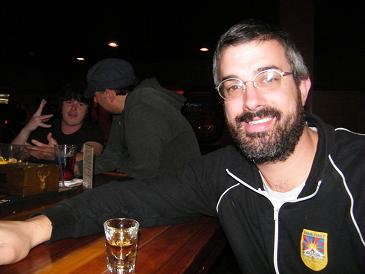
The Daly files

City Hall won’t be the same in the new year — and not just because Gavin Newsom will be off in Sacramento being lieutenant governor. Sup. Chris Daly, who has represented low-income constituents from the Tenderloin, SoMa, and adjoining District 6 neighborhoods for a decade and has long been framed as Newsom’s nemesis, has been termed out.
True to his spitfire reputation, Daly agreed to go out with a Jan. 5 roast. So we thought we’d do our part by recalling our favorite moments from a supervisor who served as the progressive conscience of the board — but not always politely.
“How can you have decorum when at the same time you are allowing children to go hungry and homeless?” he asked us recently. “The most gracious or grateful or proper thing should be to work for justice. To me, that’s good manners.”
Here are 10 things we will never forget about Daly. (And attend his roast: Wed/5, 8pm, $20. The Independent, 647 Divisadero, SF. Facebook info)
1. He shares a birthday with Fidel Castro.
Daly was born Aug. 13, 1972, characterized as the Day of Long Odds, according to Gary Goldschneider and Joost Elfers’ Secret Language of Birthdays. Cuban revolutionary Fidel Castro was also born on Aug. 13, in 1926. Further compounding suspicions that Daly is a pinko commie-lover: he met his wife Sarah Low at the World Youth Festival in Havana.
2. He painted with dark colors as a child.
“My mom tells the story about going to the teacher-parent conference when I was four or five and the teacher wasn’t exactly sure which kid I was,” Daly said. “Then she figured it out: I was the incredibly quiet, somewhat shy, well-behaved one. But she had one concern: when I finger-painted, I always picked really dark colors like black, brown, and dark green. So she called me over and asked why. I told her, “Those are the colors left when all the other kids take all the other colors.” Hmmm.
3. He got into fisticuffs with Mayor Willie Brown in 2001.
“Unbeknownst to Brown, Chris brought some homeless activists to a meeting that was supposed to be private,” recalled Sup. John Avalos, who was Daly’s legislative aide at the time. “Brown stood up and started going after Chris and somehow the story morphed into a fist-fight.” Daly claims the mayor started the confrontation.
“He got up and actually got out of his chair and came after me,” he said. “And I said, ‘You want some of this? You want some of this? Bring it on.’ “
4. He developed a whole new meaning for “acting mayor.”
In October 2003, Willie Brown went to Tibet and, as was his practice, allowed the supervisors to rotate into the “acting mayor” position, typically a ceremonial job. Daly promptly appointed two progressives to the Public Utilities Commission. “Brown interrupted his visit to announce that there had been a ‘coup d’état’ in San Francisco and that he had got to get on a plane to deal with it,” former Supervisor Jake McGoldrick told us.
5. He screamed at the cops during an arrest in a protest over a proposed parking garage at Hastings Law School in 2002.
Many versions of what really happened here. “I was screaming ‘Ouch!’ — I was in a pain compliance hold,” Daly said. “The cops said he was screaming at them about having them fired,” former Sup. Aaron Peskin recalled. “Chris said he was saying ‘Ow!’ and the police said he was saying, ‘Do you know who I am?” Avalos said.
Either way, the photo was used against him by downtown interests in the 2006 election.
6. At an MTA budget meeting in May 2005, Daly stepped out of his role as board member and into the persona of outraged member of public.
Avalos recalled how Daly left the front of the room, sat down with the audience, and was clapping and cheering as the public criticized the board’s Municipal Transportation Agency budget decision. “[Activist] Richard Marquez told me, ‘You got to do something to control that guy,’ ” Avalos recalled.
7. He once reportedly told the “motherfuckers at the Golden Gate Restaurant Association who refuse to pay their employees a living wage, fuck you!”
Actually, the reports on this were wrong: Daly’s wife said those words, at Daly’s 2006 reelection party, a victory that felt even sweeter because downtown spent $1 million trying to defeat him. “My wife is a bit embarrassed about that speech, but I loved it,” Daly said.
8. He claimed Newsom was “artfully dodging allegations of cocaine use” during a board hearing on Newsom’s proposed health care cuts in June 2007.
There was never any evidence that the mayor was a coke head. But Daly insisted that the rumors were there, and the mayor never denied them. “What ticked me off was that all the big cuts to public health that year were to stimulant treatment programs,” he said.
9. Peskin fired him as chairman of the powerful Budget Committee just before it finalized work on Newsom’s proposed $6.06 billion budget.
Peskin cited Daly’s bitter public conflict with Newsom over budget priorities. “Fundamentally the budget process is about public policy and not about personality,” Peskin stated at the time. “When I called him to say he was out, he said it was totally cool. But then for the next six months, he wouldn’t talk to me,” Peskin told us.
10. In January 2010, Daly told the board’s Rules Committee that he would use the word fuck in each of his remaining board meetings.
“That was really helpful to our cause,” Peskin recalled.
The caretaker hypocrites
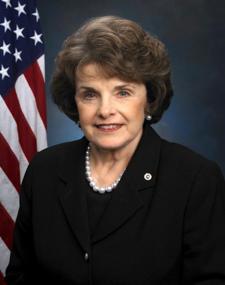
Isn’t it interesting that so many of the people who are demanding a “caretaker” mayor — someone who will accept the appointment but not run again — are politicians who were originally appointed to their jobs, and then ran again?
Dianne Feinstein: Appointed mayor by the supervisors. Ran again, even though she had said she wouldn’t.
Gavin Newsom: Appointed supervisor by Willie Brown. Ran for re-election then for mayor.
Sean Elsebernd: Appointed by Gavin Newsom. Ran for re-election.
Michela Alioto-Pier: Appointed by Gavin Newsom. Ran for re-election.
It is, DCCC Chair Aaron Peskin told me, “more than a bit ironic.”
I have to admit, there’s also something a bit un-democratic about the caretaker idea. What if the supervisors appoint a “caretaker” — and round about July or so, we all realize he or she is doing a great job. Why can’t we, the voters, decide to keep that person in office? And if the person the supes appoint is doing a crappy job, we can vote for somebody else.
I get that someone who isn’t spending the entire interim period running for re-election might have some advantages. But in the end, the “caretaker” is a bit like term limits. Shouldn’t the voters be the ones to decide that?
Homelessness: Newsom’s real legacy

OPINION His voice tinged with modest pride, Gavin Newsom recently announced that he has housed 12,000 people since becoming mayor. This is an absurdly high number, four times larger then any street count of homeless people since he has been in office, but it’s been accepted by the media and public.
Homelessness has been a key issue for Newsom. He first got elected in large part by taking it on, and has been celebrated in some quarters as a champion for homeless people.
But digging behind the veneer, removing bus tickets out of town, permanent housing his predecessor, Willie Brown, created, and temporary stays and duplication, there are 1,395 permanently affordable housing units that Newsom can truly take credit for. More frequently his administration has housed people (fewer then 2,000) by leasing residential hotel rooms from slumlords and charging homeless people unaffordable rents to live there.
Only 14 percent of the units have been for families, although they make up 40 percent of the homeless population.
Newsom put three different initiatives on the ballot that have spurred hatred against homeless people. His signature operation was mixing kindness with punishment. This way, he wooed conservatives who saw through the camouflage, and liberals who did not.
Care Not Cash was the first measure. That campaign focused on accusing homeless welfare recipients of spending all their money on booze and drugs. The proponents claimed they would take public assistance away, in return for housing and treatment. The treatment part never came to fruition, and of course proponents never mentioned they were counting shelter as housing.
Care Not Cash catapulted Newsom into the limelight. His self-deprecating charm conveyed the message: “The status quo simply isn’t working.” In the end, benefits were slashed and perpetual shelter vacancies were created while shelter-seekers were turned away. Food lines exploded.
Newsom could have used his power to raise the money to house people — without stealing it from other destitute people. He chose not to.
The next year Newsom ran for mayor and simultaneously put an anti aggressive panhandling initiative on the ballot. In classic Newsom strategy, the proposition loosely defined the term “aggressive” and bizarrely required, but did not fund, substance abuse treatment for perpetrators.
It was the meanest campaign in three decades. Several violent acts were wrongly attributed to homeless people. The Golden Gate Restaurant Association put out billboards claiming homeless people spread venereal disease. Once implemented, the initiative made no visible impact on the number of panhandlers in San Francisco.
Most recently, Newsom introduced Proposition L, an ordinance that could put people in jail for 30 days on a second offense just for sitting or lying on the sidewalk. It passed, and set the parameters for very nasty dialogue about poor people once again in San Francisco.
All three of these votes took place very strictly along class lines — affluent people supported them and poor people did not.
Homelessness is not a lifestyle choice; it’s a symptom of poverty. Yet Newsom’s legacy of hatred against homeless people has made it difficult to amass the public support needed to create true solutions. Overstating his accomplishments and spreading myths about homeless people sets us back. It gives San Franciscans the impression homeless people have the help they need but simply choose to remain out on the cold hard pavement.
In a city filled with thousands of destitute people, it is now illegal to sleep unsheltered. After Newsom’s plaster media façade crumbles, this will be his lasting legacy. *
Jennifer Freedenbach is executive director of the Coalition on Homelessness.
The mayoral roulette
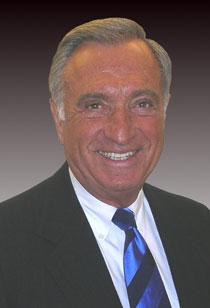
At the San Francisco Tomorrow holiday party Dec. 8th, David Chiu, Dennis Herrera, John Rizzo, Jake McGoldrick and a host of others who I’ve seen at these events for at least the past few years were doing their usual schmoozing — when Ross Mirkarimi, a former SFT board member, showed up with …. Art Agnos. I haven’t seen the former mayor at an SFT event since … I don’t know. Since a long long time ago.
Agnos made a short speech and talked about all of the rising stars in the San Francisco progressive movement — Mirkarimi, Chiu, Rizzo, David Campos, Eric Mar, John Avalos … and it was all very nice and low key. But there was a message in his appearance, in his connection with Mirkarimi, and even in the overall tone of his remarks, which amounts to this:
If the supervisors have trouble finding a progressive who can get six votes — and if they want an old hand, someone who has been through a brutal recession as mayor of San Francisco and dealt with awful budgets and nasty politics, someone who will serve for a year and then walk away — Agnos is open to being asked.
Well, maybe a little more than open to being asked. I wouldn’t say he’s actively, publicly campaiging for the job, but he has met with most of the supervisors, and dropped them all a 13-page memo listing all of his accomplishments, and his supporters (maybe his emissaries) are making the rounds and making the case for Agnos. Which amounts to this:
None of the progressives now more-or-less openly in the mix (Campos, Chiu, Mirkarimi, even Aaron Peskin) can realistically take on all the sacred cows (esp. police and fire), make a bunch of other cuts, and push for all sorts of revenue increases — and at the same time try to run for re-election in November (when the tax hikes would be on the ballot). The only way to do “what needs to be done” is to put in a progressive caretaker who can then take the political heat for the tough decisions — and help set up a campaign for another progressive in November.
I’m not sure I entirely agree — the right person, with the right leadership and agenda, could set up a five-year plan for fiscal stability, launch year one immediately and tell the public that he/she needs a full term to finish the job. But it’s true that it will be tough — and it’s also true that none of the obvious alternatives have ever run citywide.
If Tom Ammiano were interested, we wouldn’t be having this discussion. Tom has run citywide numerous times (for School Board, pre-district elections supervisor and mayor), has been elected by half the city (to the Assembly), and has the credibility to deal with the budget crisis and still win in November. But he’s not, and we have to respect that.
Right now, the progressives can’t seem to unite on a candidate. None of the current board members has six votes today. And Campos, Chiu, Mirkarimi and everyone else in the game knows full well how hard it will be to win in November, particularly against State Sen. Leland Yee, who will be a formidable candidate, and possibly City Attorney Dennis Herrera (who has won citywide), State Sen. Mark Leno (who is popular all over town) and others.
So if a couple rounds pass and there’s no winner, the “progressive caretaker” concept will be in play. It’s possible Mirkarimi would give up his seat two years early and take that job; it’s likely Peskin would agree to serve one year and then step down. But it’s also possible that neither scenario works out — at which point Sheriff Mike Hennessey and Agnos will be in play.
(I hear through the grapevine that Willie Brown is nosing around, too — and let’s remember that he became Assembly speaker by cutting a deal with the Republicans.)
Hennessey’s got a strong progressive record, but has never had to deal with anything remotely as awful as what the next mayor will face. So Agnos backers will make the case that their guy has the experience and gravitas to pull it off.
Given all of that, let me say a couple of things about Agnos, since I was around and watching City Hall when he was mayor (and some of the people who will be voting on this weren’t.)
Art’s a mixture. He was a great progressive member of the state Assembly. When he ran for mayor, we backed him strongly; he seemed to be the great progressive hope. Then his long list of wonderful promises ran into the buzz saw of a deep recession — and made things much worse with his arrogant, imperious style. His first major act in office was to sign a set of contracts that gave away the store to PG&E. He never lifted a finger for public power. And it quickly became clear that he wasn’t a fan of open government or public process. We were all supposed to “Trust in Art” and shut up if we didn’t like it.
That’s why — despite what was at the time and is in retrospect a pretty darn progressive record, a lot of solid accomplishments and absolutly no hint of corruption or scandal — the progressives just weren’t all that excited about his re-election. So he lost to Frank Jordan, who was way worse.
The thing is, Agnos these days is a lot more mellow. He’s 72, knows he’s not going anywhere else in politics, and has essentially admitted to me that he made a lot of mistakes, and his arrogance and closed-door attitude were top on the list. A reformed Agnos — willing to serve with a degree of humility and an acceptance that progressive politics in this town demands inclusiveness, and that even though he’s a former mayor, he’s not by definition the most important person in any room he walks into — would present an interesting option.
Of course, we still don’t know exactly where he would be on the issues, since, like Chiu, he hasn’t even publicly called himself a candidate for the job. I still think anyone who is a serious contender ought to be willing to appear before the supervisors and answer questions.
We all know where to start: What’s your plan for raising a quarter billion dollars in new revenue in 2011?
Class of 2010: Malia Cohen

sarah@sfbg.com
It took two weeks and 19 updates of San Francisco’s ranked-choice voting system before Malia Cohen, a former Mayor Gavin Newsom staffer and partner in a firm that helps businesses and nonprofits create public policy, was declared the winner of the hotly contested race to represent District 10, which includes Bayview, Hunters Point and Ingleside. The nail-biting time lag was a byproduct of complex calculations that involved 22 candidates, no clear front-runners, and a slew of absentee and provisional ballots.
But when the RCV dust settled, the results proved that the D10 vote continues to break down along class, race, and gender lines. These RCV patterns personally benefited Cohen’s success in picking up second- and third-place votes.
But they also helped D10’s African American community, now smaller than its growing Asian community but still larger that the black community in any other distinct in the city, send an African American supervisor back to City Hall. And it avoided a run-off between Lynette Sweet and Tony Kelly, who won most first-place votes.
Some chalk up Cohen’s victory to her polished appearance, the middle-of-the road positions she took on the campaign trail, and an impressive list of endorsements that include the San Francisco Democratic Party, the Labor Council, the Building and Construction Trades Council, state Sen. Leland Yee (D-SF), Assembly Speaker Pro Tempore Fiona Ma (D-SF), Board of Supervisors President David Chiu, SF Democratic Party Chair Aaron Peskin, and BART Board President James Fang.
But Cohen told us she thinks coalition building was the key. “Endorsements only account for a quarter of the reasons why you win,” she said. “It’s all about building an organization, a net that goes deep and wide.”
Some progressives were alarmed by a Dec. 1 fundraiser to help settle Cohen’s campaign debt whose guest list included Newsom, former Mayor Willie Brown, Sup. Sean Elsbernd, Ma, Building Owners and Managers Association director Ken Cleaveland, Kevin Westlye of the Golden Gate Restaurant Association, and Janan New of San Francisco Apartment Association.
Cohen dismissed concerns over this conservative showing of après-campaign support. “Fear not,” she said. “It is a fundraiser event. And now that I’m a newly elected supervisor, I look forward to meeting everyone. And I will do a great job representing everyone.
So what should we expect from Cohen, who ran as a fourth-generation “daughter of the district from a labor family” on a platform of health, safety, and employment — and will soon represent the diverse southeast sector, which has the highest unemployment, crime, recidivism, foreclosure and African American out-migration rates citywide and is ground zero for Lennar Corp.’s plan to build thousands of condos at Candlestick and the shipyard?
“I’m a bridge-builder,” said Cohen, who attributes her surprisingly tough but open-minded edge to being the oldest of five sisters.
So far, she’s not going out on a progressive limb. She told us she favors a caretaker mayor: “I’d like someone to maintain the business of the city, someone who has zero political ambition,” she said. “That way it creates an even playing field for the mayoral race.”
Cohen says she is determined to address quality of life concerns, including filling potholes, re-striping crosswalks and introducing traffic calming measures, and taking on critical criminal justice issues, including City Attorney Dennis Herrera’s gang injunction in the Sunnydale public housing project in Visitacion Valley. She opposes Herrera’s strategy but notes: “If not gang injunctions, then what? I can’t dispute that they get short-term results, but what about the long-term impacts? We need long-term solutions.”
Cohen supports Sup. John Avalos’ efforts to pass mandatory local hire legislation but is open to “creative solutions” to help get it over the finishing line. “People who live here should be working here,” Cohen said. “But is 50 percent the magic mandatory hire number? I don’t know.”
Cohen, who just survived a foreclosure attempt, has promised to be a “fierce advocate” for constituents facing similar challenges, including those who met predatory loan brokers at church.
But asked how she would cut spending or raise revenue to address the city’s massive budget deficit, she had no specific answer.
Yet Cohen disagrees with detractors who say she lacks experience. “I may look cute, but don’t be misled. I have a public policy background and fire in my belly. I’m a union candidate, I’m smart, I’m talented, and above all, I love the people in D10 and the rest of San Francisco. I want everyone to prosper and receive benefits. So give me a shot.”
The class of 2010
In about a month, the first class of district-elected supervisors since the 1970s will be gone, termed out, done with the transformative politics they brought to San Francisco. It’s a milestone worth marking: in 2000, when the city returned to district elections, everything changed. Machine-driven politics, controlled by money and mayoral power, vanished almost overnight. Constituencies that were virtually shut out of the corridors of power — tenants, labor, environmentalists, economic progressives, public power activists, the list goes on — suddenly had a seat at the table. Neighborhood issues started to matter. And downtown power brokers were no longer the only game in town.
But term limits mean that none of the members of the class of 2000 can remain in office beyond Jan. 8, 2011; and along with the new members elected two years ago, the class of 2010 will feature four new faces. It’s a diverse group. Two (Malia Cohen and Mark Farrell) have never before run for, much less held, elective office. One (Jane Kim) is Asian, one (Cohen) is African American, one (Scott Wiener) is gay. Farrell, who will replace Michela Alioto-Pier in District 2, is the only straight white guy. (Carmen Chu was reelected from District 4).
Overall, it’s safe to say, the ideological balance of the board hasn’t changed much — but the political approaches will be very different. In 2000, the election was all about then-Mayor Willie Brown, about fighting (or appeasing) the Brown Machine. This group of candidates didn’t run against anything in particular — and with the balkanized nature of local politics, they all have divergent bases of support.
So we sat down with the Class of 2010 and asked them to tell us what they plan to do with the next four years. Two trends emerged: all of the new supervisors want to be seen as independent of any political operation. And most have no clear agenda whatsoever for addressing the biggest problem facing the city — a looming budget deficit that will define almost everything they do in their first year.
At a moment of major fiscal crisis and political change, these four people will on center stage — and what they do could determine both the direction of the city and the hopes of the progressive movement. Click below for our exclusive interviews and profiles:
‘
Newsom and downtown groups court Cohen
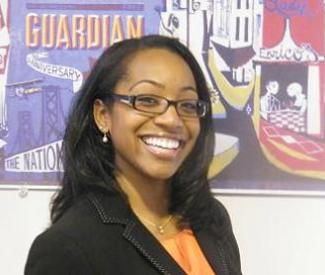
A rogue’s gallery of downtown power brokers and moderate politicians is lining up to give D10 supervisor-elect Malia Cohen money during a fundraiser at Democratic Party money man Wade Randlett’s house tonight (Wed/1). And while the group may be trying to buy the support of a candidate they didn’t support in the election, Cohen and some of her progressive supporters say she’s been open to developing relationships across the ideological spectrum.
“Fear not,” Cohen told us when we raised an eyebrow at the host committee, and she noted that most of those on the list didn’t endorse her candidacy. “It is a fundraiser event, and now that I’m a newly elected supervisor, I look forward to meeting everyone.”
The guest list includes Mayor Gavin Newsom, former Mayor Willie Brown, Sup. Sean Elsbernd, Assembly member Fiona Ma, Building Owners and Managers Association director Ken Cleaveland, lobbyist Sam Lauter, Brook Turner with Coalition for Better Housing, Kevin Westlye of Golden Gate Restaurant Association, Janan New of San Francisco Apartment Association, as well as building trades head Michael Theriault and Tim Paulson of the San Francisco Labor Council.
“That’s not my perception of it,” Randlett – who used to run the downtown political organization SFSOS – told us when we asked about downtown’s attempt to buy influence with a candidate who finished the campaign about $20,000 in debt. He also rejected the characterization that it was a high-roller event, noting that prices initially listed at $100-$500 have since been lowered to $50. “Anyone who wants to attend at any price is welcome,” he said.
“I think it’s smart of their part, because they didn’t support her in the election, to try to give her money in the end,” said Gabriel Haaland of SEIU Local 1021, which did endorse Cohen. “It remains to be seen where she’s going to land [politically], but it seems clear what this group is attempting to do, to influence her votes.”
Cohen also received endorsements from the San Francisco Democratic County Central Committee, its Chair Aaron Peskin, and Board of Supervisors President David Chiu, who says he isn’t concerned about the Randlett fundraiser. “I understand that she has been celebrating with people from across the ideological spectrum,” Chiu said.
Indeed, Cohen said she is anxious to get to know representatives of San Francisco constituencies across the spectrum, borrowing a line from Shirley Chisholm, the first African-American women elected to Congress, in calling herself “unbought and unbossed.” Cohen said, “I will do a great job representing everyone. I will protect the interests of District 10 residents.”
Randlett, who flamed out with SFSOS before reviving his standing as a top-tier Democratic Party fundraiser by being an early backer of Barack Obama’s presidential bid, told us that was a connection he shares with Cohen. “The only reason I supported Malia from the beginning and am hosting the event for her is that like me she was there for Barack from Springfield through election night, never wavered in her support for him, and continues to stick by him now, when fair weather friends are carping from the sidelines,” Randlett told us.
Paulson told us that Cohen asked him to co-host a fundraiser with Newsom – who Cohen once worked for although he didn’t support her in this election – and that he didn’t see the complete roster until a couple days ago. “I am surprised there was this list,” Paulson said of the groups that regularly oppose progressive candidates and legislation.
But Haaland said that labor and the left will also be reaching out to Cohen, whose lack of a strong ideological grounding and representation of a district slated for the city’s most ambitious redevelopment plans will make her a pivotal vote on the new board. “We have to do our best to reach out to her as well,” Haaland said.
Boring through

news@sfbg.com
Despite an official groundbreaking ceremony last February, the Central Subway — an underground Muni connection to Chinatown — still doesn’t have its full $1.5 billion in funding lined up yet, and now the project is facing renewed criticism that the high cost isn’t worth the benefits.
The project was a promise by former Mayor Willie Brown to Chinatown leaders who were upset that the Embarcadero Freeway was torn down after the 1989 Loma Prieta earthquake and never rebuilt, leaving that densely populated part of town difficult to access. But not everyone in Chinatown wants the project.
Wilma Pang, founder and co-chair of A Better Chinatown Tomorrow (ABCT) stands firmly against it, while the Rev. Norman Fong, deputy director of programs for the Chinatown Community Development Center, takes a solid stand for building the project, as does Board of Supervisors President David Chiu, who represents the district.
Fong explains that the majority of Chinatown has united to make sure the subway comes through, and that he himself has never seen the community in Chinatown more set on something. “This is an environmental justice movement,” Fong said. “For me, this was the first time Chinatown had ever fought [for such a major infrastructure project].”
City staff is also focused on moving the project forward. “This project has been supported by our state, local, and federal officials,” Brajah Norris, external affairs manager for the Central Subway Project, told the Guardian.
But the group SaveMuni — formed last year by progressives, transit engineers, transit advocates, and other activists “working to reverse Muni’s death spiral” — recently called for the Central Subway to be shelved and its resources put to more efficient projects. “Now that the analysis has been done, it’s time to rethink the situation,” SaveMuni says in a white paper on the Central Subway.
The group argues that using the subway will take longer than other transit options, threatens many businesses on Stockton Street, and doesn’t even connect effectively with the Muni system. Even worse, they point out that Muni would have to spend an additional $4 million a year in local operating expenditures beyond the existing bus service, an expenditure that seems unnecessary to the organization members.
Although creating a subway for the crowded community seemed like a good idea initially, people like Tom Radulovich soon began to realize that a 1.7 mile subway stretch buried 20 feet underground is not the same as the plan he hoped for when considering an economically efficient transportation system for the people in Chinatown.
“People deserve a whole range of alternatives,” said Radulovich, executive director of Livable City and an elected member of the BART Board of Directors. “You have to be mindful of when the [current] project is not the same project you voted for.”
For those at SaveMuni, the project long ago strayed from its original goal. Although they agree that Chinatown community members deserve their own form of reliable transportation, they believe this is not the right way to be spending federal, state, and local money.
“It’s an important corridor, so funding should go there,” Radulovich said. But he thinks the same money could be better used other ways, such as for a dedicated Bus Rapid Transit (BRT) lane.
Jerry Cauthen, a retired SFMTA transportation engineer who cofounded San Francisco Tomorrow and SaveMuni, explained that he initially liked the concept of a subway but then became “bitterly disappointed” as the project progressed.
The subway line has three stops mapped out: one at Moscone Center, one at Union Square/Market Street, and one in Chinatown. From the Chinatown station, the tunnel will continue under Washington Square and remain there for future extensions to the subway, which is projected to begin service in 2018.
“There’s no reason to wait 10 years for a subway,” Cauthen said. “Because it is not going to do what it says it will do.”
Cauthen explained that the route for the Central Subway misses the most important lines anyway, which would be “serving Chinatown poorly.” Cauthen was not alone in his concern that the three-stop subway system will prove to be more of a hassle than a convenience.
But in a committee meeting held Nov. 16 at City Hall, the San Francisco County Transportation Authority (which oversees capital expenditures, while the SFMTA runs Muni) addressed the issue that the city in fact does not have all the money it needs to complete this project. While federal officials have already handed over $72 million out of $948 million, getting the rest of that federal money requires the city and its affected agencies to come up with local matching funds of between $137 million to $225 million.
Malcolm Yeung, public policy manager for the Chinatown Community Development Center, explained that based on the recent hearing, the SFMTA needs to find a viable source for the remaining $137 million. It has until February to inform the Federal Transportation Administration how it will obtain the rest of this money. The SFCTA meeting was an attempt to request an allocation of about $22 million in Proposition K (sales tax) funds.
Now that the city is having trouble meeting its fiscal goal by February 2011, the new question is, if city officials don’t come up with the money, will San Francisco lose the project and its funding?
“I don’t think it means that we lose the whole project,” Yeung said, but there could be delays. And every time there is a delay, there is also an associated cost to be paid.
According to SFMTA, the project received $948.2 million in federal money, $375 million from the state, and $255.1 million in local contributions. Norris explained that since the federal money was given for this specific New Starts program, then it can only be used for this project. And if the project comes to a halt, the money will go somewhere else. “People don’t realize that $948 million is part of the New Starts program,” Norris said. “If we don’t get it, we actually lose it.”
Fong, Chiu, and other supporters of the project rallied in its support outside City Hall on Nov. 15. As Fong told us, “[People against the project] don’t appreciate the hard work, that it takes a decade to get the federal funds … It cannot be simply shifted or “redirected” as some have said.”
For Fong, ending this project would be “disregarding two decades of hard work.” Although the ideas to improve Muni seem fair to Fong, moving forward with the subway is the only option for him right now.
*This article has been corrected from an original version.
The mayoral selection last time
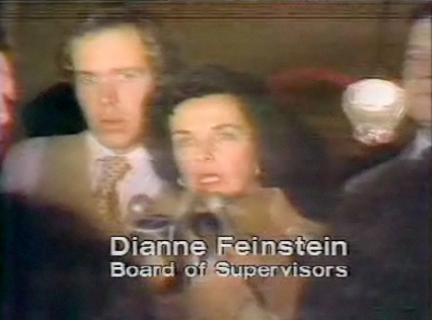
The last time the Board of Supervisors had to pick a mayor, things were very different. Former Sup. Dan White had just murdered Mayor George Moscone and Sup. Harvey Milk. The city was in shock. Board President Dianne Feinstein became acting mayor, and one week later, on Dec. 4, six of her colleagues — the narrowest possible margin — elected her to fill out Moscone’s term.
It’s worth looking back at what happened that week, not only because it’s a fascinating bit of political history, but because it gives some insights into how the current process should and shouldn’t go.
We’ve gone back and pulled not only the minutes of that meeting, but all of the relevant articles and editorials from the San Francisco Chronicle, the old San Francisco Examiner and the Bay Guardian, and while newspaper accounts are only the first, and often imperfect draft of history, the Chron had a good City Hall reporter, Jerry Burns, and you can get a lot from the day-by-day accounts.
For starters, everyone (even the Guardian) agreed that Feinstein did a good, almost uncanny job of keeping it together and managing the city in the week after the horrendous murders. But she was by no means the only, or consensus candidate for the job — Sup. Robert Gonzales announced his candidacy Dec. 1, and others were in the running until the end. The Guardian wrote at the time that Feinstein was fine as acting mayor – but shouldn’t be in office for the final 13 months of Moscone’s term.
Among the interesting elements of the drama:
— The process was riddled with Brown Act violations, and the selection of Feinstein was, in retrospect, almost certainly based on illegal meetings. “Feinstein spent yesterday at her Pacific Heights home,where she talked with most of the supervisors,” a Dec. 4, 1978 Chronicle article by Burns noted. That would amount to an illegal meeting; under state law, then and now, meeting individually and serially in private with all or most of the members of a public board is a clear violation of the Brown Act.
At the time, however, nobody challenged Feinstein’s actions.
— Then, as now, there was a move to name a “caretaker” mayor who would fill out the remaining 13 months of Moscone’s term — and vow not to run again. But the conservative Examiner said that was a bad idea: In a Dec. 3 editorial, the paper, then owned by Hearst Corp., noted: “The City should not have to accept a “caretaker” mayor invested with only a thin veneer of authority.” The notion went nowhere.
— At least one name that was bandied around back then is in play again today: Then-Assembly Member Willie Brown.
— Feinstein got exactly six votes. Although in most casual historical accounts, she’s described as a clear, almost unanimous choice, that was far from true. In fact, Sup. Ron Gonzalez, who described himself as the board member most in synch with Moscone’s agenda, announced his candidacy Dec. 1, and as of Dec. 3, the day before the final vote, Russ Cone of the Examiner reported that “earnest and secretive negotiations among San Francisco’s nine supervisors to agree upon a mayor to replace the slain George Moscone today entered the final, feverish hours with no candidate ready to claim victory.”
At the Dec. 4th board meeting, Sup. Quentin Kopp moved to continue the decision for a week. Kopp – unlike most of his colleagues – had been avoiding the political furor in the days after the assassinations, saying it was unseemly to be making deals when city leaders ought to be in mourning. Feinstein and the six others who would ultimately elect her voted against the motion.
That would be a clear violation of law today; as a candidate, Feinstein would be unable to vote on anything that could promote her ascension to mayor. But no matter: The motion needed six votes, and only Kopp and Sup. Lee Dolson said Aye.
When the motion was made to name Feinstein as interim mayor, Kopp tried to ask her a few questions – particularly about her plans for various department heads. The city attorney quickly shut him down, saying Feinstein couldn’t legally answer or get involved in any debate.
Then six supervisors voted for Feinstein. Kopp and Dolson dissented. Feinstein by law had to abstain. And there were, of course, two empty seats; Dan White had just resigned and was in jail, and Harvey Milk was dead.
Why did Kopp vote no? There’s a back story, a key part of San Francisco political lore.
Feinstein had run for mayor twice before, in 1971 and 1975, both times finishing well out of the money. After her second defeat, she vowed she’d never do it again. In fact, the day before the assassinations, she had just returned from a trip to Nepal with her then-boyfriend (now husband) Richard Blum, and reporters asked her if she was going to run in 1979. “Not this time,” she said.
She and Kopp, longtime rivals, had cut a deal the year before. Feinstein wanted to be board president; Kopp wanted to be mayor. And Feinstein vowed that if Kopp would support her for board president, she’d stay out of the mayor’s race in 1979 and leave the field open for him.
And of course, immediately after the killings, she changed her mind. Kopp thought what was a bit slimly, and refused to vote for her for mayor. He challenged her in 1979, and narrowly lost, and her political career, so recently in the doldrums, was off and running again.
The next mayor
tredmond@sfbg.com
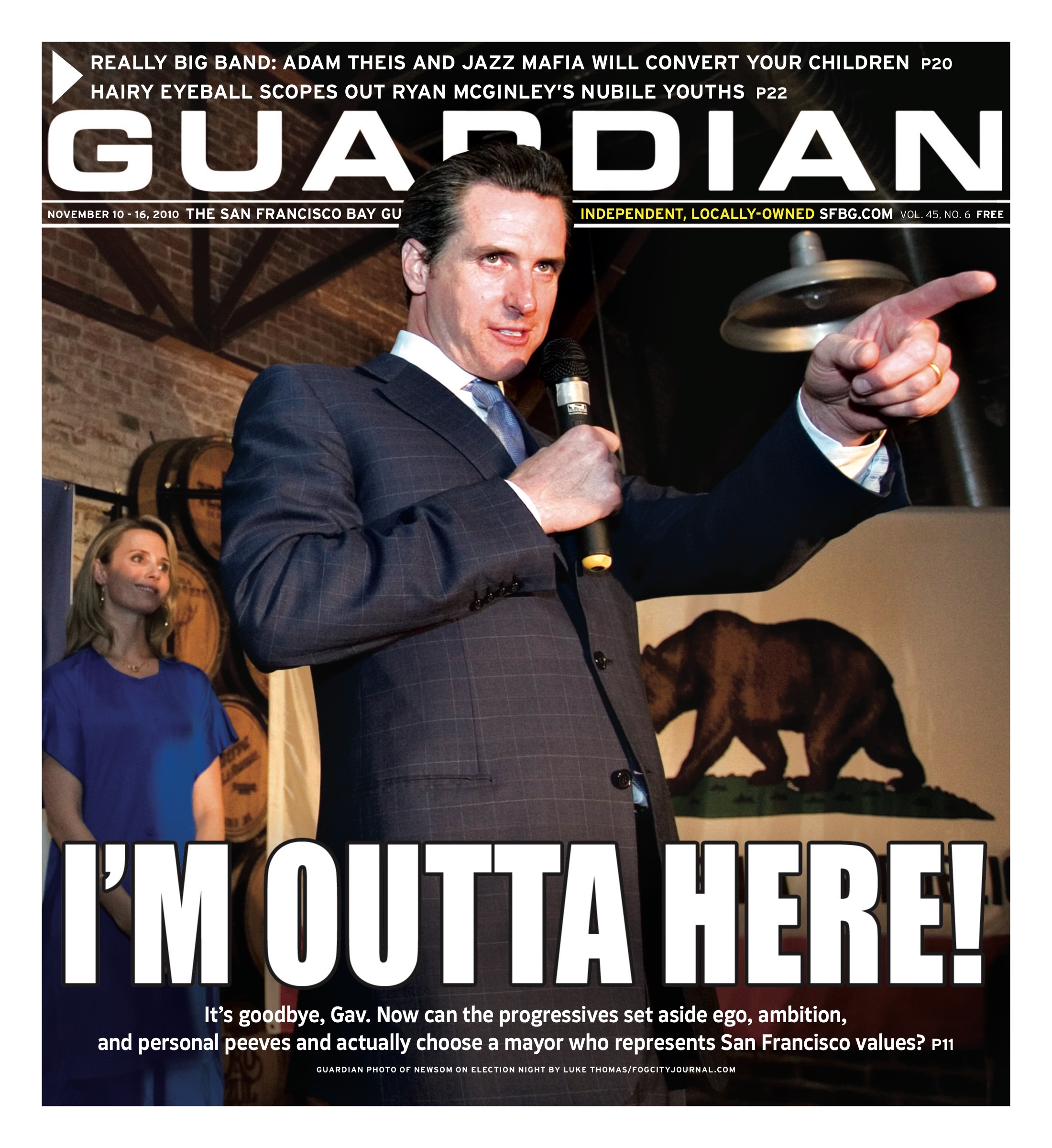
By the time a beaming Mayor Gavin Newsom took the stage at Tres Agaves, the chic SoMa restaurant, on election night, enough results were in to leave no doubt: the top two places on the California ballot would go to the Democrats. Jerry Brown would defeat Meg Whitman in the most expensive gubernatorial race in American history — and Newsom, who once challenged Brown in the primary and dismissed the office of lieutenant governor, would be Brown’s No. 2.
It might not be a powerful job, but Newsom wasn’t taking it lightly anymore. “We can’t afford to continue to play in the margins,” he proclaimed proudly, advancing a vague but ambitious agenda. “There is absolutely nothing wrong with California that can’t be fixed with what’s right with California.”
But around the city, as results trickled in for the local races, the talk wasn’t about Newsom’s role in the Brown administration, or the change the Democrats might bring to Sacramento. It was about the profound change that could take place in his hometown as he vacates the office of mayor a year early — and opens the door for the progressives who control the Board of Supervisors to appoint a chief executive who agrees with, and is willing to work with, the majority of the district-elected board.
At a time when the Republican takeover of Congress threatens to create gridlock in Washington, there’s a real chance that San Francisco’s government — often paralyzed by friction between Newsom and the board — could take on an entirely new direction. It’s possible that the progressives, long denied the top spot at City Hall, could put a mayor in office who shares their agenda.
This could be a turning point in San Francisco, a chance to put the interests of the neighborhoods, the working class, small businesses, the environmental movement, and economic justice ahead of the demands of downtown and the rich. All the pieces are in place — except one.
To make a progressive vision happen, the fractious (and in some cases, overly ambitious) elected leaders of the progressive movement will have to recognize, just for a little while, that it’s not about any individual. It’s not about David Chiu, or Ross Mirkarimi, or Chris Daly, or John Avalos, or Eric Mar, or David Campos, or Jane Kim, or Aaron Peskin. It’s not about any one person’s career or personal power.
It’s about a progressive movement and the issues and causes that movement represents. And if the folks with the egos and personal gripes and career designs can’t set them aside and do what’s best for the movement as a whole, then the opportunity of a generation will be wasted.
Folks: this is a hard thing for politicians to recognize. But right now it’s not about you. It’s about all of us.
It’s an odd time in San Francisco, fraught with political hazards. And it’s so confusing that no one — not the elected officials, not the pundits, not the lobbyists, not the insiders — has any clear idea who will occupy Room 200 in January.
Here’s the basic scenario, as described by past opinions of the city attorney’s office:
Under the state Constitution, Newsom will take office as lieutenant governor Jan. 3, 2011. The City Charter provides that a vacancy in the Mayor’s Office is filled by the president of the Board of Supervisors until the board can choose someone to fill the job until the end of the term — in this case, for 11 more months.
So if all goes according to the rules (and Newsom doesn’t try to play some legal game and delay his swearing-in), David Chiu will become acting mayor on Jan.3. He’ll also retain his job as board president.
On Jan. 4, the current members of the Board of Supervisors will hold a regularly scheduled Tuesday meeting — and the election of a new mayor will be on the agenda. If six of the current supervisors can agree on a name (and sitting supervisors can’t vote for themselves) then that person will immediately take office and finish Newsom’s term.
If nobody gets six votes — that is, if the board is gridlocked — Chiu remains in both offices until the next regular meeting of the board — a week later, when the newly elected supervisors are sworn in.
The new board will then elect a board president — who will also instantly become acting mayor — and then go about trying to find someone who can get six votes to take the top job. If that doesn’t work — that is, if the new board is also gridlocked — then the new board president remains acting mayor until January 2012.
There are at least three basic approaches being bandied about. Some people, including Newsom and some of the more conservative members of the board, want to see a “caretaker” mayor, someone with no personal ambition for the job, fill out Newsom’s term, allowing the voters to choose the next mayor in November, 2011. That has problems. As Campos told us, “The city has serious budget and policy issues and it’s unlikely a caretaker could handle them effectively.” In other words, a short-termer will have no real power and will just punt hard decisions for another year.
Then there’s the concept of putting in a sacrificial progressive — someone who will push through the tax increases and service cuts necessary to close a $400 million budget gap, approve a series of bills that stalled under Newsom, take the hits from the San Francisco Chronicle, and step out of the way to let someone else run in November.
The downside of that approach? It’s almost impossible for a true progressive to raise the money needed to beat a downtown candidate in a citywide mayor’s race. And it seems foolish to give up the opportunity to someone in the mayor’s office who can run for reelection as an incumbent.
Which is, of course, the third — and most intriguing — scenario.
The press, the pundits, and the mayor have for the past few months been pushing former Sup. Peskin as the foil, trying to spin the situation to suggest that the current chair of the local Democratic Party is angling for a job he wouldn’t win in a normal election. But right now, Peskin is no more a front-runner than anyone else. And although he’s made no secret in the past of wanting the job, he’s been talking of late more about the need for a progressive than about his own ambitions.
“If the board chose [state Assemblymember] Tom Ammiano, I would be thrilled to play a role, however small, in that administration,” Peskin told us.
In fact, Peskin said, the supervisors need to stop thinking about personalities and start looking at the larger picture. “If we as a movement can’t pull this off, then shame on us.”
Or as Sup. Campos put it: “We have to come together here and do what’s right for the progressive movement.”
Two years ago, the San Francisco left was — to the extent that it’s possible — a united electoral movement. In June, an undisputed left slate won a majority on the Democratic County Central Committee. In November 2008, Districts 1, 3, 5, and 11 saw consensus left candidates running against downtown-backed opponents — and won. In D9, three progressives ran a remarkably civil campaign with little or no intramural attacks.
The results were impressive. As labor activist Gabriel Haaland put it, “we ran the table.”
But that unity fell apart quickly, as a faction led by Daly sought to ensure that Sup. Ross Mirkarimi couldn’t get elected board president. Instead that job went to Chiu — the least experienced of the supervisors elected in that class, and a politician who is, by his own account, the most centrist member of the liberal majority.
This fall, the campaign to replace Daly in D6 turned nasty as both Debra Walker and Jane Kim openly attacked each other. Walker sent out anti-Kim mailers, and Kim’s supporters charged that Walker was part of a political machine — a damaging (if silly) allegation that created a completely unnecessary rift on the left.
And let’s face it: those fights were all about personality and ego, not issues or progressive strategy. Mirkarimi and Daly have never had any substantive policy disagreements, and neither did Walker and Kim.
In the wake of that, progressives need to come together if they want to take advantage of the opportunity to change the direction of the city. It’s not going to be easy.
“We’re good at losing,” Daly said. “I’m afraid we’re doing everything we can to blow it.”
The cold political calculus is that none of the current board members can count on six votes, and neither can Peskin or any of the other commonly mentioned candidates. The only person who would almost certainly get six votes today is Ammiano — and so far, he’s not interested.
“I know you never say never in politics, but I’m happy here in Sacramento. Eighty-six percent of the voters sent me back for another term, and I think that says something,” he told us.
It’s hardly surprising that someone like Ammiano, who has a secure job he likes and soaring approval ratings, would demur on taking on what by any account will be a short-term nightmare. The city is still effectively broke, and next year’s budget shortfall is projected at roughly $400 million. There’s no easy way to raise revenue, and after four years of brutal cuts, there’s not much left to pare. The next mayor will be delivering bad news to the voters, making unpleasant and unpopular decisions, infuriating powerful interest groups of one sort or another — and then, should he or she want the job any longer, asking for a vote of confidence in November.
Yet he power of incumbency in San Francisco is significant. The past two mayors, Newsom and Willie Brown, were reelected easily, despite some serious problems. And an incumbent has the ability to raise money that most progressives won’t have on their own.
Chiu thus far is being cautious. He told us his main concern right now is ensuring that the process for choosing the next mayor is open, honest, and legally sound. He won’t even say if he’s officially interested in the job (although board observers say he’s already making the rounds and counting potential votes).
And no matter what happens, he will be acting mayor for at least a day, which gives him an advantage over anyone else in the contest.
But some of the board progressives are unhappy about how Chiu negotiated the last two budget deals with Newsom and don’t see him as a strong leader on the left.
Ross Mirkarimi is the longest-serving progressive (other than Daly, who isn’t remotely a candidate), and he’s made no secret of his political ambitions. Then there’s Campos, an effective and even-tempered supervisor who has friendly relationships with the board’s left flank and with centrists like Bevan Dufty. But even if Dufty (who I suspect would love to be part of electing the first openly gay mayor of San Francisco) does support Campos, he’d still need every other progressive supervisor. Campos also would need Chiu’s vote to go over the top. Which means Chiu — who needs progressive support for whatever his political future holds — would have to set aside his own designs on the job to put a progressive in office.
In other words, some people who want to be mayor are going to have to give that up and support the strongest progressive. “If there’s someone other than me who can get six votes, then I’m going to support that person,” Campos noted.
Then there are the outsiders. City Attorney Dennis Herrera has already announced he plans to run in the fall. If the board’s looking for a respected candidate who can appeal to moderates as well as progressives, his name will come up. So will state Sen. Mark Leno, who has the political gravitas and experience and would be formidable in a re-election campaign in November. Leno doesn’t always side with the left on local races; he supported Supervisor-elect Scott Wiener, and losing D6 candidate Theresa Sparks. But he has always sought to remain on good terms with progressives.
All that assumes that the current board will make the choice — and even that is a matter of strategic and political dispute. If the lame duck supervisors choose a mayor — particularly a strong progressive — you can count on the San Francisco Chronicle, Newsom, and the downtown establishment to call it a “power grab” and cast doubt on the legitimacy of the winner.
“But choosing a mayor is the legal responsibility of this board and they ought to do their jobs,” Peskin said.
The exact makeup of the next board was still unclear at press time. Jane Kim is the likely winner in D6 and has always been a progressive on the School Board. She’s also close to Chiu, who strongly supported her. If Malia Cohen or Lynette Sweet wins D10, it’s unlikely either of them will vote for a progressive mayor.
Newsom also might try to screw things up with a last-minute power play. He could, for example, simply refuse to take the oath of office as lieutenant governor until after the new board is seated.
Chiu’s allies say it makes sense for the progressives to choose a mayor who’s not identified so closely with the left wing of the board, who can appeal to the more moderate voters. That’s a powerful argument, and Herrera and Leno can also make the case. The progressive agenda — and the city — would be far better off with a more moderate mayor who is willing to work with the board than it has been with the arrogant, recalcitrant, and distant Newsom. And if the progressives got 75 percent of what they wanted from the mayor (as opposed to about 10 percent under Newsom), that would be cause to celebrate.
But to accept that as a political approach requires a gigantic assumption. It requires San Franciscans to give up on the idea that this is still, at heart, a progressive city, that the majority of the people who live here still believe in economic and social justice. It means giving up the dream that San Francisco can be a very different place, a city that’s not afraid to defy national trends and conventional wisdom, a place where socioeconomic diversity is a primary goal and the residents are more important than the big companies that try to make money off them. It means accepting that even here, in San Francisco, politics have to be driven by an ever-more conservative “center.”
It may be that a progressive can’t line up six votes, that a more moderate candidate winds up in the Mayor’s Office. But a lot of us aren’t ready yet to give up hope.
Additional reporting by Noah Arroyo.
How not to choose a mayor
EDITORIAL There are plenty of good arguments among progressives about who would be the best person to replace Gavin Newsom as mayor and how the Board of Supervisors should make that decision. It’s a complicated situation: The next mayor will face a horrible budget deficit, all sorts of tough decisions — and then face the voters in 10 months. And if the board appoints a progressive, that person will face a hostile daily newspaper and several well-funded opponents in the fall.
But we know there are some very bad scenarios, some things the board and the potential mayor contenders shouldn’t do — because in the end, the process needs to be free of any sort of backroom taint.
Here are some basic ground rules for the next two months.
Newsom shouldn’t try to mess around with the selection of his successor. The mayor decided to run for state office with the full knowledge that he would leave behind a vacancy that the supervisors would fill. He has no business playing political and legal games to skew the results. For example, some say Newsom is considering delaying his swearing in, now set for Jan 3, 2011, for a week to prevent the current supervisors from voting on an interim mayor. That would be a bad faith, manipulative move. He made his choice; now he needs to get out of the way and let the City Charter process work.
The current board should have a fair shot at electing Newsom’s replacement. The day after Newsom takes office as lieutenant governor, the current board will meet for one last time — and by law, they should and will have a chance to find a candidate who can get six votes to serve out Newsom’s term. Any parliamentary moves that serve only to delay the vote and push the decision to the new board would be inappropriate.
The idea of a “caretaker” mayor is fraught with problems — and Willie Brown shouldn’t even be on the list. Newsom is pushing the idea of a true interim mayor, someone who won’t run for the job in November and will simply keep the lights on for 11 months. That means ignoring the city’s serious structural problems. A caretaker would have no authority and little ability change things. And the notion that’s being floated around of former mayor Willie Brown stepping in is disgraceful. Brown was a terrible mayor, and a rerun of that nightmare — even of only 11 months — is the last thing San Francisco needs.
Kamala Harris shouldn’t be a player in this game. If Harris, the current district attorney, is elected state attorney general, her job will be open too — and it’s easy to see how Newsom could use that as a plum to get his way. If Harris resigns before Newsom is sworn in, Newsom would get to appoint her replacement — and if that appointee is currently on the Board of Supervisors, Newsom would get to fill a seat on the board too. Harris needs to stay out of that unseemly sort of deal.
All the rules and procedures need to be made public, now. The legalities of this transition are tricky. Could the current board appoint an interim mayor now, knowing that a vacancy will occur, or must they wait until Newsom has actually resigns? Could Newsom delay his swearing in? The supervisors need to get legal advice on every possible scenario — and make it public. The last thing anyone needs in this confusion period is secrecy.
Plenty of people will be unhappy with whatever plays out. But if the process is bad, the result will be a mayor with no legitimacy.
Sorting out the Kim and Walker claims
As the District 6 supervisorial race winds down, we at the Guardian have been inundated by calls and messages by Debra Walker supporters saying how nasty Jane Kim supporters are being, and by Kim supporters complaining that Walker’s people are being mean. And while we’d be the last ones to say that we told you so, everyone should remember that politics is nasty business, particularly when two progressive candidates are targeting the same voters.
It’s not worth trying to sort out the street-level accusations, but it’s worth pointing out some dubious claims in the mailers both sides have sent in recent days, punches and counter-punches that began last week with a mailer by Walker’s camp claiming Kim moved into the district to run for office. Kim’s people dispute that she moved into D6 simply to run, and they note that progressive politicians such as Chris Daly and and Matt Gonzalez were also recent transplants when they decided to run for supervisor.
Yet it’s probably going too far to label this “last-minute lies being spread,” as the latest Kim mailer contends. Another Walker mailer says that Kim is under investigation by the Ethics Commission for illegally coordinating with an independent expenditure mailer funded partially by Willie Brown, which Kim’s camp calls another lie.
It was a story first reported by the Guardian, then picked up by the Bay Citizen, which quoted Ethics head John St. Croix as saying the situation appeared to violate campaign finance law and “warrant an investigation.” Ethics can’t confirm when it is doing investigations, so it might be going to far to say Kim is under investigation, although the incident does appear to involve improper behavior that is probably fair game for criticism.
The mailer also included a Walker campaign accusation that Kim “took off on an all-expenses-paid trip to Vegas – and charged it to the School District” while it was laying off teachers and wrestling with a $40 million deficit. That also has a kernel of truth to it, even that it sounds worse than it was and is probably being blown out of proportion.
The Kim campaign says the trip to speak at a national education conference was paid for jointly between the conference organizers and the school district, which covered about $600 worth of hotel and meal expenses. Again, the accusation has some nasty implications, but it’s probably not an unreasonable accusation during the heat of an election season.
The hit on Walker that the Kim campaign sent out in response also seems to fudge the truth just a bit, but in this case it was in exaggerating Kim’s experience not in criticizing Walker (except for the line that Walker was “Appointed by City Hall insiders” to her spot on the Building Inspection Commission, rather than “Elected by the people,” as Kim was to the school board).
But three of the five claims that Kim makes seem to apply more to Superintendent Carlos Garcia and his administrative staff than to the part-time school board members: “Experience Administering A Budget of $400+ Million,” “Experience Overseeing Over 1,000 Employees,” and “Experience Bargaining With Labor Unions.”
Yet by tonight, all these claims and counter-claims, and all the street-level mudslinging that has been going on, will hopefully fade into memories of a heated political campaign. Hopefully. But if this inter-progressive-movement fight ends up handing this seat over to downtown-backed candidate Theresa Sparks, then the nastiness could be just beginning, because both campaigns will have some explaining to do.
Walker draws first blood in D6 progressive fight
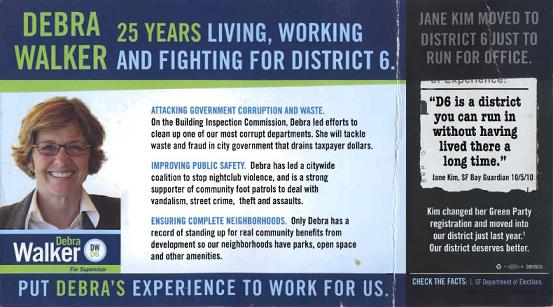
There’s been lots of behind-the-scenes sniping and bad blood between supporters of D6 supervisorial candidates Debra Walker and Jane Kim, both strong and respected progressives who have resisted publicly criticizing one another…until now. Voters are receiving a mailer from the Walker campaign highlighting the facts that Kim is new to the district and a former Green.
Along the edge of a colorful mailer discussing Walker’s 25-year history in the district is a black and gray box that says “Jane Kim moved to District 6 just to run for office,” followed by a Kim quote from her endorsement interview with the Guardian: “D6 is a district you can run in without having lived there a long time.” And it closes with, “Kim changed her Green Party registration and moved into our district just last year. Our district deserves better.”
Kim campaign consultant Enrique Pearce called the mailer “disappointing” and “a desperate ploy,” saying that he hoped it wasn’t the start of open hostilities between the two progressive camps. Both candidates have refused to endorse one another in the ranked-choice election, and there have been lots of low-level hostilities between the two sides. But Pearce said, “We have tried to keep things positive.”
Kim didn’t return calls for comment, but her Facebook status was, “today was my very first cover story & very first hit piece, only six days left- i guess i should feel complimented that people think we are worth attacking.” The cover story was a glowing SF Weekly profile of Kim focused on how being Asian-American helps her political chances.
Walker campaign consultant Jim Stearns, whose office prepared the mailer, denied that it’s a hit piece. “It’s a comparison piece between Debra and Jane on a particular issue or qualification, not a personal attack,” Stearns said. “To us, it’s a really important part of who Debra is and why she’s a great choice for the district because she’s lived and worked there for 25 years. We disagree with Jane that you can just move into a district to run and understand it.”
Yet D6 candidate Theresa Sparks, who has been targeted by progressive groups as a conservative who would alter the balance of power on the board, is also new to the district. So why is the Walker campaign targeting Kim? Stearns said he hasn’t seen any polling on the race, but he answered the question by highlighting the independent expenditures on Kim’s behalf that were funded partially by former Mayor Willie Brown and which appear to have been illegally coordinated with Pearce’s office.
“Once we found out that she is illegally raising money outside the bounds of campaign finance law and running an illegal money campaign, we became concerned they might be breaking other rules, giving them an undue advantage, and we felt like we had to respond,” Stearns said.
Pearce declined to address that charge, but he told the Guardian when we first broke that story that his office had severed ties with the group New Day for SF before the mailers went out. As for Kim’s qualifications to run for office, he cited her experience as an attorney, community organizer, and school board member and said, “I think Jane’s qualifications for office stand on their own merits.”
And he maintained that the Walker campaign had gone negative while Kim’s campaign wouldn’t, saying that damages the progressive movement. “The Debra Walker campaign chose to attack Jane for being a former Green Party member and for moving into the district last year,” he said. “They are doing it because they feel Jane is a mounting a serious challenge.”
Pearce also said that he hoped this would be the end of it, but Stearns says that there’s one more mailer on the way that mentions Kim. The Guardian endorsed Walker number one and Kim number two, writing that they are the “two leading progressives and would be better on the board than the remaining candidates.”
UPDATE: I just heard back from Walker, who said a representative’s connection to the district is an issue voters care about. “I think it’s important for people to know that [Kim recently moved into the district]. They seem to be skirting the issue or representing that she’s been there for a long time,” Walker said.
As for why they are criticizing Kim rather that Sparks, who seems like a bigger threat to progressives, Walker noted that independent groups, such as labor and the Tenants Union, have already been putting out mailers critical of Sparks. “This has always been part of our game plan,” Walker said, “differentiating and letting people know who I am and who the other top-tier people are.”
Oddball billionaire wants to wreck California
Okay, this is really scary. An oddball billionaire who used to have homes in New York and Florida but now lives just in hotels — and who has no apparent connection to California — is going to spend $20 million promoting a plan to restructure the state.
And who’s going to be drawing up the blueprints? A bunch of right-wingers from the Reagan and Bush days, a failed way-too-conservative former governor — and Willie Brown.
The entire progressive movement, which represents at least a third of California, is totally absent from this conversation, whereas the right-wing is there in the form of Condi Rice and Arnold Schwarzenegger.
The problem is, unlike the doomed effort by the Bay Area Council to create a constitutional convention, (the biggest companies in the region couldn’t manage to put together the funding to put it on the ballot) this nightmare has real resouces. I mean, $20 million is enough to run a statewide campaign. And people are so frustrated now that almost any lunacy (spending limits, more tax cuts, eliminating major social programs etc.) could get traction.
Be very afraid.
Willie Brown and accusations of machine politics in D6

A political mailer promoting progressive supervisorial candidate Jane Kim was funded primarily by former Mayor Willie Brown through a campaign committee that Kim consultant Enrique Pearce helped start and which was located in his office, the latest strange development in a race that is dividing the progressive movement at a crucial moment and prompting a nasty public debate over political “machines.”
It’s illegal for campaigns to coordinate activities with independent expenditure committees such as New Day for SF, which put out the glossy mailer proclaiming “Another renter supports Jane Kim for District 6 Supervisor” and calling her “The people’s candidate.” The most recent campaign finance statements, filed Oct. 4, listed the group’s treasurer as USF student Brent Robinson and the contact number being that of Pearce’s Left Coast Communications, where Robinson worked.
Pearce told the Guardian that he was involved in starting New Day for SF, but that he severed ties with the group and Robinson “about a month ago” when it seemed they might support Kim. “When it started to go down that path, we said that we can’t do that,” Pearce said, adding that he didn’t know why the forms still listed his phone number or why the receptionist in his office took a message for Robinson from the Guardian, although Pearce said they share a receptionist with other organizations. On Oct. 5, a day after the intial filing, the group filed a form to amend Robinson’s phone number.
The campaign finance form shows the group raised $9,200, including $5,000 from Brown on Sept. 30 and $2,500 from Twenty-Two Holdings LLC, which last year applied for a liquor license for the Wunder Brewing Co. Robinson did not return our calls for comment.
The Bay Guardian and other progressive voices used to decry the corrosive influence on San Francisco politics of the Democratic Party political machine established by Brown and former California Senate President (and current state party chair) John Burton. Although that machine is dormant now, the concept of machine politics has been revived in this election cycle by Kim and her allies, adding an ironic note to her support by Brown.
“I’m not a part of anyone’s machine and I’m certainly not a part of anyone’s master plan,” Kim declared during her June 24 campaign kickoff party, where Brown and former Mayor Art Agnos made an appearance. When I highlighted the remark in my coverage of the event, and its inference that Kim’s progressive rival Debra Walker was supported by a budding progressive political machine, it triggered a raging political debate about the concept that continues this day.
The nastiest salvos in that debate have recently been fired at the Bay Guardian and the San Francisco Democratic Party Central Committee – accusing us of being part of a political machine supporting Walker and excluding Kim (who got the Guardian’s #2 endorsement) – by Randy Shaw on his Beyond Chron blog. Shaw is one of two staff writers on the blog, along with Paul Hogarth, a Democratic Party activist and Kim campaign volunteer.
Shaw founded and runs the nonprofit Tenderloin Housing Clinic, which has millions of dollars in city contracts to administer SRO leases through Mayor Gavin Newsom’s Care Not Cash and other programs. He started BeyondChron a few years ago with seed money from Joe O’Donoghue, who was then president of the Residential Builders Association, a developer group that has sometimes clashed with Walker in her capacity as a member of the city’s Building Inspection Commission.
On Oct. 5 and then again on Oct. 12, Shaw wrote and prominently posted long stories promoting Kim’s candidacy and attacking us and the DCCC for not supporting her more strongly. In the first one, “In District 6, Jane Kim takes on the machine,” Shaw defended Burton but shared the Guardian’s criticism of how Brown behaved as mayor.
“Brown’s power was strictly personal, as became clear when his chosen Supervisor candidates were defeated in the 2000 elections,” Shaw wrote, criticizing political machines and writing that the progressive political movement is not “served when those seeking to run for office feel they must choose between ‘playing ball’ with political insiders and giving up their dreams.”
But is it possible that Shaw’s strident campaigning against Walker – indeed, his protege Hogarth planned to challenge Walker before Kim decided to get into the race – was prompted by Walker’s unwillingness to “play ball” with Shaw and his RBA backers? Should we be concerned that it’s actually Shaw who’s trying to build his own little political machine?
I’ve tried to discuss these issues with Shaw and Hogarth, including sending them a detailed list of questions (as has Guardian Executive Editor Tim Redmond), but they’ve been unwilling to respond, just as they were unwilling to contact us before writing two divisive hit pieces that were riddled with inaccuracies that they’ve refused to correct.
I’ve also left messages with Kim and others in her campaign to discuss machine politics and its implications – as well as Sup. Chris Daly, asking about the sometimes close relations that some progressive supervisors have had with Shaw and RBA developers over the years [UPDATE BELOW] – and we’re waiting to hear back.
But Pearce said voters shouldn’t read too much into a relatively small political contribution from Willie Brown, or from the “colorful writing” of Randy Shaw, emphasizing Kim’s independence and saying that was always what she intended to stress when she raised the specter of machine politics tainting the race.
“Randy Shaw is not a part of this campaign, and Willie Brown is certainly not a part of this campaign,” Pearce told us. In fact, Pearce even noted that his office is not a part of the Kim campaign, that they’re merely consultants to it. And he offered his hopes and belief that in 19 days when this campaign is over, progressives would overcome their differences and find a common agenda again. Let’s hope so.
UPDATE: Daly and I just connected and he had an interesting take on all this. He noted that when Brown was mayor, the base that he brought together included the RBA, Rose Pak and the Chinatown power brokers (who also seem to be backing Kim, who used to work as an activist/organizer in that community), and, improbably, both Labor and Downtown.
“But that’s not Gavin’s alignment, his alignment is just downtown. The RBA guys hate Gavin, mostly just because of who is is, a silver spoon guy who never worked a day in his life,” Daly said. So Matt Gonzalez, the board president who ran against Newsom in 2003, formed an alliance with the RBA and O’Donoghue, who already had a long relationship with Shaw, both personal and financial.
Daly also said that he thinks it’s a personality clash more than anything else that is driving Shaw’s opposition to Walker: “He just doesn’t like Debra.” In turn, that sort of personality-based politics — more than any differences in ideology, vision, or qualifications — is souring people in the two political camps on one another as this close election enters the home stretch. But will those resentments linger after this election? Probably, Daly said, although he plans to actively try to mediate the divide once the dust clears on this race.
“Luckily, we have a lot of young people entering the progressive movement,” Daly said. “There’s always a rejuvenation going on and one day the new leaders will be like, ‘Why do that guy and that guy hate each other?’ ‘I don’t know, I think it had something to do with the 2010 election.”
Maxwell disappoints by endorsing Sweet
To be honest, I wasn’t surprised that termed-out Sup. Sophie Maxwell endorsed D10 candidate Lynette Sweet yesterday. Just disappointed. And it’s not just because Sweet refused to come into the Guardian this fall for an endorsement interview (a stance that suggests that Sweet would be depressingly inaccessible to reporters that haven’t drunk her Kool-Aid—a stance that, unfortunately, reminds me of Mayor Gavin Newsom’s attitude towards the media).
I’d been hearing rumors that Maxwell was going to endorse Sweet since February, when Sweet, who’d already racked up Mayor Gavin Newsom’s D10 blessing at that point, showed up alongside Maxwell at the city’s kickoff event for Black history month.
Then there was the fact that during an interview in February for the Guardian’s kickoff article about the D10 race, Sweet spouted phrases that sounded eerily similar to Maxwell’s words.
“D10 is a pretty diverse district, but there is only one common thread: the need for economic development,” Sweet told me.
But a few days earlier when I interviewed Maxwell about a third, and ultimately unsuccessful, attempt to recall her , Maxwell talked of common threads:
“I’m waiting for people to have a better understanding of what this community is, what the common thread running through it is, and how to use rank choice voting,” Maxwell said, by way of explaining why she wasn’t willing to endorse anyone that early in the race.
Now, it’s understandable that Maxwell would be looking for a candidate to carry on her legacy. But it she was looking for a moderate black female candidate then why not endorse Malia Cohen, who isn’t hampered by all of Sweet’s dirty laundry—and has raised the most money in the race, so far?
Could it be that Cohen wouldn’t be down for the kind of dirty deal making that was par for the course back in the days when Willie Brown was still mayor and Sweet was the swing vote that crowned Lennar as master developer at the shipyard/Candlestick Point?
Rumor has it that Maxwell is upset at all the corporate money that’s flooding into this race in support of Steve Moss—and that she asked the other candidates to hold a press conference in which they decry this practice. Rumor also has it that Sweet signaled her willingness to join Tony Kelly, Dewitt Lacy, Chris Jackson and Eric Smith–to name a few–in making such a statement. But it hasn’t happened, yet. And the corporate money keeps rolling in for Moss.
Meanwhile, with three weeks until the election, D10 forums are beginning to sound like a parody of a “Lost” episode featuring a 22-member cast that all claim to represent the city’s polluted and economically depressed southeast sector:
“One of us is a BART director, one of us worked at City Hall, one of us is a community advocate, one of us is a City College Board member, one of us is a civil rights attorney, one of us is an affordable housing development director, one of us is a bio-diesel advocate, one of us is a public safety advocate, one of us was raised in the Bayview, one of us served on the Navy’s Restoration Advisory Board,” and so on.
I’m not saying this is wrong. Hell, I love all this diversity of choices. but I am concerned that, come election night, the progressive vote will get split into a million pieces, while deep-pocketed conservative forces like the Chamber of Commerce and Golden Gate Restaurant line up behind one candidate in an attempt to crush candidates that would stand up to their powerful influence at City Hall and truly represent the D10 community
Yes, there is ranked choice voting, and it’s unlikely that one candidate will win a majority of the vote in the first round. But it’s critical at this venture that progressives develop a winning strategy. D10 candidate Ed Donaldson told me recently that if a candidate who doesn’t represent the community’s concerns gets elected, then the community would respond just as they did around Maxwell—and organize a recall.
But wouldn’t it be better if the community can come together behind three truly progressive candidates and help them win the November election?
One of the key challenges in this race will be to win votes in Visitacion Valley, as well as in the Bayview and/or Potrero Hill.
In his latest column in the Chron, former mayor and Sweet supporter Willie Brown alluded to the importance of this in a city with ranked-choice voting:”It’s not getting much attention, but someone has finally figured out how to get the Asian vote out,” Brown observed.”You do it by mail. You get ballots and ballot books into every household, then have the whole family sit down together. The kids help with the translation, everyone talks things over and everyone votes.”
Long-winded debate about the America’s Cup

The prospect of San Francisco turning into an international enclave for billionaires and their custom-built super yachts in 2013 is either electrifying or nauseating, depending on one’s perspective. If San Francisco is selected as the venue for the 34th America’s Cup, the city’s downtown would be transformed into the “America’s Cup Village” during the prestigious match, and placed at the center of an international media spectacle.
Larry Ellison, billionaire CEO of Oracle and backer of the BMW Oracle Racing Team, won the 33rd America’s Cup sailing match in Valencia, Spain earlier this year. His victory grants him unilateral power to choose where the next regatta will be held, and so far, he’s narrowed the choices to Valencia, Spain, an undisclosed port in Italy, and San Francisco. The city’s Golden Gate Yacht Club is the home club of the BMW Oracle Racing Team.
Since July, when Ellison indicated that San Francisco was a finalist, the Mayor’s Office of Economic and Workforce Development (MOEWD) has been scrambling at breakneck speed to produce a term sheet for hosting the Cup so that it can submit a formal bid to Ellison for consideration. On Oct. 5, the term sheet went before the Board of Supervisors, where it was approved on a 9 to 2 vote, with Sups. Chris Daly and John Avalos dissenting.
The mayor’s office, the Port of San Francisco, the Bay Area Council, and other major downtown interests in San Francisco seem feverishly excited about the prospect of hosting the America’s Cup. Sup. Michela Alioto-Pier, who tends to align herself with Mayor Gavin Newsom, proclaimed at the meeting, “I pray to God that Larry Ellison says yes!” A study produced by Beacon Economics suggested that the event would generate $1.4 billion in economic activity, plus create 9,000 jobs. The Port of San Francisco has been deeply involved in the America’s Cup bid because it offers an opportunity to renovate crumbling port infrastructure.
Daly, meanwhile, launched into a rant of dissent against the America’s Cup. “I will bring a white squall onto this race and on to this Cup and I will do everything in my power starting on January 8 to make sure these boats never see that water,” he fumed. (That night, he practiced by bringing a white squall onto the Guardian over Facebook.)
Hyperbole aside, the District 6 supervisor raised some sharp questions about the America’s Cup proposal, and several of his colleagues thanked him at the Oct. 5 board meeting and at an Oct. 4 Land Use Committee hearing for seeking accountability. He was distressed at being asked to sign off on a term sheet on short notice that was not accompanied by a financial feasibility study. He also wondered why key figures — like the price tag for the actual event or the impact on the General Fund — were not clearly outlined in the proposal.
MOEWD director Jennifer Matz noted that the term sheet was meant as a preliminary, non-binding endorsement of the concept, and many details were yet to come. No final agreements can be signed off on until the proposal has cleared the environmental review process. But Daly took issue with the notion that it was just preliminary. “There is really no turning back,” he said. “This will be a rolling stone. Will this be good for San Francisco? I’m not so sure.” He wondered how the race would impact the city’s lower-income residents.
The term sheet outlines a deal in which “the Event Authority,” which essentially refers to Ellison, would get a free long-term lease of port infrastructure in exchange for bringing the race to San Francisco. The lease awards full control of Piers 30 –32 and 50, plus Seawall Lot 330, for up to 75 years (it’s possible that the lease will end just as sea-level rise starts to pose a real problem for San Francisco).
The lease comes with long-term development rights for those parcels, plus the proceeds of any tax-increment financing from the sites. What are now publicly controlled, crumbling piers with relatively low value would get full makeovers, serving as privately controlled hospitality centers, team bases, food and beverage stations, an international broadcasting center, and entertainment venues when yacht owners descend upon San Francisco during the match. Craig Hartman, the architect who is doing the Parkmerced redesign, described his vision for the yacht race venue to the Land Use Committee on Oct. 4.
At the helm of the bid to host the Cup in San Francisco is the America’s Cup Organizing Committee (ACOC) — a nonprofit organization, according to the term sheet. ACOC’s nongovernmental status means it will not be required to hold public meetings or be subject to Sunshine laws. The committee has pledged to help raise $270 million from corporate sponsors for the event. The “working” members of ACOC, who represent the private sector, include billionaire Warren Hellman, who hosts the annual Hardly Strictly Bluegrass festival, billionaire venture capitalist Tom Perkins, who had his own fancy mega yacht too, plus representatives from AT&T, Wells Fargo, a representative from the Clinton Foundation, and others from capital management firms, real-estate development groups, and yacht clubs. Between all of them, it shouldn’t be too tough to scrape together $270 million.
The “honorary” members, who represent the public sector, include House Speaker Nancy Pelosi, Senator Dianne Feinstein, Governor Arnold Schwarzenegger, State Sen. Mark Leno, Assembly Member Tom Ammiano, former and Mayor Willie Brown. Every member of the Board of Supervisors is named as an honorary member of ACOC — except Daly.
Get a clue, Randy Shaw
I read BeyondChron every day, and Randy Shaw, who operates the site, and Paul Hogarth, his managing editor, often have interesting commentary. But I’m constantly annoyed by people who run what by any stretch is a journalistic operation, but don’t follow the basic rules of (even alternative, activist) journalism: When you’re going to say something nasty about somebody, you call that person for comment.
Randy never called me, or Steve Jones, or Bruce Brugmann, before he launched an attack on the Guardian as part of a political machine. If he had — or if he’d done any reporting work and called around town — he might have learned something.
Randy’s argument is that the “machine” — including the Bay Guardian — is trying to block Jane Kim’s election as D6 supervisor. Let’s examine that for a minute.
There are plenty of people in San Francisco who would love to have a political machine. But it’s just not happening. The very fact that Jane Kim has the support of so many progressives — including the Board president, David Chiu, and Supervisors Eric Mar and John Avalos (all part of what Shaw calls the “machine”) suggests that nobody has to clout — not even me — to tell a candidate whether she can run for office, to control (or cut off) campaign contributions, or to wire an election.
In the days when Willie Brown ran San Francisco, the machine really did keep people from running for office. It really did close off avenues to political advancement. And if the machine was against you, it was really hard to raise money. If Brown were still the boss, and he didn’t want Kim to run, she would have been frozen out of much of the support and money she has today. Instead, Brown was at her campaign kickoff — and nobody’s manged to intimidate her many supporters and campaign contributors.
And guess what? The Guardian — the axis of the machine evil trying to freeze out Kim — endorsed her as our second choice.
I stand by what I said months ago — there’s nobody in San Francisco today — and no cadre or group — with the clout to operate as a political machine.
Nobody can line up six automatic votes on the Board of Supervisors. Even the progressives on the Democratic County Central Committee can’t always seem to get it together (note that Aaron Peskin, the chair and supposed machine honco, supported Tony Kelly for supervisor, and the DCCC didn’t put Kelly on its slate).
Right now, power in this city is fairly diffuse. That’s both a good and a bad thing. Good because machines are exclusionary, bad because it means the progressives can’t always function on a level that gets the right candidates elected and the right legislation through. Good because the left in this city is aggressively, almost happily disorganized and politically diverse, full of characters, voices, interest groups, candidates and elected officials who don’t always agree with each other and take orders from nobody. Bad because when we’re disorganized, we tend to lose.
Jane Kim didn’t get the DCCC endorsement. Nobody talked to me about that; I’m not on the panel and none of the members called to ask my advice. I would have said what the Guardian said in our endorsement package: There are exactly two progressive candidates who are qualified to be the next D6 supervisor, and their names are Debra Walker and Jane Kim. I still don’t understand why Kim entered the race against an established candidate with whom she has no substantial policy disagreements; I think that, before Kim moved to the district and entered the race, Walker was the clear consensus candidate of progressives, and as a matter of strategy, since Kim and Walker are both on the same side on the key issues, it might have made more sense for the left to unite behind one candidate.
But that’s not the issue anymore; Kim had every right to run, and now any cogent, honest ranked-choice voting strategy includes both her and Walker.
That statement alone makes clear that the Guardian’s not exactly in synch with the DCCC or any of Shaw’s other “machine” operations. The DCCC decided that the top candidate in D10 should be DeWitt Lacy, and left Tony Kelly off the slate entirely. We endorsed Tony Kelly as our first choice. The labor activists on the DCCC (and in the “machine”) are dead set against Margaret Brodkin winning a seat on the Board of Education; we endorsed her.
I would have explained our positions to Randy Shaw if he’d called or emailed me; I’m really easy to reach. And slapping people around without talking to them is bad journalism and bad progressive politics. Randy and I have disagreements, but I don’t consider him the enemy; we’re both part of a larger progressive community, and while I love (and thrive on) disputes in that community, we ought to be civil about it.
(I always contact Randy before I write about him. I did that yesterday, and asked him a series of questions, including why he never called me for comment. His non-response: “I write 3-4 articles a week and have published three books. You are free to quote from anything I have written without asking me about it.”)
Herb Caen used to say (somewhat in jest) that if you “check an item, you lose it.” In other words, once you start talking to everyone involved in an issue, you sometimes find out that the story isn’t at all the way you heard it.
That’s what should have happened with Shaw’s completely inaccurate claim about Steve Jones.
BeyondChron says that Jones was trying to get Kim to challenge Carmen Chu in D4 because they’re both Asian-American, ” in effect saying that as an Asian-American Jane should run among ‘her people,’ implying that demographics prevailed over issues and political stands.”
I talked to Steve about it; he did, indeed, talk to Jane Kim when Kim was shopping around for a district to run in. What he told her — and would have told Randy Shaw — was that it would be great for Kim, a school board member with citywide name recognition, to knock off Carmen Chu and expand the progressive majority rather than going after a strong progressive candidate in a solidly progressive seat. Race had nothing to do with it.
In fact, just about everything we’ve written about Kim comes down to the same argument: Sometimes, you have to think about the larger progressive movement, not just about yourself.
I sometimes wish the all the people who say the Bay Guardian is part of a powerful Peskin Machine were right: I’d love to pass a city income tax, hit the wealthy up for about half a billion dollars a year, eliminate the budget deficit without cutting services, municipalize PG&E (and have municipal cable TV and broadband), ban cars on a lot of streets, create 25,000 units of affordable housing … I’ve got a great agenda. And the Guardian’s so powerful that none of it ever happens.
Randy Shaw and I were both around for the tail end of the Burton Machine, and I think he gives the brothers Phil and John Burton too much credit. They were great on national issues, progressive champions in Congress. But they weren’t progressive leaders on local issues.
The Burton Machine was nowhere on the fights against overdevelopment and downtown power. Phil Burton rarely used his clout to support progressive causes and candidates at home. The machine got Harvey Milk fired from a commission appointment when he announced he was going to run for state Assembly against Art Agnos. The machine came together to make sure that Nancy Pelosi, an unknown who had never held office, got elected to Congress instead of Harry Britt, the most progressive elected official in the city at the time. The machine never helped out on public power, the numerous anti-highrise initiatives, rent control, or much of anything else that challenged the real estate interests like Walter Shorenstein, who gave vast sums of money to the Democratic Party.
Yes, George Moscone, a Burton ally, supported district elections, but once he got elected he stopped challenging downtown power.
And, of course, when Willie Brown emerged as heir to the machine throne, he was a disaster for progressives. He also at one point controlled an unshakable majority on the Board of Supervisors; he could call up votes whenever he needed.
The progressives in San Francisco today share an ideology on local issues — tough local issues that involve powerful economic forces at home.
And honestly, Randy: It’s not all about Jane Kim.
Endorsements 2010: State races
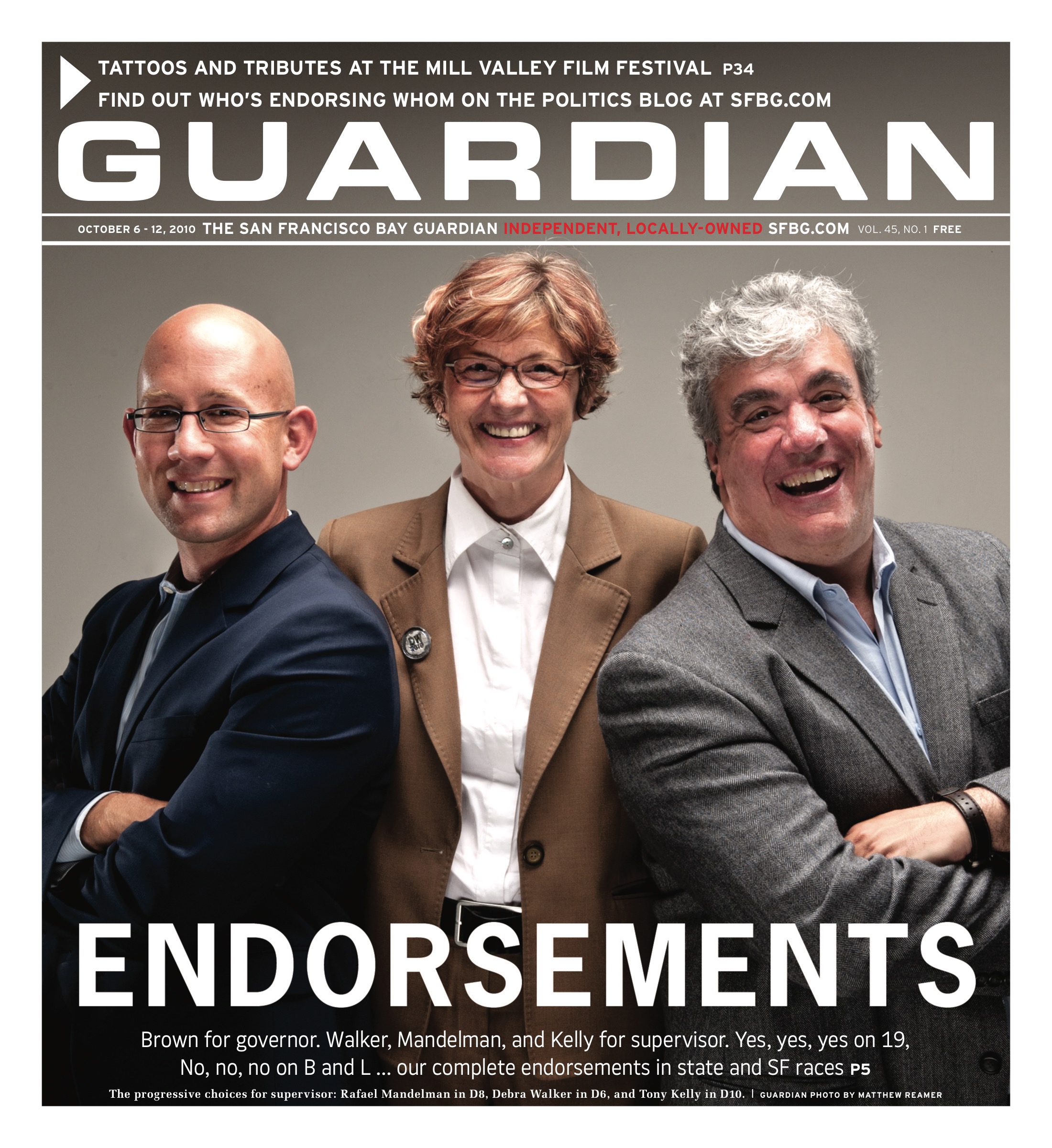
GOVERNOR
EDMUND G. BROWN
We have issues with Jerry Brown. The one-time environmental leader who left an admirable progressive legacy his first time in the governor’s office (including the Agricultural Labor Relations Board, the California Conservation Corps, and the liberal Rose Bird Supreme Court) and who is willing to stand up and oppose the Diablo Canyon nuclear power plant has become a centrist, tough-on-crime, no-new-taxes candidate. And his only solution to the state budget problems is to bring all the players together early and start talking.
But at least since he’s started to debate Republican Meg Whitman face to face, he’s showing some signs of life — and flashes of the old Jerry. He’s strongly denouncing Whitman’s proposal to wipe out capital gains taxes, reminding voters of the huge hole that would blow in the state budget — and the $5 billion windfall it would give to the rich. He’s talking about suing Wall Street financial firms that cheated Californians. He’s promoting green jobs and standing firm in support of the state’s greenhouse-gas emissions limits.
For all his drawbacks (his insistence, for example, that the Legislature shouldn’t raise any taxes without a statewide vote of the people), Brown is at least part of the reality-based community. He understands that further tax cuts for the rich won’t solve California’s problems. He knows that climate change is real. He’s not great on immigration issues, but at least he’s cognizant that 2 million undocumented immigrants live in California — and the state can’t just arrest and deport them all.
Whitman is more than a conservative Republican. She’s scary. The centerpiece of her economic platform calls for laying off 40,000 state employees — thereby greatly increasing the state’s unemployment rate. Her tax plan would increase the state’s deficit by another $5 billion just so that a tiny number of the richest taxpayers (including her) can keep more of their money. She’s part of the nativist movement that wants to close the borders.
She’s also one of the growing number of candidates who think personal wealth and private-sector business success translate to an ability to run a complex state government. That’s a dangerous trend — Whitman has no political experience or background (until recently she didn’t even vote) and will be overcome by the lobbyists in Sacramento.
This is a critically important election for California. Vote for Jerry Brown.
LIEUTENANT GOVERNOR
GAVIN NEWSOM
Why is the mayor of San Francisco running for a job he once dismissed as worthless? Simple: he couldn’t get elected governor, and he wants a place to perch for a while until he figures out what higher office he can seek. It’s almost embarrassing in its cold political calculus, but that’s something we’ve come to expect from Newsom.
We endorsed Newsom’s opponent, Janice Hahn, in the Democratic primary. It was hard to make a case for advancing the political career of someone who has taken what amounts to a Republican approach to running the city’s finances — he’s addressed every budget problem entirely with cuts, pushed a “no-new-taxes” line, and given the wealthy everything they wanted. His immigration policies have broken up families and promoted deporting kids. He’s done Pacific Gas and Electric Co. a nice favor by doing nothing to help the community choice aggregation program move forward.
Nevertheless, we’re endorsing Newsom over his Republican opponent, Abel Maldonado, because there really isn’t any choice. Maldonado is a big supporter of the death penalty (which Newsom opposes). He’s pledged never to raise taxes (and Newsom is at least open to discussion on the issue). He used budget blackmail to force the awful open-primaries law onto the ballot. He’s a supporter of big water projects like the peripheral canal. In the Legislature, he earned a 100 percent rating from the California Chamber of Commerce.
Newsom’s a supporter of more funding for higher education (and the lieutenant governor sits on the University of California Board of Regents). He’d be at least a moderate environmentalist on the state Lands Commission. And he, like Brown, is devoting a lot of attention to improving the state’s economy with green jobs.
We could do much worse than Newsom in the lieutenant governor’s office. We could have Maldonado. Vote for Newsom.
SECRETARY OF STATE
DEBRA BOWEN
California has had some problems with the office that runs elections and keeps corporate filings. Kevin Shelley had to resign from the job in 2005 in the face of allegations that a state grant of $125,000 was illegally diverted into his campaign account. But Bowen, by all accounts, has run a clean office. Her Republican opponent, Damon Dunn, a former professional football player and real estate agent, doesn’t even have much support within his own party and is calling for mandatory ID checks at the ballot. This one’s easy; vote for Bowen.
CONTROLLER
JOHN CHIANG
Chiang’s been a perfectly decent controller, and at times has shown some political courage: When Gov. Arnold Schwarzenegger tried to cut the pay of state employees to minimum-wage level, Chiang refused to go along — and forced the governor to back down. His opponent, state Sen. Tony Strickland (R-Los Angeles), wants to use to office to promote cuts in government spending. Vote for Chiang.
TREASURER
BILL LOCKYER
Lockyer’s almost certain to win reelection as treasurer against a weak Republican, Mimi Walters. He’s done an adequate job and pushed a few progressive things like using state bonds to promote alternative energy. Mostly, though, he seems to be waiting for his chance to run for governor — and if Jerry Brown loses, or wins and decides not to seek a second term, look for Lockyer to step up.
ATTORNEY GENERAL
KAMALA HARRIS
This is going to be close, and it’s another clear choice. We’ve had our differences with Harris — she’s trying too hard to be a tough-on-crime type, pushing some really dumb bills in Sacramento (like a measure that would bar sex offenders from ever using social networking sites on the Internet). And while she shouldn’t take all the blame for the problems in the San Francisco crime lab, she should have known about the situation earlier and made more of a fuss. She’s also been slow to respond to serious problem of prosecutors and the cops hiding information about police misconduct from defense lawyers that could be relevant to a case.
But her opponent, Los Angeles D.A. Steve Cooley, is bad news. He’s a big proponent of the death penalty, and the ACLU last year described L.A. as the leading “killer county in the country.” Cooley has proudly sent 50 people to death row since he became district attorney in 2001, and he vows to make it easier and more efficient for the state to kill people.
He’s also a friend of big business who has vowed, even as attorney general, to make the state more friendly to employers — presumably by slowing prosecutions of corporate wrongdoing.
Harris, to her credit, has refused to seek the death penalty in San Francisco, and would bring the perspective of a woman of color to the AG’s office. For all her flaws, she would be far better in the AG’s office than Cooley. Vote for Harris.
INSURANCE COMMISSIONER
DAVE JONES
Jones, currently a state Assemblymember from Sacramento, won a contested primary against his Los Angeles colleague Hector de la Torre and is now fighting Republican Mike Villines of Fresno, also a member of the Assembly. Jones is widely known as a consumer advocate and was a foe of Prop. 17, the insurance industry scam on the June ballot. A former Legal Aid lawyer, he has extensive experience in health-care reform, supports single-payer health coverage, and would make an excellent insurance commissioner.
Villines pretty much follows right-wing orthodoxy down the line. He wants to replace employer-based insurance with health savings accounts. He argues that the solution to the cost of health insurance is to limit malpractice lawsuits. He wants to limit workers compensation claims. And he supports “alternatives to litigation,” which means eliminating the rights of consumers to sue insurance companies.
Not much question here. Vote for Jones.
BOARD OF EQUALIZATION, DISTRICT 1
BETTY YEE
The Board of Equalization isn’t well known, but it plays a sizable role in setting and enforcing California tax policy. Yee’s a strong progressive who has done well in the office, supporting progressive financial measures. She’s spoken out — as a top tax official — in favor of legalizing and taxing marijuana. We’re happy to endorse her for another term.
SUPERINTENDENT OF PUBLIC INSTRUCTION
TOM TORLAKSON
We fully expected a November runoff between Torlakson and state Sen. Gloria Romero. Both Democrats had strong fundraising and political bases — and very different philosophies. Romero’s a big charter school and privatization fan; Torlakson has the support of the teachers unions. But to the surprise of nearly everyone, a wild-card candidate, retired Los Angeles educator Larry Aceves, came in first, with Torlakson second and Romero third. Now Aceves and Torlakson are in the runoff for this nonpartisan post.
Aceves is an interesting candidate, a former principal and school superintendent who has the endorsement of the San Francisco Chronicle and the San Francisco Green Party. But he’s too quick to take the easy line that the teachers’ unions are the biggest problem in public education, and he wants the unilateral right to suspend labor contracts.
Torlakson wants more charter-school accountability and more funding for primary education. He’s the far better candidate.
STATE SENATE
DISTRICT 8
Leland Yee
Yee’s got no opposition to speak of, and will easily be re-elected. So why is he spending money on a series of slick television ads that have been airing all over San Francisco, talking about education and sending people to his website? It’s pretty obvious: The Yee for state Senate campaign is the opening act of the Yee for San Francisco mayor campaign, which should kick into high gear sometime next spring. In other words, if Yee has his way, he’ll serve only a year of his next four-year term.
Yee infuriates his colleagues at times, particularly when he refuses to vote for a budget that nobody likes but everyone knows is necessary to keep the state afloat. He’s done some ridiculous things, like pushing to sell the Cow Palace as surplus state property and turn the land over to private real estate developers. But he’s always good on open-government issues, is pushing for greater accountability for companies that take tax breaks and then send jobs out of state, has pushed for accountability at the University of California, and made great progress in opening the records at semiprivate university foundations when he busted Stanislaus State University for its secret speaking-fees deal with Sarah Palin.
With a few strong reservations, we’ll endorse Yee for another term.
STATE ASSEMBLY, DISTRICT 12
FIONA MA
A clear hold-your-nose endorsement. Ma has done some truly bad things in Sacramento, like pushing a bill that would force the San Francisco Unified School District to allow military recruiters in the high schools and fronting for landlords on a bill to limit rent control in trailer parks. But she’s good on public power and highly critical of PG&E, and she has no opposition to speak of.
STATE ASSEMBLY, DISTRICT 13
TOM AMMIANO
Ammiano’s a part of San Francisco history, and without his leadership as a supervisor, we might not have a progressive majority on the Board of Supervisors. Ammiano was one of the architects of the return to district elections, and his 1999 mayoral campaign (against Willie Brown) marked a turning point in the organization, sophistication, and ultimate success of the city’s left. He was the author of the rainy day fund (which has kept the public schools from massive layoffs over the past couple of years) and the Healthy San Francisco plan.
In Sacramento, he’s been a leader in the effort to legalize (and tax) marijuana and to demand accountability for the BART Police. He’s taken on the unpleasant but critical task of chairing the Public Safety Committee and killing the worst of the right-wing crime bills before they get to the floor. He has four more years in Sacramento, and we expect to see a lot more solid progressive legislation coming out of his office. We enthusiastically endorse him for reelection.
STATE ASSEMBLY, DISTRICT 14
NANCY SKINNER
Skinner’s a good progressive, a good ally for Ammiano on the Public Safety Committee, and a friend of small business and fair taxation. Her efforts to make out-of-state companies that sell products in California pay state sales tax would not only bring millions into the state coffers but protect local merchants from the likes of Amazon. We don’t get why she’s joined with Berkeley Mayor Tom Bates to try to get rid of Kriss Worthington, the most progressive member of the Berkeley City Council, but we’ll endorse her for re-election.
STATE ASSEMBLY, DISTRICT 16
SANDRE SWANSON
Swanson’s a good vote most of the time in Sacramento, but he’s not yet the leader he could be — particularly on police accountability. The BART Police murdered Oscar Grant in Swanson’s district, yet it fell to a San Franciscan, Tom Ammiano, to introduce strong state legislation to force BART to have civilian oversight of the transit cops. Still, he’s done some positive things (like protecting state workers who blow the whistle on fraud) and deserves another term.
Downtown money hits district races

Downtown cash is pouring into the district supervisorial races.
Ethics Department filings show that an alliance backed by the Chamber of Commerce, the SF Police Officers Association and United Health Care Workers West is dropping major money on Steve Moss in D10, Scott Wiener in D8 and Theresa Sparks in D6.
Called the “Alliance for Jobs and Sustainable Growth,” the coalition supports the building of a mega-hospital on Cathedral Hill.
The independent expenditure alliance puts UHW, part of the Service Employees International Union, in the odd position of using membership money to attack progressive politics in San Francisco – potentially undermining years of work by another SEIU affiliate, Local 1021.
Campaign disclosure forms show that the Chamber-Police-UHW alliance has spent $20,000 on bilingual (English/Chinese) door hangers for Moss that feature photos of Chamber of Commerce President Steve Falk and United Healthcare Workers political director Leon Chow.
These same interests also spent $20,000 on robo-calls for Moss, with a heavy focus on Visitacion Valley in an effort to secure the Asian vote in the crowded D10, where there is a strong likelihood that the race will be decided by second and third place votes
Word on the street in the Bayview is that former Mayor Willie Brown is pissed off that the Chamber is backing Moss, instead of African American candidate Lynette Sweet, and that termed out D10 Sup. Sophie Maxwell is angry that big corporations are trying to buy an election in the poorest and most ethnically diverse district in town.
But unlike the rumor mill, the money trail doesn’t lie. And from that perspective this is looking like a replay of the June 2008 election, when big businesses bought support for Lennar’s Candlestick Point/shipyard development by claiming it would create thousands of jobs building condos that most workers can’t afford—jobs that have yet to materialize.
This time the battle cry is for jobs building a massive hospital, even though few workers will likely get service from this hospital, which is designed to serve as a regional center for high-end health care.
So far, the same alliance of police and corporate money has plunked down $17,000 for bilingual (English and Chinese) door hangers in support of Theresa Sparks in D6 and another $17,000 for bilingual robo-calls in support of Sparks.
And so far, Scott Wiener has gotten the relatively short end of the corporate money stick: the Alliance has only spent $15,000 on a door hanger in support of Wiener.
This means that the alliance spent $90,000 in a two-week period in September. The numbers lend credence to DCCC Chair Aaron Peskin’s belief that the alliance has a war chest of $800,000, which it intends to use to put pro-downtown candidates into power.
Asked about the support of this alliance, Sparks, Wiener and Moss gave markedly different replies that reveal as much about each candidate as the money behind them.
D6 candidate Theresa Sparks suggested that the Alliance was spending more on her and Moss’ D10 campaign, because it felt Wiener was further ahead in the D8 race than she is in D6 or Moss is in D10.
And Sparks was openly supportive of the Cathedral Hill hospital project. “I’ve been very supportive of that project,” Sparks told us.
Sparks also observed that it was logical that the Chamber would support her.
“D6 has one of the largest numbers of small businesses and one of my biggest platforms has been economic growth, and I think the Chamber has been very supportive of job creation,” Sparks said.
By comparison, Scott Wiener told the Guardian that he has not taken a position on CPMC’s proposed mega hospital on Cathedral Hill.
“Those kind of issues could come before the Board, in terms of CEQA issues, and so I could be conflicted out,” Wiener said.
When the Guardian noted that the Alliance has so far not spent any money on phone banking for Wiener in D8, Wiener said, “I have volunteers doing phone banking.”
As for Moss, he told the Guardian that said he doesn’t have a position on the mega-hospital.
“I haven’t seen the plan,” Moss said. “But I understand that there seems to be an agreement that would maintain St. Luke’s with about 300 beds, but that there is a deep suspicion among the nurses that it’s not economically viable. And there seems to be a much greater need for a hospital in the southeast.”
Moss, however, is with downtown on other key issues: He supports the sit-lie legislation on the November ballot. He also reiterated that he likes the rabidly anti-tenant Small Property Owners Association, whose endorsement he called a “mistake” during a previous interview with the Guardian.
“Landlords feel that they are responsible for maintaining costly older buildings and that they are not provided with ways to upgrade their units in ways that share costs with tenants,” Moss, who sold a condo on Potrero Hill in 2007 for the same price that he paid for the entire building in 2001, and owns a 4-floor rent-controlled apartment building in D8, near Dolores Park, that he bought for $1.6 million in 2007, and where he lived from December 2007 to February 2010.
Moss refused to provide a copy of the lease on his current rental at Vermont and 18th St—something that the Guardian requested in light of an email from his wife that indicated that the family intended to move back to Dolores Park of Moss loses the race.
‘That’s private information,” Moss said, claiming that he does not plan to move back into his apartment building in D8, if he loses in November.
Moss claimed that UHW endorsed him because his position on politicians and unions.
“I agreed that politicians should get not involved in union politics,” Moss said. “The United Healthcare Workers seem to be a worthy group,” he added. “All they said was that they wanted to make sure that they had access.”
All this campaign money drama is playing out against the backdrop of a punishing battle between United Healthcare Workers West and the rest of SEIU. And as these recent filings show, UHW is spending a huge amount of its membership dues to undermine the city’s progressive infrastructure by trying to elect candidates who are not progressive, even though its progressive sister union has endorsed Rafael Mandelman in D8.
SEIU 1021 member Ed Kinchley, who works in the Emergency Room at SF General Hospital, is furious that UHW is pouring all its money into downtown candidates like Moss, Sparks and Wiener and trying to undermine everything that its progressive sister union is trying to do.
“UHW basically isn’t participating in the Labor Council, it’s just doing its own thing,” Kinchley said.
Kinchley noted that UHW is currently in trusteeship, and is being controlled by its International, and not its local membership, thus explaining why it’s doing this dance with forces like the Chamber and the Building Owners and Managers Association, which have long been the enemy of labor.
“Sutter wants a monopoly on private healthcare, and people like Rafael Mandelman in and Debra Walker have been strong supporters of public healthcare,” Kinchley said, Kinchley also noted that he wants supervisors who are willing to state their support for public health care, rather than dodging the issue and hedging their bets, right now.
“I want someone who can straight-up say, here’s what’s important for families in San Francisco, especially something as important as healthcare,” Kinchley said. “but it sounds like UHW is teaming up with the Chamber and supporting people who are not progressive.”
“And it’s not OK for somebody in D10 to say they haven’t seen CPMC’s plans, when people from D10 use St. Luke’s all the time for healthcare, because it sounds like Sutter wants to change St. Luke’s into an out-patient clinic for paying customers,” he continued.
SEIU 1021 activist Gabriel Haaland accused the Chamber, the Building Owners and Managers Association, UHW and the Police Officers Association of putting together a massive political action committee, “to try and steal the election through corporate spending.”
All this leaves the Guardian wondering how Leon Chow, the political director of UHW, who has done good work in the past on health care issues, is feeling about seeing his photograph spreads all over town alongside that of Chamber of Commerce President Steve Falk on door hangers in support of Sparks, Wiener and Moss.
As of press time, Chow had not returned our calls, but if he does, we’ll update this post.
Editor’s Notes

Tredmond@sfbg.com
On Sept. 16, supporters of Proposition B, the pension reform measure that would also reduce health care benefits for the children of city workers, held a fundraiser at Le Méridien Hotel — which is one of the hotels on the union boycott list. That was a bad idea, and it put Public Defender Jeff Adachi, the sponsor of Prop. B, in a difficult bind. His proposition, his fundraiser — and he had to cross a picket line to get in the door. So did former mayor Willie Brown, who was one of the fundraiser’s feature guests.
Labor people were furious about the two Democrats crossing the line. Labor Council Executive Director Tim Paulson told Guardian City Editor Steven T. Jones that the move was "outrageous." At the very least, it’s highly unusual in this labor town.
And I thought of something else unusual: Brown, who among other things is a San Francisco Chronicle columnist, was helping host a political fundraiser. That’s interesting because just a few weeks earlier, the conservative San Francisco Coalition for Responsible Growth invited the Chron’s C.W. Nevius to speak at a fundraising event — and when the SF Appeal reported on it, Chron management told Nevius that wasn’t allowed.
What’s the difference? One columnist can do fundraisers and one can’t? When I asked Chron Editor Ward Bushee, he referred me to a Matier and Ross column, which included a quote on the matter from Managing Editor Steve Proctor:
"When we gave him a column, we never had any illusion he would cease to be involved in politics. I think the readers of the Chronicle understand that."
So it’s one standard for Willie, another for everyone else. Just like old times.
Adachi crosses the line
Former Mayor Willie Brown and Public Defender Jeff Adachi – author of Prop. B, which would require city employees to pay more for their pension and health care costs – yesterday crossed a union picket line at Le Méridien, which is being boycotted by hotel workers with Unite-Here Local 2, to attend a fundraiser for the measure.
http://www.youtube.com/watch?v=J6K8FkTt7pM
San Francisco Labor Council President Tim Paulson called it “such an outrageous thing in San Francisco.” Even Sup. Sean Elsbernd, perhaps the most conservative member of the Board of Supervisor, was shocked today when told of Adachi’s crossing the line, saying he would have never done so. Local 2 spokesperson Riddhi Mehta told us, “It shows their true colors. By no means are they for working families.”
Adachi has been public enemy number one of local labor leaders since he authored the measure with little input from unions or other public officials, and Paulson said this action was emblematic of Adachi’s hostility to unions, adding that it was even more surprising to see Brown, a longtime ally of unions, supporting the measure and crossing the line.
“It was not unexpected for Jeff Adachi, with the way he’s been acting lately, not caring about labor, but it was a little surprising for Willie Brown considering his career and record,” Paulson said.
Adachi told the Guardian that he was unaware at the time that it was a Local 2 picket line. “The honest truth is that when I got there, I thought it was a protest against Prop. B,” Adachi said. Yet he also that even if he had know, “I still would have went to the event.”
“I completely support the workers’ right to strike, but at the same time, I am on a mission to save the city $120 million a year,” Adachi told us. “The resources that the opponents are pouring into this are completely unreal.”
La Merdien has been on the Local 2 boycott list for several months, and both Paulson and Mehta said the picket was independent of Prop. B, although some SEIU members did show up with signs criticizing the measure. As for scheduling future fundraisers at other boycotted hotels, Adachi told us, “I’ll be more mindful of that.”
Endorsement Interviews: Rebecca Prozan
Rebecca Prozan, a candidate for Disctrict 8, has the endorsement of incumbent Sup. Bevan Dufty, and she and Dufty seem to have a lot in common. “I’m able to bring both sides together,” she told us, noting that D-8 constituents “like people who are independent thinkers, who are right up the middle.”
An assistant District Attorney, LGBT and District 8 liaison under former Mayor Willie Brown, and a Recreation & Parks Commissioner, Prozan is familiar with San Francisco government from a number of angles — but she’s also perceptive of the level of mistrust that exists. “There isn’t a San Franciscan in District 8 that actually thinks government is spending every dollar as it should,” she said.
Prozan said she is supportive of a hotel tax to boost revenues, a vehicle license fee to help improve MUNI, and a parcel tax to raise money for schools. She likes the idea of conducting audits as a way to tighten up spending, but rejected the idea of requiring nonprofit organizations to disclose how they spend city funds that are allocated to them. She doesn’t see any reason for split appointments on the SFMTA Board or the Redevelopment Agency, and she believes that while it’s “not a witch hunt,” part of the solution for MUNI should be targeting salaries. She’s against the proposed sit / lie ordinance, she’s a big fan of the Community Justice Center, and she thinks gang injunctions are a useful tool for law enforcement.
Prozan also told us she thinks the city should focus on building more rental housing, and she has been shopping around the idea of figuring out how to convert 1,100 foreclosed San Francisco properties into affordable housing for “teachers, cops, and firefighters.” Listen to the full interview below.