Water

Green City

0

› amanda@sfbg.com

GREEN CITY I spent my undergraduate years at a microscopic liberal arts college set in the shadow of a national park on an island in Maine — a remote idyll where people abhor locking their doors and you can almost smell the Atlantic whale migration when a southeastern wind blows.

The college is overtly environmental and so small it’s possible to practice what’s preached: food is grown on the school’s farm, students cycle around on communal bikes, ceremonies strive to be zero-waste. My graduation in 2000 was the largest the 31-year-old school had ever hosted, and all 97 of us stood in a haphazard row listening to keynote speaker and hobo musician Utah Phillips. After Phillips counseled us on how to avoid becoming a "blown-up" (his word for a bloviating grown-up), my friend Dan turned to me and said, "When I came to this school, I was, like, ‘Aah, here’s my tribe.’"

I had the same feeling a few weeks ago when I stumbled upon the Urban Alliance for Sustainability. Maybe I’ve finally found my people. In the 18 months that I’ve lived in San Francisco, I’ve watched global warming go from a marginalized theory to a universally acknowledged threat. That’s triggered a lot of hyperactivity about how to be green, which seems more commercial than communal. Companies are setting up booths to hawk magic elixirs, but carbon offsets seem about as realistic as get-out-of-jail-free cards. They don’t really shift what actually needs seismic adjustment: the bottom line in your life.

The UAS is different. This is a group with the serious intention of living what it believes. On top of that, it wants to help you do the same.

The organization’s basic mission is so simple it seems like it must have been done already — be a clearinghouse for all the environmentalist activity in the Bay Area. The Web site www.uas.coop lists events, and the hotline answers questions, but the coolest thing the UAS is doing is using the delicious blossom of technology to connect people who really ought to know each other by now.

For example, the group tracks members’ addresses, and when it has enough in the same area, it facilitates a potluck so everyone can meet and discuss how to green their streets. As someone who’s participated in some funky social networking experiments, I think this is simply brilliant. In a world rife with a cruel suspicion of strangers, city living can be hard duty, and trust hard-won. This is kind of like finding your tribe.

Membership isn’t free, and in the interest of full disclosure, the UAS just gave me one after I expressed interest in it while working on another story for the Guardian. But the group is a cooperative, and kicking in gets you discounts to events and something called a sustainability consultation. Mine was a meeting I approached with suspicion. Remember: I went to a hippie school where the Earth Day piñata was full of natural cotton tampons. I already ditched my car and store my quinoa in old yogurt containers. What could this guy tell me about sustainability?

But this was much more than I expected. Kevin Bayuk sat in my yard for two and a half hours, and we discussed practically every aspect of my life — what I eat, how I get around, what I read, how I take care of my health. His suggestions were realistic, and he reminded me of things I let go of back when I ripped up my rural roots. I hadn’t even considered composting here, but he told me where to get a worm bin and offered me some worms from his to get started. He knew what kinds of edible plants could grow in the shade under the jasmine in my garden and the cost of a permit to rip up the sidewalk to grow food.

People often move to San Francisco because this is a city that can handle them. The uniqueness of the citizenry and the genuine desire to do good are what I love most about this place, but there are things I deeply miss about where I came from — the smell of freshly turned dirt in the sunshine, the shimmer of uninterrupted moonlight on water, the silence in the absence of cars. But I love this place, and I’m not going anywhere. Those things are just going to have to come to me. *

Green City, the Guardian‘s new weekly environmental column, will be a mix of staff-written stories and contributions from experts and provocative thinkers. Submissions may be sent to news@sfbg.com.

Holdin’ the weight of the Bay

0

› a&eletters@sfbg.com

Still looks like slavery

But it’s the black legacy

Mistah FAB, "100 Bars"

One night last September, I hitch a ride with G-Stack of the Delinquents and Dotrix of Tha Mekanix to Dem Hoodstarz’s album release party in San Francisco. As we park outside the club, Mistah FAB rolls up with a modest posse. In contrast to his usual iced-out Technicolor clubwear, the man also known as Fabby Davis Jr. is low-key, dressed all in black, a pair of designer stunna shades supplying the main clue to his identity. He hops in Stack’s car to hear a newly laid track for the latter’s upcoming Purple Hood, then we set out for the club, a less than half block journey whose distance is lengthened interminably by a series of well-wishers and business consultations. It’s like following two CEOs across the floor of the stock exchange: Stack is on two cell phones, trying to shake hands with someone. FAB, meanwhile, handles minor transactions, poses for a photo, and takes a call, all while briefing me on the deal he had just signed with Atlantic Records for Da Yellow Bus Rydah, the much-anticipated follow-up to his 2005 disc, Son of a Pimp (Thizz Ent.).

Near the door, a man takes FAB aside. "FAB, you gotta do something about the violence," he says, meaning specifically the 141 homicides in Oakland in 2006 under former mayor and present attorney general Jerry Brown. FAB nods at what is clearly an unreasonable request, albeit one that reflects the disproportionate political burden borne by black entertainers in America. No one would turn to, say, Justin Timberlake to stop violence. Then again, I imagine no one asks Keak Da Sneak either. FAB’s position, in other words, is unique.

Though he made his early reputation as a freestyle battle rhymer and owes his success to hyphy hits like "Super Sic Wit It," FAB’s lyrics seldom stray into gangsta or pimp terrain — the title of his last album is simply literal. Yet he can get down on a track with the most thugged-out MCs. Aside from the giants Too $hort and E-40 and on par with the perpetually hot Keak, FAB is the rapper all Bay Area rappers want on their albums, because he has the biggest buzz on the radio and in the streets. His popularity gives him influence, but FAB commands respect in the hood because he’s from the hood: his compass-based hit "N.E.W. Oakland" was the first major rap recognition of his native North Oakland as a hood. This rapport with the alienated and isolated ghetto youth who constitute hyphy’s core audience separates him from the vast majority of MCs to whom the label "conscious" may be applied.

"You go up to someone in the hood and be, like, ‘Dick Cheney had a heart attack,’ they be, like, ‘Who the fuck is Dick Cheney?’" FAB says later. "But you tell him, ‘Jay-Z donated a million dollars to improve water in Africa,’ they be, like, ‘For real?’ That’s something of their world. Being a Bay Area artist, I’m of their world. So you have the opportunity to teach without them knowing."

"People who have influence," FAB continues, "have an obligation to tell people, ‘Preserve life. Save lives. Help lives.’ But it’s hard to reach people if you’re not giving them something they relate to. The hyphy movement is something they relate to. Hyphy gets you in the door, to open their ears to what I’m saying. It’s up to them to digest it."

That night at the club, FAB exerts his influence. When things get salty between security and Dem Hoodstarz’s East Palo Alto associates, the group calls FAB to the stage to perform their collaboration "Ugh." Things chill out. FAB issues an impromptu plea against violence and murders. These are problems no single person can solve, but FAB is doing his part. Yet by the show’s finale — the "Getz Ya Grown Man On" remix, on which he has a verse — Fabby Davis has left the building. Being Mistah FAB, I realize, can be exhausting.

FOLLOW THE YELLOW BUS ROAD


Mistah FAB’s deal with Atlantic is a landmark in a scene long neglected by the majors. Along with Clyde Carson’s signing with Capitol, FAB’s arrangement — including distribution for his Faeva Afta Entertainment — is the first serious acknowledgment of the renaissance Bay Area rap has undergone in the past three years. Unlike E-40, a regional star who’d already achieved putf8um sales on Jive before his push last year by Warner Bros., FAB’s an unknown quantity outside the Bay. And in contrast to Frontline or the Federation — whose deals came through the respective backing of nationally known producers E-A-Ski and Rick Rock — FAB is the first evidence for a new generation of local rappers that enough talent and dedication can get you signed. It’s another weight on the shoulders of the man born Stanley Cox Jr.

"Lots of people are putting their hopes into the album," he acknowledges. "They’re, like, ‘I hope FAB do it, because it’ll kick in the door for all of us.’ I realized when I was creating this album it’s not just something I want to do. It’s something my whole region depends on."

Da Yellow Bus Rydah‘s journey has been anything but smooth, however. Bottom line: Atlantic has postponed the album’s tentatively scheduled spring release, due to controversy surrounding the Ghostbusters-themed advance single, "Ghost Ride It." A tribute to the hood-invented practice of throwing your car in neutral as you walk alongside and steer, "Ghost Ride It" was generating a buzz through its a video on YouTube and the minor-league MTVs when a Dec. 29, 2006, Associated Press story ("Hip-Hop Car Stunt Leaves 2 Dead") linked the song with a pair of unrelated deaths: Davender Gulley, 18, of Stockton, who "died after his head slammed into a parked car while he was hanging out the window of an SUV," and an unnamed "36-year-old man dancing on top of a moving car [who] fell off, hit his head and died in what authorities said was Canada’s first ghost riding fatality." While the scant details obscure whether these incidents stemmed from ghost riding or more traditional automotive horseplay, Fox News’s Hannity and Colmes found the trend alarming enough to call FAB on the carpet in January.

"You understand that a lot of kids look up to you?" Sean Hannity accused rather than asked FAB. "They sing your songs. They dress like you. They talk like you — they wanna be you!" Aside from displaying an oversimplified sense of the relationship between artist and audience, Hannity’s remark reveals a comic lack of familiarity with hip-hop and their guest in particular: what part of "Super Sic Wit It" do you sing? Moreover, while rap fans undoubtedly draw from the same well of slang, the idea that they all talk the same — or even like FAB, for that matter — is a stereotype.

"I don’t think they expected me to be so articulate," FAB recalls with a laugh. Yet among MCs, FAB is singular interview subject. While he has a clear sense of his talent and importance, he’s more apt to discuss his personal relationship with God or how his lonely childhood as a latchkey kid inspired him to create rather than brag about how real he is. His power to articulate the struggle of urban youth — to explain the rage that motivates, say, ghost riding — is the very reason he’s often labeled the spokesperson for a hyphy movement otherwise devoted to "going dumb."

Hannity treated FAB like he’s dumb, but FAB turned the tables. Hannity’s denunciation of his effect on the "kids" prompted the rapper to question whether his influence rightly extends to a Canadian 11 years his senior, which Hannity countered by accusing FAB of wanting as much "money and controversy" as he can get. When FAB speculated on the influence of turning on the TV and seeing 3,000 soldiers die in Iraq, Alan Colmes was sent in as a balm, ending the segment.

"Both those people were adults," FAB says later of the ghost-riding deaths. "I feel bad for the families, but at the end of the day, an adult has to take responsibility for his actions."

GHOSTBUSTED


The next pothole for Yellow Bus was a late March cease and desist letter from Columbia Pictures for copyright infringement in the "Ghost Ride It" video — just as it was about to debut on MTV’s 106 and Park. "We had permission [to use the Ghostbusters van] from the man who built it and owns it," FAB explains. "But Columbia owns the logo." The video was immediately pulled from all media outlets, impairing Atlantic’s ability to market the single nationally. As a result, the Yellow Bus has been parked. The official explanation, from Atlantic VP Mike Carin, is that the label is focusing on FAB’s "artistic development." Despite the inevitable rumor that the rapper was dropped, Carin confirms that "the deal is still in place."

Still, such delays have silenced many MCs’ buzz: witness how the delay of Raekwon’s album on Aftermath has converted excitement into skepticism, or how the Team’s World Premiere (Moedoe/Koch, 2006) dropped too long after its singles had peaked, leading to lower-than-expected sales. Fortunately, the structure of FAB’s distribution deal allows him an unusual degree of freedom.

"They were willing to sacrifice certain things," he says of his initial decision to sign with Atlantic among competing offers. "They allowed me to do what I want to do — if I want to drop an independent album, I can."

ENTER DA BAYDESTRIAN


This flexibility has allowed the prolific FAB to immediately walk out another new album, Da Baydestrian, on May 15, through SMC/Fontana. Although, according to SMC cofounder Will Bronson, Atlantic has options to include as many as five of its songs on Yellow Bus, Baydestrian is an otherwise distinct project intended to satisfy the demand for a follow-up to Son of a Pimp. FAB’s also preparing a series of summer releases, including a second installment of the all-freestyle Tonite Show with DJ Fresh. (Fresh, incidentally, edited FAB’s 2005 DVD, The Freestyle King, now packaged with Baydestrian as a bonus.) With Beeda Weeda and J-Stalin, representing the East and West respectively, FAB’s formed the multihood group N.E.W. Oakland, whose mixtape is nearing completion. Prince of Da Bay (In Yo Face/Hooker Boy Filmz), a documentary on FAB by local hip-hop director Dame Hooker, should be out by press time, while FAB’s next DVD, Shoobalaboobie TV, is in the works.

"You do what you have to do to keep the buzz going," FAB says. "Also sales — on the independent level, your numbers are what’s important [to major labels]." Da Baydestrian thus has Atlantic’s blessing, but its commercial success will determine the fate of his deal.

Yet the need to appeal to the marketplace hasn’t inhibited FAB’s creativity, and Da Baydestrian refuses to play it safe. Rather than exploit the hyphy sound he helped establish, FAB only sprinkles it in, most obviously on the remix of the Traxamillion-produced "Sideshow" and the opening title track, one of six bangers produced by FAB protégé Rob-E. The young Martinez-born producer proves his versatility on tracks like the triumphant "Get This Together" and the melancholy "Life on Track," featuring Faeva Afta vocalist J-Nash, whose Hyphy Love drops in August. Another four productions by Son of a Pimp collaborator Genessee contribute to Baydestrian‘s in-house feel even as the family breaks new ground: "Can’t Wait," say, evokes Andre 3000’s explorations of go-go, filtered through FAB’s hyphy sensibility, while "Shorty Tryin’ 2 Get By" is a contemporary "Keep Ya Head Up" spiced with Bay Area R&B. The album is refreshingly free of skits, and guest stars are kept to a minimum, but Too $hort blesses the disc three times, an unambiguous stamp of approval from Bay rap’s founder.

What makes Da Baydestrian one of the most extraordinary albums since hyphy’s inception, however, is its social consciousness. "Deepest Thoughts," for example, hits out at President George W. Bush, but even more pointedly at Gov. Arnold Schwarzenegger for expanding the prison system instead of aiding the poor. The Sean T–produced "Crack Baby Anthem" addresses teen dope dealers, seeking to uplift without castigating or glorifying their activities — for the nonghetto audience, the song connects the dots between poverty, crime, and the present political climate. FAB describes his approach as "hip-hyphy," presenting an alternative to hip-hop fans who consider hyphy juvenile or incomprehensible. Granted, the disc’s school bus and helmet imagery — referring to the hyphy concept of acting "retarded" — is hardly p.c. Nonetheless, FAB’s lunchbox-wielding Baydestrian is a welcome change from the exaltation of guns and dope adorning your average rap album.

"In no way am I trying to say I’m like Martin Luther King or Malcolm X," FAB explains. "But I realized I could create nonsense and seem to support ignorance, or I can get people to start looking at the reality of it, and the reality of it is that young blacks are dying, not only in the Bay; they’re dying everywhere. We’ve been raised in a warlike civilization. We’ve been brainwashed to accept war as the proper thing to do when things don’t go right."

"Tupac [Shakur] said it himself," FAB concludes. "He said, ‘I’m not going to be the one to change the world. But I guarantee I’ll plant a seed in the mind of someone who does.’ We’re all the Tupac generation. Pac was hyphy."

While I don’t think it’s my place to declare FAB the next Tupac, I can’t fail to be struck by his invocation of the Bay Area icon. On a superficial level, of course, with all his non-thugged-out, cartoonish imagery, FAB is nothing like Pac, just as the hyphy movement differs from the Bay’s mid-’90s sound. Yet locally, if not nationally, the two rappers occupy the same position on the map of hip-hop: like Pac, FAB has cred with nearly everyone, he has a positive message within an utterly street aesthetic, and he makes tunes everyone wants to hear. No rapper has embodied all three attributes since Pac, and that combination makes FAB extraordinary. *

Public power, underground

0

› amanda@sfbg.com

Public power advocates are looking for new ways to lay the groundwork for city-owned electricity — by just opening up the ground.

The plan could be a significant step forward for the public power movement and may open a new front in the long campaign to replace Pacific Gas and Electric Co. with a city-run agency.

Sup. Chris Daly has asked the city attorney to draft legislation that would require anyone who digs up a city street, for any reason, to install city-owned power and fiber-optic cables in the hole. That would mean, for example, that when PG&E replaces natural gas lines, as it’s doing all over the city right now, the company would also have to install (or allow the city to install) the infrastructure for a municipal power and communications system.

And since the city will be paying to tear up every single street to replace water and sewer pipes over the next two decades, the plan would eventually create a complete network that could be used to deliver public electricity — and Internet and cable TV — to residents and businesses.

"In 15 to 20 years’ time, we would have an electric grid that’s underground and owned by the city," Daly told the Guardian.

The advantage of the plan is that it may be far cheaper (and more practical) to build an underground city network than to condemn and buy out PG&E’s existing, aging system.

The idea isn’t new: Back in 2004, Sup. Tom Ammiano proposed a similar plan and held hearings on it. Ammiano talked about burying electrical cable as well as fiber-optic lines, which he said would be a far better solution to the digital divide than Mayor Gavin Newsom’s wi-fi plan.

Daly’s idea is to use a special tax program to purchase the equipment at bulk prices and have it on hand for whenever the jackhammers come out.

"The beauty of this proposal is you’re getting the efficiency of the streets being dug up," Daly said, which would reduce costs for the overall plan.

And of course, the final system would be all underground — much more aesthetically pleasing and safer during earthquakes than PG&E’s aboveground grid.

The cable itself isn’t cheap, but Daly suggests the city could take advantage of the Mello-Roos Community Facilities Act of 1982, passed by voters in response to the belt-tightening implications of Proposition 13. With Mello-Roos, local officials designate an area — from as small as a house lot to as large as an entire city — as a community facilities district and levy a tax to pay for improvements to the infrastructure in that area. Similar to a "community benefit district," it must be approved by the property owners, and the funds typically go toward better streets, services, and facilities — including electricity.

It costs the city as much as $380 a foot to dig trenches, then backfill them after installing conduit. But if the street is already torn up, the price of laying electric cable is only about $100 a foot, figures we’ve obtained show. The cost for wiring all 900-odd miles of San Francisco streets would run close to $500 million — less than half of what PG&E insists the city would have to pay to buy out its old lines. And individual neighborhoods could be wired for relatively modest amounts of money.

Daly said CFDs could be established by neighborhood or district and coupled with the installation of renewable energy sources, which the city is planning to do through community choice aggregation. For example, residents in Bernal Heights could decide to add a 2 percent property tax to their bills to buy the power lines, the Public Utilities Commission could put a solar array on the nearby reservoir — and a percentage of that neighborhood’s power would be locally owned and operated and cleaner than putting up a peaker plant on Potrero Hill.

"We’re undergoing a dramatic expansion of our renewables in the city," PUC spokesperson Tony Winnicker said. "If we could move our renewables through our own distribution system, there would be enormous cost savings for our ratepayers."

The Department of Public Works would coordinate the work. "We’ve been running the Street Construction Coordination Center for as long as I’ve been here," said spokesperson Christine Falvey, who’s been with the DPW for more 10 years. The center manages the permits for digging up the rights-of-way and tracks construction projects five years into the future to make sure streets aren’t continually wracked with potholes.

A fiber optics feasibility study prepared for the city by Columbia Telecommunications Corp. and released this past January also recommended that the city take advantage of open holes in the roads. "Opportunities for cost-effective installation of fiber arise each day as City crews work in the right of way. At a minimum, San Francisco should immediately adopt a future-looking policy to add to existing fiber and conduit infrastructure at every opportunity to build up critical mass," the report reads.

About half of PG&E’s lines are already underground, and the company is slowly moving to comply with state mandates that call for more buried cables. But the city’s Utility Undergrounding Task Force reported that at PG&E’s current rate, undergrounding the remaining 470 miles of wires would take 50 years.

San Francisco activists have tried repeatedly to take over PG&E’s system and enforce the federal Raker Act, which requires the city to operate a public power system. But every attempt has required a citywide vote to create a new power agency and to authorize the sale of bonds to buy out the utility’s system — and every time that’s gone on the ballot, PG&E has spent millions to defeat it.

The Daly plan would also require a ballot fight — but perhaps not an expensive citywide campaign. The Mello-Roos taxes could be approved neighborhood by neighborhood. The price would most likely be in the millions, not the hundreds of millions it would cost to buy PG&E’s entire system at once. *

A new route to public power

0

EDITORIAL Public power isn’t a hard sell in principle. For starters, public electric utilities in California offer consistently lower rates than private companies, and in many cases, the rates are far lower. Municipal utilities are more likely to be environmentally responsible and seek better conservation measures and renewable energy sources. San Francisco’s under the thumb of Pacific Gas and Electric Co., which has soaring rates, is plagued by reliability problems, and operates a nuclear power plant.

Besides, this is the only city in the nation that has a federal mandate, the Raker Act, requiring public power.

But the politics are tough: cities that want to go into the power business traditionally buy out the private company’s existing wires, polls, and meters — but that costs a big chunk of money. And any bond act to buy out PG&E’s system requires a citywide vote — which means fighting PG&E’s tens of millions of dollars in campaign cash. Over and over again since the 1930s, the company has defeated citywide bond acts with the pure power of money.

But now Sup. Chris Daly has an approach that might change the calculus.

As Amanda Witherell reports ("Public Power, Underground," page 13), every street in San Francisco is going to be torn up in the next few years, either by PG&E, which is replacing gas lines, or by the city, which is replacing water and sewer lines. Daly wants to require everyone who digs a ditch in a San Francisco street to allow the city to run electric wire and fiber-optic cable at the same time. Since the main cost of burying power lines is the excavation, the city would be able, over the course of 15 years or so, to create a cost-effective, safe, and modern underground utility system. Then there would be no need to buy out PG&E; city officials could simply start selling power on the public lines.

It’s not that simple, of course: the wire itself isn’t cheap — and Daly is looking at a finance system that would require property owners to vote to tax themselves to pay for it. And it’s going to take a long time to complete.

But the system could be built one neighborhood at a time and could be connected to new solar generating systems that the city is planning to construct anyway. So the residents of, say, Bernal Heights or the Haight or the Mission or Bayview could agree to pay for a local city-run electric project. The solar panels would generate power (cheaply), the city-owned lines would carry them, and the savings in energy costs would more than compensate for the modest tax increase.

The city’s Public Utilities Commission has only begun to look into the idea, but staffers there say it’s entirely feasible.

This proposal needs to move forward with all possible dispatch. The supervisors should authorize money for a full-scale feasibility study to look at the costs, the schedule, and the ways neighborhood-based public power projects can be started as soon as possible. The board should approve Daly’s legislation, and the mayor should sign it.

And the public power movement ought to get behind this plan. It’s not an instant answer — but then, neither is buying out PG&E’s system; the litigation alone might take a decade. And if San Francisco can create green public power in even one district, the idea is going to spread. *

An American Sahara

0

MEXICO CITY (May 15th) – Mexico’s arid north – 54% of the nation’s land surface – is drying out and blowing away in the wind at an alarming rate as desertification transforms this always-hardscrabble terrain into an American Sahara.

According to the National Commission on Arid and Semi-arid Lands, semi-arid land is being converted to arid wasteland at the rate of 2% a year. Fragile aquifers are sucked dry and erosion turn once-tillable land into sand dunes. Subsistence farmers abandon their plots and jump into the migration stream. Even the native peoples who have lived on this difficult land for millenniums are deserting the desert.

NASA satellite overflights of the northern states of Zacatecas, San Luis Potosi, Nuevo Leon, Durango, Coahuila, Chihuahua, Sonora and the Baja California peninsula now show spreading swatches of bone-white, waterless desert, inhospitable bad lands that can no longer support human communities.

But the North is not the only region of Mexico that is drying up. National Water Commission (CONAGUA) studies indicate that 38 Mexican cities, including the luxury resorts of Acapulco and Cancun, are running out of water and could be dry in a decade. Carlos Gay, director of the National Autonomous University Climate Study Center, anticipates a 20% decrease in rainfall by 2080 in Mexico’s two wettest states, Chiapas and Quintana Roo, on the southern border.

At the other end of the nation in the desiccated north, it hardly ever rains anymore. The Laguna region, 10 municipalities in Coahuila state and five in Durango, receives the least rainfall in the Mexico – 244 millimeters annually – and has the highest rate of evaporation. Rescued from the desert by the collectivization of the land and construction of vast hydraulic projects under depression-era president Lazaro Cardenas, the Laguna was once Mexico’ leading cotton growing region. Now, devastated by dried-up wells and soils that have been contaminated by agri-chemicals, the desert is reclaiming La Laguna.

One key reason for this tragic desertification: the re-privatization of land and water resources and their over-exploitation by Mexican and transnational Agribusiness. Perhaps the most notorious offender is the dairy giant Lala – owner Eduardo Tricio Haro’s herds of 200,000 cows exhaust the carrying capacity of this fragile land. Industry insiders calculate that it takes a thousand liters of water to concoct one liter of milk. Lala – which sells more than half its production to Liconsa, the national milk distribution agency – is the source of one out of every two glasses of milk gulped down in this thirsty nation.

For the past six years, as director of CONAGUA, Clemente Jaime Jarquez, an old crony of ex-president Vicente Fox since their days at Coca Cola (Fox was the director of Mexican operations) presided over the systematic draining of the Laguna’s aquifers to benefit Tricio Haro and Lala. Now the National Water Commission is turning its attention to the neighboring Cuatrocienegas international biosphere where Lala has been granted permits to drill 250 wells – 80 of which are already in operation. Clemente Jaime Jarquez was, of course, the former CEO of the Lala Corporation.

Cuatrocienegas water is precious. The biosphere was once under the sea and its secrets date back to the Jurassic age. Indeed, microorganisms native to the region’s land and water are so unique that the biosphere has been dubbed Mexico’s Galapagos by scientists. Last July, UNAM biologist Valeria Sauza discovered that since the water agency authorized the drilling of Lala’s wells, 70% of the aquifers in some valleys have vanished and the geology of the region, which for 35,000 years remained unaltered, is turning into desert.

Lala is certainly not the only corporate entity that is draining Mexico dry. In Sonora, a border state whose badlands blend into the brutal Arizona desert, Governor Eduardo Bours, Mexico’s chicken king, has permits that allow his Bachocho corporation (the major supplier for Pepsico’s KFC) to exploit 600 million liters annually in a largely waterless state. Fox’s old stomping ground, the Coca Cola Corporation of Atlanta Georgia, sucks up ground water that could otherwise provide two liters a day for 14.5 million Mexicans, to formulate its noxious brew. In San Cristobal de las Casas Chiapas, “La Coca” sucks up five liters every second from the Huitepec aquifer where the rebel Zapatista Army of National Liberation has installed an encampment to protest the selling off of precious water.

Big timber has so denuded northern Zacatecas with clear-cuts that the region is losing 150,000 hectares to encroaching desertification every year and another 300,000 hectares are so critically eroded that springtime “tolaveras” or whirlwinds fill the air with choking red-brown dirt. University of Zacatecas agronomists calculate that 20 tons of earth is being moved every spring and dunes now rise where once farmers eked out a living growing corn and beans.

The poor of the region have paid the price for clear-cuts and the corporate evisceration of aquifers. Marginalized desert communities wage wars over what little liquid is left in the ground – 59 out of Mexico’s poorest municipalities are located in desert zones. Emaciated kids are strung along the federal highway outside Matahualpa San Luis Potosi selling desert iguanas and begging coins from passing motorists. Farmers abandon their dying fields and flee into the cities and across the northern border, leaving behind abandoned ghost towns.

Even the first peoples to inhabit these inhospitable lands – 15 desert Indian cultures – are having a harder time surviving in an environment that is seriously out of balance. Chakoko Aniko, a 76 year-old Kikapoo Indian shaman from El Nascimiento Coahuila, rues the disappearance of his peoples’ sacred deer without which Kikapoo culture cannot continue. “When the deer dies, the Kikapoos will die too” he laments to La Jornada reporter Laura Poy.

As their habitat dries out and sacred species disappear – cactus rustling puts a big hurt on native cultures – the young men and women abandon the old ways and native speakers among the Indians of Mexico’s northern desert now number in the dozens.

Mexico’s North is just one corner of the global desert. At least 41% of the planet’s surface is now in danger of going dry – 20% is already desert – directly impacting 250,000.000 people and threatening 1.5 billion more, according to numbers presented by Doctor Zafar Abdeel at the 2005 United Nations conference on the degradation of arid lands. Some 60 million sub-Saharans will be forced off ancestral lands in the next 20 years and migrate in search of work and water as the desert takes over. Wherever they go, the desert will not be far behind.

“We have lived on these lands since history began” the Kikapoo shaman Chakoko Anika recalls plaintively, “where else can we go?”

John Ross is back in Mexico after months on the road in America del Norte. You can contact him at johnross@igc.org for further information on his comings and goings.

Why I’m with Carole Migden

0

OPINION With the election on the horizon, declared candidates have hired their campaign consultants, tested the field with expensive polls, and hit the city’s political club circuit hoping to lock up early endorsements. Unfortunately, the race getting the bulk of the attention is not San Francisco’s political watermark, November’s mayoral contest. It’s not even the new super-duper Tuesday presidential primary in February. As crazy as it may seem, the election getting the most attention in San Francisco right now is the June 2008 California State Senate primary.

After several months of polling and speculation, on March 2 Assemblymember Mark Leno announced that he would be challenging former ally and incumbent senator Carole Migden.

Make no mistake about it: Migden is one of the most fearsome politicians in Sacramento. She knows how to stand up to the governor, and she has a long list of progressive accomplishments, including authoring the state Clean Water Act, enabling local governments to do community choice aggregation, and protecting the vulnerable from predatory lending. Migden is already endorsed by progressive supervisors Jake McGoldrick and Gerardo Sandoval, progressive school board commissioner Eric Mar, former president of the Board of Supervisors Harry Britt, and progressive activists Debra Walker and Michael Goldstein. She’s also up double digits, so it’s time we call this one for Migden and get on with the job of putting a progressive in the Mayor’s Office.

Progressives know that to defeat Mayor Gavin Newsom this year, we will have to mount a significant and focused grassroots campaign. Any distractions will be costly. Migden-Leno is clearly a major distraction. Leno’s challenge takes both Leno and Migden off the progressive list of possible mayoral candidates. And more important, progressive energy, volunteers, and money that should be going into the effort to defeat Newsom will be gobbled up by the State Senate race.

Leno’s longtime political consulting firm, Barnes, Mosher, Whitehurst, and Lauter, is probably best known for its role in successfully challenging San Francisco’s soft-money regulations and then managing the record-shattering $3.2 million soft-money operation to reelect Mayor Willie Brown in 1999. BMW went on to help elect Newsom in 2003.

BMW not only provides the money and operations to get its candidates elected; the firm also — by its own proud account — seeks to influence these elected officials to get deals done for its corporate clients.

One of BMW’s biggest corporate clients is the Golden Gate Restaurant Association, which opposed San Francisco’s minimum-wage and paid-sick-leave laws and is now suing the city to stop it from enacting our universal health care plan. Progressives shouldn’t allow Leno and BMW to advance up the political ladder. *

Chris Daly

Supervisor Chris Daly represents District 6.

Next week: "Why we’re with Mark Leno," by Theresa Sparks and Cecilia Chung.

Out of downtown

0

› steve@sfbg.com

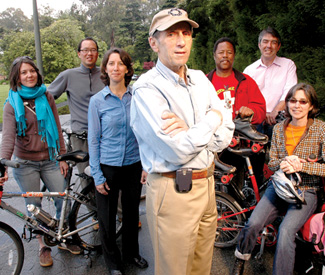
It wasn’t going well for Ted Strawser, predictably. The alternative transportation activist faced an uphill battle March 14 trying to convince a San Francisco Chamber of Commerce committee to endorse Healthy Saturdays, a plan to ban cars from part of Golden Gate Park.

Representatives of the park’s museums and Richmond District homeowners had just argued their case against the measure. “Visitors want access to our front door, and we want to give it to them,” Pat Kilduff, communications director for the Fine Arts Museums of San Francisco, indignantly told the group of two dozen business leaders gathered around a large conference table.

Strawser gave it his best shot: he talked about following the lead of other great cities to create car-free spaces; he said, “Golden Gate Park is one of the best parks in the nation, if not the world”; and he made a detailed case for closure. But around the table there were scowls, eye rolls, and other obvious signs that Strawser was being tolerated, not welcomed. Some — including chamber vice president Jim Lazarus — even started to interrupt and argue with him.

Then the man sitting next to Strawser spoke up. “I don’t think this is fair,” he said. And suddenly, everyone in the room shaped up. Strawser’s ally — his only supporter in the room — was somebody no chamber member could or would dismiss. Warren Hellman doesn’t shout or bang the table — but when he speaks, downtown pays attention.

Hellman, a prominent investment banker, told the committee members that he expected them to show the same respect for Strawser that they had for the previous two speakers. The nonsense ended, immediately.

And by the time Strawser turned the floor over to Hellman, the mood had changed. The group listened raptly, smiled, and nodded as Hellman spoke in his usual folksy, familiar, disarming style.

“It’s not a lot of fun when friends fall out,” he began, “because the previous speakers and many of you all agreed on the necessity of the garage [that was built in Golden Gate Park], and we worked together.”

He pointed out that many in the group had promised during the fall 2000 election to support Healthy Saturdays once the garage was built, although Hellman was now the only member of the coalition honoring that commitment. But he didn’t chide or shame his colleagues. That isn’t Hellman’s style.

Instead, he spoke their language. The garage has never been full and needs the money it can charge for parking to repay the bonds. This isn’t a fight that’s going away, since “part of the conflict is because this park is everybody’s park.” But there are “about 100 compromises not acceptable to either side that would move this forward.” And if a solution can’t be found, there will probably be an expensive ballot fight that nobody wants.

“My conclusion is we should attempt this test,” Hellman told the group. Ultimately, when the vote was later taken in secret, the chamber didn’t agree, although it did vote to back a trial closure after the California Academy of Sciences reopens next year.

At the meeting, Hellman openly called for Mayor Gavin Newsom to get involved in seeking a compromise, something Hellman said he had also just requested of the mayor at a one-on-one breakfast meeting. A couple of weeks later Newsom — who had already indicated his intention of vetoing the measure — did broker a compromise that was then approved by the Board of Supervisors.

As usual, Hellman didn’t take credit, content to quietly play a role in making San Francisco a better place.

Healthy Saturdays isn’t the most important issue in local history — but the significance of Hellman’s involvement can’t be underestimated. His alliance with the environmentalists and park advocates might even signal a sea change in San Francisco politics.

Warren Hellman represents San Francisco’s political and economic past. And maybe — as his intriguing actions of recent years suggest — its future.

This guy is a rich (in all senses of the word) and compelling figure who stands alone in this town. And even though his leadership role in downtown political circles has often placed him at odds with the Guardian, Hellman consented to a series of in-depth interviews over the past six months.

“Our family has been here since early in the 19th century, so we had real roots here,” Hellman told us. His great-grandfather founded Wells Fargo and survived an assassination attempt on California Street by a man who yelled, “Mr. Hellman, you’ve ruined my life,” before shooting a pistol and barely missing.

The Hellman family has been solidly ruling class ever since, rich and Republican, producing a long line of investment bankers like Warren.

Yet the 72-year-old comes off as more iconoclast than patrician, at least partly because of the influence of his irreverent parents, particularly his mother, Ruth, who died in 1971 in a scuba-diving accident in Cozumel, Mexico, at the age of 59. “She was entirely nuts,” Hellman said, going on to describe her World War II stint as a military flier in the Women’s Auxiliary Service Pilots and other colorful pursuits. “She just loved people, a little like I do. She collected people.”

Hellman grew up wealthy and cultured, but he also attended public schools, including Grant Grammar School and Lowell High School. In between, the young troublemaker did a stint at San Rafael Military Academy — “reform school for the rich,” as he called it — for stunts such as riding his horse to Sacramento on a whim.

After doing his undergraduate work at UC Berkeley, Hellman got his MBA from Harvard and went on to become, at the age of 26, the youngest partner ever at the prestigious Manhattan investment firm Lehman Bros. He developed into an übercapitalist in his own right and eventually returned home from New York and founded Hellman and Friedman LLC in San Francisco in 1984, establishing himself as the go-to financier for troubled corporations.

“He is really one of the pioneers of private equity,” said Mark Mosher, a longtime downtown political consultant and the executive director of Gov. Arnold Schwarzenegger’s California Commission on Jobs and Economic Growth, on which Hellman sits.

Hellman became what Business Week called “the Warren Buffett of the West Coast,” a man of extraordinary wealth and power. Among other accomplishments, Hellman took Levi Strauss private, recently made billions of dollars in profits selling DoubleClick to Google, and manages the assets of the California public employee retirement funds (CalPERS and CalSTRS), which are among the largest in the world.

Like many financial titans, Hellman has always been a generous philanthropist, giving to the arts, supporting schools in myriad ways, and funding the San Francisco Foundation and the San Francisco Free Clinic (which his children run). He vigorously competes in marathons and endurance equestrian events, often winning in his age bracket. And he has his humanizing passions, such as playing the five-string banjo and creating the popular Hardly Strictly Bluegrass festival.

But he’s also been a prime facilitator of downtown’s political power, which regularly flexes its muscle against progressive causes and still holds sway in the Mayor’s Office and other city hall power centers.

Hellman founded, funds, and is a board member of the Committee on Jobs, which is perhaps the city’s most influential downtown advocacy organization. Hellman and his friends Don Fisher, the founder of the Gap, and Sen. Dianne Feinstein also started SFSOS, which now wages the most vicious attacks on left-of-center candidates and causes.

When the de Young Museum and other cultural institutions were threatening to leave Golden Gate Park, Hellman almost single-handedly had an underground parking garage built for them, in the process destroying 100-year-old pedestrian tunnels and drawing scorn from the left. The Guardian called it “Hellman’s Hole.”

“We at the Bike Coalition very much started out on the opposite side of Warren Hellman,” San Francisco Bicycle Coalition executive director Leah Shahum told us. “We couldn’t have been more like oil and water on the garage issue.”

But over the past two years or so, Hellman’s profile has started to change. He went on to become an essential ally of the SFBC and other environmentalists and alternative transportation advocates who want to kick cars off JFK Drive in Golden Gate Park on weekends, crossing the downtown crowd in the process. He has shared his wealth with progressive groups such as Livable City, which often fights downtown, and has stuck up for edgy fun seekers over more conservative NIMBY types. He has also publicly repudiated the attacks of SFSOS and its spokesperson, Wade Randlett, and withdrawn his support from the group.

Hellman is still a Republican, but a thoughtful and liberal-minded one who opposed the Iraq War and wrote an article for Salon.com in February titled “If the United States Were a Company, Would George Bush Be Our CEO?” (His answer: hell no.) And to top it all off, Hellman sports a few tattoos and even attended 2006’s Burning Man Festival and plans to return this year.

Unguarded and reflective, Hellman’s comments to the Guardian foreshadow the possible future of capitalism and influence in San Francisco and point to potential political pathways that are just now beginning to emerge.

Our first conversation took place at the Guardian office two weeks before the November 2006 election, when it was starting to look like Nancy Pelosi had a good shot at becoming speaker of the House of Representatives.

“I think this election in two weeks is going to be really interesting,” Hellman told us.

This Republican was cheering for the Democrats to win. “They aren’t my kind of Republicans,” he said of the people in power. Hellman didn’t support the war or approve of how the Bush administration sold it, and he wanted Pelosi and the Democrats to hold someone accountable.

“What I’d like her to do is admit that we can’t get out [of Iraq immediately], but start to talk about what the fallout has been. Discuss the enormous cost in human life as well as money, and how it’s possible the war united the Middle East against us,” Hellman said.

The one thing he can’t abide is disingenuousness. Hellman speaks plainly and honestly, and he asked us to keep particularly caustic comments off the record only a few times during almost six hours’ worth of interviews. He was self-effacing about his political knowledge and seemed most interested in working through the problems of the day with people of goodwill.

Asked what he values most in the people he deals with, Hellman said, “It’s authenticity. Do they believe things because they believe in them, or do they believe in things because they’re cynical or they’re just trying to gain something?”

Locally, Hellman has reached out to people with varying worldviews and come to count many friends among those who regularly battle against downtown.

“I love to know people,” he said. “That’s probably the single thing that motivates me. When someone says to me, ‘How can you be friends with [then–head of SEIU Local 790] Josie Mooney?’ I say, ‘Look, I want to know Josie Mooney. And if she’s awful, then we won’t be friends.’ I’m just fascinated by getting to know people. And virtually always, they’re a little like Wagner operas: they’re better than they sound.”

Hellman was the chair of the Committee on Jobs when he got to know Mooney, who chaired the San Francisco Labor Council and was a natural political adversary for the pro-business group, particularly when Hellman was leading the fight to do away with the city’s gross receipts tax, which has proved to be costly for the city and a boon for downtown.

But after that victory, Hellman turned around and cochaired a campaign with Mooney to retool and reinstate the gross receipts tax in a way that he believed was more fair and helped restore the lost revenue to the city.

“We lost, but he put $100,000 of his own money into that campaign,” Mooney told us, noting that the proposed tax would have cost Hellman and Friedman around $70,000 a year. “I think he just thought the city needed the money. It was a substantive point of view, not a political point of view.”

Mooney considers Hellman both a friend and “an extraordinary human being…. He has made a huge contribution to San Franciscans that doesn’t relate to ideological issues. A tremendous thing about Warren is he’s not ideological, even in his political point of view…. On politics, I’d say he is becoming more progressive as he understands the issues that confront ordinary people.”

Mooney is one of the people who have helped bring him that awareness. When they first met, Mooney said, Hellman told her, “You’re the first union boss I ever met.” That might have been an epithet coming from some CEOs, but Hellman had a genuine interest in understanding her perspective and working with her.

“In a sense, I think that was a very good era in terms of cooperation between the Committee on Jobs and other elements of the city,” Hellman said. “Josie and I had already met, and we’d established this kind of logic where 80 percent of what we both want for the city we agree on, and 20 percent [of the time, we agree to disagree].”

Committee on Jobs executive director Nathan Nayman — who called Hellman “one of my favorite people in the world” — told us that Hellman feels more free than many executives to be his own person.

“He’s not with a publicly held company, and he doesn’t have to answer to shareholders,” Nayman said. “He takes a position and lives by his word. You don’t see many people like him in his income bracket.”

Hellman has become a trusted hub for San Franciscans of all political persuasions, Nayman said, “because he’s very genuine. He’s fully transparent in a city that likes to praise itself for transparency. What you see is what you get.”

Hellman expects the same from others, which is why he walked away from SFSOS (and convinced Feinstein to bolt as well) in disgust over Randlett’s scorched-earth style. Among other efforts, SFSOS was responsible for below-the-belt attacks on Sups. Chris Daly, Jake McGoldrick, and Gerardo Sandoval (whom a mailer inaccurately accused of anti-Semitism).

“If all things were equal, I’d just as soon that SFSOS went away,” Hellman said. “SFSOS started doing the opposite of what I thought they would be doing, so it was fairly easy for me to part company with them. What I thought we were doing is trying to figure out ways to make the city better, not just being an antagonistic, nay-saying attack organization. I’m not a huge fan of Gerardo Sandoval, but I thought the attacks on him were beyond anything I could imagine ever being in favor of myself. And it was a series of things like that, and I said I don’t want anything more to do with this.”

Downtown, they’re not always quite sure what to make of Hellman.

“Every once in a while, he does things that irritate people who are ideologically conservative,” Mosher said. “He took an immense amount of heat for supporting the Reiner initiative [which would have taxed the rich to fund universal preschool].”

He’s given countless hours and untold riches to public schools, doing everything from endowing programs to knocking on doors in support of bond measures and often pushing his colleagues to do the same.

“My connection to him has been through the school district, and he’s really been a prince,” Sup. Tom Ammiano said. “He has even stopped calling me antibusiness. He put a lot of his energy into improving public education, and so he shows it can be done.”

Progressives don’t always agree with Hellman, but they feel like they can trust him and even sometimes win him over. “If you get a relationship with him and you’re always honest about the facts and your own interests, he will listen, and that’s pretty remarkable,” Mooney said. “He shows a remarkable openness to people who have good ideas.”

His appreciation for people of all stripes often causes him to reject the conventional wisdom of his downtown allies, who viciously attacked the Green Party members of the Board of Education a few years ago.

“Everybody said, ‘Oh my god, Sarah Lipson, you know, she’s a Green Party member, she’s the furthest left-wing person on the board,’ blah, blah, blah,” he said. “And I phoned her up one day and said, ‘I’d really like to meet you.’ And she’s — leave aside the fact that I think she’s a very good person as a human being, but she’s a very thoughtful, analytic person. Listening to her opinions about things that are happening in the school district, I really respect that. I mean, what do I know about what’s going on in the school district? I know more now than I did then. But just getting to know people, and maybe get them to understand my point of view, which isn’t that penetrating.”

Many of his efforts have received little publicity, as when he saved the Great American Music Hall from closure by investing with Slim’s owner Boz Scaggs and helping him buy the troubled musical venue. “There are things that you and I don’t even have a clue that he has done,” Nayman said.

“He’s an interesting guy,” Mosher said. “He’s one of a dying breed, a liberal Republican. He has a social conscience and wants to use his money to do good.”

Actually, calling Hellman liberal might be going too far. In the end, he’s still very much a fiscal conservative. He doesn’t support rent control, district elections for the Board of Supervisors, taxing businesses to address social problems such as the lack of affordable health care, or limits on condo conversions.

He also opposes the requirement that employers provide health care coverage, which downtown entities are now suing the city to overturn, telling us, “In general, I don’t think it’s a good idea, because I’m still, even in my aging years, a believer that the marketplace works better than other things…. Universal health care I do believe in, but what I worry is that it’s going to be another damned bureaucracy and that it’s not going to work.”

Yet he doesn’t believe wealth is an indicator of worth, saying of his fortune, “It is luck. Most of what you do you aren’t better at than everyone.”

He doesn’t believe in the law of the jungle, in which the poor and weak must be sacrificed in the name of progress. In fact, he feels a strong obligation to the masses.

As he told us, “My mantra for capitalism — and I didn’t invent this, but I think it’s pretty good — is that capitalism won, and now we need to save the world from capitalism.”

Hellman looms large over downtown San Francisco. His Financial District office offers a panoramic view of the Bay Bridge, Treasure Island, the Ferry Building, and the rest of the city’s waterfront. He likes to be personally involved with his city and the companies in which Hellman and Friedman invests.

“Usually I’m directly involved,” he told us in an interview earlier this year. “I’ve always said that I don’t like to go to the racetrack to just look at the horses. The fun of being a principal is that you’re standing at the track and not saying, ‘Gee, that’s a beautiful gray horse.’ You’re saying, ‘Come on, he’s got to win!’ So I’m almost always invariably invested in the companies that we work with, either individually or through the firm.”

Unlike many Wall Street barons who strive to control a company and bring in new executives, flip it for a quick profit, or liquidate it, Hellman said his firm tries to identify solid companies and help facilitate what they do. “We don’t usually take over companies. I always think that we provide a service to help the businesses,” he said. “Our job is kind of the opposite of owning a factory. Our job is to be sure the people who run the business feel like it’s their business.”

Similarly, he thinks capitalists need to feel a sense of ownership over society’s problems, something he thinks is taking root in San Francisco and other economic centers, particularly among the younger generations. “It’s about understanding how much suffering there is on the other side and trying to figure out how that suffering can be alleviated,” he said. “I think it’s partly good economics that as you bring people up, they’re able to do more for society. If nothing else, they’re able to buy more and shop at a Wal-Mart or something — probably someplace you would wildly disapprove of — and buy goods and services. But I don’t think it’s that narrow.”

Rather, he believes that everyone has a little progressive in them, a little desire to cooperatively solve our collective problems rather than pass them off to future generations. He sees a marked change from his days at Lehman Bros.

“Everybody was into making it,” he said, noting that many capitalists then did charity work as a means of attaining social status but focused mostly on the accumulation of wealth. But, he said, the new generation of capitalists seems genuinely interested in improving the world.

“The feeling for giving back in the next generation, in the now 25- to 35-year-olds, it’s just an order-of-magnitude difference than it was for people who are now in their 40s and early 50s,” Hellman said. “I’m very encouraged.”

Yet the flip side is that, in Hellman’s view, downtown doesn’t wield as much power as it once did. Low political contribution limits have made politicians less dependent on downtown money, creating fewer shot callers, while democratizing tools such as the Internet have broadened the political dialogue.

“For the last 30 years we have become an increasingly tolerant city, and that’s great,” he said. “In the old days, [the Guardian] complained about downtown, and yeah, no shit, downtown really did control the city. The benefit was as that slipped away, the city became fairer and more open to argument. So now downtown hardly has any power at all anymore. In a sense, that’s a good thing. Tolerance grew tremendously when the city wasn’t dictated to.”

That tolerance caused street fairs to pop up all over town and festivals such as Hellman’s Hardly Strictly Bluegrass to blossom in Golden Gate Park. Bike lanes have taken space from cars, events such as Halloween in the Castro have gotten crazier, street protests have gotten bigger and more frequent, and people have felt more free to fly their freak flags. And all that freedom eventually triggered a backlash from groups of isolated NIMBYs who complain and often find sympathetic ears at city hall.

“Sometimes you get the feeling in this city that in the land of the tolerant, the intolerant are king,” said Hellman, whose festival has endured noise complaints even though the music is shut off by 7 p.m. “There is a continuing pressure to do away with fun, because fun is objectionable to someone, [but] we need to think about not creating a new dictatorship of a tiny group of people whose views are not in line with the opinion of most of the people of San Francisco…. You should try to balance the good of a lot of people versus the temporary annoyance of a few people.”

Preserving fun and a lively urban culture is a personal issue for Hellman, who plays the five-string banjo and calls his festival “the most enjoyable two days of the year for me.” He helps draw the biggest names in bluegrass music and acts like a kid in a candy shop during the event.

“I feel very strongly that an important part of our culture is built on the type of music and type of performance that goes on at Hardly Strictly Bluegrass,” Hellman said. From parables set to music to songs of struggle and the old union standards, “that kind of music is the conscience of our country.”

He considers bluegrass a vital and historically important form of political communication, more so than many of the upscale art forms that the rich tend to sponsor. “I’m glad that we have first-rate opera, but it’s equally important that we foster the kind of music, lyrics, etc., that support all this,” he said. “Somebody once said that most of the great Western philosophy is buried in the words of country songs. And that’s closer to the truth than most people think. A big passion of mine is to try to help — and people have defined it too narrowly — the kinds of music that I think have a hell of a lot to do with the good parts of our society.”

Perhaps surprisingly for a Republican venture capitalist from the older generation, Hellman also considers the countercultural freaks of San Francisco to be some of the “good parts of our society.” That’s why he attended Burning Man for the first time last year and why, he said, he loved it, as much for the culture and community as for the art.

“I went to Burning Man because as much as possible I want to experience everything,” he said. “I want to just see directly what it’s like. I knew I’d enjoy it. I never doubted that. But what really overwhelmed me is it was 40,000 people getting along with each other. I mean, it’s pretty intense. There were dust storms and the world’s most repulsive sight: nude men over 70 just dangling along. But I never saw an argument. It was 40,000 people just enjoying each other.”

It was most striking to Hellman because of the contrast with the rest of society. As he said, “I’ve never seen this country so divided.”

While Hellman supports Schwarzenegger — calling him “a good advertisement to California” — he has nothing good to say about his fellow Republican in the Oval Office. He calls Bush’s tenure “an absolute four-star disaster.” The invasion of Iraq is the most obvious problem, he said. “Our war policy has slowly veered from being ‘Don’t tread on me’ to we’re going to jump on your neck.”

But his antipathy to certain aspects of the Republican Party began even earlier, when the religious right began to take over.

“I thought we were not that polarized during the Clinton administration. I was somewhat encouraged,” Hellman said. “Maybe there was an undercurrent of strident religious behavior or strident conservatism, but not the conservatism that I think the Republican Party used to stand for, which was fiscal conservatism instead of social conservatism. Somehow, there was this angst in this country on the part of religious people who I guess felt this country was being taken away from them, and they were the kind of stalwart or underpinnings of society. And they took it back.”

But in the wake of that disaster, Hellman thinks, there is an opportunity for reasonable people of goodwill to set the future political course. As Nayman said of Hellman, “He does believe there is a middle way pretty much all the time.”

Politically, that’s why Hellman gravitates toward the moderates of both major parties, such as Schwarzenegger and Newsom. He looks for people who will marry his economic conservatism with a regard for things such as environmentalism and social justice.

“It’s very tough to be a big-city mayor,” Hellman said. “[Newsom is] probably the best mayor we’re entitled to. He’s got this fantastic balancing act.”

Hellman said downtown hasn’t been terribly happy with Newsom for supporting striking hotel workers, getting behind Ammiano’s health insurance mandate, supporting tax measures, and generally letting the Board of Supervisors set the city’s agenda for the past two years.

“Their measure is he has 80-percent-plus popularity, and he ought to spend some of it. Well, they might not agree with what he would spend it on. And he’s been unwilling to spend very much of it. In some parts of the business community there is disappointment with him, but I don’t think that’s right. He didn’t hide what he would be like.”

What Newsom said he would be — a big reason for his popularity — is a mayor for the new San Francisco, a place where the city’s traditional economic conservatism has been tempered by a greater democratization of power and an ascendant progressive movement that expects its issues to be addressed.

“I don’t like people who are intolerant,” Hellman said. “I don’t like people that are telling you something to get some outcome that, if you understood it, you probably wouldn’t want. I like people that are passionate.”

Asked, then, about Sup. Chris Daly, the nemesis of downtown and most definitely a man of strong political passions, he said, “I admire Chris Daly. I disagree with Chris on a lot of things he believes, but there are also probably a lot of things I would agree with Chris on. And I respect him.”

Hellman is the rare downtown power broker who wants to bridge the gap between Newsom — whom he calls a “moderate to conservative establishment person” — and progressives such as Daly, Mooney, and the Bicycle Coalition. The middle ground, he said, is often a very attractive place, as it was with Healthy Saturdays.

“I’m sure you spend time in the park on Sunday, and it’s a hell of a lot nicer in there on Sundays than Saturdays,” Hellman said. But even more important to him, this is about integrity and being true to what Golden Gate Park garage supporters promised back in 2000.

“They were proposing Saturday closing at that time, which I’ve always thought was a good idea,” he said. “And we made a commitment to them, or I thought we made a commitment to them, that let’s not have Saturday closure now, but as soon as the garage was done, we’d experiment with Saturday closure.”

We brought up what Fine Arts Museums board president Dede Wilsey has said of that pledge, that it was under different circumstances and that she never actually promised to support Saturday closure after the garage was completed.

“There’s a letter. She put it in writing,” he said of Wilsey. “She signed a letter on behalf of the museums saying that when the de Young is done, we should experiment with Saturday closings.”

The Bike Coalition’s Shahum said that even when Hellman was an enemy, he was a reasonable guy. But it’s in the past couple of years that she’s really come to appreciate the unique role he plays in San Francisco.

“He showed decency and respect toward us,” she said. “We never saw him as a villain, even though we disagreed completely. Later he really stepped up and has been a leader on Healthy Saturdays. And what I was most impressed with is that he was true to his word.”

Supervisor McGoldrick, who sponsored the measure, echoed the sentiment: “Hellman was certainly a man of his word who acted in a highly principled way.”

So why does Hellman now stand apart from the downtown crowd? Has he parted ways with the economic and cultural power brokers who were once his allies?

No, he said, “I think they parted ways with me.” *

 

Istanbul May 11, 2007

0

By Bruce B. Brugmann

CNN today was drumming on with news of Tony Blair going and Gordon Brown coming in as prime minister of Great Britain. The Turkish Press was reporting that the national elections here had been moved up three months to July 22, and this surprised the political parties, who were alarmed and said they were forced to bring in the professionals to help them carry on effective campaigns during the short period left before the election. The Turkish Daily News, Turkey’s English daily, reported that there was no space left on the TV stations or on the billboards and that campaign ads would be competing with ice cream manufacturers.
On the plane coming in, Spiro Vryonis sat next to associate pubublisher Jean Dibble and filled her in on the elections from his perspective as a Byzantine scholar. Vryonis, retired director of the center for the study of Hellenism in Sacramento, told her that Prime Minister Recep Tayyip Erdogan supported his Foreign Minister Abdullah Gul for president. “They get along like two dogs until someone throws a bone between them,” he said.
Meanwhile, I found good advice in Time Out Istanbul, the city-living guide in English. It wrote about the art of Keyif, which translates as “a pleasurable state of idle relaxation.” The article said that Keyif has been honed down to an art form by the Trurks and laid out 10 ways of experiencing Keyif the Turkish way. My favorite was the idea of walking aimlessly along the Bosthorus, the body of water seperating Asia from Europe. It said that “you’ll be surprised how relaxing the Oriental art of walking around with no destination is.” The 58th International Press Institute world congress and general assembly starts tomorrow. So I think I’ll spend the rest of the afternoon doing Keyif. B3

Digital Venuses

0

› a&eletters@sfbg.com

Call them the new British bitch pack: barefoot soul shouter Joss Stone and her ascendant sistren, skankin’ Lily Allen and torchy Amy Winehouse (Corinne Bailey Rae’s exempted due to being a queen of nice and hazy sentiment and, well, yes, color). The Pipettes also deliver Ronettes-Supremes paeans but have yet to splash large beyond the UK. It’s Stone and Winehouse who have made recent history on the US pop charts: the latter’s Back to Black (Republic) scored the highest ever debut for a British woman (number seven), and Stone’s Introducing Joss Stone (Virgin) followed a week later, debuting at number two.

The third release in this triumvirate, Allen’s Alright, Still (Capitol), is the least compelling, though it possesses the most diverse sonic palette: ska, Britpop jangle, punk, rocksteady, N’Awlinz funk, and English dancehall, courtesy of her fellow celebutot music maker, DJ and producer Mark Ronson. While "Friend of Mine" will doubtless prove a decent summer jam, the scattershot production speaks more to Ronson’s patented retro-soul ambition than to individuality on Allen’s part. I’m already over the stunt sampling of Professor Longhair and find Allen’s spin on jaded indie affect and lyrics powered by class snobbery grating.

The aforementioned artists are part of yet another wave of British acts working in black American musical idioms: James Hunter, James Morrison, Lady Sovereign, and Alice Russell. Call them the spawn of Dusty Springfield. Blue-eyed British soul diva Springfield’s 1969 classic Dusty in Memphis (Rhino/WEA) is the obvious grail for most of these new acolytes. They’ve also benefited from the successive layers of space opened by Blighty’s trends in Northern soul, acid jazz, trip-hop, and the Yankee stand taken for retro soul by the now-defunct Desco label (which split into Soul Fire and Daptone) with black vocalists such as Lee Fields. One wants to big up Allen, Winehouse, and Stone on the sisterhood empowerment tip for their brassy attitude and scathing kiss-offs to trifling men on these recordings. And it’s interesting that they’ve emerged at a time when their male counterparts, such as Morrison — and David Gray and Chris Martin — seem to have "bitched up." Yet this gender power–reversal is sadly trumped by glaring issues of race and authenticity.

REAL ME, REAL MIMICRY


Nowhere are these issues more clearly embodied than in Joss Stone, who’s about to hit the Yay Area. She’s been around for a minute, leading the cited alien invasion with her Miami Sound–assisted debut, The Soul Sessions (Virgin), in 2003. Missed in all the hype and scandal over Stone’s breakup with Motown scion Beau Dozier, her recent adoption of a faux-Yank accent, and the sacking of her handlers is the fact that her much-vaunted revamp has a precedent: Stone described her second CD — Mind, Body, and Soul (Virgin) — as her "real debut," and it contained a mix of Southern soul, urban swing, and hip-hop similar to the template codified by Lauryn Hill in the late 1990s.

The 19-year-old blond Venus actually coaxed Hill out of her fog to guest on "Music," but overall Introducing merely treads water instead of shifting any postmillennial soul paradigm. Stone remains trapped by the novelty factor of having been a 15-year-old girl from Devon who could mimic a middle-aged black American singer and has not figured out how to reconcile her West Country roots, accent, and affluence with the grit and honesty her ambitions require. She’s content to let producer Raphael Saadiq locate her brand-new thang somewhere between Aretha Franklin circa Sparkle and the early ’80s Isleys, with a soupçon of hip-hop flourishes — an approach that only really sparks on opener "Girl They Won’t Believe It" — when underage Stone really ought to be ashamed at her affair with 41-year-old Saadiq. The specter of Dallas Austin’s banging for beats screed rears its ugly head.

Stone may be styled in psychedelic body paint, flowers, and baubles as some lost wild child of Janis Joplin, but unlike that late bad-Jewish-girl-with-a-yen-for-the-blues icon, she lacks the ovaries and independence to instigate any sonic revolt, nor does she transcend her black influences. Although she too failed to flip the rock biz’s race politics, Joplin was an original. She was also perfecting a worthy form of hybridity, whereas Stone would still do best to apprentice behind a seasoned soul singer and grow into her voice. Meanwhile, she’s an immature artist trapped within the middle-class mythos and mass fantasies of the pop star system.

RUNNING THE RACE?


White artists’ love and theft of black expression, as ratified by the Elvis phenomenon, remains the primary cultural battleground in the aughties — don’t get it twisted. The phenomenon of white singers who sound black is as old as minstrelsy, of course. Vaginas trouble this aesthetic guerrilla warfare — with Stone and company entrenched in the valley of sound between Joplin, Springfield, Lydia Pense, and Teena Marie on the one side and Madonna, Taylor Dayne, Britney Spears, and Fergie on the other. Yet Stone and her sister purveyors of femme funk are not truly innocents with songs in their hearts and stars in their eyes. These daughters of Al Jolson, removing their Jewish foreignness by sonically and visually blacking up as he did in The Jazz Singer, are reaping the rewards this season from the West’s most vital industry: the consumption and export of essential blackness.

Whether fucking or channeling the likes of Dinah Washington and Ronnie Spector in the studio, Allen, Stone, and Winehouse are enjoying everything but the burden of blackness. These vocalists face the dilemma of the privileges of whiteness versus the comforts of being soulful, and this will continue to dog their careers if longevity’s next. Doubtless Stone, Allen, and Winehouse don’t want to be "nappy-headed hos" — thanks, Don Imus — but desire the erotic, exotic power of sistagirls without being the mules of the world. Yet why is the old "black joy, not black pain" truism surfacing now in the UK?

Look to recent cinema from across the pond: in The Queen, Elizabeth II, the paragon of English womanhood, is asked by Tony Blair to be feely and emotional to help heal the nation in the wake of Princess Diana’s death, to restore the heart Diana represented. But Elizabeth chafes, bound by old royal models of honor and duty. The crisis of Britannia is coded even more explicitly in Children of Men. In its dystopic vision, black women are despised yet also figures of salvation. As in the film, in which only a regenerative black female can save England, these new wave British soulsters labor to recuperate the distant and unreal of classic soul, despite its distinctly American set of societal preconditions. A post–Margaret Thatcher, post-Blair return to authenticity is what these singers represent, a late moment after Rod Stewart delivered fair Albion’s best-ever approximation of soul and empire has faded, leaving postcolonial turmoil and identity flux. Black female soul brings rebirth to this turbulent world via the vocalizing of Stone et al., placing them back at center of the world — at least aesthetically.

FLIPPING BACK TO BLACK


This activity meets its zenith in the petite, pinup-tatted, beehive-burdened, anorexic form of Winehouse. Unlike Stone, who’s at pains to elide her Englishness, Winehouse’s distinctly North London Jewish accent surfaces on her critically acclaimed Back to Black, but her extreme jazz-soul mummery remains paramount, even as white critics and listeners continue to adopt a white version of black culture at the expense of young black artists of the retro-nuevo soul or urban alternative persuasion. Winehouse has yet to be anointed with a universal ghetto pass and, like Stone and Allen, has bypassed the hood and proper apprenticeship for lucrative prime time at the nation’s premier venues this spring.

Throughout Back to Black, Winehouse gets away with borderline minstrelsy, carelessly mashing up a vocal cocktail of Washington, Billie Holiday, Carla Thomas, and Phil Spector’s girl-group surrogates while not being excoriated because her Pete Doherty–rivaling tabloid exploits with drunkenness, raunchy sexuality, and public belligerence fit her admirers’ view of authentic blackness. Behind Spanish Harlem drag, Motown cocktail dresses, and Cleopatra’s black eyeliner, Winehouse is the cunning poster girl of her mid-Atlantic milieu, permitted to get away with potentially offensive lyrics such as "side from Sammy you’re my best black Jew" ("Me and Mr. Jones"), showcasing a pair of cooning black backing vocalists and hipster-comforting insincerity.

"What kind of fuckery is this?" I’m sure to Winehouse’s equivalents across the color line — from fiftysomething Sharon Jones to 36-year-old failing freaky-deak diva Macy Gray and badass bitches in the wings such as Alice Smith — it seems like the demoralizing same old. These are black artists who, to varying degrees, can sang but whose efforts render them invisible in a field overwhelmed by white soul saviors. Why invest in these sistas’ development or even spotlight the neo–chitlin circuit movement afoot in the Southeast when the only blackness that really counts bears a stench of formaldehyde? *

JOSS STONE

Tues/15, 8 p.m., $35

Warfield

982 Market, SF

(415) 775-7722

Watered down

0

› a&eletters@sfbg.com

I’ve read more than once that Raymond Carver stories are short and laconic by artistic necessity. Some critics are invoking this dogma in writing of Ray Lawrence’s new movie, Jindabyne, and the story it’s based on, "So Much Water So Close to Home" (also used as a thread in Robert Altman’s Carver buffet Short Cuts). This is, at least where "So Much Water" is concerned, horse puckey. But Lawrence (director of 2001’s wonderful Lantana and 1985’s just-shy-of-brilliant Bliss) and screenwriter Beatrix Christian have only gone half the distance to prove it.

As Carver wrote the story, a woman struggles with the knowledge that her husband and his buddies decided to continue their fishing trip after finding a woman’s body in the river, not reporting the discovery for two days. Lawrence transplants the American story to Jindabyne, a second chance of a town in Australia’s New South Wales, relocated from its original spot, which is now under a human-made lake. The film adds characters and gives those original to the short story more unpleasantness to remember and more to look forward to, but it does substantially more in this undertaking than read Carver’s tea leaves. Particularly successful is the invention of an authority-undermining mother-in-law, whose strain on the already precarious marriage of Claire (Laura Linney) and Stewart (Gabriel Byrne) is no mere device. But the best-directed relationship in the movie is the one between the fishers and the river: the act of fishing is so lovingly captured as to implicate the audience in their decision to stay.

Overall, however, Lawrence’s style is so highly pitched (slow tracking shots of the mystery that is nature, indigenous wailing in the soundtrack, hypnotized stares aplenty) that the ugly power of the men’s decision is undercut by the film’s bigness. It waters down the shame — my preferred reading of the dammed-up Jindabyne metaphor — by elevating it. This same style was so much better suited to the tinier, coincidence-laden universe of Lantana, which actually held the mystery and danger that the editing and sound design so unaccountably try to re-create in Jindabyne.

Then there are the two megafuckups. Fuckup numero uno: the woman’s killer, ridiculously, is kept around in the movie to ooga-booga the proceedings at 20-minute intervals. He smacks strongly of the psycho in 2005’s limbs–torn–asunder–from–Down Under anatomy lesson Wolf Creek, but he lacks that character’s bitterness and intelligence. He also lacks any relevance to the story once he’s served his unfortunate inaugural purpose. But fuckup number two is a far bigger betrayal of the otherwise remarkably nurtured primary text: Lawrence and Christian graft race and class politics onto the self-contained family drama in the form of the discovered body, an Aboriginal woman, and her angry family. (For a lesson in subtly handled class politics, Wolf Creek, hand to god, is the way to go.) At first Claire’s quixotic attempts to connect with the woman’s family are good for the film’s battered soul: the men’s shameful negligence is followed by her flailing, insensitive attempts to make things right. But the film actually gives Claire and Stewart (and hell, everybody, in an end-of-the-movie congregation worthy of Scooby-Doo) their closure, and no less in a final sequence that is also blatant cultural voyeurism. An intended irony can be argued, I suppose, but some ironies are a lot more convenient than others. *

JINDABYNE

Opens Fri/11 in Bay Area theaters

See Movie Clock at www.sonyclassics.com/jindabyne

Not Coachillin’

0


SONIC REDUCER “I can’t believe you slept through the police helicopter above the tent at 3 a.m. and the megaphone going, ‘Disperse immediately or you’ll all be arrested,'” tentmate Fluffy marveled the day after another ear-busting night of the Coachella Valley Music and Arts Festival’s unofficial after-party scene in the campgrounds. It was only 8 a.m., though the sun was already beating down relentlessly like our heedless neighborhood drum circle.

I’ve snoozed through my share of lousy plays, bad bands, and crappy circuses, but I never thought I’d slumber through the 24-7 thrills at the Empire Polo Fields. And the chopper was just the chaser to April 28 trance headliner Tiesto, who began his loud set, pompously booming out over our not-so-fair tent city of spring breakers and Euro tourists, with “In the beginning there was the earth….”

We’re gonna have to sleep through the history of the planet, was my last thought as I drifted off.

O Coachella, don’t you cry for me, ’cause I’ve come from Alabama Street with a heat rash on my knee — and doubts about making the scene at the festival despite the fact that about 160,000 brave music fans were expected to face down the desert swelter as the event swelled to three days.

At this juncture, Coachella might be described as a music festival on steroids: it’s a carnival for 18 and overs with rides, art installations, dancers, and completely insane people wearing full-body chicken costumes in the 110-degree heat, though still boasting a comprehensive bill of today’s so-called hot bands. It’s your one-stop smorgasbord for music lovers, who will happily chat you up about the performer they deemed the most mind-blowing the previous night or the last Rage Against the Machine show they caught.

And they got what they came for: the Björk shroom headdress; the crazed buzz rising from such festival circuiteers as Amy Winehouse and Klaxons; solid pop from Jarvis Cocker and Peter Bjorn and John; show-stopping performances by DJ Shadow, CSS, Arcade Fire, and Konono No. 1; and the rattle of reunion bones by an amped and antic Rage Against the Machine, glowering and balding Jesus and Mary Chain, and, er, Crowded House. You couldn’t go amiss if you stuck to the desert to-do’s rave roots and entrenched yourself beneath the mirror ball, video screens, and pink and blue lights of the Sahara tent: the performances there by Justice and LCD Soundsystem connected with the crowd with a screw-it-all exuberance.

But the untold story lay far away from the press tent and Palm Springs love nests — in the crowded, brutal heat of the campgrounds next to the performance area. Is it possible to review a camping trip? In what seemed like a dusty, straw-strewn football field with thousands of other wake ‘n’ bakers? I spent far too much time taking refuge from the nonstop heat at the campground’s cybercafé, where hundreds of shirtless boys and bikinied girls would miserably crouch, recharging their cells at a bank of outlets, sit stunned watching the Coachella film on a loop, or lie on the ground like clammy, comatose dead fish, waiting out the morning before the acts began in early afternoon.

The southerly discomfort led most campers on a lengthy hike from the tent city, past the obscenely grassy country clubs surrounding the polo grounds, to find refrigerated refuge and 40s at Ralph’s, the nearest supermarket, where people were literally chillin’ on store lawn furniture. Coachella: the fest that inspired global warming — and a post–<\d>Earth Day longing for air-con.

Organizers Golden Voice had a clue: they gave away free water sporadically and provided campers with free Internet use and showers. But there were too few laptops, the wi-fi was too erratic, and the showers were locked down too early — and you knew there was too little shade in general when audience members broiled in the sparse shadows of lemonade stands.

The crowd — weighted with Rage Against the Machine fans eager to see the band’s first concert in more than five years — was also heavy on the testosterone. But maybe that’s just the state of Rage love: the band never really seemed too underground to me but has historically worked to surface activist subversion via modern rock radio. And their audience was still boiling — and amazingly good-natured despite the sleepless nights. As for myself, I finally woke up hours after the helicopter early April 29 to the sound of a random dude shouting, “Whoo!” and yammering loudly in Portuguese to the tentizens the next flap over. Later I was tempted to put my own spin on Zack de la Rocha’s onstage suggestion that Bush and Cheney be “tried for war crimes and shot.” I know the 12-hour roller coaster ride of quality hallucinogens can be a bitch — but then, so can I: is it so wrong to want the early morning shouters and the dude with the air horn to be tried for crimes against humanity’s sleep schedule and shot? I’d settle for finding out where they were dozing it off and delivering a special whoo-gram of my own.

BOB DYLAN STUDIED HERE That’s the rumor, anyway, at the Blue Bear School of Music, which has seen Tracy Chapman and more than 20,000 other musicians come through its doors in the past 36 years. Executive director Kevin Marlatt told me the nonprofit’s second annual fundraiser — showcasing 2007 Grammy Lifetime Achievement winner Booker T. Jones as well as Blue Bear staffer Bonnie Hayes and Sista Monica — will include an appearance by the James Lick Middle School Band, the result of the organization’s efforts in the last year to get more involved in public school music education. Since it took over the James Lick music program and brought in 30 guitars, he says, more than a dozen bands have popped up at just that school. So Stax around for a good cause. *

BOOKER T. JONES

Sat/12, 8 p.m., $45–$125

Great American Music Hall

859 O’Farrell, SF

www.bluebearmusic.org


David’s Kitchen

0

› paulr@sfbg.com

In the kitchen of David’s Kitchen, a tiny restaurant in the Sunset, you will find David. The kitchen is of the semiexhibition sort, viewable from the snug dining room through a rectangular aperture that looks as if it once might have housed a picture window or maybe a large plasma flat-screen television. Was this space once home to a sports bar? David is David Chang, a native of China who opened the place with his wife, Terri, about four years ago. He could have called it David Chang, if he’d cared to join the trend of to-the-greater-glory-of-me chef-owners who name their restaurants after themselves. I have sometimes wondered how often these grand people can actually be found in their own kitchens. "David’s Kitchen" suggests to us that David is actually in the kitchen, and so he is, perhaps cooking your lunch after taking your order. At lunch it can be just you and him; it’s like having your own short-order chef. He seats you, writes down what you want, then makes and serves it. You are happy, even when he presents the bill, which your own short-order chef would never be so crass as to do. But then, even the best fantasies have limits.

It would be difficult to overstate the intimacy of David’s Kitchen. Like Thai Time, the fabulous and impossibly small restaurant on Eighth Avenue in the Inner Richmond, David’s Kitchen has only a handful of tables and fills to near capacity when a few parties of three or four come through the door at about the same time. If there had been an Asian restaurant on Skylab, the makeshift space station from the 1970s, it might have looked something like this. While David’s menu does include a strong Thai element, it’s pan-Asian in a way Thai Time’s isn’t; there are even a few New World items thrown in — for fun? Or because of neighborhood demand? One of them, the chicken barley soup ($3.50), we found to be insipid, but that was the only dish we came across that failed to sing in a clear, strong voice.

Even among the Asian dishes, one finds the occasional global touch. Although fat seafood noodles ($5.95 at lunch) spoke with a pronounced Thai accent — the sauce was coconut-milk green curry, with a strong subplot of chile heat — the noodles themselves were fettuccine, for a slight Marco Polo twist. The seafood, meanwhile (shrimp, mussels, clams, and whitefish, leavened with zucchini quarters), was immaculate, in keeping with the restaurant’s assurance that "we use only the freshest ingredients."

XO chow fun noodles ($5.95), on the other hand, were the broad, glistening Chinese rice-flour kind, tossed with shreds of boneless chicken, bean sprouts, scallions, and (the star ingredient) XO sauce, a Hong Kong–<\d>style paste of dried shrimp and scallop along with garlic, onion, and chile peppers. This saucing gave the dish a flat, fierce heat, like an August day on the Great Plains — quite different from the rounded punch of the fat noodles — with a strong hint of onion breath and some soy saltiness.

Although many of the appetizers will seem familiar to anyone who’s eaten at a Thai or Chinese restaurant in these parts (and who hasn’t?), David’s versions are mostly executed with a soupçon of panache, which helps make them memorable. The crispy fish cakes ($5.75), for example, will never be mistaken for tortilla chips, but they do minimize the characteristic rubberiness of the average fish cake and achieve a delicate stiffening around the edges. It helps that they’re quite flat, like small griddle cakes.

Spring rolls ($4.95) were nearly ordinary, despite a weighty filling — of shredded chicken, bean sprouts, and shiitake mushrooms — and a crime-scene-red dipping sauce redolent of chiles and garlic. But the veggie pancake ($5.25) was unlike anything I’ve had before, a kind of soft Asian crepe, like a socca or farinata, made from ground lotus and taro root (instead of chickpea flour) and spruced up with water chestnuts, scallions, and pesto.

We also detected European influences, or echoes, in a duck curry stew ($9.95), a crock of meat, potatoes, and carrots that resembled beef burgundy, except that the beef was duck (a little fatty, but tasty) and the sauce had no red wine but plenty of yellow curry, mildest of the Thai curries. Spicy sunflower chicken ($6.75), on the other hand, though not yellow, was straight from Thailand — a larb, really, of minced white chicken tossed with a lively combination of Thai basil, garlic, and chiles. The meat was heaped in the center of a large plate, with canoelike leaves of endive set around the perimeter like hour markings on a watch. The endive was convenient for the scooping up of the minced meat, of course, but even after the leaves had run out, all the members of our table, forks in hand, were jostling for a crack at the last of the chicken.

The kitchen at David’s Kitchen doesn’t much look like the kitchen at Canteen, Dennis Leary’s small boutique place downtown. Leary’s kitchen is L-shaped, for one thing, and also more exhibitiony: you can sit at the counter and watch the chef work the stoves.

But to be at either place is to be aware that the restaurant as a labor of love is a phenomenon that persists even in this overpriced city — and that there are a few fine chefs who still do their own cooking. And then some. *

DAVID’S KITCHEN

Lunch: Tues.–Sat., 11:30 a.m.–2:30 p.m. Dinner: Tues.–Thurs. and Sun., 5–9:30 p.m., Fri.–Sat., 5–10 p.m.

1713 Taraval, SF

(415) 566-6143

Beer and wine

MC/V

Moderately loud

Wheelchair accessible

Nude beaches

0

› culture@sfbg.com

In 1967, Northern California gave birth to America’s first nude beach, at San Gregorio, near Santa Cruz. Now, 40 years later, there’s great news coming from the sand: in the biggest surge in more than a decade, clothing-optional beaches and other skinny-dipping sites are booming once again. Check out our miniguide below. And in the near future, visit an expanded version on the web that includes our unveiling of a pristine cove near Capitola and directions to a place where you can take a naked full-moon hike.

The one bummer? The popular Red White and Blue Beach, in Santa Cruz County, is closing in the wake of the retirement of owner Ralph Edwards.

San Francisco County

LAND’S END BEACH


Tucked away among craggy cliffs, patches of sand, and some of the Bay Area’s best scenery, a nude beach is the last thing you’d expect to find within a short walk of the end of Geary Boulevard. But on warm days, Land’s End usually draws dozens of visitors.

HOW TO FIND IT Go to the end of Geary, and park in the dirt lot up the road from the Cliff House. Take the trail at the far end of the lot. A hundred yards past a bench and some trash cans, the path narrows and bends, rises and falls, and eventually becomes the width of a road. Don’t take the road on the right, which leads to a golf course. Instead, keep going past another bench, and as the trail turns right, take a left toward a group of dead trees. Where there’s a stairway with a Dogs Must Be Leashed sign, descend and head left to another stairway, which leads to a 100-foot walk to the cove. Alternately, follow the service road below the El Camino del Mar parking lot a quarter mile until you reach a bench, then take the trail there. It’s rough in spots, and at the end you’ll scramble over rocks.

THE BEACH Rocks and little watery grottoes. Look for some good sandy areas away from the beach’s entrance. For the best sunbathing spots, walk west (left). Some visitors build little rock windbreaks, which provide protection from blowing sand.

THE CROWD The quarter-mile-long cove gets up to 30 visitors on the warmest days, with up to 80 percent gay male usage being fairly standard. One visitor counted six or so nudes, all men, during a May visit.

PROBLEMS Long walk, random "sex patrols" by rangers, reports of drug use, public sex on trails and nearby. Fog and wind. Quite rocky. Swimming not allowed. Trails other than the main one are unsafe and may be closed and have poison oak.

GOLDEN GATE BRIDGE BEACH


Overrun by fans undeterred by its slippery and often dangerous trails, the Golden Gate Bridge Beach usually turns into a mob scene on summer weekends. The waves don’t break as hard here as at Baker Beach, so on the nicest days in low tide, you can go out up to 50 yards. A favorite activity: watching the sunset while staring toward the site’s namesake, the Golden Gate Bridge. But don’t visit if you’re looking for privacy and solitude. "I had to stop going there because it’s such a pickup scene," frequent visitor Joseph Friday says.

Also known as Nasty Boy Beach and Marshall’s Beach, the shoreline here features a trio of adjacent coves. In the spring, check for beautiful flowers on the bluffs. Drawbacks include some poison oak on the path (often trimmed back by volunteers), which is otherwise unmaintained and becomes a muddy bluish goo after rainstorms. Golden Gate National Recreational Area rangers strongly recommend that visitors stay away from the trails and avoid swimming.

HOW TO FIND IT Go to North Baker Beach, park in the main lot, and walk north along Lincoln Boulevard, passing the sand ladder that leads to North Baker. Just north of the ladder trail, look for a dirt road with a gate leading to Battery Crosby. Follow it, then hike up the trail immediately on the south (left) side of the old fort to the top of the bluff. Rangers recently added some rails that make the path a little easier to follow. Take the trail straight west as it goes downhill toward the ocean (wear long sleeves and pants to protect against poison oak). At a small crumbling concrete bulkhead, the trail heads north along the bluffs and eventually down a shorter, steep section with small steps cut into the gully. The main path ends at the south end of Golden Gate Bridge Beach.

THE BEACH Three small rocky beaches located below Fort Winfield Scott. The main beach trail tends to be slippery, heavily eroded, and dangerous.

THE CROWD During the week, Golden Gate Bridge Beach attracts dozens of users. On weekends, (mostly nude) usage soars to between 100 and 300 visitors on the hottest days.

PROBLEMS Slippery, crumbling, sometimes muddy, and poison oak–edged trails. Trash, rocks, wind, fog, unsafe swimming conditions, sex on the beach, too many people often jammed into too little space.

San Mateo County

DEVIL’S SLIDE


Now that its main access road, landslide-prone Highway 1, is finally reopened, visitors are flocking back to one of California’s only state beaches that officially permit nudity. Called Gray Whale Cove State Beach, the site known to many users as Devil’s Slide draws maybe 200 people on warm days — about 25 percent of them nude.

Nude use is especially popular on the north end of the long sandy shore. If you like Frisbee, it’s easy to find somebody to play with at the cove. Signs, though, warn about dangerous surf. There’s no lifeguard on duty. Dogs are prohibited. The beach is open all year and is one of the only California state parks that doesn’t accept an Annual Day Use Pass.

HOW TO FIND IT From San Francisco take Highway 1 south through Pacifica. Three miles south of the Denny’s Restaurant in Linda Mar, turn east (inland, or left) on an unmarked road, which will take you to the beach’s parking lot, from which a 146-step staircase leads to the sand. Coming from the south on Highway 1, look for a road on the east (right) 1.2 miles north of the Chart House restaurant in Montara.

THE BEACH A 300-foot-long site surrounded by orangish sandstone cliffs on one side and the beautiful Pacific Ocean on the other. Devil’s Slide is a great place to read, tan, jog, play Frisbee, and watch (true to its state beach name) gray whales, pelicans, and surfers.

THE CROWD Tourists, families, surfers, and naturists all use the beach.

PROBLEMS Influx of suited visitors, cold water, fog, wind, long walk to the beach. Landslides sometimes close Highway 1, three great white sharks seen in the ’80s. Parking fee. Some sexual activity reported in north cove area in recent past. Rangers have made a few arrests.

SAN GREGORIO


A visit to San Gregorio combines history with recreation. Approaching its 40th anniversary, clothing-optional, privately run San Gregorio is America’s oldest nude beach, founded right next door to San Gregorio State Beach, where nudity is not allowed. The huge property attracts some nude and suited straight couples, singles, and families. First-timers are sometimes a bit put off by the driftwood structures on the sandy slope leading down to the beach, which are used by some visitors as sex condos. Others relish San Gregorio’s scenery. There are two miles of soft sand and tide pools to explore, as well as a lagoon, a lava tube, and, if you look close enough on the cliffs, the remains of an old railroad.

HOW TO FIND IT From Tunitas Creek Way, south of Half Moon Bay, the beach is about a mile up Highway 1. Around 100 yards north of Highway 84 on 1, take the dirt road past the big white gate with the Toll Road sign. Go a few hundred feet, and just after the 55 mph sign on your right, turn left on the dirt road (look for the address 19429 above the fence) and head past a grassy field to the parking lot, where you’ll be asked to pay an entrance fee. Take the long path from the lot to the sand; everything north of the trail’s end is clothing optional. The beach is also accessible from the San Gregorio State Beach parking area to the south; from there hike about a half mile north. Take the dirt road past the big white gate with the Toll Road sign to the parking lot.

THE BEACH You’ll find caves, cliffs, driftwood structures, and a beach full of clean, rolling sand. Pets are OK (though dogs are not allowed on weekends or holidays); fires, cameras, and overnight camping are banned. Swimming is not recommended. There are toilets in the parking lot.

THE CROWD On the warmest days, 50 to 200 visitors may be spread along the sprawling beach, which is so large that it never feels crowded. Straight couples and families tend to hang out on the south end of the beach, gay men on the north side.

PROBLEMS Fee, wind, riptides, cold water, summer fog, sex on the beach or in driftwood condos, not much of a social atmosphere. *

For more nude beaches, please check out our official guide, which is in the process of being updated.

Summertime … and the swimmin’ is easy

0

By Sam Devine


› culture@sfbg.com

It just doesn’t feel like summer without a trip to the pool. Marco Polo, chips and soda, suntan lotion on your face, pushing your brother in the deep end — it’s all a part of your balanced, nutritious summertime experience. But don’t fret if you don’t happen to have a lap pool on the roof of your railroad apartment. If you’re looking to splash it up, get the kids some swim lessons, or just do a few laps, there are plenty of great, inexpensive opportunities at one of your municipal aquatic chill spots — made by the people, for the people. Here are some of our favorites.

San Francisco

The San Francisco Recreation and Park Department’s Aquatic/Swimming Programs (www.sfgov.org) have a life’s worth of swimming activities just waiting for you. The city’s nine pools offer pregnant and senior swim programs, lessons for infants, competitive workouts, and even synchronized swimming lessons with the SF Merionettes. And SF community pools are cheap: $1 for children 17 and under, $4 for adults, and $20 for a 10-swim scrip ticket for seniors and those in economic need.

BALBOA POOL


If you’re using public transit, Balboa Pool is the most easily accessible. It’s walking distance from Balboa BART, the J line, and the 26 Valencia, 9 San Bruno, and 43 bus lines.

51 Havelock, SF. (415) 337-4701

GARFIELD POOL


Families going for the first time may be tempted to stop by the hugely popular (and busiest) Rossi or Sava pools. But we like Garfield best — it’s not as crowded as those two, and parking is easy.

1271 Treat, SF. (415) 695-5001

MISSION POOL


Little known to most folks, Mission Pool is the last outdoor community pool in San Francisco. This is the place to get that stereotypical pool day: swim in the open air, grill BBQ in the park, and soak up the Mission District sun. The pool is only open during the summer, but last year Supervisor Bevan Dufty was able to get a grant that extended operations through October.

19th St. and Linda, SF. (415) 695-5002

NORTH BEACH POOL


North Beach Pool, near the Joe DiMaggio Playground, actually has two pools: one cold (for lap swim only) and one heated to 85 degrees for recreational swimming.

651 Lombard, SF. (415) 391-0407

Bay Area

KING POOL


Berkeley’s Aquatics Program (www.ci.berkeley.ca.us/recreation) runs four community swim centers, with rates similar to those of San Francisco’s pools (except kids cost $2). Of them, King Pool is recommended for public transit riders. It’s just a short AC Transit No. 7 or No. 9 ride from Downtown Berkeley BART. Wondering why a city slicker would want to cross the bay for a pool? King offers one thing SF pools don’t: a five-day junior lifeguard program, which teaches kids first aid, CPR, and life-saving rescue techniques for $68.

1700 Hopkins, Berk. (510) 644-8518

RINCONADA POOL


If you’ve got young tots, though, and can drive to Palo Alto, the misty water play area at Rinconada is what you want. There’s a waterslide, squirting toys, fountains, and several kiddie pools, plus a blissfully ho-hum adult pool for when you need to escape the color and excitement.

777 Embarcadero, Palo Alto. (650) 463-4914

More pools

BERKELEY

www.ci.Berkeley.ca.us
BHS Warm Pool 2246 Milvia, Berk; (510) 644-6843
King Swim Center 1700 Hopkins, Berk; (510) 644-8518
West Campus Swim Center 2100 Browning, Berk; (510) 644-8520. Closed until April 30. Outdoors.
Willard Swim Center 2701 Telegraph, Berk; (510) 644-8519. $3-5. Closed until April 30. Outdoors.

OAKLAND
www.oaklandnet.com/parks

Castlemont Pool 8601 MacArthur Blvd, Oakl; (510) 879-3642. Outdoors.
deFremery Pool 1269 18th St, Oakl; (510) 238-2205
Fremont Pool 4550 Foothill Blvd, Oakl; (510) 535-5614
Lions Pool 3860 Hanly Rd, Oakl; (510) 482-7852. Outdoors.
Live Oak Pool 1055 MacArthur Blvd, Oakl; (510) 238-2292
McClymonds Pool2607 Myrtle St, Oakl; (510) 879-8050. Outdoors.
Temescal Pool 371 45th St, Oakl; (510) 597-5013. $3-5.

OTHER BAY AREA POOLS

Brisbane Community Swimming Pool 2 Solano Street, Brisbane; (415) 657-4321, www.ci.brisbane.ca.us . $4-6. Outdoors.
Emeryville Community Pool 1100 47th St, Emeryville; (510) 596-4395, www.ci.emeryville.ca.us . $5 passes ($1/rec swim, $3/lap swim). Details may change – call for updates.
Mill Valley Communitty Center 180 Camino Alto, Mill Valley; (415) 383-1370, www.millvalleycenter.org . $3-8.
Terra Linda Community Pool 670 Del Ganado Rd, San Rafael; (415) 485-3346. $4-9.
Kennedy High School 4300 Cutting Blvd, Richmond; (510) 235-2291. Richmond’s natatorium, the Plunge, just received $2 million grant from the California Cultural and Historical Endowment and is therefore being refurbished.Swims and classes have been moved to Kennedy High School. For more info, call the Richmond Swim Center at 510-620-6654 or the Richmond Recreation Division office at 510-620-6793.

Summer trippin’

0

› marke@sfbg.com

After circling the same late-night block in the Tenderloin for any number of years, I recently donned my fabulous ’50s air hostess uniform with matching kicky white pumps, splashed on a dash of Wind Song, and decided to experience the magic of travel. Why, there’s a whole world knocking at my back door — and no length I won’t go for a taste of adventure. Local Web sites such as 71miles.com, which explores nearby Northern California, and the fantastically rough-and-ready newsletter from WeekendSherpa.com are chock-full of neato getaway ideas, but I also did some wide-ranging research of my own, as evidenced below. Remember, travel can be harsh on the environment, so plan your trips well, pack light, and try to hoof it as much as possible (sans stilettos, of course) — that way you won’t miss a thing.

MARVELOUS MENDOCINO


Five or so hours up the coast and through the gorgeous wine country of Anderson Valley lies Mendocino, an achingly quaint city on a peninsular cliff, full of retired ex-hippies, impromptu music festivals, hilarious whale art, and delectable bursts of natural wonder. Stay at the incredible Inn at Schoolhouse Creek (www.schoolhousecreek.com), a collection of renovated century-old cottages run by the very friendly Steve Musser and Maureen Gilbert, complete with hot tubs, hearty breakfasts, ocean views, and a pair of cute-as-heck Sicilian pygmy donkeys (really!). Chow down with elegance at gourmet vegetarian legend the Ravens’ Restaurant at Stanford Inn (www.stanfordinn.com), and spend a day or two drifting lazily down the Big River, past harbor seals and exotic ducks, in a flotation device from nearby hunkily staffed Catch a Canoe (www.catchacanoe.com).

WET ‘N’ WILD SONOMA


Turtles, ospreys, three kinds of heron, deer, eagles, and maybe even a winery or two — such are the Russian River delights that await if you hit up River’s Edge Kayak and Canoe Trips (www.riversedgekayakandcanoe.com), in the ever-so-sunny boutique town of Healdsburg in Sonoma County. Whether you’re an experienced water rat or a casual paddler (watch that French manicure!), there are several nature-filled routes and levels of difficulty to choose from. Especially scenic is the 11-mile course via Rio Lindo, snaking around mountain bases through heavily wooded areas, with plenty of picnic spots and — I love this phrase — secluded swimming holes.

DOIN’ THE DELTA


About three hours northeast of San Francisco, right before you hit Sacramento, lies the fertile, humid, natural wonder of the Sacramento Delta (www.sacdelta.com). Consisting of numerous islands and inlets along the Sacramento River and its tributaries, the Delta is an environmental marvel, full of roadside levees, quirky small towns, and abundant agricultural land reclaimed from meandering waters. Islands are traversed by constantly running car ferries, mostly piloted by sweet, sun-seasoned lesbians (dykes and levees — how can you miss?), and visitors often come away with bushels of farm-fresh asparagus, cherries, strawberries, pomelos, and other juicy produce. The eerie jewel of the Delta, however, is Locke (www.locketown.com) — a full-on Chinatown in the middle of a grassy nowhere, founded in 1915 by Chinese farmworkers after a fire in nearby Walnut Grove destroyed their homes. Locke’s Dai Loy Museum is an authentic ghostly gambling house replete with Asian gaming tables, displays of early 20th-century pictures and artifacts of the town, and oodles of fascinating historical tidbits. (Example: in the 1920s the white police force used to raid the town dressed as "Hindus.")

KINETIC EUREKA


If you’re reading this in time, you may want to take a jaunt up to the city of Eureka, near the Oregon border — not just because the downtown area has been retooled into a quaint historical shopping district, but also because of Memorial Day Weekend’s famed and amazingly wacky Kinetic Sculpture Race (www.kineticsculpturerace.org). It’s kind of a miniature Burning Man on wheels — folks of all stripes build unique human-powered contraptions and engage in a wild three-day race over land and water, in a scramble around the city and nearby countryside. A couple years back, I rooted for the tandem bicycle contraption with a disco ball on top that shot out actual flames, but it got held up by a herd of cows blocking the road and lost. *

Piccino Cafe

0

> paulr@sfbg.com

Although restaurants can be, and often are described as being, sexy, they aren’t really sexy in that way, the people way. So far as we know, and for reasons that I need not get into, they don’t actually indulge. Which means that Piccino Cafe, a petite jewel of a restaurant that opened a few months ago on a quiet Dogpatch side street between the furies of I-280 and Third Street, cannot be the love child of, say, Universal Cafe and A16. Although such a union is flatly impossible – Universal and A16 have never met, never been alone together – one can’t stop wondering. Piccino’s serious yet warm industrial look (stainless steel, blond wood, glass), the almost tissue-thin pizza crusts coming out of the kitchen, and the ingredients obtained from impeccable sources all seem profoundly familiar if not familial.http://www.youtube.com/
YouTube – Broadcast Yourself.

If Piccino were a child, we might have our answer by waiting for it to grow up a bit. But, as the name suggests, the restaurant is tiny, with just a half dozen or so tables (not counting sidewalk seats) in a space largely given over to the kitchen. It’s almost like a catering kitchen or the original Citizen Cake; the setup seems tilted more toward making food than serving it to people, and we did notice quite a few takeout pizza boxes being whisked away by people who clearly live in the changing neighborhood. But despite the tight space, service is sharp; each table is swiftly brought a Straus Organic Creamery milk bottle filled with water (chilled but not filtered) and a plate of crispy flatbreads, and even at the outdoor tables, one’s needs are continually seen to.

It is a fact that sometimes restaurants, like children and even love children, do grow up: Delfina began in quarters no roomier than Piccino’s and is now an order of magnitude bigger, plus an adjoining pizzeria. Part of Piccino’s charm is its snugness, but the food is so good that demand is bound to raise the issue of expansion sooner or later, probably sooner. While that question simmers, wedge yourself in at one of the knee-to-knee tables, pour yourself a tumbler of water from your personal stash, have a bite of flatbread, and scan the brief menu.

What do you see? A selection of pizzas, of course, including such staples as margherita and napoletana ($9.25) – the latter swabbed with blood-red tomato sauce and dotted with halved black olives and bits of anchovy – along with special pies that vary according to season and inspiration. The people at the next table could be overheard urgently discussing a pizza topped with, among other things, speck.

"Maybe it’s fish," one of them said doubtfully. Her companion furrowed his brow. Only moments before, we too had furrowed our brows in bafflement about speck before asking our server. His answer: smoked prosciutto. The speck pie ($10.75), a bianco, was also topped with fresh arugula and mild white cheese. Since we like arugula, we’d started with a simple arugula salad ($7) decorated with Parmesan shavings and drizzled with balsamic vinegar – a simple and perfect combination, like an unforgettable piece of chamber music.

A weightier opener is the antipasti platter ($8.50), a blending of some usual suspects – country pate with Dijon mustard, thin coins of salume, black and green olives (mind the pits!) – along with a few special guests, including a chickpea spread that wasn’t hummus (coarser of texture, no tahini) and a bouquet of pickled baby carrots and radishes. There was flatbread on the side, of course, for clean-up duty.

The evening menu differs from its midday confrere mainly in the addition of a few nonbready main dishes. We did not try the evening’s risotto, though a plate that arrived at the next table (opposite the speck-flummoxed folk) looked fabulously creamy. We did try the duck confit ($14), a gently crisped leg and thigh half-recumbent on a bed of dandelion greens given some sweetness and crunch by sections of pixie tangerines and rubbly little bits of crushed hazelnuts. Duck confit is one of those ideal dishes for restaurants – it’s elegant and slightly exotic, highly skill- and time-intensive, with most of the work being done days beforehand and not much to do at the finish besides crisping the skin and warming the meat through – and Piccino’s version does honor to the kitchen. I wouldn’t have minded some lentils on the side, though maybe they’re considered cliche now, or maybe Americans just don’t have much use for legumes other than the peanut. And even with peanuts, we prefer the artifice of grinding them into paste.

There was at lunch an interesting minestrone ($5.50) that consisted largely of a mocha-colored cranberry-bean puree in which orecchiette floated like inner tubes on a muddy summer river. Perhaps legumes are more acceptable to the American palate if pulverized so as to be unrecognizable? And where there is soup, there is likely to be sandwich: of salume cotto ($8.75), slices of warm cured meat on grilled country bread. With arugula! And a nice heap of vinegar-modulated lentil salad on the side, with the legumes daringly left intact.

The advent of Piccino tells us which way the wind is blowing in the Dogpatch. In the evening the neighborhood’s streets are quiet (all the traffic is on the freeway a few blocks west and Third Street a few blocks east), and the houses show a friendly dowdiness, like a grandmother’s dresses. But the restaurant’s crowds are young and knowing, and if they’re not sure what speck is, they expect to find out. *

PICCINO CAFE

Mon.-Wed., 7 a.m.-3 p.m.; Thurs.-Fri., 7 a.m.-8:30 p.m.; Sat., 8 a.m.-8:30 p.m.; Sun. (coffee bar only), 8 a.m.-3 p.m.

801 22nd St., SF

(415) 824-4224

www.piccinocafe.com

Beer and wine

Cash only (credit cards pending)

Noisy

Wheelchair accessible

Cleaning the sour lake

0

>amanda@sfbg.com

Pablo Fajardo, Humberto Piaguaje, and Guillermo Grefa – three natives of Ecuador – recently made a visit to the Bay Area, but not as mere tourists.

"I’ve come here to inform you, San Francisco, so that you here might know what Chevron does outside the borders of the United States," Fajardo said at a press conference outside City Hall. "They are contributing to the destruction of humanity on a global level."

Fajardo is one of the lead litigators in a 14-year-old civil action lawsuit against Texaco (which was purchased by the Chevron Corp. in 2001) accusing the multinational oil company of business practices that soured the lakes, streams, soil, air, and lives of the residents of Lago Agrio ("sour lake" in Spanish). Texaco was based in this rainforest region for 28 years and operated 343 wells and processing plants that pumped 1.5 billion barrels of oil through a 300-mile exposed pipeline over the Andes. The plaintiffs allege that substandard storage and handling of the oil and its toxic byproducts during those productive years have poisoned an area three times the size of Manhattan.

Chevron contends that it has adequately cleaned up 45 sites and anything beyond that is the responsibility of PetroEcuador, a government-owned company with which Texaco had a partnership for use, ownership, and maintenance of the wells.

Chevron is the sixth largest oil company in the world and the richest corporation in the Bay Area. The San Francisco Chronicle recently dubbed Chevron its "corporation of the year" after the oil company posted $17 billion in profits in 2006.

But by the end of this year, Chevron may have a new distinction: loser of the largest environmental remediation case ever litigated. Even though legal scholars say it’s quite possible the Ecuador court will rule against Chevron, company executives still haven’t set aside any money or fully informed shareholders of this potential liability.

A resident of Lago Agrio since he was 14, Fajardo received his law degree through correspondence school coursework just three years ago, and this is the first case he’s argued. But he’s not alone. His legal team includes New York-based Steve Donziger and a bankroll from Philadelphia’s Kohn, Swift and Graf. The recent trip was also supported by the San Francisco organizations Amazon Watch and Rainforest Action Network.

"This was to put a message to the Bay Area. This is your homegrown oil company," Amazon Watch’s executive director, Atossa Soltani, said. "This is an opportunity to hold them accountable. We need to demand they uphold the values of this community."

While in town, Fajardo invited Governor Arnold Schwarzenegger to tour one of the 600 unlined oil pits that are seeping sludge into the drinking water of 30,000 Lago Agrians.

"I know that you have close ties to this company," Fajardo wrote in a letter to Schwarzenegger. "I have read that Chevron has donated over $600,000 to your campaigns and inaugurations. I have also read that your former chief of staff was a lobbyist for Chevron. However, I have faith because I know you are a man of the environment. You are making California a leader in the United States on almost every environmental issue. You are what they call a ‘green’ governor."

The governor is still reviewing the letter, his spokesperson Aaron McLear said, and has not yet decided on taking a field trip to the country. According to an Associated Press article, at an April 24 press conference Schwarzenegger was asked why he turned down an offer to meet the Ecuadorans. He responded, "Everyone has their own ideas of what it is to be an environmentalist and to protect the environment."

To convey their idea of what it means to be a good corporate citizen, Piaguaje and Grefa busted into the April 25 annual shareholders meeting at Chevron’s headquarters in San Ramon, as guests of Soltani and RAN executive director Michael Brune – who both happen to own a little stock in the company.

As three dozen protesters stood outside the meeting holding a banner that read, "Tell shareholders the toxic truth," the usual crowd of well-heeled investors dressed in prim suits and trim neckties mingled inside.

Two individuals looked a little different. Grefa wore a pale green shirt and a thick rope of multicolored beads around his neck. Beside him sat Piaguaje, in a long red tunic with a traditional headdress covering his black hair. During the question period of the meeting, they addressed Chevron board president David O’Reilly.

"Our fight is not for money," Piaguaje, the Secoya tribe leader, said through a translator. "We want you to give back our lives. We want to live in peace, harmoniously with nature. Above all, we want justice. We will continue to fight until we get justice or we will die in our struggle."

"The problems you have there," O’Reilly responded, "you need to take up with the government. There’s no credible evidence that Texaco did anything wrong."

The plaintiffs argue that Chevron’s $40 million remediation job during the ’90s is an implicit admission of some level of guilt.

Chevron says it’s being attacked for the size of its purse. At the shareholders meeting, company executives proudly reported the company made $17.1 billion last year, will be investing about $15 billion in oil exploration, and is kicking off 30 new capital projects at the cost of $1 billion apiece.

Should the Ecuadoran plaintiffs prevail, the cost of a real cleanup has been estimated at $6 billion – enough to hinder just half a dozen of Chevron’s new oil wells. Chevron contends the figure is grossly inflated. "This $6 billion assessment was made by a consultant hired by the attorneys [on the plaintiffs’ side] who only spent three days there," one of Chevron’s lawyers, Ricardo Veija, told the Guardian.

"He was there for a few weeks, actually," said the environmental scientist at his side, Sara McMillen, who’s consulting for Chevron on the case. She added that the consultants asked other experts to consider the figure. "They actually bust out laughing when they hear that number," she said. "It’s more than the cost of Exxon Valdez."

But Fajardo contends the spills in Lago Agrio are larger than the Valdez tanker spill – 30 times larger, in fact (18.5 billion gallons versus 11 million). He said Ecuadorans are more interested in drinking clean water and being treated like humans than squeezing money from Chevron.

Because of the trial, Fajardo was not allowed to attend the shareholders meeting, but we asked what he would say to O’Reilly if they were face-to-face.

"If I could speak with him," Fajardo said in clear, direct words, as if talking to a child who doesn’t want to listen, "I would tell him that I think human beings are the same. We have the same rights no matter what part of the world we live in. This company has caused great harm. Instead of spending millions of dollars in defense, they could be investing money in cleanup. It’s a question of justice."

Fajardo, his stern brow softening as he considered his words, added, "I’d also tell him I have nothing against him personally. I respect him like I respect every other person." *

On point

0

> sarah@sfbg.com

April has been an exceptionally busy month for the artists at the Hunters Point Shipyard. In addition to dusting off work spaces in preparation for the upcoming Spring Open Studio, the 300-member colony is scrambling to track the implications of Mayor Gavin Newsom’s ever-shifting effort to keep the 49ers in town, particularly as it affects the artists who have rented space at the base for 30 years.

Newsom’s latest proposal involves building a football stadium in the shipyard rather than at Candlestick Point. That’s likely to displace a group that claims to be the largest colony of artists in the nation – unless the mayor can find a place for them in his hasty plans.

"Hellzapoppin’" is how shipyard artist Marc Ellen Hamel described the recent flurry of redevelopment-related meetings. Newsom says he needs to fast-track the transfer of the shipyard from the Navy to the city if he is to meet the 49ers’ deadline for being in a new stadium by 2012.

The blitz was triggered by the 49ers’ announcement in December 2006 that they were considering a move to Santa Clara – which team officials in part blamed on Newsom’s inattention – leading some Bayview-Hunters Point residents to complain that they’re paying the price for the administration’s fumble. Newsom has proposed folding Candlestick Point and the shipyard into a giant 2,000-acre redevelopment project – to be managed by the Lennar Corp., whose profits are nose-diving and which is being sued for alleged whistle-blower retaliation in connection with its failure to control toxic asbestos dust at the site.

"Newsom’s latest plan confirms his critics’ worst fears that this is a bait and switch," said builder Brian O’Flynn, who was part of last year’s referendum drive to put the city’s previous Bayview-Hunters Point redevelopment plan on the ballot and this year’s lawsuit to force a vote. "This latest plan is about political coverage for the mayor in an election year."

His group, Defend BVHP Committee, was already concerned about Newsom’s role in thwarting a vote on the old plan and has even more concerns about the new plan. "If the 49ers leave and the stadium plan is off the table, then Newsom’s latest proposal will make way for more condos for Lennar," O’Flynn told the Guardian.

Matt Dorsey of the City Attorney’s Office said that regardless of whether the city was right to strike down the referendum – as he maintains state case law required – the new plan will get more scrutiny. The Board of Supervisors voted in February to support Newsom’s approach to the shipyard but stipulated that the terms of any such transfer "require approval by the Recreation and Park Commission, the Board of Supervisors, and such other possible approvals, including voter approval."

The artists’ colony is waiting to learn the specifics of Lennar’s redevelopment proposal, which talks of creating "permanent space for the artists at Hunters Point Shipyard," along with new waterfront parks, 8,500 units of housing, and job-generating development. So far, Michael Cohen of the Mayor’s Office and Lennar’s Kofi Bonner are only shopping around what they call a "conceptual framework," which vaguely describes the parameters for merging the yard and Candlestick Point.

The city has promised to replace all existing low-income housing at the Alice Griffith projects and to phase in new units carefully so as not to displace current residents. The artists have not received such promises. They don’t know if they’ll end up paying double the price for half the space they currently occupy, which amounts to 248,400 square feet, according to building 101 artist David Trachtenberg.

But with Lennar announcing a two-year planning goal and talking about an arts-themed development, the colony is formuutf8g its own ideas about how such a plan could work.

"The shipyard is almost like an artists’ retreat," Estelle Akamine told us, as five colleagues spoke passionately about the light, desolation, and poppies that attract artists to the base.

"But it didn’t always feel like a retreat," recalled Akamine, who has rented at the shipyard for 18 years. "There was a lot of trauma in the 1980s when we thought that the USS Missouri was going to be home-ported here. So we’re very skeptical of plans. We were born out of politics."

The Mayor’s Office claims the city is working to expedite the cleanup and transfer of the shipyard not only to adhere to the 49ers’ timeline but also to "allow us to move forward with community benefits like parks, affordable housing, and jobs for the Bayview." Trachtenberg believes the mayor has a strong interest in keeping artists at the yard too.

Newsom promotes his proposal as a way to create jobs and revitalize the BVHP economy. Akamine said, "Artists are the tip of the iceberg. We’re the visible part of a huge, largely hidden industry." Recalling how artists in SoMa fell victim to the dot-com boom at the end of the ’90s, Akamine hopes such displaced organizations will be able to relocate to the shipyard.

"Why can’t we have galleries and suppliers down here too?" she asked.

April Hankins, who rents a studio in building 117, wants to see "performance space for productions, community theater and music, and touring groups. We are discussing space for classes. Ideally, it could make San Francisco a destination for the arts."

Dimitri Kourouniotis, who rents in building 116, is stoic about the inconvenience he’s already endured, thanks to the Navy’s radiological remediation on Parcel B, where his studio is situated.

"We have already had to leave temporarily," said Kourouniotis, explaining how a three-week project to remove radiological contamination from sewers and pipes ended up taking five months and left six buildings without running water or plumbing.

Hamel, who’s rented a studio in building 101 for 15 years, wants people to know that there’s "nothing wrong" with the artists at the shipyard. "We’re not contaminated, and none of the artists have had problems with illness from possible toxic elements," she says, while Hankins compares artists to the athletes that Newsom is apparently scrambling so hard to keep.

"Both need an arena in which to exhibit increasing skill," Hankins says. "An artist’s work and an athlete’s performance is their gift to their audience. In showing patronage, ball games with high ticket prices are attended; art is collected. In communities and teams, both nourish the culture of the city for which they perform. It would be a great loss to the Bay Area to have the shipyard artist community become a redevelopment casualty." *

Spring Open Studio runs April 28-29, 11 a.m.-6 p.m., at the Hunters Point Shipyard. For more information, go to www.springopenstudio.com.

Small Business Awards 2007: Chain Store Alternative Award

0

Since it opened in 1954, Waldeck’s Office Supplies in downtown San Francisco has been a true neighborhood store. In spite of the growth of now-ubiquitous large chains such as Staples and OfficeMax, this family-run retailer has carved a niche with its host of regular local customers and businesses large and small in the neighborhood.

Of the supply shop started by his father, owner Cliff Waldeck says, "Neighborhood-serving retail businesses are why people live, work, and visit specific communities." For him, seeing regulars come in is the best part. "It’s like a scene out of Cheers."

Waldeck’s also leads its industry in being environmentally conscious. Two years ago it was certified as a green business by the San Francisco Department of the Environment.

As Waldeck, a former member of the Mill Valley City Council and a current member of the Bay Conservation and Development Commission, puts it, "I always like to say, ‘In my industry we’ve killed a lot of trees, and I have sap on my hands.’ "

Having done environmental work and advocacy as a public servant, Waldeck decided to make the transition to green practices. To get green certified, he had to demonstrate to inspectors from the San Francisco Public Utilities Commission and Public Health Department that he uses good environmental practices, abiding by criteria including recycling and reusing products, conserving energy and water, and maintaining a healthy office space.

The office supplies retailer also stocks green products such as recycled copy paper, greeting cards made of recycled paper, and energy-efficient items. And you can drop off your fluorescent tubes, toner cartridges, cell phones, and other electronics for free recycling.

Survival is a constant issue for a small business, particularly one downtown, where Waldeck’s competes for retail rental space alongside billion-dollar companies. Waldeck points out, "You might have formula retail legislation that helps preserve places like North Beach and Hayes Valley, but the Financial District doesn’t have that. I have five Starbucks within five blocks." With national chains creating the market rate for retail space, he adds, "it’s extremely difficult to make it just on your foot traffic of people coming in paying cash."

Believing that green practices and the success of a small business can go hand in hand, the retailer has an interesting proposition for San Francisco’s political leaders: anyone bidding on a city contract for goods or services should be required to name seven or so green-certified San Francisco entities they do business with, which would encourage huge companies to work with small, green-certified businesses. "What I’m advocating is that since the city and county of San Francisco is the largest employer and purchaser here, they can lead by example," Waldeck says. "Procurement in SF is basically a cage match now. Whoever wants to sell a product at the lowest price is the one who gets the contract."

With a stockpile of past awards, including the San Francisco Urban Solutions Neighborhood Business Award, San Francisco Small Business Network’s Green Business of the Year, and one from the Environmental Protection Agency Region Nine, Waldeck’s plans to keep up the good work. (Julie Park)

WALDECK’S OFFICE SUPPLIES

500 Washington, SF

(415) 981-3381

www.waldecks.com

Take 50

0

TAKE 50: SF INTERNATIONAL FILM FESTIVAL

THURS/26

*Golden Door (Emanuele Crialese, Italy/France, 2006). Epic in scope, playful in its stylistic shifts and tonal splices, and sumptuous in its painterly framing and use of light, Golden Door looks on an age-old American saga – an immigrant family’s crossing from the Old World to the new – with startlingly fresh, impassioned eyes. Director Emanuele Crialese (Respiro) turns his sometimes wry, sometimes tender focus on a band of illiterate Sicilian peasants drawn from their dirt-poor village by pre-Photoshop pictures of giant chickens and trees laden with enormous gold coins. Led by an intrepid yet ignorant patriarch (Respiro‘s Vincenzo Amato) and a comical spiritual fixer of a grandmother (Aurora Quattrocchi), the group is joined in steerage by a cryptic gentlewoman (Charlotte Gainsbourg). Ellis Island and its proto-eugenic experiments await – along with dream sequences that fluidly transmit the otherworldly magic of the villagers’ forthcoming American mystery tour. (Kimberly Chun)

7 p.m., Castro. Opening night film and party at City Hall, $85-$125

FRI/27

Black Sheep (Jonathan King, New Zealand, 2006). Something is going baaaaaad in Lord of the Rings country. The usual science experiment-gone-wrong results in the usual creature rampage, as sheep go George Romero on humans at a rural New Zealand ranch. This jolly, diverting, ultimately too-silly horror comedy from neophyte writer-director Jonathan King is duly funny. Still, it overstays its one-joke welcome by a bleat or three. (Dennis Harvey)

10:45 p.m., Kabuki

*A Few Days Later … (Niki Karimi, Iran, 2006). Already a star from her appearances in Tahmineh Milani’s overwrought – but much beloved – melodramas, Iranian actress Niki Karimi looked to the grand master, Abbas Kiarostami, for directing inspiration. In this, her second feature, she beautifully captures a specific brand of avoidance and understatement. She plays Shahrzad, a mousy graphic designer who becomes distracted at work. At home her answering machine constantly squawks about her family’s health and well-being, and her annoying neighbor (Behzad Dorani, from Kiarostami’s The Wind Will Carry Us) keeps parking his giant SUV in her space. To her credit, Karimi never shows the expected hospital scenes, tearful good-byes, or tense confrontations that seem to be looming. Instead, she retreats inside the character’s head and brings the film to a stunningly private conclusion. (Jeffrey M. Anderson)

7:15 p.m., PFA. Also Sun/29, 12:15 p.m., Kabuki; Mon/30, 6:45 p.m., Kabuki

Murch (David and Edie Ichioka, England/US, 2006). Codirector Edie Ichioka is a disciple of legendary film and sound editor Walter Murch (Apocalypse Now, The English Patient), so you know this doc will be nothing less than a glowing portrait. But instead of a simple glorification, it is more an embellished interview (complete with jump cuts during the talking head portions), with Murch using an astounding array of metaphors – besides the obvious "editing is like putting together a puzzle," he also works in painters, sock puppets, kidney transplants, and dream therapy, among others – to explain his approach to his craft. As Murch proves, a talented editor can make a good film great and a great film a masterpiece; it all comes down to an intangible combination of technical skill, sense of rhythm, and artistic instinct. (Cheryl Eddy)

9 p.m., SFMOMA. Also Sun/29, 4:15 p.m., Castro; Tues/1, 1 p.m., Kabuki; May 5, 3:30 p.m., PFA

*Slumming (Michael Glawogger, Austria/Switzerland, 2006). Two arrogant yuppie pranksters (August Diehl and Michael Ostrowski) cruise around verbally pigeonholing others, making playthings of them. Meanwhile, a drunken, derelict poet (Paulus Manker) wanders the streets alternately cajoling and ranting at people. When the pranksters find the poet passed out on a bus station bench, they decide to transport him to a similar spot across the border, without a passport. Director Michael Glawogger (Workingman’s Death) and cowriter Barbara Albert achieve a pleasurable quirky quality with their black comedy, carefully guiding it between the precious and the preachy; they sometimes amusingly present a joke’s payoff before the setup. The film passes easily between immaculate cafes and slush-covered highways, but at its center is Manker’s wonderfully cantankerous performance. (Anderson)

9:30 p.m., Kabuki. Also Sat/28, 1:30 p.m., Kabuki; May 5, 8:30 p.m., SFMOMA; May 7, 6:30 p.m., Aquarius

SAT/28

*All in This Tea (Les Blank and Gina Leibrecht, US, 2006). Tea still has an effete connotation in this country, but David Lee Hoffman is an adventurer of the old order. An unabashed partisan of the fair drink, he regularly travels to China to ferret out farmers and distributors, sampling and savoring the Old World leaves. His dedication is total; we’re hardly surprised when Werner Herzog drops by Hoffman’s Marin home for a spot of tea, because the director is a connoisseur of aficionados, explorers, and cranks. Hoffman is capably eccentric but also unassuming, making All in This Tea a friendly primer. Codirectors Les Blank and Gina Leibrecht bring their usual ethnographic grace to this 10-years-in-the-making project. (Goldberg)

1:30 p.m., PFA. Also Sun/29, 4:45 p.m., Kabuki; May 2, 4 p.m., Kabuki

*At the Edge: New Experimental Cinema (various). Experimental showcases are always an Achilles heel for film festivals big on narrative. They’re often shoehorned with tepid concessions to so-called innovation, although sometimes they yield moments of genuine surprise. This showcase has a bit of both. Paul Clipson’s Super 8 trip of blurred urban lightscapes looks through Stan Brakhage’s kaleidoscope but can’t see beyond it. On the other hand, the sleep of reason produces monsters (slavery, social Darwinism) and some beautiful animation in Atlantis Unbound, in which Lori Hiris morphs her black-and-white charcoal sketches – evoking the mystical art of William Blake or Austin Osman Spare – of 19th-century scientists into slaves, merfolk, and other beings from beyond the pale of the Enlightenment. The banality of evil is also evoked in Xavier Lukomski’s static shots of the serene Drina River Bridge, where, as the voice-over informs us, Bosnians dredged up the victims of genocide. When viewed through a long shot, the horrors of history become more pronounced, given their calm surroundings. (Matt Sussman)

8:30 p.m., PFA. Also Tues/1, 6:15 p.m., Kabuki

*Carved Out of Pavement: The Work of Rob Nilsson On the brink of 70, longtime SF filmmaker Rob Nilsson is astonishingly prolific. No less than four work-in-progress features will be excerpted in this tribute program, including some from the nearly completed "9@Night" series of interwoven fictions made with the Tenderloin Action Group. For all his invention and industry in production, Nilsson hasn’t exactly worked overtime getting his movies seen – except at the Mill Valley Film Festival, where you can count on one or two premiering each fall. The MVFF is copresenting this special show, which will have the filmmaker reviewing a career that stretches back to the mid-’70s SF CineAction collective and 1979’s Cannes Camera d’Or-winning Northern Lights, as well as discussing latter-day digital projects with numerous current collaborators, also present. Excerpts from "9@Night" will also be projected on the SFIFF’s Justin Herman Plaza outdoor screen May 1 to 3. (Harvey)

7 p.m., Kabuki

Fabricating Tom Ze (Decio Matos Jr., Brazil, 2006). Though typically grouped with the explosive Brazilian Tropicalismo movement, Tom Ze has always been too much of an eccentric to fall properly into line. It’s a point made abundantly clear in Fabricating Tom Ze (I still haven’t figured out the title), a generally awestruck doc that makes up for its thin content with plenty of Ze’s indefatigable, abundant speech. Between the interruptions, self-mythologizing, and creative suggestions for the film’s director (all of which Decio Matos Jr. takes), Ze spills over with quixotic, brilliant epigrams on creativity and authenticity. "I have to make a small invention every time I have an idea worthy of becoming music," he reports – as if there were any doubting his inventiveness. (Goldberg)

1 p.m., SFMOMA. Also Tues/1, 8;30 p.m., El Rio; May 6, 3:30 p.m., Kabuki; May 9, 6:30 p.m., Aquarius

*Hana (Hirokazu Kore-eda, Japan, 2006). Hirokazu Kore-eda’s gentle deconstruction of that venerable institution of Japanese film the samurai movie isn’t too much of a departure from his previous features. Hana also focuses on the small, unexpected sense of community that arises out of idiosyncratic responses to tragedy or, in this case, the public’s hunger for it. It’s 1702, and like other underemployed samurai during peacetime, Sozaemon Aoki (Okada Junichi) is restless, as is the general population, which gorges itself on violent revenge plays and romanticized notions of honor. The pensive Sozaemon is bent on carrying out his duty to avenge his father’s death, even if he seems more at home tutoring the kids in the hardscrabble but lively tenement where he lives. His neighbors, who initially tease him about his lack of guts, eventually rally round his failures – and their own lowly status – and celebrate the humble resolve. To paraphrase resident dimwit Mago (Kimura Yuichi), when life gives you shit, make rice cakes. (Sussman)

4:30 p.m., Kabuki. Also May 2, 6:45 p.m.; and May 5, 5:45 p.m., PFA

*The Island (Pavel Lounguine, Russia, 2006). Not to be confused with Michael Bay’s jiggly, blow-’em-up, organ-harvesting gesture toward Logan’s Run. If Andrei Tarkovsky’s movies were lit by God, then The Island sets God to work creating an austere black-and-white landscape of unforgiving snow, rocky shores, hills of coal, and blighted driftwood. By all appearances a mad monk but in this reality a truth-talking, faith-healing saint of sorts, Father Anatoly is doing penance on the island for a wartime act that most reasonable deities would excuse. No such luck for this Russian Orthodox overseer – wearisome monastery politics and the teary negotiations of the sick and injured occupy the sooty savant in this elegantly wrought parable, which puts cheesy stateside Biblesploitation big-budgeters such as The Reckoning to shame. (Chun)

4:15 p.m., Kabuki. Also May 2, 6:45 p.m., Kabuki; May 3, 3:30 p.m., Kabuki

Once (John Carney, Ireland, 2006). A genuine sleeper at Sundance, this small Irish indie charmer will be spoiled only if you swallow all advance hype about its purported brilliance. Sometimes nice is quite enough. Real-life singer-songwriters Glen Hansard and Marketa Irglova play struggling Dublin musicians, one a native busker still living above Da’s vacuum repair shop, the other a Czech emigre supporting her family by selling flowers on the street. Their slow-burning romance is more musical than carnal, climaxing in a studio recording session. Writer-director John Carney’s film manages to play like a full-blown musical without anyone ever bursting into song. Instead, the appealing original folk rock tunes played and sound-tracked here come off as vivid commentary on a platonic (yet frissony) central relationship. (Harvey)

7:15 p.m., Kabuki. Also May 6, 9:30 p.m., Clay

Protagonist (Jessica Yu, US, 2006). Jessica Yu, the Oscar-winning director of the 1996 short documentary Breathing Lessons (she also made 2004’s In the Realms of the Unreal, a haunting look at outsider artist Henry Darger), returns with Protagonist, an initially confusing but ultimately fascinating doc about four men who couldn’t be more dissimilar on the surface. How can the themes of classical Greek tragedy link a Mexican bank robber, a German terrorist, a reluctantly gay Christian, and an aggro martial artist? Yu uses puppet interludes, revealing interviews, and a keen eye for detail as she traces their shared stages of provocation, rage, doubt, catharsis, and so on – proving the journey of an antihero has little to do with setting, be it ancient or modern. (Eddy)

6:15 p.m., SFMOMA. Also Mon/30, 4:15 p.m., Kabuki; Tues/1, 9:15 p.m., Kabuki

*Strange Culture (Lynn Hershman Leeson, US, 2006). The duly strange, as yet unresolved case of SUNY Buffalo art professor Steve Kurtz has spurred local filmmaker Lynn Hershman Leeson’s best feature to date, a documentary-dramatization hybrid. With the man himself still legally restrained from discussing his circumstances, Thomas Jay Ryan plays Kurtz, who as a founding member of the multimedia Critical Art Ensemble had long made work focusing on social justice issues and the intersection between science and government. To create an exhibition on biotechnology, he acquired for carefully safety-measured display some bacteria samples readily available online. When wife of 27 years Hope (played by Tilda Swinton) unexpectedly died of heart failure in her sleep, emergency medical personnel grew suspicious of these unusual art supplies. Soon FBI personnel evicted the distraught widower from his home, quarantined the entire block, and accused him of possessing bioterrorist weapons of mass destruction during an incredibly cloddish investigation. Kurtz’s real-life colleagues and friends were interviewed in a free-ranging yet pointed feature whose actors also step out of character to articulate their concern about the government’s post-9/11 crackdown on dissent, even the rarefied gallery kind. (Harvey)

6 p.m., Castro. Also May 4, 8: 45 p.m., SFMOMA; May 8, 7 p.m., PFA

SUN/29

The End and the Beginning (Eduardo Coutinho, Brazil, 2006). Picking a small town at random and making a film about its residents can be brave filmmaking. It can also be plain lazy, as is the case with Brazilian filmmaker Eduardo Coutinho’s directionless profile of rural Aracas, in the state of Paraiba. Unsurprisingly, people being people, he finds great interview subjects, but he doesn’t bother to connect them to one another or to the town. Only their highly region-specific Catholicism provides any unifying thread. And though Coutinho’s not exactly condescending (beyond some slight Kids Say the Darndest Things baiting of his loonier interviewees), there’s an unspoken mandate to keep things simple: his response to one woman’s enticing hint at her failed law practice is to ask about her sewing. (Jason Shamai)

7:15 p.m., Kabuki. Also Tues/1, 3:30 p.m., Kabuki; May 3, 4 p.m., Kabuki

*Singapore Dreaming (Yen Yen Woo and Colin Goh, Singapore, 2006). With their second feature, Yen Yen Woo and Colin Goh have their hearts in the right place while their eyes are on the prize of capturing a postcolonial city-state clutching at the global economy. The gently humorous, humanist realism of Edward Yang comes to mind while watching this husband-and-wife directorial team’s warm, witty depiction of the everyday lives of a working-class Singapore family who live, dream, bicker in pidgin English and Mandarin, and inhale vast quantities of herbal tea in their high-rise project. Pops buys lottery tickets, hoping to move into a slick new condo. Back from his studies in the States, the pampered son is discovering that in go-go Singapore his degree isn’t quite as covetable as it once was, and the beleaguered daughter is in her final trimester, coping with a demanding yuppie boss and a slacker hubby who yearns to be in a carefree rock band and pees in his father-in-law’s elevator. When disaster strikes, no one is thinking about the matriarch, whose only seeming desire is to properly feed and water her brood, but she ends up providing some unexpected feminist substance, rather than sustenance, under the movie’s wise gaze. (Chun)

8:30 p.m., Kabuki. Also May 4, 1 p.m., Kabuki; May 5, 3 p.m., Kabuki

12 Labors (Ricardo Elias, Brazil, 2006). Part Black Orpheus, part 400 Blows, 12 Labors is a Brazilian feature that revisits the myth of Hercules through the story of a motorcycle messenger’s rehabilitation. A kid from a rough part of Sao Paulo, Heracles gets out of juvie and tries to start a new life. To land a job as a motorcycle messenger, he has a trial day with (you guessed it) a dozen jobs to complete. An artist who never knew his father, he also writes origin stories in comic book form, which mystify his coworkers. Though Heracles’s experiences seem tinted with divinity, he inspires worry on the part of the viewer. Since all good myths have moral purpose, this one finally addresses the very current social issue of juvenile delinquency and rehabilitation in urban Brazil. (Sara Schieron)

9:30 p.m., Kabuki. Also Mon/30, 7 p.m., Kabuki; May 5, 4:30 p.m., Kabuki; May 7, 9:15 p.m., Aquarius

MON/30

*Broken English (Zoe Cassavetes, USA, 2006). "I don’t think Hollywood knows what to do with me," Parker Posey recently opined, despite having a prominent role in Superman Returns. Fortunately for us, Amerindie cinema does still know what to do with her. The SFIFF is hosting a double bill of the pushing-40 actor’s latest, reprising the title figure in Hal Hartley’s Henry Fool sequel Fay Grim and starring in Zoe Cassavetes’s feature debut. Posey is perfect as director-scenarist Cassavetes’s superficially cheery but highly insecure NYC hotelier. Some may think this low-key seriocomedy paces pat single-gal-searching paths – from Helen Gurley Brown’s Sex and the Single Girl to Sex and the City – but in its thoughtful nature and serious treatment of a clinical-depression interlude it roams well outside stock terrain. Even if the fade-out waxes a tad improbably happily-ever-after, Posey’s nuanced performance will make you root for it. (Harvey)

6:30 p.m., Kabuki. Also May 2, 2 p.m., Kabuki

Fay Grim (Hal Hartley, USA/Germany, 2006). A decade ago Hal Hartley made his best movie, the practically epic – by this miniaturist’s standards – Henry Fool. By most estimates it’s been downhill ever since. They love him in France – but perhaps he should never have left Long Island. So it was heartening news to hear he was returning to the world of Henry Fool, better still to know the sequel would revolve around the title character’s scrappy, vulnerable abandoned wife, Fay, who provided one of Parker Posey’s finest hours. She’s still good here, natch, but Fay Grim is all over the map – literally. The convoluted story line journeys from a mild farcical take on espionage thrillers to a murkily serious commentary on world politics. It’s watchable, but once again one gets the sense that with Hartley, the wider his focus, the blurrier it gets. (Harvey)

9:15 p.m., Kabuki. Also May 3, 9:10 p.m., PFA

TUES/1

Congorama (Philippe Falardeau, Canada/Belgium/France, 2006). Quebec writer-director Philippe Falardeau’s story of a revolutionary electric car and a sticky-fingered inventor is part of that ever-widening army of films that plant fairly obvious and poorly integrated details into the first act so that later, when the story is retold from another perspective, they reappear with more context to click Aha!-ingly into place. Though some of the big, unwieldy reveals are a lot of fun in a Lost sort of way, they distract from the more prosaic but more satisfying concerns of the film’s smartly drawn characters. The inventor, for instance, is a not particularly likable person who still has a believably loving, humor-filled relationship with his family. Now talk about a novel concept! (Shamai)

6 p.m., Kabuki. Also May 2, 9:15 p.m., PFA; May 6, 6:30 p.m., Aquarius

Private Fears in Public Places (Alain Resnais, France/Italy, 2006). Alain Resnais’s 17th feature is dreamy and sometimes enchanting, though it doesn’t warrant comparison to the knife-sharp moral plays made during his prime, such as Hiroshima Mon Amour and Last Year at Marienbad. Adapted from a play by Alain Ayckbourn (the two previously collaborated on Smoking and No Smoking), Private Fears in Public Places weaves the love(less) stories of a half dozen Parisians; plotlines intersect, but in light brushes rather than the solemn collisions of Babel and Crash). The artifice Resnais imposes on his film is poetic in miniature – the camera, for example, periodically floats above the set, filming actors as if they were in a dollhouse – but the sum total is stultifying, unhinging an already-adrift narration and making Private Fears in Public Places seem needlessly opaque. (Goldberg)

7 p.m., PFA. Also May 3, 6:15 p.m., Kabuki; May 7, 4 p.m., Kabuki

*Rocket Science (Jeffrey Blitz, USA, 2006). Promising to be the next best coming-of-age cultie with its sure-handed, sharp performances and Freaks and Geeks-like sobriety, Rocket Science finds new agony and indie rock-laced ecstasy in one miserable adolescent’s progress. Or to be specific, one stuttering, 98-pound weakling’s marked, often laugh-out-loud funny lack of progress. The high school years for Hal Hefner (compulsively watchable frail cutie-pie Reece Thompson) seem to be going from bad to sexy once he gets recruited for the school debate team by scarily driven, Tracy Flick-esque champ Ginny (Anna Kendrick). But his travails never quite end even as he attempts to extract nerd revenge and literally find his voice, accompanied by vintage Violent Femmes and hand-clapping quirk pop by Eef Barzelay of Clem Snide. Tapping memories connected to a speech impediment, Spellbound codirector Jeffrey Blitz turns tongue-tied prince Hal’s articulation struggles into the perfect metaphor for every awkward teen’s gropes toward individuation. (Chun)

4 p.m., Kabuki. Also May 4, 6:15 p.m., Clay

A real Earth Week question: What would happen if a Hearst staffer sent up a question to Hearst corporate: Why are we forced to lie for PG&E?

0

By Bruce B. Brugmann

Well, there it was, in the same bottom right hand corner of the Chronicle front page where the PG&E ad had been two days before, a story headlined “Green guardians go extra mile to save planet.”

The April 20 story, by Chronicle/Hearst environmental writer Jane Kay, reported that Maya Butterfield, the mother of fourchildren, “drives as little as possible while she waits for a car company to sell a hybrid minivan.”

The story reported that The Rev. Sally Bingham “tells her Grace Cathedral congregants that it’s an insult to the Creator if they don’t take care of the earth.”

The story reported that UC Berkeley student Sam Aarons “lobbied to move the campus toward energy efficiency.”

The story reported that lawyer turned-teacher Will Parish “installed solar panels on his roof and double panes on his windows. He takes short showers, takes his own bags to the store, and eschews bottled water in favor of good old Hetch Hetchy brew.”

Hetch Hetchy brew? What about Hetch Hetchy public power? Imagine, Jane Kay, who has been around the park a time or two, got the term Hetch Hetchy on the Chronicle front page in a story extolling the folks going an extra mile and taking lesser showers to help save the planet. Incredible.

She, and all the others on the Chronicle/Hearst green team, slaving away on green this and green that for Earth Day and the paper’s green coverage, did not mention the real green story: that there is such a thing as Hetch Hetchy public power and that PG&E has an illegal private utility in San Francisco that has been polluting the city, corrupting City Hall, corrupting the Hearst papers for decades, and keeping green public power out of the city. More: that PG&E muscled City Hall and stopped the city from sending its own cheap Hetch Hetchy public power to the city’s own residents and businesses as federal law required. (The federal Raker Act and a U.S. Supreme Court decision mandated that San Francisco must be a public power city, the only city so mandated in the U.S., because it got an unprecedented concession to dam a beautiful valley (Hetch Hetchy) inside a national park (Yosemite) for the city’s water and power supply.

We got the water, but PG@E kept us from getting our own cheap public power and instead PG&E forced the city to buy its expensive private power and decades of anti-green, pro-nuclear and fossil-burning private power. See many Guardian stories since l969).

Get the picture? The Chronicle/Hearst sprinkled friendly references to PG&E throughout their coverage while never mentioning the city’s public power mandates or movements nor any mention of the major Ammiano/Mirkarimi press conference and legislation for a real greening movement, which is community choice aggregation, the first step toward public power.

David R. Baker, who wrote so glowingly about PG@E’s $l0 million victory over public power in Sacramento, noted in his April 20 green piece that “PG&E, for example, offers free energy audits, which look at a shop or office’s total energy use and suggest steps to cut it.”

There were references to the variety of PG&E’s “energy saving resources, including a home energy analyzer,” with a helpful online reference, and the “many programs to help lower electricity use,” again with a helpful online reference. There was even, God save us all, a special top of the page shaded box on page 22 of the April 20 Green special supplement, titled “PG&E’s emissions reduction program.” The end paragraph: “Several other utilities also offer customers ways to help the environment. For more information on programs offered, contact your local utility.” Nobody wanted a byline on this blast of nonsense, so the tag just read “Chronicle staff.”

Get the picture? Repeating for clarity and emphasis: Hearst, as it has for decades, once again polluted its news columns on behalf of PG@E and blacked out any reference to public power, the city’s public power mandates, community choice aggregation, or any of the greening and financial benefits that would flow from a public power city.

Note: this is Hearst corporate policy and I do not blame reporters or editors who are forced to carry on this charade. I just wonder if sometime, somewhere, on some story like this, what would happen if a reporter or editor would send the question upstairs, why are we forced to lie for PG@E?

In any event, I am going to email the questions to Hearst corporate in New York, directly, and via their local executives Publisher Frank Vega and Editor Phil Bronstein. Why can’t Hearst tell the truth about PG@E? Why is Hearst damaging its credility and embarrassing its staff by continuing to coddle PG&E and censor public power?

Bruce B. Brugmann, looking out today from my office window at the bottom of Potrero Hill and seeing the poisonous fumes wafting up and toward the city from the Mirant private power plant, courtesy of PG&E, Hearst, and PG&E-friendly stories purporting to be Earth Day coverage

Extra! Extra! PG&E buys the front page of the San Francisco Chronicle. The shame of Hearst. Why people get mad at the media (l9)

0

By Bruce B. Brugmann

And so Hearst, after decades of shamefully operating as a PG&E shill and shamefully censoring the PG&E/Raker
Act scandal out of its papers (both in its old Examiner and its new Chronicle), ran a large cheery PG&E ad in the right hand corner of the front page of yesterday’s April l8 Chronicle.

The ad ran without the usual identification “advertisement,” even though it was a pure political ad and part of PG&E’s phony “let’s green the city” campaign. The ad, spiffy and lime-colored,
was classic PG&E greenwashing: “Green is giving your roof a day job. To sign up for PG&E’s solar classes, visit Let’sgreenthiscity.com.”

In a classic of self-immolation, publisher Frank Vega sought to justify the front page ad with a short publishers’ statement on page two. He wrote, “Today, the Chronicle begins publishing front page ads. Our advertisers recognize the value of the Chronicle brand, our audience and the priority of delivering key messages to you, our reader. In the recent past, newspapers such as the Wall Street Journal, the New York Times and USA Today have all announced their willingness to accept advertising in prominent positions.

“The Chronicle is committed to delivering you important news, information and advertising in a variety of new and engaging ways.”

Vega hasn’t been around long, and he may not know the history of Hearst’s obeisance to PG&E and so he may not realize that he was selling the front page to the utility that has created the biggest scandal in American history involving a city. But couldn’t someone over at 5th and Mission fill him in?

Meanwhile, over at City Hall, Hearst’s greenwashing for PG&E barreled along as usual. While Hearst allowed PG&E to take over the front page, the Chronicle was pitching in for PG&E on the news side by blowing off a major press conference and story by Sups. Tom Ammiano and Ross Mirkarimi on their introduction of their community choice aggregation plan. This is a major step toward public power that involves the city buying environmentally sound energy in bulk and selling it to the public at lower prices than what PG&E charges, which PG&E hates. Wyatt Buchanan, obviously new to the issue, buried the news in three dopey lines at the bottom of a supervisors’ roundup story. And he didn’t get the public power point, didn’t explain the plan properly, and didn’t even use the correct name the plan is known by “community choice aggregation.” And then Buchanan reports without blushing, “The plan faces a series of major hurdles before it came be implemented,” not mentioning that the major hurdle is that good ole greenwasher perched on the front page of his paper and spending millions on its greenwashing campaign. Doesn’t anybody over there fill in the virgin reporters about the PG&E crocodiles in the back bays of City Hall?

Let me start with but one point: The Guardian and I have for years documented how Hearst reversed its policy of supporting the building of the Hetch Hetchy dam and public power and has censored its news and editorials on behalf of PG&E since the late l920s. The reason has perhaps been best explained in the book “The Chief:The Life and Times of William Randolph Hearst” by David Nasaw, who is the chair of the doctoral history program at the Graduate Center of the City University of New York. Nasaw writes in his book, published in 2000, that Hearst and his old Examiner, the Hearst flagship paper, were for 40 years promoting “full municipal ownership and control of Hetch Hetchy water and power.” Hearst was opposed by the “business and banking communities, led by (Herbert) Fleishhacker, a board member of several of the bank and power trusts, who hoped to be able to privatize at least some of the Hetch Hetchy resources.” Fleishhacker was also the president of the London and Paris National Bank of San Francisco and Hearst’s chief source of funds on the West Coast.

Thus, Nasaw writes, “the basis for a Hearst-Fleishhacker alliance was obvious. Hearst needed Fleishhacker to sell his bonds, while the banker needed the Hearst newspaper to promote his (privatization) plans for Hetch Hetchy.”
Nasaw outlines the secret deal: Hearst got desperately needed cash. Fleshhacker and PG&E got a Hearst reversal of policy to support PG&E and oppose Hetch Hetchy public power–a policy that has lasted up to yesterday when Hearst sold its front page to PG&E (much too cheaply) and then stomped down an anti-PG&E, public power news story inside.

“No longer would the Hearst papers take an unequivocal stand for municipal ownership,” Nasaw writes, based on Hearst correspondence with John Francis Neylan, his West Coast lieutenant and publisher of the Examiner. “No longer would they employ the language and images that had been their stock in trade.”

And so PG&E bought Hearst in the mid-l920s and Hearst has stayed bought up to this very day. Through the years, as we have developed this theme story, I have asked every local Hearst publisher and many reporters and editors why their pro-PG&E/anti-public power campaign continues on, much to the damage of the paper’s credibility and much to the embarrassment of its staff. Nobody can explain. If anybody can, let me know.
Believe me, there will be much more to come on this issue, in the Guardian and in the Bruce blog.

Postscript: Awhile back, during the latest public power initiative in 2002, Susan Sward and Chuck Finnie did a splendid story on the scandal. But it was a quickie affair and the two reporters and their story were snuffed out, not to be heard from again.

Bruce B. Brugmann, who sees the poisonous fumes of the Mirant Power plant from my office window at the bottom of Potrero Hill, courtesy of PG&E, Hearst, and the San Francisco Chronicle and its greenwashing for PG@E campaigns B3

pg&e.jpg

Save the green planet

0

› a&eletters@sfbg.com

With I Don’t Want to Sleep Alone, Taiwanese director Tsai Ming-liang has made something of a modern silent movie. I didn’t count, but I am pretty sure there are only a handful of words (if not less) spoken by the movie’s main characters. Taking the place of dialogue is ambient noise — snippets from a Cantonese opera, a Malaysian news report, a talk show in Mandarin — and most of all, unadulterated silence. With communication perpetually out of reach, it is no wonder alienation is such a major theme in Tsai’s films. Visually, the director is all about stationary long shots and understatement. He fashions an environment that dwarfs and suppresses its inhabitants.

In many instances this environment is literally ecological. Pollution, contamination, unknown illnesses, and inexplicable catastrophes run deep in Tsai’s world: in 1997’s The River, the main character contracts a nagging, stubborn neck pain after being in a filthy river (the causality, however, is never made explicit). His peripatetic quest for a treatment leads to a denouement of son-and-father bonding in a gay sex club. The Hole, Tsai’s 1998 follow-up, imagines Taipei after a deadly and unknown pandemic strikes; the entire city is emptied out but for two people, surviving unbeknownst to each other. Taipei is once again under ecological threat in 2005’s The Wayward Cloud as a dire water shortage drives people to eat watermelons for liquid sustenance.

Similarly, the Kuala Lumpur of I Don’t Want to Sleep Alone is not doing too well. In one scene a noxious haze blankets the city, generated by a wildfire in Indonesia that has been blown across the Strait of Malacca. People are warned to stay inside or wear masks if they have to venture out. Unfortunately, there is a mask shortage, so plastic bags and disposable Styrofoam bowls are deployed as makeshift substitutes.

"It is a truthful reflection of the world we live in at this moment," Tsai says during an interview when asked about the scenarios of ecological trouble in his films. "We are living in a moment [when] the world is actually sick. For example, the fire you see in this film [I Don’t Want to Sleep Alone] is something that Malaysians and the countries around Malaysia have to face every year. It is a real problem that has a lot of repercussions — not just environmental but also social and economical."

In a sense, the intersection of these outcomes is embodied in the massive unfinished construction site that serves as a kind of structural centerpiece in the film. Located in the middle of Kuala Lumpur, the building to be, along with many others, was started during an economic boom in the country. In the late 1990s the Asian financial crisis devastated the entire region, and the project was left unfinished and abandoned. The foreign laborers brought into Malaysia to help build it instantly became jobless.

Tsai first saw the structure in 1999 when he visited Malaysia, his birth country. Six years later he decided to enter the site for the first time. What he found was a giant pool of dark water — a collection of rain, soot, and runoff that had gathered inside the building over the course of years.

Water, of course, is Tsai’s preferred element; his first three features — Rebels of the Neon God (1992), Vive l’Amour (1994), and The River — are known as his water trilogy. Tsai has said before that he sees his characters as plants and their loneliness as a sort of thirst that needs constant watering. As such, discovering that large body of water within a gutted structure was, to him, an unmistakable sign. "I saw the water and decided I had to make a film at that place," Tsai says. "I felt the water was waiting for me to come back." *

I DON’T WANT TO SLEEP ALONE

Thurs/19–Sat/21, 7 and 9 p.m.; Sun/22, 4 and 7 p.m.; $6–$8

Yerba Buena Center for the Arts Screening Room

701 Mission, SF

(415) 978-2787

www.ybca.org

>

Smoke gets in your eyes

0

Long before Al Gore saw green in front of a blue screen and Hollywood used the Academy Awards to congratulate itself for suddenly becoming ecofriendly, Tsai Ming-liang braided more than a half dozen superb movies set in parts of a poisoned planet that Americans rarely contemplate. Resulting in at least a pair of classics — 1997’s The River and 2003’s Goodbye, Dragon Inn — Tsai’s one of a kind linked works to date have been distinguished by their not just rare but entirely singular realism and prescience about everyday pollution. Along with Todd Haynes’s similarly radical 1995 melodrama, Safe, The River uncovers the taken-for-granted toxicity of human-made environments and does so with a depth that realizes there is no easy diagnosis, let alone cure.

Tsai’s palette changes a bit in his latest film, I Don’t Want to Sleep Alone, the first set in his birth country, Malaysia. Instead of the soaked Taipei that dominates most of his alienated romantic comedies, I Don’t Want to Sleep Alone occupies a Kuala Lumpur beset by nearby fires. While painterly, the colors aren’t so glossy, partly because smoke gets in Tsai’s eyes and those of the film’s lovers, who of course include his frequent star Chen Shiang-chyi and his muse, Lee Kang-sheng. If (as Tsai once suggested to me) Lee’s characters are connected to — if not directly reflective of — Tsai’s view of whatever Lee’s going through in his offscreen life, then Tsai must be annoyed to the point of murderous thoughts. This time Lee is leading a double life, leaving the gorgeous Norman Atun to pine for him just as Lee once pined in what was previously Tsai’s most literal musical-beds narrative, 1994’s Vive l’Amour. Unrequited love has a long life in Tsai’s world, where hearts are pure while water and air are toxic. (Johnny Ray Huston)