Water

Psychic Dream Astrology

0

May 5-11

Mercury stops its retrograde madness on the 11th!

ARIES

March 21-April 19

Being rational is a great tool to have in your shed, but rationalizing your feelings sucks. Allow yourself to understand what your heart is saying by experiencing it before you "make sense of things" this week.

TAURUS

April 20-May 20

Taking control of matters doesn’t mean being a pushy, bossy, busybody, Taurus! Now is the time to find a still place within yourself to assess your situation so you can calmly plot your next moves.

GEMINI

May 21-June 21

When the shit hits the fan and chaos overwhelms you, the best you can do is act from your integrity. You can’t stop your problems from existing, but you can bring your smartest and nicest parts to the table.

CANCER

June 22-July 22

Try to notice how you react to things in the moment, Cancer. Let this week’s disturbances — big and small — shine some light on your own special ways of fueling the very fires you are trying to put out.

LEO

July 23-Aug. 22

Approach your life with a positive attitude this week, Leo. You’re likely to get returns on exactly what you put out there, so check your deep subconscious motives. Avoid self-fulfilling prophesies of the bad vibes variety.

VIRGO

Aug. 23-Sept. 22

You’ve got to push your all out there this week, Virgo. Put on your Action Slacks and hit the floor! You don’t have to figure out all the details, just clarify your intentions for best results.

LIBRA

Sept. 23-Oct. 22

It’s only natural to have fears when striking out on your own, Libra. The trick is to be able to tell the difference between your common sense and fretting. Go boldly where you have not been before, fears be damned.

SCORPIO

Oct. 23-Nov. 21

Don’t give up, old buddy! Self-doubt may be tugging at your guts, creating confusion. Put the effort into building yourself up by appreciating some of your recent accomplishments. Reinforce the good stuff this week.

SAGITTARIUS

Nov. 22-Dec. 21

Being able to tolerate crappy feelings is hard, especially for a pleasure-seeker such as your sweet self! Don’t let frustrations stymie you, Sag. Take care of things in a way you can live with, even if that means taking a slow path.

CAPRICORN

Dec. 22-Jan. 19

Sometimes you’ve got to gather your energy before you march out into the world, Capitan. This week look for creative ways to wind down before you spin out. Exercise patience in all you do.

AQUARIUS

Jan. 20-Feb. 18

Its time for a major change, Water Bearer, and with it may come loss. Don’t try to bypass the wonky feelings. Instead, allow yourself to feel the discomfort they may bring now so you can have a better tomorrow.

PISCES

Feb. 19-March 20

Pace yourself, Pisces. You’re going to need more than a winning smile and charm to pull off the transformation you’re going through! Take risks you can sustain this week.

Jessica Lanyadoo has been a psychic dreamer for 15 years. Check out her Web site at www.lovelanyadoo.com or contact her for an astrology or intuitive reading at (415) 336-8354 or dreamyastrology@gmail.com.

North Beach and Chinatown lift forks for Noodlefest 2010

1

I do love me some noodles. As do we all — just ask the cooks carving them from a solid, gyro like block of pasta at the Seattle Chinese restaurant I once blissfully attended, or the happy fettuccine eaters at the sidewalk cafes on Columbus Avenue. The world would be a better place if we could all put down our weapons and pick up our forks and spoons.

Which is roughly what is happening at this weekend’s Noodlefest 2010 (Sun/2). Sure, the days of armed warfare between North Beach and Chinatown may be safely behind us (were they ever in existence), but the two adjacent neighborhoods rarely come together to plan community happenings. Harken to the candlelit dinner scene in The Lady and the Tramp — it takes a pasta strand to break the ice, and bring you snout to snout.

But why eat a strand when you can sample six different pasta meals? Entry to Noodlefest gets you a taste of three steaming mountains of Chinatown noodles, and three from North Beach, in addition to live noodle making demonstrations and entertainment of all stripes.

So grab a fork. And to reinforce what this peaceful coexistence of culinary traditions signifies in the history of our city, two long time residents of the neighborhoods, Reverend Norman Fong of the Chinatown Community Development Center, and Dan Macchiarini of the North Beach Merchants’ Association, sent us their memoirs of growing up in the city’s historically Chinese and Italian ‘hoods. If the following tales of downtown SF life in the ‘50s and ‘60s don’t make you feel all noodley inside, then I don’t know what will.


Noodlefest 2010
Sun/2 3-7pm, $15
Grant, between Pacific & Vallejo, SF

www.chinatowncdc.org
———————-

The yin and yang of Chinese-Italian relationships
By Reverend Norman Fong, Chinatown Community Development Center


During the 1950s and 1960s,  it wasn’t all fine and dandy growing up in Chinatown and North Beach, although I wouldn’t trade my life experience for anything. In my younger elementary school years, I was a Chinatown kid; all my classmates were Chinese-Americans.

Then I had to cross Washington Square to head to Francisco Jr. High, where I learned about other races.  I remember having a crush on one very cute girl who lived in North Beach but I was too shy to ever ask her out and there weren’t too many cross-cultural relations back then. I also remember some very negative moments when groups of Italian boys would harass me.

One time I was chased by these boys who screamed “let’s get the Chinaman” and they tied me to the fence near St. Peter & Paul and they threw water balloons at me. I went home and I told my mom “I hate italians” and explained what happened.

My mom said life was about balance. “Did you know our landlord is Italian? He only charges us $90 rent and never raised the rent?” I didn’t fully understand at the time just how much that meant, but I do now. Years later, when I was about 18 years old, we were evicted from our home — by a Chinese landlord who bought the building.

Life is about balance, the Yin and Yang of life. Dan Macchiarini and Kathleen Dooley of the North Beach Merchants Association are friends because we shared the same block at the Chinatown Community Development Center office at 1525 Grant. I bought my Valentine’s Day flowers from Kathleen for my wife a number of years.

This Noodlefest is not just about noodles, spaghetti versus chow mein… It’s about relationships… and building cultural bridges… and “balance.”

Fireworks and noodles
By Dan Macchiarini, North Beach Merchants’ Association


Back in the day of the day, back when I was around 9 years old in the early 1960’s, I was among a bunch of kids my age from North Beach and Chinatown who would regularly play pick up games of football in Washington Square. Park Saturdays, Sundays, and whenever we could during the summer. We would have played baseball but the adults using the park wouldn’t let us and we could only play softball down at the Joe DiMaggio playground.

This was also a time when there were no real playgrounds at all in Chinatown, so a lot of the Chinese kids would come across Broadway to play in North Beach at Washington Square Park with us Italian kids. Some kids from Chinese ancestry lived in North Beach already. We got along fairly well too, considering the nonsensical historic animosity between a lot of our parents from our two distantly different racial and ethnic backgrounds.

We also hung out and played tennis dodge ball in the alley streets in both communities. These alleys during the day were very safe and were the kind of the place where car drivers looked out for and expected us kids to be.   Chinatown and North Beach both share a network of smallish streets and alleys. We made these “kids turf” when we weren’t in the park.

However, the most fun time for us was around mid February every year. It was always rainy and cold but this is the time of Chinese New Year. None of us Italian kids, even on the fourth of July, had access to fire works like the Chinese kids did. This made for a great trading relationship between us, everything from baseball cards to candy and sometimes even money changed hands for us to get the fireworks and use them. We had great contests blowing up tin cans, setting off stings of fire crackers to see how much noise and smoke we could make, until we got nailed by our parents who would attempt to restrict our alley pyrotechnics antics, commerce and careers on both sides of the ethnic divide.

The Chinese kids seemed to be at greater liberty to get and use these fireworks than we Italian kids were. It didn’t seem fair to me. I asked my father why this was. He said it was part of their culture and explained the “lunar new year.” He and my mother regularly took us to the Chinese New Year parade during the late 1950s and early 1960s. There were massive fireworks and firecrackers there, mostly still in the rain but spectacular at night during the parade of dragons and lions.

Before the parade, my parents would take my sister and I to dinner in their favorite Chinese restaurant and they would order all kinds of exotic dishes.  The restaurant, still there, was up Washington Street just off Grant Ave., three block off of Broadway and, literally, under the building. You walk down concrete steps to the doorway. Very “old school” Chinatown. My father knew all the waiters and the owner would greet us with broad smile.  Somehow, they knew each other back in their day, the 1930s, when everyone was struggling just to survive. So we got the VIP treatment there.

The food was incredibly good, although as a nine year old, I was somewhat picky — which my father had a VERY low tolerance for. I loved the Chinese noodles, all the chow mien dishes, and was okay with the rice dishes, but I had a lot of trouble with egg fu yung types; they tasted runny and raw to me. My mother insisted that my sister and I “try everything” they ordered, and my father would cuff me in the head to get my attention and tell me to “eat all your food.” I evolved a plan through; it involved a conspiracy with my sister because she loved egg fu yung. When my parents were distracted and not looking, we would change plates under the table. This all worked out fairly well until one time when we dropped one of the plates we were exchanging under the table. The food hit the floor and my father hit the ceiling. I was good at ducking, though. Luckily, the waiters and the owner were in fits laughter over this so my father’s temper cooled off fast but my mother made us kids sit through the rest of the meal without ANY more food as well as having to help the waiters picked up the mess.

I complained to my father, asking him why I couldn’t just eat the chow mien, like the pasta we made and ate at home. He told me that he brought me out to a Chinese restaurant so “you can learn” the taste of the way other people make food — and beside, the Chinese invented pasta too.

He said it was part of history, that about 800 years ago Marco Polo, an Italian merchant, went to China from Europe to Asia along the silk road to trade — and brought the idea of pasta to Italy and Europe (along with gunpowder).

He went on about this history, lecturing about how food was part of culture and we, as kids, should experience all kinds of food to learn about all kinds of cultures.  This lasted about ten minutes, but it still didn’t get me to like egg fu yung — although a thought pushed itself into my nine year old mind that those Chinese kids I played and “traded” with in the alleys of North Beach and Chinatown for fireworks were my “Silk Road,” and going between North Beach and Chinatown was truly great adventure.

ENDORSEMENTS: San Francisco ballot measures

0

 PROPOSITION A

SCHOOL FACILITIES SPECIAL TAX

YES

This measure would extend a 1990 parcel tax that expires in 2010 by another 20 years, keeping it at its current rate ($32 a year for single family homes and commercial enterprises, $16 a year per dwelling unit for mixed use buildings). The tax brings in $7 million a year for San Francisco school facilities and would finance seismic upgrades, structural strengthening and related improvements of its facilities, and child care centers. Vote yes.


PROPOSITION B

EARTHQUAKE SAFETY AND EMERGENCY RESPONSE BONDS

YES

It’s hard to argue against a $430 million bond act to upgrade police, fire, and water facilities to prevent a catastrophic collapse of the city’s most basic public safety infrastructure in the event of an inevitable earthquake. Hard — but not impossible: Sup. Chris Daly, the lone vote against Prop. B, points out that the bond money would be used to upgrade police stations but that the old County Jail at 850 Bryant St. wouldn’t get any help. Prisoners, it seems (even those who are awaiting trial and have been convicted of nothing) aren’t worth protecting. And the Fire Department has been very hazy about where it’s going to spend the cash. So we’ve got some concerns here — but on balance, we’re endorsing Yes on B.


PROPOSITION C

FILM COMMISSION

YES

By some accounts, this measure was put together in retaliation for Mayor Gavin Newsom’s November 2009 demand that Film Commission executive director Stefanie Coyote resign — shortly after her husband, actor Peter Coyote, supported Attorney General Jerry Brown over Newsom for governor. But Bill Barnes, who works as a legislative aide for Newsom ally Sup. Michela Alioto-Pier, the author of Prop. C, says Alioto-Pier was working on this measure even before Coyote got ousted.

Either way, it’s a positive step. Prop. C would streamline a convoluted permitting process for shooting films in San Francisco — a process that can involve multiple departments — and would create a one-stop shop. It would also split the power to appoint the film commissioners between the mayor and the board (6-5, respectively), and require that all 11 commissioners have specific qualifications or experience. Vote yes.


PROPOSITION D

RETIREMENT BENEFITS

YES

Prop. D is a compromise. Sup. Sean Elsbernd wanted to reform the city’s pension system by mandating higher employee contributions and an end to what’s known as “spiking” — giving some employees a big raise just before they retire. Under current law, that worker would get a pension based on the inflated salary.

Elsbernd wanted to change the calculation and base pensions on an average of the final three years of salary an employee earned. Labor countered that some lower-paid workers only reach their top pay at the end of their careers. The final deal would base pensions on a two-year average. Prop. D would also require future employees to contribute and extra 2 percent to their pensions and require the city to set aside some money every year for the pension and retiree health care systems. In the end, progressive Sups. David Campos and Eric Mar signed on, and the city employee unions aren’t opposed. Vote yes.


PROPOSITION E

BUDGET LINE ITEM FOR POLICE SECURITY

YES

Prop. E would make one simple tweak to the reporting requirements for San Francisco’s annual city budget: a line-item on how much is spent on security for city officials and visiting dignitaries. As things stand, the amount the police department spends to protect people like, oh, say Mayor Gavin Newsom while he is crisscrossing the state campaigning for (lieutenant) governor is kept secret. That’s information the public has a right to know. Vote yes.


PROPOSITION F

RENTERS’ FINANCIAL HARDSHIP APPLICATIONS

YES

Prop. F would allow a tenant facing a rent increase to file a petition with the Rent Board claiming financial hardship. If the tenant was unemployed, or had his or her wages cut by 20 percent or more, or didn’t get a cost of living increase in government benefits and was paying at least 33 percent of his or her income as rent, the rent hike would be delayed for 60 days pending a hearing. If the renter can establish hardship, the landlord would have to hold off on the increase until the tenant’s employment or benefit situation improved. Few San Francisco landlords would be hurt by the delay in what are typically modest rent hikes — but a lot of tenants could avoid eviction. Vote yes.


PROPOSITION G

TRANSBAY TRANSIT CENTER

YES

Prop. G, a policy statement, became a moot point earlier this year, but it’s still good for San Franciscans to affirm the city’s support for bringing high-speed rail service downtown. The California High-Speed Rail Project is moving to create bullet train service from SF to downtown Los Angeles using bond money approved by voters in 2008. Even though that bond measure named the Transbay Terminal as the northern terminus of the first phase, some officials raised doubts about whether the downtown location was the best choice. That rail service was integral to plans for the transit center, which is currently being rebuilt, so the Board of Supervisors placed this measure on the ballot to support that choice. Earlier this month, the California High-Speed Rail Authority considered other alternatives and voted to stay with the Transbay Terminal. That’s the right way to go; vote yes.

ENDORSEMENTS: State ballot measures

8

PROPOSITION 13

LIMITS ON PROPERTY TAX ASSESSMENT FOR SEISMIC RETROFITS

YES

The primary sponsor of Prop. 13 is Republican Sen. Roy Ashburn, who dominated the news for several days after he was arrested for drunk driving on his way home from a Sacramento gay bar. Needless to say, Ashburn’s dramatic coming out has whipped up far more attention than his noncontroversial ballot initiative.

We’re generally opposed to anything that gives tax cuts or tax deferrals to property owners; thanks to a 1978 measure also called Prop. 13, much of the commercial and residential property in California is badly under assessed. And Prop. 13, 2010 style, is indeed a tax break. But it’s probably justified.

Buildings in this state are typically reassessed for property taxes after they’ve been modified with new construction, except in cases where the modifications are made to comply with earthquake-safety standards. While most buildings that undergo seismic retrofitting are exempt from reassessment until the property is transferred to a new owner, the exemption for unreinforced masonry buildings is limited to 15 years. Prop 13 would remove that 15-year cap.

The fiscal impact on cities is likely to be pretty minor, and the measure might encourage both commercial and residential landlords to bring their buildings up to standard. Vote yes.


PROPOSITION 14

OPEN PRIMARIES

NO

At the height of a royal mess last year when the state budget was long overdue and the two-thirds majority needed to pass it was still out of reach by one vote, Republican Sen. Abel Maldonado struck a deal with Democrats. He said he’d support the budget — if the majority party would meet a few of his demands. One thing he insisted on was Prop. 14 — a ballot measure that would effectively remove political parties from the primary elections process, allowing all voters to cast ballots for any candidate regardless of party affiliation.

Under Maldonado’s plan, all candidates would run on a single primary ballot, and the top two vote-getters would face off in the general election. Heavily funded by the California Chamber of Commerce and marketed by the same spin doctors and corporate lawyers who are rolling in Yes on 16 campaign money, Prop. 14’s backers say it will result in more centrist elected officials.

There are plenty of pitfalls here, the most worrisome being that it would drive up the cost of elections and give more moneyed (and corporate-allied) candidates a sharper competitive edge while elbowing out progressives. It would allow Republicans to play a role in what would normally be Democratic primaries (and vice versa.) The measure would also make it nearly impossible for smaller parties — the Green Party, for example — to offer candidates in the November elections.

Bad idea, bad process, Vote no.


PROPOSITION 15

FAIR ELECTIONS ACT

YES

California desperately needs electoral reform. Corporate campaign spending and lobbyists have poisoned the decision-making process and muzzled the voice of the people. Something radical needs to be done — and while this measure is only a small, measured step in the right direction, it’s an important and promising experiment.

Prop. 15 would create a pilot public financing program for the 2014 and 2018 races for California Secretary of State — and the program would be funded by a tax on lobbyists. Right now lobbyists pay only $12.50 per year to register with the state. This measure would increase that fee to $350 annually and use the money to create a fund of about $6 million that candidates for the crucial office overseeing elections in the state could tap after demonstrating their popular support by gathering a number of small contributions. All candidates who qualify would be given the same amount of money and left to compete on the issues. Ideally this public financing program would prove successful and eventually be expanded to other offices. Public financing of election campaigns, which is currently working well in Arizona and Maine, is certainly worth a try in California. Vote yes.


PROPOSITION 16

MONOPOLY PROTECTION FOR PG&E

NO! NO! NO!

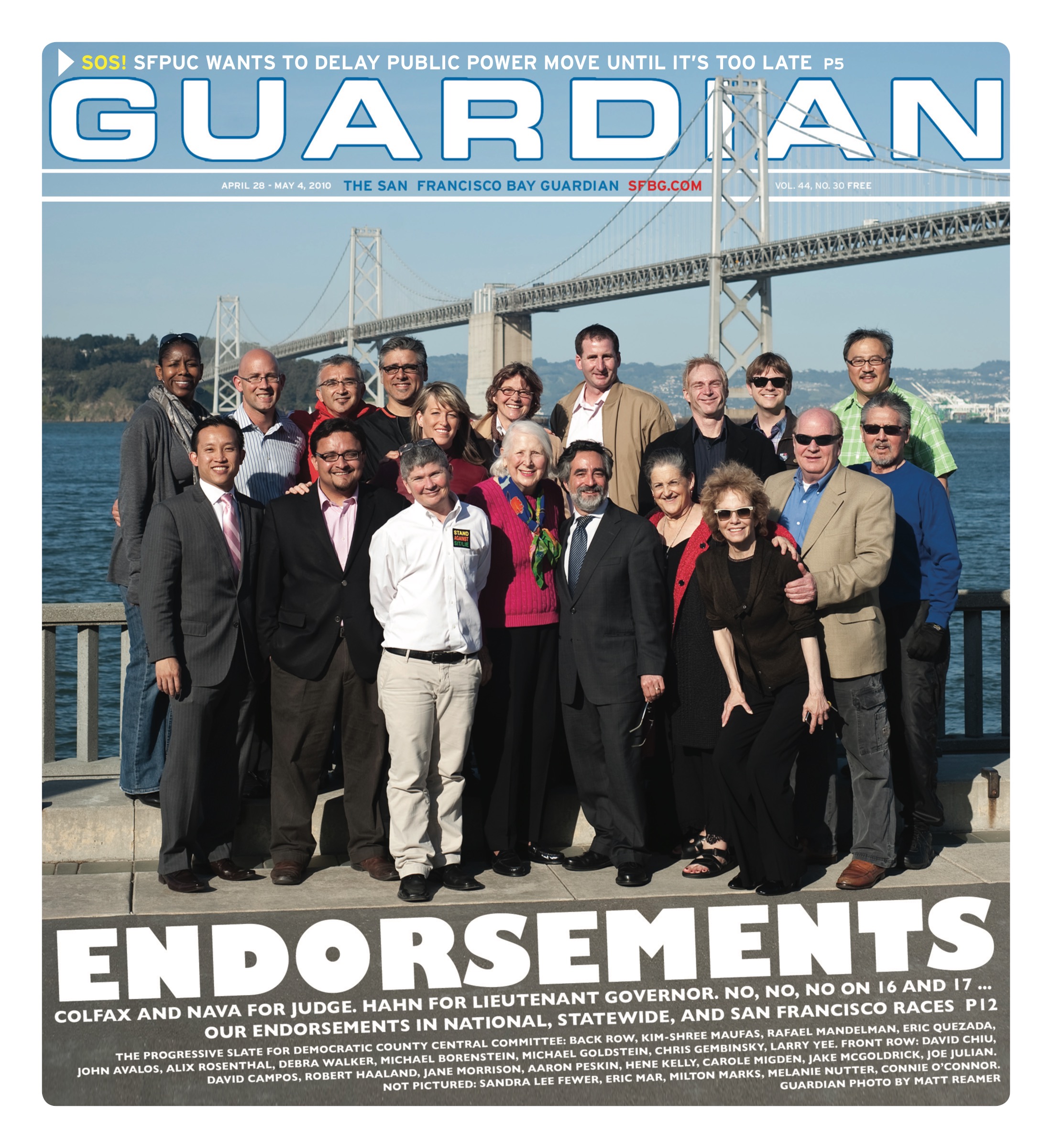
The deceptively titled “Taxpayer’s Right to Vote Act” was dreamed up and funded entirely by Pacific Gas and Electric Co., the monopolistic utility that is worried it could face actual competition here in San Francisco (and elsewhere) from municipal electricity programs that would offer customers a greener energy mix and more accountability than PG&E executives will ever demonstrate.

Rather than accept some healthy competition, this sleazy corporation has opted to spend some $35 million to exterminate all possibilities of municipal electricity programs cropping up anywhere in the state in a bid to preserve its octopus-like grip on the energy market in Northern California. Prop. 16 would require a two-thirds majority vote at the ballot before any community choice aggregation (CCA) program — or any attempt at creating or expanding a public-power system — could move forward. That’s an extreme hurdle — -and PG&E knows it.

In effect, PG&E is trying to buy public policy here, trying to pass a law that will protect its own monopoly interests.

In San Francisco, the CCA being proposed would offer customers 51 percent renewable power by 2017, which means it would blow PG&E out of the water in the green arena and mark S.F. as taking greater strides toward combating climate change than any other major U.S. city. This example could set a precedent for others, which, in turn, could create favorable market conditions for green energy startups that want to harness wind, solar, biomass, geothermal, tidal, and energy efficiency alternatives.

The very existence of Prop. 16 is already threatening the San Francisco CCA; the city’s Public Utilities Commission is trying to delay a final contract until after the June 8 vote on the measure (see editorial, page 5)

Vote no on Prop 16. Not just because it’s an example of a big business single-handedly trying to alter the state constitution for its own economic benefit by pouring millions of dollars into a deceptive advertising campaign. Not just because a two-thirds majority vote requirement is anti-democratic. Not just because there were reports that the signature gatherers who got people to sign on in support of placing Prop. 16 on the ballot were telling people that its purpose was to limit PG&E expansion or encourage solar power. Not just because Senate Pro Tem Darrell Steinberg and a half dozen members of the Legislature sent a letter rebuking PG&E CEO Peter Darbee for disrespecting the democratic process by going straight to the ballot to undermine legislation it initially supported that enabled the creation of CCA programs. Not just because PG&E is using $35 million of ratepayer dollars (that’s the check you wrote them for your electricity bill!) to put out slick TV ads for this campaign when it should have been repairing the pipelines under those manholes that keep exploding and messing up your morning commute. Not even just because with CCA, you already have the right to vote whether or not you want to be part of it, a choice PG&E will never give you. And not just because PG&E keeps trying to raise rates, which is much more difficult for municipal energy agencies to do.

If for no other reason, vote no because Prop. 16 flies in the face of everything environmentalists stand for. It’s a measure that will thwart progress on fighting climate change, brought to you by the company that practically invented green-washing. PG&E is a huge nuclear power player; it purchases coal from mountaintop-removal coal mines in West Virginia that are completely devastating biodiverse landscapes in Southern Appalachia and screwing over poor people by tainting their drinking water; and it’s in the process of building fossil fuel-fired power plants in poor communities of color in California. The CCA programs at least represent a glimmer of hope for an alternative model; Prop. 16 kills off that possibility with one fell swoop motivated by pure greed. For the love of justice, democracy, and the planet, vote no on Prop 16.


PROPOSITION 17

CAR INSURANCE SCHEME

NO, NO, NO!

Mercury Insurance sponsored this measure and is campaigning for it with tens of millions of dollars, betting it can fool voters and make hundreds of millions of dollars in profits by doing so. And if the company is right, insurance rates will skyrocket for new drivers and those who haven’t had continuous insurance coverage, which experts say will increase the number of uninsured drivers on the roadways and end up increasing insurance rates for everyone.

Mercury and its founder George Joseph have been truly malevolent players in California, exploiting their customers to make billions of dollars in profits, attacking California’s landmark insurance reform measure Prop. 103 with lawsuits and corrupting campaign contributions over more than 20 years, and flouting insurance regulators in such brazen fashion that even Insurance Commissioner Steve Poizner, a conservative Republican, recently chastised the company for its “lengthy history of serious misconduct” (see “Buying power,” March 17).

Now, however, the company is hoping its promise to cut the insurance premiums of drivers who have maintained continuous coverage by “as much as $250 per year” will buy their votes and that they’ll overlook the myriad negative impacts of increasing everyone else’s premiums by $1,000 per year or more, based on Mercury’s own estimates.

Think about that. If you’re a driver who missed an insurance payment by even one day, or a soldier returning from boot camp, or someone with a low-income getting insurance for the first time or after ditching your car for a while, what are you going to do when you discover already-expensive car insurance comes with a $1,000 annual surcharge?

Many Californians, those who share our roads, will choose to drive without insurance. Then they’ll be more likely to leave the scene of accidents or declare bankruptcy rather than paying out-of-pocket for their accidents, both of which increase the cost of insurance for everyone else.

That’s how insurance works. If someone pays less, someone else pays more; and the only entity guaranteed to really make money over the long term is the insurance company. Don’t fall for this scam. Vote no on 17.

ENDORSEMENTS: National and state races

15

Editor’s note: the file below contains a correction, updated May 5 2010. 


National races


U.S. SENATE, DEMOCRAT


BARBARA BOXER


The Republican Party is targeting this race as one of its top national priorities, and if the GOP can dislodge a three-term senator from California, it will be a major blow for the party (and agenda) of President Obama. The pundits are happily talking about how much danger Barbara Boxer faces, how the country’s mood is swinging against big-government liberals.


But it’s always a mistake to count out Boxer. In 1982, as a Marin County supervisor with little name recognition in San Francisco, she trounced then-SF Sup. Louise Renne for an open Congressional seat. Ten years later, she beat the odds and won a hotly contested primary and tough general election to move into the Senate. She’s a fierce campaigner, and with no primary opposition, will have a united party behind her.


Boxer is one of the most progressive members of the not-terribly progressive U.S. Senate. She’s been one of the strongest, most consistent supporters of reproductive rights in Washington and a friend of labor (with 100 percent ratings from the AFL-CIO and National Education Association). We’ve had our disagreements: Boxer supported No Child Left Behind, wrote the law allowing airline pilots to carry guns in the cockpit, and was weak on same-sex marriage when San Francisco sought to legalize it (although she’s come around). But she was an early and stalwart foe of the war in Iraq, split with her own party to oppose a crackdown on illegal immigration, and is leading the way on accountability for Wall Street. She richly deserves reelection, and we’re happy to endorse her.


CONGRESS, 6TH DISTRICT, DEMOCRAT


LYNN WOOLSEY


It’s odd that the representative from Marin and Sonoma counties is more progressive by far than her colleague to the south, San Francisco’s Nancy Pelosi. But over the years, Lynn Woolsey has been one of the strongest opponents of the war, a voice against bailouts for the big Wall Street banks, and a foe of cuts in the social safety net. We’re proud to endorse her for another term.


CONGRESS, 7TH DISTRICT, DEMOCRAT


GEORGE MILLER


George Miller has been representing this East Bay district since 1974, and is now the chair of the Education and Labor Committee and a powerhouse in Congress. He’s too prone to compromise (with George W. Bush on education policy) but is taking the right line on California water (while Sen. Dianne Feinstein is on the wrong side). We’ll endorse him for another term.


CONGRESS, 8TH DISTRICT, DEMOCRAT


NANCY PELOSI


We’ve never been terribly pleased with San Francisco’s most prominent Congressional representative. Nancy Pelosi was the author of the bill that created the first privatized national park at the Presidio, setting a horrible standard that parks ought to be about making money. She was weak on opposing the war, ducked same-sex marriage, and has used her clout locally for all the wrong candidates and issues. But we have to give her credit for resurrecting and pushing through the health care bill (bad as it was — and it’s pretty bad — it’s better than doing nothing). And, at a time when the Republicans are trying to derail the Obama presidency, she’s become a pretty effective partner for the president.


Her fate as speaker (and her future in this seat) probably depends on how the Democrats fare in the midterm Congressional elections this fall. But if she and the party survive in decent shape, she needs to take the opportunity to undo the damage she did at the Presidio.


CONGRESS, 9TH DISTRICT, DEMOCRAT


BARBARA LEE


Barbara Lee, who represents Berkeley and Oakland, is co-chair of the Progressive Caucus in the House, one of the most consistent liberal votes in Congress, and a hero to the antiwar movement. In 2001, she was the only member of either house to oppose the Bush administration’s Use of Force resolution following the 9/11 attacks, and she’s never let up on her opposition to foolish military entanglements. We’re glad she’s doing what Nancy Pelosi won’t — represent the progressive politics of her district in Washington.


CONGRESS, 13TH DISTRICT, DEMOCRAT


PETE STARK


Most politicians mellow and get more moderate as they age; Stark is the opposite. He announced a couple of years ago that he’s an atheist (the only one in Congress), opposed the Iraq war early, called one of his colleagues a whore for the insurance industry, and insulted President Bush and refused to apologize, saying: “I may have dishonored the commander-in-chief, but I think he’s done pretty well to dishonor himself without any help from me.” He served as chair of the House Ways and Means Committee for exactly one day — March 3 — before the Democratic membership overruled Speaker Pelosi and chucked him out on the grounds that he was too inflammatory. The 78-year-old may not be in office much longer, but he’s good on all the major issues. He’s also fearless. If he wants another term, he deserves one.


State races


GOVERNOR, DEMOCRAT


EDMUND G. BROWN


Jerry Brown? Which Jerry Brown? The small-is-beautiful environmentalist from the 1970s who opposed Pacific Gas and Electric Co.’s Diablo Canyon nuke and created the California Conservation Corps, the Office of Appropriate Technology, and the Farm Labor Relations Board (all while running a huge budget surplus in Sacramento)? The angry populist who lashed out at corporate power on a KPFA radio talk show and ran against Bill Clinton for president? The pro-development mayor of Oakland who sided with the cops on crime issues and opened a military academy? Or the tough-on-crime attorney general who refuses to even talk about tax increases to solve the state’s gargantuan budget problems?


We don’t know. That’s the problem with Brown — you never know what he’ll do or say next. For now, he’s been a terribly disappointing candidate, running to the right, rambling on about preserving Proposition 13, making awful statements about immigration and sanctuary laws, and even sounding soft on environmental issues. He’s started to hit his stride lately, though, attacking likely GOP contender Meg Whitman over her ties to Wall Street and we’re seeing a few flashes of the populist Brown. But he’s got to step it up if he wants to win — and he’s got to get serious about taxes and show some budget leadership, if he wants to make a difference as governor.


LIEUTENANT GOVERNOR, DEMOCRAT


JANICE HAHN


Not an easy choice, by any means.


Mayor Gavin Newsom jumped into this race only after it became clear that he wouldn’t get elected governor. He sees it as a temporary perch, someplace to park his political ambitions until a better office opens up. He’s got the money, the statewide name recognition, and the endorsement of some of the state’s major power players, including both U.S. Senators and House Speaker Nancy Pelosi. He’s also been a terrible mayor of San Francisco — and some progressives (like Sup. Chris Daly) argue, persuasively, that the best way to get a better person in Room 200 is to ship Newsom off to an office in Sacramento where he can’t do much harm and let the supervisors pick the next mayor.


But it’s hard to endorse Newsom for any higher office. He’s ducked on public power, allowing PG&E to come very close to blocking the city’s community choice aggregation program (See editorial, page 5). His policies have promoted deporting kids and breaking up families. He’s taken an approach to the city budget — no new revenue, just cuts — that’s similar to what the Republican governor has done. He didn’t even bother to come down and talk to us about this race. There’s really no good argument for supporting the advancement of his political career.


Then there’s Janice Hahn. She’s a Los Angeles City Council member, the daughter of a former county supervisor, and the sister of a former mayor. She got in this race way before Newsom, and her nightmare campaign consultant, Garry South, acts as if she has some divine right to be the only Democrat running.


Hahn in not overly impressive as a candidate. When we met her, she seemed confused about some issues and scrambled to duck others. She told us she’s not sure she’s in favor of legalizing pot, but she isn’t sure why she’s not sure since she has no arguments against it. She won’t take a position on a new peripheral canal, although she can’t defend building one and says that protecting San Francisco Bay has to be a priority. She won’t rule out offshore oil drilling, although she said she has yet to see a proposal she can support. Her main economic development proposal was to bring more film industry work to California, even if that means cutting taxes for the studios or locating the shoots on Indian land where there are fewer regulations.


On the other hand, she told us she wants to get rid of the two-thirds threshold in the state Legislature for passing a budget or raising taxes. She supports reinstating the car tax at pre-Gov. Arnold Schwarzenegger levels. She supports a split-roll measure to reform Prop. 13. She wants to see an oil-severance tax to fund education. She’s one of the few statewide candidates who openly advocates higher taxes on the wealthy as part of the solution to the budget crisis.


We are under no illusions that Hahn will be able to use the weak office of lieutenant governor to move on any of these issues, and we’re not at all sure she’s ready to take over the top spot. But on the issues, she’s clearly better than Newsom, so she gets our endorsements.


SECRETARY OF STATE, DEMOCRAT


DEBRA BOWEN


Debra Bowen is the only Democrat running, a sign that pretty much everyone in the party thinks she’s doing a fine job as Secretary of State. She’s run a clean office and we see no reason to replace her.


CONTROLLER, DEMOCRAT


JOHN CHIANG


Like Bowen, John Chiang has no opposition in the primary, and he’s been a perfectly adequate controller. In fact, when Gov. Schwarzenegger tried two years ago to cut the pay of thousands of state employees to the minimum wage level, Chiang defied him and refused to change the paychecks — a move that forced the governor to back down. We just wish he’d play a more visible role in talking about the need for more tax revenue to balance the state’s books.


TREASURER, DEMOCRAT


BILL LOCKYER


Bill Lockyer keeps bouncing around Sacramento, waiting, perhaps, for his chance to be governor. He was attorney general. Now he’s treasurer seeking a second term, which he will almost certainly win. He’s done some good things, including trying to use state bonds to promote alternative energy, and has spoken out forcefully about the governor’s efforts to defer deficit problems through dubious borrowing. He hasn’t, however, come out in favor of higher taxes for the rich or a change in Prop. 13.


ATTORNEY GENERAL, DEMOCRAT


KAMALA HARRIS


There are really only two serious candidates in this race, Kamala Harris, the San Francisco district attorney, and Rocky Delgadillo, the former Los Angeles city attorney. Harris has a comfortable lead, with Delgadillo in second and the others far behind.


Delgadillo is on his second try for this office. He ran against Jerry Brown four years ago and got nowhere. And in the meantime, he’s come under fire for, among other things, using city employees to run personal errands for him (picking up his dry-cleaning, babysitting his kids) and driving his car without insurance. On a more significant level, he made his reputation with gang injunctions that smacked of ethnic profiling and infuriated Latino and civil liberties groups. It’s amazing he’s still a factor in this race; he can’t possibly win the general election with all his baggage.


Harris has a lot going for her. She was among the first California elected officials to endorse Barack Obama for president, and remains close to the administration. She’s a smart, articulate prosecutor and could be one of the few women atop the Democratic ticket this year. We were never comfortable with her ties to Willie Brown, but he’s no longer a factor in state or local politics. These days, she’s more closely allied with the likes of State Sen. Mark Leno.


That said, we have some serious problems with Harris. She’s been up in Sacramento pushing Republican-style tough-on-crime bills (like a measure that would bar registered sex offenders from ever using social networking sites on the Internet) and forcing sane Democrats like Assembly Member and Public Safety Committee Chair Tom Ammiano to try to tone down or kill them (and then take the political heat). If she didn’t know about the problems in the SFPD crime lab, she should have, and should have made a bigger fuss, earlier.


But Harris has kept her principled position against the death penalty, even when it meant taking immense flak from the cops for refusing to seek capital punishment for the killer of a San Francisco police officer. She’s clearly the best choice for the Democrats.


INSURANCE COMMISSIONER, DEMOCRAT


DAVE JONES


Two credible progressives are vying to run for this powerful and important position regulating the massive — and massively corrupt — California insurance industry. Dave Jones and Hector De La Torre are both in the state Assembly, with Jones representing Sacramento and De La Torre hailing from Los Angeles. Both have a record opposing insurance industry initiatives; both are outspoken foes of Prop. 17; and either would do a fine job as insurance commissioner. But Jones has more experience on consumer issues and health care reform, and we prefer his background as a Legal Aid lawyer to De La Torre’s history as a Southern California Edison executive. So we’ll give Jones the nod.


BOARD OF EQUALIZATION, DISTRICT 1, DEMOCRAT


BETTY T. YEE


Betty Yee has taken over a job that’s been a stronghold of progressive tax policy since the days of the late Bill Bennett. She’s done well in the position, supporting progressive financial measures and even coming down, as a top tax official, in favor of legalizing (and taxing) marijuana. We’re happy to endorse her for another term.


SUPERINTENDENT OF PUBLIC INSTRUCTION


TOM TORLAKSON


Two prominent Democratic legislators are running for this nonpartisan post, state Sen. Gloria Romero of Los Angeles and Assembly Member Tom Torlakson of Martinez. It’s a pretty clear choice: Romero is a big supporter of charter schools who thinks parents should be able to move their kids out of one school district and into another (allowing wealthier white parents, for example, to abandon Los Angeles or San Francisco for the suburban districts). She’s been supported in the past by Don and Doris Fisher, who put a chunk of their GAP Inc. fortune into school privatization efforts. Torlakson wants more accountability for charters, opposes the Romero district-option bill, and has the support of every major teachers union in the state. Vote for Torlakson.


STATE SENATE, DISTRICT 8, DEMOCRAT


LELAND YEE


Sen. Leland Yee can be infuriating. Two years ago, he was hell-bent on selling the Cow Palace as surplus state property and allowing private developers to take it over. In the recent budget crisis, he pissed off his Democratic colleagues by refusing to vote for cuts that everyone else knew were inevitable (while never making a strong stand in favor of, say, repealing Prop. 13 or raising other taxes). But he’s always been good on open-government issues and has made headlines lately for busting California State University, Stanislaus over a secret contract to bring Sarah Palin in for a fundraiser — and has raised the larger point that public universities shouldn’t hide their finances behind private foundations.


Yee will have no serious opposition for reelection, and his campaign for a second term in Sacramento is really the start of the Leland Yee for Mayor effort. With reservations over the Cow Palace deal and a few other issues, we’ll endorse him for reelection.


 Correction update: Yee’s office informs us that the senator suports an oil-severance tax and a tax on high-income earners and “believes that Prop. 13 should be reformed,” although he hasn’t taken a position on Assemblymember Tom Ammiano’s reform bill. 


STATE ASSEMBLY, DISTRICT 12, DEMOCRAT


FIONA MA


Fiona Ma’s a mixed bag (at best). She doesn’t like Pacific Gas and Electric Co. and supports public power, but comes up with strange bills that make no sense, like a 2009 measure to limit rent control in trailer parks. Why does Ma, who has no trailer parks in her district, care? Maybe because the landlords who control the mobile home facilities gave her some campaign cash. She faces no opposition, and we’re not thrilled with her record, but we’ll reluctantly back her for another term.


STATE ASSEMBLY, DISTRICT 13, DEMOCRAT


TOM AMMIANO


When the history of progressive politics in modern San Francisco is written, Tom Ammiano will be a central figure. His long-shot 1999 mayoral campaign against Willie Brown brought the left to life in town, and his leadership helped bring back district elections and put a progressive Board of Supervisors in place in 2000. As a supervisor, he authored the city’s landmark health care bill (which Newsom constantly tries to take credit for) and the rainy day fund (which saved the public schools from debilitating cuts). He uses his local influence to promote the right causes, issues, and candidates.


And he’s turned out to be an excellent member of the state Assembly. He forced BART to take seriously civilian oversight of the transit police force. He put the battle to reform Prop. 13 with a split-role measure back on the state agenda. And his efforts to legalize and tax marijuana are close to making California the first state to toss the insane pot laws. As chair of the Public Safety Committee, he routinely defies the police lobbies and the right-wing Republicans and defuses truly awful legislation. We’re glad Ammiano’s still fighting in the good fight, and we’re pleased to endorse him for another term.


STATE ASSEMBLY, DISTRICT 14, DEMOCRAT


NANCY SKINNER


Nancy Skinner has taken on one of the toughest, and for small businesses, most important, battles in Sacramento. She wants to make out-of-state companies that sell products to Californians collect and remit sales tax. If you buy a book at your local bookstore, you have to pay sales tax; if you buy it from Amazon, it’s tax-free. That not only hurts the state, which loses hundreds of millions of dollars in tax revenue, it’s a competitive disadvantage to local shops. Skinner’s a good progressive vote and an ally for Ammiano on the Public Safety Committee. We’re happy to endorse her for another term.


STATE ASSEMBLY, DISTRICT 16, DEMOCRAT


SANDRE SWANSON


Sandre Swanson represents the district where BART police killed Oscar Grant, but he wasn’t the one out front pushing for more civilian accountability; that was left to SF’s Ammiano. And while Swanson was generally supportive of Ammiano’s bill, he was hardly a leader in the campaign to pass it. This is too bad, because Swanson’s almost always a progressive vote and has been good on issues like whistleblower protection (a Swanson bill that passed this year protects local government workers who want to report problems confidentially). We’ll endorse him for another term, but he needs to get tougher on the BART police.

Warriors, come out and play! (with this squeaky mouse)

0

Blossompaw jumped down from the wall and headed past the plants Jayfeather had carefully nurtured. The scent of them made Ivypaw’s mouth water, but she knew the warning given to every Clan cat: Stay away from the catnip.

Worry not for our youth in the post-Harry Potter era; there’s a new line of young adult fiction that’s got all the kids a’ reading. And it’s about fighting clans of kitties — my favorite! The Warriors, a series which to date includes over thirty titles, is a lot like Brian Jacques’ Redwall books — a small universe of carefully plotted minutiae following the escapades of animals in epic form.

But we’re going to the next level here.The Warriors see the Redwall sci-fi/fantasy nerd love of quests, battles, and prophecies, then raises it an all kitteh cast of characters. Oh yes, whiskers and all.

Warriors’ slightly confusing authorship (the books’ byline, Erin Hunter, actually refers to four women, none of them named Erin) begins each book with a comprehensive listing of each kitty in all four of the forest’s clans. Kits to clan leaders, pelt and eye colors included. For example, Dovepaw, one of the protagonists of Fading Echoes (book number two in the Omen of the Stars sub-series), is an apprentice of Shadow Clan, “a pale she-cat with blue eyes,” who is mentored by Lionblaze, “a golden tabby tom with amber eyes.” Leaving aside the complex belief structure and social hierarchy of the Warriors’ world, with 113 cats in the four mortal (oh yeah, it goes there) clans alone, it’s important to keep track of these details.

And readers do. Oh, but they do! A quick foray to The Warriors website reveals the true depths of fandom the kitties muster. Message boards require one to select a kitty avatar  to chat with the other kitties.

Which I did, all in the name of journalism of course (a golden she-cat with yellow eyes I named “Quillpaw”), and regardless of the fact that many of the conversation threads were a bit beyond my reckoning, most having to do with complex spoiler theories and desperate purrs for a single tom to mate with. Scandalous!

I meowed at my kitty friends online about why they liked this magical, mystical world of claws and fresh-kill, and I found Twilightfoot (who appears to be a fan fic writing, gender neutral black deputy cat with green eyes from he/she’s profile picture)’s answer to be the most endearing. I quote:

What do I like about Warriors?:

They are VERY interesting, and have a good plot that I can relate to.

It is NOT a G-rated series, which I <3!

I get very, um, connected with the characters, which I can rarely do with a book.

In this day and age, connection is really the pith of the matter, isn’t it? Cheers to you, Twilightfoot. And cheers to you, Warriors books — I never really liked reading about people, anyway.

Pioneers! O Urban Pioneers!

0

By Robyn Johnson

culture@sfbg.com

People are returning to land like it’s the 1970s all over again, but they’re not packing up for Vermont, letting their hair go au naturel, and unplugging from the grid to do it. Urban agriculture is sprouting up like, well, sprouts. And while we all feel strongly about sustainability and pay a lot of lip service to higher ideals, the majority of us probably aren’t willing to adopt the radical homemaker lifestyle and sacrifice cell phone coverage, The Colbert Report, or regular social interactions. The following cursory guide highlights a few urban farms in SF and immediate environs where you can volunteer or access food, as well as resources for cultivating your space in the concrete tangle (even if you live in a third-story apartment) and options for the time-honored tradition of gleaning.


MANY FARMHANDS MAKE LIGHT WORK

Community farms offer support not always available for the individual plots of community gardens (which typically have astronomically long wait-lists anyway), or even your own cramped Bay Area backyard. And for 60-hour-work-weekers, it might be taxing to grow more than a bit of basil or mold on that cheese in the back of the fridge. If you don’t have the time, energy, space, or inclination to follow famed urban farmer Novella Carpenter’s fantastic example (ghosttownfarm.wordpress.com), consider volunteering at the following places to satisfy your green thumb’s bidding.

As Chris Burley, the director of Hayes Valley Farm (www.hayesvalleyfarm.com) told me, “People are looking for a tangible way to get their hands dirty and address the impacts of our ecologically destructive, industrialized food system while doing something meaningful and connecting with their community.” And that’s exactly the goal that the farm, located off Laguna and Fell steets, has been aiming to fulfill since its inception as a way to revitalize an unused lot, once a freeway onramp, into a shared space.

Although the farm is still taking root, so to speak, the plan is to eventually grow enough fresh and organic food to feed the neediest nearby members plus the volunteers working to cultivate the space. Education also plays a major part in the function of the project, with Thursday and Sunday “work parties” where people can get that hand-dirtying experience, as well as regular classes on urban gardening and permaculture.

Altho Quesada Gardens Initiative (www.quesadagardens.org) primarily operates as a community-directed organization that seeks to strengthen the social systems of Bayview-Hunters Point, local food production has become one of the top concerns of the neighborhood. The resident-led nonprofit connects and maintain backyard farms and free food-producing community gardens throughout the area. In one of the neater facets of its food justice work, the group also helps maintain the kitchen garden of roving supper club Old Skool Café (www.oldskoolcafe.org), which employs at-risk or previously incarcerated youth. With such kick-ass people, it’s no wonder that urban farm hero Will Allen adopted one of the satellite gardens on his visit to the Bayview. Community volunteer meetings and gardening days tend to be informal, so e-mail for specific opportunities.

Sometimes the best things in life really are free. Located at Gough and Eddy on land kindly lent by the Lutheran Church, The Free Farm (www.thefreefarm.org) intends to give away 100 percent of its produce. Still in its initial development stages, the fledgling project welcomes volunteers every Saturday and Wednesday from 10 a.m.-2 p.m. to help with the launch. Working in tandem with its sister organization, The Free Farm Stand in the Mission also offers fresh fruits and vegetables donated by other local urban farmers. Although places like Little City Gardens (www.littlecitygardens.com) and folks who glean from public land contribute, the bulk of the produce comes from the 18th Street and Rhode Island (www.18thandrhodeisland.org) farm maintained by the SF Permaculture Guild, which offers volunteer opportunities as well. With a goal to sextuple the farm’s output within the next five years, it could probably use a little bit more help. Work days are on Friday.

For West Oakland residents, two nonprofits have been power-housing to combat the food desert that plagues the area. City Slickers Farms (www.cityslickerfarms.org) operates several all volunteer-run farms throughout the neighborhood that could always use a few extra work hands. Collectively these six lots cultivate ducks and chickens, bee hives, veggies, fruit trees, and medicinal herbs, the produce of which are distributed through the Saturday Farm Stand on a sliding scale or work-trade basis — no one’s turned away. And if you still have a mighty urge for some composting, weeding, planting, and mulching, People’s Grocery (www.peoplesgrocery.org) runs three farms that constantly need tending. The 55st Street location tends fruit trees, culinary herbs, and vegetables; 59th Street is a slightly less cultivated space in collaboration with Berkeley’s Spiral Gardens Community Food Security Project (www.spiralgardens.org), which runs its own food garden off Oregon and Sacramento streets for you West Berkeleyites. People’s Grocery’s newest land acquisition, the plot behind the California Hotel off of 35th and Chestnut streets, hosts a greenhouse and a biointensive microfarm that replaced its 3.5 acre Sunol site last January.


HOME SWEET URBAN HOMESTEAD

If you have access to private land to cultivate, or even if you don’t, the following resources will set you on the path to food freedom. These classes, demonstration sites, and professional landscaping services will help you turn backyards, rooftops, and even windows into humming generators of small-scale urban agriculture.

Before you even think to take a shovel to your virgin backyard or start a worm bin, visit Garden for the Environment (www.gardenfortheenvironment.org). A one-acre demonstration garden in the heart of Golden Gate Heights that also teaches organic food production and sustainable landscaping with weekly workshops, you can see how it’s done before trial-and-erroring on that graywater irrigation system or chicken coop. The resource directory on its Web site also serves as an invaluable aid for at-home troubleshooting. Hotlines for gardening and composting issues, where to find recycled lumber, how to test your soil, manure suppliers, wasp removal companies — it’s all there.

DIY food production classes abound everywhere in the Bay Area but the one-stop shopper won’t find a better resource than the Institute of Urban Homesteading (www.iuhoakland.com) in Oakland. It offers a comprehensive curriculum ranging from beekeeping, butchery, goat farming, brewcraft, herbal medicine, bread making, fermentation, berry patches, and other topics of the same ilk. It’s a real crash course in manifesting your inner Laura Ingalls Wilder. With no central location, classes are taught in the teachers’ homes, which presents a neat opportunity to see real-time urban homesteading and the different ways people create sustainable places in an urban setting. Also consider Urban Kitchen SF (www.urbankitchensf.com) and BioFuel Oasis (www.biofueloasis.com) in Berkeley for supplementary courses.

If you’re feeling overwhelmed and green behind the ears, several services will landscape your yard into a cornucopia of organic delectables and even continue the maintenance if you just can’t do anything with that black thumb of death. Star Apple Edible Gardens (www.starappleediblegardens.com) provides a range of services throughout the Bay Area, the simplest being consultations and composting tutorials. You also can order ready-made kitchen gardens or go whole kit and caboodle and have customized “garden design and installation, pathway and hardscape installation, irrigation design and installation, planting, plant feeding and cultivation, regular harvesting of your garden crops, and design, installation, and maintenance of composting systems.” Other similar businesses include All Edibles (www.alledibles.com), which specifically works with East Bay dwellers, and Chris Sein of Wildheart Gardens (www.wildheartgardens.com), who also consults on backyard chickens and mushrooms.

For a lot of us in the Bay Area, the dream of having a backyard is about as likely as Glenn Beck admitting that Obama is not a herald of an impending Orwellian dictatorship. So what can the more dispossessed among us do to return to the soil? Popular in Europe and becoming more so here, rooftop gardens are a great solution to space issues. Graze the Roof (www.grazetheroof.blogspot.com), the community vegetable patch on top of Glide Memorial Church, hosts rooftop gardening workshops. You can also gain experience by volunteering on work days every Thursday or first Saturdays. For those feeling less than philanthropic or sociable, pop over to your local bookstore to pick up the Use Your Roof Guidebook by Bay Area Localize (www.baylocalize.org). Seven bucks and four easy chapters gets you on your way to a more edible roof.

For balcony-less apartment dwellers, and maybe those with vaulted ceilings, window farms have become the new rooftop gardens. An open-source project that’s evolved over the past year, Windowfarms (www.windowfarms.org) gives how-tos for its innovatively cheap and space-conscious hydroponics system — jerry-rigged from repurposed plastic water bottles, tubing, and fish tank pumps that hangs in vertical columns in the window — as free PDFs on its Web site. It also hosts community boards where members share improvements to the system, which is constantly being updated. Alas, window farms can only really successfully raise leafy greens, but having a homegrown salad in a studio apartment is still pretty darn amazing.

If you already have your urban farm bustling along — or even just a prolific citrus tree — then yard-sharing is a great way to spread the fruit of your labor throughout the community. Neighborhood Fruit (www.neighborhoodfruit.com), SF Glean (www.sfglean.org), and Produce to the People (www.producetothepeople.org) will gladly help you to unload the excess bounty and distribute it to the hungry.

Events listings

0

Event Listings are compiled by Paula Connelly. Submit items for the listings at listings@sfbg.com.

WEDNESDAY 21

"Out in Israel" Various locations, visit www.outinisraelsf.org for more details. It’s not too late to catch some of the events taking place across the Bay Area in celebration of queer Israeli culture. On Wed/20 folk singer Yael Deckelbaum will be performing at Muse Gallery (614 Alabama, SF; (415) 279-6281) at 8:30pm, free. On Thurs/21 Israeli chef and TV personality Gil Hovav will takeover Regalito’s Restaurant (3481 18th St., SF; (415) 503-0650) for a 6pm and 8pm seating wherehe will entertain guests while making traditional Israeli cuisine with a Mexican influence available at two pre fix price points of $25 or $40. For more free events, talks, and performances, visit www.outinisraelsf.org.

"Water Dilemma – Bottled or Tap?" San Francisco Main Library, Latino Hispanic Room, 100 Larkin, SF; (415) 557-4400. 6pm, free. Consumers are provided with yearly test results on contaminant levels in tap water, but the bottled water industry is not required to disclose any testing results. Hear the Director of the California Office of the Environmental Working Group (EWG) Renee Sharp discuss this disparity and the EWG’s recent discovery of array of chemical contaminants found in every bottled water brand.

THURSDAY 22

Book Arts and Environmental Awareness San Francisco Center for the Book, 300 DeHaro, SF; (415) 565-0545. 1pm, free. Celebrate Earth Day by taking part in free activities like free printmaking, green typography, making "Save – Don’t Pave – the Bay" postcards that can be mailed to elected representatives, and more.

FRIDAY 23

Academy of Sciences Neighborhood Days California Academy of Sciences, 55 Music Concourse, Golden Gate Park, SF; www.calacademy.org. Through June 13. Look up which weekend your zip code gets you a free pass into the Academy of Science, grab your housemates and photo ID with proof of residency, and get your science on. The Parkside and Sunset (94116, 94122) neighborhoods are up first.

Earth Day at City College City College of San Francisco, 50 Phelan, SF; (415) 239-3580. 11am, free. Attend this environmental fair featuring live music, instructions on how to compost including information about the new city ordinance, how to fix your bike, how to recycle, and more.

Free Dance Classes ODC Dance Commons, 351 Shotwell, SF; (415) 863-6606. Various times through May 2, free. In honor of National Dance Week, ODC is offering free dance classes in many different styles, like Afro-Cuban modern, tango, hip hop, ballet, contemporary, flamenco, belly dancing, and more.

SATURDAY 24

Swan Day Hanuman Center, 4450 18th St., SF; www.womenarts.org. 10am; $35 all day pass, individual event passes available for less. Show your support for women in the arts at this all day festival featuring a multicultural blessing, a Haitian dance workshop, an open mic, screenings of short films, and more.

Twin Peaks Bioregion Meet in Golden Gate Park, SF; call (415) 564-4107 or email iris@natureinthecity.org to RSVP and for exact meeting location. 4pm, $10-20 donation to support nature in the city. Explore the wilderness of the live oak woodlands of Golden Gate Park, Mt. Sutro, Twin Peaks, and Glen Canyon and learn about species and habitats, issues and controversies.

BAY AREA

Salute to the Women of Congo Fotovision, 5515 Doyle, Emeryville; (415) 725-1636. 1pm, $1-35 suggested donation. Make creative cards to show your support and recognition of the courageous women in the Democratic Republic of Congo. Postcards will be distributed to women on the Congo as an act of solidarity and compassion. Materials are provided, but you are welcome to bring your own photographs.

SUNDAY 25

Hot.Fat.Femmes Good Vibrations, 603 Valencia, SF; (415) 522-5460. 7pm, free. Enjoy a fiercely intellectual panel of voluptuous vixens, fattiesexuals, and fat activists at this evening of body positive, sex positive and size affirming fat girl love hosted by Virgie Tovar. Tovar will read from her most recent work and there will be a photo exhibit featuring hot fatties.

People’s Earth Day Women’s Building, 3543 18th St., SF; www.greenaction.org. 2pm, $10-$50 suggested donation. Join Greenaction and youth and women community leaders from Kettleman City and Bayview Hunters Point for an afternoon of live theater, local foods, and solidarity with these polluted communities that are fighting for health and justice.

Poem for Mother Earth Galeria de la Raza, 2857 24th St., SF; (415) 826-8009. 4pm, $5. Take part in this indigenous healing day for Earth Day featuring poets, artists, musicians, and story-tellers of all ages presenting an afternoon of Bi-lingual performance and action. In conjunction with POOR magazine, a poor and indigenous people led, non-profit grassroots arts organization.

BAY AREA

People’s Park Anniversary Concert People’s Park, Telegraph at Dwight, Berk.; www.peoplespark.org. Noon, free. Enjoy music from Antioquia, Funky Nixons, Phoenix, Wingnut Breakfast, and many more as well as activities, a circus workshop, drum circle and more to celebrate the 41st anniversary of People’s Park.

MONDAY 26

"Leaders at the Lab" Margaret Jenkins Dance Lab, suite 200, 301 8th St., SF; (415) 861-3940. 7pm, free. Choreographers, dancers, dance-makers, and enthusiasts are invited to attend this talk with choreographer Alonzo King, who will discuss the career choices he made in order to succeed in the ever-changing climate of dance-making art.

TUESDAY 27

Underground Market San Francisco Art Institute, 800 Chestnut Street, SF; foragesf.com. 4pm, free. Taste and purchase food that is being produced in backyards and home kitchens in the Bay Area at this underground market presented by Forage SF. The market will feature live music, homemade baked goods, raw chocolate, raw honey, jams, jellies, pickles, kombucha, and more.

Appetite: A course of courses

0

On a sunny Saturday morning, 3/27 in Menlo Park, Chef Guillaume Bienaime led a small group of us through cooking a five course meal, finishing with a leisurely lunch, all in Marche‘s well-outfitted kitchen and dining room. Groggy upon arrival  — it was 10am; not early, but I had to make it down from the city — Guillame was steaming cappuccinos and serving awesome banana dark chocolate scones to get us properly fueled for a couple hours of cooking. Guillame and staff are about as laidback it gets. This isn’t the kind of class where’ll you’ll get intense instruction or detailed technique, but Guillaume and staff are right there in the mix the entire time, offering tips, showing you how best to chop, hack, grill or puree.

I’m glad I didn’t get the job of dissecting a saddle of lamb. I’m sure it would do me well to learn such butchering technique, but fresh off a recent, deep cooking slice into my thumb, thoughts of hacking fat and bone with a cleaver gave me chills. But my fellow classmate fearlessly tackled the meat, with fine, orderly cuts to show for her efforts. Seared and roasted with an olive and caper relish, the lamb was medium rare and juicy.

Veggies were truly beautiful: from grilled aspargus with tender morels and spring onion to a creamy, soup-like fennel & potato veloute, it was a garden cornucopia. My favorite vegetable dish we made? Nantes carrots, toasted in a blend of coriander, sesame seed and hazelnuts. Buttery, nutty and fresh, this is one I can’t wait to make at home. Watching the carrots sizzle in giant ovens gave me a little thrill as they simultaneously smelled divine. The next class on April 24 focuses on Spring vegetables so I imagine there will be more along these lines.

I personally took on summer-redolent strawberry soup with rhubarb poached in grenadine, sugar and water. The sous chef patiently showed me a more aesthetic way to cut up rhubarb stalk. Pushing strawberries through a powerful juicer was a plain, old good time. We topped the lovely soup mixture (with lemon, orange and strawberry juices plus a splash of kirsch for good measure) with fresh, house-made yogurt. Since that needed more prep time, it was already pre-made by Marche staff.

Lingering over our decadent, farm-fresh lunch with other South Bay foodies and cooks, we enjoyed an Alsace white, sweet on the nose, while conversation centered around food, naturally. It’s a pricey class and more for those who want to try by doing (which is how I best learn), rather than receiving step-by-step instruction, but it’s another of those many educational food pleasures available to us in the Bay Area. Guillaume and staff are hands-on but relaxed and you’ll be cooking in a fine dining kitchen, a rare opportunity for many of us.

Next class: 4/24, 10am-1:30pm — number of courses depends on size of class
$105 per person (limited to 14)
898 Santa Cruz Avenue, Menlo Park
(650) 324-9092
www.restaurantmarche.com

Visit Virgina’s personal culinary itinerary site at www.theperfectspotsf.com

Josh Wolf in the eye of the storm (again)

Josh Wolf has landed in hot water again — this time in connection with his reporting from inside the student occupation at Wheeler Hall on the University of California Berkeley campus to protest budget cuts.

The blogger and videographer was jailed in 2006 after resisting a subpoena to testify before a Federal grand jury because he had taken footage at a 2005 San Francisco protest against the G8 summit. His case was widely reported on, in part because he set a record for jail time served — 226 days — for refusing to give up newsgathering materials. Police believed Wolf possessed footage that could be used to press charges for vandalism of a police car and an assault on an officer. He didn’t.

Now the 27-year-old filmmaker, a student at the Graduate School of Journalism at UC Berkeley, faces a possible seven-month suspension in the wake of a student occupation of Wheeler Hall last November 20. Wolf was one of two reporters whose footage from inside Wheeler Hall was included in a Democracy Now! broadcast about the occupation — but he was the only UC Berkeley student who has said he was there documenting the event as a member of the press.

Wolf says he wore a police-issued press badge around his neck during the Wheeler Hall occupation. Press passes can serve to flag journalists as being in a separate category from civilians in situations involving law enforcement, but displaying one does not always provide a reporter immunity from arrest. The video he shot was integrated into a report produced with independent journalist Brandon Jourdan, who was also inside the building. Wolf and Jourdan were both arrested — but their footage was widely viewed on Democracy Now!, a national alternative news outlet.

In an “informal resolution” issued April 9, UC Berkeley’s Center for Student Conduct found that Wolf “participated in a disturbance of the peace,” charging him with multiple violations of the student conduct code. Wolf’s role as a journalist is not discussed in the list of charges, making it seem as if he’s being lumped in with the student protesters, despite being there as a reporter.

But the fact that he wears another hat as a journalist clearly hasn’t escaped the campus enforcers of the student conduct code. As part of the disciplinary measure, Wolf was also directed to write a 10-page essay reflecting on a list of questions, including: “How do you consider and reconcile the roles of being a student and being a journalist? At what points does either role become more important to you and why? What are your limits as a journalist? Where and how do you draw lines for yourself in terms of things you will or will not do to pursue professional goals?”

Wolf is being given the option of writing the paper and taking the seven-month suspension (a plea bargain of sorts), or moving on to a formal adjudication process that would entail going before a five-member hearing panel, like a court trial. His plan is to try and get an extension for the informal resolution process as a means of getting the charges dropped altogether.

Berkeley Associate Dean of Students Christina Gonzales, whose office oversees the Center of Student Conduct, was unable to discuss Wolf’s particular case because of a federal law prohibiting public disclosure on such matters. Nonetheless, she offered some general comments. “In the big picture, whenever you’re dealing with conduct, you do take into consideration circumstances,” Gonzales said. “If some one reported, ‘I have special credentials’ or whatever, then [the Center for Student Conduct] will go back as part of their research on any of the cases and try to find out as much information they can to determine if that was a known fact, whatever it is that the student’s telling us.” She stressed that the informal resolution was only a first step in the disciplinary process, and that no formal decision has been made at this point in time.

 “There’s always information that comes from others that’s taken into consideration with the whole picture,” Gonzales added.

Wolf says that when he asked Laura Bennett, Assistant Director at the Center for Student Conduct, whether it would impact the outcome of his case if he submitted a letter from Jourdan confirming that he was there as a reporter, he didn’t get a straightforward response. “Her response was, well, that kind of a letter would simply lead me to have more questions, such as, ‘how did you get into the building, who did what, what happened inside the building,’ a whole bunch of stuff that I’m not inclined to help with for any number of reasons,” Wolf said. “Some of this was given on a privileged basis. … And admittedly it’s like, wait, I went down this rabbit hole before, with the grand jury, and I’m not about to deviate from that path.”

Jourdan, who has contributed to the Huffington Post, Reuters, and the New York Times, among other outlets, told the Guardian that he wrote a letter supporting Wolf in this case. “To the best of his ability, he was there to capture a moment in history,” Jourdan said. Wolf is holding off on submitting the letter for now.

“I think what’s happening in the UC system is there’s a sort of crackdown,” added Jourdan, who faces his own charges after reporting on a March 4 demonstration against budget cuts to education that broke onto a West Oakland freeway. “When journalists are charged with criminal offenses … it’s impeding the work. The information is not free flowing. It’s imperative that journalists be given access to cover something … that in time will be seen as an historic movement.”

Pick up next week’s issue or visit us online for a more detailed report.

Emerald city

0

GREEN ISSUE Walk out your front door today and you won’t find a corner store that doesn’t sell “organic food,” a restaurant whose we-buy-sustainable addendum reads “whenever possible,” a trash can with a precious separate compartment for your all-natural soda cans. It’s hard to forget that it’s not all another secret plan from the government to make your life less fun. But it’s not! Below, please find assembled an all-star list of resources that are honest-to-goodness designed to help you help out our little ball, spinning all terrestrially out in space.

RECYCLING
They’ve tried to make it easy on you. Compost goes in green! Beer bottles in blue! Devil Styrofoam — where’d you get that? — in black! But still, you have questions. What about the bottle caps? Can I recycle the bag my Korean taco came in? Can I get a new green bin without a rat-hole in it? (Yes! No, that’s compost! Yes, but work on that vermin problem!) One quick stop at the Recology SF Web site has you sorted. You’ll also find info on the dump’s sculpture garden — the world’s only garbage company’s art park.

GROWING THAT GREEN
Because that window box in your bedroom hasn’t contributed anything to dinner in way too long, SF Garden Resource Organization maintains a database on everything you need to grow your own sustenance in the city. Find within its welcoming Internet embrace info on cheap local classes to turn that idle thumb green, all kinds of gardening pointers, and the lowdown on which community gardens are accepting new plot tenders.

PESTICIDES AND JUNK MAIL
They’re awful, aren’t they? And they’re all around us, which is why the Environmental Health Association of Nova Scotia’s toxicity guide for everyday lotions, cleaners, and pet products is so nice to have on hand. Thanks, Nova Scotia! For up close and personal commerce, the friendly worker-owners at Rainbow Grocery can steer you toward natural household products. An there are a bajillion lovely shops like Marie Veronique Organics (1790 Fifth St., Berk.) that’ll sell you the good local stuff. Kill your junk mail with the support of the helpful folks at Bay Area Recycling Outreach Coalition.

SHOPPING
Go organic or go secondhand. For natural fiber or recycled fabric gear, the Bay’s got lots of flash spots like Ladita (827 Cortland, SF. 415-648-4397 www.shopladita.com) or Eco Citizen (1488 Vallejo, SF. 415-614-0100. www.ecocitizenonline.com). Little Otsu (849 Valencia, SF. 415-255-7900 www.littleotsu.com) is all you need for gift shopping, with unique posters, books, and various assorted preciousness. But for the broke environmentalists, wait for the $2 per item of clothing sales at Goodwill (Various locations, www.goodwill.com), Mission Thrift (2330 Mission, SF. 415-821-9560), or even one of the several consignment stores along Fillmore like Repeat Performance (2436 Fillmore, SF. 415-563-3123) or Seconds to Go (2252 Fillmore, SF. 415-563-7806) to feel good about confounding consumerism. The big fish in our green pond, however, remains the invaluable Green Zebra coupon book, with hundreds of deals on earth-lovin’ spas, goods, and adventures.

OUT ON THE TOWN
There are oodles of spots to help you make a night of it without playing our environment for a fool. Terroir (1116 Folsom, SF. (415) 558-9546, www.terroirsf.com) serves elegant, chemical-free wines that taste even better if the wine-bar’s adorably scruffy owners pour them. Thirsty Bear Brewpub (661 Howard, SF. (415) 974-0905. www.thirstybear.com) has a stellar system of low-waste operation and serves only organic brews through its taps. For the club kids, the eco spot de rigueur is Temple (540 Howard, SF. (415) 978-8853 www.templesf.com), where owner Paul Hemming’s Zen Compound concept is expanding to include a roof garden, global art gallery, and dance floor that harnesses the energy expended on beats.

ACTIVISM
Of course, you could always do something outside your day’s normal scope. Hit up the following organizations to make change in your little corner of the world: Roots of Change for food sustainability issues, Livable City for hopes of a future outside our cars, and Planning and Conservation League for work on issues like global warming and water usage.

Drowned out

0

rebeccab@sfbg.com

GREEN ISSUE The tiny, rigid-hull inflatable boats that researchers at Scripps Institution of Oceanography use for whale tagging are a mere fraction of the size of the blue whales they are deployed to search for. But Scripps PhD candidate Megan McKenna says there’s no reason to worry about the mammoth creatures — which can weigh as many tons as 27 elephants put together — bumping up against the boat when she reaches overboard with a pole to tag them.

“They’re just pretty mellow, I guess,” McKenna says. “There’s no flailing or anything. Some barely even notice that we’re there.” For two summers, she’s ventured out in pursuit of the endangered whales, popping short-term monitoring tags on them to learn how they behave when massive cargo shipping vessels motor past.

It’s an important question for a couple of reasons. Government funding was provided for the Scripps study after two blue whales were struck and killed by commercial shipping vessels in 2007, tragedies magnified by the fact that the marine mammals are still struggling for survival. If even two die in such collisions every few years, the entire species could be imperiled, McKenna says.

At the same time, a less-understood phenomenon has marine scientists worried that the deep-blue giants’ survival is being undermined by a subtler problem, that Jackie Dragon of San Francisco-based Pacific Environment likens to “death by a thousand cuts.” Noise generated by whirring ship propellers registers at the same frequency as the low tones whales use to communicate and forage for food, and researchers are concerned that the constant interruption is affecting their ability to engage in basic survival behavior.

Put together with an array of concerns including chemical pollution, marine debris, over-fishing, and ocean acidification, noise pollution is just coming onto the sonar of local marine sanctuary councils and federal environmental agencies, and proposed solutions are only in the fledgling stages.

Pacific Environment is one of several environmental organizations advocating for shipping vessels to travel at slower speeds, a quieter practice that also reduces the chances of hitting a whale. Despite growing evidence that noise pollution and ship strikes pose big problems for the planet’s largest mammals, it’s likely to be an uphill battle in an growing global industry where time is money, and on-time delivery is paramount.

Endangered whales favor the Gulf of the Farallones and Cordell Bank sanctuaries, not far from San Francisco, so Pacific Environment has chartered a catamaran to take ecologically-minded whale watchers out to what Dragon dubs the “Yosemites of the sea.” Using hydrophones, they capture the deep, rumbling whale calls. They also pick up noise generated by commercial ships, whose designated lanes cut directly through the protected areas.

Under just the right ocean conditions, the low, eerie mating call of a male blue whale off the coast of California can be heard by a female off the coast of Hawaii. “That just has to do with the physics of sound in the ocean,” McKenna explains. “They’re vocal animals. You can think of sound in the ocean as our vision. Sound travels so much better in water than light does, so it’s really an acoustic environment that they’re living in.”

McKenna is working with whale researchers John Calambokidis of the Cascadia Research Collective and John Hildebrand of Scripps Institution. While they’ve observed that some whales linger at the surface longer than usual after a ship has passed, leaving them vulnerable to a strike, there are no conclusive results as of yet.

To explain the noise impacts, Dragon uses an analogy of trying to communicate in a crowded bar where it’s difficult to hear. “In the ocean, sound is king,” she says. “This chronic, noisy, foggy environment … has a masking effect. It might mean whales will not be able to navigate correctly, or may not be able to communicate with mates or offspring.”

The Gulf of the Farallones National Marine Sanctuary supports a rare concentration of blue whales, partly because the water is rich in nutrients, biodiversity, and tiny, shrimp-like creatures called krill. Blue whales and endangered humpbacks forage there from April through November, the colossal blues consuming an astounding 4 tons of krill each day.

At an April 8 joint meeting between the Gulf of the Farallones and Cordell Bank marine sanctuary advisory councils, the groups discussed creating a working group — bringing together stakeholders from the U.S. Coast Guard, shipping industries, and others — to establish a set of recommendations for how to regulate noise pollution in the sanctuaries.

“The purpose is to better understand the issue from the standpoint of the sanctuary,” explains Lance Morgan, who chairs the Cordell Bank council. “Ideally, we’d produce a report that says, here’s what we think the issues are.”

Yet Morgan acknowledges that it won’t be easy to get the federal government to impose new sanctuary regulations since there are still so many outstanding questions. “We’re learning a lot about the acoustic environment,” he says. One concern is whether whales are actually able to perceive the sound of the giant shipping vessels, he notes, since the environment has become so noisy. If they can’t hear the ships, they’re at a much higher risk of collision. “We certainly know we can drown out whale calls in certain situations,” he says, “but what does that mean in the long term?”

There are around 14,000 blue whales left across the entire watery globe, according to the most optimistic estimates, just a sliver of the estimated 300,000 that lived before they were nearly harpooned to extinction during a ruthless whaling era. Scientists are encouraged that their numbers have climbed since the mid-1960s when they were listed as endangered.

Yet even with this mild success story as a backdrop, there is growing concern about potential long-term effects of underwater industrial noise. Navy sonar, military air guns, and blasts from seismic surveys all contribute to the problem at varying frequencies. The collective din of ocean noise has doubled every decade since the 1950s, and the shipping business is only expected to grow.

Maersk, the world’s largest shipping company, runs weekly container ships from Hong Kong to ports in Oakland and Long Beach, a journey lasting more than two weeks. Getting the goods there on time is “the most important thing to our customers,” says Lee Kindberg, the company’s environment director.

The container ships arrive crammed full of everything from electronics — which require special climate-controlled containers — to clothing, bath products, household items, and pharmaceuticals. Perishable items are transported in refrigerators, consuming a third more energy and powered by auxiliary engines. Up to 8,000 containers can be packed onto a single ship, and the average vessel size has expanded around 20 percent in the past five years. More than 90 percent of the world’s traded goods are transported by water, with shipments on container vessels increasingly rapidly.

If ever there was an icon for globalization, and all that the buy-local and sustainability movements rail against, it would be a diesel-powered container ship transporting heavily packaged stuff halfway across the globe.

“Clearly it’s not a good thing if we hit a whale,” Kindberg says. Undersea noise pollution “is certainly an issue that we’ve been made aware of. But there doesn’t seem to be any real clarity as to what the impacts are,” she notes. Maersk would support certain speed reductions to protect the whales, Kindberg says, but “if you slow down in one place, you need to speed up someplace else, and that can take more fuel.”

Regulations in certain waters off the eastern seaboard already require ships to move at slower speeds to minimize harm, and Kindberg says Maersk has voluntarily opted to operate at slower speeds to reduce greenhouse gas emissions (it saves on fuel costs too). But when going along at 10 knots (around 11 m.p.h.), the speed environmental organizations say is safest for marine mammals, it’s harder to maneuver the ship, Kindberg says. Sailing around the marine sanctuaries is not an option in California, she adds, since ships have to pass through them to get to the ports.

Other efforts to solve the shipping-noise problem focus on ship design. “We’re building larger and larger ships, and they’re getting noisier and noisier,” says marine ecologist Leila Hatch of the National Oceanic and Atmospheric Administration (NOAA), who studies the effects of underwater sound on marine mammals.

The International Maritime Organization accepted a plan in 2008 to form a working group and to pin down guidelines for making commercial ships quieter, according to Hatch. Although the guidelines aren’t enforceable and are unlikely to be implemented any time soon, she sees it as an opportunity for a win-win scenario. If new ships featured a design with more efficient propulsion, they could be quieter, cheaper to operate, and more energy-efficient — which would also improve the air-quality problems associated with giant commercial ships.

The California Air Resources Board, meanwhile, initiated an effort last year for a program to get commercial vessels to slow down near the coastline, a bid to reduce emissions of smog-causing chemicals and the greenhouse gas carbon dioxide. Not much is happening on that front to date, but such a program could have the positive side effect of quieting underwater noise.

Hatch has been trying to quantify the decline in hearing ranges for marine mammals as the seas grow increasingly crowded with larger, noisier ships. “Much of the space they used to have is taken up by shipping noise. What is that likely to mean in terms of their ability to communicate effectively and find food?” she asks.

To find answers, she’s engaged in a research project at the Stellwagen Bank National Marine Sanctuary off the coast of Massachusetts that blends GPS ship-tracking data with profiles from sound-monitoring devices planted on the sea floor. Results suggest that whales’ communication ranges have diminished by 80 percent in some places.

There are few easy answers, however, since scientists are still trying to piece it all together. One certainty is that “we’re changing the environment they’re trying to live in,” notes McKenna, who says she now finds herself wondering if she’ll end up purchasing something that’s packed onto a massive containership when she spies one out on the horizon. “To what degree is it impacting them?”

She can’t say exactly, and that’s part of the problem, because the global shipping industry wants to see some concrete facts before the battleship can be turned. In the meantime, Kindberg says the captains helming Maersk line are just trying to avoid hitting the whales.

In the company of bees

0

Sarah@sfbg.com

GREEN ISSUE On a rainy afternoon in April, I’m standing on an abandoned military base on Alameda Island counting bees on a wild rosemary bush. In the three minutes I’ve been standing here, I’ve spotted five large, furry bumblebees, flitting from flower to flower, performing the function that keeps the whole ecosystem buzzing.

But the honeybees I often see here are absent. I’m not surprised. As I learned from Bernd Heinrich’s Bumblebee Economics (Harvard University Press, 1979) bumblebees are tundra-adapted insects that are better able to forage at low temperatures than sun-loving Italian honeybees.

I’ve been obsessed with bees for years. My sister says it began when I got stung on the bum as a toddler. My daughter says it started the day we rescued a swarm of half-drowned honeybees that had gotten stranded in high winds on a beach in Santa Cruz. All I know is that my bee obsession really bloomed when we lived on a lavender farm on the north coast of California and I found bumblebees asleep on the lavender, at night.

A beekeeper on the farm explained that, unlike honeybees, bumblebees don’t form permanent colonies. Instead, they nest in empty mouse holes and form small social groups that die out each fall. The bees sleeping on the flowers were probably male, he added; they tend to be lazier, while the females do most of the work.

He told me that only the young pregnant bumblebee queens hibernate in the fall, emerging alone the next spring to start new colonies. There are more than 4,000 species of native bees in North America. Some are the size of ants; others are territorial and drive other bees off the flowers they guard. Most are solitary, nonaggressive loners, and some aren’t that busy at all.

Curious, I bought a book about beekeeping from a clerk who told me his father once kept bees in Oakland. “Urban honey is the best,” he said, explaining that urban gardens often contain unusual and diverse collections of plants. “City bees have far more exotic choices of nectar.”

Fast-forward to the present and it seems that the general public also has taken a much more active interest in bees, particularly since 2006 when colony collapse disorder decimated honeybee populations, triggering warnings of a coming agricultural crisis and potential devastation to the ecosystem.

Scientists estimate that bees pollinate nearly three-fourths of the world’s flowering plants. These plants provide food and shelter for many species of animals. A 2008 survey by the U.S. Department of Agriculture shows that 36 percent of the 2.4 million hives in the U.S. have been lost to colony collapse disorder, which translates into billions of honeybees.

Some species of bumblebees also are vanishing. Robbin Thorp, professor emeritus of entomology at UC Davis, blames their disappearance on commercially reared bumblebees that are imported to pollinate hothouse tomatoes and then escape into the wild, where they leave pathogens on flowers (see “Buzz Kill,” 01/27/10).

But amid such big news, I’m still keeping a diary of notes on bees and focusing on my own backyard on Alameda Island, wondering how I can attract more bees. Xerces Society for Invertebrate Conservation heeded Thorp’s thesis and petitioned to stop the cross-country movement of bumblebees, but the Portland, Ore.,-based group has also produced handy pocket guides to help people like me identify bumblebees in the field.

So far I haven’t spotted the missing Western bumblebee, Bombus occidentalis. But I did see a bumblebee queen spiraling through a Potrero Hill garden on a mild day in early January. Reached by phone, Heinrich, professor emeritus of the biology department of the University of Vermont, told me that the queen would retreat into her underground hole when the weather got cold and wet again, which it soon did.

When he was writing Bumblebee Economics, which explores biological energy costs and payoffs using bumblebees as the model, Heinrich studied Bombus terricola, the yellow-banded bumble bee that was plentiful around Maine bogs in the 1970s.

“I could see dozens all at once. But since then, for years I didn’t see any at all, and since then I’ve only seen a few,” Heinrich said “Nobody figured out what happened.”

Gordon Frankie, professor and research entomologist at UC Berkeley, told me he’s happy to see the increased interest in urban bees. “People have begun to recognize that bees have a major role to play in agriculture,” Frankie said, as he and Rollin Coville, who has a doctorate in entomology from UC Berkeley and a passion for photographing insects, showed me around the experimental urban bee garden they created in 2003 at the edge of a field in downtown Berkeley.

“Bees love blues, purples, pinks, and yellows,” Frankie said, explaining that bees can see ultraviolet hues but not red flowers as we observe bees busily foraging on a blue lilac bush.

He also said bees love hanging out in open meadows where the sun shines and where they can see the flowers. “In the forest is no damn good if you’re a bee,” he said.

In July 2009, Frankie, Coville, and Thorp published an article in California Agriculture that outlined the results of bee surveys in gardens in Berkeley, La Canada Flintridge, Sacramento, San Luis Obispo, Santa Barbara, Santa Cruz, and Ukiah.

“Evidence is mounting that pollinators of crop and wild land plants are declining worldwide,” they wrote. “Results indicate that many types of residential gardens provide floral and nesting resources for the reproduction and survival of bees, especially a diversity of native bees. Habitat gardening for bees — using targeted ornamental plants — can predictably increase bee diversity and abundance and provide clear pollinator benefits.”

Frankie and Coville also helped produce a 2010 native bee calendar that features Coville’s photographs of bumble, squash, mason, carpenter, leafcutter, mining, wool carder, cuckoo, and ultragreen sweat bees, plus tips on how to attract these pin-ups by planting a variety of bee-friendly plants, avoiding pesticides, and refraining from over-mulching.

Researchers have observed almost 50 species of native bees at UC Berkeley’s bee garden, out of 85 species recorded citywide. UC Berkeley’s urban bee gardens’ Web site, (www.nature.Berkeley.edu/urbanbeegardens) notes that bees have preferences for gardens as well as flowers.

“Gardens with 10 or more species of attractive plants attracted the largest number of bees,” the Web site states, cautioning people against hanging around plants too long. “If an observer spends too long in one place hovering over the same patch of flowers, the bees will gradually begin to move on to other flowers where they won’t be bothered. To facilitate counts, it is sometimes a good idea to create little paths through the garden so that all patches are accessible to the observer.”

Here in California, high real estate prices have led to the increased paving over of bee habitat. And bees have come under additional stress in the wake of a 2006 E. coli outbreak that sickened more than 200 individuals and resulted in at least three deaths on the Central Coast. Growers have since been pressured to eliminate hedgerows, wetlands, habitat, and wildlife around farms.

But as a February 2010 Nature Conservancy report on food safety and ecological health notes, “certain on-farm food safety requirements may do little to protect human health and might in fact damage the natural resources on which agriculture and all life depend.”

These concerns have a direct, if hidden, impact on Bay Area residents, whose food supply comes almost exclusively from outside urban limits. Take San Francisco, where crop production consists of $1 million worth of orchids, flower cuttings, and sprouts on two acres of land, according to a 2008 Department of Public Health report.

Missing from that equation is the honey that local bees produced. As San Francisco beekeeper Robert MacKimmie recently noted, mites hit his hives hard in 2009. “And the summer and fall were pretty brutal since we were in the third year of drought,” MacKimmie said.

He hopes El Nino-related rains will be good for this year’s bees: more water means more flowers for bees, which rely on nectar and pollen to sustain themselves and their developing brood.

MacKimmie doesn’t have a garden and uses other people’s yards to keep his bees. “The honey serves as rent,” he said, noting that he only places two hives in each yard to disperse the bees in more equitably and sustainably. He points to the work of Gretchen LeBuhn, a San Francisco State University professor who started the Great Sunflower Project in 2008, as a fairly easy way to gather information about bee populations.

Reached by e-mail, LeBuhn said her project has more than 80,000 people signed up to plant sunflowers this year. “Participants create habitat by planting sunflowers and then contribute data to our project by taking 15 minutes to count the number of bees visiting their sunflower,” she wrote.

“The Great Sunflower Project empowers people from preschoolers to scientists to do something about this global crisis by identifying at risk pollinator communities,” LeBuhn said. “By volunteering to collect data as a group, these citizen scientists provided huge leverage on a minimal investment in science and created the first detailed international survey of pollinator health and its implications for food production.

“Getting this kind of critical scientific data at thousands of locations using traditional scientific methods would cost so much money that it is untenable,” she added.

LeBuhn encourages people to submit their bee count data at www.greatsunflower.org, which recommends growing bee balm, cosmos, rosemary, tickseed, purple coneflowers, and sunflowers. Unfortunately her data shows that “at least 20 percent of the gardens are getting very poor pollinator service.”

The public is encouraged to visit the UC Berkeley bee garden in May when public tours begin. But you might want to brush up on your Latin, the language experts speak when they hang out with the bees.

Coville saw a mason bee land on a lavender-flowered sage and said, “I think I just saw an Osmia on a Salvia mellifera!”

Frankie smiled at me and said, “It’s bee talk.”

Editorial: No free ride for developers

0

Under Newsom’s approach, the current residents and businesses of San Francisco will have to put up millions of dollars to cover the costs created by market-rate housing developers

The dumbest plan the Newsom administration has cooked up in a long time continues to make its way through City Hall. The mayor wants to defer fees for housing developers as a way to “stimulate” the economy — despite the fact that the city’s own economist concluded the plan would lead to the creation of a relatively tiny number of jobs and perhaps 40 or 50 new market-rate condos over the next two years.

And the cost would be staggering. Over the next 15 to 20 years, depending on how much the housing market picks up, $43 million worth of fees developers typically pay before they break ground could be deferred, an analysis by Fernando Marti, a member of the Eastern Neighborhoods Citizens Advisory Committee, shows. The city would get the money eventually — but buildings would go up before the cash to provide water and sewer service, public transportation, schools, parks, and other amenities is in the city’s accounts.

At the same time, information released by the city last week shows that the gap between the cost of the infrastructure needed for the Eastern Neighborhoods plan and the fees developers will pay is at least $100 million, and perhaps as much as $234 million.

The message is clear. Under Newsom’s approach, the current residents and businesses of San Francisco will have to put up millions of dollars to cover the costs created by market-rate housing developers. In fact, Newsom’s administration is already suggesting special levies on property in the impacted areas to make up the difference.

In underserved areas like the Eastern Neighborhoods, where transit and open space are already inadequate to meet current needs, the situation is particularly harsh. “They want to have the Eastern Neighborhoods pay higher taxes than anyone else to mitigate the impacts of new stuff that was supposed to pay for itself,” planning activist Tony Kelly, who is running for District 10 supervisor, told us. “This is a non-starter.”

The problem is nothing new — although a lot of pro-development activists have been denying it for years: new high-end housing development doesn’t pay its own way. If more than 40,000 new residents are going to live in the southeast part of town, San Francisco will have to build schools, police stations, firehouses, bus and rail lines, parks, and in some cases new roads. Then the city will have to hire (and train) cops, bus drivers, firefighters, gardeners, and teachers. None of that is cheap — in fact, the Eastern Neighborhoods Infrastructure Finance Working Group estimates that the actual cost of providing basic infrastructure would be about $22 for every square foot of new development.

The developers howl at that sort of number and insist they can’t afford it, so the city is prepared to charge closer to $10 a square foot. To make up the difference in the Eastern Neighborhoods, the working group suggested some form of tax-increment financing — that is, the city would borrow against the expected new property tax revenues from the new development and use that to build infrastructure. The mayor took that off the table, wanting any new revenue to go right to the General Fund.

And, of course, under the mayor’s current plan, the modest fees developers actually have to pay will be deferred for several years, making the problem even worse. So the only way to pay for the costs of new housing development is some sort of special property-tax district in the affected neighborhoods.

Add to this the fact that the mayor’s proposal would mean the immediate loss of at least 400 affordable housing units, and the whole thing becomes untenable.

The supervisors have amended the fee-deferral plan to make it a bit less awful, but the whole approach is still completely backward. City fees aren’t holding up housing construction; the weak market and tight credit are to blame for that. And when those conditions change, developers will be poised — as always — to make a vast amount of money selling overpriced condos for millionaires in San Francisco. And if they can’t pay their own way, the city shouldn’t allow them to break ground.


No free ride for developers

2

EDITORIAL The dumbest plan the Newsom administration has cooked up in a long time continues to make its way through City Hall. The mayor wants to defer fees for housing developers as a way to "stimulate" the economy — despite the fact that the city’s own economist concluded the plan would lead to the creation of a relatively tiny number of jobs and perhaps 40 or 50 new market-rate condos over the next two years.

And the cost would be staggering. Over the next 15 to 20 years, depending on how much the housing market picks up, $43 million worth of fees developers typically pay before they break ground could be deferred, an analysis by Fernando Marti, a member of the Eastern Neighborhoods Citizens Advisory Committee, shows. The city would get the money eventually — but buildings would go up before the cash to provide water and sewer service, public transportation, schools, parks, and other amenities is in the city’s accounts.

At the same time, information released by the city last week shows that the gap between the cost of the infrastructure needed for the Eastern Neighborhoods plan and the fees developers will pay is at least $100 million, and perhaps as much as $234 million.

The message is clear. Under Newsom’s approach, the current residents and businesses of San Francisco will have to put up millions of dollars to cover the costs created by market-rate housing developers. In fact, Newsom’s administration is already suggesting special levies on property in the impacted areas to make up the difference.

In underserved areas like the Eastern Neighborhoods, where transit and open space are already inadequate to meet current needs, the situation is particularly harsh. "They want to have the Eastern Neighborhoods pay higher taxes than anyone else to mitigate the impacts of new stuff that was supposed to pay for itself," planning activist Tony Kelly, who is running for District 10 supervisor, told us. "This is a non-starter."

The problem is nothing new — although a lot of pro-development activists have been denying it for years: new high-end housing development doesn’t pay its own way. If more than 40,000 new residents are going to live in the southeast part of town, San Francisco will have to build schools, police stations, firehouses, bus and rail lines, parks, and in some cases new roads. Then the city will have to hire (and train) cops, bus drivers, firefighters, gardeners, and teachers. None of that is cheap — in fact, the Eastern Neighborhoods Infrastructure Finance Working Group estimates that the actual cost of providing basic infrastructure would be about $22 for every square foot of new development.

The developers howl at that sort of number and insist they can’t afford it, so the city is prepared to charge closer to $10 a square foot. To make up the difference in the Eastern Neighborhoods, the working group suggested some form of tax-increment financing — that is, the city would borrow against the expected new property tax revenues from the new development and use that to build infrastructure. The mayor took that off the table, wanting any new revenue to go right to the General Fund.

And, of course, under the mayor’s current plan, the modest fees developers actually have to pay will be deferred for several years, making the problem even worse. So the only way to pay for the costs of new housing development is some sort of special property-tax district in the affected neighborhoods.

Add to this the fact that the mayor’s proposal would mean the immediate loss of at least 400 affordable housing units, and the whole thing becomes untenable.

The supervisors have amended the fee-deferral plan to make it a bit less awful, but the whole approach is still completely backward. City fees aren’t holding up housing construction; the weak market and tight credit are to blame for that. And when those conditions change, developers will be poised — as always — to make a vast amount of money selling overpriced condos for millionaires in San Francisco. And if they can’t pay their own way, the city shouldn’t allow them to break ground.

Marin County’s water grab

31

By Joan Bennett

OPINION In August 2009, the Marin Municipal Water District’s elected board of directors conducted a public hearing to hear and discuss comments on a proposed $432.8 million desalination plant that would be built near the Richmond-San Rafael Bridge. Despite overwhelming public opposition, the board unanimously approved the proposal. The stated reason: the dire need for a reliable water supply.

There is no truth to MMWD’s rationale.

This is not just a Marin County issue. The plant would have major impacts on the bay.

The Pacific Institute’s yearlong study, "Desalination, With a Grain of Salt," concluded that "most of the state’s seawater desalination proposals are premature … [such plants] fail to adequately address economic realities, environmental concerns, or potential social impacts."

James Fryer, the former head of MMWD’s water conservation from 1992 to 1999 and a water management and conservationist expert with 20 years of experience in the field, concluded in a separate report that desalination should be pursued only as a last resort.

In response, MMWD paraded before the public the inevitable hackneyed specter of a drought. But MMWD’s arguments are contradicted by the facts:

MMWD operates seven reservoirs with more than 79,000 acre feet of water. Annual ratepayer consumption is roughly 28,000 acre feet or less. Last year, consumers used 26,000 acre feet.

Two of those the reservoirs, Phoenix Lake and Soulajoule, have remained untapped for 17 to 20 years.

Since the 1976-77 drought, MMWD’s reservoirs were expanded by 26,000 acre feet, nearly a 50 percent increase.

Marin tree-ring studies demonstrate that a severe drought occurs once every 400 years.

As Paul Helliker, MMWD general manager, recently noted: "This year we won’t have any rationing because we are above our thresholds … there is no reason to because there is no problem with water supply."

If these facts alone are insufficient to convince even the most dubious, there are more.

The water source for desalination is the polluted San Francisco Bay. MMWD insists that expensive filters and reverse osmosis membranes will block dangerous contaminants such as pharmaceuticals, pesticides, chemicals, heavy metals, and Central Marin Sanitary Agency’s 11 million gallons of treated sewage (not to mention untreated spills) dumped daily into the bay near the intended desalination intake pipe.

A desalination plant is an energy glutton. MMWD is already the largest energy user in Marin. The plant would increase MMWD’s energy use from 40 percent to as high as 300 percent depending on the facility’s size and operation.

For decades the water district has urged its customers to conserve, and its customers have complied. As a reward, in February, to erase revenue shortfalls from conservation efforts, MMWD ordered a 10 percent rate hike and simultaneously halved its conservation budget on the disingenuous grounds that "conservation doesn’t work." This raises a conundrum: if rates were raised because of shrinking water use, then does MMWD even need a desalination plant? *

Joan Bennett is a lawyer in Marin. The Coalition for the Public’s Right to Vote About Desalination (CPR-VAD) is circulating an initiative for the November ballot to compel MMWD to obtain voter approval for the plant. For more information, see www.marinwatercoalition.com and www.foodandwaterwatch.org/water/california/marin.

Park it here: an alterna-Dolores six pack

1

The other day, sharing the scrap of blanket space I was able to hustle between 1,000 of my Vitamin D deprived brethren, I spotted:

1. A green parrot. On a man’s shoulder.

2. A green python. Ditto, shoulders.

3. An LED light filled, fixed gear frame.

All in a ten foot radius. Freaky! Unique! Not very relaxing! Conclusion: I need a break from Dolo. 

Luckily, I made a serendipitous discovery: there are other parks in San Francisco! Many, in fact. Here are some green spaces that are sunny, green, and relatively free of studied self imagery:

Alamo Square

Okay, so perhaps this won’t provide much respite from those hip cats and their big snakes — on a sunny day, Alamo is almost as flush with BBQs and irony as it’s neighbor in the Mission down South. But Alamo’s got the most iconic view in the city (if your icons, as mine, are based on early ‘90s sitcoms) and a really cool shoe garden by the public bathrooms.

Walk in at: Steiner & Hayes


Lafayette Square

One of the most intelligent ideas our city planners had was to put a park on nearly every peak in our city. Head up to Lafayette Square, deep in the heart of tony Pac Heights, and you can see their brillance manifested for yourself — a panoramic view of urban valleys, green hills. This park is where all the little old rich ladies go with their little old rich dogs, and its pristine lawns is aching for a little more infiltration by the prols.

Walk in at: Sacramento & Laguna, SF


Alta Plaza

One hill over, Alta Plaza is Lafayette’s only slightly less ritzy cousin. Most of the lawn space is on a terraced slant, perfect for when the sun is in the southern end of the sky. And should you get the yen to rise up and do something, Alta’s got superb tennis and basketball courts that are rarely occupied on weekdays.

Walk in at: Clay & Steiner, SF


Ocean Beach

Did you know that the western side of the city is lined by the Pacific Ocean? It’s true! And while Ocean Beach no longer features the amusement parks and boho repurposed streetcar villages, it’s still one of the coolest things about living here. Pick a sunny day (or a tempestuous one if you dig watching storm action in a solid coating of Gore-Tex) and post up between a couple dunes, where you chill in a little wind sheltered, clothing optional cove of your own. [note: nudity not really legal]

Walk in at: Judah & Great Highway, SF


Misson Creek Park

With all the UCSF construction in the neighborhood to the south, who knows how long it’ll stay this way, but for now, Mission Creek Park reminds me the river we used to escape to when I was in high school; a spot where we could swim that was still close enough to the city to be doable on a half day off. Don’t swim in Mission Creek (actually, do it! That’d be hilarious!). But you get what I mean, here’s a place to hang, eat, read, smoke that J — next to a river. Bliss.

Walk in at: Channel & 4th St.


Fillmore Center

Am I really blowing up the spot on this little oasis? Dang, I’m taking this whole journalism thing seriously.  Consider yourself in on the greenest little patch of lawn in Western Addition — enter in through the snazzy plaza, and head straight past all the old people on benches to the wall of cascading water in back, which has a tranquil little pool and all the empty lawn space you need. All this solitude does come at a price though: BYO tamales and ganja treats.

Walk in at: Fillmore & O’Farrell

The problem with Park Merced

7

It’s no secret that Park Merced, the sorta-suburban mega-housing complex in the southwest corner of the city, wants to expand. New mid-rise towers would house some 7,000 apartments, with space for maybe 12,000 new residents — which is fine if you like the idea of more rental housing in the city (although much of it not affordable). But it also means a huge amount of new traffic in the area, particularly on 19th Avenue, which is pretty crowded as it is.


Now, the developer and the city talk about adding new transit to the area — an underground Muni rail station at Park Merced, more buses, all that good stuff. Sup. Sean Elsebernd, who represents the district, is (properly) demanding it.


But here’s the hitch: Never once in the history of this city has a major new development paid enough fees or brought enough money into the city to pay for the infrastructure required to serve it. And that’s going to get even worse if the mayor gets his way and defers development fees.


The cost of the level of transit necessary to serve the new residents of Park Merced, along with the expanded number of students at San Francisco State, and the expansion of the Stonestown shopping center, is gong to be massive. Park Merced may pay to build a new station — but the developer won’t pay for the cost of buying new buses and trains, hiring operators, and paying them. The increased property tax revenue from the project won’t cover that, either — particularly since it also has to cover water and sewer expansion, police and fire expansion, new schools and parks, and all the other expensive things that 7,000 new residents will want.


I don’t think the city’s even come close to figuring out the total bill for all the infrastructure improvements this project will require. Let’s add that up first — before the city issues any permits — and present the developer with the bill. Then we can decide if this project is a good idea.

Avoiding sharks and difficult questions with Toro y Moi

0

When you come out of the womb and your mama names you Chaz, life is going to be pretty cool. Mr. Chazwick Bundick is a child of the south, who from the sound of his uber laid-back synth melodies, must have grown up poolside, full pitcher of sweet tea attached at the hip.  The electro-musician goes by the moniker Toro y Moi— playing Mon/12 at Bottom of the Hill– and fully embodies the chillwave scene at its core, with layer upon layer of ambient wonder. And of course, Chaz is way chill.

Growing up in Columbia, South Carolina, Bundick layed low and created music in his bedroom as a young guy, taking inspiration from his parent’s luscious vinyl collection. Electronic and experimental elements of late ’70s new wave combined with his favorite artists, Animal Collective, Sonic Youth, J Dilla, Flying Lotus, and Daft Punk, for an antiqued space sound.He likes to think of himself as a composer, as opposed to a songwriter, producing complex layers of buried bass, fairytale melodies, surf guitars, and bewitching vocals.

His latest LP, Causers of This [Carpark, 2010] was released in February and is a total treasure box; a more electronic take on the usual beach soundtrack. Toro y Moi’s whimsical songs sound like they’re floating 10,000 leagues under the sea; cool, calm, and unaffected by gravity. Funny, because I soon find out that the guy doesn’t like water. 

Talking to Bundick over the phone was interesting– his mellow, musical stylings are a definite reflection of the 23-year-old’s unhurried, aloof temperament. Setting up the stage for a Philadelphia performance that evening, Bundick causally answered a few questions about life as a Southern Chaz and avoiding the sharks that loom.

SFBG: I read in a previous interview that if you could be any animal, it would be a dog or a shark. So, what kind of canine? 

Bundick: I like French Bulldogs, black Pugs, mutts, Jack Russell Terriers and wieners. 

SFBG: And what about sharks– I hear they freak you out.

Bundick: Well, I’m not a fan of jumping in the ocean. The water has to be clear, with light sand. I grew up going to a beach that had unclear water and I didn’t like going in– I like to see what’s in the water. I’m also afraid of sting rays. My friend stepped on one. And jellyfish. 

SFBG: Funny, because your sound is so easily compared to ocean-characteristcs. Yet you’re not an ocean fan.

Bundick: If I had to choose between living in the mountains or the beach, I’d definitely choose the mountains. 

SFBG: So what’s your music-writing process like? Do you dream of wooded slopes, crystal-clear streams and mountain lions?

Bundick: When I write songs I literally lock myself in my room. I won’t go out or talk to anyone. I go into songwriting mode. 

SFBG: For how long? Like a day? A week?

Bundick: Weeks or months. I think the longest was two months of not talking to anyone– OK, well, not in a crazy person way. That would make for a cool story, but basically, people ask me to hang out and I say, no sorry. I mean, I see my parents and stuff.

SFBG: So what have you been listening to while on tour?

Bundick: Let me grab my iPod and see…lots of soul and funk. Some weird house music. Riz Ortolani, an Italian composer from the ’70s who wrote the music to the movie Cannibal Holocaust. They show animals being killed– it’s bad. It was banned in a lot of places. Oh, and no, I didn’t watch it. My friend did. He told me. I wouldn’t watch it. 

SFBG: What have you been doing in between shows?

Bundick: Working on interviews. Drawing in my sketchbook.

SFBG: What do you like to draw?

Bundick: Numbers. 

SFBG: Uh, what? That sounds boring. Explain. 

Bundick: I like to draw numbers. Particularly the number two and the number five. Sometimes the number three. I’m not obsessed…I went to school for design, so I like the work with the shape and counter space, their arms and feet and different fonts.

SFBG: Wow, that actually makes sense. So what now? 

Bundick: I feel kinda weird. I feel like I might be kinda sick. And so I drank a bunch of orange juice and now I’ve got that gross, too much orange juice feeling.


I didn’t have any orange juice today, but I think I understand the feeling. Maybe he should’ve added a little vodka?


Toro y Moi w/The Ruby Suns and dreamdate

Mon/12, 8:30pm, $10

Bottom of the Hill

1233 17th Street, SF

www.bottomofthehill.com


A lyrical “Eatrip” to Japan

0

A white tent, lit up like a lantern in the midst of a field darkened by night. A gathering of diverse souls; a musician, a hippie, a film director, all seated on the floor about a low, round dinner table. It could be anywhere (well no, not really, that whole tent thing is kind of crazy). But then, an exquisite dish is passed around, to the delight of the bohos gathered. It’s transcendent! It’s fresh! It’s radishes and strawberries. We’re not in Kansas anymore.

But we are in the midst of a beautiful film about Japanese food culture — Eatrip, which has its US premiere at New People’s Viz Cinema Sat/10 through Thur/15.

Here’s why I’m stoked; I know that outside my window the San Franciscan sun is shining down — but fellow Americans, believe you me when I say it’s raining. I’m talking about the deluge of knowledge our well meaning Information Age has hoisted on us regarding the tragedy of food in America. We’re fat, we eat processed shit, our system’s fucked. On and on. Where Eatrip triumphs is not only it’s beautiful, colorful food pornography (mixing grains and water in a big wooden bowl never looked so good), but rather its examination of somebody else’s relationship to what they eat. It’s a chance to look out from underneath our umbrellas to other weather systems. 

Sure, many of the eaters that director Yuri Nomura profiled are perhaps exceptional, most with one foot (at least) in the ethereal. One of her most lyrical sequences follows a woman around her cabin in the mountains, where she lives and prepares food with her children to feel closer to the earth. A Japanese back-to-lander? And why ever not? There’s also a monk featured, whose thoughts on food as one of life’s great pleasures might come as a surprise to folks familiar with the “eschewing worldly delights” view of meditative monkdom.

So how are we to relate this pastoral view of diet to Japanese culture as a whole? Does Eatrip reflect a country’s whose style of eating is more conscious and slow, or are these individuals outliers to the madness, a la Joel Salatin of Polyface Farms in Food, Inc.? We can ask him ourselves at the movie’s first showing this Saturday, when Nomura will be on hand for the showing and “food and talk party” with Mishima Brackett, former creative director at Chez Panisse.

In the meantime… strawberries and radishes… I could get down with that.

Eatrip US premiere & reception

w/ director Yuri Nomura

Sat/10 7 p.m., $50 ($10 for regular screenings)

Viz Cinema @ New People

1746 Post, SF

(415) 525-8600

www.newpeopleworld.com


Bright futures

0

arts@sfbg.com

DANCE This past weekend, Kendra Kimbrough Barnes and José Navarrete with Violeta Luna — CounterPULSE’s winter artists-in-residence — showed what artists can do, given time and space to work. Both tackled complex issues that extract high human costs. For Barnes it was imprisonment; for the Navarrete-Luna team, water. Both half-hour pieces will benefit from some refinement and rethinking.

Barnes calls her Home Is That Way? a work in progress, so one can hope it will return in a modified form. Home doesn’t even to attempt to untangle the morass surrounding the justice system, instead trying to shed light on the personal cost for prisoners and their families. Intimate yet far-reaching, Home has strong bones; they need to be fleshed out. Seen through Shelley Davis’ chain-link fence, Barnes, Clairemonica Figueroa, Kayos Makaya, and Travis Rowland are four automaton prisoners who do their own version of walking the walk. When Figueroa puts a slight drag into her step, she fills it with the weight in her soul.

The often haunting Home reworks all-too-familiar images well. The dancers spread-eagle themselves against the wall, and you don’t know whether there is guard behind them or whether they are trying to push the stones down. A lineup turns into a row boat with a futile dream of getting away. In a prison yard, the men work at bodybuilding, the women at connecting with each other. When Home attempts to recall a time of innocence, it runs into a common theatrical conundrum. It’s almost impossible for adults to slip into the skin of children. So these games of pattycake, kick the ball, and hopscotch look imposed instead of embodied. The piece’s un-credited writing, though undoubtedly heartfelt, also has a stiff earnestness to it that undercuts its emotional thrust. Davis’ set, including what looks a place for dreaming, needs better lighting.

At the end of another work in progress, New Rituals for a Desperate Era, Navarrete invites the audience to fill out a petition to Congress to recognize water as a human right. He explains that he wants the audience to go away having done something hopeful. Audiences will also take something good with them if a piece is rounded off successfully. He and Luna might try to do that in addition to the political gesture. Luna is a performance artist from Mexico whose finely tuned theatrical skills complement Navarrete’s more exuberant antics. Together they have created a wild ride that starts cosmically and ends in a carnivalesque phantasmagoria. Major credit has to go to long-time Bay Area designer Lauren Elder’s stunning set and costumes, the key to which are that detritus of modern society: the plastic water bottle.

Rituals is divided into distinct episodes, with Luna taking the lead in evoking a holistic perspective of nature with slow-paced but tightly controlled images of birthing and growth through sacred practices. Navarrete is a motor-mouthed huckster of “agua mágica” — the product of multinational greed — that promises to heal everything from asthma to sexual dysfunction. He also beautifully segues into a transformation from an oil-slicked subhuman into a dying fish who dreams of clean water. The final image of the transformation of the gods takes too long, though it’s worth the wait.

Duck me

0

le.chicken.farmer@gmail.com

CHEAP EATS My cowboy hat had mold in it. My chicken farmer coat had mold in it. Even the buttons were fuzzy. My brother doesn’t take baths, he takes showers, and so the outdoor tub was full of insect skeletons, spiders, spider webs, and junk mail. There is a rumor that a guest of his hid some weed in the chicken coop. Not that I’m interested, but I took a look anyway and only saw straw.

I am tempted to get chickens again. There is no buried treasure that chickens will not eventually uncover, and I’ve always kind of wanted stoner chickens. I’ve always wondered what it would be like if they, as a species, were a little more chill and slept longer. Not that it would matter much to me at this point. Ten years of chicken farming has permanently programmed me to snap awake at first-light. In the year or so since I last farmed actual chickens, nothing has changed on this front.

Anyway, I don’t know if I can keep this place. My brother, who had been subletting it, went bust and lit out for Ohio, leaving me, for the moment, his van. Which burns oil, has a badly cracked windshield, no horn or high-beams, electrical problems, and a slow leak in at least one tire. What this all reminds me of, naturally, is every other car I’ve ever had except for that last little one, the new one, which I sold last year when I sold my soul to the devil, and my heart to someone even meaner.

So wheels being wheels, I am able at will to visit my old, now-haunted shack in the woods, at least until the brother comes back.

Should I get chickens?

Can anyone help me pay the rent? Surely I must have me some friends in town who like to sneak away and be haunted for a weekend by the ghost of broken water heaters, all-night face-touching in the dark, and the squawks of long-ago stewed chickens, scratching and pecking from dusk to dawn in search of rumored grass.

The editor of the paper I write for, if not the world, wrote to me while I was still in Europe and said, “If you come back, I will buy you duck soup.”

Technically he said when you come back, but for fun I want to think of this — this duck soup business — as just that: business. Like a contract extension. Or a contract renegotiation. Or a contract.

So correct me if I’m wrong, my lawyerly readers, but I interpret it like this: If I come back (which I did), what’s in it for me is one bowl of my favorite thing to eat in the whole wide world, duck noodle soup, and — as a kind of a signing bonus — an unwritten, nonverbal, body-languageless, and in-no-way-even-hinted commitment to continue to publish this column for as long as I am alive and can make a sentence — whichever comes first.

Well.

That’s a no-brainer, innit? No brain, no heart, no soul, but I’ve still got me my stomach, don’t I? And a healthy appetite and this shit van for a month, and two places to live and at least two bikes …

So I wrote back just as soon as I was in the country, give or take exactly 13 days, and agreed in spirit to the editor of the paper I write for’s proposal. Then I donned my best business skirt and matchingest sneakers, hopped on one of my at-least-two bikes, and pumped it to the Tenderloin to iron out the details.

The details: wide egg noodles, one whole, delicious, fall-apart tender duck leg quarter, and wontons in a wonderfully businesslike broth. Times two. As a show of support and solidarity, Mr. Redmond ordered the same exact thing!

So I told him my story, like I tell all my friends, only instead of making him cry or puke or curse or have to walk around the block a few times to clear his head, he came back with an even better story. And by better I mean worse. Which makes me feel kind of actually, I don’t know, good — knowing that shit happens to everyone, even editors.

It’s no frills, not undiscovered, cheap-even-if-you-have-to-pay-for-it, and by far my new favorite restaurant.

HAI KY MI GIA

Thu.–Tue.: 8 a.m.–6 p.m.

707 Ellis, SF

(415) 771-2577

Cash only

No alcohol