War

The republic of fennel

0

› paulr@sfbg.com

Fennel, like certain politicians one could name, has its pestilential, never-say-die quality: you see it growing all over the city, its feathery green plumage waving from street-tree wells or creeping up faded walls. It’s the kind of plant that could survive a nuclear holocaust, the kind of survivor the writer Jonathan Schell must have had in mind when he described a nuked United States as "a republic of insects and grass" at the outset of The Fate of the Earth (Knopf, 1982). He might have been optimistic about the republic part.

When we think of fennel, to be fair, we’re probably not thinking of nuclear war, indestructible weeds, rotted republics, or even Hillary Clinton. We’re most likely thinking about the plant’s seeds, which, when dried, are a staple of the Italian kitchen and of some of the wondrous spice blends of the Indian subcontinent. But the fennel plant has roots too, pale bulbs you find in abundance at farmers markets around this time of year. The bulbs have the feel and texture of celery root and offer a licorice flavor much milder than that of the seeds, so for these reasons fennel root, sliced or shaved, is often proposed as an alternative in recipes that call for celery.

Since celery root is the last word in necessary-but-not-sufficient foodstuffs, it’s easy not to bother substituting something else for it, and I never did — and so I never had much use for fennel root. I always had celery root on hand, and that was enough. Then, in January, a friend served slices of roasted fennel root as a before-dinner nibble. The earth shifted slightly under my feet.

Roasting, it must be said, brings out the best in many uncooperative vegetables. It deepens and softens and adds a smoky sweetness. Beets, cauliflower, asparagus — all benefit from this treatment; fennel root too.

Most of the prep work involves trimming the root end and the feathery rigging. Slice the trimmed bulbs lengthwise, about a quarter-inch thick. Rinse away any dirt, and don’t worry if the slices fall apart some. Have an oven preheated to 450 degrees. Put the fennel in a single layer on a roasting pan or cookie sheet, drizzle with olive oil, sprinkle with salt and some dried thyme, and roast about 12 minutes, turning the pieces halfway through. Drizzle with a little more oil and serve.

The Guardian Iraq War casualty report (03/24/08)

0

For a breakdown of the positions that relevant politicians are taking on the war in Iraq, visit the slate.com link below. 36 U.S. soldiers were killed this month, which means at least one U.S. soldier was killed for every day that passed. Click here to view.

Casualties in Iraq

U.S. military:

4 U.S. Soldiers were killed in a bomb blast on Sunday bringing the American soldier death toll to 4,000, according to CNN.

The New York Times created a web page called Faces of the Dead, where you can view specific information about all of the U.S. Soldiers who have died in Iraq.

4,276: Killed since the U.S. invasion of Iraq 3/20/03

Source: http://www.icasualties.org/

145 : Died of self-inflicted wounds, according to http://www.icasualties.org/

For the Department of Defense reports go to: http://www.defenselink.mil/

For a more detailed list of U.S. Military killed in the War in Iraq go to: www.cnn.com

To view a breakdown of U.S. military casualties by state of residence, click here.

Iraqi civilians:

82,394 – 89,914: Killed since 1/03

Source: http://www.iraqbodycount.net

For a list of recent events that have resulted in Iraqi casualties, visit :
http://www.iraqbodycount.org/database/recent/

For first hand accounts of the grave situation in Iraq, visit some of these blogs:
www.ejectiraqikkk.blogspot.com
www.healingiraq.blogspot.com
www.afamilyinbaghdad.blogspot.com

Iraq Military:

30,000?: Killed since 2003

Source: http://www.infoshout.com

Journalists:

127 journalists have been killed since the start of the war in March, according to CPJ.


Refugees:

2.2 million: Iraqis displaced internally

2 million: Iraqis displaced to neighboring states

Incessant violence across much of Iraq’s central and southern regions has forced tens of thousands of people to leave their homes every month, presenting the international community with a humanitarian crisis even larger than the upheaval aid agencies had planned for during the 2003 war, according to United Nations High Commissioner for Refugees’ estimates.

U.S. Military Wounded:

132,199: Wounded from 3/19/03 to 3/01/08

Source: http://www.icasualties.org/


The Guardian cost of Iraq war report (03/24/08): So far, $505 billion for the U.S., $63 billion for California and $1 billion for San Francisco.

Compiled by Paula Connelly

Here is a running total of the cost of the Iraq War to the U.S. taxpayer, provided by the National Priorities Project located in Northampton, Massachusetts. The number is based on Congressional appropriations. Niko Matsakis of Boston, MA and Elias Vlanton of Takoma Park, MD originally created the count in 2003 on costofwar.com. After maintaining it on their own for the first year, they gave it to the National Priorities Project to contribute to their ongoing educational efforts.

To bring the cost of the war home, please note that California has already lost $63 billion and San Francisco has lost $1 billion to the Bush war and his mistakes. In San Francisco alone, the funds used for the war in Iraq could have been used to provide 3,144,442 homes with renewable electricity, 726,370 people with health care, or 31,528 public safety. For a further breakdown of the cost of the war to your community, see the NPP website aptly titled “turning data into action.”

For more information on what the war is costing the United States visit the American Service Friends Committee website here.

Blown coverage

0

Most major media outlets are cautious about the war in Iraq these days. Other than times like, say, the fifth anniversary, they don’t cover the war every day, and when they do, they usually provide some sense of the war’s enormous costs, as well as its unpopularity both here and abroad.

But that wasn’t always the case. When George W. Bush beat the drums of war five years ago, most news organizations did little to question the president’s rhetoric. Some even played an active role in selling his case to the public.

“Although some raised doubts, none of the major newspapers were completely against the war,” Greg Mitchell, editor of Editor and Publisher magazine, told the Guardian. According to a 2003 survey by Mitchell’s publication, about 24 percent of newspapers questioned Bush’s arguments prior to the invasion, while the rest supported or were impartial to them.

“Very few disagreed with Bush’s language when he used terms like axis of evil and evildoers,” said David Domke, associate professor of communication at the University of Washington. Domke analyzed 320 editorial pages of the country’s top 10 newspapers between Sept. 11 and the beginning of the Iraq War. He found very little scrutiny or questioning of the administration’s case.

Another 2003 study, this one published in the Newspaper Research Journal, examined coverage by The New York Times and Washington Post between Sept. 11 and Oct. 7, 2001. The study concluded that most editorials in the influential papers simply reiterated White House opinions. This passive acceptance of administration spin did not just influence public opinion, the Journal argued. It also set the tone for news coverage across the country.

Broadcast media mimicked the pro-war bent of the country’s major newspapers. “Overwhelmingly, the expert sources [on television] were pro-war, even [on] PBS,” said Isabel Macdonald, communications director of Fairness and Accuracy in Reporting (FAIR).

In the weeks following Colin Powell’s presentation to the United Nations, FAIR found that 75 percent of the 393 sources who appeared on ABC, CBS, NBC, and PBS nightly news were current or former military officials. Only one speaker, Sen. Edward Kennedy (D-Mass.) denounced the invasion.

Since the invasion five years ago, the public’s approval of the Iraq War has gone from about 70 percent to 35 percent. Recent editorials reflect this drastic shift. A July 2007 study by Politico.com found that newspaper opinion pieces are now much more critical of the war. The New York Times called for a troop withdrawal on July 8, 2007. The Fort Worth Star-Telegram, which twice endorsed Bush, called for a withdrawal several months before the Times. Another traditionally conservative daily, the Dallas Morning News, also asked for troop reductions.

Once the war started going badly, “a lot of military elite jumped ship,” Robert McChesney of the media reform organization Free Press told the Guardian. “Reporters have changed their stance because their sources have given them a different point of view.”

The alternative press, on the other hand, was consistently against the war from the start, and alternative weeklies provided some of the most significant coverage of the antiwar movement. The Guardian editorialized against the war, did cover stories against the war and pushed the agenda on a regular basis – and we weren’t alone.

We emailed editors of papers belonging to the Association of Alternative Newsweeklies to get a sense of how many were out in front against the invasion, and the results were impressive. All over the country, in big cities and small towns, alt-weeklies were filling the role that the daily papers and TV stations didn’t.

Among the papers that published articles critical of Bush’s war plans and that reported favorably on the protests: Tucson Weekly. Athens (Ohio) News. Boulder Weekly. Long Island Press. North Coast Journal. Monterey Coast Weekly. Random Lengths (San Pedro). Memphis Flyer. Boston Phoenix. ArtVoice (Buffalo). Rochester City Newspaper. Colorado Springs Independent.

“We came out against it immediately,” wrote Bradley Zeve, publisher of the Coast Weekly. “And we sent a report to Iraq.”

Said Robbie Woliver, editor in chief of Long Island Press: “We were on this from the start and even had some amazing ongoing coverage by a reporter who was non-embedded. Back then that was pretty rare.”

Paemla White at Boulder Weekly noted that her paper “wrote a mondo article covering every single antiwar event in the week prior to shock and awe in an effort to prove conclusively that there was opposition.”

Ken Neill, publisher of the Memphis Flyer, reminded us that his paper was “ahem, outspoken in our editorials and in coverage of marches, etc.” That’s something of an understatement – Neill and his publication were among the most vociferous opponents of the war in the country.

In fact, most of the alts were writing about the war well ahead of the invasion: “Don’t forget that we gave the anti-war perspective BEFORE the war started,” said James Allen, publisher of Random Lengths.

The Village Voice and the L.A. Weekly both had strong antiwar articles in 2003. But they’re now part of the same chain that owns the SF Weekly, and the chain (now called Village Voice Media) doesn’t allow editorials in its publications. In fact, the Weekly made fun of the antiwar protesters (including the Guardian staff).

But overall, if you wanted to find out the other side of the war story, the alternative weeklies were offering it.

The Guardian Iraq War casualty report (03/19/08)

0

For a breakdown of the positions that relevant politicians are taking on the war in Iraq, visit the slate.com link below. 36 U.S. soldiers were killed this month, which means at least one U.S. soldier was killed for every day that passed. Click here to view.

Casualties in Iraq

A female suicide bomber killed five Iraqi civilians today in Northeast Baghdad, according to the L.A. Times.

Yesterday, 2 U.S. soldiers and 52 Iraqi civilians, including 6 youths, were killed in bombings across Baghdad on the same day that Vice President Cheney visited the country to discuss security, according to the BBC.

Iraqi civilians:

82,249 – 89,760: Killed since 1/03

Source: http://www.iraqbodycount.net

For a list of recent events that have resulted in Iraqi casualties, visit :
http://www.iraqbodycount.org/database/recent/

For first hand accounts of the grave situation in Iraq, visit some of these blogs:
www.ejectiraqikkk.blogspot.com
www.healingiraq.blogspot.com
www.afamilyinbaghdad.blogspot.com

U.S. military:

4,268: Killed since the U.S. invasion of Iraq 3/20/03

Source: http://www.icasualties.org/

145 : Died of self-inflicted wounds, according to http://www.icasualties.org/

For the Department of Defense reports go to: http://www.defenselink.mil/

For a more detailed list of U.S. Military killed in the War in Iraq go to: www.cnn.com

To view a breakdown of U.S. military casualties by state of residence, click here.

Iraq Military:

30,000?: Killed since 2003

Source: http://www.infoshout.com

Journalists:

127 journalists have been killed since the start of the war in March, according to CPJ.org.


Refugees:

2.2 million: Iraqis displaced internally

2 million: Iraqis displaced to neighboring states

Incessant violence across much of Iraq’s central and southern regions has forced tens of thousands of people to leave their homes every month, presenting the international community with a humanitarian crisis even larger than the upheaval aid agencies had planned for during the 2003 war, according to United Nations High Commissioner for Refugees’ estimates.

U.S. Military Wounded:

132,199: Wounded from 3/19/03 to 3/01/08

Source: http://www.icasualties.org/

The Guardian cost of Iraq war report (03/19/08): So far, $503 billion for the U.S., $63 billion for California and $1 billion for San Francisco.

Compiled by Paula Connelly

Here is a running total of the cost of the Iraq War to the U.S. taxpayer, provided by the National Priorities Project located in Northampton, Massachusetts. The number is based on Congressional appropriations. Niko Matsakis of Boston, MA and Elias Vlanton of Takoma Park, MD originally created the count in 2003 on costofwar.com. After maintaining it on their own for the first year, they gave it to the National Priorities Project to contribute to their ongoing educational efforts.

To bring the cost of the war home, please note that California has already lost $63 billion and San Francisco has lost $1 billion to the Bush war and his mistakes. In San Francisco alone, the funds used for the war in Iraq could have been used to provide 3,144,442 homes with renewable electricity, 726,370 people with health care, or 31,528 public safety. For a further breakdown of the cost of the war to your community, see the NPP website aptly titled “turning data into action.”

For more information on what the war is costing the United States visit the American Service Friends Committee website here.

Lessons for the U.S. in Bolivia

0

LA PAZ, BOLIVIA — I’ve spent a lot of time in recent months pondering people power, both for my article on the fifth anniversary of the Iraq War and in preparing for my trip to Bolivia, where since 2000 popular movements and direct action have ousted two presidents, thwarted water and natural gas privatization efforts, and brought former coca grower Evo Morales and his MAS (Movement Toward Socialism) Party to power.

Here in Bolivia, where everyone down to the poor street vendors are organized into unions and federations, the people can shut down entire cities or critical infrastructure for weeks on end. Solving the myriad problems facing this poor country may still be difficult, particularly with Morales facing a U.S.-backed upper class in revolt over the new proposed constitution, but there is a sense of real empowerment here, of true democracy in action.

In the U.S., we seem to have forgotten that definition of democracy, instead content to define it as what we do in voting booths, choosing between the two parties every couple years, or bitching about the government in conversations or blog posts. Five years ago today, we saw an exception to that approach on the streets of San Francisco.

But what if we didn’t go home? What if it was like Cochabamba, Bolivia in 2000, or El Alto and other departments spilling into La Paz in 2003, and the people stayed in the streets, absorbed the police and military crackdown, and developed into a broad uprising that drew in the middle class and made governing the country — let alone launching an ill-advised war — an untenable position?

It’s tough to imagine that scenario in the U.S., isn’t it? But whereas President Bush has arrogantly condemned Bolivia for what he sees as “a breakdown in democracy,” I think there are important lessons that we gringos can learn from our Bolivian brothers and sisters. Here, with no power beyond direct action, they have fundamentally altered the course of their country. But we in the States, with all our wealth and power, have allowed our government to illegally run amuck in the world, causing irreparable harm. And I think that’s something we should all ponder today and in the months ahead.

p.s. To read a travel journal of my five-week trip through Bolivia and Peru, visit my personal blog.

South by Cynic

0

By Kimberly Chun


› kimberly@sfbg.com

SONIC REDUCER Date night, March 15, the closing Saturday eve of the South by Southwest music conference, and I swear, the biggest thrill around is my offroadin’ pedicab ride on my way to the Diesel:U:Music bash atop Mount San Jacinto, through the remains of the Mess with Texas 2 music-comedy day-party in Waterloo Park. How sad is that?

"I do yoga, so that helps," explains my "driver" Liam (his name changed to protect the innocent). The spines of his spindly, highly waxed mohawk shiver like excited mushrooms beneath a forager’s greedy digits and his wire-rimmed spectacles gently mist as he steps up and pedals hard, climbing the park’s slopes as the Texas Capitol shines reprovingly above. "Hopefully it’s not all blocked off — this is my favorite shortcut."

Some shortcut: we career down too-tight paved paths, nearly get decked by a hat vendor stand, then head off onto the grass and through the woods, plunk down a curb — with minimal lady-passenger spillage — and then get back on a path and through a parking structure and finally, somehow, we’re on San Jac. Saint Jack ‘n’ Coke be praised. Liam glances back, mildly beatific: "Wanna smoke a bowl?"

Hey, I’ve only downed a few gratis cans of Lone Stars and a tall sweet tea ‘n’ vodka so far tonight — and with only a giveaway energy bar to absorb it all. Welcome to Austin, Texas, and SXSW, the now unfailingly polite, organizationally fine-tuned, and increasingly disappointing group-grope-n-grip for the increasingly somber, not-so-extravagantly partying music biz. Sure, the numbers are there — the fest appears to be doing well, with more than 123,000 attendees and 1,500 showcased acts, while pouring more than $77 million in expenditures into Austin coffers, according to 2007 stats — and the nontoiling gawkers and stalkers still filled the streets for what has become the nation’s fave musical spring break. But how to quantify the new wave of malaise? Roughly parse the leavings in the tea cup: where were the conference heavies when Dolly Parton bowed out due to health issues, as did, ahem, the Lemonheads? Was 60-ish ex-Oakland R&B elder Darondo’s much-talked-of Ubiquity appearance the best of the fest — or was it Yeasayer or Vampire Weekend? Does Ice Cube really wanna forsake Friday for the rap game? Can all the Euro and overseas showcases sub for the dampened-down US major label presence due to layoffs and cutbacks? At the troubled heart of 2008’s decentralized music biz, few could be heard whooping it up or mourning over at the fall of New York Governor Eliot Spitzer, who as the state’s attorney general oversaw the uncovering of $50 million in unpaid royalties to musicians and served subpoenas against labels while investigating payola. Is it true, as so many I spoke to at SXSW have said, that "everything I’ve seen that I’ve liked, I’ve already seen before"? My, South By, how lame you were this year. (Can this trend bottom out? See Sonic Reducer’s 2007’s judgment: "But for a three-time SXSWhiner like myself … the fest generally underwhelmed this year," and 2006’s description of "the ground-level, vaguely dissatisfied vibe at this year’s fest — one studded with sentiments ranging from "there’s too many people here" to "everyone I’ve talked to is complaining about working too hard and not having any fun.")

Sure, there were plenty of free shows and oodles of guest-list jockeying, but when the most talked-about soirees were Perez Hilton’s hush-hush hoedown, Rachael Ray’s bid for day-party indie cred ("There better be good food!" one warily groaned), and natch, the Playboy after-hours warehouse rave — complete with more empties and Porta-Johns than you can shake a Hefty bag at — you can just toss the teacup and throw up your multi-wristbanded hands. The truth: do these brands, celebs, or marketing pipe dreams have anything to do with music? The sonic sustenance of SXSW has become secondary to product placement, relegated to background noise amid a recession-jittered hard sell. No surprise that my extremely random sampling of music lovers were uniformly disgruntled. They weren’t hearing the sounds that made it worth braving the yeehawing and puking hordes, risking podiatric agony for five whole nights.

Sure, there were revelatory moments: the grinning electro-diva Santogold, the crowd-entrancing the Whip, and teased blonde soulstress Duffy (dimpled Kate Bosworth-like everygirl to Amy Winehouse’s trouble-lady) were fab, as were Sightings and Evangelista. Lou Reed cracked mordantly wise even while hawking his new concert doc recreating Berlin (RCA, 1973), shades of Neil Young and Heart of Gold two years ago. SXSW organizers oughta take a cue from the packed "Vinyl Revival" panel, the teeming unofficial shows off the beaten Sixth Street path, where Monotonix raised the roof — and drum kit — at the Typewriter Museum, and where experi-punks screeched under sunny skies at Ms. Bea’s at shindigs hosted by Brooklyn party-starter Todd P, who was given his own official showcases this year. You can already make out signs of the next-gen underground filtering into Moby’s Girl Talk–like Playboy finale and folkie Liam Finn’s noise climax on DirectTV. Is the life-support-via-corporate-sponsorship worth the tourist buck, South By? Next time bring the focus back to the truly smokin’ sounds.

Also glad I saw: Black Moth Super Rainbow (spewing glitter and piñata), Joe Lean and the Jing Jang Jong (let the nouveau-mod boy-band revolution begin), Ra Ra Riot (kids love Arcade Fire!), High on Fire and Motorhead, Blitzen Trapper with Adam Stephens on harmonica, Justice and Moby’s DJ sets, Torche, High Places, Half Japanese (with a wiggly David Fair and Yo La Tengo’s Ira Kaplan on sax), Deer Tick, Scary Mansions, Inca Ore and Grouper, a musically unimaginative but enthusiastic Carbon/Silicon, Goat the Head, Lightspeed Champion, Sons and Daughters, the Kills, "Body of War," Yacht, Does It Offend You, Yeah?, Smalltown Supersounders Lindstrom and Kim Hiorthoy, Naked Raygun, the Dicks, the Ting Tings, Paper Rad, Samara Lubelski, and Black Helicopter.

Regret I missed: the Rascals, the Wombats, Barbara Mason, Jaymay, Bun B, the Bo-Keys, Game Rebellion, These New Puritans, Robyn, Pete Rock, Ruby Suns, Napalm Death, the Touch Alliance, Snowglobe, Kayo Dot, Ola Podrida, Bowerbirds, Dark Meat, White Rabbits, White Rainbow, El-P, Herman Dune, Holy Ghost!, Digitalism, Arp, Juiceboxxx, Supagroup, Daryl Hall, Meneguar, Black Ghosts, the Mirrors, Van Morrison, 17 Hippies, Afrobots, Working for a Nuclear Free City, Boyz Noize, Peggy Sue and the Pirates, Death Sentence: Panda!, Christian Kiefer, Megafaun, Salvador Santana Band, Psychic Ills, Devin the Dude, Passenger, the Morning Benders, the Tennessee Three, the Switches, Sera Cahoone, Little Freddie King, A-Trak, Kid Sister, the Clipse, Headlights, Los Llamarada, Pissed Jeans, Rob G, Wale, Dax Riggs, Neon Neon, These Are Powers, WILDILDLIFE, Clockcleaner, Look See Proof, the Cynics, Dusty Rhodes and the River Band, Rahdunes, Stars Like Fleas, and Cheveu.

Pigeon vs. Fuck: Pidgeon, the Pigeon Detectives, Pigeon John, and Woodpigeon go up against Fuck Buttons, Holy Fuck, and Fucked Up, umpired by CunninLynguists.

BLACK MOTH SUPER RAINBOW

Wed/19, 9 p.m., $12

Bottom of the Hill

1233 17th St., SF
www.bottomofthehill.com

Ribbons and signs

0

› sarah@sfbg.com

The hardest thing I’ve ever done was take my son to the airport the day he deployed to Iraq.

We set off at dawn, the hour that most dates with the Army begin, exhausted after a sleepless night in which my son packed his gear, put on his military fatigues and assumed what my daughter calls his "soldier’s face," an expressionless, unnaturally calm look.

The sun rose, Led Zeppelin began to sing, Dancing days are here again / As the summer evenings grow / I got my flower / I got my power / I got my woman who knows on my car radio — and I began to wonder how I could be helping my son in joining Bush’s surge.

Isn’t this kind of dysfunctional? I thought, wondering if my son’s militaristic tendencies were the universe’s way of jokingly paying me back for a lifetime of peacenik activities.

I know he says he wants to go, but he is young and innocent and doesn’t know what he is getting into, I thought, glancing at my son, who had always shown an interest in war since he was a small child, and was already looking like some kind of psycho-killer, thanks to a pair of black-rimmed, ballistic glasses he insisted on wearing on the plane.

And now he was reminiscing about the time he almost melted a machine gun barrel.

"I let off 300 rounds out of a machine gun without a break," he explained, his newly shaved head as fuzzy as a chick. "By the time I was done, the barrel was glowing orange and red at the tip. They were blanks, but they still create that much heat."

For a moment I wanted to turn and drive in the opposite direction. But I knew that there was nothing I could do to stop my son from going on his mission, the modern day version of the medieval knight’s quest.

It wasn’t until after we’d hugged and he’d disappeared into airport security that I broke down and cried.

When I got home, I took out the yellow ribbon magnet I got at the Camp Roberts PX store. I bought it last summer, when I attended the California National Guard farewell ceremony. And now I wrote on it, in black marker, "Til they all come home."

Then I stuck the magnet on my car, between the "Prune the Shrub" and the "Yes to Coexistence, No to Violence" bumper stickers. I’d finally come out as a military mom.

A few weeks later, I was filling up my car, when the guy behind me at the gas station commented on my bumper sticker collection.

"Don’t you think that sometimes there has to be violence for there to be coexistence?" said this guy, who looked younger than me, but older than my son.

"Last weekend 14 US soldiers were killed by roadside bombs," I said, my voice suddenly on the edge of tears. "What good does that do anybody?"

"Nobody," the guy agreed, evidently attuned to my distress. "What’s your son’s name? I’ll pray for him."

PRECIOUS TREASURE


These days, I pray for my son all the time, and all the people who are in Iraq, too. I pray in elevators and bathrooms and coffee stores. I pray when I’m driving across the Bay Bridge toward San Francisco and the towers on the bridge’s western span loom like archangels.

"Protect him, protect them all," I say to the towers, the angels, and anyone else who might be listening.

Until my son enlisted, I had no idea of the daily nightmare that military families endure. The pain they feel when they read the paper or see the news and hear that some soldiers have been killed, and wonder if folks in uniform will show up at the door with bad news.

And until I went to the National Guard’s farewell ceremony last summer, I had no idea what the 800 guardsmen, who were deploying with my son, were like. Then I saw them marching in formation toward me across a dusty parade field under the anxious gaze of their families. A shiver went up my spine.

They were so young, these soldiers — boys, most of them, just like my son. And they were so representative of the racial demographics of California, so many colors and ethnicities gathered there that day. And most of them didn’t seem to be rolling in money.

But they were precious treasure in the eyes of their wives and children, siblings and parents, who all would really rather not see them leave. And they continue to be a mighty rare resource in these days of no military draft, a body of soldiers who should be only be deployed when all other avenues have been exhausted.

Most of us are disconnected from these soldiers, their families and this war. We see images of burning tanks, charred buildings, and stunned Iraqis on the television. But there is no smell of burning flesh. No fear that the person walking toward us is a bomb, about to go off.

And without the draft, most Americans aren’t worrying that Iraq will devour their children. It’s a dangerous disconnect that could allow this war to drag on for decades — its burden to fall on the backs of the same soldiers and their families, over and over again.

Watching these young men prepare to deploy, I felt sick, remembering that when Bush first tried to make his case for the invasion, I naively believed this war could be averted. All it would take, so I thought, was people listing the many reasons why a preemptive invasion was illegal and how it would have long-term counterproductive repercussions for Iraq.

I also remembered how I began to grow desperate in December 2002, when Bush continued to talk about assassination, regime change, and first-strike nuclear attacks, despite the fact that inspectors found no evidence that Saddam had weapons of mass destruction and despite the fact that millions were marching against an invasion.

I helped organize and participate in a naked peace sign on a beach in Santa Cruz County, along with my friend and fellow peacenik Jane Sullivan.

I know that getting naked to stop the invasion sounds terribly lame in retrospect. As Jay Leno joked at the time, "Good idea. Wrong president." But it wasn’t likely to trigger any nuclear build-ups, either.

At the time, my son was 16 and wasn’t talking about joining the military. That happened in his first year at college. It was January 2006, and I was hopeful that since the war was becoming increasingly unpopular, the Democrats would be able to take control of Congress and force Bush to bring the troops home, before my son could be deployed.

My son’s recruiters apparently had no such illusions

"Run away, boy! They’ll send you to Iraq!" they said, when my son showed up to enlist.

"I couldn’t expect you to understand," he said, the day he broke the news of his enlistment, adding that he believed his ensuing experience would be "like a crucible."

Crucible is certainly an accurate metaphor describing my odyssey as a newborn military mom. As I wrote in my diary in Spring 2007, when my son got his deployment orders and came home on leave for a week, "Since last week, I have learned the difference between the cavalry, the field artillery and the infantry. I have helped my son draw up a living will and power of attorney documents. We have had conversations about death, maiming, and vegetative conditions."

We also had plenty of sweet and funny times, the way people do when they don’t know how much time they have left together. Like the day we took a road trip to Mount Tam. We laughed ourselves silly when the person in the passenger seat of the car ahead of us turned out to be a giant poodle. After we climbed to the top of the mountain and looked out at stunning views of the Bay and ocean, my son said, "If everyone could go into space and see the planet Earth from a distance, they’d probably become very spiritual."

Then he skipped down the path with a hop and jump, like a leprechaun on vacation.

The next morning we delivered him to the National Guard Armory in Walnut Creek (at dawn, of course,) so he could hurry up and wait until he and his fellow soldiers were bussed away to Paso Robles for three months of predeployment training.

The streets were deserted, except for a TV crew filming families like ours saying goodbye. This was the biggest deployment of the local Guard in a long time, and it was making prime time news. I didn’t feel much like talking, and afterwards, my daughter and I caught BART to San Francisco. The first stop was Lafayette. When we looked out the window, we saw a hillside covered with white crosses, one for each US soldier who has died in Iraq, so far.

It was May 9, 2007. The sign said 3,367.

"Unspeakable pain, grief, and discombobulation," was all I wrote in my diary that night.

THE PAIN GOES ON


By June 5, 2007, I noted that the number of US casualties had risen to 3,495.

Today, it’s creeping toward 4,000 soldiers, and no one even knows for sure how many thousands of Iraqis have been killed, maimed, or displaced by this war.

During the months my son has been gone, I have reached out to the other military moms and wives I know in the Bay Area. To them, I offer my profound thanks. They alone understand what it’s like to go weeks without hearing anything, then learn nothing of what is going on when you do get to speak with your soldier by phone.

When I told Kim Mack, whose 23-year-old son Bobby just returned from a yearlong tour in Iraq, that my son hopes to be home by the end of April, she said, "People don’t understand what it does to the family. I know what you are going through."

Mack is executive director for Sacramento for Obama and supports his candidacy in large part because she believes he’s the only Democratic front runner who is serious about withdrawing combat troops from Iraq as soon as possible.

Cindy Sheehan, whose son Casey died in Iraq on April 4, 2004, observes that none of the presidential front-runners are talking about a complete troop withdrawal.

"I cannot bring my son back to life, but your story is what keeps me motivated to get the troops out of Iraq and start the reconciliation process with the people of Iraq," Sheehan said.

So, here I sit, tortured by unspeakable worries as the fifth anniversary of the invasion approaches. Does the trail mix in my son’s care packages soothe his nerves or fuel random acts of violence? Will he and his buddies get the care they need when they come home? Will we be out of Iraq by 2009? When will the Iraqis get their country back?

I don’t know, but I’ll keep pushing until I have answers, and all the troops are home, and the black marker pen is completely worn off from my yellow ribbon magnet.

Half a decade of war

0

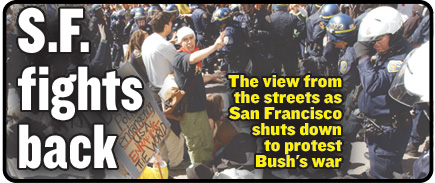
EDITORIAL Five years ago, the antiwar movement shut down San Francisco. It was a moment in history, one of those times that those of us who were there will never forget. No cars on Market Street. No cars on Mission Street. No business as usual anywhere downtown. Just a powerful statement that the city was not going to pretend that invading Iraq was an acceptable move.

And yet, for five years, the war has gone on. Sometime this spring, it’s likely the total number of American soldiers killed in the pointless military adventure will pass 4,000. And that’s just a fraction of the carnage: according to iraqbodycount.org, more than 89,000 civilians have died since the George W. Bush administration launched the invasion in March 2003.

There will be any number of newspaper stories, special reports and anniversary programs in the next few weeks, but of all the facts and statistics they’ll cite about the war, one ought to be at the top:

The antiwar movement was right.

Everything that the activists in the streets (and the very few newspapers that supported them, like this one) said at the time would prove to be absolutely true. As Steven T. Jones notes on page 14, there were no weapons of mass destruction. There was no link between Saddam Hussein and al-Qaeda. Iraq had nothing to do with Sept. 11. United States troops were not welcomed as liberators. There is no functioning Iraqi democracy. The situation in the Middle East is more unstable now than it was five years ago. Nothing has come of this war except disaster, death, and a bill to the American people that could reach $3 trillion.

In fact, Bush’s war is one of the main reasons that the economy is such a mess today — and that’s something the Democratic presidential candidates need to be talking about.

There has been nowhere near enough debate over the cost of the war. Bush has managed to fund the entire effort through supplemental appropriations, without once presenting a full budget to Congress. And the Democrats, fearing political criticism if they cut funding to troops who are in harm’s way, have gone along with every single spending request.

That’s been a huge factor in the nation’s mounting budget deficits and rapidly growing debt. And unlike deficit spending that funds social and infrastructure priorities, the red ink has done little to create jobs or improve the economy. It’s well known that military spending does less to help economic growth and recovery than any other type of government program. Put another way: If the $3 trillion that will go to the Iraq war were put into any other public venture, it would have tremendous positive consequences for society. It could, for example, preserve Social Security for another entire generation without new taxes or benefit cuts.

But those sorts of choices haven’t been presented to the public, because the war has been sold as a painless effort that requires no national sacrifice. And the bills won’t all come due until this president is gone and his successor has to deal with a deep recession, a horrible budget mess, growing unemployment, and a legacy of international distrust.

The good news is that the antiwar activism has forced both presidential candidates to pledge to bring the troops home — and Barack Obama could be the first president in years to be elected in large part on the basis of a strong grassroots peace movement. But the next president won’t stop the war without continued, constant pressure. It’s easy to think of the antiwar movement as a failure and to get discouraged — but this is not time to let down. If a Democrat wins the White House, visible and organized activism will be more important than ever. And this time, it might actually change American politics.

Editor’s Notes

0

"At 11 a.m., Thursday, March 20, I found myself at the corner of Market and Beale streets, looking at the startling emptiness of the Financial District." (See "The days SF stood still," [03/26/03]).

That’s where I was five years ago. You remember where you were, too: it was one of those moments in time that nobody forgets. Shock and Awe lit up the sky over Iraq, President George W. Bush announced the glorious military victory that was on the way, and the politicians — even the Democrats — were so busy praising the troops in the field that nobody stopped to ask how this was all going to end.

As we report this week, the major newspapers didn’t, either. In fact, in a survey by Editor and Publisher magazine, more than 75 percent of the papers supported Bush’s arguments for war. The airwaves were filled with generals and admirals talking up the invasion; the antiwar movement was marginalized.

And while the mainstream media were waving flags and cheering, the alternative press was presenting the other side of the issue. "Bush’s war represents a dangerous turning point for the United States," we wrote on March 26, 2003.

I sent out an e-mail to my colleagues in the Association of Alternative Newsweeklies this week asking how many of the weeklies were strongly against the war, and the answers started pouring in immediately. Tucson Weekly. San Diego City Beat. Boulder Weekly. Monterey Coast Weekly. Boston’s The Phoenix. The North Coast Journal. Random Lengths. The Memphis Flyer. Rochester City Newspaper. Creative Loafing. And that’s just a few of the names on the list.

Overall, the independent and alternative media were in the vanguard, providing the information that the big outfits wouldn’t.

Resistance is futile — or is it?

0

It was a time without precedent in American history. The commander-in-chief voiced his intention to take the country to war — a voluntary, preemptive war with no clear catalyst, no faraway invasion or Pearl Harbor or sinking of the Maine and millions of people shouted their opposition. With plenty of time to avert war, the protesters warned the invasion would be a costly disaster.

They were right. And it didn’t matter.

The war in Iraq was a test of our democratic ideals. It was a test that this country failed, a failure that has been felt by the people of the United States, Iraq, and elsewhere for the last five years. For many, the refusal of the US government to heed the demands of its citizens left them disillusioned and disempowered.

But others say it sparked a political change that woke up an apathetic citizenry, pulled the Democratic Party back to the left, and may have averted war with Iran.

It’s certainly arguable that the presidential campaign of Barack Obama owes its energy and success in part to the antiwar movement — and if Obama wins, he will be the first president in a long time who took office thanks to the support of a strong grassroots progressive movement.

Nowhere was the clash of people power and government will more acute than on the streets of San Francisco, where a series of massive marches, some drawing nearly 100,000 people, filled the streets prior to the invasion of Iraq on March 19, 2003. The onset of war led protesters to effectively shut down the city, resulting in about 2,300 arrests and millions of dollars in costs to the city.

President George W. Bush dismissed the protests, of course, but he wasn’t the only one. Political leaders such as Rep. Nancy Pelosi, then-Mayor Willie Brown and soon-to-be Mayor Gavin Newsom (who didn’t attend any of the marches, unlike progressives on the Board of Supervisors) condemned the peace movement for hurting an innocent city. But with the “battle for San Francisco” making international news, the protesters were more concerned with the global audience.

A month earlier, on the weekend of Feb. 15 and 16, there were coordinated protests against the impending war in about 800 cities around the world, drawing around 10 million people. The peace march in Rome included about 3 million people, earning a listing in the Guinness Book of World Records as the largest anti-war rally in history. People have never made such a loud and clear statement against an incipient war.

Beyond the numbers, the antiwar movement was also right. On every major issue and prediction, the messages from the street proved correct while those from the White House were wrong. The US wasn’t welcomed as liberators. There were no weapons of mass destruction. Iraq after the invasion isn’t a stable democracy or shining beacon to anyone but the new generation of jihadis Bush created.

We can blame a hard-headed president, ineffectual opposition party, failure of the national media, or the national climate of fear following Sept. 11. But rather than refighting that lost battle, now is the time to gain perspective on the events of five years ago and determine what it means for democracy and the post-Bush national agenda.


TO THE STREETS

There were two main umbrella groups organizing protests before the war: Direct Action to Stop the War (DASW) and International ANSWER (Act Now to Stop War and End Racism). ANSWER has remained active and DASW has recently been reconstituted for the fifth anniversary of the war, using direct action in San Francisco as well as other urban centers and outposts like Chevron’s refinery in Richmond, which has reportedly been processing Iraqi oil.

“With the fifth anniversary coming up, we’re going back to direct action on the streets,” said Henry Norr of DASW. “But I don’t have any illusions that it’s going to be like it was five years ago.”

The maddening march to an ill-advised war created a political dynamic in which a broad cross-section of Americans was willing to hit the streets.

“We had a wonderfully diverse group of people, from soccer moms to anarchists,” said Mary Bull, who cofounded DASW, a collective of various affinity groups and concerned individuals formed in October of 2002 as Bush started beating the drums of war.

It was a group fiercely determined to prevent the war — and really believed that was possible. In fact, Bull recalls how she and other members of the group burst out crying at one meeting when a key activist said the war was going to happen.

Richard Becker, who cofounded ANSWER and serves as its West Coast coordinator, said that in the summer of 2002, “we came to the conclusion that [the war] was going to happen.” The group called its first big protest for Sept. 15, 2002, and another one two weeks later. But the movement really exploded on Oct. 26 when almost 100,000 people took to Market Street, much of it a spontaneous popular uprising.

“We were overwhelmed,” Becker said. “We were in a perpetual state of mobilization to keep up with what was going on. But then it didn’t stop the war.”

Did he think they could?

“I think a lot of people thought maybe it was possible to stop it. And we thought maybe it was possible to stop it,” Becker said.

The high point, according to Becker and Norr, was Feb. 17, 2003, when the New York Times ran a front page analysis piece entitled “A new power in the streets” that claimed “the huge anti-war demonstrations around the world this weekend are reminders that there may still be two superpowers on the planet: the United States and world public opinion.” But then Colin Powell went to the United Nations to argue for the invasion, and the Democrats in Congress did nothing, and it became clear war was coming.

Norr stayed out there protesting, being arrested several times and even shot in the leg by Oakland police with a rubber bullet during a protest at the Oakland docks. And he thinks some good came from the experience.

“The lesson for people is the political and economic elites are committed to preserving and extending empire. And they basically say as much in their own writing,” Norr said. “Wars are not anomalies.”

Despite being a frustrating and depressing exercise, most saw benefits to the failed movement. “People got an incredible education about how the system really worked,” Becker said. “Building a movement is mostly about a series of setbacks.”

Medea Benjamin, cofounder of both Global Exchange and CodePink and fixture of the anti-establishment peace movement for years, was upbeat about the protests. “We did our job as citizens. We did what we were supposed to do: organize, get people to take action, get people onto the streets,” she said. “We did everything we could think of.

“What you take from it is we don’t have a very well-developed democracy because the people spoke and the government didn’t listen.”

25war2_Lars1.jpg The ever-evolving “Democracy Wall” on Valencia Street, March 2003, helped stir up debate (Photo by Lars Howlett)


FACING ARREST

The collective action of five years ago starts with a series of personal stories — tens of thousands of them — so let me briefly begin with mine.

My arrival in San Francisco was closely tied to the march to war. I was living in Sacramento and working as the news editor of the Sacramento News & Review when Bush began his saber rattling against Saddam Hussein, but by the end of 2002 I had a falling out with my boss and found myself jobless.

Like most Northern Californians who opposed the war, I came to San Francisco on Jan. 18 to make my voice heard and experienced a bit of serendipity on my way to Justin Herman Plaza: while reading the Guardian on Muni, I saw their advertisement for a city editor, a job that was ideal for me at a paper I’ve always loved. Needless to say, it was a great day, empowering and full of possibilities.

Less than two months later I was on the job, and on the second week of that job I was back on the turbulent streets of San Francisco, part of a Guardian team covering the eruption of this city on the first full day of war. When I stepped off the cable car just after 7 a.m., people were streaming up Market Street and I joined them.

When a large group stopped at the intersection of Market and Beale, I stopped too, taking notes and bearing witness to this historic, exciting event. I had a press pass issued by the California Highway Patrol that allowed me to cross police lines, so when police in riot gear surrounded us and threatened arrest, I held my ground with 100 or so protesters.

After interviewing about a dozen people about why they were there and that they hoped to accomplish (see “On the bus: Journalists, lawyers, four-year-olds — the cops were ready to bust anyone Thursday morning“), I was arrested with the others and taken to a makeshift jail and processing center at Pier 27 (no charges were filed in my case, and charges against all of the 2,300 people arrested here in those first few days of the war were later dropped).

I recently tracked down a few of the people who appeared in my article, including Daphne and Ross Miller, who were at the center of the most interesting drama to play out during our standoff with the police. She’s a family practice physician, he’s an architect, and they live in Diamond Heights with their two children, Emet, who is almost 9, and Arlen, 12, who was away on vacation when the war began.

“We were genuinely shocked that the war started,” Ross told me. “We were at some of the earlier protests and really thought there was no way [Bush] could do it.”

They woke up March 20, 2003, to news that the war had begun and immediately walked to the BART station with Emet and rode to the Embarcadero station, not really planning for the day ahead but just knowing that they had to make themselves heard.

“We were pissed as hell. I don’t think I’ve ever been so angry in my life,” Daphne said.

They quickly came up with a plan. “We basically decided that if anyone was going to be arrested, it was going to be Ross and I’d stay with Emet. But it didn’t end up that way and I ended up in the arrest circle.”

Daphne had their house keys and threw them over the police line to Ross at one point. A photographer in the circle had gotten shots of a man named Roman Fliegel being roughed up by police as they pulled him off his bicycle, which was towing a trailer with a sound system, and decided to throw his backpack with camera gear out as well. When Ross — who had four-year-old Emet on his shoulders — caught it and refused police orders to give it to them, police grabbed Emet and roughly arrested Ross, leaving a gash on his forehead.

“Rage surged through the crowd, and it seemed as if things might get ugly, but the police kept a tight lid on the situation, using their clubs to shove back protesters who had moved forward,” I wrote at the time.

Emet was delivered into the circle with Daphne as the arrests continued, many quite rough. “At that point, as a mom, I had to exercise the most restraint ever,” said Daphne, who was angry about the situation but fearful about what she was exposing her son to. “Please, don’t let any violence happen here,” she pleaded with the crowd. Eventually, commanders on the scene let the mother and child go.

“The officer who let me go said that if he saw me again out there, he would call Child Protective Services on me,” Daphne said. But two days later, still brimming with outrage at her country’s actions, she ditched a downtown medical conference to rejoin the street protests, this time solo.

The couple say they’ve lost friendships over the war and have become more engaged with politics, coming to believe that Bush and the neocons are malevolent figures who knew how badly the war would go and did it anyway to establish a large, permanent military base in Iraq.

“Since that day, we’ve been far more active,” Ross said. “We realized you can’t just trust the system. You have to push.”

But that determination was mixed with feelings of disempowerment and depression. They attended some of the protests that following year, but the couple — like most people — just stopped going at some point because they seemed so futile.

“There was a horrible sense of resignation and a genuine depression that followed,” Ross told me.

The nadir was when Bush was reelected and they considered leaving the country. But then, Ross said, “we decided we’re not just going to run away and we’re not going to accept this.” Looking back, even with the scare over Emet, they express no regrets.

“It was the right thing to do because it was the wrong war to have. I’d do it again and again and again if I had to,” Ross said

They’re guardedly hopeful that Barack Obama could begin to turn things around if he’s elected. “I think the right president can at least start to dismantle this,” Daphne said. “I think thousands of people marching in the streets is something he would listen to.”

25war3_Charles1.jpg A die-in on the streets of San Francisco in March 2007 marked the fourth anniversary of the invasion (Photo by Charles Russo)


WITNESS TO HISTORY

Covering the peace movement in those early days was a heady experience, like reporting on a revolutionary uprising or working in a foreign country where the people are organized and active enough to be able to shut down society and brave enough to risk bodily injury for their beliefs.

I was at the founding meeting of CodePink — which became the most effective group at personally confronting the warmongers and keeping the war in the public eye — one evening at Muddy Waters in the Mission District shortly after the war started.

Looking back, Benjamin rattled off a long list of the alliances the group built — with labor, churches, businesses, and a wide array of social movements — and creative actions intended to build and demonstrate popular support for ending the war.

“We’ve done so many things and what did we get? We got a surge,” she said. “It shows the crisis in our democracy, the crisis of the two-party system, the crisis of a dysfunctional opposition party.”

Yet she said the peace movement has been remarkably successful in convincing the public that the war was a mistake and that it’s time for the troops to come home, even if the Democrats have been slow to respond to that shift.

“The progress we’ve made is turning around public opinion and that’s going to play a big role in the upcoming elections,” she said. For Norr, the role of the news media is a particular sore spot. He was a technology reporter for the San Francisco Chronicle who called in sick on the first full day of war and was arrested on Market Street with his wife and daughter, resulting in suspension by editor Phil Bronstein for his actions.

I wrote several stories on the issue, which culminated in Norr being fired and Bronstein unilaterally banning Chron employees from peace protests. I even borrowed CodePink’s guerilla tactics when Bronstein repeatedly refused to return my calls or address why he had singled out antiwar protesters for uniquely punitive treatment. I confronted him during a speech he gave at the Commonwealth Club (see “Lies and half-truths,” 5/7/03). That was the tenor of the times: we were all tired of being lied to and we decided to push back.

Norr was particularly frustrated with his own paper’s reporting of the war and started sending articles by the foreign press to his paper’s news desk, trying to wake his colleagues up to the pro-war propaganda being passed off as journalism in this country.

He was also disappointed with the country and with the Chronicle — both the management and his fellow reporters, who did little to support him — but the experience caused him to return to his roots as a progressive activist.

“The war and losing the job and everything brought an abrupt end to my consumerist phase and dumped me back into the world of being an activist,” said Norr, who serves on the KPFA 94.1 FM local station board and has made three recent trips to the Palestinian territories while working with the International Solidarity Movement.

Benjamin said Americans shouldn’t expect the next president to end the war — not without lots of pressure from a renewed and vocal peace movement. “This is the time to set the stage for the post-Bush agenda,” Benjamin said. “Don’t put your hopes in Barack Obama in getting us out of Iraq. Put your hopes in the people.”

25war4_Lane1.jpg A rally and nonviolent direct action at the Richmond refinery targeted Chevron on March 15 (Photo by Lane Hartwell)


THE AFTERMATH

The San Francisco Police Department, which spent more than $2 million on overtime costs responding to peace protests between March 15 and April 16, 2003, generally behaved with restraint and professionalism, but there were several exceptions.

The most costly and disturbing incident came when Officer Anthony Nelson began aggressively swinging his long riot baton at protesters, badly shattering the arm of peaceful protester Linda K. Vaccarezza, who suffered a permanent disability in her career as a court reporter.

Nelson’s incident report falsely stated that Vaccarezza had threatened him with a sign attached to a solid pole, but video of the incident later clearly showed there was no pole and that she was retreating when he teed off on her (see “The home front,” 05/19/04).

Vaccarezza received an $835,000 settlement from the city in November of 2004. On Oct. 5, 2005, two and a half years after the incident, SFPD fired Nelson for lying about what happened that day, and the City Attorney’s Office has been successfully fighting Nelson’s appeals in court ever since, putting in more than $100,000 in attorney time and costs into the Nelson and Vaccarezza cases.

The other significant ongoing litigation from the antiwar protests involved Mary Bull, who was arrested during an early protest for pouring fake blood in front of the entrance to Chevron’s San Francisco office before being allegedly strip searched and left naked in her San Francisco Jail cell for 36 hours.

Ironically, Bull was among those who brought a successful class action lawsuit against Sacramento County after she and others protesting a logging plan were strip searched, setting a precedent and led most counties to reform their strip-search policies. She used her share of the $15 million judgment to buy an organic permaculture farm in Sebastopol.

Her San Francisco case, in which Bull won a multimillion-dollar judgment, is still under appeal and now in mediation. Bull said the protests five years ago did make a difference, something she tells those who fret about its apparent failure. “I tell them to look at what issues the candidates are talking about now and I thank them for protesting then.”

“Even though we had millions throughout the world, we were sort of blocked, but now we’re regaining that momentum,” Melodie Barclay, a massage therapist who was also arrested with me on the first day of the war, told me recently. “We can’t judge it by the fact that we didn’t get the momentum we wanted.”

Norr started his antiwar activism working with Students for a Democratic Society in Boston, protesting the Vietnam War, which he said shares many similarities with the current situation, for good or for ill. He said that people tend to forget that while the protests then were huge and helped end the war, the movement did wane after Nixon ended the draft and substituted massive aerial bombardment for boots on the ground.

“The protests dropped off considerably,” he said. “A lot of the things that drove people to take risks in the late ’60s had faded by the early ’70s.”

He thinks the current administration learned a lesson from those days: it’s easier to maintain a war effort if the average citizen isn’t affected.

But there are other factors as well keeping a lid on the antiwar outrage.

“The culture has changed too. Young people are oversaddled with debt. People in schools seem to be docile. The culture as a whole seems to be more individualist and consumerist,” Norr said.

Yet some young people have woken up and many of them are funneling their energies into a peace group that was formed in the summer of 2005: World Can’t Wait, as in: the world can’t wait for the end of Bush’s second term before we change our direction and leadership.

“We don’t just want them gone, we need to repudiate their program,” said Giovanni Jackson, a 26-year-old WCW student organizer. “If we’re going to change anything, we need the youth.”

Jackson was at WCW’s founding convention in New York City, which came just as New Orleans was being flooded and then essentially abandoned by the federal government.

“When [Kerry] lost, people felt demoralized and World Can’t Wait kind of stepped into that situation,” Jackson said. “There was a lot of demoralization in the antiwar movement at that time.”

The group organized protests and student walkouts on Nov. 2, 2005.

“Everyone has their moments of doubt,” he said, “but I’m motivated by the crimes we see everyday.”


THE LESSONS

One of the biggest barriers to galvanizing people and turning the fifth anniversary of the war into something that might make a difference is the presidential election, which is diverting the energy of many potential protesters — and at the same time, offering some hope that a new president may lead to peace.

After all, every single one of the Democratic presidential candidates has promised to withdraw troops from Iraq, with varying timelines and numbers of US personnel left behind. And with enough encouragement, they might be willing to help change the status quo.

Many of the activists who volunteered their time and money to help move the Obama campaign into its front-runner position came out of the antiwar movement, and Obama’s strong stand against the war has been a key factor in his popularity.

Becker and some other activists don’t have much faith that a change in presidents will change the course in Iraq, although he agrees that much of the energy now surrounding Barack Obama derives directly from the antiwar movement.

“There’s been a huge upsurge of hope for Obama and that he might bring about the kind of change we need,” Bull said, adding that she doesn’t share that hope, believing the only path to peace is to pressure Obama and other leaders to commit to more progressive positions.

Norr said, “On one level, people have illusions about the power of peaceful protests. People believe in democracy, as well they should. We feel like the rulers should be paying attention to public opinion.

“It’s a remarkable story how broadly and quickly the American people have turned against the war. Public opinion was certainly ahead of the Democrats.”

And people will only grow more disenchanted with Iraq and its multitude of costs. “The people here are paying for this war, and everyday we have new stories about health clinics being shut down,” Becker said.

Becker was amazed last March as massive demonstrations for immigrant rights seemed to explode out of nowhere. “We think there will be more things like that,” he said.

Because after five years of organizing communities to resist the military-industrial complex’s plans, Becker thinks there’s been some visible progress.

“There isn’t a town or hamlet in the US that doesn’t have activism going on, but you wouldn’t know it from the corporate media,” Becker said. “It’s a mistake for people to feel discouraged.”


Phosphorescent shimmers with strange beauty

0

By Todd Lavoie

Old Weird America, indeed – the spectral-twangin’, gorgeously raggle-taggle ghost-folkster Matthew Houck, a.k.a., Phosphorescent, will be throwing mad shadows upon the walls of the Independent Sunday, March 23, when he takes the stage in support of his October-released spine-tingler Pride (Dead Oceans).

Now on album number three, the Athens, Geo./Brooklyn-based Houck has expanded beyond the largely go-it-alone parameters of Pride to include a backing band for this tour; should be interesting to see how the deep-in-the-earhole intimacy of the almost entirely self-recorded disc translates to the stage in the form of a full-fledged quartet. Not that there’s much cause to worry: if the guy can bring backwoods-gothic to Bed-Stuy, by crikey, I’m sure he’ll find a way to channel onstage the same gossamer-gospel hocus-pocus that makes Pride such a fascinating listen.

It’s an intriguing proposition, fashioning such distinctly rural sounds while surrounded by so much concrete, but Houck has done exactly that, and quite convincingly as well. This is no pard’ner-grabbing, knee-slapping hoedown, however: instead, Pride arrives in misty drifts, sighing and swaying over pine-cloaked hills, across Civil War battlefields and weed-overrun graveyards. If there’s a trace of Brooklyn on this record, I have to hear it – and while we’re at it, most of the time I’m not picking up too much 21st century here, either. (Other than the production, of course, which is goose-pimplingly exquisite.)

The Guardian Iraq War casualty report (03/17/08)

0

At least 39 Iraqi civilians were killed today in a suicide bombing at a mosque in Karbala, according to the Associated Press.

For a breakdown of the positions that relevant politicians are taking on the war in Iraq, visit the slate.com link below. 36 U.S. soldiers were killed this month, which means at least one U.S. soldier was killed for every day that passed. Click here to view.

Casualties in Iraq

Iraqi civilians:

82,199 – 89,710: Killed since 1/03

Source: http://www.iraqbodycount.net

For a list of recent events that have resulted in Iraqi casualties, visit :
http://www.iraqbodycount.org/database/recent/

For first hand accounts of the grave situation in Iraq, visit some of these blogs:
ejectiraqikkk.blogspot.com
healingiraq.blogspot.com
afamilyinbaghdad.blogspot.com

U.S. military:

4,266: Killed since the U.S. invasion of Iraq 3/20/03

Source: http://www.icasualties.org/

145: Died of self-inflicted wounds, according to http://www.icasualties.org/

For the Department of Defense reports go to: http://www.defenselink.mil/

For a more detailed list of U.S. Military killed in the War in Iraq go to: www.cnn.com

To view a breakdown of U.S. military casualties by state of residence, click here.

Iraq Military:

30,000?: Killed since 2003

Source: http://www.infoshout.com

Journalists:

127: journalists have been killed since the start of the war in March, according to www.cpj.org.

Refugees:

2.2 million: Iraqis displaced internally

2 million: Iraqis displaced to neighboring states

Incessant violence across much of Iraq’s central and southern regions has forced tens of thousands of people to leave their homes every month, presenting the international community with a humanitarian crisis even larger than the upheaval aid agencies had planned for during the 2003 war, according to United Nations High Commissioner for Refugees’ estimates.

U.S. Military Wounded:

132,199: Wounded from 3/19/03 to 3/01/08

Source: http://www.icasualties.org/


The Guardian cost of Iraq war report (03/17/07): So far, $503 billion for the U.S., $63 billion for California and $1 billion for San Francisco.

Compiled by Paula Connelly

Here is a running total of the cost of the Iraq War to the U.S. taxpayer, provided by the National Priorities Project located in Northampton, Massachusetts. The number is based on Congressional appropriations. Niko Matsakis of Boston, MA and Elias Vlanton of Takoma Park, MD originally created the count in 2003 on costofwar.com. After maintaining it on their own for the first year, they gave it to the National Priorities Project to contribute to their ongoing educational efforts.

To bring the cost of the war home, please note that California has already lost $63 billion and San Francisco has lost $1 billion to the Bush war and his mistakes. In San Francisco alone, the funds used for the war in Iraq could have been used to provide 3,144,442 homes with renewable electricity, 726,370 people with health care, or 31,528 public safety. For a further breakdown of the cost of the war to your community, see the NPP website aptly titled “turning data into action.”

For more information on what the war is costing the United States visit the American Service Friends Committee website here.

SXSW: Playboy bods and yobs, “Body of War,” sniffing a Siltbreeze

0

stopallwarsign.jpg
Signage modification – Austin, Texas-style. All photos by Kimberly Chun.

What a weird lil’ South By this is? Can it get any stranger than the evening of March 13, which started out at Stubb’s for a sold-out anti-war concert, “Body of War,” linked to the feature documentary on 25-year-old Tomas Young, who was paralyzed from a bullet to his spine, taken after serving in Iraq for less than a week. System of a Down’s Serj Tankian accompanied himself on piano, Billy Bragg presented a powerful “Farmer Boy,” and Kimya Dawson, Ben Harper, and RX Bandits filled out the bill. (Sightings of the Dawson’s infant being cartered by her partner, abounded throughout the fest).

excocaine.jpg
Gimme more Ex Cocaine.

Then it was off to the Siltbreeze showcase at Soho Lounge for a hand drum-driven Ex Cocaine from Missoula, Montana, and the stirring guitar-electronics invocations of Blues Control from Brooklyn. Good to see such a sizable crowd out for what many might see as a micro-niche night.

bluescontrol sml.jpg
Outta-hand Blues Control.

Made few pitstops at Friends for the soon-to-be capacity Carbon/Silicon showcase (witness the scores of disappointed Clash fans milling around before their 11:30 p.m. set outside, cordoned off by police tape just so they don’t get raucous). London’s Noah and the Whale plied their rootsy folky harmonies with sweetness and high spirits.

noahandthewhale sml.jpg
Swallow this: Noah and the Whale.

More ambitious but definitely more streamlined lineup-wise, was Florence and the Machine, also from London town, over at BBC/Steve Lamacq’s event at the Rio. Like a sweet, over-the-top cross between Kate Bush and a high school musical theater star, Flo mimed drowning, quasi-tap-danced, and threw her gold-sequined jacket to an audience member when she grew encumbered. All accompanied only by ukulele. And with plenty of drama for all.

florenceandthemach sml.jpg
The Fantasticks, anyone? Florence and the Machine.

daftbunny sml.jpg

Time to queue for the Playboy/C3 (presenters of Lollapalooza, et al) ninth annual late-night party. The line wound round the block of the “301” warehouse and the media line (through the back entrance – I felt like I ought to be helping with the dishes!) was just as crazed. Once inside, after watching oodles of would-be media types getting turned away at the list, I spied Perez Hilton all in white, with white shorn locks, got my beverage (check the ample barbecue midnight snack), and studied the Heavy as they cozied up to playmates in sad drooping bunny ears and cotton tails.

playboy1.jpg
Things got Heavy.

bunny.jpg

PG&E’s Green War Chest?

0

Greetings, Californians for a Clean Energy Future! Welcome to the fold of innocuous sounding, pseudo-environmental political front groups. This one is brought to us by our buddies over at Pacific Gas and Electric Co.

The group, which doesn’t seem to have a Web site or any other physical manifestation outside of filings with the California Secretary of State, already has $340,000 ready and waiting for the upcoming election cycle. According to a Secretary of State spokesperson, the group was born on Dec. 21, 2007. The only contact is the law firm Nielsen Merksamer, which has a history of teaming up with PG&E to break the law for political gain.

So far, they haven’t spent a cent — all of which were dumped into the committee by PG&E in three lump sums. Wonder what they’re going to spend all that money on? Since it’s calling itself a “coalition of environmentalists, taxpayers, and Pacific Gas and Electric Company,” it could go for or against nearly anything — including boosting Prop 98 on this June’s ballot. If passed, the measure would kill rent control and make it illegal for governments to use eminent domain to seize utility infrastructure and use it to provide the services themselves, an idea San Francisco has considered in the past and Stockton is currently pursuing.

SXSW: Touch down! Plans, schplans…

0

cas sml.jpg
Won’t you listen to Cassettes Won’t Listen.

“Punk rock – we don’t have that category in this country.” Oh, the quotables already emanating from Austin, Texas – albeit from a boomer-rock-oriented radio commentator interviewing aging Aussie punk vets.

SXSW, here we go again. The plane was packed on the way from Denver to Austin. Baggage claim was filled with checked guitars and black-garbed hollow-eyed scenesters. Todd P already had a Juicebox show going at 2 a.m. at his party central, Ms. Bea’s. And rumors are already swirling – has Dolly Parton cancelled? Is it possible to squirm into the already-closed-guestlist Playboy afterhours party Thursday night? Where is Perez Hilton having his ssseeecccret soiree (with Robyn no doubt working her rework of Snoop Dogg’s “Sex Eruption”)? Rachel Ray is having a party – huh?! You can spend more time planning your sked than actually seeing music, but the one-man band sounds of Cassettes Won’t Listen drew me into the Austin Convention Center’s dark, semi-depressing, school-caf-like Daystage.

Most disturbing news: so many longtimers aren’t making it this year due to industry cutbacks. Most disturbing stuff in the fest bag o’ fliers: an Armed Forces Entertainment card with a little green toy soldier attached (“Plug in your weapon, turn up the power and fire away. Your limo is a Humvee and your ride is a Blackhawk”). War is so cute – and glamorous! And a card announcing a casting call for Blue Man (I guess the blue face paint fits any ole one – except maybe women?).

What’s up tonight? Free Yr Radio is throwing a bash with Simian Mobile Disco, Yeasayer (all the buzz here, natch), and Times New Viking (Ohio-ans do it so good) at La Zona Rosa, a black rock showcase with Lightspeed Champion courtesy of Vice, a Kills show at the Fader Fort, an Emusic showcase, White Williams at the Gorilla vs Bear party. Also drool-worthy is the Terrorbird/Forcefield PR party with Yacht, Raveonettes, Why?, These New Puritans, the Blow, Radar Bros., Bowerbirds, and the return of the Mae Shi. Kimya Dawson will likely be at the Keep Austin Good event at San Hotel’s parking lot, and Dan Deacon and Deer Tick are making some very late-night noise – shhhh! – at one o’ UT Austin’s quads at, oh, 2 a.m. And most of those events aren’t even official.

Desperately seeking cinema

0

> a&eletters@sfbg.com

Jennifer Reeves’s movies are personal wishing wells, each a repository of dreams and worries. As we see ourselves reflected in the water’s surface after tossing in a coin, so too is Reeves’s presence apparent in the handmade, fussed-over quality of her moving pictures. I use that broad designation pointedly, as her films are as varied in material and form as they are prosaic in mood and temperament. Over 15 years of independent filmmaking, the New York–based artist has created hand-painted films in the style of her mentor Stan Brakhage, freewheeling shorts, fiction fantasias, 16mm double-projections, feature narratives, and experiments in high definition. San Francisco Cinematheque hosts the formally restless filmmaker for a three-program tour.

Reeves’s early shorts channel riot-grrrl spark with scratched-up film stock. Elations in Negative (1990) is a good sample of the celluloid-mad sexual politics of these 16mm beaters, though Taste It Nine Times (1992), with its vivid pickle-biting innuendos, will be missed from the Cinematheque run. In painted films like The Girl’s Nervy (1995) and Fear of Blushing (2001), Reeves’s appropriation of Brakhage’s technique conveys playful femininity in color, pattern, and music.

Though Reeves toyed with narrative early on, most notably in 1996’s psychodrama Chronic, 2004’s The Time We Killed represented a kind of breakthrough. An unhurried 94 minutes passes through the dark mirror of an agoraphobic poet keeping to her New York apartment during the buildup to the Iraq War. "Terrorism brought me out of the house, but the war on terror drove me back in," Robyn (Lisa Jarnot) says in her peripatetic voice-over, adding later, "I’m afraid of catching the amnesia of the American people." Reeves’s magnetically immersive filmmaking is such that the political situation neatly folds into an extended experiment in subjectivity — besides being an unstinting portrait of madness (it’s everywhere in this film: in a record’s spin and neighbors’ voices echoing through the walls, in dogs’ faces, bathwater, and masturbation), The Time We Killed also serves as an understated chronicle of the collateral psychic and moral damage of our country’s manufactured warmongering.

The Time We Killed is heavier than Reeves’s other work, though it’s not without humor; she finds the ridiculous, unwieldy side of depression in Robyn’s litany of death fantasies and a painfully misguided interaction with a curious neighbor. Robyn’s locked in, but Reeves is formally unfettered, mixing conventional 16mm footage with lyrical, associative streams of inner life shot in high-contrast black-and-white. The filmmaker raids her home-movie archive for the film, in addition to using her own apartment and acting as Jarnot’s body double during the extended shooting. This air of transference makes The Time We Killed weirdly transparent, so we feel as intimately connected to Reeves’s isolated work in the editing room as we do to Robyn’s experience in the apartment.

Since The Time We Killed, Reeves has returned to more typically experimental filmmaking. Her 2006–07 Light Work variations strike an ideal balance of abstract and representational visions, in the process cataloging the changing textures of cinema. In the affecting He Walked Away (2007), Reeves dissects, refracts, and abstracts footage from her older movies to create a tri-tipped memorial piece in which the intrinsically elegiac nature of cinema is connected to the dissolution of film technology, which is then tied to the disappearing loves and friendships that shadow personal lives.

As with Guy Maddin — another filmmaker who favors overheated evocations — one has the sense that Reeves could make a hundred interesting movies from the same scraps of footage. "I want to counter the turncoats who say film’s dead," Reeves announces on her excellent new blog. "Try telling a painter that she can only use digital paint on a Mac for the rest of her life. She’d be pissed." But if she were Jennifer Reeves, she certainly wouldn’t slow down.

IMMERSIVE CINEMA: JENNIFER REEVES

Artists’ Television Access, Sat/15, 8:30 p.m.

Yerba Buena Center for the Arts, Sun/16, 7:30 p.m.;
Tues/18, 7:30 p.m.; $6–$8

See Rep Clock for venue information

“Friedlander”

0

REVIEW Throughout Lee Friedlander’s 50-year oeuvre, much of which is now on display at San Francisco Museum of Modern Art, the photographer has been lauded for his liveliness, optimism, and mobility. Yet his paean to modern Americana often resembles monochrome memento mori. Taken as a whole, Friedlander’s work has always seemed driven to two poles: the ephemeral and the haunting.

Heavily impressed by the avant-naturalism of European photographers Eugène Atget and Henri Cartier-Bresson, as well as the post–World War II experimentalism of Robert Frank, Friedlander staked his claim at a moment in the 1950s when the photograph transcended the moribund category of journalistic tool and became its own art form. Modeling much of his working method around Cartier-Bresson’s so-called decisive moment, Friedlander’s timeless images still have a striking past tense about them. Now ossified on film, these thousand microcosmic moments, captured throughout the 1960s and ’70s, seem like lively obituaries.

While Friedlander first made a name for himself as a contractor for Atlantic Records — where he shot such musicians as Ornette Coleman — he was never a celebrity photographer. In fact, his most intriguing work resulted from a personal obsession with traveling and shooting the country, crisscrossing between New York and his home state of Washington. And so the images of nocturnal motel rooms, cycloptic TV sets, and storefront tessellations conjure the American dynamism and dread of Vladimir Nabokov or David Lynch. The plethora of windows and mirrors in his street photography admit countless apertures through which to see his subjects. But Friedlander’s playful sense of humor always appears just within the clutches of something inexplicably sinister — like the cartoonish shadows that often hover into his frame. Though his more recent work — in portraiture, nudes, and particularly in nature — may suffer slightly from the inevitable cooling of youth’s ambition, Friedlander’s baroque attention to detail and depth of field are unmatched. This is a definitive exhibition on one of America’s most ingenious, albeit conflicted, photographers. The photographer’s son Erik Friedlander will perform pieces from his album Block Ice and Propane (SkipStone, 2007) on April 24, 8 p.m., $12–$15, at Phyllis Wattis Theater.

"FRIEDLANDER" Through May 18. Mon.–Tues., Fri.–Sun., 11 a.m.–5:45 p.m.; Thurs., 10 a.m.–8:45 p.m.

$7–$12.50, free for members and 12 and under. San Francisco Museum of Modern Art, 151 Third St., SF. (415) 357-4000, www.sfmoma.org

Dress sharp

0

REVIEW Don’t tell anyone, but I have a secret fetish. Nothing turns me on like a new pair of shoes, and few bring me to shoegasm like sexy stilettos. So I put on my favorite pair of Gucci patent-leather tuxedo shoes and headed down to Stiletto, clubutante Parker Day’s arty party at Asia SF, in search of the perfect footwear.

Day named the night after the seductive heels, but it also alludes to the discreetly slim knife — both of which are deadly in the hands of the Pam Anderson B-movie character Barb Wire. "It’s sharp and it’s sexy," Day said. "It gets to the point." But it was The Warriors, a 1979 cult classic about New York City street gangs at war, that set the theme for that night’s party. As footage from the film was projected onto a side wall, the music morphed genres, from hip-hop and hit pop to electronic and indie-rock remixes for an audience as diverse as The Warriors‘s cast — and equally reminiscent of the early-’80s Big Apple. Fab Five Freddy, Blondie, and Madonna occupy the same turf without incident.

The crowd’s footwear was just as varied, but cowboy boots and Converse All-Stars were the most heavily represented in The Warriors–inspired fashion show. Taking cues from the movie, models worked leather vests and gunmetal belts into fierce ensembles, which they paraded down the runway like gangsters. A bit later, audience members were able to participate in a Warriors–themed costume contest. Not to ruffle anyone’s fab feathers, but I think my own shoes were the ultimate winners.

STILETTO

Third Friday of the month, 10 p.m.–3 a.m., $8

Asia SF

201 Ninth St, SF

http://www.myspace.com/stilettosf

Diamonds are harder than gym bodies

0

Black Lizard made me gay. Or, at the very least, Kenji Fukasaku’s 1968 jewel-toned mod noir opened my quasicloseted 16-year-old eyes to a certain queer aesthetic — one which foregrounds its own artifice by using Aubrey Beardsley’s illustrations for Oscar Wilde’s Salome as wallpaper; one which dresses deviance in a gown with a 25-foot-long feathered train; and one which knows that the flipside of fabulousness is utter ridiculousness. It certainly wasn’t something I was seeing in the twink-filled issues of XY foisted upon me by my Pride ring–wearing, secret community college beau, but something closer to what I later found in John Waters’s films with Divine, James Bidgood’s diaphanous beefcake photography, and Ronald Firbank’s deeply purple prose.

However, unlike the above artists, Fukasaku was heterosexual, and Black Lizard represents an anomaly within a career that included much macho studio boilerplate. Even at his finest, Fukasaku had a flair for rough stuff: he directed some of the best yakuza films ever made (Battles Without Honor and Humanity [1973–74]) and ended his career with 2000’s controversial adolescent bloodbath and political fable Battle Royale. Yet, as with Joseph L. Mankiewicz’s practically flaming 1959 adaptation of Tennessee Williams’s Suddenly, Last Summer, there was just the right combination of elements (and most importantly, the right combination of peacocks involved) to make Black Lizard one of queer cinema’s unsung gems. Which is precisely why freelance curator T. Crandall chose the film to kick off his rep series, "The Revival House: Classic Queer Cinema," at Artists’ Television Access.

As clichéd as such a phrase may be, Black Lizard is awash in precious stones and glittering surfaces — but none shine with as much brilliance as the transvestite Akihiro Miwa (credited as Maruyama), who plays the titular jewel connoisseur and criminal mastermind that kidnaps specimens of human beauty to freeze them in eternal tableaux vivant on her island lair. The film is completely Akihiro’s: her entrances stop time, her song is a siren call which causes men to become her slaves, her lavish outfits become more so with each new scene. "The face of Garbo is an Idea, that of Hepburn, an Event," quipped Roland Barthes (referring to Audrey, not Kate). Miwa’s face, whose mouth morphs rubber band–like from a sour moue into the devouring O of a deep cackle unleashed, is a gloss on Barthesian idealness.

Prior to Fukasaku’s film, Miwa had appeared in the same role in Yukio Mishima’s long-running stage adaptation of pre-World War II mystery and suspense novelist Edogawa Rampo’s 1934 short story "Black Lizard." Rampo’s tale was one of many starring his Sherlock Holmes, the brilliant detective Gogoro Akechi, who in Mishima and Fukaaku’s retelling falls heart-first into a dangerous pas de deux with his androgynous quarry. Miwa was a successful nightclub entertainer active in avant-garde theater (and she still is: last year, she starred in a Tokyo production of Jean Genet’s The Eagle Has Two Heads) when she met Mishima — our second of the aforementioned peacocks — who was haunting Tokyo gay bars to "research" his 1953 novel Forbidden Colors.

It’s not hard to see why Rampo’s story of a moribund ice queen obsessed with changeless beauty appealed to Mishima. By 1968, Mishima was that queen, fully immersed in his own homoerotic brand of aestheticized Emperor worship, which would reach its grisly apogee in his ritual suicide four years later. Prior to Black Lizard, his muscular body had already been given the coffee table book treatment in Ba-ra-kei: Ordeal by Roses (Aperture, 1971), where Hosoe Eiko’s photographs present the author posed as a martyred St. Sebastian or as a snowbound samurai. Appropriately, he makes his cameo in Fukasaku’s film as one of Black Lizard’s frozen exemplars of aesthetic perfection— a brawny sailor, no less.

In the end, though, diamonds are harder than gym-wrought muscle, and it was Miwa’s flash, not Mishima’s flesh, that held my attention — at least consciously — upon my first adolescent exposure to Black Lizard. Many viewings later, Mishima seems pathetically unaware of the self-parody he’s partaking in. But Miwa’s exquisite luminescence remains untarnished.

THE REVIVAL HOUSE: BLACK LIZARD

March 19, 8 p.m.; $6

Artists’ Television Access

992 Valencia, SF

(415) 824-3890

www.myspace.com/therevivalhouse

Love and hate and the black cripple

0

OPINION Editors note: I don’t usually run poetry here, but we cosponsored the Valentine’s Day "Battle of (All) the Sexes" poetry fundraiser for POOR Magazine, one of my favorite institutions — and tiny, who runs POOR, convinced me to publish the winning poems. You can get more info at www.poormagazine.org. (Tim Redmond)

First place:

LOVE AND HATE


By Queennandi


I’m about to commentate

Hate is comin’ to tha ring, weighing in at an unknown amount of pounds

Ready to bring on destruction and pain

Puttin’ the little kids out of their homes

Creating victims out of the elderly, addicted to bein’ insane

Oooh, and hate starts frivolous wars

Our childrens’ blood is shedded

While hate’s kids become pampered and spoiled

The hate record looks undefeated, but lovez comin’ to tha ring

Look, now hate done ran and retreated

Love got hate on tha ropes- Bam! Bow! Bam! Bing!

Love IS comin’ wit body blows, and hate can’t block a thing

Now love comes wit an uppercut- Bam!

Put the families back in their homes

Boom! Enough criticizing and criminalizing the poor

Bow! Return tha souljahs and end the war

Now! It’s justice for all- Bam! Boom! Pow!

Cuz hate just got knocked out!

Second place

I’M THE BLACK CRIPPLE


By Leroy F. Moore


I’m the BLACK CRIPPLE

Look at me, look at me

Hear this, hear this

I’ve learned from Heyward’s Porgy

Play on your pity

Just to get that money

I’m the BLACK CRIPPLE

You’ll do me like you did bang, bang Margarett L. Mitchell

I’m an open swore in the BLACK community

Cup in hand

Leaning against the wall

Passersby don’t want to understand

I’m the BLACK CRIPPLE

Gave my body to the US Army

Got shot by the LAPD

But you can’t get red of me

Mainstream think I’m too angry

My own people don’t even notice me

I’m the BLACK CRIPPLE

My spoken word, you can’t handle

You think I’m too radical

Black sisters don’t know what they are missing

My BLACK CRIPPLE body is always erect

Mind masturbation but she can’t deal with the situation

Educated and motivated

Now people are intimidated

I’m the incarcerated BLACK CRIPPLE

Lock down

Lock out

Walking on death row

The State has lost my file

SSI, SSDI and GA

In my pocket is Uncle Sam’s dirty hands

I’m the BLACK CRIPPLE

Rocking your cradle

Yeah, I know what I want but you’re too goddam fickle

Hell yeah, I’m the BLACK CRIPPLE

No, no, no

I’m the PROUD BLACK CRIPPLE

No, no, no

I’m the LOUD PROUD BLACK CRIPPLE

No, no, no

I’m the ANGRY LOUD PROUD BLACK CRIPPLE

No, no, no

I’m the SEXY ANGRY LOUD PROUD BLACK CRIPPLE

Yeah! Yeah! Hell Yeah!

Queennandi is the author of Life, Struggle and Reflection (POOR Press, 2006). Leroy Moore (www.leroymoore.com) is the producer of Krip-Hop Mixtape Vols. 1 and 2 — collections of hip-hop artists with disabilities — and a member of the Po Poets Project of POOR Magazine.

Freedom of Information: A citizen’s guide to fighting secret government

0

San Francisco has the best local sunshine law in the country — and there are still problems getting access to information. Even though the digital age in which we live affords government agencies with myriad ways to give citizens more access to public documents, there is too often little official will to create transparency. And often, bureaucrats are downright hostile to public scrutiny. But help is out there. This guide to local and national organizations offers a wide range of resources for journalists, citizen activists, and hell-raisers who want to track their tax money and hold their government accountable.

LOCAL ORGANIZATIONS


The California First Amendment Coalition is an independent, nonpartisan, nonprofit organization whose mission is to "promote and defend the people’s right to know" by improving compliance with state and federal access laws. CFAC’s Web site contains an archive of articles dealing with FOI issues, the texts of state FOI laws, and other useful resources. 534 Fourth St., Suite B, San Raphael, CA 94901. (415) 460-5060, cfac@cfac.org, www.cfac.org.

The California Newspaper Publishers Association is the umbrella organization to which most newspapers in the state belong, so it has an acute interest in open government. Its FOI Watch newsletter (also available online) includes a clearinghouse of sunshine news from around the state. 708 Tenth St., Sacramento, CA 95814. (916) 288-6015, tom@cnpa.com (general counsel Thomas Newton), www.cnpa.com.

Californians Aware, run by former CFAC general counsel Terry Francke, helps activists and organizations get access to public meetings and records and offers resources on the Web for citizens, public officials, journalists, and attorneys. 2218 Homewood Way, Carmichael, CA 95608. (916) 487-7000, info@calaware.org, www.calaware.org.

The Center for Investigative Reporting sponsors workshops on investigative techniques for journalists and university students. The center’s Web-based magazine provides FOI information, tips for journalists, and updates on past CIR investigations. 2927 Newbury St., Suite A, Berkeley, CA 94703. (510) 809-3160, center@cironline.org, www.muckraker.org.

The DataCenter provides on-call research, consultation, and referrals to justice organizations regarding FOI issues. It also offers research and action training. Services are free or on a sliding scale, depending on one’s ability to pay. 1904 Franklin St., Suite 900, Oakland, CA 94612. (510) 835-4692, ext. 376, www.datacenter.org.

The Electronic Frontier Foundation, an online First Amendment organization, works to uphold digital free speech, empower the online public, and protect privacy on the Internet. It provides stories and alerts on its Web site, with daily updates. Effector, an e-mail newsletter, is available through the site. 454 Shotwell St., S.F., CA 94110. (415) 436-9333, information@eff.org, www.eff.org.

The First Amendment Project is a public interest law firm that provides legal representation, educational programs, and low-cost or free advice for journalists, public interest organizations, and individual citizens with public records and FOI-related issues. In a joint publication effort with the Society of Professional Journalists, the project offers three free pocket guides, on the Brown Act, California’s Open Meeting Law, and accessing court records. The Web page has information on using the California Public Records Act as well as on getting court records. 1736 Franklin St., 9th floor, Oakland, CA 94612. (510) 208-7744, fap@thefirstamendment.org, www.thefirstamendment.org.

Media Alliance is a nonprofit media center that offers classes on journalism skills, including how to find and use public records. 1904 Franklin St., Suite 500 Oakland, CA 94612. (510) 832-9000, information@media-alliance.org, www.media-alliance.org.

The Society of Professional Journalists, Northern California Chapter, FOI Committee fights for open access to information and educates members of the public on FOI issues. The group provides a subscription e-mail list for journalists and others involved in FOI and First Amendment issues in California as well as putting on the James Madison FOI Awards. 222 Sutter St, 6th Floor, San Francisco, CA 94108 (415) 321-1700, www.spj.org/norcal.

NATIONAL ORGANIZATIONS


The Brechner Center for Freedom of Information conducts research and educates the public in mass-media law and the First Amendment, including public access to government meetings and records and litigation information. University of Florida, College of Journalism and Communications, 3208 Weimer Hall, P.O. Box 118400, Gainesville, FL 32611-8400. (352) 392-2273, www.jou.ufl.edu/brechner.

The Center for National Security Studies works with concerned citizens and groups to expose secret government policies and offers free assistance to those seeking records under the Freedom of Information Act. It also coordinates related litigation. 1120 19th St. NW, 8th floor, Washington, D.C. 20036. (202) 721-5650, cnss@cnss.org, www.cnss.org.

The FOIA Blog, created by an FOIA Washington attorney, has an updated list of documents currently being released by several government agencies infoprivacylaw@yahoo.com, www.thefoiablog.typepad.com.

The Freedom of Information Center of the University of Missouri School of Journalism has a collection of more than one million articles and documents about access to information at the local, state, and federal levels. The center works to ensure compliance with sunshine laws around the country. Its Web site contains links, updates, and tips on FOI inquiries. A free e-mail newsletter provides information on developments in FOI access and issues; you can sign up by contacting umcjourfoi@missouri.edu. University of Missouri, 133 Neff Annex, Columbia, MO 65211. (573) 882-5736, daviscn@missouri.edu, www.missouri.edu/~foiwww.

GovernmentDocs allows people to browse and search thousands of pages acquired through the FOIA and sunshine laws. Registered users can review and comment on documents. www.governmentdocs.org

GovTrack provides information on the U.S. Congress. It compiles information on federal legislation, voting records, and other congressional date and simplifies the language for ordinary citizens. It also indexes all bills, as well as changes to them, in Congress and all roll call votes www.govtrack.us.

Investigative Reporters and Editors provides educational services for investigative reporters and editors. The group’s Web site offers FOI-related resource guides, a database of FOI stories, tips for using the Freedom of Information Act, and a database of previous FOI requests. University of Missouri School of Journalism, 138 Neff Annex, Columbia, MO 65211. (573) 882-2042, www.ire.org

The National Freedom of Information Coalition is composed of First Amendment organizations dealing with FOI issues. It provides resources for the media, government officials, lawyers, and citizens who want access to public information. The coalition also offers seminars and workshops to media professionals, attorneys, academics, students, and the public on FOI issues and helps nurture start-up FOI groups and Internet sites. Its Web site offers links to relevant legislation and organizations state by state, as well as an Internet mailing list, FOI-L. 133 Neff Annex, Columbia, MO 65211. (573) 882-5736, cdavis@nfoic.org, www.nfoic.org.

OMB Watch is a member of the Public Access Working Group, a coalition of organizations promoting greater access to government information. OMB Watch offers an online newsletter, OMB Watcher, available on its Web site or by e-mail, which typically includes articles on FOI issues. To subscribe to the weekly e-mail version, e-mail join-ombwatcher@lyris.ombwatch.org. 1742 Connecticut NW, Washington, D.C. 20009. (202) 234-8494, www.ombwatch.org.

The Project on Government Secrecy is an advocacy and public education project of the Federation of American Scientists. The project has an extensive archive and provides regular news updates through its Web site and e-mail newsletter, Secrecy News. 1725 DeSales Street NW, 6th floor, Washington, D.C. 20036. (202) 454-4691, www.fas.org/sgp/index.htm.

Project Vote Smart provides information on local, state, and national candidates, including voting records, issue positions, campaign contributions, phone numbers, and mailing addresses. The database is accessible by calling the toll-free hotline at 1-888-VOTE-SMART. 1 Common Ground, Phillipsburg, MT 59858. (406) 859-8683 comments@vote-smart.org, www.vote-smart.org.

The Radio-Television News Directors Association is the world’s largest professional organization devoted to electronic journalism. It lobbies for cameras in courtrooms and strong FOI laws and provides coverage of FOI issues on its Web site. 1600 K St. NW, Suite 700, Washington, D.C. 20006. (202) 659-6510, www.rtnda.org.

The Reporters Committee for Freedom of the Press operates the 24-hour FOI Service Center at 1-800-336-4243 to answer emergency questions from journalists and others with open-records problems. 1101 Wilson Blvd., Suite 1101, Arlington, VA 22209. (703) 807-2100, rcfp@rcfp.org, www.rcfp.org.

The Society of Professional Journalists advocates for open access to information and educates members of the public on FOI issues. The society’s Web site has an FOI section with extensive links to resources and information, including a list of FOI advocacy organizations. 3909 N. Meridian St., Indianapolis, IN 46208. (317) 927-8000, questions@spj.org, www.spj.org.

State Sunshine and Open Records shares information, guidance and advice on developments and news about open records at the state and local level. They also have an extensive list of links to other sunshine blogs. www.openrecords.wordpress.com.

The Student Press Law Center works with the Reporters Committee for Freedom of the Press to cover FOI and other First Amendment issues reutf8g to high school and college journalists. It offers free advice, lawyer referrals, and analysis. 1101 Wilson Blvd., Suite 1100, Arlington, VA 22209. (703) 807-1904, admin@splc.org, www.splc.org.

The Sunlight Foundation develops a database to ensure transparency in government and fiscal accountability. They digitize new info and provide access to existing information. 1818 N Street NW, Suite 410, Washington, D.C. 20036, (202) 742-1520. www.sunlightfoundation.com.

WikiFOIA helps people understand the FOI Act on a state and federal level by providing a how-to-guide about open records requests, as well information on how to make that request. www.wikifoia.pbwiki.com.

INTERNATIONAL ORGANIZATIONS AND RESOURCES


The Guardian Web site has extensive information and links concerning international press-freedom issues. For details on journalists under fire, including frontline dispatches and reports from the battle to keep the world safe for journalists, go to www.sfbg.com/journalists/. For updates, dispatches, and links to national and international FOI groups, go to www.sfbg.com/FOI.

The UK FOI Blog provides a glimpse into how FOI issues are dealt with across the pond by listing news and developments on FOI in Great Britain. www.foia.blogspot.com.

Local government resources

The Government Information Center, on the fifth floor of the San Francisco Public Library’s Main Branch, stocks public documents published by the city. These include annual reports for committees and departments, minutes and agendas of official meetings, environmental impact reports, and city audits, ordinances, and resolutions. San Francisco Public Library, 100 Larkin St., S.F., CA 94102. (415) 557-4500, www.sfpl.org.

The Oakland Public Ethics Commission responds to complaints and holds hearings on possible violations of the city’s Sunshine Ordinance. Records, tapes of the commission’s meetings, agendas, and minutes can be picked up at the commission’s office. 1 Frank Ogawa Plaza, 4th floor, Oakland, CA 94612. (510) 238-3593, ethicscommission@oaklandnet.com, www.oaklandnet.com/government/public_ethics/webpage.html.

The Office of Information and Privacy, U.S. Department of Justice, provides online versions of frequently requested records, opinions, policy statements, and guides to the Freedom of Information Act. The guides include detailed instructions for filing FOIA requests, average response times for different governmental offices, and a wealth of other useful information. The text of the FOIA is available on the office’s Web site. 1425 New York Ave., Suite 11050, Washington, D.C. 20530. (202) 514-3642, www.usdoj.gov/oip/oip.html.

Public Access to Court Electronic Records is an online database of court records and decisions. Web access is 8¢ a page, and requires registration through the Web at www.pacer.psc.uscourts.gov. P.O. Box 780549, San Antonio, TX 78278. 1-800-676-6856, pacer@psc.uscourts.gov.

The San Francisco Ethics Commission monitors and enforces the Sunshine Ordinance and the city’s governmental-ethics, campaign-finance, and lobbyist-reporting laws. Individuals can file complaints regarding violations of the Sunshine Ordinance. The commission meets the second Monday of each month at 5:30 p.m. in City Hall, Room 408. 25 Van Ness, Suite 220, S.F., CA 94102. (415) 252-3100, ethics.commission@sfgov.org, www.sfgov.org/site/ethics_index.asp.

The San Francisco Law Library is open to the public, though only government officials, state bar members, and judges can check out items. Main reference library: Mon.-Fri., 8:30 a.m.-5 p.m., Veterans War Memorial Building, 401 Van Ness, Room 400, S.F. (415) 554-6821. Courthouse reference room: Mon.-Fri., 8:30 a.m.-4:30 p.m., 400 McAllister, Room 512, S.F. (415) 551-3647. Financial District branch: Mon.-Thurs., 9 a.m.-9 p.m.; Fri.-Sat., 9 a.m.-5 p.m.; Sun., noon-4 p.m., 685 Market St., Suite 420, S.F. (415) 882-9310, www.ci.sf.ca.us/site/sfll_index.asp.

The Sunshine Ordinance Task Force oversees compliance with San Francisco’s sunshine law by investigating complaints from individuals who believe city officials have withheld records or conducted meetings in violation of the law. The task force meets the fourth Tuesday of each month at 4 p.m. City Hall, 1 Dr. Carlton B. Goodlett Place, Room 244 (meetings held in Room 408), S.F. For complaint forms and other information call (415) 554-7724 or go to http://www.sfgov.org/site/sunshine_index.asp

PUBLICATIONS


The California First Amendment Coalition publishes the California Journalist’s Legal Notebook, a handy guide to the legal issues surrounding telephone interviews, press passes, gags on sources, and other journalism-related topics ($36.25, $30.88 for CFAC members, shipping included). Also by CFAC is The New Brown Act: How the Open Meeting Law Has Been Revised ($12.75, $7.39 for CFAC members, shipping included). (415) 460-5060.

The Oakland Public Ethics Commission publishes a free brochure, How to Notice a Public Meeting under the Oakland Sunshine Ordinance and the Brown Act, useful for making sure a public meeting follows the requirements of the Brown Act. (510) 238-3593, (510) 238-6620, ethicscommission@Oaklandnet.com, www.oaklandnet.com/government/public_ethics/webpage.html.

Access to Courts and Court Records in California, Open Meeting Laws in California, and The California Public Records Act are free, convenient, quick-reference guides published by the Society of Professional Journalists, Northern California Chapter, and the First Amendment Project. (510) 208-7744, www.thefirstamendment.org/freepress.html.

The ACLU Freedom of Information Project publishes Using the Freedom of Information Act: A Step-by-Step Guide (#4002, $3) and Your Right to Government Information (#1190, $5.95), which covers a broader range of topics, including how to get into public meetings. Both publications can be ordered online through the ACLU’s e-store or by phone. ACLU Publications, P.O. Box 4713, Trenton, NJ 08650-4713. 1-800-775-2258, www.aclu.org.

The Government Printing Office publishes The Freedom of Information Act Guide and Privacy Act Overview ($63), a 986-page guide to the FOIA produced by the Justice Department. It can be ordered by phone at 1-866-512-1800 or online at bookstore.gpo.gov. The Citizen’s Guide is available in its entirety online at www.fas.org/sgp/foia/citizen.html.

The Freedom of Information Clearinghouse Guidebook is a free brochure about making FOIA requests and appealing agency decisions. It’s available online through the Freedom of Information Clearinghouse. www.citizen.org/litigation/free_info/index.cfm.

Paper Trails: A Guide to Public Records in California ($12.89), written by Stephen Levine and Barbara Newcombe, is published by the Center for Investigative Reporting and supported by the California Newspaper Publishers Association. It can be ordered from the CIR. An abridged, online version is coming soon. 2927 Newbury St., Suite A, Berkeley,, CA 94703. (510) 809-3160, www.centerforinvestigativereporting.org/

The fourth edition of the Investigative Reporters’ Handbook ($61, $51 for Investigative Reporters and Editors members), by Steve Weinberg, Brant Houston, and Len Bruzzese, is a comprehensive and accessible guide for novice and experienced journalists that shows how to locate and use more than 500 sources of public information. (573) 882-3364, www.ire.org/store/books.

The Reporters Committee for Freedom of the Press supplies a wealth of publications on public access and other First Amendment topics. How to Use the Federal FOI Act ($5) is a handbook on FOI rights, with instructions for appealing if your request is denied, and includes sample letters. The First Amendment Handbook ($7.50) is a journalist’s pocket guide to FOI issues. Two guides — Judicial Records: A Guide to Access ($3) and Access to Electronic Records ($5) — analyze state laws and decisions regarding access to legal records and government electronic data. Tapping Officials’ Secrets is a set of guides to state public records and open-meeting laws ($10 a state). The News Media and the Law is a quarterly magazine that includes updates on legislation pertinent to FOI ($30 a year for four issues). Some of these publications are available in their entirety online; all can be ordered online. 1-800-336-4243, www.rcfp.org.

The second edition of Law of the Student Press ($18) is a vital handbook for student newspapers. It’s extensively annotated but avoids legalese and tries to bring the law to life for students and educators. The Student Press Law Center also publishes Covering Campus Crime, Third Edition ($2) and the Student Press Law Center Report ($15 for three issues a year). (703) 807-1904, www.splc.org.

Citizen Muckraking: How to Investigate and Right Wrongs in Your Community ($9) offers advice on writing press releases, conducting interviews, and using the FOIA. The book, a collaborative effort by the Center for Public Integrity, is available through Common Courage Press. 1-800-497-3207, www.commoncouragepress.com

>

Saint Peter

0

› a&e@sfbg.com

Arguably no modern film director made a better sustained entrance than Peter Bogdanovich, whose first four features were all triumphs. Targets (1968) was a chilling conceit that brought Hollywood pretend terror (Boris Karloff basically playing himself) against a modern real-world horror, the randomly mass-murdering sniper. That critical success led to a major studio deal to adapt (with then wife and collaborator Polly Platt) Larry McMurtry’s novel The Last Picture Show (1971), a melancholy black-and-white flashback to 1950s rural Texas. It won two Oscars, was nominated for five more, and served as a launching pad for actors including Jeff Bridges, Ellen Burstyn, and Cybill Shepherd. Next came What’s Up, Doc? (1972), a delightful, San Francisco–set nod to 1930s screwball comedies with Barbra Streisand and Ryan O’Neal. Its huge success was equaled by 1976’s Paper Moon, with O’Neal and daughter Tatum as a Depression-era confidence duo.

That’s a heady four hits in five years — and they’ll all be shown at the Castro Theatre in a tribute to the director presented by Midnites for Maniacs’ Jesse Hawthorne Ficks. Another four films will be seen in director’s cuts different from original theatrical versions. Further, Bogdanovich himself will be on hand at all but the earliest matinees. He’s a great raconteur who’s insightfully frank about the ups and downs of an eventually checkered career.

"Ups and downs" puts it mildly. While Bogdanovich started out on top, Hollywood relished kicking him with each downward step. But he’s still here — and especially visible recently, thanks to his role on The Sopranos as Lorraine Bracco’s shrink. Behind the camera too, he’s gotten love lately from the four-hour DVD documentary Tom Petty and the Heartbreakers: Runnin’ Down a Dream (2007). Bogdanovich, who hasn’t directed a big-screen movie since 2001’s lamentably underseen The Cat’s Meow with Kirsten Dunst, hopes to soon start shooting an adaptation of Tracey Letts’s jet-black stage comedy Killer Joe — and he’s got other irons in the fire.

If it’s thus a fine moment to be Bogdanovich, there have been many not-so-great ones. Phoning recently from Los Angeles, he recalls that before the debut of Daisy Miller (1974), his first commercial failure, critic Judith Crist asked him, "Is it good? It better be … because they’re waiting for you." Catching major flack for that film was Shepherd, the model-turned-actress he left Platt for.

"Peter and Cybill" were inseparable, possibly obnoxious. They cohosted The Tonight Show for a week and were reportedly arch as hell. They occupied the inaugural cover of People, with the headline "Living Together Is Sexy." The director quotes Cary Grant (doing a perfect vocal imitation) advising, "Petah, please stop telling people you’re happy and in love!" Asked why, Grant said, "Because they aren’t happy and in love."

Even those who liked Daisy Miller went Attila on 1975’s At Long Last Love, a lavish tribute to ’30s musicals with Cole Porter songs recorded live by some actors who were trained singers (Madeleine Kahn) and others who weren’t (Shepherd, Burt Reynolds). It was meant to be charming. It got the most vitriolic reviews this side of Battlefield Earth. Bogdanovich now says, "We rushed and fucked it up. The first preview in San Jose was an unmitigated disaster. Then we recut and remixed, and it played quite well. But I made some calamitous changes after that, and didn’t preview it again before release. We were just killed. Later we made a different edit. When Jesse called me to say he was showing it, I said, ‘Why?’ ‘I like it.’ ‘Oh, you’re the one.’<0x2009>"

The Castro will screen that improved edit — which is charming. Although the title is still a pseudonym for "turkey," At Long Last Love has never been released on video or DVD. In a town where success usually excuses all egotism, Bogdanovich had still somehow crossed a line. His failures were blamed on sheer arrogance. "I got a lot of that," he says — though back then a purportedly imperious on-set demeanor and statements like "I’m not modest, I’m not humble, and the more success I have, the more critics will resent me" surely didn’t help. He’d had the temerity to befriend Hollywood legends including Grant, John Ford, and Orson Welles — who was practically a permanent houseguest. Who the hell did he think he was?

Cynics had already interpreted Bogdanovich’s hit homages to Hollywood’s past as evidence he didn’t have an original thought in his head. Then they gloated over his nonhits. Despite the star power of Reynolds and both O’Neals, Nickelodeon was a 1976 Christmas flop. (Forced to shoot in color, Bogdanovich says, "It’s another movie in black and white" — which is how he’ll show it at the Castro.)

Despite excellent reviews, 1979’s Paul Theroux adaptation Saint Jack didn’t find an audience. Ditto 1981’s They All Laughed, an enchanting, ensemble romantic comedy. It was (among other things) a valentine to his new love and protégée, erstwhile Playboy centerfold Dorothy Stratten — who shortly after filming ended was killed by the thuggish promoter-husband she’d tried to leave amicably. That murder-suicide was followed by more ugliness: a war of words between Bogdanovich and Hugh Hefner; "dramatization" of the tragedy in 1983’s Star 80 ("I begged Bob Fosse not to do it") and a TV movie; and distribution problems for They All Laughed that cost him millions. Sympathy soured when Bogdanovich became involved with Dorothy’s younger sister, Louise — who was all of six months older than his own daughter. (Nonetheless, their eventual marriage lasted 13 years.)

Bogdanovich had a left-field comeback in 1985’s Mask, with Eric Stoltz as Elephant Kid and Cher as biker-chick mom. But even that was marred by public sparring with both Cher and studio execs. The latter substituted Bob Seger tunes for Bruce Springsteen ones key to the story’s real-life inspiration. (The Castro’s "theatrical world premiere" cut restores all the Bruuuuce.) Whether good, bad, or indifferent, his subsequent ventures flopped. In an eerie echo of past events, 1993’s The Thing Called Love came out (barely) after star River Phoenix OD’d. Bogdanovich turned to directing TV episodes (including for The Sopranos) and cable movies. It wasn’t a comedown, he says. "The scripts were good … and I got to work with actors like Cicely Tyson, Sidney Poitier, and George Segal."

Bogdanovich also relit an acting career abandoned decades earlier. Having written essays about film history (notably for Esquire) before moving to Hollywood, he thinks his industry hater trail is partly due to perception of him as critic turned filmmaker. He considers the roughly 45 stage productions he acted in (and the 6 he directed) from age 15 to 24 as his real prior job.

Given all past tempests, Bogdanovich seems on good terms with his exes — Shepherd (in town with the play Curvy Widow) has promised to show up at the Castro late Friday for The Last Picture Show and At Long Last Love; Louise is flying in to talk about her late sister when They All Laughed shows on Sunday.

Is it painful for them to see Dorothy Stratten onscreen? "Yeah, especially now that [costar] John Ritter has died," he says. "But you know, when you see it with an audience, it’s OK — it takes the pain somewhat away. One of the peripheral tragedies [to Stratten’s death] was that the movie was never properly seen in its day. You couldn’t really look at it in the way it was meant to be enjoyed."

A GENUINE TRIBUTE TO PETER BOGDANOVICH

Fri/7–Sun/9, $10 per day ($25 weekend pass)

Castro Theatre

429 Castro, SF

www.castrotheatre.com, www.ticketweb.com

“Speaking Fierce”

0

PREVIEW The first time I discovered feminism wasn’t just for white women who ate organic produce, I was eavesdropping on one of my mom’s phone calls. She was going off about some ex-boyfriend and a few "lazy-ass mothafuckas" before declaring that neither her mother, nor her mother’s mother, nor her mother’s mother’s mother had taken any bullshit and she didn’t plan to break the chain now. Put in those terms, my 10-year-old brain started to think that the word feminism might just apply to every woman I knew who had the nerve to survive in my Fillmore neighborhood. Years later, I picked up Colonize This! Young Women of Color on Today’s Feminism (Seal Press, 2002), coedited by Daisy Hernandez and Bushra Rehman, and read about how other women my age were piecing together their own narratives of empowerment. Nowadays, Brooklyn-born Rehman is probably best known for writing on-the-road adventure stories about runaway Desi girls. She’s featured in this evening of art, spoken word, humor, and music in celebration of International Women’s Day. The night also includes performances by Bay Area soul diva Jennifer Johns and poetry collective Climbing PoeTree. Aside from celebrating stories of creative resistance, the event supports the Women of Color Resource Center, which works with war vets and teaches media production to low-income women of color in Oakland.

"SPEAKING FIERCE" Thurs/6, 7–9 p.m., $10–$25 (no one turned away for lack of funds). First Congregational Church, 2501 Harrison, Oakl.; (510) 444-2700, ext. 305, www.coloredgirls.org