War

Blink

0

le.chicken.farmer@gmail.com

CHEAP EATS He was tapping a red-tipped cane, staying close to the buildings, and sometimes bumping into them. We greeted each other in passing. And the second person I saw that morning, walking to BART in the dark, was using a red-tipped cane too, but also holding onto her man’s arm. Her hat was tall and adorned with either fruit, flowers, or both. I took off my glasses and wiped them on my shirt.

The children have been wonderful. Boink, who started reading books to his little sister while I was away, says "I love you" about a million times a day now. One of the first things we did was make gnocchi, and now Popeye the Sailor Baby is old enough to help roll them too.

The Chunks de la Cooter remember all our songs and games, and Chunk II hardly ever lets go of me when I’m there. As if, more than even me, she can’t believe I’m back and ain’t lettin’ go this time.

I feel like I’ve just woken up from a really, really bad dream, rolled over in my sweat-soaked life, and blinked into the also-blinking eyes of my four True Loves, age two, two, three, and four. These four, they give my heart right back to me.

Boink thinks we should open a restaurant together. Inclined to believe him, I picture the boy 14 years from now, standing on a step-stool next to me, lightly dusted in flour from his fuzzy blond head to his pink tennis shoes — only I guess by then he’ll have flour in his beard too.

Maybe in the meantime — his parents and child labor laws willing — I can practice him in my imaginary guerilla Guerrero Street pastry war against Tartine. He can sell lemonade to the liner-uppers across the street while I learn to cook. Or better yet: limeade.

The burritos I have eaten have tended to be from Cancun, of course, with Earl Butter, and of course El Farolito with Dan-Dan the Fireman and Phenomenon. With one exception. That was El Buen Sabor, with Last Straw Sullenger, who is helping me to curtain and depression-proof my new hovel.

And she bought me a burrito for lunch.

Now I was never very fond of Good Taste during my previous stomps through the Mission, I forget why. But Earl Butter told me El Buen Sabor got better, and I trust him, as you know.

As you also know, if you’ve been reading Cheap Eats while I was out there getting my ass kicked, the buttery one just doesn’t venture beyond a two-block radius of his house at lunchtime or dinnertime. Or breakfast time, for that matter.

So what I think he likes about El Buen Sabor is that it’s the closest beans to home for him, and now me. Well, their two table-top squeezy-thingie salsas are excellent — both the red and the green. They both have some seriousness to them, and are good not only on chips and burritos, but back home poured over slightly stale and heavily buttered drop biscuits. I speak from first-hand leftover experience. But personally, I don’t think the place is any better than I think I used to think it was. That is: nothing special.

They do have brown rice and spinach tortillas, as Last Straw proved by asking for, and getting, both. With her vegetarian burrito.

Whereas I got my vegetarian burrito with as much unhealthiness as possible: white rice, refried beans, and carnitas. It was good, but honestly, unless you live one block away and are Earl Butter, or have recently eaten Mexican food in Regensburg, Germany … it’s nothing to write home about.

Let alone a restaurant review.

So now, if you’ll excuse me, I would like to go back outside again, before it gets dark again, and look into one of those stenciled sidewalk gems again, for a while longer.

This one:

I WOULD STEAL THE STARS FOR YOUR and then I can’t quite make out the last word but I believe it to be HAT.

There is more than one way to read this.

EL BUEN SABOR

Daily: 10 a.m.–10:30 p.m.

697 Valencia, SF

(415) 552-8816

D/MC/V

Beer & wine

L.E. Leone’s new book is Big Bend (Sparkle Street Books), a collection of short fiction.

Japanese avant-garde, Tropicalismo, and North Korean ideology — onscreen at SxSW

0

Just as Downtown 81 is worth watching for its live DNA footage, the Japanese avant-garde music documentary We don’t care about music anyway… is worth a look for the five minutes of two-piece noise rock band Umi No Yeah!. The boy/girl duo jams on a trash-filled beach in Tokyo- — he bent over an old Casio and drum machine and her flailing in a silver body suit while thrashing on a blown-out guitar. The song begins in a swell of noise and ends with an intoxicating dance groove and the girl shed to a polka-dot bikini bottom. The rest of Cédric Dupire’s and Gaspard Kuentz’s documentary intersperses the John Cage-like practice of various male musicians with Koyaanisqatsi-like clips of Tokyo’s industrialized megapolis. Interesting reinterpretations of instruments are revealed — a human heart gets used as a signal and the cello is reclaimed from the bourgeois — but it’s the bikini that distorts the dryness usually associated with avant-garde music.

Beyond Impanema will be fun for anyone who’s still naive to Tropicalia music. Guto Barra’s film has a rich blend of live footage and interviews with the originators from the late-1960’s movement, but for those already convinced and obsessed, it provides little more than a Wikipedia-type history gloss with cool YouTube-like clips. Your enjoyment depends on how difficult it is to find those clips — the ones of Carmen Miranda and Os Mutantes being some of the best — and how much you’re interested in hearing about the import of Tropicalia to America via David Byrne and Arto Lindsay. I could have done with a little more rigor and a little less CSS, Bonde Do Role, and MIA, but because of the great Tom Zé interview three-quarters through, I can’t complain.

North Korea is disturbing. Everyone from CNN to Vice Magazine has revealed this fact with video coverage from inside the Hermit Kingdom. In Red Chapel, Danish journalist and film director Mads Brüger takes this realization a step further by exposing the ideological insides through comedy. Accompanied by two Danish-Koreans — one disabled, the other sumo-wrestler fat — Brüger convinces the DPRK to not only let them into their country but also welcome and embrace them with an open, breast-filled hug that only a desperate, lonely mother could provide. The result is both terrifying and beautiful: blinding naïveté and endearing sincerity get exposed via irony and socio-political concern. Red Chapel goes beyond the pointed-finger approach of “OMG, look at those N. Korean crazies and their anti-US terrorist campaign” and into a genuine, individualized concern that offers a priveleged glimpse into the contradictions of both Cold War-retained communism and post-modern democratic capitalism.

Sit, lie, stand and fight

14

A version of the following op-ed by Ben Rosenfeld ran in this week’s Guardian, edited for space reasons, and it’s generating quite a lively discussion here. He has asked us to post this extended dance mix of his piece, which offers more political context and gets into some of the issues raised in this weeks’ cover story, which is also generating heated debate. So here it is:

            This is a call out to creative, fun-loving San Franciscans: The mayor, the police chief, and their downtown cronies have declared war on our grassroots arts culture, and they are coming for your actual and conceptual space next. All that stands between the town you love and their vision of San Francisco as one big mercantile zone is a single vote progressive majority on the Board of Supervisors. But come November, they see the chance to take that away. The future they promise is already manifest in their many recent attacks on public and private gatherings, and their efforts to wrest the commons from the commoners.

            On Halloween 2009, the San Francisco Police, under their new chief, Los Angeles transplant George Gascón, shut down the Take Back Halloween Flashdance in front of the Ferry Building before DJ Amandeep “Deep” Jawa even arrived. Then they shut down several smaller street parties. (SFBG, 11/2/09) Their official reason—that organizers lacked permits—is what Bill Clinton famously termed an explanation, but not an excuse. The SFPD has a long history not only of tolerating unpermitted gatherings, but of re-routing traffic around and even escorting them. They are fully empowered to grant the equivalent of on-the-fly permits, a concept recognized in federal parks regulations. Applying for an actual permit is cumbersome, costly, anti-spontaneous, and reinforces the government’s view of itself as censor.

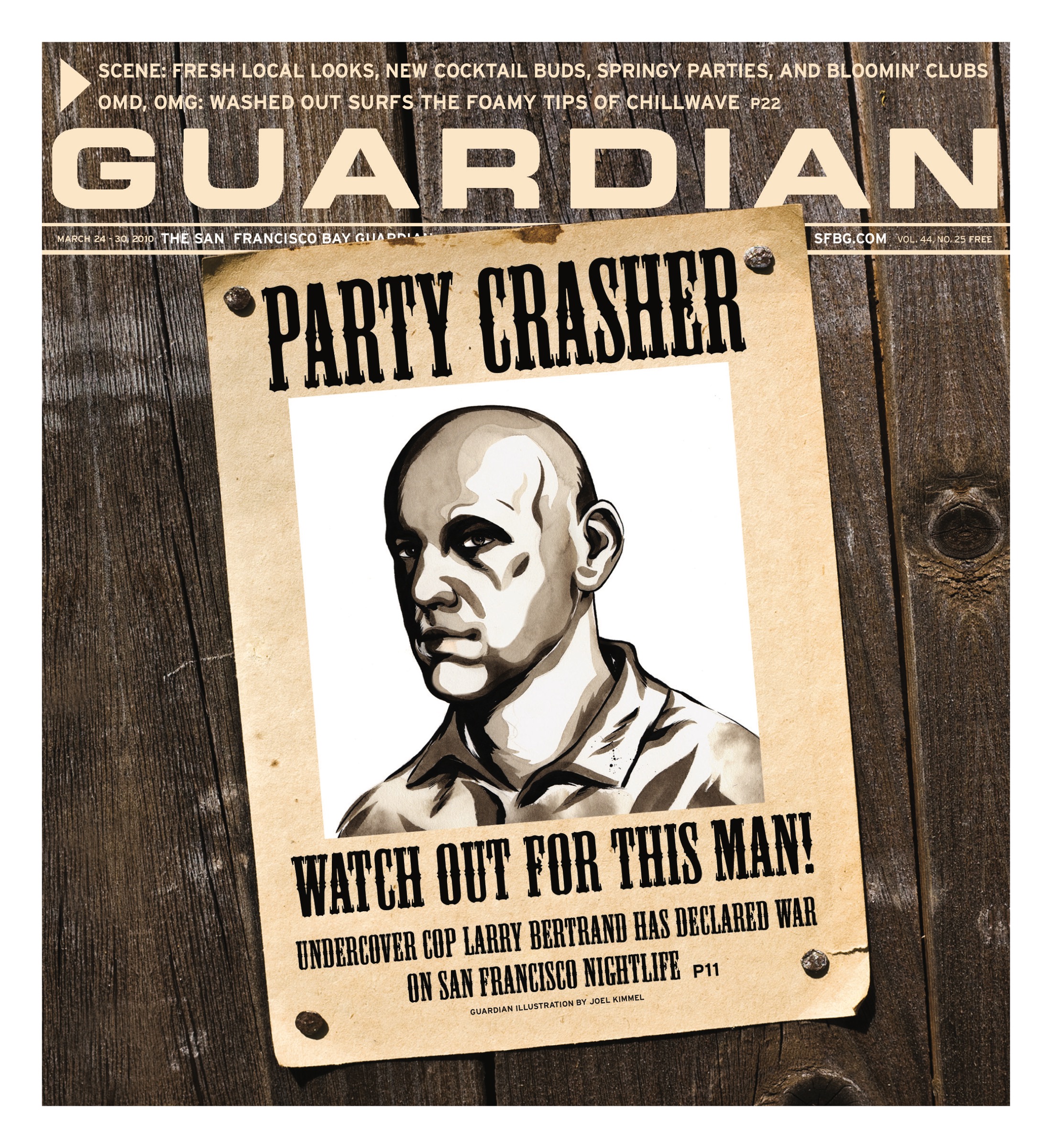
            Since Halloween, Chief Gascón’s force has been striking a mighty blow against crime by writing scores of open container citations to revelers in Dolores Park; fining or forcing the closure of SOMA clubs and bars for failing to conform to every fickle letter of the law; and sending undercover officers into warehouse and studio parties to bust them from within, sometimes violently, and without warrants. Their alpha party-crasher is a twitchy undercover cop named Larry Bertrand. He reportedly makes a habit of gratuitously attacking partygoers and vandalizing property, especially DJ equipment. One DJ wrote on a confidential email list: “I have been telling every DJ I know to run with their gear when your party gets busted [by Bertrand].” Not only has the chief failed to rein in Bertrand, but he wants to put a Taser in his hand, and in the hands of a rotten core of approximately 100 other officers whom the Chron found in 2006 are responsible for most citizen complaints, but whom the Department and this chief have systematically failed to discipline.

            Perhaps the most un-San Franciscan of all of Gascón’s initiatives is his demand for an anti-sit/lie ordinance, which would literally criminalize the very act of sitting or lying on certain public sidewalks at certain times. Never mind the fact that most violent crime is committed by people standing up and in striking range. Gascón appears to share the mayor’s philosophy that homelessness is just an aesthetic problem the rest of us should hose off our sidewalks. Not only is the idea just plain mean, it is anathema to San Francisco’s culture of compassion and broadmindedness, and its affirmative celebration of vibrant street culture. The danger is not that the police will arrest everyone who dares to take a load off or sit and sip a Snapple against the side of a building, but that they will enforce the law selectively according to their own purity tests, while robbing the rest of us of a diverse street scene that makes us all richer.

            To be sure, essential San Francisco has reasserted itself in the teeth of earlier culture wars, if in ever wealthier iterations. When Willie Brown stood in front of Critical Mass in 1997 and declared it illegal, riders blew by him like he was a grand prix flagman, and ridership surged from one or two thousand to five to seven thousand. What’s different this time are the demographics. San Francisco is richer than ever before, even at the height of the dot.com boom. Rents are through the roof. Everywhere, industrial warehouses and studios are drying up and concept industrial restaurants and bars are sprouting up. A new wave of young, hip residents has arrived seeking Dionysus, but they want no part of the political machinations under his robe. They are liberal, but they are not active. At least not yet. The mayor, the chief, and the norm core they serve are counting on our collective non-engagement. If we don’t band together—hipsters, activists, artists, and fun-loving folk all—we will watch the San Francisco we cherish slip away.

            On March 27, reclaim public space. Sit and lie on the public sidewalk. March and sing in the public street. Picnic on the pavement. Pop open a beer in Dolores Park. Do it without a permit. The Constitution is your permit. San Francisco’s heritage of artistic experimentation is your permit. Hell, the people telling you to get a permit flocked here because people like you marched around them in the first place and made this City a model of art and innovation for the world. Do it for them too. This is a defining moment. They are playing for keeps and so must we. Let’s bask in San Francisco’s ongoing heyday, not in quaint stories of the good times that used to be.

What is the plural of cyclops, anyway? “God of War III,” reviewed

0

By Peter Galvin

God of War III

(Santa Monica Studio, Sony Computer Entertainment)

PS3

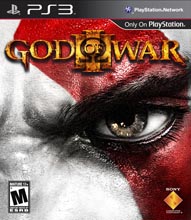
A melting pot of ancient Greek myths and characters, the God of War series embodies the term “Big Game.” When the first title made its debut on the PS2 in 2005, people were blown away by the scope of the environments and the brutality of its anti-hero Kratos. A pawn in one of those tragic mind-games that Greek gods were so well-known for, Kratos was a Spartan warrior who set out to exact vengeance against the gods that betrayed him, battling his way through hell itself more than once. In this, the third and supposedly final game in the franchise, action and spectacle are amplified to their limits as Kratos ascends Mount Olympus to murder Zeus himself.

The first title to debut on a next-gen console, God of War III’s graphics are doubly incredible and the mechanics continue to be top notch, but it’s here that the story begins to falter. For the first half of the game, God of War III is a re-tread of its prequels, but that’s kind of okay when it’s also such ridiculous fun. You continue to destroy innumerable centaurs and cyclopses (cyclopsi?) and developers Santa Monica Studio have created a mechanism they coin “Zipper Technology” that aims to realistically resemble guts and organs popping out of a body. The bosses are likely the main draw, often filling the screen with their immense size, and God of War III has some of the best bosses yet in the series, including a Titan that you must scale á la Shadow of the Colossus.

Unfortunately the game climaxes early, just a little more than halfway through, and the ultimate battle with Zeus is a mostly disappointing section considering the wonderful spectacle that preceded it. Vengeance is a reliable plot-device for a reason, but eventually you’re going to have to supply answers and they better be good. As an ending to the series, perhaps Santa Monica Studio were shooting for something a little more arty but instead they nailed pretentious and repetitive. Depth was never really God of War’s strong suit anyway; for all its flash and dazzle, the series was enjoyed best as a top-notch exercise in murdering mythical creatures.

Our Weekly Picks

0

>>WEDNESDAY 24

MUSIC

Mi Ami

I’m thankful for Mi Ami. Without the SF band that is two thirds ex-Black Eyes members, I’d be more wistful about that band’s untimely collapse. Listening to Mi Ami is like visiting an old friend; it’s even the next logical step in the evolution of that unmistakable Black Eyes sound. Sure, there are lots of drums and rhythmic bass, and the squealing vocals of Daniel Martin-McCormick are one-of-a-kind, but Mi Ami’s songs are longer, more about repetition and atmosphere. With a sophomore LP due this spring, Mi Ami’s abrasive sound isn’t ever going to snag an MTV spot — but they’ll always have a reliably loyal following of listeners to show for it. (Peter Galvin)

With High Places and Protect Me

8:00 p.m., $10

Rickshaw Stop

155 Fell, SF

(415) 861 2011

www.rickshawstop.com


EVENT

“Luna Negra: A Night of Performance for and by Women”

It’s only right that during Women’s History Month, we sit down and listen to writers like Roxanne Dunbar-Ortiz. Born to a landless father/farmer and Native American mother in Oklahoma, Dunbar-Ortiz built a life around supporting the struggle of the disenfranchised. She protested the Vietnam War and played major roles in the Native American civil rights movement and publicizing U.S. treachery against the Sandinistas during the contra war. She’ll be joined onstage by other spoken word voices, Afro-Caribbean music, dancers, an Ecuadorian curandera, and not one Y chromosome. (Caitlin Donohue)

7 p.m. , $5–$7

Mission Cultural Center for Latino Arts

2868 Mission, SF

(415) 643-5001

www.missionculturalcenter.org


>>THURSDAY 25

EVENT/MUSIC

Healing Haiti: An Evening of Arts and Culture

The Haiti benefits of recent weeks often bring together more talented artists than you’d normally find on a single bill. This one is no exception. The Berkeley label Wide Hive (celebrating its 10th anniversary) and the music workshop Own the Mic are uniting with the Element Lounge to put on a show that includes everything from belly dancing to new Bay Area R&B, with gift baskets and raffles thrown in. Tribal Mystics will bring the belly dance, while the music lineup includes DJing by Matt Cali and vocal turns by new voices Alexis Rose, Charito Soriano, Yvette Plant, and Guardian writer Lilan Kane. Radio mainstay Jamillions is one headliner — all proceeds go to Yele Haiti. (Johnny Ray Huston)

9 p.m., $5–$7

Element Lounge

1028 Geary, SF

(415) 440-1125

www.ownthemic.org/healing-haiti


DINE/EVENT

Querido Viejo Tequila Tasting Event

At some point, everyone has a bad run-in with tequila. It could be downing too many margaritas at your coworkers’ wedding or putting back shots because your friends thought you “weren’t quite drunk enough.” We all know this stuff is strong and not to be messed with. Fortunately, Querido Viejo Tequila is offering a tasting where you can actually enjoy the flavors and aromas and not feel pressured to pound one right after the other. This local distiller has been fermenting pure agave for years and is sharing its new line of hooch. The Terrace Room’s 180-degree view overlooks Lake Merritt, so be sure to bring a camera and enjoy the sunset. But remember: pace yourself. (Elise-Marie Brown)

6 p.m.; $2 tequila, $5 appetizer

Terrace Room

1800 Madison, Oakl.

(510) 903-3771

www.theterraceroom.com


MUSIC

Ana Tijoux

As one of Chile’s most respected lady MCs, Ana Tijoux is different from the summery South American songstresses who often breeze through town. Born into exile, Tijoux began life in France, where her Chilean father and French mother fled during Pinochet’s cruel regime. As a teenager, she returned to her father’s homeland and quickly found a home in Santiago’s burgeoning hip-hop scene. It was there that she earned her cred as a conscious “rapera.” Her upcoming solo release 1977 (Nacional Records) drops lyrics that reflect on the year of her birth, and that unique moment in Chile’s turbulent history that heavily influenced her own. (Mirissa Neff)

With Funky C and Joya; DJ set by Juan Data

8 p.m., $12–$15

La Peña Cultural Center

3105 Shattuck, Berk.

(510) 849-2568

www.lapena.org


>>FRIDAY 26

MUSIC

Nite Jewel

She pops in a blank 8-track cassette and takes a deep breath before pressing the ‘Record’ button. Romona Gonzalez, the L.A. lady behind Nite Jewel, insists on making and mixing her sound with old gadgets. She hits play on another deck, letting the beats of early ’90s hip-hop and R&B reverberate on the speakers, while her fingers plunk out lace-lined synth-sounds. Nite Jewel is absolutely ideal for a hazy discotheque or any smoky bedroom with glowing stars on the ceiling. Gonzalez sings and the ghostly melodies bounce and swirl, pulling listeners into a desirable, hypnotic state. She is Debbie Deb, Bronx pop, and alternative disco all at once, layering sounds and personalities that pulse and push, yet still manage to relax and soar. (Amber Schadewald)

With Neon Indian, DJ set by Jonas Reinhart

9 p.m., $15

Mezzanine

444 Jessie, SF

(415) 625-8880

www.mezzaninesf.com


DANCE

Ballet Folclorico de Mexico de Amalia Hernandez

Ballet Folclorico de Mexico de Amalia Hernandez is one of the best in the grand tradition of researching indigenous dances and adapting them to the proscenium theater. It’s also a legendary family-run institution led by the daughter of anthropologist/dancer Amalia Hernandez, who founded the company in 1951. The dances still encompass a wide spectrum of the Mexican experience: an initial quasi-mystical encounter between Aztec gods and humans, the struggle for independence; and the carnivals associated with religious festivals. But they also include choreographies inspired by such mundane activities as games, hunting and wedding rituals. (Rita Felciano)

8 p.m., $25–$65

Marin Veterans Memorial Auditorium

10 Avenue of the Flags, San Rafael

(415) 499-6800

www.marincenter.org


FILM/SEX

Too Much Pussy! Feminist Sluts in The Queer X Show

What do you get when you put seven ladies — musicians, artists, activists, sex workers, and porn stars — in a van and send them around Europe with the duty to discover the line between art and pornography? You get Too Much Pussy, a sex-positive road movie by Emilie Jouvet. The camera follows the group of radical women in and out of nightclubs in Paris, Berlin and Stockholm during the summer of 2009. They span sexual (dis)orientations and gender expressions and the experiences they gather are just as diverse: political, inspiring, sexy and frustrating. Chat up two of the stars, Madison Young and Sadie Lune, after the film for even more dirty secrets. (Schadewald)

8 p.m., $10–$15

Femina Potens

2199 Market, SF

(415) 864-1558

www.feminapotens.org


>>SATURDAY 27

MUSIC

Audio Alchemy: Kid Koala

Who doesn’t love Dan the Automator? From Dr. Octagon to Handsome Boy Modeling School, Loveage, and Deltron 3030, this guy is one of our favorite DJs. Fess up. He is. And here’s another reason to love: he’s presenting Kid Koala in Audio Alchemy, a bimonthly mixing of live music with top DJs at Yoshi’s. Yoshi’s has been been on some other for a minute now. Last year’s sessions with 9th Wonder, Black Quarterback and Manicato in the front room; Alan Marshall, De La Soul, Gil Scot Heron, and Amiri Baraka in the auditorium; swank mixers thrown by the dandies at Brooklyn Circus — they’ve got a tight off-hours scene. One that seems to be fusing together some tastier elements of our desolate culture. (D. Scot Miller)

With DJ Shortkut and the Jazz Mafia All-Stars

10:30 p.m., $20

Yoshi’s SF

1330 Fillmore, SF

(415) 655-5600

www.yoshis.com


DANCE

ODC Pilot 56: “My Young Nostalgic Life”

ODC’s Pilot program showcases are a deal for audiences who like the thrill of discovery. They’re also a break for young choreographers, who get 11 weeks in a supportive environment to create work even as they learn ancillary skills such as marketing, program design, and production and box office management. Since the first Pilot in 1990, close to 300 choreographers have gone through this gentle boot camp. Pilot 56 features six women who collectively decided that “My Young Nostalgic Life” best describes ideas they want to explore through dance. (Felciano)

8 p.m. (also Sun/28, 5 and 8 p.m.), $12

ODC Commons

351 Shotwell, SF

(415) 863-9834

www.brownpapertickets.com


MUSIC

Soweto Gospel Choir

Times are tough in Soweto. Fault me for stating the obvious to provide context for the Soweto Gospel Choir. Are they joyful? Yes. Are they melodious? Uh-huh. Do their voices meld from ululatory to raspy to soaring to proud to a blend of gospel noise and traditional African rhythm? Do audiences come away clapping and laughing and smiling fit to beat the band? Sing it! Part of the group’s elation may have to do with the runaway success of their mission — providing shelter and hope to AIDS orphans in their home communities. So far they’ve toured the world performing for some pretty receptive big dogs — Nelson Mandela, Oprah and Archbishop Desmond Tutu, to name a few. (Donohue)

8 p.m., $25–$65

Paramount Theatre

2025 Broadway, Oakl.

(415) 575-6100

www.ciis.edu


EVENT

Pearls Over Shanghai Kabuki Makeup Class

If the only knowledge you have of Kabuki makeup comes from Memoirs of a Geisha, don’t droop your head in embarrassment — instead, take a class on the traditional Japanese art form. RetroFit Vintage is offering a chance to educated the misinformed or the curious on what it takes to create the perfect Noh heroine. Kegel Kater will apply the makeup for her role as a whore, angel, and lotus dancer in Thrillpeddlers’ Pearls Over Shanghai. (Brown)

3–5 p.m., free

RetroFit Vintage

910 Valencia, SF

(415) 550-1530

www.retrofityourworld.com


EVENT

Muchas Voces Una Vision/Many Voices One Vision”

What is the function of a poet laureate, exactly? I’m fairly certain I’ve never seen one designing fanciful special boards for the neighborhood diner, or doing anyone’s English homework. How can we put these decorated people of the pen to work? Happily, the dilemma is being resolved in fine fashion this weekend, when SF’s official bards past and present join forces and rattle off original lines to benefit the people of Haiti. Catch readings by poet laureate Diane di Prima and her predecessors Devorah Major and Jack Hirschman. They’ll be joined by more than 30 other artists. (Donohue)

7 p.m. , $10 (suggested donation)

La Peña Cultural Center

3105 Shattuck, Berk.

(415) 849-2568

www.lapena.org


>>MONDAY 29

MUSIC

Nellie McKay

You probably didn’t see it coming, but now that Nellie McKay’s As Normal as Blueberry Pie: A Tribute to Doris Day (Verve) is out, it’d be tough to come up with a more suitable pairing. Musician, comedienne, actress — if there’s one thing McKay isn’t, it’s predictable. But who knew she’d pay genuine homage to one of the swinginest singers of the 1950s? Setting aside her often self-depreciating wit, McKay reintroduces Day to a new generation of fans with irresistible exuberance and charm. To make it a truly classy affair, the Great American is going for the sit-down experience. (Galvin)

With Howard Fishman

8:00 p.m., $21

Great American Music Hall

859 O’Farrell, SF

(415) 885-0750

www.gamh.com


MUSIC

Taylor Texas Corrugators

As founder and leader of legendary Southern California punk rockers Black Flag — he started the band and its record label, SST — Greg Ginn has earned his place in the DIY underground pantheon. The famously hard-working artist has never been complacent, and he comes to the city tonight with his new project, the Taylor Texas Corrugators. The Corrugators finds the guitarist leaning in a more Western swing direction, but, as always, with a host of other musical influences thrown in to keep things evolving. (Sean McCourt)

With Guella and Barney Caldron

8 p.m., $10

Red Devil Lounge

1695 Polk, SF

(415) 447-4730 www.reddevillounge.com


* The Guardian listings deadline is two weeks prior to our Wednesday publication date. To submit an item for consideration, please include the title of the event, a brief description of the event, date and time, venue name, street address (listing cross streets only isn’t sufficient), city, telephone number readers can call for more information, telephone number for media, and admission costs. Send information to Listings, the Guardian Building, 135 Mississippi St., SF, CA 94107; fax to (415) 487-2506; or e-mail (paste press release into e-mail body — no text attachments, please) to listings@sfbg.com. We cannot guarantee the return of photos, but enclosing an SASE helps. Digital photos may be submitted in jpeg format; the image must be at least 240 dpi and four inches by six inches in size. We regret we cannot accept listings over the phone.

The new War on Fun

46

news@sfbg.com

For several years, the Guardian has been running regular stories chronicling what we’ve dubbed the Death of Fun, a trend of official crackdowns and shakedowns on people who throw parties and festivals in San Francisco. In the last year, that trend has started to morph into an often brutal War on Fun, with a growing list of atrocities and casualties associated with this overzealous new approach to killing the city’s entertainment industry.

Why this is happening is baffling to those most affected: nightclub owners and workers, party promoters, DJs and VJs, fundraising activists, and people just out to have a good time without being harassed by a cop. But in recent months, we’ve learned much more about what’s happening and who the main perpetrators are.

Two undercover enforcers have been at the center of just about every recent case of nightclubs or private parties being raided without warrants and aggressively shut down, their patrons roughed up (see “Fun under siege,” 4/21/09) and their money, booze, and equipment punitively seized “as evidence” (see “Police seize DJs laptops,” 11/24/09) even though few of these raids result in charges being filed in court.

Officer Larry Bertrand of the San Francisco Police Department’s Southern Station and Michelle Ott, an agent with the California Department of Alcoholic Beverage Control, are plainclothes partners who spend their weekends undercover, crashing parties, harassing disfavored nightclubs, brutalizing party-goers, and trying to send the unmistakable message that they’re in charge of San Francisco nightlife. Neither responded to our interview requests.

Isolated incidents of intolerant cops and NIMBY citizens who repeatedly complain about certain clubs or festivals has been a problem for years (see “Death of fun,” 5/24/06 and “Death of fun, the sequel,” 4/24/07). Top city officials have opted to cancel events such as Halloween in the Castro District rather than try to manage them better, and the nightlife community has tried to organize in defense of its interests (see “Fighting for the right to party,” 7/1/08) with mixed results.

But the personal War of Fun by Bertrand and Ott seems to have galvanized and united the nightlife and festival community like never before, leading to the creation of a new California Music and Culture Association and prompting threats of a federal lawsuit alleging the ABC-SFPD collaboration is a racketeering scheme designed to harass, disrupt, and extort people engaged in otherwise lawful activity.

The myriad horror stories associated with Bertrand and Ott have also finally begun to draw attention from the Mayor’s Office, which has quietly pushed the SFPD to rein in Bertrand and change its policies on raiding parties and seizing property. State Sen. Mark Leno also has gotten involved, brokering a March 12 meeting between club owners and Steve Hardy, director of ABC (which, in addition to cracking down on nightclubs — see “Busting bars,” 6/23/09 — has recently announced a campaign against fruit-infused liquor).

“They were going to see how they could unwind this a bit,” Leno told us, adding that he was “infuriated” by stories of abusive treatment of the public. “The fear that it spreads through the community is unacceptable.”

The question now is what Hardy, Mayor Gavin Newsom, and Police Chief George Gascón — who has ordered some crackdowns and wants greater authority to discipline problem officers — is going to do about it.


CHAOS AT A STUDENT PARTY

It was after midnight on Jan. 31 when Krystal Peak, a journalist with San Francisco State University’s Golden Gate Xpress, received a call from her managing editor. There was a commotion and a swarm of police cars outside a student party at Seventh and Minna streets near her home, and she was asked to investigate.

She came upon the aftermath of a melee between police and partygoers that had taken place after a fundraising event at a SoMa warehouse art space was upended. The benefit was organized to raise legal funds for students who staged a building occupation at the University of California at Berkeley, in defiance of budget cuts.

The event was clearly chaotic, and it’s hard to sort out exactly what happened and when. City officials say the partiers were throwing bottles and firecrackers at the police; people at the event say the cops started it all.

But the tales partygoers tell about the behavior of Bertrand and Ott, the undercover enforcers, are similar to a series of other stories involving the pair, stories published in the Guardian and elsewhere.

There had been multiple arrests by the time Peak arrived on the scene. Numerous witnesses asserted that things were going along without incident until a fire marshal arrived in response to a complaint, and in short order, two officers who’d been there in plainclothes for hours — Bertrand and Ott — began shouting, tackling people, and kicking in doors.

Police Chief George Gascón acknowledged that the department has been targeting underground parties. “We get a lot of resident complaints about it,” he said in a recent Guardian interview. “We’re talking about a lot of the underground parties, or the parties where the promoters are exceeding their authorities to a number of people.”

Several hundred attended this particular party. Of the 11 people arrested, eight were either detained or cited and released. None faced underage drinking or drug charges. At least five were charged with resisting arrest. One individual was charged with vandalism, two were charged with battery on an officer, and two detained for being drunk in public.

Peak began photographing the scene: busted-up chairs, uniformed officers guarding the entrance, police cars everywhere. She zoomed her lens to capture the wreckage inside. None of the uniformed officers seemed to have a problem with her — but when she spotted the undercover officers with exposed badges, that changed.

The cops broke through the door, yelling. “They said, ‘This is an investigation, you’re not allowed to be here.'<0x2009> she said. “We told them we were with the press.” They threatened to arrest her.

Shortly after, the plainclothes officers crossed in front of her to an unmarked car. She took another picture. Bertrand, a tall guy with a shaved head, allegedly turned and grabbed her arm, and both officers shouted at her. “[Ott] said to me, ‘Your flash has impeded my investigation,'” Peak recounted. She was cuffed and arrested on the spot, and her camera was confiscated.

She was cited for obstruction of justice, but the charges were dropped. And she got her camera back — but says the SD memory card, where all the photos were stored — was missing.

“I flipped [the camera] open … and found the SD card was missing,” she said. She asked Bertrand where it was. “He said, ‘I don’t know what you’re talking about,'” Peak recalled. Bertrand, she recalled, then looked around at a group of officers watching the exchange, and announced, “This woman is refusing to leave. I’m going to have to re-arrest her.” Ott appeared, according to Peak, and insisted that there was no evidence the memory card had been in the camera in the first place.

“My camera will not ignite a flash unless there’s a memory card in there,” Peak explained. In the end, she left empty-handed — without photos of the undercover officers.


BUSTING DOORS

Earlier, when the party was in full swing, a 24-year-old California State University, Fullerton student visiting from Los Angeles says when the fire marshal entered, Bertrand flashed his badge, yelling at everybody to get out. “It was really aggressive from the get-go,” said the Fullerton student, who spoke on condition of anonymity because he had a pending legal case. “It’s very hard for me to describe the intensity to which this guy was busting down doors.”

Later, the young man from L.A. said, he was following people who left in a rush, and ran to catch up. “Shortly after, I felt a blow to the back right of my head,” he said. “My glasses flew off, and I was tackled to the ground. My forehead was being pushed straight into the ground and they were holding my hair. I kept repeating … please, I can’t see — I’m legally blind. I thought three or four officers were on top of me, and they were saying, ‘Fuck you, you little anarchist punk.'<0x2009>”

That’s when he said he felt a sensation like “a bunch of really intense bee stings on my left side, just above my hipbone.” He thought he was Tasered — and photos he showed us depict a skin burn. SFPD officers are not authorized to carry Tasers.

“It sounds like a stun gun, not a Taser gun,” Ken Cooper, a firearms and Taser instructor based in New York, noted when the incident was described to him.

When we shared the photos with SFPD’s media relations department, Lt. Lyn Tomioka noted, “I can tell you that we do not have any tool that would produce the type of wounds shown in the picture that you attached, or produce a stinging sensation.”

The L.A. visitor said he was delivered this explanation from an officer while in the holding cell: “One of your anarchist buddies must’ve had a Taser, ran over to you trying to get one of our officers, got you instead, and ran away.”

Cooper Brislain, a Web developer from Santa Cruz, told us his iMac was destroyed that night. A friend of the owners of the art space, he was there doing video mixing for the party, he explained. After the trouble started, he began carrying his computer and mixing equipment toward the door. “The uniformed officers were going to let me go. I told them, ‘I just came here to perform.’ They seemed OK,” he said. Then he encountered Bertrand.

He … grabbed me by the collar, led me over toward the wall, and sat me down,” Brislain told us. He says Bertrand and Ott seized his computer. Brislain says no charges were filed against him.

The morning after, he found that his computer had been smashed up. His friends found it in pieces at the bottom of the stairs. To this day, he says he has not been able to retrieve his ID, which was seized that night. “I tried calling [Bertrand] on his extension to leave a message and never heard back,” he says. “They told me he probably wouldn’t return voicemails.” The District Attorney’s Office has a different perspective. D.A. spokesperson Brian Buckelew said the partygoers were drunk and “going nuts on police.” People were throwing firecrackers, he said. “It obviously got out of hand, and people were throwing bottles at police,” he said.

The student from L.A. allegedly shoved a female officer, Buckelew said. According to the report, he said, police officers were taking someone into custody, and he tried to pull them free.

Nevertheless, even Chief Gascón agrees that it’s not okay to destroy someone’s personal property. “If in fact the allegations were proven to be the case that an officer took somebody’s laptop and threw it down the stairs,” Gascón told us, “that would be inappropriate, and that officer would be sanctioned accordingly.” He noted that he met with an attorney from the Electronic Frontier Foundation about a recurring trend of officers — Bertrand in particular — seizing DJ laptops at underground parties. “We’ve met with them and we’ve agreed to actually tighten up the protocols in how this would be handled,” Gascón noted.


A RICO SUIT

The list of local nightclub clubs that have been recently targeted by Bertrand and Ott or subjected to ABC sanctions is long. It includes Great American Music Hall, Slim’s, DNA Lounge, Mist, Whisper, the Room, Vessel, Azul, Butter, and Club Caliente (which closed down after its mostly Latino customers were scared away by repeated raids).

“Using the now familiar pattern and ruse of ABC authority, these raids have been without warrant and without probable cause, under the pretext of finding liquor violations,” attorney Mark Webb wrote in a claim against the city, describing the harassment of Caliente owner Maurice Salinas and later adding, “Despite numerous raids, the invading officers [Bertrand and Ott] managed to ‘uncover’ a single infraction: one customer used his brother’s ID card, claiming he was over 21 to gain entry. For this reason, Mr. Salinas was cited and fined, bullied, intimidated, and yelled at on the spot.”

Webb said such behavior isn’t legitimate police work, but unlawful harassment. In fact, this experienced litigator said it’s far closer to the shakedowns and extortion rackets familiar to him from the start of his legal career in the late 1970s prosecuting organized crime cases in New York City.

That’s why he’s threatening to bring a novel lawsuit against the city and ABC under federal Racketeer Influenced and Corrupt Organization (RICO) Act, a law designed go after the mob, but which has since been adapted to target entities ranging from the tobacco industry to the Los Angeles Police Department.

Webb told us that interference with legitimate business operations, such as running a nightclub, is the essence of RICO suits. As part of the case, Webb plans to submit a surveillance video that shows Bertrand kneeling on the neck of bartender Javier Magallon from The Room and twisting his arm. Webb gave us a copy of the video.

Another element of making a RICO case is the use of intimidation and retaliation against those who complain — which was central to a March 17 SF Weekly story about promoter Arash Ghanadan being inappropriately singled out for arrest by Bertrand as retaliation for filing a complaint against the officer with the Office of Citizen Complaints.

Webb says he has a strong case that he intends to file soon, but that most of his clients just want the SFPD to rein in Bertrand and stop facilitating ABC actions. “I want to have a sit-down with Gavin Newsom,” Webb said. “I am calling on Mayor Newsom to come in and mediate what would be an expensive, divisive fight that will generate national interest … I think this thing can go way quickly without litigation.”

Newsom press secretary Tony Winnicker, who said Newsom has brought concerns about Bertrand to the chief’s attention, didn’t immediately embrace Webb’s offer. “The mayor would rather leave it to the chief,” Winnicker said.

So the question for Gascón is whether he’s willing to take on the cowboy cops within the SFPD’s ranks. After all, Bertrand is also on the San Francisco Police Officers Association Board of Directors.

The nightlife community is organized like never before and plotting its next move in fighting a war it didn’t initiate and barely understands. Whether that war continues now seems to be a question for the party crashers and their supervisors.

End the nightlife crackdown

0

Harassing parties and clubs shouldn’t be a priority for a cash-strapped city’s police department

EDITORIAL Police Chief George Gascón has asked for more authority to crack down on rogue cops, and has vowed to clean up the small handful of bad actors who are giving the department an ugly reputation for violence and abuse. But before San Franciscans are going to trust the chief, he’s got to show some evidence that he’s serious — and cleaning up the mess that is Southern Station’s crackdown on nightlife would be a great place to start.

As Rebecca Bowe and Steven T. Jones report in this issue, the SFPD seems to be waging war on parties, clubs, and events, particularly in the SoMa area. And it’s not pretty. Undercover cops sneak into events then call in the troops, who make multiple dubious arrests and, according to widespread accounts, seize or destroy laptops and other DJ equipment and beat up and abuse participants.

It’s a pointless waste of law enforcement resources. In a city where a significant number of murders remain unsolved, where merchants complain about street-level crimes that could easily be addressed by foot patrols, and where the chief complains that he lacks the funds to address all the problems he’s facing, we can’t fathom why stopping nightlife is a top police priority. At the very worst, some participants and promoters might be guilty of holding an event without the proper permits — but nobody’s getting robbed, assaulted, or killed.

And the tactics used by the officers are needlessly violent, sometimes brutal. According to lawsuits and eyewitness accounts, SFPD officers have smashed laptops, kicked and beaten partygoers, and arrested people with little cause. A San Francisco lawyer is preparing to file a RICO Act lawsuit against the city, charging that the police are conspiring with state liquor-control officials to harass people engaged in lawful activity.

The policy directives behind this appear to come from Cdr. James Dudley, the former captain of Southern Station, and the officer most directly responsible for the crackdown is Larry Bertrand. Paired with an officer from the state Department of Alcoholic Beverage Control, Bertrand attends parties in plain clothes, sometimes dressed as a raver.

Complaints about Bertrand and the crackdowns are piling up. We’ve been writing about it for months. SF Weekly picked up the story last week. There are complaints filed with the city’s Office of Citizen Complaints and lawsuits pending. The chief may not have known about the problems at the crime lab, but he has to be aware of what Bertrand is up to.

Gascón should direct Dudley and Bertrand to back off — to halt the undercover work, end the seizure of personal property such as laptops and DJ gear (it’s not a crime to own a computer or speaker system), and work with the clubs and the nightlife community to devise reasonable systems for dealing with permit issues. And he needs to do it publicly, to let San Franciscans know that he’s addressing the issue.

Mayor Gavin Newsom needs to get involved too, and make a clear public statement that harassing parties and clubs isn’t the top priority for a cash-strapped city’s police department.

Film listings

0

Film listings are edited by Cheryl Eddy. Reviewers are Kimberly Chun, Michelle Devereaux, Max Goldberg, Dennis Harvey, Johnny Ray Huston, Erik Morse, Louis Peitzman, Lynn Rapoport, Ben Richardson, and Matt Sussman. The film intern is Peter Galvin. For rep house showtimes, see Rep Clock. For first-run showtimes, see Movie Guide.

OPENING

Chloe See "Moore and Less." (1:36) Elmwood, SF Center, Sundance Kabuki.

Greenberg Roger Greenberg (Ben Stiller) is 40, and you might think he’s going through a midlife crisis — if he hadn’t been in pretty much this same crisis for 15 years or more. Still very edgy and fragile after a nervous breakdown-sparked institutional stay, he’s holing up at the comfortable Hollywood home of a big-deal brother while the latter and family are on vacation in Vietnam. (The implication being that Roger is most welcome here when no one else actually has to endure his prickly, high maintenance company.) While in residence he reconnects with old friends including the ex-girlfriend (Jennifer Jason Leigh) he dumped yet never quite got over — though clearly she did — and the ex-bandmate (Rhys Ifans) he burned by wrecking their one shot at a major-label deal. He also gets involved, kinda-sorta, with big bro’s personal assistant Florence (mumblecore regular Greta Gerwig), whose passivity and low self-esteem make her the rare person who might consider a relationship with someone this impossible. Like all Noah Baumbach films, especially the slightly overrated Squid and the Whale (2005) and vastly underrated Margot at the Wedding (2007), his latest pivots around a pathologically self-absorbed and insensitive protagonist who exasperates anyone unlucky or blind enough to fall into his or her orbit. Working from a story co-conceived by spouse Leigh, Baumbach’s script sports his usual sharp dialogue, penetrating individual scenes, and narrative surprises. But it also gets stuck in dislikable Roger’s rut, finding conflict easily but stubbornly resisting even the smallest useful change. For all its amusing and uncomfortable moments, Greenberg emerges a dual character slice with no real point. Neither Roger or Beth reward long scrutiny (least of all as a hapless potential couple), while the few screen minutes Ifans and Leigh get make you wish their roles had hijacked the focus instead. (1:40) Piedmont, Shattuck. (Harvey)

Hot Tub Time Machine At last, Crispin Glover returns to his time-travel movie roots! (1:55) California.

How to Train Your Dragon Yet another 3D cartoon for the kiddies. At least this one is about Vikings. (1:38)

*The Sun It may have taken five years for Alexander Sokurov’s The Sun (2005) to reach local theaters, but then the Russian master’s contemplation of Emperor Hirohito’s last days as Godhead is decidedly out of time. Painterly and slow like all Sokurov’s work, the film specifically follows his estranged reconstructions of Hitler’s retreat with Eva Braun (1999’s Moloch) and Lenin’s demise (2000’s Taurus). In August 1945, Hirohito broke with tradition by making a direct appeal to the Japanese people to end military operations; soon thereafter he renounced his divine rights. The Sun‘s elliptical narration intuits the emperor’s paled existence, and Issey Ogata’s lead performance, centering on a fish-out-of-water puckering of the lips, amply conveys the shuttered hours of a man who, in experience if not in fact, is not quite human. The muted use of available light and a disquieting sound design (faraway air-raid sirens yield to the barest brush of a finger) eschew historiography’s harsh glare, instead returning primal scenes of power to a dreamlike state of unknowing. Sokurov’s most hallucinatory effects are reserved for ashen views of firebombed Tokyo which float free from perspective or clear boundary; a brief fantasy in which fish-like warplanes spew apocalyptic destruction suggests the emperor’s childlike imagination and set the stage for his historical date with General MacArthur, realized by Sokurov less as a diplomatic breakthrough than a leaden twilight. (1:50) Shattuck. (Goldberg)

Waking Sleeping Beauty Hollywood history is full of epic rivalries, juicy scandals, multi-million-dollar mistakes, and triumphant comebacks. Sometimes, all of the above and more can be contained within a single studio, or even a single studio division, or even a single studio division during a finite number of years, as illustrated by this insidery peek at Disney’s animation division. The doc gives a bit of background, but focuses its attentions on 1984-1994, a ten-year span that saw the floundering department struggle through post-Walt, identity-crisis blues before blossoming into a rejuvenated powerhouse. Waking Sleeping Beauty director Don Hahn was a producer on the Oscar-nominated Beauty and the Beast (1991), so he’s uniquely positioned to tell the story as it unfolded, using home movies and countless interviews. High points include a glimpse of late composer Howard Ashman introducing his demo for the iconic Little Mermaid (1989) tune "Under the Sea" (it was Ashman’s idea to give the crab character a Jamaican accent), and plenty of dish on the legendary Jeffrey Katzenberg-Michael Eisner feud. (1:26) Embarcadero. (Eddy)

ONGOING

Ajami You may recognize the title of Yaron Shoni and Scandar Copti’s debut collaboration as one of five films nominated for a 2010 Academy Award in the Foreign Category. Though it didn’t bring home the grand prize, Ajami remains a complex and affecting story about desperation and its consequences in a religiously-mixed town in Israel. As we follow the lives of four of Ajami’s residents the narrative shifts perspective almost maddeningly, switching characters seemingly at the height of each story’s action. But once all of the stories fully intersect, the final product has the distinction of feeling both meticulously calculated and completely natural. I was most impressed to learn that Shani and Copti prepared their actors with improvised role-playing rather than scripts. By withholding what was going to happen in a scene before shooting, we are treated to looks of surprise and emotion on actor’s faces that never feel unnatural. Attaining such a level of realism may be Ajami‘s crowning achievement; it can’t have been easy to make a foreign world feel so familiar. (2:00) Shattuck. (Galvin)

Alice in Wonderland Tim Burton’s take on the classic children’s tale met my mediocre expectations exactly, given its months of pre-release hype (in the film world, fashion magazines, and even Sephora, for the love of brightly-colored eyeshadows). Most folks over a certain age will already know the story, and much of the dialogue, before the lights go down and the 3-D glasses go on; it’s up to Burton and his all-star cast (including numerous big-name actors providing voices for animated characters) to make the tale seem newly enthralling. The visuals are nearly as striking as the CG, with Helena Bonham Carter’s big-headed Red Queen a particularly marvelous human-computer creation. But Wonderland suffers from the style-over-substance dilemma that’s plagued Burton before; all that spooky-pretty whimsy can’t disguise the film’s fairly tepid script. Teenage Alice (Mia Wasikowska) displaying girl-power tendencies is a nice, if not surprising, touch, but Johnny Depp’s grating take on the Mad Hatter will please only those who were able to stomach his interpretation of Willy Wonka. (1:48) Castro, Empire, 1000 Van Ness, SF Center, Sundance Kabuki. (Eddy)

*The Art of the Steal How do you put a price on something that’s literally priceless? The Art of the Steal takes an absorbing look at the Barnes Collection, a privately-amassed array of Post-Impressionist paintings (including 181 Renoirs) worth billions — and the many people and corporate interests who schemed to control it. Founder Albert C. Barnes was an singular character who took pride in his outsider status; he housed his art in a specially-constructed gallery far from downtown Philadelphia’s museum scene, and he emphasized education and art appreciation first and foremost. But he had no heirs, and after his death in 1951, opportunists began circling his massive collection; the slippery political and legal dealings that have unfolded since then are nearly as jaw-dropping as Barnes’ prize paintings. Philly documentarian Don Argott has a doozy of a subject here, and his skillful, even suspenseful film does it justice. (1:41) Smith Rafael. (Eddy)

The Blind Side When the New York Times Magazine published Michael Lewis’ article "The Ballad of Big Mike" — which he expanded into the 2006 book The Blind Side: Evolution of a Game — nobody could have predicated the cultural windfall it would spawn. Lewis told the incredible story of Michael Oher — a 6’4, 350-pound 16-year-old, who grew up functionally parentless, splitting time between friends’ couches and the streets of one of Memphis’ poorest neighborhoods. As a sophomore with a 0.4 GPA, Oher serendipitously hitched a ride with a friend’s father to a ritzy private school across town and embarked on an unbelievable journey that led him into a upper-class, white family; the Dean’s List at Ole Miss; and, finally, the NFL. The film itself effectively focuses on Oher’s indomitable spirit and big heart, and the fearless devotion of Leigh Anne Tuohy, the matriarch of the family who adopted him (masterfully played by Sandra Bullock). While the movie will delight and touch moviegoers, its greatest success is that it will likely spur its viewers on to read Lewis’ brilliant book. (2:06) Oaks. (Daniel Alvarez)

Brooklyn’s Finest "Really? I mean, really?" asked the moviegoer beside me as the final freeze-frame of Brooklyn’s Finest slapped our eyeballs. Yes, that’s the sound of letdown, despite the fact that Brooklyn’s Finest initially resembled a promisingly gritty juggling act in the mode of The Wire and Cop Land (1997), Taxi Driver (1976) and Training Day (2001). Bitter irony flows from the title — and from the lives, loves, bad habits, pressure-cooker stress, and unavoidable moral dilemmas of three would-be everyday cops, all occupying several different rungs on a food chain where right and wrong have an unpleasant way of switching sides. Eddie (Richard Gere) is the veteran officer just biding his time till he gets his pension, all while comforting himself with the meager sensuous attentions of hooker Chantel (Shannon Kane). Sal (Ethan Hawke) is the bad detective, stealing from the dealers to fund a dream home for his growing family with Angela (Lili Taylor). Tango (Don Cheadle) is the undercover detective who has cultivated friendships with dealers like Caz (Wesley Snipes) and sacrificed his marriage for a long-promised promotion from his lieutenant (Will Patton) and his superior (Ellen Barkin, in likely the most misogynist portrayal of a lady with a badge to date). You spend most of Brooklyn’s Finest waiting for these cops to collide in the most unfortunate, messiest way possible, but instead the denouement leaves will leave one wondering about unresolved threads and feeling vaguely unsatisfied. In any case, director Antoine Fuqua and company seem to pride themselves on their tough-minded if at times cartoonish take on law enforcement, with Hawke in particular turning in a memorably OTT and anguished performance. (2:13) 1000 Van Ness. (Chun)

The Bounty Hunter There’s a real feeling of impotence in reviewing a movie whose ad was pasted on the side of the bus you took to the screening. This thing is determined to be seen, and that’s a true shame. Those who heed the call of the ubiquitous marketing campaign will have to sit through a dull parade of contrivances concerning a bounty hunter (Gerard Butler) whose latest catch is his court-skipping ex-wife (Jennifer Aniston). She’s a hotshot city journalist who’s forced to continue her investigation of a police cover-up while handcuffed to a car door and bickering with her old flame. The trajectory of the plot is obvious enough, but there’s so little chemistry between the two actors that the inevitable reconciliation practically constitutes a twist ending. Aniston saw fit not to whine her way through this role, which is something, but nothing nearly as complimentary can be said about Butler. He emotes in lurches, with the presence of a guy who’s not sure acting is the right direction for his life but still really wants to give it a go. If "This. Is. Sparta!" weren’t burned into my brain I would swear the man had never been in front of a camera before. (1:50) 1000 Van Ness, SF Center, Sundance Kabuki. (Jason Shamai)

The Crazies Disease and anti-government paranoia dovetail in this competent yet overwhelmingly non-essential remake of one of George A. Romero’s second-tier spook shows. In a small Iowa hamlet overseen by a benevolent sheriff (Timothy Olyphant) and his pregnant wife (Radha Mitchell), who’s also the town doctor, a few odd incidents snowball into all-out chaos when a mysterious, unmarked plane crashes into the local water supply. Before long, the few residents who aren’t acting like homicidal maniacs are rounded up by an uber-aggressive military invasion. Though our heroes convey frantic panic as they try to figure out what the hell is going on, The Crazies never achieves full terror mode. It’s certainly watchable, and even enjoyable at times. But memorable? Not in the slightest. (1:41) 1000 Van Ness. (Eddy)

Crazy Heart "Oh, I love Jeff Bridges!" is the usual response when his name comes up every few years for Best Actor consideration, usually via some underdog movie no one saw, and the realization occurs that he’s never won an Oscar. The oversight is painful because it could be argued that no leading American actor has been more versatile, consistently good, and true to that elusive concept "artistic integrity" than Bridges over the last 40 years. It’s rumored Crazy Heart was slotted for cable or DVD premiere, then thrust into late-year theater release in hopes of attracting Best Actor momentum within a crowded field. Lucky for us, this performance shouldn’t be overlooked. Bridges plays "Bad" Blake, a veteran country star reduced to playing bars with local pickup bands. His slide from grace hasn’t been helped by lingering tastes for smoke and drink, let alone five defunct marriages. He meets Jean (Maggie Gyllenhaal), freelance journalist, fan, and single mother. They spark; though burnt by prior relationships, she’s reluctant to take seriously a famous drunk twice her age. Can Bad handle even this much responsibility? Meanwhile, he gets his "comeback" break in the semi-humiliating form of opening for Tommy Sweet (Colin Farrell) — a contemporary country superstar who was once Bad’s backup boy. Tommy offers a belated shot at commercial redemption; Jean offers redemption of the strictly personal kind. There’s nothing too surprising about the ways in which Crazy Heart both follows and finesses formula. You’ve seen this preordained road from wreckage to redemption before. But actor turned first-time director Scott Cooper’s screenplay honors the flies in the windshield inherited from Thomas Cobb’s novel — as does Bridges, needless to say. (1:51) Piedmont, 1000 Van Ness, Shattuck, Sundance Kabuki. (Harvey)

Diary of a Wimpy Kid Spoiler alert: nothing happens in Diary of a Wimpy Kid. That was OK when it was just a book—author Jeff Kinney’s illustrated novel works due in large part to his whimsical drawings and tongue-in-cheek humor. It’s a kids’ book, but it’s fun for adults, too. The same can’t be said for the film adaptation: Diary of a Wimpy Kid sticks close to its source material without the creativity necessary to make it work on the big screen. As in the book, Greg Heffley (Zachary Gordon) navigates the treacherous terrain of middle school, struggling to cope with an awkward best friend, a brutal older brother, and parents who just don’t understand. All the actors turn in solid performances — Gordon is a particularly good find. But there’s so little here to work with. The best that can be said about Diary of a Wimpy Kid is that it’s cute and mostly harmless: a pleasant diversion for young’uns, and a tolerable bore for the parents they drag along. (2:00) 1000 Van Ness. (Peitzman)

*An Education The pursuit of knowledge — both carnal and cultural — are at the tender core of this end-of-innocence valentine by Danish filmmaker Lone Scherfig (who first made her well-tempered voice heard with her 2000 Dogme entry, Italian for Beginners), based on journalist Lynn Barber’s memoir. Screenwriter Nick Hornby breaks further with his Peter Pan protagonists with this adaptation: no man-boy mopers or misfits here. Rather, 16-year-old schoolgirl Jenny (Carey Mulligan) is a good girl and ace student. It’s 1961, and England is only starting to stir from its somber, all-too-sober post-war slumber. The carefully cloistered Jenny is on track for Oxford, though swinging London and its high-style freedoms beckon just around the corner. Ushering in those freedoms — a new, more class-free world disorder — is the charming David (Peter Sarsgaard), stopping to give Jenny and her cello a ride in the rain and soon proffering concerts and late-night suppers in the city. He’s a sweet-faced, feline outsider: cultured, Jewish, and given to playing fast and loose in the margins of society. David can see Jenny for the gem she is and appreciate her innocence with the knowing pleasure of a decadent playing all the angles. The stakes are believably high, thanks to An Education‘s careful attention to time and place and its gently glamored performances. Scherfig revels in the smart, easy-on-eye curb appeal of David and his friends while giving a nod to the college-educated empowerment Jenny risks by skipping class to jet to Paris. And Mulligan lends it all credence by letting all those seduced, abandoned, conflicted, rebellious feelings flicker unbridled across her face. (1:35) Oaks, Smith Rafael. (Chun)

*The Ghost Writer Roman Polanski’s never-ending legal woes have inspired endless debates on the interwebs and elsewhere; they also can’t help but add subtext to the 76-year-old’s new film, which is chock full o’ anti-American vibes anyway. It’s also a pretty nifty political thriller about a disgraced former British Prime Minister (Pierce Brosnan) who’s hanging out in his Martha’s Vineyard mansion with his whip-smart, bitter wife (Olivia Williams) and Joan Holloway-as-ice-queen assistant (Kim Cattrall), plus an eager young biographer (Ewan McGregor) recently hired to ghost-write his memoirs. But as the writer quickly discovers, the politician’s past contains the kinds of secrets that cause strange cars with tinted windows to appear in one’s rearview mirror when driving along deserted country roads. Polanski’s long been an expert when it comes to escalating tension onscreen; he’s also so good at adding offbeat moments that only seem tossed-off (as when the PM’s groundskeeper attempts to rake leaves amid relentless sea breezes) and making the utmost of his top-notch actors (Tom Wilkinson and Eli Wallach have small, memorable roles). Though I found The Ghost Writer‘s ZOMG! third-act revelation to be a bit corny, I still didn’t think it detracted from the finely crafted film that led up to it. (1:49) California, Piedmont, Sundance Kabuki. (Eddy)

*The Girl With the Dragon Tattoo By the time the first of Stieg Larsson’s so-called "Millennium" books had been published anywhere, the series already had an unhappy ending: he died (in 2004). The following year, The Girl With the Dragon Tattoo became a Swedish, then eventually international sensation, its sequels following suit. The books are addicting, to say the least; despite their essential crime-mystery-thriller nature, they don’t require putting your ear for writing of some literary value on sleep mode. Now the first of three adaptive features shot back-to-back has reached U.S. screens. (Sorry to say, yes, a Hollywood remake is already in the works — but let’s hope that’s years away.) Even at two-and-a-half hours, this Girl With the Dragon Tattoo by necessity must do some major truncating to pack in the essentials of a very long, very plotty novel. Still, all but the nitpickingest fans will be fairly satisfied, while virgins will have the benefit of not knowing what’s going to happen and getting scared accordingly. Soon facing jail after losing a libel suit brought against him by a shady corporate tycoon, leftie journalist Mikael Blomkvist (Michael Nyqvist) gets a curious private offer to probe the disappearance 40 years earlier of a teenage girl. This entangles him with an eccentric wealthy family and their many closet skeletons (including Nazi sympathies) — as well as dragon-tattooed Lisbeth Salander (Noomi Rapace), androgynous loner, 24-year-old court ward, investigative researcher, and skillful hacker. Director Niels Arden Oplev and his scenarists do a workmanlike job — one more organizational than interpretive, a faithful transcription without much style or personality all its own. Nonetheless, Larsson’s narrative engine kicks in early and hauls you right along to the depot. (2:32) Albany. (Harvey)

Green Zone Titled for the heavily-guarded headquarters of international occupation in Baghdad, Green Zone reunites director Paul "Shaky-Cam" Greengrass with star Matt Damon, the two having previously collaborated on the last two Bourne films. Instead of a super-soldier, this time around Damon just plays a supremely insubordinate one as he attempts to uncover the reason why his military unit can’t find any of Saddam’s WMDs. With the aid of the CIA, a Wall Street Journal reporter and a friendly Iraqi, Damon goes rogue in order to suss out the source of the misinformation. The Iraq War action is decent if scarce, but an overindulgence in (you guessed it) shaky-cam and political jargon cannot hide the fact that Green Zone‘s plot is simplistic and probably light on actual facts. Damon makes a fine cowboy-cum-hero, but the effectiveness of the mix of patriotism and Pentagon paranoia will vary based on your penchant for such things. Still, Green Zone moves fast enough that it remains worth a matinee for conspiracy thriller aficionados. (1:55) Empire, 1000 Van Ness, Sundance Kabuki. (Galvin)

The Hurt Locker When the leader of a close-knit U.S. Army Explosive Ordnance Disposal squad is killed in action, his subordinates have barely recovered from the shock when they’re introduced to his replacement. In contrast to his predecessor, Sgt. James (Jeremy Renner) is no standard-procedure-following team player, but a cocky adrenaline junkie who puts himself and others at risk making gonzo gut-instinct decisions in the face of live bombs and insurgent gunfire. This is particularly galling to next-in-command Sanborn (Anthony Mackie). An apolitical war-in-Iraq movie that’s won considerable praise for accuracy so far from vets (scenarist Mark Boal was "embedded" with an EOD unit there for several 2004 weeks), Kathryn Bigelow’s film is arguably you-are-there purist to a fault. While we eventually get to know in the principals, The Hurt Locker is so dominated by its seven lengthy squad-mission setpieces that there’s almost no time or attention left for building character development or a narrative arc. The result is often viscerally intense, yet less impactful than it would have been if we were more emotionally invested. Assured as her technique remains, don’t expect familiar stylistic dazzle from action cult figure Bigelow (1987’s Near Dark, 1989’s Blue Steel, 1991’s Point Break) — this vidcam-era war movie very much hews to the favored current genre approach of pseudo-documentary grainy handheld shaky-cam imagery. (2:11) Shattuck. (Harvey)

*The Last Station Most of the buzz around The Last Station has focused on Helen Mirren, who takes the lead as the Countess Sofya, wife of Leo Tolstoy (Christopher Plummer). Mirren is indeed impressive — when is she not? — but there’s more to the film than Sofya’s Oscar-worthy outbursts. The Last Station follows Valentin Bulgakov (James McAvoy), hired as Tolstoy’s personal secretary at the end of the writer’s life. Valentin struggles to reconcile his faith in the anarchist Christian Tolstoyan movement with his sympathy for Sofya and his budding feelings for fellow Tolstoyan Masha (Kerry Condon). For the first hour, The Last Station is charming and very funny. Once Tolstoy and Sofya’s relationship reaches its most volatile, however, the tone shifts toward the serious — a trend that continues as Tolstoy falls ill. After all the lighthearted levity, it’s a bit jarring, but the solid script and accomplished cast pull The Last Station together. Paul Giamatti is especially good as Vladimir Chertkov, who battles against Sofya for control of Tolstoy’s will. You’ll never feel guiltier for putting off War and Peace. (1:52) Albany. (Peitzman)

*The Most Dangerous Man in America: Daniel Ellsberg and the Pentagon Papers For many, Daniel Ellsberg is a hero — a savior of American First Amendment rights and one of the most outspoken opponents of the Vietnam war. But as this documentary (recently nominated for an Academy Award) shows, it’s never an an easy decision to take on the U.S. government. Ellsberg himself narrates the film and details his sleepless nights leading up to the leak of the Pentagon Papers — the top secret government study on the Vietnam war — to the public. Though there are few new developments in understanding the particulars of the war or the impact the release of the Papers had on ending the conflict, the film allows audiences to experience the famous case from Ellsberg’s point of view, adding a fresh and poignantly human element to the events; it’s a political documentary that plays more like a character drama. Whether you were there when it happened or new to the story, there is something to be appreciated from this tale of a man who fell out of love with his country and decided to do something about it. (1:34) Shattuck, Smith Rafael. (Galvin)

*Mother You can guarantee that a movie titled Mother is not gonna be a love fest, ever. And through the lens of The Host (2006) director-writer Bong Joon-ho, motherly love becomes downright monstrous — though altogether human. Much credit goes to the wonderful lead actress Kim Hye-ja as the titular materfamilias, who’s frantically self-sacrificing, insanely tenacious, quaintly charming, wolfishly fearsome, and wildly guilt-ridden, by turns. On the surface, she’s a sweetly innocuous herbalist and closet acupuncturist — happily, and a wee bit too tightly, tethered to her beloved son Yoon Do-joon (Won Bin). He’s a slow-witted, forgetful, and easily confused mop-top who flies into deadly rages when taunted or called a "’tard." When Do-joon is quickly arrested and charged with the murder of schoolgirl Moon Ah-jung (Mun-hee Na), Mom snaps into action with a panic-stricken, primal ferocity and goes in search of the killer to free her boy. But there’s more to Do-joon, his studly pal Jin-tae (Ku Jin), and Moon Ah-jung than meets the eye, and Mother discovers just how much she’s defined, and twisted, herself in relation to her son. Bong gives this potentially flat and cliched noirish material genuine lyricism, embedding his anti-heroine in a rural South Korean landscape like a penitent wandering in an existential desert, gently echoing filmmakers such as Ingmar Bergman and Abbas Kiarostami and beautifully transcending genre. (2:09) Shattuck. (Chun)

Our Family Wedding America Ferrera and Lance Gross play a couple of lovebirds who must jump through some serious family hoops before they get married in the mostly serviceable Our Family Wedding. What begins as a dual Guess Who’s Coming to Dinner, with the differences in each family’s traditions forcing complications and compromises, soon loses sight of its matrimonial plot as the focus steers towards a childish rivalry between the fathers. While it’s being marketed as a goofy comedy, the final product seeks a relatively sentimental tone, which makes the few slapstick moments — like a goat trying to rape Academy Award-winning actor Forest Whitaker — seem pretty inappropriate. Still, for some audiences the well-tread plot will act as comfort food: they fight, they make up, and it all ends in a big wedding where we watch the characters dance for damn near ten minutes. (1:41) 1000 Van Ness. (Galvin)

*A Prophet Filmmaker Jacques Audiard has described his new film, A Prophet, as "the anti-Scarface." Yet much like Scarface (1983), A Prophet bottles the heady euphoria that chases the empowerment of the powerless and the rise of the long-shot loner on the margins. In its almost-Dickensian attention to detail, devotion to its own narrative complexity, and passion for cinematic poetry, A Prophet rises above the ordinary and, through the prism of genre, finds its own power. The supremely opportunistic, pragmatically Machiavellian intellectual and spiritual education of a felon is the chief concern of here. Played by Tahar Rahim with guileless, open-faced charisma, Malik is half-Arab and half-Corsican — and distrusted or despised by both camps in the pen. When he lands in jail for his six-year sentence, he’s 19, illiterate, friendless, and vulnerable. His deal with the devil — and means of survival — arrives with Reyeb (Hichem Yacoubi), temporarily locked up before his testifies against the mob. Corsican boss Cesar Luciani (Niels Arestrup) wants him dead, and Malik is tagged to penetrate Reyeb’s cell with a blade hidden in mouth. After Malik’s gory rebirth, it turns out that the teenager’s a seer in more ways than one. From his low-dog position, he can eyeball the connections linking the drugs entering the prison to those circulating outside, as well as the machinations intertwining the Arab and Corsican syndicates. It’s no shock that when Cesar finds his power eroding and arranges prison leaves for his multilingual crossover star that Malik serves not only his Corsican master, but also his own interests, and begins to build a drug empire rivaling his teacher’s. Throughout his pupil’s progress, Audiard demonstrates a way with Henri Cartier-Bresson’s decisive moment, and when Malik finally breaks with his Falstaffian patriarch, it makes your heart skip a beat in a move akin to the title of the director’s last film. This Eurozone/Obama-age prophet is all about the profit — but he’s imbued with grace, even while gaming for ill-gotten gain. (2:29) Shattuck, Smith Rafael. (Chun)

Remember Me Ominously set in New York City during the summer of 2001, Remember Me, starring Robert Pattinson (of the Twilight series) and Emilie de Ravin (of TV’s Lost), pretty much answers the question of whether it’s still too soon to make the events of September 11 the subject of a date movie. Or rather, not the subject so much as the specter waiting just off-camera for its walk-on while brooding 21-year-old Tyler Hawkins (Pattinson) quotes Gandhi, gets into brawls, gets drunk, writes letters to his dead brother, and otherwise channels despondency and rage into various salubrious outlets. One of these is romancing (under circumstances severely testing the viewer’s credulity) de Ravin’s Ally Craig, grappling somewhat more constructively with her own familial tragedy. Ally is the sort of self-possessed, strong-willed young woman whose instincts, shortly after she’s been backhanded by her drunk father (Chris Cooper), tell her to placate and have sex with her drunk boyfriend when he comes home enraged after battling his own father (Pierce Brosnan). She is there to teach Tyler, through quirky habits like eating dessert first, what director Allen Coulter (2006’s Hollywoodland) wishes to teach us: that time is short and one must fill one’s life with meaningful actions — like throwing a fire extinguisher through a window to convince a classroom of tweens to stop bullying one’s little sister. The film is seeded with allusions to an impending catastrophe that feels less integrated than exploited. And it’s uncomfortable seeing the fall of the towers used to make the ground shake under a sweet, fairly depthless depiction of love and grief. (2:08) Empire, 1000 Van Ness, Sundance Kabuki. (Rapoport)

Repo Men If you are considering going to see Repo Men you’ll need to go ahead and turn off your brain first — the guy who wrote it sure did. The script is jam-packed with contrivances and tonal inconsistencies, which is a shame because the plot had potential. In a near future when mechanical replacement organs are a reality, Jude Law plays Remy, an ex-soldier hired by the Union to find recipients that cannot afford their bills and repossess their artificial organs to return to the manufacturer. After a freak accident, Remy needs a replacement organ himself and when he can’t pay, the Union sends his childhood friend and ex-partner Jake (Forest Whitaker) to retrieve it. Repo Men is at its best when it embraces its cartoonishness, when the film is so stupid that it transcends the hodge-podge story and glows with goofy grotesque action. If you can, stick around ’til the climax that includes an Old Boy (2003) homage (rip-off) and one of the more laugh-out-loud ridiculous endings I’ve seen in a long time. But high-art, this ain’t. (1:53) 1000 Van Ness, Shattuck, Sundance Kabuki. (Galvin)

The Runaways In Floria Sigismondi’s tale of the rise and fall of a 1970s all-girl band, LA producer Kim Fowley (Michael Shannon) proclaims that the Runaways are going to save rock and roll. It’s hard to gauge the sincerity of this pronouncement, but you can certainly hear, in songs like "Cherry Bomb" and "Queens of Noise," how the band must have brightened a landscape overrun by kings of prog rock. Unfortunately, a handful of teenagers micromanaged by a sleazy, abusive nutcase proved not quite up to the task, though the band did launch the careers of metal guitarist Lita Ford (Scout Taylor-Compton) and, more famously, Joan Jett (Kristen Stewart). Sigismondi’s film entertainingly sketches the Runaways’ beginnings in glam rock fandom and gradual attainment of their own rabid fan base. We get Currie lip-synching Bowie to catcalls at the high school assembly, Jett composing "Cherry Bomb" with Fowley, glamtastic hair-and-wardrobe eye candy, pills-and-Stooges-fueled intra-band fooling around, and five teenage girls sent off sans chaperone on an international tour with substantial quantities of hard drugs in their carry-on luggage. What follows is less pretty: a capsule version of the band’s disintegration after the departure of bottoming-out 16-year-old lead singer Cherie Currie (Dakota Fanning). In a film darkened by Currie’s trajectory, Jett’s subsequent success is a feel-good coda, but it’s awkwardly attached and emblematizes one of The Runaways‘ main problems. When the band begins to fall apart, the film doesn’t know which way to turn and ends up telling no one’s story well. (1:42) 1000 Van Ness, SF Center. (Rapoport)

She’s Out of My League From the co-writers of the abysmal Sex Drive (2008), She’s Out of My League could be another 90-minute assemblage of gross-out humor, dick jokes, and unabashed homophobia. As it turns out, the latest offering from Sean Anders and John Morris is legitimately funny — far better than the trailer (and that half-assed title) would have you believe. The adorkable Jay Baruchel stars as Kirk, a hapless loser who finds himself dating bonafide hottie Molly (Alice Eve). Once you get past the film’s silly conceit — Kirk’s only "movie ugly," and personality goes a long way — you’re left with a surprisingly charming comedy. The characters are amusing and the wit is sharp. Not to mention the fact that She’s Out of My League offers a downright heartfelt message. There’s a sincerity here that feels genuine instead of just tacked-on: yeah, yeah, it’s about what’s inside that counts, but there’s more to it than that. Ignore the dreadful "jizz in my pants" scene, and the movie’s almost an old-fashioned romcom. (1:44) 1000 Van Ness, SF Center. (Peitzman)

Shutter Island Director Martin Scorsese and muse du jour Leonardo DiCaprio draw from oft-filmed novelist Dennis Lehane (2003’s Mystic River, 2007’s Gone Baby Gone) for this B-movie thriller that, sadly, offers few thrills. DiCaprio’s a 1950s U.S. marshal summoned to a misty island that houses a hospital for the criminally insane, overseen by a doctor (Ben Kingsley) who believes in humane, if experimental, therapy techniques. From the get-go we suspect something’s not right with the G-man’s own mind; as he investigates the case of a missing patient, he experiences frequent flashbacks to his World War II service (during which he helped liberate a concentration camp), and has recurring visions of his spooky dead wife (Michelle Williams). Whether or not you fall for Shutter Island‘s twisty game depends on the gullibility of your own mind. Despite high-quality performances and an effective, if overwrought, tone of certain doom, Shutter Island stumbles into a third act that exposes its inherently flawed and frustrating storytelling structure. If only David Lynch had directed Shutter Island — it could’ve been a classic of mindfuckery run amok. Instead, Scorsese’s psychological drama is sapped of any mystery whatsoever by its stubbornly literal conclusion. (2:18) California, 1000 Van Ness, Sundance Kabuki. (Eddy)

Stage listings

0

Stage listings are compiled by Guardian staff. Performance times may change; call venues to confirm. Reviewers are Robert Avila, Rita Felciano, and Nicole Gluckstern. Submit items for the listings at listings@sfbg.com. For further information on how to submit items for the listings, see Picks.

THEATER

OPENING

The Diary of Anne Frank Next Stage, 1620 Gough; 1-800-838-3006, www.custommade.org. $10-28. Previews Fri/26-Sat/27, 8pm; Sun/28, 7pm. Opens Tues/30, 8pm. Runs Thurs-Sat, 8pm; Sun, 7pm. Through May 1. Custom Made performs Wendy Kesselman’s modern take on the classic.

An Enemy of the People Randall Museum Theatre, 199 Museum Wy; http://sffct.wordpress.com. Free. Opens Fri/26, 7:30pm. Runs Sat/28, 7:30pm; Sun/28, 3pm. Also: Eureka Valley Recreation Center Auditorium, 100 Collingwood. April 2-3 and 9-10, 7:30pm; April 11, 3pm. Through April 11. San Francisco Free Civic Theatre performs Henrik Ibsen’s drama.

Othello African American Art and Culture Complex, 762 Fulton; 1-800-838-3006, www.african-americanshakes.org. $20-30. Previews Thurs/25, 10am. Opens Fri/26, 8pm. Runs Wed-Thurs, 10am (school matinees); Sat/27, April 10, and April 17, 8pm; Sun/28, April 3, April 11, and April 18, 3pm. Through April 18. African-American Shakespeare Company closes its 15th season with this adaptation of Shakespeare’s play, set during a modern-day military tribunal in Iraq.

BAY AREA

A Seagull in the Hamptons Ashby Stage, 1901 Ashby, Berk; www.shotgunplayers.org. $15-30. Previews Thurs/24-Fri/25, 8pm. Opens Sat/26, 8pm. Runs Wed, 7pm; Thurs-Sat, 8pm; Sun, 5pm. Through April 25. Shotgun Players perform Emily Mann’s fresh spin on Chekhov’s The Seagull.

ONGOING

*…And Jesus Moonwalks the Mississippi Cutting Ball Theater, 277 Taylor; 1-800-838-3006, www.cuttingball.com. $15-30. Thurs-Sat, 8pm; Sun, 5pm. Through April 11. Amid the tumult of the American Civil War, a former slave named Damascus (a subtle, commanding Aldo Billingslea) searches for his daughter, desperate to pass on his song to her lest it be forgotten. Plucked from a tree and a noose by a god moved to see him get a second chance, he searches on, now as a woman named Demeter, until he finds a white family called the Verses, served by a downhome Shakespearean schemer named Brer Bit (Martin F. Grizzell, Jr.) and headed by a bitter matriarch (Jeanette Harrison) in the absence of the paterfamilias (David Sinaiko), a deserter-turned-scavenger making his way back with a Yankee bugler (Zac Schuman) in tow. Twin daughters Blanche (Sarah Mitchell) and Free (Erika A. McCrary), meanwhile, are not so very identical, and Demeter suspects that Free — whose imaginary friend is an African American Jesus with a decidedly 20th-centruy mojo (played by a beautifully deadpan-beatific David Westley Skillman) — is actually his/her own kin. In this inspired poetical-historical counter-narrative from Bay Area playwright Marcus Gardley, Greek mythology, African American folklore, personal family history, and Christian theology are all drawn irresistibly along in a great sweep of wild and incisive humor, passion, pathos and rousing gospel music as buoyant and wide as the Mississippi — or rather Miss Sippi (the impressive Nicole C. Julien), personification of the mighty and flighty river, backed by a chorus of blue-gowned sisters (Rebecca Frank, Halili Knox, Erica Richardson). The Cutting Ball–Playwrights Foundation coproduction, lovingly directed by Amy Mueller, sports exquisite design touches from Cutting Ball regulars like Michael Locher, whose gorgeous plank-wood set serves as the ideal platform for a work both magnificently simple and eloquently evocative. (Avila)

Baby: A Musical Off-Market Theatres, 965 Mission; 1-800-838-3006, www.roltheatre.com. $20-32. Thurs-Sat, 8pm; Sun, 2pm. Through April 18. Ray of Light Theatre performs a comedy about pregnancy.

Caddyshack: Live! Dark Room, 2263 Mission; 401-7987, www.brownpapertickets.com/event/99361. $20. Fri/26-Sat/27, 8pm. The Dark Room presents Jim Fourniadis’ live adaptation of the iconic movie.

Death Play EXIT Theatre, 156 Eddy; 673-3847, www.theexit.org. $15-20. Thurs/25-Sat/27, 8pm. Thunderbird Theatre Company presents the third installment in the comedy series by Sang S. Kim.

*Den of Thieves SF Playhouse, 533 Sutter; 677-9596, www.sfplayhouse.org. $40. Tues, 7pm; Wed-Sat, 8pm (also Sat, 3pm). Through April 17. Stephen Adly Guirgis has been good to SF Playhouse. The company already scored big with two of the New Yorker’s gritty, dark and sharply funny plays, Our Lady of 121st Street and Jesus Hopped the ‘A’ Train. Director Susi Damilano continues the streak with SF Playhouse’s latest, the less heavy but very funny Den of Thieves, about an unlikely foursome of inept bandits caught trying to heist a Mafioso’s safe under a discotheque in Queens — a simple tale that gives plenty of scope to Guirgis’s muscular way with dialogue and the clash of characters. The story opens on a depressed recovering kleptomaniac, Maggie (an affectingly understated Kathryn Tkel), and her 12-step sponsor Paul (the excellent Casey Jackson), a nerdy fast-talking mixed-race former safecracker, whose Jewish grandfather headed up a famous crime ring that robin-hooded their take to library construction for kids in the neighborhood. Enter Maggie’s former boyfriend, a Puerto Rican tough named Flaco (a hilariously spot-on Chad Deverman), with his new squeeze, erotic dancer Boochie (a deftly comic Corinne Proctor), and a lead on a large traceless sum of cash. Suddenly the smell of big money sends recovery out the window and makes uneasy bedfellows of the motley, hostile bunch. Enter angry but softhearted mobster Little Tuna (Ashkon Davaran), his sadistic sidekick Sal (Peter Ruocco), and big gun Big Tuna (Joe Madero). Facing mob vengeance, it’s time for some fast-talking and deal making among the mini-den, and all bets are off. The ending seems to have eluded Guirgis a little, but the way there makes for meaty comedy, while the exceptional cast sells the conceit so beautifully they make it a crime to miss. (Avila)

Desperate Affection Royce Gallery, 2901 Mariposa; www.expressionproductions.com. $28. Thurs-Sat, 8pm. Through April 10. Expression Productions presents a dark comedy by Bruce Graham.

Eat, Pray, Laugh! Off-Market Theaters, 965 Mission; www.brownpapertickets.com. $20. Wed, 8pm. Through April 28. Off-Market Theaters presents stand up comic and solo artist Alicia Dattner in her award-winning solo show.

KML Preaches to the Choir Jewish Theater, 470 Florida; www.killingmyblobster.com. $15-20. Thurs/25-Fri/26, 8pm; Sat/27, 7 and 10pm; Sun/28, 7pm. The award-winning sketch comedy group takes aim at the higher powers in this piece directed by Paco Romane.

*Loveland The Marsh, 1074 Valencia; 826-5750, www.themarsh.org. $15-50. Sat, 8:30pm; Sun, 7pm. Through April 25. Starting May 8, runs Sat, 5pm and Sun, 2pm at the Marsh Berkeley, 2120 Allston, Berk. Through June 13. Los Angeles–based writer-performer Ann Randolph returns to the Marsh with a new solo play partly developed during last year’s Marsh run of her memorable Squeeze Box. Randolph plays loner Frannie Potts, a rambunctious, cranky, and libidinous individual of decidedly odd mien, who is flying back home to Ohio after the death of her beloved mother. The flight is occasion for Frannie’s own flights of memory, exotic behavior in the aisle, and unabashed advances toward the flight deck brought on by the seductively confident strains of the captain’s commentary. The singular personality and mother-daughter relationship that unfurls along the way is riotously demented and brilliantly humane. (Avila)

Now and at the Hour EXIT Stage Left, 156 Eddy; 673-3847, www.theexit.org. $15-25. Fri/26-Sat/27, 8pm. EXIT presents the subtly unnerving show by theatrical magician Christian Cagigal.

Pearls Over Shanghai Hypnodrome, 575 Tenth St.; 1-800-838-3006, www.thrillpeddlers.com. $30-69. Sat, 8pm; Sun, 7pm. Through April 24. Thrillpeddlers presents this revival of the legendary Cockettes’ 1970 musical extravaganza.

Ramble-Ations: A One D’Lo Show Brava Theater Center, 2781 24th St; 647-2822, www.brava.org. $10-25. Thurs-Sat, 8pm; Sun, 3pm. Through April 3. Performance artist D’Lo offers up a comedic solo show from a unique (gay, Hindi, Sri Lankan, SoCal, hip-hop) perspective.

The Real Americans The Marsh, 1062 Valencia; 826-5750, www.themarsh.org. $18-50. Wed-Fri, 8pm (April 16, show at 9pm; starting April 24, no Fri shows except May 28, 8pm); Sat, 5pm; Sun, 3pm. Through May 30. The Marsh presents the world premiere of Dan Hoyle’s new solo show.

Shopping! The Musical Shelton Theater, 533 Sutter; 1-800-838-3006, www.brownpapertickets.com. $27-29. Fri-Sat, 8pm. The musical is now in its fifth year at Shelton Theater.

Something You Might Want Stagewerx Theatre, 533 Sutter; www.catchynametheatre.org. $16. Fri/26-Sat/27, 8pm; Sun/28, 3pm. CatchyNameTheatre presents this dark comedy written and directed by Jim Strope.

Suddenly Last Summer Actors Theatre, 855 Bush; 345-1287, www.actorstheatresf.org. $15-35. Thurs-Sat, 8pm. Through April 10. Actors Theatre presents one of Tennessee Williams’ finest and most famous plays.

The Sugar Witch New Conservatory Theatre Center, 25 Van Ness; 861-4914, www.nctcsf.org.

Wed-Sat, 8 pm; Sun, 2pm. Through April 4. NCTC presents the premiere of Nathan Sanders’ crime story.

Truce Noh Space, 2840 Mariposa; 826-1958. $10-25. Wed-Sat, 8pm. Through April 3. Playwright-performer Marilee Talkington stars in Vanguardian Productions’ presentation of her autobiographical work about a woman struggling with impending blindness.

What Mama Said About Down There Our Little Theater, 287 Ellis; 820-3250, www.theatrebayarea.org. $15-25. Thurs-Sun, 8pm. Through July 30. Writer-performer-activist Sia Amma presents this largely political, a bit clinical, inherently sexual, and utterly unforgettable performance piece.

BAY AREA

Concerning Strange Devices from the Distant West Roda Theatre, 2015 Addison, Berk; (510) 647-2949, berkeleyrep.org. $13.50-27. Days and times vary. Through April 11. Berkeley Rep presents a sexy and intriguing new show from Naomi Iizuka.

*East 14th: True Tales of a Reluctant Player Marsh Berkeley, 2120 Allston, Berk; www.themarsh.org. $20-35. Fri/26, April 9, 16, 30, and May 7, 9pm; Sun/28, 7pm; April 10, May 1, and May 8, 8pm; April 18 and 25, 2pm. Don Reed’s solo play, making its Oakland debut after an acclaimed New York run, is truly a welcome homecoming twice over. (Avila)

Handless Central Stage, 5221 Central, Richmond; 1-800-838-3006, www.raggedwing.org. $15-30. Thurs/25-Sat/27, 8pm. Ragged Wing Ensemble presents Amy Sass’ re-invention of the folk-tale The Handless Maiden.

*Learn to be Latina La Val’s Subterranean, 1834 Euclid, Berk. impacttheatre.com. $10-20. Thurs/25-Sat/27, 8pm. Impact Theatre continues its 14th season with the world premiere of Enrique Urueta’s play.

PERFORMANCE

"Act Wright Performance" Bayanihan Community Center, 1010 Mission; 239-0249. Wed, 8pm. $10. Kularts presents this ensemble theater showcase directed by Anthem Salgado.

Alicia Dattner Off-Market Theatre, 965 Mission; 538-9232, www.cafearts.com. Wed, 8pm, $20. The comedian performs her solo show.

"Funny That Way" Actors’ Theatre, 855 Bush; www.brownpapertickets.com/event/102787. Sun, 7pm. $8. Bay Area comedians perform to raise money for anti-poverty organization Tripura Foundation.

"King Tut: The Boy Who Would Be King" Bayview Opera House, 4705 Third St; 824-0386. Fri-Sat, 8pm (also Sat, 2:30pm); Sun, 4pm. $10-20. Farah Dews’ play recreates King Tut’s coronation.

"Naked Comedy!" Clubhouse, 414 Mason, Ste 502; 921-2051. Sat, 9pm. $12-15. Will Franken headlines.

PianoFight Studio 250 at Off-Market, 965 Mission; www.pianofight.com. Mon, 8pm. $20. The female-driven variety show Monday Night ForePlays returns with brand-new sketches, dance numbers, and musical performances.

"Sheherezade X: A Year in Review (2009)" Phoenix Theatre, 414 Mason; 885-8526. Fri-Sat, 8pm. $25. Short plays by local writers take on topics as varied as Muni and Bernie Madoff.

Virgin Play Series Magic Theatre, Fort Mason Center, Bldg D, Marina at Laguna, SF; 240-4454, http://magictheatre.org. Mon, 6pm. Free (reservations recommended). Magic Theatre presents Martha Heasley Cox’s series of staged readings of works currently in development.

DANCE

"Dance Anywhere" Various locations; www.danceanywhere.org. Fri, noon. This worldwide conceptual art piece celebrates the power of dance. Check website for local events.

"ODC Pilot 56: My Young Nostalgic Life" ODC Dance Commons, Studio B, 351 Shotwell; 863-9834. Sat-Sun, 8pm (also Sun, 5pm). $12. Six emerging choreographers present new works.

BAY AREA

Ballet Folklórico de México de Amalia Fernandez Marin Center, 10 Avenue of the Flags, San Rafael; www.marincenter.rorg. Fri, 8pm. $25-65. The distinguished company performs traditional dance from Mexico.

Merce Cunningham Dance Company Zellerbach Hall, UC Berkeley, Bancroft at Telegraph, Berk; (510) 642-9988, www.calperformances.org. Fri-Sat, 8pm. $30-50. The company presents the late legend’s final work, Nearly 90².

Editor’s Notes

6

Tredmond@sfbg.com

In 2003, after the United States invaded Iraq, a San Francisco Chronicle technology columnist named Henry Norr got fired for participating in an antiwar demonstration. Marching against the war, the Chron’s managers decided, was a conflict of interest. Although Norr didn’t write about politics, or international affairs, or anything other than computers, he was sent packing.

A year later, Chronicle reporter Rachel Gordon was barred from covering the biggest story in town — Mayor Gavin Newsom’s decision to allow same-sex marriages — because she’d married her same-sex partner. Again the paper’s editors went up on their big high horses and pronounced her conflicted.

So how come it’s fine for columnist and former mayor Willie Brown — who writes about politics all the time — to work as a flak for Pacific Gas and Electric Co.?

Brown was on hand to represent PG&E March 17 at a California Public Utilities Commission hearing on Proposition 16, a statewide ballot measure aimed at blocking public power. He sat with the PG&E executives and said in public that he was there on PG&E’s behalf. PG&E has been a client of his private law firm, and he acknowledged that the company "sought my counsel" over the past few years.

Sounds like a lot more obvious conflict than anything Norr or Gordon did.

But guess what? The Chron has a different standard for celebrity former mayors who carry water for corrupt utilities. When we asked Chronicle editor Ward Bushee about Brown’s obvious conflict, here’s what he said: "Willie Brown writes a popular weekly column for the Chronicle, and readers frequently tell us that they look forward to reading his informed insights and entertaining opinions on issues ranging from politics to movies.

"Our readers like his column to a large degree because he’s the Willie Brown with a long and colorful political history and many connections," he continued. "Willie is not an employee or a member of the Chronicle staff but his columns go through standard editing procedures. He understands conflict of interest as well as anyone. I’m confident that he would not use his column to promote or benefit outside interests or clients. But if you feel differently, why don’t you contact him and ask him these questions directly."

Um, actually, Mr. Bushee, you need a history lesson. Brown was notorious for using his position as speaker of the state Assembly to promote the interests of his private law clients — something that could have gotten him disbarred in 47 states (but not this one). So he has a long history of "promoting … outside interests or clients."

And I did try to contact him. The first time I called, he answered his phone but said he was too busy to talk. I’ve left messages since then, and he hasn’t called back.

For the record, I enjoy Brown’s column too. And for the record, I have no problem with a journalist taking stands on issues. I speak about issues all the time — on panels, on the radio, at community events … anytime anyone’s willing to listen, I’ll tell you what I think. Which is pretty much what you read right here.

But I never get paid for advocating for anyone, certainly not PG&E. And I don’t like double standards.

Frankly, Bushee is wrong here. If Willie Brown can show up as PG&E’s spokesperson at a public hearing on a major political issue and still cover San Francisco and California politics as a columnist (without, by the way, ever disclosing in his column that a major player in the political world is a private client of his), then the Chron should give Henry Norr his job back. And Rachel Gordon should be able to write about the politics of same-sex marriage. Because this looks really, really bad.

The commons and commoners

48

By Ben Rosenfeld


OPINION This is a call out to creative, fun-loving San Franciscans: the mayor, the police chief, and their downtown cronies have declared war on our grassroots arts culture, and they are coming for your actual and conceptual space next. The future they promise is manifest in their many recent attacks on public and private gatherings, and their efforts to wrest the commons from the commoners.

On Halloween 2009, the San Francisco Police, under their new chief, Los Angeles transplant George Gascón, shut down the Take Back Halloween Flashdance in front of the Ferry Building before DJ Amandeep "Deep" Jawa even arrived. Then they shut down several smaller street parties. Their official reason — that organizers lacked permits — is what Bill Clinton famously termed an explanation, but not an excuse.

The SFPD has a long history of not only tolerating unpermitted gatherings, but of rerouting traffic around and even escorting them. The cops are fully empowered to grant the equivalent of on-the-fly permits. Applying for an actual permit is cumbersome, costly, anti-spontaneous — and reinforces the SFPD’s view of itself as censor.

Since Halloween, Chief Gascón’s force has been striking a mighty blow against crime by writing scores of open container citations to revelers in Dolores Park; fining or forcing the closure of SoMa clubs and bars for failing to conform to every fickle letter of the law; and sending undercover officers into warehouse and studio parties to bust them from within, sometimes violently, and without warrants.

Perhaps the most un-San Franciscan of all Gascón’s initiatives is his demand for an ordinance that would literally criminalize the very act of sitting or lying on certain public sidewalks at certain times. Never mind the fact that most violent crime is committed by people standing up and in striking range.

Not only is the idea just plain mean, it is anathema to San Francisco’s culture of compassion and broadmindedness, and its affirmative celebration of vibrant street culture. The danger is not that the police will arrest everyone who dares to take a load off or sit and sip a Snapple against the side of a building, but that they will enforce the law selectively according to their own purity tests, while robbing the rest of us of the diversity and ferment which make us richer.

On March 27, reclaim space for art and innovation. Sit and lie on the public sidewalk! March and sing in the public street! Picnic on the pavement. Pop open a beer in Dolores Park. Do it without a permit. The Constitution is your permit. San Francisco’s heritage of artistic experimentation is your permit. Hell, the people telling you to get a permit flocked here because people like you marched around them in the first place and made this city inspiring. Do it for them too. This is a defining moment. They are playing for keeps, and so must we. Let’s bask in San Francisco’s ongoing heyday, not in quaint stories of what used to be.

Ben Rosenfeld is a lawyer in San Francisco.

End the nightlife crackdown

5

EDITORIAL Police Chief George Gascón has asked for more authority to crack down on rogue cops, and has vowed to clean up the small handful of bad actors who are giving the department an ugly reputation for violence and abuse. But before San Franciscans are going to trust the chief, he’s got to show some evidence that he’s serious — and cleaning up the mess that is Southern Station’s crackdown on nightlife would be a great place to start.

As Rebecca Bowe and Steven T. Jones report in this issue, the SFPD seems to be waging war on parties, clubs, and events, particularly in the SoMa area. And it’s not pretty. Undercover cops sneak into events then call in the troops, who make multiple dubious arrests and, according to widespread accounts, seize or destroy laptops and other DJ equipment and beat up and abuse participants.

It’s a pointless waste of law enforcement resources. In a city where a significant number of murders remain unsolved, where merchants complain about street-level crimes that could easily be addressed by foot patrols, and where the chief complains that he lacks the funds to address all the problems he’s facing, we can’t fathom why stopping nightlife is a top police priority. At the very worst, some participants and promoters might be guilty of holding an event without the proper permits — but nobody’s getting robbed, assaulted, or killed.

And the tactics used by the officers are needlessly violent, sometimes brutal. According to lawsuits and eyewitness accounts, SFPD officers have smashed laptops, kicked and beaten partygoers, and arrested people with little cause. A San Francisco lawyer is preparing to file a RICO Act lawsuit against the city, charging that the police are conspiring with state liquor-control officials to harass people engaged in lawful activity.

The policy directives behind this appear to come from Cdr. James Dudley, the former captain of Southern Station, and the officer most directly responsible for the crackdown is Larry Bertrand. Paired with an officer from the state Department of Alcoholic Beverage Control, Bertrand attends parties in plain clothes, sometimes dressed as a raver.

Complaints about Bertrand and the crackdowns are piling up. We’ve been writing about it for months. SF Weekly picked up the story last week. There are complaints filed with the city’s Office of Citizen Complaints and lawsuits pending. The chief may not have known about the problems at the crime lab, but he has to be aware of what Bertrand is up to.

Gascón should direct Dudley and Bertrand to back off — to halt the undercover work, end the seizure of personal property such as laptops and DJ gear (it’s not a crime to own a computer or speaker system), and work with the clubs and the nightlife community to devise reasonable systems for dealing with permit issues. And he needs to do it publicly, to let San Franciscans know that he’s addressing the issue.

Mayor Gavin Newsom needs to get involved too, and make a clear public statement that harassing parties and clubs isn’t the top priority for a cash-strapped city’s police department.


Anti-war movement seeks allies

7

By Jobert Poblete

This Saturday (March 20) will mark the seventh anniversary of the Iraq war and local groups are mobilizing for another round of protests to oppose the occupation of Iraq and the expansion of the war into Afghanistan. But this year’s program will also highlight local struggles as well, with speakers delving into the fight for more public education funding and the march passing by two hotels where union workers are in strained negotiations for a new contract.

The protest is being organized by ANSWER – Act Now to Stop War and End Racism – a coalition notorious for its everything-but-the-kitchen-sink approach to protest. Besides its plugs for Iraq, Afghanistan, public education, and local labor struggles, flyers promoting Saturday’s protest include demands around jobs, Palestine, Latin America, and Haiti. ANSWER organizer Chris Banks told us that these seemingly disparate issues are connected.

“There is a finite amount of resources in our society,” Banks said. “And if those resources are used on wars and to bail out banks, then we can’t use them for schools, health care, and public transit. The wall between foreign policy and domestic policy is a fictitious wall.”

This year’s protest will focus on the economic crisis and on “bailing out people instead of banks.” Students who helped organize the recent March 4 Day of Action are part of the coalition mobilizing for the Saturday protest and students and teachers will be among the speakers at the rally at Civic Center. Protest endorsers include the United Educators of San Francisco, a union that represents more than 6,000 public school employees. Dennis Kelly, president of UESF, told us that the protest “ties directly in with our concerns about the California state budget, that the priorities being set are the wrong priorities.”

The rally will be followed by a march that will pass by the Hilton and the Four Seasons, two hotels where members of Unite Here Local 2 are without a contract because of a negotiating impasse with management. The biggest point of contention between the hotels and union is over health care. (Union members currently pay $10 a month for family coverage but the hotels want to increase that to $200 a month.)

Israel Alvaran, a community organizer at Local 2, said that the health care issue provides a connective thread between the anti-war movement and his union’s struggles. “We believe in stopping the wars in the Middle East,” Alvaran said. “They’re driving the war economy that’s preventing people at home from getting affordable health care, public education, programs for creating jobs and building the economy.”

Alvaran hopes the March 20 protest will help raise the visibility of hotel workers and show the hotel corporations that the union has broad community support. He also said that including workers’ struggles in the protest is important because it exposes young activists joining the anti-war movement to labor and union issues.

Banks echoed this desire to raise public consciousness about local issues. “As much as possible, we want people to make the connection between local struggles and imperialist wars,” Banks said. “People go into political motion for different reasons. We want them to come out on March 20 and they’ll have opportunities to hear speakers representing different movements.”

Saturday’s protest will begin with a rally at Civic Center Plaza at 11 a.m. At noon, protesters will march through downtown San Francisco before returning to Civic Center. 

Occupation! exhibit highlights racism at SF businesses

1

By Cécile Lepage

San Francisco has always had a liberal streak, but not so its business community, as a current exhibit highlights. In 1963 and ‘64, San Francisco was hit with massive demonstrations that denounced businesses’ discriminatory hiring practices and demanded equal work opportunity for African-Americans. Crowds picketed on Auto Row, in front of Mel’s Drive-In, Lucky Store, the Sheraton Palace Hotel, and Bank of America.

The Main Library exhibit “Occupation! Economic Justice as a Civil Right in San Francisco, 1963-64” retraces a struggle for economic justice that was specific to the city by the Bay, where thousands of African-Americans had moved to during World War II to work on the shipyards. When the war effort wound down, they were the first to be fired. Only direct actions—sit-ins, sleep-ins, and shop-ins—were able to shake the status quo: they led to more than 260 employment agreements for minority workers. There’s only a few days left to discover this important yet underrepresented piece of SF history: the display ends on March 27.

We spoke with curator Nancy J. Arms Simon about the exhibit and its relevance:

SFBG: How did this exhibition come to be?

NAS: It was actually the brainchild of Susan Goldstein, from the San Francisco History Center, and Catherine Powell, the director of the Labor Archives and Research Center. They had talked about collaborating on an exhibit related to labor, drawing from both collections.

In the meantime, I had fallen in love with the photographs of the photojournalist Phiz Mezey that I had discovered at the Labor Archives. She documented the April ‘64 demonstrations on Auto Row. So, it was a perfect blending. Those pictures are amazing because esthetically they’re incredible. On every single one of them, the layout just keeps your eyes circling. And the other part is that Phiz Mezey had been removed from her position at San Francisco State University, where she had been a professor. She had refused to sign the Communist Levering Act that all public employees were required to sign. In the 1950s, anyone who worked for a state agency had to sign an anti-communist oath.

While she was petitioning San Francisco State for years to get her job back, which she did in 1978, she was also trying to support herself and her kids. And so she became a documentary photographer. So I had become intrigued with her and with that story. When I started the project, I thought it would be an exhibit on the Auto Row protests. I didn’t even realize that this was part of a greater series of events that had spanned for two years.

SFBG: What were people asking for?

NAS: What they wanted was jobs, what I refer to as front-end jobs. I don’t like the idea of using the terms skilled and unskilled labor, because too many things that are very skilled get lumped under unskilled labor.

Blacks in San Francisco were assigned to jobs where they didn’t interact with the public. Basically, they weren’t allowed to. So they were allowed to be mechanics, janitors, but they weren’t allowed to be service people: bank tellers, waitresses, salesmen. There were two big pushes conjointly going on. There was the push for equality in housing, to end the segregation in housing, and also this push for jobs. If you don’t have access to jobs, there’s so much that you lose along with that. There’s that compounded effect of not saving to send your kids to college or provide for your own retirement… 

SFBG: But during the Second World War, [President] Roosevelt had enacted the Fair Employment Practices Act that made discrimination unlawful with companies that held government contracts.

NAS: But it was slated to end once the war was over. It was voted through to continue slowly across the country state by state, but it wasn’t nationwide until ‘64, when LBJ signed the Civil Rights Act. So for 20 years, from 1945 to 1964, people who had known a certain quality of life were fighting just to maintain it. Laws to promote equality might have been enacted, or agreements might have been signed, but having the law didn’t mean anything. There was this understanding that you can never let out the pressure; you have to keep pushing to make sure that that equality is actually enacted.

SFBG: How did the protesters organize their actions?

NAS: There’s a lot of lessons on how you effectively make change. There was a lot of unity amongst the groups, CORE, the WEB Du Bois Club, and the Ad-hoc Committee to End Discrimination. They had lawyers in place. Before a protest, they would decide who could afford to get arrested, and who couldn’t. So the people who could afford to get arrested would go to a certain level, they would maybe go inside the building. And all the leaders always made a point to get arrested, because they knew that that would get more press. And they also intentionally clogged the courts. They made sure that hundreds of people would get arrested just to slow things down and make it more difficult on the system.

It was really effective. And I think there’s a lot of these lessons that we miss today. They started with Mel’s Diner and they did get the owner to sign the agreements. Over at Lucky Store grocery, they did a shop-in. This is non-violent protest at its most beautiful! They went in and filled their shopping carts, they got to the counter and got them all run through. Remember, this is all scanned by hand. And then, once everything was scanned, they would say, “I will pay for these groceries once you give better jobs to Blacks,” and then they would leave. And all these bagged groceries filled the entire floor! All this stuff had to be put away. Plus people were picketing outside the store. So not only are you creating this major headache and throwing this wrench in the wheel, you’re also blocking people from shopping. So they were significantly cutting into their income.

SFBG: The Sheraton Palace Hotel rally was the biggest protest to take place.

NAS: It was really hard to narrow it down to a few statements to get into a showcase! About 1,500 protesters surrounded the hotel on March 6, 1964. There were other events leading up to that, though, they had tried negotiations, they had started smaller pickets outside. There would have been a court order to end the picket. So this is all building up.

During the major protest, I think 450 people entered the building and wouldn’t leave the lobby. The police carried them out, but they came back. They slept in overnight. And then the mayor, Jack Shelley, stepped in. He worked on the negotiation process and made it happen. After that, literally, the day they signed the agreement, they started picketing on Auto Row. This is how well organized they were. At the same time, other businesses were signing agreements for hiring Blacks, because they didn’t want this kind of press to happen. Remember, this is all happening in “liberal” San Francisco, so the fact that this is not good press for them counted.

SFBG: In the outcomes, you were careful to underline how these events had an impact on individuals’ lives.

NAS: It’s so easy for us in hindsight to know that civil rights were the right thing to fight for. But just think about what it would take out of somebody to get arrested. Tracy Sims, who later became Tamam Tracy Moncur, basically took the fall for her group. Because there were so many people arrested, they sent them to court in groups of 10 to12 people. She ended up getting 60 days in jail, plus a $200 fine. It was horrible for her. She was an idealistic 18-year-old. She knew she was doing the right thing. They were successfully changing laws just to confirm she was doing the right thing. And then she’s punished. After she served her time, her mother was already back on the East Coast, and she went to live with her mom.

SFBG: You were able to gather artifacts to tell this story, pins in particular.

NAS: These are all part of the Labor Archive collection. Graphically, they’re so simple, easy to read. You see them in photographs and they absolutely pop out. My favorite one is this “= Quality” one. It’s timeless. You’ve got the word play of equality equals quality. It’s got the silhouettes of a white child and a black child. What does equality really mean? It means equal quality for everybody. It’s not just a word. I really love that one, because it’s still so contemporary. Objects have got a power of their own. If you can stop and think of what’s involved, why they were created, and all the places they’ve been to… Some of the old pins will have the printer’s union stamp and the sheet metal workers’ stamp Look at that! That’s pride in your work right there.

A lost San Francisco saga

1

arts@sfbg.com

MUSIC “There are great artists and musicians who will never be discovered,” says Herman Eberitzsch Jr. III “That’s the way it is,” he reasons. “There’s only so much room at the top.”

That’s why you’ve most likely never heard of Eberitzsch (pronounced “eh-bur-itch”) despite his remarkable music talent. He has a name straight out of a gothic fairy tale — far from the iconic, slick-sounding syllables associated with San Francisco’s psychedelic soul renaissance during the late 1960s and ’70s. Yet his recordings hold up to the best of them. “We had a strong conviction that we were the next big thing,” Eberitzsch says. “But we weren’t.”

Each generation harbors a certain aesthetic mood that mutates and evolves under the prescient vision of a limited number of innovators. Their fresh styles, resonant at first, then become formulated and stagnant, disseminated in the norm. We then await the next genius, or at least a movement of collective creativity, to shake things up. But what attunes us to one artistic strand, pregnant with a world of open-ended meaning and feeling, rather than another with just as much potential richness? How do we come to discern between the vanguard and the wayward? And what if we miss something in the process?

Eberitzsch’s unlikely story might just read like a rediscovery of what we overlooked. He recorded hours of bluesy soul fueled by free-form jazz throughout the ’70s that never saw commercial release. He arranged, wrote, sang, and funkified the keys on dozens of songs with mainstays of Santana’s circuit (Coke Escovedo, Linda Tillery), Lee Oskar of War, and Sly Stone’s drummer, Greg Errico, among many others. Most of the musicians who recorded on Eberitzsch’s own arrangements were, by and large, no-namers, yet it’s their music which now stands out.

Eberitzsch’s songs leap and wander. They gracefully move the spirit while grounding the body in rich, earthy grooves. They are a naive and inspiringly audacious attempt at channeling the sort of raw expression that challenges, mesmerizes, fights, and loves. In the midst of so much experimental and groundbreaking sound, Eberitzsch’s music either missed the ears of the right A&R rep or was just not the right kind of different.


A CHANCE REDISCOVERY

Now Eberitzsch is sitting across from me in a café near his former Potrero district home, excited to tell his story. He greets me as Allen Ginsberg (my look-alike visage intact, masked in dark beard and glasses), and I feign appreciation for the well-meaning reference, knowing that although Ginsberg had quite a poetic sharpness, he wasn’t the best-looking fellow. But Eberitzsch’s generous charm and earnest happiness with the course his life has taken, despite the disappointments, quickly win me over. Waves of amiable energy overtake the slightly weathered rasp in his voice. A youthful, idealistic Eberitzsch naturally emerges in the course of minutes. In a way, he’s been waiting for this interview for 40 years.

“Atlantic told me, ‘We don’t hear it at this time,'<0x2009>” Eberitzsch says, highlighting the elusive way a record company executive might elongate time, stretching the curt word like a worn rubber band. “But when you invest your life and your heart and soul into a project of your own creation, your own little children of songs, you don’t throw them away. You don’t send them down the River Styx,” he says, laughing. “So I put ’em in the basement.”

That’s where record collector Daniel Borine mistakenly found the two-inch apex tapes, 35 years later, while doing photo research for a reissue project on lost Bay Area modern soul. What those tapes hid — a dusty time capsule of relentless insight and vigor — amazed Borine. In a move away from the prideful hoarding that typically characterizes collectors, Borine wanted to share the tapes with a larger audience and finally do justice to Eberitzsch’s music. He pursued the new and quickly growing business of recorded music archaeology and preservation, an endeavor that mirrors what so many archivists have done already for literature, film, and visual art. Borine had the tapes mastered and organized the tracks into coherent volumes. He plans to put out four full-length records of Eberitzsch’s brilliant efforts, titled the HE3 Project, over the coming years on his own upstart Family Groove Records.

The first chapter of the compilation is set for release on March 30. It focuses on Eberitzsch’s trailblazing efforts from three distinct recording sessions between 1971 and 1974. These recordings capture Eberitzsch’s far-reaching artistry — a grounded and soulful angle on space-jazz psychedelia, informed as much by Weather Report as by Robert Johnson. This is the story of the man behind the HE3 Project.


ORIGINS OF A WOULD-BE TRAILBLAZER

Herman Eberitzsch Jr. III was born in San Francisco’s colorful Portola neighborhood in 1947. He grew up in a German household, where he learned to play the classical composers — Mozart, Bach, Beethoven, and Brahms — at a young age. But somewhere along the way Eberitzsch caught the funk and couldn’t let go. “In my room I listened to James Brown,” he recalls. “When I grooved and played the boogie, I had a powerful left foot that shook the ground. My left foot took down the house, so I eventually had to move out.”

Eberitzsch conjured doo-wop on the corner with the young funky drummer Greg Errico, who lived down the street. He was enraptured by the blues in Oakland, danced to jazzy R&B grooves in San Francisco, and witnessed the emergence of a new psychedelic sound at the Fillmore and in the streets. Immersed in the Bay Area’s magnetic music community, he naturally gravitated to the keys again. “I figured out how to play funky style clavinet and piano,” Eberitzsch says. “They called me Funky Knuckles for short.”

At 21, the freshly-dubbed Funky Knuckles joined a band with Boots Hughston called Sword and the Stone, and was booked by Bill Graham to perform at the Fillmore. The outfit transitioned into a quartet, Shane, with Santana’s David Brown on bass. They hustled around the city making $10 an hour and all the beer they could drink. The city bubbled over with an unparalleled creative force. The time was electric.

That same year — 1968 — Eberitzsch attended UC Berkeley to study psychiatry. But he quit after one semester to pursue music as a career, preferring the organic therapeutic powers of rhythm and melody to the structured treatment of question and answer. “Music is a much more pure form of psychiatry. It has two potentials: it either incites you to create, or it soothes the savage beast,” he says. “I became a knowledgeable person of people through music.” And cyclically, Eberitzsch’s improvisational music erupted from kinetic relationships with people.

Read part two of “A lost San Francisco saga” here.

Broken promises

0

arts@sfbg.com

FILM Zhao Liang’s Petition is an audacious documentary, making up for whatever it lacks in formal innovation with an extraordinary level of commitment and narrative insight. Using a lightweight digital camera to enter repressed zones of Chinese society, both in the guts of bureaucracy and at its most wretched margins, Zhao spent a decade tracking the bitter lives of citizens who travel to Beijing to petition the central government for a fair hearing. Once there, they face malicious neglect and interminable waiting. The petitioners live on the street or crammed into small hotels, in constant fear of "retrievers" from their home provinces. The government estimates local corruption statistics by the numbers of complaints, so there’s incentive for these thugs to prevent dissenters from ever reaching the front of the line.

Forget the critic’s shorthand of "Dickensian" or "Kafkaesque." Franz Fanon is a closer match for Zhao’s radical engagement, but the point is that Petition‘s testimonies are not positioned for literary identification. "Our city has millions of people," a retriever threatens a petitioner, unaware that he’s on camera, "We don’t care if one disappears." The film does. Zhao’s rage is made clear without recourse to platitudes. More important, Petition‘s chorus of suffering never congeals into an undifferentiated mass; we never forget that this purgatory is finally someone’s life.

Zhao’s hidden camera generates damning evidence, but the documentarian’s most effective tool is time. Ten years is a long enough span to realize aging, a necessary reference point for Petition‘s trail of arrests and relocations — with each, the prospect of justice ever more remote. When the petitioners’ tents are razed for an Olympic park, their slow grind is directly juxtaposed with the country’s rapid development, and the common murmurs of uprising come to seem comprehensible, perhaps even inevitable.

Over her decades as the engaged American intellectual par excellence, Susan Sontag occasionally received flack for projecting her own quest for moral seriousness on other peoples’ struggles. Promised Lands (1974), one of four films she made and the only documentary, is not so well known as "Trip to Hanoi" or her productions of Beckett in Sarajevo, but it does nonetheless issue from this less appealing side of her intellect. Unlike Petition‘s effortful humility, Promised Lands has the tokenizing insouciance of a tourist’s slideshow. The 16mm film was cobbled together in the immediate aftermath of the Six Day War, with strident Zionist Yuval Ne’eman and leftist intellectual Yoram Kaniuck serving as the alpha and omega of the Israeli soul.

Their rhetorical styles are opposed, though the conclusions they draw are equally foregone — for Ne’eman, Israel will follow Spain in ousting the Arabs (he says this without a trace of irony, the Inquisition notwithstanding), while for Kaniuck it is enough to say it can only end tragically, since both sides are "right." Both avoid any serious talk of political realities. For her part, Sontag presses a densely collaged soundtrack (shades of Godard and Emile de Antonio) over voyeuristic, estranged views of Jews at the Wailing Wall, encroaching consumer capitalism (Promised Lands‘ most significant insight), Hasids roaming the desert streets, and blackened corpses in the dunes.

The real problem with Promised Lands isn’t its lack of Palestinian voices — it’s that Sontag never rises to the challenge of describing what it means to make this film as an American. Given what she would later write in On Photography, it’s curious that she could be so blasé here about wielding the camera as a mystifying poetic-ethnographic instrument. The film ends with the sound of an unseen woman’s cries, her suffering wholly detached from its cause and context. One can’t escape the sense that Sontag was enamored by a place where moral issues were right on the surface, but that she never solidified this abstract "interest." Our loss.

YBCA PRESENTS HUMAN RIGHTS AND FILM 2010

Petition, Thurs/18, 7:30 p.m., $8

Promised Lands, March 25, 7:30 p.m., $8

Yerba Buena Center for the Arts, 701 Mission, SF

(415) 978-2787, www.ybca.org

Film listings

0

Film listings are edited by Cheryl Eddy. Reviewers are Kimberly Chun, Michelle Devereaux, Max Goldberg, Dennis Harvey, Johnny Ray Huston, Erik Morse, Louis Peitzman, Lynn Rapoport, Ben Richardson, and Matt Sussman. The film intern is Peter Galvin. For rep house showtimes, see Rep Clock. For first-run showtimes, see Movie Guide.

SF INTERNATIONAL ASIAN AMERICAN FILM FESTIVAL

The 28th San Francisco International Asian American Film Festival runs through Sun/21 at the Sundance Kabuki, 1881 Post, SF; Viz Cinema, 1746 Post, SF; Clay, 2261 Fillmore, SF; Pacific Film Archive, 2575 Bancroft, Berk; and Camera 12 Cinemas, 201 South Second St, San Jose. Tickets (most shows $12) available at www.asianamericanmedia.org. All times pm.

WED/17

PFA Agrarian Utopia 7. Mundane History 9:20.

Sundance Kabuki "Classic Filipino American Shorts" (shorts program) 4:15. God is D_ad 4:30. "FutureStates" (shorts program) 6:45. Wo Ai Ni Mommy 7. You Have Been Weighed and Found Wanting 9:15. Aoki 9:30.

Viz "Memory Vessels and Phantom Traces" (shorts program) 4:45. Ninoy Aquin and the Rise of People Power 7. Dear Doctor 9:15.

THURS/18

PFA Hana, Dul, Sed… 7. Bayan Ko: My Own Country 9.

Sundance Kabuki Mundane History 5. "Wandering, Wondering" (shorts program) 5. "Blueprints for a Generation" (shorts program) 5. Au Revoir Taipei 7. "FutureStates" (shorts program) 7:15.

Viz "Sweet Dreams and Beautiful Nightmare" (shorts program) 5. Tehran Without Borders 7:30.

FRI/19

Camera Au Revoir Taipei 7.

PFA What We Talk About When We… 7. The Forbidden Door 9:10.

SAT/20

Camera Dear Doctor noon. "3rd I South Asian International Shorts" (shorts program) 2:45. Aoki 3. The People I’ve Slept With 4:45. A Village Called Versailles 5:30. Make Yourself at Home 7:15. Like You Know it All 7:45. Prince of Tears 9:15.

PFA Manila in the Claws of Neon 6. About Elly 8:30.

SUN/21

Camera "Wandering, Wondering" (shorts program) noon. Talentime 2. State of Aloha 2:15. Cooking With Stella 4:30. Fog 4:45. In the Matter of Cha Jung Hee 6:45. The Forbidden Door 7. The Message 9.

OPENING

The Bounty Hunter Gerard Butler and Jennifer Aniston play a formerly married couple who … zzzzz. Huh? Oh, whatever. (1:50)

Diary of a Wimpy Kid The agonies of middle school come to life in this kid-friendly comedy. (2:00)

The Girl on the Train André Téchiné’s beautifully photographed, ripped-from-the-headlines film explores the events that led a young Parisian girl to lie about being the victim of an anti-semitic attack. Téchiné’s dramatization fails as an account of the incident, but the film manages to evoke a powerfully mysterious tone due largely to two stellar performances, by Émilie Dequenne as the 20-something Jeanne and Catherine Deneuve as her persistent mother. Much of the running time follows Jeanne’s experiences before the fabrication, as she falls for (and moves in with) a young wrestler named Franck, before a tragic event causes Jeanne to invent the famous lie. An arty exploration into the psychology of victimization that happens to be anchored by a real-life event, The Girl on the Train may disappoint those looking for easy answers but is undeniable as a showcase for some outstanding acting. (1:42) Embarcadero, Shattuck. (Galvin)

*The Girl With the Dragon Tattoo See "Life After Death." (2:32) Albany, Embarcadero.

Mother Bong Joon-ho’s latest is a crime drama about a mentally challenged murder suspect and his formidable mother. See review at www.sfbg.com. (2:09) Clay, Shattuck.

*Neil Young Trunk Show As loose as Jonathan Demme’s prior Neil doc Heart of Gold (2006) was tidy, with a taste for rave-ups where that film emphasized the mellower country-rock side, this neck-deep wade into Young’s four-decade-plus songbook is pretty dang nirvanic. Shot at the Tower Theater in Upper Darby, PA —exactly the kind of funky old midsized venue you’d want to see him at — it’s assembled via camera and editorial choices as seemingly random yet astute as Young’s grab bag of tunes. The latter range from historic hits ("Cinnamon Girl," "Harvest," "Cowgirl in the Sand") to more recent compositions ("The Believer," "No Hidden Path") and some real obscurities from the bottom of that trunk, including a few acoustic heartbreakers. Even shown out of concert order — there’s never any sense just where we are in the audience’s evening — they meld seamlessly, the epic half-hour oceanics of "Path" just as well as something small and plaintive like "Sad Movies." Never in better voice (qualify that as you will) at age 65, surrounded by an assured band of five plus scattered oddball props and one live canvas painter, Young is the eye of this particular hurricane — even if "Like a Hurricane" is the one performance that feels a tad uninspired. If you’re a fan, this will be pretty close to sheer ecstasy. If not … well, frankly, I have absolutely no idea whether
you’ll be converted, mildly entertained, or bored to death. (1:22) Lumiere, Shattuck. (Harvey)

Repo Men Nope, not a sequel to the 1984 cult classic. Jude Law and Forest Whitaker will, however, relieve you of your futuristic mechanical organs if you can’t pay for them post-transplant. (1:53) Shattuck.

The Runaways In Floria Sigismondi’s tale of the rise and fall of a 1970s all-girl band, LA producer Kim Fowley (Michael Shannon) proclaims that the Runaways are going to save rock and roll. It’s hard to gauge the sincerity of this pronouncement, but you can certainly hear, in songs like "Cherry Bomb" and "Queens of Noise," how the band must have brightened a landscape overrun by kings of prog rock. Unfortunately, a handful of teenagers micromanaged by a sleazy, abusive nutcase proved not quite up to the task, though the band did launch the careers of metal guitarist Lita Ford (Scout Taylor-Compton) and, more famously, Joan Jett (Kristen Stewart). Sigismondi’s film entertainingly sketches the Runaways’ beginnings in glam rock fandom and gradual attainment of their own rabid fan base. We get Currie lip-synching Bowie to catcalls at the high school assembly, Jett composing "Cherry Bomb" with Fowley, glamtastic hair-and-wardrobe eye candy, pills-and-Stooges-fueled intra-band fooling around, and five teenage girls sent off sans chaperone on an international tour with substantial quantities of hard drugs in their carry-on luggage. What follows is less pretty: a capsule version of the band’s disintegration after the departure of bottoming-out 16-year-old lead singer Cherie Currie (Dakota Fanning). In a film darkened by Currie’s trajectory, Jett’s subsequent success is a feel-good coda, but it’s awkwardly attached and emblematizes one of The Runaways‘ main problems. When the band begins to fall apart, the film doesn’t know which way to turn and ends up telling no one’s story well. (1:42) Bridge. (Rapoport)

ONGOING

Ajami You may recognize the title of Yaron Shoni and Scandar Copti’s debut collaboration as one of five films nominated for a 2010 Academy Award in the Foreign Category. Though it didn’t bring home the grand prize, Ajami remains a complex and affecting story about desperation and its consequences in a religiously-mixed town in Israel. As we follow the lives of four of Ajami’s residents the narrative shifts perspective almost maddeningly, switching characters seemingly at the height of each story’s action. But once all of the stories fully intersect, the final product has the distinction of feeling both meticulously calculated and completely natural. I was most impressed to learn that Shani and Copti prepared their actors with improvised role-playing rather than scripts. By withholding what was going to happen in a scene before shooting, we are treated to looks of surprise and emotion on actor’s faces that never feel unnatural. Attaining such a level of realism may be Ajami‘s crowning achievement; it can’t have been easy to make a foreign world feel so familiar. (2:00) Embarcadero, Shattuck. (Galvin)

Alice in Wonderland Tim Burton’s take on the classic children’s tale met my mediocre expectations exactly, given its months of pre-release hype (in the film world, fashion magazines, and even Sephora, for the love of brightly-colored eyeshadows). Most folks over a certain age will already know the story, and much of the dialogue, before the lights go down and the 3-D glasses go on; it’s up to Burton and his all-star cast (including numerous big-name actors providing voices for animated characters) to make the tale seem newly enthralling. The visuals are nearly as striking as the CG, with Helena Bonham Carter’s big-headed Red Queen a particularly marvelous human-computer creation. But Wonderland suffers from the style-over-substance dilemma that’s plagued Burton before; all that spooky-pretty whimsy can’t disguise the film’s fairly tepid script. Teenage Alice (Mia Wasikowska) displaying girl-power tendencies is a nice, if not surprising, touch, but Johnny Depp’s grating take on the Mad Hatter will please only those who were able to stomach his interpretation of Willy Wonka. (1:48) Castro, Cerrito, Empire, 1000 Van Ness, SF Center, Sundance Kabuki. (Eddy)

*The Art of the Steal How do you put a price on something that’s literally priceless? The Art of the Steal takes an absorbing look at the Barnes Collection, a privately-amassed array of Post-Impressionist paintings (including 181 Renoirs) worth billions — and the many people and corporate interests who schemed to control it. Founder Albert C. Barnes was an singular character who took pride in his outsider status; he housed his art in a specially-constructed gallery far from downtown Philadelphia’s museum scene, and he emphasized education and art appreciation first and foremost. But he had no heirs, and after his death in 1951, opportunists began circling his massive collection; the slippery political and legal dealings that have unfolded since then are nearly as jaw-dropping as Barnes’ prize paintings. Philly documentarian Don Argott has a doozy of a subject here, and his skillful, even suspenseful film does it justice. (1:41) Elmwood, Opera Plaza, Smith Rafael. (Eddy)

Avatar James Cameron’s Avatar takes place on planet Pandora, where human capitalists are prospecting for precious unobtainium, hampered only by the toxic atmosphere and a profusion of unfriendly wildlife, including the Na’vi, a nine-foot tall race of poorly disguised cliches. When Jake Sully (Sam Worthington), a paraplegic ex-marine, arrives on the planet, he is recruited into the "Avatar" program, which enables him to cybernetically link with a part-human, part-Na’vi body and go traipsing through Pandora’s psychedelic underbrush. Initially designed for botanical research, these avatars become the only means of diplomatic contact with the bright-blue natives, who live smack on top of all the bling. The special effects are revolutionary, but the story that ensues blends hollow "noble savage" dreck with events borrowed from Dances With Wolves (1990) and FernGully: The Last Rainforest (1992). When Sully falls in love with a Na’vi princess and undergoes a spirit journey so he can be inducted into the tribe and fight the evil miners, all I could think of was Kevin Bacon getting his belly sliced in The Air Up There (1994). (2:42) 1000 Van Ness. (Richardson)

The Blind Side When the New York Times Magazine published Michael Lewis’ article "The Ballad of Big Mike" — which he expanded into the 2006 book The Blind Side: Evolution of a Game — nobody could have predicated the cultural windfall it would spawn. Lewis told the incredible story of Michael Oher — a 6’4, 350-pound 16-year-old, who grew up functionally parentless, splitting time between friends’ couches and the streets of one of Memphis’ poorest neighborhoods. As a sophomore with a 0.4 GPA, Oher serendipitously hitched a ride with a friend’s father to a ritzy private school across town and embarked on an unbelievable journey that led him into a upper-class, white family; the Dean’s List at Ole Miss; and, finally, the NFL. The film itself effectively focuses on Oher’s indomitable spirit and big heart, and the fearless devotion of Leigh Anne Tuohy, the matriarch of the family who adopted him (masterfully played by Sandra Bullock). While the movie will delight and touch moviegoers, its greatest success is that it will likely spur its viewers on to read Lewis’ brilliant book. (2:06) Elmwood, Oaks. (Daniel Alvarez)

Brooklyn’s Finest "Really? I mean, really?" asked the moviegoer beside me as the final freeze-frame of Brooklyn’s Finest slapped our eyeballs. Yes, that’s the sound of letdown, despite the fact that Brooklyn’s Finest initially resembled a promisingly gritty juggling act in the mode of The Wire and Cop Land (1997), Taxi Driver (1976) and Training Day (2001). Bitter irony flows from the title — and from the lives, loves, bad habits, pressure-cooker stress, and unavoidable moral dilemmas of three would-be everyday cops, all occupying several different rungs on a food chain where right and wrong have an unpleasant way of switching sides. Eddie (Richard Gere) is the veteran officer just biding his time till he gets his pension, all while comforting himself with the meager sensuous attentions of hooker Chantel (Shannon Kane). Sal (Ethan Hawke) is the bad detective, stealing from the dealers to fund a dream home for his growing family with Angela (Lili Taylor). Tango (Don Cheadle) is the undercover detective who has cultivated friendships with dealers like Caz (Wesley Snipes) and sacrificed his marriage for a long-promised promotion from his lieutenant (Will Patton) and his superior (Ellen Barkin, in likely the most misogynist portrayal of a lady with a badge to date). You spend most of Brooklyn’s Finest waiting for these cops to collide in the most unfortunate, messiest way possible, but instead the denouement leaves will leave one wondering about unresolved threads and feeling vaguely unsatisfied. In any case, director Antoine Fuqua and company seem to pride themselves on their tough-minded if at times cartoonish take on law enforcement, with Hawke in particular turning in a memorably OTT and anguished performance. (2:13) 1000 Van Ness, Shattuck. (Chun)

The Crazies Disease and anti-government paranoia dovetail in this competent yet overwhelmingly non-essential remake of one of George A. Romero’s second-tier spook shows. In a small Iowa hamlet overseen by a benevolent sheriff (Timothy Olyphant) and his pregnant wife (Radha Mitchell), who’s also the town doctor, a few odd incidents snowball into all-out chaos when a mysterious, unmarked plane crashes into the local water supply. Before long, the few residents who aren’t acting like homicidal maniacs are rounded up by an uber-aggressive military invasion. Though our heroes convey frantic panic as they try to figure out what the hell is going on, The Crazies never achieves full terror mode. It’s certainly watchable, and even enjoyable at times. But memorable? Not in the slightest. (1:41) 1000 Van Ness. (Eddy)

Crazy Heart "Oh, I love Jeff Bridges!" is the usual response when his name comes up every few years for Best Actor consideration, usually via some underdog movie no one saw, and the realization occurs that he’s never won an Oscar. The oversight is painful because it could be argued that no leading American actor has been more versatile, consistently good, and true to that elusive concept "artistic integrity" than Bridges over the last 40 years. It’s rumored Crazy Heart was slotted for cable or DVD premiere, then thrust into late-year theater release in hopes of attracting Best Actor momentum within a crowded field. Lucky for us, this performance shouldn’t be overlooked. Bridges plays "Bad" Blake, a veteran country star reduced to playing bars with local pickup bands. His slide from grace hasn’t been helped by lingering tastes for smoke and drink, let alone five defunct marriages. He meets Jean (Maggie Gyllenhaal), freelance journalist, fan, and single mother. They spark; though burnt by prior relationships, she’s reluctant to take seriously a famous drunk twice her age. Can Bad handle even this much responsibility? Meanwhile, he gets his "comeback" break in the semi-humiliating form of opening for Tommy Sweet (Colin Farrell) — a contemporary country superstar who was once Bad’s backup boy. Tommy offers a belated shot at commercial redemption; Jean offers redemption of the strictly personal kind. There’s nothing too surprising about the ways in which Crazy Heart both follows and finesses formula. You’ve seen this preordained road from wreckage to redemption before. But actor turned first-time director Scott Cooper’s screenplay honors the flies in the windshield inherited from Thomas Cobb’s novel — as does Bridges, needless to say. (1:51) Lumiere, Piedmont, 1000 Van Ness, Shattuck, Sundance Kabuki. (Harvey)

*An Education The pursuit of knowledge — both carnal and cultural — are at the tender core of this end-of-innocence valentine by Danish filmmaker Lone Scherfig (who first made her well-tempered voice heard with her 2000 Dogme entry, Italian for Beginners), based on journalist Lynn Barber’s memoir. Screenwriter Nick Hornby breaks further with his Peter Pan protagonists with this adaptation: no man-boy mopers or misfits here. Rather, 16-year-old schoolgirl Jenny (Carey Mulligan) is a good girl and ace student. It’s 1961, and England is only starting to stir from its somber, all-too-sober post-war slumber. The carefully cloistered Jenny is on track for Oxford, though swinging London and its high-style freedoms beckon just around the corner. Ushering in those freedoms — a new, more class-free world disorder — is the charming David (Peter Sarsgaard), stopping to give Jenny and her cello a ride in the rain and soon proffering concerts and late-night suppers in the city. He’s a sweet-faced, feline outsider: cultured, Jewish, and given to playing fast and loose in the margins of society. David can see Jenny for the gem she is and appreciate her innocence with the knowing pleasure of a decadent playing all the angles. The stakes are believably high, thanks to An Education‘s careful attention to time and place and its gently glamored performances. Scherfig revels in the smart, easy-on-eye curb appeal of David and his friends while giving a nod to the college-educated empowerment Jenny risks by skipping class to jet to Paris. And Mulligan lends it all credence by letting all those seduced, abandoned, conflicted, rebellious feelings flicker unbridled across her face. (1:35) Oaks, Smith Rafael. (Chun)

*The Ghost Writer Roman Polanski’s never-ending legal woes have inspired endless debates on the interwebs and elsewhere; they also can’t help but add subtext to the 76-year-old’s new film, which is chock full o’ anti-American vibes anyway. It’s also a pretty nifty political thriller about a disgraced former British Prime Minister (Pierce Brosnan) who’s hanging out in his Martha’s Vineyard mansion with his whip-smart, bitter wife (Olivia Williams) and Joan Holloway-as-ice-queen assistant (Kim Cattrall), plus an eager young biographer (Ewan McGregor) recently hired to ghost-write his memoirs. But as the writer quickly discovers, the politician’s past contains the kinds of secrets that cause strange cars with tinted windows to appear in one’s rearview mirror when driving along deserted country roads. Polanski’s long been an expert when it comes to escalating tension onscreen; he’s also so good at adding offbeat moments that only seem tossed-off (as when the PM’s groundskeeper attempts to rake leaves amid relentless sea breezes) and making the utmost of his top-notch actors (Tom Wilkinson and Eli Wallach have small, memorable roles). Though I found The Ghost Writer‘s ZOMG! third-act revelation to be a bit corny, I still didn’t think it detracted from the finely crafted film that led up to it. (1:49) California, Embarcadero, Piedmont, Sundance Kabuki. (Eddy)

Green Zone Titled for the heavily-guarded headquarters of international occupation in Baghdad, Green Zone reunites director Paul "Shaky-Cam" Greengrass with star Matt Damon, the two having previously collaborated on the last two Bourne films. Instead of a super-soldier, this time around Damon just plays a supremely insubordinate one as he attempts to uncover the reason why his military unit can’t find any of Saddam’s WMDs. With the aid of the CIA, a Wall Street Journal reporter and a friendly Iraqi, Damon goes rogue in order to suss out the source of the misinformation. The Iraq War action is decent if scarce, but an overindulgence in (you guessed it) shaky-cam and political jargon cannot hide the fact that Green Zone‘s plot is simplistic and probably light on actual facts. Damon makes a fine cowboy-cum-hero, but the effectiveness of the mix of patriotism and Pentagon paranoia will vary based on your penchant for such things. Still, Green Zone moves fast enough that it remains worth a matinee for conspiracy thriller aficionados. (1:55) California, Empire, 1000 Van Ness, Piedmont, Sundance Kabuki. (Galvin)

The Hurt Locker When the leader of a close-knit U.S. Army Explosive Ordnance Disposal squad is killed in action, his subordinates have barely recovered from the shock when they’re introduced to his replacement. In contrast to his predecessor, Sgt. James (Jeremy Renner) is no standard-procedure-following team player, but a cocky adrenaline junkie who puts himself and others at risk making gonzo gut-instinct decisions in the face of live bombs and insurgent gunfire. This is particularly galling to next-in-command Sanborn (Anthony Mackie). An apolitical war-in-Iraq movie that’s won considerable praise for accuracy so far from vets (scenarist Mark Boal was "embedded" with an EOD unit there for several 2004 weeks), Kathryn Bigelow’s film is arguably you-are-there purist to a fault. While we eventually get to know in the principals, The Hurt Locker is so dominated by its seven lengthy squad-mission setpieces that there’s almost no time or attention left for building character development or a narrative arc. The result is often viscerally intense, yet less impactful than it would have been if we were more emotionally invested. Assured as her technique remains, don’t expect familiar stylistic dazzle from action cult figure Bigelow (1987’s Near Dark, 1989’s Blue Steel, 1991’s Point Break) — this vidcam-era war movie very much hews to the favored current genre approach of pseudo-documentary grainy handheld shaky-cam imagery. (2:11) Cerrito, Opera Plaza, Shattuck. (Harvey)

*The Last Station Most of the buzz around The Last Station has focused on Helen Mirren, who takes the lead as the Countess Sofya, wife of Leo Tolstoy (Christopher Plummer). Mirren is indeed impressive — when is she not? — but there’s more to the film than Sofya’s Oscar-worthy outbursts. The Last Station follows Valentin Bulgakov (James McAvoy), hired as Tolstoy’s personal secretary at the end of the writer’s life. Valentin struggles to reconcile his faith in the anarchist Christian Tolstoyan movement with his sympathy for Sofya and his budding feelings for fellow Tolstoyan Masha (Kerry Condon). For the first hour, The Last Station is charming and very funny. Once Tolstoy and Sofya’s relationship reaches its most volatile, however, the tone shifts toward the serious — a trend that continues as Tolstoy falls ill. After all the lighthearted levity, it’s a bit jarring, but the solid script and accomplished cast pull The Last Station together. Paul Giamatti is especially good as Vladimir Chertkov, who battles against Sofya for control of Tolstoy’s will. You’ll never feel guiltier for putting off War and Peace. (1:52) Albany, Opera Plaza. (Peitzman)

*The Most Dangerous Man in America: Daniel Ellsberg and the Pentagon Papers For many, Daniel Ellsberg is a hero — a savior of American First Amendment rights and one of the most outspoken opponents of the Vietnam war. But as this documentary (recently nominated for an Academy Award) shows, it’s never an an easy decision to take on the U.S. government. Ellsberg himself narrates the film and details his sleepless nights leading up to the leak of the Pentagon Papers — the top secret government study on the Vietnam war — to the public. Though there are few new developments in understanding the particulars of the war or the impact the release of the Papers had on ending the conflict, the film allows audiences to experience the famous case from Ellsberg’s point of view, adding a fresh and poignantly human element to the events; it’s a political documentary that plays more like a character drama. Whether you were there when it happened or new to the story, there is something to be appreciated from this tale of a man who fell out of love with his country and decided to do something about it. (1:34) Shattuck, Smith Rafael. (Galvin)

*North Face You’ll never think of outerwear the same way again — and in fact you might be reaching for your fleece and shivering through the more harrowing climbing scenes of this riveting historical adventure based on a true tale. Even those who consider themselves less than avid fans of outdoor survival drama will find their eyes frozen, if you will, on the screen when it comes to this retelling/re-envisioning of this story, legendary among mountaineers, of climbers, urged on by Nazi propaganda, to tackle the last "Alpine problem." At issue: the unclimbed north face of Switzerland’s Eiger, a highly dangerous and unpredictable zone aptly nicknamed "Murder Wall." Two working-class friends, Toni Kurz (Benno Fürmann of 2008’s Jerichow) and Andi Hinterstoisser (Florian Lukas) — here portrayed as climbing fiends driven to reach summits rather than fight for the Nazis — take the challenge. There to document their achievement, or certain death, is childhood friend and Kurz’s onetime sweetheart Luise (Johanna Wokalek, memorable in 2008’s The Baader Meinhof Complex), eager to make her name as a photojournalist while fending off the advances of an editor (Ulrich Tukur) seeking to craft a narrative that positions the contestants as model Aryans. But the climb — and the Eiger, looming like a mythical ogre — is the main attraction here. Filmmaker Philipp Stölzl brings home the sheer heart-pumping exhilaration and terror associated with the sport — and this specific, legendarily tragic climb — by shooting in the mountains with his actors and crew, and the result goes a way in redeeming an adventure long-tainted by its fascist associations. (2:01) Smith Rafael. (Chun)

Our Family Wedding America Ferrera and Lance Gross play a couple of lovebirds who must jump through some serious family hoops before they get married in the mostly serviceable Our Family Wedding. What begins as a dual Guess Who’s Coming to Dinner, with the differences in each family’s traditions forcing complications and compromises, soon loses sight of its matrimonial plot as the focus steers towards a childish rivalry between the fathers. While it’s being marketed as a goofy comedy, the final product seeks a relatively sentimental tone, which makes the few slapstick moments — like a goat trying to rape Academy Award-winning actor Forest Whitaker — seem pretty inappropriate. Still, for some audiences the well-tread plot will act as comfort food: they fight, they make up, and it all ends in a big wedding where we watch the characters dance for damn near ten minutes. (1:41) 1000 Van Ness. (Galvin)

*Percy Jackson and the Olympians: The Lightning Thief It would be easy to dismiss Percy Jackson and the Olympians: The Lightning Thief as an unabashed Harry Potter knock-off. Trio of kids with magic powers goes on a quest to save the world in a Chris Columbus adaptation of a popular young adult series — sound familiar? But The Lightning Thief is sharp, witty, and a far cry from Columbus’ joyless adaptation of Harry Potter and the Sorcerer’s Stone (2001). Logan Lerman stars as Percy Jackson, the illegitimate son of Poseidon and Catherine Keener. Once he learns his true identity at Camp Half-Blood, he sets off on a quest with his protector, a satyr named Grover, and potential love interest Annabeth, daughter of Athena. Along the way, they bump into gods and monsters from Greek mythology — with a twist. Think Percy using his iPhone to fight Medusa (Uma Thurman), or a land of the Lotus-Eaters disguised as a Lady Gaga-blasting casino. A worthy successor to Harry Potter? Too soon to say, but The Lightning Thief is at least a well-made diversion. (1:59) 1000 Van Ness. (Peitzman)

*A Prophet Filmmaker Jacques Audiard has described his new film, A Prophet, as "the anti-Scarface." Yet much like Scarface (1983), A Prophet bottles the heady euphoria that chases the empowerment of the powerless and the rise of the long-shot loner on the margins. In its almost-Dickensian attention to detail, devotion to its own narrative complexity, and passion for cinematic poetry, A Prophet rises above the ordinary and, through the prism of genre, finds its own power. The supremely opportunistic, pragmatically Machiavellian intellectual and spiritual education of a felon is the chief concern of here. Played by Tahar Rahim with guileless, open-faced charisma, Malik is half-Arab and half-Corsican — and distrusted or despised by both camps in the pen. When he lands in jail for his six-year sentence, he’s 19, illiterate, friendless, and vulnerable. His deal with the devil — and means of survival — arrives with Reyeb (Hichem Yacoubi), temporarily locked up before his testifies against the mob. Corsican boss Cesar Luciani (Niels Arestrup) wants him dead, and Malik is tagged to penetrate Reyeb’s cell with a blade hidden in mouth. After Malik’s gory rebirth, it turns out that the teenager’s a seer in more ways than one. From his low-dog position, he can eyeball the connections linking the drugs entering the prison to those circulating outside, as well as the machinations intertwining the Arab and Corsican syndicates. It’s no shock that when Cesar finds his power eroding and arranges prison leaves for his multilingual crossover star that Malik serves not only his Corsican master, but also his own interests, and begins to build a drug empire rivaling his teacher’s. Throughout his pupil’s progress, Audiard demonstrates a way with Henri Cartier-Bresson’s decisive moment, and when Malik finally breaks with his Falstaffian patriarch, it makes your heart skip a beat in a move akin to the title of the director’s last film. This Eurozone/Obama-age prophet is all about the profit — but he’s imbued with grace, even while gaming for ill-gotten gain. (2:29) Embarcadero, Shattuck, Smith Rafael. (Chun)

Remember Me Ominously set in New York City during the summer of 2001, Remember Me, starring Robert Pattinson (of the Twilight series) and Emilie de Ravin (of TV’s Lost), pretty much answers the question of whether it’s still too soon to make the events of September 11 the subject of a date movie. Or rather, not the subject so much as the specter waiting just off-camera for its walk-on while brooding 21-year-old Tyler Hawkins (Pattinson) quotes Gandhi, gets into brawls, gets drunk, writes letters to his dead brother, and otherwise channels despondency and rage into various salubrious outlets. One of these is romancing (under circumstances severely testing the viewer’s credulity) de Ravin’s Ally Craig, grappling somewhat more constructively with her own familial tragedy. Ally is the sort of self-possessed, strong-willed young woman whose instincts, shortly after she’s been backhanded by her drunk father (Chris Cooper), tell her to placate and have sex with her drunk boyfriend when he comes home enraged after battling his own father (Pierce Brosnan). She is there to teach Tyler, through quirky habits like eating dessert first, what director Allen Coulter (2006’s Hollywoodland) wishes to teach us: that time is short and one must fill one’s life with meaningful actions — like throwing a fire extinguisher through a window to convince a classroom of tweens to stop bullying one’s little sister. The film is seeded with allusions to an impending catastrophe that feels less integrated than exploited. And it’s uncomfortable seeing the fall of the towers used to make the ground shake under a sweet, fairly depthless depiction of love and grief. (2:08) Empire, 1000 Van Ness, Sundance Kabuki. (Rapoport)

She’s Out of My League From the co-writers of the abysmal Sex Drive (2008), She’s Out of My League could be another 90-minute assemblage of gross-out humor, dick jokes, and unabashed homophobia. As it turns out, the latest offering from Sean Anders and John Morris is legitimately funny — far better than the trailer (and that half-assed title) would have you believe. The adorkable Jay Baruchel stars as Kirk, a hapless loser who finds himself dating bonafide hottie Molly (Alice Eve). Once you get past the film’s silly conceit — Kirk’s only "movie ugly," and personality goes a long way — you’re left with a surprisingly charming comedy. The characters are amusing and the wit is sharp. Not to mention the fact that She’s Out of My League offers a downright heartfelt message. There’s a sincerity here that feels genuine instead of just tacked-on: yeah, yeah, it’s about what’s inside that counts, but there’s more to it than that. Ignore the dreadful "jizz in my pants" scene, and the movie’s almost an old-fashioned romcom. (1:44) Elmwood, Oaks, 1000 Van Ness, SF Center. (Peitzman)

Shutter Island Director Martin Scorsese and muse du jour Leonardo DiCaprio draw from oft-filmed novelist Dennis Lehane (2003’s Mystic River, 2007’s Gone Baby Gone) for this B-movie thriller that, sadly, offers few thrills. DiCaprio’s a 1950s U.S. marshal summoned to a misty island that houses a hospital for the criminally insane, overseen by a doctor (Ben Kingsley) who believes in humane, if experimental, therapy techniques. From the get-go we suspect something’s not right with the G-man’s own mind; as he investigates the case of a missing patient, he experiences frequent flashbacks to his World War II service (during which he helped liberate a concentration camp), and has recurring visions of his spooky dead wife (Michelle Williams). Whether or not you fall for Shutter Island‘s twisty game depends on the gullibility of your own mind. Despite high-quality performances and an effective, if overwrought, tone of certain doom, Shutter Island stumbles into a third act that exposes its inherently flawed and frustrating storytelling structure. If only David Lynch had directed Shutter Island — it could’ve been a classic of mindfuckery run amok. Instead, Scorsese’s psychological drama is sapped of any mystery whatsoever by its stubbornly literal conclusion. (2:18) California, 1000 Van Ness, Sundance Kabuki. (Eddy)

A Single Man In this adaptation of Christopher Isherwood’s 1964 novel, Colin Firth plays George, a middle-aged gay expat Brit and college professor in 1962 Los Angeles. Months after the accidental death of Jim (Matthew Goode), his lover for 16 years, George still feels worse than bereft; simply waking each morning is agony. So on this particular day he has decided to end it all, first going through a series of meticulous preparations and discreet leave-takings that include teaching one last class and having supper with the onetime paramour (Julianne Moore) turned best friend who’s still stuck on him. The main problem with fashion designer turned film director Tom Ford’s first feature is that he directs it like a fashion designer, fussing over surface style and irrelevant detail in a story whose tight focus on one hard, real-world thing — grief — cries for simplicity. Not pretentious overpackaging, which encompasses the way his camera slavers over the excessively pretty likes of Nicholas Hoult as a student and Jon Kortajarena as a hustler, as if they were models selling product rather than characters, or even actors. (In fact Kortajarena is a male supermodel; the shocker is that Hoult is not, though Hugh Grant’s erstwhile About a Boy co-star is so preening here you’d never guess.) Eventually Ford stops showing off so much, and A Single Man is effective to the precise degree it lets good work by Goode, Moore and especially the reliably excellent Firth unfold without too much of his terribly artistic interference. (1:39) 1000 Van Ness, Opera Plaza. (Harvey)

*Sweetgrass Recorded between 2001-03 by Lucien Castaing-Taylor and Ilisa Barbash, Sweetgrass immerses us in sheep farming before taking off after a pair of latter-day cowboys on a 150-mile drive through Montana’s Absaroka-Beartooth range — a journey with deep historical roots and no practical future. As its rugged scenery beggars (but ultimately unseats) projections of the pastoral, so too do its mild sheep trigger myriad symbolic associations. Sweetgrass is finally about the relationship between farmhands and their flocks, and in this, it is notably unsentimental. During long takes of shearing and birthing, the correspondent displays of violence and tenderness, much of it erotic and seemingly reflexive, speaks to the human-animal encounter Berger eulogized in 1977. The lonesome cowboys whisper sweet nothings to the dogs and hurl fantastically mismatched streams of curses at the sheep (the absence of women being the common link). Through it all, Castaing-Taylor’s camera is an embodied presence, and hard work at that. Compared with Planet Earth‘s impossible views and spectacular displacements, Sweetgrass has its feet planted on the ground. (1:41) Lumiere, Shattuck. (Goldberg)

REP PICKS

The Female Bunch Al Adamson was the Ed Wood Jr. of the late 60s and 1970s, albeit a version without any delusions of grandeur — in it for the money, he knew his ultra-cheap films were crap. This one, titled to cash in on The Wild Bunch and made the same year (though there were no distribution takers until 1971, two years later), is closer to an unacknowledged, soporific remake of Herschell Gordon Lewis’ great ’68 She-Devils on Wheels, with the deadly dames on horseback rather than motorcycles. When Sandy (Nesa Renet) is dumped by her faithless Vegas lounge singer boyfriend — and no wonder, since she behaves like a Velcro doormat — her showgirl friend Libby (peroxide-blonde perennial Adamson star and subsequent spouse Regina Carroll) recommends she join a "club" of women on a secret ranch. They smuggle drugs, have soft-core orgies (with Mexican men and each other), abuse the local "wetbacks," and enforce a strict "no men" rule on ranch property whose violation can lead to the poor sod getting branded, dragged to death, or worse. One such unfortunate is Russ Tamblyn, who sure fell hard and fast from being third-billed in Best Picture winner West Side Story just eight years prior; another is pathetic ranch hand Lon Chaney, Jr. in one of his last roles, seeming even more pathetic than called for because he was undergoing debilitating cancer treatments at the time. The "she-devil" here is serious man-hater Grace, whose thespian Jennifer Bishop also appeared in such greats as 1970’s Bigfoot (as one of the pretty girls it keeps chained in its cave), 1974’s Impulse (imperiled by William Shatner), 1969’s The Maltese Bippy, and two Hee Haw episodes. The Female Bunch was advertised with slogans including "Hot Pants — and a Fast Draw! They Treat Their Horses Better Than Their Men!" It was partially shot at the Spahn Ranch, also home at the time to Charlie Manson and company. This grade-Z opus is preceded at the Vortex Room by the very big-budget Candy (1968), an abysmal stab at Terry Southern’s porn satire whose all-star cast included everyone from Brando and Burton to Ringo Starr, Sugar Ray Robinson, John Huston, and Anita Pallenberg. Thurs/18, 9 p.m., $5, Vortex Room, 1082 Howard, SF; www.myspace.com/thevortexroom. (Harvey)

Music listings

0

Music listings are compiled by Paula Connelly and Cheryl Eddy. Since club life is unpredictable, it’s a good idea to call ahead to confirm bookings and hours. Prices are listed when provided to us. Submit items at listings@sfbg.com. For further information on how to submit items for the listings, see Picks.

WEDNESDAY 17

ROCK/BLUES/HIP-HOP

Astral Force, DC/AC El Rio. 7pm, donation. Benefit for AIDS/LifeCycle.

Epiphanette, Great Girls Blouse, Miriam Speyer and New Blend Retox Lounge. 9pm, free.

Filthy Thieving Bastards, Blag Dahlia, Zander Schloss Thee Parkside. 8pm, $10.

Gomez, Buddy Great American Music Hall. 9pm, $28.

Kegels, Jokes for Feelings, Mitchell Experiment Bottom of the Hill. 9pm, $8.

Kim Wilson Blues Revue Biscuits and Blues. 8 and 10pm, $24.

Camaron Ochs, Spooky Flowers, Ayla Nereo Café du Nord. 9:30pm, $12.

Razorhoof, Iron Witch, Hazzards Cure Hemlock Tavern. 9pm, $6.

Undead Boys, Love Songs, Dope Charge, Keeners Elbo Room. 6pm, $8.

Zoo Station, Stung Slims. 8pm, $15.

DANCE CLUBS

Booty Call Q-Bar, 456 Castro, SF; www.bootycallwednesdays.com. 9pm. Juanita Moore hosts this dance party, featuring DJ Robot Hustle.

Hands Down! Bar on Church. 9pm, free. With DJs Claksaarb, Mykill, and guests spinning indie, electro, house, and bangers.

Jam Wednesday Infusion Lounge. 10pm, free. DJ Slick Dee.

Machine Sloane, 1525 Mission, SF; (415) 621-7007. 10pm, free. Warm beats for happy feet with DJs Sergio, Conor, and André Lucero.

Mary-Go-Round Lookout, 3600 16th St., SF; (415) 431-0306. 10pm, $5. A weekly drag show with hosts Cookie Dough, Pollo Del Mar, and Suppositori Spelling.

RedWine Social Dalva. 9pm-2am, free. DJ TophOne and guests spin outernational funk and get drunk.

Respect Wednesdays End Up. 10pm, $5. Rotating DJs Daddy Rolo, Young Fyah, Irie Dole, I-Vier, Sake One, Serg, and more spinning reggae, dancehall, roots, lovers rock, and mash ups.

Synchronize Il Pirata, 2007 16th St., SF; (415) 626-2626. 10pm, free. Psychedelic dance music with DJs Helios, Gatto Matto, Psy Lotus, Intergalactoid, and guests.

Yoruba Dance Sessions Bacano! Som., 2925 16th St., SF; (415) 558-8521. 9pm, free. With resident DJ Carlos Mena and guests spinning afro-deep-global-soulful-broken-techhouse.

THURSDAY 18

ROCK/BLUES/HIP-HOP

Common Eider King Eider, Raccoons, Das Blut, Hiss and Hum, Marigold Crowns Amnesia. 9pm, $7.

Willie G Biscuits and Blues. 8pm, $15.

Gomez, One Eskimo Great American Music Hall. 9pm, $28.

Groove Armada, Lilofee Fillmore. 8pm, $30.

HIJK, Love is Chemicals, Rademacher Café du Nord. 8pm, $10.

Hurry Up Shotgun, Victory and Associates, Genius and the Thieves Hemlock Tavern. 9pm, $6.

*Jucifer, Grayceon, Serpent Crown Thee Parkside. 9pm, $8.

Static Thought, Spawn Atomic, Step Up! El Rio. 8pm, $7.

Tokyo Raid, Pan Demon, Bitch Be Cool, Housecoat Project, Red Penny One Paradise Lounge. 9pm, $7.

Trifles, Cheetahs on the Moon, Bodice Rippers Hotel Utah. 9pm, $6.

Victims Family, Bar Feeders, Polar Bears Bottom of the Hill. 9pm, $10.

JAZZ/NEW MUSIC

Babatunde Lea Quintet Yoshi’s San Francisco. 8pm, $20.

Dred Scott Quartet Coda. 9pm, $7.

Pepe Jacobo Cigar Bar and Grill, 850 Montgomery, SF; www.cigarbarandgrill.com. 9pm, $7.

FOLK/WORLD/COUNTRY

Bassekou Kouyate, Ngoni Ba Slims. 8pm, $25.

Dime Store Dandy Rite Spot, 2099 Folsom, SF; www.ritespotcafe.net. 9pm, free.

DANCE CLUBS

Afrolicious Elbo Room. 9:30pm, $5-7. DJs Pleasuremaker, Señor Oz, and guest Earthrise Soundsystem spin Afrobeat, Tropicália, electro, samba, and funk.

Club Jammies Edinburgh Castle. 10pm, free. DJs EBERrad and White Mice spinning reggae, punk, dub, and post punk.

DJ Key Bump and Tropicana Madrone Art Bar. 5-9pm. With a performance by Mestiza.

Drop the Pressure Underground SF. 6-10pm, free. Electro, house, and datafunk highlight this weekly happy hour.

Echo-A-Gogo Knockout. 10pm, free. Vintage dub reggae with DJ Lucky and friends.

Electric Feel Lookout, 3600 16th St, SF; (415) 431-0306. 9pm, $2. With DJs subOctave and Blondie K spinning indie music videos.

Funky Rewind Skylark. 9pm, free. DJ Kung Fu Chris, MAKossa, and rotating guest DJs spin heavy funk breaks, early hip-hop, boogie, and classic Jamaican riddims.

Good Foot Yoruba Dance Sessions Bacano! Som., 2925 16th St., SF; (415) 558-8521. 9pm, free. A James Brown tribute with resident DJs Haylow, A-Ron, and Prince Aries spinning R&B, Hip hop, funk, and soul.

Heat Icon Ultra Lounge. 10pm, free. Hip-hop, R&B, reggae, and soul.

Kick It Bar on Church. 9pm. Hip-hop with DJ Jorge Terez.

Koko Puffs Koko Cocktails, 1060 Geary; 885-4788. 10pm, free. Dubby roots reggae and Jamaican funk from rotating DJs.

Meat DNA Lounge. 9:30pm, $2-5. Industrial with DJs BaconMonkey, Netik, Sage, and Unit 77.

Nightvision Harlot, 46 Minna, SF; (415) 777-1077. 9:30pm, $10. DJs Danny Daze, Franky Boissy, and more spinning house, electro, hip hop, funk, and more.

Peaches Skylark, 10pm, free. With an all female DJ line up featuring Deeandroid, Lady Fingaz, That Girl, and Umami spinning hip hop.

Represent Icon Lounge. 10pm, $5. With Resident DJ Ren the Vinyl Archaeologist and guest.

Rock Candy Stud. 9pm-2am, $5. Luscious Lucy Lipps hosts this electro-punk-pop party with music by ReXick.

Solid Club Six. 9pm, $5. With resident DJ Daddy Rolo and rotating DJs Mpenzi, Shortkut, Polo Mo’qz and Fuze spinning roots, reggae, and dancehall.

FRIDAY 19

ROCK/BLUES/HIP-HOP

Joe Bagale, Oona, Thrill of It All Independent. 9pm, $14.

Blasphemous Rumours, Cured Slims. 9pm, $15.

Con Funk Shun Yoshi’s San Francisco. 8 and 10pm, $26-30.

Deceptikon, Captain Ahab, Twin Crystals, Tik/Tak Hemlock Tavern. 9:30pm, $6.

Gomez, Little Ones Great American Music Hall. 9pm, $28.

Groove Armada, Fenech-Soler Live Fillmore. 8pm, $30.

Horse Operas, Goldie Wilson House of Shields. 10pm, $5.

Kaptron, James Lanman, Kit, Kat and the Suitcase Brothers Hotel Utah. 9pm, $10.

Lavay Smith and Her Red Hot Skillet Lickers Biscuits and Blues. 8 and 10pm, $20.

Voodoo Glow Skulls, Hub City Stompers, Compton SF Bottom of the Hill. 10pm, $12.

Yung Mars, Get Back Crew Coda. 10pm, $10.

Z-Trane Electric Trio, Justin Ancheta, Con Brio Pier 23. 9:30pm.

JAZZ/NEW MUSIC

Audium 9 1616 Bush, SF; (415) 771-1616. 8:30pm, $15.

Black Market Jazz Orchestra Top of the Mark. 9pm, $10.

Emily Anne’s Delights Revolution Café, 3248 22nd St, SF; (415) 642-0474. 8:45pm, free.

Equinox Trio Rite Spot, 2099 Folsom, SF; www.ritespotcafe.net. 9pm, free.

Eric Kurtzrock Trio Ana Mandara, Ghirardelli Square, 891 Beach, SF; (415) 771-6800. 8pm, free.

Keith Jarrett Davies Symphony Hall, 201 Van Ness, SF; www.sfjazz.org. 8pm, $30-95.

FOLK/WORLD/COUNTRY

Harlem Gospel Choir Kanbar Hall, 3200 California, SF; www.jccsf.org. 8pm, $40-45.

"Jewish Music Festival" Congregation Sherith Israel, 2266 California, SF; www.jewishmusicfestival.org. 6pm, free. "Journey to Shabbat" performance with Rita Glassman, Yuval Ron, and Jamie Papish. See website for complete festival schedule.

Mazacote Cigar Bar and Grill, 850 Montgomery, SF; www.cigarbarandgrill.com. 9pm, $7.

Nell Robinson, Henriettas Noe Valley Ministry, 1021 Sanchez, SF; www.noevalleymusicseries.com. 8:15pm, $18.

Bassam Saba Arab Cultural and Community Center, Two Plaza, SF; www.arabculturalcenter.org. 8pm, $15.

Smiley Mountain Band Plough and Stars. 9pm, $6-10.

Zoyres Eastern European Wild Ferment Red Poppy Art House. 8pm, $10-15.

DANCE CLUBS

Activate! Lookout, 3600 16th St, SF; (415) 431-0306. 9pm, $3. Face your demigods and demons at this Red Bull-fueled party.

Alcoholocaust Presents Riptide Tavern. 9pm, free. DJ What’s His Fuck spins old-school punk and other gems.

Bridges: Brooklyn to the Bay and Beyond Elbo Room. 9pm, $8. With DJs Concerned and Jimmy Love, and live performance by Andy Allo.

Deep Fried Butter, 354 11th St., SF; (415) 863-5964. DJs jaybee, David Justin, and Dean Manning spinning indie, dance rock, electronica, funk, hip hop, and more.

Dirty Rotten Dance Party Madrone Art Bar. 9pm, $5. With DJs Morale, Kap10 Harris, and Shane King spinning electro, bootybass, crunk, swampy breaks, hyphy, rap, and party classics.

DJ Jeremiah and Friends Madrone Art Bar. 9pm, $5. Afrobeat, ju ju, and tribal funk.

Exhale, Fridays Project One Gallery, 251 Rhode Island; (415) 465-2129. 5pm, $5. Happy hour with art, fine food, and music with Vin Sol, King Most, DJ Centipede, and Shane King.

Fat Stack Fridays Koko Cocktails, 1060 Geary, SF; (415) 885-4788. 10pm, free. With rotating DJs Romanowski, B-Love, Tomas, Toph One, and Vinnie Esparza.

Gay Asian Paradise Club Eight, 1151 Folsom, SF; www.eightsf.com. 9pm, $8. Featuring two dance floors playing dance and hip hop, smoking patio, and 2 for 1 drinks before 10pm.

Good Life Fridays Apartment 24, 440 Broadway, SF; (415) 989-3434. 10pm, $10. With DJ Brian spinning hip hop, mashups, and top 40.

Hot Chocolate Milk. 9pm, $5. With DJs Big Fat Frog, Chardmo, DuseRock, and more spinning old and new school funk. This week’s guest is QDUP Foundation.

Hubba Hubba Revue DNA Lounge. 9pm, $10-15. Burlesque show.

Look Out Weekend Bambuddha Lounge. 4pm, free. Drink specials, food menu and resident DJs White Girl Lust, Swayzee, Philie Ocean, and more.

Loose Stud. 10pm-3am, $5. DJs Domino and Six spin electro and indie, with vintage porn visual projections to get you in the mood.

M4M Fridays Underground SF. 10pm-2am. Joshua J and Frankie Sharp host this man-tastic party.

Oldies Night Knockout. 9pm, $2-4. Doo-wop, soul, and one-hit wonders with DJs Primo, Daniel, and Lost Cat.

Radioactivity 222 Hyde, SF; http://222hyde.com. 6pm, free. Low-budget synthesizers and Eastern European cold war beats.

Rockabilly Fridays Jay N Bee Club, 2736 20th St., SF; (415) 824-4190. 9pm, free. With DJs Rockin’ Raul, Oakie Oran, Sergio Iglesias, and Tanoa "Samoa Boy" spinning 50s and 60s Doo Wop, Rockabilly, Bop, Jive, and more.

Tingel Tangel Club Second Anniversary Blowout Celebration Café du Nord. 9:30pm, $20. With Veronica Klaus, Joey Arias, Basil Twist, Todd Almond, Fauxnique, Marga Gomez, and DJs Juanita More and Bus Station John.

SATURDAY 20

ROCK/BLUES/HIP-HOP

Airfix Kits, Housecoat Project, Teutonics, DJ the Wizard, DJ Phil Lantz Knockout. 5-9pm, free. Crime record signing from 5-6pm.

Tim Barry, Possessed by Paul James, Fire Whiskey Thee Parkside. 8:30pm, $10.

Con Funk Shun Yoshi’s San Francisco. 8 and 10pm, $30.

Shane Dwight Biscuits and Blues. 8 and 10pm, $20.

Foreverland, Barely Manilow Mezzanine. 9pm, $15.

Inferno of Joy, Reaction, Dutch Windmill El Rio. 9pm, $7.

Lilan Kane Blues Band Lou’s Pier 47, 300 Jefferson, SF; www.louspier47.com. 8pm.

Octomutt, Dandeline Rite Spot, 2099 Folsom, SF; www.ritespotcafe.net. 9pm, free.

Rosin Coven, George Cole Quintet, Kim Boekbinder Café du Nord. 9pm, $15.

Ron Silva and the Monarchs, Franco Nero Ska Hemlock Tavern. 9:30pm, $8.

Slipstream Sparrows, Headshear, Richard Bitch, Anhata Sound Hotel Utah. 8pm, $8.

Small Change Romeos, Mavalour, Midway Delta, DJ unk’l funk’l El Rio. 3pm, $8.

Uzi Tattoo, Prik Flower, Economen Thee Parkside. 3pm, free.

Xiu Xiu, tUne-YaRdS, Noveller Bottom of the Hill. 10pm, $12.

JAZZ/NEW MUSIC

Alphabet Soup Coda. 10pm, $10.

Audium 9 1616 Bush, SF; (415) 771-1616. 8:30pm, $15.

Eric Kurtzrock Trio Ana Mandara, Ghirardelli Square, 891 Beach, SF; (415) 771-6800. 8pm, free.

Hiromi, Robert Glasper Experiment Herbst Theatre, 401 Van Ness, SF; www.sfjazz.org. 8pm, $25-55.

Loveseat Trio Revolution Café, 3248 22nd St, SF; (415) 642-0474. 8:45pm, free.

Ricardo Scales Top of the Mark. 9pm, $15.

FOLK/WORLD/COUNTRY

Albino!, Alma Desnuda Independent. 9pm, $17.

Mark Levine and the Latin Tinge Red Poppy Art House. 8pm, $10-15.

Marara Music Store, 66 W. Portal, SF; www.shelbyashpresents.net. 2pm, free.

Pine Box Boys, Earl Brothers, Last Men on Earth, Good Luck Thrift Store Outfit Slims. 8:30pm, $15.

Fito Reinoso Cigar Bar and Grill, 850 Montgomery, SF; www.cigarbarandgrill.com. 9pm, $7.

Sila, Meklit Hadero, DJ Jeremiah Great American Music Hall. 9pm, $14.

Marcus Tardelli, Carlos Oliviera, Ricard Peixoto Brava Theater Center, 2781 24th St, SF; (415) 242-4500. 8pm, $34.

DANCE CLUBS

Bootie: Donner Party DNA Lounge. 9pm, $6-12. Mash-ups with John! John! and the Wagonistas.

Booty Bassment Knockout. 10pm, $5. Hip-hop with DJs Ryan Poulsen and Dimitri Dickinson.

Cockfight Underground SF. 9pm, $7. With DJs Earworm and Matt Hite.

Fire Corner Koko Cocktails, 1060 Geary, SF; 885-4788. 9:30pm, free. Rare and outrageous ska, rocksteady, and reggae vinyl with Revival Sound System and guests.

Fringe: An Indie Rock Dance Party Madrone Art Bar. 9pm, $5. With DJs Blondie K and subOctave.

Full House Gravity, 3505 Scott, SF; (415) 776-1928. 9pm, $10. With DJs Roost Uno and Pony P spinning dirty hip hop.

HYP Club Eight, 1151 Folsom, SF; www.eightsf.com. 10pm, free. Gay and lesbian hip hop party, featuring DJs spinning the newest in the top 40s hip hop and hyphy.

Road to Ultra Supperclub, 657 Harrison, SF; info@santrancecisco.com. 10pm, $15. With Javi Cannus, Sheff, Dutch, Michael Anthony, Jeff Richmond, and Hil Huerta.

Saturday Night Soul Party Elbo Room. 10pm, $10. With DJs Lucky, Phengren Oswald, and Paul Paul.

Sharam 1015 Folsom. 10pm, $10. With DJ Rooz, Taj, and more.

Social Club Lookout, 3600 16th St., SF; (415) 431-0306. 9pm. Shake your money maker with DJs Lee Decker and Luke Fry.

Spirit Fingers Sessions 330 Ritch. 9pm, free. With DJ Morse Code and live guest performances.

SUNDAY 21

ROCK/BLUES/HIP-HOP

B-Stars, Hi Rhythm Hustlers, Royal Deuces, Karling Abbeygate Band Knockout. 9pm, $8.

*Blowfly, Clarence Reid, Knights of the New Crusade, Awesome Party DNA Lounge. 6:30pm, $15.

David Matthew Daniels, Robert Meade, Sean McArdle Brainwash Café, 1122 Folsom, SF; www.brainwash.com. 6pm, free.

Fat Tuesday Band Biscuits and Blues. 8pm, $15.

*Kreator, Kataklysm, Evile, Lightning Swords of Death Slims. 8pm, $24.

Massive Moth, Your Cannons, Here Come the Saviours Hemlock Tavern. 9:30pm, $6.

Janelle Monae Café du Nord. 8pm, $12.

Ralph’s World Swedish American Hall (upstairs from Café du Nord). 3pm, $18.

Rollercoaster, Watch it Sparkle, Sweet Nothing Kimo’s. 9pm.

JAZZ/NEW MUSIC

Terry Disley Washington Square Bar and Grill, 1707 Powell, SF; (415) 433-1188. 6pm, free.

"Jazz Jam Session" Epicenter Café. 6pm, free.

Sunday Sessions Madrone Art Bar. 6pm, free. With Wil Blades.

Kenny Washington Bliss Bar, 4026 24th St, SF; (415) 826-6200. 4:30pm, $10.

FOLK/WORLD/COUNTRY

Motel Drive, Clay Thee Parkside. 4pm, free.

"Salsa Sundays" El Rio. 4pm, $5. With Danilo y Universal.

Jake Shimabukuro Yoshi’s San Francisco. 7 and 9pm, $18-24.

"Te Gusto Musical" Coda. 8pm, $10. With Anthony Blea and friends.

DANCE CLUBS

Call In Sick Skylark. 9pm, free. DJs Animal and I Will spin danceable hip-hop.

DiscoFunk Mashups Cat Club. 10pm, free. House and 70’s music.

Dub Mission Elbo Room. 9pm, $6. Dub, roots, and classic dancehall with DJ Sep, Maneesh the Twister, and guest DJG.

Gloss Sundays Trigger, 2344 Market, SF; (415) 551-CLUB. 7pm. With DJ Hawthorne spinning house, funk, soul, retro, and disco.

Honey Soundsystem Paradise Lounge. 8pm-2am. "Dance floor for dancers – sound system for lovers." Got that?

Kick It Bar on Church. 9pm. Hip-hop with DJ Zax.

Stag AsiaSF. 6pm, $5. Gay bachelor parties are the target demo of this weekly erotic tea dance.

MONDAY 22

ROCK/BLUES/HIP-HOP

American Studies, Ash Reiter, Mark Matos and Os Beaches Elbo Room. 9pm, $6.

*Karine Denike, Dina Maccabee Band, Upstairs Downstairs Knockout. 9pm, $7.

"Felonious Presents Live City Revue" Coda. 9pm, $7.

Mama Lion, Eighteen Individual Eyes, Heated El Rio. 7pm, $5.

Janelle Monae Café du Nord. 8pm, $12.

DANCE CLUBS

Bacano! Som., 2925 16th St., SF; (415) 558-8521. 9pm, free. With resident DJs El Kool Kyle and Santero spinning Latin music.

Black Gold Koko Cocktails, 1060 Geary, SF; 885-4788. 10pm-2am, free. Senator Soul spins Detroit soul, Motown, New Orleans R&B, and more.

Death Guild DNA Lounge. 9:30pm, $3-5. Gothic and industrial with DJs Decay, Joe Radio, and Melting Girl.

Manic Mondays Bar on Church. 9pm. Drink 80-cent cosmos with Djs Mark Andrus and Dangerous Dan.

Motown on Mondays Madrone Art Bar. 6pm, free. With DJ Gordo Cabeza and guests.

Monster Show Underground SF. 10pm, $5. Cookie Dough and DJ MC2 make Mondays worth dancing about, with a killer drag show at 11pm.

Network Mondays Azul Lounge, One Tillman Pl, SF; www.inhousetalent.com. 9pm, $5. Hip-hop, R&B, and spoken word open mic, plus featured performers.

TUESDAY 23

ROCK/BLUES/HIP-HOP

Axe, Terroritmo, Foga Na Roupa Elbo Room. 9pm, $7.

Devendra Banhart and the Grogs, Dorothy and the Originals Warfield. 8pm, $27.50-32.50.

Bias Tape, AJ Rivlin El Rio. 8pm, free.

Jason Collett, Bahamas, Zeus Café du Nord. 8:30pm, $15.

Jamie Cullum, Imelda May Fillmore. 8pm, $35.

Fell Voices, Addaura, Elk, Necrite, DJ Rob Metal Thee Parkside. 8pm, $8.

Ted Leo and the Pharmacists, Bleached Great American Music Hall. 9pm, $17.

Serena Maneesh, Depreciation Guild, Veil Veil Vanish Bottom of the Hill. 9pm, $12.

Savoy Brown Biscuits and Blues. 8pm, $20.

Stagger and Fall, Hollowbodys, Idle Threats, Hounds and Harlots Knockout. 9:30pm, free.

Thralls, All Time High, Hollow Earth Hemlock Tavern. 9pm, $6.

DANCE CLUBS

Alcoholocaust Presents Argus Lounge. 9pm, free. With DJs Corruptor Ref, Sebastian Twot, and What’s His Fuck.

Eclectic Company Skylark, 9pm, free. DJs Tones and Jaybee spin old school hip hop, bass, dub, glitch, and electro.

La Escuelita Pisco Lounge, 1817 Market, SF; (415) 874-9951. 7pm, free. DJ Juan Data spinning gay-friendly, Latino sing-alongs but no salsa or reggaeton.

Share the Love Trigger, 2344 Market, SF; (415) 551-CLUB. 5pm, free. With DJ Pam Hubbuck spinning house.

Womanizer Bar on Church. 9pm. With DJ Nuxx.

Alerts

0

By Jobert Poblete


alert@sfbg.com

WEDNESDAY, MARCH 17

Citywide community meeting


Advocates for homeless youth in San Francisco discuss the upcoming supervisor elections and the proposed sit/lie ordinance, a proposal by Mayor Gavin Newsom to criminalize sitting on sidewalks.

5:30–7 p.m., free

LGBT Community Center

1800 Market, SF

smashbangboom@gmail.com

"Shout! Art by Women Veterans"


The peace and social justice group Swords to Plowshares hosts this two-day event to honor women veterans and bring together community members working to serve them.

6–-9 p.m., $10

1632 C Market, SF

www.swords-to-plowshares.org

THURSDAY, MARCH 18

Poizner on Poizner


The Commonwealth Club hosts Steven Poizner, California’s insurance commissioner and a candidate to be the Republican nominee for governor this June. Poizner has stirred controversy recently with his anti-immigrant position, so come listen to or protest his plans for California.

5:30 p.m., $7–$45

Lafayette Veterans Memorial Hall

3780 Mount Diablo Blvd., Lafayette

www.commonwealthclub.org

Bilingually speaking


The Piedmont Appreciating Diversity Committee, Piedmont League of Women Voters, and Diversityworks screens Speaking in Tongues, a film about bilingual programs in Bay Area Schools and a 2009 SF International Film Festival Audience Award winner.

6:30–9 p.m., free

Wildwood School Auditorium

301 Wildwood, Piedmont

www.diversityfilmseries.org

FRIDAY, MARCH 19

Planetary grooving


Stomp the Stumps! brings together political rock dance bands to raise money for environmental causes. This year’s concert features the Quilt, the Funky Nixons, and the Gary Gates Band. Proceeds go to the Bay Area Coalition for Headwaters and Earth First!

8 p.m., $10 adv/$12-15 at the door

Ashkenaz

1317 San Pablo, Berk.

www.ashkenaz.com

SATURDAY, MARCH 20

Antiwar march and rally


Another year, another Iraq war anniversary. This one marks the seventh anniversary of the start of the Iraq war. This year’s march also supports city hotel workers’ contract fights by paying visits to two hotels being boycotted by their union, UNITE HERE Local 2.

11 a.m., free

Civic Center Plaza, SF

www.answersf.org

SUNDAY, MARCH 21

Great American Meatout


Thinking about going vegetarian? To get you started, the San Francisco Vegetarian Society and Unitarian Universalist Church will host its fifth Meatout Celebration, complete with a vegetarian lunch and free recipes.

12:15–3:30 p.m., $5

Unitarian Center

1187 Franklin, SF

www.sfvs.org

TUESDAY, MARCH 23

UC Regents Meeting


Today is the first day of the UC Board of Regents’ three-day meeting at UCSF. Inside, the regents will discuss buildings, grounds, and capital projects; outside, there will be fireworks of sorts as activists mobilize for protests.

2:30 p.m., free

Community Center, UCSF Mission Bay

1675 Owens, SF

www.universityofcalifornia.edu/regents

Mail items for Alerts to the Guardian Building, 135 Mississippi St., SF, CA 94107; fax to (415) 255-8762; or e-mail alert@sfbg.com. Please include a contact telephone number. Items must be received at least one week prior to the publication date.

Behind the Mexican drug war

1

Editors note: The killings of three U.S. consular employees in Ciudad Juarez has brought increased press attention in this country to the violence of Mexico’s drug gangs.  Our Mexico City correspondent, John Ross, reports on the background story.

MEXICO CITY – Last July, in a meticulously planned raid reminiscent of the classic guerrilla jail breakouts that are legend in Latin America, a commando force of 20 heavily armed fighters freed 53 comrades from a prison in the northern state of Zacatecas. Were the perpetrators in fact guerrilleros from some as-yet unknown revolutionary foco or narcos emulating a guerrilla-style jailbreak intent on freeing their own?


Recent assassination attempts against high-ranking state officials — Sinaloa’s Secretary of Tourism (successful), Coahuila’s Attorney General (the restaurant at which he was dining with a Texas mayor was sprayed with automatic weapon fire), and a Baja California finance undersecretary (hung by the neck from a Tijuana freeway overpass) — suggest revolutionary retribution in a year that marks the 100th anniversary of the Mexican Revolution in which jitters of new uprisings are legion. January 1st was welcomed in with anarchist bombs, sabotage, and “expropriations” in Mexico City and Tijuana on the northern border.

Although the incidents cited suggest revolutionary subversion, they were all the handiwork of Mexico’s five narco cartels, which are locked in an intractable war with both President Felipe Calderon’s military and federal police — and reportedly hundreds of U.S. drug warriors — that has now taken more than 19,000 lives since December 2006.

The jail breakout in Zacatecas and the Sinaloa and Coahuila shootings are attributed to the syndicates headed by Joaquin “El Chapo” Guzman, his former associates in the Beltran Leyva gang, and the notorious Zeta cartel.

The hanging of Baja California state finance official Rogelio Sanchez Jimenez was charged to a blood-drenched capo Teodoro Garcia Simentel, a.k.a. “El Teo” or “Three Letters” who is deemed responsible for hundreds of hangings, beheadings, and excessively violent homicides — an associate, Santiago Meza (“El Pozalero”) has reportedly confessed to dissolving 300 victims in vats of acid. Most of the victims were allies of the fading Arellano Felix clan, with whom El Teo is contesting Tijuana.

Simentel was captured this past January 14th in an upscale residential neighborhood of La Paz in adjourning Baja California Sur state, the second top-rung narco purportedly taken down by Mexican authorities in a month. The bust earned bouquets of kudos from Washington, which is financing Calderon’s drug war under the $3,000,000,000 Merida Initiative.

The U.S. role in the capture of El Teo and Arturo Beltran Leyva, “the Boss of Bosses,” who was gunned down by Mexican marines December 16th, appears to have been purposefully downplayed. According to an unidentified member of Calderon’s Security Cabinet as reported by Gustavo Castillo, a La Jornada correspondent with exceptional sources, Simentel was located by the U.S. Department of Homeland Security’s Immigration & Customs Enforcement, a first indication that ICE is now being deployed in Mexico’s drug war.

The Drug Enforcement Administration and the FBI are also thought to have armed agents on the ground here under provisions of the Merida Initiative and the North American Security and Prosperity Agreement.    

The Calderon government vehemently denies that participation of U.S. agents led to the capture of El Teo or Beltran Leyva, although it acknowledges enhanced cooperation between the two nations’ drug fighters. The suggestion that Washington has assets on the ground here is not acceptable to many Mexicans, whose country has been repeatedly invaded and even annexed by U.S. troops, and is regarded as a violation of national sovereignty.

The number of U.S. security agents working in Mexico is closely held, but observers of Washington’s presence here such as specialist Jorge Camil affirm that it has been rising dramatically since the 9/11 terror attacks on New York and Washington and now totals in the hundreds. The DEA and the FBI now have offices in provincial capitals such as Tuxtla Gutierrez Chiapas, close to the Guatemalan border and multiple smuggling routes.

Mexico is not only in the crosshairs of the U.S. security apparatus because of the flourishing drug trade — the infiltration of terrorists across the porous border also excites attentions, although all reported incidents to date have proven to be false alarms.

Of increasing interest to Washington is the possible alliance of narco gangs with Mexico’s fledgling guerrilla cells, an interpolation of the Colombian model.

The concept of narco-guerrilla coalescence was first proffered in the mid-1980s, soon after Ronald Reagan officially proclaimed the War on Drugs. Then-veep George H.W. Bush, a Navy man, was placed in charge of overseeing interdiction efforts in the Caribbean to stop the Colombian cocaine flow into the southern United States.

Under Bush’s watch, intelligence reports placed the onus on the Marxist-Leninist Revolutionary Armed Forces of Colombia (FARC), the Army of National Liberation (ELN), and M-19, a left nationalist movement later decimated by the Colombian army, for extending protection to such world-class kingpins as Pablo Escobar.

The truth was, however, more diffuse: paramilitary units such as the United Auto-Defenders of Colombia (AUC) armed by right-wing rural “terratenientes” (rich land owners) and the Colombian military were the big players in the so-called “narco-guerrillas,” although several FARC fronts openly provided protection to the druglords.

The narco-guerrilla thesis eventually became the underlying reason d’etre for Plan Colombia, in which the twin wars on drugs and terrorism were married. Since the late 1990s, Washington has pumped billions into Colombia to sustain this counter-insurgency strategy. The Merida Initiative, signed in that Yucatan city by George Bush and Felipe Calderon in 2007, is often referred to as Plan Mexico.

As recipients of billion-dollar boodles in U.S. drug war largesse, Colombia’s Alvaro Uribe and Mexico’s Calderon are Washington’s most significant allies on a continent where the left has taken power in a majority of countries.

Today, despite a decade of Plan Colombia, Colombian cocaine production has held steady and the FARC ranks as Latin America’s most powerful narco-guerrilla group. Although Mexico has no known counterpart, FARC activities here are closely monitored. FARC offices were shuttered during the presidency of Vicente Fox (2000-2006) — the FARC and Colombian president Andres Pastrana entabled negotiations in Mexico City in the 1990s.

A Colombian-born National University graduate student was deported to Bogotá last year on terrorism charges for sympathizing with the FARC, and Uribe has issued extradition warrants for a Mexican student who survived the bombing of the Ecuadorian jungle camp of FARC leader Raul Reyes (not his real name) in 2008.

One connection: FARC operators are said to consort with the Valle del Norte Cartel, the main Colombian supplier for El Chapo’s Sinaloa Cartel. A purported 2007 jungle tete a tete between Reyes, and an unidentified cartel representative suggested the possibility that the Sinaloa boys would buy cocaine directly from the Colombian rebels rather than deal with a series of middlemen suppliers.

Mexico’s armed leftists take pain to steer clear of association with drug gangs. Military intelligence first identified the Zapatista Army of National Liberation (EZLN) as drug and gunrunners on the Guatemalan border, an estimate said to have been backed up by CIA satellite overflights. The Zapatistas have dodged the stigma by waging a vigilant crusade against drugs in their autonomous communities in southeastern Chiapas. Cultivation of marijuana by militants is severely punished by banishment from the EZLN. Nonetheless, the Mexican Army has repeatedly stormed into Zapatista villages on the pretext of marijuana patch sightings.

Mexico’s homegrown guerrilla bands have their roots in the north of the country where this distant neighbor nation’s 1910-1919 revolution first germinated. Revolutionary martyrs Francisco Madero, Pancho Villa, Venustiano Carranza, and Alvaro Obregon were all northerners who marched their armies south to seize power. In 1965, Arturo Gamiz, a disaffected rural schoolteacher, and 12 rebels laid siege to army barracks in Ciudad Madero, Chihuahua; all were killed in the assault. Six years later, the September 23rd Communist League based in the northern industrial city of Monterrey took its name from the date of the assault; 15 armed groups of which the September 23rd league was the most prominent operated throughout Mexico in the 1970s. The Forces of National Liberation (FLN), also based in Monterrey, gave birth to the EZLN in Chiapas. A sister guerrilla group, the Villista Army of National Liberation in Chihuahua, was never consolidated.

Conditions in the north of Mexico where both the narco cartels and the military concentrate their forces are propitious for a resurgence of guerrilla activity.

Unemployment in the region, driven by the decline of the maquiladora industry (many assembly plants have moved to China), is at a 15-year high. The rural economy has been eclipsed by neo-liberal adventures such as the North American Free Trade

Agreement and the deepening recession, the worst in 80 years, is forcing campesinos to abandon their land. A hundred years ago in this vast, mineral-rich region of deserts and scarred mountains, landless peasants and displaced farmers formed the nucleus of Pancho Villa’s revolutionary army.

In 2010, many survive the economic crisis by turning to drug cropping — a half million Mexicans are said to earn their living in the drug economy. One indication of increasingly close ties between militant farmers and the drug cartels was the slaying of Margarito Montes Parra, longtime leader of the leftist UGOCEP (General Popular Union of Workers and Farmers) who was ambushed by cartel gunmen in Ciudad Obregon last fall.

Widespread human rights abuses by federal troops who combat the narcos along the northern border has provoked a wave of anti-army, anti-government anger in many northern states and conditions for a Gamiz-like assault on military installations cannot be discounted should drug gangs and armed radicals find common cause.

For prospective guerrilla formations, alliance with narcos has its perks: weapons and money. Both the narcos and the radicals are interested in subverting the state, although their motives may be distinct. For anti-imperialist revolutionaries, poisoning the Yanquis with drugs is a weapon of class war. But negatives abound: everything the cartels touch is corrupted by profit-driven mercantile greed that is at odds with revolutionary ideals, although there are always those who will argue that the end justifies the means.

For Homeland Security and Washington’s security apparatus, the nightmare prospect of a coalition of narcos and guerilleros cruising the border is reason enough to sustain agents on the ground south of the border whether or not Mexican authorities are prepared to admit their presence. Indeed, this January, Obama’s Justice Department announced the merger of its International Terrorism and Narcotics investigation units to prepare for just such an eventuality. The vision of Mexico as a potentially failed narco-state advanced by the Pentagon and the Joint Chiefs of Staff in a 2008 evaluation is a five-star national security issue for Washington and the option of a U.S. preventative invasion is always on the table.          

John Ross continues to slog across Obama’s America now in the second month of his monster book tour with “El Monstruo – Dread & Redemption In Mexico City” (“gritty and pulsating” – NY Post.) The author will be in Madison Wisconsin, Traverse City, Grand Rapids Michigan and Chicago (Heartland Café March 31st) during the final two weeks of March.  Consult johnross@igc.org or www.nationbooks.org for local dates.

U.S. Census begins, officials work to quell fears

14

By Adrián Castañeda

Federal Census forms are being mailed out today, March 15. It’s a massive government effort to count everyone who lives in the United States that comes every 10 years, and it’s being matched by an equally strong effort by nonprofit groups to ensure that even marginalized residents get counted.

In a country that once counted slaves as 3/5 a person and did not count Native Americans at all, it appears that the 2010 census will come the closest to counting all people living in the U.S. Millions of dollars are being spent to inform people of the importance, and the function, of responding to the decennial census – and saving the feds from spending further millions on door-to-door enumerating. 

Among other things, the population count is used to determine the apportionment of public funds to various communities and of seats in the U.S. House of Representatives. Despite all the immigrant-bashing by right-wingers who claim to revere the U.S. Constitution, that guiding document requires that all persons, not just citizens, be counted. It is for this reason that special care is being taken to include the historically undercounted communities such as low-income families, non-English speakers, and immigrants both undocumented and documented.

For Alex Darr, office manager of the San Francisco census office that covers all of the Mission and Bayview districts, the task is difficult but familiar. A veteran of the 2000 census, when some estimates say as many as 100,000 San Francsicans were not counted, Darr says the census has evolved in both form and execution. 

What used to be a multi-page document with as many as 52 questions per person has now been whittled down to just 10. “Ten questions in ten minutes, we like to say around here,” says Darr. The questions are of the most basic sort, requesting the age, sex and race of every member of a household. It does not ask about citizenship. Even more reassuring to immigrants, 2010 is the first census that will be available en Español. Spanish language forms will be arriving in the Mission, but that and the laws that require participation may not be enough to encourage people to respond.

 The U.S. Census Bureau is actively recruiting bilingual speakers to work in the Mission and educate residents of the importance of the census for things like social services and infrastructure. Employing residents of the area, Darr says, will reassure people that responding to the census is not a risk when census-takers begin knocking on doors in late May because, “it’s easier to hear this from your neighbor.”

A document released by the census bureau estimates that for each percentage point of the population that does not return its census form by the April 14th deadline, the government will spend $80-90 million sending out census-takers to visit homes. Darr says that his office’s efforts will, “save [residents] some trouble, save the government some money as well.” San Francisco’s census-takers, with a starting salary of $22 per hour, will be among the highest paid in the country.

In addition to the boost in recruitment, Darr’s office has teamed up with a variety of community organizations to form the Mission Complete Count Committee and build on the existing relationships with residents. Rosario Anaya of the Mission Language and Vocational School (MLDS) says students at the center are being urged to pass on information about the census to their families and the building is being used as a training center for census workers. Anaya says the response has been good but there is hesitation. Some residents have told her, “We get counted but there’s no services coming back to us.”

Joel Aguiar of the SF Day Laborer program says his group trained day laborers and domestic workers to go out and engage their friends in discussion about the census. “When they think of the census, they’re not going to think of somebody knocking on their door,” Aguiar says of their program. Many of the workers are worried that by responding to the census, they would put their housing at risk by inadvertently revealing to the landlord or housing authorities how many live in their crowded homes.

But Aguiar says the laborers found that, “really a lot of their fears are unfounded.” Many of the community groups in the Mission will also be hosting Questionnaire Assistance Centers starting March 19th, with multilingual staffs to help anyone who needs help filling out forms. Information on individual QAC sites and much more on the census will be printed in El Tecolote’s late March issue.

MLDS is one of several groups who participated in conjunction with the city and the SF Recreation and Parks Department in a community soccer tournament over the weekend at Garfield Park. The tournament featured both adult and children’s teams representing the various social justice groups as well as a team fielded by the census bureau. Aguiar says the soccer games strengthened the census education effort by “associating it with something which is already a community event.”

The Mission is also home to a number of single room occupancy hotels, or SROs, that are another community that was vastly undercounted by the last census. “Many SROs don’t have buzzers, have absent managers, or have managers who will not let us in,” says Kendra Froshman of the Mission SRO Collaborative. In response, the Mission SRO has joined a citywide coalition formed by the Community Housing Partnership to push for legislation that would change SRO visitor policies to allow census workers to enter.

The Mission is not the only area on Darr’s agenda. While citizenship is not a major issue in Bayview-Hunter’s Point, investigation into the low mail-back rate after the 2000 census found that many residents did not return their forms simply because they did not have a mailbox on their street. It remains unclear if mailbox distribution is one of the many things the government uses census data to calculate, but for the 2010 census, the Postal Service and the Housing Authority have set up various locations in the neighborhood where people can drop off their completed forms to be mailed.

“We are starting at a new beginning point for people to understand the importance of being counted,” Bayview Census representative Omar Khalif says of the outreach effort he has been working on since last July. Khalif attributes the low return rate to misinformation, saying many of the people in the area are hesitant to divulge personal information to the government despite being on government assistance and living in government housing.

As part of the effort, many different groups, such as the SF Housing Development Corporation, have come together to form the Bayview Complete Count Committee and host a series of community events such as a Gospel feast on March 28, giving residents a chance to win prizes for turning in their forms early. Flyers posted in community centers urge residents that being counted could mean thousands of government dollars in funding for their neighborhood. Working with all the established groups has given the census office better access to an often-disenfranchised community, Khalif says: “This is something that benefits us as a whole.”

The first census since the 9/11 attacks and the federal government crackdown that followed has many has many people understandably worried about giving too much personal information to the government. Census data is used by a variety of government agencies as well as private entities for everything from allocating federal funds to academic research and even advertising.

Many undocumented people fear that participating in the Census will tip off ICE agents. However, personal census information, including names, is strictly confidential even to other agencies within the government. “If the president asked me for your census form, I can say ‘No, you can’t get it,'” U.S. Census Bureau Director, Robert Groves recently told a crowd of immigrants in a Texas bordertown.

The long form of the 2000 census asked a variety of questions including employment, living expenses, and citizenship. These questions are now found on the American Community Survey (ACS), which is sent out every year to a small percentage of homes and gives the Department of Commerce more up to date and in depth data on how Americans live. Yet fears on both sides of the issue persist.

Some Latino advocacy groups such as the National Coalition of Latino Clergy and Christian Leaders (CONLAMIC) have launched a campaign urging Latinos to boycott the census until Congress passes comprehensive immigration reform. “Before you count us you must legalize us,” proclaims the president and founder of CONLAMIC, Rev. Miguel Angel Rivera, on his website. Similarly, several conservative politicians have spoken out about counting non-citizens, as it will shift Congressional power and federal money to areas with high populations of immigrants.

Conservative U.S. Rep. Michelle Bachman (R-Minnesota) briefly called for a boycott of the census, saying on air that the survey is intrusive but does not ask the right questions. “This would be your perfect opportunity to find out how many illegal aliens are in [the] United States,” she suggested. She also cited the internment of Japanese-Americans in World War II as a misuse of Census data. Census Bureau officials have stated that the USA Patriot Act does not override the explicit, legally mandated confidentiality of the census. Government assurances do little to quell public fears, but it is possible that the boots on the ground work done by census takers and their partners in the various community groups around the city will make the 23rd census a success.

The Green Party’s nadir

2

This should be a great time for the Green Party. Its namesake color is being cited by every corporation and politician who wants to get in good with the environmentally-minded public; voters in San Francisco are more independent than ever; and progressives have been increasingly losing the hope they placed on President Barack Obama.
But the Green Party of San Francisco — which once had an influence on city politics that was disproportionate to its membership numbers — has hit a nadir. The number of Greens has steadily dwindled since its peak in 2003; the party closed its San Francisco office in November; and it has now lost almost all its marquee members.
Former mayoral candidate Matt Gonzalez, school board member Jane Kim, community college board member John Rizzo, and Planning Commissioner Christina Olague have all left the party in the last year or so. Sup. Ross Mirkarimi — a founding member of the Green Party of California and its last elected official in San Francisco — has also been openly struggling with whether to remain with an organization that doesn’t have much to offer him anymore, particularly as he contemplates a bid for higher office.
While a growing progressive movement within the Democratic Party has encouraged some Greens to defect, particularly among those with political ambitions, that doesn’t seem to be the biggest factor. After all, the fastest growing political affiliation is “Decline to State” and San Francisco now has a higher percentage of these independent voters than any other California county: 29.3 percent, according to state figures.
Democratic Party registration in San Francisco stood at 56.7 percent in November, the second-highest percentage in the state after Alameda County, making this essentially a one-party town (at last count, there were 256,233 Democrats, 42,097 Republicans, and 8,776 Greens in SF). Although Republicans in San Francisco have always outnumbered Greens by about 4-1, the only elected San Francisco Republican in more than a decade was BART board member James Fang.
But Republicans could never have made a real bid for power in San Francisco, as Gonzalez did in his electrifying 2003 mayoral run, coming within 5 percentage points of beating Gavin Newsom, who outspent the insurgent campaign 6-1 and had almost the entire Democratic Party establishment behind him.
That race, and the failure of Democrats in Congress to avert the ill-fated invasion of Iraq, caused Green Party membership to swell, reaching its peak in San Francisco and statewide in November 2003. But it’s been a steady downward slide since then, locally and statewide.
So now, as the Green Party of California prepares to mark its 20th anniversary next month in Berkeley, it’s worth exploring what happened to the party and what it means for progressive people’s movements at a time when they seem to be needed more than ever. Mirkarimi was one of about 20 core progressive activists who founded the Green Party of California in 1990, laying the groundwork in the late 1980s when he spent almost two years studying the Green Party in Germany, which was an effective member of a coalition government there and something he thought the United States desperately needed.
“It was in direct response to the right-wing shift of the Democrats during the Reagan and Bush Sr. administrations. It was so obvious that there had been an evacuation of the left-of-center values and policies that needed attention. So the era was just crying out woefully for a third party,” Mirkarimi said of the Green Party of California and its feminist, antiwar, ecological, and social justice belief system.
But he and the other founding Greens have discovered how strongly the American legal, political, and economic structures maintain the two-party system (or what Mirkarimi called “one party with two conservative wings”), locking out rival parties through restrictive electoral laws, control of political debates, and campaign financing mechanisms.
“I’m still very impassioned about the idea of having a Green Party here in the United States and here in California and San Francisco, vibrantly so. But I’m concerned that the Green Party will follow a trend like all third parties, which have proven that this country is absolutely uninviting — and in fact unwelcoming — of third parties and multiparty democracy,” Mirkarimi said.
Unlike some Greens, Mirkarimi has always sought to build coalitions and make common cause with Democrats when there were opportunities to advance the progressive agenda, a lesson he learned in Germany.
When he worked on Ralph Nader’s 2000 presidential campaign — a race that solidified the view of Greens as “spoilers” in the minds of many Democrats — Mirkarimi was involved in high-level negotiations with Democratic nominee Al Gore’s campaign, trying to broker some kind of leftist partnership that would elect Gore while advancing the progressive movement.
“There was great effort to try to make that happen, but unfortunately, everyone defaulted to their own anxieties and insecurities,” Mirkarimi said. “It was uncharted territory. It had never happened before. Everyone who held responsibility had the prospect of promise, and frankly, everybody felt deflated that the conversation did not become actualized into something real between Democrats and Greens. It could have.”
Instead, George W. Bush was narrowly elected president and many Democrats blamed Nader and the Greens, unfairly or not. And Mirkarimi said the Greens never did the post-election soul-searching and retooling that they should have. Instead, they got caught up in local contests, such as the Gonzalez run for mayor — “that beautiful distraction” — a campaign Mirkarimi helped run before succeeding Gonzalez on the board a year later.
Today, as he considers running for mayor himself, Mirkarimi is weighing whether to leave the party he founded. “I’m in a purgatory. I believe in multiparty democracy,” Mirkarimi said. “Yet tactically speaking, I feel like if I’m earnest in my intent to run for higher office, as I’ve shared with Greens, I’m not so sure I can do so as a Green.”
That’s a remarkable statement — in effect, an acknowledgement that despite some success on the local level, the Green Party still can’t compete for bigger prizes, leaving its leaders with nowhere to go. Mirkarimi said he plans to announce his decision — about his party and political plans — soon.
Gonzalez left the Green Party in 2008, changing his registration to DTS when he decided to be the running mate of Nader in an independent presidential campaign. That move was partly necessitated by ballot access rules in some states. But Gonzalez also thought Nader needed to make an independent run and let the Green Party choose its own candidate, which ended up being former Congress member Cynthia McKinney.
“I expressly said to Nader that I would not run with him if he sought the Green Party nomination,” Gonzalez told us. “The question after the campaign was: is there a reason to go back to the Green Party?”
Gonzalez concluded that there wasn’t, that the Greens had ceased to be a viable political party and that it “lacks a certain discipline and maturity.” Among the reasons he cited for the party’s slide were infighting, inadequate party-building work, and the party’s failure to effectively counter criticisms of Nader’s 2000 and 2004 presidential campaigns.
“We were losing the public relations campaign of explaining what the hell happened,” he said.
Gonzalez was also critical of the decision by Mirkarimi and other Greens to endorse the Democratic Party presidential nominees in 2004 and 2008, saying it compromised the Greens’ critique of the two-party system. “It sort of brings that effort to an end.”
But Gonzalez credits the Green Party with invigorating San Francisco politics at an important time. “It was an articulation of an independence from the Democratic Party machine,” Gonzalez said of his decision to go from D to G in 2000, the year he was elected to the Board of Supervisors.
Anger at that machine and its unresponsiveness to progressive issues was running high at the time, and Gonzalez said the Green Party became one of the “four corners of the San Francisco left,” along with the San Francisco Tenants Union, the Harvey Milk LGBT Democratic Club, and the San Francisco Bicycle Coalition, which helped set a progressive agenda for the city.
“Those groups helped articulate what issues were important,” Gonzalez said, citing economic, environmental, electoral reform, and social justice issues as examples. “So you saw the rise of candidates who began to articulate our platform.” But the success of the progressive movement in San Francisco also sowed the seeds for the Green Party’s downfall, particularly after progressive Democrats Chris Daly, Tom Ammiano, and Aaron Peskin waged ideological battles with Mayor Gavin Newsom and other so-called “moderate Democrats” last year taking control of the San Francisco Democratic Party County Central Committee.
“Historically, the San Francisco Democratic Party has been a political weapon for whoever was in power. But now, it’s actually a democratic party. And it’s gotten progressive as well,” Peskin, the party chair, told us. “And for a lot of Greens, that’s attractive.”
The opportunity to take part in that intra-party fight was a draw for Rizzo and Kim, both elected office-holders with further political ambitions who recently switched from Green to Democrat.
“I am really concerned about the Democratic Party,” Rizzo, a Green since 1992, told us. “I’ve been working in politics to try to influence things from the outside. Now I’m going to try to influence it from the inside.”
Rizzo said he’s frustrated by the inability of Obama and Congressional Democrats to capitalize on their 2008 electoral gains and he’s worried about the long-term implications of that failure. “What’s going on in Washington is really counterproductive for the Democrats. These people [young, progressive voters] aren’t going to want to vote again.”
Rizzo and Kim both endorsed Obama and both say there needs to be more progressive movement-building to get him back on track with the hopes he offered during his campaign.
“I think it’s important for progressives in San Francisco to try to move the Democratic Party back to the left,” Kim, who is considering running for the District 6 seat on the Board of Supervisors, told us. “I’ve actually been leaning toward doing this for a while.”
Kim was a Democrat who changed her registration to Green in 2004, encouraged to do so by Gonzalez. “For me, joining the Green Party was important because I really believed in third-party politics and I hope we can get beyond the two-party system,” Kim said, noting the dim hopes for that change was also a factor in her decision to switch back.
Another Green protégé of Gonzalez was Olague, whom he appointed to the Planning Commission. Olague said she was frustrated by Green Party infighting and the party’s inability to present any real political alternative.
“We had some strong things happening locally, but I didn’t see any action on the state or national level,” Olague said. “They have integrity and they work hard, but is that enough to stay in a party that doesn’t seem to be going anywhere?”
But many loyal Greens dispute the assertion that their party is on the rocks. “I think the party is going pretty well. It’s always an uphill battle building an alternative party,” said Erika McDonald, spokesperson for the Green Party of San Francisco, noting that the party plans to put the money it saved on its former Howard Street headquarters space into more organizing and outreach. “The biggest problem is money.”
Green Party activist Eric Brooks agrees. “We held onto that office for year and year and didn’t spend the money on party building, like we should have done a long time ago,” he said. “That’s the plan now, to do some crucial party organizing.”
Mirkarimi recalls the early party-building days when he and other “Ironing Board Cowboys” would canvas the city on Muni with voter registration forms and ironing boards to recruit new members, activities that fell away as the party achieved electoral successes and got involved with policy work.
“It distracted us from the basics,” Mirkarimi said. Now the Green Party has to again show that it’s capable of that kind of field work in support of a broad array of campaigns and candidates: “If I want to grow, there has to be a companion strategy that will lift all boats. All of those who have left the Green Party say they still support its values and wish it future success. And the feeling is mostly mutual, although some Greens grumble about how their party is now being hurt by the departure of its biggest names.
“I don’t begrudge an ambitious politician leaving the Green Party,” said Dave Snyder, a member of the Golden Gate Bridge, Highway, and Transportation District Board of Directors, and one of the few remaining Greens in local government.
But Snyder said he won’t abandon the Green Party, which he said best represents his political values. “To join a party means you subscribe to its ideals. But you can’t separate its ideals from its actions. Based on its actions, there’s no way I could be a member of the Democratic Party,” Snyder said.
Current Greens say many of President Obama’s actions — particularly his support for Wall Street, a health reform effort that leaves insurance companies in control, and the escalation of the war in Afghanistan — vindicate their position and illustrate why the Green Party is still relevant.
“The disillusionment with Obama is a very good opportunity for us,” McDonald said, voicing hope they Green can begin to capture more DTS voters and perhaps even a few Democrats. And Brooks said, “The Obama wake-up call should tell Greens that they should stick with the party.”
Snyder also said now is the time for Greens to more assertively make the case for progressive organizing: “The Democrats can’t live up to the hopes that people put on them.”
Even Peskin agrees that Obama’s candidacy was one of several factors that hurt the Green Party. “The liberal to progressive support for the Obama presidency deflated the Greens locally and beyond. In terms of organizing, they didn’t have the organizational support and a handful of folks alienated newcomers.”
In fact, when Mirkarmi and the other Green pioneers were trying to get the party qualified as a legal political party in California — no small task — Democratic Party leaders acted as if the Greens were the end of the world, or at least the end of Democratic control of the state Legislature and the California Congressional delegation. They went to great lengths to block the young party’s efforts.
It turns out that the Greens haven’t harmed the Democrats much at all; Democrats have even larger majorities at every legislative level today.
What has happened is that the Obama campaign, and the progressive inroads into the local party, have made the Greens less relevant. In a sense, it’s a reflection of exactly what Green leaders said years ago: if the Democrats were more progressive, there would be less need for a third party.
But Mirkarimi and other Greens who endorsed Obama see this moment differently, and they don’t share the hope that people disappointed with Obama are going to naturally gravitate toward the Greens. Rizzo and Kim fear these voters, deprived of the hope they once had, will instead just check out of politics. “They need to reorganize for a new time and new reality,” Rizzo said of the Greens.
Part of that new reality involves working with candidates like Obama and trying to pull them to the left through grassroots organizing. Mirkarimi stands by his decision to endorse Obama, for which the Green Party disinvited him to speak at its annual national convention, even though he was one of his party’s founders and top elected officials.
“After a while, we have to take responsibility to try to green the Democrats instead of just throwing barbs at them,” Mirkarimi said. “Our critique of Obama now would be much more effective if we had supported him.”
Yet that’s a claim of some dispute within the Green Party, a party that has often torn itself apart with differences over strategy and ideology, as it did in 2006 when many party activists vocally opposed the gubernatorial campaign of former Socialist Peter Camejo. And old comrades Mirkarimi and Gonzalez still don’t agree on the best Obama strategy, even in retrospect.
But they and other former Greens remain hopeful that the country can expand its political dialogue, and they say they are committed to continuing to work toward that goal. “I think there will be some new third party effort that emerges,” Gonzalez said. “It can’t be enough to not be President Bush. People want to see the implementation of a larger vision.”