

First off: How old does it make me feel that some kid at UPenn is writing his dissertation on the techno parties I threw in Detroit in the early ’90s? *Ancient sigh*. Second off: the nine-year-old Detroit Electronic Music Festival, sometimes known as Movement for legal reasons but basically Mecca for tech-heads, has announced its initial lineup for May 24-26 (Memorial Day weekend). The big news is not that it’s sponsored by Big Boy this year (eek!) but that fest originator and knob-twiddling god Carl Craig is returning to perform.  Carl Craig: BACK Carl bought my video camera in 1994 so I’d have money for Amtrak to move to SF (sweetheart!) so blame him for my presence here. Also performing will be a number of other wicked-wonderful characters from back-in-tha-D days, like my spiritual twin brother Alton Miller, who will be a highlite of the more complex, jazzy house side of the fest.
  Alton Miller: You should see him dance, really Other NAMES on the pretty soulful hitlist: Speedy J, Buzz Goree, Terrance Parker, Girl Talk, Moby, Mike Grant, Alex Under, Konrad Black, and for some hip-hop new old-schoolness Cool Kids. More lineup and info here. I’ll be there covering every backstage minute for SFBG. Put your hands up for Detroit. (That’s not me in the vid, it’s my cuz. I’m in no way responsible for his dancing or this entire music video.)
Video
Tingly for techno: DEMF lineup announced
On the rise
Aura Fischbeck is one of those dancer-choreographers who blows into town and starts performing with more established colleagues while they create their own choreographies. At first they appear in group shows until they accumulate enough material for their own programs. Fischbeck isn’t quite there yet. Her most recent appearance at the Garage — about as underground a venue as you can have in the city — included the work of another excellent dancer, Travis Rowland, who is just expanding his career into choreography.
The three pieces Fischbeck presented confirmed an earlier impression of her as a choreographer willing to restrict her movement ideas to shape them better. It’s a process that works. Relay, performed by Fischbeck, Sarah Pfeifle, and Leigh Riley, grouped three very different performers in a kind of game in which unisons periodically acted as page-turners to reveal new permutations on given material. This rigorous, formal process enhanced the individuality of the dancers.
Compass, which took the dance into nature via a video by Chris Wise, was a fierce, space-eating solo in which Fischbeck’s arms rotated as if trying to unscrew from their sockets — when they weren’t shooting out like laser beams, that is. The dancer put herself through a whole kaleidoscope of states of being, from desiring domination to willing acquiescence.
The new Go West — a meditation on the country’s expansion toward the Pacific — is Fischbeck’s most ambitious work yet. Created for seven women, it was too big for the Garage. It’s a sprawling work, full of funny and provocative imagery (both human and animal) with a tongue-in-cheek collage score of western music. It needs work, but the bones are there.
Rowland’s duet with Michaela Shoberg, But Only If You Like Me First, was awkward, like the puppy love whose trajectory it portrayed. But let’s see what he does next.
“Fabric of Cultures: Fashion, Identity, Globalization”
REVIEW In an age of inexpensive fashion knockoffs proliferated by stores like H&M and Forever 21, it’s become almost effortless to access catwalk trends. But while it’s a fashionista’s wet dream to possess such designer approximations, one wonders whether we’re forgetting our clothing’s origins, born from the creative genius of haute couture, which in turn found its inspiration in many of the world’s traditional garments. The Museum of Craft and Folk Art’s "Fabric of Cultures: Fashion, Identity, Globalization" assuages some of my qualms by giving viewers not only an education on the development of textiles like block printing and lace or openwork, but also an opportunity to peruse traditional and high-fashion pieces as well as some of the classic ensembles that still inspire designers today. The brilliant gold threading of a deep purple sari from India calls to mind a lamé dress in the Marc by Marc Jacobs spring line, and a Mexican women’s cream-colored coat with broad sleeves, pleated breast, and colorful embroidery reminds me of my slammin’ new outerwear from H&M. The 30-piece exhibition is divided into five themes: weaving, surface design, embellishment, and openwork/pleating, and boasts creations by the likes of Emilio Pucci and Mary McFadden. While "Fabric of Cultures" is not the largest or best-organized show one will encounter, it will help cultivate your knowledge of textiles, and there’s a sweet video presentation on pleating done at a factory in Japan. As viewer who loves clothes but can’t design them, I’d say the exhibit was better than an episode of Project Runway. Sorry, Heidi, et al.
FABRIC OF CULTURES: FASHION, IDENTITY, GLOBALIZATION Through April 27. Tues.–Fri., 11 a.m.–6 p.m.; Sat.–Sun., 11 a.m.–5 p.m. Museum of Craft and Folk Art, 51 Yerba Buena Lane, SF. $5. (415) 227-4888, www.mocfa.org
Go for baroque
In the southern suburb of Portland, Ore., where dwell the two main men behind the ornate folk-pop of Musée Mécanique, there’s an old amusement park with a Ferris wheel, carousel, and, perhaps most strikingly, a roller-skating arena with a pneumatic-powered Wurlitzer organ that drops down from the ceiling.
"The park has all sorts of stuff that was inspiring in terms of the instrumentation we used for our record," says singer-guitarist Micah Rabwin — who also plays the keys and singing saw — over the phone from Portland in reference to their yet-unreleased debut, The Wayward Orchestrion. These various old-time amusements weren’t merely an abstract point of inspiration, however, as he excitedly explains: "We used some found sounds that we recorded at the amusement park itself. The park’s in the record!"
It’s these kinds of rusty, creaky pleasures that chiefly inspire both Rabwin and fellow multi-instrumentalist Sean Ogilvie (keys, guitar, accordion, vocals), who borrow their band’s name from the now Fisherman’s Wharf–based museum they used to visit when they lived down here a few years ago.
"We love to make a song that has its own soul, just like the machines they have over there at the museum," Ogilvie says of their tunesmithery, the products of which could be likened to a delicate Joseph Cornell assemblage. The orchestrion of the album’s title is, according to Ogilvie, "like a drum machine," except it runs on air power through paper rolls, which gives it an incidental quality that — combined with its "wayward" state — suggested to them a "wandering piece of equipment walking around, gathering little interesting tidbits into itself."
It’s an image reminiscent of freewheeling Japanese video game Katamari Damacy, yet it accurately reflects their songwriting and recording process: obviously Rabwin and Ogilvie aren’t robots or magical stuff-accumuutf8g orbs, but in the process of recording, the two would gradually incorporate new and odd bits of instrumentation — pianos, organs, et al. — to flesh out the basic tunes that they workshopped together. Once the basic tracks were laid down in their cobbled-together home studio, Rabwin and Ogilvie brought in strings and recorded drum tracks to unite the various instrumental adornments at play, pairing in serendipitous fashion the old with the new: for instance, vocal harmonies and a Mellotron choir, a singing saw with a thereminlike synth effect, and acoustic and electric guitar.
As old-timey as the frontmen’s tastes might be, The Wayward Orchestrion feels deeply contemporary throughout — sincere in its fragility, and lustrous even as it’s shielded from the brightness of the sun. One of its most affecting tracks is "Somehow Bound," on which strings and xylophone plinks buoy a lovely, sad, pink parade float of a song along. "Fits & Starts," meanwhile, is a wistful stroll through a pedal-steel sunset, exemplifying the kind of huddled, intimate feeling characterizing much of the disc. With the help of a backing band, the live rendering of their musical snow globe takes on a more rock ‘n’ roll quality, even as it often entails playing two instruments at once for a few of the musicians.
This spring tour marks the group’s first significant eastward trip, and they seem pretty darn excited at the prospect of taking their collection of keyed instruments and found sounds out on the road. Musée Mécanique sound like they’re soundtracking the eventual re-opening of the market for hot air balloons, top hats, and groomed mustaches. They shine quiet wonder through an eerie, nostalgic lens of quivering saws and keyboards, all the while providing Sufjan Stevens with formidable competition in the "Best Baroque Folksters" category. (Michael Harkin)
MUSÉE MÉCANIQUE
With Here Here and Winterbirds
Thurs/27, 8 p.m., $8
Rickshaw Stop
155 Fell, SF
(415) 861-2011
Karaoke revolution
>a&eletters@sfbg.com
REVIEW The radio at my neighborhood Laundromat is a source of pop music melancholy. That a-ha song "Take on Me" gets me misty while folding socks — damn it.
Something similar happened when I first saw British artist Phil Collins’s captivating Smiths karaoke video project, dünya dinlemiyor (Turkish for "the world won’t listen") at the San Francisco Museum of Modern Art in 2006. The piece documents Turkish Smiths fans performing versions of the band’s classics in front of high-keyed landscape photo backdrops — many depicting sites far more tropical than Istanbul. Throughout the run of the exhibition, the cozy projection room was packed with people who stayed far longer than they would for more blatantly arty video pieces. They laughed with empathy — and perhaps to deflect the mix of emotions roused by their own powerful memory triggers.
Dünya dinlemiyor was just one-third of a recently completed trilogy by Collins: to bracket his shoot in Istanbul, he also conducted karaoke sessions at Bogotá, Colombia, and two Indonesian cities. All three were recently united as a triptych at the Dallas Museum of Art. That Texas metropolis — site of the 1992 concert DVD Morrissey: Live in Dallas — is a long way from here. But the monograph produced for the exhibition, Phil Collins: the world won’t listen (Yale University Press, 132 pages, $45), serves as something akin to an edifying concert brochure. This is particularly true of a historical essay (regarding the Smiths oppositional relationship to Thatcherism and corporate label hegemony) by music critic Simon Reynolds.
In addition to Reynolds’s observations, Phil Collins: the world won’t listen includes still photos from videos, related imagery, two other illuminating essays, and a particularly engaging interview with Collins. "Karaoke is a form of joyful treason in which you quite materially supplant your idol," he tells the book’s editor, Dallas Museum curator Suzanne Weaver. Her conversation with the artist illuminates his interest in mediated subjects, and positions his Smiths project as an anti–American Idol. "Every single season [American Idol] is about complete conformity around the idea of the songbook," he observes. Collins’ Smiths project shatters that conformity, presenting an international range of people swayed by the idiosyncratic, outsider, emo aura of, say, "The Boy with the Thorn in His Side."
Critic Bruce Hainley links American Idol to the George W. Bush administration in a manner that — fittingly, considering that the Smiths are a touchstone of Collins’s project — combines longing with astute social observation. "What does it take to be a celebrity (not a star), circa 2007?" he asks, and then provides the American Idol–inspired answer: "Twelve weeks, and consumers voting with more gusto than they have voted in any recent American presidential election." Just as insistently, Hainley points to the crush-generating erotic lure of pop music collateral, citing a shirtless Joe Dallesandro on the cover of the first Smiths album, as well as the camera’s apparent lust for a Smiths fan in a red T-shirt in Collins’s Bogotá-set video. Next, Liz Kotz provides descriptive insight into Collins’s other works, which subvert standard practices of popular media in their depictions of Kosovo refugees, Iraqi citizens, and people emotionally scarred by their appearance on reality TV.
Because musical performance is so central to Collins’s work, it’s a shame that this slip-cased volume doesn’t include a DVD with a few song snippets and examples of the similarities and differences between each national version of the project. But there are compensations: the book does sport images of the Smiths’ set lists, an unauthenticated 1981 handwritten note from Morrissey, and Hainley’s comic acknowledgment of Collins’s pop music namesake: "Why not Genesis karaoke?"
Patty meltdown
› superego@sfbg.com
SUPER EGO Clear the runway! Clear the runway! She’s got a Target elastic waistband and too many Walgreens L’Oreal home highlights in her shag — and she’s about to crash-land drunk off her Lucite Shoe Pavillion fuck-me pumps and into my $30 Blue Lotus powertini, with guarana extract, caffeine, taurine, and B vitamins 3, 5, 6, and 12. Somebody call Grey’s Anatomy on her jiggly, glitter-thonged ass, stat. Save me, Dr. McCreamy! Save my exorbitant cocktail!
Nightlife 911!!!
Hi. I’m writing to you from the bowels of underground club connoisseur hell, a.k.a. a gay bar in Las Vegas on St. Patrick’s Day during spring break. Try not to imagine it. On the giant video screen: a 2005 frat-boy rave remix of the Cranberries’ "Zombie." In the glass tanks lining the dance floor: live piranhas. Streaming through the door: distressed embroidered jeans and bleached-out cocka’dos. Kill me.
"What did you expect?" Hunky Beau reminds me not-so-gently. "This city has the freakin’ Liberace Museum. Drop the snob act." So I take some heart in the equality of it all. The Vegas homo-horror crowd out by the airport’s no different from the straight-when-sober one thronging the Strip, except the lesbians are real and the other women aren’t. Or rather, they’re 50 percent less real. Surgery is confusing! It’s like silicone algebra. And don’t let’s even glance at Vegas menswear, ‘k? When did Affliction team up with Hurley and Crocs to make Jams?
Other than the occasional squawk of stale reggaetón emanating from pastel Hummers on West Tropicana — not to mention a slew of rowdies screeching "The Star-Spangled Banner" throughout New York New York (never forget!) — the charge-card cocktails, Timba-hop tunes, and space-age bachelor ultralounge aesthetic of omnisexual fantasyland are bottle-serviced with a splash of Burner du Soleil myshtique. In Las Vegas, the apex of a corker evening is a Coyote Ugly boobarella with red contact lenses and vampire fangs writhing on a dry-iced bar to DJ Tiësto. The only thing missing, really, is a topless raver girl revue with dildo glowsticks and peekaboo JNCO jeans. I’m copyrighting this idea immediately.
Everything’s slathered in pimps-and-ho cheese and infernal strobing ultraviolet beams, grinding my delicate complexion into hamburger. Is this what you want, America? Awful-looking skin?
Like Manhattan and Miami — where three-quarters of San Francisco’s dance music movers-and-shakers are currently scratching their bikini waxes at the bubbly-drenched, forever-2001 Winter Music Conference — Vegas has now officially Disneyfied the salacious grit from my fond partial-memories of nightlife there, on and off the Strip. Bring on the recession, darlings! I’m all for having wild fun — this, after all, is how a majority of Midwesterners will be introduced to club culture — and I realize that a vibrant and shocking underground depends on a slick surface limelight to tunnel beneath. But please: what happens in Las Vegas, stay there.
Lady Go Boom Enough grumpy, let’s party! You may remember the excitably gorgeous Lady Tigra as one half of ’80s Miami Bass female electro-rap phenom L’Trimm, whose sub-woofin’ 1988 hymn to cracked windshields, "Cars That Go Boom" (Hot Productions), raised the fluorescent-suspendered rafters of club kids nationwide at the time. I was there, and Tigra was fierce. Now she’s back — grrrl! — with a slinky-nasty new album, Please Mr. Boombox (High Score), and a savvy plan to retake the alternative nightlife spotlight by teaming up with the cheekiest promoters on the West Coast. Fresh from her balls-out show at Los Angeles’s latest actually great party, Mustache Mondays, she’ll sink her claws into your dancey-pants with gender-bending vocalist and performance artiste extraordinaire Jer Ber Jones and the ever-beaky DJ Chicken at Cafe Du Nord on March 28. Her warped OMD-sampling jam "A Moon Song," especially, has been freaking the red zones in my headphones lately. And please note that I have not made a single tragic Tatiana the Tiger joke in this catty plug, mostly because I wish I’d mauled that hot dead Indian boy first and I’m still bitter. So there.
LADY TIGRA
Fri/28, 8:30 p.m., $15
Cafe Du Nord
2170 Market, SF
(415) 861-5016
A big wheelin’ Easter Sunday
While some of you were eating brunch with your families, most of you were in Dolores Park for the Sisters’ annual Easter festivities, I was at home catching up on some Zzzs, and a bunch of cars were parked outside churches, about 500 hilarious blasphemers were riding Big Wheels down Potrero Hill’s windiest street. Check here for photos or take a look at the video below, posted by mflorido (or Boj).
Kinda beats hunting for Easter eggs, huh?
Cops clash with protestors: video
Thanks to Bob Brigham, I have some video of the Market Street protests this afternoon.
The Chron describes the scene this way: ” As officers encircled the group, they briefly pushed other protesters onto the sidewalk and confiscated at least one bicycle and a sign.”
But the video suggests a lot less restraint on the part of the cops.
Resistance is futile — or is it?
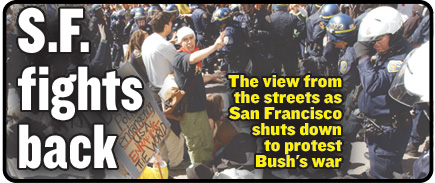
It was a time without precedent in American history. The commander-in-chief voiced his intention to take the country to war — a voluntary, preemptive war with no clear catalyst, no faraway invasion or Pearl Harbor or sinking of the Maine — and millions of people shouted their opposition. With plenty of time to avert war, the protesters warned the invasion would be a costly disaster.
They were right. And it didn’t matter.
The war in Iraq was a test of our democratic ideals. It was a test that this country failed, a failure that has been felt by the people of the United States, Iraq, and elsewhere for the last five years. For many, the refusal of the US government to heed the demands of its citizens left them disillusioned and disempowered.
But others say it sparked a political change that woke up an apathetic citizenry, pulled the Democratic Party back to the left, and may have averted war with Iran.
It’s certainly arguable that the presidential campaign of Barack Obama owes its energy and success in part to the antiwar movement — and if Obama wins, he will be the first president in a long time who took office thanks to the support of a strong grassroots progressive movement.
Nowhere was the clash of people power and government will more acute than on the streets of San Francisco, where a series of massive marches, some drawing nearly 100,000 people, filled the streets prior to the invasion of Iraq on March 19, 2003. The onset of war led protesters to effectively shut down the city, resulting in about 2,300 arrests and millions of dollars in costs to the city.
President George W. Bush dismissed the protests, of course, but he wasn’t the only one. Political leaders such as Rep. Nancy Pelosi, then-Mayor Willie Brown and soon-to-be Mayor Gavin Newsom (who didn’t attend any of the marches, unlike progressives on the Board of Supervisors) condemned the peace movement for hurting an innocent city. But with the “battle for San Francisco” making international news, the protesters were more concerned with the global audience.
A month earlier, on the weekend of Feb. 15 and 16, there were coordinated protests against the impending war in about 800 cities around the world, drawing around 10 million people. The peace march in Rome included about 3 million people, earning a listing in the Guinness Book of World Records as the largest anti-war rally in history. People have never made such a loud and clear statement against an incipient war.
Beyond the numbers, the antiwar movement was also right. On every major issue and prediction, the messages from the street proved correct while those from the White House were wrong. The US wasn’t welcomed as liberators. There were no weapons of mass destruction. Iraq after the invasion isn’t a stable democracy or shining beacon to anyone but the new generation of jihadis Bush created.
We can blame a hard-headed president, ineffectual opposition party, failure of the national media, or the national climate of fear following Sept. 11. But rather than refighting that lost battle, now is the time to gain perspective on the events of five years ago and determine what it means for democracy and the post-Bush national agenda.
TO THE STREETS
There were two main umbrella groups organizing protests before the war: Direct Action to Stop the War (DASW) and International ANSWER (Act Now to Stop War and End Racism). ANSWER has remained active and DASW has recently been reconstituted for the fifth anniversary of the war, using direct action in San Francisco as well as other urban centers and outposts like Chevron’s refinery in Richmond, which has reportedly been processing Iraqi oil.
“With the fifth anniversary coming up, we’re going back to direct action on the streets,” said Henry Norr of DASW. “But I don’t have any illusions that it’s going to be like it was five years ago.”
The maddening march to an ill-advised war created a political dynamic in which a broad cross-section of Americans was willing to hit the streets.
“We had a wonderfully diverse group of people, from soccer moms to anarchists,” said Mary Bull, who cofounded DASW, a collective of various affinity groups and concerned individuals formed in October of 2002 as Bush started beating the drums of war.
It was a group fiercely determined to prevent the war — and really believed that was possible. In fact, Bull recalls how she and other members of the group burst out crying at one meeting when a key activist said the war was going to happen.
Richard Becker, who cofounded ANSWER and serves as its West Coast coordinator, said that in the summer of 2002, “we came to the conclusion that [the war] was going to happen.” The group called its first big protest for Sept. 15, 2002, and another one two weeks later. But the movement really exploded on Oct. 26 when almost 100,000 people took to Market Street, much of it a spontaneous popular uprising.
“We were overwhelmed,” Becker said. “We were in a perpetual state of mobilization to keep up with what was going on. But then it didn’t stop the war.”
Did he think they could?
“I think a lot of people thought maybe it was possible to stop it. And we thought maybe it was possible to stop it,” Becker said.
The high point, according to Becker and Norr, was Feb. 17, 2003, when the New York Times ran a front page analysis piece entitled “A new power in the streets” that claimed “the huge anti-war demonstrations around the world this weekend are reminders that there may still be two superpowers on the planet: the United States and world public opinion.” But then Colin Powell went to the United Nations to argue for the invasion, and the Democrats in Congress did nothing, and it became clear war was coming.
Norr stayed out there protesting, being arrested several times and even shot in the leg by Oakland police with a rubber bullet during a protest at the Oakland docks. And he thinks some good came from the experience.
“The lesson for people is the political and economic elites are committed to preserving and extending empire. And they basically say as much in their own writing,” Norr said. “Wars are not anomalies.”
Despite being a frustrating and depressing exercise, most saw benefits to the failed movement. “People got an incredible education about how the system really worked,” Becker said. “Building a movement is mostly about a series of setbacks.”
Medea Benjamin, cofounder of both Global Exchange and CodePink and fixture of the anti-establishment peace movement for years, was upbeat about the protests. “We did our job as citizens. We did what we were supposed to do: organize, get people to take action, get people onto the streets,” she said. “We did everything we could think of.
“What you take from it is we don’t have a very well-developed democracy because the people spoke and the government didn’t listen.”
 The ever-evolving “Democracy Wall” on Valencia Street, March 2003, helped stir up debate (Photo by Lars Howlett)
FACING ARREST
The collective action of five years ago starts with a series of personal stories — tens of thousands of them — so let me briefly begin with mine.
My arrival in San Francisco was closely tied to the march to war. I was living in Sacramento and working as the news editor of the Sacramento News & Review when Bush began his saber rattling against Saddam Hussein, but by the end of 2002 I had a falling out with my boss and found myself jobless.
Like most Northern Californians who opposed the war, I came to San Francisco on Jan. 18 to make my voice heard and experienced a bit of serendipity on my way to Justin Herman Plaza: while reading the Guardian on Muni, I saw their advertisement for a city editor, a job that was ideal for me at a paper I’ve always loved. Needless to say, it was a great day, empowering and full of possibilities.
Less than two months later I was on the job, and on the second week of that job I was back on the turbulent streets of San Francisco, part of a Guardian team covering the eruption of this city on the first full day of war. When I stepped off the cable car just after 7 a.m., people were streaming up Market Street and I joined them.
When a large group stopped at the intersection of Market and Beale, I stopped too, taking notes and bearing witness to this historic, exciting event. I had a press pass issued by the California Highway Patrol that allowed me to cross police lines, so when police in riot gear surrounded us and threatened arrest, I held my ground with 100 or so protesters.
After interviewing about a dozen people about why they were there and that they hoped to accomplish (see “On the bus: Journalists, lawyers, four-year-olds — the cops were ready to bust anyone Thursday morning“), I was arrested with the others and taken to a makeshift jail and processing center at Pier 27 (no charges were filed in my case, and charges against all of the 2,300 people arrested here in those first few days of the war were later dropped).
I recently tracked down a few of the people who appeared in my article, including Daphne and Ross Miller, who were at the center of the most interesting drama to play out during our standoff with the police. She’s a family practice physician, he’s an architect, and they live in Diamond Heights with their two children, Emet, who is almost 9, and Arlen, 12, who was away on vacation when the war began.
“We were genuinely shocked that the war started,” Ross told me. “We were at some of the earlier protests and really thought there was no way [Bush] could do it.”
They woke up March 20, 2003, to news that the war had begun and immediately walked to the BART station with Emet and rode to the Embarcadero station, not really planning for the day ahead but just knowing that they had to make themselves heard.
“We were pissed as hell. I don’t think I’ve ever been so angry in my life,” Daphne said.
They quickly came up with a plan. “We basically decided that if anyone was going to be arrested, it was going to be Ross and I’d stay with Emet. But it didn’t end up that way and I ended up in the arrest circle.”
Daphne had their house keys and threw them over the police line to Ross at one point. A photographer in the circle had gotten shots of a man named Roman Fliegel being roughed up by police as they pulled him off his bicycle, which was towing a trailer with a sound system, and decided to throw his backpack with camera gear out as well. When Ross — who had four-year-old Emet on his shoulders — caught it and refused police orders to give it to them, police grabbed Emet and roughly arrested Ross, leaving a gash on his forehead.
“Rage surged through the crowd, and it seemed as if things might get ugly, but the police kept a tight lid on the situation, using their clubs to shove back protesters who had moved forward,” I wrote at the time.
Emet was delivered into the circle with Daphne as the arrests continued, many quite rough. “At that point, as a mom, I had to exercise the most restraint ever,” said Daphne, who was angry about the situation but fearful about what she was exposing her son to. “Please, don’t let any violence happen here,” she pleaded with the crowd. Eventually, commanders on the scene let the mother and child go.
“The officer who let me go said that if he saw me again out there, he would call Child Protective Services on me,” Daphne said. But two days later, still brimming with outrage at her country’s actions, she ditched a downtown medical conference to rejoin the street protests, this time solo.
The couple say they’ve lost friendships over the war and have become more engaged with politics, coming to believe that Bush and the neocons are malevolent figures who knew how badly the war would go and did it anyway to establish a large, permanent military base in Iraq.
“Since that day, we’ve been far more active,” Ross said. “We realized you can’t just trust the system. You have to push.”
But that determination was mixed with feelings of disempowerment and depression. They attended some of the protests that following year, but the couple — like most people — just stopped going at some point because they seemed so futile.
“There was a horrible sense of resignation and a genuine depression that followed,” Ross told me.
The nadir was when Bush was reelected and they considered leaving the country. But then, Ross said, “we decided we’re not just going to run away and we’re not going to accept this.” Looking back, even with the scare over Emet, they express no regrets.
“It was the right thing to do because it was the wrong war to have. I’d do it again and again and again if I had to,” Ross said
They’re guardedly hopeful that Barack Obama could begin to turn things around if he’s elected. “I think the right president can at least start to dismantle this,” Daphne said. “I think thousands of people marching in the streets is something he would listen to.”
 A die-in on the streets of San Francisco in March 2007 marked the fourth anniversary of the invasion (Photo by Charles Russo)
WITNESS TO HISTORY
Covering the peace movement in those early days was a heady experience, like reporting on a revolutionary uprising or working in a foreign country where the people are organized and active enough to be able to shut down society and brave enough to risk bodily injury for their beliefs.
I was at the founding meeting of CodePink — which became the most effective group at personally confronting the warmongers and keeping the war in the public eye — one evening at Muddy Waters in the Mission District shortly after the war started.
Looking back, Benjamin rattled off a long list of the alliances the group built — with labor, churches, businesses, and a wide array of social movements — and creative actions intended to build and demonstrate popular support for ending the war.
“We’ve done so many things and what did we get? We got a surge,” she said. “It shows the crisis in our democracy, the crisis of the two-party system, the crisis of a dysfunctional opposition party.”
Yet she said the peace movement has been remarkably successful in convincing the public that the war was a mistake and that it’s time for the troops to come home, even if the Democrats have been slow to respond to that shift.
“The progress we’ve made is turning around public opinion and that’s going to play a big role in the upcoming elections,” she said. For Norr, the role of the news media is a particular sore spot. He was a technology reporter for the San Francisco Chronicle who called in sick on the first full day of war and was arrested on Market Street with his wife and daughter, resulting in suspension by editor Phil Bronstein for his actions.
I wrote several stories on the issue, which culminated in Norr being fired and Bronstein unilaterally banning Chron employees from peace protests. I even borrowed CodePink’s guerilla tactics when Bronstein repeatedly refused to return my calls or address why he had singled out antiwar protesters for uniquely punitive treatment. I confronted him during a speech he gave at the Commonwealth Club (see “Lies and half-truths,” 5/7/03). That was the tenor of the times: we were all tired of being lied to and we decided to push back.
Norr was particularly frustrated with his own paper’s reporting of the war and started sending articles by the foreign press to his paper’s news desk, trying to wake his colleagues up to the pro-war propaganda being passed off as journalism in this country.
He was also disappointed with the country and with the Chronicle — both the management and his fellow reporters, who did little to support him — but the experience caused him to return to his roots as a progressive activist.
“The war and losing the job and everything brought an abrupt end to my consumerist phase and dumped me back into the world of being an activist,” said Norr, who serves on the KPFA 94.1 FM local station board and has made three recent trips to the Palestinian territories while working with the International Solidarity Movement.
Benjamin said Americans shouldn’t expect the next president to end the war — not without lots of pressure from a renewed and vocal peace movement. “This is the time to set the stage for the post-Bush agenda,” Benjamin said. “Don’t put your hopes in Barack Obama in getting us out of Iraq. Put your hopes in the people.”
 A rally and nonviolent direct action at the Richmond refinery targeted Chevron on March 15 (Photo by Lane Hartwell)
THE AFTERMATH
The San Francisco Police Department, which spent more than $2 million on overtime costs responding to peace protests between March 15 and April 16, 2003, generally behaved with restraint and professionalism, but there were several exceptions.
The most costly and disturbing incident came when Officer Anthony Nelson began aggressively swinging his long riot baton at protesters, badly shattering the arm of peaceful protester Linda K. Vaccarezza, who suffered a permanent disability in her career as a court reporter.
Nelson’s incident report falsely stated that Vaccarezza had threatened him with a sign attached to a solid pole, but video of the incident later clearly showed there was no pole and that she was retreating when he teed off on her (see “The home front,” 05/19/04).
Vaccarezza received an $835,000 settlement from the city in November of 2004. On Oct. 5, 2005, two and a half years after the incident, SFPD fired Nelson for lying about what happened that day, and the City Attorney’s Office has been successfully fighting Nelson’s appeals in court ever since, putting in more than $100,000 in attorney time and costs into the Nelson and Vaccarezza cases.
The other significant ongoing litigation from the antiwar protests involved Mary Bull, who was arrested during an early protest for pouring fake blood in front of the entrance to Chevron’s San Francisco office before being allegedly strip searched and left naked in her San Francisco Jail cell for 36 hours.
Ironically, Bull was among those who brought a successful class action lawsuit against Sacramento County after she and others protesting a logging plan were strip searched, setting a precedent and led most counties to reform their strip-search policies. She used her share of the $15 million judgment to buy an organic permaculture farm in Sebastopol.
Her San Francisco case, in which Bull won a multimillion-dollar judgment, is still under appeal and now in mediation. Bull said the protests five years ago did make a difference, something she tells those who fret about its apparent failure. “I tell them to look at what issues the candidates are talking about now and I thank them for protesting then.”
“Even though we had millions throughout the world, we were sort of blocked, but now we’re regaining that momentum,” Melodie Barclay, a massage therapist who was also arrested with me on the first day of the war, told me recently. “We can’t judge it by the fact that we didn’t get the momentum we wanted.”
Norr started his antiwar activism working with Students for a Democratic Society in Boston, protesting the Vietnam War, which he said shares many similarities with the current situation, for good or for ill. He said that people tend to forget that while the protests then were huge and helped end the war, the movement did wane after Nixon ended the draft and substituted massive aerial bombardment for boots on the ground.
“The protests dropped off considerably,” he said. “A lot of the things that drove people to take risks in the late ’60s had faded by the early ’70s.”
He thinks the current administration learned a lesson from those days: it’s easier to maintain a war effort if the average citizen isn’t affected.
But there are other factors as well keeping a lid on the antiwar outrage.
“The culture has changed too. Young people are oversaddled with debt. People in schools seem to be docile. The culture as a whole seems to be more individualist and consumerist,” Norr said.
Yet some young people have woken up and many of them are funneling their energies into a peace group that was formed in the summer of 2005: World Can’t Wait, as in: the world can’t wait for the end of Bush’s second term before we change our direction and leadership.
“We don’t just want them gone, we need to repudiate their program,” said Giovanni Jackson, a 26-year-old WCW student organizer. “If we’re going to change anything, we need the youth.”
Jackson was at WCW’s founding convention in New York City, which came just as New Orleans was being flooded and then essentially abandoned by the federal government.
“When [Kerry] lost, people felt demoralized and World Can’t Wait kind of stepped into that situation,” Jackson said. “There was a lot of demoralization in the antiwar movement at that time.”
The group organized protests and student walkouts on Nov. 2, 2005.
“Everyone has their moments of doubt,” he said, “but I’m motivated by the crimes we see everyday.”
THE LESSONS
One of the biggest barriers to galvanizing people and turning the fifth anniversary of the war into something that might make a difference is the presidential election, which is diverting the energy of many potential protesters — and at the same time, offering some hope that a new president may lead to peace.
After all, every single one of the Democratic presidential candidates has promised to withdraw troops from Iraq, with varying timelines and numbers of US personnel left behind. And with enough encouragement, they might be willing to help change the status quo.
Many of the activists who volunteered their time and money to help move the Obama campaign into its front-runner position came out of the antiwar movement, and Obama’s strong stand against the war has been a key factor in his popularity.
Becker and some other activists don’t have much faith that a change in presidents will change the course in Iraq, although he agrees that much of the energy now surrounding Barack Obama derives directly from the antiwar movement.
“There’s been a huge upsurge of hope for Obama and that he might bring about the kind of change we need,” Bull said, adding that she doesn’t share that hope, believing the only path to peace is to pressure Obama and other leaders to commit to more progressive positions.
Norr said, “On one level, people have illusions about the power of peaceful protests. People believe in democracy, as well they should. We feel like the rulers should be paying attention to public opinion.
“It’s a remarkable story how broadly and quickly the American people have turned against the war. Public opinion was certainly ahead of the Democrats.”
And people will only grow more disenchanted with Iraq and its multitude of costs. “The people here are paying for this war, and everyday we have new stories about health clinics being shut down,” Becker said.
Becker was amazed last March as massive demonstrations for immigrant rights seemed to explode out of nowhere. “We think there will be more things like that,” he said.
Because after five years of organizing communities to resist the military-industrial complex’s plans, Becker thinks there’s been some visible progress.
“There isn’t a town or hamlet in the US that doesn’t have activism going on, but you wouldn’t know it from the corporate media,” Becker said. “It’s a mistake for people to feel discouraged.”
Hope Mohr Dance
PREVIEW After training in ballet, San Francisco native Hope Mohr moved to New York City, where she danced with Lucinda Childs and Douglas Dunn before spending four seasons with the Trisha Brown Dance Company. After eight years, she decided that she could continue her career back in her hometown. Significantly, upon returning in 2005, she joined the company of Margaret Jenkins, who had also left the Big Apple to resettle in her Bay Area stomping grounds more than 30 years ago. Even then, however, Mohr knew that she would eventually want her own group. This upcoming concert is the debut of her newly formed Hope Mohr Dance troupe, in which she’ll present four pieces with 13 dancers. Of key interest is her 2007 collaboration with video artist Douglas Rosenberg, Under the Skin, a commissioned work from Stanford University that grew out of a series of workshops Mohr conducted with breast cancer survivors. Five trained dancers and three survivors perform together in the piece. When Bill T. Jones created his 1994 Still Here, conceived on a similar premise, it raised a firestorm of criticism about so-called "victim art." Mohr is confident that the fertile tension between the subject matter and the dance’s formal demands has allowed her to create a work that stands on its artistic merits. The other three pieces, Moments of Being (a premiere), Elision, and more awake than dreaming, are non-narrative investigations of what gave Mohr’s debut program its title, "Let the Body Speak."
HOPE MOHR DANCE Fri/14-Sun/16, 8 p.m. Dance Mission Theater, 3316 24th St, SF. $18. (415) 273-4633
There won’t be blood
› a&eletters@sfbg.com
Michael Haneke would likely be offended if you said you enjoyed his movies — though no doubt he would enjoy hearing you were offended by them. The chill surface neutrality of a Haneke feature such as Caché (2005) is designed to intrigue and then frustrate — by depriving extreme situations of their usual sensationalism and neat narrative resolution so that we end up implicated by our own thwarted expectations. Even as a scold, Haneke is too disciplined to let us join him on his soapbox. The whole point lies in being discomfited.
The "normal" boy who kills a girl in Benny’s Video (1992); the bourgeoisie unraveling due to exposure of their own race and class prejudices in Code: Unknown (2000) and Caché; and an entire society reverting to primitive behaviors after unspecified catastrophe in Time of the Wolf (2003) are all so disturbing because they’re so banal. Even when portrayed by movie stars, these figures are willfully ordinary, observed at length performing dull tasks or making poor decisions for petty reasons. The one time he approached a conventional melodramatic arc and larger-than-life protagonist (if an antiheroine) was in the Elfride Jelinek adaptation of The Piano Teacher (2001) where Isabelle Huppert’s character embodies the masochistic role usually played by his viewers themselves.
None of these films are exactly date movies, but they still orbit an audience’s comfort zone more closely than Haneke’s most notorious film, the original 1997 Funny Games. Now, Haneke has made the seemingly perverse choice of creating a shot-for-shot remake as his first English-language feature. Actually, it’s a decision as coolly logical as any he’s made, since he has said more than once that the original is more a comment on US society and media than their Austrian equivalents.
Beyond its sheer unpleasantness, both language and subtitling prevented the original from reaching his target audience. Still, it’s unlikely people will be turning out en masse for Funny Games U.S., as the movie is being called everywhere but here. Those who do take the plunge are likely going to hate, hate, HATE it — which will be one way of gauging that Haneke’s subversion of standard genre rules is working as planned.
We meet the Farber family via eye-of-God aerial shots following their car to the exquisitely leafy countryside where their expansive lakeside summer home resides. With little Georgie (Devon Gearhart) in the backseat, Ann (Naomi Watts) and George (Tim Roth) play guess-the-classical-composer. It’s too perfect and we know it, because Haneke incongruously interrupts their banter with a jarring blast of cacophonous death metal (actually a John Zorn piece) — the only music heard in the film that’s not ostensibly played from CD by an onscreen character. Horror, it suggests, might just be a dial flip away from intruding on this cozy trio.
Stopping short of their own electronic gate, the Farbers greet strangely uncommunicative neighbors standing on their lawn with two unknown men. Later, while father and son prep the sailboat, Ann gets a visit from Paul (Michael Pitt), who says he’s staying with the aforementioned neighbors and has been sent to borrow some eggs. Apologizing profusely, he nonetheless quickly manages to turn her hospitality into sputtering rage. Meanwhile, the dog disappears. Soon Paul is joined by Peter (Brady Corbet), his doppelgänger in tennis whites and floppy bangs. They look like consummate squeaky-clean preppies — or Hitler Youth. They have a not-long-hidden agenda. Things degenerate very quickly.
For all their sadism, Peter and Paul aren’t so much conventional villains as they are abstracts — tools to indict the viewer for participating in these games, or expecting anything like the usual fictive payoffs. The casting of the instantly recognizable Watts and Roth distracts at first, but Haneke’s approach (which employs agonizingly long takes, including one extreme instance that approaches 10 minutes in duration) and the actors’ grueling expressions of physical and emotional distress hit the right note of violated ordinariness.
It’s worth noting that perhaps Haneke’s most ingenious (and frequently overlooked) gambit is that there is almost no onscreen violence. As much as Funny Games feels like particularly merciless, graphic torture porn, the actual moments of assault are almost always cut away from or just out of frame. The one exception turns out to be Haneke’s single cruelest joke — and naturally, it’s on you. Without coming right out and saying it, Funny Games is now very much an answer to Hollywood norms and a larger cultural denial: here, violence is all suffering and no spectacle. *
FUNNY GAMES
Opens Fri/14 at Bay Area theaters
Freedom of Information: More sunshine — easily and at no cost
› news@sfbg.com
Imagine sitting at home — or in your office, or in your favorite café — and listening in on what are now secret, backroom policy discussions and decisions in the San Francisco mayor’s office. Imagine having access to an immediate transcript of the talks. Imagine being able to read internal e-mail discussions among city staffers about issues that affect you — without ever filing a public records request. In fact, imagine never having to file another written request for public documents; imagine just going to a city Web site, entering a search term, and finding all of the records yourself.
Imagine filing a complaint with a city agency and tracking the issue, minute by minute, as it works its way through the system.
Imagine listening on your cell phone to any policy body as it meets in city hall.
All of this is possible, today. Much of it is not only consistent with but actually required by local law. And it won’t cost the city more than a modest amount of money.
Transparency is a common buzzword during this presidential campaign; the Barack Obama campaign has even issued a white paper describing policy and technological ways to embrace it. He’s talking about live Internet feeds of meetings about significant issues involving executive branch appointees as well as for those of regulatory departments (a program that would go far beyond what you see on C-SPAN).
So there’s no reason San Francisco can’t take the lead in using technology — generally simple, off the shelf, existing technology — to dramatically increase sunshine at City Hall and public participation in local government.
Proposition G, the city’s 1999 sunshine law, mandates that San Francisco use "all technological and economical means to ensure efficient, convenient and low cost access to public information on the Internet." Here are five easy ways to do that:
1. Fully adopt the voyeur concept for city meetings. This is the idea that the public should be able to observe and engage in government decision making — all government decision making.
All policy meetings in City Hall should at the very least be broadcast as audio on the Web and available via phone teleconference. In other words, the meetings should be streamed online, and that stream should be accessible by calling a free conference line. This is already standard practice in the business world and is working well for many investors in public companies that disclose financial information in compliance with Securities and Exchange Commission rules. It can be done for little or no cost with services like blogtalkradio.com, skype.com, freeconferencecalls.com, and webex.com.
Today only a limited number of public meetings are broadcast, mostly because the only outlet is SFG-TV and resources are limited. But audio streaming is a no-brainer — there’s no need for a staffer to control cameras, the microphones are already set up, and these days just about every room has a speakerphone.
Currently, the SFG-TV video coverage isn’t posted on the city’s Web site, sfgov.org, until two or three days after a meeting. That’s too long; the audio should be made immediately available online. And the Internet URL and dial-in options should be listed on the meeting agenda so that news media and citizen bloggers can instantly refer back to the URL with timecodes to point out specifics, and include them in their stories and blog postings.
With streaming, you can follow along in real time when you are stuck at home taking care of a sick relative, or at the office listening with headphones, or you are disabled and can’t cross town to attend in person.
The city already has a great contract for real time captioning — the text you see at the bottom of the screen for video. It’s not 100 percent accurate, but it’s pretty decent. That could be expanded to cover streaming audio, and the text could be computer translated (or translated by bilingual typists) into other common languages. The advantage of media integrated with RTC is that specialized search engines like blikx.com and everyzing.com can be used to find relevant phrases and begin playback directly at that spot. And transcriptions can be posted online in real time (somewhat like live blogging!) so that if you are late for a meeting you can quickly scan what has already transpired, and by the end of the meeting you will effectively have a draft of minutes. That saves a lot of staff time and provides an immeasurably more useful historic record.
Today, video recordings of city meetings can’t be downloaded — the only way to review it or post a clip to YouTube is to order a $10 DVD, which arrives a week after you send a check (and no, they don’t take PayPal). And while many other city meetings make audio recordings, you have to pay $1 for an audio tape and pick it up during business hours or pay more for postage. They all should be available as free podcasts.
The SFG-TV video shows more than just the speakers and officials; there are other angles, and they ought to be available too. It’s important to know who attended the meeting but never said anything, who greeted whom, and even who ignored whom.
2. Let the public do the broadcasting. All City Hall meeting rooms should provide wi-fi (and electrical outlets), and the system ought to have enough speed to allow bloggers or activists to upload high-quality video broadcasts of meetings that SFG-TV can’t afford to cover. It can be done using existing services like Justin.tv, Upstream.tv, and live.yahoo.com. This would also allow live blogging — and let people preparing to testify on an issue have access to the Web to do research on the spot. If the room had a projector and a screen, people who were unable to attend the meeting could still comment, either through video or just by posting text messages that the decision makers could read.
The audio broadcasting of meetings should be expanded to include all meetings between the mayor (or supervisors) and city staff. The law already requires public access to so-called passive meetings — those between the mayor or department heads and outside parties that influence city policy.
3. Make public most city emails and other documents as soon as they are produced.
San Francisco city employees produce thousands of records a day — e-mails, memos, reports, etc. — and the vast majority of them are and should be public record. But many are deleted and others never see the light of day. When a member of the public asks for all the records on a topic, just finding those documents can be a sizable task.
But it’s technologically simply to solve that problem: every time a city employee produces a document, the computer system should automatically send a back-up copy to a public web server. That way nothing would get lost or erased, and anyone looking for public information could simply go to that site and search for it him or herself.
For e-mails sent by city staff, one way might be to CC (carbon copy) an online message board (for example Google or Yahoo groups, which would be available at no cost to the city). Other approaches for instant messages, text messages and voicemails could be adopted as well. The Palo Alto City Council is already doing something like this for a narrow collection of e-mails (although not in real time).
We all know there are some city communications that must remain private or be redacted — for example Attorney Client discussions or human-resource conversations regarding personnel. But there are simply ways to make sure those stay confidential: one approach might simply have the user tick a flag or answer a Yes/No Possible Redaction popup when the message is sent. Certain employees — like the people who handle sensitive employee health records and certain litigators in the city attorney’s office — could have software that defaults to a confidential server.
The added advantage, of course, is that the computers could also make a record of the title and date of every confidential document — and that information could be made public. If a dispute arose over whether the city was improperly withholding records, the public would at least know that certain documents existed.
All city files could be stored on network drives (not on local drives) with one location for default public files that would not allow overwriting or deletions and would be mirrored to a Web server and another drive for the few that may require redaction first.
4. Save all the old records. After a very embarrassing lawsuit that is threatening the Missouri governor’s job, that state in January adopted an email retention system that preserves all email for at least seven years (based on federal requirements for financial records). And e-mail/instant message/text/fax retention systems are standard practice now in the financial industry (Morgan Stanley lost a $1.45 billion judgment because the company failed to preserve e-mail).
In fact, we all know storage continues to get cheaper and smaller — so San Francisco should abolish any retention timeframes for electronic records and keep them all into the foreseeable future. The world-famous Internet Archive is right here in the Presidio: I suspect that group would love to archive all the city information, and keep it online, free and forever.
When paper documents are part of the public record, they should be scanned and converted to text and posted within two days. This would include discussions between staff and individual members of policy bodies and the creation of the draft agenda and supporting materials as they are obtained.
All these methods would significantly reduce the number of public records requests to the city staff and thus save the city money.
5. Make calendars public — and keep communications public. Mayor Gavin Newsom won’t provide detailed daily calendars — even after the fact, when there is no possible security reason for keeping his workday itinerary secret. All top officials should post their calendars on the web so the public can track what they are doing.
The city needs to adopt a global policy that city business should be performed on city devices (computers, email accounts, phones) whenever possible — and when city employees or officials use their own computers or hand-held communications tools, those should be forwarded immediately to the city system and made public.
San Francisco has one of the best local Sunshine laws in the country — and at a time when activists at every level are looking for ways to use technology to expand public access, the city should be in the forefront. All it takes is some political will.
———————————————————-
Here are some more ways that the city could use technology to improve public access:
1. Use a program like govtrack.us to follow legislative changes.
2. Explore ways to bring nonprofits that perform traditional government services under sunshine laws.
3. Significantly improve the city’s Crimestats system (more real-time allow alerts for crimes near you) – google mashup et al. See http://chicago.everyblock.com/crime/
4. Embrace e-rulemaking technology – similar to federal rulemaking use technology to get ideas online and generate more participation for those who can’t show up in a meeting.
5. Require the Police Department to issue press credentials to bloggers.
6. Fund a few open-government lawsuits to expand the boundaries on access to public records (the law provides for attorney’s fees if the suit is successful).
7. Require city agencies to post the method for obtaining public records online. Require posting of all negative determinations on home pages.
8. At budget time, mandate that each agency provide statistics as determined by SOTF on sunshine responsiveness.
9. Require an assessment of sunshine compliance as a mandatory item for all Financial/Management audits.
10. Televise SOTF and Ethics Commission formal hearings.
11. Require active Ethics investigative files to be open.
12. Embrace fully the much-improved but incomplete example of posting online all interactions as part of large contract negotiations – as was partially done with TechConnect.
13. Host accounts payable/receivables online with the scanned images of invoices paid.
———————————————————
>
Click here for details on the First Amendment Awards Dinner. Norwin S. Yoffie Career Achievement Award If journalists were the subjects of trading cards like baseball players, the Dan Noyes rookie card would be just as impressive as a 2008 career highlights card. Think Reggie Jackson: a long, impressive career, spanning multiple organizations and a propensity to come out swinging big at the end of a hard-fought battle. Over a career spanning 30 years, Noyes has pursued serious investigations, some lasting as long as a year, into everything from questionable Liberian timber imports to illicit gun trafficking from United States suppliers to the Nuestra family gang. Journalism first interested Noyes during the crucial investigative reporting that sparked Watergate scandal in the early 1970s. In 1977 Noyes cofounded the Berkeley-based Center for Investigative Reporting (CIR), an independent news organization which produces in-depth stories and documentaries for all major news outlets. In 1979, reporting for the ABC News program 20/20, CIR broke a story on a swindling United Nations charity organization and its connections to international drug trafficking. More recently, Noyes has done a series of print and broadcast pieces concerning gang violence in California and its effect on the lives of those surrounding the lifestyle. Noyes still holds an executive position at the CIR and continues to contribute to the world of investigative journalism. Beverly Kees Educator Award Cliff Mayotte sees his Advanced Acting Class at Lick-Wilmerding High School as one that merges students’ "consciousness and awareness as young adults with their skills and energies as performance artists." The subtitle of the course is "Theatre as Civic Dialogue," and the eight students enrolled during the 2007 spring semester used all their abilities to pull off a notable show. After an introduction to Documentary Theatre — a form he described as "oral history turned into performance" — the group selected a topic that was important to them, giving birth to the "Censorship Project." The students interviewed their peers, teachers, and administrators to gather perspectives on the ways in which expression and opinion can be muted or altered, both voluntarily and involuntarily. They reached out to organizations such as Project Censored, the First Amendment Project, and the Ella Baker Center for Human Rights. They transcribed interviews and studied subjects in order to capture statements, word patterns, and mannerisms of interviewees, then shaped the themes into a 60-minute performance. Professional Journalists "Being a high school sports guy, I don’t get to do this very often," the Modesto Bee‘s Will DeBoard said of his first major foray into investigative reporting. He had gotten a tip that the California Interscholastic Federation was investigating recruiting violations by the football program at Franklin High School in Stockton, which competed with schools in his area. DeBoard asked the school and CIF about recruiting violations, but the football coach flatly denied the allegations and the CIF wasn’t much more helpful. So DeBoard decided to make formal requests for public records with the help of business reporter Joanne Sbranti, and after fighting through some initial denials, he obtained hundreds of pages of investigatory documents from CIF showing how the school was recruiting players from American Samoa. "It really was a treasure trove of great stuff. We got two weeks’ worth of stories out of these documents," DeBoard said. "It really showed us that what the school was telling us just wasn’t true." The documents detailed the recruiting scheme and gave DeBoard tons of leads for follow-up stories, including the address of "a home owned by the coach where there were all these gigantic Samoan linemen living there." DeBoard called the effort an "adrenaline rush" better than that caused by the best game he’s covered and a high point of his journalism career. Contra Costa Times investigative reporter Thomas Peele has a long history of battling for public records access on behalf of both reporters and private citizens. Peele, who helps with projects for all the newspapers under the Bay Area News Group-East Bay ownership, helped ensure the recovery of thousands of e-mails from the Oakland mayoral tenure of Jerry Brown when he left office to become the state’s attorney general in 2006. Peele also helped conduct a statewide audit of Public Records Act compliance by law enforcement agencies with the nonprofit Californians Aware, which revealed glaring inconsistencies in how police across the state make information about their activity available to the public. And he’s been a major figure in helping the Chauncey Bailey Project pry out new information about Bailey’s murder last year and it’s connection to Your Black Muslim Bakery. He began his career in 1983 at a small weekly in Bridgehampton, N.Y., and moved from there in 1988 to the Ocean County Observer in New Jersey before joining the CCT in 2000. KTVU-TV producer Roland De Wolk is leading the investigative team of photographer Tony Hedrick and video editor Ron Acker in a quest to get the names of drivers who regularly use FasTrak lanes but don’t pay anything. But to date, says De Volk, the Metropolitan Transportation Commission has been blocking his team’s quest. De Wolk told the Guardian that his team filed a California Public Records request when the MTC wouldn’t provide information on the amount of money it was losing thanks to drivers who don’t pay tolls when they use FasTrak lanes. "We asked MTC for specific numbers last summer and got little information. That makes a reporter’s antennae quiver," said De Wolk. But when he and his team asked for the numbers of people obstructing their plates, the MTC started acting squirrelly, De Wolk said. "Finally, after six to eight weeks of asking we got an answer: a photo of a car whose plate was blank," fumed De Wolk, whose team continues to push for the names of the 10 most frequent FasTrak violators. Broadcast News Outlet When KGO-TV reporter Dan Noyes and producer Steve Fyffe asked Muni to turn over records of public complaints against its drivers, they were ready for some bureaucratic foot dragging. But they never expected the yearlong grudge match that followed. First, the union representing Muni drivers sued to keep the records sealed. Then Muni’s parent department, the Municipal Transportation Agency, made a backroom deal with the union and released a blizzard of confusing and heavily redacted paperwork that would have made the Pentagon blush. "It was essentially a big document dump," Fyffe told us. "There was no way to tell one form from another or which driver was which." Noyes and Fyffe convinced their bosses at KGO-TV to file a lawsuit for full access to the records. The station prevailed, after which Noyes and Fyffe received over 1,200 pages of public complaints about 25 drivers. Recently, the station went back to court after Muni refused to release surveillance tapes of the drivers. As in the previous case, the judge ruled that the public had a right to the materials and forced the transit agency to hand the tapes over. Fyffe said he sees KGO’s legal successes as small victories in a much larger fight. "I hope in the future that this case will make Muni and other city departments more [responsive] to records requests … these kinds of incremental victories hopefully lead, little by little, to a more open government." Print News Outlet The Sacramento Bee operates in a city run by top-tier politicians and their spinmeisters, so the editors and reporters there have placed increasingly high value on using documents to support their stories. "We’ve always used public records here. Being in a state capital, we’re a little more aware of the necessarily of that," managing editor Joyce Terhaar said. "You just need to be able to tell a story about what’s really happening." Yet she said that in recent years, the Bee has made a concerted effort to hire public-records experts and to have them share their knowledge with the paper’s staff through regular workshops. And last year, those efforts paid off with a string of big, impactful investigative stories. Among them was Andy Furillo’s look at how much the state was spending to fight inmate care lawsuits, Andrew McIntosh’s exposé on the lack of oversight for paramedics and emergency medical technicians, and stories by John Hill and Kevin Yamamura on misconduct by the state’s Board of Chiropractic Examiners. In selecting the Bee, Society of Professional Journalists judges recognized these individual efforts as well as the Bee‘s "institutional support of reporters and their use of public records for numerous stories." Community Media One of the only ways to uncover corporate wrongdoing is to dig through court records, and it’s the job of the press to report what it discovers, said Becky O’Malley, executive editor for the Berkeley Daily Planet. She was convinced that a prior court order violated the public’s constitutional rights to see court documents, so the small daily newspaper sued and won in a California appeals court last year, making public 15,000 pages of records from a class-action suit filed against Wal-Mart in 2001. The documents included allegations that the company had denied rest breaks to its workers and deleted hours from paychecks. In the Planet‘s freedom of information suit, the appeals court judges agreed with the paper’s attorneys that the case could set a dangerous precedent where the public would have to prove its right to access court records. "It’s becoming more of a trend for judges to grant permanent seals on court records," said O’Malley. That’s unfortunate, she added, since "the only way the public finds out about bad things going on in society is through court records." Special Citation Award After Oakland journalist Chauncey Bailey was murdered last August, a large group of Bay Area media organizations formed a rare coalition to investigate his death and the activities of Your Black Muslim Bakery, a long-time East Bay institution believed by police to be involved in the killing. Since then, the group has produced several stories complete with audio, video, and photo presentations, the most recent of which is a series by retired Santa Rosa Press-Democrat reporter Mary Fricker detailing the sexual assault allegations made by young women once in the custody of Yusuf Bey Sr., founder of the bakery. Fricker received help from independent radio journalist Bob Butler, investigative reporter A.C. Thompson, and MediaNews staff writers Cecily Burt, Thomas Peele and Josh Richman. Other stories have reported allegations of real estate fraud against bakery associates, explored potential coconspirators in Bailey’s death, and examined the bakery’s ties to several prominent politicians. More about the project — the first of its kind since a group of journalists investigated the murder of Don Bolles more than 30 years ago in Arizona — can be found at chaunceybaileyproject.org, or at www.sfbg.com/news/chaunceybailey. Public Official It was a staff member, Kathryn Dresslar, who told Assemblymember Mark Leno how horrible state agencies had become at complying with the California Public Records Act. Dresslar served on the board of Californians Aware, a group that advocates for open government, and she described to her boss how a 1986 audit by the organization had given every one of the 33 agencies in California government a failing grade. Ryan McKee, then a high-school student and the son of CalAware board president Rich McKee, had visited each agency and asked for a few simple things. He wanted to see each agency’s guidelines for public access, and he requested some basic information, including the salary of the agency director. Agency after agency refused to follow the law. So Leno introduced legislation that would have mandated that every agency post its access guidelines on the Web — and included stiff fines for agencies that violated the Public Records Act. "It put some teeth into the law," Leno told us. "And I got 120 of 120 members of the state Legislature to vote for it. That wasn’t enough for Gov. Arnold Schwarzenegger, who vetoed the bill, saying it wasn’t needed. The governor insisted that he had already ordered state agencies to fix the problem. "It was a great eye-opener for me, and showed me the resistance this administration has to allowing public access to state government," Leno said. "Without that access the public is at a great disadvantage." Library It might be hard to believe, but in 1949 the University of California Regents, a bastion of higher education, rode the wave of anticommunist fervor and McCarthyism, forcing all UC employees to take a loyalty oath. The Board of Regents adopted the rule that UC administrators pushed forth: denounce communism and swear loyalty to the state, or face losing your job. As could be expected, people resisted and 31 faculty, workers, and student employees lost their jobs. They appealed the case to the California Supreme Court and eventually were reinstated in 1952, but the controversy cast a pall over the UC’s reputation and divided campuses. With the help of a grant from UC President Emeritus David Gardner, archivists from UC Berkeley’s Bancroft Library and other researchers painstakingly compiled 3500 pages of text, many audio statements, and photos from four UC collections. The online collection, which went live in December 2007, serves as primary source material for students and researchers who want to understand how UC administrators got embroiled in and came to terms with the McCarthy-era tensions that rocked the country. Legal Counsel Electronic data is the new frontier for public-records law, and Rachel Matteo-Boehm, a lawyer with Holme, Roberts and Owen, last year won a key case preserving the public’s right to access to what some public agencies have tried to claim was proprietary data. The county of Santa Clara produced a digital map showing property lines, assessors parcels and other key real-estate data, and that became the basis for a geographic information system tool. The GIS would allow users to plot everything from property taxes to street repairs, public investment, political party registration, school test scores and other trends. But Santa Clara wasn’t giving it out to the public: The database cost more than $100,000, which meant only big businesses could use it. Boehm went to court on behalf of the California First Amendment Coalition to argue that the data was public, and must be made available without high charges. "As information begins to be collected in electronic form, and governments choose to put information in sophisticated electronic formats, you can run into real public-access problems," Boehn told us. Boehm convinced a Santa Clara Superior Court judge that the data was indeed covered under the California Public Records Act. Now Santa Clara must make the map available to the public — and other counties with similar data, seeing the results of the suit, are following that rule. The decision was a key one, Boehm said: "One day we’re going to wake up and all there will be is electronic records," she noted. And if governments can apply different rules to those documents, "you can kiss the Public Records Act goodbye." Whistleblower When Dan Cooke shared details of an alleged sewage spill on Alcatraz Island with the Guardian, the health of the national park — where he’d been working as an historical interpreter for over a decade — was foremost on his mind. But he lost his job after the story was published — apparently for taking a proactive role in noting details of the spill in the island’s log book and speaking candidly to the press about what he’d seen. Wanting nothing more than a return to his job leading educational tours of the island, he filed an administrative claim with the US Department of Labor against the Golden Gate National Park Conservancy and the National Park Service. And he called the Guardian. We reported his firing. The next time Cooke called, it was to happily report he was back on the job. Citizen SuperBOLD has accomplished something entirely different from what it set out to do. Originally, the small group of devoted Berkeley public library users organized to oppose the installation of RFID tags in books. "In the process of going to library board of trustees meetings, we discovered they were vioutf8g the Brown Act," said Gene Bernardi, who heads SuperBOLD’s steering committee with Jane Welford, Jim Fisher, and Peter Warfield. They found, among other things, that certain documents were only made available to trustees and a lottery system was employed in selecting speakers during public comment. They took their complaints to the Berkeley city attorney and joined up with the First Amendment Project, which threatened a lawsuit. Things have changed, though it’s still not perfect — city council meetings only allow 10 speakers and the library trustees still play the lottery for public comment, but marginal improvements portend better days. "Now you can speak more than once," said Bernardi. "Now you can speak on consent calendar and agenda items. So there are more opportunities to speak … if the Mayor [Tom Bates] remembers to call public comment." Electronic Access For years, web pioneer Carl Malamud has sought ways to use the Internet to connect average citizens with their government. His new Web site public.resource.org helps that cause by excavating buried public domain information and posting it online. Though still in its early stages, the site already allows users to tap into hard-to-find records from places like the Smithsonian, Congress, and the federal courts system. Even though most government records are part of the public domain, fishing them out from the bureaucratic depths can be a daunting and expensive task, even for someone like Malamud. During a lecture at UC Berkeley last year, he related his recent difficulties in acquiring a simple database from the Library of Congress. Instead of turning over the materials, officials at the Library cited dubious copyright protections and presented Malamud with a bill for over $85,000 — all for access to supposedly public information. Thanks to Malamud’s Web site, that database and millions of other documents are now available with the click of a mouse. Ultimately, Malamud hopes public.resource.org will help bring about an age of "Internet governance," in which every last byte of public data winds up online for all to see, free of charge. THE SOCIETY OF PROFESSIONAL JOURNALISTS MARCH 18, 2008 TICKETS: >
› a&e@sfbg.com Arguably no modern film director made a better sustained entrance than Peter Bogdanovich, whose first four features were all triumphs. Targets (1968) was a chilling conceit that brought Hollywood pretend terror (Boris Karloff basically playing himself) against a modern real-world horror, the randomly mass-murdering sniper. That critical success led to a major studio deal to adapt (with then wife and collaborator Polly Platt) Larry McMurtry’s novel The Last Picture Show (1971), a melancholy black-and-white flashback to 1950s rural Texas. It won two Oscars, was nominated for five more, and served as a launching pad for actors including Jeff Bridges, Ellen Burstyn, and Cybill Shepherd. Next came What’s Up, Doc? (1972), a delightful, San Francisco–set nod to 1930s screwball comedies with Barbra Streisand and Ryan O’Neal. Its huge success was equaled by 1976’s Paper Moon, with O’Neal and daughter Tatum as a Depression-era confidence duo. That’s a heady four hits in five years — and they’ll all be shown at the Castro Theatre in a tribute to the director presented by Midnites for Maniacs’ Jesse Hawthorne Ficks. Another four films will be seen in director’s cuts different from original theatrical versions. Further, Bogdanovich himself will be on hand at all but the earliest matinees. He’s a great raconteur who’s insightfully frank about the ups and downs of an eventually checkered career. "Ups and downs" puts it mildly. While Bogdanovich started out on top, Hollywood relished kicking him with each downward step. But he’s still here — and especially visible recently, thanks to his role on The Sopranos as Lorraine Bracco’s shrink. Behind the camera too, he’s gotten love lately from the four-hour DVD documentary Tom Petty and the Heartbreakers: Runnin’ Down a Dream (2007). Bogdanovich, who hasn’t directed a big-screen movie since 2001’s lamentably underseen The Cat’s Meow with Kirsten Dunst, hopes to soon start shooting an adaptation of Tracey Letts’s jet-black stage comedy Killer Joe — and he’s got other irons in the fire. If it’s thus a fine moment to be Bogdanovich, there have been many not-so-great ones. Phoning recently from Los Angeles, he recalls that before the debut of Daisy Miller (1974), his first commercial failure, critic Judith Crist asked him, "Is it good? It better be … because they’re waiting for you." Catching major flack for that film was Shepherd, the model-turned-actress he left Platt for. "Peter and Cybill" were inseparable, possibly obnoxious. They cohosted The Tonight Show for a week and were reportedly arch as hell. They occupied the inaugural cover of People, with the headline "Living Together Is Sexy." The director quotes Cary Grant (doing a perfect vocal imitation) advising, "Petah, please stop telling people you’re happy and in love!" Asked why, Grant said, "Because they aren’t happy and in love." Even those who liked Daisy Miller went Attila on 1975’s At Long Last Love, a lavish tribute to ’30s musicals with Cole Porter songs recorded live by some actors who were trained singers (Madeleine Kahn) and others who weren’t (Shepherd, Burt Reynolds). It was meant to be charming. It got the most vitriolic reviews this side of Battlefield Earth. Bogdanovich now says, "We rushed and fucked it up. The first preview in San Jose was an unmitigated disaster. Then we recut and remixed, and it played quite well. But I made some calamitous changes after that, and didn’t preview it again before release. We were just killed. Later we made a different edit. When Jesse called me to say he was showing it, I said, ‘Why?’ ‘I like it.’ ‘Oh, you’re the one.’<0x2009>" The Castro will screen that improved edit — which is charming. Although the title is still a pseudonym for "turkey," At Long Last Love has never been released on video or DVD. In a town where success usually excuses all egotism, Bogdanovich had still somehow crossed a line. His failures were blamed on sheer arrogance. "I got a lot of that," he says — though back then a purportedly imperious on-set demeanor and statements like "I’m not modest, I’m not humble, and the more success I have, the more critics will resent me" surely didn’t help. He’d had the temerity to befriend Hollywood legends including Grant, John Ford, and Orson Welles — who was practically a permanent houseguest. Who the hell did he think he was? Cynics had already interpreted Bogdanovich’s hit homages to Hollywood’s past as evidence he didn’t have an original thought in his head. Then they gloated over his nonhits. Despite the star power of Reynolds and both O’Neals, Nickelodeon was a 1976 Christmas flop. (Forced to shoot in color, Bogdanovich says, "It’s another movie in black and white" — which is how he’ll show it at the Castro.) Despite excellent reviews, 1979’s Paul Theroux adaptation Saint Jack didn’t find an audience. Ditto 1981’s They All Laughed, an enchanting, ensemble romantic comedy. It was (among other things) a valentine to his new love and protégée, erstwhile Playboy centerfold Dorothy Stratten — who shortly after filming ended was killed by the thuggish promoter-husband she’d tried to leave amicably. That murder-suicide was followed by more ugliness: a war of words between Bogdanovich and Hugh Hefner; "dramatization" of the tragedy in 1983’s Star 80 ("I begged Bob Fosse not to do it") and a TV movie; and distribution problems for They All Laughed that cost him millions. Sympathy soured when Bogdanovich became involved with Dorothy’s younger sister, Louise — who was all of six months older than his own daughter. (Nonetheless, their eventual marriage lasted 13 years.) Bogdanovich had a left-field comeback in 1985’s Mask, with Eric Stoltz as Elephant Kid and Cher as biker-chick mom. But even that was marred by public sparring with both Cher and studio execs. The latter substituted Bob Seger tunes for Bruce Springsteen ones key to the story’s real-life inspiration. (The Castro’s "theatrical world premiere" cut restores all the Bruuuuce.) Whether good, bad, or indifferent, his subsequent ventures flopped. In an eerie echo of past events, 1993’s The Thing Called Love came out (barely) after star River Phoenix OD’d. Bogdanovich turned to directing TV episodes (including for The Sopranos) and cable movies. It wasn’t a comedown, he says. "The scripts were good … and I got to work with actors like Cicely Tyson, Sidney Poitier, and George Segal." Bogdanovich also relit an acting career abandoned decades earlier. Having written essays about film history (notably for Esquire) before moving to Hollywood, he thinks his industry hater trail is partly due to perception of him as critic turned filmmaker. He considers the roughly 45 stage productions he acted in (and the 6 he directed) from age 15 to 24 as his real prior job. Given all past tempests, Bogdanovich seems on good terms with his exes — Shepherd (in town with the play Curvy Widow) has promised to show up at the Castro late Friday for The Last Picture Show and At Long Last Love; Louise is flying in to talk about her late sister when They All Laughed shows on Sunday. Is it painful for them to see Dorothy Stratten onscreen? "Yeah, especially now that [costar] John Ritter has died," he says. "But you know, when you see it with an audience, it’s OK — it takes the pain somewhat away. One of the peripheral tragedies [to Stratten’s death] was that the movie was never properly seen in its day. You couldn’t really look at it in the way it was meant to be enjoyed." A GENUINE TRIBUTE TO PETER BOGDANOVICH Fri/7–Sun/9, $10 per day ($25 weekend pass) Castro Theatre 429 Castro, SF › a&eletters@sfbg.com To say that Pedro Costa is one of the world’s greatest filmmakers might sound like a provocation. But I have said it and will repeat it: Pedro Costa is one of the world’s greatest filmmakers, and there’s nothing willfully perverse in my statement. What follows are initial notes toward understanding why Costa matters. Final judgment is left up to the audience — to whom this director yields so much — and should only follow from seeing his films. Watching Costa’s work gives me the chills; it’s a most mysterious, unusual, and unclassifiable oeuvre, one littered with ghosts of the past and the present. From the first frame of each Costa film, it’s apparent we’re in the company of that rare filmmaker who simply cares about people: about who his subjects are, about what they’re feeling and thinking, and just as crucially, what his viewers are thinking about them. Each work is riddled with enticing close-ups, and Costa’s pictorial attention (coming out of a sensibility equally at home with European fine art as, say, the dust bowl photography of Walker Evans) is a constant wonder. The subjects are for the most part the downtrodden inhabitants of a Lisbon, Portugal, slum called Fontaínhas, people literally overlooked by dominant cultures. He’s not trying to rub their misery in his viewers’ faces — calling him a "Straubian neorealist," to quote J. Hoberman, is misleading; if anything, his films, with their rejection of rational structures, are more neosurrealist. Rather, the progression in Costa’s cinema has been to give voice to his subjects and to treat them as worthy of existing as fictional characters (Bones, 1997); then, to delve further into their world, their personalities, and their ways of living (In Vanda’s Room, 2000); and most recently, with great success, to combine the two approaches (Colossal Youth, 2006). Costa finds richness in small variations, and his evolution has led to a narrowing of both subject matter and spatial exploration. Costa has retreated from the wide-open, Monument Valley–esque volcanic surface of Cape Verde to interiors; the benefit of seeing 1994’s Down to Earth is in realizing how Costa’s characters must now feel, cramped in their disheveled surroundings. Combined with his movement toward a long-take style, this signals a shift from a cinema of space to a cinema of time. A parallel trend is an attempt to redefine beauty in cinematic terms — from the exquisite monochrome 35mm of The Blood (1989) to the grubby, purposeful digital video of In Vanda’s Room — and its staggeringly unique use (aided by Costa’s remarkable compositional eye) in Colossal Youth. Likewise, few contemporary filmmakers are as concerned with the juxtaposition of image and soundtrack, and each of Costa’s films reveals new ways of seeing and hearing: in Colossal Youth, the sound is a better narrative guide than the visuals — making long takes a necessity. Yet the more these movies seem to be within one’s grasp, the more they slip away from comprehension. Costa seems to be saying the same thing about life today: he portrays the outside world as a labyrinth and the domestic arena as a much-needed shelter. He’s surely something of a Brechtian modernist (with Jean-Luc Godard as perhaps an even greater influence than Jean-Marie Straub), yet it’s tempting to assign the modifier post in order to understand Costa’s work. His persistent interrogation of the ways in which people live is certainly post–Yasujiro Ozu. And as Jeff Wall has noted, Costa can also be considered post-Bressonian in that he improves on what some find problematic about the master’s later works — namely, Robert Bresson’s tendency to turn his models into intense abstractions. Costa corrects this by allowing disorder, the uncleanliness of the real world. (Bones is that rare transitional film able to stand on its own as a masterpiece, though at the same time, it doesn’t go far enough — as Vanda and Colossal Youth show). The category that Costa might most willingly fit is that of a postpunk director; that the English moniker Colossal Youth — distinct from the film’s Portuguese title Juventude em marcha, literally "Youth on the March" — is also the only album from the stripped-down Welsh band Young Marble Giants (Rough Trade, 1980) is a surrealist coincidence. Costa’s films are complex objects in which the present and the past intermingle, both literally (in the posthuman Portuguese slums where Costa’s last three features unfold) and within the history of film. The lipstick traces of Howard Hawks, John Ford, Fritz Lang, Jacques Tourneur, and many other auteurs reappear in Costa’s films. Just as Down to Earth takes off from I Walked with a Zombie (1943), Bones remakes The Searchers (1956). (It might be perverse to say Colossal Youth is Rio Lobo [1970] to Vanda‘s Rio Bravo [1959], but … there, I just said it.) Les inrockuptibles‘s Serge Kaganski has said that Fontaínhas’s poor are like Indians in classical westerns, and that seems about right. In the same way that he recognizes Bresson’s genius, Costa nods to Hollywood even as he tries, in his unorthodox mode of production — he’s created a studio system in which the crew is minimal, and in the case of Colossal Youth, technical support is provided by the actors off camera — to rip it up and start again. One final, crucial note: As Costa describes, the themes in the films are highly personal. A search for family and for home threads through them, articuutf8g desire for a community that merges the personal and the political (his community is about as far from the European Commission as one can get). And in his subjects, he’s found that missing family, which is but one of many reasons why Colossal Youth is so touching. He’s also developed an alternative, collaborative model of filmmaking that is radical yet replicable, and one that will generate disciples — provided a director is willing to devote the time needed to nurture similar relationships with actors. Even if Costa "only" continues to make films about downtrodden Portuguese — exploring what one festival guide has called a "desperate utopian dream of a human existence" — it’s a new form of cinema that will continue to reverberate, echo, and grow richer with each variation. The avenues of inquiry are innumerable. After all, John Ford only made westerns. STILL LIVES: THE FILMS OF PEDRO COSTA Through April 12 Pacific Film Archive 2575 Bancroft Way, Berk. (510) 642-5249 › johnny@sfbg.com Over roughly the past year, Brillante Mendoza has brought a pair of films to festivals that pack a particular one-two punch when they are programmed to play at the same event. Foster Child first bears witness to the final day that caretaker Thelma Maglangqui (superb veteran actress Cherry Pie Picache) mothers three-or-four-year-old mestizo John-John (Kier Segundo), and as sunlight gives way to night, it follows her from a Manila slum into the ostentatious hotel where she passes him over to wealthy white foster parents from San Francisco. Slingshot also uses a real-time conceit, but in an entirely different manner — locked within the mazelike alleys and shanties of Manila’s Mandaluyong City, it foregoes long takes and methodical passages to careen as if the camera were a baton passed from one preoccupied, panicky person to another. Or perhaps more aptly, as if the point of view was a valuable that one character fleeces from another’s pocket. As a melodrama, Foster Child fits into the dominant genre of Filipino feature films that screen at international festivals — a genre that certain North American critics might enjoy more than writers such as Richard Bolisay and Alexis Tioseco, whose critical conversations are as vital to thriving "CineManila" activity as any current filmmaker. In a piece on one of Tioseco’s excellent Web sites, Criticine, Noel Vera recalls a Rotterdam screening where fellow film scholar and Chicago-based critic Jonathan Rosenbaum compared Mike De Leon’s Kisapmata (1981) to Rainer Werner Fassbinder’s Martha (1974). Perhaps in that spirit, Rosenbaum’s contemporary, the critic and influential programmer Tony Rayns, has likened Foster Child to Fassbinder as well. I’d add another comparison that, however Eurocentric, is meant as a great compliment: Foster Child shares a number of similarities with Douglas Sirk’s mother of all melodramas, Imitation of Life (1959), such as a harshly ironic perspective on maternal bonds in a racist, capitalist world. When Mendoza’s film reaches its final wrenching moments — and Thelma seems stripped, at least temporarily, of life (even the future repetition of her foster maternal duties is harrowing) — a lesser director would have simply milked the pathos. Instead, Mendoza allows no mercy to invade his sympathy, presenting a sequence that calls to mind a scenario depicting Lana Turner’s selfish protests by the bedside of her dying maid Annie (Juanita Moore) in 1959’s Imitation of Life, a sight that is extra bitter because Annie’s lost daughter Sarah Jane (Susan Kohner) can be seen smiling in a nearby framed picture within the shot. Foster Child‘s climactic heartbreak is set against a backdrop of vulgar department store displays that privilege white glamour and which celebrate a false vision of familiar perfection. "The house that love built," proclaims one callow ad, depicting a mother and child. The cruel gods of capitalist marketing provide perfectly horrible set design. Those last glances, leading to a weary climb up a concrete public transit stairwell, also ricochet off Foster Child‘s sustained (and indeed Fassbinder-like) first shot: a silent, postcard-perfect view of Manila’s high-rise cityscape that gives way to a noisier look at the ramshackle slums at the feet of those skyscrapers. A more subtle echo occurs between two scenes that take place nearer to the narrative’s center: an idyllic, sunlit view of Thelma bathing John-John outside her home, and a later moment when she has to wash him in a hotel’s many-mirrored, intimidating bathroom. Engaged Web sites such as Bolisay’s Lilok Pelikula (Sculpting Cinema) have greeted this neorealist symbolism, and Foster Child‘s standing ovation at the 2007 Cannes Film Festival, with some wariness. Indeed, it is frustrating if international audiences take Mendoza’s movies for the whole of Filipino independent film today, when thanks to the punk-fueled Khavn de la Cruz, the monumental Lav Diaz, the prodigiously visionary Raya Martin, and the autobiographical John Torres, CineManila is frankly more inspired than almost all of the indie film — and much of the experimental work — currently coming from the United States. Mendoza’s talent equals or bests anyone who has passed through the Sundance factory in the past decade, but he and his more formally radical contemporaries have to vie for the same too-few spaces allocated to feature films from the Philippines at most festivals. By working within relatively linear narrative structures and feature-length frameworks, Mendoza veers toward the mainstream currents of vital Filipino independent cinema. But he’s demonstrating great versatility. Slingshot‘s burnt-brown palette, verging on black-and-white in nighttime scenes, contrasts greatly with the more colorful, sun-dappled view of slum life in Foster Child, which is so pleasant that soap bubbles blown by children float through one shot. But it would be a mistake to see Foster Child‘s view of cramped city blocks as purely idealized, simply because a fresh array of mothers with newborn babies can be found on every corner — a scene in which foster system overseer Bianca (comedienne Eugene Domingo) greets these women and knowingly checks in on their offspring has a sinister underpinning. Its title translated from a term (tirador) denoting a street hustler, Slingshot is harder and faster — money or valuables are frequently handed from one character to another on the sly as people move in an out of a shot that is itself moving forward. A viewer had best be on the top of his or her game while watching, because everyone in the film is on the make. But the gay Mendoza brings a subversive eye to the masculine genre of action: he knows that harder and faster might seem tougher, but it doesn’t necessarily mean one is savvier. Interestingly, while Slingshot‘s critical reception in CineManila realms seems warmer than that given to Foster Child, the film has had its share of semiblind assessments in English-language publications. More than one critic has complained that the film wears a viewer out with its frantic pace before it abruptly ends. The reviews fail to note that Mendoza frames his many-stranded story line and slum-stranded characters amid a broader view of societal and political corruption. He kicks the story off with cops raiding blocks of Mandaluyong City to round up and arrest people who are then bailed out by politicians in exchange for votes. He fades out with a glimpse of a pickpocket at work during a quasireligious campaign rally dominated by empty, clichéd speeches. Between those crowd scenes, Slingshot joins a wide variety of characters for intimate treks through semi-anonymous acts, only to abandon them — just as fate might and a politician’s promises are certain to. Tess (Angela Ruiz) steals video equipment to pay for a pair of dentures. Her illicit lover Rex (Kristofer King) neglects fatherhood in favor of druggy reverie. In an example of tail-biting irony, the impulsive Caloy (Coco Martin, whose open-faced melancholy carries over from Mendoza’s debut feature The Masseur [2005]) needs to scrape together cash to keep the pedicab that he’s using to earn money. Meanwhile, Leo (Nathan Ruiz, the gamine title character of Aureaus Solito’s 2005 The Blossoming of Maximo Oliveros, now adolescent and pimply) begins what will eventually become one of the worst days of his life by accidentally getting his dick caught in his pants zipper. The two-dimensional faces of political candidates — including actor Richard Gomez, then running in real life for a Senate position — look on from the campaign billboards and posters that dominate public spaces. In the eyes of the official system, Lopez’s Leo is the thief character of Slingshot‘s Tagalog title, but in the real world he’s just one of many everyday bandits, who are doing whatever they can to survive while a faceless upper class profits from their votes. There’s a potent undercurrent to Lopez’s performance perhaps being the titular one, though, since it’s much harsher than the similar turn he delivered as Maximo in Solito’s comparatively romantic film festival favorite. The differences in pace and look between Foster Child and Slingshot demonstrate that Mendoza is capable of sculpting widely contrasting true visions of Manila’s streets, which in turn shows that the exact same setting can take on widely varying characteristics based on one’s perspective at any given moment. Part of Mendoza’s versatility might be grounded in his background as a production designer under the name Dante Mendoza. It also might reflect a developing, nuanced queer sensibility, one that has forsaken forebear Mel Chiongo’s eye for international markets to also produce a feature, 2007’s Pantasya, that possibly plays off of Slingshot‘s view of corrupt police forces and probably adds a critical dimension to the age-old "I love a man in an uniform" motif of gay porn. After half a dozen features as a director, Mendoza has ranged from melodrama to action, from a pentet of gay sex fantasies to a story about education amid the Aeta tribe (2006’s Manoro). His next step will probably be hard to predict, and it’ll definitely be worth watching. FOSTER CHILD March 14, 6:45 p.m., Kabuki March 16, noon, Kabuki SLINGSHOT March 15, 7 p.m., Pacific Film Archive March 18, 7 p.m., Kabuki FOR IMMEDIATE RELEASE: GEORGE MICHAEL ANNOUNCES FIRST NORTH AMERICAN TOUR IN 17 YEARS, A NEW ALBUM AND MAKES AMERICAN ACTING DEBUT George Michael Tickets are onsale Monday, April 7th at 10am! San Francisco, CA (March 24, 2008) – After performing 80 shows in 12 European countries for a staggering 1.3 million fans over the past year alone, legendary superstar George Michael will be bringing his smash 25 LIVE tour to North American Arenas in the summer of 2008, including a local show at the HP Pavilion in San Jose on June 19th, in support of his new retrospective record. This will be Michael’s first North American tour in 17 years. His last Bay Area performance was on October 1st, 1991 at the Oakland Coliseum. The new record, titled Twenty-Five, will be released April 1st and is a 29-song, 2-CD set featuring several new songs (including duets with superstars Paul McCartney and Mary J. Blige) in addition to many of Michael’s iconic songs from both his solo and WHAM! career. In addition, a companion 2-disc DVD of 40 videos will also be made available. The 25 LIVE tour broke several ticket sales records, most notably in Copenhagen. Michael’s concert at The Parken Stadium sold over 50,000 tickets in the matter of minutes, shattering the previous ticket sales record at the venue, formerly held by U2. On the 25 LIVE tour, Michael left both fans and critics alike in awe: “It was a master class in pop genius.” – The Observer “George proved he is simply one of the best vocalists this country has ever produced. A stunning performance.” – The Sun “Worth waiting for. The show was, in every single meaning of the word, perfect.” – De Morgen “A tremendous singer, a complete showman, all George Michael needs is a mike, his songs, and the magic on stage is instantaneous.” – La Parisien The North American leg of the 25 LIVE tour will kick off in San Diego on June 17th and will continue through San Jose, Las Vegas, Los Angeles, Seattle, Vancouver, Minneapolis, Chicago, Dallas, Houston, New York and several other major cities. The tour will incorporate 22 shows over the course of seven weeks and Michael will perform material taken from the entire span of his career, including some classic Wham! tracks. Michael has recently teamed up with iTunes and Ticketmaster to produce an innovative media package which allows fans rare access to Michael’s videos, songs, and tickets to one of his North American 25 LIVE concerts. The package goes on sale on iTunes on March 25th. Tickets to the 25 LIVE tour at the HP Pavilion will go on sale to the general public on Monday, April 7th at 10am at www.livenation.com, Ticketmaster outlets and charge by phone at 415-421-TIXS or 408-998-TIXS. Tickets are priced at $55.50, $89.50 and $175.50 for reserved seating plus applicable service charges. George Michael has enjoyed one of the most successful and enduring careers in the history of pop music, selling more than 85 million records globally and encompassing seven US No. 1 singles, two Grammy awards, three American Music Awards, an MTV Video Music Award and two prestigious Ivor Novello awards for songwriting. His record “Faith” has sold over 20 million copies alone. In addition, Michael has garnered 11 British No. 1 singles and seven British No. 1 albums. He recently was declared the most played British artist on radio over the course of the last 20 years. On March 27th, Michael can be seen making his American acting debut on the new hit ABC series, Eli Stone, in which each episode is titled after one of his songs. For more information about the George Michael, please visit: For media inquiries, please contact: North America: International: OFFICIAL 25 LIVE U.S. CONCERT DATES: 6/17 San Diego/San Diego Sports Arena ### Aaron Siuda | Marketing Director / Northwest – Music By Jamilah King Instead I was met with an engaging movie that eschews traditional documentary filmmaking to capture the playful exuberance of the Yippie generation. Through animation and rare video footage, Abbie Hoffman and Jerry Rubin came to life with a message of resistance that transcended decades. I spoke to Brett Morgan, the film’s director, over the phone (for the first part of the interview go here): SFBG: You mentioned that you were trying to really capture the energy of the Yippies. Do you see any of that energy in today’s anti-war movement? Brett Morgan: The thing about the Yippies that I love is the sense of playfulness and the fun, and I think if you go to YouTube you can see viral videos from Obama Girl to a whole range of stuff that’s pretty illuminating and exciting. I think there are leaders who have the charisma that an Abbie Hoffman had that just aren’t getting the same media play. › a&eletters@sfbg.com I’m typing this with one hand, because I’m patting myself on the back with the other. According to Eddi Projex himself, I’m the first writer to ever interview him, back in 2003 when he was a member of Hittaz on tha Payroll, who’d just released their retail debut, Ghetto Storm (Hitta). It was the tail end of the Bay’s turn-of-the-century commercial drought, yet the group — including Polo, Curcinado, and Fletchberg Slim — sold almost 4,000 copies. On April 6, 2005, I wrote a Guardian piece on Projex when he had a BET video hit with "Drank-A-Lot," featuring his former mentor Numskull and Money B. Now here we are again, and while I claim no credit for Projex’s success, I can’t help feeling gratified. I knew he just needed a shot and he got one: his Bedrock-produced single, "On like Me," was one of the hottest Bay records of 2007, despite the increasing difficulty of getting local music on the radio. Showcasing the skillful hook-writing evident on Ghetto and "Drank," "On like Me" confirms Projex’s status as one of the top three post–Mistah FAB Oakland rappers, along with Beeda Weeda and J-Stalin. "I’ve always jumped on the hook," says Projex. "That’s the most important part of the song. You could be the rawest verse-writing nigga ever, but if you ain’t got the catchy hook, the raps don’t mean shit." At that time, hyphy was heavy, he recalls: "I almost bit. I took the beat to the studio, got to talking about shakin’ dreds, and D-Kash [who signed Eddi to Hi-Speed Records] says, ‘Eddi, that ain’t you.’ So I went to my car, put the CD in, and blasted it. And I just started rappin’: ‘Candy on the paint / Chrome on the feet / Is anybody out there on like me?’ I took that bit for the hook, put everything together. Called that nigga the next morning — check this out! He was, like, ‘Yeah!‘ "FAB was, like, let me hear that," Projex continues. "Then he called me, like, ‘Eddi, this the one!’ He played it that Friday on Yellow Bus Radio." "The response was crazy," Mistah FAB confirms. "Rick Lee from KMEL gave it a chance, then Mind Motion. It just took off." Unfortunately, Projex wasn’t prepared to consolidate his success. "Album was nowhere near done," he concedes. "I just had a song on the radio. It jumped off, and I wasn’t ready for it." It wasn’t until the end of the year that Projex dropped his album, Now or Never (Hi-Speed/Payroll), which includes the "On like Me" remix with FAB and Too $hort as well as new singles, "Wiggleman," produced by Bedrock, and "Breezy," produced by the Mekanix and highlighting Keak da Sneak. While Now brims over with grimy street raps, it also shows Projex’s deeper side, reflected in such tracks as the love song "I’m Feeling You," the politically minded "That’s Right," and the homage to family life, "Grown Man." "My grandma love that song," Projex says of "Grown Man." "I’m not afraid to say I got a wife and kids. I’m still a player though. But I try to make music that everybody listens to. I’m a well-rounded dude." Though the tracks are way more gangsta, those numbers make Now arguably the most lyrically substantial street record since FAB’s Baydestrian (Faeva Afta/SMC, 2007). What makes Projex’s positive songs so powerful, moreover, is his undeniable street cred. The 26-year-old rapper, born Eddie Scott, hails from East Oakland’s Stonehurst district, a.k.a. Stone City. "That’s the last turf in East Oakland besides Sobrante, on the border of San Leandro," he explains. "Basically the 100s. That’s the first place I seen rocks selling, sold a rock, whatever. When Stone City was created, there wasn’t no rolling 100s. Then everybody came together to rep the 100s." Wanting to set him on the right path, Projex’s mother sent him to Berkeley High School to pursue a promising football career, which was cut short by a shattered ankle. In his sophomore year, he dropped out to sell crack in Stone City and hooked up with Hittaz on tha Payroll, who became Numskull’s crew when the Luniz broke up. By the time he was 18, Projex was traveling across the country with Numskull, from Los Angeles to New York City, rubbing shoulders with elite rappers like Xzibit, Jayo Felony, and Wu-Tang Clan. Though he and Numskull have since parted ways, Projex remains grateful for the experience, which separates him from the majority of his peers, many of whom have yet to venture East. "I’ve seen the light, so I want that back," Projex says. "But this time I’m going to be in that light. I still got my Hitta roots, but I’m trying to make music for the masses. I’m trying to go putf8um and make millions." Engaging, even experiential, Chicago 10 eschews a traditional documentary approach to capture the playful exuberance of the yippie generation. Through animation and rare video footage, producer-director Brett Morgen brings Abbie Hoffman, Jerry Rubin, and their experiences of the infamous Chicago 7 trial to life, in turn allowing them to bring a message of resistance that transcends decades. I recently spoke with Morgen. SFBG What inspired you to make this film? BRETT MORGEN There was political inspiration and then there was filmic inspiration. We conceived of the film around 2002, when the US had just invaded Afghanistan and they were talking about going into Iraq. It didn’t seem like there were that many people out protesting. Greg Carter, the producer, came to me and asked what I thought about making a film on the Chicago 7 because those guys were like rock stars, they totally inspired him when he was young. I told him I grew up in the ’80s, with the weight of the ’60s on my shoulders. My generation was constantly being told that we’d never be as passionate or as vibrant or as impactful. So I said, "I don’t want to make a film with that holier-than-thou attitude. If we’re going to make a film about this period, ultimately to reintroduce it to generations of Americans who haven’t been exposed to this story, let’s do it in the language of the youth movement today." The world doesn’t need another movie about ’68 scored by Buffalo Springfield and music that’s really the soundtrack to our parents’ lives. This [film] isn’t a history lesson; this isn’t a movie that’s even about ’68. It’s really a fable for all times: there’s a war, there’s opposition to a war, and there’s a government that’s trying to silence the opposition. Opens Fri/29 at Shattuck Cinemas Curious about what some of the groups we feature in this week’s Noise Pop cover story sound like? Anyone remember when reading about music meant that the quality of the writing alone had to convey individual sonic textures? Well, no more! Thank you, Internets! Behold! Below are some introductory vids — more info on these stellar performers (as well as a full fest schedule) is available at www.noisepop.com/2008 The Dodos, “Fools” Holy Fuck, “Milkshake” MSTRKRFT, “Street Justice”
Freedom of Information: 2007 James Madison Award winners
DAN NOYES (COFOUNDER, CENTER FOR INVESTIGATIVE JOURNALISM)
CLIFF MAYOTTE
WILL DEBOARD
THOMAS PEELE
ROLAND DE WOLK
KGO-TV
SACRAMENTO BEE
THE BERKELEY DAILY PLANET
CHAUNCEY BAILEY PROJECT
MARK LENO
UC BERKELEY’S BANCROFT LIBRARY LOYALTY OATH PROJECT
RACHEL MATTEO-BOEHM
DAN COOKE
SUPERBOLD (BERKELEYANS ORGANIZED FOR LIBRARY DEFENSE)
CARL MALAMUD, PUBLIC.RESOURCE.ORG
NORTHERN CALIFORNIA CHAPTER presents the 23RD ANNUAL JAMES MADISON FREEDOM OF INFORMATION AWARDS DINNER
NEW DELHI RESTAURANT
160 ELLIS STREET
SAN FRANCISCO
No-host bar @ 5:30 p.m.
Dinner/Awards @ 6:30 p.m.
$50 SPJ members & students
$70 General public
For more information, contact David Greene (dgreene@thefirstamendment.org)
Saint Peter
The young untold
SFIAAFF: Manila: the drama
george micheal

HP Pavilion in San Jose on June 19th
www.georgemichael.com
Cindi Berger
Bianca Bianconi
PMK-HBH Public Relations
(212) 582-1111
Connie Filippello
Connie Filippello Publicity
+44 (0) 207 229 5400
6/19 San Jose/HP Pavilion
6/21 Las Vegas/MGM Grand
6/22 Phoenix/US Airways Center
6/25 Los Angeles/Great Western Forum
7/2 Seattle/Key Arena
7/4 Vancouver/General Motors Place
7/7 St Paul/Xcel Energy Center
7/9 Chicago/United Center
7/13 Dallas/American Airlines Center
7/14 Houston/Toyota Center
7/17 Toronto/Air Canada Centre
7/18 Montreal/Bell Centre
7/21 New York/MSG
7/23 New York/MSG
7/26 Philadelphia/Wachovia Center
7/27 Boston/TD Banknorth Garden
7/29 Washington DC/Verizon Center
7/31 Atlanta/Philips Arena
8/2 Tampa/St Pete Times Forum
8/3 Sunrise/Bank Atlantic Center
(:: (415) 281.9216 / (415) 243-9532 fx
8:: aaronsiuda@livenation.com
*:: 260 5th Street | San Francisco, CA, USA | 94103
Yippie! More from ‘Chicago 10’ director Brett Morgan

When I walked into the Berkeley Cinema screening of the Chicago 10, I didn’t know what to expect. I had only a vague idea of the infamous Chicago Seven trial and felt oddly out of place among the aging hippies: I fully was prepared for another boring lesson on why my generation sucks.
On like him
Life during wartime
CHICAGO 10
Noise Pop video attack