TV

Hot sexy events July 14-20

0

Brooke Magnanti didn’t always appreciate the transformative power of writing about sex. As “the most famous call girl in the world,” she wrote an infamous blog in the UK about her life and times as a prostitute. She got famous – although she kept her true identity concealed – and a hit TV show was made of her life. Her frank sex talk kept everyone intrigued, titillated, and humanized sex workers for an online audience. And then the tabloids found out who she was. 

And she was poked, prodded, harassed via email, her parents were interrogated, her ex boyfriend started getting all threaten-y. Her other career as a research scientist was called into question. Sucks. But she’s better now, happy she voiced her sexual reality, and as found her relationships deepen on account of it. She’s looking to teach you how to seize the power of the pen (and Ipad) for the same means this weekend, in a talk (Sat/17) and writing workshop (Sun/18) at Femina Potens gallery. She’s ex-hooker, hear her roar. 


Cock Rings

Dr. Charles Glickman wants you to squeeze the very most out of your cock collar – what a nice feller! He’ll be breaking down the anatomical mysticalism behind base camp, make sure you’re being safe, and, of course, talk ’bout fun new tricks to spice things up between you and your ringbearer. You doooo.

Wed/14 6:30-7:30 p.m., free

Good Vibrations

2504 San Pablo, Berk.

(510) 841-8987

www.goodvibes.com


Novice Night

Part expert panel discussion, part hands-on play time, this class is perfect for the new comer to the BDSM scene. Canes, clips, hoods, and needles? You can find it all here. Women only, please.

Fri/16 8-10 p.m., $4 members, $10 non-members

Women’s Building

3543 18th St., SF

www.theexiles.org


Great America Takeover

The SF Citadel wants you to arrive early at the castle, unload all your toys there, then head out for a day of thrill-seeking – on the rides at Great America. Say what? No, really. Wear your tourist clothes, and if you get a terrible sunburn all the better. Rosy cheeks knocks $5 off your admission for the Citadel dungeon play party upon the group’s return to the city.

Sat/17 meet at SF Citadel 10 a.m. for carpools to amusement park, $54.99 park admission

SF Citadel 

1277 Mission, SF

(415) 626-1746

www.sfcitadel.org


Writing Workshop with Belle De Jour

There is a blogger out there even sexier than I. UK digital dime, Belle De Jour (aka, Brooke Magnanti) shares her secrets for getting allll of you all on paper, or digital page, in this writing workshop not to be missed.

Sun/18 3 p.m., $15-20

Femina Potens

2199 Market, SF

(415) 864-1558

www.feminapotens.org


Fabulous Fellatio/Petting the Kitty

Gotta love that give and take. And should you and your sweetie want a refresher course on all ways to put the puff back into each other’s privates (sorry, I don’t know where I was going with that one), Good Vibes is supplying you with not one, but two evenings of education with sex educator Megan Andelloux. Go the first night for a crash course on phallus lovin’, the second for a crash course of cunnilingus. Study hard, kids.

FF: Mon/19 6-8 p.m., $25-30

PtK: Tues/20 6-8 p.m., $25-30

1620 Polk, SF

(415) 345-0400

www.goodvibes.com


Beginning Strip Class

Burlesque beauty Alotta Boutté brings her considerable, ahem, skills to the stripper pole in the dungeon basement of the Big Pink House. Wear clothing that’s comfortable — but not so comfortable you’ll mind leaving it on the floor.

Tues/20 7:30-9:30 p.m., $5

Big Pink House (contact for address)

(415) 292-3222

www.soj.org


Our Weekly Picks: July 14-20, 2010

0

WEDNESDAY 14

MUSIC

Sean Bonnette

Sean Bonnette is the guitar player for Andrew Jackson Jihad, the band that proved punk rock sounds better unplugged. He’s been with the group since its inception in 2004, and along with his comrade-in-arms Ben Gallaty, has spent the last six years writing hilariously irreverent lyrics, cutting a swath through the country’s basements, parks, and concert halls, and slowly pushing folk-punk into the mainstream consciousness. Bonnette’s solo show promises to be a showcase of the loveliest, messiest, raggedy-ist tunes this side of Neutral Milk Hotel and a reminder that, 924 Gilman’s financial woes notwithstanding, DIY’s not dead. (Zach Ritter)

With Kepi Ghoulie and Gnarboots

9 p.m., $8

Bottom of the Hill

1233 17th St., SF

(414) 621-4455

www.bottomofthehill.com


MUSIC

Bardot A Go Go

In America, Bastille Day is the only day of the year where Francophiles, if they’re not storming a prison, can revel in their obsession en masse. With drink specials and a night of decadence that would make Louis XIV’s wife blush, the Rickshaw Stop offers its very own discotheque. If Austin Powers and Marie Antoinette put their wits together and threw a party, Bardot A Go Go would be it. With swinging ’60s pop — Serge Gainsbourg, France Gall, and the titular femme fatale, to name a few — and its very own go-go girls, this long-standing shindig stares hipsters in the face and dares to ask the unaskable: Parlez-vous francais? So put down your Balzac, put on a beret, and get the hell down to Fell. (Ryan Lattanzio)

8 p.m., $7

Rickshaw Stop

155 Fell, SF

(415) 861-2011

www.rickshawstop.com


THURSDAY 15

VISUAL ART

Japanese Art Kite Show

What could be better than a Matt Furie painting? Well, maybe a Matt Furie painting on a kite. Furie is one of 21 artists contributing sky-ready works to “Japanese Art Kite Show,” a group exhibition co-curated by Shoko Toma and Yukako Ezoe that brings together kites by 21 artists from Japan and the Bay Area. Bay Area residents from the Hamamatsu City prefecture in Japan have taken part in the Berkeley Kite Festival for the past five years, while Hamamatsu kites — created with washi and rice glue — date back at least 450 years. The kites here vary in size and utilize hemp for string. On Naoki Onodera’s kite, stars evoke another historical marker: the Kanrun Maru’s journey across the Pacific from Japan to the U.S. 150 years ago. (Johnny Ray Huston)

Through July 29

5:30 p.m., free

Chandler Fine Art and Framing

170 Minna, SF

(415) 546-1113

www.chandlersf.com


COMEDY

Zane Lamprey

Do you like to go out drinking? Me too! Oh, and so does Zane Lamprey, host of Three Sheets, a TV show that’s survived the move to three different channels as Lamprey travels the world exploring fine libations, drinking games, and hangover cures. With the future of the show uncertain — again — Zane has taken to the streets with the “Drinking Made Easy Comedy Tour,” a celebration of all things alcoholic. No one can fault you for not knowing about Three Sheets, it’s had a hell of a time staying on air. But show me a San Franciscan who doesn’t look happier with a drink in their hand, and I’ll show you a liar. (Peter Galvin)

8 p.m., $29.50

Fillmore

1805 Geary, SF

www.livenation.com


MUSIC

Mary Gauthier

The story of Mary Gauthier’s rise in the ranks of musicians — a career she chose at the ripe age of 35 after stints as a teenage runaway, substance abuser, philosophy major, café manager, and restaurant owner — is full of lucky breaks and an almost charmed trajectory. Yet her first year of life, spent in the charity wards of St. Vincent De Paul, was far removed from the good fortunes of her eventual transformation to masterfully frank folk lyricist and guileless performer. In The Foundling, her sixth album, Gauthier chronicles her own history from birth date to birthright, searching for answers and finding only more questions. Her Café Du Nord appearance, however, answers our question: When’s Mary Gauthier going to come back around? (Nicole Gluckstern)

With Peter Bradley Adams

8:30 p.m., $20

Café Du Nord

2174 Market, SF

(415) 861-5016

www.cafedunord.com


MUSIC

Sextreme Ball

It’s been 15 years since the Lords of Acid-My Life with the Thrill Kill Kult Sextacy Ball Tour stomped across the continent. But since sex, drugs, and mass murder have never really gone out of style, this summer’s reprise is far from feeling dated. Maybe it’s just the humidity, but there’s an almost palpable electric charge in the air — could it be the promise of a) tissue-throbbing, groin-grinding beats b) the cheerfully lewd lyrics of classics such as “Mr. Machoman” or creepier implications of “Sex on Wheels” or c) the prospect of catching latest Lords of Acid chanteuse Lacey Conner in a leather-clad catfight? I’m going with d) all of the above. (Gluckstern)

9 p.m., $23

DNA Lounge

375 11th St, SF

(415) 626-1409

www.dnalounge.com


FRIDAY 16

DANCE

Run for Your Life! and Gadung Kasturi

Run for Your Life! … it’s a dance company! and Gadung Kasturi Balinese Dance and Music are unlikely bedfellows, but trust Dudley Brooks — he knows how to make a match. After all, he is “sleeping” with both of them. Run for Your Life! is his long-running comedy-dance theater company; Gadung Kasturi is a classical Balinese dance company whose music Brooks has performed for more than 20 years. How he keeps the two identities apart is anybody’s guess. Stylization is what keeps him going. His comedy, often with puppets, is smart, hilarious, and musical. Included in this program are the LOL-worthy Les Sillyphides, Cirque du So Little, and Roaring ’20s, Mafioso-inspired The Soldier’s Tale. Gadung, with eight-year old Chandra Ayu Davies — who blew everyone away at this year’s Ethnic Dance Festival — offers the new Nyapuh Jagat. Watch for Brooks, he’ll be hammering away in the gamelan orchestra. (Rita Felciano)

Through Sat/17

8 p.m., $18

Dance Mission Theater

3316 24th St., SF

(415) 273-4633

www.brownpapertickets.com


MUSIC

Antibalas

Afrobeat keeps growing and mutating, revitalizing club music and giving indie rock a much-needed groove. Twelve years into since their summertime birth, Brooklyn’s Antibalas can be seen and heard as true veterans of the sound, with ties to two generations of the Kuti legacy. At the same time, afrobeat is the base from which the group — who worked with producer Tortoise’s John McEntire on 2007’s Security — reach deep into other genres. Antibalas plays out often enough to have seen the world and then some, and one of its most recent songs, “Rat Race,” suits the current socioeconomic moment. Prepare to dance. (Huston) With Sway Machinery

9 p.m., $23

Great American Music Hall

859 O’Farrell, SF

1-888-233-0449

www.gamhtickets.com


DANCE

Post: Ballet

Choreographer and dancer Robert Dekkers is making himself known in the dance world for seamlessly merging contemporary and classical movement styles. The name of his new SF-based contemporary ballet company, Post: Ballet, says it all. Much like his stylistic sensibility, the words Post: Ballet imply an affiliation with and departure from the conventions of classical ballet. The company’s inaugural performance, Concert One, features classically-trained, versatile ballet dancers in a series of innovative and thought-provoking works. Dekkers’ fierce choreography — along with live music by SF composers Daniel Berkman and Jacob Wolkenhauer, as well as the engaging music of Grizzly Bear, Steve Reich, and Department of Eagles (to name a few) — will keep those who ordinarily fall asleep at the ballet wide awake. (Katie Gaydos)

Through Sat/17

8 p.m., $25

Cowell Theater

Fort Mason Center

Marina at Laguna, SF

www.postballet.org


VISUAL ART

David Byrne and Dave Eggers

Former Talking Head David Byrne and McSweeney’s founder Dave Eggers are no strangers to other disciplines of art. Both have dabbled in screenwriting and visual art outside their respective fields of popular music and prose fiction. Now SF’s Electric Works is hosting simultaneous galleries by the two Renaissance men. Byrne’s exhibition shares the name “Arboretum” with his 2006 book of branching diagrams. Eggers’ “It Is Right To Draw Their Fur” treats more animate subjects — animals, to be exact. As it happens, Eggers studied art before switching to writing novels, so these grease pencil drawings are hardly the work of a naïf. Judging from their past works and unconventional worldviews, Byrne and Eggers ought to complement each other well. (Sam Stander)

Through Aug. 21

6 p.m., free

Electric Works

130 Eighth St., SF

(415) 626-5496

www.sfelectricworks.com

SATURDAY 17

FILM

Little Shop of Horrors

Midnight movies are alive and well in San Francisco, and the Landmark Theatres are active participants in the historic cult tradition. For the next month, the Bridge plays host to a “Rocksploitation”-themed midnight program, featuring local cinephile band Citizen Midnight playing pre-show music for a variety of rock-inspired flicks. This week the series features Frank Oz’s incredibly campy 1986 musical remake of Little Shop of Horrors starring Rick Moranis and Steve Martin. Check back in the coming weeks for Brian De Palma’s gothic rock opera Phantom of the Paradise (1974) and an uncut version of David Lynch’s 1990, Palme d’Or-winning, Elvis-fueled Wild at Heart. (Stander)

Midnight, $10

Bridge Theatre

3010 Geary, SF

(415) 668-6384

www.landmarkafterdark.com


FILM/MUSIC

Psycho with the San Francisco Symphony

The symphony’s probably the last thing you’d associate with a shower scene. (Although if we’re talking porn here, maybe you missed Wet ‘n Wagner or Rusty Tromboners 2: Spit Valves Under Spray Heads.) It’s definitely the last place you’d expect to hear the stabbing “EE! EE! EE! EE!” of the shower scene from Hitchcock’s Psycho (1960) to pop up — unless you’ve an ear for esoteric snatches of Webern. But Bernard Herrmann’s fiendishly clever orchestral score for this mother of all classic slashers is catnip for the adventurous San Francisco Symphony, which will be performing it in full as the 50-year-old flick unfurls above them in all its chocolate-syrup-spattered glory. Expect expert deployment of sinister ostinato and hair-curling counterpoint throughout. Don’t forget to invite Mom. (Marke B.)

8 p.m., $30–$70

Davies Symphony Hall

201 Van Ness, SF

(415) 864-6000

www.sfsymphony.org


SUNDAY 18

MUSIC

New Pornographers

Have you been craving propulsive choruses? Hunting for hummable harmonies? Longing for a variety of vocalists? Seek no further — Canada’s foremost power pop supergroup, the New Pornographers, is now touring on behalf of its fifth album, Together. Their continued togetherness is a bit unexpected, since members Neko Case and Dan Bejar (of Destroyer) have full-blown careers of their own. But the New Porn engine keeps chugging along, a full-fledged entity rather than a side project. The latest record is perhaps their most bombastic yet, but they haven’t sacrificed the diversity of lyrical voices that makes them consistently worthwhile. They’re supported at Oakland’s Fox Theater by local concern the Dodos as well as sometime-Yeah Yeah Yeahs member Imaad Wasif. (Stander)

With Dodos and Imaad Wasif

7:30 p.m., $27.50

Fox Theater

1807 Telegraph, Oakl.

www.thefoxoakland.com

The Guardian listings deadline is two weeks prior to our Wednesday publication date. To submit an item for consideration, please include the title of the event, a brief description of the event, date and time, venue name, street address (listing cross streets only isn’t sufficient), city, telephone number readers can call for more information, telephone number for media, and admission costs. Send information to Listings, the Guardian Building, 135 Mississippi St., SF, CA 94107; fax to (415) 487-2506; or e-mail (paste press release into e-mail body — no text attachments, please) to listings@sfbg.com. We cannot guarantee the return of photos, but enclosing an SASE helps. Digital photos may be submitted in jpeg format; the image must be at least 240 dpi and four inches by six inches in size. We regret we cannot accept listings over the phone.

Gryp the surgeon

5

arts@sfbg.com

MUSIC The bass. The accents. A scary little man in a hooded jacket. On first introduction to Die Antwoord via the video for their breakthrough jam, “Enter the Ninja,” I was officially freaked out: intimidated by their honest anger, rank lyrics and ultrahip haircuts. It was early February of this year when the Ninja, Yo-Landi Vi$$er, and DJ Hi-Tek of South Africa entered my life, and only days after we met on the ‘interweb,’ I was officially obsessed.

Blowing up their videos to full-screen, I inhaled their stench, injected their music-laden virus, and swallowed mouthfuls of diseased, infectious theatrical genius for hours on end, letting all that is Die Antwoord swim to my brain, pump through my veins, and wallow in the depths of my stomach. I felt sick, happy, and addicted — and apparently, so did the rest of the world.

Die Antwoord blew up almost immediately after a couple quick posts from influential music tasters. Only six months into their new-found fame, these sick bastards have already played — and wooed — Coachella, signed with Interscope, and gained shows with MIA on their first official U.S. tour. Even gross celebrities like Fred Durst and Katy Perry have typed their praises. Their show at the Rickshaw Stop sold out in less than an hour.

They’re white trash with skills: super-slick production, extra-catchy hard core beats, and personas that should be employed by the traveling carnival. Images of sexpot Yo-Landi and her tween-like frame rotate between cracked-out fiend, a shy classmate I met in the fourth-grade, and a sexy, antiestablishment Swedish lesbian. It’s probably not OK that I find her at all attractive. The tiny-lady MC is totally cool being covered in rats, freely kisses the critters, and holds them upside down by their tails. I am quite jealous of her ability to rock wicked-short bangs.

Then there’s Ninja; a rail-thin, pasty man with a mouth as rotten as San Francisco’s Sixth Street. His collection of tattoos are horrible. My favorites include a large, erect penis; his non-gangster “very secret fairy forest”; and phrases like “If you don’t like funerals, don’t kick sand in a ninja’s face.” His prime video moment: a close-up of his seemingly giant balls aggressively keeping beat to a sick bass line, hidden only under the thin fabric of his “Dark Side of the Moon” boxers.

Die Antwoord’s third member, DJ Hi-Tek, is basically mute and/or hasn’t fully developed his character quite yet. Stay tuned.

So nasty. So raw. So are they real? The Web is stocked with videos of Max Normal TV, Ninja’s, a.k.a. Waddy Jones’, former project that included Yo-Landi Vi$$er as his assistant. They’re art punks and all their projects before now simply laid the groundwork for Die Antwoord.

People’s concern with the legitimacy of the group is out of style. Since when don’t we like people who take on alternate public personas? Would we really like them more if they were, as one Videogum writer put it, “actually borderline mentally retarded poor children from ghettos covered in generic Cheetos dust and meth crumbs?” No. Because either way they’re fokken intense, intoxicating, absurd, and pumping some serious Zef flow. (Says Ninja: “Zef = flavor, ultimate style, fokken cool, more than fokken cool. A zone. A level. And we’re on the highest level.”)

What any fan needs to figure out is how to translate the crazy-thick accent and constant use of Afrikaans slang. Yo-Landi finds it hilarious that fans attempt to sing along, unknowingly screaming absurdities that would make anyone blush. The song “Jou Ma se Poes in ‘n Fishpaste Jar” translates to “Your mother’s cunt in a fishpaste jar,” which, unsurprisingly, has a corresponding picture. Just don’t go around spouting off the lyrics in front of Grandma.

DIE ANTWOORD

With DJ Jeffrey Paradise

Fri/16, 8:30 p.m., sold out

Rickshaw Stop

155 Fell, SF

(415) 861-2011

www.rickshawstop.com

666-ZOMB

0

arts@sfbg.com

FILM Yes, vampires and werewolves are getting pretty dang tired lately.

Yet even they haven’t risked getting so overexposed as our shuffling undead friends.

George Romero’s last couple Dead films felt tapped out — if you were Romero, wouldn’t you be bored with zombies by now too? We’ve had remakes of Romero sequels, fer chrissakes. Plus we’ve had so many zombie comedies (2004’s Shaun of the Dead being the gold standard) that parodying the genre has itself become a cliché. There’ve been Zombie Strippers (2004), Nazi zombies (last year’s Dead Snow pretty much completed that concept), gay zombies (Bruce La Bruce’s oddly poignant 2008 Otto), a zombie feature made by an 11-year-old girl (Emily Hagins’ 2006 Pathogen), a documentary about that (2009’s Zombie Girl) … yada, yada. Of course there’s still fun to be had on occasion. But mainstream hit Zombieland (2009) worked not ‘cuz of zombies per se, but because Woody Harrelson and Jesse Eisenberg were funnier than their routine spoofy material.

Let’s face it: zombies are a limited concept. You can make them go slow or fast (pausing naturally to debate whether “fast zombies” betray all things sacred). They can be silent, grunty, or banshee-screamy. That’s about it. Vary the formula much farther and you’re outta zombie territory.

[Rec] 2 does fudge matters somewhat. This sequel to the successful 2007 Spanish original (decently Hollywood-remade in 2008 as Quarantine) elaborates its hints that what’s going on here is not just some bite-driven viral thingie but a supernatural evil. It’s home-lab “contagious enzyme” germ warfare — meets Satan. The zombies are, indeed, recently-munched living beings who can be perma-killed with the traditional headshot. Yet they are also Exorcist-y “possessed” who speak in many voices, including the classic Mercedes McCambridge-through-Linda-Blair obscene croak. Whatever.

Explication wasn’t the first film’s strong suit. It isn’t for this superior follow-up, either, which starts with [Rec]‘s memorable final shot (which Quarantine shamelessly surrendered in trailers): last survivor Ángela Vidal (Manuela Velasco) dragged from first-person camera range by something that surely ended her career as both glam TV reporter and living human.

Picking up moments later, [Rec] 2 then switches to the camcording POV of special-forces cops speeding to a Barcelona apartment building whose residents, responding firefighters, and fluff-story-pursuing TV news guests are now presumed undead. No one is allowed in or out save the SWAT-equivalent team whose imposed outside leader (Jonathan Mellor) turns out to be no Ministry of Health official, but a priest.

After various really bad things happen, their camera dies. [Rec] 2 cleverly then restarts the narrative from other live-video viewpoints, first wielded by three neighboring bourgeois teens who elude site barriers in search of “something really cool.” Once they realize what they’ve gotten themselves into, they do what comes naturally: panic and demand adults save them. But mummy and daddy can’t help you now.

Returning writing-directing duo Juame Balagueró and Paco Plaza know the slow build won’t work a second time, so [Rec] 2 quickly turns headlong. That it works pays testament to their screenplay — which cleverly develops original tropes rather than simply reprising them — and ability to invest the exhausted mockumentary form with visceral potency. (A couple deaths here are truly memorable despite the usually obfuscating shaky-cam format.)

There are silly ideas — otherwise invisible ephemera can be seen by night-vision cameras? Satan hasn’t covered his Radio Shack ass yet? — but [Rec] 2 proves there’s still imaginative life in zombie cinema, even if it requires bending the rules. [Rec] 3 and 4 are reportedly moving forward. This might become the rare film series — living or undead — that steadily improves.

[REC] 2 opens Fri/16 in Bay Area theaters.


Whitman criticized for opposing high-speed rail

10

By Brittany Baguio

Although Republican gubernatorial Meg Whitman claims job creation is one of her top priorities, she recently stated that she opposes the plan to build a high-speed rail system in California – a project that is being eagerly anticipated in San Francisco, its northern terminus.

Whitman says the state does not have enough money to fund the project because of the state’s current budget deficit, but labor, environmental, and other groups say it will be a boon to the state’s economy and environment. Voters approved Proposition 1A in November 2008, supporting the construction of a high-speed rail system with an initial investment of $9.95 billion in bond money.

Proponents say the project will alleviate freeway and airport congestion and provide a green transportation option that has both short- and long-term economic benefits. According to the California High-Speed Authority website, the project would create 160,000 constructed-related jobs as well as 450,000 more jobs by 2035. The construction of the rail system would also improve the movement of people, goods, and services throughout California and ultimately raise more than $1 billion in surplus revenue a year.

“We are eager to thoroughly brief whoever the next governor is on this project and work with him or her to make California’s high-speed rail system a reality,” California High-Speed Rail Authority representative Rachel Wall told the Guardian.

Supporters of the bullet train disagree with Whitman’s analysis and contend that the construction of a bullet train would create revenue and jobs. In a press release, California Labor Federation Executive Secretary-Treasurer Art Pulaski said, “In her glossy TV ads, Whitman says she understands the daily hardships facing our state’s unemployed, but it’s clear that’s just more campaign rhetoric. In opposing high-speed rail, she’s shown her true colors on jobs. It’s shocking that a candidate for Governor could be so detached from the economic hardships facing our state’s families. With one in eight Californians out of work, how can we afford not to invest in the creation of hundreds of thousands of permanent, good new jobs?”

Communications director of the California Labor Federation, Steve Smith, believed that Whitman’s opposition exhibited her political inexperience and uninformed decisions. “She’s out there talking a big game about job creation, but no specifics about how she would create jobs,” Smith told us. “Her proposals would be devastating to California and would lead to higher unemployment in California. She says that California can’t afford the project, but what we can’t afford is not to take advantage of improving our economy and environment.”

Whitman isn’t the only one opposing the project. Bay Area cities of Menlo Park, Palo Alto, Burlingame, Belmont, and Atherton have all voiced concerns about the project and the impact of trains move rapidly through those communities, filing a lawsuit seeking to halt the project.

The bullet train project was awarded $2.25 billion from the American Recovery and Reinvestment Act last January and is currently undergoing supplemental environmental reviews. Construction is scheduled to begin in 2012, with improvements such as rail electrification expected to improve rail service on the San Francisco peninsula even before the high-speed trains start running around 2020.

Assuming the public-private project isn’t derailed politically and can raise the estimated $40 billion total cost, the trains will travel at speeds of up to 220 mph and take passengers from the LA Union Station to San Francisco’s Transbay Terminal in less than 2 hours and 40 minutes.

Stage listings

0

Stage listings are compiled by Guardian staff. Performance times may change; call venues to confirm. Reviewers are Robert Avila, Rita Felciano, and Nicole Gluckstern. Submit items for the listings at listings@sfbg.com.

THEATER

ONGOING

Abigail: The Salem Witch Trials Temple SF, 540 Howard; www.templesf.com. $10. July 29, Aug 5, 12, 19, 26, 9pm. Through Aug 26. Buzz Productions, with Skycastle Music and Lunar Eclipse Records, presents an original rock opera based on the Salem witch trials.

Beijing, California Thick House Theater, 1695 18th St; www.asianamericantheater.org. $15-25. Thurs-Sat, 8pm; Sun, 5pm. Through Sat/17. Asian American Theater Company presents a new play by Paul Heller set in the year 2050, when China invades America.

Cindy Goldfield & Scrumbly Koldewyn in Cowardly Things New Conservatory Theatre Center, 25 Van Ness; 861-8972, www.nctsf.org. $20-28. Thurs-Sat, 8pm. Through July 31. Cindy Goldfield and Scrumbly Koldewyn in a tribute to Noel Coward.

Comedy Ballet The Garage, 975 Howard; (800) 838-3006, www.brownpapertickets.com. $15-25. Thurs-Sat, 8pm, Sun, 3pm. Through Sun/18. Dark Porch Theatre presents an outlandish and unusual dance and theater hybrid.

Dead Certain Royce Gallery, 2901 Mariposa; (866) 811-4111. $12-28. Thurs-Sat, 8pm. Through August 14. Expression Productions presents a psychological thriller by Marcus Lloyd.

Foresight Fort Mason Southside Theater, Building D; www.fortmason.org. $22-27. Fri-Sat, 8pm; Sun, 2 and 8pm. Through July 18. Easily Distracted Theatre presents a new play by Bay Area filmmaker Ruben Grijalva.

Gilligan’s Island: Live on Stage! The Garage, 975 Howard; (800) 838-3006, www.brownpapertickets.com. $15-20. Sun, 8pm. Through August 29. Moore Theatre and SAFEhouse for the Performing Arts brings the TV show to the stage, lovey.

How the Other Half Loves Phoenix Theatre, 414 Mason; (800) 838-3006, www.offbroadwaywest.org. $35, Thurs-Sat, 8pm. Through July 31. In Alan Ayckbourn’s 1971 comedy, a night of infidelity propels two colliding couples into menacing a third, a pair of innocents unwittingly drawn into the whole affair as alibis. The collisions are made all the more kinetic by the fact that Ayckbourn cheekily drops the two principal couples into overlapping living rooms, where they continually brush by each other in ironic obliviousness. At the outset of this droll two-act, Fiona Foster (a smart, cucumber-cool Sylvia Kratins) has just slept with Bob Phillips (a brilliantly sourpussed James Darbyshire), junior colleague of her husband Frank (Jeff Garrett, exuding the animated splendor of the full-on English twit), on the night of the couple’s wedding anniversary (pure coincidence for the forgetful, loveless Fiona). In loose coordination with lover Bob, Fiona explains her late night absence with reference to a pair of vague acquaintances, the Featherstones (Jocelyn Stringer and Adam D. Simpson). Bob does the same with Teresa (a spunky Corinne Proctor), his homebound wife and a new, deeply disgruntled young mother. Naturally, back-to-back dinner parties with said alibis ensue, much to the horror and chagrin of the adulterers. Off Broadway West Theatre Company’s production, smoothly helmed by Richard Harder, makes the most of the complex staging as both time and space collapse over intersecting dining tables. If the play is slow to catch fire, it reaches a nice sustained peak that proves worth the going. Shaky accents from Garrett and especially Simpson can distract at times, but Harder’s cast is generally solid and engaging, with particularly enjoyable work from Darbyshire and Proctor as the volatile younger Phillips with their crass bickering, canned erotic energy, and barely countenanced off-stage baby. (Avila)

The 91 Owl African American Arts Cultural Complex, 762 Fulton; 574-8908, www.brownpapertickets.com. $10-25. Nightly, 8pm. Through July 22. A production of Bernard Norris’s play about the life of a San Francisco bus stop.

Peter Pan Threesixty Theater, Ferry Park (on Embarcadero across from the Ferry Bldg); www.peterpantheshow.com. $30-125. Tues and Thurs, 7pm; Fri-Sat, 7:30pm (also Sat, 2pm); Wed, 2pm; Sun, 1 and 5pm. Through August 29. JM Barrie’s tale is performed in a specially-built 360-degree CGI theater.

Piaf: Love Conquers All Eureka Theatre, 215 Jackson; (800) 838-3006, www.brownpapertickets.com. $25-36. Tues-Fri, 8pm; Sat, 2 and 8pm. Through August 7. Tone Poet Productions brings a portrait of Edith Piaf to the stage.

Posibilidad, or Death of the Worker Dolores Park and other sites; 285-1717, www.sfmt.org. Free. Sat-Sun, 2pm; also Sept 6, 2pm; Sept 17, 8pm. It may have been just a coincidence, but it certainly seems auspicious that the San Francisco Mime Troupe, itself collectively run since the 1970’s, would preview their latest show Posibilidad on the United Nations International Day of Cooperatives. The show, which centers around the struggles of the last remaining workers in a hemp clothing factory ("Peaceweavers"), hones in on the ideological divide between business conducted as usual, and the impulse to create a different system. Taking a clip from the Ari Lewis/Naomi Klein documentary The Take, half of the play is set in Argentina, where textile-worker Sophia (Lisa Hori-Garcia) becomes involved in a factory takeover for the first time. Her past experiences help inform her new co-workers’ sitdown strike and takeover of their own factory after they are told it will close by their impossibly fey, new age boss Ernesto (Rotimi Agbabiaka). You don’t need professional co-op experience to find humor in the nascent collective’s endless rounds of meetings, wince at their struggles against capitalistic indoctrination, or cheer the rousing message of "Esta es Nuestra Lucha" passionately sung by Velina Brown, though in another welcome coincidence, the run of Posibilidad also coincides with the National Worker Cooperative conference being held in August, so if you get extra inspired, you can always try to join forces there. (Nicole Gluckstern)

Reading My Dad’s Porn and French Kissing the Dog The Marsh Studio Theater, 1074 Valencia; (800) 838-3006, www.themarsh.org. Thurs-Sat, 8pm. Through Sat/17. The title of San Francisco writer-performer Cherry Zonkowski’s confessional solo show gives only a little away—a passing detail from the Nordic diversions of a spirited army brat and daughter of an alcoholic father—but the rest of the narrative leaves even less to the imagination. An account of Zonkowski’s initiation into the sex party and BDSM scene, Reading My Dad’s Porn bounces gleefully between comically graphic depictions of sweaty, writhing Bay Area meet-and-greets and a childhood and young adulthood buried in family dysfunction, a loveless marriage, and the grueling teaching load of a recent English PhD. Ultimately, it’s the story of a woman finding her own identity and community, and if the outlines sound familiar they also feel that way. The straightforward plot—peppered with humorous details and asides (as well as the odd song, accompanied by accordionist Salane Schultz, alternating nights with Aaron Seeman)—lacks both urgency and characters of much complexity. The story’s patina of outré sex, meanwhile, is far from revelatory and too superficial and jokey to offer much dramatic heft. Nevertheless, the show, developed with director David Ford, draws a limited appeal from the force of Zonkowski’s extroverted personality, whose orientation sexual and otherwise skews toward fun—although her more aggressive attempts to corral the audience into participating (mainly vocally) in the show’s narrative high jinx may put some off even more than the fisting by the snack table. (Avila)

What Mama Said About Down There Our Little Theater, 287 Ellis; 820-3250, www.theatrebayarea.org. $15-25. Thurs-Sun, 8pm. Through August 28. Writer-performer-activist Sia Amma presents this largely political, a bit clinical, inherently sexual, and utterly unforgettable performance piece.

Young Frankenstein Golden Gate Theatre, 1 Taylor; 551-2000, www.shnsf.com. $30-99. Thurs-Sat, 8pm; Sun, 2pm, also Tues/13, July 20, 8pm; Wed/7, July 24, 21, 2 and 8pm. Through July 25.

For all its outlandish showmanship, Mel Brooks’s other movie-turned-musical is not quite as grand a beast as The Producers . Still, the adventures of Victor Frankenstein’s reputation-conscious grandson, Frederick Frankenstein—played with exceeding charm and surgeon-like skill by major cut-up Roger Bart, originator of the role on Broadway—remains a monster of a show, in more ways than one. The rapid-fire repartee, for starters, is scarily deft, the comic timing among a first-rate cast all but flawless (even when milking a line shamelessly), the fancy footwork (choreographed by director Susan Stroman) pretty fancy, and the mise en scène holds some attractive surprises as well. At the same time, and despite the fecund humor revolving around questions of size and virility, the show’s actual two-and-a-half-hour length proves a bit wearying, especially as many of the best jokes (though by no means all) are the much-loved and universally much-repeated gags from the film. Moreover, Brooks’s songs, while very able, rarely rise to memorable and sometimes feel perfunctory or a bit busy. One of the glorious exceptions is the blind hermit scene (played brilliantly by Brad Oscar), which combines the hilariously plaintive song "Please Send Me Someone" with a lovingly faithful rendition of the original spoof for a sequence that literally smokes. (Avila)

BAY AREA

*East 14th: True Tales of a Reluctant Player Marsh Berkeley, 2120 Allston, Berk; www.themarsh.org. $20-50. July 24, 31, 8pm; Sun/18, July 25, Aug 1, 7pm; Fri/16, 9pm. Through August 1. Don Reed’s solo play, making its Oakland debut after an acclaimed New York run, is truly a welcome homecoming twice over. (Avila)

Left of Oz Ashby Stage, 1901 Ashby, Berk; (800) 838-3006, www.brownpapertickets.com. $25-50. Fri-Sat, 8pm, Sun, 7pm. Through Sun/18. Stephanie’s Playhouse presents a lez-queer musical comedy following the out west adventures of Dorothy.

Speech & Debate Aurora Theatre, 2081 Addison, Berk; www.auroratheatre.org. $34-55. Wed-Sat, 8pm; Sun, 2pm, 7pm; Tues, 7pm. Through Sun/18. Aurora Theatre closes its 18th season with Stephen Karam’s comedy about three teen misfits connected to a small town sex scandal.


PERFORMANCE/DANCE

BATS Improv Theatre Bayfront Theater, Fort Mason Center, B350 Fort Mason; 474-6776, www.improv.org. Fri-Sat, 8pm. Through July 31. Bay Area Theatresports presents an evening of theater and comedy.

The Bowls Project: Secrets of the Apocalyptic Intimate Yerba Buena Center for the Arts, Sculpture Court, 701 Mission; 978-2787, www.ybca.org. Various times. Through August 22. Charming Hostess presents a series of performances in conjunction with an interactive sound sculpture.

Liz Grant Variety Pack Comedy Show Purple Onion, 140 Columbus; 200-8781, www.brownpapertickets.com. Fri, 4:30pm. Through Sept 3. $10. A changing lineup of stand up comedy.

"San Francisco Olympians Festival" Exit Stage Left, 156 Eddy; www.sfolympians.com Fri/16-Sat/17, 8pm, $10. A series of one-act perfomances by No Nude Men Productions.

Film listings

0

Film listings are edited by Cheryl Eddy. Reviewers are Kimberly Chun, Michelle Devereaux, Max Goldberg, Dennis Harvey, Johnny Ray Huston, Erik Morse, Louis Peitzman, Lynn Rapoport, Ben Richardson, and Matt Sussman. For rep house showtimes, see Rep Clock. For first-run showtimes, see Movie Guide.

ANOTHER HOLE IN THE HEAD

The seventh Another Hole in the Head Film Festival runs July 8-29 at the Roxie, 3117 16th St, SF; and Viz Cinema, New People, 1746 Post, SF. For tickets (most shows $11) and schedule, visit www.sfindie.com.

OPENING

Inception Christopher Nolan takes a break from the Bat-Director’s Chair to helm this Leonardo DiCaprio thriller about futuristic mind crimes. (2:30) Marina, Presidio.

*Let It Rain Well-known feminist author Agathe Villanova (writer-director Agnès Jaoui) is taking a rare break from her busy Paris life, visiting her hometown to see family, vacation with boyfriend Antoine (Frédéric Pierrot), and do a little stumping for her nascent political career. But despite the ever-picturesque French countryside as background, all is not harmonious. Antoine complains Agathe’s workaholism (among other things) is killing their relationship, particularly once she agrees to be time-consumingly interviewed for film about "successful women" by shambling documentarian Michel (coscenarist Jean-Pierre Bacri) and local Karim (Jamel Debbouze). Her married-with-children sister Florence (Pascale Arbillot) is having a secret affair with Michel, but seems more focused on old resentments springing from Agathe being their late mother’s favorite. Karim — son of the family’s longtime housekeeper (Mimouna Hadji) — bears his own grudge against the clan and brusque, officious Agathe in particular. Being happily wed, he’s further bothered at his hotel day job by his attraction to co-worker Aurélie (Florence Loiret-Caille). These various conflicts simmer, then boil over as the documentary shooting goes from bumbling to disastrous. In 2004, Jaoui delivered a pretty near perfect Gallic ensemble seriocomedy in Look at Me. This isn’t quite that good. Still, her seemingly effortless skill at managing complex character dynamics, eliciting expert performances (including her own), and weaving it all together with insouciant panache makes this a real pleasure. The problem with Agnès Jaoui: she’s so good it chafes that (acting-only gigs aside) she’s made just three films in ten years. Pick it up, girl! (1:39) Opera Plaza. (Harvey)

*[Rec] 2 See "666-ZOMB." (1:24) Lumiere.

The Sorcerer’s Apprentice Socially awkward science nerd Dave (Jay Baruchel) toils away on his suspiciously elaborate NYU physics project, unaware that he’s about to have a Harry Potter-style moment of awakening. Enter Balthazar (Nicolas Cage), a centuries-old, steampunky sorcerer who believes Dave to be "the Prime Merlinian" — i.e., the greatest conjurer since Merlin himself. (Literally) rising from ashes to provide conflict are fellow sorcerers Horvath (Alfred Molina) and Morgana (Alice Krige); signing on for romantic-interest purposes are Monica Bellucci and newcomer Teresa Palmer. The Sorcerer’s Apprentice spins off Disney classic Fantasia (1940) in only the loosest sense, though there is a scene of dancing brooms. The bland Baruchel’s rise to fame continues to mystify, but at least Cage and Molina seem to be having a blast exchanging insults and zapping each other around. (1:43) (Eddy)

South of the Border After a prolific career of dramatic films steeped in political commentary, Oliver Stone drops the pretext. South of the Border is his Michael Moore moment, a chance for the filmmaker to make a direct and focused documentary in which his bias is readily apparent. Stone travels to South American nations and meets with their political leaders, men and women — including Hugo Chávez, Evo Morales, and Rafael Correa — who have long been considered enemies of the United States. His goal is to show that they are not ruthless dictators but rather democratically elected representatives of their country, cast in a negative light by a mainstream media with ulterior motives. Stone’s rapport with these politicians is intimate: at one point, he plays soccer with Morales. Even if you’re skeptical of his assertions, you can at least appreciate the unique perspective South of the Border offers. As a film, it’s somewhat slipshod, not nearly as glossy as a Moore production. But provided you’re willing to fill in the blanks, it’s a captivating and well-intentioned endeavor. (1:18) (Peitzman)

Spring Fever Shot surreptitiously and chock full of gay sex, Chinese director Lou Ye’s latest film isn’t likely to earn him any additional slack from Chinese government censors (his 2006 film, Summer Palace, got him banned from filmmaking for five years after he failed to preview it before it screened at Cannes). Using hand-held cameras, public settings, and natural lighting, Lou follows Wang Ping (Wu Wei), who’s been having a passionate, messy affair with travel agent Jiang Cheng (Qin Hao). Things get more complicated when the snoop Wang’s wife hires to follow her closeted husband winds up pursuing the two men in ways he never imagined. What Spring Fever lacks in continuity and psychological depth, it makes up for with sexual candor and a genuine frisson of risk, given the secretive conditions under which it was made. That thrill doesn’t quite last through the film’s duration, but as a document of defiance Spring Fever is commendable. (1:56) Four Star. (Sussman)

Standing Ovation Atlantic City teens form a song-and-dance troupe in this High School Musical-style family film. (1:48)

ONGOING

Beetle Queen Conquers Tokyo Opening with the humid buzz of crickets and the probings of bug aficionados in the thick of a forest, first-time documentarian Jessica Oreck puts Japan’s fascination with insects under the microscope. Preferring to let the images and interview subjects speak for themselves, she turns a lens to young children who clamor to buy sleek, shiny, obsidian beetles, as well as the giant big city gatherings of insect collectors — events that likely are less than familiar to western audiences. Oreck’s intent is to get at the ineffable attraction behind such astonishing sales as that of a single beetle for $90,000 not so long ago, and to that end, she weaves in looks at insect literature and art, visits to Buddhist temples, and historical factoids about, for instance, the first cricket-selling business in the early 1800s. (1:30) Sundance Kabuki. (Chun)

*City Island The Rizzo family of City Island, N.Y. — a tiny atoll associated historically with fishing and jurisdictionally with the Bronx — have reached a state where their primary interactions consist of sniping, yelling, and storming out of rooms. These storm clouds operate as cover for the secrets they’re all busy keeping from one another. Correctional officer Vince (Andy Garcia) pretends he’s got frequent poker nights so he can skulk off to his true shameful indulgence: a Manhattan acting class. Perpetually fuming spouse Joyce (Julianna Margulies) assumes he’s having an affair. Daughter Vivian (Dominik García-Lorido) has dropped out of school to work at a strip joint, while the world class-sarcasms of teenager Vinnie (Ezra Miller) deflect attention from his own hidden life as an aspiring chubby chaser. All this (plus everyone’s sneaky cigarette habit) is nothing, however, compared to Vince’s really big secret: he conceived and abandoned a "love child" before marrying, and said guilty issue has just turned up as a 24-year-old car thief on his cell block. Writer-director Raymond De Felitta made a couple other features in the last 15 years, none widely seen; if this latest is typical, we need more of him, more often. Perfectly cast, City Island is farcical without being cartoonish, howl-inducing without lowering your brain-cell count. It’s arguably a better, less self-conscious slice of dysfunctional family absurdism than Little Miss Sunshine (2006) — complete with an Alan Arkin more inspired in his one big scene here than in all of that film’s Oscar-winning performance. (1:40) Four Star. (Harvey)

Cyrus It’s tempting to label Mark and Jay Duplass’ Cyrus as "mumblecore goes mainstream." Yes, the mumblecore elements are all there: plentiful moments of awkward humiliation, characters fumbling verbally and sometimes physically in desperate attempts to establish emotional connections, and a meandering, character-driven plot, in the sense that the characters themselves possess precious little drive. The addition of bona fide indie movie stars John C. Reilly, Catherine Keener, and Marisa Tomei — not to mention Hollywood’s chubby-funny guy du jour, Jonah Hill — could lead some to believe that the DIY-loving Duplass brothers (2005’s The Puffy Chair, 2008’s Baghead) have gone from slacker disciples of John Cassavetes (informally known as "Slackavetes") to worshippers at the slickly profane (with a heart) altar of Judd Apatow. But despite the presence of Apatow protégé Hill (2007’s Superbad) in the title role, Cyrus steers clear of crowd-pleasing bombast, instead favoring small, relatively naturalistic moments. That is to say, not much actually happens. Mumblecore? More or less. Mainstream? Not exactly. Despite playing a character with some serious psychological issues, Hill comes off as likeable. Unfortunately the movie is neither as broadly comic nor as emotionally poignant as it needs to be — the two opposing forces seem to cancel each other out like acids and bases. (1:32) Empire, Sundance Kabuki. (Devereaux)

Despicable Me Judging from the adorable, booty-shaking, highly merchandisable charm of its sunny-yellow Percocet-like minions, Despicable Me‘s makers have more than a few fond memories of the California Raisins. That gives you an idea of the 30-second attention-span level at work here. Thanks to Pixar and company, our expectations for animated features are high, but despite the single lob at Lehman Brothers aimed toward the grown-ups, the humor here is pitched straight at the eight and younger crowd: from the mugging, child-like minions to the all-in-good-fun, slightly quease-inducing 3-D roller-coaster ride. Gru (Steve Carell) is Despicable‘s also-ran supervillain — a bit too old and too unoriginal for a game that’s been rigged in the favor of the youthful, annoyingly perky Vector (Jason Segel), who’s managed to swipe the Giza Pyramids and become the world’s number one bad dude. When Vector steals away the crucial shrink ray needed for Gru’s plot to thieve the moon, the latter pulls out the big guns: three adorable orphans who have managed to penetrate Vector’s defenses with their fund-raising cookie sales. It turns out kids have their own insidiously heart-warming way of wrecking havoc on one’s well-laid plans. Filmmakers Pierre Coffin and Chris Renaud do their best to exploit the 3-D medium, but Avatar (2009) this is not. Nor will many adults be able to withstand the onslaught of cute undertaken by all those raisins, I mean, minions. (1:35) 1000 Van Ness, Presidio, SF Center. (Chun)

*Exit Through the Gift Shop Exit Through the Gift Shop is not a film about the elusive graffiti-cum-conceptual artist and merry prankster known as Banksy, even though he takes up a good chunk of this sly and by-no-means impartial documentary and is listed as its director. Rather, as he informs us — voice electronically altered, face hidden in shadow — in the film’s opening minutes, the film’s real subject is one Thierry Guetta, a French expat living in LA whose hangdog eyes, squat stature, and propensity for mutton chops and polyester could pass him off as Ron Jeremy’s long lost twin. Unlike Jeremy, Guetta is not blessed with any prodigious natural talent to propel him to stardom, save for a compulsion to videotape every waking minute of his life (roughly 80 percent of the footage in Exit is Guetta’s) and a knack for being in the right place at the right time. When Guetta is introduced by his tagger cousin to a pre-Obamatized Shepard Fairey in 2007, he realizes his true calling: to make a documentary about the street art scene that was then only starting to get mainstream attention. Enter Banksy, who, at first, is Guetta’s ultimate quarry. Eventually, the two become chummy, with Guetta acting as lookout and documenter for the artist just as the art market starts clambering for its piece of, "the Scarlet Pimpernel of street art," as one headline dubs him. When, at about three quarters of the way in, Guetta, following Banksy’s casual suggestion, drops his camcorder and tries his hand at making street art, Exit becomes a very different beast. Guetta’s flashy debut as Mr. Brainwash is as obscenely successful as his "art" is terribly unimaginative — much to the chagrin of his former documentary subjects. But Guetta is no Eve Harrington and Banksy, who has the last laugh here, gives him plenty of rope with which to truss himself. Is Mr. Brainwash really the ridiculous and inevitable terminus of street art’s runaway mainstream success (which, it must be said, Banksy has handsomely profited from)? That question begs another: with friends like Banksy, who needs enemies? (1:27) Lumiere. (Sussman)

Get Him to the Greek At this point movie execs can throw producer Judd Apatow’s name on the marquee of a film and it’s a guaranteed blockbuster. It’s hard to say whether this Forgetting Sarah Marshall (2008) spin-off benefits from the Apatow sign of approval or if it would be better off standing on its own, but it definitely doesn’t benefit from comparisons to its predecessor. Russell Brand returns as the British rock star Aldous Snow, and Jonah Hill, playing a different character this time, is given the task of chaperoning the uncooperative Snow from London to LA in 48 hours. Despite a great cast, including a surprisingly animated P. Diddy, the story is pretty bland and can’t match the blend of drama and comedy that Marshall achieved. Of course, none of that matters because the movie execs are right: if you like Apatow’s brand of humor, you’re going to have a good time anyway. (1:49) Four Star, 1000 Van Ness, Presidio. (Peter Galvin)

*The Girl Who Played With Fire Lisbeth Salander is cooler than you are. The heroine of Stieg Larsson’s bestselling book series is fierce, mysterious, and utterly captivating: in the movie adaptations, she’s perfectly realized by Noomi Rapace, who has the power to transform Lisbeth from literary hero to film icon. Rapace first impressed audiences in The Girl With the Dragon Tattoo (2009), a faithful adaptation of Larsson’s premiere novel, and she returns as Lisbeth in The Girl Who Played With Fire. The sequel, as is often the case, isn’t quite on par with the original, but it’s still a page-to-screen success. And while the first film spent equal time on journalist Mikael Blomkvist (Michael Nyqvist), The Girl Who Played With Fire is almost entirely Lisbeth’s story. Sure, there’s more to the movie than the hacker-turned-sleuth — and the actor who plays her — but she carries the film. Rapace is Lisbeth; Lisbeth is Rapace. I’d watch both in anything. (2:09) Embarcadero, Smith Rafael. (Peitzman)

*The Girl With the Dragon Tattoo By the time the first of Stieg Larsson’s so-called "Millennium" books had been published anywhere, the series already had an unhappy ending: he died (in 2004). The following year, The Girl With the Dragon Tattoo became a Swedish, then eventually international sensation, its sequels following suit. The books are addicting, to say the least; despite their essential crime-mystery-thriller nature, they don’t require putting your ear for writing of some literary value on sleep mode. Now the first of three adaptive features shot back-to-back has reached U.S. screens. (Sorry to say, yes, a Hollywood remake is already in the works — but let’s hope that’s years away.) Even at two-and-a-half hours, this Girl With the Dragon Tattoo by necessity must do some major truncating to pack in the essentials of a very long, very plotty novel. Still, all but the nitpickingest fans will be fairly satisfied, while virgins will have the benefit of not knowing what’s going to happen and getting scared accordingly. Soon facing jail after losing a libel suit brought against him by a shady corporate tycoon, leftie journalist Mikael Blomkvist (Michael Nyqvist) gets a curious private offer to probe the disappearance 40 years earlier of a teenage girl. This entangles him with an eccentric wealthy family and their many closet skeletons (including Nazi sympathies) — as well as dragon-tattooed Lisbeth Salander (Noomi Rapace), androgynous loner, 24-year-old court ward, investigative researcher, and skillful hacker. Director Niels Arden Oplev and his scenarists do a workmanlike job — one more organizational than interpretive, a faithful transcription without much style or personality all its own. Nonetheless, Larsson’s narrative engine kicks in early and hauls you right along to the depot. (2:32) Four Star, Lumiere, Smith Rafael. (Harvey)

Grown Ups In order of star power, Grown Ups casts Adam Sandler, Kevin James, Chris Rock, Rob Schneider, and David Spade as five fortysomething friends who reunite to attend the funeral of their high school basketball coach, and play catch-up over a long weekend together at a cabin by the lake. If you’re expecting five of America’s biggest comedy stars to form like Voltron and make the most hilarious movie of the year, you’ve got a sad day coming. Grown Ups is never the sum of its parts, it’s about on par with Sandler’s other producing/starring affairs, and probably features a lot of the same jokes. People fall in poop and little kids say cute things designed to make audiences awww, but history has shown that’s exactly what a popcorn viewer is looking for. By these standards, Grown Ups is a perfectly summer-y movie. (1:42) 1000 Van Ness. (Galvin)

*I Am Love I Am Love opens in a chilly, Christmastime Milan and deliberately warms in tandem with its characters. Members of the blue-blood Recchi family are content hosting lavish parties and gossiping about one another, none more than the matriarch Emma (Tilda Swinton). But when prodigal son Edoardo befriends a local chef, Emma finds herself taken by both the chef’s food and his everyman personality, and is reminded of her poor Soviet upbringing. The courtship that follows is familiar on paper, but director Luca Guadagnino lenses with a strong style and small scenes acquire a distinct energy through careful editing and John Adams’ unpredictable score. Swinton portrays Emma’s unraveling with the same gritty gusto she brought to Julia (2008), and her commitment to the role recognizes few boundaries. You’ve probably seen this story before, but it has rarely been this powerful. (2:00) Embarcadero, Sundance Kabuki. (Galvin)

*Joan Rivers: A Piece of Work Whether you’re a fan of its subject or not, Ricki Stern and Annie Sundberg’s documentary is an absorbing look at the business of entertainment, a demanding treadmill that fame doesn’t really make any easier. At 75, comedian Rivers has four decades in the spotlight behind her. Yet despite a high Q rating she finds it difficult to get the top-ranked gigs, no matter that as a workaholic who’ll take anything she could scarcely be more available. Funny onstage (and a lot ruder than on TV), she’s very, very focused off-, dismissive of being called a "trailblazer" when she’s still actively competing with those whose women comics trail she blazed for today’s hot TV guest spot or whatever. Anyone seeking a thorough career overview will have to look elsewhere; this vérité year-in-the-life portrait is, like the lady herself, entertainingly and quite fiercely focused on the here-and-now. (1:24) Embarcadero. (Harvey)

John Rabe John Rabe (Ulrich Tukur) was the Oskar Schindler of Nanking: A man who, under discreetly opportunist pretenses, attempted to keep the Chinese in a safety zone from the Japanese in the late 30s. Steve Buscemi plays Robert Wilson, a surly American doctor. He’s to Tukur as Ben Kingsley was to Liam Neeson in 1993’s Schindler’s List, but without the nuance or iconic chemistry. Tukur is understated, bordering on uninteresting, and Buscemi is just over-the-top. Unlike Spielberg’s film, John Rabe grants us little access to the stories of civilians. The film is so preoccupied with people of power and those like Rabe, couched in a world of privilege, that the film lacks an emotional, human center. It’s impossible to feel much of anything because we’re never asked to feel, nor are we ever asked to endure any especially difficult scenes. Even the occasional rain of hellfire isn’t as wallop-packing as it ought to be. (2:14) Four Star, Presidio. (Ryan Lattanzio)

The Karate Kid The most baffling thing about The Karate Kid is its title: little Dre Parker (Jaden Smith) never actually learns karate. He practices kung-fu, an entirely different form of martial arts — you know, from a different country. There’s something obnoxious and absurd about the misnomer: the film seems to suggest that if you’ve seen one Asian culture, you’ve seen them all. That aside, it’s not a bad movie. Smith is mostly pretty likeable, and there’s a definite satisfaction to seeing him grow from bullied weakling to kung-fu star. And Jackie Chan gets to exercise his dramatic chops — he even gets a crying scene! But Karate Kid is a "reboot," the preferred term for the endless stream of unnecessary remakes Hollywood keeps churning out. You can’t help but think about the superior 1984 version. Jaden Smith is no Ralph Macchio, Jackie Chan is no Pat Morita, and kung-fu is no karate. Don’t even get me started on the "jacket on, jacket off" crap. Which, if you say it quickly, sounds a little adult for a PG movie. (2:20) 1000 Van Ness, SF Center. (Peitzman)

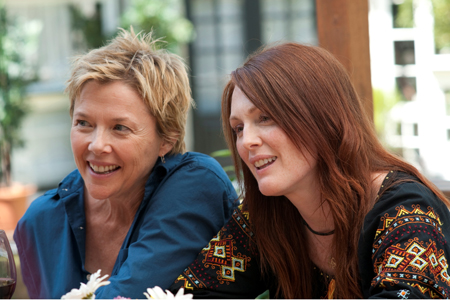
*The Kids Are All Right In many ways, The Kids Are All Right is a straightforward family dramedy: it’s about parents trying to do what’s best for their children and struggling to keep their relationship together. But it’s also a film in which Jules (Julianne Moore) goes down on Nic (Annette Bening) while they’re watching gay porn. Director Lisa Cholodenko (1998’s High Art) co-wrote the script (with Stuart Blumberg), and the film’s blend between mainstream and queer is part of what makes Kids such an important — not to mention enjoyable — film. Despite presenting issues that might be contentious to large portions of the country, the movie maintains an approachability that’s often lacking in queer cinema. Of course, being in the gay mecca of the Bay Area skews things significantly — most locals wouldn’t bat an eye at Kids, which has Nic and Jules’ children inviting their biological father ("the sperm donor," played by Mark Ruffalo) into their lives. But for those outside the liberal bubble, the idea of a nontraditional family might be more eye-opening. It’s not a message movie, but Kids may still change minds. And even if it doesn’t, the film is a success that works chiefly because it isn’t heavy-handed. It refuses to take itself too seriously. At its best, Kids is laugh-out-loud funny, handling the heaviest of issues with grace and humor. (1:47) Bridge, SF Center. (Peitzman)

*Knight and Day A Bourne-again Vanilla Sky (2001)? Considerably better than that embarrassingly silly stateside remake, though not quite as fulfilling as director James Mangold’s 3:10 to Yuma (2007) rework, this action caper played for yuks still isn’t the most original article in the cineplex. But coasting on the dazzling Cheshire grins of its stars, Tom Cruise and Cameron Diaz, reunited for the first time since Sky, you can just make out the birth of a beautiful new franchise. Everygirl June Havens (Diaz) is on her way to her sister’s wedding when she collides-cute at the airport with Roy Miller (Cruise). After killing the passengers and pilots on their plane, he literally sweeps her off her feet — thanks to some potent drugs. Picture a would-be Bond girl dragged against a spy-vs.-spy thriller semi-against-her-will — grappling with the subtextual anxiety rushing beneath all brief romantic encounters as well as some very justifiable survival fears. Can June overcome her trust issues? Is Roy the man of her dreams — or nightmares? Mangold and company miss a few opportunities to have more fun with those barely teased out ideas, and the polished, adult-yet-far-from-knowing charisma of the leads doesn’t quite live up to sophisticated interplay of Cary Grant and Grace Kelly, or even the down-home fun of Burt Reynolds and Sally Field, but it’s substantial enough for Knight and Day to coast on, for about 90 minutes tops. (2:10) 1000 Van Ness. (Chun)

The Last Airbender There must be some M. Night Shyamalan fans out there. How else does one explain the fact that he keeps making movies? And yet, most of his post-Sixth Sense (1999) work has ranged from forgettable to downright reviled. His latest disaster is sure to fall into the latter category: in The Last Airbender, he takes a much-loved Nickelodeon cartoon and transforms it into an awkwardly paced, poorly acted mess. Woefully miscast Noah Ringer stars as Aang, the avatar with the power to end the Fire Nation’s dominion. Along with his friends, siblings Sokka (Jackson Rathbone) and Katara (Nicola Peltz), Aang must — oh, just watch the damn show. For newcomers, the film is as confusing as Shyamalan’s equally self-indulgent Lady in the Water (2006). For fans of the TV show, The Last Airbender is nearly unbearable, condensing the entire first season into one film by removing the humor, the heart, and the complexity of the characters. There’s no twist here — we expect Shyamalan to disappoint, and he does. (1:34) 1000 Van Ness, SF Center, Sundance Kabuki. (Peitzman)

Micmacs An urge to baby-talk at the screen underlines what is wrong with Jean-Pierre Jeunet’s new film: it is like a precocious child all too aware how to work a room, reprising adorable past behaviors with pushy determination and no remaining spontaneity whatsoever. There will be cooing. There will be clucking. But there will also a few viewers rolling their eyes, thinking "This kid rides my last nerve." It’s easy to understand why Jeunet’s movies (including 2001’s Amélie) are so beloved, doubtless by many previously allergic to subtitles. (Of course, few filmmakers need dialogue less.) They are eye-candy, and brain-candy too: fantastical, hyper, exotic, appealing to the child within but with dark streaks, byzantine of plot yet requiring no close narrative attention at all. The artistry and craftsmanship are unmissable, no ingenious design or whimsical detail left unemphasized. In Micmacs, hero Bazil (Dany Boon) is a lovable misfit who lost his father to an Algerian landmine, then loses his own job and home when he’s brain-injured by a stray bullet. He falls in with a crazy coterie of lovable misfits who live underground, make wacky contraptions from junk, and each have their own special, not-quite-super "power." They help him wreak elaborate, fanciful revenge on the greedy arms manufacturers (André Dussollier, Nicolas Marié) behind his misfortunes, as well as various human rights-y global ones. So there’s a message here, couched in fun. But the effect is rather like a birthday clown begging funds for Darfur — or Robert Benigni’s dreaded Life is Beautiful (1997), good intentions coming off a bit hubristic, even distasteful. (1:44) Opera Plaza. (Harvey)

Predators Anyone who claims to be disappointed by Predators has clearly never seen parts one and two in the series; all three are straight B-movie affairs (though 1990’s Predator 2 takes everything oh-so-slightly over the top. Gary Busey’ll do that). And if you’ve seen either of the recent Predator-versus-Alien flicks, Predators should feel like a masterpiece. Nimród Antal directs under the banner of Robert Rodriguez’s production company, which explains the presence of Danny "Machete" Trejo in the cast. Adrien Brody stashes his Oscar in a safe place to star as Royce, a well-armed mercenary who awakes to find himself in free fall, plummeting into a strange jungle along with other elite-forces types (including Brazilian Alice Braga, playing an Israeli soldier). It doesn’t take long before Royce realizes that "this is a game preserve, and we’re the game." I wish Predators had allowed itself to have a little more fun with its uniquely skilled characters (the yakuza guy does have a nice, if culturally-stereotyped, swordplay scene); there’s also an underdeveloped "plot twist" involving the presence of the decidedly un-badass Topher Grace among the human prey. But all is forgiven when Laurence Fishburne turns up as Crazy Old Dude Who’s Been Hiding Out With Predators a Little Too Long. Fishburne’s presence also adds to the heart-of-darkness vibe the movie seems vaguely interested in conveying. (1:51) 1000 Van Ness. (Eddy)

*Restrepo Starting mid-’07, journalists-filmmakers Tim Hetherington and Sebastian Junger spent some 15 months off and on embedded with a U.S. Army platoon in Afghanistan’s Korengal Valley, a Taliban stronghold with steep, mountainous terrain that could hardly be more advantageous for snipers. Particularly once a second, even more isolated outpost is built, the soldiers’ days are fraught with tension, whether they’re ordered out into the open on a mission or staying put under frequent fire. Strictly vérité, with no political commentary overt or otherwise, the documentary could be (and has been) faulted for not having enough of a "narrative arc" — as if life often does, particularly under such extreme circumstances. But it’s harrowingly immediate (the filmmakers themselves often have to dive for cover) and revelatory as a glimpse not just of active warfare, but of the near-impossible challenges particular to foreign armed forces trying to make any kind of "progress" in Afghanistan. (1:33) Clay. (Harvey)

The Secret in Their Eyes (2:07) Opera Plaza, Red Vic.

*Stonewall Uprising On the night of June 28, 1969, police embarked on what they thought would be a routine raid on a gay bar in New York’s Greenwich Village, the sleazy, Mafia-run Stonewall Inn. The ensuing three days of rioting — during which mostly young men and drag queens accustomed to being marginalized and hauled off to jail stood their ground and fought back — became what historian Lillian Faderman has called "the shot heard round the world" for LGBT activism: a spontaneous expression of street-level outrage that fueled the birth of a movement. Kate Davis and David Heilbroner’s solid documentary Stonewall Uprising takes a "just the facts, ma’am" approach to this historic flashpoint that makes for an information-packed, if at times dry, 80 minutes. Working around the paucity of photographic documentation of the actual riots (itself a testament to the marginalization of homosexuality in the late 1960s), Davis and Heilbroner make extensive use of period news footage and photography, reenactments, and most important, the first-person testimonies of who those who witnessed and participated in what one interviewee terms "our Rosa Parks moment." The filmmakers’ contextual groundwork is as impressive for its archival research as it is repetitive in its message: pre-Stonewall life was hell. The documentary becomes more nuanced as it zeros in on reconstructing the first night of rioting via eyewitness accounts. (1:22) Lumiere. (Sussman)

Touching Home Hometown boys (Logan and Noah Miller) make good in this based-on-a-true-story tale of identical twins who must divide their time at home between training for major league baseball and looking after their alcoholic father. The brothers, who also wrote and directed the film, aim for David Gordon Green by way of Marin, but fall short of mastering that director’s knack for natural dialogue. Ed Harris is, unsurprisingly, compelling as the alcoholic father, but the actors in the film who are not named Ed Harris tend to contribute to the script’s distracting histrionics. Touching Home has some amazing NorCal cinematography, and I could see how family audiences might enjoy its "feel bad, then feel good" style of melodrama. But while it’s awkward to say that someone’s real-life experiences come off as trite, there are moments here that feel as clichéd as a Lifetime movie. (1:48) Smith Rafael. (Galvin)

*Toy Story 3 You’ve got a friend in Pixar. We all do. The animation studio just can’t seem to make a bad movie — even at its relative worst, a Pixar film is still worlds better than most of what Hollywood churns out. Luckily, Toy Story 3 is far from the worst: it’s actually one of Pixar’s most enjoyable and poignant films yet. Waiting 11 years after the release of Toy Story 2 was, in fact, a stroke of genius, in that it amplifies the nostalgia that runs through so many of the studio’s releases. The kids who were raised on Toy Story and its first sequel have now grown up, gone to college, and, presumably, abandoned their toys. For these twentysomethings, myself included, Toy Story 3 is a uniquely satisfying and heartbreaking experience. While the film itself may not be the instant classic that WALL-E (2008) was, it’s near flawless regardless of a viewer’s age. Warm, funny, and emotionally devastating—it’s Pixar as it should be. (1:49) Empire, Marina, 1000 Van Ness, Sundance Kabuki. (Peitzman)

The Twilight Saga: Eclipse The only person more bored by the Twilight franchise than I am is Kristen Stewart. In Eclipse, the third installment of the film series, she mopes her way through further adventures with creepily obsessive vampire Edward (Robert Pattinson). Look, you’re either sold on this star-crossed love story or you’re not, and it’s clear which camp I fall into. Besides, Eclipse is at least better than New Moon, the dreadful Twilight film that preceded it last year. But the story is still ponderous and predictable — Eclipse sets up a conflict and then quickly resolves it, just so it can spend more time on the Bella-Edward-Jacob love triangle. (As if we don’t know how that ends.) Then there’s the unfortunate anti-sex subtext: carnal relations are cast as dirty, wrong, and soul-destroying. I’m not saying we should be encouraging all teenagers to have sex, but that doesn’t mean we should make them feel ashamed of their desires. And what parent would approve of Eclipse‘s conclusion? Marrying your first boyfriend at 18 — not always the best move. (2:04) Empire, 1000 Van Ness, Sundance Kabuki. (Peitzman)

*Wild Grass The premise of Wild Grass, Alain Resnais’ loopy new film, could have come straight from Nancy Meyers: an older married man finds a single, middle-aged woman’s wallet. He returns it but can’t stop thinking about her. She, in turn, is intrigued by his attentions. Both are surprised by the connection they feel growing between them, one which they nevertheless have difficulty articulating. When they finally meet, sparks fly. That purloined wallet, along with the romcom set-up, aren’t the only MacGuffins in Resnais’ Wild ride, which uses Christian Gailly’s novel L’ Incindent as a rough guide for its careening tour of the irrational courses that desire can lead us down. The man and woman in question are Georges, an embittered writer with a possibly dark past, and flame-haired Marguerite, a dentist and part-time aviatrix, both played to neurotic perfection by longtime Resnais regulars André Dussollier and Sabine Azéma. Resnais’ attempt to translate what he has called the "musicality" of Gailly’s prose has resulted in a frenetic everything-but-the-kitchen-sink approach that tries to visually approximate Georges and Marguerites’ every internal monologue, fantasy, and increasingly risky instance of impulsive behavior, throwing in some knowing winks to classic Hollywood cinema for good measure. It’s a mess, to be sure (there are even two endings!). But like Mr. Magoo, the 87-year-old Resnais, as if by some unseen hand, steers clear of complete disaster. There hasn’t been a Gallic car crash this delightful to watch since Godard’s famous pile-up in 1967’s Week End. (1:44) Opera Plaza, Shattuck. (Sussman)

*Winter’s Bone Winter’s Bone has already won awards at the Berlin International Film Festival and the Sundance Film Festival, but it’s the kind of downbeat, low-key, quiet film that may elude larger audiences (and, as these things go, Oscar voters). Like Andrea Arnold’s recent Fish Tank, it tells the story of a teenage girl who draws on unlikely reserves of toughness to navigate an unstable family life amid less-than-ideal economic circumstances. And it’s also directed by a woman: Debra Granik, whose previous feature, 2004’s Down to the Bone, starred Vera Farmiga (2009’s Up in the Air) as a checkout clerk trying to balance two kids and a secret coke habit.

Drugs also figure into the plot of the harrowing Winter’s Bone, though its protagonist, Ree Dolly (Jennifer Lawrence), is faced with a different set of circumstances: her meth head father has jumped bail, leaving the family’s humble mountain home as collateral; the two kids at stake are her younger siblings. With no resources other than her own tenacity, Ree strikes out into her rural Missouri community, seeking information from relatives who clearly know where her father is — but ain’t sayin’ a word. It’s a journey fraught with menace, shot with an eye for near-documentary realism and an appreciation for slow-burn suspense; Lawrence anchors a solid cast with her own powerful performance. Who says American independent film is dead? (1:40) Embarcadero. (Eddy)

REP PICKS

*Beyond the Doors and Bigfoot This double bill in the middle of the Vortex Room’s conspiracy-focused schedule of Thursday screenings offers musings on some favorite 1970s subjects for paranoid speculation. "Our assignment: neutralize the three Pied Pipers of rock n’ roll music," recalls a government operative near the beginning of Larry Buchanan’s Beyond the Doors. Upset at Vietnam protests and drug culture, President Nixon hits on the logical solution: Jimi, Janis and Jim (Morrison) must die. Made in 1984, this late effort by Southern cheesebagger Buchanan followed three decades of such titles as Naughty Dallas (1964), Zontar: The Thing from Venus (1966), Mars Needs Women (1967), and The Loch Ness Horror (1981). Having achieved modest box-office success with his tabloid-tenored 1976 take on Marilyn Monroe, Goodbye Norma Jean, Buchanan applied the same delicate brushstrokes to this dramatized imagining of what really happened to acid rock’s martyred holy trinity. Actor "discoveries" Gregory Allen Chatman (Hendrix), Riba Meryl (Joplin), and Bryan Wolf (Morrison) were, not entirely surprisingly heard from again, though the various approximations of those musicians’ sounds could be worse. In the second half of the Vortex Room bill, John Carradine helps helps various bikers, rednecks, and cops investigate the abduction of underdressed white-meat babes which Bigfoot (or rather, several Bigfoots … or is that Bigfeet?) kidnaps to chain up in a cave so that they might squirm and scream in their bikini briefs. (The original ad line was "Breeds with anything.") Leading victim is 1950s starlet Joi Lansing, a Mormon-raised Monroe wannabe whose prior career highlights were a brief run on The Beverly Hillbillies, bits in studio features and leads in Z-grade films like the glorified ’67 country-music concert compendium Hillbillies in a Haunted House. This being a 1970 drive-in feature (by Robert F. Slatzer, who’d made the rather stupendously bad 1967 Hellcats), naturally a biker club rides to the eventual rescue, pitting one group of hairy primitives against another. Add Faster, Pussycat! Kill! Kill! (1965) star Haji, Elvis bodyguard Del "Sonny" West, some hoary Hollywood veterans, and lesser Mitchum family members, and you’ve got one weird time capsule. Thurs/15, 8 p.m., $5, Vortex Room, 1082 Howard, SF; www.myspace.com/thevortexroom. (Harvey)

Board votes on Candlestick-Shipyard project EIR appeal today

3

All images by Luke Thomas

The Chronicle’s suggestion that the city’s massive Candlestick-shipyard project may be facing smoother sailing seems like wishful thinking to those who attended a July 12 noontime rally that was organized by POWER (People Organized to Win Employment Rights) and featured two Louisiana-based advocates who protested the project’s EIR and shared many of the longstanding concerns about project cleanup, infrastructure and financing.

The Chronicle was of course referring to five amendments to the city’s massive redevelopment proposal that Board President David Chiu introduced during yesterday’s July 12 meeting of the Board’s Land Use committee. The Chron interpreted these amendments as a sign that Chiu plans to approve the project’s environmental impact report, which comes before the Board today, after several groups appealed the final EIR that the Planning Commission approved last month.

But while city officials fear the developer will walk, if the Board does not approve the final EIR, some environmental advocates hope a better plan could be reached.

At POWER’s July 12 rally, nationally acclaimed environmental scientist Wilma Subra called on the District Attorney’s environmental justice department to “step up.” Subra claimed that the project’s final EIR “failed to evaluate and assess the cumulative impacts of exposure to children, adults and the environment as a result of exposure to all of the chemicals at the site.”

Monique Harden, co-director and attorney for Advocates for Environmental Health Rights (AEHR) of New Orleans, Louisiana, pointed to “deep flaws in the environmental regulation system,” as a reason why low-income communities of color should be concerned about the proposed plan.
“Why in the middle of an environmental crisis caused by BP in the Gulf am I coming to San Francisco?” Harden asked. “Because San Francisco is providing unequal environmental protection to its residents. As a resident of New Orleans, I’m concerned that San Francisco is careening towards making a decision that can crush the future of Bayview Hunters Point,”

But as local Bayview resident Jose Luis Pavon began talking about seeing gentrification occur in his lifetime within San Francisco, he and others got shouted down by a group of yellow and green-shirted project supporters, who were led by a guy calling himself Bradley Bradley and Alice Griffith public housing resident Stormy Henry.
“This is the devil’s trick in the last hour,” Henry said of the POWER rally.

Henry shared her heartfelt belief that if the Board approves the project’s final EIR, she and other Alice Griffith residents will get desperately needed new housing units. even if it takes some years to build them. Others in her group were unable to answer media questions: they had difficulty speaking in English, but were clutching neatly written statements in support of the project that they later read aloud at the Board’s Land Use Committee hearing.

As these project supporters prepared to move inside to attend the Land Use Committee meeting and lobby supervisors for their suppor, D. 10 candidate Tony Kelly shared his concerns that the Navy has a demonstrated history of finding nasty things at the shipyard years after they say everything’s clean, and that this pattern could jeopardize the plan.

“This happened at Parcel A,” Kelly said, referring to the first and only parcel of land that the Navy transferred to the city for development in 2004. “Since then, Parcel A has gotten smaller and as they found stuff on sites they then renamed as new parcels, like UC-3, which has radiological contamination in a sewer line that goes into the Bayview. So, that means the contamination is now in the Bayview.”

Kelly is concerned that the city is trying push through EIR certification before the Navy completes an environmental impact statement (EIS) related to shipyard cleanup activities. “The EIS is supposed to go before the EIR, as far as I know,” Kelly said

At the Land Use Committee meeting, Sup. Sophie Maxwell, whose district includes Candlestick and the Shipyard,said, the project was about “revitalization and opportunity.”

She noted that the certification of the project’s final EIR has been appealed to full Board’s July 13 meeting. She further noted that she intends to introduce legislation next week to address concerns that Ohlone groups have expressed.

The next two hours were full of testimony from a bevy of city officials, beginning with Michael Cohen, Mayor Gavin Newsom’s top economic advisor in the Office of Workforce and Economic Development.

“Every single element [of this project] has been discussed and debated at countless meetings,” Cohen claimed, as he sought to quell fears that the community had not been properly consulted with over the plan. “As we get closer to a vote, all of a sudden pieces of paper start circulating, criticizing project and suggesting that community involvement just began,” he continued. ” That’s factually untrue.”

He also sought to reassure the supervisors that the Board will have a say-so as to whether the city accepts early transfer of shipyard parcels from the Navy.
“Neither the city nor the developer have any specific authority over the cleanup,” Cohen said, noting that the cleanup is governed by specific rules set out in CERCLA [Comprehensice Environmental Response, Compensation and Liability Act, aka Superfund].

“Regardless of what we do, CERCLA will continue to be the regulatory tool,” Cohen said. ” I urge you not to be confused by CEQA and CERCLA.”

So, how can the city implement Prop. P, which voters overwhelmingly supported in 2000, urging the Navy to clean up the shipyard to highest attainable standards.
“Prior to any transfer, US EPA and DTSR have to concur in writing that the shipyard is safe,” Cohen explained, noting that, thanks to Speaker of the House Nancy Pelosi, the Navy has already spent over $700 million on shipyard cleanup efforts.

“We have 250 artists at the shipyard….but not a shred of scientific evidence to say that the shipyard is not safe,” Cohen claimed. “It’s safe to develop the shipyard in precisely the manner we are proposing.”

When Sup. Eric Mar raised the question of radiological contamination on Parcel UC-3, Cohen downplayed Mar’s concerns.
“The exposure levels are lower than watching TV,” Cohen claimed. “The primary source is very low level radiation from glow-in-the-dark dials.”
Indicating a map that showed a network of old sewers (in blue) and old fuel lines (in red) under the entire development area, Cohen said, “The radiological contamination that has and will be addressed at the shipyard is quite low level. You have radiation, you get nervous. We asked EPA to come out and do a scan to deal with the issue.”

IBI Group’s David Thom, the lead architect and planner for the project said the plan is designed “to connect new development back into the Bayview.”
“And this plan connects the Bayview through to the water.”

Tiffany Bohee, Cohen’s deputy in the Mayor’s Office of Economic and Workforce Development, insisted that project’s proposed bridge is better than Arc Ecology’s proposed alternative route, which would not involve constructing a bridge over an environmentally sensitive slough.
“The non-bridge route increases the number of intersections,” Bohee said, seeking to turn an environmental question (the impact of bridge on wildlife and nature experience) into a public safety issue.”
She claimed the BRT route over bridge was 5-10 minutes faster than Arc’s proposed alternative, “because there are fewer turns, it can go at higher speeds.” But Arc’s studies suggest the BRT route over the bridge is only a minute faster, and would cost over $100 million.

Bohee noted that $50 million from the sale of 23 acres of parkland for condos at the Candlestick Point State Recreation Area (CPSRA) will be “set aside for the state, and won’t be able to be raided by the city,” with $40 million going to improvements, and $10 million to ongoing operation and maintenance costs.

She also cited additional benefits that the project would bring to the community, including thousands of construction job opportunities.

“We are working with City Build to make sure they are for local residents,” Bohee said.“And there is absolutely no displacement for the rebuild,” Bohee continued referring to proposal to place current Alice Griffith public housing iresidents n new units, on a 1-1 basis

Eric Mar said he was impressed by many elements of the plan, but continued to express reservations.
“I’m still concerned that is seems to serve newcomers as proposed to existing residents,” he said. “And I’m still not convinced that the bridge is the best for existing residents.”

Rhonda Simmons, who works in Cohen’s Office of Economic and Workforce Development,  tried to flesh out details of the project’s job creation promises.
“The most immediate workforce is related to the construction site, and as you know, this project goes over a 15-20 year span,” Simmons said, pointing to green tech and retail as job opportunities that will exist once the project is built.

Mar expressed concern that the jobs may not be at the level of D.10 residents
“How is this gonna bring their skill level up?” he asked.
“The idea is that training gives first level entry at a variety of building trades,” Simmons said, pointing to the project’s large solar component.

“What about women?” Sup. Maxwell asked
Simmons pointed to retail opportunities,
“The idea of the training is to give folks job readiness skills, like getting there and showing up on time,” she said

Mar wanted to know who would have oversight of monitoring and compliance.
“In the city we have a tapestry of folks who do contract compliance,” she said. “The oversight will come from a variety of places.”

After Kurt Fuchs of the Controller’s Office listed the estimated economic benefits of the project, Board President David Chiu observed that the city is “at a crossroads.”

“I do not plan to prejudge,” Chiu continued, as he introduced his five amendments to regulate the Parcel E-2 cleanup, the size of a proposed bridge over the Yosemite Slough, expand healthcare access in the Bayview, create a workforce development fund and lay the groundwork for bringing public power to the project.

During public comment, Bayview resident Fred Naranjo pleaded for project support.  

“Please don’t let the train leave the station,” Naranjo said. “If Lennar leaves, the Bayview will never be developed.”

And Tim Paulson, executive director of the San Francisco Labor Council expressed hope that an agreement was getting closer.
“There really is a path to getting this done,” Paulson said. “This really is a model project in many ways for the rest of the United States.”
But D. 10 resident Linda Shaffer with the Yerba Buena chapter of the California Native Plant society indicated the huge pressure exerted on folks to support the project
“I do not want to be classified as an opponent, but we have concerns,” Shaffer said, noting that her group has filed an appeal of the project’s final EIR.

And while the Sierra Club’s Arthur Feinstein thanked Chiu for proposing to reduce the size of the bridge, he pointed out that Chiu’s amendment wasn’t really a compromise.
“That’s because it’s still a bridge,” Feinstein said, as he explained how noisy the area surrounding the slough will become as traffic whizzes by.

Connie Ford of the Labor Council accused some project critics of being “disrespectful.”
Ford took particular issue with claims that the project will gentrify the area
“The neighborhood is changing,” she said. “Since 1990, African American families have been leaving the Bayview in huge numbers. I encourage you to see this project as a good plan.”

Gabe Metcalfe of SPUR expressed his unconditional support for the plan,
“This plan is being asked to fix a huge number of problems,” he said.
Noting that the bridge continues to be a sticking point, Metcalfe said he sees opposition to every transportation project these days.
“We seem to be in a moment when you can’t build anything without it being opposed.”

But other speakers from the Sierra Club reiterated their stance that there are better and viable options to the bridge, noting that it is too costly, and that the surrounding community and wildlife would be better off without it.”

All these competing viewpoints suggest that whatever decision the Board makes today, it will take some time and create plenty of uproar. So, here’s hoping the Board votes in a way that will truly benefit the D. 10 community, not career politicians, city officials and out-of-state developers. It’s about time.

Jumping jack flash

0

le.chicken.farmer@gmail.com

CHEAP EATS Rode my bike to my second favorite neighborhood, the Tenderloin. I was hoping to find the place where me and Sal the Porkchop ate crawfish and garlic noodles one night after watching dance, or something somewhat cultural, at any rate. I remember I was dressed a little dressier than usual and worried about squirting crawfish juice on my skirt.

After that my memory was erased — there’s a slight chance by space aliens. But it’s also possible that the crawfish were that spicy. That’s why I wanted to find the place. And will, another time.

This time I got distracted. Three lanes of oncoming traffic when you’re riding a bicycle the wrong way down a one-way street, such as Gough Street, will do that to you. I wish that didn’t seem like a metaphor for my life, but it does.

Because I do, ultimately, want to continue living it, I zipped over to the sidewalk and there was a bike rack. I started to lock up without even looking around first. I was on the other side of Market Street. Nothing else mattered.

Then, yes, I looked around.

With every intention of still going in search of crawfish afterward, I ducked into a place called Go Getters Deli, only the "o" was a green olive with a pimento in it. Plain block letters on the window advertised burgers and burritos, but that wasn’t why I chose the place.

I chose it because all six or seven of the people inside were sitting on the same side of their tables, facing the same direction, and looking upward. So I took that to mean there was a TV, with a soccer game on it.

And there was and there was, and so crawfish would have to wait.

But I couldn’t decide which idea I liked better: eating a burrito in a burger joint, or a burger in a taqueria. Since it was already almost half-time, I wouldn’t be able to do both. So, being predictable, I went with Plan C. Which, in this case, was a chicken sandwich with "flaming sauce," red onions, and tomatoes.

Flaming sauce = chipotle, and the sandwich was damn good. The bread tasted homemade, which seemed strange, unless they are in cahoots with Go Getters Pizza across the street and down a block. And, come to think of it, why wouldn’t they be? With a name like Go Getters Deli.

Well, the chipotle sauce wasn’t exactly "flaming." But that’s why I keep a bottle of hot sauce in my purse. With which … yum, yes, hot hot hot. And a lime Jarritos.

And an exciting half of World Cup soccer, and I forgot all about the crawfish place I had already forgotten about.

While the players were still hugging each other or else lying in the grass crying, taking off their shirts, and so on, I polished off my Jarritos, put on my sunglasses, smiled at my fellow sports fans, thanked the owners and kitchen and counter people (who had all come out to watch the end of the game), and walked into the doorjamb because I had my sunglasses on.

It was one of those days: on the edge between foggy and sunny. I buttoned up my jacket halfway, saddled my Schwinn, and huffed back to the Mission. Where some guy was doing jumping jacks on the sidewalk.

Normally I would have stopped and talked to such a someone, but he didn’t look quite crazy enough for me. He looked like a really fucking normal person, in fact, dressed in a regular way. Just happened to be doing jumping jacks on the sidewalk is all. Valencia Street. Facing a telephone pole.

And who am I to argue with that? I had a big scratch on my face. It looked like I’d been in a fight with a cat, or a catfight, but in fact (and as usual) the story was much less interesting. It starred a two-year-old, with a cracker. These things happen. Crackers are sharper than you think.

I mean, it was an accident.

I mean, physical fitness is important. *

GO GETTERS DELI

Mon.–Sat. 9 a.m.–8 p.m.; Sun. 9 a.m.–6 p.m.

100 Gough., S.F.

(415) 863-4149

D/MC/V

No alcohol

The good news for Jerry Brown

4

The press is all over the latest Field Poll, which shows Jerry Brown and Meg Whitman in a dead heat.  And it’s no surprise that, thanks to a campaign that thus far has been almost entirely negative, voters aren’t particularly thrilled with either candidate.


But I think there’s some good news for Jerry Brown here. Whitman has spent more than $90 million so far, and the voters like her less than they did six months ago. After all that money, some of which has gone for blistering attacks on Brown, Whitman is still not ahead. And it’s hard to see what she can do now to move the needle.


CallBuzz:


Moreover, it looks like the attack ads on Whitman by Brown’s labor allies — including California Working Families 2010 — have had their intended effect: to increase Whitman’s negatives and keep her from pulling away from Brown during the summer, before he can afford to put his own ads on TV.


Meanwhile, Brown’s favorability is only marginally changed from March. It’s 42-40% favorable today, compared to 41-37% favorable before. (Of course, Brown’s favorable was 50-25% back in March of 2009, but that was when he was just the new Attorney General and not a candidate for governor with rivals.)


At some point, Jerry’s got to start seriously campaigning, and he’s got a lot of work to do. He has to define himself to younger voters, who know a lot more about Ebay than about Brown’s tenure as governor, which was generally pretty good. He has to remind Latinos of how awful Whitman is on immigration. He’s got to spend some money.


But at this point, there’s hardly a voter in California (at least, not one with a TV set) who hasn’t seen multiple Whitman ads, defining her as a successful business person and attacking Brown as a failed politician. Those are powerful messages. The ads have been well produced, well targeted and should have been effective. And they haven’t gotten her over the halfway point yet — even against an opponent who is vulnerable to attack and hasn’t campaigned much at all.


Both candidates seem to be holding the party loyalists — the vast majority of the Republicans like Meg, the vast majority of the Democrats like Jerry. And there are more Democrats than Republicans. The independents aren’t breaking Meg’s way, either — she’s only slightly ahead, not enough to make up the difference.


Now if Brown can just get his people to care enough to go to the polls. …

Lisa Cholodenko on “The Kids Are All Right”

0

Writer-director Lisa Cholodenko earned attention with critically acclaimed features like High Art (1998) and Laurel Canyon (2002). Her latest movie, The Kids Are All Right, is a “personal film” about a lesbian couple raising teenagers. I spoke to Cholodenko about queer politics, explicit content, and keeping things lighthearted.

San Francisco Bay Guardian: Recently, there was a lot of controversy surrounding a Newsweek article, in which the author wrote about the difficulty of queer actors playing straight roles. I was wondering about your take on that, and on the opposite — straight actors playing queer roles. Is that something you even considered when casting?
 
Lisa Cholodenko: I’ll be honest, I was just told about this article and I didn’t read it. You know, I think it’s kind of weird thing to even discuss in a way, to me. Chiefly because I think actors’ personal lives — I just think people should have a private life, not that they should be in the closet, but that there should be a separation between professional life and personal life. And if a director feels like so-and-so, whether they’re gay or straight, would be good for a role, give them the role. What does it matter? As it turns out, I think gay people have more of an affect, whether they’re lesbians or gay men, that’s harder to camouflage in straight roles. Why that is, I mean, you could talk about that. I think it’s easier to go the other way. That’s just what it is. I say that without a value judgment. It is what it is.

SFBG: The Kids Are All Right has a same-sex relationship, of course, but it also has a fair amount of graphic sex and even a snippet of hardcore gay porn. Do you think it will shock a mainstream audience? Are they ready for it, and does that matter?

LC: I think it’s shocking in a sense that it’s portrayed in such a real way, that it’s not super arch, or it’s not like The L Word. This stuff has been on TV and in films. In a way, I’m not inventing the wheel at all. But I think the package that it’s coming in is going to be disarming to people. I think we tried and I think we were somewhat successful in making it so that you don’t realize exactly what you’re watching, the subversiveness of what you’re seeing. You can settle into watching it without that kind of discomfort of being super aware of, “This is something I’m not. I’m other and this is not my thing.” I think we figured out a way for people to enter it, and that was really important for us.

SFBG: I ask because I do feel like this shouldn’t be a big deal, that people should be able to handle it. And yet, the night before I saw your movie, I saw Sex and the City 2, in which there was a gay wedding. And as soon as the two men kissed, the camera cut away. There’s a lot of intimacy between Nic and Jules in the movie, so I was wondering particularly about that. Are people outside of San Francisco going to be apprehensive?

LC: Yeah. You know, I think we didn’t really know. I think we tried to write it and I tried to direct it in a way that the humor would be disarming enough, and the images themselves, if you really deconstruct it, would be tame enough. So it was more the suggestion of it. That would be the kind of twist. The people in the know would get it more than the people that were not in the know, maybe. I think we hoped that it would have a mainstream appeal to it, and that we could get beyond the people who would be apprehensive. There were questions about the gay porn and about how much sexuality we were showing, but we felt like, this is the fun of the film. It’s not going to be Spider-man 12 or something. It’s not going to be a multiplex film. But we hope it’s not going to be super rarefied art house film. So in terms of the Sex and the City thing, I think that they’re looking to go as wide as humanly possible, to every grandmother to every neck of whatever, so you can only take it so far.

SFBG: I want to touch on the humor that you mentioned, because I think it’s one of the movie’s real strong points. It’s so funny. What was your approach when you were co-writing to keeping the drama of the story but still making it fun?

LC: It was like a process, it was a real evolution. We had sort of a plot, a conceit for how the plot comes together, which was this thing about the kind of doofus friend wanting to watch the DVDs, and finding the porn, and blah, blah, blah, blah. So that all was funny, and then the kind of awkward conversation about trying to tiptoe around trying to figure out if their kid was gay, and that they would even care that the kid is gay, and how ironic that two gay moms are going to care that there kid is gay. And all that stuff. So it made us laugh, but there was a lot of other stuff in there that we took a lot more seriously and played a lot more seriously. I think as we went deeper into the drafts and moved along in the evolution of getting the film done, I really, really, really pushed for us to take whatever was potentially funny in there and just kick it up a notch. Stuart [Blumberg, who co-wrote the film] is a really funny guy — we have a similar sensibility. The same kind of stuff makes us laugh. So we knew if we were sitting there writing it and laughing, it was good. We had kind of gotten there.

SFBG: I think a lot of the humor comes from the fact that the film is so real and grounded. You have Laser, a 15-year-old boy, who talks like a 15-year-old boy, and that’s something we don’t always see in movies. And so it’s not stereotypical or preachy—it feels more organic than that.

LC: Yeah, we were really passionate about making it not politically correct and not sanctimonious and not super earnest and just hoping that there would be heart in it, simply because these were sympathetic and three-dimensional characters in a difficult situation.

SFBG: I wanted to ask about the character of Nic [played by Annette Bening], who could have been played very typically butch, because she has a masculine name and short hair and these traditionally “male” qualities. In terms of the writing and the directing, how did you make sure there was more complexity there?

LC: You know, I think that wasn’t super overdetermined. It’s really just kind of my worldview. I don’t live in a world where people are super stratified. I don’t feel like my partner and I are super — I kind of see the butch and femme in every lesbian I know. I know that there are lesbians who really kind of identify with that, and that’s there thing in the world, and that’s good. But it’s a personal film, so it’s written from my worldview. So there’s that, and then there’s also, you get Annette Bening and you get Julianne Moore, and they come with their own essence and personality. Julianne Moore has some butch in her and Annette Bening has some femme in her. They are who they are.

SFBG: There’s a great conversation early on in the film about the spectrum of sexuality and how it’s not so easily defined, which ties into Jules sleeping with a man. Were you concerned about an audience’s reaction to a lesbian having sex with a straight guy?

LC: I mean, it was a concern for me, but I felt like, you know what, oh well. I might be nailing the coffin. It might just be a bad choice. But in essence, the whole plot of the film revolves around that, so it was either, ditch the film or run with it and try to make it feel earned and interesting and viable and what not. In the early drafts I would show people — and when I started getting feedback in the early drafts, and “This is good,” I stopped being so uptight about that and just let myself kind of take it to the next place.

SFBG: It wasn’t an issue for me, but I think for a lot of people, they expect more rigid definitions. We don’t see a lot of queer characters on screen, and so when we do, many want them to be perfect: the queer voice, the lesbian, the gay man. And when they step outside those boundaries, suddenly it becomes an issue, politically.

LC: The calculated thing was that, I thought, a) I identify with this. This is something that I feel like, that makes sense to me. That makes sense to people I know. That makes sense to whatever. So it didn’t feel like some weird kind of conceit that I came up with that was like, that never happens. All lesbians are rigidly this and don’t go over that boundary. Because we know that’s not true. So there was that, and then I thought, I like this set-up and I like this plot, and also I feel like, it’s kind of an interesting intermingling of straight and gay. I felt like, if I really want this to be a mainstream film, that’s good. This is really inclusive of gay and straight, and I like that. I like that personally and I like that for this film. I was much more interested in reaching out to the male population than I was concerned about alienating a sector of the lesbian population.

SFBG: I wanted to talk about the title, The Kids Are All Right, and that focus on the children. How did the title come about? How do you feel about the role the kids play, and why is that central to the film?

LC: The film is about, you know, these women and their experience making a family. The family. The man who comes in and wants to be part of the family. Really when you’re talking about the family, it’s about the life of the kids. So it’s sort of an ironic title, in the sense that the kids are kind of doing better than the moms, in a way. And it’s also a kind of a wink to the notion that gay people can’t raise healthy, psychologically healthy children. Like, the kids are fine. Don’t worry about them. They’re just right.

SFBG: You talked a bit about what Annette Bening and Julianne Moore brought to the film, but I was wondering if you could elaborate on casting.

LC: Julianne was someone I had probably 10 years ago, just at some function somewhere. We had spoken about wanting to work together at some point. She was a fan of the first film that I made, High Art, and I was always a fan of hers, particularly in Boogie Nights (1997). So when Stuart and I wrote this, we asked ourselves several times, could Julianne play this part or that part? We were sort of on the fence. We thought she could play either part. So I sent it to her and I said, “Which part would you like to play?” And she picked Jules. Which, we weren’t surprised. We knew she’d want to play that part, but I thought I’d offer her the other one if she wanted it. And that was great.

Then finding her counterpart, the Nic character, was more difficult. It was kind of vexing. I just didn’t know what actor in that age group who had great acting chops, who was funny and dramatic and sexy, could be a good match for her. But when I stumbled on the idea of Annette Bening, I kind of got rabid about it. OK, this is it, this is the only person who can do it. So come hell or high water, she’s gonna do it.

SFBG: And then in terms of the younger actors — you don’t always see teenagers who actually look like teenagers.

LC: Well, they’re pretty close to the ages they’re supposed to play. Mia [Wasikowska] was like 19 at the time, and Josh [Hutcherson] was maybe 16, going on 17. So they were pretty close. Mia was someone that I had seen on an HBO series called In Treatment and thought she was interesting. I liked that she was Australian, not a typical American young actor, from LA or New York and wouldn’t have that baggage or affect that you might find in a lot of young actors from here. And he — I didn’t know his work, but I knew that he had done a lot of work. I was told he was an up-and-coming actor, so I was open to meeting him as well as other people, but when he came in and did the scene, it was just one of those things where you go like, “Oh, yeah.” I thought maybe Laser would be more of a Paul Dano-type kid, a little bit more twee, but when I saw him, I thought, oh, that’s good. He should be more boyish and more kind of robust, and just like a dude. I like that.

SFBG: There’s a lot of subtlety in The Kids Are All Right. I liked Nic’s drinking, which was fairly underplayed but came up several times. What was the thought process behind that? Does she have a drinking problem, or is that just the manifestation of the turmoil going on in her family?

LC: I think we felt like, oh, you know what? She’s kind of borderline. She’s a little bit of a lush. She’s kind of leaning on the wine too much, and this has become a thing and the other partner is now noticing. She’s drinking too much and she’s a stress case and she’s not dealing with it very well. She doesn’t have a good off valve. I think we tried to design it in a way that it felt like, this is something that’s coming to a head in their relationship. One partner’s seeing a behavior that’s making her concerned and the other one doesn’t want to deal with it yet, and she’s boozing it up.

SFBG: It’s also interesting because it’s easy to label Nic the control freak. But here’s Nic, who can’t control her drinking, and Jules, the free spirit, trying to get her to keep it in line.

LC: Right, right, right. Well, I felt like everybody has their ironies and contradictions and stuff. It’s endemic, I think, in all long-term relationships.

SFBG: There was another relationship that interested me, which was the relationship between Paul [Mark Ruffalo] and Tanya [Yaya DaCosta]. I was wondering if it was significant that it was an interracial relationship. In the sense that, 40 years ago, audiences might have been shocked by an interracial relationship, but now it plays naturally — and hopefully, the same will be true of same-sex relationships. Was that intentional, or am I reading into things too much?

LC: You know, I think it wasn’t totally consciously mediated, but at a certain point when I was thinking about casting, I had Erykah Badu in my mind for that role. I felt like, who’s the kind of person who Paul would be with? It seems like he’s the kind of guy who would be running after the most exotic person. That character to me was sort of gorgeous and exotic and whatever. And then, to go from that to Jules, who is totally exotic in her own way, because she’s who she is and she’s older and she’s beautiful and she’s a lesbian. It was this kind of motif of like, what’s exotic? The Tanya character, the black character, is clearly in love with him and would be devoted to him in a heartbeat. And the white character, who’s a lesbian and completely inaccessible, is not available at all.

I guess the second part to that question is, at a certain point when we were putting this together was, it’s not only that, in terms of the psychology of the character, but I think this is good to mix it up. You know, he’s screwing this black woman, and OK, compare that to the lesbians watching gay male porn. This is what people do in life. It’s not just white people and straight people. It’s mixed up.

The Kids Are All Right opens Fri/9 in San Francisco.

Our Weekly Picks: July 7-13, 2010

0

WEDNESDAY 7

EVENT

The Butterfly Mosque reading

Journalist and author G. Willow Wilson is familiar to comics fans for her Vertigo-published modern fantasy series Air and graphic novel Cairo, both with artist M.K. Perker, as well as her work on various superhero properties. A woman in mainstream comics is unusual enough, but Wilson is also a Muslim. Her new prose memoir, The Butterfly Mosque: A Young American Woman’s Journey to Love and Islam, treats the experiences that led her from her home in Denver through Boston University to time spent teaching in Cairo. Much of her comics work deals with the collision of the West with the Middle East, often in fictionalized political contexts, and this reading and Q & A should include plenty of her uniquely positioned insights on this cultural dynamic. (Sam Stander)

7:30 p.m., free

Booksmith

1644 Haight, SF

(415) 863-8688

www.booksmith.com


DANCE

The Foundry

When words fail, a turn of a cheek or small shift in stance can signify a world of meaning. Choreographer, dancer, and director of the Foundry Alex Ketley is hyperconscious of the subtle secrets our bodies both hide and reveal. This consciousness allows him to deconstruct and reconstruct movement in such a way as to capture the emotional unknown that lies beyond words. Enlisting a cast of captivating dancers and former Ballet Frankfurt media artist Les Stuck, Ketley’s newest project, Please Love Me, explores how we relate to others and investigates the contradictory nature of love and relationships. (Katie Gaydos)

8 p.m., $20

Z Space at Theater Artaud

450 Florida, SF

www.conservatoryofdance.org


THURSDAY 8

FILM

Mulholland Dr.

Lucid dreams, fever dreams, wet dreams — what’s the difference in Mulholland Dr., David Lynch’s 2001 apocalyptic vision of Hollywood? Above all else, the film is a love story doomed from the very start as Rita (Laura Herring) stumbles out of a car wreck and into the arms of Betty (Naomi Watts, in a performance somewhere between Pollyanna and Patty Hearst). What follows is a Pandora’s box — and Rita’s got the key to a blue one of those you definitely shouldn’t open — of Bergmanesque female trouble, and some surrealist hell to boot: the jitterbug, Roy Orbison, and bite-size geriatrics, to name a few. In every dread-drenched scene, Lynch has our undivided attention even when we have no idea what the hell is going on. (Ryan Lattanzio)

2 and 7 p.m., $7.50–$10

Castro Theatre

429 Castro, SF

(415) 621-6120

www.castrotheatre.com


COMEDY

David Alan Grier

Although he got his start in acting by tackling serious roles and earning a master’s at the Yale School of Drama, David Alan Grier got his first taste of mainstream exposure and success as a cast member on the classic 1990s TV show In Living Color, where he brought to life hilarious characters such as Antoine from “Men on Film” and the crazy blues singer Calhoun Tubbs. In the years since, Grier has lent his considerable talents to several other projects, more recently Comedy Central’s show Chocolate News and his 2009 book Barack Like Me: The Chocolate Covered Truth. Here’s your chance to check out Grier live, uncensored, raw, and on stage. (Sean McCourt)

Through Sun/11

8 p.m. (also Fri/9-Sat/10, 10:15 p.m.)

$22.50–$23.50

Cobb’s Comedy Club

915 Columbus, SF

(415) 928-4320

www.cobbscomedyclub.com


EVENT

Cybernet Expo

It would seem like a no-brainer, filling a webmaster job at an adult Internet company. Geeks love porn, right? True as that may be, they still need a conference to link them up to the pervy, techie job of their dreams. Never fear, Cybernet Expo is here! The trade show has been linking sticky palms since 1997, and offers seminars, panel discussions, networking opportunities — and a convention-closing get down among the chains and whips of the SF Armory. “Oh yeah, it’s gonna be a fun party,” says Terry Mundell, business development manager of Kink.com, who will be organizing Saturday night’s after hours good times. Even better than a night on his website? (Caitlin Donohue)

Through Sat/10, $199

Golden Gateway Hotel (most events)

1500 Van Ness, SF

www.cybernetexpo.com


FRIDAY 9

DANCE

“Symbiosis: A Celebration of Dance and Music”

Kara Davis seems to be able to do it all. A trained ballet dancer, she has danced for the last 14 years with who’s who of modern dance in San Francisco. No matter the style and the challenge, she eats it up. Now she is also developing a strong, independent voice as a choreographer for her project agora company. This program, presented as part of Dance Mission Theater’s “Down and Dirty Series,” is half dance and half music. It reprises Davis’ two substantial ensemble pieces, A Softened Law and one Tuesday afternoon, first seen at ODC in December, and the gorgeous 2006 duet, Exit Wound, choreographed for herself and Nol Simonse. Exit‘s music was written by Sarah Jo Zaharako, whose Gojogo quartet, in the evening’s second half, will play more of Zaharako’s compositions. The lineup culminates in a premiere, Symbiosis, which features — no surprise here — Davis as a solo dancer. (Rita Felciano)

Through Sun/11

8 p.m., $20

Dance Mission Theater

3316 24th St., SF

www.dancemission.com


EVENT

Pantheon

The Temple is Burning Man’s sacred space. And this year, the Temple of Flux is really something special, among other reasons for its massive collaboration of various Bay Area tribes to build the biggest and most unusual and ambitious temple in the event’s long history (something I know from embedding myself with the project for an upcoming Guardian cover story). But to pull this off, the Temple crew has embarked on an equally aggressive and unprecedented fundraising campaign, the centerpiece of which is Pantheon, featuring Elite Force, Soul of Man, 21 of SF’s best DJs, transformative décor, and a slew of sexy gods and goddesses roaming the temple grounds. So don a toga or other Greek or Roman attire and join this bacchanalian celebration. (Steven T. Jones)

9 p.m.–5 a.m., $20–$25

103 Harriett, SF

www.pantheonsf.eventbrite.com

www.temple2010.org


SATURDAY 10

VISUAL ART

“Alien/ation”

A showcase of illustrators whose work has appeared in Hyphen magazine, “Alien/ation: An Illustration Show” will open at SPACE Gallery in SF with DJ sets by B-Haul and Gordon Gartrell and live painting from participating artists, in what is billed as “an art riot extravaganza.” Currently on its 20th issue, Hyphen is a San Francisco-based publication focusing on Asian American culture, and the crossover of its featured art into a gallery setting is a welcome development. Magazine illustration is generally frequented by talented cartoonists and fine artists, and the artists featured here are excellent and stylistically diverse enough to keep things interesting. Particularly exciting is the inclusion of oddball cartoonist Rob Sato, lush illustrator Kim Herbst, and distinctive portraitist Jon Stich. (Stander)

7 p.m. (artists’ reception, 5:30 p.m.), $5

SPACE Gallery

1141 Polk, SF

(415) 377-3325

www.spacegallerysf.com


SUNDAY 11

MUSIC

“Simcha! The Jewish Music Festival’s 25th Anniversary Party”

Rabbi Nachman, a 14th century Chassidic scholar, counted in his teachings the importance of displaying simcha (Hebrew for joy), like, all day every day so that you could effectively carry out God’s commandments. The translation for all you pagan sinners remains salient: you gotta be loose to enjoy the flow. Take simcha as your mantra when you head to the Jewish Music Festival’s 25th anniversary party, where tunes from Glenn Hartman and the Klezmer Playboys, the Red Hot Chacklas, Eprhyme, and oh so much more will trip happily through the Yerba Buena Gardens. Duck next door to the Yerba Buena Center for the Arts Sculpture Court (Third Street at Mission) to check out Jewlia Eisenberg and Charming Hostess’ “The Bowls Project: Secrets of the Apocalyptic Intimate,” an odd blending of sustainable architecture, the domestic sacred, and haunting evocations of secrets held and shared. (Donohue)

Noon–5 p.m., free

Yerba Buena Gardens

Mission at Fourth St., SF

(510) 848-0237, ext. 119

www.jewishmusicfestival.org


MUSIC

Gipsy Kings

It might seem ridiculous to argue that the Gipsy Kings are underrated, but bear with me. Sure, they’ve sold millions and millions of albums worldwide, and sure, they contributed a key cut to the iconic Big Lebowski (1998) soundtrack (their music is also featured in Toy Story 3). Despite this, or perhaps because of it, they still don’t seem to get much respect. The Gipsy Kings aren’t anyone’s favorite band. People rarely argue about the extent of their cultural influence or whether they’re “important.” This is a shame, really, because their covers reveal an unexpectedly sly, parodic impulse, while their standard flamenco tracks are actually relatively innovative in their merging of traditional Spanish dance with more modern pop influences. (Zach Ritter)

8 p.m., $85

Fillmore

1805 Geary, SF

(415) 346-3000

www.thefillmore.com


MUSIC

Weed Diamond

Though Weed Diamond hails from Denver, its conspicuous name alone suggests a sentiment we San Franciscans can relate to. Despite an insistently lo-fi, reverb-soaked gamut — like putting a beautiful indie rock seashell to the ears — these guys aren’t afraid of an infectious chorus. They also aren’t afraid of paying due respect to their influences, especially in the trippy shoegaze and heavy-on-the-feedback noise pop elements. Now on tour with Dash Jacket and Tan Dollar, Weed Diamond evolved from the solo project of Tim Perry to a full five-piece band and has since played SXSW and up and down the West. It’s like a psychoactive bonbon: delicious yet intoxicating. (Lattanzio)

With Tan Dollar and Dash Jacket

4 p.m., free

Milk Bar

1840 Haight, SF

www.milksf.com


MONDAY 12


PERFORMANCE

“What’s Cookin’ With Josh Kornbluth”

Monday special at the Contemporary Jewish Museum café: Josh Kornbluth on wry. Popular monologist Kornbluth, fresh from his latest solo flight, Andy Warhol: Good For the Jews?, is once again hanging out on the border of fine art and cultural critique, only this time there’s matzo ball soup and a Cobb salad option. It’s also more interactive. From noon to 2 p.m. (each Monday over the next five weeks) Kornbluth will be offering conversation to museum patrons bold or clueless enough to enter his well-appointed lair. It’s as simple as that. But then, if you know Kornbluth, nothing is ever that simple. (Robert Avila)

Through Aug. 9

Mondays, noon-2 p.m., free (museum admission not included)

Contemporary Jewish Museum

736 Mission, SF

(415) 655-7800

www.thecjm.org 

The Guardian listings deadline is two weeks prior to our Wednesday publication date. To submit an item for consideration, please include the title of the event, a brief description of the event, date and time, venue name, street address (listing cross streets only isn’t sufficient), city, telephone number readers can call for more information, telephone number for media, and admission costs. Send information to Listings, the Guardian Building, 135 Mississippi St., SF, CA 94107; fax to (415) 487-2506; or e-mail (paste press release into e-mail body — no text attachments, please) to listings@sfbg.com. We cannot guarantee the return of photos, but enclosing an SASE helps. Digital photos may be submitted in jpeg format; the image must be at least 240 dpi and four inches by six inches in size. We regret we cannot accept listings over the phone.

Ariel, part 2: Think Pink!

0

MUSIC Ladies and gentlemen, meet the real Ariel Pink.

The Los Angeles musician’s first few 2004-06 releases on Animal Collective’s Paw Tracks label were the stuff of indie water cooler infamy, but they also collected recordings (2002’s House Arrest and Lover Boy; 2003’s Worn Copy) that Pink had made years before. It wasn’t until early 2009 that the world had the chance to hear any new output from the notoriously mysterious musician.

Until then, the talk about Pink largely focused on how serious he was — or wasn’t. Built from lengthy experimentation and goofy gimmicks, such as drum noises made with his armpits, his lo-fi music wasn’t just a byproduct of bedroom recording, it was a reimagining of 1970s and ’80s radio jingles and easy listening sounds. Jingles are disposable by definition, yet anyone familiar with some from the ’70s has to admit they are designed to remain in your brain. They were touchstones for the young Pink, and through a love for them, he picked up a knack for great hooks and memorable choruses.

Catchy though they may be, the repetitive nature of Pink’s early songs nonetheless made some listeners wonder whether he was just monkeying about and marketing lo-fi weirdness to those with nostalgic impulses. A sweeping ballad that might mark a poignant moment in a Sunday night made-for-TV tearjerker, “For Kate I Wait” is one of the best songs from his 2004 debut The Doldrums (Paw Tracks). But the damn thing does not need to be over four minutes long, considering it consists of a single idea: sentences that rhyme with the title.

On Pink’s new album Before Today (4AD), he takes the leap to a larger label, drops a lot of the lo-fi scuzz and delivers smoothly succinct pop songs. The lo-fi isn’t gone completely, but it is refined. And while his vocals remain muddy and hidden behind other sounds, half the fun is guessing just what he’s going on about. You can’t take the weird out of a man, and Pink has spent too many years purposely being strange for Before Today to suddenly strip him of all idiosyncrasy. Keen-eared listeners will pick out stream-of-consciousness mutterings like “Make me maternal, fertile woman/Make me menstrual, menopause man/Rape me, castrate me, make me gay/Lady, I’m a lady from today” on “Menopause Man,” and while the tongue-in-cheek imagery conveys to listeners that Pink is still in on his own joke, the album really shines when he manages to play it straight.

The cover art for Before Today’s chief single “Round and Round” may sport a lovingly drawn image of a man french-kissing a dog, but the track itself is so masterfully clean and structured that it transcends homage, becoming one of the year’s best songs. The gifted flair for a sound and a hook that made Pink’s early works so catchy is still there, but he switches up tempo and groove so many times that the composition never outstays its welcome despite its five-minute length. Likewise, “Can’t Hear My Eyes” is easy-listening heaven, with echoed vocals and sharp piano flourishes that recall the Alan Parsons Project’s more radio-friendly fare, like “I Wouldn’t Wanna Be Like You.” These particular songs stand out for their devotion to time and place, but all of Before Today is a sprawling run through the dollar bin at Amoeba Music, and Pink makes it his own by picking apart the best bits and reimagining 2010 as it might have been if Fleetwood Mac and Cherry Coke still ran the radio.

Pink is often casually tossed in the freak-folk category of knowing eccentrics, alongside the likes of Devendra Banhart and Joanna Newsom. Both Banhart and Newsom have recently taken a more classic approach to their respective crafts — to great success — while remaining true to their unique personalities. It’s likely that the freak-folk tag’s death and in turn these artist’s survival resides in the realization that weirdness doesn’t have to define you as an artist. Mark down 2010 as the year Pink decided to take his turn at bat, cutting the shit and showing the world Ariel Pink cooks with fire.

Quick Lit: July 7-July 13

0

Literary readings, book tours, and talks this week

“RADAR Reading Series”, “Why there are words,” naked ladies, the poetics of resistance,  Alison Arngrim, “Monthly Rumpus”, and more.

Wednesday, July 7 

A Poetics of Resistance
Author Jeff Conant will read and discuss his new book, A Poetics of Resistance: The Revolutionary Public Relations of the Zapatista Insurgency, an engaging study for organizers to understand how to develop their messages of bottom-up revolution.
7 p.m., free
Modern Times Bookstore
888 Valencia, SF
www.mtbs.com

Breast Strokes
Authors Cathy Edgett  and Jane Flint present their inspiring story about two friends who help each other through the diagnosis of breast cancer.
7 p.m., free
Books Inc. Berkeley
1760 4th St., Berk.
(510) 525-7777


Intergenerational Writers Lab

A unique literary workshop for emerging writers featuring readings and performances by Lorna Dee Cervantes, Ben Fong-Torres, Leticia Hernandez, Genny Lim, and the 2010 IWL participants: C. Adán Cabrera, Emilie Coulson, Lyndsey Ellis, Marisa Gedney, Bill Gong, Meldy Hernandez, Nancy Larson, Page McBee, Ruby Rain and Natalia Vigil.
7 p.m., $5-$20 sliding scale
Intersection for the Arts
446 Valencia, SF
www.theintersection.org

“RADAR Reading Series”
Attend this showcase of underground and emerging artists and writers featuring Ryka Aoki de la Cruz, Diane di Prima, Mica Sigourney, and Tony Tulathimutte. Hosted by Michelle Tea.
6 p.m., free
San Francisco Pubic Library
Main Branch
100 Larkin, SF
www.radarproductions.org

Thursday, July 8

California Rocks
Join Katherine Baylor for a reading and discussion of her new book, California Rocks: A Guide to Geologic Sites in the Golden State.
6 p.m., free
University Press Books
2430 Bancroft, Berk.
(510) 548-0585

Flood Earth
Species extinction expert Peter Ward describes what the world will look like in 2050 and beyond.
Books Inc. Marina
2251 Chestnut, SF
(415) 931-3633

Sometimes Too Hot the Eye of Heaven Shines
Attend this reading and release party for Ryka Aoki’s new book, with readings by Ali Liebegott, Jusin Chin, and Ryka Aoki.
7 p.m., free
Modern Times Bookstore
888 Valencia, SF
www.mtbs.com

To Have Not
Author Frances Lefkowitz shares and reflects on her own life of poverty.
7 p.m., free
Books Inc. Berkeley
1760 4th St., Berk.
(510) 525-7777

Unlikely Allies
Author Joel Richard Paul weaves together a fascinating account of three people who, each for his own reasons, connived, betrayed, and spied to help win the revolution for the Americas.
6 p.m., $12
Mechanics’ Institute
57 Post, SF
(415) 393-0100

“Why There Are Words”
This installment of the “Why There Are Words” literary series asks authors to weigh in on what the word “accident” means to them. Featuring Elissa Bassist, editor and essayist from The Rumpus, Glen David Gold, author of the bestselling novel Carter Beats the Devil, Joshua Mohr, author of the novel Some Things that Meant the World to Me, Anne Raeff, author of Two Serious Ladies and Clara Mondschein’s Melancholia, Jason Roberts, author of A Sense of the World: How a Blind Man Became History’s Greatest Traveler, and Tatjana Soli, author of The Lotus Eaters.
7 p.m., $5
Studio 333
333 Caledonia, Sausalito
(415) 331-8272

Friday, July 9

“Poets and Writers on the Depression Era”
Part of LaborFest 2010, hear poets and writers speak on the struggle of working people to survive in this desperate world.
7 p.m., free
Kaleidoscope Gallery
3104 24th St., SF
www.laborfest.net

Saturday, July 10

The Butterfly Mosque
Hear the first American Muslim woman to become a professional comic book writer, G. Willow Wilson, discuss her new book, The Butterfly Mosque: A Young Woman’s Journey to Love and Islam.
6 p.m., $7
ICCNC
1433 Madison, Oakl.
(510) 219-2431

Confessions of a Prairie Bitch
Star of the hit TV show Little House on the Prairie, author Alison Arngrim presents her comic memoir of growing up as one of television’s most memorable characters.
3 p.m., free
Borders
400 Post, SF
(415) 399-1633

Sunday, July 11

Last Dog on the Hill
At this benefit for Hopalong rescue, author Steve Duno presents his new book.
6 p.m., free
Books Inc. Berkeley
1760 4th St., Berk.
(510) 525-7777

“Naked Girls Reading”
Get tips, advice and how-to’s from a naked girl at this latest installment of the “Naked Girls Reading” series featuring Carol Queen, Dottie Lux, Lady Monster, Isis Starr, Kimberlee Cline and Hollie Stevens providing their favorite words of advice.
7 p.m., $15-$20
Center for Sex and Culture
1519 Mission, SF
www.nakedgirlsreading.net

Monday, July 12

Awaken Your Strongest Self
Author Neil Fiore talks about his four-step program for breaking self-destructive habits, increasing productivity, and performing at your best.
7 p.m., free
Books Inc. Berkeley
1760 4th St., Berk.
(510) 525-7777

“Monthly Rumpus”
Enjoy this reading with authors Justine Sharrock, Matt Stewart, Eli Horowitz, Mac Barnett, Lauren Wheeler, and Matthew L. Mosely featuring a performance by Richard Porter, music by Ember Shrag, and comedy by Janine Brito. There will also be food, raffles, and more.
7 p.m., $10
Make-Out Room
3225 22nd St., SF
www.therumpus.net

Presumed Dead
Crime reporter for the San Francisco Chronicle and author Henry Lee discussed his new book titled, Presumed Dead: A True Life Murder Mystery.
7:30 p.m., free
The Booksmith
1644 Haight, SF
(415) 863-8688

Tuesday, July 13

An Intimate Ecology
Author Julia Whitty talks about her new book filled with gripping adventure, cutting-edge science, and an intimate understanding of our deep blue home.
7 p.m., free
Books Inc. Berkeley
1760 4th St., Berk.
(510) 525-7777

Golden Gate
Librarian, professor and author Kevin Starr discusses his new book titled, Golden Gate: The Life and Times of America’s Greatest Bridge.
7 p.m., free
BookShop West Portal
80 West Portal, SF
(415) 564-8080

Stage listings

0

Stage listings are compiled by Guardian staff. Performance times may change; call venues to confirm. Reviewers are Robert Avila, Rita Felciano, and Nicole Gluckstern. Submit items for the listings at listings@sfbg.com.

THEATER

OPENING

Cindy Goldfield & Scrumbly Koldewyn in Cowardly Things New Conservatory Theatre Center, 25 Van Ness; 861-8972, www.nctsf.org. $20-28. Previews Thurs/8, 8pm. Opens Fri/9, 8pm. Runs Thurs-Sat, 8pm. Through July 31. Cindy Goldfield and Scrumbly Koldewyn in a tribute to Noel Coward.

Comedy Ballet The Garage, 975 Howard; (800) 838-3006, www.brownpapertickets.com. $15-25. Opens Fri/9, 8pm. Runs Thurs-Sat, 8pm, Sun, 3pm. Through July 18. Dark Porch Theatre presents an outlandish and unusual dance and theater hybrid.

Dead Certain Royce Gallery, 2901 Mariposa; (866) 811-4111. $12-28. Previews Thurs/8-Fri/9, 8pm. Opens Sat/10, 8pm. Runs Thurs-Sat, 8pm. Through August 14. Expression Productions presents a psychological thriller by Marcus Lloyd.

Foresight Fort Mason Southside Theater, Building D; www.fortmason.org. $22-27. Opens Fri/9, 8pm. RunsFri-Sat, 8pm; Sun, 2 and 8pm. Through July 18. Easily Distracted Theatre presents a new play by Bay Area filmmaker Ruben Grijalva.

Gilligan’s Island: Live on Stage! The Garage, 975 Howard; (800) 838-3006, www.brownpapertickets.com. $15-20. Opens Sun/11 8pm. Runs Sun, 8pm. Through August 29. Moore Theatre and SAFEhouse for the Performing Arts brings the TV show to the stage, lovey.

The 91 Owl African American Arts Cultural Complex, 762 Fulton; 574-8908, www.brownpapertickets.com. $10-25. Previews Thurs/8, 8pm. Opens Fri/9 8pm. Runs nightly 8pm. Through July 22. A production of Bernard Norris’s play about the life of a San Francisco bus stop.

Piaf: Love Conquers All Eureka Theatre, 215 Jackson; (800) 838-3006, www.brownpapertickets.com. $25-36. Previews Wed/7-Thurs/8, 8pm. Opens Fri/9 8pm. Runs Tues-Fri, 8pm; Sat, 2 and 8pm. Through August 7. Tone Poet Productions brings a portrait of Edith Piaf to the stage.

"San Francisco Olympians Festival" Exist Stage Left, 156 Eddy; www.sfolympians.com $10.

BAY AREA

Mrs. Warren’s Profession Bruns Ampitheatre, 100 California Theatre Shakespeare Way, Orinda; (510) 548-9666, www.calshakes.org. $34-70. California Shakespeare Theater presents George Bernard Shaw’s classic morality play.


ongoing

Abigail: The Salem Witch Trials Temple SF, 540 Howard; www.templesf.com. $10. Thurs/8, 29, Aug 5, 12, 19, 26, 9pm. Through Aug 26. Buzz Productions, with Skycastle Music and Lunar Eclipse Records, presents an original rock opera based on the Salem witch trials.

Beijing, California Thick House Theater, 1695 18th St; www.asianamericantheater.org. $15-25. Thurs-Sat, 8pm; Sun, 5pm. Through July 17. Asian American Theater Company presents a new play by Paul Heller set in the year 2050, when China invades America.

*Blackbird: Honoring a Century of Pansy Divas Mama Calizo’s Voice Factory, 1519 Mission; 786-9325, www.evezen.org. Thurs-Sat, 8pm. Through Sat/10. The intimate Blackbird Funeral Parlour Speakeasy is somber-toned and deceptively hushed, complete with period furnishings, a see-through dressing room, softly flickering altar, and obligatory piano. Only a few moments into Seth Eisen’s exceptional one-man cabaret, however, and the place is alive and kicking: doleful aspects of the décor making ample room for a sly, vigorous, soulful performer and a completely unexpected journey through some vibrant underground queer history (backed by fellow Circo Zero alum Sean Feit’s sharp musical direction and breezy accompaniment, and Alanna Simone’s gently humorous and haunting video pieces). Your guide is 100-year-old Jean Marlin, author of the notorious 1930s Pansy Craze, 75 years dead and looking fabulous in tails, bold green cravat, dapper purple hankie and a topping of regal black plumage (costumer Jack Davis demonstrates a genius throughout for turning a shoestring budget into a G-string–supported extravaganza). A multifaceted performer with quick tongue, nimble steps, and hearty voice (giving life to an assortment of extraordinary songs), Eisen uses drag, dance, puppetry, and performance art techniques to give flight to worthy exotic blackbirds known and forgotten—drag queen Zen priest Tommy Issan Dorsey; sexually ambiguous Danny Kaye; Brazil’s inimitable Ney Matogrosso; the definitely outré Klaus Nomi; and disco treasure Sylvester, whose live rendition of the Beatles’ "Blackbird" at SF’s War Memorial Opera House is one of several standout moments in this rollicking and poignant act of resurrection, insurrection, and homage. (Avila)

"Durang Me!" Next Stage, 1620 Gough; 1-800-838-3006, www.custommade.org. $10-28. Thurs-Sat, 8pm. Through Sat/10. Christopher Durang’s The Actor’s Nightmare could just as easily be called The Accountant’s Nightmare, as befuddled Everyman and presumed non-actor George Spelvin (Eric O’ Kelly) attempts to navigate his way out of a confused rendition of Noel Coward’s "Private Lives" dressed as Prince Hamlet and menaced by a trashcan-bearing Beckett-arian (AJ Davenport). This traditional companion piece to Durang’s Catholic School send-up Sister Mary Ignatius Explains It All for You references a Catholic boyhood several times, but it is the anxiety of the present moment that prevails, as the stage clears, and Spelvin is chased into a corner by an unforgiving spotlight to deliver his frantic last-ditch attempt at a soliloquy: his ABC’s. The titular Sister Mary Ignatius (AJ Davenport), by turns arctic and expansive, attempts to explain all, while periodically trotting out her star pupil Thomas (Cole Cloud) to recite catechism and spell eck-u-men-ickle for cookies. Davenport plays the pedantic side of Sister Mary with humorous vigor, but when a group of her former students drop by "to embarrass her" she doesn’t quite pull off embodying the ogress of their now-adult nightmares. Of her former students, it is probably Aloysius Benheim (Eric O’Kelly) who comes across as the most damaged by her tyranny, and not coincidentally, suffers the piece’s greatest humiliation. (Nicole Gluckstern)

How the Other Half Loves Phoenix Theatre, 414 Mason; (800) 838-3006, www.offbroadwaywest.org. $35, Thurs-Sat, 8pm. Through July 31. In Alan Ayckbourn’s 1971 comedy, a night of infidelity propels two colliding couples into menacing a third, a pair of innocents unwittingly drawn into the whole affair as alibis. The collisions are made all the more kinetic by the fact that Ayckbourn cheekily drops the two principal couples into overlapping living rooms, where they continually brush by each other in ironic obliviousness. At the outset of this droll two-act, Fiona Foster (a smart, cucumber-cool Sylvia Kratins) has just slept with Bob Phillips (a brilliantly sourpussed James Darbyshire), junior colleague of her husband Frank (Jeff Garrett, exuding the animated splendor of the full-on English twit), on the night of the couple’s wedding anniversary (pure coincidence for the forgetful, loveless Fiona). In loose coordination with lover Bob, Fiona explains her late night absence with reference to a pair of vague acquaintances, the Featherstones (Jocelyn Stringer and Adam D. Simpson). Bob does the same with Teresa (a spunky Corinne Proctor), his homebound wife and a new, deeply disgruntled young mother. Naturally, back-to-back dinner parties with said alibis ensue, much to the horror and chagrin of the adulterers. Off Broadway West Theatre Company’s production, smoothly helmed by Richard Harder, makes the most of the complex staging as both time and space collapse over intersecting dining tables. If the play is slow to catch fire, it reaches a nice sustained peak that proves worth the going. Shaky accents from Garrett and especially Simpson can distract at times, but Harder’s cast is generally solid and engaging, with particularly enjoyable work from Darbyshire and Proctor as the volatile younger Phillips with their crass bickering, canned erotic energy, and barely countenanced off-stage baby. (Avila)

The New Century New Conservatory Theatre Center, 25 Van Ness, SF; 861-8972, www.nctcsf.org. $22-40. Wed-Sat, 8pm; Sun/11, 2pm. Through Sun/11. New Conservatory Theatre Center performs Paul Rudnick’s bill of short comedies.

Peter Pan Threesixty Theater, Ferry Park (on Embarcadero across from the Ferry Bldg); www.peterpantheshow.com. $30-125. Tues and Thurs, 7pm; Fri-Sat, 7:30pm (also Sat, 2pm); Wed, 2pm; Sun, 1 and 5pm. Through August 29. JM Barrie’s tale is performed in a specially-built 360-degree CGI theater.

Posibilidad, or Death of the Worker Dolores Park and other sites; 285-1717, www.sfmt.org. Free. Sat-Sun, 2pm; also Sept 6, 2pm; Sept 17, 8pm. The San Francisco Mime Troupe opens its 51st season with a modern song and tango about politics in the workplace.

Reading My Dad’s Porn and French Kissing the Dog The Marsh Studio Theater, 1074 Valencia; (800) 838-3006, www.themarsh.org. Thurs-Sat, 8pm. Through July 17. The title of San Francisco writer-performer Cherry Zonkowski’s confessional solo show gives only a little away—a passing detail from the Nordic diversions of a spirited army brat and daughter of an alcoholic father—but the rest of the narrative leaves even less to the imagination. An account of Zonkowski’s initiation into the sex party and BDSM scene, Reading My Dad’s Porn bounces gleefully between comically graphic depictions of sweaty, writhing Bay Area meet-and-greets and a childhood and young adulthood buried in family dysfunction, a loveless marriage, and the grueling teaching load of a recent English PhD. Ultimately, it’s the story of a woman finding her own identity and community, and if the outlines sound familiar they also feel that way. The straightforward plot—peppered with humorous details and asides (as well as the odd song, accompanied by accordionist Salane Schultz, alternating nights with Aaron Seeman)—lacks both urgency and characters of much complexity. The story’s patina of outré sex, meanwhile, is far from revelatory and too superficial and jokey to offer much dramatic heft. Nevertheless, the show, developed with director David Ford, draws a limited appeal from the force of Zonkowski’s extroverted personality, whose orientation sexual and otherwise skews toward fun—although her more aggressive attempts to corral the audience into participating (mainly vocally) in the show’s narrative high jinx may put some off even more than the fisting by the snack table. (Avila)

What Mama Said About Down There Our Little Theater, 287 Ellis; 820-3250, www.theatrebayarea.org. $15-25. Thurs-Sun, 8pm. Through August 28. Writer-performer-activist Sia Amma presents this largely political, a bit clinical, inherently sexual, and utterly unforgettable performance piece.

Young Frankenstein Golden Gate Theatre, 1 Taylor; 551-2000, www.shnsf.com. $30-99. Thurs-Sat, 8pm; Sun, 2pm, also Tues/13, July 20, 8pm; Wed/7, July 24, 21, 2 and 8pm. Through July 25.

For all its outlandish showmanship, Mel Brooks’s other movie-turned-musical is not quite as grand a beast as The Producers . Still, the adventures of Victor Frankenstein’s reputation-conscious grandson, Frederick Frankenstein—played with exceeding charm and surgeon-like skill by major cut-up Roger Bart, originator of the role on Broadway—remains a monster of a show, in more ways than one. The rapid-fire repartee, for starters, is scarily deft, the comic timing among a first-rate cast all but flawless (even when milking a line shamelessly), the fancy footwork (choreographed by director Susan Stroman) pretty fancy, and the mise en scène holds some attractive surprises as well. At the same time, and despite the fecund humor revolving around questions of size and virility, the show’s actual two-and-a-half-hour length proves a bit wearying, especially as many of the best jokes (though by no means all) are the much-loved and universally much-repeated gags from the film. Moreover, Brooks’s songs, while very able, rarely rise to memorable and sometimes feel perfunctory or a bit busy. One of the glorious exceptions is the blind hermit scene (played brilliantly by Brad Oscar), which combines the hilariously plaintive song "Please Send Me Someone" with a lovingly faithful rendition of the original spoof for a sequence that literally smokes. (Avila)


BAY AREA

*East 14th: True Tales of a Reluctant Player Marsh Berkeley, 2120 Allston, Berk; www.themarsh.org. $20-50. July 24, 31, 8pm; July 18, 25, Aug 1, 7pm; Fri/9, 16, 9pm. Through August 1. Don Reed’s solo play, making its Oakland debut after an acclaimed New York run, is truly a welcome homecoming twice over. (Avila)

Left of Oz Ashby Stage, 1901 Ashby, Berk; (800) 838-3006, www.brownpapertickets.com. $25-50. Fri-Sat, 8pm, Sun, 7pm. Through July 18. Stephanie’s Playhouse presents a lez-queer musical comedy following the out west adventures of Dorothy.

Les Liasons Dangereuses Redwood Ampitheatre, 30 Sir Francis Drake, Ross; (415) 251-1027, www.porchlight.net. $15-30. Thurs-Sat, 7:30pm; also Wed/7, 7:30pm. Through Sat/10. Porchlight Theatre Company presents a production of Christopher Hampton’s adaptation of the 1782 novel.

Loveland The Marsh Berkeley, 2120 Allston, Berk; (800) 838-3006, www.themarsh.org. $25-50. Fri/9, 7pm; Sun/11, 2pm. Through July 11. Ann Randolph’s comic solo show about an irreverent woman’s trip back to her childhood home in Ohio.

Shaker Chair Pear Avenue Theatre, 1220 Pear Avenue, Mtn View; (800) 838-3006, www.brownpapertickets.com. $15-30. Thurs-Sat, 8pm; Sun, 2pm (also Sat/10, 2pm). Through July 11. Pear Avenue Theatre presents Adam Bock’s play about a middle-aged widow who applies Shaker philosophy to her lifestyle.

Speech & Debate Aurora Theatre, 2081 Addison, Berk; www.auroratheatre.org. $34-55. Wed-Sat, 8pm; Sun, 2pm, 7pm; Tues, 7pm. Through July 18. Aurora Theatre closes its 18th season with Stephen Karam’s comedy about three teen misfits connected to a small town sex scandal.


PERFORMANCE/DANCE

BATS Improv Theatre Bayfront Theater, Fort Mason Center, B350 Fort Mason; 474-6776, www.improv.org. Fri-Sat, 8pm. Through July 31. Bay Area Theatresports presents an evening of theater and comedy.
The Bowls Project: Secrets of the Apocalyptic Intimate Yerba Buena Center for the Arts, Sculpture Court, 701 Mission; 978-2787, www.ybca.org. Tues/6, 6-8pm, free. Through August 22. Charming Hostess presents a series of performances in conjunction with an interactive sound sculpture.
Liz Grant Variety Pack Comedy Show Purple Onion, 140 Columbus; 200-8781, www.brownpapertickets.com. Fri, 4:30pm. Through Sept 3. $10. A changing lineup of stand up comedy.
"San Francisco Olympians Festival" Exit Stage Left, 156 Eddy; www.sfolympians.com Fri/9-Sat/10, 8pm, $10. A series of one=act perfomances by No Nude Men Productions.

On the cheap listings

0

On the Cheap listings are compiled by Paula Connelly. Submit items for the listings at listings@sfbg.com.

WEDNESDAY 7

“Misspelled” Robert Berman/E6 Gallery, 1632 Market, SF; (415) 558-9975. 7pm, free. Attend the opening reception for Victor Reyes’ public art installation turned gallery exhibition that explores Reyes’ unique approach to graffiti, by dissecting individual letters and exposing the anatomy and architecture found in the symbols we use to communicate. Inspired by San Francisco’s streets, these alphabets recontextualize abandoned city surfaces to raise questions about how we interpret these spaces and the content within them.

FRIDAY 9

Japanese Superheroes Viz Cinema, New People, 1746 Post, SF; (415) 525-8600. 7pm, $10. Join hosts Patrick Macias, August Ragone, and Tomohiro Machiyama for a new talk in the TokyoScope Talk Series about the fascinating history and origins of Japanese superheroes featuring rare film clips and images from numerous tokusatsu, sentai, and henshin hero productions including Ultra Seven, Kikaida, Space Sheriff Gavan, and more.

BAY AREA

Juggling and Unicycling Festival Berkeley High School, Jacket Gym, 1980 Allston, Berk.; www.berkeleyjuggling.org/festival. Fri. 3pm-Midnight, Sat. 9am-Midnight, Sun. 9am-5pm; free. Vaudeville style variety show Sat. 7:30pm, $15. Meet and watch some of the best jugglers and unicyclists on the West Coast and learn some tricks of the trade for all skill levels at juggling, unicycle, and circus arts workshops.

SATURDAY 10

Art Riot Space Gallery, 1141 Polk, SF; www.hyphenmagazine.com. 7pm; $5, or $15 including a one year subscription to Hyphen Magazine. Featuring an exhibit by illustrators and painters from across the country, live painting, music by DJs B-Haul and Gordon Gartrell, and vegan cupcakes by Black Orchid Bakery. Featured artists include Danny Neece, Eve Skyler, Jon Stich, Jorge Mascarenhas, and more.

“Borders” Root Division, 3175 17th St., SF; (415) 863-7668?. 7pm, free. This exhibit about lines and how we cross them will feature work by artists from 9 different states, representing 9 different ethnicities, that explores how we define and interact with the borders that surround us. Mediums to include interactive sculpture, video, photography, installation, performance, and new media.

Hayes Valley Community Picnic Patricia’s Green Park, Hayes at Octavia, SF; RSVP at (415) 240-2433. 1pm, free. Join members of your community for a picnic brought to you by the Dean Clark Store, where revelers will share food, soft drinks, play games, and exchange gifts.

Strike Reenactment Hyde Street Pier, Jefferson at Hyde, SF; www.laborfest.net. Noon and 3pm, free. See a live reenactment of the 1901 San Francisco Waterfront strike, when sailors, teamsters, and longshoremen went on strike for better pay and working conditions. Hear speeches and join the march to implore ships’ crews to join the ranks. Part of the 2010 LaborFest.

Summer Freedom School St. Francis Lutheran Church, 152 Church, SF; (415) 703-0465. Saturdays through Aug. 14; 10am, free. This six week seminar on the Civil Rights Movement (aka the Southern Freedom Movement) serves as a case study for how social movements happen and a tool for getting ready for the next one. Mornings will feature guest speakers, short films and discussions, followed by a pot luck lunch, and an afternoon portion of discussions and activities. For more information visit www.educationanddemocracy.org.

A Voice for Justice in Honduras Mission Cultural Center for Latino Arts Theater, 2868 Mission, SF; 415-643-5001. 7pm, donations encouraged. Hear Karla Lara sing from the classic “Nueva Trova” repertoire with added themes of love, motherhood, and human rights. Lara and other musicians formed Artists in Resistance, a group that performs to maintain an open public opposition to the de facto governments of Roberto Micheletti and Porfirio Lobo, which repress media and democracy. Proceeds benefit Artists in Resistencia in Honduras.

BAY AREA

Treasure Island Triathlon 533 California, Treasure Island, San Francisco Bay; www.tricalifornia.com. 5k-10k Run Race, Sat. 7am-Noon; Olympic Distance Triathlon, Sat. 7:30am-5pm; Sprint Distance Triathlon, Sun. 7am-Noon; Sports Expo, Sat. 7am-3pm, Sun. 7am-Noon. All events free for spectators. Enjoy views from the scenic looped course as you watch athletes compete, including 50 contestants from past seasons of the TV series The Biggest Losers. A Sports Expo will be going on all weekend featuring the latest triathlon gear, athlete services and food vendors.

SUNDAY 11

Big Umbrella Open Studios Big Umbrella Studios, 906.5 Divisadero, SF; (415) 359-9211. 3:30pm; free, suggested donation for use of supplies. Join Big Umbrella artists in art making, art being, or art gazing at this participatory workshop for adults and children. Bring supplies, found objects, and works in progress. Art making supplies will also be available. Collaboration encouraged.

Jewish Music Festival Party Yerba Buena Gardens, Mission at 3rd. St., SF; (510) 848-0237 ext. 119. Noon, free. Celebrate the 25th Anniversary of the Jewish Music Festival at this picnic and party featuring performances, instrumental jams, a parade, and an instrument petting zoo for all ages. Instruments encouraged. Artists to include Eprhyme, Glenn Hartman and the Klezmer Playboys, Peter Jacques, Elana Jagoda, and more.

World Cup Finals Civic Center Plaza, Polk between McAllister and Grove, SF; (415) 831-2782. 11:30 a.m., free. Join fellow San Francisco soccer fans for a big screen broadcast of the World Cup finals featuring soccer-related activities for youth, food vendors, and valet bike parking. No glass bottles or alcohol permitted.

MONDAY 12

“What’s Cookin’ with Josh Kornbluth” Contemporary Jewish Museum Café, 736 Mission, SF; (415) 655-7800. Noon, free. Liven up your Mondays with an interactive improvised lunch performance by monologist Josh Kornbluth, who will entertain and engage you with lively lunchtime banter all summer long. Every Monday through August 30.


Film listings

0

Film listings are edited by Cheryl Eddy. Reviewers are Kimberly Chun, Michelle Devereaux, Max Goldberg, Dennis Harvey, Johnny Ray Huston, Erik Morse, Louis Peitzman, Lynn Rapoport, Ben Richardson, and Matt Sussman. For rep house showtimes, see Rep Clock. For first-run showtimes, see Movie Guide. Due to the July 4 holiday, theater information was incomplete at presstime.

ANOTHER HOLE IN THE HEAD

The seventh Another Hole in the Head Film Festival runs July 8-29 at the Roxie, 3117 16th St, SF; and Viz Cinema, New People, 1746 Post, SF. For tickets (most shows $11), visit www.sfindie.com. For commentary, see Trash and http://www.sfbg.com/pixel_vision

THURS/8

Roxie Death Kappa 5. Mutant Girls Squad 7. A Serbian Film 9.

FRI/9

Roxie Samurai Princess 5. Symbol 7. RoboGeisha 9. Tucker and Dale vs. Evil 11.

SAT/10

Roxie Satan Hates You 5. A Serbian Film 7. Vampire Girl vs. Frankenstein Girl 9. The Exterminator 11.

SUN/11

Roxie Nightmares in Red, White, and Blue 5. The Violent Kind 7. Yatterman 9.

MON/12

Roxie Sexy Time Trip Ninjas 5. Samurai Princess 7. Nightmares in Red, White, and Blue 9.

TUES/13

Roxie Satan Hates You 5. Silent Night, Zombie Night 7. Yatterman 9.

OPENING

Beetle Queen Conquers Tokyo Opening with the humid buzz of crickets and the probings of bug aficionados in the thick of a forest, first-time documentarian Jessica Oreck puts Japan’s fascination with insects under the microscope. Preferring to let the images and interview subjects speak for themselves, she turns a lens to young children who clamor to buy sleek, shiny, obsidian beetles, as well as the giant big city gatherings of insect collectors — events that likely are less than familiar to western audiences. Oreck’s intent is to get at the ineffable attraction behind such astonishing sales as that of a single beetle for $90,000 not so long ago, and to that end, she weaves in looks at insect literature and art, visits to Buddhist temples, and historical factoids about, for instance, the first cricket-selling business in the early 1800s. (1:30) Elmwood, Sundance Kabuki. (Chun)

*Daddy Longlegs Purportedly based on their own growing-up experiences, Ben and Joshua Safdie’s feature does for the terminally immature Manhattan reluctant father what Roger Dodger (2002) did for the terminally predatory heterosexual Manhattan bachelor: provide gruesome shaky-cam dissection of a dad dreadful by any common moral standard, yet who is more pathetic and oddly ingratiating than loathsome. The two weeks Lenny (Ronald Bronstein) is charged with caring for his two unruly young sons (Sage Ranaldo, Frey Ranaldo) by a pointedly estranged, vacationing ex-spouse provide enough evidence for a hundred angry divorce proceedings. While a friend is behaving inappropriately with the kids, Lenny goes into the bathroom to smoke a doob; when he’s got a babysitting work conflict, he sedates them into a near-coma. Yet at the same time he’s also a really fun, loving dad — just one lacking all conventional instincts for appropriate behavior. On the one hand this is a parental horror film, on the other a touching and delicate portrait of someone who would very much like to be a good dad but is congenitally doomed as fuckup. Both hands say: this is rather wonderful, ultimately very poignant movie. (1:40) Roxie. (Harvey)

Despicable Me The ad campaign for this film is completely impenetrable, is it not? Apparently it’s a 3-D animated comedy about a guy plotting to steal the moon, with some sentimental stuff thrown as a bonus. (1:35)

*The Girl Who Played With Fire Lisbeth Salander is cooler than you are. The heroine of Stieg Larsson’s bestselling book series is fierce, mysterious, and utterly captivating: in the movie adaptations, she’s perfectly realized by Noomi Rapace, who has the power to transform Lisbeth from literary hero to film icon. Rapace first impressed audiences in The Girl With the Dragon Tattoo (2009), a faithful adaptation of Larsson’s premiere novel, and she returns as Lisbeth in The Girl Who Played With Fire. The sequel, as is often the case, isn’t quite on par with the original, but it’s still a page-to-screen success. And while the first film spent equal time on journalist Mikael Blomkvist (Michael Nyqvist), The Girl Who Played With Fire is almost entirely Lisbeth’s story. Sure, there’s more to the movie than the hacker-turned-sleuth — and the actor who plays her — but she carries the film. Rapace is Lisbeth; Lisbeth is Rapace. I’d watch both in anything. (2:09) Smith Rafael. (Peitzman)

Grease Sing-A-Long Snore. Where’s the sing-a-long love for Grease 2 (1982)? “Cool Rider” forever! (1:50)

John Rabe John Rabe (Ulrich Tukur) was the Oskar Schindler of Nanking: A man who, under discreetly opportunist pretenses, attempted to keep the Chinese in a safety zone from the Japanese in the late 30s. Steve Buscemi plays Robert Wilson, a surly American doctor. He’s to Tukur as Ben Kingsley was to Liam Neeson in 1993’s Schindler’s List, but without the nuance or iconic chemistry. Tukur is understated, bordering on uninteresting, and Buscemi is just over-the-top. Unlike Spielberg’s film, John Rabe grants us little access to the stories of civilians. The film is so preoccupied with people of power and those like Rabe, couched in a world of privilege, that the film lacks an emotional, human center. It’s impossible to feel much of anything because we’re never asked to feel, nor are we ever asked to endure any especially difficult scenes. Even the occasional rain of hellfire isn’t as wallop-packing as it ought to be. (2:14) Elmwood, Presidio. (Ryan Lattanzio)

*The Kids Are All Right See “We Are Family.” (1:47) SF Center.

Predators The hunt-happy creatures take a break from fighting the Aliens to terrorize a surprisingly highbrow cast, including Adrien Brody and Laurence Fishburne (but not, alas, Chris Hansen). (runtime not available)

*Stonewall Uprising See “Riot Awakening.” (1:22)

*Wild Grass The premise of Wild Grass, Alain Resnais’ loopy new film, could have come straight from Nancy Meyers: an older married man finds a single, middle-aged woman’s wallet. He returns it but can’t stop thinking about her. She, in turn, is intrigued by his attentions. Both are surprised by the connection they feel growing between them, one which they nevertheless have difficulty articulating. When they finally meet, sparks fly. That purloined wallet, along with the romcom set-up, aren’t the only MacGuffins in Resnais’ Wild ride, which uses Christian Gailly’s novel L’ Incindent as a rough guide for its careening tour of the irrational courses that desire can lead us down. The man and woman in question are Georges, an embittered writer with a possibly dark past, and flame-haired Marguerite, a dentist and part-time aviatrix, both played to neurotic perfection by longtime Resnais regulars André Dussollier and Sabine Azéma. Resnais’ attempt to translate what he has called the “musicality” of Gailly’s prose has resulted in a frenetic everything-but-the-kitchen-sink approach that tries to visually approximate Georges and Marguerites’ every internal monologue, fantasy, and increasingly risky instance of impulsive behavior, throwing in some knowing winks to classic Hollywood cinema for good measure. It’s a mess, to be sure (there are even two endings!). But like Mr. Magoo, the 87-year-old Resnais, as if by some unseen hand, steers clear of complete disaster. There hasn’t been a Gallic car crash this delightful to watch since Godard’s famous pile-up in 1967’s Week End. (1:44) Clay, Shattuck. (Sussman)

ONGOING

The A-Team Why was the original A-Team the most popular band of mercenaries on TV? The estimable chemistry and comedic skills of Mr. T; legit Breakfast at Tiffany‘s star George Peppard; conservative commentator Dwight Schultz; and Dirk Benedict, fresh from his role as the original Starbuck on Battlestar Galactica, played a major part, as did the quasi-anti-authoritarian, boyish, blow-’em-up-real-good tone, making it more of a cartoonishly violent kin to MASH than First Blood (1982). The cheeky humor and snappy writing were the real key to The A-Team‘s popularity — the reason impressionable protein units like yours truly tuned in. Director Joe Carnahan (2006’s Smokin’ Aces) and cast seem to have sussed out a bit of that magic, especially when the sun-roasted Bradley Cooper as Faceman and Sharlto Copley as Murdock roll with the what-the-hell non-sequiturs (less sure is the star of last year’s District 9‘s grip on exactly what accent he’s been charged with). But the cinematic version won’t be rehabbing the public’s view of guns-for-hire like Blackwater anytime soon. Liam Neeson lacks the cigar-chomping paternal bravado of Peppard, Quinton “Rampage” Jackson is tasked with the unenviable job of following T time, and the script, complete with the ludicrously elaborate plans and a spark-challenged romance between Cooper and Jessica Biel, is just a rough excuse to watch boys and their toys. (1:57) (Chun)

*Babies Thomas Balmes’ camera records the first year in the lives of four infants in vastly different circumstances. They’re respectively born to hip young couple in Tokyo’s high-tech clutter; familiar moderately alterna-types (the father is director Frazer Bradshaw of last year’s excellent indie drama Everything Strange and New) in SF’s Mission District; a yurt-dwelling family isolated in the vast Mongolian tundra; and a Namibian village so maternally focused that adult menfolk seem to have been banished. Yes, on one level this is the cutest li’l documentary you ever saw. But if you were planning to avoid thinking that is all (or most) of what Babies would be like, you will miss out big time. Void of explanatory titles, voice-over narration, or subtitle translations, this is a purely observatory piece that reveals just how fascinating the business of being a baby is. There’s very little predictable pooping, wailing, or coddling. Instead, Balmes’ wonderful eye captures absorbing moments of sussing things out, decision-making, and skill learning. While the First World tykes firstborns both — are hauled off to (way) pre-school classes, the much less day planned Third Worlders have more complex, unmediated dealings with community. Those range from fending off devilish older siblings to Mongol Bayarjargal’s startlingly casual consorting with large furry livestock. (Imagine the horror of parents you know were their baby found surrounded by massive cows — a situation that here causes no concern whatsoever for adults, children, or bovines.) So accustomed to the camera that it doesn’t influence their behavior, the subjects here are viewed with an intimacy that continually surprises. Babies is getting a wider-than-usual release for a documentary, one cannily timed to coincide with Mother’s Day. But don’t be fooled: this movie is actually very cool. (1:19) Smith Rafael. (Harvey)

*Coco Chanel and Igor Stravinsky Revered for the innovative fashion house that set the bar for style and was always knocked off but never cut prices for the real deal (and still sniffs at online clothing sales), Gabrielle “Coco” Chanel gets her second biopic, as an artist on par with composer Igor Stravinsky in this rhapsodically sensuous love letter to an unlikely romance. It opens with the designer and future branding legend (depicted with burning eyes and pantherine mystery by Anna Mouglalis) attending the controversial, riot-starting 1913 premiere of Stravinsky’s The Rite of Spring in Paris. Recognizing Stravinsky (a viral avant-garde stud-muffin in the hands of Mads Mikkelsen, last in deadlocks and warrior face in Clash of the Titans) as a simpatico radical spirit, Chanel lends her house to the composer. He comes with considerable baggage: a slew of children and a consumptive wife, Katarina (Elena Morozova). Morozova’s performance as the angel-faced earth mother scorned, so blatantly disrespected by the rad lovers madly getting down on the music-room carpet, almost steals the show, but then the house-porn fabulosity of the recreated Chanel villa in Garches — a symbol of their hermetic attraction and shot like a seductive, claustrophobic, black-and-white deco womb — takes over, and we’re back in the thick of CoGor’s somewhat inexplicable affair once again. (1:55) (Chun)

Cyrus It’s tempting to label Mark and Jay Duplass’ Cyrus as “mumblecore goes mainstream.” Yes, the mumblecore elements are all there: plentiful moments of awkward humiliation, characters fumbling verbally and sometimes physically in desperate attempts to establish emotional connections, and a meandering, character-driven plot, in the sense that the characters themselves possess precious little drive. The addition of bona fide indie movie stars John C. Reilly, Catherine Keener, and Marisa Tomei — not to mention Hollywood’s chubby-funny guy du jour, Jonah Hill — could lead some to believe that the DIY-loving Duplass brothers (2005’s The Puffy Chair, 2008’s Baghead) have gone from slacker disciples of John Cassavetes (informally known as “Slackavetes”) to worshippers at the slickly profane (with a heart) altar of Judd Apatow. But despite the presence of Apatow protégé Hill (2007’s Superbad) in the title role, Cyrus steers clear of crowd-pleasing bombast, instead favoring small, relatively naturalistic moments. That is to say, not much actually happens. Mumblecore? More or less. Mainstream? Not exactly. Despite playing a character with some serious psychological issues, Hill comes off as likeable. Unfortunately the movie is neither as broadly comic nor as emotionally poignant as it needs to be — the two opposing forces seem to cancel each other out like acids and bases. (1:32) (Devereaux)

8: The Mormon Proposition (1:30)

*Everyone Else Maren Ade’s Everyone Else is a distinctly modernist romantic comedy — one without air. Gitti (Birgit Minichmayr) and Chris (Lars Eidinger) are on vacation, and failing miserably at basic communication. Everyone Else figures holiday as a stage, in which the principles grasp for their roles in relationship to the other. They are a young, bourgeoisie German couple staying at his parents’ villa in Sardinia. He is a disappointed architect, she a music publicist. Already, though, this capsule betrays the film’s methodical mode of exposition, whereby facts like “his parents’ villa” and “in Sardinia” are realized in conversation, later than we expect. Before then, we’re privy to inner jokes, private nonsense, and gestural rapport. Rather than using such minutiae to ingratiate us into Chris and Gitti’s quirks, Ade is embedding us in the relationship’s interior. We realize how deeply during the course of two dinners with an architect acquaintance and his wife, the first at the new couple’s house and the second at the villa. The other pair stands in for the “everybody else” of the title, and, in their outsized performance as a couple, acts as a convenient cipher for Chris and Gitti’s bottomless insecurities. Chris and Gitti are not cold fish — their passion is intense, if swollen by doubt — but the fact that their relationship’s obstacles are self-imposed leads to a certain captive mentality, in which staying together means being marooned from the outside world. (1:59) (Goldberg)

*Exit Through the Gift Shop Exit Through the Gift Shop is not a film about the elusive graffiti-cum-conceptual artist and merry prankster known as Banksy, even though he takes up a good chunk of this sly and by-no-means impartial documentary and is listed as its director. Rather, as he informs us — voice electronically altered, face hidden in shadow — in the film’s opening minutes, the film’s real subject is one Thierry Guetta, a French expat living in LA whose hangdog eyes, squat stature, and propensity for mutton chops and polyester could pass him off as Ron Jeremy’s long lost twin. Unlike Jeremy, Guetta is not blessed with any prodigious natural talent to propel him to stardom, save for a compulsion to videotape every waking minute of his life (roughly 80 percent of the footage in Exit is Guetta’s) and a knack for being in the right place at the right time. When Guetta is introduced by his tagger cousin to a pre-Obamatized Shepard Fairey in 2007, he realizes his true calling: to make a documentary about the street art scene that was then only starting to get mainstream attention. Enter Banksy, who, at first, is Guetta’s ultimate quarry. Eventually, the two become chummy, with Guetta acting as lookout and documenter for the artist just as the art market starts clambering for its piece of, “the Scarlet Pimpernel of street art,” as one headline dubs him. When, at about three quarters of the way in, Guetta, following Banksy’s casual suggestion, drops his camcorder and tries his hand at making street art, Exit becomes a very different beast. Guetta’s flashy debut as Mr. Brainwash is as obscenely successful as his “art” is terribly unimaginative — much to the chagrin of his former documentary subjects. But Guetta is no Eve Harrington and Banksy, who has the last laugh here, gives him plenty of rope with which to truss himself. Is Mr. Brainwash really the ridiculous and inevitable terminus of street art’s runaway mainstream success (which, it must be said, Banksy has handsomely profited from)? That question begs another: with friends like Banksy, who needs enemies? (1:27) (Sussman)

Get Him to the Greek At this point movie execs can throw producer Judd Apatow’s name on the marquee of a film and it’s a guaranteed blockbuster. It’s hard to say whether this Forgetting Sarah Marshall (2008) spin-off benefits from the Apatow sign of approval or if it would be better off standing on its own, but it definitely doesn’t benefit from comparisons to its predecessor. Russell Brand returns as the British rock star Aldous Snow, and Jonah Hill, playing a different character this time, is given the task of chaperoning the uncooperative Snow from London to LA in 48 hours. Despite a great cast, including a surprisingly animated P. Diddy, the story is pretty bland and can’t match the blend of drama and comedy that Marshall achieved. Of course, none of that matters because the movie execs are right: if you like Apatow’s brand of humor, you’re going to have a good time anyway. (1:49) (Peter Galvin)

*The Girl With the Dragon Tattoo By the time the first of Stieg Larsson’s so-called “Millennium” books had been published anywhere, the series already had an unhappy ending: he died (in 2004). The following year, The Girl With the Dragon Tattoo became a Swedish, then eventually international sensation, its sequels following suit. The books are addicting, to say the least; despite their essential crime-mystery-thriller nature, they don’t require putting your ear for writing of some literary value on sleep mode. Now the first of three adaptive features shot back-to-back has reached U.S. screens. (Sorry to say, yes, a Hollywood remake is already in the works — but let’s hope that’s years away.) Even at two-and-a-half hours, this Girl With the Dragon Tattoo by necessity must do some major truncating to pack in the essentials of a very long, very plotty novel. Still, all but the nitpickingest fans will be fairly satisfied, while virgins will have the benefit of not knowing what’s going to happen and getting scared accordingly. Soon facing jail after losing a libel suit brought against him by a shady corporate tycoon, leftie journalist Mikael Blomkvist (Michael Nyqvist) gets a curious private offer to probe the disappearance 40 years earlier of a teenage girl. This entangles him with an eccentric wealthy family and their many closet skeletons (including Nazi sympathies) — as well as dragon-tattooed Lisbeth Salander (Noomi Rapace), androgynous loner, 24-year-old court ward, investigative researcher, and skillful hacker. Director Niels Arden Oplev and his scenarists do a workmanlike job — one more organizational than interpretive, a faithful transcription without much style or personality all its own. Nonetheless, Larsson’s narrative engine kicks in early and hauls you right along to the depot. (2:32) Smith Rafael. (Harvey)

Grown Ups In order of star power, Grown Ups casts Adam Sandler, Kevin James, Chris Rock, Rob Schneider, and David Spade as five fortysomething friends who reunite to attend the funeral of their high school basketball coach, and play catch-up over a long weekend together at a cabin by the lake. If you’re expecting five of America’s biggest comedy stars to form like Voltron and make the most hilarious movie of the year, you’ve got a sad day coming. Grown Ups is never the sum of its parts, it’s about on par with Sandler’s other producing/starring affairs, and probably features a lot of the same jokes. People fall in poop and little kids say cute things designed to make audiences awww, but history has shown that’s exactly what a popcorn viewer is looking for. By these standards, Grown Ups is a perfectly summer-y movie. (1:42) (Galvin)

*I Am Love I Am Love opens in a chilly, Christmastime Milan and deliberately warms in tandem with its characters. Members of the blue-blood Recchi family are content hosting lavish parties and gossiping about one another, none more than the matriarch Emma (Tilda Swinton). But when prodigal son Edoardo befriends a local chef, Emma finds herself taken by both the chef’s food and his everyman personality, and is reminded of her poor Soviet upbringing. The courtship that follows is familiar on paper, but director Luca Guadagnino lenses with a strong style and small scenes acquire a distinct energy through careful editing and John Adams’ unpredictable score. Swinton portrays Emma’s unraveling with the same gritty gusto she brought to Julia (2008), and her commitment to the role recognizes few boundaries. You’ve probably seen this story before, but it has rarely been this powerful. (2:00) (Galvin)

*Iron Man 2 Tony Stark (Robert Downey Jr.) returns, just as rich and self-involved as before, though his ego his inflated to unimaginable heights due to his superheroic fame. Pretty much, he’s put the whole “with great power comes great responsibility” thing on the back burner, exasperating everyone from Girl Friday Pepper Potts (Gwyneth Paltrow); to BFF military man Rhodey (Don Cheadle, replacing the first installment’s Terrence Howard); to certain mysterious Marvels played by Samuel L. Jackson and Scarlett Johansson; to a doofus-y rival defense contractor (Sam Rockwell); to a sanctimonius Senator (Garry Shandling). Frankly, the fact that a vengeful Russian scientist (Mickey Rourke) is plotting Tony’s imminent death is a secondary threat here — for much of the film, Tony’s biggest enemy is himself. Fortunately, this is conveyed with enjoyable action (props to director Jon Favreau, who also has a small role), a witty script (actor Justin Theroux — who knew? He also co-wrote 2008’s Tropic Thunder, by the way), and gusto-going performances by everyone, from Downey on down. Stay for the whole credits or miss out on the geek-gasm. (2:05) (Eddy)

Jonah Hex Based on DC’s dark western comics, Jonah Hex is a jumbled mess of mishandled superhero tropes and obligatory attempts at badass-ery. The title character, a grizzled gunfighter with a distinctive facial scar, could be an engaging outsider antihero, but as portrayed by Josh Brolin, he feels neither as cool nor as tortured as we’re clearly expected to believe. The film has a decidedly ’90s feel to it — think overbudgeted, underthought masterpieces like Wild Wild West (1999) — with its farcically fantastical take on post-Civil War supervillainy. Its ridiculous cast of character actors is almost completely squandered, including archvillain John Malkovich, Aidan Quinn as Ulysses S. Grant, and Will Arnett in an inexplicably serious role. Megan Fox is trying the hardest out of the whole cast, but in a rather sleazy move, her character always seems to appear in soft focus. Oh, and there are a few explosions. (1:81) (Sam Stander)

The Karate Kid The most baffling thing about The Karate Kid is its title: little Dre Parker (Jaden Smith) never actually learns karate. He practices kung-fu, an entirely different form of martial arts — you know, from a different country. There’s something obnoxious and absurd about the misnomer: the film seems to suggest that if you’ve seen one Asian culture, you’ve seen them all. That aside, it’s not a bad movie. Smith is mostly pretty likeable, and there’s a definite satisfaction to seeing him grow from bullied weakling to kung-fu star. And Jackie Chan gets to exercise his dramatic chops — he even gets a crying scene! But Karate Kid is a “reboot,” the preferred term for the endless stream of unnecessary remakes Hollywood keeps churning out. You can’t help but think about the superior 1984 version. Jaden Smith is no Ralph Macchio, Jackie Chan is no Pat Morita, and kung-fu is no karate. Don’t even get me started on the “jacket on, jacket off” crap. Which, if you say it quickly, sounds a little adult for a PG movie. (2:20) (Peitzman)

*The Killer Inside Me This January a Sundance controversy broke. The movie in question was eclectic English director Michael Winterbottom’s The Killer Inside Me, the latest screen version of a beloved and spectacularly nasty noir tale by literary pulp hero Jim Thompson. The protest was that the onscreen violence against women was viciously excessive. The accusation is true: in Winterbottom’s film, violence is horribly immediate, sadistic yet matter-of-fact, almost unendurable — everything movie violence almost never is. There’s nothing remotely comfortable about the highly personal, unnecessary cruelty our antihero wreaks. Sheriff Lou Ford (Casey Affleck), a good ol’ boy in his dusty, back-slappy west Texas hometown of the late 1950s, is a world-class sociopath who depends on lazy small-town gullibility and rote suspicion toward outsiders to literally get away with murder. Lou is shagging local Amy (Kate Hudson) — but gets distracted by Joyce (Jessica Alba), a probable prostitute he’s asked to bum rush outta town. Leading ladies Alba and Hudson are widely perceived as spoiled hotties of little talent — hence perfect battering-rams for pulp-machismo movie violence. What’s cool about Winterbottom’s Killer is that it refuses to let you enjoy the abuse they endure, which is viscerally unpleasant as a fist to the gut. It’s abrupt, grueling, and horrific. At once folksy-nostalgic and vicious, The Killer Inside Me is unabashedly about men who hate women. It successfully translates Thompson’s gambit of insinuating us into the seemingly pleasant, reasonable viewpoint of a protagonist we are then surprised to discover is psychotic and without a conscience. Offended Sundance attendees should’ve gotten a clue: deliberately misleading in its pulp-nostalgia trappings, this is one movie that upsets not gratuitously, but exactly as it should. (1:48) (Harvey)

Killers (1:40)

*Knight and Day A Bourne-again Vanilla Sky (2001)? Considerably better than that embarrassingly silly stateside remake, though not quite as fulfilling as director James Mangold’s 3:10 to Yuma (2007) rework, this action caper played for yuks still isn’t the most original article in the cineplex. But coasting on the dazzling Cheshire grins of its stars, Tom Cruise and Cameron Diaz, reunited for the first time since Sky, you can just make out the birth of a beautiful new franchise. Everygirl June Havens (Diaz) is on her way to her sister’s wedding when she collides-cute at the airport with Roy Miller (Cruise). After killing the passengers and pilots on their plane, he literally sweeps her off her feet — thanks to some potent drugs. Picture a would-be Bond girl dragged against a spy-vs.-spy thriller semi-against-her-will — grappling with the subtextual anxiety rushing beneath all brief romantic encounters as well as some very justifiable survival fears. Can June overcome her trust issues? Is Roy the man of her dreams — or nightmares? Mangold and company miss a few opportunities to have more fun with those barely teased out ideas, and the polished, adult-yet-far-from-knowing charisma of the leads doesn’t quite live up to sophisticated interplay of Cary Grant and Grace Kelly, or even the down-home fun of Burt Reynolds and Sally Field, but it’s substantial enough for Knight and Day to coast on, for about 90 minutes tops. (2:10) (Chun)

The Last Airbender There must be some M. Night Shyamalan fans out there. How else does one explain the fact that he keeps making movies? And yet, most of his post-Sixth Sense (1999) work has ranged from forgettable to downright reviled. His latest disaster is sure to fall into the latter category: in The Last Airbender, he takes a much-loved Nickelodeon cartoon and transforms it into an awkwardly paced, poorly acted mess. Woefully miscast Noah Ringer stars as Aang, the avatar with the power to end the Fire Nation’s dominion. Along with his friends, siblings Sokka (Jackson Rathbone) and Katara (Nicola Peltz), Aang must — oh, just watch the damn show. For newcomers, the film is as confusing as Shyamalan’s equally self-indulgent Lady in the Water (2006). For fans of the TV show, The Last Airbender is nearly unbearable, condensing the entire first season into one film by removing the humor, the heart, and the complexity of the characters. There’s no twist here — we expect Shyamalan to disappoint, and he does. (1:34) (Peitzman)

Love Ranch “Who do you think you are, the queen of fucking England?” That’s Joe Pesci to Helen Mirren in Love Ranch, a film that takes Mirren about as far as possible from her titular role in 2006’s The Queen. She stars as Grace Botempo, co-owner of Nevada’s first legal brothel alongside her husband, Pesci’s Charlie. The fact that the regal British dame is entirely convincing as an American madam speaks to her impressive versatility. While the movie as a whole is engaging — insofar as it’s a 1970s period piece about legalized prostitution — the plot is mostly predictable. Grace finds herself drawn to the Argentinean prize fighter her husband forces her to manage. In Bruza (Sergio Peris-Mencheta), she gets the attention and appreciation Charlie can no longer offer. In Grace, Bruza gets a woman who looks damn good at 64. Above all else, it’s enjoyable watching Mirren in this context; she gets ravaged by a much younger man, breaks up girl-on-girl fights, and says things like “I’ve got 25 psychotic whores to manage. That’s a full dance card.” Though it has its charmingly trashy moments, it’s doubtful Love Ranch would be worthwhile without her performance. (1:57) (Peitzman)

Micmacs An urge to baby-talk at the screen underlines what is wrong with Jean-Pierre Jeunet’s new film: it is like a precocious child all too aware how to work a room, reprising adorable past behaviors with pushy determination and no remaining spontaneity whatsoever. There will be cooing. There will be clucking. But there will also a few viewers rolling their eyes, thinking “This kid rides my last nerve.” It’s easy to understand why Jeunet’s movies (including 2001’s Amélie) are so beloved, doubtless by many previously allergic to subtitles. (Of course, few filmmakers need dialogue less.) They are eye-candy, and brain-candy too: fantastical, hyper, exotic, appealing to the child within but with dark streaks, byzantine of plot yet requiring no close narrative attention at all. The artistry and craftsmanship are unmissable, no ingenious design or whimsical detail left unemphasized. In Micmacs, hero Bazil (Dany Boon) is a lovable misfit who lost his father to an Algerian landmine, then loses his own job and home when he’s brain-injured by a stray bullet. He falls in with a crazy coterie of lovable misfits who live underground, make wacky contraptions from junk, and each have their own special, not-quite-super “power.” They help him wreak elaborate, fanciful revenge on the greedy arms manufacturers (André Dussollier, Nicolas Marié) behind his misfortunes, as well as various human rights-y global ones. So there’s a message here, couched in fun. But the effect is rather like a birthday clown begging funds for Darfur — or Robert Benigni’s dreaded Life is Beautiful (1997), good intentions coming off a bit hubristic, even distasteful. (1:44) Smith Rafael. (Harvey)

*Ondine You want to believe in mermaids, leprechauns, tooth fairies, and Father Christmas — and director Neil Jordan plays with those hopes, and fears, in this unabashedly romantic fable set in a Irish fishing village. Mullet-ed fisherman Syracuse (Colin Farrell), dubbed “Circus,” thanks to his days as a drinking fool, is the butt of everyone’s jokes till he happens to catch a mysterious girl (Alicja Bachleda) in his net. She calls herself Ondine, shies away from people, and sings in an unknown tongue to the sea, drawing salmon, lobster, and fortune to the fisherman otherwise down on his luck. His precocious daughter, Annie (Alison Barry), is in need of a kidney transplant — and a measure of hope — and she grows convinced that her father’s hidden-away water baby is a selkie, a mythical Celtic sea creature that can shed its seal skin, bond with humans, and make wishes come true. Unfortunately believing in magic doesn’t always make it so, though Ondine gracefully limns that space between belief and reality, squeezing small moments of pleasure and humor from its rough, albeit attractive, characters and absolutely stunning landscapes in scenes beautifully lensed by onetime Wong Kar Wai cinematographer Christopher Doyle. (1:43) (Chun)

*Please Give Manhattan couple Kate (Catherine Keener) and Alex (Oliver Platt) are the proprietors of an up-market vintage furniture store — they troll the apartments of the recently deceased, redistributing the contents at an astonishing markup — and they’ve purchased the entire apartment of their elderly next-door neighbor (Ann Guilbert). As they wait for her to expire so they can knock down a wall, they try not to loom in anticipation in front of her granddaughters, the softly melancholic Rebecca (Rebecca Hall) and the brittle pragmatist Mary (Amanda Peet). Filmmaker Nicole Holofcener has entered this territory before, examining the interpersonal pressures that a sizable income gap can exert in 2006’s Friends with Money. Here she turns to the pangs and blunderings of the liberal existence burdened with the discomforts of being comfortable and the desire to do some good in the world. The film capably explores the unexamined impulses of liberal guilt, though the conclusion it reaches is unsatisfying. Like Holofcener’s other work, Please Give is constructed from the episodic material of mundane, intimate encounters between characters whose complexity forces us to take them seriously, whether or not we like them. Here, though, it offers these private connections as the best one can hope for, a sort of domestic grace accrued by doing right, authentically, instinctively, by the people in your immediate orbit, leaving the larger world to muddle along on its axis as best it can. (1:30) (Rapoport)

*Restrepo Starting mid-’07, journalists-filmmakers Tim Hetherington and Sebastian Junger spent some 15 months off and on embedded with a U.S. Army platoon in Afghanistan’s Korengal Valley, a Taliban stronghold with steep, mountainous terrain that could hardly be more advantageous for snipers. Particularly once a second, even more isolated outpost is built, the soldiers’ days are fraught with tension, whether they’re ordered out into the open on a mission or staying put under frequent fire. Strictly vérité, with no political commentary overt or otherwise, the documentary could be (and has been) faulted for not having enough of a “narrative arc” — as if life often does, particularly under such extreme circumstances. But it’s harrowingly immediate (the filmmakers themselves often have to dive for cover) and revelatory as a glimpse not just of active warfare, but of the near-impossible challenges particular to foreign armed forces trying to make any kind of “progress” in Afghanistan. (1:33) (Harvey)

The Secret in Their Eyes (2:07)

Sex and the City 2 Sex and the City 2 couldn’t be anymore brazenly shameless, dizzyingly shallow, or patently offensive if it tried. This is aspiration porn, pure and simple, kitted out in the Orientalist trappings of a Vogue spread and with all the emotional intelligence of a 12 year-old brat. As the first SATC film nearly made short work of any shred of nuance or humanity that Carrie, Samantha, Charlotte, and Miranda carried over from their televised selves, SATC 2 fully embraces the bad pun-spewing, couture-clad clichés the girls have hardened into. Sure they have kids, husbands, career changes, and menopause to deal with, but who cares about those tired signposts of middle age when there is more shit to buy, more champagne to swill, private airlines to fly on, $22,000-a-night luxury suites to inhabit, Helen Reddy songs to butcher, and whole other peoples — specifically, the people of Abu Dhabi, who speak funny, dress funnier, and have craaazy notions about what it means to be “one of the girls” — to alternately boss around, offend, and pity? (Fun SATC2 fact: did you know that in the “new Middle East” women secretly wear designer duds underneath their abayas?) Oh, that one tiny pang of sympathy you feel during the tipsy confessional between Charlotte and Miranda in which they bond over how being a mother and giving up one’s life ambition is difficult? A mirage. Because really, the greater concern is flying back to JFK first class or bust. And let’s not even get into the few bones the film tosses to the homos, such as the opening set piece: a gay wedding only a straight man could’ve thought up, replete with a shopworn Liza Minnelli having her Gene Kelly-in-Xanadu moment. But seriously, Michael Patrick King, don’t get it twisted: Stanford may call it such, but it’s not “cheating” if you’re already in an open relationship. Then again, if being a foil for your straight BFF’s insecurities about the luxe confines of monogamy gets you a gift registry at Bergdorf’s, why not? The laughs are cheaper this time around, but SATC 2‘s fuckery is strictly price-upon-request. (2:24) (Sussman)

Solitary Man Consider this another chapter in a larger recession-era cinematic narrative: a kind of corollary to Up in the Air and another dispatch from the flip side of the American dream — namely, American failure. Wheeling, dealing, disgusting, and charming in turns, Michael Douglas manages the dubious achievement of making a hungry and lecherous BMW dealership honcho compelling, even as we roll our eyeballs in disgust. His Ben Kalmen was once at the top of the world, a fairy-tale self-made star whose luxury auto commercials were all over TV, a sharp-tongued wife (Susan Sarandon) and tenderly tolerant daughter (Jenna Fischer) by his side. After his career lands in the crapper, Ben begins a long climb up, trading favors with his girlfriend Jordan (Mary-Louise Parker) and taking her daughter Allyson (Imogen Poots) to his alma mater for her college interview. During this trip down memory lane he renews his ties with old pal Jimmy (Danny DeVito) and befriends budding schlub Daniel (Jesse Eisenberg), all while making some very bad, reflexively womanizing choices. If you can stomach its morally bereft, perpetually backsliding yet endearingly honest protagonist, you’ll be rewarded with on-point dialogue and a clear-eyed yet empathetic character study concerning the free fall of a self-sabotaging, old-enough-to-know-better prick, individualistic to the core and even more. Is Ben as worthy of a bailout, or a second chance, as the American auto industry? The answer remains up in the air. (1:30) (Chun)

*Splice “If we don’t use human DNA now, someone else will,” declares Elsa (Sarah Polley), the brash young genetic scientist bent on defying the orders of her benign corporate benefactors in Vincenzo Natali’s pseudo-cautionary hybrid love child, Splice. From that moment on, it’s pretty clear that any ethical conundrums the movie raises aren’t really worthy of debate: what Elsa wants to do in the name of scientific progress — splice human DNA into gooey muscle masses to provide said corporation with proteins for gene therapy — is, you know, deranged. Elsa bucks both corporate policy and sound moral judgment and does it anyway, much to the horror of her husband and fellow hotshot research scientist, Clive (Adrien Brody). Her genetic tinkering soon results in the dramatic birth of something akin to a homicidal fetal chick crossed with a skinned bunny. It grows at an alarming rate, and when human characteristics become apparent, Elsa clings to it with the instinctual vigor of a tigress protecting her cub. When Elsa and Clive are forced to hide their creation at Elsa’s abandoned family farmhouse to escape detection from prying corporate eyes, Splice evolves into another kind of hybrid: a genetically engineered Scenes from a Marriage (1973) crossed with the DNA of The Omen (1976) and grafted onto the most very special My So-Called Life episode ever. Not that there’s anything wrong with that. Splice may be a ludicrous, cut-rate exercise in Brood-era David Cronenberg — but it’s a damned entertaining one. (1:45) (Devereaux)

Touching Home Hometown boys (Logan and Noah Miller) make good in this based-on-a-true-story tale of identical twins who must divide their time at home between training for major league baseball and looking after their alcoholic father. The brothers, who also wrote and directed the film, aim for David Gordon Green by way of Marin, but fall short of mastering that director’s knack for natural dialogue. Ed Harris is, unsurprisingly, compelling as the alcoholic father, but the actors in the film who are not named Ed Harris tend to contribute to the script’s distracting histrionics. Touching Home has some amazing NorCal cinematography, and I could see how family audiences might enjoy its “feel bad, then feel good” style of melodrama. But while it’s awkward to say that someone’s real-life experiences come off as trite, there are moments here that feel as clichéd as a Lifetime movie. (1:48) Smith Rafael. (Galvin)

*Toy Story 3 You’ve got a friend in Pixar. We all do. The animation studio just can’t seem to make a bad movie — even at its relative worst, a Pixar film is still worlds better than most of what Hollywood churns out. Luckily, Toy Story 3 is far from the worst: it’s actually one of Pixar’s most enjoyable and poignant films yet. Waiting 11 years after the release of Toy Story 2 was, in fact, a stroke of genius, in that it amplifies the nostalgia that runs through so many of the studio’s releases. The kids who were raised on Toy Story and its first sequel have now grown up, gone to college, and, presumably, abandoned their toys. For these twentysomethings, myself included, Toy Story 3 is a uniquely satisfying and heartbreaking experience. While the film itself may not be the instant classic that WALL-E (2008) was, it’s near flawless regardless of a viewer’s age. Warm, funny, and emotionally devastating—it’s Pixar as it should be. (1:49) (Peitzman)

The Twilight Saga: Eclipse The only person more bored by the Twilight franchise than I am is Kristen Stewart. In Eclipse, the third installment of the film series, she mopes her way through further adventures with creepily obsessive vampire Edward (Robert Pattinson). Look, you’re either sold on this star-crossed love story or you’re not, and it’s clear which camp I fall into. Besides, Eclipse is at least better than New Moon, the dreadful Twilight film that preceded it last year. But the story is still ponderous and predictable — Eclipse sets up a conflict and then quickly resolves it, just so it can spend more time on the Bella-Edward-Jacob love triangle. (As if we don’t know how that ends.) Then there’s the unfortunate anti-sex subtext: carnal relations are cast as dirty, wrong, and soul-destroying. I’m not saying we should be encouraging all teenagers to have sex, but that doesn’t mean we should make them feel ashamed of their desires. And what parent would approve of Eclipse‘s conclusion? Marrying your first boyfriend at 18—not always the best move. (2:04) (Peitzman)

*Winter’s Bone Winter’s Bone has already won awards at the Berlin International Film Festival and the Sundance Film Festival, but it’s the kind of downbeat, low-key, quiet film that may elude larger audiences (and, as these things go, Oscar voters). Like Andrea Arnold’s recent Fish Tank, it tells the story of a teenage girl who draws on unlikely reserves of toughness to navigate an unstable family life amid less-than-ideal economic circumstances. And it’s also directed by a woman: Debra Granik, whose previous feature, 2004’s Down to the Bone, starred Vera Farmiga (2009’s Up in the Air) as a checkout clerk trying to balance two kids and a secret coke habit.

Drugs also figure into the plot of the harrowing Winter’s Bone, though its protagonist, Ree Dolly (Jennifer Lawrence), is faced with a different set of circumstances: her meth head father has jumped bail, leaving the family’s humble mountain home as collateral; the two kids at stake are her younger siblings. With no resources other than her own tenacity, Ree strikes out into her rural Missouri community, seeking information from relatives who clearly know where her father is — but ain’t sayin’ a word. It’s a journey fraught with menace, shot with an eye for near-documentary realism and an appreciation for slow-burn suspense; Lawrence anchors a solid cast with her own powerful performance. Who says American independent film is dead? (1:40) (Eddy)


 

Closing the wealth gap

0

Dick Meister, former labor editor of the SF Chronicle and KQED-TV Newsroom, has covered labor and politics for a half-century. Contact him through his website, www.dickmeister.com, which includes more than 250 of his recent columns.


Although the wage gap between white and African-American workers remains wide, it has been shrinking. But that’s not so for the more significant black and white wealth gap.

A new study by researchers at Brandeis University shows that the wealth gap has been growing steadily, leaving African-American families with increasingly fewer resources than white families to cope with serious economic problems such as many families face today.

The Brandeis study found that in the quarter-century from 1984 to 2007, the African-American and white wealth gap more than quadrupled, from $20,000 to $95,000.

Middle-income white households had $74,000 in financial assets by 2007. That was far higher than even the average high income African-American family, which had only $18,000 in assets. At least 25 percent of the black families had no assets at all – no wealth, that is.

The study notes that wealth – “what you own minus what you owe” – is what “allows people to start a business, buy a home, send children to college, and ensure an economically secure retirement. Without wealth, families and communities cannot become and remain economically secure . . . The gap is opportunity denied and assures racial inequality for the next generation.”

The main reasons cited by the researchers for the four-fold increase in the African-American and white wealth gap are unfortunately not surprising: Racial discrimination and tax policies that favor the rich, who are disproportionately white.

The study noted the advantages given the wealthy through tax cuts on investment income and inheritances, retirement accounts, home mortgages and college savings. In contrast, African-American families typically face disadvantages – the disadvantages of “persistent discrimination.”

For example: During the period beginning in 1984, African Americans “were at least twice as likely to receive high cost home mortgages as whites with similar incomes. These high-cost loans unnecessarily impeded wealth building in minority communities and triggered the foreclosure crisis that is wiping out the largest source of wealth for minorities.”

Lacking sufficient assets, African Americans in general have had no choice but to rely heavily on expensive credit. The total amount of their debt just about doubled between 1984 and 2007 to at least $3,600 each.

To make it worse, African Americans, like other non-white credit users, generally have to pay more than white borrowers in interest payments and other charges. Many have no choice but to borrow from predatory lenders who charge exorbitant interest rates.

The study suggests several remedies, including creation of a Consumer Financial Protection Agency designed to ensure fairness for all in their financial dealings. That would include helping “equalize and regularize the terms on which cash-strapped families are borrowing to make ends meet.”

Efforts to help low and moderate income families increase their assets so as to gain economic stability and mobility have been increasing. But the study shows the efforts must be intensified, for they are “not yet strong enough or at a scale to make a significant difference in people’s lives.”

The study shows as well that the wealth gap between African Americans and whites persists even among African Americans who hold well-paying jobs.   Thus “wealth opportunities must be targeted to families of color whose lives are made even more precarious by not having enough assets to make ends meet when economic challenges arise.”

True enough, there are public policies now in place “that provide incentives and subsidies for asset building.” But reforms are needed to make certain that the policies benefit all Americans equally – reforms that might at last close the wealth gap between African-American and white workers and their families.

The Brandeis study has it right: “Public policies have played and continue to play a major role in creating and sustaining the racial wealth gap, and they must play a major role in closing it.”

Dick Meister, former labor editor of the SF Chronicle and KQED-TV Newsroom, has covered labor and politics for a half-century. Contact him through his website, www.dickmeister.com, which includes more than 250 of his recent columns.

Redneck dawn

0

If it left here tomorrow, would you still remember redneck rock? In the 20-tweens, you might hear it rushing through the purple veins of Southern gothic TV: within Jace Everett’s growling poster-boy blues, “Bad Things,” which opens True Blood, and Gangstagrass’ hip-hop-drenched banjo-and-fiddle hillbilly vamp, “Long Hard Times to Come,” the theme to the trigger-happy Justified.

In 1974’s The Improbable Rise of Redneck Rock, author Jan Reid defined the genre as Texan through-and-through, based in irreverently reverent Austin and embodied by Willie Nelson, Kinky Friedman, Janis Joplin, Doug Sahm, Townes Van Zandt, and Billy Joe Shaver. Reid sees the Dixie Chicks, Steve Earle, and Stevie Ray Vaughn as its unlikely descendants, but that’s only one blood line. The rusty dust of redneck rock can also be found rising from the sound of Lynyrd Skynyrd’s “Simple Man” and “Sweet Home Alabama” and the Allman Brothers’ “Ramblin’ Man” and “Blue Sky” on classic rock radio. Or whenever 38 Special’s soft-rock stab at Top 40 popularity, “Caught Up in You,” pops up, be it in a biker bar or a key girl-power moment from Drew Barrymore’s Whip It. Redneck rock lives wherever the Nuge wanders, crossbow in hand. Do the ghosts of redneck rock lurk wherever Buffalo Bill beards and American Gothic facial hair may roam?

Today, Nashville yields few answers: you’d be hard-pressed to hear anything beyond the “new rock” recent past in the OTT bounce of the Kings of Leon, apart from the sinewy guitar snaking beneath the pelvic thrust of, say, “Sex on Fire.” Though perhaps this year’s watery disaster — evoking the legendary 1927 Mississippi floods that inspired a generation of blues songwriters — will bring in a new wave of soul-searching.

You’re likelier to find remnants of redneck rock in the fiery ambitions of Louisville, Ky., combo My Morning Jacket. Or out west, in the Cali-rock dreams of Howlin Rain and the Portland folk-psych ruminations of Blitzen Trapper. These bands are also fans, unafraid to demonstrate their allegiance to those enlightened rogues the Allmans — shred-savants in the name of “Jessica” and the still-astonishing “Whipping Post” — or the Band, the group whose wide, deep catalog likely has the biggest impact on post-punk’s redneck rockers.

Perhaps it’s a sign of the times, with the recession continuing to bear down unsparingly on the music world, but neither My Morning Jacket, Kings of Leon, nor Howlin Rain has released a studio album since 2008. The exception is Blitzen Trapper. Enigmatic storyteller Eric Earley and company came to most critics’ attention with their third full-length, Wild Mountain Nation (Lidkercow Ltd., 2007). That recording dared to reclaim a kind of back-to-the-backwoods, Green Man-tapped mythos, complete with saintly tramps, critter call-outs, country caravans, and a genuine-dandelion-wine “Wild Mtn. Jam.” The new Destroyer of the Void (Sub Pop) yields further clues to the ensemble’s redneck of the woods.

The four-eyed Minotaur on the cover of Destroyer replaces the spectral Bigfoot skulking through Wild Mountain Nation‘s underbrush and the changeling wolf-boy in the title track of Furr (Sub Pop, 2008). In the opening title track, this Destroyer stalks a spaghetti southwestern dreamscape awash with rolling stones, wayward sons, and other rock ‘n’ roll archetypes, pieced out with harmonies more akin to “Bohemian Rhapsody” than “Good Vibrations.” Is this a rustic-rock mini-opera variant on the Who’s “A Quick One, While He’s Away”? Instead, Blitzen Trapper appears intent on chasing away yawning distractions, the enemy of imagination — bounding over Rockpile hill and dale on “Laughing Lover,” fluttering after acoustic-guitar-glittered butterflies in “Below the Hurricane,” then finally settling down for a tale about “The Man Who Would Speak True,” a protagonist who destroys all who listen with his terrible honesty.

Does this fear point to why Blitzen Trapper prefers to take refuge in a lush, obfuscating thicket of folk tales, rock ‘n’ roll tropes, and unexpected sonic switchbacks? Truth is feared, and healing sanctuary can found in the natural order. No wonder Blitzen Trapper treats its windy musical changes — the roaring fuzz-guitar-and-B-3 overture of “Love and Hate,” the dying trees and elegiac piano and strings of “Heaven and Earth,” and the minor-chord yet blissfully sweet “Dragon’s Song” — as mysterious, unchanging, and impossible to tame.

“Sadie, I can never change,” wails Earley, in a feather-light tip of a cap to “Free Bird”‘s “This bird you cannot change/Lord knows I can’t change.” It’s a slight, very specific turnaround from the proud, loaded declaration of independence hammered out with such lyricism by Skynyrd: Blitzen Trapper stands its ground in fertile soil, part Mississippi Delta and “The Weight,” part A Night at the Opera and Village Green Preservation Society, its melodies — and heart — ever unresolved, its notions semi-nonsensical and wild-eyed.

BLITZEN TRAPPER

With the Moondoggies

Wed/30, 9 p.m., $20

Fillmore

1805 Geary, SF

(415) 346-6000

www.livenation.com

The people’s court

0

arts@sfbg.com

HAIRY EYEBALL Amanda Curreri wants you. Like the open-ended phrasing of its title, "Occupy the Empty," Curreri’s second solo show at Ping Pong Gallery is both a basic statement of what an artist does within an exhibition space and a call to action soliciting the viewer to step in, step up, and take a stand. Or perhaps the phrase should be "take the stand," since, as the artist explained to me during a recent gallery visit, the arrangement of the installation’s components roughly mirrors the layout of a courtroom.

A heavy wooden bench sits to the right of the gallery entrance, evoking where the witnesses, lawyers, and spectators sit; leaning against the wall to the right is the "jury box," two long panels silk-screened with six life-size images of chairs apiece; a sculpture in the gallery’s center, which looks like a segment of the kind of pearl necklace both Jackie O and a porn actress would wear, becomes the balustrade that typically separates the actors from the observers in legal proceedings.

On the wall opposite the bench hangs a canvas covered in carefully painted grayscale rectangles — an abstract approximation of TV static — that’s next to a TV set elevated on a stool off of which hangs a compilation of last words of various famous figures (it’s hard to top Karl Marx’s final trump card: "Last words are for fools who haven’t said enough"). This is what Curreri refers to as the "power spot" in the room, "either where the judge would go or where the witness stand would be."

Our conversation is occurring after I’ve just "stepped down" from being videotaped by Curreri, and her telling collapse of the judge’s bench and the jury box sums up my experience: I wasn’t really under oath, but I wanted to be true to myself, since my act of testifying and its record are now part of "Occupy the Empty." She’s been asking people who come by the show to sign up and share their thoughts on the subject of last words. On July 9th, just before the exhibit closes, these conversations will be played back on the TV set, which until then has remained off.

Curreri started formulating "Occupy the Empty" last year after participating in a court hearing in Massachusetts concerning her late father. It turns out this was the same courthouse in which Italian-American anarchists Sacco and Vanzetti were sentenced to death in the early 20th century. Curreri, also of Italian-American descent, started thinking about the judicial system as a kind of democratic theater in which one’s mandatory performance carries incredibly high stakes — including, as with Sacco and Vanzetti and thousands of other tragic cases, death.

"I wanted to bring some gravity into what we do as artists," Curreri explains, reflecting on the stakes of participation in her art. "I really value the way people put their lives together and present themselves. So I wanted a work that would necessitate some commitment on the viewers’ part."

When Curreri starts remembering the conversation she had with her father on his deathbed, I think of the collage hanging on the wall opposite the silk-screened jury box, in which Curreri has surrounded a copy of the moving letter Sacco wrote to his son on the eve of his execution with childhood photos of her and her dad. This fusion of the personal with the historic is simultaneously touching and troubling (Sacco’s words are not those of Curreri’s father, even though the two men are aligned graphically), but it is rooted in the common impulse to ground our present by finding solace in the past. Last words are comforting in this regard. They are epigrammatic reminders that we will have our say.

At its core, "Occupy the Empty" is about just that: having a say. Or as Curreri phrases it: "I’m asking people to stand in a moment of silence and occupy it and project."

MORE FAMILY MATTERS


"3+3," a group show of local marquee names at Haines Gallery, contains a lot of eye candy. Shaun O’Dell’s delicate ink-on-paper exercises in moiré pattern interference and Leslie Shows’ graphic reconfiguration of a brush-painted Chinese landscape scroll via cut-out comics and Benday dot sprays are particularly lovely stations in this curatorial relay: Haines selected O’Dell along with Kota Ezawa and Darren WatersTon, who in turn chose Emily Prince, Taha Belal, and Shows, respectively.

Prince’s contribution stands out because the beauty of its craft comments on the nature and history of its craft. In two identical wooden square frames hang what appear to be identical lace doilies, although the one of the right seems more brittle and aged. Closer inspection reveals that the second doily is in fact a to-scale, scanned, and intricately cut-out paper replica of the one on the left, which the wall card indicates was crocheted by the artist’s grandmother. Prince’s handiwork is no less delicate — or "auratic" for that matter — than that of her grandmother’s, and this tribute to "women’s work" is no less genuine for containing a facsimile.

If you want to have a conversation about the place of craft within fine art, you’re first going to have to navigate through these two skeins.

OCCUPY THE EMPTY

Through July 10, free

"Last Words" viewing party July 9 , 7–9 p.m.

Ping Pong Gallery

1240 22nd St, SF

(415) 550-7483

www.pingponggallery.com

3+3

Through July 10, free

Haines Gallery

49 Geary, SF

(415) 397-8114

Hear the call for East Oakland community paparazzi

0

When Oacia5804 (her screen name) was asked on the Our Oakland website to contribute an image that told a story about her East Oakland home, she didn’t rip her shot off of the TV news. The mother of two sent in an amazing shot of her kids pointing up at a rainbow looping perfectly over a neighborhood street. “Even tho [sic] the streets of East Oakland seem dark at times, There is Always a ray of light that will shine and inspire Greatness,” writes the photographer in the shot’s caption. That’s exactly the kind of alternative narrative that Our Oakland, a non profit that is gathering stories for incorporation into a public arts project, hopes to publicize. They’re calling for submissions for a photo contest (submissions accepted until Thurs/8) that want to challenge our perceptions of what East Oakland looks like. 

 “Each contest photo reshapes the image of East Oakland,” states Rene Yung in the press release for the competition. And it does need a certain amount of retooling, that image. What do you think about when you think East Oakland? Unfortunately, we’ve been somewhat programed with a negative answer. It’s detrimental to the reasoning skills of people who have to listen to an endless reel of news about drug deals and prostitution outside of the neighborhood, but what does that negative imaging mean to the people that live on those streets that are so often pictured behind yellow caution tape, or gone “wild” with gang activity?

Yung created the website as part of a project she’s doing for the East Oakland Community Library, in which she’s integrating art with community voice. The finished product will include a digital archive of stories about the neighborhood as told by residents, and a 64-foot bank of etched glass windows that are meant to invoke the interconnectedness of the community. At the moment, the website includes user generated written narrative — but the photo contest is Our Oakland’s big deal at the moment. “Each photographer is taking charge of what the public gets to see and hear about the community, and, in the process, is changing the conversation about East Oakland,” says Yung.

To build awareness about the  photo contest (and the prizes, natch — whooo wants some schmancy electronics?), Our Oakland has been staging a series of events that focus on building story telling skills and technological expertise in taking photos. It’s spread the news about the project at Lao Family Community Development, an organization that promotes social self-sufficiency in Southeastern Asian families, Our Oakland’s booth encouraged kids and families to write down and illustrate their stories on big, fun pieces of construction paper. Our Oakland has also conducted photo workshops for the kids at the Allendale Recreational Camp and the Tassafaronga Recreation Center.

But shooting’s open to all, so tell your mamma, tell a friend, get those photos in. We can widen that running commentary we all have to hear about East Oakland — and maybe even change some minds on what a strong community looks like.

For more information on the My East Oakland photo contest, go here. Entries are due by Thurs/8.

Film listings

0

Film listings are edited by Cheryl Eddy. Reviewers are Kimberly Chun, Michelle Devereaux, Max Goldberg, Dennis Harvey, Johnny Ray Huston, Erik Morse, Louis Peitzman, Lynn Rapoport, Ben Richardson, and Matt Sussman. For rep house showtimes, see Rep Clock. For first-run showtimes, see Movie Guide.

OPENING

*Everyone Else See "Nobody But You." (1:59) Lumiere, Shattuck.

The Last Airbender Millions of people out of work, and M. Night Shyamalan is still making movies. (1:34) Presidio.

Love Ranch See "Madam Majesty." (1:57) Embarcadero.

*Restrepo Starting mid-’07, journalists-filmmakers Tim Hetherington and Sebastian Junger spent some 15 months off and on embedded with a U.S. Army platoon in Afghanistan’s Korengal Valley, a Taliban stronghold with steep, mountainous terrain that could hardly be more advantageous for snipers. Particularly once a second, even more isolated outpost is built, the soldiers’ days are fraught with tension, whether they’re ordered out into the open on a mission or staying put under frequent fire. Strictly vérité, with no political commentary overt or otherwise, the documentary could be (and has been) faulted for not having enough of a "narrative arc" — as if life often does, particularly under such extreme circumstances. But it’s harrowingly immediate (the filmmakers themselves often have to dive for cover) and revelatory as a glimpse not just of active warfare, but of the near-impossible challenges particular to foreign armed forces trying to make any kind of "progress" in Afghanistan. (1:33) Bridge. (Harvey)

The Twilight Saga: Eclipse Another one already? Jeez. (2:04) California, Shattuck, Sundance Kabuki.

ONGOING

The A-Team Why was the original A-Team the most popular band of mercenaries on TV? The estimable chemistry and comedic skills of Mr. T; legit Breakfast at Tiffany‘s star George Peppard; conservative commentator Dwight Schultz; and Dirk Benedict, fresh from his role as the original Starbuck on Battlestar Galactica, played a major part, as did the quasi-anti-authoritarian, boyish, blow-’em-up-real-good tone, making it more of a cartoonishly violent kin to MASH than First Blood (1982). The cheeky humor and snappy writing were the real key to The A-Team‘s popularity — the reason impressionable protein units like yours truly tuned in. Director Joe Carnahan (2006’s Smokin’ Aces) and cast seem to have sussed out a bit of that magic, especially when the sun-roasted Bradley Cooper as Faceman and Sharlto Copley as Murdock roll with the what-the-hell non-sequiturs (less sure is the star of last year’s District 9‘s grip on exactly what accent he’s been charged with). But the cinematic version won’t be rehabbing the public’s view of guns-for-hire like Blackwater anytime soon. Liam Neeson lacks the cigar-chomping paternal bravado of Peppard, Quinton "Rampage" Jackson is tasked with the unenviable job of following T time, and the script, complete with the ludicrously elaborate plans and a spark-challenged romance between Cooper and Jessica Biel, is just a rough excuse to watch boys and their toys. (1:57) 1000 Van Ness, SF Center. (Chun)

*Babies Thomas Balmes’ camera records the first year in the lives of four infants in vastly different circumstances. They’re respectively born to hip young couple in Tokyo’s high-tech clutter; familiar moderately alterna-types (the father is director Frazer Bradshaw of last year’s excellent indie drama Everything Strange and New) in SF’s Mission District; a yurt-dwelling family isolated in the vast Mongolian tundra; and a Namibian village so maternally focused that adult menfolk seem to have been banished. Yes, on one level this is the cutest li’l documentary you ever saw. But if you were planning to avoid thinking that is all (or most) of what Babies would be like, you will miss out big time. Void of explanatory titles, voice-over narration, or subtitle translations, this is a purely observatory piece that reveals just how fascinating the business of being a baby is. There’s very little predictable pooping, wailing, or coddling. Instead, Balmes’ wonderful eye captures absorbing moments of sussing things out, decision-making, and skill learning. While the First World tykes firstborns both — are hauled off to (way) pre-school classes, the much less day planned Third Worlders have more complex, unmediated dealings with community. Those range from fending off devilish older siblings to Mongol Bayarjargal’s startlingly casual consorting with large furry livestock. (Imagine the horror of parents you know were their baby found surrounded by massive cows — a situation that here causes no concern whatsoever for adults, children, or bovines.) So accustomed to the camera that it doesn’t influence their behavior, the subjects here are viewed with an intimacy that continually surprises. Babies is getting a wider-than-usual release for a documentary, one cannily timed to coincide with Mother’s Day. But don’t be fooled: this movie is actually very cool. (1:19) Shattuck, Smith Rafael. (Harvey)

*Coco Chanel and Igor Stravinsky Revered for the innovative fashion house that set the bar for style and was always knocked off but never cut prices for the real deal (and still sniffs at online clothing sales), Gabrielle "Coco" Chanel gets her second biopic, as an artist on par with composer Igor Stravinsky in this rhapsodically sensuous love letter to an unlikely romance. It opens with the designer and future branding legend (depicted with burning eyes and pantherine mystery by Anna Mouglalis) attending the controversial, riot-starting 1913 premiere of Stravinsky’s The Rite of Spring in Paris. Recognizing Stravinsky (a viral avant-garde stud-muffin in the hands of Mads Mikkelsen, last in deadlocks and warrior face in Clash of the Titans) as a simpatico radical spirit, Chanel lends her house to the composer. He comes with considerable baggage: a slew of children and a consumptive wife, Katarina (Elena Morozova). Morozova’s performance as the angel-faced earth mother scorned, so blatantly disrespected by the rad lovers madly getting down on the music-room carpet, almost steals the show, but then the house-porn fabulosity of the recreated Chanel villa in Garches — a symbol of their hermetic attraction and shot like a seductive, claustrophobic, black-and-white deco womb — takes over, and we’re back in the thick of CoGor’s somewhat inexplicable affair once again. (1:55) Shattuck, Sundance Kabuki. (Chun)

Cyrus It’s tempting to label Mark and Jay Duplass’ Cyrus as "mumblecore goes mainstream." Yes, the mumblecore elements are all there: plentiful moments of awkward humiliation, characters fumbling verbally and sometimes physically in desperate attempts to establish emotional connections, and a meandering, character-driven plot, in the sense that the characters themselves possess precious little drive. The addition of bona fide indie movie stars John C. Reilly, Catherine Keener, and Marisa Tomei — not to mention Hollywood’s chubby-funny guy du jour, Jonah Hill — could lead some to believe that the DIY-loving Duplass brothers (2005’s The Puffy Chair, 2008’s Baghead) have gone from slacker disciples of John Cassavetes (informally known as "Slackavetes") to worshippers at the slickly profane (with a heart) altar of Judd Apatow. But despite the presence of Apatow protégé Hill (2007’s Superbad) in the title role, Cyrus steers clear of crowd-pleasing bombast, instead favoring small, relatively naturalistic moments. That is to say, not much actually happens. Mumblecore? More or less. Mainstream? Not exactly. Despite playing a character with some serious psychological issues, Hill comes off as likeable. Unfortunately the movie is neither as broadly comic nor as emotionally poignant as it needs to be — the two opposing forces seem to cancel each other out like acids and bases. (1:32) California, Metreon. (Devereaux)

8: The Mormon Proposition (1:30) Elmwood, Sundance Kabuki.

*Exit Through the Gift Shop Exit Through the Gift Shop is not a film about the elusive graffiti-cum-conceptual artist and merry prankster known as Banksy, even though he takes up a good chunk of this sly and by-no-means impartial documentary and is listed as its director. Rather, as he informs us — voice electronically altered, face hidden in shadow — in the film’s opening minutes, the film’s real subject is one Thierry Guetta, a French expat living in LA whose hangdog eyes, squat stature, and propensity for mutton chops and polyester could pass him off as Ron Jeremy’s long lost twin. Unlike Jeremy, Guetta is not blessed with any prodigious natural talent to propel him to stardom, save for a compulsion to videotape every waking minute of his life (roughly 80 percent of the footage in Exit is Guetta’s) and a knack for being in the right place at the right time. When Guetta is introduced by his tagger cousin to a pre-Obamatized Shepard Fairey in 2007, he realizes his true calling: to make a documentary about the street art scene that was then only starting to get mainstream attention. Enter Banksy, who, at first, is Guetta’s ultimate quarry. Eventually, the two become chummy, with Guetta acting as lookout and documenter for the artist just as the art market starts clambering for its piece of, "the Scarlet Pimpernel of street art," as one headline dubs him. When, at about three quarters of the way in, Guetta, following Banksy’s casual suggestion, drops his camcorder and tries his hand at making street art, Exit becomes a very different beast. Guetta’s flashy debut as Mr. Brainwash is as obscenely successful as his "art" is terribly unimaginative — much to the chagrin of his former documentary subjects. But Guetta is no Eve Harrington and Banksy, who has the last laugh here, gives him plenty of rope with which to truss himself. Is Mr. Brainwash really the ridiculous and inevitable terminus of street art’s runaway mainstream success (which, it must be said, Banksy has handsomely profited from)? That question begs another: with friends like Banksy, who needs enemies? (1:27) Lumiere. (Sussman)

Get Him to the Greek At this point movie execs can throw producer Judd Apatow’s name on the marquee of a film and it’s a guaranteed blockbuster. It’s hard to say whether this Forgetting Sarah Marshall (2008) spin-off benefits from the Apatow sign of approval or if it would be better off standing on its own, but it definitely doesn’t benefit from comparisons to its predecessor. Russell Brand returns as the British rock star Aldous Snow, and Jonah Hill, playing a different character this time, is given the task of chaperoning the uncooperative Snow from London to LA in 48 hours. Despite a great cast, including a surprisingly animated P. Diddy, the story is pretty bland and can’t match the blend of drama and comedy that Marshall achieved. Of course, none of that matters because the movie execs are right: if you like Apatow’s brand of humor, you’re going to have a good time anyway. (1:49) Empire, Four Star, 1000 Van Ness, Presidio, SF Center, Shattuck, Sundance Kabuki. (Peter Galvin)

*The Girl With the Dragon Tattoo By the time the first of Stieg Larsson’s so-called "Millennium" books had been published anywhere, the series already had an unhappy ending: he died (in 2004). The following year, The Girl With the Dragon Tattoo became a Swedish, then eventually international sensation, its sequels following suit. The books are addicting, to say the least; despite their essential crime-mystery-thriller nature, they don’t require putting your ear for writing of some literary value on sleep mode. Now the first of three adaptive features shot back-to-back has reached U.S. screens. (Sorry to say, yes, a Hollywood remake is already in the works — but let’s hope that’s years away.) Even at two-and-a-half hours, this Girl With the Dragon Tattoo by necessity must do some major truncating to pack in the essentials of a very long, very plotty novel. Still, all but the nitpickingest fans will be fairly satisfied, while virgins will have the benefit of not knowing what’s going to happen and getting scared accordingly. Soon facing jail after losing a libel suit brought against him by a shady corporate tycoon, leftie journalist Mikael Blomkvist (Michael Nyqvist) gets a curious private offer to probe the disappearance 40 years earlier of a teenage girl. This entangles him with an eccentric wealthy family and their many closet skeletons (including Nazi sympathies) — as well as dragon-tattooed Lisbeth Salander (Noomi Rapace), androgynous loner, 24-year-old court ward, investigative researcher, and skillful hacker. Director Niels Arden Oplev and his scenarists do a workmanlike job — one more organizational than interpretive, a faithful transcription without much style or personality all its own. Nonetheless, Larsson’s narrative engine kicks in early and hauls you right along to the depot. (2:32) Clay, Four Star, Piedmont, Shattuck, Smith Rafael. (Harvey)

Grown Ups In order of star power, Grown Ups casts Adam Sandler, Kevin James, Chris Rock, Rob Schneider, and David Spade as five fortysomething friends who reunite to attend the funeral of their high school basketball coach, and play catch-up over a long weekend together at a cabin by the lake. If you’re expecting five of America’s biggest comedy stars to form like Voltron and make the most hilarious movie of the year, you’ve got a sad day coming. Grown Ups is never the sum of its parts, it’s about on par with Sandler’s other producing/starring affairs, and probably features a lot of the same jokes. People fall in poop and little kids say cute things designed to make audiences awww, but history has shown that’s exactly what a popcorn viewer is looking for. By these standards, Grown Ups is a perfectly summer-y movie. (1:42) Empire, Marina, 1000 Van Ness, Shattuck. (Peter Galvin)

Have You Heard from Johannesburg? The best word to describe Connie Field’s Have You Heard From Johannesburg? is "impressive." At eight-and-a-half hours, the seven-part documentary series spans nearly five decades of the South African anti-apartheid movement. The individual films are well-researched and thought-provoking. The stories are compelling — that is, until you put them all together. The complete series is just too long for those without a strong, vested interest in South African history. It’s simply not approachable for the mainstream, and the approximately three-hour chunks it’s meant to be consumed in are daunting. These films are better suited to a televised series, where viewers could appreciate hearing about anti-apartheid pioneers like Oliver Tambo and Desmond Tutu in smaller, digestible bites. As it stands, Field’s documentary is not likely to find a wide audience — a real pity, given the 10 years of effort she put into it, and the importance of sharing the South African struggle for equality with the rest of the world. (8:30) Roxie, Smith Rafael. (Peitzman)

*I Am Love I Am Love opens in a chilly, Christmastime Milan and deliberately warms in tandem with its characters. Members of the blue-blood Recchi family are content hosting lavish parties and gossiping about one another, none more than the matriarch Emma (Tilda Swinton). But when prodigal son Edoardo befriends a local chef, Emma finds herself taken by both the chef’s food and his everyman personality, and is reminded of her poor Soviet upbringing. The courtship that follows is familiar on paper, but director Luca Guadagnino lenses with a strong style and small scenes acquire a distinct energy through careful editing and John Adams’ unpredictable score. Swinton portrays Emma’s unraveling with the same gritty gusto she brought to Julia (2008), and her commitment to the role recognizes few boundaries. You’ve probably seen this story before, but it has rarely been this powerful. (2:00) Albany, Embarcadero, Sundance Kabuki. (Galvin)

*Iron Man 2 Tony Stark (Robert Downey Jr.) returns, just as rich and self-involved as before, though his ego his inflated to unimaginable heights due to his superheroic fame. Pretty much, he’s put the whole "with great power comes great responsibility" thing on the back burner, exasperating everyone from Girl Friday Pepper Potts (Gwyneth Paltrow); to BFF military man Rhodey (Don Cheadle, replacing the first installment’s Terrence Howard); to certain mysterious Marvels played by Samuel L. Jackson and Scarlett Johansson; to a doofus-y rival defense contractor (Sam Rockwell); to a sanctimonius Senator (Garry Shandling). Frankly, the fact that a vengeful Russian scientist (Mickey Rourke) is plotting Tony’s imminent death is a secondary threat here — for much of the film, Tony’s biggest enemy is himself. Fortunately, this is conveyed with enjoyable action (props to director Jon Favreau, who also has a small role), a witty script (actor Justin Theroux — who knew? He also co-wrote 2008’s Tropic Thunder, by the way), and gusto-going performances by everyone, from Downey on down. Stay for the whole credits or miss out on the geek-gasm. (2:05) 1000 Van Ness. (Eddy)

*Joan Rivers: A Piece of Work Whether you’re a fan of its subject or not, Ricki Stern and Annie Sundberg’s documentary is an absorbing look at the business of entertainment, a demanding treadmill that fame doesn’t really make any easier. At 75, comedian Rivers has four decades in the spotlight behind her. Yet despite a high Q rating she finds it difficult to get the top-ranked gigs, no matter that as a workaholic who’ll take anything she could scarcely be more available. Funny onstage (and a lot ruder than on TV), she’s very, very focused off-, dismissive of being called a "trailblazer" when she’s still actively competing with those whose women comics trail she blazed for today’s hot TV guest spot or whatever. Anyone seeking a thorough career overview will have to look elsewhere; this vérité year-in-the-life portrait is, like the lady herself, entertainingly and quite fiercely focused on the here-and-now. (1:24) Embarcadero, Piedmont, Shattuck, Smith Rafael. (Harvey)

Jonah Hex Based on DC’s dark western comics, Jonah Hex is a jumbled mess of mishandled superhero tropes and obligatory attempts at badass-ery. The title character, a grizzled gunfighter with a distinctive facial scar, could be an engaging outsider antihero, but as portrayed by Josh Brolin, he feels neither as cool nor as tortured as we’re clearly expected to believe. The film has a decidedly ’90s feel to it — think overbudgeted, underthought masterpieces like Wild Wild West (1999) — with its farcically fantastical take on post-Civil War supervillainy. Its ridiculous cast of character actors is almost completely squandered, including archvillain John Malkovich, Aidan Quinn as Ulysses S. Grant, and Will Arnett in an inexplicably serious role. Megan Fox is trying the hardest out of the whole cast, but in a rather sleazy move, her character always seems to appear in soft focus. Oh, and there are a few explosions. (1:81) 1000 Van Ness. (Sam Stander)

The Karate Kid The most baffling thing about The Karate Kid is its title: little Dre Parker (Jaden Smith) never actually learns karate. He practices kung-fu, an entirely different form of martial arts — you know, from a different country. There’s something obnoxious and absurd about the misnomer: the film seems to suggest that if you’ve seen one Asian culture, you’ve seen them all. That aside, it’s not a bad movie. Smith is mostly pretty likeable, and there’s a definite satisfaction to seeing him grow from bullied weakling to kung-fu star. And Jackie Chan gets to exercise his dramatic chops — he even gets a crying scene! But Karate Kid is a "reboot," the preferred term for the endless stream of unnecessary remakes Hollywood keeps churning out. You can’t help but think about the superior 1984 version. Jaden Smith is no Ralph Macchio, Jackie Chan is no Pat Morita, and kung-fu is no karate. Don’t even get me started on the "jacket on, jacket off" crap. Which, if you say it quickly, sounds a little adult for a PG movie. (2:20) 1000 Van Ness, SF Center. (Peitzman)

*The Killer Inside Me This January a Sundance controversy broke. The movie in question was eclectic English director Michael Winterbottom’s The Killer Inside Me, the latest screen version of a beloved and spectacularly nasty noir tale by literary pulp hero Jim Thompson. The protest was that the onscreen violence against women was viciously excessive. The accusation is true: in Winterbottom’s film, violence is horribly immediate, sadistic yet matter-of-fact, almost unendurable — everything movie violence almost never is. There’s nothing remotely comfortable about the highly personal, unnecessary cruelty our antihero wreaks. Sheriff Lou Ford (Casey Affleck), a good ol’ boy in his dusty, back-slappy west Texas hometown of the late 1950s, is a world-class sociopath who depends on lazy small-town gullibility and rote suspicion toward outsiders to literally get away with murder. Lou is shagging local Amy (Kate Hudson) — but gets distracted by Joyce (Jessica Alba), a probable prostitute he’s asked to bum rush outta town. Leading ladies Alba and Hudson are widely perceived as spoiled hotties of little talent — hence perfect battering-rams for pulp-machismo movie violence. What’s cool about Winterbottom’s Killer is that it refuses to let you enjoy the abuse they endure, which is viscerally unpleasant as a fist to the gut. It’s abrupt, grueling, and horrific. At once folksy-nostalgic and vicious, The Killer Inside Me is unabashedly about men who hate women. It successfully translates Thompson’s gambit of insinuating us into the seemingly pleasant, reasonable viewpoint of a protagonist we are then surprised to discover is psychotic and without a conscience. Offended Sundance attendees should’ve gotten a clue: deliberately misleading in its pulp-nostalgia trappings, this is one movie that upsets not gratuitously, but exactly as it should. (1:48) Shattuck, Sundance Kabuki. (Harvey)

Killers (1:40) 1000 Van Ness.

*Knight and Day A Bourne-again Vanilla Sky (2001)? Considerably better than that embarrassingly silly stateside remake, though not quite as fulfilling as director James Mangold’s 3:10 to Yuma (2007) rework, this action caper played for yuks still isn’t the most original article in the cineplex. But coasting on the dazzling Cheshire grins of its stars, Tom Cruise and Cameron Diaz, reunited for the first time since Sky, you can just make out the birth of a beautiful new franchise. Everygirl June Havens (Diaz) is on her way to her sister’s wedding when she collides-cute at the airport with Roy Miller (Cruise). After killing the passengers and pilots on their plane, he literally sweeps her off her feet — thanks to some potent drugs. Picture a would-be Bond girl dragged against a spy-vs.-spy thriller semi-against-her-will — grappling with the subtextual anxiety rushing beneath all brief romantic encounters as well as some very justifiable survival fears. Can June overcome her trust issues? Is Roy the man of her dreams — or nightmares? Mangold and company miss a few opportunities to have more fun with those barely teased out ideas, and the polished, adult-yet-far-from-knowing charisma of the leads doesn’t quite live up to sophisticated interplay of Cary Grant and Grace Kelly, or even the down-home fun of Burt Reynolds and Sally Field, but it’s substantial enough for Knight and Day to coast on, for about 90 minutes tops. (2:10) Four Star, 1000 Van Ness, Presidio. (Chun)

Lovers of Hate Living out of his car after being dumped by Diana (Heather Kafka), perpetually dour Rudy (Chris Doubek) can hardly find a place to take a shower. In stark contrast to his desperate situation, Rudy’s brother Paul (Alex Karpovsky) is a successful children’s fantasy writer, holed up in a borrowed mansion in Utah to work on his next book. Rudy decides to pay his bro an unwelcome surprise visit, but he arrives just behind Diana, who has come to have a serious chat (and also some sex) with Paul. Still in love with Diana, Rudy skulks unnoticed through the tremendous house, playing vengeful voyeur to the new couple’s already rather weird relationship. Lovers of Hate‘s central trinity are not especially nice people, but neither are any of them evil; writer-director Bryan Poyser balances pity and disgust at their painfully human actions, without necessarily making a case for why we care. (1:33) Roxie. (Stander)

Micmacs An urge to baby-talk at the screen underlines what is wrong with Jean-Pierre Jeunet’s new film: it is like a precocious child all too aware how to work a room, reprising adorable past behaviors with pushy determination and no remaining spontaneity whatsoever. There will be cooing. There will be clucking. But there will also a few viewers rolling their eyes, thinking "This kid rides my last nerve." It’s easy to understand why Jeunet’s movies (including 2001’s Amélie) are so beloved, doubtless by many previously allergic to subtitles. (Of course, few filmmakers need dialogue less.) They are eye-candy, and brain-candy too: fantastical, hyper, exotic, appealing to the child within but with dark streaks, byzantine of plot yet requiring no close narrative attention at all. The artistry and craftsmanship are unmissable, no ingenious design or whimsical detail left unemphasized. In Micmacs, hero Bazil (Dany Boon) is a lovable misfit who lost his father to an Algerian landmine, then loses his own job and home when he’s brain-injured by a stray bullet. He falls in with a crazy coterie of lovable misfits who live underground, make wacky contraptions from junk, and each have their own special, not-quite-super "power." They help him wreak elaborate, fanciful revenge on the greedy arms manufacturers (André Dussollier, Nicolas Marié) behind his misfortunes, as well as various human rights-y global ones. So there’s a message here, couched in fun. But the effect is rather like a birthday clown begging funds for Darfur — or Robert Benigni’s dreaded Life is Beautiful (1997), good intentions coming off a bit hubristic, even distasteful. (1:44) Embarcadero, Shattuck, Smith Rafael. (Harvey)

La Mission A veteran S.F. vato turned responsible — if still muy macho — widower, father, and Muni driver, fortysomething Che (Benjamin Bratt) isn’t the type for mushy displays of sentiment. But it’s clear his pride and joy is son Jess (Jeremy Ray Valdez), a straight-A high school grad bound for UCLA. That filial bond, however, sustains some serious damage when Che discovers Jes has a secret life — with a boyfriend, in the Castro, just a few blocks away from their Mission walkup but might as well be light-years away as far as old-school dad is concerned. This Bratt family project (Benjamin’s brother Peter writes-directs, his wife Talisa Soto Bratt has a supporting role) has a bit of a predictable TV-movie feel, but its warm heart is very much in the right place. (1:57) Opera Plaza, Roxie. (Harvey)

*Ondine You want to believe in mermaids, leprechauns, tooth fairies, and Father Christmas — and director Neil Jordan plays with those hopes, and fears, in this unabashedly romantic fable set in a Irish fishing village. Mullet-ed fisherman Syracuse (Colin Farrell), dubbed "Circus," thanks to his days as a drinking fool, is the butt of everyone’s jokes till he happens to catch a mysterious girl (Alicja Bachleda) in his net. She calls herself Ondine, shies away from people, and sings in an unknown tongue to the sea, drawing salmon, lobster, and fortune to the fisherman otherwise down on his luck. His precocious daughter, Annie (Alison Barry), is in need of a kidney transplant — and a measure of hope — and she grows convinced that her father’s hidden-away water baby is a selkie, a mythical Celtic sea creature that can shed its seal skin, bond with humans, and make wishes come true. Unfortunately believing in magic doesn’t always make it so, though Ondine gracefully limns that space between belief and reality, squeezing small moments of pleasure and humor from its rough, albeit attractive, characters and absolutely stunning landscapes in scenes beautifully lensed by onetime Wong Kar Wai cinematographer Christopher Doyle. (1:43) Opera Plaza. (Chun)

*Please Give Manhattan couple Kate (Catherine Keener) and Alex (Oliver Platt) are the proprietors of an up-market vintage furniture store — they troll the apartments of the recently deceased, redistributing the contents at an astonishing markup — and they’ve purchased the entire apartment of their elderly next-door neighbor (Ann Guilbert). As they wait for her to expire so they can knock down a wall, they try not to loom in anticipation in front of her granddaughters, the softly melancholic Rebecca (Rebecca Hall) and the brittle pragmatist Mary (Amanda Peet). Filmmaker Nicole Holofcener has entered this territory before, examining the interpersonal pressures that a sizable income gap can exert in 2006’s Friends with Money. Here she turns to the pangs and blunderings of the liberal existence burdened with the discomforts of being comfortable and the desire to do some good in the world. The film capably explores the unexamined impulses of liberal guilt, though the conclusion it reaches is unsatisfying. Like Holofcener’s other work, Please Give is constructed from the episodic material of mundane, intimate encounters between characters whose complexity forces us to take them seriously, whether or not we like them. Here, though, it offers these private connections as the best one can hope for, a sort of domestic grace accrued by doing right, authentically, instinctively, by the people in your immediate orbit, leaving the larger world to muddle along on its axis as best it can. (1:30) Elmwood. (Rapoport)

The Secret in Their Eyes (2:07) Albany, Lumiere.

Sex and the City 2 Sex and the City 2 couldn’t be anymore brazenly shameless, dizzyingly shallow, or patently offensive if it tried. This is aspiration porn, pure and simple, kitted out in the Orientalist trappings of a Vogue spread and with all the emotional intelligence of a 12 year-old brat. As the first SATC film nearly made short work of any shred of nuance or humanity that Carrie, Samantha, Charlotte, and Miranda carried over from their televised selves, SATC 2 fully embraces the bad pun-spewing, couture-clad clichés the girls have hardened into. Sure they have kids, husbands, career changes, and menopause to deal with, but who cares about those tired signposts of middle age when there is more shit to buy, more champagne to swill, private airlines to fly on, $22,000-a-night luxury suites to inhabit, Helen Reddy songs to butcher, and whole other peoples — specifically, the people of Abu Dhabi, who speak funny, dress funnier, and have craaazy notions about what it means to be "one of the girls" — to alternately boss around, offend, and pity? (Fun SATC2 fact: did you know that in the "new Middle East" women secretly wear designer duds underneath their abayas?) Oh, that one tiny pang of sympathy you feel during the tipsy confessional between Charlotte and Miranda in which they bond over how being a mother and giving up one’s life ambition is difficult? A mirage. Because really, the greater concern is flying back to JFK first class or bust. And let’s not even get into the few bones the film tosses to the homos, such as the opening set piece: a gay wedding only a straight man could’ve thought up, replete with a shopworn Liza Minnelli having her Gene Kelly-in-Xanadu moment. But seriously, Michael Patrick King, don’t get it twisted: Stanford may call it such, but it’s not "cheating" if you’re already in an open relationship. Then again, if being a foil for your straight BFF’s insecurities about the luxe confines of monogamy gets you a gift registry at Bergdorf’s, why not? The laughs are cheaper this time around, but SATC 2‘s fuckery is strictly price-upon-request. (2:24) 1000 Van Ness, Presidio, SF Center. (Sussman)

Solitary Man Consider this another chapter in a larger recession-era cinematic narrative: a kind of corollary to Up in the Air and another dispatch from the flip side of the American dream — namely, American failure. Wheeling, dealing, disgusting, and charming in turns, Michael Douglas manages the dubious achievement of making a hungry and lecherous BMW dealership honcho compelling, even as we roll our eyeballs in disgust. His Ben Kalmen was once at the top of the world, a fairy-tale self-made star whose luxury auto commercials were all over TV, a sharp-tongued wife (Susan Sarandon) and tenderly tolerant daughter (Jenna Fischer) by his side. After his career lands in the crapper, Ben begins a long climb up, trading favors with his girlfriend Jordan (Mary-Louise Parker) and taking her daughter Allyson (Imogen Poots) to his alma mater for her college interview. During this trip down memory lane he renews his ties with old pal Jimmy (Danny DeVito) and befriends budding schlub Daniel (Jesse Eisenberg), all while making some very bad, reflexively womanizing choices. If you can stomach its morally bereft, perpetually backsliding yet endearingly honest protagonist, you’ll be rewarded with on-point dialogue and a clear-eyed yet empathetic character study concerning the free fall of a self-sabotaging, old-enough-to-know-better prick, individualistic to the core and even more. Is Ben as worthy of a bailout, or a second chance, as the American auto industry? The answer remains up in the air. (1:30) Elmwood, Opera Plaza, Piedmont. (Chun)

*Splice "If we don’t use human DNA now, someone else will," declares Elsa (Sarah Polley), the brash young genetic scientist bent on defying the orders of her benign corporate benefactors in Vincenzo Natali’s pseudo-cautionary hybrid love child, Splice. From that moment on, it’s pretty clear that any ethical conundrums the movie raises aren’t really worthy of debate: what Elsa wants to do in the name of scientific progress — splice human DNA into gooey muscle masses to provide said corporation with proteins for gene therapy — is, you know, deranged. Elsa bucks both corporate policy and sound moral judgment and does it anyway, much to the horror of her husband and fellow hotshot research scientist, Clive (Adrien Brody). Her genetic tinkering soon results in the dramatic birth of something akin to a homicidal fetal chick crossed with a skinned bunny. It grows at an alarming rate, and when human characteristics become apparent, Elsa clings to it with the instinctual vigor of a tigress protecting her cub. When Elsa and Clive are forced to hide their creation at Elsa’s abandoned family farmhouse to escape detection from prying corporate eyes, Splice evolves into another kind of hybrid: a genetically engineered Scenes from a Marriage (1973) crossed with the DNA of The Omen (1976) and grafted onto the most very special My So-Called Life episode ever. Not that there’s anything wrong with that. Splice may be a ludicrous, cut-rate exercise in Brood-era David Cronenberg — but it’s a damned entertaining one. (1:45) SF Center. (Devereaux)

Touching Home Hometown boys (Logan and Noah Miller) make good in this based-on-a-true-story tale of identical twins who must divide their time at home between training for major league baseball and looking after their alcoholic father. The brothers, who also wrote and directed the film, aim for David Gordon Green by way of Marin, but fall short of mastering that director’s knack for natural dialogue. Ed Harris is, unsurprisingly, compelling as the alcoholic father, but the actors in the film who are not named Ed Harris tend to contribute to the script’s distracting histrionics. Touching Home has some amazing NorCal cinematography, and I could see how family audiences might enjoy its "feel bad, then feel good" style of melodrama. But while it’s awkward to say that someone’s real-life experiences come off as trite, there are moments here that feel as clichéd as a Lifetime movie. (1:48) Smith Rafael. (Galvin)

*Toy Story 3 You’ve got a friend in Pixar. We all do. The animation studio just can’t seem to make a bad movie — even at its relative worst, a Pixar film is still worlds better than most of what Hollywood churns out. Luckily, Toy Story 3 is far from the worst: it’s actually one of Pixar’s most enjoyable and poignant films yet. Waiting 11 years after the release of Toy Story 2 was, in fact, a stroke of genius, in that it amplifies the nostalgia that runs through so many of the studio’s releases. The kids who were raised on Toy Story and its first sequel have now grown up, gone to college, and, presumably, abandoned their toys. For these twentysomethings, myself included, Toy Story 3 is a uniquely satisfying and heartbreaking experience. While the film itself may not be the instant classic that WALL-E (2008) was, it’s near flawless regardless of a viewer’s age. Warm, funny, and emotionally devastating—it’s Pixar as it should be. (1:49) Empire, Marina, 1000 Van Ness, Sundance Kabuki. (Peitzman)

*Winter’s Bone Winter’s Bone has already won awards at the Berlin International Film Festival and the Sundance Film Festival, but it’s the kind of downbeat, low-key, quiet film that may elude larger audiences (and, as these things go, Oscar voters). Like Andrea Arnold’s recent Fish Tank, it tells the story of a teenage girl who draws on unlikely reserves of toughness to navigate an unstable family life amid less-than-ideal economic circumstances. And it’s also directed by a woman: Debra Granik, whose previous feature, 2004’s Down to the Bone, starred Vera Farmiga (2009’s Up in the Air) as a checkout clerk trying to balance two kids and a secret coke habit.

Drugs also figure into the plot of the harrowing Winter’s Bone, though its protagonist, Ree Dolly (Jennifer Lawrence), is faced with a different set of circumstances: her meth head father has jumped bail, leaving the family’s humble mountain home as collateral; the two kids at stake are her younger siblings. With no resources other than her own tenacity, Ree strikes out into her rural Missouri community, seeking information from relatives who clearly know where her father is — but ain’t sayin’ a word. It’s a journey fraught with menace, shot with an eye for near-documentary realism and an appreciation for slow-burn suspense; Lawrence anchors a solid cast with her own powerful performance. Who says American independent film is dead? (1:40) Embarcadero, Shattuck. (Eddy)

The sporting life

0

le.chicken.farmer@gmail.com

CHEAP EATS In defense of Emeryville, there’s the Emery Bay Public Market, where you can get duck noodle soup for $6, or almost anything else in the world. There’s a Caribbean booth, Indian, Korean, Vietnamese, Japanese, Afghani, Cajun, Mexican, pizza, Peets … You can sit outside, if you want, and watch the trains go by.

There are train tracks in Emeryville.

Today I had a gyro. On a big screen near the main entrance to the market, South Korea was playing Nigeria, and on a small TV up over the Caribbean food, Greece was playing Argentina. I took my gyro to Jamaica. Tonight I have a date with an Argentinean with at least four names in his name, so I figured it wouldn’t hurt to have something to say on the subject in case he’s a soccer fan.

As you know, I’m not. But I am.

What in the world I’m doing in Emeryville — hanging out at the Emery Bay Public Market, drinking Peets, watching trains, and dating Argentineans who may or may not have anything to say about soccer — has everything in the world to do with my friend Kiz.

This may sound somewhat time-lapsed, but Kiz found her man, and they moved in together and got engaged and now they’re in Hawaii! He’s great, but he has a dog, is where I come in.

At first I didn’t want to do it. Why would anyone choose to be in Emeryville. For a week! With a dog. I’m more of a cat person. I love where I live and don’t like being more than one building away from Earl Butter (who lives upstairs) for hours and hours, let alone days at a time. But then I started thinking about it: Kiz and her man have a TV. Cable. DVR. And their apartment complex has a swimming pool and hot tub. I could record and watch soccer and soccer and soccer. I could throw my drool-soaked soccer-watching shirts in the dryer (which they have), jump in the pool, soak in the tub, and check out yet another international delicacy at the Public Market across the street.

So far, my favorite is Sergio Ramos of Spain. Although, damn, there’s this one guy on the Greek team … But I’m rooting for Argentina. Today. Tonight.

To boot, I became a basketball fan (also by accident) just in time to see the Celtics lose to the Lakers in game seven of the NBA Championship. Really and truly I was looking for fried chicken, of course; but I’d heard that it could be had in fine fashion at a bar in Emeryville called Scends.

My informant being a literary editor who has published and paid but never perked me, I accepted his invitation to dine there together. I use the word dine loosely. We sat on a bench by the backroom exit, eating off of paper plates in our laps and jostled by drunken sports fans hooting and hollering at a big screen TV behind our heads.

In other words, my kind of place!

The fried was perfect. They have wings, oysters, catfish, snapper, and prawns. But my favorite was the lug nut in the porkpie hat who kept yelling above all the rest of the din: "Fumble!!!" And "Touchdown!!!"

Christ, I love people. Especially ones who can fry fried stuff the way Scends does, with lots of crispy crunch and — same time — enough succulence to float the sinkingest of ships, like me. Christ, I love juicy meat, and oysters. And mac ‘n’ cheese with lots of hot sauce on it.

So here’s to Scends, and here’s to Ponzo the Dog, whose shit I almost actually sort of don’t mind bagging, and Sloop the Non-Slacking Editor, whose shit I have not until this very sentence had any occasion to even think about — damn my convolutedness!

But it was Sloop’s idea to go there, also not realizing it was game seven of the NBA finals, and his tenacity and elbowing skills found us a little corner to imbibe in. Not to mention his hard-earned dollars that paid for our fried and beers.

So, yeah, so … Emeryville. Who knew? All this, and choo-choo trains. And all I have to do is walk Ponzo three times a day and find funny ways to cover up all the bridal magazines.

SCENDS

Hours: Mon. 2–8:30 p.m.; Tue.–Thu. 2–10 p.m.;

Fri. 2–11 p.m.; Sat. 3–11 p.m.; Sun. 3–8:30 p.m.

3627 San Pablo Ave., Emeryville

(510) 547-9238

D/MC/V

Full bar

So ya wanna be in pictures? Two calls for onscreen lovemakers

0

Has your lover ever gazed at you over a post coital puff, coughed, and whispered through a cancer-wracked, husky voice (sorry, those damn cigs have me all riled today) “baby, we should be in pictures,”? Of course, right? Like, this morning, probably! Well, fire up that Gchat and ready your Flip on its charger, because you and and he-she-it have a date with destiny — times two! — this Pride weekend. That’s because Good Vibes is running two calls for submissions of homemade/independent sex films, both due Wed/30.


Numero uno: The Independent Erotic Film Festival 

Everyone’s always dreaming of the day when Dr. Carol Queen and Peaches Christ dissect your lovemaking onstage in front of the audience of the Castro Theater! Right? Right? “There’s nothing like discussing film criticism with a bunch of drag queens,” Queen told me in a recent phone interview. Queen, SF’s resident sexpert, one-time Lusty Lady peep show tease, and founder of the Center for Sex and Culture, said the 4th year of the IXFF (which will take place Sept. 23) will be great because “we can see things that aren’t in the genre expectations of porn — it expands peoples’ ideas of what a sex movie is. If people are only looking at porn on cable TV, they’re only seenig a little bit of what sexuality can be.”

And you, gentle reader, can be part of that sexuality expansion! Of course, not everyone’s entry needs to be hard core. Says Dr. Queen, some past films could have made it as a documentary. “Some are different,” she told me. “They’re artier, they’re more personal.” Whatever’s sexy to you, mmkay?

Entries can be up to seven minutes long (keep it short and more of your randy peers can air their nasty bits at the festival). Good Vibes chooses the shorts they air based on how “good” they are, as well as in the spirit of fostering diversity of sexual representation. Oh, and the People’s Choice award winner gets $1,500 — that’ll keep you condoms for days! You can send it in until midnight on Wed/30, which by my count means you have about 5 days and 10 hours to get it up.


Numero dos: “The G-Spot Does Exist” challenge

“We decided to make this film after after all the press about the G-spot not really existing,” said Dr. Queen about Good Vibes and Je Joue‘s new project, Gush: The Official Guide to the G-Spot and Female Ejaculation, the third in the Good Releasing “Pleasure Ed” series (for which she writes and hosts). “It was this ridiculous study they did — they weren’t sex researchers! They asked a lot of dumb questions, got dumb answers.”

The companies will be tapping porn performers to act in G-spot stimulating scenes — with real life partners, and favored co stars, as has been the series’ wont in the first “Pleasure Ed” movies, of which the first two installations focused on cunnilingus and fellatio. “We want people to learn seeing genuine sexual energy,” said Queen.

But they’re also seeking a regular gal who just really likes her spongey mass of pleasure.

“We wanted to see who out there wanted to represent her own skills and knowledge,” Queen told me. They’re accepting submissions in the form of videos, or even an essay and photos. Once you have won the G-spot crown, your next task is to find out who you want to share it with; like the pros, you’ll be performing for Gush with a partner of your choice — even if that’s a Je Joue G-Ki.


For salacious details on how to submit to the The Independent Erotic Film Festival (entries due Wed/30), go to www.gv-ixff.org

For all the gushing glory of “The G-Spot Does Exist” challenge, send videos to: Good Releasing G-Spot Video, 934 Howard Street, San Francisco, CA 94103. Or or or! Just join the rest of the world by digitizing, and sending a link, photo and/or essay to casting@goodreleasing.com