TV

The Good Shepard

0

arts@sfbg.com

This is doubtless no news to people who have TV reception, but I was disappointed to recently learn Dax Shepard is a regular on the NBC series Parenthood. Which is probably fine. But for a few minutes there it looked like he was going to become a movie star, and now that seems less immediately likely. Shepard is a fine example of talent deserving and getting breaks that boost them to the B list, but no further. (For proof life isn’t fair thataway, observe that just because she lucked into Knocked Up — a movie Shepard cameoed in, probably just for fun — Katherine Heigl now gets movies built around her.)

Shepard is goofy, off-kilter’dly attractive, versatile, capable of being subtle (yet funny) in broad circumstances. He’s shown those qualities in Without a Paddle(2004), Employee of the Month (2006), Baby Mama (2008), and When in Rome. He starred in three barely released to theaters: Mike Judge’s Idiocracy(2006), which has a cult following; Bob “Mr. Show” Odenkirk’s Let’s Go to Prison (2006), which deserves one but has a reputation for world-class suckage instead; and Smother (2008) with Diane Keaton, which nobody defends. You see the problem: this is not a winning resume. Ergo, Shepard is back where he started (as Ashton Kutcher’s Punk’d minion), on TV every week.

Except this week, when he’s also at a theater near you in The Freebie. This is one of those actors-making-work projects that often turn out badly, because creating a movie to act in yourself is seldom an impetus from which greatness springs. Then again, writer-director-star Katie Aselton has spent years grooming for greatness — let us note in 1995 she snagged both Miss Maine Teen and the Jantzen Swimsuit Competition.

And in fact, The Freebie is pretty good. Not as good as Breaking Upwards, the somewhat similar New York City indie earlier this year. But among movies about long-term couples pondering Seeing Other People, it’s up there. Annie (Aselton) and Darren (Shepard) have been married seven years, in Los Angeles yet, and still they hang out and have fun, just the two of them, all the time. (We never learn what either does for a living.) It has not escaped notice, however, that their sex life has receded to the point where there’s no answer to “When did we last … ?” because no one can remember. “I still get major boners for you,” Darren reassures. “They’re just, like, snuggle boners.”

When at a dinner party Darren fervently urges a friend to sow all wild oats lest she meet Mr. Right and be doomed to never have sex with anyone else again, this low ebb becomes an issue. Should they do something about it? Perhaps by choosing a single, specific date on which they are free to (separately) do somebody else? Then return home refreshed, newly appreciative of and horny toward each other? Uh-huh.

This plan is presented so stealthily by Darren — and Shepard is one of those actors whose characters’ thought processes leak haplessly through his googly eyes, rendering fibs and scheming hilarious — that by the time it’s agreed on, Annie thinks it’s her idea. Was there ever a romantic comedy in which mutual cheating turned out a good idea? It doesn’t here, either. But getting to the “We’ve made a terrible, terrible mistake” part proves loose, amusing, credible, and briefly dead serious. (That serious bit proves that the ingratiating Shepard can do mirthless, ugly, and abusive when necessary.)

The Freebie was largely improvised. Aselton is used to such processes, being married to and sometimes cast by mumblecore leader Mark Duplass (2005’sThe Puffy ChairCyrus). Like many m-core movies, The Freebie — which otherwise feels too eventful to be classified as such — looks like crap. But Aselton gets a lot of other things right, from the regular-people L.A. milieu to perfect mixtape soundtrack choices by artists you’ve never heard of.

All the performances are excellent, the director herself playing naturalistic straight-woman to Shepard’s toned-down yet still slightly surreal mix of sly, snarky, and spacey. File his career next to that of Steve Zahn, Seann William Scott, or David Arquette, to name other guys who may seldom or never get movies built around them. They should, though. 

THE FREEBIE opens Fri/29 in Bay Area theaters.


Citizen’s Band

0

paulr@sfbg.com

DINE One of the revelations in Peter Mayles’ cycle of enchanting memoirs about life in Provence (A Year in ProvenceToujours ProvenceEncore Provence) is that some of the best food in France is to be found at truck stops. This stands to reason, since truckers are a migratory species whose survival depends on knowing where to eat — and French truckers spend their days zooming around France, a land where food and wine are as much a part of the national identity as the language itself.

Citizen’s Band (which opened in August on a semi-sketchy stretch of Folsom St. in SoMa) isn’t quite a truck stop and it certainly isn’t in France, but it does have, stashed above the door, a collection of vintage CB radios, the kind whose tinny crackle helped drive C.W. McCall’s 1975 truckers’ anthem, “Convoy.” And it is, in its hipster-city way, a convincing contemporary version of a roadside diner: it has a long counter, zinc-topped tables, harsh lighting, and plenty of din, all at the edge of an insanely busy street.

But the place doesn’t serve Pabst Blue Ribbon beer, despite a plethora of hipsters, and the staff all seem to be relations of Flo, the cheeky woman from the Progressive Insurance TV ads. Indeed, beer places a distant second as a libation to wine, which is offered in a variety of interesting pours listed on the huge chalkboard that backs the counter. So maybe we’re not so far from France after all. Or somewhere in Europe. Lately I’ve noticed a small but definite bloom on wine lists of reds produced in German-speaking lands, and Citizen’s Band offers a glass of Blaufränkisch, an Austrian red, for $7.50. Our (female) server described it as “feminine,” not a customary description for wine. To me, the wine was light and spicy, like a nero d’avola after some heavy core training. Could this be what she meant?

If a convoy of hungry, discerning French truckers came rolling up to Citizen’s Band, what would they find, apart from trouble in parking? American food, subtly reimagined and cooked to the highest standard. Chef Chris Beerman’s menu includes elements of what we might call comfort cuisine, including macaroni and cheese and a burger with fries, but it also soars into the higher airs of the gastronomic ether — and even the homey stuff is enriched by a close attention to detail.

The mac ‘n’cheese ($8) was made with fontina and a Sonoma dry-jack fonduta, which helped permeate the pasta tubes. I didn’t like the fried onion rings on top; they were crunchy but discordant. A plate of humble franks and beans ($8) was stylishly reinvented with grilled sweet Italian sausage from Paul Bertolli’s Fra’ Mani in Berkeley, surrounded by butter beans (from Iacopi Farms) in a rich sauce of oregano, pecorino romano, and (to judge from the glossiness) butter. And how many diners, or truck stops, would toss a salad of baby arugula leaves ($8) with diced peaches (for deep sweetness), almond brittle (for sweet crunch), Point Reyes blue cheese (for rich bite), and a huckleberry vinaigrette for a final fillip of piquancy and (deep purple) color?

The burger ($13, plus $2 for cheese) was quite a production. The beef was kobe, from Snake River Farms; the bun, challah (which is pretty much brioche, for purposes of richness). Also aioli and house-made burger pickles and — better than either of those items, good as they were — no raw onion. Best of all, the kitchen actually grilled the meat as ordered, to medium rare, as recommended by Flo. A medium-rare burger means a juicy burger, and juiciness makes all the difference. A dry burger is a dead burger. The stack of fries on the side was excellent, still warm and crisp from the deep fryer.

The roasted red trout ($20) looked like a pair of cantaloupe slices slipped atop an heirloom-tomato panzanella, with a scattering of garlicky Monterey Bay calamari and some uncredited braised greens. The fish was lovely, but it was the panzanella that commanded our attention: it was colored by several shades of cherry tomatoes and made crunchy by croutons toasted gold. Panzanella is summer on a plate, but it’s also, at least traditionally, frugality on a plate, a way of rejuvenating bread that’s past its prime. To find it deployed with such elegant discipline here was a delight. Encore!

CITIZEN’S BAND

Dinner: Tues.–-Sat., 5:30–11 p.m.

Lunch: Mon.–Fri., 11:30 a.m.–2 p.m.

Brunch: Sat., 10 a.m.–2 p.m.

1198 Folsom, SF

(415) 556-4901

www.citizensbandsf.com

Beer and wine

MC/V

Noisy

Wheelchair accessible


Controlling big money campaigns

0

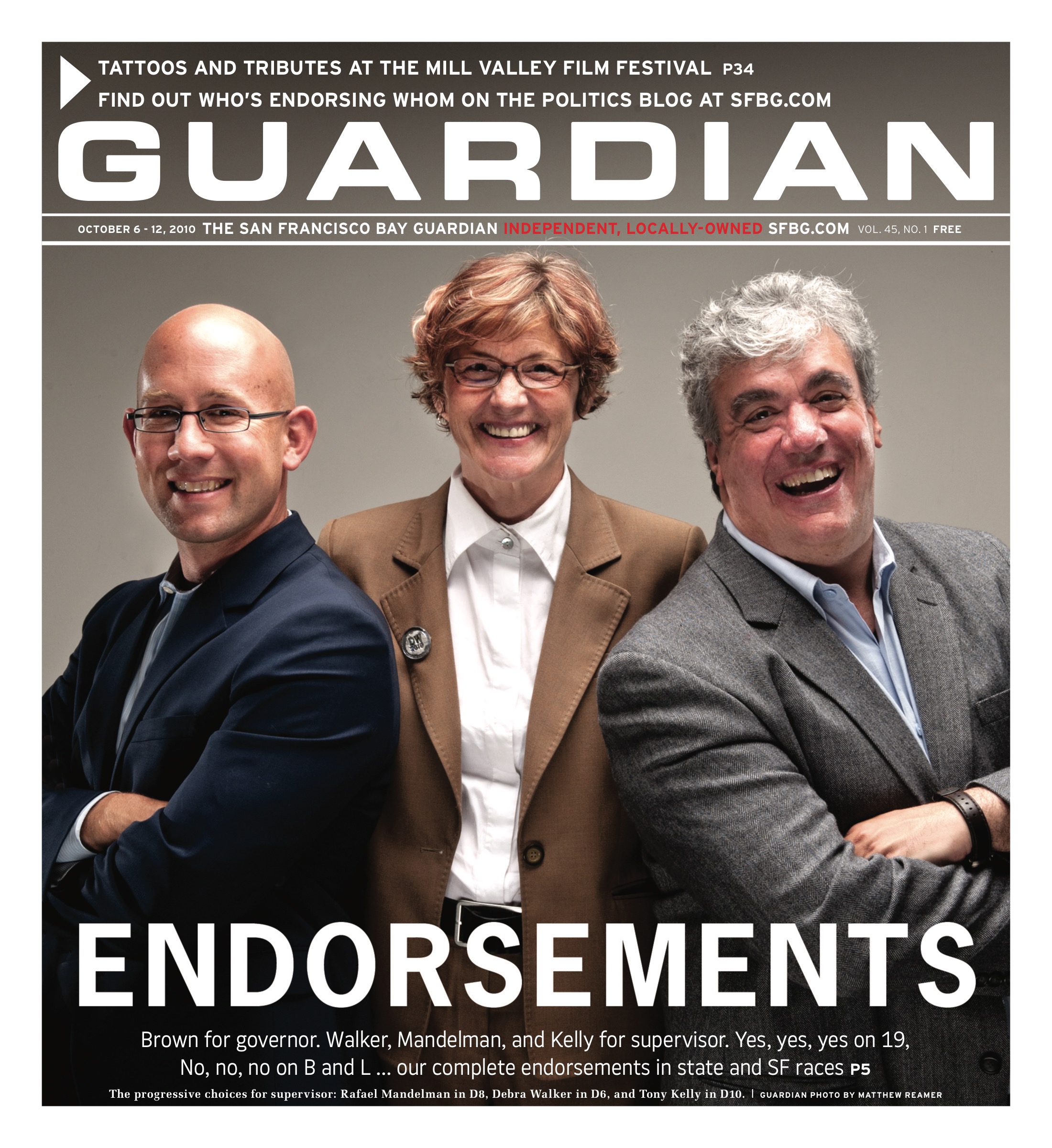
Big money moved into the district supervisorial races this fall. Downtown forces, working with landlords and a labor union that wants a giant new hospital on Van Ness Avenue, are pouring hundreds of thousands of dollars into races in Districts 6, 8, and 10, trying to alter the direction of the board by electing more conservative candidates. And while district races allow grassroots candidates without huge war chests a decent shot at winning, all this cash is going to have an impact — and might prove to be decisive in some races.

A lot of the money hasn’t been raised directly by candidates, either — it’s in the form of so-called independent expenditure committees, outside operations that, in theory, have no direct connection to any candidate. These committees can raise money without limits, spend it however they like, and ignore the limits that candidates face. And thanks to the U. S. Supreme Court, it’s almost impossible to regulate the committees. So the IEs, as they’re known, can put out attack ads, make scurrilous accusations, even lie outright — and have no accountability.

But San Francisco, which led the nation in using ranked-choice voting and has an impressive system for public financing of elections and disclosure, ought to be working to control this flood of sleaze. There are two major steps the supervisors should be looking at.

1. Respond to the money. San Francisco currently gives matching public funds to candidates who raise enough on their own to meet a threshold. That gives underfunded candidates at least a fighting chance to stay competitive. But it doesn’t address what happens when an outside group comes in and drops, say, $50,000 to promote or attack a candidate.

Unfortunately, federal law and court decisions limit the city’s ability to cap or restrict that spending. But the current system of matching public funds offers a potential alternative.

Suppose, for example, the city offered matching funds not just on the basis of what a candidate has raised — but also on the basis of what his or her opponents (including IEs) are spending. For example, if an IE spends $50,000 attacking a candidate, the city could give that candidate $50,000 (or, better, $100,000) to fight back.

That sounds like a lot of taxpayer dollars — but if the system is designed right, much of it will never be spent. Because the independent expenditure committees are only effective if the money is one-sided. Once these operators realize that all they’ve be doing by spending money against a candidate is increasing that candidate’s own resources, they’re far less likely to mount these campaigns.

The disclosure laws can be tightened too. Campaign ads and mailers have to say where the money’s coming from — but only in tiny type or in rushed voiceovers that few people notice. The federal government’s mandate that cigarette packages and ads have big, prominent statements about the health risks of smoking has been very effective. Requiring campaigns, particularly independent expenditure groups, to identify their major donors in large, visible type in prominent places on printed material and in clear language on radio or TV ads would help the voters understand the players — and the motivations — behind the campaign material.

2. Deal with the legal violations — promptly. A lot of these big-money campaigns have a tendency to skirt — or sometimes flagrantly violate — the city’s campaign law. And by the time the ethics Commission gets around to investigating (if that even happens) the election is over and it’s too late.

The supervisors ought to mandate that all credible allegations of election-law violations be investigated — and resolved if at all possible before Election Day. And if that means Ethics needs more staff, that’s a small price to pay for honest elections. 


Controlling big money campaigns

0

Thanks to the U. S. Supreme Court, it’s almost impossible to regulate the so-called independent expenditure committees.

EDITORIAL Big money moved into the district supervisorial races this fall. Downtown forces, working with landlords and a labor union that wants a giant new hospital on Van Ness Avenue, are pouring hundreds of thousands of dollars into races in Districts 6, 8, and 10, trying to alter the direction of the board by electing more conservative candidates. And while district races allow grassroots candidates without huge war chests a decent shot at winning, all this cash is going to have an impact — and might prove to be decisive in some races.


A lot of the money hasn’t been raised directly by candidates, either — it’s in the form of so-called independent expenditure committees, outside operations that, in theory, have no direct connection to any candidate. These committees can raise money without limits, spend it however they like, and ignore the limits that candidates face. And thanks to the U. S. Supreme Court, it’s almost impossible to regulate the committees. So the IEs, as they’re known, can put out attack ads, make scurrilous accusations, even lie outright — and have no accountability.

But San Francisco, which led the nation in using ranked-choice voting and has an impressive system for public financing of elections and disclosure, ought to be working to control this flood of sleaze. There are two major steps the supervisors should be looking at.

1. Respond to the money. San Francisco currently gives matching public funds to candidates who raise enough on their own to meet a threshold. That gives underfunded candidates at least a fighting chance to stay competitive. But it doesn’t address what happens when an outside group comes in and drops, say, $50,000 to promote or attack a candidate.
Unfortunately, federal law and court decisions limit the city’s ability to cap or restrict that spending. But the current system of matching public funds offers a potential alternative.

Suppose, for example, the city offered matching funds not just on the basis of what a candidate has raised — but also on the basis of what his or her opponents (including IEs) are spending. For example, if an IE spends $50,000 attacking a candidate, the city could give that candidate $50,000 (or, better, $100,000) to fight back.

That sounds like a lot of taxpayer dollars — but if the system is designed right, much of it will never be spent. Because the independent expenditure committees are only effective if the money is one-sided. Once these operators realize that all they’ve be doing by spending money against a candidate is increasing that candidate’s own resources, they’re far less likely to mount these campaigns.

The disclosure laws can be tightened too. Campaign ads and mailers have to say where the money’s coming from — but only in tiny type or in rushed voiceovers that few people notice. The federal government’s mandate that cigarette packages and ads have big, prominent statements about the health risks of smoking has been very effective. Requiring campaigns, particularly independent expenditure groups, to identify their major donors in large, visible type in prominent places on printed material and in clear language on radio or TV ads would help the voters understand the players — and the motivations — behind the campaign material.

2. Deal with the legal violations — promptly. A lot of these big-money campaigns have a tendency to skirt — or sometimes flagrantly violate — the city’s campaign law. And by the time the ethics Commission gets around to investigating (if that even happens) the election is over and it’s too late.

The supervisors ought to mandate that all credible allegations of election-law violations be investigated — and resolved if at all possible before Election Day. And if that means Ethics needs more staff, that’s a small price to pay for honest elections

Ignoring Cheney’s real victims

0

Dick Meister. former labor editor of the SF Chronicle and KQED-TV Newsroom, has covered labor and politics for a half century. Contact him through his website, www.dickmeistersf.com, which includes more than 250 of his columns.


So, as the Washington Post ‘s Paul Farhi reported recently, hunter Harry Whittington is still suffering from the effects of  being shot accidentally by hunting partner Dick Cheney in Texas four years ago.

I’m sure we’re all sorry about that, about how Whittington still has the lead pellet that pierced his larynx when the then-vice president swung around abruptly and fired away at a flight of quail. We’re of course sorry, too, about the 30 or so other pieces of shot still inside Whittington out of some 200 that slammed him, and the scars he bears.

 “I was lucky,” Whittington told Farhi, “I just feel every day ‘s a gift. Sometimes I wonder why I got those extra years.”

But what of the real victims? What of the defenseless quail that Cheney, Washington and two friends were stalking with a clear and undisguised intent to kill?

At least one quail was saved when Dead Eye Dick hit Whittington while aiming for a bird, and there was a bit of poetic justice since Whittington was struck as he was returning from retrieving a quail he had killed.

But no one bothered reporting how many other birds had been killed. After all, they were inferior beings raised for the amusement of Cheney and others who get their kicks stalking and killing fellow creatures.

Cheney’s been at it a long time, targeting ducks, pheasants and other birds as well as quail, in company with such other conservative favorites as Supreme Court Justice Antonin Scalia and former President George W. Bush.

Although apparently not as skilled and frequent a hunter as Cheney, Bush has managed to bring down a few winged creatures himself, most notably during his New Year’s holiday in Texas a few years back., Bush, who modestly declared that “I’m not that good a shot,” managed to down five quail. He said that “was a lot of fun.”
 
Bush praised the owner of the area in which the hunt took place for maintaining the land as a good habitat, not because it benefited the birds, of course, but because  – like the Texas farm where Cheney was hunting – it provided easy targets for hunters who wished to kill birds.

There are more than 20 million “sportsmen” like Bush and Cheney who find it fun to prey on innocent birds and animals.

The number of “sportsmen” has declined in recent years, thanks to anti-gun sentiment, urbanization, the animal rights movement, availability of a broad range of other leisure activities, heightened environmental awareness and the increasing cost of hunting equipment,

But there are still far too many people searching the countryside for winged and four-legged victims. What’s more, manufacturers of guns and other hunting gear have greatly intensified efforts to increase their number. So have state fish and game departments, which rely on hunters’ license fees to cover much of their operational costs.

Hunters and their defenders argue that, although the hunters’ targets are too dumb to realize it, hunting actually benefits them by “thinning the herds” and thus keeping them from starvation. But though there’s no doubt that reducing or at least relocating some animal populations may be necessary for their survival, there are civilized ways to do it.

Once, long ago, we had to hunt and kill in order to survive. But this is the 21st century. It’s outrageous that leaders and citizens of the world’s most powerful and influential nation, one that presumes to be the role model for all others, find it amusing to engage in the barbarity of killing for sport.

Invariably, when I address this subject, people come back at me complaining that I just don’t understand that some people need to hunt animals to help feed their families.

I understand. But that’s another matter entirely. I’m writing about the vast majority of hunters who hunt and kill their fellow animals, not for food, but for the fun of it. To me, that seems a sick thing to do.

 Let me repeat: It’s killing for the sport of it that should disturb us all. It’s not just the bird and animal targets that need protecting. Think of the message that’s being delivered to the rest of us. It’s a message, as animal rights activist Jamie Kemsey noted, “that it is acceptable to commit an act of violence and take innocent life simply for the fun of it. In these violent times we cannot afford, under any circumstances, to condone such morally bankrupt actions.”

Dick Meister. former labor editor of the SF Chronicle and KQED-TV Newsroom, has covered labor and politics for a half century. Contact him through his website, www.dickmeistersf.com, which includes more than 250 of his columns.

Kim chichi

0

le.chicken.farmer@gmail.com

CHEAP EATS It was the weekend and my kitten and me were dancing to the Ramones in our pajamas. Coffee sloshing all over the place. Kibble clattering. The phone rang and we let it ring. I already had lunch plans and dinner plans. Why answer the phone?

I answered the phone. Knowing me, it was either my lunch plan or my dinner plan, calling to cancel. So I stopped the music.

Stoplight kept dancing.

On the phone was one of my three-year-old pals. She was upset and wanted to talk, so we talked. Once she had collected herself and was breathing normally I asked, “How’s your mommy?”

“Good,” she said, in her normal little voice. “How’s Stoplight?”

“Good. We were dancing,” I said.

“Oh.”

“Ramones.”

If she had an opinion about them, she didn’t say. For the moment, her favorite bands are ABBA and Harry Belafonte — who isn’t, strictly speaking, a band. We made plans to get a burrito between lunch and dinner, and then she put her mom on. Coincidentally, we too made plans to get a burrito between lunch and dinner.

For lunch, I had a burrito. You will be relieved to learn that it was not the conventional kind. It was another one of those Korean-style kimchi burritos, such as had bewitched, bothered, and bewildered me a few months back at John’s Snack & Deli, downtown.

I haven’t slept well ever since. And I wanted to repay the kind then-stranger who ruined my circadian rhythm, if not life, by introducing me to the kimchi burrito. Interestingly, he’s never had one himself. Just saw the sign at John’s and thought I should know, bless him.

John’s is not in my opinion open on weekends. Nor is it open past six on weekdays, meaning most working stiffs who aren’t lucky enough to work in the Financial District will never know. A moment of silence, for them.

The good news is that the HRD Coffee House, South of Market, also has a kimchi burrito, and is open Saturdays. The bad news is it’s pork, not beef, and it ain’t even a third as juicy as John’s sleep disorder was, as I recall. By comparison, HRD’s kimchi burrito is underspicy and over-ricy. But, come to think of it, underpricey too. It’s only $5.50, and that’s good news all over again. Plus you don’t have to eat it on your bike (or at your desk, I guess) because HRD is an actual place. You know, with tables, chairs, counters, a very fluorescent back room, and college football on TV.

We sat at the window counter, me and my new friend Mr. Wong — not to be confused with Mr. Wrong (my old friend). And we talked about movies, food, and movies about food. He’s a film writer and, I gather, a collector. But he’s in over his head. He’s attended and collected so many movies that he hasn’t had time, in 51 years, to learn how to cook, not even pasta. Check it out, this cat owns copies of my two favorite movies — which are both very, very obscure, and, Jesus, pretty old — but he hasn’t seen either one!

Yet.

In exchange for teaching Mr. Wong how to cook, I think he’s going to share his collection with me. First thing I’m going to show him how to make: popcorn.

We will work our way up to kimchi, and then bulgogi, and then kimchi burritos because, sad to say, my Mr. Wong still hasn’t exactly had an exactly brilliant and/or life-altering one. As much as we both liked HRD, the place.

And the people.

He finished his. I gave the second half of mine to a homeless person on Market Street.

“It’s a burrito,” I said, “but, get this: it’s Korean!”

The dude, apparently not a foodie, was underplussed.

“So you know,” I said. “A Korean burrito.”

“I’ll think about that,” he said, “while I’m eating it.”

HRD COFFEE SHOP

Mon.–Fri. 7 a.m.–3 p.m.; Sat. 9 a.m.–3 a.m.

521 Third St.

(415) 543-2355

Cash only

No alcohol

Summer in the fall

0

arts@sfbg.com

MUSIC As I sit sipping some morning coffee, Elizabeth Morris of Allo Darlin’ is wrapping up an unseasonably sunny London afternoon. “I don’t know what’s happening, but it’s really warm weather,” she says over the phone. “The last week was really cold and miserable, and then the last two days have been absolutely beautiful.”

It seems fitting to be discussing Allo Darlin’s self-titled album with Morris on a day when the sun won’t be denied. You’d be hard-pressed to find a more perfect “summer” album released in October. Full of shimmery electric guitar, tambourine shakes, and bass lines that would sound at home on lost Motown cuts, the group’s music oozes charm, occupying some sort of space between Belle & Sebastian and a modern, garage-y spin on the Shangri-Las. Out at the forefront of it all is Morris with her ukulele and enchanting vocals.

Originally born and raised in Australia, Morris moved to London five years ago, shortly after finishing school in Brisbane, hoping to do something with the songs she’d begun writing. In Brisbane, Morris doubted her talents and ability to fit in, but London’s music scene proved to be a much more fertile ground for her. “Brisbane at the time was really grunge-y, noise rock, avant-garde kinda stuff — which is cool, but I felt really out of place and would never have felt confident playing little pop songs,” she explains. “I’d definitely written a bunch of songs, but I thought they were all pretty much rubbish. I didn’t feel like I’d written anything good until I moved to London.”

Once settled in London, Morris fronted the Darlings, a group made up of coworkers from the TV and film sound production facility she worked at. After that group dissolved, she began playing solo before winding up with a backing band made up of friends of friends, brothers of friends, and members of some of her favorite local bands. It all came together with a little help from the Boss.

“I was asked to do a Bruce Springsteen song for this tribute compilation and I knew Paul (Rains, Allo Darlin’ guitarist-keyboardist) was really into him. So I asked if he wanted to do this song with me, and that’s kinda how I got started playing with these guys. So we were brought together by Springsteen,” Morris says with a laugh.

In the interview, Morris talks excitedly about some of her musical loves: Jonathan Richman, Steve Martin’s banjo playing, the Go-Betweens, old reggae. She and her bandmates share an affection for Yo La Tengo and their parents’ old Beach Boys’ records. Her earnest and enthusiastic admiration mirrors the tone of her lyrics, which play a major role in making Allo Darlin’ fun. One minute she’s combining lines about love and chili, the next she’s breaking into a verse from Weezer’s “El Scorcho” or singing what’s gotta be the first pop song ever written about Ingmar Bergman’s Wild Strawberries (1957). Her lyrical style is clever and unique — by turns romantic, silly, pensive, or yearning.

“I kind of always write from emotion or feeling rather than anything else. I never really sit and write things in a notebook or compose words,” Morris says. “I’ve tried to write story-songs or songs about characters, but it just never really works. I’m not very poetic, I guess. I’m better at seeing things how they are, trying to put them into words with a nice melody and seeing what happens.”

Allo Darlin’s upcoming tour marks the group’s third trip to the U.S., but it’s their first time in California. Despite the impersonal nature of a phone conversation, Morris’ excitement is palpable. She’s even picking up some American slang. “All the bookers say ‘psyched’ — like ‘We’re psyched that you’re coming.’ It’s really cute,” she says, laughing.

“So yeah, we’re psyched to be doing the West Coast.”

ALLO DARLIN’

with Eux Autres, Terry Malts

Wed/27, 8 p.m.; $10

Rickshaw Stop

155 Fell, SF

(415) 861-2011

www.rickshawstop.com

Understory

0

Dear Andrea:

We’ve been trying to sex up our sex life (we have been married 10 years and yes, things can get a little boring) and among other things I went to Victoria’s Secret and bought some not too slutty but certainly sexy underwear, and … nothing. He just wanted to get them off so we could get down to business. Isn’t this the kind of thing men are supposed to like? Now I feel kind of silly for wasting the money and time.

Love,

Not In The Mood

Dear Mood:

I’m convinced that fancy underwear, in particular, is vastly over-rated. Males are reputed to be visual responders, while women are said to respond more to words, emotional states, and even smells than to raw visual input. But if you ask men what they really want to see women wearing, most of them say nothing. Or rather, “Nothing, thanks.”

So what will reignite a long-banked fire? In a word, teamwork. Don’t stand there by the bed throwing what amounts to metaphorical sexual spaghetti strands at the wall until one sticks. You want to make a mutual effort to reconnect, which takes time. Skip the last TV show. Prioritize. Let the new sexy emerge organically, and then when (if) you discover that some sort of shopping trip is in order, try going (or leaning over the laptop) together.

At the same time, I would never discount the power of feeling sexy. It could be new underwear or new muscles or a new haircut or new boots (hello). But I’m all about the doing something for yourself that reaffirms your hottitude in your own eyes. And — if you don something that makes you feel that way and then act on it with him, I can pretty well guarantee he’ll notice.

Love,

Andrea

Dear Andrea:I like the way boxers look. But I get jock itch and need to keep out moisture and I think briefs work better for that. Therefore, I usually wear briefs or sling-type underwear. I feel kind of silly in the little tight things, but anything’s better than crazy crotch itch.

Love,

Funny Pants

Dear Pants:

Did you know that “it’s pants” is a very British way of saying “stupid” or “lame” but much funnier? I want to call things “pants!” But meanwhile, I am happy not to be in yours.

Not that we women don’t get our own mortifying crotch complaints — have you never noticed that we get an entire aisle at the big chain drugstores?

One thing I can say for men and their jockular issues is that they rarely go on about them in public. The thing is, women are universally instructed to avoid anything tight and plasticy, so if I were you (so glad I’m not!) I’d want to be very sure what is causing that itch and follow a doctor’s sartorial recommendations. Maybe you’ll hit it lucky and she’ll let you wear boxers, as a man was intended to.

Love,

Andrea

Labor’s outreach

0

Dick Meister, former labor editor of the SF Chronicle and KQED-TV Newsroom, has covered labor and politics for a half-century. Contact him through his website, www.dickmeister.com, which includes more than 250 of his columns.

Never have the nation’s younger workers been more in need of unionization. And never have the nation’s unions been more in need of the membership growth that recruiting younger workers can bring them.

Here’s how it looks, and it’s not a pretty picture for labor: Last year, unions lost 10 percent of their members in private employment –  the biggest drop in more than 25 years.  That cut union membership by 834,000 workers, down to 15.7 million workers.

Which means that overall, counting public as well as private employment, unions now represent only a little more than 12 percent of the country’s workers. Just 20 years ago, 20 percent of all workers were unionized.

So, how can organized labor add significantly to its numbers and thus add significantly to labor’s political and economic strength.

The answer should be obvious, and it certainly is to union leaders: Sign up the younger workers aged 18 to 29 who are especially hurting economically. They need unions as much as unions need them.

A recent survey commissioned by the AFL-CIO shows that fully half of the young workers surveyed said they had only enough savings to cover their living expenses for two months should they become unemployed, as of course many workers of all ages have in recent months.

Many of the young surveyed also were concerned that whatever the jobs they find, they’ll do worse than workers of other generations have done when they retired.

Unions hope to attract such workers to their ranks in part with recent academic studies showing that unionized workers invariably do better than non-union workers when they retire and in virtually all other ways.  For instance, studies show that the average wage of unionized younger workers is about $15 an hour – more than 12 percent or about $1.75 an hour more than non-union workers of the same age.

 Forty percent of the unionized younger workers had employer-financed health care, while only 20 percent of those outside unions had such a benefit.

Whatever the occupation, and however they were measured, unionized younger workers did better – unionized men better than non-union men, unionized women better than non-union women, unionized African Americans and Latinos better than non-union workers in those categories.

Yet despite the obvious advantages of union membership that has brought better pay and benefits to the younger workers who’ve joined, younger workers generally have had the lowest unionization rate of any age group. Only about 7 percent are in unions.

But that could very well change. Other new studies indicate that the economic situation for younger workers is worsening, and that well over half the workers now say they hope to avoid that by unionizing. Joining a union would not only help them improve their own status and help reverse what’s been a steady decline in union strength. It also would bring new strength to union efforts in behalf of important social, economic and political reforms.

The AFL-CIO has established a program aimed at recruiting the younger members that its affiliated unions badly need – as badly as the younger workers need unions. And as badly as we need the benefits that a strong labor movement can bring to all of us, whatever our age.

Dick Meister, former labor editor of the SF Chronicle and KQED-TV Newsroom, has covered labor and politics for a half-century. Contact him through his website, www.dickmeister.com, which includes more than 250 of his columns.

Alerts

0

news@sfbg.com

WEDNESDAY, OCT. 20


Oakland candidates forum

The Alameda County Democratic Lawyers Club hosts at forum featuring the candidates for Oakland mayor and Alameda County Superior Court judge. With the Oakland mayor’s race between well-funded favorite Don Perata and progressive challengers Rebecca Kaplan and Jean Quan heating up as it comes into the home stretch, this could be a fun one.

5–7 p.m., $25 for members, $30 for nonmembers

Everett & Jones BBQ Restaurant

126 Broadway, Oakl.

510-836-7563

demlawyers.org/events

THURSDAY, OCT. 21


Save the Dolphins

Earth Island Institute presents “From Flipper to The Cove to Blood Dolphin$: A Conversation with Ric O’Barry,” a plea to save dolphins for being slaughtered in Taiji, Japan. O’Barry, star of the Oscar-winning documentary The Cove and the Animal Planet TV miniseries Blood Dolphin$, will update his campaign with information and video footage from his recent trip to Japan.

7 p.m., $5–$20 sliding scale

The David Brower Center

2150 Allston Way, Berk.

510-859-9100

www.eii.org/events/dolphin

FRIDAY, OCT. 23


Ports blocked for Oscar Grant

The International Longshore and Warehouse Union Local 10 has called for a shutdown of Bay Area ports to call for justice in the case of Oscar Grant, who was fatally shot by BART police officer Johannes Mehserle on an Oakland train platform on New Year’s Day 2009. “Bay Area ports will shut down that day to stand with the black community and others against the scourge of police brutality,” said Jack Heyman, an executive board member for the union. Mehserle was convicted of involuntary manslaughter in July and is scheduled to be sentenced Nov. 5.

All day, free

Ports through the Bay Area

www.ilwu10.org

jackheyman@comcast.net

SUNDAY, OCT. 24


Sunday Streets

The final Sunday Streets car-free event of the season will for the first time travel through the streets of the Tenderloin and Civic Center area. Bicyclists, pedestrians, and skaters travel a route that passes City Hall, Boedekker Park, Tenderloin Recreation Center, and the Tenderloin National Forest in Cohen Alley, off Ellis near Leavenworth, featuring live performances, the Funkytown Roller Disco, and free bike rental and repair stations. This event also coincides with the second annual Tricycle Music Festival, with live music from 11 a.m. to 2 p.m. on the steps of the Main Library.

10 a.m.–3 p.m., free

Civic Center/Tenderloin

sundaystreets@gmail.com

415-344-0489. ext. 2

www.sundaystreetssf.com

MONDAY, OCT. 25


Earth-a-llujah Revival

Reverend Billy and the Church of Life After Shopping Choir returns to San Francisco as part of their Earth-a-llujah, Earth-a-llujah Revival Tour, bringing the environmentalist and anti-consumerist gospel to the Mission District. Fresh off of a run for the mayor of New York City and successful campaign to get Chase Manhattan Bank to disinvest in mountaintop removal coal mining, Rev. Billy (a.k.a. performance artist Billy Talen, who got his start here in SF) and his flock will fill you with the Holy Spirit and exorcise you of your credit cards. Hallelujah!

7 p.m., $12

Victoria Theater

2961 16th St., SF

(415) 863-7576

www.revbilly.com/events/cali-tour

www.brownpapertickets.com/event/133698

Our Weekly Picks: October 13-19

0

WEDNESDAY 13

MUSIC

Vader

Vader’s history stretches back almost 30 years. Borrowing Darth’s moniker might not have been the world’s most original idea, but they were likely among the first to have done it. The Polish death metal stalwarts formed in 1983 in Olstzyn, deep behind the Iron Curtain. Successful demo recordings got them hooked with Earache Records, and the band has been pillaging the world’s stages ever since. Guitarist-singer Piotr Wiwczarek is the only original member left in the fold, but the band’s anthemic music is as potent as ever, mixing impossibly thick blast beats with heavy slabs of neoclassical melody. Their upcoming album Return to the Morbid Reich is a nod to the 1990 demo that made their name; this tour, they’re inviting you along for the ride. (Ben Richardson)

With Immolation, Abigail Williams, Lecherous Nocturne, and Pathology

6:30 p.m., $22

DNA Lounge

375 11th St., SF

(415) 626-1409

www.dnalounge.com


THURSDAY 14

DANCE

Lines Ballet

The story of Scheherazade and her 1,001 nights of tales to postpone her beheading by the Persian king has intrigued and captivated audiences for ages. Choreographer Alonzo King’s dance adaptation Scheherazade delves beyond the story to explore themes ranging from the symbolism of abused women to the transformative power imbued in the tales. The company of chiseled titans dance alongside tabla master Zakir Hussain’s score, which incorporates traditional Persian instrumentation into the original classical composition by Rimsky-Korsakov. The piece premiered in Monaco last December; San Franciscans can now experience King’s artistic rendering of Scheherazade’s classic tale for themselves. (Emmaly Wiederholt)

Through Oct. 24

Thurs/14, 7 p.m.; Fri.–Sat., 8 p.m.;

Sun., 5 p.m.; Oct. 20–21, 7:30 p.m., $25–$75

Yerba Buena Center for the Arts

Novellus Theater

700 Howard, SF

(415) 978-2787

www.linesballet.org


FILM

“Jim Henson and Friends: Inside the Sesame Street Vault”

Consider the Muppet. Made of foam and googly eyes, set atop spindly legs under a mop of primary-color hair, these brave figures have become our children’s teachers on a level unparalleled in the world of infotainment. We’re talking street, of course — Sesame Street, which since its 1969 debut has won 97 Emmy awards, more than any other show. Yerba Buena Center for the Art is running a series of Sesame clip collections, and today’s viewing pays homage to the contributions of the show’s early creative team, with a special furry hug to creator Jim Henson, and little-seen guest appearances from the show’s early days. (Caitlin Donohue)

7:30 p.m. (also Sat/16, 2 p.m.), $6–$8

Yerba Buena Center for the Arts

701 Mission, SF

(415) 978-2787

www.ybca.org


DANCE

“CounterPULSE’s Performing Diaspora: Sri Susilowati”

Stripping world dance of its trappings is quite the rage these days. But few have done it so radically as Indonesian classical dancer did Sri Susilowati at last year’s Performing Diaspora festival. Yet this was the same artist who, only a few months before at the Ethnic Dance Festival, had performed an exquisite, contemporary Javanese mourning dance. Now she is back, having been invited to expand on her 2009 piece. Susilowati may look one of those ethereal dance creatures whose bodies are so stylized that it’s difficult to think of them having earthly passions. Yet they do. Hint on Susilowati: food. Another Indonesian dancer, Prumsodun Ok, opens the show for her. (Rita Felciano)

Thurs/14–Sat/16, 8 p.m.; Sun/17, 3 p.m., $24

CounterPULSE

1310 Mission St./SF

(415) 626-2060

www.brownpapertickets.com


MUSIC

Fresh and Onlys and Kelley Stoltz

San Francisco-based artists the Fresh and Onlys and Kelley Stoltz will both have new albums on hand at this double CD release blowout. The new Fresh and Onlys disc, Play It Strange, showcases the band’s garage-rocky spin on 1960s pop, and was recorded for the first time outside of a DIY studio setup with Comets on Fire producer Tim Green. Stoltz releases his newest batch of throwbacks to the Beatles’ and Beach Boys’ style of sunny pop with To Dreamers. This is a perfect night to come out and support local music. (Landon Moblad)

With Carletta Sue Kay

9:30 p.m., $12

Café Du Nord

2170 Market, SF

(415) 861-5016

www.cafedunord.com


FRIDAY 15

DANCE

Dandelion Dancetheater

Known for its loud, provocative works merging dance, drama, and music, Dandelion Dancetheater turns its attention to motherhood in MamaLOVE: Seeds of Winter. The seven-women cast explores mom-related themes by diffusing fairy tales, myths, and lullabies to discover the context and relevance of the cultural archetypes and stereotypes surrounding motherhood. Each evening brings a rotating roster of guest mama-choreographers: Mary Carbonara, Tammy Cheney, Laura Elaine Ellis, Suzanne Gallo, Dana Lawton, Laura Renaud-Wilson, and Chingchi Yu. Directed by Kimiko Guthrie, the show promises to be haunting, hilarious, and not to be missed as the mom-artists address the complexities of love, loss, connection, and independence. (Wiederholt)

Though Oct. 24

Fri-Sat, 8 p.m.; Sun, 7 p.m. (also Oct. 24, 3 p.m.), $12-15

Shawl Anderson Dance Center

2704 Alcatraz, Berk.

(510) 654-5921

www.dandeliondancetheater.org


SATURDAY 16

MUSIC

Longplayer San Francisco: 1,000 Years in Three Simultaneous Acts”

As a founding member of legendary rabble-rousers the Pogues, Jem Finer helped the band deconstruct traditional Irish music and create a new musical creature out of its varied influences. Taking this willingness to experiment with different sounds and ideas and bringing it to another level, Finer composed Longplayer, a piece designed to last 1,000 years and played on instruments such as Tibetan bowl gongs. Today’s special performance will be a 1,000-minute excerpt performed by 18 musicians on a custom-built, 60-foot-wide circular “instrument” — so slow down and take some time to absorb some art that goes against today’s faster-is-better mentality. (Sean McCourt)

7 a.m.–11:40 p.m., $25–$28

Yerba Buena Center For The Arts Forum

701 Mission, SF

(415) 978-2787

www.ybca.org


EVENT

“ODC Theater’s JumpstART”

Several years and millions of bucks in the making, ODC is at last ready to unveil its new state-of-the-art “cultural campus” in the Mission in a celebratory free day of “dance, theater, performance, and community.” With more than 20 performers and organizations participating, there will be something for everybody — yes, even clogging — at this one-of-a-kind public offering. A glance at the roster includes such names as Scott Wells and Dancers, Robert Moses’ Kin, Killing My Lobster, Youth Speaks, and of course ODC/Dance, all curated by ODC Theater director Rob Bailis in collaboration with the likes of choreographer Joe Goode, world music expert Lilly Kharrazi, and playwright-director Mark Jackson. (Robert Avila)

Noon–11 p.m., free (tickets available one hour prior to each performance)

ODC Theater

3153 17th St, SF

(415) 863-9834

www.odcdance.org


DANCE

Trolley Dances

I still wish they’d call them Street Car Dances instead of Trolley Dances, because that’s what they are, but the name is a registered trademark and has its origins in San Diego (where they actually have trolleys). However, there is nothing else I would change on these annual easy-rider events. They are pure fun, and curator Kim Epifano always comes up with an intriguing lineup of entertainers. This year you’ll see, among others, dancers from Joe Goode Performance Group, Sara Shelton Mann, Ensohza Minyoshu (traditional Japanese folk music and dance), and Sunset Chinese Folk Dance Group. And do look out for a special treat on Ninth Ave for our animal friends, courtesy of brilliant maskmaker Mike Stasiuk. Boarding takes place at Duboce Park. (Felciano)

Through Sun/17

11 a.m. (runs every 45 minutes until 2:45 p.m.), free with Muni fare ($2)

Duboce at Scott, SF

(415) 226-1139

www.epiphanydance.org


EVENT

ArtSpan Open Studios

Do you ever want to stroll into other people’s homes simply from sweet curiosity? Perhaps you covet thy neighbor’s art, or maybe just appreciate light and shadow and like talking with the peeps who represent it? Do all three at the largest and oldest open studios event in the country. The self-guided art tour is ongoing through October, but this weekend doors will open in the artsy northern and eastern neighborhoods. From the nude drawings of Derriere Guard (ahem, Beavis) to the ultraviolet photos of South African succulents, it’s the best opportunity to get to know your local artists. And maybe take home a derriere or two. (Kat Renz)

Through Oct. 31

Sat.–Sun., 11 a.m.–-6 p.m., free

Bayview, Excelsior, Financial District, North Beach, Potrero, Russian Hill, SoMa,Tenderloin

(415) 861-9838

www.artspan.org


SUNDAY 17

MUSIC

BATUSIS

Featuring two of the founding architects of punk rock — guitarists Sylvain Sylvain from the New York Dolls and Cheetah Chrome from the Dead Boys — Batusis already has its street cred and headliner status firmly in place. Taking its name from the groovy dance that Adam West performed in the campy 1960s Batman TV show, the band came together and released a new self-titled EP earlier this year that’s steeped in the sounds that earned these six string slingers their place in the punk pantheon in the first place. This dynamic duo may not be so young anymore, but they’re sure as hell just as loud and snotty. (McCourt)

With Re-Volts

8 p.m., $12–$15

Thee Parkside

1600 17th St., SF

(415) 252-1330

www.theeparkside.com


MONDAY 18

MUSIC

David Bazan

Previously known for fronting the popular indie-rock project Pedro the Lion, David Bazan has returned to working under his own name. His most recent solo album, Curse Your Branches, covers some religious-themed lyrical ground that fans should be familiar with by now, like the tales of sinners losing their way and Bazan grappling with his own faith. But it also presents itself in a much more upbeat, poppier setting than we’re used to, often at odds with the reflective and sometimes dark themes of the songs. Moody, country-tinged Baltimore duo Wye Oak opens. (Moblad)

8 p.m., $15

Independent

628 Divisadero, SF

(415) 771-1421

www.theindependentsf.com 


The Guardian listings deadline is two weeks prior to our Wednesday publication date. To submit an item for consideration, please include the title of the event, a brief description of the event, date and time, venue name, street address (listing cross streets only isn’t sufficient), city, telephone number readers can call for more information, telephone number for media, and admission costs. Send information to Listings, the Guardian Building, 135 Mississippi St., SF, CA 94107; fax to (415) 487-2506; or e-mail (paste press release into e-mail body — no text attachments, please) to listings@sfbg.com. We cannot guarantee the return of photos, but enclosing an SASE helps. Digital photos may be submitted in jpeg format; the image must be at least 240 dpi and four inches by six inches in size. We regret we cannot accept listings over the phone.


Stage listings

0

Stage listings are compiled by Guardian staff. Performance times may change; call venues to confirm. Reviewers are Robert Avila, Rita Felciano, and Nicole Gluckstern. Submit items for the listings at listings@sfbg.com. 

THEATER

OPENING

Habibi Intersection for the Arts, 446 Valencia; 626-2787, www.theintersection.org. $15-25. Previews Thurs/14-Sun/17, 8pm. Opens Mon/18, 8pm. Runs Thurs-Sun, 8pm. Through Nov 7. Intersection for the Arts and Campo Santo present the world premiere of a play by Sharif Abu-Hamdeh.

Nina and the Monsters Shotwell Studios, 3252A 19th; 509-8656, 509-8656. $10-15. Opens Fri/15, 8pm. Runs Fri-Sat, 8pm (also Sun/17 and Oct 24, 2pm). Ninjaz of Drama with Footloose present a modern-day fairy tale.

Proof Exit Stage Left Theatre, 156 Eddy; www.belljartheatre.com. $20. Opens Fri/15, 8pm. Runs Fri-Sat, 8pm. Through Oct 30. Bell Jar Theatre presents David Auburn’s award-winning play.

Susie Butler Sings the Sarah Vaughan Songbook Exit Theater Cafe, 156 Eddy; (510) 860-0997, www.brownpapertickets.com. $15-20. Opens Sat/16, 8:30pm. Runs Sat, 8:30pm. Through Nov 20. Local actress and singer Susie Butler takes on the Sassy songbook.


ONGOING

Absolutely San Francisco Phoenix Theatre, Stage 2, 414 Mason; 433-1235, www.absolutelysanfrancisco.com. $20-25. Fri-Sat, 8pm. Through Oct 23. A one-woman musical starring Karen Hirst, with book and music by Anne Doherty.

Anita Bryant Died For Your Sins New Conservatory Theatre Center, 25 Van Ness; 861-8972, www.nctcsf.org. $24-40. Wed-Sat, 8pm; Sun, 2pm. Through Oct 24. New Conservatory Theatre Center presents a show by Brian Christopher Williams.

*The Brothers Size Magic Theatre, Bldg D, Fort Mason Center; 441-8822, www.magictheatre.org. $20-60. Dates and times vary. Through Sun/17. Magic Theatre presents the West Coast premiere of Tarell Alvin McCraney’s play, directed by Octavio Solis.

Cat on a Hot Tin Roof Actors Theatre, 855 Bush; 345-1287, www.actorstheatresf.org. $26-38. Wed-Sat, 8pm. Through Oct 22. Actors Theatre presents Tennessee Williams’ sultry, sweltering tale of a Mississippi family, directed by Keith Phillips.

Christian Cagigal’s Obscura: A Magic Show EXIT Cafe, 156 Eddy; (800) 838-3006, www.brownpapertickets.com. $15-25. Thurs-Sat, 8pm. Through Dec 18. Magician Christian Cagigal presents a mix of magic, fairy tales, and dark fables.

Disoriented Off-Market Theater, 960 Mission; (800) 838-3006, www.brownpapertickets.com. $20. Sun, 7pm. Through Oct 17. A trio of solo performances by Asian-American women.

A Funny Thing Happened on the Way to the Forum Eureka Theatre, 215 Jackson; 255-8207, www.42ndstmoon.org. Wed, 7pm; Thurs-Fri, 8pm; Sat, 6pm; Sun, 3pm (also Sat/16, 1pm). Through Oct 24. 42nd Street Moon presents the Sondheim musical farce, starring Megan Cavanagh.

Futurestyle ’79 Off-Market Theater, Studio 250, 965 Mission; (800) 838-3006, www.brownpapertickets.com. $15-20. Wed, 8pm. Through Oct 27. A fully improvised episodic comedy played against the backdrop of SF in 1979.

Hamlet Alcatraz Island; 547-0189, www.weplayers.org. By donation. Sat-Sun, times vary. Through Nov 21. Outside of an actual castle, it would hard to say what could serve as a more appropriate stand-in for Kronborg castle of Helsingør—also known as Elsinore—than the isolated fortress of Alcatraz Island, where WE Players are presenting Hamlet in all its tragic majesty. As audience members tramp along stony paths and through prison corridors from one scene to the next, the brooding tension the site alone creates is palpable, and the very walls impart a sense of character, as opposed to window-dressing. Deftly leaping around rubble and rock, a hardy troupe of thespians and musicians execute the three-hour production with neat precision, guiding the audience to parts of the island and prison edifice that aren’t usually part of the standard Alcatraz tour package. Incorporating movement, mime, live music, and carefully-engineered use of space, the Players turn Alcatraz into Denmark, as their physical bodies meld into Alcatraz. Casting actress Andrus Nichols as the discontent prince of Denmark is an incongruity that works, her passions’ sharp as her swordplay, the close-knit family unit of Laertes, Ophelia, and Polonius are emphatically human (Benjamin Stowe, Misti Boettiger, Jack Halton), and Scott D. Phillips plays the appropriately militaristic and ego-driven Claudius with a cold steel edge. (Gluckstern)

IPH… Brava Theater, 2781 24th St, 647-2822, www.brava.org. $15-35. Thurs-Sat, 8pm. Through Sat/16. Brava Theatre and African-American Shakespeare Company present the US premiere of an adaptation of Iphigenia at Aulis.

*Jerry Springer the Opera Victoria Theatre, 2961 16th; www.jerrysf.com. $20-36. Wed-Sat, 8pm. Through Sat/16. Highbrow meets low in one big, boisterous mono-brow middle as one of the baser of daytime talk-show hosts meets his audience and maker—or anyway Jesus and Satan—in a TV show purgatory that really is purgatory. The form is operatic, the subject matter the stuff of soap, and the resulting tawdry spectacle all but irresistible in Ray of Light Theatre’s production of the 2003 British musical by Richard Thomas (music, book and lyrics) and Stewart Lee (book and lyrics). If the conceit feels a bit one-note, it’s a note taken very cleverly and ably for all its worth. A smart, smarmy and dyspeptic Patrick Michael Dukeman excels in the title role, as the chorus, meanwhile, comprised of Jerry’s rabid studio audience, puts the unbridled hooligan glee in glee club, lending Wagnerian weight to such key phrases as “step-dad” or “chick with a dick.” The grand and just slightly sleazy Victoria Theatre makes the perfect venue for this fine irreverence, filling it charmingly with rafter-shaking vulgarity and mayhem.

Kiss of Blood Hypnodrome Theatre, 575 10th; (800) 838-3006, www.brownpapertickets.com. $25-35. Thurs-Fri, 8pm. Through Nov 19. Thrillpeddlers’ seasonal slice of eyeball is comprised of three playlets variously splattered with platelets, all directed by Russell Blackwood and bridged by a rousing burst of bawdy song from the full cast. Rob Keefe’s Lips of the Damned (after La Veuve by Eugene Heros and Leon Abric) takes place in a rat-infested museum of atrocities just before the fumigating starts, as an adulterous couple—comprised of a kinky married lady (a vivacious Kara Emry) and a naïve hunk from the loading dock (Daniel Bakken)—get their kicks around the guillotine display, and their comeuppance from the jilted proprietor (Flynn DeMarco). Keefe’s delightfully off-the-wall if also somewhat off-kilter Empress of Colma posits three druggy queens in grandma’s basement, where they practice and primp for their chance at drag greatness, and where newly crowned Crystal (a gloriously beaming Blackwood) lords it over resentful and suspicious first-runner-up Patty Himst (Eric Tyson Wertz) and obliviously cheerful, non-sequiturial Sunny (Birdie-Bob Watt). When fag hag Marcie (Emry) arrives with a little sodium pentothal snatched from dental school, the truth will out every tiny closeted secret, and at least one big hairy one. Kiss of Blood, the 1929 Grand Guignol classic, wraps things up with botched brain surgery and a nicely mysterious tale of a haunted and agonized man (Wertz) desperate to have Paris’s preeminent surgeon (DeMarco) cut off the seemingly normal finger driving him into paroxysms of pain and panic. Well-acted in the preposterously melodramatic style of the gory genre, the play (among one or two other things) comes off in a most satisfying fashion. (Avila)

Last Days of Judas Iscariot Gough Street Playhouse, 1620 Gough; (510) 207-5774, www.CustomMade.org. $10-30. Thurs-Sat, 8pm; Sun, 7pm. Through Oct 30. Custom Made Theatre Company presents the 2005 play by New York’s Stephen Adly Guirgis (Our Lady of 121st Street, Jesus Hopped the A Train), which places purgatorial Judas (Kristoffer Alberto Barrera) on trial to determine his deserved fate for dropping a dime on Jesus and all that jazz. Flamboyant, sycophantic and horny prosecutor El-Fayoumy (Ben Ortega) and defense attorney Loretta (Amelia Avila) call between them a series of brow-raising witnesses—including Mother Teresa (Brandy Leggett), Sigmund Freud (Catz Forsman), and Satan (Richard Wenzel)—as Judas (seated on the upper tier of Sarah Phykitt’s suitably imposing split-level set) stares stoically in relative silence or appears in a series of childhood flashbacks. Characteristically funny and streetwise, as well as versed in the Catholic rigmarole as filtered through a NYC-boroughs sensibility, Guirgis’s play is also unusually tedious in its jokey, poky unfolding since—offering not much more than a cipher in the largely mute Iscariot—the proceedings lack a strong sense of dramatic stakes. It feels more like a revue than a play, or like an unnecessarily long-winded excuse for the final, well-turned concluding monologue by a heretofore marginal character (a speech delivered with admirable understatement by director Brian Katz). (Avila)

Love Song Exit Theatre, 156 Eddy; (800) 838-3006, www.brownpapertickets.com. $20. Thurs-Fri, 8pm; Sat, 3 and 8pm. Through Oct 23. An offbeat comedy by John Kolvenbach, directed by Loretta Janca.

Mary Stuart The Ashby Stage, 1901 Ashby, Berk; (510) 841-6500, www.shotgunplayers.org. $15-30. Thurs-Sat, 8pm; Sun, 5pm. (also Oct 20, Oct 27, Nov 3; 7pm). Through Nov 7. Shotgun Players presents Friedrich Schiller’s historical drama, directed by Mark Jackson.

*The Real Americans The Marsh MainStage, 1062 Valencia; (800) 838-3006; www.themarsh.org. $20-50. Wed-Fri, 8pm; Sun, 5pm. Through Nov 6. The fifth extension of Dan Hoyle’s acclaimed show, directed by Charlie Varon.

*Scapin American Conservatory Theatre, 415 Geary; 749-2228, www.act-sf.org. $10-90. Tues-Sun, times vary. Through Oct 23. Bill Irwin, the innovative former Pickle Family clown and neo-vaudevillian turned Broadway star, makes a San Francisco return at the helm—and in the title role—of American Conservatory Theater’s production of Moliere’s classic farce. It’s an excuse for some arch meta-theatrical high jinx as well as expert clowning, a love fest really, with many fine moments amid a general font of fun whose heady purity seems like it should fall under some FDA regulation or other—clearly, somebody has paid someone to look the other way, and for once the corruption is unreservedly welcome. Joining the fun is Irwin’s old comrade-in-arms and, here, sacks, Geoff Hoyle, as miserly and dyspeptic daddy Geronte. Other ACT regulars and veterans flesh out a winning cast, among them the ever versatile and inimitable Gregory Wallace as Octave, a flouncing Steven Anthony Jones as put-out patriarch Argante, René Augesen as boisterously unlikely “virgin” Zerbinette, and a wonderfully adept and scene-stealing Judd Williford in the role of Scapin sidekick Sylvestre. As for Irwin, his comedic sensibility shows itself scrupulously apt and timeless at once, and his sure, lithesome performance intoxicating and age-defying. As a director, moreover, he gives as generously to each of his fellow performers as he does to his adoring, lovingly tousled audience. (Avila)

The Shining: Live The Dark Room, 2263 Mission; 401-77891, www.darkroomsf.com. $7-10. Fri-Sat, 8pm. Through Oct 23. The Dark Room becomes the Overlook Hotel in this stage production of the horror classic.

Sunset Limited SF Playhouse, 533 Sutter; 677-9596, www.sfplayhouse.org. $40-50. Tues-Wed, 7pm; Thurs-Fri, 8pm; Sat, 3 and 8pm. Through Nov 6. This 2006 play by Cormac McCarthy exhibits some of the best and worst of the celebrated author, but significantly more of the latter. It sets an aging white academic and failed suicide (Charles Dean) in a room with his rescuer and would-be savior, a poor black social worker (Carl Lumbly), who has just snatched him from a railway platform ahead of a tête-à-tête with a train called the Sunset Limited. Both characters remain nameless, emphasizing the abstract pseudo-Socratic dimensions attendant on the dialogue-driven realism here (staged with a knowing wink in director Bill English’s scenic design, a partially walled wood-framed shack with see-through slits between the thin horizontal planking). The black man is a born-again Christian and ex-con convinced Jesus has just given him a major assignment. His dogmatic certainty is matched by the white man’s nihilism and despair. “I believe in the primacy of the intellect,” the miserable prof tells his host, who’s locked the door on his self-destructive guest in an effort to buy time to change his mind. Leaving aside the historically clichéd, problematic and baggage-heavy dynamic of a poor black American devoted to the welfare of a rich white one, neither man moves from his respective position one inch (at least until perhaps and partially at the very end), which constrains the dramatic development. Moreover, both sides argue feebly, mainly by gainsaying whatever it is the other one says, making this not a great intellectual debate either. SF Playhouse’s production sets two fine actors at this heavy-handed twofer, but little can be done to redeem so static and arid an exercise. (Avila)

Superior Donuts TheatreWorks at the Mountain View Center for the Performing Arts, 500 Castro; (650) 463-1960, www.theatreworks.org. $19-67. Tues-Wed, 7:30pm; Thurs-Fri, 8pm; Sat, 2 and 8pm; Sun, 2 and 7pm. Through Oct 31. TheatreWorks presents Tracy Letts’ tale of friendship and redemption in a Chicago donut dispensary.

Zombie Town Stage Werx Theatre, 533 Sutter; www.stagewerx.org. (800) 838-3006, www.brownpapertickets.com. $24. Thurs-Sat, 8pm (also Oct 31, 5pm). Through Oct 31. Catharsis Theatre Collective presents a documentary play about zombie attacks in Texas.


BAY AREA

Angels in America, Part One Pear Avenue Theatre, 1220 Pear, Mtn View; (650) 254-1148, www.thepear.org. $15-30. Thurs-Fri, 8pm; Sat, 2 and 8pm; Sun, 2pm. Through Sat/16. Pear Avenue Theatre kicks off its fall “Americana” program with the Tony Kushner play.

*Compulsion Berkeley Repertory Theatre, Thrust Stage, 2025 Addison; (510) 647-2949, www.berkeleyrep.org. $29-85. Dates and times vary. Through Oct 31. Director Oscar Eustis of New York’s Public Theater marks a Bay Area return with an imaginatively layered staging of Rinne Groff’s stimulating new play. Compulsion locates the momentous yet dauntingly complex cultural-political outcomes of the Holocaust in the career of a provocative Jewish American character, Sid Silver, driven by real horror, sometimes-specious paranoia, and unbounded ego in his battle for control over the staging of Anne Frank’s Diary. A commandingly intense and fascinatingly nuanced Mandy Patinkin plays the brash, litigious Silver, based on real-life writer Meyer Levin, a best-selling author who obsessively pursued rights to stage his own version of Anne Frank’s story. The forces competing for ownership of, and identification with, Anne Frank and her hugely influential diary extend far beyond her father Otto, Silver, or the diary’s publishers at Doubleday (represented here by a smooth Matte Osian in a variety of parts; and a vital Hannah Cabell, who doubles as Silver’s increasingly alarmed and alienated French wife). But the power of Groff’s play lies in grounding the deeply convoluted and compromised history of that text and, by extension, the memory and meanings of the Holocaust itself, in a small set of forceful characters—augmented by astute use of marionettes (designed by Matt Acheson) and the words of Anne Frank herself (partially projected in Jeff Sugg’s impressive video design). The productive dramatic tension doesn’t let up, even after the seeming grace of the last-line, which relieves Silver of worldly burdens but leaves us brooding on their shifting meanings and ends. (Avila)

*East 14th: True Tales of a Reluctant Player Marsh Berkeley, 2120 Allston, Berk; www.themarsh.org. $20-50. Dates and times vary. Through Nov 21. Don Reed’s solo play, making its Oakland debut after an acclaimed New York run, is truly a welcome homecoming twice over. (Avila)

*Loveland The Marsh Berkeley, 2120 Allston Way; (800) 838-3006, www.brownpapertickets.com. $20-50. Fri, 7pm; Sat, 5pm. Through Nov 13. Ann Randolph’s acclaimed one-woman comic show about grief returns for its sixth sold-out extension.

Music listings

0

Music listings are compiled by Paula Connelly and Cheryl Eddy. Since club life is unpredictable, it’s a good idea to call ahead to confirm bookings and hours. Prices are listed when provided to us. Submit items for the listings at listings@sfbg.com.

WEDNESDAY 13

ROCK/BLUES/HIP-HOP

*Dead Sea, Grayceon, DJ Crackwhore Elbo Room. 9pm, $7.

Femka Project, Sleeping Desires Knockout. 9:30pm, $6. With DJs Omar, Josh, and Justin.

Floater, Trophy Fire, Apopka Darkroom Bottom of the Hill. 9pm, $10.

Macy Gray Bimbo’s 365 Club. 8pm, $25.

*Immolation, Vader, Abigail Williams, Lecherous Nocturne, Pathology DNA Lounge. 6:30pm, $22.

Jason King Band Biscuits and Blues. 8 and 10pm, $15.

Jolly Good Fellows, Astral Force, Zej El Rio. 8pm, $5.

K-OS, Shad, Astronautilus Slim’s. 9pm, $16.

Jane Lui, Goh Nakamura, Melissa Polinar Café Du Nord. 9:30pm, $10.

Script Fillmore. 8pm, $25.

Shadow Shadow Shade, AM Magic, Upstairs Downstairs Red Devil Lounge. 8pm, $8.

Shuteye Union, Carcrashlander, Silian Rail Rickshaw Stop. 8pm, $10.

Skarhead, Alcatraz, Dro City Holocaust, Plead the Fifth, Adlib and Panic Thee Parkside. 8pm, $13-15.

Th Mrcy Hot Springs, Pure Country Gold, Mystery Lights Hemlock Tavern. 9pm, $6.

Hawksley Workman, Sallie Ford and the Sound Outside, Paul M. Davis Hotel Utah. 8pm, $10.

DANCE CLUBS

Booty Call Q-Bar, 456 Castro, SF; www.bootycallwednesdays.com. 9pm. Juanita Moore hosts this dance party, featuring DJ Robot Hustle.

Hands Down! Bar on Church. 9pm, free. With DJs Claksaarb, Mykill, and guests spinning indie, electro, house, and bangers.

Jam Fresh Wednesdays Vessel, 85 Campton, SF; (415) 433-8585. 9:30pm, free. With DJs Slick D, Chris Clouse, Rich Era, Don Lynch, and more spinning top40, mashups, hip hop, and remixes.

Mary-Go-Round Lookout, 3600 16th St, SF; (415) 431-0306. 10pm, $5. A weekly drag show with hosts Cookie Dough, Pollo Del Mar, and Suppositori Spelling.

Open Mic Night 330 Ritch. 9pm, $7.

RedWine Social Dalva. 9pm-2am, free. DJ TophOne and guests spin outernational funk and get drunk.

Respect Wednesdays End Up. 10pm, $5. Rotating DJs Daddy Rolo, Young Fyah, Irie Dole, I-Vier, Sake One, Serg, and more spinning reggae, dancehall, roots, lovers rock, and mash ups.

Switch Triple Crown. 9pm, free. With DJ Cheb i Sabbah.

Synchronize Il Pirata, 2007 16th St, SF; (415) 626-2626. 10pm, free. Psychedelic dance music with DJs Helios, Gatto Matto, Psy Lotus, Intergalactoid, and guests.

THURSDAY 14

ROCK/BLUES/HIP-HOP

Acorn, Leif Vollebekk, Angel Island Café Du Nord. 9pm, $12.

Atomic Love Bombs, Blisses B, Stove, Friends of the River Hotel Utah. 8pm, $8.

Dan Black, Butterfly Bones, DJ Morale Independent. 9pm, $15.

Chikita Violenta, Leopold and His Fiction, Echo Twin Bottom of the Hill. 9pm, $12.

Crayon Fields, Magic Bullets, Mystery Claws Rickshaw Stop. 8pm, $12.

*Fishbone, Everything Must Go, Loyd Family Players DNA Lounge. 8pm, $14. SF DocFest opening night party.

Larry Garner Biscuits and Blues. 8 and 10pm, $15.

Hoodoo Gurus, Wrong Words Great American Music Hall. 8pm, $26.

Jail Weddings, Lotus Moons, We Are Country Mice Hemlock Tavern. 9pm, $7.

Erica Sunshine Lee, Camaron Ochs, Kelly McFarling Slim’s. 8pm, $13.

Mental 99 El Rio. 7pm, free.

*Silver Griffin, Manzanita, Orchestra of Antlers Red Devil Lounge. 8pm, $6.

JAZZ/NEW MUSIC

Brian Andres and the Afro-Cuban Jazz Cartel Coda. 8:30pm, $10.

Kasey Knudsen, Liza Mezzacappa, Permanent Wave Ensamble Amnesia. 9pm, $5. Part of SFJazz Hotplate Series.

Manhattan Transfer Herbst Theatre, 401 Van Ness, SF; www.sfjazz.org. 7:30pm, $30-75.

FOLK/WORLD/COUNTRY

Savannah Blue Atlas Café. 8pm, free.

“Songwriters Unplugged Showcase III” Yoshi’s San Francisco. 8pm, $14. With Bonnie Hayes, Heather Combs, Anita Lofton, Valerie Orth, and Ziva.

Tu Gusto Musical Coda. 8:30pm, $10. With Brian Andres and the Afro-Cuban Jazz Cartel, Avotcja and Modupue, Alejandro Chavez and Friends, Patricio Angulo and the Sonado Project, and more.

DANCE CLUBS

Afrolicious Elbo Room. 9:30pm, $10. DJs Pleasuremaker and Señor Oz spin Afrobeat, tropicália, electro, samba, and funk.

CakeMIX SF Wish, 1539 Folsom, SF; www.wishsf.com. 10pm, free. DJ Carey Kopp spinning funk, soul, and hip hop.

Caribbean Connection Little Baobab, 3388 19th St, SF; (415) 643-3558. 10pm, $3. DJ Stevie B and guests spin reggae, soca, zouk, reggaetón, and more.

Drop the Pressure Underground SF. 6-10pm, free. Electro, house, and datafunk highlight this weekly happy hour.

Good Foot Som., 2925 16th St, SF; (415) 558-8521. 10pm, free. With DJs spinning R&B, Hip hop, classics, and soul.

Jivin’ Dirty Disco Butter, 354 11th St., SF; (415) 863-5964. 8pm, free. With DJs spinning disco, funk, and classics.

Kissing Booth Make-Out Room. 9pm, free. DJs Jory, Commodore 69, and more spinning indie dance, disco, 80’s, and electro.

Koko Puffs Koko Cocktails, 1060 Geary, SF; (415) 885-4788. 10pm, free. Dubby roots reggae and Jamaican funk from rotating DJs.

Libra Dance Party Deco Lounge, 510 Larkin, SF; (415) 346-2025. 8:30pm, free. With DJs L’Elephant, Tres Lingerie, Steve Fabus, Sergio, Ken Vulsion, André Lucero, and more spinning dance, housem funk, jazz, boogie, and more.

Mestiza Bollywood Café, 3376 19th St, SF; (415) 970-0362. 10pm, free. Showcasing progressive Latin and global beats with DJ Juan Data.

Motion Sickness Vertigo, 1160 Polk, SF; (415) 674-1278. 10pm, free. Genre-bending dance party with DJs Sneaky P, Public Frenemy, and D_Ro Cyclist.

Paul Oakenfold, Chuckie, Kenneth Thomas Fillmore. 8pm, $35. Spinning electronic.

Peaches Skylark, 10pm, free. With an all female DJ line up featuring Deeandroid, Lady Fingaz, That Girl, and Umami spinning hip hop.

Popscene 330 Rich. 10pm, $10. Rotating DJs spinning indie, Britpop, electro, new wave, and post-punk.

Queer Porn TV El Rio. 8pm, $5. A super sexy variety show with Venus in Furs, DJs PRDCT, and Primo, Boylesque by James Darling, a kinky kissing booth, a porno-preview peepshow, and more.

FRIDAY 15

ROCK/BLUES/HIP-HOP

Birds and Batteries, Geographer, Holy Rolling Empire Bottom of the Hill. 10pm, $12.

Blood Red Shoes, Sky Larkin, My First Earthquake Rickshaw Stop. 8:30pm, $12.

Matt Costa, Threes and Nines Slim’s. 9pm, $16.

“Delta Wire’s 40th Year Celebration” Biscuits and Blues. 8 and 10pm, $20.

Jason Derulo, Auburn Regency Ballroom. 8pm, $28.

*Die Antwoord Ameoba, 1855 Haight, SF; www.amoeba.com. 6pm, free.

Girls, Holy Shit, She’s Fillmore. 9pm, $22.50.

Hollyhocks, Billy and Dolly Make-Out Room. 7:30pm, $7.

Indian Jewelry, Clipd Beaks, Late Young Hemlock Tavern. 9:30pm, $10.

Rubblebucket, Kiss and Tell Boom Boom Room. 9:30pm, $10.

Scream, Dusted Angel, Dead Meat Thee Parkside. 9pm, $10-12.

7 Orange ABC, King Baldwin, Maiden Lane, Ladies on a Train Hotel Utah. 8:30pm, $8.

*Kelley Stoltz, Fresh and Onlys, Carletta Sue Kay Café Du Nord. 9:30pm, $12.

Soundearth, Bpos, Agentstriknine, Mantis One El Rio. 9pm, $10.

Tainted Love Bimbo’s 365 Club. 9pm, $23.

JAZZ/NEW MUSIC

Garaj Mahal Swedish American Hall (upstairs from Café Du Nord). 8pm, $35.

FOLK/WORLD/COUNTRY

Meredith Axelrod and Craig Ventresco Amnesia. 7pm, free.

Gaelic Storm Great American Music Hall. 9pm, $20.

Latin Kings All-Stars Yoshi’s San Francisco. 8 and 10pm, $25.

Native Elements Coda. 10pm, $10.

DANCE CLUBS

Club Dragon Club Eight, 1151 Folsom, SF; www.eightsf.com. 9pm, $8. A gay Asian paradise. Featuring two dance floors playing dance and hip hop, smoking patio, and 2 for 1 drinks before 10pm.

Dirty Rotten Dance Party Madrone Art Bar. 9pm, $5. With DJs Morale, Kap10 Harris, and Shane King spinning electro, bootybass, crunk, swampy breaks, hyphy, rap, and party classics.

Exhale, Fridays Project One Gallery, 251 Rhode Island, SF; (415) 465-2129. 5pm, $5. Happy hour with art, fine food, and music with Vin Sol, King Most, DJ Centipede, and Shane King.

Fat Stack Fridays Koko Cocktails, 1060 Geary, SF; (415) 885-4788. 10pm, free. With rotating DJs B-Cause, Vinnie Esparza, Mr. Robinson, Toph One, and Slopoke.

Fubar Fridays Butter, 354 11th St., SF; (415) 863-5964. 6pm, $5. With DJs spinning retro mashup remixes.

Good Life Fridays Apartment 24, 440 Broadway, SF; (415) 989-3434. 10pm, $10. With DJ Brian spinning hip hop, mashups, and top 40.

Hella Tight Amnesia. 10pm, $3.

Hot Chocolate Milk. 9pm, $5. With DJs Big Fat Frog, Chardmo, DuseRock, and more spinning old and new school funk.

Hubba Hubba Revue: Mad Science DNA Lounge. 9pm, $10-15. Burlesque gone mad with the Fuxedos.

Jah Yzer’s Nickel Bag of Funk Birthday Celebration Elbo Room. 10pm, $5. Hip-hop and reggae with DJs Ant-One, Sean G, and Jah Yzer.

Mercury Soul 111 Minna Gallery. 5pm, free. A happy hour filled with DJ sets and string quartets.

Oldies Night Knockout. 9pm, $2-4. Doo-wop and one-hit wonders with DJs Primo, Daniel, and Lost Cat.

Radioactivity 222 Hyde, SF; (415) 440-0222. 6pm. Synth sounds of the cold war era.

Rockabilly Fridays Jay N Bee Club, 2736 20th St, SF; (415) 824-4190. 9pm, free. With DJs Rockin’ Raul, Oakie Oran, Sergio Iglesias, and Tanoa “Samoa Boy” spinning 50s and 60s Doo Wop, Rockabilly, Bop, Jive, and more.

Some Thing The Stud. 10pm, $7. VivvyAnne Forevermore, Glamamore, and DJ Down-E give you fierce drag shows and afterhours dancing.

*Z-Trip Mighty. 9pm, $25.

SATURDAY 16

ROCK/BLUES/HIP-HOP

Big Lion, Mental 99, Clair, True Margrit, Battlin’ Bluebirds Bottom of the Hill. 9:30pm, $10.

Burmese, Kowloon Walled City, Nero Order Hemlock Tavern. 9:30pm, $7.

Meklit Hadero Swedish American Hall (upstairs from Café Du Nord). 8pm, $25.

Jackie Payne Band Biscuits and Blues. 8 and 10pm, $20.

McTuff Coda. 10pm, $10.

Morning Benders, Twin Sister, Cults Fillmore. 9pm, $20.

No Alternative, Everything Must Go, Hightower El Rio. 10pm, $7.

Rogue Wave, Mumlers Independent. 9pm, $15.

Rubblebucket, Katdelic Boom Boom Room. 9:30pm, $10.

Sic Alps, Howlin Rain, Wooden Shjips, Greg Ashley, Assemble Head in Sunburst Sound Thee Parkside. 1:30pm, $15. With Carlton Melton, White Manna, Young Prisms, and more.

Scott Alan Simmons, JJ Schultz Band, Glittersnatch Hotel Utah. 9pm, $10.

Street Dogs, Devil’s Brigade, Flatfoot 56, Continental Slim’s. 8pm, $16.

Tainted Love Bimbo’s 365 Club. 9pm, $23.

Wiz Khalifa, Yelawolf 8pm, $22.50.

JAZZ/NEW MUSIC

“Ladies of Jazz” Noe Valley Ministry, 1021 Sanchez, SF; www.noevalleymusicseries.com. 8:15pm, $25. With Cathi Walkup, Jennifer Lee, Leanne Weatherly, and Melissa Dinwiddie.

Stella Royale Café Royale, 800 Post, SF; (415) 641-6033. 8pm, free.

FOLK/WORLD/COUNTRY

Robert Gastalum, Esben and the Witch Amnesia. 7pm, free.

Craig Ventresco and Meredith Axelrod Atlas Café. 4pm, free.

DANCE CLUBS

Bar on Church 9pm. Rotating DJs Foxxee, Joseph Lee, Zhaldee, Mark Andrus, and Nuxx.

Bootie: Hubba Hubba Revue Pirate Show DNA Lounge. 9pm, $6-12. Mash-ups, burlesque, and more.

Booty Bassment Knockout. 10pm, $5. Hip-hop with DJs Ryan Poulsen and Dimitri Dickenson.

Cock Fight Underground SF. 9pm, $7. Gay locker room antics galore with electro-spinning DJ Earworm, MyKill, and Dcnstrct.

Fire Corner Koko Cocktails, 1060 Geary, SF; (415) 885-4788. 9:30pm, free. Rare and outrageous ska, rocksteady, and reggae vinyl with Revival Sound System and guests.

Fringe Madrone Art Bar. 9pm, $5. With DJs Blondie K and subOctave spinning indie music videos.

Full House Gravity, 3505 Scott, SF; (415) 776-1928. 9pm, $10. With DJs Roost Uno and Pony P spinning dirty hip hop.

HYP Club Eight, 1151 Folsom, SF; www.eightsf.com. 10pm, free. Gay and lesbian hip hop party, featuring DJs spinning the newest in the top 40s hip hop and hyphy.

Ok Hole Amnesia. 9pm, $5. With DJs Nay Nay, Muscledrum, and C.L.A.W.S. spinning dance music.

Prince vs. Michael Madrone Art Bar. 8pm, $5. With DJs Dave Paul and Jeff Harris battling it out on the turntables with album cuts, remixes, rare tracks, and classics.

Rock City Butter, 354 11th St., SF; (415) 863-5964. 6pm, $5 after 10pm. With DJs spinning party rock.

Saturday Night Soul Party Elbo Room. 10pm-2am, $10. DJs Lucky, Paul Paul, and Phengren Oswald spin butt-shakin’ ’60s soul on 45.

Spirit Fingers Sessions 330 Ritch. 9pm, free. With DJ Morse Code and live guest performances.

SUNDAY 17

ROCK/BLUES/HIP-HOP

Arrington De Dionysos Malaikat dan Singa, Edmund Welles, Lickets Hotel Utah. 9pm, $7.

*Batusis, Re-Volts Thee Parkside. 8pm, $12-15.

Craig Chaquico Yoshi’s San Francisco. 7 and 9pm, $25.

Lloyd Gregory Biscuits and Blues. 8 and 10pm, $15.

Hot Chip, Sleigh Bells Warfield. 9pm, $38.

Johnny Hi-Fi, Lion Riding Horses, Festizio Café Du Nord. 8pm, $10.

Living Colour, Against the Girl Independent. 8pm, $25.

Amy Obenski Rock-It Room. 7pm, free.

Say Anything, Motion City Soundtrack, Saves the Day, Valencia Regency Ballroom. 8pm, $27.

Toys That Kill, Fleshies, Rank/Xerox Hemlock Tavern. 8pm, $7.

JAZZ/NEW MUSIC

Laurie Antonioli, Matt Clar, and John Shifflett Bliss Bar, 4026 24th St, SF; (415) 826-6200. 4:30pm, $10.

Clarinet Thing Koret Auditorium, de Young Museum, Golden Gate Park, 50 Hagiwara Tea Garden Dr, SF; www.theintersection.org. 2pm, free.

FOLK/WORLD/COUNTRY

Candela El Rio. 4pm, $8.

Gayle Lynn and Her Hired Hands Thee Parkside. 4pm, free.

DANCE CLUBS

Call In Sick Skylark. 9pm, free. DJs Animal and I Will spin danceable hip-hop.

DiscoFunk Mashups Cat Club. 10pm, free. House and 70’s music.

Dub Mission Elbo Room. 9pm, $6. Dub, dubstep, roots, and dancehall with Vinnie Esparza and J Boogie.

Gloss Sundays Trigger, 2344 Market, SF; (415) 551-CLUB. 7pm. With DJ Hawthorne spinning house, funk, soul, retro, and disco.

Honey Soundsystem Paradise Lounge. 8pm-2am. “Dance floor for dancers – sound system for lovers.” Got that?

Jock! Lookout, 3600 16th St, SF; (415) 431-0306. 3pm, $2. This high-energy party raises money for LGBT sports teams.

Kick It Bar on Church. 9pm. Hip-hop with DJ Zax.

Lowbrow Sunday Delirium. 1pm, free. DJ Roost Uno and guests spinning club hip hop, indie, and top 40s.

Pachanga Coda. 7pm, $10. Salsa dance party with DJs Fab Fred and DJ Antonio, with Louie Romero y Mazacote.

Religion Bar on Church. 3pm. With DJ Nikita.

Stag AsiaSF. 6pm, $5. Gay bachelor parties are the target demo of this weekly erotic tea dance.

Swing Out Sundays Rock-It Room. 7pm, free (dance lessons $15). DJ BeBop Burnie spins 20s through 50s swing, jive, and more.

MONDAY 18

ROCK/BLUES/HIP-HOP

David Bazan, Wye Oak Independent. 8pm, $15.

Califone, Greg Ashley Bottom of the Hill. 9pm, $12.

Tia Carroll Biscuits and Blues. 8 and 10pm, $15.

Envy, La Dispute, Touche Amore, And So I Watch You From Afar Café Du Nord. 8pm, $14.

Flyleaf, Story of the Year Regency Ballroom. 7:30pm, $25.

Jugtown Pirates, Rob and Cindy, Chris Jeffries and the Plastic Fantastic Lovestains Elbo Room. 9pm, $5.

*Lydia and the Projects, Dina Maccabee Band, Matthew Edwards and the Unfortunates Knockout. 9pm, $7.

Elissa P., Dot Punto, Moonlight Orchestra El Rio. 7pm, $5.

DANCE CLUBS

Black Gold Koko Cocktails, 1060 Geary, SF; (415) 885-4788. 10pm-2am, free. Senator Soul spins Detroit soul, Motown, New Orleans R&B, and more — all on 45!

Death Guild DNA Lounge. 9:30pm, $3-5. Gothic, industrial, and synthpop with DJs Decay, Joe Radio, and Melting Girl.

Household Triple Crown. 9pm, free. With DJs Mr. White, Kimmy Le Funk, Gabriel Testadorra, and Daren Grant spinning house, disco, techno, hip hop, funk, and soul.

Krazy Mondays Beauty Bar. 10pm, free. With DJs Ant-1, $ir-Tipp, Ruby Red I, Lo, and Gelo spinning hip hop.

M.O.M. Madrone Art Bar. 6pm, free. With DJ Gordo Cabeza and guests playing all Motown every Monday.

Manic Mondays Bar on Church. 9pm. Drink 80-cent cosmos with Djs Mark Andrus and Dangerous Dan.

Musik for Your Teeth Revolution Café, 3248 22nd St., SF; (415) 642-0474. 5pm, free. Soul cookin’ happy hour tunes with DJ Antonino Musco.

Network Mondays Azul Lounge, One Tillman Pl, SF; www.inhousetalent.com. 9pm, $5. Hip-hop, R&B, and spoken word open mic, plus featured performers.

Punk Rock Sideshow Hemlock Tavern. 10pm, free. With DJ Tragic and Duchess of Hazard.

Skylarking Skylark. 10pm, free. With resident DJs I & I Vibration, Beatnok, and Mr. Lucky and weekly guest DJs.

TUESDAY 19

ROCK/BLUES/HIP-HOP

Cory Chisel, Sahara Smith Café Du Nord. 8pm, $12.

Dahga Bloom, Moccreto, Superstitions Five Points Arthouse, 72 Tehama, SF; www.fivepointsarthouse.com. 9pm.

Electric Shepherd, Outlets, Swaybone Bottom of the Hill. 9pm, $8.

Film School, LoveLikeFire, Fake Your Own Death Independent. 8pm, $15.

Half Handed Cloud, Roar, Carol Cleveland Sings Hemlock Tavern. 9pm, $6.

Minus the Bear, Tim Kasher, AM Regency Ballroom. 7:30pm, $24.

Nick Moss and the Flip Tops Biscuits and Blues. 8 and 10pm, $20.

Ash Reiter, Petracovich, Jamie Drake, Carly Escoto Hotel Utah. 9pm, $6.

Sentinel Beast, Hatchet, Vindicator, Possessor Thee Parkside. 8pm, $8.

Villagers, Dave Smallen, Attachments, Yourstru.ly Rickshaw Stop. 8pm, $12.

DANCE CLUBS

Alcoholocaust Presents Argus Lounge. 9pm, free. With DJ What’s His Fuck.

Brazilian Wax Elbo Room. 9pm, $7. With Forro Brazuca and DJs Carioca and P-Shot.

Eclectic Company Skylark, 9pm, free. DJs Tones and Jaybee spin old school hip hop, bass, dub, glitch, and electro.

Rock Out Karaoke! Amnesia. 7:30pm. With Glenny Kravitz.

Share the Love Trigger, 2344 Market, SF; (415) 551-CLUB. 5pm, free. With DJ Pam Hubbuck spinning house.

Womanizer Bar on Church. 9pm. With DJ Nuxx.


Trans action time

0

le.chicken.farmer@gmail.com

CHEAP EATS And then there was Kiz’s wedding, and I was honored to be a part of her get-ready team. Although: I had nightmares about branding her face with a curling iron or, worse, catching her hair on fire.

She must have had the same nightmares, because when the big day finally came, she barely let me touch her hair. This was probably for the best. She looked awesome and entirely unmismanaged by her get-ready team, and anyway the ceremony was held outside, at the lighthouse in Santa Cruz, in a wind so strong that the four women holding the chuppah damn near missed the vows for parasailing to Reno. Kiz’s naturally fantastic hair was pretty much horizontal the whole time anyway. It stayed fantastic, but horizontally fantastic.

Wind notwithstanding, both she and her dude went ahead and said they did, and that was it, give or take a lot of other things.

For example: three times in the past 30 days I have heard straight newlyweds include, as a part of their ceremony, shout-outs to California gays. Meaning straight people with a conscience are feeling increasingly weird about their participation in a bigoted and discriminatory system that excludes many of their close friends.

Cool!

Cooler yet will be when straight couples start to stop getting married, in protest. Proving beyond a shadow of a doubt that in fact antiquated marriage laws undermine marriage, whereas queerness might could rejuvenate it.

Coolest of all will be when I get married. Won’t that be a hoot? Won’t that change the cynical way everyone feels (or at least I feel) about the eroding, outmoded institution?

For the moment, of course, there is nothing preventing trans people in most states from being married — legally (as long as no nasty dispute ever arises inspiring someone to prove for the sake of financial gain or custody or some such that their marriage was never really valid — which, really, how often does anything like that happen in this neat, clean world we live in?)!

My more immediate concern is one no amount of legislation can ever redress, undress, or even approach: how to get on the menu. As it is, there are not a lot of guys willing to be seen in broad daylight with girls like me, let alone take us home to mother. Let alone stand on some windy precipice and say they do. I’m working on this. I have ideas. Big ‘uns.

But speaking of going behind a rock and yipping like a coyote, there’s Los Coyotes right there near the 16th Street BART station. I’ve walked by it a zillion times without it ever registering, until Earl Butter was kind enough to notice the picture in the window of meat and melted cheese all over a bed of french fries.

He did what you’re supposed to do: he told me, so at the next imaginable mealtime we were there, sharing a big plate of carne asada fries and a pretty small bowl of birria.

The birria was greasy and bare-bones. In this case, that means we found a lot of weird pieces of bone without any meat on them. But there was a lot of meat too. And nothing else. Oh well … that’s birria, as the saying goes. Just goat and goodness, and you gotta love that.

Well, I do. Points for serving it any old day of the week. And points for adding carne asada fries to the Mission District burrito scene. It wasn’t the best carne asada. Or the best cheese, or the best fries, for that matter. But somehow when you added them all up, it was a damn great thing to be eating.

And we each drank a lemonade and each ate some green chips with a variety of salsas, including a mango one. And one that was just strips of pickled nopales and onions, speaking (still) of coyotes.

The atmosphere is really good, too. A lot of cool, colorful tile work, and color and brightness in general, plus Mexican soap operas on TV.

New favorite taqueria? Next time I’ll get a burrito, and weigh back in.

Taqueria Los Coyotes

Mon.–Thu. 9:30 a.m.–10 p.m.;

Fri.–Sat. 9 a.m.–3 a.m.

3036 16th St., SF

(415) 861-3708

MC,V

Beer and wine

Labor’s promise

0

Dick Meister, former labor editor of the SF Chronicle and KQED-TV Newsroom, has covered labor and politics for a half-century. Contact him through his website, www.dickmeister.com, which includes more than 250 of his columns.


The AFL-CIO and its affiliated unions know what they must do to grow and strengthen the labor movement for the benefit of all Americans. They must recruit and train millions of young workers, particularly young women and minority workers.  It is they who will join with others to shape our future.

Union organizers are already focusing clearly on reaching out to young would-be members who are often skeptical of union promises to help them win, not only better pay and working conditions, but also a meaningful voice in community affairs.
Participants in one of several recent AFL-CIO meetings on the subject noted that a key issue among young workers, as among so any others in these perilous economic times, is their inability to find a job or to pay for higher education. While unionization, of course, does not guarantee workers jobs or money to pay for higher education, it certainly gives them to at least a good chance of finding work or earning a college degree.

AFL-CIO Secretary Treasurer Liz Shuler told another gathering that outreach to young people is a top labor priority. But she said that, even though young workers need unions, they generally don’ t know much about them. That’s in part because they are less likely than young people in earlier generations to have a family member or neighbor to talk to them about unionization and its rewards.

Unions, of course, usually win agreements from employers for, among other fringe benefits, health insurance.  But recent surveys show that about one-third of young workers have no health insurance.  The surveys show in general “a massive decline” in the economic situation of the young. One-third of those surveyed say they often can’t pay their bills, for instance. Only about half have paid sick days and must work so even if ill.

A survey done recently by the federal Bureau of Labor Statistics cautions that  “unions must become more diverse and open up more opportunities for young workers and women in leadership or they will move on to other social justice organizations.”

The AFL-CIO’s James Parks noted that “while acknowledging the significant gains for women in the workplace made possible by unions and their growing diversity in the union movement, the federal report urges unions to do even more to become more open.”

The national AFL-CIO has moved further in that direction by requiring state and local AFL-CIO bodies to establish concrete goals for diversifying the leadership of their member unions.

There’s also been efforts to movement to meet the complaints of young members and would-be members that union leaders  are often able to stay in office far too long, blocking younger candidates for union office from assuming leadership posts. .  That would be eased by an AFL-CIO proposal for unions to set term limits for elective leadership positions.

At any rate, this much is very, very clear: Unions need the young if they are to prosper and grow, and the young need unions if they are to realize their full potential as citizens. Together, unions and the young can bring important new strength to the country.

Dick Meister, former labor editor of the SF Chronicle and KQED-TV Newsroom, has covered labor and politics for a half-century. Contact him through his website, www.dickmeister.com, which includes more than 250 of his columns.

A trio of great Hispanic leaders

0

Dick Meister, former labor editor of the SF Chronicle and KQED-TV Newsroom, has covered labor and politics for a half-century. Contact him through his website, www.dickmeister.com, which includes more than 250 of his columns.

It’s Hispanic Heritage Month, an excellent time to remember three of the most important Hispanic labor leaders in U.S. history. All three were engaged in the much needed and very tough job of organizing and improving the generally poor conditions of the nation’s largely Latino farm labor force.

Cesar Chavez, of course, is one of the farm worker leaders we should particularly honor. Another is Dolores Huerta, who joined Chavez in founding the United Farm Workers union – and who, in fact, is still organizing and otherwise helping Latino workers, particularly women.

The third leader who’s especially deserving of honor is the lesser known but no less important t pioneer farm labor organizer, Ernesto Galarza. Despite his important work, Galarza has been largely forgotten – though certainly not by me.  He’s been dead now for a quarter-century, but I recall him well from my days as a reporter covering farm labor:

His shining, black hair and fierce, penetrating gaze. His angry, intense words and slashing speeches against those who resisted demands for reform. His scholarly writing and novels and poetry – and his teaching.

Galarza was one of the loudest and most unusual of the voices that have been raised for the farm worker. He had a Ph. D., wrote a half-dozen books and numerous pamphlets and articles , and taught at all levels, from elementary school to university.

Yet Galarza was also an active union organizer – a key leader in laying the groundwork for the farm labor movement led by Cesar Chavez.

Galarza came to California’s fields in 1948, as an officer of the American Federation of Labor’s now long gone National Farm Labor Union. He had grown up in California, and had worked on farms as a teenager.

But Galarza had left that behind to head off to college on a scholarship and, eventually, to Columbia University for a doctorate in Latin American affairs.

After that, Galarza worked for the Pan American Union in Washington – until, characteristically, he became enraged over what he felt was the organization’s overlooking the exploitation of Latin American workers by US business interests. He resigned to take the job with the National Farm Labor Union.

Galarza led several strikes, but he was completely thwarted by the federal Bracero program that allowed growers to import penniless, undemanding Mexican workers to replace US workers who dared to strike or otherwise seek better treatment. So Galarza shifted his efforts into trying to abolish the Bracero program.

For more than a dozen years he fought a frustrating and often lonely battle. He spoke out endlessly before legislative committees and elsewhere, He issued hundreds of reports documenting the abuses of U.S. and Mexican workers under the Bracero program,. But the program remained untouched, and by 1960, Galarza’s union was gone. Near exhaustion, he turned mainly to writing and teaching.

But finally, in 1964, the public pressure that Galarza had a key role in generating led Congress to kill the Bracero program. It’s no coincidence that year, 1964, was the same year in which Cesar Chavez began his organizing drive. For Galarza was correct: The existence of the Bracero program had made farm labor organizing impossible.

By the time of Galarza’s death at 78 in 1984, the Chavez-led United Farm Workers had become an effective, nationally supported union.

The farm labor system still relies heavily on desperately poor immigrant workers, But thanks to the farm workers union that Ernesto Galarza helped bring about, many workers have had the chance to seek – and many have won – the right to the decent lives that Ernesto Galarza spent so much of his life seeking for them.

I was fortunate enough to also get to know Cesar Chavez.  I first met him when I was covering labor for the San Francisco Chronicle. It was on a hot summer night 45 years ago in the little farm town of Delano in southern California.

“Si se puede . . . It can be done . . . Si se puede.” He said it repeatedly as we talked deep into the early morning hours.

Si se puede . . . But I would not be persuaded. Too many others, over too many years, had tried and had failed to win for farm workers the union rights they had to have if they were to escape their severe economic and social deprivation. The Industrial Workers of the World who stormed across western fields early in the 20th century, had first tried organizing farm workers – and failed. Failing, too, were Communist organizers, socialists, and AFL and CIO organizers.

I was certain Chavez’ effort would be no different from theirs. Boy, was I wrong.  I had not accounted for the tactical brilliance, creativity, courage and just plain stubbornness of Cesar Chavez.

He understood that farm workers had to organize themselves, not depend on outsiders to do it. Chavez led the workers in creating a union of their own, which then sought out – and won – widespread support  from influential outsiders through boycotts and other tactics of non-violence patterned after those of Mohandas Gandhi and Martin Luther King Jr.

Chavez proved beyond doubt that the poor and oppressed can prevail against even the most powerful of opponents – if they can effectively organize themselves and adopt non-violence as their principal tactics. As Chavez explained, “We have our bodies and spirits and the justice of our cause as our weapons.”

The results of the Chavez-led organizing drives were impressive – the first farm union contracts in U.S. history, and the California law, also a first, that requires growers to bargain collectively with workers who vote for unionization.

Chavez worked closely with Dolores Huerta in creating and leading the United Farm Workers union. Huerta was, for instance, one of the principal leaders of the worldwide grape boycott that forced growers to agree to those first farm labor contracts  – which Huerta negotiated despite her lack of experience in contract bargaining.

Huerta’s work with the UFW was just a part of her lifelong and extraordinarily successful and courageous fight for economic and social justice that she waged while also raising 11 children.

Huerta’s traveled the country, speaking out and joining demonstrations for a wide variety of causes and successfully lobbying legislators for important gains for Hispanic immigrants and others.

Huerta started out as an elementary school teacher in northern California in 1955, but soon tired of seeing the children of farm workers regularly come to school hungry. That, and her anger over the injustices suffered by the local farm workers, led Huerta to quit teaching and join the Community Services Organization – the CSO – an organization founded by community organizer Saul Alinsky, with Chavez eventually serving as its General Director.

The CSO helped local Chicanos wage voter registration drives and take other actions to win a strong political and economic voice. But when the CSO’s other directors refused to agree to a union organizing drive among local farm workers, Chavez and Huerta quit to organize on their own. Like so many others, the CSO directors said it couldn’t be done. Thankfully, they were wrong and Cesar Chavez and Dolores Huerta were right.

But being right is just the first step, essential as it is. Hundreds of thousands, if not millions of poorly treated farm workers badly need to be organized, badly need the decent treatment that unionization can bring them, as it did to many others that the extraordinary efforts of Cesar Chavez, Dolores Huerta, and Ernesto Galarza helped bring to many others.

Dick Meister, former labor editor of the SF Chronicle and KQED-TV Newsroom, has covered labor and politics for a half-century. Contact him through his website, www.dickmeister.com, which includes more than 250 of his columns.

Get a clue, Randy Shaw

29

I read BeyondChron every day, and Randy Shaw, who operates the site, and Paul Hogarth, his managing editor, often have interesting commentary. But I’m constantly annoyed by people who run what by any stretch is a journalistic operation, but don’t follow the basic rules of (even alternative, activist) journalism: When you’re going to say something nasty about somebody, you call that person for comment.


Randy never called me, or Steve Jones, or Bruce Brugmann, before he launched an attack on the Guardian as part of a political machine. If he had — or if he’d done any reporting work and called around town — he might have learned something.


Randy’s argument is that the “machine” — including the Bay Guardian — is trying to block Jane Kim’s election as D6 supervisor. Let’s examine that for a minute.


There are plenty of people in San Francisco who would love to have a political machine. But it’s just not happening. The very fact that Jane Kim has the support of so many progressives — including the Board president, David Chiu, and Supervisors Eric Mar and John Avalos (all part of what Shaw calls the “machine”) suggests that nobody has to clout — not even me — to tell a candidate whether she can run for office, to control (or cut off) campaign contributions, or to wire an election.


In the days when Willie Brown ran San Francisco, the machine really did keep people from running for office. It really did close off avenues to political advancement. And if the machine was against you, it was really hard to raise money. If Brown were still the boss, and he didn’t want Kim to run, she would have been frozen out of much of the support and money she has today. Instead, Brown was at her campaign kickoff — and nobody’s manged to intimidate her many supporters and campaign contributors.


And guess what? The Guardian — the axis of the machine evil trying to freeze out Kim — endorsed her as our second choice.


I stand by what I said months ago — there’s nobody in San Francisco today — and no cadre or group — with the clout to operate as a political machine.


Nobody can line up six automatic votes on the Board of Supervisors. Even the progressives on the Democratic County Central Committee can’t always seem to get it together (note that Aaron Peskin, the chair and supposed machine honco, supported Tony Kelly for supervisor, and the DCCC didn’t put Kelly on its slate).


Right now, power in this city is fairly diffuse. That’s both a good and a bad thing. Good because machines are exclusionary, bad because it means the progressives can’t always function on a level that gets the right candidates elected and the right legislation through. Good because the left in this city is aggressively, almost happily disorganized and politically diverse, full of characters, voices, interest groups, candidates and elected officials who don’t always agree with each other and take orders from nobody. Bad because when we’re disorganized, we tend to lose.


Jane Kim didn’t get the DCCC endorsement. Nobody talked to me about that; I’m not on the panel and none of the members called to ask my advice. I would have said what the Guardian said in our endorsement package: There are exactly two progressive candidates who are qualified to be the next D6 supervisor, and their names are Debra Walker and Jane Kim. I still don’t understand why Kim entered the race against an established candidate with whom she has no substantial policy disagreements; I think that, before Kim moved to the district and entered the race, Walker was the clear consensus candidate of progressives, and as a matter of strategy, since Kim and Walker are both on the same side on the key issues, it might have made more sense for the left to unite behind one candidate.


But that’s not the issue anymore; Kim had every right to run, and now any cogent, honest ranked-choice voting strategy includes both her and Walker.


That statement alone makes clear that the Guardian’s not exactly in synch with the DCCC or any of Shaw’s other “machine” operations. The DCCC decided that the top candidate in D10 should be DeWitt Lacy, and left Tony Kelly off the slate entirely. We endorsed Tony Kelly as our first choice. The labor activists on the DCCC (and in the “machine”) are dead set against Margaret Brodkin winning a seat on the Board of Education; we endorsed her.


I would have explained our positions to Randy Shaw if he’d called or emailed me; I’m really easy to reach. And slapping people around without talking to them is bad journalism and bad progressive politics. Randy and I have disagreements, but I don’t consider him the enemy; we’re both part of a larger progressive community, and while I love (and thrive on) disputes in that community, we ought to be civil about it.


(I always contact Randy before I write about him. I did that yesterday, and asked him a series of questions, including why he never called me for comment. His non-response: “I write 3-4 articles a week and have published three books. You are free to quote from anything I have written without asking me about it.”)


Herb Caen used to say (somewhat in jest) that if you “check an item, you lose it.” In other words, once you start talking to everyone involved in an issue, you sometimes find out that the story isn’t at all the way you heard it.


That’s what should have happened with Shaw’s completely inaccurate claim about Steve Jones.


BeyondChron says that Jones was trying to get Kim to challenge Carmen Chu in D4 because they’re both Asian-American, ” in effect saying that as an Asian-American Jane should run among ‘her people,’ implying that demographics prevailed over issues and political stands.”


I talked to Steve about it; he did, indeed, talk to Jane Kim when Kim was shopping around for a district to run in. What he told her — and would have told Randy Shaw — was that it would be great for Kim, a school board member with citywide name recognition, to knock off Carmen Chu and expand the progressive majority rather than going after a strong progressive candidate in a solidly progressive seat. Race had nothing to do with it.


In fact, just about everything we’ve written about Kim comes down to the same argument: Sometimes, you have to think about the larger progressive movement, not just about yourself.


I sometimes wish the all the people who say the Bay Guardian is part of a powerful Peskin Machine were right: I’d love to pass a city income tax, hit the wealthy up for about half a billion dollars a year, eliminate the budget deficit without cutting services, municipalize PG&E (and have municipal cable TV and broadband), ban cars on a lot of streets, create 25,000 units of affordable housing … I’ve got a great agenda. And the Guardian’s so powerful that none of it ever happens.


Randy Shaw and I were both around for the tail end of the Burton Machine, and I think he gives the brothers Phil and John Burton too much credit. They were great on national issues, progressive champions in Congress. But they weren’t progressive leaders on local issues.


The Burton Machine was nowhere on the fights against overdevelopment and downtown power. Phil Burton rarely used his clout to support progressive causes and candidates at home. The machine got Harvey Milk fired from a commission appointment when he announced he was going to run for state Assembly against Art Agnos. The machine came together to make sure that Nancy Pelosi, an unknown who had never held office, got elected to Congress instead of Harry Britt, the most progressive elected official in the city at the time. The machine never helped out on public power, the numerous anti-highrise initiatives, rent control, or much of anything else that challenged the real estate interests like Walter Shorenstein, who gave vast sums of money to the Democratic Party.


Yes, George Moscone, a Burton ally, supported district elections, but once he got elected he stopped challenging downtown power.


And, of course, when Willie Brown emerged as heir to the machine throne, he was a disaster for progressives. He also at one point controlled an unshakable majority on the Board of Supervisors; he could call up votes whenever he needed.


The progressives in San Francisco today share an ideology on local issues — tough local issues that involve powerful economic forces at home.


And honestly, Randy: It’s not all about Jane Kim.


No brains required

0

Dead Rising 2

Blue Castle (Capcom)

Xbox 360/PS3/PC

GAMER If Dead Rising was a videogame homage to Dawn of the Dead (1978), then Dead Rising 2 has taken a big leap forward in the George Romero zombie timeline, landing somewhere near the patchy neighborhood of 2005’s Land of the Dead.

Set a few years after the events of the original, the sequel depicts a society well past the shock and dismay of the zombie outbreak: it’s begun to make money off it. At the game’s outset, motocross driver Chuck Greene is a contestant on a competition TV show called Terror is Reality, where the goal is to slice up zombies on a motorcycle outfitted with chainsaws. This is not a game that takes itself terribly seriously. The original Dead Rising had plenty of goofy material, from Mega Man costumes to psychopathic clowns, but it was also grounded so strongly in its homage to the Romero film that the goofiness felt like icing on a cake. Here, goofiness takes center stage. This isn’t quite a criticism, mind you, and the silly fun you have in Dead Rising 2 beats the pants off watching 2007’s Diary of the Dead any day.

After his appearance on Terror is Reality, and an apparent terrorist attack that caused zombies to break into the show’s studios, Chuck finds himself quarantined on a patch of the Vegas strip with three days to solve mysteries and make sure that his daughter receives her daily shot that prevents her from turning into a member of the undead. As in the original, you’re largely free to go where you like for the three days, but dilly-dallying comes at the expense of saving other survivors. That clock is always ticking down, and it quickly becomes clear that it’s impossible to do everything the game offers in the time given, forcing you to make choices about whom to save and which mysteries to investigate.

This isn’t some complex moral exercise: the real reason to play Dead Rising 2 is to kill lots of zombies. We’re talking thousands upon thousands, filling every screen. Luckily, Las Vegas is packed with the tools of zombie disposal, from lawnmowers to novelty foam fingers, and the game introduces a new system of combining items to make them doubly efficient and doubly hilarious. Grab that rake and attach a car battery and you have an electric rake — perfect for zapping zombies at a safe distance.

Other than the new location and the combo items, developer Capcom didn’t mess much with the formula; in fact, a number of the game’s sections are indistinguishable from the first title. The option to play cooperatively with a friend is welcome, but the multiplayer portion is more afterthought than anything. It’s not reinventing the wheel, but there aren’t a lot of games in the “zombie sandbox” genre and the overwhelming wealth of stuff to do in Dead Rising 2 suggests you’ll be slicing up zombies and making yourself laugh for a long time to come.

Past presence

0

arts@sfbg.com

LIT/MUSIC/VISUAL ART A present from the past — the paradox within that phrase is as close as one might get to pithily describing hauntology. The term was coined in 1993 by the French philosopher Jacques Derrida to describe utopian specters within capitalist society. But more recently, the music writer Simon Reynolds has specifically applied hauntology — literally, ghost logic — to music, using the term to describe the playfully eerie studio-as-séance-site releases on the British label Ghost Box, and similar recordings.

Since his early days as a journalist for Melody Maker, Reynolds has cannily related French theory to musical phenoms in practical and illustrative ways, whether applying the feminism of Hélène Cixous to Throwing Muses, ideas about jouissance to the sonic innovations of My Bloody Valentine, or Deleuze and Guattari to the jones for acceleration in rave culture. With the release of Reynolds’ most recent book, Totally Wired: Postpunk Interviews and Overviews (Soft Skull Press, 464 pages, $16.95), I thought the time was right to turn the tables and interview him about hauntology and the related library music genre — especially since the current Berkeley Art Museum exhibition “Hauntology” cites him while putting forth a hauntological theory of visual art.

SFBG What do you think about the current interest in library music as culture grows ever more digitized? To me it seems there’s an intrinsic push-pull between searches for rare objects in far reaches, and then their incorporation into digital or online spheres.

Simon Reynolds Certainly there are some music bloggers who specialize in library [music] and go about it in an extremely systematic manner — they aim to upload or share or post every single Bruton or Peer International Library or Chappell release. They work their way through the entire catalog, number by number. These are super-obscure records, and there doesn’t seem to be any kind of discography for a lot of the labels — I guess they weren’t precious about their own output. That must be both attractive and maddening (attractively maddening?) for a certain kind of obsessive-compulsive collector.

People are building a body of knowledge about library music, in the same way that reggae collectors did with the similarly chaotic and massive output of record labels in the ’70s. But it still has the aspect of an unmapped zone, a zone of discovery, which you can’t say about many other areas of music.

SFBG What aspects of library music appeal to you, and what aspects don’t?

SR I like the electronic stuff done by people moonlighting from the BBC Radiophonic Workshop, or by oddball figures like Ron Geesin. Or Eric Peters and Frederick G, who did stuff — electronic weirdness, or effects-laden goofy production-type tracks — for Studio G among other library labels. The Studio G stuff on the Trunk compilation G-Spots is just so luxuriant sounding.

In library music, the weird combination of anything-goes experimentation and un-precious functionalism creates good results, especially when you factor in brevity. Most library tunes are really short. So you get the same alien buzz as from experimental music, but without being detained for 20 minutes to an hour.

I also like the whole mythos and vibe around library music, the idea of all these studios in Wardour Street and thereabouts in central London churning stuff out, with top session players or underemployed composers earning a bit of dough on the side. And of course the packaging, with its uniform artwork for different series and wonderfully distilled evocative track descriptions (“pathetic, grotesque”; “relaxed swing-along”).

The downside is that some library music is just anodyne. A large proportion is sub-music, just splinters of mood or feeling that aren’t developed because they’re meant to underscore or mood-tint brief moments in a movie or TV show. I’m also less interested in the breaks end of library music, the “groovy scene in swinging discotheque” redolent tunes favored by some beat headz.

SFBG How would you characterize or define the relationship between library music and hauntology?

SR What people would consider the classic era of library music — the ’60s and ’70s, when there were groups of musicians in the studio, as opposed to the ’80s and thereafter, when it increasingly became one composer using a digital synthesizer to play all the parts — has heavy associations with the popular culture of that period. Especially TV programs and radio, and particularly children’s TV. Library music was used when there wasn’t a budget to get a soundtrack made, so you got this off-the-peg stuff.

If you’re a child of the ’60s or ’70s, this music has a potent memory-stirring effect, but in a nonspecific way. You hear certain kinds of lite-jazz chords, or melancholic orchestrations, or certain analog synth sounds, and it sets off reverberations inside you, but you can’t place them. (A later generation will probably have the same relationship with digital-era music — we’re maybe getting that with the vogue for video game sounds in a lot of dance music now.)

When hauntologist artists use this material, they can trigger all these emotions. They can also mess with the “science of mood” in library music by making emotions clash and mingle in strange combinations.

The formality and institutional vibe of library releases has a similar appeal to the “benevolent state” stuff that the hauntologist artists are into (like polytechnics, new towns, the BBC when it believed in elevating and educating the common man, etc.). Even though the library labels were commercial ventures, the aura of them is oddly similar to government or educational institutions: kind of stuffy and prim. The artwork relates to the way Penguin and Pelican books looked. It has that “lost Britain” quality.

SFBG Have you heard responses from theorists about your application of Derrida’s concept of hauntology to music?

SR No. I really just stole the word off Jacques because I liked the feel of it. It’s Mark Fisher of k-punk who’s done the more serious mapping of hauntology as a theory onto the music. I think there are definitely some parallels and connections, but Derrida’s thing seems very much bound up with Marxism and philosophy.

SFBG What is particularly hauntological about the Ghost Box label’s recordings, and what are some notable hauntological recordings over time?

SR The “haunty” aspect to the Ghost Box stuff relates to the reverberations I just described. They use samples from the era’s library or incidental music and TV or Radiophonic Workshop scores. Or (in the case of more composed-and-played recordings by Belbury Poly or The Advisory Circle) they write new melodies and motifs that are evocative of that era or in the style of that music.

I think there’s an intrinsic musical appeal and value to this stuff that works on people who don’t have the nostalgic connection. For instance, I know some quite young Americans who really like Ghost Box’s stuff. But if you are of the demographic, it has this extra layer of meaning and effect. It can be bound to a generation, and also to nationality. (Interestingly, it appeals to Australians, who get a lot of the TV from the U.K., and thus have a similar pop cultural matrix of memory).

The Ghost Box artists have a “haunty” aspect in the sense that they’re interested — in a simultaneously playful and serious way — in all kinds of pop culture to do with the supernatural and horror, from the Algernon Blackwood/Arthur Machen tales of cosmic horror, to the Hammer House of Horror movies, to Doctor Who, to ghost stories. Again, there’s a nostalgic aspect in the sense that these things, first encountered as a child, have a profound effect. British children’s TV had some really creepy and macabre stuff on it. In retrospect, you wonder, “What were they thinking broadcasting this stuff to under-10-year-olds?”

Ghost Box has fun with the cultural associations of all this stuff. There is a really pleasing clash of the campy and the genuinely disquieting in the way they handle it. It’s not some goth/industrial scary thing, which I think is where people get confused — they put on the Ghost Box records and discover they’re quite pleasant and enjoyable.

I like the main three Ghost Box groups very much — The Focus Group, Belbury Poly, and The Advisory Circle. And Roj made a cool album, The Transactional Dharma of Roj. The label’s most fully realized, brilliant record is Advisory Circle’s Other Channels. But in terms of individual peaks, I’d say certain tracks on Focus Group’s Hey Let Loose Your Love and Belbury Poly’s The Willows are among the most remarkable music of the past decade. For me they find this place between idyllic and eerie that just presses all my buttons, especially when you add the overall framework — the design and the concepts have this dry, poker-faced humor to them.

A similar vibe is going on in the records by Moon Wiring Club and Mordant Music, who are the other two central hauntologists for me. The Caretaker, a.k.a. Leyland James Kirby, has also done some really great stuff, but it’s more amorphous and drone-y.

SFBG Inside and outside of a deployment of library music, does hauntology appeal to you more than “retrofuturism” as an idea and a practice?

SR They are similar, or they overlap. The Ghost Box guys and Mordant Music are into the whole nostalgia for the future trip. Part of the appeal of something like the BBC Radiophonic Workshop is the futurism of it, the alien impact it had on impressionable ears, now inevitably filtered through a scrim of bygone charm and quaintness.

SFBG What future forms might hauntology take?

SR It may well be that every generation will come up with some kind of working-through of its recent past, the stuff that affected it most intensely as children. If you look at Ariel Pink and all the people he’s influenced who’ve come through recently, it’s bound up with a different memory-set: ’80s pop, MTV, and radio.

HAUNTOLOGY

Through Dec. 5

(Oct 29, 6-9pm “Hauntology at L@te Event with Interdisciplinary Intro Panel and musical performances Indignant Senility, Barn Owl, and Jim Haynes)

Berkeley Art Museum

2626 Bancroft Way, Berk.

(510) 642-0808

www.bampfa.berkeley.edu