Theater

Film Listings

0

Film listings are edited by Cheryl Eddy. Reviewers are Kimberly Chun, Michelle Devereaux, Peter Galvin, Max Goldberg, Dennis Harvey, Johnny Ray Huston, Louis Peitzman, Lynn Rapoport, Ben Richardson, and Matt Sussman. For rep house showtimes, see Rep Clock. For first-run showtimes, see Movie Guide.

ANOTHER HOLE IN THE HEAD

The eighth Another Hole in the Head Film Festival runs through June 17 at the Roxie Theater, 3117 16th St., SF. For tickets ($11) and complete schedule, visit www.sfindie.com.

OPENING

*Beginners See “Father’s Day.” (1:44) Embarcadero.

Bride Flight Who doesn’t love a sweeping Dutch period piece? Ben Sombogaart’s Bride Flight is pure melodrama soup, enough to give even the most devout arthouse-goer the bloats. Emigrating from post-World War II Holland to New Zealand with two gal pals, the sweetly staid Ada (Karina Smulders) falls for smarm-ball Frank (Waldemar Torenstra, the Dutchman’s James Franco) and kind of joins the mile high club to the behest of her conscience. The women arrive with emotional baggage and carry-ons of the uterine kind. As the harem adjusts to the country mores of the Highlands, Frank tries a poke at all of them in a series of sex scenes more moldy than smoldery. This Flight, set to a plodding score and stuffy mise-en-scene, never quite leaves the runway. Not to mention the whole picture, pale as a corpse, resembles one of those old-timey photographs of your great grandma’s wedding. These kinds of pastoral romances ought to be put out to, well, pasture. (2:10) Clay, Shattuck. (Ryan Lattanzio)

Judy Moody and the Not Bummer Summer A girl has an adventurous summer in this live-action family film adapted from the best-selling book. (1:31) Shattuck.

My Heart is an Idiot Although My Heart is an Idiot is billed as a documentary about love, it fails to wade in at any depth. Instead, it focuses on the routine personal issues its subject, Davy Rothbart (editor-publisher of Found magazine), has with his own past and present romances. The only person mystified by his troubled relationships, though, is Davy. You want to palm your forehead and mumble “duh” throughout much of the film, but therein lies, perhaps, its one saving grace; Davy is almost miraculously endearing as a tragic romantic cast by himself as the protagonist of his own epic love story. Is this self-indulgent? Yes. Is he naive? Yes. Does he look kinda pathetic? Absolutely. Though it’s hard not to empathize with and even quietly champion someone who thoroughly wants to believe in true love (even if he doesn’t seem to know what that means), it’s also ultimately hard to really care. (1:34) Roxie. (Cooper Berkmoyer)

*Le Quattro Volte See “Wheel in the Sky Keeps on Turnin’.” (1:28) Lumiere, Shattuck.

Submarine Coming-of-age tale about a 15-year-old who becomes a little too interested in the sex life of his parents. (1:37)

Super 8 They’re heeeere. (1:52) California, Four Star, Presidio.

ONGOING

*L’Amour Fou Pierre Thoretton’s documentary L’amour fou opens with two clips of men bidding farewell. The first, from 2002, is of the French-Algerian couturier Yves Saint Laurent announcing his retirement in a moving and emotional speech worthy of his favorite writer Marcel Proust. The second is of Pierre Bergé, Saint Laurent’s longtime business partner and former lover, eulogizing his departed friend at the designer’s memorial service six years later. Thoretton’s film is suffused with goodbyes, many tender and candid, some portentous and rehearsed. To be sure, L’amour fou is a touching portrait of the powerful and tempestuous bond between Saint Laurent and Bergé, a bond that lasted close to five decades and resulted in one of the great empires of 20th century fashion. But it is also, alongside David Teboud’s two 2002 YSL documentaries, another entry in the hagiography of Saint Laurent, one cannily steered by Bergé as much as by Thoretton. Well-spoken and charming, Bergé still comes off as the punchy entrepreneurial foil to Saint Laurent’s dazzling but fragile genius. He can be both hyperbolic (praising Saint Laurent’s gifts) but also forthcoming (discussing the designer’s demons). Former muses Loulou de la Falaise and Betty Catroux are also interviewed, but this is clearly Bergé’s show. (1:43) Opera Plaza. (Sussman)

*Bill Cunningham New York To say that Bill Cunningham, the 82-year old New York Times photographer, has made documenting how New Yorkers dress his life’s work would be an understatement. To be sure, Cunningham’s two decades-old Sunday Times columns — “On the Street,” which tracks street-fashion, and “Evening Hours,” which covers the charity gala circuit — are about the clothes. And, my, what clothes they are. But Cunningham is a sartorial anthropologist, and his pictures always tell the bigger story behind the changing hemlines, which socialite wore what designer, or the latest trend in footwear. Whether tracking the near-infinite variations of a particular hue, a sudden bumper-crop of cropped blazers, or the fanciful leaps of well-heeled pedestrians dodging February slush puddles, Cunningham’s talent lies in his ability to recognize fleeting moments of beauty, creativity, humor, and joy. That last quality courses through Bill Cunningham New York, Richard Press’ captivating and moving portrait of a man whose reticence and personal asceticism are proportional to his total devotion to documenting what Harold Koda, chief curator at the Costume Institute at the Metropolitan Museum of Art, describes in the film as “ordinary people going about their lives, dressed in fascinating ways.” (1:24) Opera Plaza. (Sussman)

*Blank City “No one was doing what they were trained to do” — key to the explosion in Super-8 movie-making in late ’70s and mid-’80s New York City, according to John Lurie, star of 1984’s Stranger Than Paradise. Filling in the blanks of a burnt-out city-turned-artistic playground, musicians like Lurie and Jim Jarmusch made films, and artists such as Jean-Michel Basquiat and Richard Kern plopped themselves in front of the camera or behind it. Those grainy artifacts were populated by performers oozing with character and charisma, à la Steve Buscemi and Debbie Harry, while combos that ran the generational gamut, from Patti Smith to the Contortions to Sonic Youth, provided the soundtracks as well as the vivid onstage visuals. French filmmaker Celine Danhier does the noble work of trying to encapsulate and couple the disparate No Wave and Transgressive cinemas under the umbrella of shared geography — the squatter-friendly, pre-Times Square-cleanup New York — though organizationally and conceptually Blank City has a tough time surmounting flaws like choppy chronology and uneven allotments of screen time. The No Wave years get short shrift — you’re yearning to see more of the actual films. Should these two movements be paired in the first place — and where does the wildly successful 1983 hip-hop document Wild Style fall (and why isn’t the same year’s Style Wars included)? Danhier fails to make convincing connections, though the snippets of interviews with provocateurs like Amos Poe and Lydia Lunch almost make up for it (who knew, say, that late Dreamlander Cookie Mueller was Rainer Werner Fassbinder’s dealer, as John Waters gossips?), and snippets of movies such as the vibrant Downtown 81 (1981) transmit the scene’s energy — loud, clear, and cacophonous. (1:35) Shattuck. (Chun)

*Bridesmaids For anyone burned out on bad romantic comedies, Bridesmaids can teach you how to love again. This film is an answer to those who have lamented the lack of strong female roles in comedy, of good vehicles for Saturday Night Live cast members, of an appropriate showcase for Melissa McCarthy. The hilarious but grounded Kristen Wiig stars as Annie, whose best friend Lillian (Maya Rudolph) is getting hitched. Financially and romantically unstable, Annie tries to throw herself into her maid of honor duties — all while competing with the far more refined Helen (Rose Byrne). Bridesmaids is one of the best comedies in recent memory, treating its relatable female characters with sympathy. It’s also damn funny from start to finish, which is more than can be said for most of the comedies Hollywood continues to churn out. Here’s your choice: let Bridesmaids work its charm on you, or never allow yourself to complain about an Adam Sandler flick again. (2:04) Empire, Marina, 1000 Van Ness, Shattuck, Sundance Kabuki. (Peitzman)

*Cave of Forgotten Dreams The latest documentary from Werner Herzog once again goes where no filmmaker — or many human beings, for that matter — has gone before: the Chauvet-Pont-d’Arc Cave, a heavily-guarded cavern in Southern France containing the oldest prehistoric artwork on record. Access is highly restricted, but Herzog’s 3D study is surely the next best thing to an in-person visit. The eerie beauty of the works leads to a typically Herzog-ian quest to learn more about the primitive culture that produced the paintings; as usual, Herzog’s experts have their own quirks (like a circus performer-turned-scientist), and the director’s own wry narration is peppered with random pop culture references and existential ponderings. It’s all interwoven with footage of crude yet beautiful renderings of horses and rhinos, calcified cave-bear skulls, and other time-capsule peeks at life tens of thousands of years ago. The end result is awe-inspiring. (1:35) SF Center, Shattuck. (Eddy)

*The Double Hour Slovenian hotel maid Sonia (Ksenia Rappoport) and security guard Guido (Filippo Timi) are two lonely people in the Italian city of Turin. They find one another (via a speed-dating service) and things are seriously looking up for the fledgling couple when calamity strikes. This first feature by music video director Giuseppe Capotondi takes a spare, somber approach to a screenplay (by Alessandro Fabbri, Ludovica Rampoldi, and Stefano Sardo) that strikingly keeps raising, then resisting genre categorization. Suffice it to say their story goes from lonely-hearts romance to violent thriller, ghost story, criminal intrigue, and yet more. It doesn’t all work seamlessly, but such narrative unpredictability is so rare at the movies these days that The Double Hour is worth seeing simply for the satisfying feeling of never being sure where it’s headed. (1:35) Piedmont, Shattuck, Smith Rafael. (Harvey)

*Everything Must Go Just skirting the edge of sentimentality and banality, Everything Must Go aims to do justice by its source material: Raymond Carver’s rueful, characteristically spare short story, “Why Don’t You Dance?,” from the 1988 collection Where I’m Calling From. And it mostly succeeds with some restraint from its director-writer Dan Rush, who mainly helmed commercials in the past. Everything Must Go gropes toward a cinematic search for meaning for the Willy Lomans on both sides of the camera — it’s been a while since Will Ferrell attempted to stretch beyond selling a joke, albeit often extended ones about masculinity, and go further as an actor than 2006’s Stranger Than Fiction. The focus here turns to the despairing, voyeuristic whiskey drinker of Carver’s highly-charged short story, fills in the blanks that the writer always carefully threaded into his work, and essentially pushes him down a crevasse into the worst day of his life: Ferrell’s Nick has been fired and his wife has left him, changing the locks, putting a hold on all his bank accounts, and depositing his worldly possessions on the lawn of their house. Nick’s car has been reclaimed, his neighbors are miffed that he’s sleeping on his lawn, the cops are doing drive-bys, and he’s fallen off the wagon. His only reprieve, says his sponsor Frank (Michael Pena), is to pretend to hold a yard sale; his only help, a neighborhood boy Kenny who’s searching for a father figure (Christopher Jordan Wallace, who played his dad Notorious B.I.G. as a child in 2009’s Notorious) and the new neighbor across the street (Rebecca Hall). Though Rush expands the characters way beyond the narrow, brilliant scope of Carver’s original narrative, the urge to stay with those fallible people — as well as the details of their life and the way suburban detritus defines them, even as those possessions are forcibly stripped away — remains. It makes for an interesting animal of a dramedy, though in Everything Must Go‘s search for bright spots and moments of hope, it’s nowhere near as raw, uncompromising, and tautly loaded as Carver’s work can be. (1:36) Piedmont, SF Center. (Chun)

Fast Five There are plenty of laugh-out-loud moments in Fast Five, in addition to a much demolition derby-style crunch — instances that stretch credulity and simultaneously trigger a chuckle at the OTT fantasy of the entire enterprise. Two unarmed men chained to the ceiling kick their way out of a torture cell, jump favela rooftops to freedom with nary a bullet wound in sight, and, in the movie’s smash-’em-up tour de force, use a bank vault as a hulking pair of not-so-fuzzy dice to pulverize an unsuspecting Rio de Janeiro. Not for nothing is rapper Ludacris attached to this franchise — his name says it all (why not go further than his simple closing track, director Justin Lin, now designated the keeper of Fast flame, and have him providing the rap-eratic score/running commentary throughout?) In this installment, shady hero Dominic (Vin Diesel) needs busting out of jail — check, thanks to undercover-cop-turned-pal Brian (Paul Walker) and Dominic’s sis Mia (Jordana Brewster). Time to go on the lam in Brazil and to bring bossa nova culture down to level of thieving L.A. gearheads, as the gearhead threesome assemble their dream team of thieves to undertake a last big heist that will set ’em up for life. Still, despite the predictable pseudo-twists — can’t we all see the bromance-bonding between testosteroni boys Diesel and Dwayne Johnson coming from miles of blacktop away? — there’s enough genre fun, stunt driving marvels, and action choreography here (Lin, who made his name in ambitious indies like 2002’s Better Luck Tomorrow, has developed a knack for harnessing/shooting the seeming chaos) — to please fans looking for a bigger, louder kick. (1:41) 1000 Van Ness. (Chun)

The First Grader After a government announcement offering free elementary school educations to all Kenyans, an elderly man, Maruge (Oliver Litondo), shuffles to the nearest rural classroom in search of reading lessons. Though school officials (and parents, miffed that the man would take a child’s place in the already overcrowded system) protest, open-minded head teacher Jane (Naomie Harris) allows him to stay and study. Maruge’s freedom-fighter past, which cost him his family at the brutal hands of the British, is an important part of this true story, which otherwise would’ve felt a bit too heavy on the heartwarming tip. (His classmates, actual students at the school used for filming, are pretty unavoidably adorable.) As directed by Justin Chadwick (2008’s The Other Boleyn Girl ), Harris and Litondo turn in passionate performances, but the film unfolds like a heavy-handed TV movie. The facts of this story are inspiring enough — the film shouldn’t have to try so hard. (1:43) Shattuck, Smith Rafael. (Eddy)

Forks Over Knives Lee Fulkerson steps up as the latest filmmaker-turned-guinea-pig to appear in his own documentary about nutrition. As he makes progress on his 12-week plan to adopt a “whole foods, plant-based diet” (and curb his Red Bull addiction), he meets with other former junk food junkies, as well as health professionals who’ve made it their mission to prevent or even reverse diseases strictly through dietary changes. Along the way, Forks Over Knives dishes out scientific factoids both enlightening and alarming about the way people (mostly us fatty Americans, though the film investigates a groundbreaking cancer study in China) have steadily gotten unhealthier as a direct result of what they are (or in some cases, are not) eating. Fulkerson isn’t as entertaining as Morgan Spurlock (and it’s unlikely his movie will have the mainstream appeal of 2004’s Super Size Me), but the staunchly pro-vegan Forks Over Knives certainly offers some interesting, ahem, food for thought. (1:36) Opera Plaza. (Eddy)

The Hangover Part II What do you do with a problematic mess like Hangover Part II? I was a fan of The Hangover (2009), as well as director-cowriter Todd Phillips’ 1994 GG Allin doc, Hated, so I was rooting for II, this time set in the East’s Sin City of Bangkok, while simultaneously dreading the inevitable Asian/”ching-chang-chong” jokes. Would this would-be hit sequel be funnier if they packed in more of those? Doubtful. The problem is that most of II‘s so-called humor, Asian or no, falls completely flat — and any gross-out yuks regarding wicked, wicked Bangkok are fairly old hat at this point, long after Shocking Asia (1976) and innumerable episodes of No Reservations and other extreme travel offerings. This Hangover around, mild-ish dentist Stu (Ed Helms) is heading to the altar with Lauren (The Real World: San Diego‘s Jamie Chung), with buds Phil (Bradley Cooper) and Doug (Justin Bartha) in tow. Alan (Zach Galifianakis) has completely broken with reality — he’s the pity invite who somehow ropes in the gangster wild-card Mr. Chow (Ken Jeong). Blackouts, natch, and not-very-funny high jinks ensue, with Jeong, surprisingly, pulling small sections of II out of the crapper. Phillips obviously specializes in men-behaving-badly, but II‘s most recent character tweaks, turning Phil into an arrogant, delusional creep and Alan into an arrogant, delusional kook, seem beside the point. Because almost none of the jokes work, and that includes the tired jabs at tranny strippers because we all know how supposedly straight white guys get hella grossed out by brown chicks with dicks. Lame. (1:42) Empire, Four Star, Marina, 1000 Van Ness, Presidio, SF Center, Shattuck, Sundance Kabuki. (Chun)

*Incendies When tightly wound émigré Nawal (Luba Azabal) dies, she leaves behind adult twins Jeanne (Mélissa Désormeaux-Poulin) and Simon (Maxim Gaudette) — and leaves them documents that only compound their feelings of grief and anger, suggesting that what little they thought they knew about their background might have been a lie. While resentful Simon at first stays home in Montreal, Jeanne travels to fictive “Fuad” (a stand-in for source-material playwright Wajdi Mouawad’s native Lebanon), playing detective to piece together decades later the truth of why their mother fled her homeland at the height of its long, brutal civil war. Alternating between present-day and flashback sequences, this latest by Canadian director Denis Villeneuve (2000’s Maelstrom) achieves an urgent sweep punctuated by moments of shocking violence. Resembling The Kite Runner in some respects as a portrait of the civilian victimization excused by war, it also resembles that work in arguably piling on more traumatic incidences and revelations than one story can bear — though so much here has great impact that a sense of over-contrivance toward the very end only slightly mars the whole. (2:10) Shattuck. (Harvey)

Kung Fu Panda 2 The affable affirmations of 2008’s Kung Fu Panda take a back seat to relentlessly elaborate, gag-filled action sequences in this DreamWorks Animation sequel, which ought to satisfy kids but not entertain their parents as much as its predecessor. Po (voiced by Jack Black), the overeating panda and ordained Dragon Warrior of the title, joins forces with a cavalcade of other sparring wildlife to battle Lord Shen (Gary Oldman), a petulant peacock whose arsenal of cannons threatens to overwhelm kung fu. But Shen is also part of Po’s hazy past, so the panda’s quest to save China is also a quest for self-fulfillment and “inner peace.” There’s less character development in this installment, though the growing friendship between Po and the “hardcore” Tigress (Angelina Jolie) is occasionally touching. The 3-D visuals are rarely more than a gimmick, save for a series of eye-catching flashbacks in the style of cel-shaded animation. (1:30) 1000 Van Ness, Presidio, SF Center, Sundance Kabuki. (Sam Stander)

Midnight in Paris Owen Wilson plays Gil, a self-confessed “Hollywood hack” visiting the City of Light with his conservative future in-laws and crassly materialistic fiancée Inez (Rachel McAdams). A romantic obviously at odds with their selfish pragmatism (somehow he hasn’t realized that yet), he’s in love with Paris and particularly its fabled artistic past. Walking back to his hotel alone one night, he’s beckoned into an antique vehicle and finds himself transported to the 1920s, at every turn meeting the Fitzgeralds, Gertrude Stein (Kathy Bates), Dali (Adrien Brody), etc. He also meets Adriana (Marion Cotillard), a woman alluring enough to be fought over by Hemingway (Corey Stoll) and Picasso (Marcial di Fonzo Bo) — though she fancies aspiring literary novelist Gil. Woody Allen’s latest is a pleasant trifle, no more, no less. Its toying with a form of magical escapism from the dreary present recalls The Purple Rose of Cairo (1985), albeit without that film’s greater structural ingeniousness and considerable heart. None of the actors are at their best, though Cotillard is indeed beguiling and Wilson dithers charmingly as usual. Still — it’s pleasant. (1:34) Albany, Piedmont, Shattuck, Sundance Kabuki. (Harvey)

*Nostalgia for the Light Chile’s Atacama Desert, the setting for Patricio Guzmán’s lyrically haunting and meditative documentary, is supposedly the driest place on earth. As a result, it’s also the most ideal place to study the stars. Here, in this most Mars-like of earthly landscapes, astronomers look to the heavens in an attempt to decode the origins of the universe. Guzmán superimposes images from the world’s most powerful telescopes — effluent, gaseous nebulas, clusters of constellations rendered in 3-D brilliance — over the night sky of Atacama for an even more otherworldly effect, but it’s the film’s terrestrial preoccupations that resonate most. For decades, a small, ever dwindling group of women have scoured the cracked clay of Atacama searching for loved ones who disappeared early in Augusto Pinochet’s regime. They take their tiny, toy-like spades and sift through the dirt, finding a partial jawbone here, an entire mummified corpse there. Guzmán’s attempt through voice-over to make these “architects of memory,” both astronomers and excavators alike, a metaphor for Chile’s reluctance to deal with its past atrocities is only marginally successful. Here, it’s the images that do all the talking — if “memory has a gravitational force,” their emotional weight is as inescapable as a black hole. (1:30) Opera Plaza. (Devereaux)

Pirates of the Caribbean: On Stranger Tides The last time we saw rascally Captain Jack Sparrow (Johnny Depp), he was fighting his most formidable enemy yet: the potentially franchise-ending Pirates of the Caribbean: At World’s End (2007). The first Pirates movie (2003) was a surprise critical success, earning Depp his first-ever Oscar nomination; subsequent entries, though no less moneymaking, suffered from a detectable case of sequel-itis. Overseeing this reboot of sorts is director Rob Marshall (2002’s Chicago), who keeps the World’s End notion of sending Jack to find the Fountain of Youth, but adds in a raft of new faces, including Deadwood‘s Ian McShane (as Blackbeard) and lady pirate Penélope Cruz. The story is predictably over-the-top, with the expected supernatural elements mingling with sparring both sword-driven and verbal — as well as an underlying theme about faith that’s nowhere near as fun as the film’s lesser motifs (revenge, for one). It’s basically a big swirl of silly swashbuckling, nothing more or less. And speaking of Depp, the fact that the oft-ridiculous Sparrow is still an amusing character can only be chalked up to the actor’s own brand of untouchable cool. If it was anyone else, Sparrow’d be in Austin Powers territory by now. (2:05) 1000 Van Ness, Sundance Kabuki. (Eddy)

Queen to Play From first-time feature director Caroline Bottaro comes this drama about … chess. Wait! Before your eyes glaze over, here are a few more fast facts: it’s set in idyllic Corsica and features, as an American expat, Kevin Kline in his first French-speaking role. (Side note: is there a Kline comeback afoot? First No Strings Attached, then The Conspirator, and now Queen to Play. All within a few short months.) Lovely French superstar Sandrine Bonnaire plays Héléne, a hotel maid who has more or less accepted her unremarkable life — until she happens to catch a couple (one half of which is played by Jennifer Beals, cast because Bottaro is a longtime fan of 1983’s Flashdance!) playing chess. An unlikely obsession soon follows, and she asks Kline’s character, a reclusive doctor who’s on her freelance house-cleaning route, to help her up her game. None too pleased with this new friendship are Héléne’s husband and nosy neighbors, who are both suspicious of the doctor and unsure of how to treat the formerly complacent Héléne’s newfound, chess-inspired confidence. Queen to Play can get a little corny (we’re reminded over and over that the queen is “the most powerful piece”), and chess is by nature not very cinematic (slightly more fascinating than watching someone type, say). But Bonnaire’s quietly powerful performance is worth sticking around for, even when the novelty of whiskery, cardigan-wearing, French-spouting Kline wears off. (1:36) Smith Rafael. (Eddy)

*13 Assassins 13 Assassins is clearly destined to be prolific director Takashi Miike’s greatest success outside Japan yet. It’s another departure for the multi-genre-conquering Miike, doubtless one of the most conventional movies he’s made in theme and execution. That’s key to its appeal — rigorously traditional, taking its sweet time getting to samurai action that is pointedly not heightened by wire work or CGI, it arrives at the kind of slam-dunk prolonged battle climax that only a measured buildup can let you properly appreciate. In the 1840s, samurai are in decline but feudalism is still hale. It’s a time of peace, though not for the unfortunates who live under regional tyrant Lord Naritsugu (Goro Inagaki), a li’l Nippon Caligula who taxes and oppresses his people to the point of starvation. Alas, the current Shogun is his sibling, and plans to make little bro his chief adviser — so a concerned Shogun official secretly hires veteran samurai Shinzaemon (Koji Yakusho) to assassinate the Lord. Fully an hour is spent on our hero doing “assembling the team” stuff, recruiting other unemployed, retired, or wannabe samurai. When the protagonists finally commence their mission, their target is already aware he’s being pursued, and he’s surrounded by some 200 soldiers by the time Miike arrives at the film’s sustained, spectacular climax: a small village which Shinzaemon and co. have turned into a giant boobytrap so that 13 men can divide and destroy an ogre-guarding army. A major reason why mainstream Hollywood fantasy and straight action movies have gotten so depressingly interchangeable is that digital FX and stunt work can (and does) visualize any stupid idea — heroes who get thrown 200 feet into walls by monsters then getting up to fight some more, etc. 13 Assassins is thrilling because its action, while sporting against-the-odds ingeniousness and sheer luck by our heroes as in any trad genre film, is still vividly, bloodily, credibly physical. (2:06) Bridge, Shattuck, Smith Rafael. (Harvey)

*Thor When it comes to superhero movies, I’m not easily impressed. Couple that with my complete disinterest in the character of Thor, and I didn’t go into his big-screen debut with any level of excitement. Turns out Kenneth Branagh’s Thor is a genre standout — the best I’ve seen since 2008’s Iron Man. For those who don’t know the mythology, the film follows Thor (Chris Hemsworth) as he’s exiled from the realm of Asgard to Earth. Once there, he must reclaim his mighty hammer — along with his powers — in order to save the world and win the heart of astrophysicist Jane Foster (Natalie Portman). Hemsworth is perfectly cast as the titular hero: he’s adept at bringing charm to a larger-than-life god. The script is a huge help, striking the ideal balance between action, drama, and humor. That’s right, Thor is seriously funny. On top of that, the effects are sensational. Sure, the 3D is once again unnecessary, but it’s admittedly kind of fun when you’re zooming through space. (2:03) 1000 Van Ness. (Peitzman)

The Tree of Life Mainstream American films are so rarely adventuresome that overreactive gratitude frequently greets those rare, self-conscious, usually Oscar-baiting stabs at profundity. Terrence Malick has made those gestures so sparingly over four decades that his scarcity is widely taken for genius. Now there’s The Tree of Life, at once astonishingly ambitious — insofar as general addressing the origin/meaning of life goes — and a small domestic narrative artificially inflated to a maximally pretentious pressure-point. The thesis here is a conflict between “nature” (the way of striving, dissatisfied, angry humanity) and “grace” (the way of love, femininity, and God). After a while Tree settles into a fairly conventional narrative groove, dissecting — albeit in meandering fashion — the travails of a middle-class Texas household whose patriarch (a solid Brad Pitt) is sternly demanding of his three young sons. As a modern-day survivor of that household, Malick’s career-reviving ally Sean Penn has little to do but look angst-ridden while wandering about various alien landscapes. Set in Waco but also shot in Rome, at Versailles, and in Saturn’s orbit (trust me), The Tree of Life is so astonishingly self-important while so undernourished on some basic levels that it would be easy to dismiss as lofty bullshit. Its Cannes premiere audience booed and cheered — both factions right, to an extent. (2:18) California, Embarcadero. (Harvey)

*Win Win Is Tom McCarthy the most versatile guy in Hollywood? He’s a successful character actor (in big-budget movies like 2009’s 2012; smaller-scale pictures like 2005’s Good Night, and Good Luck; and the final season of The Wire). He’s an Oscar-nominated screenwriter (2009’s Up). And he’s the writer-director of two highly acclaimed indie dramas, The Station Agent (2003) and The Visitor (2007). Clearly, McCarthy must not sleep much. His latest, Win Win, is a comedy set in his hometown of New Providence, N.J. Paul Giamatti stars as Mike Flaherty, a lawyer who’s feeling the economic pinch. Betraying his own basic good-guy-ness, he takes advantage of a senile client, Leo (Burt Young), when he spots the opportunity to pull in some badly-needed extra cash. Matters complicate with the appearance of Leo’s grandson, Kyle (newcomer Alex Shaffer), a runaway from Ohio. Though Mike’s wife, Jackie (Amy Ryan), is suspicious of the taciturn teen, she allows Kyle to crash with the Flaherty family. As luck would have it, Kyle is a superstar wrestler — and Mike happens to coach the local high school team. Things are going well until Kyle’s greedy mother (Melanie Lynskey) turns up and starts sniffing around her father’s finances. Lessons are learned, sure, and there are no big plot twists beyond typical indie-comedy turf. But the script delivers more genuine laughs than you’d expect from a movie that’s essentially about the recession. (1:46) Shattuck. (Eddy)

*X-Men: First Class Cynics might see this prequel as pandering to a more tweeny demographic, and certainly there are so many ways it could have gone terribly wrong, in an infantile, way-too-cute X-Babies kinda way. But despite some overly choppy edits that shortchange brief moments of narrative clarity, X-Men: First Class gets high marks for its fairly first-class, compelling acting — specifically from Michael Fassbender as the enraged, angst-ridden Magneto and James McAvoy as the idealistic, humanist Charles Xavier. Of course, the celebrated X-Men tale itself plays a major part: the origin story of Magneto, a.k.a. Erik Lehnsherr, a Holocaust survivor, is given added heft with a few tweaks: here, in an echo of Fassbender’s turn in Inglourious Basterds (2009), his master of metal draws on his bottomless rage to ruthlessly destroy the Nazis who used him as a lab rat in experiments to build a master race. The last on his list is the energy-wrangling Sebastian Shaw (Kevin Bacon), who’s set up a sweet Bond-like scenario, protected by super-serious bikini-vixen Emma Frost (January Jones). The complications are that Erik doesn’t ultimately differ from his Frankensteins — he pushes mutant power to the detriment of those puny, bigoted humans — and his unexpected collaborator and friend is Xavier, the privileged, highly psychic scion who hopes to broker an understanding between mutants and human and use mutant talent to peaceful ends. Together, they can move mountains—or at least satellite dishes and submarines. Jennifer Lawrence as Raven/Mystique and Nicholas Hoult as Hank McCoy/Beast fill out the cast, voicing those eternal X-Men dualities — preserving difference vs. conformity, intoxicating power vs. reasoned discipline. All core superhero concerns, as well as teen identity issues — given a fresh charge. (2:20) Empire, 1000 Van Ness, Presidio, Sundance Kabuki. (Chun)

 

Dancing in the light

0

arts@sfbg.com

DANCE The Ka-Ren people, who live on the border between Thailand and Burma and who have never recognized these political divisions, are known for their indigenous jewelry-design traditions. They didn’t get a gemologist in Ledoh, though they did get a dealer in a different kind of jewel — dances — and not because of a well-developed plan. Rather, it was serendipitous.

Performer-choreographer Ledoh — one name only, as is common among the Ka-Ren — came to this country at age 11 when his father realized that the family, although relatively well-off economically, might not have much of future in Burma. (Ledoh’s preferred name for his country; it is also called Myanmar.) The boy found the contrast between “garden parties and embassy events” and “having to take care of my sisters and slug to the Laundromat in the snow” striking, to say the least. But he dove into his American life, focusing his energy on visual arts and athletics. Dance, and butoh in particular, was nowhere near his horizon. But the Ka-Ren culture was ingrained into his DNA.

After college, on his way to Bangkok to study gemology — “I wanted to help my people,” Ledoh explains in a post-rehearsal conversation — his life took an unexpected turn. During a stopover in Kyoto, a friend took him to a butoh concert by one of the Japan’s great practitioners, Katsura Kan. Ledoh was hooked, and an intended three-month stay in Asia turned into three years.

This weekend sees the premiere of another of Ledoh’s full-evening works, Suicide Barrier: secure in our illusion, choreographed and performed by himself and dancers Iu-Hui Chua and Tammy Ho.

Even though he has lived in San Francisco since 1998, Ledoh has stayed on the margins of Bay Area dance. For one thing, he works very slowly. You can expect about one piece every two years; in the swirl of local dance-making, their impact has been low-key until recently. He gets an idea, he explains, “and then I crawl under a rock and come out when it’s time to do so.” The name of his company, Salt Far, says it all. Salt is the result of crystallization when “nothing is left except the essence of what there was.” His most recent work started as Signature Required: Life During Wartime, a response to 9/11 that evolved into ColorMeAmerica, a meditation on a personal journey through a strange land. It took him two-and-a-half years to complete.

While the influence of butoh is unmistakable in the choreographer’s work, the label doesn’t quite stick. Borrowing a definition from film, he calls what he does “butoh vérité.” He wants to pierce the genre’s trappings — glacial speed, bodily distortions, and white body paint — and focus the attention on the reality underlying the external phenomena.

Ledoh also works out his pieces into the smallest details. Nothing is left to chance. They are tightly structured multimedia events evincing a hands-on approach to integrating dance, sound, and visual elements. For Suicide he is again working with composer Matthew Ogaz and videographer-media artist Perry Hallinan.

All these aspects of Ledoh’s artistic temperament have earned him the admiration of ODC Theater director Rob Bailis. ODC Theater, in collaboration with Circuit Network, is producing Suicide. “Frankly, Ledoh is a genius,” Bailis says. “He is extremely diligent, lives a good long time with a subject, and comes to the table with a well-realized and courageous approach to a topic.”

Ledoh lives in Sonoma and San Francisco. His daughters, whom he had to take to their piano lessons between a rehearsal and this interview, live in SF. The eternal commute between the two places may well have sown the seeds for what has become Suicide. The Golden Gate Bridge Authority is considering installing a wall and a net to discourage jumpers. The intent may be to save lives but, in all likelihood, an ancillary purpose may be avoiding lawsuits. It’s a very fractured approach to seeing reality.

For Ledoh, this act of wall-building became an image of a self-deception that inevitably alienates us from full consciousness. For some, that blindness is hubris; for others, it means an inability to see the “other.” In his work, Ledoh tries to penetrate the false sense of reality and security that he observes everywhere in contemporary life. It’s in the dancer whom he sees only as a reflection thrown back by a mirror — and in the shopper who walks the aisles of a supermarket. He finds it even in the Ka-Ren, who, with the advent of ecotourism, “are now stuck in a game reserve of a natural forest.”

In a publicity shot, Ledoh is shown with a white flower stuck in his mouth. Is it a chrysanthemum, a funeral flower in many cultures? “It is a Gerbera daisy, and yes, it is a mourning flower for me,” he explains. The Ka-Ren grow them — for export.

Ledoh is not naïve about our ability to break through the walls we build around ourselves. He calls it “chasing our tail and never biting into it.” In his art, he tries to get as close as he can. Butoh, he says, is the means to “keep it honest, not to stylize,” which would distort the perspective. Working with the exquisite, ballet-trained Ho, he whispers images to her: “brush it away”; “reach for the apple.” These images, he later explains, are grasped by the mind that then has to let them sink inside the body. Gradually, Ho transforms herself into a vessel beyond what she thought she was. Then the choreographer encourages her to open and neutralize her eyes. When she no longer focuses, her eyes have become lenses through which we can look inside.

SUICIDE BARRIER: SECURE IN OUR ILLUSION

Fri/3-Sat/4, 8 p.m.; Sun/5, 7 p.m., $15–$18

ODC Theater

3153 17th St., SF (415) 863-9834 www.odctheater.org

Stalled out

0

arts@sfbg.com

THEATER Call it one step back in the middle of a big leap forward. Intersection for the Arts and resident theater company Campo Santo marks the organization’s recent move to the Chronicle Building with a hobbled world premiere adaptation of Denis Johnson’s latest novel, Nobody Move. The title for Johnson’s fleet, cool, and witty crime noir comes from a reggae lyric: “Nobody move, nobody get hurt.” A cautionary line that sounds too prescient under the circumstances, but life moves whether we like it or not.

Personally, I don’t like it, at least this week. Watching Campo Santo flail with Denis Johnson material is a bummer that feels like the end of a winning streak. Johnson, a protean American author (and Campo Santo’s playwright in residence), turned midcareer to playwriting after contact with the exceptional San Francisco theater company back in 1999. His close collaboration with Campo Santo led to some of the more vibrant and thrilling productions of the last decade, including Soul of a Whore and Hell Hound on My Trail. Even less successful outings like 2006’s Purvis were more than worthwhile, full of bold ideas and strong take-no-prisoners performances.

No such inspired passion or theatrical muscularity arises from Nobody Move, which centers on the California adventures of one Jimmy Luntz.

Many a first-glance would peg Luntz (Daveed Diggs) as a loser, but this oddball amateur musician and inveterate gambler is sure he was “born lucky.” Luntz, however, has owed a gangster from Alhambra named Juarez (Tommy Shepherd) a little too much for a little too long. He narrowly escapes retribution from Gambol (Donald E. Lacy Jr.), Juarez’s strong arm, by popping him one in the leg and making for the mountains along the Feather River. There he meets a tough, boozy Indian beauty named Anita (Catherine Castellanos) who has been set up to take the fall for an embezzlement scheme by her powerful ex-husband and a corrupt judge. Luntz and Anita form a lopsided marriage of lust and convenience, with Luntz promising to help her steal the stolen money as they hide out together at a sad motorcycle clubhouse operated by former Luntz associate Capra (Michael Torres) and his high-strung lover Sol (Brian Rivera). Meanwhile, a veteran in Juarez’s employ named Mary (Margo Hall) nurses Gambol back to his ugly self and begins a curious romance with the bad man as he plots sadistic, testicle-chomping revenge against lucky Luntz.

Lunching on Luntz’s nuts is just one plot-driver, but a solid one. At the very least, it should have created — as it does in the novel — a wincing degree of suspense. Director-adapter Sean San José assembles a cast of Campo Santo regulars who should be more than up for the job. But an unmoving note is struck from the very first lines. Diggs broadcasts too loudly and manically to allow us much entry or sympathy for our hero. And though Castellanos gets him to cool down a bit, just about everyone else is over-amped too, turning the cool-jazz tone of Johnson’s enjoyable prose into a screechy cacophony.

There are, nevertheless, some choice moments here and there, as you’d expect from the likes of a Margo Hall or Michael Torres, who both provide some much needed ballast. But the actors are also up against a script that never quite stands firmly on its own legs, but rather — like the injured psychopathic gangster Gambol (infused with plenty of bluster and spleen by Lacy) — hops painfully from one place to the next. The dialogue — originally sharp, lean and consistently funny noir-repartee — comes across here as strained and unnecessarily overloaded by detail confined to descriptive passages in the novel. As is, the play moves, but skittishly, in a loud and self-conscious way that prevents any serious engagement with either the characters or the story.

The benefits of Intersection’s move from Valencia Street to previously vacated space on the ground floor of the Chronicle’s longtime headquarters (the newspaper’s offices have retreated to an upper floor) will no doubt show themselves in the coming months. But Campo Santo’s opening bid is a disappointment, even as it shows off a promising new performance space in a large basement-level conference room.

NOBODY MOVE

Through June 12

Thurs.–Sat., 8 p.m.; Sun, 3 p.m., $20–$35

Intersection for the Arts

925 Mission, SF

(415) 626-2787

www.theintersection.org

Stage Listings

0

Stage listings are compiled by Guardian staff. Performance times may change; call venues to confirm. Reviewers are Robert Avila, Rita Felciano, and Nicole Gluckstern. Submit items for the listings at listings@sfbg.com. For further information on how to submit items for the listings, see Picks. 

THEATER

OPENING

All Atheists Are Muslim Stage Werx, 533 Sutter, SF; www.brownpapertickets.com. $20. Opens Sun/5, 7pm. Runs Sun, 7. Through July 10. Zahra Noorbakhsh returns with her timely comedy.

Assassins Eureka Theatre, 215 Jackson, SF; www.roltheatre.com. $20-36. Opens Thurs/2, 8pm. Runs Thurs-Sat, 8pm (also Sat, 2pm); Sun, 2pm. Through June 25. Ray of Light Theatre performs the Sondheim musical.

Fighting Mac! Thick House Theatre, 1695 18th St, SF; 1-800-838-3006, www.therhino.org. $15-30. Previews Thurs/2-Sat/4 and Thurs/9, 8pm; Sun/5, 3pm. Opens Fri/10, 8pm. Runs Wed-Sat, 8pm; Sun, 3pm. Through June 19. Theatre Rhinoceros performs John Fisher’s play about real-life queer British general Hector MacDonald.

“Fury Factory 2011” Various venues and prices; www.brownpapertickets.com. June 9-July 12. Over 30 Bay Area and national companies participate in this bi-annual theater festival.

Much Ado About Lebowski Cellspace, 2050 Bryant, SF; www.sfindie.com. $25. Opens Fri/3, 8pm. Runs Fri-Sun, 8pm. through June 28. SF IndieFest and the Primitive Screwheads perform a Shakespeare-inflected take on the Coen Brothers’ classic film.

BAY AREA

Edward Albee’s Tiny Alice Marin Theatre Company, 397 Miller, Mill Valley; (415) 388-5208, www.marintheatre.org. $32-53. Previews Thurs/2-Sat/4, 8pm; Sun/5, 7:30pm. Runs Tues, Thurs-Sat, 8pm (also June 16, 1pm; June 11 and 25, 2pm); Wed and Sun, 7:30pm (also Sun, 2pm). Through June 26. Marin Theatre Company performs Albee’s most divisive play, an erotic thriller-cum-comic allegory.

[title of show] TheatreWorks at the Mountain View Center for the Performing Arts, 500 Castro, Mtn View; (650) 463-1960, www.theatreworks.org. $24-42. Previews Wed/1-Fri/3, 8pm. Opens Sat/4, 2 and 8pm. Runs Tues-Wed, 7:30pm; Thurs-Sat, 8pm (also Sat, 2pm); Sun, 2 and 7pm. Through June 26. TheatreWorks performs a new musical about musicals by Hunter Bell and Jeff Bowen.

ONGOING

Little Shop of Horrors Boxcar Theatre Playhouse. 505 Natoma; www.boxcartheatre.org. $20-50. Tues-Sat, 8pm; Sun, 2pm. Through June 26. Boxcar Theatre presents a new version of the musical.

Nobody Move Intersection for the Arts, 925 Mission, Golden Gate; 626-2787, www.brownpapertickets.com. $20-35. Thurs-Sat, 8pm; Sun, 3pm. Through June 12. Intersection for the Arts and Campo Santo present a play based on the novel by Denis Johnson.

The Pride New Conservatory Theatre Center, 25 Van Ness, SF; (415) 861-8972, www.nctcsf.org. $24-40. Wed-Sat, 8pm; Sun, 2pm. Through July 10. New Conservatory Theatre Center performs the West Coast premiere of Alexi Kaye Campbell’s love-triangle time warp drama.

Reborning SF Playhouse, 533 Sutter; 677-9596. www.sfplayhouse.org. Tues-Wed, 7pm; Thurs-Sat, 8pm (also Sat, 3pm). Through June 11. Though emphatically fictional, Zayd Dohrn’s play Reborning, currently receiving its world premiere at the SF Playhouse, provides an intriguing introduction to a decidedly fringe occupation. That of reborning: the art of crafting photo-realistic doll children commissioned by collectors, and sometimes by grieving parents. The play opens with an act of creation, as Kelly (Lauren English) tidies up a closed eye with a sculptor’s blade while a joint burns in the ashtray beside her. Enter Lorri Holt as Emily, a crisp, efficient businesswoman, and a client, come to check on the progress of her “baby” Eva. Things start to go South when Emily suggests some modifications and Kelly’s own obsession with the project eventually spirals out of control. Amiable foil, Alexander Alioto as Kelly’s boyfriend Daizy, exudes eager, golden retriever-like loyalty, but as Emily coolly observes, has “nothing to offer someone who is drowning.” All three actors are top-notch and do a fine job processing thoroughly uncomfortable moments, and the crack design team set the stage and mood precisely. Unfortunately the script itself skews towards melodrama and certain themes (dildo-design, drug abuse, “the dumpster darling”) imbue Reborning with an almost seedy, Jerry Springer vibe that seems inconsistent with director Josh Costello’s strictly straightforward approach to the charged material. (Gluckstern)

Risk is This…The Cutting Ball New Experimental Plays Festival EXIT on Taylor, 227 Taylor; (800) 838-3006, www.cuttingball.com. $20-50. Fri-Sat, 8pm. Through June 25. Cutting Ball Theater closes its 11th season with a festival of experimental plays, including works by Eugenie Chan, Rob Melrose, and Annie Elias.

The Stops New Conservatory Theatre Center, 25 Van Ness; 861-8972, www.nctcsf.org. $24-40. Wed-Sat, 8pm; Sun, 2pm. Through June 25. New Conservatory Theater Center presents a musical comedy set in San Francisco.

A Streetcar Named Desire Actors Theatre, 855 Bush; 345-1287, www.actorstheatresf.org. $26-38. Wed-Sat, 8pm. Through June 25. Actors Theatre of San Francisco presents the Tennessee Williams tale.

*Vice Palace: The Last Cockettes Musical Thrillpeddlers’ Hypnodrome, 575 10th St; (800) 838-3006, www.brownpapertickets.com. $30-35. Fri-Sat, 8pm; Sun, 7pm. Through July 31. Hot on the high heels of a 22-month run of Pearls Over Shanghai, the Thrillpeddlers are continuing their Theatre of the Ridiculous revival with a tits-up, balls-out production of the Cockettes’ last musical, Vice Palace. Loosely based on the terrifyingly grim “Masque of the Red Death” by Edgar Allan Poe, part of the thrill of Palace is the way that it weds the campy drag-glamour of Pearls Over Shanghai with the Thrillpeddlers’ signature Grand Guignol aesthetic. From an opening number set on a plague-stricken street (“There’s Blood on Your Face”) to a charming little cabaret about Caligula, staged with live assassinations, an undercurrent of darkness runs like blood beneath the shameless slapstick of the thinly-plotted revue. As plague-obsessed hostess Divina (Leigh Crow) and her right-hand “gal” Bella (Eric Tyson Wertz) try to distract a group of stir-crazy socialites from the dangers outside the villa walls, the entertainments range from silly to salacious: a suggestively-sung song about camel’s humps, the wistful ballad “Just a Lonely Little Turd,” a truly unexpected Rite of Spring-style dance number entitled “Flesh Ballet.” Sumptuously costumed by Kara Emry, cleverly lit by Nicholas Torre, accompanied by songwriter/lyricist (and original Cockette) Scrumbly Koldewyn, and anchored by a core of Thrillpeddler regulars, Palace is one nice vice. (Gluckstern)

BAY AREA

Care of Trees Ashby Stage, 1901 Ashby, Berk; (510) 841-6500, www.shotgunplayers.org. $17-26. Thurs-Sat, 8pm; Sun, 5pm. Through June 26. Shotgun Players presents a play about love and belief by E. Hunter Spreen, directed by Susannah Martin.

Distracted 529 South Second St, San Jose; (408) 295-4200, www.cltc.org. $15-35. Thurs-Sat, 8pm; Sun, 2pm. Through June 19. City Lights Theater Company of San Jose presents a drama written by Lisa Loomer and directed by Lisa Mallette.

Let Me Down Easy Berkeley Repertory Theatre, Roda Theatre, 2015 Addison, Berk; (510) 647-2949, www.berkeleyrep.org. $17-73. Tues and Thurs-Sat, 8pm (also Sat, 2pm); Wed, 7pm; Sun, 2pm. Through June 26. Anna Deavere Smith performs her latest solo show.

Welcome Home, Julie Sutter Marion E. Greene Black Box Theater, 531 19th St, Oakl; www.theatrefirst.com. $10-30. Thurs-Sat, 8pm; Sun, 2pm. Through June 19. A combat veteran returns home to figure out her post-Iraq life in Julie Marie Myatt’s drama.

PERFORMANCE/DANCE

Dance Elixir Fort Mason Center, Southside Theatre, Marina at Laguna, SF; www.sfiaf.org. Sun, 4. $15. The company performs Thieves, a work about mortality.

Iraqi Bodies, Nina Haft and Company Fort Mason Center, Southside Theatre, Marina at Laguna, SF; www.sfiaf.org. Fri-Sat, 8pm; Sun, 7pm (Iraqi Bodies only). $25. Iraqi Bodies debuts in the U.S. with Crying of My Mother, a work that addresses religious conflicts in Iraq, while Nina Haft and Company perform T:here, a collaboration with Bay Area Palestinian dance artists and musicians. Sunday, Dance Elixir joins the shared program with The Quieting Heart


Rep Clock

0

Schedules are for Wed/1–Tues/7 except where noted. Director and year are given when available. Double and triple features are marked with a •. All times are p.m. unless otherwise specified.

ARTISTS’ TELEVISION ACCESS 992 Valencia, SF; www.atasite.org. $8-10. “Mission Eye and Ear,” new film/video and music collaborations by Paul Clipson and Darren Johnston, Kerry Laitala and Aaron Novik, and Konrad Steiner and Matt Ingalls, Fri, 8.

BALBOA 3620 Balboa, SF; www.balboamovies.com. $20. “Opera, Ballet, and Shakespeare in Cinema:” Aida, performed by Maggio Musicale Fiorentino, Wed, 7:30; Romeo and Juliet, performed at the Globe Theater, Sat-Sun, 10am.

BRIDGE 3010 Geary, SF: www.peacheschrist.com. $17. “Midnight Mass:” Sleepaway Camp (Hiltzik, 1982), Sat, midnight.

CASTRO 429 Castro, SF; (415) 621-6120, www.castrotheatre.com. Regular programming $7.50-10. “The Castro Remembers Elizabeth Taylor (1932-2011):” •Who’s Afraid of Virginia Woolf? (Nichols, 1966), Wed, 2:15, 7, and Boom! (Losey, 1968), Wed, 4:40, 9:25. “Sidney Lumet (1924-2011):” •Network (1976), Thurs, 2:45, 7, and 12 Angry Men (1957), Thurs, 5, 9:15. “Midnites for Maniacs: Debutantes Triple Feature:” •Cruel Intentions (Kumble, 1999), Fri, 7:20; The Virgin Suicides (Coppola, 1999), Fri, 9:30; Buffalo 66 (Gallo, 1998), Fri, 11:45. All three films, $12. “70mm Festival:” It’s a Mad Mad Mad Mad World (Kramer, 1963), Sat-Sun, call for times; Play Time (Tati, 1967), Mon-Tues, call for times.

CHRISTOPHER B. SMITH RAFAEL FILM CENTER 1118 Fourth St, San Rafael; (415) 454-1222, www.cafilm.org. $10.25. The Double Hour (Capotondi, 2010), call for dates and times. The First Grader (Chadwick, 2010), call for dates and times. Queen to Play (Bottaro, 2009), call for dates and times. La Traviata, performed by the Royal Opera House London, Thurs, 7; Sun, 1. This event, $18.

FOUR STAR 2200 Clement, SF; www.lntsf.com. $10. “Asian Movie Madness: Jet Li Now and Then” •The Warlords (Chan and Wai, 2007), and The Shaolin Temple (Zhang, 1982), Thurs, call for times.

LUMIERE 1572 California, SF; www.contractorsroutine.com. $8-10.50. Contractor’s Routine (Tsapayev, 2010), June 3-9, 7.

PACIFIC FILM ARCHIVE 2575 Bancroft, Berk; (510) 642-5249, www.bampfa.berkeley.edu. $5.50-9.50. Programming resumes June 10.

RED VIC 1727 Haight, SF; (415) 668-3994; www.redvicmoviehouse.com. $6-10. Kill the Irishman (Hensleigh, 2011), Wed, 2, 7:15, 9:30. Paperback Dreams (Beckstead, 2008), Thurs, 7:30. Repo Man (Cox, 1984), Fri-Sat, 7:15, 9:15 (also Sat, 2, 4). The Great Muppet Caper (Henson, 1981), Sun-Mon, 7:15, 9:20 (also Sun, 2, 4). Wayne’s World (Spheeris, 1992), June 7-8, 7:15, 9:20 (also June 8, 2).

ROXIE 3117 and 3125 16th St, SF; (415) 863-1087, www.roxie.com. $5-9.75. “Another Hole in the Head Film Festival,” June 2-16. Horror, sci-fi, and fantasy films; visit www.sfindie.com for complete schedule. YERBA BUENA CENTER FOR THE ARTS 701 Mission, SF; (415) 978-2787, www.ybca.org. $6-8. Mamma Roma (Pasolini, 1962), Thurs and Sat, 7:30; Sun, 2.

Film Listings

0

Film listings are edited by Cheryl Eddy. Reviewers are Kimberly Chun, Michelle Devereaux, Peter Galvin, Max Goldberg, Dennis Harvey, Johnny Ray Huston, Louis Peitzman, Lynn Rapoport, Ben Richardson, and Matt Sussman. For rep house showtimes, see Rep Clock. For first-run showtimes, see Movie Guide. Due to the Memorial Day holiday, theater information was incomplete at presstime.

ANOTHER HOLE IN THE HEAD

The eighth Another Hole in the Head Film Festival runs June 2-17 at the Roxie Theater, 3117 16th St., SF. For tickets ($11) and complete schedule, visit www.sfindie.com.

OPENING

*Blank City “No one was doing what they were trained to do” — key to the explosion in Super-8 movie-making in late ’70s and mid-’80s New York City, according to John Lurie, star of 1984’s Stranger Than Paradise. Filling in the blanks of a burnt-out city-turned-artistic playground, musicians like Lurie and Jim Jarmusch made films, and artists such as Jean-Michel Basquiat and Richard Kern plopped themselves in front of the camera or behind it. Those grainy artifacts were populated by performers oozing with character and charisma, à la Steve Buscemi and Debbie Harry, while combos that ran the generational gamut, from Patti Smith to the Contortions to Sonic Youth, provided the soundtracks as well as the vivid onstage visuals. French filmmaker Celine Danhier does the noble work of trying to encapsulate and couple the disparate No Wave and Transgressive cinemas under the umbrella of shared geography — the squatter-friendly, pre-Times Square-cleanup New York — though organizationally and conceptually Blank City has a tough time surmounting flaws like choppy chronology and uneven allotments of screen time. The No Wave years get short shrift — you’re yearning to see more of the actual films. Should these two movements be paired in the first place — and where does the wildly successful 1983 hip-hop document Wild Style fall (and why isn’t the same year’s Style Wars included)? Danhier fails to make convincing connections, though the snippets of interviews with provocateurs like Amos Poe and Lydia Lunch almost make up for it (who knew, say, that late Dreamlander Cookie Mueller was Rainer Werner Fassbinder’s dealer, as John Waters gossips?), and snippets of movies such as the vibrant Downtown 81 (1981) transmit the scene’s energy — loud, clear, and cacophonous. (1:35) (Chun)

*Dumbstruck Don’t get it twisted and splintered, Charlie McCarthy: this almost-earnest doc devoted to one of the world’s geekiest forms of entertainment, ventriloquism, knows its subject comes cloaked in cheese and then some. But despite a slightly clunky, by-the-book structure — writer-director Mark Goffman (The West Wing, Law & Order: SVU) never quite takes the potentially loaded material beyond its certain safe, linear confines — Dumbstruck surprises with its profiles of the very eccentric people who are driven to spiel through dummies. Kim, a former Miss Ohio beauty queen, is trying to rise above kiddie shows and hit the coveted cruise circuit, as her mother wrings her hands at home, worrying that her daughter will never stop playing with dolls and start popping out some real children. Wilma has hit rock bottom, ostracized by her family because of her love of ventriloquism and on the verge of eviction, and Terry has made it to the top after years of struggle, winning America’s Got Talent and ultimately a $100 million contract at a Vegas Casino. Goffman obviously put in the hours with his subjects — you just wish he had dug deeper into the interior life of his ventriloquists: why does Kim, who resembles a human Barbie doll, feel compelled to perform through her grotesque floozy puppet, and why did the waifish tween Dylan choose the smooth-talking black doll as his counterpart? I’ll be waiting for answers in the Waiting for Guffman-style feature that just might come in Dumbstruck‘s wake. (1:24) (Chun)

Empire of Silver Love, not money, is at the core of Empire of Silver — that’s the M.O. of a Shanxi banking family’s libertine third son, or “Third Master” (Aaron Kwok) in this epic tug-of-war between Confucian duty and free will. The Third Master pines for his true love, his stepmother (Hao Lei), yet change is going off all around the star-crossed couple in China at the end of the 19th century and the start of the 20th, and the youthful scion ends up pouring his passion into the family business, attempting to tread his own path, apart from his Machiavellian father (Tielin Zhang). Much like her protagonist, however, director (and Stanford alum) Christina Yao seems more besotted with romance than finance, bathing those scenes with the love light and sensual hues reminiscent of Zhang Yimou’s early movies. Though Yao handles the widescreen crowd scenes with aplomb, her chosen focus on money, rather than honey, leaches the action of its emotional charge. It doesn’t help that, on the heels of the Great Recession, it’s unlikely that anyone buys the idea of a financial industry with ironclad integrity — or gives a flying yuan about the lives of bankers. (1:52) (Chun)

Mia and the Migoo A young girl fights to protect the planet in this traditionally-animated French import. (1:32)

The Tree of Life See “The Importance of Being Self-Important.” (2:18)

X-Men: First Class Matthew Vaughn (2010’s Kick-Ass) helms this reboot of the comic-book series, with a new cast headed up by James McAvoy, Michael Fassbender, and January Jones. (2:20)

ONGOING

*L’Amour Fou Pierre Thoretton’s documentary L’amour fou opens with two clips of men bidding farewell. The first, from 2002, is of the French-Algerian couturier Yves Saint Laurent announcing his retirement in a moving and emotional speech worthy of his favorite writer Marcel Proust. The second is of Pierre Bergé, Saint Laurent’s longtime business partner and former lover, eulogizing his departed friend at the designer’s memorial service six years later. Thoretton’s film is suffused with goodbyes, many tender and candid, some portentous and rehearsed. To be sure, L’amour fou is a touching portrait of the powerful and tempestuous bond between Saint Laurent and Bergé, a bond that lasted close to five decades and resulted in one of the great empires of 20th century fashion. But it is also, alongside David Teboud’s two 2002 YSL documentaries, another entry in the hagiography of Saint Laurent, one cannily steered by Bergé as much as by Thoretton. Well-spoken and charming, Bergé still comes off as the punchy entrepreneurial foil to Saint Laurent’s dazzling but fragile genius. He can be both hyperbolic (praising Saint Laurent’s gifts) but also forthcoming (discussing the designer’s demons). Former muses Loulou de la Falaise and Betty Catroux are also interviewed, but this is clearly Bergé’s show. (1:43) (Sussman)

The Beaver It’s been more than 15 years since Jodie Foster sat in the director’s chair; she’s back with The Beaver, which tells the unique story of Walter Black (Mel Gibson), a clinically depressed man who struggles through his suicidal desires with the help of a beaver puppet. Walter uses the puppet — which he also voices — as a way of connecting with his family and the outside world. The film examines both the comedic aspects and the devastating reality of mental illness, and the script walks the line between dark and light — it’s the first feature from Kyle Killen, who created the critically adored but short-lived TV series Lone Star. The Beaver gets points for ambition, but it’s ultimately too all over the place to come together in the end. The moments of humanity are undercut by scenes of Walter and his wife Meredith (Foster) having sex with the puppet in the bed — intentionally funny, but jarring nonetheless. Still, Foster’s direction is solid and, for all its faults, The Beaver is a great reminder of Gibson’s legitimate talent. (1:31) (Peitzman)

*Bill Cunningham New York To say that Bill Cunningham, the 82-year old New York Times photographer, has made documenting how New Yorkers dress his life’s work would be an understatement. To be sure, Cunningham’s two decades-old Sunday Times columns — “On the Street,” which tracks street-fashion, and “Evening Hours,” which covers the charity gala circuit — are about the clothes. And, my, what clothes they are. But Cunningham is a sartorial anthropologist, and his pictures always tell the bigger story behind the changing hemlines, which socialite wore what designer, or the latest trend in footwear. Whether tracking the near-infinite variations of a particular hue, a sudden bumper-crop of cropped blazers, or the fanciful leaps of well-heeled pedestrians dodging February slush puddles, Cunningham’s talent lies in his ability to recognize fleeting moments of beauty, creativity, humor, and joy. That last quality courses through Bill Cunningham New York, Richard Press’ captivating and moving portrait of a man whose reticence and personal asceticism are proportional to his total devotion to documenting what Harold Koda, chief curator at the Costume Institute at the Metropolitan Museum of Art, describes in the film as “ordinary people going about their lives, dressed in fascinating ways.” (1:24) (Sussman)

*Bridesmaids For anyone burned out on bad romantic comedies, Bridesmaids can teach you how to love again. This film is an answer to those who have lamented the lack of strong female roles in comedy, of good vehicles for Saturday Night Live cast members, of an appropriate showcase for Melissa McCarthy. The hilarious but grounded Kristen Wiig stars as Annie, whose best friend Lillian (Maya Rudolph) is getting hitched. Financially and romantically unstable, Annie tries to throw herself into her maid of honor duties — all while competing with the far more refined Helen (Rose Byrne). Bridesmaids is one of the best comedies in recent memory, treating its relatable female characters with sympathy. It’s also damn funny from start to finish, which is more than can be said for most of the comedies Hollywood continues to churn out. Here’s your choice: let Bridesmaids work its charm on you, or never allow yourself to complain about an Adam Sandler flick again. (2:04) (Peitzman)

*Cave of Forgotten Dreams The latest documentary from Werner Herzog once again goes where no filmmaker — or many human beings, for that matter — has gone before: the Chauvet-Pont-d’Arc Cave, a heavily-guarded cavern in Southern France containing the oldest prehistoric artwork on record. Access is highly restricted, but Herzog’s 3D study is surely the next best thing to an in-person visit. The eerie beauty of the works leads to a typically Herzog-ian quest to learn more about the primitive culture that produced the paintings; as usual, Herzog’s experts have their own quirks (like a circus performer-turned-scientist), and the director’s own wry narration is peppered with random pop culture references and existential ponderings. It’s all interwoven with footage of crude yet beautiful renderings of horses and rhinos, calcified cave-bear skulls, and other time-capsule peeks at life tens of thousands of years ago. The end result is awe-inspiring. (1:35) (Eddy)

The Conspirator It may not be your standard legal drama, but The Conspirator is a lot more enjoyable when you think of it as an extended episode of Law & Order. The film chronicles the trial of Mary Surratt (Robin Wright), the lone woman charged in the conspiracy to assassinate Abraham Lincoln. It’s a fascinating story, especially for those who don’t know much of the history past John Wilkes Booth. But while the subject matter is compelling, the execution is hit-or-miss. Wright is sympathetic as Surratt, but the usually great James McAvoy is somewhat forgettable in the pivotal role of Frederick Aiken, Surratt’s conflicted lawyer. It’s hard to say what it is that’s missing from The Conspirator: the cast — which also includes Evan Rachel Wood and Tom Wilkinson — is great, and this is a story that’s long overdue to be told. Still, something is lacking. Could it be the presence of everyone’s favorite detective, the late Lennie Briscoe? (2:02) (Peitzman)

*The Double Hour Slovenian hotel maid Sonia (Ksenia Rappoport) and security guard Guido (Filippo Timi) are two lonely people in the Italian city of Turin. They find one another (via a speed-dating service) and things are seriously looking up for the fledgling couple when calamity strikes. This first feature by music video director Giuseppe Capotondi takes a spare, somber approach to a screenplay (by Alessandro Fabbri, Ludovica Rampoldi, and Stefano Sardo) that strikingly keeps raising, then resisting genre categorization. Suffice it to say their story goes from lonely-hearts romance to violent thriller, ghost story, criminal intrigue, and yet more. It doesn’t all work seamlessly, but such narrative unpredictability is so rare at the movies these days that The Double Hour is worth seeing simply for the satisfying feeling of never being sure where it’s headed. (1:35) Smith Rafael. (Harvey)

*Everything Must Go Just skirting the edge of sentimentality and banality, Everything Must Go aims to do justice by its source material: Raymond Carver’s rueful, characteristically spare short story, “Why Don’t You Dance?,” from the 1988 collection Where I’m Calling From. And it mostly succeeds with some restraint from its director-writer Dan Rush, who mainly helmed commercials in the past. Everything Must Go gropes toward a cinematic search for meaning for the Willy Lomans on both sides of the camera — it’s been a while since Will Ferrell attempted to stretch beyond selling a joke, albeit often extended ones about masculinity, and go further as an actor than 2006’s Stranger Than Fiction. The focus here turns to the despairing, voyeuristic whiskey drinker of Carver’s highly-charged short story, fills in the blanks that the writer always carefully threaded into his work, and essentially pushes him down a crevasse into the worst day of his life: Ferrell’s Nick has been fired and his wife has left him, changing the locks, putting a hold on all his bank accounts, and depositing his worldly possessions on the lawn of their house. Nick’s car has been reclaimed, his neighbors are miffed that he’s sleeping on his lawn, the cops are doing drive-bys, and he’s fallen off the wagon. His only reprieve, says his sponsor Frank (Michael Pena), is to pretend to hold a yard sale; his only help, a neighborhood boy Kenny who’s searching for a father figure (Christopher Jordan Wallace, who played his dad Notorious B.I.G. as a child in 2009’s Notorious) and the new neighbor across the street (Rebecca Hall). Though Rush expands the characters way beyond the narrow, brilliant scope of Carver’s original narrative, the urge to stay with those fallible people — as well as the details of their life and the way suburban detritus defines them, even as those possessions are forcibly stripped away — remains. It makes for an interesting animal of a dramedy, though in Everything Must Go‘s search for bright spots and moments of hope, it’s nowhere near as raw, uncompromising, and tautly loaded as Carver’s work can be. (1:36) (Chun)

Fast Five There are plenty of laugh-out-loud moments in Fast Five, in addition to a much demolition derby-style crunch — instances that stretch credulity and simultaneously trigger a chuckle at the OTT fantasy of the entire enterprise. Two unarmed men chained to the ceiling kick their way out of a torture cell, jump favela rooftops to freedom with nary a bullet wound in sight, and, in the movie’s smash-’em-up tour de force, use a bank vault as a hulking pair of not-so-fuzzy dice to pulverize an unsuspecting Rio de Janeiro. Not for nothing is rapper Ludacris attached to this franchise — his name says it all (why not go further than his simple closing track, director Justin Lin, now designated the keeper of Fast flame, and have him providing the rap-eratic score/running commentary throughout?) In this installment, shady hero Dominic (Vin Diesel) needs busting out of jail — check, thanks to undercover-cop-turned-pal Brian (Paul Walker) and Dominic’s sis Mia (Jordana Brewster). Time to go on the lam in Brazil and to bring bossa nova culture down to level of thieving L.A. gearheads, as the gearhead threesome assemble their dream team of thieves to undertake a last big heist that will set ’em up for life. Still, despite the predictable pseudo-twists — can’t we all see the bromance-bonding between testosteroni boys Diesel and Dwayne Johnson coming from miles of blacktop away? — there’s enough genre fun, stunt driving marvels, and action choreography here (Lin, who made his name in ambitious indies like 2002’s Better Luck Tomorrow, has developed a knack for harnessing/shooting the seeming chaos) — to please fans looking for a bigger, louder kick. (1:41) (Chun)

The First Grader After a government announcement offering free elementary school educations to all Kenyans, an elderly man, Maruge (Oliver Litondo), shuffles to the nearest rural classroom in search of reading lessons. Though school officials (and parents, miffed that the man would take a child’s place in the already overcrowded system) protest, open-minded head teacher Jane (Naomie Harris) allows him to stay and study. Maruge’s freedom-fighter past, which cost him his family at the brutal hands of the British, is an important part of this true story, which otherwise would’ve felt a bit too heavy on the heartwarming tip. (His classmates, actual students at the school used for filming, are pretty unavoidably adorable.) As directed by Justin Chadwick (2008’s The Other Boleyn Girl ), Harris and Litondo turn in passionate performances, but the film unfolds like a heavy-handed TV movie. The facts of this story are inspiring enough — the film shouldn’t have to try so hard. (1:43) Smith Rafael. (Eddy)

Forks Over Knives Lee Fulkerson steps up as the latest filmmaker-turned-guinea-pig to appear in his own documentary about nutrition. As he makes progress on his 12-week plan to adopt a “whole foods, plant-based diet” (and curb his Red Bull addiction), he meets with other former junk food junkies, as well as health professionals who’ve made it their mission to prevent or even reverse diseases strictly through dietary changes. Along the way, Forks Over Knives dishes out scientific factoids both enlightening and alarming about the way people (mostly us fatty Americans, though the film investigates a groundbreaking cancer study in China) have steadily gotten unhealthier as a direct result of what they are (or in some cases, are not) eating. Fulkerson isn’t as entertaining as Morgan Spurlock (and it’s unlikely his movie will have the mainstream appeal of 2004’s Super Size Me), but the staunchly pro-vegan Forks Over Knives certainly offers some interesting, ahem, food for thought. (1:36) (Eddy)

The Hangover Part II What do you do with a problematic mess like Hangover Part II? I was a fan of The Hangover (2009), as well as director-cowriter Todd Phillips’ 1994 GG Allin doc, Hated, so I was rooting for II, this time set in the East’s Sin City of Bangkok, while simultaneously dreading the inevitable Asian/”ching-chang-chong” jokes. Would this would-be hit sequel be funnier if they packed in more of those? Doubtful. The problem is that most of II‘s so-called humor, Asian or no, falls completely flat — and any gross-out yuks regarding wicked, wicked Bangkok are fairly old hat at this point, long after Shocking Asia (1976) and innumerable episodes of No Reservations and other extreme travel offerings. This Hangover around, mild-ish dentist Stu (Ed Helms) is heading to the altar with Lauren (The Real World: San Diego‘s Jamie Chung), with buds Phil (Bradley Cooper) and Doug (Justin Bartha) in tow. Alan (Zach Galifianakis) has completely broken with reality — he’s the pity invite who somehow ropes in the gangster wild-card Mr. Chow (Ken Jeong). Blackouts, natch, and not-very-funny high jinks ensue, with Jeong, surprisingly, pulling small sections of II out of the crapper. Phillips obviously specializes in men-behaving-badly, but II‘s most recent character tweaks, turning Phil into an arrogant, delusional creep and Alan into an arrogant, delusional kook, seem beside the point. Because almost none of the jokes work, and that includes the tired jabs at tranny strippers because we all know how supposedly straight white guys get hella grossed out by brown chicks with dicks. Lame. (1:42) (Chun)

*Hesher Young teen TJ (Devin Brochu) has lost his mom, and her shockingly sudden passing has sent his entire family into a tailspin. His father (Rainn Wilson) can barely rouse himself from his heavily medicated stupor, while his lonely grandmother (Piper Laurie) is left to care for the wrecked men folk as best she can. All TJ can do is to try to desperately hang onto the smashed car that has been sold to the used car salesman and then the junkyard. So it almost seems like a dream when he catches the attention of an aloof, threatening metalhead named Hesher (a typecast-squashing, perfectly on-point Joseph Gordon-Levitt), squatting in an empty suburban model home. Hesher threatens to kill him, then moves in, becoming his so-called “friend” and brand-new, unwanted shadow. What’s a grieving family lost in its own tragic inertia supposed to do with a home invasion staged by an angry, malevolent spirit? Coming to terms with Hesher’s presence becomes a lot like going through Kubler-Ross’s five stages of grief: there’s the denial that he’s taken over the living-room TV and rejiggered the cable to get a free porn channel, the anger that he’s set fire to your enemy’s hot rod and left you at the scene of the crime, and lastly the acceptance that there’s no good, right, or unmessy way to say goodbye. Director Spencer Susser (with co-writer David Michod of 2010’s Animal Kingdom) modeled the character of Hesher after late Metallica bassist Cliff Burton, and that fact, along with the film’s independent-minded spirit, is probably one of the reasons why Metallica allowed more than one of their songs to be used in the film. Hesher itself also likely had something to do with it: if the intrigue with heavy-metal-parking-lot culture doesn’t do donuts in your cul-de-sac, then the sobering story might. (1:45) (Chun)

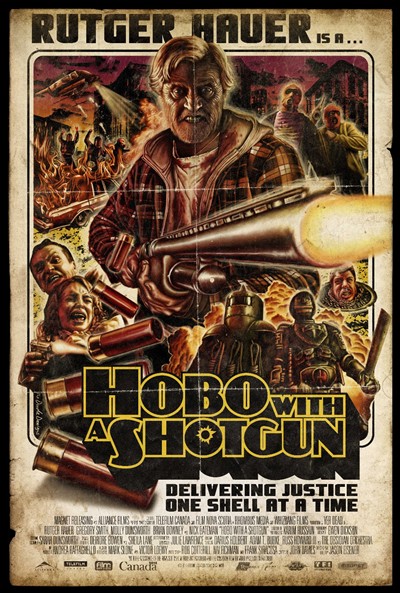
Hobo With a Shotgun Hobo With a Shotgun began as a $150 faux-trailer short that got considerable exposure online and off. The resulting long-form debut for director Jason Eisener and scenarist John Davies is doubtless the zenith in Halifax, Nova Scotia-shot retro ‘ploitation splatter comedies to date. Which tells you nothing, of course. But it is pretty good — not great — insofar as spoofy gross-out nods to yesteryear’s exploitation cinema go. Better than Machete (2010), a whole lot better than the likes of Zombie Strippers! (2008) or 95 percent of what Troma puts out. Grizzled Rutger Hauer stars as the titular character who rides rails into an equally nameless berg nicknamed “Fuck Town” because it’s so plagued by drugs ‘n’ thugz. The hoodlums are led by crime kingpin “The Drake” (Brian Downey) and goon sons (Gregory Smith, Nick Bateman) whose violent perversities are Caligula-licious. With corrupt police force in pocket, they’re free to terrorize the populace via acts of degradation and violence pushed over the bad-taste top and then some. When Hauer’s hobo rescues a prostitute (Molly Dunsworth) from this clan’s clutches, he trips his own mental wire from peaceably detached transient to pawnshop-armed streetsweeper of scum, à la 1980s vintage vigilante cheese. Hobo With a Shotgun faithfully apes exploitation conventions, from its lurid widescreen Technicolor hues to a score combining overproduced 1970s funky soundtrack kitsch with ’80s direct-to-video synth pulsing. Throughout, Hauer maintains a straight face. Maybe a tad more so than necessary — this movie could have used the wilder streak crazy-coot comedic streak shown by Jeff Bridges in last year’s True Grit or Kurt Russell in 2007’s Grindhouse. (1:26) Lumiere. (Harvey)

*Incendies When tightly wound émigré Nawal (Luba Azabal) dies, she leaves behind adult twins Jeanne (Mélissa Désormeaux-Poulin) and Simon (Maxim Gaudette) — and leaves them documents that only compound their feelings of grief and anger, suggesting that what little they thought they knew about their background might have been a lie. While resentful Simon at first stays home in Montreal, Jeanne travels to fictive “Fuad” (a stand-in for source-material playwright Wajdi Mouawad’s native Lebanon), playing detective to piece together decades later the truth of why their mother fled her homeland at the height of its long, brutal civil war. Alternating between present-day and flashback sequences, this latest by Canadian director Denis Villeneuve (2000’s Maelstrom) achieves an urgent sweep punctuated by moments of shocking violence. Resembling The Kite Runner in some respects as a portrait of the civilian victimization excused by war, it also resembles that work in arguably piling on more traumatic incidences and revelations than one story can bear — though so much here has great impact that a sense of over-contrivance toward the very end only slightly mars the whole. (2:10) (Harvey)

*Into Eternity Danish artist Michael Madsen (no, not that Michael Madsen) sneaks into Werner Herzog territory with this rather existential documentary about nuclear waste storage. Though he lacks Herzog’s distinctive, delightful style (his narration is way too corny, and his interview subjects lack any discernable quirks), Madsen is onto something here. Ostensibly, his film is an exploration of Finland’s Onkalo, an enormous underground facility built to store highly dangerous waste until it is no longer radioactive. Ho-hum, until you realize the facility must remain intact and functional for 100,000 years. How, Into Eternity asks, can we plan that far in the future? We can anticipate most natural-disaster scenarios, but what about human intrusion? How can we prevent future civilizations from drilling into the deadly cache, either accidentally or deliberately? How do we warn them? Should we warn them? Will humans even be around that far in the future? All we are is dust in the wind? Needless to say, this quiet, stylistically unassuming doc goes way, way deeper than 500 meters below Finland’s ancient bedrock. (1:15) Roxie. (Eddy)

Kung Fu Panda 2 The affable affirmations of 2008’s Kung Fu Panda take a back seat to relentlessly elaborate, gag-filled action sequences in this DreamWorks Animation sequel, which ought to satisfy kids but not entertain their parents as much as its predecessor. Po (voiced by Jack Black), the overeating panda and ordained Dragon Warrior of the title, joins forces with a cavalcade of other sparring wildlife to battle Lord Shen (Gary Oldman), a petulant peacock whose arsenal of cannons threatens to overwhelm kung fu. But Shen is also part of Po’s hazy past, so the panda’s quest to save China is also a quest for self-fulfillment and “inner peace.” There’s less character development in this installment, though the growing friendship between Po and the “hardcore” Tigress (Angelina Jolie) is occasionally touching. The 3-D visuals are rarely more than a gimmick, save for a series of eye-catching flashbacks in the style of cel-shaded animation. (1:30) (Sam Stander)

*Meek’s Cutoff After three broke down road movies (1994’s River of Grass, 2006’s Old Joy, 2008’s Wendy and Lucy), Kelly Reichardt’s new frontier story tilts decisively towards socially-minded existentialism. It’s 1845 on the choked plains of Oregon, miles from the fertile valley where a wagon train of three families is headed. They’ve hired the rogue guide Meek to show them the way, but he’s got them lost and low on water. When the group captures a Cayeuse Indian, Solomon proposes they keep him on as a compass; Meek thinks it better to hang him and be done with it. The periodic shots of the men deliberating are filmed from a distance — the earshot range of the three women (Michelle Williams, Zoe Kazan, and Shirley Henderson) who set up camp each night. It’s through subtle moves like these that Meek’s Cutoff gives a vivid taste of being subject to fate and, worse still, the likes of Meek. Reichardt winnows away the close-ups, small talk, and music that provided the simple gifts of her earlier work, and the overall effect is suitably austere. (1:44) (Goldberg)

Midnight in Paris Owen Wilson plays Gil, a self-confessed “Hollywood hack” visiting the City of Light with his conservative future in-laws and crassly materialistic fiancée Inez (Rachel McAdams). A romantic obviously at odds with their selfish pragmatism (somehow he hasn’t realized that yet), he’s in love with Paris and particularly its fabled artistic past. Walking back to his hotel alone one night, he’s beckoned into an antique vehicle and finds himself transported to the 1920s, at every turn meeting the Fitzgeralds, Gertrude Stein (Kathy Bates), Dali (Adrien Brody), etc. He also meets Adriana (Marion Cotillard), a woman alluring enough to be fought over by Hemingway (Corey Stoll) and Picasso (Marcial di Fonzo Bo) — though she fancies aspiring literary novelist Gil. Woody Allen’s latest is a pleasant trifle, no more, no less. Its toying with a form of magical escapism from the dreary present recalls The Purple Rose of Cairo (1985), albeit without that film’s greater structural ingeniousness and considerable heart. None of the actors are at their best, though Cotillard is indeed beguiling and Wilson dithers charmingly as usual. Still — it’s pleasant. (1:34) (Harvey)

Pirates of the Caribbean: On Stranger Tides The last time we saw rascally Captain Jack Sparrow (Johnny Depp), he was fighting his most formidable enemy yet: the potentially franchise-ending Pirates of the Caribbean: At World’s End (2007). The first Pirates movie (2003) was a surprise critical success, earning Depp his first-ever Oscar nomination; subsequent entries, though no less moneymaking, suffered from a detectable case of sequel-itis. Overseeing this reboot of sorts is director Rob Marshall (2002’s Chicago), who keeps the World’s End notion of sending Jack to find the Fountain of Youth, but adds in a raft of new faces, including Deadwood‘s Ian McShane (as Blackbeard) and lady pirate Penélope Cruz. The story is predictably over-the-top, with the expected supernatural elements mingling with sparring both sword-driven and verbal — as well as an underlying theme about faith that’s nowhere near as fun as the film’s lesser motifs (revenge, for one). It’s basically a big swirl of silly swashbuckling, nothing more or less. And speaking of Depp, the fact that the oft-ridiculous Sparrow is still an amusing character can only be chalked up to the actor’s own brand of untouchable cool. If it was anyone else, Sparrow’d be in Austin Powers territory by now. (2:05) (Eddy)

Potiche When we first meet Catherine Deneuve’s Suzanne — the titular trophy wife (or potiche) of Francois Ozon’s new airspun comedy — she is on her morning jog, barely breaking a sweat as she huffs and puffs in her maroon Adidas tracksuit, her hair still in curlers. It’s 1977 and Suzanne’s life as a bourgeois homemaker in a small provincial French town has played out as smoothly as one of her many poly-blend skirt suits: a devoted mother to two grown children and loving wife who turns a blind eye to the philandering of husband Robert (Fabrice Luchini), Suzanne is on the fast track to comfortable irrelevance. All that changes when the workers at Robert’s umbrella factory strike and take him hostage. Suzanne, with the help of union leader and old flame Babin (Gerard Depardieu, as big as a house), negotiates a peace, and soon turns around the company’s fortunes with her new-found confidence and business savvy. But when Robert wrests back control with the help of a duped Babin, Suzanne does an Elle Woods and takes them both on in a surprise run for political office. True to the film’s light théâtre de boulevard source material, Ozon keeps things brisk and cheeky (Suzanne sings with as much ease as she spouts off Women’s Lib boilerplate) to the point where his cast’s hammy performances start blending into the cheery production design. Satire needs an edge that Potiche, for all its charm, never provides. (1:43) (Sussman)

Queen to Play From first-time feature director Caroline Bottaro comes this drama about … chess. Wait! Before your eyes glaze over, here are a few more fast facts: it’s set in idyllic Corsica and features, as an American expat, Kevin Kline in his first French-speaking role. (Side note: is there a Kline comeback afoot? First No Strings Attached, then The Conspirator, and now Queen to Play. All within a few short months.) Lovely French superstar Sandrine Bonnaire plays Héléne, a hotel maid who has more or less accepted her unremarkable life — until she happens to catch a couple (one half of which is played by Jennifer Beals, cast because Bottaro is a longtime fan of 1983’s Flashdance!) playing chess. An unlikely obsession soon follows, and she asks Kline’s character, a reclusive doctor who’s on her freelance house-cleaning route, to help her up her game. None too pleased with this new friendship are Héléne’s husband and nosy neighbors, who are both suspicious of the doctor and unsure of how to treat the formerly complacent Héléne’s newfound, chess-inspired confidence. Queen to Play can get a little corny (we’re reminded over and over that the queen is “the most powerful piece”), and chess is by nature not very cinematic (slightly more fascinating than watching someone type, say). But Bonnaire’s quietly powerful performance is worth sticking around for, even when the novelty of whiskery, cardigan-wearing, French-spouting Kline wears off. (1:36) Smith Rafael. (Eddy)

Rio (1:32)

Something Borrowed (1:53)

*13 Assassins 13 Assassins is clearly destined to be prolific director Takashi Miike’s greatest success outside Japan yet. It’s another departure for the multi-genre-conquering Miike, doubtless one of the most conventional movies he’s made in theme and execution. That’s key to its appeal — rigorously traditional, taking its sweet time getting to samurai action that is pointedly not heightened by wire work or CGI, it arrives at the kind of slam-dunk prolonged battle climax that only a measured buildup can let you properly appreciate. In the 1840s, samurai are in decline but feudalism is still hale. It’s a time of peace, though not for the unfortunates who live under regional tyrant Lord Naritsugu (Goro Inagaki), a li’l Nippon Caligula who taxes and oppresses his people to the point of starvation. Alas, the current Shogun is his sibling, and plans to make little bro his chief adviser — so a concerned Shogun official secretly hires veteran samurai Shinzaemon (Koji Yakusho) to assassinate the Lord. Fully an hour is spent on our hero doing “assembling the team” stuff, recruiting other unemployed, retired, or wannabe samurai. When the protagonists finally commence their mission, their target is already aware he’s being pursued, and he’s surrounded by some 200 soldiers by the time Miike arrives at the film’s sustained, spectacular climax: a small village which Shinzaemon and co. have turned into a giant boobytrap so that 13 men can divide and destroy an ogre-guarding army. A major reason why mainstream Hollywood fantasy and straight action movies have gotten so depressingly interchangeable is that digital FX and stunt work can (and does) visualize any stupid idea — heroes who get thrown 200 feet into walls by monsters then getting up to fight some more, etc. 13 Assassins is thrilling because its action, while sporting against-the-odds ingeniousness and sheer luck by our heroes as in any trad genre film, is still vividly, bloodily, credibly physical. (2:06) (Harvey)

*Thor When it comes to superhero movies, I’m not easily impressed. Couple that with my complete disinterest in the character of Thor, and I didn’t go into his big-screen debut with any level of excitement. Turns out Kenneth Branagh’s Thor is a genre standout — the best I’ve seen since 2008’s Iron Man. For those who don’t know the mythology, the film follows Thor (Chris Hemsworth) as he’s exiled from the realm of Asgard to Earth. Once there, he must reclaim his mighty hammer — along with his powers — in order to save the world and win the heart of astrophysicist Jane Foster (Natalie Portman). Hemsworth is perfectly cast as the titular hero: he’s adept at bringing charm to a larger-than-life god. The script is a huge help, striking the ideal balance between action, drama, and humor. That’s right, Thor is seriously funny. On top of that, the effects are sensational. Sure, the 3D is once again unnecessary, but it’s admittedly kind of fun when you’re zooming through space. (2:03) (Peitzman)

The Topp Twins: Untouchable Girls It’s hard to name an American equivalent of New Zealand’s Topp Twins — a folk-singing, comedy-slinging, cross-dressing duo who’re the biggest Kiwi stars you’ve never heard of (but may be just as beloved as, say, Peter Jackson in their homeland). Recent inductees in the New Zealand Music Hall of Fame, the fiftysomething Jools and Lynda, both lesbians, sing country-tinged tunes that slide easily from broad and goofy (with an array of costumed personas) to extremely political, sounding off on LGBT and Maori rights, among other topics. Even if you’re not a fan of their musical style, it’s undeniable that their identical voices make for some stirring harmonies, and their optimism, even when a serious illness strikes, is inspiring. This doc — which combines interviews, home movies, and performance footage — will surely earn them scores of new stateside fans. (1:24) (Eddy)

Water for Elephants A young man named Jacob Jankowski (Robert Pattinson) turns his back on catastrophe and runs off to join the circus. It sounds like a fantasy, but this was never Jacob’s dream, and the circus world of Water for Elephants isn’t all death-defying feats and pretty women on horses. Or rather, the pretty woman also rides an elephant named Rosie and the casualties tend to occur outside the big top, after the rubes have gone home. Stumbling onto a train and into this world by chance, Jacob manages to charm the sadistic sociopath who runs the show, August (Christophe Waltz), and is charmed in turn by August’s wife, Marlena (Reese Witherspoon), a star performer and the object of August’s abusive, obsessive affections. Director Francis Lawrence’s film, an adaptation of Sarah Gruen’s 2006 novel, depicts a harsh Depression-era landscape in which troupes founder in small towns across America, waiting to be scavenged for parts — performers and animals — by other circuses passing through. Waltz’s August is a frightening man who defines a layoff as throwing workers off a moving train, and the anxiety of anticipating his moods and moves supplies most of the movie’s dramatic tension; Jacob and Marlena’s pallid love story feeds off it rather than adding its own. The film also suffers from a frame tale that feels awkward and forced, though Hal Holbrook makes heroic efforts as the elderly Jacob, surfacing on the grounds of — what else? — a modern-day circus to recount his tale of tragedy and romance. (2:00) (Rapoport)

*Win Win Is Tom McCarthy the most versatile guy in Hollywood? He’s a successful character actor (in big-budget movies like 2009’s 2012; smaller-scale pictures like 2005’s Good Night, and Good Luck; and the final season of The Wire). He’s an Oscar-nominated screenwriter (2009’s Up). And he’s the writer-director of two highly acclaimed indie dramas, The Station Agent (2003) and The Visitor (2007). Clearly, McCarthy must not sleep much. His latest, Win Win, is a comedy set in his hometown of New Providence, N.J. Paul Giamatti stars as Mike Flaherty, a lawyer who’s feeling the economic pinch. Betraying his own basic good-guy-ness, he takes advantage of a senile client, Leo (Burt Young), when he spots the opportunity to pull in some badly-needed extra cash. Matters complicate with the appearance of Leo’s grandson, Kyle (newcomer Alex Shaffer), a runaway from Ohio. Though Mike’s wife, Jackie (Amy Ryan), is suspicious of the taciturn teen, she allows Kyle to crash with the Flaherty family. As luck would have it, Kyle is a superstar wrestler — and Mike happens to coach the local high school team. Things are going well until Kyle’s greedy mother (Melanie Lynskey) turns up and starts sniffing around her father’s finances. Lessons are learned, sure, and there are no big plot twists beyond typical indie-comedy turf. But the script delivers more genuine laughs than you’d expect from a movie that’s essentially about the recession. (1:46) (Eddy)


On the Cheap Listings

0

On the Cheap listings are compiled by Jackie Andrews. Submit items for the listings at listings@sfbg.com. For further information on how to submit items for the listings, see Picks.

WEDNESDAY 1

Wicked Plants indeed Conservatory of Flowers, 100 JFK Drive, Golden Gate Park, SF; (415) 831-2090, www.conservatoryofflowers.org. 6:30-8pm, $10. Meet botanical rockstar Amy Stewart, author of the bestselling book Wicked Plants: The Weed that Killed Lincoln’s Mother and Other Botanical Atrocities – which happens to be the inspiration for the Conservatory’s current exhibition, also called Wicked Plants. Hear about a tree that sheds poison daggers, a red seed that stops the heart, a shrub that causes paralysis, a vine that strangles, and a leaf that triggered a war.

THURSDAY 2

“Bestia Mundi” art opening Bone Room, 1573 Solano, Berk.; (510) 526-6262, www.boneroompresents.com. 7-9pm, free. Check out the latest work of Ron Pippin, the artist who creates museums of “wunderkammers” – specimens of an empyrean other-world consisting of boxes and skeletons articulated with strange machinery – at his opening for “Bestia Mundi.” Of course, given the venue, you will be able to peruse the wonders of natural history as well as the oddities that the Bone Room has to offer.

FRIDAY 3

Small space, big taste Books, Inc., 2551 Chestnut, SF; (415) 931-3633 , www.booksinc.net, www.biggirlssmallkitchen.com. 7pm, free. Having a large kitchen, especially in San Francisco, is not always an option. Quarter-life Cooks Cara Eisnepress and Phoebe Lapine understand all too well and have got you covered with their new cookbook to accompany their cooking blog, Big Girls Small Kitchen. They teach you everything from buying your first spatula to must-have kitchen essentials and recipes that reflect a twenty-something and cramped-for-space point-of-view.

SATURDAY 4

Eco-urban festival Union Street between Gough and Steiner, SF; www.unionstreetfestival.com. Sat/4 and Sun/5, 10am-6pm, free. This year the Union Street Festival promises to be even more focused on on health, green education, and sustainable living. Dine at the many healthy food booths, cafes, and bistros, and peruse the local green vendors while listening to live entertainment featuring jazz, classical and swing music. But be sure to leave your brown bags at home – this year the festival is alcohol-free.

King of RPGs launch party Cartoon Art Museum, 655 Mission, SF; (415) CAR-TOON, www.cartoonart.org. 5:30-7:30pm, free. Celebrate the release of the second volume of this popular Graphic novel, King of RPGs, a tongue-in-cheek tale of nerd rage due to a crippling World of Warcraft addiction. Tonight, writer and manga expert Jason Thompson and artist Victor C. Hao meet and greet fans with beverages, light food and a talk about the process of making professionally published manga.

SUNDAY 5

Dance church el Rio, 3158 Mission, SF; (415) 282-3323, www.elriosf.com. 11am-3pm, $3-$5 suggested donation. Its parties like this that helped save Lyon Martin Health Services from closure, but that doesn’t mean you have to stop showing the love. This Sunday’s Dance Church – a booty dancing, bloody mary drinking alternative to traditional church – will be donating the cover charges to the much needed health clinic. There will be breakfast, bloody marys (of course,) and a queer communion on the back patio.

MONDAY 6

The Lazy Gourmet book launch party Bazaar Cafe, 5927 California, SF; (415) 831-5620, www.twolazygourmets.com. 6-9pm, free with drink purchase. Help celebrate the launch of Robin Donovan and Juliana Gallin’s new cookbook, The Lazy Gourmet: Magnificent Meals Made Easy, and learn how even the most unmotivated person with an empty stomach can make simple, elegant, and delicious dishes. Come hungry, buy a book, and sample the recipes prepared by the authors themselves.

TUESDAY 7

Viral Time Cowell Theater, Fort Mason Center, SF; (415) 752-5537, www.longnow.org. 7-8:30pm, $10, free for members. This installment of the Long Now Foundation’s monthly series called “Seminars About Long-term Thinking” features science journalist Carl Zimmer as he discusses blazingly fast and ancient viral time in his new book, A Planet of Viruses. Whole Earth Catalog founder Stewart Brand hosts this discussion about these microscopic organisms – some good, some bad – that are a major engine for the evolution of all other life on the planet.

Whore! Magazine release party Casanova Lounge, 527 Valencia, SF; www.whoremagazine.net. 7-10pm, free. The second issue of Whore! Magazine – the quarterly publication that celebrates the women who define themselves outside of the status quo – features vagina fashion, women of the French Revolution, feminism (duh!), and more. Kick back with a cocktail among like-minded feministas and give cheers to another issue of this provocative magazine.


Beating a fourth horse

0

Beat poet and Buddhist Allen Ginsberg inspires “The Worst Horse,” a Fri/27 program of multidisciplinary work at the San Francisco Zen Center curated by acclaimed SF author and RADAR founder Michelle Tea.

If Ginsberg’s definition of poetry as “making the private world public” is one starting point, the other is the Buddhist parable of the fourth horse, related by Zen Center founder Shunryu Suzuki Roshi in his famous Zen Mind, Beginner’s Mind. In the story, the mere shadow of the whip causes the first horse to run swiftly away, while it’s the first touch of the whip that induces the flight of the second, and the whip’s tearing of the flesh that provokes the third horse’s flight. But the fourth horse does not run until it’s repeatedly lashed.


 “If you think the aim of Zen practice is to train you to become one of the best horses,” writes Suzuki, “you will have a big problem. This is not the right understanding.” Considering the merciful nature of the Buddha, however, it becomes clear: “He will have more sympathy for the worst one than for the best one.”

The parable acts as the specific point of departure for the featured group of artists, some of whom are well-versed in Buddhism while others fall under the “beginner’s mind” rubric. The bill includes Philip Huang (writer, performer, agent provocateur and founder of the Home Theater Festival), acclaimed actress and Cultural Odyssey co–artistic director Rhodessa Jones, writer and artist Ali Liebegott, and poet-comedian and “reluctant self-help guru” Bucky Sinister. The evening also includes a screening of the 1960 award-winning short film Dream of the Wild Horses, a gorgeous and haunting cinematic rumination on the wild horses of France’s Camargue District, presented by Oddball Films.
 
“The Worst Horse”

Fri/27, 7:30 p.m., $10-$12 suggested donation

San Francisco Zen Center

300 Page, SF

http://news.sfzc.org/content/view/961/46/

Last train to Fuck Town

0

arts@sfbg.com

The course of an acting career can vividly illustrate the randomness of fate. Rutger Hauer spent some years in Dutch experimental theater of the 1960s — after pulling off that best way to terminate one’s military service, faking mental illness — then became a local heartthrob as a medieval knight in a hit TV series at that decade’s end.

He spent the 1970s primarily starring in Dutch movies, notably the striking early films of Paul Verhoeven — well before Showgirls (1995), Starship Troopers (1997), or even 1987’s RoboCop (the director wanted Hauer for the lead, but was overruled by the studio). In the 1980s, Hauer played the memorable villains of Blade Runner (1982), The Hitcher (1986), and 1981’s Nighthawks (inducing tough investigative cop Sylvester Stallone to don drag at the end to catch him), between runs at being an action hero and theoretically loftier assignments around the globe.

Then he settled into a multilingual journeyman’s potluck of low-budget genre features, TV projects, small parts in mainstream films (2005’s Sin City and Batman Begins), Guinness commercials, and a Kylie Minogue video. Apparently 67-year-old Dutch actors in Los Angeles can’t be choosy.

Then again, sometimes better opportunities might choose them. At Sundance this January, Hauer played lead roles in two diametrically opposed movies. One was as the 16th-century Flemish artist Pieter Bruegel the Elder in Polish director Lech Majewski’s extraordinary The Mill and the Cross (recently at the San Francisco International Film Festival), which brings one of that painter’s most epic canvases to cinematic life and will hopefully open on U.S. art house screens later this year. The other was Hobo With a Shotgun. Guess which one is opening theatrically here already.

Hobo began as a $150 faux-trailer short that got considerable exposure online and off. The resulting long-form debut for director Jason Eisener and scenarist John Davies is doubtless the zenith in Halifax, Nova Scotia-shot retro ‘ploitation splatter comedies to date. Which tells you nothing, of course. But it is pretty good — not great — insofar as spoofy gross-out nods to yesteryear’s exploitation cinema go. Better than Machete (2010), a whole lot better than the likes of Zombie Strippers! (2008) or 95 percent of what Troma puts out.

Grizzled Hauer stars as the titular character who rides rails into an equally nameless berg nicknamed “Fuck Town” because it’s so plagued by drugs ‘n’ thugz. The hoodlums are led by crime kingpin “The Drake” (Brian Downey) and goon sons (Gregory Smith, Nick Bateman) whose violent perversities are Caligula-licious. With corrupt police force in pocket, they’re free to terrorize the populace via acts of degradation and violence pushed over the bad-taste top and then some.

When Hauer’s hobo rescues a prostitute (Molly Dunsworth) from this clan’s clutches, he trips his own mental wire from peaceably detached transient to pawnshop-armed streetsweeper of scum, à la 1980s vintage vigilante cheese like 1982’s Class of 1984 (Perry King vs. evil high school “punks”), 1985’s Death Wish 3 (Charles Bronson vs. evil gang “punks”), and 1984’s Savage Streets (Linda Blair versus … figure it out).

Hobo With a Shotgun faithfully apes exploitation conventions, from its lurid widescreen Technicolor hues to a score combining overproduced 1970s funky soundtrack kitsch with ’80s direct-to-video synth pulsing. (Complete with a closing-credits rock song that channels Pat Benatar.) Its ludicrously over-the-top violence is kinda funny, but also nastier than need be.

Throughout, Hauer maintains a straight face. Maybe a tad more so than necessary — this movie could have used the wilder streak crazy-coot comedic streak shown by Jeff Bridges in last year’s True Grit or Kurt Russell in 2007’s Grindhouse.

Game Rutger Hauer retains his blue-eyed charisma and clearly relishes playing the gentle (when not lethal) giant in this artificially baroque scenario. He’s also an actor long on the world stage still seeking a role in a worthy film (or play) that may define him for posterity. He’s obviously got the talent — but at this point, would he take it? Would it even be offered? Did he take Hobo With a Shotgun because it seemed funny, or because it was the best he could get? 

HOBO WITH A SHOTGUN opens Fri/27 in Bay Area theaters.

Last train to Fuck Town: Rutger Hauer rides again in “Hobo With a Shotgun”

0

The course of an acting career can vividly illustrate the randomness of fate. Rutger Hauer spent some years in Dutch experimental theater of the 1960s — after pulling off that best way to terminate one’s military service, faking mental illness — then became a local heartthrob as a medieval knight in a hit TV series at that decade’s end.

He spent the 1970s primarily starring in Dutch movies, notably the striking early films of Paul Verhoeven — well before Showgirls (1995), Starship Troopers (1997), or even 1987’s RoboCop (the director wanted Hauer for the lead, but was overruled by the studio). In the 1980s, Hauer played the memorable villains of Blade Runner (1982), The Hitcher (1986), and 1981’s Nighthawks (inducing tough investigative cop Sylvester Stallone to don drag at the end to catch him), between runs at being an action hero and theoretically loftier assignments around the globe.

Then he settled into a multilingual journeyman’s potluck of low-budget genre features, TV projects, small parts in mainstream films (2005’s Sin City and Batman Begins), Guinness commercials, and a Kylie Minogue video. Apparently 67-year-old Dutch actors in Los Angeles can’t be choosy.

Then again, sometimes better opportunities might choose them. At Sundance this January, Hauer played lead roles in two diametrically opposed movies. One was as the 16th-century Flemish artist Pieter Bruegel the Elder in Polish director Lech Majewski’s extraordinary The Mill and the Cross (recently at the San Francisco International Film Festival), which brings one of that painter’s most epic canvases to cinematic life and will hopefully open on U.S. art house screens later this year. The other was Hobo With a Shotgun. Guess which one is opening theatrically here already.

Hobo began as a $150 faux-trailer short that got considerable exposure online and off. The resulting long-form debut for director Jason Eisener and scenarist John Davies is doubtless the zenith in Halifax, Nova Scotia-shot retro ’ploitation splatter comedies to date. Which tells you nothing, of course. But it is pretty good — not great — insofar as spoofy gross-out nods to yesteryear’s exploitation cinema go. Better than Machete (2010), a whole lot better than the likes of Zombie Strippers! (2008) or 95 percent of what Troma puts out.

Grizzled Hauer stars as the titular character who rides rails into an equally nameless berg nicknamed “Fuck Town” because it’s so plagued by drugs ’n’ thugz. The hoodlums are led by crime kingpin “The Drake” (Brian Downey) and goon sons (Gregory Smith, Nick Bateman) whose violent perversities are Caligula-licious. With corrupt police force in pocket, they’re free to terrorize the populace via acts of degradation and violence pushed over the bad-taste top and then some.
When Hauer’s hobo rescues a prostitute (Molly Dunsworth) from this clan’s clutches, he trips his own mental wire from peaceably detached transient to pawnshop-armed streetsweeper of scum, à la 1980s vintage vigilante cheese like 1982’s Class of 1984 (Perry King vs. evil high school “punks”), 1985’s Death Wish 3 (Charles Bronson vs. evil gang “punks”), and 1984’s Savage Streets (Linda Blair versus … figure it out).

Hobo With a Shotgun faithfully apes exploitation conventions, from its lurid widescreen Technicolor hues to a score combining overproduced 1970s funky soundtrack kitsch with ’80s direct-to-video synth pulsing. (Complete with a closing-credits rock song that channels Pat Benatar.) Its ludicrously over-the-top violence is kinda funny, but also nastier than need be. Throughout, Hauer maintains a straight face. Maybe a tad more so than necessary — this movie could have used the wilder streak crazy-coot comedic streak shown by Jeff Bridges in last year’s True Grit or Kurt Russell in 2007’s Grindhouse.

Game Hauer retains his blue-eyed charisma and clearly relishes playing the gentle (when not lethal) giant in this artificially baroque scenario. He’s also an actor long on the world stage still seeking a role in a worthy film (or play) that may define him for posterity. He’s obviously got the talent — but at this point, would he take it? Would it even be offered? Did he take Hobo With a Shotgun because it seemed funny, or because it was the best he could get?

HOBO WITH A SHOTGUN opens Fri/27 in Bay Area theaters.


Stein time

0

arts@sfbg.com

 A visit to the Bay Area from David Greenspan is a rare treat. A visit by Gertrude Stein even more so. It’s kind of a twofer this weekend as Greenspan delivers his version of Stein’s lecture on the theater, Plays, amid a wide-ranging Stein retrospective (Seeing Gertrude Stein: Five Stories) at the Contemporary Jewish Museum (which occurs simultaneously with the San Francisco Museum of Modern Art’s new exhibition, The Steins Collect). Although Greenspan is not often seen on stage in these parts, the inimitable New York City playwright-actor — whose brilliant comedies are often as rich in humor as in formal and intellectual surprises — has had his share of productions in the Bay Area. SF Playhouse recently mounted the musical Coraline (for which he wrote the book) and She Stoops to Comedy. A little further back. Thick Description and the Jewish Theatre had a hit with their coproduction of Greenspan’s Dead Mother, or Shirley Not All in Vain. Greenspan spoke to the Guardian by phone from New York ahead of his appearance at CJM.

SFBG The Stein lecture you’re presenting ran in rep with the New York revival of your 1999 play, The Myopia, in which Stein is also referenced. Was that the first time you’d done the lecture as a piece of theater?

David Greenspan I’ve done it periodically, one night here, one night there. And then I did it for a benefit for a theater company. Melanie Joseph, who runs the Foundry Theatre in New York, I invited her and she loved it. So when we began playing The Myopia, we decided we would include [a performance of] the Stein lecture in tandem. I had never had anything approaching a run before.

SFBG What drew you to that lecture as something to perform?

DG I’ve become interested over the last number of years in the theatrical possibilities of nontheatrical texts. I did this piece called The Argument, which is based on Aristotle’s Poetics and the writings of a man named Gerald F. Else, who wrote about The Poetics. The Argument recites the first half of The Poetics. I’d been toying with that for a while, and I’d also done — in a reading for a friend, a fellow playwright — the Stein lecture, and it went over so well, people so enjoyed it. So, besides the interest in the non-theatrical text as a performative work, it is an intriguing lecture.

And I should say, it’s not that it’s not performative. Even The Poetics. They’re both performative pieces in the sense that they’re both lectures, so they would have been given. Whatever difference between a lecture and a performance, it’s a presentation. So there’s theatrical potential in them. But I guess I was fascinated by her observations about the theater, how it addressed her own concerns, recollections, and reminiscences about growing up watching plays, and references to her experiences when she finally moved to Paris. I found it rather rich historically as well.

SFBG There’s that wonderful line you quote in The Myopia about theater as something that’s actually happening&ldots;

DG Right. Well, she says that something is always happening. And that anybody knows a quantity of stories, so what’s the use of telling another story? There are already so many stories. I think what she’s trying to get at is that there is something beyond simply telling the story. There’s some essence of what is happening. And she’s trying to depict [that] without actually telling a story. It’s almost a series of impressions that she’s molding, almost like a sculpture, to give an audience a sense, without a story, of an experience. Of course, in The Myopia I pickled it because The Myopia is filled with stories. In a sense, I use it as a way of separating myself from her because my concerns are different. But I still find her delightful.

SFBG What do you think of Stein’s plays?

DG I’ve seen a few of them on stage. They’re difficult to describe, and they’re difficult for me to talk about. The closest experience I’ve ever had to performing in something like Stein would be a Richard Foreman play. I acted for Richard Foreman once. His work eschews traditional action. It’s somewhat different, but it’s the closest I’ve come to something like Stein. Like she says, she’s not interested in story and action. She’s interested in emotion and time.

I think also what she’s interested in is coordinating to her own satisfaction a visual and aural experience, one that is not dependent on following a story. Because she had problems with that, she found that it bothered her to have to pay attention, particularly if it was a story that had any kind of nuance. She wanted to keep backing up and seeing it again and couldn’t do it. But to get back to your question, the plays themselves I can’t speak to, but the lecture itself with its analysis and observations of the theater experience — and it’s a very personal lecture, very personal descriptions for her — and the rich theatrical reminiscences, I find very satisfying and continually intriguing. Also it begins to elucidate what she was trying to do in her plays.

SFBG What kinds of things do audiences relate to?

DG When she describes her experience of theater as a young person, it’s all about San Francisco and Oakland. So it should give people a little bit of a peep hole into what it was like to see theater [back then]. It was very important to her, the arrival of foreign companies. And Sarah Bernhardt came through, and that was an important thing for her to see. It was very significant for her to see a play in a language she really didn’t understand. She didn’t have to follow it. She could just listen to it and look at it without dealing with a story. That’s what’s most important to her — how to coordinate seeing and hearing in the theater. 

DAVID GREENSPAN’S PLAYS

Thurs/26, 7 p.m.; Sun/29, 1 and 4 p.m., $20

Contemporary Jewish Museum

736 Mission, SF

(415) 655-7800

www.thecjm.org

Our Weekly Picks: May 25-31, 2011

0

WEDNESDAY 25


MUSIC

Stiff Little Fingers

Led by founding member and singer Jake Burns for 34 years now, Belfast’s punk legends Stiff Little Fingers remain a stalwart musical force to be reckoned with. Fueled by the same energy and edgy political criticism that drove classic tracks like “Alternative Ulster” and “Suspect Device,” the band may have changed lineups over the years, but still delivers the goods live, and will likely showcase some songs from its forthcoming album, due out later this year. Be sure to catch SLF tonight in all its glory in a small club — later this weekend they co-headline the Punk Rock Bowling festival in Las Vegas. (Sean McCourt)

With Sharks

8 p.m., $20

Slim’s

333 11th St., SF

(415) 255-0333

www.slims-sf.com


MUSIC

Yeasayer

After listening to its self-described “Middle Eastern-psych-snap-gospel” music on its second studio album Odd Blood, you’ll only be yelling “yay!” to the stylings of Brooklyn-based trio (Chris Keating, Ira Wolf Tuton, and Anand Wilder), Yeasayer. Truth be told, the threesome admitted that Odd Blood was conceived because of a “massive” acid trip in New Zealand. Psychedelics or not, Yeasayer managed a more poppy feel to its much-acclaimed sophomore releases as opposed to its previous recordings. What’s more of a trip is that Peter Gabriel’s drummer, Jerry Marotta, assisted Yeasayer with its recording in an upstate New York studio. Trust me — you won’t be saying “nay” to Yeasayer.(Jen Verzosa)

 With Smith Westerns and Hush Hush

Wed/25-Thurs/26, $20

Fillmore

1805 Geary, SF

(415) 346-6000

www.livenation.com


THURSDAY 26


EVENT

“Muybridge in Three Movements”

It’s Eadweard Muybridge madness with performance, film, and conversation about the artist wrapped into one evening at SFMOMA. A pioneering spirit whose work led to early motion pictures, Muybridge began his artistic career in the 1860s in California. In conjunction with the retrospective exhibition “Helios: Eadweard Muybridge in a Time of Change,” SFMOMA presents excerpts from Catherine Galasso’s Bring On The Lumière!, a performance meditation on early cinema and the basic components of light and movement, key to Muybridge’s work. Also on the program: related short films selected by San Francisco Cinematheque’s Steve Polta and a conversation on cinematic space and time led by Infinite City: A San Francisco Atlas author Rebecca Solnit. (Julie Potter)

7 p.m., $10

Phyllis Wattis Theater

San Francisco Museum of Modern Art

151 Third St., SF

(415) 357-4000

www.sfmoma.org


MUSIC

Atomic Bomb Audition

The first time I heard the Atomic Bomb Audition, I wondered what film the band was scoring: desolate yet pretty, surreal but cohesive, complete with natural scene changes and visible textures. The Oakland band thus succeeds in its explicit compositional goal — to make music for films that don’t exist. Self-described “cinematic sci-fi metal” (Oh Lucifer, please not another heavy metal sub-sub-subgenre … ), ABA channels psychedelic black doom tainted with Mr. Bungle’s carnie creed and heartened by the fearlessness reminiscent of Pink Floyd’s Animals. The resulting soundtrack rings equally holy and dissonant; get your cinematic self to the show because this is the band’s last live one of the year. (Kat Renz)

With Listo, and Moe! Staiano

9 p.m., $8

Bottom of the Hill

1233 17th St., SF

(415) 621-4455

www.bottomofthehill.com


DANCE

“Post:Ballet Sneak Peek”

Rooted in ballet with an eye toward the future, Robert Dekkers’ Post:Ballet thrives on fresh, edgy collaborations with artists in other disciplines. “Sneak Peek” offers an interactive preview of Interference Pattern, a work in progress with film excerpts by Amir Jaffer, performances by the company, audience experiments, and discussion. In discovering how observations influence the subconscious, the exchange during the evening aims to draw a variety of responses from the dance-artists and the audience. Before starting Post: Ballet in 2009, Dekkers performed in the Bay Area with ODC/Dance and Company C Ballet. These days his gorgeous troupe breathes new movement and ideas into ballet. Go ahead, sneak a peek! (Potter)

7–9 p.m., $10

Public Works

161 Erie, SF

(415) 932-0955

www.postballet.org


FRIDAY 27


MUSIC

“Carnaval Fever”

Just can’t get enough SF Carnaval? Sparkly revelers: stray ye not far from the Mission this Memorial Day weekend. Go beyond the free parade and festival (more info on those events at www.sfcarnaval.com) and shake your feathers at the multi-venue after-party, “Carnaval Fever.” Brick and Mortar, newly opened in the old Coda space at Mission near Division, hosts a trio of live bands, starting with Latin American-Caribbean funksters B-Side Players (Fri/27) and followed by retro funksters Monophonics (Sat/28) and the not-purportedly-funky-but-no-doubt-will-make-you-dance-anyway Brazilian accordion slingers Forró Brazuca (Sun/29). For those who’d rather party in a club pounding with Latin beats, there’ll be DJ sets at Public Works (with headliner Marques Wyatt, Sat/28) and Som. (with Sabo, Sun/29). (Cheryl Eddy)

Fri/27–Sun/29, 9 p.m., $12–$15

Brick and Mortar

1710 Mission, SF

Sat/28, 9 p.m., $10

Public Works

161 Erie, SF

Sun/29, 9 p.m., $10

Som.

2925 16th St., SF

www.carnavalfever.com


SATURDAY 28


DANCE

“RAWdance Concept Series: 8”

I’m here to tell you: RAWdance’s Concept Series can become addictive. Few mixed programs of excerpted or in-progress works are as much fun as these occasional showings hidden in the Duboce Triangle (with parking as difficult as North Beach). Presided over — if such it can be called — by RAWdance’s Wendy Rein and Ryan Smith in a venue where, quite unceremoniously, you have to move your butt if the choreographer needs your space, the evenings offer glimpses of what these choreographers are up to. Rarely does it lack for something intriguing, even if it’s just a question the choreographer hasn’t found the answer to yet. This time AXIS’ Margaret Crowell, Amy Seiwert, and wild-woman Christine Bonansea join the hosts, along with the South Bay’s Nhan Ho. As always, coffee and popcorn are included. (Rita Felciano)

Sat/28–Sun/29, 8 p.m.;

Sun/29, 3 p.m., pay what you can

James Howell Studio

66 Sanchez, SF

(415) 686-0728

www.rawdance.org


SUNDAY 29


FILM

Saicomanía

If you haven’t heard of Los Saicos, you’re not alone — though Héctor M. Chávez’s new rockumentary, Saicomanía, aims to shed some long-deserved light on “the best-kept secret from the ’60s.” Formed in 1964 Peru, at the height of worldwide Beatlemania, the members of Los Saicos were anything but fresh-scrubbed mop tops (see: the band’s name, which recalls a certain 1960 Hitchcock movie). Amid (unfounded) rumors that its members were cannibals and played their instruments with hand tools, a raw, frenzied, jangly sound emerged, surging forth to influence countless other bands (including present-day darlings the Black Lips, who appear in the doc), but earning few props from music historians beyond connoisseurs of early garage rock. Saicomanía traces the band’s origins and catches up with its surviving members, still giving off mischievous punk-rock vibes after all these years. The film’s U.S. premiere is hosted by Colectivo Cinema Errante; the screening also features music videos by contemporary South American bands influenced by los abuelos of garage-punk. (Eddy)

7:30 p.m., $6

Artists’ Television Access

992 Valencia, SF

(415) 824-3890

www.atasite.org


TUESDAY 31


DANCE

Royal Danish Ballet

The 19th century Bournonville repertoire is what the Royal Danes — a.k.a. the Royal Danish Ballet, founded in 1748 — is best known for. With this company, forget about errant princes and lost princesses, sky-high extensions, and tornado like whirligigs. Instead, watch for ordinary folks in feathery footwork, rounded arms, suppleness, and ease. That’s what you’ll get with La Sylphide — the oldest extant Romantic ballet. But the Danes, no longer exclusively Danish, also are resolutely 21st-century dancers. That’s why the company is also bringing Nordic Modern, four hot-out-of-the-studio choreographies. Why won’t we see some of Bournonville’s fabled full-evening story ballets? Everyone else on this U.S. tour is getting them, but we don’t have an available theater that can accommodate the designs. What a pity. (Felciano)

Tues/31, June 1, and June 3–4,

8 p.m., $38–$100

Zellerbach Hall

Bancroft at Telegraph,

UC Berkeley, Berk.

(510) 642-9988

www.calperfs.berkeley.edu


MUSIC

Antlers

There are depressing albums, and then there is Antlers’ 2009 LP Hospice. Based on musician Peter Silberman’s intimate solo recordings, Hospice paints nightmares of hospitals, terminally ill children, death, and depression, all with such solemnity that it made this listener egregiously bummed. The band’s follow-up, Burst Apart, drops hospital drama for what might as well be a psychologist’s office — this time wrestling with universal themes of love, scary dreams, and putting the dog to sleep. It’s a far easier pill to swallow, and the newfound keyboard melodies provide a strong backbone for Silberman’s sing-along “ooh and ah” falsetto. It’s also the year’s first firmly melodramatic release to play equally well whether it’s late at night or a sunlit day. (Peter Galvin)

With Little Scream

8 p.m., $18

Great American Music Hall

859 O’Farrell, SF

(315) 885 0750

www.gamh.com 


The Guardian listings deadline is two weeks prior to our Wednesday publication date. To submit an item for consideration, please include the title of the event, a brief description of the event, date and time, venue name, street address (listing cross streets only isn’t sufficient), city, telephone number readers can call for more information, telephone number for media, and admission costs. Send information to Listings, the Guardian Building, 135 Mississippi St., SF, CA 94107; fax to (415) 487-2506; or e-mail (paste press release into e-mail body — no text attachments, please) to listings@sfbg.com. Digital photos may be submitted in jpeg format; the image must be at least 240 dpi and four inches by six inches in size. We regret we cannot accept listings over the phone.

Stage Listings

0

Stage listings are compiled by Guardian staff. Performance times may change; call venues to confirm. Reviewers are Robert Avila, Rita Felciano, and Nicole Gluckstern. Submit items for the listings at listings@sfbg.com. For further information on how to submit items for the listings, see Picks. 

THEATER

OPENING

The Pride New Conservatory Theatre Center, 25 Van Ness, SF; (415) 861-8972, www.nctcsf.org. $24-40. Opens Fri/27, 8pm. Runs Wed-Sat, 8pm; Sun, 2pm. Through July 10. New Conservatory Theatre Center performs the West Coast premiere of Alexi Kaye Campbell’s love-triangle time warp drama.

BAY AREA

Let Me Down Easy Berkeley Repertory Theatre, Roda Theatre, 2015 Addison, Berk; (510) 647-2949, www.berkeleyrep.org. $17-73. Opens Sat/28, 8pm. Runs Tues and Thurs-Sat, 8pm (also Sat, 2pm); Wed, 7pm; Sun, 2pm. Through June 26. Anna Deavere Smith performs her latest solo show.

Welcome Home, Julie Sutter Marion E. Greene Black Box Theater, 531 19th St, Oakl; www.theatrefirst.com. $10-30. Opens Thurs/26, 8pm. Runs Thurs-Sat, 8pm; Sun, 2pm. Through June 19. A combat veteran returns home to figure out her post-Iraq life in Julie Marie Myatt’s drama.

ONGOING

Little Shop of Horrors Boxcar Theatre Playhouse. 505 Natoma; www.boxcartheatre.org. $20-50. Opens Wed/25, 8pm. Runs Tues-Sat, 8pm; Sun, 2pm. Through June 26. Boxcar Theatre presents a new version of the musical.

*Lucky Girl EXIT Studio, 156 Eddy; (800) 838-3006, www.brownpapertickets.com. $10-25. Thurs/26-Sat/28, 8pm. Honey (Cheryl Smith) talks about “the shoes” first, the shoes repeatedly, against even her analyst’s power to retain a common interest in the footwear of her attacker. Why should she so concern herself with this detail of the man who assaulted her, wounding her in ways too subtle and deep to measure—unless through the wayward precision of the poetical imagination some measure might actually be taken. That is the force and beauty of Lucky Girl, a notable new stage adaptation by Tom Juarez of poet Frances Driscoll’s 1997 collection, The Rape Poems, which premieres as part of Exit Theatre’s DIVAfest 2011. Juarez crafts an engagingly dynamic and delicate narrative arc from Driscoll’s thematically joined but otherwise disparate poems, gorgeously formulated verses that delve into a devastating subject with an unexpected range of humor, insight, and compassion. This supple range is acutely grasped and exquisitely interpreted by Smith, whose gripping performance (keenly directed by Kathryn Wood) eschews anything remotely sentimental for a complex and moving portrait of the enduring aftermath of terror. (Avila)

Nobody Move Intersection for the Arts, 925 Mission, Golden Gate; 626-2787, www.brownpapertickets.com. $20-35. Thurs-Sat, 8pm; Sun, 3pm. Through June 12. Intersection for the Arts and Campo Santo present a play based on the novel by Denis Johnson.

*Queer Southside Theater, Bldg D, Third Floor, Fort Mason Center, Marina at Laguna, SF; (415) 399-9554, www.sfiaf.org. $12-25. Fri/27-Sat/28, 8 pm; Sun/29, 7pm. Composer Erling Wold’s 2001 chamber opera, based on the early novel by William S. Burroughs, returns as part of this year’s San Francisco International Arts Festival. It’s a moody, evocative, dreamy, and witty piece, beautiful to listen to and totally worth seeing, first of all for the soulful, salacious showmanship and prowess of Joe Wicht as Burroughs’s narrative stand-in Lee, a punchy junk-addicted American (decked in perfect period-setting attire by Laura Hazlett) on the prowl for boys and other highs in 1950s Mexico City. Wicht is magnetic in the part, embodying Lee with complete assurance and proving as potently dynamic in his singing as in the wry, textured delivery and well-wrought physicality of his characterization. Ken Berry as the other principal singer adds further energy and buoyancy in several supporting roles. James Graham, subdued and sly, plays well against Wicht as Lee’s obsession, the young Allerton, lured on a trip to South America to seek out the mysterious indigenous psychotropic drug called yage (aka ayahuasca). Graceful dancers Diana Consuelo Hopping Rais and Jorge Rodolfo De Hoyos Jr. meanwhile add an appealingly languid human landscape in a variety of non-speaking parts (in intelligent, sensual choreography by Cid Pearlman). The episodic plot is well-suited to Wold’s atmospheric score, which is here played by a five piece ensemble and blends elongated, jagged, whirling lines and harmonies with convincing splashes of Latin color. Minor distractions in some unfortunate technical glitches, uneven sound levels on the actors, and the rustle of body mics aside, this is a small but admirable production directed by Jim Cave and conducted by Bryan Nies. (Avila)

Reborning SF Playhouse, 533 Sutter; 677-9596. www.sfplayhouse.org. Tues-Wed, 7pm; Thurs-Sat, 8pm (also Sat, 3pm). Through June 11. Though emphatically fictional, Zayd Dohrn’s play Reborning, currently receiving its world premiere at the SF Playhouse, provides an intriguing introduction to a decidedly fringe occupation. That of reborning: the art of crafting photo-realistic doll children commissioned by collectors, and sometimes by grieving parents. The play opens with an act of creation, as Kelly (Lauren English) tidies up a closed eye with a sculptor’s blade while a joint burns in the ashtray beside her. Enter Lorri Holt as Emily, a crisp, efficient businesswoman, and a client, come to check on the progress of her “baby” Eva. Things start to go South when Emily suggests some modifications and Kelly’s own obsession with the project eventually spirals out of control. Amiable foil, Alexander Alioto as Kelly’s boyfriend Daizy, exudes eager, golden retriever-like loyalty, but as Emily coolly observes, has “nothing to offer someone who is drowning.” All three actors are top-notch and do a fine job processing thoroughly uncomfortable moments, and the crack design team set the stage and mood precisely. Unfortunately the script itself skews towards melodrama and certain themes (dildo-design, drug abuse, “the dumpster darling”) imbue Reborning with an almost seedy, Jerry Springer vibe that seems inconsistent with director Josh Costello’s strictly straightforward approach to the charged material. (Gluckstern)

Risk is This…The Cutting Ball New Experimental Plays Festival EXIT on Taylor, 227 Taylor; (800) 838-3006, www.cuttingball.com. $20-50. Fri-Sat, 8pm. Through June 25. Cutting Ball Theater closes its 11th season with a festival of experimental plays, including works by Eugenie Chan, Rob Melrose, and Annie Elias.

The Stops New Conservatory Theatre Center, 25 Van Ness; 861-8972, www.nctcsf.org. $24-40. Previews Wed/25-Thurs/26, 8pm. Opens Fri/27, 8pm. Runs Wed-Sat, 8pm; Sun, 2pm. Through June 25. New Conservatory Theater Center presents a musical comedy set in San Francisco.

A Streetcar Named Desire Actors Theatre, 855 Bush; 345-1287, www.actorstheatresf.org. $26-38. Wed-Sat, 8pm. Through June 25. Actors Theatre of San Francisco presents the Tennessee Williams tale.

*Vice Palace: The Last Cockettes Musical Thrillpeddlers’ Hypnodrome, 575 10th St; (800) 838-3006, www.brownpapertickets.com. $30-35. Fri-Sat, 8pm; Sun, 7pm. Through July 31. Hot on the high heels of a 22-month run of Pearls Over Shanghai, the Thrillpeddlers are continuing their Theatre of the Ridiculous revival with a tits-up, balls-out production of the Cockettes’ last musical, Vice Palace. Loosely based on the terrifyingly grim “Masque of the Red Death” by Edgar Allan Poe, part of the thrill of Palace is the way that it weds the campy drag-glamour of Pearls Over Shanghai with the Thrillpeddlers’ signature Grand Guignol aesthetic. From an opening number set on a plague-stricken street (“There’s Blood on Your Face”) to a charming little cabaret about Caligula, staged with live assassinations, an undercurrent of darkness runs like blood beneath the shameless slapstick of the thinly-plotted revue. As plague-obsessed hostess Divina (Leigh Crow) and her right-hand “gal” Bella (Eric Tyson Wertz) try to distract a group of stir-crazy socialites from the dangers outside the villa walls, the entertainments range from silly to salacious: a suggestively-sung song about camel’s humps, the wistful ballad “Just a Lonely Little Turd,” a truly unexpected Rite of Spring-style dance number entitled “Flesh Ballet.” Sumptuously costumed by Kara Emry, cleverly lit by Nicholas Torre, accompanied by songwriter/lyricist (and original Cockette) Scrumbly Koldewyn, and anchored by a core of Thrillpeddler regulars, Palace is one nice vice. (Gluckstern)

BAY AREA

Care of Trees Ashby Stage, 1901 Ashby, Berk; (510) 841-6500, www.shotgunplayers.org. $17-26. Thurs-Sat, 8pm; Sun, 5pm. Through June 26. Shotgun Players presents a play about love and belief by E. Hunter Spreen, directed by Susannah Martin.

Distracted 529 South Second St, San Jose; (408) 295-4200, www.cltc.org. $15-35. Thurs-Sat, 8pm (also Sun/29, 7pm; June 5, 12, and 19, 2pm). Through June 19. City Lights Theater Company of San Jose presents a drama written by Lisa Loomer and directed by Lisa Mallette. 


Rep Clock

0

Schedules are for Wed/25–Tues/31 except where noted. Director and year are given when available. Double features are marked with a •. All times are p.m. unless otherwise specified.

ARTISTS’ TELEVISION ACCESS 992 Valencia, SF; www.atasite.org. $3-6. “Retelling Stories,” films by Matt Wolf, Mike Kuchar, and Chris Vargas, Thurs, 7. New work by film students at the City College of San Francisco, Fri, 7. “Other Cinema:” “New Experimental Works,” Sat, 8:30. Saicomania (Chávez, 2011), Sun, 7:30.

BALBOA 3620 Balboa, SF; www.balboamovies.com. $20. “Opera, Ballet, and Shakespeare in Cinema:” Aida, Sat-Sun, 10am; June 1, 7:30. Performed by Maggio Musicale Fiorentino.

CASTRO 429 Castro, SF; (415) 621-6120, www.castrotheatre.com. Regular programming $7.50-10. Pirates of the Caribbean: On Stranger Tides (Marshall, 2011), Wed-Thurs, call for times. This film, $10-12. “The Castro Remembers Elizabeth Taylor (1932-2011):” •Cat on a Hot Tin Roof (Brooks, 1958), Fri, 2, 7, and Suddenly, Last Summer (Mankiewicz, 1959), Fri, 4, 9:30; •A Place in the Sun (Stevens, 1951), Sat, 2:30, 8, and Raintree County (Dmytryk, 1957), Sat, 4:50; Giant (Stevens, 1956), Sun, 2, 7; •Father of the Bride (Minnelli, 1950), Mon, 1, 5:05, 9:20, and National Velvet (Brown, 1944), Mon, 2:50, 7; •Secret Ceremony (Losey, 1968), Tues, 7, and X Y & Zee (Hutton, 1971), Tues, 9:05. Fri/27 evening-show double feature ($25) benefits Project Inform.

CHRISTOPHER B. SMITH RAFAEL FILM CENTER 1118 Fourth St, San Rafael; (415) 454-1222, www.cafilm.org. $10.25. The Double Hour (Capotondi, 2010), call for dates and times. The Princess of Montpensier (Tavernier, 2010), call for dates and times. Queen to Play (Bottaro, 2009), call for dates and times. 13 Assassins (Miike, 2010), call for dates and times. Nostalgia for the Light (Guzmán, 2010), Wed, 7. With Isabel Allende in person; this event, $12. As You Like It, Thurs, 7; Sun, 1. Performed at the Globe Theater, London. The First Grader (Chadwick, 2010), May 27-June 2, call for times.

PACIFIC FILM ARCHIVE 2575 Bancroft, Berk; (510) 642-5249, www.bampfa.berkeley.edu. $5.50-9.50. Programming resumes June 10.

RED VIC 1727 Haight, SF; (415) 668-3994; www.redvicmoviehouse.com. $6-10. Rubber (Dupieux, 2011), Wed-Thurs, 7:15, 9:15 (also Wed, 2). The Room (Wiseau, 2003), Fri-Sat, 7:15, 9:15 (also Sat, 2, 4, midnight). The Fall (Singh, 2006), Sun-Mon, 7, 9:25 (also Sun, 2, 4:25). Kill the Irishman (Hensleigh, 2011), May 31-June 1, 7:15, 9:30 (also June 1, 2).

ROXIE 3117 and 3125 16th St, SF; (415) 863-1087, www.roxie.com. $5-9.75. “I Wake Up Dreaming 2011: Legendary and Lost Film Noir:” •The 49th Man (Sears, 1953), Wed, 6:30, 9:40, and World for Ransom (Aldrich, 1954), Wed, 8; •Witness to Murder (Rowland, 1954), Thurs, 6:15, 10, and Kiss Me Deadly (Aldrich, 1955), Thurs, 8. Meek’s Cutoff (Reichardt, 2010), Wed-Thurs, 7:15, 9:30. “San Francisco Sex Worker Film and Arts Festival: Sex Worker Movies at the Roxie,” Sat, 2. For schedule, visit www.sexworkerfest.com. VORTEX ROOM 1082 Howard, SF; www.myspace.com/thevortexroom. $5 donation. •Dorian Gray (Dallamano, 1970), Thurs, 9, and De Sade (Endfield, 1969), Thurs, 11.

Your summer guide to art escapes

0

Living in San Francisco means having the richness of art in a major city, and the natural beauty of California all in one fell swoop. Here’s your guide to enjoying urban escapes and art and live performance – at the same time! – this summer. Also, check out our guides to the season’s falls and festivals, movies, music, and best adventures you can go on without a car.


WITHIN THE CITY 

Yerba Buena Gardens Festival

With three stages of free performances, this festival is perfect for a dose of culture and fresh air during your lunch hour with music, dance, theater, and readings. There’s weekend concerts too: the SF Mime Troupe performs Aug. 21, SF’s local songbird Meklit Hadero on Aug. 27, and SF’s pluckiest free ring wraiths, Circus Bella return to the lawn for the weekend of July 1-2.

May through September, free. www.ybgf.org


Stern Grove Festival

Stern Grove’s eucalyptus tree surroundings create a pretty magical summer stage for free performances. The experience gets even better when you pack a tasty picnic spread to enjoy — but leave your umbrellas and high-back chairs at home to keep the peace with those who didn’t snag the primo front row spots. In addition to the annual appearances of the San Francisco Ballet, Opera and Symphony, the concert lineup features Sharon Jones and The Dap-Kings, the Jazz Mafia Symphony, Neko Case, Afrocubism, The English Beat, Aaron Neville, and Javier Limon and Buika.

Sundays, June 19-August 21, free. www.sterngrove.org


San Francisco Mime Troupe at Dolores Park 

Enjoy palm trees and revolutionary spirit with your Tecate: with this historic troupe of not-mimes – forget the pantomime, this is socially relevant theater in the park.

July 2, 3, 4, free. www.sfmt.org


San Francisco Symphony in the Park

This year’s concert, which will be performed in Sharon Meadow, features conductor Michael Francis and pianist Valentina Lisitsa on a program of Mussorgsky’s A Night on Bald Mountain, Rachmaninoff’s Piano Concerto No. 2, and Beethoven’s Symphony No. 5.  

July 10, 2 p.m., free. www.sfsymphony.org


Shakespeare in the Park, The Presidio

Bring the whole family for this year’s performance of  Cymbeline at the Presidio’s Main Post Parade Ground Lawn.

September 3, 4, 5, 10, 11, 17, 18, 24, 25, free. Sharon Meadow, Golden Gate Park, SF. www.sfshakes.org


Opera in the Park

This year’s annual concert, also in Sharon Meadow, features a special musical program commemorating the tenth anniversary of September 11, 2001.

September 11, 1:30 p.m., free. Sharon Meadow, Golden Gate Park, SF. www.sfopera.com


AND BEYOND…

Oliver Ranch

Seventy miles north of San Francisco in Sonoma County, Oliver Ranch boasts scenic acres and 18 site-specific installations by artists such as Bruce Nauman and Richard Serra, as well as Ann Hamilton’s distinct tower where commissioned dance, poetry, theater, and music performances unfold. The tower structure – defined by two staircases built in a double helix form that accommodate the audience on one staircase and the performers on the other — suits a range of sensory projects and performances hosting artists like Meredith Monk and the Kronos Quartet. Limited capacity allows for only 100 visitors, making this ticket a splurge — but it’s all good, each concert in the tower benefits a non-profit organization. June appearances include Pauline Oliveros and Terry and Jo Harvey Allen. Should you be lucky enough to get tickets, be sure to bring some water and sunscreen and make a day of it visiting all the nearby wineries.

Various dates in June, prices vary. 22205 River, Geyserville. (510) 412-9090, www.oliverranchfoundation.org


Headlands Center for the Arts open house 

Just across the bridge in the rugged Golden Gate National Recreation Area, the Headlands Center for the Arts synthesizes natural and urban environments in a cluster of historic, 1900s military buildings at Fort Barry among hills, cliffs, coves, and beaches. At the center’s summer open house, artists open their studios to the public to show their works-in-progress and talk with visitors about their creative process in a variety of disciplines. Catch one of the many performances and readings scheduled throughout the day and then head to the mess hall, which is transformed into a café serving delicious homemade snacks at down-home prices for the event. While you’re there, a hike through the windy Headland hills is a must-do.

July 24, 12-5 p.m., free. 944 Fort Barry, Sausalito. (415) 331-2787, www.headlands.org


Robert Mondavi Winery Summer Music Festival

One of the first wineries in the Napa Valley, the Robert Mondavi Winery offers much more than sipping, swilling, and spitting. A concert series scheduled for Saturday nights in July features music in an open-air setting and this summer’s lineup includes Gavin DeGraw, Colbie Caillat, David Foster, Chris Isaak, K.D. Lang, and the Siss Boom Bang. Mondavi’s grounds also include an art gallery open daily from 10 a.m. to 4 p.m., with artifacts and paintings as well as a sculpture collection focused on the work of San Francisco artist, Beniamino Bufano, displayed in the main courtyard surrounded by rows of vines. Head here for a fancy summer night of outdoor music and wind down after an afternoon of tastings.

Saturdays in July, $75-$105. 7801 St. Helena Hwy., Oakville. (888) 766-6328, www.robertmondavi.com


Summer fairs and festivals

0

ONGOING

Young At Art Festival de Young Museum, Golden Gate Park, SF. (415) 695-2441, www.youngatartsf.com. Through May 22, free. The creative achievements of our city’s youth are celebrated in this eight day event curated and hosted by the de Young Museum.

* Oakland Asian Cultural Center Asian Pacific Heritage Festival Oakland Asian Cultural Center, 388 Ninth St., Oakl. (510) 637-0462, www.oacc.cc. Through May 26. Times and prices vary. Music, lectures, performances, family-friendly events in honor of Asian and Pacific American culture and traditions.

DIVAfest Exit Theatre, 156 Eddy, SF. (415) 931-2699, www.theexit.org. Through May 28. Times and prices vary. Bastion of the alternative, EXIT Theatre showcases its 10th annual buffet of fierce women writers, performers, and directors. This year features two plays, beat poetry, musical exploration, and more.

* Yerba Buena Gardens Festival Yerba Buena Gardens, Mission and Third St., SF. (415) 543-1718, www.ybgf.org. Through Oct. 31. Times vary, free. A series of cultural events, performances, activities, music, and children and family programs to highlight the green goodness of SoMa’s landscaped oasis.


May 18-June 5

San Francisco International Arts Festival Various venues. (415) 399-9554, www.sfiaf.org. Times and prices vary. Celebrate the arts through with this mish-mash of artistic collaborations dedicated to increasing human awareness. Artists included hail from around the world and right here in the Bay Area.


May 21

* A La Carte & Art Castro St. between Church and Evelyn, Mountain View. (650) 964-3395, www.miramarevents.com. 10am-6pm, free. With vendors selling handmade crafts, microbrewed beers, fresh foods, a farmers market, and even a fun zone for kids, there’s little you won’t find at this all-in-one fun fair. Asian Heritage Street Celebration Larkin and McAllister, SF. www.asianfairsf.com. 11am-6pm, free. This year’s at the country’s largest gathering of APA’s promises a Muay Thai kickboxing ring, DJs, and the latest in Asian pop culture fanfare — as well as tasty bites to keep your strength up.

Freestone Fermentation Festival Salmon Creek School, 1935 Bohemian Hwy, Sonoma. (707) 479-3557, www.freestonefermentationfestival.com. Noon-5pm, $12. Learn about the magical wonders of fermentation with hands-on and mouth-on demonstrations, exhibits, and tasty live food nibbles.

Uncorked! San Francisco Wine Festival Ghirardelli Square, SF. (415) 775-5500, www.ghirardellisq.com. 1-6pm, $45-50 for tasting tickets, free for other activities. Uncorked! brings you the real California wine experience with tastings, cooking demonstrations, and even a wine 101 class for those who are feeling not quite wine-refined.


May 20-29

SF Sex Worker Film and Art Festival Various venues, SF. (415) 751-1659, www.sexworkerfest.com. Times and prices vary. Webcam workshops, empowering film screenings, shared dialogues on plant healing to sex work in the age of HIV: this fest has everything to offer sex workers and the people who love ’em.


May 22

Lagunitas Beer Circus Lagunitas Brewing Co., 1280 N McDowell, Petaluma. (303) 447-0816, www.craftbeer.com. Noon-6pm, $40. All the wonders of a live circus — snake charmers, plate spinners, and sword swallowers — doing their thing inside of a brewery!


May 21-22

* Maker Faire San Mateo County Event Center, 2495 South Delaware, San Mateo. www.makerfaire.com. Sat, 10am- 8pm; Sun, 10am-6pm, $5-25. Make Magazine’s annual showcase of all things DIY is a tribute to human craftiness. This is where the making minds meet. Castroville Artichoke Festival Castroville, Calif. (831) 633-0485, www.artichokefestival.org. Sat., 10am- 6pm; Sun., 11 am- 4:30 p.m., free. Pay homage to the only vegetable with a heart: the artichoke. This fest does just that, with music, parades, and camping.


May 28-29 

San Francisco Carnaval Harrison between 16th and 22nd St., SF. 10am-6pm, free. The theme of this year’s showcase of Latin and Caribbean culture is “Live Your Fantasy” — bound to bring dreams alive on the streets of the Mission.


June 3-12

Healdsburg Jazz Festival Various venues, Healdsburg. (707) 433-463, www.healdsburgjazzfestival.org. Times and prices vary. Bask in the lounge-lit glow of all things jazz-related at this celebration in Sonoma’s wine county.


June 3-July 3 

SF Ethnic Dance Festival Zellerbach Hall, Berk. and Yerba Buena Center for the Arts, SF. www.worldartswest.org. Times and prices vary. A powerful display of world dance and music taking to the stage over the course of five weekends.


June 4

* Berkeley World Music Festival Telegraph, Berk. www.berkeleyworldmusicfestival.org. Noon-9pm, free. Fourteen world music artists serenade the streets and stores of Telegraph Avenue and al fresco admirers in People’s Park.

Huicha Music Festival Gundlach Bundschu Winery, 2000 Denmark St., Sonoma. (707) 938-5277, www.gunbun.com/hmfevent. 2-11pm, $55. Indie music in the fields of a wine country: Fruit Bats, J Mascis of Dinosaur Jr, Sonny and the Sunsets, and more.


June 4-5

Union Street Eco-Urban Festival Union from Gough to Steiner and parts of Octavia, SF. (800) 310-6563, www.unionstreetfestival.com. 10am-6pm, free. Festival goers will have traffic-free access to Cow Hollow merchants and restaurant booths. The eco-urban theme highlights progressive, green-minded advocates and products.

The Great San Francisco Crystal Fair Fort Mason Center, Building A., SF. (415) 383-7837, home.earthlink.net/~sfxtl/index.html. Sat., 10am-6pm; Sun., 10am-4pm, $6. Gems and all they have to offer: beauty, fashion, and mysterious healing powers.


June 5

* Israel in the Gardens Yerba Buena Gardens, SF. (415) 512-6420, www.sfjcf.org. 11am-5pm, free. One full day of food, music, film, family activities, and ceremonies celebrating the Bay Area’s Jewish community and Israel’s 63rd birthday.


June 10-12

Harmony Festival Sonoma County Fairgrounds, 1350 Bennett Valley, Santa Rosa. www.harmonyfestival.com. 10am-10pm, $45 one day, $120 for three day passes. This is where your love for tea, The Flaming Lips, goddess culture, techno, eco-living, spirituality, and getting drunk with your fellow hippies come together in one wild weekend.

Queer Women of Color Film Festival Brava Theater. 2789 24th St., SF. (415) 752-0868, www.qwocmap.org. Times vary, free. A panel discussion called “Thinkers and Trouble Makers,” bisects three days of screenings from up-and-coming filmmakers with stories all their own.


June 11-12

* Live Oak Park Fair 1301 Shattuck, Berk. (510) 227-7110, www.liveoakparkfair.com. 10am-6pm, free. This festival’s 41st year brings the latest handmade treasures from Berkeley’s vibrant arts and crafts community. With food, face-paint, and entertainment, this fair is perfect for a weekend activity with the family.


June 11-19 

San Mateo County Fair San Mateo County Fairgrounds. 2495 S. Delaware, San Mateo. www.sanmateocountyfair.com. June 11, 14, 18, and 19, 11am-10pm; all other days, noon-10pm, $10 for adults. It features competitive exhibits from farmers, foodies, and even technological developers — but let’s face it, we’re going to see the pig races.


June 12

Haight Ashbury Street Fair Haight between Stanyan and Ashbury, SF. www.haightashburystreetfair.org. 11am-5:30pm, free. Make your way down to the grooviest corner in history and celebrate the long-standing diversity and color of the Haight Ashbury neighborhood, featuring the annual battle of the bands.


June 16-26

Frameline Film Festival Various venues, SF. www.frameline.org. Times and prices vary. This unique LGBT film festival comes back for its 35th year showcasing queer documentaries, shorts, and features.


June 17-19 Sierra Nevada World Music Festival Mendocino County Fairgrounds. 14400 CA-128, Boonville. (916) 777-5550, www.snwmf.com. Fri, 6pm-midnight; Sat, 11am-midnight; Sun, 11am-10pm, $60 for Friday and Sunday day pass; $70 for Saturday day pass, $150 three day pass. Featuring Rebulution, Toots and the Maytals, and Jah Love Sound System, this fest comes with a message of peace, unity, and love through music.


June 18 

Summer SAILstice Encinal Yacht Club, 1251 Pacific Marina, Alameda. (415) 412-6961, www.summersailstice.com. 8am-8pm, free. Boat building, sailboat rides, sailing seminars, informational booths, music, a kid zone, and of course, wind, sun, and water.

Pinot Days Festival Pavilion, Fort Mason Center, SF. (415) 382-8663, www.pinotdays.com. 1-5pm, $50. Break out your corkscrews and head over to this unique event. With 220 artisan winemakers pouring up tastes of their one-of-a-kind vino, you better make sure you’ve got a DD for the ride home.


June 18-19

North Beach Festival Washington Square Park, SF. (800) 310-6563, www.northbeachchamber.com. Sat, 10am-6pm; Sun, 10am-6pm, free. Make your way down to the spaghetti capital of SF and enjoy food, music, arts and crafts booths, and the traditional blessing of the animals.

Marin Art Festival Marin Civic Center, San Rafael. (415) 388-0151, www.marinartfestival.com. 10am-6pm, $10. A city center designed by Frank Lloyd Wright plays host to this idyllic art festival. Strolling through pavilions, sampling wines, eating grilled oysters, and viewing the work of hundreds of creative types.


June 20-Aug 21

Stern Grove Music Festival Stern Grove. Sloat and 19th Ave., SF. (415) 252-6252, www.sterngrove.org. Sundays 2pm, free. This free outdoor concert series is a must-do for San Francisco summers. This year’s lineup includes Neko Case, the SF Symphony, Sharon Jones, and much more.


June 25-26

San Francisco Pride Celebration Civic Center Plaza, SF; Parade starts at Market and Beale. (415) 864-FREE, www.sfpride.org. Parade starts at 10:30am, free. Gays, trannies, queers, and the rest of the rainbow waits all year for this grand-scale celebration of diversity, love, and being fabulous. San Francisco Free Folk Festival Presidio Middle School. 450 30th Ave., SF. (415) 661-2217, www.sffolkfest.org. Noon-10pm, free. Folk-y times for the whole family — not just music but crafts, dance workshops, crafts, and food vendors too.


June 29-July 3

International Queer Tango Festival La Pista. 768 Brannan, SF. www.queertango.freehosting.net. Times vary, $10-35. Spice up your Pride (and Frameline film fest) week with some queer positive tango lessons in culturally diverse, welcoming groups of same sex couples.


June 30-July 3

High Sierra Music Festival Plumas-Sierra Fairgrounds, Quincy. www.highsierramusic.com. Gates open at 8am Thursday. $205 weekend pass, $90 parking fee. Yonder Mountain String Band, My Morning Jacket, and most importantly, Ween. Bring out your sleeping bags for this four day mountaintop grassroots festival.


July 2

Vans Warped Tour Shoreline Amphitheatre, Mountain View. www.vanswarpedtour.com. 11am, $46-72. Skating, pop punk, hardcore, screamo, and a whole lot of emo fun.


July 2-3

Fillmore Jazz Festival Fillmore between Jackson and Eddy, SF, 1-800-310-6563, www.fillmorejazzfestival.com. 10am-6pm, free. Thousands of people get jazzed-up every year for this musical feast in a historically soulful neighborhood.


July 4

City of San Francisco Fourth of July waterfront celebration Pier 39, Embarcadero and Beach, SF. (415) 709-5500, www.pier39.com. Noon-9:30pm, free. Ring in the USA’s birthday on the water, with a day full of music and end up at in the city’s front row when the fireworks take to the sky.


July 9-10

Renegade Craft Fair Fort Mason Festival Pavilion. Buchanan and Marina, SF. (312) 496-3215, www.renegadecraft.com. 11am-7pm, free. Put a bird on it at this craft fair for the particularly indie at heart.


July 14-24

Midsummer Mozart Festival Various Bay Area venues. (415) 627-9141, www.midsummermozart.org. Prices vary. You won’t be hearing any Beethoven or Schubert at this midsummer series — the name of the day is Mr. Mozart alone.


July 16-17

Connoisseur’s Marketplace Santa Cruz between Camino and Johnson, Menlo Park. (650) 325-2818, www.miramarevents.com. 10am-6pm, free. Let the artisans do what they do best — you’ll polish off the fruits of their labor at this outdoor expo of artisan food, wine, and craft.


July 21-Aug 8

SF Jewish Film Festival Various Bay Area venues. www.sfjff.org. Times and prices vary. A three week smorgasbord of world premiere Jewish films at theaters in SF, Berkeley, the Peninsula, and Marin County.


July 22-Aug 13

Music@Menlo Chamber Music Festival Menlo School, 50 Valparaiso, Atherton. (650) 330-2030, www.musicatmenlo.org. Classical chamber music at its best: this year’s theme “Through Brahms,” will take you on a journey through Johannes’ most notable works.


July 23-Sept 25

 SF Shakespeare Festival Various Bay Area venues. www.sfshakes.org. Various times, free. Picnic with Princess Innogen and her crew with dropping a dime at this year’s production of Cymbeline. It’s by that playwriter guy… what’s his name again?


July 30

Oakland A’s Beer Festival Eastside Club at the Oakland-Alameda Coliseum, 7000 Coliseum Way, Oakl. www.oakland.athletics.mlb.com. 4:05-6:05pm, free with game ticket. Booze your way through the Oakland A’s vs. Minnesota Twins game while the coliseum is filled with brewskies from over 30 microbreweries, there for the chugging in your souvenir A’s beer mug.


July 30-31

 Berkeley Kite Festival Cesar Chavez Park, 11 Spinnaker, Berk. www.highlinekites.com. 10am-5pm, free. A joyous selection of Berkeley’s coolest kites, all in one easy location.


July 31

Up Your Alley Dore between Folsom and Howard, SF. www.folsomstreetfair.com. 11am-6pm, $7-10 suggested donation. Whether you are into BDSM, leather, paddles, nipple clamps, hardcore — or don’t know what any of the above means, this Dore Alley stroll is surprisingly friendly and cute once you get past all the whips!


Aug 1-7

SF Chefs Various venues, SF. www.sfchefs2011.com. Times and prices vary. Those that love to taste test will rejoice during this foodie’s paradise of culinary stars sharing their latest bites. Best of all, the goal for 2011’s event is tons of taste with zero waste.


Aug 7

SF Theater Festival Fort Mason Center. Buchanan and Marina, SF. www.sftheaterfestival.org. 11am-5pm, free. Think you can face about 100 live theater acts in one day? Set a personal record at this indoor and outdoor celebration of thespians.


Aug 13

San Rafael Food and Wine Festival Falkirk Cultural Center, 1408 Mission, San Rafael. 1-800-310-6563, www.sresproductions.com. Noon-6pm, $25 food and wine tasting, $15 food tasting only. A sampler’s paradise, this festival features an array of tastes from the Bay’s best wineries and restaurants.


Aug 13-14

Nihonmachi Street Fair Post and Webster, SF. www.nihonmachistreetfair.org. 11am-6pm, free. Founded by Asian Pacific American youths, this Japantown tradition is a yearly tribute to the difficult history and prevailing spirit of Asian American culture in this SF neighborhood.


Aug 20-21

Oakland Art and Soul Festival Entrances at 14th St. and Broadway, 16th St. and San Pablo, Oakl. (510) 444-CITY, www.artandsouloakland.com. $15. A musical entertainment tribute to downtown Oakland’s art and soul, this festival features nationally-known R&B, jazz, gospel, and rock artists.


Aug 20-22

* SF Street Food Festival Folsom St from Twenty Sixth to Twenty Second, SF. www.sfstreetfoodfest.com. 11am-7pm, free. All of the city’s best food, available without having to go indoors — or sit down. 2011 brings a bigger and better Street Food Fest, perfect for SF’s burgeoning addiction to pavement meals.


Aug 29-Sept 5

Burning Man Black Rock City, Nev. (415) TO-FLAME, www.burningman.com. $320. This year’s theme, “Rites of Passage,” is set to explore transitional spaces and feelings. Gather with the best of the burned-out at one of the world’s weirdest, most renowned parties.


Sep 10-11

* Autumn Moon Festival Street Fair Grant between California and Broadway, SF. (415) 982-6306, www.moonfestival.org. 11am-6pm, free. A time to celebrate the summer harvest and the end of summer full-moon, rejoice in bounty with the moon goddess.


Sept 17-18

SF International Dragon Boat Festival California and Avenue D, Treasure Island. www.sfdragonboat.com. 10am-5pm, free. The country’s largest dragon boat festival sees beautiful man-powered boats take to the water in 300 and 500 meter competitive races.


Sept 23-25

SF Greek Food Festival Annunciation Cathedral. 245 Valencia, SF. www.sfgreekfoodfestival.org. Fri.-Sat., 11am-10pm; Sun., noon-9pm, free with advance ticket. Get your baba ghanoush on during this late summer festival, complete with traditional Greek dancing, music, and wine.


Sept 25

Folsom Street Fair Folsom between 7th and 12th St., SF. www.folsomstreetfair.org. 11am-6pm, free. The urban Burning Man equivalent for leather enthusiasts, going to this expansive SoMa celebration of kink and fetish culture is the surest way to see a penis in public (you dirty dog!).


Sept 30-Oct 2

Hardly Strictly Bluegrass Speedway Meadows, Golden Gate Park, SF. www.strictlybluegrass.com. 11am-7pm, free. Pack some whiskey and shoulder your banjo: this free three day festival draws record-breaking crowds — and top names in a variety of twangy genres — each year.


Items with asterisks note family-fun activities.


2,000 years in the waking

0

arts@sfbg.com

One night in 2009 I found myself climbing a stairwell to the second floor of the Grotowski Institute’s historic roost at Rynek-Ratusz 27 in downtown Wroclaw, Poland, with maybe 30 or 40 other people hailing from a variety of countries. We entered a modestly large room, plain and hushed like a Quaker meetinghouse, with several ascending rows of benches against opposite walls — the same room where Jerzy Grotowki’s Laboratory Theatre had performed Akropolis in 1965, someone whispered. I was jet-lagged and might have been the one whispering, for all I could make of this somnambulant excursion. But when the performance began, all sleepiness dropped away and one of the most memorable encounters, in a trip filled with impressive theatrical events, began to unfold.

The encounter was with Teatr ZAR, a Wroclaw-based ensemble company founded in 2002 by Jaroslaw Fret (also since 2007 director of the Grotowski Institute) whose unique work arises from years-long investigations into primordial music from the Orthodox Christian world — some of the oldest examples of polyphonic music, culled from a series of research trips to Eurasia and North Africa, including early Christian sites in Armenia, Bulgaria, Corsica, Egypt, Georgia, Greece, and Iran.

“Zar” is the name of the 2000-year-old funeral songs still sung by the Svaneti tribe in the remote reaches of the Caucasus Mountains in northwestern Georgia, which Fret and company visited between 1999 and 2003. Fret and Teatr ZAR rigorously absorb such ancient and distinct religious music (via cultural exchange with practitioners and the adoption or invention of various techniques of notation and transmission that would likely merit an advanced degree in musicology) and then thoughtfully rework it amid movement and themes (some text-derived if not exactly text-based) over a significant gestation period. This concerted ensemble practice, in line with Grotowski’s own “laboratory theatre” approach, has produced three startling theatrical pieces, each lasting roughly one hour, grouped as a triptych under the title Gospels of Childhood.

Many of us in the room that night had come to Wroclaw by special invitation of Philip Arnoult’s Baltimore-based Center for International Theater Development in conjunction with the Grotowski Institute, which was hosting the Grotowski Year 2009, on the 10th anniversary of the death of the internationally renowned Polish prophet of “poor theatre.” (Under the auspices of UNESCO, the Grotowski Year coincided with two major theater festivals, including one built around the EU’s prestigious European Theatre Prize, that year bestowed on the great Polish director Krystian Lupa.) We had all, therefore, been treated to the same buzz about an unusual company working with ancient songs. But it would have been difficult to anticipate the effect on the audience of the intoning voices and thrilling harmonies that filled the room, or for that matter the moody intensity, bounding athleticism, brooding and ecstatic movement, and the quasi-liturgical atmosphere of these exceptionally deft and well-crafted performances.

In a remarkable Bay Area debut this week, the entire Gospels of Childhood Triptych is being performed six times as a must-see showcase of the eighth annual San Francisco International Arts Festival.

The first piece, Overture, which was the original inspiration for the group, is a gorgeously subdued, candle-lit, almost ceremonial work, arising from a shimmering chorus of voices and invoking the cycle of life and death in its fleet and lithesome choreography. It developed from Fret’s interest in Gnostic thought and intertwines the story of Lazarus from the perspective of his two sisters with the testimony of Mary Magdalene, who holds a particular place in Gnostic traditions.

The second piece, Caesarean Section: Essays on Suicide, is a physically and emotionally powerful work whose raw, wild energy animates prodigious feats of dance amid another intoxicating arrangement of music, now accompanied by live instrumentation. It amounts to an emotionally wide-ranging exploration of freedom and the human condition on the brink of self-annihilation.

Finally, the third piece, Anhelli: The Calling (which was still being developed when I saw it in 2009) is inspired in part by Polish Romantic poet Juliusz Slowacki and his journey from Naples to the Holy Land, in which the ensemble made use of a large white sheet in its evocation of an expanse as forbidding as it was liberating.

These pieces, which can be seen on separate nights or all in one go between two venues on Potrero Hill (the perfectly suited St. Gregory of Nyssa Episcopal Church hosting parts one and three, and the nearby Potrero Hill Neighborhood House hosting the more volatile and frenetic Caesarean Section), stir up a range of feeling with their arresting amalgam of liturgical song (with a smattering of modern airs from the likes of Erik Satie) and the power and precision of ZAR’s accomplished ensemble. Use of natural light, live instrumental accompaniment, and simple stage properties (simple but strikingly arranged, as in a glowing shaft of broken glass that cuts across the floor in Caesarian Section) meanwhile train a low-tech, premodern set of theatrical elements toward addressing the fundamental facts of life and death. The deep relationship between theater and religion rarely feels this palpable.

But it starts with the music, which as Fret told me in Poland in 2009, gives the path to all that follows, both as a direction and foundation. “Every single action [in Gospels of Childhood] was put on a solid footing because the music was very solid; music is so precise, a structure of breathing. “

That structure, says Fret, is a tool applied to life, just as theater is a tool. “In the extraordinary vibratory qualities of the zar, we saw a column of breathing. It is 2,000 years old. Even the Svaneti people don’t understand it — in that there is no [semantic] meaning — but they have not forgot the ritual function of it, related to the funeral ceremony, to saying farewell, to fulfilling that moment when the coffin is lowered into the earth, sending the soul somewhere. For a moment a society breathes together. This is the most important and central function of singing, to breathe together. The main message of life and of art is a pattern of breathing. We can use emotion to direct our breathing. We can also use some tools, like song, to harmonize, not only in terms of technique but also with what’s inside. The performance is a huge ‘partitura,’ or score, of breathing.” 


TEATR ZAR: THE GOSPELS OF CHILDHOOD TRIPTYCH

Part of the SF International Arts Festival

Thurs/19–Sat/21 and Mon/23–May 25;

7 p.m.(part one); 8:15 p.m. (part two); and 9:30 p.m. (part three)

$12–$25 ($48 for all three parts)

St. Gregory of Nyssa Church (parts one and three)

500 De Haro, SF

Potrero Hill Neighborhood House

953 De Haro, SF

(800) 838-3006

www.sfiaf.org


Into the Vortex, part two

0

The second half of the Vortex Room’s May retrospective of movies about crazy (or just beleaguered) artists is heavy on 1970s Eurosleaze — a status surely we all aspire to.

First up is a Thurs/19 double bill of a famous classic and, until recently, a extremely hard-to-find cult obscurity. The classic is none other than Michelangelo Antonioni’s 1966 English-language debut Blow-Up, which as we recently learned from best-tribute-honoree-ever Terence Stamp at the San Francisco International Film Festival, was originally cast with himself and Joanna Shimkus (who gave up a brief acting career for a still-extant marriage to Sidney Poitier) in the leads. The inscrutable Italian fired them without warning or explanation, casting David Hemmings and Vanessa Redgrave instead.

Blow-Up is one of the most austere, enigmatic films ever to have enjoyed great popular success — somehow it hit the “Swinging London” nerve internationally despite being utterly (if fascinatingly) obtuse. Hemmings plays a decadent mod fashion photographer who accidentally captures images that might be related to a murder in a public park. Or might not. This led to Antonioni’s crash ‘n’ burn second English language feature Zabriskie Point, a 1970 disaster with some unforgettable sequences. But that’s another story.

The photographer as spy on illicit matters was taken further in 1973’s Baba Yaga, a late entry in the annals of European features based on adult targeted comic books. This second and last feature by Corrado Farina — the first was even harder-to-find 1971 occult capitalism = cannibalism story They Have Changed Their Face — is a baroque fantasia in which bob-haired photog Valentina (Isabelle De Funès) is lured into the orbit of seemingly lesbian “witch” Baba Yaga (expatriate American star Carroll Baker), who casts a spell on her camera to the distress of various friends and collaborators.

They include Valentina’s boyfriend, played by George Eastman (a.k.a. Luigi Montefiori) — an underappreciated one-man treasure hunk of Italian cinema lore. He sparked deliciously onscreen and as occasional scenarist for directors ranging from Fellini, Bava, and Pupi Avati to prolific, bottom dweller Joe D’Amato (who journeyed from respected 1973 Klaus Kinski giallo Death Smiles on a Murderer to such telltale titles as 1981’s Porno Holocaust, 1995’s 120 Days of Anal, and 1999’s Prague Exposed).

Often encouraged toward one extreme or another (robber-kidnapper-rapist in 1974’s Rabid Dogs, homicidal monster in 1980’s gory Antropophagus, “Big Ape” in 1983’s dystopian sci-fi knockoff After the Fall of New York), he gets a rare romantic lead role here. Briefly shirtless in Baba Yaga, he merits deployment of that timeless phrase: woof.

The Vortex’s final May program features two commercially failed turn-of-the decade (several decades ago) takes on fashionable kink. Massimo Dallmano’s 1970 The Secret of Dorian Gray stars Helmut Berger — presumably taking an angry vacation from lover Luciano Visconti, who refused to cast him in 1971’s Death in Venice as a much-younger love object — plays Oscar Wilde’s antihero in a “modern allegory” wherein he despoils a whole roster of 1960s Eurobabes. This being Berger, however, his heterosexual passion is about as persuasive as his three-piece salmon-hued suede suit is natural, in retrospect. Stabs at swinging relevance include our protagonist visiting discotheque “The Black Cock Club.” The film gets correspondingly gayer as it goes along.

Finally there’s its cofeature De Sade (1969), a rare big-budget effort from American International Pictures — and a huge flop, though that didn’t stop them from investing further in invariably doomed “A” pictures beyond their usual drive-in range through the mid-1970s. (Trivia note: De Sade was the last film to play Berkeley’s late, beloved UC Theatre in 2001, when its ebbing repertory-theater fortunes finally ran out.)

De Sade is a P.O.S., but an ambitious such. It copies opening-credit graphics from Saul Bass; a theatrical framework and wannabe visuals from the Fellini of 8 1/2 (1963); presumes that lots of slo-mo toplessness will convey limitless intellectual perversity, accompanied by the kind of now-corny audio and visual FX that made Roger Corman’s The Trip (1967) so datedly trippy.

In the title role, Keir Dullea does his best to act seriously — as he had in 1962’s David and Lisa, let alone 1968’s 2001: A Space Odyssey — but this ludicrous stab at Fellini-esque decadent carnivalia is dreadfully betrayed by cheesebag director Cy Endfield and writer Richard Matheson — though their work was apparently much interfered with. The results reduce a famous literary and philosophical anarchist-tyrant to a misunderstood victim of unfair political and familial circumstance. Whaaah. It’s lavish and trivial — ask anyone who’s actually waded through The 120 Days of Sodom, which remains the toughest literary slog this side of the collected works of Bret Easton Ellis. 


ART, OBSESSION, AND FILM CULT

Thurs/19 and May 26, 9 and 11 p.m., $5

Vortex Room

1082 Howard, SF

www.myspace.com/thevortexroom


Duck soup

0

I shouldn’t be so hard on Kaiser. I myself am prone to misdiagnoses. Example: the knee injury I sang the blues about two weeks ago that turned out to be a hamstring problem.

When I passed out in the bathroom at 5 a.m. and came to, all bonked and a-crumple, my first thought was Too Much Whiskey. Then I realized I hadn’t drunk anything for at least two weeks. So I must have been dehydrated.

Whatever. As you know, my cure for almost anything — including the common cold, uncommon anxiety, hammies, depression, and dehydration — is roast duck noodle soup. So when I saw Thailand Restaurant on Castro Street across from the theater, after all these years, I wondered if they had it.

The last time I ate at Thailand Restaurant, just to give you an idea, might have been the first time I had ever eaten Thai food. I’m pretty sure it was the first time I had tom ka gai. We’re talking early ’90s.

I was hungry. Then, I was always hungry. Now I’m just hungry when I’m awake. Like last week when I renoticed Thailand Restaurant. I was awake, depressed, dehydrated, and hamstring challenged. Plus some other things, so even though it was only 5 p.m., I ascended the steps.

And they did have roast duck noodle soup! Like a regular walking into a bar, I ordered it before I even sat down. Then I sat down. In the window. And I looked out the window and thought about my old friend Satchel Paige the Pitcher.

He lives in Thailand now. Teaches English, is married to a Thai woman named Ann Paige the Pitcher, and they have cute little half-Thai, half-tall kids. Every couple years or so I get to see them, usually in Sacramento.

I would like to go to Thailand one day.

I’m not sure what I would do there, besides eat, but the other day Satchel Paige the Pitcher surprised the pus out of me by knocking on my door.

I opened it and just blinked and blinked.

“Hi Dani,” he said. It’s dark in my apartment. It’s also small.

“Satchel Paige the Pitcher!” I said. And I gave him a big hug and welcomed him to my small, dark apartment. Which he barely fit into.

Embarrassingly, I was still in my pajamas, even though it was afternoon. I was writing; I just hadn’t bothered to get dressed yet because sometimes, you know, I don’t. On writing days. I am rarely visited, and even rarelier by Satchel Paige the Pitcher.

I mean really, the only person who ever drops by besides Earl Butter — who doesn’t count cause he lives upstairs — is the Maze. And the Maze comes at night, so I tend to have clothes on. Lately he brings chicken saag from my new favorite restaurant, Pakwan, because it’s one of the worst restaurants in the city to eat in at, and I happen to live two blocks away.

And I happen to love their chicken saag.

But that ain’t what this is about. This is about me being in the darkest of moods, for the third week in a row, and sitting in a second-story window, looking down on Castro Street, thinking about Satchel Paige the Pitcher and waiting for duck soup to come fix everything.

He’s moving back, you know, he thinks. Maybe. Probably, but to Sacramento. And do you know why? Because in Thailand, he says, girls don’t play team sports.

His cute little kids being girls, and Thai ones, I can’t think of a better reason to move to Sacramento. Where would I be, for example, without team sports? I could draw a line all the way back to my earliest memories: football, soccer, baseball, football, volleyball, baseball, golf. Ironically, that was where I started: golf. But that ain’t a team sport, and I already said I’m not going to golf.

There must be a gene. Before I am a writer, a musician, a woman even, or a queer, I am an athlete. Satch has got it. His kids, probably. And if I don’t get back out there, soon — happy birthday to me — I am going to go absolutely fucking bonkers. Here’s my soup. 

THAILAND RESTAURANT

Sun.–Thurs. 11 a.m.–10 p.m.;

Fri.–Sat. 11 a.m.–10:30 p.m.

438-A Castro, SF

(415) 863-6868

Beer and wine

MC/V

Editor’s notes

0

tredmond@sfbg.com

When California Senate President Darrel Steinberg introduced a bill this spring that would allow local government agencies to impose a wide range of new taxes, I didn’t think anyone would take it seriously (including the author). It seemed, unfortunately, to be a piece of political theater and possibly some high-stakes poker. With a simple majority vote, the Democrats could infuriate Republicans by finding a back-door way to raise taxes. Maybe that would bring the recalcitrant, obstructionist GOP to the budget table.

Instead, an amazing thing has happened: SB653 is moving forward, and community groups, politicians, and the news media are all getting involved in a critical debate: how should a state with almost 40 million people whose representatives can’t even agree on a basic vision for anything be managed and governed?

Gov. Jerry Brown, in one of his populist streaks, says he wants government to be closer to the people — that is, let local agencies run things. That runs counter to the liberal agenda of the past half-century or so, a time when the federal government stepped in to ensure civil rights in the South, the state government stepped in to mandate educational equality, and all of us wanted to be sure that poor areas got their share of the social wealth. Segregationists wanted “states rights.” Rich conservatives wanted local control over school funding.

But the world goes around and around, and the reality on the ground and in the political air changes, and these days the crucial issue, the defining issue, in the United States is wealth inequality and taxation — and the hard-right GOP has a stranglehold on both Washington and Sacramento. Meanwhile, cities are leading the way on civil rights issues — San Francisco, for example, defied both state and federal law to allow same-sex marriage and continues to fight for a saner immigration policy, even if that means opting out of a federal law-enforcement program.

The San Francisco Chronicle ran an editorial May 15 opposing SB653, arguing that it will benefit wealthier counties (which, oddly enough these days, elect pro-tax Democrats) at the expense of poorer counties (which elect conservative Republicans). That may be true, but there’s another way to look at it.

I’m not suggesting that the state cut spending in rural and low-income areas, and neither is Steinberg. The idea is that the state’s support for local government should be a floor — a solid floor — but not a ceiling. I’m fine with some of my tax money going to areas with a lower tax base and serious economic problems, even if the people who live there elect Neanderthals to the state Legislature. But if those of us in more liberal communities want to pay more for better services, why shouldn’t we have that option?

And if some of us think this state is too big to govern anymore and ought to be split up anyway, this seems an excellent way to start having that discussion. 


Our Weekly Picks: May 18-24, 2011

0

WEDNESDAY 18

EVENT

Larry Flynt

To some, Larry Flynt is crass smut peddler. For many others, he is a champion for the First Amendment who has engaged in a variety of legal battles defending the freedom of speech since the 1970s, perhaps most infamously against the late Rev. Jerry Falwell. The legendary Hustler publisher comes to the city to discuss his new book, One Nation Under Sex, in which the now 68-year-old media mogul examines the world of politicians and sex scandals — and their impacts on American history. In addition to a book signing, Flynt’s coauthor, Columbia University professor David Eisenbach, will join him in conversation with the San Francisco Chronicle’s Phil Bronstein. (Sean McCourt)

6:30 p.m., $7–$45

Commonwealth Club

595 Market, SF

(415) 597-6700

www.commonwealthclub.org


THEATER

Tales of the City

Armistead Maupin’s San Francisco spirit gets a musical makeover courtesy of American Conservatory Theater in the new production Tales of the City, directed by Jason Moore, with libretto by Tony Award-winning writer Jeff Whitty, music and lyrics by John Garden and Jake Shears of the Scissor Sisters, and choreography by Larry Keigwin. Based on Maupin’s two novels set in 1970s San Francisco, Tales of the City and More Tales of the City, the author’s memorable characters navigate the foggy skies, disco clubs, and legendary 28 Barbary Lane. As A.C.T.’s biggest undertaking ever, the grand musical boasts a large cast and celebrates the glorious oddities of San Francisco. Previews start this week! (Julie Potter)

Through July 10

Check website for dates and times, $35–$98

American Conservatory Theater

405 Geary, SF

(415) 749-2228

www.act-sf.org


MUSIC

Light Asylum

Last year, James Murphy explained that by disbanding LCD Soundsystem, he would free more time to make coffee and produce for bands like Arcade Fire, the Flaming Lips and, er … Light Asylum? With a single EP recalling the goth side of New Wave, Light Asylum has made a strong impression. Bruno Coviello’s synths tend to come in first, playing tight loops that speed up the heart rate, priming it for the emotional impact of Shannon Funchess’ deep, brooding voice. (Drawing Grace Jones comparisons, if you imagine her covering Depeche Mode or Ian Curtis.) It’s ultimately captivating, accompanied by a fog machine and a dark dance floor. (Ryan Prendiville)

With Water Borders, Boyz IV Men, WhITCH, Nako, and Richie Panic

9 p.m., $10

Public Works

161 Erie, SF

(415) 932-0955

www.publicsf.com


THURSDAY 19

PERFORMANCE

Kunst-Stoff arts/fest

Join local dance artists Mary Carbonara, Jesse Hewit, Christy Funsch, Stephen Pelton, Julia Stiefel, Marina Fukushima, and Daiane Lopes da Silva for a robust installment of Kunst Stoff arts/fest, a multi-weekend festival of cross-disciplinary performances selected by Kunst-Stoff artistic director Yannis Adoniou. Recently relocated to Civic Center, the new Kunst-Stoff space offers an intimate venue for performance and continues to champion experimental voices in the field. Come back next week for additional programs by Kunst-Stoff, Rob Bailis, Laura Arrington, Abby Crain, and Margit Galante. Performances range from works in process and improvisations to full completed works, demonstrating a broad range of contemporary expressions. (Potter)

Thurs/19–Sat/21 and May 26–28, 8:30 p.m., $15

Kunst-Stoff Arts

1 Grove, SF

(415) 777-0172

www.kunst-stoff.org


EVENT

“Great Expectations: The Opulence of Alone”

Loneliness is a lot of things, but most folks wouldn’t say that it’s opulent. That’s why Bay Area artists Hannah “Daddy” Cairns, Kari “iamMom” Koller, Angela “MYSDIX” Dix, and Najva Sol are not like most folks. These boundary-bending queers and friends present an interactive gallery spectacle aimed at embracing Alone. Presented in conjunction with SF and New York City collective the Lowbrow Society for Arts (and part of the 100 Days of Spring series at local community space the Schoolhouse) this event promises encounters with life-size Victorian doll-people and wandering portrayals of Mrs. Havisham (that spinster chick from Great Expectations). Plus: video projections of bloody cow-heart romance, an uncanny photo booth, provocative poetics, a try-on costume chest, and overall enchantingly dark vibes that will make you want to go home and listen to Kate Bush alone in your bathrobe. (Hannah Tepper)

Thurs/19–Fri/20, 7 p.m., $3 suggested donation

Schoolhouse

1592 Market, SF

(240) 505-8665

www.lowbrowsociety.org


DANCE

“8x8x8”

Dancers are peripatetic, and not just on stage. Like the wandering minstrels of old, they travel to take their art to the people rather than sitting at home lamenting the absence of audiences. One of the more adventurous along those lines is Rande Paufve’s six-year-old “8x8x8,” which brings dancers, eight at time, to unusual performance venues (clubs, bars) with stages about eight-feet square. This year Paufve and her troupers are offering downtown dance — witty, urban, smart, small-scale — to patrons of Oakland’s Uptown, who will see choreography by Paufve as well as other locals Janet Das, Melecio Estrella and Andrew Ward, Abigail Hosein, Dandelion Dancetheater, Navarette x Kajiyama, Lisa Townsend, and (from Oregon) Gregg Bielemeier. And in the end they’ll be invited to join the dance — drink in hand. (Rita Felciano)

8:30 p.m., $8

Uptown

1928 Telegraph, Oakl.

www.paufvedance.org


EVENT

“San Francisco Cinematheque at 50”

Five decades and thousands of screenings later, San Francisco Cinematheque is having a party. The long itinerant experimental film series dates its anniversary back to the summer afternoon in 1961 when Bruce Baillie rigged a projection space in the East Bay redwoods. Canyon Cinema eventually came down from the hills and split into a distribution co-op and the Cinematheque. Neither is profitable; both are essential. Help pitch in at this festive benefit featuring films by Larry Jordan, Paul Clipson, and Kerry Laitala; live performances by garage rockers Primary Structures and longtime Beastie Boys collaborator Money Mark; and a silent art auction featuring artwork by several first-rate experimental filmmakers. (Max Goldberg)

8 p.m., $25–$45

111 Minna Gallery

111 Minna, SF

(415) 552-1990

www.sfcinematheque.org


DANCE

Oakland Ballet

The renewal of ballet in Oakland seems well on its way. In December the new Artistic Director Graham Lustig’s Nutcracker was a charmer of wit and sentiment. Now he is presenting his first season with choreography by two smart, talented dance-makers. Sonja Delwaide choreographed Mozart’s enchanting glass harmonica music; Amy Seiwert adapted and enlarged her splendid 2009 “Response to Change.” In addition to a new duet, Lustig presents the entirety of his reconstituted Oakland Ballet Company through his “VISTA” with music from the Lounge Lizards. The Laney Foyer is given over to four local artists’ visual responses to watching the dancers at work. Sounds good, all of it. (Felciano)

Thurs/19–Sat/21, 8 p.m. (also Sat/21, 3 p.m.), $15–$38

Laney College

900 Fallon, Oakl.

1-866-711-6037

www.oaklandballet.org


FRIDAY 20

EVENT

Endangered Species Day

Aside from cockroaches, humans are one of the least imperiled species, by sheer numbers at least, on the planet. Which — combined with our big brains, opposable thumbs, and raging self-consciousness — means we have the power and the intelligence to help those less fortunate, right? The Golden Gate National Recreation Area, stretching from Point Reyes to Pacifica, has more plants and animals in federally-listed dire straits than Yosemite, Yellowstone, Sequoia, and King’s Canyon National Parks combined. Join volunteer habitat restoration projects in the Presidio, Muir Beach, and San Mateo’s Milagra Ridge to honor the Senate-designated Endangered Species Day. Save the world? Save yourself? Is there a difference? You are the environment, sweet pea! (Kat Renz)

 Fri/20, 1–4 p.m.; Sat/21, 9 a.m.–1 p.m., free

Various locations

(415) 561-3077

www.parksconservancy.org


SATURDAY  21

EVENT

“World War II: Fighting the War With Ink and Paint”

When the United States was drawn into World War II in December, 1941, the Walt Disney studio began contributing to the war effort in a variety of ways — making training videos for soldiers, designing insignias and logos for different branches of the military, and of course, making cartoons, albeit this time to bolster public morale. Beloved characters such as Mickey, Donald, and Pluto all did their part to comfort and encourage Americans during that difficult time. Disney historian Paul F. Anderson will be on hand for “Fighting the War With Ink and Paint,” a multimedia presentation about that fascinating and important era in the Disney legacy. (McCourt)

3 p.m., $9–$12

Walt Disney Family Museum Theater

104 Montgomery, Presidio, SF

(415) 345-6800

www.waltdisney.org


SUNDAY 22

MUSIC

“Twang Sunday”

Want the most twang for your buck? Pedal or lap steel guitar, an electric or acoustic, or p’haps a banjo or piano? Git ’em all — the strings’ll be vibrating aplenty at Thee Parkside’s weekly dose of variations on the country music theme. The Careless Hearts are up from San Jose, weaving stories through harmonized drawls while blending rock ‘n’ roll, indie, folk, and of course, country, with dusty grace. Locals the GoldDiggers offer alt-country expertise, and Rick McCulley, with a throat of rocks reminiscent of a male Lucinda Williams, is power pop with an Americana edge. The music is free — and for just $5, you can get your tummy in sync with the tunes by chowing down on some pulled-pork barbecue. Yeehaw! (Renz)

4 p.m., free

Thee Parkside

1600 17th St., SF

(415) 252-1330

www.theeparkside.com


MONDAY 23

MUSIC

Bomba Estereo

A specific type of ignorant American, I can’t understand Spanish. But if I did, I probably still wouldn’t know what Liliana Saumet is saying on the mic. Hailing from Bogotá, Colombia, Bomba Estereo combines electro and cumbia to create a sublimely tropical psychedelia. But when singer Saumet really starts to rip, and the staccato drum beats seem to stand still behind her pace, a serious hip-hop element unavoidably shines through. One of the band’s last stops on their North American tour is at the extremely intimate New Parish. (Please: if the lyrics are the Colombian equivalent of the Black Eyed Peas’, don’t tell me.) (Prendiville)

8:30 p.m., $18

New Parish

579 18th St., Oakl.

www.thenewparish.com 


The Guardian listings deadline is two weeks prior to our Wednesday publication date. To submit an item for consideration, please include the title of the event, a brief description of the event, date and time, venue name, street address (listing cross streets only isn’t sufficient), city, telephone number readers can call for more information, telephone number for media, and admission costs. Send information to Listings, the Guardian Building, 135 Mississippi St., SF, CA 94107; fax to (415) 487-2506; or e-mail (paste press release into e-mail body — no text attachments, please) to listings@sfbg.com. Digital photos may be submitted in jpeg format; the image must be at least 240 dpi and four inches by six inches in size. We regret we cannot accept listings over the phone.


Stage Listings

0

Stage listings are compiled by Guardian staff. Performance times may change; call venues to confirm. Reviewers are Robert Avila, Rita Felciano, and Nicole Gluckstern. Submit items for the listings at listings@sfbg.com. For further information on how to submit items for the listings, see Picks.

THEATER

OPENING

Nobody Move Intersection for the Arts, 925 Mission, Golden Gate; 626-2787, www.brownpapertickets.com. $20-35. Opens Thurs/19, 8pm. Runs Thurs-Sat, 8pm; Sun, 3pm. Through June 12. Intersection for the Arts and Campo Santo present a play based on the novel by Denis Johnson.

Little Shop of Horrors Boxcar Theatre Playhouse. 505 Natoma; www.boxcartheatre.org. $20-50. Previews Fri/20-Sat/21, Sun/22, 7pm; Tues/24, 8pm. Opens Wed/25, 8pm. Runs Tues-Sat, 8pm; Sun, 2pm. Through June 26. Boxcar Theatre presents a new version of the musical.

The Stops New Conservatory Theatre Center, 25 Van Ness; 861-8972, www.nctcsf.org. $24-40. Previews Fri/20-Sat/21, 8pm; Sun/22, 2pm; May 25-26, 8pm. Opens Fri/27, 8pm. Runs Wed-Sat, 8pm; Sun, 2pm. Through June 25. New Conservatory Theater Center presents a musical comedy set in San Francisco.

BAY AREA

Care of Trees Ashby Stage, 1901 Ashby, Berk; (510) 841-6500, www.shotgunplayers.org. $17-26. Previews Wed/18, 7pm; Thurs/19-Fri/20, 8pm. Opens Sat/21, 8pm. Runs Thurs-Sat, 8pm; Sun, 5pm. Through June 26. Shotgun Players presents a play about love and belief by E. Hunter Spreen, directed by Susannah Martin.

Distracted 529 South Second St, San Jose; (408) 295-4200, www.cltc.org. $15-35. Opens Thurs/19, 8pm. Runs Thurs-Sat, 8pm (also May 29, 7pm; June 5, 12, and 19, 2pm). Through June 19. City Lights Theater Company of San Jose presents a drama written by Lisa Loomer and directed by Lisa Mallette.

ONGOING

*Lucky Girl EXIT Studio, 156 Eddy; (800) 838-3006, www.brownpapertickets.com. $10-25. Thurs-Sat, 8pm; Sun, 3pm. Through May 28. Honey (Cheryl Smith) talks about “the shoes” first, the shoes repeatedly, against even her analyst’s power to retain a common interest in the footwear of her attacker. Why should she so concern herself with this detail of the man who assaulted her, wounding her in ways too subtle and deep to measure—unless through the wayward precision of the poetical imagination some measure might actually be taken. That is the force and beauty of Lucky Girl, a notable new stage adaptation by Tom Juarez of poet Frances Driscoll’s 1997 collection, The Rape Poems, which premieres as part of Exit Theatre’s DIVAfest 2011. Juarez crafts an engagingly dynamic and delicate narrative arc from Driscoll’s thematically joined but otherwise disparate poems, gorgeously formulated verses that delve into a devastating subject with an unexpected range of humor, insight, and compassion. This supple range is acutely grasped and exquisitely interpreted by Smith, whose gripping performance (keenly directed by Kathryn Wood) eschews anything remotely sentimental for a complex and moving portrait of the enduring aftermath of terror. (Avila)

Reborning SF Playhouse, 533 Sutter; 677-9596. www.sfplayhouse.org. Tues-Wed, 7pm; Thurs-Fri, 8pm; Sat, 3 and 8pm. Through Jun 11. Though emphatically fictional, Zayd Dohrn’s play Reborning, currently receiving its world premiere at the SF Playhouse, provides an intriguing introduction to a decidedly fringe occupation. That of reborning: the art of crafting photo-realistic doll children commissioned by collectors, and sometimes by grieving parents. The play opens with an act of creation, as Kelly (Lauren English) tidies up a closed eye with a sculptor’s blade while a joint burns in the ashtray beside her. Enter Lorri Holt as Emily, a crisp, efficient businesswoman, and a client, come to check on the progress of her “baby” Eva. Things start to go South when Emily suggests some modifications and Kelly’s own obsession with the project eventually spirals out of control. Amiable foil, Alexander Alioto as Kelly’s boyfriend Daizy, exudes eager, golden retriever-like loyalty, but as Emily coolly observes, has “nothing to offer someone who is drowning.” All three actors are top-notch and do a fine job processing thoroughly uncomfortable moments, and the crack design team set the stage and mood precisely. Unfortunately the script itself skews towards melodrama and certain themes (dildo-design, drug abuse, “the dumpster darling”) imbue Reborning with an almost seedy, Jerry Springer vibe that seems inconsistent with director Josh Costello’s strictly straightforward approach to the charged material. (Gluckstern)

Risk is This…The Cutting Ball New Experimental Plays Festival EXIT on Taylor, 227 Taylor; (800) 838-3006, www.cuttingball.com. $20-50. Fri-Sat, 8pm. Through June 25. Cutting Ball Theater closes its 11th season with a festival of experimental plays, including works by Eugenie Chan, Rob Melrose, and Annie Elias.

*Vice Palace: The Last Cockettes Musical Thrillpeddlers’ Hypnodrome, 575 10th St; (800) 838-3006, www.brownpapertickets.com. $30-35. Fri-Sat, 8pm; Sun, 7pm. Through July 31. Hot on the high heels of a 22-month run of Pearls Over Shanghai, the Thrillpeddlers are continuing their Theatre of the Ridiculous revival with a tits-up, balls-out production of The Cockettes’ last musical, Vice Palace. Loosely based on the terrifyingly grim “Masque of the Red Death” by Edgar Allan Poe, part of the thrill of Palace is the way that it weds the campy drag-glamour of Pearls Over Shanghai with the Thrillpeddlers’ signature Grand Guignol aesthetic. From an opening number set on a plague-stricken street (“There’s Blood on Your Face”) to a charming little cabaret about Caligula, staged with live assassinations, an undercurrent of darkness runs like blood beneath the shameless slapstick of the thinly-plotted revue. As plague-obsessed hostess Divina (Leigh Crow) and her right-hand “gal” Bella (Eric Tyson Wertz) try to distract a group of stir-crazy socialites from the dangers outside the villa walls, the entertainments range from silly to salacious: a suggestively-sung song about camel’s humps, the wistful ballad “Just a Lonely Little Turd,” a truly unexpected Rite of Spring-style dance number entitled “Flesh Ballet.” Sumptuously costumed by Kara Emry, cleverly lit by Nicholas Torre, accompanied by songwriter/lyricist (and original Cockette) Scrumbly Koldewyn, and anchored by a core of Thrillpeddler regulars, Palace is one nice vice. (Gluckstern)


DANCE

Dancing Earth Marines Memorial Theatre, 609 Sutter; (800) 838-3006, www.sfiaf.org. Fri/20, 8pm. $16-25. The Native American dance ensemble presents Of Bodies of Elements, in conjunction with the SF International Arts Festival.

Here Now Dance Collective The Garage, 975 Howard; 518-1517, www.975howard.com. Wed/18-Thurs/19, 8pm. $10. The company produces The Apology Project, an installation with live performance that will move from room to room.

Hope Mohr Dance and FACT/SF Southside Theatre, Fort Mason Center, Bldg D, third floor; (800) 838-3006, www.sfiaf.org. Fri/20-Sat/21, 7pm; Sun/22, 2pm. $16-25. Hope Mohr Dance presents Plainsong and FACT/SF presents The Consumption Series.

Jo Kreiter/Flyaway Productions Sunnyside Elementary School Yard Wall, 250 Foerster; 333-8302, www.flyawayproductions.com. Sat/21, 11am and 2pm; Sun/22, 2 and 4pm; Mon/23, 6pm; Tues/24, 11am and 6pm (through May 26). Free. The dance company presents Wall Ball / throw yourself in, a free, site-specific work.

Push Dance Company Museum of the African Diaspora, 685 Mission; www.moadsf.org. Sat/21, 2 and 4pm; Sun/22, 1 and 3pm (through May 29). $5-12. The company and the Museum of the African Diaspora present the world premiere of choreographer/director Raissa Simpson’s Mixed Messages.

Doug Varone and Dancers Novellus Theater, Yerba Buena Center for the Arts, 700 Howard; 392-2545, www.sfperformances.org. $30-50. San Francisco Performances presents Chapters From a Broken Novel, by the resident company at New York’s 92nd Street Y Harkness Dance Center.

Scott Wells and Dancers counterPULSE, 1310 Mission; (800) 838-3006, www.sfiaf.org. Fri-Sun, 8pm; also May 29, 2pm (through May 29). $16-25. The world premiere of A Walk in the Parkour.

BAY AREA

Berkeley Ballet Theater Julia Morgan Center for the Arts, 2640 College, Berk; (510) 830-9524. Fri/20, 7pm; Sat/21, 2pm and 7pm; Sun/22, 2 and 6pm. $6-25. The company presents a spring showcase with new work by KT Nelson and Damara Ganley.

Cuba Caribe Festival of Dance and Music Malonga Casquelourd Center for the Performing Arts, 1428 Alice, Oakl; 273-4633, www.cubacaribeorg. Fri/20-Sat/21, 8pm; Sun/22, 3pm. $10-24. “El Agua: Transatlantic Tongues,” with Marc Bamuthi Joseph, Aguas Da Bahia, Grupo Experimental Nagó, Muriel Johnson, and Liberation Dance Theater. Oakland Ballet Company Laney College Theater, 900 Fallon, Oakl; www.OaklandBallet.org. Thurs/19-Fri/20, 8pm; Sat/21, 3 and 8pm. $15-60. The company presents a world premiere by Graham Lustig and work by Amy Seiwert and Sonya Delwaide. 

Rep Clock

0

Schedules are for Wed/18–Tues/24 except where noted. Director and year are given when available. Double features are marked with a •. All times are p.m. unless otherwise specified.

ARTISTS’ TELEVISION ACCESS 992 Valencia, SF; www.atasite.org. $6-7. “Other Cinema:” “Graham Connah Combo’s Travelogue Tone Poems,” Sat, 8:30.

BALBOA 3620 Balboa, SF; www.balboamovies.com. $20. “Opera, Ballet, and Shakespeare in Cinema:” Don Quixote, Wed, 7:30. Performed by the Bolshoi Ballet.

CASTRO 429 Castro, SF; (415) 621-6120, www.castrotheatre.com. Regular programming $7.50-10. The Women (Cukor, 1939), Wed, 2:30, 5:15, 8. •Raising Arizona (Coen, 1987), Thurs, 7, and The Big Lebowski (Coen, 1998), Thurs, 8:50. Pirates of the Caribbean: On Stranger Tides (Marshall, 2011), May 20-26. This film, $10-12.

CHRISTOPHER B. SMITH RAFAEL FILM CENTER 1118 Fourth St, San Rafael; (415) 454-1222, www.cafilm.org. $6.50-15. Potiche (Ozon, 2010), call for dates and times. The Princess of Montpensier (Tavernier, 2010), call for dates and times. Queen to Play (Bottaro, 2009), call for dates and times. The Double Hour (Capotondi, 2010), call for dates and times. 13 Assassins (Miike, 2010), May 20-26, call for times. My Brother Mike (Sheridan), Thurs, 7:15. This event, $15; benefit for Bukelew Programs. “Shorts in Brief: A Family Film Festival,” Sun, 2. The Power of the Powerless (Taylor, 2009), Sun, 7.

CITY COLLEGE OF SAN FRANCISCO Diego Rivera Theater, 50 Phelan, SF; www.cityshorts.tumblr.com. Free. “City College of San Francisco’s Cinema Department Presents: City Shorts Film Festival,” Thurs, 7.

FOUR STAR 2200 Clement, SF; www.lntsf.com. $10. “Asian Movie Madness:” •Tempation Summary (Ho, 1990), and Dirty Doll, Thurs, call for times.

MECHANICS’ INSTITUTE 57 Post, SF; (415) 393-0100, rsvp@milibrary.org. $10. “CinemaLit Film Series: Elizabeth Taylor, Tribute to a Star:” Who’s Afraid of Virginia Woolf? (Nichols, 1966), Fri, 6.

111 MINNA 111 Minna, SF; www.sfcinema.org. $25-45. “SF Cinematheque: Cinematheque at 50,” screening and benefit party, Thurs, 8.

PACIFIC FILM ARCHIVE 2575 Bancroft, Berk; (510) 642-5249, www.bampfa.berkeley.edu. $5.50-9.50. Programming resumes June 10.

PARAMOUNT 2025 Broadway, Oakl; 1-800-745-3000, www.ticketmaster.com. $5. A Streetcar Named Desire (Kazan, 1951), Fri, 8.

RED VIC 1727 Haight, SF; (415) 668-3994; www.redvicmoviehouse.com. $6-10. Dead Man (Jarmusch, 1996), Wed, 2, 7, 9:25. Big in Bollywood (Meehan and Bowles, 2011), Thurs, 7:15, 9:15. Paul (Mottola, 2011), Fri-Sat, 7:15, 9:30 (also Sat, 2, 4:15). Corner Store (Bruens, 2010), Sun-Tues, 9:15 (also Sun, 2, 4:15; Mon, 7:15). The Annual (Gillane, 2011), Tues, 7:15. Tuesday screenings benefit the Red Vic.

ROXIE 3117 and 3125 16th St, SF; (415) 863-1087, www.roxie.com. $5-9.75. “I Wake Up Dreaming 2011: The Legendary and the Lost!:” •Whispering City (Otsep, 1947), Wed, 6:10, 9:55, and Ruthless (Ulmer, 1948), Wed, 8; •Smooth as Silk (Barton, 1947), Thurs, 6:40, 9:30, and Customs Agent (Friedman, 1950), Thurs, 8; •Café Hostess (Salkow, 1940), Fri, 6:40, 9:40, and Dangerous Blondes (Jason, 1943), Fri, 8; •I Love Trouble (Simon, 1948), Sat, 2, 5:45, 9:30, and Ride the Pink Horse (Montgomery, 1947), Sat, 3:45, 7:30; •The Web (Gordon, 1947), Sun, 2, 5:45, 9:30, and 711 Ocean Drive (Newman, 1950), Sun, 3:45, 7:30; •Dance Hall Racket (Tucker, 1953), Mon, 6:40, 9:20, and The Violent Years (Morgan, 1956), Mon, 8; •Chain Gang (Friedman, 1950), Tues, 6:30, 9:30, and Cell 2455, Death Row (Sears, 1955), Tues, 8. “Sex Worker Movies,” Sat, 2-midnight. This event, $8-10; for programming info, visit www.sexworkerfest.com.

VICTORIA 2961 16th St, SF; www.countercorp.org. Visit website for ticket info. “Tipping Man 6: Anti-Corporate Film Festival,” Thurs-Sat.

VIZ CINEMA New People, 1746 Post, SF; www.newpeopleworld.com. $10-25. Eatrip (Nomura, 2009), Sat, 3, 5, 7.

VORTEX ROOM 1082 Howard, SF; www.myspace.com/thevortexroom. $5 donation. •Blow-Up (Antonioni, 1966), Thurs, 9, and Baba Yaga (Farina, 1973), Thurs, 11. YERBA BUENA CENTER FOR THE ARTS 701 Mission, SF; (415) 978-2787, www.ybca.org. $6-8. “Three-Way: A Trilogy of Vintage Erotica:” Camille 2000 (Metzger, 1969), Thurs and Sat, 7:30; A Labor of Love (Flaxman and Goldman, 1976), Fri, 7:30 and Sun, 2; The Wild Pussycat (Dadiras, 1969), May 26, 7:30.