Television

Noodle gnar: We got your SF air guitar championship photos right here

0

Attention, pre-adults: there is a place for you, a place where a laissez faire attitude and zero musical talent will not only get you by, but get you laid. Ladies and gentleman, welcome to San Francisco, the American hotbed of would-be air guitar heroes.

No, champions. No, gods. In fact, such is the level of air guitar talent in the Bay Area that the organizers of the U.S. Air Guitar Championships decided to hold not one, but two regional competitions last weekend at the Independent.

Authentic nerds (minus the “ironically cool” schtick) took the opportunity to trade their tighty-whities for more creative duds and rise to the heavens.They came, they shredded — they melted the ears off a boozed-up crowd that heartily welcomed beer, candy, rubber animals, and body parts thrown at their heads, not to mention catapaulting, oversized bodies. What would a rock show be without stage diving? 

On night one (Fri/24), the “master of airimonies” was Bjorn Turoque, the dark horse 2003 winner of the World Air Guitar Championships in Finland (a victory documented in the film Air Guitar Nation). Judges were Hot Lixx Hulihan — two time SF winner and one time national winner — as well as Onion A.V. Club’s Mark Hawthorne and some other dude that everyone hated. In true rock and roll spirit, the crowd expressed their disgust for any unfair scoring by hurling random objects at the judges.

On night two (Sat/25), Hot Lixx mastered the airimonies, while judge Turoque was joined by nemesis and legend C Diddy (co-star in the aforementioned documentary, first ever U.S. champion, and a world champion himself) and Dr. Frank of Mr. T Experience, who is also the author of King Dork. The crowd showed much more love and respect for this bunch and kept their fist-pumping hands to themselves.

Participants on each night’s lineup battled imaginary axes in two rounds: air noodling to a minute-long song of one’s own choosing, and a surprise song from the judges. The judges scored the performances on a scale from four to six, looking for technical skill, stage presence, and something called “airiness” — the unexplainable something that “you’ll know when you see.” In the end, the winners with the highest combined score on each night — Shred Nugent and seasoned champ Cold Steel Renegade — represented San Francisco in Chicago’s national throwdown. 

The winner from night one, Shred Nugent (a.k.a. Airy and the Hendersons, get it?), shows excitement for his high score. All photos by Jackie Andrews

Cold Steel Renegade, now a two-time SF champ, emerged victorious on the following night to join Nugent in Chicago

While more performance art than concert, the night involved all of the elements of a good rock show: a rowdy crowd, lights, fog, and energetic “musicians.”  Along with rock ‘n’ roll comes baggage — sex, drugs, booze, hurling television sets out windows, trashing hotel rooms. And while none of the contestants got super creative, a few did pulled out some of those stops.

Toward the end of his performance, this contestant pulled tall boys out of his pockets and sprayed onlookers with the froth. His score was dinged for playing something other than air guitar. 

Creepy fake cocaine moment No. 1: Singar the Goat Demon and his “groupie” snort lines of the faux blow and then prance around the bag in a strange pagan-like ritual. 

Creepy fake cocaine moment No. 2: The Six String General snorted lines of the spurious nose-candy off this young ladies bum before whacking her from behind. 

An otherwise unmemorable performance became noteworthy with a freakishly high jump into the crowd to a perfectly timed confetti explosion. 

Opting for Marilyn Manson shock, posing pretty for the camera. 

And so it was — the San Francisco leg of the U.S. Air Guitar Championships came and went, blowing minds and leaving a huge mess. We hear that our SF contenders did well in Chicago, but unfortunately neither are going to Finland for the World Air Guitar Championships. Next year!

Smells like motherland spirit

0

cheryl@sfbg.com

FILM When North Korea makes the news, it’s usually under unpleasant headlines containing words like “nuclear” and “hostilities.” What most Americans know of this secretive country is either drawn from these dire reports or formed via pop culture. Notable are Vice magazine’s surprisingly illuminating North Korean travelogue, which “aired” online, and a pair of 2004 films: doc A State of Mind, about two girls training for the country’s circus-on-a-terrifying-scale Mass Games, and, of course, Team America: World Police.

For the sum of a few thousand euros, Beijing-based Koryo Tours can book Westerners (except journalists — NO JOURNALISTS ALLOWED!) on trips that include the Mass Games, the DMZ, Baekdu Mountain, and more (act now for the “Kim Il Sung 100th Birthday Ultimate Mega Tour 2012”!) The Koryo website’s FAQ (“Will the guides try to brainwash me?”) offers quite an education about how controlled access to the country really is — as you might suspect, tourists have to be extremely careful where they point their cameras. Still, a vacation in North Korea would surely be a one-of-a-kind experience.

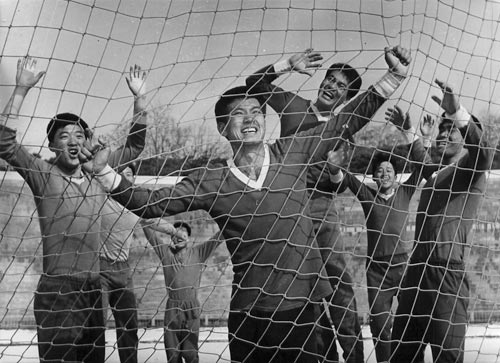
With that in mind, Koryo is sponsoring a screening of a one-of-a-kind — at least in America — film, Centre Forward, a 1978 curio that was digitally restored in 2010. Directed with limited artistic flair by Pak Chong-Song (according the Yerba Buena Center for the Arts’ website, “considered one of the DPRK’s finest filmmakers”), this 75-minute, black-and-white propaganda piece weaves the tale of Comrade In Son, a gifted but inexperienced soccer player struggling to succeed on a team that recently upgraded its training regime from merely exhausting to sadistically brutal.

Along the way, the lad wearing No. 17 learns important lessons from his sister (a dancer whose training also tends toward the sadistically brutal), his roommate (an older player with international triumphs under his belt), his coach (who gives motivational speeches that invoke the teachings of the Fatherly Leader), and the lyrics of the rousing tunes that play over the film’s many montages — “Oh we are sportspersons of the Leader, let us demonstrate wisdom and vigor,” that sort of thing. There’s never any doubt, because it’s emphasized over and over, that sporting glory is owned by the motherland, not individual players. (Though if you fail, you’re personally responsible for hindering the DPRK’s pursuit of being “a kingdom of sports.”)

Centre Forward‘s original release must’ve stirred the hearts of North Korean soccer fans who recalled the national team’s best-ever World Cup showing; in 1966, it reached the quarter-finals after defeating perennial powerhouse Italy. Contemporary fans might better remember the 2010 World Cup, though they’d probably prefer not to — while even qualifying for the tournament was an accomplishment (and the extreme underdogs did score a goal in their game against Brazil), the team exited after three losses, including a humiliating 0-7 defeat versus Portugal.

The media, of course, feasted on the oddities the outsider country brought to the World Cup stage: the identically-dressed fans that were alleged to be Chinese actors imported to South Africa for the occasion; the assertion that the North Korean coach was getting pitch-side advice from Kim Jong-il via an invisible phone invented by the Supreme Leader himself. We chuckled, sure. But who didn’t worry a bit when the team had to trudge back to Pyongyang, still stinging from having their asses handed to them on international television by Cristiano Ronaldo and company?

Multiple sources reported the team and coach were “publicly rebuked” (some said for six hours) for their poor showing, and that the team was forced to “reprimand” their own coach, who was then quickly shunted into a laboring job (see above, re: “kingdom of sports.”) Superstar striker Jong Tae-se — loyal to North Korea, but born in Japan, so he enjoys the decadent luxury of playing in Europe — was spared from this punishment. But what happened to the other players? If Centre Forward‘s “no pain-no gain” training philosophy at all resembles real life, I shudder to imagine.

CENTRE FORWARD

Thurs/30, 7:30 p.m., $6–$8

Yerba Buena Center for the Arts

701 Mission, SF

(415) 978-2787

www.ybca.org

Film Listings

0

Film listings are edited by Cheryl Eddy. Reviewers are Kimberly Chun, Michelle Devereaux, Peter Galvin, Max Goldberg, Dennis Harvey, Johnny Ray Huston, Louis Peitzman, Lynn Rapoport, Ben Richardson, and Matt Sussman. For rep house showtimes, see Rep Clock. For first-run showtimes, see Movie Guide.

OPENING

Happy Happy, a documentary by Roko Belic (1999’s Genghis Blues), traces the contented lifestyles of men and women around the globe. Manoj Singh is a Kolkata rickshaw driver sustained by his son’s smile. Anne Bechsgaard’s life is enriched by her co-housing community in Denmark. These soothingly sentimental profiles are intercut with commentary from leading neuroscientists and psychologists. They provide a cursory guide to the rare balancing act that is happiness in the 21st century. A brisk 75 minutes, the film is saturated with thought-provoking tidbits (the Bhutan government aims for gross national happiness instead of GDP) and an ambient backing track that’s heavy on the chimes. However, sometimes there’s the sense that these mechanics of happiness aren’t cinematically compelling enough, and that rifling through a couple Wikipedia pages might offer just as much insight. At its best, Happy sparks a reflection on how many of the unofficial criteria for joy one has fulfilled, and suggests ideas for simple happiness boosters. (1:15) Roxie. (David Getman)

Larry Crowne A recently unemployed man (Tom Hanks, who also co-wrote and directs the film) starts attending college, where he promptly becomes hot for teacher (Julia Roberts). (1:39) Four Star, Piedmont, Presidio, Shattuck.

Monte Carlo Selena Gomez, Leighton Meester, and Katie Cassidy play friends who fake their way to an awesome European vacation. (1:48)

Mr. Nice By the second hour of Mr. Nice, star Rhys Ifans and company have exhausted every possible pot smoking flourish. There’s the seductive French inhale by the pool, the suggestive mouth to mouth, the euphoric dragon release in the deserts of Pakistan: all rendered in extreme close-up with improbably thick plumes of white smoke. Mr. Nice is mostly sexy drug use tutorial, though it’s also part biography of real-life drug smuggler Howard Marks. His claim to fame — at least according to the movie’s tagline — is the sheer number of aliases, phone lines, and children he had (43, 89, and 4, respectively). Unexpectedly, it’s the period costuming, cinematography, and the enchanting listlessness of Chloe Sevigny that redeem the film. Mr. Nice is captivatingly interlaced with vintage news and scenery clips from the period and it’s shot in a way that is both hyper-stylized and erratic. Those twists and turns of Marks’s life turn out to be not nearly as suspenseful onscreen as they should be, making the movie less of a traditional drug thriller and more of a mildly interesting reflection on the culture of the period. (2:01) Lumiere, Shattuck. (Getman)

*Page One: Inside the New York Times When Andrew Rossi’s documentary premiered at Sundance this January, word of mouth on it was respectable but qualified, with nearly everyone opining that it was good … just not what they’d been led to expect. What they expected was (in line with the original subtitle A Year Inside the New York Times) a top-to-bottom overview of how the nation’s most respected — and in some circles resented — arbiter of news, “style,” and culture is created on a day-to-day as well as longer term basis. That’s something that would doubtless fascinate anyone still interested in print media, or even that realm of web media not catering to the ADD nation. But that big picture and the wealth of minute cogs within isn’t Page One‘s subject. Instead, Rossi focuses on the Gray Lady’s wrestling with admittedly fast-changing times in which newspapers and any other information source on paper seem to constitute an endangered species. This particular Times, however, is such a special case that that crisis might better have been explored by training a camera on a less fabled publication, perhaps one of the many that have succumbed to a once unthinkable, market-shrunk mortality in recent years. The film finds its colorful protagonist in David Carr, an ex-crack addict turned media columnist who retains his cranky, nonconformist edge even as he defends the Times itself from the same out-with-the-old cheerleaders who 15 years ago were inflating the dot-com boom till it burst. Facing one particularly smug champion of the blogosphere at a forum, Carr notes that without a few remaining outlets — like the Times — doing the hard work of serious research and reportage, the web would have nothing to purloin or offer but its own unending trivia and gossip. Page One does what it does entertainingly well, but if you’re looking for insight toward this not-dead-yet U.S. institution as a whole, you’d be better off simply picking up this week’s Sunday edition and reading every last word. (1:28) Bridge, Shattuck, Smith Rafael. (Harvey)

Transformers: Dark of the Moon Just wondering how Michael Bay could possibly improve on the previous film’s robot balls. (2:34) Presidio.


ONGOING

The Art of Getting By The Art of Getting By is all about those confusing, mixed-up and apparently sexually frustrating months before high school graduation. George (Freddie Highmore) is a trench coat-wearing misanthrope — an old soul, as they say — whose parents and teachers are always trying to put him inside a box and tell him how to think. He finds a kindred sprit in Sally (Emma Roberts) who smokes and watches Louis Malle films. Hot. Heavily scored by the now-ancient songs of early ’00s blog bands, it may all sound like indie bullshit but this one has charm and wit despite its post-trend package. Like a sad little crayon, Highmore is a competent Michael Cera surrogate du jour. Writer-director Gavin Wiesen embraces hell of clichés, but he suitably sums up a generational angst along the way. The film may not always feel real, but it does have real feeling. Look out for great performances from Blair Underwood and Alicia Silverstone. (1:24) Sundance Kabuki. (Ryan Lattanzio)

Bad Teacher Jake Kasdan, the once-talented director of a few Freaks and Geeks episodes and 2002’s underrated Orange County, seems hell-bent on humiliating everyone in the cast of Bad Teacher. Cameron Diaz is Elizabeth, the title’s criminally bad pedagogue who prefers the Jack Daniels method to the Socratic. Her impetus for pounding Harper Lee into her middle school students’ bug-eyed little heads is to cash in on a bonus check to fund her breast-y ambitions and woo Justin Timberlake and his baby voice. The only likable onscreen presence is Jason Segal as a sad sack gym teacher in love with Elizabeth. But he could do so much better. There’s no shortage of racist jokes and potty humor in this R-rated comedy pandering to those 17 and below. When asked if she wants to go out with her coworkers, Elizabeth ripostes, “I’d rather get shot in the face!” That scenario is likely a better alternative than suffering this steaming pile of cash cow carcass. (1:29) Marina, 1000 Van Ness, Shattuck, SF Center. (Lattanzio)

*Beginners There is nothing conventional about Beginners, a film that starts off with the funeral arrangements for one of its central characters. That man is Hal (Christopher Plummer), who came out to his son Oliver (Ewan McGregor) at the ripe age of 75. Through flashbacks, we see the relationship play out — Oliver’s inability to commit tempered by his father’s tremendous late-stage passion for life. Hal himself is a rare character: an elderly gay man, secure in his sexuality and, by his own admission, horny. He even has a much younger boyfriend, played by the handsome Goran Visnjic. While the father-son bond is the heart of Beginners, we also see the charming development of a relationship between Oliver and French actor Anna (Mélanie Laurent). It all comes together beautifully in a film that is bittersweet but ultimately satisfying. Beginners deserves praise not only for telling a story too often left untold, but for doing so with grace and a refreshing sense of whimsy. (1:44) Embarcadero, Piedmont, Sundance Kabuki. (Peitzman)

*Bill Cunningham New York To say that Bill Cunningham, the 82-year old New York Times photographer, has made documenting how New Yorkers dress his life’s work would be an understatement. To be sure, Cunningham’s two decades-old Sunday Times columns — “On the Street,” which tracks street-fashion, and “Evening Hours,” which covers the charity gala circuit — are about the clothes. And, my, what clothes they are. But Cunningham is a sartorial anthropologist, and his pictures always tell the bigger story behind the changing hemlines, which socialite wore what designer, or the latest trend in footwear. Whether tracking the near-infinite variations of a particular hue, a sudden bumper-crop of cropped blazers, or the fanciful leaps of well-heeled pedestrians dodging February slush puddles, Cunningham’s talent lies in his ability to recognize fleeting moments of beauty, creativity, humor, and joy. That last quality courses through Bill Cunningham New York, Richard Press’ captivating and moving portrait of a man whose reticence and personal asceticism are proportional to his total devotion to documenting what Harold Koda, chief curator at the Costume Institute at the Metropolitan Museum of Art, describes in the film as “ordinary people going about their lives, dressed in fascinating ways.” (1:24) Opera Plaza. (Sussman)

Bride Flight Who doesn’t love a sweeping Dutch period piece? Ben Sombogaart’s Bride Flight is pure melodrama soup, enough to give even the most devout arthouse-goer the bloats. Emigrating from post-World War II Holland to New Zealand with two gal pals, the sweetly staid Ada (Karina Smulders) falls for smarm-ball Frank (Waldemar Torenstra, the Dutchman’s James Franco) and kind of joins the mile high club to the behest of her conscience. The women arrive with emotional baggage and carry-ons of the uterine kind. As the harem adjusts to the country mores of the Highlands, Frank tries a poke at all of them in a series of sex scenes more moldy than smoldery. This Flight, set to a plodding score and stuffy mise-en-scene, never quite leaves the runway. Not to mention the whole picture, pale as a corpse, resembles one of those old-timey photographs of your great grandma’s wedding. These kinds of pastoral romances ought to be put out to, well, pasture. (2:10) Opera Plaza. (Lattanzio)

*Bridesmaids For anyone burned out on bad romantic comedies, Bridesmaids can teach you how to love again. This film is an answer to those who have lamented the lack of strong female roles in comedy, of good vehicles for Saturday Night Live cast members, of an appropriate showcase for Melissa McCarthy. The hilarious but grounded Kristen Wiig stars as Annie, whose best friend Lillian (Maya Rudolph) is getting hitched. Financially and romantically unstable, Annie tries to throw herself into her maid of honor duties — all while competing with the far more refined Helen (Rose Byrne). Bridesmaids is one of the best comedies in recent memory, treating its relatable female characters with sympathy. It’s also damn funny from start to finish, which is more than can be said for most of the comedies Hollywood continues to churn out. Here’s your choice: let Bridesmaids work its charm on you, or never allow yourself to complain about an Adam Sandler flick again. (2:04) Marina, 1000 Van Ness, Shattuck, Sundance Kabuki. (Peitzman)

Buck This documentary paints a portrait of horse trainer Buck Brannaman as a sort of modern-day sage, a sentimental cowboy who helps “horses with people problems.” Brannaman has transcended a background of hardship and abuse to become a happy family man who makes a difference for horses and their owners all over the country with his unconventional, humane colt-starting clinics. Though he doesn’t actually whisper to horses, he served as an advisor and inspiration for Robert Redford’s The Horse Whisperer (1998). Director Cindy Meehl focuses generously on her saintly subject’s bits of wisdom in and out of a horse-training setting — e.g. “Everything you do with a horse is a dance” — as well as heartfelt commentary from friends and colleagues. In the harrowing final act of the film, Brannaman deals with a particularly unruly horse and his troubled owner, highlighting the dire and disturbing consequences of improper horse rearing. (1:28) Embarcadero, Shattuck, Smith Rafael, Sundance Kabuki. (Sam Stander)

Cars 2 You pretty much can’t say a bad thing about a Pixar film. Cars 2 is by no means Ratatouille (2007) or Wall-E (2008), but the sequel to the 2006 hit Cars offers plenty of sleek visuals and one-note gags under its hollow hood. If nothing else, Pixar seems to have overcome the dingy, dark glaze that plagues 3-D films. Directors John Lasseter and Joe Ranft return to beloved autos Lightning McQueen (Owen Wilson) and the “extremely American” Mater (Larry the Cable Guy). This time around, secret agents Finn McMissile (Michael Caine) and Holley Shiftwell (Emily Mortimer) come along for the ride while working to expose sabotage in the alternative fuel industry. Compelling chase sequences, explosions and more than a few jabs at cultural stereotypes follow suit. This is the lightest, silliest Pixar film to date, but you probably don’t have any business seeing it unless you’ve got a kid in tow. (1:52) Balboa, Empire, 1000 Van Ness, Presidio, SF Center, Shattuck, Sundance Kabuki. (Lattanzio)

*Cave of Forgotten Dreams The latest documentary from Werner Herzog once again goes where no filmmaker — or many human beings, for that matter — has gone before: the Chauvet-Pont-d’Arc Cave, a heavily-guarded cavern in Southern France containing the oldest prehistoric artwork on record. Access is highly restricted, but Herzog’s 3D study is surely the next best thing to an in-person visit. The eerie beauty of the works leads to a typically Herzog-ian quest to learn more about the primitive culture that produced the paintings; as usual, Herzog’s experts have their own quirks (like a circus performer-turned-scientist), and the director’s own wry narration is peppered with random pop culture references and existential ponderings. It’s all interwoven with footage of crude yet beautiful renderings of horses and rhinos, calcified cave-bear skulls, and other time-capsule peeks at life tens of thousands of years ago. The end result is awe-inspiring. (1:35) SF Center, Shattuck. (Eddy)

Conan O’Brien Can’t Stop Conan O’Brien Can’t Stop seems less of a movie title and more like a hushed comment shared between one of the many hangers-on during the filming of the “Legally Prohibited From Being Funny On Television Tour.” Throughout 23 cities’ worth of footage, O’Brien seethes, paces, sweats, yells and beats dead jokes so hard that they spring back to life, as he is wont to do. At this point, the Leno/Coco drama is a bit stale — at least in internet time — but the documentary is a fascinating comedian character study nonetheless. It may be hard to sympathize with a man nursing a bruised ego as he cashes a $45 million dollar check, but it’s easy to see that he’s one of the best late night hosts (temporarily off) the air. Split primarily between clips of O’Brien performing songs on stage with a myriad of celebrity guests and bemoaning how exhausted and frustrated he is, Can’t Stop derives most of its hilarity from the off-the-cuff comments that pepper Conan’s everyday conversations. (1:29) Lumiere, Shattuck. (Getman)

*The Double Hour Slovenian hotel maid Sonia (Ksenia Rappoport) and security guard Guido (Filippo Timi) are two lonely people in the Italian city of Turin. They find one another (via a speed-dating service) and things are seriously looking up for the fledgling couple when calamity strikes. This first feature by music video director Giuseppe Capotondi takes a spare, somber approach to a screenplay (by Alessandro Fabbri, Ludovica Rampoldi, and Stefano Sardo) that strikingly keeps raising, then resisting genre categorization. Suffice it to say their story goes from lonely-hearts romance to violent thriller, ghost story, criminal intrigue, and yet more. It doesn’t all work seamlessly, but such narrative unpredictability is so rare at the movies these days that The Double Hour is worth seeing simply for the satisfying feeling of never being sure where it’s headed. (1:35) Opera Plaza. (Harvey)

Empire of Silver Love, not money, is at the core of Empire of Silver — that’s the M.O. of a Shanxi banking family’s libertine third son, or “Third Master” (Aaron Kwok) in this epic tug-of-war between Confucian duty and free will. The Third Master pines for his true love, his stepmother (Hao Lei), yet change is going off all around the star-crossed couple in China at the end of the 19th century and the start of the 20th, and the youthful scion ends up pouring his passion into the family business, attempting to tread his own path, apart from his Machiavellian father (Tielin Zhang). Much like her protagonist, however, director (and Stanford alum) Christina Yao seems more besotted with romance than finance, bathing those scenes with the love light and sensual hues reminiscent of Zhang Yimou’s early movies. Though Yao handles the widescreen crowd scenes with aplomb, her chosen focus on money, rather than honey, leaches the action of its emotional charge. It doesn’t help that, on the heels of the Great Recession, it’s unlikely that anyone buys the idea of a financial industry with ironclad integrity — or gives a flying yuan about the lives of bankers. (1:52) Four Star. (Chun)

Green Lantern This latest DC Comics-to-film adaptation fails to recognize the line between awesome fantasy-action and cheeseball absurdity, often resembling the worst excesses of the Christopher Reeve Superman movies. A surprisingly palatable Ryan Reynolds stars as Hal Jordan, the cocky test pilot who is chosen to wield a power ring as a member of an intergalactic police force called the Green Lantern Corps. He must face down Parallax, an alien embodiment of fear, who appears here as a chuckle-inducing floating head surrounded by tentacles. Peter Sarsgaard is effectively nauseating as Hector Hammond, who becomes Parallax’s crony after he is transformed by a transfusion of fear energy. The acting is all over the map, with Blake Lively’s blank-faced love interest caricature as the weakest link, and the effects are hit-or-miss, but scenes featuring alien Green Lanterns should please fans, and you could probably do worse if you’re looking for an entertaining popcorn flick. (1:45) 1000 Van Ness, Sundance Kabuki. (Stander)

The Hangover Part II What do you do with a problematic mess like Hangover Part II? I was a fan of The Hangover (2009), as well as director-cowriter Todd Phillips’ 1994 GG Allin doc, Hated, so I was rooting for II, this time set in the East’s Sin City of Bangkok, while simultaneously dreading the inevitable Asian/”ching-chang-chong” jokes. Would this would-be hit sequel be funnier if they packed in more of those? Doubtful. The problem is that most of II‘s so-called humor, Asian or no, falls completely flat — and any gross-out yuks regarding wicked, wicked Bangkok are fairly old hat at this point, long after Shocking Asia (1976) and innumerable episodes of No Reservations and other extreme travel offerings. This Hangover around, mild-ish dentist Stu (Ed Helms) is heading to the altar with Lauren (The Real World: San Diego‘s Jamie Chung), with buds Phil (Bradley Cooper) and Doug (Justin Bartha) in tow. Alan (Zach Galifianakis) has completely broken with reality — he’s the pity invite who somehow ropes in the gangster wild-card Mr. Chow (Ken Jeong). Blackouts, natch, and not-very-funny high jinks ensue, with Jeong, surprisingly, pulling small sections of II out of the crapper. Phillips obviously specializes in men-behaving-badly, but II‘s most recent character tweaks, turning Phil into an arrogant, delusional creep and Alan into an arrogant, delusional kook, seem beside the point. Because almost none of the jokes work, and that includes the tired jabs at tranny strippers because we all know how supposedly straight white guys get hella grossed out by brown chicks with dicks. Lame. (1:42) 1000 Van Ness, SF Center. (Chun)

Kung Fu Panda 2 The affable affirmations of 2008’s Kung Fu Panda take a back seat to relentlessly elaborate, gag-filled action sequences in this DreamWorks Animation sequel, which ought to satisfy kids but not entertain their parents as much as its predecessor. Po (voiced by Jack Black), the overeating panda and ordained Dragon Warrior of the title, joins forces with a cavalcade of other sparring wildlife to battle Lord Shen (Gary Oldman), a petulant peacock whose arsenal of cannons threatens to overwhelm kung fu. But Shen is also part of Po’s hazy past, so the panda’s quest to save China is also a quest for self-fulfillment and “inner peace.” There’s less character development in this installment, though the growing friendship between Po and the “hardcore” Tigress (Angelina Jolie) is occasionally touching. The 3-D visuals are rarely more than a gimmick, save for a series of eye-catching flashbacks in the style of cel-shaded animation. (1:30) 1000 Van Ness, SF Center. (Stander)

*Making the Boys In 1968 The Boys in the Band revolutionized Broadway and opened a lot of minds by being a hit play (and film) about NYC homosexuals. Yet on the cusp of “Gay Liberation” and for many years thereafter, much of the actual gay community hugely objected to author Mart Crowley’s fictive portrait of its ‘mos as insular, shallow, classist, bitchy, and guilt-ridden. It was (as interviewee Edward Albee notes here) a picture ideally suited to straight Broadway audiences who lined up to see queers rendered pitiful if still identifiably human. Crayton Robey’s absorbing documentary chronicles the bumpy road of Boys and its creators — Crowley never had another hit, floundering until he moved into TV series scripting. The cast of the 1970 movie version, directed by William Friedkin (one year before The French Connection, followed by The Exorcist), saw their big break turn into a virtual industry blacklisting. Exceptions were unimpeachably heterosexual thespians Laurence Luckinbill and Cliff Gorman, who only “played” gay. This engrossing document recalls a work that trailblazed, was rejected as politically correct, then re embraced as an important touchstone in gay visibility and self-empowerment. (1:33) Roxie. (Harvey)

Midnight in Paris Owen Wilson plays Gil, a self-confessed “Hollywood hack” visiting the City of Light with his conservative future in-laws and crassly materialistic fiancée Inez (Rachel McAdams). A romantic obviously at odds with their selfish pragmatism (somehow he hasn’t realized that yet), he’s in love with Paris and particularly its fabled artistic past. Walking back to his hotel alone one night, he’s beckoned into an antique vehicle and finds himself transported to the 1920s, at every turn meeting the Fitzgeralds, Gertrude Stein (Kathy Bates), Dali (Adrien Brody), etc. He also meets Adriana (Marion Cotillard), a woman alluring enough to be fought over by Hemingway (Corey Stoll) and Picasso (Marcial di Fonzo Bo) — though she fancies aspiring literary novelist Gil. Woody Allen’s latest is a pleasant trifle, no more, no less. Its toying with a form of magical escapism from the dreary present recalls The Purple Rose of Cairo (1985), albeit without that film’s greater structural ingeniousness and considerable heart. None of the actors are at their best, though Cotillard is indeed beguiling and Wilson dithers charmingly as usual. Still — it’s pleasant. (1:34) Albany, Balboa, Embarcadero, 1000 Van Ness, Piedmont, Sundance Kabuki. (Harvey)

Mr. Popper’s Penguins (1:35) 1000 Van Ness.

*My Perestroika Robin Hessman’s very engaging documentary takes one very relatable look at how changes since glasnost have affected some average Russians. The subjects here are five thirtysomethings who, growing up in Moscow in the 70s and 80s, were the last generation to experience full-on Communist Party indoctrination. But just as they reached adulthood, the whole system dissolved, confusing long-held beliefs and variably impacting their futures. Andrei has ridden the capitalist choo-choo to considerable enrichment as the proprietor of luxury Western menswear shops. But single mother Olga, unlucky in love, just scrapes by, while married schoolteachers Lyuba and Boris are lucky to have inherited an apartment (cramped as it is) they could otherwise ill afford. Meanwhile Ruslan, once member of a famous punk band (which he abandoned on principal because it was getting “too commercial”), both disdains and resents the new order just as he did the old one. Home movies and old footage of pageantry celebrating Soviet socialist glory make a whole ‘nother era come to life in this intimate, unexpectedly charming portrait of its long-term aftermath. (1:27) Balboa. (Harvey)

Submarine (1:37) Opera Plaza.

*Super 8 The latest from J.J. Abrams is very conspicuously produced by Steven Spielberg; it evokes 1982’s E.T.: The Extra-Terrestrial as well as 1985’s The Goonies and 1982’s Poltergeist (so Spielbergian in nature you’d be forgiven for assuming he directed, rather than simply produced, the pair). But having Grandpa Stevie blessing your flick is surely a good thing, especially when you’re already as capable as Abrams. Super 8 is set in 1979, high time for its titular medium, used by a group of horror movie-loving kids to film their backyard zombie epic; later in the film, old-school celluloid reveals the mystery behind exactly what escaped following a spectacular train wreck on the edge of their small Ohio town. The PG-13 Super 8 aims to frighten, albeit gently; there’s a lot of nostalgia afoot, and things do veer into sappiness at the end (that, plus the band of kids at its center, evoke the trademarks of another Grandpa Stevie: Stephen King). But the kid actors (especially the much-vaunted Elle Fanning) are great, and there’s palpable imagination and atmosphere afoot, rare qualities in blockbusters today. Super 8 tries, and mostly succeeds, in progressing the fears and themes addressed by E.T. (divorce, loneliness, growing up) into century 21, making the unknowns darker and the consequences more dire. (1:52) California, Empire, 1000 Van Ness, Presidio. (Eddy)

*13 Assassins 13 Assassins is clearly destined to be prolific director Takashi Miike’s greatest success outside Japan yet. It’s another departure for the multi-genre-conquering Miike, doubtless one of the most conventional movies he’s made in theme and execution. That’s key to its appeal — rigorously traditional, taking its sweet time getting to samurai action that is pointedly not heightened by wire work or CGI, it arrives at the kind of slam-dunk prolonged battle climax that only a measured buildup can let you properly appreciate. In the 1840s, samurai are in decline but feudalism is still hale. It’s a time of peace, though not for the unfortunates who live under regional tyrant Lord Naritsugu (Goro Inagaki), a li’l Nippon Caligula who taxes and oppresses his people to the point of starvation. Alas, the current Shogun is his sibling, and plans to make little bro his chief adviser — so a concerned Shogun official secretly hires veteran samurai Shinzaemon (Koji Yakusho) to assassinate the Lord. Fully an hour is spent on our hero doing “assembling the team” stuff, recruiting other unemployed, retired, or wannabe samurai. When the protagonists finally commence their mission, their target is already aware he’s being pursued, and he’s surrounded by some 200 soldiers by the time Miike arrives at the film’s sustained, spectacular climax: a small village which Shinzaemon and co. have turned into a giant boobytrap so that 13 men can divide and destroy an ogre-guarding army. A major reason why mainstream Hollywood fantasy and straight action movies have gotten so depressingly interchangeable is that digital FX and stunt work can (and does) visualize any stupid idea — heroes who get thrown 200 feet into walls by monsters then getting up to fight some more, etc. 13 Assassins is thrilling because its action, while sporting against-the-odds ingeniousness and sheer luck by our heroes as in any trad genre film, is still vividly, bloodily, credibly physical. (2:06) Four Star, Opera Plaza, Shattuck. (Harvey)

The Tree of Life Mainstream American films are so rarely adventuresome that overreactive gratitude frequently greets those rare, self-conscious, usually Oscar-baiting stabs at profundity. Terrence Malick has made those gestures so sparingly over four decades that his scarcity is widely taken for genius. Now there’s The Tree of Life, at once astonishingly ambitious — insofar as general addressing the origin/meaning of life goes — and a small domestic narrative artificially inflated to a maximally pretentious pressure-point. The thesis here is a conflict between “nature” (the way of striving, dissatisfied, angry humanity) and “grace” (the way of love, femininity, and God). After a while Tree settles into a fairly conventional narrative groove, dissecting — albeit in meandering fashion — the travails of a middle-class Texas household whose patriarch (a solid Brad Pitt) is sternly demanding of his three young sons. As a modern-day survivor of that household, Malick’s career-reviving ally Sean Penn has little to do but look angst-ridden while wandering about various alien landscapes. Set in Waco but also shot in Rome, at Versailles, and in Saturn’s orbit (trust me), The Tree of Life is so astonishingly self-important while so undernourished on some basic levels that it would be easy to dismiss as lofty bullshit. Its Cannes premiere audience booed and cheered — both factions right, to an extent. (2:18) California, Embarcadero, Empire, Smith Rafael, Sundance Kabuki. (Harvey)

*The Trip Eclectic British director Michael Winterbottom rebounds from sexually humiliating Jessica Alba in last year’s flop The Killer Inside Me to humiliating Steve Coogan in all number of ways (this time to positive effect) in this largely improvised comic romp through England’s Lake District. Well, romp might be the wrong descriptive — dubbed a “foodie Sideways” but more plaintive and less formulaic than that sun-dappled California affair, this TV-to-film adaptation displays a characteristic English glumness to surprisingly keen emotional effect. Playing himself, Coogan displays all the carefree joie de vivre of a colonoscopy patient with hemorrhoids as he sloshes through the gray northern landscape trying to get cell reception when not dining on haute cuisine or being wracked with self-doubt over his stalled movie career and love life. Throw in a happily married, happy-go-lucky frenemy (comic actor Rob Brydon) and Coogan (TV’s I’m Alan Partridge), can’t help but seem like a pathetic middle-aged prick in a puffy coat. Somehow, though, his confused narcissism is a perverse panacea. Come for the dueling Michael Caine impressions and snot martinis, stay for the scallops and Brydon’s “small man in a box” routine. (1:52) Albany, Clay, Smith Rafael. (Devereaux)

*Trollhunter Yes, The Troll Hunter riffs off The Blair Witch Project (1999) with both whimsy and, um, rabidity. Yes, you may gawk at its humongoid, anatomically correct, three-headed trolls, never to be mistaken for grotesquely cute rubber dolls, Orcs, or garden gnomes again. Yes, you may not believe, but you will find this lampoon of reality TV-style journalism, and an affectionate jab at Norway’s favorite mythical creature, very entertaining. Told that a series of strange attacks could be chalked up to marauding bears, three college students (Glenn Erland Tosterud, Tomas Alf Larsen, and Johanna Morck) strap on their gumshoes and choose instead to pursue a mysterious poacher Hans (Otto Jespersen) who repeatedly rebuffs their interview attempts. Little did the young folk realize that their late-night excursions following the hunter into the woods would lead at least one of them to rue his or her christening day. Ornamenting his yarn with beauty shots of majestic mountains, fjords, and waterfalls, Norwegian director-writer André Ovredal takes the viewer beyond horror-fantasy — handheld camera at the ready — and into a semi-goofy wilderness of dark comedy, populated by rock-eating, fart-blowing trolls and overshadowed by a Scandinavian government cover-up sorta-worthy of The Girl with the Dragon Tattoo (2009). (1:30) Lumiere. (Chun)

*X-Men: First Class Cynics might see this prequel as pandering to a more tweeny demographic, and certainly there are so many ways it could have gone terribly wrong, in an infantile, way-too-cute X-Babies kinda way. But despite some overly choppy edits that shortchange brief moments of narrative clarity, X-Men: First Class gets high marks for its fairly first-class, compelling acting — specifically from Michael Fassbender as the enraged, angst-ridden Magneto and James McAvoy as the idealistic, humanist Charles Xavier. Of course, the celebrated X-Men tale itself plays a major part: the origin story of Magneto, a.k.a. Erik Lehnsherr, a Holocaust survivor, is given added heft with a few tweaks: here, in an echo of Fassbender’s turn in Inglourious Basterds (2009), his master of metal draws on his bottomless rage to ruthlessly destroy the Nazis who used him as a lab rat in experiments to build a master race. The last on his list is the energy-wrangling Sebastian Shaw (Kevin Bacon), who’s set up a sweet Bond-like scenario, protected by super-serious bikini-vixen Emma Frost (January Jones). The complications are that Erik doesn’t ultimately differ from his Frankensteins — he pushes mutant power to the detriment of those puny, bigoted humans — and his unexpected collaborator and friend is Xavier, the privileged, highly psychic scion who hopes to broker an understanding between mutants and human and use mutant talent to peaceful ends. Together, they can move mountains—or at least satellite dishes and submarines. Jennifer Lawrence as Raven/Mystique and Nicholas Hoult as Hank McCoy/Beast fill out the cast, voicing those eternal X-Men dualities — preserving difference vs. conformity, intoxicating power vs. reasoned discipline. All core superhero concerns, as well as teen identity issues — given a fresh charge. (2:20) 1000 Van Ness, Sundance Kabuki. (Chun)


Film Listings

0

Film listings are edited by Cheryl Eddy. Reviewers are Kimberly Chun, Michelle Devereaux, Peter Galvin, Max Goldberg, Dennis Harvey, Johnny Ray Huston, Louis Peitzman, Lynn Rapoport, Ben Richardson, and Matt Sussman. For rep house showtimes, see Rep Clock. For first-run showtimes, see Movie Guide.

FRAMELINE

The 35th San Francisco International LGBT Film Festival runs through Sun/26 at the Castro, 429 Castro, SF; Rialto Cinemas Elmwood, 2966 College, Berk; Roxie, 3117 16th St., SF; and Victoria, 2961 16th St., SF. For tickets (most films $9-$15) and complete schedule, visit www.frameline.org.

OPENING

Bad Teacher Cameron Diaz don’t need no education. (1:29) Shattuck.

Buck This documentary paints a portrait of horse trainer Buck Brannaman as a sort of modern-day sage, a sentimental cowboy who helps “horses with people problems.” Brannaman has transcended a background of hardship and abuse to become a happy family man who makes a difference for horses and their owners all over the country with his unconventional, humane colt-starting clinics. Though he doesn’t actually whisper to horses, he served as an advisor and inspiration for Robert Redford’s The Horse Whisperer (1998). Director Cindy Meehl focuses generously on her saintly subject’s bits of wisdom in and out of a horse-training setting — e.g. “Everything you do with a horse is a dance” — as well as heartfelt commentary from friends and colleagues. In the harrowing final act of the film, Brannaman deals with a particularly unruly horse and his troubled owner, highlighting the dire and disturbing consequences of improper horse rearing. (1:28) Embarcadero, Shattuck, Smith Rafael. (Sam Stander)

Cars 2 Owen Wilson, Larry the Cable Guy, Michael Caine, and others give voice to the autos in this spy-themed Pixar sequel. (1:52) Balboa, Shattuck.

Conan O’Brien Can’t Stop Conan O’Brien Can’t Stop seems less of a movie title and more like a hushed comment shared between one of the many hangers-on during the filming of the “Legally Prohibited From Being Funny On Television Tour.” Throughout 23 cities’ worth of footage, O’Brien seethes, paces, sweats, yells and beats dead jokes so hard that they spring back to life, as he is wont to do.

At this point, the Leno/Coco drama is a bit stale — at least in internet time — but the documentary is a fascinating comedian character study nonetheless. It may be hard to sympathize with a man nursing a bruised ego as he cashes a $45 million dollar check, but it’s easy to see that he’s one of the best late night hosts (temporarily off) the air. Split primarily between clips of O’Brien performing songs on stage with a myriad of celebrity guests and bemoaning how exhausted and frustrated he is, Can’t Stop derives most of its hilarity from the off-the-cuff comments that pepper Conan’s everyday conversations. (1:29) Lumiere, Shattuck. (David Getman)

Oki’s Movie See review at www.sfbg.com. (1:20) Yerba Buena Center for the Arts.

*Viva Riva! Gritty, riveting, and even heartbreaking, Viva Riva!, the first Congolese feature film to get distribution in the states, is much like its small-time crook of an anti-hero, Riva (Patsha Bay Mukuna) — in love with life and prepared to laugh in the face of death when it comes knocking. Director Djo Tunda Wa Munga’s African Movie Academy Award winner tumbles with the grimy details of its Kinshasa, Congo, backdrop, and rarely stumbles. A mere foot soldier in a sprawling crime world, Riva has seized his chance at breaking into the big time, with a score of stolen gasoline, and has returned home. His eyes are on an unlikely prize, Nora (Marie Malone), the well-guarded moll of a Kinshasa gangster. As Riva stalks his lithe prey, he’s tailed by the ruthless Angolan crime boss he’s crossed (Hoji Fortuna) and a local military commander under the thug’s thumb (Marlene Longage). As sexy and violent as a contemporary noir, and as familiar as a folk tale unraveled round a campfire, Viva Riva! holds your attention with all the bruised bravado of its Stagger Lee-like protagonist, catching you in with the way the gorgeous Nora undulates at an outdoor gathering at one moment, then squats in the dirt to take a piss at the next. (1:36) Lumiere, Shattuck. (Chun)

ONGOING

*L’Amour Fou Pierre Thoretton’s documentary L’amour fou opens with two clips of men bidding farewell. The first, from 2002, is of the French-Algerian couturier Yves Saint Laurent announcing his retirement in a moving and emotional speech worthy of his favorite writer Marcel Proust. The second is of Pierre Bergé, Saint Laurent’s longtime business partner and former lover, eulogizing his departed friend at the designer’s memorial service six years later. Thoretton’s film is suffused with goodbyes, many tender and candid, some portentous and rehearsed. To be sure, L’amour fou is a touching portrait of the powerful and tempestuous bond between Saint Laurent and Bergé, a bond that lasted close to five decades and resulted in one of the great empires of 20th century fashion. But it is also, alongside David Teboud’s two 2002 YSL documentaries, another entry in the hagiography of Saint Laurent, one cannily steered by Bergé as much as by Thoretton. Well-spoken and charming, Bergé still comes off as the punchy entrepreneurial foil to Saint Laurent’s dazzling but fragile genius. He can be both hyperbolic (praising Saint Laurent’s gifts) but also forthcoming (discussing the designer’s demons). Former muses Loulou de la Falaise and Betty Catroux are also interviewed, but this is clearly Bergé’s show. (1:43) Opera Plaza. (Sussman)

The Art of Getting By The Art of Getting By is all about those confusing, mixed-up and apparently sexually frustrating months before high school graduation. George (Freddie Highmore) is a trench coat-wearing misanthrope — an old soul, as they say — whose parents and teachers are always trying to put him inside a box and tell him how to think. He finds a kindred sprit in Sally (Emma Roberts) who smokes and watches Louis Malle films. Hot. Heavily scored by the now-ancient songs of early ’00s blog bands, it may all sound like indie bullshit but this one has charm and wit despite its post-trend package. Like a sad little crayon, Highmore is a competent Michael Cera surrogate du jour. Writer-director Gavin Wiesen embraces hell of clichés, but he suitably sums up a generational angst along the way. The film may not always feel real, but it does have real feeling. Look out for great performances from Blair Underwood and Alicia Silverstone. (1:24) 1000 Van Ness, Sundance Kabuki. (Ryan Lattanzio)

*Beautiful Boy Save the children, but pity the parents. Director-cowriter Shawn Ku’s Beautiful Boy is one of two recent films concerning parents of kids who go on school killing sprees, and it’ll get potentially shortchanged due to the forthcoming We Need to Talk About Kevin‘s head-turning cast and its Hitchcockian literary source material. Still, Beautiful Boy shines in its own humble way, by dint of its quiet sense of integrity and refusal to pander. The bone-deep unhappiness suffusing the family concerned was present long before 18-year-old college student Sammy (Kyle Gallner) picked up a gun, killed more than a dozen people, then took his own life. Surviving parents Kate (Maria Bello) and Bill (Michael Sheen) already kept separate bedrooms under the same roof and led separate lives, with Bill pasting an unsettling grin on for work and Maria relentlessly pushing to make everything all right, neither noticing the barely perceptible warning signs that their only son was succumbing to despair. Belying its title, Beautiful Boy is less focused on the desperate youngster than on the adults attempting to cope with the horror he’s wrought — not necessarily cleaning up after him or picking up the pieces, but somehow finding their way through their own explosive responses. Bolstered by fine performances by Bello and Sheen, it’s yet another installment in the post-9/11 cinema of trauma — this time, attempting to imagine the unimaginable and to comprehend a kind of healing. (1:40) SF Center. (Chun)

*Beginners There is nothing conventional about Beginners, a film that starts off with the funeral arrangements for one of its central characters. That man is Hal (Christopher Plummer), who came out to his son Oliver (Ewan McGregor) at the ripe age of 75. Through flashbacks, we see the relationship play out — Oliver’s inability to commit tempered by his father’s tremendous late-stage passion for life. Hal himself is a rare character: an elderly gay man, secure in his sexuality and, by his own admission, horny. He even has a much younger boyfriend, played by the handsome Goran Visnjic. While the father-son bond is the heart of Beginners, we also see the charming development of a relationship between Oliver and French actor Anna (Mélanie Laurent). It all comes together beautifully in a film that is bittersweet but ultimately satisfying. Beginners deserves praise not only for telling a story too often left untold, but for doing so with grace and a refreshing sense of whimsy. (1:44) Embarcadero, Piedmont, Sundance Kabuki. (Peitzman)

*Bill Cunningham New York To say that Bill Cunningham, the 82-year old New York Times photographer, has made documenting how New Yorkers dress his life’s work would be an understatement. To be sure, Cunningham’s two decades-old Sunday Times columns — “On the Street,” which tracks street-fashion, and “Evening Hours,” which covers the charity gala circuit — are about the clothes. And, my, what clothes they are. But Cunningham is a sartorial anthropologist, and his pictures always tell the bigger story behind the changing hemlines, which socialite wore what designer, or the latest trend in footwear. Whether tracking the near-infinite variations of a particular hue, a sudden bumper-crop of cropped blazers, or the fanciful leaps of well-heeled pedestrians dodging February slush puddles, Cunningham’s talent lies in his ability to recognize fleeting moments of beauty, creativity, humor, and joy. That last quality courses through Bill Cunningham New York, Richard Press’ captivating and moving portrait of a man whose reticence and personal asceticism are proportional to his total devotion to documenting what Harold Koda, chief curator at the Costume Institute at the Metropolitan Museum of Art, describes in the film as “ordinary people going about their lives, dressed in fascinating ways.” (1:24) Opera Plaza. (Sussman)

Bride Flight Who doesn’t love a sweeping Dutch period piece? Ben Sombogaart’s Bride Flight is pure melodrama soup, enough to give even the most devout arthouse-goer the bloats. Emigrating from post-World War II Holland to New Zealand with two gal pals, the sweetly staid Ada (Karina Smulders) falls for smarm-ball Frank (Waldemar Torenstra, the Dutchman’s James Franco) and kind of joins the mile high club to the behest of her conscience. The women arrive with emotional baggage and carry-ons of the uterine kind. As the harem adjusts to the country mores of the Highlands, Frank tries a poke at all of them in a series of sex scenes more moldy than smoldery. This Flight, set to a plodding score and stuffy mise-en-scene, never quite leaves the runway. Not to mention the whole picture, pale as a corpse, resembles one of those old-timey photographs of your great grandma’s wedding. These kinds of pastoral romances ought to be put out to, well, pasture. (2:10) Opera Plaza. (Lattanzio)

*Bridesmaids For anyone burned out on bad romantic comedies, Bridesmaids can teach you how to love again. This film is an answer to those who have lamented the lack of strong female roles in comedy, of good vehicles for Saturday Night Live cast members, of an appropriate showcase for Melissa McCarthy. The hilarious but grounded Kristen Wiig stars as Annie, whose best friend Lillian (Maya Rudolph) is getting hitched. Financially and romantically unstable, Annie tries to throw herself into her maid of honor duties — all while competing with the far more refined Helen (Rose Byrne). Bridesmaids is one of the best comedies in recent memory, treating its relatable female characters with sympathy. It’s also damn funny from start to finish, which is more than can be said for most of the comedies Hollywood continues to churn out. Here’s your choice: let Bridesmaids work its charm on you, or never allow yourself to complain about an Adam Sandler flick again. (2:04) Empire, 1000 Van Ness, Shattuck, Sundance Kabuki. (Peitzman)

*Cave of Forgotten Dreams The latest documentary from Werner Herzog once again goes where no filmmaker — or many human beings, for that matter — has gone before: the Chauvet-Pont-d’Arc Cave, a heavily-guarded cavern in Southern France containing the oldest prehistoric artwork on record. Access is highly restricted, but Herzog’s 3D study is surely the next best thing to an in-person visit. The eerie beauty of the works leads to a typically Herzog-ian quest to learn more about the primitive culture that produced the paintings; as usual, Herzog’s experts have their own quirks (like a circus performer-turned-scientist), and the director’s own wry narration is peppered with random pop culture references and existential ponderings. It’s all interwoven with footage of crude yet beautiful renderings of horses and rhinos, calcified cave-bear skulls, and other time-capsule peeks at life tens of thousands of years ago. The end result is awe-inspiring. (1:35) SF Center, Shattuck. (Eddy)

*The Double Hour Slovenian hotel maid Sonia (Ksenia Rappoport) and security guard Guido (Filippo Timi) are two lonely people in the Italian city of Turin. They find one another (via a speed-dating service) and things are seriously looking up for the fledgling couple when calamity strikes. This first feature by music video director Giuseppe Capotondi takes a spare, somber approach to a screenplay (by Alessandro Fabbri, Ludovica Rampoldi, and Stefano Sardo) that strikingly keeps raising, then resisting genre categorization. Suffice it to say their story goes from lonely-hearts romance to violent thriller, ghost story, criminal intrigue, and yet more. It doesn’t all work seamlessly, but such narrative unpredictability is so rare at the movies these days that The Double Hour is worth seeing simply for the satisfying feeling of never being sure where it’s headed. (1:35) Opera Plaza. (Harvey)

Green Lantern This latest DC Comics-to-film adaptation fails to recognize the line between awesome fantasy-action and cheeseball absurdity, often resembling the worst excesses of the Christopher Reeve Superman movies. A surprisingly palatable Ryan Reynolds stars as Hal Jordan, the cocky test pilot who is chosen to wield a power ring as a member of an intergalactic police force called the Green Lantern Corps. He must face down Parallax, an alien embodiment of fear, who appears here as a chuckle-inducing floating head surrounded by tentacles. Peter Sarsgaard is effectively nauseating as Hector Hammond, who becomes Parallax’s crony after he is transformed by a transfusion of fear energy. The acting is all over the map, with Blake Lively’s blank-faced love interest caricature as the weakest link, and the effects are hit-or-miss, but scenes featuring alien Green Lanterns should please fans, and you could probably do worse if you’re looking for an entertaining popcorn flick. (1:45) 1000 Van Ness, Sundance Kabuki. (Stander)

The Hangover Part II What do you do with a problematic mess like Hangover Part II? I was a fan of The Hangover (2009), as well as director-cowriter Todd Phillips’ 1994 GG Allin doc, Hated, so I was rooting for II, this time set in the East’s Sin City of Bangkok, while simultaneously dreading the inevitable Asian/”ching-chang-chong” jokes. Would this would-be hit sequel be funnier if they packed in more of those? Doubtful. The problem is that most of II‘s so-called humor, Asian or no, falls completely flat — and any gross-out yuks regarding wicked, wicked Bangkok are fairly old hat at this point, long after Shocking Asia (1976) and innumerable episodes of No Reservations and other extreme travel offerings. This Hangover around, mild-ish dentist Stu (Ed Helms) is heading to the altar with Lauren (The Real World: San Diego‘s Jamie Chung), with buds Phil (Bradley Cooper) and Doug (Justin Bartha) in tow. Alan (Zach Galifianakis) has completely broken with reality — he’s the pity invite who somehow ropes in the gangster wild-card Mr. Chow (Ken Jeong). Blackouts, natch, and not-very-funny high jinks ensue, with Jeong, surprisingly, pulling small sections of II out of the crapper. Phillips obviously specializes in men-behaving-badly, but II‘s most recent character tweaks, turning Phil into an arrogant, delusional creep and Alan into an arrogant, delusional kook, seem beside the point. Because almost none of the jokes work, and that includes the tired jabs at tranny strippers because we all know how supposedly straight white guys get hella grossed out by brown chicks with dicks. Lame. (1:42) 1000 Van Ness, SF Center, Shattuck, Sundance Kabuki. (Chun)

Judy Moody and the Not Bummer Summer Try not trying so hard, Judy Moody. The tween paperback fave gets an OTT makeover for the cineplex, as director John Schultz and company throw as many bells, whistles, silly new slang, kooky gruesome colors, CGI twinkles, sing-along subtitles, and zany hijinks into the mix as possible, in vain hope of keeping kiddie eyeballs from drifting. Bright-eyed redhead Judy Moody (Jordana Beatty) — think Pippi Longstocking, only way more annoying — is stuck at home for the season, sans most of her pals and parentals, scuttling her plans for a Not Bummer Summer filled with weirdly competitive thrill points (her very own invention) and pointless faux adventures (ditto). Her cute, arty, wack-eee Aunt Opal (Heather Graham) offers some diverting solace, but the summer seems to find its groove only after Judy slimily co-opts younger bro Stink’s (Parris Mosteller) obsession with Bigfoot. Lovers of visceral kid stuff will appreciate Judy and mob’s affection for pee and puke references — too bad the entire enterprise just reeks of very bummer desperation. (1:31) 1000 Van Ness. (Chun)

Kung Fu Panda 2 The affable affirmations of 2008’s Kung Fu Panda take a back seat to relentlessly elaborate, gag-filled action sequences in this DreamWorks Animation sequel, which ought to satisfy kids but not entertain their parents as much as its predecessor. Po (voiced by Jack Black), the overeating panda and ordained Dragon Warrior of the title, joins forces with a cavalcade of other sparring wildlife to battle Lord Shen (Gary Oldman), a petulant peacock whose arsenal of cannons threatens to overwhelm kung fu. But Shen is also part of Po’s hazy past, so the panda’s quest to save China is also a quest for self-fulfillment and “inner peace.” There’s less character development in this installment, though the growing friendship between Po and the “hardcore” Tigress (Angelina Jolie) is occasionally touching. The 3-D visuals are rarely more than a gimmick, save for a series of eye-catching flashbacks in the style of cel-shaded animation. (1:30) 1000 Van Ness, SF Center. (Stander)

*Making the Boys In 1968 The Boys in the Band revolutionized Broadway and opened a lot of minds by being a hit play (and film) about NYC homosexuals. Yet on the cusp of “Gay Liberation” and for many years thereafter, much of the actual gay community hugely objected to author Mart Crowley’s fictive portrait of its ‘mos as insular, shallow, classist, bitchy, and guilt-ridden. It was (as interviewee Edward Albee notes here) a picture ideally suited to straight Broadway audiences who lined up to see queers rendered pitiful if still identifiably human. Crayton Robey’s absorbing documentary chronicles the bumpy road of Boys and its creators — Crowley never had another hit, floundering until he moved into TV series scripting. The cast of the 1970 movie version, directed by William Friedkin (one year before The French Connection, followed by The Exorcist), saw their big break turn into a virtual industry blacklisting. Exceptions were unimpeachably heterosexual thespians Laurence Luckinbill and Cliff Gorman, who only “played” gay. This engrossing document recalls a work that trailblazed, was rejected as politically correct, then re embraced as an important touchstone in gay visibility and self-empowerment. (1:33) Roxie. (Harvey)

Midnight in Paris Owen Wilson plays Gil, a self-confessed “Hollywood hack” visiting the City of Light with his conservative future in-laws and crassly materialistic fiancée Inez (Rachel McAdams). A romantic obviously at odds with their selfish pragmatism (somehow he hasn’t realized that yet), he’s in love with Paris and particularly its fabled artistic past. Walking back to his hotel alone one night, he’s beckoned into an antique vehicle and finds himself transported to the 1920s, at every turn meeting the Fitzgeralds, Gertrude Stein (Kathy Bates), Dali (Adrien Brody), etc. He also meets Adriana (Marion Cotillard), a woman alluring enough to be fought over by Hemingway (Corey Stoll) and Picasso (Marcial di Fonzo Bo) — though she fancies aspiring literary novelist Gil. Woody Allen’s latest is a pleasant trifle, no more, no less. Its toying with a form of magical escapism from the dreary present recalls The Purple Rose of Cairo (1985), albeit without that film’s greater structural ingeniousness and considerable heart. None of the actors are at their best, though Cotillard is indeed beguiling and Wilson dithers charmingly as usual. Still — it’s pleasant. (1:34) Albany, Balboa, Embarcadero, 1000 Van Ness, Piedmont, Sundance Kabuki. (Harvey)

Mr. Popper’s Penguins (1:35) 1000 Van Ness.

*My Perestroika Robin Hessman’s very engaging documentary takes one very relatable look at how changes since glasnost have affected some average Russians. The subjects here are five thirtysomethings who, growing up in Moscow in the 70s and 80s, were the last generation to experience full-on Communist Party indoctrination. But just as they reached adulthood, the whole system dissolved, confusing long-held beliefs and variably impacting their futures. Andrei has ridden the capitalist choo-choo to considerable enrichment as the proprietor of luxury Western menswear shops. But single mother Olga, unlucky in love, just scrapes by, while married schoolteachers Lyuba and Boris are lucky to have inherited an apartment (cramped as it is) they could otherwise ill afford. Meanwhile Ruslan, once member of a famous punk band (which he abandoned on principal because it was getting “too commercial”), both disdains and resents the new order just as he did the old one. Home movies and old footage of pageantry celebrating Soviet socialist glory make a whole ‘nother era come to life in this intimate, unexpectedly charming portrait of its long-term aftermath. (1:27) Balboa. (Harvey)

Submarine (1:37) Opera Plaza, SF Center.

*Super 8 The latest from J.J. Abrams is very conspicuously produced by Steven Spielberg; it evokes 1982’s E.T.: The Extra-Terrestrial as well as 1985’s The Goonies and 1982’s Poltergeist (so Spielbergian in nature you’d be forgiven for assuming he directed, rather than simply produced, the pair). But having Grandpa Stevie blessing your flick is surely a good thing, especially when you’re already as capable as Abrams. Super 8 is set in 1979, high time for its titular medium, used by a group of horror movie-loving kids to film their backyard zombie epic; later in the film, old-school celluloid reveals the mystery behind exactly what escaped following a spectacular train wreck on the edge of their small Ohio town. The PG-13 Super 8 aims to frighten, albeit gently; there’s a lot of nostalgia afoot, and things do veer into sappiness at the end (that, plus the band of kids at its center, evoke the trademarks of another Grandpa Stevie: Stephen King). But the kid actors (especially the much-vaunted Elle Fanning) are great, and there’s palpable imagination and atmosphere afoot, rare qualities in blockbusters today. Super 8 tries, and mostly succeeds, in progressing the fears and themes addressed by E.T. (divorce, loneliness, growing up) into century 21, making the unknowns darker and the consequences more dire. (1:52) California, Empire, 1000 Van Ness. (Eddy)

*13 Assassins 13 Assassins is clearly destined to be prolific director Takashi Miike’s greatest success outside Japan yet. It’s another departure for the multi-genre-conquering Miike, doubtless one of the most conventional movies he’s made in theme and execution. That’s key to its appeal — rigorously traditional, taking its sweet time getting to samurai action that is pointedly not heightened by wire work or CGI, it arrives at the kind of slam-dunk prolonged battle climax that only a measured buildup can let you properly appreciate. In the 1840s, samurai are in decline but feudalism is still hale. It’s a time of peace, though not for the unfortunates who live under regional tyrant Lord Naritsugu (Goro Inagaki), a li’l Nippon Caligula who taxes and oppresses his people to the point of starvation. Alas, the current Shogun is his sibling, and plans to make little bro his chief adviser — so a concerned Shogun official secretly hires veteran samurai Shinzaemon (Koji Yakusho) to assassinate the Lord. Fully an hour is spent on our hero doing “assembling the team” stuff, recruiting other unemployed, retired, or wannabe samurai. When the protagonists finally commence their mission, their target is already aware he’s being pursued, and he’s surrounded by some 200 soldiers by the time Miike arrives at the film’s sustained, spectacular climax: a small village which Shinzaemon and co. have turned into a giant boobytrap so that 13 men can divide and destroy an ogre-guarding army. A major reason why mainstream Hollywood fantasy and straight action movies have gotten so depressingly interchangeable is that digital FX and stunt work can (and does) visualize any stupid idea — heroes who get thrown 200 feet into walls by monsters then getting up to fight some more, etc. 13 Assassins is thrilling because its action, while sporting against-the-odds ingeniousness and sheer luck by our heroes as in any trad genre film, is still vividly, bloodily, credibly physical. (2:06) Bridge, Shattuck. (Harvey)

The Tree of Life Mainstream American films are so rarely adventuresome that overreactive gratitude frequently greets those rare, self-conscious, usually Oscar-baiting stabs at profundity. Terrence Malick has made those gestures so sparingly over four decades that his scarcity is widely taken for genius. Now there’s The Tree of Life, at once astonishingly ambitious — insofar as general addressing the origin/meaning of life goes — and a small domestic narrative artificially inflated to a maximally pretentious pressure-point. The thesis here is a conflict between “nature” (the way of striving, dissatisfied, angry humanity) and “grace” (the way of love, femininity, and God). After a while Tree settles into a fairly conventional narrative groove, dissecting — albeit in meandering fashion — the travails of a middle-class Texas household whose patriarch (a solid Brad Pitt) is sternly demanding of his three young sons. As a modern-day survivor of that household, Malick’s career-reviving ally Sean Penn has little to do but look angst-ridden while wandering about various alien landscapes. Set in Waco but also shot in Rome, at Versailles, and in Saturn’s orbit (trust me), The Tree of Life is so astonishingly self-important while so undernourished on some basic levels that it would be easy to dismiss as lofty bullshit. Its Cannes premiere audience booed and cheered — both factions right, to an extent. (2:18) California, Embarcadero, Smith Rafael, Sundance Kabuki. (Harvey)

*The Trip Eclectic British director Michael Winterbottom rebounds from sexually humiliating Jessica Alba in last year’s flop The Killer Inside Me to humiliating Steve Coogan in all number of ways (this time to positive effect) in this largely improvised comic romp through England’s Lake District. Well, romp might be the wrong descriptive — dubbed a “foodie Sideways” but more plaintive and less formulaic than that sun-dappled California affair, this TV-to-film adaptation displays a characteristic English glumness to surprisingly keen emotional effect. Playing himself, Coogan displays all the carefree joie de vivre of a colonoscopy patient with hemorrhoids as he sloshes through the gray northern landscape trying to get cell reception when not dining on haute cuisine or being wracked with self-doubt over his stalled movie career and love life. Throw in a happily married, happy-go-lucky frenemy (comic actor Rob Brydon) and Coogan (TV’s I’m Alan Partridge), can’t help but seem like a pathetic middle-aged prick in a puffy coat. Somehow, though, his confused narcissism is a perverse panacea. Come for the dueling Michael Caine impressions and snot martinis, stay for the scallops and Brydon’s “small man in a box” routine. (1:52) Albany, Clay, Smith Rafael. (Devereaux)

*Trollhunter Yes, The Troll Hunter riffs off The Blair Witch Project (1999) with both whimsy and, um, rabidity. Yes, you may gawk at its humongoid, anatomically correct, three-headed trolls, never to be mistaken for grotesquely cute rubber dolls, Orcs, or garden gnomes again. Yes, you may not believe, but you will find this lampoon of reality TV-style journalism, and an affectionate jab at Norway’s favorite mythical creature, very entertaining. Told that a series of strange attacks could be chalked up to marauding bears, three college students (Glenn Erland Tosterud, Tomas Alf Larsen, and Johanna Morck) strap on their gumshoes and choose instead to pursue a mysterious poacher Hans (Otto Jespersen) who repeatedly rebuffs their interview attempts. Little did the young folk realize that their late-night excursions following the hunter into the woods would lead at least one of them to rue his or her christening day. Ornamenting his yarn with beauty shots of majestic mountains, fjords, and waterfalls, Norwegian director-writer André Ovredal takes the viewer beyond horror-fantasy — handheld camera at the ready — and into a semi-goofy wilderness of dark comedy, populated by rock-eating, fart-blowing trolls and overshadowed by a Scandinavian government cover-up sorta-worthy of The Girl with the Dragon Tattoo (2009). (1:30) Lumiere. (Chun)

*X-Men: First Class Cynics might see this prequel as pandering to a more tweeny demographic, and certainly there are so many ways it could have gone terribly wrong, in an infantile, way-too-cute X-Babies kinda way. But despite some overly choppy edits that shortchange brief moments of narrative clarity, X-Men: First Class gets high marks for its fairly first-class, compelling acting — specifically from Michael Fassbender as the enraged, angst-ridden Magneto and James McAvoy as the idealistic, humanist Charles Xavier. Of course, the celebrated X-Men tale itself plays a major part: the origin story of Magneto, a.k.a. Erik Lehnsherr, a Holocaust survivor, is given added heft with a few tweaks: here, in an echo of Fassbender’s turn in Inglourious Basterds (2009), his master of metal draws on his bottomless rage to ruthlessly destroy the Nazis who used him as a lab rat in experiments to build a master race. The last on his list is the energy-wrangling Sebastian Shaw (Kevin Bacon), who’s set up a sweet Bond-like scenario, protected by super-serious bikini-vixen Emma Frost (January Jones). The complications are that Erik doesn’t ultimately differ from his Frankensteins — he pushes mutant power to the detriment of those puny, bigoted humans — and his unexpected collaborator and friend is Xavier, the privileged, highly psychic scion who hopes to broker an understanding between mutants and human and use mutant talent to peaceful ends. Together, they can move mountains—or at least satellite dishes and submarines. Jennifer Lawrence as Raven/Mystique and Nicholas Hoult as Hank McCoy/Beast fill out the cast, voicing those eternal X-Men dualities — preserving difference vs. conformity, intoxicating power vs. reasoned discipline. All core superhero concerns, as well as teen identity issues — given a fresh charge. (2:20) Empire, 1000 Van Ness, Sundance Kabuki. (Chun)


Gamer road trip: E3 report!

0

If last week’s E3 press conferences in Los Angeles are any indication, game consoles are no longer just about games. The Electronic Entertainment Expo, the year’s biggest video game industry event, lavishly presented gamers with a sneak peek at the most-anticipated titles and hardware goodies looking to lighten wallets later this year. But as more blockbuster game franchises are released simultaneously on the Wii, PlayStation, and Xbox, it’s become imperative for their parent companies to differentiate themselves — and traditional gaming has begun to take a back seat to this broad experimentation.

Along those lines, Microsoft attempted to guide itself out of the corner it had painted itself into following the huge sales of Kinect, the camera device that quickly became the fastest-selling consumer electronic of all time. Microsoft has been lacking significant game releases for Kinect owners, making this year’s release slate integral to satisfying the new and unexpectedly large consumer base. An upcoming Xbox interface allowing users to control other entertainment like Netflix and live TV by voice seemed to be a hit, as was the announcement of Kinect controls for traditional games like Mass Effect 3 and Ghost Recon: Future Soldier. Microsoft undoubtedly launched Kinect to compete with the draw of Nintendo’s family-friendly Wii, and the device’s appeal to the more serious gamer is a delicate maneuver that these franchises could help accomplish.

In the PlayStation camp, Sony made a speedy apology for the PlayStation Network outage that has battered its reputation for the past two months and piggybacked its return with announcements for bundles, deals, and partnerships offering consumers considerable content for their respective price points. Presenting these products as “gifts” to consumers was an interesting approach to mitigating ire over the network snafu. All business, Sony’s presentation was the least titillating but perhaps most solid of the conferences.

No more beating around the bush: the biggest question going into E3 2011 was “What is Nintendo’s new console?” Leaked information that pointed to a new, more powerful console was confirmed when Nintendo announced the Wii U, a console with a touchscreen controller capable of streaming games to your hands — with or without a television screen. Actual game announcements were left to the newly-launched 3DS and surprises were scarce: tried-and-true franchises Mario Kart, Starfox, and The Legend of Zelda. While the possibilities for Wii U initially seem vast, the console’s true nature — and that of its “revolutionary” controller — remains nebulous. There’s the potential for an HD system to recapture Nintendo’s diminishing hardcore audience, but right now the Wii U looks like another stab at cornering families and casual players.

Third-party publishers care less about console revolutions and more about good ol’ fashioned video games. Electronic Arts stuck to its guns, offering concrete gameplay footage and loud (loud!) speakers that shook the Orpheum Theatre with Battlefield 3 explosions. The Battlefield franchise is looking to take Call of Duty head-on this year, and time will tell if players favor authenticity over that series’ scripted bombast. Either way, Battlefield 3 is one pretty game. EA also made a strong go at providing social networking experiences that augment traditional play, and offered them all for free — perhaps a dig at Activision’s recent announcement it will offer paid subscriptions to a similar Call of Duty social experience.

Inside the Los Angeles Convention Center, many newly-announced games were playable or shown in demo form. Highlights: Uncharted 3‘s two gameplay demos both boasted a top-tier knack for exciting set-pieces and storytelling, and it is the first game to truly suggest the power 3-D can add to the gameplay experience. BioShock Infinite was unmatched in attention to detail with its departure to a city-in-the-clouds backdrop. And Mass Effect 3 finally gave gamers a glimpse of Earth’s destruction in a short demo that demonstrated massive carnage and a surprisingly-affecting level finale. There were tears in a few eyes, folks.

E3 2011 was less about this or that game, and more about the process of evolving your traditional game console into an entertainment center where you surf the Web, watch movies, and even take the experience on the go. Nintendo was eager to suggest the new home applications its controller might afford, and Microsoft and Sony focused on expanding new possibilities for their current hardware through Kinect and Sony’s motion device, PlayStation Move. As more and more of the public identify as gamers, this is the playing field expanding to allow for different types of game experiences. Even so, games like Battlefield 3, Uncharted 3, and Mass Effect 3 suggest traditional gaming is more than up to the competition a broader user base might bring. 


Terrible news from Rock Rapids, Iowa

5

And so some terrible news went out yesterday and today  from Rock Rapids, Iowa.

I can’t remember such agitation and anguish  amongst the alumni of our little hometown in northwest Iowa.

The emails were hot and heavy and sad because the Sportsman’s Lounge, a landmark institution and the meeting place and local pub  for locals and alumni,  had burned down on Monday and the police were investigating possible arson. As Darryl Freed, class of 1953, ex backshop ace  at the Lyon County Reporter and helicopter pilot in Vietnam, put it in an email update: “This is a catastrophe of biblical proportions.”  It was particularly poignant because the alumni were coming back to town in a few days for Heritage Days, the town’s big annual celebration, and their favorite hangout would be a burned patch off of Main Street.

Here’s the story from Sioux Falls television  station KSFY:

http://www.ksfy.com/category/185294/video?clipId=5930074&autostart=true

Everyone went to the Sportsman’s Lounge, sooner or later.  I say sooner or later because some of the more proper young and older ladies  woiuldn’t set foot in the place, a bit  rowdy and lots of  drinking. Then their alumni friends came back to town and they had to go to the lounge if they wanted to see them.

Everyone had a favorite story about the lounge. My favorite involved Ted Fisch, class of 1952, scrappy center on the 195l football team, member in good standing of the fabled  Hermie Casjens gang. Ted  was back in town for  a class reunion and Heritage Days.   He ambled  up to the bar and asked for a glass of red wine.  The wine was promptly produced and Ted drank it down.  He then asked for another.  Sorry, the bartender said, we don’t have any more wine. So there was Ted Fisch, just in from Redondo Beach, Calif., unable to get more than one glass of wine at his hometown bar.

Next year, Ted showed up and asked for a glass of wine. This time, the lounge folk  were ready for him and they had a shelf  and backroom full of good California wines. Ted had two glasses. This was classic Rock Rapids humor and we told the story again and again through the years, always noting it happened in the bar at the Sportsman’s Lounge.

Losing the Sportsman’s Lounge is like losing an old friend you have known for years or that you played football or basketball with in high school.  This was the case with Doug Peterson, a retired naval officer  now living near Mount Shasta, California, when he got word that the lounge had burned to the ground.  He recalled that he was a halfback and Darrel (Tank) Wilken was the lineman who opened up holes for him back on late 1950s teams. Tank was the guy who founded the lounge, Doug said.   Tank went off to Alaska to work as a guide and rented out the lounge. Tank died when his  plane crashed on takeoff in Alaska. The lounge was sold and changed hands several times through the years.

Doug is bringing his fiancee, Kathryn Thornton, back to Rock Rapids for the first time for Heritage Days and his 50th class reunion. She told me in an email that she is “devastated” that the Sportsman’s Lounge will be gone. She said she’d heard all the stories for so long about the lounge from Doug and me (she was a longtime consultant to the Guardian). Now she feels cheated because she missed by a few days seeing what we were talklng about with such affection.

The good thing is that the lounge  never seemed to change. It always had a musty 1960s look and feel.  I swear that every time I came in through the years that the “Leave it to Beaver”  reruns were  playing on the television set above the  bar.This was a nice  local touch because the star of the show, Jerry Mathers, had been born in Rock Rapids in the late 1940s  when his father Norman Mathers coached high school  football and basketball, including my power house  junior high team.  The tv  scenes of the rambunctious Beaver could have been set in Rock Rapids and  Beaver could have fit in nicely with the  Hermie Casjens gang.   Local columnist Ken Barker has figured this all out and is leading the charge to bring Jerry Mathers back to town for Heritage Days next year.

My favorite  connection to the lounge  was Larry Raddle and basketball.    He and his wife Barb owned and managed the place for years (Larry at the bar and Barb doing fried chicken in the back,) Larry and I played basketball together through junior high and then on the famous high school  teams of l95l-53. We were the same size, 6 foot 4 inches. When  we came out of the locker room, with our band playing “On Rock Rapids,” and Larry would dunk the ball, we often had the game won before the opening whistle.   I couldn’t quite dunk the ball but I had a deadly left hand hook shot.

Whenever I was in town, I would show up at the lounge  for the special martini he would make for me. We would talk about our team and why we never made it to the state tournament.  I always made the same point,  Larry, you needed a jump shot. (Jump shots weren’t used in our day, alas.)

When I first asked if he could make me a good martini,  Larry said, how  about a Pete Appel special? Sure, I replied. I knew  Pete worked at the Rock Rapids State Bank down the street and so I figured I couldn’t go wrong.   The Pete Appel special turned out to be my first triple martini,  light on the vermouth.   Soon, I was staring at five triple martinis stacked up in front me at the bar.   I had became part of the lounge  tradition:  whenever a visiting  alumnus stood at the bar, drinking with gusto,  the locals would buy another of the same drink and send it quietly along the bar to the drinker. I was never quite sure who was buying me triple martinis, so I waved thanks and tried to get them to stop. 

Larry knew the town and he knew his customers.  In the summer, he would have the farmers bring in their sweet corn and pile the ears up on a table near the door.   On Christmas Eve, he would close the lounge at 6 p.m. sharp and kick everybody out.  “I couldn’t stand the wives calling up on Christmas Eve and asking for their husbands to come home,”  he told me. Larry’s customers always got home in time for Christmas Eve.

The Sportsman’s Lounge, RIP.

I hope Editor  Jodie Hoogeveen of  the Lyon County Reporter, the excellent small town weekly  just around the block from the lounge, will figure out how to do a proper obituary. Or maybe it’s a story for the lively newsletter of the Lyon County Historical Society.  I hope the obit will give us the ownership and historical lineage of the lounge and tell us about the life and good  times of this indispensable institution that may be gone for good.  My line is the same as always: You don’t have to go to England to enjoy a good neighborhood pub.  You can  go to the Sportsman’s Lounge in Rock Rapids, Iowa.  b3

Through the lens of hip-hop

1

Photographer/filmmaker Brian Cross charts a musical map of the African diaspora in the Americas — and opens new Summit Peek Gallery show tonight (6/2), “If It Fits in the Backpack: 10 Years on the Road with Mochilla”

Last year, Los Angeles-based production group Mochilla released Timeless,a trilogy film series documenting three concerts performed in L.A., early 2009. For these concerts, the photographer/filmmaker/DJ duo behind Mochilla, Brian Cross and Eric Coleman, shined light on three composers who have helped influence and shape hip-hop in different ways: the originator of Ethio-jazz, Mulatu Astatke; leftfield Brazilian arranger, Arthur Verocai; and a gutsy rendition of J Dilla’s beats crafted by Miguel Atwood-Ferguson with 60-piece orchestra. The films paint intimate portraits of musical exchange and live performance while paying tribute to some of the overlooked giants of the sprawling African musical diaspora.

In many ways Timeless is a culmination of themes explored in Mochilla’s films from the past decade. Their first project, Keepintime: Talking Drums and Whispering Vinyl (2001), and the follow-up live recording and DVD release in 2004, captured improvisational collaboration between L.A. hiphop producers and DJs, such as Madlib and J.Rocc, among others, with some of the powerhouse session drummers who inspired their sample-based work. Brasilintime: Batucada Com Discos (2007) also navigated the dynamic tension between an older generation of drummers, this time including legendary Brazilian percussionists, and the new school of analog producer/turntablists.


But not only did Mochilla depict creative partnership between these two forms of percussionists, they also translated the cut-up aesthetic of the DJ and rhythmic momentum of the drummer to the inner workings of the films themselves. A pastiche of words, music, and imagery composed of still shots and footage drive forward the fragmented stories, and striking moments of reconciliation, which unfold on screen.

More recently, Cross (known more familiarly as B+) set off to Columbia to document the Petronio Alvarez music festival as well as collaborative work between Will Holland (a.k.a. Quantic) and Ernesto “Fruko” Estrada, who could be credited with forging the rootsy, Afro-Columbian take on salsa. Mochilla also shot a good deal of the footage for Banksy’s street art disaster film from last year, Exit Through the Gift Shop, caught wayward rapper Jay Electronica at the Pyramids in Egypt and recording in South Africa, and documented Nas and Damian Marley on tour. To put it short, the dudes put in work.

“I look more for the off-handed moments that can be sustained as photos in themselves,” Cross tells me over the phone, while working in the dark room basement of his home in Los Angeles. He says that he’s excited to see how the large hand-printed photos will look in the upcoming Mochilla showcase at the new Peek Gallery in the Mission, this Thursday. “I’m trying to be iconic, but at the same time I don’t want to make publicity photos for record companies,” Cross says. “The videos, in a way, can be much more interesting because the fluidity allows for a certain kind of candidness.”

Cross, 44, has quite a history with such candidness in his work. Born in Limerick, Ireland, Cross moved to San Francisco’s Mission district in 1990 before attending CalArts in Southern California to study photography. While still completing his degree, Cross started writing what would become a landmark book on the emergence and socio-political implications of hiphop in L.A., It’s Not About a Salary: Rap, Race, and Resistance in Los Angeles (Verso Books, 1993). He is responsible for a number of iconic album covers of underground hiphop acts, from Freestyle Fellowship to Ras Kass and Mos Def. And Cross also made headway with more than a few magazine photo spreads and music videos throughout the past couple decades, notably including an arresting multi-textured piece for DJ Shadow’s “Midnight in a Perfect World” off Entroducing….. (Mo’ Wax Records, 1996).


Looking over Cross’ ever-growing body of work, some primary themes consistently arise: Through the lens of hiphop, Cross orients a number of conversations, multi-generational interchanges, rhythmic confluences, and resistant divergences that weave through the diaspora of African musical traditions in the Americas. “There’s an anthropological side as well as an ethnomusicologist side to it—an attempt to make a map of the diaspora in terms of the music set by the present,” Cross explains. “The goal is ultimately to document in a way that is not strictly historical, but to let the past speak to now rather than the other way round.”

SFBG I find an interesting dynamic in your film work and the documented live performances. On the one hand, you’ll take hiphop producers and DJs and pair them with percussionists, so as to put the contemporary in tension with the recent past that informed those contemporaries. On the other hand, there’s another element of featuring the music of those composers themselves. In what way do you think the past speaks to the present, as you put it, in both those approaches?

Brian Cross The idea is that somehow you don’t want to frame it off. In other words, for Keepintime, we didn’t want to get Paul Humphrey or Earl Palmer involved in something and frame off the dialogue in terms of, ‘Ok Paul, we want you to play the classic break on “One Man Band (Plays all Alone),” and now we’re going to layer something on top of it and develop a routine.’ But that’s not what’s interesting about Paul Humphrey. Yeah, it’s amazing he did that, and that’s why we’re choosing to work with him. But Paul Humphrey is somebody living and breathing; he’s our past, but he’s also our present. We want to open up a space of dialogue that is open to this series of works but isn’t limited to it.

For the Brasilintime project, we could have gone to Brazil and found obscure musicians who made amazing recordings and complete the narrative in the way that normal Eurocentric or Western versions of the story go: We bring them to Carnegie Hall, we do a concert, venerate them, and show them that Carnegie Hall is in fact the best venue in the world and is the most important place to see music. Whoa whoa whoa, back it up, we’re not going to do that. We’re going to go to there and engage, and try to actually build a bridge to the music. Let’s not have this as a one-sided sentence that leads in a single direction. Generally, what we try to do is to de-center, to find ways in which we can open up, because, invariably, when you do these things, that’s when you make discoveries. Oh, Mamao and Wilson das Neves played on the Jose Mauro record, he died before the record came out, and then Dilla sampled it … that’s when you make these discoveries.

You know I don’t mind the Buena Vista Social Club [1997] record. Ry Cooder is a great producer and a great musician, but the film is fucking awful. It’s so fucking wrongheaded. And that director, Wim Wenders, is smarter than that, man. We’re people of the left, he knows better than that. Of course, everybody got involved and was super happy that these guys were finally discovered, and we can fully appreciate how beautiful their music is and the contributions they’ve made. But then Carnegie Hall is put into the equation; we don’t need to reaffirm the same set of cultural values. We don’t need that. Maybe that’s kind of a trite example, but I’m interested in trying to forge ways to talk about music, or to explore possibilities of music, that don’t fall into the same set of traps that most writing and television and documentaries about music fall into.

SFBG Yeah, there are standard methods for placing outsider music, or the marginal narratives of musical traditions and musicianship, into the mainstream narrative, one of validation internal to our own frameworks of understanding. As a photography and filmmaker, how do you approach a sense of the outsider, or the musician who is resistant, or peripheral to the grand narratives? What techniques do you take up in order to engage these musicians and traditions and make them visible for a broader audience?

BC Well, when it comes to Brazilian music, I’m pretty serious about my shit. I do my research thoroughly. I try to put my best foot into it. But other than that, it’s pure human relationships, man. For me, here’s my pet peeve: Too much of the stuff happening right now is done without real social engagement. It’s through the Internet, whether it’s digital digging, or people paying 800 dollars for an obscure record from Ethiopia or Angola, when you could buy a ticket to go there for the same amount. You should be going. That’s the responsibility. The responsibility is to go there, actually experience it, and see what works on the ground.

To go back to Ry Cooder, when he went to Cuba to make Buena Vista, that wasn’t the music people were listening to in Cuba. People were listening to Timba, and Timba is a completely different thing. I just think there’s a lot more to be gained from actually going to say, Baranquilla, and spending time there in the town—meeting people, buying records, meeting musicians—than there is from surfing the Internet and finding the latest hot cumbia re-groove from Argentina or whatever. If you’re serious about your shit you have to go there, engage on the ground, and see what makes sense. You like Wu-Tang? Go to Staten Island. Go for a walk around the projects. Go visit P.L.O. Liquors where all those songs came from. That’s the kind of compliment you need to be paying people. And there’s ways to do this that aren’t touristic. You can go and feel the vibe there. It might seem obvious, but it gets lost in these discussions.

SFBG Do you see that as your primary motivational force? That your projects are prefaced on this desire to travel, meet these musicians that inspire you where they live and make music; find out what they’re doing, why they’re doing it, and be a part of it?

BC Well, the two things are kind of contingent. It’s cyclical somehow. I’m there, experiencing, helping to build bridges as best as I can, and I’m also thinking about photographs because that’s what I do.

SFBG How do you think this approach fits back into your earlier photo work in Los Angeles and your book, ‘It’s Not about a Salary?’

BC It’s an extension of it, really. You know the book is a very primitive thing, if you actually sit there and read it from cover to cover, which I did for a project a couple years ago, and I was highly embarrassed (laughs). But there was no model. It’s not like Can’t Stop Won’t Stop [Picador, 2005] existed, and someone had put that work down. I was 26, I had been into hiphop since I was 17, and I gave it a stab. And, of course, I put myself into a cultural debate that I didn’t know much about, for my own peril.

Ostensibly, the work isn’t much different. In that book, yeah, it’s about hiphop in Los Angeles, but I also managed to talk to Roy Porter, The Watts Prophets, Kamau Daaoood, Horace Tapscott, and a whole slew of other people who didn’t straightforwardly have anything to do with hiphop in Los Angeles. But in another way, they had everything to do with it. What has always been interesting for me with hiphop is that it has this historical reach. That’s what I tried to bring into the book. There’s definitely things which I don’t agree with now, and suppositions that I made or thought what would happen which didn’t. But it was a critical moment, right before The Chronic [Death Row, 1992], which I think was really a world changer.

The amazing thing about the golden era of hiphop, as they call it now, that era up to ‘95 or ’96, is that it was incredibly inclusive music. There was Japanese Koto, all sorts of rhythms from the Caribbean, rock, jazz, funk, you name it. That sourced people into record stores in different ways. The categories didn’t make sense as they did previously. That’s the magnetic lure of it. Somehow, hiphop allowed this extraordinary ability to look at previously recorded things and make them work in the present. For me, that was a critical modernist moment, or as the prevailing discourse has it a post-modernist moment—the collage and montage.

SFBG That brings up another interesting point in your work in the idea that when listening to hiphop not only is the origin of the break or the sample concealed, but also the artist’s background is concealed. The identity of the artist is mystified. Would you say that your projects aim towards making visible the musician as a person rooted in an environment or social setting?

BC The two-sided sword of the invention of youth culture is that it posits a kind of energy and dynamism to what we call youth. The problem is that the way it’s commodified is made contingent on the exclusion of anything outside youthful values or youthful thinking. I don’t agree with that. And if you look at the music of the diaspora, it’s not there. These kind of generational fishers don’t exist in other traditions of music: not in Latin, not in African-oriented music, and in my understanding of European folk traditions, they’re not there either.

While I find aspects of youth admirable, it shouldn’t ever be considered an exclusive category. For instance, David Axelrod is in his late 70s, and he has as much to contribute, and as many interesting things to say now as he did when he was 30. The thing is we’ve consigned him off to a category as if he doesn’t exist. And that seems ridiculous to me. I mean James Gadson still has fire now as a drummer just as he did when he played with Bill Withers. Why would we decide that he no longer has importance? It’s not like people have stopped listening to Bill Withers. But that’s how our music culture works. We fetishize the appearance of youth, but we’re not entirely clear on the implications of that. So, I like the idea of putting the person in the room if I can. For inclusivity, it has to be that.

And we have to get past the old ways of thinking, too. When I was first doing this, it was all super secretive. No one was supposed to know what your samples were or where your drums came from, because that was your tool kit, and if everyone had the same tool kit, it wouldn’t be interesting anymore. But I don’t buy that. In the end, there’s a deluge of information out there, it’s what you do with it that’s important. Your understanding and ability to manipulate the history is what’s important.

SFBG Even when you put out ‘Keepintime,’ I imagine that people worried that you would unveil the alchemic creative process, otherwise covered up, behind a hiphop record.

BC It goes back even before that. Take the video I did for DJ Shadow’s “Midnight In A Perfect World.” It plots out a series of concerns that I’m still interested in. You know, Earl Palmer is in there, and the sample is from a David Axelrod record. And they didn’t clear the sample. Shadow was terrified that Earl was going to recognize the song. But Earl didn’t even remember David Axelrod the person, let alone the record (laughs). They weren’t hits! Earl wasn’t sitting around listening to Axelrod records. But if you’re going to be too scared to talk to him, we’ll never learn anything from the guy. And then he shows up, and we’re transported to a whole different world: New Orleans before World War II.

You could say rock n’ roll came from the soles of Earl Palmer’s shoes. He was a child vaudeville performer, a tap dancer, and he battled against Sammy Davis Junior, and a lot of cats from that era. But he was never the best dude, and he was always interested in drums, so he taught himself how to play drums. So, that shuffle beat, that swamp beat as they call it, which became the foundation of rock n’ roll drumming, came from a guy who’s a tap dancer in black vaudeville as a child, who figured out a way to transform his tap dancing onto a drum kit. Think of the multi-billion dollar industry that rock n’ roll has become, and we still don’t know these things. We have to sit down and talk to these guys to find out these stories.

If It Fits in the Backpack: 10 Years on the Road with Mochilla
Opening photo exhibition w/ film screenings and Q&A
With Brian Cross and Eric Coleman
Thurs./02, 7p.m.-11p.m., free (thru 06/30)
Peek Gallery (Summit SF)
780 Valencia Ave. @19th St., SF
(415) 861-5330
www.thesummit-sf.com/peekgallery.html

The mystery of Terry Malts

0

arts@sfbg.com

MUSIC The shroud of mystery surrounding Terry Malts is no accident. It turns out that all three band members are also core members of another local band (plus a few instrumental switcheroos) that has received some notoriety over the years, even snagging a spot on the soundtrack of one of those beloved television shows about WASP-y rich kids.

But to call it a side project or a spin-off from those-who-shall-remain-nameless — as is often done around town among people in the know — is disingenuous to all that is Terry Malts, a solid, well-conceived musical effort in its own right. Straying from the cliché of the self righteous musician, the band members seem to take little seriously in conversation. They cite poppers and tall cans of beer as influences and joke about having never heard of the aforementioned “other” band. But the music is no joke.

When asked what the real deal was with this seemingly covert operation, guitarist Corey Cunningham replies that the band “wanted a fresh start” and thought it best to “let people reach their own perspective.” Plus, he adds, there is no line where one of their bands begins and another ends. “I see it as though we are different people in a different band.”

Perhaps that’s why people seem to pigeonhole them into a punk corner in an effort to understand who and what the band Terry Malts is. The constant Ramones comparisons — though understandable on a superficial level — should make eyes roll because Terry Malts is so much more than that: carefree bubblegum pop of the 1960s combined with the fuck-you attitude of 1970s punk and a layer of fuzz and feedback enough to please any jaded post-punk-post-indie pop music snob.

These guys tear it up live as well — Nathan Sweatt’s fast-pounding drums are tight enough to incite a dance riot, and Cunningham’s high-driving distorted guitar leads sound like he took a bubble bath with a blender. Phil Benson, towering in stature and personality, seems as if he’s singing love ballads to his bass guitar — hugging his instrument up high and smiling while bopping up and down. But don’t misread that as precious. The boys have ass-kicking spunk that results in live performances and recordings that keep you wanting — no, needing — more.

The band just released a 7-inch on Slumberland Records, the still-relevant Oakland via Washington, D.C., label that released recordings from such college radio chart toppers as Small Factory, Velocity Girl, and 14 Iced Bears in the early 1990s. “I’ve been buying Slumberland records since high school, so it’s a big deal for me,” says Cunningham. Owner Mike Schulman sought them out after hearing this year’s double-A-sided Distracted cassette on Loglady.

Three tracks were chosen for the 7-inch release “I’m Neurotic,” with “Distracted” and “Where is the Weekend” wrapping up the B-side. The title track kicks off with a blast of overdrive and propulsive drum beat and continues on a steady rhythm with intermittent bursts of feedback. The sing-songy “Distracted,” a song about moving on after a heartbreak, is so blissfully poppy and sweet that you could eat it. Perhaps “Where is the Weekend” is the most straightforward and in-your-face — an anthem for the modern proletariat working a crap-ass job for low wages in an overpriced city where the weekend fun can’t come soon enough.

When asked what’s on the horizon for this up-and-coming band, Benson wisecracks: “There’s been talk of a possible LP. Perhaps a series of three flexis, each featuring a different instrument, that while played together on three separate turntables reveal a single masterpiece. We shall see.” Oh yes, we shall. *

TERRY MALTS

W/ Melted Toys and Permanent Collection

June 2, 9 p.m., $3

The Knockout

3223 Mission, SF

www.knockoutsf.com

Rep Clock

0

Schedules are for Wed/1–Tues/7 except where noted. Director and year are given when available. Double and triple features are marked with a •. All times are p.m. unless otherwise specified.

ARTISTS’ TELEVISION ACCESS 992 Valencia, SF; www.atasite.org. $8-10. “Mission Eye and Ear,” new film/video and music collaborations by Paul Clipson and Darren Johnston, Kerry Laitala and Aaron Novik, and Konrad Steiner and Matt Ingalls, Fri, 8.

BALBOA 3620 Balboa, SF; www.balboamovies.com. $20. “Opera, Ballet, and Shakespeare in Cinema:” Aida, performed by Maggio Musicale Fiorentino, Wed, 7:30; Romeo and Juliet, performed at the Globe Theater, Sat-Sun, 10am.

BRIDGE 3010 Geary, SF: www.peacheschrist.com. $17. “Midnight Mass:” Sleepaway Camp (Hiltzik, 1982), Sat, midnight.

CASTRO 429 Castro, SF; (415) 621-6120, www.castrotheatre.com. Regular programming $7.50-10. “The Castro Remembers Elizabeth Taylor (1932-2011):” •Who’s Afraid of Virginia Woolf? (Nichols, 1966), Wed, 2:15, 7, and Boom! (Losey, 1968), Wed, 4:40, 9:25. “Sidney Lumet (1924-2011):” •Network (1976), Thurs, 2:45, 7, and 12 Angry Men (1957), Thurs, 5, 9:15. “Midnites for Maniacs: Debutantes Triple Feature:” •Cruel Intentions (Kumble, 1999), Fri, 7:20; The Virgin Suicides (Coppola, 1999), Fri, 9:30; Buffalo 66 (Gallo, 1998), Fri, 11:45. All three films, $12. “70mm Festival:” It’s a Mad Mad Mad Mad World (Kramer, 1963), Sat-Sun, call for times; Play Time (Tati, 1967), Mon-Tues, call for times.

CHRISTOPHER B. SMITH RAFAEL FILM CENTER 1118 Fourth St, San Rafael; (415) 454-1222, www.cafilm.org. $10.25. The Double Hour (Capotondi, 2010), call for dates and times. The First Grader (Chadwick, 2010), call for dates and times. Queen to Play (Bottaro, 2009), call for dates and times. La Traviata, performed by the Royal Opera House London, Thurs, 7; Sun, 1. This event, $18.

FOUR STAR 2200 Clement, SF; www.lntsf.com. $10. “Asian Movie Madness: Jet Li Now and Then” •The Warlords (Chan and Wai, 2007), and The Shaolin Temple (Zhang, 1982), Thurs, call for times.

LUMIERE 1572 California, SF; www.contractorsroutine.com. $8-10.50. Contractor’s Routine (Tsapayev, 2010), June 3-9, 7.

PACIFIC FILM ARCHIVE 2575 Bancroft, Berk; (510) 642-5249, www.bampfa.berkeley.edu. $5.50-9.50. Programming resumes June 10.

RED VIC 1727 Haight, SF; (415) 668-3994; www.redvicmoviehouse.com. $6-10. Kill the Irishman (Hensleigh, 2011), Wed, 2, 7:15, 9:30. Paperback Dreams (Beckstead, 2008), Thurs, 7:30. Repo Man (Cox, 1984), Fri-Sat, 7:15, 9:15 (also Sat, 2, 4). The Great Muppet Caper (Henson, 1981), Sun-Mon, 7:15, 9:20 (also Sun, 2, 4). Wayne’s World (Spheeris, 1992), June 7-8, 7:15, 9:20 (also June 8, 2).

ROXIE 3117 and 3125 16th St, SF; (415) 863-1087, www.roxie.com. $5-9.75. “Another Hole in the Head Film Festival,” June 2-16. Horror, sci-fi, and fantasy films; visit www.sfindie.com for complete schedule. YERBA BUENA CENTER FOR THE ARTS 701 Mission, SF; (415) 978-2787, www.ybca.org. $6-8. Mamma Roma (Pasolini, 1962), Thurs and Sat, 7:30; Sun, 2.

Four for Popfest

0

arts@sfbg.com

 The third annual San Francisco Popfest kicks off Wednesday, May 25 at Rickshaw Stop. The good news is that this year’s festival has been expanded to five days, transforming Memorial Weekend into a music extravaganza. There are shows at Rickshaw, Cafe Du Nord, and Hemlock Tavern, as well as a secret Sunday show at Dolores Park. The bad news is that you can only be in one place at a time. Here are four must-see Bay Area groups.

The opening night headliner Blackbird Blackbird is spearheaded by vocalist, producer, and multi-instrumentalist Mikey Sanders. He released his debut album Summer Heart in late 2010 through Bandcamp on a “pay what you wish” system and followed it up in 2001 with Halo, which is a collection of new songs, B-sides, and unreleased tracks. With the aid of the blogosphere, Blackbird Blackbird quickly amassed a following.

Blackbird Blackbird’s music is electronic-based, although when performing live, Sanders plays with Cade Weidenhaft on drums. Sanders creates a rich, textured synthscape, as on “Sunspray,” where bubble sounds and an overall feeling of swirling makes the song seem as if it’s being sung from underwater. Other tracks, like “Ups and Down” with its heavy bass, sound dance party-ready.

Also on the Wednesday, May 25 bill is Sanders’ project Wolf Feet, which he started with Austin Wood. The pair recorded tracks while living in a “Hobbit-like apartment in Santa Cruz,” explains Sanders, who grew up in San Francisco but went to school in Santa Cruz. It’s a decidedly less electronic project than Blackbird Blackbird, and garage-rock influenced, with upbeat tempos, handclapping, twinkling guitars, and howling vocals.

Sanders is promoting Wolf Feet similarly to Blackbird Blackbird, self-releasing an EP in January via UFOLK Records and running a cute and informative Tumblr. The band’s homemade video for “Dead Hand,” a montage of vintage films such as Thunderbirds Are Go and Gamera vs. Zigra, was already featured on Pitchfork.

The Friday, May 27 Popfest show includes San Francisco’s beloved the Mantles. After a slew of singles, a self-titled LP, and the Pink Information EP, the group recently released the “Raspberry Thighs/Roman Hat” seven-inch single via SDZ Records. The song reveals a darker side to the band.

The Mantles have always been high on melodies, which they coat in reverb, but the sunny sounds are sometimes meant to distract from the truth. “Raspberry Thighs” starts with buoyant guitars, and Michael Olivares’ vocals are more spoken than sung as he says, “Hey there unassuming eyes/ What on earth can alarm you/ You’re too ready to derail/ You’re too ready to say goodbye.” It’s hard to discern all the lyrics, but there’s a sadness to Olivares’ farewell and description of the ephemeral summer.

The Saturday, May 28 show at Rickshaw Stop is a showcase for Slumberland Records. To put it simply, the entire lineup is awesome. San Francisco’s the Art Museums, formed by Josh Alper (Whysp) and Glenn Donaldson (Skygreen Leopards) in the summer of 2009, sing tales of artists, lovers, and imposters that read like mantras for the aught generation. The band released its debut record Rough Trade on Woodsist last year and will put out an EP called Dancing this summer.

From tales of bike-based dates and descriptions of art happenings to details of Sta-Prest trousers and even the band’s name, the Art Museums’ music is meant to be absurdly funny, and true. Alper and Donaldson craft hooks and sing in faux-British accents — their heroes include the Kinks, Swell Maps, and the Television Personalities. The band records on a Tascam 388 eight-track for its snap, crackle, and pop, and performs with Carly Putnam (Green Flash) and Virginia Weatherby (the Mantles) to fill out its live sound. 


SAN FRANCISCO POPFEST


Blackbird Blackbird, Wolf Feet

Wed/25, 8 p.m.; $12

Rickshaw Stop

155 Fell, SF

(415) 861-2011


The Mantles

Fri/27, 8 p.m.; $15–$17

Rickshaw Stop

Slumberland Recods Showcase

Sat/28, 5 p.m., $17

Rickshaw Stop


www.sfpopfest.com


Our Weekly Picks: May 25-31, 2011

0

WEDNESDAY 25


MUSIC

Stiff Little Fingers

Led by founding member and singer Jake Burns for 34 years now, Belfast’s punk legends Stiff Little Fingers remain a stalwart musical force to be reckoned with. Fueled by the same energy and edgy political criticism that drove classic tracks like “Alternative Ulster” and “Suspect Device,” the band may have changed lineups over the years, but still delivers the goods live, and will likely showcase some songs from its forthcoming album, due out later this year. Be sure to catch SLF tonight in all its glory in a small club — later this weekend they co-headline the Punk Rock Bowling festival in Las Vegas. (Sean McCourt)

With Sharks

8 p.m., $20

Slim’s

333 11th St., SF

(415) 255-0333

www.slims-sf.com


MUSIC

Yeasayer

After listening to its self-described “Middle Eastern-psych-snap-gospel” music on its second studio album Odd Blood, you’ll only be yelling “yay!” to the stylings of Brooklyn-based trio (Chris Keating, Ira Wolf Tuton, and Anand Wilder), Yeasayer. Truth be told, the threesome admitted that Odd Blood was conceived because of a “massive” acid trip in New Zealand. Psychedelics or not, Yeasayer managed a more poppy feel to its much-acclaimed sophomore releases as opposed to its previous recordings. What’s more of a trip is that Peter Gabriel’s drummer, Jerry Marotta, assisted Yeasayer with its recording in an upstate New York studio. Trust me — you won’t be saying “nay” to Yeasayer.(Jen Verzosa)

 With Smith Westerns and Hush Hush

Wed/25-Thurs/26, $20

Fillmore

1805 Geary, SF

(415) 346-6000

www.livenation.com


THURSDAY 26


EVENT

“Muybridge in Three Movements”

It’s Eadweard Muybridge madness with performance, film, and conversation about the artist wrapped into one evening at SFMOMA. A pioneering spirit whose work led to early motion pictures, Muybridge began his artistic career in the 1860s in California. In conjunction with the retrospective exhibition “Helios: Eadweard Muybridge in a Time of Change,” SFMOMA presents excerpts from Catherine Galasso’s Bring On The Lumière!, a performance meditation on early cinema and the basic components of light and movement, key to Muybridge’s work. Also on the program: related short films selected by San Francisco Cinematheque’s Steve Polta and a conversation on cinematic space and time led by Infinite City: A San Francisco Atlas author Rebecca Solnit. (Julie Potter)

7 p.m., $10

Phyllis Wattis Theater

San Francisco Museum of Modern Art

151 Third St., SF

(415) 357-4000

www.sfmoma.org


MUSIC

Atomic Bomb Audition

The first time I heard the Atomic Bomb Audition, I wondered what film the band was scoring: desolate yet pretty, surreal but cohesive, complete with natural scene changes and visible textures. The Oakland band thus succeeds in its explicit compositional goal — to make music for films that don’t exist. Self-described “cinematic sci-fi metal” (Oh Lucifer, please not another heavy metal sub-sub-subgenre … ), ABA channels psychedelic black doom tainted with Mr. Bungle’s carnie creed and heartened by the fearlessness reminiscent of Pink Floyd’s Animals. The resulting soundtrack rings equally holy and dissonant; get your cinematic self to the show because this is the band’s last live one of the year. (Kat Renz)

With Listo, and Moe! Staiano

9 p.m., $8

Bottom of the Hill

1233 17th St., SF

(415) 621-4455

www.bottomofthehill.com


DANCE

“Post:Ballet Sneak Peek”

Rooted in ballet with an eye toward the future, Robert Dekkers’ Post:Ballet thrives on fresh, edgy collaborations with artists in other disciplines. “Sneak Peek” offers an interactive preview of Interference Pattern, a work in progress with film excerpts by Amir Jaffer, performances by the company, audience experiments, and discussion. In discovering how observations influence the subconscious, the exchange during the evening aims to draw a variety of responses from the dance-artists and the audience. Before starting Post: Ballet in 2009, Dekkers performed in the Bay Area with ODC/Dance and Company C Ballet. These days his gorgeous troupe breathes new movement and ideas into ballet. Go ahead, sneak a peek! (Potter)

7–9 p.m., $10

Public Works

161 Erie, SF

(415) 932-0955

www.postballet.org


FRIDAY 27


MUSIC

“Carnaval Fever”

Just can’t get enough SF Carnaval? Sparkly revelers: stray ye not far from the Mission this Memorial Day weekend. Go beyond the free parade and festival (more info on those events at www.sfcarnaval.com) and shake your feathers at the multi-venue after-party, “Carnaval Fever.” Brick and Mortar, newly opened in the old Coda space at Mission near Division, hosts a trio of live bands, starting with Latin American-Caribbean funksters B-Side Players (Fri/27) and followed by retro funksters Monophonics (Sat/28) and the not-purportedly-funky-but-no-doubt-will-make-you-dance-anyway Brazilian accordion slingers Forró Brazuca (Sun/29). For those who’d rather party in a club pounding with Latin beats, there’ll be DJ sets at Public Works (with headliner Marques Wyatt, Sat/28) and Som. (with Sabo, Sun/29). (Cheryl Eddy)

Fri/27–Sun/29, 9 p.m., $12–$15

Brick and Mortar

1710 Mission, SF

Sat/28, 9 p.m., $10

Public Works

161 Erie, SF

Sun/29, 9 p.m., $10

Som.

2925 16th St., SF

www.carnavalfever.com


SATURDAY 28


DANCE

“RAWdance Concept Series: 8”

I’m here to tell you: RAWdance’s Concept Series can become addictive. Few mixed programs of excerpted or in-progress works are as much fun as these occasional showings hidden in the Duboce Triangle (with parking as difficult as North Beach). Presided over — if such it can be called — by RAWdance’s Wendy Rein and Ryan Smith in a venue where, quite unceremoniously, you have to move your butt if the choreographer needs your space, the evenings offer glimpses of what these choreographers are up to. Rarely does it lack for something intriguing, even if it’s just a question the choreographer hasn’t found the answer to yet. This time AXIS’ Margaret Crowell, Amy Seiwert, and wild-woman Christine Bonansea join the hosts, along with the South Bay’s Nhan Ho. As always, coffee and popcorn are included. (Rita Felciano)

Sat/28–Sun/29, 8 p.m.;

Sun/29, 3 p.m., pay what you can

James Howell Studio

66 Sanchez, SF

(415) 686-0728

www.rawdance.org


SUNDAY 29


FILM

Saicomanía

If you haven’t heard of Los Saicos, you’re not alone — though Héctor M. Chávez’s new rockumentary, Saicomanía, aims to shed some long-deserved light on “the best-kept secret from the ’60s.” Formed in 1964 Peru, at the height of worldwide Beatlemania, the members of Los Saicos were anything but fresh-scrubbed mop tops (see: the band’s name, which recalls a certain 1960 Hitchcock movie). Amid (unfounded) rumors that its members were cannibals and played their instruments with hand tools, a raw, frenzied, jangly sound emerged, surging forth to influence countless other bands (including present-day darlings the Black Lips, who appear in the doc), but earning few props from music historians beyond connoisseurs of early garage rock. Saicomanía traces the band’s origins and catches up with its surviving members, still giving off mischievous punk-rock vibes after all these years. The film’s U.S. premiere is hosted by Colectivo Cinema Errante; the screening also features music videos by contemporary South American bands influenced by los abuelos of garage-punk. (Eddy)

7:30 p.m., $6

Artists’ Television Access

992 Valencia, SF

(415) 824-3890

www.atasite.org


TUESDAY 31


DANCE

Royal Danish Ballet

The 19th century Bournonville repertoire is what the Royal Danes — a.k.a. the Royal Danish Ballet, founded in 1748 — is best known for. With this company, forget about errant princes and lost princesses, sky-high extensions, and tornado like whirligigs. Instead, watch for ordinary folks in feathery footwork, rounded arms, suppleness, and ease. That’s what you’ll get with La Sylphide — the oldest extant Romantic ballet. But the Danes, no longer exclusively Danish, also are resolutely 21st-century dancers. That’s why the company is also bringing Nordic Modern, four hot-out-of-the-studio choreographies. Why won’t we see some of Bournonville’s fabled full-evening story ballets? Everyone else on this U.S. tour is getting them, but we don’t have an available theater that can accommodate the designs. What a pity. (Felciano)

Tues/31, June 1, and June 3–4,

8 p.m., $38–$100

Zellerbach Hall

Bancroft at Telegraph,

UC Berkeley, Berk.

(510) 642-9988

www.calperfs.berkeley.edu


MUSIC

Antlers

There are depressing albums, and then there is Antlers’ 2009 LP Hospice. Based on musician Peter Silberman’s intimate solo recordings, Hospice paints nightmares of hospitals, terminally ill children, death, and depression, all with such solemnity that it made this listener egregiously bummed. The band’s follow-up, Burst Apart, drops hospital drama for what might as well be a psychologist’s office — this time wrestling with universal themes of love, scary dreams, and putting the dog to sleep. It’s a far easier pill to swallow, and the newfound keyboard melodies provide a strong backbone for Silberman’s sing-along “ooh and ah” falsetto. It’s also the year’s first firmly melodramatic release to play equally well whether it’s late at night or a sunlit day. (Peter Galvin)

With Little Scream

8 p.m., $18

Great American Music Hall

859 O’Farrell, SF

(315) 885 0750

www.gamh.com 


The Guardian listings deadline is two weeks prior to our Wednesday publication date. To submit an item for consideration, please include the title of the event, a brief description of the event, date and time, venue name, street address (listing cross streets only isn’t sufficient), city, telephone number readers can call for more information, telephone number for media, and admission costs. Send information to Listings, the Guardian Building, 135 Mississippi St., SF, CA 94107; fax to (415) 487-2506; or e-mail (paste press release into e-mail body — no text attachments, please) to listings@sfbg.com. Digital photos may be submitted in jpeg format; the image must be at least 240 dpi and four inches by six inches in size. We regret we cannot accept listings over the phone.

Rep Clock

0

Schedules are for Wed/25–Tues/31 except where noted. Director and year are given when available. Double features are marked with a •. All times are p.m. unless otherwise specified.

ARTISTS’ TELEVISION ACCESS 992 Valencia, SF; www.atasite.org. $3-6. “Retelling Stories,” films by Matt Wolf, Mike Kuchar, and Chris Vargas, Thurs, 7. New work by film students at the City College of San Francisco, Fri, 7. “Other Cinema:” “New Experimental Works,” Sat, 8:30. Saicomania (Chávez, 2011), Sun, 7:30.

BALBOA 3620 Balboa, SF; www.balboamovies.com. $20. “Opera, Ballet, and Shakespeare in Cinema:” Aida, Sat-Sun, 10am; June 1, 7:30. Performed by Maggio Musicale Fiorentino.

CASTRO 429 Castro, SF; (415) 621-6120, www.castrotheatre.com. Regular programming $7.50-10. Pirates of the Caribbean: On Stranger Tides (Marshall, 2011), Wed-Thurs, call for times. This film, $10-12. “The Castro Remembers Elizabeth Taylor (1932-2011):” •Cat on a Hot Tin Roof (Brooks, 1958), Fri, 2, 7, and Suddenly, Last Summer (Mankiewicz, 1959), Fri, 4, 9:30; •A Place in the Sun (Stevens, 1951), Sat, 2:30, 8, and Raintree County (Dmytryk, 1957), Sat, 4:50; Giant (Stevens, 1956), Sun, 2, 7; •Father of the Bride (Minnelli, 1950), Mon, 1, 5:05, 9:20, and National Velvet (Brown, 1944), Mon, 2:50, 7; •Secret Ceremony (Losey, 1968), Tues, 7, and X Y & Zee (Hutton, 1971), Tues, 9:05. Fri/27 evening-show double feature ($25) benefits Project Inform.

CHRISTOPHER B. SMITH RAFAEL FILM CENTER 1118 Fourth St, San Rafael; (415) 454-1222, www.cafilm.org. $10.25. The Double Hour (Capotondi, 2010), call for dates and times. The Princess of Montpensier (Tavernier, 2010), call for dates and times. Queen to Play (Bottaro, 2009), call for dates and times. 13 Assassins (Miike, 2010), call for dates and times. Nostalgia for the Light (Guzmán, 2010), Wed, 7. With Isabel Allende in person; this event, $12. As You Like It, Thurs, 7; Sun, 1. Performed at the Globe Theater, London. The First Grader (Chadwick, 2010), May 27-June 2, call for times.

PACIFIC FILM ARCHIVE 2575 Bancroft, Berk; (510) 642-5249, www.bampfa.berkeley.edu. $5.50-9.50. Programming resumes June 10.

RED VIC 1727 Haight, SF; (415) 668-3994; www.redvicmoviehouse.com. $6-10. Rubber (Dupieux, 2011), Wed-Thurs, 7:15, 9:15 (also Wed, 2). The Room (Wiseau, 2003), Fri-Sat, 7:15, 9:15 (also Sat, 2, 4, midnight). The Fall (Singh, 2006), Sun-Mon, 7, 9:25 (also Sun, 2, 4:25). Kill the Irishman (Hensleigh, 2011), May 31-June 1, 7:15, 9:30 (also June 1, 2).

ROXIE 3117 and 3125 16th St, SF; (415) 863-1087, www.roxie.com. $5-9.75. “I Wake Up Dreaming 2011: Legendary and Lost Film Noir:” •The 49th Man (Sears, 1953), Wed, 6:30, 9:40, and World for Ransom (Aldrich, 1954), Wed, 8; •Witness to Murder (Rowland, 1954), Thurs, 6:15, 10, and Kiss Me Deadly (Aldrich, 1955), Thurs, 8. Meek’s Cutoff (Reichardt, 2010), Wed-Thurs, 7:15, 9:30. “San Francisco Sex Worker Film and Arts Festival: Sex Worker Movies at the Roxie,” Sat, 2. For schedule, visit www.sexworkerfest.com. VORTEX ROOM 1082 Howard, SF; www.myspace.com/thevortexroom. $5 donation. •Dorian Gray (Dallamano, 1970), Thurs, 9, and De Sade (Endfield, 1969), Thurs, 11.

Rep Clock

0

Schedules are for Wed/18–Tues/24 except where noted. Director and year are given when available. Double features are marked with a •. All times are p.m. unless otherwise specified.

ARTISTS’ TELEVISION ACCESS 992 Valencia, SF; www.atasite.org. $6-7. “Other Cinema:” “Graham Connah Combo’s Travelogue Tone Poems,” Sat, 8:30.

BALBOA 3620 Balboa, SF; www.balboamovies.com. $20. “Opera, Ballet, and Shakespeare in Cinema:” Don Quixote, Wed, 7:30. Performed by the Bolshoi Ballet.

CASTRO 429 Castro, SF; (415) 621-6120, www.castrotheatre.com. Regular programming $7.50-10. The Women (Cukor, 1939), Wed, 2:30, 5:15, 8. •Raising Arizona (Coen, 1987), Thurs, 7, and The Big Lebowski (Coen, 1998), Thurs, 8:50. Pirates of the Caribbean: On Stranger Tides (Marshall, 2011), May 20-26. This film, $10-12.

CHRISTOPHER B. SMITH RAFAEL FILM CENTER 1118 Fourth St, San Rafael; (415) 454-1222, www.cafilm.org. $6.50-15. Potiche (Ozon, 2010), call for dates and times. The Princess of Montpensier (Tavernier, 2010), call for dates and times. Queen to Play (Bottaro, 2009), call for dates and times. The Double Hour (Capotondi, 2010), call for dates and times. 13 Assassins (Miike, 2010), May 20-26, call for times. My Brother Mike (Sheridan), Thurs, 7:15. This event, $15; benefit for Bukelew Programs. “Shorts in Brief: A Family Film Festival,” Sun, 2. The Power of the Powerless (Taylor, 2009), Sun, 7.

CITY COLLEGE OF SAN FRANCISCO Diego Rivera Theater, 50 Phelan, SF; www.cityshorts.tumblr.com. Free. “City College of San Francisco’s Cinema Department Presents: City Shorts Film Festival,” Thurs, 7.

FOUR STAR 2200 Clement, SF; www.lntsf.com. $10. “Asian Movie Madness:” •Tempation Summary (Ho, 1990), and Dirty Doll, Thurs, call for times.

MECHANICS’ INSTITUTE 57 Post, SF; (415) 393-0100, rsvp@milibrary.org. $10. “CinemaLit Film Series: Elizabeth Taylor, Tribute to a Star:” Who’s Afraid of Virginia Woolf? (Nichols, 1966), Fri, 6.

111 MINNA 111 Minna, SF; www.sfcinema.org. $25-45. “SF Cinematheque: Cinematheque at 50,” screening and benefit party, Thurs, 8.

PACIFIC FILM ARCHIVE 2575 Bancroft, Berk; (510) 642-5249, www.bampfa.berkeley.edu. $5.50-9.50. Programming resumes June 10.

PARAMOUNT 2025 Broadway, Oakl; 1-800-745-3000, www.ticketmaster.com. $5. A Streetcar Named Desire (Kazan, 1951), Fri, 8.

RED VIC 1727 Haight, SF; (415) 668-3994; www.redvicmoviehouse.com. $6-10. Dead Man (Jarmusch, 1996), Wed, 2, 7, 9:25. Big in Bollywood (Meehan and Bowles, 2011), Thurs, 7:15, 9:15. Paul (Mottola, 2011), Fri-Sat, 7:15, 9:30 (also Sat, 2, 4:15). Corner Store (Bruens, 2010), Sun-Tues, 9:15 (also Sun, 2, 4:15; Mon, 7:15). The Annual (Gillane, 2011), Tues, 7:15. Tuesday screenings benefit the Red Vic.

ROXIE 3117 and 3125 16th St, SF; (415) 863-1087, www.roxie.com. $5-9.75. “I Wake Up Dreaming 2011: The Legendary and the Lost!:” •Whispering City (Otsep, 1947), Wed, 6:10, 9:55, and Ruthless (Ulmer, 1948), Wed, 8; •Smooth as Silk (Barton, 1947), Thurs, 6:40, 9:30, and Customs Agent (Friedman, 1950), Thurs, 8; •Café Hostess (Salkow, 1940), Fri, 6:40, 9:40, and Dangerous Blondes (Jason, 1943), Fri, 8; •I Love Trouble (Simon, 1948), Sat, 2, 5:45, 9:30, and Ride the Pink Horse (Montgomery, 1947), Sat, 3:45, 7:30; •The Web (Gordon, 1947), Sun, 2, 5:45, 9:30, and 711 Ocean Drive (Newman, 1950), Sun, 3:45, 7:30; •Dance Hall Racket (Tucker, 1953), Mon, 6:40, 9:20, and The Violent Years (Morgan, 1956), Mon, 8; •Chain Gang (Friedman, 1950), Tues, 6:30, 9:30, and Cell 2455, Death Row (Sears, 1955), Tues, 8. “Sex Worker Movies,” Sat, 2-midnight. This event, $8-10; for programming info, visit www.sexworkerfest.com.

VICTORIA 2961 16th St, SF; www.countercorp.org. Visit website for ticket info. “Tipping Man 6: Anti-Corporate Film Festival,” Thurs-Sat.

VIZ CINEMA New People, 1746 Post, SF; www.newpeopleworld.com. $10-25. Eatrip (Nomura, 2009), Sat, 3, 5, 7.

VORTEX ROOM 1082 Howard, SF; www.myspace.com/thevortexroom. $5 donation. •Blow-Up (Antonioni, 1966), Thurs, 9, and Baba Yaga (Farina, 1973), Thurs, 11. YERBA BUENA CENTER FOR THE ARTS 701 Mission, SF; (415) 978-2787, www.ybca.org. $6-8. “Three-Way: A Trilogy of Vintage Erotica:” Camille 2000 (Metzger, 1969), Thurs and Sat, 7:30; A Labor of Love (Flaxman and Goldman, 1976), Fri, 7:30 and Sun, 2; The Wild Pussycat (Dadiras, 1969), May 26, 7:30.

Rep Clock

0

Schedules are for Wed/11–Tues/17 except where noted. Director and year are given when available. Double and triple features are marked with a •. All times are p.m. unless otherwise specified.

ALAMEDA THEATRE 2317 Central, Alameda; www.projectyouthview.org. $5-99. “Project YouthView 2011: The Power of Youth in Film,” youth film festival, Thurs, 6:30.

ARTISTS’ TELEVISION ACCESS 992 Valencia, SF; www.atasite.org. $5-6. Blaze Foley: Duct Tape Messiah (Triplett, 2011), Wed, 8. “Other Cinema:” Works by Melinda Stone, Greg Gaar, Enid Baxter Blader, Michael Rudner, and more, Sat, 8:30. “OpenScreening,” Thurs, 8. For participation info, contact ataopenscreening@atasite.org.

BALBOA 3620 Balboa, SF; www.balboamovies.com. $20. “Opera, Ballet, and Shakespeare in Cinema:” Don Quixote, Sat-Sun, 10am; May 18, 7:30. Performed by the Bolshoi Ballet.

CASTRO 429 Castro, SF; (415) 621-6120, www.castrotheatre.com. Regular programming $7.50-10. “Faye Dunaway Double Feature:” •Puzzle of a Downfall Child (Schatzberg, 1970), Wed, 2:55, 7, and Eyes of Laura Mars (Kershner, 1978), Wed, 4:55, 9. 8 1/2 (Fellini, 1963), Thurs, 2:30, 5:15, 8. “Midnites for Maniacs: Whitey Can Rock Too:” •Rock N’ Roll High School (Arkush, 1979), Fri, 7:20; The Blues Brothers (Landis, 1980), Fri, 9:30; and Out of the Blue (Hopper, 1980), Fri, 11:59. All three films, $12. •The Good, the Bad, and the Ugly (Leone, 1966), Sat, 1, 6:15, and Aguirre, The Wrath of God (Herzog, 1972), Sat, 4:20, 9:30. •20,000 Leagues Under the Sea (Fleischer, 1954), Sun, 2, 6:40, and Clash of the Titans (Davis, 1981), Sun, 4:25, 9:05.

CHRISTOPHER B. SMITH RAFAEL FILM CENTER 1118 Fourth St, San Rafael; (415) 454-1222, www.cafilm.org. $6.50-15. Potiche (Ozon, 2010), call for dates and times. The Princess of Montpensier (Tavernier, 2010), call for dates and times. Queen to Play (Bottaro, 2009), call for dates and times. The Double Hour (Capotondi, 2010), May 13-19, call for times. Project Happiness (Sorenson, 2011), Sun, 6:30.

FOUR STAR 2200 Clement, SF; www.lntsf.com. $10. “Asian Movie Madness:” •Deaf Mute Heroine (Wu, 1971), Thurs, noon, 3:50, 7:40, and Pursuit (Wong, 1980), Thurs, 1:55, 5:45, 9:35.

MECHANICS’ INSTITUTE 57 Post, SF; (415) 393-0100, rsvp@milibrary.org. $10. “CinemaLit Film Series: Elizabeth Taylor, Tribute to a Star:” Suddenly, Last Summer (Manckiewicz, 1959), Fri, 6.

NINTH STREET INDEPENDENT FILM CENTER 145 Ninth St, SF; www.superastig.com. $20. Rakenrol (Henares, 2011), Fri, 7.

PACIFIC FILM ARCHIVE 2575 Bancroft, Berk; (510) 642-5249, www.bampfa.berkeley.edu. $5.50-9.50. Programming resumes June 10.

PHOENIX HOTEL 601 Eddy, SF; www.disposablefilmfest.com. Free. “Disposable Film Festival Bike-In Summer Tour,” Wed, 7:30.

RED VIC 1727 Haight, SF; (415) 668-3994; www.redvicmoviehouse.com. $6-10. Bukowski: Born Into This (Dullaghan, 2003), Wed, 2, 7, 9:20. Cointelpro 101 (Marks, 2010), Thurs, 7:15, 9:15. The Upsetter: The Life and Music of Lee “Scratch” Perry (Higbee and Lough, 2011), Fri-Sun, 7:15, 9:20 (also Sat-Sun, 2, 4). Dead Man (Jarmusch, 1996), May 17-18, 7, 9:25 (also May 18, 2).

ROXIE 3117 and 3125 16th St, SF; (415) 863-1087, www.roxie.com. $5-9.75. Brian Eno 1971-1977: The Man Who Fell to Earth, Wed, 7. “SF 24 Hour Film Race 2011,” Thurs, 7. Stake Land (Mickle, 2010), Thurs, 7, 9:30. “I Wake Up Dreaming 2011: The Legendary and the Lost!:” •Dementia (Parker, 1955), Fri, 6:40, 9:45, and Phantom Lady (Siodmak, 1944), Fri, 8; •Street of Chance (Hively, 1942), Sat, 2:15, 6, 9:30, and Ministry of Fear (Lang, 1944), Sat, 3:45, 7:45; •The Spiritualist (Vorhaus, 1948), Sun, 2:30, 5:45, 9:15, and The Night Has a Thousand Eyes (Farrow, 1948), Sun, 4, 7:30; •C-Man (Lerner, 1949), Mon, 6:30, 9:45, and Guilty Bystander (Lerner, 1950), Mon, 8; •Once a Thief (Wilder, 1950), Tues, 6:15, 9:45, and The Great Flamarion (Mann, 1945), Tues, 8.

SAN FRANCISCO MUSEUM OF MODERN ART 151 Third St, SF; www.sfcinema.org. $10 (festival pass, $50). “Crossroads, Program 1: Radical Light: Cinematheque at 50,” Thurs, 7.

SAN FRANCISCO STATE UNIVERSITY McKenna Theatre, Creative Arts Bldg, 1600 Holloway, SF; www.creativearts.sfsu.edu. $5-10. “51st Film Finals,” Fri, 7.

VICTORIA 2961 16th St, SF; www.sfcinema.org. $10 (festival pass, $50). “Crossroads, Program 2: Featured Artist: Jeanne Liotta,” Fri, 7; “Program 3: The Chilling Montage of Crimson Repression!”, Fri, 9; “Program 4: Observers Observed,” Sat, noon; “Program 5: Two Roads Developed,” Sat, 2:30; “Program 6: Crossroads Honoree: Robert Nelson,” Sat, 4:30; “Program 7: Apparent Motion: Celebrating the Art of Projection,” Sat, 8; “Program 8: Playback,” Sun, 2:30; “Program 9: The Realms of Transience…,” Sun, 2:30; “Program 10: The Observers (Goss, 2011), Sun, 7:30.

VIZ CINEMA New People, 1746 Post, SF; www.legacyfilmfestivalonaging.org. $11. “Legacy Film Festival on Aging,” Fri-Sun.

VORTEX ROOM 1082 Howard, SF; www.myspace.com/thevortexroom. $5 donation. •Scarlet Street (Lang, 1945), Thurs, 9, and Scream Baby Scream (Adler, 1969), Thurs, 11. YERBA BUENA CENTER FOR THE ARTS 701 Mission, SF; (415) 978-2787, www.ybca.org. $6-8. In a Glass Cage (Villaronga, 1987), Thurs and Sat, 7:30; Sun, 2.

TV eye

0

arts@sfbg.com

HAIRY EYEBALL In 1976 artist Clive Robertson reflected on a performance he gave that same year, in which he dressed up as and restaged pieces by the famous postwar German performance artist Joseph Beuys. “We have to adapt legends so that they become portable and can fit into our pockets,” he wrote. “Unfortunately for the artist, that is the fight we label history.”

Robertson was addressing his own anxiety of influence in the face of Beuys’ then-ascendant status within the art world, but his comments also provide a gloss on the struggle that curators and art historians face in their own practice. In the case of “God Only Knows Who the Audience Is,” a parting gift from the graduating students of California College of the Arts’ Graduate Program in Curatorial Practice, currently on view in the galleries of the school’s Wattis Institute, it is a struggle undertaken with great intelligence and economy.

Smartly conceived and staged, “God Only Knows” is a dialogic tale of two histories. One is a survey of the nonprofit artist-run organization and gallery space La Mamelle (which became ART COM in the 1980s) that existed in various incarnations from 1975 through 1995 and forms an important, if under-recognized, chapter of Bay Area art history. The other traces a concurrent shift in performance art, largely made possible by the advent of video technology, away from the artist’s body and toward the disembodied artist.

La Mamelle was, appropriate to its name, a nurturing organ for the local art scene. In addition to hosting events and organizing exhibits, the organization released videos, audio-zines, and microfiches, and published anthologies as well as the regular magazine in which pieces such as Robertson’s “The Sculptured Politics of Joseph Beuys,” quoted above, first appeared.

The constant proliferation of publications and media put local artists such as Chip Lord, the video collective Ant Farm, Lynn Hershman, and Bonnie Sherk — who all have pieces or documentation of early performances on display here — in touch with other artists around the world and vice versa. The aforementioned artists had wandered to the end of the conceptual inroads that had been laid down by the likes of Andy Warhol and Beuys, and were now operating in a new media wilderness, with only their VHS cameras to guide them.

“God Only Knows” successfully locates these artists and their work within a continuum of practices that stretches into the present. Others have followed Robertson in treating Beuys and his practice as source material (“identity transfer” in his words), as evinced by nearby pieces in the first floor’s survey of performance art that de-centers the artist’s body as both a performance’s agent and its living trace, such as Whitney Lynn’s 2010 re-do of another Beuys performance, or Luis Felipe Ortega and Daniel Guzmán’s 1994 video Remake, in which the duo stages “improved upon” versions of canonical performance art pieces.

The exhibit’s second floor takes us into the ’80s and ’90s, where the message is clear: television opened up the potential for art to reach new audiences. Greeted by the ponderous, mustachioed visage of Douglas Davis in his The Last Nine Minutes, a live-to-video performance realized in 1977 for Documenta 6, we immediately see how video dissolved the time lag between action and its documentation. Bill Viola’s 44 portraits of television viewers (1983-84) staring silently into their TV sets, made for WGBH in Boston, screens on the other side of the entrance.

In the middle of the gallery, playing across what the accompanying brochure calls an “archipelago” of viewing stations, are various video pieces by La Mamelle and ART COM artists, as well as those by artists such as the Borat-like Olaf Breuning, whose work plays off of the spectacle of TV shows. Meanwhile, at the back of the room, Mario Garcia Torres’ jarring 2008 nine-channel compilation of artists’ TV cameos from the past four decades (Dali doing a car commercial; Warhol appearing as himself on The Love Boat) tabulates the increasing banality of art’s intersection with television.

Yet despite the histories laid out in “God Only Knows Who the Audience Is,” Bravo’s Work of Art, YouTube, and the continual meddling presence of James Franco, video has yet to kill the performance art star — or at least the demand for the star’s body, as demonstrated by Marina Abramovic’s recent MOMA retrospective, in which the real attraction was not the controversial restagings of her greatest hits, but her daily physical presence.

The irony, of course, is that exhibit’s online half-life, which continues today. The Flickr and Tumblr are still there. The artist is still present to those who navigate to those pages, even though Abramovic left the building long ago. God only knows who’s still watching.


DISAPPEARING ACTS

The title of German painter Christoph Roßner’s current solo show at Romer Young, “The Hat, That Never Existed,” is a tip-off. Roßner’s smudged, over-painted, and half-erased depictions of things and people — trees, candles, top hats, houses, old men — scan as disappearing acts rather than fixed portraits (the way the canvases have been hung even suggests that a few have gone missing from the gallery). “Ghoulish” is the operative word here. Not much separates the faceless specter of Ghost from the skeletal visage in Grinser; and Roßner can make even a rock look like an Expressionist coffin. That’s not lazy journalistic shorthand, either: Roßner’s rough-hewn bleakness is of a piece with the Old World aesthetics of, say, George Grosz. The séance lasts only one more week, though, so act fast.

GOD ONLY KNOWS WHO THE AUDIENCE IS

Through July 2

CCA Wattis Institute for Contemporary Art

1111 Eighth St.

(415) 551-9210

www.wattis.org

THE HAT, THAT NEVER EXISTED

Through May 14

Romer Young Gallery

1240 22nd St., SF

(415) 550-7483

www.romeryounggallery.com


Rep Clock

0

Schedules are for Wed/4–Tues/10 except where noted. Director and year are given when available. Double and quadruple features are marked with a •. All times are p.m. unless otherwise specified.

ARTISTS’ TELEVISION ACCESS 992 Valencia, SF; www.atasite.org. $4-6. “Other Cinema:” “The Essays and Arguments of James Hong,” Sat, 8:30.

CASTRO 429 Castro, SF; (415) 621-6120, www.castrotheatre.com. Regular programming $7.50-10. “San Francisco International Film Festival:” On Tour (Amalric, 2010), Thurs, 7. For tickets and info, visit www.sffs.org. “Cinematic Titanic:” Samson and the 7 Miracles of the World (Freda, 1961), Fri, 7; Rattlers (McCauley, 1976), Fri, 9:30. This event, $35 (double feature, $60); tickets at www.sfsketchfest.com. “Peaches Christ Presents the Ultimate Mommie Dearest: 30th Anniversary Birthday Celebration:” Mommie Dearest (Perry, 1981), Sat, 8. This event, $25-40; tickets at www.peacheschrist.com.

CHRISTOPHER B. SMITH RAFAEL FILM CENTER 1118 Fourth St, San Rafael; (415) 454-1222, www.cafilm.org. $6.50-15. Certified Copy (Kiarostami, 2010), call for dates and times. Poetry (Yun, 2010), call for dates and times. Potiche (Ozon, 2010), call for dates and times. The Princess of Montpensier (Tavernier, 2010), call for dates and times. The Magic Flute, Thurs, 7; Sun, 1. Performed on film by Teatro alla Scala. Queen to Play (Bottaro, 2009), May 6-12, call for times.

EXPLORATORIUM McBean Theater, 3601 Lyon, SF; www.asifa-sf.org. Free. “An Evening With Marv Newland,” Fri, 7:30.

MECHANICS’ INSTITUTE 57 Post, SF; (415) 393-0100, rsvp@milibrary.org. $10. “CinemaLit Film Series: Elizabeth Taylor, Tribute to a Star:” A Place in the Sun (Stevens, 1951), Fri, 6.

PACIFIC FILM ARCHIVE 2575 Bancroft, Berk; (510) 642-5249, www.bampfa.berkeley.edu. $5.50-9.50. “San Francisco International Film Festival:” Ulysses (Godoy, 2011), Wed, 6:30; Detroit Wild City (Tillon, 2010), Wed, 8:40; Auroroa (Puiu, 2010), Thurs, 7. For tickets and info, visit www.sffs.org. “Film and Video Makers at Cal: Works from the Eisner Prize Competition,” Fri, 7.

RED VIC 1727 Haight, SF; (415) 668-3994; www.redvicmoviehouse.com. $6-10. William S. Burroughs: A Man Within (Leyser, 2010), Wed, 2, 7:15, 9:15. True Grit (Coen and Coen, 2010), Thurs-Sat, 7, 9:20 (also Sat, 2, 4:30). Hair (Forman, 1970), Sun-Mon, 7, 9:30 (also Sun, 2, 4:30). Bukowski: Born Into This (Dullaghan, 2003), May 10-11, 7, 9:20 (also May 11, 2).

ROXIE 3117 and 3125 16th St, SF; (415) 863-1087, www.roxie.com. $5-9.75. Stake Land (Mickle, 2010), Wed-Thurs, 7:15, 9:30. Taxi Driver (Scorsese, 1976), Sat-Mon, 7, 9:20 (also Sat-Sun, 2:30, 4:45).

VORTEX ROOM 1082 Howard, SF; www.myspace.com/thevortexroom. $5 donation. •Bucket of Blood (Corman, 1959), Thurs, 9, and Blind Beast (Masumura, 1969), Thurs, 11. YERBA BUENA CENTER FOR THE ARTS 701 Mission, SF; (415) 978-2787, www.ybca.org. $6-8. The Strange Case of Angelica (de Oliveira, 2010), Thurs and Sat, 7:30; Sun, 2.

This place

0

arts@sfbg.com

LIT Begun in part as a series of maps accompanying public lectures, Rebecca Solnit’s Infinite City: A San Francisco Atlas (University of California Press, 167 pages, $24.95) is a remarkable act of gathering, one that presents myriad versions and visions of San Francisco and its surrounding areas that can inform a reader’s experience.

Infinite City was recently selected by the Northern California Independent Booksellers as one of its 2011 winners. Duality is a fundamental aspect of the book’s breadth and depth and sense of sharply critical appreciation — structurally, Solnit pairs distinct maps with corresponding chapter-length essays. In keeping with that characteristic, and also with the book’s group spirit (though admittedly on a much smaller and less intensive scale), I asked different Guardian contributors to share appraisals of one, or in most cases two, of the 22 sections. The result provides just a hint of what can be found within Infinite City. (Johnny Ray Huston)

MAP 3. “Cinema City: Muybridge Inventing Movies, Hitchcock Making Vertigo

The map for this chapter tracks the San Francisco life of Eadweard (sic) Muybridge, alongside landmarks from Alfred Hitchcock’s Bay Area masterpiece Vertigo. In “The Eyes of the Gods,” Solnit, who won the National Book Critics Circle award for her 2003 Muybridge bio River of Shadows, writes of the 19th century artist’s breakthrough high-speed photography, “It was as though the ice of frozen photographic time had broken free into a river of images.”

Many such rivers flowed all over this fair city when Vertigo premiered at the Stage Door Theatre at 420 Mason St. on May 9, 1958. Alas, only 10 of the more than 60 single-screen venues extant that year, all demarcated on Shizue Seigel’s fine map, are still functioning. Solnit rightly describes the shift to watching films on various digital delivery mechanisms as leaving contemporary culture with a “curious imagistic poverty.” As she concisely describes watching Milk and Once Upon a Time in the West on the Castro Theatre’s giant screen, we’re reminded that there is no comparison between enjoying cinema in such a grand setting and staring at a laptop. The great 20th century memoirist and observer Quentin Crisp wrote, “We ought to visit a cinema as we would go to a church. Those of us who wait for films to be made available for television are as deeply suspicious as lost souls who claim to be religious but who boast that they never go to church.”

That applies to you too, Netflix subscribers! The Roxie, Castro, Red Vic, Clay, and a small number of other houses of worship are still in business, so what are you waiting for? (Ben Terrall)

MAP 4. “Right Wing of the Dove: The Bay Area as Conservative/Military Brain Trust”

In “The Sinews of War are Boundless Money and the Brains of War Are in the Bay Area,” Solnit argues that antiwar, green, and left Bay Area hotspots are well known and don’t need to be charted again — unlike military contractors and assorted other forces of reaction in the region.

Solnit notes that many military bases that used to operate in the Bay Area are closed, “but the research, development, and profiteering continue as a dense tangle of civilian and military work, technological innovation, economic muscle, and political maneuvering for both economic and ideological purposes.”

Among the hard-right compounds providing counterevidence for that demonstration chestnut “the people united will never be defeated”: Lawrence Livermore National Labs (birthplace of Star Wars — the Reagan era money pit, not the George Lucas movie); Lockheed Martin, world’s largest “defense” contractor; the Hoover Institution, Stanford’s reactionary think tank; and Northrop Grumman, missile component designer. It’s useful to have so many of them in one place, if queasy-making.

On the lower left of the map sits Sandow Birk’s beautifully warped code of arms, which features the Cicero quote (Nervi belli pecunia infinita) that Solnit cites in her chapter title, under a half eagle/half dove, a rifle-toting soldier, and a scythe-clutching skeleton. It should be on the door of every U.S. military recruiting center. (Terrall)

MAP 6. “Monarchs and Queens: Butterfly Habits and Queer Public Spaces”

“How thoroughly the lexical landscape of gay history is invested with [a] paradigm of emergence,” notes poet Aaron Shurin in “Full Spectrum,” the chapter accompanying Infinite City‘s sixth map. Like one of the dazzlingly-named butterfly species rendered by Mona Caron on the map, Shurin flits gracefully between memoir and historiography as he tracks San Francisco’s ongoing evolution as a locus for queer emergence.

From North Beach to Polk Gulch, from Folsom to Castro, LGBT folk — be they American painted ladies, Satyr angel wings, or Mission blues — have continually migrated to and within the city to shed their cocoons and show their true colors. Local faux-queen Fauxnique traced this metamorphosis at the 2003 Miss Trannyshack Pageant when she climatically emerged as a regal butterfly to Elton John’s “Someone Saved My Life Tonight” (apropos to Shurin’s royalty motif, she won the crown). So too did the late Age of Aquarius painter Chuck Arnett, who often nestled butterfly imagery into his portraits of SoMa’s leather demimonde, and whose murals once adorned some of the many now-extinct bars also denoted by Ben Pease’s cartography. Only more than half a dozen of these “wildlife sanctuaries,” in Shurin’s parlance, have survived, with the Eagle Tavern’s announced closure marking another loss of habitat. Queers, though, are if anything adaptive, and my hope is that the future fluttering tribes of San Francisco will keep alighting on new ground to unfurl their wings. (Matt Sussman)

MAP 7. “Poison/Palate: The Bay Area in Your Body”

“Food is part of the Bay Area you hear about nowadays, exquisite upscale food at famous restaurants and gourmet markets. But it’s so boring we couldn’t stay focused on it in this map.” These refreshing, if rarely uttered words come two-thirds of the way through the chapter that accompanies the “Poison/Palate” map, Rebecca Solnit’s “What Doesn’t Kill You Makes You Gourmet.”

The phony Tuscany of Napa and the once-orchard-filled, now-EPA-Superfund-site-speckled Silicon Valley are wisely singled out for derision, a convenient duality in both geography and culture and the perfect framework on which to hang a critique of the local culinary community’s smug, myopic self-indulgence, by raising the not-so-elite-specters in Bay Area food history (the It’s It, the Popsicle, the Hangtown Fry, the Rice-a-Roni), and reintroducing the politics of food into the conversation, in the form of the chemical tonnage used to produce wine grapes, food giveaways at community gardens, Diet for a Small Planet, and Black Panther breakfast programs for school-kids. The sprawling topic is almost given too short a shrift, threatening to leap its mutant-mermaid-bedecked map.

Better is the 18th chapter, “How to Get From Ethiopia to Ocean Beach.” Solnit begins by loosely charting the ingredients that go into your cuppa joe: the water from Hetch Hetchy, the milk from West Marin, the coffee that courses through the port of Oakland, and, impishly, the leavings that flow toward the Southeast Water Pollution Control Plant. All that’s missing from the equation is the sugar that I need to make the darkest, brandy-and-cherry-tinged brew palatable. SF’s cafe culture is also deservedly lionized — though some might want to hurl china due to the exclusions on the accompanying map: why, for instance, call out Blue Danube Coffee House and not the grungier, more Chinese-populated Java Source? (Kimberly Chun)

MAP 8. “Shipyards and Sounds: The Black Bay Area since World War II”

Though author Joshua Jelly-Schapiro opens this chapter, subtitled “High Tide, Low Ebb,” with an eloquent invocation of Otis Redding’s “(Sittin’ on) The Dock of the Bay” — penned in Sausalito, by the way — it was the slight mention of Lowell Fulson’s “San Francisco Blues” that most resonated with me. “Ohh, San Francisco,” the lyric goes, “Please make room for me.” The facts presented in “Shipyards and Sounds” record The City’s answer as a genteel and progressive “No nigger.”

Beginning at the start of WWII, when Southern blacks migrated to the Bay Area to build ships in Hunters Point, Jelly-Schapiro points out that the main areas of wartime shipbuilding (Richmond, Hunters Point, Marin City) are “places that today remain centers of black population and of black poverty.” Indicating, to me, that little has changed since the 1940s in some significant ways. Don’t get mad at me, I didn’t say it. Jelly-Schapiro did.

Jelly-Schapiro also shows how terms like “redevelopment” displaced black Fillmore District residents to housing projects they’d been banned from during the war and land-grab euphemisms like “urban renewal” decimated black neighborhoods such as West Oakland. Electoral laws mandating that the SF Board of Supervisors be elected by citywide contests and not by district allowed a city that desegregated its schools and transit system in the 1860s to remain progressive and very, very white.

Jelly-Schapiro’s conclusion contains a critique of Bay Area celebrations when “Negro president” Barack Obama was elected in 2008. What he won’t say is covered in Shizue Seigel’s map. A sidebar shows the dwindling soul of a city, while the headers cover the founding of the Black Panthers and Sylvester’s solo debut at Bimbo’s. (D. Scot Miller)

MAP 9. “Fillmore: Promenading the Boulevard of Gone”

After the damned disheartening facts presented in the previous chapter, it’s both merciful and hopeful that “Little Pieces of Many Wars” — though just as rage-inducing — establishes some kind of equilibrium.

Gent Sturgeon’s incredible Rorschach-inspired artwork opens a thoroughly-researched piece on Fillmore Street and its many incarnations. Mary Ellen Pleasant’s abolitionist work and her eucalyptus trees — which still stand on the corners of Bush and Octavia streets — are a starting point for a leisurely stroll with Solnit, who runs the voodoo down, “The war between the states left its traces here,” she says, “as did the Second World War, and the war on poverty, the war on drugs, the stale and ancient war of racism, and the various forms of freelance violence.”

She remembers San Francisco as an abolitionist headquarters, and Fillmore Street as the first place Allen Ginsberg read “Howl.” Recalling the Fillmore’s rich heritage of jazz, poetry, and art, Solnit takes it even further, adding, “The wealthy sometimes claim to bring civilization to rough neighborhoods, but the Upper Fillmore neighborhood that was so culturally rich when it was the property of poor people in the 1950s is smoothed over in significance now.”

The tragedy of Japanese internment, and the cross-cultural exchange that was demolished by it and redevelopment loom like white sheets over the city to this day. But Solnit closes with an optimistic sense of resurgence, even though Nickie’s has gone Irish.

Ben Pease’s cartography shows the cross-currents of culture of yesterday’s Fillmore Street, but not much else. That’s not a complaint, really. (Miller)

 MAP 13. “The Mission: North of Home, South of Safe”

Two 2009 shootings on 24th Street pop out, in blood red, on the map accompanying Adriana Camarena’s “The Geography of the Unseen,” in much the same way that the spate of shooting deaths the previous year marked my brief time spent living in the Mission. In ’08, I lived in a Victorian flat at Treat and 23rd, distinguished by the fact that it was a favorite hang for the teenaged homies — its steps were slightly tucked back off the street, ideal when it came to hiding out, smoking dope, and snacking out — until my landlords installed a fence, ostensibly to keep the steps free of spit.

We were on the same block as an appliance-loaded junkyard; the last stop of an ancient Mission industrial railroad; and the Parque Niños Unidos, with its swampy, grassy corner, so often cordoned off to keep the tots from wading in the mud, its circling ice cream carts and its de facto refreshment stand, El Gallo Giro taco truck; and the community garden, where the feral kittens tumbled and hid and fresh produce was given away free every Sunday afternoon.

The Parque likely was the last thing 18-year-old poet Jorge Hurtado saw when he was shot and killed on our corner at 1 a.m. that year. I remember waking up that night to what sounded like a cannon boom, only the first of a slew that sweltering, ominous summer — Mark Guardado, president of the SF chapter of the Hells Angels, was killed a little over a week later, down Treat, in front of Dirty Thieves. The tension was thick and gooey in the air — who was next? The beauty of Shizue Seigel’s Mission map lies in how intimate it is, how it’s threaded around the shaggy-dog snatches of yarns Camarena catches among the day laborers waiting at Cesar Chavez and Bayshore, from the long litany of splintered families, time spent in the refuge of gangs at 24th and Shotwell, and then, in Frank Pena’s case, lives cut sadly short farther up 24th at Potrero. The included stories, rarely straying beyond the tellers’ voices and the facts they choose to reveal, stay with you — even if her sources’ internal lives remain, as the chapter’s subtitle goes, “the Geography of the Unseen.” (Chun)


NORTHERN CALIFORNIA INDEPENDENT BOOKSELLERS 2011 BOOK OF THE YEAR AWARDS


FICTION


Gold Boy, Emerald Girl, stories, Yiyun Li (Random House, 240 pages, $25)

Nonfiction

Packing for Mars: The Curious Science of Life in the Void, Mary Roach (W.W. Norton and Company, 336 pages, $15.95)

Honorable Mention: Autobiography of Mark Twain, Vol. 1, (University of California, 760 pages, $34.95)


POETRY

Come On All You Ghosts, Matthew Zapruder (Copper Canyon, 96 pages, $16)

Food Writing

My Calabria: Rustic Family Cooking from Italy’s Undiscovered South, Rosetta Costantino, Janet Fletcher, and Shelley Lindgren (W.W. Norton and Company, 416 pages, $35)

Children’s Picture Book

The Quiet Book, Deborah Underwood and Renata Liwska (Houghton Mifflin Books for Children, 32 pages, $12.95)

Honorable mention: Zero, Kathryn Otoshi (KO Kids, 32 pages, $17.95)


TEEN LIT

The Sky is Everywhere, Jandy Nelson (Dial, 288 pages, $17.99)

Honorable mention: The Mockingbirds, Daisy Whitney (Little, Brown Books for Young Readers, 352 pages, $16.99)


REGIONAL TITLE

Infinite City: A San Francisco Atlas, Rebecca Solnit (University of California, 167 pages, $24.95)

Honorable mention: A State of Change: Forgotten Landscapes of California, Laura Cunningham (Heyday, 352 pages, $50)


What to watch, part two

0

WEDS/27

The Ballad of Genesis and Lady Jaye (Marie Losier, U.S., 2011) Once dubbed “the wickedest man in the world”, shock artist and cofounder of seminal industrial music pioneers Throbbing Gristle Genesis Breyer P-Orridge has softened somewhat with time. Her plunge into pandrogyny, an ongoing artistic and personal process embarked upon with the late Jacqueline “Lady Jaye” Breyer P-Orridge, is an attempt to create a perfectly balanced body, incorporating the characteristics of both. As artists, the two were committed to documenting their process, but as marriage partners, much of their footage is sweetly innocuous home video footage: Genesis cooking in the kitchen decked out in a little black dress, Lady Jaye setting out napkins at a backyard bar-b-que or helping to dig through Genesis’ archives of COUM Transmissions and Throbbing Gristle “ephemera,” the two wrapped in bandages after getting matching nose jobs. “I just want to be remembered as one of the great love affairs of all time,” Jaye tells Genesis. This whimsical documentary by Marie Losier will go a long way toward making that wish a reality. Wed/27, 9:15 p.m., and May 5, 6:30 p.m., Kabuki. (Nicole Gluckstern)


THURS/28

Love in a Puff (Pang Ho-cheung, Hong Kong, 2010) In 2007 the global crackdown on smoking made its way to Hong Kong, where the smoking ordinance effectively banned the practice in all indoor areas. This has lead to the explosion of “hot pot packs,” where smokers from varying walks of life come together in solidarity to grab their drags in the streets. That’s the milieu of Love in a Puff, an utterly charming, endearingly funny rom-com from Hong Kong filmmaker Pang Ho-cheung. When Cherie, a pretty Sephora sales clerk and asthmatic with a magenta-hued bob, meets Jimmy, a blandly handsome 20-something advertising exec, over Capri Slims and Lucky Strikes, what follows is a thoroughly modern and tentative courtship waged through dozens of text messages, a dash of karaoke, and a chaste encounter in a Hong Kong “love hotel.” Throw in some haunted car trunks, rogue foreign pubes in bracelets, all night-smoke runs to beat brutal tax increases, and a dry-ice-in-the toilet fetish (“It’s like taking a dump in heaven!” exclaims Jimmy) and you get a thoroughly quirky but never overly cute take on modern romance, one that never blows smoke when it comes to navigating the messy realities of love. Thurs/28, 8:45 p.m., and Sat/30, 1:15 p.m., Kabuki. (Michelle Devereaux)


SAT/30

The Black Power Mixtape 1967-1975 (Göran Hugo Olsson, Sweden/U.S.) Cinematic crate-diggers have plenty to celebrate, checking the results of The Black Power Mixtape 1967-1975. Swedish documentarian Göran Hugo Olsson had heard whispers for years that Swedish television archives possessed more archival footage of the Black Panthers than anyone in the states — while poring through film for a doc on Philly soul, he discovered the rumors were dead-on. With this lyrical film, coproduced by the Bay Area’s Danny Glover, Olsson has assembled an elegant snapshot of black activists and urban life in America, relying on the vivid, startlingly crisp images of figures such as Stokely Carmichael and Huey P. Newton at their peak, while staying true to the wide-open, refreshingly nonjudgmental lens of the Swedish camera crews. Questlove of the Roots and Om’Mas Keith provide the haunting score for the film, beautifully historicized with shots of Oakland in the 1960s and Harlem in the ’70s. It’s made indelible thanks to footage of proto-Panther school kids singing songs about grabbing their guns, and an unforgettable interview with a fiery Angela Davis talking about the uses of violence, from behind bars and from the place of personally knowing the girls who died in the infamous Birmingham, Ala., church bombing of 1963. Sat/30, 9 p.m., Kabuki, and Tues/3, 6 p.m., New People. (Kimberly Chun)


SUN/1

Circumstance (Maryam Keshavarz, France/U.S./Iran/Lebanon) Thirteen (2003) goes to Tehran? The world of sex, drugs, and underground nightclubs in Iran provides the backdrop for writer-director Maryam Keshavarz’s lusty, dreamy take on the passionate teenagers behind the hijabs. Risking jail and worse are the sassy, privileged Atafeh (Nikohl Boosheri) and the beautiful, orphaned Shireen (Sarah Kazemy), who, much like young women anywhere, just want to be free — to swim, sing, dance, test boundaries, lose, and then find themselves. The difference here is that they’re under constant, unnerving surveillance, in a country where more than 70 percent of the population is younger than 30. Nevertheless, within their mansion walls and without, beneath graffitied walls and undulating at intoxicating house parties, the two girls begin to fall in love with each other, as Atafeh’s handsome, albeit creepy older brother Mehran (Palo Alto-bred Reza Sixo Safai) gazes on. The onetime musical talent’s back from rehab, has returned to the mosque with all the zeal of the prodigal, and has hooked up with the Morality Police that enforces the nation’s cultural laws. Filmed underground in Beirut, with layers that permit both pleasure and protest (wait for the hilarious moment when 2008’s Milk is dubbed in Farsi), Circumstance viscerally transmits the realities and fantasies of Iranian young women on the verge. Sun/1, 6 p.m., and Tues/3, 6:15 p.m., Kabuki. (Chun)

The Salesman (Sébastien Pilote, Canada) Indefatigably optimistic on the outside, small-town Quebec car salesman Marcel (Gilbert Sicotte) refuses to slow down, let alone retire — perhaps from fear that grief over his wife’s death would fill any hours left empty, though he’s far too composed to let that show. He has his daughter (Nathalie Cavezzali) and grandson (Jeremy Tessier) to dote on, and his customers to endlessly fuss over and reassure. But there are few customers these days because the local factory workers are on strike, their plant in danger of being shuttered. Sébastien Pilote’s quiet drama carefully accumulates everyday details toward a full understanding of Marcel and his milieu, the stability of both eventually threatened by factors that not even his formidable powers of denial can overcome. It’s the kind of movie so small and unassuming you’re caught completely unaware when it delivers a gut-punch. Sun/1, 6:15 p.m., Kabuki; Tues/3, 8:50 p.m., PFA; and May 5, 2 p.m., Kabuki. (Dennis Harvey)

13 Assassins Before you accuse Japan’s bad boy director Takashi Miike of going all prestige-y by making a Kurasawa-esque samurai pic, consider that his 13 Assassins is actually a remake of what was originally dismissed by many as a Seven Samurai knockoff, the late Eiichi Kudo’s 1963 film of the same name. Koji Yakusho stars as Shinzaemon Shimada, an aging ronin convinced to come out of the proverbial retirement to assassinate a psychotically brutal lord (Goro Inagaki) with a penchant for raping, killing, and wreaking general havoc. Shinzaemon assembles a ragtag team of warriors with varying levels of experience, and the requisite carnage ensues. Featuring solid performances and an impressively choreographed climax, this well-told tale nevertheless feels disappointing stale. The idea of the iconoclastic Miike reinventing the samurai genre is an intriguing one. But while the film at times gnashes the provocative pulp that most Miike devotees have come to crave, it admittedly elicits a measure of old-fashioned respectability that the genre, by default, seems to command like a master ordering his knightly charge. It certainly beheads all its targets, but with something of a shrug of its shoulders. Sun/1, 8:30 p.m., Castro. (Devereaux)


MON/2

Incendies (Denis Villeneuve, Canada/France, 2010) When tightly wound émigré Nawal (Luba Azabal) dies, she leaves behind adult twins Jeanne (Mélissa Désormeaux-Poulin) and Simon (Maxim Gaudette) — and leaves them documents that only compound their feelings of grief and anger, suggesting that what little they thought they knew about their background might have been a lie. While resentful Simon at first stays home in Montreal, Jeanne travels to fictive “Fuad” (a stand-in for source-material playwright Wajdi Mouawad’s native Lebanon), playing detective to piece together decades later the truth of why their mother fled her homeland at the height of its long, brutal civil war. Alternating between present-day and flashback sequences, this latest by Canadian director Denis Villeneuve (2000’s Maelstrom) achieves an urgent sweep punctuated by moments of shocking violence. Resembling The Kite Runner in some respects as a portrait of the civilian victimization excused by war, it also resembles that work in arguably piling on more traumatic incidences and revelations than one story can bear — though so much here has great impact that a sense of over-contrivance toward the very end only slightly mars the whole. Mon/2, 6:30 p.m., and May 5, 8 p.m., Kabuki. (Harvey)


TUES/3

Tabloid (Errol Morris, U.S., 2010) Taking a break from loftier subjects, Errol Morris’ latest documentary simply finds a whopper of a story and lets the principal participant tell her side of it — one we gradually realize may be very far from the real truth. In 1978 former Miss Wyoming Joyce McKinney flew to England, where the Mormon boy she’d grown infatuated with had been posted for missionary work by his church. What ensued became a U.K. tabloid sensation, as the glamorous, not at all publicity-shy Yankee attracted accusations of kidnapping, imprisonment, attempted rape, and more. Her victim of love, one Kirk Anderson, is not heard from here — presumably he’s been trying to live down an embarrassing life chapter ever since. But we do hear from others who shed considerable light on the now middle-aged McKinney’s continued protestations that it was all just one big misunderstanding. Most important, we hear from the lady herself — and she is colorful, unflappable, unapologetic, and quite possibly stone-cold nuts. Tues/3, 9:30 p.m., Kabuki, and May 5, 2:45 p.m., New People. (Harvey)

THE 54TH ANNUAL SAN FRANCISCO INTERNATIONAL FILM FESTIVAL runs through May 5. Venues are the Sundance Kabuki, 1881 Post, SF; Castro, 429 Castro, SF; New People, 1746 Post, SF; San Francisco Museum of Modern Art, 151 Third, SF; and Pacific Film Archive, 2575 Bancroft, SF. For tickets (most shows $13) and complete schedule visit www.sffs.org>.

Rep Clock

0

Schedules are for Wed/27–Tues/3 except where noted. Director and year are given when available. Double and quadruple features are marked with a •. All times are p.m. unless otherwise specified.

ARTISTS’ TELEVISION ACCESS 992 Valencia, SF; www.atasite.org. $4-6. “Free Form Film Festival: Elementals of Media Uncaged,” Thurs, 8. “À La Node: An Evening of Electronic Performance,” Fri, 8. Presented by SFAI’s “Signal to Noise” class. “Other Cinema:” Waste Land (Walker, 2010), Sat, 8:30.

BALBOA 3620 Balboa, SF; www.balboamovies.com. $10. Bruce Springsteen: The Promise — The Making of “Darkness on the Edge of Town” (Zimny), Thurs, 7:30. Benefit for Bread and Roses.

CASTRO 429 Castro, SF; (415) 621-6120, www.castrotheatre.com. Regular programming $7.50-10. The King’s Speech (Hooper, 2010), Wed, 3, 5:30, 8. Black Swan (Aronofsky, 2010), Thurs, 2, 4:30, 7, 9:05. “San Francisco International Film Festival: Peter J. Owens Acting Award,” Fri, 7:30; La Dolce Vita (Fellini, 1960), Sun, 12:30; “Mel Novikoff Award: Serge Bromberg and Retour de Flamme: Rare and Restored Films in 3D,” Sun, 5; 13 Assassins (Miike, 2010), Sun, 8:30; “Tindersticks: Claire Denis Film Scores, 1996-2009,” Mon, 8:30. For tickets and info, visit www.sffs.org. •Jaws (Spielberg, 1975), Sat, 2, 7, and Close Encounters of the Third Kind (Spielberg, 1977), Sat, 4:20, 9:20.

CHRISTOPHER B. SMITH RAFAEL FILM CENTER 1118 Fourth St, San Rafael; (415) 454-1222, www.cafilm.org. $6.50-15. Certified Copy (Kiarostami, 2010), call for dates and times. Poetry (Yun, 2010), call for dates and times. Potiche (Ozon, 2010), call for dates and times. American Graffiti (Lucas, 1973), Thurs, 7:30. This event, $15-50; benefits Marin Charitable. The Princess of Montpensier (Tavernier, 2010), April 29-Mau 5, call for times. “New Documentaries on Ingmar Bergman:” …But Film Is My Mistress (Björkman, 2010) with “Images From the Playground” (Björkman, 2009), Sun, 7.

EMBARCADERO One Embarcadero Center, Promenade Level, SF; www.scion.com/filmscreening. Free. New Garage Explosion: In Love With These Times (Brown and Patel, 2010), Wed, 7.

MECHANICS’ INSTITUTE 57 Post, SF; (415) 393-0100, rsvp@milibrary.org. $10. “CinemaLit Film Series: French Twist:” Time Out (Cantet, 2001), Fri, 6.

PACIFIC FILM ARCHIVE 2575 Bancroft, Berk; (510) 642-5249, www.bampfa.berkeley.edu. $5.50-9.50. “Film 50: History of Cinema: Fantasy Films and Realms of Enchantment:” Splice (Natali, 2009), Wed, 3:10. “San Francisco International Film Festival,” April 22-May 5. For schedule, see film listings; for tickets and additional info, visit www.sffs.org.

RED VIC 1727 Haight, SF; (415) 668-3994; www.redvicmoviehouse.com. $6-10. Valley Girl (Coolidge, 1983), Wed, 2, 7:15, 9:25. Manhattan (Allen, 1979), Thurs-Fri, 7:15, 9:20. The Room (Wiseau, 2003), Fri-Sat, midnight. “Red Vic Benefit:” “Poster Sale,” 1-6; “Midnites for Maniacs: Calling All Maniacs, Come Save the Red Vic:” “Ficks’ Picks: My 35 Favorite 35mm Trailers,” Sat, 7:30; “My Movie Memorabilia Auction,” Sat, 9; “Secret 35mm Screening of a Brilliant and Obscure 1970s Film Not Available on VHS or DVD,” Sat, 9:45. Suggested donation $10-20 to benefit the Red Vic. Moulin Rouge (Luhrmann, 2001), Sun-Mon, 7, 9:25 (also Sun, 2, 4:30). William S. Burroughs: A Man Within (Leyser, 2010), May 3-4, 7:15, 9:15 (also May 4, 2). ROXIE 3117 and 3125 16th St, SF; (415) 863-1087, www.roxie.com. $5-9.75. Red, White and Blue (Rumley, 2010), Wed-Thurs, 7:15, 9:15. Stake Land (Mickle, 2010), April 29-May 5, 7:15, 9:30 (also Sat-Sun, 2:55, 5).

Kill your TV

0

le.chicken.farmer@gmail.com

Dear Cheap Eats Lady,

Where did you go? New Orleans? That is great.

It is the news. It is the unkind heart of government, our American government, that makes me want to stop what I’m doing, which is watching television, and go to sleep. This is easy, because I am lying on the couch anyway. All it requires is a rollover and the determination to jettison my responsibilities for the day. Students be damned, the government got me so down, I could not grade your papers.

The thing that’s great about me is that, I do roll over and go to bed for the day. It is a habit I’ve had all my life. I didn’t get to use it so much when I worked full time in an office. But those days were, in the scope of all the jobs I’ve had, short-lived.

There was a time, during the Bush eras, when I thought I would simply drop out of society. And I did. It was too much to take. I felt like democracy was over, and nobody cared. So I quit. I quit the whole thing. I am a man of accomplishment and purposefulness. Especially when it comes to not doing anything. The complete quitting. Oh, how I excel.

This has been kind of going on for a few weeks. My job doesn’t seem to notice. But I know I can’t go on like this and maintain any sort of a paycheck. Eventually the work will pile up so much that I will not be able to get it done anymore. I feel like the mailfolks who stash all the mail they don’t feel like delivering in their houses.

I have a tiny bedroom filled knee-deep with research papers about gun control, abortion, global warming, and how cell phones are very convenient. You would think that someone would be interested.

Yers,

Earl

Dear Earl Butter,

Goddamn it, man, deliver that mail! Seriously, you don’t have to worry about the government. David Byrne and I have that taken care of. What you do need to do is put every one of those student papers in its own private individual envelope, address them to as many different mail carriers as you can think of, and: stamp, boom, gone!

The USPS is in fact an evil institution, point taken. But I don’t know why you are letting the TV news roll you over. This is Cheap Eats! Switch to sports. I mean, not that it’s any less depressing than what may or may not be happening in the world of … the world, for all I know. On my way to the basketball game last night, for example, I learned that there might not be a pro football season next season. But wait, shouldn’t you be downstairs playing with my cat?

Yes, New Orleans. Where else is there? The first thing I ate this time was crawfish pieroghi. And it’s so hot here now that Hedgehog and I almost have no choice but to lick Hansen’s satsuma-flavored snow-blizzes off of each other.

Technically, hers may have been coconut-flavored, unless that’s my sunscreen I smell, typing this.

Other than that, it’s pretty kinda weird, living with someone you don’t live with in a town where you don’t live. I mean, in the morning she goes off to make TV (of a very different nature than the kind rolls you over), and I go off to change diapers, and then after work we go eat crawfish pieroghis just like any other northeast Ohio/central Pennsylvania bred couple in New Orleans.

Except some nights last week there was the French Canadian Quarter Festival, where we were not only rocked by brass bands and zydeco, but by Crabby Jack’s boudin sausages, which changed my life, and then Love at First Bite’s cochon du lait po’boys, which changed my life.

And then, as if my life weren’t different enough already, on the weekend we went to the mall. We went to Metarie. That’s like going to San Mateo. Except after we stopped for refreshment at Acme Oyster House, which changed my life.

Earl, I’ll be back next week. Our beloved Bay Area is not exactly unknown for its oysters, either. If you can find me a place that has char-grilled ones as good as this, or even half as good, if not better, then I will take you there.

And grade your papers.

And kill your television.

No you worry,

Your L.E.


Rep Clock

0

Schedules are for Wed/20–Tues/26 except where noted. Director and year are given when available. Double and quadruple features are marked with a •. All times are p.m. unless otherwise specified.

ARTISTS’ TELEVISION ACCESS 992 Valencia, SF; www.atasite.org. $5-6. “George Chen’s Show,” talk show, comedy, music, and more, Wed, 8. “OpenScreening,” Thurs, 8. For participation info, contact ataopenscreening@atasite.org. “Other Cinema:” “Bill Daniel’s Tumbleweed Crossroads,” Sat, 8:30.

CASTRO 429 Castro, SF; (415) 621-6120, www.castrotheatre.com. $7.50-10. Elmer Gantry (Brooks, 1960), Wed, 7:30. With TCM host Ben Mankiewicz and star Shirley Jones in person; visit www.tcm.com/roadtohollywood for free tickets. “San Francisco International Film Festival:” Beginners (Mills, 2010), Thurs, 7. For tickets and info visit www.sffs.org. “John Waters’ Birthday Weekend:” •Pink Flamingos (1972), Fri, 7:30, and Female Trouble (1974), Fri, 9:35; •Polyester (1981), Sat, 2, 5:30, 9, and Desperate Living (1977), Sat, 3:45, 7:15; •Serial Mom (1994), Sun, 1:25, 5:05, 8:45, and Hairspray (1988), Sun, 3:20, 7.

CHRISTOPHER B. SMITH RAFAEL FILM CENTER 1118 Fourth St, San Rafael; (415) 454-1222, www.cafilm.org. $6.50-15. Certified Copy (Kiarostami, 2010), call for dates and times. Poetry (Yun, 2010), call for dates and times. Potiche (Ozon, 2010), call for dates and times. Paul Jacobs and the Nuclear Gang (Landau, 1980), Mon, 7:15. With filmmaker Saul Landau and journalist Norman Solomon in person.

CITY COLLEGE OF SAN FRANCISCO Ocean Campus, 50 Phelan, SF; (415) 239-3580. Free. A Fierce Green Fire (Kitchell, 2011), Wed, 7.

MECHANICS’ INSTITUTE 57 Post, SF; (415) 393-0100, rsvp@milibrary.org. $10. “CinemaLit Film Series: French Twist:” Man on the Train (Leconte, 2002), Fri, 6.

PACIFIC FILM ARCHIVE 2575 Bancroft, Berk; (510) 642-5249, www.bampfa.berkeley.edu. $5.50-9.50. “Film 50: History of Cinema: Fantasy Films and Realms of Enchantment:” Wings of Desire (Wenders, 1988), Wed, 3:10. “Alternative Visions:” The Saddest Music in the World (Maddin, 2003), Wed, 7:30. “San Francisco International Film Festival,” April 22-May 5. For schedule, see film listings; for tickets and additional info, visit www.sffs.org.

RED VIC 1727 Haight, SF; (415) 668-3994; www.redvicmoviehouse.com. $6-10. The Big Lebowski (Coen, 1998), Wed-Thurs, 7, 9:30 (also Thurs, 2, 4:20). Reservoir Dogs (Tarantino, 1992), Fri-Sat, 7:15, 9:25 (also Sat, 2, 4:15). Baraka (Fricke, 1992), Sun-Mon, 7:15, 9:20 (also Sun, 2, 4:15). Valley Girl (Coolidge, 1983), April 26-27, 7:15, 9:25 (also April 27, 2).

ROXIE 3117 and 3125 16th St, SF; (415) 863-1087, www.roxie.com. $5-9.75. Carancho (Trapero, 2010), Wed-Thurs, 9. Even the Rain (Bollaín, 2010), Wed-Thurs, 7. Some Days Are Better Than Others (McCormick, 2010), Wed-Thurs, 7 and 9. Red, White and Blue (Rumley, 2010), April 22-28, 7:15, 9:15 (also Sat-Sun, 2:55, 5).

WOMEN’S BUILDING 3543 18th St, SF; www.coathangerproject.com. Free. The Coat Hanger Project (Young), Wed, 7. With director Angie Young in person for a post-screening discussion about reproductive rights in America. YERBA BUENA CENTER FOR THE ARTS 701 Mission, SF; (415) 978-2787, www.ybca.org. $6-8. “Fearless: Chinese Independent Documentaries:” Disorder (Huang, 2009), Thurs, 7:30. 

Behind the panel

2

caitlin@sfbg.com

CAREERS AND ED Graphic novelist Gene Yang has a theory about how the comic industry came to be home to more Asian American artists than probably any other North American media form. “American comics have always been an outsider’s medium,” he wrote in a recent e-mail correspondence with the Guardian. “Most of the American comic book icons — Superman, Batman, the Hulk, Captain America — were created by poor Jewish boys living in the ghettos of New York. All you needed was a pencil, some paper, and a tiny bit of talent. Asian Americans took advantage of the same dynamic.”

Suppositions aside, Yang’s point is this: these days, Asian Americans are at the top of the comic book game. Yang has published many comic titles that creatively explore what it was like for him and his siblings growing up in the Bay Area (he was born in Alameda). American Born Chinese pits a high schooler against a monkey king from Chinese folklore who compels him to face his discomfort with his family’s heritage. Level Up looks at a video game fanatic’s transition to med school, a journey undertaken by Yang’s brother in real life.

Yang is by no means the only Asian American excelling in the comic industry. Jim Lee, a Korean American who was named copublisher of DC Comics last year, is often regarded as the modern era’s quintessential comic artist. And many of the genre’s biggest names — including the man behind DC’s Supergirl series; Bernard Chang, creator of the syndicated strip Liberty Meadows Frank Cho; and Human Target illustrator Cliff Chiang (all interviewed via e-mail for this article) — are first- or second-generation Asian Americans.

“If you were to ask any comic book fan who their favorite artists are, odds are there will be an Asian American creator — or two, or three, if not four — on that list,” Chang says.

This wasn’t always the case. When most of today’s comic book artists were growing up, there were few stories being told about Asian Americans in popular entertainment. Chang moved to Miami from Taiwan as a child, and apart from comic books sent to him by relatives overseas, saw very little in the mass media that could relate to his own experience. “For the most part, you had the Bruce Lee kung fu movies that played on the secondary television stations on the weekends,” he says.

“Everything seemed to be about people in Asia or recent immigrants,” remembers American-born Chiang. “I didn’t go out of my way to seek out those stories. What I did respond to was art and animation created by Asians in the form of cartoons like Speed Racer or Battle of the Planets.”

He wasn’t the only one who turned to cartoons as a child. Yang fondly remembers the commonalities he found in superhero comics, even going as far as attributing his and other Asian American boys’ attraction to Superman to a subconscious recognition of a kindred soul. It was a connection he copped from Jeff Yang, editor of Secret Identities: The Asian American Superhero Anthology, a collection that assembled some of today’s top comic art talent in creating an illustrated shadow history of the United States.

To wit: “Here’s a guy with two identities, one American and the other foreign — Kryptonian. He has two names, one American — Clark — and the other foreign with a hyphen in the middle, Kal-El. He came to America at a young age. He’s black haired, mild-mannered, and wears glasses. All of his superpowers derive from the fact that he’s a foreigner.”

And there’s the art form itself, Yang continues: words and pictures side by side, typically avoided in Western art save in children’s books and advertising but embraced in Asian tradition. “You could have the best brush-painted image in the world,” Yang says, “but if the poem paired with it sucked, the whole piece sucked.”


THE SAGA OF RYAN CHOI

But if so many of the genre’s artists are Asian American, why are so few of its protagonists? Despite the prevalence of minority fans at comic conventions and the ever-diversifying profile of the people who create comics, their characters — with the important exception of those in manga — are mainly Caucasian.

And the big publishing houses in comics appear to sticking with this monotone. For a time, Marvel and DC experimented with retiring their big name heroes, replacing them — in the words of Yang — with “younger, hipper, often ethnic versions.” As an example, he offers the saga of the Atom, originally a white guy named Ray Palmer. Palmer was made to disappear mysteriously, and in the logic of the comic universe, was replaced by his
Chinese protégé, Ryan Choi.

But “the young ones just weren’t selling,” says Yang. Ryan Choi got a blade to the chest and Ray Palmer got his job back.

Most of the widely-known artists we spoke to think diversifying the superhero world wasn’t something that could happen overnight. Most fans, they said, are attracted to comics out of a sense of nostalgia that doesn’t hold up well with change, especially one as drastic as switching up a character’s race.

“Supergirl is an established character with years of history and story lines,” Chang says. “I can’t simply come in and change her to be an Asian girl, that wouldn’t make sense. But I make an effort to draw new supporting characters with different ethnicities, not just Asians but blacks, Latinos, and others.”

Cho thinks the reason Asians have thrived in the comics industry is the genre’s relative anonymity. “You have to understand there’s a strong and subtle undercurrent of racism in America. But comics are color-blind. It’s the ideas, art, and stories that matter — not how you look or who you are.” And he wants to keep it that way. “I don’t want to read any Asian-centric stories, or any black stories. I just want to read a good story.”


“I DEMAND SOME REPRESENTATION!”

Of course, not everyone shares his views. Hellen Jo is a SF comic artist who draws because she considers comics “a beautiful narrative medium with boundless potential.”

“Despite the ‘enlightened’ age we live in, I still can’t find many Asian American narratives that resonate with me personally,” Jo says. So she makes her own gorgeous comic strips and books that tell stories that fall far outside the standard comic canon, distinct even from the genre’s occasional tries at depicting Asian women.

“We don’t often see Asian American women shown as brash, plain, ugly, dirty, and without ambition — and it certainly isn’t because those types of API [Asian Pacific Islander] women don’t exist,” Jo says. “I identify as a gross, stupid, ugly Asian American girl and I demand some representation!”

But she’s not waiting for Marvel to release Gross, Stupid, Ugly API No. 1. Jo is taking the bull by the horns — just like Yang, who draws his own works, and the many mainstream artists we spoke with who contribute to books like Secret Identities and have side projects that speak more directly to the API experience. Sure, these books don’t sell as much as the blockbuster Batman and Avengers titles — but at least they exist now.

As do more and more Asian Americans and other minorities among the genre’s most talented creators. It’s hard not to believe that Ryan Choi will rise again, in his own series this time, with a decidedly unambitious API girl at his side.